
A seated ceremony lets one or both partners sit for most or all of the wedding ceremony, and it is one of several workable alternatives to standing at the front for thirty, forty or sixty minutes. This guide compares the real options, shows how to build a beat-by-beat storyboard of your own ceremony, walks through one invented worked case, and lists the conditions under which each plan fails.
Start by listing every moment of your seated ceremony and marking how long you would stand in each. Then choose one of six models: fully seated from the first moment, seated after the processional, seated except for the vows, seated with a standing exchange only, a mixed plan with a short rest, or a plan with guests seated too. Place chairs where the officiant, the photographer and every guest can still see you. Write the sit and stand cues into the cue sheet, rehearse them once on the real floor, and name a backup trigger in case the plan needs to change on the day.
Most wedding ceremonies are planned as a picture first. Two people stand under an arch, an officiant speaks, rings are exchanged, and everyone applauds. The picture is lovely, and it quietly assumes that both partners can stand still for the whole thing. Many cannot, and many more could but would rather spend that time listening to the words than managing their own legs, back, balance, breathing or nerves.
If you want the standard order of events first, the guide to the wedding ceremony step by step covers it. A seated ceremony is not a lesser version of the standing one. It is a different layout with its own rules for sightlines, music, photography and pacing. Done well, guests often notice the intimacy more than the chairs. Done carelessly, it creates a ceremony where half the room cannot see the couple, the officiant towers awkwardly over two people in low chairs, and the first photographs show the backs of heads.
This article is about the choice and the mechanics, not the reason. Couples sit for all sorts of reasons: a chronic condition, a recent surgery, pregnancy, pain, fatigue, a heavy dress or costume, heat, a long religious service, or plain preference. You do not owe anyone an explanation, and nothing here assumes a diagnosis. Where a question touches on what a body can safely do, the person to ask is the treating clinician, not a wedding website.
A note on scope. This is general planning information, not medical, legal or accessibility-compliance advice. Rules for venues, permits and accommodations vary by place and change over time, so the Sources section points you to the agencies that publish them.
The guide also stays in its lane. How to lay out a seated ceremony around a wheelchair, how to plan energy across a whole wedding weekend, and how to pick an accessible venue each have their own coverage. For the venue side, the guide to accessible wedding venue red flags is the place to start. Here the question is narrower: how do you stop standing through a long ceremony without losing the shape, the sound or the photographs of it?
What a seated ceremony actually means
The phrase covers a wider range than most people expect. At one end, both partners sit on chairs from the moment guests arrive, and the officiant sits or stands to one side. At the other end, the couple walks in, stands for a three-minute exchange of vows, and sits for everything else. Both are a seated ceremony in the sense that matters for planning: the default posture is sitting, and standing is a deliberate choice rather than an assumption. The rest of this guide uses the phrase in that wide sense.
It helps to separate three things that often get tangled together.
Who sits. One partner, both partners, the wedding party, the officiant, the parents, or every guest. Each combination changes the picture and the logistics. A ceremony where only one partner sits needs a different arrangement from one where the couple sits side by side.
When they sit. From the start, after arriving, only during long passages such as readings or a sermon, or only at the very end. The “when” is where most of the design work lives, because every change of posture is a moment that needs a cue, a pause and a few seconds of quiet.
How they get there. Walking in and sitting, being seated before guests arrive, arriving by wheelchair or scooter, or arriving by a mobility aid and transferring to a chair. The focus here is posture over the course of the seated ceremony, not the mobility equipment itself.
None of these choices is more correct than another. The test is whether the plan serves the people in the ceremony and whether guests can follow what happens. Tradition rarely settles the question. Plenty of religious and cultural services already include seated portions, and many officiants have run ceremonies for couples who sit.
Why a long ceremony becomes a standing problem
Length is the first variable, and it is easy to underestimate. A seated ceremony printed as “thirty minutes” in a program often runs longer once the processional, readings, a unity ritual, a musical interlude and the signing are added. A wedding site that lists a ceremony start time says nothing about the real standing time for the people at the front. A seated ceremony is usually the simplest answer, though not the only one.
Standing is also not one thing. Standing still is different from standing and shifting weight, which is different from walking a slow aisle, which is different from standing in shoes that were chosen for photographs. A heavy gown, a corset-style bodice, a rented formal jacket, a seated ceremony in direct summer sun or a drafty cold church each add their own load. The venue’s floor matters too: gravel, grass, a dock, a stone floor and a carpeted step all feel different underfoot.
Then there are the hidden extras. The couple often stands for the photographs that happen after the vows, during a receiving line, or while a guest takes a long time to find the right page of a reading. The ceremony is rarely only the seated ceremony. It is the walk, the wait, the words, the rings, the signing, the kiss, the exit, and sometimes a formal group portrait at the front before anyone has sat down.
A useful habit is to separate planned time from stand time. Planned time is what the program says. Stand time is how long a specific person is upright and still without a support. The gap between the two is often twice as large as couples guess, and it is the number that should drive the design. The next section shows how to count it.
Counting the stand cost of your ceremony
Before comparing options, measure what you are trying to fix. The stand cost method is simple, and it uses only a pencil and the ceremony outline. Count first, and only then decide whether a seated ceremony is needed and which kind.
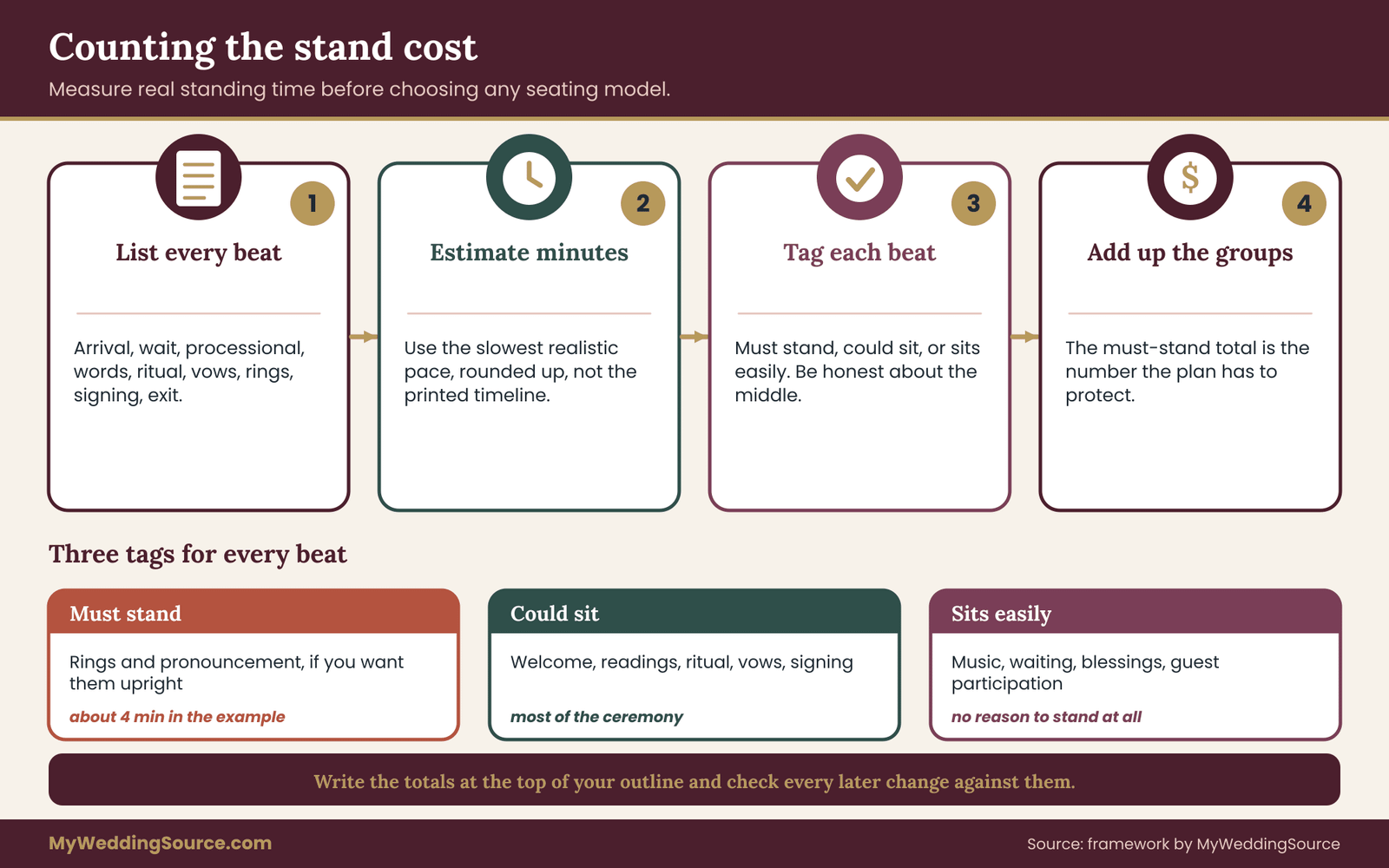
First, list every beat of the seated ceremony in order: arrival, the wait before the processional, the processional, the welcome, readings, any ritual, vows, rings, the pronouncement, the signing, the recessional and the immediate aftermath. Include the unplanned beats such as the pause for applause and the moment guests look for the photographer.
Second, write a plain estimate next to each beat. Use minutes, rounded up. Do not use the wedding planner’s idealized timeline. Use the slowest realistic pace, including delays for music, a late guest and a long reading.
Third, mark each beat with one of three tags: must stand if the beat has a ritual or legal reason for upright posture, could sit if it could happen seated with a small change, and sits easily if there is no reason to stand at all. Most readings, welcomes, sermons, musical pieces, rituals with objects and signing are in the third group. Many ceremonies have only two or three beats that truly need standing, and some have none.
Fourth, add up the minutes in each group. The “must stand” total is the number the plan has to protect. The “could sit” total is the room you have to work with. For most ceremonies, the “must stand” total is small.
The method has one more step that matters more than the arithmetic. Ask the partner who would be sitting, or their clinician if they have one, what a realistic standing limit looks like and what happens past it. Treat their answer as a design input, not an obstacle. If the limit is five minutes, the plan keeps standing under five minutes. If the limit changes by the day, build a plan that works at the lowest level and treat anything better as a bonus.
This also exposes a point couples sometimes miss. The person who sits is not the only one who benefits. Officiants, parents, wedding party members and elderly guests may all be standing longer than anyone planned for. The same stand cost count applied to the whole front of the ceremony often reveals that sitting is a kindness to six or eight people, not one.
Write the final numbers down in a small block at the top of the ceremony outline: total minutes, must-stand minutes, could-sit minutes, and the standing limit you are designing to. Every later decision in this guide, from chair choice to processional route, gets checked against that block. If a change makes the must-stand total grow, it needs a reason.
Six seated ceremony models, compared in plain language
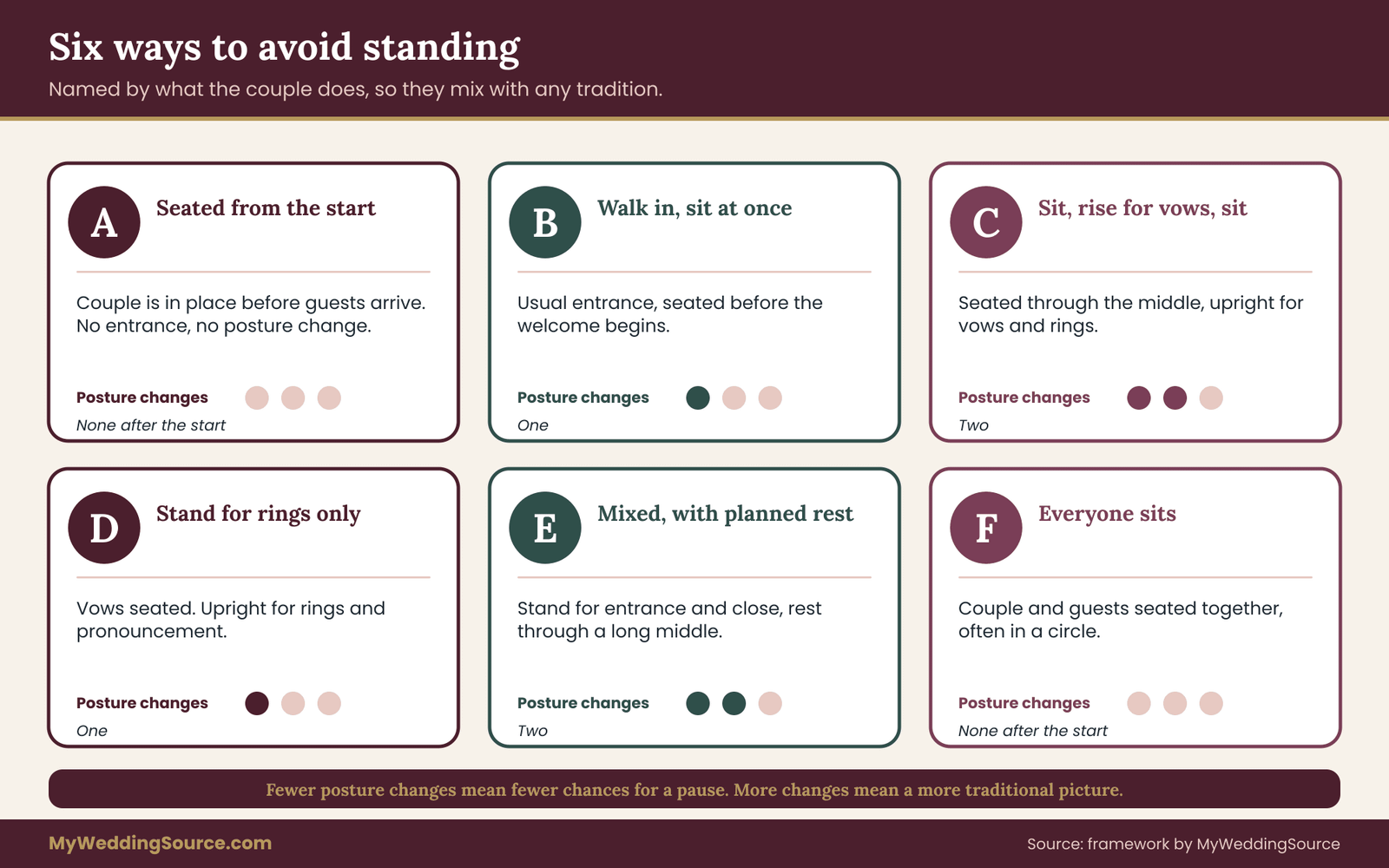
Once you know the stand cost, the choice is between a small number of models. Each one answers three questions differently: when does the sitting partner sit, what does the processional look like, and what do guests see. The six below cover nearly every real plan. They are named by what the couple does, not by any tradition, so you can mix them with whatever rituals you already have.
Model A: seated from the start. The couple is already in place before guests walk in. Guests arrive to a room where two chairs, or one chair and a standing partner, are the center of the layout. There is no processional for the couple, only a musical entrance for the officiant or wedding party. This is the simplest seated ceremony to run because there is no posture change at all. The cost is that the “moment of entrance” disappears, so the opening of the seated ceremony needs another way to mark the beginning.
Model B: walk in, then sit at the first beat. The couple, or one partner, processes in the usual way and sits as soon as they reach the front, before the welcome begins. Standing time is the aisle plus a few seconds. This keeps the entrance and gives the couple the rest of the seated ceremony seated. It needs a clear cue so guests do not assume the couple is about to do something else, and it needs the chairs to be placed so the sitting is quick and quiet.
Model C: sit, rise for the vows, sit again. The couple sits through the welcome, readings and any ritual, stands for the vows and rings, and sits again for the closing words. Standing time is the length of the exchange, usually a few minutes. This model suits couples who want the traditional picture at the key moment and need rest on either side of it. It has the most transitions, which means the most places for a hesitation.
Model D: stand only for the exchange of rings. A tighter version of Model C. The couple is seated through almost everything, including the vows, and stands only for the rings and the pronouncement, or even for just the kiss. The standing time is under a minute or two. It works when the vows are long or personal and the couple wants to speak them comfortably.
Model E: a mixed plan with a planned rest. The couple stands for the entrance and the first section, sits for a longer middle part, and stands again briefly for the close. This is the right choice when standing tolerance is moderate and the seated ceremony has a natural pause, such as a musical piece, a reading by a guest or a family ritual. The rest is built into the program, so no one reads it as a problem.
Model F: everyone sits. Guests are seated for the whole ceremony, which is already the norm for most weddings, and the couple sits with them or in front of them in chairs on the same level. In a small ceremony, the couple and the guests may sit in a circle or a close semicircle, with the officiant standing or sitting in the middle. This is the most informal of the six, and it is often the one that feels warmest.
Notice what the models do and do not change. They change posture and layout. They do not change the vows, the legal requirements for the officiant, or the order of the ritual. If your location requires specific words, witnesses or signatures, confirm those with the officiant and the issuing office before you finalize the layout. A guide to officiant requirements covers who can legally perform the seated ceremony and what they must do; it applies unchanged to a seated plan.
How the models differ in practice
Models A, B and F reduce the number of posture changes to zero or one. That is the safest choice when the sitting partner’s limit is low or unpredictable, because every extra transition adds a small risk of delay, loss of balance or discomfort. Models C and E add one or two transitions each, and Model D adds one at the very end. Each seated ceremony model trades the number of posture changes against how traditional the picture looks.
The models also differ in how much they rely on the officiant. In Models A, B and F the officiant can work from a fixed spot, and the cue sheet is simple. In Models C and E the officiant must announce or signal each change and then wait. A calm, specific officiant who has done this before makes those moments invisible. An officiant who fills silence with jokes can make the pause feel like a problem.
Sound is another difference. A couple who sits is lower, which changes how far their voices travel and how a lapel microphone sits. Seated couples often speak more quietly because they are not projecting upright. In a large room, this makes a microphone for the couple a practical need, not a luxury. The guide on ceremony cue sheets covers how to document microphone handoffs, and a seated plan only adds a line or two.
Finally, the models differ in how they feel to guests. Model A reads as a quiet, intentional design. Model B reads as a traditional ceremony with one small adjustment. Model C reads as a formal service with a rhythm. Model F reads as a gathering. If the aim is to avoid drawing attention to the seating, Models B and E are the least noticeable, because the couple has the entrance and the exit in the usual form.
Choosing between them without overthinking
A reliable way to choose is to answer three questions in order. First, what is the standing limit for the least-comfortable person at the front, and how sure are you about it? If the limit is low or uncertain, use A, B or F. Second, does the couple want an entrance? If yes, B or E fit; if not, A or F.
Third, is there a moment in the seated ceremony that feels wrong to deliver seated, such as the exchange of rings or a blessing? If yes, C or D give that moment its standing form. The right seated ceremony model is the one the least-comfortable person can follow without effort.
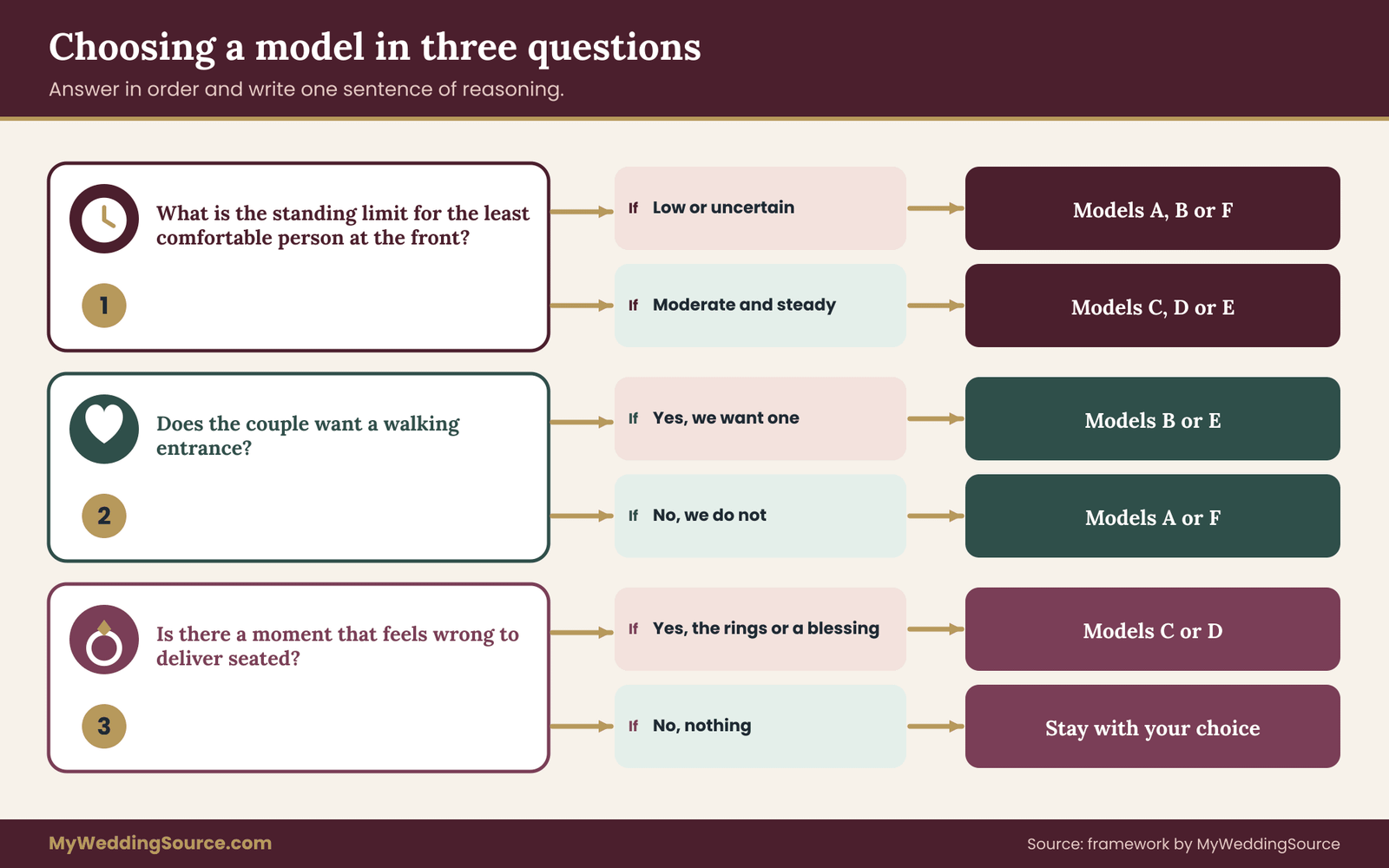
Write the choice down with one sentence of reasoning, for example, “Model B, because we want the entrance and the vows are long.” A sentence like that is useful later, when a vendor asks why the layout looks the way it does or a relative asks why you are not standing. It also tells the officiant, photographer and venue coordinator what the plan is for, which makes every later conversation shorter.
A final point on naming. Some couples worry that a seated ceremony will be read as a sign that something is wrong. In practice, guests respond to the tone set at the beginning. A short, warm line from the officiant, such as “Please stay seated, as the couple will be,” sets that tone, and the first minute makes the layout feel intended. Rehearsing the line is more helpful than rewording it endlessly.
What the models cost in time and setup
The models also carry different planning workloads. Model A has the lowest on-the-day workload but the heaviest setup before guests arrive, because the couple must be in place early and comfortable for a while, which may mean a private waiting area close to the seated ceremony site. Model B needs a clear path and a tested chair at the front.
Models C and E need a person assigned to help with the transitions if help is wanted, such as someone who steps forward to steady a chair or collect a bouquet during a change. A seated ceremony costs little extra in money and a fair amount in attention to detail.
Model D needs the officiant to describe the standing moment in advance, and it benefits from a simple physical marker, such as a small mat or a firm spot for the couple to stand on. Model F needs the most thought about the layout of the guest chairs, because there is no aisle and no stage, and the room must feel organized without a front.
Rental costs for chairs vary widely by region and vendor, so this guide gives no figures. Ask the rental company for the actual price and delivery terms in writing, and compare them against the venue’s included furniture. A rental planning checklist explains what to confirm before you sign, including delivery windows, damage terms and who sets up.
The seating and processional storyboard, beat by beat
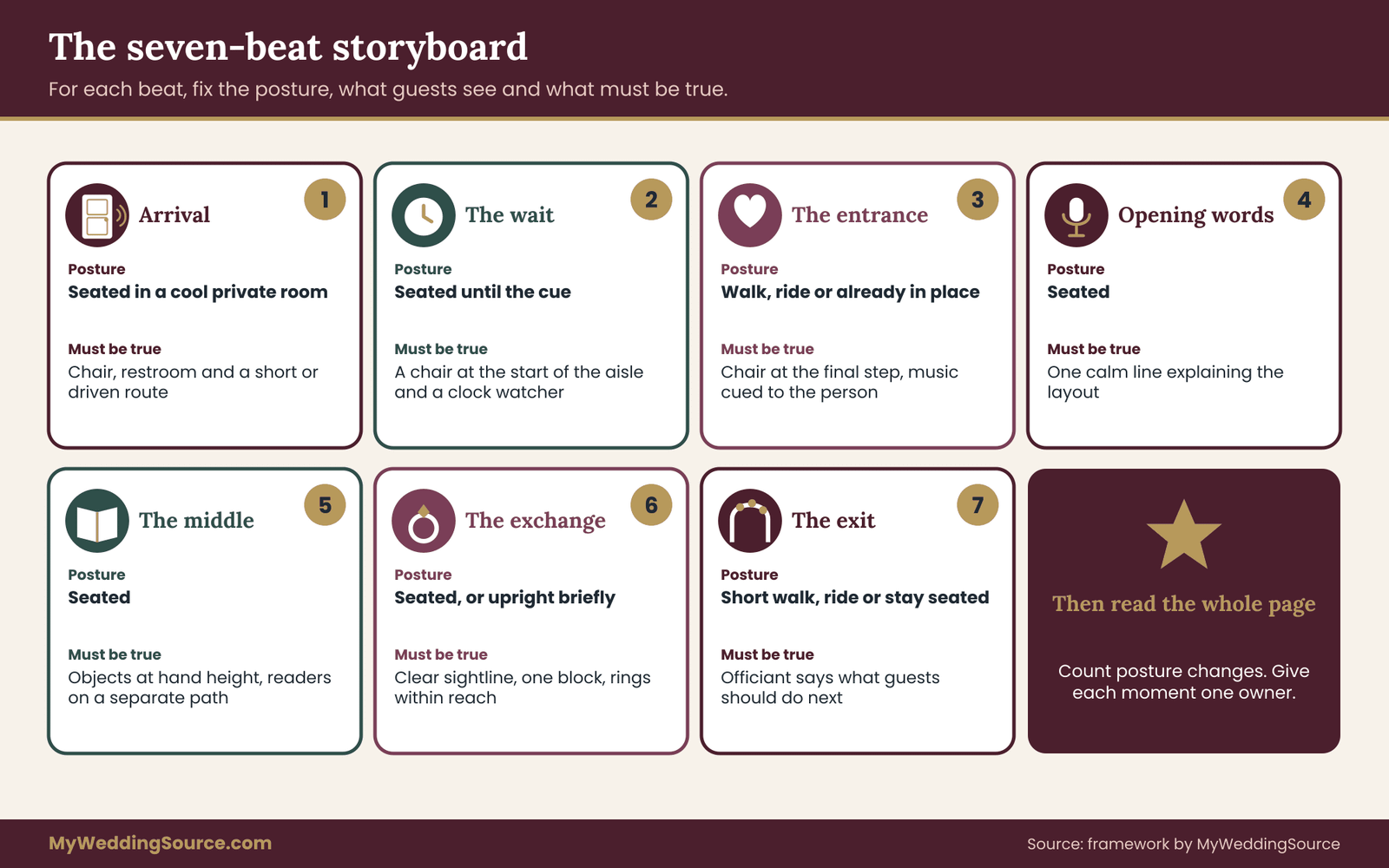
The storyboard is the working tool of this guide. It is a one-page sequence of seven beats, and for each beat you decide three things: the posture of each person at the front, what guests see, and what has to be true for the beat to work. It turns a vague wish to “sit for most of it” into a plan that an officiant, a photographer and a venue manager can follow without guessing.
The seven beats are arrival, the wait, the entrance, the opening words, the middle, the exchange, and the exit. They are deliberately generic. A Catholic Mass, a secular ceremony in a garden and a civil ceremony at a courthouse all contain them, though the middle will look different in each. If you want the traditional order and vocabulary, the guide to the wedding ceremony step by step lays it out, and the storyboard simply adds a posture line to each step.
Beat one: arrival
This is the time from the moment the sitting partner reaches the venue to the moment the processional music begins. It is the beat most often forgotten, and it is where energy is spent before the seated ceremony starts. Decide where the couple waits, whether there is a chair there, and how far the walk to the seated ceremony site is.
If the distance is long, or the surface is rough, plan a ride, a short cart or a path that avoids the worst stretch. A seated ceremony begins well before the music does, so the plan for this beat is part of the plan for the whole day.
Ask the venue whether a private room with seating is available, with a bathroom nearby, and whether it can be used until the last minute. A cool, quiet room with a chair also helps for reasons that have nothing to do with mobility, such as nerves and heat. In a seated ceremony of Model A, this beat carries extra weight, because the couple will be in place well before guests are, and the waiting space should be comfortable enough to support that.
Beat two: the wait
The wait is the interval between being ready and the first note. Late guests, late vendors and a late officiant all stretch it. Stand cost often hides here, because people stand at the back of the aisle with a bouquet in hand, unsure whether to sit. The simple fix is a chair at the start of the aisle, out of sight, until the cue to begin.
A second fix is a named person whose only job is to watch the clock and say, “Ten minutes, stay seated.” In a seated ceremony the wait is the cheapest place to save energy, because a chair here costs almost nothing.
If the start may slip, build slack into the plan instead of hoping. A seated ceremony start time with a stated buffer, such as telling guests to be seated at a time earlier than the real start, protects the front of the seated ceremony from guests arriving late. The cue sheet guide covers how to document that buffer and who owns it.
Beat three: the entrance
This is where the processional model matters most. In Models A and F there is no entrance for the couple, and the beat is a musical start for the officiant or the wedding party. In Models B, C, D and E, the sitting partner walks, rolls or is escorted to the front. Decide the route, the pace, the support and the finishing position. The next section covers processional choices in detail. Every seated ceremony needs this answer written down, however simple the layout is.
The key storyboard question for this beat is simple: where does the person end up, and how many seconds pass before they are in a chair? A walk that ends at a chair placed exactly where the person arrives is far easier than one that ends at a spot a few steps from a chair. Treat the chair as part of the final step of the aisle, not as an afterthought placed beside it.
Beat four: the opening words
The welcome, the opening reading or the invocation usually runs a few minutes. This is the first stretch where a seated couple can rest, and it is the beat that sets the guests’ expectations. The officiant should address the seating directly and briefly, in plain language, so that no one wonders whether something has gone wrong. A short line is enough, and it should be written into the script rather than improvised.
Some officiants prefer to sit as well, particularly in Models A and F, so that no one at the front stands over anyone else. Others stand to keep the guests’ attention. Either works, as long as the officiant’s eye line to the couple is level enough for a natural conversation and the officiant’s voice carries. If the officiant must stand and the couple sits, the officiant should stand slightly to the side, not directly in front, so that the couple and the officiant are both visible.
Beat five: the middle
The middle is the longest beat and the easiest to shorten the stand cost of, because it usually contains the readings, the ritual, the musical piece and any family participation. In a seated ceremony this is where the couple is simply seated, and the design question is attention: where should guests look? If readers come to a lectern, the couple’s chairs should not compete with it.
If a ritual involves objects, such as a cord, a candle, a glass or a ceremonial drink, the objects should be at hand height, and a small table or tray should sit within reach. This is the stretch that makes a seated ceremony feel natural rather than adapted.
This is also where cultural and religious elements are most often adapted. Many traditions already include seated passages, and an officiant familiar with the tradition can usually say which parts can be done seated without changing their meaning. Ask rather than assume, and ask early, so that nothing is a surprise on the day. If a family elder expects a specific posture, a short private conversation beforehand is kinder than a correction in public.
Beat six: the exchange
Vows, rings and the pronouncement are the beats that carry the legal and emotional weight, and the ones couples most often want to do standing. The storyboard question is whether standing is truly needed, and if so, for how long. Models C and D answer by rising for this beat only. If the couple stands, the officiant should sequence the words so that the standing time is minimal: ask the couple to rise, say the vows, exchange the rings, pronounce the marriage, and invite the couple to sit again, all in one short block.
Even in a seated ceremony, the exchange is the moment guests remember most, so give it the clearest sightline in the room.
If a partner cannot stand, the exchange works seated. Rings can be placed on hands resting on a small table or on the partner’s lap, and the kiss can be shared at chair height. Photographers do this regularly. What matters is that the officiant, the ring bearer and the witnesses are positioned so that the exchange is visible and audible, not that the couple is upright.
Beat seven: the exit
The recessional is the last place standing is expected, and the last place a plan can fail. The couple has just been through an emotional moment, may be tired, and will usually be asked to walk the full aisle with guests applauding. The storyboard options are to exit by the aisle at an easy pace, to remain seated while guests come to them, or to stay in place while the wedding party leaves first. Each is valid.
Remaining seated while guests file past or stay in place has a quiet appeal, because it avoids a long walk and turns the exit into a receiving moment. The cost is that guests must know what to do. A short line from the officiant, such as “Please join us for refreshments, and the couple will greet you here,” solves the problem.
Reading the storyboard as a whole
When all seven beats are filled in, look at the page as a single sequence. Count the posture changes. Count the seconds of walking. Check that the beats which share a location, such as the wait and the entrance, share a chair or a plan. Then look for beats where two people have a role at the same moment, such as an usher guiding guests while the officiant signals the couple, and assign one person to each. A seated ceremony storyboard that survives this check is usually ready for the officiant.
A good storyboard fits on one page, uses plain words, and can be read by someone who has never seen your venue. If it takes a paragraph of explanation, the plan is probably trying to do too much at once.
Share the storyboard with the officiant, the photographer, the venue coordinator, the musicians and the person who will cue the processional. Ask each of them for one thing: what is the first thing in this plan that will not work from your position? Their answers are cheap to collect and expensive to learn about on the day.
Processional choices when one or both partners will sit
The processional is the first thing guests see, and it sets how they read everything after it. In a seated ceremony it can still be a full, formal entrance. It simply needs to end at a chair, and it needs to respect how far the sitting partner can comfortably go. Several shapes work, and the right one depends mostly on the surface, the distance and the support the person wants.
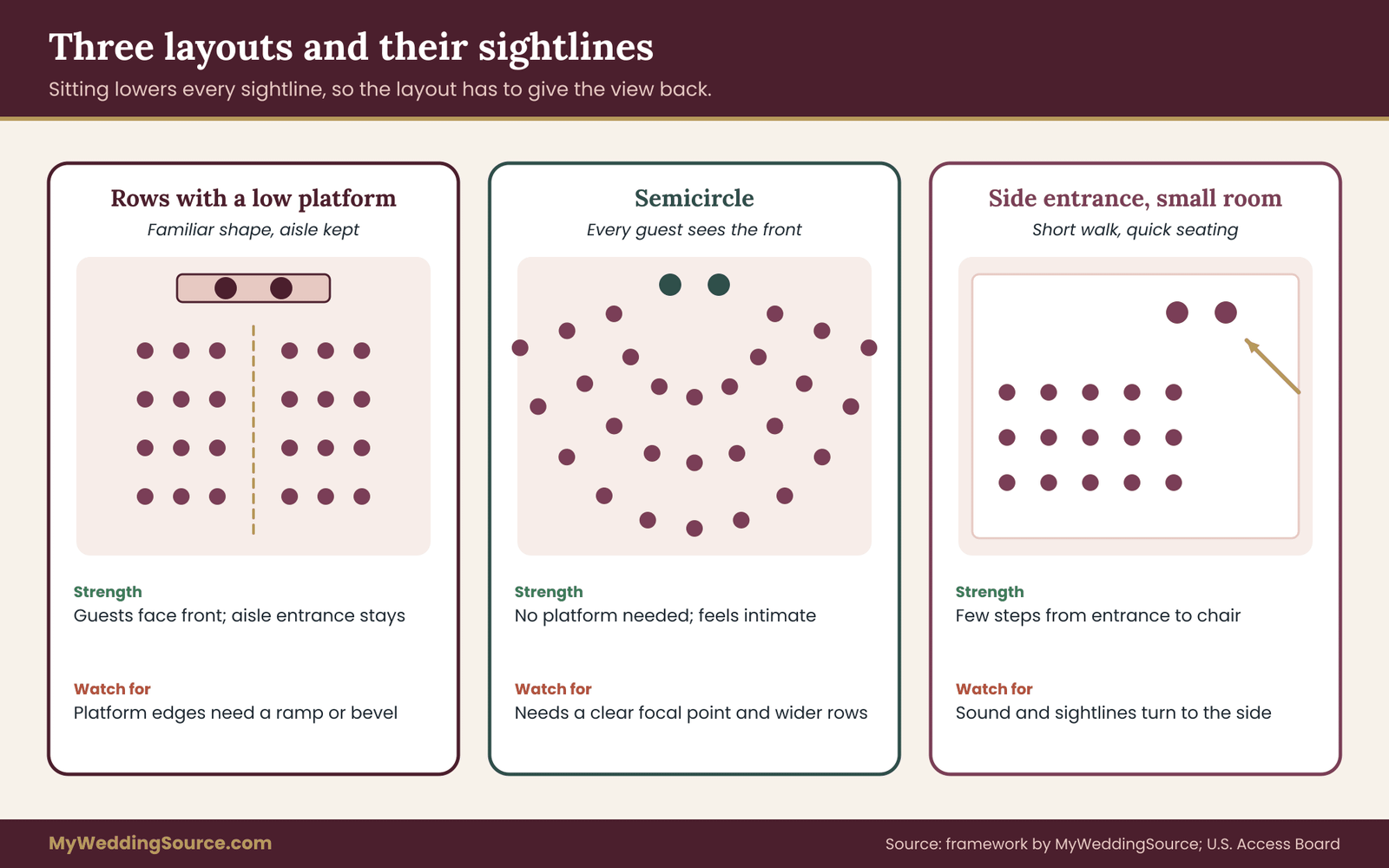
The short aisle. If the aisle is short, the sitting partner walks it in the usual way, with or without support, and sits at once. Shortening the aisle itself is the best change available. Many venues let the couple choose where the chairs begin, and moving the first row of guests closer to the front can cut the distance by half.
The side entrance. Instead of the center aisle, the couple enters from the side and is at their chairs in a few steps. This preserves a moment of arrival without the long walk, and it works well in small rooms and in outdoor spaces where the aisle is unpaved. It does change the sightline, because guests turn their heads to the side, so a clear announcement or a musical cue helps.
The seated entrance. The couple arrives in a chair, a wheelchair, a scooter or a cart, or is already seated when the doors open. For a partner who uses a mobility aid, this is not a workaround but simply how the entrance happens. For a partner who walks but tires, a ride covers the longest stretch and the final steps are walked.
The escorted entrance. A parent, a friend or the other partner walks alongside, offering an arm or a steady pace. This is the traditional shape, and it fits Models B, C and E. Choose the escort based on who the sitting partner feels steady with, not on who the family expects. The seated ceremony does not need a seated entrance, and a seated entrance does not need a fully seated ceremony; the two choices are independent.
The meeting in the middle. Each partner comes from a different direction and they meet at the chairs. This is common for couples who prefer not to be given away and for blended families, and it halves the distance for each. Layouts with no center aisle are a topic of their own, so this section stays with the posture and chair questions.
Pace, support and music
A seated plan changes the pace of the processional. A slow walk to a recorded piece can feel endless when each step costs effort, and a piece chosen for its length can end before the person arrives or keep playing long after they sit. Ask the musician or the person running the sound to cue the music to the person, not the other way around: the entrance piece should begin when the first person moves and fade only after the last person is seated. A seated ceremony changes the tempo of everything that happens before the first chair.
Support should be agreed in advance and rehearsed. If someone will offer an arm, decide which arm and what happens at the final step. If a cane, crutch, walker or other aid will be used, decide where it goes once the person is seated, since a cane left on the floor is a trip hazard and a walker left in the aisle blocks the path. A small hook on the chair, a stand at the side or a helper standing by solves this quietly.
Shoes are part of the plan too. Flat, supportive or familiar shoes are a standard accommodation for many bodies, and nobody in the room needs to know what is on a person’s feet. A long dress can hide them entirely. If the dress or suit affects movement, a guide to wedding day accessories is the place to read before the final fitting, not after.
Who goes first, and when
For a processional with a wedding party, the sequencing can protect the couple’s energy. Because the walk is the part that costs the most, it can be shortened by sending the party in earlier and starting the couple’s entrance close to the front. Alternatively, the party can enter together and wait in place, so the couple walks last and is seated as soon as they arrive.
The reverse also works: the couple enters first, sits, and the wedding party joins them, which turns the party’s entrance into a lively section rather than a long wait for the couple. In a seated ceremony the order of the processional is a tool for saving energy, not only a tradition.
If the couple is being seated before guests arrive, the party and officiant can enter around them. This is where a clear cue sheet matters. Every person in the processional should know who they follow, where they stop and where they stand or sit.
Edge cases in the processional
A few situations deserve a planned answer. If the sitting partner’s condition changes day to day, decide in advance the trigger for switching from walking to riding, for example the morning of the wedding, with a named person who makes the call with the partner and then tells the officiant and the sound operator. If the day is hot, cold or wet, the aisle may be too long or too slippery, and the fallback is the side entrance or a covered path.
If a child is part of the entrance, such as a flower girl or ring bearer, remember that children set the pace, and a seated plan should not depend on a smooth five-year-old. Every seated ceremony benefits from a decision on these cases before the morning of the wedding.
Chairs, floor plan and sightlines for a seated ceremony
Furniture is where a seated ceremony succeeds or fails in photographs. Two chairs placed carelessly at the front can look like a waiting room. Placed well, they look like a deliberate design. The tests below apply whatever the style of the wedding.
Chair height and depth. Choose chairs that the sitting partner can get into and out of without effort. Seats that are too low or too soft make rising difficult, and a chair with firm arms gives something to push from. Ask the partner to try the actual chair, not a picture of it. If the chair is rented, ask the rental company which models are available and whether a test visit is possible.
Chair style versus the rest of the room. A single armchair next to a standing partner can look unbalanced. Matching two chairs, or using a loveseat, gives a visual balance and puts the couple at the same height. A pair of chairs also works well in a small ceremony, where each person has their own space.
Space around the chair. Leave room for a mobility aid, a train, a bouquet and a step to rise. A chair placed against an arch or a table can trap a person. The guide on venue technical walkthroughs covers how to measure clear widths and turning space, and the same measurements apply here.
Surface. Chair legs sink into grass, wobble on gravel and slip on polished stone. Ask the venue about flooring under the chairs. A low platform, a flat mat or a rug underneath can stabilize the chair, but any raised edge is a trip hazard and needs a bevel or ramp. Test the chairs on the actual surface at the walkthrough.
Sightlines for guests
The most common failure in a seated ceremony is that guests in the back half cannot see the couple. People sit lower than they stand, and rows of guests block the view of anyone seated behind. Fix this with at least one of four tools: a low platform for the couple, a raised row of chairs for the couple, a layout with the couple at the center of a semicircle, or fewer rows with wider spacing. Sightlines decide whether a seated ceremony feels generous or distant to the people in the rows.
A platform is the most direct option. Even a low rise of a few inches changes the view for the back rows, but it adds a step or an edge, so it must have a ramp or be wide enough to meet accessibility needs. The access board and the ADA publish standards for ramps and clearances, and venues that host the public are often already compliant. Ask the venue before building anything.
A semicircle or horseshoe layout lets every guest see the front without a platform, because the rows curve toward the couple. It suits Model F and any small to medium ceremony, and it replaces the aisle with a central focus.
Officiant and readers
Place the officiant so that guests see the couple’s faces, not the officiant’s back. If the officiant stands, a spot to one side and slightly forward works, with the couple seated at an angle toward both the officiant and the guests. If the officiant sits, a chair at the same height as the couple’s creates a conversation rather than a lecture. In a seated ceremony the officiant’s position matters more than usual, since the couple is lower than the person speaking to them.
Readers and musicians need their own paths. A reader who has to cross in front of the couple blocks sightlines and may step on a dress. Give readers a separate approach and a fixed place to stand, with a lectern or a music stand at a comfortable height.
Sound and microphones
Sound travels differently from a lower position, and a lapel microphone on a seated couple can pick up fabric noise. Ask the sound operator to test the exact seated position, with the exact seating and the clothing in the plan. A handheld microphone on a stand placed within reach of both partners is an alternative, as long as it is at the right height.
Officiant, music and cue changes for a seated ceremony
A seated ceremony runs on cues. Someone starts the music, someone tells guests to stand or sit, someone hands over a ring. When the couple sits, a handful of cues change, and writing them out is the cheapest insurance against confusion. The goal is that no one at the front has to improvise, and no guest has to guess.
The officiant’s script needs four additions. The first is a short opening line that explains the layout. The second is a clear instruction for guests, which is often the most important line, because guests default to standing whenever the couple enters or leaves. The third is a transition line for each posture change. The fourth is a closing line that tells guests what happens next.
Sample wording you can adapt
These lines are examples. Change them to match your voice and your officiant’s. Every seated ceremony script benefits from the same four moves.
Opening: “Welcome, everyone. Please stay seated. The couple will be seated for most of today, and we are glad you are here with them.”
For a posture change: “At this point, the couple would like to stand for their vows. Please remain seated.”
After vows: “You may be seated. Thank you.”
For the exit: “As the couple leaves, please stay in your seats until the music has finished, and then join us outside.”
Each line is short, calm and free of apology. A seated ceremony that frames the seating as a choice tends to be received as one. A line that begins “Because of a condition” is not needed and not recommended, since the reason is private. Some couples like to add a warm sentence, such as “We asked everyone to stay seated so we can all be comfortable,” and that is fine.
The “please be seated” problem
At many ceremonies, the officiant says “please rise” or “please be seated” to guests as part of the program, especially in religious services. This convention conflicts with a seated plan in two ways. If guests are told to rise when the couple enters and the couple is already sitting, guests may stand with nothing to watch. And if guests are told to sit while the couple remains standing, the room can become confused.
Decide in advance which tradition applies and write the cue accordingly. In a seated ceremony, the simplest rule is: guests rise only if the couple rises, and the officiant says so explicitly. If your tradition requires guests to rise at set points, ask the officiant whether the point can be adapted, for example by inviting guests to stand “if they are able and wish to,” a phrase many clergy use already.
Music cues
Music is a timing risk because it runs to a clock, not to people. For a seated plan, ask the musician or the DJ to follow three rules. Start the processional piece on the officiant’s or coordinator’s signal, not on a fixed time. Hold the final note or loop a phrase until the last person is seated. And end the recessional piece only after the couple is out of the aisle, or be ready to loop.
If the music is recorded, the person running it should have the cue sheet and a person at the front to signal readiness. If the music is live, the musician needs to see the couple, since a musician who cannot see them will guess. The cue sheet guide on ceremony timing and music cues explains how to write a cue, who gives it and who confirms it.
Handoffs while seated
A seated couple needs a plan for objects: rings, bouquets, readings, the license and a pen for signing. Decide who holds each item and how it reaches the couple. A ring bearer who must walk to a seated person may have to kneel or bend, so a small tray at hand height or a helper who passes the item is easier. For the signing, a table at the right height, a clipboard on a lap or a signing done afterward in a private place are all acceptable.
If the couple sits, a small side table is useful at the front for water, tissues, a program or a medication that must be nearby. A discreet water glass is useful whatever the reason for sitting. If medication is part of someone’s day, they and their treating professional decide how and when to manage it; the plan only needs to leave a place and a person to help.
A quiet role: the ceremony steward
One of the most useful assignments in a seated plan is a steward whose only job is the sitting partner’s comfort during the ceremony. The steward does not speak. They watch for signals, hold a bag, fetch water, adjust a chair and carry out the backup plan if needed. Pick someone calm, trusted by the partner, and not otherwise busy. A parent, a sibling or a close friend who is not in the wedding party is often the best choice. The steward is the person who makes a seated ceremony feel effortless to the couple.
Agree on a signal, such as a hand touching a knee or a small nod, that means “I need a pause.” Agree what the steward does when they see it, which may be as simple as stepping forward to catch the officiant’s eye. Share the signal with the officiant so that a pause can look intentional.
Guests and the seated ceremony: sitting together, standing together
The second half of the design is the room. Guests respond to cues from the front, and they notice when the couple is not doing what they expect. A small amount of structure helps them understand the layout and keeps the focus on the seated ceremony instead of the chairs.
Tell guests ahead of time. A line on the wedding website or in the program is enough. A good phrase is “The seated ceremony will be seated for the couple; guests are welcome to stay seated throughout.” This sets expectations for anyone who would otherwise stand out of habit or worry, and it helps older guests, who may be glad to stay seated too. The guide on guest care planning covers how to arrange comfort for older relatives, babies and children, and a seated ceremony fits neatly with that planning.
Seat guests in a way that matches the layout. In a semicircle, the first row should be close enough to the couple to feel intimate and far enough to leave space for the aisle or entrance. In rows, leave a clear center for sightlines and avoid placing tall guests directly behind the couple’s line of sight where possible.
Reserve accessible spots. Some guests need seats at the aisle, at the end of a row or in a space for a wheelchair, and they should not be placed behind a pillar. Reserve these spots in advance, with signs or ushers, and place a companion seat beside them. The guide to accessible wedding venue red flags lists what to check about entrances, routes and restrooms before you commit to a space.
Brief the ushers. Ushers should know the plan, the cue to stay seated, the reserved spots and the route for the couple. They can answer “Why are they sitting?” with a single sentence: “That is how they planned it.” No one is owed more.
Do guests stand when the couple enters?
In many traditions, guests rise for the bride, the couple or the procession. In a seated ceremony that convention has to be settled. Options include asking guests to stay seated throughout, asking them to rise for the entrance only, or following the tradition and letting the couple sit while guests rise. All three work, as long as the officiant states which applies. When the couple sits for the entrance, as in Model A, guests have nothing to rise for.
The reception handoff
The ceremony ends and the next beat begins, often with a long standing cocktail hour. For a couple who sit, it is worth designing a bridge: a place to sit during photographs, a seat near the receiving line, a table within reach of food and drink. The reception guide on guest flow explains how to arrange entry, seating and movement so that the couple is never standing in a crowd by default.
Consider also whether the seated ceremony site doubles as the next space. If the room is flipped for the reception, the couple may be left waiting in a hallway. If the seated ceremony is outdoors and the reception is inside, a golf cart or a short path may be needed. These are the details that make the day feel easy afterward, and they are cheap to plan when the ceremony is.
Photos, video and the seated ceremony
Photographers can make a seated ceremony look as good as any, and many have shot them. The trouble comes from one habit: the seated ceremony pictures are planned for a standing couple, and a seated couple needs a different set of angles. A brief conversation a few weeks before the wedding removes the problem.
Tell the photographer and videographer the plan in writing. Include the model, the beats where the couple will stand, the chair positions and the direction the couple will face. Ask for their view of the layout, and ask where they plan to stand. Photographers often move during a seated ceremony, and a seated couple means they need a lower angle and more room to the side so that they do not block guests.
Angles that work
For a seated couple, the strongest pictures tend to come from slightly above eye level at a three-quarter angle, from the side where the officiant stands and from behind the guests’ heads. Ask for a few from a low angle near the front, too, since a low angle makes the couple look larger and hides the chairs. Pictures of hands, rings and faces do not depend on posture at all, and a photographer who shoots close can make the standing question disappear. A photographer who has shot a seated ceremony before will already know most of this.
If the couple stands for the exchange, tell the photographer exactly when. A photographer who knows the moment can be in position early rather than moving mid-ceremony. If the couple remains seated for the exchange, say so, so the photographer plans for hand-level images.
Portraits and group photos
Formal portraits can be the most tiring part of a wedding day, and they usually come right after the seated ceremony, when the couple is already tired. This is a place where the seated plan can extend. Options include holding portraits before the seated ceremony, when energy is highest, doing a short portrait session seated, scheduling a break between the seated ceremony and the family photographs, and giving the couple a chair at the edge of the frame during group photos.
A seated ceremony ends the standing in the aisle, and the portrait schedule should not bring it back.
Group photographs are another place where standing adds up, for the couple and for everyone in the group. A written family photo list helps, and the guide on the wedding family photo list explains how to build one that is short and ordered. Keep it brief, put the longest and most elderly groups first, and sit anyone who needs it.
Video, livestream and audio
If a seated ceremony is filmed or streamed, a seated couple changes the camera setup. The camera needs a clear line to the couple at a lower height, and a camera operator who has a fixed position can avoid the aisle. Audio is the bigger issue: a seated couple speaks to a different spot, and a lapel microphone can be muffled by clothing. Test the audio at the actual seated position during the rehearsal. A seated ceremony is no harder to film than any other, as long as the operator knows the plan.
If remote guests will watch the stream, tell them the couple will be seated, so that they do not worry. The same line used on the website works.
A worked case: an invented couple and a forty-five-minute ceremony
The following example is invented. It is not a real couple, a real venue or a real medical situation. It exists to show how the stand cost count, the model choice, the storyboard and the backup trigger fit together. Treat the numbers as illustration, not as targets.
The couple. Priya and Tom are planning an outdoor ceremony at a garden venue. Priya has a condition that makes long standing painful, and with her clinician she has decided that about ten minutes upright is her comfortable limit on an ordinary day and less on a bad one. Tom has no standing limit. They do not want to explain this to guests. They want an entrance, a quiet middle and photographs that look like a normal wedding.
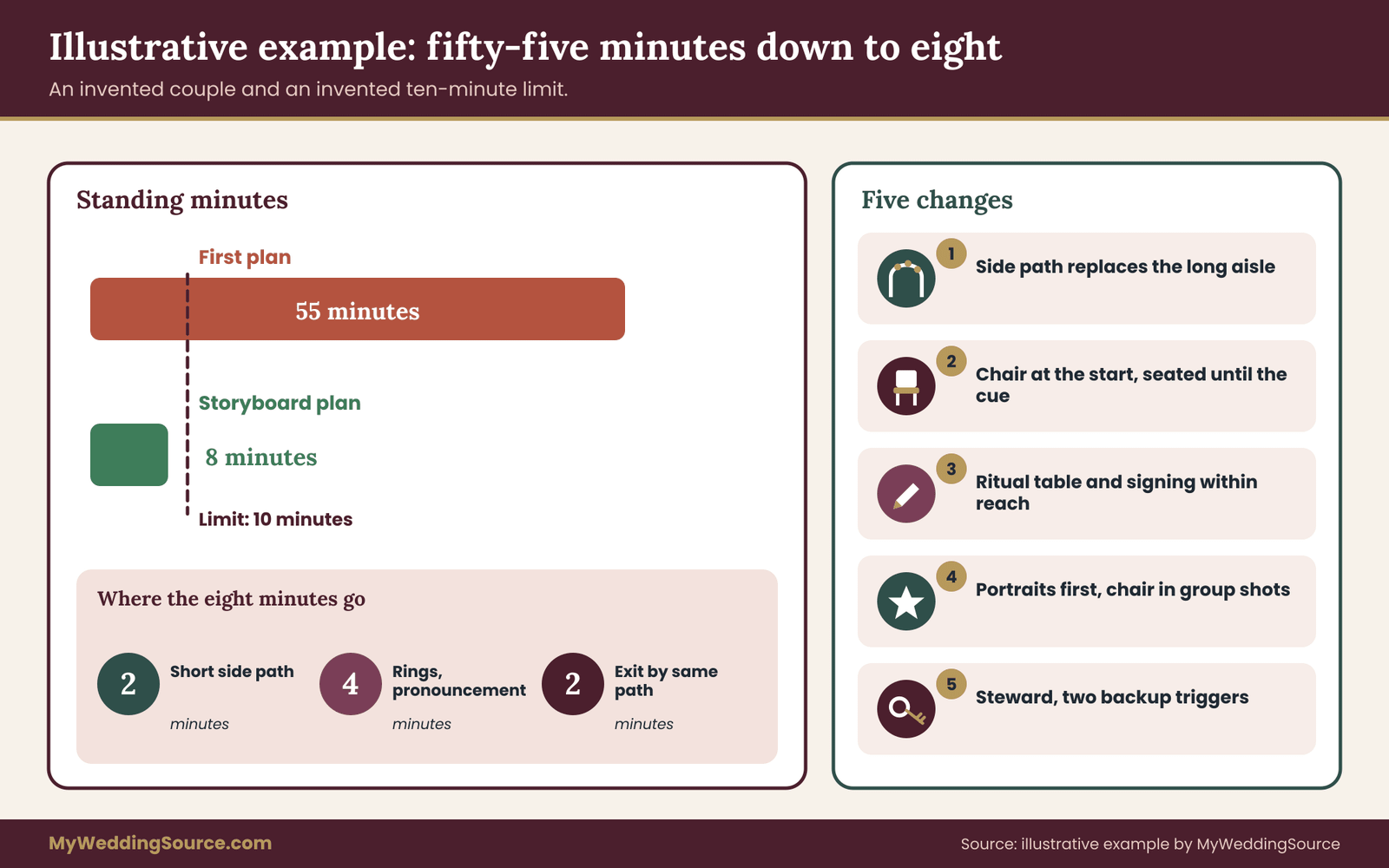
The first count. They list the beats in the planned order and give each a realistic number of minutes. Waiting at the back of the aisle takes ten. The processional down the long garden path takes three. The welcome takes four. Two readings take eight. A candle ritual takes five. Vows take six, rings three, and the pronouncement and kiss one. The signing takes five. The recessional takes three. Formal photographs at the front before anyone sits take seven. The standing total is fifty-five minutes, more than five times her limit.
Marking the beats. Priya and Tom mark each beat. The wait, welcome, readings, ritual, vows and signing all “could sit” or “sit easily.” The processional, rings, pronouncement and recessional are marked “must stand” only because they are the moments both of them want to do standing. That leaves about eleven minutes of must-stand, a little over her limit.
Choosing the model. They want the entrance, so Model A is out. They want the vows to be calm and heard, and they also want the rings and the kiss standing, so they pick Model D with an entrance: vows seated, rings and pronouncement standing. In their own words on the storyboard: “Model D with an entrance, because we want to walk in together and stand only for the rings.”
The adjustments. The long garden path becomes a short side path, cutting the walk from three minutes to two. A chair is placed near the start of the path so that Priya waits seated until the cue. The ritual table is moved within reach of both chairs, and the signing happens seated at a small table.
The recessional is shortened by exiting through the same side path rather than the full aisle. Formal photographs move to before the seated ceremony for the couple, with only the quick family groups after, and Priya has a chair at the edge of each shot.
The new count. Standing time is two minutes for the entrance, four for the rings and pronouncement, and two for the exit. That is eight minutes, within her ten, with a margin of two. Eight minutes is a standing total they can say out loud to the officiant, the photographer and the venue, and each of them can point to the beat on the storyboard.
The cues. The officiant opens with a line that explains the seating in a sentence. Guests are asked to stay seated throughout. The music is cued by the coordinator, who watches Priya reach her chair. A steward, Priya’s sister, sits in the front row with a bag and a signal. Tom’s role is to pause before the rings so that Priya can rise at her own pace.
The backup trigger. The plan names two triggers. If Priya rates her morning as a low day, the rings and pronouncement are done seated, and the exit uses a cart. If the weather changes, the seated ceremony moves under the covered pavilion, which has a shorter path and a firm floor. The steward and the coordinator know both triggers and the officiant is told at the rehearsal.
What they would do differently. In reviewing the plan, they note one thing they nearly missed. The cart route crossed a gravel strip, so they asked the venue to lay a temporary mat. They also realized that no one had told the musicians that the entrance piece might be longer if Priya paused. They added a line to the cue sheet.
The worked case is a pattern, not a template. Another couple with a different limit, venue or tradition would reach a different plan by the same steps: count, mark, choose, adjust, recount, cue and name the triggers. What carries over is the order of the steps and the habit of writing the final standing total in minutes.
When a seated ceremony plan fails, and what to do instead
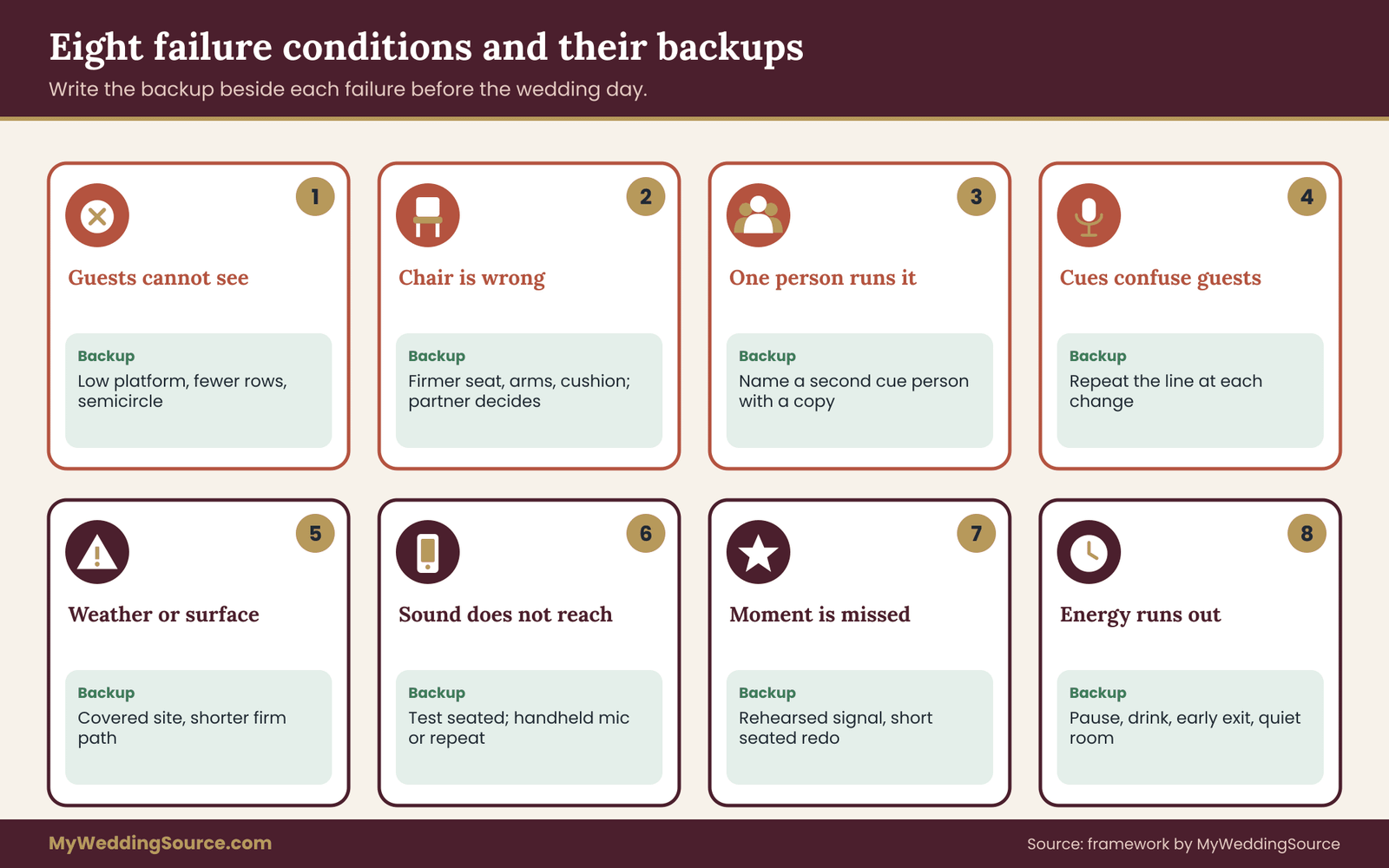
Every plan has failure conditions, and naming them in advance is what separates a plan from a hope. The failures below are the ones that show up most often in seated layouts. For each, the useful questions are how you would notice it, who decides, and what the backup is. Write the answers on the storyboard, so that nobody is solving them in the aisle.
Failure one: guests cannot see. The usual cause is flat ground, tall rows and low chairs. You notice it at the walkthrough or during setup, when someone sits in the last row and cannot see the couple. The backup is a low platform, fewer rows, a semicircle or a screen. The decision belongs to the couple and the coordinator, and it must be made before guests arrive, since moving chairs mid-seating is chaos.
Failure two: the sitting partner cannot rise, or cannot sit comfortably. The chair is too low, too soft, too wide, or on an uneven surface. You notice it at the first test, which is why the chair should be tested on the actual surface and, if possible, in the actual outfit. The backup is a firmer chair, a cushion, a seat with arms or a different chair altogether. The partner decides, not the vendor.
Failure three: the plan depends on one person. If a single helper controls the cues and that person is delayed, unwell or distracted, the whole plan stalls. The backup is a named second person with a copy of the cue sheet. Two people should always know the plan.
Failure four: the posture changes confuse guests. Guests stand when they should sit, or sit when they should stand, and the room feels out of step. The backup is a clear line from the officiant at each change and a note in the program. A cue that is repeated twice is never wasted.
Failure five: the weather changes the surface or the distance. Rain, heat, wind or cold can make a path unusable or a chair unstable. The backup is a covered location, a shorter path, a firmer surface or a shelter for the waiting area. The decision point and the person who calls it should be named at the planning stage, not on the morning.
Failure six: the sound does not reach. A lower seated voice, a muffled microphone or a noisy chair reduces clarity. You notice it at the sound check. The backup is a different microphone, a different position, or a short line from the officiant that repeats the vows for guests.
Failure seven: the photographs miss the moment. The photographer was in the wrong place, or the couple’s posture changed unexpectedly. The backup is a second shooter, a rehearsed signal, and a quick posed re-creation of the exchange afterward, kept short and seated.
Failure eight: energy runs out before the end. The plan counted stand time but not the tiredness of the waiting, the heat, the emotion and the photographs. You notice it when the partner signals. The backup is a pause, a drink, a seat for the remaining beats and an early exit. Plan the recovery too: a quiet room, a snack, a rest before the reception.
A short test before the day
A rehearsal is the best way to find failures. Run the sequence once on the real floor, with the real chairs, the real shoes and the real microphone if possible. Walk the route, sit, rise, sit again, and time each step. Ask one person to sit in the last row and tell you what they can see and hear. Afterward, change one thing at a time, and run the changed step again. Even a seated ceremony that looks simple on paper deserves one run on the real floor.
If a full rehearsal is not possible, a short one still helps. Even a ten-minute run through the chair placement and the cues with the officiant, the coordinator and the steward is better than none. If the venue is far away or the venue’s rules prevent a rehearsal, use the walkthrough to place the chairs and test the surface, and rehearse the script at home.
When to change the model on the day
A model is a plan, not a contract. On the day, the couple may feel better or worse than expected. The cleanest approach is to give the sitting partner the authority to change the plan with a signal and to tell the steward, who tells the officiant. Moving from Model C to Model D, or from Model B to Model A, can often be done with a single sentence.
Having a fallback planned and practiced makes that sentence calm. A seated ceremony plan that allows a change on the day is far less stressful than one that does not.
If a change is made, resist the urge to apologize or explain. A seated ceremony that adapts smoothly looks designed, and guests remember the warmth of it, not the posture. For further thinking about venue features that make adaptation easy, a guide to accessible venue red flags lists what to look for before booking.
Your next steps
You do not need to settle everything at once. Work through these in order, and stop when the plan is clear enough for the people who must carry it out.
- Write the seated ceremony outline with realistic minutes for each beat.
- Mark each beat as must stand, could sit or sits easily, and total the minutes.
- Ask the sitting partner, and their clinician if they have one, what standing limit to design to.
- Choose one of the six models and write one sentence of reasoning.
- Fill in the seven-beat storyboard with posture, what guests see and what must be true.
- Test the chairs on the real surface and check sightlines from the last row.
- Write the officiant lines, music cues and handoffs into the cue sheet.
- Name a steward, a second cue person and two backup triggers.
- Brief the photographer, the sound operator and the venue in writing.
- Rehearse once, recount the standing minutes and adjust.
FAQ
Is a seated ceremony acceptable for a wedding?
Yes. Nothing about a wedding requires the couple to stand for the whole ceremony. Rules about the officiant, witnesses and the license are about who is present and what is said, not about posture. Confirm any specific legal or religious requirement with your officiant and the office that issues your license, then plan the seating around those requirements without apology.
Do we need to tell guests why we are sitting?
No. A short, positive line in the program or on the website, such as asking guests to stay seated, is enough. The reason is private and nobody is owed it. Ushers and the officiant can answer questions with a calm sentence like “That is how they planned it,” and move on.
How long should the ceremony be if one partner sits?
There is no right length. A shorter ceremony reduces the strain on everyone, but a seated plan can also handle a long ceremony if the postures are planned. Count the real minutes, find the must-stand beats and keep those within the partner’s limit. If a limit is uncertain, design to the lower figure and treat the rest as a margin.
Can both partners sit?
Yes. Many couples choose chairs for both, either side by side or facing each other. Matching chairs also gives a balanced picture and avoids one person looking singled out. Make sure both can reach the objects used in the seated ceremony, such as rings, a table or a microphone, without leaning or twisting.
Where should the officiant stand?
To one side and slightly forward, so guests can see the couple’s faces and the officiant’s voice carries. If the couple sits, the officiant may also sit, which creates an even eye line. Test the position at the walkthrough, check the sound and make sure the officiant is not blocking the photographer or the nearest guests.
What do we do about guests who expect to stand?
Settle the rule in advance and tell the officiant. The simplest rule is that guests rise only if the couple rises, and the officiant says so. If a tradition expects guests to stand at set points, ask whether those points can be optional, and add a line in the program so people know what to expect.
How do we keep photographs from looking awkward?
Brief the photographer in writing with the model, chair positions and the beats where you will stand. Ask for hand-level and close images, a low front angle and a slightly raised angle from the side. Schedule portraits before the seated ceremony or keep them short and seated, so the pictures are taken when you have the most energy.
What if the plan needs to change on the day?
Name a person, usually the steward, who can pass a signal to the officiant, and agree two backup triggers in advance, such as a low day or bad weather. Changing models is often a single sentence from the officiant. A change made calmly looks planned, and guests remember the seated ceremony rather than the adjustment.
Sources
- ADA.gov, U.S. Department of Justice: information and technical assistance on the Americans with Disabilities Act
- U.S. Access Board: accessibility guidelines and standards for ramps, clearances and seating
- ADA National Network: guidance on accommodations for events and public venues
- Job Accommodation Network: practical guidance on seating and standing accommodations
- CDC, Disability and Health: general information on access and participation
- National Park Service, Accessibility: guidance for outdoor sites and programs
- National Weather Service: heat, cold and storm safety information
- National Fire Protection Association: codes and standards for assembly spaces and egress
- USA.gov: finding state and local marriage license and officiant rules
- Occupational Safety and Health Administration: general information on heat illness prevention