
A private first look is a short, planned moment when the two of you see each other before the ceremony, away from an audience, so the emotion belongs to you first and to the photographs second. This guide helps couples who want that privacy, and who may also need low noise, few people and a predictable sequence, to choose a format and set it up without pressure.
Treat a private first look as a design choice with four dials: who can see it, how much sensory load it carries, how much time pressure surrounds it, and how it will be captured. Pick one of six low-pressure formats by scoring each dial for the two of you, write down what the photographer may and may not do, and agree a fallback in advance. If the moment goes badly, you stop, pause and use the fallback, with no apology owed.
Most advice about a private first look is written for couples who want a dramatic reveal with a camera close by. That is a fine wish. But some couples picture something different. They want the first sight of each other to be quiet, unobserved and unhurried. Others know that a surprise, a crowd or a clicking shutter will take the feeling away before they can have it. A private first look is the version of the idea that starts from those needs instead of from a shot list.
This guide does not assume that all couples who prefer privacy have the same needs. For one person the problem is being watched. For another it is the sound of a shutter, bright light, the pressure of having to react on cue, or the fear of crying in front of a stranger. For a third it is simply that the day feels loud and the private first look is the one calm minute worth protecting. The method below works from your own list, not from a label.
You will find six formats, four dials for choosing among them, a set of decision rules, a worked case with an invented couple, scripts for talking to your photographer, and a plain account of how each format can fail and what to do then. Planning a private first look is mostly a matter of deciding in advance who stands where, and for how long.
A note on scope. This is general planning information, not legal, tax or financial advice, and it is not medical or therapeutic advice. Venue policies, photographer contracts and accessibility obligations vary, so confirm them with the people who issue them. The sources at the end point to official pages on accessibility, sun times and copyright.
What a private first look protects
Before comparing formats, it helps to name what a private first look is protecting. Couples often say “privacy” and mean three separate things, and each one points to a different setup.
The first is emotional privacy: the right to react however you react without being observed by guests, family or even the photographer. You might laugh, cry, say nothing, or need a minute with your face turned away. A private first look protects the reaction itself.
The second is sensory comfort. The reveal tends to happen on a wedding morning, when hair, makeup, music, relatives and vendors are all operating at once. Even a happy moment can be hard to feel while a camera clicks, a flash fires or a crowd murmurs behind a door. For some people a private first look is the one point in the day with deliberately low input.
The third is control of the sequence. Many couples dislike surprises on a wedding day, even pleasant ones. A private first look lets you decide when it happens, who knows, what is said and what happens next. That predictability is itself a form of comfort, and it is worth protecting as carefully as the privacy.
Keep these three apart in your own head. A couple who mainly want emotional privacy may be happy with a photographer far away with a long lens. A couple whose main concern is sensory load may not want any camera nearby at all. A couple who mostly want control of the sequence may be content with a fairly ordinary first look if the timing is fixed and rehearsed.
What a first look is not
A first look is not a performance, and it is not a rule. Nothing about a wedding requires you to see each other early, or to see each other late. Some couples find that a private first look lowers their stress for the whole day, because the biggest emotional moment is already behind them and they can attend the ceremony with a steadier nervous system.
Others find that saving it for the aisle is the point. Both are legitimate. If photographs of guests are part of the worry, the wedding photography consent guide covers boundaries for everyone else at the event.
It is also not a photography session with a feeling attached. The photographs are a product of the moment, not its purpose. If the choice comes down to a better picture or a calmer couple, a calmer couple wins, since you will remember how it felt long after you stop looking at the album.
Four dials that shape a private first look
The core of this guide is a simple scoring method. Every private first look can be described by four dials, and each dial can be turned low, medium or high. Instead of copying a stranger’s wedding, you set the dials for the two of you and let the format follow.

Dial one: audience. Who is in sight or earshot? Low means no one but the two of you. Medium means a single trusted person at a distance, such as a photographer using a long lens or a planner at a door. High means several people, including relatives or a full photo team. Many couples assume the photographer must be close. In practice, audience can be turned very low by choosing equipment and placement that keep people out of both sight and hearing.
Dial two: sensory load. How much light, sound, movement and surprise is in the space? Low means a quiet room, soft natural light, no flash, no music and no clicking you can hear. High means a bright venue, bustle in the corridor and a photographer working at close range. You can turn this dial down by choosing the room, the time, the lighting and the camera, and by agreeing on silence.
Dial three: time pressure. How much of the schedule depends on this moment running on time? Low means a long buffer before and after, and nothing waiting on you. High means a tight transition where a delay causes a chain reaction, with a hair team, a car and a ceremony start all pressing. Time pressure is the hidden source of stress at many first looks, and it is the dial couples most often forget to set. A wedding vendor timeline shows where the pressure sits across the day.
Dial four: capture mode. How will the moment be recorded, if at all? Low means nothing recorded at all, or only a recording the two of you control. Medium means a photographer at a distance, or a short audio recording with no video. High means close-range photography and video from several angles. Capture is a dial, not a yes or no, and every position on it is acceptable.
Why four dials and not a quiz
A quiz would give you a label. Four dials give you a vocabulary you can share with a photographer and a planner. “We want audience low, sensory low, time pressure low, capture medium” is a sentence a professional can act on. “We are shy” is not.
The dials also interact. Turning audience down often turns time pressure up, because a private setup needs extra minutes to arrange. Turning capture down often protects the other three dials at once. Seeing those trade-offs on paper, before the morning, is the main benefit of this approach.
Setting your own dials
Sit down separately for ten minutes and each write four words, one per dial: low, medium or high, for how you would like it. Then compare. Where you match, you are done. Where you differ, talk about the reason before you negotiate the number. A partner who wants capture high may be thinking of the photographs they will share with a grandparent.
A partner who wants capture low may be thinking of the second after the reveal. Once the reasons are on the table, a compromise such as “capture medium, and the photos only from a distance” usually appears.
Do not take the dials as a medical or diagnostic tool. They describe preferences and conditions, not identities, and they can change by the hour. A couple may want audience low at the private first look and high at the reception, and that is a normal combination.
The session options matrix: six low-pressure formats
Here is the original piece of this guide, a matrix of six formats for a private first look. Each one sets the four dials differently, so you can read across and see what you give up and what you gain. The formats are described in prose below and drawn as cards in the illustration, because a grid of tiny text is hard to read and harder to discuss.
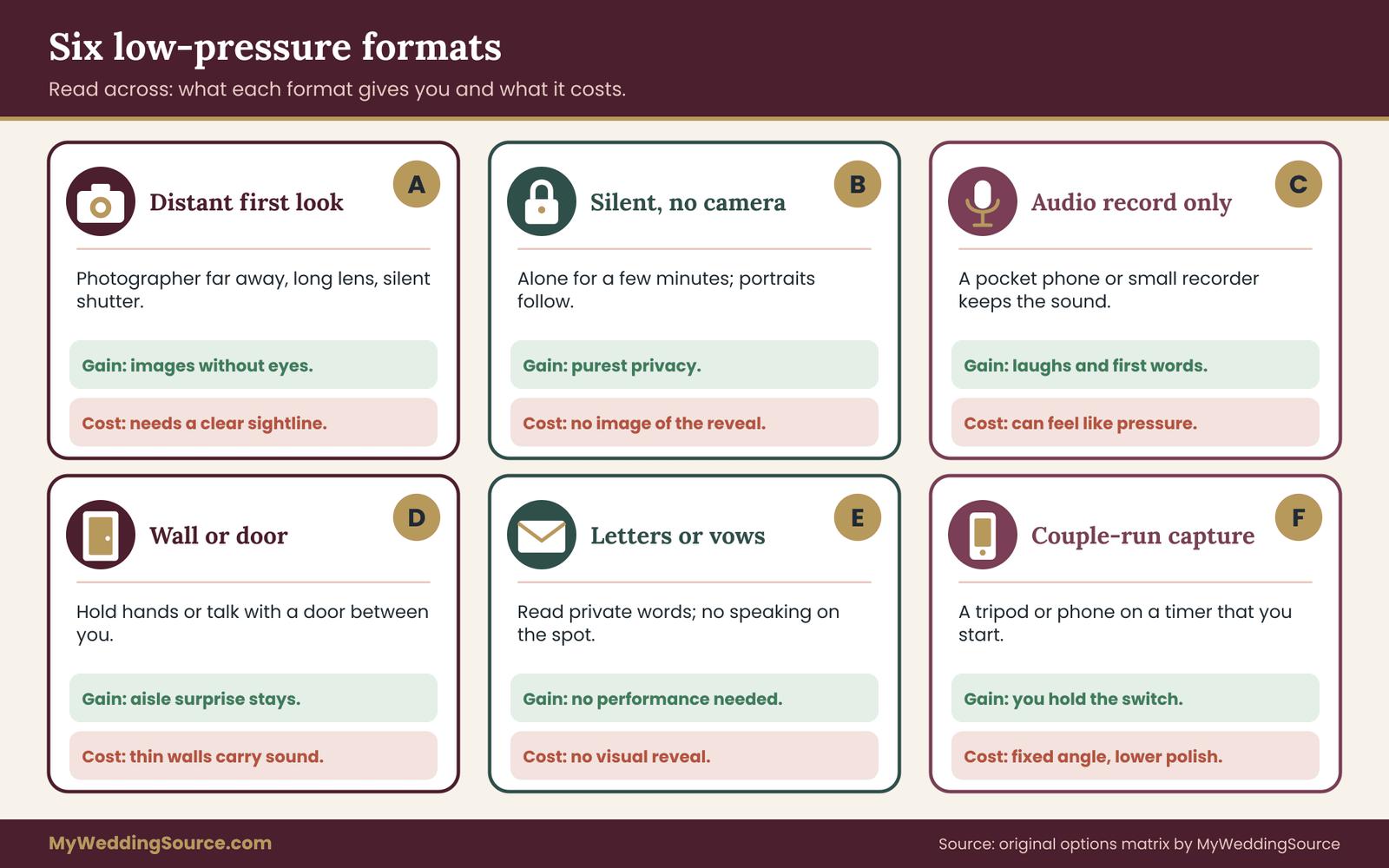
Think of the six formats as positions along a line, from “most like a classic first look” to “least visible”. None is better than the others for every private first look. Each suits a different mix of needs, and each has a failure mode that the later sections explain.
Format A: the distant first look
The two of you meet in a quiet spot, and the photographer works from far away with a long lens, out of earshot and ideally out of sight. You may know roughly where they are, or they may be behind a hedge, a pillar or a window. This format keeps audience low and sensory load fairly low, while capture stays medium and you still receive images of the reaction.
It suits couples who like the photographs but dislike being watched. Its weak point is geometry: the photographer needs a clear line of sight and a spot where they cannot be heard, and many venues do not offer both. If the site is crowded or has glass everywhere, this format can quietly become a close one.
Format B: the silent, no-camera first look
The two of you share the moment alone, and no one photographs it. After a few minutes of your choosing, you signal and the photographer joins for portraits. Audience is as low as it can be, sensory load is low, and capture is none for the reveal itself. Time pressure can still run high, because the photographer is waiting somewhere nearby.
This format is the purest version of a private first look. Its cost is that the single most photographed moment of the morning will not exist as an image. Some couples are glad of it, and some regret it later, so decide with that cost in your mind, not in the moment. A middle path is to keep the moment unrecorded and to stage a short, gentle “second look” afterward for pictures.
Format C: the unseen first look with a short audio record
Here the moment is private, but the two of you, or a small device, record the sound only. The recording can be a phone left in a pocket or a small recorder placed beforehand. Audio carries the laugh, the breath and the first words without any camera in the room, and a few minutes of it can be a lasting keepsake.
Audience is low and sensory load is low, since there is no visible equipment other than something small. It works well for people who find cameras more intrusive than sound. The failure mode is that the recording itself becomes a source of pressure, because you may feel you must say something worth keeping. Agree beforehand that the file can be deleted unheard.
Format D: the wall or door first look
You stand on opposite sides of a door, a wall or a hanging cloth, and you reach for each other’s hands, or you simply talk. You do not see each other until the ceremony. It gives you the pre-ceremony connection and the quiet, but it holds the visual reveal for the aisle.
Audience is low, sensory load is low and time pressure is usually mild, since there is little to set up. Capture can be a photograph of the clasped hands from behind, taken at a distance. This is the best format for couples who want the privacy and also want the walk down the aisle to still hold a surprise. Its weak spot is that a thin wall carries sound, so confirm that neither of you can be overheard.
Format E: the letters or vows first look
Instead of a visual reveal, you exchange written letters or read short private vows to each other in separate rooms, or in the same room with eyes closed or backs turned. The exchange is the moment. It can be done in a few minutes, and it asks for no performance, since you can read a sentence you wrote earlier at your own pace.
This format turns the dials down on every front. It is also the most flexible for couples who find spontaneous speech hard, and it pairs well with keeping the words private at the ceremony as well. Photographs, if any, can be of the folded pages or of a hand holding a letter.
Format F: the couple-run first look
The two of you control the capture yourselves. A tripod and a small camera, or a phone on a stand, records a timed sequence, while the photographer waits elsewhere. You decide when it starts and stops. Audience is low and you hold the recording switch, which for many people is the point.
Sensory load can be low if you pick a camera with no shutter sound and no flash. The trade-off is image quality and framing, since a fixed angle will not follow your movements. Some couples then ask the photographer to join for a recreated second pass, and some keep the self-recorded footage as the only version.
How the six compare in practice
In everyday terms: if you want pictures but not eyes, choose A. If you want privacy above pictures, choose B. If you want a sound record, choose C. If you want the surprise held for the aisle, choose D. If speaking in the moment feels hard, choose E. If you want to control the recording, choose F. Notice that formats can be combined, for example E followed by A for a short joint portrait, and that you can choose different formats for different people on the day.
Reading the matrix by dial
Use the matrix as a lookup, not a verdict. If your top priority is audience low, formats B, C, D, E and F score best. If sensory load low matters most, E and D are the quietest, with B close behind. If time pressure low matters, D and E need the least setup and the smallest buffers. If capture matters, A and F give you the most images, and A gives them with the least effort on your side.
Every cell in the matrix changes if the venue changes. A garden with sightlines suits A. A hotel corridor suits D. A small suite suits E. The next section turns those observations into decision rules, so the venue and the couple are considered together.
What the matrix leaves out
The matrix does not count family. If a parent or a bridal party member expects to be present, that expectation changes the dials, and it is better to name it early than to find out on the morning. It also does not account for hair and makeup timing, which can make an early first look impossible without a rushed schedule behind it. Both problems are about people and the clock, and the planning sections after this one return to them.
A last caution: the matrix describes options, not outcomes. Even the quietest format can sting if one partner arrives anxious or tearful in a way they did not expect. The goal of a private first look is not a specific feeling. It is a setup that gives both of you room to have whichever feeling arrives, and a fallback if it is more than you want.
A short sorting exercise
To test the matrix before you commit, take a sheet of paper and write the six letters down the side. Beside each, write one sentence that begins “We would feel fine if” and one that begins “We would feel uneasy if”. For format A you might write that you would feel fine if the photographer is out of earshot, and uneasy if you can hear the shutter. For format F you might write that you would feel fine if you control the start, and uneasy if the camera needs adjusting mid-moment.
Cross out any format where the “uneasy” sentence describes something you cannot avoid at your venue. Circle any format where both sentences describe things you can control. Usually two or three formats survive, and the choice between them can wait for the decision rules. This small exercise often surfaces a preference that a general question about privacy would not.
You can also ask a trusted friend who knows you both to read your sentences and say which format they would have guessed. Where their guess differs from yours, you have found either a blind spot or a private preference worth protecting. Either way, the conversation is cheap, and it happens months before anyone is waiting in a corridor. It also gives you a shared script to use when family members ask why you are doing something unusual with your first look.
Keep the sheet. It becomes the one-page private first look brief that you hand to the photographer later, and the language you used for yourselves will usually be clearer than anything written for a vendor.
Choosing a private first look format: decision rules
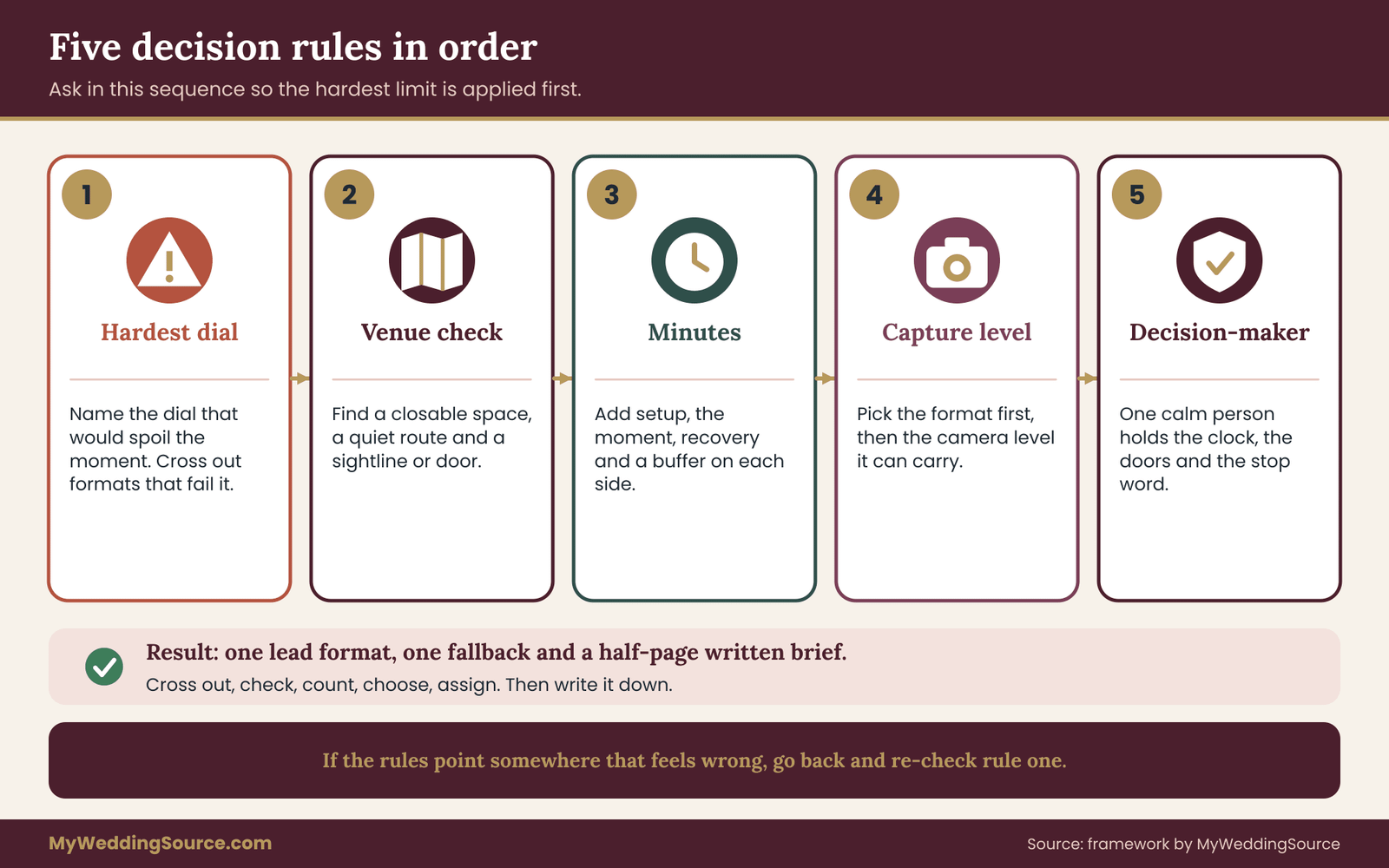
With six formats on the table, the next step is to choose one. A good choice rests on a short sequence of questions, asked in a fixed order, so that the most constraining answer comes first. The order below puts the things you cannot change ahead of the things you would like.
Rule one: start with the dial that hurts most
Ask each other which of the four dials, if set wrong, would spoil the moment. For one couple it is audience. For another it is a flash or a sudden sound. For a third it is a tight schedule. Whatever you name first becomes the dial you refuse to compromise. Every format that scores badly on that dial is crossed out.
If you cannot agree on one dial, take the answers from the partner who has more to lose. That sounds unfair, but a private first look that overwhelms one person is not a shared success. The partner with the stronger reaction usually knows it, and usually appreciates being believed.
Rule two: check the venue before the dream
Look at the places where a private first look could actually happen. You need a spot that is quiet, can be closed off, and offers a way to arrive without crossing a crowd. For a distant first look, you also need a viewpoint for the photographer. For a wall or door format, you need a door or a hanging cloth. For a letters format, you need two rooms or a room with a corner.
Walk the venue with your private first look in mind, or ask the venue manager the practical questions: Is there a quiet room that stays closed to guests before the ceremony? Is there an indoor route between the suite and the ceremony space? Which doors lock? Where do vendors load in, and when? The guide on accessible wedding venue red flags is a helpful companion for the walk, since step-free routes and quiet rooms often come up together.
Rule three: count the minutes honestly
Each format has a time footprint. A distant first look often takes about ten minutes including the walk to the spot, and a no-camera version can take as little as five. Add the setup, since a private moment needs someone to clear the corridor, close the doors and signal readiness. Add the recovery, since many people need a short pause afterward. Then add a buffer on each side.
If the total does not fit before the ceremony without squeezing hair, makeup, dressing or transport, move to a format with a smaller footprint, or move the private first look earlier in the day. A private first look that runs late is a source of the exact pressure you were trying to avoid.
Rule four: decide the capture level last
Many couples begin with the camera and work backward, which tends to produce a format that serves the photographs. Try the reverse. Pick the format that serves the two of you, then decide the capture level it can carry. If the format only works with no camera, accept it. If the format needs a distant photographer, then discuss placement. If you want both a private moment and a strong image, plan the portrait portion as a separate block after the moment.
This also protects the relationship with your photographer. A professional can usually say yes to a clear, early request, and finds it harder to say yes to a last-minute change of plan in a corridor.
Rule five: assign one decision-maker for the day
On the day, choose one person to hold the plan and to call a stop. That person might be a planner, a coordinator or a friend who is calm under pressure. They are not there to perform. Their job is to watch the clock, check the sensory conditions and say, “We are changing to the fallback,” when needed, so that neither of you has to be the one who admits the plan is not working.
Without a named decision-maker, the photographer may feel obliged to press on, family may feel entitled to peek, and the couple may feel obliged to soldier through. With one, the stop becomes a normal part of the schedule.
Putting the rules together
Here is the sequence in a single paragraph, so you can say it out loud. Name the dial that matters most. Cross out formats that fail it. Check the venue for each survivor. Count the minutes, with buffers. Pick the capture level. Name the decision-maker. Choose a fallback. Write the result down on a half page. You now have a private first look plan that a photographer and a planner can read in two minutes.
Two examples of the rules at work
A quick scenario shows the order. Suppose one partner finds sudden noise very hard and both want some photographs. Rule one crosses out any format with a camera that clicks nearby, which removes close-range work in format A and the default setup in F. Rule two finds a quiet side garden with a hedge, which keeps A alive at a distance if the photographer uses a silent shutter mode.
Rule three finds ten minutes of room. Rule four sets capture to medium. The survivor is a distant first look with a silent camera, and the fallback is the door format.
Now suppose a couple wants no photographs of the reveal at all and has a small suite with two rooms. Rule one crosses out every format with a camera. Rule two shows that the suite supports a door format or a letters format. Rule three finds five minutes. Rule four sets capture to none for the moment, with a portrait block afterward. The survivor is the letters format, followed by a short staged portrait, and the fallback is a no-camera meeting in the suite.
Each private first look case reaches a clear answer in minutes, because the sequence limits the options before preferences begin to multiply.
When the rules disagree with your instincts
Sometimes the rules point to a format that does not feel right. That is useful information. Perhaps the quiet option leaves out something you want, such as a shared image with a parent, or perhaps you are craving a more public reveal than your own list suggested. Go back to rule one and check whether you named the right dial. People often discover that what they called audience was really surprise, or that what they called sensory load was really time pressure.
Once you adjust, run the rules again. The process takes a few minutes the second time, and the format that results is usually one you can commit to.
Preparing the space for a private first look
A private first look succeeds or fails in the physical details of the place. The format sets the goal, but the room, the light and the route decide whether you can reach it. This section is a walk through the practical choices.
Pick a space that stays private on its own
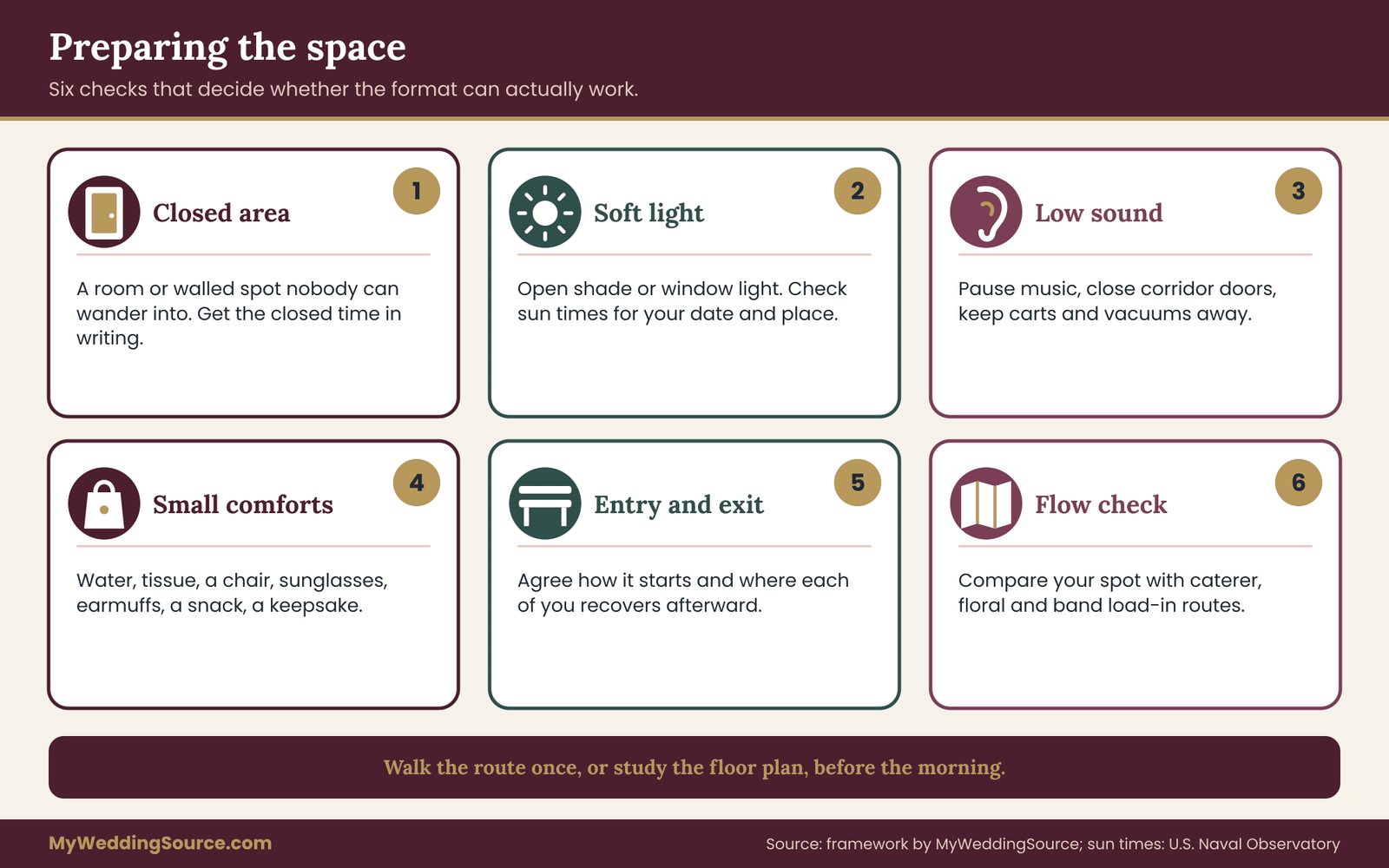
Choose a place that cannot be wandered into. A room that guests, caterers or family members might enter in the middle of the moment is a poor choice, even if it is pretty. Look for a closed room, a walled garden, a side terrace behind a door, or an outdoor spot with a natural barrier. Ask the venue whether staff will keep the area clear during the time you need, and get that answer in writing as part of the confirmation.
Test the route from each side. The two of you should be able to reach the spot without crossing a crowd, and neither should have to wait where guests can see them. If one partner arrives early and waits alone, plan a quiet holding place.
Manage light and sound on purpose
Light is a sensory input as well as a photographic one. Soft, indirect light from a window or open shade is easier on the eyes than a flash, a bright bulb or direct sun. If the moment is outside, find the shadow side of a building at the hour you are going. Many sources, including the U.S. Naval Observatory, publish sun times for a location and date, which lets you choose a time when the light is gentle and the shade is reliable.
Sound matters just as much. Close windows to the corridor, turn off background music, and ask the staff to keep the area free of vacuums, trolleys and set-up noise. If the venue has a public address system, ask whether it can be paused for those minutes. When a hearing or noise concern is part of the picture, consider that a sudden loud sound can be harder to take than a steady quiet one, and plan the quiet so that nothing interrupts it.
Bring the small comforts
A short list of items can make the moment easier. Water, a tissue, a handkerchief or a soft cloth. A chair, if standing for several minutes is tiring. A small snack, if the schedule has run long. Earplugs or noise-reducing earmuffs, if the surrounding noise is likely. Sunglasses for bright light. A fidget item or a small keepsake in a pocket. None of these are indulgences. They are the ordinary tools that help a person stay present.
Leave them where they can be reached without a search. A small tote bag held by the decision-maker, with each partner’s items labeled, saves a minute of hunting at the worst time.
Plan the entry and the exit
How you arrive affects how you feel. A format that begins with a slow, quiet walk is easier than one that begins with a sudden door opening. Agree how the reveal starts: a spoken word, a knock, a light tap or a message. Decide in advance whether you will touch, hug or just look. Many couples find that deciding this in advance removes the awkward half-second in which neither knows what to do.
Think about the exit too. After the moment, you may want a few minutes alone before the photographer joins. You may want to return to separate rooms to recover. Build a place for that into the plan. The entry and exit are the parts that trip people up, because they sit between the moment and the rest of the day.
Rehearse without the reveal
You can walk the route without staging the reveal. Do it at a venue visit or in the hour before the day begins. Walk the route, stand where you will stand, and point out where the photographer would be. This lets both of you see the sightlines and hear how sound carries. It also lets the decision-maker rehearse their signal. The rehearsal does not need to be emotional. It only needs to remove the surprises.
If a visit is not possible, ask the venue for photographs or a floor plan, and ask a trusted friend to stand where the photographer would stand while you check whether you can see them. A short test can reveal that a “hidden” position is plainly visible from the chair where you will sit.
Check the space against guest and vendor flow
A private first look shares a building with a lot of other activity. Caterers carry trays, florists set arches and band members load in. Ask for a simple map of those flows and compare it with your chosen spot. If a delivery door opens on the garden path, move the spot or change the time. The guide on guest photo boundaries also covers the point of keeping guests out of photographs they have not agreed to appear in, which matters when a corridor view could catch a relative.
A short note from the venue, reached by email or on a printed floor plan, that names the closed area and the time it is closed is usually enough. Keep it with your documents so the decision-maker can point to it if a staff member wanders in.
Working with your photographer on a private first look
The photographer is the person who most affects how a private first look feels, and the person most often left out of the conversation until the week before. A good professional will welcome a clear brief. A good private first look brief is short, specific and written, and it arrives early enough to be priced and scheduled.
What to ask before you book
Raise the subject when you first talk to a photographer, not after the contract is signed. Ask how they usually handle a private first look, and whether they have worked with couples who wanted it quieter or more private. Listen for how they describe it. A photographer who talks about getting close, directing poses and capturing “every angle” may be a poor match. One who talks about distance, silence and letting the moment unfold is a better fit.
Ask about equipment: whether they have a silent shutter mode, a long lens for distance work and a way to work without flash. Ask whether they can work with natural light only. Ask whether they bring an assistant, because a second person in the area changes your audience dial. These are practical questions, and a professional will have answers. Their answers also help you compare candidates, which the wedding vendor contract guide supports when you reach the paperwork.
Put the plan in writing
Whatever is agreed should appear in the contract or in an attached shot list or brief. A promise made in conversation can be forgotten by the morning. Write down the format, the placement, the distance, whether there is a flash, whether there is an assistant, how long the photographer will wait before joining, and who gives the signal. Add the fallback and the stop signal.
If the contract has a clause about shot lists, put the private first look in it. If it has a clause about coverage hours, check how long the photographer is booked for and whether a private first look changes the order of the day. Ask what happens if the moment runs long, and whether overtime is charged. For the broader timeline logic, the wedding vendor timeline article shows how coverage hours and buffers relate.
Agree on what the photographer may and may not do
A short list of conditions removes most of the friction. Common ones include: no flash, no verbal direction during the reveal, no movement closer than an agreed distance, no one else entering the area, and no use of the images from that moment without your approval. If you prefer that images of the reveal never appear on a social account or website, say so now. A portfolio request later is much harder to decline than a clause written up front.
Many professionals will accept these conditions without a fuss. Some will tell you that they cannot work that way, which is also useful information. It is better to hear it at a consultation than in the corridor.
Silent capture and distance work for a private first look
For a distant first look, ask the photographer to explain how they will manage the shot. A long lens collapses distance, so a photographer can work from a good deal further away than you might expect, though not unlimited. Ask them to scout the spot beforehand, if possible, and to place themselves where they will not be seen or heard. Silent shutter modes on many modern cameras reduce clicking, though they can affect certain subjects or lighting, so a test is sensible.
Do not assume that equipment is the same across studios. A candid conversation about the specific camera and lens is worth the minute.
The second-pass option
If you want both privacy and a clear image, ask for a second pass. The reveal is private. Afterward, the photographer joins for a short, gentle set of portraits that echo it: a first embrace, a forehead touch, a shared laugh. This is sometimes called a recreation, though it need not feel staged. It gives you images without asking the real moment to perform.
Be honest with yourselves about how you feel about repeating a gesture for a camera. Some people find it easy and some find it draining. If it is draining, choose a different path, and tell the photographer that you will not be repeating anything.
Working with a planner or day-of coordinator
A coordinator can hold the clock and the doors, which lets the photographer concentrate on the work. Brief them on the format, the fallback and the stop signal. Ask them to be the one who tells guests and staff to stay away, so that you never have to say it yourselves. If you are working without a planner, ask a calm friend to hold the same role, and give them the same one-page brief.
Make sure the coordinator and the photographer have each other’s contact details and have spoken at least once before the day. Misaligned assumptions are the most common cause of disruption, and a five-minute call usually clears them.
If your photographer is also your videographer
Some studios offer both photo and video, and one person may do both. That affects the audience dial and the sensory dial, since the camera count rises. Ask whether the private first look can be photographed only, with video limited to a wide shot at a distance or left out. Ask whether any audio will be recorded, and whether a lapel microphone will be required. You can decline both. If you want the sound but not the picture, a small recorder placed in advance may do the job.
Scripts: what to say to the photographer, the family and each other
Many couples know what they want and cannot find the words, particularly with relatives who have strong views. The scripts below are templates. Change them so they sound like you, and keep them short.
To the photographer, in the first conversation
“We would like a private first look, and we want it quiet. That means no flash, no direction during the moment and the camera far enough away that we will not see or hear it. After a few minutes of our choosing, we will signal you and you can join for portraits. Can you work this way, and what would you need from us?”
That paragraph states the format, the conditions and the order of events, and it ends with an open question. A professional can respond to it, and the answer will tell you whether the working relationship is likely to go smoothly.
To the photographer, in the written brief
“Format: distant first look. Location: the side garden behind the hedge. Distance: at least thirty feet, long lens, silent shutter, no flash. Duration: up to ten minutes; we will wave when we are ready. Fallback: if either of us says ‘pause,’ stop and return to the suite. Contact on the day: the coordinator.”
Short lines are easier to follow than long paragraphs, and a numbered or labeled list can be copied into the shot list without edits. Adjust the numbers to match your own situation, and do not copy the distance unless it fits your site.
To a parent or relative who wants to watch
“We want the private first look to be just the two of us, because that is what feels right. We will find you right afterward, and we would love to have you in the portraits.”
This script does not argue with the wish to be present. It states the decision, offers a specific time to meet and gives the relative something to look forward to. Many people respond better to a clear plan than to an explanation. If the relative is upset, you can add, “I know this is hard to hear, and it is not about you.”
To a bridal party member who is eager to help
“Thank you for wanting to help. The most useful thing you can do is keep the corridor clear between two and two-fifteen, and let us know the moment someone is heading this way.”
This gives a helper a job, which is usually what they want. It also places a person at the door, which keeps the area private without the couple having to do it.
To each other, before the day
“If it feels like too much, I will say ‘pause.’ We stop and do not discuss it until later. If I forget to say it, you can say it for me.”
This agreement is brief and removes the need to explain in the moment. A shared word is easier than a sentence, and a partner who is overwhelmed may lose the sentence. Pick a word that feels neutral, and one you would not say by accident.
To the venue manager
“On the wedding morning we need a closed area for about twenty minutes with no staff, guests or vendors entering. Can you confirm which space can be closed, and can you share the time with the catering and floral teams?”
A request like this works best in writing, since the manager may not be the person on the floor during the event. Ask who will relay it, and ask for a name you can call.
On the day, for the decision-maker
“We are in the final five minutes. I am closing the door. If either of them says the word, I will open it and move straight to the fallback. I will not ask questions in the moment.”
The decision-maker’s script is the shortest of all, and it is the one most likely to be repeated aloud. Practice it once so that it sounds ordinary.
When someone pushes back
A few people will insist that a private first look must be done a certain way, or that they have a right to be part of it. You do not have to argue the point. A calm, repeated sentence is enough: “We have decided, and we are happy with it.” If the person persists, hand the matter to your coordinator or a trusted relative, and step away. Nothing about a private first look requires you to defend it in the minutes before it happens.
If the pushback comes from a vendor, such as a photographer who insists on close coverage, check the contract, restate the request in writing and decide whether the relationship can work. If not, the time to change is well before the day.
Timing, light and buffers around a private first look
The time of day sets the light, the crowd and the energy of everyone involved. A private first look is easiest when it sits in a stretch with nothing urgent on either side. This section shows how to place it, and how to size the buffers so a small delay does not turn into a rush.
Where it sits in the day
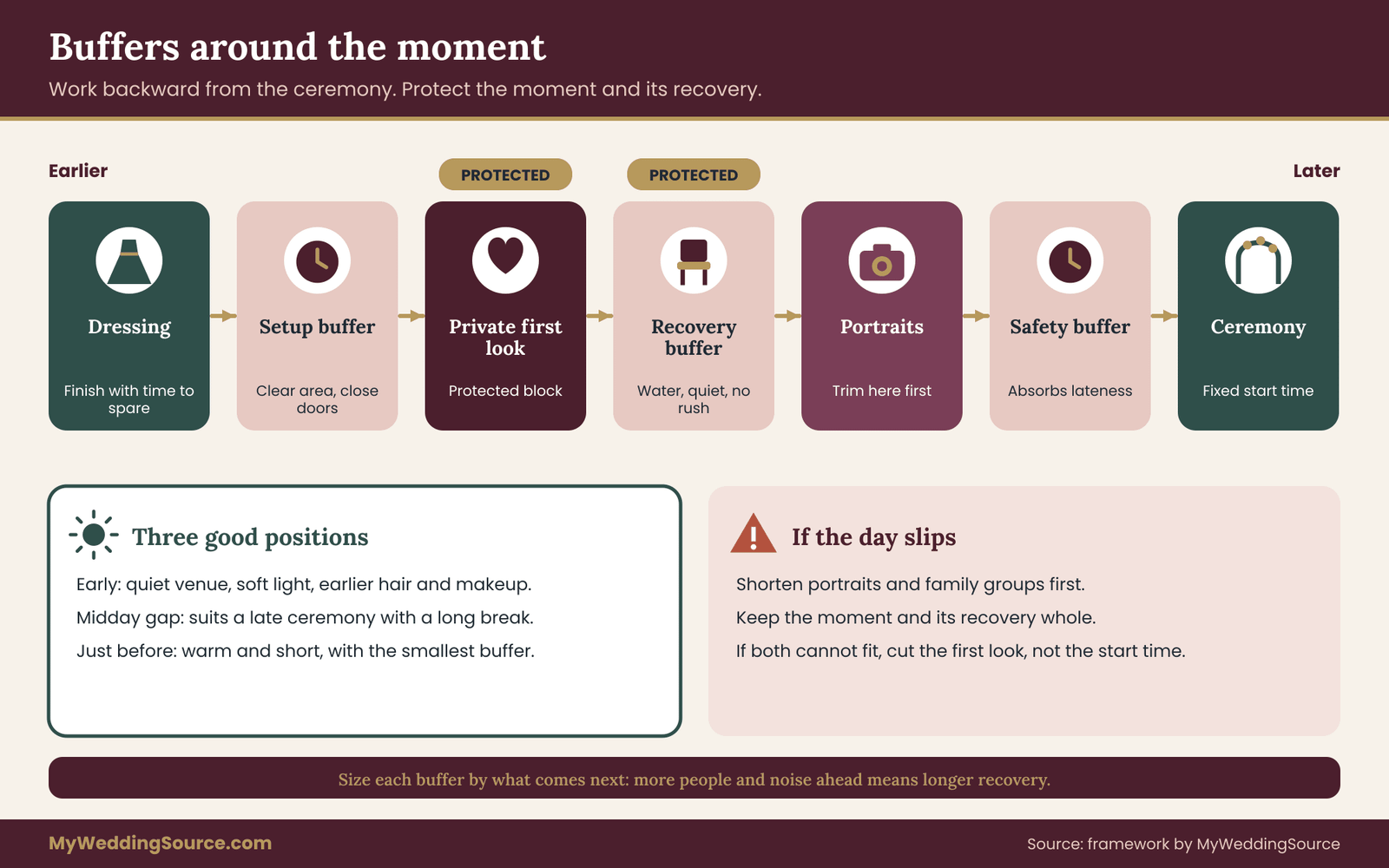
Most first looks happen after dressing and before portraits, which in turn sit before the ceremony. A private first look usually works best in one of three positions. Early, before most guests arrive, when the venue is quiet and the light is soft. Mid-morning or early afternoon, if the ceremony is late and there is a long gap. Or immediately before the ceremony, in a short window, if a longer gap would add stress.
The early position gives you the most calm, but it asks for earlier hair and makeup. The middle position suits a late ceremony. The last-minute position keeps the surprise warm, but it has the smallest buffer. If you are weighing these, look at how the ceremony itself unfolds on the day. The wedding ceremony step-by-step guide shows the sequence from arrival to recessional, which helps you see how much room exists before the processional.
Work backward from the ceremony
Start with the ceremony start time and subtract. The processional or walk, the last-minute check of attire and the lineup. Then the portrait block, if there is one. Then the private first look and its recovery. Then the dressing. Finally the hair and makeup start. At each step, write the length of the block and the length of the buffer after it.
A simple way to size the buffers is to give each one a job. The buffer after the private first look is a recovery buffer: ten to twenty minutes is typical, though you should size it to the two of you. The buffer before it is a setup buffer: enough time to clear the area, close doors and be calm.
The buffer between portraits and the ceremony is a safety buffer, which absorbs lateness. If a day looks tight, it is the safety buffer you will be tempted to cut, and it is the one that does the most good.
Choose a stretch of good light
The light affects both the comfort and the photographs. Early morning and late afternoon offer low, warm sun. Midday offers strong overhead light, and shade is more comfortable then. Check sunrise and sunset for your date and place using an official tool, such as the U.S. Naval Observatory’s calculator or the NOAA solar calculator, and plan the private first look so that it falls in a stretch of gentle light or in open shade.
Weather can change the plan, so identify the indoor backup in advance. An overcast sky can actually be kind to a private first look, since it spreads light evenly. Rain moves it inside, which is why the venue’s quiet room matters. The National Weather Service publishes forecasts you can check in the days beforehand and on the morning itself.
Choose the number of people carefully
At a private first look, the right number of people nearby is the smallest one that still lets the day run. Often that is the decision-maker at a door, and the photographer at a distance. Everyone else is elsewhere. If the photographer has an assistant, decide where the assistant will be. If a parent insists on being present, discuss a different moment to include them, such as a photo right afterward.
Setting a clear order for the morning
Write the morning as a list of blocks, each with a start time, an end time and a named person. Dressing, first look, recovery, portraits, family groups, then a quiet break before the ceremony. Give each block a person who knows it exists. A private first look fails when two people each think the other is in charge of the door.
Once the order is set, share it with the people involved and ask each to confirm in writing. It does not need to be elaborate. A single message with the block list and the times will do, and it gives you a document to point at if someone arrives early.
Buffers that match the transition
A flat ten-minute buffer is better than none, and still not right for every move. Moving from a private first look into a large family photo session is a bigger shift than moving from a private first look into a quiet break. The more people and noise the next block contains, the longer the recovery should be. If you know that you need a long quiet pause after the reveal, make it fifteen or twenty minutes and mark it as a protected block.
What to do if the schedule slips
The day will rarely run exactly to plan. Decide before the day which blocks can be shortened and which cannot. Usually the family groups and the portrait block can shrink, and the private first look and its recovery cannot. Tell the photographer and the coordinator that the private first look and the recovery buffer are protected, so they trim elsewhere first.
If you are running late, shorten the portraits, not the recovery. A shortened portrait block still yields photographs. A skipped recovery tends to yield a tense couple in every photograph that follows.
A worked case: Tessa and Jonah (an invented example)
The couple below is invented, and the numbers are examples, not recommendations. They show how the dials, the formats and the decision rules turn into a plan. Real couples will find different answers.

The situation
Tessa and Jonah are marrying at a small estate with a walled garden, a quiet library and a long driveway. The ceremony is at four in the afternoon. Tessa finds crowds and sudden noise tiring and prefers to cry in private. Jonah is calm in company but dislikes surprises and wants to know the order of everything. They both want some photographs of the reveal, though neither wants the photographer near.
They have a photographer who has agreed to work with a long lens and a silent shutter. They have a coordinator, Priya, who has worked at the estate before. Both sets of parents would like to be present for the private first look.
Setting the dials
Separately, each writes four words. Tessa: audience low, sensory low, time pressure low, capture medium. Jonah: audience low, sensory medium, time pressure low, capture medium. They match on three. On sensory load, Jonah says the matter is less about noise and more about knowing what will happen. They agree to treat sensory as low and to cover the predictability concern by writing the plan down.
Applying the rules
Rule one: the dial that hurts most is audience for Tessa and surprise for Jonah. Formats with close-range cameras are removed. Rule two: the walled garden has a gate that can be closed and a hedge that screens a bench, so format A is possible at a distance. The library offers a door format as a fallback.
Rule three: the distant first look takes about ten minutes, with five minutes of setup and fifteen of recovery. Rule four: capture is medium, from the hedge, with a silent shutter. Rule five: Priya is the decision-maker, and she holds a printed card with the stop word.
The plan on paper
The written brief says: distant first look in the walled garden, at one-thirty. Priya closes the gate at one-twenty and stands inside it. The photographer is behind the hedge by one-twenty-five. Tessa walks in from the east door and sits on the bench with her back to the gate. Jonah arrives from the west, and when he reaches her she turns. They have ten minutes, with a water bottle and a chair beside the bench. At one-forty, they wave to the photographer, or Priya taps the gate. The fallback is the library door format.
The parents are told: “We want the private first look to be just the two of us. We will meet you in the courtyard at two for photographs together.” Both sets of parents agree, though one says they are sad to miss it. Tessa and Jonah answer kindly and leave it.
What happens on the day
At one-twenty, a florist wanders toward the garden. Priya intercepts, and the florist goes the long way around. The private first look begins at one-thirty-two, two minutes late. Tessa finds the sun on the bench too bright, and Jonah moves the chair to the shade without comment. They speak for about six minutes. Neither says “pause.”
At one-forty, they wave. The photographer joins for a few gentle portraits in the shade, ten minutes in all. Tessa takes a fifteen-minute quiet break in the library with tea. Jonah takes a short walk. The parents meet them at two in the courtyard. Nothing is rushed, and the private first look plan has two minutes to spare.
What they would change
Afterward, they say that the bench was a poor choice because of the sun, and that a shaded spot would have saved Jonah the chair move. They would also have asked the florist team to start on the other side of the grounds. Neither change is dramatic, and neither affected the moment. The lesson is that a good plan expects small surprises, and has someone ready to handle them.
Why this case is useful, and where it stops
The case shows the dials, the format choice, the buffer sizes and the written brief working together. It does not prove that this exact plan suits anyone else. A different couple, with a different venue and different needs, would reach a different format. Read the case as a model for the process, not as a template for the details.
When a private first look goes sideways: failure conditions and backups
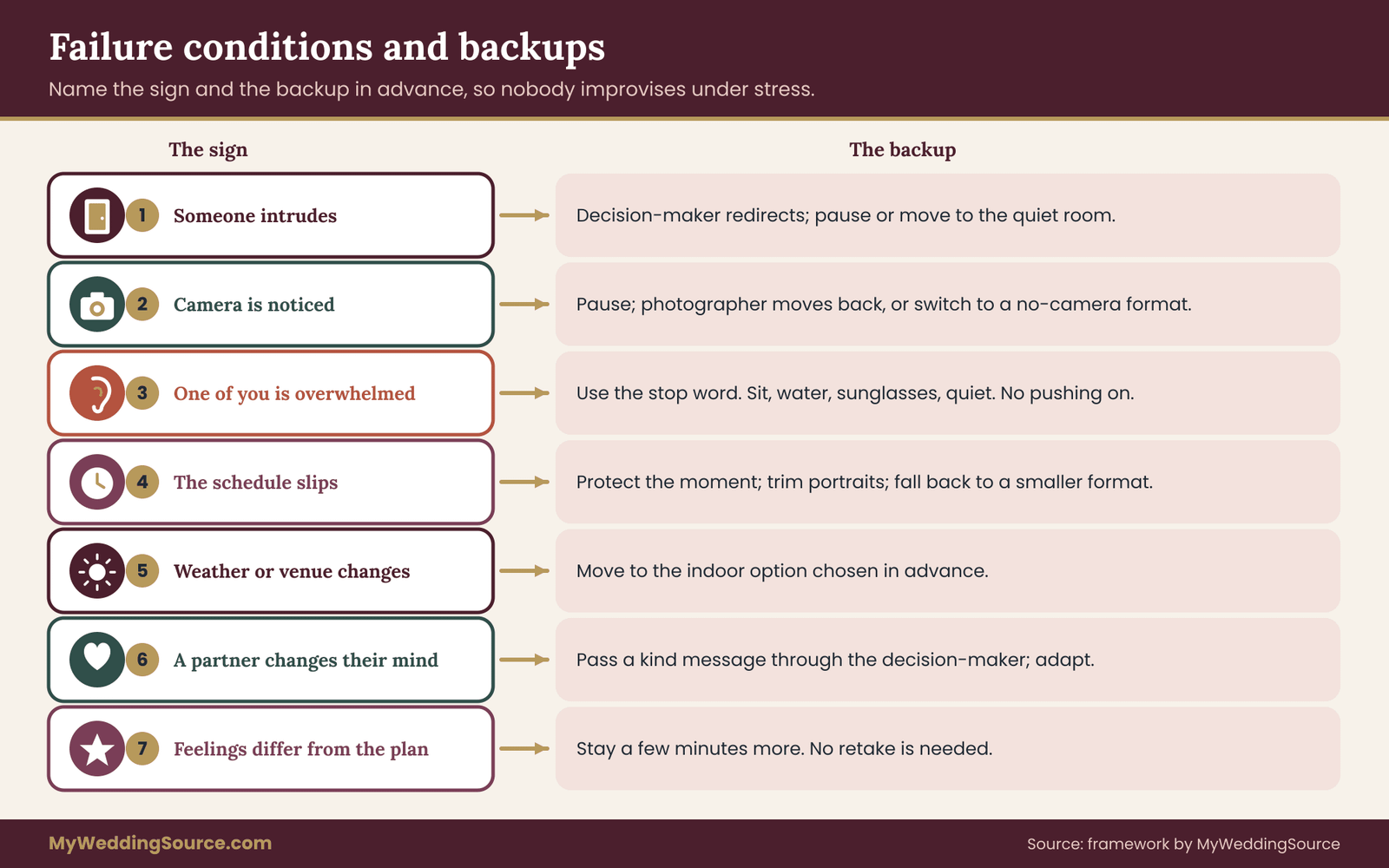
Every private first look format can fail, and the useful question is not whether but how you will recognize it and what you will do. A failure condition is a specific, observable sign that the plan is no longer serving you. A backup is the move you have already chosen for that sign. Writing them in advance means you do not have to invent them while upset.
Failure condition one: someone intrudes
A staff member, a guest, a child or a relative walks into the area during the moment. This is the most common failure, and it is almost always an accident. The backup is that the decision-maker steps in, redirects the person calmly and pauses the moment if needed. If it cannot be resumed, move to the quiet room, or hold the rest for a few minutes before the portraits.
To prevent it, post a person at the gate, put a simple sign on the door if the venue allows it, and share the closed time with every team that works nearby. A sign that says “Private until two o’clock, thank you” is polite and usually effective. Check whether the venue allows signs before you place one, which is part of the walk-through.
Failure condition two: the camera is noticed
The photographer is seen or heard, and one of you stiffens. The backup is a pause and a quiet word to the photographer through the decision-maker, who can ask them to move further back or to stop. If the reveal has barely begun, begin again after a minute. If it has already happened, carry on without the camera for the rest of the time.
You can limit the chance by asking the photographer to scout, by testing sightlines in advance and by confirming a silent shutter. If you cannot make the photographer invisible at your venue, move to a format that does not need one, such as the door format or the letters format.
Failure condition three: one of you feels overwhelmed
This is the failure that matters most, and the least visible. A partner may feel flooded by emotion, sound, light or the sense of being watched. The signs are individual: going quiet, turning away, shaking, speeding up speech, needing to leave, or crying in a way that feels unmanageable rather than cathartic. You will know your own signs better than anyone.
The backup is the stop word. Use it, and then do what you agreed: sit, drink water, step outside, wait, put on earmuffs or sunglasses. Do not push through for the photographs. A good plan makes a pause ordinary, which is why the stop word should be agreed early and mentioned to the decision-maker, who can protect the pause.
Failure condition four: the schedule slips
Hair runs long, transport is late or a vendor arrives at the wrong time. The private first look is squeezed, and the pressure rises. The backup is the protected-block rule: the private first look and its recovery keep their time, and the portraits, family groups and breaks shrink first. If the slip is serious, move to a smaller footprint format, such as the door format or a short no-camera meeting.
If you cannot keep both the private first look and the ceremony start time, cut the private first look. The ceremony is the one fixed point, and a rushed first look defeats its purpose. You can have a quiet moment together after the ceremony instead, which is a format of its own.
Failure condition five: the weather or the venue changes
Rain, wind, heat or a double-booked space forces a new location. The backup is the indoor option you chose in advance. A hotel corridor can work for a door format, a quiet suite for a letters format and a covered porch for a distant format. Ask the venue for two options before the day, and write down both.
Do not choose a backup you have never seen. A room on a floor plan can turn out to be a loud storeroom or a busy passage. If you cannot see it ahead of time, ask for photographs and ask what noise the room carries.
Failure condition six: a partner changes their mind
Sometimes one of you decides, on the morning, that they want something different. They may want to see each other earlier, or later, or not at all. This is allowed. A private first look is not a contract between the two of you. The backup is a short, kind conversation through the decision-maker, who can pass the message and keep the schedule moving.
You can lower the odds by asking, a week before: “Is there anything about the plan that you would change?” People often have a doubt that they have not yet named, and a calm question draws it out.
Failure condition seven: the emotion is not what you expected
Some couples expect tears and feel calm. Others expect calm and feel overwhelmed. Neither reaction means the private first look was a failure, and neither calls for a retake. The backup is acceptance. Stay a few minutes longer than planned, if the buffer allows, and let the feeling settle. If the photographs do not show what you hoped, they will still show you as you were.
A simple stop-and-switch card
Write a tiny card for the decision-maker. It should say, in four lines: the stop word, the fallback format, the room for the fallback and the time that the ceremony cannot move. The card is short because it is read under stress. Keep it in a pocket, and keep a copy in the photographer’s brief.
Test the card with a friend. If a friend can read it and act on it in half a minute, a stranger can too. If the friend cannot, shorten it.
Alternatives if a first look is not the right shape
A private first look will not suit everyone. Some couples would rather keep the whole reveal for the aisle, or feel that any early meeting would shift the emotional weight of the ceremony. Others find the privacy hard to arrange, and would be happier with something smaller. The alternatives below keep what you wanted from the private first look without asking you to accept a format that does not fit.
The private moment after the ceremony
Some couples choose to hold their first quiet moment after the ceremony, when the pressure has dropped and the legal step is complete. Ask your officiant or coordinator to allow a few minutes alone in a closed room before the reception begins, or before the receiving line. This keeps the reveal for the aisle and still gives you the privacy.
The trade-off is time. Guests are waiting, cocktail hour is starting and the photographer may want family groups. Build in a short, protected pause and tell the photographer that it is part of the plan. A pause of ten minutes is often enough to catch your breath.
The quiet pre-ceremony meeting without a reveal
You can meet before the ceremony without seeing each other, as in the door format, or you can meet with eyes closed and hands held. This provides connection without the visual reveal. It is often chosen by couples whose families or traditions favor seeing the couple only at the ceremony, and by couples who want the surprise at the aisle.
The meeting can also be done by message, a voice note or a short letter handed over by a trusted person. The point is to share a private word, not to match any form.
The private vows variant
If speaking aloud to each other is a source of pressure, consider a written exchange instead. Each of you writes a short letter, hands it to the decision-maker and reads it privately. You can then decide, afterward, whether to share any of it. This overlaps with the letters format and works well alongside any of the others.
The reveal held for the ceremony, with preparation
A traditional reveal at the aisle is not a mistake. If you want it, plan it carefully. Tell the officiant and the coordinator which dials matter. Ask for a calm processional with the music at a comfortable volume, a place to stand that is not in direct sun, and a pause before the first words. Let the guests know, through the program or a quiet announcement, that the couple would like a calm and unhurried start. The wedding planning checklist helps you see where those requests fit among everything else due that week.
Skipping the moment altogether
You can also decide that you do not need a dedicated first look. If the day already holds enough private time, or if the arrangements feel like more trouble than they are worth, skip it. Spend that time resting. A calm hour before the ceremony is a perfectly good use of a wedding morning, and nobody will count the missing photograph.
How to choose between an alternative and a format
If the problem is the audience, a format can usually solve it. If the problem is the reveal itself, an alternative may suit better. If the problem is time, a smaller format or a later private moment may be easier. When you cannot tell, try imagining the morning for each option, minute by minute, and notice which one leaves you with the steadiest feeling. That feeling is better evidence than any list.
It may help to talk to someone who has already made a similar choice, such as a friend, a relative or a professional. You are not asking for permission. You are asking what they would do differently. Their answer often sharpens your own.
After the private first look: recovery, photos and sharing
The minutes after the moment matter nearly as much as the moment itself. After a private first look, this is when the feeling settles, when the photographs are made, and when decisions about what to share get made. A little thought here keeps the rest of the day from feeling like an afterthought.
Take the recovery seriously
After a private first look, many people feel a wave of relief, tiredness or emotion. Give yourselves the time you planned. Sit down, drink water, eat something small, and let the heart rate settle. If one of you wants to be alone, that is fine, and the decision-maker can hold the door. If you want to stay together, ask for a quiet corner and a few minutes of silence.
Resist the urge to move straight into portraits unless you both want to. A tired or flushed face is not a problem for a photograph, but a rushed feeling shows. Fifteen minutes is a common recovery. A longer one is fine if the schedule allows.
Ease into the photographs
If you have chosen a second pass, let the photographer begin with the easiest frames: a hand hold, a walk side by side, a laugh. Leave the demanding poses for later. Tell the photographer what helps. Some people prefer a silent photographer, and some prefer a light running commentary. Some find eye contact easy and others find it hard, and a good photographer can work with either.
If you chose no photographs of the reveal, say so plainly when the photographer arrives, and move on to the next block without remark. Nobody needs to feel they have missed something.
Decide what happens to the images
Agree in advance how the photographs of the private first look will be used. Will they be in the album? In a gallery for guests? On the photographer’s website or social accounts? You can allow some uses and refuse others, and the contract should say so. The U.S. Copyright Office explains how copyright usually works for photographs, and in many arrangements the photographer owns the copyright and grants you a license, which makes the wording of the license important.
If you want to keep the images private, say it in the contract: a private gallery, no portfolio use, no social posting. If you are comfortable with portfolio use of the portraits but not of the reveal, say that too. A clear line saves an awkward email later.
Think about what you tell guests
Guests may want to know what happened. A short, warm line is enough: “We had a quiet moment together this morning, and it was lovely.” You do not have to describe it or share the pictures. If you are comfortable with it, a program note can say that the couple chose a private first look, and that photographs will be shared afterward. If you want the evening to be low on cameras, ask the officiant or the coordinator to mention it kindly.
Keep a note for yourselves
Write down, within a day or two, what worked and what you would change. The note does not have to be neat. A few lines are enough, and they are worth having when you tell the story later, or when a friend asks for advice. It also helps you remember how the moment felt, which photographs cannot always capture.
When the moment did not go as hoped
If the private first look was harder than expected, or the photographs do not show what you wanted, be gentle with yourselves. One short morning does not decide how a marriage feels. If a vendor failed to follow the brief, such as by coming closer than agreed, raise it calmly and in writing, with the contract language in front of you. Ask what can be done, and decide how you want the matter resolved.
If the experience left you shaken, talk to each other and, if you wish, to a professional you trust. A wedding day is a high-demand day for anyone. Needing time to settle afterward is ordinary.
Your next steps
Start with an evening of conversation, not research. Each of you writes the four dials in a word, compares and agrees on which one matters most. Use the six formats and the decision rules to pick a leading choice and a fallback, and write them on a half page. Add the stop word, the decision-maker and the protected buffer.
Then share the brief. Send it to your photographer, your coordinator and your venue manager. Ask for written confirmation of the closed area and the timing. Walk the route once, or study the floor plan. Rehearse the stop word. Choose a time, work back from the ceremony and put the private first look in the schedule with its recovery. Then leave it alone and let the day arrive.
FAQ
Is a private first look the same as having no photographer there?
No. A private first look can have no camera at all, or a camera at a long distance, or a recording you control. Only the first of those removes the photographer entirely. The right choice depends on how you want the moment captured, if at all. You can pick a quiet format, set the capture level and then decide on the photographer’s distance and conditions.
How long should a private first look last?
Most last between five and fifteen minutes, with extra time before for setup and after for recovery. A short one is fine if it feels complete. A longer one needs more buffer and a steadier schedule. Decide in advance how long you want, and let the decision-maker signal the end, so that neither of you has to watch the clock.
What if one of us wants a first look and the other does not?
Talk about the reason first. One may want the privacy of a quiet moment, and the other may want the surprise of the aisle. A door or letters format gives you connection without the visual reveal, and a moment after the ceremony gives you privacy later. If neither works, skipping the private first look is a legitimate choice, with no need to apologize for it.
Do we need to tell the photographer why we want it private?
No. You can describe what you want without giving reasons. A line such as “quiet, no flash, a long distance and a signal from us” is enough. Share more if it helps, and keep it to yourselves if you prefer. A professional needs to know the conditions, not the story behind them, and should respect a clear, polite request.
Can a private first look be done outdoors in cold or wet weather?
It can, but plan a shelter. A covered porch, a doorway or an indoor room can serve as the backup. Check the forecast from the National Weather Service in the days beforehand and on the morning. If conditions are poor, a door format indoors or a letters format may suit better, and neither depends on the weather.
What if our families insist on watching?
State the decision kindly and offer a time to include them, such as photographs together right afterward. A short script, repeated calmly, works better than an argument. Ask your coordinator or a trusted relative to hold the door. If the pressure continues, you can change the time or place so the question does not arise.
Should we do a private first look if we feel anxious about the day?
It can help some people, by moving a big emotional moment away from the crowd. It can add pressure for others, if the setup feels like one more task. Try the dials and decide which formats feel lighter. If anxiety is significant, consider talking to a professional you trust. A private first look can be adjusted to fit what you need.
Can we ask for the photographs of the reveal to stay private?
Yes. Put it in the contract: a private gallery, no portfolio use and no social posting of those images. Photographers often have standard terms, and many will agree to changes if you ask early. The U.S. Copyright Office explains the basic rules for photographs, and the license in your contract determines what you may do and what the photographer may do.
Sources
- ADA.gov, U.S. Department of Justice Civil Rights Division
- Introduction to the ADA, U.S. Department of Justice
- U.S. Access Board, accessibility guidelines and standards
- Autism spectrum disorder, Centers for Disease Control and Prevention
- Autism spectrum disorder, National Institute of Mental Health
- Noise and hearing loss prevention, National Institute for Occupational Safety and Health
- Sun or moon rise and set, U.S. Naval Observatory
- NOAA solar calculator, National Oceanic and Atmospheric Administration
- Weather forecasts, National Weather Service
- Copyright basics, U.S. Copyright Office