
The school calendar is the quiet scheduling force behind a wedding guest list: it decides which families can travel, for how many days, with which children, and whether anyone needs childcare. This guide shows how to read the school calendar for your guests, turn it into a simple family constraint matrix, and choose a date that most of them can actually attend.
Do not look for “the” school calendar, because there is no national one. List the guest households with school-age children, find each household’s own school calendar (district, private school or college), and note four things per household: the age group of the children, the nearest break or no-school day, the travel distance, and who could stay home with the children. Mark each candidate date as clear, tight or blocked for each household. Ask guests before the date is final, and verify every date on the school’s own site.
Most couples choose a wedding date by looking at their own calendars, the venue’s openings and the season. Guests come third, and when guests are considered at all, the usual test is a holiday or a big sporting event. The school calendar rarely comes up. Then the save-the-dates go out, and a cousin writes back that the date falls in the middle of her children’s state testing week, a college friend says it is the first week of the fall term, and a godparent asks whether the reception has anything for a four-year-old who goes to bed at seven.
None of these problems is dramatic, and none is a reason to panic. They are easy to see in advance if you know where to look. The school calendar is a public document, set by a district, a school or a college, and published months before the school year begins. This article explains how to read it as a guest-planning tool.
You do not need to be a planner to use what follows. You need a guest list with households marked, an hour to look up a handful of school websites, and a willingness to ask a few guests a direct question. If you are still deciding between dates, read this alongside the broader guide to choosing a wedding date around guest availability, which covers vendor capacity and other travel disruptions. This article stays on one narrow question: how school schedules change who can attend and what they need when they do.
A note on scope. This is general planning information, not legal, tax or financial advice, and school dates, airline fares and local rules change, so confirm each date with the school or the official source before you rely on it.
Why the school calendar decides who can come
Think about the guests who are easiest to lose from a guest list without anyone noticing. They are rarely the ones who decline outright. They are the families who quietly decide that the trip is too hard. A household with two working parents and three school-age children can attend a wedding only if several separate conditions line up at the same time: the children are out of school or can miss school, an adult can leave work, the trip fits the budget, and the children are either welcome at the event or cared for somewhere else.
The school calendar controls the first condition directly, and it influences the others. If the wedding falls on a long weekend or inside a scheduled break, the children are free, tickets may cost more, and every other family in the country is traveling too. If it falls on an ordinary weekend in the middle of a term, the children are free on Saturday but may have a school event on Friday afternoon or a test on Monday. If it falls during exam season, a high school or college student may truly be unable to come.
The three ways a school calendar changes attendance
The effects fall into three groups, and keeping them apart makes them easier to plan around.
Availability. Can the family be there at all? This is about breaks, exam windows, school events and the number of days away from school the family would have to ask for.
Cost and travel difficulty. Does the date make travel more expensive or harder? Spring break and winter break weeks tend to be crowded across airports, highways and hotels, and the families who most need those weeks are exactly the ones traveling with children.
Care. If the family comes, what happens to the children during the ceremony, the reception and the late evening? A date that suits the school calendar still fails if there is no plan for a five-year-old at nine at night.
Those three groups map onto three decisions you control: the date, the guest-facing information you send, and the care arrangements you offer. The rest of this guide takes them in order.
What this article does not try to do
Two limits are worth stating early. First, this is not a guide to deciding whether children are invited. That is a separate and sometimes sensitive decision, and the guide to wedding guest care for babies, children and older relatives covers the practical side of looking after them once they are on the guest list. Here, the question is narrower: given that some guests have school-age children, how does the school calendar change their travel and care needs?
Second, this guide does not assume that every guest follows a traditional public school calendar. Private schools, charter schools, year-round schools, boarding schools, homeschooling families and college students all work differently, and teachers and school staff have their own school calendars that differ from their students’. The sections below deal with each in turn.
What a school calendar actually contains
A school calendar looks like a simple list of dates, but it contains several different kinds of information, and only some of it matters for a wedding. Knowing the categories helps you read a school calendar quickly and tell whether a date is truly blocked.
Instructional days and non-instructional days
The core of the calendar is the first day of school, the last day of school, and the days in between on which students attend. Around that core are days off: federal and state holidays, a fall break in some places, a winter break, a spring break, and a scatter of single days that vary by district. Some of those single days are for teacher training, some are for parent conferences, some are floating days, and some exist to make up for weather closures.
For a wedding, the important distinction is between days on which a student is genuinely free and days on which the school building is closed but a child may still have obligations such as sports, music or a job. A no-school Friday before a Saturday wedding is helpful. A no-school Monday after it is even more helpful, because it removes the pressure to drive home that night.
Breaks, and what they are called
Breaks go by different names in different places. Winter break may be called Christmas break, holiday break or midwinter recess. Spring break may be tied to Easter in some districts and set independently of it in others. Some districts have a week off in the fall, sometimes called a mid-winter or autumn recess. A few have a short break in the weeks around a state fair or a local holiday.
What matters is that the same name does not mean the same dates. Two districts forty miles apart may hold spring break in different weeks. A family who lives in one district and has relatives in another may find that their children’s break does not match their cousins’ break, which affects whether a child can come to a wedding at the other family’s end of the country.
Testing windows and exam periods
Many school calendars carry testing dates that do not appear on a casual reading. State assessments often run in a spring window, and districts may restrict absences and field trips during that window. Advanced Placement exams are given on a published schedule in the first weeks of May, and the College Board posts the exam calendar on its website. Standardized college admission tests have fixed national test dates, and a junior or senior may be sitting one on a Saturday. The ACT and the College Board both publish their dates a long time ahead.
For a wedding guest, an exam is different from a break. A break is a window you can plan around. An exam is a fixed point that the student usually cannot move, and a parent may not be willing to ask them to.
Early release days, half days and events
Some of the most disruptive items on a school calendar are small. An early release day means school ends at noon, and a family driving four hours that afternoon will arrive late. A half day before a break creates a rush. A graduation, a concert, a recital or a championship game may appear on the school’s activity calendar rather than the district calendar, so a family might not think to mention it until you ask.
Where the calendar is published
Public school districts normally publish their calendar on the district website, and many also publish the next year’s calendar early. Private schools publish their own, and they can differ sharply from the local public district. Colleges publish an academic calendar through the registrar’s office, and it lists term start and end dates, reading days and final exam periods. If a guest’s school is in doubt, a short message asking for a link to the calendar is faster than trying to guess at the school calendar.
Many calendars are adopted by a school board and can be amended. A school calendar published for next year may be revised, and a snow-day makeup can add a school day to a planned break. That is one reason the later sections ask you to verify dates close to the point where you commit, and again before invitations go out.
The family constraint matrix for your school calendar research
The matrix starts with a guest household list, and the first step is not on a school website. It is on your own guest list. Most guest lists are written person by person, but school calendars apply to households, because a family travels together and decides together. Before you look up a single calendar, group the guests into households and mark the ones that include a student.
If you already keep a guest spreadsheet, add four columns. The method fits well with the household approach in the wedding guest list guide, and it takes about as long as sorting addresses for invitations.
Add four columns to your guest list
Student ages. Not birthdays, just the grade or age band: infant or toddler, preschool, elementary, middle school, high school, or college. The age band predicts both the school calendar type and the care need.
School or district. The name of the school or the district, or “homeschool,” “unknown,” or “college.” Where a household has children in two different schools, note both, because their calendars may differ.
Distance from the venue. A rough band is enough: local, a short drive, a long drive, or a flight. Distance determines how many days away the trip needs.
Likely adult decision-maker and backup. Who is the parent who will decide whether the trip is possible, and is there another adult, a grandparent or a sitter, who could take over the children for part of the event? You are not prying. You are noting which family arrangements may exist so that you know what to ask.
Households you can skip
You do not need to research every household. A household with no children in school, a household whose children are all adults, and a household whose children are not invited to the wedding can be left off the school calendar list. A household with a baby under school age matters for care, but not for the school calendar. That cuts a typical list considerably. A wedding with one hundred twenty guests may have only eight to fifteen households with school-age children, though the number depends entirely on your circle, and it is worth counting your own rather than assuming.
Ask once, ask kindly
Some households are easy to read from what you already know. Others are not. A short, kind message is better than a guess. Something like this works: “We are choosing between two dates. Could you tell us whether either one clashes with the school calendar for your kids, and whether you would need a different day to travel?” It asks about two dates, it makes clear that the family will not be pressured, and it leaves room for an honest answer. A later section gives more scripts, and the guidance in the wedding RSVP etiquette guide covers how to word questions on the response card itself.
How the matrix works
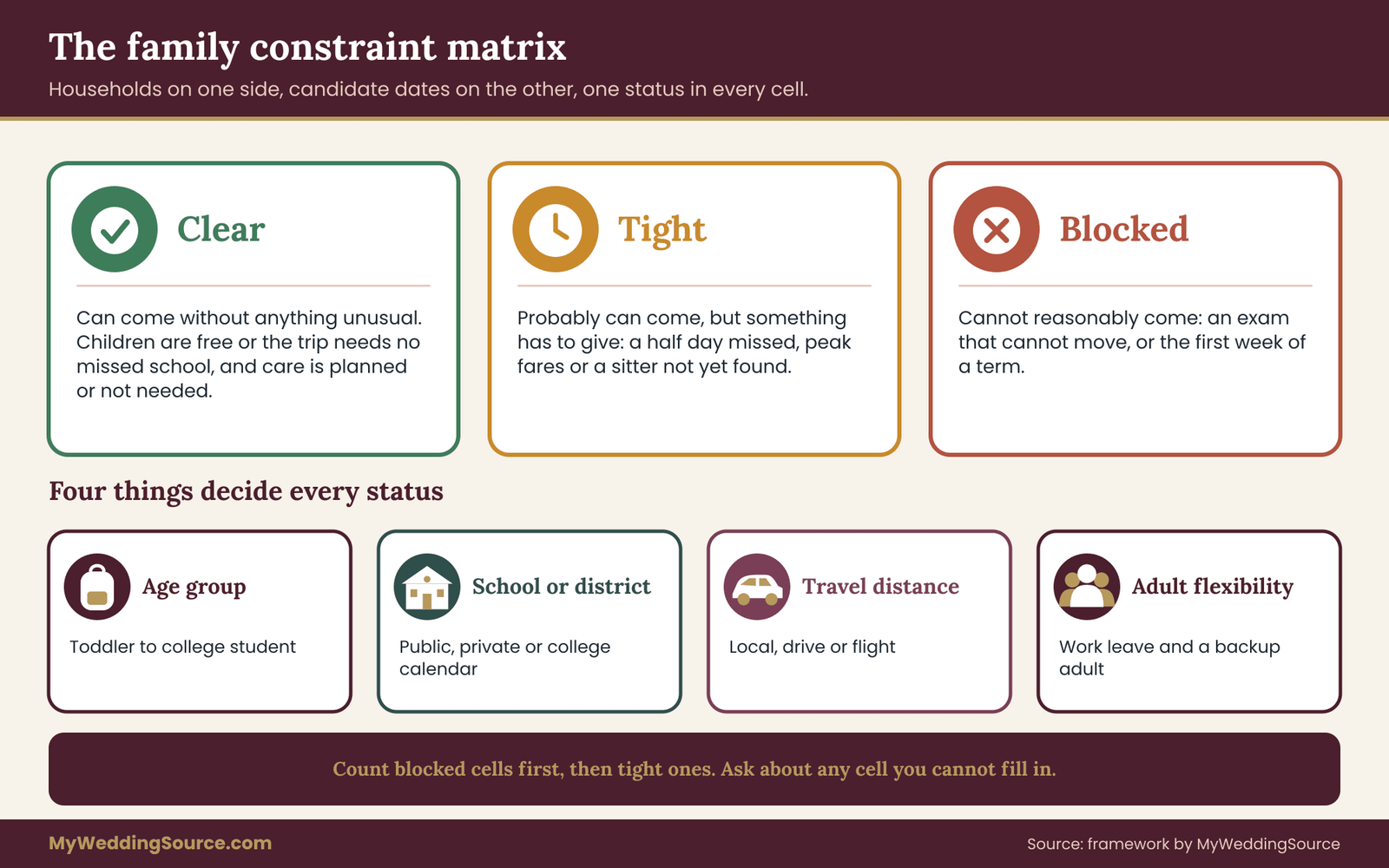
The center of this guide is a simple tool: the family constraint matrix. It is called a matrix because it crosses two lists, the households on your list and the candidate dates you are considering, and records a status in each cell. Each household gets a status for each date. The tool works on paper, in a spreadsheet or on an index card, and you will see an illustrated version of it below.
The three statuses
Each cell takes one of three values.
Clear. The household can come on that date without asking for anything unusual. The children are out of school or the trip does not need a missed school day, no exam or major event falls in the window, and a care plan either exists or is not needed.
Tight. The household can probably come, but something has to give. Perhaps the children miss a half day of school, the trip is on a peak travel weekend, or the family needs a babysitter and does not have one yet. A tight date can often be rescued with information or a small arrangement.
Blocked. The household cannot reasonably come. A college student has a final exam, a high school student is sitting a test they cannot reschedule, or the date falls in the first week of a new term when a family would not take children out of school for a trip.
Resist the urge to invent a fourth or fifth status. If you find yourself writing “maybe,” you probably need to ask the family. The value of the matrix is that every cell is either known or flagged as an open question.
The four dimensions behind every cell
When you decide a status, you are weighing four dimensions at once. Naming them keeps the decision from becoming a vague feeling.
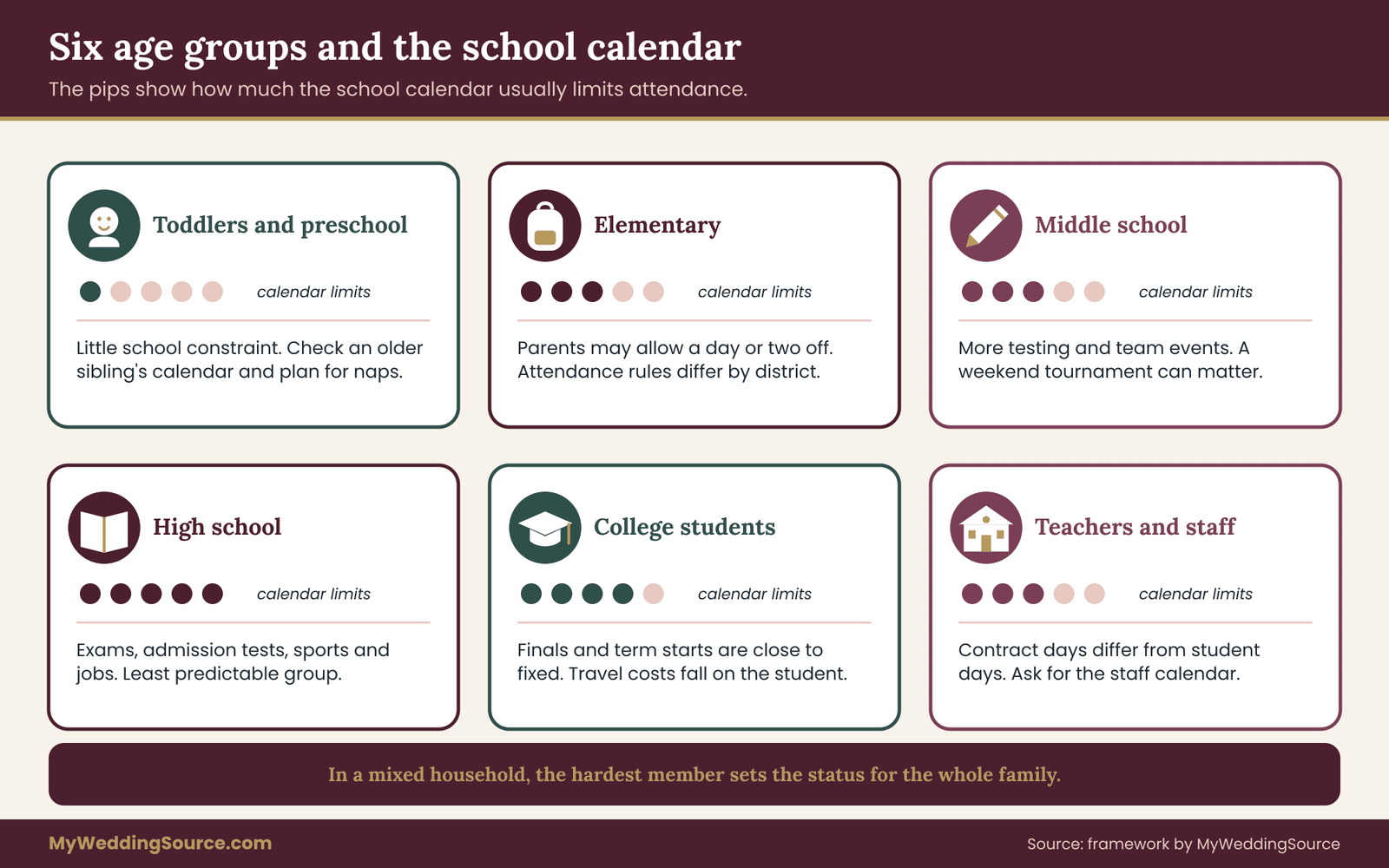
Age group. A toddler is not affected by school at all, but needs a nap schedule and probably a care plan. An elementary student is bound to a school calendar that treats absences fairly strictly in some places and loosely in others. A middle schooler is similar but may have more testing. A high school student has the heaviest conflicts: exams, college admission tests, advanced courses, sports and work. A college student follows the academic calendar of the college, which can differ from every other calendar in the family.
School district or school type. Two siblings in different schools can have different calendars. Public districts set their own dates. Private and parochial schools often follow a different pattern, and may include religious holidays that public schools do not. Year-round schools spread the breaks across the year rather than concentrating them in summer.
Travel distance. A local guest needs only the afternoon. A guest who must fly needs a day before and often a day after, which means the effective absence from school is two to four days even though the wedding is one.
Adult flexibility. Parents can often move a work schedule or arrange cover for one day more easily than for four. Grandparents, aunts and uncles, and adult siblings are sometimes available as a second adult. Single parents have less room than two-parent households, which is not a judgment, simply a planning fact.
How the four dimensions combine
Consider a simple case. A family with a nine-year-old and a thirteen-year-old lives six hours away by car. The wedding is on a Saturday in the second week of April. The district’s spring break is the week after, so the children are in school on the Friday before the wedding. The family can leave on Friday after school and arrive late, attend the Saturday wedding, and drive back on Sunday. The status is tight: it works if the parents are willing to drive at night and if no school event interferes on Friday.
Change one fact. If spring break fell on the week of the wedding, the status would move toward clear for school, but the family might now be paying peak prices and competing for rooms. The school calendar helps in one way and hurts in another. That is the reason the matrix has four dimensions rather than one.
A matrix does not need to be large
The goal is not to track every household for every possible date. It is to compare two or three serious candidate dates for the households that are affected. If you have already narrowed your date options with the process in the guide to choosing a wedding date, run the matrix on the final candidates only. A matrix of ten households and three dates has thirty cells and takes a short evening, which is a reasonable price for avoiding a surprise decline from someone you wanted at the front row.
What to do with the result
Count the blocked cells first. A date with two or three blocked households among your closest family is a serious problem. A date with a blocked cell for a distant acquaintance is not. Then count the tight cells, and decide whether you can ease them with information, hotel help or care arrangements. A date with many tight cells and few blocked cells is often workable if you act early. A date with many blocked cells needs a different date, or a candid decision about whose absence you can accept.
How the school calendar looks at each age group
The same wedding date can be easy for one child and impossible for another in the same family. Walking through the age groups one at a time shows where the school calendar bites and where something else, such as bedtime, matters more.
Infants, toddlers and preschoolers
For the youngest children the school calendar is mostly irrelevant. Many preschools and child care centers follow their own schedule, and some close on public school holidays while others do not, but a family can usually travel without asking anyone for permission. What changes the plan for this group is not the school calendar. It is naps, meals, noise and the length of the day.
Even so, it is worth asking one question: does an older sibling attend school? Many families with a preschooler also have a school-age child, and it is the older child’s school calendar that will decide the trip.
If a toddler or baby is coming, the useful planning tools are practical. A quiet room, a place to warm a bottle, a stroller route and a chair near the exit make a bigger difference than any date. Those are covered in the guide on wedding guest care planning, and they are the reason the matrix has a care dimension separate from the school dimension.
Elementary students
Elementary schools are where the school calendar becomes concrete. Children are young enough that parents will not leave them behind for a multi-day trip without an adult they trust, and old enough that missing school has a visible cost. Many parents of elementary students are willing to take a child out for a day or two for a family wedding, particularly when the trip is the occasion for a reunion. Others hold firmly to attendance, especially near testing windows or at the start of the year.
School policies on excused absences differ. A family event may be excused in one district and recorded as unexcused in another. The district’s attendance policy, normally on its website, is the reference. You do not need to read it for every guest, but when a family writes that they are worried about missing school, a short, friendly answer such as “we understand if the timing is hard” is better than lobbying them.
For this age group, the days around the wedding matter most. A Friday evening arrival after school works if the school day ends at a normal time. An early release day may help. A school concert on Thursday night probably does not interfere, but a Friday morning field trip might.
Middle school students
Middle school brings more testing, more extracurricular activities and more social pressure not to miss school. Parents often treat this age group more like high school than elementary. Missed days can mean missed homework, and a student with a sport or band commitment may have a Saturday obligation the family had forgotten.
The practical point is that a middle schooler’s own schedule may now be a constraint that the parents do not fully control. A tournament, a recital or a competition can be scheduled for any Saturday. If you have close family with a child in this group, a quick message asking whether any weekend between your two candidate dates is already taken is more useful than asking about the school calendar alone, because activities live on a separate calendar.
High school students
High school is the group with the heaviest constraints, and the school calendar is only part of it. Advanced Placement exams run in the first weeks of May on a published schedule, and a student sitting an exam will not miss it for a wedding. The ACT and the SAT are offered on fixed Saturdays through the year, and a junior preparing for college applications may have registered months ahead. Semester exams cluster in December and January and again in May and June. Some districts schedule final exams for a full week and release students early on those days, which can work in a family’s favor.
Beyond exams, high school students have jobs, teams, productions and, in some cases, dual-enrollment college classes with a separate calendar. A student who is a member of a varsity team may have a championship that cannot be moved. A student with a summer job may need the date off, which depends on an employer, not on a school.
For the wedding, this means that a high school student’s attendance is the least predictable of any age group. Ask the student’s parent, and where the relationship allows, ask the student directly. A sixteen-year-old who knows the date a year in advance can often protect it. One who hears about it three weeks before may already be committed.
College students
College students are guests in their own right and often are the group you most want to include: cousins, siblings, close friends, members of the wedding party. The college calendar is separate from the school calendar of a younger sibling, and it is not the same as another college’s. Terms may be semesters or quarters. The fall term can begin as early as mid August at some schools and as late as the end of the month at others. Finals fall in December and in early to mid May, and some schools have a reading period before them during which attendance at anything is hard.
Students also have a second travel constraint that is easy to forget: they are away from home. A student from the same city as the wedding may be in a dorm three states away. Travel is not a four-hour drive, it is a ticket the student or the family has to pay for, plus the cost of missing class or a shift at a campus job.
For college students, a wedding during the first week of a term or the week of finals is close to a blocked cell. A wedding in the week after finals, or in a break, is usually clear. A wedding mid-semester is tight: possible if there is no major exam or project due, and if the student can afford the ticket.
Mixed households
Many households do not fit a single age group. A family may have a preschooler, a fourth grader and a sophomore. In that case the matrix status for the household is the status of the hardest member. If the sophomore is blocked by an exam and the parents will not leave a sixteen-year-old home alone for a weekend, the household may split: one parent travels with the younger children, or the whole household declines. Knowing this ahead of time lets you offer something useful, such as a shorter stay, instead of discovering it in an RSVP.
Teachers and school staff as guests
Teachers and staff are a special case. A teacher’s calendar is not the same as a student’s. Teachers may have a contract year that begins before the first student day and ends after the last one, and they usually have professional days on which students are off but they are not. A teacher in the wedding party may be free on a day their own children are in school, or the reverse.
Teachers also tend to know the school calendar very well, which makes them a handy source. If a guest is a teacher, asking them how the local school calendar works is often the quickest way to understand a district you do not know. They are also likely to be more flexible about dates in summer and unusually committed in the first and last weeks of a school year.
Using the school calendar to compare candidate dates
By this point you have a household list and a way to describe each cell. The next question is how to compare dates side by side without drowning in detail. The answer is to compare the same few features for each date and to treat the results as a decision aid rather than a score to maximize.
A short checklist for each candidate date
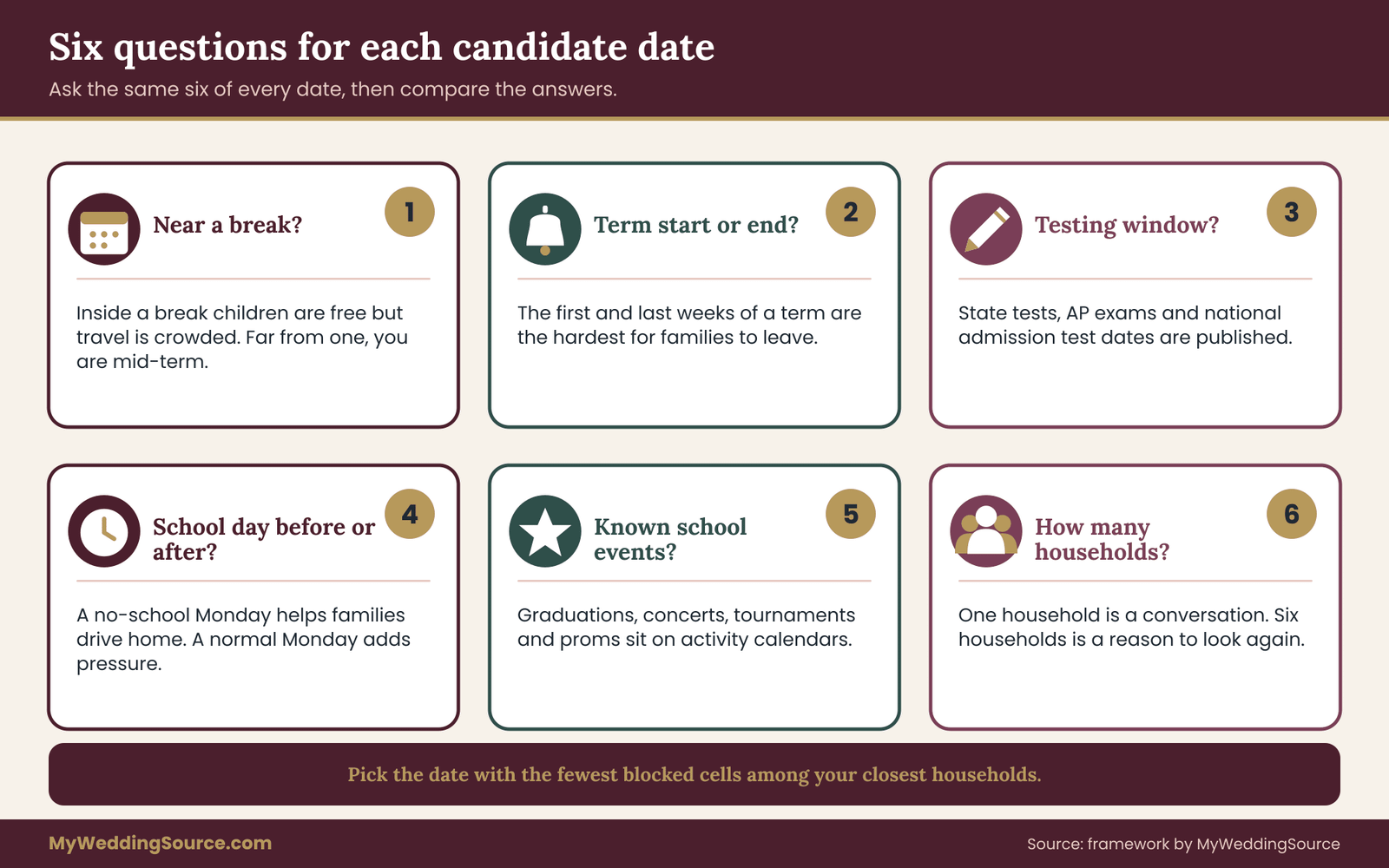
For every date you are seriously considering, write down the answers to six questions.
Is the date inside, adjacent to or far from a major break? Inside a break, children are free but travel is crowded. Adjacent to a break, the date may lengthen a trip for families who combine the wedding with a holiday. Far from a break, you are in the middle of a term.
Is it near the start or end of a term? The first week and the last week of a term are the hardest for families to leave.
Does it collide with a testing window? State assessments, Advanced Placement exams and national college admission test dates are the usual culprits. They are published and can be checked.
Is the day before or after a school day? A Saturday wedding followed by a Monday no-school day helps families travel home. A Saturday wedding followed by a normal Monday adds pressure.
Are there known school events? Graduations, concerts, tournaments and proms are often scheduled on weekends and may involve your guests directly.
How many households are affected? A problem that touches one household is a conversation. A problem that touches six is a reason to look at another date.
The goal is to find the date with the fewest blocked cells among your closest guests. Perfect dates do not exist, and a school calendar search that tries for one tends to leave a couple with no date at all.
How the school calendar shapes guest travel
Travel is where the school calendar and money meet. A family with school-age children cannot pick the cheapest week to fly, because the cheapest weeks are rarely the weeks their children are free. Understanding that squeeze explains why some guests ask for more notice than others, and why a date inside a school break is both a help and a cost.
Break weeks are crowded weeks
When many districts share the same break, many families travel at once. Airports, highways, rental car counters and hotels are all busier, and prices tend to follow. The exact weeks differ by region, but the general pattern is familiar: winter break around the end of December, a spring break in March or April, and a long summer stretch with its own busy weeks. A wedding that falls in one of these windows means that your guests with children are competing with every other traveling family, and they may be paying more than guests who are traveling on an ordinary weekend.
That is not a reason to avoid break weeks entirely. It is a reason to tell guests the date early, to hold hotel rooms earlier than you otherwise would, and to avoid assuming that “the kids are off” means “the trip is easy.” The guide to coordinating wedding guest hotels across budgets and mobility needs explains how room blocks work and what to ask a hotel about cut-off dates, and those questions matter more when many other travelers want the same rooms.

Travel days eat school days
A wedding is one day, but a trip is several. For a guest who drives a short distance, the trip may add nothing to the school week. For a guest who flies, a trip that begins on Friday morning and returns on Sunday evening still costs a school day, and a trip that begins on Thursday costs two. A family that lives across the country may need three or four days, and a wedding that sits on a Saturday in the middle of a term can mean a missed Friday and a missed Monday.
You can reduce the school cost with small choices. A Saturday late afternoon or evening ceremony lets travelers fly in the same morning, which sometimes saves a day. A Sunday brunch gives families a reason to stay the night and fly home Monday on a no-school day. A wedding on a Friday evening, scheduled on a weekend that is attached to a three-day weekend, spreads the trip over days that are already free.
None of these choices is right for every wedding. They are options to weigh for the households you most want to have.
Long weekends and school holidays
A three-day weekend is a common wedding choice because it gives guests an extra day. The advantage for families is real, since a Monday holiday often means no school. The disadvantage is that many families already have a plan for that weekend, and many hotels charge their highest rates.
Federal holidays set the pattern, but districts do not all follow it. Some districts close on a day that others treat as an ordinary school day, and some schools close on days that are not public holidays. A date that looks like a long weekend on a national calendar may be a normal school weekend for some of your guests. The only way to know is to check the school calendar for the households you care about.
Religious and cultural observances
School calendars intersect with religious and cultural observances in ways that vary by place and by school. Some districts close for particular religious holidays. Private and religious schools often close for their own observances, and families may avoid travel or events on those days whether or not school is in session. A wedding date that is open on the school calendar can still conflict with an observance that matters to a group of guests.
This is another reason to ask rather than assume. A short note on the save-the-date inviting guests to flag any conflicts is respectful and practical. It also tells guests that you are open to hearing them before the date is final, which is the most important message you can send.
Driving windows and arrival times
Families who drive need a realistic window. A parent who finishes work at five, picks up children at six and drives four hours will arrive at ten at night. If the rehearsal dinner, the welcome drinks or an early morning event starts at nine the next day, that family has had very little rest.
If your plans include a Friday evening event and you know that families with school-age children are coming from a distance, consider whether the event should be optional and whether the Saturday schedule starts late enough for them to arrive in good shape. A mid-afternoon ceremony is easier on families than a morning one for the same reason.
Hotel stays and school-term pricing
Hotels near a college or in a university town raise prices on move-in weekends, parents’ weekends and graduation weekends, and those dates come from academic calendars, which work like a school calendar for adults. A wedding in a college town on a parents’ weekend can have very little hotel availability, even when it is nowhere near a school break. The tip here is simple: if your venue or a guest hotel is near a university, check that college’s academic calendar for events, not only your guests’ school calendars.
The same issue shows up in reverse. A family from a college town may have a child at that college. Their travel plans are shaped by a school calendar they do not control, and the wedding may land on a weekend that matters to them for reasons unrelated to your date.
Flights, fares and flexibility
You cannot control fares and should not promise guests anything about them. What you can do is give notice. The earlier a household knows the date, the more options they have: they can buy tickets with free changes, they can compare airports, and they can adjust a school absence request. Official guidance on air travel, including refund and change rules, is published by the U.S. Department of Transportation, and families booking for several people should check it before buying. For flights with children, the Transportation Security Administration publishes guidance on screening when traveling with children, which is useful to point nervous parents toward.
Questions worth asking a venue and hotel
A few questions help whenever the school calendar suggests a busy week.
Ask the hotel whether the block rate depends on a minimum number of nights, and whether the cut-off date is before or after typical family booking times. Ask whether rooms with two beds or connecting rooms are available, because families need them and they often sell first. Ask whether the hotel has a policy on children in a pool or common area during evening events. Ask the venue whether it has a quiet room, a place for strollers, and an end time that lets families leave at a sensible hour.
None of these is specific to the school calendar, but the school calendar tells you which questions are urgent.
Childcare and the school calendar
Travel gets a family to the wedding. Care decides whether they can enjoy it. The school calendar matters here because it determines what is happening to children before and after the event, and because many families rely on school hours as their normal care.
School hours are a form of childcare
For many working parents, the school day is a large part of the care structure. When school is closed, the family has to cover the hours that school normally covers. A no-school Friday before a wedding is a childcare problem as much as a travel opportunity: someone has to be with the children while the parents prepare to leave.
This is the reason that no-school days often show up as a source of stress for parents and not as a benefit. A wedding that falls near a day off may feel to a parent like one more day to cover. It helps to remember this when you are tempted to read a school holiday as pure good news for your guests.
What a family needs on the day
When children attend the wedding, their needs are fairly predictable. They need a place to sit with the family, food that fits their tastes and a schedule that does not leave them waiting for hours. They need something to do during long transitions, and a quiet place when they are overtired. When children do not attend, their parents need a way to get home or to the hotel on a timeline the sitter can keep.
The simplest help you can offer is clarity. Let guests know the timeline: when the ceremony starts, when dinner is served, when the formal events end, and when the last shuttle leaves. A family with a sitter at the hotel can plan around a clear end time. A family bringing the children can decide when to leave without worrying about missing something important.
Offering care without taking on a liability
Some couples arrange childcare at the venue or hotel, such as a hired sitter or a supervised room. This can be very helpful to families, but it brings responsibilities.
The staff should be qualified and vetted, the space should be safe, parents should know exactly who is responsible, and the arrangement should be agreed in writing with the vendor. The sections of this site on vetting caregivers and pickup authorization go deeper, and you should not improvise childcare. If you are not ready to manage that carefully, a better option is to suggest that families bring their own sitter, or to share a list of local, licensed child care options and let each family decide.
The federal childcare.gov site and the Office of Child Care at the U.S. Department of Health and Human Services publish general information on choosing and checking child care, and it is a good place to send families who want to make their own arrangements.
Verifying each school calendar with official sources
A school calendar you read on a forum, or half remember from last year, is not a reliable basis for a decision. Dates move, and a mistake can cost a family real money. The rule of this guide is simple: use the school’s own published calendar, and say so when you ask guests to confirm.
Where to look, in order
Start with the district or school website. Most public districts have a school calendar page, often a downloadable document, with the board-approved dates for the current and sometimes the next school year. A private or charter school usually posts its own. A college’s academic calendar is normally on the registrar’s page, and it distinguishes between the dates for classes, reading days, finals and commencement.
If the site shows only the current year and your wedding falls in the next one, look for a “proposed” or “draft” calendar, which some districts publish for public comment. Treat a draft as a draft. If a district has not yet approved the school calendar for your wedding year, tell guests that you are working from the draft and will confirm.
For national exam dates, the College Board posts the Advanced Placement exam calendar and its SAT test dates, and ACT publishes its own test dates. For general facts on how schools are organized and how a school calendar differs from place to place, the National Center for Education Statistics and the U.S. Department of Education publish background material, though they are not a substitute for a local calendar.
What to record
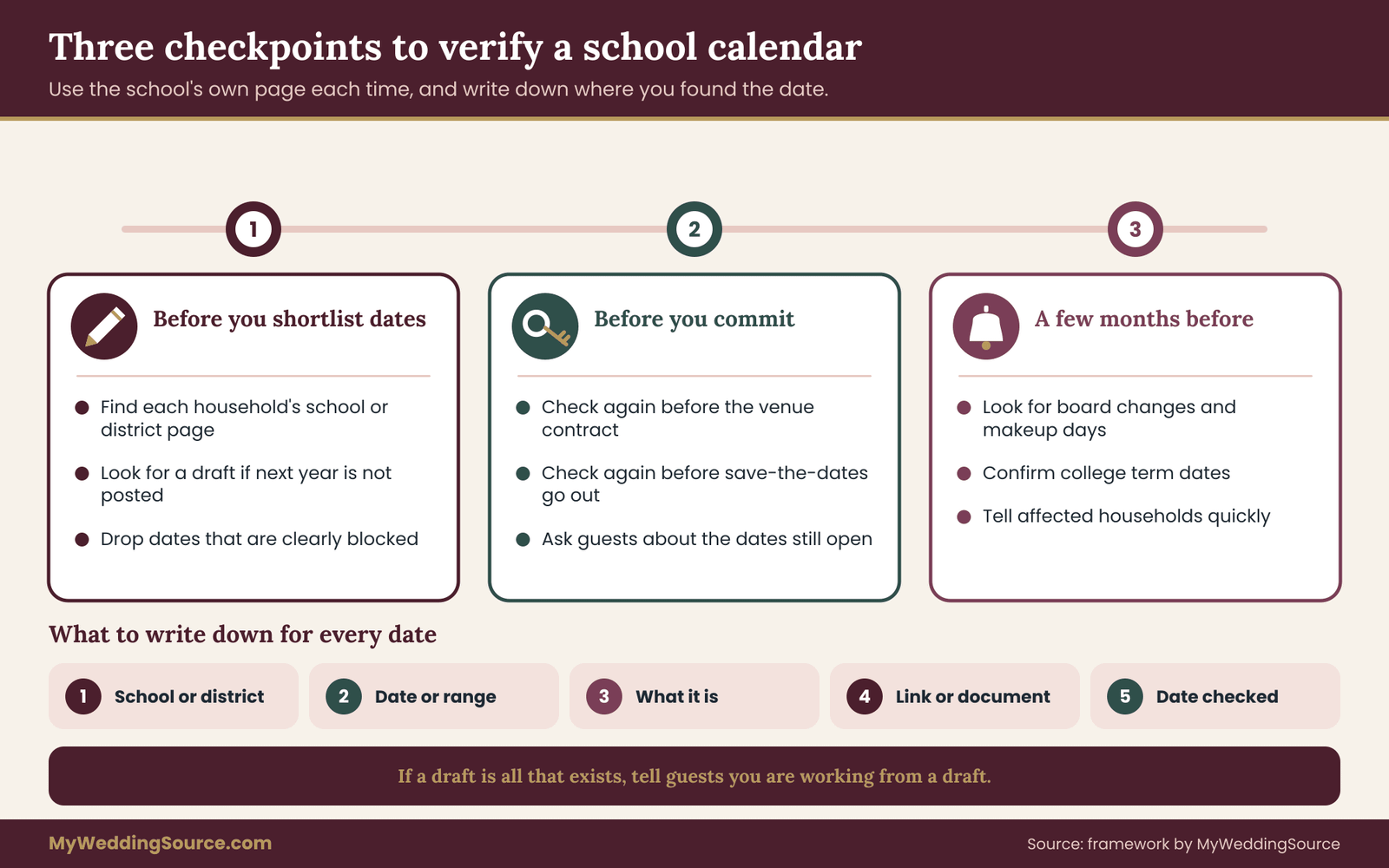
When you look up a calendar, record what you need and where you found it. A simple note works: the school or district, the date or range, what it is (break, exam window, term start), the link or document name, and the date you checked. This habit helps in two ways. It tells you later whether the information might have changed. And if a guest disagrees with you, you can say exactly where you read it.
How far ahead the data is reliable
Calendars are most reliable for the current school year and become less certain further out. A wedding two years away may fall in a school year whose calendar has not been written. In that case you have three options. You can use the pattern from earlier years as a rough guide, bearing in mind that districts change their patterns. You can ask a friendly guest, such as a teacher or a parent, whether they have heard about next year. Or you can hold the decision until each school calendar is published, if your timing allows.
Do not tell guests that a date is “safe” because it was free last year. Say that it matched the published calendar when you checked, and that you will check again.
Checking again before you commit
Check at three points. Check before you shortlist dates, so that you do not waste effort on a date that is clearly blocked. Check again before you sign the venue contract or send save-the-dates, because that is the last point at which a change is cheap. Check a third time a few months before the wedding, when each final school calendar is usually in place and any snow-day or board changes have appeared.
If a change moves a break or adds a school day close to your wedding, you will not usually be able to change your date. What you can do is tell the affected households quickly, offer to share a ride or a hotel suggestion, and adjust your own schedule if it helps, for example by moving the Sunday brunch earlier. A short, practical message is better than silence.
When the official source is unclear
Some districts publish calendars in formats that are hard to read, or leave out items such as early release days and parent-teacher conferences. If the page is unclear, call or email the school office and ask, and make the question narrow: “Is school in session on this Friday, and is there an early release?” Office staff can usually answer in a sentence. If you are not a parent of the school, a guest can ask on your behalf.
Asking guests about the school calendar without making it awkward
You can collect a lot of the information you need from public sources. For the rest, you need to ask people. Many couples avoid this because they worry about seeming pushy, but a courteous question at the right time is welcome. Families would much rather be asked early than discover a conflict after the date is set.
When to ask
The best time to ask is before the date is fixed and while two or three dates are still possible. That is rarely practical for a whole guest list, so ask only the households that matter most for the decision: immediate family, wedding party members and the few guests whose absence would be hard.
Once the date is set, the question changes from “which date works?” to “what would help you attend?” That is a different conversation. It is about travel notes, room holds and care, not about the choice of day.
Script: asking before the date is final
For a close family member, a short, direct message works well.
“We are deciding between two dates for the wedding, and we would love to have your family there. Do you know whether either one clashes with the kids’ school calendar, a break, a test or an event? We are not going to pick a date that locks anyone out if we can help it, but we need to hear about it now.”
The key features are that it names the two dates, gives the family a reason to answer, and does not promise to move heaven and earth. You are listening, not negotiating.
Script: the save-the-date line
On a save-the-date or a wedding website, a short sentence invites families to speak up without singling anyone out.
“If the date or the school calendar makes travel difficult for your household, please tell us, and we will help where we can.”
That gives families a way to raise a conflict, and it signals that you understand that some of them will need to plan around school. It costs nothing and often saves a long, awkward conversation later. The wedding invitation etiquette guide covers what a save-the-date and an invitation normally contain, and a line like this fits inside the usual wording.
Script: a family says the date is hard
If a family says the date is difficult, answer with thanks and with a question, not with an argument.
“Thank you for telling us. What would make it easier: a shorter trip, a room close to the venue, a ride, or a place for the kids to rest? If it still does not work, we will understand.”
Notice the last sentence. A family who feels pressured will often say yes and then be unhappy, or say no and feel guilty. A family who feels free to choose will say what they really can do. The relationship is more important than one more attendee.
Script: a family is deciding whether to bring the children
If children are invited and the parents are unsure, offer practical details.
“We are planning the ceremony for about thirty minutes, dinner right after, and the formal part ends at ten. There is a quiet room for little ones. Does that help you decide?”
That gives them the facts they need to judge whether the children will cope. The more specific the timeline, the easier the decision for the family. If children are not invited, say so kindly and early, so that families can arrange a sitter, and do not make exceptions that you cannot extend to others.
Script: a family asks about a school absence
If a parent writes that they would have to take the children out of school, resist the urge to advise. You may not know the district’s attendance rules, and you are not in a position to decide for the family. A short reply is enough.
“We understand, and we do not want you to put school at risk. If it is easier for the children to stay home with someone, we will completely understand, and we would love to see you at a later celebration.”
If the family does want to attend, they can ask the school. They know the teachers and the policies and will handle it better than any outsider can.
What to put on the RSVP
For households with school-age children, a single line on the response card or the website form can help: “Number of children attending, and ages.” That tells you about the age groups, which feeds your care planning and your meal counts. It does not ask why anyone is not coming. The RSVP etiquette guide explains how to word it, and you should check how it fits with your invitation rules about who is invited.
Avoid long forms. A household with several children will not fill out a questionnaire about every school day. Ask for the facts you will use: attendance, ages, hotel need and a contact number.
Worked example: three dates, eight households
Abstract rules are easier to trust once you have seen them applied. The example below is invented, with invented people and districts, and it does not describe any real family or school. It shows how the family constraint matrix works from the first list to the final decision.
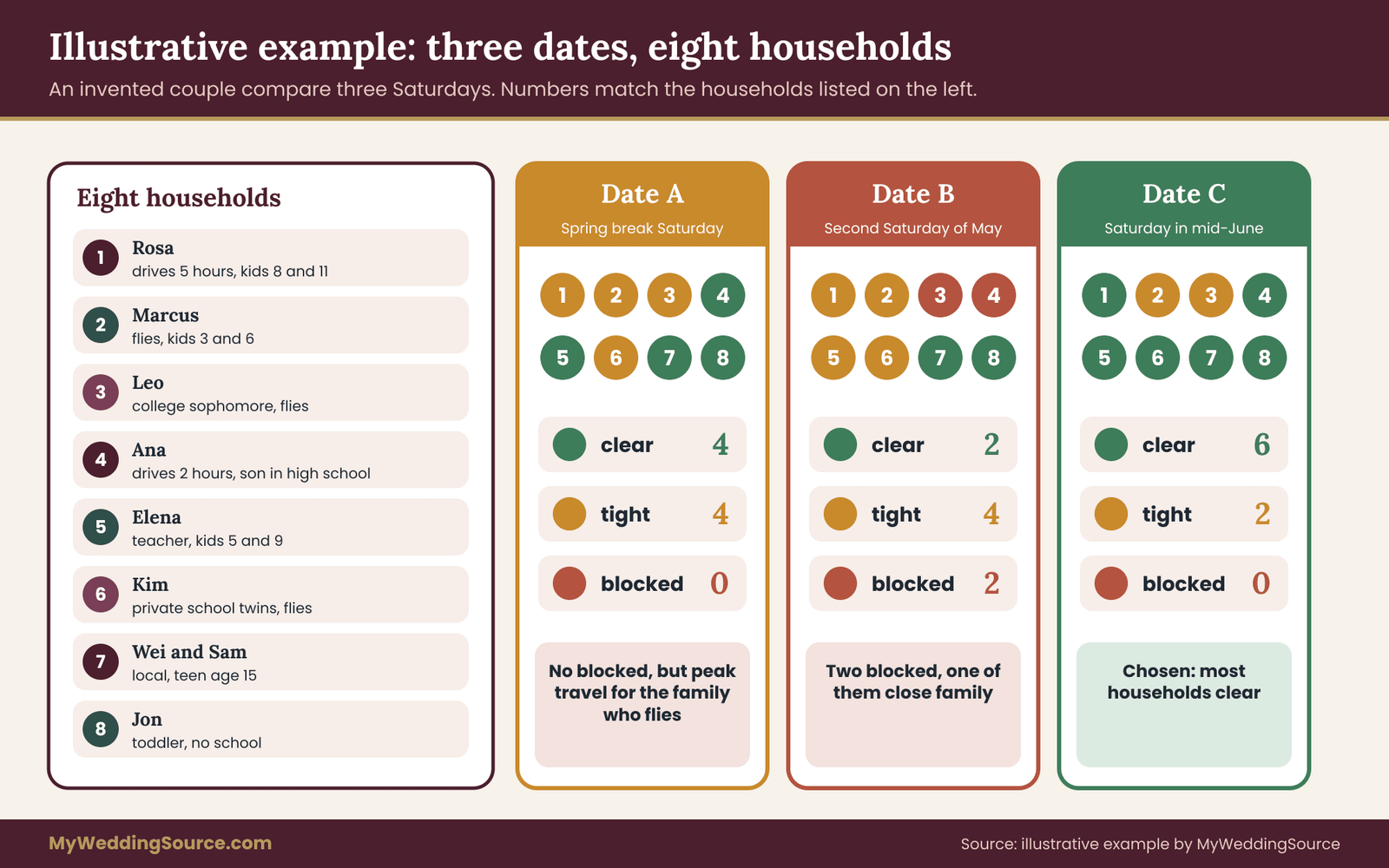
Dana and Miguel are planning a wedding for about one hundred guests in a mid-sized city. They are choosing among three Saturdays. Date A is the Saturday that falls inside the spring break of one nearby district. Date B is the second Saturday of May. Date C is a Saturday in mid-June, shortly after most local schools finish the year. Their venue has all three open.
Step one: the household list
Going through the guest list, they find eight households where the school calendar matters.
- Dana’s aunt Rosa, with children aged eight and eleven in District X, a five-hour drive away.
- Dana’s brother Marcus, with children aged three and six in District Y, who would need to fly.
- Dana’s cousin Leo, a college sophomore, who would also fly.
- Miguel’s cousin Ana, with a sixteen-year-old in high school, a two-hour drive away.
- Miguel’s sister Elena, who teaches in District Z and has children aged five and nine, about an hour away.
- Dana’s college roommate Kim, whose twelve-year-old twins attend a private school, flying in.
- Two close friends, Wei and Sam, with a fifteen-year-old, living in the same city.
- Miguel’s friend Jon, with a two-year-old and no older children, driving in.
Jon’s household turns out to have no school constraint at all. It stays on the list because of the care question, but it does not need a calendar lookup.
Step two: the lookups
Dana spends one evening on the websites. District X’s calendar shows school in session on the Friday before Date A and Date B. District Y is on spring break during Date A, and its school year ends the Friday before Date C. District Z is on break during Date A, and its teachers finish a few days after the students. The private school’s calendar differs from every public district. Leo’s college lists final exams during the second week of May. Ana’s son attends a high school that publishes the Advanced Placement schedule, and his exam dates fall in the week after Date B.
Dana writes each fact in a note with the source and the date checked. Two items are marked “draft,” because one district’s calendar for the following spring has not been approved. She asks one question of Ana and Marcus, using the script from the earlier section, and gets answers within a day.
Step three: the matrix
Each household now gets a status for each date.
For Date A, the spring break week, four households are clear and four are tight. Rosa’s children would miss the Friday, and the drive is long. Marcus’s family is on break, but fares are at their peak. Leo is in the middle of a term. Kim’s private school is in session, and she would have to fly. No household is blocked.
For Date B, two households are clear, four are tight and two are blocked. Leo’s finals fall in the same week, and Ana’s son has an exam on the Monday after, so his parents are unwilling to travel. Elena is a teacher near the end of the year, and the testing window affects Rosa’s children.
For Date C, six households are clear and two are tight. Marcus’s children have school on the Friday before, and Leo has a summer job. District X is out, the private school is out, and Ana’s son is free. Nobody is blocked.
The result is a simple count: Date A has no blocked cells and four tight ones, Date B has two blocked and four tight, and Date C has none blocked and two tight.
Step four: what else the matrix cannot see
At this point the couple could pick Date C and stop. A good decision uses the matrix as one input, not as the whole answer. Dana and Miguel check the things the school calendar does not show. Mid-June is a busy wedding season, so hotel rooms and vendors may be harder to book. Some guests may already have summer travel plans, which the school calendar says nothing about. And a few of their older relatives would find a June ceremony in the heat more difficult than one in April.
They weigh these against the matrix. Date B is out because of the two blocked households, one of them close family. Date A has no blocked cells, but its four tight cells include peak travel for Marcus, the one guest who must fly with small children. Date C keeps the most households clear and leaves them with two tight ones that they can ease.
They choose Date C, with two follow-ups. They send Marcus a note a year ahead so he can look at flights early. They hold a block of rooms with two beds and ask the hotel when families normally book.
Step five: check again
A few months before the wedding, Dana checks each school calendar once more. District Y’s final calendar differs from the draft by a day, which changes nothing for the wedding itself but means Marcus’s children will miss one more school day than expected if they leave on Thursday. She sends him a short note. She also confirms that Leo’s college has not changed its term dates. The rest are unchanged.
The example took about three evenings in total, spread across several months. It did not guarantee that every guest would come. It did make sure that the couple chose their date with open eyes, that nobody they cared about was surprised by a conflict, and that the households who needed notice got it early.
Choosing a date when the school calendar splits your guests
The example above has an easy answer, which real life does not always supply. Sometimes every candidate date has a blocked cell for someone you love. Here are the rules of thumb that help when the school calendar does not hand you a winner.
Weigh closeness before count
A blocked cell for a sibling or a parent matters more than three blocked cells for acquaintances. Decide in advance who you cannot hold the wedding without, and treat their cells as near-vetoes. For everyone else, weigh the number of cells but not the strength of the relationship alone, because it is easy to inflate the importance of people who are loudest about their schedules.
Separate “can’t” from “would rather not”
A college student with a final exam cannot attend. A family that would prefer not to take two children out of school for a day is in a different position, and many such families do decide to go when it is a close relative’s wedding. When you read a response, ask yourself whether the family said “cannot” or “it would be hard.” The second can often be eased.
Ask who carries the cost
Some dates are cheap for the couple and expensive for guests, and the reverse. A mid-week or off-season date can save you money and cost a family with children a missed day of school and a more expensive flight. A peak-season Saturday may cost you more and be easier for families. There is no right answer, but it is fair to notice who is paying and to decide knowingly.
Do not over-optimize
A date that is clear for every school-age household may not exist, and a search for it can eat months. A good working rule is to stop when you have a date with no blocked cells among your closest households and a manageable number of tight ones. After that, additional improvement is guesswork.
Mitigations for tight cells
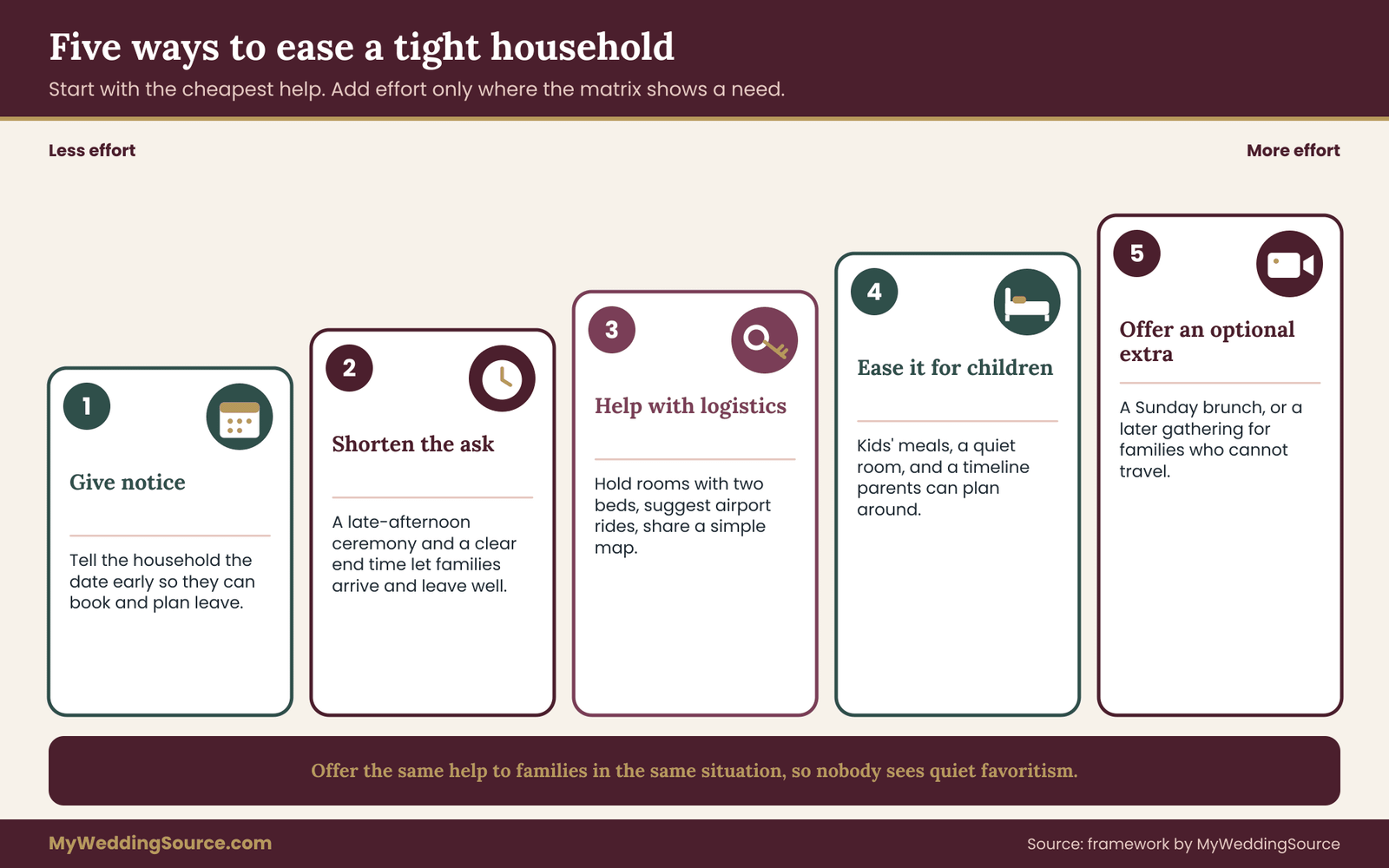
If you cannot change the date, you can ease tight cells in a few ways. These are in rough order of effort.
First, give notice. The earlier a family knows, the more options it has. Second, shorten the ask: a Saturday evening ceremony lets travelers arrive that morning, and a clear end time lets them leave. Third, help with logistics: hold rooms in a block, suggest a ride from the airport, share a map. Fourth, make the event easier for children: a kids’ table, simple food, a quiet space. Fifth, provide an optional extra: a Sunday brunch for those who can stay, or a way for families who cannot come to share in the day, such as a livestream or a gathering after the wedding.
None of these costs much, and each reduces the pressure on a family. The wedding planning checklist is a good place to keep the dates for sending notice, holding rooms and confirming details so that these steps do not slip.
When the date is already fixed
If you have already signed a venue contract or sent invitations, the matrix still helps. You are no longer choosing a date, but you are choosing what to tell guests and what to offer. Run the matrix for the one date, find the tight and blocked households, and put your effort into the tight ones. Blocked households may still send love or visit afterward. Tight households are the ones you can actually help.
Limits and edge cases when you plan around a school calendar
A method for reading a school calendar can only be as good as the information it starts with. These are the situations in which the matrix gives a weaker answer, and what to do about each.
Year-round and multi-track schools
Some schools do not use a long summer break. They spread the same number of days across the year in shorter blocks, and some divide students into tracks that have different days off. In a district like that, two children of the same age may have different breaks. Do not assume that a long weekend in June is free for a family in a year-round school, and do not assume that a family has the usual spring break. Look at the school’s own calendar, and ask the parent which track the child is on.
Homeschooling families
Homeschooling families set their own schedules, and many of them have more flexibility around a wedding than families with children in school. Others follow a rigorous plan, join co-ops that meet on fixed days, or take part in sports leagues and testing events with their own dates. There is no calendar to look up, so the answer is simply to ask. Do not assume that “homeschool” means “free.”
Shared custody and blended households
Children who live in two homes follow a custody schedule that may decide which weekends they can travel, and the school calendar may be the least of the constraints. Parents in this position often know months in advance which weekends belong to whom. A wedding that lands on the other parent’s weekend can be blocked in a way that has nothing to do with school.
Be gentle here. You do not need the details of an arrangement and should not ask for them. A general question such as “Is that a weekend you have the children?” is enough, and it is polite to accept the answer without comment. If a parent says the dates do not work, take that at face value.
Boarding schools and distant colleges
A boarding school student lives away from home and has a school calendar with a small number of travel windows, such as a long weekend or a break. Leave-weekends may be restricted and require advance permission from the school. A student at a distant college is a similar case. For these guests, the family often needs to coordinate several schedules and book travel far in advance, so early notice helps more than anything.
Teachers in the wedding party
A teacher who is in the wedding party or who is one of the couple has constraints you should know in detail. Many teachers cannot take time off during the school year without losing pay or arranging a substitute, and some districts limit requests around testing windows, the start of the term and the end of the term. If a member of the wedding party is a teacher, or one of you is, ask them for the contract calendar early. The dates for staff may differ from the dates for students, and the personal leave rules sit in the district’s policies.
Snow days, closures and calendar changes
A school calendar assumes that school will be held on the days it says. Weather closures, emergencies and board decisions can change that. A makeup day may be added to a planned break, or a day may be extended. The date of a break normally does not shift once the school year has begun, but it can happen, and it is one reason a final check close to the wedding is sensible.
Changes can also come in the other direction. A district may drop a planned school day to give students a break, or move a teacher day. The practical response is the same: stay in touch with the households that depend on the calendar.
Guests from other countries and other systems
International guests follow different school calendars. In some countries the school year begins in September and ends in June, in others it begins in January or February, and the long break may fall in what you think of as the middle of your winter. A family visiting from abroad may be able to travel at a time that is impossible for a family at home, or the reverse. Do not carry assumptions about “school” across borders. Ask each family when their children are free.
Differences between states and districts
In the United States, school calendars are set locally, with state rules on the minimum number of instructional days or hours and on some start and end dates. Two neighboring states may have entirely different norms, and so may two neighboring districts. That is the reason this article treats the district or school as the unit of research and warns against generalizing about “most schools.” Whatever you read about typical start dates and breaks is a pattern, not a rule, and a local calendar will overrule it.
What the matrix cannot capture
The matrix cannot tell you how a family feels. It cannot tell you whether a parent is tired, whether a child is anxious about travel, or whether a family is quietly short on money. It does not measure how much a guest wants to come. A household marked clear may still decline for reasons you will never know, and a household marked blocked may find a way to attend.
That is not a failure of the method. It is a reminder that the matrix is a tool for finding obvious conflicts early, not a way to predict human choices. Treat any decline kindly, and do not read it as a judgment on your date.
Privacy and fairness
You are collecting information about children’s schools, ages and schedules. Keep it light and keep it private. Use it to plan, not to discuss. Do not share one family’s reasons with another, do not post a list of conflicts, and do not use the information to pressure anyone. Store only what you need, such as age bands and break dates, and delete the notes after the wedding. Do not record children’s full names or school names in places that other people can open. A simple spreadsheet with initials and age bands is enough.
Fairness matters too. If you offer help to one family, such as a room hold or a ride, consider whether you can make the same offer to others in similar circumstances. You do not have to do everything for everyone, but you should avoid quiet favoritism that other guests may notice.
Limits of the sources
This guide points to official sources for school calendars, exam dates and travel rules, but it does not repeat their details, because they change. A school calendar is revised, fares move and rules are updated. Always confirm with the school or the issuing agency, and treat anything you read here as a way of structuring your questions, not as a statement of current facts.
Your next steps
Here is a short sequence you can follow this week.
First, group your guests into households and mark those with school-age children. Add the four columns: age band, school or district, distance and adult backup.
Second, narrow your date options to two or three. If you have not done that yet, use the date-selection guide to get there. Third, find each household’s school calendar from the school’s own site and record the source and date checked. Fourth, fill in the matrix with clear, tight and blocked for each date.
Fifth, ask the households whose cells are unclear, using the scripts above. Sixth, choose the date, and for the tight households, send notice and offer the small helps that fit your event. Finally, set a reminder to check each school calendar again before you commit and a few months before the wedding.
FAQ
Is there one school calendar I can use for all my guests?
No. In the United States, school calendars are set by individual districts, private schools and colleges, so two families in the same town may have different breaks. Group your guests into households, find each household’s own school calendar on the school’s website, and treat any national pattern as a rough guide only. Confirm each date directly with the school.
How early should I check the school calendar for my wedding date?
Check before you shortlist dates, again before you sign a venue contract or send save-the-dates, and a third time a few months before the wedding. Many districts publish the next year’s calendar well ahead, but some publish only a draft. If your date falls in a year without a published calendar, tell guests you are working from a draft.
Should I avoid a school break when picking a wedding date?
Not necessarily. A break frees children from school but crowds airports, highways and hotels, so travel may cost more. Whether a break helps depends on your guests: families who drive a short distance may gain, while families who fly may pay more. Compare candidate dates with the constraint matrix instead of ruling a break in or out.
How do I ask guests about school conflicts without being pushy?
Ask early, ask about specific dates, and make clear that you will not pressure anyone. A short message that names two dates and asks whether either clashes with a school break, test or event works well. If a family says a date is hard, thank them and ask what would help. Accept a decline kindly.
What if a high school or college student has exams near my date?
Treat an exam as a fixed point. Advanced Placement exams and national admission tests follow published schedules, and college finals follow the registrar’s calendar, so a student is unlikely to move them. If the exam sits close to your date, ask the student’s parents early, and consider a different date if that guest is close family.
Do teachers have the same calendar as students?
Not always. Teachers often have professional days when students are out of school but staff are working, and their contract year can begin earlier and end later than the student year. If a teacher is in the wedding party or is one of the couple, ask for their contract calendar and their district’s leave rules.
What if a child’s parents live in different households?
Ask in general terms, such as whether the date falls on a weekend the parent has the children, and accept the answer without asking for details. A custody schedule can decide whether a child can travel on a given weekend regardless of the school calendar. Do not share one family’s reasons with others.
Can I still use this method if my date is already set?
Yes. Run the matrix for the one date, identify the tight and blocked households, and focus your effort on the tight ones. Offer early notice, room holds, a clear end time and simple help for children. Blocked households may still join a later celebration. You are no longer choosing a date, only deciding what to offer.
Sources
- National Center for Education Statistics – background on how U.S. schools and school years are organized
- U.S. Department of Education – federal education information and links to state agencies
- College Board – Advanced Placement exam calendar and SAT test dates
- ACT – national ACT test dates
- U.S. Department of Transportation, Aviation Consumer Protection – airline refund, change and family travel rules
- Transportation Security Administration – screening guidance for travelers with children
- Childcare.gov – federal information on choosing and checking child care
- Office of Child Care, U.S. Department of Health and Human Services – child care policy and resources
- USA.gov – links to state education departments and local school information