
Wedding reimbursements are the repayments that move between the couple, two families and a planning team after someone pays a wedding cost out of their own pocket. This guide shows how to track wedding reimbursements in one shared ledger that records who paid, what proof exists and where each approval stands, so nobody is left guessing about money.
Keep one ledger for wedding reimbursements with a row for every out-of-pocket cost. Each row names the payer, the payee, the amount, the proof and an approval status that moves from claimed to approved to paid to closed. Agree on spending limits and approvers before the first receipt arrives, settle in scheduled rounds instead of one by one, and net out what people owe each other so fewer transfers are needed. When a claim has no proof or no approval, hold it and ask before paying.
Most weddings quietly run on other people’s credit cards. A mother puts the cake deposit on her card because the baker takes only certain payment types. A bridesmaid buys forty yards of ribbon on the way home. The planner pays the rental company and adds the cost to a bill. A groom’s uncle covers the late-night pizza and says he will “sort it out later.” Each of these is reasonable on its own, and together they produce a pile of small debts with no owner.
That pile is the real subject of this guide. Wedding reimbursements rarely cause fights because of the money. They cause fights because nobody wrote down what was agreed, and then three people remember three different versions. A calm, plain ledger fixes most of that. It does not require accounting skill, only a few columns, a few rules and the habit of recording a cost on the day it happens.
A note on scope. This is general information, not legal, tax or financial advice. Payment rights, gift rules and contract terms differ by state and by agreement, so where a rule matters, the article points you to the agency or the document that decides it.
What wedding reimbursements are, and why they pile up
A reimbursement is a repayment for a cost someone else covered on the wedding’s behalf. It is different from a gift, where the giver does not expect money back, and different from a loan, where the repayment is the point of the arrangement. Wedding reimbursements sit between the two: the payer fronted the money, the wedding owes it, and the only open question is how much, to whom and when.
The reason they pile up is that weddings have no single checkout. In a normal purchase one person pays and the transaction is over. A wedding is dozens of small purchases made by many people over many months, with different payment methods, different vendors and different ideas about who is responsible. Some of those purchases were planned and approved. Others happened because a vendor needed something at the last minute and the nearest person with a card said yes.
Here are the most common situations that create a reimbursement, so you can recognize them early.
Vendor payments made on someone else’s card. A parent or relative pays a deposit or balance directly because they offered to contribute, or because it was convenient. The wedding now owes that person, or the payment counts against their contribution. These are the cases where wedding reimbursements overlap with the contribution conversation, which is covered in the guide to wedding decision rights on this site.
Small purchases by helpers. Attendants, relatives and friends buy supplies, favors, flowers, signs, snacks or transport. These are usually small, usually undocumented and usually the source of the most awkward conversations, because asking for fifteen dollars back feels petty.
Planner and coordinator expenses. A planner or day-of coordinator may pay for items and then bill you, or they may ask you to pay vendors directly. Whether a charge is a reimbursement of a real cost or a markup on one depends on the planner’s contract, and the difference matters.
Day-of emergencies. A steamer, a sewing kit, extra ice, a cab, a replacement cable. People cover these without thinking, and the claim shows up weeks later or never.
Travel and lodging fronted for the wedding party. A family member books a block of rooms or a shuttle and expects to be repaid by the people who use them.
Why a shared ledger beats memory and text messages
A single ledger for wedding reimbursements turns scattered messages into one source of truth.
Text threads feel like a record, but they are not a ledger. A text that says “I got the flowers, Venmo me later” tells you almost nothing: which flowers, how much, whether there was a receipt, whether anyone else approved it, and whether “later” means this week or after the honeymoon. Multiply that by thirty messages across four group chats and nobody can say what is owed.
A ledger answers the questions that texts cannot. It shows the total outstanding at any moment. It shows who is owed the most and who owes the most. It shows which claims have proof and which do not. It shows which claims were approved before the money was spent and which were not. Above all, it makes the process impersonal. When the rule is “every claim goes in the ledger with proof,” nobody has to feel accused when you ask for a receipt.
The cost of getting this wrong
Untracked wedding reimbursements fail quietly, which is why the damage tends to appear late.
Disorganized wedding reimbursements cost real money in three ways. First, double payment: the same expense gets repaid once by the couple and again by a parent, because two people each thought it was theirs. Second, lost claims: a helper who is never repaid quietly absorbs the cost and resents it. Third, disputes that damage relationships long after the flowers are gone. None of these needs a legal fix. They need a record created at the time the cost was incurred.
The wedding cash-flow planning guide on this site covers the bigger picture of deposits, final balances and reserve timing. This guide takes a narrower slice of that picture: the repayments that run sideways between people, rather than the payments that run from you to vendors.
Map the people and the money paths first
Before you build any ledger, draw the cast. Wedding reimbursements go wrong most often because the group is larger and messier than anyone admitted at the start. A short written map of who can spend, who can approve and who gets repaid takes about twenty minutes and prevents most of the confusion.
Start with four kinds of people, because each one behaves differently around money.
The couple. They are usually the final owner of the budget, whatever the family contributions look like. They set the overall limits and break ties. In many weddings they are also the ones paying most claims out of a shared account.
Family A and Family B. Each family may contribute money, pay vendors directly, buy items or lend help. The two sides often have different customs, different expectations and different comfort with written agreements. One family might treat a handshake as final. The other might expect a spreadsheet. Neither is wrong, but the ledger has to work for both.
The planning team. This can be a professional planner, a venue coordinator, a day-of coordinator, a trusted friend who volunteered, or the wedding party acting together. They may spend your money, advance their own, or both.
The vendors. They are not part of the reimbursement ledger, but they are why it exists. A vendor payment made by a third party is the most common trigger for a claim.

Three money paths
Each path produces wedding reimbursements differently, so name the path first.
Money in a wedding moves along three paths, and a reimbursement only happens on two of them. Keeping them separate in your head makes the ledger much simpler.
The first path is direct payment: someone pays a vendor, and the payment is recorded against the budget. If the person paying is the couple, there is nothing to reimburse. If the person paying is a parent or friend, the payment may become a contribution, a loan or a claim, depending on what was agreed.
The second path is advance and repay: someone covers a cost and expects to be repaid by the wedding account. This is the classic reimbursement. It carries risk for the payer, because they carry the cost until the claim is processed, and it carries risk for the couple, because they are now committed to a cost they may not have approved.
The third path is pooled money: a family or group puts money into a shared pot, and costs are paid from it. This is simpler on the surface, but it creates its own record problem, because the pot needs an opening balance, a closing balance and a list of what came out.
Write down which path each family and each team member is using. One quick note per person is enough. If Family A prefers to pay vendors directly and Family B prefers to hand the couple a lump sum, say so. If the planner will advance costs and bill monthly, say so. Surprises arise when paths are mixed without anyone noticing, such as when a parent pays a florist directly and also hands over a check labeled “for flowers.”
Decide who owns the ledger
Someone has to own wedding reimbursements day to day, and it should be a named person.
Pick one ledger keeper. This is not the same as the person who makes decisions. The keeper records entries, chases missing proof and prepares the settlement summary. Many couples choose a detail-minded friend, sibling or the planner, and a few keep the job themselves. Whoever does it should have a stated backup who can read the ledger and step in.
A good keeper has three qualities. They are reachable, so claims get recorded within a day or two. They are neutral enough that both families trust them to treat each claim the same way. And they have a calm tone, because the job involves asking people for receipts. If the only candidate is someone who is also a major contributor, consider adding a second pair of eyes who reviews the ledger monthly. The point is not suspicion. It is that a record read by two people is harder to get wrong.
Write the keeper’s name, the backup’s name and the ledger’s location at the top of the ledger itself, so the question “who do I tell?” always has an answer.
Write the rules before the first receipt arrives
The single most useful thing you can do for wedding reimbursements is to agree on the rules while nobody is owed anything. A rule proposed after a disputed claim feels like an accusation. The same rule proposed in month three of planning, to everyone at once, feels like ordinary organization.
The rules fit on one page. Think of it as a short house agreement, not a contract, and write it in the plainest language you can. It should answer six questions, and the answers should be sent to every person who might spend money for the wedding.

Rule one: what can be claimed
The first rule defines the territory, because wedding reimbursements only work when everyone agrees on what belongs in them.
List the categories that qualify for repayment, and say what does not. A good starting list covers vendor payments made on the wedding’s behalf, supplies bought for the wedding itself, transport and lodging for a defined role, and emergency purchases on the day. Common exclusions are personal items bought for yourself, upgrades nobody asked for, travel you would have taken anyway, and gifts for the couple.
The exclusions deserve as much thought as the inclusions. A bridesmaid who buys a dress for herself has not made a reimbursable claim, but a bridesmaid who buys the shared welcome-bag contents has. If the line is not written down, people will draw it where they prefer, and the preferences will differ.
Rule two: the spending ceiling and pre-approval threshold
Without a ceiling, wedding reimbursements drift upward one small purchase at a time.
Set two numbers. The first is a ceiling below which a helper may spend without asking, such as a small supply run. The second is a threshold above which the helper must get a yes before buying. The numbers depend on your budget and your trust. Some couples set a low ceiling and require a message for anything bigger. Others allow generous latitude to one reliable person and none to everyone else.
Do not borrow numbers from a stranger’s article. Look at your own budget, find a figure that a mistake would not hurt, and use that. For many couples, that is the cost of a modest dinner. For others, it is the cost of a good deposit. What matters is that the number exists and that everyone has seen it.
The practical rule that goes with it is simple: a purchase above the threshold with no prior yes may not be repaid. People should know that it may be declined in whole or in part. Stating this up front protects both sides. The helper is warned, and the couple has grounds to decline without it feeling like a surprise.
Rule three: who approves, and who backs them up
Approval is where wedding reimbursements either stay tidy or turn into guesswork.
Name one primary approver per category. The couple may approve everything over the threshold. A planner may approve vendor-related claims under a set amount. A parent who runs a family job, such as the rehearsal dinner, may approve costs within that job’s budget. If the approver is also the person claiming, a second person has to sign off. That is not a suggestion. It is the one rule that prevents most quiet errors.
Write the approver’s name next to each category, along with a backup for the weeks they are traveling or unreachable. A claim should never wait three weeks because the only approver was on vacation.
The wedding decision rights guide on this site explains how couples and families can divide authority without losing control, and the same principle applies here. People are more willing to accept a no from a named, trusted approver than from an anonymous process.
Rule four: what proof is required
Proof is the part of wedding reimbursements that people most often skip, so state it plainly.
Say what counts as proof, in what form and by when. The usual answer is an itemized receipt or invoice, plus a payment record showing the cost actually left the claimant’s account. Photos are fine. The deadline matters: ask for proof within a set number of days of the purchase, because memory and paper both fade.
Also say what happens when no receipt exists. Maybe the claim is paid up to a small amount with a written note, or maybe it requires an approver’s confirmation that the purchase happened. A later section covers this in detail. For now, just note that the rule needs to exist before the first missing receipt.
Rule five: how and when people are repaid
A fixed schedule keeps wedding reimbursements from becoming a series of favors.
Choose the payment method and the schedule. Many couples settle once a month during planning and once more after the wedding. Others pay claims within a week of approval. Whatever you choose, say it plainly: “Approved claims are paid on the fifteenth and the last day of each month, by bank transfer.”
Name the payment method too. Bank transfers, checks and payment apps all work, but each has different fees, limits and record trails. Pick one for the settlement rounds so the records line up with one account. The Consumer Financial Protection Bureau publishes plain-language material on payment apps and transfers that is worth a read before you choose.
Rule six: the cutoff date
A cutoff date gives wedding reimbursements an end, which is what lets the budget close.
Set a final date after which new claims will not be accepted, usually a few weeks after the wedding. Without one, claims can arrive months later and reopen a budget you thought was closed. A cutoff also helps the planning team, who can finish and send their last statement.
Include a short sentence about late claims: “Claims received after the cutoff are reviewed at the couple’s discretion.” That keeps the door open for genuine mistakes without promising to pay everything.
How to deliver the rules without making it awkward
The way you introduce wedding reimbursements to your families sets the tone for everything after.
The delivery matters as much as the content. Send the rules as a single friendly message from the couple, framed as something that protects everyone. A short, kind note works better than a formal document.
“To keep everyone’s money clear, we are using one shared list for anything people pay for the wedding. Please add costs the day you pay, attach the receipt, and check with us first on anything over a set amount. We will repay approved costs on the fifteenth and the last day of each month.”
Send it to both families at the same time. If one side gets it first, the other side may feel like an afterthought. If any family member would find a written note stiff, offer a short call and send the note afterward as a summary. The goal is shared understanding, not formality.
When a family resists written rules
Resistance to written wedding reimbursements is common and usually friendly.
Some people take a written reimbursement process as a sign of distrust. A parent may say, “We do not need all that, we trust you.” That is a generous sentiment, and the right answer is not to insist. Thank them, and explain that the process protects them as well, because it shows what they paid and gets them repaid on a clear date. Offer to do the recording for them: if they send a photo of the receipt, you will enter the row yourself.
For a parent who prefers not to be repaid at all, ask whether they intend the payment as a gift. If yes, record it in the ledger as a contribution, not a claim, so the budget is accurate and nobody assumes a debt exists. The contributions guide on this site covers the gift, loan and conditional gift categories in more depth. Here it is enough to say: if the money is not coming back, label it that way on day one.
Keep the rules short and visible
The best test of your wedding reimbursements rules is whether a helper could repeat them from memory.
A rule that nobody remembers does no work. Put the one-page version at the top of the ledger, pin it in the group chat where people ask about money, and repeat it when new helpers join. If something about the rules turns out to be unworkable, change it once, in writing, for everyone. Changing rules quietly for one person invites the same dispute you were trying to avoid.
The budget connection: where wedding reimbursements fit
Wedding reimbursements are not a separate budget. They are a flow through the same budget. Every approved claim is a real cost that belongs in a category, and every unapproved claim is a potential overrun. If you track wedding reimbursements in a ledger that never connects to your budget, you will find the total only when it is too late to adjust.
The simplest connection is a category column. Each ledger row gets a budget category, such as flowers, stationery, transport or décor, and the ledger keeper totals approved and pending claims by category each month. The wedding budget guide explains how to set categories and track planned and actual figures. Pending reimbursements should be visible beside those figures as committed costs, even though no money has moved.
Committed versus paid
Wedding reimbursements exist in the budget before they exist in the bank.
This distinction saves arguments. A claim that has been approved but not yet paid is a commitment. It is real money the wedding owes, and it should appear in the budget as spent for planning purposes. A claim that is still waiting for approval is a possibility, not yet a commitment. The budget should show it separately, so you can see the range of what might still land.
Many couples overlook this and look only at the bank balance. The balance says what has been paid. It does not say what is owed. When a dozen approved claims sit unpaid for three weeks, the balance looks healthy and the real position is worse by the sum of those claims. Showing committed costs in the budget closes that gap.
Contribution offsets
Family payments are where wedding reimbursements and contributions overlap most.
If a parent paid a vendor and counts that payment against a promised contribution, record it twice, in different columns. In the cost column it is an expense of the wedding. In the funding column it is a contribution already delivered. Those two entries together mean no repayment is owed, and the budget stays accurate. Recording only one of them either hides a cost or creates a phantom debt.
The most frequent error here is treating a family payment as a reimbursement when the family meant it as a contribution, or the reverse. When the intention is unclear, ask directly and write down the answer. A single question, “Is this part of your contribution, or would you like us to repay it?”, resolves it in seconds.
Keep the ledger aligned with vendor records
Wedding reimbursements often start with a vendor payment, so the vendor’s records matter too.
When a family member pays a vendor, the vendor’s invoice should still show the wedding as the customer. If the card statement shows a parent’s name, the vendor needs to know the payment came from the couple’s side, so the balance is credited correctly. Ask the vendor for a paid receipt that names the wedding or the couple, and file it with the claim. This small step prevents a later argument about whether a deposit was received.
The ledger for wedding reimbursements: columns, statuses and IDs
A ledger for wedding reimbursements is a plain spreadsheet or shared document with one row per claim. It is not a budget, a bank register or a to-do list, although it touches all three. Its job is narrow: to show for every out-of-pocket cost who paid, what for, how much, what proof exists, who approved it and whether it has been repaid.
You can build it in any spreadsheet tool the keeper already knows. Fancy software does not help if the people entering claims will not use it. A simple shared sheet that everyone can open on a phone beats a clever system that three people avoid.
The twelve columns that do the work
These columns are the minimum a ledger of wedding reimbursements needs to be useful.
Twelve columns are enough for nearly every wedding. Fewer, and you cannot answer the questions that come up. More, and people stop filling them in.
Claim ID. A short unique number, such as R-001, R-002, assigned in the order claims arrive. The ID lets you refer to a claim in a message without retyping the details.
Date incurred. The day the money left the payer’s account, not the day the claim was entered. The gap between them tells you how quickly people report costs.
Payer. The person or party who actually paid. Use full names the first time, and the same spelling every time, because a sorted sheet treats “Mom,” “Linda” and “Linda R.” as three people.
Payee or owed to. Who should be repaid. This is usually the same as the payer, but not always. A parent might pay a bill on behalf of a sibling who will be the one repaid by the couple, so the two columns should stay separate.
Vendor or purpose. Who received the money, or what the money bought. One line is enough.
Budget category. Flowers, stationery, transport, attire, décor, food and drink, and so on, matching the categories in your budget.
Amount claimed. The amount the payer asks to be repaid, including tax and any fee they paid. If the claim covers only part of a larger bill, say so in the notes.
Proof status. Whether proof exists and what kind. The next section describes a four-level scale.
Approver. The person who said yes, with the date.
Approval status. Where the claim stands, using a short fixed list of statuses.
Amount approved and paid. Two columns or one split cell, because the approved figure can differ from the claimed one, and the paid figure can lag behind the approved one.
Notes. Anything unusual: a partial approval, a dispute, a link to the receipt, a reminder to ask the vendor for a paid note.
Those twelve fields are the reimbursement ledger. Everything else, such as totals by person or by category, is a summary calculated from them. If you ever feel tempted to add a thirteenth column, ask whether it answers a question someone has actually asked. If it does not, leave it out.
Use fixed statuses, not free text
Statuses let you see the whole state of wedding reimbursements at a glance.
The approval status column is the most useful one in the ledger, and the way to keep it useful is to restrict it to a short list. If people type whatever they like, you will end up with “ok,” “OK,” “approved?” and “waiting on Sam,” and you cannot filter any of them.
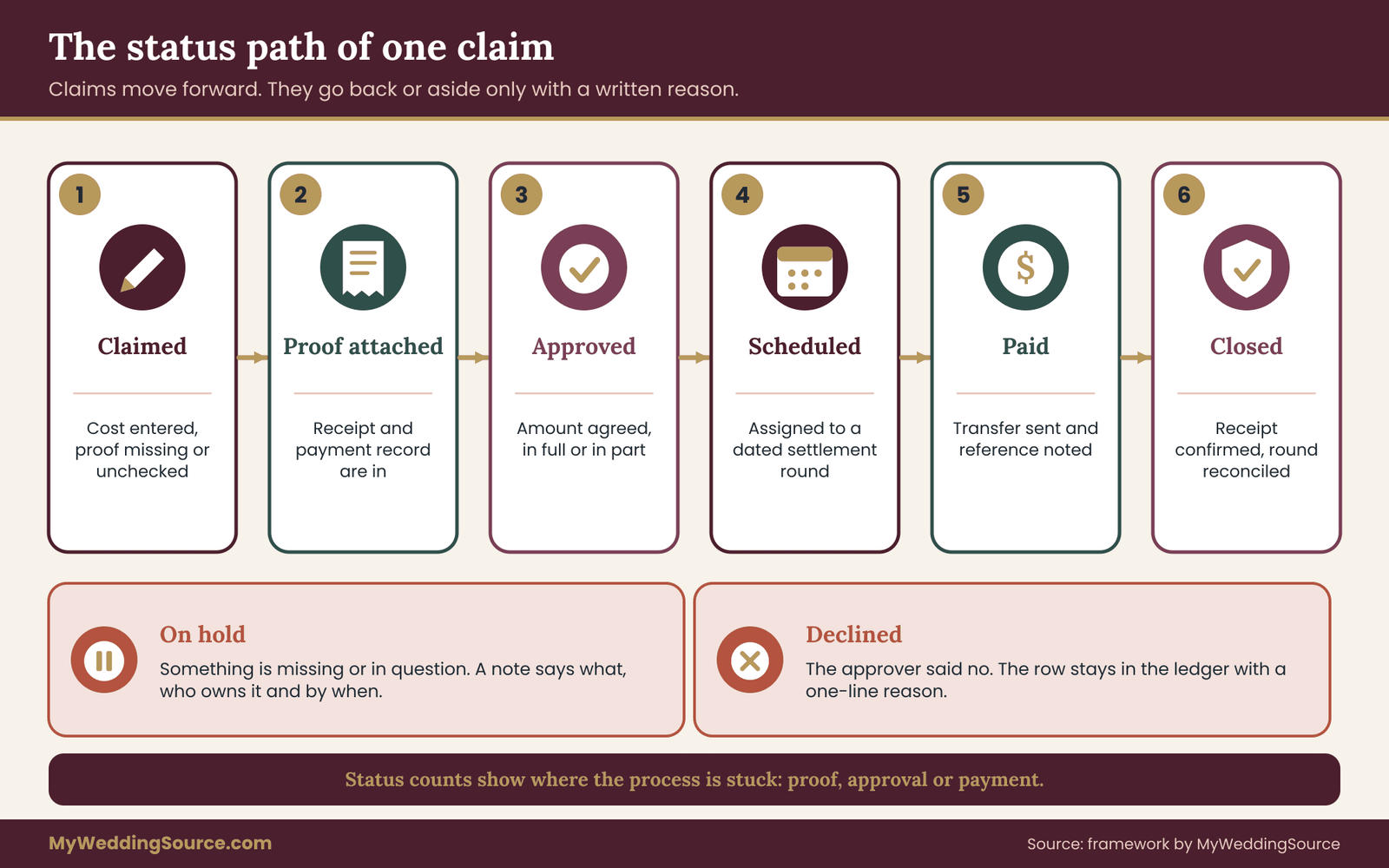
A workable list has six statuses.
Claimed. Someone has entered the cost, but the proof is missing or not yet reviewed.
Proof attached. The receipt and payment record are in, and the claim is waiting for a decision.
Approved. The approver agreed to the amount, in full or in part. The approved amount is written in its own cell.
Scheduled. The claim is approved and assigned to a settlement round with a date.
Paid. The money has moved, and the payment reference is recorded.
Closed. The payee has confirmed receipt, or the settlement round has been reconciled to the bank statement.
Two side statuses cover the exceptions. On hold means something is missing or in question, and a note says what. Declined means the approver said no, with a reason. Never delete a declined claim. A row that says “declined, personal purchase, discussed on March 3” is far more useful than a gap in the numbering.
Why the statuses move in one direction
Forward movement keeps wedding reimbursements honest.
A claim should move forward through the statuses and only go back with a reason. If a claim marked Approved turns out to have a wrong amount, change its status to On hold and write why, rather than editing the amount silently. A ledger where numbers change without a trace is a ledger nobody trusts.
This one-direction rule also tells you where the process is clogged. If most claims sit at Claimed, proof is the problem and the keeper needs to chase receipts. If most sit at Proof attached, approvers are slow. If most sit at Approved, nobody has scheduled a settlement round. The status counts turn into a simple diagnosis without any extra work.
Capture who paid and how
How the original cost was paid shapes how a claim among wedding reimbursements is proven.
The payment method of the original cost matters more than people expect. A cost paid by credit card leaves a statement line. A cost paid in cash leaves nothing unless someone kept a receipt. A cost paid through a payment app leaves a transaction record in the app. The ledger does not need the account number, which you should never store in a shared document, but it does need a plain word such as “card,” “cash,” “app” or “check” in a column or a note.
That one word guides the proof requirement. Card and app payments can be matched to statements. Cash payments lean entirely on the itemized receipt, so they deserve a stricter look when the amount is large. The proof section later in this guide builds on this.
Number the claims and reference them everywhere
Claim IDs make wedding reimbursements searchable, from the ledger to the receipt folder.
Once a claim has an ID, use it. Ask people to include the ID in the memo line of the repayment, in the subject of any email about it and in the filename of the receipt photo. A file called R-014_florist_balance.jpg can be found in seconds. A file called IMG_4471.jpg cannot.
Create a single folder for receipts and proofs, with the same ID naming rule. The folder and the ledger together form the full record. If the ledger says a receipt exists, the folder should hold it. When you reconcile the two at the end of each month, any gap shows up quickly.
Build the summaries from the rows
Summaries turn rows of wedding reimbursements into answers.
Once the rows are clean, add a small summary area on a second tab. Four summaries cover nearly everything.
The first is a total by status, showing how much is claimed, approved, scheduled and paid. The second is a total by person, showing who is owed and who owes. The third is a total by category, which feeds the budget. The fourth is an ageing list: claims older than a set number of days without a decision. A spreadsheet can produce all four with built-in sorting and summing, so you do not need advanced formulas.
Keep the summaries on a separate tab so no one overwrites them while entering claims. Review them at the same time each month, and share the person-by-person summary with the people concerned. Showing someone only their own line keeps the process private, and it keeps the cross-family numbers from becoming a topic of gossip.
Tools: keep it boring
The best tool for wedding reimbursements is the one every claimant will actually open.
Choose a tool that every claimant can reach without installing anything new. A shared spreadsheet, a form that writes to a sheet, or a simple shared table in a notes app are all fine. A form helps because it forces the required fields, such as amount, date, payer and a photo of the receipt. The keeper then copies or links the form’s rows into the ledger.
Avoid tools that need each claimant to create an account, unless the group is small and comfortable. Avoid anything that stores bank logins. And decide who has edit rights: usually the keeper edits the ledger, claimants use the form, and approvers can comment. That arrangement protects the numbers and still keeps everyone involved.
A warning about screenshots
Screenshots are common in wedding reimbursements, and they prove less than people think.
Screenshots of payment app histories are often offered as proof, and they are better than nothing, but they have limits. They show that a payment happened, not what it was for. They can crop out details. And on some apps, the memo line shows a joke rather than a purpose. Treat a screenshot as the payment half of proof and ask for an itemized receipt or invoice as the purchase half.
Proof that holds up for wedding reimbursements: receipts, statements and gaps
Proof is where most wedding reimbursements stall. A claimant says they paid. The couple believes them. The record, however, shows nothing, and the money sits in limbo because nobody wants to say “I need to see it.” Setting a clear proof standard in advance makes that conversation routine.
Proof answers two separate questions. The first is whether the purchase was real and what it covered, which an itemized receipt or invoice shows. The second is whether the claimant actually paid, which a statement line, a payment app record or a bank record shows. A claim with both halves is strong. A claim with one half is workable for small amounts. A claim with neither is a request for trust.
A four-level proof scale
A numbered scale makes proof decisions on wedding reimbursements fast and consistent.
Give each claim a proof level from one to four, and record the level in the ledger. This turns an awkward judgment call into a quick lookup.
Level four: itemized document plus matching payment record. The best case. A vendor invoice or detailed receipt, and a card statement line or app record with the same date and amount.
Level three: itemized document alone. A clear receipt exists, but the payment record is not attached. It is fine for modest amounts, especially when the claimant is someone you know well, and easy to defend for card payments, since you can verify them later against a statement.
Level two: payment record alone. A statement line or app record shows the payment but not what it bought. Ask for the invoice or a short written description from the vendor.
Level one: a statement from the claimant only. No document supports the claim. Use sparingly and only below the lowest threshold in your rules, with the approver noting why they accepted it.

Pair each level with a limit. For example, level four claims may be approved at any size within the category budget. Level three may be approved up to a middle amount. Level two needs a follow-up before approval. Level one is limited to small purchases, and a repeated pattern of level one claims from the same person is a reason for a polite conversation. Set the specific amounts yourselves. The numbers are yours to choose, and only the structure is worth borrowing.
When there is no receipt
Missing paper is the most common snag in wedding reimbursements, and it needs a calm rule.
Cash paid to a street vendor, a tip handed to a driver, a tool borrowed and replaced: some costs never produce a receipt. A rule that rejects every such claim will push people to invent paper, which is worse than having none. A better rule accepts a small, clearly labeled exception.
Ask the claimant to write a short note covering four points: what was bought, from whom, on what date and for how much. Ask them to sign or initial it, or send it by message so it carries a timestamp. Then ask the approver to add one line confirming that the purchase happened, if they were there or can confirm it from the day. Record the claim at proof level one, and note that it was paid on a no-receipt basis.
Keep a cap on this category, set by your rules. Something like a small monthly allowance per person is more workable than a case-by-case argument. If a claimant regularly lacks receipts for larger sums, say kindly that you can repay them only up to the cap without paper, and offer to help them get a duplicate. Many shops can reprint a receipt from a card number and a date, and a vendor can often email a copy of an invoice in minutes.
Duplicate claims and double payment
Two people covering one cost is a classic trap in wedding reimbursements.
When two people share the cost of something, or a purchase was split across cards, the same expense can enter the ledger twice. The usual signs are two rows with the same vendor and date, an amount that equals the sum of two smaller claims, or two people who both attended the same errand.
The fix is mechanical. Before approving a claim, sort the ledger by vendor and date and glance at neighbors. If two rows look alike, ask the people involved whether they are the same purchase. This takes less than a minute per claim and prevents the awkward discovery, months later, that the cake topper was repaid twice.
Double payment also happens between the ledger and the vendor. A parent pays a balance on their card and the couple pays the same balance from their account. The vendor now holds more than it is owed, and refunds can take time. Tell each payer, in writing, which party is paying which vendor, and have the keeper record every vendor payment in the same ledger, whoever makes it.
Check the vendor side too
Wedding reimbursements that start with a vendor payment should be matched to the vendor’s own record.
Proof from the claimant is one half of the picture. The other half is the vendor’s own record. If a relative paid a deposit, ask the vendor for a paid receipt or an updated invoice that shows the deposit credited. Compare it to the contract. The wedding vendor due diligence checklist covers what to confirm with a vendor before you pay, and the same questions apply when someone else pays on your behalf.
If you use purchase orders for larger vendors, the wedding vendor purchase order checklist shows how to tie each purchase to a written authorization. That habit helps here too: a claim that matches an approved purchase order needs little further checking, because the approval already exists.
Fees, tax and tips
Small add-ons are where wedding reimbursements drift away from the plan.
Ask claimants to claim what they actually paid, including sales tax and any fee on the payment method, and to separate any tip. Tips are often paid in cash and rarely have a receipt, so list them in a separate row with a short note. If the contract already includes a service charge or gratuity, check before anyone adds a second one by hand. This is a common source of both overpayment and awkward feelings, and it is easy to prevent with one question to the vendor.
Payment surcharges deserve a mention. Some vendors add a percentage when a card is used. If a relative paid by card and was charged a fee the couple would not have paid by bank transfer, decide whether that fee is part of the claim. The rules should say so in advance, ideally with an instruction to ask the vendor for the cheapest payment method before paying.
Store proof where the ledger can reach it
Proof only helps wedding reimbursements if it can be found later.
Keep a shared folder with one file per claim, named with the claim ID. Ask claimants to upload a photo or PDF as they enter the claim. Photos taken in poor light or at an angle are hard to read, so ask for a flat, well-lit picture where the total is visible.
Do not store full card numbers, bank account numbers or passwords in the folder. If a document includes a full number, blur it before saving, or ask the claimant to send a version with only the last four digits visible. The Cybersecurity and Infrastructure Security Agency publishes simple guidance on protecting accounts and personal information that is worth passing on to anyone helping with the money side.
Approval paths for wedding reimbursements: who says yes, and when a second person is needed
Approval is the step where a claim becomes a commitment. Done well, it is quick and almost invisible. Done badly, it is either a rubber stamp that lets errors through or a bottleneck that leaves helpers waiting for weeks. The goal for wedding reimbursements is a path that is fast for ordinary claims and careful for unusual ones.
Three routes by size and type
Matching the route to the size of the claim keeps wedding reimbursements moving.
Most weddings do well with three routes, matched to the thresholds in the rules.
Route one: routine, below the ceiling. A claim below the ceiling, in an allowed category, with proof at level three or four, is approved by the keeper. The keeper checks the amount, the category and the proof, then marks it approved and schedules it. No one else needs to weigh in. This route should handle most claims, and it should take a day or two at most.
Route two: above the ceiling, or a new vendor. The category approver reviews it, usually one of the couple or a named family lead. It is best if the claimant sent a message before spending, so the approval is already on record. If not, the approver can still approve, and the ledger notes that approval came after the purchase.
Route three: unusual or disputed. Claims with no proof, claims by the approver themselves, claims from the planner that are not clearly pass-through costs, and claims above a high threshold go to two people. Typically that means one of the couple plus a second reviewer from the family or the planning team.

The rule that nobody approves their own claim
Self-approval weakens wedding reimbursements more than any other single pattern.
If a family lead pays for something and also approves their own category, the claim needs a second reader. It does not mean the lead is dishonest. It means that any record read by only one person, who also benefits, is weaker than one read by two. A self-approved claim is the easiest to dispute later, even if it is perfectly valid, because no one else saw it.
When the couple themselves make a claim, such as one partner paying for a shared cost from a personal account, apply the same rule. The other partner approves. It sounds formal for two people who live together, but it keeps the books clean, and it makes the later conversation about who owes what much simpler.
Partial approvals and how to word them
Part-approved claims are normal in wedding reimbursements and deserve a clear note.
Sometimes a claim is partly approved: the receipt includes a personal item, or the purchase exceeded the agreed amount. The approver should record the approved amount, the declined amount and a one-line reason for the difference.
Reasons can be plain and friendly. “Approved up to the agreed limit for centerpieces,” or “The extra bouquet was not part of the plan, so we are repaying the rest.” Send the reasoning to the claimant at the same time as the decision. A claimant who gets only a smaller transfer with no explanation will assume something went wrong. One who gets a clear sentence will usually accept it.
Turnaround time
Speed matters in wedding reimbursements because the claimant is carrying the cost.
Set a target for how quickly claims are reviewed, such as a few days for routine claims and a week for larger ones. Tell claimants. Then keep it. Helpers who wait weeks for a response learn not to submit claims, which pushes costs underground and then produces an unexpected pile of requests after the wedding.
If an approver is traveling, hand the role to the backup in writing and say so in the group. If the ledger shows a claim older than the target, the keeper nudges the approver, and if necessary the couple takes over. The cost of a slow approval is borne by the person who fronted the money, so the process should treat delay as a failure to correct, not a neutral state.
Keep approvals in the ledger, not in the chat
Decisions on wedding reimbursements belong where the next person will look for them.
When an approver says “yes, fine” in a group chat, the ledger keeper should copy the decision into the ledger with the date and the approver’s name. A decision that exists only in a chat will be lost within a month, and it will be hard to find when someone asks. The approver’s reply can be a short message such as “R-023 approved at the full amount.” The keeper then updates the status and the approved amount.
If a decision was made in person, ask the approver to confirm by message afterward. A single sentence is enough. This takes the keeper a moment and removes any doubt about what was agreed.
Standing approvals for predictable costs
Recurring costs in wedding reimbursements do not need a fresh decision each week.
Some costs recur and need no fresh decision each time: the day-of coordinator’s transport, the weekly florist deliveries, a monthly storage fee. Give the claimant a standing approval for a defined amount and period, record it in the ledger as such, and ask them to attach proof as usual. Standing approvals reduce friction while keeping an anchor in the record. Review them at each month’s meeting and cancel or renew them in writing.
The same idea works for the wedding party. A short list of pre-approved purchases, such as boutonniere pins, a set number of bottles of water or a defined amount for emergency supplies, lets people act on the day without asking. Write the list, send it to the party and record purchases against it.
Settlement rounds for wedding reimbursements: batches and netting
Paying claims one at a time, the moment each is approved, feels responsive but creates its own mess. A couple might send fifteen small transfers in a month, each with a different memo, none of which line up with the ledger. Settlement rounds fix this. Wedding reimbursements are approved continuously, but they are paid on fixed dates, in batches, with a single summary for each person.
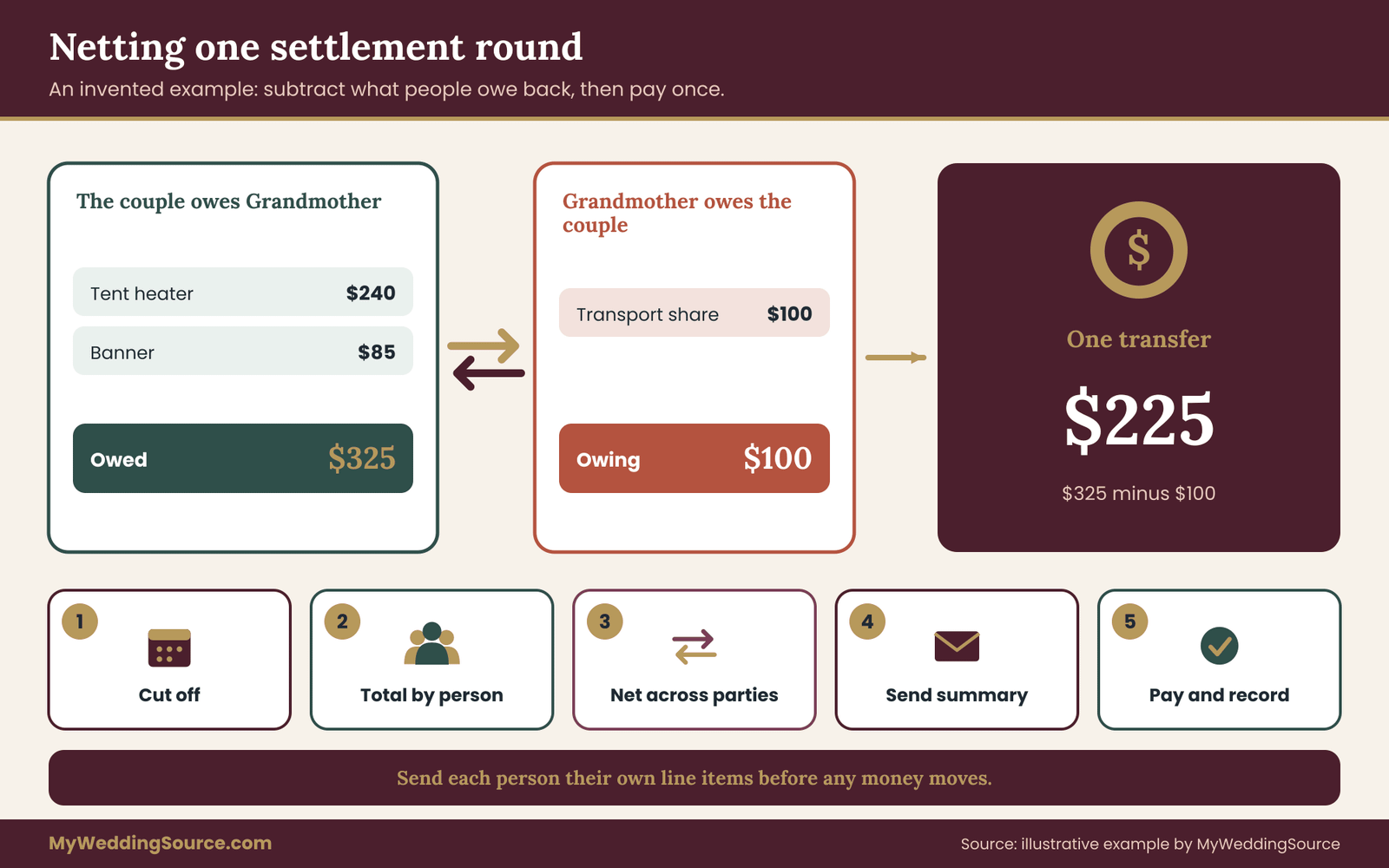
A round has five steps, and the keeper runs all of them.
- Cut off. Choose the date and take every claim marked Approved up to that date.
- Total by person. For each person, add up the approved amounts they are owed and subtract anything they owe back.
- Net across parties. Where two parties owe each other, reduce the two debts to one.
- Send the summary. Each person receives their own line items and their net figure before any money moves.
- Pay and record. Make the transfers, note the payment reference in the ledger and move the claims to Paid.
Why netting matters
Netting is the biggest time saver in wedding reimbursements.
Netting is the part that saves time and bad feeling. Suppose a parent is owed money by the couple for a rental deposit, and the couple is owed money by that same parent for their share of the rehearsal dinner. Sending two transfers in opposite directions is silly and invites mistakes. Subtract one from the other and send a single transfer, or none at all if the numbers cancel.
Netting also works across a group. If Family A owes the couple for something, and the couple owes the planner for something else, the couple can ask Family A to pay the planner directly, with everybody’s agreement, and each ledger row reflects it. This reduces the number of transfers, but it increases the risk of confusion, so it needs a written note in each affected row. Do it only when all three parties understand and agree.
Be careful with netting between two families. Each side might prefer to deal only with the couple, not with each other, and a line that shows Family A paying Family B directly can feel intrusive. If in doubt, route the amounts through the couple, even if that adds a step.
A worked round, in numbers
A small round with invented numbers shows how wedding reimbursements shrink when they are netted.
Imagine a small round with invented figures. The couple owes a grandmother 240 dollars for a rented tent heater and 85 dollars for a banner. The same grandmother owes the couple 100 dollars for her agreed share of the transport. The ledger shows owed 325, owing 100, net 225. The summary sent to her says so line by line, and one transfer of 225 dollars settles it.
Note what the summary includes: every claim ID, the amount approved, the amount offset and the final number. If she disagrees with any line, she can point to a row. Without the line items, a bare transfer of 225 invites questions like “Where did the extra 100 go?” that a clear summary answers in advance.
Choose the rhythm that fits the stage
The right rhythm for wedding reimbursements changes as the date approaches.
Early in planning, claims are few and large. A monthly round is plenty. In the last six weeks, claims multiply and are smaller, and a round every two weeks helps. In the week of the wedding, run no rounds at all; collect receipts and settle after. Doing arithmetic during the final week is a bad use of energy, and mistakes made in a rush are hard to undo.
After the wedding, run a final round once the cutoff date passes. Then close the ledger: every claim should be Paid, Declined or On hold with a reason, and any hold should have an owner and a date. The aim is a ledger that can be read by a stranger and understood.
Pick the payment method with the record in mind
The payment method for wedding reimbursements decides where the record lives.
A bank transfer, a check or a payment app each leaves a record in a different place. Choose one for the rounds so the ledger’s payment references match a single statement. If people must be paid in different ways, note the method on each row.
The Consumer Financial Protection Bureau explains how electronic transfers and payment apps work and what protections generally apply, and the Federal Reserve publishes consumer-facing information about payment systems. Read both before you pick a method, especially if a large sum will move. Protections differ between a card payment, a bank transfer and a transfer to a friend through an app, and a transfer sent to the wrong person can be hard to recover.
Whatever the method, double check the recipient’s details with a small test or a confirmed message, record the date and reference, and keep the confirmation with the claim.
Reconcile at the end of each round
Reconciling closes each round of wedding reimbursements with proof that the numbers agree.
After a round, compare three things: the ledger’s list of Paid claims, the bank or app statement for the period and the total on the summaries you sent. They should agree. If they do not, find the difference before the next round. The usual causes are a transfer that failed, a claim paid twice, an amount keyed wrongly or a fee that was deducted from the transfer.
Reconciling takes minutes when done each round and hours when saved until after the wedding. Mark the round as reconciled in the ledger with the date, so the record shows it was checked.
Link settlement to your cash flow
Payouts for wedding reimbursements compete with vendor balances for the same cash.
A round is a cash outflow, and it competes with vendor balances and reserves for the same money. Before you schedule a large round, look at your calendar of upcoming payments. The deposit and reserve timing guide shows how to time deposits, final balances and reserves so that no single month is overloaded. If a big claim would strain the account in a month that already has a vendor balance due, move the round or split the payment, and tell the claimant in advance.
A person who is told “we will pay this on the thirtieth, as the account will be low before that” is usually fine. A person who hears nothing and watches the transfer slip is not.
The planning team and wedding reimbursements: planners, coordinators and helpers
The third group in the title is the planning team, and it needs its own treatment because the money works differently. Family members are usually repaid for isolated costs. A planning team spends money continuously, across many vendors, often on your behalf, and sends bills that mix fees and costs.
Separate the fee from the costs
Planner bills mix two kinds of money, and wedding reimbursements cover only one of them.
A planner’s fee pays for their time. A cost pass-through repays what they paid to someone else. These are different things, and the planner’s contract should say which is which. A common mistake is to treat the whole bill as a single number and miss that part of it is a repayment, with receipts, and part of it is a service, with a rate.
Ask for each planner invoice to show fees on one line and costs on another, with a list of the costs and proof behind each. For costs, the same ledger rules apply as for a family member: category, proof, approval. For fees, the contract is the proof, and the ledger simply records that a scheduled fee was paid.
If the contract mentions markups, handling fees or commissions on vendor costs, read that clause closely. Some planners charge a percentage on the vendors they book. Others pass costs through at cost. Neither is wrong, but you should know which arrangement applies before you approve the first claim. If the contract is silent, ask in writing. The wedding vendor contract guide on this site explains which clauses to look for in the contract itself.
Who pays the vendors?
How the planner pays vendors determines how many wedding reimbursements you will see.
Planners handle vendor payments in three ways. Some tell you to pay vendors yourself while they coordinate. Some pay vendors with their own money and bill you. Some collect a lump sum from you into a client account and pay vendors from it. Each has different risks, and the ledger should reflect which one is in use.
In the first case, there is nothing to reimburse. In the second, every vendor payment is a reimbursement claim from the planner, and the planner should supply the vendor invoice and proof of payment for each. In the third, the planner holds your money, so ask for a running statement showing what came in and what has been paid out, and treat that statement as the ledger’s source for those costs. A statement that arrives only after the wedding is too late to catch an error.
If the planner is a friend or a family member acting informally, be especially clear. Informal planners often cover costs gladly and forget to say so. Ask them, in advance, to record each cost in the shared ledger as they go, even for small items.
Approval limits for the planning team
Planners need limits for wedding reimbursements just as relatives do.
Give the planner a spending authority that matches their role. A professional with a contract may be allowed to commit certain amounts without asking, and may need your approval above a figure. A volunteer friend should have a smaller authority. Write the limits into the rules, and in the planner’s case, confirm them against the contract’s terms for authority and change orders.
Never leave authority unstated. A planner who orders an upgrade “because it was better” and bills you for it has done nothing unusual in their world, and your surprise is the consequence of an unwritten rule. Prevent it with a sentence: “Any single purchase above this amount needs a message from us first.”
The wedding party and small costs
Helpers rarely volunteer claims for wedding reimbursements, so ask them.
Bridesmaids, groomsmen and other helpers tend to buy small things and rarely ask for repayment. Assume that anything under a certain amount may be a quiet gift, but do not assume it. Ask each helper at the start whether they want to be repaid for small costs, and make the answer easy: “Send us your receipts and we will repay you on the first of the month. If you would rather treat these as your gift to us, tell us, and we will note it.” Record those who decline repayment as in-kind contributions so the budget reflects the true cost.
This conversation avoids a sad pattern: a helper spends two hundred dollars across six months, never asks, and feels resentful on the wedding day. A written offer to repay, openly stated, lets them decide.
Keep the team’s ledger access narrow
Narrow access keeps wedding reimbursements private.
Planners and coordinators need to see their own claims and the status of each. They do not need to see the family contributions or the other family’s payments. Give them access to a filtered view, or send them a periodic summary. The less a person sees, the less there is to misunderstand, and the fewer questions you will field about money that has nothing to do with them.
A worked example: the Alvarez, Brandt and planner ledger
A full example makes the pieces click. The couple below, the families and the planner are invented, and the figures are made up for illustration. They are not typical costs. The point is the process, not the amounts.
Dana Alvarez and Theo Brandt are planning a wedding with help from Dana’s mother Rosa, Theo’s father Karl, a hired planner named Lena Ortiz and a bridesmaid named Maya. Dana’s friend Priya keeps the ledger. The couple has sent a one-page set of rules: a small no-questions ceiling for supplies, a message first for anything larger, itemized receipts within two weeks, rounds on the first of each month and a cutoff three weeks after the wedding.
Seven claims in one month
Each row below shows a different kind of decision in wedding reimbursements.
By the end of the month the ledger holds seven rows. Priya works through them in order.
R-001, florist deposit, 900 dollars. Rosa paid it on her card. Before approving, Priya asks the question from the contributions conversation: is this part of your promised contribution, or do you want it repaid? Rosa says it counts toward her pledge. Priya records it as an expense of the wedding and a contribution delivered, with no repayment owed. The remaining part of Rosa’s pledge is shown as still to come.
R-002, heaters and tent lights, 420 dollars. Karl paid the rental company directly. He sent the invoice and a card statement line, so the proof level is four. The category approver, Theo, approves it in a message.
R-003, ribbon and sign supplies, 62.40 dollars. Maya bought them and sent a photo of the receipt. It is under the ceiling, in an allowed category, at proof level three. Priya approves it herself under route one.
R-004, shuttle deposit, 600 dollars. Lena Ortiz paid the shuttle company and billed it as a pass-through. Her invoice lists the shuttle deposit on a cost line, separate from her fee, and attaches the shuttle company’s receipt. The contract says costs are passed through at no markup. Dana and Theo approve it together because it is above the ceiling.
R-005, late-night snack order, 164.50 dollars. Karl’s brother Sam paid cash for pizza and has no receipt. His first claim says 180 dollars. Priya asks the pizzeria for an order confirmation, which shows 164.50 dollars. The claim moves from proof level one to level two, and she approves the lower figure.
R-006, a tip for the delivery driver, 15.50 dollars. Sam handed it over in cash and sent a short signed note. This is level one, under the no-receipt cap, so Priya approves it with a line in the notes.
R-007, shoes, 85 dollars. Maya also claims a pair of shoes she bought for the wedding. The rules exclude personal attire. Priya declines the claim, adds the reason and sends Maya a kind message explaining it, along with a thank-you for the supplies.

Netting the first round
The first round of wedding reimbursements is where the ledger pays off.
On the first of the next month, Priya runs a round. She starts with the claims that are marked Approved: R-002, R-003, R-004, R-005 and R-006. Rosa’s R-001 is not paid, since it was recorded as a contribution. R-007 is declined and stays in the ledger.
She totals by person. Karl is owed 420 dollars. Maya is owed 62.40. Lena is owed 600. Sam is owed 164.50 plus 15.50, which is 180. The gross total is 1,262.40 dollars.
Then she checks what people owe the wedding. Karl had agreed, in an earlier message that Priya found and copied into the notes, to cover 250 dollars of the rehearsal dinner. She subtracts it from his claim, so Karl is paid 170 dollars. The net total for the round is 1,012.40 dollars, and the couple sends four transfers instead of five plus a request to Karl for money.
Each person receives a short summary: their claim IDs, the amounts, any offset and the final transfer. Karl’s summary shows both items, so he sees why 170 is lower than 420. Nobody sees anyone else’s line.
What the example shows
Looking back, the wedding reimbursements in this example were settled by habits, not heroics.
Several small habits did the work. A named keeper handled everything the same way. A question about intent turned a possible 900 dollar repayment into a recorded contribution. A request to the pizzeria replaced a vague cash claim with a document. A declined claim stayed in the ledger with a reason. Netting cut one transfer and made the whole round easier to explain.
Notice also what did not happen. Nobody accused anyone. Nobody had to remember anything. When Karl asked why his transfer was 170 dollars, the answer was in the summary he already held. That is the real return on a ledger: not accuracy for its own sake, but fewer conversations that begin with “I thought.”
Disputes, declined claims and awkward conversations
Even a good process produces disagreements. A claim is declined, an amount is questioned, or a family member feels unfairly treated. The ledger does not remove these moments, but it gives you something factual to point at, which keeps them from becoming personal.
Declining a claim kindly
Declining is a normal part of wedding reimbursements, and tone decides how it lands.
A decline is easier to receive when it comes with a reason, an acknowledgment and a way forward. Keep it short, specific and warm.
“Thank you for picking these up. Our agreement covers supplies for the wedding itself, so we cannot repay the shoes, but the ribbon and sign supplies are approved and will be in the first-of-the-month transfer.”
Avoid language that implies the person did something wrong. People who buy things for your wedding are doing you a favor, and a decline should read as a boundary on the budget, not a judgment on their choices.
When the amount is disputed
Disputed amounts in wedding reimbursements usually trace back to a single line.
If a claimant says the approved amount is too low, return to the facts: the proof, the rule and the approval. Walk through the row with them. Often the difference comes from a tax line, a returned item or a split purchase, and an itemized view settles it. If the rule is ambiguous, the couple decides, and the keeper writes the decision into the rules so it applies to everyone from then on.
Resist the pull to settle a dispute by paying the higher figure “just to keep the peace.” It is understandable, but it sets a pattern. The next claimant will notice that pushing works. A reasonable compromise, openly labeled as an exception, is acceptable, but it should be the couple’s decision and recorded as such.
When two families see it differently
Fairness between families is the hardest part of wedding reimbursements.
Some disputes are not about one claim but about fairness between the families. One side has paid for more, or one side feels it has been asked to cover costs that mainly benefit the other. The ledger helps by showing facts: who has paid what, by category, and what is still expected.
Share the facts privately with each side, not in a joint meeting, unless both families prefer openness. Remind each of what was agreed in writing. If no agreement exists on a particular cost, the couple should propose a fair split, explain the reasoning and invite questions. The wedding etiquette guide on this site covers how to handle sensitive family conversations around weddings, and the same tone applies here: calm, direct and respectful of both sides.
When someone asks to be repaid late
Late claims test the cutoff you set for wedding reimbursements.
Late claims happen. A relative remembers a cost months later, or a vendor sends a final bill after the cutoff. Check the rules. If the claim is real and proven, the couple may choose to pay it as a courtesy, and the ledger should note the exception. If the cutoff exists to protect your finances, apply it consistently, and say so kindly. A late claim that comes with full proof deserves a considered answer, not an automatic no.
When money has been paid in error
Mistaken transfers happen in wedding reimbursements, and speed helps.
If a transfer went to the wrong person or the wrong amount, act quickly. Contact the recipient and ask for the money back politely and in writing. If the payment was made by a method that offers dispute rights, contact the provider promptly, since time limits can apply. The Consumer Financial Protection Bureau explains how to report errors with electronic transfers and how to dispute a charge on a credit card. Note every step in the ledger so the record shows what happened and when.
When you cannot agree
Some disagreements about wedding reimbursements do not resolve on facts alone.
Sometimes a disagreement does not resolve. The sum is small, the relationship matters and the argument is costing more than the money.
A simple option is to treat the disputed amount as a gift, or to split it, and record that as a decision. If the sum is large and a relative refuses to engage with the wedding reimbursements process, a neutral third person, such as a respected family friend, can often help. For legal questions about a contract or a debt, consult a licensed attorney, who can address your jurisdiction and facts. A court is rarely the right place for a family wedding, but your state’s consumer protection or small claims resources are listed on USAGov for situations where nothing else works.
Protect the relationship first
The long view matters most when wedding reimbursements get tense.
In every dispute, ask which outcome you will be glad about in five years. For most weddings, the answer favors the relationship over the sum. That does not mean paying anything demanded. It means choosing words, timing and tone that leave room for the other person to say yes. A ledger gives you a fair process. Kindness decides whether people feel the process was fair.
Privacy, records and the limits of wedding reimbursements
A shared ledger holds sensitive facts: who has money, who lent it, who is owed and who was declined. Treat it with the care you would give any financial record. Wedding reimbursements involve family members who may not want their finances visible to relatives, so privacy is part of the design, not an afterthought.
What to keep out of the ledger
Never put account numbers, card numbers, passwords, government identification numbers or full home addresses in the ledger or its folder. The ledger needs names, amounts, dates and short descriptions, and nothing else. If a claim needs an account detail for a transfer, send it privately, once, and do not copy it into the shared file.
Do not store other people’s personal messages in the folder either. A one-line note that says “approved by message on the fourth” is enough. Keep screenshots of private conversations out of a file that several people can open.
Control who sees what
Decide the access levels in advance. The couple and the keeper see everything. Approvers see their categories. Claimants see their own rows. Planners see the planning team’s rows. A spreadsheet can handle this with separate tabs or filtered views, or you can send each person a periodic summary instead of access. Turn on two-step sign-in for the account that holds the ledger, and use a strong passphrase. The Cybersecurity and Infrastructure Security Agency’s Secure Our World program offers short, plain guidance on both.
Review the sharing list each month. People who joined for a task and finished it should lose access. Do the same at the end of the wedding: remove helpers, keep the couple and the keeper, and download a copy before anything is deleted.
What counts as a record to keep
Keep the final ledger, the settlement summaries, the receipts and proofs, the rules you sent and any messages that changed them. These show what was agreed and what was paid. The Internal Revenue Service publishes general guidance on how long to keep records, and the guide to organizing wedding records after the event on this site gives a practical way to file them. Put the ledger in the money folder, with the same retention approach as your other receipts and contracts.
If a family member was repaid or recorded as a contributor, consider giving them a short written confirmation, such as a final summary of their lines and the net figure. It closes the loop for them, and it gives you something to point to if a question arises years later.
Reimbursement, gift or loan: know which one it is
The ledger is for repayments. Not every transfer between people at a wedding is one. A gift is money given with no expectation of return. A loan is money given with an agreement to repay, often over time. A reimbursement is repayment of a specific cost someone paid for you. The label matters for your own clarity and, in some cases, for tax or legal treatment.
Do not use the ledger to hide a loan or a gift as a claim. If a parent gives the couple money toward the venue, record it as a contribution. If a relative lends money to be repaid after the wedding, record it as a loan with its own terms in the contribution documentation, not in the reimbursement ledger. Mixed records confuse everyone, including the people who made them.
The Internal Revenue Service explains that gift tax rules generally apply to the giver and that most gifts do not create a tax bill, and it publishes a plain set of answers on the topic. Whether any particular arrangement is a gift, a loan or something else for tax purposes is a question for a qualified tax professional. If a large family payment comes with strings or a repayment promise, ask a tax professional or an attorney to look at it before you rely on your own reading.
What a ledger cannot do
A ledger records and organizes. It does not replace a contract, and it cannot make a verbal promise binding. It does not decide whether a vendor owes you a refund, whether a planner overcharged you or whether a family member has a legal claim. Rights to refunds, chargebacks and deposit returns depend on your contracts, your payment method and your state’s rules.
If a vendor’s charge looks wrong, the Federal Trade Commission and the Consumer Financial Protection Bureau publish consumer guidance, and your state attorney general’s office handles consumer complaints. The ledger supplies the facts, such as the dates, amounts and proofs, that make those conversations easier. It does not give legal advice.
Limits worth admitting up front
Three limits are worth saying out loud to the people helping you. First, the ledger is only as good as the entries. A cost that never gets recorded never gets repaid. Second, approval before spending cannot be forced. A helper may buy something anyway, and you will then decide whether to repay it. Third, the process cannot fix a disagreement about the wedding’s budget. If two families have different ideas about who should pay for what, solve that first, then record the result.
Review and update
Review your rules and ledger after the first month and again at the halfway point. Ask the people who use it what worked and what felt clumsy. Adjust the form, the thresholds or the round dates, and tell everyone once, in writing. After the wedding, keep a short note on what you would change. If a friend later asks how you handled wedding reimbursements, you will have an answer ready.
Your next steps
Start with a single evening. Write down the cast: the couple, each family, the planner or coordinator and the helpers who might spend money. Beside each name, note whether they pay vendors directly, advance costs for repayment or contribute to a pool. Pick a keeper for wedding reimbursements, and a backup.
Then draft the one-page rules for wedding reimbursements: what can be claimed, the ceiling and threshold, the approvers, the proof required, the settlement dates and the cutoff. Send them to both families at the same time in a warm message. Build the twelve-column wedding reimbursements ledger, set up the six statuses and create a folder for proofs. Enter any costs already paid, so the ledger starts complete.
From then on, run the cycle: record each claim the day it arrives, review it against the proof and the rules, approve or hold it, pay in rounds, reconcile and close. After a couple of rounds the process becomes routine, and wedding reimbursements turn from a source of tension into a short monthly task with a clear answer for everyone.
FAQ
How do I track wedding reimbursements without making it awkward?
Make the process impersonal and shared. Send one friendly note to everyone at the same time, explaining that you are using a single list so nobody has to remember details. Record claims in a shared ledger with a fixed set of columns, and ask for receipts as a standard step, not a personal request. When everyone follows the same rule, asking for proof stops feeling like an accusation.
What should a ledger for wedding reimbursements include?
For wedding reimbursements, each row should show a claim ID, the date incurred, the payer, the person owed, the vendor or purpose, a budget category, the amount claimed, the proof level, the approver, the approval status, the amount approved and paid, and a notes field. Add summaries by status, person and category on a separate tab. Avoid account numbers and other sensitive details in the shared file.
Who should approve wedding reimbursements?
Name a primary approver for each category of wedding reimbursements, and a backup. Routine claims below a set ceiling can be approved by the ledger keeper, larger ones by the couple or a named family lead, and unusual ones by two people. No one should approve their own claim. Write the approvers and the limits into the rules before the first receipt arrives so there is no confusion later.
What counts as proof in wedding reimbursements when there is no receipt?
Accept a small, clearly labeled exception. Ask for a short signed note stating what was bought, from whom, on what date and for how much, and ask an approver to confirm the purchase happened. Record it as the lowest proof level and keep a cap on this category. For larger amounts, ask the vendor for a duplicate receipt or an order confirmation.
Is a parent’s payment a gift, a loan or part of wedding reimbursements?
It depends on what the parent intended, so ask directly and write down the answer. A gift expects nothing back. A loan carries an agreement to repay. A reimbursement repays a specific cost the parent covered for the wedding. A simple question such as “Is this part of your contribution, or would you like us to repay it?” settles it. For tax or legal questions, ask a professional.
How often should we pay out wedding reimbursements?
Fixed rounds work better than one-off transfers for wedding reimbursements. Monthly is enough early in planning, and every two weeks helps in the last six weeks. Skip rounds in the final week and settle after the wedding. Each round should total claims by person, net out what people owe back, send a summary first, pay, record the references and reconcile against the bank statement.
How do planner expenses differ from planner fees in wedding reimbursements?
In wedding reimbursements, a fee pays for the planner’s time and is covered by the contract. An expense is a cost the planner paid to someone else and passes on to you. Ask for invoices that list fees and costs on separate lines, with proof behind each cost. Check the contract for markups, handling fees or commissions, and ask in writing if it is silent.
What if a family member disputes our wedding reimbursements?
Go back to the facts in the ledger: the proof, the rule and the approval. Walk through the row together, since differences often come from tax, a returned item or a split purchase. If the rule was unclear, decide as a couple and update the rules for everyone. If the disagreement continues, consider treating a small difference as a gift. For larger sums, consult a licensed attorney.
Sources
- Consumer Financial Protection Bureau
- How do I dispute a charge on my credit card bill?, Consumer Financial Protection Bureau
- Frequently asked questions on gift taxes, Internal Revenue Service
- How long should I keep records?, Internal Revenue Service
- Secure Our World, Cybersecurity and Infrastructure Security Agency
- Consumer information, Federal Trade Commission
- Consumer resources, Federal Reserve Board
- Consumer resources, Federal Deposit Insurance Corporation
- State consumer protection offices, USAGov