
A mountain lodge wedding trades the convenience of a city venue for views, quiet and a sense of being somewhere that matters. In return it asks for more homework: a road that may close, air that affects some guests, and weather that can change within a single afternoon. This guide gives you a road closure and guest access contingency map, one worked case, and the failure conditions that tell you when to change plans.
Plan a mountain lodge wedding around three doors into the property: the main road, a backup route or shuttle point, and a stay-put option that works if nobody can arrive or leave. Write down who decides to switch doors, at what clock times, and what each guest group does when you do. Check altitude, snow, fire and flood conditions with the agencies that publish them, ask the lodge what it already does when the road closes, and put the answers in your contract and your guest updates.
Most advice about mountain weddings starts with photography and ends with the cake. The harder questions sit in the middle: how do eighty people reach a building at the end of a winding road, what happens to the dinner if the road closes at three o’clock, and what do you tell a grandparent who gets a headache at the rehearsal dinner. A mountain lodge wedding is less a style choice than a logistics project with a beautiful backdrop. Small habits like this separate a calm mountain lodge wedding from a stressful one.
This article is narrow on purpose. It does not walk you through choosing a venue in general, building a guest list or writing vows. Those topics have their own guides on this site, including the wedding venues guide for comparing places and questions to ask. Here the focus is the three problems that set a mountain setting apart: altitude, access roads and weather changes, and how to turn them into a plan you can hand to a lodge manager, a shuttle driver and your guests.
Every mountain lodge wedding has a version of this question, so ask it early.
A note on scope. This is general planning information, not legal, safety, medical or insurance advice, and road, fire and weather conditions are set by the agencies and operators named in the Sources section. A well-run mountain lodge wedding makes this step feel ordinary.
What makes a mountain lodge wedding different
A flat, urban venue has a street address, a loading dock and a dozen taxi options. A lodge in the mountains usually has one approach, a single lane of pavement or gravel, and very little redundancy. When a lodge works well it is because the staff know the road, the weather and the rhythm of arrivals. When it works poorly it is because nobody asked.
Four features change the planning.
The access road is part of the venue. For a city hotel the street is public infrastructure. For a lodge the road may be a county road, a forest service route, a private drive or some mixture. Each has a different owner, a different plowing or grading schedule and a different way of announcing closures. You are renting a building, but you are depending on a road that the lodge may not control.
Distance is measured in time, not miles. A lodge that looks twenty miles from a town on a map can be an hour away in winter, in smoke, after a rockfall or behind a slow line of vehicles on a one-lane stretch. Guests who plan arrival by map distance will be late. Vendors who plan by map distance will bill overtime.
Services thin out. Cell coverage, fuel, grocery stores, pharmacies and urgent care all become farther away. That is part of the charm and part of the risk, and it means a mountain lodge wedding needs a more complete supply list than a downtown event.
Conditions change fast. Mountain weather can shift from clear to windy to wet in hours, and the temperature difference between a morning ceremony and an evening reception can be large. Plans that assume a single stable forecast tend to break.
None of this makes a lodge a bad choice. It makes the choice more of a trade. The rest of this guide helps you decide what you can accept, what you must fix and what should push you toward another venue.
Who this guide is for
It is written for couples who are comparing lodges, have already booked one, or have been invited to hold a wedding at a family or friend’s mountain property. It also helps planners and lodge coordinators who want a shared vocabulary. If your wedding spans a full weekend with cabins and shared facilities, the guidance here sits alongside broader weekend planning, which you can pair with the guest-lodging thinking in the guide to wedding guest hotels, budgets and mobility. It is a short step, and it pays off at almost any mountain lodge wedding.
The questions that will keep coming back
Every section ahead returns to a small set of questions. Who owns and controls the road? What is the latest time a guest can safely arrive, and who says so? What happens to a guest who cannot get in, and to a guest who cannot get out? Which vendors have to be on site early, and which can arrive late without harm?
What do we say, in what order, to whom? If you can answer these five in plain sentences, you have the core of a plan. For a mountain lodge wedding, this kind of detail matters more than the color of the napkins.
The three-door access map for a mountain lodge wedding
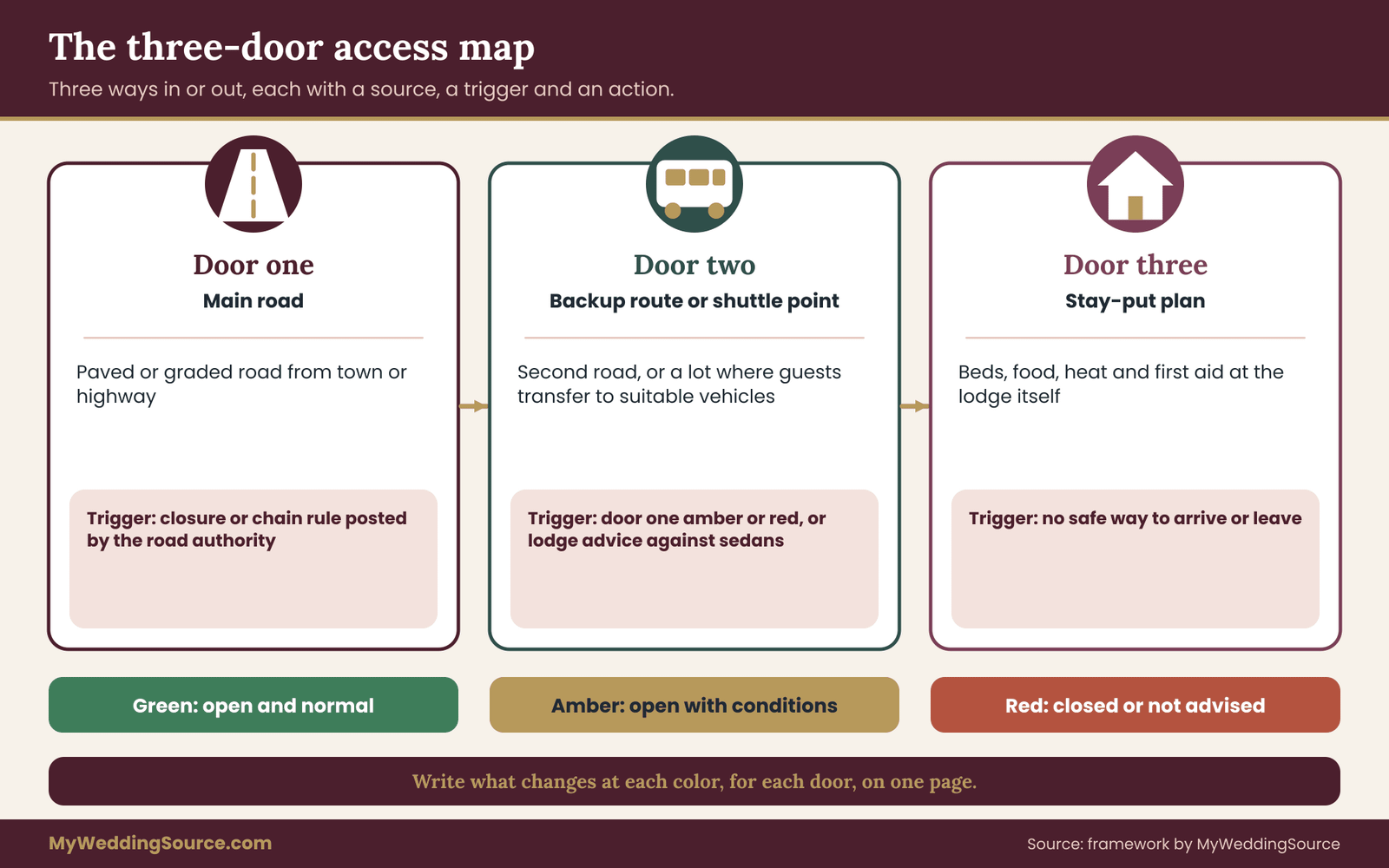
The central tool in this guide is a one-page access map built around three doors. A door is any way people can enter or leave the lodge area during the wedding weekend. Think of the lodge as a house with a front door, a back door and a decision to stay home.
Door one: the main road. This is the route most guests will use under normal conditions: the paved or maintained road from the nearest town or highway exit. Write down its name, who maintains it, its typical drive time in good conditions and how conditions are announced.
Door two: the alternate route or the shuttle point. This may be a second road, a longer route around a pass, a different highway approach or a staging point where guests park a regular car and transfer to a higher-clearance vehicle or a shuttle. If no second road exists, say so on the map. A missing door two is not a failure of the map. It is information that changes everything else.
Door three: stay-put. This is the plan for the case in which no one can safely come or go. It covers where guests sleep, what they eat, how medications and children are handled and how the ceremony changes or moves. Door three is the one most couples skip, and it is the one that saves the weekend.
How the map works in practice
The map is a single sheet. In the left column you list each door and its facts. In the middle you write a trigger: the specific condition that moves you from one door to the next. On the right you write the action: who calls whom, what guests are told, and what the schedule becomes. Couples who plan a mountain lodge wedding often find that one phone call settles this.
A trigger must be something observable, not a mood. “The road looks bad” is not a trigger. “The state transportation department lists a closure or chain requirement on our road” is. “The lodge manager tells us the plow has not reached the upper switchbacks by noon” is. “The forecast for the arrival window includes freezing precipitation and the lodge’s own guideline is that sedans do not go up in those conditions” is. The more a trigger depends on a named source, the less you will argue about it at the worst moment.
Three levels of readiness
Each door can be in one of three states. Green means open and normal. Amber means open with conditions, such as chains, a pilot car, reduced hours or a speed limit. Red means closed or not advisable. Your map should say what changes at each color for each door. A mountain lodge wedding with a green main road and an amber backup is a different day from one with an amber main road and a red backup, and your guests should understand the difference through a short, plain message rather than a long explanation.
Put the answer in writing, because a mountain lodge wedding leaves little room for guesses.
You do not need a printed grid to use this. Write it as a short list on one page, share it with the lodge, your planner or point person, and the shuttle company, and ask each to confirm in writing that the facts for their part are correct. Few details decide the mood of a mountain lodge wedding as quietly as this one.
What the map is not
The map does not replace the lodge’s own emergency plan, local emergency management, or instructions from sheriff’s deputies, forest officials or road crews. If an official orders an evacuation or closes a road, that instruction wins over your schedule, your contract and your guest list. The map exists to make the decisions that are yours fast and calm, and to make the handoff to officials clean when they take over.
Why three doors and not two
Couples often prepare a plan A and a plan B. Plan B tends to be a different route, which helps when one road is blocked but not when the whole area is cut off by snow, smoke, a washout or a power failure. Door three forces you to think about the situation where the plan B route is also gone. Many couples who book a mountain lodge wedding add this line to their contract notes.
It is also the door that changes costs, because food, beds and staff hours are involved. Raising door three early, while you are still negotiating, is far cheaper than raising it the week of the wedding. Treat this as a standing item on your mountain lodge wedding planning sheet.
When you read the chapters that follow, keep the same sheet beside you. Each chapter fills in a column: road facts for the left, triggers for the middle, actions for the right. By the end you will have a finished map and a plain-language message ladder, which the worked case later shows in use. ## Road facts to collect before you sign
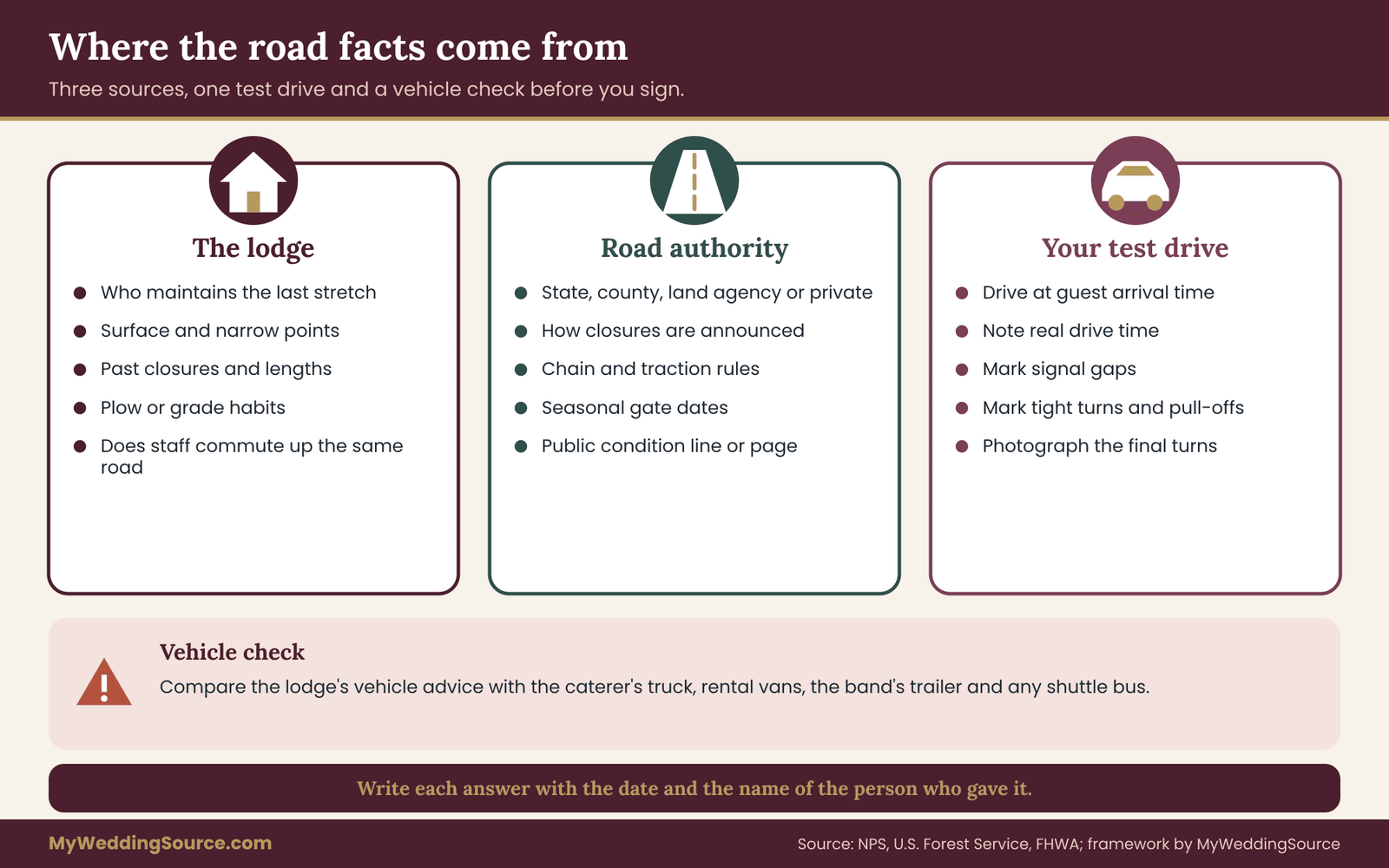
The left column of your map is built from facts, and most of those facts come from three places: the lodge, the road authority and your own test drive. Collect them before you sign, because a contract signed without them commits you to a route you have not examined. None of this is unusual for a mountain lodge wedding, and lodge staff will likely recognize the question.
Ask the lodge about the road
Start with the lodge manager or owner, who usually knows the road better than anyone. Ask these questions and write the answers down with the date and the name of the person who gave them.
Who maintains the final stretch of road, and who maintains the approach to it? Is it paved, graded gravel or dirt? Is there a seasonal closure, a locked gate or a posted weight limit? How is the road plowed or graded, and when does that usually happen relative to a storm? Has the road closed in the past for snow, mud, rockfall, fire, flooding or construction, and how long did the longest closures last?
Are there stretches where two vehicles cannot pass? Do rental sedans, vans and buses use the road, or does the lodge advise against some of them? That is the kind of fact a mountain lodge wedding depends on and a city venue rarely needs.
Ask also about the lodge’s own habits. Does it keep a shuttle or a high-clearance vehicle? Does it have a written severe weather procedure? Does it ever cancel check-in or close the dining room? Do staff live on site or commute up the same road you are asking guests to use? The last question matters more than it sounds. A kitchen team that lives in town has to be able to arrive too.
Ask the road authority
The lodge can describe habits. The road authority describes conditions. Identify who is responsible for each section of the route: a state transportation department for highways, a county road department for county roads, a land management agency for forest or park roads, or a private owner for the last mile. Then find out how each announces closures, chain or traction requirements, construction delays and seasonal gate dates. A mountain lodge wedding rewards couples who check the unglamorous details first.
Most state and county agencies run public road condition pages or phone lines, and the Federal Highway Administration points travelers toward state and local traveler information services. Many mountain roads on public land also fall under the National Park Service or the U.S. Forest Service, which publish alerts and seasonal closure information for their roads. You do not need to memorize any of this. You need to know which source your map names as the trigger for each door, and you need to bookmark it where your point person can find it.
Drive it, or have someone you trust drive it
A test drive is the cheapest piece of due diligence you can buy. Drive from the nearest town and from the nearest airport or highway exit, at the time of day your guests will arrive, and note the actual time. Note where you lose phone signal. Note where the road narrows, where there are tight turns, where the surface changes and where a large vehicle would struggle.
Note where there is a safe place to pull over and where there is not. Keep the answer where your point person can find it during the mountain lodge wedding weekend.
If you cannot go in person, ask the lodge for a recent video of the approach, or ask a local friend. Do not rely only on a mapping app, which may show a route that works for a pickup truck in summer and fails for a rented compact car in a wet spring. This is one place where a mountain lodge wedding differs sharply from a hotel ballroom event.
Record the vehicle question
Many road problems come down to vehicles. A rental sedan, a fifteen-passenger van, a motorcoach and a hearse have very different limits on grade, width and turning radius. Ask the lodge which vehicles it recommends and which it discourages. Then check each vendor’s vehicle against that answer: the caterer’s truck, the rental company’s delivery vehicle, the band’s trailer, the florist’s van and any guest shuttle.
The vendor timeline in the wedding vendor timeline guide is a good place to capture arrival windows once you know which vehicles are going to be on the road, and when. This is a useful test of whether your mountain lodge wedding plan holds together.
Gate, signal and wayfinding facts
Three smaller facts often cause delays. First, gates: if the road has a gate, who holds the code, and is it shared in writing with each vendor? Second, signal: if cell coverage disappears on the approach, guests following a phone map may lose directions at the one fork that matters. Third, wayfinding: confirm that the lodge has signs at turnoffs, and decide who will place temporary signs for the wedding and who removes them.
Printed directions that name the last three turns in plain words work when a phone does not. Write it down now and a mountain lodge wedding becomes much easier to run later.
Turn the facts into door descriptions
Now fill in the first column of the map. For door one, write the road name, the owner, the normal drive time from town, the narrowest stretch, the vehicle advice, and the source you will use for conditions. For door two, write the same for the alternate route or shuttle point. If door two is a second road, be honest about its drive time. A route that adds ninety minutes is a real door, but it is not a door you will use for a three o’clock ceremony unless the decision is made early.
For door three, write the lodge’s capacity to host people overnight, the food it holds, any generator or backup heat, and the nearest medical resources. This is the column most likely to expose a gap, and finding the gap now is the point.
Closure triggers and decision times
With facts in hand, the middle column of the map can be filled in. A trigger is only useful if it comes with a time and an owner, so the same trigger written for a Thursday and for the day of the wedding will often have different actions. Revisit this point once more in the final week before the mountain lodge wedding.
Choose your decision points
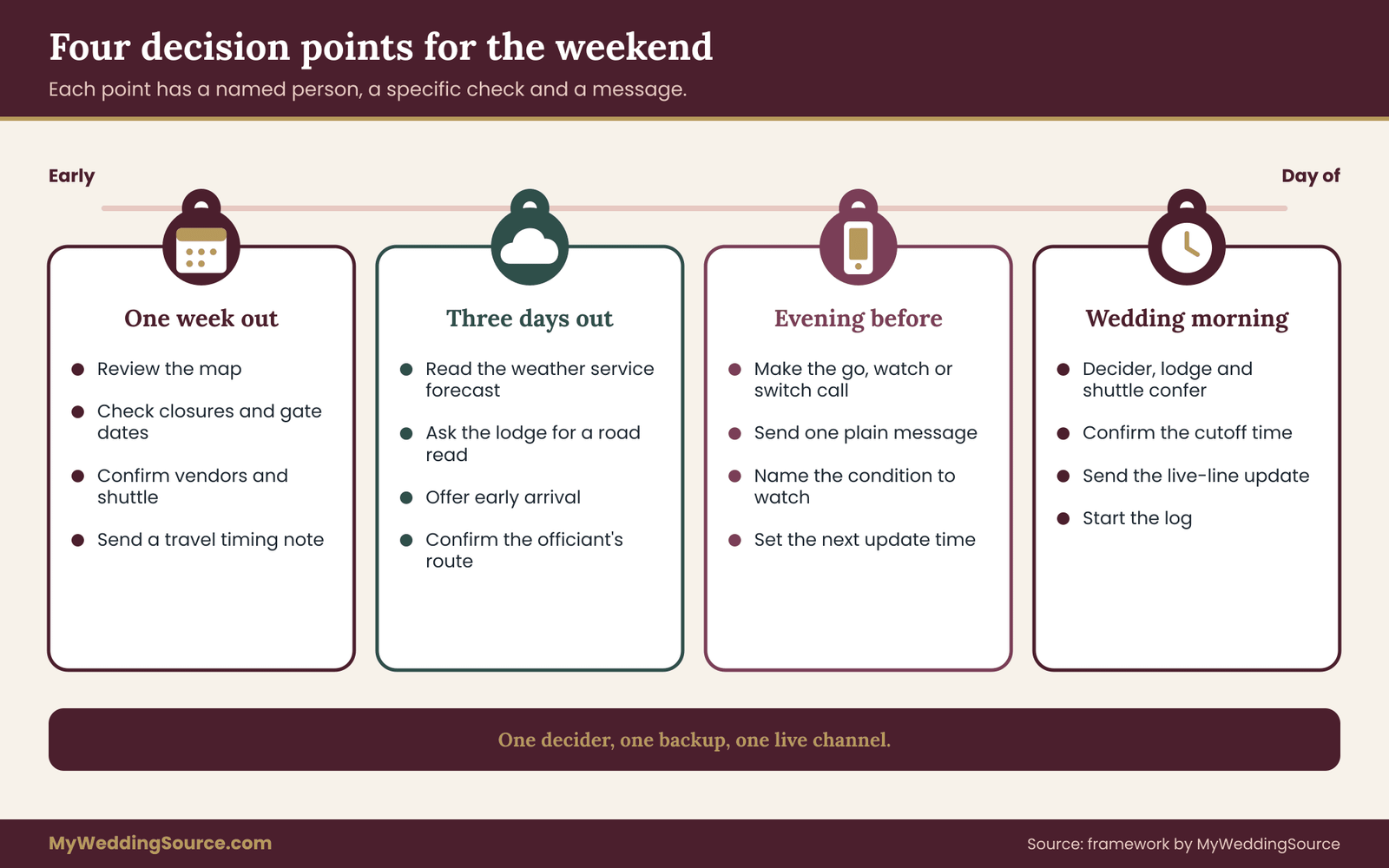
Pick four decision points that match the rhythm of a wedding weekend. They are not magic numbers. They are anchors you can move to fit your own schedule, and each one should have a named person and a specific check.
The first is a week to ten days out. At this point you are checking long-range signals, such as whether the lodge’s season has any gate or closure dates, whether construction is posted and whether the forecast outlook points toward unusual conditions. The action here is to review the map, confirm vendors and send guests a short note about travel timing. If the answer is unclear, treat it as an open item for your mountain lodge wedding and keep asking.
The second is about three days out, when forecasts become more useful. Check the forecast from the National Weather Service for the lodge’s location and the nearest higher elevation. Ask the lodge for an honest read on road prospects and ask the shuttle company whether the vehicles and drivers are ready. Decide whether to send an early-arrival invitation, which is a message suggesting guests who can arrive a day earlier do so.
The third is the evening before arrival day. Make a go, watch or switch decision for the next day and send it to guests in plain language. A watch decision means you are keeping the plan but have named the specific condition that would change it. Most trouble at a mountain lodge wedding starts with an assumption nobody checked.
The fourth is the morning of the wedding, and any later time that conditions change. This is where the day-of point person, the lodge manager and the officiant or celebrant coordinate the final shape of the day.
Write triggers as if for a stranger
Imagine handing the sheet to someone who has never met you. Each trigger should be understandable without background. Here are patterns that work.
“If the highway department posts a closure of the main road between the highway exit and the lodge turnoff, we move to door two and the point person sends the amber message within thirty minutes.” Write this into the vendor sheet for the mountain lodge wedding so nobody relies on memory.
“If the lodge manager reports that the access road requires chains or four-wheel drive and fewer than half of our guest vehicles qualify, we start the shuttle plan from the staging lot.”
“If the forecast issued for the day before arrival includes a winter storm warning or a flood warning for the lodge’s county, we offer early arrival and ask the officiant to confirm they can reach the lodge a day early.”
“If wildfire smoke or a fire restriction reduces access, we follow the instructions of the land management agency and the lodge, and we move to door three if guests cannot leave.”
Notice what these share. Each names a source, a condition and an action. None says “if it looks bad.”
Assign a single decider
A wedding with five people holding opinions about the road will lose an hour to a discussion at the exact time when an hour matters. Name one decider for the access map. It can be a planner, a couple’s parent, the lodge manager for conditions on the property or one of the partners. Name a backup too. The decider’s job is not to be right about the weather. It is to decide, announce and keep the group moving. Advice can come from anyone. The call comes from one person.
Define the “last safe arrival” time
For the day itself, set a last safe arrival time for guests and for each vendor group. This is the time after which you will not wait. It might depend on daylight, on how long a road takes to clear or on staff availability at the lodge. Late arrivals after the cutoff go to door three: a different seating, a later meal or an overnight stay if one is available.
Say the cutoff out loud in your planning conversations with the lodge, and put it in the vendor timeline. This is a modest cost compared with the stress it removes from a mountain lodge wedding.
Couples sometimes resist a cutoff because it feels like abandoning someone. It is the opposite. A known cutoff lets the rest of the guests relax and lets drivers choose not to push a dangerous road after dark.
Keep the money tied to the triggers
Triggers also control costs. If the shuttle plan activates, who pays for it, and is that cost already in the budget? If the caterer cannot arrive, is there a refund or a partial service? If the lodge closes the road, do you owe a balance for a day that did not happen? The conversation about these clauses belongs in your contract review, and the wedding vendor contract guide explains what to look for in cancellation, force majeure and change language.
Aim to have the trigger language in the access map and the cost language in the contract point at the same events, using the same words. ## Altitude and your mountain lodge wedding guests Share the result with the people who will be on site for the mountain lodge wedding.
Altitude is the part of a mountain lodge wedding that guests notice in their bodies. It is also the part couples most often wave away with a line in the invitation. A short, careful plan costs very little and can spare a few people a miserable weekend.
What altitude does, in plain terms
At higher elevations the air has less oxygen available per breath, the air is usually drier and the sun is stronger. Many people feel nothing. Some feel a mild headache, poor sleep, a little nausea, tiredness or shortness of breath when walking up stairs. A smaller number develop more serious altitude illness. The Centers for Disease Control and Prevention publishes travel health guidance that explains the risks, the symptoms and when to seek medical care, and it is the right source to point guests toward rather than a paragraph of your own.
The same principle applies to every other part of a mountain lodge wedding.
Elevation alone does not predict who will be affected. Health agencies generally describe the risk as rising with how high you go and how quickly you get there, and some people react at lower elevations than others. Fitness is not a reliable shield. A marathon runner can feel worse than a retired teacher, and a person who felt fine on a previous trip may still react this time. A realistic answer here is worth more than an optimistic one for a mountain lodge wedding.
You are not a physician and should not act like one. Your job is to know the lodge’s elevation, to tell guests honestly, to encourage them to ask their own clinician if they have heart, lung, blood or pregnancy-related concerns, and to design the weekend so that nobody is pushed past what they can manage. If your mountain lodge wedding includes cabins, repeat the check for each building.
Tell guests the elevation, early and plainly
The wedding website and the save-the-date should state the lodge’s elevation and the elevation of the town where most guests will sleep or land, if they differ. Then add a short note that thin air and dry conditions affect people differently, with a link to the health guidance. A tone that works: “We are holding the wedding at a lodge in the mountains.
Some guests feel the altitude, so please plan to drink water, take it easy on the first day and talk to your own clinician if you have questions.” It is calm and useful and does not frighten anyone. Lodges that host a mountain lodge wedding regularly tend to answer this without hesitation.
Do not give medical instructions yourself. Do not suggest that guests take a specific medication. Do not tell guests that they will be fine. What you can say is that you have planned water, shade, seating, a quiet room and slower pacing, and that you want anyone who feels unwell to tell a point person right away.
Design the schedule around thin air
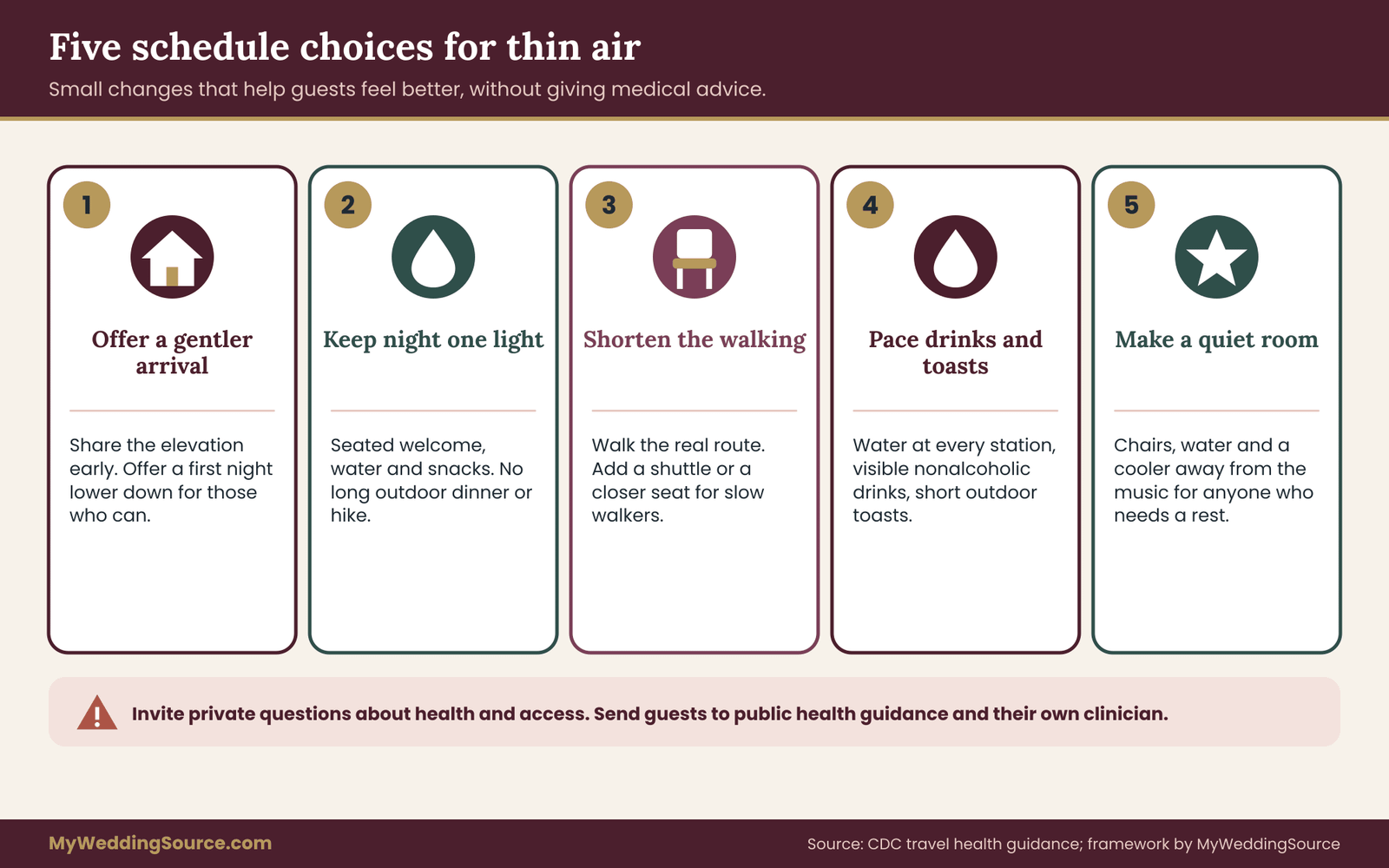
A few simple schedule choices make altitude easier for everyone.
Arrive earlier or sleep lower first. Guests who come from sea level and go straight to the lodge may feel it more than those who spend a night at a lower elevation first. If the lodge’s region has a lower town with hotels, a first night there can help some people. This is not a rule, and some guests will not have the time or money. Offer it as an option, and see the hotel planning thinking in the guest hotels guide for how to present choices at different budgets.
Keep the first evening light. A welcome gathering with seating, water and snacks is better than a hike or a long outdoor dinner. People feel the lodge before they feel the party.
Shorten the walking. Ceremony sites that require a climb over uneven ground should be tested. If the ceremony is a ten-minute walk uphill, ask whether a shuttle or a closer alternative exists. For wheelchair, walker and cane users, walk the real route and do not assume the lodge’s marketing photo reflects it.
Pace the toasts and the bar. Alcohol affects people more at higher elevations according to common travel guidance, and dehydration makes everything worse. Provide water at every station, slow the opening cocktail hour and keep nonalcoholic options visible and appealing. Plan a toast schedule that does not require guests to stand in the cold for a long time.
Create a quiet place. A small room with chairs, water and a cooler, away from the music, is useful for guests who need to sit, for older relatives and for anyone with a headache. Tell the lodge staff where it is and who may use it.
Sun, dryness and cold
The mountain sun is strong. Daytime ceremonies need shade, sunscreen and hats for guests, especially those sitting in rows with no cover. The air is dry, so lips, skin and eyes suffer, and a small basket with lip balm, tissues and eye drops is more useful than another candle.
Evenings cool quickly. A basket of blankets or a rack of shawls by the reception door does more for comfort than a heater that cannot be used in a wooden lodge. Guests rarely notice this when it works, which is the goal at a mountain lodge wedding.
Health needs that deserve a private conversation
A few guests have conditions that make altitude a real decision: heart or lung disease, serious anemia, sleep apnea, recent surgery, a pregnancy or a baby. Do not ask for details on a public form. Instead, tell all guests that they are welcome to contact a point person privately about access or health needs, and respond privately and kindly.
If someone decides not to come, avoid pressure. A livestream or a later visit can include them, and a clear, warm message is better than a request for explanation. Build it into the schedule from the start, not as a fix after the mountain lodge wedding begins.
For infants and toddlers, ask a pediatrician through the parents, not through the invitation. The guidance for children and altitude is for families and their clinicians to decide.
Oxygen, first aid and local care
Decide whether the lodge has a first aid kit, an automated external defibrillator and trained staff. Ask about the nearest hospital and its drive time under both normal and closed-road conditions. If someone needs care that the lodge cannot provide, the emergency number and the lodge’s directions to emergency responders should be on a card at the front desk and with your point person.
The American Red Cross publishes first aid and preparedness information, and a lodge that holds large events often has staff who have completed its courses. Ask, and ask for the answer in writing.
If a guest uses supplemental oxygen for a medical condition, they will make their own arrangements with their clinician and supplier, but you can help by confirming electrical outlets, safe storage spaces and fire safety rules at the lodge. Many lodges have open flames, wood stoves or candles, and those do not mix with oxygen. Ask the lodge about its rules and share them with the guest privately. It costs little to confirm and can save a great deal of trouble at a mountain lodge wedding.
Weather changes across a mountain lodge wedding weekend
Mountain weather is not just unpredictable. It is layered. The valley can be calm while the ridge is stormy. The morning can be bright and the afternoon thundery. The temperature can swing across the day, and conditions in town may say little about conditions at the lodge. Lodges accustomed to a mountain lodge wedding keep their own notes on this.
Use the right forecast
Start with the National Weather Service forecast for the lodge’s exact location, not the nearest town. The agency lets you enter a point on a map, and mountain areas often have different forecasts for different elevations. Check the forecast discussion, which is a written explanation from forecasters, for confidence and for notes about timing.
Also check watches, warnings and advisories for the lodge’s county or zone, since a warning is a specific signal that conditions are dangerous or likely to become so. Think of it as part of the foundation of a mountain lodge wedding, not an extra.
Commercial weather apps can be useful for a quick glance, but they often use a general model that does not handle mountains well. Treat them as a second opinion, and in any disagreement trust the agency product and the lodge manager who sees the sky. The lodge will usually appreciate the question, since a mountain lodge wedding puts real demands on its staff.
Season by season, the typical risk changes
Winter and early spring raise snow, ice, chain requirements, avalanche control closures and long plow times. Late spring and early summer can bring mud, runoff, washouts and unpredictable storms. Summer brings afternoon thunderstorms, lightning, heat at lower elevations, flash flooding in canyons and wildfire. Autumn can bring early snow, shorter days and wind. No season is free of risk, and any lodge that tells you otherwise has not been through a full year.
For fire, the Interagency wildfire information on wildfire.gov and local land management agencies publish restrictions and active incident information. A fire restriction can change whether candles, sparklers, fire pits, lanterns and outdoor cooking are allowed. It can also close roads. Ask the lodge for its fire policy in the contract and decide in advance what you replace open flame with. Keep it simple, because a mountain lodge wedding already has enough moving parts.
Design the day for three weather states
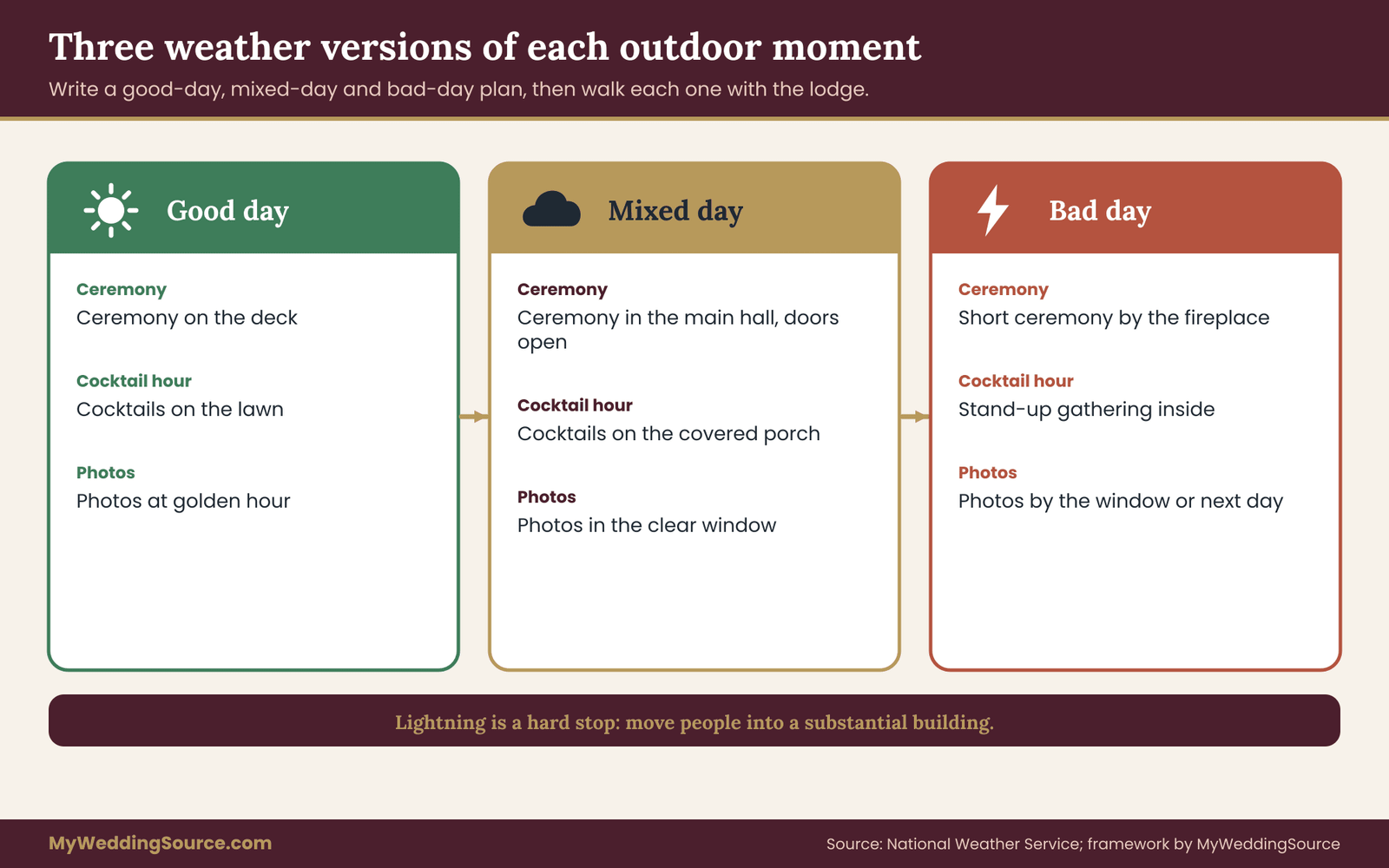
For each outdoor element, write a version for a good day, a mixed day and a bad day. A ceremony on a deck might become a ceremony in the main hall, then a shorter ceremony by the fireplace. A cocktail hour on a lawn might become a cocktail hour in a covered porch, then a stand-up gathering inside. Photos that depend on sunset light need a window that moves.
The most useful question to ask the lodge is not “do you have a rain plan?” but “show us the rain plan.” Walk it. Count chairs. Measure the room. Ask how long it takes staff to flip the space and who does it. Agree on a flip time and a person in charge of the move, and write both into the day-of schedule. Record who gave the answer and when, so the mountain lodge wedding plan stays accurate.
Lightning and wind
Lightning is a hard stop. A ceremony under an open sky during a thunderstorm should move indoors, and the National Weather Service publishes lightning safety guidance that recommends getting inside a substantial building when thunder is heard. Wind is the quiet nuisance: it topples arches, lifts tablecloths and shreds paper programs. Ask the lodge about its wind practices, weigh down signs and use heavier decor. That one sentence of clarity can steady the whole mountain lodge wedding weekend.
Cold and what guests wear
Add a short line to your guest information about layers, closed shoes for gravel and mud, and warm wraps for the evening. Guests dress for a wedding photo, and mountain evenings punish thin clothing and heels. A realistic dress-code note, with a mention of shoes that handle gravel, is a kindness. If the lodge has boot trays or a coat check, mention it. ## Building the guest access plan: shuttles, parking, and arrivals
Doors are only useful if guests can walk through them. This chapter turns the map into a guest access plan: how each person arrives, where vehicles go, and what happens when the plan switches.
Sort guests into access groups
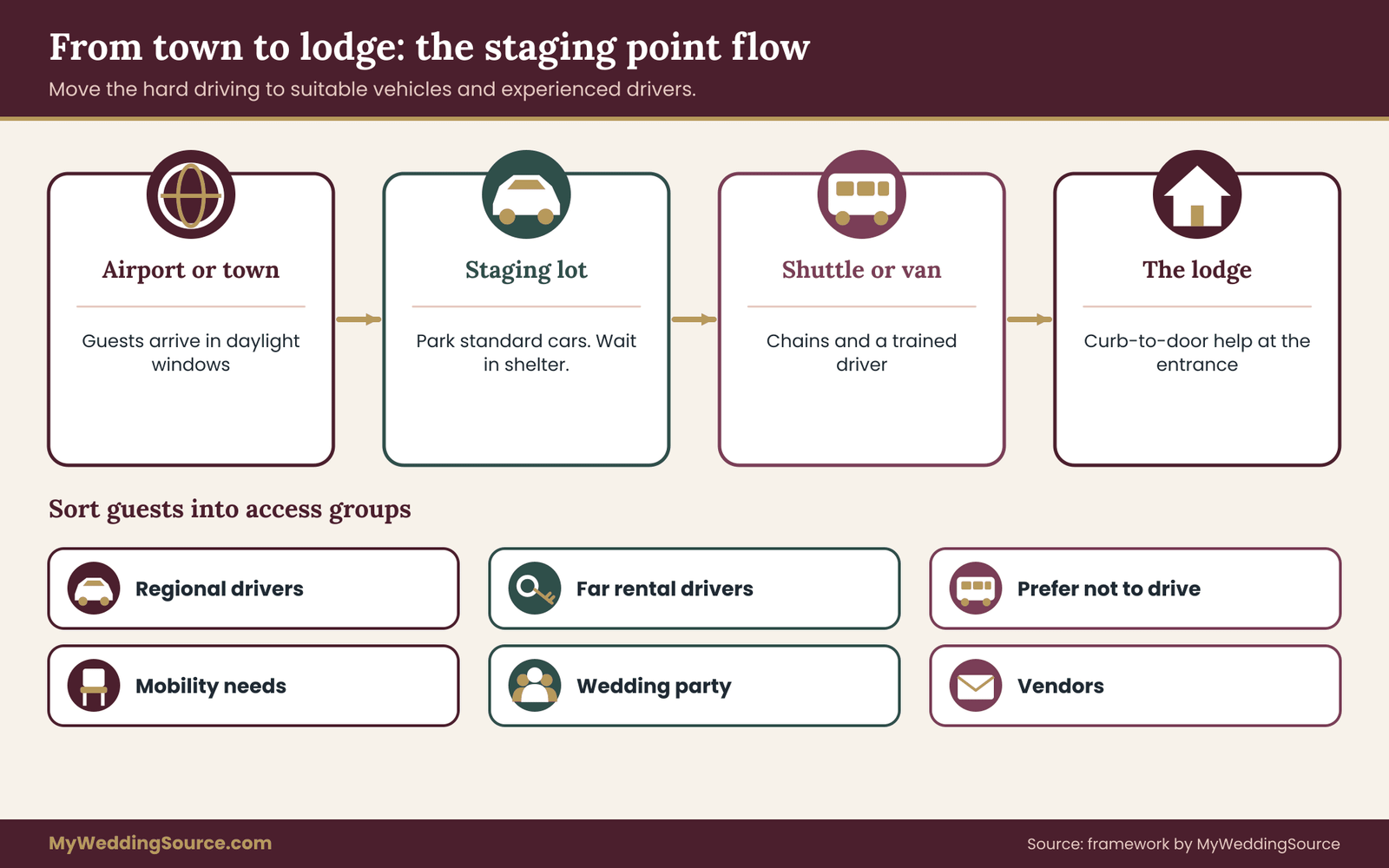
Guests are not one crowd. For the road plan, sort them into groups by how they will travel, because each group needs a different message and a different fallback.
Local and regional drivers who know mountain roads and own suitable vehicles. They need timing and conditions updates, not hand-holding.
Rental car drivers from far away who may be uneasy on mountain roads, are driving an unfamiliar car and may not own chains or have used them. They need clear directions, realistic drive times and a nudge to arrive in daylight.
Guests who cannot or should not drive the road, including people with vision limits, nervous winter drivers and anyone who prefers not to. They need shuttle seats.
Guests with mobility needs, who need curb-to-door service and an accessible route at both ends. The same principles as for hotel rooms apply, and the lodge should walk the route with you.
Wedding party and immediate family, who often arrive early, stay on site and carry the most luggage and decor.
Vendors and staff, treated as their own group in the next chapter.
Write the number of people in each group. Even a rough count tells you whether you need one shuttle or three, and whether a staging point is realistic.
The staging point
A staging point is a place at the bottom of the road, in a town or at a lot, where guests park standard cars and ride up together. It is the most common form of door two. It works because it moves the hard driving into the hands of experienced drivers in appropriate vehicles, reduces the number of cars on a narrow road and makes the end of the night simpler. Ask for it in plain words, and ask again if a mountain lodge wedding detail still feels vague.
Check the practical details. Who owns the lot, and is overnight parking allowed? Is it plowed or graded? Is it well lit and safe? Is there a shelter for waiting, since guests may stand there for a while? How many trips will the shuttle make, and how long does each take? A single van carrying twelve people on a forty-minute round trip moves about thirty guests an hour, so eighty guests require careful scheduling or more vehicles. Do the arithmetic with your actual numbers and the shuttle company’s real times.
Plan arrivals in waves, not as one rush
Even without a closure, a narrow road is easier when arrivals are spread. Invite guests to arrive in a window, not at a single time, and give each group a suggested slot. If guests are staying at the lodge or in cabins, set a check-in window that does not overlap with vendor load-in. Confirm it again two weeks before the mountain lodge wedding.
For the ceremony, set a “doors close” time a little before the start, with a short buffer built in. On a mountain road the buffer should be larger than in a city and based on your test-drive time. This is the sort of check that makes a mountain lodge wedding feel unhurried.
Parking on a mountain property
Mountain lodges often have limited parking, some of it on slopes or gravel. Ask how many vehicles fit, where the overflow goes, and who directs cars. A volunteer or hired parking attendant with a flashlight and a reflective vest is not extravagant. Ask where snow or mud is pushed, so that guests are not directed into a drift. Decide where the shuttle loads and unloads, where the elderly can be dropped near the door and where vendors park so they do not block the lodge’s emergency access.
A fire lane is not a suggestion, and the lodge manager will point out which lanes must stay clear. Use your own numbers here, since every mountain lodge wedding has different limits.
The end of the night
The ride down is the part many couples forget. After dinner, with tired guests, alcohol and darkness, the road is not the same road. Plan the last shuttles ahead, publish the times, and agree on a rule about who does not drive. If a ride down is not available for some guests, rooms or cabin beds at the lodge become the plan. Consider asking the lodge to hold a few rooms for guests who decide late that they would rather stay. The questions are the same as for any late-night ride home, with steeper stakes.
When door one closes while guests are on the road
Suppose a closure is announced while some guests are already driving up. The plan should say who calls them, where they go and how they are told. Use a short written message from the point person with one clear instruction, such as “Please stop at the staging lot and wait for a shuttle” or “Please turn around and go to the town hotel; we will update you at six.” Guests who are already driving should not read long texts, so the message should be short enough to see at a glance and only sent when the driver is stopped.
Prepare these message templates beforehand. A quick conversation now beats a hard decision during the mountain lodge wedding.
Worked case: a mountain lodge wedding with one closed road
The following example is invented to show how the map works. The lodge, the couple and the numbers are not real, and your own facts will differ.
The setup
Mara and Dev are planning a mountain lodge wedding in late autumn for seventy guests. The lodge sits at the end of a nine-mile county road that branches off a state highway. The road is paved but narrow, with two tight switchbacks. The lodge has eight rooms and four cabins, sleeping about thirty-five people. A mountain town with hotels lies forty minutes below. The only other route is a longer forest road that adds an hour and is gravel, closed seasonally to low-clearance vehicles.
They fill in the map. Door one is the county road, with the county road department as the source for conditions. Door two is a staging lot at the bottom of the county road, with a shuttle company that runs two vans and a small bus. They treat the forest road as not usable for guests, which they write down so that nobody assumes otherwise.
Door three is the lodge itself with a plan for overnight stay for the people who are already up there, and a second plan for those who are in town. Your guests will not see this work, but they will feel it throughout the mountain lodge wedding.
The triggers
They write four triggers. A county closure or a chain requirement on the road moves to door two. A forecast of a winter storm warning in the arrival window triggers an early-arrival invitation and a staff conversation. A closure that blocks door two as well triggers door three. And a lodge manager’s report that the road is not safe for the shuttle’s vehicles triggers a hold on all movement, followed by a message to all guests. Skipping it is the most common shortcut in mountain lodge wedding planning.
Three days out
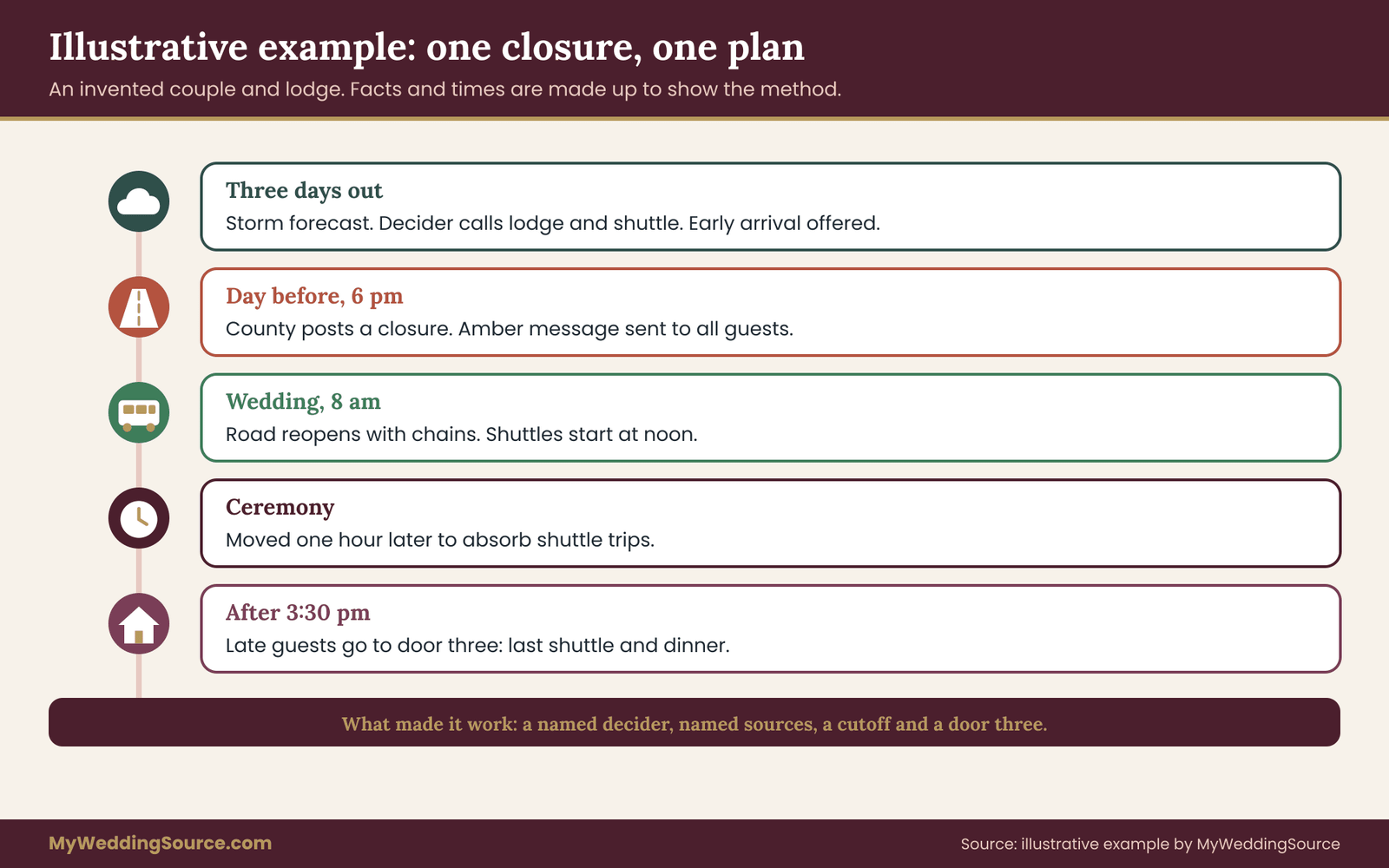
The forecast three days out shows a storm arriving the afternoon before the wedding. The decider, Dev’s sister, calls the lodge manager, who says the county road has closed twice this season under similar conditions, each time for several hours. She checks with the shuttle company, which can offer a larger vehicle if the staging lot opens a day early. She sends guests an early-arrival invitation and asks the officiant to confirm that she can arrive that day.
Eighteen guests accept the invitation and book rooms in town on the night before. The lodge confirms that the cabins can hold the wedding party and immediate family, who move up a day early. The caterer agrees to load in the day before as well and store food in the lodge’s cold room.
The cost of the extra night for the caterer’s staff is discussed and, because the contract language on schedule changes allows it, is shared between the caterer and the couple. Add it to the same one-page sheet you use for the rest of the mountain lodge wedding plan.
The evening before
The storm arrives early. At six in the evening the county posts a closure. The decider sends the amber message to all guests: the road is closed, the wedding is going ahead, everyone who is not already up at the lodge should plan to be at the staging lot at noon the next day, and a second message will arrive by nine in the morning confirming the road status.
The morning of
At eight, the county reopens the road with a chain requirement. The lodge manager reports that the plow has cleared the road and that the shuttle vans carry chains. The decider sends the message: shuttles start at noon, the ceremony moves from three o’clock to four to absorb the shuttle trips, and guests should dress warmly. The last safe arrival is three-thirty at the staging lot. A mountain lodge wedding is easier to enjoy when this part is settled.
Four guests, driving from the airport in a compact rental, reach the staging lot at four-fifteen. They miss the shuttle cutoff. The point person sends them to door three: they will ride up on the last shuttle at six and join at the dinner, and the lodge has set aside a room if they would rather stay down.
They arrive for the toasts. The wedding goes ahead without them in the ceremony, and the couple records a short video message for them. Nobody is angry, because the cutoff was written down and the alternative was real. Ask the lodge to confirm it in an email so the mountain lodge wedding file stays complete.
What the case shows
Several things made the day work. The decider was named. The sources for conditions were named. The shuttle and the early arrivals were arranged before the storm, not during it. A cutoff existed, and a door three existed for the people who missed it. None of it needed luck. It needed a page of facts, a few agreed triggers and a short list of messages.
What the case does not show
It does not prove that a plan like this always works. If the closure had lasted two days, door three would have become the whole event, and the couple would have faced a decision about whether to hold a smaller ceremony with the people on site. That is the subject of the failure conditions later in this guide. ## Vendors, load-in, and power at a mountain lodge wedding The point is not perfection but a clear answer for the mountain lodge wedding day.
Guests can choose to arrive late. Vendors cannot, because the dinner, the music and the flowers depend on them. A mountain lodge wedding needs a vendor plan that treats the road as a shared resource and the lodge as a place with limits on power, water, space and staff. Be especially careful here if your mountain lodge wedding falls in a season of changing weather.
Tell each vendor the real conditions
When you hire vendors, tell them where the lodge is, how long the drive takes in good and bad conditions and what vehicles the lodge recommends. Ask them in writing whether they have worked at mountain venues, whether they carry chains or have four-wheel drive, whether they use their own generator and how they handle a closed road. It is one of the quieter decisions in a mountain lodge wedding, and one of the most useful.
A caterer that regularly serves remote sites will have answers. One that does not will need more support. The questions in the vendor due diligence checklist fit well here, and the venue-specific questions in the venue technical walkthrough guide help you look at power, load-in routes and room dimensions with the lodge staff present.
Load-in earlier than you would in town
Plan load-in a day early for anything that can safely stay overnight, such as rentals, linens, furniture and staging gear. Perishables are a separate case, so ask the lodge what cold storage it has and who may use it. The earlier the load-in, the less the road matters on the wedding day. It also means that if a storm arrives, much of the equipment is already up the mountain.
The tradeoff is cost and security. The lodge may charge for extra days, and unattended equipment needs a safe place. Discuss both before booking. Everyone helping with the mountain lodge wedding should know this, not just the couple.
For vendors who must arrive on the day, such as florists with fresh flowers or photographers, set earlier arrival times with a buffer and agree on a cutoff after which they go to door three. Give vendors the same sheet that you give guests, with the three doors, the sources and the point person’s number.
Where vendors sleep
A band that has to drive down a mountain at one in the morning after loading out may prefer to stay. Ask the lodge whether it can offer rooms to vendors, at what price and for which hours. If it cannot, ask for a nearby option. Vendors who sleep on site are easier to schedule, and they are less likely to be stranded.
Include the cost in your budget as a contingency line, so that a closure does not become an argument. It takes ten minutes now and avoids a scramble on the mountain lodge wedding day.
Power, water and heat
Lodges often have limited electrical capacity, and old wiring can trip under the load of a band, a catering kitchen and a space heater at once. Ask the lodge how much power is available at each location, which circuits are shared, and whether a generator is permitted and where it can be placed. Fire safety rules may restrict extension cords, heaters and candles.
Water pressure and hot water supply may depend on a well or a tank, and a full house can strain either. A tank that supports twenty overnight guests may not support seventy people washing hands and a kitchen in full service. This fits the broader logic of mountain lodge wedding planning, which is to decide early and write it down.
Heat matters as well. A wood-burning stove is charming, and it does not heat a large room. Ask how the lodge is heated, how it handles open doors during a ceremony and whether the staff can raise the temperature before guests arrive. The wedding rental planning checklist is a useful place to record any rented heaters, tents, flooring and generators, and the lodge’s approval for each.
Wireless and backup communication
Many mountain lodges have weak or no cell service, and some have Wi-Fi that works in the lobby and nowhere else. This affects music playlists, livestreams, payment terminals and your own ability to hear from the shuttle driver. Ask the lodge exactly where coverage works and which carriers. Download music and vendor documents before leaving town. Ask your point person to read this part of the mountain lodge wedding sheet aloud once.
Keep a printed contact sheet. The wedding day digital contingency plan gives a framework for keeping the day running when networks fail, and it fits a mountain lodge wedding especially well. When in doubt, choose the option that keeps your mountain lodge wedding flexible.
If cell coverage is poor, ask whether the lodge has a landline, a radio or a satellite messenger. The lodge’s own emergency procedure should cover how it reaches the outside world, and you should know the answer before you need it.
Contract language to ask for
Several clauses reduce risk if the road closes or a vendor cannot arrive. Ask each vendor and the lodge about the following, then compare the answers with each signed contract.
Change of schedule. Can the load-in move a day earlier or later without penalty if the weather requires it? Who pays extra staff hours?
Force majeure and closures. What events does the contract treat as beyond a party’s control, and does a road closure or a fire restriction count? What happens to the deposit and the balance if the wedding cannot go ahead at the lodge?
Substitution. If a vendor cannot reach the site, what is the remedy, and is there a local backup?
Overnight stay. If guests or vendors are stranded, does the lodge charge room rates, a reduced rate or nothing? What food is available?
Insurance. Ask whether the lodge carries liability coverage and what it requires of vendors, and whether event cancellation insurance would respond to a road closure. A policy is a contract with its own exclusions, so read the actual wording or ask a licensed insurance professional, and do not assume weather or closures are covered.
None of these clauses make the day safer by themselves. They decide who pays when something goes wrong and which conversations are short because the answer is already on paper.
The update ladder: communication when conditions change
The best access plan fails if guests learn about changes from rumor. A message ladder gives you a fixed order for what you say, to whom and when.
Build the ladder in four rungs
Rung one: the standing information. This lives on the wedding website and in the invitation suite. It covers the elevation, the road description, the recommended vehicles, drive times, the staging lot, the shuttle schedule, the last safe arrival time and the point person’s phone number. It is written for calm days, so keep it plain and accurate.
Rung two: the early notice. Sent a few days out when the forecast concerns you. It tells guests what you are watching, what you recommend, such as early arrival or a different time, and when the next update will come. It does not predict. It says what you know and when you will know more.
Rung three: the go, watch or switch message. Sent the evening before and the morning of. It uses one of three words and one instruction. Go means plans are unchanged. Watch means plans are unchanged but a named condition could change them. Switch means the plan has moved to a different door, and the message says exactly what guests do now.
Rung four: the live line. On the day, a single channel, such as a text group, a printed phone tree or a person at the staging lot, carries short updates. Choose one. Guests who receive updates from three channels will believe the most dramatic one. A group text works only if every guest has agreed to receive it, so ask for phone numbers on the RSVP form and say how they will be used.
Writing the messages
Keep each message short, specific and calm. State the condition, the decision, the action and the next update time. For example: “The county has posted a chain requirement on the lodge road. Shuttles will run from the staging lot starting at noon. If you are driving a standard rental car, please park at the lot. Keep a copy on paper at the lodge during the mountain lodge wedding.
We will send another update by ten.” Avoid exclamation points, vague warnings and long apologies. Guests reading on a phone in a car should be able to take in the whole message at a glance. Do not leave this to the week of the mountain lodge wedding.
Prepare templates for each color, in advance, with blanks for times and places. In the middle of a storm, filling in blanks is far easier than writing from scratch.
Who hears first
Order matters. The decider hears first, then the lodge manager and the shuttle company, then the vendors, then the wedding party and family, then all guests. Vendors and the lodge need time to adjust, and the wedding party and family can help calm others. If a message to guests goes out before the lodge or the shuttle company knows, you may promise something that nobody can deliver. A mountain lodge wedding is a team effort, and this step makes the team’s job clearer.
Tell people what you do not know
An honest “we do not know yet; the next update is at six” is better than silence. It also protects the decision maker from being held to a promise made before the facts were clear. If a road reopens earlier than expected, the later message is welcome news. If it does not, nobody feels misled.
Keep a log
During the weekend, a point person should keep a short written log: time, source, condition, decision and message sent. It takes a minute per entry, and it is invaluable if there is a dispute with a vendor about who changed what, or if you want to learn from the event. It also helps the lodge.
Hospitality operators and event transportation coordinators learn from the same pattern, and a clear log can improve the next wedding there. ## Alternatives when the map fails Plan for the ordinary version of this and the difficult one, since a mountain lodge wedding can bring both.
Some days the map is not enough. A closure lasts longer than expected, a fire changes the entire region, or the lodge cannot host. Having alternatives ready is not pessimism. It is a way to protect the couple’s real goals, which are usually to be married, to be with the people they love and to avoid anyone being hurt or stranded.
Separate the legal marriage from the celebration
If the legal ceremony is what matters most, consider whether it can happen separately, earlier or elsewhere. Marriage license rules differ by state and county, and an officiant may need to be present at a particular place or within a particular time window. Check requirements with the issuing office and your officiant, and ask the officiant what they need. Some couples sign the license in a courthouse or at home before the lodge weekend, which turns the lodge event into a ceremony and celebration where a closure costs less.
Do this only after confirming that your state allows it and that the officiant and witnesses fit the rules. That is the working habit behind sound mountain lodge wedding planning.
Move the ceremony, keep the lodge
If the road to the lodge is the problem for only a few hours, the easiest alternative is a later start. The ceremony moves from afternoon to early evening, dinner shifts, and the lodge adjusts. Ask the lodge in advance how much flexibility its kitchen, its staff and its noise rules allow. A lodge that must close the kitchen at nine cannot serve a dinner that begins at eight-thirty. Seen this way, mountain lodge wedding planning is mostly a matter of asking the right person early.
Move the guests, keep the ceremony
If most guests cannot arrive but the wedding party and family are already there, a small ceremony with a livestream or a recorded message can include the rest. The same logic applies in the other direction: a small ceremony in town with a later gathering at the lodge. A livestream depends on good connectivity, and many lodges lack it, so confirm bandwidth before you rely on it.
Move the whole event to a lower location
Some couples keep a backup venue in the town below. It might be a restaurant, a hotel ballroom, a community hall or a winery. The backup does not need to be beautiful. It needs to be available, have capacity and accept short notice. Talk to the backup venue’s manager before you need it and ask whether they will hold a date with a fee, a refundable deposit or a handshake.
Be honest that you may never call. Some will say no, and that is useful information. The wedding venues guide can help you compare backup spaces and the questions to ask. With this settled, the rest of the mountain lodge wedding plan has firmer ground.
A backup venue also changes your vendor contracts. Caterers, rentals and music need to be able to serve a second location. Add the clause early.
Postpone, and know what postponing costs
A postponement is the hardest alternative. It involves every vendor, every guest’s travel and every deposit. Before you ever need it, read each contract for rescheduling terms, fees and deadlines, and decide who has the authority to postpone and by what time. A postponement is rarely decided on the wedding day. It is more often decided a day or two before, when a long closure is forecast. The principle is simple: know the cost of change before the pressure arrives.
Offer a second celebration
A second celebration, such as a casual party at home a month later, helps guests who could not travel and relieves pressure on the lodge day. If a weather event takes some guests out, this is a kind, simple alternative. Say it plainly and early. It does not need to be elaborate. These checks make mountain lodge wedding planning feel manageable and not endless.
Failure conditions for a mountain lodge wedding
A plan without failure conditions is a hope. This chapter lists the conditions under which your access map no longer works, so that you can recognize them early and change course. Share it with the shuttle driver so the mountain lodge wedding timing is the same for everyone.
Condition one: no door three
If the lodge cannot house or feed guests who are stuck, and no nearby place can, then the stay-put door does not exist. In that case the wedding depends on the road staying open, and you should either reduce the guest count to what the lodge can hold, add a lower-elevation backup, or reconsider the venue. This is the most important failure condition, because it is the one that turns a delay into a safety problem. Good mountain lodge wedding planning keeps each answer where the whole team can find it.
Condition two: a single point of failure in the road
If the only route passes through a stretch known for closures, such as a pass, a canyon, a slide-prone slope or a single bridge, and the lodge has no history of managing it, treat that as a major risk. Ask the road authority how often the stretch closes. If the answer is “often”, you might choose a different season or a different lodge.
Condition three: the decider cannot decide
If the person you named cannot make a decision, because they are traveling, ill or out of signal, the map breaks. Name a backup and confirm that both people have the full sheet. Test it with a hypothetical: “It is six on Friday, the road is closed, and the decider is on a plane. Who calls the shuttle?” Review it again whenever the lodge changes anything about the mountain lodge wedding.
Condition four: vendors that cannot adapt
If a key vendor refuses an earlier load-in, will not carry chains or insists on a schedule that only works on a perfect day, they are a risk. Decide whether to replace them or to build a plan around them. Do not hide the problem. A beautiful dinner that does not arrive is not a beautiful dinner.
Condition five: guests who will not follow instructions
Some guests ignore advice, drive too fast or arrive too late. You cannot control them, but you can reduce their effect. Tell them the cutoff once, clearly, and tell the shuttle driver and the lodge staff that the cutoff is real. If you have a group of guests who consistently ignore instructions, assign a friend to travel with them. In mountain lodge wedding planning, a written answer beats a remembered one every time.
Condition six: a closure that is too long
If a closure lasts so long that the shuttle plan and the late start cannot absorb it, the event has to change shape. The trigger is not a time on the clock. It is a point where fewer than a workable number of key people, such as the couple, officiant and a witness, can be present, or where food, heat or safety cannot be maintained.
Decide the minimum viable wedding in advance, such as the couple, officiant, witnesses and whoever is on site, and decide how the rest will be included later. Ask one more time if the answer changes before the mountain lodge wedding.
Condition seven: an official instruction
If officials order an evacuation, close the road or restrict the area, follow them. Do not argue with a sheriff’s deputy about the cake. The lodge manager, the land management agency and emergency management take priority over any schedule. After the event, handle contract questions through the cancellation and force majeure terms and not through confrontation.
Condition eight: your own energy
A mountain lodge wedding with an active contingency plan can wear out the people running it. If the planner, the parents or the couple are spending the week of the wedding on road reports, the plan is too fragile. Reduce complexity, add help or choose a simpler setup. A calm mountain lodge wedding is mostly built from answers like this one.
What to do when a condition appears
When you spot a failure condition, do three things. Write it down with the date and the source. Tell the lodge and the affected vendors promptly. And decide whether to repair it, accept it or change the plan. Often repairing is cheap: a second shuttle, a lower-elevation backup or an earlier load-in. Accepting is acceptable only if you know the cost and the people affected agree. ## Your next steps
Work through these in order. Each takes an evening or less, and together they turn a lovely idea into a plan you can hand to other people.
First, gather the road facts. Call the lodge with the questions from the road chapter, identify who owns each stretch of road, bookmark the condition sources and write the answers on one page with dates.
Second, test-drive the approach. Drive it yourself or ask someone you trust, at the time of day guests will arrive, and note the time, the signal gaps and the narrow stretches.
Third, draft the three-door map. Fill in door one, door two and door three, with a source and a trigger for each. If one door does not exist, write that down and decide whether it is acceptable.
Fourth, name your decider and backup. Confirm that both have the sheet, both have the lodge manager’s number and both agree on the four decision points.
Fifth, set the cutoff. Choose the last safe arrival time for guests and for vendors, and write it into the timeline and the contracts.
Sixth, talk to the lodge about door three. Ask about overnight capacity, food, heat, power and first aid. Put what they promise in writing.
Seventh, write the message ladder. Prepare the standing information for the website and templates for the go, watch and switch messages.
Eighth, review the contracts. Look for schedule changes, force majeure language, substitution and overnight costs, and ask the lodge and each vendor to confirm the same understanding of a road closure.
Ninth, choose a backup. Identify a lower-elevation venue and a minimum viable wedding, and decide who has the authority to invoke either.
Tenth, brief everyone. Share the sheet with the lodge, the planner or point person, the shuttle company and the vendors, and ask each to confirm their part.
Review the map at each decision point, update it after every conversation with the lodge and save the final version with your wedding records so you can learn from it later.
FAQ
How far in advance should I decide on a backup route for a mountain lodge wedding?
Decide as soon as you have the lodge’s road facts, ideally before you sign the contract. A backup route or staging lot affects vehicle choices, vendor timing and cost, so it is much easier to build in early. You can refine details closer to the date, but the existence of a door two should be known months ahead.
Who decides whether the road is safe enough for guests?
Officials decide closures, and the lodge manager can advise on conditions at the property. Your named decider decides what the wedding does in response. Keep those roles separate. If an agency or the lodge says the road is not safe, that outranks your schedule, and your map should say how guests are told.
Should I tell guests about altitude on the invitation?
Yes, in a short and calm way. State the elevation, mention that thin and dry air affects people differently, and point guests to public health guidance and their own clinician. Offer a private channel for health or access needs. Avoid medical instructions or promises that everyone will be fine.
What if some guests cannot drive mountain roads?
Offer shuttle seats from a staging point and ask guests to say privately if they would like one. Count how many you need so you can size the vehicles. Some guests may prefer to stay in the town below and ride up together, so mention that choice early and clearly.
Do I need a second venue for a mountain lodge wedding?
Not every couple does, but a backup is worth considering if the road is a single route with a history of closures or if the lodge cannot house guests overnight. A backup can be simple, such as a hotel room or a restaurant. Ask whether it will hold the date, and at what cost.
Does wedding insurance cover a road closure?
It depends on the policy, and many exclude some weather or access events. Read the actual wording, check what counts as a covered cause, and ask a licensed insurance professional if you are unsure. Do not assume that a closure or a fire restriction is covered, and compare the policy with your vendor contracts.
What should the lodge be able to tell me about emergencies?
Ask for its written severe weather or emergency procedure, its first aid and defibrillator arrangements, how staff communicate if cell service fails, and the nearest medical care with drive times in normal and closed-road conditions. A prepared lodge answers quickly. Anything vague is worth following up before you sign.
When should I postpone instead of changing the plan?
Postponement is usually a last resort, considered when a long closure is forecast and neither a later start nor a smaller event is workable. Read your contracts for rescheduling terms, set a decision deadline with the people involved, and compare the cost of postponing with the cost of the minimum viable wedding you defined earlier.
Sources
- National Park Service
- National Weather Service
- U.S. Forest Service
- Federal Highway Administration
- Centers for Disease Control and Prevention, travel health
- Wildfire.gov interagency wildfire information
- Ready.gov emergency preparedness
- American Red Cross, first aid and preparedness
- National Fire Protection Association
- U.S. Fire Administration