

A boat ceremony and a dock ceremony can look almost the same in a photograph, and they behave very differently on the day. This guide compares the two for the ceremony alone, with an original ceremony option chart, a guest boarding ledger, one worked case and the conditions that should send you back to dry land.
Choose a boat ceremony only when the vessel can legally carry your whole ceremony group, the guest who will find boarding hardest can get aboard and off again with dignity, and sound and weather stay manageable for fifteen to thirty minutes. If one of those fails, a dock ceremony with the vessel as a backdrop keeps most of the water and removes most of the risk. Score both on the same seven factors before you pay a deposit.
Most couples who ask about a boat ceremony are really asking one question: how much of the picture do we keep if we stay at the dock? The honest answer depends less on taste than on arithmetic, sound, tide and the people on your guest list. A boat ceremony asks a lot of a short event. A dock ceremony asks much less, and it gives up less than people expect.
This guide is deliberately narrow. It covers the ceremony, which usually lasts a quarter to half an hour, and not the whole day on the water. If you are also weighing a full charter with dinner and dancing aboard, the broader questions of vessel authorization, charter insurance and reception capacity belong in a separate comparison. Here the question is only where the vows happen and what each choice costs you in comfort, safety, sound, light and money.
A note on scope. This is general planning information, not legal, insurance or maritime advice, and the rules for vessels, alcohol service and marriage ceremonies differ by state, waterway and vessel. Where a rule matters, the guide names the agency that issues it so you can confirm the current version yourself.
What a boat ceremony and a dock ceremony actually are
The two phrases hide several different arrangements. Before comparing anything, decide which arrangement you are really picturing, because the trade-offs change from one to the next.
A boat ceremony underway. The vessel is moving, usually slowly, while the vows are spoken. This is the rarest version and the hardest one. Engine noise, wake, wind and the crew’s duties all compete with the officiant. The vessel must be moving on a route its authorization covers, with a captain who is also running the boat.
A boat ceremony with the vessel stopped. The vessel is anchored, drifting or held in place on the water. Sound improves and the deck steadies, but the vessel still moves with wind and swell, and getting guests on and off remains a full operation.
A boat ceremony at the dock. The vessel stays tied up and the ceremony takes place on deck. This is the quietest version of a boat ceremony. The vessel still has a written passenger limit, a gangway and a captain who decides when to cast off or stay put.
A dock ceremony with the vessel nearby. Guests stand or sit on a pier, a marina lawn or a waterfront terrace, and the boat is the backdrop. No one boards for the vows. The vessel might be decorated, might carry the couple away afterward, or might simply sit beside the aisle.
A shore ceremony with a boat arrival or departure. The vows happen on land, and the vessel appears at the beginning or the end. This is the lightest use of water, and it appears here only because many couples treat it as a fallback.
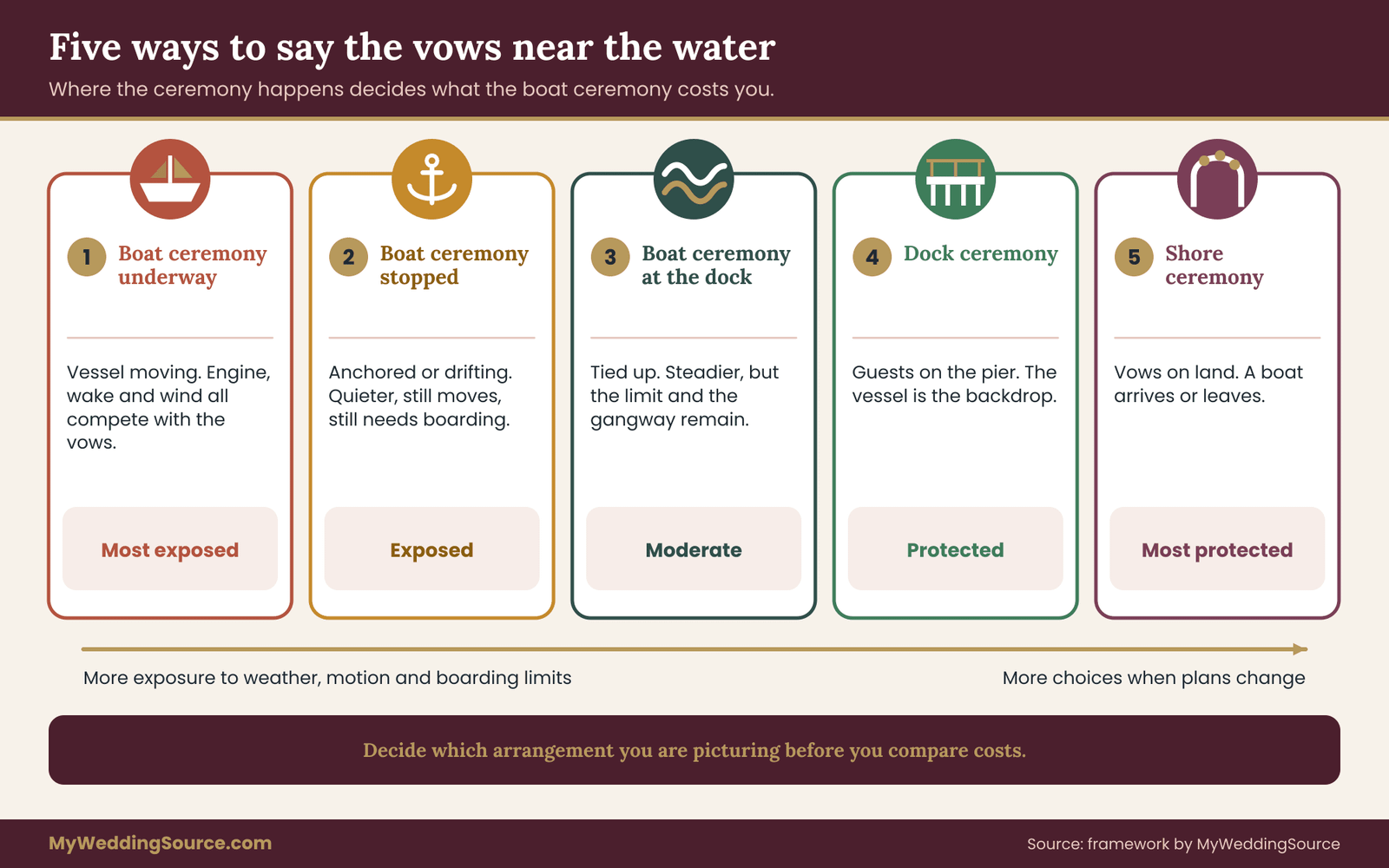
These five arrangements sit on a spectrum from most exposed to most protected. The more of the ceremony that happens aboard a moving vessel, the more the boat ceremony depends on factors outside your control. The more of it happens at the dock, the more it depends on ordinary venue questions: sound, shade, surface and permission.
Dock, pier, marina and quay are not the same
A dock ceremony takes place on a structure that ranges from a solid concrete pier to a floating wooden walkway that rises and falls with the water. The difference matters. A fixed pier is firm underfoot and carries chairs and a sound system easily. A floating dock may rock slightly, slope more steeply at low tide and limit how many people may stand on it at once.
Marinas are usually private property with their own rules, insurance requirements and access hours. A public pier may belong to a city or park agency and need a permit. A yacht club may offer a lawn and a dock only to members or to hosted events. Before you commit to a dock ceremony, find out who owns the structure and who can say yes. The venue guide on this site, choosing a wedding venue, covers the general questions of permission and hold terms that apply here too.
Why the comparison is worth making early
A boat ceremony is a booking decision that shapes everything after it. It limits your headcount, your guest list, your music and your photographer. It also sets a weather deadline. A dock ceremony is much easier to move. If you compare them in the first weeks of planning, you can keep both alive until the facts are in. If you compare them after the invitations are out, you are mostly choosing which problem to live with.
The comparison also helps even if you end up on land entirely. Many couples who think they want a boat ceremony discover that what they love is water in the background, golden light and a sense of arrival. A dock ceremony delivers those. The rest of this guide helps you tell which part of the idea you actually care about.
Why a boat ceremony is a different question from a charter question
Search for boat weddings and most of the advice concerns charters: how many passengers, which insurance, what a deposit covers. Those questions matter, and the site’s other guidance on vendor agreements covers them. A ceremony question is narrower and in some ways stricter.
A ceremony is the one moment of the wedding that cannot be repeated, rearranged or sped up. The legal and personal weight of the vows sits there. That raises the cost of a failure that would be a minor annoyance at a cocktail hour. A dropped glass at dinner is a story. A vow lost to engine noise, or a ceremony delayed forty minutes because the dock is closed for the tide, is a loss of the thing you came for.
What a short event does and does not simplify
The ceremony is short, and that helps in three ways. Guests spend little time aboard, so seasickness and chill matter less. The program has no seated dinner, so the vessel’s seated capacity is not the limit. And one timing decision, the start time, controls almost everything.
It also hurts in three ways. Everyone must be in place at the same moment, so boarding is a bottleneck. Sound matters more than it does at a reception, because the words are the point. And the ceremony has a fixed audience layout, since guests face one direction, which reduces the room a vessel’s deck can offer.
Who this comparison is for
The comparison is most useful for three groups of couples. The first group has a fixed guest count above about fifty and is wondering whether any vessel will carry it. The second group has a few guests who would struggle with a gangway and wants to know whether a dock ceremony quietly solves the problem. The third group loves the idea of a boat ceremony but has a modest budget and wants to know where the money goes.
If you fit none of these, you may still find the option chart useful as a way to make an unspoken preference visible. Partners often disagree about the boat for reasons neither has said aloud. Scoring the same factors, separately and then together, brings the disagreement into the open without a fight.
Where the chart sits in the larger plan
The option chart in the next section is a ceremony tool, not a whole-wedding tool. Use it first, before you shop for charter operators. Once the chart tells you that a boat ceremony is worth pursuing, you can move on to the vessel-specific questions of authorization, crew and insurance, and to the contract review described in the guide to reading a wedding vendor contract.
Once the chart tells you the dock is the better ceremony, you can also stop reading about vessels and put the saved energy into the venue, the sound system and the lighting. That is not a downgrade. For many weddings, the dock ceremony is the choice that lets the water stay in the picture while the people stay comfortable.
A word about the guest who cannot say no
Guests rarely tell you that a boat ceremony worries them. They are happy for you, they do not want to be difficult, and they will board a vessel they dislike rather than say so. The responsibility for noticing lies with the couple. Part of the comparison below is simply a prompt to think about the specific people on your list, by name, before the decision is made, and to give each one a private and easy way to say what they need.
The ceremony option chart for a boat ceremony vs a dock ceremony
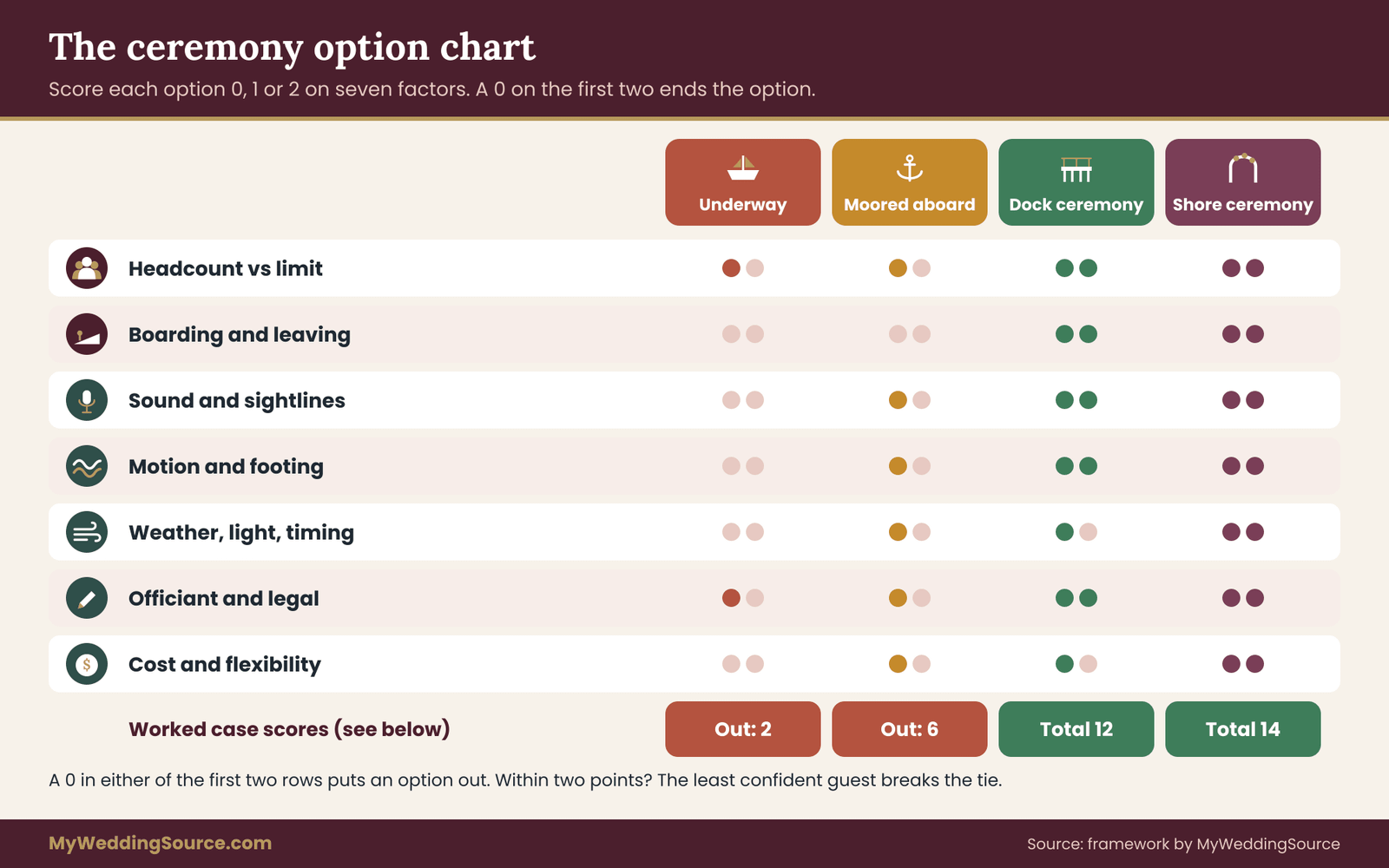
The chart is the heart of this guide. It scores four ceremony options on seven factors, using a three-point scale, and it includes a rule that stops a high total from hiding a serious problem. You can run it on paper in an evening, and it works again each time a fact changes.
The four options are a boat ceremony underway, a boat ceremony with the vessel moored or stopped, a dock ceremony with the vessel as a backdrop, and a shore ceremony with a boat arrival or departure. Score each option on each factor with a 0, a 1 or a 2.
- 0 means the factor fails. The option cannot safely or sensibly do this.
- 1 means it works with a condition. Someone must do something specific, and you can name who and by when.
- 2 means it is comfortable. No special arrangement is needed.
The seven factors
Factor one, the headcount against the written limit. Count everyone who will be on the vessel for the vows: guests, the two of you, the officiant, the photographer, any musician, a planner and any helper. Compare the total with the figure the operator gives you in writing for your route. Ask whether crew count toward that figure. A boat ceremony that cannot carry the whole group scores 0 here, no matter how lovely it is.
Factor two, boarding and leaving. Picture each guest crossing a gangway or stepping over a gap, then repeating the trip afterward in worse light. Score by the guest who will find it hardest. A dock ceremony scores well here because the surface is usually level and wide, though a floating dock at low tide can slope more than it looks.
Factor three, sound and sightlines. Can every guest hear the vows and see the couple? A boat ceremony puts the couple at one end of a narrow deck, which means rows of guests stretch away from them. A dock ceremony can let the aisle be the dock itself, with the water on both sides, and guests standing along the edge.
Factor four, motion and footing. Heels, canes, walkers and young children all react to a deck that moves. Even a vessel tied to the dock shifts when another boat passes. A solid pier is the steadiest surface, and a shore ceremony is steadier still.
Factor five, weather, light and timing. Wind, chop, lightning and fog can change a boat ceremony or end it. They also affect a dock ceremony, but the dock gives you more choices when conditions turn: move the group under cover, shorten the vows, or relocate to a nearby room. Tides add a timing factor to both, as the next sections explain.
Factor six, officiant, legal and cue-sheet fit. Your officiant needs to hear, be heard, hold the paperwork steady and stand somewhere stable. The legal marriage rules for your location apply to a vessel too, and a vessel that crosses a boundary can complicate them. Confirm this early with the office that issues your marriage license.
Factor seven, cost and flexibility. A boat ceremony costs money for the vessel’s time and crew and gives you little room to change. A dock ceremony may have lower direct costs but can add chair, sound and permit costs. Score flexibility too: how easily can you move the date, the time or the format?
The disqualifier rule
Add the scores, but read the chart in two steps. First, look at factors one and two. If an option scores 0 on either, it is out, regardless of total. A vessel that cannot carry the group or cannot be boarded by the guest who most needs to attend is not a boat ceremony you can offer.
Second, among the options still standing, compare totals. The option with the highest total wins, unless two options are within two points of each other, in which case the tie-breaker is the guest. Choose the option the least confident guest will enjoy most.
That tie-breaker is deliberate. Couples tend to score their own preferences high and their guests’ discomfort low. Asking which option the quietest, oldest or most anxious guest would choose pulls the decision back toward the people who have the most to lose.
What the chart usually shows
Without inventing numbers for your wedding, the pattern is predictable enough to describe. A boat ceremony underway tends to score well on atmosphere and poorly on sound, motion and legal clarity. A boat ceremony tied up at the dock tends to improve sound and motion but keeps the headcount and boarding limits. A dock ceremony with the vessel as a backdrop usually scores best on factors one, two and four, and it often wins overall by a small margin once cost and flexibility are included.
The shore ceremony with a boat departure wins on safety and loses on the sense of being on the water. Many couples find it too far from the original idea. If so, that is information: you want the water to be part of the vows, not a background to them.
Running the chart as two people
Each partner should score the options separately before comparing, ideally without discussing the factors first. Disagreement on factor three or factor seven usually reveals a real difference in priorities: one person cares about the photographs, the other about the guest experience. Disagreement on factor one or two usually signals missing information, so go and get it.
Use a pencil. The chart will change when the operator sends a document, when the marina answers an email, or when a guest tells you something you did not know. A chart that you update is useful. A chart you fill in once and file is a guess.
What to do with the result
Write one sentence beneath the chart that states the choice and the condition that would change it. For example: “We choose a dock ceremony with the vessel as a backdrop, and we would switch to a boat ceremony at the dock if the operator confirms a written limit above our headcount.” That sentence, dated and shared with both families, is the output.
If the result is a boat ceremony, the next sections of this guide help you prepare it. If the result is a dock ceremony, the same sections help you prepare that, because many of the questions about sound, timing and guests carry over directly. The chart is a decision tool, not a verdict on how much you love the idea.
Sound, sightlines and the officiant on a boat ceremony
Of the seven factors, sound is the one couples underestimate most. Visual planning gets all the attention in the early weeks, since boats photograph well. But a ceremony is a spoken event, and it is the words that guests came to hear. A boat ceremony puts several sources of noise within a few feet of the vows.
Where the noise comes from
On a vessel, the usual sources are the engine or generator, the wind across the deck, water against the hull, rigging or fittings that tap and clank, and the crew’s own communications. On a vessel that is stopped, the engine may be off, but a generator may run for power and air conditioning. On a vessel at the dock, other boats, marina traffic, dock lines and water pumps add to the mix.
None of this makes a boat ceremony impossible. It means the sound plan needs to be a real plan. Ask the operator what runs during a ceremony, whether engines or generators can be shut down for the length of the vows, and whether the vessel has a public address system you may use. Ask for these answers in writing, because the person who says yes in a sales call is not always the person on deck on the day.
Amplification choices
A small battery-powered speaker and a wireless lavalier or handheld microphone can carry the officiant’s voice across a modest deck. A vessel’s own system may already be installed, but its speakers may point toward the dining area and not toward the ceremony space. Ask whether you may bring your own equipment, whether it needs a certificate of insurance, and who handles the cabling and the power.
A dock ceremony is easier. A fixed pier or a lawn beside the dock can hold a regular ceremony sound system, with stands and cables, and your audio vendor can test the sound in advance. The guide to ceremony cue sheets explains how to give the officiant, music and readers a single written timeline, which matters more when the setting limits rehearsal time.
Sightlines on a narrow deck
Decks are long and thin. If guests sit in rows, the back rows are far from the couple and may see only heads. If they stand along the rails, many have the water behind them and the couple at one end. Some vessels have a bow area, a stern deck or a flybridge that can serve as a platform, and each has a different effect on the view.
Walk the vessel, or ask the operator for a deck plan with measurements, and place the couple, the officiant and the guests on the plan before you decide. A dock ceremony typically offers a straight aisle along the dock or a curved arrangement on a lawn, and sightlines are easier to predict. Whichever you choose, aim to give every guest a clear view of the couple’s faces.
The officiant’s needs
Your officiant is a participant with practical needs. They need to hear and be heard. They need a stable place to stand and a way to hold the license and any script without it blowing away. They need to know the cue for starting and a plan if the ceremony must stop. And they need to know whether their authority to officiate extends to the vessel and the waters where it will be.
Marriage rules differ by state and waterway, and a vessel moving across a jurisdictional boundary is a legal question that you should not settle by guessing. The guide to wedding officiant requirements explains what to ask an officiant and the issuing office. Many couples sign the legal paperwork on land and hold a symbolic ceremony aboard, which avoids the question altogether.
Music and silence
Live music on a boat ceremony needs the same attention as the vows. A guitar or a string player can sound lovely in open air, but players need stable chairs, shelter for instruments from spray and sun, and a power source if amplified. A recorded processional through a small speaker is simpler. Ask the musician whether the vessel’s motion is a problem for the instrument.
Some couples choose silence as a feature. A short ceremony with minimal music, spoken softly with the sound of water behind it, can be moving, especially in a boat ceremony tied up at a quiet marina. If that is your plan, test whether the vows carry without amplification, and bring a backup microphone anyway.
Timing, tides and light for a boat ceremony
The ceremony is short, so its start time carries a lot of weight. On the water, three clocks run at once: the sun, the tide and the vessel’s own schedule. They rarely agree by accident, and the couple’s job is to put them on one page.
The sun
Golden light is the reason many couples want a boat ceremony. It is also the reason for a rushed ceremony, because the best light lasts a short time and moves quickly over water. Low sun may shine directly into the faces of guests who face west, and it may leave the couple in silhouette from the photographer’s position. Decide whether you want the light behind the couple, in front of them or at an angle, and ask the photographer to check the direction the vessel or the dock will face.
Plan the ceremony to start before the light peaks, not at it. Guests need time to arrive, board and settle. Those minutes eat into the window, and a late start means the vows happen in fading light or the dark. Both choices are workable, but the second needs lighting that is safe on a deck or dock and still looks good.
The tide
On tidal waters, the water level can change by a surprising amount over a few hours. For a boat ceremony, the effect shows up at the gangway. At high tide, a gangway between a fixed pier and a vessel may be nearly level. At low tide, the same gangway may slope steeply, and the vessel’s deck may sit well below the pier.
A floating dock rises and falls with the water, but the ramp that joins it to land follows the tide and its angle changes. Ask the marina for the slope of the ramp at the tide you expect, not only at an average level. NOAA’s Tides and Currents service publishes predictions for many coastal locations, and a quick check of your date and time will show whether low water coincides with your guests’ arrival.
If your location is on a lake or river with little tide, you can skip most of this, though water levels on reservoirs and managed waterways can still vary. Ask the marina what to expect.
The vessel’s clock
A vessel that carries passengers for hire usually has a fixed block of hours. The crew may need time before the event to prepare and time afterward to clean, refuel or return to a berth. A boat ceremony that starts late eats into the charter, and a ceremony that runs long may cost overtime. Ask for the cast-off time, the return time and the policy for delays.
At a dock, a similar clock applies in a different form. The marina may close gates at a certain hour, restrict access after dark or limit when music may play. A public pier may close at sunset. Check the hours before you fix a start time.
Building a ceremony window
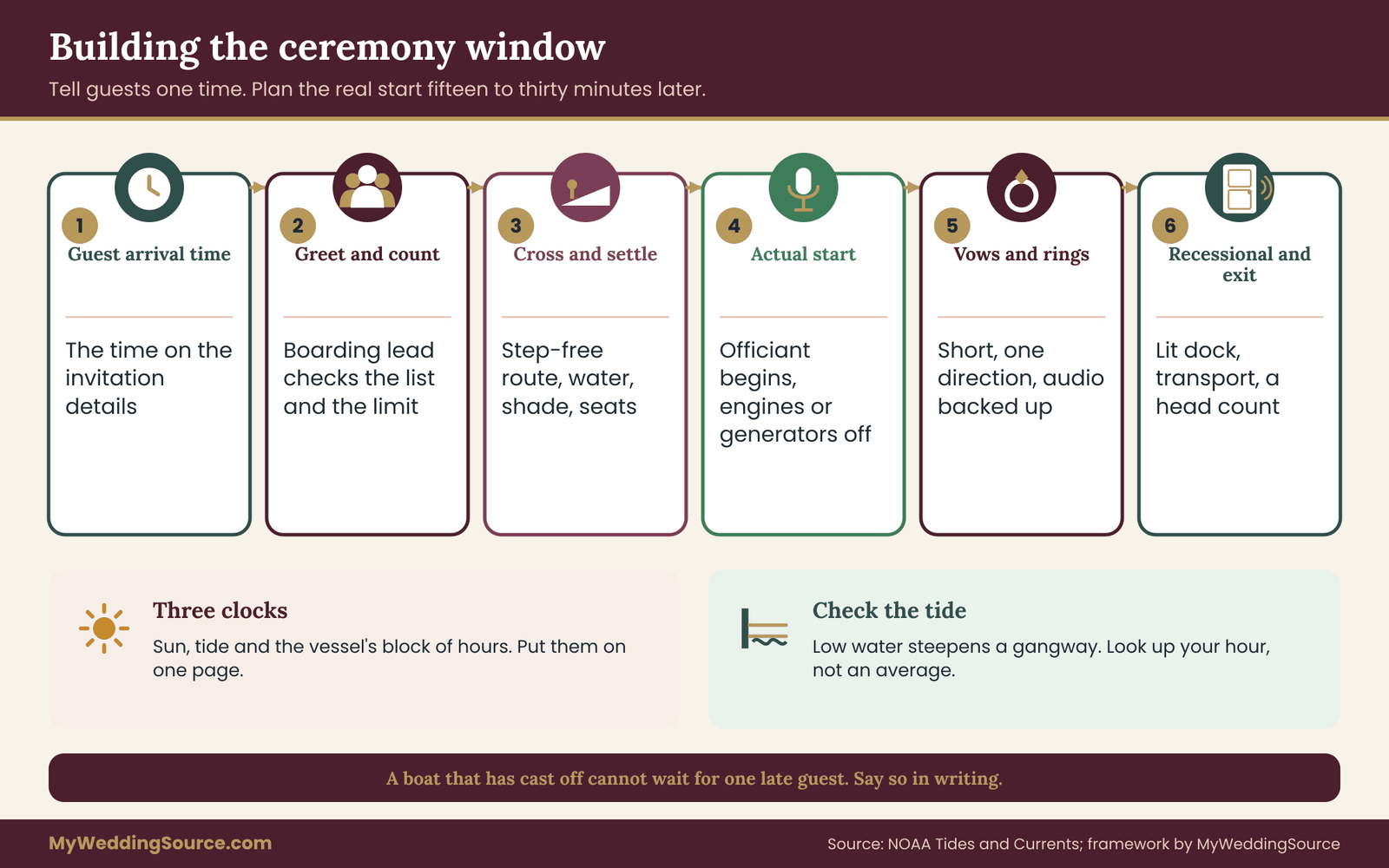
Work backward from the vows. Write down the start time you want. Subtract the time guests need to move from arrival to their places. Add the time for the officiant’s introduction and any readings. Add the vows, the ring exchange and the recessional. Then add a buffer, because boarding almost always takes longer than expected.
A useful habit is to write two times: the guest arrival time, which is the time you tell guests, and the actual start, which is fifteen to thirty minutes later. The gap protects the schedule from latecomers, slow boarding and a vessel that needs one more minute to be ready. Guests who arrive early on a dock can enjoy the water. Guests who arrive early on a vessel may stand on a deck in the sun, so give them shade and water.
Late guests on the water
A dock ceremony can pause for a late guest, if only for a minute. A boat ceremony underway cannot, since a vessel that has left the dock does not return to collect one person. If the plan includes a cast-off, write the cast-off time on the invitation details as the firm arrival deadline, and appoint someone to greet guests, count heads and close the gangway at a stated time.
This is an uncomfortable rule to enforce, which is why it helps to set it in advance and in writing. Guests who miss the departure should have a place to go, such as a shoreside gathering where they can watch from the dock and join the reception afterward. Without that plan, a late guest becomes a crisis and a source of guilt.
Dark and the return
If the ceremony runs into evening, the return and the departure after it will happen in dark. A lit dock, a safe gangway and a plan for guests who have been drinking all matter. Ask the operator about lighting, the marina about dock lighting and your venue about parking and transport. The cost of a lit, supervised, step-free exit is small compared with the cost of an injury at the end of a happy evening.
Guest boarding needs for a boat ceremony vs a dock ceremony
Boarding is where a boat ceremony most often fails in practice. It is not dramatic. It is a slow line at a gangway, a grandmother who hesitates, a child who will not let go of a parent’s hand, a pair of heels on a wet deck. The remedy is to think about each guest in advance, and the tool for that is a boarding ledger.
The boarding ledger
Make a simple list of every guest and every vendor who will be at the ceremony. Beside each name, note any need that bears on boarding, such as a wheelchair or scooter, a walker or cane, difficulty with stairs, pregnancy, a very young or very old age, a visual or hearing difference, an anxiety about water, a service animal, or a plan to wear heels or formal shoes.
You do not need to ask anyone for a diagnosis, and you should not. Ask the family or the guest what they would find easiest. A line in your RSVP follow-up such as “We are planning part of the day near the water. Is there anything that would make getting around easier for you?” invites an answer without pressing for details.
The ledger is private. Keep it with the couple and the person responsible for boarding. It exists to help you arrange the day, not to label anyone.

The categories that matter
Wheelchairs, scooters and walkers. The path from the car to the vessel must be step-free, wide enough and firm. A gangway with a steep slope, a raised threshold or a narrow door may not admit a mobility device. Ask the operator for the specifics rather than a general assurance. The U.S. Access Board publishes guidance on accessible routes at recreational boating facilities, and the Americans with Disabilities Act applies to many marinas and piers, though vessels have their own rules. Ask the operator what the vessel offers, and the marina what the dock offers.
Older guests and those with limited stamina. A gangway may be manageable, but the wait in the sun, the unsteady deck and the lack of a seat may not be. Plan seats near the boarding point, handrails along the route, and a person to offer an arm to anyone who wants one.
Children. Check the vessel’s rules on life jackets, which vary by vessel and jurisdiction, and ask whether the operator supplies child sizes. Name an adult for each child so supervision does not rest on a general sense that someone is watching. A dock ceremony needs a similar plan, since a dock is a place where small children can fall in.
Guests who feel unwell on water. Motion sensitivity is common, and guests may not mention it. Offer a calm route, a place near the middle of the vessel, fresh air and a shoreside option. This guide does not give medical advice, and a guest should talk to their own clinician about anything specific.
Guests in formal footwear. High heels catch in gaps and slip on wet decks, and the same is true on dock planks. Say so in the invitation details, and have a plan for the guests who ignore the advice, such as flat sandals or heel protectors for the walk.
Alcohol. Drinking before boarding is a safety concern on any vessel and a legal question in many places. Decide whether the bar opens after the ceremony, and ask the operator about its policy.
The boarding time estimate
You can estimate boarding time without statistics by sketching it. Count how many people can cross the gangway at once, usually one at a time or two with help. Think about how long a typical crossing takes for someone who needs a hand. Multiply by the number of guests and add a margin. The point is not precision. It is to see whether the boarding itself takes five minutes or half an hour.
If your sketch shows a long boarding time, your options are to stagger arrivals, add a second boarding point, shorten the program or choose a dock ceremony. None of these is a failure. A long boarding time is a design problem that has several solutions.
A dock ceremony has boarding needs too
A dock ceremony is not free of access issues. The path to the dock may cross gravel, steps or a long walk from parking. The dock itself may be narrow, have gaps between planks or lack a rail. A floating section may feel unstable to someone with balance concerns. The difference is that you can solve these problems with ordinary venue tools: a mat over gravel, a ramp, golf cart rides or a seat. The guide to accessible wedding venue red flags lists the questions worth asking about any waterfront space.
Weather, the decision clock and the switch between ceremonies
Weather is where a boat ceremony and a dock ceremony part ways most clearly. On the water, the captain owns the decision. At the dock, the couple has more say. Both need a plan, and the best plan lets one ceremony turn into the other.
Two kinds of limit
A safety limit belongs to the captain. Wind, sea state, lightning and visibility can make a trip unwise or unsafe, and the captain’s judgment on those matters is final. You cannot negotiate it and you should not try. A comfort limit belongs to you and your guests. Chop that unsettles older guests, cold wind that makes the vows unbearable, or heat that leaves everyone wilting are comfort issues, and you can choose to change the plan before the captain would.
Write both down. For the safety limit, ask the operator to state in writing who decides, at what time, using which forecast and what happens to your money in each case. For the comfort limit, agree among yourselves what conditions would lead you to move the ceremony, and who has the authority to say so on the day.
Reading the forecast
The National Weather Service publishes marine forecasts for coastal zones and many large lakes, including wind speed, wave height and advisories. These forecasts are more specific than a general weather app, and a captain will usually look at them. Look at them yourself in the days before the wedding so you are not surprised by a call from the operator. A forecast changes, so watch the trend, not a single reading.
Do not try to interpret marine advisories like an expert. Use them to ask better questions: “The forecast mentions strong winds in the afternoon. Is our ceremony time within the concern, and what would you do?” The operator’s answer tells you whether the plan is sound.
The decision clock
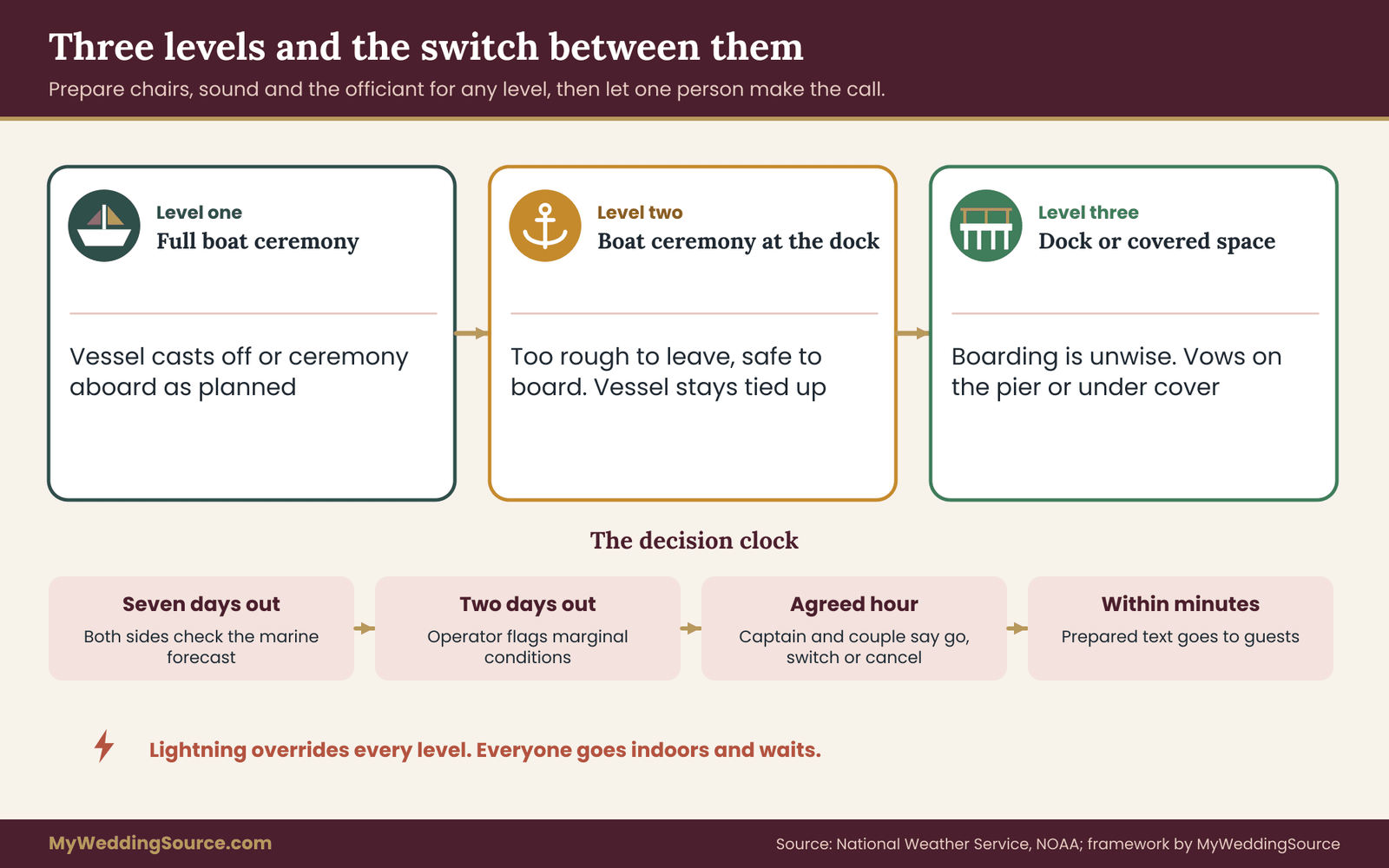
A decision clock is a short list of times and owners. It might read: seven days out, both sides check the marine forecast; two days out, the operator flags any marginal conditions; the morning of the ceremony, the captain confirms go or no-go by a stated hour; and a prepared text goes to guests within minutes of any change.
The hour matters. A decision made at noon for a ceremony at five gives guests time to adjust. A decision made at four-thirty leaves them in cars, in a parking lot or on a dock in the rain. Agree the earliest hour that the operator can reasonably decide, and build the guest message around it.
Plan A, Plan B and the switch
Think of the ceremony as having three levels. Level one is the full boat ceremony as imagined. Level two is the same ceremony with the vessel at the dock, if conditions are too rough to cast off but safe to board. Level three is a dock ceremony or a nearby covered space, if boarding itself is not wise.
The switch between levels works only if it is prepared. Chairs, sound and the officiant need to be ready for either. Guests need to know where to go. The photographer needs to know the alternate position. And everyone needs to know who makes the call. A well-built plan can switch levels in under half an hour. A poorly built one cannot switch at all.
A dock ceremony has its own weather questions, and they need a clear plan too. Whatever you choose, write down what happens in rain, wind, heat, lightning and fog, and put a shelter on the same site map as the chairs.
Lightning is not negotiable
Lightning is the single condition that overrides every plan. A vessel, a dock and an open lawn are all exposed. If lightning is nearby, move people into an enclosed building or a hard-topped vehicle and wait. Do not hold a ceremony in the hope that the storm passes. The operator and the marina have their own policies, and they may be stricter than yours. Follow whichever is more cautious.
What the contract says about weather
The contract should say who decides, whether a weather cancellation produces a refund, a credit or a reschedule, and what happens if the trip is shortened. A credit has limited value for a ceremony you can only hold once. Look for language about partial refunds, about the vessel’s right to cancel for safety, and about the time by which that decision will be made. If the contract is silent, ask for an amendment before paying a deposit.
What a boat ceremony costs compared with a dock ceremony
This guide does not quote prices, because prices vary by region, season, vessel and day of the week, and any number printed here would go out of date. What it can do is show where the money goes, which lets you compare the two options on structure rather than on a quote.
Where a boat ceremony’s costs come from
The largest cost is the vessel’s time, which is usually priced by the hour or in a package. The time you pay for includes boarding, the ceremony and the return, not only the vows. If boarding takes forty minutes, you pay for forty minutes of boarding.
Crew is the second cost. The operator may add a fee for additional crew, for a dock attendant or for a mate who helps guests board. Ask what is included and what is extra. Ask too about fuel charges, which some operators add separately, about a minimum charter length and about gratuity.
Insurance and permits are the third group. A vessel carrying passengers for hire should have its own insurance, and some marinas or operators ask for a certificate of insurance from the couple or from vendors who come aboard. A marina event fee may apply even for a vessel that is already moored there. The guide to the vendor due diligence checklist covers how to check a business before you pay.
Finally, there are the second-order costs. A smaller capacity may mean a smaller guest list and a second event for those who cannot attend. A shorter program may mean a separate reception venue, with its own deposit and transport.
Where a dock ceremony’s costs come from
A dock ceremony shifts the spending from the vessel to the site. The marina or the public authority may charge an event fee or require a permit. Chairs, a sound system, an arch or other structure and lighting may be needed, and each must be allowed on the dock and safe for its weight and footing. Some docks limit how many people may stand or sit on them. Others forbid tents, candles or confetti.
You may also need a covered space in case of rain, which is a cost whether you use it or not. Transport and parking can matter if the marina is small. And if you want the vessel as a backdrop, you may pay a smaller fee for it to be docked at the ceremony site, or nothing at all if it is the marina’s own boat.
The cost that is easy to miss: reserve and risk
A boat ceremony has a larger worst case. If weather, a mechanical problem or a crew shortage cancels the trip, your loss depends on the contract. A dock ceremony has a smaller exposure, because the site is fixed and the fallback is nearby. Compute your worst case in plain numbers for each option: the deposit you would lose, the cost of a replacement, and the cost of changing the date.
This is not a reason to avoid a boat ceremony. It is a reason to know the exposure before you commit and to pay the deposit by a method that gives you protection. The Consumer Financial Protection Bureau explains the billing dispute rights that apply to credit card payments, and the Federal Trade Commission has advice on checking businesses and on deposits. Neither replaces a clear contract.
Questions to ask before any deposit
Ask both the operator and the marina for the following, in writing:
- The maximum number of persons allowed on your route, and whether crew count.
- The date and terms of the operator’s passenger authorization and insurance.
- Who decides about weather, at what time, and what happens to your payment.
- What is included in the hourly or package price, and what is extra.
- Whether you may bring your own sound, flowers, chairs and decoration.
- Which parts of the vessel or dock are open to guests and which are restricted.
- The boarding method, the gangway width and the arrangements for mobility devices.
- The policy on alcohol, candles, confetti, petals and open flames.
A good operator answers these directly. Vague answers, long delays or pressure to pay before documents arrive are signals worth taking seriously. Turn the answers into contract terms before you pay, and keep the written replies with the contract.
Comparing like with like
When you compare the cost of the two options, line up what each one gives you. A boat ceremony includes the vessel’s atmosphere and the sense of departure, and it excludes anything the capacity limit prevents. A dock ceremony includes the site and its permissions, and it may leave the vessel as an optional extra. Compare total spend for equal outcomes: same guest count, same hours, same fallback. A boat ceremony that looks cheaper may cost more once the fallback venue is added, and a dock ceremony that looks costlier may include features the boat lacks.
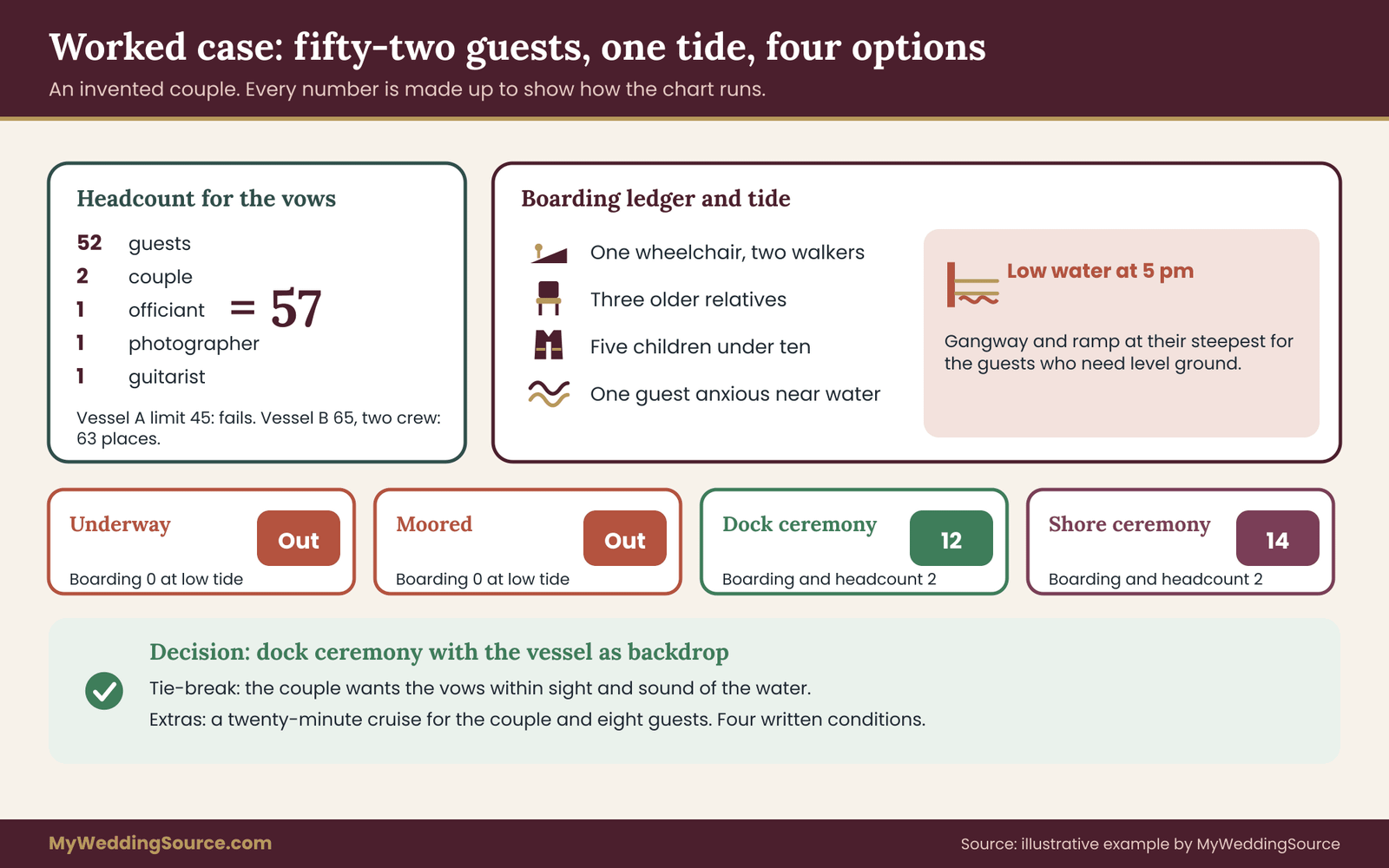
A worked case: fifty-two guests and two ways to say the vows
The case below is invented to show how the chart and the ledger work together. The couple, the vessel and every number are made up. Your own answers will differ, and your documents should come from the operator and the marina, not from this page.
The setting
Nadia and Owen are planning an early-evening ceremony at a harbor marina in a tidal area. Their guest list for the ceremony is fifty-two. They would like the vows to happen on the water, and a boat ceremony is their first idea. Two operators have replied to their first email.
Vessel A is a small charter boat with a written limit of forty-five persons on the route. Vessel B is a larger event vessel with a written limit of sixty-five persons, crew included, and two crew members on duty. That leaves sixty-three places for the wedding group.
The headcount
Nadia and Owen count everyone who would be aboard for the vows: fifty-two guests, the two of them, the officiant, a photographer and a solo guitarist. That makes fifty-seven. Vessel A fails factor one outright, because forty-five is below fifty-seven. Vessel B passes with room for six more, which is thin if even two guests bring an unplanned plus-one.
The couple also decides to ask a planner to help with boarding. That brings the number to fifty-eight. That leaves five places. They write down the figure and agree that any addition must be checked against the written limit before it is approved.
The ledger
Their boarding ledger lists several needs. One guest uses a wheelchair, and two use walkers. Three older relatives find stairs tiring. Five children are under ten. One guest is pregnant, and another has told Nadia she gets anxious near water. Several guests plan to wear heels.
The ceremony is set for five o’clock. A check of the tide predictions shows that low water falls close to that time on their date. The operator says the gangway slopes more steeply at low tide, and the marina adds that the floating section’s ramp is also at its steepest then. For the guest in the wheelchair and the two with walkers, that is a serious problem.
Scoring the four options
Nadia and Owen each score the four options, then compare. They agree on the following, using the three-point scale.
A boat ceremony underway on Vessel B scores 1 on headcount, 0 on boarding at low tide, and low scores on sound, motion and weather. It is out on the disqualifier rule, because boarding scores 0.
A boat ceremony with Vessel B moored scores 1 on headcount and 0 on boarding at the same tide. It is also out, though it would improve if the ceremony moved to high water.
A dock ceremony on the fixed pier beside Vessel B scores 2 on headcount, boarding, sound and motion. It scores 1 on weather because the pier has no cover. It scores 2 on the officiant, because the legal paperwork is simple on land, and 1 on cost and flexibility because of a marina event fee and a rented sound system. That gives a total near twelve.
A shore ceremony on the terrace with a boat departure scores 2 on nearly every factor and totals fourteen, but it gives up the water view during the vows.
The decision
The two top options are within two points of each other, so Nadia and Owen use the tie-breaker. Which option would the least confident guest enjoy more? The guest with the water anxiety, the guest in the wheelchair and the older relatives would all be comfortable at either. The tie then goes to the couple’s own priority, which is to say vows within sight and sound of the water. They choose the dock ceremony, with Vessel B tied up beside the pier.
They also add two small features to keep part of the boat ceremony. After the vows, the couple and eight members of the wedding party take a twenty-minute cruise in the harbor while the guests toast from the pier. The vessel remains at the dock for the rest of the event, and the reception moves to a waterfront restaurant a short walk away.
The conditions they wrote down
Nadia and Owen write four conditions beneath the chart. If the marina does not confirm the event permit by a stated date, they move the ceremony to the terrace. If the forecast shows lightning or sustained strong wind, they move under the covered area at the restaurant. If any guest cannot reach the pier by the step-free route, they change the route before changing the ceremony. And if Vessel B cannot give written confirmation of its limit, its authorization and its insurance, they drop the cruise.
What the example shows
The point is not that dock ceremonies are better. In a different setting, with a high tide at the ceremony hour, a smaller guest list and no mobility needs, the boat ceremony might have won. What the example shows is the method: count honestly, name the people, check the tide, apply the disqualifier rule and write down the conditions. The decision looks obvious afterward. It was not obvious at the start.
Hybrids that keep some of the boat ceremony
Many couples who start with a boat ceremony end up in a hybrid, and hybrids deserve to be chosen on purpose, not as consolation. Each one gives up something and keeps something.
The boat arrives
The couple, or the wedding party, arrives at the dock by boat. Guests wait on the pier. The vows happen on land. This keeps the arrival moment and the photographs of a vessel gliding in. It costs only the vessel’s time for a short trip, and it requires only that the couple board. It works well when the guest list is large, and it is easy to cancel for weather because nothing depends on the vessel appearing.
The risk is timing. Guests wait while the boat approaches, and a delay on the water becomes a delay on land. Build in a margin and have the officiant ready to begin when the couple steps ashore.
The couple leaves by boat
After the dock ceremony, the couple sails off for a short ride, with or without a few companions. Guests watch from the pier, toast and then move on to the reception. This is a common version of a boat ceremony with an ending. It allows a celebratory exit without carrying the whole group.
The questions here concern the departure. Where do guests stand to see it? Is the viewing area safe and shaded? Does the vessel’s departure fit the marina’s rules? Whatever you plan, keep the departure short and keep the couple’s return time clear.
A small boat ceremony, a large celebration
Some couples hold a ceremony aboard with only a handful of people, such as parents and a witness, and then celebrate with a larger group on land. This is workable when a vessel’s limit is small, and it preserves the intimacy of vows on the water. The large group joins for a welcome, a toast and a meal.
If you choose this path, tell the wider group in advance, so nobody feels excluded, and consider how to share the moment afterward through photographs or a short, private recording. The guide to ceremony step-by-step planning explains how a ceremony can be arranged to suit a small or a large audience.
A moored ceremony at the best tide
If a boat ceremony at the dock is your preference, the tide can be your friend. Ask the marina and the operator when water is highest on your date, and consider setting the vows at that time, as long as the light and the guests’ schedules allow. A gangway that is nearly level at high water is a much simpler boarding route than one that slopes at low water.
This only works if the tide cooperates with the sun, and on many days it will not. Check the predictions for several dates before you fix yours. It is easier to choose a date for its tide than to fight a steep gangway.
A waterfront venue on land
Sometimes the best answer is a venue that looks out over the water and has none of a vessel’s constraints. A terrace, a lawn, a restaurant deck or a lakeside pavilion can deliver the view with ordinary ceremony logistics. The broader question of how to choose among such sites is covered in the guide to wedding venue types and questions.
Choosing among the hybrids
Choose the hybrid that preserves what you care about most. If it is the arrival, choose the boat arrival. If it is the exit, choose the departure. If it is the quiet of vows on the water, choose a small ceremony. If it is the view, choose the waterfront venue. And if it is the experience of being aboard together, accept that a boat ceremony needs a small group and a calm day.
Be honest about the answer. Couples often say they want a boat ceremony when they mean they want one photograph. If the photograph can happen at the dock, the rest of the decision becomes much easier.
Photography, roles and the record of a boat ceremony
A ceremony is the part of the day you most want to remember, and the setting changes how it is recorded. On a vessel, the photographer’s options shrink. On a dock, they widen, though light and wind remain.
The photographer’s position
On a vessel, the photographer shares a narrow deck with guests, crew and the couple. There may be one useful angle, usually from behind the guests or from a side rail. Wide lenses help, and so does a clear understanding of where the photographer may stand. Ask the operator whether any parts of the vessel are off limits to vendors, and whether the crew need to move through the ceremony space.
A dock ceremony gives the photographer a straight line of approach, perhaps from the water side if a second boat is allowed, or from the end of the pier. A dock also lets the ceremony be photographed against water and sky with fewer obstacles. Whether you choose a boat ceremony or a dock ceremony, walk the space with the photographer at the time of day you plan to use it.
Equipment near water
Cameras, lenses and phones do not like water, and a dropped item on a dock or a deck is gone. Ask your photographer how they protect gear, whether they carry a backup camera and whether they have worked on boats. Ask too about their insurance, since some marinas and operators ask for a certificate from vendors who come aboard.
Guests’ phones are part of the same risk. Over water, a phone dropped from a rail is lost. An unplugged ceremony, where guests are asked to put devices away, protects both the equipment and the view. The guide to wedding photography consent covers how to set expectations about photos and image use in a way that guests accept.
Video and sound capture
If you want a recording of the vows, plan it as carefully as the live sound. Wind noise ruins a recording even when it is bearable to the ear. A small wireless microphone clipped to the officiant or the couple, with a wind cover, can make a large difference. Ask the videographer to test the setup at the same hour and in the same spot. On a boat ceremony, ask also about engine and generator noise in the recording.
A backup is worth having. A phone recording from a trusted guest standing near the front, or a small recorder in the officiant’s pocket, costs little and can save the audio.
The record afterward
Plan who holds the license, who signs it and where it goes after the ceremony. A document on a boat deck can blow away, get wet or be dropped. Use a clipboard with a clip, a weighted folder or a secure bag, and put one person in charge of it. Whatever the setting, the paperwork should go from the officiant to the person who files it without sitting in a pocket for a week.
Roles on the day, so nobody improvises at the gangway
A dock ceremony and a boat ceremony both depend on a handful of people who know their jobs. The couple should not be among them. On a ceremony day, you want to be the people being married, not the people checking a headcount.
The boarding lead
One person owns the boarding or the dock approach. They hold the guest list, count people through the gangway, check the limit and know the cast-off time. They also know who needs help and have asked in advance how best to give it. This person needs enough authority to say “we are at the limit” without apology. A friend with a firm and friendly manner is better than a relative who cannot say no.
The dock host or greeter
A second person stays at the entrance to the dock or marina. They point guests to parking, welcome them, offer water and give out the practical details: where the restrooms are, where to stand, which way to walk. They also notice who arrives in heels or who looks unsteady, and they offer help.
The weather watcher
A third person owns the forecast. They check the marine forecast and local radar at the agreed times, talk to the captain or marina contact and report to the couple’s planner. This person should not also be the person with the license or the person giving a reading. The decision clock only works if someone is watching it.
The officiant and the cue sheet
The officiant needs the same written cue sheet as the musicians and readers. On the water, a short sheet is better than a long one: arrival cue, start, readings, vows, rings, pronouncement, recessional and a note on what to do if the ceremony must pause. Keep the sheet to one page and put the pause instructions at the top.
The site map
Draw a simple map of the ceremony space, with the dock or the deck, the chairs, the aisle, the officiant’s spot, the sound, the shelter, the restroom and the step-free route. Share it with the operator, the marina, the photographer and the planner. The guide to a venue technical walkthrough explains how to measure a site and note access routes, and the same habits apply on a dock.
When to drop the boat ceremony, and what to say
A good decision process can say no. These are the conditions that should end a boat ceremony, and each one has a plain reason behind it.
The conditions
The operator cannot or will not provide the documents you ask for. A vessel that carries passengers for hire should have a current authorization, a qualified captain and insurance, and a business that cannot show them on request is not ready for your wedding. The U.S. Coast Guard explains the framework for passenger vessels, and its pages are a starting point for the questions to ask.
The written passenger limit is below your worst-case headcount. Do not add people to a vessel on the assumption that a private event is different. It is not.
Anyone suggests the limit can stretch for a private party. This is a failed gate. The limit exists for safety, and the crew is right to stop boarding when it is reached.
The weather and cancellation terms are silent or one-sided. If the contract gives you no refund and no reschedule when the captain cancels for safety, you carry all the risk.
You cannot absorb the worst-case loss. If losing the deposit would damage your budget, choose the option with the smaller exposure.
A guest you will not exclude cannot board. If the person who most needs to be there cannot reach the vessel with dignity and safety, change the plan. Do not carry a guest up a steep gangway.
The return will happen in the dark, with drinking and no transport plan. That combination is a risk on land and a worse one at a dock or on a vessel.
You are being rushed to pay before the documents arrive. Pressure is a reason to slow down.

Soft stops and hard stops
Some of these are hard stops, such as missing documents or a limit below your headcount. Others are soft stops, which mean the problem can be fixed with an amendment, a different date or a different tide. Sort each condition into one of the two groups, and attach a date to every soft stop. A condition with no owner and no date has a way of becoming a surprise.
The same test for a dock ceremony
A dock ceremony has its own stop conditions. The marina or the public authority does not give permission in writing. The dock cannot carry the group’s weight or has a posted limit below your headcount. No step-free route exists and none can be arranged. There is no shelter for lightning or heavy rain within a short walk. Or the site’s hours end before your ceremony does. Treat these as seriously as the boat conditions, since they decide whether the dock ceremony is actually available to you.
What stopping looks like
Stopping is not failure. It is the result of a process that works. A couple who drops the boat ceremony in March because the tide and the gangway do not work has saved money, kept their guests comfortable and kept the water in the picture with a dock ceremony. A couple who learns the same thing in August has fewer choices.
Edge cases worth a minute
A lake or river with little tide. The gangway slope matters less, but water levels on reservoirs can still change, and wind across open water can be strong. Ask the marina about seasonal levels and about summer afternoon storms.
A vessel you would pilot yourself. Renting a boat and driving it is a vacation arrangement. A couple who must also run the vessel cannot be present for their own vows, and a boat ceremony on such a vessel is a poor fit for a wedding.
A historic ship or a ferry. These often have their own event rules, fixed sailing times and public access, and they may have strict limits on decoration and open flames. Ask early, and expect fixed packages.
A destination location. Rules for vessels, marriage ceremonies and alcohol may differ from those you know at home. Use local operators and local officials, and treat any assurance without a document as unconfirmed.
Scripts for the conversations you will need
Plans fall apart in conversations that did not happen. A few short scripts help, and you should adapt them to your own voice.
The first email to an operator
“We are planning a ceremony of about fifty guests on or beside the water and are comparing a boat ceremony with a dock ceremony. For our date, could you tell us the maximum persons allowed on your route and whether crew count, send your current passenger authorization, the captain’s credential and an insurance certificate, and explain the weather and cancellation terms? We would also like to understand how guests with limited mobility board.”
The note to a guest
“We are planning part of the day near the water. Is there anything that would make getting around easier for you, such as a seat, a hand or a different route? Tell us whatever is helpful, and we will keep it private.”
The conversation with a partner
“I want to score the options separately first and then compare. If we disagree on the boarding or the headcount, we get more information. If we disagree on the look, we talk about what each of us cares about most.” The script takes pressure out of a topic that can easily turn into an argument about taste.
The message to a family member who is pressing for the boat
“We love the idea of a boat ceremony, and we are checking the headcount, the tide and boarding for everyone. If the numbers work, we will do it. If they do not, we have a dock ceremony that keeps the water and keeps everyone comfortable.” Short, warm and honest, with no debate invited.
Your next steps
Start with the quickest tasks and work toward the larger ones. Each takes less time than you might expect.
- Write your worst-case and best-case headcounts for the ceremony, counting vendors, children and helpers.
- Decide which of the five arrangements you are really picturing, from a boat ceremony underway to a shore ceremony with a boat departure.
- Check the tide predictions for your date and time, and note the hour of low water.
- Send the first-email script to two or three operators and to the marina, and ask for the limit, the documents and the weather terms.
- Build the boarding ledger, privately, with a note beside every guest who may need help.
- Score the four options on the seven factors, each of you separately, and then together.
- Apply the disqualifier rule, then the tie-breaker, and write one sentence that states the choice and the condition that would change it.
- Draw the site map and the decision clock, name the boarding lead and the weather watcher, and share them.
- Request written amendments for any term that conflicts with your plan, and pay a deposit only after they are signed.
- Check current rules with the issuing agencies listed in the sources, since requirements, fees and vessel terms change.
FAQ
Is a boat ceremony or a dock ceremony better for older guests?
A dock ceremony is usually easier for older guests, because a fixed pier is level, wide and steady, and nobody has to cross a gangway. A boat ceremony can still work if the vessel has handrails, seating near the boarding point, a gentle gangway at high tide and a crew member to help. Ask older relatives privately what they would prefer, and let their answer carry weight.
Does a boat ceremony count every guest toward the passenger limit?
Yes, every person aboard counts as a person on the vessel, including the couple, the officiant, the photographer and any musician. Whether the operator’s crew count toward the written figure depends on the vessel, so ask for the answer in writing. Compare the total with the maximum for your route, not with the vessel’s general size or the number of seats on the deck.
Can we legally marry on a boat?
Possibly, but the answer depends on where you are and where the vessel goes. Marriage licenses and officiant authority are tied to a jurisdiction, and a vessel can cross boundaries. Ask the office that issues your license and your officiant before you decide. Many couples sign the legal paperwork on land and hold a symbolic boat ceremony, which avoids the question.
What happens to a dock ceremony if the weather turns?
A dock ceremony gives you more choices than a boat ceremony does. You can shorten the vows, move guests under cover or relocate to a nearby room. Lightning is the exception, and it means everyone goes indoors and waits. Plan a covered space close to the dock before the date, and write down who decides to move and by what hour.
How early should we compare a boat ceremony with a dock ceremony?
As early as you have a rough date and headcount. The first questions, the written passenger limit and the tide at your hour, cost nothing and can rule out an option in days. Comparing early lets you keep both choices alive while facts arrive. Comparing after invitations are out mostly leaves you choosing which problem to accept.
Will a boat ceremony cost more than a dock ceremony?
Often, but not always. A boat ceremony adds vessel time, crew, fuel and insurance costs, and its worst case is larger if weather cancels the trip. A dock ceremony adds marina fees, chairs, sound and a covered backup. Compare the total for equal outcomes, with the same guest count and the same fallback, and read the cancellation terms before you pay.
How do we handle guests who do not want to board?
Ask early, privately and kindly, and offer a real alternative so nobody feels left out. A dock ceremony lets them attend without boarding, and a shore gathering lets them join the toast. Do not ask anyone to manage a steep gangway they cannot safely use. Planning the alternative from the start makes a boat ceremony kinder for everyone.
What should we do if the captain cancels the boat ceremony?
Follow the decision clock you agreed in advance. Move to the dock ceremony or covered space, send the prepared message to guests and confirm the refund, credit or reschedule terms in writing. The captain’s safety decision is final, so the contract should say beforehand what happens to your money. If it is silent, ask for an amendment before you pay.
Sources
- U.S. Coast Guard: passenger vessel regulation, inspection and safety information.
- Coast Guard Office of Auxiliary and Boating Safety: recreational boating safety, life jackets and passenger guidance.
- Coast Guard Marine Safety, Security and Stewardship: inspection, credentialing and commercial vessel policy.
- National Weather Service marine forecasts: marine zone forecasts, advisories and wind and wave guidance.
- NOAA Tides and Currents: tide predictions and water level information for coastal and lake locations.
- ADA.gov: U.S. Department of Justice information on the Americans with Disabilities Act.
- U.S. Access Board: accessibility guidelines, including those for piers and recreational boating facilities.
- Consumer Financial Protection Bureau: credit card billing disputes and consumer payment rights.
- Federal Trade Commission consumer advice: guidance on deposits, refunds and checking businesses before paying.