
An accessible park wedding depends on one unglamorous fact: every guest has to be able to get from the gate to a seat, and from the seat to a restroom, without a step, a soft patch or a slope that stops them. This guide gives you a repeatable survey of paths, surfaces and seating spots, a scorecard, a worked example and clear conditions for walking away from a spot.
Survey an accessible park wedding as a chain of segments from the gate to the seat and on to the restroom. Measure each segment for clear width, running slope, cross slope, level changes, gaps and surface firmness. Judge the seating spot separately for ground, shade, sightline and sound. Score every segment Pass, Fix or Stop. A single Stop on the only route means the spot changes, not the guest. Do the survey once early, once with the real equipment, and once again within a few days of the date.
Most advice about an outdoor ceremony is written for the couple and the photographer. It asks what the light will do at six o’clock and where the arch should stand. Those are fair questions. This guide asks a different one: can everyone you invited actually arrive, sit, see, hear and leave? At an accessible park wedding the answer is not obvious from a photo, a map or a website, and it is often not obvious from a quick stroll either.
A public park is an odd kind of wedding location, and an accessible park wedding in one is an odd kind of project. It is not built for your event. It is built for walkers, families, runners, dogs, strollers and people who come for an hour. The paths were laid out by an agency with its own history, budget and maintenance schedule. Some are paved and graded carefully. Some are old, heaved by tree roots, or covered in loose stone. A beautiful meadow may sit at the end of a gravel lane with a drainage ditch across it.
That mismatch is why an accessible park wedding needs its own inspection. A hotel ballroom has a floor plan, an elevator and staff who know where the ramp is. A park gives you a spot on a map and a permit with a few conditions. Everything else, you have to find out by walking, measuring and asking.
A note on scope. This is general planning information, not legal, engineering or medical advice. Accessibility rules, park rules and permit terms differ by agency and by site, and they change. Where a number or rule matters, this guide points you to the agency that issues it so you can confirm the current version yourself.
What an accessible park wedding survey covers
The survey in this guide has two halves. The first half is the route. The second half is the seating spot. For an accessible park wedding, both halves are written down on paper, with measurements, so that the decision does not rest on one person’s impression of a sunny afternoon.
The route is everything between the place a guest leaves a vehicle and the place they sit. It also includes the way to the restroom, the way to the reception area if there is one, and the way back out. The route is broken into short segments so a problem can be located precisely. “The path is bumpy” is not useful. “Segment three, the last forty feet before the meadow, has two roots that lift the surface by more than an inch” is useful, and it is something a park manager can answer.
The seating spot is the ground and the air around the chairs. It covers whether the surface under the chairs is firm enough for wheels and canes, whether there is a flat place for a wheelchair or scooter beside a companion, whether the shade falls on the people who need it, and whether the people in the back can hear and see.
Between the two halves of an accessible park wedding survey sit support points: rest places, shade, water, accessible parking, a drop-off, and a restroom. They are not glamorous either, and they decide whether a guest with limited stamina stays for the whole ceremony.
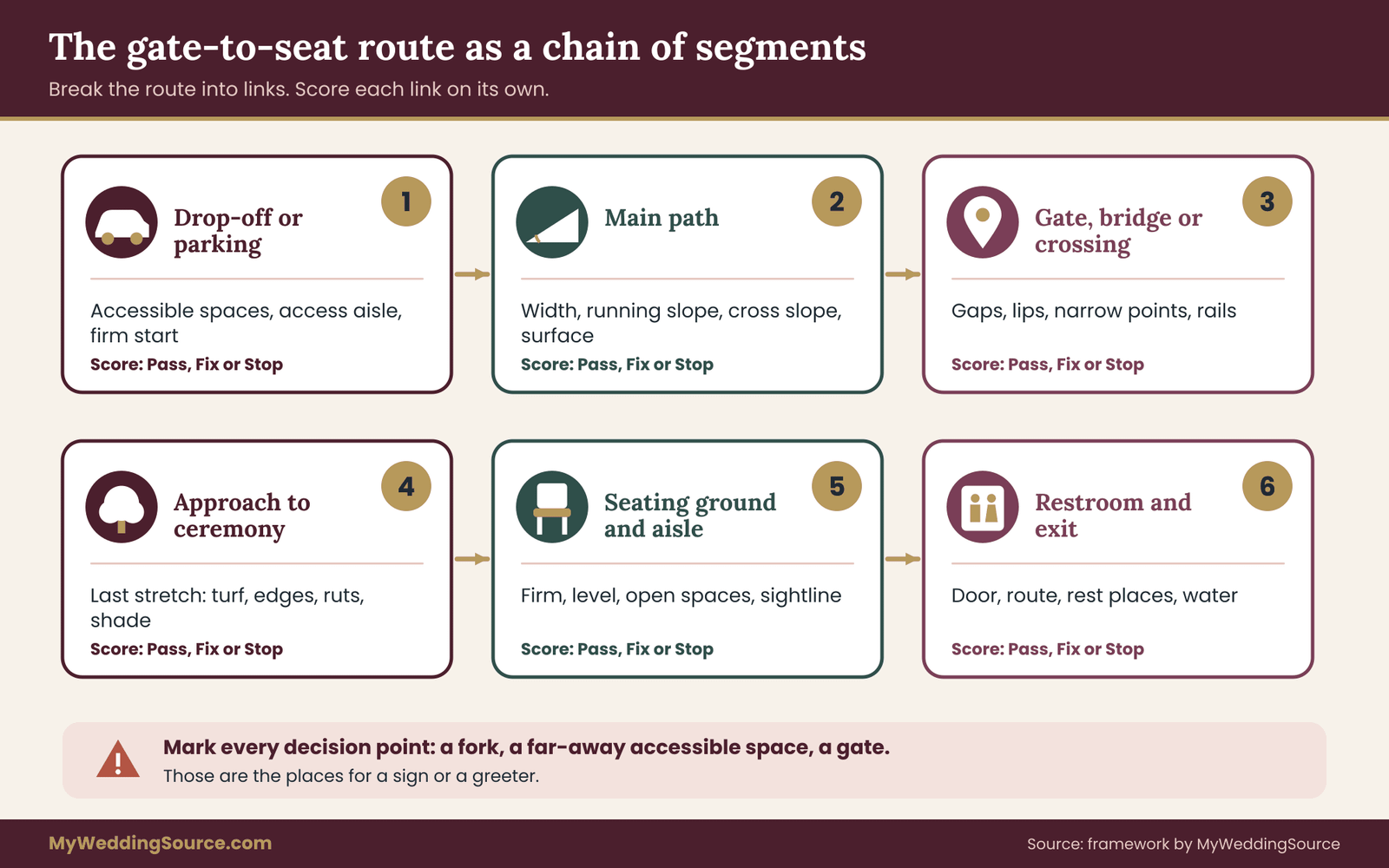
The figure above shows the route as a chain. Each link has its own measurements and its own score. If one link fails and cannot be fixed, the whole accessible park wedding fails for the guests who need it.
Why a park is different from a venue
Readers who have worked through a venue search, perhaps with the broader wedding venues guide, will recognize the logic of an accessibility check. The guide on accessible wedding venue red flags covers the questions to ask a building or a private property about entrances, restrooms and staffing. A park changes four things for an accessible park wedding.
First, nobody on site works for you. There is no venue coordinator who can move a table or open a side gate. At most there is a permit office, a maintenance crew with a schedule, and a ranger who may or may not be nearby on the day.
Second, the public keeps using the space. People will walk, ride and park around your ceremony. A path you rely on may be shared with cyclists, and a parking lot you rely on may be full before your guests arrive.
Third, you usually cannot change much. Many agencies limit digging, staking, driving onto grass, placing anything permanent and laying temporary surfaces. Fixes that are easy at a private venue may need written approval or may be refused.
Fourth, the ground is natural. Weather, season, irrigation, mowing and wear change a surface from week to week. A lawn that was firm in July can be soft after three days of rain in October.
None of that makes an accessible park wedding a bad idea. Parks can be wonderful, and many have excellent accessible paths. It means the survey replaces the assumptions that a venue’s staff would otherwise cover for you.
Who plans an accessible park wedding
The method suits anyone organizing an accessible park wedding, whether a couple or a family member, with or without a planner. It does not require special training or equipment. You will need a tape measure, a smartphone with a level or inclinometer app, a way to take dated photos, a notebook or a printed form, and, if possible, the actual mobility devices that guests use. It also helps to have one other person, because measuring a path alone is awkward and holding a tape end is a two-person job.
If you or a guest uses a mobility device and you are able and willing to test routes yourself, your own experience should lead. If you are measuring on behalf of someone else, ask them what matters before you start. The next section shows how.
What an accessible park wedding survey will not tell you
It will not tell you whether a path meets any legal standard. Legal compliance is a question for the agency that owns the park and for the accessibility rules that apply to it. The benchmarks used in this guide are planning thresholds taken from commonly cited federal guidance, and they are deliberately cautious. A path that passes them is a good sign. A path that fails them is a reason to ask questions, not a legal finding.
It will not predict every guest’s needs. The point of the brief in the next section is to learn them directly instead of guessing.
And it will not replace the park’s own rules. Always confirm with the issuing agency what you are allowed to bring, place and change. A fix that is not permitted is not a fix.
Start with the people: the access brief
Before you stand in a field with a tape measure, write down who your accessible park wedding is for. This takes about twenty minutes, and it changes what you measure.
An access brief is a one-page note with three parts: the people, the needs and the non-negotiables. It is not a list of medical conditions. It is a list of physical facts about movement, seating, vision, hearing and stamina that affect the route and the seat. Nobody is asked to disclose a diagnosis.
Ask privately and ask once
The usual mistake is to wait for a guest to raise a problem. Many people will not, especially older relatives and anyone who does not want to be the reason the plan changes. A short, private, optional question on the invitation response or in a call works better. Keep the wording plain and keep it about the day, not the person.
“We are planning an outdoor ceremony in a public park. Is there anything that would help you get around, sit comfortably or hear and see, such as a flat route, a shaded seat or a place near the path? Reply to us directly and we will keep it private.”
Send it to everyone, not to selected guests. That avoids singling anyone out and catches needs you would not have predicted, such as a guest recovering from surgery or a parent with a double stroller.
For guests who live far away, the lodging side of the question often belongs in the same conversation. The guide on wedding guest hotels for mixed budgets and mobility covers how to ask about rooms, and it is worth keeping the two threads consistent so a guest is not asked the same thing twice.
The six needs that change an accessible park wedding survey
You do not need to categorize guests. You do need to know which of these six needs are present, because each one points the survey at a different measurement.
Wheels. Manual wheelchairs, power chairs, scooters, rollators and strollers all need a continuous firm surface, enough width and gentle slopes. Soft ground, loose stone and cross slope are the main enemies.
Walking aids. Canes, crutches and walkers need a surface that does not grab the tip or sink under it. They also need rest, because a short walk for most people is a long one for someone who uses an aid.
Limited stamina. Some guests can walk but not far, or not quickly, or not in heat. They need shorter distances, benches and shade.
Low vision. Uneven edges, sudden changes of level and unmarked drop-offs are a bigger concern than distance. High-contrast edges and a predictable path help.
Hearing and sensory needs. Open air carries sound away, wind adds noise and traffic or a playground nearby can drown a quiet voice. These needs affect where seats sit relative to the officiant and the speakers.
Medical timing. Some guests need access to medication, a restroom or a cool place at predictable times. This needs a route to a restroom and a place to rest that does not depend on walking through the ceremony.
Turn the answers into non-negotiables
Once the replies are in, write three to five non-negotiables. They are short and physical. Examples of the form, not of any real list: a continuous firm route to the seating area with no step; a flat place beside the aisle for at least two wheelchair or scooter users with companions; a restroom reachable by a firm route; shade over the accessible seats during the ceremony; seats no more than a set distance from the officiant. Pick a number for the distance with the guests who need it, not for them.
The non-negotiables are the test of every segment and spot you survey for an accessible park wedding. A spot that satisfies the couple’s photo ideas but fails a non-negotiable is not an option until it is fixed. The scorecard later in this guide builds on that idea.
Who decides
If the guest who uses the device is a partner or a close family member, their word on what works is final. If the guest is a more distant relative, a quick phone call usually settles what would help. Do not substitute your own judgment about what someone “can manage.” People know their own bodies, their equipment and their limits, and they often know a trick or a limit you would never think of, such as a power chair that cannot tolerate a certain cross slope or a rollator that catches in mulch.
Map the route of an accessible park wedding in segments
The route of an accessible park wedding is easier to judge in pieces. Walking the whole thing once and writing “mostly fine” hides the one forty-foot stretch that stops a wheelchair. The method here breaks the route into segments of roughly equal difficulty, numbers them and gives each its own score.
Draw the chain before you walk it
Start at a desk with a park map and a satellite view. Mark five anchor points: where guests will park or be dropped off, the nearest accessible parking spaces if any, the ceremony seating area, the nearest restroom and the place the couple will arrive from. Then draw the likely routes between them. Most parks offer two or three candidates. Number them route A, route B and route C.
Then walk each route in the order a guest would: from the vehicle, along the path, through any gate, across any crossing, and onto the seating ground. Every time the surface changes, the slope changes, the width narrows or a decision point appears, start a new segment. A typical accessible park wedding route has between five and eight segments. If you end up with twenty, you are splitting too finely. If you end up with two, you are merging too much.
A useful default is six segments:
- Drop-off or parking to the first path.
- The main path or sidewalk.
- A crossing, a gate or a bridge, where there is one.
- The approach to the ceremony area.
- The seating ground and the aisle.
- The restroom route and the exit route.
Segment six is really two, and a longer park may need both. The point is not the number. The point is that each segment has a start, an end, a surface and a score you can discuss with someone else.
Record the same facts for every segment
For each segment write the same short list. A repeated format lets you compare routes and spot the weakest link quickly.
- Length, in paces or feet.
- Narrowest clear width.
- Steepest running slope and where it occurs.
- Worst cross slope.
- Surface type and condition.
- Any level change, gap, drain, root, grate or curb.
- Edge conditions, such as drop-offs, water or shrubs.
- Shade and rest options.
- A dated photo from the walker’s eye height and one from a seated height.
The photo from a seated height is easy to forget and worth the trouble. A path that looks smooth standing up often shows every crack at the height of a wheelchair seat, and a hedge that looks decorative may hide the next turn from a seated view.
Name the decision points
A decision point is any place where a guest could take the wrong route, or where the right route leaves the obvious one. The classic example is a paved path that forks, with the accessible branch longer and less obvious than the stairs. Another is a lot whose accessible spaces are at the far end. Mark each decision point on the map. They are the places to put signs, a greeter or a note in the guest information, and they are the places where guests who rely on the accessible route are most likely to get lost.
The guide on wedding signage as a system explains how to plan readable signs, and the same principles hold outdoors: put the sign where the decision happens, not where the destination is.
Time the route
For an accessible park wedding, time each route once at an ordinary pace and once at a slow one. The slow pace should be about half the ordinary speed. This is not a fitness measure. It simply shows how much extra time to build into the schedule so that guests who move slowly are seated before the ceremony starts, not arriving in the middle of the processional. A route that takes four minutes at an ordinary pace may take eight at a slow one, and ten if the guest stops to rest.
If the total is long, that is useful information. It may lead to a shuttle, a closer drop-off or a different spot. The fixes section later returns to those options.
Measure each segment, one measure at a time
The measurements are the heart of an accessible park wedding survey. They are the part most easily skipped and the part that most protects you from a surprise on the day. None needs special tools. All of them can be done in an afternoon.

The figure above lists the six measures and the planning benchmarks used in this guide. The numbers come from widely cited federal accessibility guidance for walking surfaces and ramps. They are cautious planning thresholds, and they are not legal conclusions. The agency that owns the park decides which standard applies to its site, and some outdoor trails have separate provisions that allow steeper or narrower sections where terrain is hard to change.
Clear width
Measure the narrowest point between obstacles, not the width of the path where it is pleasant. The narrowest point is often a gate, a bollard, an overhanging branch or a bench placed too close to the edge. A clear width of at least 36 inches is the commonly cited minimum for a wheelchair route.
It is tight. Many mobility devices need more room to turn, and two people walking side by side or a wheelchair user with a companion need more again. Sixty inches lets two wheelchairs pass or turn comfortably, and it is a better target for the stretch near seating.
If a path is long and narrow, ask where passing spaces exist. A narrow path used in both directions at once, with arriving guests meeting departing ones, can jam quickly.
Running slope
Running slope is the steepness along the direction of travel. A slope of 1 in 20, or 5 percent, is commonly treated as the point where a path becomes a ramp and starts to need handrails and landings. A slope of 1 in 12, or about 8 percent, is the commonly cited maximum for a ramp, and long runs at that slope are tiring or impossible for many people, especially in a manual chair or with a walker.
Measure with a smartphone level app held on a straight board or on a four-foot level. Phone sensors vary, so test the app on a surface you know is level, and take three readings at each spot. A rough field test is rise over run: put a stick or a straight board on the ground, measure the horizontal distance and the vertical drop at the end. For a 1 in 20 slope, a four-foot board rises about two and a half inches over its length.
Measure the steepest stretch, not the average. A path that gains six feet over four hundred feet looks gentle until you learn that all of the gain happens in the last sixty.
Cross slope
Cross slope is the tilt from side to side. It is easy to miss and hard to live with. A wheelchair on a cross slope pulls toward the downhill side, which forces the user to steer against it with every push. About 1 in 48, or roughly 2 percent, is the commonly cited maximum cross slope for a walking surface. Many park paths are crowned or sloped to drain water, so this number is often exceeded without anyone intending it.
Measure by laying the level across the path. Check several points along each segment, because cross slope often varies from one section to the next.
Level changes and gaps
A small lip is a big obstacle for a front caster or a cane tip. Commonly cited guidance treats a vertical change of up to a quarter inch as acceptable, a change between a quarter and a half inch as acceptable if beveled, and anything more as a step or a ramp. Openings in a surface, such as drain grates or gaps between boards, are commonly limited to about half an inch in the direction of travel, because a narrow wheel or a cane tip can catch.
Look for the ones that appear in the field: roots lifting pavement, a concrete joint that has settled, the lip where a path meets a bridge, the edge of a drain, a utility cover, the line where asphalt ends and a gravel shoulder begins. Run a hand or a ruler across each one.
Surface
Surface is the measure most likely to decide an accessible park wedding, and it gets its own section next.
Edges and drop-offs
An edge matters for safety even when it does not block the route. Look for a drop at the side of a path, water beside a boardwalk, a retaining wall without a rail or a curb that cuts into the walking line. A guest with low vision, a rolling device or an unsteady gait is at greater risk near an unprotected edge. Note it, and consider whether a small barrier, a visible marker or a different route would reduce it.
A note on guesswork
If you are unsure of a reading, record the uncertainty instead of rounding in your favor. “Cross slope between 2 and 4 percent, device unsteady” is a more honest and more useful entry than “about 2.” The point of the notes is to guide a decision with the park manager and with the guest, and honest uncertainty tells you where to look again.
Test the surface, not the photo
A photograph of a prospective accessible park wedding site shows color and shape. It cannot show how a surface behaves under weight, moisture and wheels. Surface testing is hands-on and takes about ten minutes per segment.
Firm and stable is a practical test
Accessibility guidance often describes an acceptable walking surface as firm, stable and slip resistant. Those three words are worth translating into field tests you can repeat.
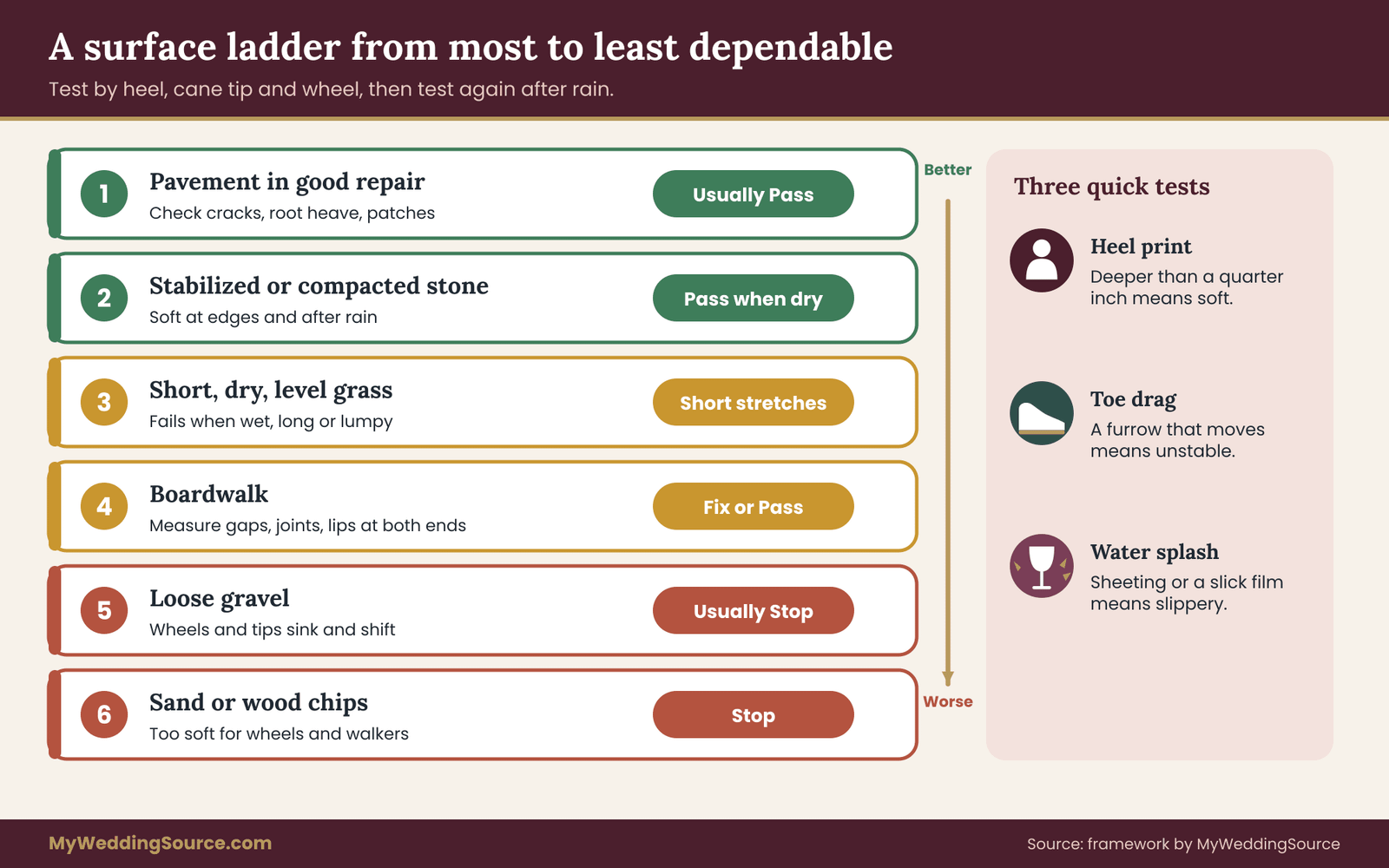
Firm means the surface does not give much under load. Stand on it. If your heel leaves a mark deeper than a quarter inch, a cane tip or a narrow wheel may sink more. Push a stiff-tipped umbrella or a cane tip into the surface with firm hand pressure and see how far it goes in.
Stable means the surface does not shift. Gravel, sand, wood chips and loose stone shift under a wheel and under a walking aid. Drag the toe of a shoe across the surface. If a visible furrow forms and the material moves, it is not stable.
Slip resistant means the surface keeps its grip when wet. Pour a little water on a patch of paved surface and watch whether it beads or sheets. Smooth sealed concrete, painted lines, metal plates and old wooden boards can be slick in light rain or morning dew.
Then do the most reliable test of all. If a guest can lend a device, or if you have access to a manual wheelchair or a rollator, push or ride the segment end to end. Notice where the effort rises, where the wheels slip and where you would want to stop and rest.
Common park surfaces, in plain terms
Asphalt and concrete are the most reliable for wheels when they are in good shape. Look for cracks, root heave, patched sections and drainage lines. Old asphalt can have a rough, gritty surface that is hard to roll over for a manual chair. New asphalt can be soft on a hot day.
Compacted crushed stone can be firm when it is fresh, well packed and dry. It softens in rain, loosens with wear and washes out on slopes. Some parks call a path “accessible” because it is compacted stone. Test it after rain if you can, and walk its edges, where it often fails first.
Loose gravel is a poor surface for wheels, canes and walkers. If your route includes a stretch of loose gravel, treat it as a Stop unless the agency can lay mats or compact it.
Grass is often the surface of the ceremony itself. Short, dry, well-rooted turf on level ground can be acceptable for a short distance. Long grass, wet grass, uneven turf, gopher mounds and irrigation heads are not. Grass that is firm in dry weather can be soft after rain, and mowing schedules change how it feels.
Boardwalks are firm but come with gaps between boards, loose fasteners, uneven joints, slick algae and rails that block a seated view. Measure the gaps and look at the board edges. Check how a boardwalk meets the ground at each end, because that is where the lip often is.
Sand and wood chips are the hardest on wheels. They sink, spread and tire a walker. A wood chip surface is sometimes laid under playground equipment for fall protection, and it is generally a poor route for a wheelchair unless the product is a specific accessible type.
Decomposed granite and stabilized fines vary a lot. Well-installed stabilized surfaces can be firm. Ordinary decomposed granite can be soft and dusty after rain. Test it in the same way as stone.
Test under the likely conditions
Surfaces change with weather, and an accessible park wedding is at the mercy of that. If you can, test in the conditions you are most worried about. For an event in a wet season, test after rain, not before. For an event in summer, test on a hot afternoon, because asphalt softens and metal heats. If you cannot test under those conditions, write down what the park manager says about how the surface behaves after rain or heat, and ask for a recent photo from the same season.
Record the verdict in a plain sentence
For every segment write one sentence that someone else could act on. For example: “Segment four: compacted stone, firm when dry, soft at both edges, ruts after rain near the meadow gate; needs mats or a different route in wet weather.” A verdict like this gives the park manager a specific question, the rental company a specific job and the guest a specific expectation.
The seating location brief for an accessible park wedding
The route gets guests to the ceremony area of an accessible park wedding. The seating brief decides whether they can enjoy it once they are there. In an accessible park wedding, seating is not an afterthought arranged by a rental company on the morning of the event. It is a short written brief, based on the survey, that says where each kind of seat goes and why.
Think in four seat types
Guests at an accessible park wedding do not all need the same chair at the same place. Four seat types cover most situations, and a good layout includes each of them.
Aisle seats on a firm surface. These suit guests who use a cane, a walker or who need to leave quickly. They sit at the end of rows, with no one required to stand to let them out, and they sit close to the path.
Open spaces for mobility devices. These are flat, firm places, usually at the end of a row or in a gap between rows, where a wheelchair, scooter or rollator can stay in the device. The commonly cited clear floor space for one wheelchair is about 30 by 48 inches, and a companion’s chair sits beside it. Give each space more room than that on soft or sloped ground, because turning is harder.
Shaded seats. These are for guests who tire in heat, who take medication that increases sun sensitivity or who simply find a long ceremony in direct sun too much. Shade is not a luxury in an open meadow in July.
Front or near-front seats. Guests with low vision, hearing loss or a sensory need often benefit from a closer position. Offer them without announcing it, and without placing them in a corner.
The aim of an accessible park wedding layout is that the people who need these seats can sit among the other guests, not in a separate bay at the back. A group of wheelchair spaces parked in one remote corner is a form of exclusion, and it tends to put the people who most need to see and hear in the worst position for both.
Place the accessible spaces before the rest
Decide where the open spaces, aisle seats and shaded seats go first. Fill in the rest of the layout around them. If you start with a symmetrical grid and try to add accessible spots afterward, you will usually find they end up on the edge, on a slope or in the sun.
A practical layout rule for an accessible park wedding: split the open spaces between both sides of the aisle, and put some of them near the front, some in the middle and some near the back. That gives wheelchair users and their companions the same range of choices as everyone else. If a family is seated together, the open space sits beside them and not across the aisle.
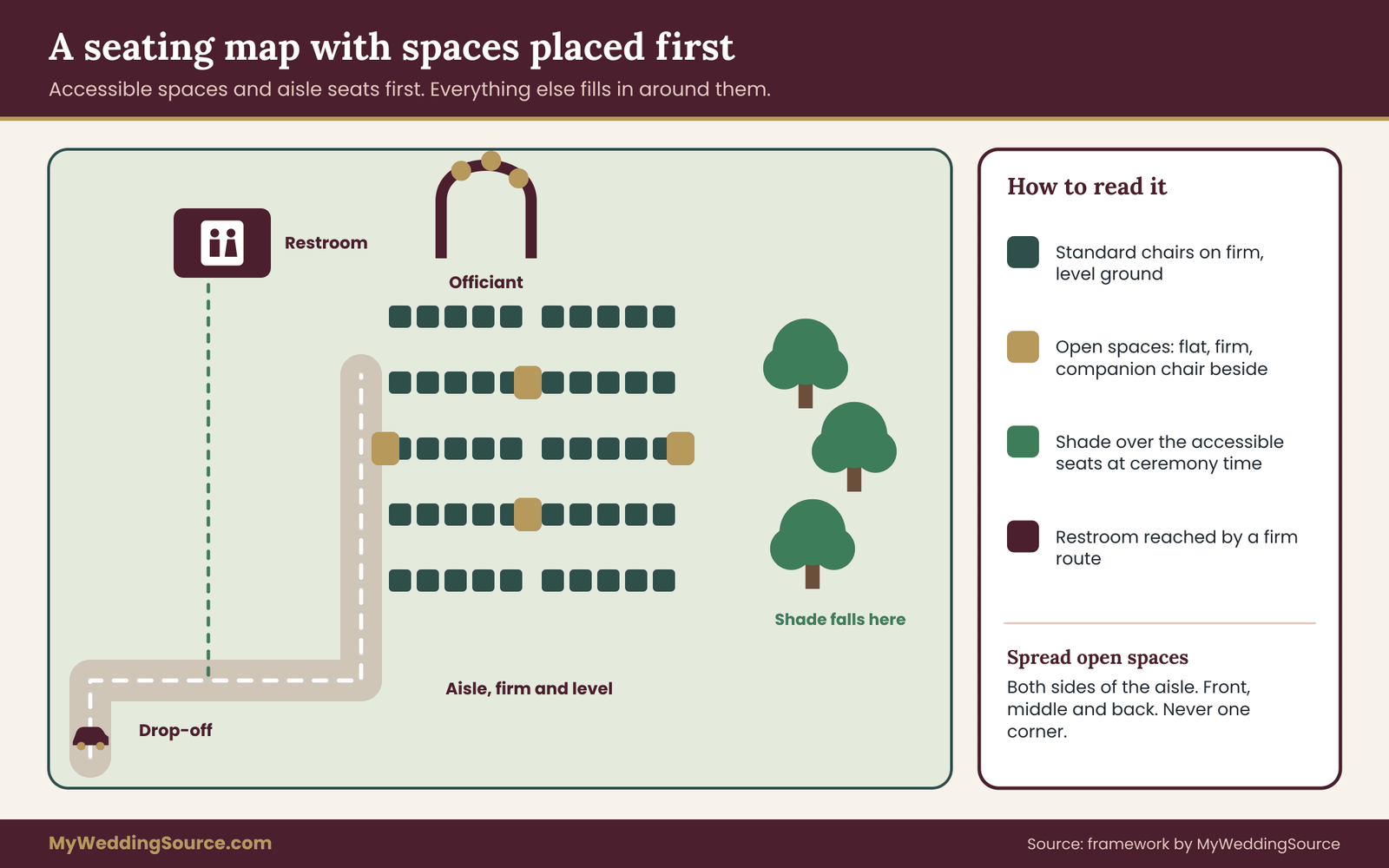
The figure above sketches a layout in the form of a top-down map. Treat it as a pattern. The real arrangement depends on the shape of your ground, the position of the sun and the number of guests who need the spaces.
The ground under the chairs
Ground conditions under the seating matter as much as the path to it at an accessible park wedding. Folding chairs on soft grass sink, tilt and become unsteady. They are also unstable for guests who push up from the seat, and a walker or cane has little to rest on. On a slope, the chair legs sit at different heights, which makes the whole row feel unsteady.
Test the seating ground in the same way as a path: firmness, stability, slope and cross slope. Look for gopher mounds, irrigation heads, tree roots, rocks and any dip that holds water. Walk the area where each row would go. If the ground is sloped, aim for the flattest area even if the view is slightly less dramatic.
If you cannot find ground that is firm and level enough, there are three common responses. You can move the seating onto a nearby paved or stabilized area. You can lay temporary surfaces, if the park allows them. Or you can reduce the number of chairs on grass and let some guests stand or sit in their own chairs along the path. The fixes section covers each of these.
Distance to the officiant and the sound
At an accessible park wedding, distance matters for sight and for sound. A guest who is hard of hearing will often manage in the first few rows and struggle in the last. Open air carries speech away, and wind makes it worse. A small amplifier and a microphone make a larger difference outdoors than most couples expect, and a quiet vow is easier to hear when the speaker faces the guests who need the sound.
Note any noise sources: traffic, a playground, a water feature, a nearby road, aircraft, a lawn crew. Visit at the time of day you plan to hold the ceremony and listen from the seat positions. If you cannot visit at the right time, ask the park manager when mowing, maintenance and busy periods occur.
For ideas about how to organize the ceremony itself once the layout is set, the usual order of a ceremony helps you check that the layout works for each stage and not only for the seated vows. Build extra minutes into the processional timing if some guests will need longer to arrive.
Sightlines
Sightlines at an accessible park wedding are easy to get wrong. A raised arch, a tree, a rail or a row of standing guests can block a wheelchair user’s view. A seated guest looks through a gap that is much lower than a standing guest does. Photograph the view from a seated height, about 45 to 50 inches above the ground, at the front, middle and back of the layout.
If the spot is on a hill, check whether the slope helps or hurts. Seating that rises behind the ceremony, as in a natural amphitheater, can give everyone a clear view. Seating on a downhill slope puts people’s backs to the ground and may push a wheelchair forward.
Shade, sun and wind
For an accessible park wedding, position the seating relative to the sun and wind during the planned ceremony time. Use a sun-path app or a simple compass to see where the shadows will fall. The goal is for the accessible seats to be shaded without creating a dark, cold corner. If natural shade is not available, ask whether a pop-up canopy or a tent is permitted. Many agencies limit or prohibit them, and wind can make them dangerous.
Wind affects comfort, sound and hair, and it also affects safety. Light chairs and signs tip in wind. A guest with a cane or a rollator is less stable in gusts. If the spot is exposed, note which direction the wind usually comes from at that time of day and season, and choose a position that gives a little shelter.
Rest, shade, restrooms and drop-off
A route and a seating spot can both pass an accessible park wedding survey and still fail the guest, because of what sits around them. Support points are the small, practical things that decide whether a guest with limited stamina or a medical need can stay through the whole event.
Drop-off and accessible parking
Many guests at an accessible park wedding will arrive by car. Find out whether the park has designated accessible parking, how many spaces there are and how far they are from the ceremony route. Count the spaces, and check the access aisle beside each. If the lot is shared with other park users, ask whether the spaces can be reserved for your event or whether they will be open to the public.
Check the path from the parking spaces to the route, not only the spaces themselves. In some parks, the accessible parking is close to a trailhead but separated from the ceremony area by a curb, a lawn or a steep path. A close space with no usable path is not accessible.
A drop-off zone is often more helpful than parking. A driver can leave a guest at a flat, firm spot near the route, then park farther away. Ask whether a vehicle may drive onto a service road or a closed lane for a short time. Many agencies allow this only for permitted vehicles, so request written permission and name the vehicles.
If guests are traveling in, keep the park’s access information consistent with what you tell them about shuttles and rides.
Rest places
Look for places to sit along the route. A bench every few hundred feet is a rough guide for comfort on a longer path, and it matters more as the slope increases. Check that each bench has a firm, level surface beside it, so a person using a wheelchair or a walker can sit with a companion.
If the route has no benches, ask whether you can place chairs along the path at spaced intervals for the ceremony period. Many park agencies allow that for a short time, and the chairs double as a signal to guests that resting is expected.
Restrooms
A restroom is a core part of any accessible park wedding survey. Measure the route to it from the seating area. Note the surface, the slope, the distance and whether the building has a step at the door, a heavy door, a narrow stall or a locked entrance. Parks vary a great deal, and some have only portable units.
If you plan to rent portable units, ask for at least one accessible unit and check its surface and placement. A portable unit placed on grass or gravel can be inaccessible even if the unit itself is designed for wheelchairs. The path to it and the ground under it matter as much as the unit.
Ask whether the park’s restrooms will be open at the time of the ceremony, and who unlocks them. Seasonal closures, winterized facilities and locked buildings are common.
Drinking water and a cool place
Locate drinking water, which any accessible park wedding needs. Some parks have fountains, some have a tap and some have none. If there is none, plan to bring water. Offer it at the arrival point and near the seating, not only at the reception.
For a hot day, identify a shaded or cooler place where a guest can rest if needed: a covered pavilion, a car with air conditioning, a visitor center. This is not an extreme measure. It is a plain, kind provision for guests of any age. The guide on wedding guest care planning covers the broader question of how to organize care for guests who need extra support, and the same principle applies in a park.
A small contact list
Write down the numbers you may need: the park office, the ranger or security line, the maintenance contact for the day, an accessible taxi or paratransit option, and the nearest urgent care or hospital. Put the list in the hands of one reliable person on the day. This is not a worst-case document. It is the same kind of list any event needs, made more important by the absence of venue staff.
Score an accessible park wedding survey: Pass, Fix or Stop
The measurements from an accessible park wedding survey pile up quickly. Without a way to turn them into a decision, they just become a long list of worries. The scorecard below does that job. It is deliberately simple, and it separates problems that can be solved from problems that mean the spot should change.

The three scores
Every segment of an accessible park wedding route, and every seat type in the seating brief, receives one of three scores.
Pass. The segment meets the planning benchmark and the non-negotiables from the access brief. Nothing needs to change except normal upkeep, and you only note the date of the survey.
Fix. The segment fails a benchmark or a non-negotiable in a way someone can realistically repair before the event, with permission. Examples include loose gravel that can be raked and compacted, a short lip that can be ramped with a portable threshold ramp, a section of soft turf that can be covered by a temporary mat, or a bench that can be moved. A Fix always has an owner, a method, a date and a check. A Fix without all four is not a fix, it is a hope.
Stop. The segment fails in a way that cannot be repaired in time, or that the agency will not allow you to repair, or that creates a safety risk. Examples include a steep section on the only route, a staircase with no alternative, an unprotected drop beside the path, a bridge with wide gaps or a surface that floods after light rain.
The one rule that matters most
A single Stop on the only route to the ceremony is a Stop for the whole route. It does not matter how lovely the rest of it is, or how few guests would be affected. A guest who cannot get to the ceremony does not attend, and a route that works for nearly everyone is not accessible for the person who needs it. When a Stop appears, the survey’s answer is to change the spot, the route or the plan. It is not to ask the guest to manage.
If there is a second route, a Stop on the first one does not end the survey. It sends you to the second route, which you score in the same way. Many successful outdoor weddings end up on the second or third route, and many come to value the one they would not have chosen from a photo.
Setting the score quickly
You do not have to agonize over borderline cases. A few reliable shortcuts help.
If a reading is clearly within the benchmark and the surface passes the hands-on test, it is a Pass.
If a reading exceeds the benchmark by a small amount, the guest who relies on that segment tells you whether it is a Pass or a Fix. A slope that is a little over the line may be fine for a power chair user and impossible for someone pushing a manual chair or using a walker. Ask.
If a segment fails and the fix needs approval from the agency you have not yet asked, it is a Fix with an open question. Record it that way and chase the answer. Do not score it as a Pass because you expect a yes.
If you cannot measure or test a segment, it is not a Pass. Mark it Unknown and plan a return trip.
Write stop conditions in advance
For an accessible park wedding, the hardest time to make a decision is the week before the wedding, when invitations are out, deposits are paid and the spot has been the plan for a year. That is why stop conditions belong in writing early, at the stage where leaving the spot is cheap.
Write three to five sentences in the form “If this happens, we move.” They should be specific and they should be agreed by both partners and, ideally, by the guests who rely on the route. A few examples of the form:
- If the agency will not allow a temporary surface and the compacted stone path is soft after rain, we move the ceremony to the paved plaza.
- If no accessible route to a restroom can be confirmed in writing by a set date, we choose a different spot.
- If the day-before test shows standing water on the seating ground, we use the backup spot.
- If fewer than the agreed number of accessible spaces can be confirmed, we reduce the guest count or change the site.
Write the date by which each condition must be settled. Putting a date on a decision forces someone to make it, and it keeps a hopeful plan from drifting past the point where an alternative can still be booked. The wedding vendor contract guide covers how to ask vendors about change deadlines and cancellation terms, which matters if you need to move a rental or a shuttle.
Keep the score visible
Create a one-page accessible park wedding summary that lists each segment, its score and the open items. Share it with your partner, the planner if you have one and any guest who helped define the brief. A visible scorecard keeps the conversation honest. It also protects you from the common drift where a Fix quietly turns into an accepted problem because nobody wanted to bring it up again.
A worked case: the meadow overlook, surveyed
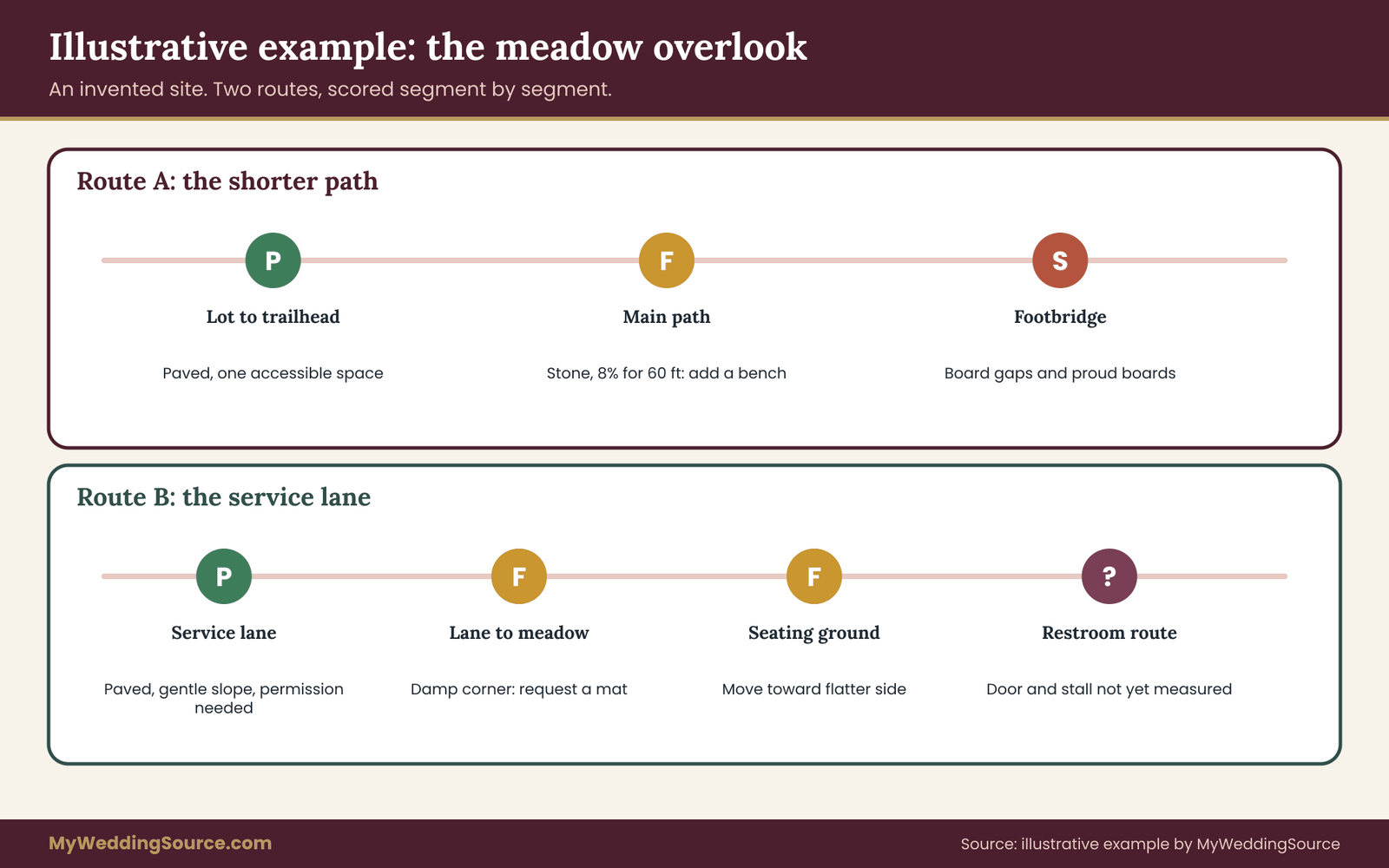
A made-up accessible park wedding shows how the method behaves in practice. The numbers and the site below are invented for illustration. They are not measurements of any real park, and the choices are not recommendations for any specific location.
Imagine a couple planning an accessible park wedding ceremony for sixty guests at a public meadow with a view over a small valley. They like the spot for its light and the view. Their access brief, based on replies to a short question on the invitation, names four needs: one guest uses a power wheelchair, one uses a rollator, an older relative walks slowly with a cane, and a cousin pushes a double stroller.
The non-negotiables are a continuous firm route with no step, two flat open spaces beside the aisle, shade over the accessible seats and a restroom reachable by a firm route.
The route, segment by segment
They identify two possible routes from the parking lot to the meadow and survey the one that looks shorter first.
Segment one, lot to trailhead. Paved, 120 feet, firm, with one accessible space and an access aisle beside it. Cross slope slightly above the benchmark at one point, about three percent, but short. Score: Pass, with a note.
Segment two, main path. Compacted stone, 400 feet, firm and well drained in the dry. Running slope reaches about eight percent for a stretch of about sixty feet. The rollator user says a stretch at that slope is tiring, and the power chair user says it is acceptable. Score: Fix. The couple adds a bench at the base of the slope and asks about a shuttle for the stretch.
Segment three, footbridge. Wood boards, 40 feet, about four feet wide. Gaps between boards look near the half-inch limit, and two boards sit proud by more than half an inch at the far end. Score: Stop for this route, unless the agency can repair the boards or confirm they are acceptable.
At that point the survey could end the whole idea or send the couple to the second route. They go to route B.
Route B, segment two, service lane. Paved, 650 feet, gentle slope under three percent, closed to vehicles except for park staff. Fully firm. The agency has to allow guests to use it and allow a drop-off vehicle on it. Score: Pass, pending permission.
Segment three, lane to meadow edge. A short stretch of mown grass, 80 feet. Dry, short turf, firm in the test, soft in a damp corner where water collects. Score: Fix. The couple plans a temporary mat across the damp corner, subject to approval.
Segment four, seating ground. Slightly sloped, cross slope about three to four percent on the side farthest from the path, flatter close to it. Score: Fix. The seating moves toward the flatter side, the rows shorten and the open spaces go on the flattest ground at the end of the rows.
Segment five, restroom route. A paved path to a permanent restroom building, 300 feet from the meadow edge. The door is heavy and the stall dimension is not measured. Score: Unknown. A return trip, and a question to the park manager, follow.
The seating brief for the case
The seating brief matches the access brief. Two open spaces sit at the ends of rows two and four, close to the aisle and on the flattest ground. The older relative sits on an aisle seat in row one. The cousin with the stroller has a spot at the back, close to the lane, so a fussy child can leave without crossing the meadow.
Shade comes from a line of trees to the west, which will shade the right side of the seating by the planned time. The couple tests this at the planned time of day on a clear afternoon and finds the shadow reaches the second row by the correct hour, so they choose the right side for the accessible seats.
The decisions the accessible park wedding survey forced
Three things changed because of the survey. The route moved from the shorter path to the service lane. The seating moved toward flatter ground, even though the view from there is slightly less open. And the couple added a restroom question and a mat request to their conversation with the park.
Two other things did not change. The spot stayed the same, because the survey found a route that worked. And the couple did not have to ask any guest to manage on a surface that failed. A different outcome was always possible. If route B had also failed, the stop condition would have sent them to the paved plaza near the visitor center, a less romantic spot that every guest could reach.
What the case does not prove
An invented accessible park wedding shows the process and not the result. Real sites have different surfaces, different agencies and different rules. A park may refuse the service lane, deny the mat or close the restroom building. The survey does not remove those risks. It exposes them early, while a different spot is still cheap to choose.
Fixes and alternatives when a segment fails
A failed segment does not always mean a failed accessible park wedding site. The question is what can be changed, who has to approve it and what the change costs in time and money. Fixes fall into a ladder, from the lightest touch to the heaviest, and it helps to climb it in order.

Rung one: move the chairs or the guests
The cheapest fix for an accessible park wedding is a change in layout. Shift the seating toward flatter ground. Shorten the rows. Move the open spaces closer to the path. Place the aisle where the surface is firmest. This costs nothing but a little view, and it often solves cross slope and softness at the edge of a meadow.
You can also change who goes where. A guest who cannot manage a long walk can be dropped at the nearest point, with a short, firm route to the seat, while others walk from the parking lot. A guest who prefers to arrive early can wait in a shaded seat before the rest arrive.
Rung two: change the route
If one segment fails and another route works for your accessible park wedding, use the other. This is often the best outcome, because it needs no permission to alter the ground, only permission to use a lane, a gate or a drop-off point that is already there. Ask the agency which routes are open to guests and which are limited to staff. Ask for written permission to use a staff lane, and ask who will unlock any gate.
Rung three: add a temporary surface
At an accessible park wedding, temporary surfaces can bridge a short soft or uneven stretch. Examples include interlocking mats, rolled roadway mats, trackway panels and plywood sheets, and portable threshold ramps for lips. They are a reasonable fix for a damp corner of lawn, a short gravel stretch or a small level change.
Three cautions apply. Most agencies have rules about anything laid on turf, because mats can kill grass and edges can trip. Ask for approval first, in writing, and ask about duration limits and removal. Second, a mat is only as good as its edges and its base. A mat on soft ground can still sink, curl or slide, and edges should be level with the ground or beveled.
Third, mats and ramps add a trip hazard for guests who do not use wheels. Mark the edges with a contrasting color and tell the setup crew where the mat ends.
The guide on wedding rental planning covers how to ask rental companies about delivery, setup, tear-down and damage terms. Use the same questions with a company that supplies mats, ramps, chairs or tents: ask who delivers, who lays the item, who is on site during the event and what happens if it rains.
Rung four: move the shuttle, not the guests
If the route to your accessible park wedding is long but the surfaces pass, a shuttle may close the gap. A golf cart, a van or a small bus can carry guests between the parking lot and the ceremony area. Ask the agency whether vehicles are allowed on that path, what kind of vehicle, how many trips and who may drive. Many parks allow only permitted vehicles and trained drivers, and some require proof of insurance.
A shuttle does not fix a ceremony site that fails inside the seating area. It only shortens the walk. It also creates a new set of tasks: a driver, a schedule, a loading spot that is itself accessible and a plan for wheelchair users, since many carts cannot carry a mobility device. Check that the vehicle can carry a wheelchair or scooter, or that a second option exists, before relying on it.
Rung five: move the ceremony within the park
If the segment cannot be fixed, look for another accessible park wedding spot in the same park. Many parks have a paved plaza, a pavilion, a picnic shelter or a flat lawn near a parking lot. These spots are often less scenic, but they are also more likely to pass. Survey the second spot in the same way as the first, with its own segments and seating brief. Ask the agency whether the permit can move with you and whether it affects the fee.
Rung six: move the park or move the venue
Sometimes the right answer for an accessible park wedding is a different park or a different kind of site. This is not a defeat. A survey that finds a Stop early is doing what it was meant to do. The guides on choosing a venue and on venue accessibility warning signs help with a search for a replacement, and the same survey applies to every candidate.
Costs and time
A fix for an accessible park wedding costs time first. Approval from a park agency can take days or weeks, a rental company needs lead time, and a shuttle needs a driver. Put the approval steps on a calendar that works backward from the date, with a buffer. Ask each vendor for a written price before you commit, and ask what the price includes. Do not assume figures: costs for mats, ramps, shuttles and portable units vary widely by region and season, so collect quotes from more than one supplier where you can.
What not to fix
A few fixes at an accessible park wedding cause more harm than they prevent. Do not use loose boards or unsecured plywood on a slope. Do not add a ramp steeper than a ramp can safely be, simply to avoid a step. Do not rely on volunteers to carry a guest and a chair over a gap, because that creates a risk for both people and removes the guest’s choice. And do not count on guests to “help each other” as the main plan. Informal help is welcome and kind, but the route should work without it.
Talk to the park and the vendors
An accessible park wedding survey is only half the work. The other half is a set of conversations with the people who control the ground and the equipment. These conversations are easier if you arrive with the scorecard and a short list of questions.
Questions for the park office
For an accessible park wedding, the permit office or the events coordinator is the first call. Park staff vary in how much detail they know, so ask politely for the person who does. Take notes on the date, the name of the person and what they said, and follow up in writing so there is a record.
Ask these questions, adapted to the site:
- Which routes to the ceremony area are open to guests and which are limited to staff?
- Is the path from the parking area to the ceremony area maintained for accessibility, and who maintains it?
- Are there designated accessible parking spaces, and can any be held for the event?
- May a vehicle drop off guests near the ceremony area, and under what conditions?
- Are temporary mats, ramps, chairs, canopies or portable restrooms allowed, and how must they be placed and removed?
- When are mowing, irrigation, spraying and maintenance scheduled for that week?
- Which restrooms are open at that time of day and season, and are they accessible?
- What is the policy if the ground is wet or the weather is severe?
- Is there a staff contact on the day?
Ask for answers in writing. A permit may list conditions, but the answers to these questions often live outside the permit. A short email confirming the call protects both sides.
What to request as documents
Ask the agency for the permit conditions, a site map, any park accessibility guide or access statement, the maintenance schedule for the week and any rules for temporary structures. National and state park agencies often publish accessibility information on their websites for individual sites, and it is a good first read before you call. If the park manages an official accessibility page, cite it in your notes by name and date.
Questions for the rental company
If a company supplies chairs, mats, ramps, tents, portable restrooms or a shuttle for an accessible park wedding, give them the scorecard and ask them to confirm the product, not just the order. What size is the mat? What is the surface texture? What is the maximum slope of the ramp? What is the width of the portable unit’s door, and does the unit have an accessible model? Who sets it up, at what time and with what tools? Will someone be on site if it needs adjusting?
Ask for specific product details and dimensions, and compare them with the benchmarks in the survey. Do not rely on a catalog description of a product as “accessible.” The word has no fixed meaning in a sales page.
Questions for the photographer and the officiant
The photographer at an accessible park wedding needs to know the routes and the seating spots, because the usual photography habits can block them. A photographer who stands in the aisle to shoot the processional may block a wheelchair route. A photographer who sets up a ladder on a slope near the accessible seats may create a hazard. Share the brief and ask where they plan to stand.
The officiant needs to know the sound plan and the sightlines. Ask the officiant to face the guests who need to hear, speak clearly, use the microphone and wait for the processional to finish. If the officiant has a script or a cue sheet, check where the couple stands and sits, and whether anyone is expected to kneel, climb or walk on uneven ground.
Write it down, then share it
The final step for an accessible park wedding is a short document that summarizes the decisions. One page is enough: the chosen route, the seating brief, the support points, the stop conditions and the contacts. Share it with the planner, the vendors, the greeter and anyone who will help on the day. It is the same discipline as a ceremony run sheet, and it keeps the plan from living in one person’s head. The venue technical walkthrough guide shows how a walkthrough turns measurements into vendor instructions, and the same idea applies here.
Day-of checks and weather for an accessible park wedding
An accessible park wedding survey done weeks ago describes a park as it was then. On the day, a rain shower, a fallen branch or a closed restroom can change the answer. The final stretch of the process is a short re-check, a clear weather rule and a person whose job is the route.
The three surveys
Treat an accessible park wedding survey as three visits, each with a different purpose.
The first visit is for choosing the spot. It uses the full method: segments, measurements, surface tests and a seating brief. It happens as early as you can, before deposits for anything that depends on the spot.
The second visit is a rehearsal with the real equipment. Bring the wheelchair, scooter or rollator that a guest will use, or ask the guest to join. Walk or roll the route from the drop-off to the seat, using the planned timing. Test the open spaces with the actual device, and ask whether the spacing feels workable. This is also the best time to test the mats, ramps and chairs the rental company will provide, if the company can bring samples.
The third visit is a short check within a few days of the date, ideally the day before and again on the morning. It is not a new survey. It confirms that the scored segments still match: no new construction, no flooding, no fallen limbs, no new fencing and no changed hours at the restroom.
What the day-before check looks for
Walk the route with a printed copy of the scorecard. For each segment, ask one question: does this look the same as when I scored it? If the answer is yes, tick it. If not, note what changed and decide whether it moves the score.
Look especially for the things that change fastest. Standing water in low spots. Soft turf after rain or irrigation. New ruts from vehicles. Leaves, acorns or seed pods on pavement. A closed or locked door. A path blocked by a maintenance truck. A lot that will be partly used by another event.
Take dated photos. If the park is involved in a dispute over conditions later, or if you need to show a vendor that a surface changed, the photos matter.
A weather rule written in advance
Weather decides whether an accessible park wedding surface works, so write the weather rule before the week arrives. A rule has a trigger and an action, and it names who decides.
Rain is the most common trigger. A surface that passes when dry may fail when wet, and a lawn that is firm on Friday can be soft on Saturday. Decide how much rain in the preceding days, or how wet the ground feels in the test, moves the plan to the backup spot or adds mats.
Look at the guidance from the National Weather Service for how to read a forecast and how to interpret chances of rain, and check forecasts at several time points. Decide in advance who makes the call and by what time, so that guests and vendors can be told while there is still time to act.
Heat is another trigger. In hot weather, asphalt softens and metal surfaces burn, and shade becomes a health issue. Think about the time of the ceremony, water, shade and a cool place. The same applies to cold, wind and smoke.
Lightning is a hard stop. A ceremony in an open meadow is exposed, and the plan should include where guests go if thunder is heard and how long they wait. Ask the park about its own severe weather procedure.
The route steward
Assign one person, other than the couple, as the route steward for the accessible park wedding. The steward walks the route an hour before guests arrive, opens or confirms gates, checks the restroom and places signs. During arrival the steward stands at the decision point where the accessible route splits from the obvious one. After the ceremony the steward watches the exit.
The steward is not a guard and does not need special training. What they need is the one-page plan, a phone, the park contact numbers and the authority to make small decisions, such as moving a chair or re-routing a guest. Choose someone calm and observant who is not also in the wedding party, because wedding party members have other jobs.
Brief the steward in advance, walk the route with them once and give them the scorecard. A steward who has walked the route will spot a problem faster than one who has only read about it.
Signs and greeters
Even a good accessible park wedding route needs signs. Place a sign at each decision point: where the lot ends and the path begins, where the accessible route diverges from a stair or slope, and where the restroom path leaves the main way. Use large, high-contrast text and a simple arrow. Do not rely on a small sign on an easel in grass. Chairs and signs tip in wind, and a sign low to the ground is hard to read from a wheelchair or a car.
A greeter at the lot can point guests in the right direction, offer a drop-off or a shuttle and hand out a one-page map with the route. A printed map is also useful for guests who do not use a smartphone or who lose signal in the park.
Guest information before the day
Tell guests what to expect at the accessible park wedding. A short note in the invitation suite or on the wedding website can describe the route, the surface, the distance, the restroom and the options for drop-off and seating. Keep it factual and calm. It lets guests decide for themselves whether to bring a device, bring a companion or arrive early.
A suggested pattern for the note: the address of the parking lot and the entrance; where the accessible parking and drop-off are; what the path is like and how long it takes; where the seating is and what it is like; where the restroom is; who to contact for help. Offer a phone number for a person who can answer questions in advance. An email address is not necessary, and a phone number or a response form works fine.
After the event
After an accessible park wedding, put away the mats and ramps and return the area to the state you found it in. Check that nothing remains, including stakes, tape, signs and bits of mat. Many parks inspect the site after an event, and a clean departure helps you and the next couple.
Write a short note on what worked and what did not, including the dimensions and surfaces you recorded. If a friend or relative plans a wedding in the same park, a reliable record of what you found is a generous thing to pass on.
Your next steps
You do not need to plan an accessible park wedding in one weekend. Work in this order, and stop at the first Stop.
- Write the access brief. Send a short, optional question to every guest and write three to five non-negotiables.
- Pick one to three candidate accessible park wedding spots in public parks and gather the permit rules, maps and any accessibility pages from the agency before you visit.
- Draw the route chain for each spot, with five or six segments, and mark the decision points.
- Visit with a tape measure, a level app, a notebook and a helper. Measure width, running slope, cross slope, level changes, gaps and surface for each segment, and photograph from a seated height.
- Score each segment Pass, Fix or Stop, and write the verdict sentence for each Fix.
- Complete the seating brief for the accessible park wedding: four seat types, ground, shade, sightlines and sound, and the support points.
- Write stop conditions and dates, then talk to the park office and the vendors, and ask for answers in writing.
- Return with real equipment for a rehearsal, then do a short check the day before and on the morning.
If you are still choosing a location, start with a broader look at venue options and use this survey on your shortlist.
FAQ
What makes an accessible park wedding different from an accessible venue wedding?
A park has no on-site staff working for you, the public keeps using the space and the ground changes with weather. You usually cannot alter much without agency approval. That is why an accessible park wedding needs a measured survey of routes, surfaces and seats, plus written answers from the park office, instead of relying on a venue coordinator to cover the gaps.
Which measurements matter most when surveying a path?
Clear width, running slope, cross slope, level changes, gaps and surface firmness. Surface and cross slope are the two most often missed. A path can look smooth and still tilt a wheelchair sideways or soften after rain. Measure the worst point in each segment, not the average, and photograph it from seated eye height.
Do the numbers in this guide prove a path is legally accessible?
No. They are cautious planning thresholds drawn from commonly cited federal guidance, not a legal finding. The agency that owns the park decides which standard applies to its site, and some trails follow separate outdoor provisions. Use the numbers to spot problems and frame questions, then ask the agency or an accessibility professional about compliance.
Is grass acceptable for ceremony seating?
Sometimes, for short distances. Short, dry, well-rooted turf on level ground can work, but long, wet or uneven grass, mounds and irrigation heads cannot. Test firmness with your heel and a cane tip, check cross slope, and test again after rain. If the grass fails, move seating toward paved or stabilized ground or ask the park about approved temporary mats.
How many wheelchair spaces should an accessible park wedding plan for?
Use the replies to your guest question, not a formula, when planning an accessible park wedding. Count guests who use wheels and add a flat, firm space with a companion’s chair beside each, plus a spare or two. Spread the spaces across rows and both sides of the aisle so guests are not grouped at the back. Confirm the number again a week before the date.
What if the park will not allow mats, ramps or a shuttle?
Then those fixes are off the table for the accessible park wedding and the score does not change. Work up the ladder: move the seats, use a different open route, relocate within the park or choose another site. A Fix that is not approved is not a Fix. Record the refusal in writing, apply your stop conditions and decide by the date you set.
When should we visit the site?
Three times. Visit early to choose the accessible park wedding spot using the full survey. Visit again with the actual mobility devices to rehearse the route and test the open spaces. Visit within a few days of the date, and on the morning, to confirm nothing has changed. If you can, test once under the weather you worry about most.
Who should be in charge of the route on the day?
Name one calm person for your accessible park wedding, not in the wedding party, as the route steward. They walk the route an hour before guests arrive, check gates and the restroom, place signs at decision points and watch arrivals. Give them the one-page plan, the park contact numbers and permission to make small changes, such as moving a chair or re-routing a guest.
Sources
- U.S. Department of Justice, ADA.gov: Americans with Disabilities Act information and technical assistance
- U.S. Access Board: ADA Accessibility Standards and guidance on walking surfaces and ramps
- U.S. Access Board: Outdoor developed areas guidance for trails and outdoor recreation
- National Park Service: official site and park-specific permit and accessibility information
- National Park Service: Accessibility in the national parks
- U.S. Forest Service: recreation sites and accessibility information
- Recreation.gov: federal recreation site and permit information
- ADA National Network: ADA technical assistance and publications
- National Recreation and Park Association: public park and recreation resources
- National Weather Service: forecasts, heat and lightning safety guidance