
A denied wedding permit feels like the end of the park ceremony you pictured, but it is usually a decision with a reason attached, and the reason tells you which of four moves is worth making. This guide shows how to read the denial, choose between fixing, modifying, appealing or moving, and keep every guest and vendor informed while you do it.
Do not rebook anything in the first day. First, get the reason for the denial in writing and sort it into one of five causes: a paperwork gap, a calendar conflict, a scope or capacity limit, a site rule that cannot change, or a judgment call by staff. Then pick one of four responses: fix and reapply, ask for a modified approval, request a review, or move to another site. Set a short decision clock, send honest notices in a fixed order, and only then touch contracts.
Most couples who apply for a park permit expect a yes. The application is a form, the fee is modest, and the park is public. So when an email arrives that says the request was not approved, the first reaction is usually a mix of embarrassment and panic. Guests have saved the date. A photographer is booked for that location, and the vendor contract may even name the park. A rental company has a delivery slot. The ceremony was supposed to be the easy part of the wedding.
Here is the calmer way to look at it. A denied wedding permit is information about one specific request, made on one specific date, for one specific group at one specific spot. It is not a verdict on your wedding, and it is rarely a verdict on the park as a whole. Agencies deny requests for ordinary, repairable reasons far more often than for dramatic ones, and even the hard stops tend to leave a nearby door open.
This article stays on the moment after the answer is no. It does not walk you through the permit application itself, and it does not try to rank parks. For the wider picture of choosing and testing a place, the wedding venues guide is the better starting point. Here the job is narrower: turn a denied wedding permit into a clear decision within about two weeks, with a backup that your guests can actually follow.
A note on scope. This is general information, not legal advice. Permit rules, appeal rights, fees and timelines differ by agency and by site, and they change, so confirm every detail with the office that issued your notice. Nothing here guarantees that a particular request will be approved on a second try.
What a denied wedding permit actually means
A permit is a written permission for a specific use of a specific space at a specific time. When an agency denies one, it is saying no to that combination, not to weddings in general. Reading it that way changes what you do next, because each part of the combination can be adjusted. The space can change, the time can change, the use can change, and the size of the group can change.
It also helps to separate three things that people often blur together. A booking holds a space on a calendar. A permit grants permission for what you plan to do there. A denied wedding permit refuses the request, and sometimes the booking goes with it and sometimes it does not. If you had paid a reservation fee, the notice for a denied wedding permit should say what happens to that money. If it does not say, that is your first question.
There are three common shapes a denied wedding permit takes, and they feel similar from the inbox but behave very differently.
The first is the clean denial, where the agency says no and stops. You get a short message, perhaps with a reason code or a sentence of explanation. The second is the conditional denial, where the notice says the request cannot be approved as written but names what would change the answer, such as a smaller headcount, an earlier end time or a different area of the park.
The third is the incomplete-application denial, which is really a request for missing documents wearing the label of a rejection. Conditional and incomplete versions of a denied wedding permit are the most common, and both are good news compared with a clean no.
A denied wedding permit also differs from a revoked one. A revoked permit was approved first and then withdrawn, often because of a closure, a hazard or a rule change close to the date. The steps in this guide still help, but revocation adds urgency and usually changes who is responsible for refunds, so ask about that directly.
What a denied wedding permit does not do is erase your claim to the date in your own plan. You still have a ceremony time, a guest list, vendors and a budget. What you have lost is one location option. The useful question is not “why us?” but “what exactly did they refuse, and is there a version of it they would accept?”
One more point before the practical steps. Public agencies are not adversaries. Park staff who handle event requests see the same problems repeatedly: groups larger than a lawn can hold, amplified music near a residential edge, a vendor who needs a vehicle on a path. A courteous, specific reply tends to get a courteous, specific answer. Anger rarely speeds anything up, and a short polite message often unlocks the detail that a form letter left out.
Reading the notice: what to do in the first forty-eight hours
The first two days after a denied wedding permit are for information, not action. The worst decisions in this situation happen on day one, when a couple cancels a rental, announces a new venue to the family group chat, and then learns the denied wedding permit was only a missing signature.
Start by reading the notice for your denied wedding permit slowly, twice, and highlighting every sentence that carries a fact. You are looking for six things.
The reason. Is it stated, and is it specific? “Does not meet requirements” is not a reason. “Requested headcount exceeds the posted capacity of the area” is.
The authority. Which office decided, and under what rule, code or policy? The name and a contact point matter later if you ask for a review.
The scope. Was the whole request denied, or only part of it, such as the sound system, the tent or the end time? A partial denial reads as a full one when the opening line says “not approved.”
The money. What happens to the application fee, a site reservation fee or a deposit? Some agencies refund, some keep an administrative portion, and some apply the amount to a future request. Do not assume.
The clock. Is there a deadline to respond, reapply, supply documents or ask for a review? Deadlines in denial letters are often short, and missing one can close options that were open on day one.
The path. Does the notice mention reapplication, appeal, review or an alternate site? Even a single sentence about these tells you what the agency expects.
Next, write down your own facts about the denied wedding permit in one place: the date and time you requested, the area, the headcount, every add-on, and the date you applied. Agencies sometimes deny on the basis of a version of the request that differs from what you remember. Comparing your record with the notice catches errors on both sides.
Then send one short, polite message to the contact named in the notice. Its job is to confirm facts, not to argue. You can ask what specifically caused the denial, whether any version of the request could be approved, whether a review is available and by what date, and what happens to fees. Keep it to those four or five questions.
A message in this spirit works well: “Thank you for the notice about our request for the ceremony on the date listed. We would like to understand the decision so we can respond correctly. Could you tell us the specific reason, whether a changed version could be approved, whether a review is available and its deadline, and how the application fee is handled?” It is calm, it names the date, and it gives the reader an easy list to answer.
While you wait for the reply, do three quiet things. Check your own calendar for the ceremony date and the dates around it, because some alternatives will depend on flexibility. Tell your partner and any one person who helps with logistics what happened, so you are not the only one carrying it. And pause outgoing commitments: no new deposits, no public announcements, no cancellations. The decision clock described later starts only after you have the reason in hand.
If no reply about your denied wedding permit arrives within two business days, call the office during its listed hours and then follow up in writing, noting the date and time of the call. A paper trail costs nothing and protects you if the answer later changes.
The five causes of a denied wedding permit
Every denied wedding permit traces back to one of five causes. Sorting yours correctly is the most useful thing you can do in the first week, because the cause decides which response has a real chance. The categories below are a working framework, not an agency taxonomy, so match your notice to the closest one rather than expecting the same words.
Cause one: a paperwork gap. The application was missing something. Common examples are a certificate of insurance that was not attached, a site map without chair placement, a vendor list left blank, a signature, or a fee that did not clear. This is the friendliest cause of a denied wedding permit. The agency has not decided against your wedding; it has not yet been able to decide. The right response is usually to fix the gap and resubmit promptly, and to ask whether the original place in line is preserved.
Cause two: a calendar conflict. Another event, a maintenance window, a blackout around a holiday or a closure holds the date, the time or the area. Conflicts are about the calendar and not about you, which means the answer often depends on moving one variable. A start time two hours earlier, a Sunday in place of a Saturday, or a different lawn in the same park can turn a no into a yes without any argument.
Cause three: a scope or capacity limit. The request asks for more than the site is approved to host. Typical triggers are headcount above a posted limit, a tent or stage that needs separate review, amplified sound, a caterer or bar, a request to close a path, or vehicles on turf. A scope-based denied wedding permit is often partly negotiable. Many agencies will approve a reduced version, so the question is which pieces of your plan are essential and which are habits.
Cause four: a fixed site rule. Some places do not allow certain uses at all. A natural area may restrict weddings to protect habitat. A memorial site, a cemetery edge or a cultural resource may be off limits for gatherings. A reservoir shoreline may be closed to events. When the rule is categorical, no amount of polite persistence changes it, and the right response is to move. Recognizing this kind of denied wedding permit early saves weeks.
Cause five: a judgment call. The agency has discretion and used it. Maybe the area is already stretched by other bookings, or staff worry about parking, noise or the neighbors. A discretionary denied wedding permit is the hardest to read from outside. It is also sometimes the most open to a modified request, because the concern behind them can often be addressed with a plan.
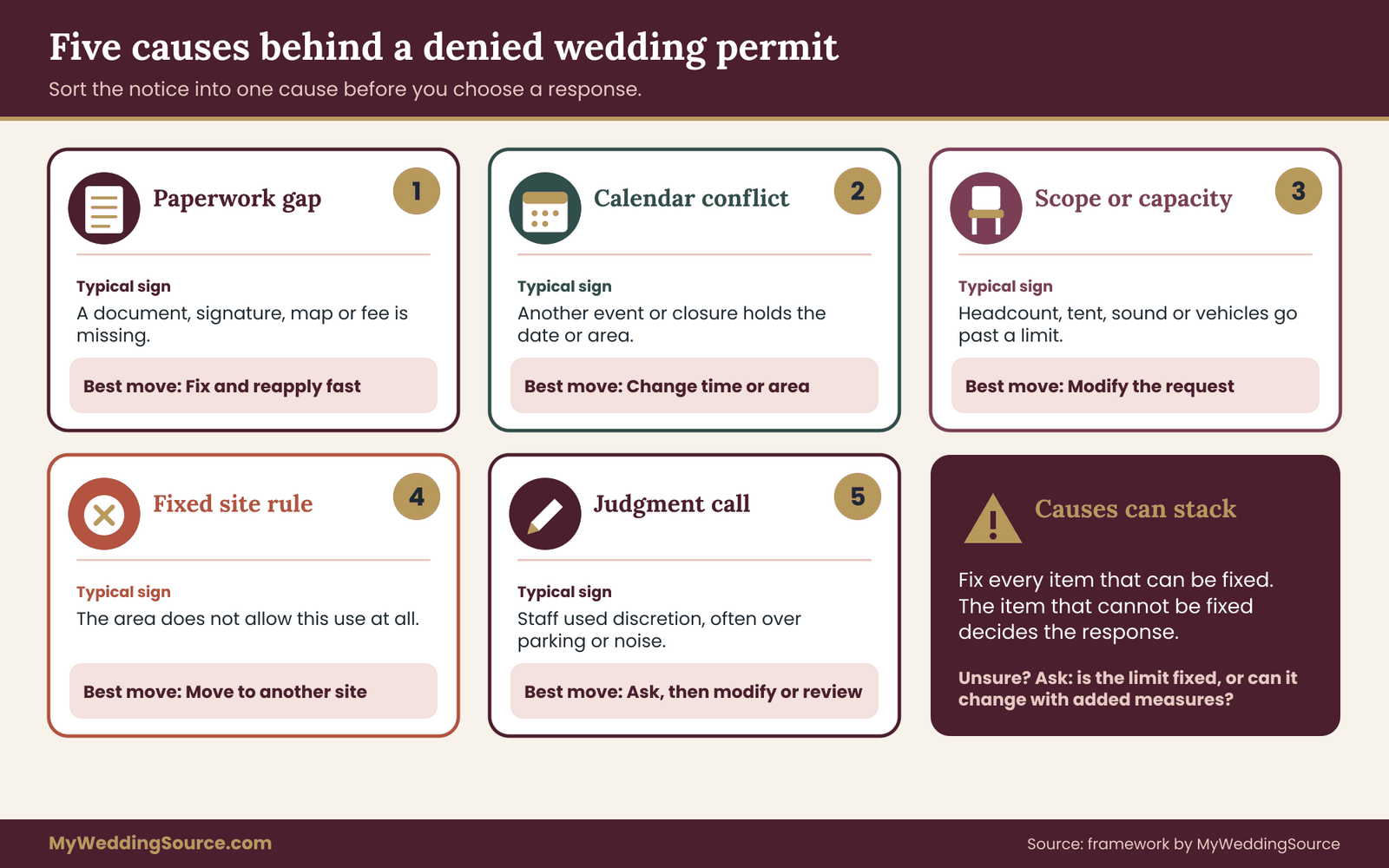
To sort the notice for your denied wedding permit, ask three questions in order. Does the notice name something missing? If yes, you are in cause one. Does it name a date, time or area conflict? Then cause two. Does it name a number, an item or an activity? That points to cause three, or cause four if the notice cites a prohibition rather than a limit. If none of these fit, you are probably in cause five, and the clarifying message from the first two days matters even more.
Be honest about ambiguity in a denied wedding permit. A notice that cites “capacity” might be cause three if the number can be raised with a plan, or cause four if the area is simply not rated for gatherings. When you cannot tell, ask one direct question: “Is the limit a fixed rule for this area, or can it change with additional measures?” The answer sorts the cause at once.
Keep a one-line label for your cause where your partner can see it, for example “cause three: headcount over the area limit, items negotiable: sound and tent”. That label becomes the spine of everything that follows. It prevents the common mistake of treating a paperwork gap with a venue hunt, or a fixed rule with three rounds of appeals.
It also helps to note that causes can stack. A denied wedding permit might cite a missing certificate and a headcount over the limit. Fixing the first does not solve the second. Treat the stack as a list, fix each item that can be fixed, and let the one that cannot be fixed decide the response.
Three short scenarios show how the sorting works in practice. In the first, a denied wedding permit arrives with one line: “Certificate of insurance not received.” That is cause one. The couple finds the certificate, attaches it and resubmits the same day, and the second notice is an approval.
In the second, a denied wedding permit cites “another event approved for the requested area and time.” That is cause two, and the couple asks whether the adjacent pavilion or a morning slot is open. In the third, a denied wedding permit says only “request not approved at this time.” That is cause five until someone explains it, so the couple sends the clarifying message and waits for the answer before choosing anything.
The scenarios share a habit worth copying. In each, the couple resisted the urge to reply to the denied wedding permit with a long defense. They asked for the one fact that mattered, labeled the cause, and moved to the response that fit. Replies that tell the whole story of why the park matters feel natural, yet they bury the question staff need to answer. A denied wedding permit rarely needs a persuasive essay; it needs a precise question and, where the cause allows, a precise change.
Four responses to a denied wedding permit: fix, modify, review or move
Once the cause is clear, you have four responses to a denied wedding permit. They are not ranked from best to worst. Each one fits some causes and wastes time on others.
Response one: fix and reapply. This is the right response to a paperwork gap and sometimes to a calendar conflict. You supply what was missing, correct the error and resubmit, ideally with a short note referencing the original request so staff can connect the two. Ask whether your original submission date still counts for queue order. If the agency processes requests in order, a late fix can lose the date to someone else, so speed matters more than perfection of the cover letter.
Response two: ask for a modified approval. This fits causes two, three and some of five. You propose a smaller or changed version of the request and ask whether that version could be approved.
The proposal should be concrete: a lower headcount with a number, an earlier end time with a clock time, an acoustic setup in place of amplified music, a different area with a name. Vague offers such as “we can be flexible” give staff nothing to say yes to. Offer two versions, a preferred one and a fallback, and ask which is workable.
Response three: request a review. If the notice names a review or appeal process, or if the agency’s rules provide one, this is an option for causes three and five when you believe the decision rested on a factual error or an unclear reading of a rule.
A review is not a second chance to say you want the date. It is a request to re-examine a specific point: the area capacity figure used was for a different zone, the conflicting event was cancelled, the rule cited applies to commercial events and yours is a private ceremony. Bring the point and the evidence, and keep it short.
Response four: move. The ceremony relocates. It might stay in the same park but use another area, it might go to a different public site, or it might leave the public realm altogether. Moving is the right response to cause four by definition, and it is the right response to any other cause when the decision clock runs out or the cost of continuing exceeds the cost of changing.
A few rules help when choosing.
Run response one or two first when the cause is one, two or three and the decision clock allows. They are the cheapest and fastest, and they keep the original plan alive.
Run response three only if you can name a specific error or unclear rule. Review requests that amount to “please reconsider” use up goodwill and rarely change a result.
Start the groundwork for response four in parallel, quietly, even while you pursue one of the others. Quietly means gathering information and holding no deposits. The purpose is to avoid being forced into a poor choice on the last day.
Do not run all four at once with equal energy. A couple who simultaneously reapplies, appeals, tours three sites and tells guests that “we might be moving” produces noise that guests, vendors and staff all interpret differently. Pick a primary response and a prepared fallback, and give each a date.
There is one more subtle point. Responses are not always final. You may modify, get denied again, and then move. That is acceptable, and the decision clock in the next section is built to allow exactly one attempt of the first three responses before the move happens, so that the second denial never costs you the backup.
A final caution about timing after a denied wedding permit. If your ceremony date is far off, you have room for more than one attempt, and reapplying with a stronger packet is sensible. If the date is within a few weeks, the calculus flips: a long review process may outlast the date, and the practical choice is often to move and, if the park still matters, to use it for photographs or a gathering that does not need a permit. Section after next covers that carefully.
The fourteen-day decision clock after a denied wedding permit
Open-ended hoping is the most expensive response to a denied wedding permit. A clock turns it into a plan. The clock below is built for a ceremony that is more than about two months away. If your date is sooner, compress the clock for the denied wedding permit proportionally and shorten each window, but keep the order.
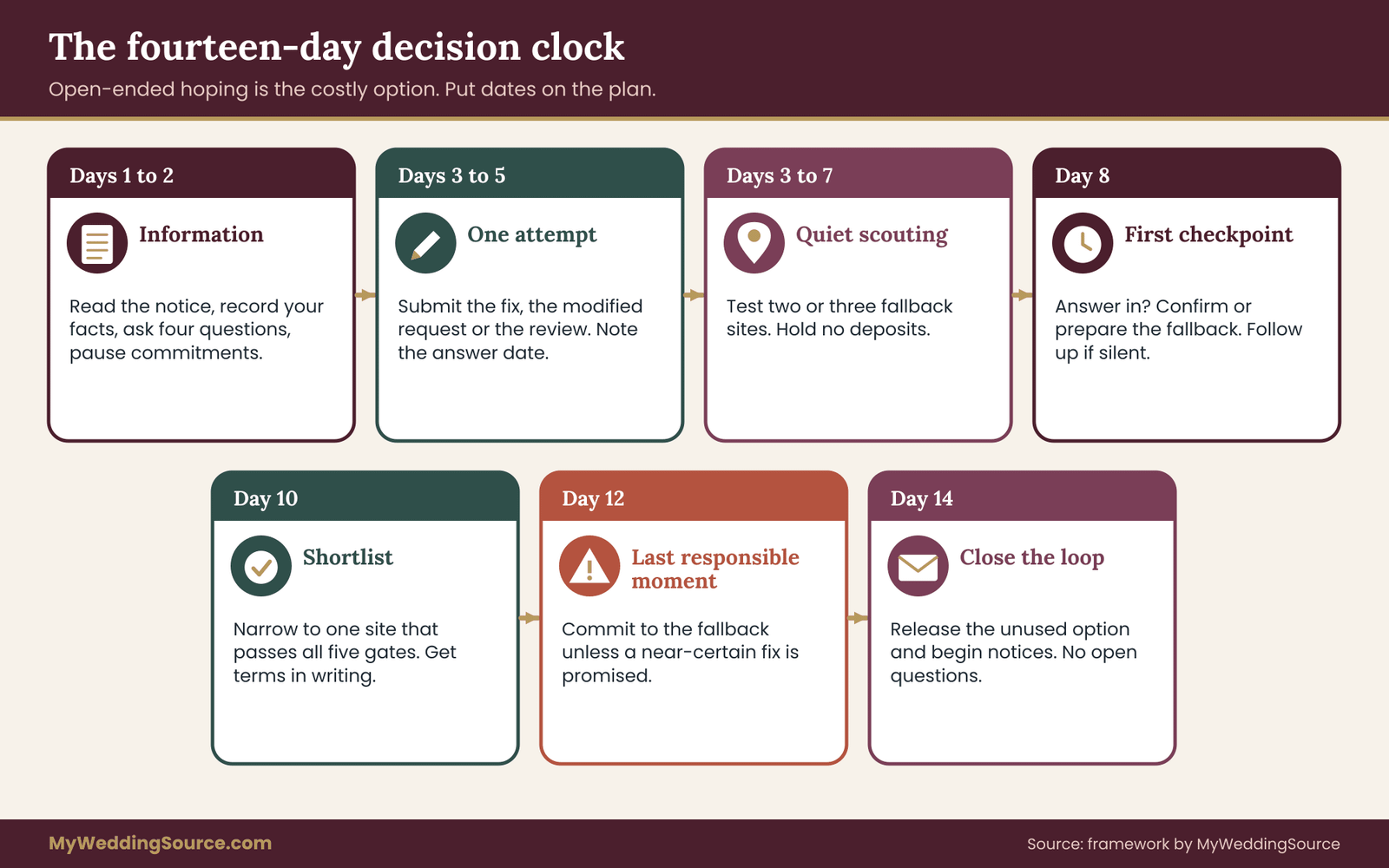
Days one and two: information. Read the notice, record your own facts, send the clarifying message, and pause outgoing commitments. Label the cause. No announcements.
Days three to five: one attempt. Choose your primary response from the four. If it is a fix or a modified request, submit it now, with a clear subject line and a short note. If it is a review, file it inside the stated deadline. Put the date you submitted on your calendar and the date by which you expect an answer. If the agency has not told you its response time, ask.
Days three to seven, in parallel: scouting. Without paying anything, build a short list of two or three fallback sites using the decision tree in the next section. Ask each for availability on your date, and ask what their approval or booking process looks like. This takes a few emails and perhaps one visit.
Day eight: first checkpoint. Has the agency answered? If yes and the answer is a yes, confirm details in writing and stop scouting. If yes and the answer is a no, move to day ten with a prepared fallback. If no answer yet, send a courteous follow-up asking for a timeline and note that you are planning contingencies.
Day ten: fallback shortlist. Narrow to one fallback that passes all five gates in the decision tree. Visit it if you have not. Ask for terms in writing, including the hold period and the cancellation rules, but do not pay a nonrefundable amount yet unless the site’s availability is truly at risk.
Day twelve: the last responsible moment. Decide whether to commit to the fallback. Signals that favor committing include no answer from the agency, an answer that requires more changes than you can accept, or a fallback that may be taken by someone else. A signal that favors waiting is a promised answer within a day or two on a fix that is nearly certain.
Day fourteen: close the loop. Either the original site is approved and you release the fallback politely, or you commit to the fallback and begin notifications. Either way, the uncertainty ends here. If you keep the question open past this point, guests and vendors will feel it.
A few remarks on running the clock.
The clock is a discipline, not a deadline imposed by the agency. You are free to adjust it, but write down the new dates when you do. Couples who say “we will decide soon” about a denied wedding permit tend to drift for weeks.
If the agency’s response time is longer than your clock, the clock wins. Waiting five weeks for a review while holding no backup is a gamble with your guests’ travel plans. A courteous message that says you will proceed with a different site on a given date unless you hear otherwise is fair to everyone.
If your wedding is within a month, compress aggressively. Days one and two become one day. The attempt and the scouting start together. The last responsible moment moves up. Short-notice cases rely more on fallbacks that need little or no permission, which the backup types section describes.
Finally, assign roles for the denied wedding permit. One partner owns the agency conversation. The other owns the fallback conversations. A third trusted person, perhaps a parent or a friend, holds the master list of who has been told what. Splitting the work keeps the tone of each conversation steady and prevents the same questions from reaching vendors twice.
Short-notice cases need a few extra rules. Suppose the ceremony is five weeks away and a denied wedding permit arrives. The first two days still belong to information, but the attempt and the scouting start together, and the last responsible moment is day seven.
In that window, a fix for a paperwork gap is worth trying only if the agency promises a quick answer. A modified request for a different area is worth trying if staff can name the area. A formal review is almost never worth it, since the process is usually longer than the time you have.
At three weeks or less, assume the park is not available as the ceremony site unless you already hold a written yes. Spend your energy on a fallback that needs no new permission, and ask the park only whether portraits are allowed. A denied wedding permit this close to the date is not a reason to cancel anything large. It is a reason to simplify, and a simpler ceremony with the same people is still your wedding.
Keep the tone steady with vendors in these cases. Tell them that the location is changing, that the date is not, and that you will send details within a day. Vendors respond well to a clear sentence about what is fixed. They respond badly to a stream of partial updates, which is how a late denied wedding permit turns into three different addresses in three different inboxes.
The alternative-location decision tree
When response four is on the table after a denied wedding permit, most couples choose a fallback by feel: a lovely garden, a friend’s yard, the reception venue’s patio. Feel is not wrong, but it leaves out facts that cause second failures. The decision tree below puts five gates in a fixed order, and any site must pass all of them before you commit. The order matters. It starts with the gate that most often kills a candidate and ends with the gate that is most often skipped.
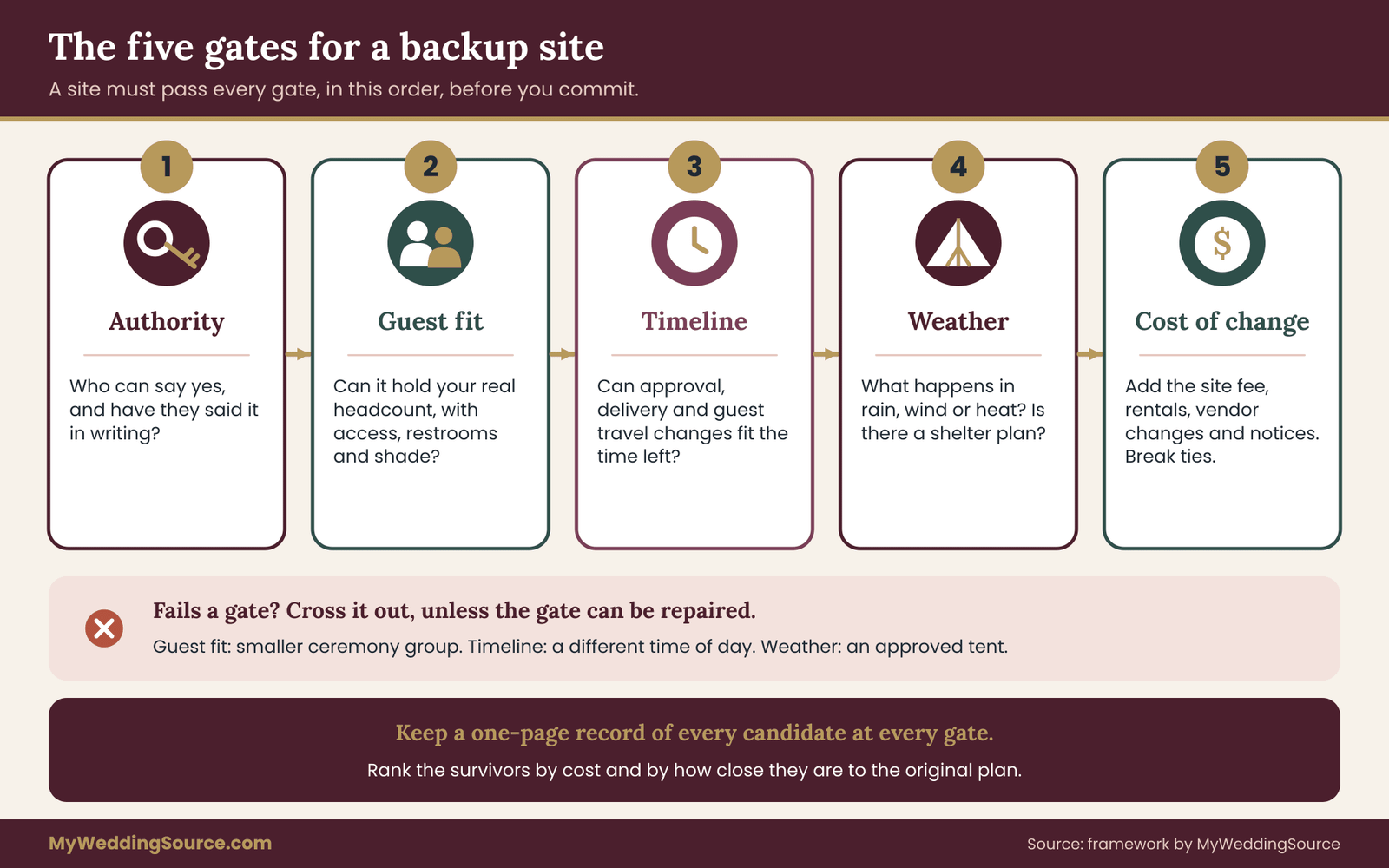
Gate one: authority. Who can say yes, and have they? A site that sounds welcoming but has no written approval is not a fallback yet. Private property needs the owner’s written consent for the use, date and headcount. A public site needs its own permission process identified. A venue needs a signed agreement. If no one can give you a clear answer within a few days, the site fails this gate for now.
Gate two: guest fit. Can the site hold your actual headcount for the ceremony, seated or standing, with the access guests need? Count chairs, not heads. Ask for the posted capacity if one exists. Then consider mobility, restrooms, parking and shade. A site that holds your numbers on paper but offers one narrow path and no accessible restroom fails for the guests who need those things. The accessible wedding venue red flags checklist is a good lens for this gate.
Gate three: timeline. Can the site be ready on your date with the lead time left? Count permit or approval time, rental delivery, vendor re-routing and the time guests need to adjust travel. A site that can say yes in three weeks fails if your date is in two.
Gate four: weather and exposure. What happens if it rains, blows or overheats? An outdoor fallback needs its own bad-weather answer. A tent, an indoor room or a shelter nearby counts. A site with no answer to weather is a fallback that needs its own fallback. The venue technical walkthrough guide shows what to measure and ask on a site visit.
Gate five: cost of change. What does this actually cost, in money, in vendor changes and in guest disruption? Add up the new site fee, rental differences, transport changes, any vendor change fees and the cost of the notices. Compare it with the cost of a modified request at the original site. Cost is last because it should break ties, not drive the choice.
Apply the gates like this. List every candidate. Cross out any that fail gate one. From the rest, cross out any that fail gate two. Continue through the gates. Whatever survives is a real fallback. If more than one survives, rank them by gate five and by how close they are to the original plan, since smaller changes are easier for guests to follow.
A site that fails only one gate is not necessarily dead. Ask whether the failing gate can be repaired. Gate two can sometimes be repaired with a smaller ceremony group and a later gathering for everyone. Gate three can sometimes be repaired with a different time of day. Gate four can be repaired with a rental tent that the site approves. Gate one is the hardest to repair, which is why it comes first.
Keep a one-page record of the tree for your denied wedding permit with every site’s result at every gate. It sounds formal, but the page is useful in three ways. It makes the decision visible to both partners, so you are not arguing from memory. It gives you a quick answer when someone asks why you chose the site. And it protects you from sentimental drift, where a site you have already imagined seems to pass gates it has not.
One practical note on the same-park option. If the park’s staff are willing, ask whether a different area within the same park could accept your request. Same-park moves keep the guest experience closest to the plan, and staff often know which areas are lightly booked. The ask costs one email.
Six kinds of backup after a denied wedding permit
The decision tree tells you how to test a site after a denied wedding permit. This section describes the kinds of sites worth testing, with the strengths and weak points of each, so your shortlist includes more than the first option that comes to mind. The six kinds below are listed roughly from the smallest change to the largest. None is automatically better; the right one is the one that passes your gates.
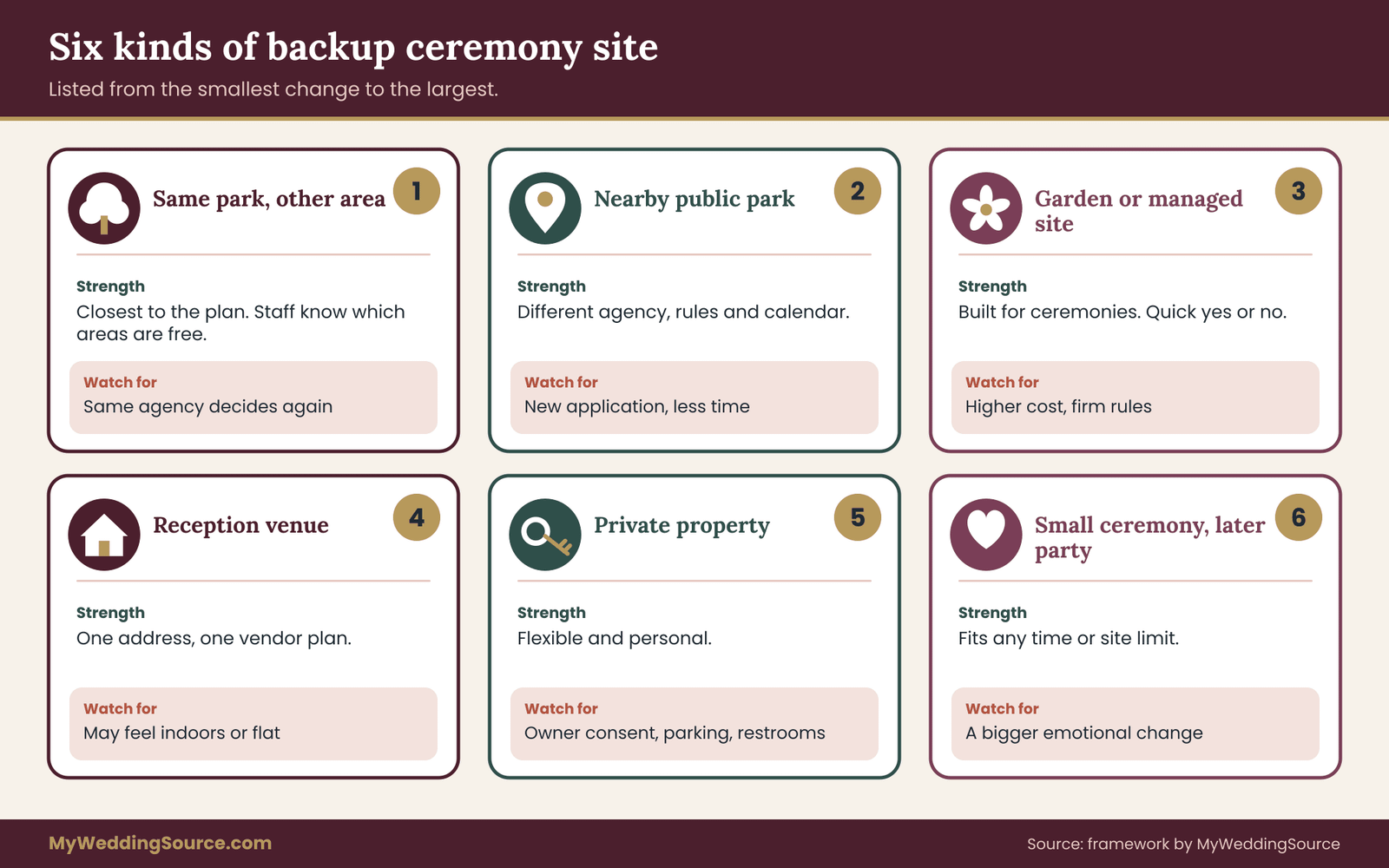
A different area of the same park. This is the smallest change. The setting, the drive and the look of the photographs stay close to what guests were told. It works best when the denied wedding permit was about a specific area, a crowded date or a capacity figure tied to one lawn. The weak point is that the same agency decides again, so the same hidden constraints, such as headcount rules or sound limits, may apply. Ask staff which areas have fewer constraints before you apply.
A different public site nearby. A neighboring city park, a county park or a regional park may have different rules, different capacity figures and a different calendar. Different agencies often run them, and one agency’s strict approach does not predict another’s. The weak point is that you are starting a new application with less time. Start by asking about availability and processing time on your date, and by asking whether a ceremony of your size is common there.
A garden, arboretum or similar managed site. These usually have a staff member whose job includes events, a published price and a booking process that is built for ceremonies. They tend to say yes or no quickly. The weak points are cost, which can be higher than a public lawn, and a more rigid set of vendor and timing rules. A managed site is a strong choice when your priority is certainty rather than the lowest cost.
Your reception venue. If your reception venue has an outdoor space, a lobby, a ballroom or a side room, the ceremony can join it. This simplifies logistics for everyone: one address, one set of vendors, one parking plan. The weak point is the feeling. A couple who wanted trees and sky may find a banquet room flat, and guests who expected a park may be confused. Mitigate that by choosing the best view from the venue and by explaining the change warmly in your notice.
Private property with the owner’s consent. A family yard, a friend’s field or a rented home with grounds can be lovely and flexible. The weak points are many: written consent from the owner, local rules on events at residences, parking and neighbor impact, restrooms, power and insurance. Treat private property as a real site with real gates, not as a loophole. If a rental property is involved, the owner’s explicit approval of a ceremony of your size is not optional.
A smaller ceremony now, with a larger gathering later. Sometimes the cleanest backup is to change the shape. A brief ceremony with a small group, held somewhere that needs little or no approval, can be followed by a reception or a blessing event at another time. This is a bigger emotional change than moving a few miles, and some couples find it freeing while others find it sad. It is a valid option when time or conditions leave no site that holds the full guest list.
Whichever kind you choose, a few shared checks apply.
Photography and vendors. Some photographers and officiants price by location or travel. Tell them the new site early, ask whether anything in the contract changes and put the answer in writing. Look closely at the change clauses in each agreement.
Light and timing. A ceremony that was timed for the golden light on a west-facing lawn may land in full sun at a different site. Check where the sun sits at your ceremony time at the new place. A change of site often calls for a change of start time of thirty to sixty minutes, and the cue sheet needs to move with it.
Sound and quiet. A site next to a road, a playground or a pool adds noise. Walk it at the same time of day as your ceremony and listen. If you are using a small speaker, find out whether the site restricts amplified sound.
Restrooms, water, shade and seats. These are the unglamorous items that decide whether guests are comfortable. A site with none of them is a site where you must bring all of them.
Guest travel. If many guests are traveling, a move of a few miles may matter little; a move across a river or into a different town may break lodging and shuttle plans. Map the new route before you decide.
Match the kind of backup to the cause of the denied wedding permit. A paperwork gap or a calendar conflict points to the same park, since the agency has not rejected the use. A capacity or scope limit points to a different area, a different park or a managed site with a higher rating.
A fixed site rule points away from that site and often away from that agency, because a similar rule may sit on neighboring land. A judgment call points to a modified request first and a different agency second. Pairing the cause with the backup keeps you from solving a denied wedding permit with the wrong tool.
It also keeps the guest experience in view. If the denied wedding permit was about sound, a quiet ceremony in the same park may be nearly identical for guests. If it was about headcount, a move to a larger site may be the only fix that keeps the guest list intact. If the denied wedding permit was about the date, a weekday or a different weekend may serve better than any new location.
One more consideration: the ceremony location often sets the legal and symbolic center of the day. Whatever you choose, confirm with your officiant what the marriage license requires for the place of the ceremony in your state. Requirements vary, and your officiant or the issuing county office can answer quickly. It is better to ask before you commit than after the invitations go out.
When your shortlist has two survivors, a simple tiebreaker helps. Imagine explaining the change to your oldest and youngest guests in one sentence each. If one site makes that sentence easy, such as “same park, the garden lawn instead,” and the other needs a paragraph, take the easier sentence. Guests forgive a change they can understand at a glance.
And keep a plain record of the sites you rejected after the denied wedding permit, and why. It is useful if the first choice fails, and it spares you from re-scouting the same place twice.
Telling people about a denied wedding permit: order and scripts
Notifications are where a denied wedding permit becomes either a small hiccup or a week of confusion. The facts are the same in both cases. The difference is the order in which people hear them and how clear the message is. Tell people about a denied wedding permit only once you have decided, and tell them in a deliberate sequence.
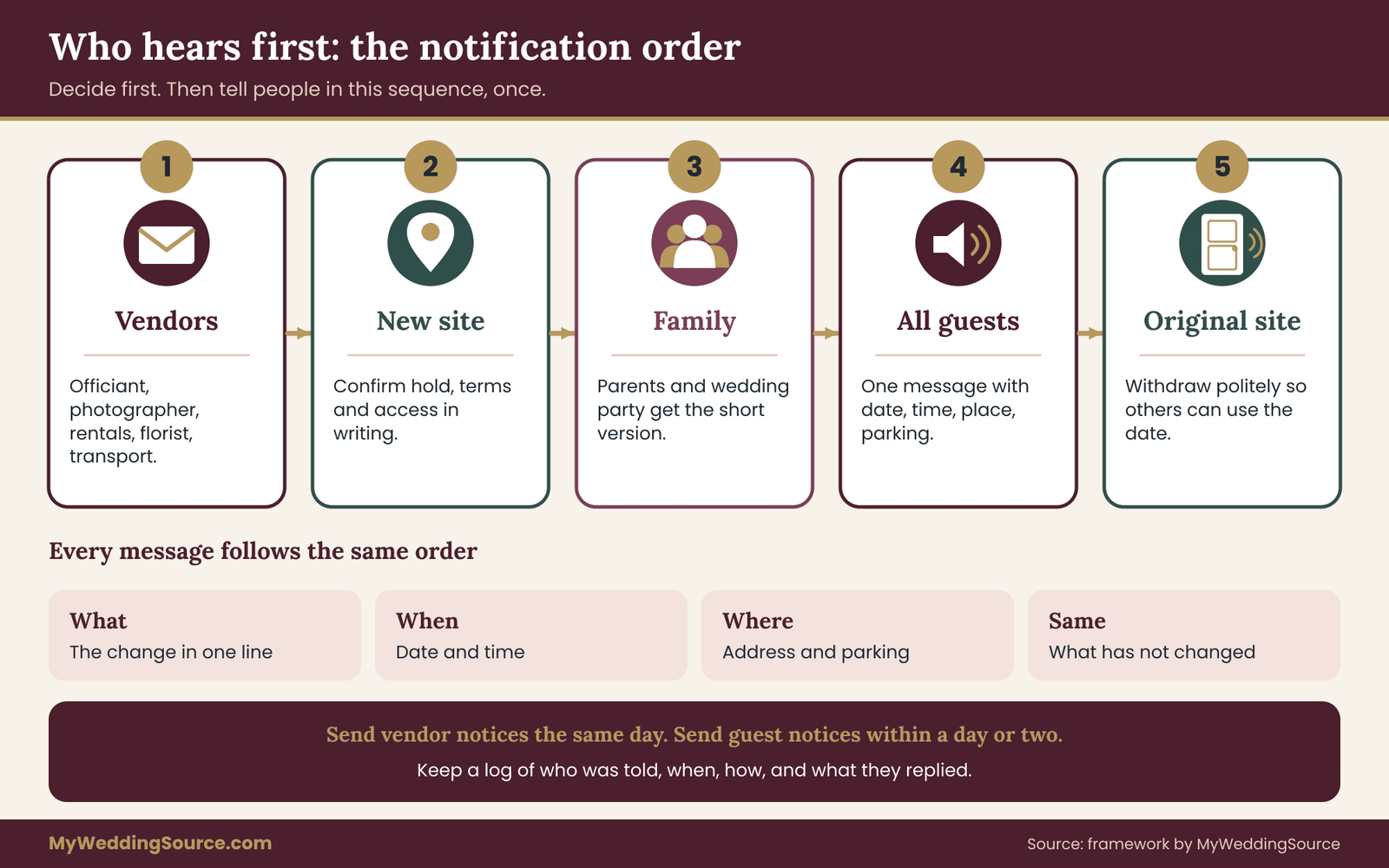
The recommended order has five groups.
First, the people who must act. These are the vendors whose work changes: the officiant, the photographer, the rental company, the musicians, the florist and the transport provider. They need the information first because their schedules are the least flexible.
Second, the venue or site you are moving to. Confirm the hold, the terms and the date in writing before anything goes public.
Third, immediate family and the wedding party. They will be asked questions by everyone else. Give them the answer, the new details and a two-line explanation they can repeat.
Fourth, all guests. One message, sent once, with everything they need.
Fifth, the original site. If you have a hold, a booking or an open application, withdraw it politely so another couple can use the date.
A few principles apply to every message. Lead with what is happening, not with how you feel. Give the new details in the same order every time: date, time, place, address, parking, what has not changed. Avoid blaming the agency, since guests do not need an account of the denial and it can sound bitter. Keep it short. And name one place where updates will be posted, such as the wedding website, so guests have a single source.
Here are scripts you can adapt. Replace the bracketed parts with your own details.
To the officiant. “Our park request for [date] was not approved, so we are moving the ceremony to [new site, address]. The time may shift to [time]. Could you confirm you can still officiate on that basis, and tell us if anything in your agreement changes? We will send the updated cue sheet by [date].”
To the photographer. “Our ceremony location has changed from [park] to [new site]. Same date, [new time]. Please let us know whether the change affects travel, timing, coverage or your agreement, and whether you would like to visit the new site beforehand. We can send the address and a map today.”
To a rental company. “The delivery address for [date] has changed to [new site]. Could you confirm availability of the same items there, any difference in delivery or setup fees, and the latest time we can finalize the quantities? Please send changes in writing.”
To the new site. “Thank you for holding [date, time] for our ceremony of about [number] guests. We would like to confirm the hold in writing, the cancellation terms, the access time for setup, and any rules on sound, decor and vendors. Could you also confirm the contact on the day?”
To the original site. “Thank you for reviewing our request for [date]. We have chosen another location and would like to withdraw our application and any hold so the date is available to others. Could you confirm the withdrawal and how our fee will be handled?”
To family and the wedding party. “Quick update: the park could not approve our request, so the ceremony will be at [new site] at [time]. Everything else is the same. The full details go to guests on [date]. If someone asks, the short version is that the first location had a limit we could not work around.”
To all guests. “We have a change of ceremony location. The ceremony will now take place at [new site, address] on [date] at [time]. Parking is [detail]. [Accessibility detail.] The reception remains at [place and time]. Details and a map are at [website]. We are grateful you are coming and look forward to celebrating together.”
Notice what these messages leave out: the phrase denied wedding permit, the agency’s reasoning and any apology that sounds like a crisis. A simple change note respects people’s time, and it keeps a denied wedding permit from becoming the headline of the wedding. If someone asks, a calm one-sentence answer is enough.
Short messages matter too. A text to a close friend or a parent can be this plain: “Update on the ceremony: our park request was not approved, so we are moving to [new site] at [time]. Same day, same reception. Details by email tomorrow.” Notice that the text mentions the denied wedding permit only as a reason, in a few words, and moves straight to the new facts.
If a guest asks what happened, a calm answer is enough: “The park could not approve our request for that area, so we found a good alternative.” Nobody needs the paperwork details, and repeating the full story of a denied wedding permit at every dinner table keeps the stress alive.
If a relative reacts badly, resist the urge to debate. Say that the decision is made, that the new site has been checked for guests, and that you appreciate their patience. A denied wedding permit is nobody’s fault, and the message should not invite a search for someone to blame.
A few edge cases deserve thought.
If guests are traveling from far away, send the notice by email and text, since some people check one more than the other, and follow up with a phone call to anyone who is elderly or likely to miss it. The wedding day digital contingency plan covers backup channels for reaching everyone quickly.
If invitations have already gone out with the old location printed, a small card with the update is better than a reprint. Include it with any invitations not yet delivered and send the digital notice to everyone.
If the ceremony location was a central feature of the invitation, such as a named park, acknowledge it gently: “We are sorry to change the setting we shared; the new site has its own charm.” Do not oversell.
If some guests have accessibility needs that the new site meets differently, contact them directly. A general notice will not tell a wheelchair user whether the path is level.
Timing matters too. Send vendor notices the same day you decide. Send guest notices within a day or two. Waiting a week invites rumors and unwelcome questions at family dinners.
Finally, keep a log. List every person or business, the date and method of notice, their reply and any follow-up action. A one-page log prevents the quiet failure where one vendor never got the message and arrives at the old site.
It also helps to ask one trusted person to proofread each message before it goes out. Errors in the new address or time are the single most damaging typo in this process, and a second pair of eyes catches them.
Money, contracts and deadlines after a denied wedding permit
A denied wedding permit creates a small tangle of financial questions. Most of them are answered by documents you already hold, which is why the first step is to gather the papers rather than to call people. After a denied wedding permit, open every contract and invoice tied to the ceremony location and the ceremony day, and read three things in each: what the location is called, what change or cancellation terms apply, and what deadlines are running.
Start with the denied wedding permit itself. Find out what happens to the application fee, any site reservation fee and any deposit. Possibilities include a full refund, a partial refund with an administrative deduction, a credit toward a future request, or no refund. These are the agency’s rules, not yours, so the answer is a question to ask rather than an argument to make. Write down whatever you are told and when.
Next, list the vendors whose agreements name the park or depend on it.
Officiant and ceremony musicians. Many agreements are tied to a date and time, not a location, but some mention travel. Ask whether a location change changes the fee. Usually it does not unless the distance grows.
Photographer and videographer. Contracts often set coverage hours and a location, and sometimes a travel fee. A move within the same region may need only an email. A move that changes the light or the schedule may need an amended timeline. Ask whether the amendment will be written.
Rental company. Delivery addresses and setup times change. A tent, chairs, an aisle runner or an arch rental may have a change fee, and a tent may need a new site review. Ask for the revised quote before you confirm.
Florist. Arch and aisle designs are often built for a space. A new site may need a different structure or different quantities. Ask what changes and whether the cost does.
Transport and shuttle. Pickup points and routes change. Ask whether the vendor charges for a revised route and whether the revised time affects the driver’s hours.
Caterer or bar. If the ceremony had a cocktail hour or refreshments nearby, check whether the new site allows food and drink or whether service has to move.
The vendor contract guide explains the clauses that matter most here: change of venue, force majeure, rescheduling and refund language. If a vendor says a change fee applies, ask for the clause number in your agreement. If there is no such clause, ask politely whether the vendor will waive the fee given that the change was outside your control. Many will, particularly for a change that does not add work.
Then consider the cost logic of each response, using the categories rather than invented numbers.
After a denied wedding permit, a fix or a modified request mostly costs time and perhaps a small additional fee. If the approved version has a smaller headcount or a shorter schedule, check whether any rented quantities or vendor hours can be reduced to save money.
A review costs time and some goodwill. It rarely costs money directly, but it can delay other decisions.
A same-park move costs little. A different public site may cost a new fee and a new application. A managed garden or a venue usually costs more than a public lawn, though it may replace costs you were going to pay for rentals, restrooms or permits anyway. Private property can look cheaper but may add insurance, portable restrooms, parking help and rentals that a park already offered.
A smaller ceremony now followed by a later event splits costs across two dates, which may add some and reduce others.
Add a line for the unglamorous costs: printing a change card, extra postage, a hotel room block that needs adjusting, an extra shuttle run and the time it takes to handle all this. Put every line in one place. The wedding cash-flow planning guide shows how to track deposits and balances by date so you are not surprised by a payment that falls due in the middle of the scramble.
Build a simple file for the whole episode. Put the notice, your clarifying message and the reply, the application and its receipt, the fallback site’s terms and every vendor reply in one folder, named by date. If the matter ever needs a second look, whether a fee question or a dispute over a change charge, the folder lets you answer in minutes. A vendor timeline is a handy companion for lining up which vendor needs which notice by what date.
Pay attention to deadlines in your own documents. A rental company may require final quantities by a date. A caterer may require a final count. A hotel block may release unused rooms by a date. A change of ceremony site may affect when guests arrive and leave, which can touch all three. Create a short list of upcoming deadlines and check each against the new plan.
When a payment is needed to hold a fallback site, use a payment method that offers dispute rights, and keep the receipt. Consumer protections for card payments are described by the Consumer Financial Protection Bureau, and the rules and time limits are best confirmed there. Avoid sending large nonrefundable amounts until the site passes all five gates, and avoid paying a private owner in cash without a written agreement.
If you have wedding insurance or event cancellation coverage, read the policy. Many policies cover cancellation for specified causes and often exclude a change of venue due to a permit decision, but this varies widely and only the policy and the insurer can say. If it seems relevant, ask the insurer before incurring costs.
Lastly, remember that not every cost of a denied wedding permit is worth fighting. If a vendor charges a fair fee for extra work caused by your change, paying it is part of the price of the change. Save arguments for charges that have no basis in your agreement.
A worked case: one invented denial from notice to new ceremony
The following case is invented to show the method end to end. It is not a report of a real couple or a real agency, and the numbers are illustrative. Mara and Theo planned a late-afternoon ceremony on a city park lawn for about ninety guests on a Saturday in early October. They applied about four months ahead.
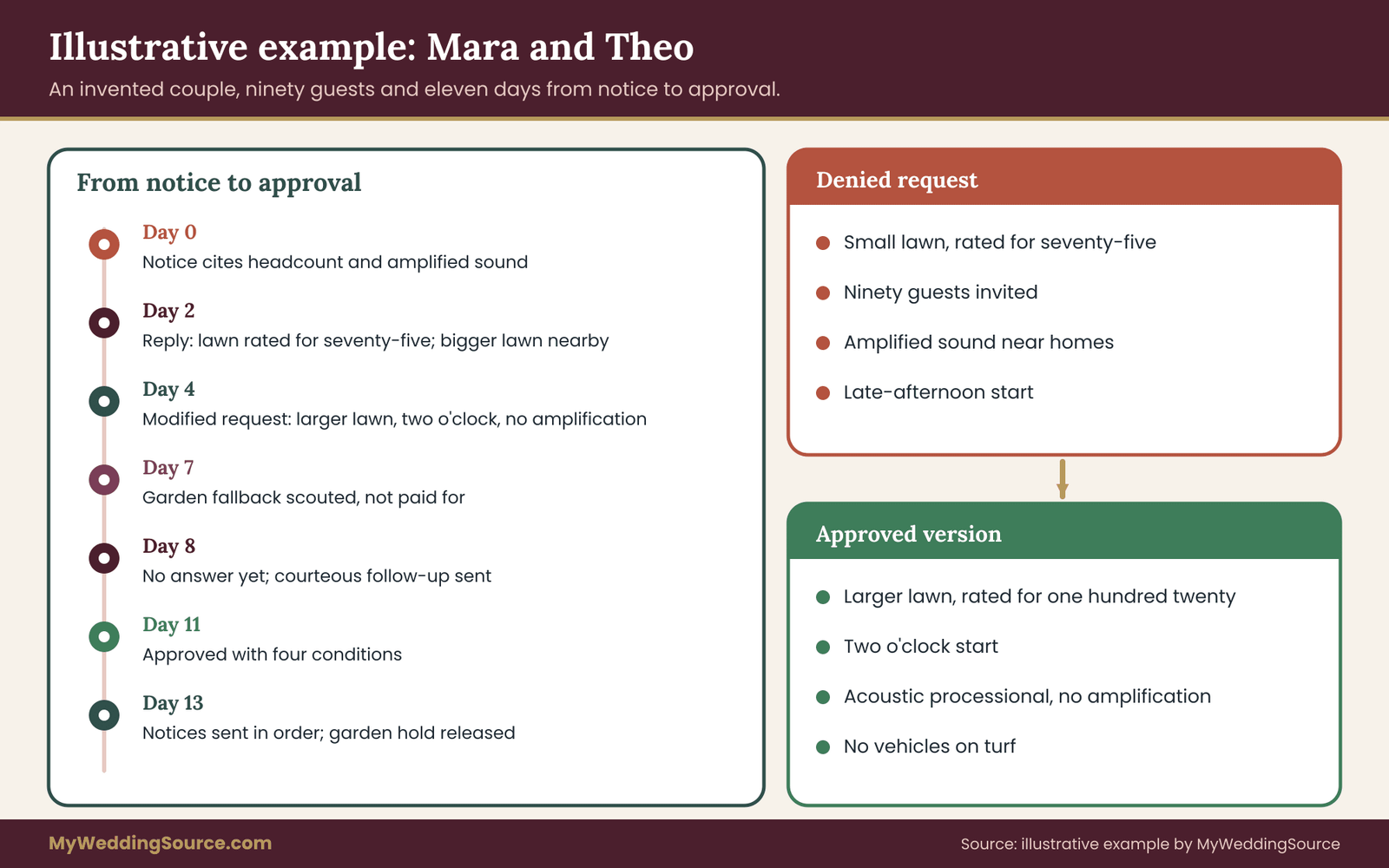
The notice. Eleven weeks before the date, the parks office sent an email saying the request was not approved. The text cited the headcount “exceeding the posted limit for the requested area” and the request for amplified sound “not permitted in the requested area.” No other detail was given.
Hours one to forty-eight. Mara highlighted the two cited items and compiled their own record: ninety guests, a small battery-powered speaker for the processional, a fifty-minute ceremony, the lawn named on the form. They paused vendor communications and sent a short message to the contact in the notice asking four things: whether the limits were fixed for that area, whether a different area could host their numbers, whether a version without amplified sound could be approved, and how the application fee would be handled.
Labeling the cause. The reply arrived on day two. The lawn was rated for seventy-five people, and amplified sound was not allowed there because of a nearby residential edge. A larger lawn in the same park, about a ten-minute walk away, was rated for one hundred twenty and allowed low-volume amplification until a set hour.
That lawn was free on their date in the early afternoon but not in the late afternoon. The fee would be credited to a revised request. Mara and Theo labeled it cause three, scope and capacity, with the area and the time as the negotiable pieces.
Response chosen. They chose response two, a modified request for the larger lawn, with an earlier start time of two o’clock and a plan for a small acoustic setup with no amplification for the processional. They submitted on day four.
Parallel scouting. While they waited, they used the decision tree on three fallbacks. A garden site near the park passed gates one to three but cost more. The reception venue’s terrace passed gates one, three and five but could hold only sixty. A friend’s yard failed gate one because the owner had not confirmed and failed gate two on parking. The garden became the prepared fallback.
Day eight checkpoint. The parks office had not answered. Mara sent a courteous follow-up asking for a timeline. A reply promised an answer within three business days.
Day eleven. The modified request was approved with conditions: a two o’clock start, a maximum of one hundred twenty guests, no amplified sound and no vehicles on turf. Theo confirmed the conditions in writing and asked about restrooms, which the staff said were in the building near the lot.
Notifications. Because the area changed and the time moved, they notified in order. The officiant and photographer first, the same day. Rental and florist next. Family and the wedding party the following day. All guests two days later, with a map, a note about the earlier start and a parking detail. They withdrew the garden hold politely and thanked the site.
What changed and what it cost. The ceremony moved from late afternoon to early afternoon, so the photographer adjusted the timeline. The florist adjusted an arch for a different backdrop. The rental company charged no change fee because quantities and the delivery window were similar. They spent some hours and a little printing on a change card for invitations not yet mailed.
What they would do differently. They said they would have asked about the lawn’s rating before applying, and would have chosen the larger lawn from the start. That points to the prevention section later in this guide.
Three lessons from this invented case apply widely. First, the cause was found by asking one precise question. Second, the fallback was ready but not paid for, so the couple could stay calm and keep the better option alive. Third, notices went out only after the decision, in a fixed order, with the same facts in each.
Not every case ends well, and the next section covers what to do when it does not.
Failure conditions: when the plan after a denied wedding permit should change
A plan for a denied wedding permit can fail in its own ways. The point of naming failure conditions in advance is that you stop arguing with yourself on the day a signal appears. Write these on the same page as your decision clock, and agree with your partner that any one of them triggers a defined change.
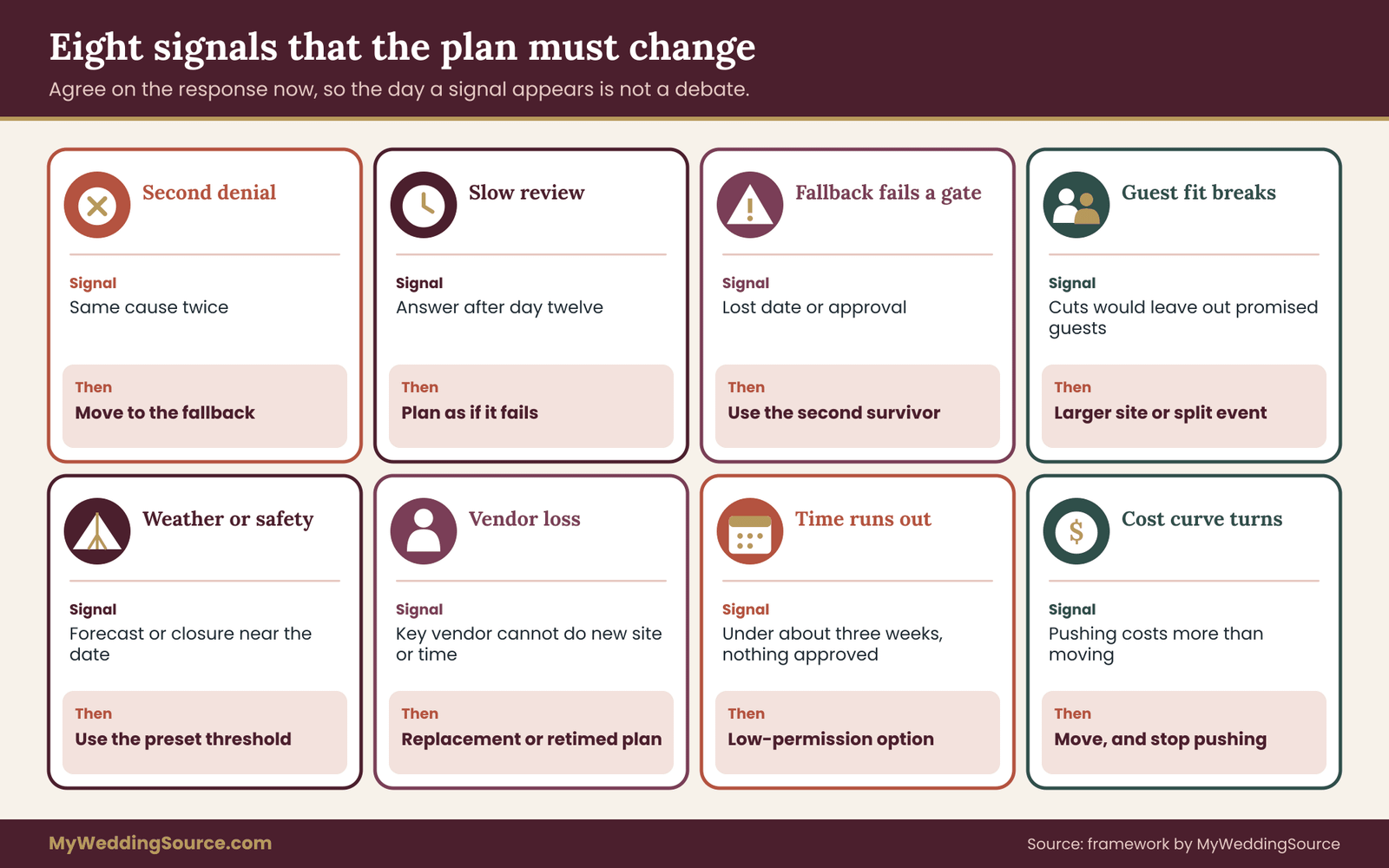
The second denied wedding permit. If a modified request or a fix is denied again for the same cause, stop. A repeated denied wedding permit on the same point means the point is fixed or the agency is unlikely to move. Go to the prepared fallback. Do not enter a third round unless the agency itself invites it with a specific change.
A review that outlasts the clock. If a review will not be decided before your day-twelve checkpoint, treat the answer as no for planning purposes. You can keep the review alive, but build the fallback as if it will fail, and notify guests on schedule.
A fallback that fails a gate late. A site that looked fine and then loses its approval, its date or its capacity is a signal to switch to the second survivor of the tree. This is why a decision tree should end with at least two candidates when possible. If only one survives, keep scouting quietly even after you pay a refundable hold.
Guest fit breaks after a denied wedding permit. If a response that shrinks the headcount forces you to cut people you promised, pause. The options are a larger site, a split event with a ceremony for a small group and a celebration for all, or a livestream for guests who cannot attend. Choose deliberately, not by default.
Silence from the agency. If the office stops answering after a denied wedding permit, and your clock is running, send one more written message that states the date you will proceed with the fallback. Silence is not approval, and it is not a reason to wait past day twelve. A short, courteous note keeps the record clean and leaves the door open if they respond later.
Weather and safety. If the forecast, a closure or a safety notice affects the new site close to the date, your weather answer takes over. The National Weather Service lightning guidance is a useful reference for outdoor events, and the site’s own staff can tell you what they do in a storm. Decide the cancellation or move-indoors threshold before the day.
Vendor loss. If a key vendor cannot work at the new site or the new time, ask whether a colleague can step in, and compare the cost of a replacement with the cost of another change. Read the change clauses to see who bears the cost.
Time runs out. When fewer than about three weeks remain and no outdoor site is both approved and workable, move to the options that need the least permission: the reception venue, a private room, a managed garden with an open date, or a very small ceremony with a larger gathering. The park may still serve for portraits taken in public areas where the rules allow it, but ask the agency first, since photography can have its own rules.
The cost curve turns. If the total cost of continuing to push the original site, including fees, vendor changes and time, exceeds the cost of a clean move, move. Sentiment is legitimate, but it is not a budget line.
Emotional load. This one is easy to skip. If planning has become a source of constant strain between the two of you, simplify. A smaller, calmer ceremony somewhere that works is a good wedding. A beautiful park that takes six more weeks of conflict is not an obvious win.
A practical way to use these conditions is to number them and mark which ones are already close. Revisit the list at each checkpoint, and cross out any that no longer apply. When one triggers, do not reopen the whole decision; apply the defined change and move on.
Preventing a second denied wedding permit: build the backup before you apply
Most of the pain of a denied wedding permit comes from having had no plan for it. A little groundwork before the next application, or before your first one if you are reading this early, removes much of it.
Ask before you apply. A short conversation with the office can reveal the rated capacity of each area, rules on sound, tents, vehicles and vendors, the processing time and the usual busy dates. Ask whether staff can tell you which areas have fewer constraints for a ceremony of your size. This is a request for information, not for approval.
Apply early, within the agency’s window. Many agencies set earliest and latest dates for requests. Applying early gives you time for a fix and a second attempt. Applying close to the date leaves no room.
Apply with a clean packet. Include every document the agency lists, a clear site map with chair placement, accurate headcount, honest descriptions of vendors and sound, and any insurance certificate the agency requests. A complete application removes cause one from your list.
Request the smallest version that works. Padding the request with extras you might not use invites cause three. If you may want a tent, a sound system or a caterer nearby, ask whether those are possible, and request only what you will really use.
Pick a date with slack. A Friday or a Sunday, or a shoulder month, may face less competition than a prime Saturday. The wedding venues guide covers how to compare dates and sites, and a flexible date is one of the strongest forms of insurance you have.
Line up the fallback in advance. Before the application is decided, identify one fallback that passes the five gates. Do not pay for it, but know its availability, its terms and its contact. A shortlist built calmly beats one built in panic.
Build change tolerance into vendor agreements. Ask vendors whether a location change within a stated distance changes the agreement, and put the answer in writing before you sign.
Keep your guest messaging ready. Draft a short change notice that you could send in an hour. It will rarely be needed, but when it is, it saves a day.
Track decisions in one place. A single page with the cause label, the chosen response, the dates on the clock and the notification log keeps both partners aligned. The wedding ceremony cue sheet guide helps you adjust the order of the ceremony when the site or time changes.
Check the guest list against capacity. Before applying, compare your realistic ceremony headcount to the posted capacity of the area. The wedding guest list guide can help if the number is the problem. A smaller ceremony group, with a celebration afterward for everyone, is a legitimate shape.
If you are reading this before you have applied, treat the previous steps as your plan for avoiding a denied wedding permit. If you are reading it after a denied wedding permit, use them for the second application or for the fallback.
Either way, the work is the same: know the rules of the specific area, ask for only what you need, leave time for one correction, and keep one prepared alternative that has been checked against the five gates. A second denied wedding permit at the same site for the same reason says the answer will not change, and it is the signal to move.
None of this guarantees approval, and no one can promise it. What it does is shrink the chance that a denied wedding permit arrives as a surprise, and ensure that when one does, you have a map.
Your next steps
- Get the reason for the denied wedding permit in writing and label the cause as one of the five. If you cannot tell, ask whether the limit is fixed or can change with added measures.
- Pause new commitments, and gather every contract and invoice that names the ceremony location.
- Choose a primary response and a fallback, and put the fourteen-day decision clock on your calendar with a date for each checkpoint.
- Run your candidate sites through the five gates and keep a one-page record of the results.
- Draft the vendor, family and guest notices now, and send them in order only after you decide.
- Write your failure conditions on the same page as the clock, and review them at every checkpoint.
FAQ
Can I reapply after my wedding permit is denied?
Often yes, but it depends on the agency and the cause. If the denial was for missing documents or a conflict you can change, a corrected request is usually welcome. Ask the office whether your place in line is preserved and whether a fee applies again. If the cause is a fixed rule for that area, reapplying for the same use will likely get the same answer.
Is a denied wedding permit the same as a revoked one?
No. A denied permit was never approved. A revoked permit was approved and later withdrawn, often because of a closure, a hazard or a rule change. The steps in this guide help with both, but revocation tends to be closer to the date, so ask immediately about refunds, alternate dates and any areas that remain open.
Should I tell guests right away that the permit was denied?
No. Wait until you have decided what happens next, usually within about two weeks. Guests need a clear instruction, not a status report. Tell vendors first, then family and the wedding party, then everyone else with one message containing the new details. Early announcements of a maybe create questions you cannot answer yet.
Can I get my application fee back after a denial?
It depends on the agency. Some refund in full, some deduct an administrative amount, and some credit the fee toward a revised request. The notice or the agency’s published rules should say, and if they do not, ask in writing. Keep any reply. Do not assume a refund, and do not withhold other steps while you wait for one.
What if the park denies a permit because of headcount?
Ask whether the limit is fixed for that area or whether a different area could host your number. Many parks have lawns of different sizes. You can also reduce the ceremony group and hold a larger celebration elsewhere. If the area’s capacity is a safety rating, a larger headcount will not be approved, so plan around the number.
Do I need a permit for photos in the park if the ceremony is moved?
Maybe. Some agencies treat photography separately from ceremonies, particularly for professional photographers or for set equipment, while others allow small portrait sessions in public areas. Ask the agency that manages the park, and ask in writing. If you move the ceremony but keep the park for portraits, confirm that rule before you tell the photographer.
Is it fine to hold the ceremony in a public park without a permit?
Do not guess. Whether a small, informal gathering needs permission depends on the agency, the area and the size, and an unpermitted setup of chairs, music or an arch can lead to being asked to leave. If a rule is unclear, ask the office. If the answer is no, treat that as a fixed rule and choose a site where you have written approval.
How do I choose between appealing and moving?
Appeal, or request a review, only when you can name a specific error or unclear rule and the review can finish before your decision clock ends. Move when the cause is a fixed rule, when a second request was denied, or when time is short. Preparing the move while the review runs is sensible, so one answer never leaves you stranded.
Sources
- National Park Service, U.S. Department of the Interior
- U.S. Forest Service, U.S. Department of Agriculture
- Bureau of Land Management, U.S. Department of the Interior
- Local governments directory, USA.gov
- State governments directory, USA.gov
- Americans with Disabilities Act information, ADA.gov
- ADA standards and guidelines, U.S. Access Board
- Lightning safety, National Weather Service
- Consumer Financial Protection Bureau
- National Recreation and Park Association