
Wildlife rules decide what guests, vendors and photographers may do around animals, nests, plants and water at a public park, and most of them never reach the people who have to follow them. This guest brief shows how to turn the land manager’s wildlife rules into a one-page instruction sheet, assign every rule to a person, and decide in advance what counts as a failure.
Ask the land manager five habitat questions, then convert each answer into one plain sentence a guest can follow, such as “Stay on the gravel path” or “Do not feed or approach any animal.” Give every sentence an owner, a place where guests will see it, and a stop condition. Hand vendors a separate sheet covering loading, food, lights, power and trash. Check the sheet against the permit and the site’s current rules, because wildlife rules differ by agency, season and species and can change.
A park wedding is a small event in a large living space. The ceremony may take twenty minutes, but the site was there before you arrived and will be there after your guests leave. Birds may be nesting within sight of the aisle. A shoreline may be closed to people at certain tides or seasons.
A meadow may look empty and still be a protected plant community. None of this is obvious from a photo on a booking page, and none of it forgives a guest who wanders into it because nobody said otherwise.
Most couples understand this in general terms and still end up with a gap. The permit lists conditions in legal language. The couple reads the permit once. The guests receive a website link with a start time and a parking note. Vendors receive a load-in time. Nobody receives the wildlife rules in a form they can act on, which is how a well-meant photo shoot ends up in a restricted area or a food table ends up attracting animals that then have to be removed from the site.
The deliverable in this article is a conservation-first instruction sheet, one page for guests and one page for vendors, built from the actual wildlife rules of your actual site. You will see how to collect those wildlife rules, how to rewrite them, how to place them, how to test them with a worked case, and what to do when a site says no.
A note on scope. This is general information, not legal advice, and it is not a substitute for the permit, the park’s own wildlife rules or the advice of a local wildlife or permitting professional. Always confirm current requirements with the office that manages the site before you finalize anything.
If you are still choosing where to marry, start with the broader wedding venues guide, then return here once you have a public site in mind. This article assumes that you have a candidate park and want to plan around its living conditions.
Why wildlife rules belong in a wedding plan
Wildlife rules protect animals and habitat from people, and they also protect people from animals. Both halves matter at a wedding, because a wedding gathers a large number of people who do not know the site, many of whom are dressed and focused on something other than their surroundings.
Think about who is on site and how each group behaves. The couple is anxious about timing. The guests are looking at one another and at phones. The photographer is looking for a better angle. The caterer is looking for a place to set a tray. The rental crew is looking for the shortest path from the truck. Each of these people, doing something ordinary, can cross a line that a regular park visitor would not cross, because they are moving in a group, carrying objects, and following a schedule.
The wildlife rules exist for reasons that a lay person can understand without a biology degree. Animals that are fed lose their caution and may become dangerous to themselves and to people. Nesting birds that are flushed from a nest may abandon it. Plants that are trampled in a sensitive area may not recover for years.
Artificial light and sound can disrupt animals that depend on darkness and quiet. Litter, including tiny pieces of decoration, can be swallowed or tangled around animals. Park managers have seen all of this, which is why their permits include conditions that look strict from the outside.
There is also a practical reason that has nothing to do with conservation values. A permit can be revoked or an event can be stopped when conditions are broken. An office that finds food scraps in a protected area after an event may deny the same couple’s relatives next year, or may add conditions that affect the next wedding. Taking wildlife rules seriously keeps your day intact and keeps the door open for others. Couples who learn the wildlife rules early rarely regret it.
Finally, there is a reason of tone. A guest who is told “Please stay on the path so we do not disturb the nesting birds” usually responds with interest. A guest who learns of the rule afterward, from a ranger, usually responds with embarrassment. The first conversation is cheap and kind. The second is neither. Wildlife rules that arrive on time are almost always received well.
What this article does not cover
Several neighboring questions have their own guides on the site, and this article does not repeat them. It does not explain how to find and apply for a park permit, how to decorate within a park’s limits, how to survey paths for access, or how to feed guests at a remote campground.
It also does not treat private venues with their own wildlife policies in depth, although the same method works there. The narrower question here is: what do the living things at this site require of the people attending, and how do you say it so that it gets done?
What park wildlife rules usually cover
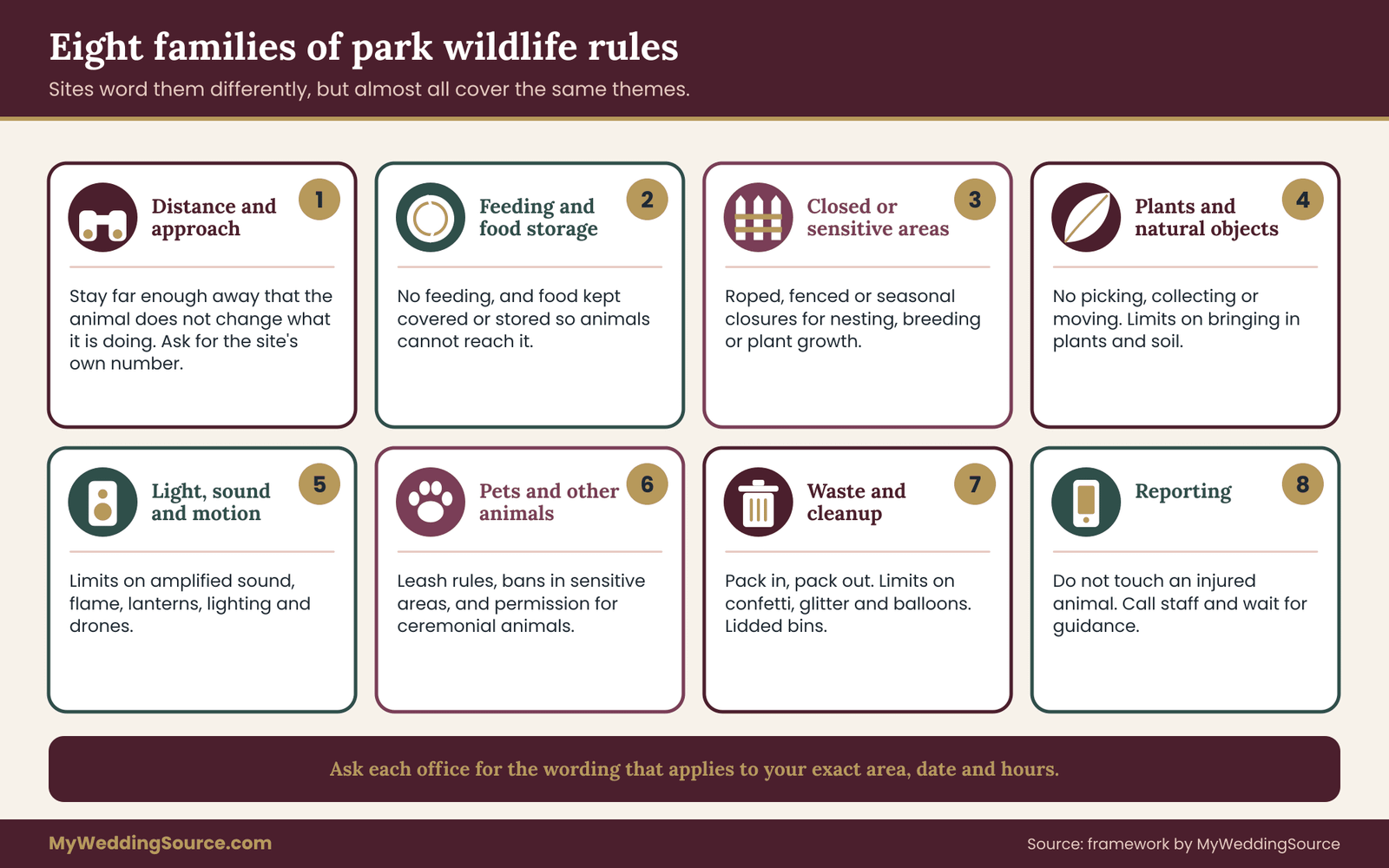
Before collecting rules, it helps to know the general families they fall into. Agencies write these differently, so your site may combine several or use different words, but nearly every public land manager addresses the same themes.
Distance and approach. Many agencies set minimum distances from wildlife or tell visitors to stay far enough away that the animal does not change its behavior. The number, if there is one, depends on the species and the site. Do not guess it. Ask for it, and write it down in the form the office uses.
Feeding and food storage. Feeding wildlife is commonly prohibited on public land, and many sites also require food to be stored so animals cannot reach it. At some sites this is a matter of a closed vehicle or a bear-resistant container. At others it is simply that food must not be left unattended.
Closed or sensitive areas. Habitat areas are often marked with signs, fencing, rope or natural boundaries. They may be closed seasonally for nesting, calving, spawning or plant growth, and the closure may not be visible on a map you saw months earlier.
Plants, rocks and natural objects. Picking flowers, collecting shells or moving rocks is commonly restricted. So is bringing in plants, seeds or soil that might carry invasive species.
Light, sound and motion. Some sites limit amplified sound, open flame, fireworks, lanterns and artificial lighting. Some add limits on drones and other aircraft, which are often subject to separate rules.
Pets and animals brought by guests. Many parks regulate dogs and other pets, and many set conditions for ceremonial animals such as horses or doves.
Waste and cleanup. Pack-it-in, pack-it-out expectations, restrictions on glitter, confetti and balloons, and requirements about how trash is contained are very common.
Reporting. Sites often say what to do if you encounter an injured animal or a hazard, usually “do not touch, contact staff.”
Notice what is missing from the list: a universal number or a universal prohibition. A coastal sanctuary, a prairie preserve, an urban pocket park and a national park unit may each ask for something different. The method in the next sections is deliberately site-neutral so that it works anywhere, with the specific content supplied by the office that manages your location.
Seasons and timing change the wildlife rules
Many wildlife rules are seasonal. A trail that is open in autumn may be closed for several months in spring. A beach may carry restrictions during nesting periods that do not apply in winter. A wetland may be dry and quiet in one month and busy with migrating birds in another. Because weddings are often booked a year ahead, the wildlife rules you read at booking may not be the wildlife rules in force on your date.
This has a practical consequence. Treat the date as one of the inputs to the question you ask the office. Do not ask “What are the wildlife rules?” Ask “What are the wildlife rules and closures that apply to this exact area on this exact date and these exact hours?”
Then ask a follow-up that most couples forget: “When would you tell us if conditions change before the date, and how?” Keep every dated answer in one folder, because wildlife rules that change are only useful if you can show what the earlier version said.
What “conservation-first” means here
Conservation-first is a ranking rule, not a mood. When a wedding preference conflicts with a wildlife rule, the rule wins, and the preference changes. When the wildlife rules are silent, the sheet should lean toward the lower-impact choice. When a decision is uncertain, you ask the office instead of assuming. This ranking keeps a planning conversation from turning into a negotiation about whether a particular photo is worth a particular risk, because the answer was settled before the day.
Using the ranking also protects relationships. Wildlife rules stated as the site’s position, not yours, are easier for everyone to accept. If a relative asks to release doves or toss petals and the answer is already in writing as “not at this site,” the couple is not the one saying no. The site is. That makes the conversation short and impersonal, which is what you want.
Finding the wildlife rules that apply to your site
The most reliable wildlife rules are the ones the office will confirm in writing for your date. Everything else is background. The job is to collect the wildlife rules, in the order of authority, without relying on a blog post, a venue listing or a neighbor’s memory. Wildlife rules passed along by word of mouth are the ones that are usually out of date.
Start with the land manager. That may be a city or county parks department, a state park system, a national park unit, a wildlife refuge, a forest, a conservancy or a private trust that manages public access. Your permit, if you have one or are applying for one, will name the office. If you are not sure who manages the exact spot, ask the nearest visitor center or park office. A beach, a trail and a parking lot that look like one place can be managed by different agencies.
Then work through the layers that can add conditions. The land manager’s own wildlife rules come first. A permitting office or events division may add event conditions. A wildlife agency, a marine authority or an environmental office may restrict an area for a protected species. A neighboring landowner, a friends group or a lessee may have an easement or a restriction. If your question touches a protected species, the managing office usually knows which authority is involved and will say so.
Five habitat questions to ask every office
Ask the same five questions of every office so that the answers can be compared and so that nothing is lost between conversations. The five questions cover the wildlife rules that matter most to an event, in the order a planner needs them.
- What is living here on my date? Ask about nesting, breeding, migration and flowering that overlaps the date and the hours. Ask which species or habitats the office is protecting at the exact spot.
- Where may people go and where may they not? Ask for the boundary of the event area in plain terms, with landmarks, and for the location of any closed, fenced or marked areas.
- What may be brought in or taken out? Ask about food, drink, decor, plants, pets, animals, lighting, sound equipment and anything released or thrown.
- What happens if an animal appears? Ask what you and your guests should do, whom to call and who has authority to stop the event.
- How will changes reach us? Ask when conditions could change, how much notice is usual, and who will tell you.
Write down the name of the person, the date of the answer and the words used. If the answer arrives by phone, send a short written summary and ask them to correct it. A two-line confirmation takes a minute and settles most later disputes. If two offices give different wildlife rules for the same spot, ask them to reconcile it, and follow the stricter one until they do.
What good answers look like
A good answer is specific, bounded and dated. “Stay out of the dune area” is vague. “The roped area between the boardwalk and the water line is closed to everyone from spring through late summer” is better, and the best answer adds the name of the person who can tell you if the closure moves. A good answer to the “what appears” question includes a phone number or contact method that will work on the day, not only a general inbox.
Watch for answers that are really deflections. “It should be fine” and “most people don’t have problems” are not answers to a conservation question. Politely ask whether you can have it in writing or whether there is a document that states the rule. Offices that will not put a rule in writing sometimes mean that the rule is a courtesy rather than a requirement, and sometimes mean that it is a requirement that they have not codified yet. Either way, you want to know which.
Check the vendor and permit paperwork against the answers
Once you have the answers, compare them with what you have already signed or agreed to. A caterer’s plan may assume that guests can carry plates to the lawn. A decorator’s plan may include a release of petals. A rental company’s delivery route may cut across a sensitive area because it is the shortest drive. Mark every place where the plan conflicts with the answers, then fix the plan, not the answers.
Treat every conflict with the wildlife rules as a plan error, not a negotiation. The vendor due diligence checklist is a useful companion at this step, because it frames the questions you should ask each vendor about their own policies and insurance.
Turning wildlife rules into a guest brief
The guest brief is a one-page, plain-language document that tells guests what to do and not do on site. It is not a lecture on ecology and it is not a list of fines. It is an instruction sheet. Its test is whether a guest who reads only the top third will still make the right choice at the moment it matters. A good brief carries only the wildlife rules a guest can act on that day.
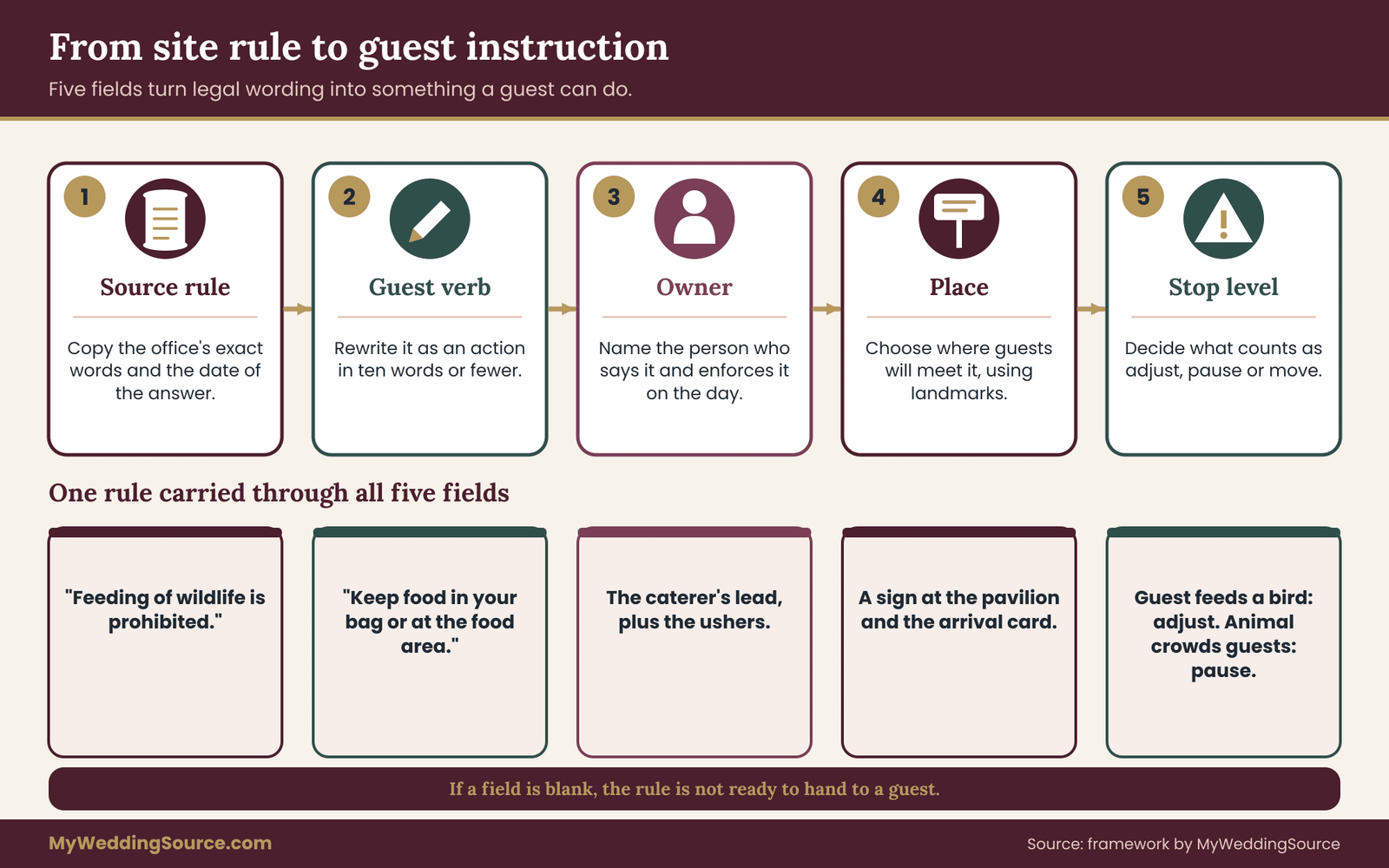
The easiest way to produce it is a four-column working draft that you keep in your notes. Column one is the source: the exact wording from the office, with the date. Column two is the guest action: what a person should do in a single sentence of ten words or fewer.
Column three is the owner: the person who is responsible for communicating or enforcing it on the day. Column four is the place: where guests will meet it. Do not create a table in the final piece. The working draft is only for you.
Rewrite each rule as a verb
Rules written in legal language start with a prohibition. Guest instructions work better when they start with a verb the guest can perform. “Feeding of wildlife is prohibited” becomes “Keep all food in your bag or at the food area.” “Entering closed habitat is prohibited” becomes “Stay inside the marked ceremony area.” “Pets must be leashed” becomes “Dogs stay on a short leash, or stay at home.”
The positive form tells people what to do, which is less likely to produce a defensive reaction and more likely to produce the right action. Guests follow wildlife rules more readily when each one reads as an action, not a warning.
Keep each instruction concrete enough to picture. “Respect nature” fails because no one can say whether they are respecting it. “Stay on the gravel path until the ceremony ends” can be checked by looking down. Wherever you can use a landmark, use it: the fence, the boardwalk, the oak, the parking sign, the third bench. Landmarks survive the confusion of a crowd better than distances in feet or meters.
Keep the brief short enough to read
A guest brief with a dozen items will not be read. The usual result is that guests read the first two and skim the rest. Try to limit the sheet to six items, ordered by risk, with the most serious first. If the site’s wildlife rules truly require more, split them into “before you arrive” and “at the site,” and make the second list the one that is short enough to read standing up.
A workable ordering is: where to stand and walk, what to do with food and drink, how to behave if an animal appears, what not to bring or throw, how to leave the site, and whom to ask. That last item is not optional. A person who is unsure and has someone to ask will ask. A person who is unsure and has no one to ask will guess. Wildlife rules with no named contact are rules that guests will interpret for themselves.
Say why, in one clause
Add a short reason to the two or three rules that guests are most likely to resist. People follow rules they understand, and a clause costs only a few words. “Please do not feed the gulls, because fed birds crowd and snatch food from guests” gives a guest a practical reason.
“Please stay behind the rope; the dunes are nesting habitat” gives an ecological one. Do not attach a reason to every line or the sheet will read like a sermon, and do not invent reasons that the office did not give. If you are not sure why a rule exists, ask.
Decide the tone before you draft
The tone should be warm, calm and brief. Avoid shouting capitals, threat language, and exclamation marks. Avoid humor that makes light of the wildlife rules. Do not write as though guests are suspects. A friendly sentence such as “The park is home to a lot of wildlife, so we have a few ground rules” tells guests that the couple cares about the place and that the wildlife rules are about the place, not about them.
If your wedding includes guests who are children, older adults, people with limited mobility or people unfamiliar with the area, consider how each reads and moves. A child may not understand “keep your distance” but will understand “we look at animals with our eyes, not our hands.” A guest who uses a wheelchair or walker may need a surface that the rule allows.
If the rule keeps people on a gravel path and the guest cannot use gravel, that is a conflict to raise with the office before the day, not on it. Ask the office which alternative routes or surfaces are available.
The vendor instruction sheet and the wildlife rules it must carry
Guests visit for a few hours. Vendors do the physical work: they arrive early, move heavy objects, run power, handle food and leave late. That makes vendors the group most likely to affect habitat, and also the group most likely to have a standing practice that does not fit the site. The vendor sheet exists to replace their usual assumptions with your site’s wildlife rules before they load the truck.
Keep the vendor sheet separate from the guest brief. It is longer, more technical and addressed to professionals who will read it with a pen. It should open with the site name, the permit contact, the date, and the contact person on the day, followed by the six duties described below.
Send it with the contract amendment or the final logistics message, not as a casual attachment on the morning of the event. A vendor who sees the wildlife rules after loading the truck has already made the choices that the sheet was meant to affect.
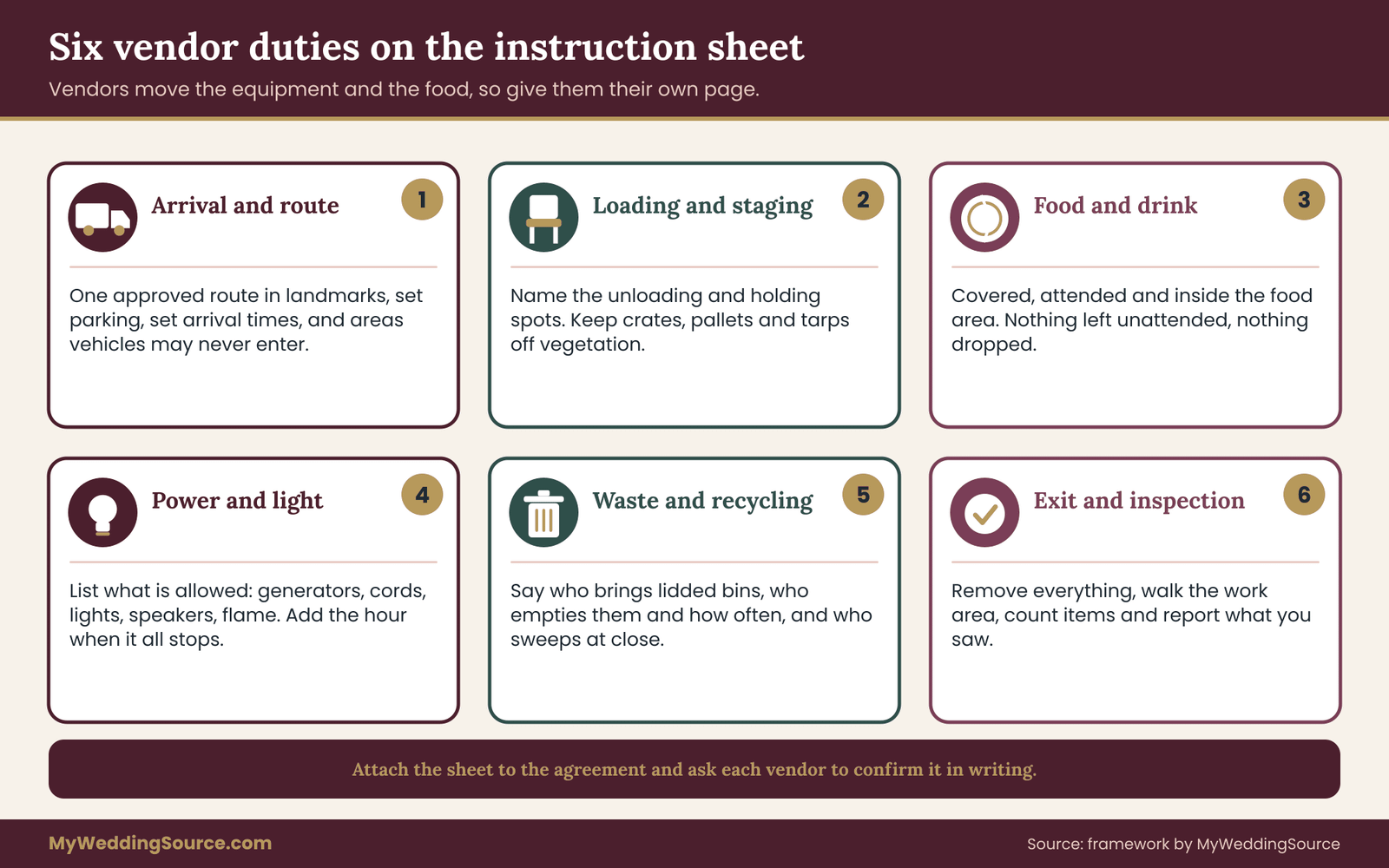
The six vendor duties
Arrival and route. State the single approved route from the road to the event area, the parking area for each vehicle, the times vehicles may be on site, and any area vehicles may not enter. Many sensitive-area violations at events are not deliberate; they are the result of a driver following a navigation app to the nearest point. Ask the office for a route description in landmarks, and put the same description in the vendor sheet.
Loading and staging. Name where equipment may be unloaded and where it may be stored while waiting. Equipment should not be set down on vegetation outside the event area. Pallets, crates and tarps change the ground beneath them, and a tarp left over grass for hours can damage it.
Food and drink handling. Spell out the rule for how food is held, served and cleared. The next section covers this in detail. The key point for the sheet is a single line: “No food or drink is left unattended outdoors at any time, and nothing is discarded on the ground.”
Power, light and sound. List the sources that are permitted and the ones that are not. Generators, extension cords, string lights, speakers and open flame can each affect animals, and each may be restricted by the site. Ask the office whether there are hours when artificial light or amplified sound must stop. Ask the office to state its light and sound wildlife rules by hour, not only by general category.
Waste and recycling. State who brings containers, who empties them, where the waste goes and how it is contained during the event. Require lidded containers where the site demands it, and require a sweep of the area at close.
Exit and inspection. Require each vendor to remove everything they brought, to walk their work area with a checklist, and to report anything they saw, such as an injured animal, a nest near their area or a damaged barrier. This is also the moment to ask for photos of the area before and after, which the couple may need if the office asks for evidence.
Put the wildlife rules into the contract language
A sheet is a request, and the wildlife rules it carries should be written the same way each time. A contract clause is an obligation. If a vendor’s usual practice conflicts with the sheet, you want the sheet to prevail, and the cleanest way is to attach it to the agreement and to add one sentence that says the vendor will follow the site’s wildlife rules and the attached instructions.
The wedding vendor contract guide explains how amendments and attachments should be handled, and the sentence is only a reminder that the sheet is a part of the agreement.
Do not copy long legal paragraphs into a vendor contract. Vendors who see a wall of language may sign without reading it. A short attachment with six plain duties is more likely to be read, remembered and followed. Six plain duties carry the wildlife rules in a form that vendors will use.
Vendors who need special attention
Some vendors have higher exposure to wildlife rules than others. A caterer handles the single largest attractant. A florist and a decorator handle plants and objects that may be restricted. A band or DJ controls sound and often lighting. A rental crew handles vehicles and large items. A photographer and videographer move off the path to find angles, and may fly drones.
Transportation providers may idle engines near sensitive areas. Give each of these vendors a clear marked line on the sheet that applies to their work, and ask each to acknowledge it in writing.
If a vendor refuses or says the rule is unreasonable, treat it as important information. A vendor who will not work within the site’s wildlife rules is a risk to your permit. You may need a different vendor, a changed plan or a different site, and it is much better to find that out three months before the date than the morning of.
Food, drink and trash under wildlife rules
Food is the main route through which a wedding affects animals. Most of the situations that cause a ranger to intervene, an animal to be hurt or a permit to be questioned begin with food or its remains. For that reason this topic gets its own section, even though the vendor sheet covers it in a line.
The idea is simple. Most food-related wildlife rules rest on a single idea. Animals learn from experience. An animal that finds food near people once will return, and it may approach with less caution each time. That behavior can create danger for the animal and for people, and it can lead managers to remove the animal. The site’s food-related wildlife rules exist to prevent the first time.
Decide where food is allowed
The safest plan is to concentrate all food and drink in one defined, attended area, and to keep guests there while they eat. This is the simplest way to meet food-related wildlife rules without policing anyone. A guest who walks across a meadow carrying a plate is a moving attractant. A guest at a table inside the food area is not. If the site allows no food at all in the ceremony area, set the food area elsewhere and tell guests.
Consider the ceremony and reception as separate in this respect. The ceremony can be a food-free event of twenty or thirty minutes, with water in sealed bottles at most. The reception, where food appears, can be held in a space that the site designates for it, which may be a pavilion, a parking-lot-adjacent lawn or a different location altogether.
If the site has no suitable place for food, consider holding the meal elsewhere, as a later part of the day. That separation is a good conservation choice and also reduces cost and complexity at the park.
Closed containers, closed tables, closed bins
Whenever food is outdoors, ask how it will be covered. Closed containers keep out insects and birds, and covered tables reduce odor. Trash bins should have lids that animals cannot open and should be emptied during the event, not only at the end. A full open bin is a feeding station. If the site requires animal-resistant bins, use them, and do not substitute a regular bin because it is more convenient.
Plan for the smaller crumbs and drips as well. A tray of pastries produces more crumbs than most people realize. A beverage station drips sugar. A bar produces bottle caps and citrus peels. Assign a person to sweep and wipe the food area at set intervals, and give that person a small kit with a lidded bin, a hand brush, a dustpan, wipes and spare bags.
Do not leave food out for the “look”
Some wedding styles rely on displays that stay out for hours: dessert tables, grazing boards, fruit arrangements, candy bars, favor baskets with edible items. These are appealing and are also very attractive to animals. If your plan includes display food, ask whether the site permits it, put it under cover, bring it out late, and remove it quickly. Replace long-term food displays with items that are not edible, or with foods that are served directly from a staffed station.
For the same reason, avoid edible favors that guests will carry across the site, and avoid anything that is meant to be scattered, such as birdseed. Birdseed is sometimes presented as a nature-friendly alternative to rice or confetti, but many parks prohibit it because it feeds wildlife and attracts animals to a place where people are gathered. Ask before you buy. Many wildlife rules on thrown items are written broadly for exactly this reason.
Drinks, ice and water
Drinks are easier than food, but not harmless. Sugary drinks attract insects. Alcohol may be limited or banned by the site, and the permit may require licensed service. Ice that melts leaves a puddle that attracts insects. Ask the office about the water supply as well: some sites do not permit guests to fill containers from natural sources or to dump water on the ground, and some restrict the use of cooler drain plugs.
If you plan a toast, think about how the toast moves. Flutes passed hand to hand at the ceremony site become glasses on the ground. A single beverage station with a sturdy table and a bin at hand, and a guest request to finish drinks before moving away, is simpler than a roaming service that cannot be controlled.
Trash that animals can reach
The most important trash rule is that nothing is left behind. The second most important is that nothing is buried, burned or placed in bins that are not meant for it unless the site says so. The third is that trash is not left in a pile on the ground “for the crew to pick up later.” Piles are open invitations. If the site has no trash service, the plan must include removal by the couple’s team, in closed bags, in a vehicle, before anyone leaves.
For the broader question of reducing waste at a wedding in general, the guide to wedding waste reduction planning covers supplies, rentals and disposal. The point in this article is narrower: whatever is left outdoors after the event is a wildlife risk, so the standard for cleanup set by wildlife rules is higher than “looks tidy.”
A short cleanup standard
Use a plain standard that anyone can apply: walk the area in a line, slowly, with a bag, and look at the ground. Pick up every item that does not belong, including twist ties, bottle caps, small bits of ribbon, pieces of tape, cigarette butts, flower stems and broken glass. Assign two people so that one can check the other’s work.
Take a photo of the clean area, and take another a few minutes later from a different angle. If the site requires a check by staff before you leave, ask when they can do it and schedule the end of the event around that time.
Light, sound and movement near wildlife
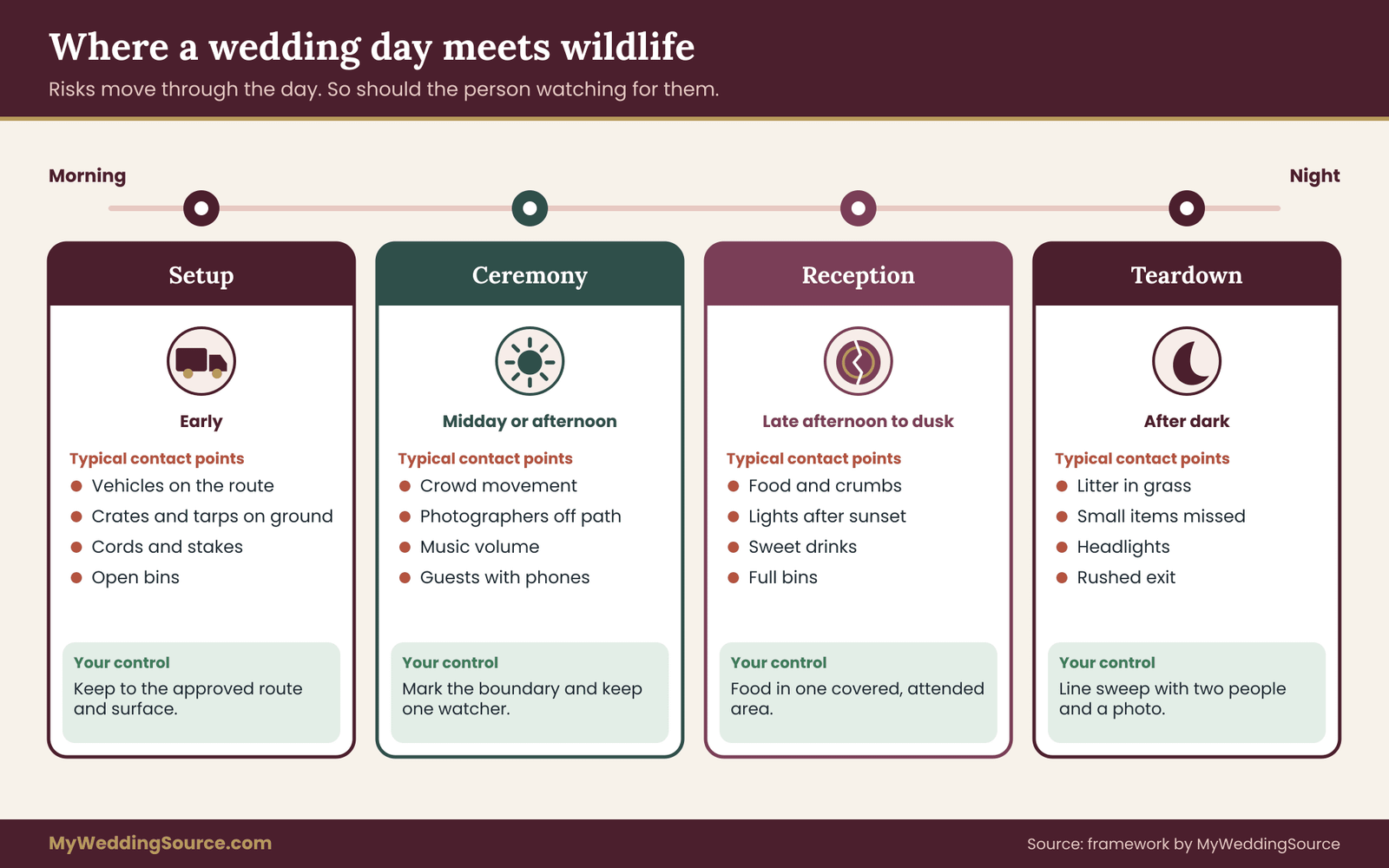
Animals notice what people do not. A bright light in the evening, a speaker with bass, a procession that moves through a quiet field and a crowd that surges toward a photographer all register as disturbances. The wildlife rules for light, sound and movement are usually less detailed than the food-related wildlife rules, yet they matter just as much, because they affect animals that never come close enough to be seen.
The first question is what time it is. Many animals are most active at dawn and dusk, which are also the times couples prefer for photographs. A ceremony at sunset places guests at the site during the hours when wildlife is most likely to be moving, feeding or returning to shelter.
A midday ceremony may be less appealing visually but may place fewer demands on the site. Ask the office whether certain hours are quieter for the animals that live there, and weigh the answer against the light you want. Wildlife rules about hours often matter more than wildlife rules about equipment.
Sound
Amplified sound is limited at many sites, sometimes to a defined area, sometimes by hour and sometimes completely. Even when it is allowed, the effect on animals can be greater than the effect on people, because sound travels over open ground and water. A string quartet, a solo guitar or an acoustic ensemble usually has less impact than a full sound system. For a small ceremony, a lavalier microphone for the officiant and one small speaker pointed toward guests may be enough, and some sites ask for no amplification at all.
If you do plan music, pick a volume that suits the guests nearest the speaker and not the guests farthest from it. Place the speaker so that it points away from open habitat and toward people. Ask the office whether there is a quiet-hours rule, and end music before it begins. For help with ceremony timing and the order of cues, the ceremony cue sheet guide is a helpful reference, and the wildlife cue to add is simple: the person who watches for animals can call a pause.
Light
Light at night changes behavior. Some animals avoid it, some are drawn to it, and some are disoriented by it. Parks that are dark by design, such as those with coastal nesting areas or dark-sky programs, may restrict lighting closely. String lights, lanterns, spotlights, camera flash and vehicle headlights are all lights. Open flame, including candles, is often restricted as a fire hazard, and in dry conditions may be banned altogether.
If the site allows lighting, ask about color, brightness, direction and shut-off time. A warm, low, shielded light that points down and away from habitat is usually a smaller disturbance than a bright white light shining out. Battery-powered candles and small shielded lamps are common substitutes for open flame, though they too may be limited. If the ceremony ends after dark, plan the guests’ walk to the cars with the lowest light the site allows and with people who know the route.
Movement and crowd behavior
A group of people moves differently from one person. A processional through an open field, a recessional with a cheering crowd or a group photo on a slope can push people into places they would not otherwise enter. The remedy is to define the boundaries physically: a visible line, a rope, a row of cones the site permits, or a stationed person. Wildlife rules about boundaries only work when guests can see where the boundary is. People respect a line they can see. They rarely respect a line described in an email.
Plan for the exit as well as the entry. After a ceremony, guests naturally spread out toward photographs, restrooms and cars. Place a helper at each point where a path splits, and give that helper a short sentence to say to guests who start to leave the route: “This way to the cars, please. The other area is closed for nesting.” The sentence has the reason in it and invites no argument.
Photographers, drones and close approaches
Photographers have a particular relationship with wildlife rules. Their job is to find the best view, and the best view is often just beyond the boundary. A photographer who has worked in studios and ballrooms may not recognize habitat. A photographer who works outdoors regularly may be a good partner, or may assume that the usual practice is safe.
Include the photographer in the vendor sheet and in a short conversation. Photographers who know the wildlife rules in advance rarely need to be corrected on the day. Show a map of the event area. Point out the closed areas. State that the wildlife rules and boundaries prevail over any shot.
Ask where the photographer plans to stand for the main moments, and confirm that those places are inside the permitted area. If the photographer needs a spot outside it, ask the office whether the permit can include it, or choose another angle.
Photos with animals present
If an animal appears during the ceremony, the correct response is to let it be. The photographer should not move toward it and guests should not crowd it. A moment with a bird on a fence in the background is a bonus, and a photograph that results from staying still is better than one that results from chasing. Make it a standing rule that no photograph is worth approaching an animal. If your site publishes distance guidance, include it on the vendor sheet in the office’s own words.
Wedding photographers sometimes use baits or props to attract animals for pictures, or propose staged photos with domestic animals such as horses. Do not allow baiting, and treat any staged animal photo as a separate permission question that the office must approve. For guidance on the legal and consent side of photography itself, the guide to wedding photography consent covers who may be photographed and under what terms.
Drones
Drones are a common request and a common problem. Many public lands restrict or prohibit launching, landing or operating unmanned aircraft, and separate federal rules apply to flight in general. A drone near nesting birds or other animals can cause alarm, and many offices treat this as a serious matter. Do not assume that a professional operator’s usual licenses settle the question.
A drone operator’s license does not replace the land manager’s wildlife rules. The land manager decides whether launching from or over the site is permitted, and the aviation authority sets rules for the airspace. Ask both questions, and if the answer is no or unclear, do not fly.
If a guest brings a personal drone, the guest brief should say plainly that drones are not allowed unless the couple has written permission. A drone launched by a guest in the middle of a ceremony is the kind of event that ends in a ranger conversation.
Selfies, props and “just one more”
A group of guests with phones is a group looking down, not around. They can step off paths, climb on structures, lean over railings and move toward animals without noticing. A short line on the brief can help: “Take photos from the path, and look up before you step.”
An officiant or a helper can repeat it at the start of the photo session. If a guest asks to take a photograph in a closed or marked area, the answer is always no, and the helper who says it should have the authority to say it.
Decor, plants and anything released or thrown
Decor is where a couple’s visual plan most often meets the site’s limits. The general question of what you may place in a public park belongs to a separate guide, and the park decor rules differ from site to site. In this section, the focus is narrower: which decor decisions interact with wildlife and plants, and how to choose lower-impact alternatives.
Things that are released or thrown
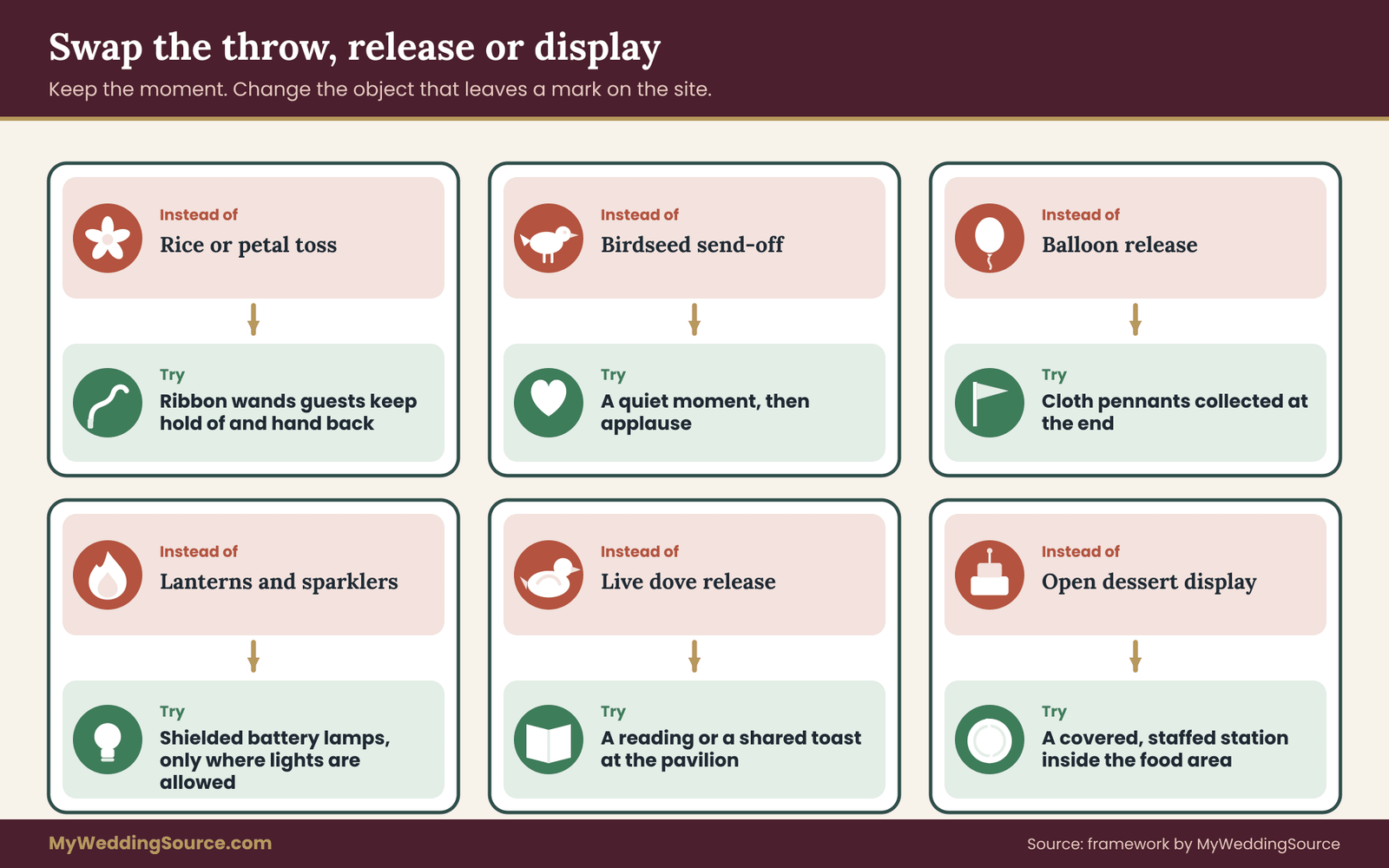
The classic items are rice, birdseed, petals, confetti, glitter, balloons, lanterns, bubbles, ribbon wands, sparklers and live animals such as doves or butterflies. Many parks restrict or prohibit them for one or more of these reasons: they can be eaten by animals, they can tangle or choke, they can create litter that is hard to collect, they can start fires, or they can introduce non-native species.
A release of live animals is often a bigger issue than guests expect. The animals may not survive, may not belong in the local ecosystem and may spread disease.
The easiest approach is to assume that anything released is prohibited until the office says otherwise. Wildlife rules on releases and throwing tend to be among the strictest at any site. Ask directly, item by item, in writing. If the answer is yes, ask for conditions, such as biodegradable petals only, collected after the ceremony, in a specific area.
If the answer is no, choose a different gesture. Guests can wave ribbons held on a stick that they keep, blow soft bubbles inside a hall, hold a quiet moment, or simply clap. A final gesture does not have to scatter anything to feel celebratory.
Plants and flowers
Plants raise two issues. The first is what you may take: picking wildflowers, branches or moss is often prohibited, and a decorator who gathers greenery from a roadside or a park is taking something that belongs to the public and may be protected. The second is what you may bring: cut flowers and potted plants can carry seeds, insects or soil that introduce non-native species. Some sites have rules about plant material that may enter the site and where it came from.
Ask the office which plant materials are allowed. Wildlife rules on plants often sit in a different document from the event permit, so ask for both. Then ask your florist how the flowers were grown and handled, and whether they are free of soil and seeds. Potted plants are often more problematic than cut stems, because the soil can carry things you cannot see.
If the site restricts plants, consider decor that does not rely on living material, such as fabric, paper, wood, glass or ceramic objects that you remove at the end. The narrower point is that anything living from elsewhere deserves a question.
Stakes, ropes, signs and structures
Anything that touches the ground may harm it. Stakes can damage roots and burrows, and heavy structures can compress soil. Arches, aisle markers and sign posts should be freestanding on weighted bases where the site allows, and placed on durable surfaces, not on vegetation. Fishing line, string and wire are hazards to birds and small mammals and should not be used. Tape and zip ties are small, hard to find and easily swallowed. Choose fabric ties and rope that you can count and collect.
Signs are a special case, because the couple’s own signs can help or hurt. A guest sign that points the way is useful, and a small one that explains the nesting area is better still. A sign that is staked in a sensitive area, or that uses adhesive on a post, is a problem. The wedding signage system guide explains how to plan signs as a set, and the wildlife addition is that each sign must be approved, placed on an allowed surface and counted on the way out.
Pets, ceremonial animals and service animals
Many sites regulate dogs and other pets, and some prohibit them completely in sensitive areas. Service animals are treated under separate legal rules, and the office can tell you what applies. If a couple wants a dog in the ceremony, ask the office first, and plan for a handler whose only job is the dog. If a guest brings a pet without asking, the person at the entry point should know what to say.
Horses, carriages, birds of prey and other animals that are part of a ceremony raise further questions, including insurance, permits and welfare. Treat each as a separate permission item that may be refused Wildlife rules on animals brought to the site are often stricter than guests expect. Treat each as a separate permission item that may be refused, and do not build a ceremony around one until the office has said yes.
Worked case: a shoreline park ceremony and its wildlife rules
The following example is invented to show the method. The park, the people and the answers are fictional, and the details are not a statement about any real site or agency. Your office will give you different answers, and you should follow those.
Imagine a couple, Priya and Tom, who want a late-afternoon ceremony for fifty guests at a fictional city shoreline park called Heron Point. They have a permit application in progress. They have a caterer, a florist, a photographer, a small acoustic duo and a rental company. They have not yet asked about wildlife.
Step one: the five questions
Priya calls the parks office and asks the five habitat questions. In this story, the office gives these answers and sends a short email confirming them. First, shorebirds nest in the dune grass beside the beach path from early spring until late summer, and the ceremony date falls inside that period. Second, the ceremony may be held on the mowed lawn between the parking area and the boardwalk, and no one may enter the roped dune area.
Third, no food or drink is allowed on the lawn except sealed water, the pavilion may be used for the meal, and rice, petals, confetti, balloons, bubbles, lanterns and drones are not allowed. Fourth, if an animal appears, guests should stay still and call the staff number, and any staff member may pause the event. Fifth, the office will tell the couple by email if a closure line moves, usually with at least a week of notice.
Priya writes a summary of these answers and replies to the email, asking the office to correct anything that is wrong. The office confirms, with one change: the sealed water rule applies only during the ceremony.
Step two: the working draft
Tom turns the answers into the working draft described earlier. Each line holds the rule, the verb for the guest, the owner and the place.
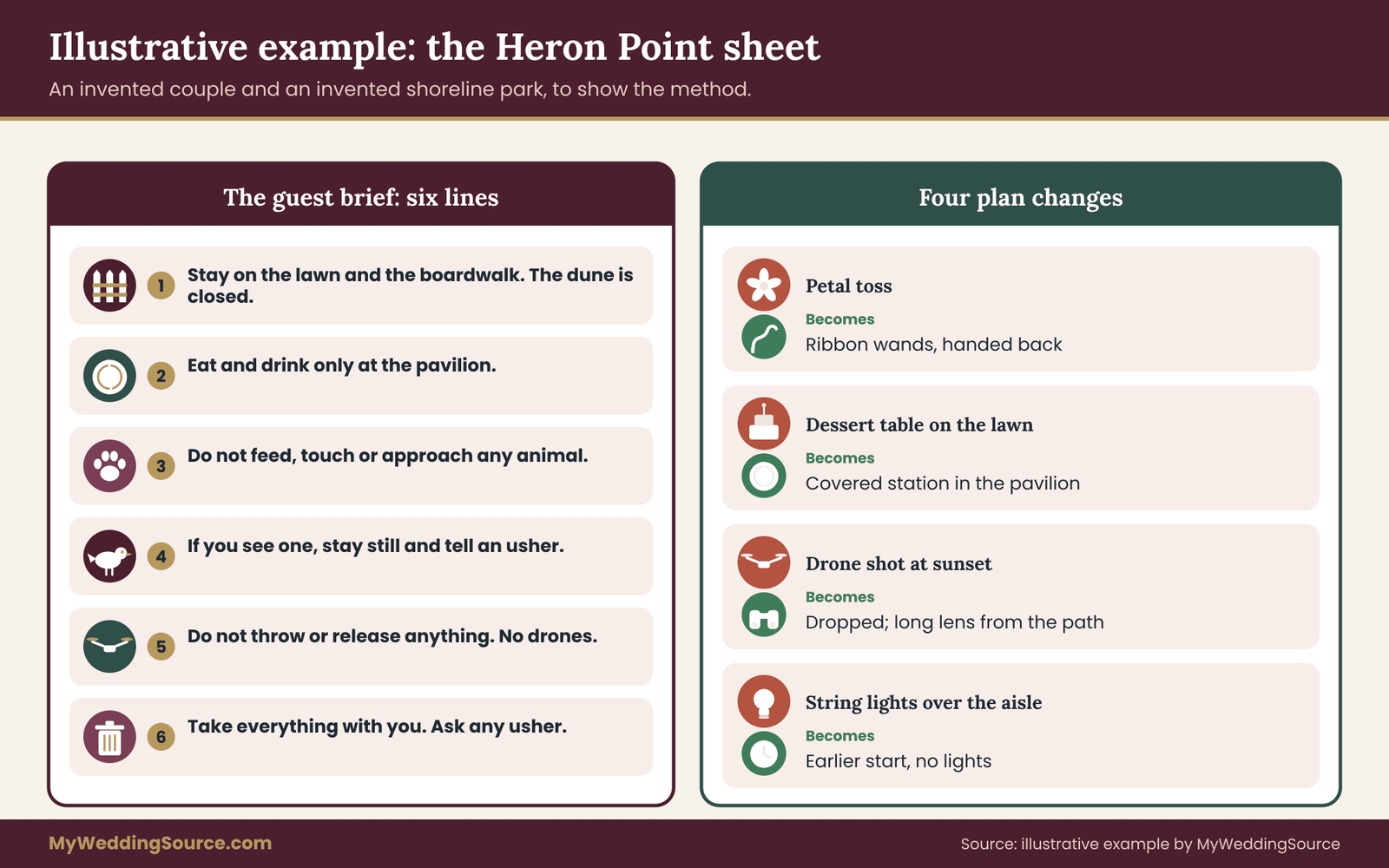
The rope rule becomes “Stay on the lawn and the boardwalk,” owned by two ushers, placed on the invitation insert and on a sign at the lawn entrance. The food rule becomes “Eat and drink only at the pavilion,” owned by the caterer’s lead, placed on the website page and on a pavilion sign. The release rule becomes “No throwing or releasing anything,” owned by the officiant, who mentions it at the start of the ceremony.
The animal rule becomes “If an animal appears, stay still and let an usher know,” owned by a designated wildlife watcher, a friend named in the plan, placed on the sheet and at the usher briefing. The drone rule becomes “No drones, please,” owned by the photographer for professional equipment and by the ushers for guests. The leaving rule becomes “Take your things and use the lot path to leave,” owned by the ushers.
Step three: the guest brief
Priya and Tom write the final guest brief as six lines under the heading “A few ground rules for Heron Point.” The text reads, in the spirit of the method:
“Heron Point is home to nesting shorebirds, so a few ground rules help us share it. Please stay on the lawn and the boardwalk; the roped dune area is closed to everyone. Please eat and drink only at the pavilion, and keep all food in your bag or at the table. Please do not feed, touch or approach any animal.
If you see one, stay still and tell an usher. Please do not throw or release anything, and leave drones at home. When you leave, take everything you brought and use the path to the parking lot. Questions? Ask any usher, or the staff at the visitor desk.”
The brief is under one hundred words, uses plain verbs and contains one reason. It goes on the website, in the invitation insert, on two signs, and on a card handed to guests as they arrive.
Step four: the vendor sheet
The vendor sheet is longer. It begins with the site name, the office contact, the permit reference, the date and the day-of contact. It then lists the six duties. For arrival, it gives a single route from the main road to the service lot and states that no vehicle may enter the lawn. For loading, it names the service lot as the only staging area and requires crates and tarps to stay on the pavement. For food, it requires all food to be inside the pavilion, covered when not being served, and all trash to be in lidded bins that the caterer empties every hour.
For power, light and sound, it allows battery lights inside the pavilion only, no lights on the lawn and a single small speaker that faces the guests. For waste, it names the couple’s cleanup team and the end-of-event sweep. For exit, it requires each vendor to walk their area, count their items and report what they saw.
Each vendor replies in writing. The florist writes that the planned scattered petals will be replaced with a bouquet and a fabric runner that will be removed. The caterer writes that the dessert display will move into the pavilion and be covered. The photographer confirms that all shots will be from the lawn and boardwalk and asks whether a longer lens may be used from the path for shots of the shore, which the office allows. The duo confirms unamplified music for the ceremony.
Step five: what changed
The couple’s original plan had a petal toss, a dessert table on the lawn, a drone shot at sunset and string lights over the aisle. After the process, all four are gone or changed. The petal toss becomes a ribbon wand wave using wands that guests hand back. The dessert table moves into the pavilion. The drone shot is dropped. The string lights are dropped in favor of a timing change: the ceremony moves earlier so that it ends before the light is low.
None of these changes costs much, and none shrinks the ceremony. They change what the couple has to buy, carry and clean up. The cost lines for petals, drone service and lights disappear. The ribbon wands cost a little and are returned. The caterer’s tent is no longer needed on the lawn. The couple has not reduced the wedding; they have traded a few effects for a simpler plan with fewer failure points.
Step six: the day
On the day, two ushers stand at the dune side of the lawn. The wildlife watcher, a cousin, carries a copy of the sheet and the staff phone number. As the ceremony starts, a shorebird walks along the boardwalk edge. The watcher does not approach it. She signals an usher, who quietly asks a few guests to stay in their seats. The ceremony continues. The bird walks on.
During the photo session, one guest steps over the rope to get a better angle. An usher says, “This way, please. The dune is closed for nesting.” The guest steps back. No conversation is needed, and no rule has to be enforced by a stranger.
At the end, the vendors walk the area, count their items and report. The couple’s cleanup team does the line sweep, finds three bottle caps and a hair tie, and takes the photos the office asked for.
What the example shows
The case is simple on purpose. The lesson is that the work happened before the day: five questions, a written confirmation, six lines for guests, six duties for vendors, and a short set of changes to the plan. Nothing required special equipment or expert knowledge. The wildlife rules at Heron Point were ordinary, and the sheet still changed four decisions. It required asking, writing and assigning.
The same pattern works for any set of wildlife rules, at larger sites with more complicated wildlife rules. The steps are identical, and the sheet gets longer, so you split it by audience, trim it by risk and test it on someone who has never seen it. A good test is to hand the guest brief to a friend, ask what they would do if they saw a deer near the aisle, and see whether the answer matches what the brief intends. If it does not, change the brief, not the friend.
Testing the sheet before you print it
Before final printing, run a ten-minute check. Read each line aloud and ask whether a stranger could act on it. Compare the sheet with the permit and the office’s confirmation email. Walk the site, if you can, with the sheet in hand and look for places where a guest could still go wrong. Hand the vendor sheet to one trusted person who has not been involved and ask them to explain what each vendor must do. Anything they cannot explain is a place where a vendor will also be confused.
Alternatives when the wildlife rules rule out your plan
Sometimes the answers from the office will remove the thing you most wanted. The nesting area covers the view, the lawn is closed, the pavilion is not available for food or the site bans the music you had planned. This is disappointing, and it is also useful: you learned it before paying for anything that depended on it. The question now is what to change, and the options form a rough ladder from smallest change to largest.
Change the element, not the site
The smallest change is to replace the element that conflicts. A banned release becomes a quiet gesture. A banned light becomes an earlier start. A banned amplifier becomes an unplugged ensemble. A banned food display becomes a staffed station inside a permitted area. Most conflicts with wildlife rules end here, because most conflicts are about one item, not about the whole event.
When you replace an element, check that the replacement does not create a new problem. A ribbon wand is lower impact than petals only if guests keep hold of it and return it. A battery candle is lower risk than flame only if the site allows lights at all. A single speaker is quieter than a system only if it is aimed and capped. Ask the office again if there is any doubt, and write the answer down.
Change the time
The next option is to change the hour or the day. A ceremony earlier in the afternoon may avoid the animals’ busiest period and the need for lights. A weekday may avoid crowds that add to the site’s pressure. A date outside nesting or breeding season may open areas that are closed in spring.
If your guest list is flexible, ask the office which weeks are least restricted and compare them with your own constraints. Travel, vendor availability and guest schedules still matter, and the point here is that the wildlife calendar is a legitimate input as well.
Be careful about shifting only a part of the day. If the ceremony moves, vendors may need new load-in times, the photographer may need new light, and travel arrangements may need adjusting. Make a list of what depends on the time before you ask for a different one.
Change the footprint
A third option is to shrink or redraw the event area. A smaller ceremony space, a different part of the same park, or a ceremony without a reception on site can bring a plan within the wildlife rules. A split event, with a short ceremony at the park and the meal elsewhere, is often the most effective way to stay within food restrictions. It also reduces cleanup, vendor traffic and risk. Some couples find that the shorter, quieter ceremony is the part they enjoy most.
If the footprint shrinks, the guest count may need to shrink with it. A permit and a site capacity usually set an upper limit. Ask the office how it counts people, and see the discussion in the venues guide for how venue capacity interacts with other limits.
Change the site
The largest change is to move to another site. This is sensible when the wildlife rules at your first choice conflict with the heart of the plan. A different park, a garden with its own wildlife policy, a pavilion in a developed area or an indoor venue with an outdoor terrace may fit better. The shorter the list of restrictions, the less planning the sheet requires, but no site is free of wildlife rules, and every site that touches habitat has its own.
When you compare sites, compare them on the same five habitat questions. A site that answers them clearly and quickly is a better partner than a site that answers vaguely, even if the vague site has the nicer view. The ease of getting a straight answer is itself information about how the day will go. A site that can state its wildlife rules plainly is usually a site that enforces them plainly.
Keep a backup that does not depend on wildlife
Whichever path you choose, hold a backup that does not depend on the site’s conditions. The office may change a closure on short notice. A storm may flood the lawn. An injured animal may close a path. A backup can be a covered space, a smaller area, a postponed start or another location that is already arranged. The point is that no single closure should be able to cancel the ceremony. Build the backup into the vendor timeline so that every vendor knows the trigger and the alternative.
Scripts for hard conversations
Plain scripts reduce stress. Use them as starting points, in your own words.
To the office, when a rule blocks something: “We want to follow the wildlife rules and protect the site. Can you tell us what would be allowed instead?” This question invites alternatives and shows good faith.
To a vendor who resists: “The site’s wildlife rules are part of our permit, so we need these changes in writing. Can you confirm that you can work within them?” If they cannot, ask whether they can recommend a colleague who can.
To a relative who wants a release or a toss: “The park doesn’t allow it, and we want to keep the permit. We’d love to do something else together. Could you hold the ribbon wands?” The relative is given a job, and the conflict is resolved by redirecting energy.
To a guest who breaks a rule: “Thanks for stepping back. The dune is closed for nesting.” Say it once, warmly, and move on.
Failure conditions: when to adjust, pause or move
A sheet without stop conditions is a wish list. The part of the process that most couples skip is deciding, ahead of time, what counts as a failure and what happens when it occurs. Without that decision, the person closest to the problem will improvise under pressure, and that person is often a young usher or a nervous couple. Written conditions turn a stressful moment into a checklist.
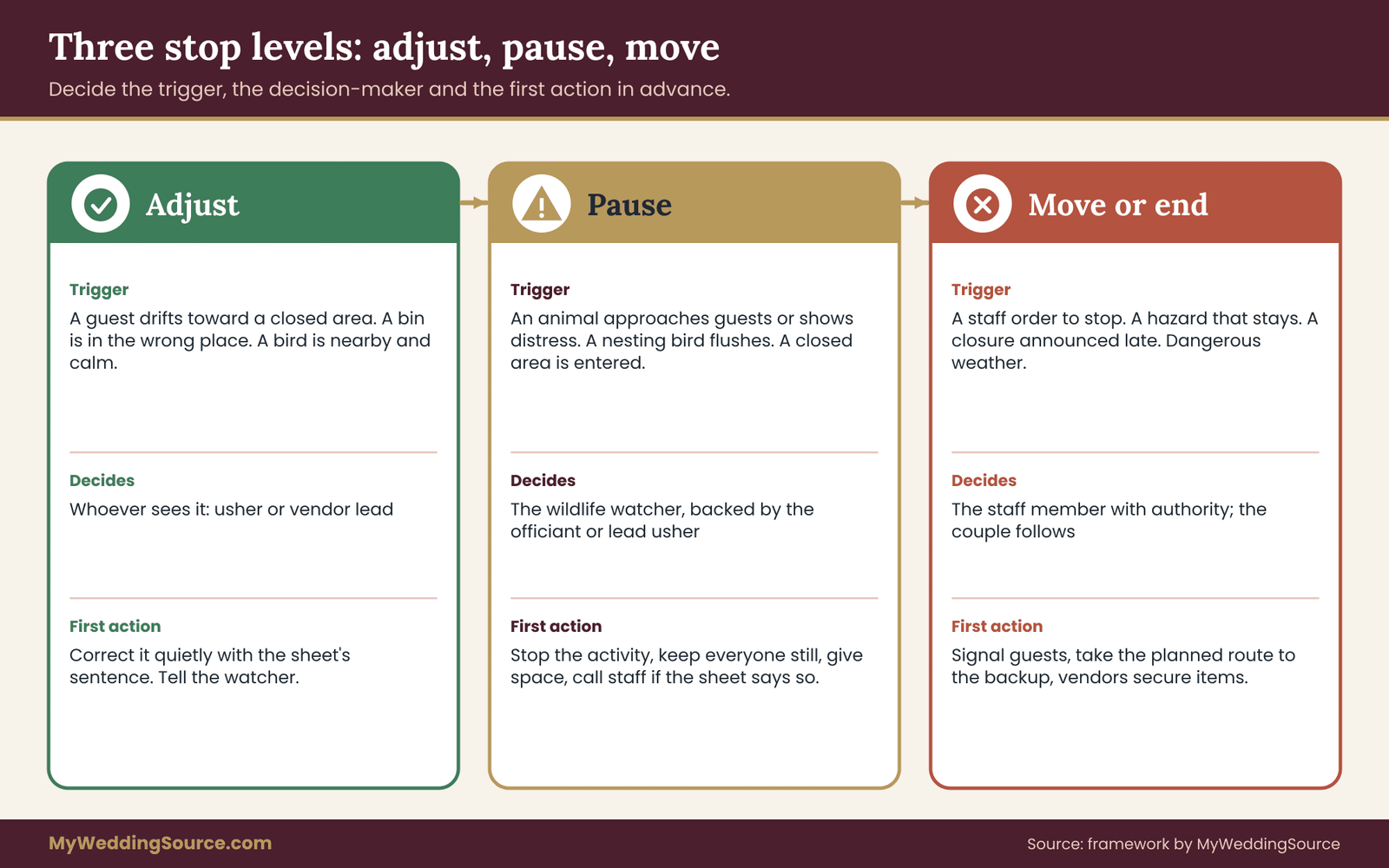
The scheme that follows has three levels: adjust, pause and move. Each has a trigger, a decision-maker and a first action. Tailor them to your site’s wildlife rules and confirm them with the office.
Level one: adjust
An adjustment is a small correction that does not stop the event. The triggers are minor and local. A guest wanders toward a closed area. A vendor places a bin in the wrong spot. A cooler is left open. A guest starts to feed a bird. An animal is visible in the distance and not approaching.
The decision-maker is whoever sees the problem, usually an usher or a vendor lead. The first action is to correct it quietly and promptly, using the short sentence on the sheet. The second action is to tell the wildlife watcher, so the issue is tracked. No one announces anything, and no one is shamed.
Wildlife rules are easier to enforce when no one is embarrassed in front of the group. If the same problem happens three times, treat it as a sign that the sheet or the placement of signs is not working, and fix that.
Level two: pause
A pause is a short stop of the activity that is causing the problem. The triggers are an animal approaching the guests or the ceremony area, an animal showing signs of distress, a nesting bird flushing from a nest near the event, a guest who ignores corrections, or an area that has been entered despite being closed. A pause can also be triggered by a staff member or a ranger at any time. Wildlife rules usually give staff the final say, so a staff request always counts as a pause.
The decision-maker is the wildlife watcher, with the officiant or lead usher as backup. The first action is to stop the activity, keep guests still, and give animals space. The watcher contacts staff if the sheet says to. Do not chase an animal, do not try to move it and do not touch it, even if it seems injured, because injured animals can be dangerous. Wait for the office’s guidance. If the pause resolves, resume. If it does not, move to level three.
Level three: move or end
A move is a change of location or a shortened event. The triggers are a staff order to stop, a hazard that cannot be resolved quickly, an animal that remains in the event area and cannot be moved by staff, a closure announced on short notice, a permit condition that is clearly being broken beyond what can be corrected, or weather that creates danger. The event may move to the backup space, shorten the ceremony or end.
The decision-maker is the staff member who has authority, and, absent that, the couple, advised by the officiant or planner. This must be settled in advance. State on the sheet that a staff direction is final and that the couple will not argue it. The first action is to tell guests calmly, by a prearranged signal, and move them along a route that avoids the problem area. Vendors stop work and secure items. Everyone follows the backup plan.
Recording what happened
Whatever the level, record it, because wildlife rules disputes are settled by dates and facts. A short note with the time, what was seen, what was done and who was told is enough. If the office asks for a report, you will have one. If a vendor disputes a charge because of a pause, you will have the facts.
If the same issue happens at another event, the office may value the information. Keep it in your records alongside the permit and the sheet. Photos of the closed area and the clean area belong in the same folder.
After the event
Within a day or two, contact the office. Thank them, confirm that the site is clear, and ask whether they saw any problems. If something went wrong, say so and ask what you can do to put it right. Offices remember couples who report their own mistakes, and they remember couples who leave problems for others to find. A short, honest follow-up message also protects relatives and friends who want to hold events there in the future.
Then update the sheet, and note any wildlife rules that were unclear on the day. If a rule was unclear, rewrite it. If a sign was missed, move it. If a vendor behaved well, note that for the next time. The sheet becomes a template for any future outdoor event, including a rehearsal dinner, a vow renewal or a family gathering.
Your next steps
Work through these in order. Each takes an hour or less, and together they turn a general intention into a plan that can be checked.
- Name the land manager and the exact area. Confirm who manages the spot where you will stand, park and eat, and who can answer questions about habitat on your date.
- Ask the five habitat questions in writing. Record the name, the date and the words used, and send back a short summary for correction.
- Compare the answers with your current plan. Mark every decor item, food plan, light, sound, vehicle route and photo idea that conflicts with the wildlife rules, then change the plan.
- Draft the guest brief. Six lines, plain verbs, one or two reasons, a warm tone, and a person to ask.
- Draft the vendor sheet. Six duties, a single approved route, and an acknowledgment from each vendor. Use the vendor due diligence checklist to confirm that each vendor’s insurance and practices match what the sheet requires.
- Assign owners and name a wildlife watcher. Give the watcher the sheet, the staff contact and the authority to call a pause.
- Write the three stop levels. Adjust, pause and move, each with a trigger, a decision-maker and a first action, confirmed with the office.
- Place the sheet where it will be seen. Website, invitation insert, signs, arrival card and usher briefing.
- Test, print and rehearse. Hand the sheet to someone who has not seen it, fix what confuses them, and brief your helpers on the day before.
- Follow up with the office. Thank them after the event, report anything that went wrong and update your template.
If any step turns up a rule that blocks your plan, go back to the alternatives ladder: change the element, then the time, then the footprint, then the site.
FAQ
Do wildlife rules apply to a small ceremony of only a few guests?
Usually yes. Wildlife rules attach to the place, the activity and the permit, not to the number of people, and a small group can still disturb a nest or feed an animal. A small group is easier to brief, though, which makes the guest brief more effective. Confirm with the office whether any rule changes with group size, such as a stricter limit on where the group may stand.
Who should I ask about the wildlife rules for my site?
Ask the office that manages the land, such as a city or county parks department, a state park, a national park unit or a refuge, and ask the permitting office if it is separate. If a protected species is involved, that office will usually say which wildlife or environmental agency is also involved. Always ask for the answer in writing for your exact date and area.
Can we release doves, butterflies or balloons if we clean up afterward?
Treat releases as not allowed until the office says yes in writing. Live animals may not survive or belong in the local ecosystem, and balloons and lantern debris can harm animals and cause litter or fire. Cleanup does not undo those risks, because a released item cannot be recovered. A quiet gesture, such as ribbon wands that guests return, avoids the issue entirely.
Is birdseed a safe substitute for rice or confetti?
Not necessarily. Birdseed feeds wildlife, which many parks prohibit, and it draws birds and other animals to the place where guests are gathered. Some sites also limit it because seed can spread plants that do not belong there. Ask the office before buying anything meant to be thrown, and if the answer is no, choose a gesture that scatters nothing.
What should guests do if an animal approaches during the ceremony?
Stay still, stay calm and give the animal room. Do not feed, touch, chase or photograph it from close range. Tell an usher or the wildlife watcher, who can call a pause and contact park staff if the sheet says so. If an animal looks hurt, do not handle it. Wait for staff guidance, and resume only when they or the watcher say it is clear.
Can our photographer use a drone or go off the path for a better shot?
Only if the land manager allows it in writing. Many public lands restrict drone launches and flights, and aviation rules apply separately, so both questions need answers. Off-path shooting can enter closed habitat, which is a common cause of problems. Give the photographer the boundary map, confirm where they will stand, and treat the site boundary as the limit of any shot.
How do wildlife rules affect decor such as plants, arches and signs?
They can limit what you bring, what you place and what you take. Sites may restrict outside plants and soil, picking local vegetation, stakes in the ground, tape, wire and anything that could be swallowed or tangle an animal. Use freestanding items on durable surfaces, count everything in and out, and ask the office to approve signs and structures before you order them.
What if the park changes a closure before our date?
Ask early how and when the office will notify you of changes, and keep your backup plan ready. Pass any change to vendors and guests through the same channels you used for the sheet, and update the sheet so the new wording matches. If the change removes something essential, use the alternatives ladder: change the element, the time, the footprint or, as a last resort, the site.
Sources
Check each agency for current rules, forms and fees, because they change.
- National Park Service: park-specific rules, wildlife safety and special use permit information.
- U.S. Fish and Wildlife Service: national wildlife refuge information and federal wildlife protection programs.
- U.S. Forest Service: national forest recreation rules and special use permit contacts.
- Bureau of Land Management: public lands recreation and permit information.
- NOAA Fisheries: marine mammal and protected marine species guidance for coastal sites.
- Federal Aviation Administration, unmanned aircraft systems: federal rules for drone operation.
- U.S. Geological Survey: public information on wildlife and natural resources.
- U.S. Environmental Protection Agency: general environmental guidance, including waste and litter.
- Leave No Trace Center for Outdoor Ethics: outdoor ethics principles for minimizing impact.
- ADA.gov: federal information on service animals and accessibility.