
A venue comparison between an unusual space and a traditional ballroom goes wrong when the two are measured on different things. This guide gives you a venue comparison scorecard that starts from what a ballroom quietly includes, scores every line of the other venue against it, and shows you which gaps you can close and which ones end the search.
Write down what a ballroom provides by default, then score each of those lines at the nontraditional venue as Included, Bring-in, Absent or Blocked, and mark whether the answer is in writing. Count the Bring-in lines, because each one is a task and a quote you now own. Walk away if any must line is Blocked or still unconfirmed on the date your hold ends. Compare totals only after every Bring-in line has a written quote.
Couples who tour a museum hall, a library reading room, a warehouse or a boat usually fall in love with the space and then try to compare it with a hotel ballroom using a gut feeling. The ballroom quote arrives as one tidy package. The unusual venue arrives as a rental fee and a long, friendly silence about everything else. The two numbers look comparable, and they are not.
This article is about the venue comparison itself, not about any one kind of venue. It does not ask whether you should choose an unusual place; it asks how to tell, on paper, what choosing it would actually involve. That makes the process useful for a library, a gallery, an industrial loft, a botanical garden building or a restored rail depot, and it keeps you honest about the traditional option as well.
A note on scope. This is general planning information, not legal, insurance or financial advice. Rules about occupancy, alcohol, accessibility and insurance differ by place and change over time, so confirm each one with the venue, the local fire authority and the agency named in the Sources section.
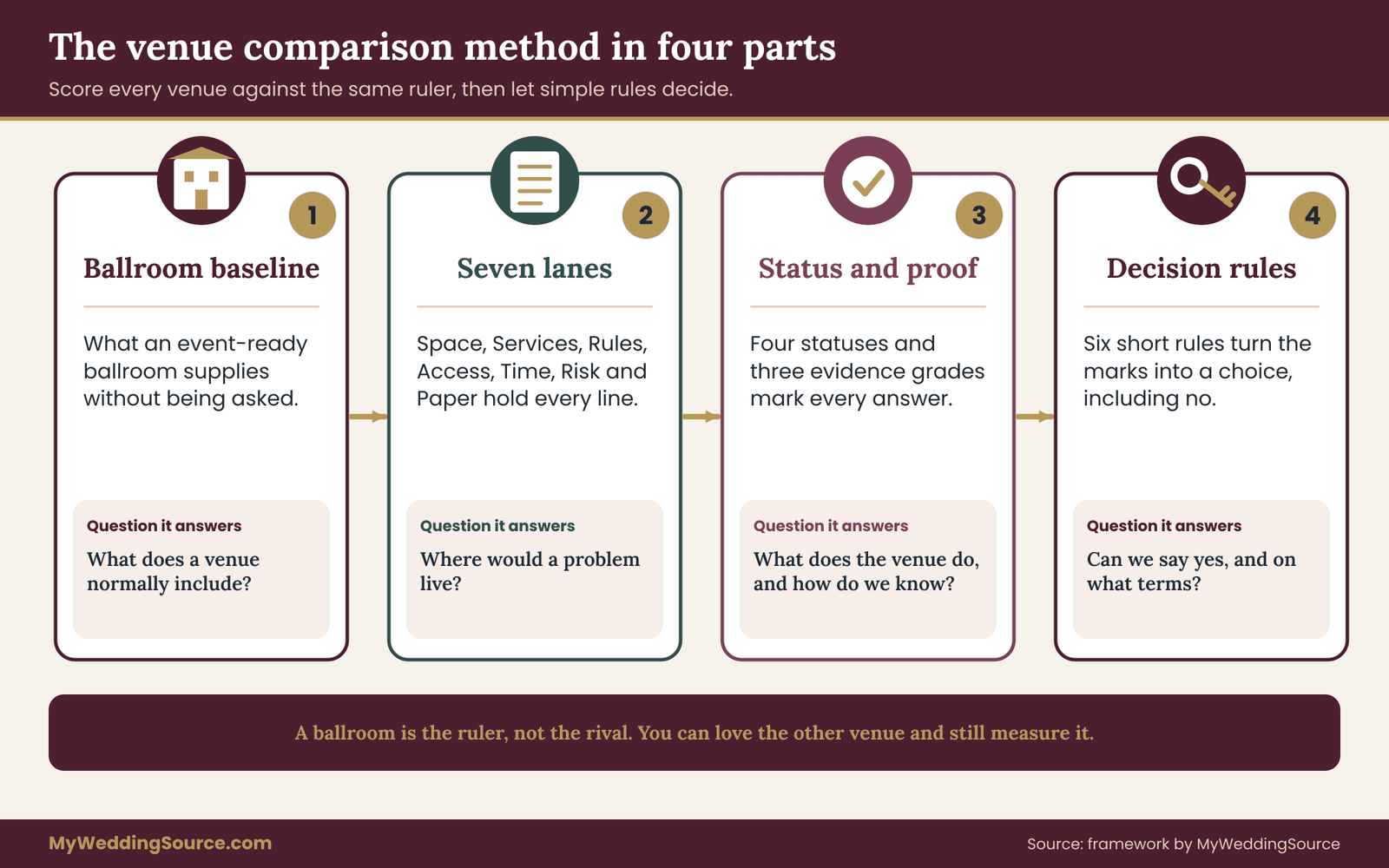
The venue comparison method has four moving parts, and the rest of the guide builds them one at a time. A ballroom baseline tells you what a venue normally supplies. Seven lanes organize the questions. Four statuses and three evidence grades describe each answer. A short set of decision rules turns the pattern of answers into a choice, including the cases where the honest result is no. Along the way you will see one worked case with an invented couple and invented venues, so the logic is visible without any made-up prices.
For the broader question of how to choose a venue at all, including costs, tour questions and red flags, start with the general wedding venues guide. This article picks up at the moment you are holding two real options and need to compare them fairly.
Why a venue comparison needs a ballroom baseline
Most venue comparison advice is a list of things to look at: capacity, price, location, parking, catering. Lists like that fail on unusual venues for a specific reason. They assume every venue offers the same categories of thing and differs only in quantity. A ballroom has a catering kitchen, so you compare menus. A gallery may have no kitchen at all, so there is nothing to compare until you decide how food gets there.
The baseline fixes the venue comparison problem. Instead of comparing two venues to each other, you compare each venue to the same reference: the set of things a competent, event-focused ballroom supplies without being asked. Anything the ballroom supplies and the other venue does not becomes a visible line item with a status, rather than a thing you discover three months later.
The ballroom is a reference, not a rival
You do not have to like ballrooms for this to work. Plenty of couples want the opposite of a ballroom and will choose an unusual space regardless. The baseline is not a vote for the traditional choice. It is a ruler. A ruler can measure a thing you love without making you love it less.
It also protects against a quieter bias. A ballroom quote that includes tables, chairs, linens, staff, a kitchen, a bridal suite, a coat check and a day-of manager looks expensive next to a gallery rental fee. But the gallery fee excludes almost all of that. The fair venue comparison is the gallery fee plus the cost of replacing each missing line, and you can only add that up if you have listed the lines.
What the venue comparison is deliberately not
This venue comparison is not a ranking of venue types. It does not say museums beat barns or that hotels beat libraries, and there is no tested vendor ranking behind it. It is also not a price survey, because prices depend on your region, date and guest count, and any figure printed here would be out of date or wrong for you. Where money matters, the method tells you to use your own written quotes.
Finally, a venue comparison is not a replacement for the venue’s own rules. If a museum or library publishes event guidelines, those control. The venue comparison scorecard’s job is to make sure you have read them, and that you have turned each sentence into a status.
Who this is for
The venue comparison scorecard suits three situations. First, you have two or three finalists and one of them is unconventional. Second, a family member is pushing for the ballroom “because it is easier,” and you want a calm way to test that claim. Third, you already love an unusual space and want to know whether the plan holds together before you pay a deposit. In all three, the venue comparison does not deliver a verdict on taste. It is a clear picture of what each choice asks of you.
What a ballroom quietly includes
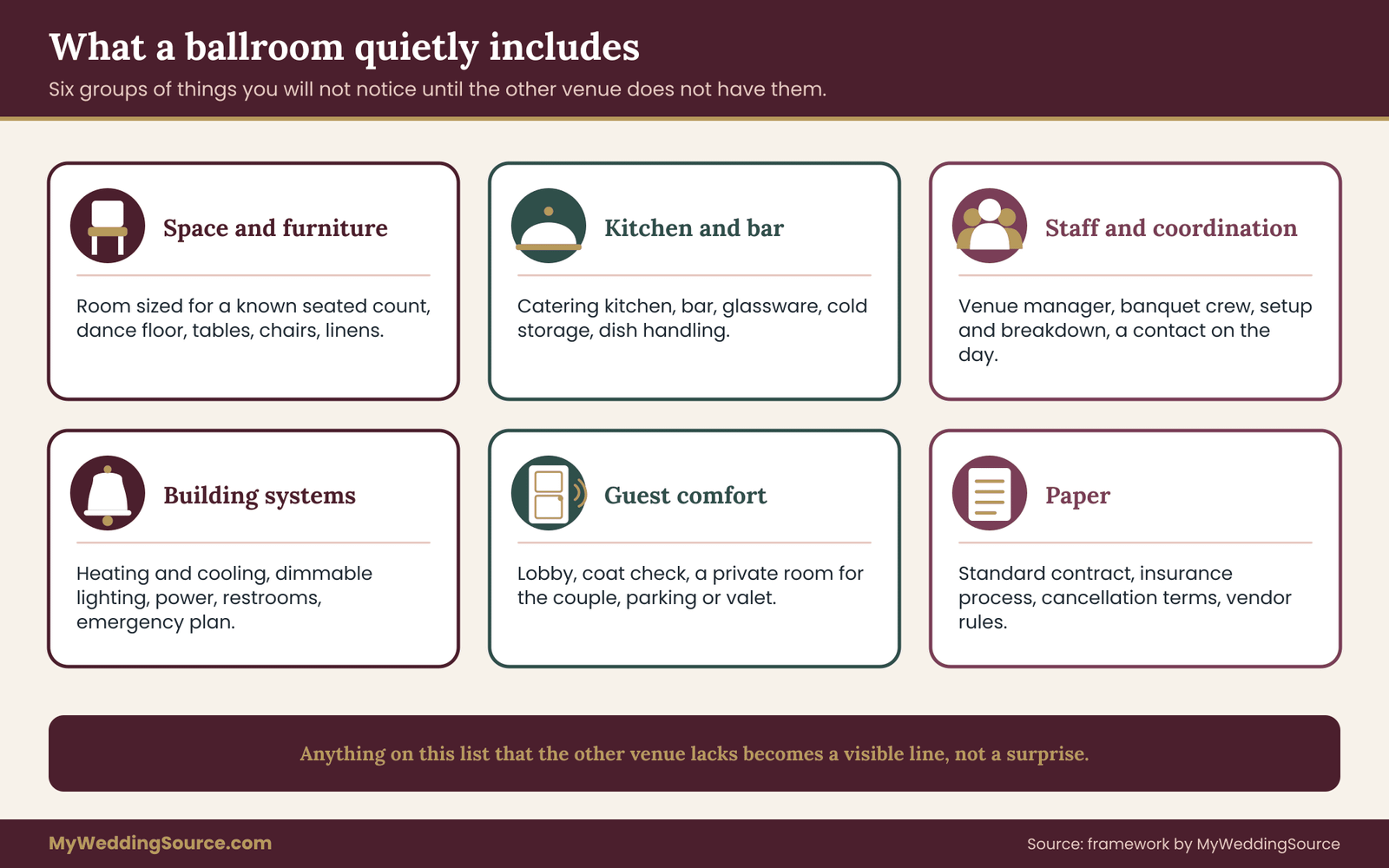
Before you can score anything, you need the baseline written out. The list below is not a promise that every ballroom includes every item. It is the set of things you should expect a venue built for events to have an answer for. Ask your ballroom finalist to confirm which ones apply to its package, and treat any “that is extra” as a Bring-in line, not as a surprise.
Space and furniture. A room sized for a known number of seated guests, a dance floor or space for one, tables and chairs in the quantity you need, and a stage or platform option. Linens and place settings are often available through the venue or its caterer.
Kitchen and bar. A working catering kitchen, a licensed bar or a defined path to alcohol service, glassware, cold storage, dish handling and a place for the cake.
Staff and coordination. A venue manager or event captain, banquet staff, setup and breakdown crews, and a contact who knows the building on the day.
Building systems. Heating and cooling that handle a crowd, lighting with dimmers, power for a band or DJ, an approved sound setup, restrooms sized for the guest count, and an emergency plan that includes the room.
Guest comfort. Coat check space, a lobby or pre-function area for arrivals and cocktails, a private room for the couple, and parking or valet arrangements.
Paper. A standard contract, a certificate of insurance process, a clear cancellation policy and a vendor list or rules, even if you disagree with some of them.
Why the baseline works as a checklist
Each of these items answers a question an unusual venue might not. Does the building have a catering kitchen? Does it have a place for the couple to get ready? Who stays until the last guest leaves? A ballroom answers yes to most without being asked, which is exactly why those questions disappear from your attention. The baseline brings them back.
It is also reasonable to tell your ballroom finalist about the exercise. Ask them to mark each baseline line as included in the package, available for an extra fee, or not offered. Their answers become the ballroom column of your venue comparison scorecard, and a ballroom that cannot answer clearly has told you something about its own readiness.
Adjusting the baseline to your wedding
The baseline is a starting list, not a fixed one. If you plan a daytime ceremony with a small dessert reception, a catering kitchen drops off your must list. If your grandmother uses a wheelchair, step-free access moves to the top. Mark each baseline line as a must, a want or a nice-to-have before you score, because the venue comparison decision rules later depend on that mark, and it is much easier to be honest about priorities before a favorite venue is in the room.
A good test is to imagine the worst plausible hour of the day and ask what you would need to survive it: a heavy rain at arrival, a delayed caterer, a toast that runs long, a guest who feels unwell. The lines that matter in that hour are your musts. Lines you can live without, such as a coat check in a mild climate, are wants. Keep the must list short, because every must is a place where the venue comparison can end.
Writing the first draft in one sitting
Give yourself about an hour and a document or sheet of paper. List the baseline lines down the left side, group them under the seven lanes introduced in the next section, and add three blank columns for the ballroom, the unusual venue and notes. Do not fill in any answers yet. A finished list of questions is useful by itself, because it is what you take on every tour from now on, and it replaces the vague plan to “ask about everything.”
The seven lanes of a venue comparison scorecard
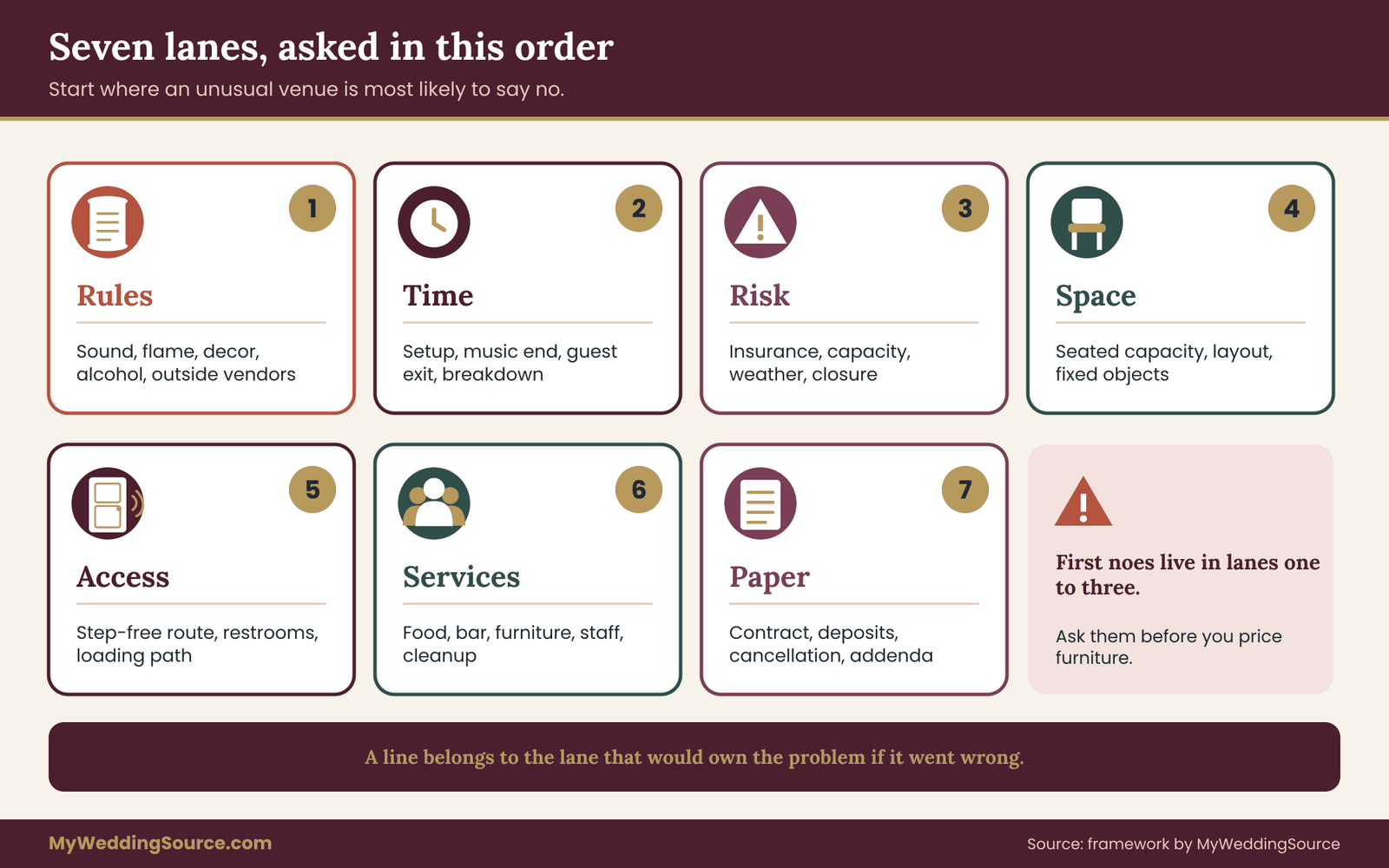
Seven lanes hold every baseline line in the venue comparison. The names are plain on purpose, so that anyone helping you, from a parent to a planner, can read the sheet without a legend. The lanes are Space, Services, Rules, Access, Time, Risk and Paper. A line belongs to the lane that would own the problem if it went wrong.
Space covers the room itself: how many guests it seats at tables, how many it holds standing, where the dance floor goes, where the band or DJ sits, where the head table fits, and whether anything in the room is fixed or off limits. It also covers the ceremony location if it differs from the reception room.
Services covers the things people do: food, bar, setup, breakdown, cleaning, security, a day-of contact, a person who lets vendors in. A line sits here when a ballroom would normally staff it.
Rules covers what the building lets you do: amplified sound, open flame, confetti and petals, taping or nailing anything to walls, outside vendors, alcohol, photography and lighting equipment, and any restriction near objects or collections.
Access covers how people and equipment get in: step-free routes, elevators, restrooms, drop-off, parking, loading doors and the path from a truck to the room.
Time covers the clock: when you can enter for setup, when guests can arrive, when music must stop, when everyone must leave, and how much time breakdown gets.
Risk covers insurance, capacity limits, fire and emergency rules, weather and what happens if the venue closes unexpectedly.
Paper covers the contract, the deposit and payment schedule, cancellation and rescheduling terms, damage fees and who signs what.
How many lines to expect
A realistic scorecard has roughly thirty to forty lines. That sounds like a lot, but most are one-sentence questions with one-sentence answers, and a ballroom column fills in quickly. An unusual venue column takes longer because the venue has to look things up. The count is the point: if a venue cannot help you fill in thirty lines before you sign, you have learned how it will behave afterward.
Do not add lines for everything imaginable. Each line should match something a ballroom normally does or something your wedding specifically needs. A line that nobody can score, or that has no cost or consequence either way, makes the sheet harder to read and hides the lines that matter.
Lane order is also question order
Work the lanes in the order Rules, Time, Risk, Space, Access, Services, Paper when you tour or write to the venue. The reasoning is simple. Rules, Time and Risk are the lanes where an unusual venue is most likely to say no, and a no there costs you the least to discover early. Space and Access confirm the room can work physically. Services is where most of the money moves. Paper comes last because the contract should reflect everything you learned, not replace it.
If you ask a museum about linens before you ask whether it permits amplified music or alcohol, you may spend a week building a plan around a venue that cannot host your reception. The order protects your time.
How to score each line: four statuses and three grades
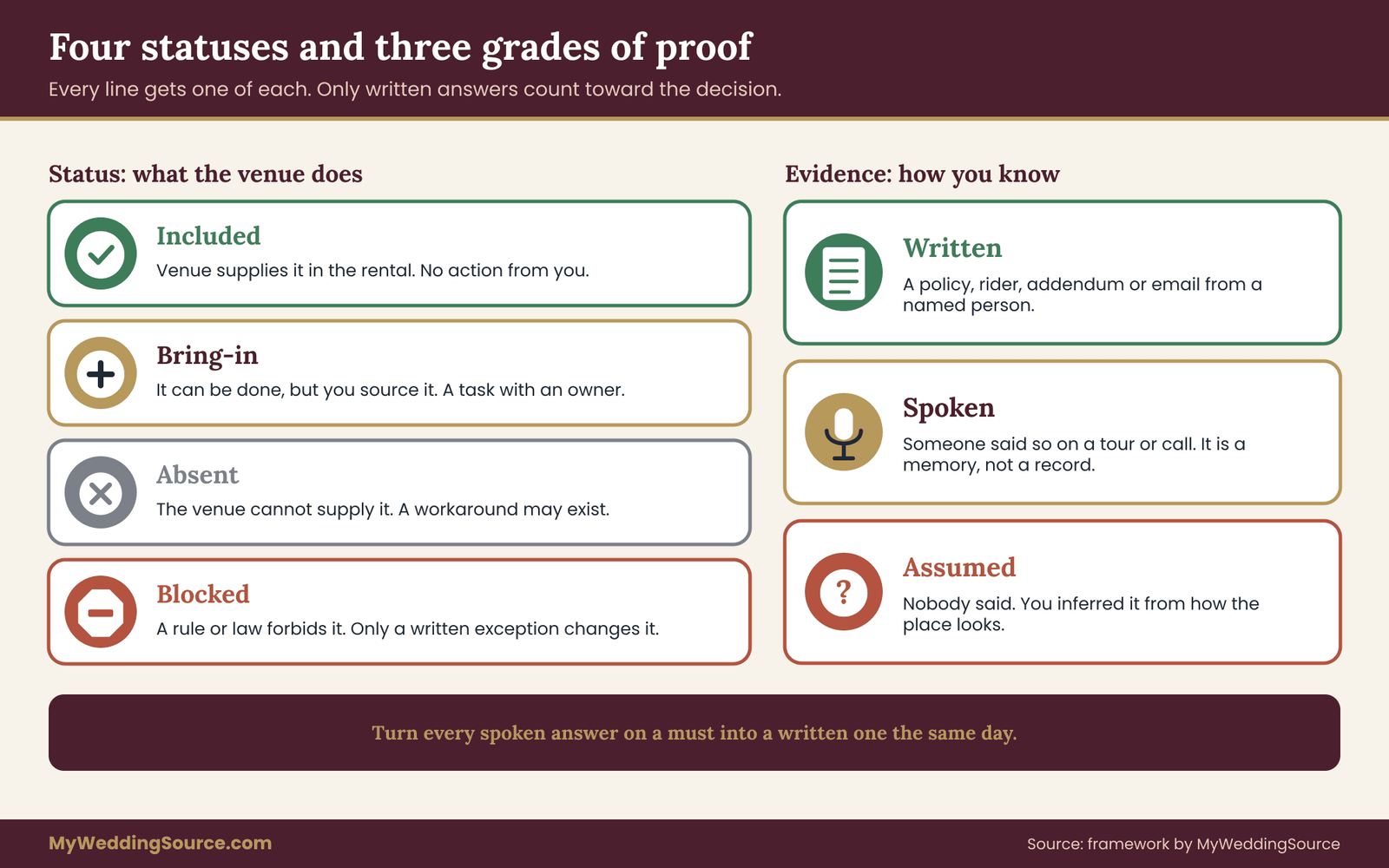
Every line gets two marks. The first is a status that describes what the venue does about that line. The second is an evidence grade that describes how you know. Keep them separate. A line can be Included but only by an offhand comment, and that is a different situation from Included in a signed rider.
The four statuses
Included means the venue provides it as part of the rental, at no extra charge, with no action from you. A ballroom that supplies round tables and chairs for your headcount has this line as Included.
Bring-in means it can be done, but you or your team must source it. This is the most important status, because it tells you where the work and the money go. Rental tables, a caterer’s mobile kitchen, a licensed bartender, extra restroom trailers and a lighting technician are all Bring-in lines. A Bring-in line is not a problem; it is a task with an owner.
Absent means the venue cannot provide it and it cannot realistically be solved on site. A ceremony room with no climate control in midsummer, or a hall with only one narrow stairway, may be Absent on a given line. Absent lines are weighed against your must and want marks.
Blocked means the venue’s rules or the law forbid it. If a library’s event policy forbids alcohol, then alcohol service is Blocked. You do not weigh a Blocked line against costs, because no cost solves it. You weigh it against your priorities, and if the line is a must, the venue is out.
Why Absent and Blocked are different
They feel similar, but they behave differently over time. An Absent line may have a workaround, such as renting a portable heater or hiring a shuttle. A Blocked line usually needs the venue to change a rule, and some rules, such as those tied to a building’s fire code or a collection’s protection, are not the venue manager’s to change. Treat a Blocked line as a firm no unless the venue offers a written exception, and treat an exception in writing as a new Included or Bring-in status with conditions.
The three evidence grades
Written means you have the answer in a document or email that the venue controls: an event policy, a contract rider, a signed addendum or a message from a named staff member. Spoken means someone told you in person or on the phone. Assumed means nobody told you; you inferred it from what the venue looks like or from what other venues do.
The grades matter because the three behave differently when a dispute arises. A Written answer is a record. A Spoken answer is a memory, and the person who gave it may have left by the wedding date. An Assumed answer is a risk. Only Written lines count toward the venue comparison decision rules later, and the habit of turning Spoken into Written is the single most valuable move in the whole process.
“Thank you for the tour. To be sure we have it right, could you confirm in writing that amplified music is allowed until the end time in our rental agreement?”
A scoring example from a single line
Take the line “caterer may use the building’s kitchen.” At a ballroom the answer is Included, Written, because the package describes the kitchen. At a gallery, the staff member says during the tour that caterers “usually set up in the loading area.” That is a Spoken answer, and the status is probably Bring-in, because a caterer will need a portable setup, a clear workspace and possibly a rule about open flame or cooking. You mark it Bring-in, Spoken, and write a follow-up to turn it into Written.
If the venue’s event policy then says that on-site cooking with flame is not permitted, the line changes: finishing food with warming equipment may be Bring-in, but any plan that needs a flame becomes Blocked. The venue comparison scorecard shows the change at once, and your caterer can respond to the actual rule instead of the tour comment.
Marking musts, wants and nice-to-haves
Add one more mark, priority, in a third small column. A must is something without which the wedding does not work for you. A want improves it. A nice-to-have is pleasant and negotiable. The marks are yours, not the venue’s, and they can differ between partners. Agree on them together before scoring so that the venue comparison decision rules are not being applied to a moving target.
A practical limit helps: if more than about a quarter of your lines are musts, you are probably describing preferences as requirements, and the venue comparison will end at the first imperfection. Trim until the musts describe real failure.
What to do with partial answers
Real venues rarely answer a line cleanly. A manager may say a thing is allowed “with approval,” or “for most events,” or “as long as it is quiet.” A venue comparison needs a rule for these answers, or the scores will quietly drift toward whatever you hoped to hear.
Use the weaker reading until the answer is firmer. “Allowed with approval” is Bring-in only if the approval process is described and you know who approves and when. Otherwise it is Spoken or Assumed, and the line stays unfinished. “For most events” tells you the venue has an exception pattern, so ask what makes an event the exception. A venue comparison built on firm readings is smaller, and it holds up when the contract arrives.
Write the exact words the venue used beside the status. When the same phrase appears in a later email, you can see at once whether the answer has changed. This small habit also makes the venue comparison easier to share, because a parent or planner can read the venue’s own words instead of your summary of them.
Gathering evidence for your venue comparison
The venue comparison scorecard is only as good as the answers behind it. Gathering them is a small research project inside the venue comparison with three steps: ask for the documents first, ask the questions the documents do not answer, and turn every useful spoken answer into something written.
Step one: ask for the documents
Before a tour, ask each venue for its event policy or rental guidelines, a sample contract, its certificate of insurance requirements, any vendor rules, its floor plan with capacity figures and its cancellation terms. Public institutions such as libraries, museums and parks often have these as downloadable pages or forms. A venue that does not have them yet may write them for you or may be telling you it has never hosted a wedding.
Read the documents with the venue comparison scorecard open. Each sentence that restricts or permits something is a line, and most of them are Rules, Time and Risk lines. A sentence like “no open flame in the gallery” becomes Blocked for candles in that room, and perhaps Bring-in for flameless alternatives. A sentence like “events must conclude by the posted time” becomes a Time line with a hard edge.
Two warnings. First, policies written for meetings or lectures are sometimes the only policies a venue has, and they may not fit a reception. Ask whether a separate wedding policy exists. Second, a policy that says “subject to approval” or “at the discretion of the director” has not answered your question. Mark that line Spoken at best, and ask what the approval process looks like and when you will know.
Step two: ask the questions the documents leave open
Keep a short script. The questions below are phrased to produce an answer you can score, not a general impression.
- “What is the maximum number of guests at tables in this room, and who set that number?”
- “Which vendors have worked in this space before, and do you require approved vendors?”
- “Is there a kitchen or prep area, and what may a caterer do in it?”
- “What time may our vendors enter, and what time must the building be empty?”
- “Which areas are off limits to guests and to our photographer?”
- “Who is on site from your staff for the whole event, and what are they responsible for?”
- “What insurance do you require, and in what form do you need the certificate?”
- “What happens to our date if the building closes for weather, maintenance or an emergency?”
Write the answers during the call or tour, and send them back the same day in a short message: “Here is what we understood. Please correct anything that is wrong.” A reply that confirms it is Written evidence. A reply that corrects it is even better, because it shows the original answer was at risk.
Step three: ask who can say yes
Unusual venues often have two or three people with partial authority: an events coordinator who takes inquiries, a facilities manager who knows the building, and a director or board that approves exceptions. The coordinator may be warm and sincere and still unable to promise anything the facilities manager or board has not agreed to.
Ask directly: “Who decides whether we can do this, and how long does that take?” Then put the question and the deadline on your calendar. If a decision depends on a committee that meets quarterly, your wedding date and your deposit date need to line up with it.
“Is that decision yours to make, or does it need someone else’s approval? If it needs approval, who is that, and by what date can we expect an answer?”
A different kind of due diligence
For vendors, there is a checklist approach to confirming who they are and what they carry, and the site covers it in the vendor due diligence checklist. A venue is also a business or an institution with its own obligations, and some of the same questions apply: who owns the building, who is responsible for repairs, and whether insurance and licenses are current. A public institution may answer these through a standard process, and a private owner of a converted space may need to show you.
Visiting with the venue comparison scorecard, not with a feeling
Bring the draft sheet to each tour, on paper or a tablet. Walk the path a guest would take, from drop-off to the entrance to the room to the restroom, and score the Access lines as you go.
Then walk the path a truck would take, from the loading door to the room, and score the load-in lines. If you need a thorough on-site measurement process after you have chosen, the guide to the venue technical walkthrough covers measurements, access routes and vendor needs in detail, and this venue comparison does not need to duplicate it.
On the tour, watch for what is happening around you. Is another event in the building? Are signs, cords or exhibits in the way? Is there a visible fire exit, a working elevator and a restroom that looks usable for sixty or a hundred people? None of this proves anything, but each observation can become a question.
Common documents and what they usually settle
Each document answers some lines and leaves others open, which is why you collect several.
- Event policy. Settles most Rules and Time lines, and sometimes Services.
- Floor plan with capacity. Settles Space lines, but only if the capacity figure is tied to a seating style. A standing capacity is not a seated capacity.
- Sample contract. Settles Paper lines and often reveals Bring-in items buried in the fine print, such as required staff, mandatory security or cleaning fees.
- Insurance requirements. Settles Risk lines about who covers what, though your own insurer needs to confirm the details.
- Vendor rules or approved list. Settles whether the Bring-in lines can be filled by your preferred vendors.
- Accessibility information. Settles many Access lines, and a tour should confirm it.
If a venue offers none of these, you will be scoring on Spoken and Assumed evidence, and the venue comparison decision rules will treat the venue accordingly.
Reading each lane: what unusual venues tend to change
The next sections describe how each lane typically shifts when you leave a ballroom. These are patterns to prompt questions, not predictions about any specific building, and every venue should still be scored on its own answers.
Space: capacity, circulation and the objects in the room
In a ballroom, capacity is mostly arithmetic. A room has a seated figure and a standing figure, and the fire authority has approved both. In an unusual venue, capacity is shaped by things a ballroom does not have: fixed exhibits, display cases, columns, stairs, shelving, a mezzanine that cannot take a crowd, or floors with a load limit. A hall that holds a certain number standing may hold far fewer at tables once you add a dance floor, a buffet line and a band.
Ask for the seated capacity with your intended layout, and ask who set it. Then mark ceremony and reception separately if they happen in different rooms. If the venue cannot name a seated number, the Space lines should be Assumed, and you may want a layout from a vendor who has worked in the building before you commit.
Services: the lane where money and labor move
A ballroom’s services are one big Included block. An unusual venue breaks that block into dozens of Bring-in lines. Tables, chairs, linens, tableware, a kitchen, bartenders, servers, a cleaning crew, security, an event captain and a coat check each become a separate decision with a separate quote and sometimes a separate rule about who may provide it.
The practical effect is that Services is where an apparently cheap venue becomes expensive, and also where an apparently expensive one becomes reasonable. The venue comparison scorecard does not need to know the prices to show this. Counting Bring-in lines in Services, before any quote arrives, tells you how many separate vendors or rentals you will manage.
Keeping a log so the venue comparison stays honest
Over several weeks, answers pile up in emails, tour notes and phone calls. A short log keeps the venue comparison from relying on memory. Give each entry a date, the name of the person who answered, the line it affects and the evidence grade. When a Spoken answer becomes Written, update the grade and attach the message.
The log also protects against a quiet problem: staff turnover. Unusual venues, especially public ones, may have a coordinator who leaves between your tour and your wedding. If the venue comparison shows that a must rests on a Spoken answer from someone who is no longer there, you will see it at once, not on the wedding day. Keep the log in the same file as the scorecard, so that a single document carries the whole venue comparison and anyone who joins the project can pick it up.
Rules: where the first no usually comes from
Rules lines are the ones most likely to be Blocked at an unusual venue and the least likely to be Blocked at a ballroom. Typical areas include alcohol, amplified sound, open flame, confetti and petals, tape or adhesives, anything attached to walls, smoke or haze machines, food and drink near collections or books, and photography with flash or lighting stands. Many of these exist to protect objects, floors and fire safety, and they are rarely negotiable in the way a price is.
Ask about each one by name. “Do you allow decorations?” gets a vague yes. “May we place freestanding arrangements on the tables, hang anything from the ceiling, or use candles of any kind?” gets a scoreable answer. The same applies to vendors: a venue that requires its own approved caterer, or insists on a certain licensed bartender, has changed several Services lines from Bring-in to Blocked-unless-approved.
Access: the lane that decides who can attend
Access has two parts that people often blend. One is guest access: step-free entry, an elevator that works, restrooms that fit people with mobility devices, seating at the ceremony, parking and drop-off. The other is vendor access: loading doors, ramps, freight elevators, hallway widths, and the distance from the truck to the room. Older civic buildings can be excellent on one and difficult on the other.
The Americans with Disabilities Act sets requirements that differ for public entities and private businesses, and the ADA website explains the structure, so ask what the building offers and do not assume. Ask a named person to describe the route from drop-off to your seat and from your seat to the restroom, and confirm the answer in writing. If an elderly relative or a guest who uses a wheelchair is coming, this lane may hold your first must.
For a more detailed look at how a venue’s access gaps appear in practice, see the guide to accessible wedding venue red flags, which this venue comparison relies on rather than repeats.
Time: unusual venues tend to run on institutional clocks
A ballroom’s clock is built around events: setup the morning of, a reception that runs into the night, breakdown after. A museum, library or public building often has a different clock built around opening hours, staff shifts and security. You may get setup only after the public leaves, a firm end time that arrives earlier than you imagined, and a short breakdown window before staff go home.
Score every Time line separately: earliest vendor entry, earliest decor setup, guest arrival, last call, music end, guest departure and vendor exit. If your plan needs three hours of setup and the venue allows one, that is a Time line with a real cost, usually in extra vendor labor or a smaller design. If your plan needs dancing until late and the building closes at an early hour, the line may be Blocked, and the conversation moves to alternatives such as an after-party elsewhere.
Risk: what the venue assumes you will handle
Ballrooms are used to insurance. Many unusual venues are not, and some require much more of you than a hotel would, such as event liability insurance with the venue named as an additional insured, a damage deposit and sometimes proof that each vendor carries its own policy. Your insurance agent and the venue’s requirements need to line up, and a mismatch late in planning is slow to fix.
Risk also includes weather and closure. A garden pavilion may have no indoor fallback, a boat may cancel for wind, a historic building may close for a repair. Ask about each: what is the plan if the main room cannot be used, who decides, and when. The answer shapes your Paper lines too, because cancellation and rescheduling terms need to match your real exposure.
Paper: the contract should match the venue comparison scorecard
At the end, the contract is the document that makes Written answers binding. Compare your venue comparison scorecard to it line by line. Every Included line should appear as included. Every Bring-in line should have its rules described, such as approved vendors or insurance requirements. Every exception you were promised in person should be in the contract or an addendum. If a promised item is not there, treat the line as Spoken, because a contract that does not mention it generally does not oblige the venue to provide it.
The site’s guide to the wedding vendor contract explains the clauses to read in any vendor agreement, including payment terms and cancellation, and those clauses apply to venue contracts as well. Read cancellation and date-change terms before you pay, not after.
Reading the scores: a venue comparison decision rule
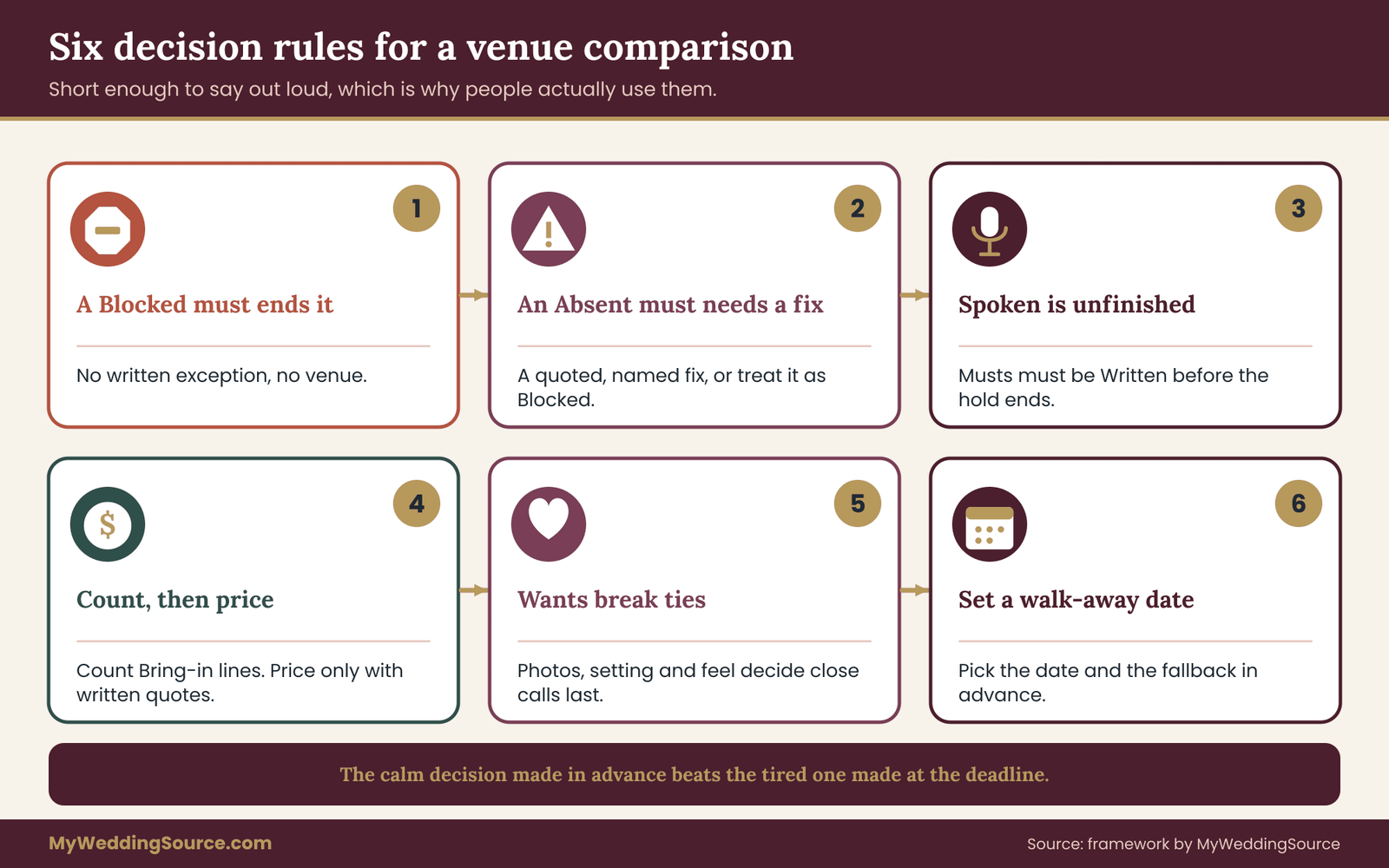
Now your venue comparison has two columns, each line marked with a status and an evidence grade. The decision rules turn those marks into a choice without pretending to be arithmetic. They are intentionally simple, because a rule you can say out loud is a rule you will actually use.
Rule one: a Blocked must ends the venue
If any must line is Blocked, the venue is out unless it offers a written exception that changes the status. A verbal “we can probably work something out” does not qualify. This rule exists to stop the slow drift in which a favorite venue gets credit for flexibility it has not offered.
Rule two: an Absent must needs a named fix
If a must is Absent, you need a specific, quoted fix before the venue stays in the running. “We will figure out heat” is not a fix. “A rental company has quoted portable heaters for the ceremony space with delivery and removal” is. An Absent must without a fix is treated as Blocked until it has one.
Rule three: Assumed and Spoken musts are unfinished, not safe
A must line marked Assumed or Spoken has not been scored; it has been postponed. Before the hold date, every must line should be Written. If a venue cannot or will not put a must in writing, treat that as information about how the venue will behave when something goes wrong.
Rule four: count the Bring-in lines, then price them
After the first three rules, count the Bring-in lines in each lane. That count is the size of your project. A ballroom may have five or six. An unusual venue may have twenty or more. Then assign each Bring-in line an owner, a written quote and a deadline. Only when every Bring-in line has a quote do you add them to the venue fee and compare the totals with the ballroom.
This sequence prevents a common mistake, which is comparing the venue fee alone. It also prevents the opposite mistake, which is inflating a venue’s cost with guesses. Neither the guide nor the venue comparison scorecard supplies numbers; the totals come from documents you hold.
Rule five: weigh wants and nice-to-haves last
Wants and nice-to-haves decide close calls. If both venues pass the first four rules and the totals are within a range you can live with, compare the lines that matter emotionally: the photographs, the ceremony space, the sense of place, the sightlines, the guest experience. This is where an unusual venue often wins, and it deserves to win on the right grounds, with the gaps already counted.
Rule six: set a walk-away date
Every Spoken or Assumed must needs a date by which it must become Written. Set that date before your hold ends or before your deposit is due, and decide in advance what you will do if the venue misses it. The decision made calmly in advance is easier than the decision made when you are tired and the other option is gone.
Using the venue comparison when the date is close
Sometimes the wedding is only a few months away and venues are filling. A venue comparison can still work, but it needs a compressed schedule. Score the musts first and send the same short request to every finalist on the same day. Ask each venue for its answer date, and drop any venue that cannot give written answers in time to meet your own deposit deadline.
In a tight timeline the evidence grades matter more, not less. A fast venue comparison tempts you to accept Spoken answers, because Written ones take days. Resist this for the lines that end a venue: capacity, end time, music, alcohol, step-free access and cancellation. For wants and nice-to-haves, accept Spoken answers and plan to confirm them later.
Also ask whether the venue has a standard wedding package or a template addendum. A venue that has done many weddings can often answer a full venue comparison in a single document, while a venue new to weddings needs more questions and more time. That difference is itself part of the comparison, and it often explains why a ballroom’s column fills in so quickly.
Worked example: a library hall against a hotel ballroom
The case below is invented to show the method. The couple, the venues and the numbers of lines are illustrative, no prices appear, and the outcome is not a recommendation for or against any real library or hotel. Its purpose is to show how a venue comparison moves from a feeling to a decision.
Priya and Daniel are planning an evening wedding for 110 guests in late spring. Priya’s grandmother uses a walker. Daniel’s family wants a long dinner and a dance floor. The couple have two finalists: the Meridian Hotel ballroom, which gave them a package quote, and the Harbor Street Library reading hall, a handsome room with tall windows and a mezzanine, which sent a rental form and a two-page event policy.
Step one: write the baseline and mark priorities
They list thirty-six baseline lines across the seven lanes, based on what the hotel’s package describes. Together they mark seven lines as musts: seated capacity for 110 at rounds, step-free route to the room and restroom, a place for hot food to be prepared or finished, alcohol service, music for dancing for at least two hours, a private space for the couple, and a written cancellation term that returns the deposit if the building cannot be used.
Priya wants a mix of candlelight and string lights, and Daniel wants a dessert table with fresh flowers. They mark those as wants. A coat check is a nice-to-have because the date is warm.
Step two: score the ballroom column first
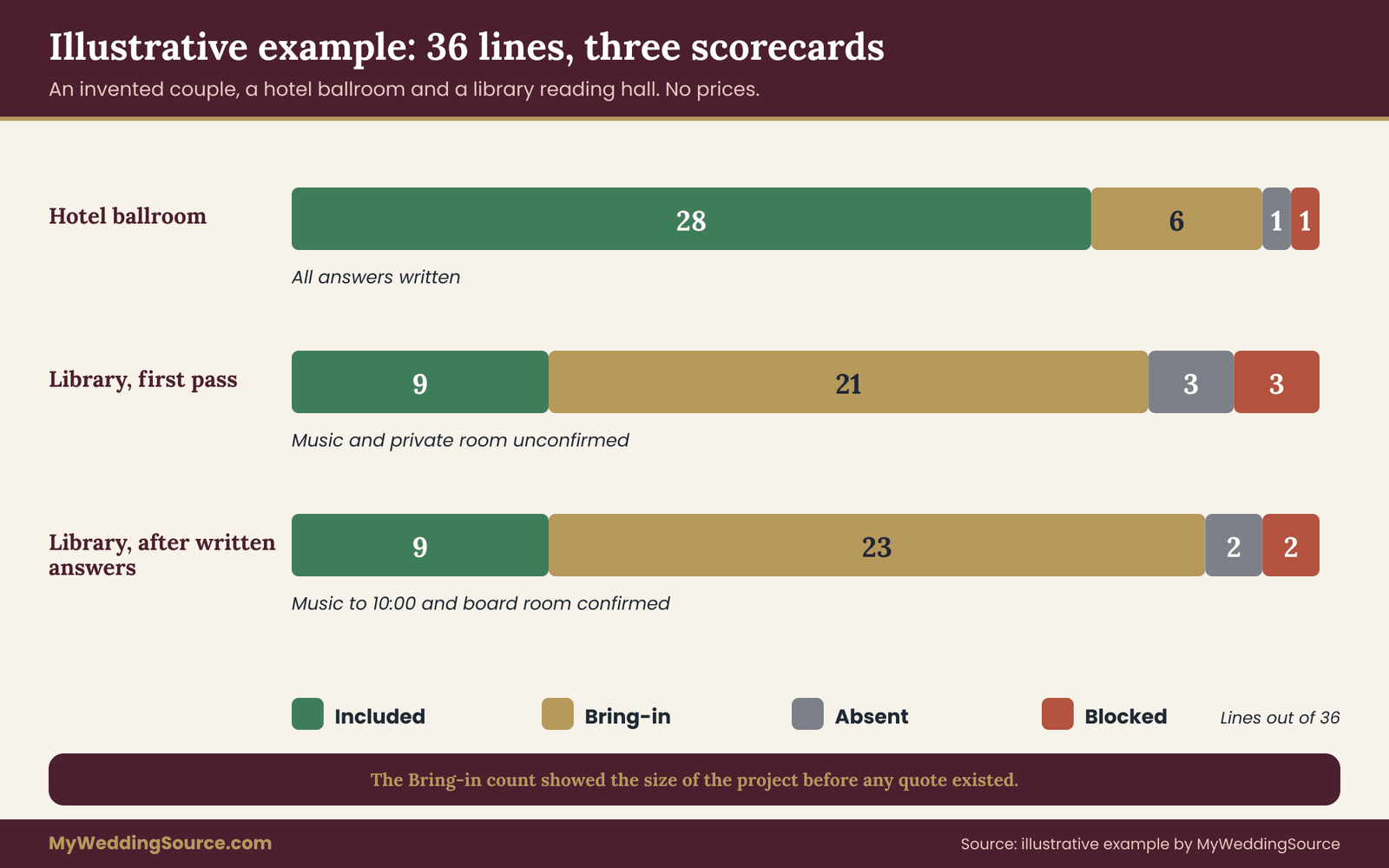
The hotel answers in a single call and a follow-up email. Twenty-eight lines come back Included, six Bring-in and one Absent. The Absent line is an outdoor ceremony space, which is a want, not a must. One line is Blocked: the hotel requires its own caterer, so Daniel’s aunt cannot cook a family dish for the dinner. All of the hotel’s answers are Written.
Even the six Bring-in lines are informative. They include the uplighting the couple wanted and a photo booth. The hotel would allow both, but the couple would pay a separate vendor and the venue wants a certificate of insurance. The ballroom column of the venue comparison shows that even the benchmark has gaps, and each one now has an owner.
Step three: score the library column
The library sends its event policy and a sample rental form, then agrees to a tour. After the tour and a follow-up email, the first venue comparison scorecard shows nine lines Included, twenty-one Bring-in, three Absent and three Blocked.
The Absent lines are a private room for the couple, a coat check and on-site parking. The library’s offer for the couple is a staff workroom that is not suitable, so the private-space must is Absent with no fix yet. The Blocked lines are open flame, confetti and, according to the manager during the tour, amplified music after 9:30 p.m. The first two are wants and nice-to-haves. The third touches a must, since dinner would end around 7:45 and the couple want at least two hours of dancing.
The twenty-one Bring-in lines are what tell the story. The library has no catering kitchen, so food service, a mobile kitchen setup and a licensed bartender are all Bring-in. The room has no event furniture, so tables, chairs, linens and tableware are Bring-in. A librarian is required to be present for the whole event, which the policy describes as a staffing line. Insurance is required, with the library named as an additional insured.
Step four: apply the rules
Rule one says a Blocked must ends the venue unless a written exception changes it. The music line is marked Blocked, Spoken, so the couple do not treat it as final. They email the library director and ask whether amplified music could continue later than 9:30 with a staff member present. They also ask whether a room elsewhere in the building could serve as a private space for the couple, even for a short period.
Two weeks later the director replies in writing. Music may continue until 10:00 with a staff member on site for the added time. A small board room off the main lobby may be used as the couple’s room before the ceremony and for a short break, and it is reachable by an elevator. The music line becomes Bring-in, Written, because it requires staffing. The private-space line becomes Bring-in, Written, with a limit on how long it is available.
Step five: the gap ledger
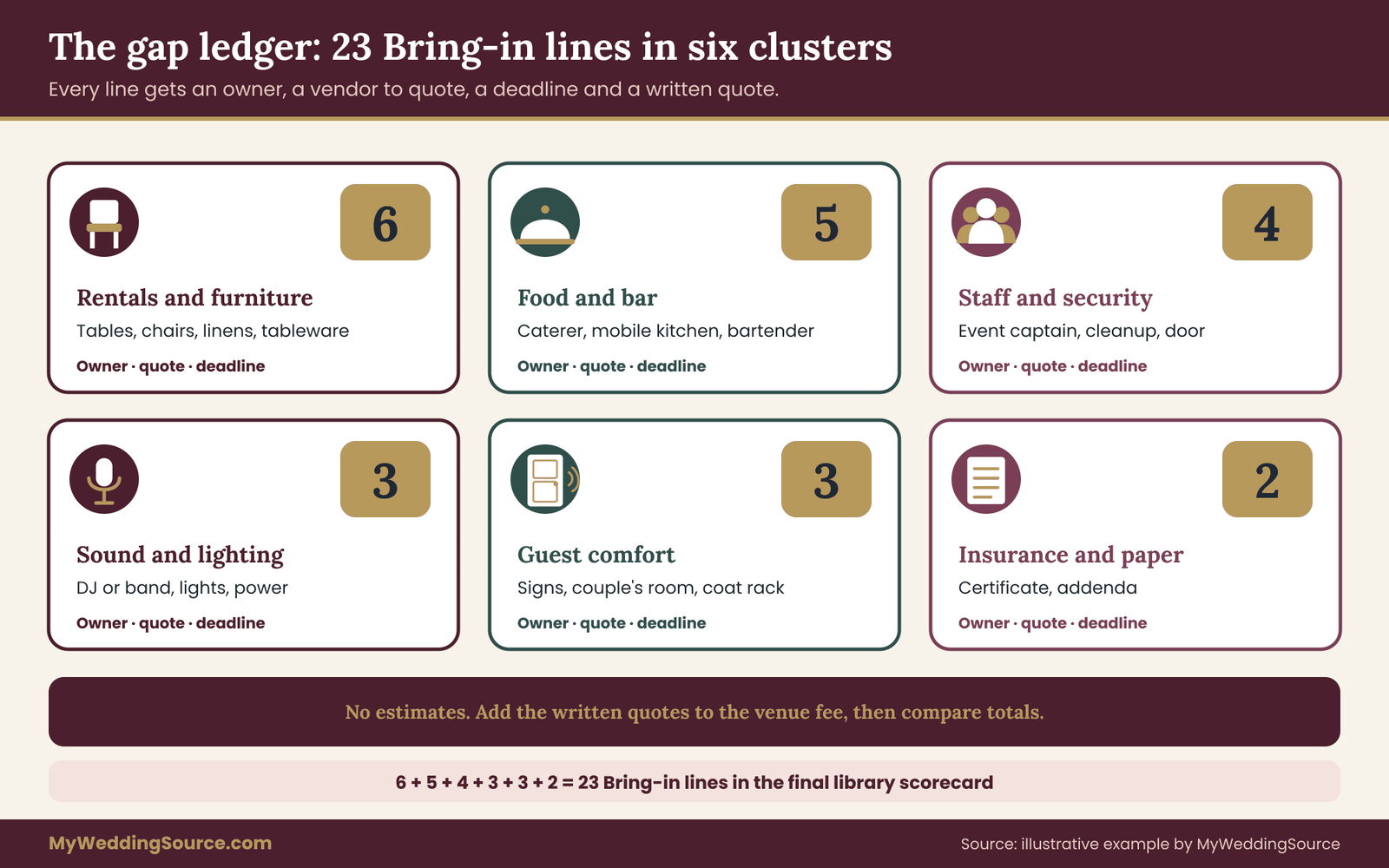
The final library column has nine Included lines, twenty-three Bring-in, two Absent and two Blocked, because the music line and the private-space line both moved to Bring-in. The couple now build a ledger of the Bring-in lines, which is the part of the method that most changes behavior.
They group the twenty-three lines into six clusters: rentals and furniture, six lines; food and bar, five; staffing and security, four; sound and lighting, three; guest comfort, signs and the couple’s room, three; insurance and paperwork, two. Each line gets an owner, a vendor to quote, a deadline and a space to paste the written quote when it arrives.
Nothing in the ledger has a price yet. The couple do not estimate. A rental company, their caterer, a licensed bartender and the sound vendor each send a written quote, and the couple add them to the library’s rental fee. Only then do they hold the library total beside the hotel package total.
Step six: decide, with conditions
When the quotes arrive, the library’s gap-adjusted total is higher than the hotel’s, and the difference is large enough to be real but smaller than the couple feared. They discuss it as a choice between two kinds of cost: a hotel that costs more in what it forbids, such as Daniel’s aunt’s cooking, and a library that costs more in the number of vendors and the amount of coordination.
They decide on the library with three conditions. First, the written event rules, the music exception and the board room use must be included as addenda to the contract before the deposit is paid. Second, the grandmother’s route from drop-off to the room and restroom must be confirmed in writing and walked once with a staff member. Third, a walk-away date: if the addenda are not signed by that date, they return to the hotel. The hotel’s date is not yet at risk, so the fallback is real.
What the example shows
Three features of the case apply beyond it. The first is that the Bring-in count in the venue comparison did the work that a price could not do earlier. Twenty-three lines against six told the couple what kind of project they were choosing before any quote existed.
The second is that the Spoken answer about music was neither accepted nor ignored. It was turned into a written question, and the written answer changed the status. The third is that the decision came with conditions and a date. A decision without them would have been a hope.
What would have changed the outcome
It is useful to see how the same couple might have ended up at the hotel. If the director had declined the music exception in writing, the music line would have stayed Blocked, a must would have been Blocked, and rule one would have ended the library.
If the library had required an approved caterer whose terms did not fit, the food lines would have changed from Bring-in to Blocked or to a different cost. If the library could not confirm the step-free route in writing, the grandmother’s access would have stayed Assumed, which rule three treats as unfinished.
None of these outcomes would have been a failure of the method. They are exactly what the method is for. The hotel was always the fallback, and the venue comparison gave the couple a calm, documented reason to use it if the library could not meet the conditions.
Reusing the example for your own venue comparison
You do not need to copy the couple’s numbers. What transfers is the order of work. Write the baseline, mark the musts, score the traditional option first, then score the unusual one with the same lines. Turn Spoken answers on musts into written questions. Apply the rules, build the ledger and only then compare totals.
If your venue comparison involves a boat, a garden or a warehouse instead of a library, the lines move but the process does not. A garden’s venue comparison will carry more weight in Risk and Time, because of weather and daylight. A warehouse’s venue comparison will carry more Bring-in lines in Services and Space. A museum’s venue comparison will carry more Blocked lines in Rules. The count of each status, by lane, is a quick picture of where your work will be.
Keep the example’s three conditions in mind as a pattern: written addenda before the deposit, a confirmed access route, and a walk-away date. Those three conditions turn almost any venue comparison into a decision you can defend later.
Failure conditions that end a venue comparison early
A venue comparison method is only trustworthy if it can say no. These are the conditions under which the venue comparison scorecard should stop, whatever you feel about the room. They are stated as conditions, not warnings, so you can check them against a sheet.
A must is Blocked with no written exception. This is rule one. It does not matter how beautiful the space is; if a rule forbids something the wedding cannot do without, the venue cannot host that wedding. The exception has to be in writing and has to come from someone with authority to grant it.
The seated capacity is not confirmed for your layout. If nobody can state a seated capacity that includes your dance floor, band and buffet, you may end up cutting guests or changing the format after invitations have gone out. Wait for a layout and a number that the venue or the fire authority stands behind.
Step-free access is promised but not described. If a guest needs it, a generic “yes, we are accessible” is not enough. The route has to be described from drop-off to seat to restroom, and it has to work for the equipment vendors must bring. Without that, treat the line as Assumed.
The end time cannot be written down. A venue that will not state when music must stop and when guests must leave is holding a variable it controls. Wedding plans, from a late dinner to a shuttle schedule, depend on that clock.
Insurance requirements arrive late or keep changing. If the venue’s insurance demands are unclear after two requests, you cannot tell your own agent or your vendors what to carry. Delays here usually mean the venue has no settled process for events.
The cancellation terms do not cover the venue’s own failure. If the building closes for repair, weather or an emergency and the contract does not return your deposit or offer a new date, you carry a risk you cannot manage. Ask for the term to be added.
The venue will not answer in writing. Some venues are glad to talk and reluctant to write. A venue that will not confirm the points that matter is asking you to accept Spoken answers on musts, which the venue comparison decision rules treat as unfinished.
What failure looks like in practice
A failure condition is not a drama. Usually it arrives as a polite sentence: “That would need approval,” “We would have to check with facilities,” “Our director handles exceptions.” Each is an honest answer and also a flag, because approval can take longer than your hold, and exceptions that depend on a person can disappear when the person leaves.
When you see a flag, do not argue and do not wait. Write down the status, set a date for a written answer, and keep the alternative alive. The next section covers what to do if the alternative is a ballroom and also what to do when it is something else.
Alternatives when the scores are close
Sometimes both venues pass every rule and the totals are close. Sometimes the unusual venue passes but a single Absent or Blocked want keeps nagging. A few moves help before you decide.
Split the day
If a venue works for the ceremony but not for a late reception, or the reverse, consider using two spaces. A library or museum may be a lovely ceremony location with strict end times, while a hotel ballroom, restaurant or hall handles dinner and dancing. The venue comparison scorecard supports this directly: score each space on the lines it must carry, and a Blocked line at one site may be Included at the other.
Count the transport as a Bring-in line, including who moves guests, how long it takes and how it works for the guest with limited mobility.
Change the format, not the venue
Many Blocked or Absent lines belong to the format of the reception, not to the venue. A cocktail-and-dessert reception avoids the need for a full kitchen. An early evening event that ends at the venue’s closing time avoids a Time conflict. A reduced guest count, if capacity is the problem, changes the Space lines without changing the venue. Revisit the musts to see whether one of them describes a format you could modify, and be honest about whether you want to.
Look at a middle option
Venues that are not ballrooms or museums sit between the two. Barns, lodges, restaurants and all-inclusive resorts are built for events and often supply most baseline lines, though each has its own limits. The site’s guides to barn wedding venues and all-inclusive wedding venues describe the costs and questions for those types, and the same venue comparison scorecard works on them. Sometimes the right choice is a venue whose baseline is mostly Included but whose character is closer to the space you love.
Run a small test before you commit
If you can, attend a public event in the unusual space, even one unrelated to weddings. Notice how long it takes to find the restroom, how the sound carries, how guests move, and how staff handle the room. It will not replace written answers, but it fills in Space and Access lines with observation instead of imagination.
Keep the fallback until the contract is signed
A fallback is real only if it is still available. Do not release the ballroom date because the unusual venue feels right. Release it when the library’s or museum’s addenda are signed and the deposit is paid. The cost of holding a date is usually small compared with the cost of starting over, but check the ballroom’s own terms about how long it will hold and what happens when you decline. If the date is in demand, ask how long they can wait.
Even with a venue comparison scorecard, a few patterns recur. Knowing them in advance makes them easier to avoid.
Comparing the fee to the package
This is the most common one. A rental fee at an unusual venue looks small beside a ballroom package, and it is a different thing. Compare the fee plus every Bring-in line against the package plus its own Bring-in lines. If the quotes for the Bring-in lines are not in yet, you do not have a venue comparison yet.
Treating a tour comment as a promise
Staff are often sincere and often wrong about what the director, the board or the insurer will permit. The remedy is the habit already described: the same day, send a written summary and ask for correction. A friendly “yes” on a tour is a lead, not an answer.
Scoring the venue’s best day
Unusual venues look their best on a quiet weekday morning with good light. Your wedding is an evening with a hundred guests, wet coats, a band and a kitchen’s worth of equipment moving through the room. Score the lines for your event, not for the tour. If you can, visit at the hour of your event and see how the space works in that light and with that foot traffic.
Letting the emotional lines decide too early
The photographs, the architecture and the story of the place are real values, and they belong in rule five, after the rules have been applied. If they come first, every gap gets a favorable reading. If they come last, they break ties among options that all work.
Forgetting guests who are not in the room yet
A venue comparison tends to focus on the couple’s experience. Guests have their own lines: how they arrive, where they park, how they find the restroom, whether they can hear the ceremony, whether an older relative can sit comfortably for a long dinner. Add a line for each kind of guest you know you will have, and score it.
Keeping the venue comparison in one head
If one partner holds the sheet and does the emailing, the other partner experiences the decision as a surprise. Share the file, agree on the musts together, and take turns scoring. Differences in how two people read a line are information, and it is cheaper to find them now.
Running the venue comparison with a partner and family
A venue decision involves more people than the two names on the contract. Parents may be paying, relatives may be traveling, and a friend with strong opinions may be offering to help. The venue comparison scorecard helps because it moves the disagreement from taste to lines.
Agree on the musts together, first. Before anyone tours a venue, the couple sits down and marks musts, wants and nice-to-haves. Disagreements show up here, and they are easier to resolve when no particular venue is on the table. If one partner’s must is another’s want, talk about why; sometimes the must is really a worry that a different solution would address.
Share the sheet, not the verdict. When a parent or friend asks why you prefer one venue, show the venue comparison scorecard instead of an opinion. “The library is Blocked on a must unless the director grants an exception in writing” is a fact people can discuss. “We just like it better” invites a debate with no end. Who is paying often shapes who expects a say, and the wedding budget guide is the place to settle how costs are shared.
Handle the traditional-versus-unusual tension kindly. A relative who prefers the ballroom is not necessarily dismissing your taste. They may be worried about the unfamiliar, such as an elderly guest’s access, a kitchen they cannot picture or a large number of vendors. The gap ledger answers that worry with specifics: here are the twenty lines, here is who owns each, here is the date the written rules arrive. Specifics are easier to trust than reassurance.
Decide who owns each Bring-in line. An unusual venue turns the couple into a project manager unless the work is divided. Assign each Bring-in line to a person who is not the couple where possible: a planner, a day-of coordinator, a relative who loves logistics. The wedding rental planning checklist is useful for the furniture and equipment cluster, which tends to be the largest, and it keeps the list of rentals from living only in your head.
Adapting a venue comparison to specific unusual venues
The seven lanes stay the same across venue types. What changes is where the Bring-in, Absent and Blocked lines tend to cluster. Use the patterns below to sharpen your questions, and remember that each building still needs to be scored on its own answers.
Museums and galleries. Expect the most weight in Rules and Time. Collections shape what may be near the room: food and drink, candles, florals with pollen or water, ladders, tape and anything that could leave residue. Many institutions limit the number of rooms or the path guests may use, and some require that staff stay on site throughout.
The American Alliance of Museums publishes standards and guidance for museums generally, which can help you understand why a restriction exists, though your venue’s own policy is the controlling document. Ask who in the institution protects the collection and whether that person reviews event plans.
Libraries. Libraries are often public buildings with public-service missions, so wedding use may be limited to certain rooms or hours and may be governed by a board policy. The American Library Association’s site is a place to start for background on library policies and public use, but each library sets its own rules. Many libraries have no catering kitchen, and some forbid alcohol entirely. The questions in Rules, Access and Paper tend to decide the outcome.
Historic houses and landmarks. Preservation is the dominant constraint. Floors, stairs and walls may carry strict limits, and the National Park Service explains that historic properties are often subject to preservation rules. Ask about weight limits, protective floor coverings, restrictions on tents and staking, and any approvals a preservation body must give. Capacity is often smaller than the footprint suggests.
Industrial lofts, warehouses and converted spaces. These are blank rooms. Space is generous and almost everything else is Bring-in: heat or cooling, restrooms, lighting, power, furniture, a kitchen and sometimes the basic safety systems an event needs. Ask the owner what the space is permitted to be used for, and whether the occupancy and fire approvals cover events of your size. The local fire authority can tell you what applies.
Gardens, parks and outdoor sites. Weather and permits dominate. The Risk and Paper lanes need an indoor or covered plan, a decision date and a clear term for changes. Restrooms, power, water, lighting and parking are often Bring-in or Absent. Check whether the site requires a permit, whether amplified sound is limited and whether alcohol is allowed.
Boats and waterfront venues. Capacity, safety equipment and weather are set by the operator and by rules for the vessel. Boarding, restrooms and galley limits affect Access and Services, and a weather cancellation can change the whole day. Ask what the operator does if conditions are unsafe and how the contract treats the deposit.
Civic halls and community centers. These are often easier on price and harder on Services. Kitchens may exist but be shared or restricted, and rules about alcohol, hours and cleaning are typical. Many are used for community events on a first-come basis, so date availability and booking windows belong in the Paper lane.
Using the lanes as a quick filter
If you are weighing more than three venues, run a short version of the venue comparison scorecard first. Take only the musts and score them as Included, Bring-in, Absent or Blocked with a written source. Drop any venue with a Blocked must. Then do the full thirty-line sheet for the two or three that remain. A short venue comparison pass saves tours and emails, and it reinforces the habit of asking for documents before falling in love with a room.
Keeping the venue comparison scorecard alive after you sign
A signed contract is not the end of the venue comparison sheet. Convert it into a working document: each Bring-in line has an owner and a status, each Written answer links to its source, and each deadline sits on a calendar. When a vendor asks a question about the venue, you answer from the sheet. When something changes, such as a new rule, a new staff contact or a changed end time, update the line and send a note to the people who need it.
Share the sheet with your planner or coordinator, if you have one, and with the vendors whose lines depend on the venue’s rules. A caterer who has read the event policy will ask better questions than one who has only your summary. The venue comparison sheet also becomes the backbone of the load-in plan and the day-of schedule.
Your next steps
Start the venue comparison with the baseline. Spend an hour writing the thirty to forty lines across the seven lanes, mark each as a must, a want or a nice-to-have, and agree on the marks with your partner. Then send each finalist the same short request for its event policy, sample contract, insurance requirements, floor plan and cancellation terms. The unusual venue and the ballroom get the same questions.
Score what comes back, using the four statuses and the three evidence grades. Turn every Spoken answer on a must into a written question, set a walk-away date and keep the ballroom hold until the addenda are signed. Count the Bring-in lines, build the ledger, collect written quotes and only then compare totals. For a broader look at choosing between venue types, return to the wedding venues guide when you need it, and let the venue comparison scorecard settle the rest.
FAQ
What is a venue comparison scorecard?
It is a list of the things a ballroom normally supplies, scored at each venue you are considering. Each line gets a status (Included, Bring-in, Absent or Blocked) and an evidence grade (Written, Spoken or Assumed). The result shows what each choice asks of you, including the work and the money that shift from the venue to your team when you pick an unusual space.
Why use a ballroom as the baseline?
A ballroom is built for events, so it answers most of the questions a wedding raises without being asked. Using it as the reference turns hidden items, such as a kitchen, furniture, staff and a place for the couple, into visible lines. You can use the baseline even if you would never book a ballroom, because it works as a ruler, not a preference.
Can I compare venues by price alone?
Not fairly. A rental fee at an unusual venue usually excludes tables, chairs, food service, staff and other items a ballroom package may include. Compare the fee plus a written quote for every Bring-in line against the package plus its own extras. Until those quotes arrive, you have a starting figure, not a venue comparison.
What does Blocked mean, and how is it different from Absent?
Blocked means a rule or law forbids something, such as open flame or alcohol, so no amount of money fixes it. Absent means the venue cannot provide it and there may be a workaround, such as portable heating. If a must is Blocked, the venue is out unless it grants a written exception. An Absent must needs a quoted fix.
How many lines should the venue comparison scorecard have?
Most weddings need roughly thirty to forty lines across the seven lanes: Space, Services, Rules, Access, Time, Risk and Paper. Fewer may miss something important, and many more can bury the lines that matter. Include something a ballroom normally does or something your wedding specifically needs, and drop lines nobody can score.
What should I do if the venue gives answers only by phone?
Write a short summary the same day and ask them to confirm or correct it by email. A reply turns a Spoken answer into a Written one. If the venue declines to put a must in writing, treat that line as unfinished and consider it when you decide, since the contract and the event policy are what control on the day.
When should I walk away from an unusual venue?
Walk away when a must is Blocked with no written exception, when a must stays Assumed or Spoken past the date you set, or when the contract will not cover the venue’s own closure. These conditions are stated before you tour, so the decision is a rule you agreed to, not a mood you are in.
Do I still need this if I choose a ballroom?
A shorter version still helps. Ask the ballroom to mark each baseline line as included, extra or not offered, and watch for exclusive-vendor rules, early end times and package items that cost more than you expected. A ballroom is usually clearer than an unusual venue, but the venue comparison scorecard confirms that and gives you a record in the contract.
Sources
- American Library Association
- American Alliance of Museums
- ADA.gov, U.S. Department of Justice, Civil Rights Division
- National Park Service, historic preservation
- National Fire Protection Association
- U.S. Fire Administration, Federal Emergency Management Agency
- U.S. Food and Drug Administration, Food Code
- Federal Trade Commission, consumer advice
- National Weather Service
- Library of Congress, preservation