
A gallery wedding puts a party inside a room that exists to protect other people’s property. This guide gives you a practical way to plan a gallery wedding rental: sort every object in the room by owner, draw the line nobody crosses near the art, approve each temporary installation, and ask the right insurance questions in the right order.
For a gallery wedding, list every object in the room under one of three owners: the gallery, the artist or consignor, or you and your vendors. Each owner has different rules, different insurance and different people allowed to touch it. Ask the gallery for a written art-handling boundary, get approval for each temporary installation before you pay for it, and ask three insurance questions early: what the gallery’s policy covers, what your gallery wedding liability policy covers, and who pays for damage that neither covers.
Most venue shopping rests on a simple trade. You pay for a room, the venue promises it will be clean and open on your date, and you decorate it to taste. A gallery breaks that trade in a useful way. The room is already finished, the walls are already full, and the main attraction is something you are not allowed to change. That is the reason couples pick galleries. It is also the reason the planning has to be done differently.
This article is about the part of a gallery wedding that is easy to skip because it feels like paperwork: temporary installations and the insurance that stands behind them. By “temporary installations” we mean two things. The first is anything you or your vendors bring in and set up for a day, such as hanging florals, a fabric ceiling, a projection, a backdrop or a ceremony arch.
The second is anything the gallery itself has to move, cover or take down so that the gallery wedding can happen, such as a sculpture on a plinth in the middle of the dance floor or a wall-mounted piece above the bar. Keep that difference in mind through every step of a gallery wedding.
A note on scope. This is general planning information, not legal, insurance or conservation advice. Galleries set their own event rules, insurance policies differ in wording, and both change, so the gallery’s event manager, its collections staff and your own insurance broker have the final word on anything described here.
What a gallery wedding rental actually rents you
The phrase “art gallery” covers very different buildings, and a gallery wedding rental means something different in each of them. Before you compare prices, work out which kind of gallery you are looking at, because it decides who owns the art, who sets the rules and who answers your insurance questions.
A commercial gallery sells work on behalf of artists. Most of what hangs on the wall is on consignment, which means the artist or a collector still owns it and the gallery is holding it under an agreement. A commercial gallery may rent its space after hours or between exhibitions, and the owner or a small team usually decides on the spot what is allowed. The flexibility is real. So is the risk that a single decision-maker says yes to something that their consignment agreements do not actually permit.
A university or college gallery shows student, faculty or visiting work, and it often sits inside a building run by the institution. Events there can come with the institution’s catering list, its insurance requirements and its facilities calendar. The gallery staff may be one or two people, and the real approval may sit with a department or a campus events office.
A nonprofit art center or community gallery usually rents space as a source of income. These venues tend to have a written rental policy, an event insurance requirement and a clear sense of which rooms are rentable. The exhibition may change every few weeks, which matters if you book a date far ahead and the show on your date is not the show you toured.
A museum gallery is part of a larger collection institution. That is a different situation, with conservation staff, loan agreements and strict environmental limits, and it is a topic of its own that this guide does not repeat. If your venue is a museum wing, read that material first and come back for the installation and insurance questions.
A rented gallery-style loft or studio looks like a gallery but may hold no collection at all. White walls and track lighting do not make a space a gallery in the sense this article uses. If nobody is storing art there, most of the handling questions below simply do not apply, and the ordinary venue questions do.
What the rental fee usually does and does not include
A gallery wedding rental fee buys access to a defined space for a defined window. Everything else is a separate line or a separate yes. Depending on the venue, the list of separate items can include security staff, a staff member to oversee the room, cleaning, after-hours building access, the use of the freight elevator, the use of a kitchen or catering prep room, and insurance paperwork. In a gallery wedding the order of the answers matters as much as the answers.
What the fee almost never includes is permission to alter the art or the display. The walls, the lighting rig, the labels, the plinths and the works themselves belong to the exhibition, and the exhibition belongs to someone else. Treat the room as a loan, with the art as a guest that was there first.
Ask for the list of included and excluded items in writing before you book a hold. A short email is enough, and the answer is worth more than any brochure. If the gallery cannot tell you what the fee covers, that is useful information about how the rest of the process will go.
Why the schedule of the exhibition matters
Galleries change shows. A room you toured in March, full of paintings, may hold a set of floor sculptures in October and a video installation in December. Each type of work changes the event. Paintings hang on walls and mostly ask for distance. Floor sculptures take up the same footprint you wanted for tables. Video installations may need darkness, may make sound and may not be switched off. Couples planning a gallery wedding often find this the most useful hour of the whole search.
Before you commit to a date, ask what will be on view on that date and whether the gallery will change it for your gallery wedding. Ask what happens if the show is extended, shortened or replaced after you sign. A rental agreement that locks the room but not the exhibition can leave you planning a seated dinner around a piece that arrives three weeks before the wedding.
For the wider question of how to compare venue types, costs and rental terms, the wedding venues guide covers the general picture. What follows is the layer you add when the venue holds art that is not yours.
A method that keeps the plan honest
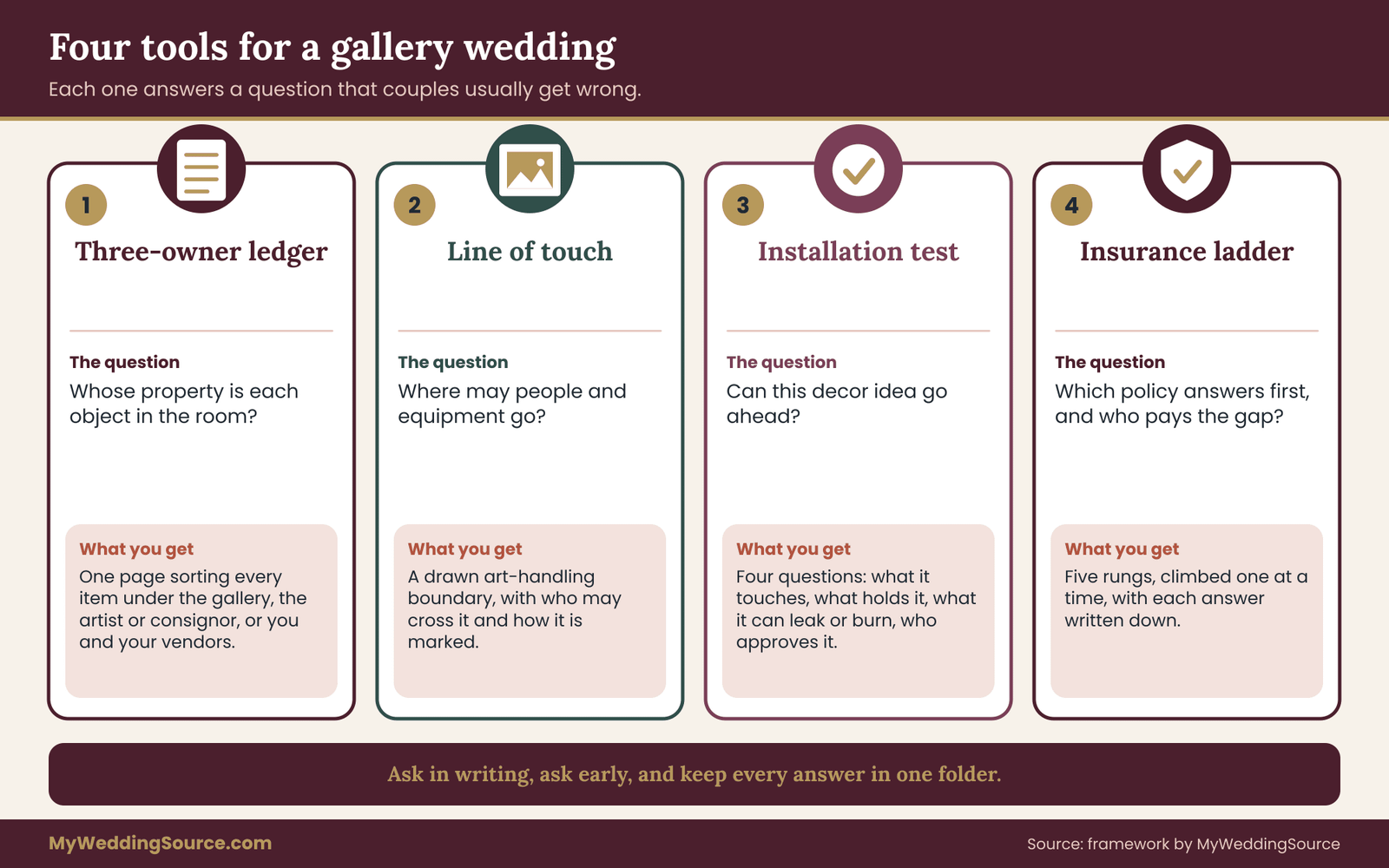
The rest of this guide is organized around four tools, each answering one question that couples tend to get wrong.
The first is the three-owner ledger. It answers: whose property is each object in the room, and what does that mean for handling and insurance? A ledger is a plain list, but making it forces the conversation that a brochure avoids.
The second is the line of touch. It answers: where exactly may people, vendors and equipment go, and who is allowed to cross the line? The art-handling boundary is the most important single document you will ask for, and it works best as a drawing rather than a paragraph.
The third is the installation test. It answers: can this decor idea go ahead, and in what form? Each idea gets four questions, covering what it touches, what it weighs, what it can leak or burn, and who approves it. Ideas that fail the test get a substitute, and the substitute is usually cheaper. That is a fair standard to hold any gallery wedding venue to.
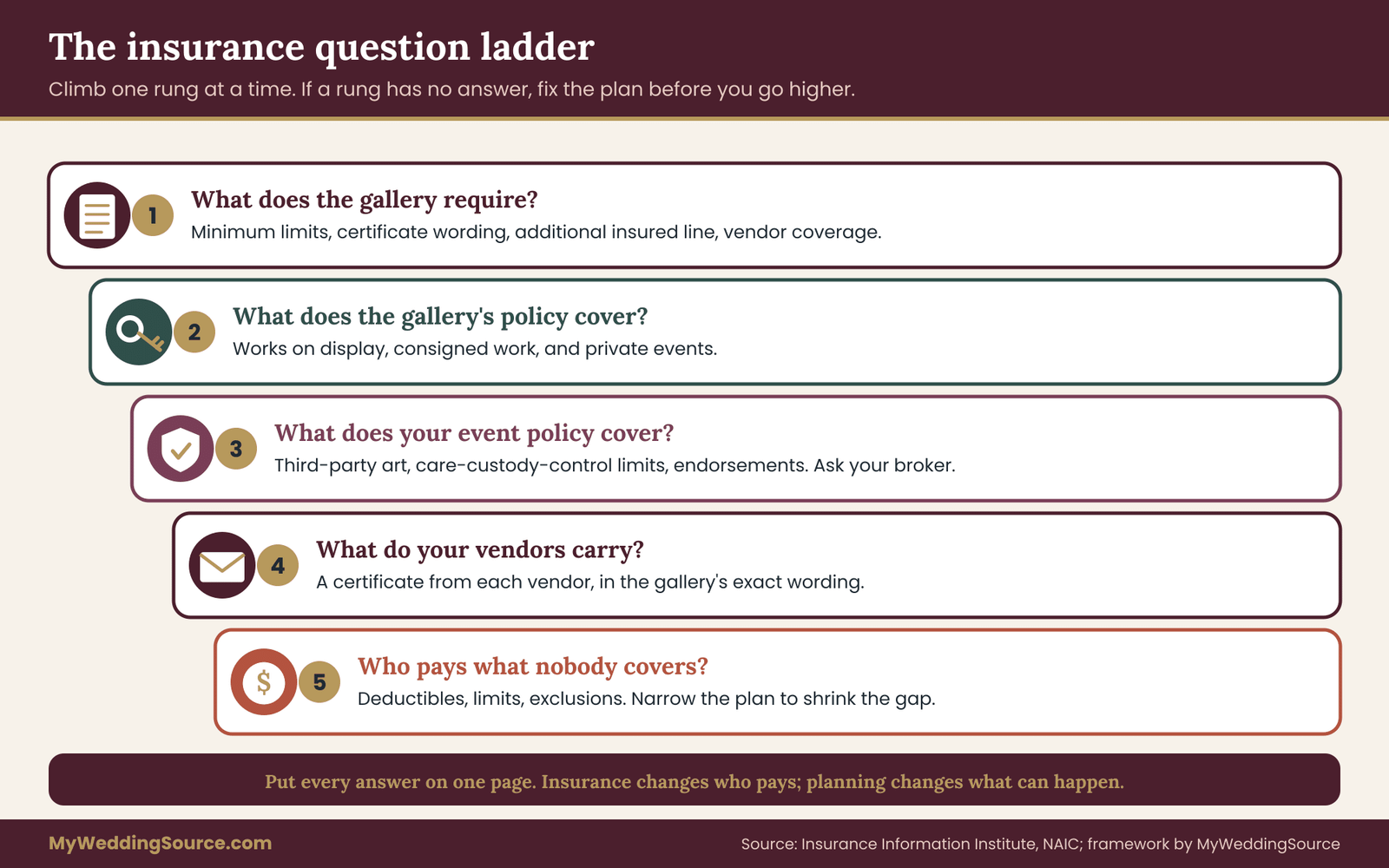
The fourth is the insurance question ladder. It answers: if something goes wrong, which policy responds first, which responds next, and who pays for what neither covers? You climb it one rung at a time, and you stop and fix the plan if a rung has no answer.
None of these tools needs special expertise. They need the right questions asked in writing, at the right time, to the right person. The person is not always the one who gave you the tour. Plan to speak with the event manager, someone who handles the collection, and the person who knows the insurance requirements, even if two or three of those roles belong to one individual.
How far ahead to start
Start the ledger and the boundary request at the first serious conversation with the gallery, which is before the deposit. Start the installation test as soon as your florist, lighting or rental vendor has a design, which is usually several months out. Start the insurance ladder as soon as you have a draft rental agreement, because an insurer or broker needs time to reply and a certificate of insurance has to be issued in the gallery’s exact name and wording.
The same logic applies to every gallery wedding rental, whatever the size of the room.
Late is the common failure. A couple who asks about insurance three weeks out may find that the broker needs the gallery’s specific wording, that the gallery needs to approve it, and that the approval takes longer than the time left. That kind of delay can force a date change or a cancelled installation. It is cheaper to ask early and be told no than to ask late and be told nothing.
The wedding venue technical walkthrough guide explains how to measure rooms, check access routes and gather vendor needs. In a gallery you run that walkthrough with an extra rule: nobody measures anything by touching the art, the walls or the display furniture, and every question about the art goes to gallery staff.
What a good answer looks like
You will get many answers during this process. A good answer has three features. It is in writing. It names the person or role that gave it. And it says what happens if the situation changes, such as a different exhibition, a different staff member or a different insurer. Treat a missing answer as an open item in your gallery wedding file, not as a yes.
A weak answer sounds like reassurance without detail: “We do weddings here all the time, it will be fine.” That may be true. It is not a plan. Reply politely and ask which parts of the gallery wedding are covered by the rental agreement, which by the gallery’s own rules and which by the insurance, and ask them to send the relevant pages.
The three-owner ledger for a gallery wedding
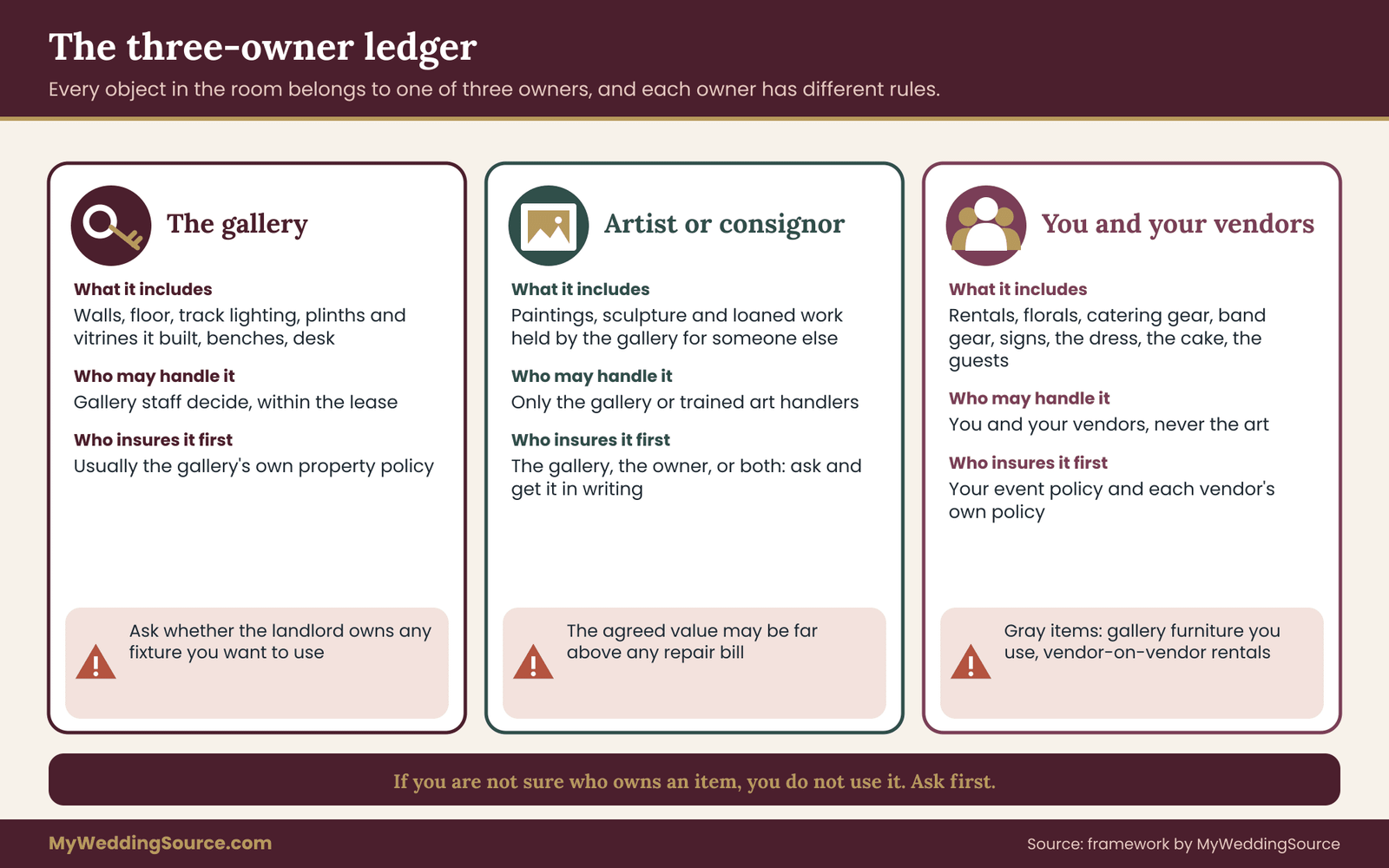
The ledger is a one-page list. Down the left side, write every object and surface in the event space, including the ones you would never think of as “art”. Across the top, write three owners. Then place each item under exactly one owner. It takes about an hour on a walkthrough, and it produces the most useful document in a gallery wedding file.
Owner one: the gallery
Gallery-owned items are the building and its fixtures. They include the walls, the floors, the ceiling, the lighting track, the plinths and vitrines the gallery built or bought, the reception desk, the coat storage, the cleaning closet and any furniture the gallery owns. They also include the gallery’s own collection if it has one, though most commercial galleries do not. That habit protects a gallery wedding better than any single rule.
For these items the gallery is the decision-maker and, usually, the party responsible for insuring the property. It can say yes to a change on its own authority, within the limits of its lease and its own policy. Most of your decor questions land here: can we hang something from the track, can we put tape on this wall, can we move this bench.
The gallery’s authority has an edge, and the edge is the lease. If the gallery rents its building, the landlord may limit what can be attached to the ceiling or walls, and the gallery cannot give you permission it does not hold. A reasonable question is whether any fixture you want to use is owned by a landlord rather than the gallery.
Owner two: the artist or consignor
Consigned and loaned work is the category that changes everything. The gallery holds it, shows it and takes care of it, but someone else owns it. That someone may be the artist, a collector, an estate, a foundation or another gallery.
Two consequences follow. First, the gallery may not be free to move the work, wrap it, cover it or take it down for your gallery wedding, because its agreement with the owner may spell out how the work is handled and displayed. Second, damage to the work is not a small repair bill.
It can be a claim for the agreed value of an object that has no replacement, and the agreed value is set by the consignment paperwork, not by what the piece looks like. It is a small piece of paperwork with a large effect on a gallery wedding.
You will not see the consignment agreements, and you should not ask to. What you can ask is whether the gallery wedding is consistent with them: whether the gallery has told the owners about the event, whether any owner has set conditions, and whether any work will be removed for the date. Those are fair questions for a gallery wedding, and an experienced event manager will have answers ready.
If the gallery does not know whether an owner has conditions, treat that as a reason to move the boundary outward. The cost of a larger buffer is a smaller guest area. The cost of a smaller buffer is a claim that nobody planned for.
Owner three: you and your vendors
Everything you bring is yours or your vendor’s. That includes rented chairs, tables and linens, the florist’s structures and containers, the caterer’s equipment, the band’s gear, the photographer’s lighting stands, your signage, your guest book and the dress, the cake and the guests.
It sounds obvious, and then the ledger shows its value. Three kinds of items sit in a gray zone. Items that are rented through the gallery, such as its own tables and chairs, belong to the gallery but are used by your vendors. Items that attach to the gallery, such as a draped fabric that hangs from a gallery track, are yours but depend on a gallery fixture.
And items that vendors hire from other vendors, such as a lighting company’s truss that a florist wants to hang from, have a second owner with its own insurance. This is the kind of detail a gallery wedding turns on.
For each gray item, write down who is responsible for it if it falls, breaks or marks something. The answer is often “we are, through our vendor’s policy,” and then the next question is whether that policy covers it.
Putting the ledger to work
Once the ledger exists, three patterns tend to appear.
The art-adjacent items. Anything that sits within a few feet of consigned work needs the closest review. These are the items most likely to cause a claim: a bar placed near a wall of paintings, a floral stand close to a plinth, a flash photographer working a few steps from an unframed piece. Write a note next to each of these items about what could reach the art: a bump, a splash, a draft, a flash, a hand.
The attachment items. Anything that touches the walls, the ceiling, the track or the floor needs the gallery’s approval in writing, and some of it needs the landlord’s. This is the group that includes hanging florals, fabric, lights, projectors and banners.
The hazard items. Anything that can leak, spill, burn, shed or stain needs a second look even when it sits far from the art. This group includes water in vases, candles, hot catering equipment, confetti, petals, fog or haze, and anything with glitter. A gallery can be hurt by something that lands in the room even when it never comes near a wall.
Give each pattern its own color on the ledger. When you sit down with the event manager, you can go through the colors one at a time and get a decision for each item rather than a general impression.
A short example of one ledger line
Suppose your florist wants a tall arrangement beside the ceremony entrance, and the entrance is a few steps from a large framed print. On the ledger, the arrangement is yours, the print belongs to a consignor, and the floor belongs to the gallery. The arrangement is art-adjacent, because a falling stem or a spilled vase could reach the print. It is also a hazard item, because it holds water.
A good line on the ledger reads like this in plain words: the arrangement moves to the opposite side of the entrance, the vase gets a waterproof liner and a weighted base, and the florist sets it up only after the gallery confirms the print will be covered or moved. Each part of that line came from a different owner. That is exactly what the ledger is for.
Common mistakes with the ledger
Couples tend to make four mistakes when they build it. They forget the gallery’s own furniture, then discover on the day that a bench is part of a work. They assume a plinth is a table, when a plinth may be a component of an artwork. They treat the guest book table as neutral and put it by a wall label that guests then lean on.
And they assume that a work that looks sturdy is robust, which a conservator would not. The ledger is the quickest way to make a gallery wedding plan specific.
The simplest rule is that if you are not sure who owns an item, you do not use it. Ask, and wait for the answer in writing.
How a vendor should use the ledger
Send the ledger, or a cleaned-up version of it, to your vendors with their load-in instructions. A caterer who sees that a piece near the service door is a consigned sculpture will plan their cart path differently. A band that sees the art-adjacent items near the stage area will choose speaker positions with that in mind. The ledger turns a general warning into a specific instruction, and specific instructions are the ones that people follow when the day gets busy.
It also helps with a hard conversation. If a vendor pushes back on a restriction, you can point to the line on the ledger that explains it, and to the owner whose rule it is. That moves the conversation away from “the couple is being difficult” and toward “this object belongs to someone else, and the gallery has set the rule.”
Drawing the line of touch
If the ledger says whose things are in the room, the line of touch says where people and equipment may go. It is the art-handling boundary, and it deserves its own page.
What the line of touch is
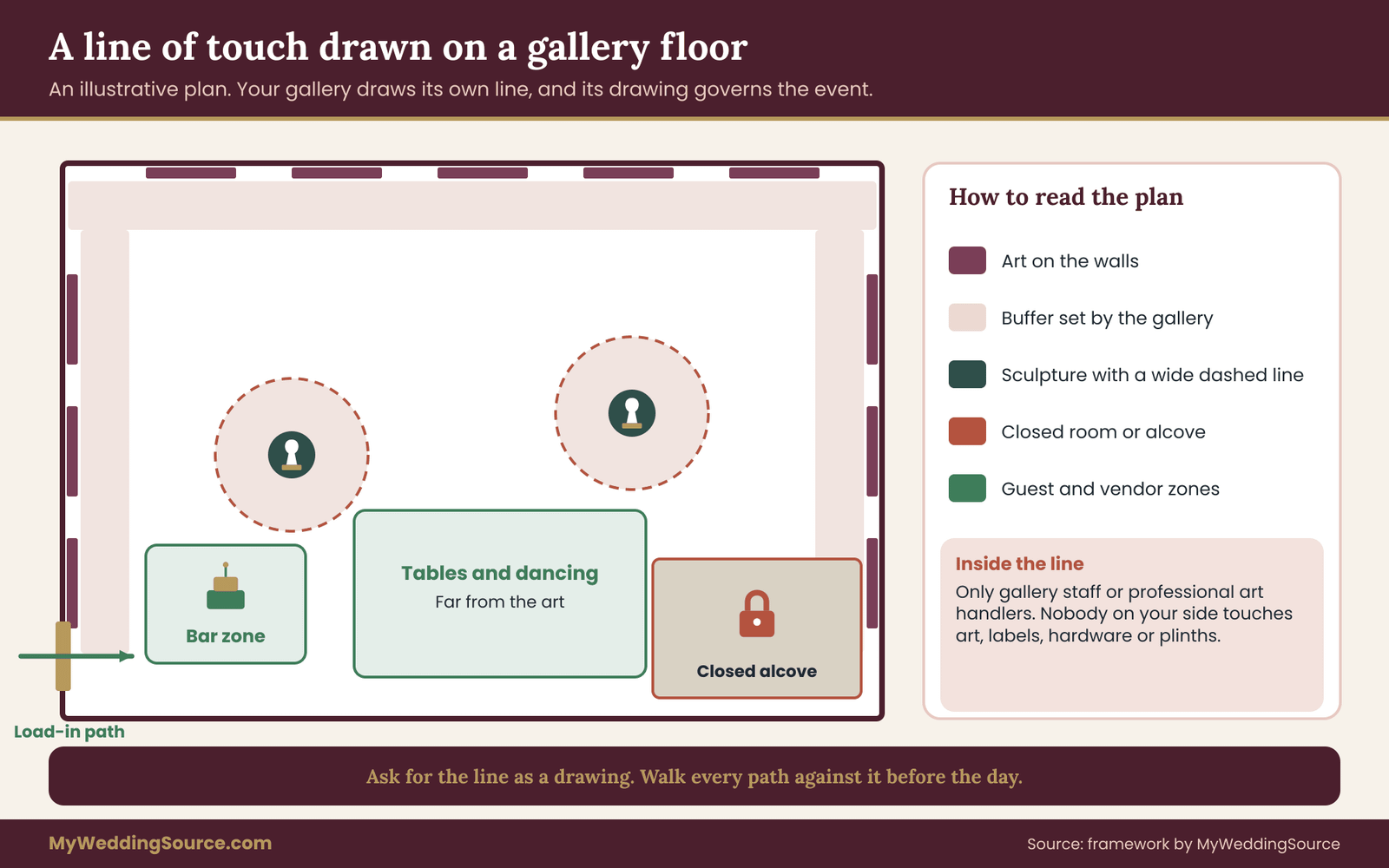
A line of touch is a drawn boundary around each piece or group of pieces, set by the gallery, that tells everyone who may cross it, when and how. Inside the line, only gallery staff or professional art handlers may reach, move or touch. Outside the line, guests and vendors may move freely, within the other limits of the gallery wedding. Expect the gallery to appreciate a gallery wedding client who asks this kind of question.
The word “line” is a simplification. In practice a gallery may set three things at once: a distance from the work, a rule about who may cross it and a physical or human marker that makes the boundary visible. The marker might be a floor line, a rope and stanchion, a table, a staff member, or a combination.
Ask the gallery for the line in writing, and ask for it as a plan of the room. A drawing with the art marked, the line around each piece and the allowed paths between them is easier to follow than a paragraph of rules, and it can be shared with vendors without editing.
Who is allowed to touch
Two groups are easy to confuse. Art handlers are trained to move, wrap, hang and transport artworks. Gallery staff may include handlers or may not. Event vendors, however skilled, are not art handlers, and guests are not either.
The practical rule for a gallery wedding is that nobody from your side touches the art, the hanging hardware, the labels or the plinths. If something needs to move, the gallery moves it, or hires someone who does. That includes moves that seem small, such as turning a picture that is crooked or lifting a sculpture a few inches. Few steps do more for a gallery wedding than this one.
This rule has a cost, and you should plan for it. If your design requires moving works, the gallery will tell you who does the moving and who pays, and the cost can include hourly staff time, the use of specialized handlers, and a condition check before and after. Ask for the number early, in writing, so that you can compare it with the alternative of designing around the art.
Markers that work and markers that do not
A boundary that exists only on paper fails by the second hour of the party. Guests are friendly, curious and increasingly relaxed, and they will lean toward a piece to read a label or to take a photo. The marker has to work on guests who are not thinking about it.
Physical markers include floor tape in a color the gallery approves, rope and stanchions, a low barrier, or furniture that creates a natural stopping point. Floor tape can mark the floor, so the gallery decides which kind is acceptable. Stanchions can be knocked over, so the gallery may want them weighted or placed at a distance that allows for a stumble.
Human markers are staff members or attendants placed at specific points. A person at the edge of a room, politely redirecting guests, is more effective than any sign. The gallery may require one for certain rooms and may charge for the time. Ask whether the cost is billed hourly, whether there is a minimum, and whether the attendants are on the gallery’s staff or hired for the gallery wedding.
Signs help but should not carry the load alone. A small, well-written sign at the entrance to a closed room is useful. A sign that says “please do not touch the art” on a table, three feet from a guest holding a glass of wine, is decoration. Use signs as a second layer, never the first.
Closed rooms are the strongest marker. If a room contains work that cannot be protected by a line, the gallery may simply close it for the event, lock it or turn the lights off. A closed room costs you floor space and sometimes a convenient restroom route. It also removes a whole category of risk.
Setting the line around different kinds of work
Different works ask for different lines, and the gallery decides each one. You can still understand the logic, which helps you plan the gallery wedding around it.
Wall-mounted flat work, such as paintings and framed prints, is vulnerable to bumps, splashes, flash and sustained crowding. The line tends to be a distance from the wall plus a rule about drinks and bags. Guests with tall hats, large bouquets or cameras on long straps need a thought as well. A gallery wedding tends to go wrong in small moments like this one, so plan for them.
Free-standing sculpture is vulnerable to knocks from every side. The line is usually all the way around it, and the floor beneath it may need extra care because a heavy piece can be sensitive to vibration. A dance floor that thumps may be a problem near a delicate base.
Fragile or unframed work, such as ceramics, glass, paper or textiles, may need to be moved out of the room, placed in a case or covered. Light and humidity may also matter, and a crowded room changes both.
Time-based and electronic work, such as video, sound or interactive pieces, brings a different list. It needs power, it may need darkness, it may make sound at certain times and it cannot always be paused. The question to ask is whether the piece will run during your gallery wedding and whether its sound or light conflicts with your program.
Work that guests are invited to touch is rare but exists. If the show includes one, the gallery will tell you, and the instructions will be specific to that piece.
Food, drink and the bar
The bar is the biggest single decision in the line of touch. Liquids near art are the classic risk, and a gallery that is careful will often limit where drinks may go. Common arrangements include serving and drinking only in a defined zone, using a bar that is physically separate from the art, requiring covered or spill-resistant cups in certain rooms and moving bar traffic to a different route than the art route.
Ask where food and drink can be consumed, not only where they can be served. A guest who leaves the bar with a glass of red wine and wanders into the main gallery is the scenario the gallery has in mind. Plan for it by giving guests somewhere pleasant to stand with a drink, so that the nearest pleasant place is not the one that is next to a piece. This is the part of a gallery wedding that guests remember least and staff watch most.
Passed hors d’oeuvres need the same treatment. Small plates, napkins and skewers have to end up somewhere. Put the bins and the trays where guests will naturally leave them, and keep them away from the art.
Dancing, music and vibration
Music is easier to plan around art than people expect, and dancing is harder. Sound does not usually damage artwork, but vibration can matter for some work, and a gallery may ask about speaker placement and volume for that reason. It may also ask that speakers not rest on or against anything that belongs to the gallery.
Dancing brings movement and crowding. A dance floor should be placed in a part of the room that has the fewest works, and the line around the nearest ones should assume a stumbling guest and not a careful one. If the gallery has a separate room with little or no art, that room is usually the natural choice for the dance floor.
Ask the gallery whether there is a limit on amplified sound, either from its own rules or from the neighbors and the building. The reception guest flow guide explains how to lay out entry, seating, food and exit so people move where you want them to. In a gallery, use that layout to move people away from the art, not toward it. Plan this early, because the layout of a gallery wedding follows from it.
Photography, flash and tripods
Photographers working in a gallery have their own set of limits. Flash, in particular, is something many galleries limit or forbid for certain works, because some materials are sensitive to light. The gallery may allow flash in some rooms and not others, or may ask that flash be bounced rather than aimed at a wall.
Tripods, light stands and bags are hazards in a crowded room. Ask the gallery whether they may be placed in the event zone and where equipment cases can be stored. A photographer who knows the line of touch before the day can plan their shots around it. A photographer who learns about it at the door will be improvising.
There is a second photography question, which is whether the art itself may appear in your photographs and in what use. A wedding photograph with a gallery work in the background is usually ordinary. Using the image commercially, such as in an advertisement or on a product, is a different matter, because the artwork may have its own copyright.
If you intend to publish or sell images, ask the gallery about its policy. For private use and sharing with family, the issue rarely arises, but the gallery’s event rules may still say something about photography.
The walk-through with the line in hand
The best moment to test the line of touch is a walk-through with the gallery staff and your key vendors, with the drawing in hand. Walk the paths that guests, vendors and equipment will take, in the order they will happen. Start with the load-in path, then the ceremony entrance, then the cocktail area, then the dinner seating, then the dance floor, then the exit. A gallery wedding works best when the boundary is obvious without a lecture.
At each step, ask one question: what is the nearest art, and what could reach it from here? The answer will sometimes be nothing, and you can move on. Sometimes it will lead to a change, such as moving a table, narrowing a path or adding an attendant. Write each change on the drawing before you leave the room.
A good walk-through produces a marked-up drawing and a short list of decisions. Ask the gallery to send the final version after the changes are made, and treat that version as the one that governs the event.
Temporary installations you bring: the installation test
Decor is the heart of any wedding, and a gallery wedding is no exception. A gallery gives you a head start, because the room is already striking. The trick is adding to it without touching it. Every decor idea that involves an installation passes through four questions.
Question one: what does it touch?
List every point of contact between the idea and the room. A floral arch that stands on the floor touches the floor. A garland that hangs from the track touches the track. A banner taped to a wall touches the wall, and so does the tape adhesive. A projection touches no surface in the usual sense but lands light on one. In a gallery wedding, the easiest fix is usually the one that removes the risk entirely.
For each point of contact, the gallery decides whether it is allowed and what method is acceptable. Floors may need protection from legs and wheels. Walls may be off-limits entirely. Track and ceiling points may be off-limits for anything but the gallery’s own lighting. Windows may carry film or glass that a sticker could damage.
Ideas that touch nothing are the easiest to approve, and a gallery wedding often does best with free-standing installations. A freestanding structure with a weighted base, a hanging element supported from a freestanding frame or a table-based arrangement can create the same visual effect without relying on the building.
Question two: what does it weigh, and what holds it?
Anything that stands needs a stable base, and anything that hangs needs a support rated for the load. The gallery may require a written rigging plan, and for anything overhead it may require a rigger or a licensed technician. Do not guess at the strength of a gallery’s track, ceiling or beams. Ask, and take the answer from the gallery or a qualified professional, never from a florist’s estimate.
The difference between a florist who says “it’s light” and a florist who supplies the weight, the support method and the point load is the difference between a sketch and a plan. Ask your vendor to provide the number, and give it to the gallery in writing. The goal at a gallery wedding is a boundary that guests follow without noticing it.
A related point is that hanging installations create a falling hazard to guests and art alike. If a piece could fall, the question is where it lands. A design that places a heavy hanging element over a walkway or over a work is a design to change.
Question three: what can it leak, burn, shed or mark?
Hazard is a separate question from contact and weight, and a surprising number of ideas fail here. Run through the usual suspects.
Water. Fresh florals sit in water, and water spills. Ask your florist about foam, sealed containers, liners and trays, and about how the arrangements get from the van to the room. A vase carried across a floor near art is a different risk from a vase delivered to a room with no art. The route matters as much as the object.
Flame and heat. Candles, torches, sparklers, flameless candles with batteries, theatrical effects, warming trays and heated lamps all raise questions. Many galleries ban open flame outright, and some ban anything with a heating element in the art rooms. Battery candles are a common substitute, and they come with their own question about the batteries.
Shedding. Petals, confetti, glitter, feathers, rice and bubbles all end up somewhere you did not intend. In a gallery, loose material can settle on a work or on its base, and some of it is hard to clean without handling the piece. Ask whether any of it is permitted, and if so, where.
Marking. Tape, adhesive hooks, wire, paint, chalk, markers and wet-ink signage can mark surfaces. So can stands with rubber feet, dark wheels and rented furniture with rough bases. The floor of a gallery is often a feature, polished or sealed, and the gallery may require protective coverings for anything that moves on it.
Haze and fog. Smoke, haze and fog from machines or from fireworks can trigger a fire alarm, leave residue and affect the air around sensitive objects. Most galleries do not allow them, and the fire alarm system may be tied to the building rather than to the gallery.
Strong scents. Heavily fragranced candles, sprays and some flowers can bother guests and, in some cases, interact with sensitive materials. A short question to the gallery is enough.
Question four: who approves it, and how will we know?
An idea is approved only when the right person has said yes in writing and the approval names the version you will build. A casual “that should be fine” about a concept is not approval of a design that changes by the time it gets built.
Create a simple approval record for each installation. It needs the idea, the design version, the touch points, the weight and support, the hazards and their controls, the gallery’s decision, the name of the person who made it and the date. Keep these in a single folder, and send the same folder to the vendor. That is the usual shape of a decor decision at a gallery wedding.
If the idea changes, the record changes. A florist who adds a heavier element two weeks out has changed the weight. A lighting vendor who adds a projector has changed the touch points. The record is what allows the gallery to say yes again, with the same information you gave it the first time.
What passes, what changes, what fails
Most ideas end up in one of three places after the test.
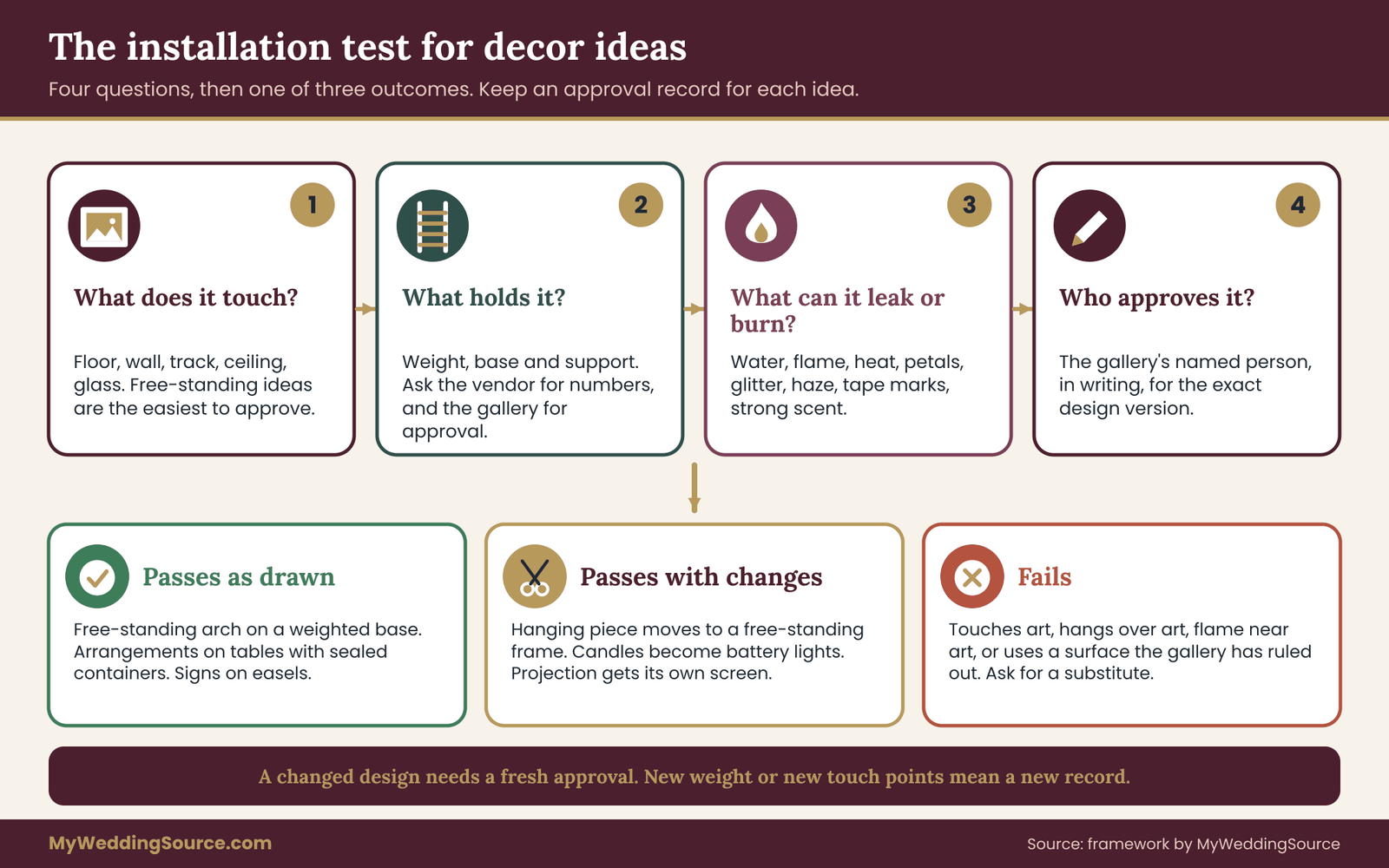
Passes as drawn. A freestanding ceremony backdrop on a weighted base, placed in a clear area and away from the art, usually passes. So does a floral installation that sits on tables, with sealed containers and trays. So do signs on easels, which are easy to move.
Passes with changes. A hanging installation may pass if it hangs from a freestanding frame rather than from the building. A projection may pass if it uses a screen rather than a wall, or if it plays at a different time. A candle display may pass if the flames are replaced by battery lights.
Fails. An idea that needs to touch art, hang over art, light a flame near art or use a surface the gallery has ruled out will not be approved. The useful response is to pass on that version and ask for a version that does the same job differently. The substitute is nearly always possible, and it is usually less expensive than the original.
Installations that depend on the gallery’s own lighting
Lighting is a special case because the gallery’s lighting is part of its exhibition. Track lights are positioned and aimed for the art, and the gallery may not allow anyone else to move them. Changing their color or intensity could change how the art looks, and some works are sensitive to light. Free-standing design is the quiet advantage of a gallery wedding.
If you want a different lighting mood, ask first what the gallery permits. Some galleries allow you to use the existing lights at a lower level, to turn certain zones on or off or to add separate lighting in non-art areas. Others will keep the exhibition lighting on, period. Plan decorative lighting that works independently, such as freestanding fixtures with their own power, positioned so that they do not shine on the art and do not need the gallery’s circuits.
Also ask about electrical capacity. Extension cords across a floor are a trip hazard, a possible source of damage and sometimes a violation of the building’s rules. A gallery may specify the outlets that your vendors may use, and the cable covers and routes that are required. The technical walkthrough approach explains how to check power, access and measurements, and a gallery adds the rule that every route is checked against the line of touch.
Projection, screens and video
Projection is popular in galleries because the walls are blank, or seem to be. Treat that as an illusion. A wall that holds an artwork, or that is part of an exhibition, is not a screen. Projecting onto it may interfere with the work, with other light and with the sightlines of guests. Ask for the answer in writing before the florist orders anything for the gallery wedding.
If you want a slideshow or a projection, bring your own screen, put it in an area without art and ask the gallery to confirm the location. Be aware that a projector throws light beyond the screen and generates heat, and it needs power and a cable route. The gallery may also have an opinion about brightness, because strong light can affect sensitive pieces.
Temporary installations the gallery changes
So far the focus has been on what you bring. The other kind of temporary installation is the one the gallery creates for your gallery wedding, by moving, covering or removing parts of its exhibition. This is where the costs and the insurance questions can grow quickly. A gallery wedding rarely needs more decor than the room already gives you.
Why a gallery might change the show
A gallery changes a show for an event for four common reasons. A piece is in the way, such as a sculpture where tables need to go. A piece is at risk, such as a delicate work near a bar or dance floor. A piece is in the wrong light or the wrong sound environment for a party. Or the gallery wants the room to feel different for your wedding and agrees to change a display.
Each is a legitimate reason, and each has a cost. A gallery that agrees to move work is accepting some risk, and it will often pass the cost of that risk to you through fees, conditions or both.
The options, from least to most change
There is a ladder of options, and the best choice is usually the lowest rung that solves the problem.
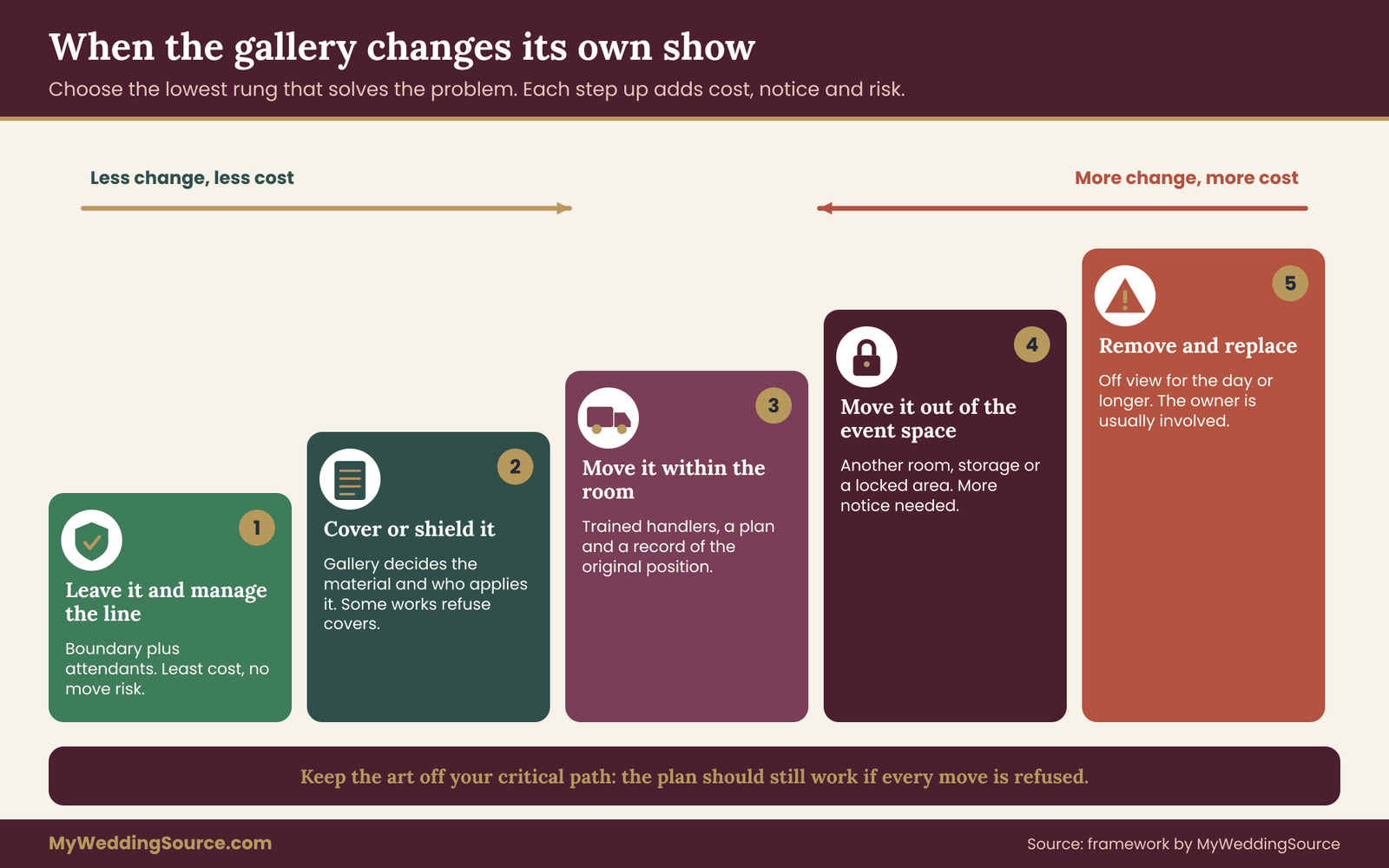
Leave it in place and manage the line. The work stays where it is, protected by a boundary and attendants. It is the least expensive and usually the least risky option, because moving art is itself a risk.
Cover or shield it. A work may be covered with a protective material, placed behind a barrier or shielded from splashes. The gallery decides what material, who does it and how it is secured. Covering is not always safe, because some works are sensitive to materials that touch them, and the gallery may refuse.
Move it within the room. A piece is moved to a safer part of the room. Moving requires trained handlers, a plan and often a record of its original position so that it can be put back exactly.
Move it out of the event space. The work goes to another room, to storage or to a locked area. This is the safest for the work and the most disruptive for the gallery, and it may require the most notice.
Remove it and replace it. In some cases a gallery will take a work off display for the day or for longer. This is the highest rung, and the one that most often involves the owner of the work.
Who pays and who decides
A gallery decides what happens to its show, and the owner of each work has a say in how it is handled. You do not decide, and you should not push. What you can do is understand the costs and make a choice with open eyes.
Expect the gallery to charge for staff time, handlers, materials and a condition check. The charge may be fixed or hourly, and it may be higher on a weekend or at night. Ask for an itemized estimate before you agree to any change in the exhibition, and ask what happens to the estimate if the plan changes.
A rental agreement should say who bears the risk of damage that occurs during a move, and that is where the insurance questions begin. Keep this list beside the design file for the gallery wedding.
The worst version of this decision
The worst version is a late request. A couple asks, three weeks before the wedding, to move a large work that the gallery has had in place for months. The gallery has to contact the owner, schedule a handler, check the insurance and confirm that the work can be moved. If any step takes longer than expected, the answer is no, and the couple has no time left to redesign.
The remedy is to ask at the beginning. At the first conversation, ask whether any work is likely to be in the way of your layout and whether the gallery is open to moving it. If the answer is that nothing moves, design around it. If the answer is that something can move, ask what notice the gallery needs and put the date on your calendar. Every approved change belongs in the gallery wedding approval folder.
Keep the art off your critical path
A final principle ties these options together. Your plan should work even if the gallery says no to every change. If your ceremony depends on moving a sculpture, you have built a critical path through someone else’s property. Design the layout so that the best-case version needs a move and the baseline version needs none. When a change is approved, you have a bonus. When it is not, you still have a wedding.
Gallery wedding insurance: the question ladder
Insurance is where a gallery wedding gets technical, and also where a calm sequence of questions beats a long conversation. The ladder has five rungs. You climb one at a time, and you write the answer to each before moving to the next. If a rung has no answer, stop and fix it, because every rung above it depends on it.
A word about what insurance is for. It does not prevent damage. It decides who pays when damage happens, and how fast. In a gallery the stakes are lopsided: the objects can be valuable and irreplaceable, the owners are third parties, and the people with the most to lose are not at the party.
That is why a gallery asks for insurance, and why it is worth taking the questions seriously even if you are certain nothing will happen. For a gallery wedding, this is the question to settle before the deposit is paid.
Rung one: what does the gallery require?
Start with the gallery’s own insurance requirements for renters. They are usually written into the rental policy or the agreement, and they commonly include a general liability policy for the gallery wedding, a minimum limit, a certificate naming the gallery as an additional insured, and a requirement that vendors carry their own coverage.
Ask for the requirements in writing, with the exact wording the gallery wants on the certificate. A certificate of insurance is a summary document, issued by an insurance agent or broker, that shows what policies exist, who they cover and the limits. The gallery will check the names, the dates and the limits, and a mismatch can hold up approval.
Ask also whether the gallery requires coverage for damage to its property and to the property of others in its care. This is a separate question from general liability, and it matters more here than at most venues.
Rung two: what does the gallery’s own policy cover?
The gallery carries its own insurance. Ask what it covers, in general terms, without expecting policy numbers. The useful questions are whether the gallery’s property insurance covers works on display, including consigned work, and whether that coverage applies during private events or has any limit for them.
A gallery’s property coverage is often designed for ordinary operations: visitors, openings, exhibitions. A private event with alcohol, crowds and vendors can change the picture, and some policies treat events differently. The gallery’s insurance contact will know, and the event manager should be able to tell you whether the gallery has checked. A gallery wedding adds third-party property to the risk, which is why the answer matters.
Ask also whether the owners of consigned work insure it themselves. Some artists and collectors do, some rely on the gallery and some have an agreement that places the risk on one side or the other. You do not need the details. You need to know that the gallery has thought about it, because the answer decides how much weight rests on your own policy.
Rung three: what does your gallery wedding liability policy cover?
Most couples who buy event insurance buy a policy that includes general liability, meaning coverage if a guest is injured or if you are legally responsible for damage to someone else’s property. Some venues require it, and some couples buy it anyway.
A standard feature of many general liability policies is a limit on damage to property that is in your care, custody or control. The exact term and wording vary by insurer and policy, and the question to ask your broker is whether damage to artwork at the venue would be covered, and if so up to what limit, or whether it would be excluded because the work is in the venue’s care. Do not assume that “liability coverage” means “art damage coverage”.
Also ask whether the policy covers damage caused by your vendors, by your guests or by both. And ask whether a specific endorsement, sometimes called a rider, can extend coverage to the gallery as an additional insured. The gallery will almost certainly want that.
A short script for the broker helps: “We are holding a wedding in an art gallery. The gallery displays works owned by other people. Does this policy cover damage to those works if it is our responsibility? What are the limits and exclusions? Can you issue a certificate naming the gallery as additional insured?” Ask your broker to describe a gallery wedding specifically, not an event in general.
Rung four: what do your vendors carry?
Vendors carry their own policies, and the gallery usually wants a certificate from each of them. The caterer, the florist, the band or DJ, the rental company, the photographer and the lighting or audio supplier may all be asked.
Vendors who work in galleries often have certificates ready. Vendors who do not may need time and a fee to get one. Ask early, and tell them the exact wording and the due date. A vendor who cannot produce a certificate for your venue is a vendor to reconsider, not a vendor to hope about.
Note the difference between a vendor’s insurance and the vendor’s responsibility. A certificate shows that a policy exists. It does not prove that the policy responds to a particular claim, and it does not make the vendor careful. Your contract with each vendor should say who is responsible for damage they cause, and the wedding vendor contract guide explains the clauses to look for.
Rung five: who pays for what nobody covers?
The last rung is the one that people skip, and it is the one that matters when something goes wrong. After rungs one to four, ask what is left. Is there a deductible, and who pays it? Is there a limit, and what happens if damage exceeds it? Is there an exclusion for something that your gallery wedding involves, such as alcohol, flame or hanging installations? Write the answer on the one-page summary for your gallery wedding.
The answer is often that you, personally, are responsible for any gap. That is not a reason to cancel. It is a reason to limit the risk through the plan: wider boundaries, fewer attachments, fewer hazards and a smaller list of things that could go wrong. Insurance and planning work together, and the more you reduce the second, the less you depend on the first.
A note on specialist art coverage
Some galleries require, or recommend, additional coverage specifically for the artwork during the event, sometimes called fine art or event coverage. A broker can tell you whether such coverage exists for your situation, what it costs and what it excludes. The decision of whether to buy it belongs to you, with the gallery’s input. Ask the gallery whether it requires it before you assume it is optional.
Do not buy coverage because a salesperson says it is needed without checking the gallery’s own list. A policy that does not match the gallery’s wording may not satisfy the requirement, and a policy that does is only useful if it fits the exposures in your plan.
Reading the gallery wedding agreement and the certificate
The rental agreement is the document that turns all of the conversations into obligations. A gallery wedding agreement is often longer than a typical venue contract, because it has to cover the art. Read it as a ledger of responsibilities, and look for the same questions the earlier tools raised. This is the most common gap in gallery wedding insurance, and the easiest to close early.
The clauses worth reading twice
Scope of space and time. Which rooms and which hours are included, and which of them are shared with the public or with other renters. Load-in and load-out times are often in a separate clause and are usually shorter than couples expect.
Art protection and boundaries. The agreement may incorporate the gallery’s art-handling rules by reference, or it may attach them. Make sure you have seen the rules it points to, and that the line-of-touch drawing is part of the file.
Changes to the exhibition. A clause may allow the gallery to change the exhibition, reduce the space or close rooms. Ask what notice you get and whether any remedy exists, such as a partial refund or a right to cancel.
Damage and responsibility. Look for who is responsible for damage to the building, the fixtures and the art, and under what circumstances. A common structure is that the renter is responsible for damage caused by the renter, the guests and the renter’s vendors. Look for whether responsibility is limited to the insurance limits or goes beyond them.
Indemnification. An indemnification clause says that you will cover the gallery’s losses from claims connected to your gallery wedding. It is standard, and it can be broad. Ask the gallery or a lawyer what it means in practice, and do not skip it. The agreement is a legal document, and the usual advice applies: read it before signing, ask questions in writing and consider having a lawyer look at anything you do not understand.
Security deposit. The deposit may be held against damage, cleanup or overtime. Ask when it is returned, what it can be applied to and how any deductions are documented. A condition record from before and after the gallery wedding helps here.
Cancellation and force majeure. Understand what happens if the gallery or you cancel, what is refundable and what happens if an event outside anyone’s control stops it.
The certificate of insurance, line by line
A certificate is a short form, but it contains several things that a gallery will check. Read yours before you send it.
The named insured should be you, or whichever party the policy covers. The certificate holder and additional insured lines should carry the gallery’s exact legal name and address, as the gallery provides them. The policy dates should cover the whole event, including load-in and load-out. The limits should meet the gallery’s minimum. The description of operations should refer to your gallery wedding, the date and the location.
If anything is wrong, the broker reissues the certificate. The correction is usually quick, if you ask in time. The wedding vendor due diligence checklist covers how to confirm that a vendor’s paperwork is complete before you pay, and the same habits apply here: check the names, the dates and the limits.
One caution: a certificate summarizes. It does not replace the policy, and it does not change the policy’s terms. If the details matter, ask the broker to confirm in writing whether the policy responds to damage to third-party art, and keep that answer with the certificate. Gallery wedding insurance works best when it matches the plan, not the other way around.
Keep one insurance page
Put the answers from the ladder on a single page. List the gallery’s requirements, the gallery’s coverage as it described it, your policy and limits, each vendor’s certificate and the open gap, if any. When the gallery’s event manager asks for an update, you can send the page. When a vendor asks what is required, you can send the same page. One page beats scattered emails, and it shows the gallery that you are an organized renter, which tends to make everything else smoother.
Documenting the room before and after a gallery wedding
Records are the unglamorous part of any event, and in a gallery they carry real weight. If a mark appears on a wall or a work after the gallery wedding, the first question is whether it was there before. A good record answers that in minutes. A missing record turns it into an argument.
The condition check
A condition check is a walk through the space, with a gallery staff member, before the event begins and again after it ends. It notes the state of the walls, floors, fixtures and display furniture in the areas you will use, and it notes anything that already shows wear. For the art, the gallery does its own condition reporting, and you should not expect to inspect works yourself or to receive a report on them.
You are documenting the room and the areas around the art, not the art. That record is the quiet backbone of a gallery wedding file.
Ask the gallery whether it does a check as a matter of routine. If it does, ask to be present and to receive a copy. If it does not, propose one, and bring a simple list of areas to cover. Most staff welcome the idea, because it protects them too.
Two checks matter. The first happens after setup and before guests arrive, when the vendors have finished and the room is in its event state. The second happens after the last guest leaves and before the vendors have fully cleared out, so that any problem can be traced to a specific vendor and time. If the gallery wants a final check after load-out, schedule it and confirm who attends.
Photographs that help
Photographs are the simplest record. Take wide shots of each area you will use, before anything is set up, from the same positions you will use afterward. Take close shots of anything that is already scuffed, chipped, stained or loose. Keep the files with their original dates, and send a copy to the gallery if it asks.
Do not photograph the art in a way that the gallery has restricted. If the gallery’s rules about photography apply to your records, follow them. The photographs are for the room and its surroundings, and a few wide shots of the walls and floors are enough. A gallery wedding is easier to close out when the starting condition is documented.
Add your own vendor records. A florist’s photo of the finished installation, a rental company’s delivery receipt that lists items and condition, and a caterer’s check-in sheet all help when a question comes up later. The rental planning checklist explains how to record deliveries and returns, and the same habits suit a gallery, where a dent in a rented table matters less than a mark near a wall.
Who is on site
A named person on your side should be responsible for the gallery relationship during the gallery wedding. That person is not the couple. It might be a planner, a day-of coordinator, a trusted friend or a family member with a clear brief. Their job is to receive instructions from the gallery staff, pass them to vendors and flag anything unusual.
Give that person the line-of-touch drawing, the approval record for each installation, the insurance page and the gallery’s contact list. Make sure they know who has authority to say yes to a change, and that the answer is the gallery’s designated person and nobody else.
If you do not have a planner, assign the role in advance and brief the person at the walk-through. Day-of problems tend to be small, and a person who has seen the drawing can solve most of them without involving you.
After the event: close the file
After the gallery wedding, the process closes in three steps. First, complete the final check and get a sign-off or a note that no issues were found. Second, confirm the return of any deposit, with a written account of any deductions. Third, collect and store the certificates, approval records, drawings and emails together. Assign this job before the gallery wedding, not during it.
If the gallery reports damage, do not argue by email in the first hour. Ask for the details, the photographs and the date and time of discovery. Compare them with your records. Contact your insurance broker at once, because policies may require prompt notice of a claim. Keep the conversation factual, and keep the gallery informed of the steps you are taking.
If everything is clear, thank the gallery staff. A short note of thanks after a smooth event costs nothing, and a gallery that remembers a careful renter is more likely to be generous about the next request, whether it is yours or a friend’s.
A worked case: a gallery wedding with consigned work and a hanging installation
The following example is invented to show the method in use. It is not a real couple, a real gallery or a real quote. The details are chosen to illustrate decisions, not to suggest what any gallery will say.
The setup
Imagine a couple, Mara and Theo, who want a wedding for about eighty guests in a small commercial gallery. The gallery has two connected rooms and a back office. The current exhibition is paintings on the walls of the front room and three floor sculptures in the back room. The gallery does events on Sunday evenings, after its public hours, and has a written rental policy.
Their ideas are a ceremony in the front room, a cocktail hour in the back room and a seated dinner in the front room after the chairs are cleared. Their florist proposes a hanging installation of branches and blooms over the dinner tables, and a ceremony arch at the front. They also want a slideshow on the back wall during dinner.
Building the ledger
On the ledger, the paintings belong to several artists, and the gallery holds them on consignment. The sculptures belong to one collector and are on loan for the show. The walls, track lighting and floor belong to the gallery, although the gallery leases the building. The chairs, tables, linens, arch, florals and sound system belong to Mara and Theo’s vendors, and the gallery’s two long benches belong to the gallery. In this gallery wedding example the method mattered more than any single decision.
Three flags appear immediately. The dinner tables sit under the paintings on the long walls. The back room is full of sculptures that the bar and the dance floor would crowd. And the hanging installation would attach to the building’s ceiling track.
Drawing the line
The gallery’s event manager provides a floor plan and marks a line around each sculpture, wider than the couple expected, because the pieces are on thin bases. The paintings receive a line along the walls, with a rule that no table may sit within a set distance of a wall. The event manager closes a small side alcove containing a fragile work and asks for one attendant in the back room for the whole event.
The couple’s first layout puts tables along the wall. Under the line, that layout loses two tables. They respond by shifting to one long central table and two round tables in the middle of the room, and they drop their guest count by eight, to seventy-two, after checking the room’s capacity for the new layout.
The installation test
The hanging installation fails on question one, because the track belongs to the building’s lease and the landlord does not allow attachments. The florist suggests a freestanding frame instead. The gallery asks for the frame’s weight, base size and anchoring plan. It must stand in the middle of the room and not over the paintings or the walkway.
The arch passes with a weighted base. The slideshow fails because the back wall is part of the exhibition, so the couple rents a freestanding screen and places it in the front room’s open corner. The candles on the dinner table fail the hazard test, and the couple replaces them with battery lights approved by the gallery. The point of the gallery wedding example is the sequence, not the specific answers.
The insurance ladder
On rung one, the gallery requires a general liability certificate, naming it as additional insured, with a minimum limit it states in writing. On rung two, the gallery says its property policy covers its own inventory but that consigned works are subject to separate arrangements, which it will confirm. The couple notes the gap and asks for the answer in writing.
On rung three, the couple’s broker tells them that their general liability policy limits coverage for property in their care, custody or control and that damage to the paintings might fall under that limit or exclusion. The broker offers to ask the insurer about an endorsement. On rung four, the florist and caterer provide certificates, and the DJ has to request one.
On rung five, the open question is damage to consigned work beyond what the gallery’s insurance responds to. The couple decides to narrow the exposure through the plan, with wider boundaries, no flame, no hanging and one attendant in each room.
The result
The final plan is smaller than the original. The dinner has fewer guests, the installation stands on the floor, the slideshow has its own screen and the candles are electric. The couple has a one-page insurance summary with one open item, a written reply from the gallery about consigned works, and a rule that if the reply says the couple needs separate coverage, they will buy it before the deposit becomes non-refundable.

What did the method buy them? Not a perfect event, but an event whose risks are named, owned and bounded. The gallery trusts the plan, the florist knows the limits and nobody discovers a rule at the door. That is what the tools are for. A gallery wedding plan that survives the first no is a sturdy plan.
What this example does not prove
The example is illustrative. Other galleries will be stricter, looser or just different. Some will refuse hanging items altogether, and some will have riggers on call. Some will require fine art coverage, and some will include it. Use the method, not the numbers or the decisions, and take the answers from the gallery you are actually renting.
Vendors and load-in at a gallery wedding
Vendors are the people most likely to cross the line of touch without meaning to. They move fast, carry heavy and awkward objects, and work against a clock. A gallery wedding needs a load-in plan that reflects the room, and a vendor briefing that is specific.
One path card per vendor
Give each vendor a one-page path card. It shows the entrance they use, the route to their work area, the rooms they may enter, the rooms they may not enter, where they park, where they stage cases and empty boxes, and who to call. It also shows the load-in window and the load-out window, and says what happens if they arrive late or leave late. Brief each team on the rules of a gallery wedding before the truck is loaded.
The card should include a short statement of the rules in plain words. No touching art, labels or plinths. No tape or adhesive on any surface. No open flame. Wheels on protective covering only. Report any contact with art or fixtures at once, even if it seems minor. A vendor who reports a bump immediately is helping you. A vendor who hides it is creating a bigger problem.
Send the card with the contract or the final confirmation, and walk through it with the lead person on each vendor team on the day. The cards are not an insult to professionals. Most experienced vendors appreciate them, because they would rather know the rules than guess. A gallery wedding load-in rewards the vendor who asks one more question.
The vendors who need the most attention
Some vendors carry more risk in a gallery than others. Florists bring water, tall pieces and sometimes rigging. Caterers bring heat, liquid, carts and waste. Rental companies bring heavy furniture and trucks. Bands and DJs bring cases, speakers and cables. Photographers and videographers bring stands, lights and a habit of moving backward while framing a shot. Bartenders handle red wine, ice and glass.
Brief each group on its specific risk. A caterer needs to know the cart route and which doors are for service. A photographer needs to know the flash rules and the line. A band needs to know the speaker rules and where the nearest work is. A short, specific briefing is worth far more than a long general one. These are the checks that keep a gallery wedding on schedule.
Staging, storage and waste
Where do the empty crates, boxes, linens and trash go? A gallery often has little back-of-house space, and the answer can be a hallway, an office or a van outside. Decide in advance, because a pile of boxes against a wall is a pile of boxes against someone’s property.
Ask the gallery what its policy is for trash and recycling, for broken glass and for spills. Mark a spill kit location, and tell staff and vendors where it is.
Timing, overtime and the last hour
The most common gallery rule is a firm end time, because the staff and the building have schedules. Overtime may be charged by the hour, and it may be unavailable. Plan the gallery wedding so that the last dance ends well before the load-out begins, and so that vendors have enough time to clear without rushing. Rushing is how things get bumped.
Add a buffer to the load-out plan. If the contract says the room must be empty by a particular time, set the vendor deadline earlier, and make sure each vendor has the cards, the staff and the dollies to meet it. The same logic applies to a wedding in any rented building, and the wedding venues guide covers the general timing questions. A gallery simply makes the penalty for being late higher. No gallery wedding is worth a plan that nobody can explain.
When a gallery wedding should change plan: failure conditions and alternatives
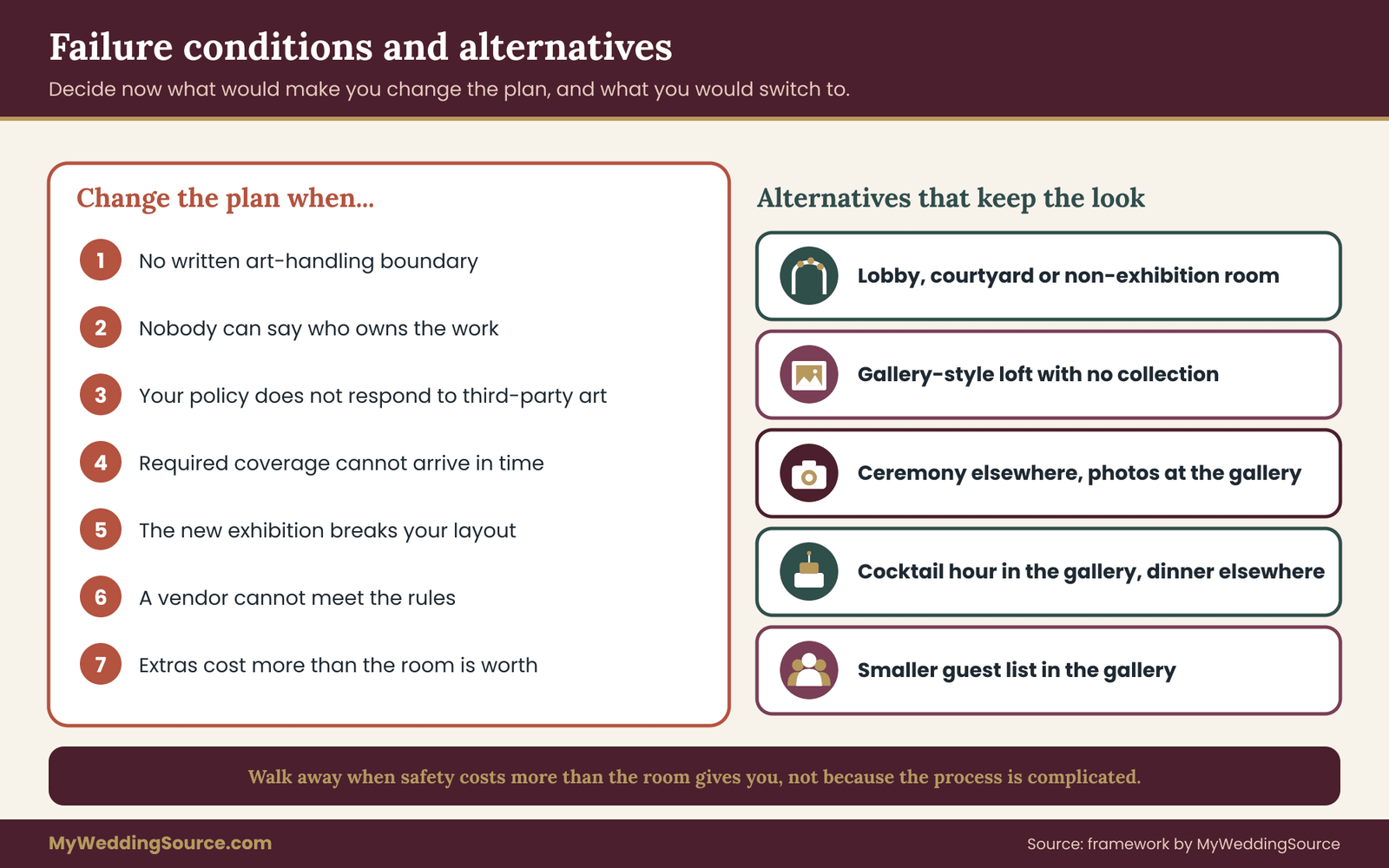
A good plan includes the conditions under which you stop. A gallery wedding has several clear failure conditions, and recognizing them early is the difference between a calm change and a crisis.
Seven signs the plan needs to change
The gallery cannot give you a written boundary. If the event manager cannot or will not put the art-handling rules in writing, you are being asked to rely on goodwill. Ask once more, politely. If the answer is still no, treat it as a warning.
The gallery does not know who owns the work. Some uncertainty is normal. A gallery that has no idea whether its owners have conditions has not looked, and you will be the one who learns what the conditions are.
Your insurance does not respond. If your broker tells you that damage to third-party art is excluded and the gallery has no other solution, you hold a risk that you cannot transfer. Either buy a policy that covers it, narrow the plan until the risk is small or choose another room.
The gallery requires coverage you cannot get in time. Insurance takes time to arrange. If the requirement arrives late and the timeline is tight, the date is at risk.
The exhibition changes in a way that breaks the layout. A new show may fill the room or introduce a type of work that your plan cannot accommodate. If the gallery cannot hold the show you toured, reassess.
A vendor cannot meet the rules. If your florist, caterer or band cannot produce a certificate, follow the rules or accept the line, replace the vendor before you replace the venue.
The costs of the extras exceed the value of the room. If handlers, attendants, extra insurance and a reduced guest count together make the gallery more expensive than a simpler venue, the room is no longer a bargain. Compare honestly, using real quotes.
Alternatives that keep the look
If the gallery does not work, you may still capture what you liked about it. Several alternatives keep the look without the art-handling burden.
Use a gallery’s lobby, courtyard or non-exhibition space. Many galleries have a front area, a terrace or an event room that holds no collection. The setting still feels like a gallery, and the risk is much lower.
Rent a gallery-style loft or studio. White walls, high ceilings and natural light are available in many event spaces that hold no art. Bring your own art, if you like, such as prints by an artist friend or a loaned work, and handle it under your own rules.
Hold the ceremony elsewhere and visit the gallery for photographs. Some galleries allow a short photo session at a time they choose. It costs less, carries less risk and gives you the look.
Hold the cocktail hour in the gallery and the dinner elsewhere. A shorter stay reduces the time and the exposure. It also reduces the number of vendors who need access.
Choose a smaller guest list for the gallery. A micro-event of a few dozen guests lets the gallery keep stricter boundaries and a quieter room. The wider question of who to invite is in the wedding budget planning guide’s discussion of trade-offs, and it connects to every choice here.
Deciding when to walk away
Walk away when the cost of safety exceeds what the room gives you, or when the people responsible for the art cannot answer your questions. Do not walk away because the process feels complicated. Complication is normal, and a gallery that engages with your questions is a good sign.
If you decide to leave, check your contract first. Understand what you will lose, what you can recover and what the timing is. Tell the gallery politely and promptly, because a quick decision lets them offer the date to someone else, which may help with the refund conversation. Use these alternatives when a gallery wedding does not fit the budget or the risk.
Your next steps
Work through the following in order, and write down each answer.
Ask the gallery what kind of space it is and what the rental fee includes and excludes. Ask what will be on view on your date, and whether the gallery will change anything for your gallery wedding. Build the three-owner ledger on a walk-through, and mark the art-adjacent, attachment and hazard items. Request the art-handling boundary as a drawing, and mark the paths for guests, vendors and equipment.
Run each decor idea through the four installation questions, and keep an approval record for each. Climb the insurance ladder one rung at a time, and keep the answers on a single page. Read the agreement for scope, art protection, exhibition changes, damage, indemnification, deposit and cancellation. Schedule the condition checks, assign a person on site and prepare a path card for each vendor. If a gallery wedding still appeals after the checks, proceed with confidence.
Finally, decide on your failure conditions now, while you are calm. Write down what would make you change the plan, and share it with your partner and your planner. For the full set of venue decisions beyond the gallery, the rental planning checklist is a useful companion, and the gallery wedding plan sits comfortably on top of it.
FAQ
Can we hang florals or fabric from the ceiling in an art gallery?
Often not from the building itself. Gallery tracks, ceilings and walls may be limited by the gallery’s lease, its rules or the exhibition. A freestanding frame with a weighted base usually gives the same look. Ask the gallery for written approval of the design, the weight, the support method and the touch points before your florist builds anything, and keep the approval with your records.
Does our wedding insurance cover damage to the art?
Not necessarily. Many general liability policies limit or exclude damage to property in your care, custody or control, and the wording differs by insurer. Ask your broker directly whether damage to third-party artwork at the venue would be covered, and up to what limit. Get the answer in writing, and compare it with what the gallery requires.
Who is allowed to move a painting or sculpture for our event?
Only the gallery or the professional handlers it chooses. Guests, vendors and the couple should never touch art, hanging hardware, labels or plinths. If your layout requires a move, the gallery will say whether it is possible, who does it, what it costs and how much notice it needs. Ask early, and design a layout that works without any move.
What is a certificate of insurance, and why does the gallery want one?
A certificate of insurance is a summary, issued by an insurance agent or broker, showing which policies exist, who they cover, the dates and the limits. A gallery asks for one to confirm that you and your vendors carry coverage and that the gallery is named as an additional insured. It summarizes the policy. It does not change the policy.
Can we use candles, sparklers or a fog machine?
Most galleries restrict open flame, and many ban sparklers, haze and fog entirely, partly because of fire alarms and residue. Battery candles are a common substitute, and the gallery will still want to approve them. Ask about every flame, heat or haze item in writing, and expect the gallery to decide based on its building rules and the art on view.
Can we project a slideshow onto a gallery wall?
Usually not onto a wall that carries or belongs to the exhibition. A freestanding screen in an area without art is the safer choice, and the gallery may still limit brightness and placement. Projectors need power, cable routes and ventilation, so include them in the installation approval and the walk-through.
What should we do if something is damaged during the event?
Stop, keep people away from the area and tell the gallery’s designated person. Do not try to repair or move anything. Photograph the area, note the time and what happened, and contact your insurance broker promptly, because policies may require quick notice. Compare the situation with your condition records, and keep the conversation factual.
When should we choose a different venue instead?
When the gallery cannot give you a written boundary, cannot say who owns the art, or requires coverage you cannot arrange in time. Also when the cost of handlers, attendants and insurance outweighs the value of the room. A gallery lobby, courtyard or a gallery-style loft with no collection may keep the look with far less risk.
Sources
- American Library Association
- American Alliance of Museums
- American Institute for Conservation
- Smithsonian Museum Conservation Institute
- National Park Service Museum Management Program
- Library of Congress Preservation
- Insurance Information Institute
- National Association of Insurance Commissioners
- Occupational Safety and Health Administration
- National Fire Protection Association