
Homeowner insurance was written for a family living in a house, not for 90 guests, a bar and a band on the lawn for one evening. This guide gives you a broker discussion checklist and a coverage gaps log, so you can find out in writing what your homeowner insurance policy does and does not do before you host a wedding on your property.
Do not assume your homeowner insurance covers a wedding, and do not assume it excludes one. Call your agent or broker 8 to 12 weeks ahead with eight blocks of questions: liability limits, medical payments, event and business-use wording, alcohol, damage to the house and grounds, tents and rentals, vendors, and paperwork. Write each answer in a gaps log as covered, excluded, conditional or unknown. Close every gap by changing the plan, adding coverage, shifting the risk to a vendor, or accepting it on purpose.
Most couples who hold a wedding at a family home spend weeks choosing a tent and about ten minutes thinking about insurance. That is understandable.
Your homeowner insurance policy is a long document in a drawer or an email attachment, the agent is someone you speak to once a year, and the subject feels like bad luck waiting to be invited. But a wedding is exactly the kind of day when ordinary exposures get bigger: more people on uneven ground, alcohol, heavy equipment, open flame, strangers working in your yard and a lot of rented property that is not yours.
This article is about one narrow job. It does not explain how to host a whole wedding at home, and it does not teach you how to read vendor certificates. For the big picture of hosting, the venues guide is the better starting point. Here the job is to learn what your own homeowner insurance policy says about a one-day wedding, put that into plain words, and decide what to do about every gap.
A note on scope. This is general information, not legal, tax or financial advice. Insurance wording, state rules and company practices differ widely, so only your policy documents, your insurer and a licensed agent or broker can tell you what applies to you.
Why homeowner insurance needs its own wedding conversation
A homeowner insurance policy is a bundle of promises with conditions attached. Part of it protects the building and your belongings. Part of it protects you if someone sues you or is hurt on your property. Part of it pays for living somewhere else after a covered loss. Each part has exclusions, limits and conditions, and none of them was priced with a wedding in mind.
That does not mean your homeowner insurance policy fails on the day. Many homeowner insurance policies contain no wording about weddings at all.
They cover your liability as a person who owns a home, and a family party at that home usually falls inside ordinary use. The trouble is the gap between “usually” and “confirmed.” You may be fine, or you may discover after an accident that the insurer sees the day as a commercial or special event, that your liability limit is lower than you thought, or that a hired band’s injury belongs on someone else’s policy.
There are three reasons to settle the question early rather than late.
First, time. Some fixes take weeks. A short-term event policy usually needs an application and an underwriter’s look. An endorsement may need approval. A vendor’s certificate has to be requested and corrected. None of that can be done on the Thursday before the wedding.
Second, leverage. Before the day, you can change the plan: cut the guest count, move the bar to a licensed caterer, skip the fire pit, hire a venue for part of the day. After an incident, you can only argue about what happened.
Third, honesty. Your agent can only advise on what you disclose. Telling your agent plainly what you plan to host is not a risk to your coverage. Hiding it can be.
What this article leaves to other guides
Two neighboring topics are covered elsewhere on the site and are mentioned here only where they touch your homeowner insurance policy. The first is the broader readiness question of whether a property can host a wedding at all: ground, utilities, neighbors, parking and restrooms. The second is how to read the certificates that vendors send you. The vendor due diligence checklist covers who to check before you hire. This guide focuses on what your own policy does, which no vendor document can tell you.
What you will have at the end
By the end you will have four things you can keep in a folder: a one-page summary of your current policy, the completed broker discussion checklist with the answers in the broker’s own words, a coverage gaps log with a decision against every line, and a short list of paperwork to collect before the day. That folder also helps your parents or hosts, who often own the policy.
What homeowner insurance typically covers, and where a wedding sits
To ask good questions you need a rough map of your homeowner insurance policy. The names differ by company and by form, but most U.S. homeowner insurance policies are built from the same few parts. The National Association of Insurance Commissioners and the Insurance Information Institute both publish plain-language explanations of these parts, and they are listed in the sources below. What follows is a general description, not a substitute for your own pages.
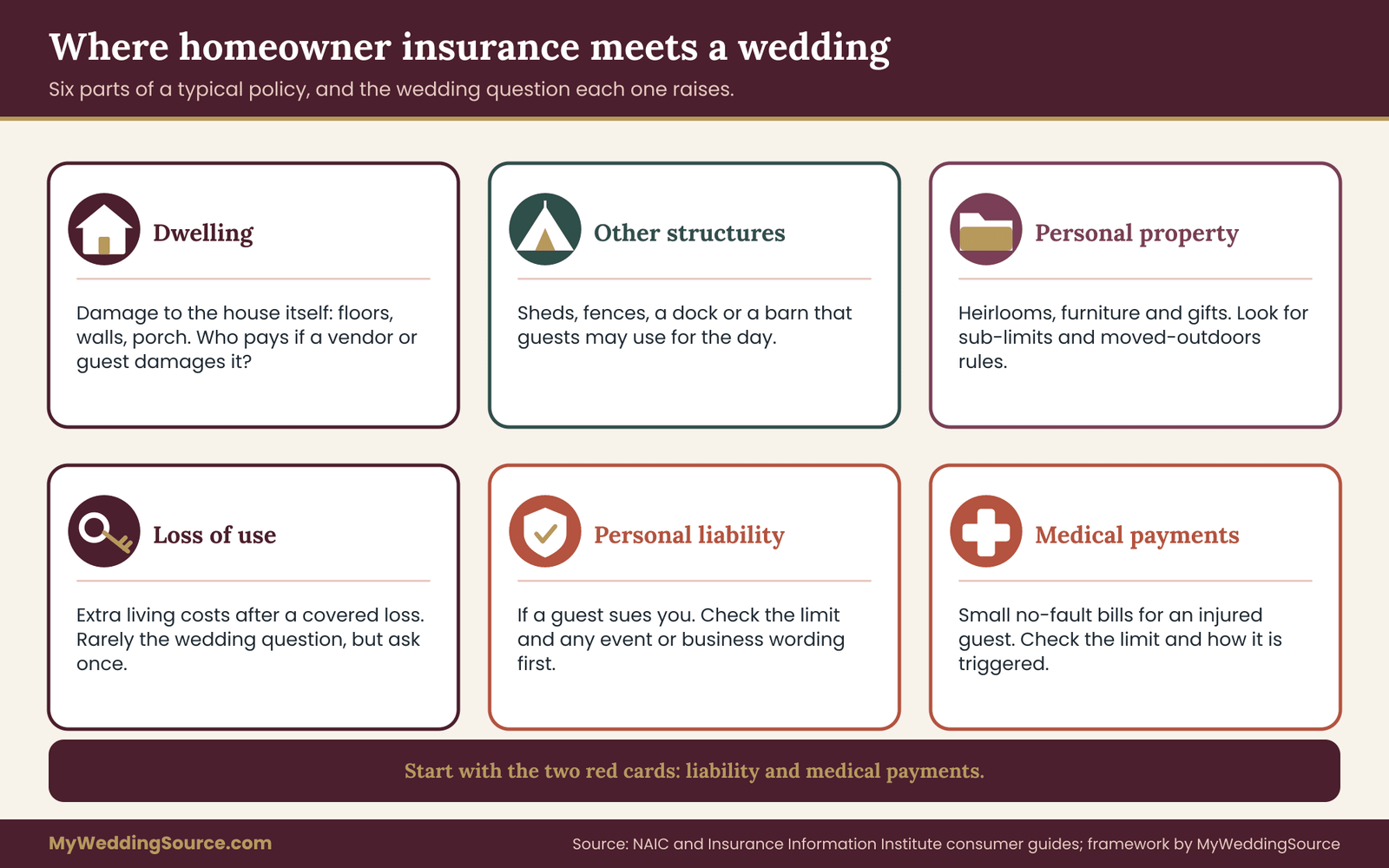
Dwelling coverage pays to repair or rebuild the house after a covered loss such as fire or wind. Other structures coverage applies to detached buildings, fences and sheds. Personal property coverage applies to belongings inside and sometimes outside the house, often with sub-limits for certain items.
Loss of use pays for extra living costs when a covered loss makes the home unlivable. Personal liability coverage responds if you are legally responsible for injuring someone or damaging their property. Medical payments to others pays modest medical bills for a guest hurt on your property, regardless of fault, up to a small limit.
For a wedding, the last two matter most, and the dwelling and property parts matter next. A guest who trips on a stake and breaks a wrist is a liability and medical payments question. A caterer who spills red wine on a hardwood floor is a property question. A rented chandelier that falls is a question about whose property it was and who promised to pay for it.
Where a one-day wedding sits in that map
A wedding is not a named category in most homeowner insurance forms. It tends to land in one of three places, and which one depends on your homeowner insurance policy and the facts.
The first place is ordinary residential use. A private family celebration with no payment from guests and no business operating at the house usually sits here, although the details still matter. The second place is a business or commercial use exclusion.
Many policies limit coverage when part of the property is used for business. If you charge a fee, rent the space out, or work with someone who does, the insurer may treat the event as business. The third place is a gap that nobody named: the policy is silent, the insurer has not decided, and a claim would force a decision after the fact.
Your goal is to move from the third place to one of the first two with a written answer.
Why private and paid events differ
A couple hosting their own wedding at their own house is different from a family renting out a backyard for weddings as a side income. In the first case, the activity is personal and your homeowner insurance policy was written for personal activity.
In the second, the activity is a business, and ordinary homeowner insurance commonly excludes or limits business activity. If any part of your plan involves money changing hands for the use of the property, say so to your agent at the start, because that is the single fact most likely to change the answer.
Typical triggers to mention include a guest or a relative paying a “site fee,” a friend who runs a small venue business bringing their own equipment and staff to use the yard, or a plan to host a second wedding at the same property next summer. None of these is automatically a problem. All of them should be said out loud.
The two limits that matter before anything else
Before the checklist, find two numbers on your declarations page: the personal liability limit and the medical payments to others limit. The declarations page is the one- or two-page summary at the front of your homeowner insurance policy. Many households carry a liability limit in the low hundreds of thousands of dollars and a medical payments limit measured in the low thousands, but do not trust that as your number. Read your own page.
Then ask yourself a simple question: if a guest were seriously hurt at a party at your home, would your liability limit feel comfortable, thin or alarming? There is no correct answer in the abstract. The point is to know the number before the day and to have a plan for the difference between that number and your comfort level. Later sections show how an umbrella policy, a one-day event policy or a smaller guest list can change it.
How to prepare for the broker discussion on homeowner insurance
A good conversation with an agent or broker starts before the call. If you arrive with a clear description of the day and a copy of your homeowner insurance policy, you will get specific answers. If you arrive with “we are having a wedding, are we covered?” you will get a general reassurance or a general warning, and neither helps you decide.
An agent usually sells policies for one or several companies and can explain your coverage and request changes. A broker usually works across many insurers and can compare options. Either may be the right person, and the word matters less than whether they can put answers in writing. If you bought your homeowner insurance directly from a company with no named agent, the customer service line or your online account can often route you to someone who can handle a request like this.
Gather four things first
Pull together the declarations page, the full policy form with its endorsements, the name of every person listed as an insured, and the name and mailing address of the property owner. These four items prevent the most common confusion, which is that the person planning the wedding is not the person who holds your homeowner insurance policy.
Next, write a one-paragraph description of the event that you can read aloud or paste into an email. Cover the date and hours, the expected number of guests including children, whether alcohol will be served and by whom, whether a tent or other temporary structure will be set up, how many vendors will work on the property, whether anyone will pay to use the property, and whether any activity involves fire, water, animals or amusement equipment. Keep it factual and complete. Leaving out the bar is not a clever shortcut.
Choose written or recorded answers
A phone call is useful for thinking out loud, but you need something you can keep. Ask the agent to send the answers by email after the call, or send your own summary and ask them to correct it.
If your agent prefers to talk, take notes with the date, the person’s name and the exact words used for the key points. A summary that begins “Thank you for speaking with me today. This is my understanding of what you told me” gives the agent a chance to fix mistakes before they matter.
Keep in mind what an email from an agent is and is not. It is evidence of what you were told, and it is useful. It is not an amendment to the policy. Only the insurer can change or confirm the contract, which is why some answers need an endorsement, a written coverage position from the company, or a new policy.
Timing: why 8 to 12 weeks ahead
Aim to start the conversation 8 to 12 weeks before the date, and earlier if the wedding is in peak season or involves anything unusual. This gives you room for a second call, for the insurer to review a request, and for time to correct vendor documents if they do not match. It also lets you change the plan with enough notice to rebook a caterer or rental company if you decide to.
If you are already inside that window, do not skip the call. Make it this week and tell the agent the date up front. Some options, such as a short-term event policy, can often be arranged quickly, although availability and speed depend on the company.
Who should be on the call
If your homeowner insurance policy belongs to your parents, a relative or another owner, they must be involved. An agent will generally speak only with the policyholder or with someone the policyholder authorizes. Ask the owner to join the call, or to give written permission for you to ask questions on their behalf. If the property is jointly owned, make sure both owners know a wedding is planned. Surprises in a claim are worse than surprises at the planning stage.
Tone for the call
You are not asking for a favor and you are not confessing something. You are a customer asking a normal question. A short opening works well: “We are planning a private wedding at our home on this date with about this many guests. We would like to confirm in writing how our homeowner insurance policy treats the event, and whether we should change anything before the day.”
The broker discussion checklist, blocks A to D
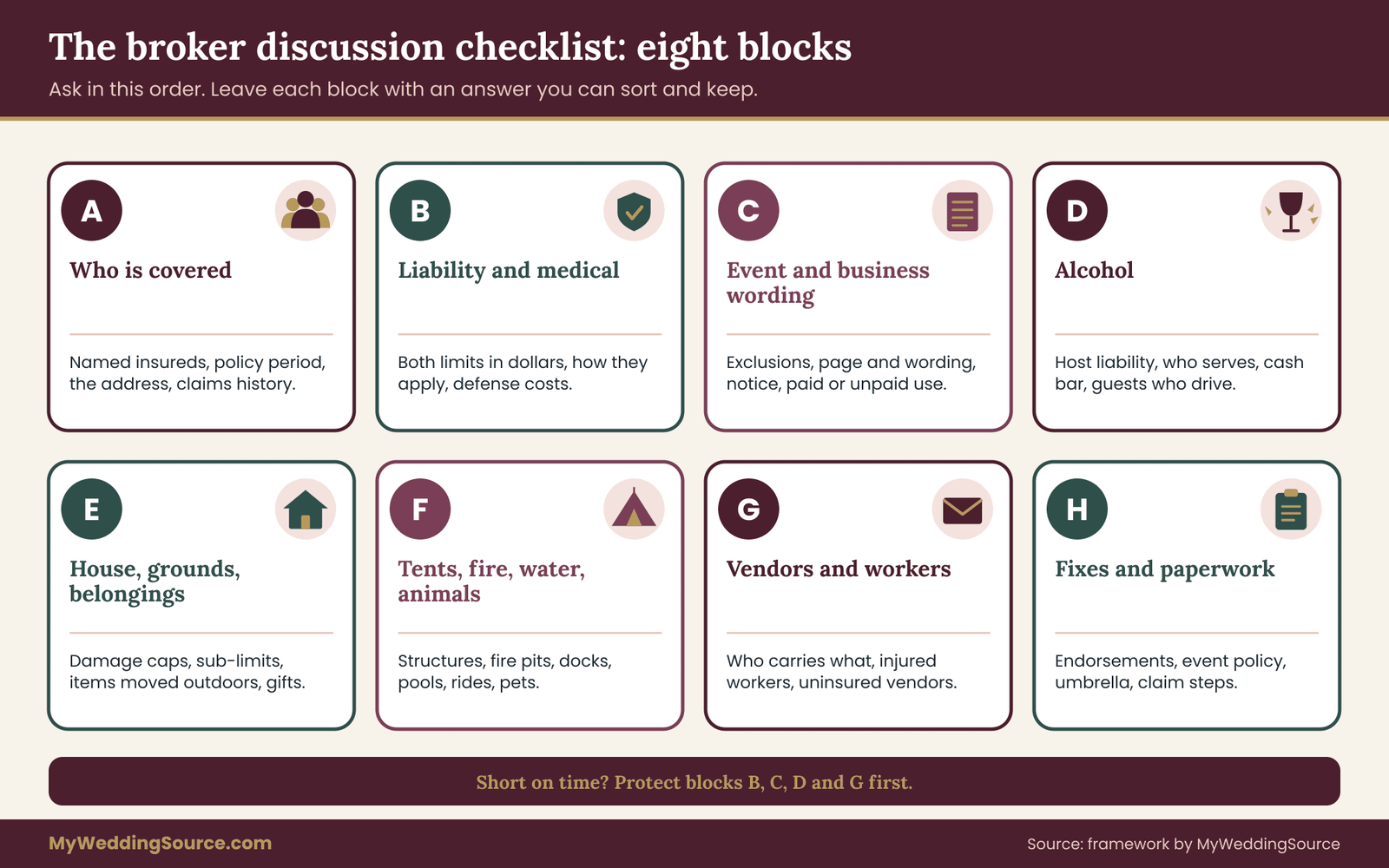
The checklist below has eight blocks of questions, lettered A to H. It is a script you can follow in order. Each block has a purpose, a handful of questions and a “what to write down” note. This section covers the first four blocks, which concern who is covered and what your homeowner insurance policy says about liability, medical bills, event wording and alcohol. The next section covers the rest.
You do not need to ask every question in the exact words below. You do need to leave each block with an answer you can sort into covered, excluded, conditional or unknown.
Block A: who and what the policy covers
The purpose of block A is to confirm the basics, so that later answers rest on solid ground.
Ask who is named as an insured and whether the couple, who may not be the policyholders, are covered as relatives living in the household or not covered at all.
Ask whether the policy period includes the event date and whether any renewal, cancellation or non-payment issue could fall near it. Ask whether the property address in your homeowner insurance policy is the address where the wedding will take place, which sounds obvious but matters when the wedding is at a second property, a family farm or land held in a trust.
Ask about the claims history on your homeowner insurance policy. A recent claim can affect how a new request is handled. Ask whether a change in occupancy or use, such as a new tenant or a long vacancy, has been recorded. Write down the insured names, the policy period, the address and any caveat the agent mentions.
Block B: liability and medical payments
Ask for the personal liability limit and the medical payments limit in dollars. Ask whether either limit applies per person, per incident or per year. Ask what the policy says about injuries to guests at a private gathering you host, and whether the answer changes with the guest count.
Ask whether liability coverage extends to damage a guest causes to another guest’s property, such as a car in the driveway or a phone dropped on a stone patio. Ask whether your homeowner insurance policy pays for legal defense and whether defense costs reduce the limit. Ask whether your liability coverage would respond if a vendor’s employee were injured on your property, and what your homeowner insurance policy says about people working at your home who are not your employees.
Write down both limits, how they apply and the exact wording of any condition.
Block C: event, business and special-use wording
This is the block most likely to produce a surprise, so take your time. Ask whether the policy includes any exclusion or limitation for business use, home-based business, commercial activity or special events. Ask for the exact page and wording. If the agent says “I’d have to check,” that is an unknown, and it belongs in your log.
Then give the agent the key facts and ask for a position. “No one pays us for the use of the property. A friend who is a wedding planner will be present as a guest and as a coordinator, unpaid. Does the event fit within your homeowner insurance policy’s ordinary use?” A reply of “yes” with a reason is useful. A reply of “probably fine” is a conditional answer and should be logged as one.
Ask whether the insurer requires notice of the event, and whether advance notice, a form or an endorsement would change the position. Ask whether a hosted wedding differs from a house party in the insurer’s view, and why. Write down the wording, the reason and any requirement for notice.
Block D: alcohol and host liquor liability
Alcohol raises the stakes for guests, drivers and hosts. Rules differ widely by state. In many states a host who serves alcohol can face liability under rules often called social host or dram shop laws, and the details depend on who is served, who serves, whether the host is paid, and what state law says. Your agent cannot give legal advice, but can tell you what your homeowner insurance policy says.
Ask whether the liability coverage responds to claims arising from alcohol served at your event, whether any exclusion limits that coverage, and whether it matters if alcohol is served by you, by a friend or by a licensed caterer. Ask whether the policy distinguishes between serving and selling. Ask whether a cash bar, a ticketed bar or tips would change the answer.
Ask what your homeowner insurance policy says about a guest who leaves your property and causes an accident. This is rarely a comfortable question, and the answer is often “it depends,” but you should hear that sentence from the agent instead of discovering it later.
Practical rules help here too. Many couples hire a licensed caterer or bartending service that carries its own liquor liability coverage and handles alcohol service, stops serving at a set time and checks identification. The Centers for Disease Control and Prevention and the National Highway Traffic Safety Administration both publish material on alcohol-related harms and impaired driving that you can use when you plan ride options. Write down the exact statements the agent makes about alcohol, including the unhelpful ones.
A short way to remember blocks A to D
Think of them as four questions: who is covered, how much is covered, is the day covered, and is the bar covered. If you can answer those four in writing, you have already done more than most hosts.
The checklist continued: blocks E to H for homeowner insurance
The second half of the discussion moves from people to property and paper. These four blocks are where most practical fixes appear, because they involve things you can change: what you set up, who brings what, and which documents exist before the day.
Block E: damage to the house, grounds and your belongings
Ask what your homeowner insurance policy says about damage caused by guests or vendors to the house, the lawn, the driveway, the septic system, a pool or landscaping. Ask whether there are limits on certain kinds of damage, such as damage from vehicles on lawns or from digging for stakes and cables. Ask whether your homeowner insurance policy distinguishes accidental damage from damage that follows an ordinary wear pattern, because a lawn rutted by a delivery truck can be argued either way.
Ask how the policy treats personal property used at the event, including family heirlooms, art, a piano, framed photographs and furniture moved outside. Ask about sub-limits for items such as jewelry, silverware and collectibles, which many policies cap well below their value. Ask whether property moved outdoors or to a tent has different coverage than property inside the home.
Ask whether gifts left at the house are covered, whether cash gifts and gift cards are limited, and whether there is any exclusion for theft by someone with permission to be in the home. This last point matters at a large event where guests and workers move through the house.
A measured site plan from a venue technical walkthrough also helps the agent picture where tents, vehicles and guests will be. Write down every cap and exclusion in the agent’s words. Then photograph the house and grounds before the event as a simple record. A dated set of photographs is one of the cheapest and most useful items in your folder.
Block F: tents, structures, fire, water and anything unusual
Ask whether a temporary structure such as a tent, stage, dance floor or platform changes anything. Ask who is responsible if a rented tent damages the lawn or is damaged by wind. Ask whether your homeowner insurance policy has anything to say about fire pits, outdoor heaters, cooking equipment, fireworks, sparklers and candles. Ask about pools, ponds, docks, hot tubs and boats, which are the features most likely to carry conditions or exclusions for guest use.
Ask about animals. A dog ring bearer or a family horse in a pasture can raise questions about liability for bites or kicks, and some policies exclude certain breeds or animals. Ask about amusement equipment such as inflatable games or mechanical rides, which many liability policies treat differently from ordinary lawn games. Ask about drones, golf carts, ATVs or boats used to move guests.
For tents and heaters, local fire rules often apply as well, and the National Fire Protection Association publishes safety information on tents and open flame that is worth reading before you finalize a layout. Write down what the agent says is covered, what is excluded and what requires an endorsement.
Block G: vendors, workers and who carries what
Ask how your homeowner insurance policy treats people who work at your home for a day. Many hosts assume vendors are covered by the host’s policy. Usually the reverse is the better arrangement: each vendor carries their own liability coverage, and some carry workers’ compensation, so an injury to a vendor’s employee does not become your claim.
Ask whether your policy responds if a vendor’s employee is injured, and under what conditions. Ask what the agent recommends you require from vendors, and whether your homeowner insurance company wants to be named on anything. Ask what happens if a vendor has no insurance, which is common among individual musicians, friends and small operators.
Ask whether an additional insured arrangement or a certificate that names you as certificate holder would be useful. For the mechanics of reading those documents, the purchase order checklist and your own contracts matter more than the agent’s advice, and the vendor contract guide explains what to write into the agreement itself. Write down the vendors who will be on site, whether each has insurance, and which gaps remain.
Block H: paperwork, endorsements and the paper trail
Ask the agent to describe every option for changing the coverage: an endorsement to your homeowner insurance policy, a rider for a specific item, an umbrella policy that sits above the liability limit, or a short-term special event policy bought separately. For each, ask what it covers, what it excludes, when it must be bought, how it is paid for, and what documentation you get.
Ask when coverage starts and ends. A one-day event policy may start at a set hour and end at a set hour, and a vendor setting up the day before may fall outside the window. Ask whether coverage includes setup and teardown. Ask what the process is if a claim occurs, whom to call, what to document, and how long you have to report.
Ask for a written summary. Ask whether the insurer can confirm its position in writing, or whether the agent’s email is the best available. Write down the reply, the names and the date.
The eight blocks in one sentence each
Block A establishes who and what is insured. Block B finds the liability and medical limits. Block C asks about event and business wording. Block D covers alcohol. Block E covers damage to the home and belongings. Block F covers tents, fire, water and animals. Block G covers vendors and workers. Block H asks about fixes and paperwork. If a call runs short on time, protect the order B, C, D, G, then the rest, because those four produce the largest surprises.
The coverage gaps log: how to record what you learn
A checklist gets you answers. A gaps log turns them into decisions. Without a log, you end up with a page of notes and a vague feeling that something was mentioned about the tent. With one, every question has a status, a next step, an owner and a date.
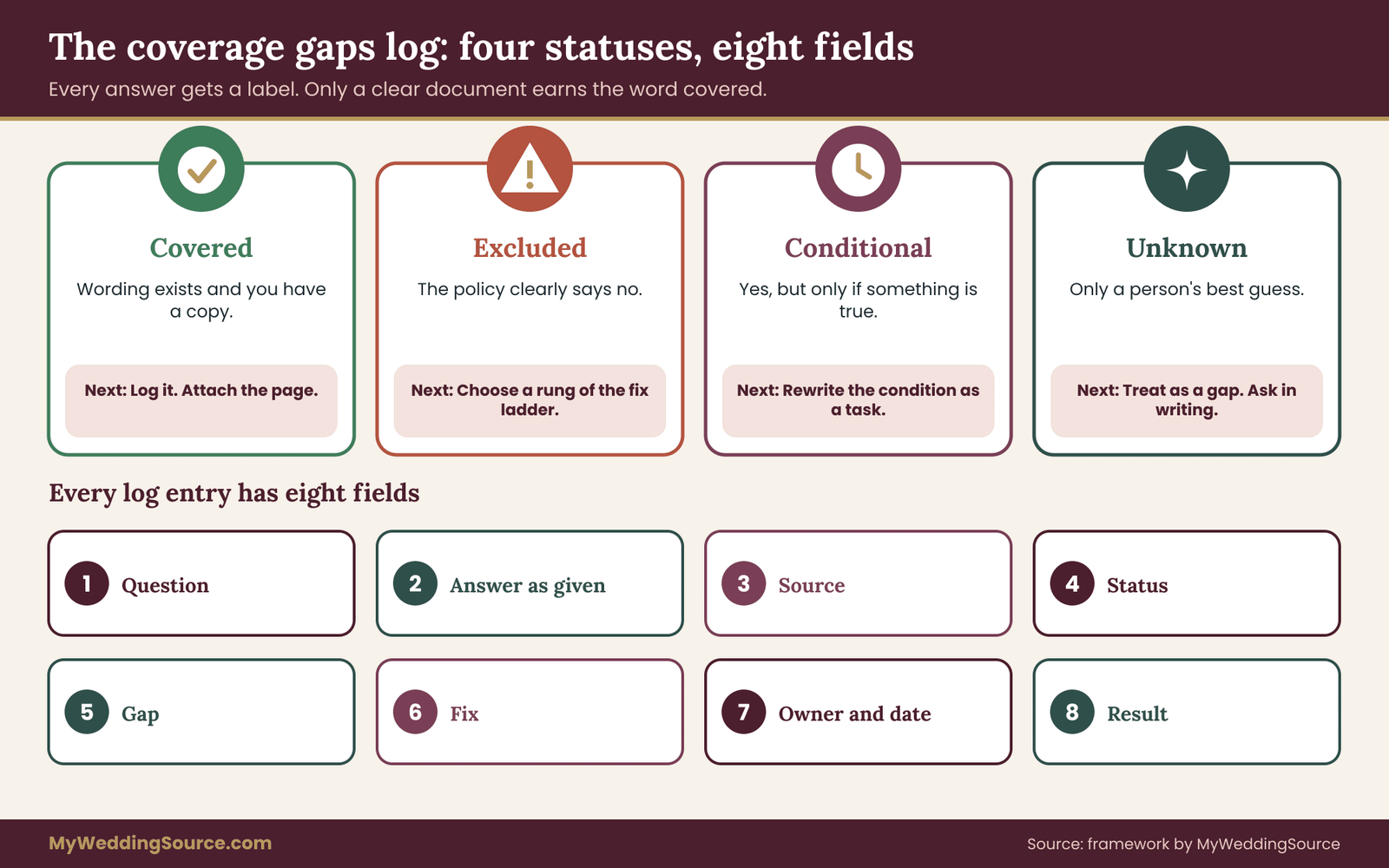
The log is a simple document: a spreadsheet, a shared note or even a paper notebook. Each entry is one question from the checklist, and each entry has the same eight fields. Write them in this order.
The question. One line, in your own words, such as “Does the liability coverage respond to alcohol served at a private wedding?”
The answer, as given. The agent’s reply in their words, with the date and the name. Do not paraphrase into something more hopeful. If the answer was “I think so,” write “I think so.”
The source. Your homeowner insurance policy page, the endorsement number, the email, the phone call. This lets someone else check later and lets you tell the difference between a fact from the document and an opinion from a person.
The status. One of four labels, explained below: covered, excluded, conditional or unknown.
The gap. One sentence on what could go wrong if the answer is wrong, written in plain terms. “If a guest is injured after leaving and the insurer treats alcohol as excluded, we might pay a claim ourselves.”
The fix. The action you chose from the fix ladder later in this guide.
The owner and the due date. One person’s name and one date. A fix without both tends to be forgotten.
The result. What happened, with the document attached. This is the field people skip, and the one that turns a to-do list into a record.
The four statuses
Use only four labels, because more labels turn the log into a debate about labels.
Covered means the policy or a document the insurer issued clearly says yes, and you have the wording. Excluded means your homeowner insurance policy clearly says no. Conditional means yes, but only if something is true: a notice is given, a vendor carries coverage, a limit is not exceeded, a guest count stays below a number. Unknown means nobody could point to wording and a person’s best guess is all you have.
Treat unknown as a gap, not as a pass. The most common mistake is to log “probably covered” as covered. If the answer cannot be pointed to in a document, it is not covered yet.
A rule for conditions
Every conditional answer needs the condition rewritten as a task. “Covered if the caterer carries liquor liability” becomes “Collect the caterer’s liquor liability certificate by this date.” “Covered if under 100 guests” becomes “Cap the guest list at 99 and write that in the planning notes.” This is how a log stops being a record of worry and becomes a to-do list with reasons attached.
Keep the log short
A log with every possible entry becomes a chore. Most weddings need 15 to 30 entries. If you have more, group them: keep one entry for “tent and structures” rather than twelve. The goal is a log you will actually reopen the week before the wedding.
Closing the gaps: the fix ladder for homeowner insurance
Once the log shows gaps, you need a way to decide what to do about each one. Panic purchases and shrugs are both poor options. The fix ladder is a way to try the cheapest and most controllable answer first and to climb only when the lower rungs do not work.
There are six rungs. Not every gap needs every rung, and a few gaps can be closed by the first one.
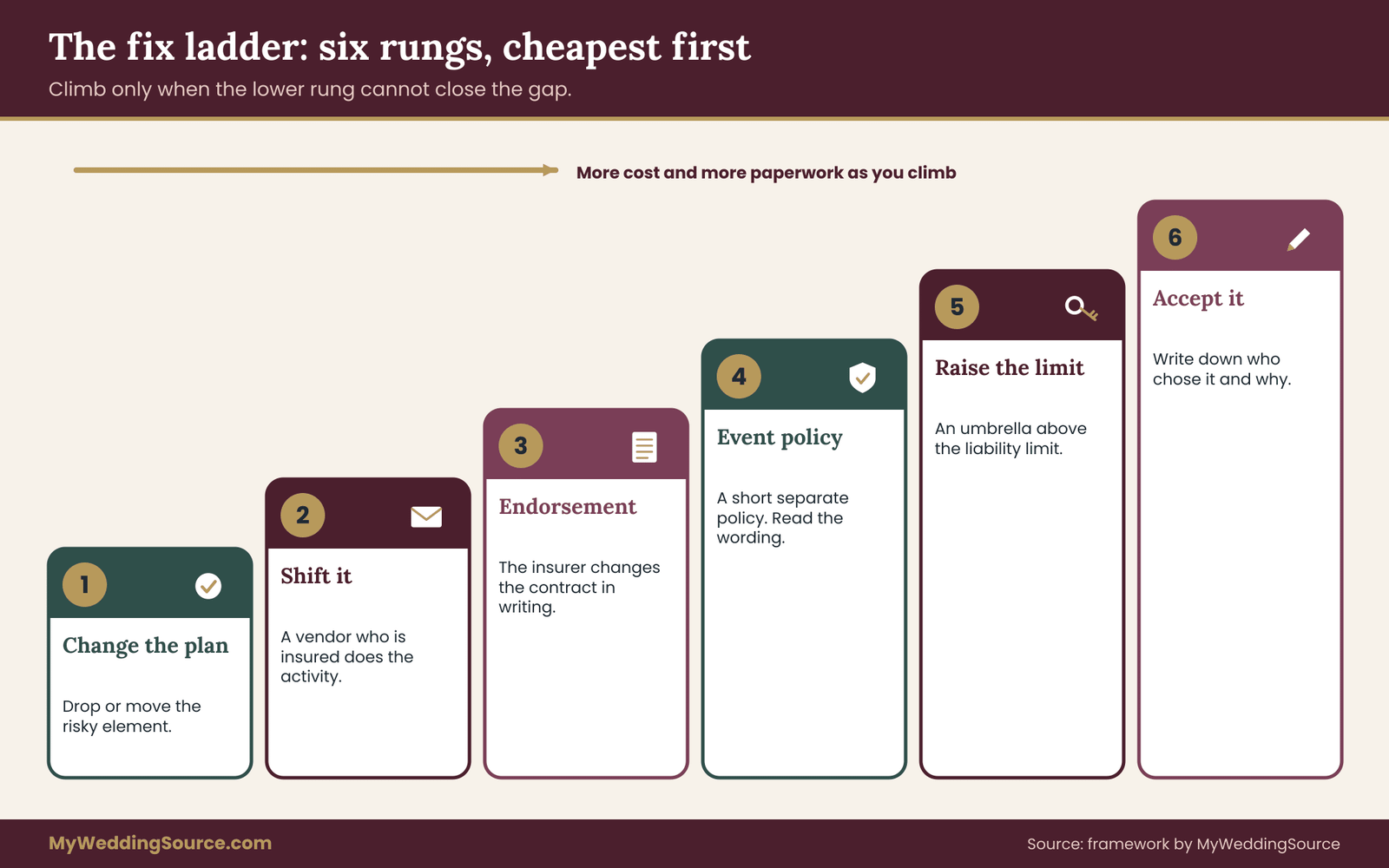
Rung one: change the plan
The cheapest fix is often to remove the exposure. If the log shows the policy is unclear about a fire pit, skip the fire pit or move it to a licensed venue’s patio. If the pool is a conditional, fence it off, close it for the day and put the decision in writing. If the tent installation involves staking into a septic field, change the layout. If the guest count crosses a threshold that causes problems with liability, local permits or insurance conditions, trim it.
This rung feels like giving something up, and sometimes it is. But it is the only fix that costs no premium, needs no approval and works regardless of what an insurer later decides. Many gaps look serious until you realize the activity causing them was optional.
Rung two: shift the activity to someone who carries the coverage
If the activity stays, ask whether someone else can carry the risk. A licensed caterer or bar service typically carries liquor liability coverage and general liability coverage as part of their business. A rental company often handles installation of tents and floors under its own policy and takes responsibility for the equipment. A professional band or DJ may carry their own liability coverage.
The idea is not to dump risk on others for the sake of it. It is that the party doing the activity for a living usually has insurance priced for that activity, and your homeowner insurance policy was not. When you require certificates from vendors, the vendor purchase order checklist and the vendor contract guide show where in the paperwork to record those requirements. Make each vendor’s coverage a condition of the booking, ask for the certificate before the date, and log it as the result of the fix.
Rung three: endorsements and riders on the homeowner insurance policy
An endorsement is a change to the contract, issued by the insurer. Depending on the company and the state, it may add coverage, remove an exclusion for a defined situation, raise a sub-limit or clarify how the policy treats an event. A scheduled personal property rider can raise coverage for a specific valuable item, such as a family heirloom you are moving outdoors.
Ask the agent whether any endorsement exists for your situation, how long it takes, whether it costs extra, and whether you can see the exact wording before agreeing. If the agent says the insurer does not issue one, ask them to say so in writing. That is an answer, and it points you to the next rung.
Rung four: a short-term special event policy
A special event policy is a separate, usually short-term policy bought for a specific event. It generally covers liability arising from the event and may include coverage for property damage and, in some cases, host liquor liability. Details vary widely by insurer, so do not assume one product matches another.
Ask the broker about three things. The first is what the policy covers and excludes, with emphasis on alcohol and on injuries to vendors. The second is when coverage begins and ends, to include setup, teardown and any rehearsal. The third is how it interacts with your homeowner insurance: whether it sits on top as additional coverage, whether it replaces your homeowner insurance coverage for the event or whether it applies only to liability.
Get the policy wording, not just the summary. A one-page overview can hide an exclusion that matters. Do not compare options only by price. Compare what each one excludes.
Rung five: raise the liability limit
If your concern is that the liability limit is thin, an umbrella or personal excess liability policy can add a layer above your home and auto limits. Umbrella policies generally require minimum underlying limits and have their own exclusions, so ask whether the umbrella applies to a wedding at home and whether it covers alcohol-related claims. Some do, some limit them, and the wording matters.
An umbrella is a year-round purchase, not a wedding purchase, so it is worth a separate conversation about whether you want one at all. If you already carry one, tell the umbrella carrier about the event as well, because it is a different company with different rules from your homeowner insurance carrier.
Rung six: accept the gap on purpose
Some gaps cannot be closed at a reasonable cost, and some are small enough to live with. The sixth rung is the honest one: write in the log that you understand the gap, have considered the alternatives, and are choosing to accept it. Note who made the decision and when.
Accepting a gap is not a failure. It becomes a problem only when it happens by accident. A couple who decides “we are comfortable with the damage deductible on the lawn, and we will keep a reserve for it” is in a very different position from a couple who never thought about it.
Choosing between rungs
Use three questions in order. Can we remove the exposure at no real cost? If not, can someone else who is insured for it carry it? If not, can we buy a defined piece of coverage whose wording we have seen? Only after those answers does acceptance make sense. When the gap is about alcohol or injury to a person, lean toward the higher rungs, because those are the claims that grow.
What the fix costs, and how to decide without invented numbers
This guide does not quote prices, because premiums depend on your state, insurer, property, claims history, guest count and the coverage requested. Any number printed here would be a guess. What you can do is build a cost comparison from quotes you collect yourself.
For each option you are considering, ask the broker for a written quote that shows the premium, the deductible or self-insured retention, the coverage limits, the dates covered and the main exclusions. Put the quotes side by side in your log, and compare them in four plain terms: what it costs, what it covers, what it leaves out and what it requires you to do.
The deductible question
Many homeowner insurance policies carry deductibles, sometimes a flat amount and sometimes a percentage of the insured value. A small property claim from the wedding, such as a damaged section of lawn or a scratched floor, may fall inside your deductible, which means you would pay it yourself either way. Ask for your deductible figures and think of the first part of any property loss as your own money.
Also ask whether a claim after a wedding could affect your renewal, and how the company treats claims in general. This is not a reason to hide a claim. It is a reason to know what a small claim costs over time, so you can decide whether to pay a minor repair yourself.
Compare the premium with the budget line
A coverage cost belongs in the wedding budget as a real line, not as an afterthought. The wedding budget guide explains how to set up categories, and an insurance line sits comfortably beside permits, rentals and cleanup. Set aside a small reserve as well for the items insurance will not pay for: the deductible, the damaged hose bib, the extra dumpster. A reserve is the plain alternative to a gap you decided to accept.
When the cheapest option is the wrong one
If a quote is far below the others, check the wording for the reason. A policy may exclude alcohol, exclude vendor injuries, cap property damage at a token amount or apply only to the guests and not the hosts. A cheaper policy with the very exclusion you were worried about does not close the gap. It only moves it.
The reverse also holds. An expensive option is not better because it is expensive. Match each quote to the gaps in your log and ask which gaps it closes. A tidy way to do this is to add a column to the log, in prose or on paper: for each quote, list the gap numbers it addresses.
Special situations: who holds the homeowner insurance policy matters
The checklist assumes a simple setup: you own the house, you hold your homeowner insurance policy, you host the wedding. Real weddings are messier. The policyholder is often a parent. The property may be rented, jointly owned, held in a trust, part of a farm or governed by a homeowners association. Each variation changes who should ask the questions and which documents matter.
Your parents or relatives own the property
This is the most common case for a family-home wedding. The people planning the wedding, the couple, are not the people on your homeowner insurance policy. Two consequences follow. First, the couple has no right to ask the insurer anything and probably no coverage of their own for the event. Second, the owners carry the exposure, even though the couple makes most of the decisions.
Handle this by treating the owners as the clients of the insurance conversation. Ask them to make the call, or to give you written permission to join it.
Share the gaps log with them and let them make the final decision on each gap, since it is their policy and their home. If the couple lives elsewhere and has its own renters or homeowner insurance policy, ask that insurer whether its liability coverage extends to an event hosted at a relative’s property. It often will not, and it is better to know.
A kind way to say this to a parent: “We would like to make sure nothing about the wedding puts your house or your policy at risk. Could we call your agent together and go through a short list of questions?”
You rent the home
A renter’s policy, sometimes called an HO-4 form, covers your belongings and your liability as a tenant. It does not cover the building, which belongs to the landlord and is covered by the landlord’s policy. A wedding at a rental property raises two separate questions. The first is whether the lease allows an event at all, which is a lease question rather than an insurance question. The second is what the renter’s policy says about your liability for guests and for damage to the landlord’s property.
Ask the landlord in writing for permission, and ask whether the landlord wants a certificate or a specific coverage in place. Some landlords request that you carry a defined liability limit or name them on a certificate. Then call your own insurer with the same eight blocks of questions. Expect the property-damage block to focus on what you owe the landlord, which is often governed by the lease as much as by your homeowner insurance policy.
The home is a vacation rental or short-term rental
If the property is rented to guests on a short-term basis, the insurance picture changes. Standard homeowner insurance often limits or excludes coverage for property rented out to others, and a separate landlord, short-term rental or commercial policy may be in force. In that case, the insurance conversation is with whichever company writes that policy. The rental planning checklist on this site covers the equipment side, and the platform’s own host protection terms, if you use one, are a separate document that you should read for exclusions around events.
A homeowners association or condominium
Many communities have rules that limit events, parking, tents, amplified sound and outside vendors. Some require a certificate of insurance from the host or the vendors, or a deposit. A condominium owner typically holds a policy that covers the interior and personal liability, while the association covers the building and common areas. Ask the association what it requires for an event and ask your agent how your homeowner insurance policy treats the use of common areas. Do not assume the association’s insurance protects you.
Mortgage and lender terms
Most hosts never think about the mortgage lender, and in most cases the lender does not need to know about a family party. But if your plan involves construction, a change in how the property is used or any commercial activity, ask whether the loan documents or the lender have requirements. This usually comes up only with unusual plans, such as a regular event business. It is a short question, and it is worth asking if anything about the plan involves income from the property.
Farms, ranches, rural land and second homes
Farm or ranch properties are often insured under a different type of policy, and a standard homeowner insurance form may not even apply. A second home or seasonal property may be insured under a separate policy with its own conditions, such as a limit on how long the property can be vacant or whether it is occupied seasonally.
A family cabin held by several relatives may be owned by an entity or a trust, and the policy may be in that name. Start by asking who the named insured is, because every later answer depends on it.
The property is held in a trust or an LLC
If the title is in a trust, an LLC or another entity, the named insured on your homeowner insurance policy may be the entity, with individuals added as additional insureds. This is a normal arrangement and not a problem, but it affects who can ask questions and who is covered. Bring a copy of your homeowner insurance policy to the call and ask the agent to read out the named insured and any additional insureds.
The wedding is a vow renewal, shower or rehearsal dinner
The same questions apply to any large gathering at your home, including a shower, a rehearsal dinner, a post-wedding brunch or a vow renewal. If more than one event is planned over a weekend, tell the agent about all of them, because the exposure is the combined weekend rather than a single afternoon. A family that hosts a Friday dinner, a Saturday wedding and a Sunday brunch has three events and probably more alcohol service than a single reception.
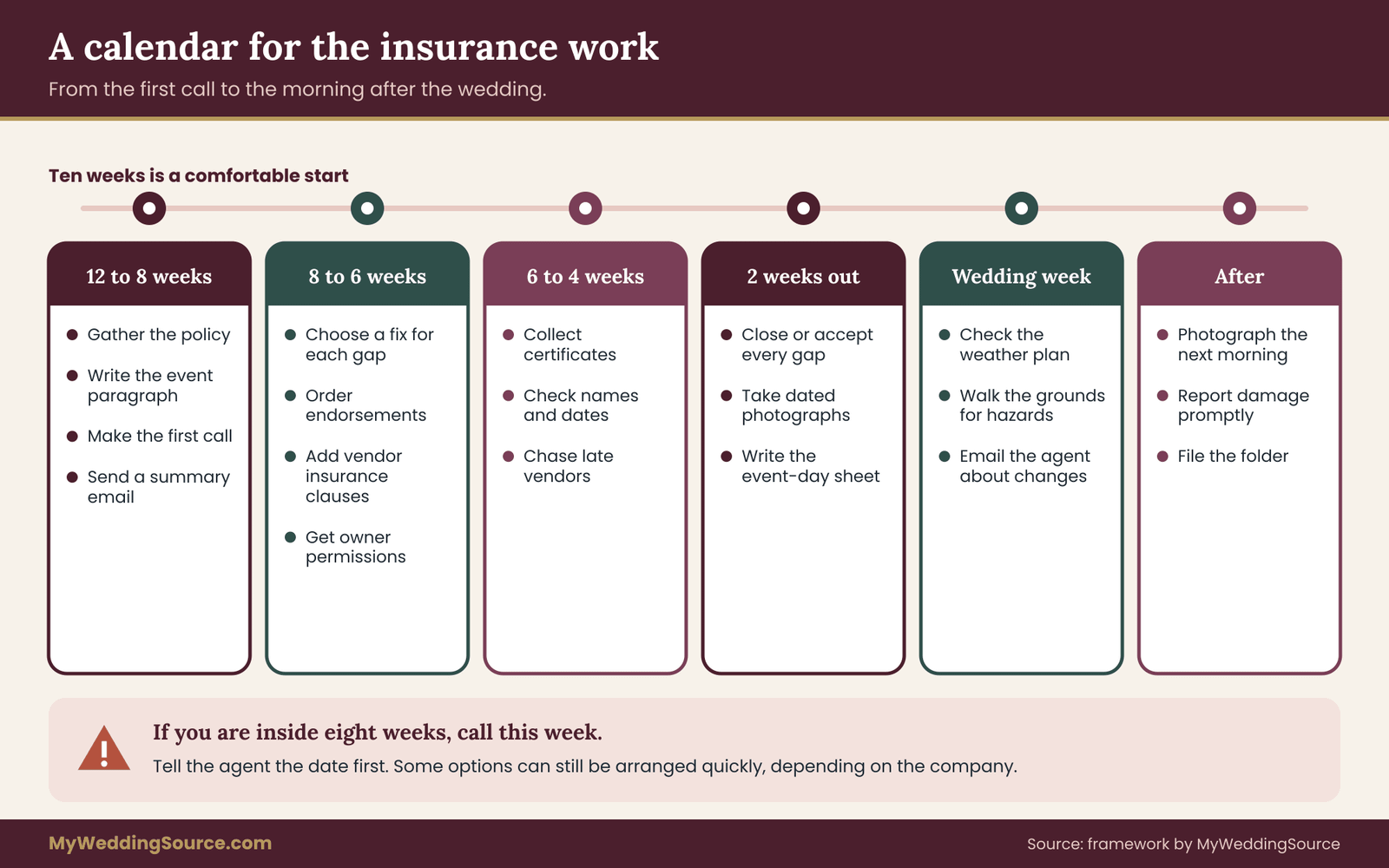
Timeline: when to call, collect and confirm
The insurance work for a wedding at home fits into a short schedule. None of the steps is large, but they have a sensible order, and most of the delay comes from waiting on other people.
Twelve to eight weeks before. Gather the policy documents, write the event description and make the first call. Send a follow-up email that summarizes what you understood. Start the gaps log. If you are using a vendor who will carry the bar, ask for their certificate now, not later.
Eight to six weeks before. Decide on the fixes. Place orders for endorsements or special event policies, or decide to change the plan. Update vendor contracts with insurance requirements. Ask landlords, associations or owners for any permissions you need.
Six to four weeks before. Collect certificates and confirmations. Check each against the contract and against your log. Correct names, dates and addresses where they do not match. Remind the vendors who have not replied.
Two weeks before. Close or accept every open gap in writing. Take dated photographs of the house, yard, driveway and any items you are worried about. Make a one-page event-day sheet with the agent’s claim line, the insurer’s contact information and your homeowner insurance policy number. Share it with your host and a trusted friend.
The week of the wedding. Check the weather plan against what the insurance conversation said about tents and heaters. Walk the property with the coordinator or a relative and note hazards: loose steps, cords, low branches, uneven ground, pool access. Write down any new change since the last call, because a change of plan since the last conversation may be worth a quick email to the agent.
After the wedding. Take another set of photographs the next morning, report anything that looks like damage promptly, and file the log, certificates and emails together. If nothing happened, you are done. If something did, your folder is the first document you will want.
A worked case: one lake house, ninety guests, five gaps
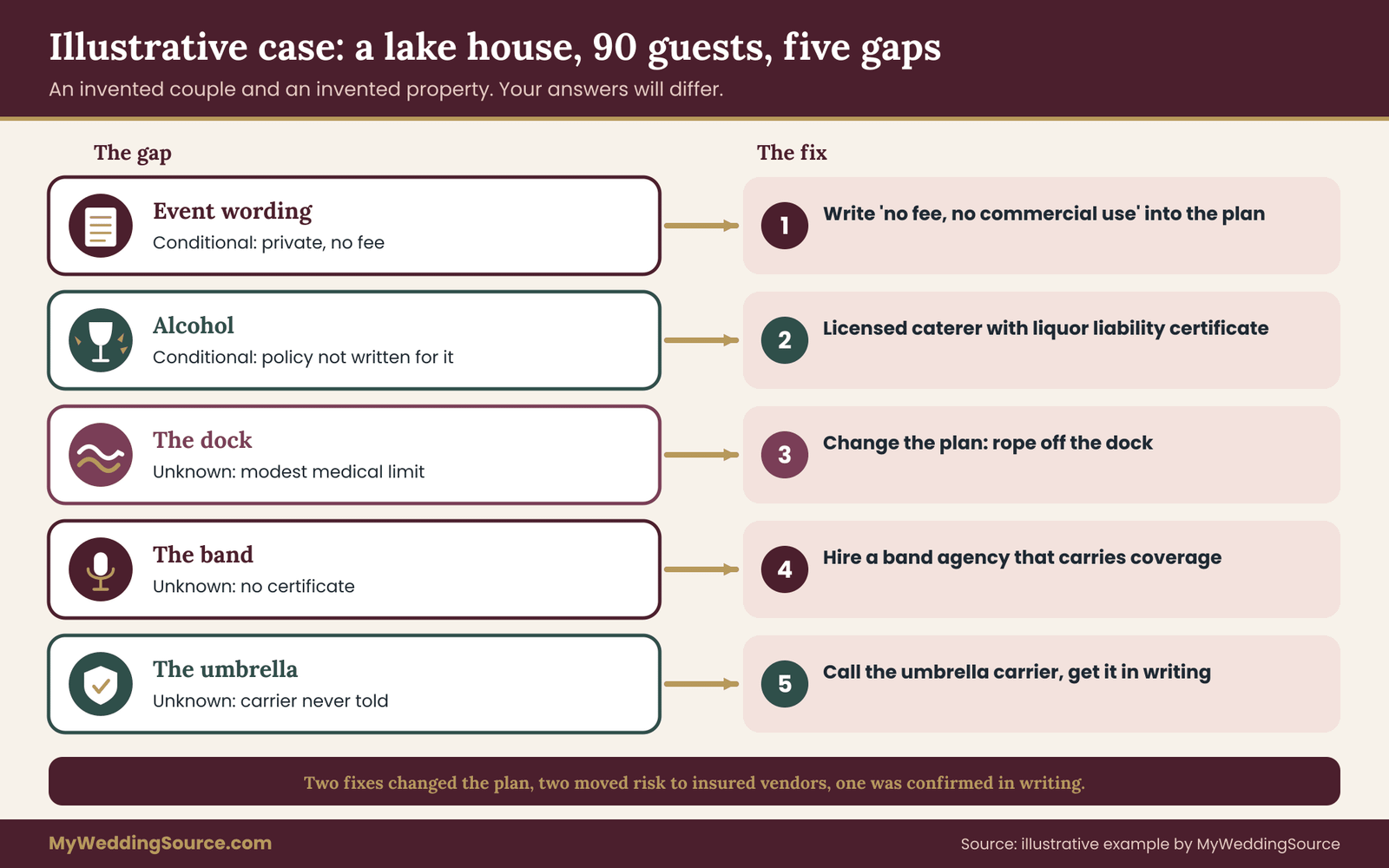
The following example is invented to show the process. The people, the property and the answers are illustrative, not a real case, and your own answers will differ. It uses no premiums or dollar limits, because those depend on your homeowner insurance policy.
Maya and Daniel are marrying on a Saturday in October at the lake house owned by Maya’s parents, Ruth and Carlos. They expect 90 guests including a dozen children.
The plan includes a rented tent over the lawn, a licensed caterer who will also run a beer and wine bar, a four-piece band from a friend of the family, a gas fire pit for the cocktail hour, and a short wooden dock that guests will use for photographs. Nobody is paying for the use of the property. The homeowner insurance policy is in Ruth and Carlos’s names.
Step one: prepare
Ten weeks out, Maya asks her parents for the declarations page and the full policy form. She writes the event description in one paragraph: date, hours, guest count, alcohol served by a licensed caterer, tent, fire pit, dock, band, six vendors on site, no fee for the use of the property. Carlos agrees to place the call and Maya joins as a listener, with Ruth’s written permission to ask questions.
Step two: the call and the log
The agent answers most questions on the spot and says “I would need to check” on four. Maya’s log, after the call and the follow-up email, holds fourteen entries. Nine are covered or conditional with clear wording. Five are gaps.
Gap one: event wording. Your homeowner insurance policy contains a business-use limitation. The agent says a private family wedding with no fee fits ordinary use, and confirms by email. Status: conditional. The condition is that no one pays for the property and no business operates there. Task: write “no fee, no commercial use” into the plan and tell the band and the planner not to refer to the home as a venue in any invoice.
Gap two: alcohol. The agent says the liability coverage is not written to respond to all alcohol-related claims and recommends the bar be run by a licensed provider with its own liquor liability coverage. Status: conditional. Task: obtain the caterer’s certificate listing liquor liability, with the home address shown as the event location, and confirm in the contract that the caterer controls service, stops at a set hour and checks identification.
Gap three: the dock. The agent finds no specific exclusion but says the medical payments limit is modest and that docks and water are a known source of injury claims. Status: unknown beyond that. Task chosen from the fix ladder: change the plan. The dock is closed for the day with a rope and a sign, and photographs are taken on the shore.
Gap four: the band. The band has no certificate. The agent says an injury to a band member on the property could create a claim against the homeowners. Status: unknown. Options: buy a short event policy, ask the band to buy one, or switch to a band that carries coverage. The couple chooses to hire an agency’s band that carries general liability coverage, and adds the requirement to the contract.
Gap five: the umbrella. Ruth and Carlos have an umbrella policy with a different company. Nobody has told that company. Status: unknown. Task: Carlos calls the umbrella carrier with the same event description and asks the same alcohol and vendor questions. The carrier confirms in writing that notice is not required for a private event but that its position on alcohol claims follows the underlying policy. Maya logs it as conditional and ties it to gap two.
Step three: the fixes
By week six, the log shows a rung chosen for each gap. Two closed by changing the plan, two by shifting to vendors with their own coverage, and one by confirming the umbrella’s position. The couple decides not to buy a special event policy because the remaining exposures fit the limits the parents are comfortable with. They write that decision down, with the date and both parents’ initials, as an accepted risk.
They also record a small reserve in the wedding budget for the lawn and for the deductible, since a rented tent and a truck full of tables on wet grass can leave marks that insurance will not pay for.
Step four: the folder
The finished folder holds the policy summary, the agent’s emails, the gaps log with fourteen entries, certificates from the caterer, the tent company and the band agency, the permission email from the parents, and a set of dated photographs taken two weeks before and the morning after. The event-day sheet lists the agent’s claim line and the insurer’s number.
What the example shows
Notice what did not happen. Nobody bought an expensive product by reflex. Nobody assumed your homeowner insurance policy was fine because it probably was. Nobody lied or leaned on a vague phrase. The couple spent about two hours across three weeks and ended up with five clear decisions. The most useful change was not a policy. It was moving the bar and the band onto vendors who carry their own insurance, and closing the dock.
On the day and afterward: documentation, incidents and claims
Most weddings at home pass without an insurance event of any kind. But the calm days are the ones where a small amount of preparation pays off, because the moment something happens is the wrong moment to look for the claim line.
The event-day sheet
Give your host, your coordinator and one trusted friend a one-page sheet. It should list the date, the address, your homeowner insurance policy number, the insurer’s claim phone number, your agent’s name and number, the vendors’ emergency contacts, the nearest urgent care, and any rules agreed on in the gaps log, such as “dock closed” or “bar stops at the agreed time.” Keep the sheet free of anything private. It is meant to be handed to a person who is stressed and needs the next step.
What to do if a guest is hurt
First, help the person and call emergency services if needed. Insurance is never a reason to delay care. Second, write down what happened while it is fresh: who, where, when, what you saw, and who else saw it.
Third, take photographs of the location and any equipment involved. Fourth, do not argue about fault at the scene, and avoid promising to pay for anything before you speak with the insurer. Offering to help get medical attention is different from accepting responsibility. Fifth, report the incident to your insurer promptly, because policies commonly require notice as a condition of coverage.
Medical payments coverage, if the policy includes it, may pay modest bills without anyone proving fault, and it can help a guest without a lawsuit. Ask the agent how it is triggered and what documentation is needed.
What to do if something is damaged
Photograph the damage and the surrounding area, keep any broken pieces, and note who was working there at the time. If the damage was caused by a vendor or by rented equipment, check the vendor’s contract and certificate before you file anything with your own insurer, because the responsible party’s coverage may be the right place to start. If the damage is to your own property and may be covered, call the insurer and ask how to file. Do not throw away evidence in the cleanup.
Think about the deductible before you file. If a repair costs less than the deductible, you will pay it yourself in either case. If it is close to the deductible, ask the agent how a small claim may affect your homeowner insurance policy, then decide. This is a normal question, not an attempt to avoid reporting.
What to do if a vendor is hurt
A vendor’s employee who is injured on your property may be covered by the vendor’s workers’ compensation, and your liability coverage may still be involved. Call emergency services if needed, record what happened, and notify the vendor’s company right away. Then notify your homeowner insurance company. This is the situation that the vendor requirement in your contracts was meant to prepare you for.
When something goes wrong after guests leave
Some claims appear days later, such as a guest who reports an injury, a neighbor who reports damage or a vehicle collision after a guest drove away. Keep your folder for at least as long as the claim window in your state and policy, which an agent or attorney can explain. The photographs, the guest list, the vendor documents and the gaps log help you describe what was and was not in place.
After the event: close the file
Within two weeks, take the follow-up photographs, check for damage, collect receipts for any repairs, and ask vendors for any final documents. Write a short note in the log about what actually happened and whether any of the fixes turned out to be unnecessary or insufficient. If you plan another event at the property, the next version of the log starts from this one.
Alternatives when homeowner insurance cannot carry the wedding
Sometimes the log shows that your homeowner insurance cannot reasonably carry the plan you have. The gaps may be too many, the answers too vague, or the cost of closing them too high for what you are hosting. That is useful information, and there are several honest alternatives short of canceling.
Host a smaller version at home. Keep the ceremony and a short gathering at the property, and move the large meal and the bar to a venue. This keeps the setting that matters to you and moves the alcohol, the vendors and most of the guests to a place with its own insurance. The venues guide helps you compare options, and a restaurant or a hall can host the reception for a fraction of the exposure.
Rent the property’s role away. Hire a licensed venue for the full day and use the family home for getting ready, photographs or a morning brunch. A venue typically carries its own liability coverage and sets requirements for vendors, which moves the largest exposures off your homeowner insurance policy.
Use a venue that supplies the coverage. Some venues require a certificate and a short-term policy from the host. That is a clear, defined cost with wording you can read in advance, and it may be simpler than trying to stretch a personal policy.
Split the weekend. Hold the ceremony at a courthouse, park or garden with its own permit rules, and a family dinner at home with a smaller guest count and no tent. The Friday-to-Sunday weekend can look very different from one large Saturday.
Remove the highest-risk elements and keep the rest. If the log shows that alcohol, water access and fire are the main problems, take those three out. A dry daytime wedding on the lawn with a light meal can be lovely and sits closer to ordinary private use than an evening with a bar.
Buy the event policy and keep the plan. If the plan matters to you and the quotes are reasonable, a special event policy with the wording you have read may be the right rung. This is a sound decision as long as you read what it excludes.
How to choose among them
Return to the log. List the gaps that remain open after rungs one to three. If they cluster around one element, such as alcohol, remove or outsource that element. If they cluster around the property itself, such as water, steep ground or a business-use limitation, consider a different site. If they cluster around the guest count, reduce it or add coverage that fits the number.
The point of the alternatives is not to talk you out of a wedding at home. It is to make sure the wedding you hold matches the protection you actually have.
Failure conditions: when to stop, switch or escalate
A plan needs stopping rules. Without them, you drift toward the wedding date carrying unresolved questions because each one seems too small to block anything. The conditions below are decision rules you can write at the top of your log and agree on with the other people involved.
Stop and escalate if the agent cannot or will not answer in writing. If the agent keeps saying “it should be fine” and will not put it in an email, treat the answers as unknown. Ask for a coverage position from the insurer, or ask a different agent or broker for an independent review.
Stop if your homeowner insurance policy excludes the central activity. If the policy clearly excludes events, alcohol or the property use you need, and no endorsement or separate policy fixes it, do not proceed as planned. Change the activity, move the venue or buy coverage that fits.
Switch if a vendor cannot show coverage. A vendor who refuses to carry insurance or to show a certificate for an activity that depends on it is a gap you cannot manage with goodwill. Replace the vendor, or remove the activity.
Switch if the quotes close the wrong gaps. If every option you can buy leaves the alcohol or the vendor-injury question open, the problem lies in the plan, not the paperwork. Reduce the exposure first.
Pause if ownership or permission is unclear. If the owner has not agreed, a co-owner does not know, a landlord has not replied or an association has not approved, the insurance work is premature. Settle the permission first.
Escalate if anything changes. A larger guest count, a new vendor, a decision to add a fire pit, a switch to a paid arrangement or a second event requires another note to the agent. Treat it as a new entry in the log and re-run the relevant block.
Move the date or the place if the unknowns outnumber the knowns two weeks out. Two weeks before the wedding, count the entries marked unknown. If the number of unknowns is large and the people who can answer are unavailable, convert the plan to the smaller alternative and notify guests early.

What to say: short scripts
Scripts reduce the awkwardness of these conversations. Adjust the words to your own voice.
To your agent: “We are hosting a private wedding at our home on this date with this many guests. Could you walk through how our homeowner insurance policy treats it, and send me a short email so we have it in writing?”
To a vendor: “Our insurer asks that every vendor on the property carry their own liability coverage. Could you send a certificate that shows your coverage and lists the event address and date?”
To a parent who owns your homeowner insurance policy: “Before we finalize the plan, we would like to check it against your homeowner insurance policy with your agent. We will do the legwork, and you make the final call.”
To a friend who offers to bartend: “Thank you, that is generous. For insurance reasons we are using a licensed bar service, and we would love you to enjoy the evening as a guest.”
To a guest who asks about the dock: “The dock is closed for the day, but we have photographs planned on the shore in this spot.”
What a calm finish looks like
By the end, you should be able to answer five questions without looking anything up: who holds the policy, what the liability limit is, what your homeowner insurance policy said about the event, which gaps were closed and how, and where the folder is. If you can, the insurance part of the wedding is done.
Your next steps
This week, find the declarations page and the full policy, and write the one-paragraph event description. Confirm who holds your homeowner insurance policy and ask that person to join the call. Next, book the call with the agent or broker for the next ten days, work through the eight blocks, and ask for a short email afterward.
Then start the gaps log and sort every answer into covered, excluded, conditional or unknown. Pick a fix for each gap from the ladder, set an owner and a date, and request certificates from the vendors who will be on the property. Two weeks before the wedding, close or accept every open gap in writing, take dated photographs and share the event-day sheet. Keep the folder when the wedding is over.
FAQ
Does homeowner insurance cover a wedding at my house?
Often a private family wedding falls under ordinary liability coverage, but nothing is automatic. The answer depends on the policy wording, whether anyone pays for the property, whether alcohol is served and what your state requires. Ask your agent for a written answer to each of the eight blocks, and treat any “probably” as unknown until you can point to wording.
How far ahead should I call my agent?
Eight to twelve weeks before the date is a good target. That leaves time for a second call, an endorsement request, an event policy application, vendor certificates and plan changes. If your wedding is closer, call this week and mention the date at the start, because some options can still be arranged quickly depending on the company.
Will mentioning a wedding raise my premium or risk my coverage?
Telling your agent about a private event is not usually a reason to lose coverage, and concealing a material fact can create problems in a claim. Ask the agent how the company treats a private event and whether notice affects your renewal. The answer varies by insurer and state, so get it in writing rather than assuming.
Do I need a special event policy?
Not always. It may help if your homeowner insurance excludes the event, if the alcohol and vendor questions stay open, or if your liability limit feels thin. Compare quotes by what each excludes, not only by price, read the actual wording, and check when coverage starts and ends, including setup and teardown.
Who is responsible if a vendor is injured at my home?
It depends on the facts, the vendor’s own coverage and your state’s rules. Vendors often carry workers’ compensation and general liability, which is why many hosts require a certificate in the contract. Your own policy may still be involved, so ask your agent what it says about people working on your property.
Does homeowner insurance cover alcohol served at the wedding?
Coverage for alcohol-related claims is often limited, conditional or excluded, and host liability rules vary widely by state. Many couples use a licensed caterer or bar service that carries liquor liability coverage and controls service. Ask your agent for your homeowner insurance policy’s exact position and ask the bar provider for a certificate.
What if my parents own the house and your homeowner insurance policy?
Then your parents are the insurance clients. Ask them to place the call or give written permission for you to join, and share the gaps log with them so they make the final decision on each gap. Your own renters or homeowner policy may not extend to an event at a relative’s property, so ask your insurer too.
What should I do if a guest is hurt at the wedding?
Get the person medical help first. Then write down what happened, take photographs, avoid arguing about fault, and report the incident to your homeowner insurance company promptly, since policies often require timely notice. Ask your agent beforehand how medical payments coverage works and what to document, so the steps are written on your event-day sheet.
Sources
- Insurance Information Institute: homeowners insurance basics
- National Association of Insurance Commissioners: consumer insurance resources
- NAIC InsureUonline: consumer guidance on home insurance
- USAGov: consumer protection and insurance information
- Consumer Financial Protection Bureau: consumer resources
- National Fire Protection Association: fire and life safety information
- Centers for Disease Control and Prevention: alcohol and public health
- National Highway Traffic Safety Administration: impaired driving
- Alcohol and Tobacco Tax and Trade Bureau: alcohol beverage information
- Federal Trade Commission: consumer advice