
Backyard wedding bathroom access comes down to one choice: send guests through your house, put them in a rented restroom trailer, or split the load between the two. This guide gives you a traffic, cleaning and access grid that scores each option for your own guest count, house layout and weather, so the decision is made on paper before the rental deposit is.
Score each option on three lines. Traffic: how many visits will happen in the busiest half hour, and how long will the line be? Cleaning: who restocks, wipes and empties during the event, and what happens to the house or the unit afterward? Access: can every guest reach it, see it after dark, and use it with privacy? If the house fails on traffic or the backyard wedding bathroom trailer fails on access, switch or combine them. Settle the backyard wedding bathroom grid before you sign for any rental, and confirm local rules with the people who issue them.
Hosting a wedding at home sounds simple until the first guest asks where the bathroom is. Then you find out what the house has been quietly doing for you all these years. It has one or two toilets, a door that locks, a sink with soap and a light switch that everyone in the family can find in the dark. A hundred guests will test all of it in about five hours.
The usual advice is a single sentence: rent restroom trailers. Sometimes that is right. Sometimes it is an expensive answer to a problem the house could have handled with a little preparation, and sometimes it creates a new problem, such as a long walk across wet grass to a unit with a step at the door. A good backyard wedding bathroom plan treats the house and the trailer as two tools and asks which one carries which load.
A note on scope. This is general planning information, not legal, insurance, engineering or medical advice. Rules about portable restrooms, septic systems, property use, noise and accessibility vary by city, county and homeowners association, and they change. Where a rule matters, this backyard wedding bathroom guide points you to the office or agency that issues it so you can confirm the current version yourself.
Why a backyard wedding bathroom is a different problem from a venue restroom
At a venue, restrooms are part of the building. They were sized for events, they have staff or a maintenance contract behind them, and the venue has already answered the accessibility and code questions. A backyard wedding bathroom is the opposite. Nobody sized your house for a crowd, and nobody has been paid to keep it running through the evening. You are the facility manager, and you are also the host.
That matters because three things change at once. The first is traffic. Guest visits to restrooms are not spread evenly across the day. They bunch up after the ceremony, at the end of dinner, and near the end of the night, and a small house layout turns those bunches into queues in your hallway. The second is cleaning. In a house, the cleaning is your family’s job, and it happens while you are wearing a wedding outfit.
In a rented unit, cleaning is a service contract with specific limits. The third is access. Your house was designed for the people who live in it, and a rented unit was designed for the people who will walk up to it. Neither was designed for your guest list until you check.
What this backyard wedding bathroom guide covers, and what it leaves to other guides
This guide is about the comparison: house restrooms against rental trailers, and the combinations in between. It does not try to be a full guide to hosting a wedding at home. For the broader question of whether your property can handle an event at all, the site’s venue guide is the place to start, and the rental planning checklist covers the wider list of tents, tables, linens and equipment that tends to arrive in the same week.
It also leaves out two adjacent topics. Septic loading is a separate question about what your drain field can take, and it deserves its own conversation with a licensed professional. Restroom attendants are a service choice that sits on top of any physical setup. Here the question is simpler and earlier: where will people actually go, and what will that do to your house, your budget and your guests’ evening?
The three possible answers
Almost every backyard wedding bathroom setup is one of three shapes.
House only. Guests use one or more restrooms inside your home. This costs the least in rental fees and asks the most of the house. It works best for small guest lists, short events and homes with a ground-floor restroom near a side or back door.
Trailer only. Guests use a rented restroom trailer or a set of units and never enter the house. This keeps the house private and gives you a defined facility, but it adds delivery, siting, power, water or hauling questions and a real rental line in the budget.
Split. The house keeps one restroom for specific uses, such as the wedding party, older guests or an accessible option, while a rented unit handles general traffic. This is common, and it is where the decision framework is most useful, because the split rule has to be written down or it will not hold.
Why a grid beats a gut feeling
Couples often decide on vibes. The house feels too personal for strangers, or the backyard wedding bathroom trailer feels too much like a construction site. Both feelings are legitimate, and the backyard wedding bathroom grid does not override them. What it does is separate the feelings from the facts, so that you know what you are trading when you follow one.
A host who knows that the house fails on queue time but wins on comfort can make a deliberate choice, such as adding a second restroom elsewhere, rather than discovering the queue at nine o’clock on the wedding night.
The next section lays out the grid itself. After that, each line gets a full section, followed by the rental questions, the split designs, a worked case and the conditions under which you should stop and change course.
The traffic, cleaning and access grid for a backyard wedding bathroom
The grid has three lines and two columns of options. The lines are traffic, cleaning and access. The columns are the house restrooms and the rental trailer. For each of the six cells you give a rating of green, amber or red, using the tests in the sections that follow.
A green means the option handles that line with ordinary effort. An amber means it works only if you add a specific fix. A red means it fails unless you change something fundamental, and you should not carry a red into the wedding day without a named replacement.
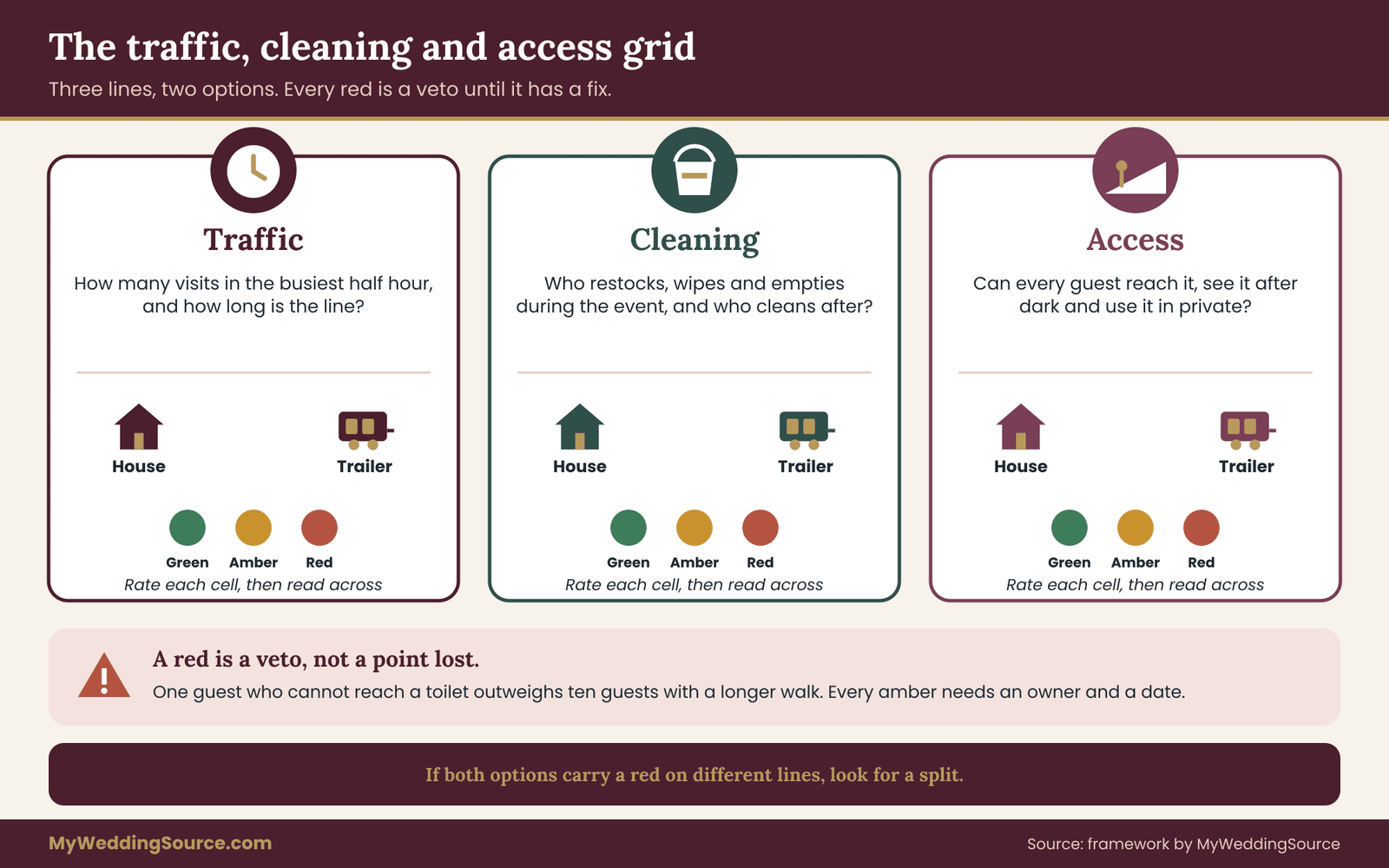
The ratings are not scores to be added up. A house with two greens and a red on access is not a “mostly good” option, because one guest who cannot reach the toilet has a worse evening than ten guests who had a slightly longer walk. Treat every red as a veto and every amber as a to-do item with an owner and a date.
How to fill in the backyard wedding bathroom grid
Work in this order. First, write down your inputs on a single page: the guest count, the event start and end times, the times of the ceremony and the meal, the number of toilets inside the house and which floor each is on, and the distance from the party space to the nearest house door.
Second, write the same facts for any rental you are considering: the number of stations, the entry height, the delivery location, the power and water needs, and what the contract says about service visits.
Third, rate each cell. Fourth, read across the lines to see which option has a red. Fifth, if both options have a red on different lines, look for a split design that moves each red onto the option that handles it better. Sixth, put every amber on a checklist with a person’s name beside it.
The vocabulary used in this backyard wedding bathroom guide
A few terms keep the rest of the guide short. A visit is one trip to the backyard wedding bathroom by one person, from leaving the party to returning. A station is one toilet or urinal position that one person can use at a time. A peak window is the half hour in which the largest share of guests will go, usually right after the ceremony or just after dinner.
Service time is how long a visit occupies a station, including entering, using it, washing and leaving. Load is the number of stations that will be occupied at once during the peak window.
Everything else in the backyard wedding bathroom grid is a comparison of load against stations, and of effort against people available to do it.
Traffic: counting visits for a backyard wedding bathroom
Traffic is the line most hosts underestimate, and it is the one you can calculate with a pencil. You do not need industry statistics to do it. You need honest assumptions that you write down, so you can change them and see what happens.
A simple queue model you can do by hand
The logic is borrowed from any line at any counter. If people arrive at a facility faster than it can serve them, a line forms and keeps growing until arrivals slow down. If they arrive slower than the facility can serve them, the line stays short.
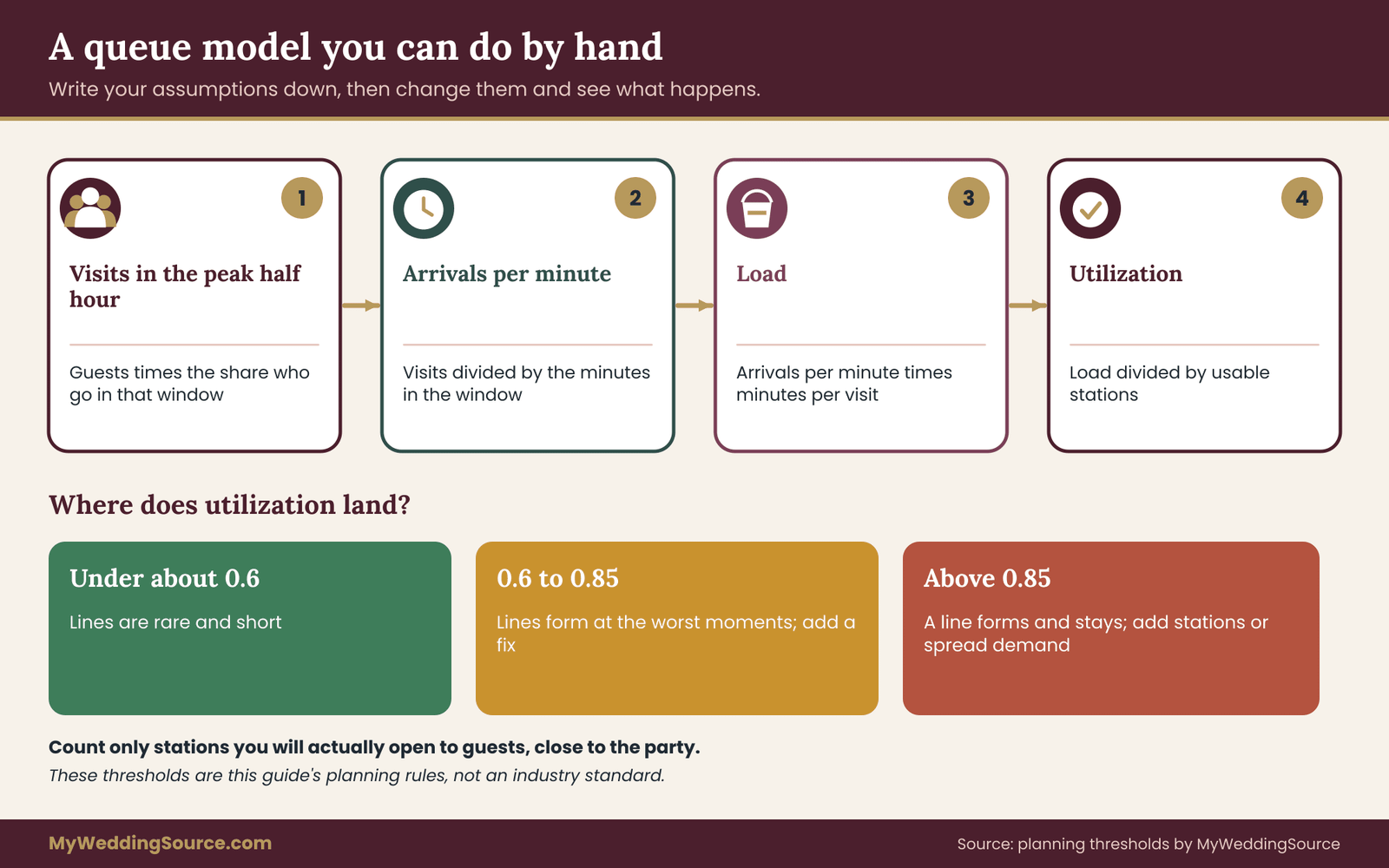
Start with the peak window. Estimate how many guests will visit a backyard wedding bathroom during it. Divide by the length of the window in minutes to get arrivals per minute. Multiply arrivals per minute by the average service time in minutes. That product is the load, the number of stations busy on average. Divide the load by the number of available stations to get the utilization.
This guide uses simple thresholds for that final number. Under about six tenths is green: lines are rare and short. Between six and eight and a half tenths is amber: lines form at the worst moments and you need a fix. Above eight and a half tenths is red: a line will form and stay. These thresholds are planning rules from this backyard wedding bathroom guide, not an industry standard, so adjust them if you know your guests tolerate longer waits.
Choosing the inputs honestly
Three inputs drive everything, and each one deserves a moment of thought.
The share of guests in the peak window. If the ceremony ends and cocktail hour begins immediately, a large share of guests may visit within twenty minutes, especially after a long drive or an outdoor wait. If dinner is served and the toasts begin right after, many guests will go during the quiet moment before speeches.
If you have a break in the schedule with a clear reason to move around, such as a photo session, the visits spread out. Pick a share you believe, write it down, and then test a higher one. If the plan still works at the higher share, it is robust.
Service time. Inside a house, the service time includes walking from the yard, finding the door, waiting for a free room and walking back. In a trailer, it includes the walk to the backyard wedding bathroom trailer and the time spent finding the right door. Formal clothing adds time. Older guests, parents with small children and guests using mobility devices add more. Use a longer service time than you would for your own visit on a normal day.
Stations that are actually available. A house with three toilets does not have three stations if one is on the second floor, one is attached to the primary bedroom that you do not want guests to enter, and one is the powder room by the front door. Count only the stations you are willing and able to open to guests, and only those within a reasonable walk.
Stations in a house are not all equal
A ground-floor powder room by the back door is a very good station. A hall bathroom reached by walking past the kitchen where the caterer works is a weak one, because guests will hesitate and the caterer will be interrupted. A bathroom reached by stairs is, for planning purposes, not a station for the general guest list at all.
Think in terms of “usable stations” and “preferred stations.” Preferred ones are near the party space, on the same level as the yard, and reachable without passing through a work area or a private room. Usable ones can handle overflow or special cases. Your queue calculation should use the preferred count for the peak window, and the usable count only as a safety valve.
Queue length is a design decision
When utilization is amber or red, the question is not only how to add stations but where the line will stand. In a house, a queue forms in a hallway, a kitchen or a living room. That is a traffic problem for the rest of the evening, because it puts a group of waiting guests in a space the caterer, the photographer or a grandparent needs to cross.
A queue in the yard is a different matter: it can be placed under a shade structure, lit, signed and given a clear edge. In many cases the better question is not “how do we avoid a line” but “where do we want the line to be.”
A two-minute exercise helps. Walk the route a guest would take from the party space to each station while holding a drink and wearing the kind of shoes your guests will wear. Count the doors and turns. If you cannot describe the route to a stranger in one sentence, the route needs a sign, a person or a different station.
The site’s reception guest flow guide covers the same logic for the whole party space, and it is worth reading beside this section, because restroom routes are one of the paths that cut across everything else.
What traffic means for the other lines
Traffic is not a standalone number. It feeds the other two lines. More traffic means more cleaning demand: more paper, more soap, more wiping and more trash. It also means more wear on the route: more feet through a hallway, more grass trampled on the path to a backyard wedding bathroom trailer, more door openings.
And it changes access: a long line is hard on anyone who cannot stand for long, and a crowded route is hard on anyone using a mobility device. Keep the utilization figure in view as you read the next two sections.
Using the house restrooms: what the route does to your home
When the house is the answer, the real work is not the restroom. It is the route. A backyard wedding bathroom that lives inside the house turns your doorway, hallway and floors into event infrastructure for the day. Planning the route well is the difference between a calm home and a house that guests wander through looking for something.
Pick one door and one path
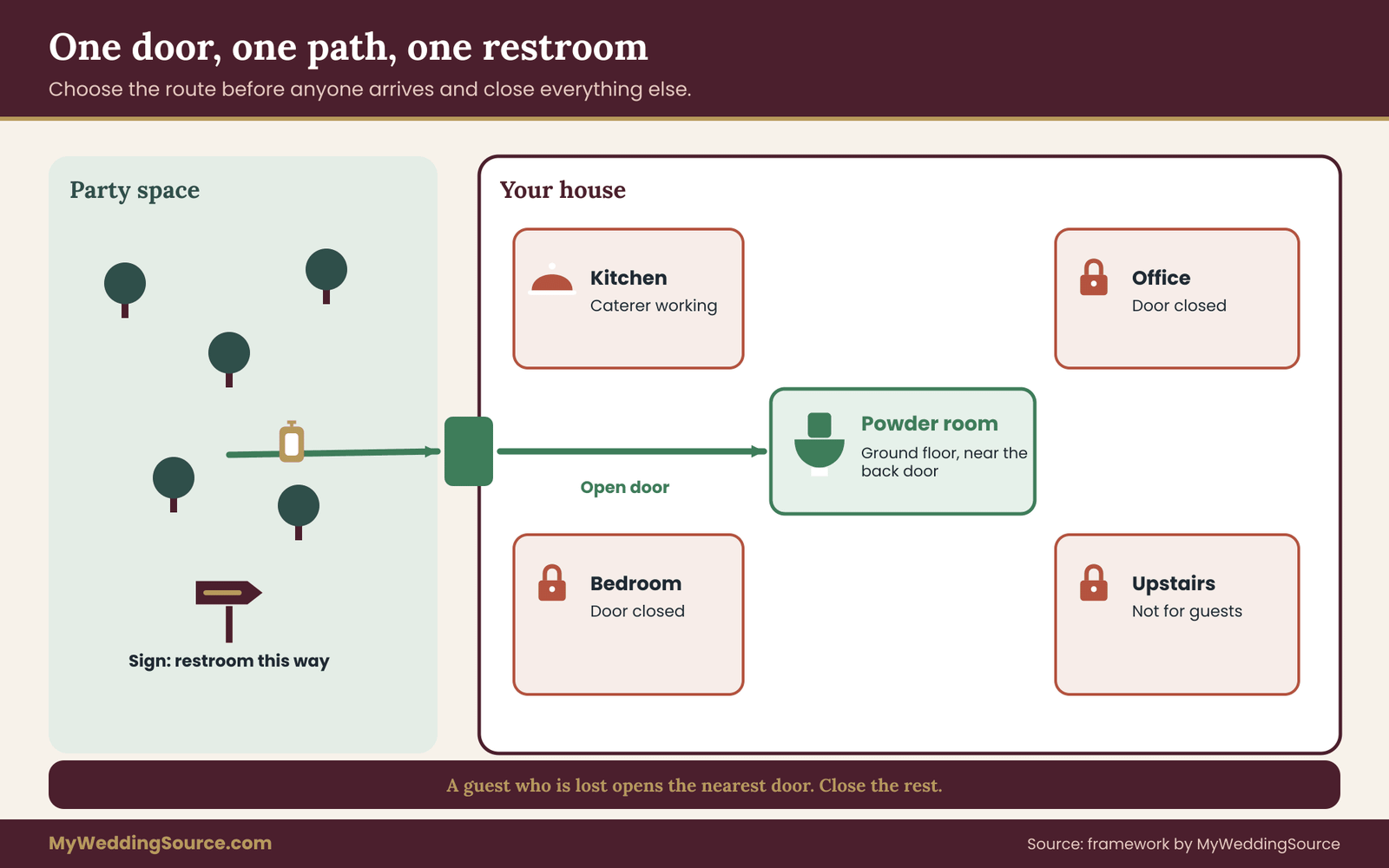
Choose a single entry door for guests and a single path from that door to the backyard wedding bathroom. Decide it on paper before anyone arrives. A back door or side door near the yard is usually best, because it keeps guests out of the front rooms and shortens the walk. If the nearest door opens into the kitchen or a messy mudroom, think about whether a temporary fix is realistic: a screen, a closed door and a sign pointing to a second entry.
Close or lock every other door that leads into the interior. Not because you distrust anyone, but because a guest who is lost opens the nearest door, and the nearest door might be a bedroom, an office or a closet with a fragile item. A short, clear route is the cheapest privacy measure you have.
Protect the floors, and the people on them
Wet grass, heels and dance-floor wax find their way onto interior floors fast. A runner or entry mat just inside the door catches most of it, and a second mat inside the restroom itself catches what the first one missed. Check that any rug in the path is secured, because a rug that slides under a guest holding a drink is a hazard. If your floors are bare hardwood or tile, wet shoes are a slipping concern as well as a cleaning one, and a towel nearby helps.
The Consumer Product Safety Commission publishes general guidance on home safety, and falls are a well-known household hazard. You do not need to read a long report. Walk the path, picture someone in unfamiliar shoes carrying a plate, and fix what you see.
Limit what guests can see
Take the personal items out of the backyard wedding bathroom the day before. Medications, razors, personal documents and anything fragile or valuable belong in a bedroom with a closed door. Guests will open cabinets. Not often, and rarely with bad intent, but curiosity is a reliable force at a party. A restroom with only what a guest needs, a fresh towel, soap, tissue and a trash can with a lid, is a backyard wedding bathroom that needs little supervision.
Give the house restroom a stand-in for you
You will not be available to answer questions. Assign one person to be the “house contact” for the event: a sibling, a close friend or a neighbor who is trusted and calm. Their job is narrow. They know the route, they can point the way, they can unlock a door if needed, and they can pass along a problem, such as a clog, to the person who handles it.
They are not a restroom attendant. They are a friendly face by the door who prevents the small problems from becoming your problem.
Know when the house will not be enough
The house is a good answer for a small, short event and a poor one for a large, long event. The backyard wedding bathroom grid makes this visible. If the usable preferred stations are one or two and the guest count is high, the traffic line goes red almost regardless of how nice the house is. A homeowner who recognizes this early has options. A homeowner who discovers it at the reception does not.
If the house wins on traffic but loses on route, for example because the only ground-floor restroom is past the kitchen, think about whether a small rented unit can take the general traffic while the house restroom stays for people who need it. That is the split design, and it gets its own section later.
Cleaning: who does it, when, and with what
Cleaning is the line that gets ignored in planning and remembered in the middle of the night. The difference between a calm evening and a tense one is often whether the person who restocks the paper knows they are the person, and whether the supplies are within reach.
Cleaning in the house: a small rota with real names
During the event, a backyard wedding bathroom needs three kinds of attention: restocking, quick wiping and trash. Restocking means toilet paper, hand soap, towels or paper napkins and a working trash bag. Wiping means a sink and counter check and a floor check. Trash means emptying a small bin before it overflows.
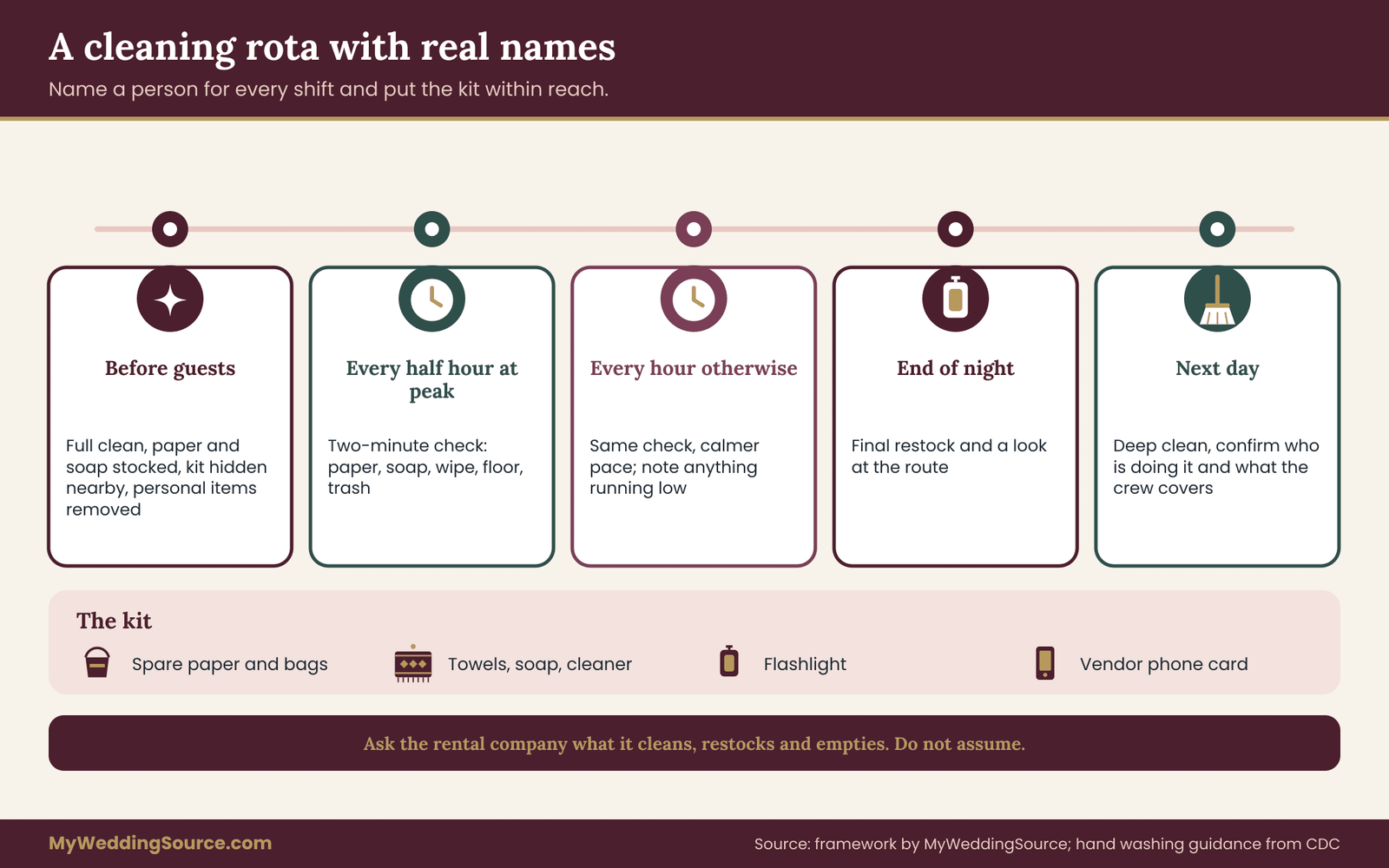
For a house restroom serving a crowd, assign a check every half hour during busy periods and every hour otherwise. The checker needs a small kit placed out of sight: spare paper, soap refill, a roll of paper towels, a spray cleaner suitable for the surfaces, gloves and a trash bag. A two-minute check, done on a schedule by a person who has been told it is their job, prevents almost every complaint.
Name the person for each shift. Do not assume the family will “just handle it.” Family members are in photographs, giving toasts and talking to relatives, and the backyard wedding bathroom check will be the first thing to slide. A friend who has no formal role in the wedding is often the best choice, and a short thank-you gift is a fair exchange.
Briefing the helper who checks the bathroom
A helper does better with a one-page brief than with a verbal “keep an eye on things.” The brief lists the schedule of checks, where the kit is, what to do for a clog or a spill, who to call for a bigger problem and what to say to a guest who asks a question. It also tells the helper what not to do: do not stand guard at the door, do not comment on how long anyone was inside and do not enter a stall in use.
Keep the brief short enough to read in two minutes. A backyard wedding bathroom runs best when the helper feels trusted, and a helper who knows the plan will make better decisions than one who has to ask you. Show them the route and the kit before guests arrive, and give them a phone number for the person who can authorize a repair.
Cleaning after the event
The house restroom will need a full clean the next day. Decide in advance who does it and whether it is part of a general post-event cleanup. If you are renting a crew or a dumpster for the larger cleanup, ask whether interior bathrooms fall inside the scope.
Many cleaning contracts exclude toilets or require extra notice, and discovering that on the morning after is no fun. The vendor contract guide on this site, how to read a wedding vendor contract, is a useful reference for what a scope sentence should and should not leave open.
Cleaning in a rented trailer: what is yours and what is theirs
A rental restroom trailer shifts the cleaning question from “who will do it” to “what does the contract say will be done.” Typical elements include delivery and setup, a clean unit at the start, supplies at the start, and pickup. Whether anyone services the unit during the event, restocks supplies or empties a holding tank depends on the vendor and the package. These are details to ask about, not assume.
Ask five specific questions. Is the unit cleaned and stocked before delivery? What supplies are included, and how much? Is an on-site attendant or a service visit available during the event, and at what scope? What happens if the rented backyard wedding bathroom unit runs out of supplies or fills a tank during the event, and who do you call? Who is responsible for damage, and what does the damage clause cover?
The supply list that prevents most problems
Whichever option you choose, you will need supplies on hand. A starting list, which you should adjust for your guest count and event length: extra toilet paper, hand soap, paper towels or a stack of folded hand towels, small lidded bins and liners, a plunger, a spray cleaner and cleaning cloths suitable for the surfaces, disposable gloves, hand sanitizer where soap and water are not available, feminine hygiene products and basic first-aid items in a labeled bag, and a flashlight or a battery lantern.
Over-buy the paper. A shortage of toilet paper is the single most predictable restroom failure, and a spare case costs little. Unopened rolls can go back into the household supply after the event.
Hand washing is part of the cleaning line
Hand washing is the piece that is easy to forget in a trailer or an unusual setup. The Centers for Disease Control and Prevention explains how and when to wash hands, and its guidance is the right baseline for any event that serves food. A house restroom has a sink. A trailer may or may not, depending on the model, and a basic portable unit may offer sanitizer only.
If your event serves food, and nearly every wedding does, a place to wash with soap and running water is the standard to aim for. Ask about it, and do not accept a sanitizer-only answer without thinking about whether your caterer and your local rules expect more.
Cleaning and the backyard wedding bathroom grid
Rate the cleaning line this way. Green: you have a named person for every shift, a kit within reach, a next-day plan and a contract that says what is covered. Amber: some of those exist but one has a gap that you can close with a phone call.
Red: nobody owns it, or the rental contract says cleaning during the event is excluded and you have no alternative. A red on cleaning is serious because it shows up late in the evening, when the queue is at its worst and everyone is tired.
Access: reaching, seeing and using a backyard wedding bathroom
Access is the line with the least tolerance for error. Traffic and cleaning failures are annoying. An access failure means a specific guest cannot use the facility at all, and the person it affects is often someone you most wanted to be comfortable: a grandparent, a friend who uses a wheelchair, a pregnant relative, a child.
Start with the guest list, not the building
Read your guest list and ask a few plain questions. Does anyone use a wheelchair, walker, cane or scooter? Does anyone have limited stamina and need a short route with a place to sit? Does anyone need space for a caregiver to assist? Are there small children who will need a parent to go with them?
Are there guests who are blind or have low vision and will need a clear, consistent route? Is anyone likely to need a backyard wedding bathroom urgently, for a medical reason, and who would rather not ask?
You do not need to ask guests to explain themselves. A short, warm line on the invitation website, such as “tell us if you have any access needs and we will do our best to plan for them,” lets people raise it privately. The site’s guide to guest care covers how to handle those conversations for children and older relatives, and the same approach works here.
What accessible means, and what it does not
The Americans with Disabilities Act sets standards for accessible design that apply to many public places and businesses. A private backyard wedding at a private home is generally not a place of public accommodation in the legal sense, and you should confirm how rules apply to your situation, especially if you rent a venue, hire an event business or hold the event at a property that is also used commercially. The ADA website and the Access Board publish the standards and technical guidance.
Whether or not a rule applies, the standards are a useful measuring stick. They describe things like clear floor space, door width, ramps and maneuvering room. If your guest needs those features, the standards tell you what “enough” looks like in numbers. Measure your door, your route and your restroom rather than guessing.
Access in the house
Ground-floor restrooms are the only realistic option for a guest with limited mobility. Check these points on site, with a tape measure and a friend.
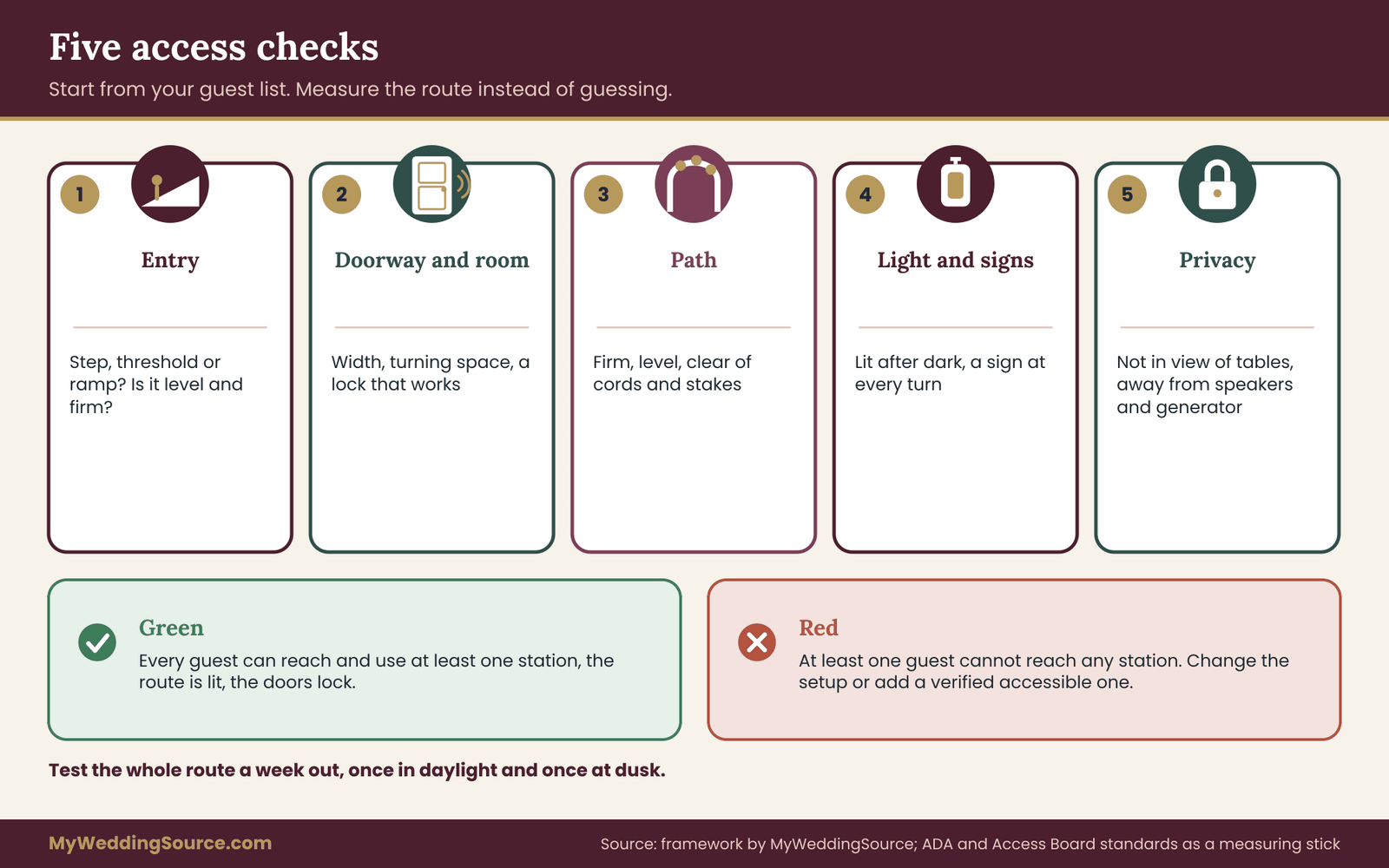
The entry. Is there a step at the door? Is the threshold high? Is the walkway firm, level and wide enough to turn into? A ramp may be an option, but it must be safe and stable, and a temporary ramp needs to be rated for the load and the slope. Ask a rental company or a contractor rather than improvising.
The doorway and the room. A standard interior door can be too narrow for some mobility devices, and a small powder room may not allow a turn. If the restroom cannot be reached or used by a particular guest, say so plainly in your plan and decide what will serve that guest instead.
Grab support and lighting. Walls in older homes may not support a grab bar, and fixing one into the wrong place is a hazard rather than a help. If you choose to add one, have it installed correctly well before the event. Make sure the light works, the switch is easy to find and a night light is on in the hallway.
Access in a rental trailer
Many trailers include a ramp or a low entry, and some models advertise accessible stations. Do not accept the word “accessible” at face value. Ask what it means. Ask the interior dimensions, the door width, the presence of grab bars, the height and slope of the ramp, and whether there is a handrail. Ask whether the unit is level once it is placed on your ground, because a slope in the yard becomes a slope at the door.
The route to the unit matters as much as the unit. A firm, level path from the party space to the ramp is essential. Grass that is fine on a dry day becomes difficult after rain, and a wheelchair or walker on soft ground is a real problem. If your yard is soft, think about temporary pathway matting laid before the event, and ask your rental vendor whether it can be supplied.
Privacy is part of access
A guest who does not feel private will not use the facility, or will use it quickly and uncomfortably. Privacy has three parts: sight, sound and perceived distance. Locks that work, doors that fully close and a position that is not directly in view of the dining tables all matter. In a house, that means choosing a backyard wedding bathroom that does not open off the main gathering room.
With a trailer, it means siting the rented backyard wedding bathroom unit so that the door does not face the guests’ tables and the path does not feel like a walk of exposure.
Sound is the piece hosts overlook. A restroom next to the sound system or a backyard wedding bathroom trailer near the generator is miserable. Put music speakers and generators away from the facility.
Light, signs and the dark
A wedding that runs after sunset needs a lit route. Many backyard weddings are planned around string lights and candles at the tables, which leave the path to the restroom in the dark. Plan for a path lit enough that a guest in formal shoes can see steps, edges and cords.
Battery or solar path lights, a lantern at the trailer door and a visible, glowing sign all help. The National Weather Service and local forecasts matter here too: a dark, wet and windy night changes how a path feels. Check the forecast the week of and the morning of.
Signs matter more than hosts expect. A small, readable sign at the party space pointing to the backyard wedding bathroom, and another at any point where the path turns, prevents wandering. For the broader approach to signage as a system, see the site’s guide to wedding signage if you want a pattern to follow. Note that a sign at the house door that says “restroom this way” also tells guests that the rest of the house is closed.
A ten-minute walk-through test for backyard wedding bathroom access
A week before the event, do one test with two helpers. Pick someone who walks slowly or uses a mobility aid, if a guest like that is coming, and ask them to try the whole route with you. Start at the party space, find the sign, follow the path, open the door, enter, lock, unlock and return. Time it, and write down every point where they hesitated or needed help.
Then repeat it at dusk, with the lights you plan to use. Many problems show up only in poor light: an unseen edge, a glare on the door, a switch nobody can find. A backyard wedding bathroom that passes the test in daylight and in the dark is ready. If it does not, the notes tell you exactly what to fix, and you still have a week to do it.
Access for the people working your event
Caterers, bartenders, musicians and photographers also need a restroom, and they may be on site for much longer than the guests. Decide where they will go. If the house is closed to guests but open to vendors, say so in advance and give the vendors a route. If the vendors will use the backyard wedding bathroom trailer along with everyone else, tell them. This is the group most likely to be overlooked in the plan, and it affects the traffic line.
Rating access on the grid
Green: every guest on your list can reach and use at least one station without help from a stranger, the route is firm and lit, and the doors lock. Amber: access exists but depends on a fix you have not completed, such as a ramp that is not yet confirmed or a path that needs matting.
Red: at least one guest cannot reach any station, or the only accessible station is somewhere you have not verified. A red on access means you pick another option or add a unit that closes the gap.
Renting restroom trailers for a backyard wedding bathroom: what to ask before you sign
A restroom trailer is a small building on wheels. It arrives on your property, gets positioned, connected or filled, and is picked up later. Each of those steps is a place where a backyard wedding bathroom can go wrong, so the rental conversation is a set of practical questions, not a price comparison.
Trailer, portable unit or both
The terms vary by company, and you should ask what a particular rental actually is. A restroom trailer is typically a towed unit with an interior, several stations, lighting, climate control and sinks. A portable unit, often called a portable toilet, is a freestanding single stall. Some companies offer a hybrid, such as a luxury single or a small cabin. Each has different needs for delivery, level ground, power and water, and each is judged differently on the backyard wedding bathroom grid.
Trailers tend to do better on cleaning, privacy and perceived quality, and worse on delivery and siting, because they are large and need space and a firm path. Single portable units do better on siting and worse on privacy, hand washing and the experience. Neither is better in general. The grid tells you which one fits your yard and your guests.
Delivery and siting: the questions that decide whether it fits
Before you pay a deposit, answer these in writing with the vendor.
How big is the unit, and how much clear space does it need around it? What is the delivery route, and is your driveway, gate and yard wide enough, firm enough and clear enough? Overhead wires and low branches matter for a tall trailer, and a soft lawn matters for a heavy one. Does the vendor need to drive across the lawn, and if so, what do they do to protect it?
Who is responsible for repair if the grass or an irrigation line is damaged? The site’s related guide on wedding rental planning is a useful companion here, since tents, tables and restroom units tend to compete for the same flat ground.
Where will it sit? Think about the route from the party, the sightline from the tables, the distance from a neighbor’s window and the distance from your own. A unit near the generator, the kitchen tent or the trash area makes everything worse. Level ground is not a nicety, because an unlevel trailer can stress the door and the ramp.
Power, water and waste
Trailers need power for lights, fans and climate control. Ask whether the unit runs from a generator, a shore power connection or a standard outlet, and what circuit it needs. Do not plug it into an extension cord that cannot carry the load, and do not run a cord across a walking path without a cover.
Water is the other question. Some units carry their own fresh water tank and a waste tank. Others connect to a hose. Ask how much water the tank holds relative to your guest count and event length, and what happens when it runs low. Ask whether the vendor refills it during the event, and whether that service is included. If the unit connects to your hose, find out the pressure and flow it needs.
Waste has to go somewhere. If the rented backyard wedding bathroom unit has a holding tank, ask about its capacity, who empties it, when, and what happens if the event runs long. If you also have a septic system, remember that a rented unit does not discharge into it by default.
Do not assume, and do not connect anything to your septic without the advice of a licensed professional. The EPA publishes homeowner guidance on septic systems, and a local health department can tell you how any local rules apply to your property.
Permits, neighbors and local rules
Some cities and counties regulate temporary structures, portable restrooms on residential property, event size, noise and street use. Some homeowners associations and rental agreements restrict these too. Rules differ so much from place to place that the safe path is to ask the people who issue them, which is usually the city or county permitting office or the health department, and your landlord or association if you have one. USA.gov can help you find the right local office.
Tell your neighbors. A trailer in a backyard is visible, sometimes audible and occasionally smelly on a warm day. A short, friendly note with the date, the hours and a contact number prevents a complaint. Where a neighbor shares a fence line with the intended location, think about moving the unit.
The contract: what to read twice
A restroom rental contract is short, and the details matter. Read for the delivery and pick-up windows, the cleaning and supplies included, any service visits, the cancellation and weather terms, the deposit and the damage or cleaning fees. Read for the stated capacity and for any exclusions, such as “not responsible for blocked access.”
Ask how the company handles a failure on the day, whether a unit stops working or the delivery is late. A reputable vendor will have a plain answer, and it will include a phone number that is answered on a Saturday. The site’s vendor due diligence checklist lists the general checks to make on any vendor, from insurance certificates to references, and they apply here too.
Scripts for the first vendor call and the neighbor note
A short script keeps the first call efficient. Say the date, the start and end times, the guest count and the address, and then ask in this order: Will your unit fit the access route I describe? What does it include for a backyard wedding bathroom of this size?
Is hand washing with soap and water available? What is the service plan during the event? What is your weather and cancellation policy? Can you send all of that in writing? Write down the name of the person who answered.
For the neighbors, keep the note plain: “We are hosting a family wedding at our home on this date, from this time to this time. A rented restroom trailer will be parked in our yard that morning and picked up the next day. Please call this number if anything bothers you during the event.” Nothing more is needed, and a number that gets answered matters more than the wording. If your backyard wedding bathroom plan changes after the note goes out, send a second note.
Insurance and liability
Check with your own insurance agent about what your homeowner or renter’s policy covers when an event is held at home, including injuries to guests and damage to rental equipment. The Insurance Information Institute offers general explainers on home insurance. Ask the rental company what its policy covers and whether it will provide a certificate of insurance.
A vendor who cannot or will not provide one is a risk to weigh. Insurance rules are specific to policy and state, so treat any general explanation as a starting point for a conversation with your agent.
Weather and the backyard wedding bathroom trailer
Weather affects a trailer more than a house. Wind can matter for a tall unit, rain affects the path, heat affects the interior and a cold snap can affect water lines. The National Weather Service publishes forecasts and alerts. Ask the vendor what its weather policy is, including whether it will move, delay or cancel a delivery in severe weather, and what happens to your deposit.
Have a fallback for the path, such as matting, and a fallback for the unit, such as opening the house restroom for the evening.
Rating the trailer on the backyard wedding bathroom grid
On traffic, the backyard wedding bathroom trailer is usually green or amber, because you can add stations by renting a larger unit or a second one. On cleaning, it depends on the contract and on service visits. On access, it depends on the unit, the ramp and the path, and it is where trailers most often fail. Rate each line with the tests above and write the fix beside every amber.
Split designs: using the house and a trailer together
Many successful setups use both. A split design assigns a role to each facility, writes it down and tells the people who need to know. The principle is simple: put each load where it costs least.
Four common splits
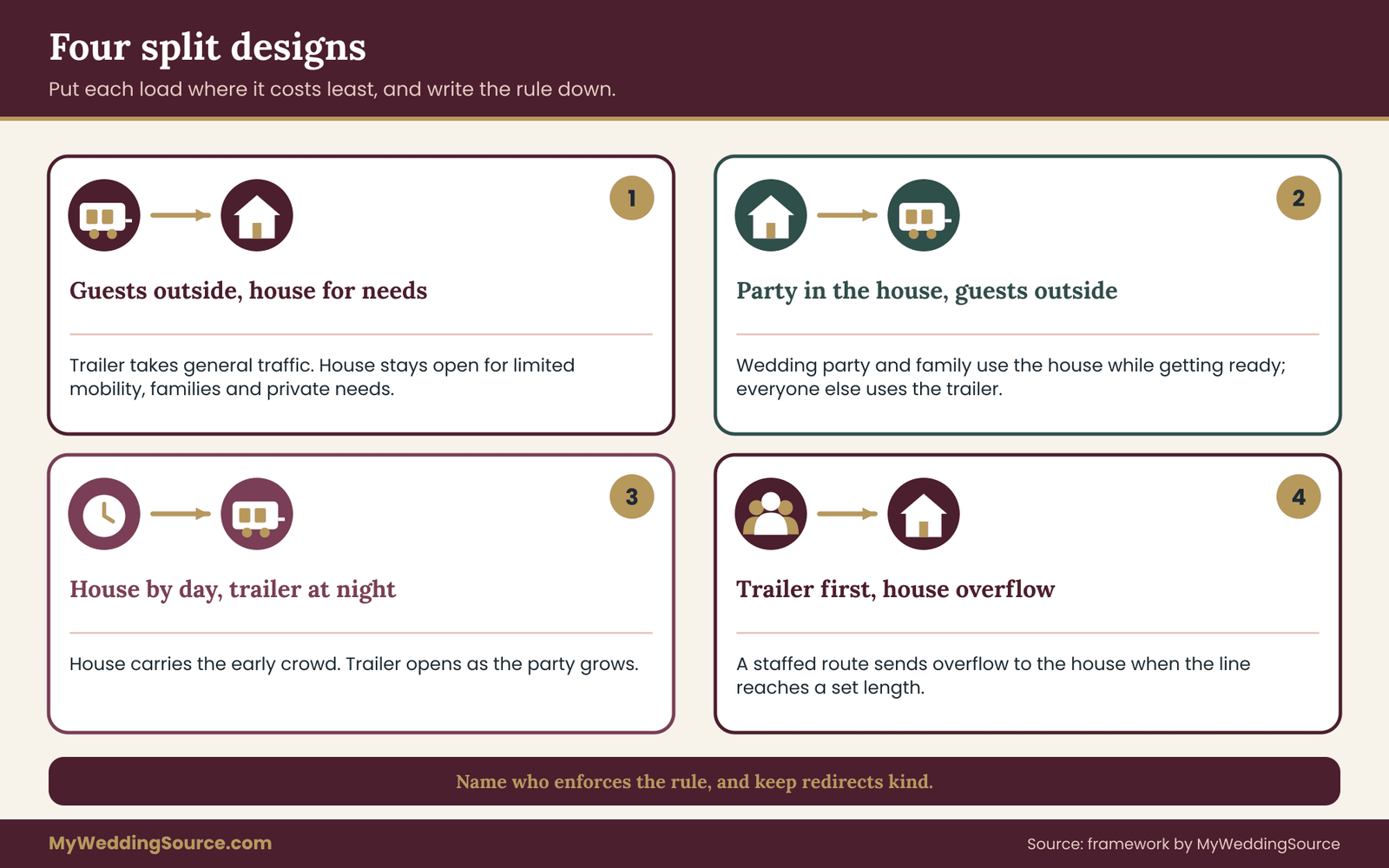
General guests outside, house for specific needs. The trailer takes most visits. The house restroom stays open for guests with limited mobility who need a ground-floor option, or for those who need a private space, such as someone changing a baby or managing a medical need. Signs and a friendly contact person tell guests who may use it.
Wedding party in the house, guests outside. The wedding party and close family use the house restroom while getting ready and during photos, and everyone else uses the backyard wedding bathroom trailer. This keeps the house routine of the day intact and makes the house restroom’s cleaning load small and predictable.
House for the day, trailer for the evening. The house handles the ceremony and the early hours, when the crowd is small or spread out. The trailer opens as the party grows. This split saves nothing on the rental, but it can reduce the number of units needed if the trailer is ordered for the peak.
Overflow house. The trailer is the main facility, and the house restroom is the overflow. When the backyard wedding bathroom trailer line reaches a set length, a person redirects guests to the house. This needs a staffed route and clear rules, and it is the least stable of the four.
The split rule has to be written
The failure of a split is vagueness. If “the house is for family” is not written down and told to the person at the door, it will be applied differently by different people. Write the rule in one sentence per facility. Name the person who enforces it. Decide what happens when someone ignores it, and keep the answer kind. A guest who walks into the house is not a problem, and a polite redirect is enough.
How a split changes the backyard wedding bathroom grid
A split moves a red from one cell to another. If the house fails on traffic but wins on access, the backyard wedding bathroom trailer takes the traffic and the house keeps the access role. If the trailer fails on access in your yard, the house keeps an access role for the guests who need it, and a path is built to the house door.
Rate the split as a design: each guest group should have a green station available, and each line should be amber or better in the cell that carries the load.
A worked case: ninety guests, one powder room and a soft lawn
This is an invented example, not a report of a real event. It exists to show how the grid turns into a decision. Every number below is an assumption chosen for the illustration, and you should replace them with your own.
The facts
A couple is hosting ninety guests at the bride’s parents’ suburban house. The ceremony is at four in the afternoon, dinner is served at half past five, and the party ends at ten. The house has three toilets. One is a powder room on the ground floor, off a back hallway and eight steps from the back door.
One is a hall bathroom reached through the kitchen, where the caterer will work. One is upstairs. The lawn is soft after a wet spring. Two guests need a closer look: a grandmother who uses a walker, and a toddler with two parents who will want to go together.
Step one: traffic
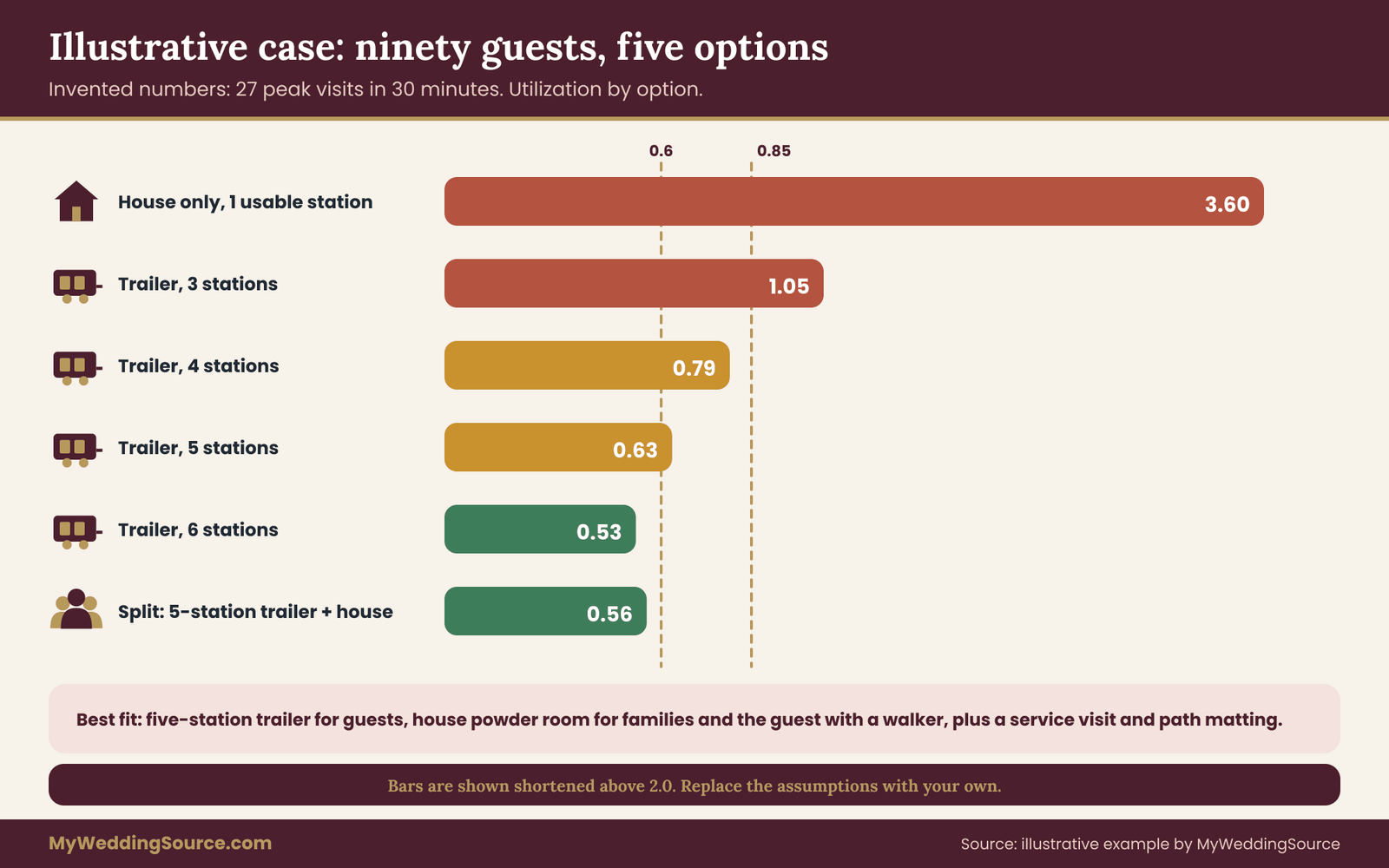
The peak window is the half hour after dinner, before the toasts. The couple assumes that three in ten guests will visit during it, which is twenty-seven visits in thirty minutes, or nine tenths of a visit per minute.
For the house, they count one preferred station: the powder room. The kitchen bathroom is a usable overflow but passes a work area, and the upstairs bathroom is not for guests. They assume a service time of four minutes, since guests must find the door, walk the hall and wait.
The load is nine tenths times four, or three and six tenths stations busy on average, against one station. Utilization is three and six tenths. That is far above the red threshold. The house alone fails on traffic by a wide margin.
For a backyard wedding bathroom trailer with three stations and a service time of three and a half minutes, including the walk across the yard, the load is about three and a quarter. Utilization is a little over one. Red. With four stations, it is about eight tenths, which is amber. With five stations, it is about six tenths, which is the border between green and amber. With six, it is just over half, which is green.
Step two: cleaning
In the house, the couple names a friend, Dev, to check the powder room every half hour during the busy period and every hour otherwise, and they put a kit in the hall closet. That is green.
For the backyard wedding bathroom trailer, the draft contract says the rented backyard wedding bathroom unit is cleaned and stocked at delivery and picked up the next morning. It does not mention service during the event. That is red. The fix is either to ask for a mid-event service visit, in writing, and see its price, or to assign a person with a kit to check the trailer on the same schedule.
The couple asks, and the vendor offers a visit at a set time for a fee. They add it to the cost list.
Step three: access
The grandmother’s walker fits through the powder room door, but there is a single step at the back door, and the floor in the hallway is polished wood. In the house, access is amber: the fix is a short, stable ramp from a rental vendor, a runner in the hall and a chair outside the door. The couple confirms the ramp’s dimensions with the vendor and tests the door with the walker the week before.
For the trailer, the vendor’s unit has a ramp and a wider door, which the couple verifies on the specification sheet. But the path crosses forty feet of soft lawn. That is red for the grandmother and amber for everyone else. The fix is pathway matting laid on the evening before, and a request that the unit be placed on the firmest ground near the patio. They also decide to keep the powder room open to the grandmother and to anyone who needs a shorter route.
The toddler’s parents are an easy case. A family restroom or a stall large enough for two is helpful, and the powder room fits. In a split design, the parents are told that the house powder room is available for families with young children.
Step four: choose the design
Neither option alone is green on every line. The house fails on traffic. The trailer, as drafted, fails on cleaning and, for one guest, on access. The couple chooses a split.
The general guest traffic goes to a five-station trailer, with a mid-event service visit and matting on the path. The house powder room is reserved for the grandmother, young families and anyone who asks, with a clear sign and Dev as the contact. The kitchen bathroom and the upstairs bathroom are closed and the doors are marked.
Recalculating with the split: about twenty-four of the twenty-seven peak visits go to the backyard wedding bathroom trailer, which is about eight tenths of a visit per minute. At three and a half minutes, the load is about two and eight tenths, against five stations, which is a utilization of about fifty-six hundredths, just under the green line. The three remaining visits, a tenth of a visit per minute at four minutes, put a load of four tenths on one station: green.
The design passes. Because the trailer figure sits on the border, the couple writes a note on the checklist: if the guest count rises above a hundred, add a station or move the toasts later.
What the example shows
Three things stand out. The house and the trailer failed on different lines, which is why a split was the natural answer. The cheapest fixes, matting, a runner, a named friend and a written service visit, mattered more than the choice of unit. And the whole decision took an hour with a pencil. The numbers are not magic; they are a way to make an argument visible, so the couple and the parents could agree on it before anyone spent money.
Reading the grid: decision rules for a backyard wedding bathroom
Once the six cells are rated, a few rules turn the grid into a choice. Use them in order.
Rule one: no unmitigated red. If an option has a red and you cannot name a fix with an owner and a date, that option is out for the guests who depend on it. This rule is the reason the backyard wedding bathroom grid exists.
Rule two: access before traffic before cleaning. If two options each have a red and you can only fix one, fix access first, because it excludes a person. Traffic is second, because it affects everyone’s comfort. Cleaning is third, because it is the most fixable with labor.
Rule three: if the house wins on access and loses on traffic, split. Keep the house as the access and family option and put the volume outside. This is the most common outcome for events of any size.
Rule four: if the backyard wedding bathroom trailer wins on traffic and loses on access, split the other way. Build or confirm the accessible route to the house, or choose a unit with a verified accessible station and a firm path.
Rule five: ties go to the option with fewer vendors. Every rental adds a delivery window, a contract and a phone number to call. If the house and a single small unit rate evenly, the simpler setup has fewer ways to fail.
Rule six: if the numbers are close to the border, add margin cheaply. A twenty percent buffer in stations, a longer break before the toasts or a staggered dinner service spreads load without more rentals. Spreading demand is often cheaper than adding supply.
Mistakes the backyard wedding bathroom grid is built to catch
Four mistakes show up again and again. The first is counting every toilet in the house as a station, when only one or two are open to guests. The second is renting a trailer without checking the path, so the unit sits in the yard and half the guests cannot use it. The third is trusting the word “included” without reading what the service covers. The fourth is forgetting the vendors, who then use the guest facilities at the worst moment.
Each of these is a failure of the same kind: a fact that nobody wrote down. The grid forces those facts onto a page. A backyard wedding bathroom plan with every fact written down and every red answered will not be perfect, but it will rarely surprise you.
When the grid says the house is enough
For a small event, say thirty guests over three hours, the house can score green on all three lines with one well-placed restroom, a named friend and a runner at the door. In that case, a rental is an extra cost and an extra thing to go wrong. The backyard wedding bathroom grid should be able to tell you not to rent. A planning tool that only ever recommends spending is not a planning tool.
When the backyard wedding bathroom grid says rent more than you expected
The opposite also happens. For a long event with a large crowd and a house that has one usable station, the backyard wedding bathroom grid will push you toward a larger trailer than the “one per fifty guests” rules you may see online. Those rules, wherever they come from, do not know your schedule, your clothing, your drinking pattern or your route.
Use them as a sanity check, not a substitute. If a vendor recommends a number, ask how they arrived at it and compare it with your own estimate.
What it costs: quote logic without invented prices
Prices for restroom rentals vary widely by region, season, unit type and vendor, and any number printed in an article is out of date quickly. So this section gives you a way to compare quotes instead of a price.
Build the same list for every option
For the trailer, list every line item you will pay: base rental, delivery and pickup, extra stations, a service visit or attendant, power or generator, water, pathway matting, ramp, damage deposit and any cleaning or fuel fees, plus taxes. For the house, list the costs people forget: extra paper and supplies, a deep clean, a rented ramp or runner, a locksmith or door fix if needed, a friend’s thank-you gift and a cleaning crew’s fee if it covers bathrooms.
Then ask each vendor for a written quote with the same scope: same date, same hours, same stations, same service. A quote that leaves out service visits will look cheaper than one that includes them, and the comparison is only fair when the scope matches.
Compare the cost of the fix, not just the cost of the unit
The grid gives you a list of fixes. Add their costs to the option they belong to. A cheaper trailer that needs matting, a service visit and a second unit may cost more than a pricier one that includes them. A free house option that needs a ramp rental and a deep clean has a cost too. When you add the fixes, the ranking sometimes flips.
Read cancellation and weather terms like a price
A deposit that is not refundable if the weather is bad is a cost, and so is a vendor who can cancel for conditions you cannot predict. Ask what the deposit covers, when it becomes nonrefundable and what a reschedule costs. The broader venue guide lists the terms worth checking on any event rental, and the same habit applies here.
Where affordability and comfort meet
If the budget is tight, the backyard wedding bathroom grid shows where money does the most good. Usually it is on a line with a red: a ramp for a guest who cannot otherwise enter, a service visit for a unit with no cleaning, a second station if the queue is long. Money spent on a green cell is money you could use somewhere else.
Edge cases and failure conditions for a backyard wedding bathroom
Edge cases that change the grid
The backyard wedding bathroom grid handles the common situations. A few unusual ones deserve a sentence each, because they change a rating in ways that are easy to miss.
A tent over the party. A tent changes the route and the lighting, and it may block the shortest path to a backyard wedding bathroom. Walk the route with the tent in place, and make sure stakes, lines and cords do not cross the path.
Rain. A wet yard turns every rating on access down by one step. Matting, covered walkways and a dry entry at the house door move them back up. Decide your rain version of the backyard wedding bathroom plan when you decide your rain version of the party.
A daytime or brunch event. Shorter events and lighter drinking mean lower traffic, and the lighting line disappears. The house may carry a brunch for a hundred that it could never carry at night.
A long evening with open drinks. Visits rise as the night goes on, and the late-night peak can exceed the dinner peak. Check cleaning and supplies at the end of the evening, not only the start.
A rented house or a shared property. A landlord, a lease or an association may limit events, rentals on site or guest use of the interior. Ask before you plan, because the answer can remove an option. The site’s technical walkthrough guide shows how to measure access routes and gather the facts a vendor will ask for.
A small lot or a narrow side yard. A trailer that does not fit down the side of the house is not an option, however good it looks in the brochure. Measure the gate and the clear path, including any turns.
Guests with medical needs. Some guests need a clean, private space and a place to sit quickly. A house restroom or a family-sized stall serves them better than a standard single stall, and a quiet word with the guest beforehand is better than a sign.
Vendors and staff. If the caterer and band will be on site for many hours, count them in the traffic estimate and decide where they will go. They may need a separate arrangement, so they do not use the guest facilities during the peak.
Failure conditions: when to stop, switch or move the plan
A decision framework is only useful if it says when to stop. These are the conditions that should make you change the setup, ask for help or reconsider the event itself.
The only accessible route fails a check. If a guest cannot reach any station and you cannot fix it, either move the restroom, add an accessible unit with a verified route, or tell the guest plainly what is available so they can decide. Do not leave it as a surprise.
Utilization stays red after the fixes. If the numbers still say a line will form and stay, add stations, spread the schedule or shorten the party. Hoping for a lighter crowd is not a fix.
The vendor cannot confirm in writing. If delivery, service, power, water or insurance cannot be confirmed in writing, treat the vendor as unconfirmed and keep a backup call list. A phone call that no one answers a week out will not be better on the day.
Local rules prohibit the setup. If the city, county, landlord or association says no to a trailer or a guest count, believe them, and change the setup before you change your mind. Fines and shutdowns on the day are far worse than a redesigned plan.
Septic or plumbing limits are unknown. If you plan to rely on the house for a large crowd and do not know what your system can take, get a professional opinion before you count the house as a station. An overloaded system is expensive and unpleasant.
The weather turns. If a severe forecast makes the path, the unit or the delivery unsafe, switch to the fallback you wrote in advance, and tell guests early. Safety comes before the plan.
Nobody owns cleaning. If, by the week before, the cleaning check has no names and no kit, the plan is not ready. This is the cheapest failure to fix and the most common to ignore.
A day-of run sheet in six lines
On the morning of the wedding, check six things. The route is clear and lit. The signs are up. The kits are stocked and where the checker can reach them. The checker knows the schedule. The vendor’s phone number is on a card with the person who will call it. The fallback is agreed, including who opens the house if the rented backyard wedding bathroom unit fails. Then let it go, because once these six are in place, the rest is a backyard wedding bathroom.
Your next steps
Start with an hour and a page. Write the inputs: guest count, schedule, usable stations in the house, the route and the yard. Rate the six cells of the backyard wedding bathroom grid honestly and mark every red and amber. If any red remains without a fix, decide on a split design or a different rental before anything else.
Then make the calls. Ask two or three vendors for written quotes with the same scope and the answers to the access, cleaning and weather questions in this backyard wedding bathroom guide. Confirm local rules with the city or county office and any landlord or association. Talk to your insurance agent.
Tell your neighbors. Name the person who checks the backyard wedding bathrooms, and tell your guests, kindly, where to go. A backyard wedding bathroom does not have to be the memorable part of your wedding, and the best sign you got it right is that nobody mentions it.
FAQ
Is it better to use the house or rent a restroom trailer for a backyard wedding?
It depends on your guest count, schedule and layout. Small, short events often work with one or two house restrooms and a named friend doing checks. Larger or longer events usually need rented stations for general traffic. Score both options on traffic, cleaning and access, and consider a split that keeps the house for specific needs.
How many restroom stations do we need?
There is no single number. Estimate how many guests will visit in your busiest half hour, multiply the arrivals per minute by the minutes each visit takes, and compare that load with the stations you can actually open. Keep utilization under about six tenths if you can. Ask vendors how they size units and compare their answer with yours.
Do we need a permit for a backyard wedding bathroom trailer at a home wedding?
Possibly. Rules about temporary structures, portable restrooms and events at residential properties differ by city and county, and some homeowners associations or leases add their own limits. Contact the local permitting or health department and any landlord or association before you book. USA.gov can help you find the right local office.
Can we connect a rental trailer to our septic system?
Do not assume you can. Many trailers use their own tanks, and connecting anything to a septic system without professional advice can cause damage. Ask the rental company how the unit handles waste and consult a licensed septic professional or your local health department if you are considering any connection.
How do we make a backyard wedding bathroom accessible?
Start with your guest list and measure the route. A ground-floor restroom with a level entry, a wide enough door and room to turn is the starting point. For a trailer, ask about the ramp, door width and grab bars, and build a firm, lit path. The ADA website and the Access Board publish technical standards you can use as a measuring stick.
Who should clean the restrooms during the reception?
Name a specific person for each shift, preferably a friend with no other role, and give them a kit and a schedule. For a rented unit, ask whether service visits or an attendant are included and what they cover. Do not assume the family will handle it, because family members are busy with the wedding itself.
What should we do if the trailer line gets too long?
Redirect overflow to a house restroom if one is designated, ask the vendor about a second unit or a service visit, and spread the schedule with a short break or a delay before toasts. Decide the overflow rule in advance and tell the person who enforces it. A short line in a lit, signed spot is easier on guests than one in a hallway.
Should we tell our neighbors about a backyard wedding bathroom trailer?
Yes. A short, friendly note with the date, hours and a contact number prevents most complaints. Mention where the unit will sit, and consider moving it away from a shared fence or a neighbor’s window. It also gives neighbors a chance to raise a concern before the day, when you can still change the setup.
Sources
- USAGov: find your local government offices and services
- U.S. Environmental Protection Agency: septic systems for homeowners
- Centers for Disease Control and Prevention: clean hands, how and when to wash
- ADA.gov: Americans with Disabilities Act, standards and guidance
- U.S. Access Board: accessibility guidelines and standards
- Occupational Safety and Health Administration: sanitation and safety resources
- U.S. Consumer Product Safety Commission: home safety information
- Insurance Information Institute: homeowners insurance basics
- National Weather Service: forecasts and alerts
- Federal Emergency Management Agency: ready.gov, preparing for severe weather