
A wedding invitation keepsake box is only as good as what touches the paper inside it. This guide compares the materials that make up a keepsake box, from the board and the sleeves to the lining and the closure, and gives you a moisture checklist so your invitation suite is still readable and flat decades from now.
For a wedding invitation keepsake box, choose a lignin-free, acid-free board box that carries a recognized permanence claim, put each piece in an inert sleeve or folder (polyester, polypropylene or polyethylene, never PVC), and separate heavy or sticky items such as wax seals and ribbon. Store the keepsake box in a stable, interior room, never an attic, basement or garage. Aim for steady, moderate humidity, check it twice a year, and ask any seller for written material specifications before you buy.
Most couples keep one invitation suite. It sits in a shoebox, a gift box from the stationer or a kitchen drawer, and for the first few years nothing seems wrong. Then the corners curl, the envelope liner stains the card above it, a ribbon leaves a brown line, or the wax seal fuses to a sleeve. The damage is rarely dramatic. It is slow, and it is almost always caused by the container or the room, not by the paper itself.
That is why the choice of a wedding invitation keepsake box deserves more thought than the usual “buy something pretty” advice. A keepsake box is a small piece of storage equipment. It holds paper, ink, adhesive, fabric and sometimes metal or wax, and each of those reacts to heat, light, air and moisture in a different way. The box either slows those reactions down or speeds them up.
This article is deliberately narrow. It is about materials and moisture. It does not cover how to word, print or mail invitations. If you are still at that stage, the guide to wedding invitation etiquette covers wording and timing, and the guide to wedding invitation print production covers proofing, quantities and printer handoffs. Here we start after the wedding, with one finished suite in your hands.
A note on scope. This is general information, not legal, tax or financial advice, and it is not a substitute for a conservator’s assessment of a valuable or damaged item. Product claims and prices change, so confirm current specifications with the seller before you buy.
Why paper fails inside a keepsake box
Paper does not simply sit still. Most modern paper contains cellulose fibers, and cellulose breaks down slowly through reactions with water, acids, oxygen and light. A good keepsake box reduces the speed of every one of those reactions. A poor one adds to them. It helps to know the six main causes, because the materials comparison later in this guide is really a comparison of how well each material controls these six.
Acid. Acidic paper and board weaken and yellow over time. Acid also migrates. A card touching an acidic envelope liner or cardboard divider can pick up a brown shadow along the contact line, a pattern conservators call acid migration. The paper that is damaged is often not the paper that was acidic.
Moisture. Humidity that is too high swells paper fibers, encourages mold and makes pages stick together. Humidity that swings up and down causes repeated expansion and contraction, which shows up as cockling, curling and cracked ink. Very dry air makes some papers brittle. Of the six causes, moisture is the one most often underestimated, so the second half of this article is a full checklist for it.
Light. Ultraviolet and visible light fade dyes, lighten inks and yellow paper. A keepsake box that is closed and kept in a dark room mostly solves this, but a display frame on a sunny wall does not.
Heat. Warmth speeds up nearly every chemical reaction in paper. A box in a hot attic ages its contents faster than one in a cool interior closet, even if the materials are identical.
Pests. Silverfish, moths, cockroaches and rodents eat paper, paste and fabric, and they favor dark, undisturbed places with a little moisture. Boxes that are closed tightly and stored off the floor are harder to reach.
Handling and contact. Skin oils, rubber bands, paper clips, tape, sticky notes, ballpoint ink and laminating pouches all cause damage when they touch paper for years. Pressure from stacking can emboss one piece into another.
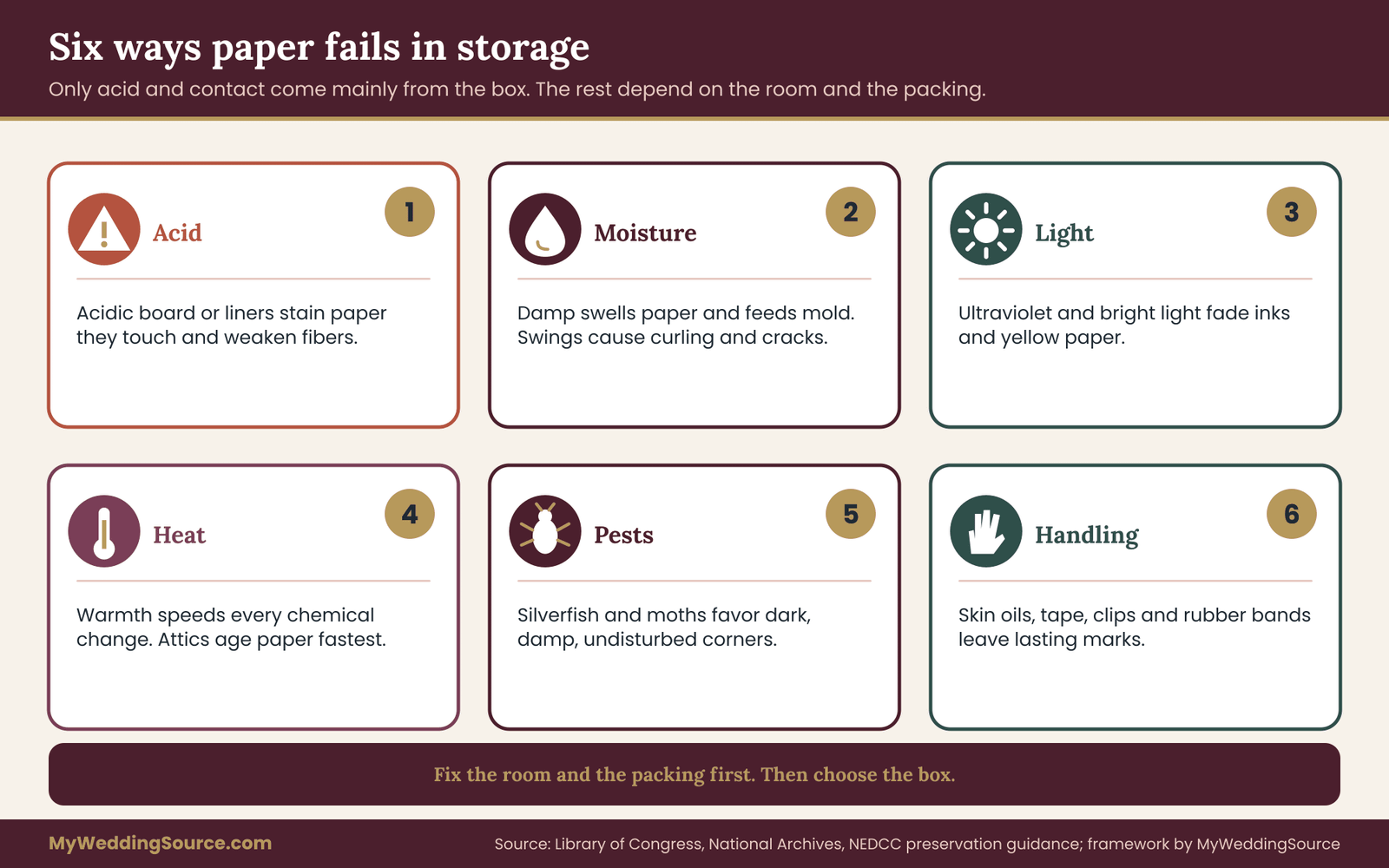
Notice that only two of these six causes, acid and contact, are mainly about the material of the keepsake box itself. The other four depend on where you keep the box and how you pack it.
That is the main idea behind the framework in this article, which splits protection into four layers: the shell (the box), the wrap (sleeves and folders), the separator (the thin material between unlike items) and the microclimate (the air and humidity inside and around the keepsake box). A weak layer can be rescued by a strong one, but only up to a point.
What “long term” realistically means
Longevity claims on keepsake boxes are often vague. “Archival” has no single legal meaning in retail, and a seller can print it on almost anything. For a wedding keepsake, a useful working definition is this: the contents should stay stable, legible and free of new stains for as long as you and your family care to keep them, which might be fifty years or more, with ordinary care and no special equipment.
That goal is modest. You are not building a museum vault. You do not need controlled climate or nitrogen-filled cases. You need to avoid the handful of mistakes that cause most household paper damage, and a short list of materials that avoid those mistakes.
Where the guidance in this article comes from
The recommendations here follow the general preservation guidance of national libraries, archives and conservation centers, such as the Library of Congress, the National Archives and the Northeast Document Conservation Center. Their published advice for family papers is consistent on the main points: stable moderate temperature and humidity, enclosures made of inert or purpose-made archival materials, no attics or basements, and regular checks. The full list is under Sources at the end. Where a figure is given, it is a commonly cited range from that kind of guidance, not a measurement of any particular box.
What a wedding invitation keepsake box actually has to hold
Before comparing materials, list what you are storing. A modern invitation suite is rarely one flat card. Each component has its own weakness, and a keepsake box that suits a plain flat card may be wrong for a layered suite with a wax seal.
The invitation card. Usually cotton, wood-pulp or recycled stock in a range of weights. Thick cotton stock is among the more stable choices. Thin, coated or glossy stock is more sensitive to moisture and to sticking.
Printing and finishing. Letterpress leaves a deep impression that can flatten under pressure. Foil stamping and metallic inks can scratch or tarnish. Thermography (raised ink) can soften under heat and stick to what touches it. Digital toner can offset onto facing surfaces if the pieces are pressed together warm. For a closer look at how these processes differ, ask your printer, who can tell you how your particular job was made.
Envelope and liner. The envelope may be plain, but the liner is often decorative paper that is thin, dyed and sometimes acidic. Liners are a common source of staining.
Inserts. Reception cards, accommodation cards, direction maps, RSVP cards and their small envelopes. They are often printed on different stock than the invitation, so two items in one suite can behave very differently in the same box.
Wraps and extras. Vellum overlays, belly bands, ribbon, twine, wax seals, pressed flowers, fabric pockets, ticket-style stubs and sometimes a wooden or acrylic cover. These are the pieces most likely to cause trouble.
The written layer. Handwritten addresses, calligraphy, a card from a guest, or a note you wrote on the back. Water-based and certain gel inks can run if they ever get damp.

Treat the list as a packing manifest. Count the pieces, photograph them laid out flat, and note anything unusual, such as a thermographed edge or a hand-applied wax seal. That inventory also tells you how much volume the keepsake box needs. Most couples underestimate. A suite with a pocket folder, a belly band and four inserts takes up several times the space of a single flat card, and a box that is too tight forces pieces to press against each other.
The one-suite rule
Keep one complete suite as the archive piece, and treat spares differently. If you ordered extras, as many printers recommend, the spares can be used for framing, scrapbooks, a guest book page or gifts to parents. The archive suite goes into the keepsake box and stays there. That rule protects the one item you cannot replace and takes a lot of pressure off every later decision, because you will not be tempted to display or handle it.
If you did not order extras and the printer is still in business, ask whether the files are on hand and whether a small reprint is possible. That is a question for the printer, covered in the guide to wedding invitation print production linked above.
Decide what the box is for
A keepsake box can serve three different purposes, and the materials change depending on which one you choose.
Deep storage. The keepsake box is closed, dark and rarely opened. The priority is chemical stability and moisture control. Appearance is secondary.
Occasional viewing. You will open it on anniversaries and show the contents to family. The priority is easy, low-friction handling, so that opening the lid does not scrape a seal or bend a corner. That favors folders and trays over tight sleeves.
Display and storage in one. Some boxes have a clear lid or a decorative exterior meant to sit on a shelf. These are the hardest to get right, because light and room humidity reach the contents all the time. If you want to look at your invitation regularly, a better approach is usually a closed archival box for the real suite and a framed or digital copy for display.
Most couples will be best served by the first or second purpose. Be honest about which one you are choosing before you start comparing prices, because a handsome display box that fails at deep storage is a poor use of money, and a plain archival box that you never open is a poor use of a keepsake.
The four-layer method for a keepsake box
Instead of asking “which box is best,” ask four questions in order. This keeps the decision simple and stops one attractive feature from hiding a weakness elsewhere.
Layer one, the shell. What is the box made of, and is that material stable? The shell is your first defense against light, dust, pests and handling.
Layer two, the wrap. What touches each piece directly? Sleeves, folders and tissue sit between the paper and everything else. This is where most of the contact risk lives.
Layer three, the separator. What goes between pieces that should not touch, such as a wax seal and a card, or a dyed liner and a pale invitation? Separators are thin and cheap, and they prevent the damage people notice first.
Layer four, the microclimate. What is the humidity and temperature inside the box, and what is the room doing? You can improve this with placement, with a few simple habits and, in some cases, with a humidity buffer.
The rest of this guide takes each layer in turn. The next section compares shell materials, the keepsake box itself, and later sections cover wraps, separators and the moisture checklist.
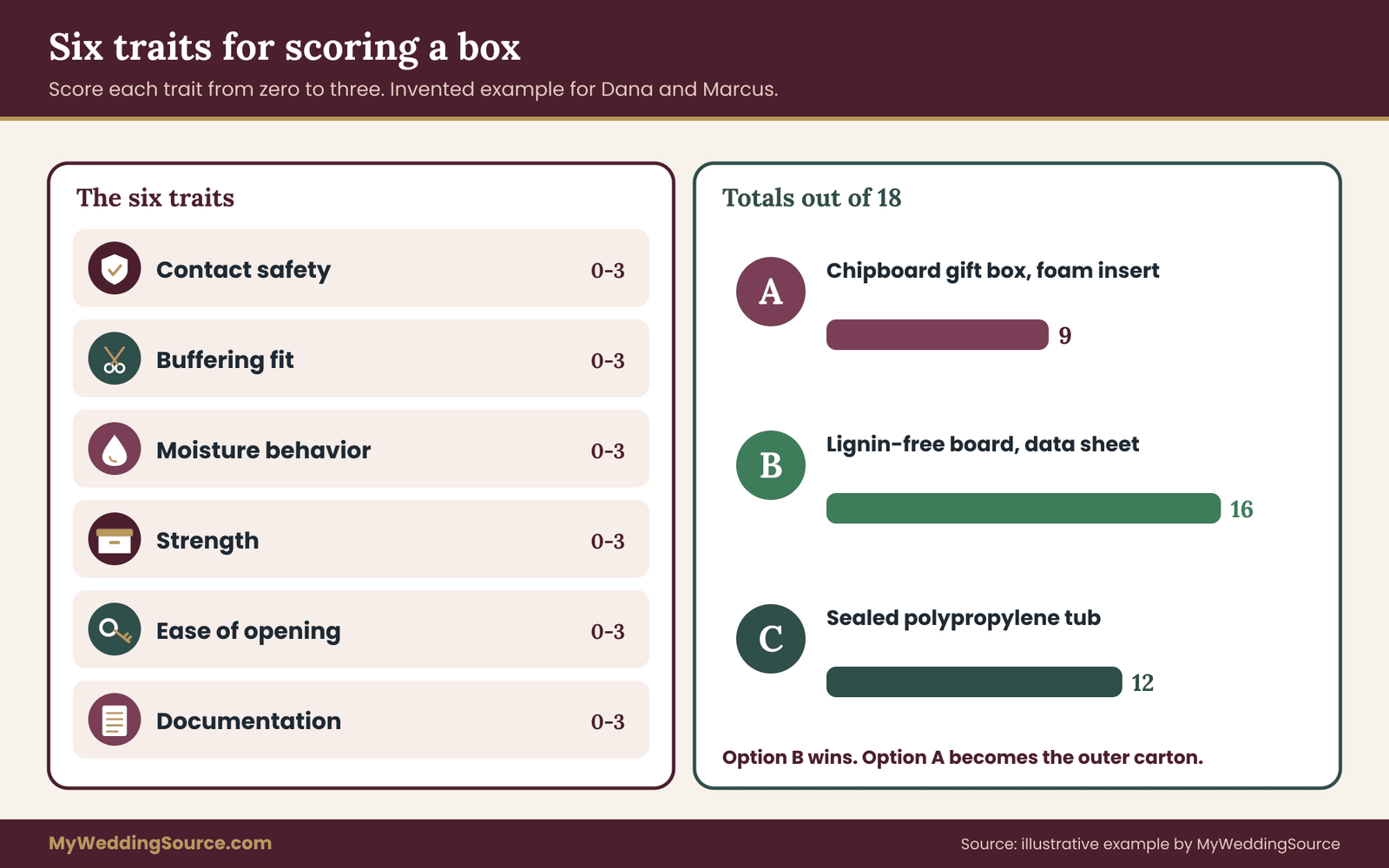
A quick way to use the method is to score each candidate box or material from zero to three on six traits: contact safety, buffering fit, moisture behavior, strength, ease of opening and documentation. You will see those six traits again, with a worked example, further on. A box that scores well on contact safety and documentation but poorly on strength can be fixed with a better shelf and careful stacking. A box that scores poorly on contact safety cannot be fixed with a nicer ribbon. ## Keepsake box materials compared: the shell
The keepsake box is the part you see in the product photo, so it gets the most marketing. Here is how the common shell materials behave when the job is to protect paper for decades. The comparison is in plain prose rather than a score sheet, and each material is judged on the six traits introduced above.
Lignin-free, acid-free board
This is the standard material for a serious keepsake box. Lignin is a natural component of wood that turns acidic as it ages, so board made from wood pulp that still contains lignin will eventually yellow and release acids. Board labeled lignin-free and acid-free is made from purified pulp or cotton, and often has an alkaline buffer added.
Contact safety is high, moisture behavior is moderate (board takes up and releases water slowly, which actually smooths out short humidity swings), strength is good if the walls are thick enough, and opening is easy. The weak point is documentation: many sellers use the words casually.
Look for a stated pH, a stated buffer, and ideally a reference to a recognized standard such as ISO 16245, which covers board and boxes for storing paper-based documents, or ISO 9706 for permanent paper. If a seller cannot say what the claim is based on, treat the word “archival” as decoration.
Buffered versus unbuffered board
Buffered board contains an alkaline reserve, usually calcium carbonate, which neutralizes acids that form over time or migrate in from outside. For most paper invitations, buffered board is a sensible choice. Conservation guidance generally recommends unbuffered material for certain items, mainly photographs, some dyed or protein-based materials such as silk or wool, and a few historic processes, because alkaline buffers can affect them.
This matters because many invitation suites include a photograph, an engagement photo card or a silk ribbon. The practical rule is simple. If the suite is paper and ink only, buffered is fine. If it contains photographs or silk, either use unbuffered material for those pieces or keep them in their own inert enclosure. A reputable archival supplier will explain which products are which, and the conservation centers listed in Sources publish plain explanations of the difference.
Plain corrugated cardboard and shipping boxes
Ordinary corrugated board is wood pulp with lignin, often acidic, and it is a favorite habitat for silverfish. It is also very absorbent, so it holds moisture against whatever touches it. It can work as a temporary outer carton for moving, but it is a poor first-line enclosure. If a cardboard box is all you have today, line it with archival folders and plan to replace it. Do not use it in a basement, ever.
Chipboard, gift boxes and stationer’s presentation boxes
Many invitation suites arrive in a decorative box. The exterior might be a printed paper wrap over chipboard, with a foam or ribbon-trimmed interior. The wrap paper is usually adhesive-mounted, and the chipboard is usually acidic. These boxes look wonderful and may last for years without visible harm, but they are not designed for permanence.
You do not have to throw them away. Keep the original box as a sleeve or outer carton and put the suite in a purpose-made archival box or at least in archival folders inside it. Remove foam inserts, which can break down and leave residue, and avoid anything with a strong adhesive smell, because off-gassing adhesives are a known problem for paper in closed spaces.
Wood and cedar
Wood is attractive and strong, and it is a risky place for paper. Most woods give off organic acids and volatile compounds, particularly in a closed box, and fresh finishes and varnishes can off-gas for a long time. Cedar is often assumed to be protective, but the same oils that repel moths can stain and smell, and conservation guidance generally steers people away from storing paper in unsealed wood.
If you love a wooden box, treat it as furniture. Line it fully with a barrier of archival board and put the suite in a second, archival box inside it, so that the paper never faces bare wood. If the wood is new, let it air for a long time first, since fresh finishes release the most vapors.
Fabric-covered and padded boxes
Fabric exteriors are fine as an outer layer, but check the lining and the adhesive. Dyes can transfer when damp, padded interiors often contain foam or batting that releases gas as it ages, and glues can bleed. A fabric box that has a rigid archival board interior, with the fabric glued only to the outside, is a good compromise. A box with fabric or foam directly against the paper is not.
Metal tins and cases
Metal looks permanent. In practice, tins can rust, corrode at the seams and trap moisture, and a lid that seals tightly creates a small sealed climate that follows the room’s humidity peak but cannot release it. Coated or powder-coated steel boxes made for archival use exist, and they are a legitimate option, but a decorative cookie tin is not one.
Plastic tubs and containers
Rigid plastic tubs are often sold for “keepsake storage.” Some are made of polypropylene or polyethylene, which are chemically stable and acceptable for paper contact. The issue is not the plastic. It is the airtight seal.
A sealed tub traps whatever humidity was inside on the day you closed it, and a humid day can become a long-term mold risk. The section on microclimate covers when a sealed container helps and when it hurts. For now, treat a plastic tub as an outer shell for protection against floods and pests, not as a replacement for an inner archival box.

Reading a product listing without being fooled
Sellers use similar vocabulary for very different products. Here are the phrases that deserve a follow-up question.
“Acid-free.” Tells you the pH at the time of manufacture, and nothing about lignin, buffering or what the glue does later. Ask whether it is also lignin-free.
“Archival quality.” Not a regulated term for consumer goods. Ask for the specification or a standard reference.
“Museum quality.” Marketing language. Same question.
“Photo safe.” May mean the product passed the Photographic Activity Test, a standardized test for how a material interacts with photographs, or it may mean nothing. Ask which test and whether the result is on the data sheet.
“Non-toxic.” Describes safety for people, not for paper.
“Made from recycled material.” A fine environmental claim and not a preservation claim. Recycled board may contain residual lignin or acids unless the maker states otherwise.
You are not being difficult by asking. Reputable archival suppliers publish specification sheets because their buyers, who include libraries and collectors, routinely ask.
Scoring the shells against each other
In a rough ranking for the job of protecting a paper invitation suite long term, a lignin-free, acid-free board box with a stated standard sits at the top. A coated archival metal box and a polypropylene tub used as an outer shell come next, as protective containers around an inner box.
A fabric box with a rigid archival interior is fine. A decorative chipboard gift box is acceptable for short-term holding. Plain corrugated cardboard and unlined wood sit at the bottom, and the reason is contact: both can touch the paper and both can harm it.
That ranking is an informed judgment based on general preservation guidance, not the result of a test, and your own situation may shift it. A couple with an extremely stable, climate-controlled closet and a lot of free time can make a wider range of choices work. A couple moving often or living in a humid region has less room for error and should lean toward board, sleeves and a good place to store the keepsake box.
Sleeves, folders, tissue and interleaving: the wrap and separator layers
Inside the box, every piece should be either in a sleeve, in a folder or separated from its neighbors by a sheet of something inert. This is where the shell’s protection is either completed or undone.
Polyester, polypropylene and polyethylene sleeves
Clear sleeves let you look without touching. The three plastics that are generally considered stable for long-term paper contact are polyester (also called PET or by brand names such as Mylar and Melinex), polypropylene and polyethylene. They are chemically inert, do not contain plasticizers that migrate and can be bought in a size that fits a standard invitation.
The material to avoid is PVC, polyvinyl chloride, which is common in cheap binders and photo pockets. PVC releases acidic compounds as it ages and contains plasticizers that can soften and stain paper. If a sleeve feels soft, sticky and smells like a new shower curtain, do not use it. A seller who does not know what plastic a sleeve is made of should not be a seller for this job.
Polyester is the stiffest and clearest and is a good choice for single pieces that need support. It can build static, which can lift loose media such as pastel or some toner, so it is a poor fit for items with powdery surfaces. Polypropylene and polyethylene are softer and slightly cloudier and are a good choice for ordinary printed pieces.
One further caution. A sleeve is not an airtight seal, but a sleeve that is tight can hold moisture against a card if the humidity rises. Leave a little room, never seal the open end with tape and keep sleeves loose enough that the card slides out without a fight.
Paper folders and enclosures
Four-flap folders and L-shaped folders made of archival paper are an excellent way to hold a suite. They breathe slightly, they buffer small humidity swings and they do not trap static. Folders are better than sleeves for items with raised printing or wax, because they do not press against the surface. They are also better for the occasional viewing purpose, because a folder opens like a book.
Interleaving tissue
Thin sheets of acid-free, lignin-free tissue, often buffered, work as separators between layers. They are the cheapest and most effective way to stop an acidic liner from staining a pale card, to keep letterpress surfaces from pressing into each other and to keep metallic foil from scuffing its neighbor. Use unbuffered tissue next to any photograph or silk.
Avoid glassine as a long-term separator. It is smooth and translucent, and it is often sold alongside archival products, but it can become acidic and sticky with age and is generally treated as a short-term material.
Things to remove before packing
Many damaging items arrive with the suite. Take off or replace:
Rubber bands. They dry, crack and stick, and leave a stain and a gummy residue. Replace with a strip of archival paper tied loosely with cotton tape.
Metal paper clips and staples. They rust and leave a mark that cannot be reversed.
Tape of any kind. Even tape that is labeled invisible turns yellow and bleeds adhesive. Do not remove old tape with a solvent yourself. A conservator can do that.
Sticky notes. Adhesive migrates, and the shape of the note becomes a stain.
Ballpoint pen notes on the suite. Label the folder or the tissue, not the invitation. If you need to write on something, use a soft graphite pencil on the folder.
Laminate. Do not laminate invitations. The process is irreversible, the adhesive is not archival and the plastic traps moisture and gases against the paper. If a suite was laminated long ago, consult a conservator rather than trying to peel it.
Labeling without damaging
A label inside the keepsake box is worth more than a label outside. Write the date, the couple’s names, the contents and a note such as “contains wax seal and ribbon, do not stack” on an acid-free card. Place it on top of the contents. If you label the outside, use a paper label attached to the box, not the paper inside.
Handling in practice
Handle paper with clean, dry hands and a clean flat surface. White cotton gloves are often suggested, but for loose paper many conservators prefer clean bare hands, because gloves reduce grip and can cause tears. For photographs and metal foil, nitrile gloves are a better option. Whatever you choose, pick up each piece by its edges, support it from below and keep food and drink off the table.
If you are thinking about wedding records beyond the invitation, such as the certificate, receipts and contracts, the guide on organizing wedding records after the event separates what to keep permanently from what to review and discard, and the invitation suite belongs in the keepsake group there. ## Moisture and your keepsake box: what actually happens
Moisture is the cause most likely to ruin a keepsake box and the least visible while it happens. Paper constantly exchanges water vapor with the air around it. When the air is damp, the paper takes on water. When it dries, the paper releases it. A keepsake box slows that exchange, but it never stops it entirely, and the speed depends on the material of the shell and on how tightly it closes.
Three moisture problems account for most household paper damage.
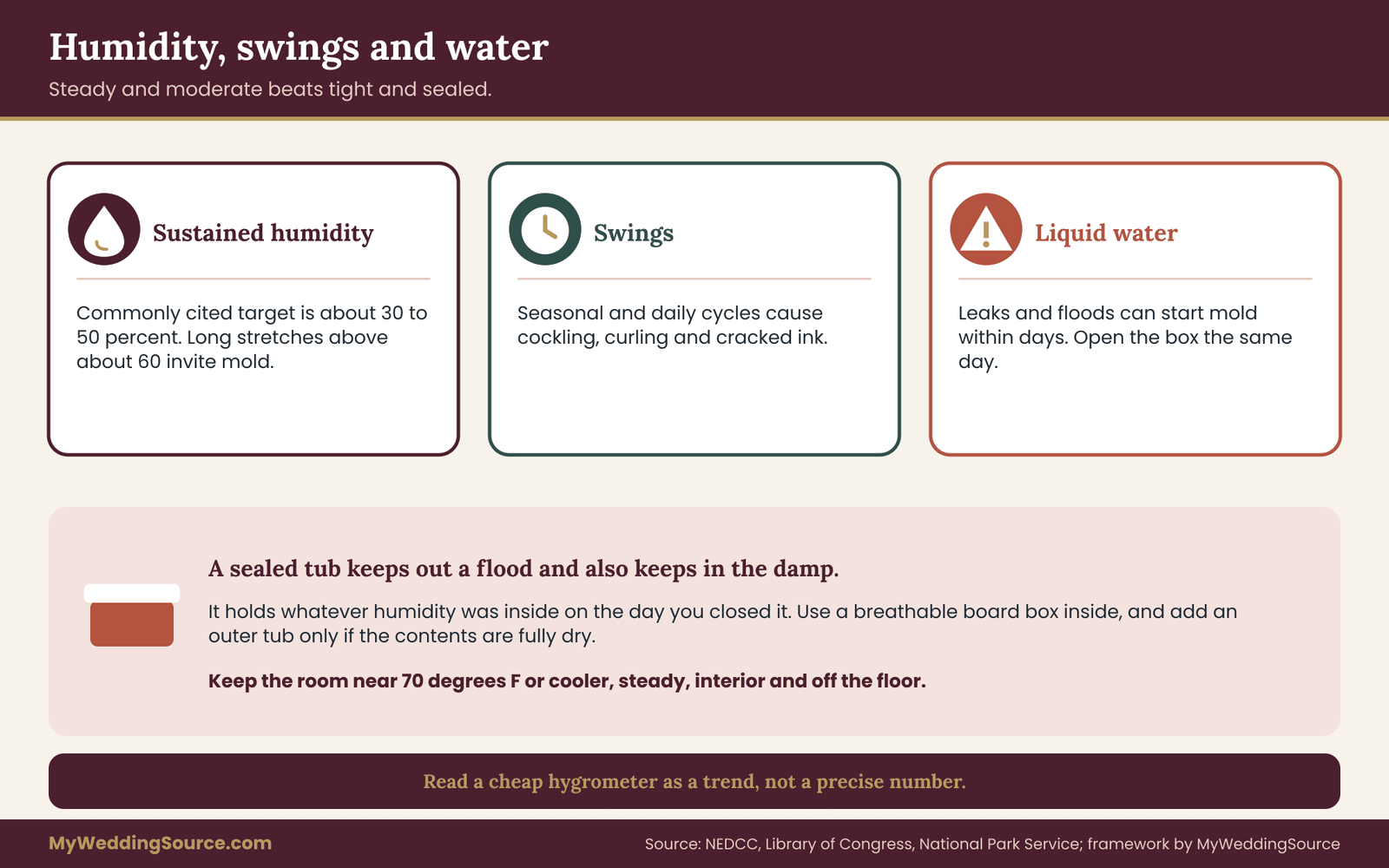
Sustained high humidity. Preservation guidance from national libraries and archives commonly gives a target range of roughly thirty to fifty percent relative humidity for paper collections, with a ceiling somewhere around sixty to sixty-five percent. Above that for a sustained period, mold spores that are always present in household air can germinate. Mold often shows up first as a faint musty smell, then as small fuzzy or powdery spots, then as stains. Once it is established, it is a conservation problem and not a cleaning problem.
Swings. Daily and seasonal cycles do slow, repeated damage. A keepsake box in a room that is humid in summer and dry in winter gets pushed in both directions every year. Thin, coated or glued items such as vellum overlays, laminated cards and foil-stamped surfaces respond at different rates and may separate or warp.
Liquid water. Leaks, floods, a burst pipe or a humidifier malfunction are not slow problems. Wet paper can mold within a couple of days. Ink, particularly many calligraphy and gel inks, can run. The keepsake box location, not the box, is the main defense here.
Why a tight box is not automatically a safe box
It is natural to think that sealing a keepsake box protects it from damp. Sometimes it does. A sealed polypropylene tub on a high shelf can keep out a short flood or a dusty renovation. But a seal has an equal and opposite effect: it holds in whatever humidity and gases were present when it was closed.
If the suite was packed on a damp summer day, a sealed tub preserves the summer air. If the suite is still carrying moisture from a damp envelope liner, that moisture has nowhere to go. And if one component off-gases, the vapors accumulate instead of dispersing. That is why many archival boxes are made of breathable board with a lid that sits on loosely, and why a conservator would often rather see paper in a breathable box in a stable room than in a sealed box in a changing one.
The practical rule: use a breathable archival board box as the inner enclosure, and add an outer sealed container only if you have a specific water risk and are certain the contents are completely dry and clean when you close it.
Stable beats perfect
You do not need to hit a specific number every day. What matters is staying within a moderate range and avoiding fast changes. A closet on an interior wall of a conditioned home is nearly always better than a bedroom closet against an outside wall, and far better than any attic, garage, basement or storage unit without climate control. The commonly cited temperature guidance is to keep paper at or below about seventy degrees Fahrenheit, with cooler being better, and, again, steady.
The moisture checklist for a wedding invitation keepsake box
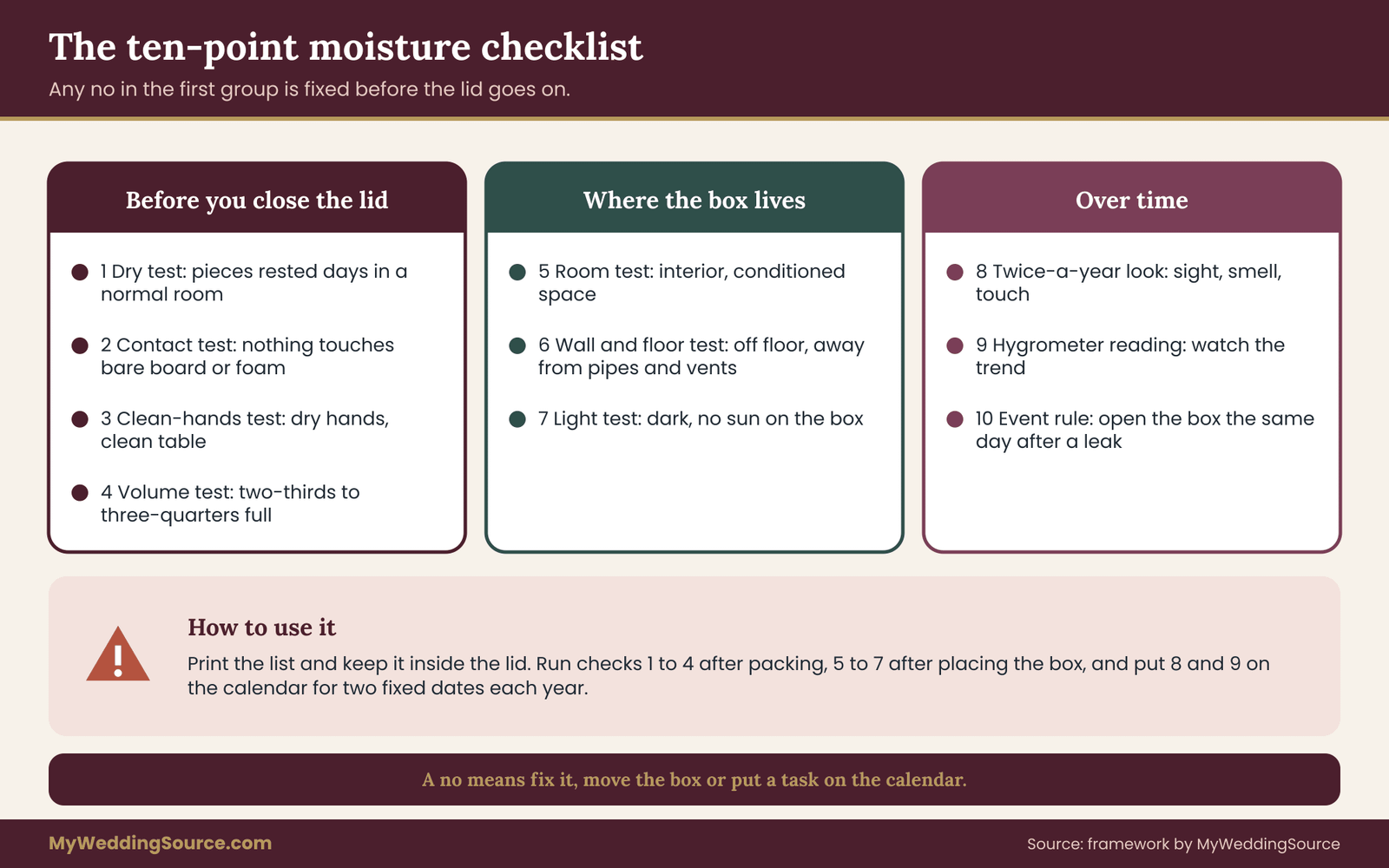
This checklist is the original working tool of this guide. It has ten checks, grouped into three moments: when you pack, where you put the box and what you do over time. Each check is a yes or no question. A single “no” in the first group should be fixed before you close the lid. A “no” in the second group means move the keepsake box. A “no” in the third group becomes a calendar task.
Before you close the lid
Check one, the dry test. Has every piece been out in a normal, comfortable room for at least a few days, and does every piece feel completely dry and flat? Do not pack anything that was recently in a damp basement, a humid venue box or a car trunk in summer. Let it acclimate in an open folder first.
Check two, the contact test. Is every piece either in a clean inert sleeve or folder, or separated by tissue from anything dyed, glued, waxed, metallic or acidic? If a piece is touching bare chipboard, bare wood, foam or fabric, the answer is no.
Check three, the clean-hands test. Were all pieces handled with clean, dry hands, and is the surface they were laid on free of food, drink, lotion and hand cream residue?
Check four, the volume test. Is the box roomy enough that nothing is bent, pressed or squeezed, yet snug enough that the contents do not slide? A keepsake box that is two-thirds to three-quarters full is a good guide. A packed-to-the-brim box presses items together, and a half-empty box lets them shift.
Where the box lives
Check five, the room test. Is the keepsake box in an interior, conditioned living space, in a closet, under a bed or on a shelf in a hallway or bedroom? An attic, a garage, a basement, a shed and a self-storage unit without climate control all fail this check.
Check six, the wall and floor test. Is the box off the floor, away from exterior walls, away from water pipes, air-conditioning drains, radiators and heating vents, and not directly under a bathroom or kitchen? Water damage most often arrives from above or from the floor.
Check seven, the light test. Is the keepsake box in a dark place or at least out of direct and strong indirect sunlight? Even a closed box left on a sunny windowsill heats up.
Over time
Check eight, the twice-a-year look. Do you open the box twice a year, perhaps when you change your clocks, and look, smell and touch? You are checking for any musty odor, new staining, curling, stuck pieces, insect droppings or a sticky feel.
Check nine, the humidity reading. Do you have an inexpensive digital hygrometer in the room, and do you check that it stays within a moderate range? A basic hygrometer reads in percent relative humidity, and the reading can be off by a few points, so use it to watch trends instead of aiming at a single number.
Check ten, the event rule. Have you decided what you will do after any water event, such as a leak, a flood, a heating failure or a move? The answer should be: open the keepsake box the same day, look, and if anything is wet or smells musty, get help rather than trying to dry it with a hair dryer or an oven.
How to use the ten checks
Print the checklist or copy it onto a card, and put it inside the lid or beside the box as a reminder. After you pack, go through checks one to four. After you place the keepsake box, go through five to seven. Put the twice-a-year look on your calendar for two specific dates and add the hygrometer reading to the same reminder.
If you are stuck on a “no” that you cannot fix, such as having only an attic for storage, the answer is not to give up. It is to store the box with someone who has a better space, to keep a high-quality scan and a framed copy at home, or to rent a climate-controlled unit. The rental has a recurring cost, so weigh it against the value of the suite.
Reading the room: a simple humidity and temperature audit
You can learn a lot about a storage location in a week with one inexpensive hygrometer. Place it where the keepsake box would sit, ideally inside an empty box of the same type, and log readings at the same times each day: morning and evening are enough. Take notes on the weather and on whether the air conditioning or heating was running.
What you are looking for is not a perfect number. It is a pattern. If the reading stays in a moderate range through a week, including a rainy day and a hot day, the spot is probably fine. If it climbs steeply on humid days or drops sharply when the heating comes on, you have identified a swing problem before it affected anything valuable.
Run the audit again in a different season. Humidity in many homes is very different between July and January.
Rules of thumb for common rooms
Hall or bedroom closet on an interior wall. Usually the best starting point. Check that it is not directly above a heating vent.
Under the bed. Often acceptable, and sometimes better than a closet, since it is dark and interior. The main concerns are dust and floor-level flooding, so use a box with a lid and a raised bed frame.
Top shelf of a linen cupboard. Usually fine, provided the cupboard is not on an outside wall or next to a bathroom.
Basement. Fails in most homes, even “dry” ones, because basements are cooler and more humid and are at risk from flooding. If a basement is your only space, use a dehumidifier, a high shelf and a regular check, and consider the invitation suite for another location.
Attic. Fails because of heat and wide temperature and humidity swings.
Garage or shed. Fails for similar reasons, with pests added.
Rental storage unit. Choose a climate-controlled unit if you must use one. A standard unit follows the outside weather and is a poor place for paper.
Hygrometers: what to buy and how to read them
A small digital hygrometer with a thermometer is enough. Place it in the same room as the keepsake box, away from direct sunlight, vents and windows. Read it as a trend, not a precise instrument. If you have two, compare them in the same room for a day. If they disagree by many points, use the average and consider the trend more important than the number.
Do not rely on a thermometer-only reading. Temperature and humidity are linked, and the number that matters for paper is relative humidity.
What to do if the reading is high
If the room is above the commonly cited upper range for several days, the answer is to reduce moisture in the room rather than to stuff the box with desiccant. Run the air conditioning, which dehumidifies as it cools, or use a household dehumidifier and empty it regularly. Improve air circulation around the keepsake box by moving it a little away from walls. Then keep logging. If the high reading persists, move the box.
What to do if the reading is low
Very dry air is less common in the paper-damage conversation, but it does happen in cold-climate winters with the heating on. Extremely dry conditions make some paper brittle and can crack glued or laminated items. If your room goes very dry, avoid placing the keepsake box next to a heater, and avoid the reflex to humidify the room heavily just to protect the box. A moderate, steady level is the target.
The next section covers microclimate tools such as silica gel and buffered humidity packs, which are often sold alongside keepsake boxes. ### Silica gel, humidity packs and other microclimate tools
Sellers of keepsake boxes often include a small sachet of silica gel, or sell humidity packs as an accessory. These products are not nonsense, but they are easy to misuse, and they are the single most common way a careful person damages a good box.
What silica gel does and does not do
Standard silica gel is a desiccant. It absorbs water vapor from the air until it is saturated, and then it stops working until it is dried out again. In a sealed or nearly sealed space, a desiccant will pull the humidity far below what paper needs. Paper left in very dry air for a long time can become brittle, and the cycle of drying and re-wetting can be worse than leaving it alone.
Conservators use a different product called conditioned or buffering silica gel, which is pre-set to a target humidity and releases or absorbs moisture to hold the air near that level. It is designed for display cases and sealed frames. It is a legitimate tool, but it needs to be matched to the volume of air, replaced or recharged on a schedule and kept from touching the paper.
For a household wedding invitation keepsake box, the practical advice is:
Do not drop a standard desiccant sachet into an ordinary box and forget it. If the keepsake box is not airtight, the sachet will saturate and do nothing. If it is airtight, it may over-dry.
Do not let any packet touch the paper. Keep it in its own pouch or tray, with a layer of board between it and the contents.
Use a buffered product only if you are sealing the box, and follow the maker’s instructions about quantity and replacement. If you do not want to maintain it, skip it.
Prefer fixing the room. A better location and a dehumidifier solve the problem that the packet is trying to solve, and they do it for the entire space.
Activated charcoal and “odor absorbers”
Activated carbon pouches can absorb gaseous pollutants and odors, and some archives use carbon-containing board for pollutant protection. A loose charcoal pouch in a household box is a different matter. It does not control humidity, can shed dust and gives a false sense that the keepsake box is protected. Treat it as optional, never as a substitute for good materials.
Moth balls, cedar blocks and insect repellents
Do not put mothballs, naphthalene, camphor or scented sachets in a keepsake box. The vapors can stain and smell for decades, and the products are irritants. If you have a pest problem, deal with it in the room, with cleaning and sealing, or through a pest-control professional, and keep the box tightly closed and off the floor.
Fire and water outer protection
Some people want a fireproof or waterproof safe for irreplaceable papers. A fire-resistant safe is mostly designed to protect paper from direct flame, and many have a high internal humidity after exposure to heat or have gel-filled walls that release moisture.
If you are considering one, check the maker’s rating for paper, and understand that the inside of a safe is not necessarily a good long-term climate. For most couples, a better approach is redundancy: a good keepsake box, a high-resolution scan stored in two places and one trusted relative who knows where the keepsake box is.
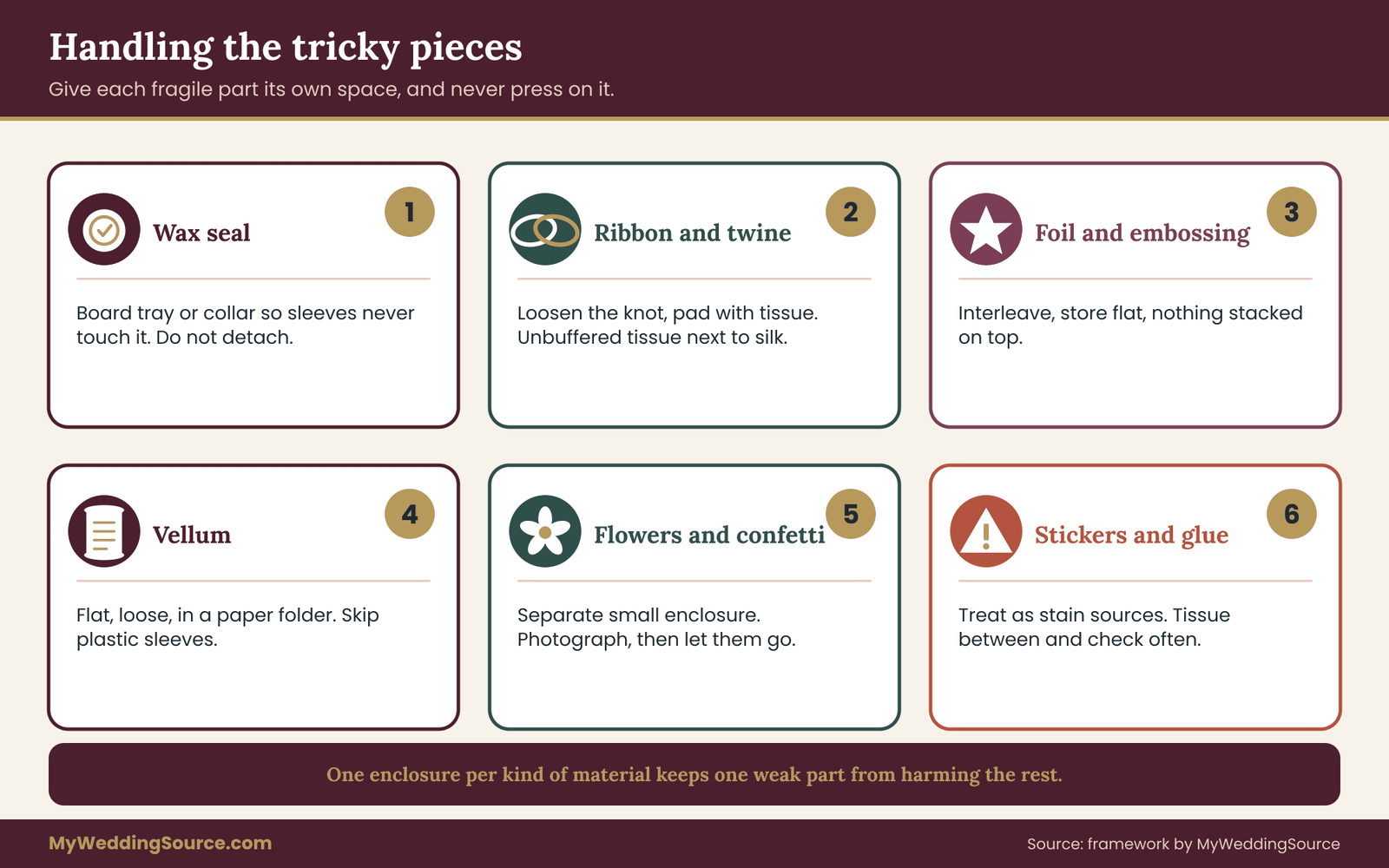
The tricky pieces: wax seals, ribbon, foil, vellum and handwritten ink
Most invitation suites are not plain. The details that make an invitation special are also the details most likely to cause storage problems. Here is how to handle each one inside a keepsake box.
Wax seals
Wax is not paper-friendly in storage. Seals can crack, chip and shed fragments, and many are made of resin-based sealing wax that can soften in warm rooms and stick to anything touching it. Oils can migrate from wax into nearby paper and leave a translucent patch.
Keep the seal from touching any sleeve or card face. Put it in a small archival board tray, or build a shallow collar of board around it, so that tissue and cover layers rest on the collar and not on the seal. If the seal is attached to the envelope, store the envelope flat in a folder with a thick pad of board beside the seal to take pressure. Never press a sleeve against it.
Do not try to detach a seal that is still attached. That is a job for a paper conservator.
Ribbon, twine and fabric
Silk and satin ribbon is attractive and fragile. Dyes can bleed if damp, metal threads can tarnish and stain, and the fabric itself yellows. Cotton twine is more stable but can leave an impression in the paper.
Remove tied ribbon only if you can do it without stress on the paper. If a ribbon is still tied, loosen the knot and pad underneath it with a strip of tissue so that the ribbon does not press a groove into the card.
Keep silk away from buffered board and use unbuffered tissue next to it. Some people prefer to cut a tiny section of ribbon and store it separately in a small enclosure, while keeping the main ribbon with the suite. That is a judgment call, and a small snip in an inconspicuous place is generally less harmful than a permanent stain.
Foil, metallic ink and embossing
Foil stamping and metallic inks can scratch, flake and in some cases tarnish. Embossing and letterpress impressions flatten under weight. The rule for all three is to avoid pressure and friction. Use an interleaving sheet, store the item flat and do not stack heavy objects on top.
If you are unsure how your invitations were printed, ask the printer. The print production guide explains why the processes differ, and your printer’s job sheet or invoice may name them.
Vellum and translucent overlays
Vellum overlays and similar translucent papers are particularly sensitive to humidity. They expand, cockle and wrinkle in damp air and can curl or tear in dry air. They are also commonly secured with a small adhesive dot, a brad or a ribbon.
Store them flat and loosely in a folder, with the overlay in its position over the card only if it lies flat without tension. Otherwise, store the overlay in a separate folder alongside the card. Do not use plastic sleeves for vellum, since trapped moisture is more likely to make it cockle.
Pressed flowers, leaves and confetti
Natural items release moisture and acids as they decay and can attract pests. If a suite includes pressed material, it should go into its own small enclosure and not rest against a printed surface. Photograph it for your records. Some couples choose to let those pieces go.
Adhesives and stickers
Pressure-sensitive stickers, double-sided tape and hot glue all age badly. They yellow, ooze and migrate. If the suite has a sticker or adhesive element, treat it as a potential stain source. Interleave with tissue and check it each time you open the box.
Handwritten addresses, calligraphy and inks
Some envelope calligraphy is done in water-based inks or gouache, and some gel and felt-tip pen inks are not lightfast. These marks can fade in light and run or feather if they ever get wet. If your address envelope is handwritten, it is a good candidate for a scan along with the card, because the writing is the first thing to go.
Whatever the ink, the envelope should be kept dry, dark and flat, and the writing should never be rubbed.
Packing the keepsake box: a step-by-step method
With the materials chosen, here is a clean, repeatable way to pack. Allow about an hour, a clear table and a clean towel or sheet of archival paper to work on.
Step one, set up. Lay out the shell, the sleeves or folders, tissue, a pencil, a ruler and the label card. Wash and dry your hands. Remove rings and bracelets that could scratch.
Step two, photograph and inventory. Lay out the pieces, photograph the front and back and make a short list. This is your insurance if something is later damaged, and it gives you a digital reference copy.
Step three, remove hazards. Take off rubber bands, clips, tape and anything else on the earlier removal list. Where something cannot be removed without risk, leave it and pad around it.
Step four, acclimate. If the pieces were stored somewhere very different in temperature or humidity, give them a day or two in the room where they will be packed.
Step five, sort by sensitivity. Group pieces by how they behave. Fragile and special items, such as wax, foil, vellum and silk, are packed in their own enclosures. Robust flat cards can share a folder, separated by tissue.
Step six, wrap. Place each piece in its sleeve or folder. Use interleaving tissue between pieces that will face each other. Do not seal sleeves.
Step seven, build the stack. Put the heaviest, flattest and most robust items at the bottom and the most delicate on top. Never stack anything on a wax seal or a raised piece. If you have a tall item, give it its own tray or a small separate box.
Step eight, fill gaps. Use crumpled or folded archival tissue to stop movement without pressure. Do not use cotton balls, bubble wrap or foam.
Step nine, label and date. Place the label card on top, with the contents, the date packed and a note on handling.
Step ten, close and place. Put the lid on loosely if it is a breathable box. Place the keepsake box in the location you audited, off the floor, and write the next check date on your calendar.
A note on flat storage
Paper keeps best flat. Standing a thick card on its edge for years can cause it to slump or bow, and a box that holds a suite on end puts the weight on the edge. If your keepsake box is tall and narrow, add a stiff board support so that nothing leans. A shallow, wide box that holds the suite flat is generally a better choice than a deep box in which the suite is stacked with other things.
Why not add the guest book and other mementos?
A common instinct is to put everything in one container: the invitation, the guest book, the dried bouquet, the garter, the programs and a few photos. Different materials need different environments, and a single box turns the most sensitive item’s needs into everyone’s problem. The more sensible approach is one enclosure per kind of material. The invitation suite and other flat paper can share. Fabric, flowers, photographs and objects should be separate. The keepsake box for the invitation can then be sized and chosen for paper alone. ## Scoring a keepsake box: the six-trait comparison in practice
Now put the six traits to work. The method is simple. For each candidate keepsake box, score each trait from zero to three, add the scores and compare the total with your own priorities. Zero means the trait fails, one means weak, two means acceptable and three means strong. The scores come from the product listing, a data sheet and your own examination, not from a lab test, so treat the totals as a way to organize your judgment and not as a measurement.
Contact safety. What touches the paper, and is it stable? Lignin-free, acid-free board with inert sleeves scores three. Bare chipboard or foam scores one or zero.
Buffering fit. Does the buffering match the contents? Buffered board for paper only scores three. Buffered board against silk or photographs, with no separator, scores low.
Moisture behavior. Does the keepsake box breathe and buffer short swings without trapping damp? A board box with a loose lid scores three. A sealed tub without a conditioning plan scores one. A bare wooden box scores low for other reasons.
Strength. Will the box hold its shape under stacking and handling? Thin walls or a flimsy lid lose points here. Strength is the trait most easily improved by good placement.
Ease of opening. Can you open and close it without dragging the contents? A tight lid that needs a hard pull will damage whatever is inside. A keepsake box you dread opening is one you will not check.
Documentation. Can the seller state what it is made of and what standard it meets, in writing? A data sheet with pH, buffer, lignin content and a standard reference scores three. “Archival quality” on a hang tag scores zero.
An illustrative worked example
The following example is invented to show the method. The couple, the products and the scores are made up for illustration and do not describe a real purchase or a real test.
Imagine a couple, Dana and Marcus, with one complete suite: a thick cotton letterpress invitation, a reception card on coated stock, an RSVP card with a small envelope, a vellum belly band tied with a silk ribbon and a wax seal on the outer envelope. They have a hall closet on an interior wall and have never owned a hygrometer.
They are choosing among three kinds of keepsake box.
Option A, a decorative chipboard gift box in a printed paper wrap, with a foam insert. Contact safety scores one, because the chipboard and foam touch the paper. Buffering fit scores one, since there is no information. Moisture behavior scores two, because chipboard breathes but is absorbent. Strength scores two. Ease of opening scores three. Documentation scores zero. The total is nine out of eighteen. It is pretty, and it is a poor primary enclosure, but it makes a reasonable outer carton.
Option B, a lignin-free, buffered archival board box with a loose lid, from a supplier that publishes a data sheet. Contact safety scores three. Buffering fit scores two, because the buffer is a good match for the paper pieces but not for the silk ribbon. Moisture behavior scores three. Strength scores two. Ease of opening scores three. Documentation scores three. The total is sixteen out of eighteen.
Option C, a sealed polypropylene tub. Contact safety scores three for the plastic itself. Buffering fit scores two, since it is neutral. Moisture behavior scores one, because the seal traps whatever humidity was inside. Strength scores three. Ease of opening scores two. Documentation scores one. The total is twelve out of eighteen. It is a good outer shell for water protection but a weak inner enclosure.
Dana and Marcus pick Option B as the inner keepsake box. The thing that tips the decision is documentation, because the seller can say exactly what the board is. They buy a few extras to solve the specific problems in their suite: unbuffered tissue to wrap the silk ribbon, a small board tray with a raised collar for the wax seal, polypropylene sleeves for the flat cards and a four-flap folder for the vellum. The decorative gift box becomes the outer carton, with the foam removed.
They place the packed box on a high interior closet shelf, put a hygrometer next to it for a week and add two reminders to their calendars. That is the entire process, and none of it required special skill.
What the example shows
The best total score does not come from the most expensive box. It comes from the box whose weak points can be covered cheaply. Option B has one real weakness, the buffer-versus-silk issue, and a few sheets of tissue solve it. Option C has a weakness, the seal, that no accessory fully solves unless the couple commits to monitoring humidity.
The example also shows why documentation carries so much weight. When two boxes look the same, the one with a data sheet and a stated standard lets you verify what you are buying. When the paper is irreplaceable, that is worth paying for.
Cost logic without invented numbers
Prices vary by seller, size and region, and they change, so this guide does not quote them. The useful thing is the structure of the decision.
The keepsake box is a small fraction of the total. A box, a few sleeves and tissue cost little compared with a framed print, an album or a day of printing. If the suite matters to you, the extra cost of the better materials is modest.
Spend where the risk is. Put the money into the layers that touch the paper: the board, the sleeves and the tissue. A beautiful exterior adds nothing to preservation. A plain, well-specified box does the same job as an expensive one.
Free options exist. Clean hands, a good shelf, no tape, no rubber bands and a twice-a-year look cost nothing and prevent a large share of damage.
Replacement cost is the real number. The invitation suite cannot be reprinted exactly unless the printer still has the files and the stock. Think of the keepsake box budget as insurance against a loss that money cannot easily reverse.
If you set an overall wedding budget, the guide to wedding budget planning shows how to place small items like this one in a post-wedding line instead of letting them be an afterthought.
Questions to ask a keepsake box seller before you buy
Whether you buy from a specialist archival supplier, a stationer or a general retailer, a short list of questions separates a considered product from a decorated one. You can send these in a message and keep the replies with your records. A good seller will answer in a few lines, and a vague or evasive reply is useful information.
What is the board made of? Look for a plain statement such as lignin-free, acid-free, buffered or unbuffered, and the type of fiber.
What standard does it meet? A reference to a recognized standard for storage materials, such as ISO 16245 for boxes and board or ISO 9706 for permanent paper, is a good sign. The Photographic Activity Test, ISO 18916, is relevant if photographs will be inside.
Is it buffered, and can I get an unbuffered option? This matters if you have silk, photographs or certain dyes.
What are the adhesives and the finish? Boxes are glued, and the glue and any coating can be the weak link. Ask whether the adhesive is stable and whether there is a coating or lamination on the interior.
What is the interior surface? Foam, flocking, fabric and varnish are all questions. Plain board is the safest answer.
How does it close? Magnets, snaps and ribbons are fine if they do not touch the contents. A tight friction lid can drag. A loose lid breathes.
What are the dimensions inside, not outside? Wall thickness changes the usable space. Measure your largest piece, add a margin on every side and compare with the interior dimensions.
What is the return policy? Ask how long you have to return an item and who pays for return shipping. You want to be able to check the box against the description and send it back if it smells of adhesive or varnish.
Is there a material safety or specification sheet? Ask for it in writing. Keep the reply.
Reading the answers
A strong answer is specific: it names a material, a value or a standard. A weak answer repeats the marketing, such as “all of our boxes are archival.” A concerning answer is silence on direct questions or a refusal to put specifications in writing. Prefer sellers who answer plainly, because you may need to refer to those specifications later.
Treat reviews with some skepticism. A review that praises the look in the first week says nothing about how the keepsake box performs over twenty years.
When the product is custom or handmade
Some couples commission a handmade box from an artisan. That is a good way to get a box that suits your suite, and the same questions apply. Ask what the board, cloth and adhesive are, whether the maker works with conservation-grade materials and whether they will put the specifications in writing. If a commission is a keepsake in its own right, it is worth the extra care to confirm what is touching the paper.
If you are working with an invitation designer or printer who offers a presentation box as part of the suite, the same questions apply to that keepsake box. Raise them at the time of ordering, as you would for any other vendor. The guide to wedding vendor contracts explains how to get promises about materials and deliverables into writing. ## Edge cases: when the standard keepsake box advice needs adjusting
The advice so far fits the typical situation: a finished suite, a home with ordinary climate and one couple who wants it to last. Real life has exceptions. Here is how to adapt the keepsake box choice and the moisture checklist for the common ones.
You live in a humid climate
If your home is humid for most of the year, the moisture checklist matters more than the choice of box. Use a breathable board box, keep it in the driest interior room you have, run the air conditioning or a dehumidifier through humid months and check the hygrometer more often than twice a year. Skip the sealed tub unless you have a way to condition the air inside it. A mild musty smell in a closet is an early warning that the closet is the wrong place.
If you cannot control the room, a second copy somewhere drier, such as the home of a relative in a drier region, is a sensible hedge. High-resolution scans are a second hedge, and they should be stored in two places.
You live in a very dry climate
Very dry air makes some paper brittle, and static builds on plastic sleeves. Prefer paper folders over plastic for powdery or delicate surfaces, avoid heaters near the keepsake box and keep the room’s humidity moderate in winter. Do not add a humidifier near the box with the aim of protecting it. A steady level is what you want.
You move often or share a small space
A keepsake box that travels needs strength and a place. Choose a sturdy shell, pad the gaps with archival tissue and place the box in a carton you can carry yourself instead of handing it to movers. Keep it with you, not in a moving truck that sits in summer heat. For a student apartment or a small rental, a flat box under the bed in an interior room is usually the best location. Label the keepsake box so that any helper knows to keep it upright and dry.
The suite has already been damaged
Many people open an old box and find stains, curling or a musty smell. What to do depends on what you see.
Curling or cockling with no odor and no stain. Usually a humidity swing. Let the pieces rest between clean blotting paper or archival tissue under a light, even weight in a stable room for a few weeks. Do not iron, steam or press with heat.
Brown lines or shadows along contact edges. Acid migration. Separate the pieces with tissue so the damage does not spread. Do not try to wash or bleach the stain.
Sticking or blocking. Pieces stuck together by damp or by wax or adhesive. Do not pull them apart. A conservator can separate them with the right tools.
Mold. Fuzzy, powdery or spotted growth, or a persistent musty smell. Isolate the item in a clean bag or box away from other paper, move it to a dry place and consult a conservator before cleaning. Avoid inhaling spores, wear a mask and gloves while handling and wash your hands afterward. Do not scrub or use bleach.
Water damage. If paper is wet, ink may run, and mold can start in a couple of days. Lay items flat on clean, absorbent paper and keep them in a cool, ventilated area while you look for professional advice. The Library of Congress and the Northeast Document Conservation Center publish guidance for water-damaged paper and can point you to conservators.
For anything valuable or heavily damaged, ask a trained conservator. The American Institute for Conservation provides a way to find one in your region.
A sentimental suite with items you do not want to separate
Some couples keep the suite in the original handmade packaging, with ribbon, a wooden cover and a wax seal. If you want to keep it as it came, treat the original as the object. Place the whole package, as it is, in a larger archival box with a good deal of padding and a sheet of tissue over the top. Do not retie or restring it, and keep a photograph of how it was assembled so it can be repacked.
Display without damage
If you want to display the invitation (the etiquette guide also notes why spare suites are worth ordering), use a frame with a mat and a backing made of lignin-free, acid-free board, with UV-filtering glazing, and hang it out of direct sun and away from damp exterior walls. Do not use dry-mount adhesives or tape to attach the invitation to the mat.
Use paper hinges or corner mounts, as a framer who works with conservation materials would. Even then, light will fade ink over time, so frame a spare or a high-quality copy and keep the original suite in the keepsake box.
If you did not order spares, ask your printer about a reprint of the front card, which is the piece most likely to be framed. That is an ordinary printing request, and it ties back to the quantities and handoffs covered in the invitation print production guide.
Sharing a suite between two households
If you and your partner are in different homes, or if you want a family member to hold a copy, decide on one master suite and one display copy. Do not split a single suite across two homes unless you accept the separate care needs. If you are working through how to share heirlooms and keepsakes, take care to agree on who is responsible for the care of the master and who has the right to access it.
Children, pets and visitors
A box on a low shelf is a keepsake box a child can open. Store it high, behind a door or in a place that is closed to young children and pets. Cats are drawn to cardboard, and some dogs chew boxes. A lidded box that stays closed in a cabinet is safer.
Digital copies as a second layer
A scan or photograph is not a replacement for the original, but it protects the information in the suite if the original is damaged. Scan each piece flat at a high resolution, front and back, in a lossless format, and photograph raised or textured items from an angle in raking light.
Store the files in two locations, follow a simple naming scheme and open the files once a year to make sure they still open. The guide to wedding records after the event has a general approach to backing up files that works well for the scans. Keep the scans with the same care as the original, because a corrupted file is no better than a lost one.
Insurance and valuation
An ordinary invitation suite is a sentimental item, not a high-value one, and most households do not insure it separately. If a suite includes a significant handmade or commissioned component and you want to document its value, keep the receipt, the maker’s name and the photos. A home inventory made for renters or homeowners insurance can include the box and a note. Check your policy for coverage conditions, since it varies, and ask your insurer directly.
A review rhythm that keeps the keepsake box healthy
A keepsake box is not a set-and-forget object. Plan a light rhythm that fits into life without becoming a chore.
Twice a year, the quick look. Use a date you will remember, such as when the clocks change. Check the room first: hygrometer reading, any new smells, any leaks or signs of insects. Then open the keepsake box and look, without removing every piece. Notice any new odor, any sticking, any stain, any curl. Close it and write the date on your label card.
Once a year, the closer look. Remove each piece, check it and replace any tissue that looks yellow or sticky. Check the sleeves for clouding or stickiness. Check wax seals for new cracks. Test your scans.
Every five years or so, the refresh. Replace separators, folders and sleeves if they have aged. Consider whether the location is still the best, since homes and climate systems change. Review the labels and update the contact for who knows where the box is.
After any event. Move, flood, renovation, new pet, new baby, new heating system or a long power outage during extreme weather. Check the keepsake box the same day.

Telling someone where it is
The most protective thing you can do for a keepsake is make sure someone else knows it exists. Tell a trusted relative where the box is, what is in it and how to handle it, and leave a short note with your other important papers. If you keep a household records binder or digital folder, add a line that points to the keepsake box. A well-made keepsake box that is lost in a house clear-out is a poor result for a careful project. ## Your next steps
You do not need to do everything at once. Work through these in order, and stop wherever the suite is safe enough for now.
Today, in thirty minutes. Take the suite out of whatever it is in. Remove rubber bands, clips and tape where you can do so safely. Put each piece in a clean folder or between sheets of plain acid-free tissue, and move the whole stack to an interior closet shelf, off the floor and away from exterior walls. That alone fixes the biggest risks.
This week. Inventory and photograph the suite. Decide whether the purpose is deep storage or occasional viewing. Measure your largest piece. Send the seller questions from this guide to two or three suppliers and keep the replies. Place a hygrometer near the planned spot and log it.
This month. Buy or commission the keepsake box, plus sleeves, folders and tissue. Pack it using the ten steps, run through the moisture checklist and put the twice-a-year look on your calendar. Tell one relative where the keepsake box is.
This year. Scan the suite, store the files in two places and test that they open. If you did not order spares and want one for display, ask the printer whether a reprint is possible.
If you are checking your planning timeline, the wedding planning checklist has a place for post-wedding tasks, and the paper that came back from guests belongs in the same box or folder.
FAQ
What is the best material for a wedding invitation keepsake box?
A lignin-free, acid-free board box with a stated standard is the safest general choice for paper. Buffered board suits most paper invitations, while unbuffered board is preferred next to photographs and silk. Whatever you choose, ask the seller for written specifications, and put sleeves or tissue between the paper and anything dyed, glued or waxed.
Is acid-free enough to call a keepsake box archival?
Not by itself. Acid-free describes acidity at the time of manufacture. It says nothing about lignin, which turns acidic later, or about the adhesive and finish. Look for lignin-free board, a stated buffer, a recognized standard such as ISO 16245 and a written data sheet. “Archival” on its own is a marketing word, not a guarantee.
Can I store my wedding invitation in a plastic tub?
Yes, with conditions. Polypropylene and polyethylene are stable plastics, but a sealed tub traps whatever humidity was inside when you closed it. Use a breathable archival board box as the inner layer, make sure everything is completely dry, and use the tub as an outer shell for flood and pest protection only.
What humidity is safe for paper?
Preservation guidance commonly gives a range of roughly thirty to fifty percent relative humidity, with sustained levels above about sixty to sixty-five percent raising mold risk. Steadiness matters as much as the number. A small hygrometer in the same room as the box will show you the trend, so check it across seasons.
Should I put silica gel in the keepsake box?
Usually not. Standard silica gel dries the air and can over-dry a sealed space, and a sachet in a loose box saturates and does nothing. If you do want a buffer, use a conditioned product sized for the volume, keep it from touching the paper, and follow the maker’s replacement schedule. Fixing the room is usually simpler.
How do I store a wax seal or ribbon with the invitation?
Keep a wax seal off every sleeve and card face by giving it a small board tray or collar, and do not try to detach it. Loosen ribbon and pad under the knot with tissue. Use unbuffered tissue next to silk, and check the pieces for sticking or staining each time you open the box.
Where in the house should I keep it?
Choose an interior closet, a high shelf or the space under a bed, off the floor, away from exterior walls, pipes, vents and sunny windows. Avoid the attic, basement, garage and any storage unit without climate control, because heat, dampness and swings in conditions do most of the damage to paper over time.
Should I laminate or frame the invitation instead?
Do not laminate. The process cannot be undone, and it traps moisture and gases against the paper. Framing is fine if the mat and backing are lignin-free, acid-free board, the glazing filters UV and paper hinges are used. Light still fades ink, so frame a spare or a copy and keep the original suite in a closed box.
Sources
- Care, handling and storage of books and paper, Library of Congress Preservation
- Caring for your family archives, National Archives and Records Administration
- Preservation leaflets, Northeast Document Conservation Center
- Conserve O Gram series on museum collections care, National Park Service
- Preservation resources, Smithsonian Institution Archives
- Find a conservator, American Institute for Conservation
- Preservation research and standards, Image Permanence Institute
- International Organization for Standardization (standards for permanent paper and archival boxes)
- Preservation education and resources, Center for Conservation of Art and Historic Artifacts
- Mailing and shipping information, United States Postal Service