

An indoor outdoor wedding asks your guests to change temperature, footing, light and sound every time they cross a doorway, and most discomfort at these events comes from the crossing, not from either space. This guide gives you a three-handoff test for temperature, footwear and signage, so each move feels planned instead of improvised.
For every move in an indoor outdoor wedding, check three handoffs before the day. First, temperature: what does a guest feel in the first minute on the other side, and what is within reach to fix it? Second, footing: what surface and what shoe meet at the threshold, and who is watching it? Third, signals: how does each guest learn that a move is starting, where to go, and when it is finished? Walk the route in the clothes and shoes guests will wear, write down a named owner for each handoff, and confirm the venue’s rules in writing.
Picture a ceremony on a lawn at five in the afternoon and a dinner in a ballroom at six. Nothing about that plan is unusual, and nothing about it looks difficult on paper. Then the day arrives. The lawn is in full sun, the ballroom is cold from a long morning of air conditioning, and the shortest path between them crosses a gravel strip and a door threshold with a lip. A grandmother stops to steady herself. Heels sink. A groomsman holds the door open for ten minutes because nobody told the band when to start. None of it is a disaster, and all of it was predictable.
That is the subject of this guide. Planning an indoor outdoor wedding is mostly a matter of treating the moves between spaces as events in their own right, with owners, lead times and backups. The ceremony, the cocktail hour and the dinner usually get long conversations. The ninety seconds between them rarely get a sentence.
A note on scope. This is general planning information for an indoor outdoor wedding, not legal, tax or financial advice, and it is not a safety certification. Occupancy limits, exit routes, tent and heater rules, and food handling requirements are set by your venue, your caterer, and local authorities, so the guide tells you what to ask them and leaves the answers to the people who can verify them.
This article stays on one narrow job: the handoff between the indoor and outdoor halves of an indoor outdoor wedding. If you want the wider picture of how guests should enter, sit, eat and leave, the site’s guide to designing reception guest flow covers that, and this article assumes you have read or will read it. For the hour that often straddles the boundary, see the cocktail hour guide. Here, we only care about the crossing.
What an indoor outdoor wedding transition really covers
The phrase “indoor outdoor wedding” can mean quite different layouts, and the right handoff plan depends on which one you have. It helps to name yours before you plan anything else.
One-way move. The ceremony is outside and everything afterward is inside, or the reverse. Every guest crosses the threshold once, in the same direction, within a few minutes. The challenge is a surge.
Two-way flow. Cocktails are outdoors, dinner is indoors, and dancing opens onto a terrace so guests drift in and out for the rest of the night. The challenge is not a surge but constant, uneven traffic through a doorway, with doors left open or closed depending on who is nearest.
Linked spaces. A tent attached to a building, a covered patio that is open on two sides, a courtyard that wraps a dining room. The boundary is blurry, which means the temperature, the light level and the sound change gradually, and guests rarely realize why they are uncomfortable.
Separated spaces. A ceremony site and a reception hall a short walk or a shuttle ride apart. The move is longer, and it involves a route, a wait, and sometimes a vehicle. This is where footing and wayfinding matter most.
You can plan a perfectly good indoor outdoor wedding around any of the four. The mistake is borrowing a plan from a different layout. A surge plan for a one-way move, with a pause and a staged release, will frustrate people in a two-way flow where nobody is meant to be told when to go.
Who this guide is for
Couples working with a venue coordinator, couples working without one, and planners and family members who have been handed an indoor outdoor wedding and a clipboard. The decisions are the same either way. The difference is only who holds each one. If you have no coordinator at all, assign the three handoffs below to three named people, because a task that belongs to “everyone” will fail at the first doorway.
What counts as a transition
A transition, for this guide, is any planned moment when a meaningful share of guests changes space within a short window. Walking from the lawn into the dining room qualifies. A guest stepping out for air does not. Treat these moments as the following list of real events and give each one a line in the run of show.
- Guests arrive and move from the entrance to the ceremony seating.
- The ceremony ends and guests move to cocktails.
- Cocktails end and guests move to dinner.
- Dinner ends and guests move to dancing, or to a lawn game, or to a dessert station.
- Any weather-driven move, planned or not.
Five moves is typical for an indoor outdoor wedding, and each one can be separated by an hour or more, so people forget the earlier ones by the time they reach the later ones. A one-page route sheet that lists every move, its owner and its backup keeps all five in view.
Why the threshold is where guest comfort breaks
If you ask guests afterward what they remember about an indoor outdoor wedding, they will not mention the doorway. They will say it was hot, or the shoes were a mistake, or they could not hear anything, or they were not sure where to go. Those complaints have a physical origin, and it is almost always at a boundary.
The body notices change faster than level.
People adapt to a steady temperature quickly and notice a sudden shift immediately. A room that would feel fine to someone sitting in it for an hour feels cold to someone who just walked in from direct sun. The reverse also holds: a dining room that is comfortable can feel stifling in the first minute after a cold air-conditioned entry hall. For a guest, the boundary is the moment of greatest discomfort even when both spaces are within a reasonable range.
This is why the temperature handoff, covered in detail later, is about the first minute on each side rather than the average temperature of each room. It also explains a common frustration: the venue’s thermostat says everything is fine, and a third of the guests are miserable anyway.
Footing changes the walk.
Guests move differently on lawn, gravel, wood decking, stone and carpet. Heels sink into soft ground. Smooth soles slip on polished floors that have just been tracked with dew. A door threshold or a short step can be invisible in low light. Older guests, guests carrying a child, and anyone using a cane, walker or wheelchair feel these changes sooner and more sharply than other guests, and they are also the guests least likely to say anything.
Light and sound reset at the door.
Going from bright outdoor light into a dim room leaves vision poor for a short time, which matters on steps and thresholds. Sound shifts as well. A quiet ceremony outdoors becomes an echo in a hard-surfaced ballroom, and a band that is audible inside can disappear into open air. People who cannot hear announcements do not follow them, which feeds the signal problem below.
Nobody knows what happens next.
At an indoor outdoor wedding, the most common source of confusion is not physical. It is informational. Guests do not know whether the move is optional, whether to take their drinks, whether the doors are open, or whether to wait for someone. Every guest then looks at every other guest, a crowd forms near the door, and the first people through set the pace for everyone. A hundred people can stand in a sunny courtyard for twenty minutes because no one said “dinner is ready.”
Crowds form where a path narrows.
A door, a staircase, a gate or a gap between tent poles narrows a route, and the people behind the narrow point wait. Waiting in the sun, in the cold, or in heels on turf is where comfort drops. The goal of a good indoor outdoor wedding transition plan is not speed. It is to make sure the wait, if there is one, happens in the right place, in the right conditions, with something useful to do.
These five sources of trouble at an indoor outdoor wedding, which are temperature, footing, light and sound, information, and bottlenecks, map onto three handoffs you can plan and assign. That is the framework the rest of this guide builds out.
The three-handoff test for an indoor outdoor wedding
A handoff, in event work, is the moment when responsibility for something passes from one person or setup to another. At the boundary of an indoor outdoor wedding, three things change hands at once: the temperature a guest experiences, the surface a guest walks on, and the information a guest relies on. The three-handoff test asks the same short set of questions about each one, for every move on your route sheet.
For each move, answer these nine questions in writing.
Temperature. What will a guest feel in the first minute after crossing? What is within arm’s reach to fix it? Who is responsible for checking it on the day?
Footing. What surface does the guest leave, what surface do they arrive on, and what lies between? What does a guest in the thinnest or heaviest shoe in your guest list do there? Who walks it before guests do?
Signals. How does a guest learn the move is starting? How do they know where to go and what to carry? Who says the move is finished, and how does that reach the vendors?
The point of the test is not paperwork. It is to force the question “who owns this?” before the evening, when a name is easy to assign, rather than during it, when the answer is whoever happens to be standing nearby.

How to score a move
You do not need a complicated rating system for an indoor outdoor wedding. For each of the nine questions, mark the answer as one of three states.
- Confirmed. You have seen it, tested it or received it in writing from the person who controls it.
- Assumed. You believe it is true but have not checked. Typical examples: “the doors will be propped open,” “the grass will be dry,” “the band will start when we move.”
- Unknown. You have no answer yet.
Every assumed item in an indoor outdoor wedding plan becomes a question for the venue, the caterer or the planner. Every unknown item becomes a task. The goal at the end of planning is not zero assumptions, which is unrealistic, but a list where each remaining assumption has a backup. If the plan depends on the lawn being dry, the backup is the paved path, the mats, or the call that sends the move indoors.
Which handoffs matter most for which layout
The three handoffs do not all matter equally for every indoor outdoor wedding layout. The weights shift.
In a one-way move, signals dominate. Everyone leaves at once, and unclear instructions turn into a crowd at the door. Temperature and footing matter, but you only have to solve them for one crossing.
In a two-way flow, temperature dominates. Doors that open and close all evening let outdoor conditions into the dance floor and let air conditioning out, so the guests closest to the door carry the cost. Footing matters for people carrying drinks.
In linked spaces, footing and light dominate, because the boundary is easy to miss. A change in floor level that looks like nothing in the daytime can cause a stumble after sunset.
In separated spaces, footing and signals both dominate, and a fourth item appears: the route itself, which belongs in the wayfinding plan. The wedding signage system covers readability and placement in detail, so this article only notes where signs belong in the handoff.
Name the owners
Write three names on the route sheet for each move of your indoor outdoor wedding: a temperature owner, a footing owner and a signal owner. For a small wedding these may be the same two or three people across the whole evening. For a larger one, the venue coordinator may hold footing, the caterer or banquet captain may hold temperature inside, and the planner or a trusted friend may hold signals. What matters is that each person knows the job, has the contact details of the other two, and has permission to act without asking the couple.
“You own the lawn-to-ballroom door from five to six. If anything about that crossing looks wrong, fix it first and tell us afterward.”
That single sentence, said to a named person, is worth more than a page of general intentions.
The temperature handoff
The temperature handoff is about the first minute on each side of the boundary. Most couples planning an indoor outdoor wedding already think about heat and cold at the level of the space, such as whether to rent a tent heater or whether the ballroom is cool enough. The handoff view adds a narrower question: what does a person standing in the doorway feel, and what can they do about it right now?
Read the day, not the average
Look up the forecast for your venue’s location from the National Weather Service and read the hourly values for the actual hours of each move, not the daily high and low. A forecast showing a pleasant afternoon high can hide a sharp drop at sunset, and a mild evening can follow a very hot afternoon in which guests have been standing in direct sun.
The National Weather Service’s safety pages also describe how heat, cold, wind and lightning affect outdoor events, and they are the right place to confirm current guidance rather than relying on a general rule from an article. Treat the forecast as a range and plan for the less comfortable end of it.
Then compare the two sides of every threshold. Ask the venue what the interior is set to and when it is adjusted. Many indoor spaces are chilled well before an event so they hold comfort when full, which means the first guests through the door meet air that is colder than the room will be an hour later. If your ceremony ends at a time when the interior is still in its cold phase, the first crowd feels it hardest.
The comfort gap is a number you can guess in advance
Without measuring anything, you can usually rank your moves by how large the gap will be. The largest gaps tend to come in these situations.
- Midday or late-afternoon sun to an air-conditioned room.
- A heated tent or room to open air after sunset.
- A ceremony in full shade or a cool breeze to a stuffy room before the air handling catches up.
- A damp lawn or a humid evening to a dry, cold interior, where damp clothing feels colder.
Rank the moves of your indoor outdoor wedding from largest gap to smallest and spend your effort on the top two. A small gap needs only a note on the route sheet. A large gap needs actual equipment, staff and signage.

Fixes that sit at the door
At an indoor outdoor wedding, the best temperature fixes are near the threshold, because that is where the discomfort is felt and where guests are already pausing. Think of three kinds.
Make the outside side easier. Provide shade at the waiting point, water within reach, and a clear way to cool down for guests who have been in the sun. Misting fans, shaded seating and cold water are commonly used in warm weather. Whether any of these is allowed or practical depends on the venue and the power supply, so check first.
Make the inside side easier. Ask the venue whether the entry area can be tempered, whether doors can be staged so cold air is not dumped on a crowd, and whether a vestibule or a short covered buffer zone exists between the two spaces. A buffer of even a few steps with a different feel lets bodies adjust.
Give guests their own tools. A basket of wraps or pashminas for a cool evening, a set of paper fans or cold towels for heat, a bottle of water as guests move. These are inexpensive, they signal care, and they give guests a way to solve their own problem without finding a staff member.
A caution on heaters and open flames. Outdoor heaters, candles and fire features carry fire and carbon monoxide risks and are subject to venue rules and local codes, especially near tents, fabric and exits. Do not decide on these yourself. Ask the venue and the rental company what is permitted, who installs and monitors it, and what clearances they require. The National Fire Protection Association publishes general safety information that can help you frame the question, but your venue and the local fire authority make the call.
Hot and cold for different guests
Not every guest at an indoor outdoor wedding has the same tolerance. Older adults, young children, pregnant guests, and people managing certain health conditions or medications may feel heat or cold sooner or less predictably. The Centers for Disease Control and Prevention publishes heat and health information that explains why. You do not need to single anyone out. A shaded, seated waiting spot near the door, and a staff member who is willing to offer water or an arm, covers most needs without announcements.
A temperature check for the day
Assign the temperature owner two checks, both quick and both written on the route sheet.
- Thirty minutes before the move, stand where guests will stand, on both sides of the boundary, for a full minute. Does it feel as expected? If not, who can change it?
- During the first wave, watch the first ten people through. Are they stopping, rubbing arms, fanning, or looking for a place to sit? That reaction is the real reading.
If the answer to either is “this is wrong,” the temperature owner needs a pre-approved list of adjustments and the authority to make them: open a second door, bring out the wraps, move the waiting point into shade, ask the venue to change the setting. A fix that has to wait for the couple does not happen in time.
The footing and footwear handoff for an indoor outdoor wedding
At an indoor outdoor wedding, footing is the quietest of the three handoffs, because when it goes well nobody notices, and when it goes badly one guest notices all at once. The footing handoff covers the surface guests leave, the surface they arrive on, and the few steps between. It also covers what is on their feet, which you can influence but not control.
Walk the route as a guest, not as a planner
The most useful thing you can do before an indoor outdoor wedding is walk every route in the same clothes and shoes your guests will wear. A planner in flat sneakers does not feel a lawn that a guest in a stiletto will. Ask a friend who plans to wear heels to the wedding to walk it with you, and ask someone older, or someone who moves more slowly, to do the same at their natural pace. Do it at the hour of the actual move if you can, since light and moisture change what you see.
On each walk, look for these specific items.
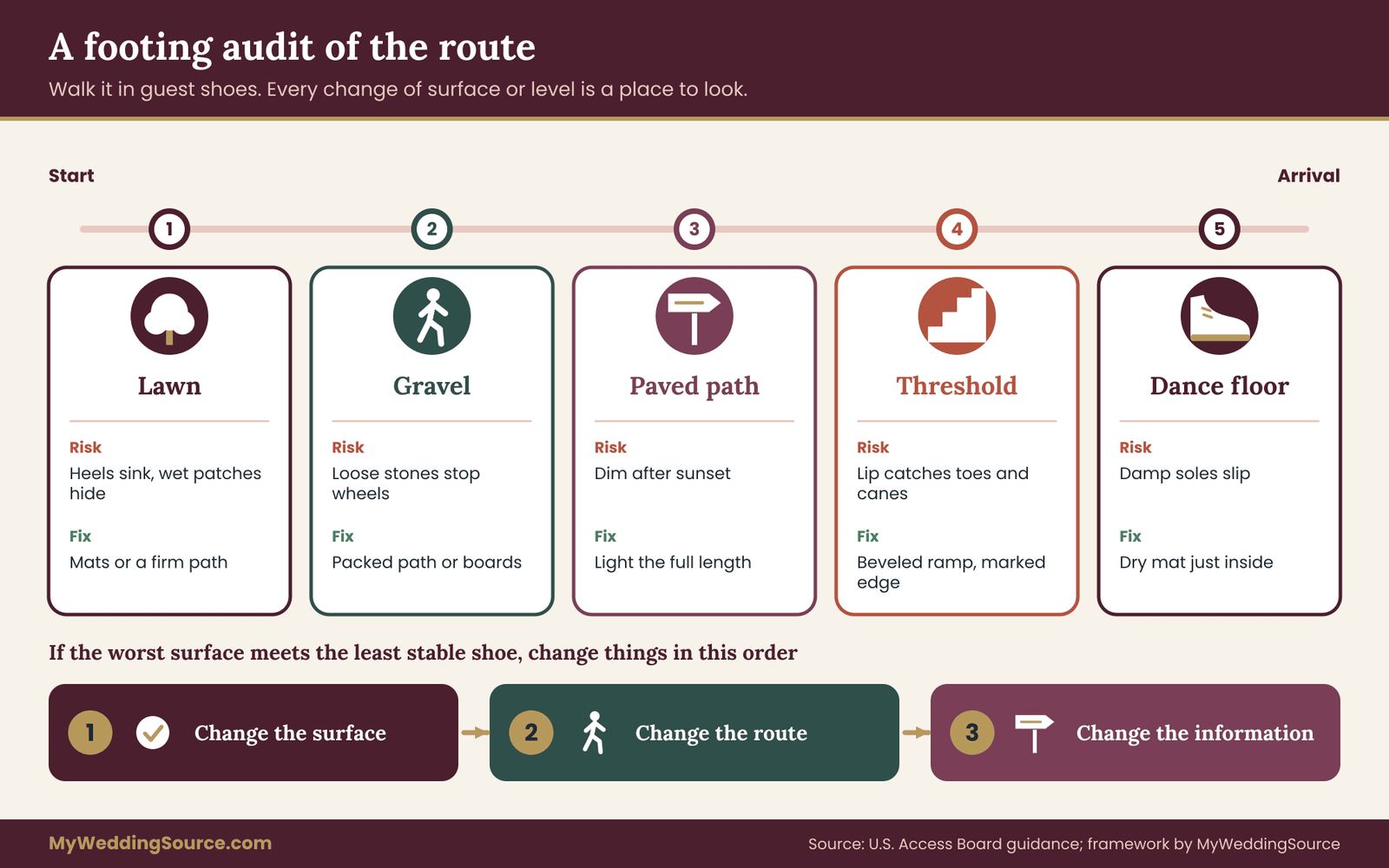
- Surface changes. Grass to gravel, gravel to a paved path, paving to decking, decking to a metal threshold, threshold to carpet or polished floor. Each change is a place where a foot may catch or slip.
- Level changes. A curb, a single step, a lip at a door track, a slope that looks gentle but is long. Single steps are the most dangerous because they are the least expected.
- Gaps and holes. Spaces between deck boards, drainage grates, sprinkler heads, tent stakes and cable runs.
- Moisture. Dew, irrigation, a damp patch where shade keeps the ground wet, or an entry mat that has soaked up rain and become slick.
- Light. Whether the path, steps and threshold will be visible at the hour guests use them.
- Width. Whether two people, or a person with a stroller, mobility aid or a wide dress can pass without turning sideways.
Write down each item with a location, not just “uneven grass.” A note like “gravel strip outside the east doors, ten steps wide” can be handed to a venue and fixed. A vague worry cannot.
Ask the venue what is allowed
Before you buy anything, ask what the venue permits on its surfaces for an indoor outdoor wedding. Many venues restrict stakes into lawn, adhesive on floors, mats on historic decking, and anything that could damage a protected surface. Others have mats, ramps or paved routes that guests are already expected to use. A quick message to the coordinator saves a purchase you would have to return.
Questions worth asking:
- Is there an approved or preferred path between the two spaces, and is it the same one the caterer uses?
- Can temporary ramps, mats or runners be installed, and who installs and removes them?
- Is the lawn irrigated on a schedule, and can it be turned off before the event?
- What is the lighting plan for the path and threshold after sunset?
- Who clears and treats the route if rain, ice or wet leaves appear?
If a route is shared with service staff carrying trays and equipment, find out the service timing. A guest path and a catering path that cross at the wrong moment create a different kind of bottleneck, and the rental company’s delivery timing can matter too. The rental planning checklist is a useful companion if you are adding mats, runners, lighting or flooring through a rental provider.
Footwear: influence, do not police
You cannot control what guests wear, and you should not try to shame anyone about it. You can still shape it with information and with a small supply of alternatives.
Say it in the invitation channel. If the ceremony is on grass, sand or gravel, say so on the website or in the details card, and describe the surface in plain words. “The ceremony is on a lawn, so block heels or flats are easier to walk in” is information, not instruction. Guests can then choose.
Offer a basket. A basket of flat shoes or sandals near the ceremony exit is a well-known courtesy, and it solves a specific problem: a guest whose heels are sinking in grass has a way out without leaving the party. Sizes are the obvious difficulty, so a basket serves a few guests, not everyone. Treat it as a bonus, not a plan.
Offer protection for heels. Small heel guards or stoppers sold for lawn events keep a narrow heel from sinking. If you offer them, put them at the point where guests first meet soft ground, not at the far side of the lawn.
Plan for bare feet. At beach and some garden weddings, guests will take their shoes off. Think about where shoes go, how feet are cleaned or dried before a polished floor, and whether there is anything sharp underfoot. A small towel or a basin by the door is a thoughtful touch, though you should confirm that the venue allows it.
Consider the other direction. Guests who wear flat soles on a polished dance floor can slip, especially after a damp lawn crossing. A mat just inside the door that dries soles can help, as long as the mat itself is flat, secured and not a trip hazard.
The threshold itself
At an indoor outdoor wedding, a threshold is a small architectural feature that gets a lot of blame. Door tracks, raised sills, metal strips and sliding-door channels create a lip that is easy to catch with a toe, a cane tip or a small wheel. A few practical points.
If the lip is small, a low, firm, edge-beveled threshold ramp can bridge it. If it is larger, you may need an approved ramp with a proper slope, which is a venue decision, and the U.S. Access Board’s accessibility guidelines describe the standards that apply to ramps and routes. You do not need to memorize them. You need to know that a ramp is not just a plank, and that a ramp which is too steep is worse than none.
Mark the threshold visibly. A contrasting strip, a small sign at eye level and a light aimed at the step all help. Brief a staff member or a friend to stand near it during the busiest minutes and to say something calm like, “Watch the step, thank you,” without making a crowd feel hurried.
Worked decision rule for footing
Here is a footing rule for an indoor outdoor wedding that is easy to remember and use. For each route, name the worst surface on it and the least stable shoe likely to cross it. If the worst surface and the least stable shoe are incompatible, such as a gravel strip and a thin heel, or a damp lawn and a smooth sole, you have three choices in this order.
- Change the surface. Add a mat, a runner or a paved detour, with the venue’s agreement.
- Change the route. Choose a path that avoids the surface, even if it is longer.
- Change the information. Tell guests in advance and provide an alternative at the door.
Always try them in that order. Telling guests to wear different shoes is the weakest fix because it puts the work on them and misses the ones who did not read it.
The signal and signage handoff
The third handoff at an indoor outdoor wedding is information. Guests need to know that a move is starting, where to go, whether to take anything with them, and when it is complete. The same information needs to reach vendors, because a band that starts early or a kitchen that fires late breaks the move for everyone.
A signal has four layers
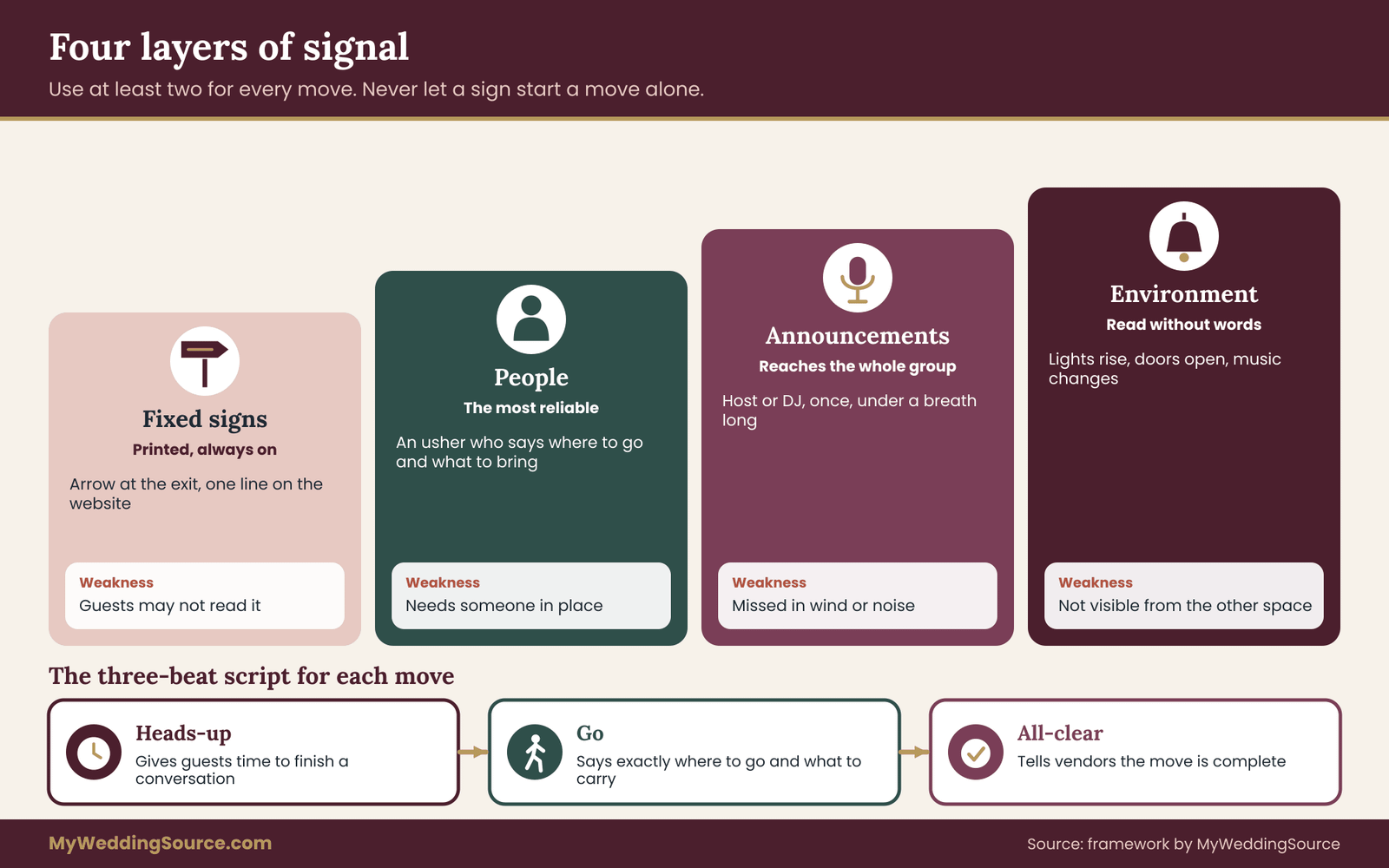
Think of the signal at an indoor outdoor wedding as four layers, from the quietest to the loudest. A reliable plan uses at least two of them for each move.
- Printed or fixed signage. A sign at the ceremony exit, an arrow on a stand, a line in the program, a note on the wedding website. This layer is always on and does not depend on anyone being present, but guests may not read it.
- People. A coordinator, a family member, a usher, a banquet captain who stands at the right place and says “Dinner is through these doors, please bring your drink.” This layer is the most reliable for helping individual guests.
- Announcements. A host, an officiant or a DJ says it out loud, once, at the right moment. This layer reaches the whole group but is easy to miss if someone is talking or the sound system does not reach the outdoor space.
- Environment. Lights come up inside, the doors open, music changes, a bell or chime sounds, staff step away from the entrance. Guests read these cues without being told.
For an indoor outdoor wedding, the environmental layer deserves extra attention, because the two spaces are not visible or audible from each other. A guest outside cannot see that the ballroom is ready. Someone has to bridge that gap.
Where signs belong in the handoff
Signs at an indoor outdoor wedding should sit at decision points: where a guest is about to choose a direction or wonders if they are in the right place. In a transition, those points are the exit from the first space, the fork in any path, the threshold, and the first view into the second space. A sign that is a hundred feet from the decision point is decoration, not wayfinding.
Keep the wording short and the action first: “Dinner this way,” “Seating chart inside,” “Please bring your drink.” Type should be large enough to read at a walking pace and in the light conditions at the hour of the move. A sign that is perfect at noon can vanish at dusk. For more on readability, placement and venue permissions, see the signage system guide, which gives the full method, including proofing and the rules venues commonly apply to stands, stakes and adhesive.
One pitfall deserves its own line. Do not rely on a sign alone to start a move. People will not follow a sign if they see a crowd standing still. Pair it with a person.
Write the signal as a script
For each move in an indoor outdoor wedding, write a short script with three beats: the heads-up, the go, and the all-clear. The heads-up gives guests time to finish a conversation. The go says exactly what to do. The all-clear tells vendors and staff the move is complete so the next thing can begin.
An example for a ceremony-to-cocktail move might read like this.
Heads-up, from the officiant or host as the ceremony ends: “Please join us on the terrace for drinks and snacks. Doors to the left of the arch are open.”
Go, from ushers at the exit: “Terrace is this way, follow the path. Water is on your right.”
All-clear, from the coordinator to the caterer and band: “Ceremony seating is cleared. Guests are on the terrace.”
Notice the heads-up is under the length of a breath. Long announcements fail, particularly outdoors with wind, children and a crowd of people who have just seen a couple get married.
The vendor side of the signal
Vendors at an indoor outdoor wedding cannot see what guests see. A caterer in the kitchen does not know that the ceremony ran ten minutes long. A band in a ballroom does not know that guests are still arriving. Establish one channel, such as a group text or a two-way radio setup managed by the coordinator, and one phrase that means “the move has started.” Everyone who needs the cue hears the same words.
If you cannot afford a coordinator, assign the vendor channel to a trusted person who is not a member of the wedding party and is not going to be photographed all evening. Give them a phone with the vendor contact list and the permission to say, “Please hold the doors another five minutes.”
Moving the crowd through an indoor outdoor wedding: doors, pacing and wait points
The three handoffs describe what each guest experiences. This section is about the group. Moving many people through a narrow point at the same time is a separate skill from keeping each one comfortable, and it is where an indoor outdoor wedding most often goes slightly wrong.
A caution before the advice. Nothing here is a safe occupancy number, an exit-width calculation or a code interpretation. Those belong to your venue, the local fire authority and the building’s own approvals, and they vary. What follows is about pacing and behavior, the parts you can plan, and it assumes the venue has confirmed that the space can hold your guest count.
Measure the walk, then plan from it
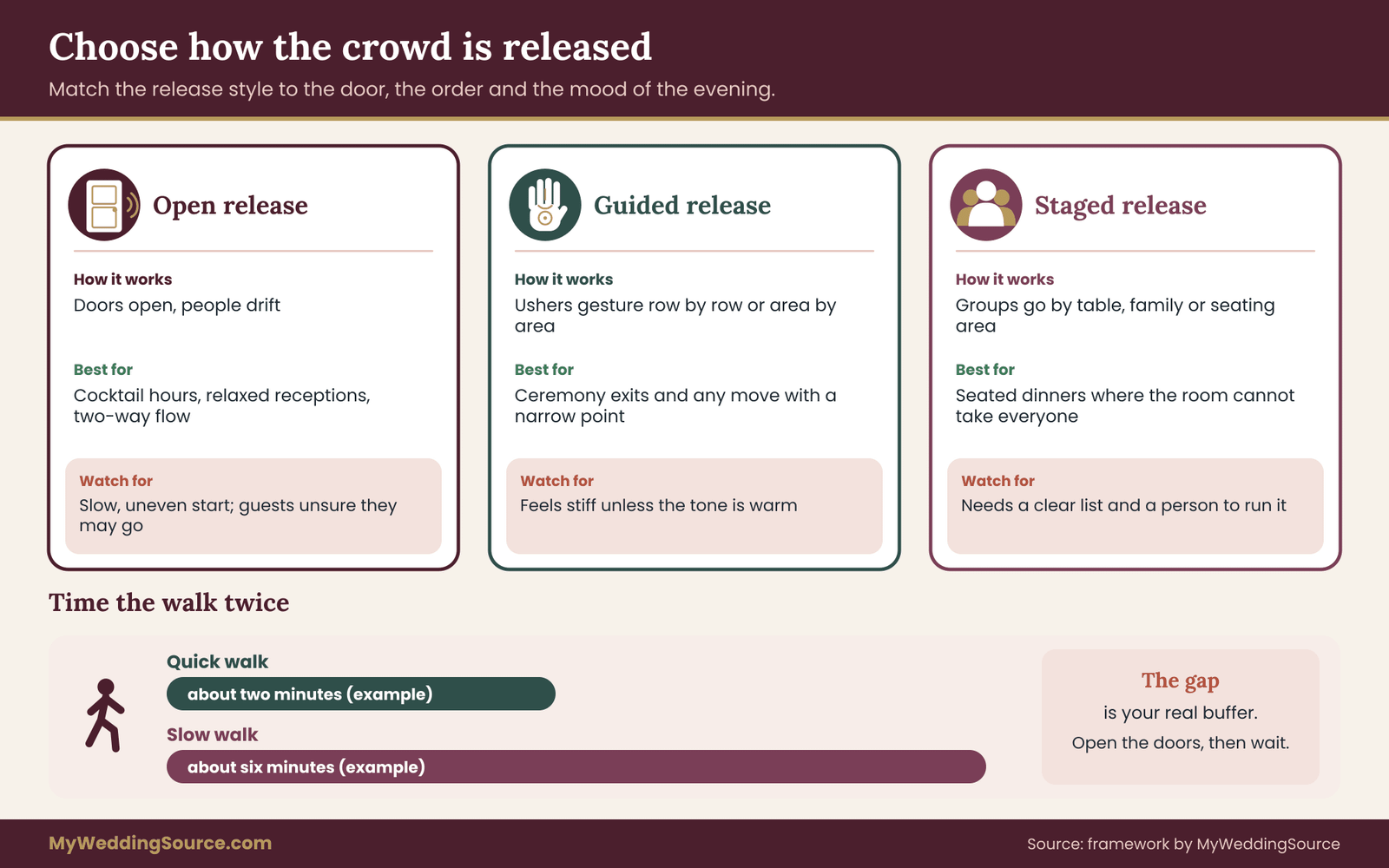
The most useful number in indoor outdoor wedding planning is one you create yourself: how long it takes to walk the route. Do not estimate it from a map. Walk it at a relaxed pace, in guest-appropriate shoes, with a stopwatch, and write the time on the route sheet. Then walk it again slowly, the way an older guest or someone with a mobility aid would, and write down that time too.
The gap between the two numbers is your real timing buffer. If the quick walk takes two minutes and the slow walk takes six, then the last person is still on the path four minutes after the first person has arrived, and the first people inside will be waiting with nothing to do. That waiting is where the plan either feels generous or feels clumsy.
Add to this the time a crowd takes to start. A group of guests rarely begins moving all at once. The people nearest the exit go first, those in the back rows are still talking, and some will stop for photos or to greet someone. Plan on a ragged start, not a clean one, and design the first space inside the second so the early arrivals have a reason to move forward.
Pick a release style
There are three common ways to release a crowd between spaces at an indoor outdoor wedding, and each fits a different situation.
Open release. Nobody is told when to go. The doors are open and people drift. It suits cocktail hours, relaxed receptions and two-way flows, where there is no need for everyone to arrive together. The risk is a slow, uneven start and guests wondering if they are allowed.
Guided release. An usher, host or coordinator gestures and speaks as the crowd goes, row by row or area by area. It suits ceremonies with fixed seating and any move with a narrow point. The risk is that it feels formal if done stiffly, but a warm tone fixes that.
Staged release. Guests move in groups, by table, by family, by seating area. It suits a move into a seated dinner where the room cannot take everyone at once, or where the food service starts with specific tables. This is closely related to the technique of releasing tables at a buffet, which the site covers in the guest flow guide for the dinner itself.
The right choice depends on three things: whether there is a narrow point, whether the next event needs guests in a specific order, and how formal the evening is. If you have no narrow point and no order requirement, choose open release and spend your effort elsewhere.
The doors are the plan
Doors determine the speed of an indoor outdoor wedding more than any other single feature. Four decisions about doors are worth making in advance.
How many are open? More open doors spread the crowd. Check with the venue whether all of them can be used for guests, whether any are reserved for service or emergency use, and whether any must stay closed to protect indoor air or keep out insects. Do not release the lock on a door or prop it open without asking, since some are alarmed or have fire-safety functions.
Who holds them? A door held by a person is a welcome. A door left to a closer is a hazard. If doors must be propped, ask the venue how and by whom, because improper propping of a fire door is a common violation that venues take seriously.
Which way do they swing? A door that opens into the crowd slows everyone. A door that opens against the flow of people is awkward. A pair of doors, one in and one out, doubles the capacity of a single path in a two-way flow. Note which doors are inward and which are outward and plan the stream accordingly.
What is directly behind them? If the first thing inside is a bar, a seating chart or a photo display, guests stop right at the entrance and block the people behind them. Put the stopping points a short distance in, in a wider area, and keep the zone just inside the door clear.
Wait points that work
Some waiting is inevitable at an indoor outdoor wedding. Plan it so the waiting place is comfortable and useful rather than accidental.
A good wait point has shade or shelter matched to the weather, somewhere to sit for people who need it, something to do or hold, such as a drink, a welcome sign or a small program, and a view of what is happening next, so people understand why they are waiting. A bad wait point is a bare strip beside a hot wall, with a door that has not opened, and no one to ask.
When a delay is likely, such as a photo session that runs long or a room that is not ready, tell guests plainly and give them something to do. A coordinator who says, “We’re about ten minutes from opening the doors, please enjoy the drinks here,” is more reassuring than silence, and keeps the crowd from stacking up at the entrance.
Two-way flow needs a different plan
When guests at an indoor outdoor wedding move freely between a dance floor and a terrace, there is no surge, and the issues change. The doorway becomes a place where people with drinks, people carrying shoes, smokers, people on phone calls and couples seeking quiet all pass each other.
Three habits help. Assign a person, perhaps a rotating helper or a venue staff member, to watch the door rather than leave it unattended. Keep the paths just outside the door well lit and free of cable, stakes or furniture. And make sure the outdoor space has its own things worth being at, such as seating, a bar, a heater or fan, and a view, so it does not become a corridor.
Think also about sound and light. Dance floor music escaping through open doors may bother neighbors or breach a noise rule at the venue, and light spilling outward can wash out a dark terrace. Ask the venue about their sound curfew and doors policy, particularly for an evening reception, and agree on a rule for how doors are used when the music is loudest.
Separated spaces and the shuttle question
If the ceremony and the reception of an indoor outdoor wedding are in different places, the move becomes a trip. The details sit with transport and parking, but a few handoff points belong here.
Decide where guests wait for a shuttle or for their own car, and apply the temperature test to that spot too. Confirm how a guest who cannot manage the walk to the pickup point is handled. Put a person at the departure point and a person at the arrival point, since two blank ends are twice as confusing as one. And consider timing: a move by vehicle has a longer tail, with early leavers arriving well before late ones, so the arrival space needs a ready welcome for a guest who is first and a ready seat for one who is last.
Weather triggers belong in the crowd plan
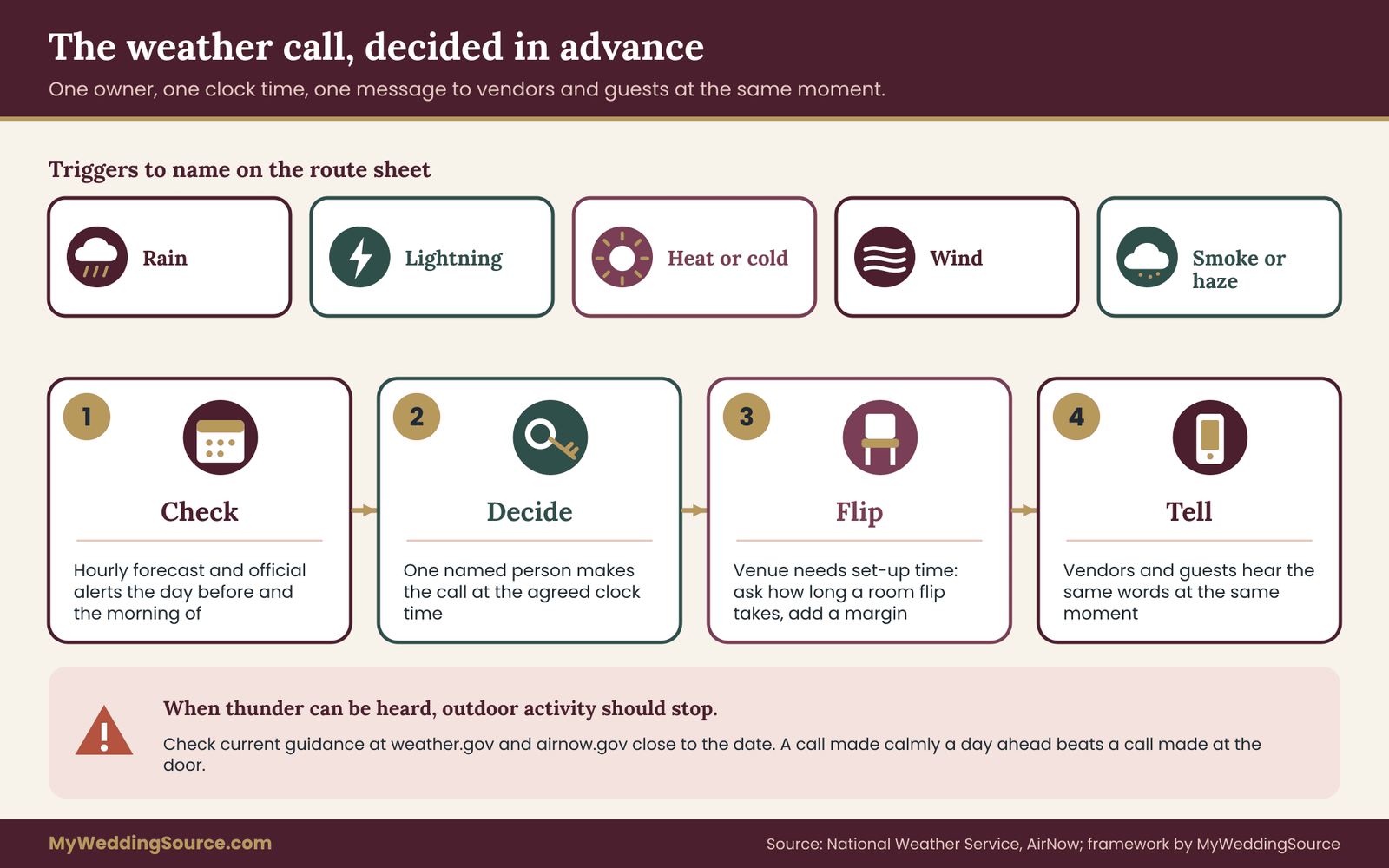
Weather is the reason many couples choose an indoor outdoor wedding layout in the first place, with a roof as a backup, and also the reason most moves get changed on the day. Agree in advance on three things for your indoor outdoor wedding.
- Who decides. One named person, such as the planner, the venue coordinator or a designated family member, makes the call. Not a committee.
- When the call is made. A set clock time before each outdoor event, with enough lead time for the venue to flip a space. Ask the venue how long its setup takes, and add a margin.
- What the signals are. Rain, lightning nearby, wind, heat or air quality. The National Weather Service gives guidance on lightning and severe weather, including that outdoor activity should stop when thunder can be heard. Check the current guidance on weather.gov rather than relying on a rule remembered from a blog.
The AirNow site, run by U.S. federal agencies, reports air quality, which matters if wildfire smoke or heavy pollution is in the forecast. Smoke and heat are quieter triggers than rain, and they deserve a line on the route sheet.
A weather decision for an indoor outdoor wedding made once, calmly, a day ahead, is nearly always better than one made at the door in a crowd. When the decision is to move indoors, the guest-flow plan for the inside space needs to already exist. A full discussion of rebuilding the evening after a delay is a separate topic, so this guide stops at the call itself: someone decides, someone tells the vendors, and someone tells the guests.
Guests who need a different handoff, and the vendors who carry it
A plan for an indoor outdoor wedding that works for the average guest can still fail for the people at the edges. In an indoor outdoor wedding the edges are wider than usual, because two environments double the number of things that can be difficult. This section covers the guests most likely to need a different handoff and the vendors whose work shapes it.
Guests with mobility needs
Guests who use a wheelchair, walker, cane or scooter, or who tire on long walks, need a route they can use, not a route they can technically manage. The difference matters. A path that requires a long detour around the back of the building, through a service corridor, is a worse experience than the one everyone else takes, and it can separate a guest from the group at the point where the group is gathering.
Start with the route sheet for your indoor outdoor wedding. For each move, ask whether a person using a mobility device can use the same path as everyone else, or whether the alternative is equally direct. The U.S. Access Board and the Department of Justice’s ADA information pages explain the general standards for accessible routes and the venue’s responsibilities, and your venue should be able to tell you what its accessible route is. If it cannot, that is useful information too. The site’s guide to accessible venue red flags lists warning signs to look for before you commit to a space.
Practical points:
- Walk the accessible route yourself, at the same time of day, with the same obstacles that will exist on the day, such as chairs, a bar, a cable run or a rental delivery.
- Check surfaces. Soft lawn, loose gravel and thick carpet can stop a wheelchair or a walker even when the path looks open. A firm path, mats or boards may be needed.
- Keep the route clear. Reserve the accessible door and keep it free of staging, planters and parked carts.
- Offer seating along the way. A few chairs at the midpoint of a long walk, in shade, give anyone who needs a rest an easy place to take one.
- Talk to the guest. If a guest has told you about a specific need, ask what would help. They know their own situation better than any checklist.
Older guests and guests who tire
Many older guests are in good shape and prefer not to be fussed over. Others find a longer walk, a hot courtyard or a cold room hard on their stamina. The best approach is to build comfort into the plan for everyone, so no one has to ask. Shaded seats near the door, water within reach, an arm to hold at a step and a seat reserved near the entrance of the next space are all quiet kinds of consideration that do not single anyone out.
If your indoor outdoor wedding has a large share of older guests, consider extending the move rather than compressing it. A cocktail hour in which people can stroll or sit as they like is easier on them than a single timed march to dinner.
Children, strollers and baby gear
Families bringing babies and young children to an indoor outdoor wedding carry equipment, and equipment changes what a path needs. A stroller needs a firm surface and enough width. A child who runs needs a barrier, or an adult, between the play area and any water, road or parking lot. A tired toddler needs a quiet corner on the other side. The site’s guest care planning guide covers nursing, childcare and quiet spaces at greater length, and it is worth reading if children are on your guest list.
For the transition, the useful questions are narrow. Where do strollers go when guests arrive, indoors or outdoors? Is there somewhere to store them near the door? Is the threshold stroller-friendly? And is there a family-friendly seat or table near the exit that lets a parent leave early without crossing the room?
Guests who may be sensitive to weather and air
Heat and cold affect everyone, but people respond differently. People with health conditions, certain medications, pregnancy, or very young or older age may be more sensitive to heat. Others have respiratory conditions and may be affected by smoke, pollen or dust on the lawn, and by cold air indoors. Allergy-prone guests may not enjoy a garden at peak pollen. You do not need a medical plan for everyone, and you should never ask guests to disclose health details. What you can do is publish the plan in plain terms, with the setting, the surface and the rough temperature feel, so guests can decide what suits them.
Service animals
Guests with service animals may need a route that avoids hot pavement, sharp gravel or crowded doorways, along with a place for the animal to rest. The ADA information page on service animals explains what the law says about access, and your venue’s policy should be consistent with it. Plan the path and the space, and brief any door staff so they treat the guest and the animal with ordinary courtesy.
Your wedding party and family
The couple, the wedding party and the families are often the ones with the tightest, least comfortable transitions. They are in formal clothes, often in the sun for photos, and moving at the very point when guests are moving. Give them their own mini-plan: a shaded waiting place, water, someone to carry their things, and a clear time for them to be where they are next needed. People who are overheated, tired or confused at the door cannot do their job as hosts.
The vendors who carry the handoff
Every vendor at an indoor outdoor wedding touches one of the three handoffs. Many couples never tell vendors where the handoffs are, so the vendor does the sensible thing from their own point of view, which may not match yours. A short conversation with each, sent in writing, fixes most of this.
Venue or site coordinator.
For an indoor outdoor wedding, the venue owns the building, the doors, the climate control, the path and the rules. Ask these questions in writing and keep the answers.
- What is the interior temperature plan for the hours of the event, and when does it change?
- Which doors can guests use, and which are reserved?
- Are there rules on ramps, mats, stakes, lighting and signage on paths and thresholds?
- What is the weather call process, who makes it, and how much lead time does a room flip need?
- What are the sound, door and outdoor-space curfews?
The venue technical walkthrough guide shows how to collect measurements and access details in a single visit, and it is a good place to check these items in person.
Caterer and bar.
Food and drink move through the same doors as guests. The caterer needs to know when guests arrive in the dining space, which path service staff use, and what happens if the move is early or late.
Food held for a long time can become a safety concern, and the right timing is something the caterer and the local health rules decide, not a general rule. FoodSafety.gov, a federal site, explains the basics of keeping hot food hot and cold food cold, and it is a fair reference for the conversation.
Ask your caterer what their policy is for food that is ready but guests are not, and what trigger tells them to pause or fire the next course. For bar planning, the bar service guide covers placement and lines, and for this topic you only need to know where drinks are collected and whether glass is allowed on grass or near water.
DJ, band and sound.
At an indoor outdoor wedding, music is the loudest of the signals. A band or DJ can announce a move, change the music to cue it, or deliver the all-clear to the dance floor. They also need to know when doors will be open, whether outdoor speakers exist, and who has the final say on volume. Confirm that the sound system reaches the outdoor space and whether the announcement can be heard there. A microphone is useless to people on a lawn with no speakers.
Photographer and videographer.
At an indoor outdoor wedding the photographer often holds the couple after the ceremony, and the timing of that holds up the whole transition. Agree in advance how long couple and family portraits may run, where guests wait, and who tells the photographer when the cocktail hour is ready. Give the photographer the route sheet so they know when and where the crowd moves, since they will often want to capture the moment of crossing and should not block it.
Rentals and decor.
Mats, runners, tents, lighting, heaters, fans, rugs and furniture are all rental items that touch the handoff of an indoor outdoor wedding. Ask the rental company for installation and strike times, the power needs, and any safety requirements. Check that items placed near doors do not narrow a path or block a sign. Heaters and fans need power and clearance, and tents require a permit in some areas, so get answers in writing before you finalize the layout.
A short script for vendors.
You can send a version of this to every vendor of your indoor outdoor wedding.
“We will be moving guests from [space] to [space] at about [time]. We have three things we are trying to get right: temperature at the door, footing on the path, and a clear signal that the move has started. Could you tell us what you need from us, what you can do on your side, and who we should contact on the day if the timing shifts?”
It is plain, it is specific, and it makes the vendor part of the solution.
A worked example of one indoor outdoor wedding evening
The following indoor outdoor wedding example is invented to show the method. The couple, the venue and the numbers are made up, and your own venue will differ. It is here so you can see how the three-handoff test turns into decisions.
The setup
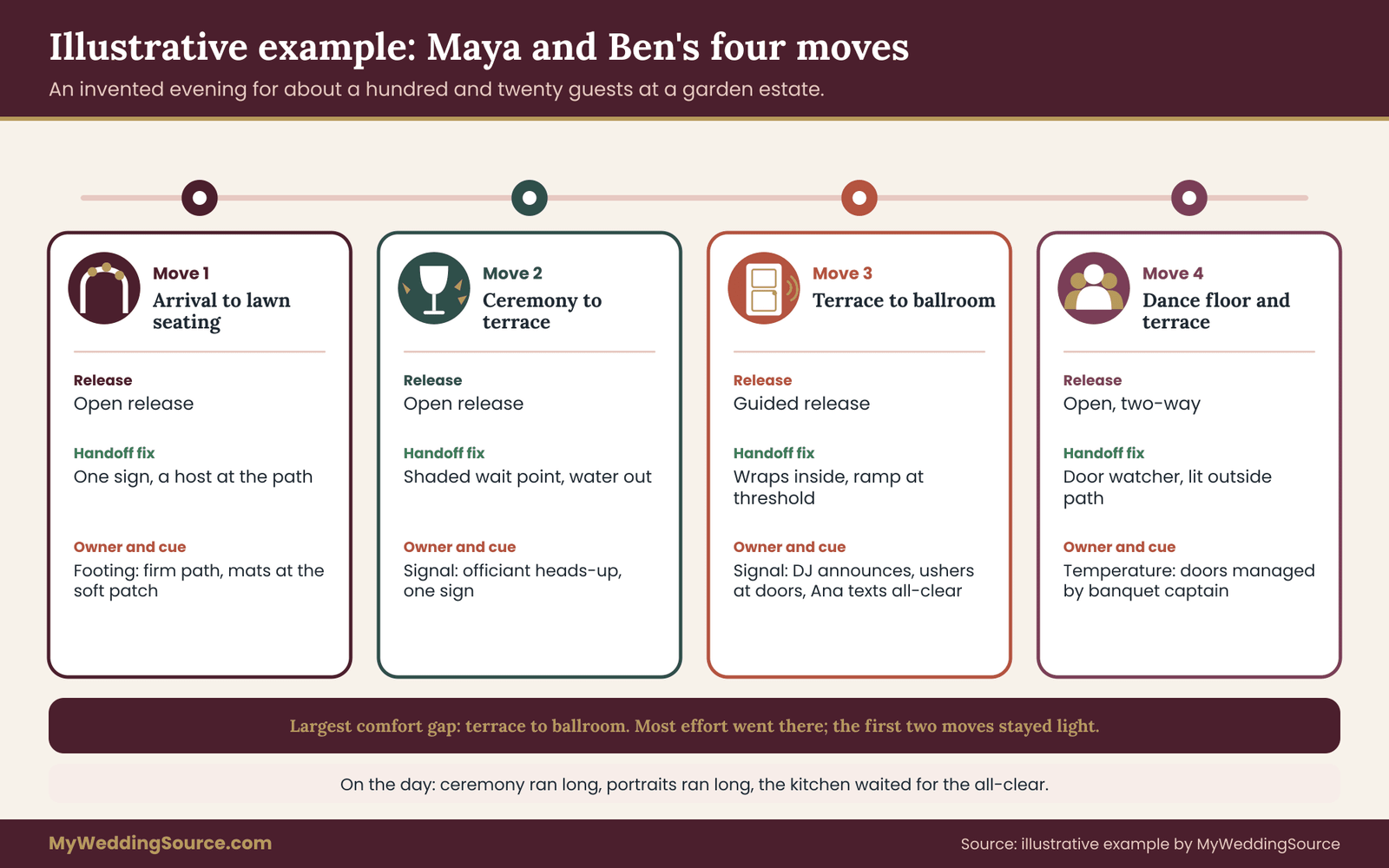
Maya and Ben are planning a late-afternoon indoor outdoor wedding for about a hundred and twenty guests at a garden estate in the fall. The ceremony is on a lawn. Cocktails are on a covered terrace attached to the main house. Dinner and dancing are in a ballroom, and the terrace doors stay open during dancing. There are four moves: arrival to ceremony seating, ceremony to terrace, terrace to ballroom, and ballroom to terrace during dancing. A few guests are in their eighties, one uses a wheelchair, and three families are bringing toddlers.
They have a coordinator from the venue, but she works with several events and cannot be everywhere. So the couple asks their planner friend, Ana, to be the signal owner for the evening.
Step one: list the moves and rank the gaps
Maya and Ben write the four moves on a sheet and rank them by how large the comfort gap is likely to be.
The move from the ceremony to the terrace is a modest gap. Both are outdoors, and the terrace is covered. The move from the terrace to the ballroom is the largest. The terrace will be warm from the afternoon sun, and the venue tends to chill the ballroom ahead of an event. The move into dancing and back out to the terrace is a steady gap that lasts all night.
They decide to spend most of their effort on the terrace-to-ballroom move and the open-door dancing, and to keep the first two light.
Step two: score each handoff
For the terrace-to-ballroom move, they fill in the nine answers.
Temperature. The ballroom’s setting is unknown, so they email the coordinator. The answer comes back: the room is set cool in the afternoon and adjusted when guests arrive. That is confirmed, and it confirms the concern. The outside side is shaded by the roof, with a breeze most evenings. They decide to ask the venue to raise the setting a little before the doors open and to place a basket of wraps just inside the door. The owner is the banquet captain, who agrees.
Footing. The route from the terrace to the ballroom is a paved path with one low threshold at the double doors. The coordinator confirms that a threshold ramp exists and can be placed. The lighting along the path is unknown, so they ask for the sunset time and the path lighting schedule. The owner is the coordinator, who will walk the path at five-thirty.
Signals. The heads-up will come from the DJ, who will say that dinner is starting and the doors will open in a few minutes. The go will come from two ushers at the double doors. The environmental cue is the ballroom lights rising, which the venue controls. The all-clear goes from Ana to the caterer and the DJ by group text. The owner is Ana.
They find three assumed items: that the doors will be open when the DJ makes the announcement, that the path will be dry, and that the kitchen will be ready when the first guests sit. Each becomes a question and a backup. For the doors, the banquet captain will open both before the announcement. For the path, the venue confirms it is paved and that irrigation does not run near it. For the kitchen, the caterer says the first course is fired when Ana sends the all-clear, not when the doors open.
Step three: walk and time the route
Maya, Ben and Ana walk the route on a visit two weeks before. The quick walk from the terrace to the ballroom takes about two minutes. They then walk it again slowly, with Maya’s grandmother, who uses a cane, and the slow walk takes close to six. Using the gap between the two, they decide the doors will open as the DJ makes the announcement, with a ten-minute window before the first course is served. That is generous enough that the grandmother is seated before the kitchen starts, and short enough that the earliest guests are not standing around.
The wheelchair user’s route from the terrace to the ballroom is the same paved path, through the same doors. The coordinator confirms the ramp will be in place, and Ben notes that a staff member should stand at the double doors to keep the route clear of the bar queue.
Step four: decide the release style
Because the doors form a narrow point and the seating chart is inside, they choose a guided release for the terrace-to-ballroom move. Ushers gesture, the DJ makes one clear announcement, and the seating chart is positioned a few steps inside the room so guests do not stop at the door. For the first move, from ceremony to terrace, they choose an open release with a single sign and a host.
Step five: write the backup
The venue says rain on the lawn is decided by a named person, the coordinator, at two in the afternoon, and that a flip of the ceremony space takes about an hour and a half. They agree on a call time of one in the afternoon, which leaves a margin. If the call goes indoors, the ballroom will hold the ceremony and the terrace will be used for cocktails if the weather allows, with a covered route. Ana will message all vendors at the same moment.
What the evening looked like
On the day of the indoor outdoor wedding, a few things differ from the plan, which is normal. The ceremony runs about ten minutes long. Ana tells the caterer, who delays the first course by the same amount. Portraits run later than expected, so guests wait on the terrace longer than the plan assumed, and the banquet captain brings a tray of water out. The ballroom is slightly cool at the start. The wraps are used by perhaps a dozen guests. The path lighting comes on a little late, and a usher with a flashlight bridges the gap.
Nothing in the indoor outdoor wedding plan prevented every surprise. What it did was make each surprise a small matter with a known owner. That is the realistic goal.
What this plan cost
Most of the decisions in the example cost little: a written message, a walk, a few staff positions the venue already provides. The spending was a threshold ramp the venue supplied, a basket of wraps, a few extra chairs and a flashlight.
Many couples assume the main cost of managing an indoor outdoor wedding is rental equipment. In practice the larger cost is time, spent early, to ask questions and walk routes. When money is limited, a useful rule is to compare the cost of a fix against the size of the gap it addresses, and spend first where the gap is largest and the guests most affected. A second usher at a narrow door often does more than a heater, and costs less.
Pitfalls that repeat at an indoor outdoor wedding
Several mistakes appear again and again in planning an indoor outdoor wedding. Knowing them in advance helps.
Planning each space and ignoring the join. The ceremony plan, the cocktail plan and the dinner plan are each fine. The move between them has no owner. The fix is the route sheet.
Trusting the thermostat. The setting says one thing and guests feel another. The fix is the first-minute check at the door.
Relying on one signal. A sign with no person, or a person with no announcement, leaves a gap. Use at least two layers.
Treating a threshold as a detail. A small lip is a significant barrier for some guests and a trip hazard in low light. The fix is to look at it at the hour guests will use it.
Moving the couple last. The couple and wedding party often arrive at the next space after guests and with no refreshments. Give them a minute and a drink.
Letting the weather call drift. A decision that no one owns is made by default at the last minute. Name the person and the hour.
Skipping the walk-through of the backup. The rain plan often relies on a space that has not been set up for guest flow. Walk it too, even if you hope never to use it.
Each of these is cheap to avoid in advance and expensive to fix on the day.
Verifying the plan and knowing its limits
An indoor outdoor wedding handoff plan is only as good as the facts under it. Much of what makes an indoor outdoor wedding comfortable is controlled by people and agencies other than you, and rules change. This section is about checking the facts and being honest about what a plan like this cannot do.
What to verify, and with whom
Split your assumptions by who can actually confirm them, and ask that person in writing.
The venue confirms: which doors may be used and propped, the interior climate schedule, the accessible route, what is allowed on the lawn and on thresholds, lighting, noise and door curfews, the weather-call process, and the guest capacity of each space. Capacity and exit rules are matters for the venue and the local fire authority, so do not quote a number from a website, a friend or this article.
The caterer confirms: food timing, holding practices, service paths, and what triggers the next course. They follow health rules that vary by location, and FoodSafety.gov gives a federal overview of general principles.
The rental company confirms: installation and strike times, power needs, weight and wind ratings for tents and fixtures, and the clearances required for heaters and fans. Any equipment that produces heat or flame is subject to local rules, and the National Fire Protection Association publishes general safety information that can help you form questions.
Official sources confirm: weather and conditions. The National Weather Service at weather.gov provides forecasts and safety guidance on heat, cold, lightning and wind. AirNow reports air quality. The Centers for Disease Control and Prevention publishes heat and health guidance. The Occupational Safety and Health Administration publishes information on heat exposure that may help you think about staff and vendors working outdoors. These sources update, so check them close to the date rather than relying on a figure you saw months earlier.
Accessibility sources confirm: general standards for routes, ramps and access. The ADA information site and the U.S. Access Board describe federal requirements, and your venue should be able to tell you how it meets them. You are not responsible for deciding whether a venue complies, but you can ask clear questions and note the answers.
Keep a short written record
For each answer, record who gave it, the date, and the exact words. A message such as “Yes, the ballroom doors will be open from six and the ramp will be installed by five” is worth more than a verbal assurance. Put those messages in one place and share them with the person who will be on site. If a question has no clear answer, say so on the route sheet rather than writing a guess as a fact.
If a vendor’s answer differs from what you assumed, update the plan rather than arguing. The point of verification is not to catch anyone out. It is to make sure the plan matches the building.
What this approach cannot do
It helps to say plainly what an indoor outdoor wedding handoff plan does not do.
It does not guarantee comfort. Weather changes, guests are different, and a well-planned crossing can still go badly if a door sticks or a storm arrives early. It aims to reduce avoidable discomfort and to make surprises small.
It does not set safe capacity, exit routes or food timing. Those are decided by the venue, the caterer and the relevant authorities, and the right answer depends on the building and the local rules. If you are unsure, ask them and use their answer.
It does not replace a professional coordinator or a safety plan for the venue. If your event is large, includes open flames, amplified heat sources or temporary structures, or has guests with significant medical needs, a venue safety reviewer or an experienced event operations manager is worth consulting.
It does not remove the need for judgment on the day. The route sheet is a guide. If conditions differ, the person who owns the handoff should act, within the limits the venue has set.
Keeping the plan current
Check the facts for your indoor outdoor wedding again close to the event. Forecasts change, the venue may update its rules, and a rental company may change a delivery window. A short review a week before and a final check the day before cover most changes. If you are a planner or a venue who reuses this method, review it at least once a year, and whenever a venue changes its rules or a vendor changes its policies.
The vendor timeline guide is a useful place to schedule these check-ins, since it shows when vendors typically need information and when to confirm final details.
A one-page route sheet in words
You do not need software for an indoor outdoor wedding route sheet. A route sheet can be a single page, with one block for each move. Each block names the move, the start and end spaces, the clock time and the measured walk times, the release style, the temperature owner and the first-minute check, the footing owner and the worst-surface note, the signal owner and the three-beat script, the weather call and its time, and the backup. Add a line for the accessible route and a line for vendors to contact. Give a copy to the coordinator, the planner and each person named as an owner.
Your next steps
Start with the moves of your indoor outdoor wedding. List every time guests change space in your plan and rank them by the size of the comfort gap. Walk the top two routes in guest-appropriate shoes, with a stopwatch, once quickly and once slowly. Send the venue the five questions from this guide and write down the answers.
Then assign three owners per move, write a three-beat script for each, and decide the weather call, the person who makes it and the hour. Share a one-page route sheet with your vendors a week before, and walk the route again the day before. Done this way, an indoor outdoor wedding stops feeling like two events stitched together and starts feeling like one evening with a few well-handled doorways.
FAQ
How early should we plan the moves in an indoor outdoor wedding?
Start when you choose the venue, because the layout decides how many moves you will have. Do the detailed work, including walking routes and asking the venue your questions, a few months out, and confirm everything again in the final week. The ranking of comfort gaps is quick, so you can do it early and refine it as the forecast comes into focus.
Do we need a coordinator for the handoffs at an indoor outdoor wedding?
Not necessarily, but each handoff needs a named owner. A venue coordinator, a planner or a trusted friend can hold them. The key is that each person knows the job, has the contact details for the others and has permission to act. A larger or more complex event, or one with guests who need extra support, benefits from a professional.
What is the single most useful thing to do for an indoor outdoor wedding?
Walk every route in the clothes and shoes your guests will wear, once at normal speed and once slowly, and write down what you notice. That one habit finds most footing, light, width and timing problems before they affect anyone. It costs an afternoon and no money, and it gives you real numbers instead of guesses.
How do we handle heat or cold when we cannot control the weather?
Focus on the first minute at each door. Provide shade or shelter at wait points, water, seating, and a small supply of wraps or fans, depending on the season. Check the forecast hour by hour from the National Weather Service, and ask the venue and rental company what heating or cooling equipment is allowed and who runs it.
Should we tell guests what shoes to wear at an indoor outdoor wedding?
Tell them about the surface, not their shoes. A line on the website or details card describing the ground, such as lawn or gravel, lets guests decide. Offer a small basket of flats and heel protectors if you like, and treat them as extras. Changing the surface or the route is more effective than asking guests to change.
How many staff do we need at the doors of an indoor outdoor wedding?
There is no fixed number, because it depends on the doors, the guest count and the layout, and your venue sets its own staffing. Think by function: someone to hold or watch the door, someone to give the signal, and someone to watch the threshold. Ask the venue what it provides and fill any gaps with trusted helpers.
What if it rains and we have to move the whole thing indoors?
Name one person who makes the call and a clock time for it, and confirm with the venue how long a room flip takes. Walk the indoor backup as carefully as the outdoor plan, including doors, seating and the waiting point. Then tell vendors and guests at the same time, in the same words, so everyone hears one message.
Is an indoor outdoor wedding plan like this a safety guarantee?
No. It helps reduce avoidable discomfort and confusion, but it does not set capacity, exit routes, food timing or equipment rules. Those belong to your venue, caterer and the local authorities. Ask them for current requirements in writing, and rely on their answers where they differ from general advice in articles like this one.
Sources
- Weather safety, National Weather Service, NOAA
- Lightning safety, National Weather Service, NOAA
- Heat and health, Centers for Disease Control and Prevention
- Heat exposure, Occupational Safety and Health Administration
- Air quality information, AirNow, U.S. Environmental Protection Agency
- Information and technical assistance on the Americans with Disabilities Act, U.S. Department of Justice
- Accessibility guidelines and standards, U.S. Access Board
- Fire safety information, National Fire Protection Association
- Food safety basics, FoodSafety.gov
- Plan ahead for disasters, Ready.gov, Federal Emergency Management Agency