
Home kitchen catering sounds like the easy, personal option for a backyard wedding, and sometimes it is. This guide explains what a professional caterer actually needs from a home kitchen, what the kitchen is and is not allowed to do, and how to test your own space with a three-lane site plan covering prep space, hygiene and service access before anyone signs a catering contract.
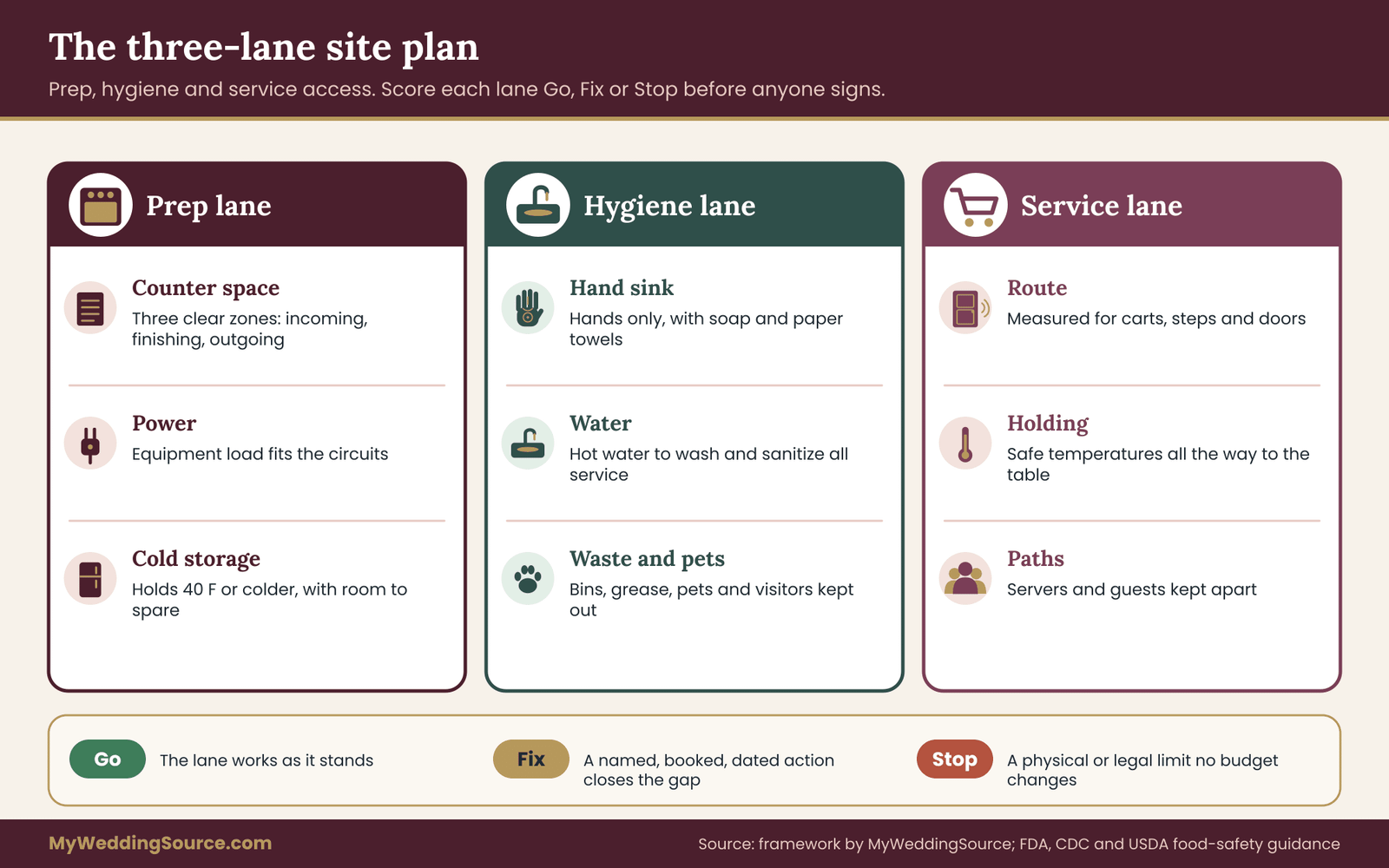
Decide what job the kitchen will do before you decide whether it can do it. A licensed caterer may use a home kitchen only as a staging area to reheat, finish and plate food made elsewhere. Cooking a full wedding meal at home for paying guests usually requires a permitted commercial kitchen. Check the space in three lanes: prep (counters, power, cold storage), hygiene (handwashing, water, waste, pets) and service access (the route from stove to table). Any lane that fails with no fix is a reason to move the cooking elsewhere.
Picture a Saturday in June. Sixty guests, a lawn, a tent, a caterer’s van in the driveway and a family kitchen that has always handled Sunday dinner for eight. At four in the afternoon, the caterer’s lead walks into that kitchen and asks three questions in a row. Where can we plug in a second oven? Where do we wash our hands? How do we get hot trays out to the lawn without crossing the dog’s yard? Most hosts have no answer, because nobody asked them earlier.
That moment is what home kitchen catering really is. It is not a question about whether your kitchen is nice. It is a question about whether a working food team can use it safely, legally and on a schedule. The answers come from arithmetic, a tape measure and a few phone calls, and all of them are cheaper to collect six weeks before the wedding than six minutes before the first course.
This article is written for two readers. The first is a couple or a host planning a backyard or private-home wedding who is wondering whether the house can be the kitchen. The second is a catering professional, or a couple’s relative who cooks well, who needs a clear picture of what a residential kitchen must offer before it counts as a workable site.
Both will find the same tool for home kitchen catering: a three-lane site plan and a role ladder that sets a ceiling on what the kitchen may do.
A note on scope. This is general information, not legal, tax or insurance advice. Food-safety rules, permits and insurance terms differ by state, county and policy, and they change. Wherever a rule matters, the article points you to the office that issues it so you can confirm the current version yourself.
The article stays inside one topic. It does not cover the whole wedding menu, the cost of a caterer, or the broader question of hosting a wedding at home, which other guides on the site handle. If you are still deciding on the setting, the wedding venues guide compares the options, and the menu planning guide covers what to serve. Here, the only question is the kitchen, and the only topic is home kitchen catering.
Two questions hiding inside home kitchen catering
Search for home kitchen catering and you will find advice that mixes two different situations. Both get called home kitchen catering. They look alike from the driveway, and they have almost nothing in common once you open the refrigerator.
In the first situation, a licensed professional caterer is hired for the wedding and needs space at the house. The food is prepared mostly in the caterer’s own permitted kitchen, then transported to the property. The house kitchen is a satellite: a place to hold, reheat, finish and plate. In this version of home kitchen catering, the question is whether the room can support that work.
In the second situation, the food itself is cooked in a home kitchen. That might be a relative who cooks for a living on weekends, a friend who offers a wedding gift of tamales, or a small business that operates from a residential address. The question here is different. Before asking whether the kitchen can handle the work, you have to ask whether the work is allowed in a home kitchen at all.
Keeping the two questions apart prevents the most common confusion. A host who says “we are doing home kitchen catering” may mean either one, and the caterer may hear the other. A short conversation fixes it, and the opening script below is worth saying out loud before any quote is requested.
“When you say you’d use our kitchen, do you mean finishing and plating food you’ve prepared elsewhere, or cooking from raw ingredients here? Please tell me which, so I can check the house against it.”
Why the distinction matters for home kitchen catering
A satellite model of home kitchen catering needs a smaller footprint, less equipment and a lighter hygiene load. It still needs the right outlets, a place to wash hands and a clear path to the service area, but the raw handling happens somewhere with a permit and a sanitizing routine. Cost sits mostly in the caterer’s fee and a modest staff-time allowance for the extra setup.
Cooking from scratch is the riskier form of home kitchen catering, because it shifts risk onto the host. Raw proteins, cross-contamination, cooling large batches and holding temperatures all become the household’s problem unless a licensed operator is clearly in charge. This is the reason many local health departments allow the first model and restrict the second, and the reason the next section lays them out on a ladder.
What professional caterers need first from home kitchen catering
Ask experienced caterers what they look for when they scout a private home for home kitchen catering and the answers are consistent in kind, though not in detail.
They want enough clean counter space to stage trays. They want power that will not trip when two warming units and a refrigerator run together. They want a sink they can use for hands only, separate from the sink used to rinse vegetables or wash tools. They want cold storage that holds a safe temperature. They want a door and a path wide enough for loaded carts. And they want to know who else will be in the room.
None of that is unreasonable, and none of it is complicated. It is a short list of physical facts about a house. The rest of this guide to home kitchen catering turns that list into numbers and checks you can run yourself with a tape measure, a thermometer and a phone.
The role ladder: what a home kitchen is allowed to be
Think of the possible jobs in home kitchen catering as four rungs on a ladder. Each rung up adds food-safety risk and tightens the legal limits. A house can usually stand on the lower rungs with a licensed caterer in charge. The upper rungs commonly require a permitted commercial kitchen, and that is a question for the local health department rather than for a blog post.
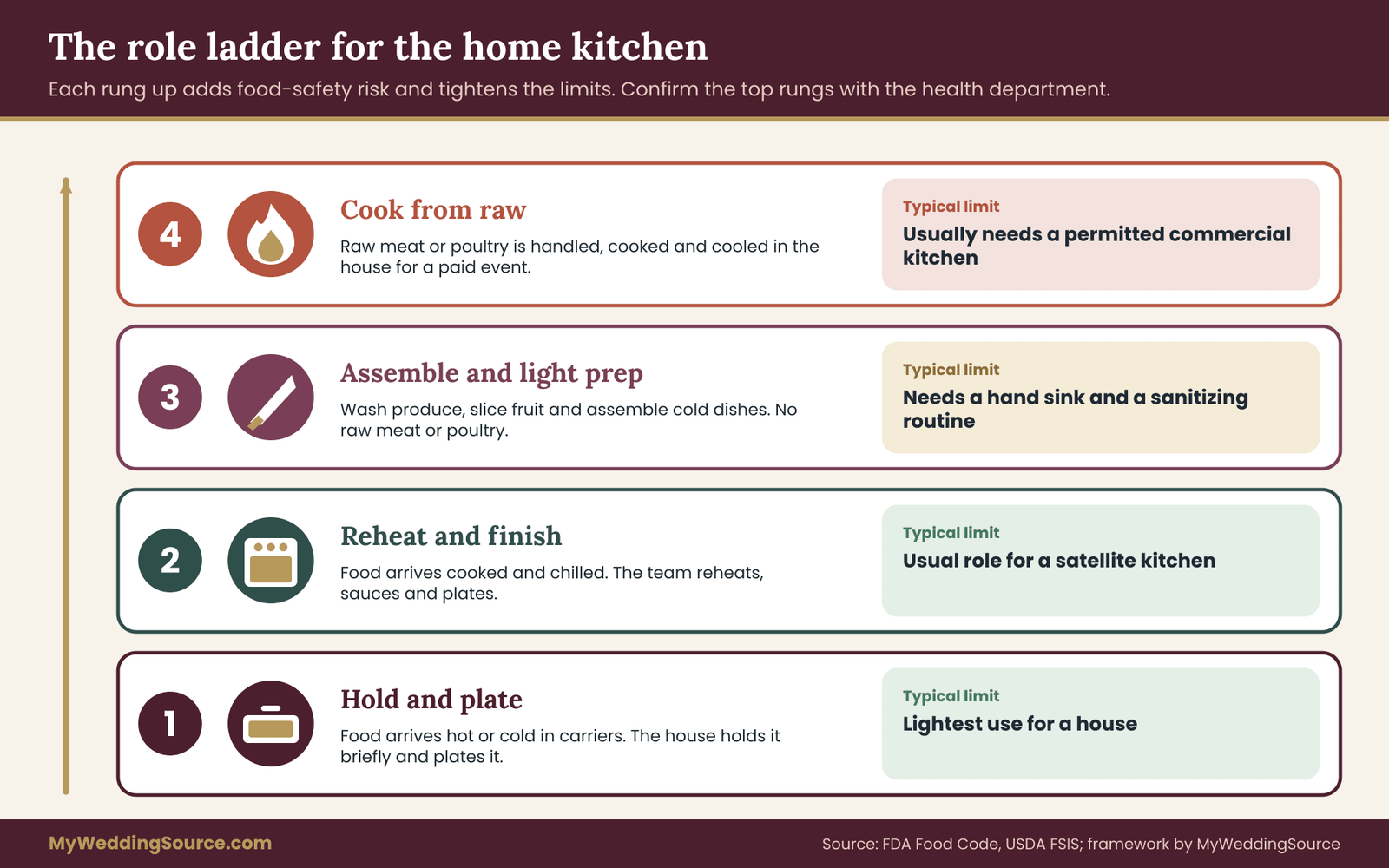
Rung one: hold and plate. Food arrives fully cooked and held at safe temperatures in the caterer’s insulated carriers. The home kitchen is used to keep items hot or cold briefly, garnish, and plate. This is the lightest form of home kitchen catering and the one a house handles most easily.
Rung two: reheat and finish. Food arrives cooked and chilled, and the team reheats it to a safe serving temperature on site, adds sauces and finishes dishes. This needs reliable ovens or warming equipment, proper thermometers and a way to track how long food sits at each stage. Many full-service caterers use this style of home kitchen catering at venues that have no kitchen.
Rung three: assemble and light prep. The team washes produce, slices fruit, assembles salads and prepares cold items on site, but does not cook raw meat or poultry. This adds a need for a sink and surfaces that can be cleaned and sanitized between tasks, and for careful allergen handling.
Rung four: cook from raw. Raw proteins are handled, cooked and cooled in the house, and the meal is sold or served as part of a paid event. This is the rung that most health departments restrict to licensed commercial kitchens. If a quote for home kitchen catering assumes rung four at a private home, ask the caterer to show you the permit or license that covers it, and confirm with the local health department.
Where cottage food rules fit
Many states have cottage food laws that let people sell certain foods made in a home kitchen. These laws are usually narrow. They commonly cover low-risk items such as certain baked goods, jams and dry mixes, and they often exclude foods that need refrigeration to stay safe. A full wedding dinner rarely qualifies. Treat a cottage food permit as a rule for a specific list of products, not a general permission for home kitchen catering, and read your state’s actual list.
The ladder as a conversation tool
The ladder works best as a shared reference for home kitchen catering. Put it in front of the caterer and ask which rung each course will use. A plated dinner might sit on rung two for the entrees, rung three for the salads and rung one for dessert. A family-style menu might be mostly rung two. A taco bar with grilled meat on site might climb to rung four unless the meat is cooked at the caterer’s commissary and held.
Once you can say “rung two” and mean it, the home kitchen catering conversation gets short. The caterer knows what to bring, the host knows what to prepare, and the health department knows which question to answer.
The rules behind home kitchen catering
Rules for home kitchen catering come from several places at once, and none of them is a single national law for home kitchen catering. Keeping the layers straight saves a great deal of confusion, because a caterer can be fully compliant in one layer and still blocked in another.
The food code layer. The first layer of home kitchen catering rules. The U.S. Food and Drug Administration publishes the Food Code, a model set of food-safety provisions. It is not a law by itself. States, counties and cities adopt it, often with changes, and the local health department enforces the adopted version. When a caterer says “the health code requires,” this is usually what they mean.
The permit layer. Caterers generally need a food service license or permit from the local health authority, and that permit is usually tied to a specific permitted kitchen. Temporary events sometimes need their own temporary food permit. Whether a private, invitation-only party at a home needs any permit varies widely, and the honest answer is to ask. USAGov and the Small Business Administration list the agencies and license types a business may need, and both are good places to start a phone call.
The property layer. A house has its own rules for home kitchen catering. Zoning may restrict commercial activity at a residence. A homeowners association may limit events, vendors or parking. A lease may forbid business use. A septic system may not handle a spike in water use. These are not food-safety rules, but they decide whether a caterer can set up at all, and the site-readiness guides on this site cover them in more depth.
The insurance layer. For home kitchen catering, homeowners policies commonly exclude business activity or limit liability for events. A caterer’s own policy may cover the caterer’s work wherever it happens, but the venue or host often has to be named on a certificate. The wedding vendor due diligence checklist walks through the proof of license and insurance to request before you hire anyone.
Questions to put to the local health department about home kitchen catering
A short call to the environmental health or food protection office for your county answers most of what the internet cannot. You do not need to explain the whole wedding. Ask plainly, write down the date and the name of the person who answered, and ask whether they can confirm the answer by email.
- Does home kitchen catering by a licensed caterer need any additional approval to finish or reheat food at a private residence for a private event?
- Is food cooked in a home kitchen allowed to be served at a paid private event, and under what conditions?
- Does the answer change for a temporary tent or outdoor cooking area?
- Which office handles complaints if a guest becomes ill?
Many offices will answer the first question simply and decline the second with a clear no. That is a useful result. A clear no on rung four for home kitchen catering is not an obstacle; it is the information you needed to move cooking to a commissary or a rented kitchen.
Proof to ask the caterer for before home kitchen catering begins
Before you rely on a caterer’s description of what is permitted, ask for the documents that show it. A professional caterer will have them ready and will not be offended.
- Current food service license or permit, with the name of the permitted kitchen
- Certificate of liability insurance naming the property owner as additional insured, where the policy allows it
- Food handler or food protection manager certification for the person in charge on site
- A written description of what will be cooked, held and finished at your home
Compare that description to the ladder. If the document says “finishing and plating on site,” you are on rungs one and two, and the house only needs to host. If it says “cooking on site,” ask why, and what permit makes that possible at a residence.
“Could you send your license, your insurance certificate and a one-page outline of what you plan to do in our kitchen? We want to confirm it with the county before we sign.”
Rentals and home kitchen catering
Some hosts try to rescue home kitchen catering in a weak kitchen by renting equipment. A rented warming cabinet, a mobile sink or extra refrigeration can lift a house from marginal to workable, but each item brings its own power and space needs. The wedding rental planning checklist covers delivery windows, returns and damage terms, and those apply to kitchen equipment as much as to chairs. Treat rented kitchen gear as part of the site test, not as a way around it.
Prep space for home kitchen catering: counters, power and cold storage
The first lane of the site plan for home kitchen catering is prep. It answers a simple question: can a team lay out, hold and finish a full service in this room without crowding the family or cutting corners? Three measurable things decide it, and you can measure all three on a quiet afternoon.
Counter and landing space
Count clear counter length in feet, not counting the stove top, sink basin or any area stacked with appliances. A working team needs separate zones: one for incoming food, one for finishing and plating, and one for outgoing trays. Even a small team of three or four will want at least three distinct surfaces that can be cleared of household clutter.
A practical way to estimate: lay out the number of sheet pans or hotel pans the caterer says it will bring, using the caterer’s own size, and set empty ones on the counter. If the pans overlap or the room has no spot for a pan to land when it leaves the oven, the space is short. Extra tables set in a nearby room or garage can add landing space, but only if the surface is clean, stable and covered with something that can be sanitized.
For home kitchen catering, ask the family to clear counters, store small appliances, and remove decorative items the week before. Kitchens look larger when they are empty, and caterers will tell you plainly whether the cleared space works.
Power and the circuit question
Electric load is the quiet failure in home kitchen catering. A single household kitchen circuit is not designed for several warming units, a second oven, a coffee urn and a refrigerator running at once. Overloaded circuits trip at the worst moment.
You do not need to be an electrician to prepare for this. Do three things. First, ask the caterer for the wattage or amperage of each appliance they plan to plug in; the label on the unit shows it. Second, find the breaker panel and note which breakers feed the kitchen, the garage and the exterior outlets, then label them. Third, if the numbers look close to the limit, ask a licensed electrician to review it, or choose fuel-based warming that does not draw from the house.
Never run extension cords across wet ground or through a doorway where they can be tripped over. The National Fire Protection Association publishes general home electrical and cooking safety guidance, and a licensed electrician can tell you what your particular panel can carry. If the answer is “not enough,” a rented generator or a separate temporary power feed for the kitchen equipment may be the fix, and it belongs on the rental list.
Cold storage that holds temperature in home kitchen catering
Refrigeration is the third piece. A household refrigerator is usually full of household food, and a wedding team needs an empty, working unit. The U.S. Department of Agriculture advises keeping cold food at or below forty degrees Fahrenheit, and hot food at or above one hundred forty. Food held between those temperatures for too long enters what the agency calls the danger zone.
Do a simple test. Place a thermometer in the refrigerator for a full day and check that it holds forty degrees or colder with the door shut. Then empty it and see how much room is available. The caterer should tell you how many pans of cold items they expect to hold, and the volume should match the empty shelf space with room for air to circulate.
If your refrigerator is too small, a rented refrigerated unit, or insulated coolers with a reliable ice supply and a thermometer in each, can fill the gap. Coolers need a schedule, not just ice: someone has to check them, drain them and replace ice before it melts.
The prep lane scorecard
Score the prep lane of home kitchen catering with three plain answers: counter space for three zones, power that matches the load, and cold storage that holds temperature with room to spare. Each is Go, Fix or Stop. A Fix is a specific, scheduled action, such as clearing a spare room, adding a rental or hiring an electrician. A Stop is a physical limit that nothing in the budget changes. The scorecard feeds the failure conditions near the end of this guide.
The hygiene lane: handwashing, water, waste and who else is in the house
The second lane of home kitchen catering is hygiene. Prep space tells you whether a team can work. Hygiene tells you whether the food stays safe while they do. Most of what goes wrong here is not dramatic; it is a missing handwashing sink, a trash can in the wrong place or a family pet that wandered into the kitchen.
The Centers for Disease Control and Prevention and the Food and Drug Administration both treat handwashing, temperature control, cross-contamination and sick-worker exclusion as the core of food safety. Those four ideas translate directly into things you can check in a house that will host home kitchen catering.
A handwashing sink that is only for hands
Professional kitchens keep a dedicated handwashing sink, and home kitchen catering needs one too. A home kitchen usually has one sink, and it is the one the team will also use to rinse produce, fill pots and wash tools. That conflict is the first hygiene problem to solve.
There are several ways to solve it. A second sink in a pantry, laundry room, mudroom or half bath can serve as the hand sink if it has hot and cold running water, soap and paper towels, and if the team agrees to use it only for hands. A portable handwashing station with a water tank, a foot pump and a catch basin can be rented, and it is a common fix for outdoor service areas.
Whatever you choose, test the water before the day, and confirm that wastewater drains somewhere appropriate. Ask whether the house is on a septic system, since heavy water use and grease deserve a thought there.
Put the hand sink where the team will pass it as they enter the kitchen, not behind a door. A station that is hard to reach does not get used.
Water, sanitizing and dish handling
The team will need a way to wash, rinse and sanitize tools, cutting boards and containers. Ask the caterer what sanitizer they use and how they test its strength; professional teams typically bring their own supplies. Plan for hot water capacity too. A household water heater that comfortably serves a family can run out when several people wash for an hour. If dish volume will be high, ask whether the caterer brings enough clean service ware to avoid washing mid-event, or whether a rental company handles it.
Ask also about the dish route. Used plates should travel away from the food prep surfaces, not across them. A dedicated return table near the exit door, with bins for scraps and for service ware, keeps dirty and clean apart.
Waste, grease and pests
Home kitchen catering for a wedding creates more waste in one evening than the household makes in a week. Decide before the day where food scraps, packaging and general trash will go, how often the cans will be emptied and who carries them. Place covered bins outside the immediate prep area, with liners and a spare set of bags. Grease needs a plan of its own: pouring it down a household drain can cause blockages, and the caterer should have a container for it.
Outdoor events attract flies, wasps and rodents. Keep food covered, remove waste promptly, and keep trash far enough from the tent that guests are not eating beside it. The wedding waste reduction guide covers sorting, composting and the end-of-night hauling in more depth.
Pets, children and household traffic
A home is a living space, and home kitchen catering has to share it. Dogs, cats, children and relatives wandering in for a snack are part of normal life, and none of them belongs in a working food area on wedding day. Decide in advance where pets will stay, who is responsible for them and how long they will be away from the kitchen.
Close and label the door to the catering area. If family members will help with the event, set a simple rule: no one enters the working kitchen without the caterer’s say-so, and no one works there while sick.
Health guidance from federal food-safety agencies recommends that workers who have vomiting, diarrhea or a fever stay out of food handling. That applies to relatives as much as to staff, and it is easier to say beforehand than during the toast.
Allergen control in home kitchen catering
A household kitchen carries traces of everything the family eats. For guests with serious food allergies, this matters. The FDA describes major food allergens and the labeling rules for packaged foods, and professional caterers follow their own procedures for ingredient tracking and cross-contact. Ask the caterer how they will separate allergen-free dishes from the rest, where finished plates for allergic guests will be staged, and who will deliver them. Do not promise guests that anything is free of an allergen unless the caterer can show how it is controlled.
The hygiene lane scorecard
Score the hygiene lane of home kitchen catering on three items: a handwashing setup that serves only hands, a way to wash and sanitize with enough hot water, and a waste and pet routine written down. A Fix might be a rented sink station, a second hot water source or a family member assigned to keep the dog elsewhere. A Stop is a kitchen with no workable water supply, or a household that cannot or will not keep animals and visitors out of the working area.
The service lane: from stove to table
The third lane of home kitchen catering covers movement. A kitchen can have beautiful counters and spotless sinks and still fail because the food cannot get to the guests in the right condition at the right time. This lane is where backyard weddings differ most from conventional venues, since the distance from stove to table is longer, uneven and open to weather.
Measure the route, not the room, for home kitchen catering
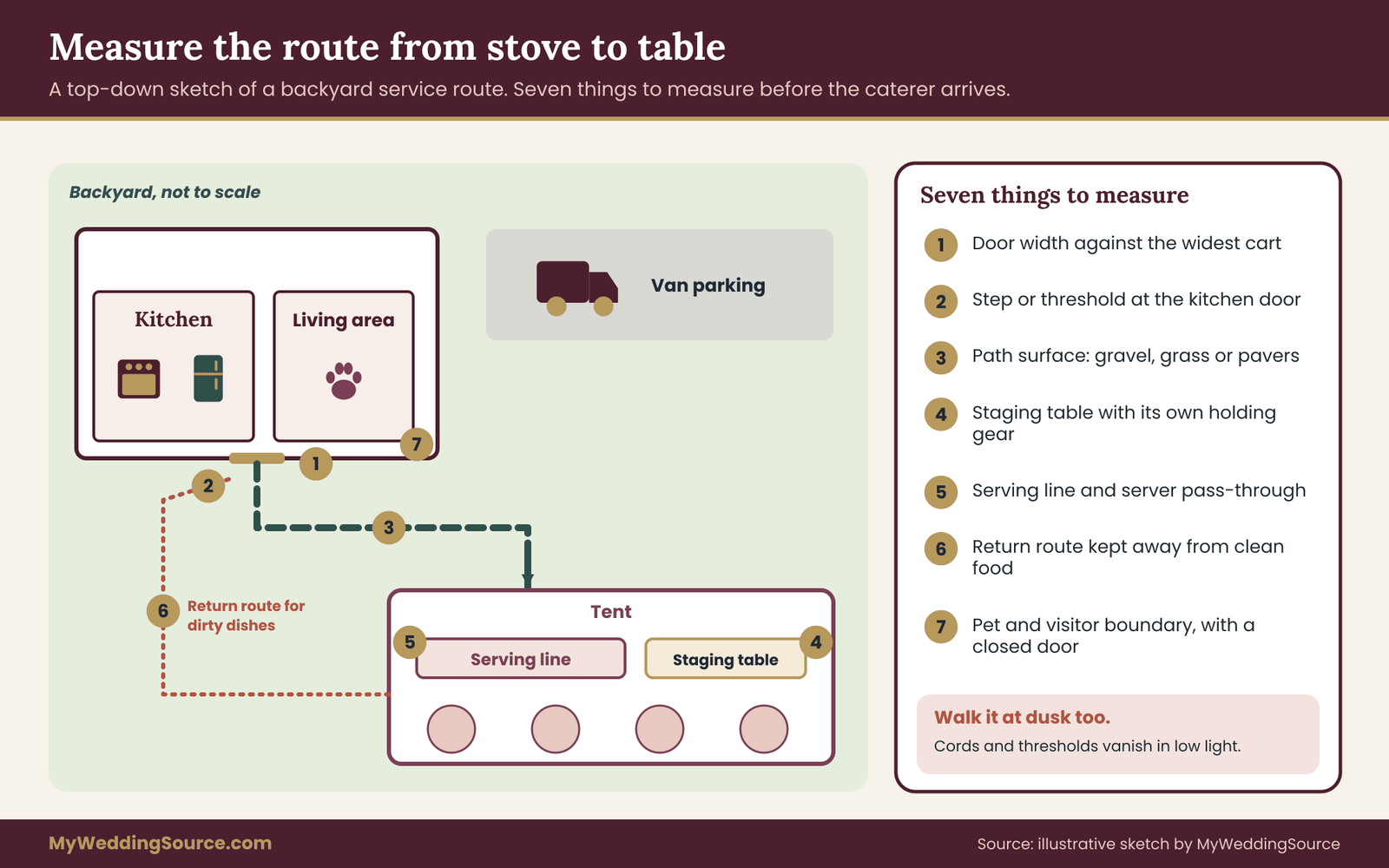
Walk the route with a tape measure and a loaded cart in mind. Start at the kitchen workspace, move to the nearest door to the yard, then along the path to the serving area. Note the width of every door, the number of steps, the surface (gravel, grass, pavers) and any slopes.
A standard rolling food cart often will not roll across a lawn, and a fully loaded hotel pan is heavy and hot. Doors under about thirty-two inches wide may be too narrow for some carts, so ask the caterer for the dimensions of what they will bring and compare.
Then check the route in the dark. A wedding that runs past sunset needs lighting on the path and at the kitchen door. Cords, hoses and thresholds that are invisible in daylight trip people at night, and the servers carrying hot food are the ones most at risk.
Hold, carry and serve
In home kitchen catering, food that leaves the kitchen starts a clock. The longer the route and the more exposed the serving area, the more attention the holding equipment needs. The Food and Drug Administration’s Food Code, and the U.S. Department of Agriculture’s guidance, both frame the rule the same way: keep cold food cold and hot food hot, and limit time in between.
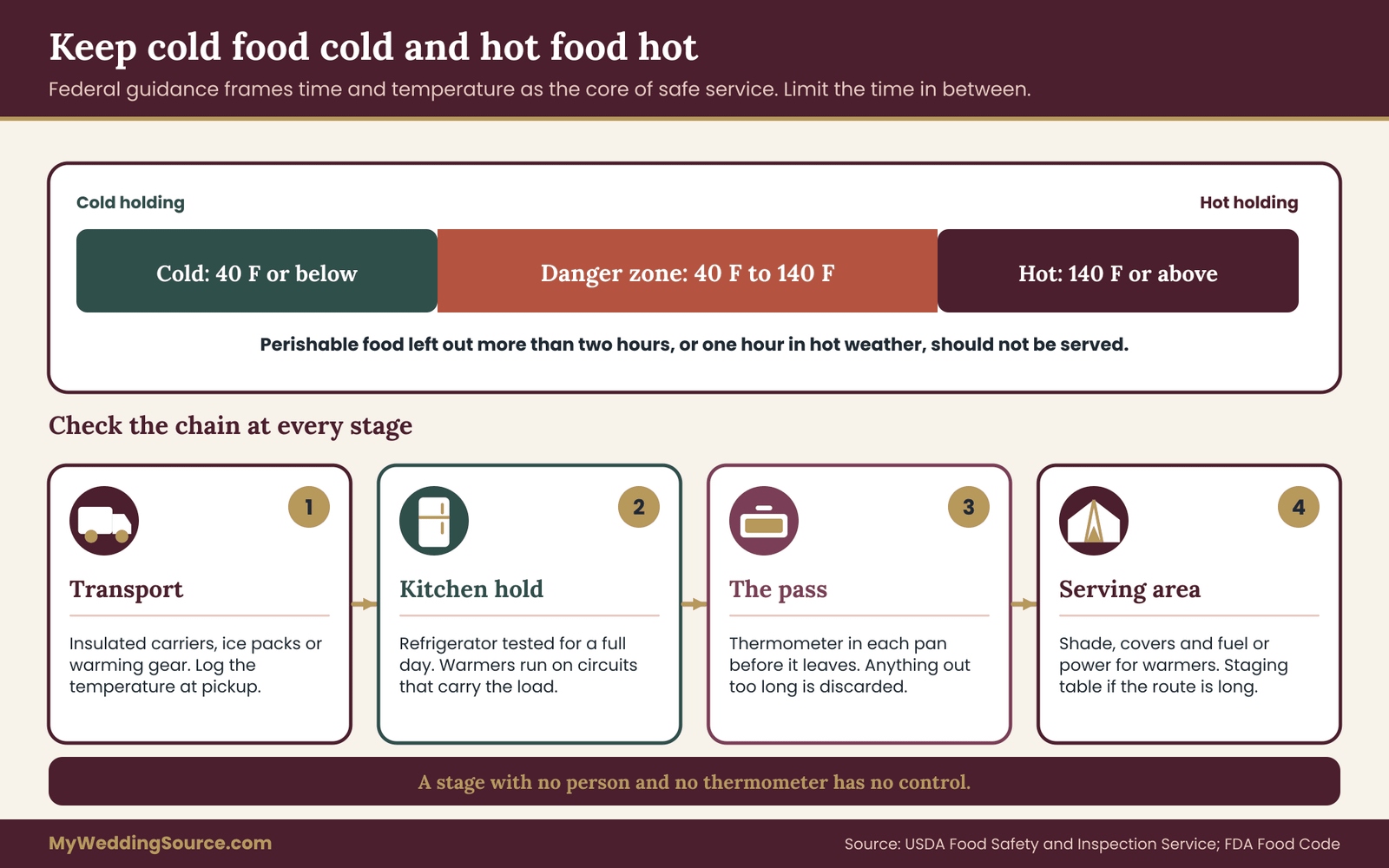
Ask the caterer how hot items will stay hot from the kitchen to the table. Common answers include insulated carriers, chafing dishes with fuel, or warming cabinets near the service area. Ask how they will monitor temperature, and whether they carry calibrated thermometers. A good answer is specific: “We check each pan at pickup and at service, and we log it.” A vague answer is a reason to ask again.
Place the serving area close enough that food does not cross a long stretch of open yard. If it must, consider an intermediate staging table near the tent, shaded, covered and stocked with the same holding equipment as the kitchen.
Guest flow and staff paths
Servers and guests should not share the same narrow path. Draw a simple map of the yard showing the kitchen door, the serving line or table drop points, the bar, the restrooms, the trash and the return route for dirty dishes. Look for crossings where a server with a tray meets a child or a guest with a drink. The reception guest flow guide covers how guests move through a meal, and the same logic applies here from the staff side.
If the route crosses a driveway used for deliveries, schedule deliveries early and keep the driveway clear during service. If the caterer’s van needs to park near the kitchen door, confirm that the spot is reserved and that other vendors know it.
Weather and the service lane in home kitchen catering
A tent over the serving area keeps rain off food, and sidewalls keep wind and debris away. Wind lifts napkins, topples stacks of plates and can blow out fuel for warming dishes. Heat raises the risk of cold food warming past forty degrees, so shade and ice matter. Ask the caterer what changes if it rains: where the food moves, who decides and how guests are told. A weather fallback is part of the service lane, not an afterthought.
The service lane scorecard
Score the service lane of home kitchen catering on three things: a measured route that carts and trays can use, a holding method that keeps temperatures safe over the distance, and a map that keeps servers and guests apart. A Fix may be a plywood walkway over lawn, a staging table, extra lighting or a rerouted delivery.
A Stop is a route that cannot be made safe, such as a kitchen on a floor with no accessible exit to the service area, or a path that crosses an area guests must use.
The service-window load test
The three lanes tell you whether a home kitchen catering setup has the right pieces. The load test tells you whether those pieces can work together inside the time you have. It is a pencil-and-paper exercise that takes about twenty minutes, and it catches the problems that a quiet walkthrough misses, because a kitchen that is fine for ten people at ease can be overwhelmed by sixty people who all want dinner within the same half hour.
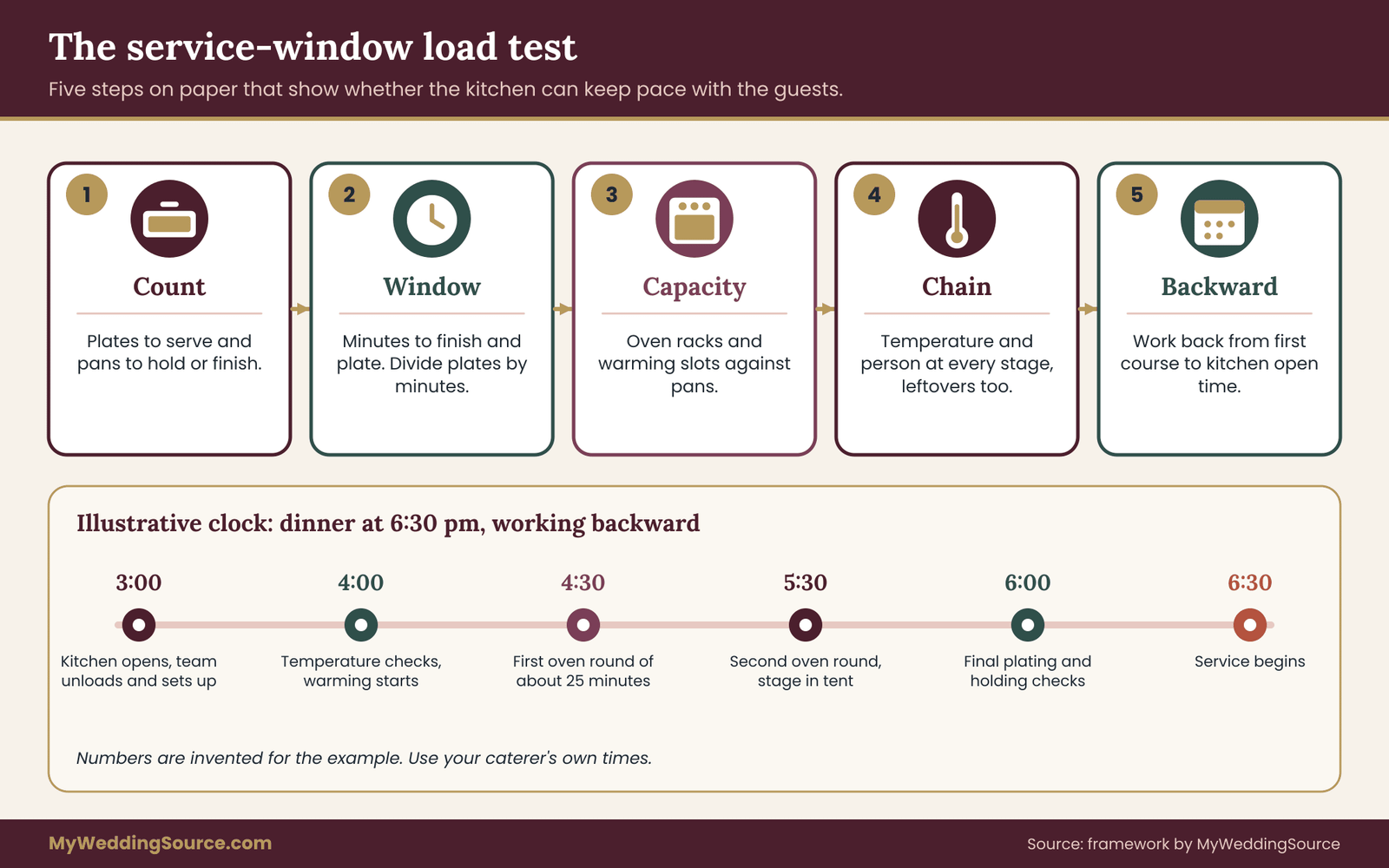
Step one: count the plates and the pans
Start with the headcount that will actually eat, which is often a little different from the invitation list. Add staff meals if the caterer includes them, and subtract guests who will have a separate meal such as children’s plates, which still count as plates but may use different food. Then ask the caterer how many pans of each hot item and how many cold items the menu needs. A caterer can usually answer in a minute, because they plan that way.
You now have two numbers: the number of plates to leave the kitchen and the number of pans that must be held or finished in the house.
Step two: set the finishing window
Ask how long the team needs to finish and plate from the moment the first pan comes out of the oven. For a plated dinner, the finishing window is the time between the first plate leaving the pass and the last. For a buffet or family-style meal, it is the time to fill and refill serving dishes. The caterer’s experience gives the real answer; your job is to check that the house can sustain it.
Write down the number of plates and the finishing window, then divide. If the caterer plans to send sixty plates out in twenty minutes, that is three plates every minute. Now picture the counter: how many plates can be on it at once, how many servers can reach the pass without bumping into each other, and how many hands are working? If the picture feels crowded, the number is too high for the room, and the fix is either more space, more staff or a longer service window.
Step three: check oven and warming capacity
Count oven racks and warming slots against the pans. A household oven usually holds a limited number of full-size pans, and many ovens do not heat evenly when loaded to the walls. If the menu needs more oven space than the house has, the fixes are familiar: reheat in rounds, bring warming cabinets, or move some dishes to rung one so they arrive hot and need only holding.
Be careful with fuel and electricity at once. If the plan relies on a household range, a second oven and a row of electric warming units, add up the load again with the circuit question from earlier.
Step four: check the cooling and holding chain
Time and temperature are the safety backbone. For every item, ask where it sits at each stage: in transit, in the kitchen, on the pass, in the serving area. At each stage, note the target temperature and who checks it. If a stage has no person and no thermometer, it has no control.
The test also covers leftovers. Federal food-safety guidance advises refrigerating perishable food promptly and not leaving it out for more than two hours, or one hour in hot weather. That rule affects the end of the night: leftovers cannot sit on the buffet while guests dance. Decide who packs them, where they go and whether they are discarded or donated; the guidance for donation involves its own rules, so do not promise food to a charity without confirming that the recipient accepts it.
Step five: run the clock backward
Pick the time the first course must hit the tables and work backward. Subtract the finishing window, the oven or reheating time, the time for the food to arrive and settle, the time for the caterer to unload and set up, and the time for any delivery or access issue.
The result is the earliest time the caterer needs the kitchen. Hosts are often surprised. A seven o’clock dinner may require the kitchen at two in the afternoon, and that conflicts with the bridal party getting ready, the photographer’s family portraits and the florist’s last trips.
Put the caterer’s access time on the shared schedule and make the household schedule fit around it. The result is a clear rule of the day: from a stated hour, the kitchen belongs to the caterer.
Reading the result of the home kitchen catering load test
If the arithmetic works, record the numbers in your site notes and move on. If it does not, you have a precise reason, such as plates per minute, oven slots or access hours, and each has a specific fix. If the fixes pile up, ask whether the same money and effort would be better spent moving the kitchen work to a commissary or a venue with a proper kitchen. That is the subject of the alternatives section later in this guide.
When relatives or friends offer to cook
At some point, a generous relative will say, “I’ll cook for the wedding.” It is a lovely offer, and it is among the most common reasons people look into home kitchen catering in the first place. It deserves a careful answer, because the legal and food-safety picture depends on what exactly is being offered.
Gift, favor or service in home kitchen catering
There is a real difference between a family member preparing a dish for the family table, which most people think of as a gift, and a person cooking a full meal for fifty or sixty guests. Cottage food laws, health codes and liability insurance do not treat these identically.
Some jurisdictions are relaxed about food prepared by a private person and shared at a private gathering, others are not, and ordinary homeowners insurance may not respond if a guest becomes ill. The local health department can tell you how your area treats it.
You do not have to refuse the offer. You can channel it into places where the risk is low and the value high. A grandmother’s recipe can arrive as a small tasting course, a family dessert table made from shelf-stable items or a dish prepared with the caterer’s oversight at the caterer’s kitchen. Many couples find that the emotional value of a family dish survives being a small part of the meal.
Questions to ask the willing cook
Ask the relative the same questions you would ask a professional, in a friendly way.
- What would you cook, and how many people would it serve?
- Where will it be cooked and cooled, and how will it travel?
- How will it be kept hot or cold until service?
- Does anyone eating it have an allergy, and how will you know?
- Would you be comfortable with the caterer or the health department reviewing the plan?
If the answers show a large batch of perishable food cooked far ahead and carried across town, the risk is high. If they describe a small, well-controlled dish that fits one of the lower rungs, it may be fine. In both cases, tell the main caterer about it, since a caterer may be uncomfortable serving another person’s food alongside their own and may have contract terms about outside food.
A script for saying yes to the heart and no to the risk
“We’d love your dish to be part of the day. Would you make it as a small first course at the caterer’s kitchen, or bring it frozen so we can heat and hold it properly? We want everyone to enjoy it and stay well.”
When a friend runs a small home kitchen catering business
Sometimes the cook is a friend with a small business operating from a residence. Treat them as a vendor. Ask for their license, insurance and the permitted location where they prepare food. If they operate under a cottage food permit, check which products the permit covers. A friend who has all of that is a professional with a friendly rate; a friend who does not is a relative with an apron, and the same careful questions apply.
Gifts of food and the guest list
Another variation is the guest who wants to bring food to a potluck-style celebration. Potlucks are a different tradition with different rules. If the wedding is meant to be a potluck, say so on the invitation, ask that dishes arrive ready to serve and plan serving utensils, labels for allergens and a way to keep hot and cold dishes at safe temperatures. If it is not meant to be a potluck, a friendly line in the invitation or on the wedding website heads off well-meaning dishes arriving unannounced.
Briefing the caterer and writing the kitchen terms down
A site plan only helps if it reaches the people doing the work. Once the three lanes and the load test are done, turn them into a one-page kitchen brief and make it part of the conversation with the caterer before the contract is signed, not after.
What the one-page brief for home kitchen catering contains
Keep it to a single page that a lead cook can read in two minutes. Include the address, the kitchen access hour and the end hour, the nearest parking for the van, and a short description of the kitchen: counter length, number of ovens and burners, sinks and what each one is for, the refrigerator’s measured temperature, and the breaker notes.
Add the route from kitchen to service area with door widths and surfaces. Add the hygiene routine: where hands are washed, where waste goes, where pets and children will be. Add the name and mobile number of one on-site contact for the host side.
Send it with a few photographs: the counters empty, the sink area, the breaker panel and the route. Photographs do more than adjectives, and a caterer who sees them can say right away what is missing.
Questions for a caterer doing home kitchen catering
Ask these before you sign, in writing if you can. They are phrased so that a good caterer can answer in a sentence.
- Which rung of the ladder does each course use, and what is prepared at your own kitchen?
- What equipment will you bring, and what do you expect the house to supply?
- What is your electrical load, and what do you need from our circuits?
- How will you keep hot food hot and cold food cold, and how will you log it?
- Who is the person in charge on site and what certification do they hold?
- How will you handle allergens, and who delivers those plates?
- How many staff will be in the kitchen, and when do they arrive and leave?
- What do you do with waste, grease and leftovers?
- What happens if the kitchen turns out to be unusable on the day?
The last question is the one that separates experienced teams from hopeful ones. A seasoned caterer has an answer: a backup warming setup, a modified menu or a plan to finish more food at the commissary. A caterer who has never considered it is telling you something too.
The wedding vendor contract guide explains the clauses that matter in any vendor agreement, and the questions above feed several of them directly.
Clauses worth adding in plain words
You do not need legal drafting. You need specific sentences in the contract or in an email that both sides acknowledge. Consider asking for the following, adapting the wording to what you and the caterer agree.
Scope of kitchen use. The caterer will use the home kitchen only for the tasks listed in the brief, and will not cook raw meat or poultry on site unless the permit covers it.
Access hours. The caterer has the kitchen from a stated time to a stated time, and the household will keep the space clear.
Equipment responsibility. The caterer brings and removes specified equipment, and is responsible for damage caused by their staff, within the limits of their policy.
Cleaning standard. The kitchen is returned to a described condition, such as counters wiped, floors swept and trash removed from the property, and a time by which that is done.
Insurance and licensing. The caterer holds the license and insurance described earlier and will provide current certificates on request.
Fallback. If a stated failure condition occurs before the event, the parties will meet by a stated date to decide on the fallback, and costs for that fallback are assigned in advance.
That last clause often matters most. A fallback with a dollar figure and a decision date turns a surprise into a contract term.
What the host provides
Hosts sometimes assume home kitchen catering will be cheaper than a caterer at a venue, because there is no rental fee. That is not a safe assumption. The caterer’s fee may include extra staff time for setup in an unfamiliar kitchen, equipment rental, transport of food from the commissary and cleaning.
The real comparison is the total cost of the whole arrangement, including any rented sink, refrigeration, power and flooring, against a venue with a kitchen. Ask for line items so you can see which costs come from the home site.
On the host side of home kitchen catering, the job is smaller but specific. Clear the kitchen and the route. Remove family food from the refrigerator. Test the water, the outlets and the oven. Set the pet and visitor rules. Have a person available to answer questions and open doors. Provide trash bags, paper towels, a working flashlight and a clear place for the team’s personal items. These are small, and each prevents a minor crisis.
Cost logic without invented numbers
You cannot price home kitchen catering from a list of averages, because the numbers depend on your menu, your region and your caterer. You can build the comparison from line items instead. Ask each caterer to quote the same menu twice: once for your house and once for a site with a kitchen, if you are comparing. Then compare the totals, not the headline per-person figures.
Start with the items that appear only at the house. Rented handwashing station, extra refrigeration, a generator or temporary power, flooring or walkway for carts, lighting along the route, an electrician’s visit and extra staff hours for setting up in an unfamiliar kitchen. Add the cost of a fallback if you have written one in. Subtract fees you avoid by not renting a venue kitchen or paying a site fee.
Then look at the items that hide in the time. If the family must vacate the house for most of a day, what does that cost in lodging or lost use? If the caterer needs the kitchen from early afternoon, what does that do to the getting-ready schedule and the photographer’s plans? These are not dollar figures, but they are real trade-offs, and the countdown below helps place them.
Finally, set the comparison against the lowest-effort alternative, which is usually the caterer’s commissary with food delivered hot. If home kitchen catering ends up costing more in fixes than the commissary option costs in transport, the answer is in the arithmetic, and you can say so kindly to the family member who loved the idea.
A countdown for home kitchen catering
Spread the work over the weeks before the wedding so no single week carries too much.
Eight to ten weeks out. Settle which rung each course uses. Call the local health department. Ask the caterer for license and insurance documents. Measure the counters, doors and route.
Six weeks out. Photograph the kitchen and the breaker panel, write the one-page brief and send it. Book an electrician or rental items if the lanes show a Fix. Agree the pet and visitor rules with the household.
Four weeks out. Hold the decision date. Review the three lanes, the load test and open Fixes with the caterer, and say Go or Switch. Confirm the access hours and put them on the shared schedule.
Two weeks out. Test the refrigerator’s temperature over a full day. Run the water, the outlets and the oven. Confirm deliveries, parking and lighting, and walk the route with the caterer’s lead.
The week of the wedding. Clear the counters and the refrigerator, move family food out, stock soap, towels and trash bags, and hand the host contact the one-page card with the breaker and water shutoff locations.
The day itself. Open the kitchen at the agreed hour, step out of the way and let the team work. After service, confirm the cleaning standard together and agree who sends the final photos or notes for the record.
Communication on the day of home kitchen catering
Name one host-side contact for the caterer and make sure it is not the bride or groom. The couple should be getting ready, greeting guests and enjoying the day, and a question about a breaker should reach someone who can answer it. Give the caterer’s lead that contact’s mobile number and ask them to call, not text, for anything urgent.
Agree on a signal for problems. If a breaker trips, if the water pressure drops, if a guest reports a food concern, the contact should know what to do first. For a tripped breaker, they should know the panel location and which breaker to reset. For water trouble, they should know where the main shutoff is. These are small tasks written on a card, and they spare the caterer from hunting through a stranger’s basement.
The walkthrough before the event
Schedule a walkthrough with the caterer’s lead at the house, ideally a few weeks before the wedding and again briefly a day or two before. Use the brief as the agenda. The caterer should stand in the room and say yes or no to each item. Many caterers will propose small changes that you would not have thought of, such as moving a table, covering a window to reduce afternoon sun on the cold station, or using the garage for dry storage.
The venue technical walkthrough guide explains how to measure and document a site for vendors, and the same method works for a private home. The difference is that at a home, you are also the facilities manager.
Keeping the record of home kitchen catering
Keep the brief, the emails, the license copies and the photos in one folder. If something goes wrong, those records show what each side said and did. If everything goes well, they are a useful starting point for the next event at the house, whether that is an anniversary party or a family reunion.
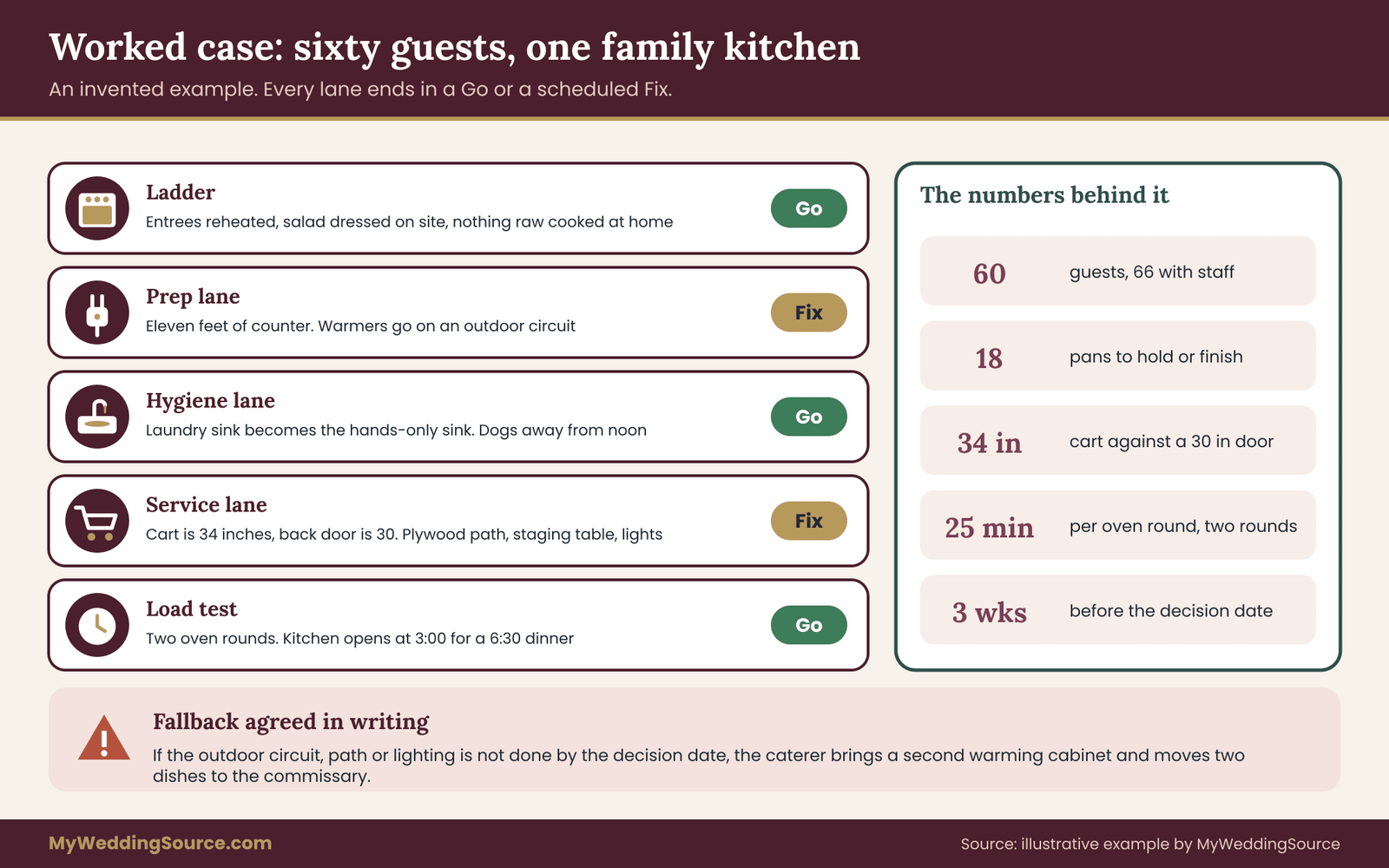
A worked case: sixty guests and one family kitchen
The following example of home kitchen catering is invented to show the method. It is not a real couple, a real caterer or a real health department ruling, and the numbers are chosen for arithmetic, not as typical figures. Use it to see how the ladder, the three lanes and the load test fit together.
The situation
Dana and Marcus are planning a late-afternoon backyard wedding for sixty guests. They have found a caterer, a small licensed business with its own commissary kitchen, who proposes a family-style dinner: two entrees, three sides, a salad and bread, with dessert handled by a separate baker. Dana’s parents own the house, and the kitchen is a galley layout with a gas range, one wall oven, a single sink and a refrigerator that is usually full.
The yard slopes gently from the back door to a tent sixty feet away. A gravel path runs along the side of the house, and the back door has a single step. The parents’ two dogs normally have the run of the house.
Step one: the ladder for this home kitchen catering job
Dana asks the caterer which rung each dish uses. The answers are clear. Entrees are cooked at the commissary, chilled and reheated on site, which is rung two. The salad is assembled at the commissary and dressed on site, rung three at most. Bread and sides are rung two. Nothing involves raw meat in the house. That already settles the biggest legal question: the home kitchen is a satellite, and the caterer holds the permit for the commissary.
Dana still calls the county health office to ask whether finishing food at a private home for a private event needs anything extra. The office says no, and Dana writes down the date and the name.
Step two: the prep lane
Dana measures the counters. She finds eleven feet of usable length once the family’s small appliances are put away, which is enough for three zones. The caterer’s lead looks at the photographs and asks for the wattage of the oven, then lists their own equipment: two warming cabinets and an induction burner for sauces.
Dana photographs the breaker panel. The kitchen circuit is shared with the dining room, and the electrician who looks at it advises keeping the two warming cabinets on an outdoor circuit with a heavy-duty cord rather than in the kitchen. That is a Fix, with a cost and a date.
The refrigerator is a different problem. It holds forty-one degrees at the top shelf, and it is half full. The family agrees to move their food to a borrowed cooler in the garage the day before, and the caterer will bring insulated carriers with ice packs for cold items, so only some of the cold storage rests on the house. Score: Go with two Fixes.
Step three: the hygiene lane
There is one sink, and the team needs it for rinsing and tools. The laundry room has a deep sink with hot and cold water, and Dana’s parents agree to stock it with soap and paper towels and post a small sign: hands only. The caterer brings sanitizer and their own bus tubs. Waste is a question mark; the caterer takes all trash and grease away, which Dana writes into the terms.
The dogs will stay at a relative’s house from noon until the next morning. Dana places a closed door and a sign between the kitchen and the living area. Score: Go, with one written term.
Step four: the service lane
The route is the hard part. Dana measures the back door at thirty inches and the caterer’s cart at thirty-four. The cart will not fit. The team decides to use hand carriers and insulated pans on a smaller cart for the first leg, and to place a plywood path on the lawn for the remaining distance.
A staging table with a warming cabinet goes into the tent, so no hot dish crosses sixty feet of open yard without a stop. Lighting goes along the path. Score: Fix, with a rental order for plywood and lights, which Dana adds to the rental list.
Step five: the load test
Sixty guests plus six staff meals make sixty-six plates, though family-style service sends out serving dishes, not plates. The caterer counts eighteen pans: eight hot entrée pans, six hot sides, two cold salads and two bread baskets. The finishing window is thirty minutes, and the team plans to reheat in two rounds. The kitchen oven holds four pans at a time, the two warming cabinets hold the rest, and a fifth pan sits on a rack.
Dana runs the arithmetic and sees that the oven needs two cycles of twenty-five minutes each. That sets the start time for the kitchen at three in the afternoon for a six-thirty dinner, with the family out of the room.
Step six: the decision
Every lane is a Go or a scheduled Fix. Dana and the caterer sign a kitchen brief, add the fallback clause and write a decision date three weeks before the wedding. If the outdoor circuit, the plywood path or the lighting is not in place by then, the caterer will bring a second warming cabinet and shift two dishes to the commissary. The cost of that fallback is agreed in advance.
What the example shows about home kitchen catering
Notice what drove the outcome. It was not the beauty of the kitchen. It was a thirty-four inch cart, a shared breaker and a single sink, which are exactly the things an informal “sure, you can use our kitchen” conversation misses. Notice also that the biggest legal question was answered at the start by the ladder, and that every other question had a measurable number and a named fix.
Alternatives when home kitchen catering does not pass
Sometimes the three lanes show that the home kitchen should not be the center of the food operation. That is a good result to learn early. A wedding at the house can still go ahead, with the cooking done elsewhere. These are the main alternatives, and each trades something for something else.
Use the caterer’s commissary instead of home kitchen catering
The simplest alternative is to let the caterer cook at their licensed kitchen and bring food to the property, using the house only for holding and plating or not at all. Food travels in insulated carriers and is held in warming equipment at the serving area. This moves the raw handling away from the house and puts the permit in the caterer’s hands. It needs a good holding setup and a short route, and it often means a modest extra transport and equipment fee.
Set up a temporary outdoor kitchen
A caterer may bring a trailer, a tent with warming equipment or a mobile kitchen. This avoids the house entirely, but it brings its own needs: a level pad, power or fuel, water supply, wastewater handling and often a permit for temporary food service. Ask the caterer and the local health department who is responsible for each piece. Space matters; a mobile unit may need more yard and a better driveway than the house kitchen would have.
Rent a commercial kitchen for the day
Some communities have shared commercial kitchens, sometimes called commissaries or community kitchens, that rent time to food businesses. A caterer or a licensed cook can prepare food there, then transport it. This gives access to a permitted space without building one. Availability, hourly fees and rules for who may use the space differ by place, so call early.
Simplify the menu
A menu with fewer hot items, more cold or room-temperature dishes and desserts made by a licensed baker can bring a house kitchen back into range. Cold platters, grazing tables and dishes that hold well reduce load on ovens and warming equipment. This is a design choice, not a downgrade, and the same logic applies to any menu built around what a site can support.
Choose a site with a kitchen
If the arithmetic keeps failing, the honest alternative is to hold some or all of the event at a site that has a working kitchen, such as a barn venue, a restaurant or a community hall, and keep the backyard for the ceremony or a small gathering. The wedding venues guide outlines the choices, and many sites that include a catering kitchen reduce the number of unknowns considerably. The meaning of the backyard can survive a venue change, especially if the ceremony or a family moment stays at home.
Failure conditions for home kitchen catering
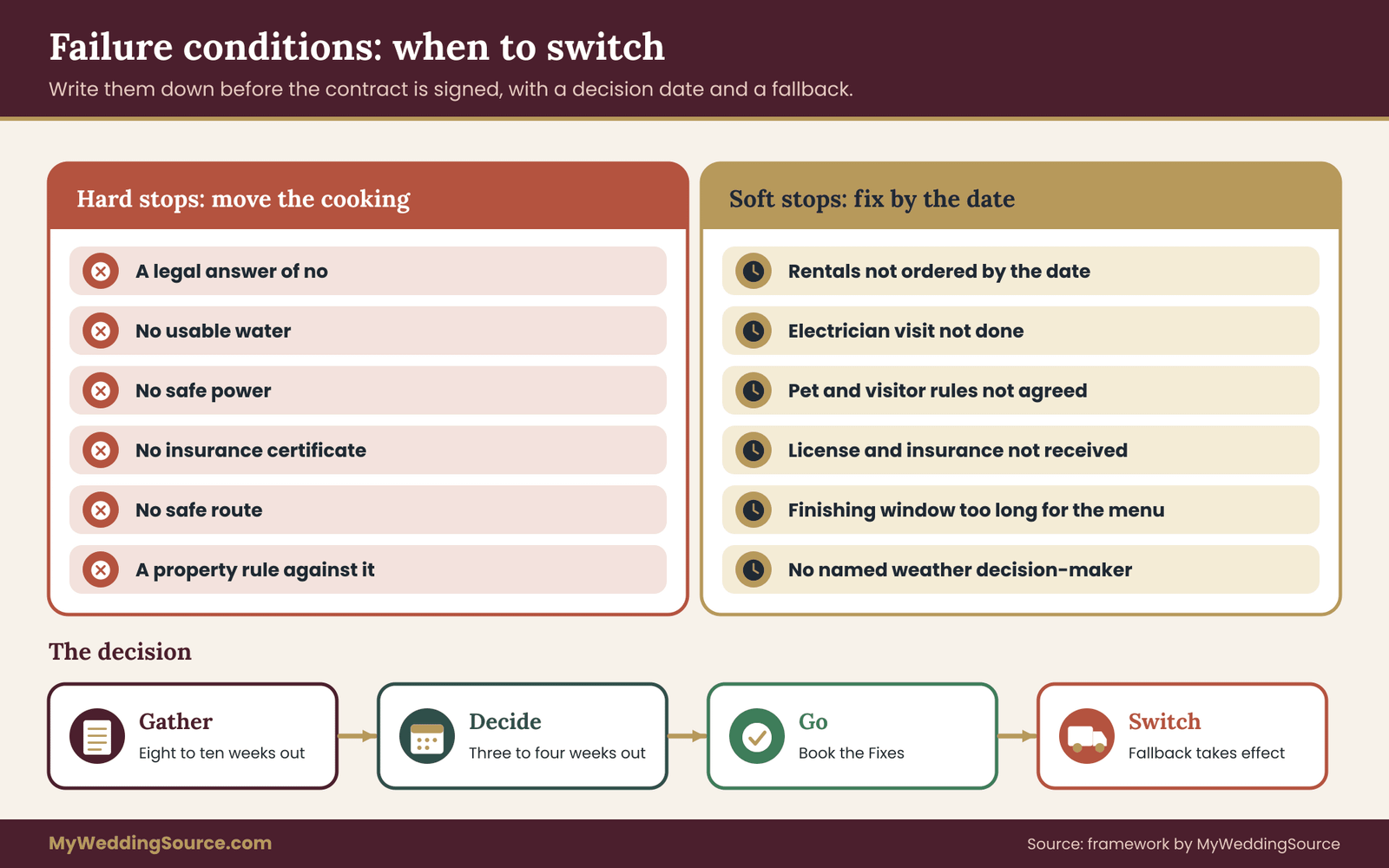
A good site plan for home kitchen catering includes the conditions under which you stop and change course. Without them, hosts tend to keep adding fixes until the day arrives and the kitchen fails in public. Write the failure conditions before the contract is signed, give each a decision date and attach a fallback to each one.
Hard stops
A hard stop is a condition that no amount of effort inside the house corrects. When one appears, move the cooking elsewhere and do not spend money trying to rescue the original idea.
A legal answer of no. The local health department says that the planned use, usually cooking from raw for a paid event, is not allowed in a home kitchen. That is the end of that rung. Move to a licensed kitchen.
No usable water. The house has no reliable hot and cold running water at the kitchen, or the supply cannot carry the load, and a rented water solution is not available or not approved.
No safe power. The circuits cannot carry the equipment and no generator, separate feed or fuel-based alternative is available.
No insurance. The caterer cannot produce a current certificate, or the host’s own policy specifically excludes the event and the host cannot obtain coverage.
No safe route. The path from kitchen to service area cannot be made safe for hot food and moving people, for instance because of stairs that cannot be bypassed or an area guests must use.
A property rule against it. A lease, association rule or local ordinance prohibits the commercial activity, and approval cannot be obtained in time.
Soft stops
A soft stop is a problem that can be fixed, but only if the fix is booked, paid for and scheduled. Treat a soft stop as a deadline, not a worry.
- Rented equipment has not been ordered by the decision date
- The electrician’s visit has not happened
- The pet and visitor rules are not agreed by the household
- The caterer has not provided license and insurance documents
- The load test shows a finishing window longer than the menu allows
- The weather fallback has no named decision-maker
Each of these has a date and an owner. If the owner has not delivered by the date, the fallback takes effect automatically. That last word matters, because the point of the rule is to remove the need to argue at the worst moment.
The decision date and the fallback
Pick one decision date, usually three to four weeks before the wedding. Before it, you are gathering information. On it, you review the three lanes, the load test and any open Fixes, and you say Go or Switch. Switch means the fallback begins.
Write the fallback as a specific change, not a general intention. A useful fallback names the alternative, the person who will carry it out, the extra cost and who pays it. For example: “If the outdoor circuit is not installed by the decision date, the caterer brings a fuel-based warming setup at an agreed rental fee, paid by the host.” Because the details were agreed earlier, no one has to negotiate during a crisis.
Day-of failure conditions
Some failures appear only on the day. Prepare a short list of things that make the team stop and adjust, and agree on who has authority to say so.
- Refrigerator reads above forty degrees when the team arrives
- A breaker trips repeatedly and cannot be reset
- Water supply fails or the hand sink is unusable
- A food item reaches the serving area outside the safe temperature range, as measured by the team’s own thermometer
- A guest reports symptoms that could relate to food
- Severe weather makes the service route unsafe
The caterer’s lead should have clear authority on food decisions. If a pan has been out too long, it is discarded, not served, and the host agrees to this in advance. The Food and Drug Administration and the U.S. Department of Agriculture both treat time and temperature as non-negotiable, and a calm decision at the pass protects guests far better than an effort to save a tray.
If a guest becomes ill
Hosts rarely want to think about it, but it is worth a paragraph. If a guest reports illness after the event, take it seriously and respond kindly. Keep the caterer’s records, the temperature logs and a list of what was served. The local health department can advise on reporting and investigation. Federal food-safety agencies publish general guidance on foodborne illness, and contacting the health department is better than guessing. Notify the caterer and your insurer according to the contract and policy terms.
Using the failure list to decide
Count the hard stops first. If any are present, the home kitchen is not the place for the work, and the decision is simple. Then count the soft stops and look at the dates. If you have more open Fixes than weeks, switch early. It is easier to move cooking to a commissary three weeks out than three days out, and a guest will not remember that the food was cooked elsewhere. They will remember whether it was good, hot and on time.
Reusing the plan for other events
The site plan for home kitchen catering, once written, belongs to the house. A family that has run the three lanes once can reuse the work for an engagement party, a rehearsal dinner or a milestone anniversary. Keep the brief, update the photographs and note anything that changed.
That turns a wedding-day scramble into a standing record, and the next caterer will appreciate walking into a house that already knows its numbers. If rented kitchen equipment was part of the answer, the wedding rental planning checklist makes a good template for tracking orders, deliveries and returns.
Your next steps
Start your home kitchen catering check with the ladder. Decide which rung each course sits on, and ask the caterer to confirm in writing. Call the county health department with the four questions in this guide and record the answer. Then walk the house with a tape measure and a thermometer, and score each lane as Go, Fix or Stop.
Next, run the load test on paper, write the one-page kitchen brief and choose a decision date. Add the failure conditions and the fallback to the contract or an email both sides acknowledge. If the lanes pass, book the fixes and move on. If they do not, move the cooking to a licensed kitchen and keep the backyard for what it does best, which is the celebration.
FAQ
Can home kitchen catering include cooking a wedding meal?
It depends on where you are and what is being cooked. Many health departments allow a licensed caterer to reheat, finish and plate food at a private home, while cooking from raw ingredients for a paid event is commonly limited to permitted commercial kitchens. Ask your county or city food protection office directly, write down the answer and ask the caterer for their license and the name of their permitted kitchen.
Do cottage food laws cover home kitchen catering?
Usually not. Cottage food laws in many states cover a narrow list of low-risk foods, such as some baked goods, that can be sold from a home kitchen. A full wedding meal that needs refrigeration or reheating generally falls outside them. Read your state’s actual product list and limits, and confirm with the agency that administers the program before you assume a permit applies.
What does a professional caterer need from a home kitchen?
Clean counter space for several work zones, power that can carry their equipment, cold storage that holds a safe temperature, a sink they can use only for handwashing, a way to wash and sanitize tools, a waste and grease routine, and a route wide enough for carts and trays. They also need a defined access time and a host contact who can answer questions on the day.
Does our homeowners insurance cover a caterer working in our kitchen?
Often not by itself. Homeowners policies commonly limit coverage for events and exclude business activity, and details vary by policy. Ask your insurer in writing how a hired caterer and a private party at the house are treated, and ask the caterer for a certificate of insurance. A one-day event policy may be an option, so ask your insurer or agent what is available.
Can a relative cook the wedding dinner for us?
Sometimes, with limits. Rules for food prepared by a private person for a private gathering differ by place, and homeowners insurance may not respond if a guest becomes ill. A safer pattern is to give the relative a small, well-controlled role, such as one dish prepared at the caterer’s kitchen or a shelf-stable dessert, and to tell the caterer in advance. Check local guidance first.
How much refrigerator space does a caterer need?
It depends on the menu, so ask the caterer for the number and size of pans they expect to hold cold. Empty your refrigerator, check that it holds forty degrees Fahrenheit or colder, and compare the free shelf space to their count, leaving room for air to move. If it falls short, rented refrigeration or insulated coolers with ice and thermometers can fill the gap.
What if home kitchen catering fails the site check?
Move the cooking, not the wedding. Options include having the caterer cook at their licensed kitchen and bring food in, renting a commercial kitchen for the day, bringing in a mobile kitchen, simplifying the menu to more cold and make-ahead items, or holding the meal at a site with a kitchen. Decide on a date three to four weeks out so the switch is calm.
Who handles food safety in home kitchen catering at a backyard wedding?
The licensed caterer or food business is responsible for its own food handling, and the person in charge on site should hold the proper certification. The host is responsible for the property, access and any food provided outside the caterer. Local health authorities enforce the rules, and federal agencies such as the FDA, USDA and CDC publish general guidance that caterers use.
Sources
- Food Code, U.S. Food and Drug Administration
- Danger zone, 40 to 140 degrees Fahrenheit, USDA Food Safety and Inspection Service
- Keep food safe, FoodSafety.gov
- Food safety, Centers for Disease Control and Prevention
- Clean hands, Centers for Disease Control and Prevention
- Food allergies, U.S. Food and Drug Administration
- Apply for licenses and permits, U.S. Small Business Administration
- Government services and information, USAGov
- Cooking and electrical safety, National Fire Protection Association
- Septic systems, U.S. Environmental Protection Agency