Park photography at a state park wedding can involve more than a ceremony reservation: some parks treat a hired photographer’s work as its own regulated activity, with a separate permit, a fee, an insurance requirement or limits on equipment. This guide gives you a verification log you can fill in, so that you ask each park the right questions in the right order and keep the answers in writing.
Treat park photography as a separate question from your ceremony booking. Write down who is asking (you, your photographer, or both), what the photographer will do (handheld stills, tripod, lights, drone, video, props), where and when, and then ask the park office in writing whether a separate permit, fee, insurance certificate or restricted-area rule applies. Record the answer, the date and the staff member in a log. If any reply is vague, assume the answer is not yet “yes” and plan an alternative.
Couples often discover the park photography question late. The ceremony site is booked, the permit for guests and chairs is in hand, the photographer is under contract, and then someone in the park office mentions a commercial photography fee, or a ranger at the trailhead asks to see paperwork before portraits begin.
Nothing about this is unusual. State parks protect land, wildlife, historic structures and other visitors’ use of the same space, and a working photographer with a tripod and an assistant has a bigger footprint than a guest with a phone.
The difficulty is that no single national rule governs it. Each state sets its own park system rules, and within a state each park or district may interpret them a little differently. One system may require nothing beyond the ceremony permit. Another may ask every professional photographer to hold an annual permit. A third may allow park photography in public areas but prohibit it in a nature preserve or a historic building inside the same park.
This article does not tell you which of those applies to you. It shows you how to find out, how to document what you learn, and what to do if the answer is inconvenient.
A note on scope. This is general information, not legal, tax or financial advice, and park rules, fees and forms change, so the park’s own office and its current published rules are always the final word.
What a park photography permit question is really asking
When a couple types “state park wedding photography permit” into a search box, they usually imagine one document. In practice there are three separate questions hiding inside it, and mixing them up is the most common reason people get the wrong answer from the wrong office.
The first is the site permission: may you hold a ceremony or gathering at this location, on this date, at this time, with this many people? That is the permit most couples already know about. The guide to choosing and vetting a wedding venue belongs on that side of the line, and so does a conversation with the park’s reservation desk.
The second is the activity permission: may a person do paid photographic work in the park, and under what conditions? This is where the phrase park photography permit most often applies. Some systems issue a commercial activity or special use authorization that covers any business operating on park land, including photographers, florists, caterers and musicians. Others have a narrower park photography or filming category with its own application.
The third is the equipment and area permission: are there limits on drones, tripods, reflectors, lighting, generators, props or arches, and are there parts of the park where photography is restricted at all? These limits are sometimes written into the permit, sometimes into general park rules, and sometimes only into a sign at the site.
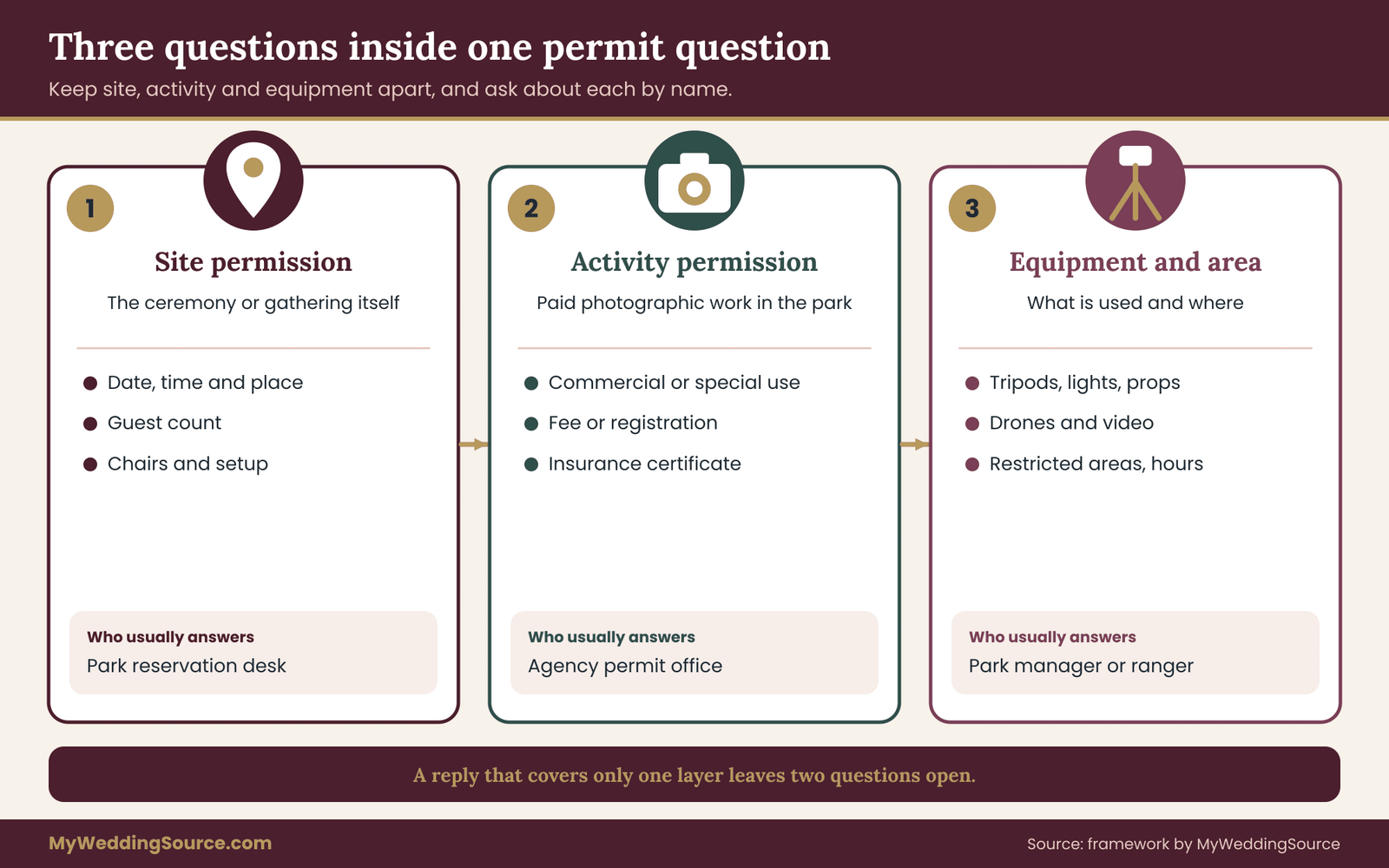
Keeping these three questions apart changes how you phrase your email. Asking “do we need a park photography permit?” invites a one-line answer about one layer. Asking all three, by name, tends to get a more complete reply, and it makes gaps easy to spot. If the park answers only the first, you know two questions are still open.
Why a separate permit may exist at all
It helps to understand the reasoning, because the reasoning predicts the rules. A park that charges photographers or asks them to register is usually trying to do one or more of these things: keep a record of who is operating a business on public land, make sure a commercial user carries liability insurance, limit crowding at popular scenic spots, protect sensitive habitat or historic fabric, and recover some of the cost of staff time.
A large multi-hour portrait session with a group of twenty and a photographer who needs a reflector stand is a different load on a trail than a family taking snapshots.
Seen that way, the questions a park asks tend to follow the footprint. How many people? How long? What equipment? Is it on a trail, a beach, a meadow, an overlook, or inside a building? Is anything left behind? If you can answer those precisely, most park staff can tell you quickly which rules apply. If you cannot, expect a slower and more cautious reply.
What this guide does not cover
Federal land is a different system. The National Park Service, for example, publishes its own policy on photography and filming, and it distinguishes casual still photography from commercial filming and from some paid still-photography situations. State park systems do not copy that policy, so a rule you read for a national park cannot be assumed to hold at a state park. The same is true of county parks, city parks and beaches, which are run by local governments with their own codes.
This guide also does not cover your wedding photographer’s contract, the guest-privacy side of park photography, or the editing and delivery of images. For guest consent, phone rules and image use, the guide to wedding photography consent is the right place. Here the subject is narrower: whether the park requires anything extra for park photography, and how to prove you asked.
Who decides park photography rules in a state park
Before you write to anyone, find out who actually owns the decision. State parks look simple on a map and complicated in an organization chart, and a surprising amount of delay comes from asking a friendly person who cannot answer.
The state park agency. Most states have a parks department or division, sometimes inside a department of natural resources, conservation or environment. It publishes the park rules, usually in an administrative code and in a plainer summary on its website. Its central office often runs the special use or commercial activity permit program and can say whether park photography falls under it.
The individual park or district. The park manager or the district office usually handles day-to-day permits and has discretion over timing, locations and conditions. The same system may allow a photographer at one park and require an extra review at another because the second park has a nesting area, a historic building or heavy visitor traffic.
A concessionaire or lodge operator. Some parks have a private company that runs the lodge, the golf course, the marina or the event hall. If your ceremony or portraits are on the concessionaire’s grounds, that company may have its own vendor rules, preferred vendor lists or outside-photographer fees. These are contractual, not regulatory, and they sit on top of whatever the park requires.
Another government, inside the park. Occasionally a city, county or a federal agency holds responsibility for part of the land, such as a beach, a pier, a lighthouse or a trail corridor. A park map can show one boundary while three agencies hold the rights.
How to find the right office
Start with the park agency’s website and search for the terms the agency itself uses. The names vary: special use permit, special event permit, commercial use authorization, commercial photography, film permit, filming and photography, professional photography. If the website lists a form, read the whole form, because the definitions section usually tells you what counts as commercial activity and what does not.
Then look for the park’s own page. Many parks list a phone number and a contact form. A written question is better than a call, because it produces a record. If you call, follow up with a short email that restates what was said, and ask the person to correct anything you got wrong. That small step turns a conversation into evidence.
If the ceremony site is within a venue that is not run by the park, such as a lodge with a lawn inside the park boundary, ask that venue separately and ask whether the park has any say over park photography on its grounds. The broader guides on wedding venues and on reading a wedding vendor contract explain how venue rules and vendor terms interact, and the same logic applies here.
The person who should send the question
A practical decision comes up early: should the couple or the photographer ask? Some parks direct the question to the professional, because the commercial permit belongs to the business. Others want the event host to apply. Often the right answer is both, in a coordinated way. The couple asks about the ceremony and the overall plan, and the photographer confirms the professional requirements and says whether they already hold the relevant permit.
Part of the verification log in this guide is simply a record of who asked whom, so that nothing falls into the gap between you.
When a separate park photography permit may apply
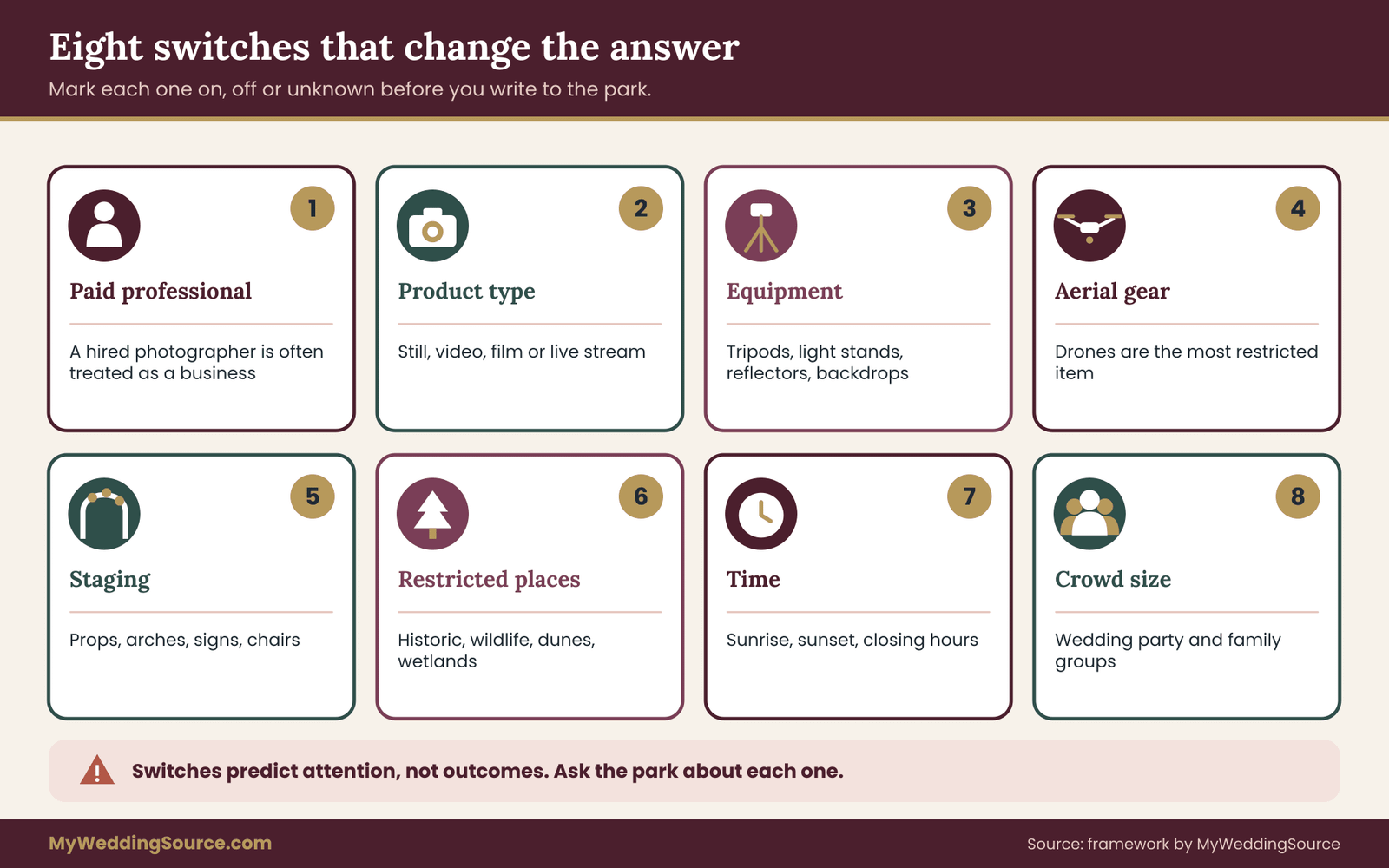
No list can say which rule your park uses, but the triggers that cause a park to ask for something extra are fairly consistent across systems. Think of them as eight switches. Any one of them can change the answer, and the more of them you turn on, the more likely it is that the park will want to review your plan.
Switch one: a paid professional. Many parks distinguish between a visitor photographing their own group and a business earning money on park land. A hired wedding photographer is usually a business, even if the couple is the one paying. Some parks apply their commercial rules to any paid work, while others only care when the work is a large production. You will not know which kind of park you have until you ask.
Switch two: the kind of product. Still park photography, video, film and live streaming are sometimes handled under different rules. A park that ignores a single photographer with a camera may still want a filming permit for a videographer, a cinematographer with a stabilizer rig, or a livestream crew. If you plan both, ask about both by name.
Switch three: equipment. Handheld cameras rarely draw attention. Tripods, light stands, reflectors, backdrops, ladders, generators and battery packs are different, because they occupy ground, block paths and can damage vegetation. Some parks limit equipment by size or by location. Others forbid anything that stays in place unattended.
Switch four: aerial equipment. Drones are the most commonly restricted item. Many state park systems prohibit launching, landing or flying them in the park without specific permission, and some forbid them outright. Federal aviation rules apply on top of park rules, which is why the Federal Aviation Administration’s drone pages are among the sources at the end of this guide. If anyone on your team plans a drone shot, treat it as its own question with its own answer.
Switch five: staging. Props, arches, florals set on the ground, signs, chairs and temporary structures turn a photograph into a set. Parks that tolerate a quick portrait on a path may not tolerate a staged scene that stays for an hour. This is the same footprint logic that governs ceremony decor in parks, and the answers often come from the same office.
Switch six: restricted places. Historic buildings, cemeteries within parks, nesting or wildlife areas, dunes, fragile meadows, caves, boardwalks over wetlands and areas closed to the public for safety may be off limits for park photography, or may need special escort. These limits often live in the park map rather than the permit.
Switch seven: time. Sunrise and sunset sessions matter to photographers and also to parks. Some parks close at dusk, lock gates, or restrict entry to day-use hours. A permit that covers a ceremony at four in the afternoon may not cover portraits at twilight.
Switch eight: crowd size. A couple and a photographer is a small footprint. A wedding party of fourteen, two photographers and family groups arriving in waves is a different one, and a park may count the people in a park photography session toward its group size thresholds.
What the switches do not tell you
Counting the park photography switches predicts how much attention your park photography plan will draw, not what a particular park will decide. A tiny session with one switch on can still require a fee if the park charges every professional. A larger session with several switches may be approved with no extra paperwork if the park considers it covered by the ceremony permit.
That is why the log in the next section records the park’s answer to each switch separately instead of collapsing everything into “permit needed” or “no permit needed”.
There is one more thing the switches do not cover: the difference between “allowed” and “permitted”. A park may say park photography is allowed in the area without a permit but still require that you stay on trails, leave no trace and yield to other visitors. That is an allowance with conditions, and the conditions belong in your notes.
Common wording you will see
Park websites use a handful of phrases that sound similar and mean different things. A special use permit is a broad category that can cover events, filming or other activities beyond ordinary visitor use. A commercial use authorization generally covers a business operating on park land. A film permit may or may not include still photography.
A reservation secures a site but does not usually authorize a business to operate there. A fee waiver is a decision by the park, not a right. When a reply uses one of these terms, ask which of your three questions it answers: the site, the activity or the equipment.
Building the park photography verification log
The park photography verification log is a one-page record you keep for each park you consider. It does three jobs. It forces you to ask the questions in a consistent way, it gives you a dated trail if staff change or a ranger challenges your plan on the day, and it makes comparing two parks easy, because the same fields are filled in for each.
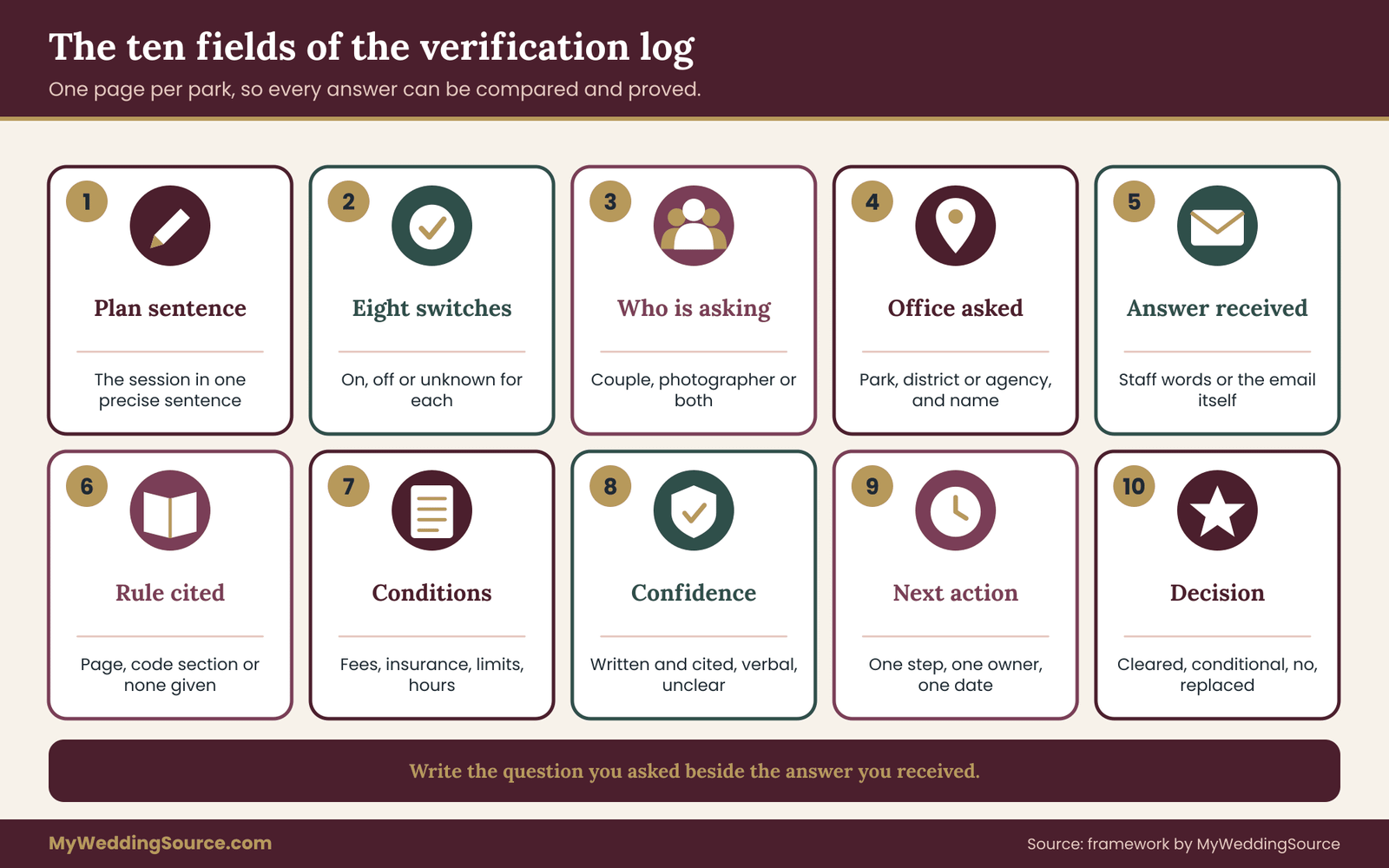
It is not a form the park will ever see. It is your own working document, and it can live in a shared note, a spreadsheet or a printed page. Ten fields are enough.
Field one: the plan in one sentence. Write the session as it would be described to a stranger. For example: “Ceremony for 40 guests at the lakeside lawn from 4:00 to 4:30, then one hour of portraits with the couple and six attendants, one professional photographer, handheld cameras plus one light stand, no video.” A sentence like that forces precision, and precision is what produces precise answers.
Field two: the eight switches. Mark each one as on, off or unknown. Unknowns become questions.
Field three: who is asking. Record whether the couple, the photographer or both are submitting the question, and the date.
Field four: the office asked. Write the exact office, the name of the staff member if you have it, the phone number or form used and whether the question went to the park, the district or the central agency.
Field five: the answer. Copy the reply in the staff member’s own words, or attach the email. Do not paraphrase at this stage.
Field six: the rule cited. Ask which page, code section or permit type the answer comes from. If the person cites nothing, note “no citation given”. That is useful information in itself.
Field seven: the conditions. List fees, insurance requirements, deadlines, equipment limits, location limits and hours attached to the answer.
Field eight: the confidence rating. Rate how confident you are that the answer is complete and current: written and cited, written but uncited, verbal only, or unclear.
Field nine: the next action. Write the single next step, who owns it and the date.
Field ten: the decision. At the end, mark the park as cleared, cleared with conditions, not cleared or replaced by an alternative.
Why confidence is its own field
Most people treat an answer as either true or false. In a park photography permit situation, answers come in grades. A written reply citing a current page of the park’s rules and signed by the park office is strong. A friendly voicemail from a seasonal employee is weak even if it turns out to be right.
When you record the grade, you know where to spend more effort. A weak answer that is also high stakes, such as a drone, deserves a second confirmation. A strong answer about handheld stills on a public path probably does not.
Keeping the park photography log honest
Two habits keep the log useful. First, write the question you asked as well as the answer you received, because a “yes” to a vague question is not a “yes” to your actual plan. Second, update the plan sentence whenever the plan changes. If the portrait session grows from one hour to two, or a second photographer joins, the earlier clearance no longer covers the new plan, and the log should say so.
Reading the park photography answers you get back
Park staff are usually helpful, and they are also busy. Replies arrive in all shapes: a form letter, a two-line email, a phone call from the manager, a link to a page you already read. The skill is sorting those replies into something you can act on. A simple three-color sort works well, and it maps directly onto the confidence field in the log.
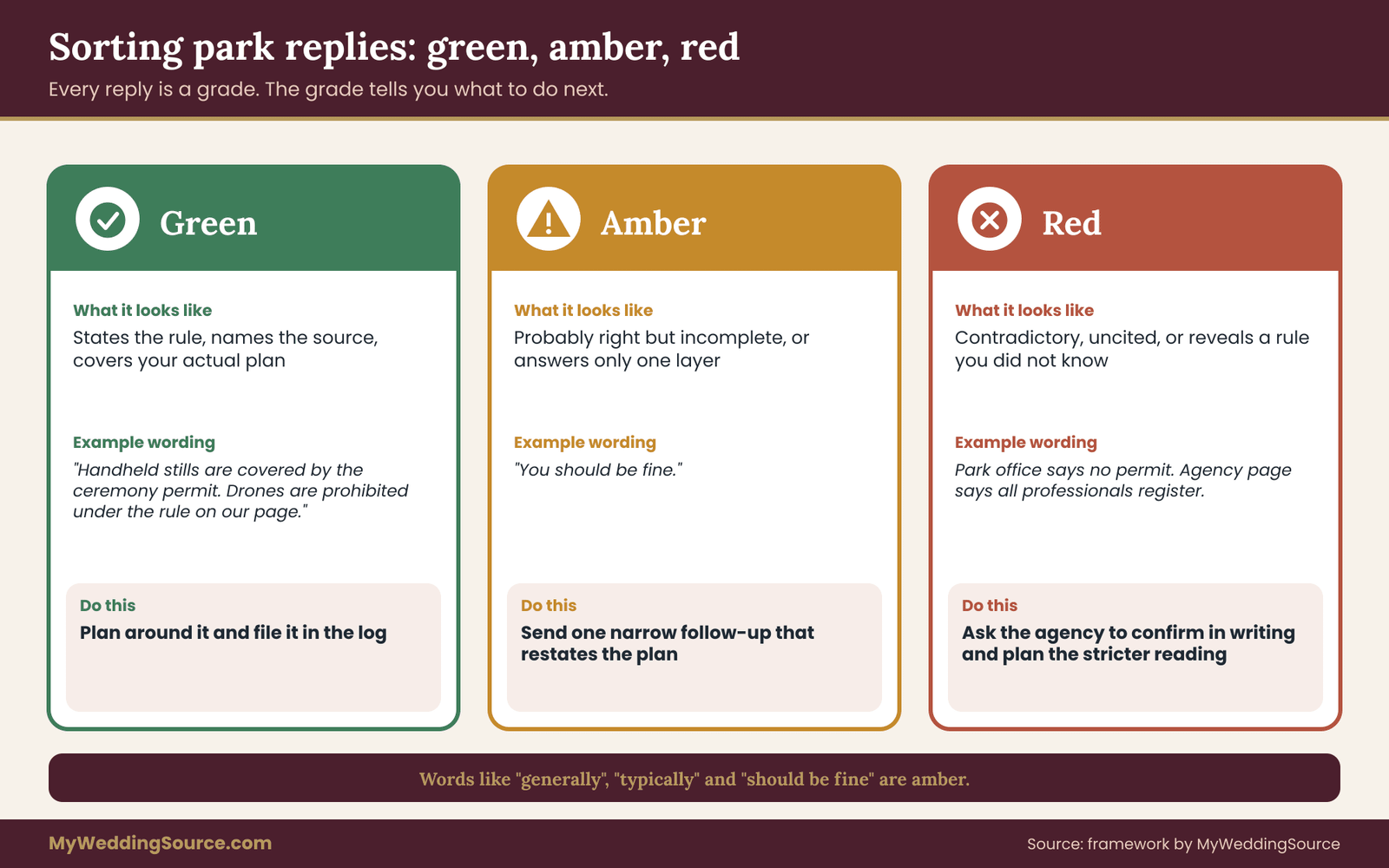
Green replies on park photography state the rule, name the source and speak to your actual plan. For example, a reply that says handheld still photography by a professional is covered by your ceremony permit, that tripods are allowed on the lawn but not on the shoreline path, and that drones are prohibited under a named rule, is green. You can plan around it.
Amber replies are probably right but incomplete. “You should be fine” is amber. So is a reply that answers the ceremony question and ignores the photographer. Amber means one more question, not a decision. Reply with a narrow follow-up that restates the plan and asks only the missing part.
Red replies contradict each other, cite nothing, or reveal a rule you had not known about. If the park office says no permit is needed and the central agency’s website says every professional must register, that is red. Do not pick the answer you prefer. Ask the central agency to confirm in writing, and tell the park office you are doing so.
A follow-up that works
The best park photography follow-ups are short and concrete. They restate the plan, name the open point and offer two ways to answer. Here is the kind of wording that tends to get a useful reply:
“Thank you for the information about our ceremony reservation. To confirm one more point: our photographer will work handheld for about an hour after the ceremony, with one light stand. Does that session need a separate park photography or commercial use permit, and if so, which form should we use?”
Notice what it avoids. It does not ask whether “everything is okay”, it does not use jargon the staff member may not recognize, and it makes a specific request. A person who can answer in one sentence usually will.
Words that should make you pause
Certain phrases in a reply are worth a second look. “Generally” and “typically” describe usual practice, not your case. “As long as it is not commercial” begs the question whether a hired photographer is commercial in that park. “Not that I’m aware of” is honest and it is not a rule. “It depends on the ranger” tells you the rule is discretionary, which means getting the discretion in writing before the day matters more, not less.
What to do when two offices disagree
Disagreement is more common than people expect, and it is usually innocent. The park office may be describing local practice, while the central agency describes the written policy. A rule may have changed recently. A concessionaire may enforce stricter terms than the park does.
When this happens, write to both offices in the same message and ask for the controlling rule. If one office is clearly the authority, follow it. If neither will commit, treat the stricter reading as your planning assumption, and keep an alternative available.
Writing the first message
Many delays begin with the first email, so it is worth getting right. A good opening message is short, names the three layers and attaches nothing the staff member has to open. Here is a template you can adapt:
“We are planning a small wedding ceremony at [park name] on [date]. We would like to understand the park photography requirements before we book. Our plan: [plan sentence]. Could you tell us (1) whether our ceremony needs a separate site permit, (2) whether our photographer needs a park photography permit, registration or insurance certificate, and (3) whether any limits apply to tripods, lights, drones or restricted areas? If another office handles part of this, please point us to it. Thank you.”
Send it from an address you check daily, put the date in the subject line, and keep the same subject line for every follow-up so the thread stays intact. Copy your photographer on the message if the park accepts that, so the park photography answer reaches the person who has to act on it. If the park replies by phone, write back with a summary the same day, and ask them to correct anything you misunderstood.
A worked case: park photography at two lakeside parks
The following is an invented example, offered only to show how a park photography log behaves. The couple, the parks and the answers are illustrative, not real, and your own parks will have their own rules.
Nolan and Priya want a late-afternoon ceremony for 40 guests followed by an hour of portraits. They have shortlisted two state parks. Park A has a lakeside lawn and a short boardwalk. Park B has a hillside meadow and a historic mill. Their photographer will use handheld cameras, one light stand and, if possible, a drone for a ten-minute aerial shot of the lake.
Step one: write the plan sentence. They draft one sentence and reuse it for both parks, so the comparison is fair.
Step two: mark the switches. For both parks the paid professional switch is on, the equipment switch is on because of the light stand, the aerial switch is on, and the time switch is unknown because they have not confirmed closing hours. The restricted-places switch is off for Park A and unknown for Park B, because the mill is a historic structure.
Step three: ask in writing. Each park receives the same three-part park photography question: site, activity, equipment. Park A replies within a few days with a clear message: the ceremony reservation does not cover professional photography, which falls under a separate commercial permit with a flat fee and a certificate of insurance requirement, and drones are prohibited. The reply cites the agency’s rules page. That is green on the permit and green on the drone.
Park B replies with a friendly note saying the couple “should be fine” and adding that the meadow is popular on weekends. That is amber.
Step four: follow up. Priya sends the narrow follow-up, restating the plan and asking whether the photographer needs separate authorization and whether the mill grounds are open for portraits. Park B answers that photographers must register through the state agency and that the mill grounds are closed to park photography because of a restoration project. The reply links to the registration page. The amber has become green, and it has also revealed a location constraint.
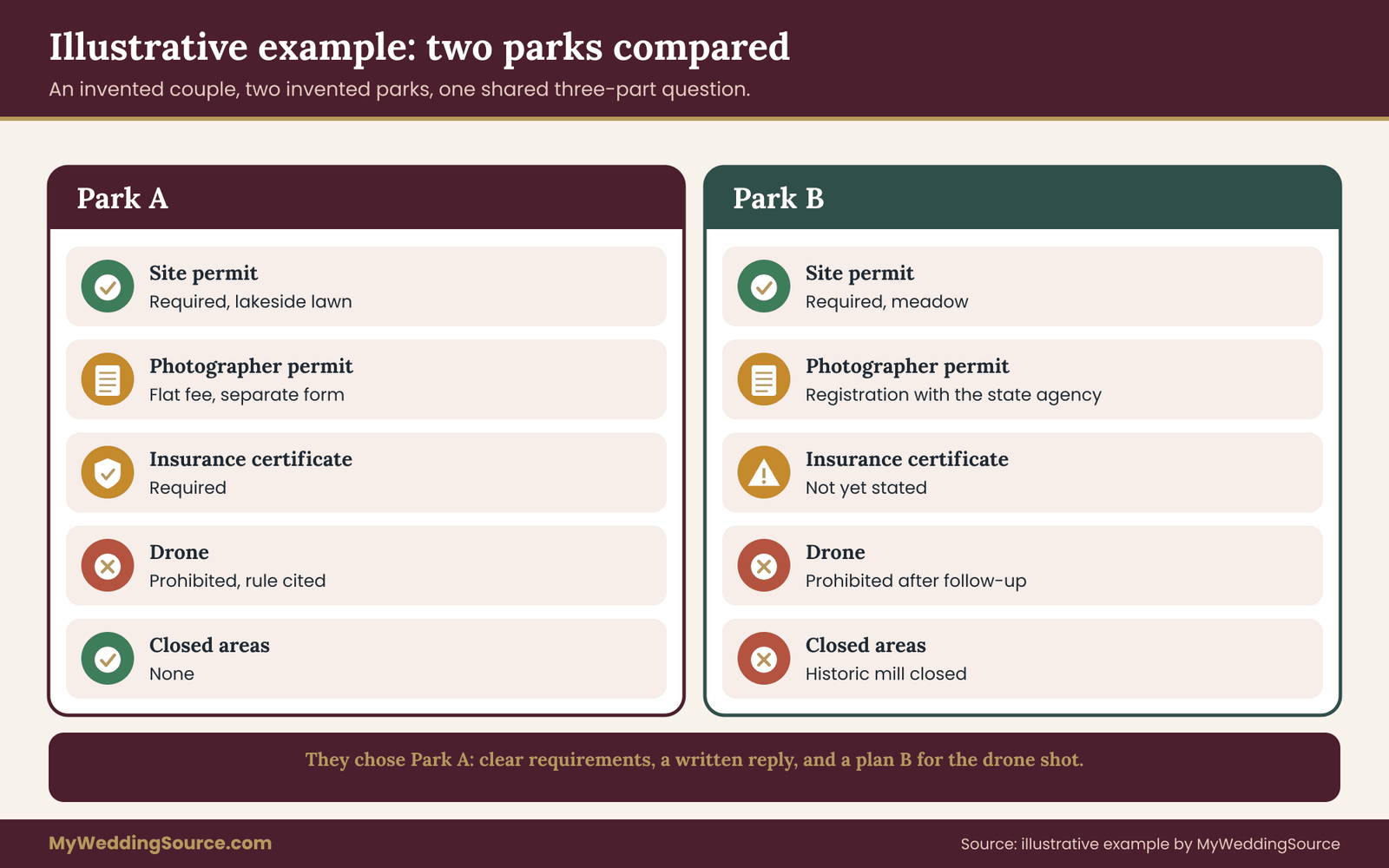
Step five: compare. Park A requires a permit and an insurance certificate, bans the drone and has no location limits. Park B requires registration, closes the mill and has not yet said anything about the drone. Priya writes back to Park B on the drone question and gets a prohibition there too.
Step six: decide. They choose Park A, because the requirements are clear and the mill is not a loss they care about at Park B, but both parks required roughly the same paperwork. They ask their photographer to confirm that they hold, or will obtain, the park’s commercial permit and to send the certificate of insurance. They drop the drone and ask the photographer whether a different high vantage point, such as the boardwalk, would give a similar shot.
What the park photography example teaches
Three lessons about park photography come out of the example, and none of them depends on the invented details. First, asking the same three-part question of each park made the replies comparable. Second, the log recorded an amber reply for what it was, which prompted a follow-up that surfaced a restriction nobody had mentioned.
Third, the photographer was brought in as a partner rather than as a surprise: the couple asked for the permit status and the insurance certificate as part of normal vendor preparation, which is the same habit that a good vendor due diligence checklist builds for every vendor.
Notice also what the couple did not do. They did not assume that a ceremony permit covered the photographer. They did not rely on a phone call. They did not treat the drone as a detail to settle on the day. Each of those small choices removed a way for the day to go sideways.
How park photography permits fit your photographer’s contract
A park photography permit is a business matter between the photographer and the park, but the consequences land on you. If the permit is missing, the session may be cut short, the photographer may be asked to leave, or the park may fine whoever is responsible. Your contract should say who handles each piece, and it is far easier to settle that in writing before the wedding than in a parking lot afterward.
Start with the question that most contracts leave unspoken: whose job is it to find out what the park requires? Many experienced wedding photographers already work in several state parks and know the local routine. Others work mostly in studios and hotels and have never needed a permit. Neither is a reason for worry, but the difference is worth discovering early. Ask directly: “Have you photographed weddings in this park or this park system, and do you hold any commercial permit for it?”
Contract points worth settling
A handful of clauses decide most park photography disputes. None needs legal language. Each can be a plain sentence in the agreement or an addendum that both sides initial.
Permit responsibility. State who applies, who pays the application fee, and who pays if the park charges a per-session or per-hour fee. Some photographers fold park costs into the package. Others pass them through at cost. Both are acceptable, but the contract should say which one applies and whether the amount is known or estimated.
Insurance. Parks that ask for a certificate of insurance usually want to be named as an additional insured or certificate holder. Ask whether your photographer carries liability coverage and whether they can supply a certificate with the park’s name on it. The guide to wedding vendor contracts covers insurance requirements more broadly, and the same logic carries over here.
Equipment limits. Add a sentence that the photographer will follow the park’s equipment rules, and that any shot that depends on prohibited equipment, such as a drone, will be replaced with an alternative the park allows. This protects both sides from a quiet disappointment later.
Location changes. If the park closes an area or the permit restricts it, the photographer should agree in advance to adapt the portrait locations without a penalty.
Cancellation. If the park denies permission or requires a different date, what happens to the photographer’s retainer? The answer depends on your contract, and it is a question worth asking before you sign rather than after.
What to ask a photographer who has never done it
If your photographer is new to park work, you can still proceed. The steps are the same. Share the log, ask them to answer the activity and equipment questions with the park, and ask for any permit or certificate they obtain. A professional who takes the question seriously will usually welcome a structure. One who dismisses it, or says “we never need that” without having checked, is giving you a signal about how they handle other details too.
“Could you confirm in writing whether you hold, or will apply for, any commercial photography permit the park requires, and send a certificate of insurance if the park asks for one?”
This is a reasonable thing for any couple to ask. It is not an accusation. It is the same kind of request a venue would make of a caterer.
Park photography costs, fees and the money logic
Fees for park photography vary widely and change often, so this guide does not quote any. What it can do is explain the structure of the costs so that you recognize them when a park describes them, and so that you can compare two quotes on the same basis.
Park photography charges generally come in a handful of forms. There may be an application or processing fee, paid once per request whether or not it is approved. There may be a permit or use fee, charged per session, per day, per hour or per year. There may be a deposit or damage bond, refundable if the site is left undisturbed.
There may be an insurance requirement, which is not a fee from the park but a cost to the photographer. And there may be an entry fee, since the photographer and guests may all need park admission.
Where the cost lands
Ask three questions for each cost: who is charged by the park, who pays under your contract, and when is it due. A photographer who holds an annual commercial permit may not charge you anything extra because the permit is already part of their business cost. A photographer who must buy a one-day permit for your session may pass the fee through.
If you do not ask, you may be surprised by a line item on the final invoice, which is exactly the kind of avoidable friction the log is designed to prevent.
When you compare parks or alternatives on cost, compare the whole path. A park with a lower ceremony fee but a higher park photography fee can cost more than a park with a higher ceremony fee and no park photography charge. Add up the site fee, the park photography fee, the insurance cost, the admission fees for your guests and any required staff presence, and compare totals rather than headline figures.
The broader methods for comparing venues work the same way for any site: ask for a complete list, not a headline.
Refunds and the quiet clauses
Two quiet clauses matter more than the fee itself. The first is what happens if the permit is denied or the park closes the area for weather, fire, flood or maintenance. Some parks refund fees, some convert them to credits, and some keep them. The second is the deadline by which you must cancel to receive a refund. Both belong in the log under conditions. If the park has not said, ask, and write down the answer.
A wedding-day closure is rare but real. Parks close trails for hazard trees, high water, wildlife activity and storm damage, and a permit rarely guarantees access to every area. A flexible plan, covered in a later section, is the safest response.
Sequencing: when to ask, and in what order
The order in which you ask park photography questions affects how much work you redo. A wrong order can leave you with a booked photographer for a location that turns out to be closed to park photography, or a park permit for a date your photographer cannot work.
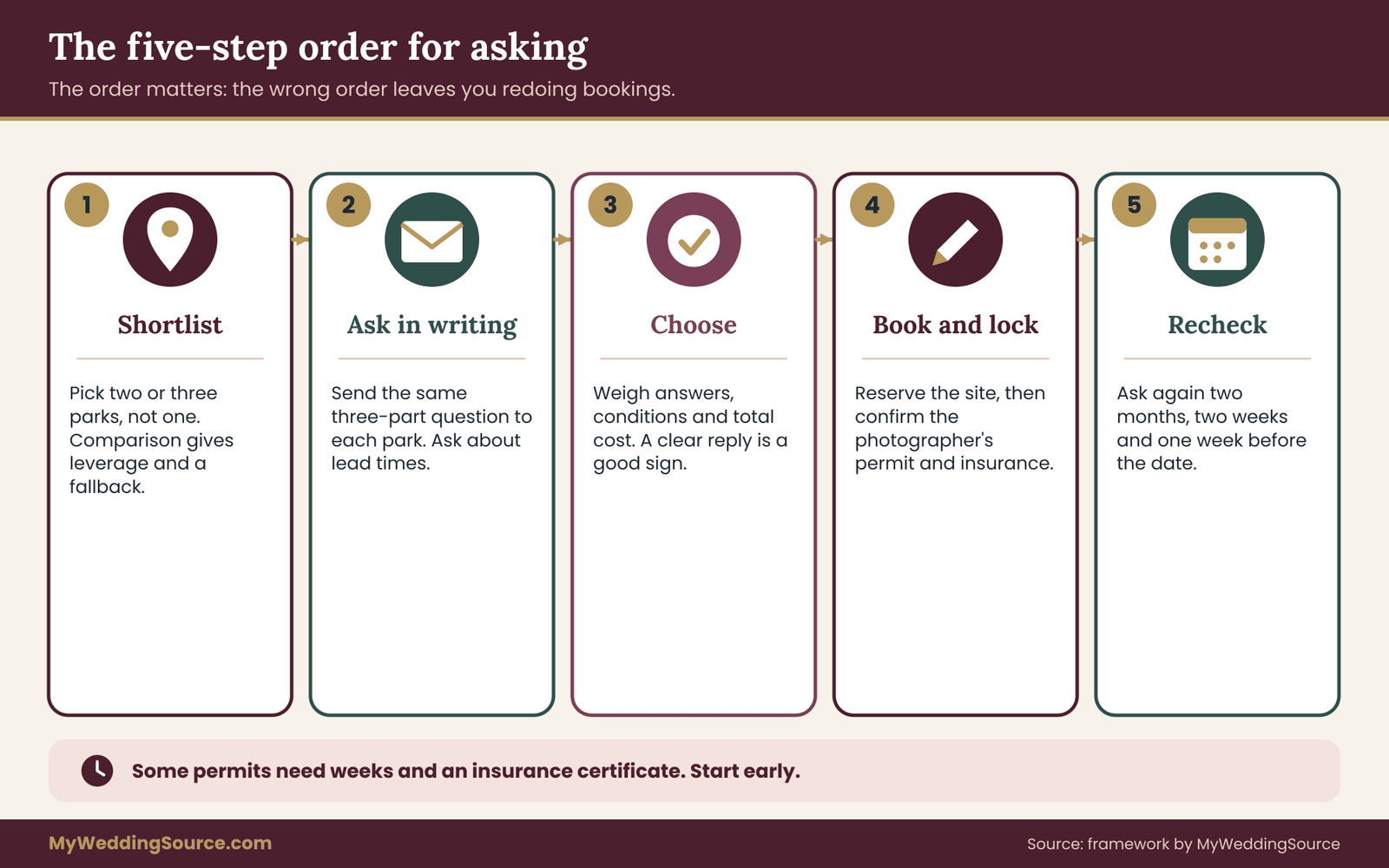
The sensible sequence has five steps, and it can be compressed or stretched depending on your timeline.
Step one: shortlist parks. Choose two or three, not one. The log is a comparison tool, and comparison gives you leverage and a fallback.
Step two: ask the three-part question. Send the same written question to each park at roughly the same time. Include the plan sentence and the eight switches. This is also the moment to ask about lead times, because some permits take weeks to process.
Step three: choose the park. Use the answers, the conditions and the total cost. A park that replies clearly and promptly is a better partner than one that replies vaguely, even if the site is slightly less scenic.
Step four: book the site, then lock the photographer. If your photographer is not yet hired, make the park’s rules part of your selection criteria. If they are hired, send the log and ask for written confirmation of their permit status. The planning guide on vendor timelines can help you place these steps among your other vendor deadlines.
Step five: recheck. Rules and conditions change. Ask again a few weeks before the date and again in the final week, and update the log each time.
Lead times you should not guess
Some park photography permits are processed quickly. Others take weeks, require a site visit or depend on a review meeting that happens monthly. The park will tell you if you ask, so ask early. If a permit needs a certificate of insurance, allow time for your photographer’s insurer to issue it. If it requires a signed agreement, allow time for both signatures. Each step looks small, and together they can consume a month.
For summer weekends and fall foliage weekends, parks can be busy, and staff may have less time to reply. Starting early is the simplest way to avoid that squeeze. If you are within a few weeks of the date and have not yet asked, call first, then follow with the written question the same day, and tell the office your date so they can prioritize.
Carrying your park photography paperwork on the day
On the wedding day, park photography is mostly invisible if the preparation was done well. The one moment it becomes visible is when a ranger, a gate attendant or a volunteer asks a simple question: who are you, and are you allowed to be here? The answer should take under a minute and should not require anyone to phone a vendor.
Assemble a small packet and give copies to three people: the photographer, the couple’s day-of coordinator or a trusted friend, and whoever drives the first vehicle into the park. The packet needs only a few items.
- The park’s written reply about park photography, printed or saved offline, since cell service in many parks is poor.
- The permit, registration or authorization, if one was required, with its dates and conditions.
- The photographer’s certificate of insurance, if the park asked for one.
- The ceremony reservation or site permit.
- The log page showing the plan sentence, so that everyone describes the session the same way.
- The name and phone number of the park contact, with the date of the last conversation.
Saving documents where signal is weak
Offline access matters more than people expect. State parks in forests, canyons and coastal areas often have patchy coverage, and a rule that is easy to confirm from home becomes impossible to confirm at the trailhead. Download PDFs to phones and keep one paper copy in a folder.
The idea is the same as the digital contingency habits in the guide to the wedding day digital contingency plan: assume the connection will fail at the worst moment, and keep the essential document where you can reach it.
What to say if you are asked
Most conversations with park staff about park photography on the day are routine. Staff are checking that the session matches what was approved, and that the plan will not harm the park or other visitors. A calm, specific reply works better than a long one. For example: “We have a ceremony reservation for this lawn from four to four-thirty, and our photographer has the park’s park photography permit. I can show you the paperwork.” Then show it.
If staff say something that contradicts your paperwork, do not argue in front of the guests. Ask politely who can confirm the rule, show the written reply, and offer to move to an area where the issue does not arise while it gets sorted out. A ranger has authority over the park, and the best outcome is a cooperative one. The day is better served by a short pause and a different backdrop than by a standoff.
Behavior and footprint in the park
Permits are one part of park photography. The other part is conduct. Even when a session is fully authorized, it can go wrong if people behave as though the park were a studio. A few habits make a large difference, and they matter to rangers and other visitors in the same way.
Stay on durable surfaces. Trails, lawns, gravel and rock are designed to take foot traffic. Meadows, dunes, wetland edges and the bases of trees are not. Photographers looking for a better angle often step into soft areas without noticing. Brief the wedding party and the photographer before you start, and name the areas that are off limits.
Carry out everything you brought. That includes flower petals, ribbon, confetti, tape, packaging and water bottles. The seven principles published by Leave No Trace, a nonprofit that works with land managers, are a good reference for the whole group and are listed among the sources. A bouquet toss or a petal shower may be prohibited outright, so confirm before you plan it.
Share space. A park is public land. Other visitors have the right to walk the path you are photographing on. Keep a lane open, pause for passers-by and avoid blocking viewpoints. A short sign stating that a session is in progress may help, but only if the park allows signs.
Wildlife and plants. Do not feed or approach animals for a picture. Do not pick flowers or branches for a bouquet or a backdrop. Some parks ban removing even fallen branches. A photographer who sees something striking should ask the park before using it, since the park may be protecting that very spot.
Noise and amplified sound. A portable speaker for a first dance portrait may be restricted by quiet hours or general park rules. This belongs in the equipment switch, and the answer should come from the park, not from assumption.
Guests and their phones
Your photographer is one person with one set of rules, but your guests are forty or more people with their own cameras. Most parks do not regulate visitors’ casual park photography, though they do regulate where visitors may stand and what they may do. Tell guests in advance which areas are open, which are not, and how to behave around wildlife and other visitors.
If you want an unplugged ceremony or limits on social posting, the wording and etiquette are covered in the guide to guest privacy and image use. Park rules and guest-privacy preferences are separate layers, and both can apply.
Access for guests and for the couple
Park photography plans often forget that some guests move differently. Lakeside lawns, boardwalks and overlooks may involve gravel, steps, slopes or long walks from the parking area. If a grandparent, a guest who uses a wheelchair or someone with limited stamina is in the portrait list, the route matters as much as the permit.
Ask the park which paths and viewpoints are accessible, whether accessible parking is close to the ceremony site and whether a vehicle may drop passengers closer. The U.S. Department of Justice publishes plain-language information on the Americans with Disabilities Act, and parks usually have their own accessibility pages.
Build the park photography schedule around those routes. Put the family groups who need the shortest walk at the beginning, near the ceremony site, and save the longer walks for the wedding party. If a scenic spot is not accessible, ask the photographer to bring the backdrop to the guest, by choosing a similar view that is reachable, instead of asking the guest to struggle toward the original.
The footprint rules still apply, and any extra vehicle access needs the park’s permission in advance, so include it in the same written question as the other park photography details.
Group portraits and family lists
A long list of family portraits can turn a short session into a long one, and long sessions are where park photography conditions bite: hours, crowd size, equipment time on site. Keep the list focused and give your photographer a short, prioritized group list. The guide to the wedding family photo list explains how to build one that moves quickly, and a shorter list lowers your footprint in the park as well as your stress.
The golden-hour trap in park photography
Light is the reason many couples choose park photography at all, and the best light often comes near sunrise or sunset. Those are also the hours when parks may be closed, gates may be locked and staff may be absent. Before you plan a sunset session, confirm in writing the closing time of the day-use area and the time by which vehicles must be out.
If the park closes at sunset, a portrait session that ends at sunset is a session that ends with a gate closing behind you. Plan the portraits for the hour before, and use the remaining time for a short, quick final set.
A short briefing for the wedding party
Five minutes before portraits, gather the group and cover four items: where you may walk, what you may not touch, who is the contact if a ranger asks a question, and what time the session ends. Name one person as the point of contact, ideally someone calm who is not in the photographs. That person carries the packet, speaks with staff and watches the clock. It is a small role, and it removes the single most stressful moment from the couple and the photographer.
Matching park photography paperwork to the three layers
By the day of the wedding, each layer of the original question should have an owner and a document. The site layer has the ceremony reservation or event permit. The activity layer has the photographer’s permit, registration or written confirmation that none is needed. The equipment layer has the park’s list of allowed and prohibited items, either in the permit or in a reply you saved.
If any layer has no document, you are relying on assumption for that layer, and the log should say so. A single gap does not mean the day will fail, but it tells you where to be most careful, and where a polite check with the park office a few days earlier would remove the doubt.
Special cases that change the answer
Some park photography situations deserve their own line in the log, because the usual assumptions break down. None is rare enough to ignore.
A small elopement with a photographer. Two people and a photographer feels like the lightest possible footprint, and it often is. But the paid-professional switch is still on, and some parks apply their commercial rules to any hired photographer regardless of group size. Others waive formal permits for sessions below a size threshold. Ask rather than assume, and ask in writing.
An out-of-state photographer. A photographer who travels to your park may not know the local rules and may not hold the state’s permit. Some state systems issue short-term or per-event permits. Others register only businesses with a local presence. If your photographer is traveling, begin the permit conversation earlier and add extra time for insurance paperwork.
A park inside a larger protected area. Some state parks sit inside, beside or within a federal or regional unit. A beach, a lighthouse or a scenic road may be managed by a different agency than the parking lot. If the map shows more than one logo, ask each agency, or ask the park which one controls the exact spot.
A venue operated by a concessionaire. When a lodge, pavilion or restaurant inside the park runs its own events, its policies usually cover park photography on its grounds. Some require you to use their preferred photographers or to pay an outside vendor fee. These rules are contractual, and the contract you sign controls them. Read it carefully, and ask for any park photography clause to be pointed out.
A historic structure or cultural site. Buildings, monuments and sacred or tribal sites within a park may be subject to additional protection. A park may restrict park photography there, require a staff escort or prohibit setups. If your vision depends on a specific structure, make it the first question in your message, not the last.
A park with a seasonal closure. Nesting seasons, high water, snow, fire risk and maintenance can close areas on short notice. Ask whether the area you want is subject to seasonal limits, and how and when closures are announced.
A session that is both ceremony and photo shoot. Many parks treat a ceremony with a small group differently from a staged shoot. If your plan is to have the ceremony and the portraits in the same two hours, describe it as one continuous event in your plan sentence, and ask the park whether it considers the park photography part of the ceremony permit or a separate activity.
Different rules for different products
If you are also planning video, a livestream for distant relatives or a short highlight film, ask about those separately. A park may allow a single photographer under its ordinary rules and still require a film permit for video equipment. A livestream may add power, bandwidth and crew questions. If your ceremony will be streamed, the checklists in the guides on digital contingency planning and venue technical walkthroughs help you plan for weak signal and power limits, and your park question should include those details.
Alternatives when a park photography permit does not fit
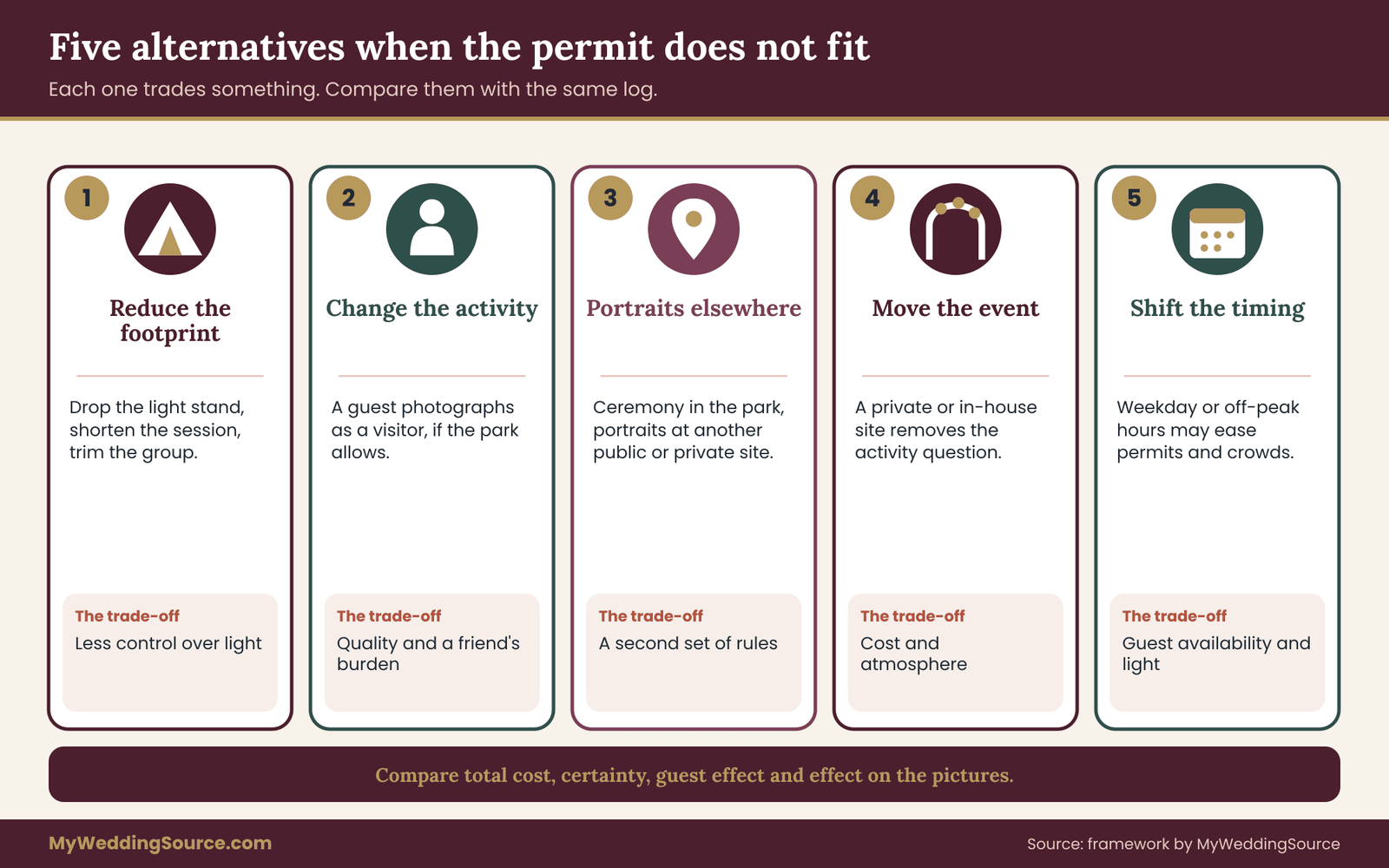
Sometimes the park photography answer is inconvenient. The fee is higher than expected, the lead time is too long, the insurance requirement is a barrier, or the park simply says no. At that point the question changes from “what does the park require?” to “what do we want from the park, and what is the lightest way to get it?” Alternatives fall into five groups, and each trades something for something else.
Keep the park, reduce the footprint. Ask whether a smaller version of the plan avoids the permit threshold. Dropping the light stand, trimming the session length or reducing the number of people in the photos may bring the session within ordinary visitor rules. The park will tell you if a threshold exists. The trade-off is less control over lighting and a shorter list of portraits.
Keep the park, change the activity. If the ceremony is permitted and only the professional photography is the problem, you can ask a guest or a friend to take photos as a visitor would. This may be allowed in many parks, but it is not a way around the rule if the person is hired in all but name, and the park decides what counts as commercial. It also changes the quality of the pictures and the burden on your friend, which is a real cost.
Hold the ceremony in the park and the portraits elsewhere. A nearby public garden, a town green, a private estate, a vineyard or a venue with a permission policy may offer similar scenery without the same rules. Check the rules of that place as well, using the same log. The guide to wedding venues explains how to ask the right questions of a private site, and the same method applies.
Hold the whole event somewhere else. If the park is the sticking point, a different site may meet the same goals more simply. A private property, a rented estate or a facility with in-house photographer rules can remove the activity question entirely. The trade-off is cost and a different atmosphere, and the decision should rest on what you actually value about the park.
Shift the timing. A weekday, an off-peak season or an earlier hour may make the permit easier to obtain, or the park less crowded, so the same plan draws less attention. The trade-off is guest availability and light.
Comparing alternatives fairly
Use the same log for each alternative, and compare four things in plain terms: total cost, certainty, effect on guests and effect on the pictures. Certainty deserves its own weight. An option that costs a little more but comes with a written yes is often better than a cheaper option that depends on a ranger’s mood on the day.
Guest effect matters too: longer drives, steeper paths and extra transfers affect older relatives and children, and the same questions come up in any guest care plan.
A useful test is to ask what you would do if you got the answer you fear most. If your answer is “we would simply have portraits somewhere else”, then the alternative is already your plan B, and you can stop worrying about the park’s reply. If your answer is “we would cancel the whole day”, the park is carrying more weight than it should, and you have a reason to build a different fallback.
Failure conditions: when park photography plans should change
A park photography log is only useful if it can say no. These are the conditions that should trigger a change of plan, a pause or an escalation. They are not signs that you have done anything wrong. They are signs that the plan needs to move.
No written answer by your internal deadline. Pick a date, for example six weeks before the wedding, by which every question needs a written reply. If a layer is still open on that date, move to the alternative for that layer.
Conflicting answers that cannot be resolved. If two offices disagree and neither will commit to a written rule, plan for the stricter reading, and keep a fallback ready.
A fee or insurance requirement that does not fit your budget. Do the arithmetic described earlier. If the total cost of the park path exceeds your limit, compare the alternatives on the same basis rather than stretching.
A permit that cannot be issued in time. If the lead time is longer than the time left, you can sometimes ask whether an expedited route exists. If not, it is a decision point.
An equipment ban that removes a shot you care about. If a prohibition on drones, tripods or lights removes something essential, decide whether you can replace it, not just whether you can work around it.
A photographer who will not engage. If your photographer refuses to confirm permit status or provide a certificate of insurance, and the park requires one, that is a vendor problem, not a park problem. The same vendor due diligence steps apply.
A closure or hazard announced before the date. If the park posts a closure, treat it as a trigger to re-open the log. Contact the park, ask for guidance in writing and activate your alternative.
What a good park photography fallback looks like
A good fallback has a location, a time, a person responsible and a decision date. It does not rely on goodwill or luck. For park photography, a fallback might be a second location ten minutes away with its own permission, a shortened session on the lawn with no equipment beyond handheld cameras, or a rescheduled portrait hour on a different day.
Write it in the log beside the primary plan, so that when a closure or a refusal arrives, you are following a page you already wrote.
Common park photography mistakes and how to avoid them
Most problems with park photography are not dramatic. They are small gaps that grow because nobody owned them. The mistakes below come up again and again in park-wedding planning, and each has a simple counter-move that fits into the log.
Assuming the ceremony permit covers everything. A reservation secures a place and a time. It may not authorize a business to work there, and it may not mention equipment. The counter-move is to ask the three-part question in every case, even when the answer turns out to be “yes, it is all covered”.
Asking only by phone. A phone call is quick, and it leaves nothing behind. If staff change, or a different ranger is on duty, you have nothing to show. The counter-move is a short written follow-up after every call, with a request to correct anything wrong.
Letting the photographer assume the couple handled it, and the couple assume the photographer did. This is the most common gap. Each party reasonably believes the other is responsible. The counter-move is a single line in the contract and one name in the log’s “who is asking” field.
Treating the drone as a detail. Aerial park photography is both popular and widely restricted. Planning a shot around it before confirming the rule invites disappointment. The counter-move is to ask about drones first, and to ask the photographer for an alternative vantage point that does not depend on one.
Reading a national rule as a state rule. The policies of one park system do not apply to another, and a federal page is not evidence about a state park. The counter-move is to look at the agency that actually manages your park and to cite its page in the log.
Trusting an old blog post, including this one. Fees, forms and rules change, and the park’s current page is the controlling source. The counter-move is to use any article, including this guide, to build the question list, and to confirm each answer against the park’s own current text.
Booking portraits for the last light. Many parks close or restrict access at dusk. The counter-move is to confirm closing times in writing and to schedule the main portraits earlier.
Ignoring conditions in the approval. An approval may come with conditions: arrive by a certain hour, avoid certain areas, keep to a number of people, carry the permit. A “yes” with conditions is only a yes if the conditions are followed. The counter-move is to list them in the log and brief the people who need to follow them.
Forgetting the photographer’s insurance paperwork. The park may ask for a certificate weeks ahead, and an insurer needs time to issue one. The counter-move is to request it at contract signing, not at the last minute.
Keeping the park photography log current
Approval is not the end of the log. Plans drift, and so do rules. Check the log at four moments. When you sign the photographer’s contract, so that the plan sentence matches the booking. About two months before the date, to confirm that fees, forms and lead times have not changed.
About two weeks before, to confirm the permit paperwork is in hand and that closures, weather or construction have not altered the area. And in the final week, to print the packet and brief the point person.
At each check, add a dated line rather than overwriting the earlier one. A log that shows how the plan evolved is more useful than one that shows only the final state, because it tells you whether a surprise is new or was in the notes all along.
When something changes, tell the people who depend on it: the photographer, the coordinator and, if it affects them, the guests. Wedding days run on shared information, and the same principle underlies the habit of sending written updates to every vendor.
When to ask for help
You do not have to do all of this alone. A wedding planner, a day-of coordinator or a venue manager who has worked in the park may know the local routine and the right person to ask. A local photographer’s association may have members who work in the park regularly.
Ask for introductions, but still confirm the answer with the park, since a colleague’s experience is not a rule. Treat advice as a source of better questions, not as a substitute for the park’s own words.
If you are unsure whether a rule applies to you, say so to the park office. Staff are generally more comfortable with a question that shows you are trying to follow the rules than with an assumption they discover later. A simple, specific question, asked early and in writing, is the most useful thing you can send.
Your next steps
Start with one evening. Write the plan sentence for your session and mark the eight switches as on, off or unknown. Shortlist two parks, and send each the same three-part written question about site, activity and equipment. Ask your photographer whether they hold any permit for those parks, and request a certificate of insurance if the park asks for one.
Then work the park photography log. Sort each reply as green, amber or red, send narrow follow-ups for the amber ones, and set an internal deadline for written answers. Compare the parks on total cost, certainty, guest effect and effect on the pictures. Choose, write the fallback beside the primary plan, and add the packet to your day-of folder. Done this way, park photography becomes a short chain of written answers, not a worry you carry to the trailhead.
FAQ
Do I need a separate permit for a photographer at a state park wedding?
Maybe. Some state park photography rules treat a hired photographer as a business that needs its own permit or registration. Others cover park photography under the ceremony permit, and a few ask only about larger productions. Rules vary by state and sometimes by park. Ask the park in writing about the site, the activity and the equipment, and keep the reply.
Who is responsible for getting the permit, the couple or the photographer?
It depends on the park and on your contract. Some parks want the professional to hold the commercial permit, while others want the event host to apply. Settle it in writing with your photographer, and record in your log who is asking and who pays any fee. Confirm the arrangement with the park office as well.
Are drones allowed for wedding photos in state parks?
Often not. Many state park photography rules restrict or prohibit drones, and federal aviation rules apply on top of park rules. Treat a drone shot as its own question and ask the park directly. Do not plan a key shot around one before you have a written answer, and ask your photographer for an alternative vantage point.
Does a ceremony reservation include park photography rights?
Not necessarily. Park photography is a separate matter: a reservation usually secures the place, date and time for your group. It may not authorize a business to operate in the park, and it may not mention equipment such as tripods or lights. Ask the park whether the photographer needs separate authorization, and request the answer in writing.
What if a ranger questions our photographer on the wedding day?
Stay calm and show your paperwork: the ceremony reservation, any park photography permit or registration, the written park reply and the photographer’s insurance certificate if one was required. Ask who can confirm any disputed rule. If needed, move to a location that avoids the issue while it is sorted out, and keep the exchange courteous.
What fees might apply to wedding photography in a park?
Parks may charge application fees, per-session or annual permit fees, deposits, and admission fees for the photographer and guests. Photographers may also need insurance. Amounts and structures differ by park and change over time, so ask for a complete current list, and check who pays each item under your photographer’s contract.
How early should we ask the park about park photography rules?
As early as you shortlist the park, and before you sign a photographer. Some permits need weeks for review, insurance certificates take time to issue, and busy seasons slow replies. Send the written question when you compare sites, set an internal deadline for answers, and recheck a few weeks before the wedding.
What if the park says no or the permit does not fit our plan?
Compare alternatives using the same log. You can reduce the footprint of the session, hold the ceremony in the park and portraits elsewhere, move the whole event, or shift the timing. Choose on total cost, certainty, guest impact and the effect on your pictures, and write the fallback beside the main plan.
Sources
- National Park Service
- National Association of State Park Directors
- State governments, USAGov
- Unmanned aircraft systems, Federal Aviation Administration
- Americans with Disabilities Act, U.S. Department of Justice
- U.S. Copyright Office
- Recreation.gov
- Leave No Trace Center for Outdoor Ethics
- U.S. Small Business Administration, insurance basics