
A party curfew is the clock that decides when music, bar service, staff and guests all have to be finished, and most surprise overtime bills come from never writing that clock down for each vendor. This guide gives you a staffing strike and signoff schedule: a single page that sets a release time and a named approver for every person you are paying, so the night ends on your terms instead of on the vendors’ invoices.
Find the earliest real stop time for your evening (venue lockout, noise rule, permit, last call or the last safe ride home). That is your party curfew. Work backward from it to give each vendor a release time: the moment they stop performing, start packing and are then free to leave. Put the release time, the overtime rate and one person who may approve extra time on a one-page signoff sheet, and have each vendor confirm it in writing before the wedding. Overtime becomes a choice, not a surprise.
Anyone who has watched a good wedding run long knows the pattern. The dance floor is full at the contracted end time, the DJ looks at the couple, the couple looks at the planner or at a parent, and somebody says “just one more hour.” Nobody is wrong to want it.
But the sentence has a price, and the price is usually set by clauses nobody reread: hourly overtime at a higher rate, a minimum block rather than the actual minutes, a second charge for a bartender who has to stay with the DJ, and a venue fee for every fifteen minutes past lockout.
This article is about preventing that moment from being a surprise. It is not about whether to have a late night at all. If you are still deciding what kind of late-night event to plan, the broader reception and timeline guides on this site cover that, and this article starts after the decision. It covers one narrow job: ending the evening cleanly inside your party curfew, with the right people leaving at the right times and nobody paying for time you did not choose to buy.
A note on scope. This is general planning information, not legal, tax or financial advice. Curfews, alcohol service hours, noise rules, worker hour rules and contract terms differ by place and by agreement, so confirm the details that matter with the venue, the local authority and the vendor’s own paperwork.
What a party curfew is, and why vendors treat it differently
In everyday conversation people say “the party ends at eleven” and mean three or four different things. The music stops. The bar closes. The guests leave. The room is empty and the venue can lock the door. Each of those is a separate event, a separate person’s job and often a separate line on a contract. A party curfew, as this guide uses the term, is the latest of those events that you cannot move, the point after which something happens that you cannot negotiate away on the night.
That definition matters because vendors do not experience the end of your party the way you do. A guest sees a dance floor. A DJ sees a ninety-minute load-out of speakers, lighting and cable that begins when the last song ends, not before. A bartender sees a cash-out, a count, a cleanup and a restock of whatever belongs to the company.
A photographer sees the last useful frames and then a drive home with equipment. A rental crew sees chairs to stack and linens to count. None of these people are idle when the party stops. They start a second shift, and the second shift has its own end.
This is why a contract that says “reception ends at midnight” can still produce overtime. The vendors who strike the room are paid for the time they are present, and the schedule for presence is usually measured from the first arrival to the last carried case, not from the first song to the last song.
If your party curfew is midnight and a vendor needs ninety minutes to leave, the real finish for that vendor is one-thirty in the morning, and an invoice that assumed midnight will be wrong in a way that is entirely foreseeable.
Three different clocks around a party curfew
It helps to separate three clocks that people blur together.
The performance clock is when the thing guests see ends: the last song, last call, last dance. The strike clock is when the work of removing equipment and restoring the room happens. The access clock is when the venue lets people in and requires them out. Your party curfew is usually set by the access clock or by a rule outside your control, and the other two have to fit inside it.
Most overtime problems around a party curfew are a collision between the performance clock and the access clock. Couples plan the performance clock because it is the fun part. Venues enforce the access clock because it is their contract. The strike clock sits between them and is the one that nobody wrote down.
Why this is a staffing question, not only a timing question
Overtime is the price of people, not of minutes. When the night runs long, the cost rises for three reasons: a vendor’s rate may increase after the contracted hours, a vendor may have to keep a second staff member longer, and some vendors bill in blocks so that ten extra minutes is charged as sixty. That is why this guide frames the topic as a staffing strike: you are deciding, vendor by vendor, which people stop work when, and who is allowed to say otherwise.
It also explains the word “signoff.” A release time written only in your head does nothing. A release time that the vendor has confirmed, and that has one named person who may change it, is something a planner, a parent or a best man can actually enforce at eleven fifty-five at night when everyone is tired and the room is loud.
Where a party curfew actually comes from
Before building any schedule, find out which rule is the real one. People often assume the curfew is the venue’s lockout time, then discover a second, earlier limit that nobody mentioned. Look at each of these sources in turn.
The venue contract. Most venues state an event end time and a time by which all guests and vendors must be out. The two are often different: an event might end at eleven with everyone out by midnight. Read both lines, and read any wording about what happens if you stay past them. Some venues charge by the hour, some by the quarter hour, and some treat a late exit as a deposit deduction.
Local noise rules. Many cities and counties have noise ordinances, sometimes with a different limit after a stated hour, and sometimes a separate standard for amplified sound outdoors. These rules are set locally, not by the venue or the couple, and an outdoor or tent wedding can be affected even when the venue is otherwise flexible. Ask the venue how they handle this, and check with the local authority if the venue cannot answer clearly.
Alcohol service rules. Jurisdictions set hours during which alcohol can be sold or served, and a licensed caterer or bartender follows those hours whatever the contract says. A bar that must stop at a given hour makes that hour the practical end of the party for many guests, even if music is allowed to continue.
Special event or street permits. If your event uses a public space, a closed street or a temporary tent, the permit may carry its own end time, and it can differ from the venue’s.
Neighbors and residential limits. For homes, estates and some rural venues, an agreement with neighbors or a homeowner association rule may limit late-night activity even when no law does. Your venue coordinator usually knows whether complaints have been a pattern.
Transport reality. A party can be legally allowed to run until two in the morning and still be practically over at eleven-thirty because the last shuttle, the last hotel desk staff or the last reasonable ride home leaves then. Guests stranded outside at midnight with no ride are a familiar planning failure. Your transport plan is part of your party curfew, and the reception flow guide on this site covers the exit side of that in more detail.

The rule of the earliest real stop
Of all these sources, the one that wins is the earliest one that you cannot change on the night. Write each down with its time and the person who can confirm it. Then circle the earliest. That is your party curfew and the anchor for everything else in this guide, and it is the number that goes at the top of your signoff sheet.
Be careful with a source you “think” is flexible. A venue manager who says “we usually let people go a bit over” is describing a habit, not a promise, and it will not help you at the moment a neighbor calls or a manager’s own shift ends. Treat anything that is not in writing as a hope. If you want the extra time, ask for it in writing as an extension and price it, which the later sections explain.
A short example of the earliest stop in practice
Imagine a couple whose venue lets events run to midnight, with all guests and vendors out by one. The city has a quiet hour that begins at eleven for amplified outdoor sound, and the venue’s courtyard is where the dancing happens. The bar is licensed to serve until midnight. Their party curfew is not midnight and not one in the morning.
For the courtyard it is eleven, because that is when amplified sound has to stop, and the dance floor must either move indoors or end at that time. The party curfew for that space is eleven, so the strike clock has to start at eleven for the outdoor sound system, even though the venue would have allowed another hour.
That example is invented for illustration, but the structure is common: three real limits, three different times, and a party curfew that is the earliest of them for the activity in question. Finding the party curfew early, rather than discovering it at ten fifty-five on the night, is most of the work. A party curfew you can name, with its source, is also much easier to defend when a guest pushes back.
The strike-and-signoff schedule: the method in one page
The staffing strike and signoff schedule is a single page with one row per paid person or crew. It has six columns, all hanging from the party curfew, which this article builds one at a time: the vendor, the last performance minute, the strike length, the release time, the overtime terms and the signoff owner. If you fill it in properly, a stranger holding the sheet at the venue could run the end of your night without calling you.
Here is the logic in short. Start with the party curfew. Subtract the time each vendor needs to strike and leave, plus a small buffer. The result is the latest moment that vendor can stop performing. Then decide whether you want them to stop earlier, at the same time as everyone else, or later through an extension you have priced in advance. Finally, name one person who is allowed to change any of it, and write down the maximum they may spend.
The six columns, explained
Vendor and role. List every person you are paying who is still present in the last two hours: the DJ or band, the bartenders, the caterer’s service staff, the photographer and videographer, the coordinator, the rental or setup crew, security, transport drivers and any attendant for coat check, kids or accessibility needs. Do not forget the people the venue supplies and bills you for, such as a cleaning crew or a security guard.
Last performance minute. The latest minute the vendor’s visible work continues. For a DJ it is the last song. For a bar it is last call. For a photographer it is the last shot you want. For a coordinator it may be the moment the last guest has left, which is later than anyone else’s.
Strike length. How long the vendor needs after the last performance minute to be out of the room. Ask for this number; do not guess it. A DJ with a single speaker and a laptop may need twenty minutes, and one with a lighting rig and truss may need much more. A caterer breaking down a full dinner service has a longer strike than one finishing a dessert station.
Release time. The moment the vendor is free to leave, after which they may not be asked to do more without a new agreement. This equals the last performance minute plus the strike length. If the release time is later than the party curfew, you have a problem to solve before the wedding, not on it.
Overtime terms. The hourly rate after the contracted hours, the billing increment (minute, fifteen minutes, hour), any minimum block, and the notice required to extend. This is read from the vendor’s contract or written quote, not from memory.
Signoff owner. One named person who can approve extra time, and a cap on what they can approve. Others on the schedule may ask. Only that person decides.

Why one page, and why written
A party curfew spread across emails and phone calls fails exactly when it is needed. The point of a single page is that it can be handed to a venue manager, a coordinator, a family member and every vendor, and everyone sees the same numbers. Many vendors already work from a run of show or timeline, and your signoff sheet can be attached to it, or its rows can be copied into it.
The vendor timeline guide on this site covers how to build that wider run of show, and the signoff sheet is the part of it that governs endings.
Written also means confirmable, and a party curfew that vendors have confirmed is one they cannot later say they never heard. Ask each vendor to reply to the sheet with a short message that they have read their row and agree. That reply, together with the contract, is what you rely on if there is a later disagreement about what was promised.
Step one: finding the earliest hard stop behind your party curfew
Everything on the schedule hangs from one number, so spend real effort on it. The goal is a single time, in writing, that you can defend.
Collect the limits behind your party curfew
Make a short list with the heading “What stops us, and when.” For each source from the previous section, write the time and where it is written down. A realistic list for a venue wedding might be: venue event end, venue all-out time, amplified sound limit, last call under the alcohol license, last scheduled shuttle, and the time the hotel desk shifts to a skeleton staff. Some entries will be blank because nobody has asked yet. A blank is a task, not an answer.
Ask the venue three direct questions and get the replies by email. What is the exact time the event must end, and what is the exact time everyone must be out? What happens, in dollars and consequences, if we are over either? Who on your staff decides on the night, and what is their number? The third question is the one most couples forget, and it matters because a policy that depends on one manager’s mood is not a policy.
Decide what the party curfew applies to
The anchor is not the same for every activity. A venue may allow indoor music until midnight but require outdoor amplified sound to stop at ten. A caterer may be allowed to serve alcohol only until eleven even though the venue is open later. When the limits differ by area or activity, record them separately and treat the earliest one for each vendor’s work as that vendor’s anchor. The overall party curfew is then the point at which the last activity must be over and the room restored.
Add the exit buffer
Subtract a buffer from the anchor so that the evening does not depend on perfection. A common-sense buffer is the time it takes the last guests to collect coats, bags, gifts and rides, and the time it takes the venue to walk the space with you. Fifteen to thirty minutes is a reasonable starting range for an ordinary reception.
A larger group, an outdoor site with a long walk to parking, or a wedding with many older or less mobile guests needs longer. The buffer is where your party curfew becomes a real time that is slightly earlier than the legal or contractual one.
This is a judgment, not a rule, and you should adjust it to your own venue. If you have never seen the room empty out, ask the venue coordinator how long a typical exit takes there, since they will have watched it many times.
Record the party curfew and share it
When you have the party curfew, write it at the top of the sheet in plain words. For example, “Music ends, bar closed and guests moving to rides by eleven-fifteen; all vendors out by midnight; venue locks at twelve-thirty.” Then send the line to the venue, the coordinator and each vendor. If a vendor replies that their contract says something different, you have found a conflict while there is still time to fix it.
What to do if the party curfew is earlier than you hoped
Sometimes the research gives bad news about the party curfew. The outdoor sound limit is ten, but you imagined dancing until eleven-thirty. Do not hide this. You have four honest options: move the dancing indoors, shorten the plan, pay for a venue extension if one exists, or take the last part of the night somewhere else.
The later section comparing ways to end the night goes through each. What you should not do is hope the rule will not be enforced, because the consequences usually land on you or on a vendor who then charges you for it. ## Reading overtime terms before they meet your party curfew
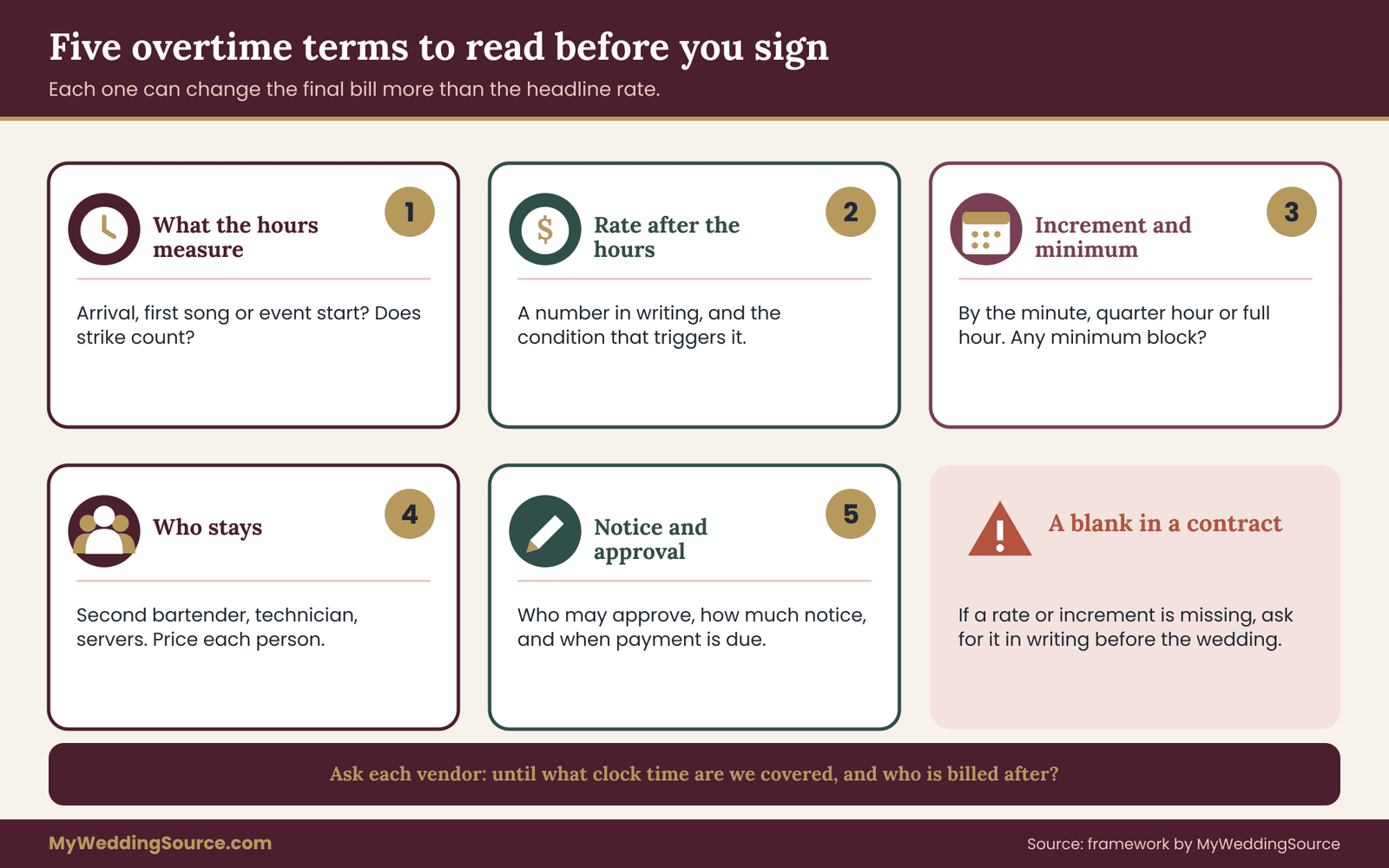
Overtime language, the thing that makes a party curfew expensive, lives in the contract, the quote or an attached rate sheet, and it is almost never where you expect it. Read the whole vendor contract once with a single question in mind: what happens to the price if the work runs past the contracted end? The answers fall into five parts, and each one can change the cost by a large factor.
Part one: what “the contracted hours” measure
Some contracts count from the vendor’s arrival, some from the start of service, and some from the start of the event. A photographer may sell “eight hours of coverage” that begin when they arrive at the getting-ready location. A DJ may sell “four hours of music” that begin when the first song plays, with setup and strike unpaid.
A bar company may charge by the bartender-hour from the moment staff arrive. These are different products with the same label. If you are comparing two quotes, convert both to the same question about your party curfew: until what clock time are we covered, and does that include strike?
Part two: the rate after the contracted hours
Some vendors charge the same hourly rate for extra time. Others charge a higher overtime rate, sometimes expressed as a multiple, sometimes as a flat figure per hour. A few apply a premium only after a late hour, such as after midnight, because of their own staffing rules. Write down the exact figure and the condition that triggers it. If the contract says “overtime rates apply” with no number, ask for the number in writing, because a blank in a contract is resolved in the vendor’s favor more often than yours.
Part three: the billing increment and minimum block that a party curfew can trigger
This is the clause that produces most surprises. A vendor may bill by the minute, by fifteen minutes, by half hour or by the full hour. A vendor may also require a minimum overtime block, so that staying twelve minutes past the end costs one full hour. Ask for the increment and the minimum, and compare them against how late you realistically think the night could run. If you expect only small overruns, a minute or fifteen-minute increment can be worth more to you than a lower hourly rate.
Part four: who is staying, not only how long
A common hidden cost is the second person. A bar that is open one more hour needs a bartender, a backup, perhaps a manager, and someone to handle cash. A band or a DJ with a technician may bill both. A caterer extending service needs servers, not just a chef.
When you ask for the overtime price, ask for it per person and ask how many people stay. Then ask a second question: if the bar closes at the scheduled time but music continues, does anyone from the bar have to remain on site, and are they billed?
Part five: notice, approval and payment
Many contracts require advance notice for an extension, written approval from a named person, or payment on the night. Some allow an extension by verbal agreement and then bill later. Know which. If the signed contract says only the person who signed it may approve extra time, then your signoff owner needs to be that person, or the contract needs an amendment naming someone else. This is the clause that connects the paperwork to your signoff sheet and to your party curfew.
Two clauses that are easy to miss
The first is the early-start and early-arrival clause. Some vendors charge for staff time before the event if the venue’s load-in window forces them to arrive earlier than planned. That is not overtime in the strict sense, but it appears on the same invoice and feels the same. Ask whether the contracted hours include it.
The second is the late-exit venue charge. If the venue bills for every fifteen minutes after the all-out time, the cost is yours, but a vendor’s slow strike can cause it. Your contract with the vendor may say nothing about that. If a vendor’s equipment is the reason you pay a venue penalty, you will want to have agreed in advance on their release time, which is the point of the signoff sheet.
Questions to ask each vendor, with plain wording
The following questions are written to be sent by email, so that each answer is in writing. Adjust the wording to the vendor and keep each message short.
For a DJ or band: “What time does your contracted time end, and does it include load-out? How long does your load-out take with the equipment we have booked? What is your hourly rate after that, and do you bill by the minute, fifteen minutes or the hour? Is there a minimum extension? If we want to stop earlier than the contract, do we owe you the full contracted time?”
For a bar or beverage service: “What time does last call happen under our license and contract, and how long after that does your team stay for cleanup? If music continues after the bar closes, do you need to keep a person on site? What is your overtime rate and billing increment? Can you give us a written closing procedure?”
For a caterer: “When does service end, and when does the team finish breakdown? What do you charge if guests are still eating, or if dessert or late-night food arrives after the planned end? How many staff would be needed for each additional hour?”
For a photographer or videographer: “Is the last hour of coverage during the party or the exit? If we want you to leave at the cake cutting or the grand exit, is any of the fee returned or credited? What is the additional hour rate and the minimum?”
For a rental or decor company: “What time do you pick up, and does the pickup window depend on the venue’s all-out time? If the room is not clear in time, what do you charge for a second trip?”
For the venue: “What are the exact end and all-out times? What are the charges for every fifteen minutes beyond? Who approves an extension on the night, and can a written extension be added before the wedding at a known price?”
How to read the answers
You are looking for three things. First, a number for every rate and increment, in writing. Second, strike lengths that fit inside your party curfew once you add them to the last performance minute. Third, a vendor willing to confirm the release time on your sheet. A vendor who answers with confidence and specifics is a good sign. A vendor who says “we’ll work it out on the night” is telling you the price will be set at the worst possible moment.
The vendor due diligence checklist covers how to compare vendors more broadly, and it can help you decide how much weight to give a vague answer on overtime in the context of everything else you know about a company.
Putting numbers into the schedule
Create a small working list as the answers come in. For each vendor, write: contracted end, strike length, release time, overtime rate, increment, minimum, approval method. The next step is to compare each release time with your party curfew, row by row. Any vendor whose release time falls after it needs a fix, and there are only four fixes: shorten what they have to do, start their strike earlier, add an agreed extension in advance, or have them stage their exit, which the staged release section below describes.
A note on negotiation around the party curfew
You have more leverage before signing than after, and a firm party curfew gives you something concrete to negotiate around. If a quote has a high overtime rate or a one-hour minimum, ask if they would change to a quarter-hour increment, or whether a pre-purchased extra hour could be included at a lower rate.
Some vendors will agree to a “reserve hour” that is billed only if used. Not every vendor will, and you should not assume it, but the question costs nothing and the answer clarifies what you are buying. Keep any change in an amended contract or a signed addendum, not in a chat message.
What this does not cover
This article does not set a price or declare any rate normal. Rates vary by market and by vendor, and any figure in a worked example later in this guide is invented for illustration. Quote the vendor’s own terms in your plan, and obtain your own written estimates.
A worked example: a party curfew of eleven-thirty
The following party curfew example is invented, and every figure in it is made up to show the method. Do not read any of the rates as typical. Use your own contracts.
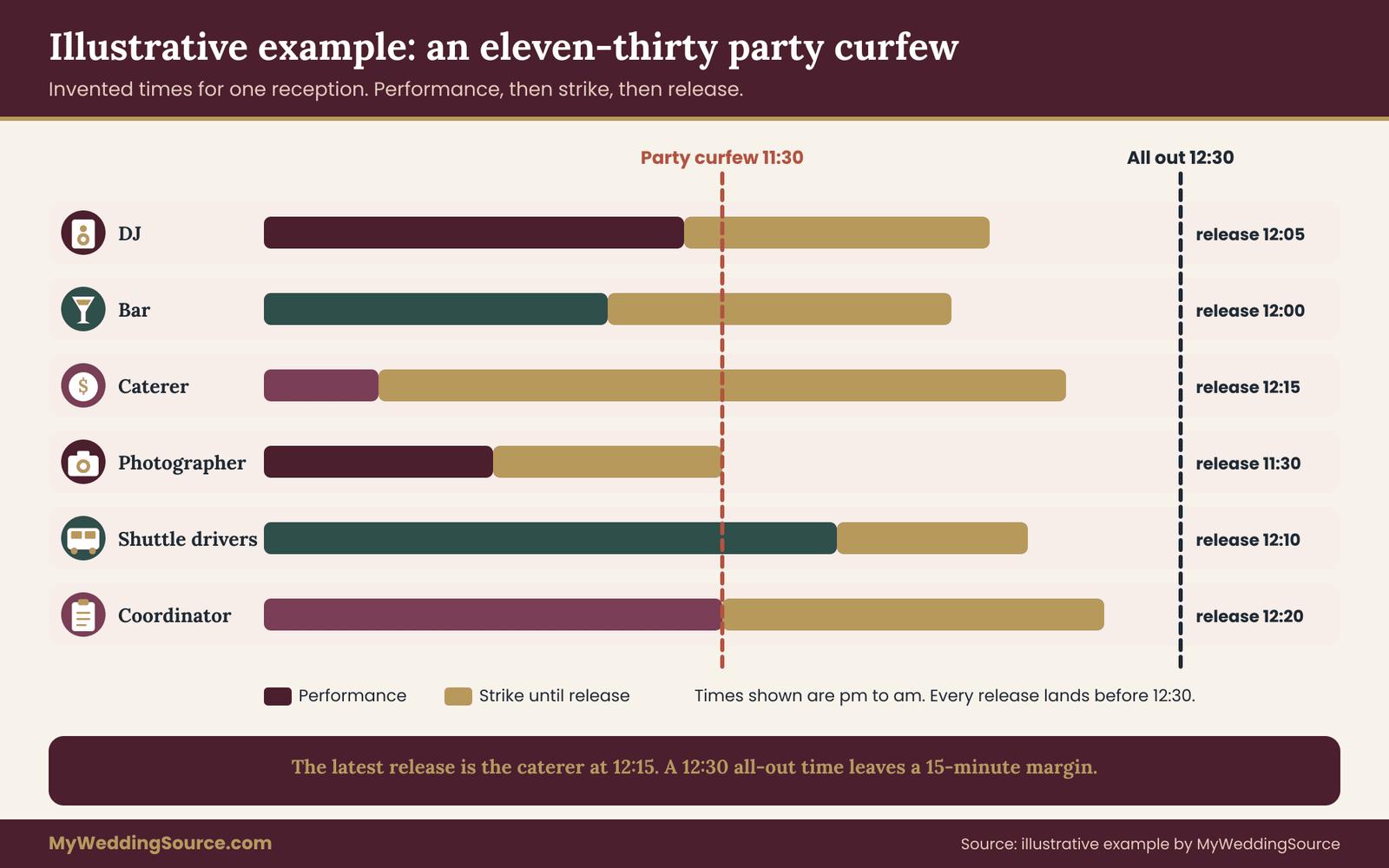
Imagine a couple with an indoor reception. The venue contract says the event must end at eleven-thirty and everyone must be out by twelve-thirty. The city’s amplified sound rule matches the event end. The bar’s license allows service until eleven-fifteen. The last shuttle to the hotel leaves at twelve. The earliest hard stop for music is eleven-thirty, so that is the party curfew, and the all-out time of twelve-thirty becomes the outer wall for strike.
Filling in the rows
The couple asks each vendor for the last performance minute they want, the strike length and the overtime terms. The answers go on the sheet.
The DJ plays the last song at eleven-twenty-five. The DJ’s load-out takes forty minutes, so the release time is twelve-five. The contract covers music until eleven-thirty with strike included, and extra time is billed at a set hourly rate in thirty-minute increments.
The bar calls last call at eleven, closes at eleven-fifteen and needs forty-five minutes for cash-out and cleanup, so the release time is twelve. Two bartenders are on site. The contract has a one-hour minimum for any extension.
The caterer finishes dessert service at ten-fifteen and breakdown takes ninety minutes after the last plate leaves, which puts the release time at twelve-fifteen. This is the latest vendor finish and it is still before the venue’s all-out time.
The photographer is covering until eleven. The photo contract has a one-hour minimum for extra coverage. The couple decides the grand exit will be at eleven-fifteen, so the photographer’s release is eleven-thirty.
The coordinator’s release is when the last vendor is out and the venue walkthrough is signed, which is twelve-twenty. The shuttle company runs at eleven-forty-five and twelve, so the drivers’ release is twelve-ten.
Look at what the sheet reveals before the wedding. Every release time is earlier than twelve-thirty. The latest is the caterer at twelve-fifteen, which leaves a fifteen-minute margin. The party curfew of eleven-thirty is the last moment of music, and the strike happens inside the venue’s remaining hour. Nothing on the sheet pushes past the party curfew or forces overtime unless the couple chooses to extend.
The night the guests ask for more past the party curfew
At eleven-ten, a guest asks the DJ to keep going. The couple would love to. Here is how it plays out without a schedule and with one.
Without a schedule, somebody says “sure, thirty more minutes.” The DJ’s extra half hour is one billing increment, so in this invented example it costs seventy-five dollars. The photographer, still holding a camera, says, “I’ll stay,” and the one-hour minimum turns twenty minutes of photos into a three hundred dollar charge.
The two bartenders are told to keep the bar open “a little longer” and each triggers the one-hour minimum, a hundred and ten dollars between them. The extra half hour of fun costs four hundred and eighty-five dollars, and nobody agreed to that number.
With the schedule, the signoff owner, here the coordinator, looks at the sheet. The cap approved in advance is one hundred and fifty dollars. The DJ extension is seventy-five and fits. The photographer’s release is already eleven-thirty, so nobody asks them to stay. The bar closed at eleven-fifteen as planned, and the extra music happens without bar staff. The coordinator approves the DJ’s thirty minutes, writes the time and the amount on the sheet, and the night ends at midnight-ish with a known total.
The same wish costs seventy-five dollars instead of four hundred and eighty-five, not because anyone negotiated, but because the sheet made each person’s release a separate decision instead of one blanket “keep going.” The lesson about the party curfew is not that late nights are expensive. It is that a late night is cheap when the people who must stay are chosen on purpose.
Checking the example against the all-out time
After the extension, the DJ’s last song is midnight and the strike takes forty minutes, putting the DJ’s release at twelve-forty, ten minutes after the venue’s all-out time. That is a real problem the schedule has made visible. The fix is to cap the extension at fifteen minutes, move the DJ’s strike earlier by having the lighting stand packed during the final songs, or ask the venue whether a short written extension to one o’clock is available at a known price.
The coordinator, holding the sheet, can see the problem in a minute. Without it, the discovery would come at twelve-thirty-five when the manager arrives with a clipboard.
This is the second use of the method. It does not only protect against vendor overtime. It also protects against the venue’s late-exit fees, which often scale by the quarter hour and are billed to the couple regardless of whose equipment caused the delay.
Staging the release at a party curfew: who leaves when
A party curfew does not need everyone to stop at the same moment. In fact, it rarely should. The cheapest and calmest way to end a night is a staged release, where each vendor leaves as soon as their part of the evening is complete, and only the people who are still needed stay.
The usual order of departure at a party curfew
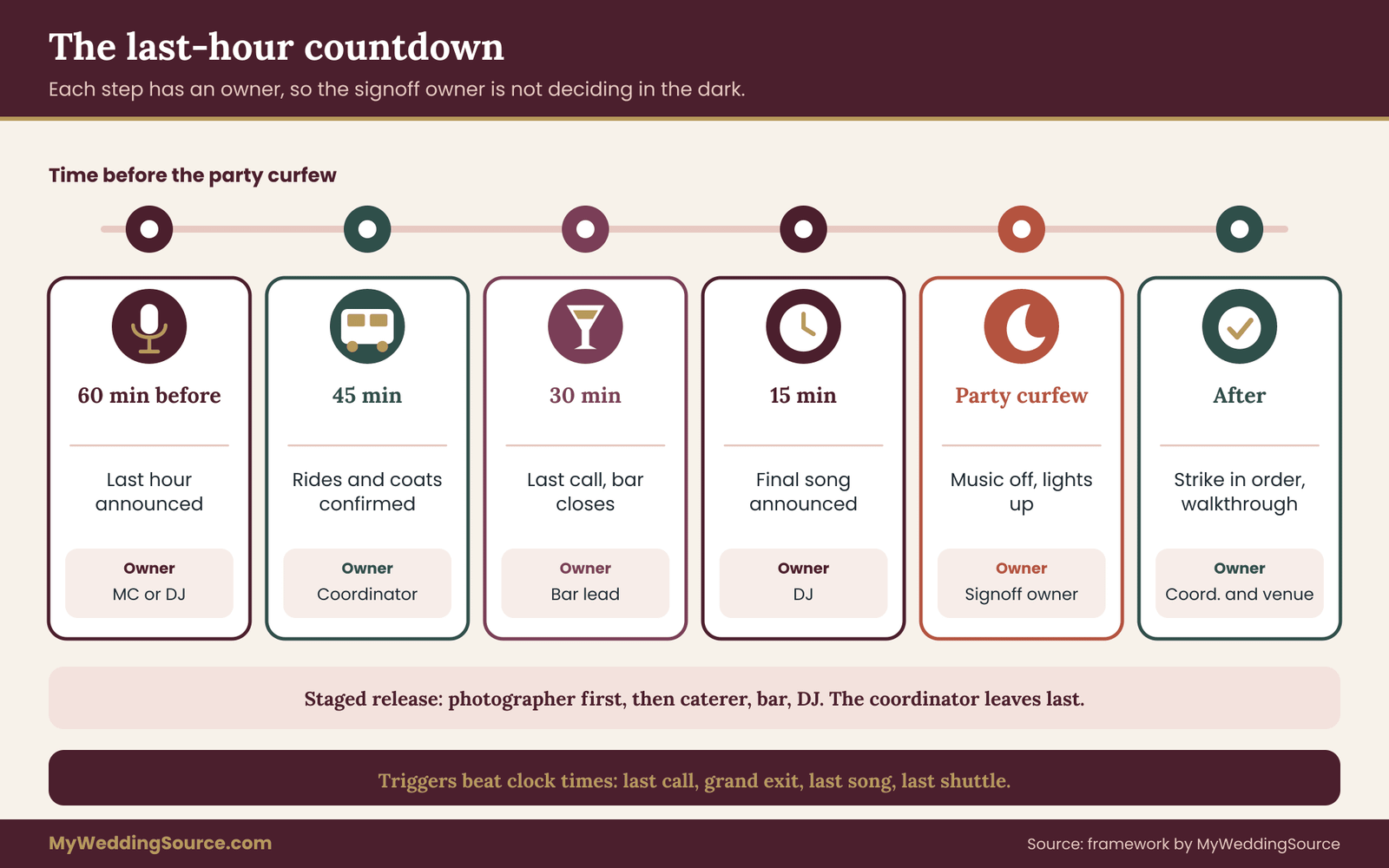
The photographer typically goes first, because the useful part of coverage ends before the party does. Many couples choose the grand exit, or the last high-energy dance, as the stopping point. The caterer’s service staff are next, after dessert and any late-night food, though their breakdown crew may stay longer. Bar staff go after last call and cleanup. The DJ or band goes after the last song and strike. The coordinator stays until the last vendor and the last guest are out and the venue has walked the room.
Writing this order on the sheet, with a time next to each, turns a messy ending into a sequence that every vendor can see. It also tells each of them who is still present after them, which tends to reduce the “just one more thing” requests that bring overtime.
Triggers rather than clock times
Clock times are the plan. Triggers are what you use on the night. A trigger is an event that tells a vendor to start their release: last call announced, cake cut, grand exit completed, last song played. If your plan says “photographer released at the grand exit, no later than eleven-thirty,” the vendor does not have to check a clock while the room is noisy and the couple is dancing. They see the event and they know.
Pick triggers that are visible and unambiguous. “When the couple leaves” is better than “when the party winds down.” “When the last shuttle departs” is better than “when most guests are gone.”
The countdown: what happens in the last hour
A simple countdown, which can be copied into the wider vendor timeline, reduces the number of decisions the signoff owner makes in the dark. The timings below are the shape, not a rule, and you can adjust them.
Sixty minutes before the party curfew: the DJ or MC announces the last hour. This gives guests a chance to decide on food, rides and goodbyes and helps the parents who are leaving early. Forty-five minutes before: the coordinator confirms the shuttle and rideshare plan and checks that coats, gifts and vendor items are staged near the exit. Thirty minutes before: last call, and the bar begins closing procedures.
Fifteen minutes before: the final song is announced, and the photographer is released if the grand exit has happened. At the party curfew: music stops, lights come up, and a short thank-you from the couple tells guests that the night is done. After: vendors strike in the order on the sheet, and the coordinator completes the walkthrough.
The party curfew countdown is not a performance. It simply stops guests from being surprised, and surprised guests are the ones who argue with the DJ.
When the staged release does not work
Sometimes a vendor cannot leave early. A band may need all its members to load the truck together. A rental company may not be able to pick up until the room is fully clear. In those cases, do not pretend their release time can be moved. Instead, put their strike inside the party curfew by shortening their performance, or let them begin packing non-essential equipment during the last hour, with the couple’s agreement.
A band that pre-packs a spare amp stand and so protects the party curfew during the final set is releasing earlier without a noticeable change for the guests. ## Comparing four ways to end the night inside the party curfew
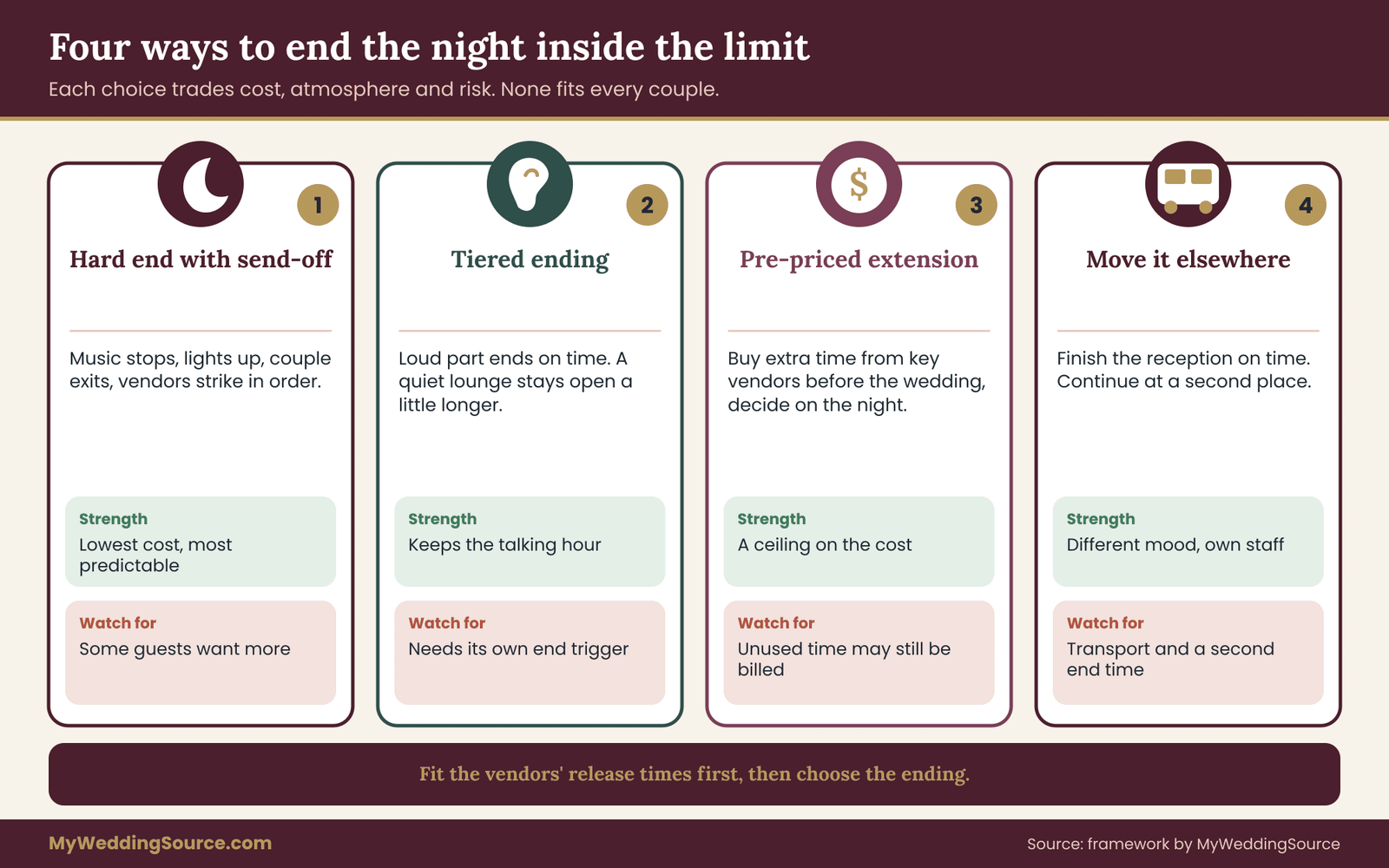
Once the schedule shows where the night will not fit, you have a decision to make. There are four common ways to end an evening around a party curfew, and each trades cost, guest experience and risk differently. None is correct for every couple, and the comparison below stays in plain words so you can weigh them against your own priorities.
Option one: a hard end with a send-off at the party curfew
The music stops at the party curfew, the lights come up and the couple leaves through a planned exit, followed by guests. Vendors strike in the order on the sheet. This is the simplest and cheapest option because everyone’s time is predictable. The cost is emotional: some guests will feel the night ended while it was still alive, and the couple may regret leaving the party at its peak.
This option works best when the venue’s all-out time is tight, when guests have long drives, or when many people are traveling the next morning. It is the most forgiving of mistakes, since nobody has to decide anything at the last minute.
A good hard end at the party curfew is not abrupt. Announce it an hour ahead, play a slower final song, and have a visible exit so that guests understand the party is finishing by design. People accept an ending they can see coming.
Option two: a tiered ending with a quiet room
The loud part of the night ends at the party curfew, but a smaller space stays open for those who want to linger: a lounge with a playlist at low volume, a coffee and dessert table, a fire pit if the venue allows it. Most vendors are released on schedule, and only a small staff remains, often just a coordinator and a few venue staff.
The price is a longer stay for the venue and sometimes extra staffing, so check the all-out time carefully. The benefit is that you keep the part of the night many people remember, which is conversation after the dance floor empties. The risk is a quiet room that does not empty, because there is no obvious end. Give it its own time and its own trigger, such as “lounge closes when the last shuttle leaves.”
Option three: a pre-priced extension past the party curfew
You buy extra time from the vendors who matter most, usually the DJ or band and the venue, before the wedding, at a known price, and you decide on the night whether to use it. This turns “just one more hour” into a choice with a ceiling. Some vendors offer a reserve hour that is billed only if used. Others require payment in advance, which is a real cost if you do not use it.
Compare it against the other options by asking what fraction of the extra time would actually be used. If a purchase order or written change order is how you approve extras, the purchase order checklist shows how to keep that tidy. If you expect the dance floor to be full at the end, a pre-priced extension may be the least stressful path. If you expect many guests to leave on schedule, you may be paying for an hour that is never used.
Check what the extension covers. An extra hour of music does not automatically include the bar, the photographer, the caterer’s staff, the venue or the shuttle. If the extension needs all of them, add the numbers up before agreeing.
Option four: end the reception early and move the late part elsewhere
If your venue’s party curfew is early, you can finish the formal reception on time and continue elsewhere: a nearby restaurant or bar, a hotel lounge, a private room. The after-party then has its own timeline, its own staff and its own end. It is the right choice when the venue cannot extend, when only part of the guest list wants a late night, or when you want a different atmosphere.
The costs are transport, a second set of vendors or a second venue, and a second end time to manage. The risks are the ones any late-night gathering carries, such as drinking, driving and guests who are tired. Use the same signoff method for the second event, with its own anchor.
For more on shaping a late event as its own plan, the planning guides linked from the reception pages on this site go into formats, guest lists and costs. This article assumes you have chosen one and focuses on closing it.
How to choose when the party curfew will not move
A short decision rule can help. Start with the all-out time of your venue and the earliest real stop. If the vendors’ release times fit inside both with a margin, choose option one or two. If they do not fit and cannot be adjusted, choose option three if the venue offers an extension and the cost is acceptable, or option four if it does not.
If you are unsure what guests want, ask a few people you trust and weigh their answer lightly. A guest who says “I’d stay till two” in the middle of the night is not a commitment.
Then ask one more question: who will be hurt if this goes wrong? If your answer is older relatives, children or guests who have to drive, lean toward the earlier end. If your answer is only the vendor invoice, then the extension is a financial choice, and the signoff owner and cap are the safeguards.
Weighing the price of one more hour
When a guest or a parent asks for an extension, the useful question is not “can we afford it” but “who stays, and for how long.” Build the cost from the sheet. List every person who must remain if music continues: the DJ, any bar or venue staff required by the license or the contract, the coordinator, a security person if the venue requires one, and any driver for a later shuttle. Multiply each person’s rate by the increment they bill, and add the venue’s charge if the all-out time moves.
Then compare the total with what the extra time buys. A full dance floor for an extra half hour with only the DJ billed is a small, clear purchase. The same half hour with a photographer, two bartenders and a driver on minimum blocks is a different purchase altogether. Put both versions in front of the signoff owner before the wedding, so that the cap on the sheet reflects the cheaper one and the more expensive one needs a conversation.
If the figure is higher than you want, look for the single vendor that drives it and change that one. Releasing the photographer at the grand exit, or closing the bar on schedule while the music continues, often removes most of the cost without touching the dancing. This is why the sheet lists vendors separately: it shows which release is expensive and which is nearly free.
Measurable checks: how to know the schedule will hold
A party curfew schedule that looks right can still fail. These checks are written so that each one can be answered yes or no, which means someone else can verify them without relying on your confidence.
Before the wedding
Every row has all six entries. If any cell is blank, the row is not finished. A missing strike length or a missing approver is the most common gap.
Every release time is earlier than the all-out time. Add the last performance minute and the strike length. If the sum is later than the all-out time, mark the row red and fix it.
Every vendor has replied in writing. A short message such as “Confirmed, row four” is enough. A vendor who has not replied has not agreed.
The signoff owner has the sheet and knows the cap. Ask them to say the cap and the process aloud. If they cannot, the plan lives only on paper.
Contract and sheet agree. Compare each rate and increment on the sheet with the contract. Where they differ, the contract usually wins, so correct the sheet or amend the contract.
The party curfew is on the venue’s own run of show. Ask the venue coordinator to confirm the end time and all-out time in their document, not just yours.
On the night
The countdown starts on time. If the sixty-minute announcement happens at the right time, everything else tends to follow. If it slips, the signoff owner should call it out.
Release triggers are observed. The photographer is released at the trigger, not later. The bar is closed at the planned time. Somebody checks and notes the actual time.
Any extension is written down. Time approved, who approved, amount, who it covers. A note on the sheet is enough.
The walkthrough is signed. The coordinator and the venue manager walk the room together, and a note records the time and the condition. This protects the deposit and ends the vendors’ responsibility.
After the wedding
Each invoice is compared with the sheet. The extra time on the invoice should match the notes taken on the night. A difference of a few minutes is normal; a difference of an hour needs a question.
Any discrepancy is raised within the vendor’s stated period. Many vendors have a window for questions about invoices. Check the contract and write to the vendor within it. A plain email with the sheet attached is enough.
What to do when a check fails
If a check fails before the wedding, the fix is usually a conversation. If it fails on the night, the signoff owner decides using the cap and the sheet, and records the result. If it fails after, ask politely and attach the evidence. In most cases a documented, calm question settles the matter.
The point of these party curfew checks is not to catch anyone out. It is to move every decision about the ending to a time when it can be made calmly, and to make every remaining decision small enough to be made quickly.
Edge cases that test a party curfew
Most weddings end without drama. But a few situations recur, and thinking through them in advance is cheaper than inventing answers at eleven-thirty at night. Each case below has a short rule.
The reception started late and the party curfew did not
If dinner runs an hour behind, the dance floor starts late and the party curfew does not move. The temptation is to protect the dancing by squeezing the strike or asking vendors to stay. Instead, decide in advance what gets cut. A common choice is to shorten toasts or skip a non-essential program item, and it is easier to agree on that before the day than during it.
Give the signoff owner permission to cut specific items when the schedule slips more than a set number of minutes, and write the list: for example, the garter toss first, then a second dance, then a slideshow.
If the lateness comes from a vendor, such as a caterer or a photographer who ran long, check the contract. Some include a clause that protects the couple from paying for delays the vendor caused. Others do not. Keep a note of the times, and raise the matter after the wedding, not on the dance floor.
A vendor wants to leave before the party curfew
Occasionally a vendor asks to go before their release time, perhaps for a long drive or a second job. You can say yes, but ask what you lose. A DJ who leaves early takes the music with them. A bar that closes early may be the last thing a guest remembers. Ask whether the contract gives any credit, and if you agree, note the time and the arrangement on the sheet so that it is not read later as a failure.
Guests will not leave at the party curfew
Sometimes the party curfew arrives and a group of guests stays. The room is loud, the bar is closed, and people are saying “just one more song.” This is where the signoff owner and the venue manager matter. Decide beforehand who speaks to the group. It should be a person the guests know, such as a sibling, the best man or the MC, rather than a vendor or a stranger. A short, warm line works better than a rule: “That’s the last song, and the shuttle leaves in ten minutes.”
If a guest becomes unruly or refuses to cooperate, the venue and any security staff handle it, not the couple. Agree in advance how that process works. If the venue has a policy, ask for it in writing.
Someone wants to pay cash to extend
A parent or a friend offers to cover the extra hour. That is generous, and it also creates a payment you have not planned for. The rule is the same: the signoff owner must approve, the vendor must agree, and the payment must be recorded. Ask the helper to pay the vendor directly or through the couple after the wedding, not as a cash handoff in the room.
Agree on the amount before time is added. If a relative is unhappy that the party is ending, remind them that the plan was set weeks ago and the sheet shows everyone’s release time.

Bad weather and the party curfew
A storm can end an outdoor event early or move it indoors, and both change the timing. If the plan includes a tent or an outdoor dance floor, add a bad-weather version of the sheet with its own anchor. The strike for tents and outdoor equipment is longer and sometimes legally restricted in the dark or in lightning, so ask the rental company what they will and will not do in bad conditions.
A shorter reception because of weather is not a failure of the party curfew plan. It is the reason you wrote the schedule.
The last ride problem and the party curfew
Even with perfect vendor timing, guests need to leave safely. If rideshare prices surge, the last shuttle is full, or a group is staying at a hotel two miles away, the party curfew may be set by the last way home. Confirm shuttle schedules, give guests a written list of options, and tell the venue and the coordinator which guests need help.
Plan extra transport for anyone who has been drinking and for anyone with limited mobility. If you have a block of rooms, the hotel guide on this site covers how to coordinate lodging and ride timing for guests with different budgets and needs.
The venue manager changes
The person who agreed to the extension may not be the person on duty. Venue staff rotate, and a verbal promise from a sales manager may not reach an evening manager. Ask for the end time and all-out time in writing, and bring a printout to the venue on the day. Ask the day-of contact to sign or initial the sheet at the start of the night, so the end time is not discovered for the first time at the end.
Children, older relatives and the party curfew
A party curfew is not the same for everyone. Children may need to leave early, and older relatives may need a ride before the dance floor peaks. Add a quiet “early departure” lane to the plan: a person who knows who needs to leave, a vehicle or a driver for them, and a point of contact.
This removes pressure from the main schedule, since the people who need to go are not held until the last shuttle. For guests with mobility needs, make sure the accessible path and the accessible transport are staffed until the last of them has left, which can extend your coordinator’s time or a volunteer’s.
Telling guests and family about the party curfew
A schedule that lives only on a sheet does not stop a party. People do. The final layer of the plan is communication: guests need to know when the night ends, and vendors need to hear it in the same way.
Before the wedding
Put the party curfew on the invitation suite or the website in plain wording, for example “The evening ends at eleven-thirty with a send-off.” Guests plan their rides and babysitters around that. If there will be a quiet room or an after-party, say so, and say when each ends. Do not leave guests to guess. Guests who do not know the ending time tend to assume it is later than it is.
Tell immediate family and the wedding party the real party curfew. Parents who expect the night to run until two will be surprised at eleven-thirty. The best time to explain is in a short message a few weeks before, with the reasons stated: the venue, the vendors, the rides. Short reasons are more accepted than long apologies.
On the night
The MC or DJ announces the ending, and it should be a person guests are used to hearing. Use warm, specific wording, and give a clear next step: where the shuttle leaves, where to collect coats, where the couple’s exit takes place.
The couple’s farewell is the single most effective way to end a party. When the couple leaves, guests tend to follow. If the couple would rather stay late, plan another visible exit, such as a final toast, a lit sparkler line where the venue allows it, or a symbolic last song, so that guests have a clear cue.
Saying it to the vendors
Vendors also need to hear the plan in person. A short check-in with each lead at the start of the night, five minutes with the sheet, is worth more than another email. Ask them to say their release time aloud and to tell you if anything has changed. If they raise a concern, you still have hours to solve it.
Scripts for the awkward moments
Some sentences are worth having ready.
To a guest who asks for more music: “We would love to, but the venue closes the room at the time we have agreed. The last song is next, and the shuttle leaves in ten minutes.”
To a vendor who asks to extend: “Thank you. Please check with the coordinator, who has the sheet and the approval limit for tonight.”
To a relative who offers to pay for more time: “That is kind. We have set the end of the night with the venue and the vendors, so I would rather not change it now. Thank you for offering.”
To the venue manager: “Here is the sheet. Could you confirm the end and all-out times, and tell us who the manager on duty will be at the end of the night?”
These lines are plain on purpose. Their job is to be easy to say when everyone is tired.
Keeping the tone of a party curfew
The aim of all this planning is a good ending, not a rigid one. A party curfew is not a punishment for fun. It is the frame that allows the last hour to feel generous because nobody is worried about what comes next. Couples who set it clearly often find that guests respect it and that the final hour becomes the best part of the night.
Worker safety, alcohol and local rules around the party curfew
Planning around a party curfew is partly a safety exercise. Late hours put tired people, equipment, alcohol and traffic in the same place. None of this needs to be alarming, but it deserves a few plain checks. Rules differ by place and by employer, so treat this as a prompt for questions and confirm answers with the venue, the vendor and the relevant agency.
The people who work your night
Vendors’ crews often work a full day before your reception begins: setup in the morning, service through the evening, strike after midnight and a drive home. Extra hours add to that. In the United States, workplace safety is overseen by the Occupational Safety and Health Administration, and pay rules for employees are described by the Department of Labor’s Wage and Hour Division. Whether a given vendor’s staff are employees or independent contractors, and how overtime applies, is a matter between the vendor and its workers, so you generally cannot and should not manage that part.
What you can do is avoid creating needless pressure: a realistic party curfew, a strike that fits inside the all-out time and a clear signoff owner mean the crew is not racing to load out in a dark parking lot.
Ask the lead of each vendor whether their team has a safe way to get home after a late finish. You are not responsible for their staffing, but a vendor who has thought about it is usually a vendor who runs a calm strike.
Equipment, lighting and exits at the end of the night
The end of a party is when cords come up, cases come out and the room is full of people who have been dancing. Ask the venue and the vendors for a clear strike path that keeps guests away from loading areas, and make sure exits remain unblocked while equipment is moved. Fire codes and occupancy rules are set locally, and the venue is generally responsible for them, so ask the venue manager what its rules are for exits and for lighting during strike.
The loading dock and elevator practices that apply to your venue are covered in other guides on this site, and a quick question to the manager about the end-of-night path is often enough.
If any guests have mobility needs, keep accessible routes clear and lit through the end of the night. A rental company stacking chairs in an accessible corridor is a small mistake that can strand someone, so place an assigned person at that route until the last guest has gone.
Alcohol, last call and getting home before the party curfew
Alcohol service hours and server responsibilities are set by local rules and the venue’s license, and a licensed bar team follows them. The National Highway Traffic Safety Administration publishes information on impaired driving, and the Centers for Disease Control and Prevention publishes general guidance on alcohol and health. Neither will tell you your local last-call time. Your caterer or bar company and the venue will.
The practical point is the order of events. A bar that closes well before the music ends, as the bar service guide explains in more detail, gives guests time to eat, drink water and arrange rides. A bar that closes at the last song leaves a rush of people to the exit at once. Many couples set last call thirty to sixty minutes before the party curfew, and this is a judgment you can adjust to your guest list. Ask the bar manager what they recommend.
Have the ride plan visible: a staffed shuttle, a list of local taxi or rideshare options, a sober driver system if you use one, and the hotel’s shuttle times if there is a block. Tell the coordinator which guests are staying and which are leaving, so that nobody is left outside waiting.
Noise, neighbors and the party curfew
If you are in a place where neighbors may be affected, check the local noise rules and ask the venue whether complaints have occurred in the past. Many local governments describe their noise rules on their official websites, and the Environmental Protection Agency provides general information on noise as a public health matter.
Make sure that any outdoor sound ends by the stated time, and that doors and windows are closed after it. A fine for noise, or a visit by local officers, is a cost nobody budgets and a vendor may pass on.
Documents worth having at the party curfew
Bring a small folder with the venue contract pages that state the end and all-out times, the vendor release times, a printed signoff sheet, the phone numbers of each lead, and a list of the ride options. If the venue has a written policy about extensions or fees, include it. A printed page is faster than finding an email in a noisy room, and it gives anyone helping you the authority to act.
Your next steps
Start with the anchor. This week, write down every real limit on your evening, with its time and where it is written, and circle the earliest. That is your party curfew. Send the line to your venue contact and ask them to confirm it in writing, along with the all-out time and the charge for going past it.
Next, build the sheet. List every paid person who will be present in the last two hours, ask each for a strike length and overtime terms, and compute each release time. Check that every release falls before the all-out time. If any does not, choose a fix: a shorter performance, an earlier strike, a priced extension or a staged exit.
Then name a signoff owner and a cap. Give that person the sheet, talk through the countdown, and make sure they can say the cap out loud. Ask each vendor to confirm their row in writing. Plan the guest message and the ride plan, and bring a printed copy of everything to the venue.
Finally, compare each invoice with the sheet after the wedding, and keep the sheet in your records. If you tie the schedule to the rest of your plan, the wedding budget guide can help you decide how much extra time you want to fund, and the venue guide covers questions to ask about hours before you sign.
FAQ
What is a party curfew at a wedding?
It is the latest time your evening can run before something you cannot change takes over, such as the venue’s end time, a local sound rule, a bar license limit or the last safe ride. Different rules give different times, so the party curfew is the earliest one that applies. Plan every vendor’s finish backward from it and confirm it in writing with the venue.
Who decides when the party ends?
On paper, the rules decide, and on the night one person you have named should decide. Choose a signoff owner, such as a coordinator or a trusted relative, who holds the sheet and can approve a small extension up to a cap you set. This avoids a crowd making a costly choice on the dance floor, and keeps vendors from taking instructions from several people.
How do I avoid surprise vendor overtime?
Read each contract for four things: the rate after the contracted hours, the billing increment, any minimum block and who may approve extra time. Ask each vendor for their strike length and confirm a release time in writing. Then name one approver and a spending cap. Most surprises come from minimum blocks and from extra staff who must stay when only one person’s time was intended.
Should the bar close before the music stops?
Often yes, because it gives guests time to eat, drink water and arrange a ride, and it ends alcohol service before the final rush to the exit. Many couples close the bar thirty to sixty minutes before the end, though the right gap depends on your guests and your local rules. Ask your bar team what they recommend and check what their closing process requires in staff time.
Is it cheaper to end early or to buy extra time?
Ending on schedule is usually cheaper and simpler because everyone’s time is known. An extension can be a reasonable cost if only one vendor bills for it and the price is set before the wedding. The expensive case is an unplanned extension that triggers minimum blocks for several vendors. Build the cost from the sheet, listing each person who would have to stay.
What if the venue lets us stay later than the contract says?
Treat it as a favor, not a plan, until it is written. Ask the venue to confirm the extra time and any charge by email before the wedding, and have the day-of manager initial it. Also check that your vendors can stay and that no local noise or license limit still applies. A venue can be flexible about its room without being able to change the law or a permit.
How early should I tell guests the night will end?
Put the end time on the invitation or the website so guests can arrange rides and sitters, and announce the last hour from the microphone sixty minutes before the end. Tell family and the wedding party earlier, with the reasons. A guest who learns the plan weeks ahead tends to accept it. A guest who learns it at the final song is more likely to argue.
What if a guest or relative offers to pay for more time?
Thank them, and route it through the signoff owner. Agree on the amount and the vendors affected before any time is added, and record it on the sheet. Ask the helper to pay the vendor or the couple after the wedding rather than handing over cash in the room. If the extension would cause the venue to charge, or the room cannot legally stay open, the answer is simply no.
Sources
- Occupational Safety and Health Administration, U.S. Department of Labor
- Wage and Hour Division, overtime pay information, U.S. Department of Labor
- Drunk driving and impaired driving safety, National Highway Traffic Safety Administration
- Alcohol and public health, Centers for Disease Control and Prevention
- Noise and its effects, U.S. Environmental Protection Agency
- Fire and life safety codes and standards, National Fire Protection Association
- Accessible routes and the ADA, ADA.gov
- Consumer protection and contracts, Federal Trade Commission
- Consumer tools for payments and disputes, Consumer Financial Protection Bureau
- Local government services and contacts, USAGov