
Plenty of couples want toasts at the reception but do not want a booming master of ceremonies steering the night. This guide shows how to introduce wedding speeches in a calm, human way: a short stage cue for each speaker, a small host team instead of one emcee, and a plan for what to do when something slips.
To introduce wedding speeches without a formal emcee, give the job to a small team instead of one performer. One host opens the toast block, a different person says one short line before each speaker, a timekeeper protects the clock, a mic runner moves the microphone, and one person watches the room. Every speaker gets a five-line stage cue card: a bridge from the last moment, a name and relationship, one frame sentence, a time promise, and a release that tells guests what happens next. Keep each introduction under twenty seconds.
Somewhere around the second round of planning meetings, a lot of couples say the same sentence: “We don’t want an emcee.” What they usually mean is that they do not want a stranger with a radio voice making jokes about their relationship. They are not saying that nobody should speak between the salad and the cake. Toasts still need a start, an order and an end, and somebody has to say the first words that tell a room of eighty people to stop talking and look up.
This article is about that somebody, and about the best way to introduce wedding speeches when no professional is in charge. You will learn how to introduce wedding speeches using a short cue template, a role assignment for the people around you, and a handful of decision rules for the moments that do not go to plan.
This guide does not try to settle who should speak, how long each speech should run or what the speeches should say. Those questions have their own guides on this site. The focus here is narrow and practical: how to introduce wedding speeches in the thirty seconds before each speaker opens their mouth.
A note on scope. This is general planning information, not legal, tax or financial advice. Where a rule matters, such as music licensing or copyright, the article points you to the agency that publishes it so you can read the current version yourself.
Why couples want to introduce wedding speeches without an emcee
The reasons are worth naming, because they decide how you will introduce wedding speeches later. Couples who skip a formal emcee tend to have one or more of five motives.
The first is tone. A professional host can be wonderful at a large, high-energy party and awkward at a dinner for sixty people who have known each other for decades. If the evening is meant to feel like a long family meal, a scripted announcer changes the temperature of the room.
The second is cost and logistics. Hiring an emcee is another vendor to book, brief and pay. Some DJs and bands include hosting in their package, and some do not. Where the budget is tight or the venue is small, many couples would rather spend that line elsewhere.
The third is control over language. An emcee who has never met your grandmother may mispronounce her name, mangle the nickname that everyone uses, or introduce a sensitive relationship in a way that stings. A friend who knows the room will not make those mistakes.
The fourth is cultural or family fit. In some families the eldest relative traditionally opens the toasts. In others, a respected friend of the couple is the natural voice. A hired stranger can feel out of place in those settings.
The fifth is simple shyness. Some couples dislike the spotlight and do not want a host whose role is to point it at them again and again.
What “no emcee” does not mean
It does not mean no structure. Rooms without any host tend to produce the same few problems. Speakers wait for each other to start. Two people stand up at once. The mic sits on a table while a relative says a heartfelt thing that only the first two rows can hear. A toast begins while half the guests are still at the buffet or in the restroom line, so the best sentence of the night lands on an empty room.
None of those problems need a professional, and each one gets smaller when you introduce wedding speeches with a plan. They need a plan for the transitions, and a plan for who handles each one. That is the whole subject of this article.
It also does not mean no host at all. Someone speaks first. Someone says “please welcome” or something warmer. The difference is that the work is spread across several people who each carry a small, rehearsed task, and nobody is asked to be funny for forty-five minutes.
Where this fits in the evening
Toasts usually sit in one of three places: during the cocktail hour, between dinner courses, or after the meal and before dancing. The right slot depends on your venue, your caterer and your guests, and the timing guides on this site cover that in detail, including the wedding vendor timeline. How guests move through the room matters too, and the guide to wedding reception guest flow covers entry, seating, food and exit. What matters here is that each slot asks you to introduce wedding speeches in a slightly different way.
During a cocktail hour the problem is attention. Guests are standing, moving and holding drinks. An introduction has to gather people physically before it can introduce anyone.
Between courses the problem is food. Servers are working and plates are going out, and a speech that begins at the wrong moment competes with clattering silverware.
After the meal the problem is energy. People are full, a little tired and ready to dance. A clean, short introduction respects that, and a rambling one feels like a delay.
The five jobs of a good introduction
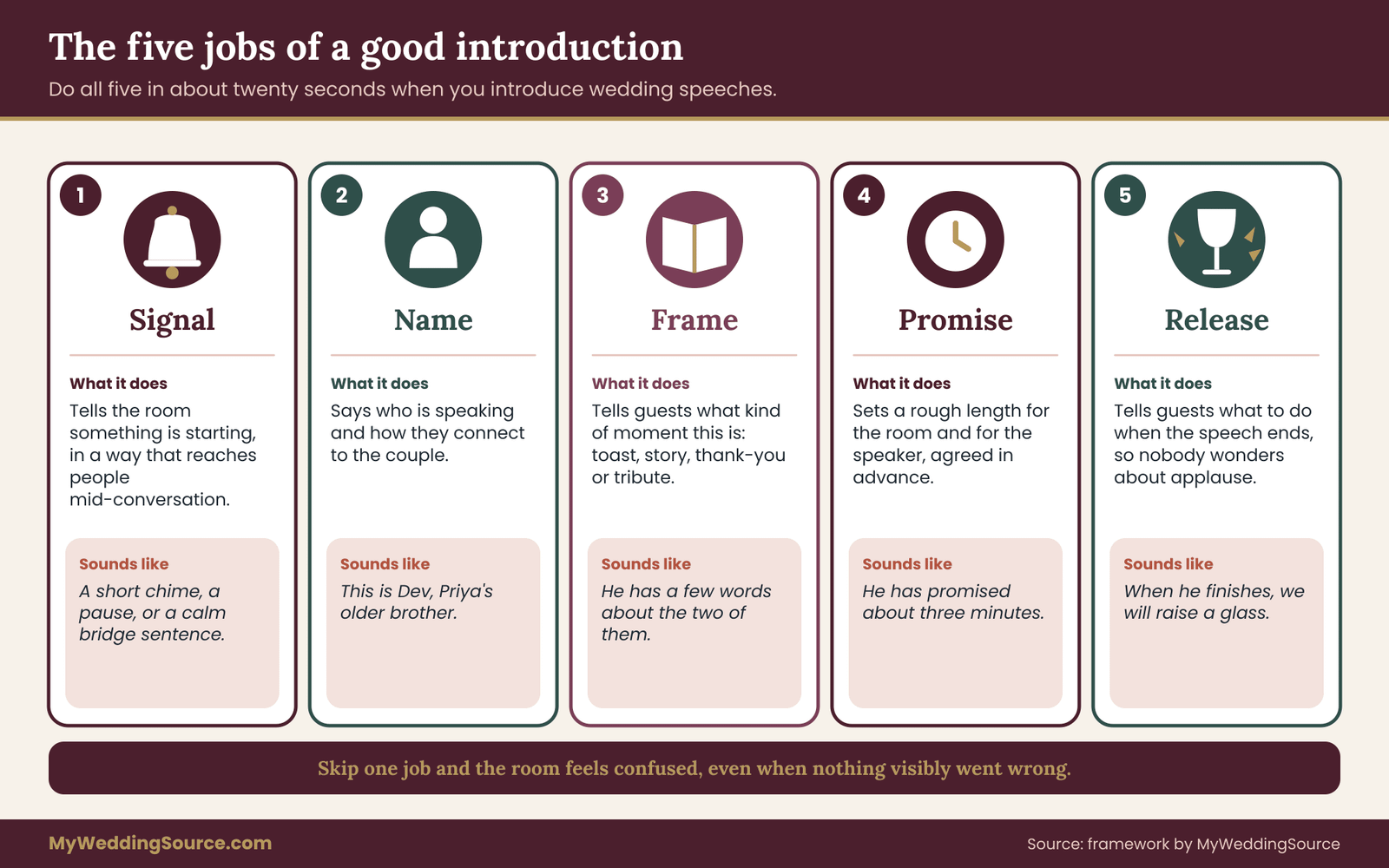
Think of the way you introduce wedding speeches as a small machine with five parts. A good one does all five in under twenty seconds. A weak one skips some, which is why the room feels confused afterward even when nothing visibly went wrong.
Signal. The introduction tells the room that something is starting. This can be a sound, a movement or a sentence, but it has to be unmistakable. Guests who are mid-conversation need a cue that reaches them without shouting.
Name. It says who is about to speak and how they connect to the couple. “This is Priya’s older brother, Dev” gives the room more than “Dev would like to say a few words.” Guests who know only one side of the family cannot place a name without a relationship.
Frame. It sets expectations in one sentence. Is this a toast with glasses, a story, a welcome, a thank-you, a tribute? A frame tells guests whether to raise a drink at the end or simply listen.
Promise. It tells the room, and the speaker, roughly how long this will take. A phrase like “a short one before the main course” lowers the room’s anxiety and quietly sets the speaker’s limit.
Release. It tells guests what happens when the speech ends. Raise a glass, sit, enjoy the next course, move to the dance floor. Without a release, speeches end in an awkward pause where nobody knows whether to clap.
Why twenty seconds
The length limit when you introduce wedding speeches is a design choice, not a rule of nature. A longer introduction starts to compete with the speaker. If you give a three-minute build-up to a ninety-second toast, you have flipped the proportions of the moment, and the speaker, who is probably nervous already, feels pressure to live up to it.
Twenty seconds is roughly two or three spoken sentences. That is enough to cover signal, name, frame, promise and release when each part is a single clause. It is also short enough that the introducer can memorize it, which matters because people reading from a phone screen tend to look down and speak softly.
If the introduction is for a speaker who needs more context, such as a grandparent who has traveled a long way or a friend who is stepping in at the last minute, the extra detail belongs in the printed program or the toast-block opening, not in each individual cue. A later section shows how to split that load.
What the introducer should not do
A few habits turn up again and again when people introduce wedding speeches, and they are best avoided. Do not tell a joke about the speaker, because the speaker is about to be on stage and cannot respond. Do not summarize what the speaker is going to say, because it deflates the first minute.
Do not apologize for the delay, the weather or the mic. Do not announce how long the speech “should” be in a way that sounds like a warning. And do not read the speaker’s biography, since the guests will hear their relationship to the couple in the speech itself.
What remains is plain and kind. A brief line that welcomes the speaker, names them, lets the room know what to do and then steps away.
Five ways to introduce wedding speeches without a formal emcee
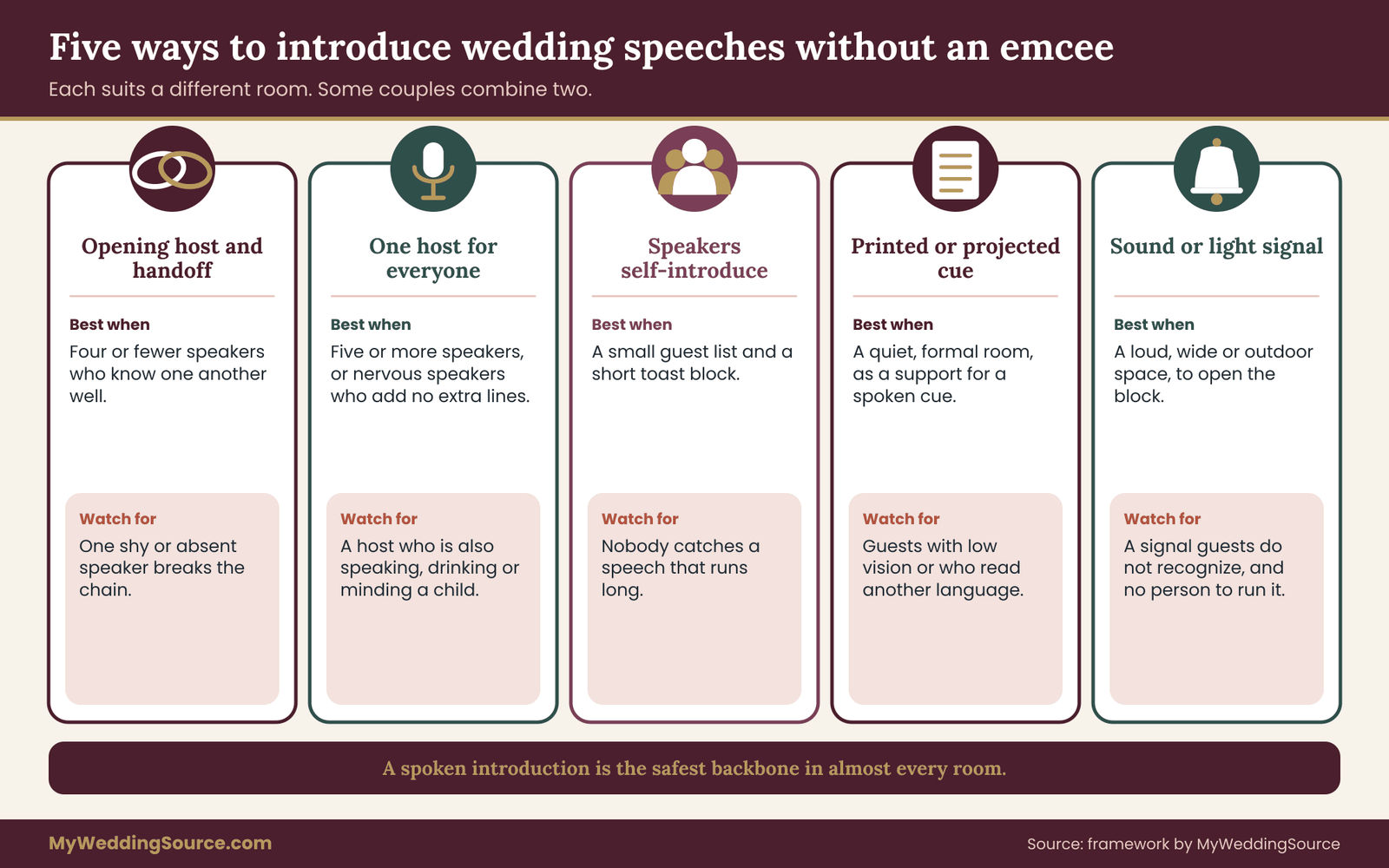
There is no single right way to introduce wedding speeches. Each of the five below suits a different room, and the best choice often depends on who in your circle is comfortable holding a microphone. Read all five before you decide, because some couples combine two of them.
Method one: the opening host and a rotating handoff
One person, usually a close friend or relative with a steady voice, opens the toast block. After that, each speaker introduces the next one in a short chain. The first speaker says one line about the second, the second about the third, and the last speaker closes the block.
This is the most natural way to introduce wedding speeches when nobody wants a formal emcee, because every introduction comes from someone who knows the next speaker personally. It works best when the speakers know each other and are not nervous about extra lines. It fails when one link in the chain is shy, absent or rambling, because the whole sequence depends on each person doing their small job.
Use it when your speakers are comfortable with each other and you have no more than four of them.
Method two: one host introduces everyone
A single trusted person, such as a sibling or a longtime friend, introduces every speaker using the same short template. This feels more like an emcee, but with a friend’s voice and a much smaller role.
It is the easiest way to introduce wedding speeches in rehearsal, since one person learns one routine. It also gives you the most consistent timing. The risk is load: if that person is also giving a speech, also keeping an eye on a child or also drinking, the job gets uneven. Choose someone who will not be pulled in other directions during dinner.
Use it when you have five or more speakers, or when some speakers are very nervous and will not add any extra lines.
Method three: the couple introduces the block, speakers introduce themselves
The couple, together or one of them, stands to welcome guests and sets up the toast block in two sentences. After that, each speaker steps up and introduces themselves with a short line: their name and how they know the couple. Nobody else speaks between speeches.
This approach lets the couple introduce wedding speeches in two sentences and skip the transitions entirely, which is why quiet couples like it. The cost is that the couple is on stage at the start, and each speaker has to remember to give their own name and relationship, which some people forget. It also means there is nobody to catch a speech that runs long.
Use it when the guest list is small, everyone knows everyone and the toast block is short.
Method four: the printed or projected cue
The introductions are on paper. A small card at each place setting, a line in the program or a simple slide on a screen lists the toast order. A single sentence from the couple or a host opens the block, and then speakers rise in the printed order, each adding their own name and relationship.
This is a quiet way to introduce wedding speeches and it suits rooms where the family does not want anything that feels theatrical. It depends heavily on the speakers knowing the order and being ready to move without prompting. It is also a poor fit for guests with low vision or for a room where many guests do not read English. A spoken cue should back it up.
Use it as a support for another method rather than on its own, unless the evening is very small and informal.
Method five: a non-verbal signal
Some couples use a sound or a gesture rather than words: a chime, a bell, a lowered light level or a few notes of music. A short sound brings the room to attention and signals that a speech is about to start, and the speaker begins without any introduction.
Done well, a sound cue is a graceful way to introduce wedding speeches and avoids stage patter. Done poorly, it confuses people who do not recognize the signal, and it still leaves the problem of who each speaker is. It also needs sound or lighting support from someone, which means a DJ, a band or a venue technician has to be in the loop.
Use it to open the toast block, then pair it with one of the spoken methods for the individual speakers.
How to choose among the five
Most couples settle how to introduce wedding speeches with three quick checks. First, count the speakers. With up to three, the opening-host-plus-handoff or the self-introduction approach is plenty. With four or more, a single host keeps the pace up and the order tidy.
Second, ask who in your circle is truly comfortable with a microphone. Do not pick a person because they are the best man or the oldest sibling. Pick the person who will not freeze, who speaks clearly, and who will not be tempted to turn the job into a comedy set. Ask them directly, and give them an easy way to say no.
Third, ask what the room needs. A sound cue helps a loud or sprawling space. A printed cue helps a quiet, formal one. A spoken introduction is the safest backbone in almost every case, because it works for guests who cannot see, cannot hear well from far away or are looking at their plates.
A short decision path
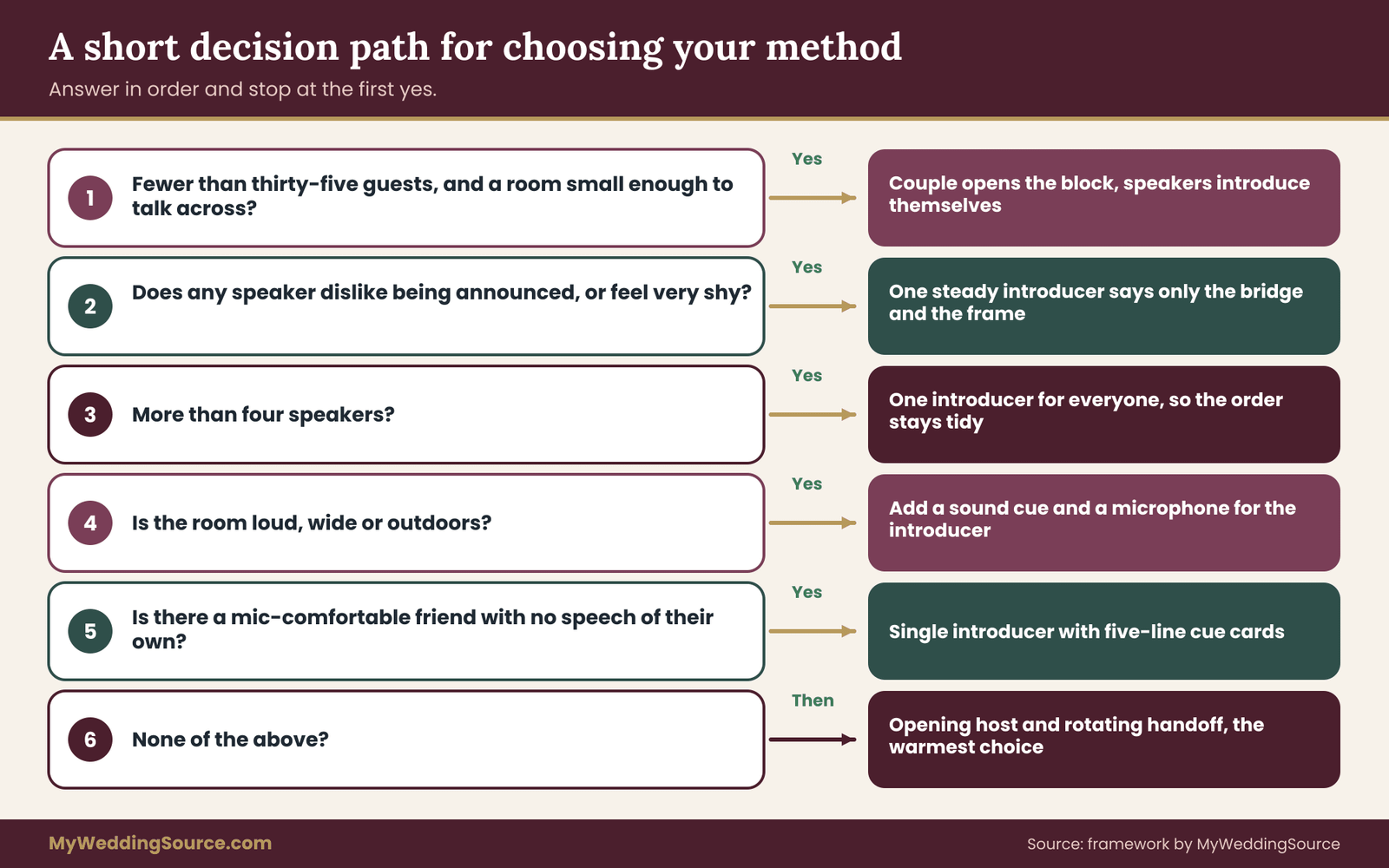
If you prefer a quick route, answer five questions in order and stop at the first answer that fits.
Is your guest count under thirty-five and the room small enough to talk across? Then the couple opens the block and speakers introduce themselves. Is there a speaker who dislikes being announced or who is very shy? Then use one steady introducer who says only the bridge and the frame. Are there more than four speakers? Then use a single introducer, because the chain of handoffs grows fragile as it gets longer.
Is the room loud, wide or outdoors? Then add a sound cue to open the block and a microphone for the introducer. Do none of those apply? Then the opening host and rotating handoff is the warmest choice.
The path is deliberately blunt. Its purpose is not to find a perfect answer but to stop the planning conversation from circling. Once you have an answer, test it in rehearsal, and change it if it does not feel right in the real voices. A couple who spend a week arguing about how to introduce wedding speeches usually end up with the same simple answer they could have picked on the first evening.
Host role assignment: five small jobs, not one big one
The reason a formal emcee exists is that somebody has to do many small tasks in a row. When you skip the emcee, you can still cover those tasks. You just spread them across people. Naming the jobs is the single most useful thing you can do to introduce wedding speeches calmly, because most problems come from tasks nobody owned.
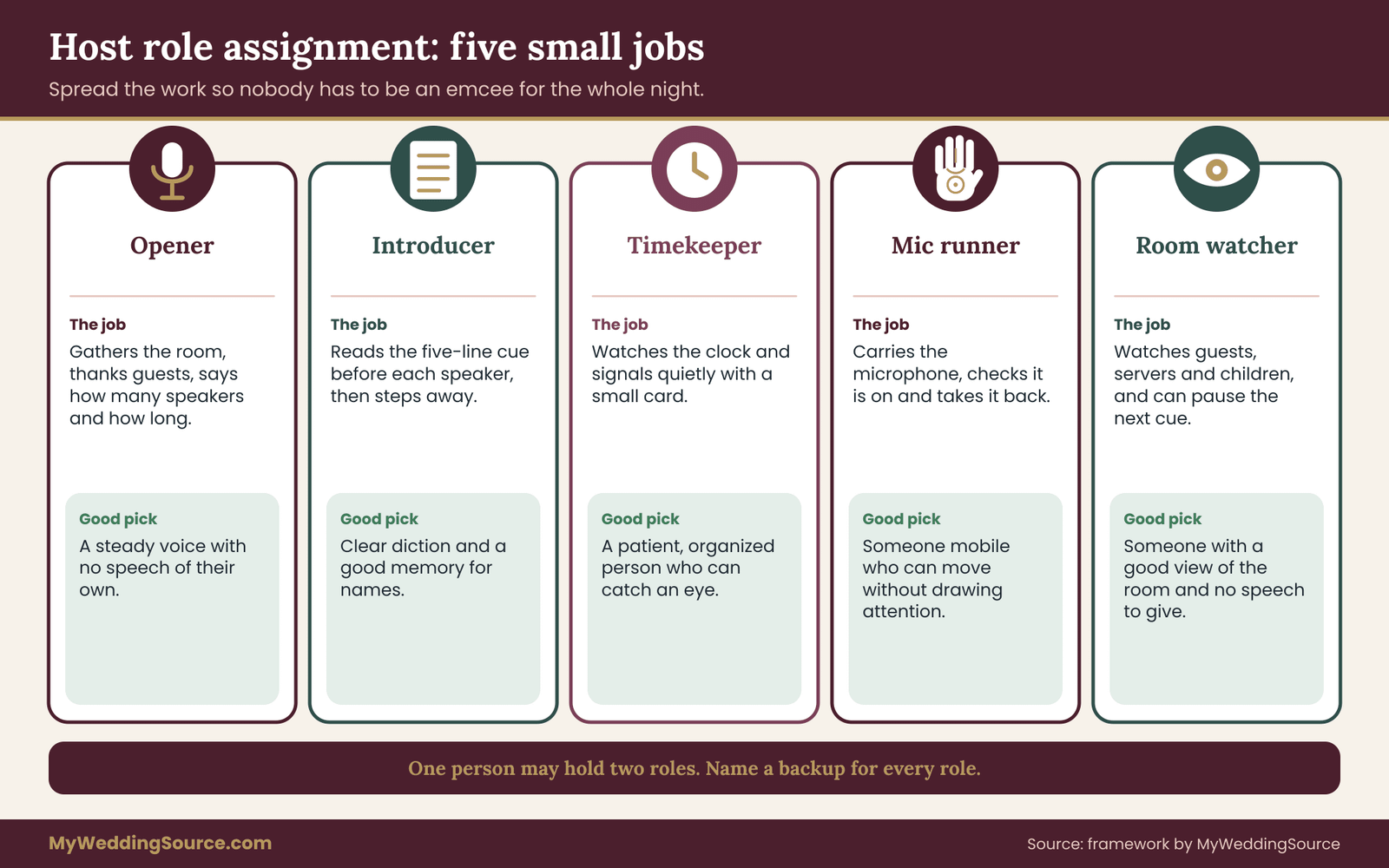
Here are the five roles that let a team introduce wedding speeches without one person carrying everything. In a small wedding, one person may hold two of them. In a larger one, you may want a separate person for each.
The opener. This person says the first words of the toast block. They gather the room, thank everyone for coming and set the frame for what follows. This is the only role that needs a little presence. It should go to someone whose voice carries and who is not about to speak themselves.
The introducer. This is the person who says the cue line before each speaker. In the single-host method, the opener and the introducer are the same person. In the handoff method, the introducer role passes from speaker to speaker.
The timekeeper. This person watches the clock and quietly signals to the introducer or the speaker when time is short. A timekeeper does not interrupt a speech. They hold a small card, catch the eye of the next speaker, or nudge the introducer to wrap the block. The timekeeper is a person with a wristwatch and a calm face, not a person with a bell.
The mic runner. This person carries the microphone to the speaker, checks that it is switched on, and takes it back afterward. In a small room with a single handheld mic, this can be the next speaker or a server who has been briefed. In a larger room, it should be a person who can move without drawing attention.
The room watcher. This person looks at the guests, not the stage. Are the tables quiet? Are the servers about to enter? Is a child about to cry? Is an elderly guest unable to hear? The room watcher can pause the next introduction by a few seconds, or ask the venue staff to hold the next course.
Matching people to roles
The opener needs voice and calm. The introducer needs memory and clear diction. The timekeeper needs patience and the nerve to signal a person they love. The mic runner needs mobility and attention. The room watcher needs a good view of the room and no speech to give.
A common mistake is giving every role to the wedding party, because that feels like a way to honor them. Some people in a wedding party are also the most emotionally loaded people in the room that night. It is kinder to give them a speech or a seat and hand the logistics to a friend, a cousin, a coordinator or a trusted venue staff member.
If you have a day-of coordinator or planner, ask what they already cover when you introduce wedding speeches and manage the toast block. Some will handle the timekeeper and room-watcher roles as part of their standard service, and some will not. Ask for the answer in writing so nobody assumes. Your wedding ceremony cue sheet may already have a similar list for the ceremony, and the same people can sometimes carry over to the reception.
Writing the roles down
Put the five roles and the names on a single page, since a written page is what lets a team introduce wedding speeches the same way every time. For each person, include a phone number, where they will be seated, and what they should do if the plan changes.
That page goes to the venue contact, the DJ or band, the photographer and the caterer. The venue needs to know who will hold the mic. The caterer needs to know when the toast block starts so the kitchen can hold or release courses. The photographer needs to know who is speaking so they can find the angle.
This is also where you decide the backup. If the opener is stuck in traffic, who steps in? If the mic runner is needed elsewhere, who takes over? Naming a backup for each role costs ten minutes now and can save a ruined moment later.
The stage cue template to introduce wedding speeches in five lines
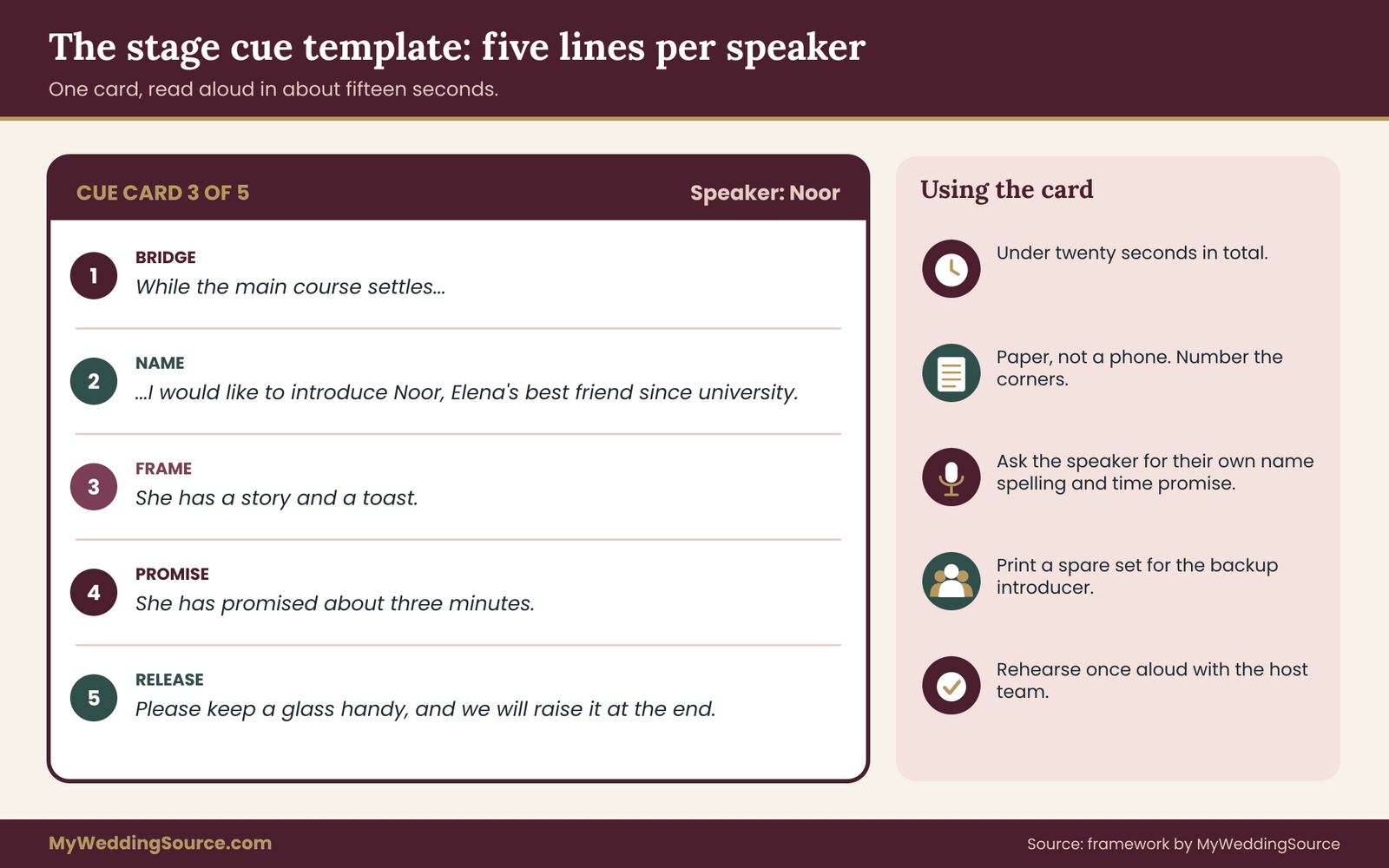
This is the working core of the article, the script you will use to introduce wedding speeches. A stage cue is a short, written script for one introduction. It has five lines, one for each job listed earlier. The introducer holds it on a small card, not on a phone, and says it in plain voice. The same template serves every speaker, which makes it the simplest way to introduce wedding speeches consistently, easy to rehearse and easy for a substitute to pick up.
Line one: the bridge. One clause that connects the last moment to this one. It can refer to the food, the room or the previous speaker. Example: “While everyone is settled with dessert coffee…” The bridge is the signal. It tells the room that the pace is about to change, without needing a bell.
Line two: the name and the relationship. First name, relationship to the couple, and, if it helps, a short connection to the room. Example: “…please give your attention to Dev, Priya’s older brother.” Use the name the speaker uses in daily life, spelled the way they pronounce it. Ask them.
Line three: the frame. One sentence that tells the room what kind of moment this is. Example: “He has a few words about the two of them.” Do not describe the content. Say only what kind of moment it is: a toast, a welcome, a thank-you, a story, a blessing.
Line four: the promise. A short time cue for the room and for the speaker. Example: “He promised to keep it to about three minutes.” The promise should be the speaker’s own, agreed in advance. A promise the speaker did not make feels like a leash.
Line five: the release. What the room should do at the end. Example: “When he finishes, we will raise a glass.” Or: “Please stay seated, dinner continues afterward.” This line also tells the mic runner and the timekeeper what to expect.
A full cue, read aloud
Put together, a complete way to introduce wedding speeches sounds like this:
“While everyone settles in with dessert, I would like to bring your attention to Dev, Priya’s older brother. He has a few words about the two of them, and he has promised to keep it to about three minutes. When he finishes, we will raise a glass together.”
That is forty-one words and takes roughly fifteen seconds at a natural pace. Nothing in it is clever, and that is the point. It sounds like a thoughtful friend, not a broadcaster. This sample is written for this article and is meant to be adapted, not copied word for word.
Writing cue cards you can actually read
The physical card matters more than most people expect. Use a plain index card or a half sheet of paper, and write in large type or clear handwriting, at least the size you would use for a menu. Put one speaker on each card, in the order they will speak, and number the corners so a dropped stack can be sorted in seconds. Leave a blank line at the bottom for a late change, such as a speaker swapping places.
Write the name phonetically if there is any doubt, in brackets, in the way you would say it: “Siobhan (shuh-VAWN)”. Ask the speaker to say it for you once, and record it on your phone if that helps, but do not read the card from the phone during the block. A glowing screen draws the eye away from the room, and a notification in the middle of a toast is a small disaster.
Print a second set. One set goes to the introducer, and the spare goes to the backup introducer or the coordinator. If you have a handwritten set, take a photograph of each card so the backup can read it from a message if needed.
Keep the cards short enough to take in at a glance. If a card needs more than five lines, you are probably adding a sixth job, such as telling a story about the speaker, and that job belongs somewhere else.
Making the template sound like you
A template is a skeleton, and every couple should adjust it to introduce wedding speeches in their own voice. The goal is a voice that matches the room. Three adjustments help.
First, match the register. A garden brunch can take a lighter touch: “Before the cake, a quick word from someone who has known Priya since she lost her first tooth.” A formal dinner calls for something plainer: “Ladies and gentlemen, please welcome…” only if that is how your family speaks. If the phrase would sound odd at your family table, skip it.
Second, match the language. In a multilingual room, the introducer can say the name and relationship in both languages, with the second language as a short repeat rather than a full translation. If a speaker will talk in a language some guests do not understand, line three should say so, so those guests know what to expect.
Third, match the energy. Warm and unhurried is nearly always the right way to introduce wedding speeches. The introducer is not a performer. If the room is loud, wait for it to settle rather than raising your voice over it.
Cue variations for the opener
The opener’s cue is slightly different, since it has to introduce wedding speeches as a group rather than a single speech. It has the same five lines but a slightly larger frame. A usable version:
“Good evening, everyone, and thank you for being here. In a few minutes, a handful of people who love Maya and Jonah will say a few words. There are four of them, and each has promised to be brief, so we will be done well before the cake. Please keep a glass nearby, and we will raise it together at the end of each one.”
That sentence set gives the room the number of speakers, the total length, and the glass instruction, so the individual introductions can be shorter. It is the single best investment in the whole block, because it replaces dozens of small uncertainties with one clear picture.
How to introduce wedding speeches for each kind of speaker
The same five lines flex when you introduce wedding speeches for different people. Here is how to adjust the template for the speakers you are most likely to have.
Parents and grandparents
Older relatives may not want to be introduced with a title, so when you introduce wedding speeches from parents or grandparents, keep it light. They are often the people the room most wants to hear, and the guests already know them by role. A light touch works: “Maya’s father, Samuel, would like to welcome you.” If the parent is hosting the evening, say so in the frame, since it explains why they are speaking first.
Allow for pace. A grandparent who walks slowly or needs a seat should not be introduced with a rush. The mic runner should bring the microphone to them rather than expecting them to cross the room. If they have a hearing aid or a cane, mention it to the room watcher so seating and sound are ready.
Best man and maid of honor
When you introduce wedding speeches from the best man or maid of honor, treat them as part of the show, but keep it brief. Their relationship is usually obvious from the program, so line two can be as short as a first name and a title. The more useful work is the promise: these are the speakers most likely to run long, so a spoken time cue and a visible timekeeper matter most here.
If two people share the role, introduce them together and say who goes first, as in “Two of Jonah’s closest friends, Mateo and Chris, will speak in turn.”
Friends and siblings
These speakers often have the most personal material and the least practice. A kind way to introduce wedding speeches from friends lowers their nerves. Use their first name, the real connection, and one warm detail that is already public, such as “who shared an apartment with Maya for four years.” Avoid any detail the speaker has not approved.
The couple themselves
When the couple speak, the cue is different. The opener can hand over with a simple line, “And now Maya and Jonah would like to say thank you.” Do not oversell it. The room already knows who they are. What the room needs is the release: do they want a glass raised, applause or silence?
A surprise or last-minute speaker
Sometimes a relative asks for a turn on the day. Decide in advance whether you will allow this, and how you would introduce wedding speeches that nobody planned. If you do, use a shorter cue: bridge, name and relationship, and release, with the promise given by the speaker themselves in the first sentence. Ask the room watcher to confirm with the couple before the speaker gets the mic, since a surprise is not always welcome.
Speakers who do not want to be introduced
A few people dislike being announced. For them, agree on a quiet alternative. The introducer can say only the bridge and the frame, “A few more words from the family before dinner,” and the speaker introduces themselves. Respecting that preference costs nothing and avoids a stiff moment.
Introducing a reading, a blessing or a tribute
A reading, a blessing or a tribute to someone who has died changes the mood, so the way you introduce wedding speeches of this kind should match. Say “a reading” or “a moment to remember” rather than “a toast,” and tell guests whether to raise a glass. When the piece is a poem or a passage by a published author, name the author in the cue, and look at the copyright note in a later section for how to handle quoted text.
A worked case: the Hartwell and Nair dinner
The example below is invented for illustration. It does not describe a real couple, and the timings are planning choices, not measurements. It exists to show how the pieces fit together when you introduce wedding speeches, so you can copy the logic, not the details.
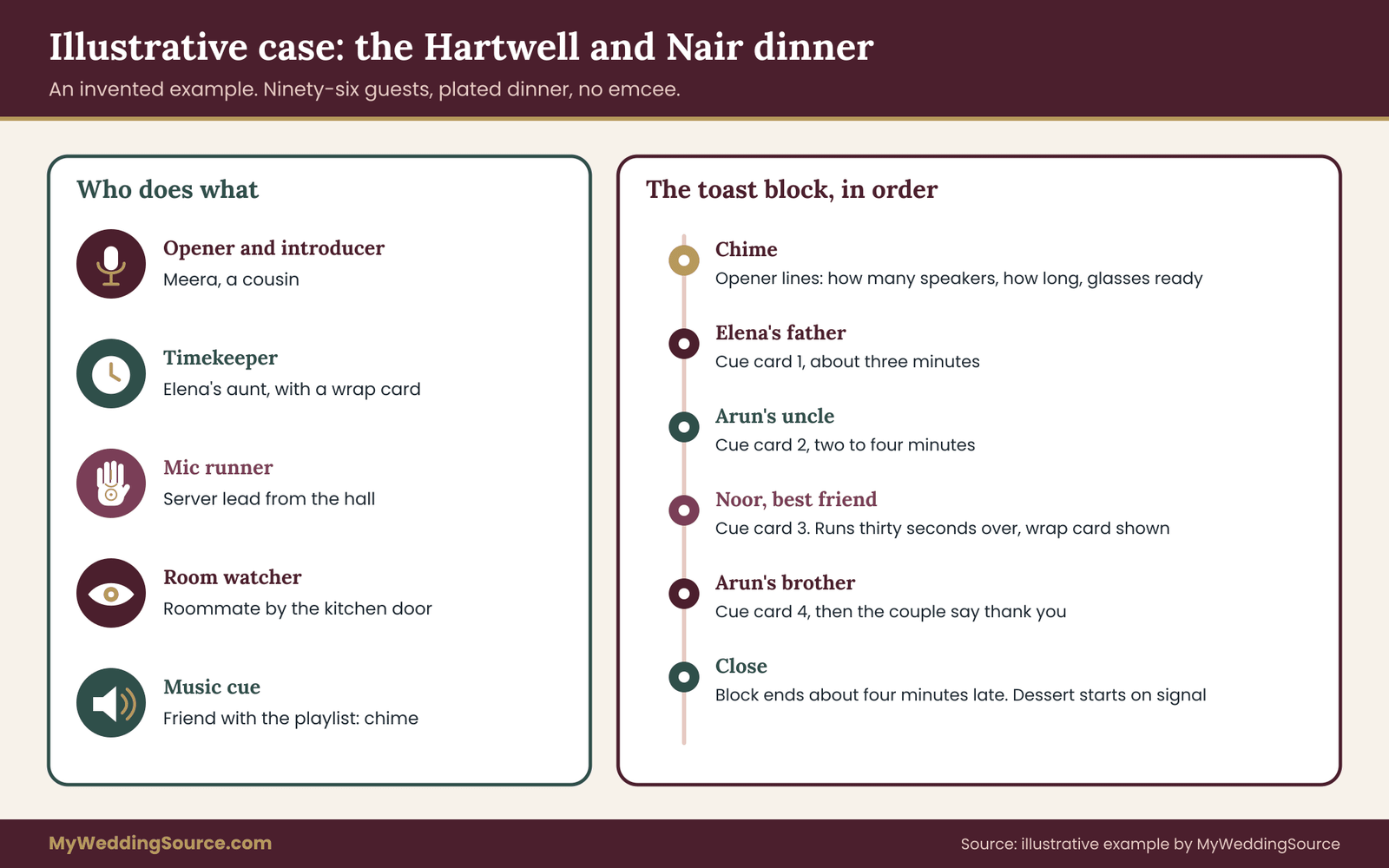
Imagine Elena Hartwell and Arun Nair, who are marrying at a rented hall with ninety-six guests, a plated three-course dinner and a playlist run by a friend rather than a DJ. They do not want an emcee. Elena’s family likes warm, unscripted evenings. Arun’s family would prefer that the elders speak first. They have four speakers: Elena’s father, Arun’s uncle, Elena’s best friend, and Arun’s brother. The couple will add a short thank-you of their own.
Step one: choose the method
Elena and Arun want to introduce wedding speeches in a relaxed way, and they count four speakers plus themselves, which pushes them toward a single introducer. They ask who is comfortable with a microphone and calm under pressure. Arun’s cousin Meera, who teaches high school and is not giving a speech, says yes. She becomes the opener and the introducer, and they choose method two from the earlier list, with a small sound cue to open the block.
Step two: assign the other roles
Elena’s aunt keeps time, because she is organized and not on the speaker list. A server lead from the hall acts as mic runner, after the couple confirms with the venue that staff can carry a handheld mic. Arun’s college roommate is the room watcher, seated near the kitchen door so he can see when the courses move.
Each person gets the one-page role sheet that explains how the team will introduce wedding speeches together. The venue contact and the friend running the playlist get the same sheet, so the music pauses at the right time and the lights stay steady.
Step three: set the order and the promises
The speakers agree on an order that mixes the families: Elena’s father, Arun’s uncle, Elena’s best friend, Arun’s brother, then the couple. Each speaker names a time they are comfortable with, between two and four minutes. Meera writes each promise on the cue card in the speaker’s own words.
The couple do not try to shorten any speech. They only collect the numbers, add them up and compare the total with the time the caterer has set aside.
Step four: write the cue cards
Meera writes five cards and one opener card, a small set of scripts to introduce wedding speeches in order. Here is the card for the third speaker.
Bridge: “While the main course settles…” Name: “…I would like to introduce Noor, Elena’s best friend since their first year of university.” Frame: “She has a story and a toast.” Promise: “She has promised about three minutes.” Release: “Please keep your glass handy, and we will raise it at the end.”
She keeps the cards in order on a clipboard and rehearses them once aloud with the couple a few days before.
Step five: lock the timing with the caterer
The kitchen agrees to clear the plates after the main course, then pause dessert until the toast block ends. The aunt who keeps time carries a printed run sheet with the planned start of the block, the planned end, and the time at which she will signal Meera to wrap up. She agrees to hold a small card with a single word on it, “wrap,” visible only to Meera.
Step six: run the block
At the planned time the playlist friend plays a short chime. Meera stands, waits for the room to settle and gives the opener line. She hands the mic to the first speaker with a nod. The server lead carries the mic between speakers. After each speech, Meera gives the release line, the room raises a glass, and she gives the next cue.
Midway through the third speech, Noor runs half a minute over. The aunt holds up her card. Meera does not interrupt. When Noor finishes, Meera says, “Thank you, Noor,” and moves straight to the next cue with a slightly shorter bridge. The block ends four minutes later than planned, and the kitchen starts dessert once Meera gives the signal.
What the example shows
Three things stand out in how Meera and the team introduce wedding speeches. First, nobody carried more than one small task, so no single person was a bottleneck. Second, the introductions were scripted but not stiff, because the cue came from the speaker’s own promise and relationship. Third, the plan expected a small overrun and had a calm way to absorb it. A plan that expects perfection tends to break; a plan that expects a few minutes of drift tends to hold.
A second illustrated case: the very small wedding
Here is a different invented example, to show that the logic scales down. Priya and Tomas are marrying at a restaurant with twenty-six guests and one long table. They want to introduce wedding speeches with almost no ceremony.
They choose the self-introduction method. Tomas stands between the main course and dessert, taps a glass lightly and says two sentences: that three people want to say a few words, and that glasses should be filled for each one. Each speaker then gives a name and relationship in their own first sentence. There is no microphone, because the room is small, and the restaurant manager agrees to hold dessert until Tomas gives a nod.
The roles are folded together. Priya’s sister is both timekeeper and room watcher, sitting at the far end of the table where she can see everyone and the kitchen door. She holds nothing but her own phone, set to a silent timer. Nobody needs a mic runner, so that role is empty on purpose.
The lesson is that the five roles are a checklist, not a staffing requirement. For a small table, some roles collapse into a single person and some disappear. What you should not drop is the thinking behind them: who gathers the room, who tracks time, and who decides when to pause service.
Building the cues into your timeline
An introduction does not happen in a vacuum. It sits inside a schedule that includes the caterer, the music, the photographer and the venue. If you introduce wedding speeches without checking those moving parts, even a perfect cue can land at the wrong moment.
Decide the slot first
You can introduce wedding speeches in one of three positions in the evening. The choice shapes the bridge line and the role of the room watcher.
Cocktail hour. Guests are standing and moving. You need a cue that physically draws them in: a chime, a lowered playlist and a clear opener. Keep the block short, since people are holding drinks. This slot is good when you want to introduce wedding speeches early so everyone can eat in peace. The wedding cocktail hour guide covers how that stretch of the evening usually flows.
Between courses. Guests are seated, which helps attention, but servers are active. Ask the caterer to hold service during each speech. Many kitchens are glad to be told in advance, and unhappy to be surprised. Make sure the room watcher can reach the catering lead quickly.
After the meal. Guests are seated, fed and a little slow. This slot is the easiest to host, but the room’s energy is lower, so the opener should be brisk. Place the toast block right before cake or just before dancing, so the release leads naturally into the next activity.
Build a one-page toast block run sheet
The run sheet is the small document behind every plan to introduce wedding speeches on time. It lists the start time, the opener’s name, each speaker with their promised time, the total planned length, and the planned end. Next to it, list the people who must be told when the block starts: the caterer, the DJ or playlist operator, the photographer, the venue lead, and the couple’s coordinator if there is one.
Add a buffer. If the speeches add up to fourteen minutes, plan eighteen. The extra time is not for the speakers to use; it is for the room to settle, for the mic to move and for a possible overrun. The guide to how guests move through the reception goes deeper on how seating, food and movement interact, and it is worth a read when you are setting the block.
Link the cues to the music
If a DJ or band is present, ask them to take part when you introduce wedding speeches, starting with the signal. A short sound or a lowered volume tells the room that something is about to happen. Ask the music person to avoid starting a song right as the last speech ends, since the release line needs a moment of quiet. The reception music planning guide covers how to brief a musician on those moments.
If you have no DJ, assign the playlist to a reliable friend and make them part of the role sheet. They need to know when to pause, when to fade up and what the signal is. Test the speaker system before guests arrive, and not only the volume: check that a handheld mic can be heard at the back of the room without feedback.
Allow for the people who are late
Guests arrive late to dinner. Servers take longer than planned. A cocktail hour runs over. Your plan to introduce wedding speeches should state what happens if the block cannot start on time. A good rule is to delay no more than ten minutes, and after that move the toast block to the next natural gap rather than cutting it. Decide this before the day so the opener does not have to make the call under pressure.
Microphone, room and access details
The best script in the world fails if half the room cannot hear it. When couples decide to introduce wedding speeches informally, they often forget that the formal setup was solving real problems: sound, sightlines and access. Cover these before the day.
Questions to ask your vendors
Ask each vendor a few direct questions, and keep their answers in writing. For the venue: does the building supply microphones and a sound system, who sets them up, and when can you test them? For a DJ or band: is hosting part of the package, and if not, will they follow your cue sheet for the signal and the pauses? For the caterer: can the kitchen hold a course during the toast block, and who should give them the word to restart? For the photographer: can you share the order of speakers so they can position themselves?
These questions cost nothing and prevent most day-of surprises. If a vendor tells you something that changes your plan, such as a hard cut-off for the music, put the new fact on the run sheet. The wedding planning checklist is a useful place to see where these conversations fit in the wider schedule.
The microphone plan
Decide how many microphones you need to introduce wedding speeches clearly, and who holds them. A single handheld mic works for a small room and a single introducer. It becomes awkward when the introducer, the speaker and the next speaker all need it within a minute. A second mic, or a mic on a stand for the introducer, removes the constant handoff.
Ask your sound vendor or venue what is included. Rented wireless microphones are usually set up by the vendor, who is responsible for choosing clear frequencies. If you are supplying your own wireless equipment, the Federal Communications Commission publishes information about wireless microphone rules and licensing, and it is worth reading before you buy or borrow gear. For most couples, the easiest path is to use the venue’s or the vendor’s equipment.
Run a short sound check at the real position. Stand where the speakers will stand, speak at a normal level and ask a friend to listen from the back. Check where feedback starts, since a mic held too close to a speaker will whine. Mark that position with a small piece of tape or a note on the run sheet.
Who hands over the mic
Treat the mic like a baton as you introduce wedding speeches one after another. The mic runner brings it to each speaker, switches it on if needed, and takes it back with a quiet “thank you.” Speakers should not hold the microphone for the previous person to retrieve. If the speaker is nervous, the runner can stay close for the first sentence, then retreat.
Plan for a speaker who wants no microphone. Some speakers prefer to project their voice. Do not force it. In a room with hearing-impaired guests, ask them kindly to use the mic anyway, and give a reason: so everyone can hear.
Sightlines and standing
Where will the speakers, and the person who will introduce wedding speeches, stand? Guests at the back should see them, which may mean a small platform, a spot near the head table or a position where the speaker can be seen from most tables. If the venue has a low ceiling or an awkward pillar, test the view from the worst seat, and check it against your seating chart so older relatives are not placed behind it.
Decide whether the introducer and the speaker share a spot. In a small room, the introducer can stand beside the speaker for a few seconds, which adds warmth. In a larger room, a separate spot prevents confusion about who is speaking.
Check lighting. A speaker in shadow is hard to hear as well as to see, and nervous speakers often feel better when they can see faces. Warm, even light on the speaking spot works better than a spotlight, and a dim room makes cards hard to read. Ask the venue whether the lights can stay on a steady setting during the block.
Access and comfort for guests
Not every guest hears, sees and moves in the same way, so introduce wedding speeches with all of them in mind. A few simple choices help many people at once.
Many older adults have some degree of hearing loss, and the National Institute on Deafness and Other Communication Disorders publishes plain-language information about it. In practice that means a microphone for every speaker, a quiet room during the block and a seat close to the speaking spot for guests who ask for one. If you have a guest who relies on sign language interpretation or captions, tell the introducer and mark the interpreter’s position so the guest can see both the interpreter and the speaker.
For guests who use wheelchairs or walkers, make sure the route to the speaking spot is clear, and let the mic runner know who may prefer to speak from their table. The ADA website and the U.S. Access Board publish accessibility guidance for events and facilities, and the venue contact can often tell you what the building already provides.
For guests who do not drink alcohol, make sure the release line says “raise a glass” rather than “raise a drink,” and that every guest has something in a glass, whether water, juice or sparkling cider. The Centers for Disease Control and Prevention offers general information about alcohol and health if you want a reference, but the practical rule is simple: the toast belongs to everyone in the room.
Children and pets
If children are present, tell the room watcher where the quietest exit is, and tell parents when the block starts so they can plan. A restless child is not a problem to fix; it is a fact to plan around. If a pet is part of the day, decide in advance whether the animal stays for the block. A barking dog can derail a speech in a way no cue card can repair.
Failure conditions and how to recover
A decision framework for how to introduce wedding speeches is only useful if it says when it will fail. Here are the situations in which these methods stop working, and what to do about each one. Write the recovery steps on the run sheet so the person in charge does not have to invent them live.

The introducer is missing or unwell
The cue card is the safeguard, because anyone can introduce wedding speeches from a clear script. Because the template is five lines on a card, any capable guest can take over after a quick read-through. Name a backup introducer on the role sheet, give them a copy of the cards and ask them to sit near the opener.
The speaker is not ready when called
A speaker may be in the restroom, outside on a call or simply caught in a conversation. Do not stall the room, and do not let the plan to introduce wedding speeches turn into a search party. The introducer says a gentle line such as “We will give Dev a moment,” and the room watcher goes to find him. If there is no sign after a minute, move to the next speaker and offer the missed one a later slot. Do not announce that anyone is missing.
The first words do not get the room’s attention
If the room stays loud after the signal, do not raise your voice. Wait for ten seconds. If it still hasn’t settled, ask the music person to lower the volume, or have the couple make eye contact with a few tables. A friend who walks to the loudest table and quietly asks for a minute often does more than a microphone.
A speaker runs long
A speaker who runs long is the most common failure when people introduce wedding speeches without a timekeeper. Prepare three levels of response. At the first level, the timekeeper catches the speaker’s eye with the agreed card. At the second level, the mic runner steps closer, which most speakers read as a signal to wrap up. At the third level, the introducer steps forward and says a kind line, “Thank you, that was lovely.” Agree on these three levels in advance with the speakers themselves, so none of them feels ambushed.
A speaker says something inappropriate
If a speaker tells a story that makes the couple or a family uncomfortable, the introducer’s job, when you introduce wedding speeches in a live room, is to recover warmth. A brief, calm line such as “Thank you, Mateo” and a clear move to the release line is enough. Do not scold in public. Afterward, the couple or a trusted family member can speak to the person privately. Speech boundaries are covered in more detail elsewhere on the site, and the best defense is a short conversation with every speaker before the day.
The sound system fails
If the microphone cuts out, the first move is to carry on without it, speaking more loudly, while the mic runner fixes the issue. If it does not come back within a minute, move the speaker closer to the front tables and ask the room to lean in. Keep a spare battery set on the run sheet list, and ask the sound vendor where the spare is.
The plan itself is wrong
Sometimes the way you chose to introduce wedding speeches is the problem. If rehearsal shows that the opener freezes, or the handoff chain is confusing, switch methods. Moving from a rotating handoff to a single introducer costs an hour of rehearsal, and it is far better than finding out at the reception.
Edge cases: open mic, surprise speakers and borrowed words
The earlier sections assume that you introduce wedding speeches in a short, planned toast block. Real weddings are messier. The cases below come up often enough to deserve a rule of their own.
Open mic and “anyone who wants to speak”
Some couples like the idea of an open floor. It can be lovely at a small gathering, and it can go badly in a large one. If you decide to introduce wedding speeches on an open-mic basis, put a few limits on it.
First, cap the number. Say that there is room for three or four more voices after the planned speakers, and keep a short sign-up card with the room watcher. Second, set a time per person, such as two minutes, and say so in the opener’s lines. Third, name an end time for the open portion, since an open floor with no ending tends to stretch. Fourth, tell the couple’s closest family before the day, so a parent is not surprised when a stranger takes the mic.
The way to introduce wedding speeches from an open mic is shorter: bridge, name and release. The speaker adds their own relationship in the first sentence. If the line forms too long, the opener can close the floor kindly: “That is a lovely note to finish on. Thank you, everyone.”
The uninvited speaker
A guest who stands up without warning, perhaps after a drink or two, is a different case. The person in charge of how you introduce wedding speeches should not argue or take the mic away. A calm, warm sentence works best: “Thank you, we have a plan for the next few minutes, and I would love to hear your toast during the dance break.” That gives the guest a real alternative and keeps the schedule.
Tell the room watcher in advance who the couple would like to handle this, usually a close friend or a sibling, not a parent. General wedding etiquette can help you decide how firm to be with relatives.
A speaker who cannot be there
A speaker may fall ill or get stuck in transit, and you still need to introduce wedding speeches around the gap. Decide whether someone can read their words, whether a short recorded message can play or whether the slot is simply dropped. Reading someone else’s words is an act of trust, so ask the absent person first when you can.
If you use a recording, test it on the real sound system, since many phone files play quietly through a room speaker. The introducer’s cue should say clearly that this is a message from the speaker, so guests know it is not live.
Speakers who do not share a language with the room
To introduce wedding speeches given in another language, add a short line of context for the guests who do not understand it. The frame sentence can say, “Rosa will speak in Portuguese, and the program has a short summary in English.” If an interpreter is present, mark their position and tell the introducer who they are. Ask the interpreter how they prefer to work, whether they speak after each sentence or at the end, and give the speaker a short briefing on pacing.
Quotes, poems and songs in a toast
Speakers often want to open with a line from a poem, a film or a song. A short spoken quotation with credit to the author is common in toasts. Longer passages, printed copies in a program or recorded readings raise a different question. The U.S. Copyright Office explains that fair use is decided case by case and offers no fixed word count that makes a use safe. Its main site has plain-language guidance on copyright basics.
For anyone who has to introduce wedding speeches that include quotations, the practical approach is simple. Encourage speakers to use their own words, a short attributed quote or a work in the public domain. If a reading is printed in the program, ask the speaker where the text came from, and when you are unsure, leave it out or ask the rights holder.
Do not copy a published speech from a book or a website and read it as your own. A speech template found online is a starting point for ideas, and even then the wording should be yours.
Music is a separate topic. Playing a recording under a toast, or asking a band to play a song as a cue, may involve licensing through the venue or the performer. The music vendor and the venue usually carry the relevant licenses for live events, and it is worth asking them in writing. The licensing guides on this site cover the basics.
Toasts with alcohol and without
When you introduce wedding speeches, say the release in a way that works for everyone. “Please raise a glass” is a better line than “please raise your champagne.” If the couple do not drink, or if many guests do not, mention water, juice or sparkling cider in the opener so nobody feels singled out. Servers should have glasses filled before the block begins, which is a task for the room watcher to confirm with the catering lead.
Rain, power cuts and noise
An outdoor plan to introduce wedding speeches can be ruined by wind, rain or a nearby party. Decide a rain location in advance, and decide who calls the move. If power is lost, the toast block can usually continue by candlelight and unamplified voices if the room is small. If the room is large, hold the block until power returns, and let the opener tell guests in one clear sentence. Neighbors and noise rules can matter at some venues, so ask the venue about cutoffs before you set a late toast time.
Emotional moments
A toast can bring tears, especially from a parent or someone remembering a person who has died. Whoever will introduce wedding speeches should be ready to let a pause breathe. A silence of ten or fifteen seconds is normal and often the best part of the speech. The mic runner can quietly offer water. The room watcher can make sure a tissue box is within reach. Nobody should hurry the speaker, and nobody should fill the silence with a joke.
The couple wants no introduction at all
Some couples would rather introduce wedding speeches with almost no script. Their evening is built around a long dinner table and conversation. If that is you, the minimal version is a single opener line and a visible printed order, and speakers rise on their own. You will lose some predictability, and you will gain a very relaxed room. Pick this approach only if every speaker is comfortable and the room is small enough that nobody needs a microphone.
Briefing and rehearsing your host team
A plan to introduce wedding speeches that has never been spoken aloud is only a theory. A short rehearsal reveals the awkward phrase, the unclear handoff and the missing person long before the reception. It does not need to be a formal event.
The briefing sheet
Prepare one page for each person with a role. It should include their role name, the time the toast block starts, the order of speakers, the planned length, the cue card or the contact list, and the name of their backup. For the introducer, add the cue cards. For the mic runner, add the mic positions and what to do if the battery dies. For the timekeeper, add the signal and the three levels of response. For the room watcher, add the kitchen contact and the plan for delaying service.
Keep the language plain, and use first names. Send the sheets a week before the wedding, and ask each person to reply with a simple yes so you know they have seen it.
The fifteen-minute rehearsal
Gather the host team, if possible, the night before at the rehearsal dinner or in a quick video call. Stand in the room if you can. Walk through the toast block as if it were happening: the opener speaks, the introducer reads each cue, the mic runner moves, the timekeeper raises the card. Ask each person to say their line out loud once. Fifteen minutes is enough.
Listen for three things as you introduce wedding speeches in the dry run. Do the cue lines sound natural in the introducer’s voice? Does the order make sense on the floor? Is there any step that two people think belongs to them? Fix each issue on the sheet. The habits of a good ceremony run-through, described in the guide to ceremony cue sheets, carry over almost unchanged to the reception.
Talking to the speakers
Speakers should hear about the plan from the couple or a trusted friend, not discover it on the day. Tell each speaker their position in the order, the way they will be introduced, the promise you plan to use and the signal they may see. Ask for their preferred name, how to pronounce it and any detail they do not want mentioned. Ask whether they want to be introduced at all.
Some speakers worry about the time cue, so frame it as a service rather than a rule: the timekeeper’s card is there so they do not have to watch the clock themselves. Offer them the freedom to say no to any piece of the plan, and write down what they decide.
Day-of check
On the day, hand the cue cards to whoever will introduce wedding speeches an hour before the block, and confirm the mic is charged and tested. Ask the venue to have the toast block time on the staff schedule. Remind the host team where the backup introducer is sitting. Then let the evening happen. A prepared team does not need to hover, and a calm couple sets the tone for everyone else.
Your next steps
Pick one evening this week and do four things. First, count your speakers and choose one of the five methods, using the three checks in this guide. Second, name the five roles and a backup for each, and ask each person directly. Third, write one stage cue card per speaker, using the five lines, and ask each speaker for their preferred name and their own time promise. Fourth, send the toast block run sheet to the caterer, the music person and the venue contact.
Then rehearse once, aloud, with the people who will do the work. If a line sounds stiff in someone’s voice, change it until it sounds like them. When the day arrives, your host team will know how to introduce wedding speeches in a way that feels warm and unhurried, and you will be free to sit down and listen.
FAQ
How do we introduce wedding speeches if we do not have a DJ or emcee?
Choose a calm friend or relative as the opener and give them a short cue card for each speaker. The card has five lines: a bridge, the speaker’s name and relationship, a frame, a time promise and a release. Add a timekeeper and a mic runner, and test the microphone beforehand. The whole introduction should take under twenty seconds per speaker.
How long should each introduction be?
Aim for about twenty seconds when you introduce wedding speeches, which is two or three spoken sentences. That is enough to signal the room, say who is speaking, set the frame, share the time promise and tell guests what to do afterward. Longer introductions compete with the speaker and raise the pressure on someone who may already be nervous. Save extra detail for the program.
Who should be the person to introduce wedding speeches?
Pick someone who speaks clearly, stays calm with a microphone and is not giving a speech of their own that evening. Close friends, siblings, cousins and trusted coordinators all work. Avoid choosing by title alone. Ask the person directly and make it easy to say no, then name a backup who has a copy of the cue cards.
Can the speakers introduce one another?
Yes. In a rotating handoff, each speaker says one short line about the next, and one opener starts the block. It feels personal and needs no extra person. It works best with four speakers or fewer who know each other well. If any speaker is shy or likely to run long, a single introducer is safer.
What do we do if a speaker runs long?
Agree on three levels of response before the day. The timekeeper first catches the speaker’s eye with a small card. If that does not work, the mic runner steps closer. As a last step, the introducer thanks the speaker warmly and moves on. Tell every speaker about this plan in advance so nobody feels ambushed.
Should we use a bell, chime or music to start the toasts?
A short sound can be a gentle way to gather a loud room, especially during cocktail hour. Use it only to open the block, and then rely on spoken introductions for each speaker. Brief your music person or the venue technician on when to play it and when to pause other music. Test the sound at the real volume.
Do we need a microphone if the room is small?
Usually yes, if any guest might have difficulty hearing. Many older adults have some hearing loss, and a speaker who speaks softly can be lost even in a modest room. A single handheld mic plus a runner is enough for most small weddings. Do a short sound check from the back of the room.
Can speakers read poems or quotes in a toast?
A short quotation with credit is common. For longer passages or printed readings, the U.S. Copyright Office explains that fair use is decided case by case, so there is no safe word count. The simplest path is to use your own words, a public-domain text or a brief attributed line, and to ask the rights holder when you are unsure.
Sources
- Fair use, U.S. Copyright Office
- Copyright frequently asked questions, U.S. Copyright Office
- Americans with Disabilities Act information and technical assistance, ADA.gov
- U.S. Access Board, accessibility guidelines and standards
- National Institute on Deafness and Other Communication Disorders, National Institutes of Health
- Wireless microphones, Federal Communications Commission
- Federal plain language guidelines, PlainLanguage.gov
- Alcohol and public health, Centers for Disease Control and Prevention
- Toastmasters International, public speaking resources