
A family cultural dance at a wedding is a short performance by relatives, usually in a tradition that matters to the families, and it goes best when it is an invitation rather than an assignment. This guide shows how to coordinate a family cultural dance without rehearsal pressure, using an opt-in performer briefing and a short run of stage-change cues instead of weeks of practice.
Treat the family cultural dance as an offer that every relative can accept, change or decline at three separate points. Send a one-page opt-in performer briefing that states the slot, the length, the music source and the backup plan. Skip the full-dress rehearsal. Instead, hold one short walk-through of the stage changes only: who walks on, where the floor is cleared, when the music starts, who hands off, and how everyone exits. Confirm music rights and venue rules in writing.
Most couples who want a family cultural dance at their wedding are not asking for a stage production. They are asking for a few minutes in which an aunt, a set of cousins or three generations of one household show something that belongs to their family, and the room gets to watch. The trouble starts when a loving idea turns into a project. Group chats fill with practice schedules, someone is told to learn a routine by Saturday, and a grandmother who simply wanted to join in ends up apologizing for missing a Tuesday session.
This article is about taking the pressure out while keeping the family cultural dance. It covers how to ask, what to put in writing, where the family cultural dance belongs in the evening, how to handle the music and the rights that come with it, how to run the changes on and off the floor, and what to do when a performer drops out an hour before the slot. You will also find a worked example with invented names and a set of scripts you can copy.
A note on scope. This is general planning information, not legal, tax or financial advice. Music rights, venue policies and local rules vary, so confirm the details that apply to you with the venue, your performers and the organizations named in the sources section. For the wider question of how the evening’s music fits together, the reception music planning guide is the place to start, and this article narrows in on one kind of moment inside it.
What a family cultural dance asks of a family
A family cultural dance can be many different things, and the first useful step is to say which one you mean. It might be a folk dance that a whole village tradition is built around, a regional dance learned at community gatherings, a ceremonial dance with a defined role for the couple’s parents, a children’s group dance taught at a weekend school, or an informal circle that anyone can enter.
Some of these are choreographed to the beat. Some are loose and led by whoever knows the steps. Some carry religious or ceremonial meaning, and some are simply what the family does when the music starts.
Each version asks something different of the people involved. A fixed routine for six performers asks for shared practice time, matching steps and agreement on the music edit. A call-and-response circle asks for one confident leader and a clear way for guests to join. A ceremonial dance asks for knowledge about who is allowed to take part and in what order. A children’s showcase asks for supervision and a plan for tired or shy kids.
When couples say they feel rehearsal pressure, they usually mean the first kind. The pressure comes from the idea that a family cultural dance must look polished, so everybody needs to practice often, and any missed session becomes a problem. The better question is what the moment is for. If the point is to share a family tradition with the room, then polish is secondary, and the plan can be built around comfort, clarity and a graceful way out for anyone who needs one.
Where the pressure actually comes from
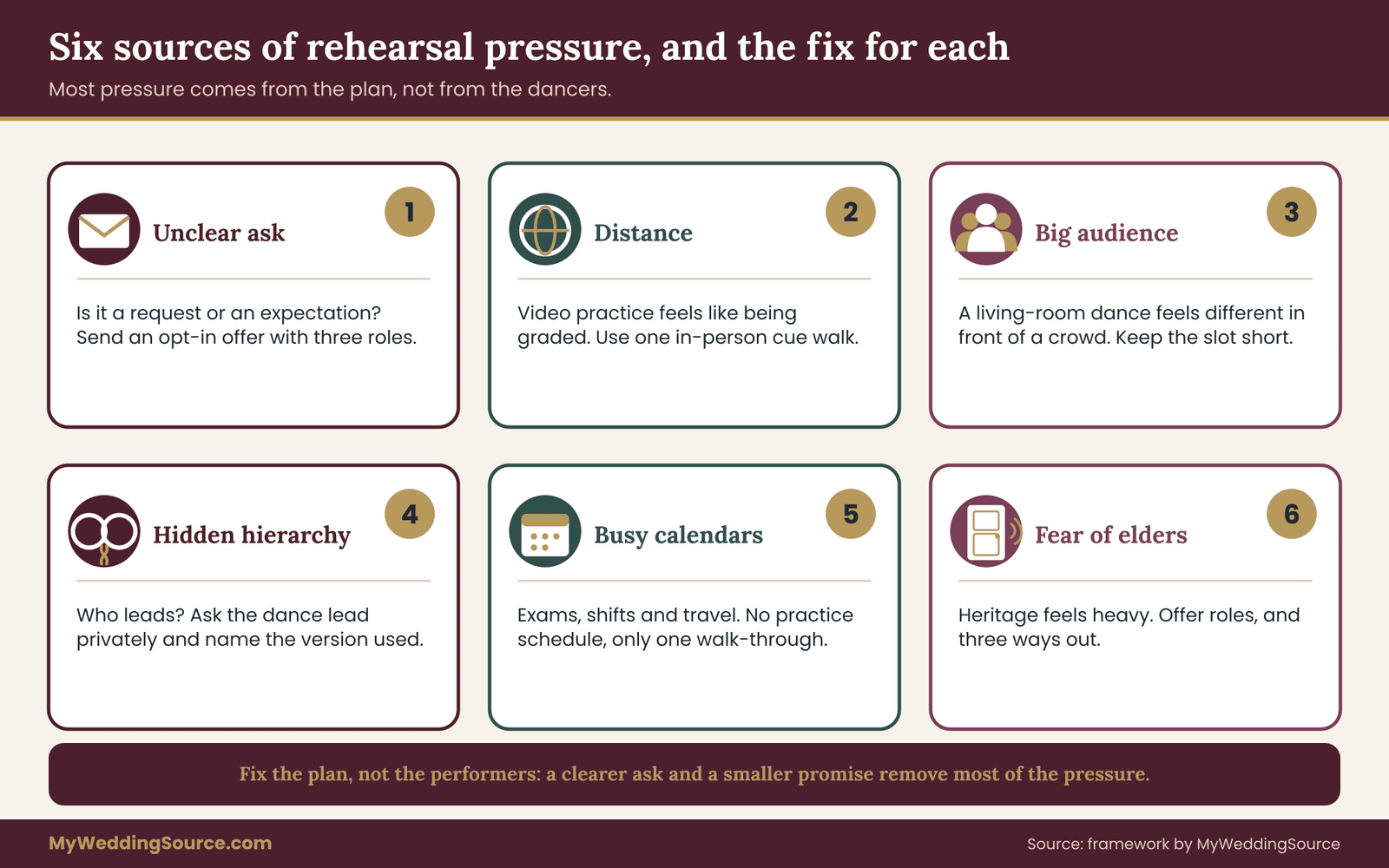
Rehearsal pressure rarely starts with the performers. It usually has a handful of sources, and naming them helps you decide which ones to remove.
The first is an unclear ask. When someone hears “we would love you to dance” they cannot tell whether it is a request, a hope or an expectation. The second is distance. Performers live in different cities, so practice happens over video, with delays and awkward angles, and people feel watched and graded. The third is audience size. A dance that was easy in a living room feels different with a hundred and fifty guests and a camera.
The fourth is hidden hierarchy. A senior relative may expect to lead, a younger cousin may know the steps better, and nobody wants to say so. The fifth is the calendar. Weddings land during exams, harvest, shift schedules and school terms, and practice time is hard to find. The sixth is fear of getting it wrong in front of elders, which can be heavy when the family cultural dance is tied to heritage.
None of these are solved by more practice. They are solved by clearer asks, a smaller promise and a plan that does not depend on everyone performing perfectly. The rest of this guide builds that plan.
What you are promising, and what you are not
It helps to write a one-sentence version of the promise your family cultural dance makes to guests. For example: “Some of our relatives will share a dance from our family’s tradition for about five minutes after dinner, and everyone is welcome to clap along.” That sentence leaves out several things on purpose. It does not promise a flawless routine. It does not promise that every named relative will appear. It does not promise a long set.
Once you have that sentence, every later decision gets easier. Length is limited by the promise. A last-minute dropout does not break the promise as long as the remaining performers can still share the family cultural dance. A rehearsal is only as large as it needs to be for the promise to hold. If you ever feel the plan growing past the sentence, that is the signal to cut something rather than add another practice.
The three people who need to agree
Three roles decide whether the family cultural dance runs smoothly. The couple decides whether the family cultural dance happens at all, and where it fits in the evening. The dance lead is the relative whom the others will follow; this may be the eldest, the best teacher or the person who knows the tradition most fully, and it is worth asking them directly rather than assuming. The coordinator is a calm person who is not performing and who holds the timeline, the music file and the cue card on the day.
The couple can fill none of these roles on the wedding day itself. They are busy, they are being photographed and they will be moved from one spot to the next. If no relative is willing to be coordinator, a trusted friend, an attendant or the venue’s event manager can take it, provided they receive the written briefing described in the next section. A planning checklist such as the wedding planning checklist can hold this assignment next to other day-of roles so it does not float.
Cultural respect without turning it into a test
Some families worry about doing the tradition justice, especially when relatives disagree about the right way to do it. Variations in steps, costume, music and order are common within one tradition, and they often follow village, region or family lines rather than any single correct version. You do not need to settle the debate before the wedding.
What you can do is decide whose version you are using for this dance and say so plainly. A short line in the briefing such as “we are following Aunt Mira’s family version” ends a long argument before it starts. If the tradition has parts that are not meant for public or mixed audiences, or roles reserved for certain relatives, ask the elders or community leaders who know. Treat their answer as a planning input, not a debate to win.
If your wedding mixes two traditions, the interfaith and cultural wedding planning guide discusses how to balance them across the day. For the dance itself, the simplest approach is often one tradition per slot, with a clear introduction, so neither family feels folded into the other.
A short readiness check before you ask anyone
Before sending a single message, answer five questions on paper. Do you want this dance on the wedding day at all, and would you be fine if it shrank or vanished? Which slot do you picture, and how long? Who is the likely dance lead, and have you spoken to them privately? Is there a recording or live music, and who owns it? What would you do if only half the performers appeared?
If you cannot answer the last question comfortably, keep working on the plan before inviting anyone. The point of the exercise is not to remove all risk. It is to make sure that a change in the line-up feels like a small adjustment rather than a crisis, because that is what lets relatives say yes without fear. The sections that follow turn these answers into a briefing, a timeline slot and a cue plan.
Opt-in first: inviting relatives to a family cultural dance
The single biggest change you can make is to turn the request into a genuine offer. An opt-in invitation says what you are hoping for, what it would involve, and how to say no or change the answer later without explaining. It sounds small. In practice it removes most of the dread, because a relative who knows they can step back is far more likely to step forward.
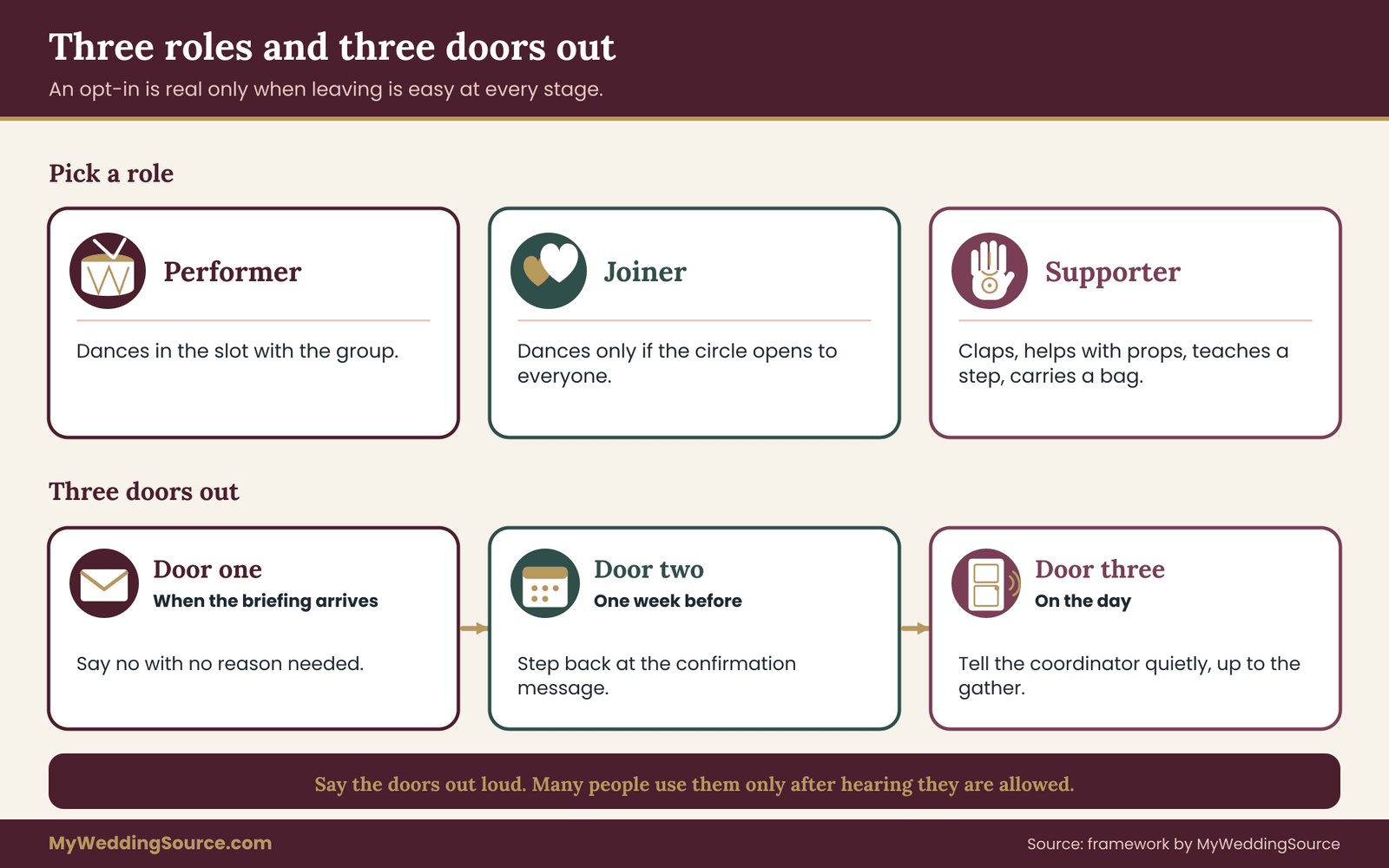
Opting in works best in layers. Rather than a single yes-or-no question, give each person three possible roles and let them pick one. You can name the roles however you like, but the idea is the same each time. A performer dances in the slot. A joiner dances only if the circle opens to everyone. A supporter helps in some other way, such as clapping, holding a prop, teaching a step in the lead-up or carrying a bag.
This three-role structure matters because many relatives feel they must either perform fully or refuse and disappoint someone. Giving them a middle path usually raises the number of willing people and lowers the stress on each. It also means the family cultural dance is never held hostage by the least available person.
The three doors out
An opt-in is only real if leaving is easy. Build in three explicit doors, and say in the invitation that all three exist.
The first door is at the briefing stage. When someone receives the written plan, they can say no with no reason needed. The second door is the week before the wedding, when you send a short confirmation. They can step back then, and you will adjust the line-up or the choreography accordingly. The third door is on the day itself, up to the moment the performers gather. A person can quietly tell the coordinator they are not up to it, and nobody will ask why.
Say all of this out loud, not just in writing. Many people will not use a door unless they have heard that they are allowed to. A sentence such as “no explanation needed at any point, and we will love you just the same” does more than a page of careful wording.
How to ask: three scripts
Scripts help because the words matter and most people draft them badly under pressure. Here are three, adjusted for different relationships. Change the names and the tone to match how your family talks.
For a senior relative whose blessing matters: “We would be honored if you would lead a short family dance at the reception, about five minutes after dinner. We would follow your version. If another role suits you better, or you would rather not, please tell us, and nothing changes between us.”
For a cousin or friend in the performing group: “We are hoping a few of you will share the family dance in a short slot after dinner. There is no practice schedule. We will send a one-page plan and run a ten-minute walk-through that day. You can say yes, maybe or no, and you can change your mind up to the last minute.”
For a parent who may feel responsible for the outcome: “We are not looking for a perfect performance. We would like the room to see something that belongs to our family. If it is simple and a bit loose, that is exactly right. Could you help us decide how long it should be?”
Asking in the right order
Order is a quiet source of offense, so plan it. Speak first to the person most likely to feel that the tradition is theirs to guide. In many families that is an elder, but not always. Then speak to the dance lead, if that is someone different. Only after they have agreed should you send the invitation to the wider group.
Sending to the group first can put an elder in the position of learning about a plan secondhand, which can create friction that has nothing to do with dancing. A private call before the group message costs fifteen minutes and often saves a month of awkwardness.
Ask each person individually if you can. A group chat creates social pressure, because a refusal becomes visible and agreement becomes a wave. People who would privately decline will often go along with a group yes. Private asks keep the opt-in honest, and you can share the final list once everyone has answered.
Children and young teenagers
Children are often the stars of a family cultural dance and also the people with the least say in being there. Treat their opt-in as a joint decision between the child and a parent. Ask the child directly, in plain words, and watch for hesitation. A child who looks at their feet and says “okay” has not necessarily said yes.
Offer younger children the same roles as adults, with a clear option to join late or watch from a parent’s lap. Plan for tired children by choosing a slot before their usual bedtime. Name one adult per small group of children who is responsible for them throughout, and keep that adult out of the performing line-up so they can step in when needed.
Teenagers are a special case. A fourteen-year-old may care a lot about how they look in front of friends. Offer them a role with some control, such as helping with the music cue, leading the youngest group or choosing the order of the steps. A teenager who is trusted with a job is much more likely to show up cheerfully. For broader guidance on looking after young guests during the day, see the guide to guest care planning.
Elders, mobility and energy
Older relatives often carry the deepest knowledge of the tradition, and they may also have the least stamina. Do not decide for them. Ask what they would like to do, and offer roles that fit different levels of movement. A grandparent might sit in a chair at the edge of the floor and lead the clapping, introduce the family cultural dance in two sentences, or place a ceremonial item at the right moment.
Chairs on the floor edge, a short slot and a seat for anyone who needs to rest are not signs of weakness. They are the reason the family cultural dance can include people from several generations in one moment. If a relative uses a cane, walker or wheelchair, ask how they would like to be involved, then let the venue know about the route and the surface.
Putting the opt-in in writing
After the private conversations, write down who said what. Keep a simple list with each person’s name, role, any limits they mentioned and the date they answered. This list becomes the spine of the briefing, and it protects you from the common problem of relying on memory about who agreed to do what.
Do not publish the list to the whole group at this stage. Share only what each person needs: their own role, the slot, the plan and the people they will coordinate with. If someone later wants to step back, you will be able to see quickly how the line-up changes and which cues need to shift. The next section explains exactly what goes into the briefing itself, and why a single page is enough.
The opt-in performer briefing for a family cultural dance, line by line
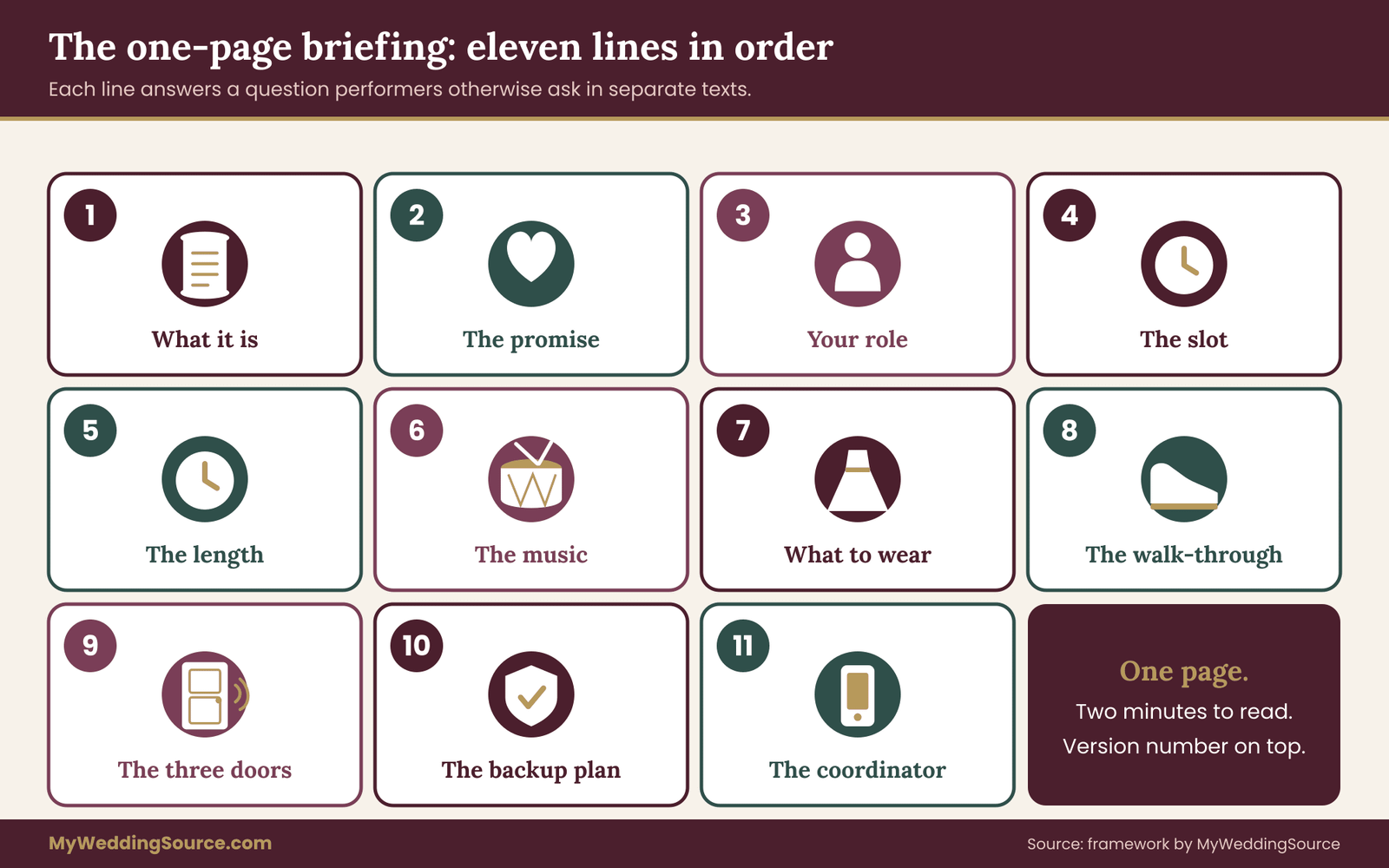
The briefing is a single page that every performer, joiner and supporter receives after they have said yes or maybe. Its job is to replace many small conversations with one clear document, so no one has to guess. A good briefing for a family cultural dance fits on one side of a sheet, reads in two minutes and can be forwarded as a message or printed and handed over.
Write it in plain language, in the language your performers use at home. If the group is bilingual, send both versions, and ask a relative to check the translation rather than relying on software alone. Keep the tone warm and avoid rules that sound like a contract. The point is to answer questions before they are asked.
The eleven lines that belong on the page
Each line below answers a question that performers often ask the couple in separate texts. Put them in this order, because it follows the order in which people worry.
1. What it is. One sentence describing the family cultural dance and whose version it follows. 2. The promise. The same one-sentence promise you wrote for guests. 3. Your role. Performer, joiner or supporter, as the person chose. 4. The slot. The approximate clock time and the moment in the evening, for example “after the toasts, before cake.”
5. The length. A hard ceiling in minutes, such as five, with the music cut to match. 6. The music. Whether it is a recording, a live musician or a relative playing, and who is bringing it. 7. What to wear. The clothing and footwear, with a note on what is optional. 8. The walk-through. The date, place and duration of the single run-through, which is for stage changes only.
9. The three doors. A reminder that stepping back is fine at any time, and who to tell. 10. The backup plan. What happens if someone cannot dance, in two sentences. 11. The coordinator. Name and how to reach them on the day, without an email address, such as a phone number shared in the private message.
Why the length ceiling matters most
If you only enforce one line, make it the length. A family cultural dance that runs long tends to cause three problems: performers tire, the dinner schedule slips, and guests who started out interested begin to check their phones. A ceiling of three to five minutes is plenty for most settings, and it makes everything else easier to plan.
State the ceiling in the briefing and build it into the music file. If the dance lead wants to do more, offer a joiner round afterward, where the circle opens to anyone and the music continues as part of the general dancing. This keeps the performance short and the party long, and it gives guests a chance to try the steps.
What to wear, without making it a burden
Clothing can become a quiet cost. Traditional dress may be expensive, hard to find or uncomfortable to dance in, and requiring it can exclude people. Make traditional dress an invitation, not a requirement, and say that comfortable formal wear is perfectly fine. If particular items hold meaning, such as a scarf, a sash or a headpiece, tell people which ones and where to get them, or offer to lend a few.
Footwear matters for safety. Dancers who plan to move quickly need shoes that grip the venue’s floor, and slippery soles on a polished dance floor are a common cause of falls. Ask the venue about the surface during your technical walkthrough, and tell performers whether to bring a second pair. The venue guidance in the technical walkthrough guide shows how to ask about floors, power and sound in one visit.
A sample briefing you can adapt
Here is a short version, written for an invented family. Adapt it freely.
“Thank you for saying yes. The Hartmann family dance will follow Aunt Rosa’s version and last no more than five minutes. It happens after the toasts and before cake, around 8:15 pm. Music is a recording that Marcus will bring on a drive and the DJ will play. Wear what feels good; the red sashes are optional and we have six to lend.
We will meet for a ten-minute walk-through at 4:30 pm, with no dancing, to practice who walks where. You can step back at any time and tell Priya, no reason needed. If someone is out, the group continues with the people who are there.”
Notice what this sample does not say. It does not mention practice sessions, it does not list consequences, and it does not repeat the couple’s hopes. The briefing is a map for the day, not a pep talk.
Sending the briefing and getting a real answer
Send the briefing individually or in small groups, not through a large chat where one question becomes a long thread. Ask for a simple reply, such as “yes,” “maybe” or “no thanks,” and a note about any limits. Make clear that “maybe” is a perfectly good answer, because it lets you plan around uncertainty without forcing a false yes.
Follow up once, a week before the wedding, with the confirmation message. Keep it short, repeat the three doors and ask for a final answer by a date. Anyone who has not replied by then is, for planning purposes, a supporter, and you can say so kindly. Do not chase more than once. A family cultural dance is meant to be a gift, and chasing people to give it turns it into a chore.
Keeping the briefing consistent when the plan changes
Plans change. A performer drops out, the slot moves, the venue bans open flame or the DJ cannot play a file. When that happens, update the single page and resend it, marked with the new date at the top. Do not rely on a trail of corrections across several messages, because someone will always act on the old one.
Number versions plainly: “Version two, updated Thursday.” Keep the old versions in a folder in case someone says the earlier plan was different. If you hold a shared document, say who is allowed to edit, usually the coordinator only. A single source of truth is the most effective defense against the confusion that makes people anxious.
Where a family cultural dance fits in the reception timeline
Timing decides more about the success of a family cultural dance than choreography does. The same five minutes can feel like a highlight or an interruption depending on when it lands. Think about three things when you choose the slot: the energy of the room, the physical state of the performers and the logistics around you, such as food service and staff changes.
The most common slots are after the toasts and before cake, between dinner courses, right after the first dance, and at the start of the open dance floor. Each has trade-offs, and none is automatically right. The decision rule below helps you pick.
Five slots compared in plain terms
After the toasts, before cake. Guests are seated, fed and attentive. Performers have eaten, but not too long ago to feel sluggish. This is the safest slot for a first-time family cultural dance, because the audience is in place and the floor is easy to clear. The downside is that guests may be restless if the speeches ran long.
Between courses. Attention is high and the staff can plan around it. The risk is that servers may need the same floor space, and a delay makes the next course arrive cold. Use this slot only if the venue agrees in writing that service will pause.
Right after the first dance. The floor is already clear and the room is focused on the couple. A family cultural dance here reads as a continuation of the couple’s story. The drawback is that performers must be dressed and ready early, which pulls them away from cocktails and dinner and raises nerves.
Start of the open dance floor. The party energy is high, and the family cultural dance can lead naturally into joiners. The risk is that the DJ is already managing a crowd, and the mood may not suit a more formal piece. Choose this slot for loose circle dances that welcome everyone.
Late evening. Guests are tired, children are gone and performers may have been drinking. Avoid it for any dance with fixed steps or children, though it can work for an informal circle among the few who remain.

A decision rule for choosing the slot
Use this short rule. If the family cultural dance has fixed steps or involves children, choose a seated slot early in the evening, after toasts and before cake. If the family cultural dance is loose and open to anyone, choose the start of open dancing. If the family cultural dance includes ceremonial elements or elders, choose a time when the room is quiet and attentive, which is nearly always before the music gets loud.
Then test the slot against the performers’ own comfort. Ask each of them whether they would rather dance before or after dinner. Many people prefer before, because they cannot enjoy their meal while worried. Others find they are too nervous to eat anyway. Whichever the majority prefers is usually the right choice, provided the venue can support it.
Building buffers into the evening
A reception schedule is a chain of small tasks, and any delay shifts every task after it. For a family cultural dance, add a ten-minute buffer before and after the slot. The buffer before gives performers time to gather, check clothing and use the restroom. The buffer after lets the staff reset the floor, the photographer capture a few frames and the DJ shift the mood.
Share the slot with the caterer and venue manager at least a week before the wedding, and ask what would change if the family cultural dance began fifteen minutes late. A reliable answer, such as “we can hold dessert,” is worth more than any guess. Your overall timeline can sit alongside this; the wedding vendor timeline explains how to share one schedule with every vendor.
How the guest experience shapes the slot
Think about what guests are doing in the minutes around the family cultural dance. If they have just stood up for a toast, they are warm and ready to watch. If they have been sitting for an hour, they may need a break. Consider where you want people to stand or sit, because a dance performed to seated guests in the round feels different from one performed in front of a standing crowd.
The reception guest flow guide covers how guests move through a venue across the evening. For a family cultural dance, the useful lesson is to avoid asking people to move twice in a short time. If guests are going to relocate for cake, put the family cultural dance before or after that move, not in the middle.
Music, recordings and rights for a family cultural dance
Music is where a family cultural dance most often runs into practical and legal questions. A recording, a live musician and a relative playing a drum each raise different issues. Most of them are easy to handle with a short conversation and a written note, and none of them need to slow the planning down.
The key idea is that someone must be responsible for the music at every point: choosing it, supplying it, cutting it to length and playing it at the right moment. If you leave any of those undefined, the family cultural dance will depend on a hopeful guess on the day.
Three music sources and their risks
A recording. Easy to control, but you need the right file in the right format, cut to the right length, with a backup. Relatives often bring music from a phone or streaming service, which may be unavailable offline or play ads. Ask for a downloaded file on a drive, and ask the DJ which format they prefer.
A live musician. Gives the family cultural dance a lovely feel and lets the music adapt to the dancers. The risks are timing, sound setup and fatigue. Agree on the start cue, the length and the tempo beforehand, and make sure the musician knows when to stop. If the musician is a relative, add them to the briefing as a performer.
A relative playing or singing. Often the most meaningful choice. It also depends heavily on the person’s confidence. Offer a recorded backup that can be played if they prefer not to go ahead, without any fuss.
Rights and permissions in plain terms
Music is protected by copyright, and public performance of recorded or live music is often covered by licenses held by venues, bands or DJs. In the United States, the Copyright Office explains the basics of copyright, and performing rights organizations such as ASCAP, BMI and SESAC license public performance on behalf of songwriters and publishers. Many venues hold blanket licenses that cover music played in their space, but you should not assume that.
The practical step is simple: ask your venue and your DJ or band what is covered, and ask for the answer in writing. Traditional folk music that is old enough may be in the public domain in terms of the composition, but a particular recording of it is usually a separate work with its own rights. When in doubt, ask the venue and the performers rather than guessing.
Questions to put to the venue and the DJ
Send three short questions by message and keep the replies. First, does the venue hold a performance license that covers recorded and live music at private events? Second, will the DJ or band play a file the family supplies, and in what format and by what deadline? Third, are there restrictions on amplified sound, volume or end times that affect the slot?
If the family cultural dance will be filmed or streamed, add a fourth question: does the license or contract cover recording of the music in video? Rights for a video or a livestream can differ from rights for a live room. Raise it early, because it may change the choice of recording. Do not treat these answers as legal advice; if something looks complicated, ask a qualified professional or the venue’s own contact.
Cutting and testing the music file
Whoever supplies the music should prepare a version trimmed to the agreed length, with a clean start and a short fade or clear end. Ask them to name the file clearly, for example “family-dance-5min,” and to bring two copies on separate drives. Ask the DJ to test the file on the actual sound system before guests arrive, at the volume the dancers need to hear.
Performers often need to hear the music differently from the audience. A dancer on a large floor may not hear the beat from speakers pointed at the crowd. Ask whether monitors or a speaker facing the floor can be arranged. If the music matters to the steps, that small adjustment can prevent a lot of wobbly timing without any extra practice at all.
Stage-change rehearsal cues for a family cultural dance
This is the core of the approach. Instead of rehearsing the family cultural dance repeatedly, you rehearse the changes around it. A family cultural dance has very few moving parts at the level of the room: people arrive on the floor, the floor is clear, the music starts, someone leads, the dance ends and everyone leaves. If those six moments are rehearsed once, calmly, the dance itself can be as loose or polished as the family likes.
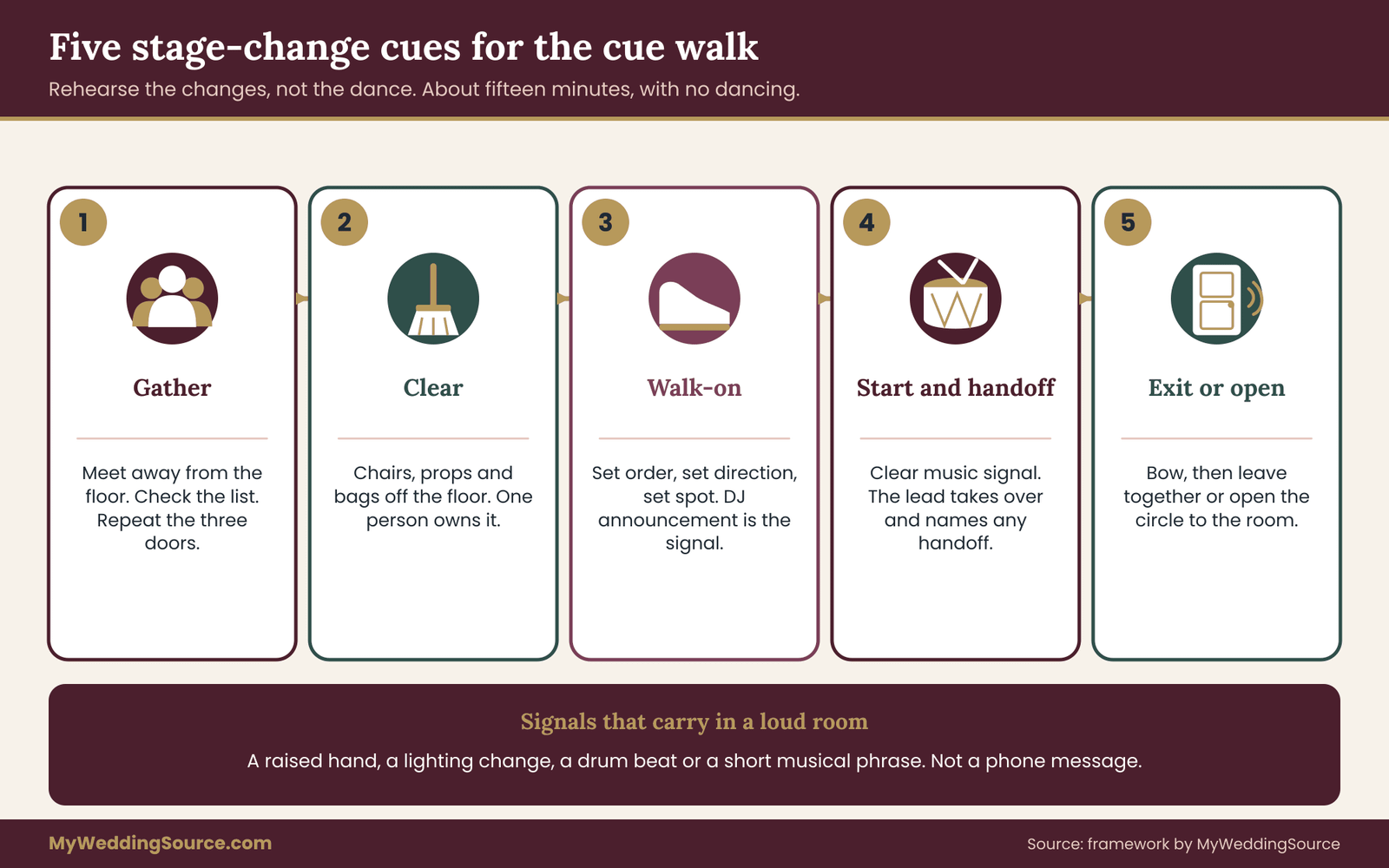
We will call this the cue walk. It is a single run of about ten to fifteen minutes, held in the actual room or one like it, where nobody dances. People walk, stand, hold their positions and point at where things happen. The cue walk is built from five stage-change cues, each with a person responsible and a signal.
The five cues
Cue one: the gather. Performers meet at a named spot away from the floor, such as beside the bar or near the coat check, at a stated time before the slot. The coordinator checks the list, mentions the three doors one last time and confirms who is out.
Cue two: the clear. The floor is cleared of chairs, props and stray bags. Someone, usually the coordinator or a venue staff member, owns this step. Decide whether guests move or stay seated, and tell them with a simple announcement.
Cue three: the walk-on. Performers enter in a set order, from a set direction, to a set spot. The first person in is the dance lead or the youngest group, depending on the tradition. The cue is the DJ’s announcement or a short musical lead-in.
Cue four: the start and handoff. The music begins on a clear signal, and the lead takes over. If the lead needs to hand to another person midway, such as moving from a group dance to a circle, that handoff is named and placed in the plan.
Cue five: the exit or open. The family cultural dance ends, performers bow or pause, and then one of two things happens. They exit together to a named spot, or they invite guests to join, and the floor opens. Either way, someone owns the moment so the room does not hang in awkward silence.
Why rehearse cues instead of steps
Steps are personal, and many families already know them. Cues are logistical, and no one knows them until they happen. Rehearsing steps adds pressure because people feel judged. Rehearsing cues removes it because there is nothing to judge: everyone is simply learning where to stand.
Cue rehearsal also tends to be shorter, easier to schedule and more inclusive. Someone who lives in another country can arrive the day before and still be ready. A grandmother who cannot dance but will lead the clapping learns exactly when to begin. Children can practice walking on without being drilled. The only people who might want a separate practice are those with a fixed routine, and even they can usually manage with one short session.
Running the cue walk in fifteen minutes
Hold the cue walk on the wedding day if you can, in the room, a few hours before guests arrive. If that is impossible, hold it the evening before or at the rehearsal dinner, and do not use the full venue time if the venue charges for access. The agenda is short and fixed.
Minutes one to three: gather everyone, read the briefing line aloud and confirm who is present. Minutes four to six: walk to the gather spot, then to the floor, following cues one to three. Minutes seven to ten: stand in position, hear the music for ten seconds and practice the handoff. Minutes eleven to thirteen: practice the exit or opening. Minutes fourteen and fifteen: ask for questions and name any changes.
At no point does anyone need to dance. If someone wants to, let them, but do not ask. If you feel pulled to run it again, resist. A second pass makes the walk longer without making it better, and tired performers start to feel they are on a stage before the day has even begun.
The cue card
Print a single card for the coordinator and one for the DJ, with the five cues in order, the clock times and the responsible person for each. Keep it to one side of a page. The card should include the music file name, the length ceiling, the backup plan and the phone number of the coordinator.
For the DJ or band, the card should add the exact words of the announcement, if any, and the signal to start the music. If you are using a stage manager role in your ceremony plan, the format will look familiar. The ceremony cue sheet guide shows a layout for cue sheets that you can adapt for this dance as well.
Signals that work in a loud room
A cue is only useful if people can see or hear it. In a loud reception, spoken instructions get lost, so use signals that carry. A raised hand from the coordinator, a change in lighting, a drum beat or a short musical phrase all work. Agree on the signal at the cue walk and repeat it twice.
Avoid relying on phone messages as cues. Performers’ phones are in bags, on silent or left at the table. A visible person standing at the edge of the floor is far more reliable than a notification. If you need to hold a group of children, a small stuffed toy or a colored ribbon held by the leader can serve as a signal they remember easily.
Stage changes for different dance types
A choreographed group routine needs the clearest cues, because its start and end are precise. Position markers on the floor, such as tape under the carpet or a note on the plan, can help, but only if the venue allows them. A circle dance needs fewer cues but a stronger leader, and a defined point where guests may join.
A ceremonial dance with defined roles needs a quiet entrance and perhaps a pause before the music. Ask the elders what silence or announcement fits the tradition, then build the cues around it. A children’s dance needs the coordinator to hold the group at the gather spot and send them in on a shared signal, with an adult at the end of the line.
What a cue walk looks like when it works
Imagine eight relatives, three of them under ten, standing near the bar at 4:30 in the afternoon with an empty dance floor in front of them. The coordinator reads the one-page plan aloud. They walk, in order, to the floor, and the youngest cousin pauses at the spot marked by a chair. They stand for ten seconds while the DJ plays the first bars of the file.
They practice the handoff, where Aunt Rosa passes a scarf to the oldest grandchild, and they practice the exit, where everyone turns and invites the room. It takes twelve minutes. There is laughter and no one has danced a single step. That is the point. When the real slot arrives, everyone knows exactly where to stand, and the family cultural dance can be whatever it is.
Keeping the cue walk calm
A few habits keep it calm. Keep the coordinator out of the performer line-up so they can see the whole floor. Keep the tone light and avoid correcting steps, since that belongs to the dance lead and only if invited. Offer water, and allow anyone to leave early. Thank people at the end and tell them they are done.
If someone asks for more rehearsal, ask what they are worried about. Often the worry is a single moment, such as the handoff or the music start, and a five-minute focus on that moment is better than a full run. Treat requests for extra practice as information about where the plan is unclear, and fix the plan rather than adding sessions.
Space, floor and safety for a family cultural dance
A family cultural dance needs less space than most people assume, but it needs the right kind. The questions are how big the cleared area must be, what the floor is made of, how people will enter and leave, and what could go wrong with the clothing, props or lighting. Answer them in a short conversation with the venue, ideally during a technical visit.
Start with the numbers that you can measure. Ask the venue for the dimensions of the dance floor and the clear area around it. Count the performers and think about how they move. A line dance travels, a circle dance spreads outward and a stationary group routine takes up less room than people expect.
Estimating the floor you need
A rough method works well enough. Picture each performer needing an arm’s length around them in every direction, then add a margin for travel. A circle of ten adults holding hands is wider than most people imagine, and a group that links arms and steps sideways may need a lane several yards long. When in doubt, ask the dance lead to show the largest movement and measure that.
Compare your estimate with the floor you have. If the dance floor is smaller than the need, you have three choices. Reduce the number of performers in the first pass, adapt the steps to a smaller area, or open adjacent space by moving tables. Do not squeeze a full group onto a small floor and hope. Crowded dancers collide, and collisions with chairs and tables cause most of the minor injuries at receptions.
Surfaces, shoes and slipping
Floors vary a lot. A portable dance floor over grass, a polished wood floor, a carpeted ballroom, a stone terrace and a concrete barn floor each behave differently. Slippery, sticky and uneven surfaces all raise the risk of a fall. Ask the venue what the floor is, whether it can be cleaned and whether it will be waxed or treated before the event.
Tell performers the surface in the briefing, and suggest shoes that suit it. Leather soles can slide on polished floors, rubber soles can grip and drag on some surfaces, and heels sink into soft ground. Barefoot dancing may be traditional for some dances but is rarely a good idea on an unknown floor, so check for splinters, spills and debris first, and get the dancers’ agreement.
Costumes, props and anything that burns
Long garments, loose scarves, bells and heavy headpieces can be lovely and also hazardous. A hem that drags can trip a dancer, a heavy headpiece can slide, and a long sash can catch on a chair. Ask performers to try their outfit while moving, and let them adjust it. A safety pin and a small repair kit on the day will solve most problems.
Props deserve their own question. Swords, sticks, ribbons, fans, candles, lanterns, plates and bowls all have their uses in traditional dances, and several raise venue questions. Open flame, sharp objects and spilled liquid are often restricted by venues and fire regulations. Ask early, in writing, and have an alternative ready, such as battery candles or a non-metal replica.
Fire, crowds and exits
Fire safety codes set rules for candles, flames and crowd density in many venues. In the United States, the National Fire Protection Association publishes widely used codes, and local fire officials and the venue enforce the ones that apply. You do not need to read the codes. You need to ask the venue manager what is permitted and whether the fire marshal must approve anything.
Think also about exits and crowding. If guests will gather around the floor to watch, make sure aisles and exits stay clear. Staff can help by keeping a lane open. Watch for children standing on the edge of the floor, since fast dancers and small children are a poor combination.
Accessibility on and around the floor
Accessibility should be part of the plan from the beginning, not an afterthought. The Americans with Disabilities Act sets requirements for many venues, and the Department of Justice explains them on its ADA website. Beyond the legal minimum, think about what lets your relatives take part: a step-free route to the floor, chairs on the edge, a clear line of sight for wheelchair users and a quiet spot for anyone who finds loud music overwhelming.
Ask performers whether they need anything. Some may have a condition that is not visible. A simple line in the briefing, such as “tell Priya if you need a chair, a break or a different role,” makes it easy to ask without feeling singled out. Then act on what they say quietly, without announcing it to the group.
Weather, heat and outdoor floors
If the family cultural dance is outdoors, add weather to the plan. Sun, heat, wind and rain affect performers and instruments. Ask where the family cultural dance would move if the weather changes, and who decides. Make sure the alternate space is the same size or can be adapted. A dance moved to a small indoor area may not fit, and nobody wants to find out at the last minute.
Heat deserves respect when performers wear layered traditional clothing. Offer water, shade and a place to sit before and after. Keep the slot short, and do not schedule it at the hottest hour of the day if you can avoid it. A well-timed dance in the evening light is often kinder to everyone.
Working with the DJ, band and camera team
Vendors are partners in a family cultural dance, and they work best when they understand the plan early. The DJ or band controls sound and timing, the photographer and videographer capture the moment, and the venue staff control the floor and the doors. Give each of them a short, specific version of the plan, not the full briefing.
Share the cue card with the DJ at least a week before the wedding, and ask a direct question: is there anything in this plan that would be difficult? Most professionals will tell you honestly, and a small change at this stage costs nothing. Their experience with other families can be a real asset, as long as you ask for it.
What to tell the DJ or bandleader
Give the DJ the file name, the length, the start cue, the announcement wording and the backup plan. Ask what format they prefer, how they will test the file and whether they can supply a microphone for the dance lead. Ask also how they handle a request to stop or restart the music, since this may happen if a performer needs a pause.
If you hire a band, share the tradition and ask whether they know the music or can learn it. Do not assume that a professional band can improvise a cultural piece they have never heard. Tell them honestly whether the family cultural dance depends on live music, and agree on a recorded fallback. The wider reception music plan, covered in the reception music planning guide, can hold this as one item among the evening’s sets.
What to tell the photographer and videographer
Photographers and videographers need to know the slot, the area, the lighting and any restrictions. Some traditions have moments that should not be photographed, or are meant for the community alone. Ask the elders, and pass the answer to your camera team clearly. If certain relatives prefer not to be filmed, say so as well.
The camera team also needs to know where to stand. A photographer who steps into the middle of a circle may disrupt the family cultural dance, and a videographer blocked by a guest cannot recover the shot. Agree on positions at the cue walk, if they can attend, or describe them in writing. Consent and sharing questions for photos are covered in the photography consent guide.
Contracts and written confirmations
You do not need a new contract for a short family dance, but you should confirm the details in writing with each vendor. A short message that lists the slot, the music, the equipment and any special requests is enough, and the reply becomes your record. If the plan needs extra time, extra equipment or extra staff, check the cost before you commit.
Look at what your existing contracts say about overtime, equipment and outside performers. A venue may charge a fee for outside performers or for amplified sound, and a DJ may charge for extra setup. The guide to wedding vendor contracts explains where to look. Ask before the day, because changes made on the spot cost more and rarely go well.
Guests and the family cultural dance: context, joining and respect
A family cultural dance lands better when guests understand what they are seeing. Many guests will not know the tradition, the music or the meaning of the steps, and a few sentences of context turn a pleasant surprise into a shared moment. The context should be short, warm and free of lecture.
You have three places to offer it: a line in the program, a spoken introduction and a brief note on a sign or menu card. Pick one or two, not all three. Too much explanation can make the family cultural dance feel like a presentation, and the performers will feel it too.
Writing the two-sentence introduction
The introduction is spoken by the DJ, the coordinator or a relative, and it should last about fifteen seconds. It names the family, the family cultural dance, where it comes from and what the room can do. For example: “This is a dance the Hartmann family has shared at celebrations for generations. Please clap along, and stay close, because the circle will open at the end.”
Avoid claims you cannot verify, such as the exact age of the tradition. If you do not know where a dance began, say it is a family tradition and leave it there. Do not describe the family cultural dance as exotic or use language that treats the tradition as a curiosity. Have the dance lead or an elder read the introduction before the wedding, and change anything they dislike.
Telling guests how to join
If the circle will open, tell guests how. A good invitation is specific and light: “Take the hand of the person next to you and follow the steps.” Show a simple move, then let people try. Most guests are glad to join if they know it is welcome, and they will hold back if they are unsure.
Plan for those who prefer not to dance. A circle dance is easy to leave and rejoin, and a seated guest can clap and watch with pleasure. Never use guilt, a microphone call-out or a spotlight to pull someone onto the floor. A person who is forced to dance rarely enjoys it, and the people around them notice.
Respecting the tradition in a mixed room
At many weddings, the room is a mix of families and cultures, and every guest has their own sense of what is polite. A few habits keep everyone comfortable. Do not ask guests to wear anything. Do not ask them to repeat words they do not understand. Do not post a how-to on social media before the family cultural dance, as a family may prefer to keep some parts private.
If the family cultural dance is tied to a religious or ceremonial context, consider whether it fits a party setting. Some families are happy to share it widely, while others treat parts of it as private or reserved. The elders know. Ask them, listen carefully and accept the answer, even if it means shortening the family cultural dance or shifting the slot.
Children in the audience
Children in the audience are sometimes the most enthusiastic joiners. Plan a space where they can watch safely, with an adult nearby, and keep them off the dance area until the circle opens. If the family cultural dance has noise, fast movement or flame, keep younger children at a distance and give them something to do afterward.
Some children will be frightened by loud drums or sudden movements. A calm word, a seat near the back and a chance to leave quietly are enough. A family cultural dance can be a joyful memory for a child, but only if it is not a source of fear.
A worked example: the Hartmann family dance
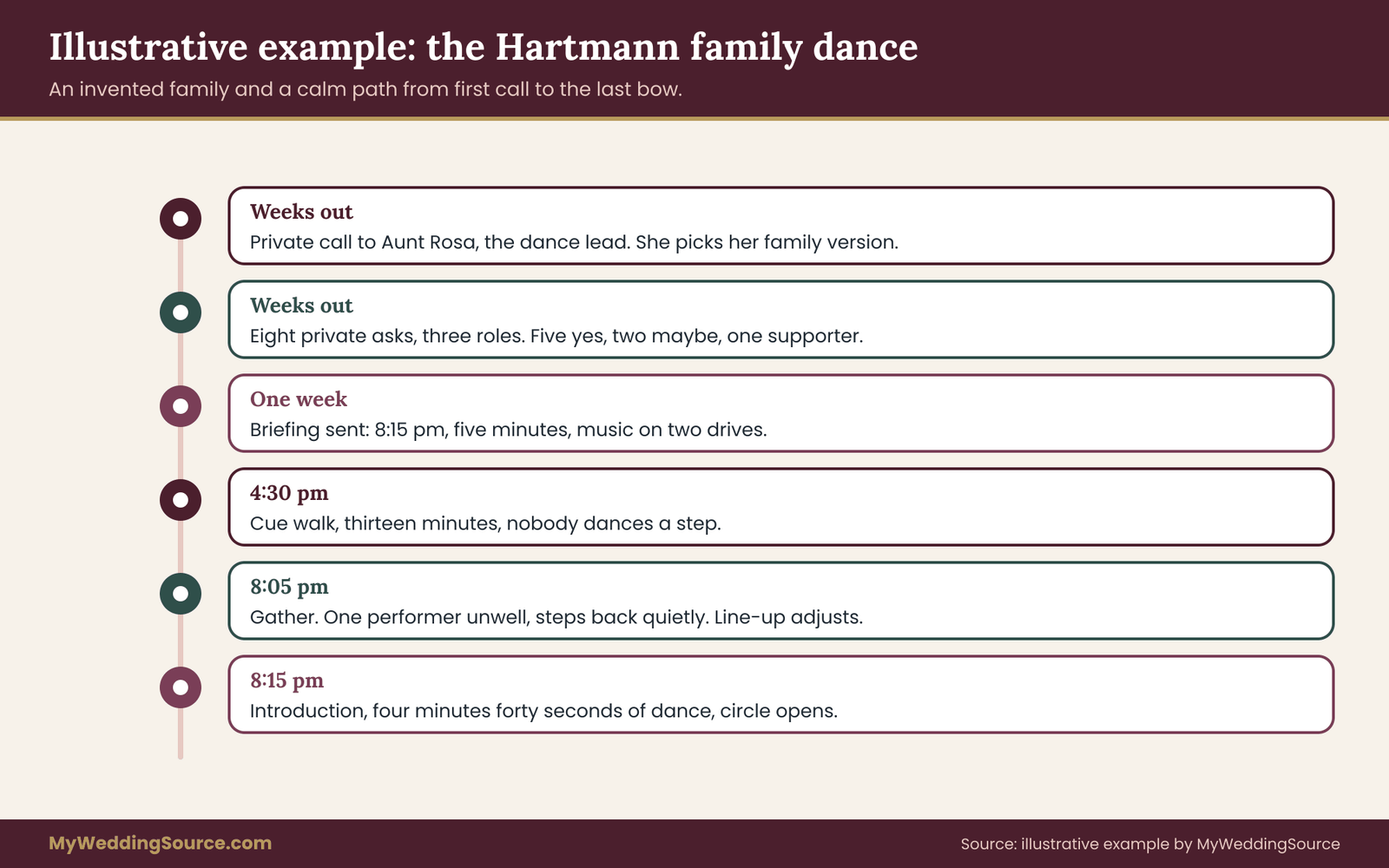
This example is invented to show how the pieces fit together. The names and details are illustrative only. Maya and Daniel are marrying on a Saturday evening in a rented hall with a hundred and twenty guests. Maya’s mother’s family has a village circle dance that is danced at weddings and holidays, and Maya would like some of her relatives to share it.
Step one: the readiness check
Maya answers the five questions. She wants the family cultural dance but would be fine if it shrank. She pictures it after the toasts, about five minutes. Her aunt Rosa is the likely dance lead, so Maya calls her privately. The music is a recording from Rosa’s family, and the hall’s manager says the venue holds a license for music played in the space but cannot confirm anything about video. If only half the relatives appear, the circle becomes smaller and Rosa leads it.
Step two: the opt-in
Maya speaks to Rosa first, using the elder script. Rosa agrees to lead and chooses her own family’s version. Maya then sends individual messages to eight relatives, offering the three roles. Five say yes to performing, two say maybe, and one asks to be a supporter because of a bad knee. A cousin who lives overseas arrives the day before and says yes to joining. Maya records each answer in a simple list.
Step three: the briefing and the music
Maya sends the one-page briefing. It names the slot as 8:15 pm after the toasts, the length as five minutes and the walk-through as 4:30 pm on the wedding day. Rosa’s nephew Marcus supplies the music on two drives, cut to five minutes. The DJ confirms he can play the file, tests it at the sound check and offers a floor speaker so the dancers can hear the beat.
Step four: the cue walk
At 4:30 pm, eleven relatives gather near the bar. The coordinator is Maya’s friend Priya, who is not dancing and holds the cue card. They walk through the five cues in thirteen minutes. The youngest cousin enters first, Rosa hands a scarf to the oldest grandchild at the midpoint, and at the end they open the circle to the room. Nobody dances a step. One uncle asks whether to bow, and Rosa says yes, once, together.
Step five: the day
At 8:05 pm the performers gather. Two of the maybe relatives decide to join as supporters, and one performer feels unwell and tells Priya, who adjusts the line-up quietly. The DJ gives the fifteen-second introduction. The family cultural dance runs four minutes and forty seconds, and the circle opens. Guests join, and the DJ moves into general dancing. The photographer stands at the edge as planned, and the video is cleared in advance.
What the example shows
The family cultural dance in this example was not flawless. A step was missed, a scarf handoff was a little late, and the youngest cousin giggled through the walk-on. None of that mattered, because the plan did not depend on perfection. Nobody practiced for weeks, nobody was publicly pressed, and the person who felt unwell left without explanation.
The example also shows where the work went. Most of it was in the private asks, the single page and the cue walk. The dance itself needed little extra attention because the surrounding logistics were already settled. That ratio, a lot of calm preparation around a short moment, is typical of dances that feel relaxed on the day.
When a family cultural dance goes off script
Even a well-built plan meets surprises. Performers get sick, flights are late, the music file fails, a toast runs long, a child melts down, or an elder decides at the last minute that the family cultural dance should be longer. The plan does not prevent these moments. It gives you a calm way to respond, which is most of what matters.
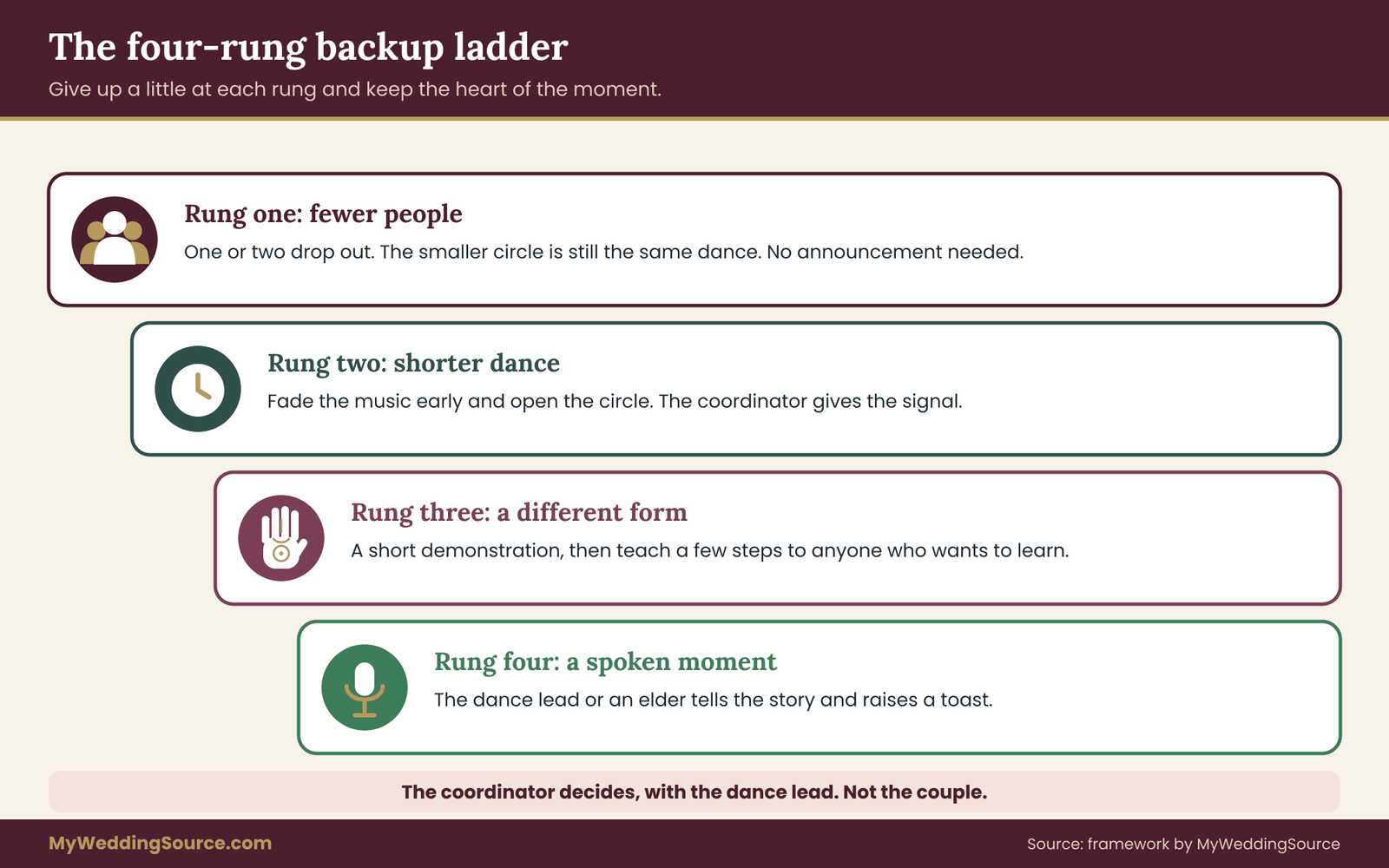
Think of the backup plan as a ladder with four rungs. At each rung, you give up a little and keep the heart of the moment. Decide in advance who has the authority to move down the ladder. In most cases it is the coordinator, in consultation with the dance lead, and not the couple.
The four-rung backup ladder
Rung one: fewer people. If one or two performers drop out, the family cultural dance continues with the rest. Brief the group so they know the gaps are fine. A smaller circle or a shorter line is still the same dance, and no explanation to guests is needed.
Rung two: shorter dance. If time is short, the music is cut to the first minute or two, and the circle opens early. The DJ can fade the track on the coordinator’s signal. This rung is also the right answer when the room is restless or the performers are tired.
Rung three: a different form. If the group is too small or the floor too crowded, the family cultural dance becomes a demonstration followed by an invitation. The dance lead shows a few steps and teaches them, and guests learn by doing. Many families find this more joyful than a formal performance.
Rung four: a spoken moment. If the family cultural dance cannot happen at all, the dance lead or an elder says a few words about the tradition and raises a toast. The family cultural dance becomes a story, and the room still receives the gift. Plan this rung with the same care as the others, since it saves a difficult evening.
Common problems and plain fixes
The music file fails. The backup drive, a phone with the file stored offline and the DJ’s own library of similar pieces form three layers of defense. If all fail, the performers can clap or sing the rhythm, which is often traditional anyway. Practice this once at the cue walk with a joke, so it feels normal.
A performer is overcome with nerves. Offer water, a quiet minute and a change of role to joiner or supporter. Never push. A short private word from someone they trust works better than a pep talk, and most people recover if they have a way out.
A relative wants to add something. This is common, and it can be lovely or disruptive. Ask the dance lead, and use the length ceiling as the deciding factor. If the addition fits within the time, welcome it. If it does not, offer it for the open dancing afterward.
The slot is delayed. Use the buffers you built. If delay passes fifteen minutes, ask performers whether they would prefer a later slot or a shortened version, and decide quickly, since waiting in costumes is tiring.
Handling disagreement between relatives
Sometimes two relatives disagree about the right way to dance or who should lead. The best approach is to prevent the argument with the line in the briefing about whose version you are following. If the disagreement still arises, speak to each person privately and listen first.
Do not settle it in front of the group. Offer a face-saving solution, such as each person leading one section, or alternating versions, or deciding that this wedding follows one version while the other is honored at another gathering. The couple’s role is to protect the relationship, not to rule on tradition. If it cannot be resolved, rung four of the ladder lets everyone keep their dignity.
Grief, absence and emotion
Family dances can stir strong feelings, especially when someone who used to lead is no longer there. A grandmother’s absence, a parent’s illness or a distance between relatives may surface during the slot. Plan for it gently. A moment of quiet before the music, a framed photo near the floor or a spoken tribute can honor the person without changing the family cultural dance.
Give performers permission to feel emotional. Tell the coordinator to have tissues and water ready, and to let people pause if they need to. If the family cultural dance carries such weight, consider adding a few seconds of silence at the end before the circle opens. The room will usually follow your lead.
Costs and small budget decisions
A family cultural dance is usually inexpensive, but a few costs can add up. Possible items include costume rentals or purchases, travel for performers, extra DJ equipment, a microphone, floor protection, extra staff time and a gift to the dance lead or musicians. Add them to a single line in your budget, and decide in advance who pays for what.
If relatives are traveling, ask whether they would like help with costs, but do it privately and without conditions. Paying for performers’ costumes or flights can create a sense of obligation that undercuts the opt-in. If you offer help, make it a gift. A short thank-you note after the wedding, handwritten and specific, often means more than money.
Your next steps
Start with a single evening and four short tasks. Write the one-sentence promise for your family cultural dance, and the readiness answers. Call the likely dance lead and ask, in your own words, what role they would like. Send the venue and your DJ the three music questions. Draft the one-page briefing using the eleven lines above.
Then work through the plan a week at a time. Send the opt-in invitations one by one, collect answers and update the list. Choose the slot and share it with the vendors. Prepare the cue card and book fifteen minutes for the cue walk. On the day, hand the card to your coordinator and let go. If you want to see how this fits with the rest of the work, a standard wedding planning checklist can hold these tasks alongside everything else.
FAQ
How do we coordinate a family cultural dance without making relatives rehearse for weeks?
Replace practice with a cue walk. Send a one-page briefing, let each person choose a role, and hold one short walk-through of the stage changes only, with no dancing required. Relatives who already know the steps need no extra practice, and those who do not can join in as supporters or in the open circle afterward.
How long should a family cultural dance be at a wedding?
Three to five minutes suits most receptions. That is long enough to share the tradition and short enough that performers stay comfortable and the schedule holds. If the family wants more, keep the formal piece short and let the circle open to guests afterward, where the music can continue as part of general dancing.
What if a performer drops out at the last minute?
Use the backup ladder. First, continue with fewer people, because a smaller group still shares the dance. If more people drop out, shorten the music, change the form to a demonstration, or have the dance lead say a few words. Tell performers in the briefing that this is fine, so the plan does not depend on everyone appearing.
Do we need a license to play music for a family cultural dance?
It depends on the venue, the music and how it is played. Many venues hold licenses covering music played at events, and DJs and bands often handle their own. Ask both in writing. Remember that a recording of old folk music can have separate rights from the tune itself. For specific questions, consult the Copyright Office, a licensing organization or a qualified professional.
Can children and elders take part in a family cultural dance?
Yes, with the right roles. Offer children a place with an adult nearby, and let them join late or watch. Offer elders roles that suit their stamina, such as leading the clapping, giving the introduction or placing a ceremonial item. Provide chairs at the edge, keep the slot short, and ask each person what they would like instead of deciding for them.
Should we let the photographer or videographer record the dance?
Usually yes, but ask first. Some traditions include moments that are private or not meant to be filmed, and some relatives prefer not to appear. Ask the elders and the performers, then tell your camera team what is allowed and where to stand. Also check whether the music license covers video or a livestream.
Where in the reception timeline should a family cultural dance go?
For dances with fixed steps or children, choose a seated slot after the toasts and before cake. For loose circle dances open to everyone, the start of open dancing works well. Avoid late evening for formal pieces. Add a ten-minute buffer before and after, and share the slot with the caterer and venue manager.
What if relatives disagree about how the dance should be done?
Decide in advance whose version you are following, and write it in the briefing. If a disagreement still arises, speak to each person privately and offer a face-saving option, such as each leading a section. Do not settle it publicly. The couple’s job is to protect relationships, and the backup ladder gives everyone a graceful way to step aside.
Sources
- Copyright basics and music, U.S. Copyright Office
- Licensing for public performance of music, ASCAP
- Music licensing for businesses and venues, BMI
- Performance licensing, SESAC
- Information and technical assistance on the Americans with Disabilities Act, U.S. Department of Justice
- Codes and standards, National Fire Protection Association
- Folk and traditional arts, National Endowment for the Arts
- American Folklife Center, Library of Congress
- Government services and information, USAGov