
Welcome bag items work when each one answers a real need a guest has in the first hour after arriving, and they fail when they are chosen because they photograph well. This guide gives you a guest-needs ranking, a four-test filter and a cost-per-bag sheet so you can decide what goes in the bag, what stays out and what each choice really costs.
Choose welcome bag items in this order. First, list who is arriving and how (flying, driving, local, with children, with mobility needs). Second, rank every candidate item against four tests: does it meet a need on arrival, will it get used, can it travel, and is it safe to hand out. Third, keep only the top tier, usually water, a small snack, a printed schedule with a map and one local touch. Fourth, price the bag per guest household and per item actually used, not per item bought.
A welcome bag is a small promise. It says that someone expected you, thought about your trip and left something useful at the door. When that promise is kept, a tired guest finds water, a snack and a clear schedule, and the bag does its job in about thirty seconds. When it is broken, the guest carries a tote of loose trinkets up three flights of stairs, wonders how to fit it in a suitcase, and quietly leaves half of it in the hotel room.
Most of the money couples spend on welcome bags goes to the second outcome. The welcome bag items are cheap one by one, the totals are not, and nobody checks afterward which welcome bag items were used. This article is about making that check before you buy. The choice of welcome bag items is a small planning problem with a clear method, and it deserves the same care as any other line in your budget.
A note on scope. This is general information, not legal, tax or financial advice. Food labeling, shipping, hotel policies and product safety rules vary by place and change over time, so where a rule matters, the article points you to the agency or supplier that publishes it.
The guide assumes a typical wedding with some guests traveling in. If you are hosting a fully local wedding, the ranking still works, but the top tier will look different. If you are hosting a destination wedding, the travel tests carry more weight. The method is the same either way.
What welcome bag items are actually for
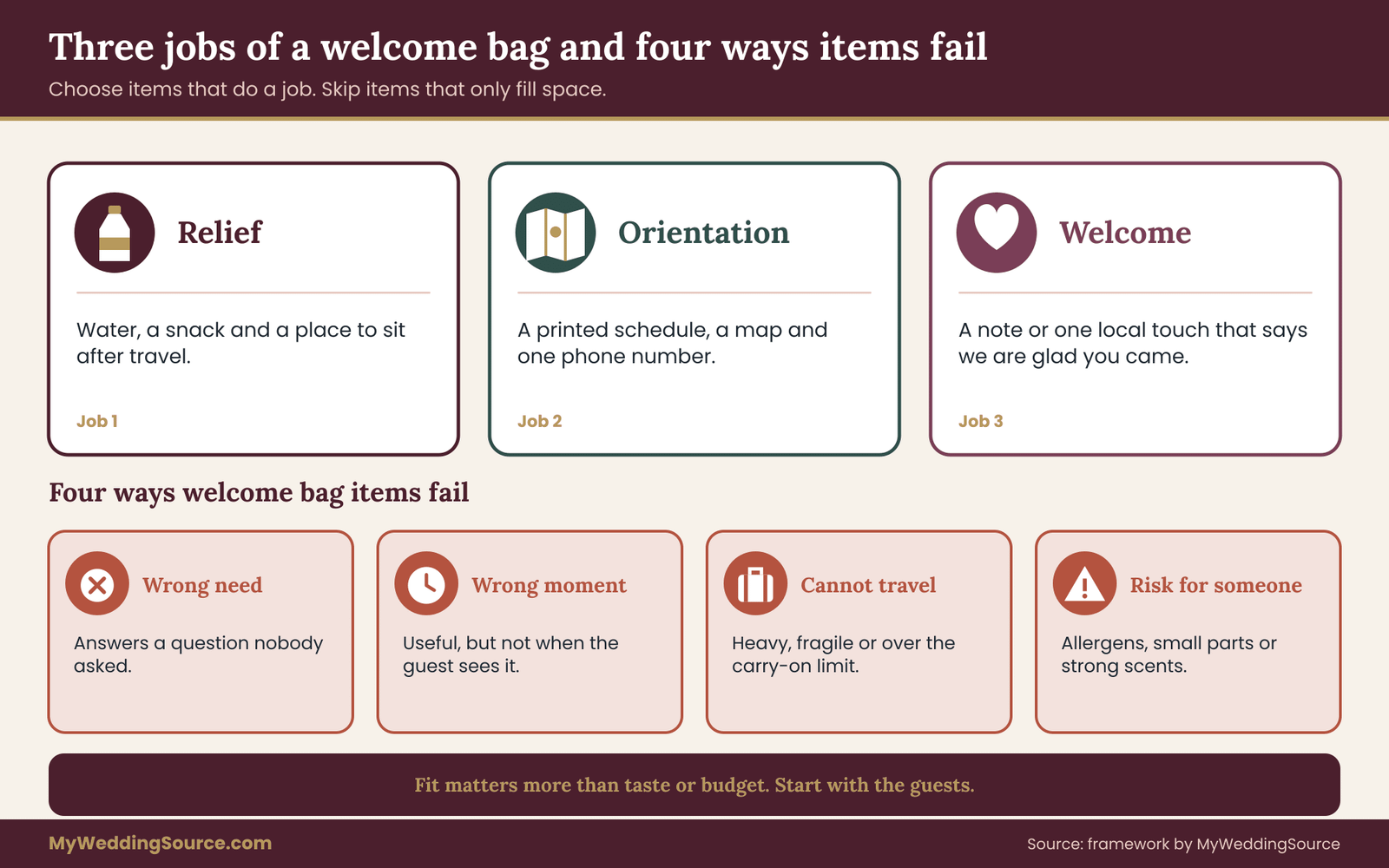
Before ranking welcome bag items, it helps to say what a bag is for. There are three honest purposes, and a good bag serves at least two of them.
The first is relief. Guests who have traveled are thirsty, hungry, short on information and a little anxious about the schedule. Welcome bag items that relieve those things are the most valuable thing you can give, and they cost very little.
The second is orientation. A guest who knows where to be, when, how to dress and how to get there is a calmer guest. A printed page with the weekend schedule, the address of each venue and one phone number to call does more than any trinket.
The third is welcome itself: a sign that the couple is glad they came. This is where a note, a local snack or a small keepsake belongs. It is the smallest purpose by practical value, and it is the one most couples over-invest in.
A bag that tries to be a party favor, a souvenir, a gift and a survival kit all at once usually ends up as clutter. Decide which purposes matter to you, and let that decide the contents.
What a welcome bag is not
A welcome bag is not the same as a wedding favor, which is given to every guest at the reception as a thank-you. It is not a gift for the wedding party, which usually has its own thinking behind it. And it is not a registry substitute.
Keeping these separate saves money. If the reception favor is already a jar of local honey, the welcome bag does not need a second sweet item. If the wedding party gets robes, the bag does not need to match them.
It also keeps your list honest. A guest who receives the same kind of item twice in one weekend has been given a duplicate, not a gift.
Why most welcome bag items go unused
The simplest way to choose better welcome bag items is to understand why the usual ones fail. There are four common patterns, and you can recognize each before you spend a dollar.
The item answers a need nobody has. A branded bottle opener is useful to someone who drinks bottled beer at home. A guest who arrived by plane with a single carry-on has no need for a bottle opener and no space for one.
The item is useful but arrives at the wrong moment. Sunscreen is helpful at an outdoor afternoon ceremony. It is not helpful in a bag handed over at midnight after a late flight, unless the guest sees it again in time. Timing matters as much as the item.
The item cannot travel. Full-size liquids, glass jars, heavy books and fragile ornaments are all welcome bag items that look generous and become a burden. The guest has to choose between carrying them and abandoning them.
The item is a risk for someone. Food with nuts, scented products for guests with sensitivities and small parts for toddlers can each turn a kind gesture into a problem. Risk is not rare; a guest list of any size usually includes someone for whom one of these applies.
Notice that none of these failures is about taste or budget. They are about fit. That is why the ranking in this guide starts with the guests and not with a shopping list.
The hidden cost of unused items
An unused item still costs the full purchase price, plus the time to buy it, store it, pack it and hand it out. It may also cost a guest the effort of carrying it home, and it may end up in the trash, which a couple planning a lower-waste wedding would rather avoid. The wedding waste reduction guide covers that side in more detail.
This is why the cost-per-bag sheet later in the article tracks cost per item used rather than cost per item bought. A two-dollar item that nine out of ten guests use is cheaper in practice than a one-dollar item that one in ten uses.
You do not need data to apply this. A rough, honest guess is enough. Ask yourself, for each item, how many of your guest households will really use it in the first day. If you cannot say “most of them”, the item is probably not in the top tier.
That habit of asking is the core skill. Welcome bag items that pass it tend to be plain, small and a little boring, which is exactly why they work.
The shape of this guide
The rest of the article moves in a straight line. You will list your guests by arrival type, run each candidate through four tests, sort the survivors into tiers, check food and safety, price the bag, plan the handoff and assemble it. After that comes a set of worked examples, a short next-steps list and answers to common questions.
If you are short on time, read the sections on the four tests, the tiers and the cost sheet. Those three carry the framework. Everything else supports them.
One more point before starting. Welcome bag items are a hospitality decision, and hospitality is shaped by the wedding as a whole. If you have not settled the guest list and the schedule, hold off on buying anything. The wedding etiquette guide is a good companion for deciding what hosts reasonably owe guests who travel, and the wedding guest list guide helps you pin down how many households you are actually buying for.
Start with your guests, not a shopping list
The first step in choosing welcome bag items is a short list of who is actually arriving. It takes ten minutes and it changes almost every later decision. Group your guest households by how they get to the wedding and what they will be doing in the first hour.
Flyers. These guests have a carry-on, maybe a checked bag, and a limited amount of room to bring things home. They have often gone several hours without proper food. For them the best welcome bag items are small, flat, light and edible or printed.
Drivers. Guests who drove in have room, but they may have been in a car for a long time and may arrive in the middle of a busy afternoon. They can carry slightly bulkier welcome bag items, though the hotel room still has limited space.
Locals. Guests who live nearby do not need welcome bag items for relief at all. A water bottle is pointless to someone ten minutes from home. Locals are better served by an orientation sheet and perhaps a note, or by no bag at all. Many couples save money by giving a bag only to guests staying overnight.
Families with children. Children need different things: a snack, something to do, and sometimes a change of expectations about the schedule. They also need welcome bag items that are safe for their age. The kids section later in this guide goes into that.
Guests with mobility needs. These guests may need to avoid carrying anything that adds weight to a walker, a cane or a wheelchair bag. Welcome bag items that must be carried up stairs or through long corridors are a burden. The guide to coordinating guest hotels across budgets and mobility needs is a useful companion here, because the room and the route to it decide how a bag can reach someone.
Older relatives. Large print matters on schedules and maps. Easy-open packaging matters on snacks. A bag with a handle that is comfortable on the wrist helps more than one with a decorative bow.

Count households, not heads
Welcome bags are normally given per hotel room or per household, not per person. A couple sharing a room needs one bag. A family of four in one room needs one bag, with a small extra for the children if you want one.
This matters for cost. If you have 120 guests and 70 rooms, you are buying about 70 bags, not 120. Counting households first is the single easiest way to bring the total down without cutting any quality.
Check the count against your hotel list close to the final date. The number of rooms tends to settle later than the number of guests, so build in a small buffer and agree a cut-off with whoever is assembling the bags.
Write down the arrival picture
Spend five more minutes on timing. Note when most guests are expected to arrive, whether the hotel has a front desk that is staffed late, and whether there is an event on the first evening. A guest arriving at four in the afternoon for a six o’clock welcome dinner needs different welcome bag items from a guest arriving at eleven at night.
If you cannot predict arrival times, assume a wide spread. That points toward welcome bag items that stay good for a day or two and instructions that can be read at any hour.
The four tests that rank welcome bag items
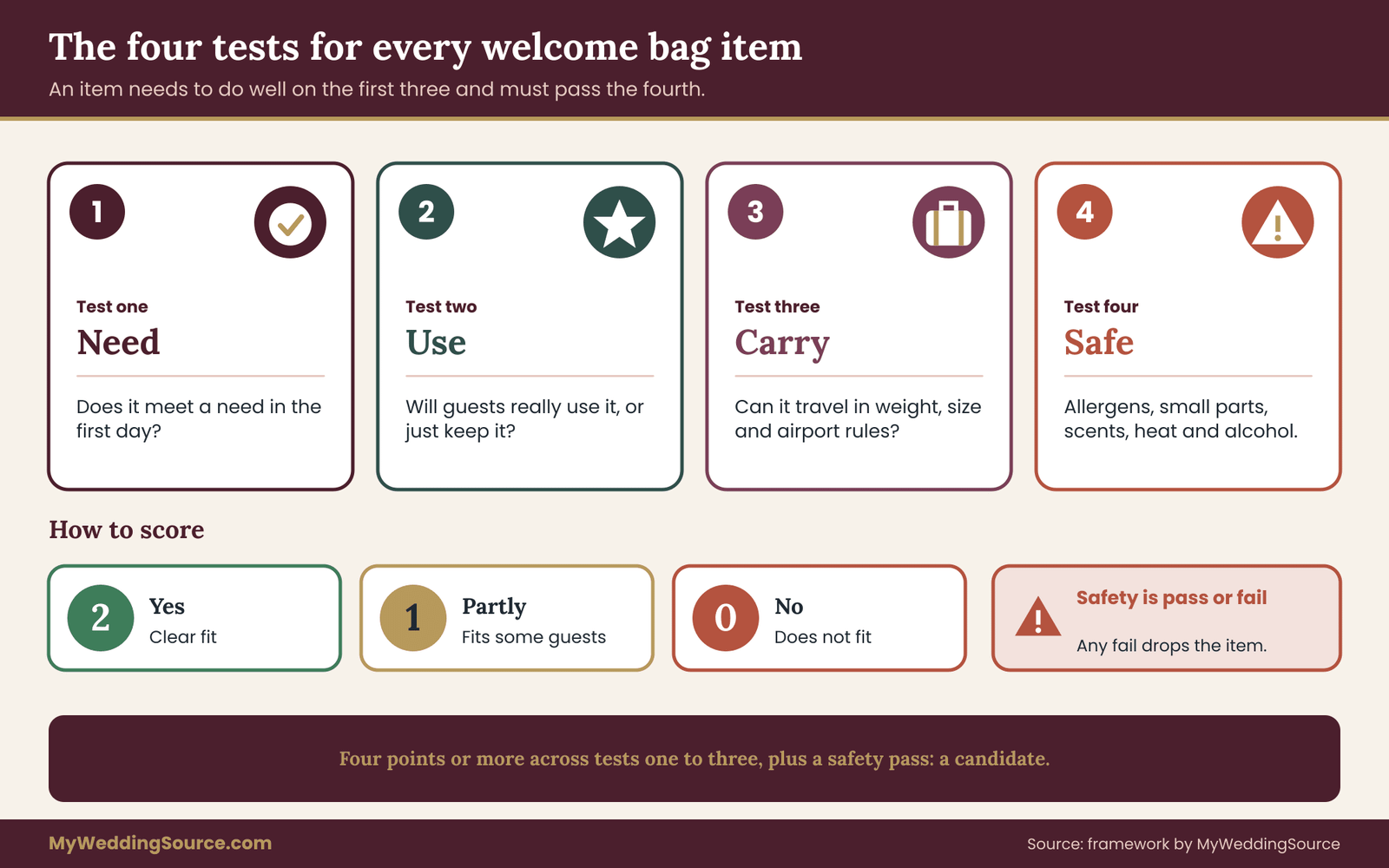
With your guests listed, you can rank candidate welcome bag items. The method here is four tests, each answered yes, partly or no. An item has to do well on the first two to earn a place, and it must not fail the last two.
Test one: need. Does this item meet a need a guest will have in the first day? Water, a snack, a schedule and a map pass easily. A keychain fails unless guests were asked to bring keys to something.
Test two: use. Will guests actually use it, or will they politely keep it and forget it? Use is about habit. A refillable bottle gets used if the venue has refill stations and the guest is walking around outside. A candle is used rarely, because few hotels allow open flames.
Test three: carry. Can it travel? This covers weight, size, fragility and, for flyers, airport rules. Liquids over the screening limit fail for carry-on. A glass jar fails for almost everyone.
Test four: safe. Is it safe for the whole guest list? This covers allergens, small parts, scents, alcohol for guests who do not drink and any item that could melt or spoil. A single failure here is enough to drop the item or to offer an alternative.
Give each item a score. A simple scheme works: two points for yes, one for partly, zero for no on tests one to three, and a pass or fail on test four. An item with four points or more across the first three tests and a pass on safety is a candidate. Anything with a safety fail is out unless you can fix it.
Worked example of scoring
Suppose a couple is considering a mini bottle of local hot sauce. On need, it scores zero: nobody arriving tired is looking for hot sauce. On use, it scores one, because a few guests will take it home and use it. On carry, it scores one, since it is small but liquid, which matters for flyers. On safety it passes unless the ingredient list includes something a guest cannot eat.
Total on the first three tests is two. It does not make the cut for the main bag. It might still be a fine reception favor, where need is not the test.
Now score a bottle of water. Need is two, use is two, carry is two for drivers and one for flyers who cannot bring it through security but can fill it after. Safety passes. That is a strong candidate, and it explains why water appears on nearly every well-built list.
When a high-scoring item still fails
Scores are a guide, not a verdict. Sometimes an item scores well and still does not suit your wedding. A snack that is ideal for a cold-weather wedding can melt in a summer one. A paper map is excellent unless the venue is a single building and a map would be redundant.
When an item scores well but feels wrong, ask what the score is missing. Often the answer is context: the climate, the venue rules or the mix of guests. Add that context to your notes. The point of scoring is to make the reasoning visible, so you can change your mind for a clear reason rather than a vague feeling.
Keep the scores in one place, such as a single page or a note on your phone. When a relative or a friend suggests another idea, you can score it in a minute. Welcome bag items chosen this way are easy to defend, and easy to explain to anyone who asks why a favorite idea did not make the bag.
Putting the ranking into tiers
The first tier is the smallest and the most important, and each later tier adds less.
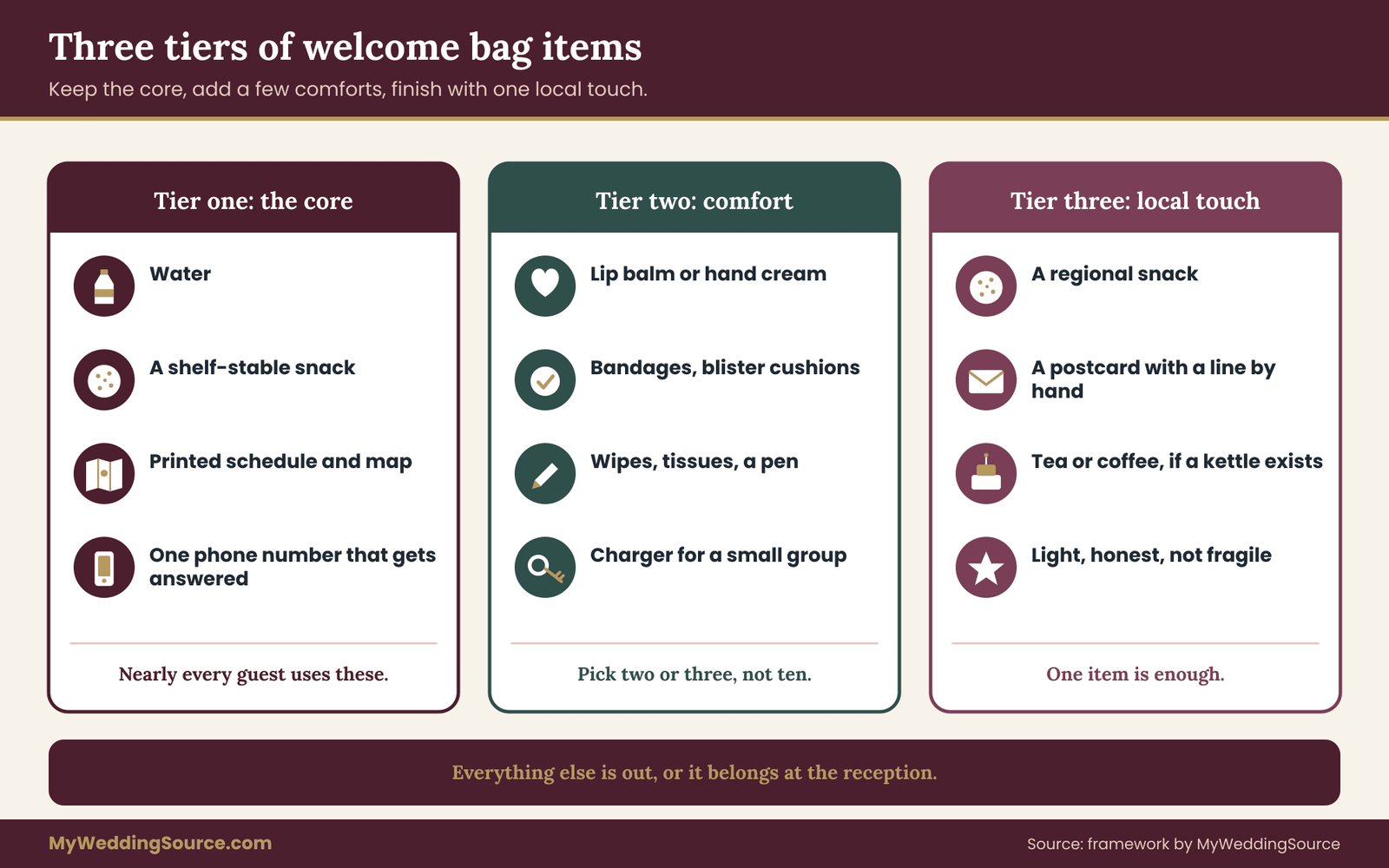
Once items are scored, sort them into three tiers. The tiers decide what goes in every bag, what goes in some bags and what stays out.
Tier one is the core. These are the welcome bag items that nearly every arriving guest uses: water, a small shelf-stable snack, a printed schedule with a map and one phone number that will be answered. If you stopped here, the bag would still be good.
Tier two is the comfort layer. Items here help many guests but not all of them: a lip balm, a small pack of tissues or wipes, a pen, a travel-size pack of adhesive bandages, a packet of blister cushions for guests who will be dancing in new shoes. They are cheap, small and useful. Pick two or three, not ten.
Small comfort welcome bag items are where couples most often overspend, because each looks cheap on its own. Ten small things at a dollar each cost as much as one good thing at ten dollars, and the bag feels less careful.
Tier three is the local touch. One item that says where the wedding is: a regional snack, a small postcard, a locally made sweet. It is optional, and it is where your budget flexes.
Everything else is out, or it belongs somewhere else in the weekend. Keep a short list of the welcome bag items you rejected, with the reason. You will thank yourself when a relative suggests adding a candle.
Tier one: the welcome bag items almost everyone uses
Tier one is short on purpose. Each item earns its place by solving a problem the guest has right now. The details below show how to get each one right, because even a good item can be spoiled by a small mistake.
Water
Water is the single most reliable item. A sealed bottle works for drivers and locals who are walking to a venue. For flyers, a sealed bottle placed in a carry-on is fine after the guest has passed security, but it is not something they can bring through the checkpoint. The Transportation Security Administration sets the carry-on liquids limit, so check its current rule if many guests are flying home with the bag.
A reusable bottle is a different choice. It can be a kind and lasting item, but it fails the carry and use tests for some guests: it takes up room, it must be empty to fly, and a guest may already own several. It scores better at an outdoor or hot-weather wedding where refill stations exist. The waste side of that choice is covered in the broader waste planning guidance on this site.
If you give a plain bottle, keep the label simple. A sticker with the couple’s names is fine. A wrap that covers the label hides the volume and the brand, and adds cost for little gain.
A small snack
The snack is the second-strongest item, and the one most couples get slightly wrong. The best snack is shelf-stable, individually wrapped, mild and easy to open. It should not need refrigeration, it should not melt in a warm room, and it should not be messy.
Think about what a tired person actually wants: a granola bar, a small bag of pretzels, a packet of crackers with a spread, a piece of fruit that travels well. A rich chocolate is a lovely gesture and a poor choice in summer.
Keep the number of snack types low. One well-chosen snack is better than four small ones, because every extra food type is another allergen check and another label to read. Allergens are covered in their own section below.
The printed schedule and map
A printed page is the most underrated item in the bag. It holds the weekend schedule, the address of each venue, the dress code, transport details and a phone number. It costs a few cents. It stops fifty individual text messages.
Design it for the guest who is tired and standing in a corridor. Large type, plain language, times in a simple list, the first event at the top. If your venues are far apart, add a small map or a line of directions from the hotel. Include the weather note and what to bring, such as a wrap for an evening ceremony.
Do not rely on a code that links to a website. Some guests have no signal, some do not want to scan codes, and some will not have the phone in hand. If you add a code for those who want it, treat it as extra, never the only route.
One phone number that gets answered
Pick one number guests can call or text, and name the person. It should not be the couple. It could be a close friend or a family member who has agreed to field questions, or a planner or coordinator if you have one. Say when it will be answered.
This small line prevents most day-of confusion. It is also the item with the highest value for the lowest cost, which makes it a fine example of the whole ranking approach.
Tier two: the comfort layer
Tier two items help a good share of guests and a few of them a great deal. Choose a few, based on your guest profile and the season. The aim is to look as if you thought about the weekend, not as if you emptied a shelf.
Lip balm and a small hand cream. Cheap, small, flat and useful in dry hotel air. Choose unscented or lightly scented, since strong scents bother some guests. Avoid anything with a claim you cannot support.
Pain relief and bandages. Adhesive bandages are a safe, practical choice. Over-the-counter medicine is trickier: dosage, age limits and allergies make it a poor thing to hand to everyone. A practical approach is to leave medicine out and tell guests where the nearest pharmacy is on the printed page.
Blister cushions or foot care. If the reception includes dancing and many guests wear new shoes, a small pack of blister cushions is among the most appreciated welcome bag items per dollar. It is a good example of an item that scores two on need and use, and two on carry.
Wipes and tissues. Small packs, individually wrapped, take almost no space and solve small problems. They also make sense for a family with young children.
A pen. Surprisingly useful for forms at hotel check-in or a customs card for international guests, and it can carry the couple’s names without much cost.
A phone charging item. A charging cable or small battery pack scores highly on need, since a flat phone is a real problem at a wedding. It also costs more. It is worth pricing as a possible upgrade for a small group, such as the wedding party or the oldest relatives, rather than for every bag.
A hangover or morning-after kit. Popular, and a good example of an item to treat carefully. Water, an electrolyte packet and a snack are fine. Medicine is not.
What to leave in tier two for later decisions
Some tier two items depend on the season and the setting. Sunscreen and insect repellent matter at outdoor weddings. A small umbrella matters in a rainy climate. A light fan matters in heat. A scarf or wrap matters at a cool evening ceremony, though it is bulky and costly.
For these, ask whether the guest really cannot get the item easily. If a pharmacy is next to the hotel, a bag does not need sunscreen. If the venue is remote, it may.
Tier three: the local touch
One local item is enough, and it is the one with the most room for creativity. The aim is for a guest to remember where the wedding took place, in a way that fits a bag.
Good local items are small, light and honest. A regional snack from a known producer. A postcard with a handwritten line. A packet of tea or coffee, if the guest is likely to have a kettle or coffee machine. A small bar of locally made soap, if scents are not a concern.
Weak local items are fragile, heavy or generic: a snow globe, a ceramic dish, a magnet bought in bulk. They score poorly on carry and use, and they tend to end up in a drawer.
If you buy from a small local maker, ask for the ingredient list and the production details. This matters for allergens and for how long the item stays good. Many small producers are happy to supply this, and a few are not set up to. The section on food rules below explains what to ask.
A note about personalization
Names and dates printed on items raise costs and limit what a guest will do with the item. A personalized item cannot be gifted on or returned. It also increases waste if leftovers remain.
A cheaper approach is a single printed tag or sticker that goes on a plain item. If you want a personal touch, a handwritten note costs almost nothing and is remembered. The principle is to spend personalization money where guests will see and keep it, which is rarely on a bottle opener.
Where the ranking lands
If you follow the tiers, a typical bag holds a bottle of water, one snack, a printed page with a map and a phone number, two or three comfort welcome bag items and one local touch. That is seven or eight welcome bag items, and it is plenty. Many good bags hold fewer.
The next section moves from ranking to safety, because the most careful choice of welcome bag items can still go wrong on food.
Food rules for welcome bag items
Food is where welcome bag items carry the most risk and the most value. A snack is the best item on the list and also the one most likely to cause a problem for a guest. A few steps keep it safe.
Read the allergen rules
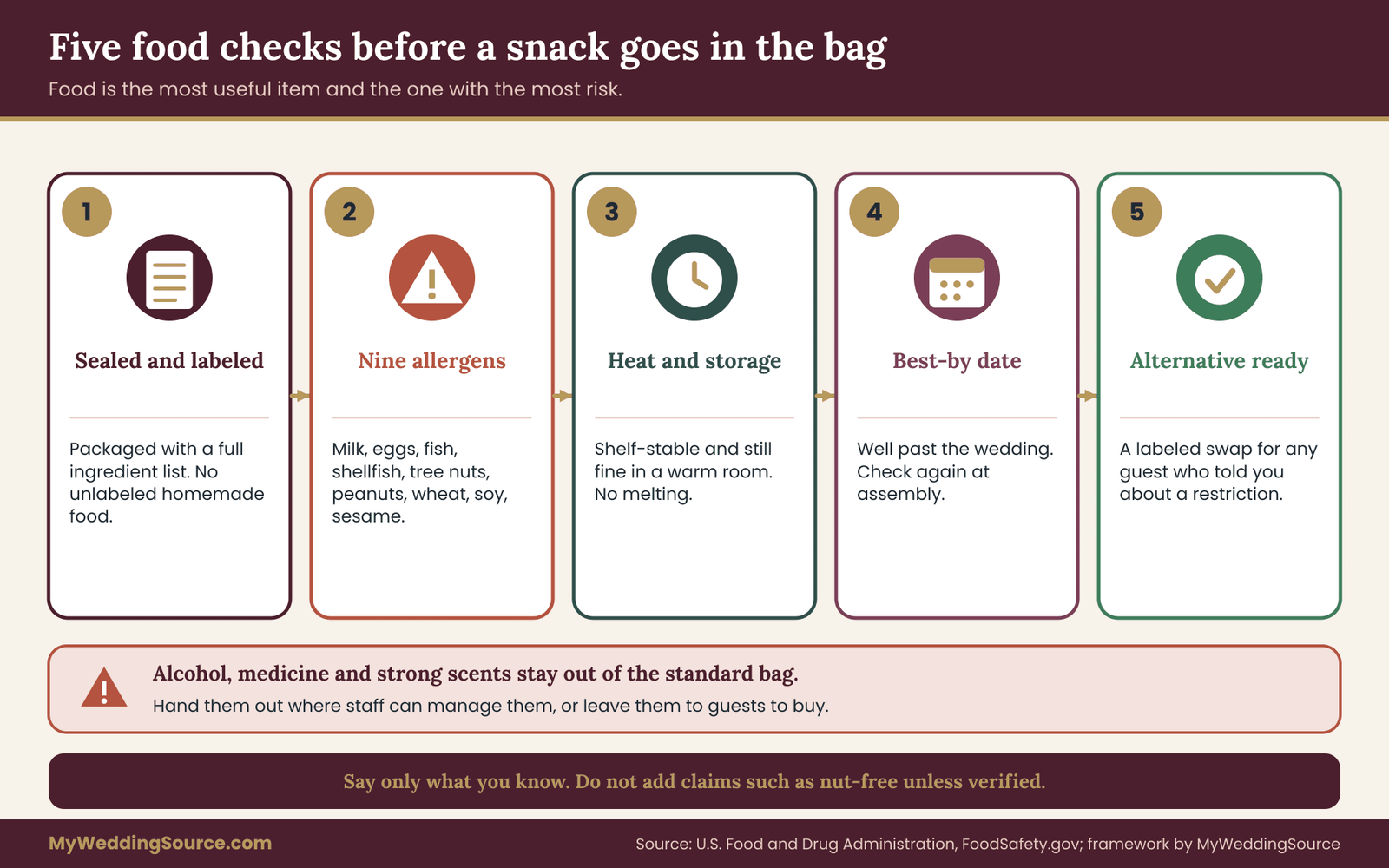
In the United States, the Food and Drug Administration lists nine major food allergens: milk, eggs, fish, crustacean shellfish, tree nuts, peanuts, wheat, soybeans and sesame. Packaged foods sold in stores must declare these in plain language on the label. That is the reason a store-bought, sealed snack is almost always safer to hand out than a homemade one.
Homemade baked goods, hand-wrapped candy and welcome bag items from a friend’s kitchen carry no such label unless you add one, and you cannot be sure of cross-contact in a home kitchen. Many states regulate what home producers may sell, and those rules differ. If you plan to use a home baker or a small local maker, ask what the rules are in your state and ask for a full ingredient list.
The simplest approach is this. Choose packaged snacks with a clear label. Keep the original label visible, or print a card listing the ingredients and the major allergens. Choose one snack that avoids as many of the nine allergens as you can, and offer an alternative in the bag for guests who have told you about a restriction.
Ask guests, then act on the answers
If your RSVP form asked about dietary needs, use the answers. A guest who told you about a peanut allergy should not open a bag with a peanut snack. You do not need to rebuild the whole bag. A small separate bag with a different snack, marked discreetly, solves it.
Do this quietly. Guests with allergies do not usually want attention drawn to them. A bag with a name on a small tag, handed over without comment, is the best approach.
The menu planning guide covers how to collect and use dietary information across the whole event, and the same list can feed the bag.
Shelf life and heat
Shelf-stable means it will keep without refrigeration for the period printed on the package. It does not mean it will keep in a hot car for six hours. Chocolate, gummy candy with a soft coating, cheese and anything with a cream filling are all poor choices in a warm climate.
Check the best-by date on every snack and make sure it is well after the wedding weekend. If you buy in bulk months ahead, check the date again when you assemble.
Fresh fruit looks lovely and works for a short window. An apple or a small orange in a bag handed over on arrival day is fine. A cut fruit cup is not, since it needs cooling. The foodsafety.gov site run by the federal government gives general guidance on keeping food at safe temperatures.
Alcohol in welcome bags
A mini bottle of wine or spirits seems festive, but it brings several issues. Some guests do not drink, some are under the legal age, and some places restrict how alcohol is handed out or delivered to hotel rooms. Hotels may have policies about outside alcohol and about who may leave it at the desk. Shipping alcohol is regulated and varies by state.
If you want an alcohol item, the simple route is to keep it for the welcome event, where a bartender can serve it, rather than putting it in a bag. If you still choose to include one, make it optional and keep it out of any bag going to a household with children.
Labels and claims
If a snack’s packaging says it is gluten-free, organic or locally made, those claims fall under federal and state rules. You are not making the claim, the producer is. Still, do not add claims of your own. A tag that says “nut-free” on a snack you have not verified is worse than no tag.
The Federal Trade Commission publishes guidance for businesses about truthful advertising. It is aimed at sellers, but the principle applies to you as a host handing out food: say only what you know.
Welcome bag items for particular guests
Different guests need different things. The aim here is to adapt the standard bag without building ten versions.
Guests who are flying
Flyers need light, flat items that can pass through airport security and fit in a full bag. Printed pages, small packaged snacks, lip balm and bandages work. A full-size liquid does not. The TSA rule on carry-on liquids sets the container size limit, so check the current rule on its website.
Think too about the trip home. A guest leaving after the wedding will have a fuller bag than on arrival. Welcome bag items that are consumable, such as snacks and water, shrink the burden as they are used. Welcome bag items that are keepsakes grow it.
If most guests are flying in, think twice about any item that cannot be eaten, used up or left behind. The wider arrival logistics sit in the guest lodging and mobility guide, which is worth reading before you decide how bags reach rooms.
Children
For children, safety is the dominant test. The Consumer Product Safety Commission regulates small parts in products intended for children under three. A bag item for a toddler should not have pieces that fit through a small-parts tester. When you cannot check, choose welcome bag items that are plainly large: a paper activity book, a large crayon, a sticker sheet kept away from very young children.
Age bands help. A small activity item for a school-age child and a soft snack for a toddler are different bags. Mark them with a small tag so a parent knows which is which. Avoid balloons, small toys with loose parts and any hard candy for young children, since these are choking risks.
The guest care planning guide covers the broader needs of babies, children and older relatives across the weekend.
Older relatives and guests with access needs
Make the printed page readable. Use large type, strong contrast and a plain font. Make sure the handle on the bag is comfortable and the bag is light. Offer to deliver it to the room rather than expecting the guest to carry it from a welcome table.
For guests with low vision, a person who can read the schedule aloud is better than any printed item. For guests who use mobility aids, avoid welcome bag items that must be carried by hand. A bag that hangs from a walker or chair may help, though it needs to be light and easy to remove.
Guests with sensitivities
Strong scents are the most common issue. Scented candles, lotions and soaps can trigger headaches or breathing problems. Unscented welcome bag items are safer. If you want a scent, keep it light and keep it in one item, so a guest can leave that item out.
Some guests avoid certain foods for religious or ethical reasons. Check that snacks suit those guests when you know of them, and label welcome bag items clearly. A snack with gelatin or an animal-derived ingredient may not suit everyone. The fix is plain labeling and one alternative.
Guests who are local
For local guests, a smaller token is enough: a note, a printed page and perhaps a snack. Some couples skip the bag for them and put the printed page on the welcome table instead. That is not rude. It is a way of spending where it helps.
A quick rule of thumb
If you cannot make a different version for each group, design a core bag every guest can use and add one small extra for the groups that need it. That keeps the number of welcome bag items per bag low and the checking simple.
A bag with few welcome bag items is also easier to check for allergens. Every added item is one more label to read, one more supplier to ask and one more chance for a mistake on assembly day.
The cost-per-bag sheet for welcome bag items
Ranking tells you what to include. Costing tells you whether you can afford it. The sheet below is a way of pricing welcome bag items that shows the true cost, including the parts people forget. You can build it on paper or in a simple spreadsheet. Keep it as a list of lines, one per item, not a grid of numbers you will stop reading.
For each item, write down six things.
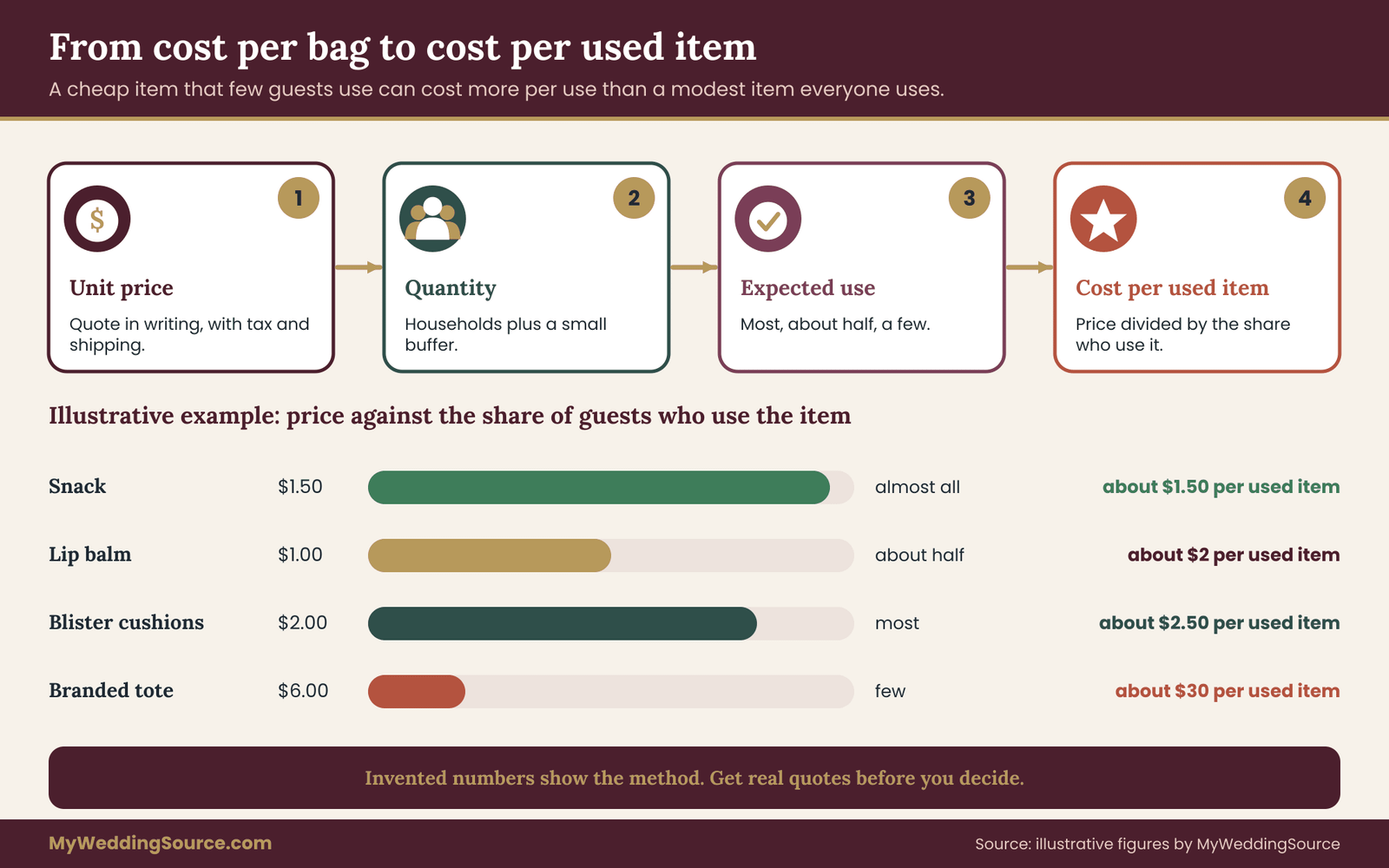
Unit price. What one costs when you buy the quantity you need, including tax and any shipping. Ask suppliers for a written quote at your quantity, since the per-piece price often changes at certain order sizes.
Quantity. The number of bags you are building, plus a small buffer for last-minute guests and damaged welcome bag items. A buffer of five to ten percent is a common planning habit, though you should set your own based on how firm your list is.
Expected use. Your honest guess of how many households will use it: most, about half, a few. This is a judgment, not a measurement, and it is fine to write it as a word.
Packing time. How long it takes to add the item to each bag. A loose item that needs wrapping, tying or labeling costs labor, even if the labor is yours.
Storage and transport. Whether it needs a cool place, a dry place or extra boxes. This is easy to ignore until the week before.
Waste or leftover risk. What you do with unused welcome bag items. Water and snacks can be eaten; a personalized item cannot.
From cost per bag to cost per used item
Add the unit prices of all items to get a cost per bag. Multiply by the number of bags for the total. That is the number most couples stop at.
Take one more step. For each item, divide its cost by the share of guests who will use it. If an item costs two dollars and about half your guests will use it, the cost per used item is four dollars. If a snack costs one dollar fifty and almost everyone eats it, the cost per used item is close to its price.
This second number often reverses an instinct. A cheap item few people use turns out to be expensive per use, and a modest item everyone uses turns out to be a bargain. Seeing it on the page makes cuts easier, because you can say “this costs four dollars for a benefit half the guests will notice” instead of “I’m not sure about it.”
The figures above are for illustration only. Your own prices will differ by supplier, region and quantity, so get real quotes before deciding.
A worked example with invented numbers
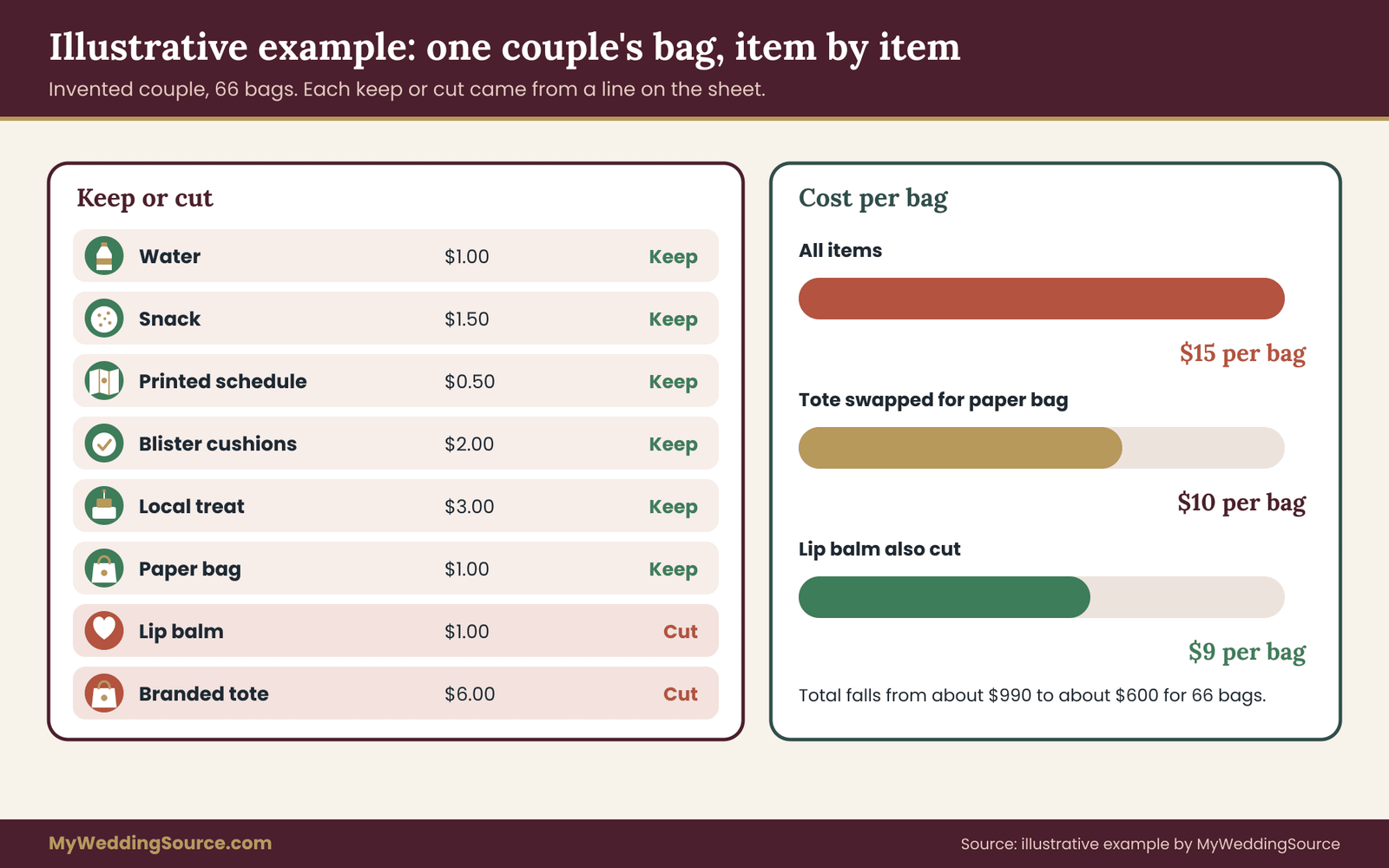
Take an invented couple, Dana and Marcus, hosting a wedding with 110 guests in 62 hotel rooms. They plan 66 bags, which allows a small buffer.
They list their candidates. Water at about one dollar a bottle. A packaged snack at about one dollar fifty. A printed schedule at about fifty cents, since they print at a local shop. A lip balm at about a dollar. A pack of blister cushions at about two dollars. A small local treat at about three dollars. And a branded tote at about six dollars.
The bag total with every item comes to about fifteen dollars, or close to a thousand dollars for 66 bags. They then run the cost-per-used-item step and find the tote is the most expensive per use, since many guests have plenty of bags. They drop it and use a plain paper bag at about a dollar.
Now the total is about ten dollars per bag, or around six hundred and sixty dollars. They also decide the local treat is worth keeping, since guests who flew in will want something from the place. Then they drop the lip balm, which scored lowest on use for their summer wedding, and the bag falls to about nine dollars, or roughly six hundred dollars in all.
Their final bag has water, a snack, the printed page, blister cushions, a local treat and a paper bag. The decisions were each made for a reason they could write down. That is the sheet doing its job. The numbers here are invented to show the method, not to suggest a price you should expect to pay.
The lesson of the example is not the final total. It is that every cut and every keep came from a line on the sheet. Welcome bag items priced this way turn a vague worry about cost into a short list of decisions.
Where costs hide
Some costs do not appear on the supplier’s quote.
Hotel handling fees. Hotels may charge to receive, store or deliver items to rooms, and some charge per piece. Ask the hotel for its policy in writing. The hotel’s own events team is the place to start, and the next section covers delivery in more detail.
Shipping. Ordering online and shipping to the hotel or to a family member adds cost and risk. Bulk items are heavy. Compare the shipped price with the price of buying from a local store.
Custom printing set-up. Printed bags, tags and stickers often have a set-up fee that makes small runs expensive. Ask whether a stock design with a simple tag is cheaper.
Your time. Assembly takes longer than expected. If you pay for help, add it. If you rely on friends, plan for snacks for them.
Replacement. Items break, melt or go stale. Keep a small reserve fund for replacements in the last week.
Setting a ceiling before you start
Decide a ceiling per bag before you shop. A ceiling gives you a number to design against, and it makes it easier to say no to additions. A cap may be a share of the total budget or a plain amount per household. The wedding budget guide can help you decide where welcome bags sit among your other costs.
A sensible approach is to start with the tier one welcome bag items, price them, and see what room is left. Add tier two and three welcome bag items only up to the ceiling. This works better than starting with everything and cutting down, because it keeps the useful items protected.
Cost control without lowering quality
Several steps reduce spend without making the bag worse.
Give bags only to guests staying overnight. This often cuts the count by a quarter or more.
Buy the snack and water from a wholesale or grocery source rather than a gifting supplier. Plain goods cost much less than packaged “wedding” versions of the same thing.
Use one good item in place of three average ones. A single well-chosen local item is better remembered than a handful of small things.
Print the schedule yourself or at a local print shop. It is the highest value item in the bag, and it should not cost much.
Skip custom branding on items guests will not keep. A tag on a plain bag does the same job as printing on the bag itself.
Keep receipts and a running total as you buy. A mid-project review catches overspending early.
A mid-project review is also a good moment to ask whether any welcome bag items could be bought together from one supplier, since a single order often saves shipping and time. Tracking each order and delivery in one place works well for a pile of small purchases from different suppliers.
Getting welcome bag items to the guests
A well-chosen bag does nothing if it never reaches the guest. Delivery is the part of the plan that most often goes wrong, and it is also where hotel terms matter most. There are three common routes, and each suits a different wedding.
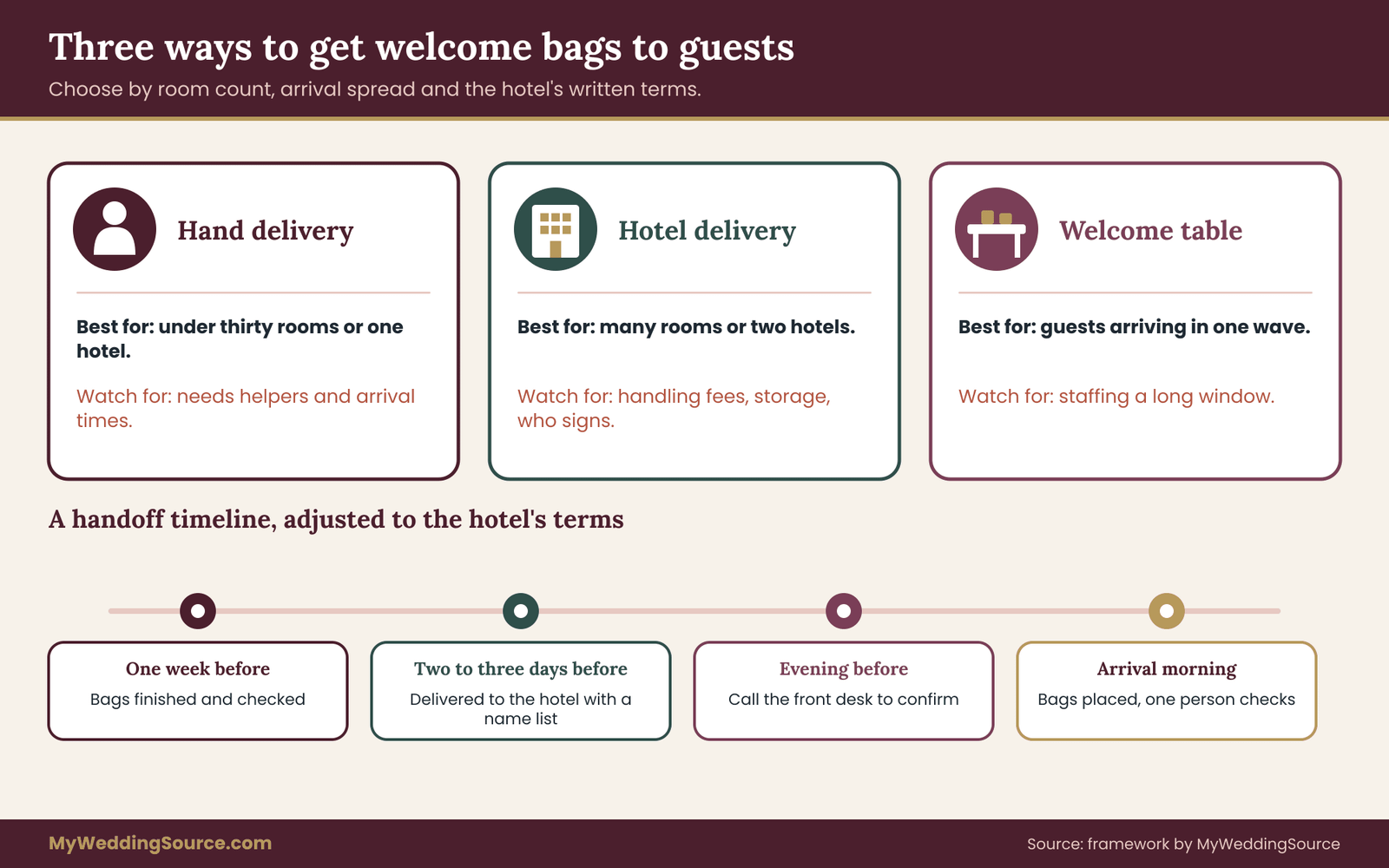
Hand delivery by the couple or family. Someone carries the bags to rooms before guests arrive, or hands them out at a welcome table. It costs no fees and allows a personal touch. It needs people, time and a way to know when guests arrive.
Delivery by the hotel. The hotel receives the bags and puts them in rooms or at the desk. It can be convenient, and it often has fees and rules. Get them in writing.
A welcome table or desk. Guests collect their bags at a table at the hotel lobby or the first event. It needs a staffed time window and a list. It suits weddings where guests arrive in a wave.
What to ask the hotel
If you use the hotel, ask for the terms before you buy anything. The questions are simple and the answers shape the bag.
Does the hotel accept deliveries for guests who are not yet checked in? Many do for a group block, and some do not.
Is there a fee per bag, per delivery or per room? Some hotels charge handling by the piece, others charge a flat fee, and some charge nothing for a group with a contracted block.
How early can the bags arrive, and who signs for them? A bag that arrives two weeks before the wedding needs storage space, and storage is not always offered.
Will the hotel put bags in rooms? If so, are guests’ names visible on the bag, and does the hotel have a rule against that for privacy? Many hotels do not give out room numbers, so the list you send must be matched to names.
What is the policy on food and alcohol in bags? Hotels may restrict outside food, especially anything perishable, and have rules about alcohol.
What happens to leftover bags? Ask whether the hotel will hold them or whether you need to collect them.
Write down the answers, the name of the person who gave them and the date. If the terms change, you will want the record. Treat the hotel like any other supplier and keep its fee quote with your other purchase records.
Hotel versus hand delivery in practice
The choice usually comes down to a few points.
If you have fewer than thirty rooms, hand delivery is often easiest and costs nothing.
If you have many rooms across two or more hotels, hotel delivery saves a lot of time, but fees may add up. Compare the fee total with the cost of paying a helper for a few hours.
If guests arrive across three days, a welcome table is hard to staff for that long. Hotel delivery or a note at the front desk works better.
If the hotel has a small lobby and no storage, a table is hard. If it has a conference room or a friendly desk, you may have more options.
A mixed approach is also fine. Many couples hand out bags at the first event and have the hotel deliver bags to guests who arrive earlier or later, using a short list.
Timing the handoff
Plan the delivery date backward from the first arrivals. A common pattern is to have bags finished a week before, delivered to the hotel two to three days before, and placed in rooms the morning of the first arrivals. Adjust to the hotel’s terms.
Give the hotel a clear list: guest name, room if known, arrival day and any special bag type, such as a bag for a child or an allergy-friendly version. Keep a copy.
On arrival day, have one person check that bags are in place. A short phone call to the front desk the evening before is enough to catch mistakes.
A short note to put in the bag
Handwritten or printed, keep the note short. Say thank you, say where to find the schedule, and give the phone number. Skip long sentiment. A guest reading a note in a hotel corridor wants to know where to go next.
The note and the welcome bag items should read as one gesture. A long note on top of a crowded bag feels like too much, and a short note on top of a small, careful bag feels warm.
For large lists, writing notes by hand takes time. Splitting it among the couple and a few relatives, with a short template and a few personal lines, is a good way to keep it genuine.
Assembling the bags
Assembly is where careful plans meet a pile of boxes. A little process saves hours.
Prepare a staging space
Choose a table, a floor space and a cool, dry place for storage. Keep food away from anything with a smell, such as candles or soaps. Keep the space clean and wash hands before handling food items.
Lay out items in the order they go into the bag. A line of stations works well, with one item per station and one person at each, or one person walking the line. Count the welcome bag items before you start, and count again after.
Use a checklist for every bag
A one-page checklist lists every item and its quantity, with a box for special versions. After a bag is filled, a second person checks it against the list. That second check catches missing welcome bag items and wrong versions far more often than a rushed single pass.
Mark special bags with a small tag. A child bag, an allergy-friendly bag, a bag for a guest who needs a larger-print page. Keep these in a labeled box, apart from the standard bags.
Keep a spare set
Make a few extra bags. Late guests, lost bags and mistakes happen. A spare set in the car or at the venue is cheap protection.
Storage and transport
Store food bags somewhere cool and out of direct sun. Never leave them in a closed car on a warm day. Pack bags in sturdy boxes that do not crush the contents. Keep a list of what is in each box.
If you are flying with the bags, think carefully. Printed welcome bag items and light snacks may travel; liquids and heavier things do not. Some couples ship welcome bag items ahead to the hotel instead. If you do, ask the hotel in advance, as noted above.
Hold an assembly session
If friends help, set a start and end time, serve food and give each person a job. Keep a short briefing. Show a finished sample bag. Explain the allergen rule: nobody adds an item not on the list. That one rule protects the guests who need it most.
At the end of the session, pack the finished bags by delivery group, not by item type, so the welcome bag items for each hotel or event travel together and nothing is split between boxes.
Welcome bag items to skip
A short list of items looks tempting and rarely earns its place. None is banned. They simply tend to fail the four tests.
Heavy or fragile items. Glass, ceramics and framed welcome bag items score badly on carry and break easily. They are fine as gifts delivered in person, not in a bag.
Large keepsakes. Anything bigger than a paperback is a burden for a flyer.
Anything scented and strong. Candles, strong lotions and perfumed soaps are a risk for guests with sensitivities, and candles are often banned in hotel rooms.
Cheap novelty items. Bulk-bought trinkets with no link to the wedding or the place. They are the main source of waste.
Items that need setup or instructions. A puzzle, a game or a kit that needs time. A tired guest will not have it.
Loose medicine. For the reasons given earlier, leave this out and point to a pharmacy.
Unlabeled homemade food. Without a label, you cannot manage allergens.
Promotional items for vendors. A bag is not a place for advertising. If a vendor offers free welcome bag items, you are free to decline, and you should be clear with guests if anything is a paid placement.
When a family member insists on adding something, a simple reply is enough: “We kept the bag to things people use in the first day. We’d love to put that at the reception table instead.” It is kind and it settles the matter.
Holding the line on welcome bag items is easier when you have the scores in front of you. You are not saying no to a person. You are saying that the item did not pass the tests, and offering it another home.
Designing the printed page guests will read
The printed page is the highest-value item in the bag, so it deserves more care than its cost suggests. It is also the item most often done badly: too small, too decorated, too long, or built around a code that does not work in the lobby.
What goes on the page
Keep the content to what a guest needs in the first day. Start at the top with the first event: its name, day, time and address. Under it, list the rest of the weekend in order. Then add the few facts that people always ask about.
The schedule. Day, time, place, one line each. If an event has two parts, such as a ceremony and a reception at different addresses, show both.
Getting there. How guests travel between the hotel and each venue, with pickup times if a shuttle runs. If guests drive, give parking details in a single line.
What to wear. Say what the invitation said, in plain words, and add any weather note. A guest packing for an evening ceremony outdoors wants to know about a wrap.
Who to call. The single phone number and the name of the person who answers.
Useful places. The nearest pharmacy, grocery store and a coffee shop. A guest who needs an item the bag did not include can find it.
Meals. Which events include food, and which do not. A guest who knows dinner is at seven will plan lunch.
Leave out long stories, family trees and anything that belongs on the website. If a guest wants the story, they will find it.
Make it readable
Use type at least as large as a typical printed menu, and larger for older guests. Choose a plain font and strong contrast. Use a light-colored paper and dark ink, and avoid text over pictures. Keep lines short. A guest standing in a corridor with a bag in one hand should be able to read it in seconds.
Check the page with someone who has not seen the plans. Ask them to find the time of the second event. If it takes longer than a few seconds, simplify.
Think about guests who use screen readers or who have low vision. A printed page cannot serve everyone, so name a person who can read it aloud or send a text copy on request. The ADA site run by the U.S. Department of Justice gives general information on accessible communication, and it is a sensible reference if you are unsure what to offer.
Keep one source of truth
The page, the website and any text message must agree. If a time changes, change all three, and say so on the page with a date. A page that disagrees with the website creates confusion at the worst time.
Version your page. Put a small date in a corner, and keep old copies out of the assembly room. This is the same habit as versioning a menu or an invitation, and it prevents the wrong version from landing in the bag.
The wedding invitation printing guide explains proofing and quantities for printed pieces, and the same habits apply to a one-page schedule: proof it twice, have a second reader, and order a few extra.
Printing choices
A local print shop can produce a single-page schedule for a small cost. Ask for a proof before the full run. Home printing is workable for small lists, though it takes ink and time. Consider folding the page in half and tucking it into a small paper sleeve, which keeps it clean and neat.
Think about the paper. A heavier stock feels better and stands up to a bag, though it costs more. A standard weight is fine for most uses. Avoid glossy stock for pages guests may want to write on.
A short printed page is also a small way to reduce waste. Print only for the households you are serving, plus a few extra, and leave the rest of the schedule to the website for guests who want detail.
A short script for the phone line
The person who answers the phone number should have a one-paragraph briefing. Give them the schedule, the venue addresses, the hotel contact and the plan for common problems: a lost bag, a late arrival, a missing room key. Tell them what they may decide alone and when to call the couple, which should be rarely.
That person does not need to be a professional. A calm friend with the page in hand is plenty. Thank them with a small gift of their own, not a spare welcome bag.
Questions to ask any supplier of welcome bag items
Whether you buy from a gifting shop, a grocery chain or a local maker, a few questions protect you.
What is the full ingredient list, and where was the item made? For food, ask about the allergens and about shared equipment.
What is the best-by date, and how should the item be stored?
What is the price at my quantity, including tax, shipping and any set-up fee? Ask for it in writing.
What is the lead time, and what happens if the order is late? A late order for a time-fixed event is a real risk. Ask for a delivery date you can plan around and a fallback.
What is the return or replacement policy for damaged or wrong items?
Can I see a sample? A sample tells you more than a photo. Order one early and test it in a bag.
Does the supplier make claims on the packaging, such as “organic” or “handmade”? Those claims belong to the supplier. Do not repeat them unless you have checked.
Keep the answers with your cost sheet. If you ever need to recall what you were promised, the written record is the thing you will have.
A supplier who answers these questions clearly is a good sign. A supplier who cannot say what is in the product, or when it will arrive, is a poor source of welcome bag items for a fixed date.
Three worked cases for choosing welcome bag items
The framework is easier to trust once you see it applied. The three cases below are invented for illustration. They are not drawn from real weddings, and the numbers are examples of method, not benchmarks.
Case one: the destination weekend
An invented couple, Priya and Tom, are marrying at a lakeside lodge four hours from the nearest airport. Most of their 80 guests are flying in, then driving. Arrival days run over two days, and the lodge has a front desk staffed until ten at night.
They list guests by arrival type: mostly flyers who then drive, a handful of drivers and a few older relatives. They score candidates. Water scores high. A packaged snack scores high. A printed schedule scores very high, because the lodge has poor mobile signal. A map scores high for the same reason. A pack of blister cushions scores well for the dancing. A local item, a small packet of tea from a producer in the region, scores medium.
They decide on a small paper bag with water, a snack, the printed schedule and map, blister cushions and the tea. They add a bug-repellent wipe, since the lodge is by water in summer and the wipes are flat and light. They skip the tote, the candle and the framed print they had been considering.
The delivery plan matters most here. The lodge accepts bags for guests with reservations and places them in rooms for a flat fee. Priya and Tom ask for the fee in writing and for the lodge’s policy on food welcome bag items. Then they set the bag count by room, not by head. The decisions are small and each has a reason, which is the point.
Case two: the city wedding with mixed budgets
An invented couple, Amara and Luis, are marrying in a city. Half of their 140 guests live within an hour. The rest are staying in two hotels at different prices, one with a large lobby and one boutique with no storage.
They use a two-level plan. Locals get a printed page and a small note at the welcome table, with nothing else. Overnight guests get the full bag. This cuts the bag count to about 55 households.
For the large hotel they use hotel delivery, since it has storage and a group desk. For the boutique hotel, with no storage, they plan hand delivery on arrival day by two cousins who have agreed. They mark each bag with a name tag on the outside of a paper bag and keep a list matching names to hotels.
They notice that guests at the cheaper hotel include several older relatives with mobility needs. They place those bags at the room door rather than at a desk, after checking with the hotel that it is allowed. The extra care costs nothing, and it is the type of detail that shapes how a guest remembers the weekend.
The cost sheet shows the full bag at a moderate price per household. They keep the local treat, a small box of regional cookies, and make sure the label shows the ingredients. They add a card listing the major allergens for each snack in the bag.
Case three: the family wedding with many children
An invented couple, Naomi and James, are hosting a wedding at a family property, with 60 guests, of whom 18 are children aged from six months to fifteen years.
Here the main need is not relief but occupation and safety. They design three bag types: an adult bag, a child bag for school age and a toddler bag. The adult bag holds water, a snack, the printed schedule and a pen. The school-age child bag holds a paper activity booklet, a large crayon set, a sticker sheet and a snack. The toddler bag holds a soft snack and a large board book, with no small parts and no hard candy.
They check the age labels on every toy item and choose welcome bag items with no small pieces for the youngest children. They keep the bags small, since children lose big ones. They label bags by age band with a small tag and tell parents at the welcome table.
Allergies matter more with so many children. They ask on the RSVP about food allergies for each child, and they use that to choose snacks. Where there is a nut allergy, they make that child’s bag nut-free and mark the bag with a discreet sticker.
They keep the costs low by buying paper goods at a stationery shop and snacks at a grocery store. The plan shows that three bag types are not much harder than one, because each is built from the same short list of items.
What the three cases share
In every case the couple started with who was arriving, not with what looked nice. They ranked the welcome bag items against the same four tests and they kept the list short. They treated delivery as part of the plan. And they wrote down the reason for each cut.
None of that needs a big budget. It needs a little time early and a willingness to leave things out.
The same logic holds for any size of wedding. Welcome bag items are a small part of the weekend, and the method keeps them in proportion.
Learning from the results
The bag is a small experiment, and you can learn from it in a week. Doing so makes the next gift, the next event or a friend’s wedding easier, and it settles any lingering doubts about what to cut.
Collect three kinds of evidence without making a project of it. First, look at what comes back. Watch the hotel rooms, the welcome table and the lobby bins when you are there. Untouched bags, abandoned bottles and snacks left on a dresser all say something. Second, count leftovers. A pile of one item after the weekend is an answer. Third, ask a few people. Two or three close friends or relatives will tell you honestly what they used, if you ask what they used and not whether they liked it.
Write the findings next to your cost sheet, item by item: used by most, used by some, used by few. Set the actual cost of each against that. An item the sheet predicted most guests would use, and few did, is a lesson about your own guesses. An item you expected little from, and guests praised, is worth remembering.
Do not over-read the results. A bag handed out at a late arrival tells you little about what an early arrival would have wanted. A rainy weekend changes use. Treat your notes as hints, not as proof, and say so in your own file.
A few quick tests help in reading the results.
If an item was untouched, ask which of the four tests it failed. Was it need, use, carry or safe? The answer tells you what to fix next time.
If an item ran out, ask whether the quantity was wrong or the guest count was. If the count was wrong, change how you count households.
If guests asked questions the printed page should have answered, update the page template. A page that fails to answer the same question twice is missing a line.
If the hotel delivery went wrong, write down what happened, who was involved and what you would ask differently. That note is valuable to anyone planning a similar weekend.
Keep it short. A single page of notes beats a long report that nobody reads. If you are helping a friend later, hand them the page and the cost sheet.
If you gave bags to guests at several events, such as a rehearsal dinner and a wedding weekend, do the same check for each, since different guests want different things at different times. The first bag may be the most used. A second, smaller bag may be more than they need.
Edge cases and awkward situations
A few situations come up often enough to be worth planning for.
A guest arrives late or leaves early. Keep a spare set and a name list. Hand the bag over when the guest arrives, or leave it with a note.
A guest declines the bag or says they do not need one. Accept this easily. Put the bag back in the spare pile.
An item is recalled or a supplier changes an ingredient. Check the supplier before assembly and again if you hear news. Federal agencies publish food recalls, and the supplier should tell you of changes.
The hotel loses the delivery. Ask for a name, a time and a list of welcome bag items delivered. Keep a spare set to cover the gap.
A guest has a serious allergy and you are not sure. Do not guess. Offer a sealed, unopened, plainly labeled alternative or no food item, and tell the guest what is in the bag if asked.
Leftover bags. Donate unopened food and water to a local food bank, if the organization accepts it, or share them with the wedding party. Check rules before donating, since some places do not accept open or homemade items.
Weather changes the plan. A heat wave turns chocolate into a mess. A cold snap makes a light wrap more useful. Keep a short list of swaps you can make in the last week.
A sponsor or vendor offers to supply items. You are free to accept or decline. If you accept, think about whether the item passes the four tests. An item that fails does not become useful because it is free.
A vendor or friend wants to put a business card in each bag. Say no politely. A bag is a gift, not an ad.
Your next steps
Start with the guest list. Count households, not heads, and sort them by arrival type. That gives you the bag count and the main constraints.
Then score your candidate items against the four tests and sort them into tiers. Keep tier one, add a few from tier two and choose one local item. Price the bag with the cost-per-used-item step, and cut until it fits your ceiling.
Call the hotel and ask the delivery questions in writing. Choose a delivery route, set the handoff date and write the printed page. Order a small sample, assemble one bag and check it against the list. Then build the rest with a second person checking each one.
For questions about what hosts reasonably owe traveling guests, the guest etiquette basics page is a calm reference. Keep the plan small and the reasons written down.
Come back to the list of welcome bag items one last time two weeks before the wedding, and ask whether each one still passes. Weather, guest count and hotel terms can change in that time. A short, useful bag, handed over on time, is remembered long after a large one is forgotten.
FAQ
How many welcome bag items should a bag hold?
Most good bags hold between four and eight welcome bag items. A core of water, a snack and a printed schedule with a map covers the main needs, and a few comfort welcome bag items plus one local touch finish it. More items usually mean more cost and more clutter without more use, so cut anything you cannot justify against the four tests.
Do I need to give a welcome bag to every guest?
No. Welcome bags are normally given per household, and many couples give them only to guests staying overnight. Local guests do not need welcome bag items for relief, and a printed page on a welcome table can serve them. Counting households instead of heads is the easiest way to lower cost without lowering quality.
What are the safest food items for a welcome bag?
Sealed, packaged snacks with a clear ingredient and allergen label are the safest choice, because the major allergens must be declared on retail packaging. Avoid homemade or unlabeled food, and choose snacks that need no refrigeration. If a guest has told you about an allergy, offer a separate, clearly labeled alternative.
Should I include medicine or a hangover kit?
It is better not to include medicine. Dose, age limits and allergies make it unsuitable to hand to everyone. Water, an electrolyte packet, a snack and adhesive bandages are safe choices. Add a line on the printed page showing the nearest pharmacy, so guests who need medicine can get it themselves.
Is a reusable tote or bottle worth the cost?
Sometimes. A reusable item suits an outdoor or hot-weather wedding where guests will use it right away, and it reduces waste if guests keep it. It scores badly on carry for flyers and on use for guests who already own one. Compare the cost per used item before you commit.
How do I get bags to guests in a hotel?
Ask the hotel about its delivery terms in writing: whether it accepts items for guests not yet checked in, any fees, storage, and food or alcohol rules. Then choose hotel delivery, hand delivery or a welcome table based on your room count and arrival spread. Send a clear guest list and confirm placement the evening before.
When should I start buying welcome bag items?
Settle the guest count and schedule first, then plan to order or buy three to four weeks before the wedding, and check best-by dates again at assembly. Order a sample early to test the bag. Delay perishable and weather-dependent welcome bag items until the final weeks, and keep a small reserve for replacements.
What should I do with leftover bags?
Share unopened water and snacks with the wedding party or family, or donate sealed food to a local food bank if it accepts such items. Keep a few spare bags until the weekend ends for late guests. Next time, use the cost sheet to buy a smaller buffer.
Sources
- Food allergies, U.S. Food and Drug Administration
- Food labeling and nutrition, U.S. Food and Drug Administration
- Safe food handling and temperatures, FoodSafety.gov
- Liquids rule for carry-on bags, Transportation Security Administration
- Business guidance on small parts in children’s products, U.S. Consumer Product Safety Commission
- Business guidance resources, Federal Trade Commission
- Food recalls and safety alerts, U.S. Food and Drug Administration
- ADA information and technical assistance, U.S. Department of Justice
- Reduce, reuse, recycle, U.S. Environmental Protection Agency