
Pets at weddings can be a sweet part of the day or a long, stressful shift for an animal that never agreed to the job. This guide gives you a pet comfort assessment and a care handoff plan, so you can decide what role an animal should have, who looks after it, and when it goes home.
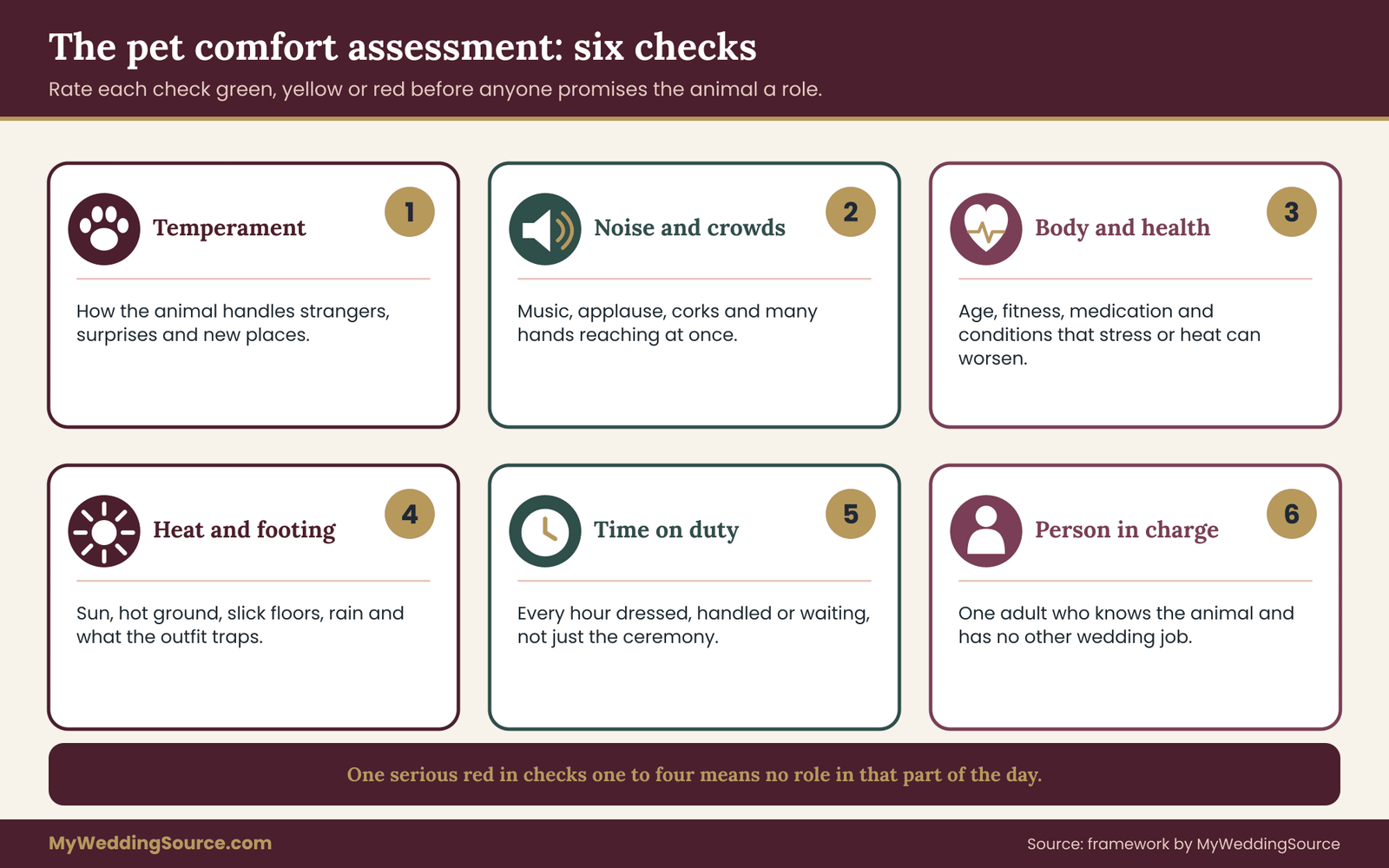
Before you promise anyone a ring-bearer dog, test the animal against six checks: temperament, noise and crowds, body and health, heat and footing, time on duty, and the person in charge. Any serious red flag means the animal skips the ceremony. Whatever role you choose, name one handler who is not in the wedding party, set up a quiet resting place, and write down the point at which the animal leaves. Then ask the venue, the caterer and your guests before you tell anyone the plan.
Most couples who want pets at weddings are not being careless. They love the animal, the animal is family, and a photo of that animal in a bow tie or a flower collar sounds like the happiest picture of the day. The trouble is that a wedding is built for people. It is loud, crowded, long and full of strangers, and it has a fixed schedule that nobody can pause.
A dog that is cheerful on the sofa can be frightened, overheated or overwhelmed in a reception tent, and a frightened animal cannot tell you so in words. Treat that gap between the picture in your head and the day itself as the main planning problem.
This guide treats the animal’s welfare as the first constraint and the aesthetic wishes as the second. That order is not a lecture. It is practical, because welfare problems tend to turn into planning problems: a dog that bolts during the processional, a cat that hides in a dress closet, a guest with an allergy who was never warned, a venue that cancels its permission at the door.
Planning for the animal first prevents most of them. The same logic applies to every plan involving pets at weddings, whatever the species.
A note on scope. This is general planning information, not veterinary, legal or insurance advice. Your own veterinarian knows the animal’s health and behavior, the venue and local authorities set the rules you must follow, and the sources at the end of this guide point to the organizations that publish current guidance.
What welfare-first planning means for pets at weddings
Welfare-first planning means that the animal’s comfort and safety decide whether, how and for how long it takes part. It does not mean that animals are banned from weddings. Many animals do well at a short, quiet, well-managed appearance, and some couples are right to include them. It means the decision is made by looking at the animal, not at the mood board. Seen this way, welfare-first planning for pets at weddings is mostly a matter of order: ask the hard questions first and shop for the bow tie last.
In practice the approach rests on three ideas that run through the rest of this guide.
The animal’s signals outrank the schedule. If a dog is panting heavily, pulling toward the exit, refusing food or freezing in place, the plan changes, even if the photographer is waiting and the processional is about to start. Everyone involved, including the photographer and the officiant, should know that the handler can end the animal’s part at any moment without discussion.
Every pet needs a person whose only job is the pet. A bridesmaid who is also holding the leash is a bridesmaid who will drop it when the music starts. The handler is a separate role, covered in detail in the care handoff plan later on.
Rules beat wishes. Venue policy, local regulations, a vendor’s contract terms and a guest’s medical needs all outrank a couple’s preferences. A beautiful plan that the venue has not approved is not a plan, it is a risk. That is as true of pets at weddings as of any other vendor or guest arrangement.
Who this approach is for
The method here works for dogs most directly, because dogs are the animals most often brought to weddings, and many of the examples use them. It also applies to cats, rabbits and other companion animals, with one large difference: many of those animals do not travel well, and the honest result of the assessment is often that they stay home and take part in some other way, such as a framed photo or a name on a sign.
The section on including an animal without bringing it covers those options. Dogs are simply where most questions about pets at weddings start.
It is also for couples who are not sure whether to include a pet at all. If you are already certain you want a dog in the ceremony, the assessment is the check on that certainty. If you are certain you do not, the later sections still help, because guests sometimes bring animals uninvited and the venue may still have policies you need to understand. Plenty of good decisions about pets at weddings end in a polite no.
This guide does not cover service animals in depth, because a service animal is a working animal with legal protections, not a wedding accessory. The venue section explains the distinction, and the site’s guide to guest care planning covers guests with different needs and is worth reading alongside this one.
Why a wedding is a harder day than it looks
It helps to picture the day from the animal’s point of view, hour by hour. The household routine ends early: people are up before dawn, moving fast, and a stranger arrives with hair and makeup equipment. The animal is dressed in something unfamiliar. It travels, perhaps in a car it only associates with the vet, to a place it has never smelled.
It meets dozens of people, some of whom crouch, grab, squeal or offer food. Music is amplified. Doors open and close, chairs scrape, glasses clink, a cork pops. Few people have ever thought through pets at weddings from this angle, and it changes the conversation.
Then the formal part begins. The animal is asked to walk calmly down an aisle with a crowd looking at it, stand still for photographs and ignore the smell of a catered dinner. Hours pass. The animal may not be walked, watered or allowed to relieve itself on its usual schedule. By the evening the humans are tired and happy, and the animal is a tired, hungry, possibly frightened guest nobody is watching.
None of those steps is cruel by itself. Together, on one long day, they add up to more than many animals can handle, and the risk grows with the length of the day. That is why the assessment in the next section looks at time on duty as its own check, and why the best plans for pets at weddings are usually short. This is why even a loving household can get pets at weddings wrong without meaning to.
The decision in one sentence
If you remember nothing else, remember this: the question is not “can our dog be at the wedding” but “what is the smallest, calmest role that our dog would tolerate, and who takes the dog home afterward.” The rest of this guide is a way of answering that question honestly and writing the answer down.
If you are still building your wider plan, the wedding planning checklist is a good place to see where a pet decision fits among the other tasks and deadlines. Asked that way, pets at weddings stop being a debate and become a short list of tasks.
The pet comfort assessment: six checks before you commit
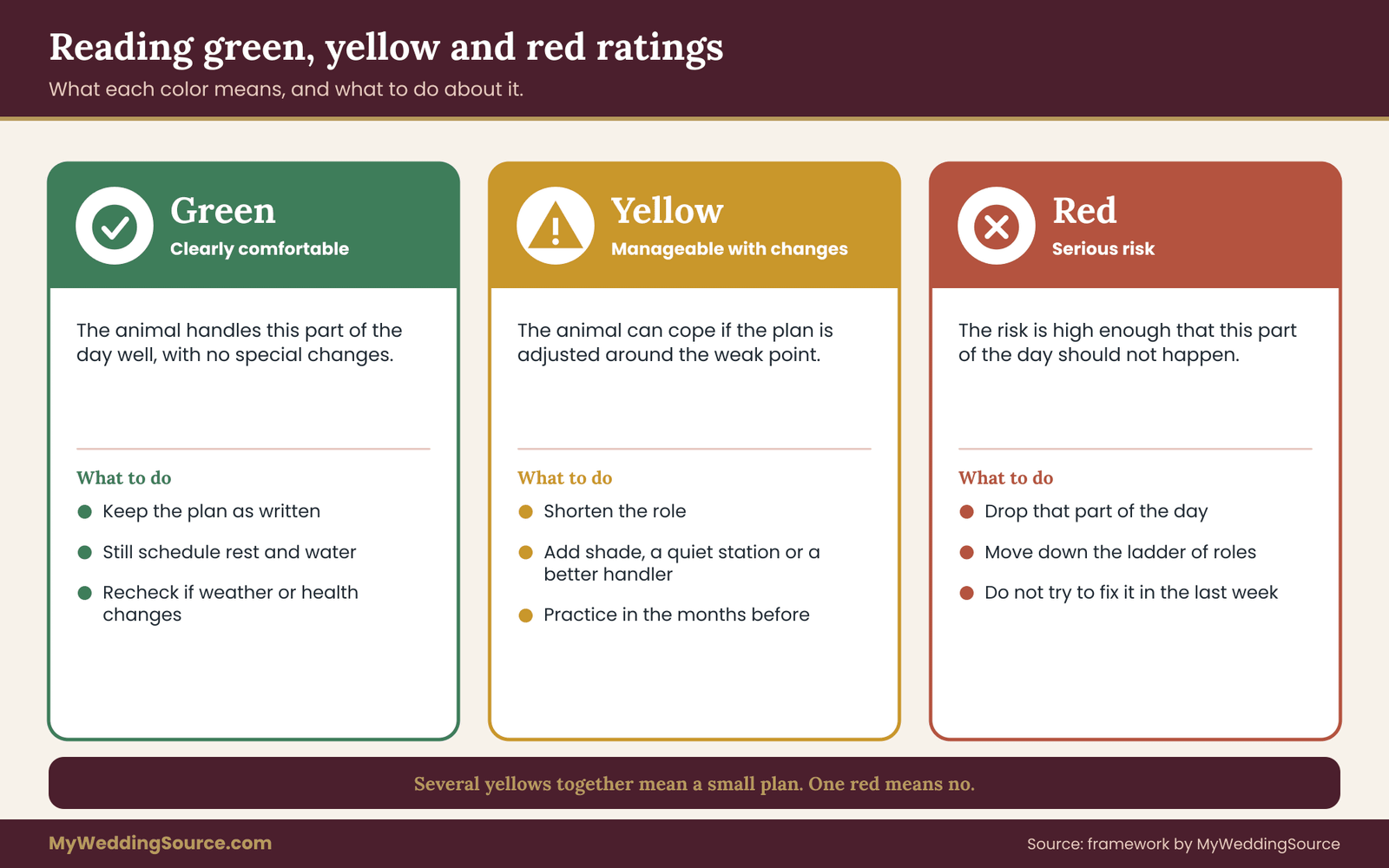
The pet comfort assessment is a short structured conversation you have with yourselves, and ideally with your veterinarian, before any invitation or vendor brief mentions the animal. It has six checks. Each one gets a rating of green, yellow or red. Green means the animal is clearly comfortable with this part of the day.
Yellow means it can manage with changes. Red means the risk is serious enough that this part of the day should not happen. Use it for every animal under consideration, because pets at weddings differ as much as people do.
The point is not a score. The point is to make you look at each risk on its own, because the human tendency is to let one cute photograph outweigh five warning signs. A written rating is harder to argue with at midnight the night before the wedding. It is a way to bring discipline to pets at weddings when emotions are high.
Be strict with yourselves, and be honest about the animal as it is, not as you wish it were. If you are unsure between two ratings, choose the lower one. A rating can always be improved by practice and preparation in the months before the wedding. It cannot be improved on the day.
Check one: temperament
Temperament is the animal’s ordinary emotional response to new things, and it is the most important of the six checks for pets at weddings. Ask how the animal behaves with strangers who approach quickly, with children, with unfamiliar adults who smell of other animals, and in a place it has never been. It is the check that most often settles the question of pets at weddings by itself.
Green looks like an animal that approaches new people with a loose, wiggly body, recovers quickly from a surprise and can settle on its own. Yellow looks like an animal that is polite but cautious, that needs a minute or two to adjust, or that is fine with one stranger and wary of ten. Red looks like an animal that growls, snaps, hides, trembles, lunges or has ever bitten someone. A bite history, even a minor one, is a red rating for any role where guests can reach the animal.
A useful test is to watch how the animal behaves at a busy family gathering at home, not at a quiet walk. If it spends the afternoon under a table, that is information. If it is the animal people have to be told to leave alone, that is also information. Pets at weddings face exactly that kind of crowd, only louder.
Check two: noise and crowds
A wedding combines two things many animals find difficult: sudden sound and close crowds. Think about the actual noise sources on your day. Amplified music, applause, a toast with a microphone, a band, a cork, a sparkler send-off, fireworks near the venue, children shrieking, a photographer’s flash.
Green means the animal is relaxed around loud household noise, such as a vacuum or a door slam, and does not startle at thunder or fireworks. Yellow means it startles and then recovers within a few seconds. Red means it shakes, hides, drools, tries to escape or stays upset for a long time after loud noise. Dogs with a known fear of thunder or fireworks should be rated red for any role at the reception.
Crowd density matters as much as volume. A dog that walks calmly past one person on a sidewalk can still be overwhelmed by twenty people trying to pet it at the same time. Ask yourself how the animal behaves when four or five people lean over it at once. At a wedding, that is a normal moment. At pets at weddings that look relaxed in photographs, the animal is often being petted by many hands at once.
Check three: body and health
This check covers age, fitness, health conditions and physical limits. A young puppy may not have finished its vaccinations or may be too excitable. A senior animal may tire quickly, have joint pain, need frequent bathroom breaks or have a medical condition that makes heat or stress dangerous. Short-nosed breeds can have more trouble with heat and exertion. Animals on medication need doses on time, and the wedding day is when schedules slip. It is the check that couples planning pets at weddings most often assume is fine without asking.
Green means the animal is healthy, up to date on veterinary care and has no condition that the day would make worse. Yellow means a manageable limit, such as a senior dog that needs shade, rest and a short role. Red means a health problem that stress, heat or a long day could aggravate, or an animal that is too young or too ill to travel safely.
Ask your veterinarian directly, and be specific: “We are thinking of bringing our dog to a daytime outdoor wedding that lasts about eight hours. Is that reasonable for this animal, and what limits should we set?” Your vet knows the animal’s chart. A planning guide does not. A short, specific appointment is among the most useful steps in planning pets at weddings.
Check four: heat, footing and weather
The environment can be the deciding factor even when temperament is excellent. Heat is the first concern. Animals do not cool themselves the way people do, and a dog standing in the sun in formal clothing, on hot pavement or a dark floor, can overheat faster than the people around it notice. Cold, rain and wet grass matter too, particularly for small or short-coated animals. Heat is the single most predictable hazard of outdoor pets at weddings.
Think about the surface the animal will actually stand on: hot stone, bare metal, slick tile, gravel, thorny ground, ground treated with products you do not know about. Think about shade and water, and about whether the animal can get out of the sun without leaving its job. Think about the outfit. A harness or collar that rubs, a cape that traps heat, a flower crown that blocks vision or a bow tie that tightens when the animal pulls all change the rating.
Green means mild weather, shade, safe footing and a short exposure. Yellow means a manageable problem, such as a warm day with shade and a cooling plan. Red means serious heat, hazardous footing or no reliable place to rest. When the forecast changes, rerun this check. It is the only one that can change in the last forty-eight hours.
Check five: time on duty
Time is the check couples most often skip. The question is not how long the wedding lasts but how long the animal is actually on duty, meaning dressed, handled, watched by guests and expected to behave, including travel and waiting. Of all the checks for pets at weddings, it is the cheapest to fix.
Green means the animal’s whole involvement lasts under an hour or two, with proper rest before and after. Yellow means a longer appearance with scheduled breaks in a quiet place. Red means an all-day commitment with no real downtime, or a day that stretches into the evening when the animal’s usual feeding, walking and sleeping routine would be disrupted.
A dog that has waited two hours in a car or a back room before it walks down the aisle has already been on duty for two hours. Count from the moment the animal leaves its usual routine until the moment it is back in it. Most of the plans that work well for pets at weddings have a very small footprint: arrive, appear, rest, leave.
Check six: the person in charge
The sixth check is not about the animal at all. It is about the human who will be responsible for it. Does this person know the animal well, and does the animal trust them? Can they hold a leash calmly while a crowd cheers? Will they leave a conversation to take the animal outside? Do they have transportation and the freedom to leave early, if needed? Good planning for pets at weddings depends on that person as much as on the animal.
Green means a reliable adult who is not part of the wedding party, who knows the animal, who has agreed to the role in plain words and who is free for the whole period. Yellow means a capable person who has a second duty, such as a family member who is also a guest and will need cover. Red means no one specific, or someone who is also giving a toast, walking down the aisle or hosting.
The person in charge is the most common weak point in pets at weddings. A pet with no named handler becomes everyone’s responsibility, which means it is no one’s. The care handoff plan later in this guide builds this role out in detail.
Reading the six ratings together
Once all six checks are rated, the pattern matters more than any one rating. A single yellow is usual and can usually be fixed with a change: shade, a shorter role, a different handler. Several yellows together mean the animal is on the edge, and the plan needs to be small. Any red in temperament, noise, body or heat means the animal does not take part in that part of the day.
A red in time or person is usually fixable by changing the plan. That is how to read the results when planning pets at weddings: look at the pattern, not at a single number.
The next section turns the pattern into a choice among five possible roles, from a full day to a photo-only appearance to staying home. Writing the six ratings on one page, with a date, also gives you something concrete to show a veterinarian, a venue manager or a worried parent. It turns “we think the dog will be fine” into “here is what we checked and what we decided.”
Choosing a role: the five options for pets at weddings
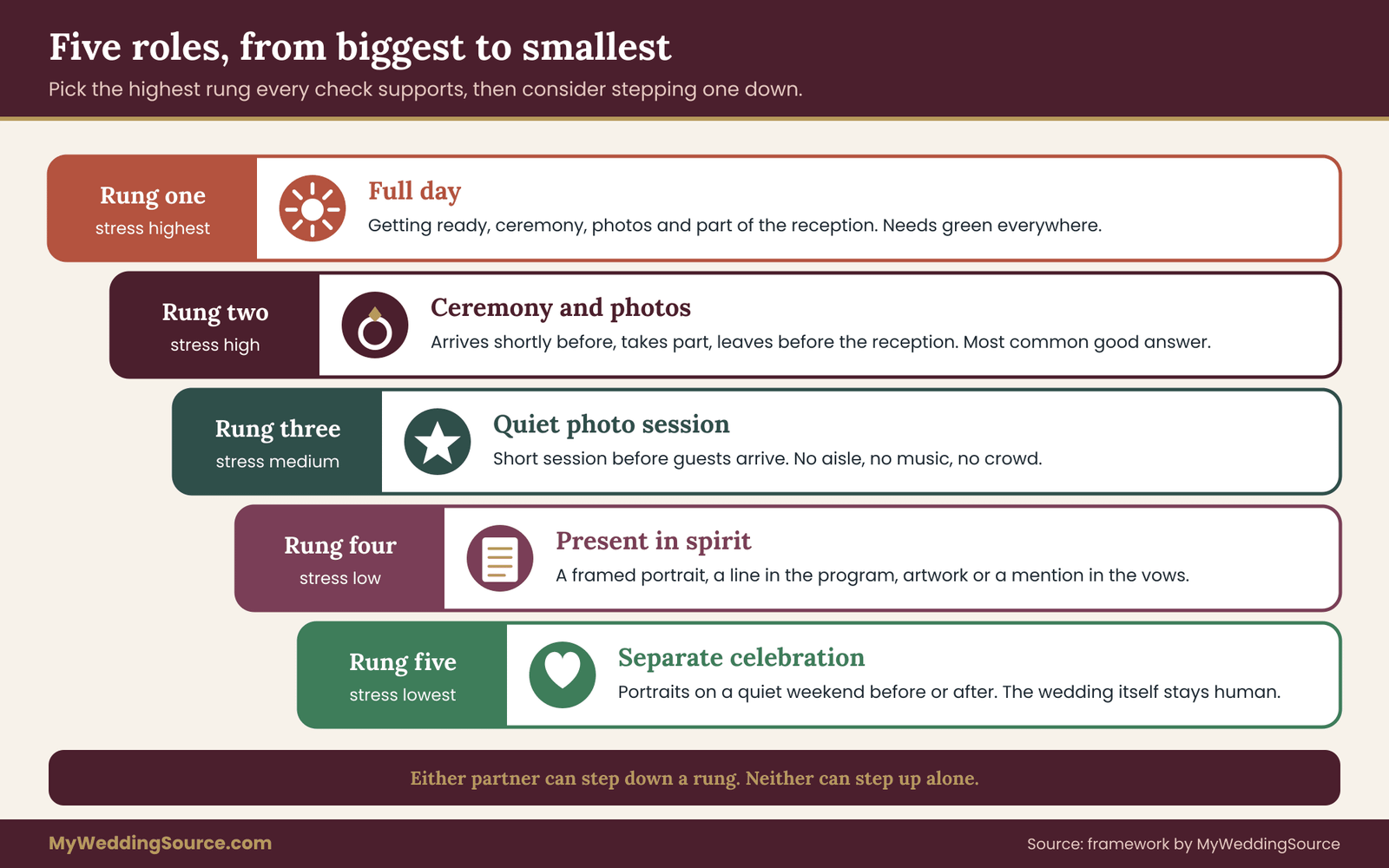
The ratings from the pet comfort assessment lead to one of five roles. They are arranged like a ladder, from the biggest commitment for the animal down to the smallest. The rule for choosing is simple: pick the highest rung that every check supports, and then step one rung down if anyone has doubts. Couples who plan pets at weddings this way rarely regret the choice. Couples who pick the top rung and hope often do. Treat the ladder as the working tool for pets at weddings.
Rung one: the full day. The animal is present for the getting-ready period, the ceremony, the photographs and part of the reception. This is the rarest sensible choice. It needs a green in every check, a calm and experienced animal, a venue that welcomes it and a dedicated handler with a rest area. Even then, “full day” should still include a long break, and it should end before the loudest part of the evening. Few pets at weddings should land here.
Rung two: the ceremony and photos only. The animal arrives shortly before the ceremony, takes part, is photographed and goes home or to a resting place before the reception begins. This is the most common good answer. It gives you the picture and the memory while avoiding the long, loud, food-filled hours when most problems occur. For most pets at weddings, this is the rung to aim for.
Rung three: photos only, before the ceremony. The animal comes to a quiet photo session, perhaps an hour or two before guests arrive, and then leaves. There is no crowd, no processional and no music. This works well for animals that are friendly but would be overwhelmed by a ceremony audience, and for venues that do not allow animals during events.
Rung four: present in spirit. The animal does not attend. It appears in a framed photo, a name on a sign, a custom illustration on the program, a collar tag worn by a family member or a mention in the vows. This is often the right answer for cats, for anxious dogs, for venues that prohibit pets and for animals with health limits. Many of the most affectionate pets at weddings never attend at all.
Rung five: separate celebration. The animal does not take part in the wedding at all, and you celebrate it another way, such as a photo session on a quiet weekend before or after. This is not a failure. It is a plan that honors the animal and the wedding without forcing them together.
How the ratings map to the ladder
A rough mapping makes the choice easier and keeps the discussion fair between two partners who may feel differently. Use the same mapping for every one of the pets at weddings you are considering, so that the decision is consistent.
All six greens support any rung, including the full day, though rung two is still usually wiser. One or two yellows support rung two or three, with the specific yellow fixed by a change in the plan. A yellow in noise or crowds, for example, points toward rung three, since the quiet photo session removes both. A yellow in time points toward rung two or three because both are short. A yellow in heat suggests moving the animal’s part to a cooler hour or indoors.
Three or more yellows, or a yellow that cannot be fixed, point to rung four. Any red in temperament, noise or body points to rung four or five for the affected part of the day. A red in heat points to a change of time, a cooler location or rung four. A red in time or person is fixable: shorten the role, or find a better handler, and then rerun the check.
This is a decision rule, not a law. If your veterinarian advises a smaller role than the ratings suggest, follow the veterinarian. If your animal has real training, a calm history and a green across the board, rung two can be done with confidence.
Trial runs that change the rating
Many yellows can be turned green with preparation, provided you start early. Months before the wedding, try the actual conditions in small steps. Visit the venue’s grounds during a quiet hour, if the venue permits it, so the animal meets the smell and the ground before the day.
Practice walking on a leash through a small group of friends while someone claps. Get the animal used to the outfit one piece at a time and watch for rubbing or shaking. Early practice is the cheapest way to improve pets at weddings plans.
Train the handler too. The most valuable trial run is the handler’s: practicing the handoff, the water break, the exit and the quick walk outside. The handler should also practice saying no to a guest who wants to feed or pick up the animal. A handler who has done it twice at a family barbecue will do it better at the reception.
Some behavior is not a matter of practice. Fear of loud noise can be reduced with veterinary guidance, but it is not usually fixed in a few weeks. Aggression toward people is a safety issue, not a training project for a wedding deadline. Treat those as fixed reds for this wedding and choose a lower rung.
An option matrix in prose
Because the options differ on several features at once, it helps to compare them side by side without a grid. Looked at together, the five rungs show that pets at weddings trade stress against photo value.
On animal stress, rung one is highest and rung five is lowest, with rungs two and three close to each other in the middle. On photo value, rung one and two give the richest pictures, because the animal appears in the ceremony; rung three gives good portraits but no ceremony shots; rung four gives a symbolic image only. On cost and complexity, rung one needs the most coordination, a handler, a rest area, a transportation plan and permissions.
Rung two needs most of the same but for a shorter window. Rung three needs only a short slot and a quiet place. Rungs four and five cost little or nothing beyond a print or a small custom item.
On risk to guests, which includes allergies, fear of animals, tripping and dropped food, the higher rungs create more risk and the lower rungs almost none. On venue approval, the higher rungs need formal permission, while rung four needs none. The overall pattern is consistent: more presence means more stress, more coordination and more risk, for a higher photo value. The best choice is the point where the benefits are real and the costs are acceptable to the animal, not only to you.
Settling a disagreement between partners
It is common for one partner to want the dog in the ceremony and the other to worry. The assessment helps because it moves the argument from feelings to specifics. Each partner rates the six checks separately and in writing, and then you compare. Disagreements usually cluster in one or two checks, such as noise or time, and those are the ones to discuss, with a veterinarian if needed. Disagreements about pets at weddings are common, and they are usually about one or two checks.
A fair rule is that either partner can lower the rung but neither can raise it alone. If one of you has a serious concern about the animal’s safety, that concern wins until it is answered. This rule sounds one-sided, but it protects the thing both of you care about, which is the animal. It also keeps the planning conversation from becoming a test of who loves the pet more.
When families weigh in, use the same approach. A parent who is certain that “dogs love weddings” can look at the six ratings and see what the plan actually requires. If relatives offer to handle the animal, treat that as an offer to interview, not a settled decision, and apply the person-in-charge check from the previous section. Keep the tone of those conversations practical: the animal’s six ratings are the topic, not anyone’s judgment.
What to do with the answer
Write the chosen rung at the top of a single page, with the six ratings, the date, the name of the handler and the exit trigger, which is the specific sign or time at which the animal leaves. That page is the core of the care handoff plan. Share it with the handler, the officiant, the photographer and the venue contact, and keep a copy on your phone. Keep that page with the rest of your records for pets at weddings, so that anyone can find it.
Then plan the rest of the day around the answer. The ceremony cue sheet needs a line for the animal’s entrance and exit, and the ceremony cue sheet guide shows how to build one that includes every moving part. The schedule for the photographs needs a time and a place. The vendors need to know that an animal is on site. The next section covers who needs to hear that, and what to ask them.
Permissions and rules: venue, vendors and guests
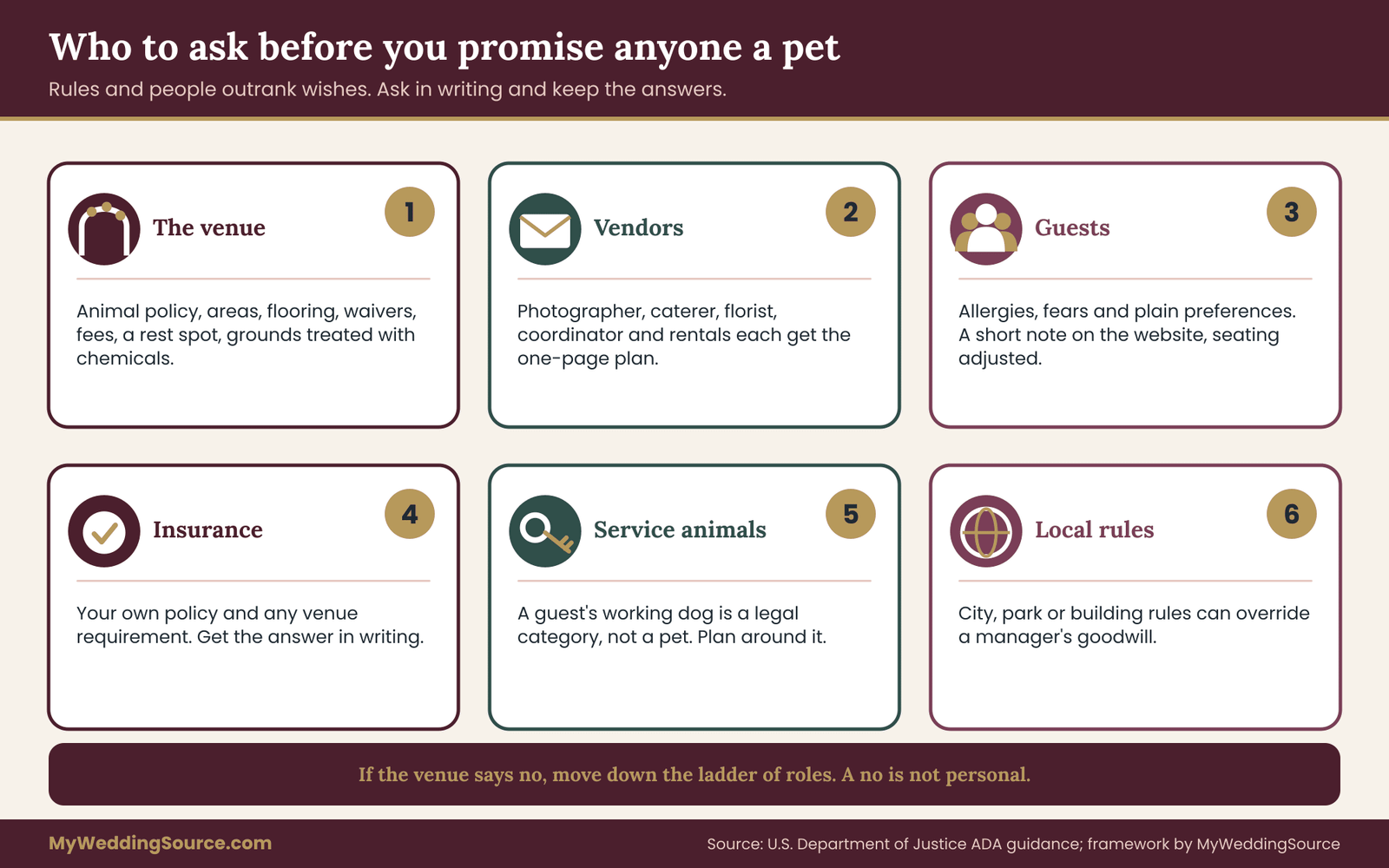
Once you know the role you want, the next job is finding out whether anyone will allow it. This is where many plans for pets at weddings fall apart, usually at the worst moment. A couple announces that the dog will walk the aisle, and three weeks later the venue’s coordinator mentions a policy in the contract that nobody read. Ask first, ask in writing and ask before you spend money on an outfit. Plan for the answer in writing.
The people and organizations who can say yes or no fall into four groups: the venue and its landlord or municipality, the vendors who work on site, the guests who share the space, and the officiant or religious site if the ceremony is held elsewhere. Each has a different reason to care.
Start with the venue contract
Read the contract and any house rules document for words such as animals, pets, dogs, service animals, flooring, sanitation, noise, insurance and damage. Venues vary widely. Some welcome dogs everywhere, some allow them outdoors only, some allow them for the ceremony but not near food, some require a deposit, a waiver or proof of vaccination, and some prohibit animals entirely except legally protected service animals. Rules about pets at weddings are often buried in a clause about sanitation or insurance.
If the contract is silent, do not assume permission. Ask the venue manager the specific questions in your plan, and get the answer by email. If the venue is a park, a historic site or a public building, the rules may come from a city or county and not from a private owner, and the manager may not be able to change them. The site’s guides to choosing a wedding venue and the venue technical walkthrough describe how to gather this sort of detail during a site visit.
Here is a short message you can adapt: “We would like our dog to take part in a short photo session and the ceremony, about forty-five minutes in total. Is that allowed at the venue? If so, what conditions apply, such as leashes, waivers, vaccination records, areas that are off limits, or a deposit? Where could a handler take the dog for a break?” Keep it factual and keep it short.
Questions to ask the venue
The most useful questions are not “can we” but “under what conditions.” Ask whether animals are allowed in the ceremony area, the photo locations, indoor spaces, the reception area and near food preparation. Ask whether there is a shaded or climate-controlled spot for the animal to rest, and whether it can be reached without passing through guests. Ask the same questions of every venue you are comparing for pets at weddings.
Ask what happens if the animal has an accident: who cleans it up, whether there is a fee and where waste should go. Ask whether there are other events on the property that day, such as another wedding with its own animal or guests with allergies. Ask about gates, fences and outside doors, because an animal that slips through an open service door is a serious emergency.
Ask whether there are plants, pesticides, fertilizer, de-icing salt or rodent bait on the grounds, because animals can be poisoned by products people do not notice.
If the venue says no, believe it, and move down the ladder. A venue’s no is not a personal rejection. It often reflects health codes, insurance conditions, other clients’ allergies or past incidents. Pushing a venue to make an exception for pets at weddings rarely ends well, because the exception depends on the coordinator’s goodwill on the day, not on a written rule.
Service animals are a different category
Service animals are not pets, and it is wise to understand the difference before you write anything on your invitations. Under the Americans with Disabilities Act, as the Department of Justice explains, a service animal is generally a dog that has been individually trained to do work or perform tasks for a person with a disability.
Businesses open to the public, including most venues, generally must allow service animals to accompany their handlers, and staff may ask only limited questions when the need is not obvious. Keep that definition separate from your plans for pets at weddings.
A venue’s “no pets” policy does not usually apply to a guest’s service animal. Emotional support animals and pets are treated differently under that law, although other laws and venue policies may apply in particular settings. If you are unsure how a rule applies, ask the venue and consult the official ADA guidance linked in the sources, not a blog or a rumor.
Two practical points follow. First, if you plan pets at weddings and a guest uses a service animal, think about how the two will interact. A pet dog that charges toward a working dog can disrupt its work. Plan the pet’s role away from that guest, or limit its time on site. Second, never ask a guest to prove a disability, and never make a guest’s service animal a condition of your pet plan. The site’s guide to caring for guests with different needs covers the wider planning side.
Vendors who need to know
Several vendors will be affected, and each should hear about the animal in advance, in writing, with the plan’s page attached. Each vendor affected by pets at weddings should hear it once, clearly, with the page attached.
The photographer and videographer need to know when the animal will appear, how long, what the handler will do and what the animal must not be asked to do, such as hold a long pose or sit on an unfamiliar surface. They also need to know that the handler can end a session at any time. A photographer who plans a long portrait session around an anxious animal will cost you more in stress than the pictures are worth.
The caterer and bartenders need to know that an animal is present, because dropped food, open plates and sauces are a hazard, and because kitchens often have rules about animals near food preparation. The florist needs to know, because some plants and flowers are dangerous to animals, which is the topic of a later section. The officiant and coordinator need the cue sheet to include the animal’s entrance and exit. The rental company and decor team should know if low candles, trailing fabric or glass elements will be within reach.
Check how your contracts handle damage or extra costs caused by an animal. The wedding vendor contract guide explains how to read clauses about liability and added fees, and a short email asking for confirmation is cheaper than a dispute afterward.
Insurance, liability and the unwritten risks
An animal in a crowd can bite, scratch, knock over a child or an elderly guest, trigger an allergy or cause an injury through a trip or a fall. Most animals never do, and the right plan makes it much less likely. But the responsibility for what happens rests with the owner and, in many places, is governed by local law, so it is worth a moment of thought. Liability for pets at weddings usually follows the owner, so ask before the day, not after.
Ask the venue whether it requires a certificate of insurance or a signed animal policy. Ask your own insurer whether your homeowner or renter policy covers injuries caused by your animal away from home, and whether any wedding or event policy you hold has an exclusion for animals. Do not assume coverage, and do not rely on a vendor’s casual assurance. Get the answer in writing, or accept that the risk is yours.
Some risks are not insurable at all. A dog that bolts and is lost in an unfamiliar area, a cat that escapes a carrier, an animal stressed to the point of illness: no policy covers the animal’s distress. The plan for those risks is prevention, which is the purpose of the assessment and the handoff plan.
Guests: allergies, fears and plain preferences
Some guests are allergic, some are frightened of dogs, some have had a bad experience with an animal, and some simply do not want to be near one at dinner. Those are all legitimate concerns, and they are more common than most couples expect. The guest list is where those concerns are quietly handled or quietly ignored. Guests’ needs are a normal part of planning pets at weddings.
Tell guests in advance that an animal will be present, how long it will be there and where. A line on the wedding website is enough: a short note that your dog will join the ceremony and photographs and will then go home, with an invitation to contact you with questions.
Guests with allergies or fears can then decide how to arrange their day, and you can adjust seating, such as placing a guest with a severe allergy away from the animal’s route and rest area. Advance notice is the kindest way to handle pets at weddings.
Do not ask guests to hold, feed or look after the animal, and tell them not to feed it. Ask the handler to be polite and firm about that, and tell the animal’s handler that “no thank you, he is on a special diet” is a fine script. An attention-seeking guest with a snack is among the most common causes of an upset stomach.
A short email to guests
A guest notice for pets at weddings does not need to be elaborate. Something like this works: “Our dog, Maple, will join us for the ceremony and a few photographs and will leave afterward. If you have allergies, a fear of dogs or other concerns, please let us know and we will make sure you are seated well away.
Please do not feed or pick up Maple, and thank you for understanding.” Adjust the wording to your own voice, and send it with the other logistics, not as a separate announcement.
If a guest replies with a serious concern, take it seriously and respond promptly. Offer practical changes: a seat in the back, a different entrance, a ceremony-only appearance or a plan to keep the animal outdoors. If the concern is severe and you cannot accommodate both the guest and the animal, the guest’s health comes first. The animal can always be photographed another day.
If you are working through several guest-related questions at once, the wedding planning checklist on this site can help you place this one in the sequence, so that notices go out at the right time and nothing is announced before it has been approved.
The care handoff plan for pets at weddings
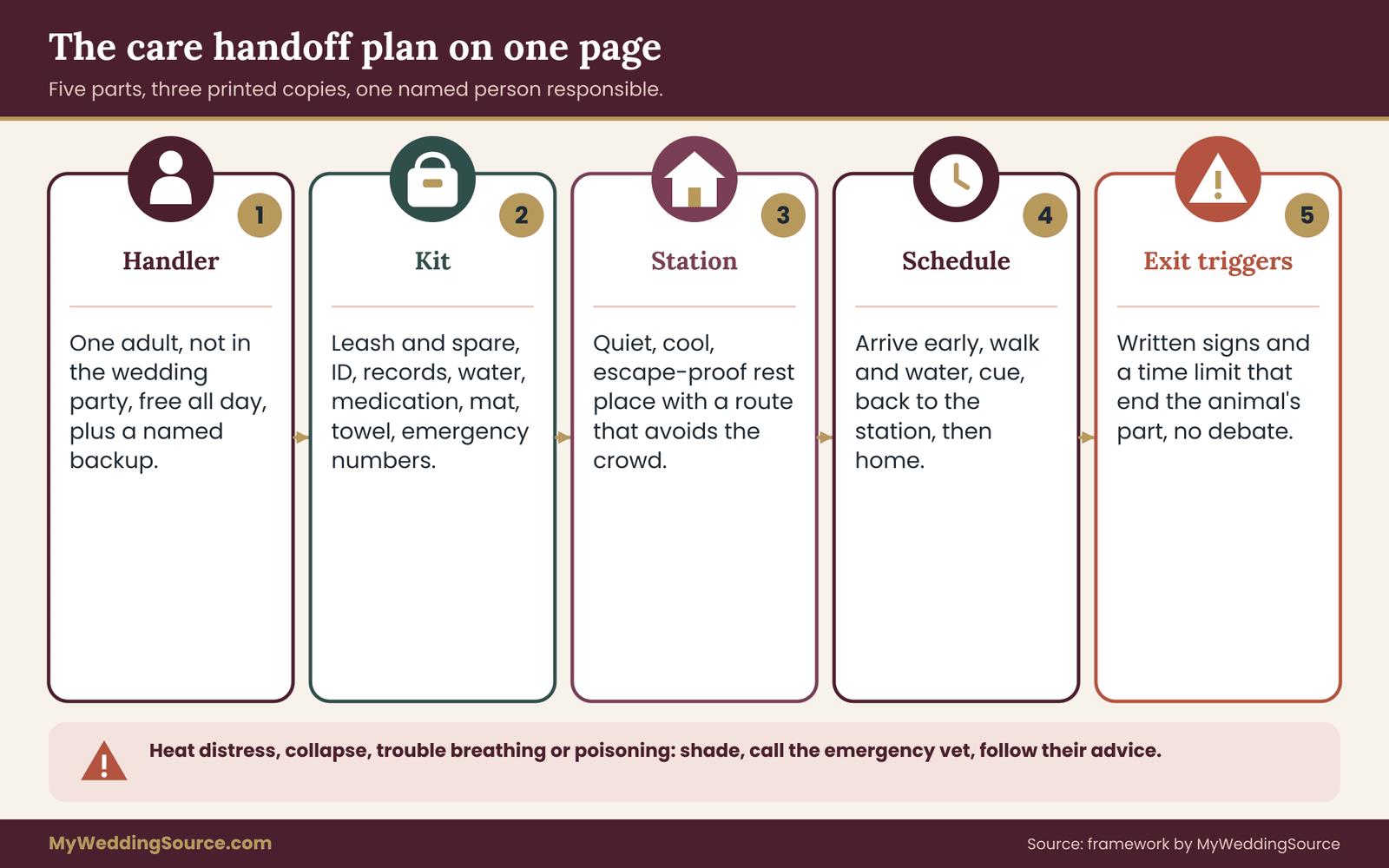
The assessment tells you whether and how much. The care handoff plan tells you who, where, with what and until when. It is a one-page document with five parts, and it is the single most useful piece of paper you can produce for pets at weddings. Print three copies: one for the handler, one for the coordinator or a trusted friend, and one in the animal’s travel bag.
Save a photo of it on your phone as well. Use it for every one of your pets at weddings, including those that never leave the house.
The word “handoff” is chosen on purpose. Over the course of a wedding day an animal is handed from one person to another several times: from the owner to the handler, from the handler to a photographer’s cue, from the aisle back to the handler, from the handler to the driver.
Each handoff is a point where something can go wrong, such as a dropped leash, an open door, a missing bag or a misunderstanding about who has the animal. The plan names each handoff and each person. Most mishaps with pets at weddings happen at one of these transfers.
The five parts are the handler, the kit, the station, the schedule and the exit triggers.
Part one: the handler
The handler is the adult who is responsible for the animal from the moment it leaves home until it is back there. Choose someone who knows the animal, whom the animal trusts, who is calm in a crowd and who is not in the wedding party. A friend, a cousin or a hired professional can all fill the role, as long as they are free for the whole period. In pets at weddings plans, this person is the single most important choice.
Write the handler’s name and phone number at the top of the page, and write a second person’s name as the backup, in case the handler has to leave or become unavailable. Then tell the handler exactly what is expected, in plain words. “Your only job today is the dog. You are free to say no to anyone, including us. You can end the dog’s part at any time, and you do not need to ask.”
Make sure the handler has what they need: a place to sit, water for themselves, a meal, a phone charger, transport and a way to get in and out of the venue without crossing the ceremony. Some couples give the handler a small thank-you, and some pay a professional. If you hire someone, ask about their experience with animals in crowds, their references, whether they carry insurance and what they do if an animal shows signs of distress. Do not hire based on an enthusiastic message alone.
A professional pet attendant or a pet-sitting service can be worth the cost if no suitable friend is available. Compare quotes in writing, ask for the terms in a contract and check that the attendant is comfortable with the exact role, not just with animals in general.
Part two: the kit
The kit is a bag that stays with the handler and holds everything the animal might need. Keep a checklist inside it so that it is repacked correctly. The core items are a sturdy leash and a back-up leash, a well-fitting collar or harness with identification, a copy of vaccination records and the veterinarian’s phone number, a water bowl and fresh water, any medication with written instructions, the animal’s regular food and a few safe treats, waste bags, a towel, a mat or blanket from home that smells familiar, and a cooling item suitable for the weather.
A good kit makes pets at weddings far easier to manage.
Add a few items for the unexpected: a spare outfit or cover if the first gets dirty, a quiet chew or toy, a portable fan or shade cover, and a recent photograph of the animal, in case it gets lost. Keep the animal’s microchip number or a copy of its registration somewhere accessible, and make sure the contact details are current. If the animal is on any medication or special diet, write the schedule on a card and put the card in the bag.
For cats and small animals, the kit also needs a secure carrier that the animal already knows, plus a way to keep the animal contained at every point. Most animals other than dogs should not be loose at a wedding at all.
Do not include anything that is unsafe. Do not feed human food, especially chocolate, grapes, raisins, onions, alcohol or sweeteners such as xylitol, which are known to be dangerous to many animals. The ASPCA and the Pet Poison Helpline, both listed in the sources, maintain current lists. Write down the number of an animal poison control service and your nearest emergency veterinarian, because the closest clinic on a wedding weekend is a question you do not want to answer in a panic.
Part three: the station
The station is the place where the animal rests when it is not on duty. It matters more than any other detail, because it is where the animal recovers from stress. A good station is quiet, shaded or climate-controlled, away from the main flow of guests and music, safe from escape and equipped with water, the familiar mat and a place for the handler to sit. No other detail does as much for pets at weddings.
Look for it during the venue visit, and confirm it with the venue manager in writing. A bridal suite, a groom’s room, a private office, a shaded corner of a garden with a fence, or even a parked, cooled vehicle that the handler stays near, can all work, depending on the rules.
A car should only be used if it is actively ventilated and monitored, and never as a place to leave an animal alone, particularly on a warm day. Heat in a parked car can become dangerous in a short time.
Test the station beforehand if you can. Bring the animal to the room with its mat and a treat, and watch how it settles. A room that has an adjoining reception space with a thin wall is a poor station, since the bass travels through. If the animal does not rest in the station, it is not working, and the plan needs a different spot or a smaller role.
Plan the route between the station and each point of duty. The animal should be able to get from the rest area to the aisle or the photo location without crossing the crowd, passing the kitchen or walking over hot ground.
Part four: the schedule
The schedule is the animal’s own cue sheet. It lists each step with a time, a place and a person, and it gives margins. A basic version for a ceremony-and-photos appearance looks like this in words. A written schedule keeps pets at weddings from running on hope.
The handler picks the animal up at home after a normal walk and meal, with a buffer so the animal is not rushed. The handler travels with a calm, ventilated, secured setup and arrives at the venue at least an hour before the animal’s part, to let it settle in the station. Thirty minutes before the ceremony, the handler takes the animal for a short walk and a bathroom break, then offers water.
Ten minutes before the cue, the outfit goes on, if one is used. At the cue, the handler walks the animal to the entrance point, and a second person, not the handler, takes the cue from the coordinator.
After the ceremony or the photos, the handler takes the animal straight back to the station, removes the outfit, offers water and rest, and stays with it. When the planned exit time arrives, the handler takes the animal home or to the sitter. The written schedule should also show what happens if the ceremony starts late: the animal’s arrival time slides back, not its time at the venue.
Build in more time than seems necessary. A schedule that has every minute filled leaves no room for an anxious animal to pause. A twenty-minute buffer before the cue is not wasted if the animal needs it, and it can be spent on the handler’s coffee if it does not.
Part five: the exit triggers
The exit triggers are the written reasons an animal leaves early. They are the most important part of the plan, because they take the decision out of the moment. A moment at a wedding is the worst time to decide whether a dog is stressed enough to leave: everyone is watching, the schedule is tight, and the couple is emotional. Clear exit triggers are the mark of a thoughtful plan for pets at weddings.
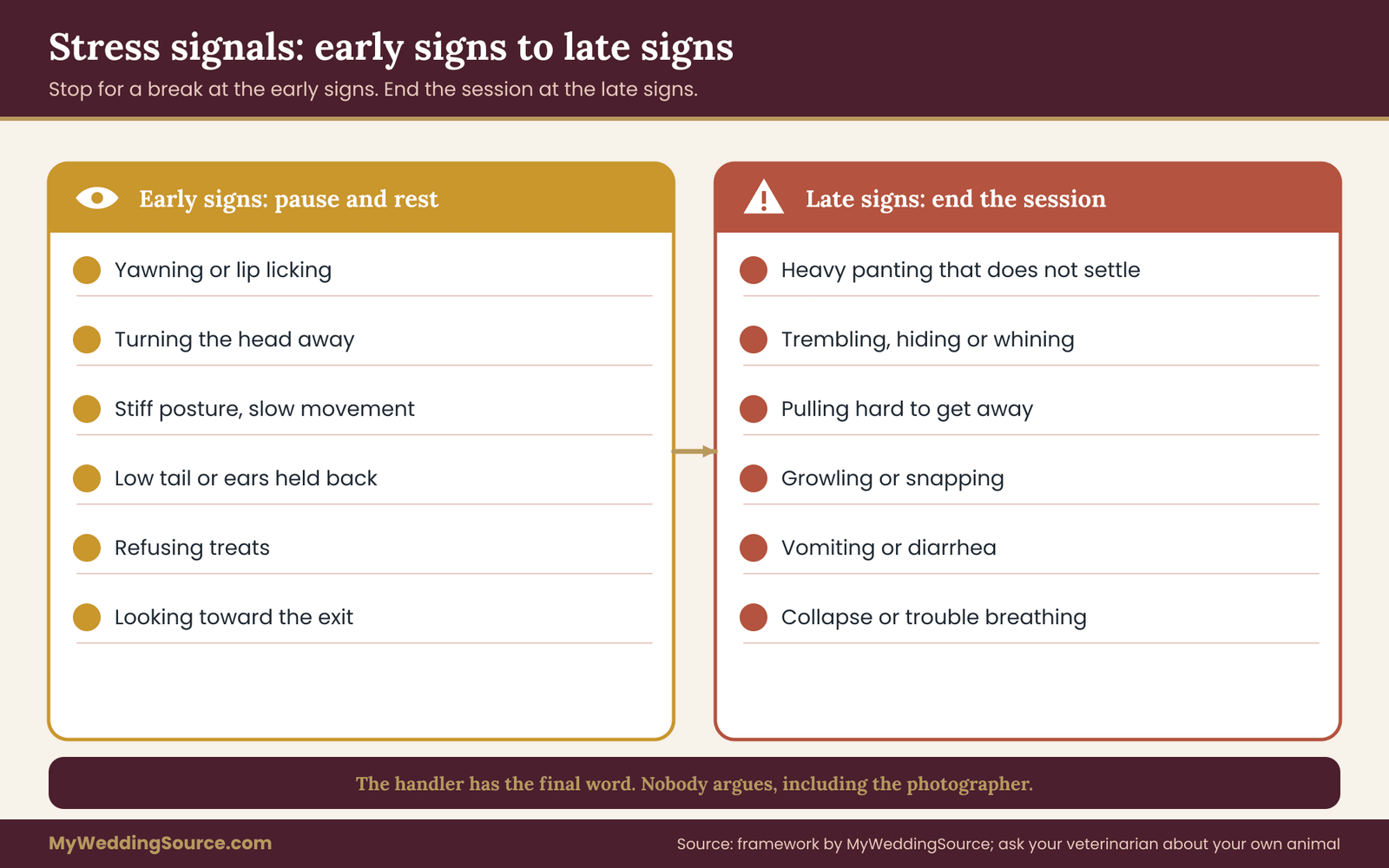
List the signs that end the animal’s part. They typically include: heavy or continuous panting that does not settle, drooling, trembling, hiding, pulling hard toward the exit, a tucked tail with a stiff body, repeated yawning or lip licking paired with avoidance, growling, refusing water or treats, vomiting or diarrhea, any sign of heat distress, and any injury. Add a time limit: “whatever happens, the dog leaves by four o’clock.”
Add one more trigger that is about the people, not the animal: “if the handler says it is time, it is time.” The handler does not need to justify the call. The couple, the photographer and the coordinator all agree in advance that they will not argue. A written trigger also protects the handler from the awkwardness of being the person who ends a cute moment.
Heat distress and other emergencies need a different protocol. If an animal shows signs of overheating, collapse, difficulty breathing or poisoning, the handler’s job is to move it to shade, call the emergency veterinarian immediately and follow their instructions, not to wait for a pause in the program. Put that sentence on the page, with the clinic’s number.
Putting the plan in front of the right people
A plan does not work if it only exists in a folder. Send the one-page version to the handler, the backup, the coordinator, the photographer and the officiant, and mention it at the vendor check-in the week before the wedding. Ask each person to reply with a short confirmation, such as “got it, I will check the page.” That small step turns the plan into a shared commitment. Shared plans are what separate calm pets at weddings from chaotic ones.
If you keep a day-of binder or shared folder, the plan can sit alongside your other documents. The site’s guide on guest care operations shows how to structure a similar set of handoffs for children and older guests, and many of the same habits apply: one named person, a quiet space, a written schedule and an easy way to leave.
Photos with pets at weddings without forcing the shot
Photographs are the main reason couples bring animals, and they are also where animals are most often pushed past their limits. A photographer who wants one more take and a couple who wants one more pose can keep an animal under bright light, in an unfamiliar outfit, in front of strangers, for far longer than it can tolerate.
The fix is to plan the pictures around the animal’s attention span, not the other way around. A thoughtful approach to photos is what keeps pets at weddings kind as well as pretty.
The aim is a small number of good images made quickly, and a plan that makes it easy to stop. A calm animal, photographed for ten minutes in a quiet place, will usually give you a better picture than a stressed animal photographed for forty.
Choose the time and place for the animal
The best time for photographs with pets at weddings is before the crowd arrives. A short session in a quiet corner of the venue, an hour or two before the ceremony, gives the animal space and the photographer clean backgrounds. Pick a spot the handler has checked for hazards, with soft, safe footing, shade in warm weather and no loose objects the animal might chew. Early, quiet sessions are the safest way to photograph pets at weddings.
If the animal appears in the ceremony, pick one moment, such as the walk down the aisle or a short appearance during the vows, and photograph that. Avoid asking an animal to sit through the entire ceremony. A standing animal is not a prop, and a sit-and-stay that has to last through readings, music and vows is a hard exercise even for a trained dog.
Consider a separate session on another day, a “pets and portraits” session in a familiar park or at home, where the animal is comfortable. Many couples find the pictures from a relaxed home session are the ones they hang on the wall. The wedding day then needs only a brief, low-pressure moment.
Brief the photographer in writing
The photographer needs the plan in advance, not on the day. Send a short note that covers four things. First, when and where the animal will appear, and for how long. Second, who the handler is and that the handler’s decisions are final. Third, what the animal is comfortable with and what it is not: for example, “she dislikes being lifted and is nervous with flash.”
Fourth, what shots you want, as a short list, so that the session is efficient. A photographer experienced with pets at weddings will welcome the page.
Ask the photographer about their experience with animals, how they work with them, whether they use flash and how they respond if an animal shows stress. If you are still choosing, this is a fair question for the interview, and the answer tells you something about how they handle the whole day. The site’s guide on wedding photography consent covers how to set limits on photography, which applies to animals as well as guests.
Ask about the equipment. A long lens lets the photographer stay back, and natural light avoids flash, which many animals dislike. A photographer who offers to get down at the animal’s level, move slowly and let the animal approach is usually a good sign. One who says “we’ll get the shot, don’t worry” without asking about the animal is not.
Poses that work, and poses that do not
Some images are low-stress and easy to get. A walk beside the couple on a loose leash, a quiet moment with the animal sitting between two people, a close-up of a paw or a collar tag, a candid of the handler and the animal resting, the couple kneeling beside the animal while it eats a safe treat. These can all be done in a few minutes, with the handler out of frame. The simplest pictures of pets at weddings are often the most loved.
Some images need more care. Picking up an animal, particularly one that dislikes it, can cause fear and injury. Holding an animal for a long pose, passing it between several people, placing it on unfamiliar surfaces or dressing it in a way that restricts movement all raise risk. Skip them, or limit them to a few seconds for an animal that is clearly comfortable with them.
Avoid using food to hold an animal’s attention for long, because it can upset the stomach and make the animal less safe around plates. A few small safe treats from the handler’s pouch are fine. A guest’s pocket full of cheese is not.
Reading stress signals during a shoot
The photographer, the couple and the handler should all know the signs that an animal has had enough, and the handler should have the final word. Early signs are subtle: yawning, lip licking, turning the head away, a stiff posture, moving slowly, a low tail, refusing treats. Later signs are easier to see: panting, trembling, hiding, whining, pulling away, growling. Everyone present at pets at weddings should know when the shoot is over.
When the early signs appear, stop for a break: let the animal rest, offer water, and decide whether to continue. When the later signs appear, the session ends. This is not a failure, and it should be framed as a normal part of working with an animal. A good photographer will say, “we have enough, thanks.”
Outfits, collars and accessories
Dressing an animal is optional and often a bad idea. A bow tie on a collar, a floral collar, a simple bandana or a ribbon is usually fine for a calm dog if it has been worn before and does not restrict movement. Full outfits, capes, hats, veils or anything that covers the face, limits sight or hearing, traps heat or can catch on things carry more risk.
The tighter and more complicated the garment, the stronger the case for skipping it. Many pets at weddings look best in nothing more than a clean collar.
Test every piece at home, for short periods, with treats, and watch the animal’s reaction. If it freezes, tries to remove it, scratches or becomes quiet and still, the garment is not working. Use materials that are safe if chewed or swallowed, and avoid small beads, wire, glitter, adhesive, heavy fabric, and anything attached with pins or glue. Keep the outfit removable in seconds.
Choose accessories that the handler can control. A leash decorated with fabric flowers is fine if it is still a secure leash. A ring bearer pillow tied to a dog’s back can slip, spook the animal or become a hazard, so many couples prefer to attach the rings to a pillow carried by a person or to a symbolic prop.
If you want a ring-bearer dog, plan how the rings are secured and who retrieves them, and consider using stand-in rings for the walk. Do not tie real rings to an animal.
Flowers, plants and decor within reach
The florist and decorator need to know about the animal, because many popular wedding plants are poisonous. Lilies are notably dangerous to cats, and a number of other common flowers and greens can cause illness in dogs and other animals. The ASPCA’s animal poison control resources list many plants by species, and your florist can use that list when designing arrangements that will be near the animal’s path or station. Flowers deserve their own line in any plan for pets at weddings.
Besides plants, look at what is at floor level: candles, confetti, petals, glitter, ribbon, string lights, cords, balloons, small decor items, table scatter, fallen food. An animal can swallow or chew nearly any of them. Ask the decor team to avoid loose items along the animal’s route, and ask the handler to check the area before the animal walks through. For a ceremony with a petal aisle, check which petals are used, and consider a smooth runner for the animal’s walk.
Keep the animal away from the bar, the buffet and the cake. Alcohol, chocolate and some artificial sweeteners are dangerous in small amounts, and a fallen plate can cause an emergency. If your wedding has a dessert table at ground level, plan the animal’s route to avoid it.
Four worked examples of pets at weddings
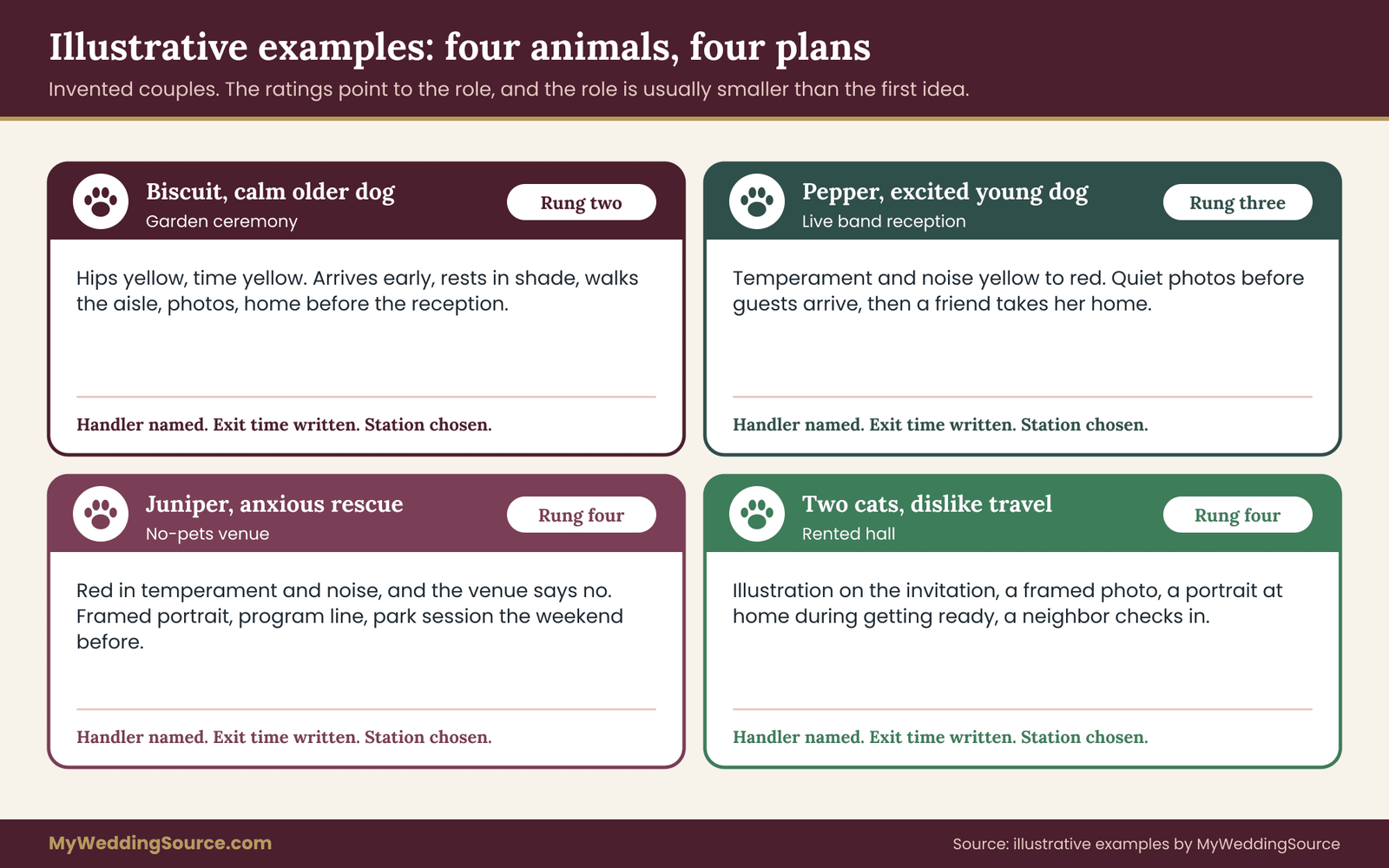
The examples below are invented for illustration. They are not case studies of real couples, and the outcomes are not research findings. They show how the assessment, the ladder and the handoff plan work together on different kinds of animals and venues. Read them as sketches of how pets at weddings plans can differ.
Example one: a calm older dog at a garden ceremony
Priya and Daniel have a ten-year-old Labrador mix named Biscuit. He is friendly with strangers, calm around noise and healthy for his age, with some stiffness in the hips. The wedding is a spring afternoon in a garden venue that allows dogs on a leash.
Their ratings: temperament green, noise green, body yellow because of the hips, heat green with shade, time yellow because the day is long, person green because Daniel’s cousin has agreed to handle him. The pattern points to rung two. They plan a short appearance. Biscuit arrives forty-five minutes before the ceremony, rests in a shaded corner with a mat and water, walks the aisle with the cousin on a loose leash, is photographed for ten minutes and then goes home with the cousin before the reception.
The key choices were the shortened role and the planned exit. The vet’s advice about the hips shaped the rest: no stairs, a soft aisle and a limit on time standing. The couple considered keeping him for dinner and decided against it.
Example two: a young, excited dog and a loud reception
Marcus and Elena have a two-year-old terrier mix named Pepper who loves people and jumps on everyone. She is healthy and strong, but she has never been in a crowd of more than a few people and gets overexcited around food. The reception includes a live band.
Their ratings: temperament yellow because of the excitement, noise yellow to red because she has never heard a band, body green, heat green, time yellow, person yellow because the only available handler is also a groomsman. Several yellows and one near-red mean the plan has to be small. They choose rung three, a quiet photo session an hour before the guests arrive, followed by a short outdoor appearance after the ceremony if she is calm.
They also change the handler. A friend who is not in the wedding party agrees to take Pepper home after the photographs. In the months before the wedding, they work with a trainer on calm greetings and leash manners, and they decide that the reception is not part of the plan at all. Pepper’s part ends at the photographs, which is a smaller role than they had imagined but one she can do well.
Example three: an anxious rescue dog and a no-pets venue
Amara and Jonas have a six-year-old rescue dog named Juniper who is afraid of strangers and sudden noise. The venue prohibits animals other than service animals. The couple had imagined her in the ceremony.
The assessment gives red in temperament and noise. The venue’s policy settles the question on its own. They choose rung four, with a framed portrait on the welcome table, a small line on the program, and a plan to hold a quiet photo session at a park the weekend before the wedding. They also arrange for a trusted sitter to stay with Juniper at home on the wedding day, with a familiar routine, a calm environment and a way to reach the couple in an emergency.
The couple reports that the park session was the part they enjoyed most, because Juniper was relaxed and the pictures were natural. That is an illustration, not a promise, but it shows that rung four and five are not consolation prizes. For an anxious animal they are the plan that respects the animal and still gives you the pictures.
Example four: two cats and a house-based celebration
Noor and Sam have two cats and are marrying at a rented hall. The cats dislike travel and new places, and the venue does not allow animals. The couple thought about bringing one in a carrier for photographs and decided it would be unfair.
They choose rung four. They commission a small illustration of the cats for the invitation suite, place a framed photograph at the entrance, and ask the photographer to take a portrait of the couple with the cats at home during the getting-ready period. A neighbor checks in on the cats during the wedding. The cats stay in their usual environment, the couple has the picture and the day goes ahead without added risk.
What the four examples have in common
In each case the couple did four things. They rated the animal honestly, they chose the rung the ratings supported, they named a handler or a sitter and they decided in advance what would end the animal’s part. In none of the examples did the aesthetic wish drive the decision. In three of them, the result was a smaller role than the couple first imagined, and none of the couples lost anything essential by choosing it. That short routine is the heart of planning pets at weddings.
The pattern is the same for most real situations. The right plan for pets at weddings is usually smaller than the first idea, simpler than the mood board and more flexible than the schedule. It is also usually easier on the humans. Smaller is usually safer when it comes to pets at weddings.
When the animal stays home: including pets at weddings in other ways
A large share of couples who start planning pets at weddings end up with an animal that stays home, and that is a good outcome, not a compromise. The animal is safe, the venue’s rules are met, and the couple still has ways to make the animal part of the story. The options below range from small to elaborate, and most of them cost very little.
A framed portrait or a photo corner. Place a picture of the animal at the welcome table, near the guest book or beside the escort cards. Guests who know the animal enjoy it, and guests who do not still see how much it matters to you. This is the easiest way to include pets at weddings that stay home.
A mention in the program or vows. A short line in the printed program, a sentence in the vows or a note in the officiant’s remarks acknowledges the animal without any logistics. Some couples include the animal’s name in the signature drink or the dessert table sign.
Custom artwork. An illustration of the animal on the invitation, the napkins, a sign or a cake topper makes it part of the design. Work with an artist or a printer, and proof the final image the way you would proof any other print item.
A family keepsake. A collar tag, a small charm or an item from the animal’s collar can be carried by the couple or attached to a bouquet, if you wish. Keep these items secure so that nothing is lost or left where an animal could swallow it.
A pre-wedding or post-wedding session. The photo session at a familiar park, at home or at a quiet spot gives you the portraits without the stress of the wedding day. Many couples treat it as a separate, relaxed event.
A home-based moment. Take a few photographs of the couple with the animal during getting ready, in the living room, with no travel at all. This is often the most natural image of the whole day.
Care while you are away
If the animal stays home, it still needs a plan. A wedding day has long hours, a late finish and sometimes a night away. Arrange for a sitter, a boarding facility or a friend who knows the animal, and give them a written page, similar to the care handoff plan: feeding times, medication, walks, the veterinarian’s number, what to do in an emergency and how to reach you. Absent pets at weddings still need care.
Do a trial before the wedding if the sitter is new. Have them spend an afternoon with the animal while you are home, then an evening while you are out. Check that the animal eats, rests and relieves itself normally, and ask the sitter about anything unusual. An animal that is anxious when left alone needs a calm, familiar environment and a sitter it already knows, not a stranger who arrives on the wedding morning.
Arrange the return home too. If you are leaving for a honeymoon, make sure the sitter’s schedule covers the full period, and leave a backup contact. Do not rely on a plan that depends on guests who might be traveling or tired.
Limits of this guide
This guide cannot replace a veterinarian who knows the animal. It does not diagnose behavior, prescribe training or give medical advice, and it cannot account for the many individual differences between animals. A rating is a planning tool, not a medical opinion. No guide to pets at weddings can know your animal as your vet does.
It also cannot cover every legal situation. Rules about animals in public places, venues, vehicles and housing vary by country, state and city, and they change. For official guidance on service animals, animal health and poison risks, use the sources listed at the end of this guide and ask the venue and your local authorities about the specific rules that apply to you. Local rules shape pets at weddings more than any general advice.
The examples are invented, and no statistics are quoted, because there is no reliable general figure for how animals respond to weddings. The method rests on observation, planning and caution, not on averages. Where the guide gives a rule of thumb, treat it as a starting point and adjust to your own animal. And when your own judgment, your veterinarian’s advice and the venue’s rules point in different directions, the most cautious one wins.
Your next steps
Work through the following in order, and give each step a date.
- Rate the six checks in writing. Each partner does it separately, then you compare. Include your veterinarian’s input on the body and heat checks.
- Pick a rung on the ladder. Choose the highest rung every check supports, then consider one rung lower. Write it at the top of a page.
- Ask the venue in writing. Use the short message in this guide, and get the answer by email before you buy any outfit or promise anyone anything.
- Name the handler and a backup. Confirm in plain words that their only job is the animal and that they can end its part at any moment.
- Build the one-page handoff plan. Include the kit list, the station, the schedule and the exit triggers, and print three copies.
- Brief your vendors. Send the photographer, the florist, the caterer and the coordinator the relevant parts, and ask each to confirm.
- Tell your guests. Add a short note to the wedding website and make seating adjustments for anyone with allergies or fears.
- Run a trial. Practice the outfit, the walk, the handoff and the rest period in the months before the wedding, and rerun the six checks if the forecast or the animal’s health changes.
If the animal’s part is small, so is the list, and that is the point. For help placing these tasks among the rest of your plan, see the wedding planning checklist and the guide to choosing a wedding venue. Keep the list short and the dates firm, and pets at weddings become manageable.
FAQ
Can I bring my dog to my wedding?
Often yes, but it depends on the venue’s rules, your dog’s temperament, health and the length of the day. Ask the venue in writing first. Then rate the dog on the six checks. A short appearance, such as photos and the ceremony, is usually safer than a full day. If the dog is anxious, aggressive or unwell, it should stay home and take part in another way.
Who should look after the pet during the wedding?
Choose an adult who knows the animal, is calm in a crowd and is not in the wedding party. That person should have one job, which is the animal. They need a quiet place to rest, the animal’s supplies, a phone, transport and a backup person. A professional pet attendant is another option, and you should confirm their terms, references and experience in writing.
How long can a dog safely stay at a wedding?
There is no single number, because it depends on the dog’s age, health, temperament, the weather and the setting. Plan the shortest role that gives you the picture, count the whole time the dog is dressed, handled or waiting, and build in rest breaks. Many couples find that a ceremony and photo appearance is enough. Your veterinarian can help you set a limit for your own animal.
What if the venue says no pets?
Accept the answer and move to another rung of the ladder. You can still include the animal through a framed photo, a mention in the program, custom artwork or a separate photo session before or after the wedding. A venue’s no usually reflects health, safety and insurance rules, and an exception rarely works well. A guest’s service animal is treated differently under the law.
Are service animals the same as pets at weddings?
No. Under the Americans with Disabilities Act, a service animal is generally a dog individually trained to perform tasks for a person with a disability, and venues open to the public usually must allow it. Pets and emotional support animals are treated differently. If you are unsure, read the official ADA guidance and ask the venue. Never ask a guest to prove a disability.
Which flowers and foods are dangerous to animals?
Many common wedding items can harm animals. Lilies are especially dangerous to cats, and other flowers and plants can cause illness in dogs. Chocolate, grapes, raisins, onions, alcohol and the sweetener xylitol are known hazards in food and drink. The ASPCA and the Pet Poison Helpline keep current lists, and your florist and caterer should know that an animal will be present.
What should be in a pet emergency kit for a wedding?
Pack a secure leash and a spare, identification, vaccination records, your veterinarian’s number, an emergency clinic’s number, water and a bowl, regular food and safe treats, any medication with written instructions, waste bags, a towel, a familiar mat, a cooling item and a recent photo. Keep the kit with the handler and add a printed copy of the care handoff plan.
What are the signs that a pet should leave the wedding?
Heavy panting that does not settle, drooling, trembling, hiding, pulling toward the exit, a stiff body with a tucked tail, repeated yawning or lip licking with avoidance, growling, refusing water, vomiting and any sign of heat distress or injury. Write these as exit triggers in the plan, and agree in advance that the handler can end the animal’s part without discussion.
Sources
- American Veterinary Medical Association: avma.org
- U.S. Department of Justice, ADA service animal requirements: ada.gov
- ASPCA Animal Poison Control: aspca.org
- Pet Poison Helpline: petpoisonhelpline.com
- Centers for Disease Control and Prevention, Healthy Pets: cdc.gov
- U.S. Department of Agriculture, Animal and Plant Health Inspection Service: aphis.usda.gov
- U.S. Food and Drug Administration, Animal and Veterinary: fda.gov
- American Animal Hospital Association: aaha.org
- Humane Society of the United States: humanesociety.org
- U.S. Department of Transportation, service animals: transportation.gov