
Early departures at a wedding are rarely a problem for the couple and almost always a problem for the family walking out the door with a sleepy child, a diaper bag, a gift bag and no clear idea of where the car is parked. This guide shows how to plan early departures so that guests with young children can leave before the send-off without stress, and without anyone feeling that they let the couple down.
Assume that early departures will happen among families with young children, and plan for them instead of hoping they will not. Put the key moments (photos, toasts, cake, first dance) ahead of the usual exit windows. Give every family a short departure and transportation card that lists who is leaving, when, how, and who has the car seat. Mark a quiet exit route, keep coats and bags handy, and offer a goodbye that needs no audience. Check local parking, ride and curfew rules, and tell guests in writing.
Every wedding has a quiet moment around nine o’clock when a parent looks at a child who has stopped being cheerful and started being tired. The toddler is rubbing both eyes. The baby has been passed through six pairs of arms. The seven-year-old has eaten two desserts and is now lying under the table with a cousin. The parent wants to stay for the dancing and also wants the child in bed. Somebody has to decide.
That decision is the heart of early departures, and it usually happens with no preparation at all. The family does not know whether leaving before the send-off will look rude. The couple does not know it is happening. The venue has no idea that a stroller, three coats and a car seat need to leave through the side door. Nobody planned the exit, so the exit is improvised in the worst possible conditions.
This article is about planning that exit. It covers why families leave, the times in the evening when they tend to go, what to put on a one-page departure and transportation card, how car seats and rides work in practice, how to handle children who are part of the wedding party, and what to do when something goes wrong. It also includes a worked example and a list of questions to put to your venue and your vendors.
A note on scope. This is general information, not legal, tax or financial advice. Child-seat laws, venue rules for early departures, childcare regulations and accessibility duties differ by state and by place, and they change. Where a rule matters, the article points you to the agency or the vendor that can confirm the current version.
If you are still working out the larger picture of children and older relatives at your wedding, start with the broader guide to wedding guest care planning. This article assumes that you already have a general idea of who is coming and zooms in on one situation: early departures by the family that needs to leave before the evening is over.
What early departures at a wedding really involve
An early departure is any exit by a guest before the planned end of the event. For guests without children it is mostly a social question: do I say goodbye, and does it matter? For a family with young children it becomes a logistics question with five moving parts.
People. Who is leaving? Sometimes the whole family goes together. Sometimes one parent takes the children home and the other stays. Sometimes a grandparent or an older cousin offers to take the children back to the hotel. Each arrangement changes who needs to know what.
Things. Strollers, car seats, boosters, coats, diaper bags, a stuffed rabbit that cannot be left behind, a gift or card that was never handed over, a slice of cake in a box. Families arrive with a small mountain of belongings, and each item has to be found at the exact moment the child is least patient.
Transport. A parked car, a rideshare, a shuttle, a taxi, a hotel two blocks away or a hotel forty minutes away. Each option has its own rules about child seats, waiting time and loading zones, and the wrong choice can add an hour to the exit.
Timing. Leaving ten minutes before the cake is cut feels different from leaving ten minutes after. Families make the choice using a mix of the child’s mood, the program and the drive home, and they rarely have the program in front of them.
Feelings. Guests do not want to offend the couple. Couples do not want to feel abandoned. Both sides tend to say nothing, and silence turns a normal event into an awkward one.
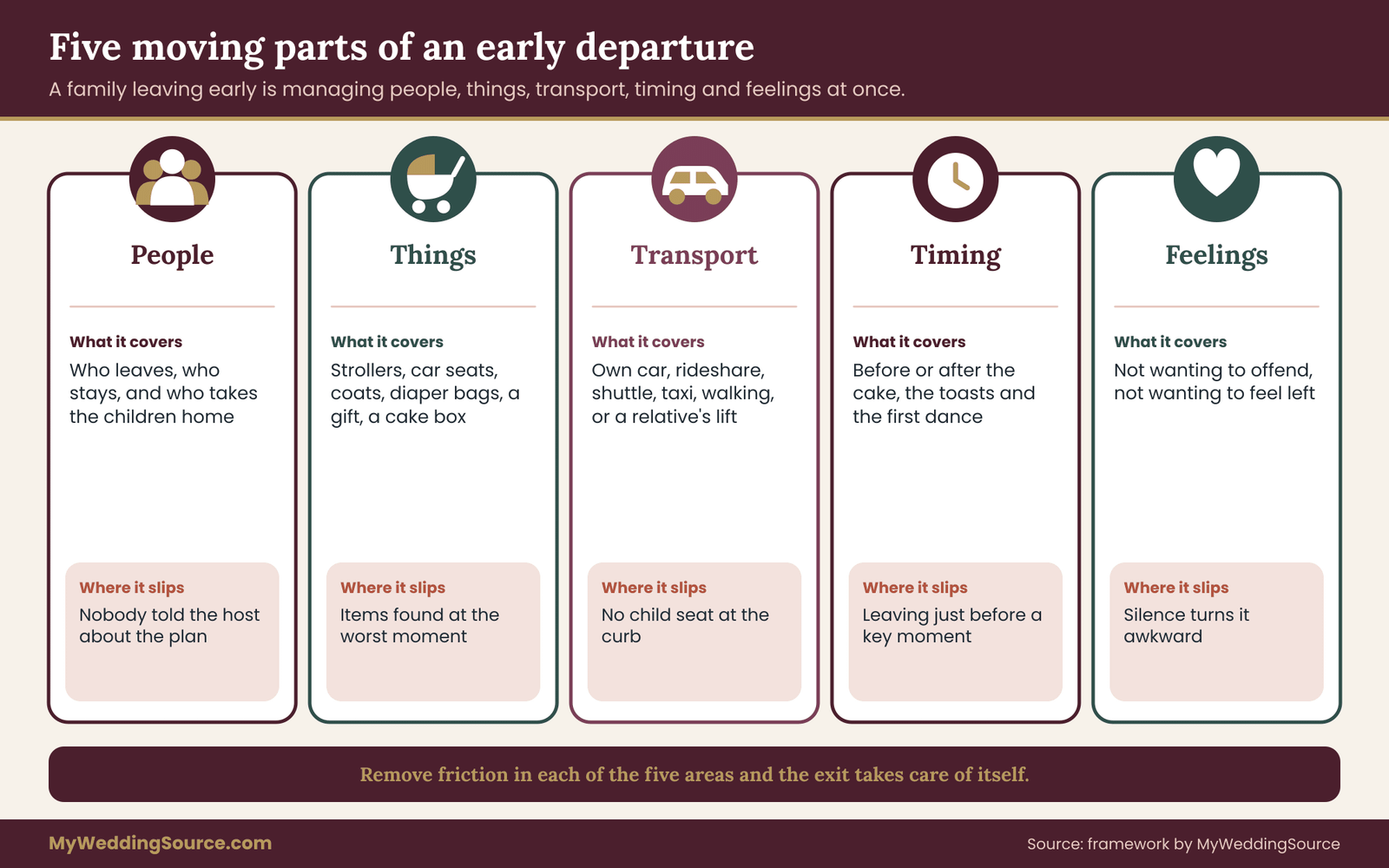
When you look at early departures this way, the solution is not a rule. It is a small set of arrangements that remove friction in each of the five areas. None of them is expensive. Most of them cost a few printed cards, a conversation with the venue and a short message to guests.
What this guide does not cover
Early departures are a different topic from supervised childcare during the event, which this guide does not cover. If you are hiring caregivers or setting up a kids’ room, the same guide on guest care covers that topic, and the sections on pickup and vetting there apply once children are in someone else’s care. Here, the parent is in charge of the child at all times, and the question is only how to get that family out smoothly.
It also does not cover the send-off itself, beyond the points where it affects who is still in the room. Whether you hold a sparkler exit, a bubble tunnel or a simple wave from the steps, the early departures that came before it still deserve a thought, and later sections give you simple ways to include them.
Why early departures deserve a plan
It may sound like too much attention for something that happens at the edge of a wedding. There are three practical reasons to plan for early departures.
First, safety. A tired child, a dark parking lot, moving vehicles and rushed adults make a poor combination. A marked path, adequate lighting and a calm handoff to the car reduce the risk that someone is hurt in the last hundred feet of the evening.
Second, goodwill. Families who leave without trouble tend to remember the wedding warmly. Families who leave in a scramble tend to remember the scramble. The couple pays almost nothing for the first outcome and can lose a good deal for the second.
Third, the room. A crying child in the middle of a toast, a stroller blocking a door, a family wandering the building looking for a coat: these are the small events that break the mood. A clean exit protects the atmosphere for everyone who stays.
Why guests with young children leave early
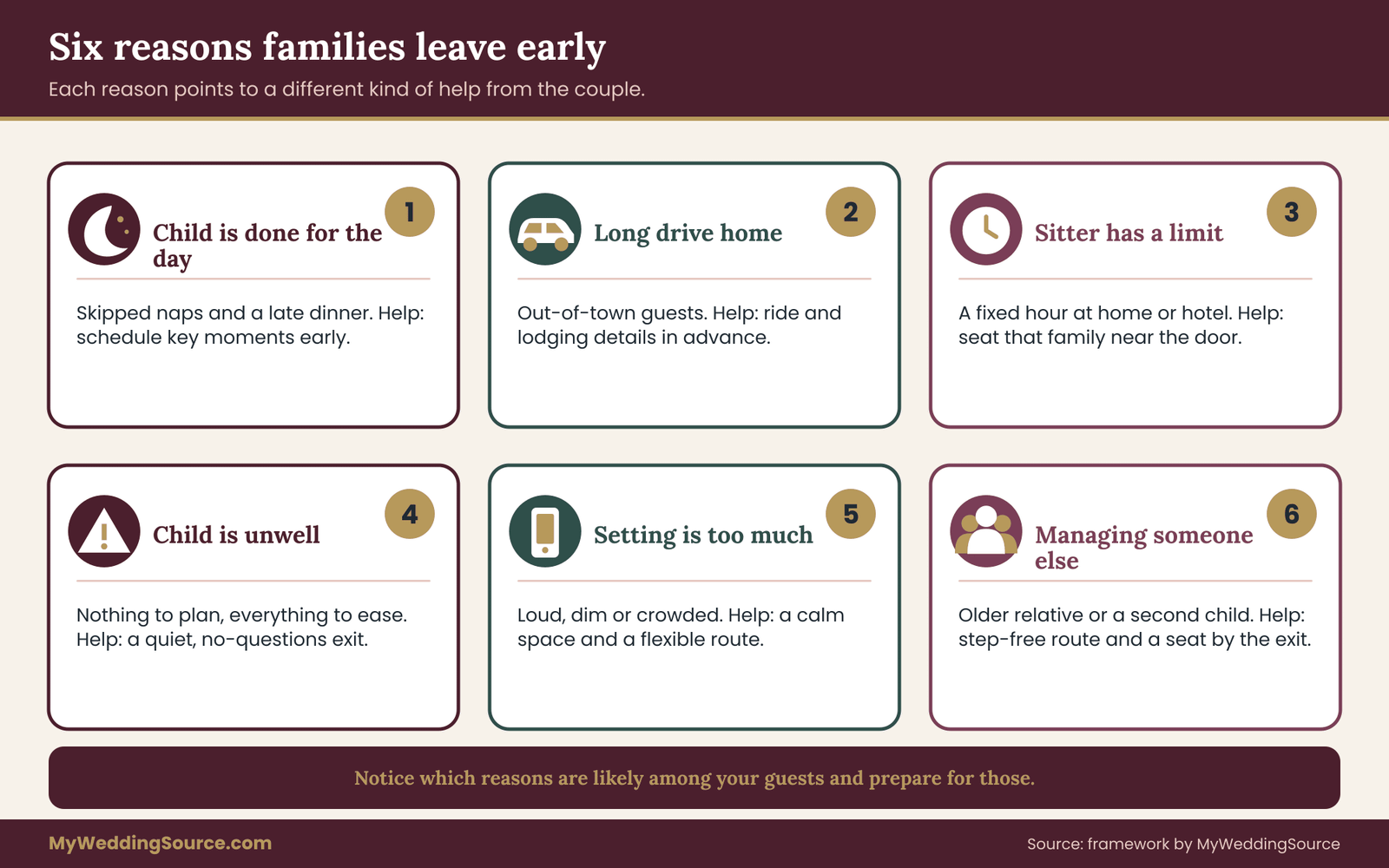
You cannot plan good early departures if you assume the reasons are all the same. Guests leave for at least six different reasons, and each reason points to a different kind of help.
The child has reached the end of the day. This is the most common reason. Young children run on routines, and a wedding reception pushes past almost every one of them. Naps are skipped, meals are late, noise is high, and sleep that should have started at seven is now overdue. A child at this point can be calm and pleasant one minute and unmanageable the next. The family leaves because the alternative is a difficult hour for everybody. Of all the causes of early departures, this one is the easiest to predict.
The drive is long. Some guests are traveling from out of town and staying at a hotel an hour away. A child who falls asleep in the car at ten o’clock will often wake up in the parking lot at the hotel, which makes a bad night worse. Parents may want to leave early enough to arrive while the child is still awake and easy to settle.
The babysitter or relative has a limit. Families who left a younger child at home or at the hotel often have a sitter who has agreed to a set number of hours. When the clock runs out, the parents have to go, whatever else is happening.
The child is unwell, or the parent is worried. A cough, an ear infection, a stomach bug or a child coming down with something that was not obvious in the morning can change everything. This is the departure that nobody can plan for, which is why a quiet exit route matters more than a rule.
The child cannot manage the setting. Loud music, dim lights, a crowd or a long formal dinner can be a lot for some children. For a child with sensory sensitivities or a disability, an early exit may be a necessary part of the day and not a matter of tiredness. The family may have decided in advance that they will leave at a set point, regardless of the schedule.
The parents are managing someone else too. An older relative who tires quickly, a second child with a different bedtime, or a relative who needs a particular kind of transport can all pull a family away earlier than they would like.
Reading the reasons as signals for the couple
Each reason behind early departures tells you what to prepare. Tired children point to program timing and a quiet place to wait. Long drives point to ride information and lodging details. Sitter limits point to a fixed hour that the family already knows, so you can ask about it ahead of time. Illness points to an exit that does not require explanation. Sensory needs point to a calm space and a flexible route. Multi-generation trips point to access and seating near the exit.
You do not have to solve every one of these. You only have to notice which ones are likely among your guests. If the invitation list includes eleven children under six, plan for more early departures than you would at a wedding with two. If most guests are local, the drive matters less and bedtime matters more.
Talk to the parents you know best
The cheapest research into early departures is a short conversation with a few parents before the wedding. Ask two or three families who have children what time they think they would leave, what they would need at that point and what would make it easier. You will learn more in ten minutes than from a page of general advice. People are usually relieved to be asked, and the answers are often practical: a place to park near the door, a chair near the exit, a reminder of where the coat check is.
Keep it casual and keep the answers private. A parent who tells you that they plan to leave at eight o’clock is trusting you with a small piece of information about their family, and it should not turn into a list that circulates among the wedding party.
Set an early departures policy before invitations go out
A policy for early departures sounds heavy for a party, but here it only means a few decisions made once, in advance, so that nobody has to invent answers on the day. You make the decisions as a couple, write them down in a sentence or two each, and share the ones that guests need.
Decision one: are early departures welcome? Most couples say yes without thinking about it. Say it on purpose anyway. A line on the wedding website such as “Families with young children are welcome to leave whenever they need to, and we will not be offended” gives parents permission to go. Without it, many parents stay too long because they think they are expected to.
Decision two: which moments matter most to you? Not every moment of the evening is equally important. Perhaps you want your cousins with toddlers to be in the family photographs, or your niece to see the cake cut, or your grandmother to hear the toast. Name the two or three moments that you would hate for a family to miss. Those are the moments to schedule before most children run out of energy.
Decision three: how will you handle the send-off for those who left? If you plan a send-off at the end, decide whether families who have already gone are part of it in some way. A short goodbye at the door, a wave from the car or a photograph earlier in the evening can all work. You will see options in the section on wording and goodbyes.
Decision four: who owns the exit on the day? The couple will be busy. Pick one person, a coordinator, a planner, a relative or a reliable friend, who will watch for families heading toward the door and help with coats, bags and cars. Give that person the departure cards described later and the list of venue rules. This is not a staffing ratio and it is not a safety role for children. It is a host role: someone whose job is to be calm and helpful at the door.
Decision five: how much will you share with guests? The less guests must ask, the better. Decide what goes in the invitation suite, on the website, on a sign and in a message the day before. You will decide the wording later, but the choice of channels belongs here.
Write the policy in six lines
You can keep the whole policy to a short note that sits inside your planning documents. A sample might read like this, adapted to your wedding:
- Families may leave at any time and no goodbye is required.
- Family photographs happen before dinner, so that children are in them.
- The cake is cut before the first dance.
- One host manages the side exit and the coat area from the start of dinner.
- Every family with children receives a departure card at check-in.
- Venue, shuttle and parking details are sent to guests in a message the week before.
Notice what is missing. There is no instruction to guests about what they must do, no penalty and no pressure. The early departures policy shapes the schedule and the support, and it leaves guests free.
Policy choices that cause trouble
A few tempting choices tend to go badly when you plan for early departures. Scheduling the best moment of the night, such as a surprise performance, for the very end means that the guests with the least energy will miss it. That may be fine if you know it, and unfair if you did not think about it.
Making the send-off a formal part of the program, with a request that all guests line up, creates a pressure that does not match the needs of parents. A cheerful invitation with a clear alternative works better.
Asking parents to commit to stay until a set hour, in writing, turns a social event into a contract and makes early departures feel like a breach. Few couples intend this, but some invitation wording does it by accident.
If you ask guests to RSVP with children’s names and ages, be clear about why you need them and how the information will be used and discarded. The section on the departure card covers what to collect and what to leave out. For the broader question of who decides what in a wedding, the guide to shared wedding decisions is a useful companion.
The four exit windows in a wedding evening
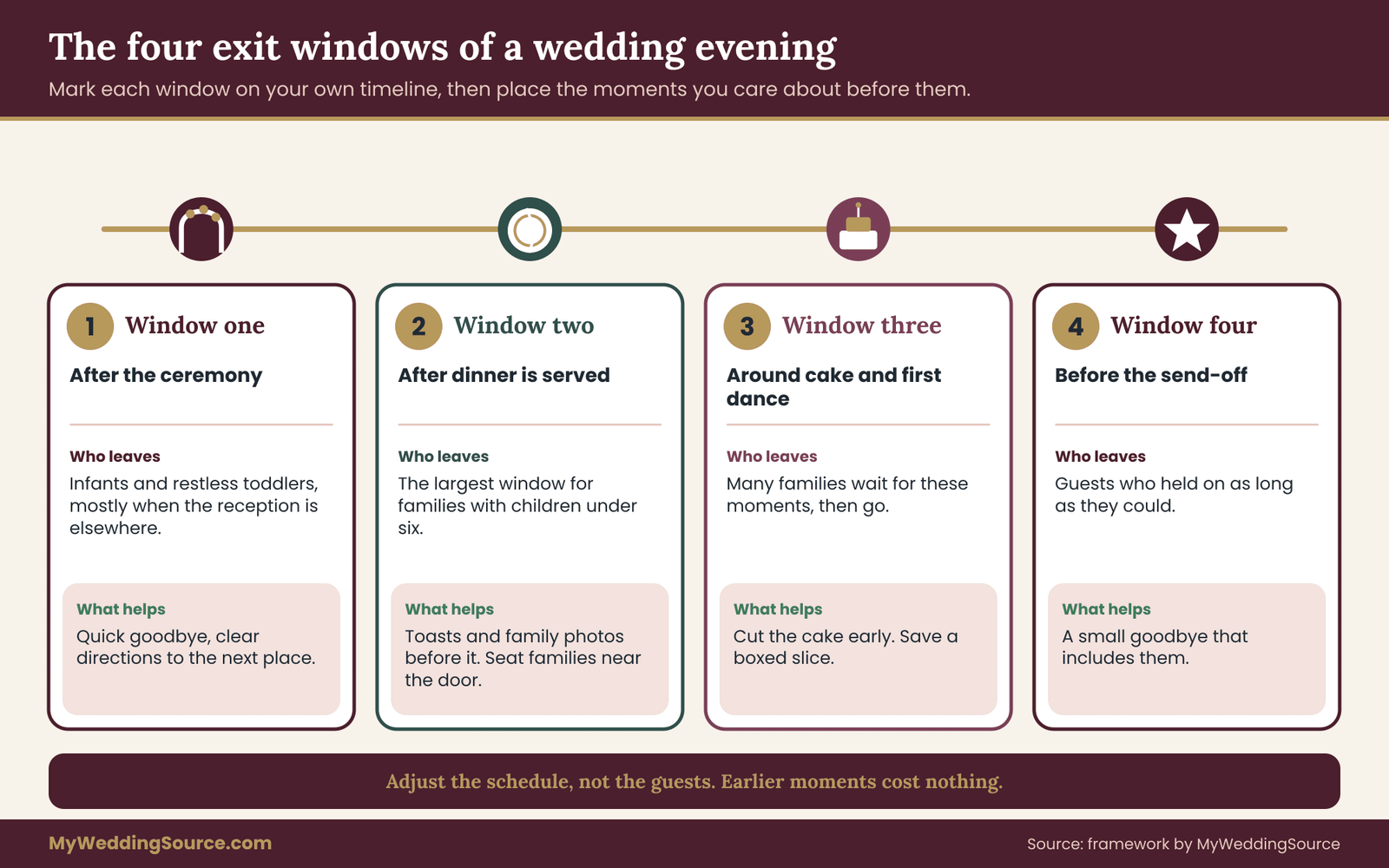
Early departures cluster at predictable points. Learning where those points fall in your own schedule is the single most useful piece of planning you can do for early departures. Think of the evening as having four exit windows.
Window one: after the ceremony and before the reception. Some families with infants or very young children leave straight after the ceremony, particularly when the reception is in a different place and the child is already restless. This window of early departures is more common at afternoon weddings with a gap between events.
Window two: after dinner is served. Children usually eat early, sometimes before the adults, and a full stomach at a fixed hour often means a short remaining time before the child stops cooperating. For many families with children under six, this is the largest exit window. It is also the window with the most potential for the couple to help, because it comes before the speeches and the cake in many schedules.
Window three: around the cake and the first dances. If cake cutting and the first dance come after the toasts, a good number of families will leave once the cake has been cut, and quite a few will stay for the first dance and then go. Families who are enjoying themselves often wait for these moments.
Window four: before the send-off. The last window is the one this article is named for, and it holds the latest of the early departures. Guests who leave in this window are often those who held on as long as they could. They miss the send-off, but they have been to most of the event, and a small gesture can include them.
How to use the windows
Look at your timeline and mark where each window of early departures falls, using local clock times. Then ask three questions about each window.
What is happening in the room at this time? If a toast, a dance and a performance are all packed into window two, families will have to choose between leaving and missing something important.
What is the quietest route to the door at this time? Windows two and three often overlap with a lot of foot traffic around the bar or the dessert table. A different door or a side corridor can save a stressful push through the room.
What is the last good moment for the families who want to leave? If you can tell them, they can plan. A line in the program such as “cake is cut at eight forty-five” lets a family decide whether to wait for it.
Adjust the schedule, not the guests
A frequent mistake in planning early departures is to push the schedule later and later and then expect children to adapt. Children rarely adapt. If your guest list includes many families, look at the timeline and ask whether the major moments can come earlier.
You do not have to hold the first dance before dinner or cut the cake before the toasts. But you can shift family photographs to the hour before the reception, keep toasts to a modest length, and bring the cake cutting forward so that it sits at the start of the dancing and not the end. Each of these changes helps early departures and costs nothing.
The wedding vendor timeline guide is a good place to see how these decisions fit with vendor schedules. If you are building a flow for the reception itself, the reception guest flow guide shows how to think about movement between areas, which is a useful frame for exits.
A short example of window planning
Imagine a wedding with a ceremony at four o’clock, cocktails at five, dinner at six, toasts at seven and cake at seven thirty, with dancing from eight and a send-off at ten thirty. A family with a three-year-old and a six-month-old could reasonably leave at any of several points.
If they leave after dinner, around seven, they miss the toasts and the cake. If they stay for the toasts and cake, they can leave around seven forty-five, which is a natural point. If they stay for the first dance, they might be out by eight fifteen. The send-off at ten thirty is clearly out of reach for them.
Knowing this, the couple can seat that family near the door, make sure their family photograph happens before dinner, and ask the host to save a slice of cake. The family is not being managed. They are being given a good evening that happens to be shorter than the whole event.
What to do when the guest list is mostly adults
Not every wedding has many children, and the work on early departures scales down. If there are only two or three families with young children, a conversation and a card are enough. The exit windows still apply, but the volume is low enough that the couple or a relative can manage them without any formal role.
The key is not to ignore the question. One of the early departures, handled badly, is still a bad memory for one family, and for them the exit is the memory.
The departure and transportation information card
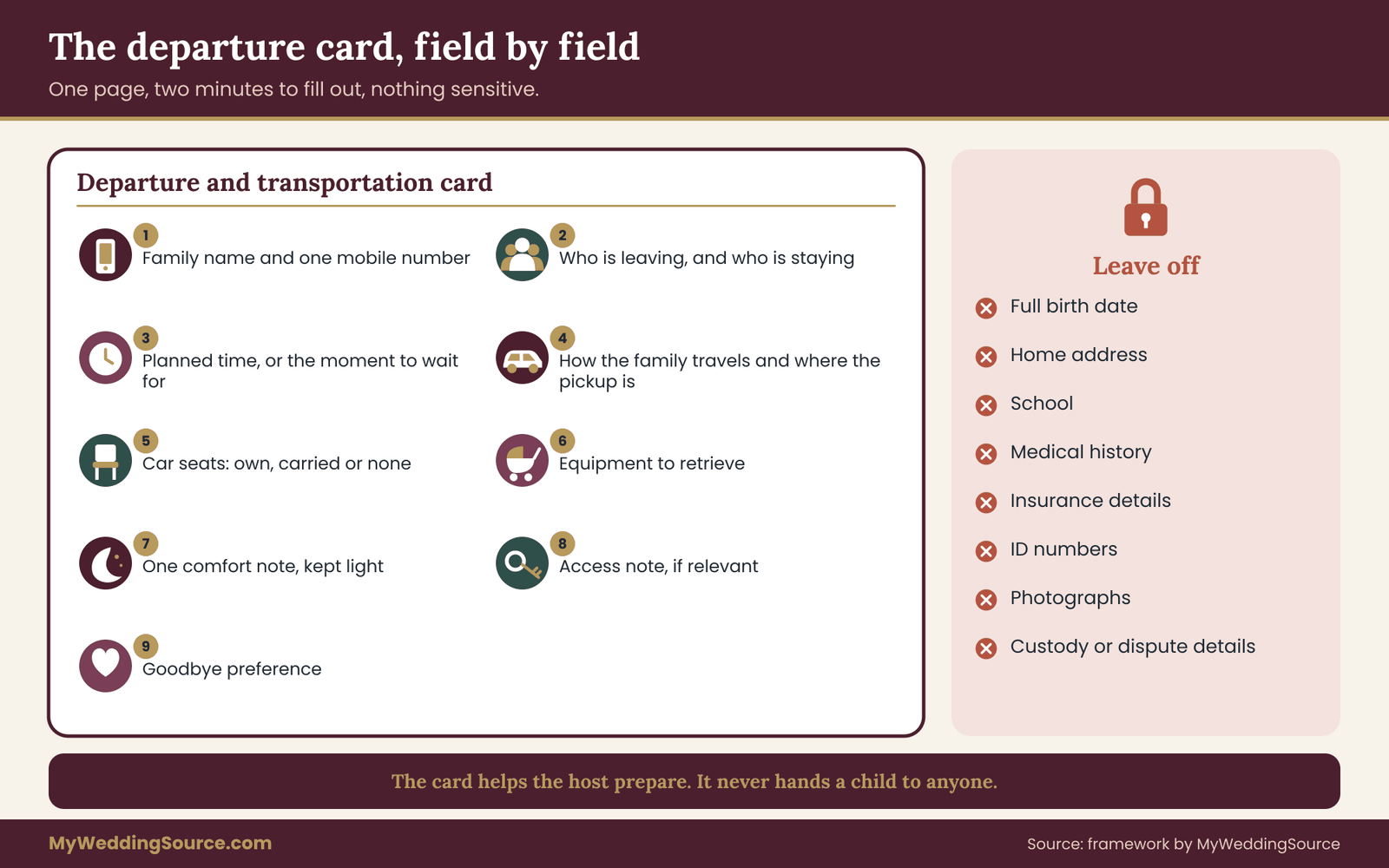
The card is the practical center of this guide on early departures. It is a single page, printed or digital, that a parent fills out once and keeps. It answers the questions that cause trouble during early departures: who is leaving, when, how, with what equipment, and who to tell. It is not a childcare form and it does not hand a child to anyone. The parent stays in charge of the child at all times.
Think of the card for early departures as a courtesy to the family and a reference for the host at the door. A family that has thought through its exit in advance leaves faster and with less stress. A host who knows about early departures in advance, such as that the Okoro family plans to leave after the cake, by rideshare, with one car seat, can have the coat ready and the door cleared.
What goes on the card
Keep the card short enough to complete in a minute or two. Here are the fields that matter, and the reason for each.
Family name and a mobile number. One number is enough. It lets the host reach the family if something is left behind, such as a jacket or a bag.
Who is leaving. A simple line: “Both parents and both children,” or “Mom and the baby only,” or “Grandma and the two older kids.” This tells the host how many people to expect at the door, and who is staying.
Planned leave time, or the moment they will wait for. Not every family knows an hour. Many know a moment: “after the cake,” “after the first dance,” “when the baby gets fussy.” Both are useful, and the second one is honest.
How they are traveling. Car, rideshare, taxi, shuttle, walking to a nearby hotel, or being collected by someone else. Add where the vehicle is or where the pickup will happen, such as “parking lot B, near the red sign.”
Car seat information. Whether the family has its own seat in the car, whether a seat has to be carried to a ride, and how many children need one. This single line prevents a very common problem, which is a rideshare arriving without a child seat when none was planned.
Equipment to retrieve. Stroller, car seat, diaper bag, coats, a gift. List only what is stored with the venue or the coat area.
One comfort note. A sentence about what helps: “Baby sleeps best in a dark room,” “Our son needs a quiet corner when he is tired,” or “Our daughter likes to say goodbye to her cousins.” Keep it light. This is a social note, not a medical record.
An access note, if relevant. A stroller path, a wheelchair or walker for a family member, a need for a seat near the door, or a preference for an exit without stairs. The host can use this to choose the right door.
A goodbye preference. A tick-box for “We would like to say goodbye to the couple,” “We will slip out quietly,” or “Please tell the couple we left.” Many parents want to say goodbye and are not sure whether to interrupt. A tick-box answers the question without any awkwardness.
What should stay off the card
The card is a planning aid for early departures, not a database of children. Leave off anything the host does not need to do the job.
Do not ask for a child’s full birth date, home address, school, medical conditions, insurance details, passport numbers or photographs. A first name and an age range are plenty. If a parent offers sensitive details on their own, do not record them on the card. A parent who wants a medical or behavioral need to be known should say so directly to the person who needs it, such as the venue manager or the shuttle driver.
Children’s personal information deserves care. In the United States, federal rules about collecting data from children online exist for a reason, and the Federal Trade Commission explains them on its website. A paper card that is handed back to the parent at the end of the night, or shredded, avoids most questions. If you use a digital form, collect the minimum, keep it only until the wedding is over, and delete it afterward.
Do not ask for information about custody arrangements or family disputes. If a family has a situation that the host must know about, the parent can raise it in private, and the hard-cases section explains how.
Who gets a card
Give the early departures card to every family with children under about ten. Older children usually manage their own exits and need less planning. The point is not to categorize guests but to make the card useful, so offer it to anyone who asks.
There are three simple ways to deliver it. Send a link to a digital version with the details message the week before. Put a printed stack at the welcome desk or the escort cards with a pen. Or hand the card to each parent in person when they arrive. A mix works well, since some parents will complete it ahead of time, some at the door and some not at all. Anyone who skips it should not be pressed.
If you use the welcome desk, a clear sign helps: “Leaving early with little ones? Take a departure card.” The wording should sound friendly and non-judgmental.
How the host uses the cards
The host who manages early departures should keep the cards in one folder or on one clipboard, sorted by planned leave time. A few minutes before each window opens, the host looks at the cards that mention that window and checks that the coat area, the route and the car arrangements are ready.
When a family approaches the door, the host greets them by name, checks the card for the car seat and the equipment, and helps the family collect their belongings. If the family planned to say goodbye to the couple, the host finds the couple and brings them to the door for a short hello, or tells the family that it is fine to go.
After the family has left, the host puts the card in a separate pile. At the end of the night, the pile goes to the couple or is destroyed, according to the policy you chose. This is a small ritual, and it protects the families who trusted you with a few details.
A sample card layout in words
If you want to draw your own, here is the order in which a parent would naturally read it. At the top, the family name and one mobile number. Below that, a line for who is leaving and a line for the planned time or the moment to wait for. In the middle, the travel method, pickup place and car seat details. Lower, a short list of equipment and a comfort note. At the bottom, the goodbye choice and a space for anything else.
Fit it on one side of the page. Use a readable size, leave room to write and provide pens that work. A digital version should work on a phone with large tap targets. The card should take no more than two minutes. If it takes longer, remove fields.
When parents do not use the card
Some families will never see the card, and some early departures will come without notice. Some will lose it. Others will leave without telling anyone. This is normal, and it is no reason to abandon the system. The card works as a convenience for those who want it. For the rest, the quiet exit route, the coat area and the available host are enough.
The goal of the card is fewer surprises, not complete information. A set of early departures supported by a card for half the families is already much smoother than one with no preparation for any of them.
Digital or paper
For early departures, paper is faster at the event itself and easier to destroy. Digital is easier to send ahead, easy to update and hard to lose. For a small wedding with a handful of families, paper is probably enough. For a larger wedding with many guests traveling, a digital form linked from the website can reduce the load at the welcome desk. If you go digital, make the form usable on a basic phone, with no account needed.
Whichever you choose, keep a few printed copies at the door for guests who arrive without having seen the link. Remember the early departures that happen without any notice at all. The card should never be a condition of leaving. It is only a way to make early departures easier for those who choose to use it.
Car seats, rides and parking for early departures
Transportation is where early departures succeed or fail. A family can have a perfect card and a calm child, and still be stuck at the curb because the ride has no child seat. This section goes through the usual options, the question to ask for each, and how to put the answers on the card and in your guest messages.
Start with the car seat question
A child who is too small for an adult seat belt needs a child restraint in a car. The details, including age, weight and height rules, are set by each state, and the National Highway Traffic Safety Administration publishes general guidance on choosing and using seats. Neither this guide nor the couple should decide what a family must use. The point for early departures is practical: if a family leaves in a vehicle, the seat has to be there.
That sounds obvious, and yet it is the most common failure. A family arrives in the grandparents’ car with one seat, and the parents plan to leave early in a rideshare. The seat is in the wrong place. Or the family planned to leave together and one parent has the car at the hotel. Or a guest arrived by shuttle and the shuttle has no seat at all. The card line about car seats exists to surface these gaps early.
Ride options and the question to ask
Think through the main options for early departures in turn.
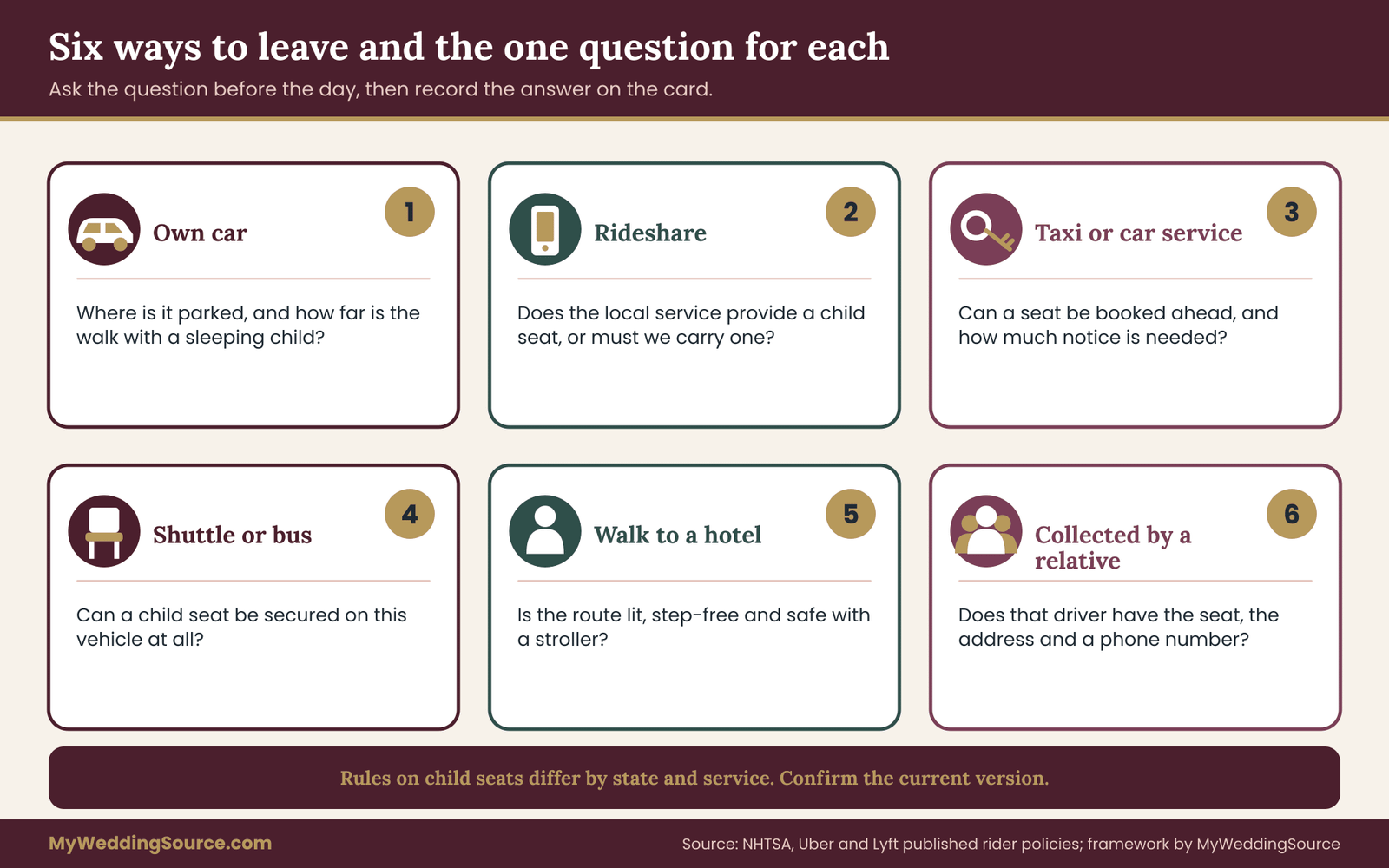
The family’s own car. This is the simplest case. The seat is already installed. The question is where the car is parked, how far it is from the door, and how the family will carry a sleeping child and a bag across a dark lot. If the parking lot is far from the exit, ask the venue whether a family can pull up to a loading area at the door, or whether staff can walk with them.
A rideshare. This is where plans often break. Rideshare companies publish their own policies about children and car seats, and those policies differ by city, by service type and over time. Uber and Lyft each explain their rules on their websites.
Some markets offer a vehicle option with a seat, some do not, and some drivers are not required to carry one. A parent who relies on a rideshare must either bring a seat or confirm the local service in advance. As the couple, do not assume. Suggest in your guest message that families check the app and carry a seat if they plan to leave by rideshare.
A taxi or car service. Rules vary by place, and in some places taxis are exempt from child restraint requirements, while others are not. A pre-booked car service can often confirm a seat in advance. If you hire a service for the wedding, ask whether it can provide child seats and how much notice it needs.
A shuttle or bus. Large vehicles are covered by different rules from passenger cars, and many shuttles have no way to secure a child seat. Ask the provider directly what it allows and whether a family can bring its own seat, and where it can be strapped in. If you are running a shuttle between a hotel and the venue, add a short question to your vendor list about children and seats. The guide to guest hotels and mobility discusses how to think about shuttles alongside lodging.
Walking to a nearby hotel. For a hotel within a few blocks, walking can be the easiest way home. Check the route for lighting, sidewalks, curb cuts and traffic crossings, and think about weather. A family with a stroller and a sleepy toddler may find a ten-minute walk easy or impossible, depending on conditions.
Collection by someone else. A relative or friend may drive the children while the parents stay. That person needs the car seat, the address of the hotel or home, and the parents’ mobile number. The card line “Who is leaving” lets the host know that the plan involves a handoff, and the departure itself should be calm and short.
Put the answer on the card, and in the message
Once you know the options, build two small pieces of communication.
On the card, include the line about travel method and the line about car seats. On the guest message sent the week before, add a short paragraph that sounds like this: “If you plan to leave early with little ones, please think about your ride. Rideshare and shuttle policies on child seats vary, so check the details before the day. Our venue has a loading area near the side entrance for pickups.”
That is all most families need. They will check the details themselves, and some will thank you for the reminder.
Parking and the last hundred feet
Parking shapes early departures more than most couples expect. The last hundred feet of early departures are the riskiest. The family is tired, the child is sleepy, the lot may be dark, and cars and people are moving. A few small preparations make it much safer.
Ask the venue about lighting in the parking area and along the route. Ask whether there is a close pickup spot for families, and whether it can be marked with a sign or a staff member in a bright vest. Ask whether valet service, if offered, can bring cars to the door quickly for families with children, and whether the valet knows how to handle a car with a child seat inside.
If the lot is far away, think about a hand-off at the door. A staff member or a friend of the couple can walk with the family to the car, carrying a bag or holding a flashlight. This is a host kindness, not a safety service. Parents remain responsible for the children at all times.
Stroller and equipment storage
For early departures, if guests bring strollers, tell them in advance where they can leave them. A stroller stored in a corner of the coat area is easy to find later. A stroller parked in an aisle is a trip hazard. The card line “Equipment to retrieve” lets the host bring the stroller to the door when the family is ready.
Car seats carried into the venue need a spot too. A seat under a table is uncomfortable and tends to be forgotten. Ask guests to keep seats near their table or in the coat area, with the family name on a small tag.
When the ride does not arrive
In early departures, rideshare cars can be late, cancel, or arrive without a seat. Prepare a simple fallback for these moments. Tell the host which family is waiting, and give the family a comfortable place to sit inside, out of the cold. The host can check the app or call a local car service. If the family has a seat and the ride arrives, nothing else is needed. If not, the host can ask a friend with a car and a seat, though only when the parents agree and the arrangement is safe.
This is another reason for the card. A family that planned for a rideshare and has a seat is flexible. A family that planned on a rideshare and has no seat is stuck, and the host who knows about it earlier can help.
Late-night driving after early departures
Families who take part in early departures often leave because they are tired, and a tired driver is a risk. The couple cannot manage this, but they can make it easier for adults to make safe choices. If a parent has been drinking, the host can quietly suggest a rideshare or ask whether the other parent will drive. A pre-planned ride home, sorted before the wedding, removes the pressure.
You do not need to lecture. A line in the guest message such as “If you plan to drink, please arrange a ride home in advance, and we will help where we can” is enough. For families with young children, the arrangement protects more than one person.
Check your own vendors
If you hire a shuttle, a limousine, a transport company or a car service for the wedding, ask them about child seats before you sign. Ask whether seats are available, whether they are included or cost extra, how much notice is needed, and whether the driver can help to install them. Get the answer in writing. The vendor due diligence checklist gives a general frame for the questions to ask any vendor before you pay a deposit.
The goal is a plan that works without improvisation. Any family involved in early departures should know in advance how they will travel, and the card should reflect it. Once that is solved, early departures become a gentle goodbye and not a scramble.
Getting a family out the door quietly
The best early departures are almost invisible. A family stands up, collects a few things, says a word to the people nearby and is gone. Most of the skill is in the hand-off between the table and the door, and it depends on three things: the route, the stored belongings and the goodbye.
The quiet exit route
The route is the first piece of early departures to test. Walk the building as a parent with a stroller. Start at a family table and trace the shortest path to the nearest door that leads to the pickup area. Notice what you pass: the dance floor, the bar, the band, a narrow corridor, a set of stairs, a heavy door.
The best route avoids the dance floor and the speaker area. It has no stairs, or has a ramp or elevator beside them. It is lit well enough to see where you are stepping, and it ends at a place where a car can stop. If the venue has more than one exit, pick the one that is both closest to the pickup point and furthest from the center of the action.
If the route runs through the main room, ask whether a family can use a side door or a service corridor. Venues are often happy to open a door and station a staff member, as long as it is asked for in advance.
Mark the route with a simple sign or a small arrow. A sign that says “Quiet exit and pickup” in plain type is enough.
Accessibility and early departures
Some families involved in early departures include a person with a disability, an older relative or a child who uses a wheelchair, a walker or other equipment. The Americans with Disabilities Act sets federal accessibility requirements for many public places, and the ADA website explains how they apply. Venue obligations depend on the type of space and the local rules, so ask the venue directly about its accessible routes, doors, restrooms and drop-off points.
For early departures, the practical questions are simple. Is there a step-free route from the main room to the pickup area? Is the door wide and light enough to open easily? Is the pickup point close enough, and is it level? Is there a place to sit while waiting? A family that must plan around these questions should be able to find the answers in your guest message and on the card.
Do not guess about what a guest needs. Offer the information and let the family decide. An accessible route that is open to everyone also helps parents with strollers, and you can describe it that way: “A step-free exit and pickup area is on the north side of the building.”
Coats, bags and belongings
Most delays during early departures are caused by belongings. The coat is somewhere, the bag is under a chair, the stroller was folded behind a curtain. A small system removes most of this.
Set up a single area for family items, close to the exit. Put a rack for coats, a shelf or tub for diaper bags and a corner for strollers and car seats. Use simple numbered tags, or write the family name on a tag with a marker. The host should know where the area is and be able to retrieve something quickly.
If the venue has a coat check, ask whether it can handle car seats and strollers, and whether it will stay open until the last guest leaves. If the venue has no coat check, you can use a closed room, a quiet corner or a rented rack.
Encourage guests to keep a few items together before they get tired. A small bag with the child’s comfort object, a spare diaper and a jacket can sit at the table, ready to go. This is the kind of tip that fits easily into a guest message.
The goodbye
A goodbye is a social gesture, and there is no single right way to do it. Offer three paths and let each family pick one.
The full goodbye. The family finds the couple, says thank you and has a short hug or a photograph. This works best when the couple is free and the family wants it. A host can help by catching the couple’s attention and arranging a short moment away from the dance floor.
The quiet goodbye. The family tells a relative or the host and leaves. The host passes along the message later. This is the most common choice for families with a sleeping child, and it is perfectly fine.
The early goodbye. The family says goodbye earlier in the evening, perhaps before dinner, and then stays for as long as the child can manage. This is useful when the family knows in advance that they will leave before the key moments.
Mention all three in the guest message in a friendly way. Something like: “If you leave early, there is no need to say goodbye in person. We would love a hug if you can catch us, and we will understand if you cannot.”
The mini send-off
Some couples like to include the families behind early departures in the send-off in a small way. A few simple ideas work without any extra staff.
Take a group photograph of all the families with young children earlier in the evening, with the couple in the middle. Give each family a small keepsake, such as a bag of bubbles or a card, with a handwritten note. Record a short video greeting at the start of the evening, to be played at the send-off for those who remain. Or send a thank-you message the next morning that mentions the children by name, if their parents are comfortable with that.
None of this is required. It simply shows that the couple noticed, which is what most families want to know.
Leftovers and favors
Many families would like to take something home. A slice of cake in a small box, a few favors for the children, a bag of snacks for the car. A table near the exit with boxes and a few labeled items turns a rushed goodbye into a gift. Check with the caterer or the venue about food packaging rules, and be careful with allergen labels on shared items. The point is a small kindness, not a service.
A quiet space to wait
Some families will not be ready the moment they decide to leave. The ride may be a few minutes away, the child may need a diaper change, or the parent may be waiting for the other adult.
A quiet place to sit near the exit, away from the music, makes this wait easier. A few chairs in a hallway, a corner with dim light, or a small room can work. If the venue offers a nursing or quiet room, tell guests where it is. The same space can also serve families who need a brief rest before heading out.
The host’s checklist at the door
The host at the door has a small job with a few repeating steps. Greet the family by name. Check the card for the vehicle, the seat and the equipment. Bring the stroller, the bags and the coats to the door. Check the pickup point and whether the ride has arrived. Offer to find the couple if the family wants a goodbye. Pass along the favor or cake box. Watch the family walk out and, if the lot is dark, offer to go with them.
None of these steps should take more than a few minutes. A calm host, a clear route and a ready coat area turn what might be a stressful scramble into a smooth, friendly exit. That is the whole purpose of planning for early departures.
Early departures for children in the wedding party
Flower girls, ring bearers, junior ushers and young relatives with a role in the ceremony have a special place in early departures. They are part of the program, and their families have promises to keep. They are also often the youngest and most tired children in the room. A little planning lets them play their part and still leave when they need to.
Front-load the roles
The simplest rule is to complete everything that involves the children early. Photographs with the couple, the walk down the aisle, any special dance or moment, and any group portrait should happen before the child reaches the end of the day. If the ceremony is late, ask the photographer whether the family portraits can happen before the ceremony or right after it, and not an hour into the reception.
A child with a role should have a clear end to it, which keeps early departures guilt-free. Tell the parents when the child’s job is done and what the family is free to do after it. A line such as “After the family photographs at five thirty, you are free to eat, play and leave whenever you like” frees the parents from guessing.
The family photo list guide helps you sequence portraits in a way that takes the children’s energy into account. A short list and a firm start time beat a long list that drifts.
Plan the parent handoffs
Children in the wedding party are often supervised by a parent, a grandparent or an older relative, and the supervisor may not be the person who planned to leave. If a flower girl’s mother is a bridesmaid and the father is at the reception, who takes the child home? Ask the parents directly, before the wedding, and write down the answer on the card.
If a parent has a role in the wedding party and cannot leave, the other parent or relative needs a clear plan. Make sure that person knows where the child will be, where the car seat is and how to reach the parent who stays. This is the same logic as the card, applied to a family with two jobs at the wedding.
Do not make the child the last part of the program
Placing a child’s moment at the end of the evening, such as a special song or a send-off role, sets the family up for disappointment. If the child will be asleep by then, the moment is lost. If the child stays awake by force, the family has a hard night.
If you want a child to take part in the send-off, make sure it fits their energy and give the parents an easy way out. A little role with a clear time limit works better than an open-ended one. The wedding is yours, so the choice is yours, but a child who is cheerful in the photographs is more likely to be the child you remember.
Teenagers and older children
In early departures, teenagers and older children may want to stay until the end, and may be fine to do so, but they also need transportation. If a family leaves early with younger children and an older child wants to stay, the card should record who will take the older one home and how. A responsible adult relative or friend can often provide this, but it has to be agreed in advance and noted somewhere.
Hard cases that break the plan
Plans are useful and then something happens. These are the situations that most often upset early departures, with suggestions for handling each one calmly.
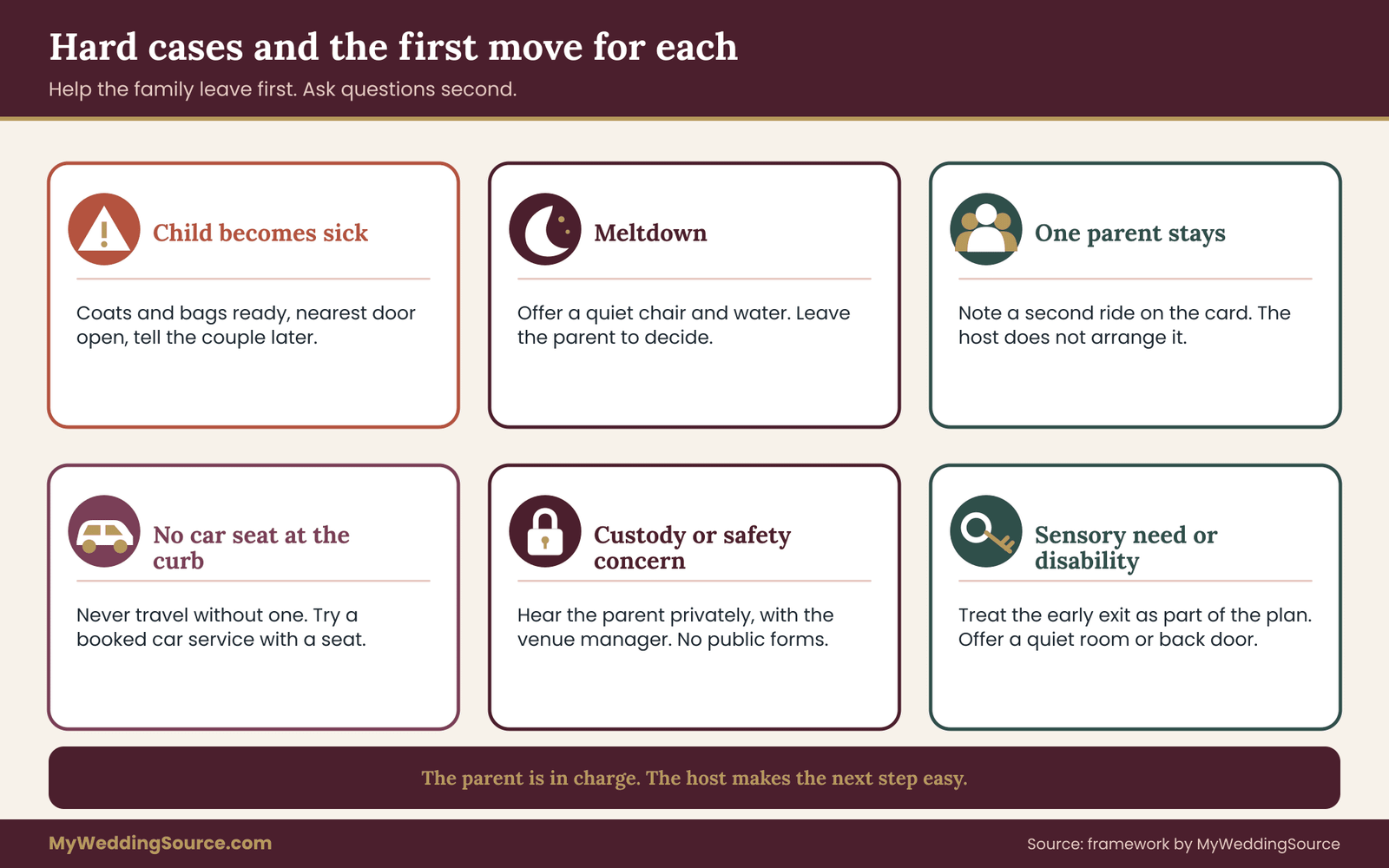
A child becomes sick during the evening. The family leaves immediately, and the host’s job is to make it quick and private. Have the coats and bags ready, open the nearest door and tell the couple later. Do not ask the family to explain. If the child is very unwell, the parents will decide whether to call a doctor or an urgent care service. The couple’s role is only to help them out.
A child has a meltdown. This is common and not a sign of poor parenting. The quiet space near the exit is useful here. A parent who steps out with a child may calm down in five minutes and return, or may decide to leave. Both are fine. The host can offer water and a chair and leave the family alone.
One parent wants to stay. A family may split, with one parent taking the children home and the other staying late. This requires a second ride or a way for the staying parent to return. Note it on the card and make sure the staying parent has a plan. The host should not need to arrange it.
The sitter or relative at the hotel is calling. If a family left an infant with a sitter, the parents may have a firm leave time. Add that time to the card, and consider placing the family’s table near the exit so that they can slip out without crossing the room.
The ride has no car seat. The host cannot solve this alone. The family may have a seat in another vehicle, or the host may help find a car with a seat. Never put a child in a car without a proper restraint. If the situation cannot be solved quickly, a taxi or a local car service with a seat may be the best option. This is one reason the card asks about the car seat in advance.
A custody or family situation. Some families have court orders, custody arrangements or safety concerns that affect who may be around a child, or who may take a child home. A parent who raises this should be heard privately, and by a person who can act on it, such as the venue manager. The couple should not collect details about disputes in a public form or ask a volunteer to enforce a court order. If a family has a serious concern, the parent should speak with the venue and, where needed, with legal counsel.
A child with a disability or sensory need. Some children cannot stay in a loud room, and some families prepare in advance for a short appearance. An early departure here is part of the plan and not a failure. The venue might offer a quiet room, a back entrance or a different seating position. Ask the family what would help, and then do that.
A guest arrives late, and wants to leave early. A family that arrives after dinner may want to stay for an hour and go, or may leave before the cake. The host can offer them the same card and a quick tour of the exit route.
An older relative is traveling with the family. An older guest who tires quickly may need to leave with the children. The same access questions apply, including a step-free route and a seat near the exit.
What to say in the moment
Hosts often freeze at the door, so a few short phrases help. To a family that is leaving in a hurry: “Let me get your coats. Your ride is at the side door.” To a parent with a crying child: “Take your time. There is a quiet chair just over there.” To a family that is apologizing: “Please do not apologize. The couple wants you to be comfortable.” To a parent who is asking about the couple: “I will tell them you left, and that you said congratulations.”
These phrases are kind and brief. They give the family permission to go.
A rule for every hard case
The pattern across all of these early departures is the same. Help the family leave first, ask questions second. Do not delay a child who is sick or exhausted in order to complete a formality. Keep personal information private. Offer help, and let the parent decide. And when the plan fails, remember that you do not need to fix everything. The parent is in charge, and the host’s role is to make the next step easy.
If the hard case involves a childcare provider or a pickup authorization, the broader guest care planning guide covers the process in more detail. For early departures, the work is smaller: open the door, find the coat and clear the path.
The following example is invented to show how the pieces fit together. The names, times and venue are made up, and any resemblance to a real family is a coincidence.
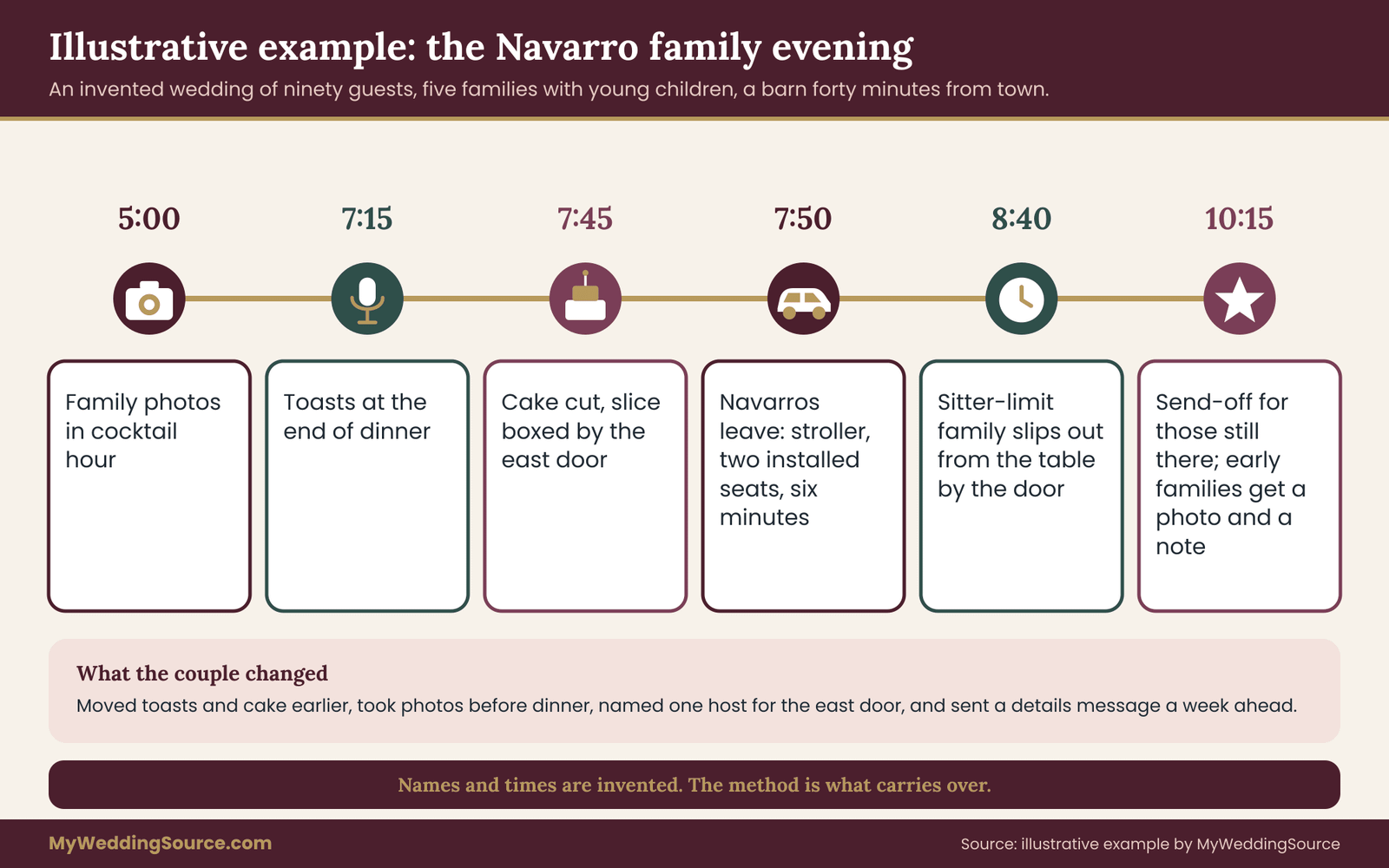
Daniela and Marcus are hosting a wedding of ninety guests at a converted barn forty minutes from the nearest town. The ceremony is at four thirty, cocktails at five thirty, dinner at six thirty and dancing from eight. They expect nine children under eight, from five families. Four families are driving in the same day and one is staying at a hotel in town.
Step one: mark the exit windows
Daniela looks at the schedule and marks the windows. Window two, after dinner, falls around seven forty. Window three, after cake and the first dance, falls around eight thirty. Window four, before the send-off, is ten fifteen. She realizes that the cake is scheduled for nine fifteen and the toasts for eight fifteen, which would push the main moments past the point where most children will be awake.
Step two: move the moments
She moves the toasts to the end of dinner, around seven fifteen, and the cake cutting to seven forty-five. The family photographs happen at five, during the cocktail hour, with all the children present. The first dance moves to eight, as the first event of the dancing. These changes cost nothing. They mean that a family who leaves at eight fifteen has seen everything the couple most wants them to see.
Step three: send the details message
A week before the wedding, the couple sends a message with the schedule, the parking details and a short note: “Families with little ones are welcome to leave whenever you like, and no goodbye is needed. The barn has a quiet exit and pickup area on the east side. If you plan to leave by rideshare, please check the service rules on child seats, since the barn is outside the usual service area and wait times can be long.”
Step four: the Navarro family card
Rosa and Tomas Navarro have a two-year-old and a six-month-old. They fill out the card online the night before. It reads, in short form: “Navarro. Mobile number given. Leaving: both parents and both children. Moment to wait for: after the cake. Travel: our own car, parking lot B. Car seats: two, already installed. Equipment: double stroller and diaper bag, to be left at the coat area. Comfort note: baby sleeps best in the dark, toddler likes a pacifier. Access: none. Goodbye: we would like to say goodbye if possible.”
Step five: the evening
The host is Daniela’s cousin Elena, who has the venue rules, the quiet exit map and the cards sorted by time. At seven fifty, she sees the Navarros pick up their bags. She walks over, greets them by name, and gets the stroller from the coat area. She tells Rosa that the cake box is ready by the east door, and she finds Marcus and Daniela for a short goodbye. The whole exit takes about six minutes. A staff member at the venue walks with the family to the lot, holding a flashlight.
Meanwhile another family, the Tran-Hughes family, planned to leave by rideshare. Their card said “car seat: none, we will carry one.” Elena checks that the seat is at the coat area. When the car arrives, the seat is installed by the parent, and the family leaves without delay.
A third family, whose card said “sitter at hotel, home by nine,” is seated near the door. They slip out at eight forty. Elena notices them leaving, waves, and passes a message to the couple later.
What the example shows
Three features of these early departures matter. The couple changed the schedule before changing any guests. The card gave the host enough information to prepare without collecting anything sensitive. And the exit was handled by one calm person with a clear job. None of it required a childcare provider, special equipment or a large budget.
Notice also what the example leaves out. There was no formal checklist for guests, no promise about safety, and no attempt to control how families made their choices. The couple offered information and support, and the families decided. That is the right level for most weddings.
Your own version
To build your own version for early departures, take the example and replace the numbers. Mark your own exit windows, move the moments you care about, write the details message, draft the card, assign a host and walk the route. A short evening of work is enough for most weddings. A larger wedding with many families may need a second host or a written version of the route.
Checking venue, vendor and ride policies, and the limits of this guide
Much of what makes early departures work is local. Venue rules, parking, noise limits, curfews, shuttle terms and ride service policies differ from place to place, and they change. Do not rely on a general article for current details. Ask the people who run the services.
Questions for the venue
Ask where families can park or be picked up near the exit, and how far the pickup point is from the main room. Ask whether the route is step-free and well lit, and whether a side door can be opened and staffed. Ask about coat check or storage for strollers and car seats, and whether it will stay open until the last guest leaves. Ask about quiet rooms, nursing rooms and any rules on children in specific areas. Ask whether there are noise curfews that affect the end of the evening, which will affect when families leave.
Ask whether the venue has its own accessibility information, and whether a staff member will be on hand at the door.
Questions for transport vendors
If you hire a shuttle, a limousine or a car service, ask whether child seats are available, how much notice they need and whether the driver can help install them. Ask about waiting times and the late-night schedule. Ask whether the vehicle can carry strollers. Ask for the answers in writing, and keep them with your vendor records. The wedding vendor contract guide explains how to keep these details with the agreement.
Questions for the hotel
If guests are staying at a hotel, ask about a pickup area, late check-in, and whether a front desk can store a stroller or a car seat. The hotel can also help with local ride services and late-night taxis. If you have a block, add a line about transport to the information you send to guests.
Questions for ride services
You cannot control what a ride service offers, but you can read its published rules. Uber and Lyft each describe their policies on their websites, and local taxi regulators publish rules on child restraints in their area. Share the relevant links, or a short summary, in the message to guests. Ask guests to confirm the current policy before the day.
The limits of this guide
This guide offers a planning method for early departures. It does not set staffing levels, prescribe safety practices for children, or replace the advice of a licensed childcare professional. If your wedding includes supervised childcare, the providers you hire and your local rules decide how that service works. If guests with disabilities have specific access needs, the venue and the guests themselves are the best sources of information, and an accessibility adviser can help with complex cases.
Rules about child restraints, venue licensing, accessibility and data from children differ by place and change over time. Check the agencies listed at the end of this article, and ask your vendors to confirm current terms in writing. If a rule affects a payment or a contract, read the contract.
Also keep in mind that no plan removes all risk. A child can still get sick, a car can still be late, and a parent can still decide to leave at a moment you did not expect. The aim of planning for early departures is to make those moments easier, and not to eliminate them.
Wording for invitations, websites and goodbyes
The way you describe early departures to guests shapes how they feel about them. The right words give permission and information without sounding like a rule. Here are examples that you can adapt.
On the wedding website
Add a short section called “Families and little ones.” A sample: “Children are welcome. If your little ones need to leave early, we completely understand, and there is no need to say goodbye in person. A quiet exit and pickup area is on the east side of the building. We will have a small coat and stroller area near the door and a friendly face to help.”
Add a second short section on transportation: “If you plan to leave early by rideshare or taxi, please check the child seat rules for your service. If you bring a seat, you can leave it at the coat area.”
In the details message
A week before the event, send the practical version: the schedule, the parking details, the location of the exit area, the departure card link and a reminder about car seats. Keep it to one screen. Link to the full details for those who want more.
On a sign at the welcome area
Use a short, friendly sign: “Leaving early with little ones? Take a departure card, and let us know how we can help.”
In the program
If you print a program, add a single line: “Cake is cut at seven forty-five.” Parents can then plan their evening around it.
At the goodbye
A short, warm phrase works best. From the couple: “Thank you for coming, and for bringing the kids. Get them home safely.” From the host: “Congratulations from the couple. They are so glad you came.” From the parents: “Thank you for including our little ones.”
What to avoid
Avoid wording that implies obligation. “We expect all guests to stay until the send-off” sets a standard that many families cannot meet. Avoid wording that implies judgment. “If you cannot keep your children quiet, please leave” is not likely to win friends. Avoid anything that sounds like a legal condition. And avoid private details about children in any group message.
Wording matters because early departures are a social event as well as a logistic one. A couple who tells guests plainly that leaving is fine will usually find that guests relax, stay as long as they can and go home happy.
Your next steps
- List the families with young children and note how many are traveling from out of town.
- Mark the four exit windows on your timeline and move the moments you care about ahead of them.
- Write your six-line early departures policy and decide who will host the exit.
- Draft the departure and transportation card, keeping it to one page and leaving out sensitive details.
- Walk the quiet exit route, note the lighting, steps and pickup point, and ask the venue to confirm them.
- Ask transport vendors, the hotel and the venue the questions listed above, and keep the answers in writing.
- Add a short family section to your website and a reminder to the details message the week before.
- Choose and brief the host, and give them the cards, the route and the venue rules.
FAQ
What are early departures at a wedding?
Early departures are exits by guests before the planned end of the event. For families with young children, they usually happen because of bedtime, a long drive, a sitter’s schedule or a child who is unwell. Planning for early departures means preparing a quiet exit, a coat and stroller area, ride information and a friendly goodbye, so that families can leave smoothly and the room stays calm.
Is it rude for parents to leave a wedding early with a child?
Most couples do not mind, and many expect it. A short, warm line on the wedding website saying that families are free to leave whenever they need to removes any doubt. A quiet goodbye to a relative or the host is enough. If a parent can catch the couple, a hug is welcome, but nobody should feel obliged to stay for the send-off.
What is a departure and transportation card?
It is a one-page form that a parent fills out to tell the host who is leaving, when, how, and with what equipment, including car seats. It helps the host prepare coats, strollers and the pickup point. It should leave out sensitive details such as birth dates, addresses and medical history, and it should never hand a child to anyone.
How should families plan car seats for a rideshare?
Rideshare policies on child seats differ by city and service, so families should check the company’s published rules for their location before the wedding. If the service does not provide a seat, the family needs to bring one and install it. The couple can remind guests in the details message, and the family can note the plan on the departure card.
When do most families leave a wedding?
Patterns vary, but early departures tend to cluster after dinner, after the cake and first dances, and before the send-off. Look at your own timeline and mark those windows. Then schedule the moments that matter most, such as family photographs, toasts and cake, ahead of them so that families do not have to choose between leaving and missing something important.
Can children in the wedding party leave early?
Yes, with a little planning. Hold photographs and any special roles early in the evening, tell parents when the child’s job is finished, and make sure someone knows who is taking the child home. Avoid placing a child’s moment at the end of the evening, since the child may be asleep, and give parents an easy way to step out.
What if a child gets sick or has a meltdown during the reception?
Help the family leave first and ask questions later. Have the coats and bags ready, open the nearest door, offer a quiet chair or a glass of water, and tell the couple afterward. Do not ask the parent to explain. A calm host, a quiet exit route and a prepared coat area make these moments easier for everyone.
Do I need to hire childcare to handle early departures?
No. Early departures work best with a host, a clear route and good information, and no childcare provider is needed because parents stay in charge of their children. If you offer supervised care, that is a separate service with its own rules, covered in the guest care planning guide. Check local requirements and use qualified providers.
Sources
- ADA.gov, U.S. Department of Justice: Americans with Disabilities Act information
- National Highway Traffic Safety Administration: car seats and booster seats
- Centers for Disease Control and Prevention: child passenger safety
- HealthyChildren.org, American Academy of Pediatrics: parent guidance on children’s safety
- Safe Kids Worldwide: child safety resources
- U.S. Consumer Product Safety Commission: children’s product safety
- Federal Trade Commission: protecting children’s privacy online
- Uber: rider policies on children and car seats
- Lyft: rider policies on children and car seats