
A wedding crossword puzzle is a small custom grid whose answers come from your own story, your venue and your guests, printed so people can solve it between the ceremony and the cake. This guide covers how to size it, how to write clues guests can actually solve, how to pilot test the difficulty, and how to produce a print-ready puzzle with an answer key.
Build a wedding crossword puzzle in a small grid, nine by nine to eleven by eleven squares, with about twelve to eighteen entries. Write each clue for one of three difficulty tiers: clues anyone can solve, clues a table can solve together, and a few insider clues that crossing letters make fair. Then run a pilot test with four people who differ in age and in how well they know you, record which clues failed, rewrite those, and print a large-type copy with a separate answer key card.
Most custom puzzles fail in the same quiet way. The couple writes clues that make sense to the two people who know every story, the wedding crossword puzzle goes on the tables, and by the second course guests have filled in three squares and put the sheet under a bread plate. Nobody is upset. The activity just did not work, and a few people felt slightly left out of a joke they were never given the key to.
A wedding crossword puzzle can do better than that, because it is one of the few reception activities that guests can do quietly, at their own pace, without being called on. That quality is useful for the cousin who dislikes loud games, the grandparent who wants to stay seated, and the teenager who would like something to do with their hands. It only works if the clues are fair.
This guide is about fairness. It does not teach crossword construction from scratch, and it does not tell you which software to buy. It gives you a way to decide how hard each clue should be, a test you can run with four volunteers in a single evening, and a layout checklist so the printed result is readable under dim reception lighting.
A note on scope. This is general planning information, not legal, accessibility-compliance or copyright advice. Where a rule matters, such as accessible design or the use of song lyrics, the guide points you to the agency or office that publishes the current version so you can confirm it yourself.
What a wedding crossword puzzle does at a reception, and when to skip it
A crossword is a quiet, solo-or-small-group activity. Understanding that in plain terms helps you decide whether it belongs at your reception and where it should sit among the other things you have planned.
What it does well
A wedding crossword puzzle fills gaps. Every reception has dead minutes: guests arriving while photos are taken, the stretch between being seated and being served, the wait while a table is released to the buffet. A wedding crossword puzzle on the table gives people something to do that is also a conversation starter. Two strangers seated together can bond over a clue about the venue city faster than over small talk.
It also tells guests something about the couple without a speech. Clues can mention how you met, a shared hobby, the town where the venue sits, the names of the wedding party, or the foods on the menu. Done well, the guest learns three or four small facts and feels included in the story.
Finally, it costs little and scales easily. A single page printed in a few dozen copies is inexpensive compared with most reception entertainment, and it needs no staff, no power outlet and no sound system. That makes it a reasonable option for venues with strict noise rules or short setup windows.
When to skip it
A wedding crossword puzzle is the wrong choice in some rooms. If most of your guests do not read English comfortably, a word puzzle in English will exclude them, and a picture-based or number-based activity will serve better. If your reception is a standing cocktail format with no tables, there is nowhere to write. If the room is very dark, even large type may not be legible, and the wedding crossword puzzle becomes a frustration.
It is also a poor fit if you are using it to replace attention you owe to guests. A wedding crossword puzzle is a supplement, not a substitute for good seating, food on time and a clear timeline. The reception guest flow guide covers those basics, and the wedding crossword puzzle should come after them in your priorities.
Lastly, skip it if the idea does not interest the two of you. Guests can tell when an activity is somebody’s duty rather than somebody’s pleasure, and a wedding crossword puzzle written at midnight under pressure tends to read that way.
What a good puzzle looks like in numbers
You do not need statistics from other weddings to judge your own puzzle. You need targets you set in advance and then check. For a typical guest group, reasonable targets are these: a fair puzzle can be started by almost any adult within a minute, a typical solver can complete more than half of it in about ten to fifteen minutes without help, and a table working together can finish it in about twenty minutes or leave only a few clues open on purpose.
These are design targets, not research findings. They are useful because they turn a vague wish, “make it fun,” into things a pilot test can measure. Later sections show how.
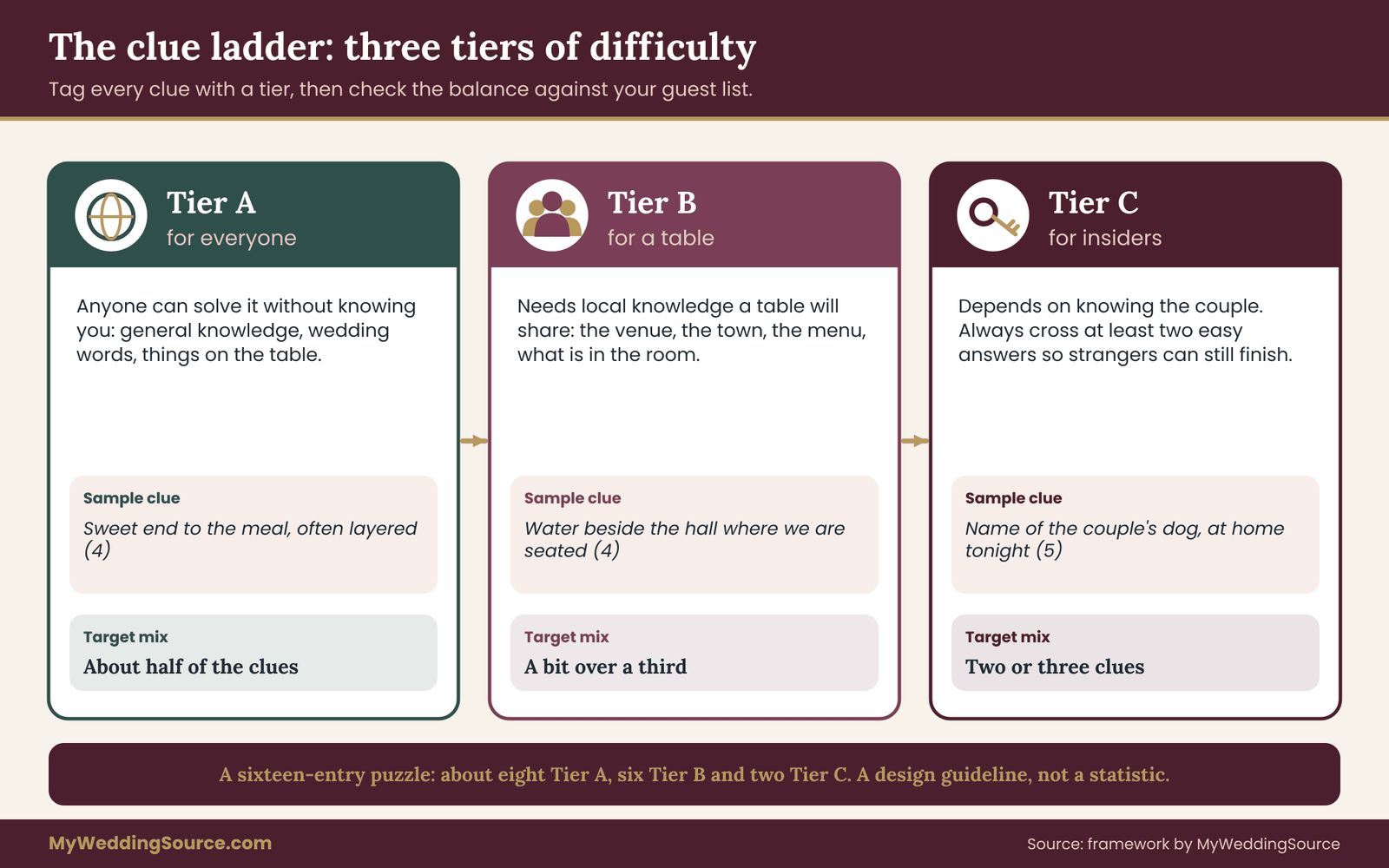
The first figure shows the three difficulty tiers the rest of this guide uses. Keep it nearby while you read about grids and clues, because every later decision refers back to it.
Who the puzzle is really for
It helps to name your solvers. Think of four types of guests. The first is the quick starter, usually someone who does crosswords or similar puzzles already. The second is the willing helper, who will contribute if a clue connects to something they know. The third is the observer, who prefers to watch a table do the puzzle and offer an answer now and then. The fourth is the person who will not touch it, and that is fine.
Design for the second and third types. The quick starter will be fine with almost anything, and the person who will not touch it needs nothing from you except permission not to play. If the helper and the observer can both add a square or two, the wedding crossword puzzle has done its job. That is the standard the clue ladder in the next sections is built to hit.
A quick word on tone
Tone matters more than difficulty. A wedding crossword puzzle that makes guests feel clever feels generous. A wedding crossword puzzle that makes guests feel tested feels like homework in nice clothes. Aim for clues that reward attention and general knowledge, add a few that reward knowing the couple, and always give the stuck solver another way in through crossing letters. The goal is a room of people who feel a little more connected, not a leaderboard.
Size, grid and solving time for a wedding crossword puzzle
The most common mistake with a wedding crossword puzzle is making it too big. A full newspaper-size grid has dozens of entries and demands a vocabulary of everyday crossword shorthand that most guests do not have. A reception puzzle should be closer to a mini crossword.
Choosing the grid size
Here is a plain way to choose, based on how much time guests will realistically have.
A seven by seven grid has about eight to twelve entries and takes a typical solver five to ten minutes. It suits a place card, a menu back or a program insert, where the wedding crossword puzzle is a small bonus rather than an event.
A nine by nine grid holds about twelve to sixteen entries and takes ten to fifteen minutes. This is the best default for a table sheet, because it is large enough to feel like a real puzzle and small enough that most guests can finish a fair share of it before the first course arrives.
An eleven by eleven grid carries sixteen to twenty-two entries and takes fifteen to twenty-five minutes. It works if your reception has a long cocktail hour or a lengthy gap between courses, and if you expect many guests to be regular puzzle solvers.
Anything larger turns into a project, and large grids are harder to read at reception lighting levels because the squares shrink. If you are unsure, choose the smaller size. A guest who finishes early feels pleased. A guest who cannot finish feels judged.
Why fewer, longer answers beat many short ones
New constructors tend to fill a grid with short three- and four-letter words because they interlock easily. The result is a wedding crossword puzzle full of abbreviations, acronyms and awkward fragments, and those are the clues guests dislike most. A better approach is fewer entries with more letters each, five to eight letters for most, because longer answers can be clued with real meaning, such as a place, a food or a song title.
A good rule is that every answer in your wedding crossword puzzle should be a word or phrase a guest would recognize on sight once they have it. If you need a footnote to explain why an answer is valid, change the answer.
Symmetry and block count
Newspaper crosswords follow strict conventions, such as rotational symmetry and a limit on black squares. You do not have to. Guests will not check your grid for symmetry. They will notice if the wedding crossword puzzle looks balanced and clean, so a roughly even spread of black squares and no isolated corners is plenty.
One rule is worth keeping: every letter should belong to two entries, one across and one down. A letter that belongs to only one entry gives the solver no crossing help, and crossing help is exactly what makes the harder clues fair. If you find a single-entry letter, rearrange the grid or change the answer.
Setting a solving-time target
Pick a target before you write a clue, and write it at the top of your working document: “A typical guest should fill at least sixty percent of the grid in ten minutes.” This is your own design target. It is not a published benchmark. Its job is to give you something to measure in the pilot test.
If you want the table to work together, set a second target: “A table of four should be able to finish in about twenty minutes, with at most two clues left that need a hint.” That sentence is the basis for the clue ladder.
The clue ladder for a wedding crossword puzzle
The central idea of this guide is a simple three-step ladder of difficulty. Instead of treating all clues as equal, label every clue in your draft with a tier and then check the balance.
Tier A: clues for everyone
A Tier A clue can be solved by any adult without knowing you. It uses general knowledge, wedding vocabulary or the immediate surroundings. Examples are the name of the month, a common wedding word such as a bouquet, a famous dessert, a well-known song title, or a plain description of an object on the table. A guest should be able to read the clue, think for a few seconds and answer with reasonable confidence.
Tier A clues are the foundation. They give every solver a first foothold and supply crossing letters for harder entries. Without them, the harder clues are unfair.
Tier B: clues for a table
A Tier B clue needs some local knowledge that someone at a typical table will have, often tied to the venue, the town, the menu or the wedding party. Examples are the name of the river beside the venue, the flower in the centerpieces, the first dish on the menu, or the city where the couple lives. A guest who has been to the venue or read the program can answer. Others can get there by crossing letters or by asking a neighbor, which is the point.
Tier B clues are what make the wedding crossword puzzle a table activity instead of a solo one. They encourage a mild, friendly kind of cooperation, as in “Does anyone know what that street is called?”
Tier C: insider clues, with crossing help
A Tier C clue depends on knowing the couple or their circle. The name of the couple’s first pet, the college they both attended, the nickname for the best man. These are the clues that make guests feel they are learning something personal.
Used carefully, Tier C clues add warmth. Used heavily, they split the room into people who know and people who do not. The fix is crossing letters. Every Tier C answer should cross at least two Tier A or Tier B answers, so a guest who does not know the story can still reconstruct the word. In effect, the insider clue becomes a small reveal rather than a gate.
The target mix
A reasonable starting mix for a wedding crossword puzzle, and again this is a design guideline rather than a statistic, is about half Tier A, a bit over a third Tier B and a small number of Tier C. In a sixteen-entry puzzle that means about eight Tier A, six Tier B and two Tier C.
You may adjust it. If your guest list is mostly close friends and family who share a long history, shift toward more Tier B and C. If your guests come from several unconnected groups, shift toward Tier A. What you should not do is write a puzzle that is mostly Tier C. That is a quiz about you, and a quiz is a different, riskier activity.
Labeling your draft
In your working document, put a letter in brackets after every clue as you write it, and keep the tags out of the printed version. A quick count at the end tells you whether the balance matches your guest list. It also gives you something to check in the pilot test, because you will compare how each tier performed with how you expected it to.
A tier is about the solver, not the clue
Notice that a tier is a property of a clue and a solver together. The same clue can be Tier A for a local and Tier B for a visitor. A clue about a popular local landmark is Tier A at a wedding where most guests live nearby and Tier B at a destination wedding. Always judge the tier against the guests you actually have, which is another reason the pilot test needs people who resemble them.
Where guests get stuck
Understanding how guests fail helps you write better clues. People tend to get stuck for four reasons. They do not know the fact, which is a knowledge gap. They misread the clue’s wording or have a different spelling in mind, which is a language gap. They know the answer but cannot make it fit the number of squares, which is a length gap. Or they lose confidence and stop, which is a motivation gap.
Tier A clues address the knowledge gap. Plain wording addresses the language gap. Showing the letter count in brackets addresses the length gap. And a lot of early wins address the motivation gap, because guests who have filled several squares keep going. The ladder, the wording rules and the layout in later sections each target one of these four gaps.
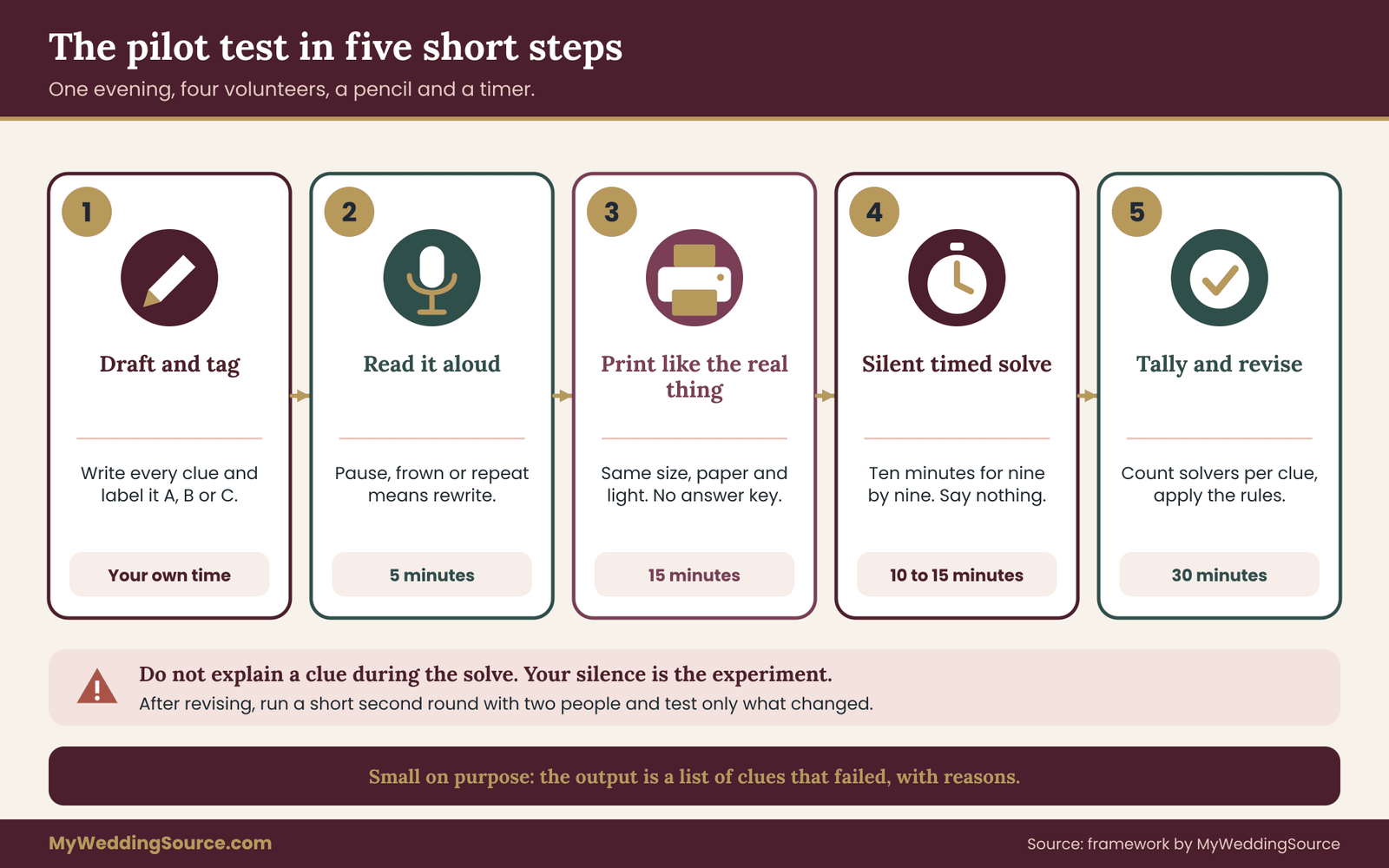
The second figure shows the pilot test as a flow. You will meet each stage in detail later, but it helps to see that the whole process is short: draft, solo read, panel solve, revise and print.
Choosing the answers first
Experienced constructors choose the answers before writing a clue, and a wedding crossword puzzle benefits from the same order. If you write clues first, you end up forcing words into the grid that do not fit, and the final puzzle feels strained.
Building a candidate word list
Start with a brainstorm of thirty to forty words and short phrases. Group them under five headings so you do not end up with a wedding crossword puzzle about only one subject.
The first group is the day itself: the venue, the town, the season, the colors, the flowers, the music. The second is the menu and the bar, which are always welcome because everyone is about to eat. The third is the couple’s story: where you met, a shared hobby, a trip, a pet, a favorite film. The fourth is general wedding vocabulary: words such as toast, vow, aisle, veil and garter. The fifth is shared culture: songs, desserts, and places that most guests would recognize.
Cross out any word that no guest could plausibly recognize. Cross out words that are hard to spell. Cross out any answer that requires a guest to know a full name they have never heard.
Prefer words guests say aloud
A good test is whether a guest would say the answer in conversation. “Bouquet” passes. “Boutonniere” is a common wedding word but it is hard to spell, and a guest who knows the word may still not be sure about the vowels. Hard-to-spell answers cause errors that look like wrong knowledge when they are really spelling slips. If you include one, give the letter count and make sure crossing words help.
Names and proper nouns
Names are tempting and risky. A name is only fair if the solver has some route to it, and routes are limited. Here is how to handle the common cases.
A couple’s first names are fair if the wedding crossword puzzle sits next to a program or a sign that shows them. Otherwise, clue them in a way that points to the program: “Half of today’s couple, as printed on the program (4).” That wording turns a Tier C into a Tier A, because the answer is in the guest’s hand.
Wedding party names can work if there is a photo board or program page. Without one, avoid them.
Place names are fine when they are visible: the venue, the town, a street on the invitation. Do not use an answer that depends on knowing a spelling that is unusual.
Pets, nicknames and in-jokes belong in Tier C and need crossing help from other entries.
Avoid crosswordese
Crossword culture has its own vocabulary of short words that appear over and over because they are easy to fit, such as certain three-letter birds, old currencies and abbreviations. Regular solvers know them. Everyone else finds them baffling. A reception puzzle is a poor place for them. If you notice an answer that you would only ever see in a crossword, replace it.
Check the crossings
Once the grid is filled, look at every crossing and ask a plain question: if a guest knows one of these two entries and not the other, will they still finish? A crossing between two Tier C answers is a danger. If neither is known, both squares stay blank forever. Replace one of them, or reword so that one becomes Tier B.
Count the number of crossings that involve at least one Tier A answer. In a healthy puzzle, nearly every harder entry should cross at least two easier ones. That is the measurable version of “fair.”
How to write clues guests can actually solve
With a grid and an answer list in hand, you can write clues. These rules apply to a wedding crossword puzzle in particular, because the audience is mixed and the setting is not a quiet room.
Rule one: say it plainly
Write clues the way you would explain something to a friend across a table. A clear definition is almost always better than a clever pun. “Sweet end to the meal, often layered (4)” is clear. A clue that depends on a double meaning needs a solver who enjoys that style, and not every guest will.
You can include a few wordplay clues for the guests who like them. Label them with a question mark at the end, which is a long-standing convention for a clue that is not literal. Keep them to a minority.
Rule two: match the clue to the answer
If the answer is a plural, the clue should be plural. If the answer is a past-tense verb, the clue should be past tense. If the answer is two words, say so with the letter count in brackets, for example “(5,4)”. A mismatch between clue and answer is the quickest way to make a solver doubt a correct guess.
Rule three: show the letter count
Always show the number of letters in brackets at the end of the clue. It is a small courtesy that removes a whole category of errors. For multi-word answers, show the split.
Rule four: one idea per clue
A clue that carries two ideas is almost always too long. Resist adding a second fact for color. If you want to say something about the couple, make it the whole clue rather than an aside.
Rule five: keep clues short
Aim for fewer than twelve words. Short clues are easier to read in dim light and fit the printed grid without shrinking the type. If a clue runs long, it is probably two ideas, and rule four applies.
Rule six: use the surroundings
The best Tier B clues point at something the guest can see. “Flower in the centerpiece on your table (4)” requires no outside knowledge at all, only a glance. This kind of clue turns the wedding crossword puzzle into a small scavenger hunt in the room, which is more fun than recall and gets guests looking around and talking.
Check with the florist, the caterer and the venue that what you describe will actually be there. A clue about a flower that was substituted at the last minute becomes a source of annoyance. If a detail is not certain, use it only in clues you can finalize near the date.
Rule seven: give insider clues a way in
A Tier C clue should contain either a gentle hint in its wording or two crossing answers that are easy. “Name of the couple’s dog, who is not at the wedding (5)” gives the solver the category and the length. It also gives a small reward: guests like to hear about the dog.
Rule eight: be fair about spelling
If an answer has more than one accepted spelling, avoid it. If you cannot avoid it, mention it in the answer key and think about which version appears in the grid. Place names, foreign words and brand names are the usual causes.
Rule nine: do not trick
Tricks erode trust. A clue whose answer is a plain word but whose wording suggests something else is an unfair surprise at a social event. If your wedding crossword puzzle has one deliberate misdirection, make it a Tier A clue so the crossings can rescue guests who fall for it.
Rule ten: read it aloud
Before a pilot test, read each clue aloud to someone. If they pause, frown or ask you to repeat it, rewrite. Reading aloud finds awkward rhythm and unclear pronouns that silent proofreading misses. It takes five minutes and is the cheapest quality check in this guide.
Comparing clue styles in prose
It helps to see how the same answer can be clued four ways. Take the answer TOAST. A direct definition might read “Words of tribute raised with a glass (5).” A wedding-specific clue might read “What the best man gives after dinner (5).” A surroundings clue might read “What the DJ announces before the champagne (5).” A wordplay clue might read “Bread that gets a speech? (5).”
The direct definition is Tier A and nearly everyone gets it. The wedding-specific clue is Tier A too, but it assumes a traditional order of events. The surroundings clue is Tier B because it depends on the actual timeline. The wordplay clue is fun for puzzlers and a wedding crossword puzzle for everyone else. A balanced puzzle uses all four kinds, in proportion to your guests.
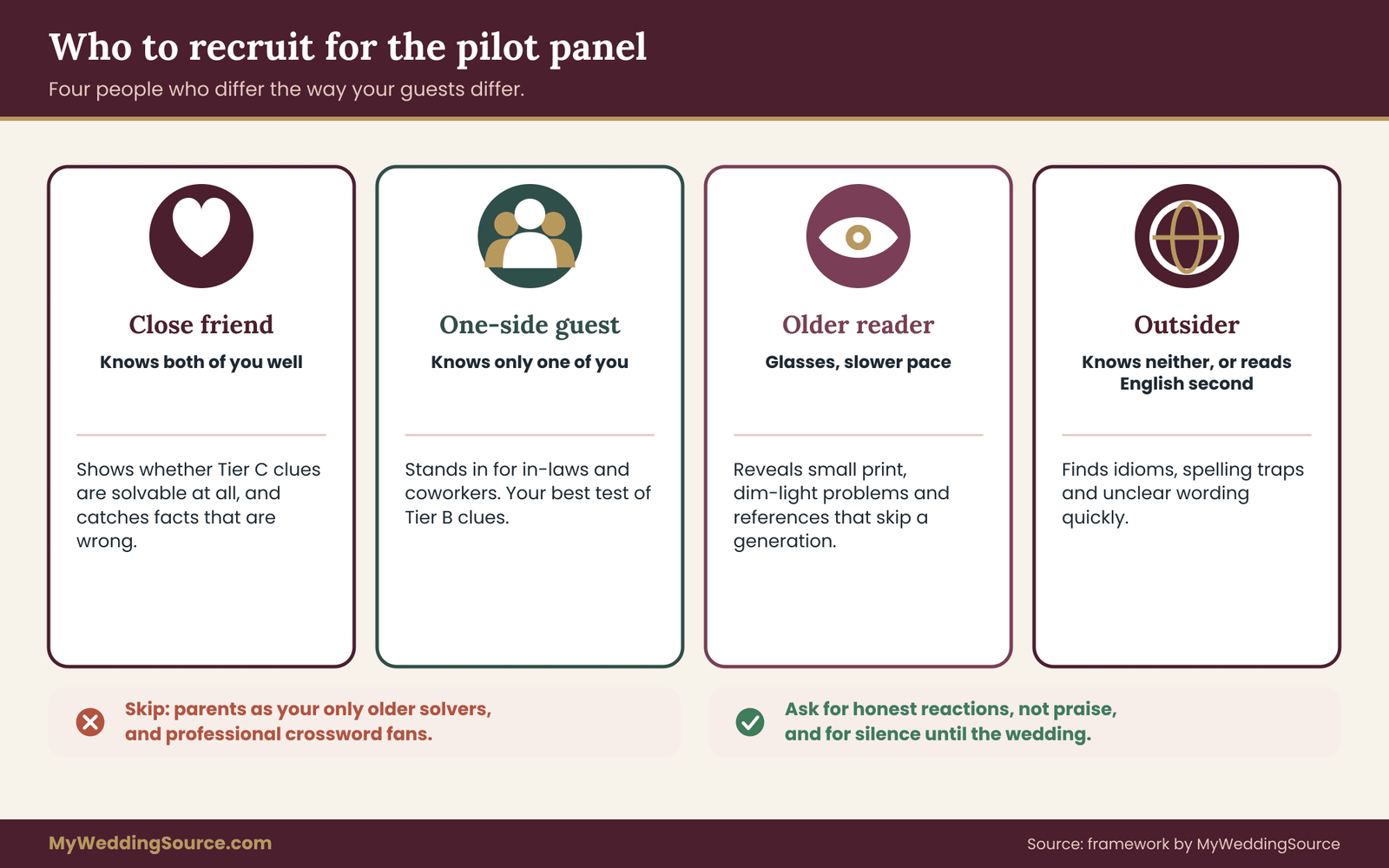
The third figure shows the panel of pilot solvers you will want, and what each type of person tells you. The next sections explain why the panel matters.
What to keep out of your clues
A wedding crossword puzzle lives in a social setting where people of different ages, families and histories share a room. Some content is a poor fit even if it is funny among friends. This section is a plain list of what to leave out, and why.
Private or sensitive facts about guests
Do not use a guest’s weight, age, health, income, relationship history or immigration situation, even as a joke. Do not use a guest’s home address or phone number. Do not name children in a way that could identify them to strangers, such as a full name with a school. Even a harmless fact can be a problem if the person did not agree to see it printed.
A simple consent rule works well: if a clue names or describes a living person other than the two of you, ask that person first. Most will say yes, and some will enjoy it. The rare person who says no has saved you from a bad moment.
Exes, breakups and old rivalries
Clues about a former partner of either of you, or about a family quarrel, do not belong in a printed puzzle. The sheet will be read by grandparents, coworkers and the person in question’s friends. Humor that works in a group chat can read as unkind on paper.
Money, religion and politics
Keep clues away from contested subjects. A clue about cost, a political figure or a religious practice can divide a table that was getting along. If your wedding includes faith traditions, a respectful and informative clue about a ritual in the ceremony is fine. A clue that implies a judgment is not.
Clues that depend on a guest’s culture or language
Be careful with idioms, regional slang and references that assume a single upbringing. A phrase that is common in one region may be meaningless in another. If a significant share of your guests speak another language at home, consider a bilingual puzzle or a different activity, which later sections discuss.
Song lyrics and other protected text
Song titles, film titles and book titles are short names and generally acceptable as answers. Printing a line of lyrics or a long quotation as a clue is a different matter, because that text may be protected by copyright. The U.S. Copyright Office publishes plain-language information on what protection covers and how fair use is assessed, and it is the right place to check current rules. A safe habit is to paraphrase in your own words rather than quote.
Alcohol-centered and pressure clues
A wedding crossword puzzle that rewards drinking, or that nudges guests to take a shot when they get an answer wrong, is a different kind of game and not the one this guide is about. Avoid coercive prompts of any kind. Guests should be able to ignore the wedding crossword puzzle with no social cost.
Prizes that create pressure
A prize can make the activity more fun or turn it into a contest. If you offer one, keep it small, make the rules clear, and make it easy to opt out. Many couples skip prizes and simply thank everyone who tried. A simple, public rule such as “everyone who hands in a sheet is entered in a drawing” is more inclusive than “first to finish wins,” because it does not reward speed over enjoyment.
Etiquette and the family audience
Weddings have unspoken rules about who is honored and how. If you are not sure whether a clue crosses a line, the wedding etiquette guide covers the general expectations around guests, families and public acknowledgements. When in doubt, choose the kinder version of the clue. A puzzle is a gift to your guests, not an inside joke at their expense.
A short screening question
Here is a quick screen for every clue in your draft. Would I be comfortable reading this aloud to the whole room? Would the person named, if any, be glad to hear it? Does it assume everyone shares my background? If the answer to any is no, rewrite or cut.
Rewriting weak clues: before and after
Reading about rules is easier than seeing them applied. The examples below are invented, built to show common problems. Each shows a draft that would stall a typical guest and a revision that would not.
Example one: the in-joke
Draft: “Reason Eli missed the train in 2019 (7).” Only a few people know the story, and even they may not remember the reason. Nothing in the clue gives a general solver a route.
Revision: “What the couple was eating at the train station when they met (5).” This is still a Tier C clue, but it gives a category, food, and a length, and the answer can be backed up by crossings with Tier A entries. It also tells guests something sweet about the couple.
Example two: the vague definition
Draft: “Floral item (7).” Too many answers fit. Bouquet, corsage and garland all work depending on the spelling and length, and a guest cannot tell which is meant.
Revision: “Flowers the bride carries down the aisle (7).” The extra context narrows the answer and uses the wedding setting. It is still one idea, and it has a clear tier: A.
Example three: the hidden spelling trap
Draft: “Tower of cream puffs, French style (13).” The answer is a word many guests cannot spell, and the clue’s wording does not help.
Revision: “Tiered dessert cut by the couple (4).” With the answer CAKE, this is a simple Tier A clue. The point is that a simpler answer makes a better puzzle than a fancy one.
Example four: the unfair crossing
Draft: two Tier C answers cross at their first letters, the dog’s name and the couple’s first-date restaurant. A guest who knows neither can never fill those two squares.
Revision: change one answer to something visible in the room, such as the table flower, so the crossing letter becomes recoverable. The wedding crossword puzzle keeps its insider flavor and loses its dead end.
Example five: the tricky wordplay
Draft: “Sparkling situation? (9).” The question mark signals wordplay, but the answer is not clear, and a guest who does not enjoy puns will give up.
Revision: “Fizzy drink for the toast (9).” A guest can reasonably answer CHAMPAGNE, and a wedding crossword puzzle fan can still enjoy the harder clue elsewhere in the grid. Keep wordplay for one or two entries, and make sure the surrounding crossings are easy.
The pattern behind the fixes
Almost every revision does one of three things. It narrows the category so guesses become possible. It points to something the solver can see or has already been told. Or it moves the clue down one tier by adding a crossing or a hint. Those three moves cover most problems you will find in the pilot test.
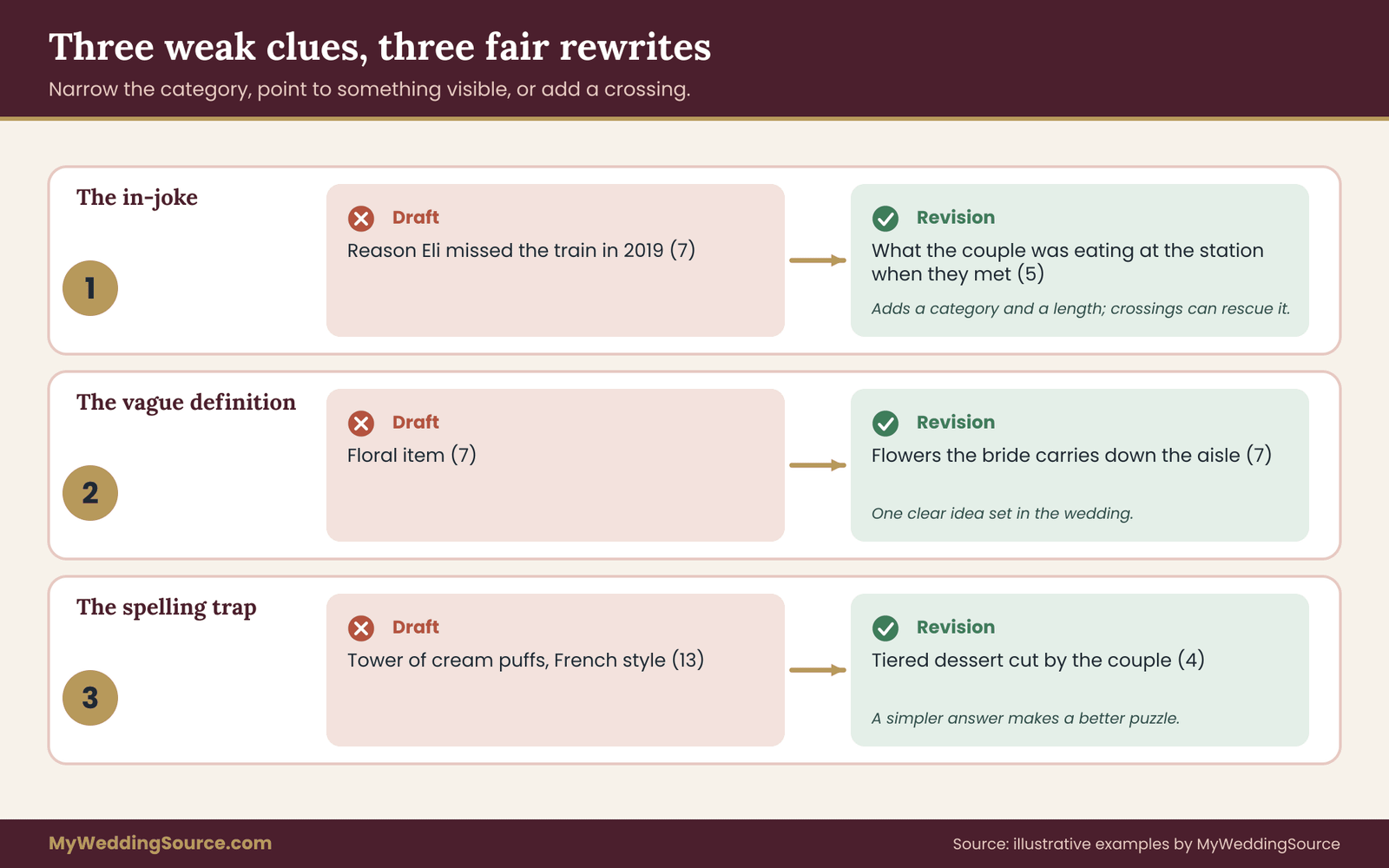
The fourth figure collects three of these rewrites on one page so you can check your own drafts against them.
Where to find fresh ideas for clues
If you run short of ideas, look at what guests will see. The invitation suite, the program, the menu card, the signage and the table names all contain facts you control and can clue with confidence. Your own timeline contains the other half: the order of events, the names of songs for the first dance and the processional, and the places you plan to take photos.
Avoid pulling clue material from guests’ social media accounts or other people’s posts. Beyond the privacy concerns, you cannot be certain of the facts, and a wrong fact in a wedding crossword puzzle is an embarrassment you cannot fix once the pages are printed.
A clue difficulty pilot test for your wedding crossword puzzle
You cannot judge the difficulty of your own clues. You know the answers, so every clue looks obvious. The only reliable fix is to hand the wedding crossword puzzle to people who do not know the answers and watch what happens. That is the clue difficulty pilot test, and it is the part of this guide that most separates a wedding crossword puzzle guests enjoy from one they abandon.
The test is small on purpose. It needs four volunteers, one printed copy each, a pencil, a timer and about forty-five minutes of total effort spread over an evening. It does not need statistics, and it should not pretend to produce any. It produces a list of clues that failed, with reasons, which is what you need.
Step one: recruit a panel of four
Choose four people who differ in the ways your guests differ. The first should be someone who knows both of you well, like a close friend. The second should be someone who knows only one of you, such as a coworker or an in-law. The third should be someone older than most of your guests, or who reads slowly or with glasses. The fourth should be someone who does not know either of you, or whose first language is not English.
If you cannot find a fourth person who is a true stranger, a friend of a friend works. Do not use your parents as your only older solvers, because they will know too many of the stories. And do not use a professional crossword fan, because their speed hides the problems a casual solver will hit.
Ask each volunteer to keep the puzzle confidential until the wedding, and explain that you want honest reactions, not praise.
Step two: print it the way guests will see it
Print the pilot copy at the same size, on the same kind of paper, as the final version. A wedding crossword puzzle that is easy on a bright screen can be much harder in small print under warm, dim lighting. If your venue is dim, run part of the test in a dim room.
Do not include the answer key. Do not include hints beyond what will be printed on the real sheet. Do not help during the solve.
Step three: run a timed, silent solve
Give each volunteer the sheet and a fixed time, ten minutes for a nine by nine grid and fifteen for an eleven by eleven. Ask them not to talk. Watch quietly and note anything you see, such as a long pause, a rereading or a frown. Do not explain a clue, no matter how tempting. Your silence is the experiment.
When the time is up, collect the sheets and mark each entry in four ways: solved correctly without help from crossings, solved correctly with help from crossings, wrong, or blank. You can see which kind by looking at the order in which entries were filled, or you can ask afterward.
Step four: a two-minute debrief
Ask each volunteer three questions. Which clue did you enjoy most? Which clue did you give up on, and why? Was there any clue that felt unfair or unclear? Write down the answers in their words, not yours. Often a single phrase, “I didn’t know what that meant,” points to a fix.
Step five: tally and tag
Create a simple list of your clues. Next to each, write the tier you intended and then the number of volunteers, out of four, who solved it correctly. You do not need a spreadsheet. A sheet of paper with the clue number, the intended tier and a count is enough.
This tally is your data. It is small, and you should not treat it as a statistical sample. It is a set of observations, and the useful ones are the clues that failed in a surprising way.
Reading pilot results and revising
Once you have the tally, apply decision rules. These are suggestions you can adapt to your own guest group. They give you a way to decide without agonizing over every clue.
The two-of-four rule
For a Tier A clue, at least three of four volunteers should get it right, with or without crossings. If only one or two did, the clue is not truly Tier A. Rewrite it or move it down a tier and adjust the balance.
For a Tier B clue, at least two of four should get it, and at least one who does not know you well. If only the two closest friends solved it, it is really Tier C.
For a Tier C clue, at least one should get it through crossings alone. If nobody did, check the crossing entries before you blame the clue.
The zero-solve rule
Any clue that nobody solved needs a decision. There are three options: rewrite the clue to be easier, replace the answer, or change the crossing entries so that more letters are given. Do not leave a zero-solve clue untouched unless you intend it as a deliberate stumper, and even then, limit yourself to one.
The everyone-solved rule
A clue that all four solved without hesitation is fine, but if more than a third of your clues fall into this group, the wedding crossword puzzle may be too easy. That is a smaller problem than the opposite, and often a pleasant one. Add a couple of harder Tier B clues if you want a little more challenge.
The speed check
Look at how far the median volunteer got in the time limit. The design target in this guide is sixty percent of the grid. If the median is well below that, the wedding crossword puzzle is too hard overall, and you should either shrink the grid or lighten the tier mix. If the median is above ninety percent, you can tighten the clues or lengthen the grid.
Remember that these numbers come from four people. They are a signal, not a measurement. If your volunteers split sharply, trust the pattern across several clues rather than one result.
Error patterns to look for
Some failures repeat. Look for these.
A spelling error that appears twice usually means the answer is a spelling trap. Replace it or add a letter count.
A blank cluster in one corner of the grid usually means two hard crossings meet there. Soften one.
A clue that was solved but solved late, after all its crossings, is a good Tier C clue. It is working as designed.
A clue that was misread in the same way by two people has ambiguous wording. Rewrite it.
A clue that the older volunteer skipped but others solved may use a reference or an idiom that spans generations unevenly. Consider a simpler replacement.
What to do with feedback about tone
Sometimes a volunteer says a clue made them uncomfortable. Take that seriously even if you disagree. If one person from a small panel noticed, several guests may. Remove or soften it. It is far easier to cut a clue than to repair a moment at the reception.
Revise, then test only what changed
After revising, you do not need a full second pilot. Run a short second round with two volunteers, ideally one who took part before and one new person. Hand them only the revised version and watch for the same kinds of trouble. If a rewritten clue still fails, make it a Tier A and move on.
Keep your tally. Having a record of what changed and why helps if a parent or a friend asks to add a clue later. You can run any new clue through the same two-of-four rule with a quick check.
When the pilot says to stop
Occasionally the pilot shows that the wedding crossword puzzle is fundamentally not working: guests ignore it, or the volunteers dislike it, or the grid is cramped. That is a useful finding. A short, honest decision to drop the wedding crossword puzzle and use another format costs far less than a stack of unused paper. The alternatives section later in this guide lists simpler formats that keep the spirit of the idea.
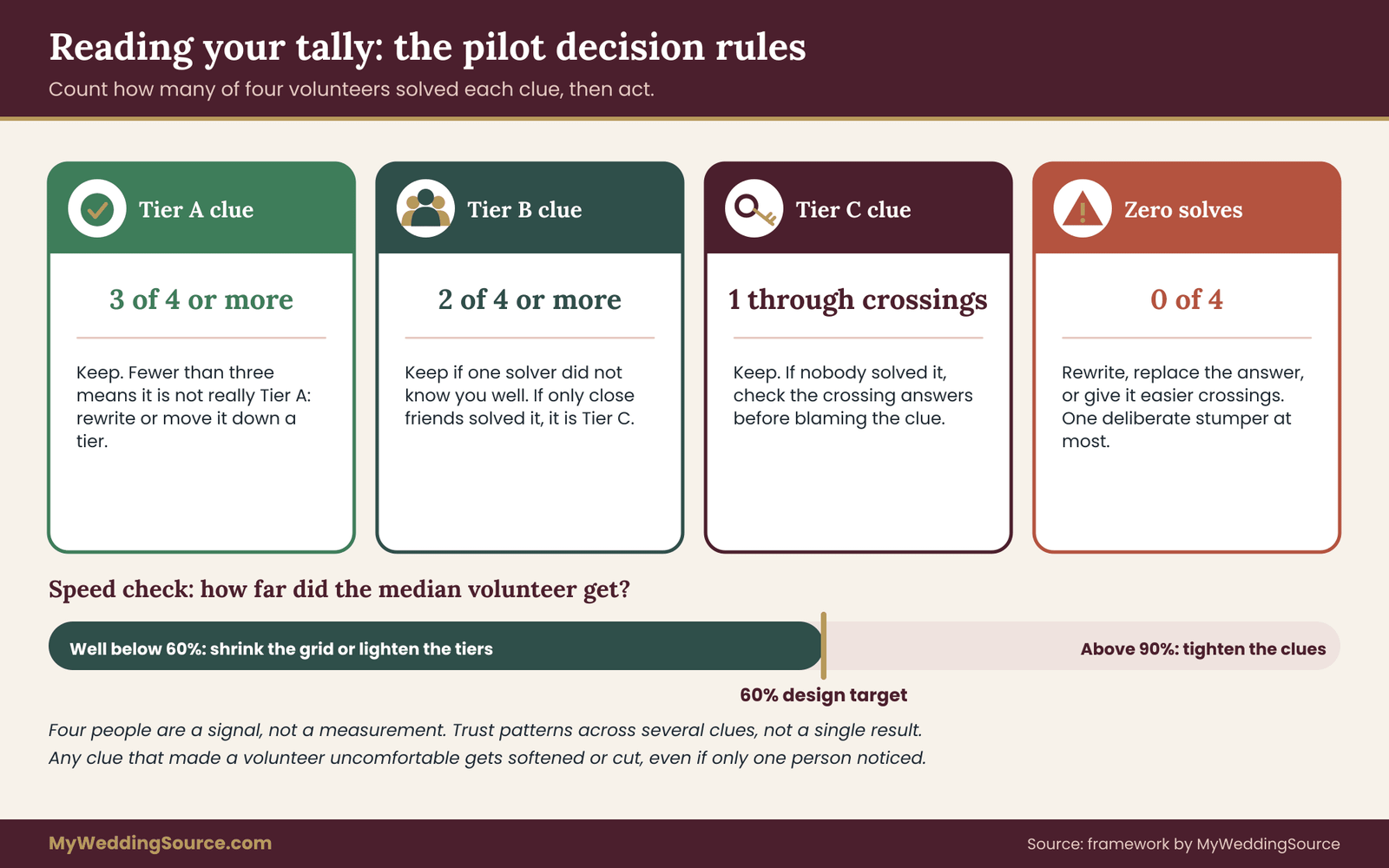
The fifth figure turns the decision rules into a simple scoreboard. Use it with your tally in hand and you will know which clues to keep, which to rewrite and which to replace.
A worked example: one invented couple, one pilot test
To make the process concrete, here is an invented example. Nora and Eli are not real people, the numbers below are made up for illustration, and nothing here is a study. The aim is to show how the tiers, the tally and the decision rules fit together in a normal evening of work.
The setup
Nora and Eli are marrying in a lakeside hall in late September, with about one hundred and ten guests seated at round tables of eight. Dinner is plated, with a long cocktail hour first. They plan a nine by nine puzzle printed on a half-sheet, placed at each setting beside the menu card. About a third of the guests are Nora’s family, a third are Eli’s, and a third are friends and coworkers from both sides. A few older relatives will attend, and several guests read English as a second language.
They set their design targets: a typical guest fills at least sixty percent in ten minutes, and a table of four can finish in about twenty minutes.
The first draft
They brainstorm and choose fourteen entries. Here is the list, by tier, described rather than reproduced as a grid.
Tier A answers include TOAST, BOUQUET, CAKE, VOW, AISLE and SEPTEMBER. These need no outside knowledge. A sample clue is “Month of today’s wedding, as printed on the program (9).”
Tier B answers include the name of the lake, the flower in the centerpiece, the first course on the menu and the town where the hall stands. A sample clue is “Water beside the hall where we are seated (4),” with the lake’s four-letter name.
Tier C answers include the couple’s dog, the café where they had their first date and the best man’s nickname. A sample is “Name of the couple’s dog, who is at home tonight (5).”
That is six, four and three entries, with one extra Tier A for the grid, so the mix is seven, four and three. They check the crossings and find that the dog and the café cross at a single square. They change the café to the food they ordered there, which crosses a Tier A answer, and move on.
The pilot panel
They recruit four volunteers: Nora’s close friend, Eli’s coworker, Nora’s aunt who wears reading glasses, and a neighbor who has never met either of them and speaks English as a second language. Each gets a printed half-sheet and ten minutes.
The tally
Here is the invented tally, out of four volunteers, for the clues that show something worth fixing.
The clue “Flower in the centerpiece (6)” was solved by one. The neighbor and the aunt could not see the flower clearly in the dim test room, and the friend thought it was a different flower. The couple realize the florist might substitute stems, and that the clue depends on a detail they cannot guarantee. They replace it with a clue about the color of the napkins, which they control.
The clue “Name of the couple’s dog (5)” was solved by two, both through crossings. That is exactly what a Tier C clue should do, so they keep it.
The clue “First course on the menu (5)” was solved by none. The answer was SALAD, but two volunteers wrote SOUP, which also fits, and the menu was not on the test sheet. They fix it by adding the menu card text to the pilot setup and by changing the clue to “Green first course, listed on your menu card (5).”
The clue “Month of today’s wedding (9)” was solved by four. Fine.
The median volunteer filled about half the grid in ten minutes, a bit under the target. Looking at the blanks, the couple see that the lower right corner, where three Tier B answers meet, is mostly empty. They soften one of them to Tier A.
The revision and the second round
After revising, they run a second round with two people, the aunt and a new volunteer who does not know them. The aunt now fills most of the grid. The new volunteer finishes a bit more than sixty percent. One clue still causes hesitation, so they add a letter-count reminder to the instructions line and leave it.
The whole process took one evening for the first round, an hour of revision and thirty minutes for the second round. That is a reasonable cost for a wedding crossword puzzle that might occupy a hundred and ten guests.
What the example shows
Three lessons stand out. The most informative failures came from the guests who knew the couple least, because they behave like many of the real guests. A clue about something the couple cannot control, like a flower, is a risk. And the fix for a failed clue is often small, a better category word or a visible reference, rather than a rewrite from scratch.
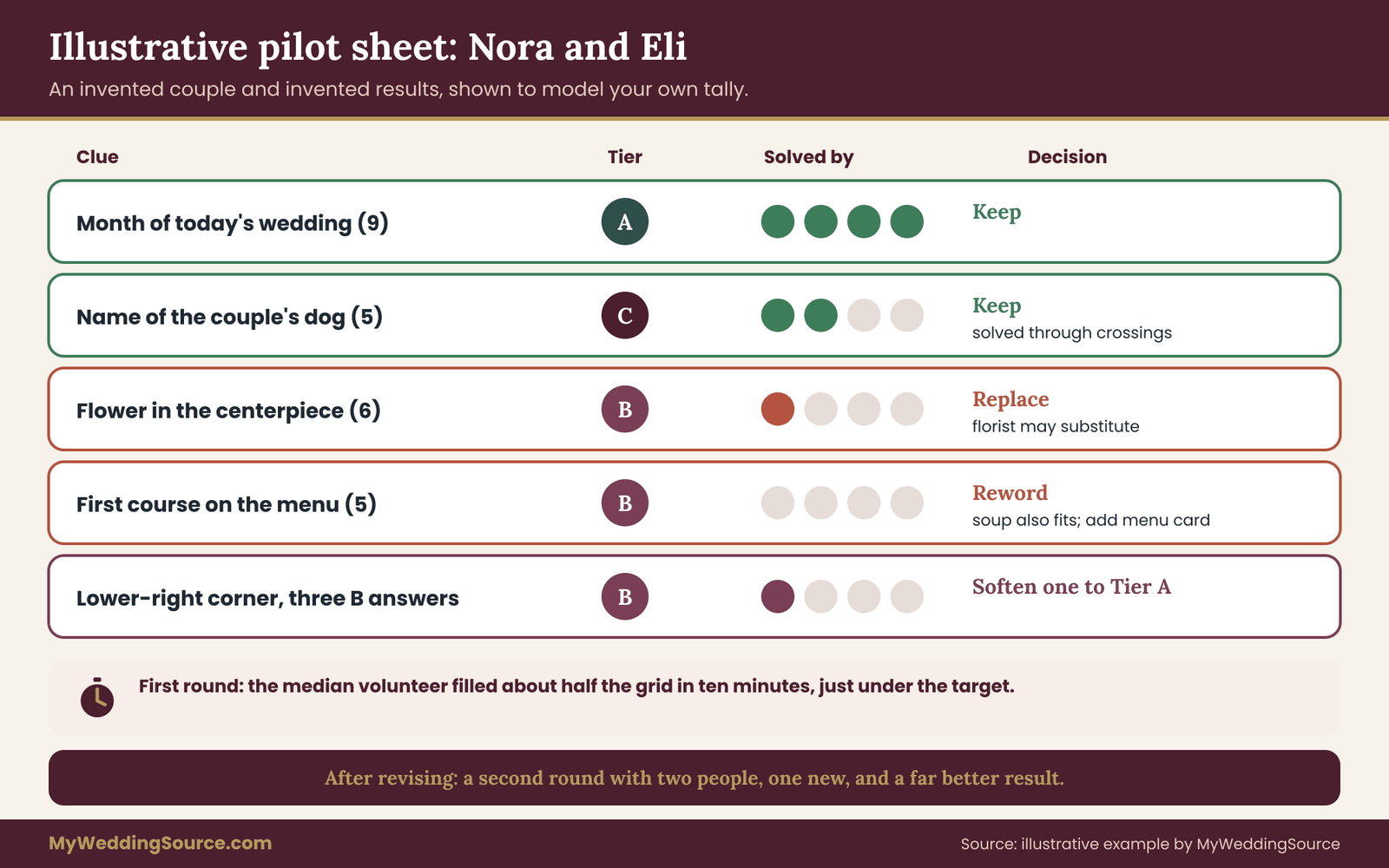
The sixth figure shows the invented pilot sheet for Nora and Eli as a before-and-after, so you can model your own tally on it.
Print-ready wedding crossword puzzle layout and answer key
A fair puzzle can still be ruined by a poor print. Plan the layout as carefully as you planned the clues, and check it against the venue’s lighting.
Page size and format
For table use, a half-sheet or a folded card is easy to handle and leaves room for a pencil. A full letter-size page works well as a program insert. If the wedding crossword puzzle will sit on a plate or a place card, check the dimensions with your printer. The wedding invitation printing guide explains proofing, quantities and printer handoffs, and the same habits apply to a puzzle: ask for a physical proof and read every clue on it.
Type size and spacing
Choose a clue type size that is comfortable for older eyes. A common rule of thumb is to avoid anything smaller than twelve points for body text, and to go larger where you can. Give each clue its own line, with clear numbering that matches the grid. Do not squeeze the clue list into narrow columns that force line breaks mid-clue.
Make the grid squares large enough to write in with a pencil, at least a few millimeters across at minimum and ideally larger, so letters do not collide. A grid that looks charming on screen can be too small to use by candlelight.
Contrast and color
Use dark text on a light background. Avoid pale gray text, script fonts for clues and tinted paper that reduces contrast. The Web Content Accessibility Guidelines from the World Wide Web Consortium describe contrast ratios for readable text, and although they are written for the web, they are a useful reference point for printed materials as well. The National Eye Institute offers general information on low vision that can help you think about who may struggle with small print.
Do not rely on color alone to carry meaning. If the numbered squares are highlighted in a pastel color, make sure the numbers are still readable in black and white.
Numbering and layout of the clue list
Put “Across” and “Down” lists under the grid or beside it, with the number and the letter count after each clue. Keep numbering simple, restart at one for each list only if your convention is clear. Most solvers expect the numbers to match the grid.
Include a short instructions line at the top, in plain words: “Fill the grid using the clues. Numbers in brackets show the number of letters. Work alone or with your table.” It lowers the barrier for guests who have not done a crossword in years.
The answer key
Create the answer key as a separate document, not printed on the back of the wedding crossword puzzle. A guest who flips the sheet will see it. Options include a small card at the host table, a folded card sealed with a sticker, or a sheet handed out only to those who ask. Some couples post the solution on their wedding website after the event, which lets guests check their work at home.
In the key, list every entry by number and direction, with the answer in capital letters, and mark any entry with alternate spellings. Include a compact filled grid for quick checking. A master copy with your tier tags is useful for you but should not be given to guests.
Spare copies and proofing
Print more than you think you need, a spare of at least ten percent, because pencils and drinks happen. Keep a few clean copies in your emergency kit. Before printing the final batch, have someone who has not seen the wedding crossword puzzle proofread the clue text against the grid. A numbering slip is the most common production error, and it can make a fair puzzle impossible.
Check once more that every fact in the wedding crossword puzzle matches the final program, menu and signage. A last-minute change of dessert or a venue swap can quietly make a clue wrong. The wedding signage system guide describes how to proof printed pieces together so they agree with each other, and the wedding crossword puzzle belongs on that same proofing list.
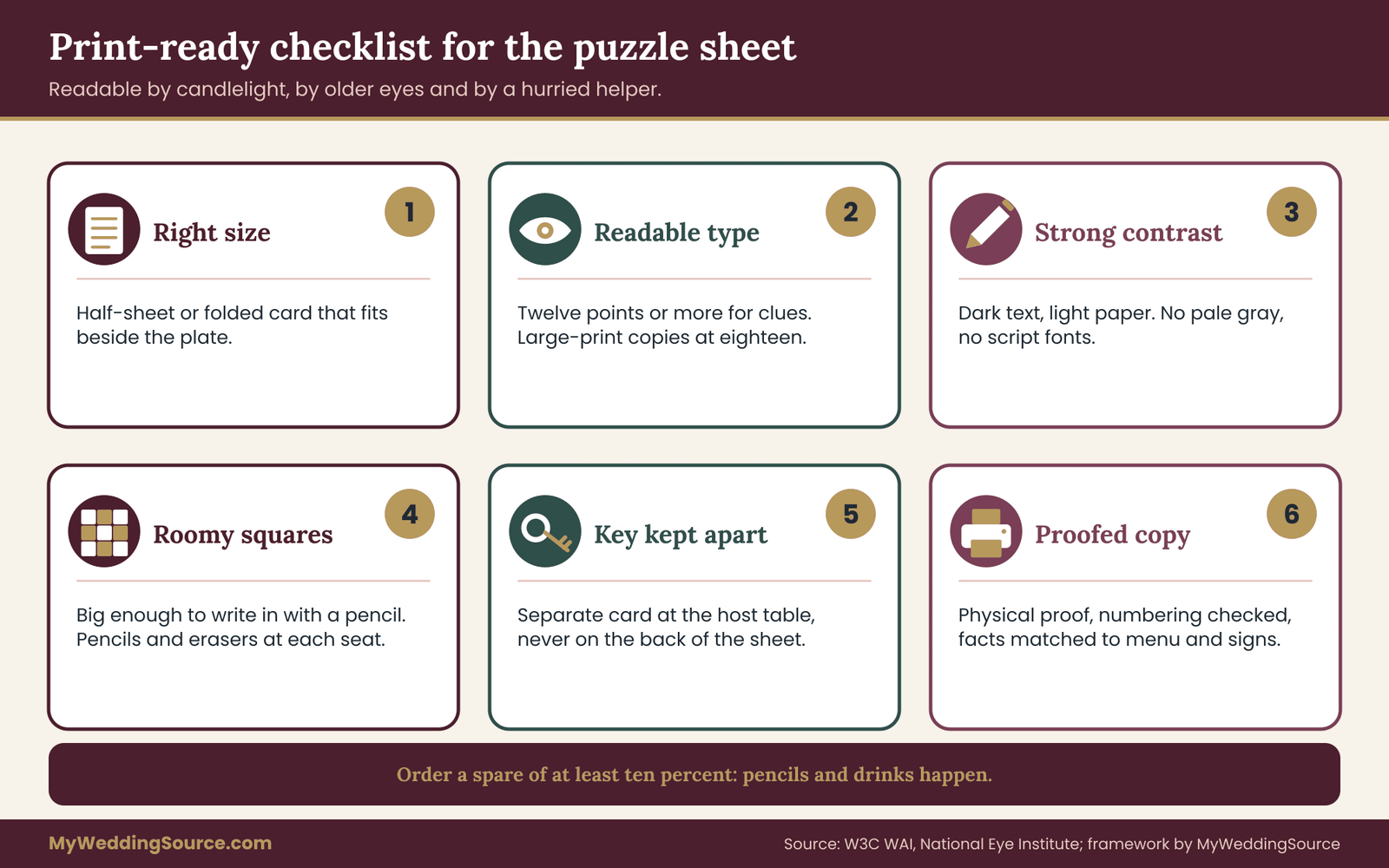
The seventh figure condenses the print-ready checklist into one picture you can hand to a printer or a helper.
Placement, accessibility and alternate formats
Where the wedding crossword puzzle sits in the day changes how it is used. How accessible it is decides who can use it at all.
Choosing the moment
A wedding crossword puzzle fits best in the gaps. At a plated dinner, the gap between being seated and the first course is a natural slot, and so is the pause before dessert. At a buffet, a wedding crossword puzzle helps while tables wait to be released. During a long cocktail hour, a folded puzzle card handed out at the entrance can give guests something to hold while they stand and talk, although a standing guest has no surface to write on, so offer pencils and a few clipboards or leave the wedding crossword puzzle for the seated portion.
Avoid placing it during toasts, the first dance or any moment that deserves attention. A guest bent over a puzzle during a speech is not rude, but the speaker will notice. The wedding cocktail hour guide discusses how to use those early minutes for guests, and the wedding crossword puzzle is one low-pressure option among several. If you have live music or a DJ, tell them the wedding crossword puzzle exists so they can pace announcements around it; the wedding reception music planning guide covers how to brief a musician on timing.
Seating and table mix
A wedding crossword puzzle works best at a table of people who can talk to each other. If you are still building your table plan, think about mixing quick starters with willing helpers rather than clustering all the wedding crossword puzzle fans together. The wedding seating chart guide explains how to balance tables by relationship, age and mobility. A wedding crossword puzzle can quietly help a mixed table, but it should not be the reason you seat someone.
Put one puzzle per guest, not one per table, so each person can choose to engage. A single sheet in the middle of the table makes one person the writer and everyone else an audience, and it makes opting out awkward.
Pencils, not pens
Provide pencils with erasers, or short golf pencils, at each setting or on a nearby tray. Pens are permanent and cause anxiety. If pencils are not practical, use erasable pens. Test them on your chosen paper stock first, because glossy cards can smear.
Accessibility basics
The Americans with Disabilities Act applies to many public accommodations and to the businesses that serve events, and the ADA website is the official place to learn how it is applied. A private wedding is not the same as a public business, so check with your venue about what it must provide. Beyond legal rules, a few habits make your wedding crossword puzzle usable by more guests.
Offer a large-print version, set at eighteen points or more, to anyone who asks, and have a few printed in advance. Keep the grid uncluttered. Avoid light gray text and decorative backgrounds. If a guest cannot see or write the grid, offer to read clues aloud so they can solve with a tablemate or a helper. The U.S. Access Board publishes technical guidance on accessible design that is useful background if your venue asks for specifics.
For guests with cognitive differences, keep the instructions short and avoid time pressure. For guests with limited dexterity, a clipboard and a thick pencil help. For guests with low vision, a high-contrast version with a bold grid line is worth printing in a few extra copies. The National Institute on Aging offers general information on vision and aging that can help you plan for older relatives, and the guest care planning guide covers how to make quiet arrangements for older guests without singling them out.
Language access
If a meaningful share of guests read another language, consider a bilingual clue list with answers in one language, or a picture puzzle that needs no language at all. A word search or a matching game with images can work as a companion sheet. Do not machine-translate clues without having a fluent reader check them, since wordplay and idioms rarely survive translation.
Alternate formats
If the pilot test shows a crossword is not right for your guests, here are plain alternatives that keep the same spirit.
A word search with the couple’s words hidden in a grid is easier than a crossword because it requires no clue reading. It suits children and guests who dislike wordplay.
A mini quiz with matching answers, such as “match the dessert to the table,” gives structure without a grid.
A “find it in the room” card, which asks guests to spot items such as the lake view or the flower in the centerpiece, is a movement-friendly alternative for guests who prefer to wander.
A shared tabletop puzzle, such as a larger table-sized grid that the whole table fills in together, suits groups and takes the pressure off any one solver.
None of these needs the elaborate testing a crossword does, but a quick read-through by two volunteers is still worth the effort.
Children and teenagers
Children can take part if you offer a simpler sheet with pictures or a short word list. Keep the content age-appropriate, avoid asking for any personal information, and do not make a child perform for the room. Teenagers often like a wedding crossword puzzle if it is presented as optional and slightly clever. Offering a sheet that is a little harder than the adult version, with a small prize that is also optional, can make it a quiet game rather than a chore.
Questions for your printer and venue
A few straightforward questions to vendors protect the puzzle from preventable trouble. You do not need to be formal. A short email or a conversation at a walkthrough is enough.
Questions for the printer
Ask what file format and resolution the printer needs, and whether fine grid lines hold up at the chosen paper weight. Ask whether you can see a physical proof, not only a screen proof, and what the turnaround time is for corrections. Ask about the minimum order, how much extra you should order for spoilage, and what the cost is for a second print run if you find an error. Ask whether the stock takes pencil well, since coated papers often resist graphite.
Ask also whether the printer can produce a small run of large-print copies, and what the extra cost is. If the answer is high, a copy shop may be the practical choice for that portion.
Questions for the venue
Ask whether tables will have a cloth and what size the table is, so you know whether a half-sheet fits beside a charger plate. Ask about lighting levels during dinner and whether they can be raised slightly at the start of service, or whether you can provide small table lamps. Ask whether there are rules about candles, confetti or items on tables that could affect where you place paper.
Ask about a place to store extra copies and the answer key on the day, and who can hand them out. If the venue handles setting tables, confirm in writing whether staff will place the puzzles or whether a helper of yours will.
Questions for the planner, coordinator or helper
If you have a coordinator, share the wedding crossword puzzle early and ask whether the timeline leaves a natural slot. Ask a helper to be the contact for any guest who wants a large-print copy or a hint, so you are not interrupted during the day. Give the helper a one-page answer key and permission to give gentle hints without revealing answers.
A simple script for hints
Hints help guests who are stuck and keep the wedding crossword puzzle friendly. A helper can say, “Would you like a hint? I can give you the first letter of any answer.” That keeps the solver in control and avoids pointing out that a clue was hard. Agree in advance that nobody is made to feel they have failed.
On the day
Check that the puzzles are on the tables, that pencils are present and that the answer key card is at the host table. Make one quick walk past a few tables to see how the paper sits under the lighting. If the wedding crossword puzzle is not working, do not draw attention to it. Guests will take the hint, and no one needs an announcement.
After the wedding, consider posting the solved grid on your wedding website with a short thank-you. It lets guests finish at home, and it closes the activity without pressure.
Your next steps
Work through these in order, and give yourself a few weeks so the pilot test does not land in the last days before the wedding.
First, decide whether a wedding crossword puzzle fits your guests and your room, using the skip list in the first section. Second, set your design targets for grid size and solving time, and write them at the top of your working file. Third, brainstorm answers and group them by the five headings, then build the grid so every letter crosses. Fourth, write clues with the ten rules and tag each with a tier.
Fifth, check the balance and the crossings. Sixth, recruit your panel of four and run the silent timed solve. Seventh, tally the results and apply the decision rules. Eighth, revise and run a short second round. Ninth, prepare the print file with large type and a separate answer key, then proof a physical copy. Tenth, confirm the final facts against your program, menu and signage one week before printing.
If you are still deciding how the wedding crossword puzzle fits among other activities, the guide on sequencing a reception from entry to exit shows how to give quiet activities room. Keep the whole project small enough that it stays a pleasure, because a puzzle built with care is felt by the guests, and a wedding crossword puzzle built in a panic is felt too.
FAQ
How long should a wedding crossword puzzle take to solve?
Plan for about ten to fifteen minutes for a typical guest to fill more than half of a nine by nine grid, and about twenty minutes for a table working together. These are design targets, not published figures. Check them with a pilot test of four people, and shrink the grid if your volunteers fall well short.
How many clues should a wedding crossword puzzle have?
Most reception puzzles work best with twelve to eighteen entries in a nine by nine or eleven by eleven grid. Fewer, longer answers beat many short ones, because longer answers can be clued with real meaning. If you are unsure, choose the smaller size so guests can finish and feel good about it.
Do I need special software to make a wedding crossword puzzle?
No. You can design a grid on graph paper, in a spreadsheet or with any free crossword maker, and then lay the final version out in a word processor or a design tool. The software matters less than the clue quality. Whatever you use, export a high-resolution file and ask your printer for a physical proof before ordering.
How do I make insider clues fair to guests who do not know us?
Make each insider answer cross at least two easy entries, and give the clue a category and a letter count. For example, say that the answer is a pet name and show the number of letters. Then test it with someone who does not know you. If nobody gets it through crossings, replace the clue.
Can I use song lyrics or quotes as clues?
Song titles and other short names are fine as answers, but printing a line of lyrics or a long quotation is different because the text may be protected by copyright. Paraphrase in your own words, or use only a title. The U.S. Copyright Office publishes plain-language guidance, and it is the place to confirm current rules.
Where should I put the wedding crossword puzzle answer key?
Keep it separate from the wedding crossword puzzle sheet, so guests do not see it when they turn the page. Use a small card at the host table, a sealed folded card, or a sheet that a helper gives to guests who ask. Many couples post the solved grid on their wedding website after the event so guests can check at home.
How do I make a wedding crossword puzzle accessible?
Print a few large-print copies at eighteen points or more, use dark text on a light background, keep the grid uncluttered and offer to read clues aloud. Provide thick pencils or clipboards for guests with limited dexterity. Ask your venue about lighting. The ADA website and the Access Board publish official accessibility information.
What if guests do not want to try the wedding crossword puzzle?
That is fine and expected. Design the wedding crossword puzzle as an optional extra, with no prizes that reward speed and no pressure to take part. Place it where it does not compete with toasts or dancing. A few guests will enjoy it a lot, many will try it briefly, and some will ignore it, which is the normal pattern for any reception activity.
Sources
- ADA.gov, U.S. Department of Justice, Americans with Disabilities Act information
- U.S. Access Board, accessible design guidance
- W3C Web Accessibility Initiative, contrast and readability guidance
- National Eye Institute, low vision information
- National Institute on Aging, vision and aging information
- U.S. Copyright Office, copyright and fair use information
- Library of Congress, general reference resources
- Federal Trade Commission, consumer information for printed goods and vendors
- USA.gov, official guide to U.S. government information