
A macaron tower is a small, delicate structure holding a few hundred filled cookies that dislike heat, damp air and being bumped. This guide gives you a limits sheet for the structure, the room conditions and the portion count, so the tower still looks and tastes right when guests reach it.
Plan a macaron tower around five limits: how much it weighs and how wide its base is, how it leans, how warm the room is, how humid the air is, and how long it can sit out of the cold. Then count portions per guest, and decide how many macarons go on the macaron tower and how many wait in chilled reserve trays. Get the limits and the counts in writing from the baker and the caterer before you sign, and measure the room on the day instead of trusting the weather app.
Macaron towers photograph beautifully, and that is the first trap. A pastel cone in a vendor’s portfolio was usually built in a cool studio, shot within an hour, and carried away. Your wedding asks the same structure to stand for hours in a venue with open doors, a hundred and fifty warm bodies, a band, spotlights and a bar nearby. Nobody mentions that in the gallery.
This article is narrow on purpose. It does not decide whether you should have cake, and it does not walk through the schedule of ordering and delivering a cake; the wedding cake timeline covers that. It does not size a dessert cart or a mixed dessert bar. It is about one object: how a macaron tower is built, what the room does to it, and how many macarons you actually need per guest.
A note on scope. This is general information, not legal, tax or financial advice, and food safety rules differ by city and county. Where a rule matters, the article points you to the agency that issues it so you can confirm the current version with your caterer, your baker and the local health department.
What a macaron tower is, and how it fails
A macaron tower is a display of finished macarons arranged on a form so the whole thing reads as one centerpiece. The form is usually a cone, a pyramid or a set of stacked tiers. The macarons may be glued on, resting on shelves, or balanced against each other. The tower may be the dessert, a companion to the cake, or a visual centerpiece with a separate supply of macarons kept somewhere cooler.
It helps to separate three kinds of failure, because each has a different cause and a different fix.
Structural failure. The form tips, slides, sags or sheds macarons. The cause is weight, a narrow base, a table that is not level, an adhesive that gave up, or a guest who leaned in for a photo. Structural failure is sudden and public.
Moisture failure. The shells go soft, sticky or cracked, or the surface loses its sheen. The cause is the air, not the baker. Macaron shells are mostly sugar and ground almonds, and sugar attracts water from humid air. Moisture failure is slow and easy to miss until someone bites in.
Temperature failure. Fillings warm up, soften and sweat, shells slide on their fillings, and some fillings stop being safe to leave out. The cause is a warm room, a warm lamp, direct sun or too long out of the cold. Temperature failure mixes appearance and food safety, which makes it the one to take most seriously.
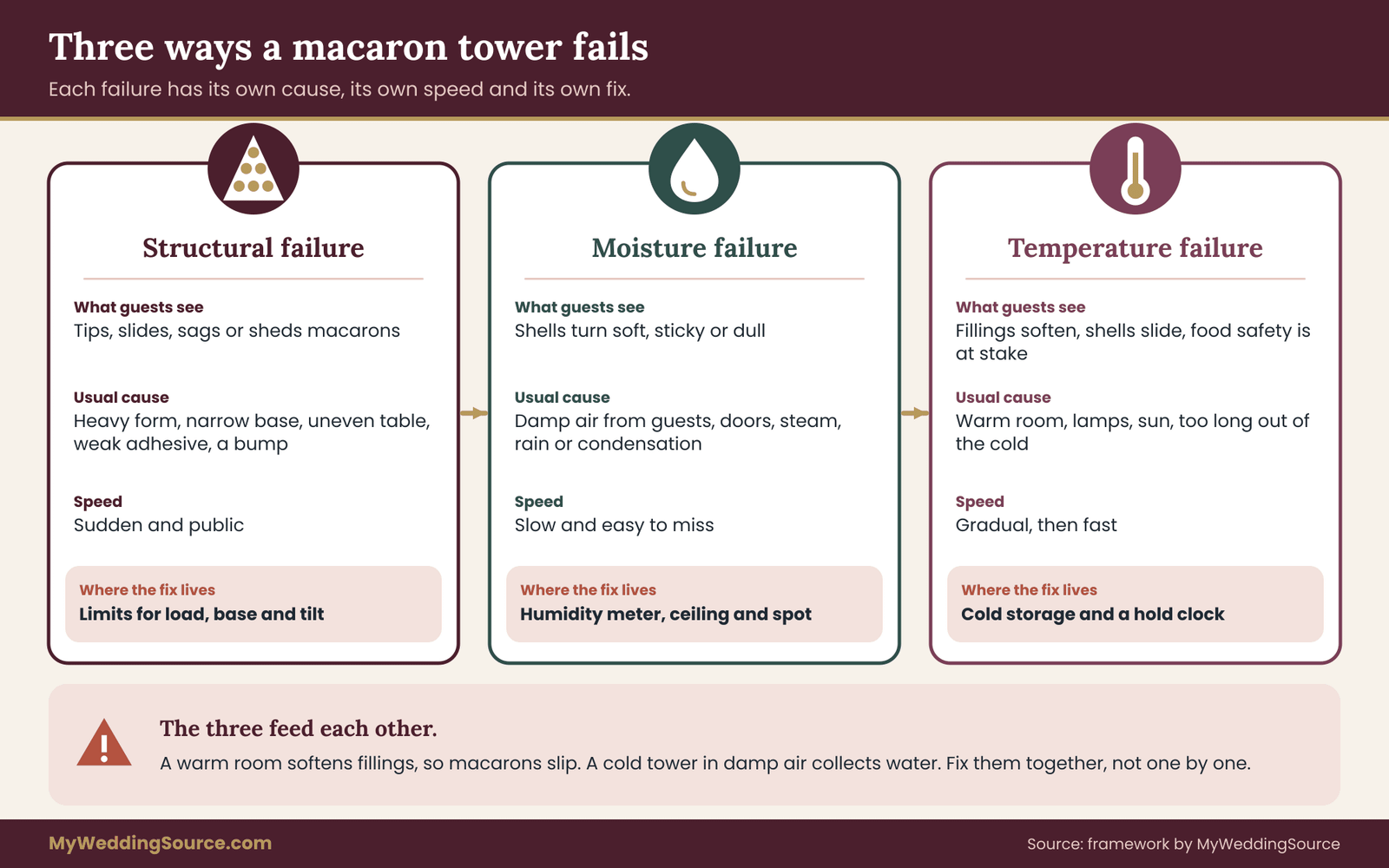
The three failures also feed each other. A warm room softens fillings, which makes macarons slip, which is a structural problem. A cold tower moved into a humid room collects condensation, which is a moisture problem created by a temperature fix. Treating them as three separate checklists is how couples end up solving one problem and creating another.
Why this deserves its own plan
A cake can sit in a cool back room until it is needed, and a sheet of cupcakes can go out in waves. A macaron tower is the opposite: its whole purpose is to be seen, which means it sits in the open for most of the reception. That is the reason the planning is different. You are deciding how much of your dessert supply to put on display, for how long, and in what conditions, then arranging a safe backup for the rest.
Cost is part of it too. Macarons are priced one at a time, a tower form is often rented or built and returned, and a tower that has to be partly replaced costs real money. The wedding budget page is a good place to put the macaron tower beside your other dessert lines, but only after you know the count. Counting comes later in this guide; first the structure.
The five limits every macaron tower needs
Every macaron tower plan should end up as a one-page sheet of limits. Not preferences, limits: a number or a clear rule for each of five things, agreed in writing, with a named person who checks each one on the day.
Limit one, load and footprint. How much the dressed form weighs, how wide its base is, and what surface it stands on. The baker or builder supplies the weight. You supply the table, the cloth and the position.
Limit two, tilt and bump. How far the tower may lean before it is moved or rebuilt, and how it is protected from guests, children, trays and chair backs. This is a rule about space around the macaron tower as much as about the tower.
Limit three, temperature. The room temperature at the display spot, and the temperature of the filled macarons themselves. The baker sets the comfort range for the recipe; the Food Code and your local health department set the rules for foods that need cold holding.
Limit four, humidity. The relative humidity at the display spot, measured with a small meter, plus a plan if the reading drifts. The baker sets the ceiling for the shells and fillings in the recipe.
Limit five, hold time. The maximum number of minutes the macaron tower, or any part of it, may stay out of cold storage before it is cleared, refreshed or replaced.
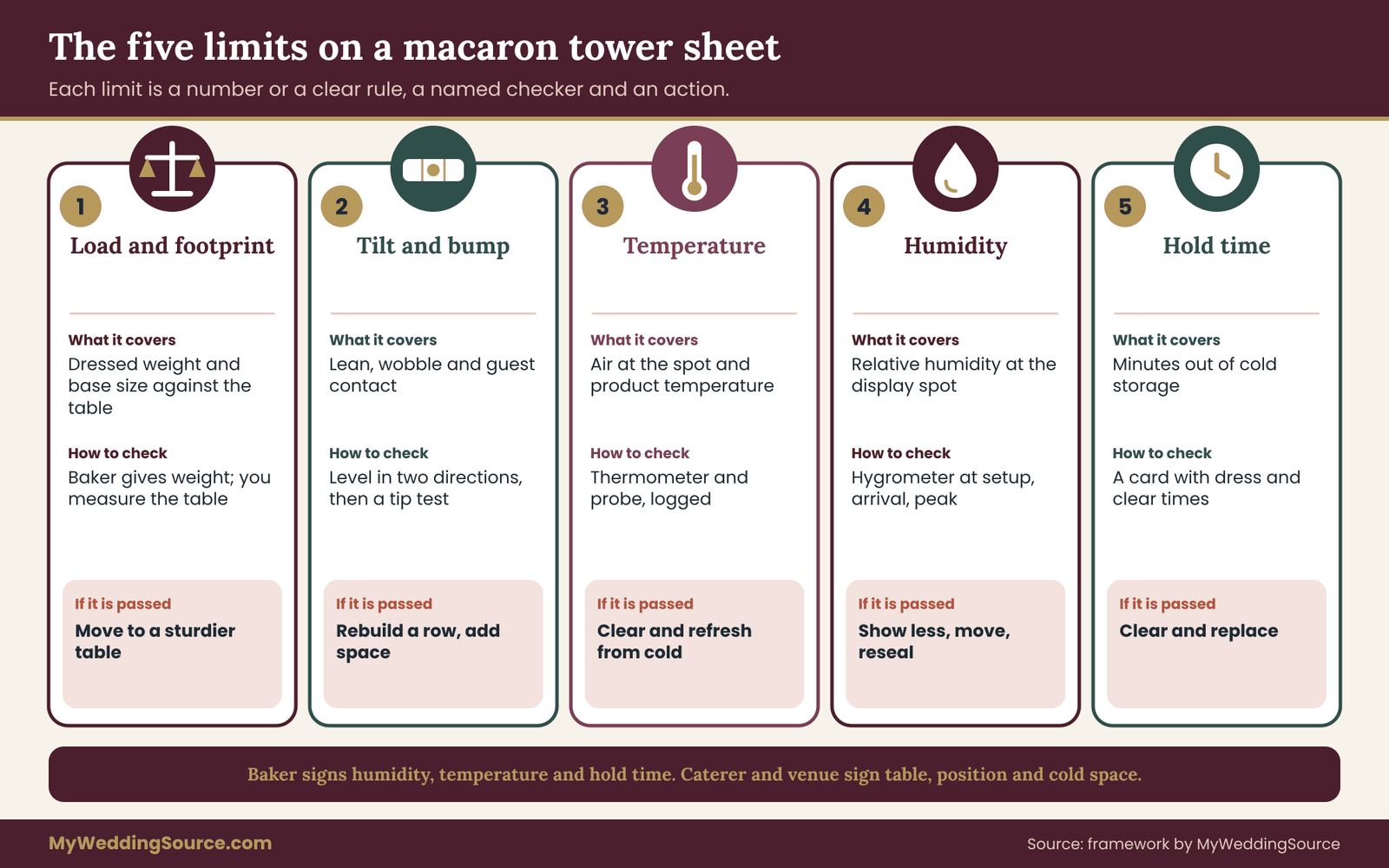
The point of the five limits is not to scare the vendor. It is to turn “it should be fine” into something two people can check with a ruler, a thermometer and a clock. A baker who has built towers in many rooms will usually answer all five without hesitation, because they already think this way. A baker who cannot name any of them is telling you something useful before you pay a deposit.
What goes on the sheet, and who signs it
Keep the sheet short. A good one fits on a single page and has four columns of information in plain sentences rather than a grid: the limit, the agreed value or rule, who checks it, and what happens when it is passed. For example, for hold time the sheet might say that the tower is dressed at a stated time, that the venue captain checks the clock, and that anything past the limit is cleared and replaced from the chilled reserve.
The baker should sign off on the humidity, temperature and hold-time lines, because those depend on the recipe. The caterer or venue should sign off on the table, the position, the power for any chilled display and the food-safety handling. You sign off on everything, because you are the person who will be asked about it afterward. Put the final sheet in the contract file; the wedding vendor contract guide explains how to attach an addendum like this to a signed agreement.
Two things the sheet cannot fix
First, it cannot make a macaron tower out of macarons that were never meant to travel. If a baker’s filling is soft, fresh and cream-based, a tall open tower may be the wrong format no matter what limits you write. Ask the baker which fillings suit display and which belong in the reserve trays.
Second, it cannot stand in for checking the room. Every limit above is measured at the display spot, not in the venue’s brochure and not in the baker’s kitchen. The measurements matter on the day of the wedding and, ideally, once before it, during a walkthrough, which the venue technical walkthrough guide explains from the venue’s side.
How to use the rest of this guide
The next section covers structure: the common ways to build a macaron tower and what each one asks of the table and the baker. After that come humidity and temperature, then the portion count, then the venue, the vendor questions, the food-safety points and a worked example with edge cases. If you only have an evening, read the structure section, the portion count and the vendor questions, and put the rest into the limits sheet.
How a macaron tower is built: five structures compared
There is no single correct way to build a macaron tower. There are five common structures, and each one trades appearance against stability, capacity and the amount of work done on site. Compare them in prose first, then pick the one that matches your room and your count.
The foam cone. A cone-shaped form, usually wrapped in food-safe film or paper, with macarons attached row by row. It gives the classic look and the highest count in the smallest footprint. It also asks the most of the adhesive and the builder, because every macaron is held by a dab of something sticky or by a pin. A cone is built on site or built earlier and moved, and each choice has a cost: building on site takes time in a space you do not control, and moving a finished cone risks shedding macarons on the way.
The tiered stand. Stacked plates or stands in graduated sizes, similar to a cake stand set, with macarons resting in rows or small stacks. Nothing is glued. Macarons rest on a surface, so a bump spills fewer of them, and refilling is easy. The count per tier is limited by plate size, and a tall set of stands has its own balance problem.
The acrylic or glass stair. A purpose-made display with shelves and risers. It is stable, easy to clean and reusable, and it suits a cooler room. It is also usually rented, so you pay for it and return it, and the look is more modern than the cone.
The hand-stacked pyramid. Macarons stacked directly on each other, held by filling or a light adhesive, with no form underneath. It can look lovely at a small scale. At a few dozen macarons it is a gamble, and past that it is rarely sensible: the bottom rows carry the whole weight of everything above.
The wall or board. A frame, pegboard or backing with macarons attached in a pattern. It is a good fit when the display is against a wall, and it spreads weight over a larger surface. It is also exposed to whatever air flows along that wall.
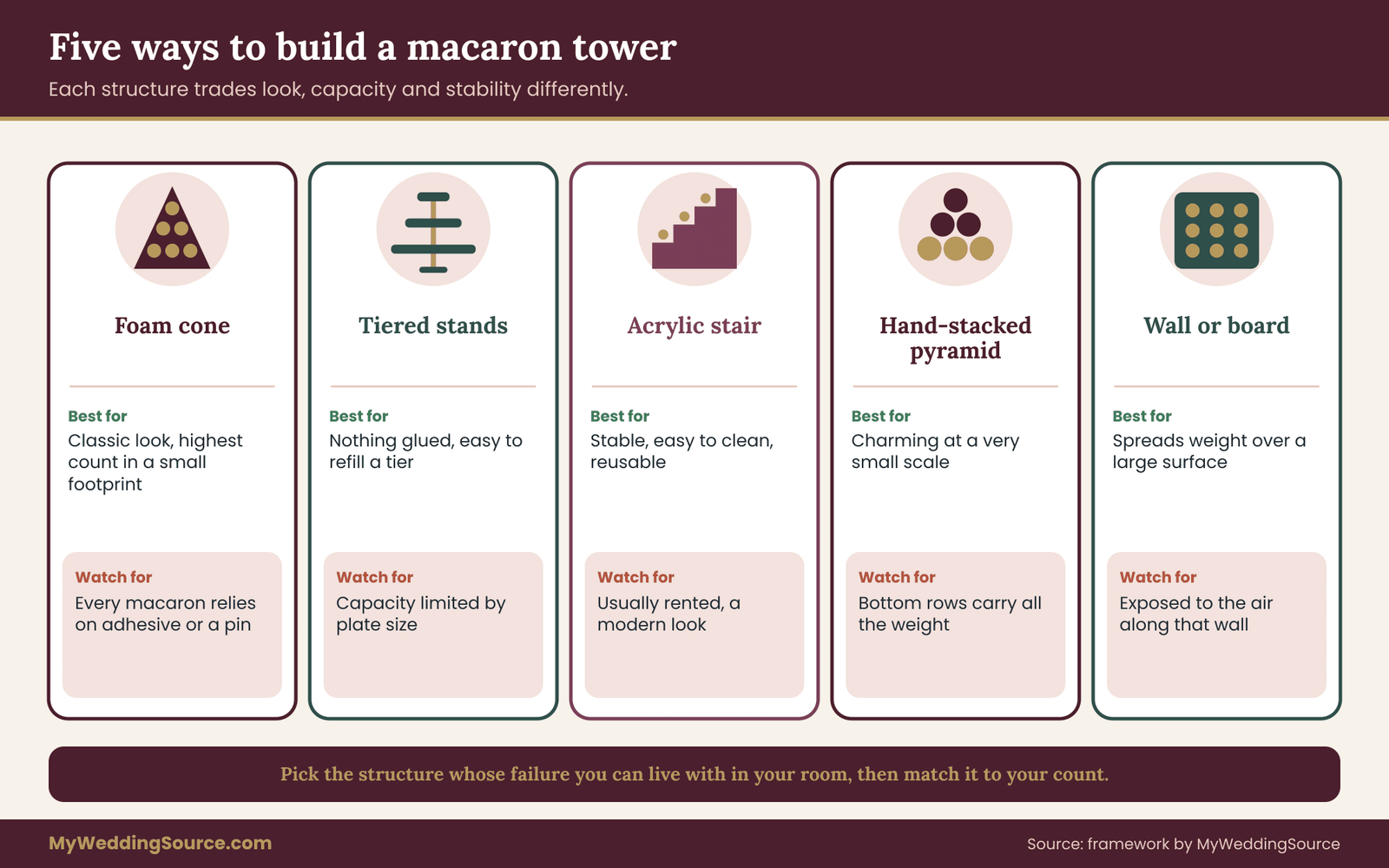
None of these is better in general. A tall foam cone suits a ballroom with steady air conditioning and a trained captain who watches it. A tiered stand suits a tent, where bumps and heat are more likely and the baker wants the ability to pull a tier and swap it. The macaron tower you want is the one whose failure modes you can live with.
Adhesives, pins and anything that touches the food
How a macaron is held on a form is a food question as well as a structural one. Bakers use small dabs of icing, melted chocolate, a firm filling, a food-safe adhesive or a pin. Each has a cost.
Icing or melted chocolate holds well in a cool room and lets go in a warm one. A pin or a toothpick holds well in either, but puts metal or wood close to food that guests will pick up and eat, sometimes children. Ask plainly whether any pin, toothpick or wire is used, and ask how the builder counts them going in and coming out, so none ends up in a pastry or a trash bag that guests could reach.
The foam itself should never touch a macaron directly. A food-safe wrap, a paper layer or a sheet between the form and the shells is the usual answer. Ask what the barrier is made of and whether the baker uses it on every tower. This is an easy question to ask and a revealing one.
Load, footprint and the table underneath
A macaron tower is lighter than a cake, but not light. Ask the baker to weigh a finished macaron and give you the dressed tower weight, form included. The number matters less than the comparison it allows: you now know whether the table you are using was built for it.
Illustrative arithmetic helps. If a finished macaron weighs about twenty grams, which is an assumption you should replace with the baker’s own figure, then a hundred and thirty-five macarons weigh about two and a half kilograms, close to six pounds, before the form and the base. That is nothing for a sturdy banquet table and a lot for a folding card table with a loose cloth.
Footprint is the second half. A tall narrow form on a small base is the classic setup for a tip. A broad base lowers the center of gravity. Ask for the base dimensions in writing, then measure the space on the table where it will stand and check that guests can reach the macarons without leaning on the table’s edge. A tower in the middle of a three-foot table, with no room to set a plate down, is a tower people lean over.
Level, wobble and vibration
A table that looks level may not be. Floors in historic venues, tents on grass and portable dance floors are all candidates for a small slope. A tiny digital level, a few dollars at a hardware store, costs less than a single macaron and tells you the truth. Check in two directions, side to side and front to back, and if the table is off, fix the legs or shim the feet before anything is placed on it.
Wobble is the second check. Press gently on a table corner and watch the form. If it sways more than you would like, move the tower to a steadier table, add a heavier base, or choose a different structure. This is the “tip test”: a hand on the table, not a hand on the macaron tower, done before the macarons go on.
Vibration is the third. Bass from speakers, rolling carts and a busy dance floor can all shake a lightweight table. Place the tower away from a speaker stack and away from the route that servers use with loaded carts, and check the position against the floor plan in the reception guest flow guide so the macaron tower stays out of the busiest paths.
Protecting the macaron tower from guests
Guests do not mean to damage a tower. They lean to see it, they take a macaron from the middle row without noticing the one above, and they set a drink down beside it. Children are drawn to it by the colors. A few simple moves reduce the risk without making the display look like a museum case.
Stand the tower with space on every side, not tucked into a corner where people crowd. Keep drinks off the table by providing a small side shelf or tray near it. Give the display a clear role: either guests help themselves from a defined section, or a server hands them out, but not both at once. A tower that serves itself is serving the people who reach it first; the top rows are safest when only staff reach them.
Many couples also place a small sign near the macaron tower. A card that says the macarons are available at certain times, or that staff will refill the tower, quiets a lot of anxiety and keeps early eaters from stripping the front.
When structure and count disagree
You may find that the structure you love holds fewer macarons than you need. That is normal. A cone of a certain height holds a certain count, and no amount of wishing adds more rows without adding weight, height or a wider base. The answer is not to stretch the form beyond its design. The answer is to split the supply: a part on the macaron tower, a part in reserve trays, with a refill plan. The counting section later in this guide turns that into numbers.
It is also fair to choose a different structure for the same count. A pair of smaller towers can be safer than one tall tower, and two towers can stand in two places, which spreads the guests along two paths instead of one. If you go that way, give each its own limits sheet, because each lives in a slightly different spot in the room.
A short test before you commit to a structure
Ask the baker or builder these five questions, in this order, and listen to how fast and how specifically they answer.
First, what is the dressed weight and base size? Second, how are macarons held on, and does any metal or wood touch food? Third, how has this structure behaved in rooms like mine? Fourth, how many macarons does it hold, and what is the plan for the rest? Fifth, what is your rule when the tower leans or sheds?
A confident, concrete answer to all five means you can move on to humidity and temperature. A vague answer to any of them means you should ask for a sample build, a photo of a recent build in a comparable venue, or a different vendor. Doing that at the quote stage costs nothing; doing it at the venue costs a tower.
Humidity and the macaron tower: what damp air does to shells
Humidity is the quiet variable in macaron tower planning. You can see a tilt and feel a warm room, but you cannot see moisture in the air until a shell has already changed. It helps to understand the basic mechanism, because it explains every practical rule that follows.
A macaron shell is a thin, dry crust over a soft interior, made mostly of sugar, egg white and ground almonds. Sugar and almond flour both take up water from the surrounding air. In a humid room the surface of the shell can lose its crispness, turn tacky and sometimes look dull. In a very dry room, the opposite can happen over a long stretch: the shell dries and the contrast between crisp surface and soft center fades.
Bakers talk about this as the shell “settling” or “maturing” in the filling, and they plan it into their schedule; the point for a couple is that the baker already works with moisture, so the right question is how the baker’s recipe behaves in your room.
Fillings matter just as much. A moist filling gives water to the shell, and a dry shell takes it. That is why filled macarons are usually kept in a sealed container in cold storage before service. It is also why a macaron that sat out on a humid afternoon can taste different from one that came straight from the refrigerator. Neither is a failure; it is simply a different point on the same slope.
Where moisture comes from at a wedding
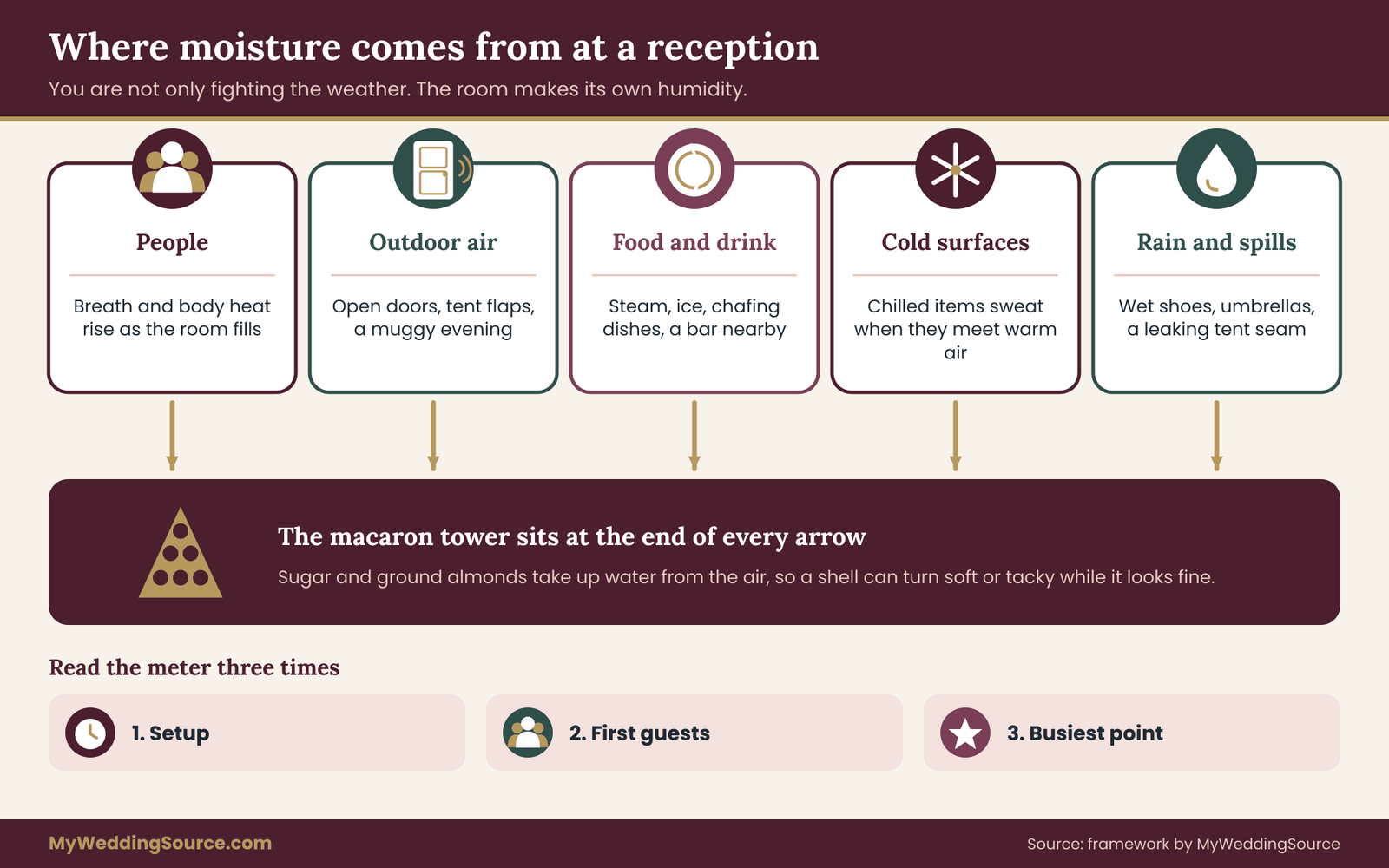
You are not only fighting the weather. A wedding venue produces moisture in several ways, and most of them are predictable.
People. Guests breathe out water vapor and give off heat. A room that feels comfortable when empty can feel different with a full reception in it. This is why a measurement taken during setup is not the same as a measurement taken at the dance.
Outdoor air. Doors held open for a photo, a cocktail hour that spills outside, a tent with flaps up: each one lets the weather in. On a muggy day, that is the biggest source. A coastal venue and an inland venue in the same month can behave very differently.
Food and drink nearby. Hot buffet equipment, steam from a kitchen pass, an ice display, a fountain or a bar with melting ice all add moisture or heat close to the display.
Cold surfaces. When a chilled item comes into warmer air, water condenses on it. A tower pulled straight out of cold storage in a humid room can collect visible droplets on the shells. That is the one case where a cold fix creates a damp problem.
Rain and spills. Rain tracked in on shoes, wet umbrellas stacked near the display, a leak at a tent seam: small things, but close to a display they matter.
Measuring humidity at the display spot
The only way to know what the macarons will experience is to measure the air where the tower will stand. A small digital thermo-hygrometer is inexpensive, shows temperature and relative humidity together, and sits in a bag. Put it where the macaron tower will be, at the height of the macarons rather than on the floor, away from the vent and away from a lamp. Let it settle for a few minutes before reading it.
Two meters are better than one. If two small meters read very differently, trust neither until you know why, and check them side by side in the same place. The National Institute of Standards and Technology publishes general information on measurement and calibration, which is a reasonable place to understand why consumer meters are roughly right but not laboratory-grade; for a display table, rough is fine as long as the same meters are used throughout the day and the trend is what you watch.
Take three readings: at setup, when the first guests arrive and again at the busiest point. Write them on the limits sheet with the time. A reading that rises steadily is a signal even if no single number is alarming. This simple log is a measurable check, which is what the format of this guide asks for, and it also protects you: if a shell softens, you will know whether the room changed or the recipe did.
Setting a humidity limit
Your baker is the right person to set the ceiling. The number depends on the shell recipe, the fillings, how the macarons are packed and how long they must hold. Do not accept a general number from a website, including this one. Ask the baker for the highest relative humidity at which the tower can stand for the planned display time, and ask what they would do if the reading is above it.
Then write the answer as a rule, not a hope. For example, the sheet could say that if the display-spot reading goes past the baker’s ceiling, staff reduce the displayed portion, move the macaron tower to the cooler end of the room and keep the rest in sealed reserve trays. The rule does not need to be dramatic. It needs to exist.
What to do when the room runs humid
A few practical moves help, and most cost nothing.
Move the tower. A spot away from the entrance, the bar and the kitchen pass is nearly always drier. Moving it ten feet can matter more than any gadget.
Reduce the display. If the room is humid, put only part of the supply on the macaron tower and keep the rest sealed. The display looks smaller but still reads as a tower, and the remaining macarons do not meet the damp air until they are needed. Shells that spend less time exposed stay crisp longer.
Cut the exposure time. Dress the tower as late as the schedule allows, within the structure’s limits, and plan to clear or refresh it on a clock. A tower that stands for ninety minutes in a humid room is in much better shape than one that stands for four hours.
Ask about airflow. A small, steady flow of dry air from an air handler is a friend. A fan blowing across the display dries the surface but may also dry out the macarons unevenly and, in a tent, may blow in more damp air. Ask the venue what the HVAC does when the room fills; many systems do not keep up with a crowd.
Avoid an enclosed case unless the baker asks for one. A glass dome keeps guests off the macarons and traps the surrounding air; if the macarons start out cool and the room is warm, the dome can fog. A baker who recommends a cover will tell you how to use it.
Humidity and the transport leg
Humidity does not begin at the venue. The macaron tower, or the macarons for it, travel from the baker’s kitchen in a car or van. A cold box, once opened in a humid vehicle or loading area, begins to sweat. Ask how the baker packs: sealed containers, layers of paper, a cold pack that does not touch the shells. Ask how long the macarons will be in the vehicle, whether the vehicle has working air conditioning, and who opens the containers first.
If the venue has a loading dock or freight elevator, the route through it adds time. It is worth asking whether your delivery slot allows the baker enough time to get from the vehicle to a cool room without waiting in an outdoor corridor.
Condensation: the cold-to-warm problem
Condensation deserves its own paragraph because it is the one place where the safest food-handling choice and the best display choice pull in opposite directions. Food safety favors keeping filled macarons cold. Moisture control favors letting them rise slowly toward room temperature in a sealed container, so that water does not condense on them.
The practical resolution is staging. Keep the macarons in a sealed container in cold storage until close to the display time, move the sealed container to a cool, dry spot for a short, defined period, and then dress the tower. The baker will know how long that period should be for their recipe; the caterer will know whether the filling can be out of the cold at all. This is a conversation among three parties, and the limits sheet is where the outcome belongs.
A humidity rule you can write on the sheet
If you want a single sentence to start from, use a version of this: “The macaron tower stands only while the display-spot humidity stays at or below the ceiling the baker gave us in writing; if it passes the ceiling, the displayed portion is reduced to the reserve plan and the clock for the remaining time restarts at zero.” The wording is yours to change. The structure, a limit, a measurement, an action and a clock, is the part worth keeping.
Temperature and hold time for a filled macaron tower
Temperature is the limit that carries a food-safety rule, so it deserves the most careful wording on the sheet. Two numbers matter: the temperature of the air at the display spot, and the temperature of the macarons themselves. They are not the same, and neither tells you how long the display has been going.
Start with the filling, because it decides almost everything. Macaron fillings range widely: buttercream, ganache, jam, curd, cream cheese and whipped cream, sometimes with fresh fruit. Some of these are shelf-stable for a short display. Others are foods that the Food Code calls time and temperature control for safety foods, which are held cold, at or below the temperature the code sets, unless a written procedure allows a limited time out.
The U.S. Food and Drug Administration publishes the Food Code, and the actual rules in your area come from the local health department, which may adopt a different edition or add its own requirements.
You do not have to decide which category your filling falls in. Ask the baker for the filling list and ask the caterer and the baker, separately, whether they treat each filling as needing cold holding. Write down the answers. If the two disagree, ask the health department which view applies, because the venue or caterer may be responsible for the food service license on the day.
The three temperatures to track
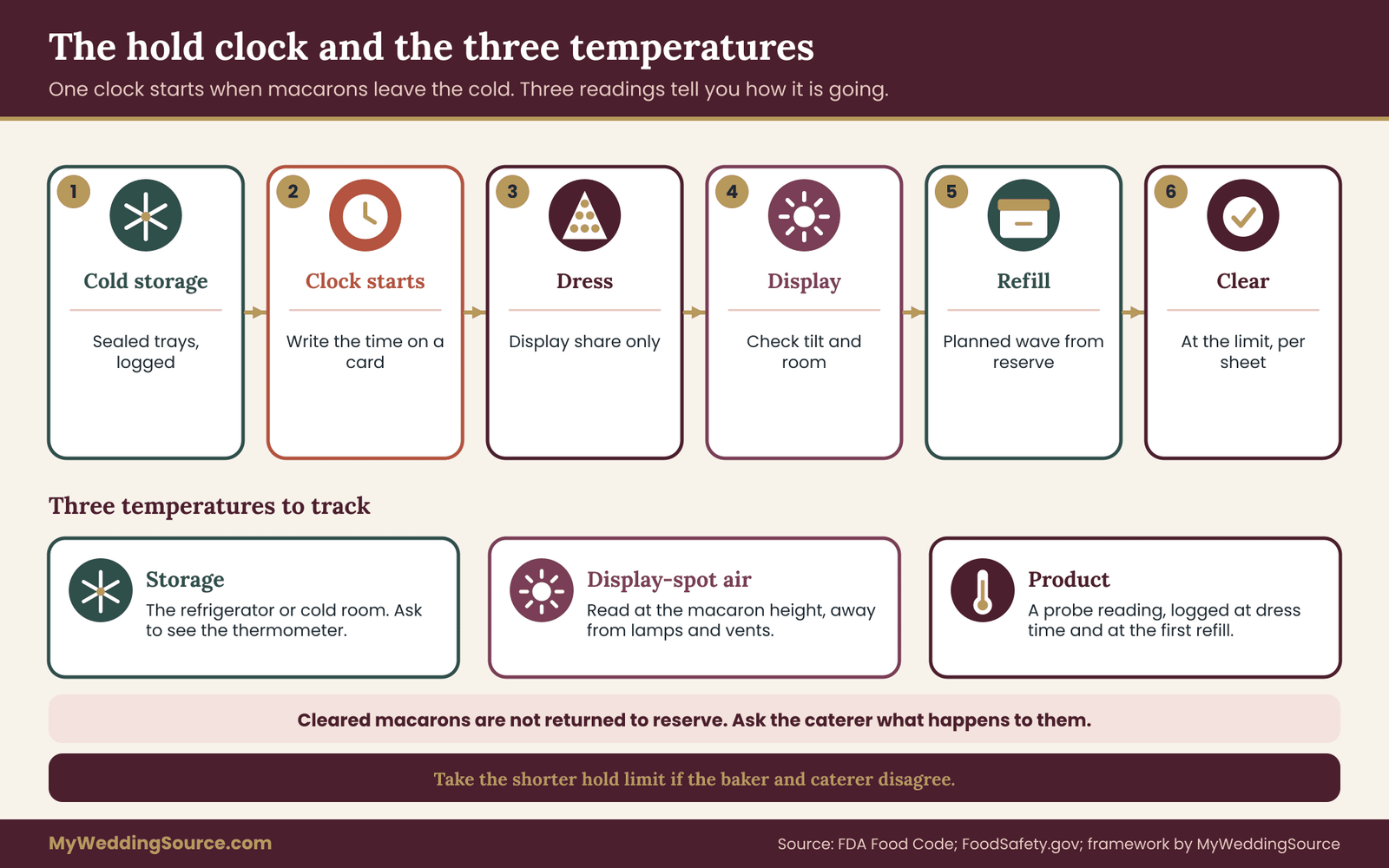
Storage temperature. Where the macarons live before they go on display: the baker’s refrigerator, the caterer’s cold room, a reach-in cooler. Ask whether it has a thermometer you can see. A cold room that has been opened constantly all day may not be as cold as its dial says.
Display-spot air temperature. What the thermometer at the tower reads. It depends on air conditioning, lights, sun, a crowd and the distance from heat sources such as kitchens, candles and heaters.
Product temperature. The macarons themselves, measured with a clean probe thermometer or an infrared thermometer, depending on the baker’s practice. Product temperature lags behind air temperature: a macaron takes time to warm and time to cool. That lag is your friend, because it gives the macaron tower some tolerance, and your enemy, because a macaron that feels cool to touch may have been out for a while.
A caterer’s staff will know how to take these readings. If the caterer or baker uses a probe, ask them to log the product temperature at dress time and at one other point during the event, and ask for the log afterward. A short written log is not a burden; for a professional it is a normal practice.
Hold time: the clock that matters most
The cleanest way to turn a vague worry about “how long can it sit out?” into a rule is a hold clock. It starts when the macarons leave cold storage and stops when they go back or are cleared. The baker and the caterer agree on a maximum, and the venue captain enforces it.
Several decisions follow from that single clock.
What goes out first. A tower dressed with macarons that have just left the cold starts its clock on the display table. A tower dressed from containers that have already sat in a warm hallway has used part of its time before it reaches the room. Count from the moment the macarons left cold storage, not from the moment the tower was finished.
Who owns the clock. Name a person. A clock owned by no one is a clock that nobody notices passing. The caterer’s captain or the baker’s assistant can write the dress time on a card next to the macaron tower, out of guests’ sight, with the planned clear time.
What happens at the limit. The sheet should say whether the tower is cleared, refreshed from reserve or kept for a shorter display of the remainder. Agree on the action in advance, because a captain who has to ask the couple whether to remove the centerpiece will hesitate, and hesitation is time on the clock.
What happens to what was cleared. Macarons that have been on display past the limit are, as a rule, not put back into the reserve trays to be served again. The safest assumption is that anything cleared from the display is discarded or becomes staff food only if the caterer’s written procedure allows it. Ask the caterer in advance; do not improvise at 10 p.m. Local rules differ, and so do company policies.
Choosing a hold-time limit with the baker and caterer
Do not use a number from this article, and do not accept a number from a forum. The correct figure depends on the filling, the starting temperature, the room, and what the local health authority and the caterer’s own procedures allow. Ask for it in writing, from the two people responsible, and compare the answers.
If both give the same figure, use it. If they differ, take the shorter one until the difference is explained. If neither will commit to a figure, treat that as a red flag about the format. A vendor who sells macaron towers for weddings should be able to say how long one stands.
The U.S. government’s FoodSafety.gov site explains the general rule of keeping cold food cold and limiting time out of refrigeration, and the Centers for Disease Control and Prevention publishes food safety basics. Use these to understand the principle, then use the vendors’ written procedures and your local rules to set the actual number.
The macaron tower as a temperature trap
A tower has a quirk that a plate of macarons does not. Its shape exposes more macarons to the air at once, and the ones on the outside of the cone are the ones facing the room. Lights, sun and air from a vent all hit the outer surface first. Warmth moves from the room into the display from every direction.
That is the reason display position and heat sources deserve a walk-through before the event. Ask yourself, standing at the spot, what is overhead (a spotlight, a pendant light, a heater), what is beside it (a candle, a hot box, a chafing dish, a window with sun), and what is behind it (a wall with a radiator, a kitchen door that opens). Then move the tower or the heat source.
Direct sunlight deserves its own warning. A window that is dim at noon can be bright at five, and a patio tent can funnel light and heat onto one table. Check the position at the hour the macaron tower will stand there, not at the hour you visited. This is where a visit at the matching time of day, a few weeks before the event, repays the trouble.
Rooms that run warm, rooms that run cold
Not every problem is heat. A venue with very strong air conditioning can chill a display, which sounds harmless until you remember condensation: a tower in a cold room that is then brought into a warm, humid space for photos can fog. A room that is cold at setup and warm by 9 p.m. is more of a challenge than a room that is steadily pleasant.
Ask the venue how the air handling is controlled and whether the temperature drifts when the room fills. Ask whether a staff member can adjust it during the event, and who, since a request through a front-desk phone is slower than a conversation with the building engineer. The venue technical walkthrough guide covers what to look at during a site visit; add the air handling and the display spot to your list.
Chilled displays and power
Some couples ask whether a refrigerated display case would solve the whole problem. It can, for some setups. A chilled case keeps filled macarons cold while still visible, and it reduces the need for reserve trays. It also brings power, a cord path, a heavier object, another rental and a different look.
A refrigerated case needs its own circuit or at least a safe, tested outlet, which is a question for the venue, not for the baker. If you go this way, ask for the electrical requirement in amps and a plan for a power cut.
A chilled case also changes the character of the display. A glass case is not a tower. Some couples use a small chilled case for the filled macarons and a decorative tower of unfilled or display-only shells, which solves temperature and keeps the look, though it raises its own questions about labelling. Display-only shells must be clearly separate from food to be eaten, and guests need to know which is which.
Writing the temperature lines
The temperature part of the limits sheet needs four short lines: the storage requirement, the display-spot range the baker accepts, the hold-time maximum with who owns the clock, and the action at the limit.
Add a fifth line for what happens if the air conditioning fails: for example, the tower is cleared, a reduced display is offered from cold storage in small batches and guests are told that macarons are available from staff on request. A fallback you can say in a sentence is a fallback people will carry out under pressure.
Counting macarons per guest for a macaron tower
Portion planning is where most macaron tower budgets go wrong, in both directions. Couples who count one per guest run short and watch the top rows vanish in ten minutes. Couples who count five per guest pay for a pile of macarons that nobody eats. The fix is a formula that starts with the role the macarons play, not with a number someone repeated online.
There is no official portion standard for macarons at weddings, so every figure in this section is a planning choice, not a statistic. Treat the per-guest numbers as starting points to test against your own guests and your baker’s advice.
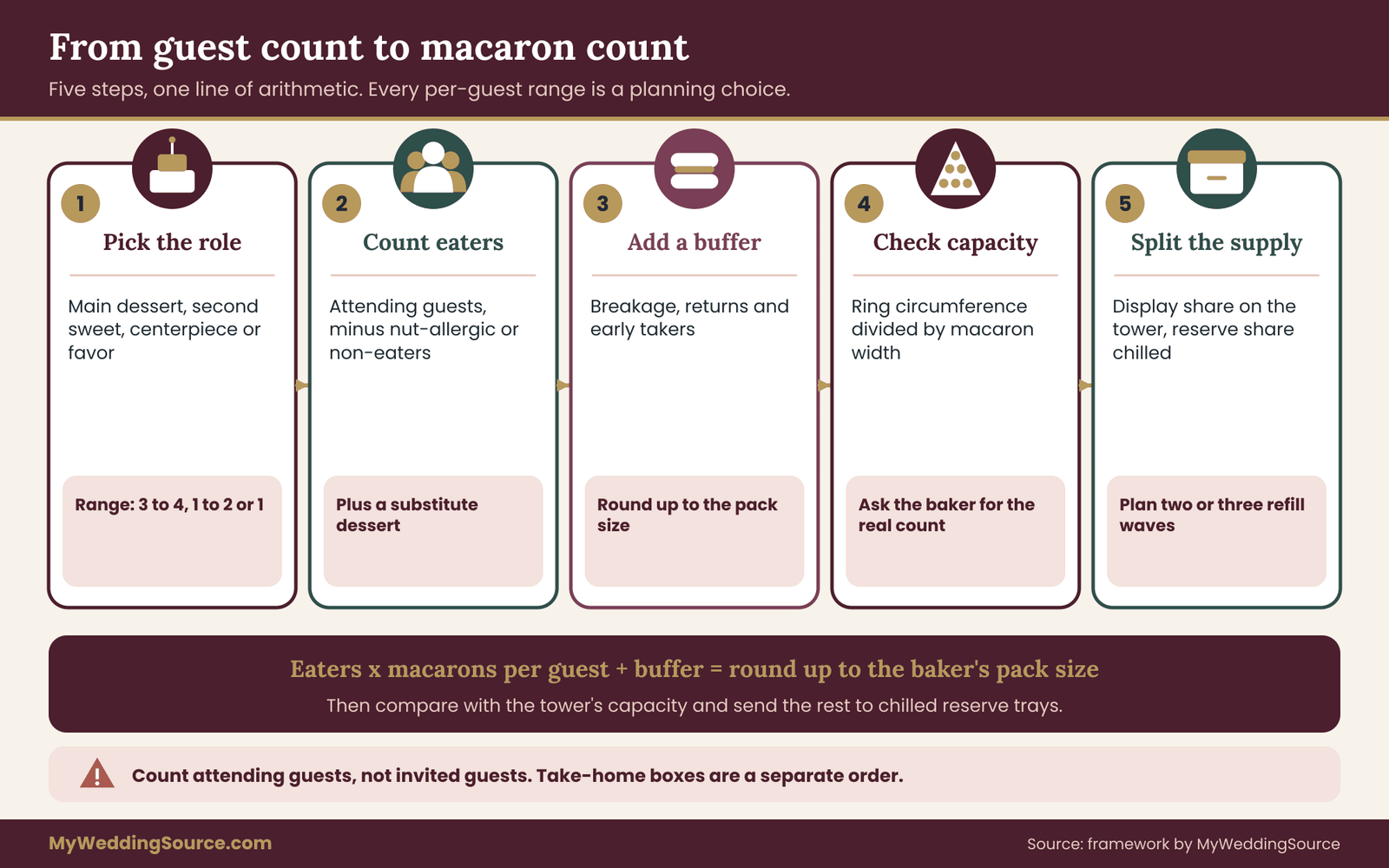
Step one: decide the role of the macarons
The same tower can mean very different things to a count, so pick one role first.
The main dessert. Macarons replace cake. Each guest expects to finish a dessert, and most will take several. A count of three or four per guest is a reasonable range to discuss with the baker.
A second sweet beside cake. Cake is served, and macarons are an extra for those who want one. Guests usually take one or two. A count of one to two per guest is a sensible range to start from.
A visual centerpiece with a small tasting. Most of the display is for looks, and guests are expected to take a single macaron as a taste. One per guest, plus a margin, covers it.
A take-home favor. Macarons go into boxes at the end of the night. This is a separate count, and it should not be taken from the tower. Boxes need their own purchase and their own storage.
Write the role on the sheet. The role is what the baker’s quote, the caterer’s service plan and your expectations all rest on. If the baker has a different role in mind, you will find out now.
Step two: count the guests who will actually eat
Start from the confirmed attending count, not the invited count. Then adjust in three ways.
Subtract people who cannot or will not eat macarons. Guests with a tree nut allergy cannot eat a macaron, because the shells are made with ground almonds in most recipes; some bakers use other nut flours or seed flours, and each has its own allergen. A guest who avoids sweets, a guest who is fasting or a guest who has left before dessert does not need a full share. Do not subtract these guests from the head count for the cake, but do remove them from the macaron count.
Add the people who are not guests. Vendors, the photographer and the band may be offered something, and staff meals are often on a different budget. Decide whether they are included and write it down.
Decide how to count children. Young children may take one macaron, drop half of it and ask for another. A common approach is to count a child at the same number as an adult for the macarons and accept the extra, since children are often the most enthusiastic. If your own children’s table is large, discuss it with the baker.
Step three: add a buffer, and size it by the structure
A buffer covers breakage, bumped macarons, early takers who return, and the slow loss that happens to any display. It is not a license to buy far more than you need.
A moderate buffer is a sensible starting point for a macaron tower that is on display for a limited time with staff nearby. A larger buffer is needed when the structure is tall, the room is crowded or the display is self-serve. Ask the baker what they add to their own orders; they have seen real losses and will have a view.
Rounding follows the baker’s pack size. Macarons are usually sold by the dozen or in standard boxes, so the final count rounds up to the next multiple. Ask for the box size when you get the quote, and base the rounding on it.
The formula in one line
Put it together as a short line you can compute with a pencil: guests eating, multiplied by macarons per guest, plus the buffer, rounded up to the baker’s pack size. Then compare the answer with what the macaron tower can hold.
Step four: compare the count with the tower’s capacity
A tower holds only so many macarons. The structure sets the number, and the number rarely matches the order.
You can estimate the capacity of a cone with plain geometry. Each ring of macarons around the cone has a circumference, and that circumference divided by the width of one macaron, plus a small gap, gives the number in the ring. Rings get smaller toward the top.
For an illustrative example, imagine macarons about one and a half inches wide with a tenth of an inch of gap, so each takes about one and six-tenths inches of ring. A ring with a diameter of twelve inches measured through the centers of the macarons has a circumference of about thirty-eight inches and holds about twenty-three. A ring ten inches across holds nineteen, one of eight inches holds fifteen, and one of five inches holds nine.
Add up nine rings that shrink by an inch each time, from twelve inches down to four, and you get about a hundred and thirty-five macarons. That is an illustration, not a specification: your baker’s form and macaron size will differ, and the baker should give you the real count.
The geometry is useful for one reason. It shows that a tower’s capacity grows with the square of its size, roughly, while the amount of macarons you need grows with your guest count. A cone for a hundred and thirty-five guests is a modest cone. A cone for four hundred macarons is a much larger structure than one for two hundred, and it is also much heavier at the top and wider at the base. Past a certain size, a second tower or a reserve is the better answer.
Step five: split the supply into display and reserve
This is the central idea of the whole guide, and it is simple: not every macaron needs to be on the macaron tower. The tower holds the display share, a portion that makes a good picture and a reasonable first round of serving. The rest, the reserve share, waits in sealed, chilled trays and goes out in refill waves.
A display and reserve split solves several problems at once. The macaron tower stays within its capacity and its weight limit. Fewer macarons are exposed to the room at any given moment, which helps humidity and hold time. A refill replaces macarons that have been out longest. And a tower that looks full when guests come to it is a tower that looks generous even though much of the supply is still in the kitchen.
Waves need a plan. The sheet should say when the first refill goes out, how many macarons it contains, who carries it, and what happens to the display it replaces. A small number of larger waves is easier to run than many small ones, but a very large wave means a large number of macarons exposed at once. For a typical reception, two or three waves are a workable range to discuss with the caterer.
Handling allergens inside the count
Guests who cannot eat macarons need an equivalent sweet, not a smaller one. If six guests avoid tree nuts, six guests need a dessert that is safe for them, prepared and served in a way that prevents contact with the macarons. That item belongs in the dessert plan, not the tower plan, but it affects the count: you removed those guests from the macaron count, and you added them to the substitute count.
Eggs, milk, wheat, soy, peanuts and sesame also appear in some macaron recipes or fillings. The FDA lists the major food allergens, and a baker should be able to say which apply to each flavor. If your guest list includes serious allergies, the wedding menu planning guide covers how to gather dietary needs and pass them to the caterer. A later section of this guide returns to labels and cross-contact on the display.
Common counting mistakes
A few errors come up often enough to name.
Counting invited guests instead of attending guests. A fall in attendance between invitations and the wedding can be large, and an order based on the invited number is an overorder.
Counting cake guests and macaron guests as the same people. Some guests will take both, some neither.
Forgetting the take-home boxes. If you promised boxes, they are not part of the macaron tower count.
Ignoring the pack size. A count of two hundred and seventy macarons is not an order; two hundred and seventy-six, which is twenty-three dozen, is.
Using the display count as the order. A tower that holds a hundred and thirty-five macarons does not mean the order is a hundred and thirty-five.
Choosing the spot for a macaron tower in the room
Where the tower stands changes every limit at once. The same tower on two different tables in the same room can face different air, different light, different crowds and a different risk of being knocked. Choosing the spot is the cheapest way to improve all five limits together.
Use a short test of five questions at each candidate spot.
What is above it? Spotlights, pendant lamps and heaters add heat to the display from overhead, and the heat falls on the top rows first. If the venue lights are on dimmers, ask what they will be set to during dessert.
What is beside it? Candles, buffet heaters, windows and doors are the ordinary culprits. A table beside a door that opens to the patio sees every gust of outdoor air.
What is behind it? A kitchen wall that carries heat, a radiator, a bar with ice and spills, or an exterior wall with sun can all change the air near the display.
What is the traffic? A tower near the dance floor sees bass and bumping. A tower beside the main aisle sees people brushing past. A tower near the bar sees people carrying drinks.
What is the floor and the table? Level, firm, big enough, with room for a server to work at the back.
Pick the spot that does best on all five, not the one that photographs best. Then check that it still photographs well; usually it does, because a cool, quiet corner has better light than a noisy one.
Time of day and the sun
A spot that works in daylight at the walkthrough may not work at the hour of the wedding. West-facing windows deliver strong, hot light in the late afternoon. A tent, even a white one, can heat quickly. If the reception runs into evening, the temperature drop or the opening of doors for fresh air can change things again.
Visit at the matching hour if you can, or ask the venue what the room does at that time of day and in that month. A planner or a venue captain often knows from earlier events. If you do not have a planner, the reception guest flow guide on this site helps you picture where people will be at each stage, which tells you when the macaron tower will be busiest.
The macaron tower and the rest of the dessert area
The tower rarely stands alone. It may sit beside a cake, a coffee station or a candy display, and each neighbor changes the conditions. A cake table with a cutting crew brings traffic and a bright, hot work light. A coffee station brings steam and spills. A candy display brings guests who linger.
Keep the macaron tower upwind of the heat sources and away from steam. Give the dessert area a clear flow: guests arrive at one end, take what they want and leave at the other, without doubling back through the macaron tower’s space. Place the sign about refills or serving times where people will see it before they reach for the display.
If the tower stands beside the cake, check that a cake cutting does not block the macaron tower’s service access. That is a small detail that often surprises couples. It is easy to solve on a floor plan and hard to solve at 9 p.m.
Questions to ask about a macaron tower before you sign
The best protection is a short, specific set of questions asked before you pay a deposit. Group them by who answers. Asking the same question of two parties is useful when one party’s answer depends on the other’s.
Questions for the baker
Ask the baker for the dressed weight of the tower and the base dimensions, how many macarons it holds, and how they are attached. Ask which fillings are used and which of those are suitable for open display, and which should stay in reserve. Ask for the highest humidity and warmest room the macaron tower can handle, and what they do when the room exceeds either. Ask how long a tower can stand and what happens afterward.
Ask who builds and dresses the tower on site, and how long that takes. Ask what happens if a macaron falls or a tier shifts, and whether the baker will stay, send an assistant or leave after delivery. Ask for photos of recent towers in comparable rooms and, if you can, an introduction to a past client who held a similar event in a similar season. Past clients can tell you what the vendor does when something goes wrong, which the portfolio will not.
Ask about the container, packing and transport: how the macarons travel, for how long and at what temperature, and whether the van has air conditioning. Ask about backup: what if the baker is ill, or the order is damaged in transit.
Questions for the caterer or venue
Ask who is responsible for the macaron tower once it is on the table. Ask whether staff will monitor it, what the clock rules are, and whether the caterer will accept the baker’s hold limit or apply a different one. Ask for a place in cold storage for the reserve trays, and ask how much space and which shelf. A reserve share needs a refrigerator, and a refrigerator at a venue is shared.
Ask about the table, the cloth and the position, and whether there is a level, firm surface. Ask whether the air conditioning is steady, whether a person can adjust it, and what the room does when full. Ask how the space handles a power failure, and whether a refrigerated case could be used if needed.
The wedding vendor due diligence checklist covers how to check a vendor’s license, insurance and references, and it fits naturally with the baker and caterer questions above. It is worth confirming that the baker has a food license that covers the product and the setting. In many places, a baker working from a home kitchen operates under specific rules, and a baker working under a different category may be allowed to deliver but not to display for hours. Ask for the license and the name of the agency that issued it.
Questions for yourselves
Ask what role the macarons play, and whether the count you are paying for matches it. Ask which guests cannot eat them. Ask what you would do if the tower is not usable on the day: serve from reserve, or from a plate, or skip it. Ask who has the authority to clear the macaron tower, and make sure that person knows. The couple should not be that person on the wedding day.
Reading the answers
A good set of answers is concrete, brief and a little cautious. “It depends on the room, but here is what we do” is a better start than “it will be fine.” A vendor who offers to visit the venue, to meet the captain or to put numbers in the contract is investing in a good result. A vendor who dismisses the questions or gets defensive has given you information about how the day may go.
Allergens, labels and service rules at the macaron tower
A macaron tower is an unusually open display. Guests pick macarons by hand or from a stand, and they may handle several before choosing. That makes allergen labelling and cross-contact more important, not less.
The FDA names nine major food allergens: milk, eggs, fish, shellfish, tree nuts, peanuts, wheat, soy and sesame. Most macaron recipes contain at least three of them. Almond flour is a tree nut. Egg whites are eggs. Many fillings add milk, and some add wheat or soy through other ingredients. A baker who is careful will give a written list for every flavor, and a caterer who is careful will use it to label the display.
Labels on the display
Put a small card near the tower that lists each flavor and the allergens it contains. Keep it simple and legible; the wedding signage system approach of a few clear signs works better than a crowd of tiny ones. If display-only elements are on the macaron tower, such as unfilled shells or decorations that are not edible, label them as not for eating. A guest cannot tell a display shell from a real one by looking.
If the baker uses a flavor with an unusual ingredient, such as a liqueur, a nut paste or a food coloring that some guests avoid, add it. The list must match the order. If a flavor changes, the card changes.
Cross-contact on the table
Cross-contact happens when an allergen moves from one food to another through hands, utensils or surfaces. On an open tower, guests who take a macaron and put it back, or who touch several, spread contact on the display itself. Serve with tongs, or have a server hand out macarons from the tower, or stage individually wrapped macarons for guests who have an allergy and need an assured safe option.
If a guest has a serious allergy, a safe alternative should not be on the same plate as the macaron tower’s macarons or served with the same utensils. It should be prepared separately, delivered by someone who knows, and handed to the guest rather than left on a shared table. Serious allergy is a case for a direct conversation with the caterer, in advance, not a label on the day.
Permits and who is responsible
Rules about who may sell, serve or display food at a wedding vary by city and county. In many places, a licensed caterer or the venue holds the food service responsibility on the day, and a baker’s role is to deliver a product that meets the baker’s own license. Ask the venue and the caterer which party is responsible for the tower once it is on the table, and ask the local health department if the answer is unclear.
The FDA’s food pages and the Food Code explain the model rules, and the department that licenses food in your county applies them.
Put the answer in the contract. If the baker is responsible for the macaron tower until the first guest takes a macaron, and the caterer afterward, say so. Responsibility that is understood by everyone and written nowhere tends to be forgotten when something goes wrong.
Contracts and costs for a macaron tower
A macaron tower quote has more moving parts than a plate of cookies. Ask for an itemized quote and read it against your count.
What the quote should itemize. The number of macarons and the price per macaron or per dozen, the flavors, the form and any rental, delivery, setup and breakdown fees, the on-site staff time if any, the reserve trays and the cold packs or cases, the allergen list, and the return of any rented items. Ask whether a stand or case is a rental with a deposit, and who is responsible if it is damaged.
What the contract should say about limits. Attach the limits sheet. State the dress time, the hold limit, the baker’s role on site, the plan for a tower that fails, and any refund or credit if the tower cannot stand because of a vendor error. The wedding vendor contract guide explains the general contract terms worth checking; the limits sheet is an addendum to them.
What the quote should not hide. A low price per macaron can be offset by high delivery, setup or rental fees. Compare the all-in cost per macaron served, not the headline number. Compare it against your other dessert lines in the budget and decide whether the macaron tower is the right share of the whole.
What to do about a deposit. Treat it like any other vendor deposit: ask what it covers, when it is due and what happens if the date changes. If the baker will not commit to the limits, a deposit is a larger risk.
A worked example: a macaron tower for one hundred twenty-eight guests
The following example is invented to show the method. The couple, the room and the numbers are illustrative, and your baker’s figures will differ.
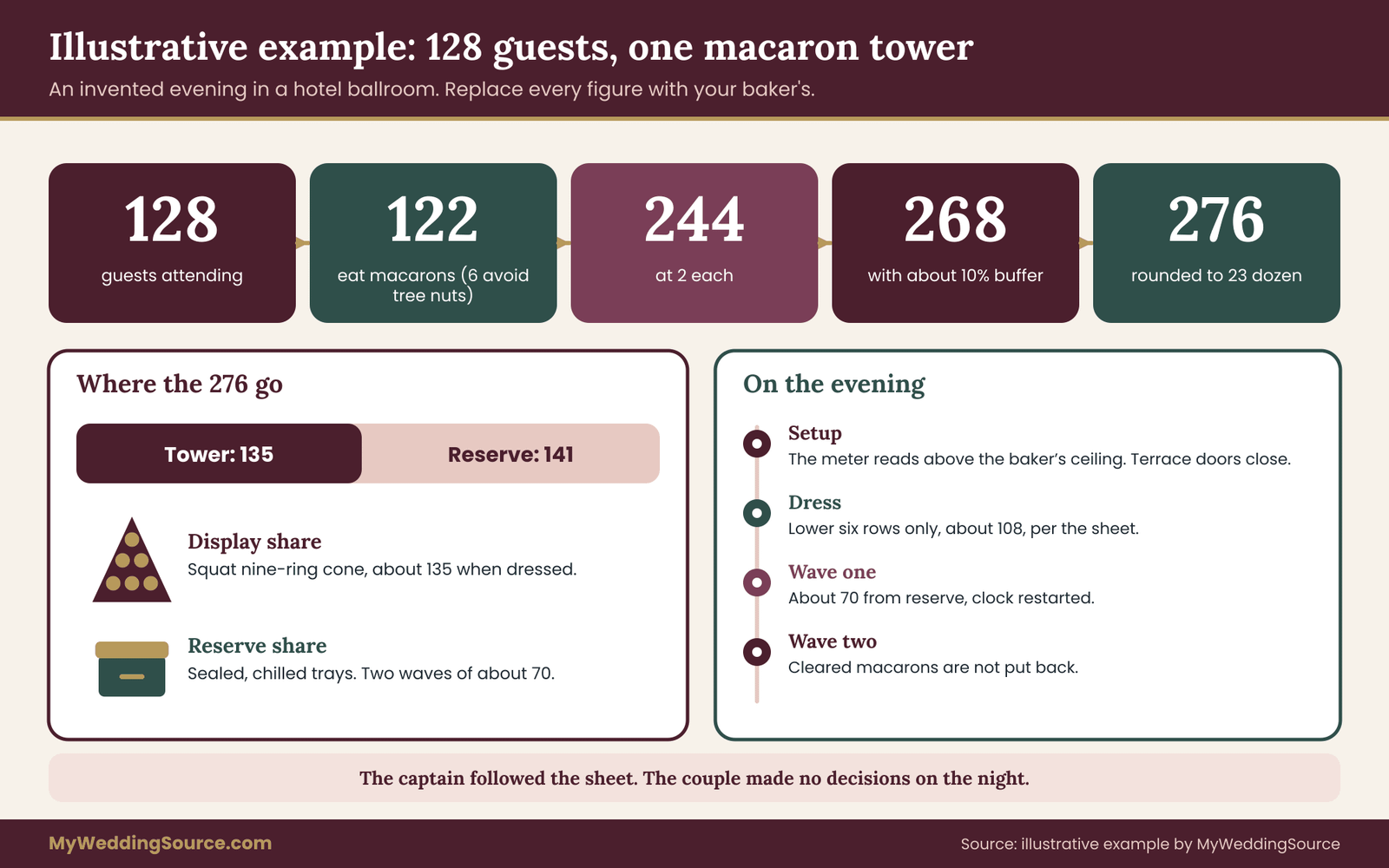
A couple expects one hundred twenty-eight guests at an evening reception in a hotel ballroom in late summer. They are serving a small cake for the cutting, and they want a macaron tower as the second sweet, which puts the role at “second sweet beside cake.” They start with two macarons per guest as a range to test, since guests will have cake as well.
Step one, the eaters. Six guests avoid tree nuts, so the macaron count uses one hundred twenty-two eaters. The six receive a separate dessert prepared by the caterer.
Step two, the count. One hundred twenty-two eaters times two is two hundred forty-four. A buffer of about ten percent for breakage and returns adds roughly twenty-four, for two hundred sixty-eight. The baker sells by the dozen, so the order rounds up to two hundred seventy-six, which is twenty-three dozen.
Step three, the capacity. The baker’s cone, a squat nine-ring form, holds about a hundred thirty-five macarons when dressed. That is close to half the order. The couple confirms the dressed weight with the baker and finds it well within what a ballroom banquet table can carry.
Step four, the split. The tower carries a hundred thirty-five macarons as the display share. The remaining one hundred forty-one macarons wait in sealed trays in the caterer’s cold storage as the reserve share. Two refill waves of roughly seventy each are planned.
Step five, the limits. The baker states in writing that the macaron tower can stand for a stated number of minutes before it is cleared and replaced, and gives a ceiling for room humidity. The caterer agrees to hold the reserve at the cold-holding temperature the local health department requires, and to log product temperature at dress time and at the first refill. The venue confirms that the air handling keeps the room steady, and the tower is placed on a banquet table away from the bar, the dance floor and the kitchen door.
What changes on a humid evening
On the day, the room reads higher in humidity than the baker’s ceiling at setup, because the evening is muggy and the doors to the terrace are open for cocktail hour. The captain closes the terrace doors after cocktail hour, and the venue engineer lowers the setpoint slightly. The reading eases but stays near the ceiling.
The sheet’s rule applies: the display share is reduced. Only the lower six rows are dressed at first, which is about a hundred and eight macarons, and the upper rows are completed from reserve once the reading eases. The cone looks slightly shorter in photographs, a trade the couple accepted in advance, and the shells stay crisper because fewer of them spend time in damp air. The couple does not make any decision on the night; the captain follows the sheet.
What changes in a heat wave
If the venue is a tent and the day is hot, the sheet’s temperature lines do the work. A shorter hold clock, a smaller display share and more frequent refills replace one large display. If the baker’s limit cannot be met in the tent at all, the plan is to move the tower to an indoor space, or to serve macarons from the reserve on trays carried by staff, with the macaron tower reduced to a decorative element of display-only shells that are labelled as such.
The couple has decided this in advance, so it does not feel like a failure.
What changes when the schedule slips
Delays are the most common stress. If dinner runs forty minutes late, the tower may be dressed too early. The sheet handles it with a rule: the dress time is set by a cue from the captain, not by the clock alone. If the cue is late, the dress is late. The reserve trays stay in cold storage, and the clock starts when they come out.
What changes with a smaller guest count
For a small wedding with fewer than fifty guests, a tower can hold the entire supply, and the reserve share may be unnecessary. The limits still apply, and a smaller tower is easier to protect. For a large wedding, two towers or a tower plus tiered stands may suit better than one large cone.
Day-of checks for a macaron tower
On the day, the limits sheet becomes a short routine for one person. Give the routine to a named person, ideally the caterer’s captain, the planner or a trusted friend with no other job.
Before dressing. Check the table with a level and the tip test. Check the position against heat, light and traffic. Read the temperature and humidity at the spot and write them down with the time. Confirm that the reserve trays are in cold storage and the labels are ready.
At dress time. Write the dress time on the card. Take a product temperature if the baker or caterer does so. Dress the macaron tower with the display share only. Place the allergen card and the service note.
During service. Check the tilt and the macarons once or twice. Read the room again at the busiest point. Watch the clock. If the macarons sweat, soften or shed, act on the sheet’s rule without waiting.
At refill. Bring the reserve out in the planned wave, remove macarons that have reached the limit, and restart the clock for the new ones. Do not top up the tower with macarons from the cleared ones.
At the end. Clear the macaron tower on schedule, label and discard or store according to the caterer’s procedure, and take a last photo of the conditions for the record. Keep the log with your wedding paperwork.
Nothing in this routine requires special skill. It requires one person who is not also toasting, dancing or greeting guests.
Edge cases worth a line each
A guest who asks for a tower macaron because of an allergy. Do not guess. Refer to the written list, and if you cannot be sure, offer the separate dessert.
A macaron dropped on the floor. Remove it, wipe the spot, and do not return it to the tower.
A table that is bumped. Stop, check the macaron tower for tilt, and rebuild a row if needed. A staff member should do this, not a guest.
A tower that finishes early. Do not refill beyond the planned count unless the caterer confirms that the reserve is safe and on hand. A tower that runs out is a sign the count was a little short, not a crisis.
Leftovers. Ask the caterer in advance what may be given to you. Food that has stood out on display is often not allowed to be taken home; macarons that stayed in sealed reserve trays may be. The rule depends on the caterer’s policy and local law.
Your next steps
Do these in order, and you will have a workable macaron tower plan in a few evenings.
First, decide the role of the macarons: main dessert, second sweet, centerpiece or favor. Second, work out the eating count, the per-guest range and the buffer, and round up to the baker’s pack size. Third, ask the baker for the structure’s capacity, weight and base, and decide the display share and the reserve share. Fourth, send the questions in this guide to the baker, caterer and venue, and ask for written answers on humidity, temperature and hold time.
Fifth, choose the spot, check the level and the tip test, and visit at the matching hour if you can. Sixth, write the one-page limits sheet and attach it to the contract. Seventh, name the person who runs the day-of routine and give them the sheet. Eighth, if you also have a cake, line up its schedule with the macaron plan using the cake planning timeline, so the two desserts do not compete for the same cold space and the same captain.
FAQ
How many macarons do I need per guest for a macaron tower?
It depends on the role. As a starting range to test with your baker, plan one to two per guest when the macarons sit beside cake, and three to four when they are the main dessert. Count only guests who will eat them, add a modest buffer for breakage, and round up to the baker’s pack size. These are planning choices, not official standards.
How long can a macaron tower stand at a wedding?
There is no single answer. It depends on the filling, the room temperature, the humidity and the rules your caterer and local health department apply. Ask the baker and caterer for a written hold time, take the shorter if they differ, name a person to watch the clock, and decide in advance what happens when the limit passes.
Do macaron towers need to be refrigerated?
Filled macarons are usually kept cold before display, and some fillings need cold holding under the Food Code. The answer depends on the filling and on local rules. Ask the baker and caterer separately, compare their answers in writing, and confirm with your local health department if they differ.
What humidity is too high for a macaron tower?
The ceiling depends on the shell recipe, the filling and the display time, so ask the baker for a figure in writing. Measure relative humidity at the display spot with a small meter at setup, when guests arrive and at the busiest point. If the reading passes the ceiling, reduce the display and keep the rest sealed.
Can a macaron tower be built ahead and moved to the venue?
Sometimes, but moving a finished cone risks shed macarons and condensation on a cold tower. Many bakers dress the form on site from sealed containers instead. Ask which method the baker uses, how the tower is protected in transit and who repairs a row if something shifts on arrival.
What is the safest way to serve a macaron tower to guests with allergies?
Almond flour is a tree nut, and eggs and milk appear in many recipes, so a macaron tower is not suitable for guests with those allergies. Provide a separately prepared dessert, handed to the guest, and label every flavor on the display with its allergens. Discuss serious allergies directly with the caterer in advance.
Should the whole order go on the macaron tower?
Usually not. A tower holds a limited number, and keeping everything on display exposes every macaron to the room’s heat and humidity. Put a display share on the macaron tower and keep the rest in sealed, chilled reserve trays for planned refill waves. This keeps the structure within its limits and the macarons fresher.
What should a macaron tower contract include?
Itemize the count, flavors, price, form and any rental, delivery, setup and breakdown fees. Attach a limits sheet covering weight and base, tilt rules, room temperature, humidity ceiling and hold time, plus who is on site and what happens if the tower cannot stand. Add the allergen list and the baker’s food license details.
Sources
- U.S. Food and Drug Administration, Food
- FDA Food Code
- FDA, Food Allergies
- FoodSafety.gov
- Centers for Disease Control and Prevention, Food Safety
- USDA Food Safety and Inspection Service
- National Institute of Standards and Technology
- National Weather Service
- Food Allergy Research and Education
- Federal Trade Commission