
A courthouse wedding announcement is the message that tells people you are married after the legal appointment has already happened. This guide gives you a quiet-window method: decide who hears what, in which order, on which date, and how to keep the news from reaching the wrong person first.
Treat the days between the appointment and the courthouse wedding announcement as a quiet window with a start and an end. Sort everyone into four rings (you and your witnesses, parents and children, close family and friends, everyone else). Tell each ring in order, on a date you set in advance, and write down a pull-forward rule for the day someone outside the circle finds out early. Check what your county clerk makes public, keep photos off public accounts until the courthouse wedding announcement goes out, and send the first message personally to the people most likely to feel hurt.
Plenty of couples choose a private courthouse wedding because they want the marriage without the audience. That is a reasonable thing to want. The trouble is that “private” and “secret” are different, and the gap between them is where most of the stress lives. A parent who learns from a coworker, a sibling who sees a photo tagged by a stranger, an aunt who hears the news at a funeral: these are not disasters, but they are avoidable, and they tend to overshadow the marriage itself.
This article is about the courthouse wedding announcement as a piece of planning, not a piece of writing. The wording matters, and later sections give you scripts for several audiences. But timing, order and control of the information matter more. A warm message that arrives second is often worse than a plain one that arrives first.
A note on scope. This is general information, not legal, tax or financial advice. Marriage license rules, record access and name-change steps differ by state and county and change over time, so where a rule matters the article points you to the office that issues it. Ask your county clerk and your officiant for the current version before you rely on anything here.
What a courthouse wedding announcement has to do
Most advice on this topic stops at the wording of a social post. A courthouse wedding announcement has to do four separate jobs, and a single message rarely does all of them.
It has to tell the truth quickly and kindly. The core fact is simple: you are married, on this date, in this place. People read the first two lines and decide how they feel. Anything that sounds like an apology or a defense invites an argument, and anything that sounds like a press release feels cold to the person who expected to be invited.
It has to arrive in the right order. Humans keep a mental ranking of who should have been told first, whether or not anyone ever said it out loud. Your courthouse wedding announcement order is a public statement of that ranking. You can choose it deliberately, or you can let group chats choose it for you.
It has to control what else gets shared. A courthouse wedding announcement is the moment photos, a name, a date and a location may start to circulate. Decide what is shared, with whom, and what stays private, before the first message goes out.
It has to set up what comes next. Some couples plan a celebration later. Others do not. Either way, the courthouse wedding announcement should signal clearly whether there is a party, a dinner, or nothing, so nobody spends a month wondering whether an invitation is coming.
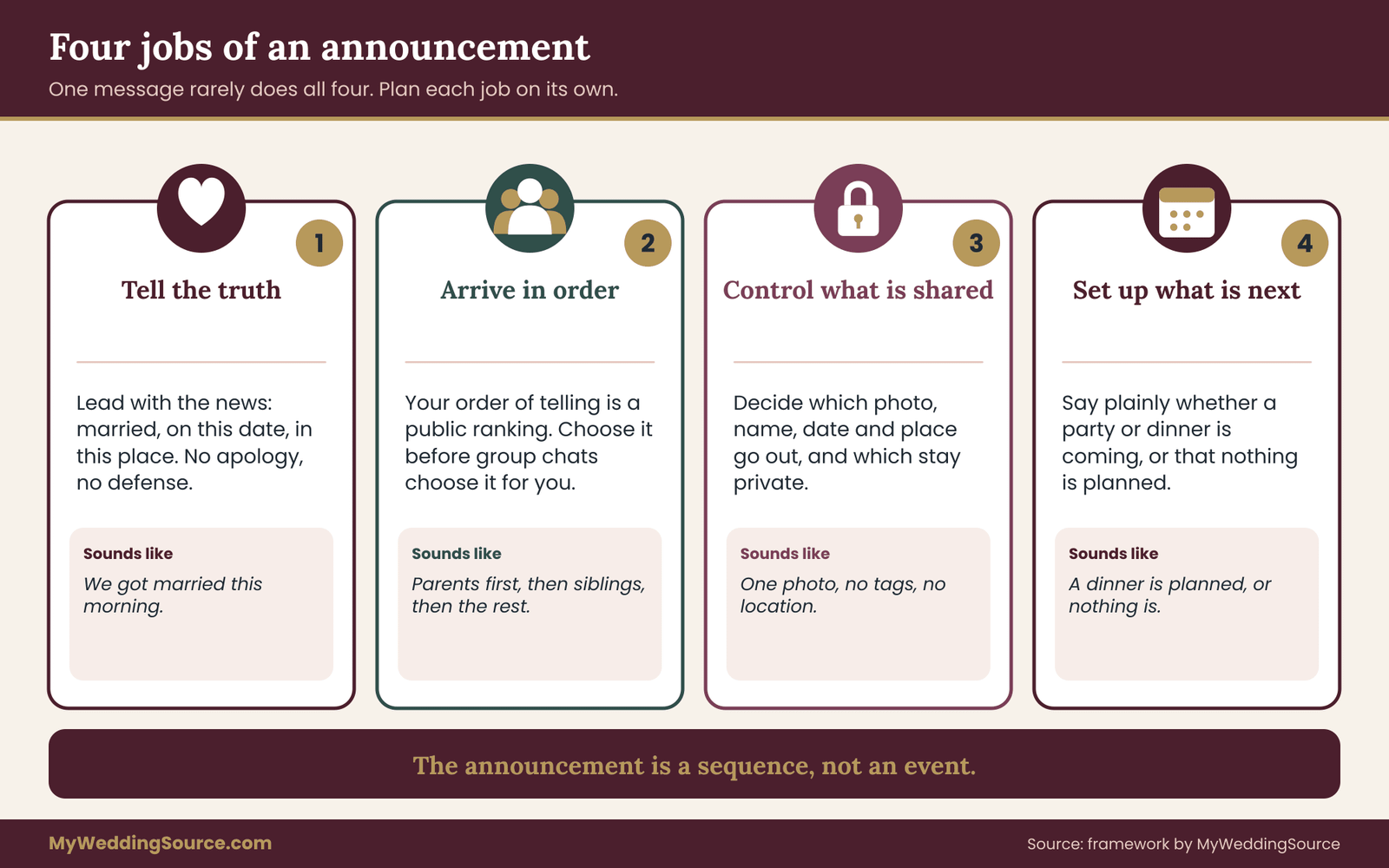
If you only remember one idea from this guide, make it this one: the courthouse wedding announcement is a sequence, not an event. It starts with the first person you tell on the morning of the appointment and ends when the last person on your list has heard it from you directly.
When a courthouse wedding announcement makes sense
Announcing later is a good fit in a few common situations. Some couples want to avoid a family disagreement over the guest list. Some want the day to belong to the two of them, with no performance. Some are managing a complicated family, an immigration or work deadline that makes a quick legal marriage useful, or a health situation that makes a big event hard. Some simply find weddings stressful and want the marriage without the machinery.
It is a poor fit when someone has a strong, reasonable expectation of being present, such as a parent who has said clearly that they want to see you married, or a child who is old enough to feel excluded. It is also a weaker choice if you are counting on a particular person’s reaction, positive or negative, to stay out of your life. Silence rarely changes a family dynamic, and a late courthouse wedding announcement does not either. It usually postpones the first conversation by a few weeks.
None of this means you should change your plan. It means you should know which of these situations is yours before you pick a date, because the answer decides who needs a personal call rather than a message.
What this guide leaves to other pages
This guide covers privacy and announcement timing. It does not repeat the full courthouse appointment checklist or the details of what officiants and witnesses must do. For the legal side of who can perform and sign, the officiant requirements guide is the better starting point, and your county clerk has the final word on what your state requires. Courthouse photography, outfits and a later celebration each have their own treatment on this site. Here the focus stays on what you tell people and when.
Which parts of a courthouse wedding are public
The first step in planning a private courthouse wedding is learning what the government itself will make visible. This is the part couples most often skip, and it is the part you cannot change by being careful.
A marriage is a legal event, and legal events create records. In the United States those records are kept at the state or county level, and the rules about who can see them vary widely. The federal government’s marriage certificate page at USA.gov explains the basics of getting a certificate, and the CDC’s National Center for Health Statistics lists where to write for vital records in each state. Neither one can tell you what your own county does with a new license, which is why you need to ask.
Here are the questions to put to the clerk’s office, by phone or at the counter, before you set a courthouse wedding announcement date.
“Once we apply, is the license application or the marriage record searchable by the public, and can we see how?”
“Does the county or any local newspaper publish lists of new licenses or marriages?”
“Do you offer any confidential or restricted option, and who qualifies?”
Some states do offer a confidential marriage option with its own eligibility rules. California is a well-known example, and it has conditions about living together and different record handling. Treat that as an illustration of why the question is worth asking, not as a rule for your state. In many places the record is simply public, which means a determined person can find it, even if almost nobody looks.
Waiting periods, license windows and appointment lists
Three other features of the process affect privacy more than people expect.
First, waiting periods and license validity windows. Some places require a short wait between getting the license and marrying, and licenses expire after a set period. These rules decide how many days pass between the day you appear at the clerk’s counter and the day you marry. If you apply in person, that counter visit is the first moment someone could see you, so build it into your quiet window rather than starting the clock at the ceremony.
Second, how appointments are posted. Some courthouses run open ceremony rooms where other couples and their guests wait in the same hallway. Others book individual slots in a closed office. A busy hallway at a municipal building is not private, even though nobody there knows you. If a coworker or neighbor might be there for their own reasons, ask the office about quieter times.
Third, who has to be present. Some states require one or two witnesses, and some do not. Your witnesses know the date. Count them as members of your first ring, and agree with them in advance on what they will and will not say.
Why this shapes your courthouse wedding announcement plan
The practical consequence is a simple rule. Your quiet window should be no longer than you can reasonably defend against the possibility of a public record being found. If the record is easy to search and your family is the type to search, keep the window short, a week or two. If the record is restricted or rarely viewed, a longer window is safer.
There is a second reason to learn these facts early: it prevents you from promising secrecy you cannot deliver. Telling a vendor, a parent or yourselves that “nobody will know” is a claim about the world. “We will tell people on this date, and we have taken reasonable steps to keep it quiet until then” is a claim you control.
The four rings of a courthouse wedding announcement
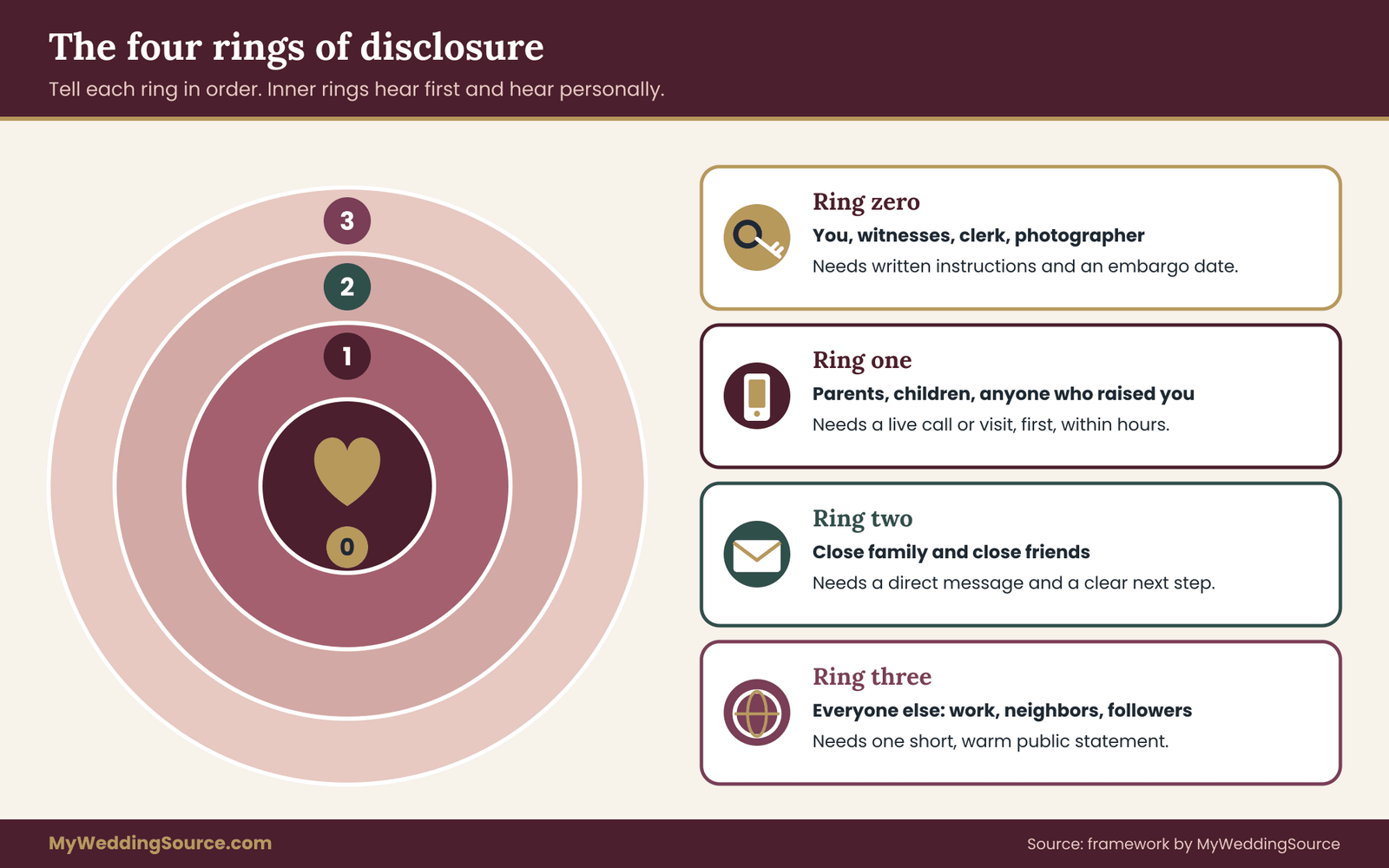
The core of this method is a way of sorting people. Instead of a single guest list, you build four rings, and you decide the order of disclosure ring by ring. The rings are based on how much someone would feel the omission, not on how close they are in some abstract sense. A friend you talk to daily may care less about the order than a distant uncle who has strong views on family protocol.
Ring zero: you and the people in the room. This is the two of you, the witnesses if your state requires them, the officiant or clerk, and a photographer if you hire one. These people know the date because they have to, and they hold the only live secret in the courthouse wedding announcement. They are also the people who can leak by accident, so give them an explicit instruction and a date: “Please keep this to yourself until the fourteenth, when we are telling our families.”
Ring one: parents, children and anyone who would be badly hurt to learn second. This is the shortest list and the one with the most weight. It usually includes your parents, any children, and sometimes a grandparent, a sibling who has been closely involved in your life, or a person who raised you. A good test: if this person heard it from someone else, would you need to apologize in person? If yes, they belong here.
Ring two: close family and close friends. Siblings not in ring one, aunts and uncles you are close to, the friends you would have invited to any wedding. These people should hear from you directly, by call or personal message, not through a group post.
Ring three: everyone else. Extended family, coworkers, neighbors, acquaintances, social followers, and the public. This ring hears through a general channel such as a post, a card, or a short message.
How to build your ring list in twenty minutes
Sit down together, with two sheets of paper or a shared note, and work through your contacts. Write each name once. Then assign a ring using three questions.
Would this person be hurt if they heard it from someone else? If yes, ring one or two. Would this person need to hear it before a specific event, such as a family dinner, a holiday, or a work announcement? If yes, move them up a ring. Is this person likely to pass it on? That one does not change their ring, but it changes how long you wait between rings. A fast talker in ring one means the gap before ring two should shrink to hours, not days.
Keep the list short in the inner rings, because every name adds work to the courthouse wedding announcement. Ring one with twelve people is a ring two. If you cannot get below six or seven, you probably have a wedding guest list in disguise, and you may want to reconsider whether a fully private courthouse wedding is what you want. Reading about how to cut a wedding guest list can help you sort who is truly inner circle.
The order inside each ring
Within a ring, the order of the courthouse wedding announcement still matters. Parents who are divorced or remarried should hear in the same hour if possible. Siblings should hear before cousins. Anyone who was expecting to be asked to take a role, such as a reading or a toast, deserves an extra sentence of warmth.
If you have children, tell them first and in person if you can, in the words that suit their age. A child who hears through a relative feels the omission far more than an adult would. Keep the explanation simple: you are married, here is what stays the same, here is what changes in the family’s daily life.
What each ring needs from you
The rings are not just an order for the courthouse wedding announcement, they are different kinds of communication.
Ring zero needs instructions. Ring one needs a personal conversation, ideally live, and time to react. Ring two needs a direct message and a clear signal about whether a celebration is coming. Ring three needs a short, warm, public statement with no explanations. Mixing these up is the most common mistake in a courthouse wedding announcement: a group post to ring one reads as a slight, and a long personal explanation to ring three reads as a defense.
Briefing ring zero in writing
Ring zero is small, but it is the only ring that holds a live secret, so it deserves a written briefing. A short message to each witness and to any photographer covers four points: the date the secret ends, what they may say if asked, what they must not post, and whom to tell if they hear that someone knows.
Give them a sentence they can use. People keep secrets better when they have a ready answer than when they have to invent one. Something like “I was out for a personal errand on Thursday” is true, closes the topic, and does not require a lie. If a witness is uncomfortable with any of this, take that seriously and ask someone else. A witness who dislikes secrets is a poor choice for a quiet window, however close the friendship.
Also tell ring zero what the courthouse wedding announcement will look like when it comes. Knowing that a calm, planned message is on its way makes it easier to stay quiet. People leak most when they feel the news is being hidden for bad reasons, and least when they understand it is a short, planned pause.
Planning the private appointment so it stays quiet
Once your rings are set, the appointment itself needs a short list of decisions, and each one affects your courthouse wedding announcement. Each one is a leak risk if you ignore it and a non-issue if you handle it.
Pick a time and a clerk’s office that fits your privacy goals. A mid-week morning slot in a small office is quieter than a Friday afternoon in a busy municipal hall. If the office takes bookings, ask whether the room is closed or open to other couples. If it does not take bookings, ask when it is slowest.
Decide who knows the date. The date is the most useful single fact for anyone who wants to find you. Tell as few people as the logistics allow. Witnesses, an officiant, a photographer if you hire one, and a ride, if you need it. Everyone else gets the news after.
Handle the outfit and the photographer with the quiet window in mind. If you hire a photographer, the contract should say when photos are delivered and who can post them. A photographer who posts a teaser the same evening can undo a month of planning. The wedding photography consent guide covers image rights and sharing permissions in more detail, and the same questions apply when the audience is your own family.
Prepare a plain-sentence answer for the unexpected question. If a coworker asks why you took the morning off, you do not have to lie. “A personal appointment” is true. Decide in advance what you will say, so you are not improvising under pressure.
Booking a vendor without revealing the plan
Even a small private wedding may involve a florist, a restaurant for lunch, or a photographer. Each is a person who might mention you to someone. Share only what the vendor needs: a date, a time, a headcount, and a request for discretion. You can write that request into the booking message. Most vendors in the wedding trade understand it, and some work this way regularly.
“We are keeping this day private for now. Please do not post or mention the booking until we confirm.”
If a vendor will not agree to that, that is information about the vendor. You can choose a different one. Where a written agreement exists, a short clause like this can sit in the contract itself, and asking for it is a normal request.
A leak audit before the day
Two days before the appointment, run a short audit. Open your calendar, your shared notes and your messages. Ask who could infer the date from what they can see. A shared calendar that lists “courthouse” is a leak. A group chat where a friend asked about your Thursday plans is a leak. A rental confirmation sent to a shared email is a leak.
Then check the physical world. Is the license in a drawer where a visiting relative might see it? Is the ring box visible? Are your outfit and flowers going to be seen by neighbors on the way out? None of these is a crisis. They are just the places where “private” tends to wear thin.
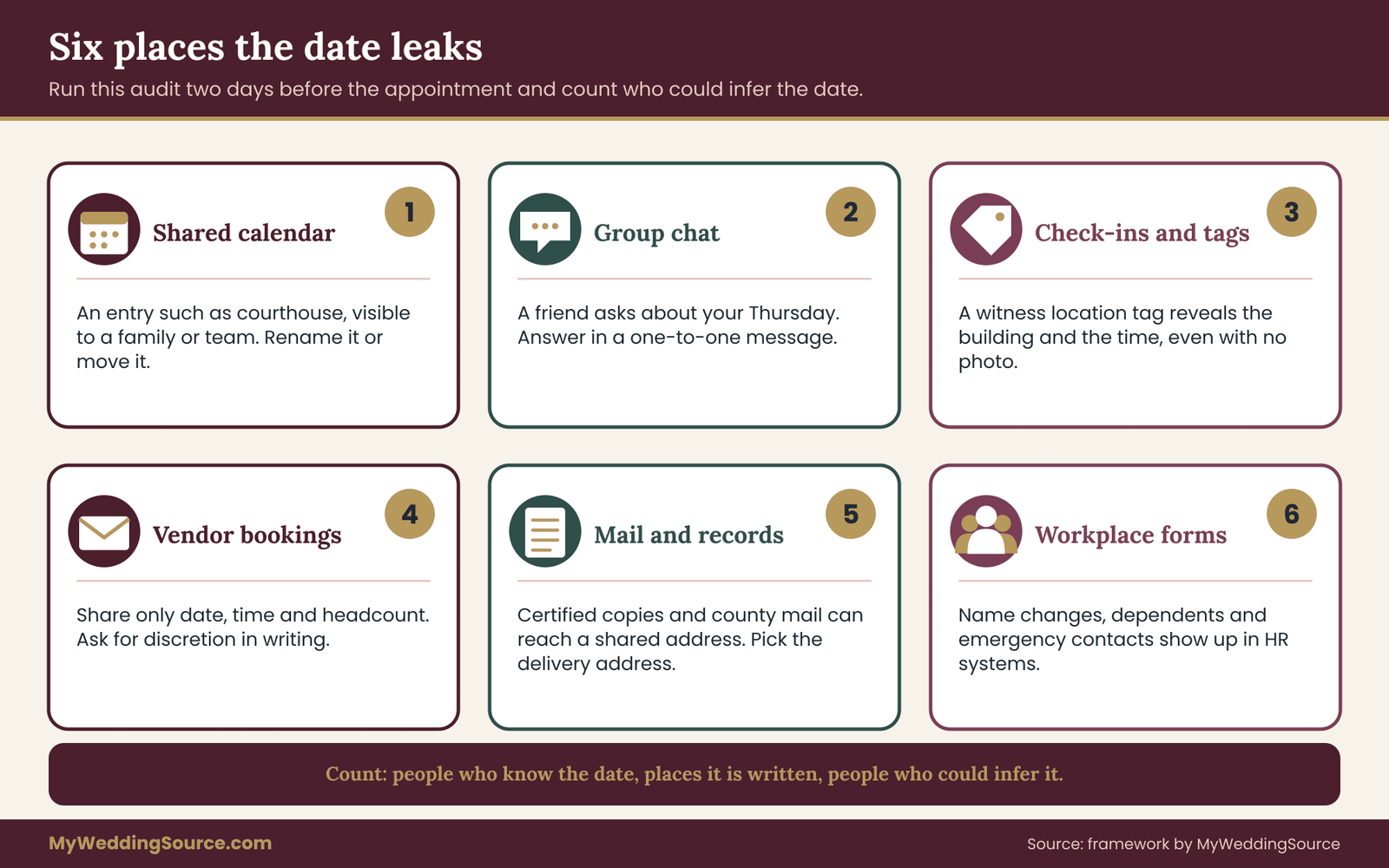
Write down the results. A leak audit for a courthouse wedding announcement is a measurable check: the number of people who currently know the date, the number of places where it is written down, and the number of people who could infer it. If those numbers are bigger than you want, shrink them before the day, not after.
The morning of the appointment
On the day, keep your phones out of public accounts. Many couples decide in advance that no one posts, tags or checks in until the courthouse wedding announcement goes out, and they agree on this explicitly with witnesses. Check-ins are especially easy to forget. A location tag from a witness’s phone reveals the courthouse and the time, even without a photo.
Also decide what happens if something goes wrong. If the appointment is delayed or rescheduled, who needs to be told? Often only the witnesses. Keep a single message ready for them, and do not widen the circle for a change of time.
Choosing the date for your courthouse wedding announcement
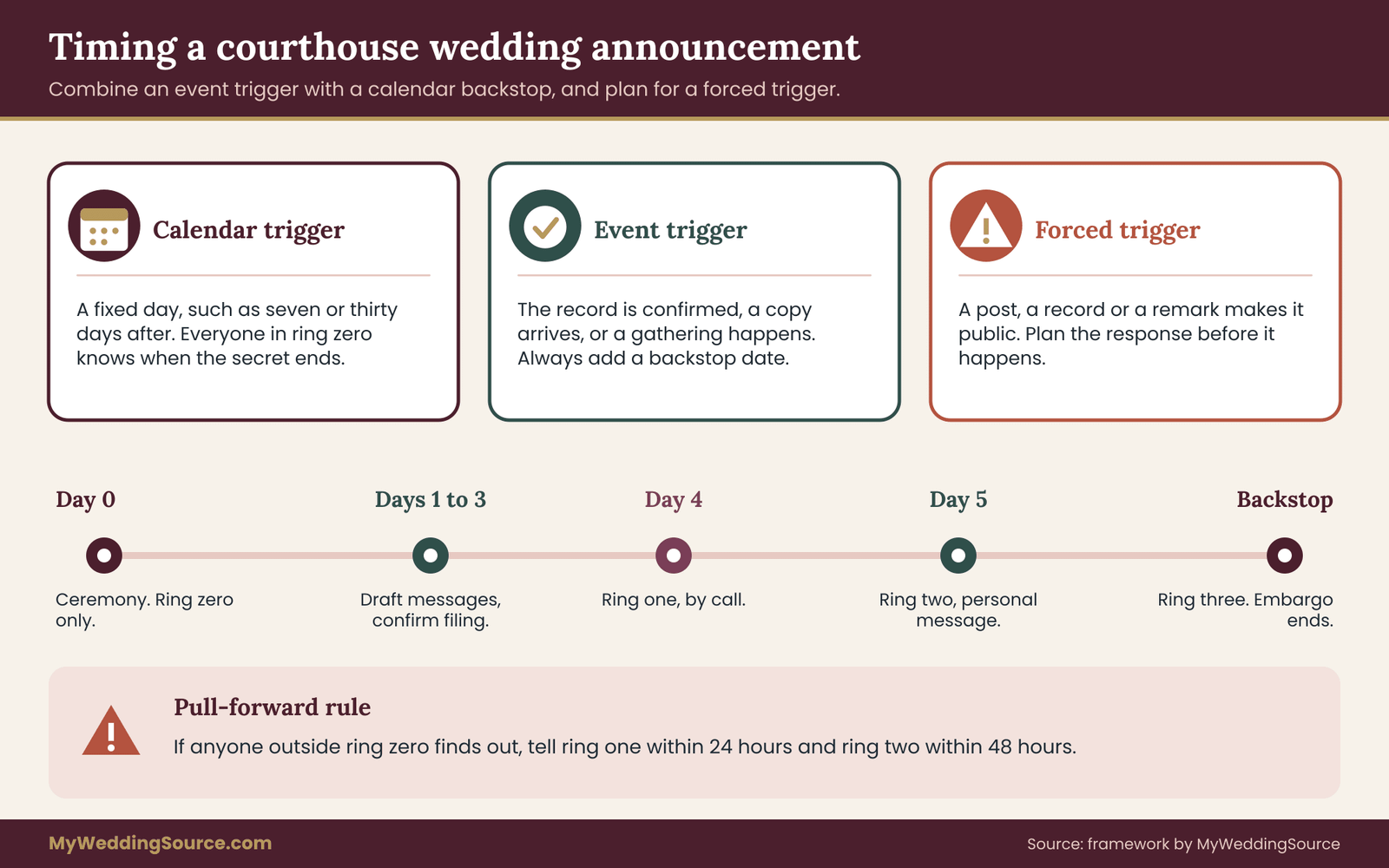
The date you announce is a decision with its own logic, separate from the date you marry. Couples tend to pick it by feel, usually “when we are ready”, and then drift. A better approach is to set the date before the appointment, using one of three kinds of trigger.
A calendar trigger. You pick a fixed day: seven days after, thirty days after, the first of next month. The advantage is that everyone in ring zero knows when the secret ends. The disadvantage is that it ignores events that may arrive sooner.
An event trigger. You announce when something happens: the marriage record is confirmed, the certified copy arrives, a family gathering takes place, a work project ends, a parent returns from a trip. Event triggers fit couples who want the courthouse wedding announcement to coincide with something that gives it context. They need a backstop date, or “after the holidays” becomes “after the spring” becomes never.
A forced trigger. Something outside your control makes the news public: a witness posts, a relative sees a record, a vendor mentions it. Planning for this one is what the pull-forward rule is for, and the next sections return to it.
The strongest plan combines the first two: an event trigger with a hard calendar backstop, and a written pull-forward rule for forced triggers.
Five common announcement timings compared
There is no best timing, only a fit with your situation. Here are the five patterns couples use most, with the reasoning behind each.
Same day, in the evening. You marry in the morning or at midday and tell everyone that night. This has the shortest quiet window and the smallest chance of a leak. It suits couples who want privacy for the ceremony itself, not for the marriage. The cost is that ring one gets almost no lead time, so make the calls in order and early.
Within a week. You allow a few days to settle, then tell rings one and two by call within the same day and ring three the day after. Most couples who choose a private courthouse wedding land here. It leaves time to receive the certified copy or at least confirm the record, and it is short enough to defend.
After the paperwork is finished. You wait until the certified copy arrives and the first name change steps are done. This can take weeks, depending on how quickly your county records the marriage and issues copies. The benefit is that you can answer practical questions, like “is it official?”, with confidence. The cost is a longer window and a larger risk of an accidental leak.
At a gathering you were already planning. A birthday, a holiday, a family reunion. The courthouse wedding announcement becomes part of the event. This is warm when it works and unkind when it feels like a stunt. If a parent will feel upstaged or surprised in front of others, tell ring one privately before the gathering.
Tied to a later celebration. You marry privately and announce with an invitation to a party. This turns the courthouse wedding announcement into a positive message with an obvious next step, and it signals that the omission was about the legal ceremony, not about excluding people from celebrating. It also carries a clear commitment: you need a date, even a rough one, before you send it. The site’s guide to wedding etiquette covers how guests tend to read the gap between a private ceremony and a later party.
Setting the backstop
Whichever pattern you choose, write a backstop date and share it with ring zero. “We will announce no later than the twenty-eighth, whatever else has happened.” A backstop protects you from your own avoidance. It also removes the pressure on witnesses, who would otherwise wonder how long they are carrying a secret.
If you are marrying near a holiday or a family event, set the backstop before the gathering, not after. Announcing during a holiday meal is possible, but announcing a day before gives ring one time to react in private.
The pull-forward rule
Write this sentence down before the appointment: “If anyone outside ring zero learns about the marriage, we tell ring one within twenty-four hours, and ring two within forty-eight.”
The rule does two things. It removes the decision from a stressful moment, and it gives ring zero a clear instruction: if you hear that someone knows, tell us at once. It also means a leak is not a failure. It is a trigger you planned for, and you simply start the sequence early.
Keep the rule for your courthouse wedding announcement short and specific. Vague plans such as “we will deal with it” tend to fail because nobody remembers what “deal with it” means at nine in the evening when a cousin sends a message asking if it is true.
A day-by-day schedule for the first week
For couples who choose the within-a-week pattern, a simple schedule keeps the sequence honest. Adjust the days to your own plan, but keep the order.
Day zero, the appointment. Ring zero only. The embargo is in effect. Send the witnesses a short thank-you with the embargo date repeated. Take one photo for yourselves and keep it private.
Day one. Rest. Confirm with the officiant or clerk that the license will be filed, and ask when you will get confirmation. Do not make announcement calls yet, because a surprise that arrives before you have fully registered it yourselves is hard to talk about.
Day two or three. Draft your messages for each ring and read them aloud. Decide who calls whom. If you plan a later celebration, agree on a rough month, so you can say it with some confidence.
Day four. Ring one, by call or in person, in a single afternoon so that the news does not travel between them. Start with whoever is most likely to be hurt or most likely to pass it on.
Day five. Ring two, by call or personal message, in the morning. Send a photo only if you are ready to see it reposted.
Day six or seven. Ring three. A post, a card, or a short note. The embargo ends and the witnesses are free to share.
After the courthouse wedding announcement
Keep a short log: who you told, when, how they reacted, and whether anything needs follow-up. It helps in the weeks after, when someone mentions a conversation you cannot quite remember, and it turns the emotional blur of announcement week into something you can look back on.
Then let it settle. Not everyone will respond at once. A few will take weeks to come around, and a few will always have mixed feelings. That is a normal outcome, not a failure of the plan.
Dealing with a leak that has a cost
Some leaks are minor and some are not. A leak to a coworker costs little. A leak to a parent’s neighbor, who then mentions it to the parent, costs a great deal. The difference is the person it reaches next. When you build the rings, mark the two or three people whose early knowledge would do the most harm, and put extra distance between them and the information. Those are the people who do not need to be told the date, and whose circle includes ring one.
The cost logic is simple. Each extra person who knows the date adds a small chance of an early leak. Each extra day in the quiet window adds another. A short window with a larger circle can carry the same risk as a long window with a tiny one. If you are unsure, use the smaller circle and the shorter window together, since they reduce the chance of a harmful leak from two directions.
Courthouse wedding announcement wording for each ring
Wording is the part of a courthouse wedding announcement people agonize over, and it is the least complicated once the order is set. The goal is a message that is short, warm and specific, and that does not invite a debate.
Four principles hold across audiences. Lead with the news, not the reason. Use “we” and avoid explaining what other people should feel. Say something kind about the relationship to the recipient. And end with a clear next step, even if the next step is “no action needed, we wanted you to hear it from us.”
Parents and ring one
For parents and children, make a call if you can. A message first is acceptable if a call is impractical, but plan to follow with a conversation. Open with the news in the first sentence, because making someone wait through a preamble is worse than getting to the point.
“We have news and we wanted you to hear it from us first. We got married this morning at the courthouse.”
After that, one or two sentences of context are enough. “We wanted a quiet day with no planning” is true and does not blame anyone. If you are planning a celebration, say so. If you are not, say that too, kindly.
Expect an emotional reaction, and do not argue with it. Hurt, surprise and joy can show up in the same call. Your job is to listen, restate that you love them, and make a plan to see them. You do not have to defend the decision in that first conversation. A later section covers how to handle the harder reactions.
Close family and friends
For ring two, a personal message or call works. The tone can be lighter, and a photo is fine if you are ready to share one.
“Quick news before it goes anywhere else: we got married on Thursday. Small, quiet, and exactly what we wanted. We would love to celebrate with you soon.”
If a celebration is not planned, replace the last sentence with something that does not create an expectation: “We wanted you to know before anyone else did, because you matter to us.”
Workplace and professional contacts
Work contacts need less detail and more practicality. If your marriage affects benefits, a name, or a leave request, your manager or HR contact should hear first, in a short and neutral message. The workplace section later in this guide covers the paperwork side. For colleagues in general, a brief sentence is enough, and you can choose how much to say.
“Some personal news: I got married last week. Thank you in advance for being low-key about it.”
If you want to keep your marriage out of the workplace for a while, that is a legitimate choice, but note that benefits enrollment and tax withholding forms may reveal it. The workplace section explains how to plan around that.
Tricky cases in ring two and ring one
A few relationships need a different kind of message from the standard script.
A stepparent or a former partner who still matters to your children. Tell them in a sentence and keep it factual. You are not asking for approval, but they will be part of the children’s response. A short call before the children hear, if the relationship allows, prevents a surprise at the school gate.
A close friend who expected to be your witness or a member of the wedding party. This one needs a personal conversation. Say plainly that the day was small and that no one was asked, because that is the honest explanation and it removes the idea that someone was chosen over them. If you are planning a celebration, a real role in it can matter.
A relative who disapproves of civil weddings or of one of you. Do not try to win the argument in the courthouse wedding announcement. Say it kindly and briefly, and keep the door open: “We would love to see you soon.” Their response is theirs to manage.
A group of friends who share a chat. Tell one person you trust to carry the news, or send one message to the group at the same moment, so nobody hears it secondhand from another member. A courthouse wedding announcement in a group chat should be the same text for everyone.
The wider announcement: post, card or note
For ring three, a single public courthouse wedding announcement does the work. Keep it to a few lines.
“We got married on [date] at [place]. It was small and private, and we are happy. Thank you for all the kindness.”
You do not need to explain the privacy choice. If you want to give a reason, one clause is enough: “We chose a quiet courthouse ceremony.” Avoid phrases like “we didn’t want a big fuss”, which can read as a judgment on people who do. And avoid apologizing: an apology invites others to decide whether to accept it.
A note on tone across all rings
Scripts help, but they should sound like you. Read each message aloud before you send it. If it contains a phrase you would never say in conversation, cut it. The best courthouse wedding announcement messages are slightly plain, because plainness reads as confidence.
If humor is how you usually communicate, a little is fine. But keep it away from ring one, where a joke can read as a dismissal of their feelings. Save the playful version for friends who will enjoy it.
Cards and notes by mail
Some couples send a printed card with a photo and a line of text. It suits ring two and three and works well alongside a later party, since a physical card feels like an invitation to celebrate. If you take this route, your invitation etiquette choices, such as wording and who receives one, still apply. A card should go out only after rings zero through two have been told, since mail can arrive before a call and reverse your order.
Images spread faster than words, and a photo is the part of a courthouse wedding announcement that most often escapes the order you planned. One tagged picture can reach ring three before ring one has picked up the phone. So the photo plan is part of the timing plan.
Start with a simple question: who will take pictures, and who will see them first? At a courthouse, the answer is often a witness with a phone, a friend, or a hired photographer. Each has a different risk. A witness posts out of excitement. A friend sends pictures to a group chat to share the joy. A professional follows a contract, which is why a contract is useful.
Agree on a photo embargo
An embargo on your courthouse wedding announcement is a plain agreement: nobody posts, sends or tags until a stated date and time. It is the single most effective leak-prevention tool, and it costs nothing. Give it to ring zero in writing, in a short message they can keep.
“Photos from Thursday are for us until Saturday at noon. After that, please feel free to share. Thank you.”
Be specific about what the embargo covers. Posts, stories, group chats, check-ins and tags are all channels, and people forget that “private” group chats include people who forward things. If you want a loose version, such as “send to family but not public”, say so, and name the people.
When a professional is involved, put the embargo in writing as a delivery rule: photos are delivered to you first, and the photographer posts nothing until you say so. The same permission questions apply to a two-person ceremony in a municipal office as to a large event.
Choosing what to share in the first post
The first photo in a courthouse wedding announcement sets the tone. Consider whether it shows the courthouse, the clerk, other couples, or any minors in the background. A photo that includes strangers raises its own privacy question, and a municipal building may have rules about photography inside. Ask the office before you hire anyone or plan a long photo session, as courthouse photography policies differ from one building to the next.
Many couples find that a single, simple picture works best: a hand, a certificate, the steps outside, a quiet portrait. It signals that this is a private moment and does not invite a flood of requests for more.
If you plan a later party, you can keep most of the images back for it. A small preview now and a fuller album later keeps people curious without feeling cut off.
Social media settings and a short checklist
Before the courthouse wedding announcement goes out, check the settings on every account you plan to post from. Who can tag you? Can people share the post? Is location data attached? A few minutes with the privacy menu now prevents a surprise later. A short list covers it: turn on tag review, turn off location on the post, check who can see old photos from the same album, and decide whether comments stay open.
Then think about what a courthouse wedding announcement does not need to show. Your full legal names, the license number, a visible date of birth on a document, an address on a package label. A photograph of a certificate can reveal more than a photograph of a person. Crop or cover anything you would not put on a billboard.
If someone posts early
Sooner or later, someone may post before the embargo ends and pull your courthouse wedding announcement forward. The pull-forward rule applies: tell ring one within twenty-four hours, ring two within forty-eight. Ask the person to take the post down politely, and do not turn it into a conflict. A calm message is usually enough.
“Thank you for the kind words. We are telling family first. Could you remove the post until Saturday?”
If it has already spread, accept it and move forward. A deleted post may already be in screenshots. The better use of energy is to make the calls you would have made anyway, a few days earlier.
Handling hurt feelings, pressure and the long conversation
Even a warm courthouse wedding announcement can land badly with someone. That is not proof you chose wrong. It is a reaction, and it is usually about the person’s role in your life, not about the courthouse.
Four reactions to a courthouse wedding announcement come up most often. Understanding each makes it easier to respond without escalating.
“Why weren’t we there?” This is the most common one, and it is rarely a request for a full explanation. It is a way of saying “I wanted to be part of it.” Respond to the wish, not the question: “We know you would have loved to be there, and we wanted you to hear it from us first. We would love to celebrate with you.” Then offer a concrete next step if you have one.
“We would have helped.” Sometimes this means the person wanted to contribute money, time or presence. Thank them sincerely. If you are planning a later gathering, a role in it can be a real answer to this feeling.
“You should have told us beforehand.” This is a request for a different order. You can acknowledge it without changing your choice: “We understand. We chose to keep the day small, and we should have been clearer about when we would tell you.” Do not promise that you will do it differently, because you cannot.
Silence or withdrawal. Some people go quiet. Give them time, send a short, warm message a few days later, and avoid chasing. Withdrawal is usually a feeling that needs space, not an argument that needs rebuttal.
What not to say
A few phrases tend to make things worse. “It’s our day” is true but reads as dismissive. “You’d have made it about yourself” blames the person. “We knew you’d react like this” turns the conversation into a case about their character. “Don’t be upset” asks someone to hide a feeling.
Replace these with statements about your own motives: “We wanted something quiet and simple.” “We were worried about the pressure of a big day.” “We care about you and wanted you to hear it from us.” Each one stays on your side of the line.
Setting a boundary without a fight
Some families will press for details, photos, a party, a religious ceremony, or a do-over. You are allowed to say no, kindly and repeatedly. A simple script works: “We have thought about it a lot, and this is what we chose. We are glad to share the happy parts.”
If a relative keeps pressing, shorten your answers rather than lengthening them. Long explanations create more material to argue with. A repeated, calm sentence is harder to push against than a new one each time.
When a celebration is the repair
For some people, the real repair is a celebration. A dinner, a backyard lunch, a small party with a toast. If you are open to that, say it early, and keep it low-pressure. A celebration after the legal ceremony does not have to copy a traditional wedding. The same planning habits apply even if the guest list is a dozen people: set a budget, a date and a headcount first.
If you are not open to it, say that too. “We are not planning a party, but we would love to have dinner with you” is clear, and it prevents the slow disappointment of an invitation that never arrives.
Looking after yourselves
Announcement weeks can be emotionally busy. Take turns making difficult calls, and agree that either of you can end a conversation that is going badly. Decide beforehand who will talk to whom, based on who has the closer relationship and who is calmer. A parent often hears more easily from their own child.
Give yourselves a quiet evening after the calls for your courthouse wedding announcement are done. You have just been married, and a week of managing other people’s reactions is easy to let crowd that out.
Paperwork and workplace steps that can reveal the news first
A courthouse wedding announcement can be perfectly timed and still be overtaken by a form. Paperwork is the quiet channel through which a marriage becomes known, and it works on its own schedule. Knowing which steps reveal the news, and which can wait, lets you choose when your courthouse wedding announcement really begins.
The rule of thumb is simple: anything that changes a name, a tax status or a benefits record will eventually show up in a system someone else can read. Anything that stays within your own household will not.
Steps that can wait
Several name-change steps are not urgent, and you can sequence them after the courthouse wedding announcement. Updating a driver’s license, a passport, a lease or a bank profile does not have a short deadline for most people, though your own situation may differ. The Social Security Administration explains how to update a name on a Social Security card, and the State Department explains passport changes after marriage. If a passport is issued soon and you plan to travel, check the current rules for your case before you decide whether to wait.
Holding these steps until after the courthouse wedding announcement is not dishonest. It is sequencing. A person who learns of the marriage from their own partner and not from a payroll form feels respected.
Steps with short windows
A few items may not wait comfortably, so look at them before you choose a long quiet window.
Health insurance. Marriage can open a special enrollment period for coverage, and HealthCare.gov describes how that works. The window is measured in weeks, not months, so confirm the current length with the marketplace or your employer plan. If one of you wants to add the other to a plan, or if coverage matters for a medical reason, a long quiet window may conflict with that deadline. In that case, tell your benefits contact early, and keep the broader announcement on its own schedule.
Employer benefits and payroll. Many employers allow a short period after a life event to change benefits. Ask HR what the window is. A neutral message to a single HR contact limits who learns the news, and most HR teams handle these matters routinely and privately. You can ask them to keep it to the benefits team.
Taxes. Marital status affects your filing status for the year, and the IRS provides guidance on how a marriage changes your tax return. A marriage before the end of the calendar year affects that year’s filing. This is a reason to have the facts right, not a reason to announce earlier, but it may affect when you update payroll withholding.
The certified copy and where it goes
Most agencies ask for a certified copy of the marriage certificate, not a photocopy. The county or state office that recorded the marriage issues them, and ordering usually takes some days or weeks. Mail from a government office is a small privacy leak if you share an address with family or a roommate, so choose the delivery address deliberately.
Records are easier to manage when they are kept together. The site’s guide to organizing wedding records after the event covers certified copies, receipts and a calendar for deadlines, and it pairs well with a quiet-window plan, since a quiet window is only a few weeks of record keeping.
What the workplace actually sees
Think through what a colleague could see before your courthouse wedding announcement reaches the office. A name change in the directory is visible. A new emergency contact is visible to HR. A new dependent on a benefits plan is visible to the benefits team. A leave request for the appointment may show a reason, depending on your employer’s system. A shared calendar is visible to the whole team.
You can control most of these by timing and by choosing a general reason. “Personal appointment” is true and complete. If you are asked directly, you can choose to answer or to say it is private. The important thing is not to say something untrue, because the truth is easy to check later and the false statement becomes the story.
A word on safety
For some people, privacy is not a preference but a protection. If there is a history of harassment, a person you need to avoid, or a legal matter such as a protective order, tell the clerk’s office and ask about options for keeping records and contact details protected. Some states run address confidentiality programs. Ask a local advocacy organization or the clerk what is available where you live. This is a practical consideration, and it can change your whole courthouse wedding announcement plan: a longer quiet window, a restricted record, or a different county for the ceremony.
Worked example: a three-week quiet window
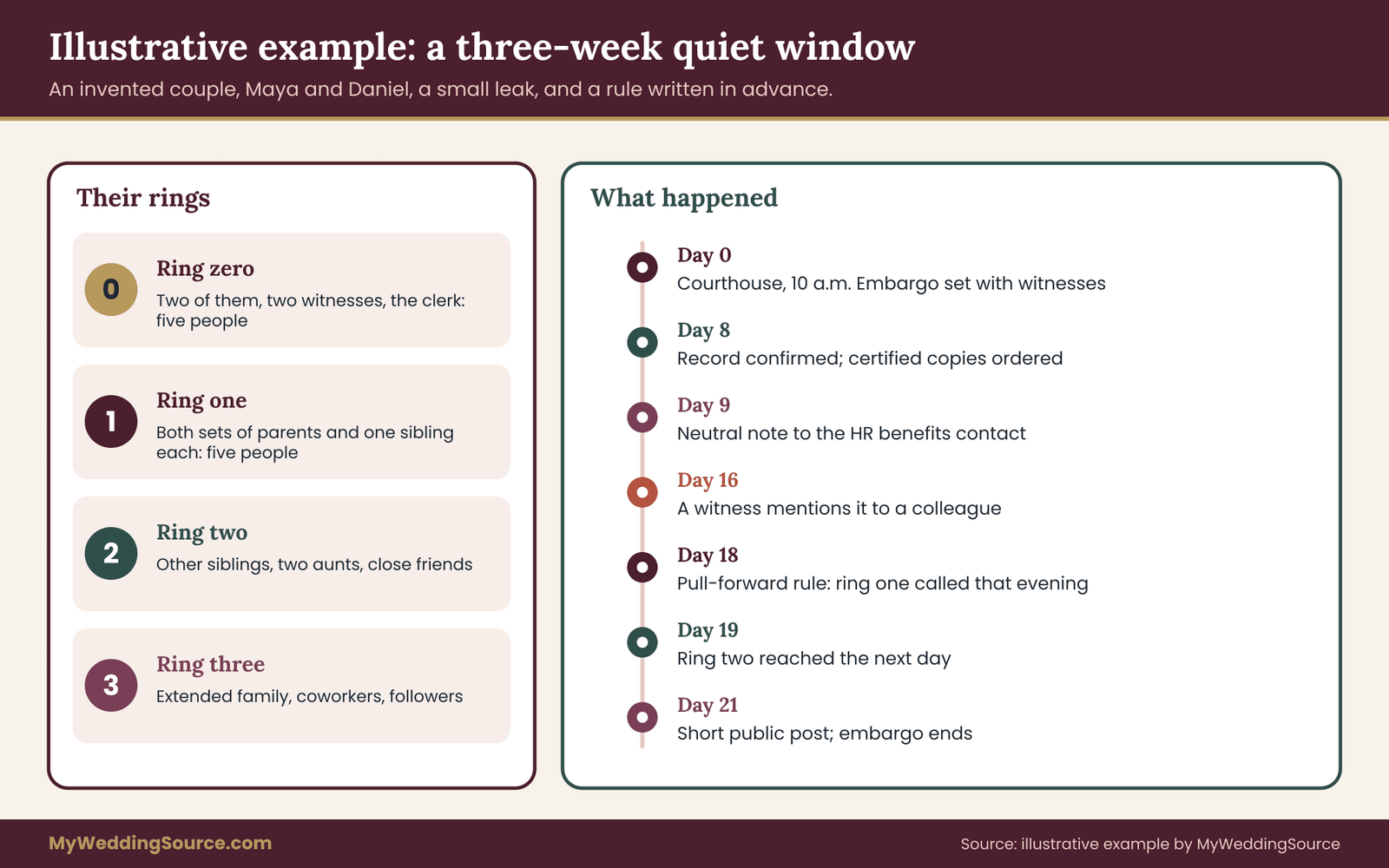
An invented couple makes the method for a courthouse wedding announcement concrete. Maya and Daniel are in their thirties, live together, and want a quiet ceremony. Maya’s parents live two hours away and have talked for years about a large family wedding. Daniel’s mother is in poor health and travels with difficulty. Both have siblings and about a dozen close friends. Maya works for a mid-size company, and Daniel is self-employed.
They decide on a Thursday morning ceremony at the county courthouse, with two friends as witnesses. They have checked with the clerk: the marriage record becomes public after it is filed, there is no confidential option in their state, and the clerk says records are rarely searched but can be.
Their rings
Ring zero is the two of them, two witnesses, and the clerk. Ring one is Maya’s parents, Daniel’s mother, and one sibling each. Ring two is the remaining siblings, two aunts, and ten friends. Ring three is the extended family, coworkers, and their social followers.
Their timing
For the courthouse wedding announcement, their event trigger is the confirmation that the marriage record has been filed. Their calendar backstop is the third Saturday after the ceremony, which gives them about three weeks. They write the pull-forward rule on a card they share with the witnesses.
The three weeks are practical, not arbitrary. Daniel’s mother has a medical appointment the week after the ceremony, and they would rather not add news to that week. Maya’s family has a birthday dinner on the third Saturday, which gives them a natural gathering for ring one to hear and celebrate. They tell ring one by phone the Friday before.
What happens
On the Thursday, they marry at ten and have lunch together. The witnesses take photos and agree to the embargo, which runs until Saturday of week three at noon. Maya tells her manager she has a personal appointment. Daniel tells no one.
On day eight, the county confirms the record. They order certified copies, with delivery to their own address. On day nine, Maya asks HR about the benefits window and finds it is long enough to wait. She sends a short, neutral message to the HR contact and asks it be kept to the benefits team.
On day sixteen, a witness mentions to a colleague that she attended a “lovely courthouse thing.” The colleague asks Maya at work two days later, and Maya says yes, calmly. The pull-forward rule applies: they call ring one that evening and ring two the next day. Their planned date of day twenty-one moves to day eighteen. Ring three hears through a short post two days after ring two.
What the example shows
Notice what went right. The leak was small, caught early, and handled by a rule written in advance, so there was no panic. The people who mattered most heard from the couple first. The most sensitive person, Daniel’s mother, heard in person and kindly, and not before her medical appointment.
Notice also what is imperfect. The window shortened by three days, and a coworker knew before ring three. That is a fair result. A courthouse wedding announcement does not need to be flawless. It needs to be roughly in order, warm and calm. The measures that mattered were simple: the number of people who knew the date stayed at five until day sixteen, every ring-one person heard directly, and no photo was public before ring two heard.
Adapting the example
Your numbers will differ, and so will your courthouse wedding announcement. A couple with no medical concerns and a looser family may announce within a week. A couple with a restricted record and a strong need for privacy may choose a month. The method is the same: choose the rings, choose the triggers, write the pull-forward rule, and keep a record of who knows.
Private wedding announcement alternatives compared
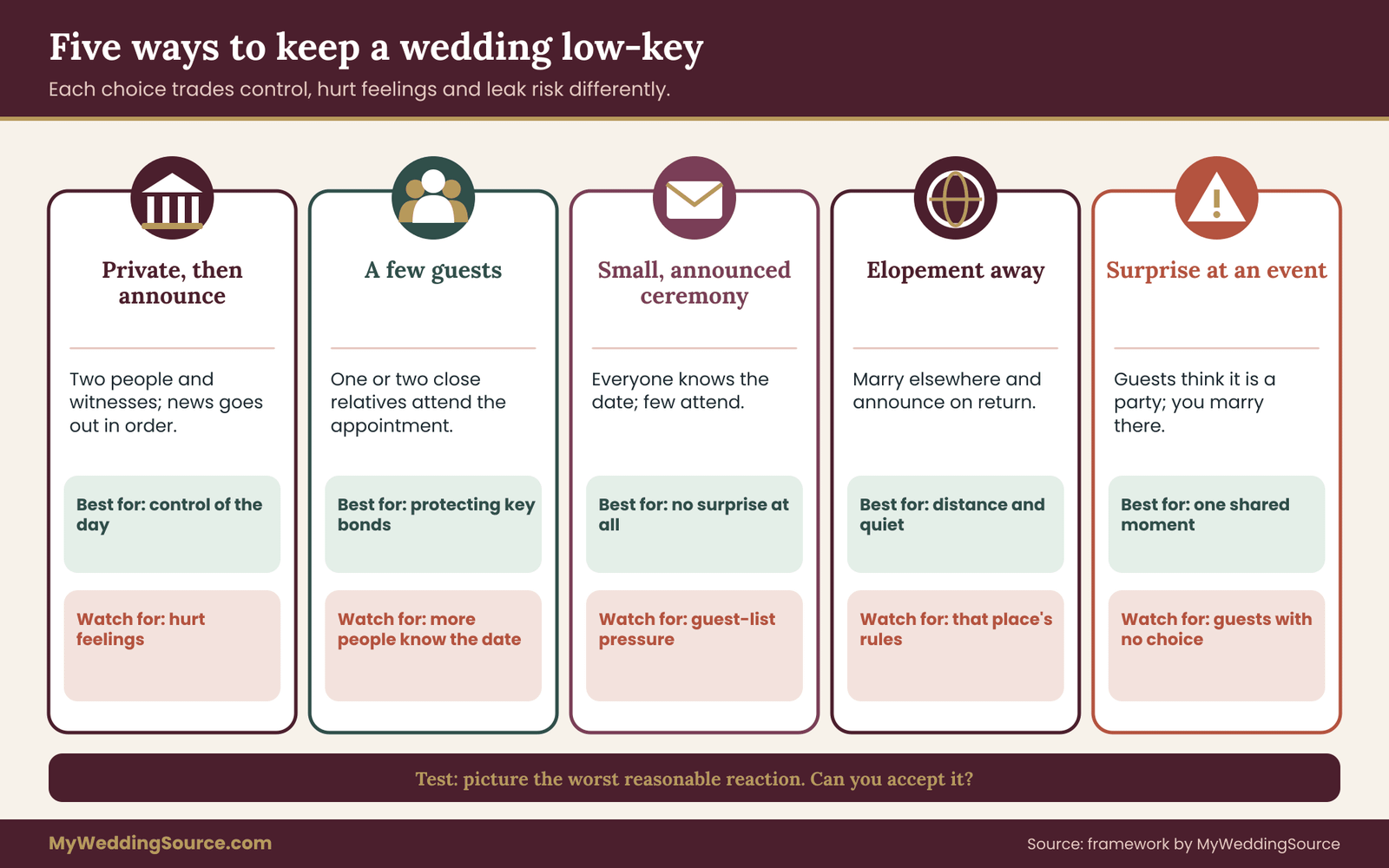
A quiet courthouse ceremony followed by a later courthouse wedding announcement is one of several ways to keep a marriage low-key. Seeing the alternatives side by side helps you check that this is the right one, and it gives you language for explaining it. Here is how five approaches differ.
Private courthouse wedding, then a courthouse wedding announcement. The legal ceremony is for two people and witnesses. The news goes out in a planned order afterward. Its strength is control of the day and of the sequence. Its cost is the risk that someone feels excluded, and the work of managing the quiet window.
Courthouse ceremony with a few guests. You bring one or two family members, typically parents or children. This reduces the hurt-feelings problem and increases the leak risk, since more people know the date. It suits couples where one or two relationships carry most of the emotional weight.
Small announced ceremony. You tell everyone the date and a few guests attend. This removes the courthouse wedding announcement problem altogether, because everyone knows in advance, but it brings back the guest-list pressure that many couples want to avoid. The site’s wedding guest list guide helps with that decision.
Elopement away from home. You travel somewhere and marry with few or no guests, and announce on return. The courthouse wedding announcement logic is the same, but the legal steps change, since you follow the rules of the place where you marry. Ask that jurisdiction’s office what it requires, and what happens to the record you create.
Surprise ceremony at a planned event. Guests believe they are attending a party, and you marry there. It makes the courthouse wedding announcement the event itself. It also removes everyone’s choice, and the guests who would have wanted to know in advance are placed in an awkward spot. If you are considering this, tell ring one beforehand.
How to choose between them
Use three questions. First, who would be hurt by being absent, and could they be present at the courthouse without raising the leak risk too much? If the answer is one or two people, the small guest version may solve the problem. Second, how long can you keep a secret honestly? If the answer is under a week, a same-day or next-day announcement may beat a long quiet window. Third, do you plan to celebrate later? If yes, the courthouse wedding announcement can point to it, and the sting of exclusion drops.
If you are unsure, a useful test is to imagine the worst reasonable reaction from the person you worry about most, and ask whether you can accept it. If you can, proceed. If you cannot, the courthouse wedding announcement may need to be earlier, more personal, or more inclusive than your first draft.
Cost and effort of each option
Costs in a courthouse wedding announcement are mostly about time and relationships, not money. A private ceremony costs a license fee and any small extras like lunch or photos, and the fee is set by the county, so confirm it with the clerk. A later party costs whatever you decide to spend on it, and the wedding budget guide explains how to set that number before you commit.
The effort comes in the calls and the conversations. A quiet window is cheap in dollars but expensive in attention. Planning for that attention, with a clear list and a clear order, is the real cost of the choice.
Edge cases that change your courthouse wedding announcement plan
A few situations alter the method enough to deserve their own treatment.
A previous marriage or a divorce in progress. If either of you was married before, the clerk may ask for proof that the earlier marriage ended. This can add a step before the license, and it can also affect how family members feel, especially children from a prior relationship. Handle the paperwork first. Ring one, in this case, often includes the former partner’s side of the family if children are involved, and a direct, plain conversation is better than a message.
Children. Young children need the news first, in person, and in simple language. Teenagers may feel excluded and need an acknowledgment of that, as well as a role in whatever comes next. Adult children from earlier marriages may need a call that does not sound like a notice. Do not let children learn from a post or from a relative’s offhand remark.
A seriously ill or elderly relative. If someone close is ill, think about whether they would rather attend, hear in advance, or hear after. Ask a family member who knows them well. Some people would greatly prefer to be present at a short ceremony, and a courthouse ceremony can often accommodate one or two extra guests. If not, a call or a short visit the same day is worth more than a perfect message.
Immigration or visa timing. Where a marriage affects an immigration process, the timing of the ceremony and the paperwork matters, and the rules are specific. Speak with a licensed immigration attorney or an accredited representative before you set dates, and follow the guidance of the relevant agency. Do not rely on a general article, including this one.
Religious or cultural expectations. In some families, a civil ceremony is a formality and the religious or cultural ceremony is the marriage. In others, a civil ceremony without family is a serious rupture. Know which you are dealing with. If a later ceremony is planned, say so in the courthouse wedding announcement, and consider telling the relevant elder or leader personally before anyone else.
Public-facing jobs and public figures. If you work in a role where your marital status is publicly discussed, a quiet window may be harder to keep. Consider telling your employer’s communications contact before a public statement, and decide who speaks for you.
A change of plan at the last minute. If the appointment is delayed, the quiet window shifts with it. Keep your embargo dates tied to the ceremony date rather than to a fixed calendar day, and tell ring zero as soon as the date moves. A written checklist for the remaining moving parts helps if you are also planning a later celebration.
Decision rules in one place
Some couples find it useful to boil the method down to a few if-then rules. These are not laws, just reasonable defaults.
If the marriage record is easy to search and your family is likely to look, keep the quiet window under two weeks. If the record is restricted, a longer window is realistic.
If anyone in ring one would be badly hurt to learn second, tell them within the first five days and by phone. If you cannot reach them, send a short message asking for a call, not the news itself.
If a celebration is planned, mention it in the first message to rings one and two. If it is not, say so plainly, and offer a smaller gesture such as dinner.
If someone outside ring zero finds out, start the sequence at once. If a short deadline applies, such as benefits enrollment, handle that with the one office that needs to know, and keep the broader courthouse wedding announcement on its own schedule.
If you are still unsure after all of this, choose the earlier date. A courthouse wedding announcement that arrives a little early is almost never regretted, and one that arrives late often is.
Measurable checks for the quiet window
A plan is easier to follow when it has numbers. Five checks are worth keeping on a single page.
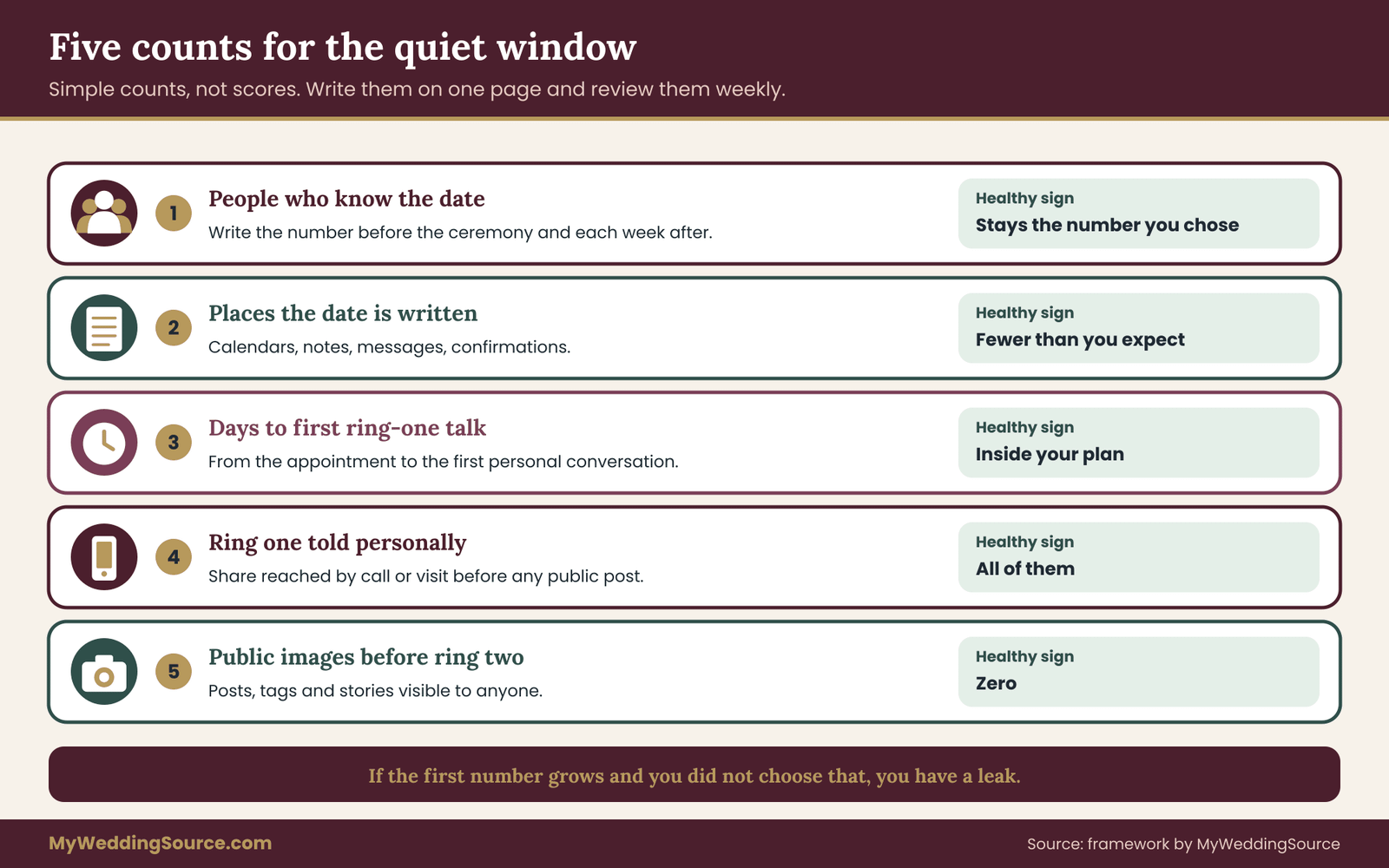
The number of people who know the date: write it down before the ceremony and again each week. The number of places the date is written: calendars, notes, messages. The number of days from ceremony to the first ring-one conversation. The share of ring one reached personally before any public post. And the number of tagged or public images before ring two has heard.
These are simple counts, not scores. If the first number grows and you did not choose that, you have a leak. If the fourth is not one hundred percent, you have a conversation to repair. They turn a vague worry into a short list you can act on.
Putting the whole courthouse wedding announcement on one page
Everything above fits on a single sheet, and a single sheet is easier to share with a partner and with ring zero. Write these lines and fill each one in plain words.
The date of the courthouse wedding announcement. The calendar backstop, and the event trigger if you have one. Example wording: “Saturday the twenty-eighth, or the day the record is confirmed, whichever comes first.”
The ring lists. Names under each ring, with the person who will contact each name. Ring one has the shortest list, and each name has a phone icon beside it, meaning a call, not a message.
The embargo. One line: what ring zero may not post, and until when. The same line works for a hired photographer, since a courthouse wedding announcement that begins with a vendor’s teaser has lost its order.
The pull-forward rule. One sentence, with the twenty-four and forty-eight hour limits.
The messages. One draft per ring, with the first line of each in bold so you can see at a glance that the news comes first.
The paperwork windows. A short list of anything with a deadline, with the office that sets it. Health coverage and employer benefits are the usual ones.
The log. A blank space to note who was told, when, and how it went.
Keep the page somewhere both of you can reach it, and keep it out of a shared family calendar or a document that others can open. The sheet itself holds the whole plan for your courthouse wedding announcement, so it deserves the same care you give the date.
Questions worth asking your officiant or clerk
Two short conversations settle most of the unknowns. Ask the clerk about public access to the record, the earliest and latest dates the license is valid, who may be present in the room, and whether photography is allowed. Ask your officiant, if you use one, who files the license, by what date, and how you will be told that it was filed.
These answers shape the timing of your courthouse wedding announcement more than any piece of advice from a friend or an article. They also let you say, truthfully, “the record is filed”, which is the sentence most people want to hear before they believe the marriage is real.
Your next steps
Work through these in order. Each one is small, and together they take an evening or two.
- Call or visit the county clerk and ask the three record questions: is the record public, is any newspaper listing made, and is there a restricted option.
- Build your four rings on one page. Keep ring one under seven names.
- Pick a trigger and a backstop date for your courthouse wedding announcement, and write the pull-forward rule in one sentence.
- Brief ring zero in writing with the embargo, the date, and what to do if they hear someone knows.
- Run the leak audit two days before the appointment, and note the counts.
- Draft one message per ring, read each aloud, and cut anything that sounds like an apology.
- Check the paperwork windows that may be short, such as health coverage and employer benefits, with the office that sets them.
- After the courthouse wedding announcement, keep your log, and store certified copies and photos in a single place. The records guide shows one way to do it.
If you want a second opinion on the legal details, the guide to who can legally officiate and your county clerk are the right places to start, not a general article.
FAQ
How long should I wait before announcing a private courthouse wedding?
There is no required length for a courthouse wedding announcement. Many couples tell close family within a few days and everyone else within a week or two. Choose a backstop date before the appointment, and shorten the window if the marriage record is easy to search or your witnesses are likely to mention it. A longer window needs more care with photos, paperwork and workplace forms, and with every message in your courthouse wedding announcement.
Is a courthouse marriage record public?
It depends on the state and county. In many places marriage records are public, and some localities or newspapers publish lists of new licenses. A few states offer a confidential option with eligibility rules. Ask your county clerk before you set your courthouse wedding announcement date, and ask how the record can be searched and who can request a copy.
Who should I tell first?
Tell the people who would be most hurt to hear it from someone else: parents, children, and anyone who raised you. Do it by phone or in person if you can, since the first call in a courthouse wedding announcement sets the tone, in a short stretch of time so the news does not travel between them. Close family and friends come next, then coworkers and the wider circle.
Do I have to explain why we married privately?
No. A short, warm reason is enough, such as wanting a quiet day. Long explanations create material to argue with. If someone pushes, repeat a calm sentence about your choice and offer something concrete, such as a dinner. You can say you are glad to share the happy parts without defending the decision.
What if a witness posts the news early?
Follow your pull-forward rule. Tell your closest people within twenty-four hours and the next ring within forty-eight, and ask the witness politely to take the post down. Do not make it a conflict. If the news has already spread, accept it and start your calls earlier than planned. Agreeing on a photo embargo beforehand makes this much less likely.
Can I wait to change my name or update records until after I announce?
Often yes, but check the short windows first. Health insurance enrollment after marriage and employer benefits changes may have deadlines measured in weeks. Name changes on a driver’s license, passport or bank account are usually less urgent. Confirm each with the issuing agency, and use a neutral message to HR so fewer people learn early.
Should I send a card or post online?
Either works for the wider circle, but only after your closest people have heard directly, because mail and posts can arrive before a call. A card suits couples planning a later party, since it feels like an invitation. A post is faster. Keep both short, avoid apologizing, and check tag and location settings before sending.
What if a family member is upset?
Listen first and avoid arguing. Respond to the wish behind the reaction, such as wanting to be there, and offer a next step if you have one, like a dinner or a visit. Give people a few days to settle before following up. Some will take weeks to come around, and that is a normal response.
Sources
- USA.gov: Get a copy of a marriage certificate
- CDC National Center for Health Statistics: Where to write for vital records
- Social Security Administration: Change your name with Social Security
- U.S. Department of State: Passports and name changes
- IRS: Tax information for newly married taxpayers
- HealthCare.gov: Special enrollment periods and life changes
- Consumer Financial Protection Bureau: Consumer resources
- Federal Trade Commission: Consumer advice
- USPS: Change of address and mail forwarding
- USCIS: Marriage and immigration information