
Subscription gifts look simple on a registry page: a box of coffee every month, a streaming plan, a meal kit, a flower delivery. The hard part starts after the gift runs out, when a card nobody planned for is charged, a delivery lands at the wrong address, or an account sits in a giver’s name. This guide gives you a one-page ownership audit to run before you list any of them.
Before you add subscription gifts to a registry, answer four ownership questions and mark four dates. Whose name is on the account? Whose card is on file when the gift ends? Who decides whether it renews? Who can cancel and how? Then write down the start date, the last paid date, the first renewal charge and the last day to cancel. If any answer is “we do not know,” the gift is not ready to list. Ask the seller, or pick a gift that ends by itself.
A couple opens a registry and sees a line that reads “Six months of fresh pasta delivered.” A guest buys it for a modest price and feels good about it. The couple enjoys the first box. Seven months later a charge appears on a card they do not recognize, for a plan they never chose, and the cancel button is on a page that asks them to log in with an email address they gave out once. Nobody did anything wrong. The gift simply had no owner after month six.
That gap is what this article is about. Most advice on registries covers what to ask for. Very little covers what happens to subscription gifts when the giver’s money stops. Subscription gifts are unusual among wedding presents because they are the only kind that keeps asking you to make decisions long after the wedding is over. A blender sits in a cupboard. A subscription sends a bill, a notice, a delivery and sometimes a price change.
You will not find a ranking of services here, and no claim that subscription gifts are good or bad. Some couples love them. Well-chosen subscription gifts can be a pleasure that lasts a year. The point is to make sure it ends the way everyone expects it to end.
A note on scope. This is general information, not legal, tax or financial advice. Renewal rules, refund rights and cancellation requirements vary by state, by payment method and by seller, and they change. Where a rule matters, this article points you to the agency that publishes it, so you can read the current version yourself.
What subscription gifts are, and why the second year is the problem
A subscription gift is any present that delivers something repeatedly over time rather than once. That includes physical deliveries such as food boxes, wine or coffee clubs, flowers, books and pet supplies, and digital services such as streaming, music, language apps, fitness apps, cloud storage and software.
It also includes the borderline cases: a prepaid year of a service that then renews automatically, or a “gift” that is really the first month of a plan the couple must keep paying for. Subscription gifts, in this sense, are defined by repetition and by a clock.
What they share is a clock. A one-time gift has a single date, the day it arrives. Subscription gifts have a timeline with several dates, and the dates matter more than the item.
Prepaid, trial and plan-start gifts are different things
Three structures hide behind the same registry label, and they behave very differently after the gift ends.
A fixed-term prepaid gift is paid for in full by the giver and stops on a known date. Three months of a flower delivery, paid once, ending in three months. If the service has no stored card for the couple, nothing happens afterward. This is the cleanest version.
A prepaid-then-renewing gift is paid by the giver for a term, but the account is set to renew automatically at the end. The renewal charge goes to whichever card is on file. If the giver’s card was used, the seller may try that card again, or the couple may be asked to add their own. This is where most surprises live. Of the three structures, this is the one that most often turns subscription gifts into a surprise.
A plan-start gift is not really a gift of the service at all. The giver pays for the first month, or buys a gift card that covers part of a plan, and the plan continues at the couple’s expense. It may be perfectly fine, but only if the couple wanted the plan in the first place.
Knowing which of the three you are looking at is the first audit step, and it takes about two minutes on a seller’s page.
The year-two problem in plain terms
Suppose a guest buys twelve months of a service. For twelve months the couple enjoys it and thinks of the guest kindly. In month thirteen one of four things happens. It ends quietly, which is the best outcome. It renews on the giver’s card, which can surprise the giver. It renews on a card the couple added to use a perk, which can surprise the couple.
Or it lapses and the account is deleted, taking saved data with it. Only the first outcome is free of friction, and it happens only when someone checked. This is the moment when subscription gifts either end gracefully or become a chore.
This is why the audit in this guide is built around ownership instead of around the product. The product is rarely the problem. The unclear owner is.
Who this audit is for
The audit is useful in three situations. You are building a registry and considering adding subscription gifts. You already have a registry and a guest has bought you one. Or you have received a subscription gift and the first renewal date is approaching. The steps are slightly different for each, and the later sections separate them.
The broader question of what belongs on a registry at all is covered in the site’s guide to wedding registry ideas, so this article stays focused on one narrow problem: what happens after the first year. Whichever applies, the goal is the same: subscription gifts that end the way everyone expects.
The ownership audit: four owners and four dates
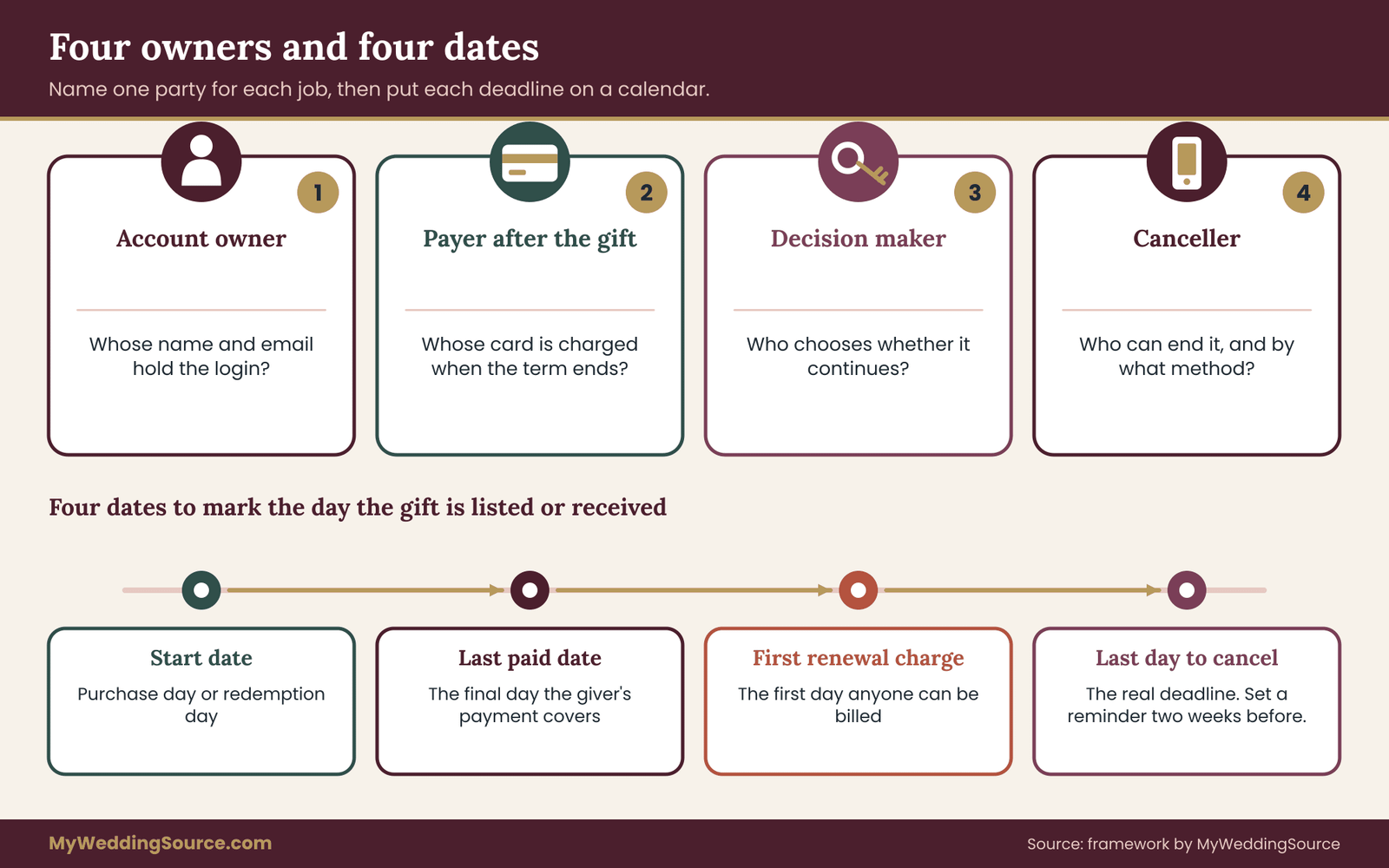
The audit has two parts. The first part names four owners. The second part marks four dates. Together they fit on one page, and you can complete the page for any recurring gift in about ten minutes.
The four owners
Every recurring gift has four jobs, and each job should have exactly one named person or party.
The account owner is the person whose name and email address the account is registered under. This matters because the account owner receives the notices, resets the passwords, and is usually the only person who can change settings. If the account is in a giver’s name, you may be receiving a gift you cannot manage.
The payer after the gift is whoever pays when the prepaid term ends. It may be nobody, which is ideal. It may be the couple. It may be the giver, if the giver agreed to a longer arrangement. The audit requires that this be a person, not an assumption.
The renewal decision maker is whoever chooses whether the service continues. Usually this is the account owner, but some sellers let a payer override the account holder, and some let either party cancel. Find out which rule applies. For subscription gifts, the decision maker is often the person least likely to be reminded.
The cancellation owner is whoever can end it, and by what method. A seller may allow cancellation online, by phone, by chat, or only through the app store that billed it. The method decides how easily a couple can leave.
If two jobs belong to different people, that is not automatically a problem. It becomes one when nobody knows it.
The four dates
Mark these on a calendar the day the gift is purchased or the day you decide to list it.
Start date. When the service begins. Some gifts begin at the moment of purchase, which can waste weeks of a prepaid term before the wedding. Others begin when the couple redeems a code, which gives them control.
Last paid date. The final day that the giver’s payment covers. Count it carefully, since a “twelve month” gift might be twelve billing cycles, fifty-two weekly deliveries, or twelve calendar months from redemption. Sellers of subscription gifts count terms in different ways, so write the date, not the label.
First renewal charge. The date the seller may first charge anyone for continuing. This is often the same day as the last paid date, or the day after.
Last day to cancel. The final date on which cancellation prevents the renewal charge. Sellers often require notice some days before renewal. Sometimes it is only a few hours. Treat this date as the real deadline, and put a reminder on a calendar two weeks before it.
A couple who has the four owners and the four dates written down has done most of the work. The remaining sections explain how to find each answer and what to do when the answer is unfavorable.
Why a registry is a poor place to discover this
A registry page shows a price, a photo and a short description. It rarely shows renewal terms. Guests click quickly, often on a phone, and the seller’s terms may live three screens away. By the time the question matters, the guest is gone, the order is complete and the couple is the only person left holding the problem.
That is the structural reason to do this audit before listing rather than after receiving. ## Who owns the account behind subscription gifts That is why subscription gifts reward a few minutes of homework before listing.
Start with the account, because every other answer depends on it. There are three common arrangements, and each leads to a different set of risks.
Arrangement one: the account is in the couple’s name
The giver buys a gift code, a gift card or a prepaid term, and the couple creates or uses their own account. This is the arrangement to prefer. The couple receives every notice, controls every setting and can cancel without asking anybody. The giver’s payment is applied as a credit or a prepaid period, and when it runs out, the couple decides.
Ask one extra question here: does the seller require a payment method to redeem the code? Some sellers want a card on file even for a fully prepaid plan, so that the plan can continue automatically. If a card is required, the couple should read the renewal terms before entering one, and should note the date the first charge could occur. Subscription gifts redeemed with a code in the couple’s own account are the easiest kind to manage.
Arrangement two: the account is in the giver’s name
The giver subscribes in their own name and has the deliveries sent to the couple, or shares a login. This sometimes happens with magazines, flower deliveries, and food boxes. It can be a lovely gesture, but it leaves the couple as recipients with no control. If the giver forgets, loses interest, or cancels in six months, the gift stops without warning. If the giver forgets to cancel, the giver pays for a service the couple may no longer want.
The remedy is a short, kind conversation. The couple can ask the giver to confirm the end date in writing, and the giver can set a reminder to cancel. Neither party has to feel awkward about it. A line as simple as the one below keeps the tone warm.
“Thank you so much for the delivery. Could you tell us when it ends, so we can plan for it and you are not billed by surprise?”
Arrangement three: a shared or family plan
Some digital services let one person add others to a plan. A giver might add the couple to a family plan for streaming or storage. The couple then depends on the giver continuing to pay and may lose access, along with any saved data, if the giver leaves the plan. This is the arrangement most likely to cause a quiet loss, since the couple may have stored photos, playlists, documents or progress inside someone else’s account.
The practical rule is simple. Anything you would be sad to lose should not live only inside an account you do not own. If a shared plan holds your wedding photos, copy them to storage you control before the first renewal date. The wedding records guide on this site, organizing your wedding records after the event, lays out a three-copy method for photos and documents that applies here as well. Subscription gifts that hold your data deserve this rule more than any others.
A five-minute account ownership check
You can settle the account question for almost any gift with five quick observations.
- Open the seller’s gift page and find the word “redeem” or “gift code.” If it exists, the couple can usually hold the account.
- Look for the phrase “billed to” or “payment method” in the checkout summary. Note whose card is requested.
- Find the sign-in method. If it uses an email address, ask whose it is.
- Look for “cancel” in the account settings or the help center. Note the method offered.
- Search the terms for “transfer.” Some accounts can move to a new owner, many cannot.
If you cannot complete a step, write “unknown” on your audit page. An unknown is useful information, because it tells you to ask the seller before listing the gift.
What to ask the seller about accounts
Sellers answer these questions more readily than most people expect. Short, factual questions get short, factual replies. Keep them in writing so you have a record.
“If a guest buys a gift code, can the account be created in our names and our email address? Is a payment card required to redeem it? Does it renew automatically when the prepaid period ends?”
Save the reply. It belongs with your other registry paperwork, and if it ever disagrees with what happens later, a dated message is more useful than a memory.
When partners disagree about subscription gifts
Two people rarely want the same things from a registry, and subscription gifts expose the difference quickly. One partner may love a weekly delivery and the other may find it stressful. One may be relaxed about a card on file while the other wants every charge accounted for. Settle this before listing, not after, since a disagreement about a gift someone has already paid for is harder to have kindly.
A useful way to settle it is to ask each partner for a veto on subscription gifts. If either partner would feel a pang of dread seeing the charge or the box, the gift stays off the list. This costs very little. It also means that every subscription gift that does arrive has two willing owners, which makes the account, payment and cancellation questions much easier to answer.
A gift that only one of you wants should usually be a gift that one of you manages, with the other agreeing to the end date in advance.
Agree, too, on who holds the audit page. Many couples split the work without thinking about it, and the person who set up the registry is the person who ends up tracking the renewals. That is fine if both of you know where the page lives and what it says. If one partner travels often, the other should hold the reminders.
Who pays when subscription gifts end
Money is where subscription gifts most often go wrong, and the reason is the card on file. A seller that stores a card can keep billing it. Whose card it is, and whether that person remembers, decides everything. Subscription gifts that renew on a stored card are where most of the unpleasant surprises start.
The three payment outcomes
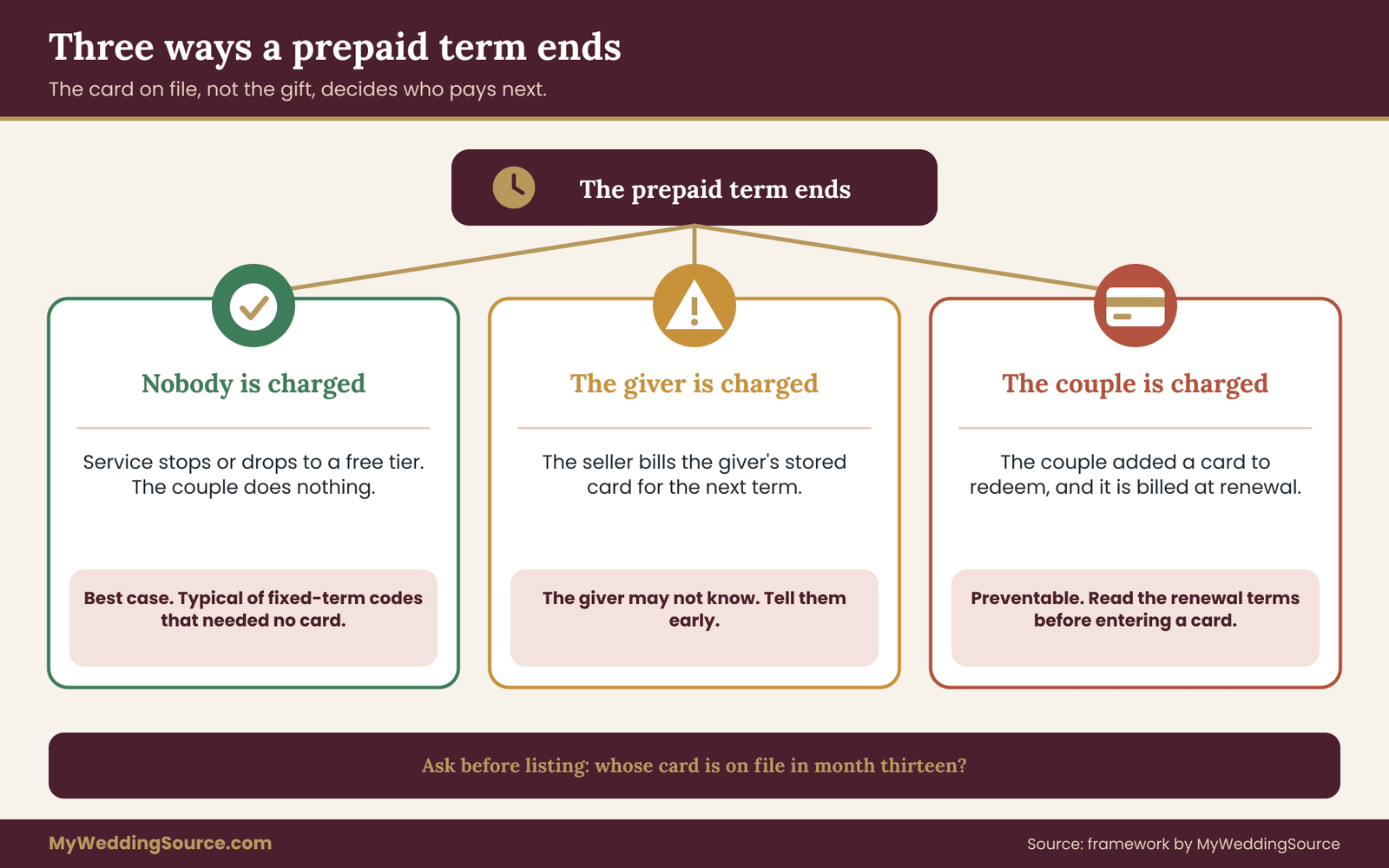
When a prepaid term ends, one of three things happens.
Nobody is charged. The service stops, or drops to a free tier. The couple does nothing. This is the clean ending, and it is typical of fixed-term gift codes that did not need a card.
The giver is charged. The seller keeps the giver’s card and bills it for the next term. The giver might know, because they chose auto-renew, or might not know, because they accepted a default setting. Either way, the giver is paying for something the couple may not need. This is the outcome that can strain a friendship, since the couple may learn about it only when the giver complains or when the giver cancels in surprise.
The couple is charged. The couple added a card to redeem or to enable a feature, and the seller bills it at the end of the gift. This is the outcome the couple can prevent most easily, because it requires a card to be entered. Do not enter a card until you have read the renewal terms and marked the last day to cancel.
The renewal price may not match the gift price
An important detail is that the price after a gift or a promotional period may be different from the price the giver paid. Introductory rates are common, and so are plan changes that follow a term. The renewal price is often written in the terms or on the checkout page, though not always in the same place as the promotional price.
Look for the line that says what the service costs after the first term, and write it on your audit page next to the four dates. The renewal passage is the one to read first when subscription gifts come with an introductory rate.
Do not assume the renewal charge equals the gift value. A gift worth a modest monthly amount can renew at a different amount, billed annually instead of monthly, and the annual charge can be a larger single hit than anyone expects. A rule of thumb for the audit: if the renewal could be charged as a single payment larger than your comfort level, move the last-day-to-cancel reminder earlier and add a second reminder a month before.
Card on file: a decision rule
Use this rule when a service asks for a payment card at redemption.
If the gift is prepaid for a long enough term that you are sure you want the service, enter a card you can monitor, and mark the cancel date. If you are unsure you want it, ask whether the service allows redemption without a card. If it does not, treat the card entry as a commitment and set the reminder before you finish the form.
If the seller offers a virtual or single-use card through your bank, consider whether it suits the purpose, and check your bank’s rules about how recurring charges behave on such cards. Subscription gifts that ask for a card at redemption should always trigger this rule.
For the money side of this decision, the wedding budget guide explains how to keep a running total, and recurring charges belong in the same list as one-time costs, since an annual renewal is a real expense even if it arrives in the first year of marriage as a surprise.
When the giver wants to keep paying
Sometimes a giver says, with real warmth, that they would like to keep covering a service. A parent may want to continue a flower delivery. A friend may offer to keep paying for a music plan. This is generous and may be perfectly good. It does change the audit, because the payer after the gift is now a named person with a continuing obligation.
Write the arrangement down in one sentence, including the amount and how long it will last. Agree on how either side can stop it without offense. A single plain message resolves most future confusion, and it protects the friendship more than the gift itself does.
“We would love that. Can we agree you will stop whenever it stops being convenient, and we will let you know if we ever want to cancel?”
Who sees the charge?
A last point on money. A renewal charge appears on whichever statement holds the card. If that statement is a joint account, both partners see it. If it is one partner’s card, the other may not. Agree before the first renewal who watches the statements, which is part of the reconciling habit described in the guide to wedding records. A recurring charge that nobody is watching is exactly how a small renewal becomes a six-month mistake. With subscription gifts, a charge nobody is watching is the real hazard.
Credit card billing disputes generally have to be reported in writing within sixty days of the statement showing the charge, as the Consumer Financial Protection Bureau explains. That window is another reason to check statements in the first few months after the wedding, when gifts, deposits and returns create unusual charges. Rules for debit cards and other payment methods differ, so ask your bank how its own process works. ## How to read the renewal terms on subscription gifts
Terms of service run long, and nobody reads them for pleasure. For the audit you do not need all of it. You need five short passages. Use your browser’s find function and search for the words below. Each passage answers a specific question, and each has a place on your audit page. Reading the terms of subscription gifts this way takes minutes, not hours.
Passage one: the renewal clause
Search for “renew,” “auto-renew,” “automatically” and “recurring.” You are looking for a sentence that says what happens at the end of the term. Some sellers renew for the same length as the term just ended. Others renew monthly, whatever the original term was. A twelve-month prepaid gift that renews month to month has a very different cost profile from one that renews for another twelve months.
Note three facts: the length of the renewal term, the renewal price or how it is set, and the payment method that will be charged.
Passage two: the notice clause
Search for “notice,” “remind” and “notify.” Some sellers promise a reminder email before renewal, and some state how many days ahead. Others do not mention it. A promised reminder is a convenience, not a safeguard. The email may land in a spam folder, or go to an address you rarely open, or be sent to the giver. The audit treats a reminder as a bonus and the calendar entry as the real control.
Passage three: the cancellation clause
Search for “cancel,” “cancellation” and “terminate.” Write down the method, the deadline and what happens to the remaining prepaid time. Some services let you cancel at any point and keep access until the paid period ends. Others end access right away. A few offer no refunds at all for unused time, which is a trade-off to weigh when the giver paid for a long term.
Passage four: the price change clause
Search for “price,” “fee” and “change.” Many services reserve the right to change prices, and some tell you how much notice they give. The audit does not require you to predict a price change. It requires you to know that the right exists and to put the price on your calendar review.
Passage five: the refund clause
Search for “refund.” Note whether a refund exists for the unused portion, a renewal you did not intend, or a delivery that did not arrive. Pay attention to who receives the refund. If the giver paid, a refund may go back to the giver’s card, which means the couple should tell the giver before cancelling an early gift.
Plain language beats legal language
When a term is hard to understand, ask the seller to explain it in one sentence, and save the reply. You are not doing anything unusual by asking. A seller who cannot say in plain words what happens at renewal has just given you useful information about the gift. Subscription gifts are easier to judge when the seller’s own words are plain.
What the law and the agencies say, in general terms
This section is background, not legal advice, and the details change. The Federal Trade Commission, which handles consumer protection in advertising and sales, has published guidance on automatic renewals and recurring charges for many years. A federal law about online sales, the Restore Online Shoppers’ Confidence Act, addresses how sellers disclose recurring terms and what consent they need before charging a card.
The FTC has also worked on rulemaking around negative option practices, and the status of that work has shifted over time, so the FTC’s own website is the place to read what applies today.
Many states have their own automatic renewal laws, and they differ on disclosures, reminders and cancellation methods. Your state attorney general’s consumer protection office can tell you what applies where you live. The practical takeaway is modest. Consumers do have protections, but those protections work best when you keep your own records: the terms as they appeared on the day you accepted them, the reminder messages and the cancellation confirmation.
Keep evidence, not just intentions
Take a screenshot or save a PDF of the terms page when you redeem a gift. Terms change, and a seller’s later version may not match what you agreed to. Save the confirmation of any cancellation, including the date and time. File them together, as the guide on wedding vendor contracts suggests for service agreements, with a short note naming who accepted what. For subscription gifts, a saved copy of the terms is worth more than a good memory.
Who decides, who cancels: the last two owners in subscription gifts
The first two owners, the account and the payer, determine who is exposed. The last two, the decision maker and the canceller, determine who can act. Mismatch between them is common and easy to miss.
When the decision maker cannot cancel
The account owner is usually the decision maker, but a few arrangements split the powers. A shared plan may allow the organizer to remove members while members cannot leave without asking. A gift sent to the couple’s address may be controlled entirely by the giver. A reseller or marketplace may bill on behalf of a third-party seller, and cancellation may have to go through the reseller.
In all of these cases the person who wants to stop the gift may not be the person who can. With subscription gifts, the two jobs often sit with different people, and nobody notices.
Write the answer to this question on your audit page: if we wanted to stop this today, could we, and how long would it take? A good answer is “yes, online, in two minutes.” A weak answer is “we would need to ask the giver to log in.” A poor answer is “we are not sure.” Subscription gifts with an unclear exit are the ones to leave off the list.
Cancellation methods differ more than you would think
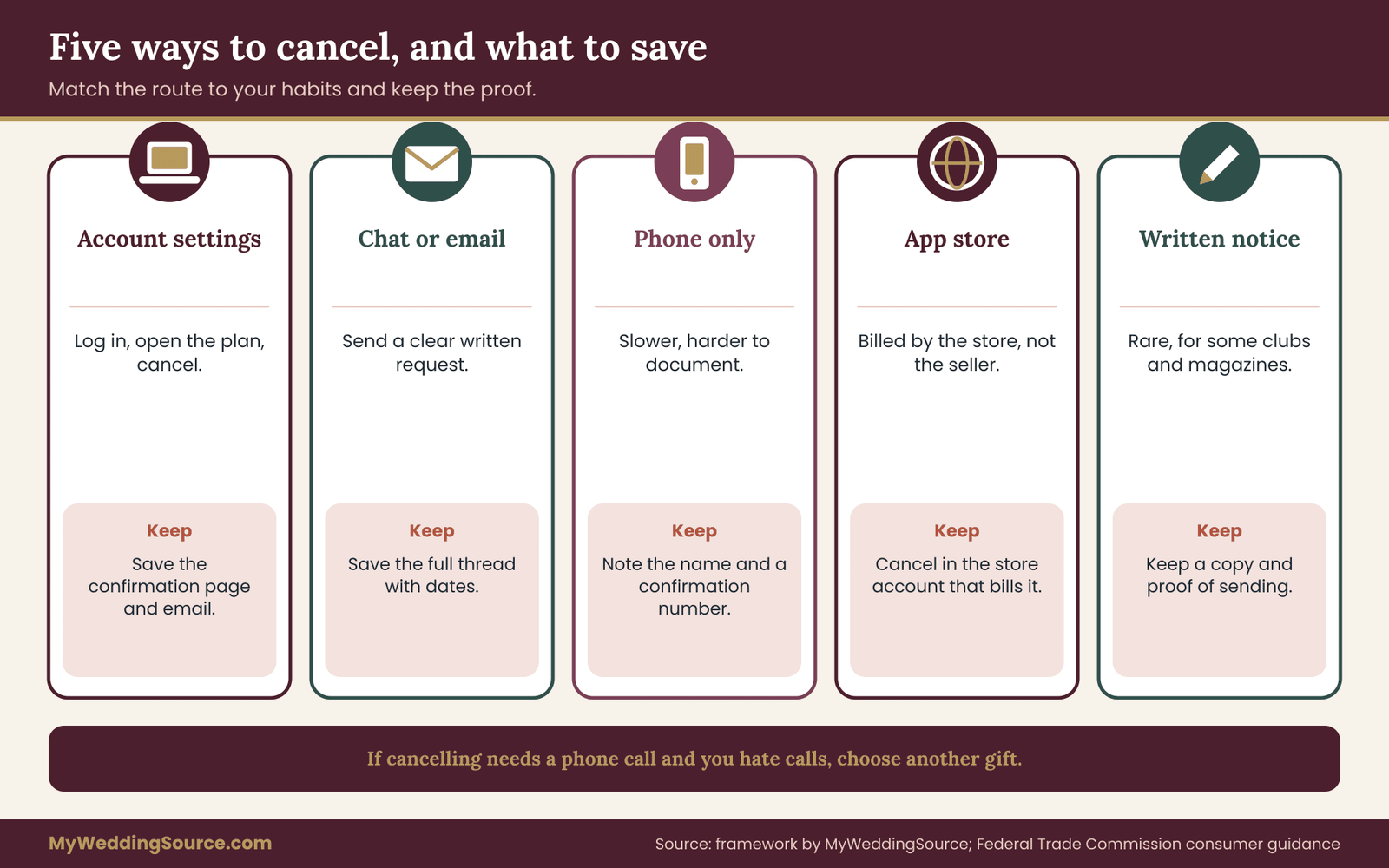
Methods fall into a handful of patterns.
Online account settings. The simplest. Log in, find the plan, click cancel.
Chat or email request. Fine if you keep a copy of the exchange and the confirmation.
Phone only. Slower and harder to document. Ask for a confirmation number and the name of the person you spoke to, and follow up in writing if you can.
App store billing. Some digital services bill through a mobile app store. In that case cancellation happens through the store account, not the service’s own website. The store’s official support pages explain how to view and end subscriptions, and the audit should note which store account holds the plan.
Mail or written notice. Rare for consumer services but possible for magazines and some physical clubs.
Match the method to your habits. A couple who rarely makes phone calls should treat a phone-only cancellation as a reason to prefer a different gift.
A script for cancelling kindly
When the time comes, a brief, specific message works best, whether you use chat, email or a form.
“Please cancel the subscription on the account under this email address, effective at the end of the current paid term, and confirm in writing that no further charge will be made.”
Ask for the confirmation to be sent by email and save it. If the service has charged you after cancelling, the confirmation is your proof when you contact the seller or your card issuer.
What if the giver is the account owner and moves away?
Life changes. A giver who set up a delivery to your home may move, lose interest or forget. If you want the arrangement to continue, ask whether the account can be moved into your name. If you want it to stop, a gentle message can free both sides. People generally prefer to be told than to learn from a bill. Subscription gifts bought by one person for another need this kind of handoff most.
Handing the audit to a partner or helper
The four owners should not live in one person’s head. If one partner manages the registry, they should also share the audit page with the other, and with a trusted person who could act if both were unavailable during a honeymoon or a busy move. A shared note with the four owners, the four dates and the cancellation method is enough. Keep the note where you keep your other post-wedding paperwork, and add the calendar reminders to a shared calendar so both partners see them.
How many subscription gifts are too many
There is no correct number, but there is a practical limit, and it is the number of audit pages you are willing to keep current. Each subscription gift brings four dates, four owners, a set of terms and a stream of messages from the seller. Three or four subscription gifts across a year is manageable for most households. Ten is a part-time job.
A helpful test is to imagine your busiest month in the first year of marriage, perhaps a move, a new job or a family visit. Could you still spot a renewal notice, decide whether to keep a service and cancel it in the right window? If the answer is not clearly yes, the registry has too many subscription gifts, or too many with overlapping end dates. Staggering the start dates helps, because it spreads the decisions across months instead of piling them into one week.
Overlap is its own risk. Two subscription gifts that deliver similar things, such as two food boxes or two streaming plans, make it likely that one will be forgotten. If your registry has duplicates, keep the one with the cleaner terms and replace the other with a one-time gift.
Audit steps for subscription gifts you have already received
If the gift has already arrived, the order of operations changes. You cannot ask the seller before the giver buys, so you reconstruct the answers.
First, find the original confirmation message. It usually names the seller, the term and the amount paid. Second, find the account. If you created it, sign in and read the plan details. If the giver holds it, ask for the end date. Third, mark the four dates on a calendar. Fourth, decide whether you want it to continue, and if you do not, set a reminder two weeks before the last day to cancel and plan to end it before that date.
Fifth, if you do want to continue, decide who will pay, and make that a deliberate choice instead of an accident of card storage.
A short thank-you note should not wait for this process. Send it first, then do the audit. Gratitude and administration are separate tasks, and the etiquette guidance on wedding gifts and thank-you notes covers the first of them. ## Subscription gifts by type: where each kind tends to go wrong
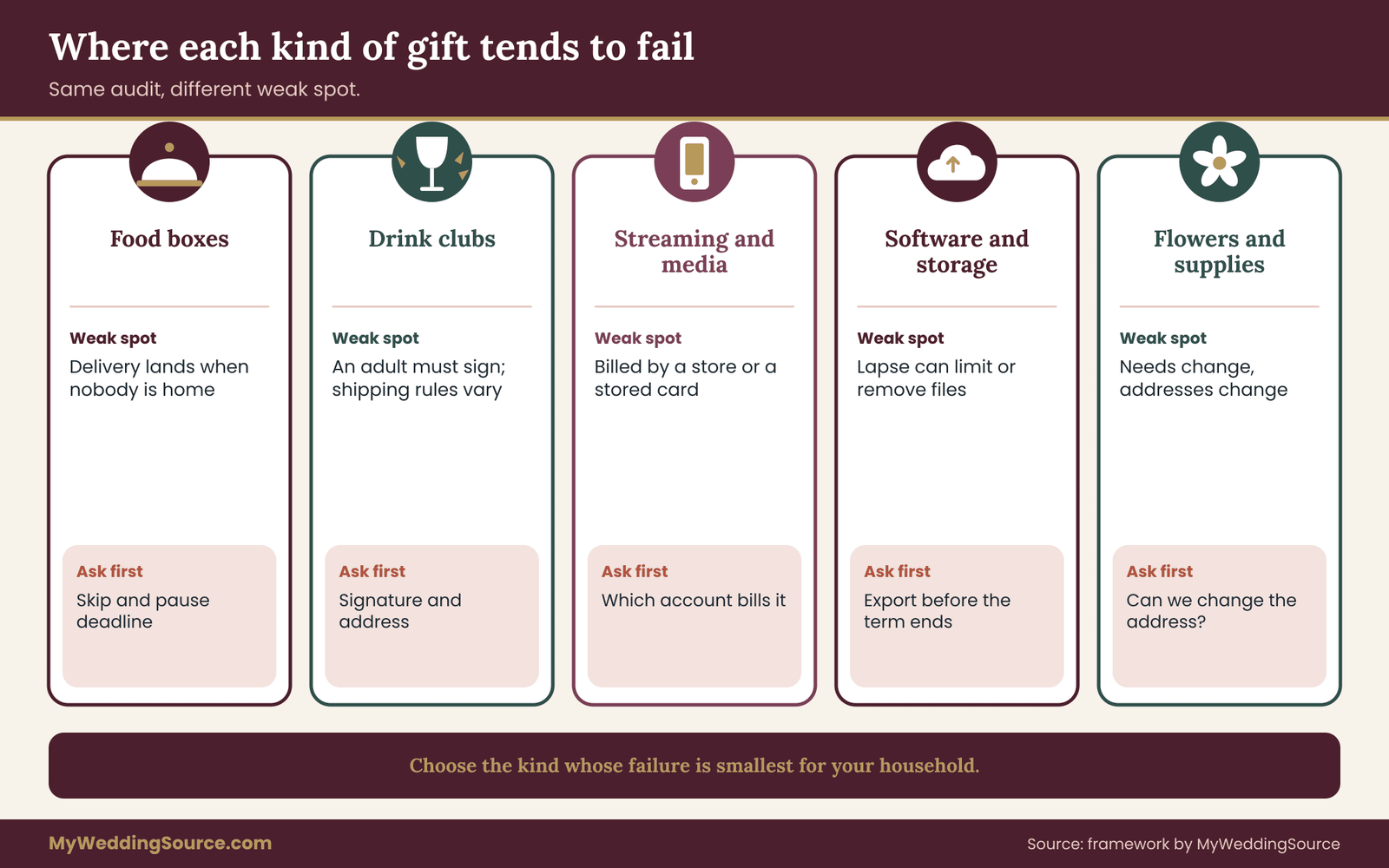
Different kinds of subscription gifts fail in different ways. The audit questions stay the same, but the weak spots shift. What follows is a pattern guide, not a product review, and nothing here says one kind is better than another. Each seller’s terms decide the details. Each of these types of subscription gifts has a favorite way of going wrong.
Food and meal deliveries
Meal kits, produce boxes, bakery subscriptions and snack clubs share a physical problem: the box arrives whether or not anyone is home. The most common failure is timing. A delivery scheduled for the week of a honeymoon sits outside for days, and perishable items spoil. Look for a skip option, a pause option and the deadline for changing a delivery, since that deadline is often several days before the shipping date. Food-based subscription gifts reward couples who read the skip and pause rules first.
Allergies and dietary needs matter too. A gift chosen for a couple with a nut allergy or a vegetarian household has to be checked against the seller’s ingredient information. For anything perishable, the U.S. Food and Drug Administration publishes general food safety guidance on handling and storage, which is worth a glance if a box has been left out in warm weather.
The renewal risk with food is the “continue until cancelled” setting. A prepaid month can quietly become a weekly charge. Mark the last day to cancel before the final box ships.
Drink clubs: wine, coffee, tea and spirits
Alcohol subscriptions add a legal wrinkle. Sellers generally need an adult to sign for deliveries, and shipping rules vary by state. A package may be refused or returned if nobody of age is present. Check that the delivery address is somewhere a signature can be given, and that both partners are comfortable with the choice. Coffee and tea clubs are simpler, though they share the skip-and-pause questions.
Drink clubs also tend to ship quarterly or monthly, so the renewal date may sit a long way from the last delivery. People forget that the charge is tied to the plan, not to the box.
Streaming, music and media
Digital media plans are easy to give and easy to forget. The usual structure is a prepaid gift card applied to a plan, with the plan continuing on a stored card. Two audit points matter. First, whether the plan renews on a card at all. Second, which store bills it, since a plan billed through a phone’s app store is managed there and not on the service’s site.
The couple should know which account to open when they want to stop. Digital subscription gifts are the ones most likely to renew without anyone noticing.
Ad-supported tiers, price changes and bundles may alter what a renewal means, so read the renewal price passage rather than relying on the gift price.
Software, apps and cloud storage
This category carries the highest risk of data loss. A year of cloud storage that quietly lapses may limit uploads, restrict access to files, or begin deleting content after a grace period. The terms usually describe what happens, and that passage is worth reading before you store anything important. Wedding photos, scanned certificates and vendor contracts should never live only on a gifted plan.
Fitness and language apps often track progress inside an account. If the account belongs to the giver or lapses, the history disappears. Ask whether data can be exported before the term ends.
Flowers, plants and household deliveries
Flower subscriptions deliver beauty with a short shelf life, so the schedule matters. Weekly flowers for a year can turn into an obligation to be home. Household supply deliveries such as cleaning products, pet food or toiletries are more practical but depend on the couple’s actual needs, which change after a wedding, a move or a new pet.
Check that the delivery address can be updated easily. The U.S. Postal Service explains change-of-address and forwarding, but forwarding rules do not apply equally to every shipper, so update the address with the seller directly.
Memberships and passes
Museum, zoo, gym and club memberships overlap with subscription gifts, though they bring extra questions about transferability and names. They are covered in the site’s guide to membership gifts on a wedding registry, where the checks focus on those points, and this article concentrates on what happens at renewal.
Timing and seasonality with subscription gifts
Weddings cluster in certain months, and so do the gifts around them. A couple married in early summer will see subscription gifts begin in summer and end in winter or the following summer. That matters for deliveries. A cold-weather problem for perishable boxes is different from a hot-weather one, and a flower subscription ending in deep winter is different from one ending in spring. Check the seller’s delivery rules for extreme weather and for holidays, when carriers run behind.
It matters for budgets as well. An annual renewal falling in the month you also pay a tax bill, an insurance premium or rent after a move is a larger strain than the same renewal in a quiet month. When you list the four dates, note the month of the first renewal charge, and compare it with the rest of your calendar.
If the renewal falls somewhere awkward, you can cancel early, change the plan or move the start date by redeeming a code later, if the seller allows it. Subscription gifts that begin when the couple chooses, instead of when the guest buys, give the most room to adjust.
Seasonality also affects whether you will use a service at all. A garden box makes no sense in an apartment with no light. A fitness app is a good fit in January and a poor one during a busy honeymoon. The audit asks mostly about ownership and dates, but a quick “will we use this in the months we will have it?” is a sensible last question.
A quick comparison in prose
Food and flowers fail through timing and waste. Drinks fail through signature and shipping rules. Digital media fails through billing through a store or a stored card. Software and storage fail through data loss. Household supplies fail through changing needs. If you have to choose, favor the kind whose failure is smallest for your household. A missed flower delivery is a small loss. A lapsed storage plan holding your wedding gallery is a large one. None of this makes any type of subscription gifts a bad choice, only a different audit.
A worked example: the Nguyen and Brooks registry audit
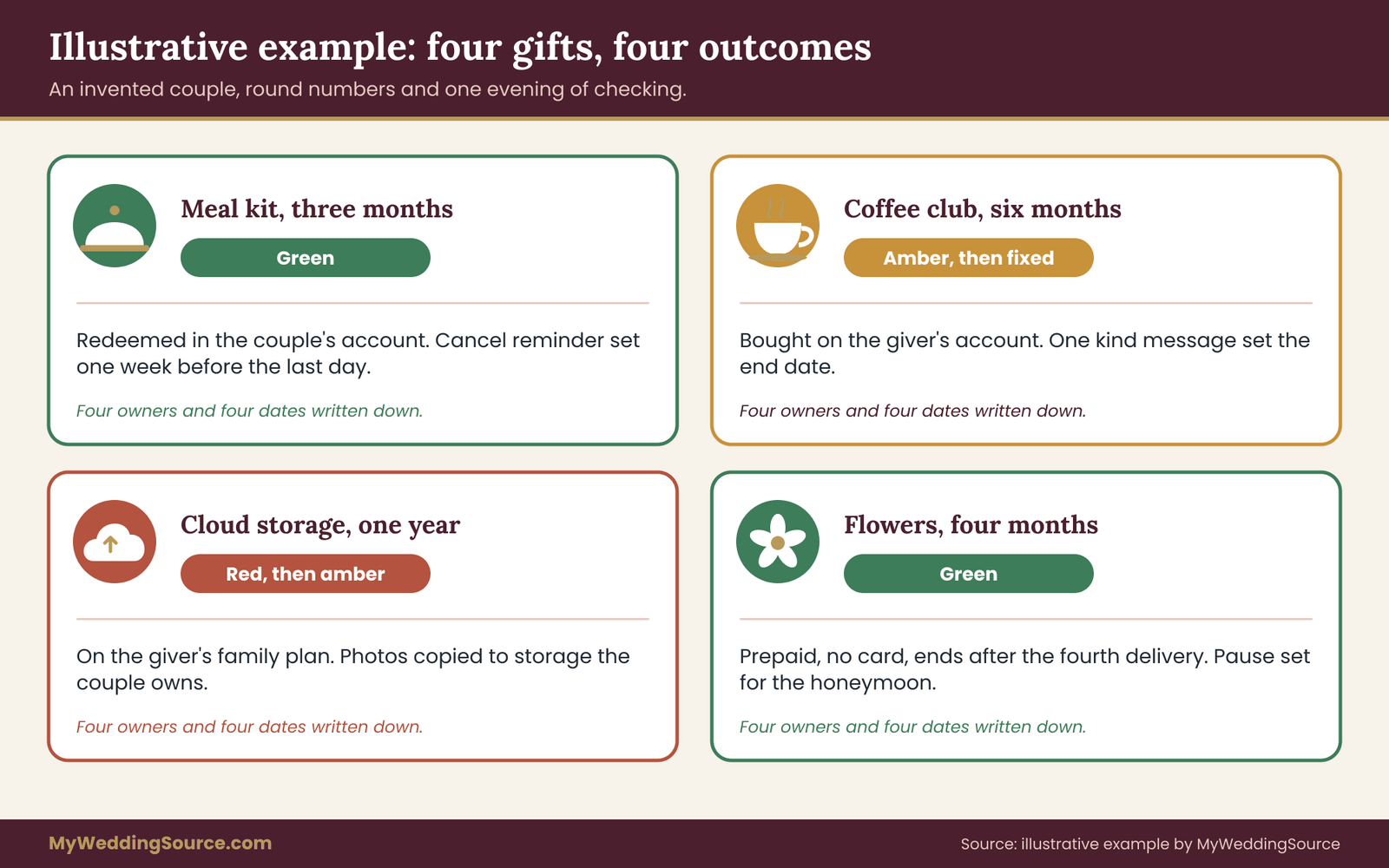
The example below is illustrative and invented, with round numbers chosen for clarity. It does not describe a real couple or a real seller, and the amounts are not typical prices. Its purpose is to show the audit working on four gifts.
Imagine a couple, Linh Nguyen and Marcus Brooks, who list four subscription gifts on their registry. A meal kit for three months, a coffee club for six months, a cloud storage plan for one year, and a flower delivery for four months. Their friends and family buy all four. The couple then runs the audit on each, one evening, with a shared note. The four subscription gifts differ in length, seller and account arrangement, which is exactly why they make a useful test.
Gift one: the three-month meal kit
The seller offers a gift code that the couple redeems in their own account. The checkout asks for a card. The terms say the plan renews weekly at the then-current price unless cancelled before a stated cutoff, several days before each shipment. The couple decides they want it for three months and not longer.
Their audit page shows: account owner, the couple; payer after the gift, the couple if they leave it, so they set a reminder for the final week; decision maker, either partner; canceller, either partner online. Dates: start on redemption, last paid date twelve weeks later, first renewal charge the following Monday, last day to cancel the Thursday before. They enter the cancel reminder one week earlier than that. Result: green.
Gift two: the six-month coffee club
The giver bought it on a personal account and shipped it to the couple. Nobody has asked for an end date. The couple sends the message suggested earlier. The giver replies that it was a six-month plan set to continue until cancelled, and that they had forgotten. The giver cancels that week, which spares both parties an awkward charge in month seven. The couple notes the date and puts a thank-you reminder in their calendar. Result: amber at first, resolved by one message.
Gift three: the one-year cloud storage plan
The plan is on a family account belonging to the giver. The couple has been saving their wedding photos to it. This is the risky one. They copy all the photos to an external drive and to storage in their own names within the first month, and ask whether the plan can be moved. It cannot. They note the end date, decide not to depend on it, and treat the plan as a temporary convenience. Result: red until the copies exist, amber afterward.
Gift four: the four-month flower delivery
A fixed-term prepaid gift with no card needed. The seller’s confirmation says that it ends after the fourth delivery and that no renewal is offered unless the couple signs up. They mark the delivery dates, set the honeymoon pause, and write the thank-you note. Result: green.
What the example shows
Three of four gifts needed less than ten minutes each. One needed a kind message. One needed a real fix. None involved a dispute, and none needed anybody to be angry at anybody. The audit did not remove risk. It moved the surprise from month seven to week one, when fixing it was cheap. Four subscription gifts, four outcomes, and one evening of work.
How long the whole audit takes
A first-time audit of four gifts, including reading the terms and writing to two sellers, can fit in an evening. After the first one, later audits go faster because the same five passages and the same four owners come up each time. The calendar reminders take the most discipline, which is why the next section ties them to the thank-you process. ## Wording subscription gifts on a registry so they end cleanly
A registry entry is the only message every guest reads. It is the best place to prevent a year-two problem, because a few extra words can set the end date, the account owner and the payment expectation before anyone buys anything. If your registry platform allows a short note on each item, use it. Careful wording turns subscription gifts from a guess into a clear, finished gift.
What a clear entry includes
A clear entry names the length of the gift, states that it ends on its own, and says whose name the account will be in. It does not need to be long. Three short sentences cover it.
“Three months of weekly meal boxes. The gift ends after the last box and does not renew. We will set up the account in our names.”
That entry tells the guest exactly what they are buying and tells the seller nothing they do not need. It also protects the guest from an unexpected renewal on their own card, which is the outcome most likely to leave a good friend with a bad feeling about a good gift.
What to avoid in a registry entry
Avoid vague phrases such as “membership” or “a year of fun” with no ending. Avoid listing a service whose gift page does not clearly allow a fixed term. Avoid asking guests to start a subscription on their own accounts, unless you are confident the guest understands the cancellation steps and has agreed to keep paying. Subscription gifts that rely on a giver’s ongoing action put the giver in an administrative role they did not ask for.
If your registry platform pulls product descriptions from the seller, review the entry after it is added, since sellers write marketing copy and not audit notes. Edit the note field to say what you have checked.
Linking only what you have audited
An unaudited item looks the same as an audited one on the page, so the discipline has to happen before listing. A simple rule: do not list subscription gifts until each audit page has no “unknown” in the four owners and has the four dates filled in. If the seller will not answer, leave the item off, since an unanswered question before the sale is rarely answered more helpfully after it. Subscription gifts without a completed page are better saved for later.
The wider question of which categories to put on a registry, and how much variety to offer, belongs to the site’s overview of wedding registry ideas, which covers the full range. This article only helps you decide whether a recurring item belongs among them.
Guest-friendly alternatives within the same entry
Some guests prefer to give something that ends tidily. You can offer two versions of the same idea: a fixed-term version of the service, and a one-time gift of something connected to it, such as a coffee grinder alongside the coffee club. Both let the guest choose a price level, and neither places a long obligation on anyone.
A short message for guests who ask about subscription gifts
Guests sometimes ask before buying, and a ready reply saves time. Keep it factual and friendly, and say what you know.
“Thank you for asking. We have checked that this one ends after the term you choose, and the account is in our names, so nothing will renew on your card.”
If you have not checked a particular item, say so and remove it from the registry until you have. It is better to disappoint a guest slightly now than to leave them with a charge later. Guests who choose subscription gifts tend to be thoughtful people, and they usually appreciate that you thought about the ending as carefully as they thought about the beginning.
Some couples also add a line to their wedding website’s registry page, explaining that any subscription gifts on the list are fixed-term and end automatically. That single line answers most questions in advance and signals that the registry has been reviewed. It is worth keeping it short and plain, with no technical terms.
How guests might ask questions
Guests may message you with practical concerns. A short, friendly reply works better than a long explanation.
“Great question. It is a fixed three-month gift that ends on its own, and we are creating the account ourselves, so you will not be billed again.”
If you do not know the answer, say so and check. Saying “let us confirm and get back to you” is better than guessing, because a guess that turns out wrong becomes your problem and theirs.
Thank-you notes and tracking for subscription gifts
Subscription gifts create a second reason to write, because they keep arriving. A one-time gift gets one note. A subscription gift deserves a note when it begins and, if it has been a pleasure, a short follow-up when it ends. Thoughtful subscription gifts deserve thoughtful records of when they began and ended.
The first note
Send the first note within the usual window after you receive notice of the gift, and name the actual item. “Thank you for the coffee club” is better than “thank you for your generous gift.” Mention something specific, like the first delivery arriving or a first recipe tried. Keep it truthful and avoid inventing anecdotes you did not live.
The closing note
When the gift ends, a short note closes the loop and lets the giver know the account has ended cleanly, so they are not wondering. It also gives you a chance to confirm that no charges are expected. People often appreciate the reassurance, and it takes two lines.
“The six months have come to an end and everything has stopped on its own. Thank you again, it made our first winter a bit warmer.”
Tracking gifts that run for months
Add subscription gifts to the same list you use for other gifts and note four extra fields: the end date, the last day to cancel, the account email and the cancellation method. A spreadsheet works, and so does a shared note. If you already keep a gift log as part of your wedding paperwork, a gift ledger of cash gifts and registry orders can live next to it, and the system described in the wedding records guide can hold both.
What to do if a gift cannot be exchanged
Most subscription gifts are not returnable in the way a toaster is. Some sellers allow refunds for unused portions, and some give credit. A giver who bought a code may be able to ask for a refund within a short window, though that depends on the seller. If you receive a subscription gift you cannot use, say so kindly and early.
A good option is to ask the giver whether they would like the credit moved to someone else, or whether the seller can switch it to a different plan. Do not expect an exchange to be possible. Check before you promise anything. Plan for the possibility that subscription gifts cannot be returned at all.
Alternatives to subscription gifts that finish on their own
If the audit leaves you uneasy, you are not obliged to keep subscription gifts on the registry. The same pleasure can arrive in forms with a clear end.
Fixed-term gift codes with no card required
These are the closest cousin to a subscription. The giver buys a code worth a set number of months or deliveries. The couple redeems it, enjoys it and, when it ends, nothing else happens. If the seller requires a card, this is no longer a clean option, so look for sellers that do not.
Gift cards for a seller
A gift card for a specific shop or service gives the couple the choice of what to buy and when. It carries its own questions, such as expiration, fees and who may redeem it, and the Federal Trade Commission publishes consumer guidance on gift cards. A card is not a subscription, though, and it ends when the balance does.
One-time experiences and vouchers
A tasting, a class or a day out has a date and a finish. The checks differ, since vouchers can expire, so use the site’s guidance on experience vouchers and read the expiry terms before listing one.
Physical items that carry the same joy
A grinder, a pitcher, a bread knife, a plant stand. These do not renew, and they last. Sometimes the best answer to a coffee club is a very good kettle.
A contribution to a shared goal
Some couples prefer to receive money toward something larger and let the giver choose the amount. Contribution funds have their own fee and payout rules, and they belong to a different part of registry planning. They are one way to get the pleasure of generosity without any billing calendar at all.
A decision rule for choosing
Here is a simple way to decide. List the subscription gifts you want. For each one, answer: can it be given as a fixed term with no card, and can we name all four owners? If yes to both, keep it. If it needs a card but you want it anyway, keep it and put the cancel reminder on the calendar the day you receive it.
If either answer is no, swap it for the closest one-time version. Keeping the list short has a side benefit: fewer subscription gifts means fewer dates to track. Keeping fewer subscription gifts is a perfectly good outcome of this rule.
{{INFOGRAPHIC:6}} ## Edge cases that change the audit for subscription gifts
The standard audit covers most situations. A few circumstances bend it, and it helps to know them before they appear.
A move or a change of address
Newlyweds move often. A delivery gift tied to an old address may go to a former landlord, a roommate or an empty apartment. Update the delivery address with the seller directly, and do it before the next shipping cutoff. A change-of-address request filed with the postal service helps with mail but may not catch every courier shipment, and perishable boxes do not wait. If the gift cannot be redirected, ask for a pause. Subscription gifts do not follow you to a new address unless you tell the seller.
A name change on the account
If one partner changes their name, the payment card, the account and the delivery name may no longer match. Sellers that verify names on deliveries or on payments can reject a mismatched order. Update the account name when you update your cards, and keep the order of changes in mind, since the wedding records guide places the official name steps first and the accounts afterward.
An account in the giver’s name that the giver wants to leave
If a giver tells you that they can no longer manage the account, you have two choices. Ask the seller whether it can be transferred, or start a new account in your name and let the old one end. Do the second only if you want the service. Do not feel obliged to continue anything simply because someone gave it to you.
The giver’s card is declined
A declined card at renewal usually leads to a pause or a lapse. The seller may email the giver, not you. If you are receiving a delivery or using a service and it suddenly stops, check with the giver first, kindly, before assuming the seller made an error.
A seller changes its terms or closes
Companies change plans, merge or stop trading. Terms can change during your gift term, and a seller can close entirely. The notices usually go to the account email. Keep that email address monitored and keep your proof of purchase. If a service ends early, you may be entitled to some form of refund or credit, depending on the seller and the situation, and the seller’s own notice is the place to start. Subscription gifts are only as stable as the company behind them.
A gift that renews on the giver’s card without the giver knowing
This happens. The giver chose a default setting and forgot. If you notice that a renewal is coming and you are not sure the giver knows, send a short note. Say that the renewal date is approaching and that you wanted them to have time to decide.
Gifts bought across households
A group gift, where several guests chip in, can scramble the four owners. Ask one person to be the organizer and put their name on the audit page as the contact. The account stays in the couple’s name, the end date is written down, and the organizer knows nobody else will be billed.
Subscription gifts received as part of a honeymoon or travel period
If you will be away, pause or skip. Many services allow pauses of a limited length. Check the limit, since a pause that runs out may restart the plan and the charge.
Free trial attached to a gift
Some gifts include a free trial that converts to a paid plan. Treat the trial end as the first renewal charge date. The common pattern is a short trial and a long forgotten tail.
A scoring sheet for subscription gifts you can finish in ten minutes
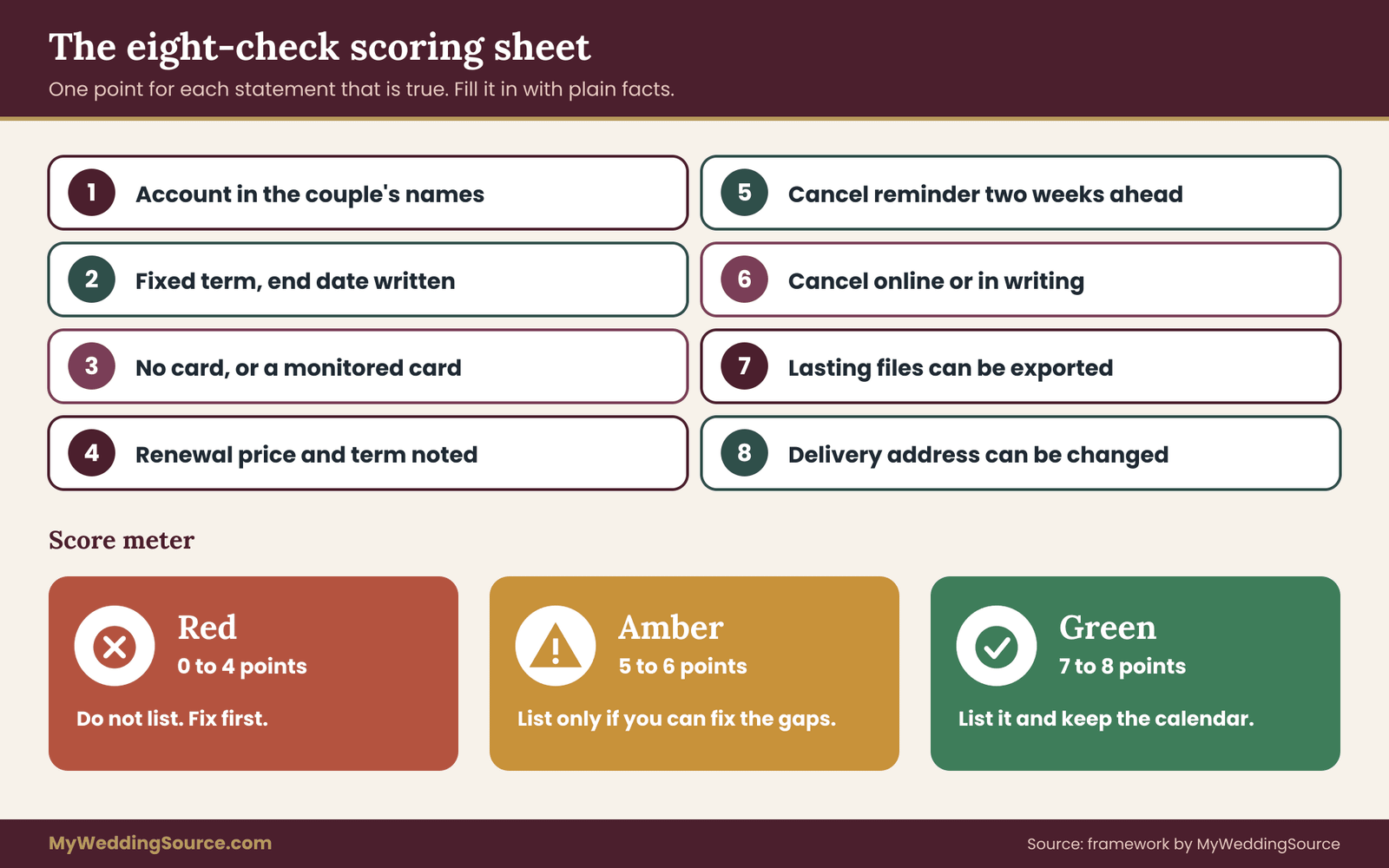
The audit becomes more useful when it produces a decision. This sheet gives each gift a score on eight measurable checks. It is an original framework and not a standard. It is meant to be filled in with plain facts, so that two people filling it in would reach the same answers. A sheet like this keeps subscription gifts from depending on anyone’s memory.
The eight checks
Give one point for each statement that is true.
- The account will be created in the couple’s names and email.
- The gift is prepaid for a fixed term and the end date is written down.
- Redemption does not require a stored payment card, or the couple has read the renewal terms and entered a card they monitor.
- The renewal price and renewal term are stated in the terms and noted on the audit page.
- The last day to cancel is on a calendar with a reminder at least two weeks ahead.
- Cancellation can be completed online or in writing within one sitting.
- Anything of lasting value created in the account can be exported or copied.
- The delivery address, if any, can be changed by the couple.
Reading the score
A gift with seven or eight points is green. List it, enjoy it and keep the calendar. A gift with five or six points is amber. List it only if the missing points are things you can fix yourselves, and write the fixes down. A gift with four or fewer points is red. Do not list it, or if it has arrived, treat it as a project: ask the seller or the giver the questions that would raise the score.
Scores are blunt. A gift with a perfect score for a service you would never use remains a poor gift. A gift with a low score for a service you love may be worth the effort of fixing. The sheet is there to show you the weak spots, not to replace judgment. Used honestly, the score sorts subscription gifts into list, fix or skip.
Measurable checks beyond the score
Some facts are worth recording as numbers because they decide how much room you have.
Count the days between the last paid date and the last day to cancel. If the number is negative, the cancellation deadline falls before the gift ends, so you must act while you are still enjoying the service. That is common and easy to miss.
Count the days between the first renewal charge and the end of the card’s billing cycle, because it tells you when you will see the charge on a statement.
Write the renewal amount as a yearly figure, even if it is billed monthly. A modest monthly price multiplied by twelve is a clearer measure of commitment than the monthly price alone.
Questions to ask a seller before listing
Keep the question list short, since busy support teams answer short messages faster.
“Can a gift be redeemed without a stored card? What happens at the end of the gift term? Can the couple cancel online at any time, and is a prepaid period refundable?”
If the reply is vague, ask once more. If the second reply is vague, treat that as a signal.
One page for all your subscription gifts
Individual audit pages work well for the first few gifts. As the list grows, a single master page makes patterns visible. Give each gift one line: its name, the account email, the end date, the last day to cancel, the renewal amount as a yearly figure, the payer after the gift and the cancellation method. Sort the lines by last day to cancel, soonest first. The top three lines are the ones that need attention this month.
A master page helps with two further tasks. The first is reconciliation, where you match each recurring charge on a statement to a line. The second is review. Once a quarter, read down the list and ask whether each service is still welcome. Subscription gifts that have outlived their usefulness are easy to end if you notice them, and expensive if you do not.
A page that you open every quarter is more useful than a perfect system you open once. Reviewing subscription gifts every quarter costs very little compared with missing one renewal.
Keep the page with your other wedding paperwork and post-event records. If you already organize the paperwork from your wedding in a folder system, a single file named for recurring services fits naturally beside contracts and receipts, and a trusted second person should know where it is.
Common mistakes with subscription gifts and how to avoid them
Most problems come from a short list of habits. Knowing them is half of fixing them.
Entering a card in a hurry. The redemption page offers a smooth path, and the card entry takes thirty seconds. Slow down at that screen. Read the sentence above the button.
Treating a reminder email as a safeguard. Sellers may send one, but it may be missed. The calendar is the safeguard.
Storing important files only in a gifted account. Make copies in storage you own.
Forgetting that annual plans bill once. A single yearly charge can feel larger than a monthly one even when the total is the same. Look at it the way you would look at any other large expense.
Leaving the giver in the dark. A short message prevents embarrassment. Do it early.
Assuming a cancelled plan stops immediately. Some end at once and some at the end of the term. Read the confirmation, and keep it.
Listing too many. Each recurring gift has its own dates. Three well-audited gifts are better than eight half-understood ones.
Ignoring the statement. A recurring charge that nobody checks is the whole reason this audit exists. Look at statements monthly in the first year, which is also when the wedding’s other charges settle. The wedding cash-flow planning guide explains how to see timing of payments across several months, and the same habit helps with renewals. Most mistakes with subscription gifts are small, and most are caught by a monthly look at the statement.
When to get outside help
If a seller keeps charging after a confirmed cancellation, start with the seller’s written complaint process and then your card issuer. The Consumer Financial Protection Bureau explains how to dispute a card charge, and your state attorney general’s consumer office takes complaints about unfair practices. The FTC accepts reports about deceptive sales practices. These agencies do not resolve every case, but a clear paper trail makes every step easier. ### A calendar for the first year of subscription gifts
Put the audit on a calendar so it runs without effort. These steps fit a year that starts on the wedding day, and you can shift them to fit your own dates.
In the first week. Collect the confirmation message for each of your subscription gifts. Create the audit page. Write the thank-you notes for the gifts that have already begun.
In the first month. Complete the four owners and four dates for every gift. Ask any open questions in writing. Copy anything of lasting value to storage you own. Set the cancel reminders, two weeks ahead of the last day to cancel.
Each month. Look at the card statement for recurring charges. Match each to a gift on the page. Anything unmatched deserves a question to the seller, and the sixty-day window for card disputes is a reason to look early.
Two weeks before each last day to cancel. Decide whether to keep, change or cancel. Tell any giver who might be affected. Write the decision on the page.
At the end of each gift. Confirm that the service has stopped, save the cancellation confirmation and send the closing note.
On your first anniversary. Review the page. Which gifts did you use? Which did you forget? Next year, when someone else asks for registry ideas, you will have a better answer than any list can give.
FAQ
What happens to a subscription gift after the first year?
It depends on the seller’s terms. A fixed-term gift may end on its own. A prepaid gift set to renew automatically will usually charge the card on file at the end of the term, which could be the giver’s or yours. Check the renewal clause, mark the last day to cancel and confirm who pays before the term ends.
Can a guest cancel a subscription gift after buying it?
Often yes, if the guest holds the account or bought a code that has not been redeemed, but it depends on the seller. Some sellers refund unused portions and some do not. If you want to keep the gift, it helps to let the giver know that the term is understood, so they are not left wondering about charges.
Should we put subscription gifts on our wedding registry?
You can, if you have checked the terms and the gift ends on its own or is clearly manageable. Run the ownership audit first. If the seller cannot say who owns the account, who pays at renewal and how to cancel, a one-time gift is a safer choice for the registry.
How do we avoid being charged after a gift ends?
Avoid entering a card unless you want the service to continue. If a card is required, set a reminder two weeks before the last day to cancel, read the renewal terms and watch your statements monthly. Keep the cancellation confirmation. If a charge appears after you cancelled, contact the seller first, then your card issuer.
Who should own the account for a subscription gift?
The couple should, in most cases, since they receive the notices and control the settings. An account in the giver’s name leaves you dependent on their attention, and a shared plan can disappear if the giver leaves it. If an account must stay with the giver, agree on an end date and a clear way to stop it.
Are automatic renewal charges regulated?
Federal and state laws address automatic renewals, including disclosure and consent. The Federal Trade Commission publishes guidance, and the rules have been subject to change, so read the agency’s current pages. State attorneys general explain local rules. Regardless of the law, keep copies of the terms, reminders and cancellation confirmations for your own protection.
What if the seller makes cancelling difficult?
Keep a record of each attempt, with dates and names, and cancel in writing where you can. Ask for a written confirmation. If charges continue, file a complaint with the seller, dispute the charge with your card issuer within its time limit, and consider a report to the FTC or your state attorney general’s consumer office.
What can we say to a giver who wants to keep paying?
Thank them warmly and agree on terms in one sentence: the amount, how long and how either of you can stop. Something like “we would love that, and please stop whenever it stops being convenient” keeps the arrangement light. Write it down so both sides remember it the same way.
Your next steps
Pick one recurring gift, either one on your registry or one you have received, and complete its audit page tonight. Write down the four owners and the four dates. If any answer is unknown, send the seller the short question set from this guide and save the reply. Choose a subscription gift you already know needs checking.
Then do two small things. Put the last day to cancel on a shared calendar with a two-week reminder, and copy anything of lasting value out of an account you do not own. Do the same for the next gift, and drop from your registry anything that cannot pass. Subscription gifts can be a pleasure for a year and a nuisance for ten, and a ten-minute page decides which.
Sources
- Federal Trade Commission, consumer protection and business guidance
- Restore Online Shoppers’ Confidence Act, Federal Trade Commission
- Consumer advice, Federal Trade Commission
- How do I dispute a charge on my credit card bill?, Consumer Financial Protection Bureau
- National Association of Attorneys General, state consumer protection offices
- USAGov, consumer complaints and protections
- Change of address and mail forwarding, U.S. Postal Service
- Food safety guidance, U.S. Food and Drug Administration
- Apple Support, manage subscriptions
- Google Play Help, manage subscriptions