

A dessert grazing table is a spread of small sweets that guests build into their own plates, and it is one of the easiest places at a wedding for allergen information to go wrong. This guide gives you a per-item ingredient label and a replenish map: one tells guests what each item contains, the other keeps that information true while the dessert grazing table is being refilled.
Give every item on the dessert grazing table a code, a name, a plain “Contains” line for the nine major allergens and a source line. Draw a map of the dessert grazing table, assign each position one item, and write down which backup tray refills that position, who does it and when. Refill by swapping a whole tray, never by topping up one item with another. If an item changes, the label changes before the item goes out. Keep a short written log, and send guests with serious allergies to one named person.
A dessert grazing table looks relaxed on purpose. Cookies, truffles, fruit, brittle, mini tarts, candied nuts and little jars share a few boards, and nobody stands in a line. That freedom is the appeal. It is also the problem. A guest with an allergy cannot watch the kitchen, cannot see which spoon touched which bowl and cannot tell a pecan from a walnut from across the dessert grazing table.
The usual advice is to put out little signs. Signs help, but a sign only describes the dessert grazing table as it looked at the moment you wrote it. A dessert grazing table changes every few minutes. A tray runs low, a server tops it up from the back, a guest drops a macaron on the wrong board, and a sign that was correct at seven is wrong by eight.
That gap between a correct label and a changing dessert grazing table is what this article covers. The label side is covered by a per-item ingredient label that ties every item to a written source. The movement side is covered by a replenish map that decides, in advance, how every position on the dessert grazing table gets restocked. Together they let a dessert grazing table stay honest for the whole evening, not only at the start.
A note on scope. This is general information, not legal, medical or food-safety advice, and food service rules differ by state and county. Where a rule matters, the article points you to the agency that issues it so you can confirm the current version yourself.
The article assumes the dessert grazing table is one part of a larger menu. If you are still deciding what to serve overall, the guide to planning a wedding menu around guests with different needs comes first. Here the sweets are already chosen, and the question is how to present them without confusion.
What a dessert grazing table is, and why allergen confusion happens there
A dessert grazing table is a self-service display of mixed sweets, usually arranged on boards, stands, trays and in small vessels, and usually replenished by staff during the evening. It differs from a plated dessert, where the kitchen controls every portion, and from a single tiered cake, where one ingredient list covers the whole item. It also differs from a buffet line, because guests approach from several sides and at no fixed pace.
Those differences matter for allergens in four ways.
There are many small items. A table with twenty bite-sized pieces has twenty ingredient lists. Most of those lists share a handful of risky ingredients, such as tree nuts, milk, egg, wheat and soy, so a single wrong assumption can touch many items at once.
The items look alike. Chocolate-dipped fruit and chocolate-dipped nuts. A vanilla shortbread and a vanilla shortbread with almond flour. A dark truffle rolled in cocoa and one rolled in crushed hazelnut. At table distance, the difference is invisible, and the label is the only place the difference exists.
Guests move things. People pick up a piece, change their mind, and put it back. They carry a plate along the board and set it down. They use the tongs from one tray on another. None of this is careless in the ordinary sense. It is simply what grazing invites.
Staff move things too. To keep the dessert grazing table full, someone brings trays from a back room and tops up positions. Without a rule, the quickest way to refill is to pour the new items onto the old ones. That is exactly how a nut-free item ends up with crumbs of a nut item.
“We’d like each item on the dessert table to have its own card, and we’d like the refill plan in writing.”
That sentence, sent early to your caterer, baker or grazing specialist, sets the tone for everything else in this guide.
What confusion looks like in practice
Allergen confusion on a dessert grazing table rarely comes from one dramatic mistake. It comes from small gaps that line up. Five patterns repeat.
The first is the stale label: a card describes the item as first planned, and the kitchen substituted an ingredient.
The second is the wrong-position refill: a tray is restocked with a different item than the card says. The third is the moved tool: a spoon or pair of tongs travels between items. The fourth is the crumb bridge: items touch, or a loose crumb or dusting of nut flour lands on a neighbor. The fifth is the orphan item: something arrives with no card at all, such as a family member’s homemade cookies set down at the end of the board.
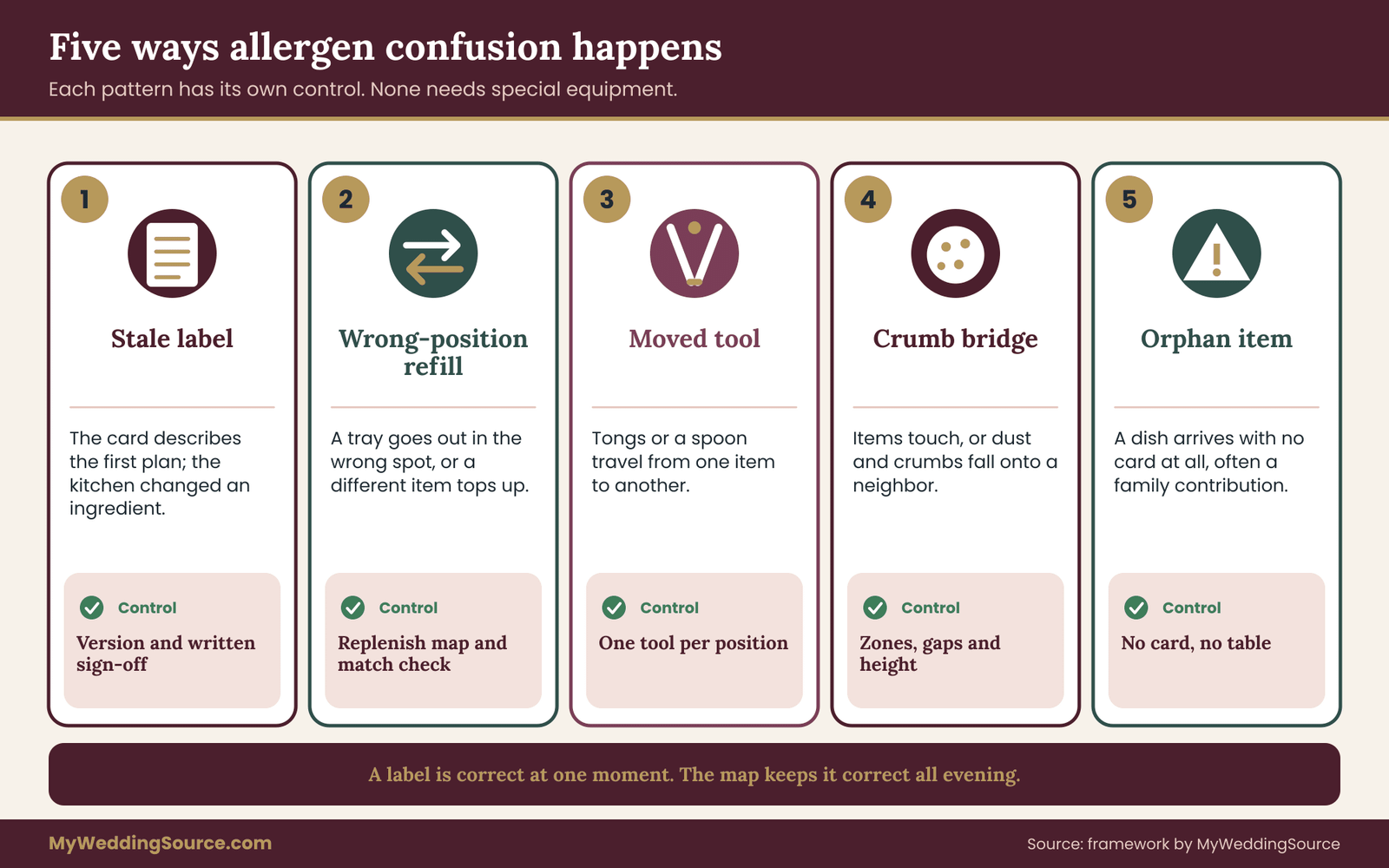
Each pattern has a matching control later in this guide. Stale labels are handled by a version and sign-off rule. Wrong-position refills are handled by the replenish map. Moved tools are handled by one tool per position. Crumb bridges are handled by layout. Orphan items are handled by an entry rule: nothing goes on the table without a card.
Who this guide is for
You may be a couple planning with a caterer, a baker or a dedicated grazing-table vendor. You may be a planner or a family member coordinating dessert for a smaller wedding. In each case the roles are the same: someone knows what is in the food, someone sets it out, someone refills it, and someone answers guests’ questions. Often those are four different people. The map and the label are how information passes between them without relying on memory.
The caterer or baker holds the food business license and controls the kitchen. You are not expected to certify the food. Your role is to ask for accurate information, make sure it reaches the dessert grazing table unchanged and avoid adding promises of your own, such as a casual “everything here is nut-free.”
The label-and-refill map: the framework in one page
The framework has two documents that always travel together.
The per-item ingredient label is a small card, one per item, written in a fixed structure. It says what the item is, what it contains, where it came from and which version of the information it reflects.
The replenish map is a one-page drawing of the dessert grazing table with every position marked. Each position holds exactly one item. For each position the map names the backup tray, the person who refills, the trigger for refilling and the tool that belongs to that spot.
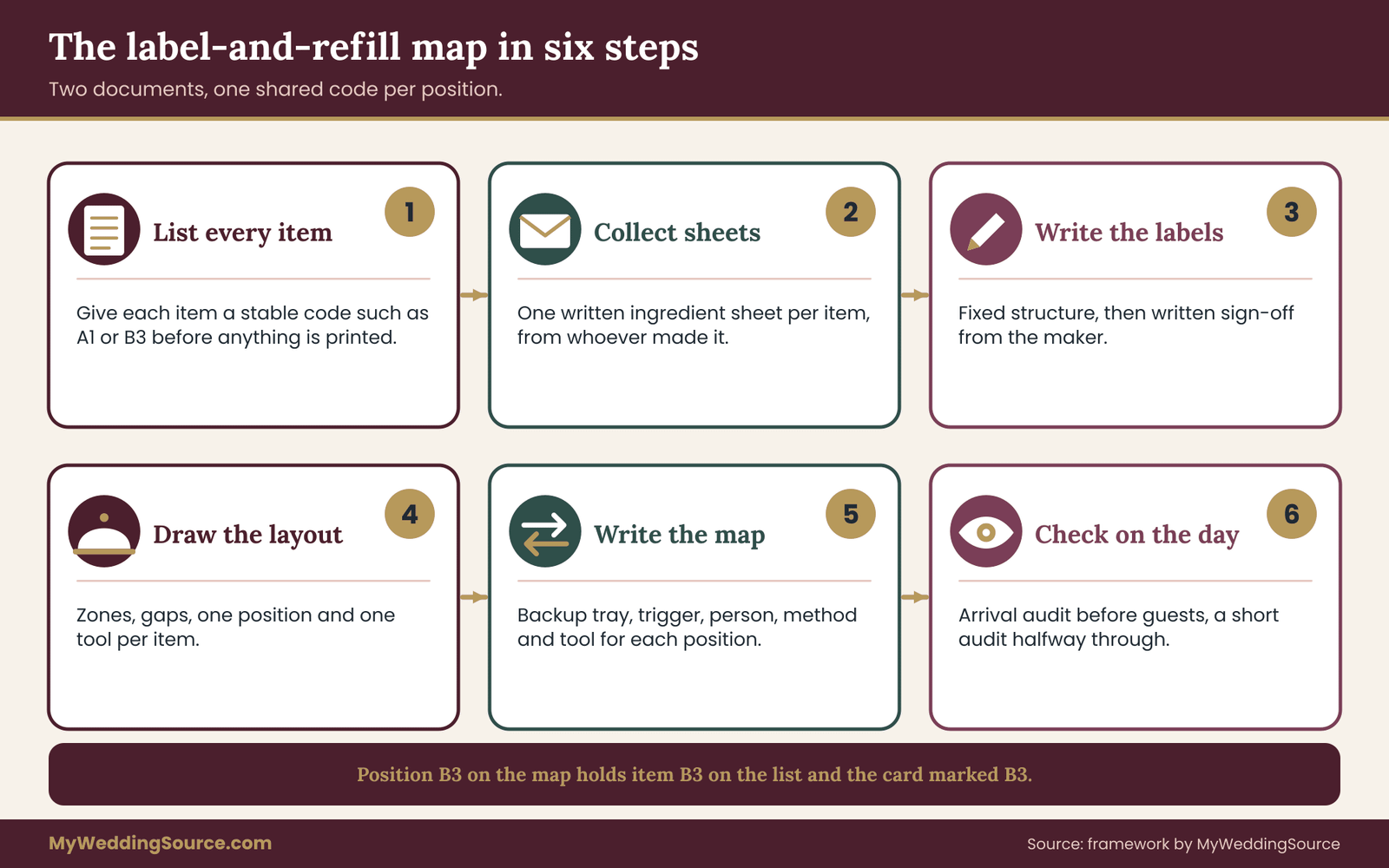
The two are linked by a single code. Position B3 on the map holds item B3 on the item list, which has a label printed with B3 in the corner. A server who is holding a tray marked B3 knows exactly where it goes, and a guest who reads a card marked B3 knows it describes the item in that spot.
Here is the sequence in six steps, which the rest of the article expands.
- List every item and give it a code, before anything is printed.
- Collect an ingredient sheet for each item from whoever made it.
- Write the label in the fixed structure and send it for sign-off.
- Draw the layout and assign each item a position and a tool.
- Write the replenish map, including what happens when an item runs out for good.
- Check on the day, with a short audit before guests arrive and another halfway through the evening.
Why two documents instead of one
Couples often try to solve this with a single list taped to the dessert grazing table. A list answers “what is on the menu” but not “what is supposed to happen when a position empties.” The map answers the second question, and without it a well-written label degrades quickly.
The reverse is also true. A map without labels tells staff where things go but gives guests nothing to read. Keeping the two together costs one extra page and removes the most common point of failure, which is a replacement made by someone who was not part of the planning.
What the framework does not claim
The framework does not make a shared table free of allergens. Open, self-service sweets cannot guarantee that a particular piece is untouched by another, and no card can promise otherwise. What the framework does is narrow the gap between what the label says and what is actually on the board, and make the remaining uncertainty visible and honest to guests.
For guests with serious allergies, that honesty usually leads to the same practical answer: an individually prepared and plated dessert, brought from the kitchen by someone who knows what is on it. The dessert grazing table stays available to everyone who is comfortable with its stated limits. A later section covers how to offer that option without singling anyone out.
How big the project actually is
A small table with ten items needs perhaps an hour of label work after the ingredient sheets arrive, and the map can be sketched in one evening. A large table with thirty items and two refill stations needs more careful sequencing, mostly because of the sign-off step, where each vendor must confirm its own items.
Plan the calendar around the slowest vendor, not around your own writing time. A realistic timeline appears later, together with the questions that decide how much of the work belongs to the vendor and how much to you. ## Building the item list and the ingredient sheets for a dessert grazing table
Everything starts with a plain list. Before you design signs or choose boards, write down every single item that will appear on the dessert grazing table, including the small things people forget: the garnish on a tart, the dusting on a truffle, the dip served with fruit, the nuts mixed into a brittle, the sprinkles on a cookie and the sauce in a little jar.
Give each item a short code. A letter for the zone and a number for the position works well, such as A1, A2, B1 and B2. Do not use flavor names as codes, because flavors change. A code is a stable handle that stays attached to a position even if the item in it changes.
Where the information comes from
Every item has a maker, and the maker is the source of its ingredient information. On a typical dessert grazing table the makers fall into four groups.
The caterer’s own kitchen produces some items and holds the recipes. Ask for a written recipe sheet, not a verbal summary.
A bakery or pastry chef supplies cookies, tarts, macarons or bars. Ask the same question: a written ingredient list per item, including fillings, glazes, toppings and any release agent or oil used on pans.
A bought-in product, such as packaged chocolates, candied nuts, dried fruit or caramels, carries a manufacturer’s label. The package is the proof. Keep the packaging, or photograph the full ingredient panel and the allergen statement for each lot you use.
Family and friends sometimes contribute items, especially at cultural weddings where a particular sweet matters. Their recipes are real and welcome. They also need a written ingredient list like everything else, and the rule that nothing goes on the dessert grazing table without a card applies to them too.
What a good ingredient sheet contains
A usable sheet is more than a list of main ingredients. For each item it should show the following.
- The full ingredient list, including sub-ingredients such as the contents of a chocolate coating or the flour blend in a crust.
- A “Contains” statement naming any of the nine major allergens: milk, eggs, fish, crustacean shellfish, tree nuts, peanuts, wheat, soybeans and sesame.
- The specific tree nut or fish or shellfish, when one is present, because guests often react to one and not another.
- A note on what else the kitchen handles in the same space, including shared equipment.
- A date and a name: who wrote the sheet and when it was last checked.
If a vendor can only offer a general statement such as “may contain traces of everything,” ask for something more specific. A blanket disclaimer is a legitimate protection for a vendor, but it gives you nothing to write on a card and nothing to share with a guest who needs to decide.
Reading the sheet critically
Ingredient sheets are written by busy people. Five checks catch most gaps.
First, look for hidden ingredients. Cookies often use butter, egg wash and flour, which carry milk, egg and wheat. Chocolate often contains soy lecithin. Some caramels contain milk. Some candied nuts are coated in egg white. Some glazes contain almond extract.
Second, compare the sheet to the package for any bought-in product. Brands reformulate. A box that was nut-free last year may not be this year, and the current label is the one that counts.
Third, check the “may contain” language against the contains line. If a package says it was made on equipment that also processes peanuts, the card for that item should carry that information in its shared-kitchen line, not hide it.
Fourth, check that the item in the photo is the item on the sheet. Vendors sometimes send a sheet for the standard version and deliver a seasonal variation.
Fifth, ask what is on top. A dusting of crushed nuts, a drizzle of white chocolate or a spoonful of sesame brittle on a plain bar changes the allergen profile of the whole piece.
“Could you send a written ingredient list for each item, including toppings, fillings and any shared equipment, with the date it was last checked?”
A rule for anything that is not yet final
Menus move. A pastry chef swaps a filling because a supplier ran short, or a couple adds a family sweet three weeks out. Set a freeze date, usually two to three weeks before the wedding, after which the item list changes only through a named person and only with a new sheet and a new label. The freeze date is not about being rigid. It is about knowing that the cards you print are describing the items that will actually be served.
For the broader calendar of when a cake or dessert order locks in, the wedding cake timeline shows how the same freeze logic works for tiered cakes. A grazing table follows the same pattern, with more items to track.
Writing the per-item ingredient label for each dessert grazing table item
The per-item ingredient label is the core artifact of this guide. It is a small card, about the size of a place card or a tent card, that sits next to one item and describes only that item. The structure is fixed, so a guest learns where to look after the first card and staff can check it at a glance.
The six fields
Code and name. The position code in a corner, such as B3, then the plain name of the item. “Dark chocolate truffle,” not “Midnight Indulgence.” Fancy names are charming on a menu and unhelpful on a label.
Contains. One line listing the major allergens present, using the standard names. If none of the nine is present, write “Contains: none of the nine major allergens in the recipe.” Do not write “allergy-free.”
Specific type. If the item contains tree nuts, name them: “almond.” If it contains fish or shellfish, name the type. A guest with a walnut allergy may eat an almond product, and a guest with a cashew allergy may not.
Made by. The name of the kitchen, bakery or product maker. This tells a guest who to ask and tells staff where to look when the answer is unclear.
Shared space. One short line such as “Made in a kitchen that also handles peanuts and tree nuts.” This is a statement about process, and it stays separate from the contains line.
Version. A short version marker and date, such as “v2, checked by the baker” with the date. The version tells staff whether the card is current and gives you a way to see when it was last approved.

Why the contains line and the shared-space line stay separate
The contains line is a statement of fact about the recipe. It can be verified from the ingredient sheet. The shared-space line is a statement about the environment. It cannot be verified item by item.
Combining them into one phrase such as “nut-free” produces a claim that neither the recipe sheet nor the kitchen can support. On a shared board, with tongs and neighboring items, even a nut-free recipe can pick up traces. Keeping the two lines apart lets a guest read both and decide for themselves.
Words to avoid on the card
Several words sound helpful and cause trouble.
“Safe.” Safe for whom, in what circumstances? A card cannot answer that.
“Free from.” Use it only for the specific recipe statement, and prefer plain wording such as “made without wheat, barley or rye ingredients.”
“Allergy-friendly.” It implies a standard the dessert grazing table has not been tested against.
“Vegan,” “dairy-free” or “gluten-free” as free-standing claims. If a guest relies on them for medical reasons, the claim has to hold on the shared board, and often it cannot. Used as diet markers rather than safety promises, they can be useful, if the shared-space line sits right beside them.
For deeper wording rules on the same topic at a savory buffet, the article on buffet ingredient labels covers sign-off and phrasing in more detail. The dessert version adds position codes and refill rules.
Keeping the card short enough to read
A card that reads like a legal notice will not be read. Aim for a card that takes about five seconds to scan: a code, a name, a bold contains line, a short made-by line and a small shared-space and version line. Use a legible font at a size readable at arm’s length in dim reception lighting. Print on matte stock, because glossy card catches candlelight and becomes unreadable from some angles.
Where to place each card
Place the card directly in front of its item, on the guest’s side, not behind it. Cards tucked behind a stand are read after the guest has already picked up the item. If an item sits on a tiered stand, place the card on the same tier. If items sit in a small jar, tape the code to the jar’s lid or base as well as placing the card, because jars get moved.
The vessel label as a backup
Where the budget allows, add a small label to the vessel or tray itself, with the same code. This is what staff see in the back room. When a tray comes out for a refill, the code on the tray and the code on the position must match, and the person doing the refill checks that match each time. This single habit prevents most wrong-position refills, and it costs only a roll of removable labels. ## Laying out a dessert grazing table: positions, lanes and distance
The layout is where allergen control becomes physical. A thoughtful layout reduces the number of things a card has to explain, because the table itself separates what should be separated. Three ideas do most of the work: zones, lanes and gaps.
Zones group items by allergen profile
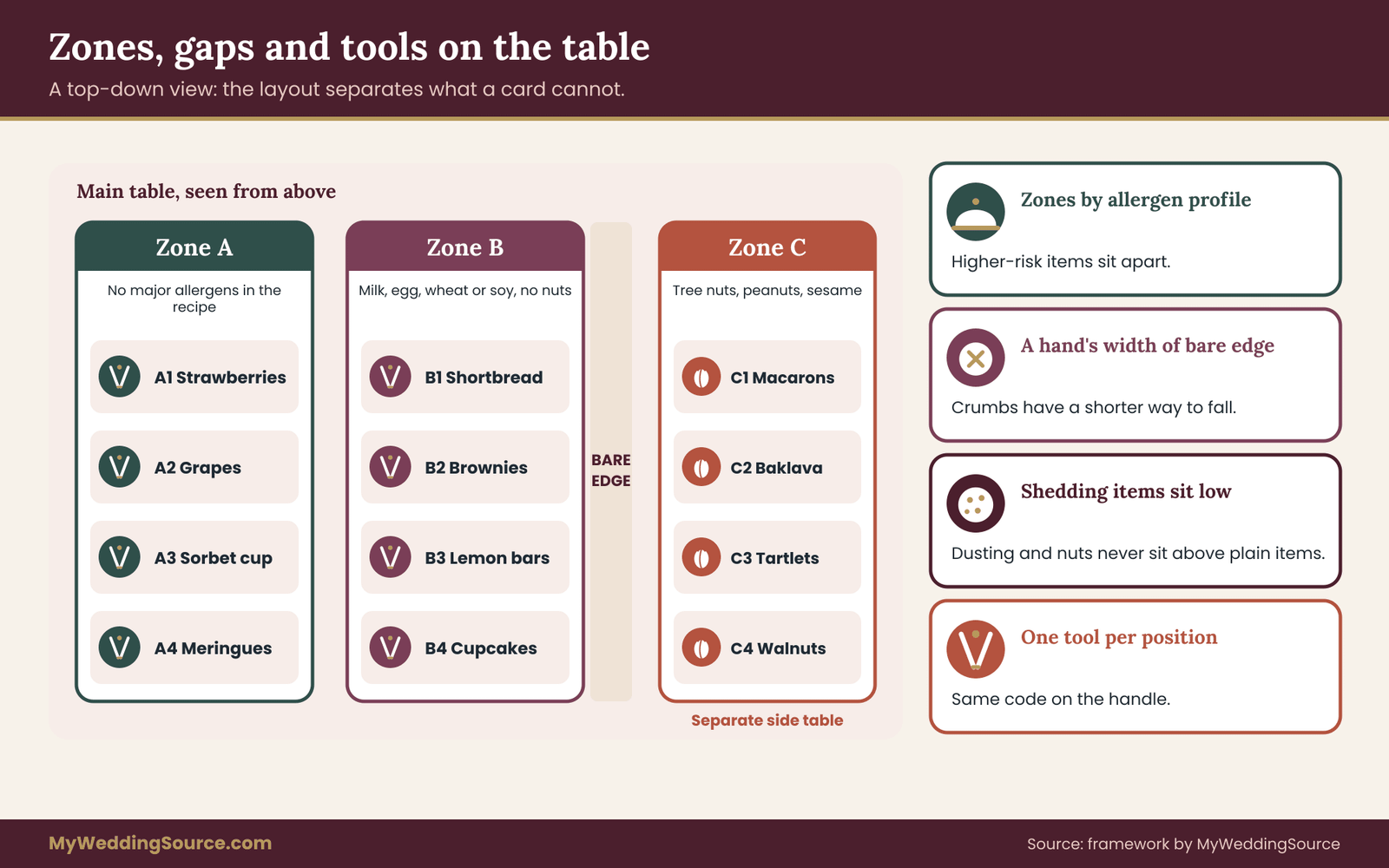
Divide the dessert grazing table into zones, each holding items with a similar allergen profile. A common arrangement uses three.
Zone A: items without the major allergens in the recipe. Fruit, certain candies, simple meringues or fruit-based sweets, if the sources confirm it. This is the zone guests with allergies will scan first.
Zone B: items with milk, egg, wheat or soy, but no nuts or sesame. Most cookies, brownies, shortbread, cupcakes and truffles fall here.
Zone C: items with tree nuts, peanuts or sesame. Baklava, nut brittle, pistachio tarts, almond macarons, halva and anything dusted or coated with nuts.
The point is not to promise that zone A is safe. The point is that a guest, a server and a photographer all know where the higher-risk items sit, and that nut crumbs have a shorter path to reach other items if the nut items are placed apart.
Lanes keep the traffic from crossing the risk
Guests walk along a table in one direction or another. If the nut zone sits in the middle, every guest passes it. If it sits at one end, guests who want to avoid it can do so without effort.
Place zone A where guests meet it first, zone B in the middle and zone C at the far end or on a separate board. If the dessert grazing table is approached from both sides, repeat the zones on both sides, or place the nut items on a distinct side table so that no path crosses it by default. A short physical gap, even a handful of inches of bare table or a tall unrelated decoration, does more than a sign.
Gaps and barriers that actually help
Three small details help more than they look.
A bare edge between zones. A hand’s width of empty board or table is enough to stop a falling crumb from landing in the next zone. Fill it with a plain linen runner or leave it open.
Height. Items that shed, such as sugar-dusted pieces, crushed-nut coatings and powdered donuts, should sit lower than neighbors, not higher. Crumbs fall down. A nut-dusted item on a high tier over a plain item is a quiet hazard.
Separate boards. A single large board looks generous and photographs well. It also makes every item a neighbor of every other. Several smaller boards with edges between them cost a little visual drama and gain a lot of control.
One tool per position
Every position gets its own tool: its own spoon, tongs, scoop or pick, and the tool stays in its position. The code on the position is repeated on the tool’s handle with a small tag or colored band. If the item is finger food and guests handle it directly, provide paper picks or small tongs, so guests do not have to touch neighboring items to take one.
The reason is simple. A pair of tongs that moves from a pistachio bar to a lemon bar carries a thin layer of pistachio with it. Neither guest nor server sees it happen.
Counting positions and items together
Resist the temptation to fill every inch. A dessert grazing table with fewer, better-spaced positions is easier to label, easier to refill and kinder to guests who are reading cards in a crowd. If you are weighing how many items to include, it may help to read how the same question appears when sizing sweets for a crowd in dessert bar servings, but for this guide the key rule is that every position needs a card, a tool and a refill path.
Tables where the layout is constrained
Sometimes the venue limits the options. A narrow ledge, a bar top, a single long banquet table against a wall, or a corner of the room may leave little room for zones. In that case, put the highest-risk items on a separate small table with its own sign, even if that table looks sparse. A second table is cheaper than a mistake, and it gives you a natural place to station one trained person.
Some problems are not solved by zoning alone. A few types of items deserve separate rules.
Look-alikes
Items that look the same but differ in allergen content need extra separation and extra card clarity. Common pairs include chocolate-dipped fruit and chocolate-dipped nuts, plain and almond shortbread, cocoa-dusted and nut-rolled truffles, and two flavors of the same macaron shell.
Three rules help. Place look-alikes in different zones, not side by side. Use different vessels or colors for each, so the difference is visible even without reading. And use a card that names the difference, such as “Dipped strawberry” and “Dipped almond,” not “Chocolate bites A” and “Chocolate bites B.”
Mixed items
Some items are mixtures by design: a trail-mix cup, a granola bark, a bowl of candied nuts and dried fruit, a platter of assorted chocolates. Each component has its own allergen profile, and guests tend to pick out pieces. A mixed bowl is the hardest item to label honestly, because the pieces migrate between components.
Options, in order of preference: avoid mixed bowls on the dessert grazing table; serve mixes in pre-portioned cups filled in the kitchen with a card per cup type; or break the mix into separate small vessels with separate cards. If a mix has to stay, label it with the union of all component allergens and say so plainly: “Contains tree nuts (almond, pecan), peanuts, milk and soy.”
Dips, sauces and drizzles
A small jar of dip is a classic hidden risk. A chocolate sauce for strawberries may contain milk. A caramel for apples may contain milk and butter. A fruit dip may include cream cheese or yogurt. Treat each sauce as its own item with its own code and card, and give it its own spoon. Never let one sauce stand in for several dippers without telling the guest which dippers it touches.
Items that guests or family bring
An unlabeled contribution is the most common orphan. Agree on a rule before the day: homemade items from family are welcome, but they go on a separate small plate or a separate family table with a card that names the maker and lists ingredients as the maker knows them. If the maker cannot provide that, the item is kept off the main table and offered by the maker in person.
Say this kindly and early. A short note to relatives works well.
“We love that you’re baking for us. To keep the dessert table clear for everyone, please send us the ingredient list a week before, and we’ll make a card for it.”
Alcohol-based and decorative items
Some elements are decoration, but guests will still eat them. Edible glitter, flower petals, gold leaf and sugar sculptures all deserve a source check. Flowers are especially tricky, because decorative flowers are often grown and treated for display, not eating. If a flower or garnish is not a food-grade, named product with a written source, remove it from any position where guests might take it. The article on edible flowers on a wedding cake covers sourcing in more detail.
Items that should not share a board at all
Three combinations deserve a hard rule.
Nut items and any item labeled for a nut allergy. Keep them on separate boards with separate tools.
Raw or runny items and everything else. Items with raw egg, fresh cream or uncooked fillings carry temperature and safety needs that other items do not. They need their own cooled position, and their own card with a time marker.
Anything with an unknown ingredient list. If you cannot say what is in it, it does not sit near items you can describe. Better to remove it.
What about gluten, dairy and vegan labels
Many guests want to know whether an item is vegan, vegetarian, dairy-free or gluten-free. Those are real needs, and they can be met without overclaiming. Use small, plain diet markers on the card, like a leaf icon for a plant-based recipe, and keep the contains line next to it. For vegan items in particular, the cross-contact questions are covered in the article on vegan cake cross-contact, and the same logic applies to a vegan sweet on a shared board.
The marker describes the recipe. The shared-space line describes the environment. Guests with a medical reason for avoiding an ingredient should still be told how to ask staff. ## The replenish map for a dessert grazing table: who refills what, when and from where
Most of the damage to a good label happens during refills. A table that was carefully set at six is handled by several people between seven and ten, usually in a hurry, usually in low light and usually without the person who wrote the labels anywhere nearby. The replenish map exists so that none of those people has to guess.
The map is a one-page drawing of the dessert grazing table from above. Each position is a box with its code. Beside each box you write five facts. They are short enough to fit on one line each, and together they remove most of the guesswork.
The five facts for every position
Backup source. Where the refill tray lives: a named cooler, a labeled rack in the back room, a particular shelf. A server should never have to wonder where B3 comes from.
Trigger. When the position is refilled. A visual trigger works better than a clock, such as “refill when the tray is about one-third full,” because guests do not eat on a schedule. Pick the trigger by item: delicate items refill earlier, sturdy ones later.
Refill person. One named role, not “staff.” The pastry lead, the dessert grazing table attendant, the banquet captain. A named role can be briefed, and a named role can be asked afterward what happened.
Method. How the refill is done. For almost every item, the rule is the same: swap the whole tray or vessel, and take the old one away. Do not pour new items onto old ones. Do not combine the leftovers of two trays.
Tool. Which spoon, tongs or pick lives at the position. A refill includes returning the tool to its own spot, and it includes replacing a tool that has been dropped or moved.

Swap the tray, not the bite
The most useful single rule on the replenish map is to replace the whole vessel. Topping up looks efficient. It creates a mixed layer of old and new items, hides how long the old ones have been out and, when two items are close in appearance, makes it likely that the wrong one lands in the wrong tray.
Swapping a tray has three advantages. It keeps one item per vessel, which keeps the code meaningful. It lets staff check the code on the incoming tray against the code at the position, one glance and done. And it gives the kitchen a clean moment to inspect, wipe the surrounding surface and reset the tool.
If whole-tray swaps are impractical for a particular item, such as a heavy dessert on a pedestal, use a second, identical vessel and swap that. A spare of every vessel is an inexpensive purchase or rental.
The match check
Before any refill goes out, the person doing it performs a two-part match check, out loud if they can.
- The code on the incoming tray matches the code at the position.
- The version on the incoming tray’s label matches the version on the card.
If either fails, the tray does not go out. It goes back to the back room and the dessert grazing table attendant is told. This is the habit that catches a substituted ingredient, a mislabeled tray and a card that was reprinted for one item but not the other.
What happens when an item runs out
Running out is not a failure. Items are meant to be eaten. The question is what happens to the position once it is empty.
There are three honest options. The first is to retire the position: remove the card, tool and vessel, and tidy the space so that no stray card remains. The second is to leave the position empty and cleaned, with the card turned face-down, if the dessert grazing table looks bare otherwise. The third is to fill it with a pre-approved substitute, but only if that substitute has its own card, its own sheet and its own tool, prepared ahead of time.
What must never happen is a quick substitution with no card. A caterer who runs out of the lemon bar and fills the space with whatever is left in the kitchen has created an orphan item at the worst moment.
“If something runs out, please remove the card and the tool with it, and don’t replace it with anything that isn’t on our approved list.”
The approved substitute list
For each position, agree on one or two substitutes before the wedding. A substitute is a real item that has been through the same process as every other: sheet, label, sign-off, tool. Print its card in advance and keep it in a labeled envelope in the back room. The approved list is short on purpose. It covers the likely shortages and leaves everything else to a conversation with a named person.
The log
A one-page log sits at the back table or on the attendant’s clipboard. Each row records the time, the position code, what was done (refilled, retired or substituted) and the initials of the person. The log has two uses. During the evening it tells the next person what has been done. Afterward it gives you a record in case a guest reports a reaction or a question comes up later.
Keep the log simple enough to be used in ten seconds. A log that takes a minute will not be kept. If staff are reluctant, ask for entries only for retirements and substitutions, and let ordinary refills pass without notes.
Briefing the people who refill
Staff change between planning and the day. The person who attended the tasting is rarely the person holding the tray. Hold a five-minute briefing before the guests arrive, and use the map as a script.
Cover five points: how the codes work, the swap-the-tray rule, the match check, what to do when an item runs out and who to call with a question. Hand the map to each person who will refill. Pin a copy in the back room, because a map no one can see does not help.
If the staff come from several companies, for example a caterer who refills the main items and a baker who refills a cake or macaron display, brief each group on its own positions and agree on one shared contact. The shared contact is usually the banquet captain or the planner, not the couple.
Refills timed around the rest of the evening
A dessert grazing table has busy moments and quiet ones. It tends to be busiest right after the cake is cut, after dinner clears or when the dance floor takes a break. Plan the heavy refills just before those moments, not during them, so staff are not working through a crowd with trays. The article on sequencing the reception shows how the evening usually breaks into phases, and the same phases decide when the dessert grazing table needs the most attention.
Cold, warm and time-limited items
Some items need more than a position. Cream-filled pastries, mousse cups, custard tarts and anything with fresh dairy need cold holding and a limit on how long they stay out. The FDA Food Code is the standard many local agencies base their rules on, and local rules decide what applies at your venue. Ask the caterer what temperature and time limits they follow, and put a “put out at” time on the card for those items. A time marker on a card turns a hidden safety limit into something staff can see and follow.
When refills need a second pair of hands
If the table has more than two zones or more than about a dozen positions, assign two people: one carries trays and one checks codes. The checker does not need to be an expert. They need the map and the authority to say “stop, this doesn’t match.” In a busy ballroom, a second person who checks only the match is worth more than a second person who simply carries more. ## Tools, boards and the small hygiene details on a dessert grazing table
Cross-contact on a dessert grazing table usually travels on objects, not on the food itself. Boards, knives, spoons, napkins, gloves and hands carry traces from one item to the next. None of this requires a laboratory. It requires deciding, ahead of time, what touches what.
Boards and surfaces
Wood boards are attractive and absorb moisture and oils. A board that has held nut brittle and then holds a plain shortbread has not been reset by a quick wipe. Ask the vendor how boards are cleaned between uses and whether boards are assigned to specific allergen groups. A simple method is to assign boards by zone: boards in zone C never appear in zone A or B, and each carries a small tag on the underside.
Non-porous surfaces such as glass, ceramic, metal or sealed stone are easier to clean thoroughly. For zone A in particular, choose a surface that can be washed and reset between uses. Parchment or food-safe liners under items add another layer, and a liner that is replaced with the tray removes crumbs along with it.
Serving tools
Provide one tool per position, as set out in the layout section, and make the tool visibly belong there. Color-coded handles, tags or bands help. When the tool must be washed during service, the replacement is a second identical tool from the same zone, not the nearest clean one.
Small items that guests handle directly, such as chocolate truffles or macarons, are best served with paper cups, small tongs or picks. Where guests reach in with their hands, expect the occasional put-back. A small sign asking guests to take what they touch is polite, and it does not remove the risk. The label should say that the dessert grazing table is self-service and that items may have been handled.
Napkins, plates and the guest’s own route
Guests also carry things. A plate that held a pistachio pastry and then goes back to the dessert grazing table for a second round brings traces with it. A short sign, “Please take a clean plate each time you return,” is a courtesy that also supports guests with allergies. Stack the plates at the start of each lane, and keep a bin for used plates on the far side, so a used plate has no reason to come back to the dessert grazing table.
Gloves, hands and service staff
Staff who refill should wash their hands and change gloves between zones, and they should not handle zone C items and then zone A items without doing so. Gloves alone are not a control if they are not changed. Ask the vendor what the glove policy is and whether staff are trained in allergen awareness. Many food service training programs, including those from the National Restaurant Association’s ServSafe, cover cross-contact, and it is reasonable to ask whether the person managing your table holds a current certificate.
Surroundings
Look at what surrounds the dessert grazing table. Candles that drip, flower petals that fall, confetti, small decorations and signage that lean over the food can all add unexpected material. If you use flowers or greenery on the dessert grazing table, keep them outside the food area or in a separate vessel, and make sure no petals sit on or between items. The same applies to any garnish that is not meant to be eaten. If it is on the dessert grazing table, a guest may eat it.
Lighting and legibility
The best card in the world fails in poor light. Test the table in the real lighting at your venue, ideally at the same time of day as the wedding, and read each card from arm’s length. If you cannot read it comfortably, neither can an older guest without reading glasses. Small battery-powered lights or a directed spotlight on the cards and not on the food will help. The same legibility principles appear in the broader guide to wedding signage, and they apply to every small card on the dessert grazing table.
Allergen-aware guests and the table’s front door
Consider where the dessert grazing table is relative to the entrance of the room and the flow of guests. A table near a door gets heavy traffic and many handlers. A table in a quieter spot is easier to staff and easier to inspect. If you are choosing a position within the room, weigh convenience for guests against the ability to keep an attendant nearby. For a table with real allergen complexity, an attendant is the single most useful addition.
What to ask the vendor, and what to put in writing
Few couples build a dessert grazing table entirely themselves. A caterer, a bakery or a specialist grazing-table company usually supplies the items, the boards and often the staff. The map and label only work if the vendor agrees to follow them, so the conversation with the vendor is part of the system.
The questions that matter
Ask these in an email, so the answers are in writing.
- Who writes the ingredient sheet for each item, and can you send it before the final headcount is due?
- Which items are made in your kitchen, and which are bought in? Can we see the packaging for bought-in items?
- Which of the nine major allergens does your kitchen handle, and how are they separated during preparation and transport?
- How do you clean boards, trays and tools between uses?
- Who attends the dessert grazing table during the event, and are they trained in allergen awareness?
- Will you use our position codes and replenish map, or do you have your own system we should adapt?
- What happens if you must substitute an item close to the event?
- Will you provide a written approval of the final labels?
- How do you store and transport backup trays, and can they be labeled by code?
- If a guest has a serious allergy, can your kitchen prepare an individually plated dessert?
Reading the answers
Pay attention to specificity. A vendor who answers with details, names the person who will staff the dessert grazing table and offers to adapt to your codes is easy to work with. A vendor who answers “we take care of everything” without detail is giving you comfort, not information. Ask a follow-up before moving on.
A vendor who refuses to share ingredient information is a red flag. You do not need every secret recipe, but you do need to know which major allergens are in each item. If they cannot or will not provide that, consider a different vendor for the items in question. The general approach in the vendor due diligence checklist applies here: verify before the deposit, not after.
Putting it in the contract
The contract or the written order confirmation should reflect what you agreed. Useful clauses are short.
- The vendor will supply a written ingredient and allergen sheet for each item by an agreed date.
- Item changes after that date require written notice and an updated sheet before service.
- The vendor will follow the replenish map or an agreed alternative, including the tray-swap rule.
- Staff at the dessert grazing table will be briefed on the map before service.
- The vendor will provide individually prepared desserts for named guests on request, with notice.
These do not need to be a legal masterpiece. They need to be written, dated and agreed. If your contract is standard form and cannot be changed, put the same points in a signed order confirmation or an email the vendor acknowledges. The general guide to reading a wedding vendor contract shows where such clauses usually fit and what other terms to check around them.
Who pays for the extra work
Extra labor has a cost. A vendor may charge for a dedicated attendant, for extra trays and vessels, for printed cards or for a separate allergen-controlled preparation. Ask for these as line items, not as a general uplift, so you can see what each piece costs and decide which pieces matter most. In many cases the cheapest meaningful steps are the free ones: a written ingredient sheet, a brief at the start of service and one attendant who understands the map.
If cost is a constraint, decide in advance which controls are non-negotiable and which are nice to have. A short list works.
- Non-negotiable: a written ingredient sheet for every item, a label for every item, one named person who answers guest questions and a rule against orphan items.
- Strongly recommended: one tool per position, a tray-swap rule and a short staff briefing.
- Nice to have: a dedicated attendant for the whole evening, separate boards by zone and vessel labels on every tray.
Rental items and timing
Boards, stands, jars and risers are often rented. A rented board may come from a stockroom where it has held anything. Ask the rental company how items are cleaned and whether you may specify boards or vessels for particular zones. The rental planning checklist covers delivery windows and condition checks, and a dessert grazing table adds one extra question: have these been cleaned for food contact, and how?
Scheduling the vendor tasks
Plan backward from the wedding date. Ask for ingredient sheets four to six weeks out, draft the labels within a week of receiving them, and request sign-off no later than three weeks out. Hold a short call or an email exchange a week before to confirm the final item list, the codes and the map. Confirm the day-of contact a few days before. The vendor timeline article shows how to fit these touchpoints into the wider calendar of vendor deadlines. ## A worked example: an invented dessert grazing table from item list to refill log
The following example is invented to show how the pieces fit together. The couple, the vendors and the guests are fictional, and the numbers are illustrative choices, not recommendations or measurements.
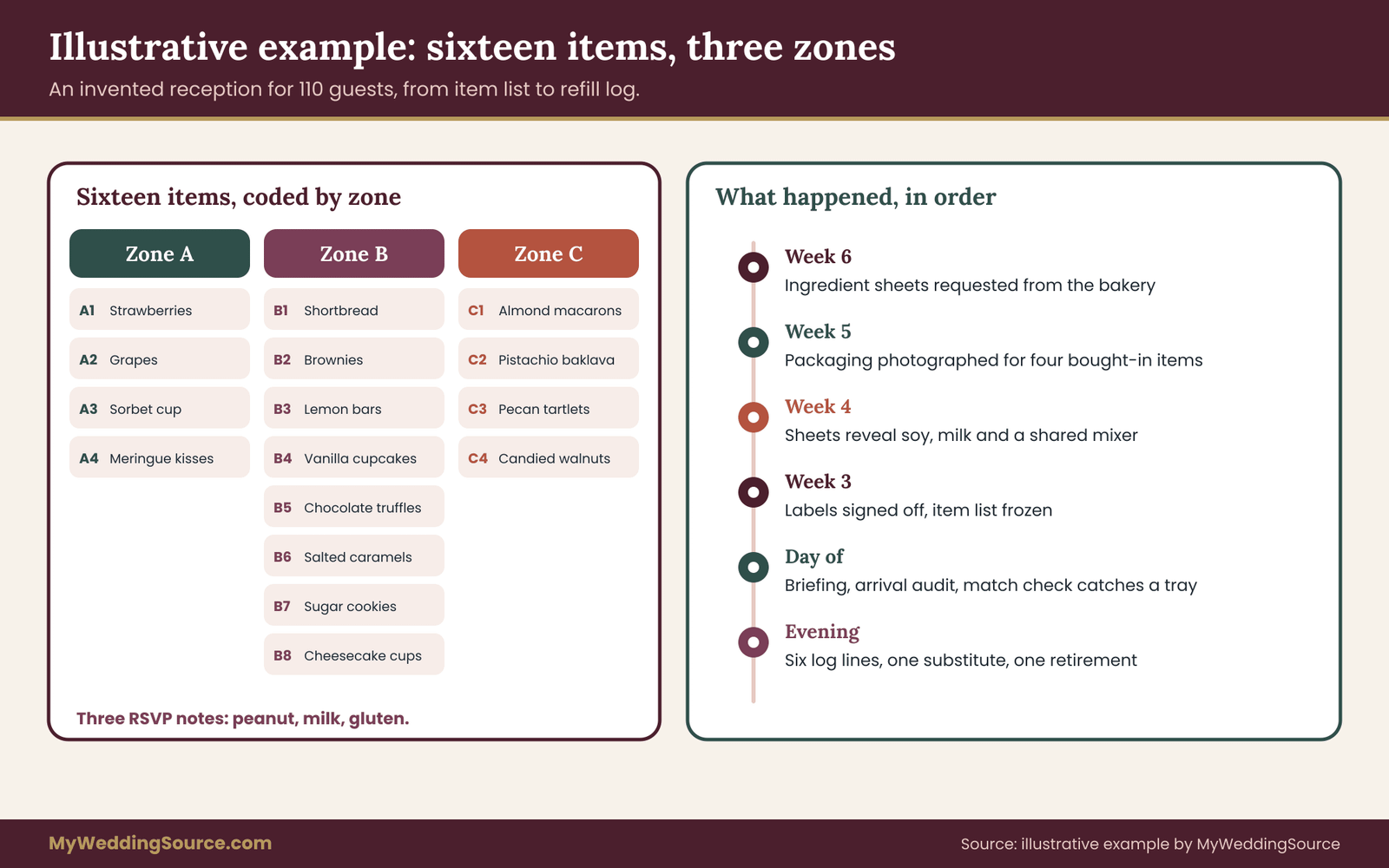
Imagine a reception for 110 guests. The couple, Dana and Ilya, hire a caterer for dinner and a local bakery for sweets. They want a dessert grazing table in place of a tiered cake, with a small cutting cake for the photo. Three RSVPs mention allergies: one guest with a peanut allergy, one with a milk allergy and one who avoids gluten for medical reasons.
Step one: the item list
Dana and Ilya, with the bakery, settle on sixteen items and give each a code. Zone A holds four items: fresh strawberries, grapes, a fruit-only sorbet cup and plain meringue kisses. Zone B holds eight: shortbread, brownie squares, lemon bars, vanilla cupcakes, chocolate truffles, salted caramels, sugar cookies and a mini cheesecake cup. Zone C holds four: almond macarons, pistachio baklava, pecan tartlets and a bowl of candied walnuts.
The bakery sends ingredient sheets for the twelve items it makes. Dana photographs the packaging for the four bought-in items: the truffles, the caramels, the candied walnuts and the sorbet cup.
Step two: the surprises
Reading the sheets, they find three things. The meringue kisses are made with a vanilla extract the bakery says contains no allergens, which is fine, but the sheet notes a shared mixer with a nut-based batter, so the shared-space line will say so. The salted caramels, per the package, contain milk, and the package states they are made in a facility that also processes tree nuts. And the brownie recipe uses a chocolate that lists soy lecithin.
None of these was dramatic. All of them would have been missed if the card had said “chocolate” and nothing more. The labels now name soy, milk and the shared facility.
Step three: the layout
The dessert grazing table sits along one wall. Zone A is at the entrance end, zone B in the middle, and zone C on a separate small side table placed a few steps away with its own card holders. There is a bare linen runner between zone A and zone B. Each position has its own tool: tongs with a green band for zone A, blue for zone B and orange for zone C.
The peanut-allergic guest is told, by Dana in a short call, that the baker handles tree nuts and peanuts in the same kitchen, that zone C is physically apart, and that the bakery can plate an individual dessert from a separate preparation if the guest prefers. The guest chooses the plated option.
Step four: the replenish map
The map shows sixteen boxes. For each, the backup tray sits in a labeled cooler or on a labeled rack in the back room, and each tray carries the same code as its position. The bakery’s lead is named as the refill person for zones B and C, and the caterer’s captain for zone A, because the fruit comes from the caterer.
Triggers are visual: refill at about one-third full for the shortbread and bars, and when the second row shows for the cupcakes. The cheesecake cups, which need cold holding, are set out in small batches with a “put out at” time on the card and are replaced rather than topped up.
Two approved substitutes are listed: a plain butter cookie for zone B and a fruit skewer for zone A. Their cards are printed and held in an envelope.
Step five: the briefing and the day
An hour before guests arrive, the bakery lead, the caterer’s captain and one catering assistant gather for five minutes. Dana hands each a copy of the map. They walk the table, read three cards aloud and confirm that each tray’s code matches its position. One tray of lemon bars arrives labeled B3 instead of B4, and the match check catches it before it goes out.
During the evening, the log has six entries. Two are retirements: the pecan tartlets run out first, and the position is cleared, the card removed and the tool taken away. One is a substitution from the approved list. Three are ordinary refills the captain chooses to record.
What the example shows
Nothing in this example required special skills. It required a written item list, sheets, one fixed label structure, a layout with a few simple rules and a map that staff actually held in their hands. The most useful moments were the match check that caught the mislabeled tray and the earlier discovery that the sheets contained details the original menu description did not.
Not everything in the example is perfect, and it should not be. Guests still touched items, one napkin ended up on the zone C side table, and a child took a cookie from the wrong tray. The system did not remove every risk. It made the dessert grazing table honest and gave staff a way to correct small errors quickly.
Measurable checks before and during the event
A plan is only as good as the checks that confirm it. Measurable here does not mean statistical. It means a check you can answer with yes or no, so nobody has to rely on a feeling that things are probably fine.
The pre-event audit
Run this about one week out, and again the morning of the wedding.
- Every item on the list has a code, a sheet, a label and a named maker.
- Every label has been approved in writing, and the approval version matches the printed version.
- The count of printed cards equals the count of positions, plus the substitutes in the envelope.
- Every position has a tool, and the tool’s tag matches the code.
- Every backup tray has a code label that matches a position on the map.
- The approved substitute list exists and has printed cards.
- The briefing time is set, and everyone who will refill has a copy of the map.
The arrival audit
Do this before guests enter, using the real table in the real lighting.
- Stand at the dessert grazing table and read each card aloud from arm’s length. Anything you cannot read comfortably is reprinted or repositioned.
- Walk the dessert grazing table and match every card to the item in front of it. Check the code, then the name.
- Check that there are no items without cards and no cards without items.
- Confirm that no tool has moved from its position and that the tools are the right ones.
- Look for crumbs, drips and decoration that shed. Wipe and reset anything doubtful.
- Confirm that the individual dessert option is arranged and that the person who will serve it knows the guests’ names.
The mid-event audit
About halfway through the dessert service, the attendant or the captain repeats a short version. Two minutes is enough.
- Does every position still have the right card and tool?
- Has any position been retired or substituted, and is it in the log?
- Is there any item without a card, such as something a guest or relative added?
- Are any items past their “put out at” time?
If any answer is no, the problem is fixed on the spot and noted.
Thresholds that trigger action
Decide ahead of time which findings stop service of an item. A short list helps: a missing or unreadable card, a tray whose code does not match its position, a tool found in the wrong zone, an item with no known ingredient list and an item past its time limit. In each case, the item is pulled until the problem is resolved. A rule you agreed to calmly in advance is easier to follow than a decision made in front of guests.

After the event
Keep the final labels, the sheets, the map and the log for a while. If a guest reports a reaction or a concern, you can answer from records, not from memory. Keep them at least until after you have heard from all guests and closed out vendor accounts; a retention plan for event paperwork is covered in the guide to organizing wedding records after the event. The log is also a useful teaching tool if you plan another event, such as an anniversary party or a family celebration.
Reading the results fairly
A clean audit does not prove that no cross-contact occurred. It shows that the controls you set were in place. A failed audit does not mean the evening went badly. It means a gap was found and closed. Treat the audit as a tool for catching problems, not as a score. ## Edge cases and judgment calls for a dessert grazing table
No framework covers every situation. These are the cases that come up most often, with a way to think about each.
A guest with a severe allergy who wants to graze anyway
Some guests with serious allergies are comfortable with a shared table after reading the cards. Others are not. The decision belongs to the guest and, where relevant, their doctor. Your job is to make both choices easy.
Offer the individually prepared dessert privately, by a quiet word before the event or a note on the RSVP follow-up, so the guest does not have to ask in public. Share the ingredient information in advance if the guest wants to read it. Do not push a guest toward the dessert grazing table, and do not make them explain themselves. If they decide to graze, point them to the named person who can answer questions on the spot.
A child’s allergy
A parent usually knows the family’s rules best. Ask the parent directly, and let them decide which items the child may eat. Children are also the most likely to reach across a table or put an item back, so seat or station the child’s family near the end of the dessert grazing table with the safest zone and consider offering a small pre-plated option. Tell the dessert grazing table attendant if there is a child with a serious allergy, in a discreet way.
A dessert grazing table with a cutting cake on it
Many couples keep a small cake for the cutting. Treat the cake as one more item with its own code and card, even if it sits on a separate stand. The cake carries its own ingredient list, and the cake’s slices will be served by staff, which changes the refill logic: there may be no tray swap, only a cutting and plating process. The wedding cake timeline covers when the bakery needs the final cake details.
Items brought in at the last minute
A relative arrives with a tray of homemade cookies. The kindest answer is also the clearest: “Thank you, that’s lovely. We’ll put them on the family table with a card.” If the relative cannot list ingredients, offer the cookies in person, not from the table. Prepare a small blank card and a pen in the back room for this reason, and agree beforehand who is allowed to say yes.
Cultural and religious sweets
Many weddings include sweets that carry meaning, such as baklava, mithai, kourabiedes, rugelach, mochi, tres leches or fruitcake. These are welcome, and their allergen profiles need the same work as any other item. Traditional recipes often include nuts, sesame, milk, egg, ghee or rosewater.
Ask the family member or baker to write them down plainly, and be ready to place these items in zone C, or on a separate tray, if they contain tree nuts or sesame. For dietary laws related to ingredients, the cards can include a plain recipe note, and the caterer or the family can confirm what applies.
Alcohol in desserts
Some sweets contain liqueur, rum, bourbon or wine. For guests who avoid alcohol for health, religious or recovery reasons, this matters. Label the ingredient plainly, for example “made with rum.” Do not rely on cooking to remove it, because that is not a promise the card can make. Where an item contains alcohol, place it with a clear card and consider keeping it away from items that look similar.
Outdoor and warm-weather tables
Heat changes the problem. Chocolate softens, cream-based items spoil and sticky items attract insects. A dessert grazing table in warm weather needs shade, smaller batches and a faster refill cycle, and it may need to omit certain items. Shorter display times and more frequent tray swaps help, as do smaller vessels. Ask the vendor about temperature control, and confirm what the venue and local rules allow. Do not leave perishable items out simply because they were out at a previous event.
Smaller weddings and home receptions
A table of eight to twelve items for forty guests is a fine project for a family kitchen. The same framework works, and the paperwork shrinks: a single sheet for the item list, a handful of cards and a hand-drawn map. The risk at home weddings is that everyone knows what is in each item, so nobody writes it down. Write it down anyway. Guests do not share that knowledge, and the person who baked the item may not be standing nearby when someone asks.
When the venue controls the food
Some venues require their own caterer or restrict outside food. Ask early what they allow in terms of outside desserts, display equipment and labeling, and whether the kitchen can follow a map. If an outside bakery is allowed, find out who is responsible for the dessert grazing table once it is set, because the bakery usually leaves and the venue staff take over. In that case, the briefing is for the venue’s team, and the venue’s captain becomes the named contact.
Honest limits on what you can promise
You will meet moments when a guest asks, “Is this safe for me?” The honest answer is rarely a simple yes or no. A good reply is calm and specific.
“Here is what the recipe contains, here is what the kitchen also handles, and here is who can tell you more. If you’d prefer, we can bring you a plated dessert from the kitchen.”
That reply respects the guest, shares what you know and does not promise what you cannot control.
Common mistakes in one list
- Writing cards from the menu description and not from the ingredient sheet.
- Printing cards before the item list is frozen.
- Placing look-alike items side by side.
- Letting one tool serve several items.
- Topping up trays instead of swapping them.
- Allowing items onto the dessert grazing table with no card.
- Using words such as “safe” or “free from” on a shared board.
- Briefing the manager but not the people who refill.
- Forgetting to set a “put out at” time on cream or custard items.
- Throwing away the map and log before the event is truly finished.
A last judgment call: how much is enough
Not every wedding needs every control. A table of wrapped candies and fruit needs far less than a table of baked goods with nuts, dairy and shared equipment. Scale the work to the risk. The nine major allergens, the number of items, the shared-equipment situation and the guests’ known needs all push the effort up or down. Start with the non-negotiables from the vendor section, then add controls where the risk is highest. A plain written label on every item and a clear refill rule beats an elaborate system that no one follows.
Your next steps
Start with one email to the caterer or bakery. Ask for written ingredient and allergen sheets for every item, and ask who will attend the dessert grazing table. While you wait, write the item list with codes, add an allergy question to your RSVP and sketch the layout with zones.
When the sheets arrive, write the labels in the fixed structure and send them for sign-off. Draw the replenish map, name the refill person for each position and print the approved substitute cards. Hold a short briefing on the day and run the arrival audit and the mid-event audit. A dessert grazing table cannot be made risk-free, but with a label for every item and a map for every refill it can be honest, readable and much easier for guests to trust.
If you are still shaping the wider menu, return to the menu planning guide and the cocktail hour planning guide, because the same thinking about labels and refills applies to every self-service station at the reception.
FAQ
What makes a per-item label different from a menu sign on a dessert grazing table?
A menu sign lists what is offered, often in one place and in marketing language. A per-item label sits beside a single item, uses a fixed structure and states what that item contains, who made it and which version of the information it reflects. Guests with allergies need the second kind, because they decide item by item, at the dessert grazing table, usually in dim light.
Do we need a label for every dessert grazing table item, even fruit?
Yes, though a fruit card can be short. Fresh fruit alone often contains none of the nine major allergens, but fruit is frequently served with dips, glazes or chocolate, and it can touch neighboring items. A card also tells guests that the fruit was considered, which builds trust in the other cards. Keep the structure the same so guests can scan quickly.
Can we write “nut-free” on a dessert grazing table card?
It is safer not to. That phrase claims an absence, and on an open, shared table you cannot prove it. Write what you can verify: “Contains: none of the nine major allergens in the recipe,” then add a shared-space line describing the kitchen. If a vendor can document a fully separate preparation and service for one item, describe that process in plain words.
How many people do we need to staff a dessert grazing table?
It depends on size and risk. A small table of a dozen items may need one attendant who understands the map. A larger table with several zones is better with two: one who carries trays and one who checks codes. Whatever the number, name one person guests can ask, and brief everyone who refills before service begins.
What should we do when a dessert grazing table item runs out?
Remove its card and tool, clean the position and either leave it empty or fill it with a pre-approved substitute that has its own card and sheet. Never fill it with whatever is available in the kitchen. Record the change in the log. The point is that no item on the dessert grazing table is ever without a matching, current label.
Should guests with serious allergies use a dessert grazing table at all?
That is their decision, ideally made with their doctor. Make both choices easy: share the ingredient sheets if asked, offer an individually prepared dessert from the kitchen, and name a person who can answer questions. Do this privately so the guest is not singled out. Never promise that a shared table is risk-free.
Who is responsible if a guest reacts to something?
Responsibility depends on your contract, your local rules and the facts. Generally, the vendor controls the kitchen and the food, while you control the information you pass on and the promises you make. That is why you should avoid claims you cannot support, keep written sheets and logs, and ask your caterer about insurance. For legal advice, consult a qualified professional.
How early should we start dessert grazing table label work?
Ask vendors for ingredient sheets four to six weeks before the wedding, draft labels within a week of receiving them and aim for written sign-off about three weeks out. Freeze the item list at that point. Custom or imported items, family recipes and any item still undecided will push the schedule, so start earlier if the dessert grazing table is large or complex.
Sources
- Food allergies, U.S. Food and Drug Administration
- FDA Food Code, U.S. Food and Drug Administration
- Food allergies, Centers for Disease Control and Prevention
- Food allergy, National Institute of Allergy and Infectious Diseases
- Food safety, FoodSafety.gov
- Food safety and inspection, USDA Food Safety and Inspection Service
- Food, U.S. Food and Drug Administration
- Advertising and marketing guidance for businesses, Federal Trade Commission
- Food safety and allergen training, ServSafe