
Shower icebreakers are the games, prompts and small rituals that help guests who have never met feel at ease at a bridal shower. This guide gives hosts an opt-in card system and a five-phase flow, so strangers can warm up at their own speed, say no without drama, and still leave knowing a few new faces.
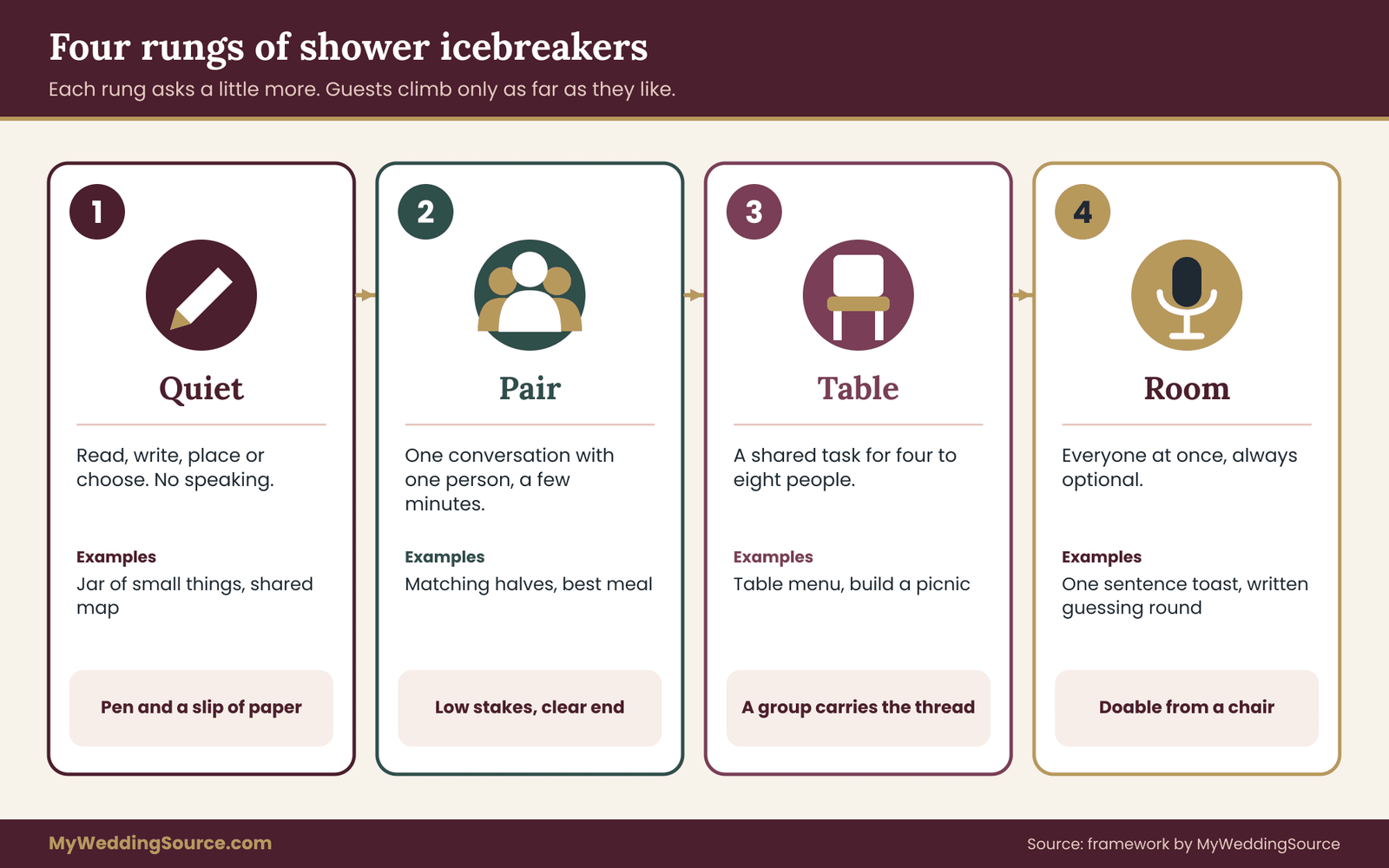
Do not run one big game and hope. Print each activity as a small card that states how much talking it asks for, how long it takes and how to skip it. Sort the cards into four rungs: quiet, pair, table and room, and treat the rungs as the backbone of your bridal shower icebreakers. Open with quiet cards, move to pairs, then tables, and offer the room-wide rung last and only as a choice. Shower icebreakers work when the quietest guest can take part without speaking, and the most outgoing guest still has something to do.
A bridal shower brings together people who share exactly one thing: they care about the guest of honor. A college roommate sits beside a future mother-in-law, a coworker, two cousins from different sides, and someone’s neighbor who was invited because she helped with the move. They have each heard a lot about one another and met none of them. The first twenty minutes decide how the afternoon feels, and shower icebreakers are the tool that shapes them.
Most advice about shower icebreakers says to pick a fun game. That advice skips the real problem. A game assumes everyone is willing to be looked at, to guess aloud, to touch something, to laugh at a stranger’s joke. Some guests are. Many are not, and for good reasons that have nothing to do with being unfriendly. Shower icebreakers that ignore those reasons feel like a test, and guests answer tests by getting quiet. Careful bridal shower icebreakers do the opposite.
This article takes a narrower view. It is about the first part of the shower, the part where strangers become a room, and about how to design that part so that taking part is always a choice. It gives you a way to build activity cards for shower icebreakers, a way to order them, a worked example, a set of checks you can measure on the day, and scripts for the awkward moments.
A note on scope. This is general hosting and etiquette information, not legal, tax or financial advice, and customs differ by family, culture and region. Where a product, venue rule or food-safety question matters, the article points you to the person or agency that can confirm the current answer.
Why strangers stall without gentle shower icebreakers
Strangers at a shower are not shy in general. They are managing a specific set of unknowns at once, and good shower icebreakers remove unknowns instead of adding pressure.
The first unknown is status. Guests do not know who is family, who is closest to the guest of honor, who hosts, and who is simply invited. They hold back a little until they know where they sit in the room. The second is topic. Small talk needs a safe subject, and at a shower the obvious subject, the couple, is also the one where saying the wrong thing is easiest. The third is duration: nobody knows how long they must perform before they can relax.
Add a fourth, the one hosts underestimate. Guests do not know what the day will ask of them. Will there be games? Will they have to stand up? Will someone read their answer aloud? Will they have to share a story about a person they met ten minutes ago? A guest who does not know the rules spends the first hour guarding against the worst version of the afternoon.
What this means for the way you design shower icebreakers
If the unknowns are status, topic, duration and demands, then the opening should answer them. Name tags and a simple seating cue answer status. A common, harmless subject answers topic. A visible schedule answers duration. A short note on the table, in the invitation or on the first card that says “everything today is optional” answers demands.
Notice what is missing from that list: a funny game. Fun comes after comfort, not before it, and that order is the first principle of workable shower icebreakers. Hosts who start with a loud room-wide game are asking strangers to perform before they know the audience. The guests who do join in tend to be the ones who already know someone, which makes the divide wider, not smaller.
What shower icebreakers should and should not do
It helps to be clear about the job. Good shower icebreakers do four things. They give strangers a reason to speak to one another that has nothing to do with being on display. They make it easy to find something in common. They end before they wear out. And they leave a path for anyone who would rather not.
They should not try to do some other things that hosts often load onto them. They should not be a vehicle for embarrassing the guest of honor, who is also in a room of people she may not know well. They should not rely on guessing guests’ private facts: age, weight, relationship status, whether they have children, whether they want children, what they earn, or how they voted. They should not require alcohol. They should not turn into a competition with prizes that matter more than the people.
The hidden costs a game can carry
A game can carry costs that are invisible to the host and plain to the guest. A prize that costs money can make a guest on a tight budget feel the room is keeping score. A game that requires a phone excludes a guest who left hers in the car or does not own one.
A game that requires reading small print excludes a guest with low vision. A game that depends on quick audio excludes a guest with hearing loss. A game that involves touch, food or close physical contact may be a problem for a guest with a medical or religious reason to avoid it.
None of that means giving up games or giving up shower icebreakers altogether. It means designing each activity so that the barrier is low, and so that a guest can step to the side without a scene. The card system in the next section builds that into the format, so you do not have to remember it for every game.
Two kinds of guests to design for
Think of two guests when you build the program. The first arrives alone, knows only the guest of honor, and would be happy to speak with one person at a time. The second arrives with a friend and would be happy with a group but may stick to the friend. If a card works for the first and is not boring for the second, it is probably right.
A short test helps when you choose bridal shower icebreakers. Read each activity and ask: what is the least a guest can do and still be included? If the answer is “nothing at all, and she still gets to listen and enjoy,” the card passes. If the answer is “she has to speak in front of the room,” the card belongs on the most optional rung, with a clear exit.
The words hosts use and what they mean here
A few terms appear throughout, so it is worth fixing them early. A card is a small printed or handwritten prompt that describes one activity. A rung is one of four levels that describe how much a card asks from a guest. The flow is the order in which you offer the cards across the event. An exit line is a short sentence on every card that tells the guest how to skip or change the task.
The word “opt-in” matters for shower icebreakers. In an opt-out design, everyone is in the game unless they say no, and saying no is conspicuous. In an opt-in design, the card is offered and a guest chooses it, and not choosing it is invisible. The practical difference is small on paper and large in the room. A guest who can quietly leave a card on the table is more likely to pick one up than a guest who must publicly decline.
Where these cards sit in the larger shower
This guide covers the opening and mixing phase of the shower, which is where shower icebreakers matter most, and not the whole event. If you are still deciding on a format, a date, who hosts and how costs are shared, start with the wedding planning checklist and come back once the basics are settled. For the broader question of what guests may expect from a host and what a host may expect from guests, the wedding etiquette guide covers the ground rules this article assumes.
Two practical limits apply. Shower icebreakers should take up a modest share of the event. A rough working range for a two-hour shower is twenty to thirty-five minutes of structured activity in total, spread out, and the rest left for eating, talking, opening gifts if that is part of your day, and breathing. And the guest of honor should have a say. Ask her which kinds of attention she enjoys and which she dreads before you buy a single card stock sheet.
What you will have from these shower icebreakers by the end
By the end you will have a set of cards sorted by rung, a flow that spaces them across the afternoon, a one-page host sheet with times and scripts, a list of checks to run as the shower unfolds, and a plan for the edge cases that tend to appear: the guest who does not speak the room’s main language, the guest who is grieving, the guest who arrives late, and the pair who clearly prefer to talk to each other.
None of it needs special supplies, and most of it can be done with index cards and a pen.
Building an opt-in card for shower icebreakers, line by line
The card is the unit of the whole system of shower icebreakers, so it deserves a careful design. A good card is small, plain and complete. It tells the guest what the activity is, how much it asks, how long it takes and how to step out. Everything else, including decoration, is secondary when you design shower icebreakers for people who have just met.
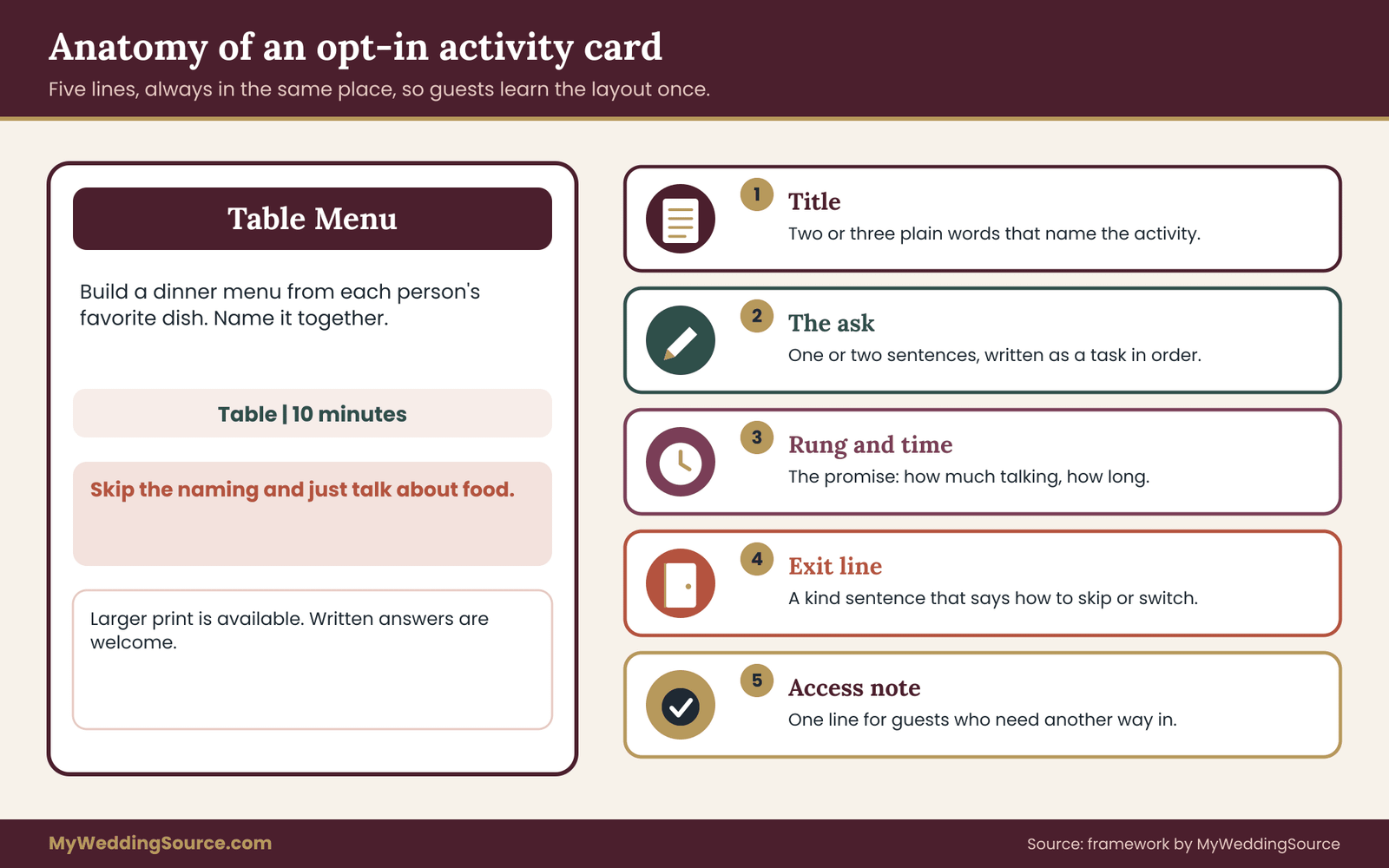
For shower icebreakers like these, use a card size that fits in one hand, such as a standard index card or a quarter sheet of paper. Print or write one activity per card. Put the same five pieces of information in the same place on every card, so guests learn the layout once and then read quickly.
The five lines every card carries
Title. Two or three words that name the activity without jokes that need explaining. “Shared Three”, “Name and Story”, “Table Map”. A title that is clear on its own saves you from reading each card aloud.
The ask. One sentence that says what the guest does, in the order they do it. “Find one person here you have not met and learn one thing you both like.” Write it as a task, not a rule list. If you need more than two sentences, the card is too complicated for strangers.
The rung and the time. A small label such as “Quiet, 5 minutes” or “Table, 10 minutes”. This is the promise: how much talking, how long. Keeping the promise is what builds trust in the next card.
The exit line. A short, kind sentence that gives the guest a way out. “Pass is fine. Just hand the card back or pick another.” The exit line is not optional. It is the feature that makes the card opt-in.
The access note. A line for guests who need a different way in. “Written answers are welcome. Ask a host for a larger-print copy.” This is one sentence, and it can be the same on every card in a set.
Why the exit line is the most important line
It is tempting to treat the exit line as legal cover. It is more useful to treat it as the reason strangers will try the card. People are generous with their attention when they know they are free to withdraw it. A guest who sees “Pass is fine” on the first card relaxes a little, and starts reading the second card for what she would like to do instead of what she must avoid.
Write exit lines for your bridal shower icebreakers in plain, warm language. Avoid phrasing that sounds like a punishment or a shrug. “No pressure” is overused and can sound dismissive. “Skip this one and take another” is concrete. “Listening counts as taking part” tells a quiet guest that she is already included.
What to leave off the card
Leave off anything that sets up a winner and a loser unless you have a reason that survives the checks in a later section. Leave off prizes in the first phase. Leave off personal facts about the guest of honor that others could get wrong or that she has not agreed to share. Leave off anything that asks a guest to name her age, relationship status, children, income or religion. And leave off jokes about the future husband, wife or partner, who is not in the room to enjoy them.
Also leave off requirements to use a phone. A card that says “Take a selfie” quietly assumes a device, a signal and a willingness to be photographed. If photos are part of the day, build a separate, optional photo prompt, and honor the family and guest preferences that apply to pictures. The same thinking appears in the site’s guide to wedding photography consent, and it carries over to showers on a smaller scale.
The four rungs of bridal shower icebreakers: quiet, pair, table and room
Sorting cards by how much they ask is what turns a pile of games into a ladder of shower icebreakers. The ladder lets a guest start at the bottom and climb only as far as she likes. It also gives you a running sense of the room: if guests are climbing, you can offer higher rungs; if they are not, you can stay low and still have a good afternoon.
Rung one: quiet
Quiet shower icebreakers ask for no speaking at all. The guest reads, writes, draws, chooses or places something. They are the safest entry point and the right first cards for a room of strangers. Examples include a card that asks each guest to write a favorite small thing about the guest of honor on a slip and drop it into a jar, a card that asks guests to place a sticker on a shared map at a place they have lived, and a card that asks guests to add a line to a shared recipe, playlist or reading list.
What quiet cards do well is give guests something to look at and talk about without being asked to. A shared map on the wall becomes a conversation piece. A guest standing near it can say “Oh, you lived there?” without having been assigned to say anything. Quiet cards are the soft edge of the ladder.
Rung two: pair
Pair cards, the second kind of bridal shower icebreakers, ask a guest to speak with one other person for a few minutes. The pairing is either chosen by the guest or made by a simple device such as matching halves of a card, the color of a dot on a name tag, or the month of a birthday. Pair cards are where most real introductions happen, because the stakes are low: one person, one conversation, a clear end.
A good pair card gives a topic that is easy to answer and does not touch private ground. “Where did you eat the best meal you had this year, and what made it good?” is an example. It invites a story, it is not about the couple, and it has no wrong answer. A weak pair card, by contrast, asks for something hard to answer on the spot or too personal for a first meeting.
Rung three: table
Table cards ask a small group, usually four to eight people at one table, to do one shared task. They work because a group takes the pressure off any single guest. If one person does not want to talk, the others carry the thread. Examples include building a table “menu” from everyone’s favorite dish, ranking five invented items together, or completing a short quiz about the guest of honor that was written by the host.
Table cards need a role or two so that the group does not stall. A “reader” and a “reporter” are enough. Make the roles optional and let the group assign them. Allow a table to ignore the rest of the card and simply talk, which is, after all, the goal of all bridal shower icebreakers.
Rung four: room
Room-level shower icebreakers involve everyone at once or ask a guest to speak to the whole room. They are the rung most people think of when they hear “shower game,” and they are the rung most likely to cause stress for strangers. Use them sparingly, late, and with a clear choice. A group toast to the guest of honor, a guessing round where answers are shouted, or a story told to everyone all belong here.
The rule for the room rung is that it must be possible to enjoy it from a chair. A guest should be able to watch, clap and laugh without being drafted. If a room card requires standing, running, blindfolds or physical contact, it needs a plain alternative, and it should not be the only activity on offer at that point in the afternoon.
Reading the room to decide how high to climb
A short habit helps. Before each rung, look at three things: how loud the room is, whether guests are standing or sitting in their original spots, and whether any guest is hovering at the edge. A loud, mixed room invites a move up. A quiet room with everyone in the same seats suggests staying on the current rung for one more card. A guest at the edge is a signal to offer her a quiet card and a friendly question rather than a push toward the center.
Shower icebreakers are not a checklist to be completed. If a group is talking happily, you can skip the next card. The cards exist to serve the conversation, and the best outcome of any set of shower icebreakers is a room that no longer needs them.
A five-phase flow for shower icebreakers across a two-hour afternoon
Cards give you the pieces of your shower icebreakers. The flow tells you when to offer each one. The pattern below is built for a shower of about two hours with a mix of guests who know each other well, a little, or not at all. Adjust the minutes for your own event, but keep the order, because the order is what makes the climb gentle.
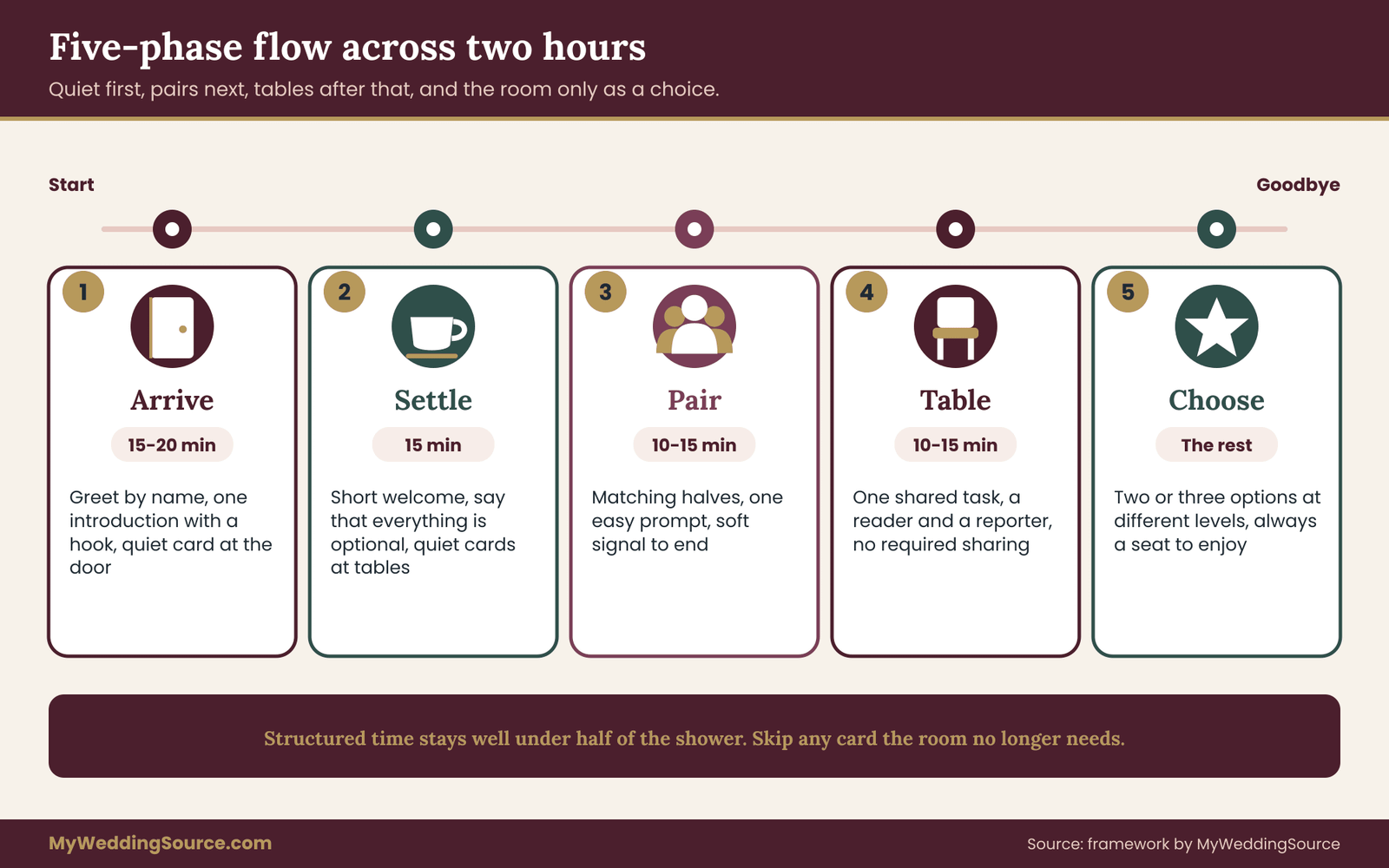
The five phases are Arrive, Settle, Pair, Table and Choose. Each has a purpose, a rung, a target length and a stopping rule. The total structured time is modest, because the aim of shower icebreakers is conversation that continues without prompts.
Phase one: Arrive, the first fifteen to twenty minutes
Guests trickle in over twenty minutes or so. This is the phase where strangers are most exposed, because they are standing with a drink and no obvious task. Fill it with quiet cards that require nothing but a pen. Set up one or two stations near the door: a name tag table with a simple prompt for something other than a title, such as a favorite snack, and a wall or jar for the first quiet card.
For bridal shower icebreakers to land, a host or a friendly volunteer should greet each arrival by name and make one introduction. The introduction should include a hook, not a résumé: “Sam, this is Priya, who also loves hiking.” That one sentence does more than any game for the first ten minutes. Name tags should be legible from a few feet away, with large lettering and a plain font, because many guests will read them from a short distance without leaning in.
Stopping rule for this first stage of the shower icebreakers: when about two thirds of the expected guests are present and seated or settled, move on. Do not wait for stragglers, and do not delay food for a late arrival.
Phase two: Settle, about fifteen minutes
Settle is the bridge between greeting and activity. Guests sit, get food or drinks, and have a first brief welcome from a host. The welcome is where you do three things: thank people for coming, say how long the afternoon will run, and describe the cards in one breath. “On each table there are a few cards with small things to try. Pick up any that look fun, skip any that do not. Everything today is optional.”
That last sentence, repeated on the card and in the invitation, carries more weight than any other line in the shower. It tells guests what the afternoon will ask of them and lets them relax into it. Keep it short and say it once. Do not apologize for the activities or oversell them.
Quiet cards continue in this phase. A guest at a table with a card and a pen has a reason to turn to her neighbor and say, “What did you write?” That is the moment shower icebreakers begin to work, and it costs nothing.
Phase three: Pair, ten to fifteen minutes
Once guests are seated and have eaten a little, offer a pair card. Pairing is the first real test of the room for any shower icebreakers, so make it easy. A good method is a two-part card: each guest gets half of a pair, such as a half of a favorite dish or a half of a famous duo, and finds the matching half. The match creates a pair without anyone being left out, and without asking a guest to choose a partner and risk rejection.
If the numbers are odd, a host can join or a trio can form. Let the pair talk for about five minutes using one prompt on the card. Then give a short, clear signal that the time is up. A soft chime, a hand raised, or a quiet “one more minute” works better than a loud call across the room.
A pair card does not require guests to report back. The value is in the conversation, not the sharing. If you want a bridge to the next phase, invite pairs to tell their neighbors one thing they learned, as an option, not an expectation.
Phase four: Table, ten to fifteen minutes
Table cards come after pairs because by now guests have spoken to at least one new person. A shared task at a table lets two or three of those new acquaintances become a small group. Aim for tables of four to eight. Bigger groups split into subgroups, and subgroups often leave quieter guests on the edge.
Give each table a single card, a pen and a role suggestion. Tell them the time limit. Walk the room lightly, listen and adjust. If a table is deep in conversation about something unrelated to the card, leave them alone. That is a success.
Phase five: Choose, the remainder
The last phase is where the room rung sits, and it is a menu, not a program. Offer two or three options, each at a different level of exposure, and let guests choose where to go. One option can be a short group toast. Another can be a quiet corner with a shared keepsake card. A third can be a table game that continues without a host. A guest who wants to leave the games and talk can do so, and nobody asks why.
If gifts are part of your shower, schedule them separately from the cards. Mixing the two crowds the afternoon and puts extra pressure on a guest of honor who is already being watched. If you are working from a longer checklist, a master wedding to-do list is a handy place to record which pieces you have decided and which are still open.
Timing bridal shower icebreakers without making the afternoon feel scheduled
A flow of shower icebreakers that is too rigid feels like a program, and strangers can tell. The point of the timing is to protect you from two common mistakes: starting a big activity too early, and dragging a small one too long.
The minute budget for shower icebreakers
Work backward from the end time. Mark the points where food arrives, where any speeches or gifts take place, and when guests are likely to start leaving. The cards fill the space between those anchors, never the other way round. If the afternoon runs late, cut a card. If it runs early, add one or let the room rest.
A simple budget for two hours could look like this in prose: roughly twenty minutes for arrival and the first quiet card, fifteen for settling and welcome, fifteen for a pair card, fifteen for a table card, and the rest for food, talk, an optional room card and goodbye. Notice that the total of structured time stays well under half of the shower. The room needs unstructured time to turn introductions into acquaintance.
Signals instead of announcements
Use soft signals to move through the phases of your shower icebreakers. A card on the table that says “When your table is ready, turn this over” lets a group move at its own speed. A playlist that shifts volume can cue a change without a spoken announcement. A host who walks the room with a small bell or a quiet word near each table is less jarring than a microphone.
Reserve the microphone, if you have one, for the welcome and the closing. A mic tends to push a room into performance mode, which is the opposite of what strangers need.
When the room is ahead of you
Sometimes a room warms quickly. Guests who share a neighborhood, a school or a workplace find common ground within minutes. When that happens, drop the pair card and go directly to a table card, or let the table card replace the structured pair round. Hosts sometimes feel they have to run the whole program they planned. They do not. The best use of a flow is to skip the parts the room no longer needs.
When the room is behind you
If a room stays quiet after the second card, do not escalate. Go back down a rung instead. Offer another quiet card, add a simple tabletop prompt such as a question card at each place setting, and let food and drink do some of the work. Ask a few outgoing guests, quietly, to help seed a conversation at the tables that seem stuck. A host who pushes harder at a quiet room usually makes it quieter.
Why the order of shower icebreakers matters
The order from quiet to pair to table to room is not a rule of etiquette. It is a pattern drawn from a simple observation about how comfort builds: people tolerate more exposure after they have had a small, safe interaction. Each rung is an earned step. Skipping to the room rung asks guests for the most visible form of participation before they have any evidence the room is friendly. That is the main reason big opening games fall flat with strangers.
Keep the ladder in mind when you are tempted to start with something loud because it worked at a different event. A different crowd, a different set of unknowns. Shower icebreakers for strangers, and bridal shower icebreakers in particular, should be built around the unknowns of this particular guest list.
A starter library of shower icebreakers for strangers
The shower icebreakers below are written as sample cards. Reword them to suit your guest of honor and your guest list. Each one is described by its ask, its rung, its time and its exit line, so you can see how the five lines fit together. None of these shower icebreakers needs a purchase beyond paper, pens and a few small items.
Quiet cards
Jar of Small Things (quiet, ongoing). Ask: write one small thing you like about the guest of honor on a slip, and fold it into the jar. Exit line: “Leave it blank and just drop in a smile, or pick another card.” The slips can be read to her privately later, which avoids putting her on the spot in front of strangers.
Where We Come From (quiet, five minutes). Ask: place a sticker or write your name on a shared map at a place you have lived or grown up. Exit line: “Stand nearby and watch if you prefer.” The map pays off later, because guests find shared places and start talking.
Shared Playlist (quiet, ongoing). Ask: write the title of one song that makes you feel cheerful on a slip. Exit line: “Skip if nothing comes to mind.” A host can fold a few into the background music, which gives guests a quiet point of connection: “That one is mine.”
Advice Cards (quiet, five minutes). Ask: write one piece of kind, practical advice for any new household, whether about food, schedules or patience. Exit line: “A simple wish works too.” Avoid prompts that ask for marriage advice from guests who may be single, divorced or widowed, because the question can sting.
Pair cards
Shared Three (pair, five minutes). Ask: with one other guest, find three things you both like or have done, other than the guest of honor. Exit line: “If three is too many, one is plenty.” This card works because it forces gentle exploration without personal questions.
Best Meal (pair, five minutes). Ask: tell each other about a meal you remember fondly and why. Exit line: “Listening counts as taking part.” This is a good pair card for guests with different backgrounds because food stories travel across cultures.
Matching Halves (pair, five minutes). Ask: find the guest holding the other half of your card and say hello. Exit line: “Hand your card to a host and a host will match you.” This is a mechanical start that avoids the dread of choosing a partner.
Two Truths, Gently (pair, five minutes). Ask: share two things about yourself that are easy to say and one wish for the next year, such as a place to visit. Exit line: “Share only what you like.” The card avoids the classic version with a lie, which can make strangers feel tested.
Table cards
Table Menu (table, ten minutes). One of the friendliest bridal shower icebreakers for a mixed room. Ask: as a table, build a dinner menu from each person’s favorite dish. Name the menu together. Exit line: “Skip the naming and just talk about food.” The product is a funny menu and, more importantly, a group of guests who now know each other’s tastes.
Guess the Guest List (table, ten minutes). Ask: the host has written five short, kind facts about the guest of honor. As a table, guess which are true or which belong to which stage of her life. Exit line: “A table can pass on any item.” The host should approve every fact with the guest of honor in advance and should avoid anything that touches money, health, family disagreements or past relationships.
Build a Picnic (table, ten minutes). Ask: choose items for a picnic that every person at your table would enjoy, including people with food restrictions. Exit line: “Pass the pen and let someone else write.” This one quietly encourages guests to talk about dietary needs without pointing at anyone.
Place Pins (table, ten minutes). Ask: each person names one place they would like to visit and one they would not. The table pins them on a small map or list. Exit line: “Skip the ‘would not’ part if you wish.”
Room cards
One Sentence Toast (room, ten minutes, optional). Ask: if you wish to, say one sentence of good wishes for the guest of honor. Exit line: “Raise a glass silently if you prefer.” The card asks only for one sentence. Many guests will manage that, and the quieter ones can still be part of the moment.
Group Photo Choice (room, five minutes, optional). Ask: a group photo will be taken at a set time. Join, or hold a place at the edge of the frame. Exit line: “Skip the photo and enjoy the party.” Offering the choice honors guests who prefer not to appear in photos, a point covered more broadly in the guide to wedding photography consent mentioned earlier.
Guessing Round (room, ten minutes, optional). Ask: the host reads questions about the guest of honor and guests write answers on paper. Exit line: “You can listen only.” Written answers let guests join without shouting, and a host can read the correct answers with a smile and no scoring.
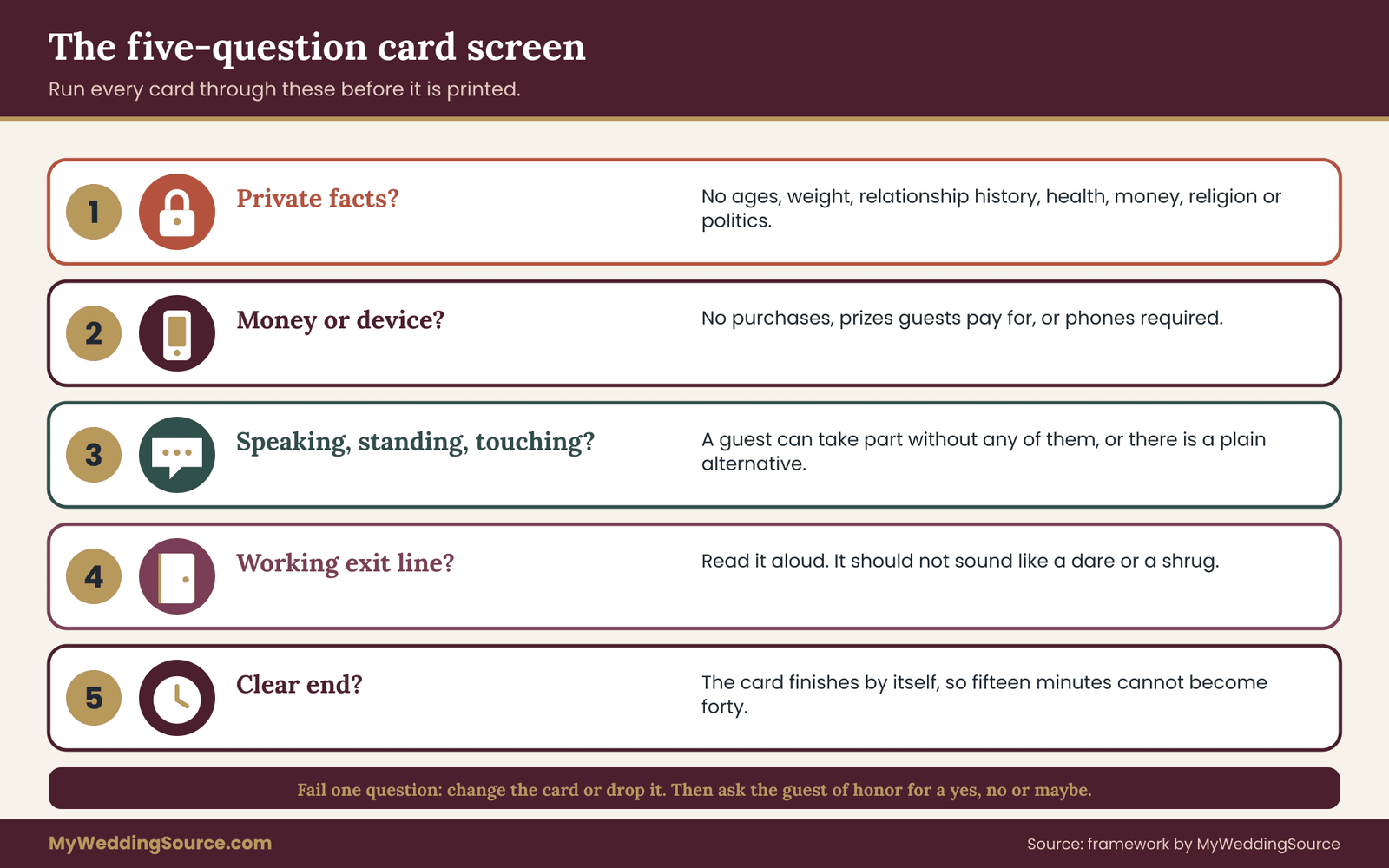
Screening any of your shower icebreakers: the five-question check
You will want to add your own shower icebreakers, and you may find ideas in game kits or online lists. Before you print any of them, run each through five questions. If a card fails one, change it or drop it.
First, does it need a named person’s private information? Ages, weight, relationship history, health, money, religion and politics are out. So are guesses about who might be pregnant, engaged or leaving a job.
Second, does it cost a guest money or require a device? A task that needs a phone, a purchase or a prize that must be bought by guests can quietly divide the room.
Third, can a guest take part without speaking, standing or touching anyone? If not, there should be a plain alternative on the same card.
Fourth, does it have an exit line that works? Read the exit line out loud. If it sounds like a dare or a shrug, rewrite it.
Fifth, does it end by itself? A card with no clear end invites a host to extend it, which is how fifteen minutes becomes forty.
Why this screen beats a generic list of bridal shower icebreakers
Lists of shower games are written for a typical guest at a typical shower. Your guests are particular. They may include someone who has just lost a pregnancy, someone who is newly out of a relationship, someone who is new to the country, or someone who is simply tired. A screen based on questions travels with you from one event to the next, while a fixed list does not know your room.
The screen also helps with the guest of honor, who should see every one of the shower icebreakers first. A shower is for her, but the cards are in front of strangers. Ask her to read the card set before it goes to print. A short “yes, no, maybe” on each card from her is faster than any debate, and it keeps her from discovering a surprise she would rather not have.
Checking claims from game sellers
If you buy a printed game set, read the product page like any other purchase. Check what is actually included, the card count and size, whether the set matches your guest count, and the refund or return policy. Be wary of claims that a set of bridal shower icebreakers will “break the ice” with anyone, since no card can promise that.
Federal consumer protection guidance on advertising from the Federal Trade Commission is a useful reference for what sellers may and may not claim, and it is listed in the sources below. Treat star ratings as one input, not a verdict, and prefer sellers that state their return terms clearly.
Adapting shower icebreakers for the guests you actually have
Once you have a set that passes the screen, look at the guest list one more time and ask which cards each group of guests will meet. A group of coworkers will probably relax with a food card. A group with several older relatives may prefer a slower, seated approach with larger print.
A group that includes children needs a separate, simple table activity so that parents are not splitting their attention. Shower icebreakers do not need to be identical across the room, and they work better when each table has a card that fits the people sitting at it.
A worked example of shower icebreakers: twenty-six guests from five circles
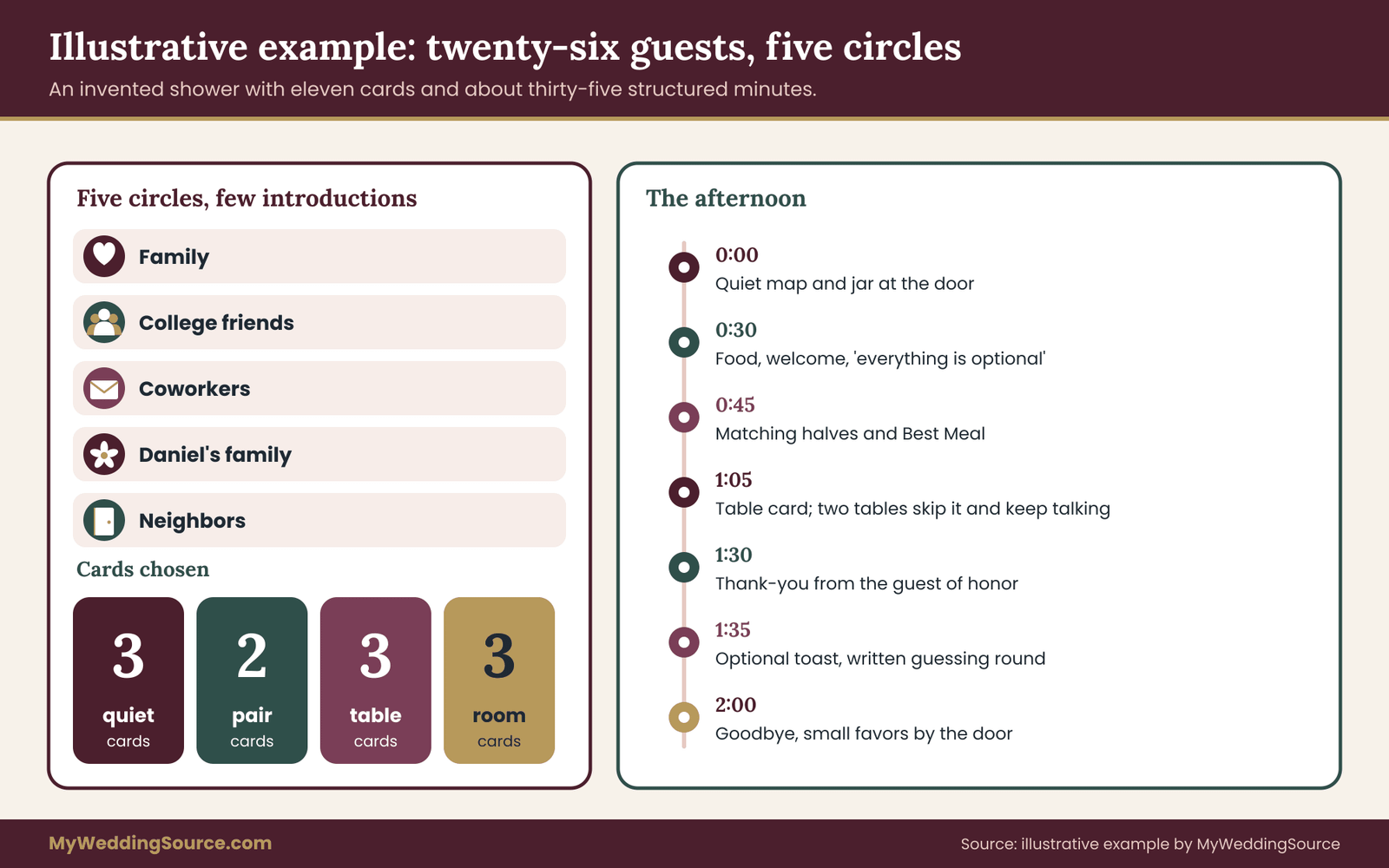
The example below is invented and meant only to show shower icebreakers in motion. The guest of honor, Marisol, is marrying Daniel. Her sister Elena and two friends are hosting a weekend afternoon shower in a rented community room with five round tables. Twenty-six guests are coming from five circles: Marisol’s family, her college friends, her coworkers, Daniel’s mother and aunts, and two neighbors. Few of these circles have met.
Step one: name the unknowns
The hosts list what guests do not know. Daniel’s mother does not know anyone but Marisol. The coworkers do not know the college friends. The neighbors know no one except Marisol. Elena also notes two guests who she suspects are quiet by nature, and one older aunt with low vision. She writes down that nothing on the program should require speaking in front of the room, and that print must be large.
Step two: choose the cards
The hosts pick eleven cards from a library like the one above. Three are quiet: Jar of Small Things, Where We Come From, Shared Playlist. Two are pair cards: Matching Halves and Best Meal. Three are table cards: Table Menu, Build a Picnic and Place Pins. Three are optional room cards: One Sentence Toast, Group Photo Choice and a short Guessing Round with written answers. They ask Marisol to read all eleven. She vetoes one table question that would have touched on her last job, and asks that the photo be taken before dessert.
Step three: build the flow
Because the shower runs two hours, the hosts mark anchor points first: food at the thirty-minute mark, a welcome right after that, the guest of honor’s thank-you at the ninety-minute mark, and goodbyes by two hours. They place the quiet cards at the door and on each table, the pair card at the forty-five minute mark, the table card at the sixty-five minute mark, and the optional room cards in the last half hour. Total structured time: about thirty-five minutes.
Step four: set the room
Elena seats guests by circle on purpose at the first table setting, then adds a small cue on the matching-halves cards to bring different circles together later. Name tags have large print and a favorite snack in place of a job title. A host stands at the door to greet by name and make one introduction with a hook. The map and the jar sit near the entrance, with the pens on strings so they stay put.
Step five: run it and adjust
Guests arrive over twenty minutes and most drift to the map. Daniel’s mother stands near it with a neighbor and they discover they grew up in nearby towns. The coworkers sit together, so Elena brings them a Best Meal card early, and they match with two college friends. At the sixty-five minute mark, three tables are talking so happily that the hosts skip the Table Menu card entirely and move to the toast. The room card gets one sentence from seven guests and a raised glass from the rest.
Step six: check the results the same afternoon
At the end, Elena runs three quick checks. First, she counts how many guests she saw talking with someone from a different circle: she estimates most of the room. Second, she checks the card basket. Few cards were left blank, and no guest had left early. Third, she asks two guests she had worried about how the day felt. Both said they liked that nothing was forced. None of this is a formal survey, and the hosts treat it as a rough guide, not a score.
What the example shows about shower icebreakers
Three things are worth noticing. The hosts spent far more time on the unknowns and the exit lines than on the games. They also dropped a card in the moment because the room was ahead of them, which is the system working as designed. And the guest of honor was involved early and again at the end, so the cards were never a surprise to her. None of these steps needs a budget, but shower icebreakers of this kind need a little attention in advance.
Comparing ways to run shower icebreakers
Opt-in cards are one approach to shower icebreakers among several. Seeing the trade-offs in prose helps you decide whether the cards are the right fit for your shower or whether a lighter option will do.
One host-led game for the whole room
This is the traditional approach: a host announces a game and everyone plays together. Its strength is energy. A room that already knows each other can get loud and merry fast. Its weakness is that it assumes a shared comfort level that strangers do not have yet. It also leaves little room for guests who need to opt out, and it depends heavily on the host’s skill and voice. Use it for a group that is mostly familiar, and keep it short.
Bingo and scavenger-style sheets
A sheet of squares, such as “find someone who has visited another country”, sends guests around the room to talk to others. This format can be a good mixer because every task is a reason to speak. It can also push guests to approach strangers on command, and the squares can drift toward personal topics. If you choose it, keep squares light, factual and optional, and allow a guest to fill squares by listening. The five-question screen later in this guide applies to bingo squares just as it does to cards.
Self-serve stations
Stations are tables with a single activity that guests may visit at their leisure, such as a card-writing corner, a small craft or a map. They give strangers something to do alongside one another, with no host needed. The downside is that they can become solitary if nobody mixes. Pair a station with a pair card, or place the stations so that guests naturally share a table.
Hiring a facilitator or entertainer
A professional host or entertainer can run activities and carry the room. This can help if the hosts are nervous, if the guest list is large, or if a venue expects a program. It also adds cost, and it moves control away from the hosts, who know the guests best. If you consider this route, ask the questions in the next section and agree in writing on content, timing, volume and what happens if a guest opts out.
No games, only conversation prompts
A shower can also have no games at all. Each table carries a small card with a question or two, and the rest of the afternoon is food and talk. This suits a very relaxed, older or smaller group. It carries the lowest risk of pressure. Its weakness is that it relies on guests to start talking, which can fail when strangers hold back. In that case, a single quiet card at the door may be enough to tip the balance.
Choosing among these shower icebreakers
A rough guide: choose cards when most guests are strangers and you want everyone to have a way in. Choose a host-led game when guests largely know each other. Choose stations when the room is large or the space is wide. Choose a facilitator when you want a program but cannot lead it. Choose conversation prompts when the group is small and relaxed. You can mix approaches, but keep one clear order.
Questions to ask vendors, venues and kit sellers about shower icebreakers
Even a small shower can involve outside parties, and they affect your shower icebreakers more than you might expect. A rented room, a printer, a game kit seller, a caterer, a photographer or a facilitator each have rules and terms that affect your icebreaker plan. Ask your questions in writing and keep the answers.
For the venue: Is there a limit on noise, music or decorations on walls? Can we hang a map or paper on the walls, and with what tape? How many tables and chairs are included, and can we move them? Is there a quiet corner or a seating area away from the main noise? What is the accessible route to the room and the restroom?
For a printer or stationery seller: What is the lead time for cards, and what happens if a name is misspelled? Can you print in a larger type size and a plain typeface? What is the price per set, and is there a minimum quantity? What is the return or reprint policy?
For a game kit seller: What exactly is in the kit and how many guests does it cover? Can I see the full card text before purchase? Are any cards based on personal questions? What is your return policy?
For a caterer or food vendor, if you use one: Can you provide an ingredient list for each item, and can you label items for common allergens? How do you handle cross-contact? The site’s guide to building a wedding menu for different diets covers this thinking on a larger scale.
For a facilitator or entertainer: What will you do, in order, and how long will each part take? Can guests opt out of every part? What will you say if a guest declines? What are your payment, cancellation and overtime terms? Do you carry liability insurance?
Measurable checks for shower icebreakers on the day
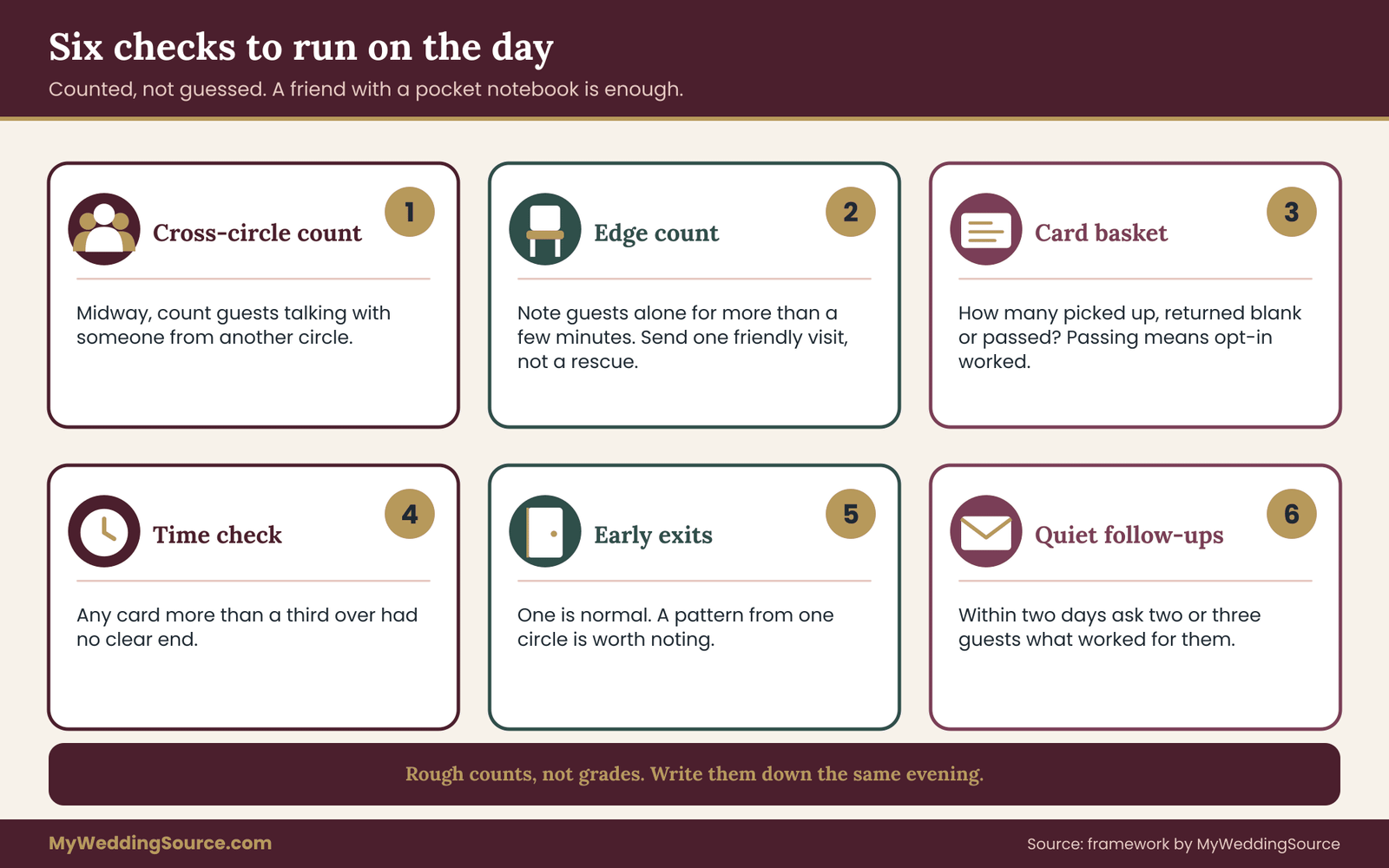
Hosts often judge shower icebreakers, and the shower as a whole, by a feeling. A feeling is fine, but it is easy to fool, because the loudest guests shape it. A few simple checks, counted rather than guessed, give you a truer picture and tell you what to change for next time. None of them needs a clipboard. A friend with a pocket notebook is enough.
Check one: the cross-circle count
Pick a moment about halfway through, after the pair card. Quickly look at each table and each cluster standing near the food, and note how many guests are in conversation with someone from a different circle: a different family, workplace or friend group. Count heads, not words. You are looking for a rising number, not a perfect score. If the count is low, add a quiet card or a table card with a clearer shared task.
Check two: the edge count
Count how many guests are alone or at the edge of the room for more than a few minutes. One is normal, since some people enjoy watching. Several suggest that your shower icebreakers are not doing their job. Send a host or a friendly guest, one at a time, with a simple question and an invitation to a table, never a public rescue.
Check three: the card basket
At the end, look at what happened to the cards. How many were picked up? How many were returned blank? How many were passed with the exit line? A high pass rate on one particular card means the card needs work. A high pass rate on every card means the room was not ready or the cards were too exposed. Both are useful findings. Do not read passing as failure, because passing means the opt-in design worked.
Check four: the time check
Compare the minutes you planned with the minutes you used. If any card ran more than a third over, either the card had no clear end or the host let it drift. If any card finished early, that is usually fine. A card that ends sooner than expected leaves room for talk, which is the goal.
Check five: the early exit count
Note when guests leave and whether anyone leaves earlier than expected. People leave for many reasons, including childcare, travel and other plans, so one early exit means little. A pattern, such as several guests from the same circle leaving after the room card, is worth noting.
Check six: two quiet follow-ups
Within a day or two, send a brief and friendly message to two or three guests you felt were less comfortable and ask what they enjoyed. Keep it open and kind: “We hoped the afternoon felt easy. What worked for you?” People will say what they are willing to say, and the answers will be more honest if you ask in a low-key way.
Using the results of your shower icebreakers
Write down the results the same evening, in a few lines. Record the cross-circle count at the midpoint, the edge count, which cards were passed, which ran long, and any comments. If you are one of several hosts, share the notes. If the shower is one event in a longer run of celebrations, those notes help the next hosts, including those planning the wedding weekend itself. The checks also make it easier to explain to the guest of honor what happened, with facts instead of vague impressions.
What the checks on your shower icebreakers cannot tell you
These counts are rough, and they say nothing about how a particular guest felt in her own head. They are not statistics, and the guest list is too small for any number to mean much beyond your own room. Treat them as prompts for reflection and as a way to catch obvious problems, not as grades. A shower with a low cross-circle count can still have been a lovely afternoon for the guest of honor.
Edge cases: when shower icebreakers meet real guests
Real guests rarely fit a neat flow of shower icebreakers. These situations come up often enough to prepare for. In each, the principle is the same: protect the guest’s dignity, keep the activity optional and avoid making the problem the center of attention.
The guest who does not share the room’s main language
Offer your shower icebreakers in two languages where you can, or add a simple picture or icon to each. Pair cards can rely on a shared object such as a food, a place or a color. Ask a bilingual guest if she would like to help, but never assign her the role. Let guests use a translation app only if they choose, since some will feel more at ease without a phone on the table. The same thinking appears in the site’s guidance on bilingual wedding signs and messages.
The guest with a hearing difference
A room full of voices is hard for a guest with hearing loss, and background music makes it harder. Keep music at a low volume during pair and table shower icebreakers. Seat the guest away from speakers and kitchen noise. Offer written versions of any spoken instructions, and let her choose a seat with a clear view of the host’s face. The National Institute on Deafness and Other Communication Disorders publishes plain guidance on communicating with people who have hearing loss.
The guest with low vision or a mobility need
Use large, high-contrast print and a plain typeface on cards and name tags. Keep paths between tables wide enough for a wheelchair or walker, and avoid activities that require everyone to stand or cross the room. A room rung that depends on moving around needs a seated version. For shower icebreakers that involve movement, the ADA information site is the federal starting point for accessibility rules in public spaces, and a venue can tell you what its own accessibility features are.
The guest who is grieving, newly separated or going through fertility struggles
You may not know. That is why careful bridal shower icebreakers avoid prompts about marriage advice, children and family plans. If a guest steps out or declines a card, let her. A quiet, warm “Take any time you need” is enough. Do not ask why in front of others. If the guest of honor tells you something about a particular guest in confidence, adjust the cards, and keep the reason private.
The guest who arrives late
A late arrival walks into a room that has already warmed up, which can feel like arriving at a play in the second act. Have a host greet her, make one introduction, and hand her a card appropriate to the current phase, usually a quiet one. Do not pause the afternoon or announce her arrival.
The pair who only want to talk to each other
Two friends who arrive together and stay together are not a problem to fix. They are comfortable, and they will probably join a table card if it looks inviting. Offer a card to both, and let them choose. If you want to mix them, a gentle device such as matching halves does it without pointing at them.
The guest of honor who dislikes attention
Some guests of honor dread being the center of a game. Ask her early. Put her cards on the quiet and pair rungs, spread the attention across the room, and let her skip anything that makes her uncomfortable. A shower that asks little of her can still feel warm to her guests.
The guest who dominates
An outgoing guest can take over a table card. A soft correction works well: a host drops by and asks the table to hear from someone who has not spoken, or hands the pen to a quieter guest. Do not call anyone out. Often the dominant guest is simply nervous and filling the quiet.
Food and drink at the activity
If a card involves tasting or sharing food, label ingredients and offer a version without food. Food allergy information from the organization Food Allergy Research and Education, and from the federal Food and Drug Administration, explains why cross-contact matters. For an alcohol-free option, offer a drink for everyone that does not single anyone out. Shower icebreakers that depend on drinking, tasting or touching leave some guests out.
What to say: short scripts for hosts running shower icebreakers
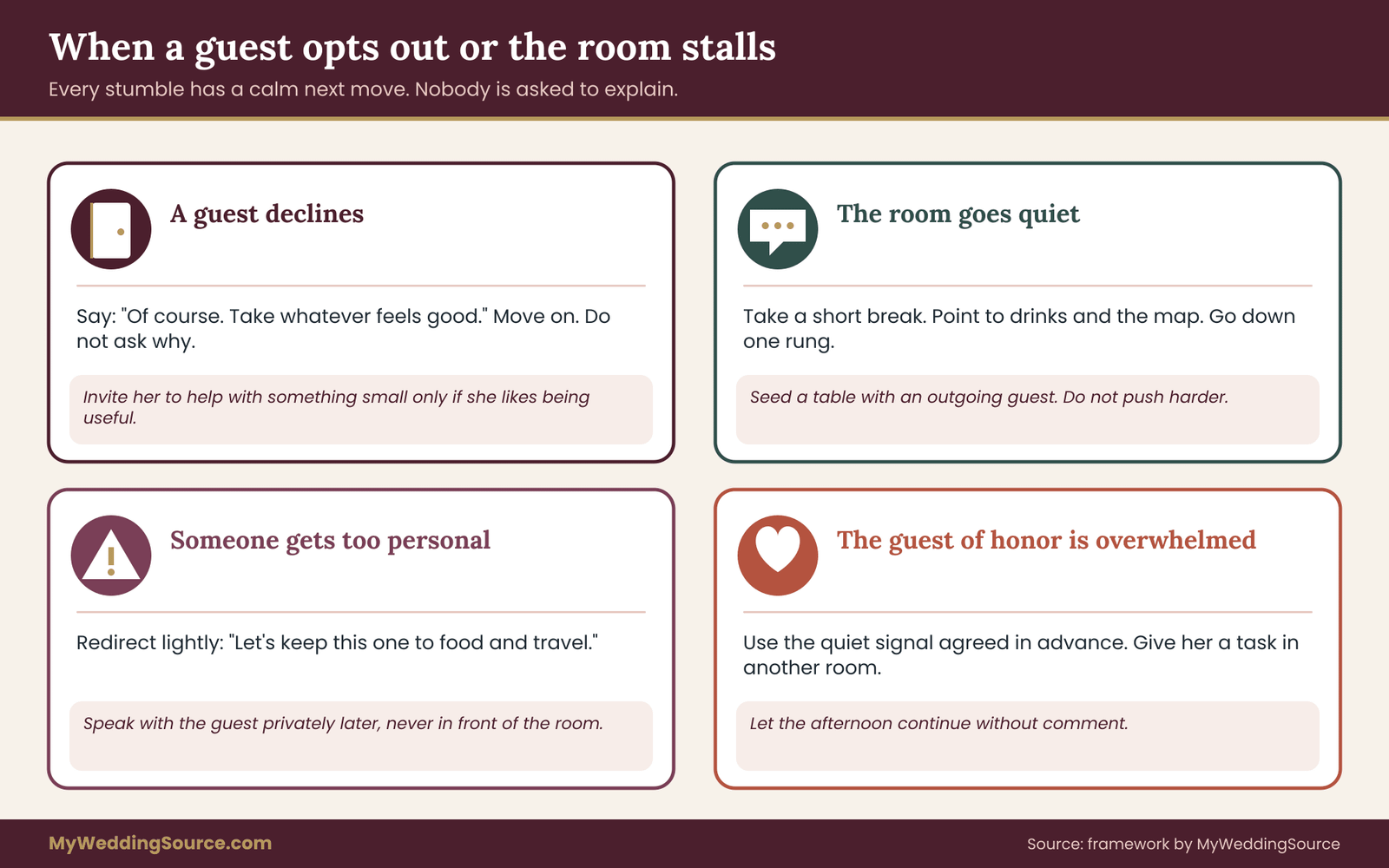
Most hosts are not worried about the shower icebreakers themselves. They are worried about the moment a guest says no, the moment the room falls quiet or the moment a game goes sideways. Short scripts help because they take the pressure of invention off you, and they keep your shower icebreakers calm. Adapt the wording to your own voice, and keep it brief.
In the invitation
“We are keeping the afternoon relaxed. There may be a few optional activities to help everyone meet, and you are welcome to join in or simply enjoy the company. Please let us know about any food needs or access needs when you reply.” This sets expectations before the day, and it invites guests to share what they need without having to ask in public. The wedding invitation etiquette guide covers wording and reply requests in more depth.
At the welcome
“Thank you all for coming. A few of you know each other and a lot of you do not yet, so there are some small cards on the tables. Pick up what looks fun and skip what does not. Everything today is optional. Food is out, and we will wrap up around four.”
When a guest declines
“Of course. Take whatever feels good.” Then move on. Do not ask why, do not offer a different task in front of others and do not hover. If you want to include her quietly, ask her to help with something small, such as handing out pens, only if she seems to enjoy being useful.
When the room goes quiet
“Let’s take a short break. There are drinks over here, and the map on the wall is filling up if you want to add yourself.” A quiet pause is not a failure. Guests often need a minute to refill their glasses and sort out who they want to talk to next.
When someone gets too personal
A card, a guest or a joke can drift to a private topic. A light redirect works: “Let’s keep this one to food and travel.” Say it as if it were part of the game. Later, if needed, speak to the guest privately. Do not scold anyone in front of the room.
When the guest of honor is overwhelmed
Have a code with her in advance, such as a favorite word or a touch on the arm, that means “I need a break”. Give her a task that takes her to another room, such as helping carry something. Let the afternoon continue without comment.
At the close
“Thank you for spending the afternoon with us. If you made a new friend today, I hope you swap numbers. There are small favors by the door.” Do not announce the results of any game here. Let people leave with the good feeling intact.
Keeping a one-page host sheet for your shower icebreakers
Put the whole plan on a single page: start and end times, anchor points, the order of cards by phase, the three scripts you are most likely to need, names of any guests with access needs and the contact for the venue. Share it with the other hosts a few days ahead. A host who has read it can step in without asking. It also helps on the day to know that someone else is watching the door while you are with a table.
Your next steps
Work through these steps for your shower icebreakers in order. Most take less than an hour, and you can spread them across two or three evenings.
First, talk to the guest of honor. Ask which kinds of attention she enjoys and which she would rather avoid, and ask whether any guests need particular care. Second, write the guest list by circle, and note the unknowns for each circle. Third, choose eight to twelve shower icebreakers from the library, covering all four rungs, and run each through the five-question screen.
Fourth, write the five lines for each card, with an exit line and an access note. Fifth, set the flow with anchor points first, then place the cards. Sixth, ask the venue, printer and any vendors the questions above, in writing.
Seventh, print and test the cards at the size and type you will use, and read them at arm’s length. Eighth, write the one-page host sheet and share it. Ninth, prepare the checks and name a friend to run them. If you are still deciding other parts of the shower, such as format and date, the overall planning checklist can hold the open items.
For wider questions of what guests and hosts owe one another, return to the etiquette guide for hosts and guests. And if the guest list itself is still shifting, the wedding guest list guide helps you decide who should be in the room.
FAQ
How many shower icebreakers should I prepare for twenty to thirty guests?
Prepare eight to twelve cards in total, with at least two quiet, two pair, two table and one or two optional room cards. You will probably use fewer than you print. A small spare set covers a card that fails the screen, a card that gets lost and a table that finishes early. More than twelve tends to turn the afternoon into a program, which is the opposite of the aim.
What if guests refuse to take part in any activity at all?
Then let them. Shower icebreakers are an offer, not an obligation. A shower without participation can still be warm if food, seating and name tags are in good order. Many guests who ignore cards early will pick one up later once they feel at ease. Do not chase, push or comment. If the room stays quiet, go back to a lower rung, add a question card to each table and let conversation start by itself.
Are shower icebreakers appropriate if the shower is mostly family?
Yes, but lighter. Even in a family group, there are circles that rarely meet, such as two sides of a family or relatives who live far apart. Use a few quiet and pair cards and skip the room rung if everyone already knows each other. The same screen applies to family shower icebreakers, because family settings carry their own private topics, and some relatives may not wish to speak in front of others.
How do I handle prizes without making anyone feel left out?
Skip prizes in the early phases. If you want one, make it small, non-competitive and shared, such as a drawing from the jar of slips, where every participant has an equal chance. Avoid prizes that guests must pay for or that depend on skill, speed or knowledge of the couple. Many hosts find that no prizes at all makes the afternoon calmer and the cards easier to pass.
Can I run these shower icebreakers at a virtual or hybrid shower?
Many shower icebreakers adapt. Quiet cards work well through a shared document or chat. Pair cards work in breakout rooms with a short, clear prompt. Table cards become small-group rooms. Keep sessions short, since screen time tires people faster, and offer a written alternative for any spoken task. Check that guests have the access and the comfort they need with the tools you pick.
How should I word shower icebreakers so they sound friendly, not bossy?
Write the ask as a short invitation in plain words and put the verb first: “Find,” “Tell,” “Pick.” Avoid exclamation points and words like “must” or “everyone.” Keep the exit line warm and specific. Read the card aloud as if you were speaking to a friend. If it sounds like an instruction on a form, rewrite it with fewer words and a calmer tone.
Is it fine to use a game kit I buy online instead of making cards?
It can be. Check the card text in advance, run each card through the five-question screen and remove any that fail. Confirm the count and size match your guest list, and read the seller’s return terms before buying. Do not rely on any promise that a kit will make guests bond. A kit is a set of prompts, and the success of any shower icebreakers still depends on the hosts’ choices.
What if two groups of guests clearly dislike each other?
Do not use the shower to fix it. Seat the groups apart, keep activities on the quiet and pair rungs, and give the hosts a clear plan for stepping in if tension rises. Table cards that require agreement can heighten friction, so choose ones with no right answer, such as menus or maps. Speak with each group quietly before the day if a problem is known.
Sources
- The Knot – wedding and shower hosting etiquette articles and planning resources
- Emily Post Institute – etiquette guidance on hosting, invitations and guest courtesy
- ADA.gov, U.S. Department of Justice – federal information on accessibility in public spaces and communication
- National Institute on Deafness and Other Communication Disorders – guidance on communicating with people who have hearing loss
- Web Accessibility Initiative, W3C – plain guidance on readable text, contrast and inclusive design
- Food Allergy Research and Education – food allergy information, labeling and cross-contact guidance
- U.S. Food and Drug Administration – food safety and allergen information for consumers
- Federal Trade Commission – consumer protection guidance on advertising claims and online purchases
- Centers for Disease Control and Prevention – food safety and general health guidance for gatherings
- USAGov – directory of federal consumer and accessibility resources