
A symbolic ceremony is a wedding moment with no legal effect of its own: the vows, rings and readings that mean something to you, held apart from the civil ceremony that creates the marriage on paper. This guide gives you a sorting method for deciding which actions belong to the legal event, which belong to the symbolic ceremony, and which are worth doing twice.
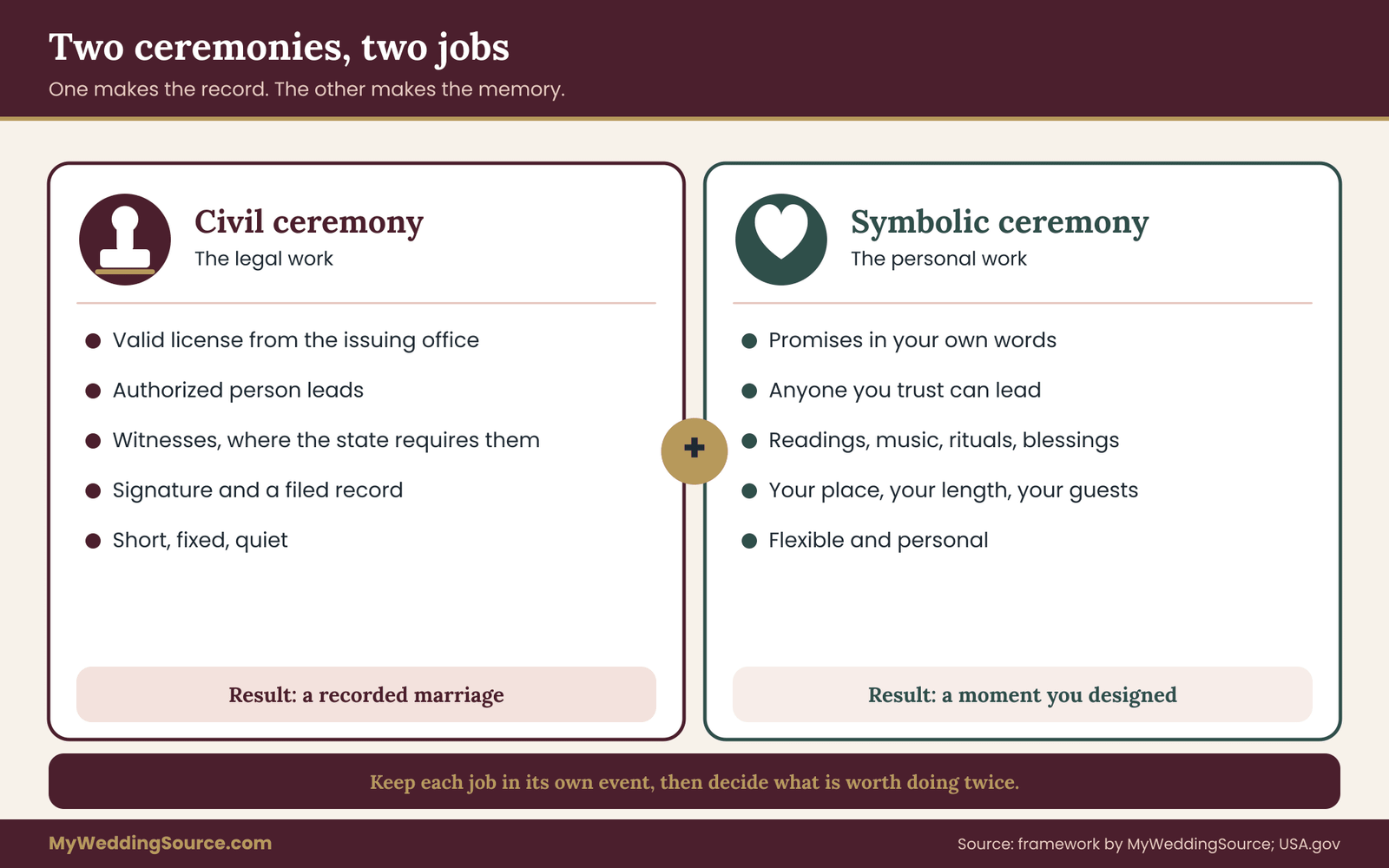
Treat the civil ceremony and the symbolic ceremony as two different jobs. The civil ceremony does the legal work: a valid license, an authorized officiant, the required witnesses, a signature and a record filed with the government. The symbolic ceremony does the human work: it lets you say what you mean, in front of the people you choose, in your own words. Sort every moment of your wedding into legal-only, symbolic-only or doubled, then pick an order and write one date for each event.
Many couples now split the wedding in two. They sign the paperwork at a courthouse, a city hall or a small office, often on a weekday with one or two witnesses, and they hold a larger gathering later. Others do both on the same afternoon, with a quiet legal moment at noon and a ceremony in the garden at four. A third group has the symbolic ceremony first and the legal act later, usually because of travel, paperwork timing or a visa.
All three patterns work. What goes wrong is the sorting. Couples say vows twice and are not sure which set counted. A relative announces “the real wedding” and a coworker hears “you got married last month” and is confused. A form asks for the date of marriage and the couple writes the party date, then spends a year correcting it. A symbolic ceremony leader says the words “by the power vested in me” with no power to vest.
None of these is serious on its own. Together they create a quiet mess that costs time, and in a few cases, money or credibility with an agency. The goal of this guide is to prevent that mess while protecting what makes the symbolic ceremony worth holding: that it is yours.
A note on scope. This is general information, not legal advice. Marriage rules are set by each state and sometimes by each county, and they change. When a rule matters, this guide points you to the office that issues it so you can confirm the current version. Everything here is written for couples in the United States; if either of you will marry in another country, the same sorting method works, but the rules at the legal end will be different.
What a symbolic ceremony and a civil ceremony each do
Start with plain definitions, because the words get blurred in conversation.
A civil ceremony is the legal event. It is the moment at which two people, with a valid license and an authorized person present, are married under the law of the place where they stand. The details differ by state. A license usually has to be obtained first, there may be a waiting period or an expiry date, an official or another authorized person has to be present, some states require witnesses and some do not, and the signed license must be returned so that the marriage can be recorded.
For the general federal pointer to how a marriage certificate is obtained, the government’s own guide at USA.gov is a good starting place, and your county clerk or equivalent office has the real answers for your location.
A symbolic ceremony is any ceremony you hold that does not, by itself, create a legal marriage. It may take place before the legal event, after it, or with no legal event nearby at all. It may be built from a script written by a friend, a tradition from a family, a religious blessing, a handfasting, a tree planting, or simply two people reading to each other in a restaurant room. It can be as formal as a church service or as small as a picnic.
The word “symbolic” can sound smaller than it is. It does not mean fake, pretend or lesser. It means the legal system is not what gives it weight. The weight comes from the people in the room and the promises made there. Many couples find that this is exactly the point.
The simplest way to tell them apart
Ask one question: if this moment never happened, would the marriage still exist in the eyes of the state? If the answer is yes, the moment is symbolic. If the answer is no, it is part of the civil ceremony. The signature on the license, the presence of an authorized officiant and the filing of the record are the moments that fail this test in most places. The processional, the readings, the ring warming and the unity candle pass it easily.
The test is useful because it removes an argument that ruins a lot of planning conversations. One partner says “the courthouse part is the real wedding.” The other says “the party is the real wedding.” Both are describing something true. One event is the real legal act; the other is the real emotional one, or perhaps they are both emotional and the legal one is simply short. The question about what the state would recognize settles the status of each moment without deciding which one matters more to you.
Why the two events pull apart
There are four ordinary pressures that separate the legal event from the ceremony.
The first is capacity. A courthouse room may seat a handful of people, and the clerk’s schedule may allow ten or fifteen minutes. A symbolic ceremony can happen in a space that fits fifty.
The second is timing. Licenses can be obtained quickly in some places and slowly in others. A couple may want the legal protections soon, for health coverage or a move, while a venue is only free in spring.
The third is cost. A civil ceremony is generally a small fee paid to a government office, while a larger ceremony has venue, seating, music and often an officiant fee. Separating them lets you spend on one and not the other.
The fourth is meaning. Some couples find the legal appointment flat, and they want a moment that they design from start to finish. Others find a religious ritual important but do not want the legal authority of a faith leader involved. The symbolic ceremony lets them shape it without depending on a legal requirement.
What this guide does not cover
This guide is not about how to plan the reception, how to feed guests after a courthouse appointment or how to limit who attends the legal event. The site has guides for the wider celebration. This article is narrower. It is about choosing, action by action, what belongs where, and about the words, dates and records that keep the two events from contradicting each other.
The legal versus ceremonial action test
The core of this guide is a sorting method that takes about an hour and can be done at a kitchen table. You list every action you expect to happen across your wedding, then put each one into one of three bins. Call the method the Move Sort.
The three bins are these. Legal-only moves are things the law or the issuing office requires, and nothing else should imitate them. Symbolic-only moves are things that carry meaning but have no legal function. Doubled moves are things you may want to do at both events because they mean something at each, such as exchanging rings or saying a promise aloud.
Step one: write the moves, not the events
Do not start with “civil ceremony” and “symbolic ceremony” as columns. Start with a plain list of moves. A move is any single thing someone does or says. Typical moves include signing, saying “I do,” exchanging rings, a reading, the officiant’s welcome, the pronouncement, the kiss, the walk in, a blessing from a parent, a unity ritual, a moment of silence for someone absent, a toast, a first dance, and a public announcement.
Write each on its own line. Be specific. “Vows” is too broad. Write “promises in our own words” and “the short legal question the officiant asks” as two lines if both will occur.
Step two: run four checks on every move
For each move, ask four questions in this order.
One: does a law or an office require it? Consult the county clerk or the state website for the license rules. If it is required, the move is legal-only. If you are unsure, call the office. Clerks answer this kind of question every day, and a three-minute call is cheaper than a wrong guess.
Two: does it create, prove or record the marriage? A signature, a witness line and a filed license do. A photograph of the signing does not create anything, but it may become a keepsake. If a move creates or proves status, treat it as legal-only even if the law does not literally name it.
Three: would saying it at a symbolic ceremony mislead anyone? The classic example is the pronouncement. If the symbolic ceremony is held before the couple is legally married, a statement such as “I now pronounce you married” tells guests something that is not yet true. The same words after the legal event are harmless, because it is true. The check is about what the listeners will believe, not about what the words mean in the abstract.
Four: does it carry meaning for us? This is the question that sorts the rest. If a move is not legally required and does not mislead, ask whether you care about it. If yes, it is symbolic-only or doubled. If no, drop it.
Step three: place each move in a bin
After the four checks, each move lands in one of the three bins. A signature goes to legal-only. A reading from a friend goes to symbolic-only. A ring exchange may go to doubled, if you want rings at the courthouse and again in front of family.
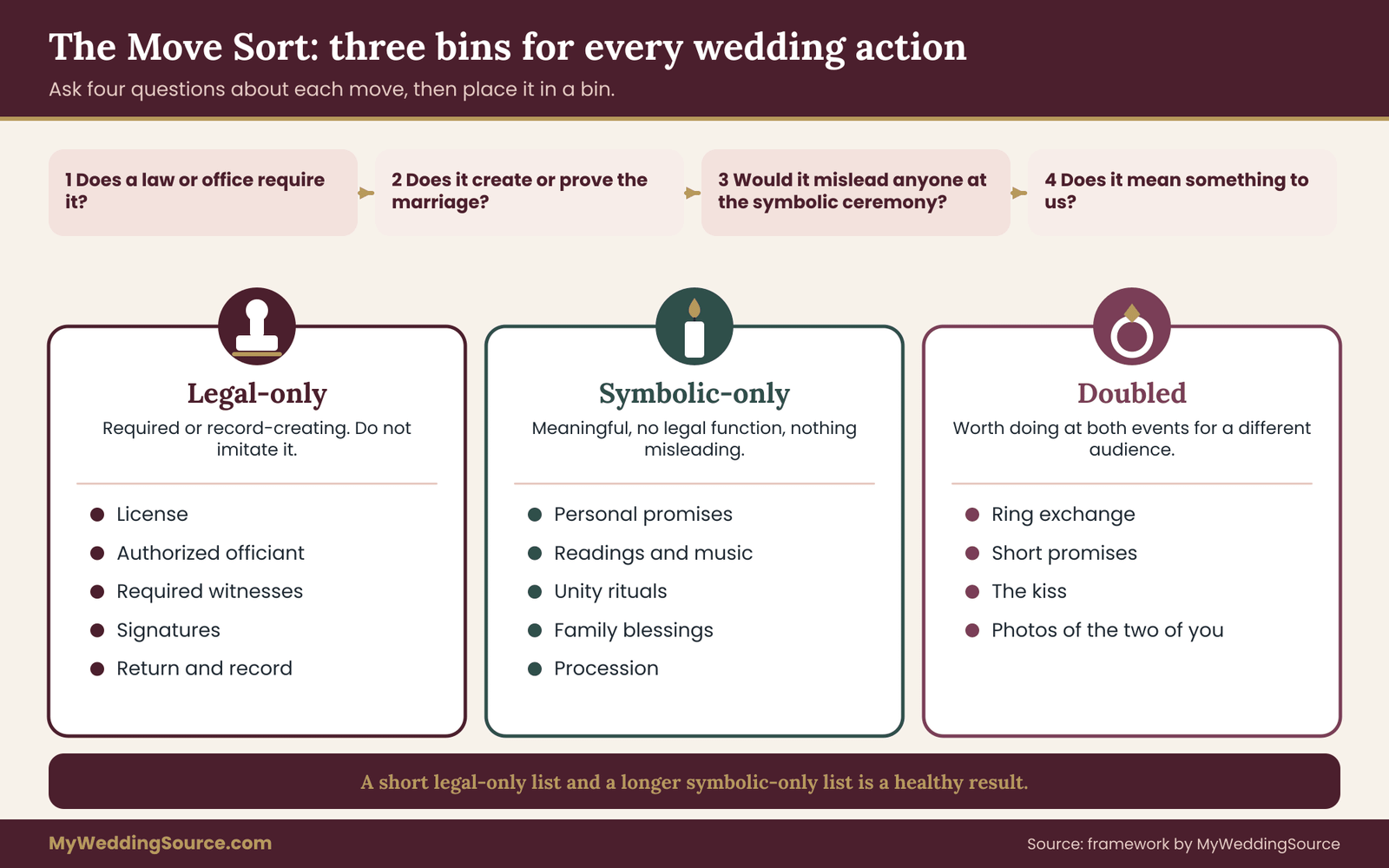
The result is usually a short legal-only list, a longer symbolic-only list and a handful of doubled moves. That balance is itself informative. A couple whose legal-only list is three lines long and whose symbolic-only list fills a page often realize that the courthouse visit needs almost no planning, and that the effort belongs elsewhere.
A caution about the sort
The Move Sort does not decide which ceremony is more important. It also does not tell you what to feel. It simply makes sure that every move has a home and that no move is hiding in the wrong event. A move that is in the wrong event is the cause of most confusion: the legal event that tried to be a celebration and ran out of time, or the celebration that tried to be a legal act and had no authority.
Actions that belong only to the civil ceremony
Legal-only moves are the ones you should not improvise. They are also the ones that look dull on a planning list, which is why couples sometimes skip the details until the week of the appointment. Go through each of these with the issuing office rather than with a blog or a vendor.
The license and its clock
The license is a government document that gives permission to marry within a certain window. Some places issue it the same day. Others add a waiting period between issue and use, and licenses expire after a set number of days. If a symbolic ceremony is planned months after the legal event, none of that matters for the party. It matters a great deal for the civil appointment, which is the only event the license touches.
Ask the office three things: whether both of you must appear in person, what identification is accepted, and how long the license stays valid. Write down the answers with the date you asked. Offices update their requirements, and a page you read in spring may be stale by autumn.
The authorized officiant
An authorized person must be present at the civil ceremony. Who counts differs by state. Judges, clerks and ordained or licensed clergy are common, and many states have a simple process by which a friend can be authorized for a single day or longer. The guide on wedding officiant requirements explains the general picture, and the state or county website is the authority for yours.
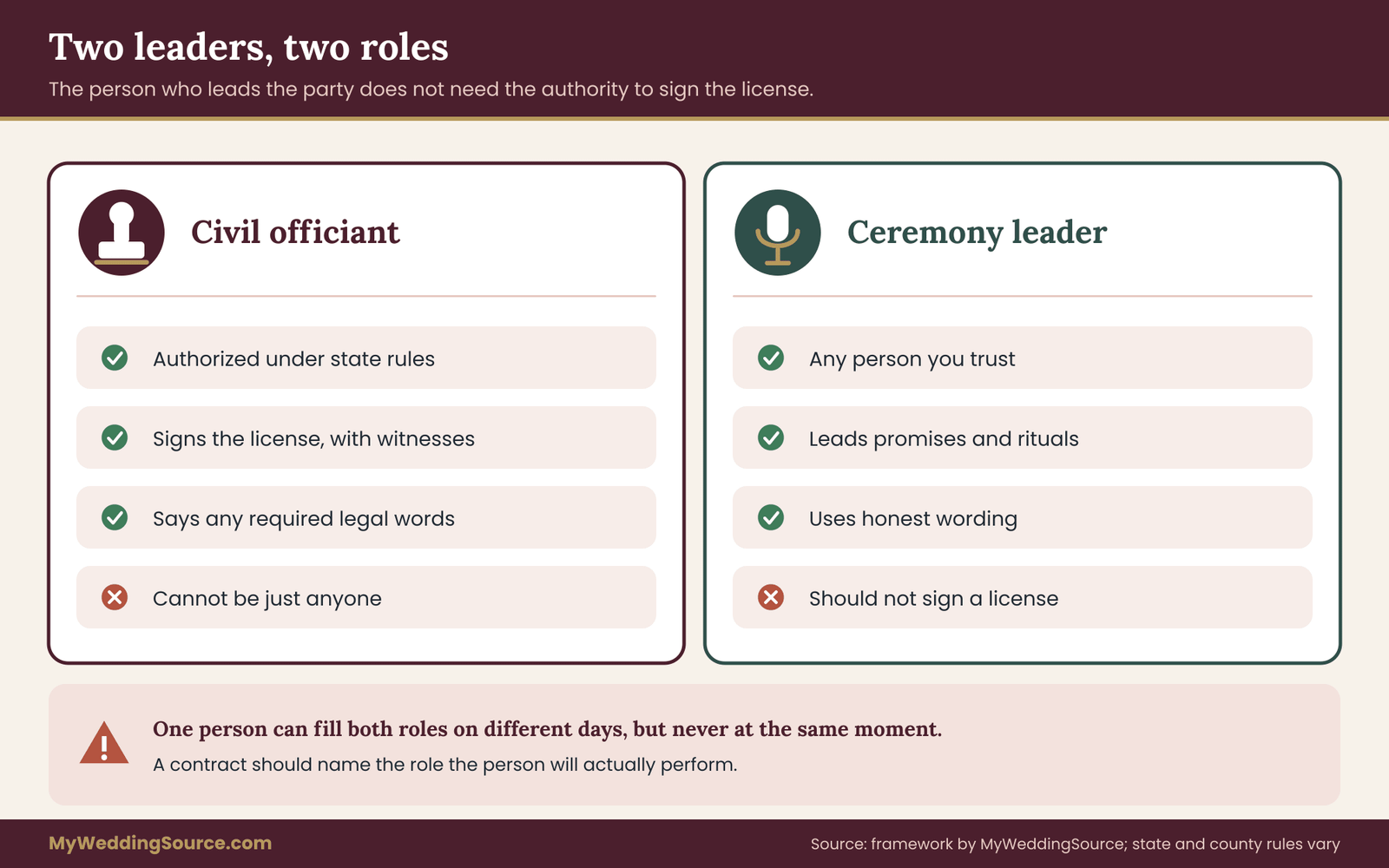
This matters for the sort because the officiant at the civil ceremony has a legal role that the leader of a symbolic ceremony does not. If your cousin will lead the symbolic ceremony, she can be anyone you trust. If she will lead the civil ceremony, she needs the right authorization on the right day. Couples who blur the two sometimes discover, after the fact, that the person who signed the license was not eligible to sign it.
Witnesses and signatures
Some jurisdictions require witnesses and some do not. Where they are required, the witnesses sign the license, and the number and eligibility rules vary. Ask whether the courthouse supplies witnesses if you arrive alone, whether witnesses must be adults, and whether they need to show identification.
The signatures are a legal-only move in every sense. They are not a performance. Nobody needs to cry, and nobody needs to film it. The office wants the right names, the right dates and legible handwriting. Treat the signing as the quietest, most careful minute of the day and leave the emotion for a different event.
The words the law may require
In some places the officiant must ask a specific question or hear a specific statement of consent. The law may not ask for more than a sentence or two. Find out what the minimum is. If a short exchange is required, it belongs in the civil ceremony, and you can decide separately whether you want a longer exchange of promises at the symbolic ceremony.
The return and the record
After the ceremony, the signed license has to be returned to the issuing office, and the marriage is then recorded. Who returns it, and by when, depends on the place. Some officiants file it. In other places the couple does. If this is skipped or late, the marriage may not be recorded on time, and the certified copy you need for a name change or an insurance change is delayed.
The guide on organizing wedding records after the event covers the follow-up in detail: ordering certified copies, checking them for errors and keeping them. For this article, the relevant point is that the record, not the party, is what agencies read. A symbolic ceremony produces no record of that kind.
What the civil ceremony cannot carry
The civil ceremony is short because it is built to be. It is not a place to fit a long reading, a ritual with several steps or a speech from a parent. Some clerks allow a few minutes of personal words. Many cannot, because the schedule is tight and the room is shared. Ask before you assume, and do not plan a symbolic moment inside a legal appointment unless the office has said yes in plain terms.
Actions that belong only to the symbolic ceremony
Symbolic-only moves are the reason many couples hold a second event. They are free of legal requirements, so they can be as long, as short, as formal or as odd as you like. The sorting task here is not about rules. It is about choosing moves that you will still be glad of in ten years.
Promises in your own words
The most common symbolic-only move is the exchange of personal promises. At the civil ceremony the exchange is short and standardized. At a symbolic ceremony you can write whatever you want. Some couples write full vows. Others write three promises each. Some read a letter. A simple rule helps whichever format you choose: write the promises to each other, not to the audience, and read them aloud once at home to check the length.
Readings, music and blessings
A reading from a friend, a song played live, a blessing from a grandparent and a moment of silence for someone who has died are all symbolic-only. They have no legal weight and no legal risk. They also depend completely on people, so check that each person is willing, knows the length and has the text in advance. The wedding ceremony cue sheet guide covers how to time readers, music and the processional so nobody stands waiting.
Rituals and unity moves
Handfasting, a unity candle, a tree planting, a sand blend, a tea service, jumping a broom, breaking a glass, a family blessing with water or bread: all of these are symbolic-only. If a ritual belongs to a particular culture or faith, make sure you understand what it means and who traditionally leads it. Ask the family member who knows the tradition to guide you, or to take part. A ritual borrowed without that understanding tends to feel thin.
The public announcement
Announcing yourselves to the people who love you is a symbolic move even when the legal marriage already exists. The announcement, in a symbolic ceremony, is a statement of shared life and not a legal declaration. This is where wording matters, and a later section gives a ladder of phrases you can use depending on the order of events.
Choices that make the symbolic ceremony different from the civil one
It helps to ask what you want the symbolic ceremony to do that the civil ceremony cannot. Common answers are these. It lets your parents, children or friends see you make promises. It lets you hold the moment outside, in a place that matters to you. It lets you include a tradition that the law does not mention. It lets you take as long as you like. It lets you hold the event in the language you speak with your family.
Choose two or three of those jobs and let them shape the program. A symbolic ceremony that tries to do everything at once ends up long and shapeless. A symbolic ceremony with a clear job, such as “let our parents see us promise,” is easy to design and easy to remember.
A short test for each symbolic-only move
Before adding a symbolic-only move to the program, ask three small questions. Does it mean something to at least one of us, without needing to be explained for ten minutes? Can the guests follow it without a printed guide? Does it fit the time we have? A move that fails the second question can be saved by a sentence of introduction from the leader. A move that fails the third should be moved to the reception or removed.
The aim is not to fill the symbolic ceremony. The aim is to make sure each move earns its place. A ceremony with four meaningful moves is better than one with nine borrowed ones.
Doubled actions: what to say twice and what to say once
Some moves are worth doing at both events. Others look like they should be doubled and are better done once. The Move Sort treats doubling as a deliberate choice, with a price.
Rings
Rings are the most common doubled move. Some couples put rings on at the courthouse, so that the legal moment feels like a wedding, and again in front of family, so that the symbolic ceremony has its own gesture. Others keep rings out of the courthouse completely and let the symbolic ceremony be the first time they wear them in public.
Both are fine. The practical risk is custody. If the rings are in a pocket at noon and need to be in the ring bearer’s hands at four, someone has to know who holds them in between. Name one person, write it on the schedule and check the ring box before leaving the house, not at the venue.
Promises
Saying promises twice can feel redundant, and it can feel lovely. If the civil ceremony includes only the short legal exchange, personal promises at the symbolic ceremony do not repeat anything. If you write detailed vows for the civil ceremony and then read them again later, the second reading can feel like a rerun to anyone who attended both.
A useful middle path is to say a short, plain set of promises at the civil ceremony and a longer, more personal set at the symbolic ceremony. Another is to keep the civil ceremony to its legal words and save every personal sentence for the symbolic ceremony. The key is to decide in advance so neither of you arrives with a different expectation.
The kiss and the pronouncement
The kiss can happen twice without trouble. The pronouncement is trickier, because it makes a claim. After the civil ceremony, a statement that you are married is true. At a symbolic ceremony held before the legal event, the same sentence is not. Choose the wording to match the facts, using the ladder in a later section. The guide on wedding ceremony steps shows where the pronouncement and the kiss usually fall in a standard order of events, which helps when you are removing or moving them.
Witnessing and attendance
Doubling attendance is a different kind of move. Some couples invite only two witnesses to the civil ceremony and the full guest list to the symbolic ceremony. Others reverse it, with parents at the courthouse and friends at the party. If either group will feel left out, say so early and say why. The simplest reason, which is almost always true, is that the room is small. A short, warm note beats silence.
A rule for deciding
For each doubled move, ask whether it will mean something the second time. A move earns a second performance when it is done for a different audience or in a different spirit. Rings at a quiet courthouse are about the two of you. Rings at the symbolic ceremony are about the people watching. That difference is enough. If the second performance would be a copy of the first, with no change in audience, wording or setting, it is better to do it once and spend the time elsewhere.
What never to double
Do not double the signing. A second signature on anything that looks like a license is a bad idea, even as a keepsake, because a document that looks official can confuse a later reader. If you want a keepsake, have the symbolic ceremony produce a certificate that is clearly titled as a commemorative document, or skip it. A commemorative page signed by guests is a lovely object and carries no legal weight, and it should say nothing that sounds like a legal statement.
Choosing the order: civil first, same day or symbolic first
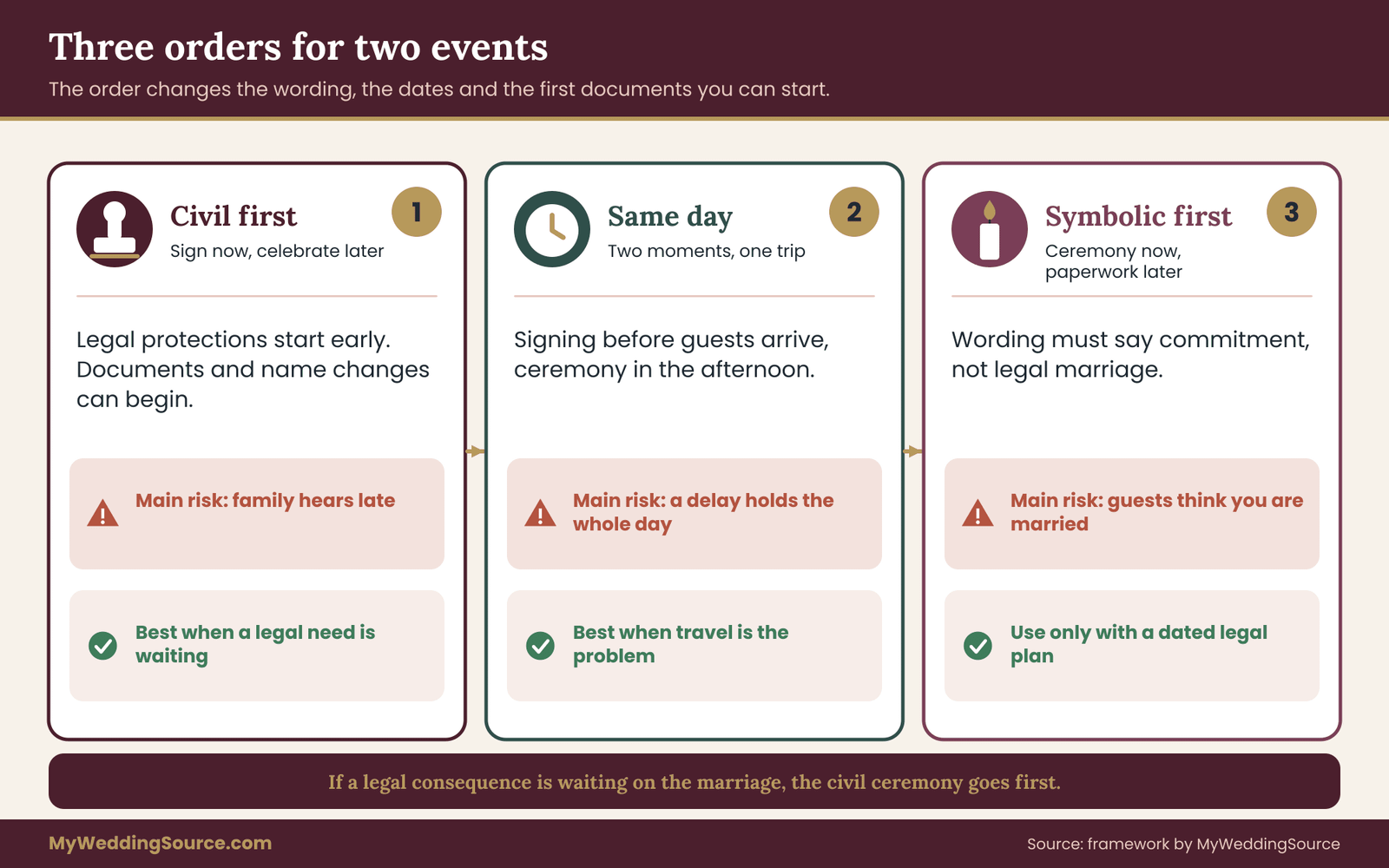
The order of events affects almost everything else in this guide. It changes the wording, the dates on your documents and the way guests understand the day. There are three common orders, and each has a different set of trade-offs.
Civil first, symbolic later
This is the most common order, and the simplest to explain. You complete the legal marriage first, then hold the symbolic ceremony weeks or months later. The legal protections begin at the civil ceremony. Documents, benefits and name changes can start. The symbolic ceremony is free to be exactly what you want, because nothing legal depends on it.
The trade-off is the gap. During the weeks between events, you are legally married while some family members may not know. You will need to decide who is told, and when. The guide on wedding decision rights can help you agree on who gets a say in that call, which is a different decision from who gets a say in the ceremony itself.
Same day, two moments
Some couples hold the civil ceremony in the morning and the symbolic ceremony in the afternoon, or do both at one venue with the legal signing before guests arrive. This keeps travel simple and means guests attend a single day. It also lets you say “we got married this afternoon” in perfect truth.
The trade-off is energy. Two ceremonies in one day means two sets of nerves. If the legal part is done before the symbolic ceremony, the symbolic ceremony can be more relaxed, because the paperwork is finished. If the legal part is done afterward, there is a small risk that something delays the signing, a late officiant or a missing witness, and the whole afternoon waits for it.
Symbolic first, civil later
Some couples hold a symbolic ceremony first, usually because a venue date, a family gathering or a trip will not move. The legal event follows when paperwork, a license window or an office appointment allows. This order is the one that needs the most care, because for a stretch of time guests may believe you are married when you are not yet.
The honest way to handle it is to say what the event is. A symbolic ceremony before the legal event can be described as a celebration of your commitment, a ceremony of promises or a commitment ceremony, and the wording should not claim the legal status. If you want the full language of marriage at that event, consider reversing the order or holding the civil ceremony first, even privately, the same day.
What the order changes
Three practical things shift with the order. The first is the pronouncement, discussed above. The second is the legal date, which is the date of the civil ceremony regardless of the order. The third is your documents: name changes, insurance changes and benefits cannot begin until the legal event has happened and the record exists.
If a time-sensitive need is driving the plan, such as a health insurance deadline, a lease, a move or an immigration filing, the civil ceremony should come first and should not wait for the party. The agencies that handle those matters read the legal record. They do not read the invitation.
A rule for choosing the order
Use this simple rule. If any legal consequence is waiting on your marriage, civil first. If nothing is waiting and the symbolic ceremony date is fixed, same day or civil first are both comfortable. Choose symbolic first only when you are willing to describe the event honestly as a ceremony of commitment, and when you are comfortable that the legal event follows within a known window. Write the legal date down now, even if it is only a target, so the symbolic ceremony does not drift into being the only ceremony.
A word on pressure
Families sometimes press for a particular order. A grandparent may want to see the legal marriage. A parent may prefer that the symbolic ceremony come first because “that is how it is done.” You are not obliged to follow either preference, but it helps to understand the reasoning. Often the concern is not the order. It is the worry of being left out. A plain explanation of the plan, with a clear invitation to the symbolic ceremony, tends to settle it more quickly than an argument about sequence.
Naming the date: forms, records and the anniversary question
Two events mean two dates, and the rest of your life will ask for one of them. The mistake is not choosing the wrong date. The mistake is giving different dates to different offices and finding out later.
The legal date is the date of the civil ceremony
For every official purpose, the date of marriage is the date on which the legal ceremony took place, as shown on the recorded marriage record. The symbolic ceremony date is a personal date. It does not appear on the certificate and it is not what an agency wants when a form asks “date of marriage.”
This holds even when the symbolic ceremony is far larger than the civil one. A form from the Social Security Administration, the Department of State, an employer or an insurer will want the date that appears on the certificate. Copy it from the certified copy, not from memory and not from the invitation.
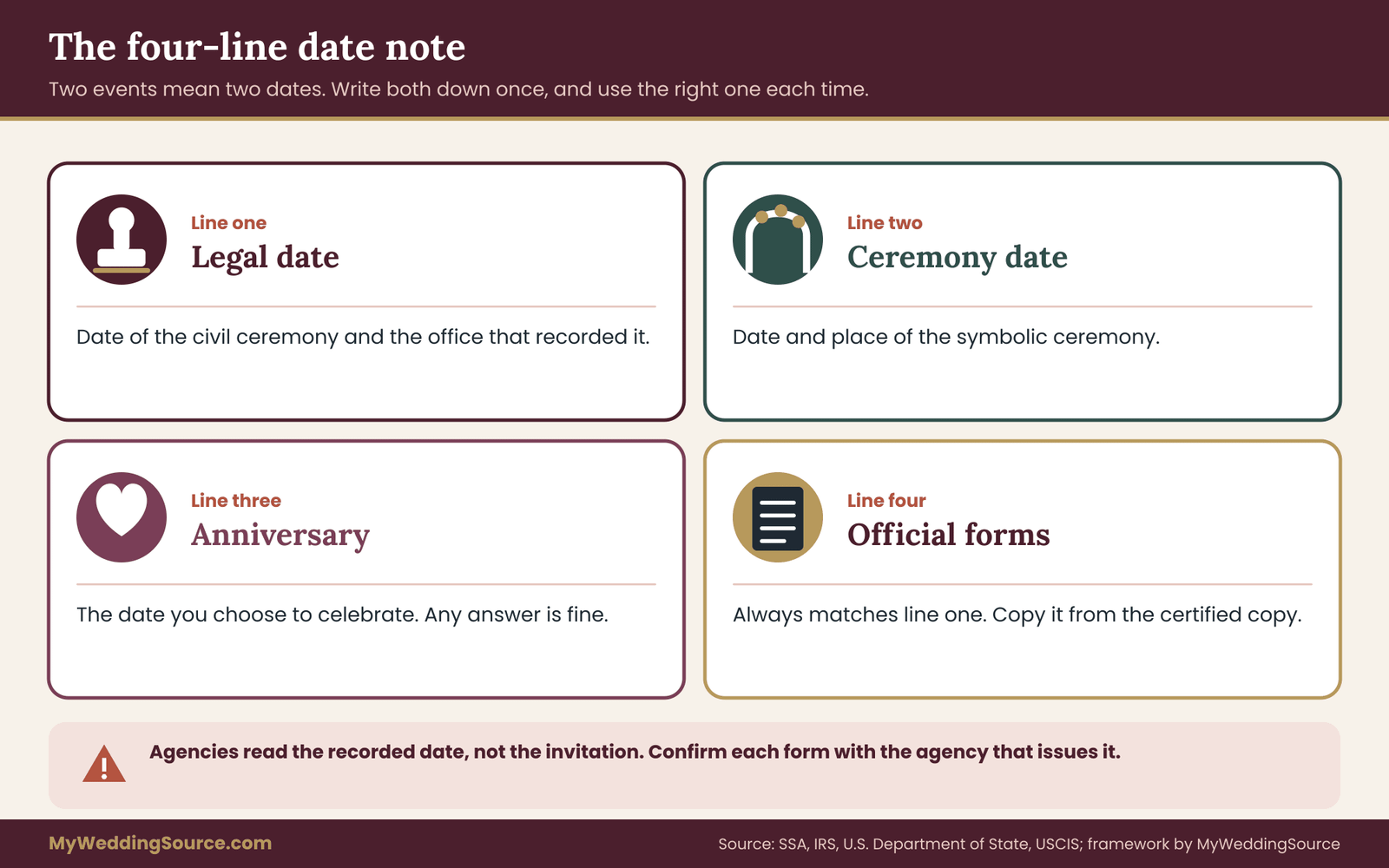
A four-line date note
Keep a short note with four lines. The first line is the legal date and the office that recorded it. The second is the date of the symbolic ceremony and the place. The third is the date you celebrate as your anniversary. The fourth is the date you use for official forms, which should match the first line. Keep this note with your marriage records so that a future version of you, or a partner filling out a form at midnight, does not need to guess.
Which date do you celebrate?
Couples answer this in different ways, and every answer is fine. Some celebrate the legal date because it is the day the marriage began. Some celebrate the symbolic ceremony date because it is the day they told everyone. Some celebrate both, with a small private dinner on one and a larger tradition on the other. What matters is that you agree, and that you tell the people who will ask, such as family who send cards or an employer who tracks service milestones.
If you are likely to be asked, pick a short sentence to use. For example: “Our legal anniversary is in March, and we celebrate the garden ceremony in June.” That sentence is calm, factual and not apologetic.
Where the legal date will be needed
The date will be requested in many places over the years. Typical examples include a name change at the Social Security Administration, a passport update through the Department of State, tax filing status through the Internal Revenue Service, employer benefits enrollment, health coverage changes, and any immigration filing that relies on proof of marriage. Each organization has its own forms and its own wording, so verify the current requirement with the issuing agency. The government sites linked in the Sources section are the places to confirm.
For tax purposes in particular, marital status is generally determined by the legal status at the end of the tax year. The Internal Revenue Service explains this on its website. If you are unsure how your own situation applies, a licensed tax professional is the right person to ask, and the symbolic ceremony date does not change the answer.
Immigration and other evidence-heavy situations
If either of you will rely on your marriage for an immigration process, keep both kinds of evidence, and keep them clearly labeled. The legal record shows that the marriage is valid. Photos and programs from the symbolic ceremony may help show a shared life, but they do not replace the record. Do not describe a symbolic ceremony as a legal wedding on any form or in any interview.
The U.S. Citizenship and Immigration Services website describes what it asks for, and that site, rather than a blog, should guide the details. A qualified immigration attorney is the right adviser if your case is complex.
Names on the documents
If one or both of you plan to change names, the civil ceremony is the event that starts it, because the certified marriage certificate is the document that agencies request. A symbolic ceremony where you are introduced with a new name is a lovely moment, and it is not the point at which the name is legally changed. If you are introduced by the new name at the symbolic ceremony before the legal event, keep it clear in your own mind that the legal name still follows the documents you hold.
Notes in the records
When you build your records archive, keep one page for the two-event story: what happened on each date, who attended, who signed, who officiated and who holds the photographs. The page is useful years later. It is also useful in the unlikely event that someone asks you to prove something, because it shows that you understood the difference at the time.
What guests, family and vendors need to hear
Most of the awkwardness around a two-event wedding comes from the way it is explained. The facts are simple, and a few sentences usually do the job. The wording changes with the order of events.
Say what each event is, early
Tell people what the first event was and what the second event will be, in one sentence each. For a civil-first plan: “We are signing the paperwork at the courthouse in March with two witnesses, and we would love you to join us for our ceremony and dinner in June.” For a symbolic-first plan: “We are holding our ceremony of promises in June, and the legal paperwork will follow in the fall.”
The point is to avoid an invitation that implies something untrue. An invitation that says “join us for the wedding” to a symbolic ceremony, when the legal marriage took place a month earlier, is a normal and friendly thing to write. An invitation that says “join us as we are married” to a symbolic ceremony that will not produce a legal marriage is not.
The wording ladder
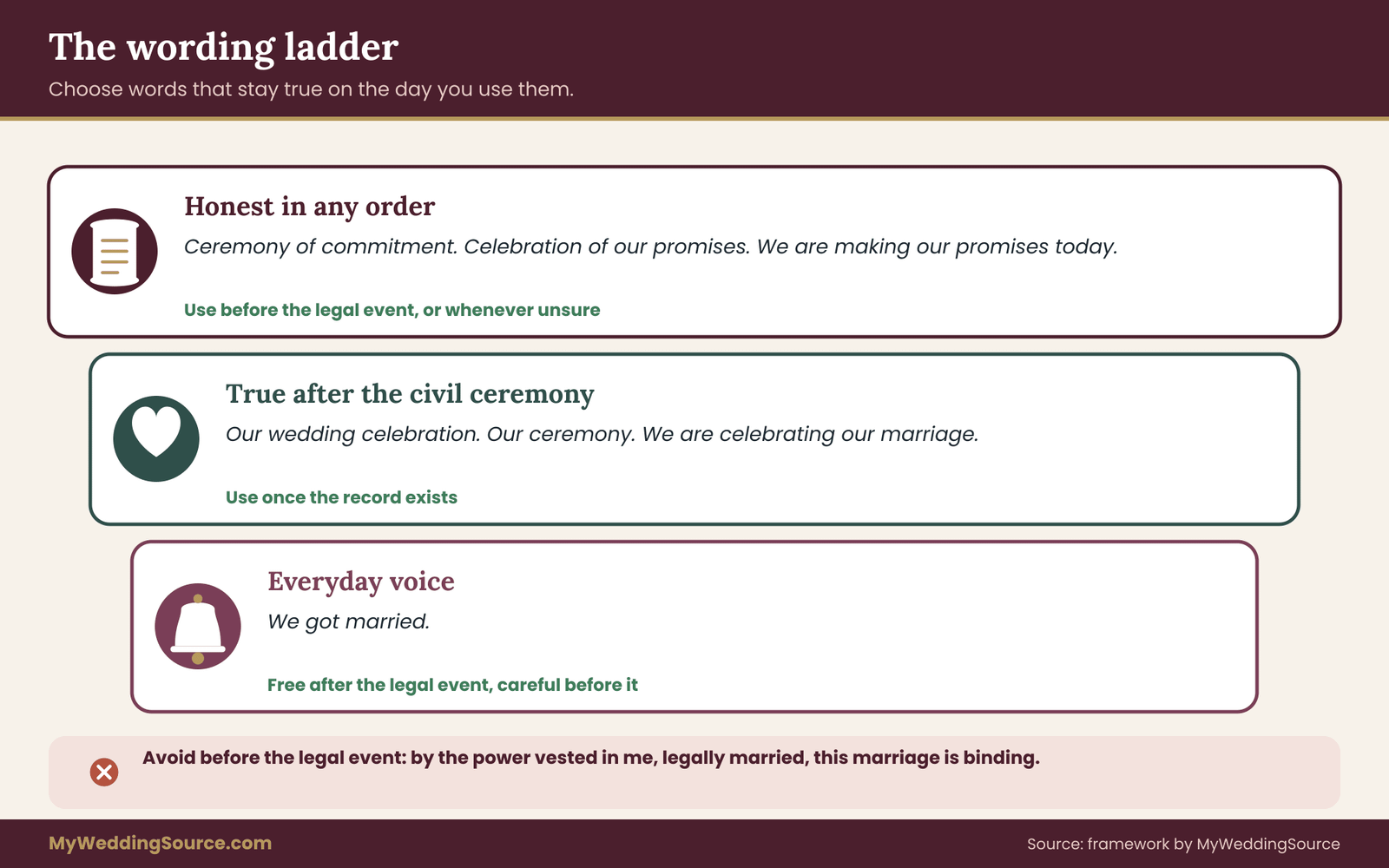
Think of the wording as a ladder with three rungs, from the most legally careful to the most casual.
The top rung is for any event where the legal status is not yet in place: “ceremony of commitment,” “celebration of our promises,” “we are making our promises to each other today.” These phrases are honest in any order.
The middle rung is for a symbolic ceremony after the civil one: “our wedding celebration,” “our ceremony,” “we are celebrating our marriage.” These are true, because the marriage exists.
The bottom rung is the casual voice of daily life: “we got married.” Use it freely after the legal event and with care before it.
What to tell your guests about the day itself
If the symbolic ceremony will include an exchange of promises, a ring ceremony and a kiss, guests will treat it as the wedding, and in every way that matters to them, it is. There is no need to apologize or explain the legal side in the middle of the ceremony. A line in the program or on the website is enough: “The legal marriage took place on March 12. Today we celebrate with the people we love.”
The wedding invitation etiquette guide covers the general conventions for wording, and the wedding etiquette guide addresses how to handle guests who ask awkward questions.
Tell your vendors the real structure
Vendors need to know which event they are working. A photographer hired for a symbolic ceremony should know whether the legal event has already occurred, because the shot list changes. A florist needs to know whether there is a signing table. A musician needs to know whether there is a pronouncement cue. An officiant or ceremony leader needs to know whether the leader is expected to sign anything, and the answer for a symbolic ceremony is usually no.
Do not hire a vendor under a description that overstates the legal event. A contract that says “wedding ceremony” for a symbolic ceremony is common and not a problem. A contract that says the leader will “officiate the legal marriage” when the leader is not authorized can create a real difficulty. If that wording appears, ask for it to be corrected before signing.
Questions to ask a ceremony leader
When you interview a person to lead the symbolic ceremony, ask these questions. Have you led a ceremony that was not the legal event before? How do you word the opening and the pronouncement in that case? Do you expect to sign anything? What do you charge, and what does the fee include? Can I see a sample script? If the leader hesitates at the second question, it is a sign that the wording will need more attention from you.
Handling the guest who asks “so are you actually married?”
Some guests will ask. Use a calm sentence, not a lecture. “Yes, we signed the paperwork in March, and today is our ceremony.” Or, for symbolic-first: “We are making our promises today, and the paperwork follows in the fall.” The question is almost always curiosity, not challenge, and a short factual answer closes it.
Who may lead a symbolic ceremony, and what they must not sign
The leader of a symbolic ceremony has a different job from the officiant at the civil ceremony, and the difference is worth stating clearly because it affects who you can ask, what you pay and what the leader says.
Anyone you trust can lead
Because a symbolic ceremony carries no legal effect on its own, there is no legal rule about who may lead it. A friend, a sibling, a faith leader, a professional celebrant or one of you can do it. The choice is about voice and comfort. Pick someone who can speak clearly to a room, who will keep to the time you agree and who understands that the point is you.
Some couples ask a person who is also authorized to officiate legally, and then feel unsure whether this makes the symbolic ceremony legal. It does not, unless the legal requirements are also met at that event: a valid license, the correct witnesses, the required wording and the filing. Being authorized is not the same as acting in that role on that day. If you want the same event to be both, plan it as the civil ceremony from the start and treat everything beyond the legal minimum as symbolic additions.
The same-day shortcut and its limits
A popular shortcut is to hold one ceremony that does both jobs: a friend, authorized for the day, leads a full ceremony with guests, signs the license afterward and files it. That is a single civil ceremony with a lot of personal content. It is not a symbolic ceremony, and the Move Sort still helps, because it shows which moves must stay legal and which are free.
If you are choosing between that shortcut and two separate events, the question is about what you want to protect. The shortcut protects simplicity. Two separate events protect the legal calm of the first and the personal freedom of the second. If the two of you or your families disagree, settle it by asking which event each choice protects.
Wording the leader should avoid
If the symbolic ceremony is held before the legal event, the leader should not say anything that claims a legal outcome. Phrases to avoid are “by the power vested in me,” “by the authority of the state,” “I now pronounce you legally married,” and “this marriage is now binding.” Phrases that work include “we are here to witness the promises these two make,” “today they make their promises before the people they love,” and “we celebrate their commitment.”
After the legal event, the leader may use fuller language, because it is true. Even then, some couples prefer to avoid the legal formula at the symbolic ceremony, so that the moment feels more personal and less like a repeat of the courthouse.
What the leader must not sign
Do not ask the symbolic ceremony leader to sign a license, a certificate that looks official or any document that implies they performed the legal marriage. If a leader signs a commemorative certificate, it should be titled clearly as a keepsake, and the leader should sign as a participant, not as an officiant. The aim is to make sure no document produced by the symbolic ceremony could later be mistaken for the record.
This also applies to guests who sign a guest book or a memory item. A guest book is a good object. It should not be labeled “marriage certificate” or “witness record” in a way that could be confused with the real thing.
Fees and expectations
Professional celebrants set their own fees, and a symbolic ceremony may cost less or more than a legal officiant depending on the scope.
Ask what is included: a planning call, script writing, a rehearsal, travel and the ceremony itself. Ask about cancellation and rescheduling terms, since a symbolic ceremony date may move if the legal event is delayed. The key point for the written agreement is that the contract should describe the role accurately. It should say “ceremony leader” or “celebrant” if that is the role, and it should not describe legal duties the person cannot perform.
A short script for the first conversation
When you contact a prospective leader, a few sentences set the frame. “We are having a civil ceremony on March 12 with two witnesses. We would like someone to lead a symbolic ceremony for family on June 14. We want a personal ceremony with our own promises, and we will not need anyone to sign a license that day. Are you available, and what would the fee cover?” The message states the structure, the dates and the scope. A leader who has done this before will respond in kind.
What the two ceremonies cost, and where the money goes
Cost is a good tiebreaker, but only if you compare the right things. The comparison is not “civil is cheap and symbolic is expensive.” It is about what each event contains and which parts of the spending are fixed.
The civil ceremony’s costs
The civil ceremony usually has a license fee set by the issuing office and sometimes a separate ceremony fee if the courthouse or a clerk performs it. These vary widely by location, so check the office’s current fee schedule rather than relying on a number from a blog. Add the cost of certified copies of the marriage certificate, which are usually charged per copy, and any travel or parking. Some couples add a small amount for photography at the courthouse.
Photography at a legal appointment is optional, and the room may have its own rules about cameras, so ask the office before hiring anyone.
The costs of the civil ceremony are small and mostly fixed, which makes them easy to budget and hard to reduce much further. They also come early, because the license has to be in hand before the appointment.
The symbolic ceremony’s costs
A symbolic ceremony has no fixed fee. Its costs depend on what you choose: a space, seating, a leader, music, flowers, a sound system, printed programs and food. It may be a few hundred dollars of picnic supplies, or it may be a full venue booking. The main variable is the venue and its minimum spending, and the decisions around guest count follow from that.
Because costs are flexible, the symbolic ceremony is where your money can be most deliberate. The Move Sort helps here. If a move is not in the symbolic-only or doubled bins, you do not need to pay for anything connected with it.
Where the two events compete for the same money
There are three places where the events compete. The first is the ring budget: if you buy rings for the civil ceremony, they are ready for the symbolic ceremony too. The second is attire: one outfit for both events or a simple outfit for the legal event and a more formal one for the ceremony. The third is photography: a photographer who covers both costs more than one who covers only the symbolic ceremony, but a full-day photographer at a ten-minute appointment is rarely needed.
For overall planning, the wedding budget guide explains how to divide spending across categories. When you split a wedding into two events, make two sets of categories, one small and one large, and assign each cost to the event where it belongs.
Hidden costs of waiting
Delaying the civil ceremony until after the symbolic ceremony can save a trip but may cost in other ways. Health coverage, shared housing arrangements, tax filing status and certain benefits depend on legal status. A delay of a few months might change what you can claim or enroll in. Check each of these with the relevant agency or provider before deciding, and treat a legal need as a reason to go civil first.
A cost logic you can reuse
Use a simple logic for any spending question: does this cost belong to the legal event, the symbolic ceremony or both? If it belongs to the legal event, it is small and fixed, so pay it and move on. If it belongs to the symbolic ceremony, ask which job it supports. If it supports none of the three or four jobs you chose, it is a candidate to cut. If it belongs to both, such as rings, you have saved by buying once.
A worked example: the Move Sort for an invented couple
The following example is invented to show the method. The names, dates and details are illustrative, and the rules mentioned are placeholders for whatever your own county clerk tells you.
The situation
Dana and Marcus live in one state, and Dana’s parents live in another. Marcus has a job change coming in the spring that affects his health coverage, so they want the legal marriage in place by March. Dana’s grandmother, who is eighty-nine, cannot travel in winter but can attend an outdoor event in June. They want something personal in front of their families, and they do not want to spend a large share of their budget on a weekday appointment that lasts a few minutes.
Their county clerk’s website says that both applicants must appear in person for the license, that the license is valid for a stated number of days, and that one witness is required for a ceremony in the clerk’s office. They call to confirm all three and write down the date and the name of the person who answered.
Step one: list every move
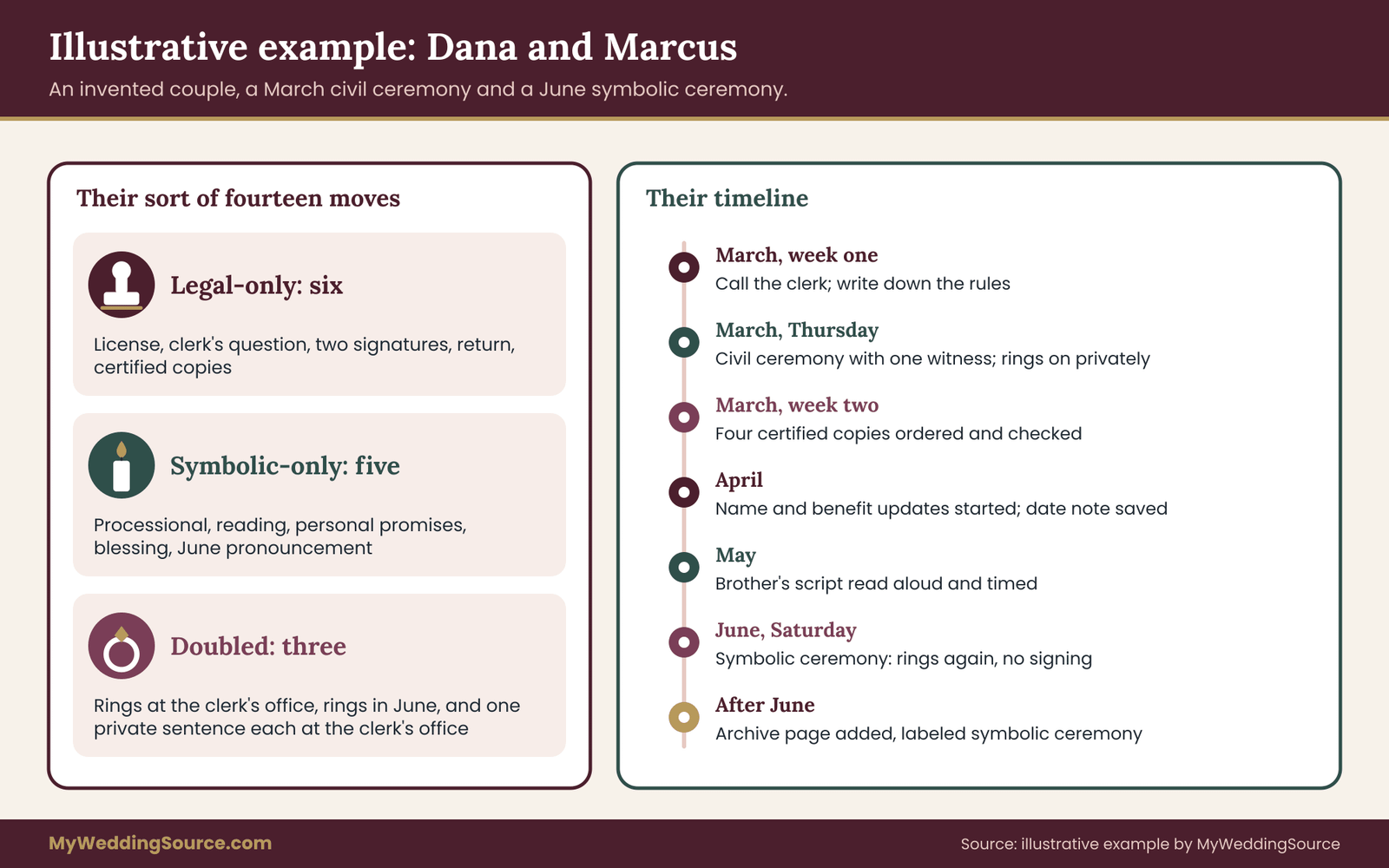
Dana and Marcus sit down and list what they imagine across both events. Their list has fourteen moves: obtaining the license, the officiant’s legal question, signing, the witness signing, returning the license, ordering certified copies, a short exchange of promises at the clerk’s office, putting on rings at the clerk’s office, a processional in June, a reading from Dana’s brother, personal promises written by each of them, a ring exchange in June, a blessing from Dana’s grandmother, and a pronouncement with a kiss.
Step two: run the four checks
Moves one through six are required or record-creating, so they are legal-only. The clerk’s office will ask the legal question and handle the signing. The witness will be a friend who is taking the morning off. Marcus will carry the license back to the office as the clerk’s instructions say, and Dana will order four certified copies a few days after the record is complete.
The short exchange at the clerk’s office is more interesting. The clerk allows a minute or two of personal words, so Dana and Marcus decide to say one sentence each, plain and private. That sentence is a symbolic move inside a legal event, and they treat it as a bonus rather than a requirement. If the clerk had said no, they would have lost nothing that matters.
The processional, the reading, the personal promises and the blessing pass the checks as symbolic-only. They have no legal function, nobody will be misled by them, and each carries meaning. The ring exchange fails the “do it once” test, so they decide it is doubled: rings go on at the clerk’s office, privately, and are exchanged again in June in front of the family. The pronouncement is the one that needs a decision, and the third check settles it, because by June the legal marriage will exist and the words will be true.
Step three: choose the order and the dates
The legal need points to civil first, and the grandmother’s travel points to a June ceremony, so the order is settled. The legal date is a Thursday in March. The symbolic ceremony date is a Saturday in June. They write both on a single note and save it in the folder they will use for their marriage records, along with a line stating which date they will use on official forms.
They also decide what they will call each event. The March event is “our civil ceremony.” The June event is “our wedding ceremony and dinner,” because by then they will be married, and the phrase is true. The invitation says so plainly and adds one sentence: “We were legally married in March, and we are glad to celebrate with you in June.”
Step four: assign roles
Dana’s brother will read and also lead the symbolic ceremony. He is not authorized to officiate in their state, and he does not need to be, since the legal marriage already exists. The two of them ask him to avoid the phrases “by the power vested in me” and “legally married,” and to use “we celebrate the promises these two have made.” He agrees and drafts a script, and they read it aloud once to check the timing. A copy goes to the photographer and the musician so each knows where the pronouncement and the kiss fall.
The legal officiant at the clerk’s office is the clerk. Dana and Marcus do not need to hire one, and no one from the symbolic ceremony needs to sign anything in March. They do ask the photographer whether she would like to attend the legal event, and decide against it, because the room is small and the appointment is short. A friend takes a phone photograph outside the building.
Step five: handle the questions
In the weeks before June, a few people ask whether the couple is already married. Dana and Marcus use the same sentence each time: “Yes, we signed in March, and June is our ceremony with everyone.” A coworker asks which date is their anniversary, and they say the March date is the legal anniversary and the June date is the one they plan to celebrate with family. Both answers come out of the note they wrote at the start.
On the day, the program includes a line stating that the legal marriage took place in March. It is printed in small type under the order of service, and nobody remarks on it. The grandmother gives her blessing, the reading is a minute long, and the promises run just under four minutes. The rings go on for the second time. Nobody signs anything.
Step six: close the records
After March, Dana orders certified copies and checks every name, date and place for errors, as the records guide recommends. She starts the Social Security update and keeps a log of what she sent and when. After June, they add a page to their archive: who attended, who led, where the photographs are stored and a copy of the program. The page is labeled “symbolic ceremony, June” so no future reader mistakes it for the legal record.
What the example shows
Three things stand out. The sorting took an hour and prevented every confusion described at the start of this guide. The legal event needed almost no planning beyond phone calls and a date. And the symbolic ceremony stayed free to be personal because nothing legal depended on it.
The same method would work with different facts. A couple who had the symbolic ceremony first would use the top rung of the wording ladder and would put the pronouncement in a different place. A couple with no legal need in the near term might hold the civil ceremony the same morning as the symbolic one. The method does not decide for you. It makes sure each choice is visible before you make it.
Measurable checks for your own version
When you have finished your own sort, run a short set of checks. Every legal-only move should have a name and a date attached. Every symbolic-only move should have a person responsible. Every doubled move should have a note saying why it is doubled. The legal date should appear in one place, and every official form should use it. The wording of every invitation, program and script should match the order of events. If any of these checks fails, the fix is usually small, and it is much smaller before the events than after.
Edge cases and failure conditions for a symbolic ceremony
Most couples will never meet these, but each is a place where the two-event plan can go wrong. Knowing the failure conditions in advance lets you set a rule while you are calm.
A symbolic ceremony with no legal event planned
Some couples choose to hold a symbolic ceremony and not marry legally, at least for now. That is a legitimate choice, and it needs to be a conscious one. Legal marriage affects many things: health coverage, taxes, inheritance, decision-making in a medical emergency, immigration, benefits and the way agencies treat a couple. A symbolic ceremony by itself changes none of those.
If you are in this situation, describe the event honestly as a ceremony of commitment, and consider speaking with a licensed attorney about what protections you may want to set up by other means, such as wills and medical directives. The answer depends on your state and your circumstances.
The license window closes
A license may expire before the appointment happens, because an appointment was moved or someone was ill. If the symbolic ceremony is fixed in the calendar and the license is about to expire, call the office early. Ask whether a new license is needed, what it costs and how long the waiting period is. Do not assume that a symbolic ceremony can substitute for the missed legal event. If the legal event slips past the party, the party becomes a symbolic-first event, and the wording should change to match.
The officiant or witness is missing
If the person who was to lead the civil ceremony is unavailable, find out what the office allows. Some courthouses provide an official on the spot. A private officiant who falls ill is a harder problem, and it argues for having a backup, or for scheduling the legal event at an office that supplies one. For a symbolic ceremony, a missing leader is easier: a friend can step in, since no authorization is needed.
The ceremony is also a religious service
If a faith leader will lead a religious ceremony and also sign the license, the event is a civil ceremony with religious content, and the legal rules apply to the signing. If the faith leader is not authorized by the state, the legal event has to happen elsewhere, and the religious service is symbolic in the legal sense, even though it is not symbolic in the religious sense. Ask the faith leader directly whether they are authorized to sign in your state. The wedding officiant requirements guide explains the usual categories of authorized people.
A previous marriage that is not fully ended
If either of you has a prior marriage, make sure it has been legally ended before applying for a license. This is a legal-only matter and does not belong in the symbolic ceremony at all. A symbolic ceremony does not repair a gap in the legal record, and it can create confusion if one party is still legally married to someone else. If you are unsure of the status of a past divorce, ask the court that handled it or a licensed attorney, before you apply.
Marrying in another country
If the legal event will take place abroad, the rules are those of the country where it happens, and the paperwork needed to have it recognized at home may include translation or certification. The U.S. Department of State publishes information for Americans marrying abroad, and the embassy or consulate of the country in question can explain local requirements. The symbolic ceremony at home is a separate matter. The sorting method is the same: decide which event is legal and which is not, write the dates, and word the invitations to match.
Social media and early announcements
A photo posted on the day of the civil ceremony with the caption “we are married” is true. A photo posted on the day of a symbolic ceremony held before the legal event, with the same caption, may not be. If the order of events matters to you, ask guests to wait until you post, and tell them what wording you prefer. The wedding ceremony step by step guide also covers how a typical ceremony is structured, which helps if you want to explain the sequence to a helper.
Conditions that should change the plan
Treat these as stop signs. The legal date has not been set and a legal need is approaching. The symbolic ceremony leader is describing the event as legally binding. A form is about to be signed with the symbolic ceremony date as the date of marriage. A vendor contract describes a legal role that the person cannot perform. A guest list is being sent invitations that say “join us as we are married” for an event that will not create a marriage. If any of these appears, pause, correct the wording or the date, and then continue.
A last decision script
If you and your partner disagree about the structure, work through three questions in order. Is there any legal consequence waiting on the marriage? If yes, the civil ceremony comes first and is not up for debate. Which moves do we each care about, from the Move Sort? List them separately before comparing. What do we want the symbolic ceremony to do that the civil one cannot? Answer in one sentence each. Most disagreements dissolve once the legal question is settled and the two lists are on the table.
Your next steps
- Call the county clerk or issuing office and write down the license, witness, officiant and filing rules, with the date you called.
- List every move you imagine across both events, then run the four checks and place each move in a bin.
- Choose the order: civil first if any legal need is waiting, same day if travel is the issue, symbolic first only with honest wording.
- Write the four-line date note and save it with your marriage records.
- Pick the wording for invitations, programs and scripts from the ladder, and send the script to your ceremony leader and vendors.
- Check every contract and document so that no one is described as performing a legal role they cannot perform.
FAQ
Is a symbolic ceremony legally binding?
No. A symbolic ceremony has no legal effect by itself, however formal or meaningful it is. A marriage is created by meeting the legal requirements of the place where it happens: a valid license, an authorized officiant, any required witnesses and the filing of the record. If you want both, hold a civil ceremony as well, either before, after or on the same day.
Can the same person lead both ceremonies?
Yes, if that person is authorized to officiate where the civil ceremony takes place. At the civil ceremony they act in a legal role and must follow the state’s rules. At the symbolic ceremony they act as a leader with no legal role. Make sure the wording, the signing and the contract make the difference clear.
Which date is our wedding anniversary?
Either, or both. The legal date is the one on your marriage record and the one used on official forms. The symbolic ceremony date is a personal date. Many couples celebrate the one that matters most to them and mention the other. What matters is that you agree and that your documents use the legal date.
Should we exchange rings at both events?
You can. Rings at the civil ceremony are often private and quick. Rings at the symbolic ceremony are often public and shared with family. Doing both is fine if each means something different. If it would be a simple repeat, do it once. Whoever holds the rings between events should be named in advance, so the box does not get lost.
What should the invitation say?
Describe each event honestly. After a civil ceremony, you can say that you were married on a given date and invite guests to celebrate. Before a civil ceremony, describe the event as a ceremony of promises or a celebration of your commitment. Avoid wording that says guests will witness a legal marriage that will not happen.
Do we need a license for a symbolic ceremony?
Not for the symbolic ceremony itself, since it has no legal effect. You do need a license for the civil ceremony. Requirements, fees and waiting periods are set by the issuing office, so check with the county clerk or the equivalent office in your area. Do not rely on a vendor or a website for the current rules.
Can a symbolic ceremony come before the civil ceremony?
Yes. Many couples do this because of venue dates, travel or paperwork timing. The risk is that guests may believe you are legally married. Use wording like ceremony of commitment, avoid legal phrases such as the pronouncement, and set a target date for the civil ceremony so it does not drift. If a legal need is waiting, do the civil ceremony first.
What should we keep as records of a symbolic ceremony?
Keep the program, the script, a list of attendees, the leader’s name, the photographs and any commemorative keepsakes in a folder labeled clearly as the symbolic ceremony. Keep the legal records, such as certified copies of the marriage certificate, in a separate folder. A short note linking the two prevents confusion later for anyone reading your files.
Sources
- USA.gov: How to get a marriage certificate
- CDC National Center for Health Statistics: Marriage and divorce
- Social Security Administration: Change your name
- U.S. Department of State: Travel and marriage abroad
- Internal Revenue Service: Filing status and marital status
- U.S. Citizenship and Immigration Services: Family-based immigration
- HealthCare.gov: Life changes and special enrollment
- Consumer Financial Protection Bureau: Consumer resources
- U.S. Office of Personnel Management: Federal benefits and life events