
Camping alternatives are the lodging and attendance choices you offer to wedding guests who cannot or would rather not sleep in a cabin, tent or bunkhouse at a campground or camp venue. This guide gives you a nearby room and opt-out travel comparison sheet, a worked case, a list of failure conditions and plain scripts, so a weekend built around a camp site still works for everyone on the list.
Offer camping alternatives in five lanes, from an upgraded bed on site to attending a single event. For each camping alternative, measure door-to-door minutes, the last safe ride home, what the guest pays, what you pay and who can use it. Put the numbers on one comparison sheet before you send invitations. Hold a small set of nearby rooms, line up a licensed shuttle if the rooms are far, and tell guests the whole menu in writing. If no lane fits a guest you cannot do without, change the format.
Most couples who choose a camp or campground venue are thinking about the same picture: a long table under trees, a bonfire, everyone close together and nobody rushing to a car. It is a good picture. It is also a picture drawn by the people who like to camp. Some of your guests will love it, and some will quietly hope for a room with a door that locks and a bathroom they do not share with strangers.
Camping alternatives are how you keep both groups in the same weekend. They are not a concession or a sign that the venue was a mistake. They are the part of the plan that decides whether a grandmother, a guest with a bad back, a family with a newborn and a coworker who simply dislikes bugs can all be at your wedding without a hard conversation.
This article is narrower than a general camp weekend plan. If you are still deciding on the site, beds and cabin rules, the camp wedding weekend guide covers the overnight workbook. Here the question is the other side of that coin: what do you offer the people who are not sleeping on the grounds, and how do you compare those offers honestly?
A note on scope. This is general planning information, not legal, safety or financial advice, and campground rules, local transport rules and insurance terms vary, so confirm each one with the operator or agency that issues it.
Why camping alternatives belong in the plan from the start
Couples often treat alternatives as an afterthought. The camp is booked, the cabins are counted, and only when the first guest asks about a hotel does a list of nearby rooms appear. By then the best rooms may be gone, the shuttle question is urgent, and the answer sounds improvised.
There are three reasons to design camping alternatives early.
The first is capacity. Camp beds are limited, and some of the beds that exist cannot be used by everyone. Top bunks, steep loft ladders, shared washrooms down a gravel path and cold nights all narrow the number of guests who can truly sleep on site. If you only plan for the beds, you have planned for fewer people than you invited.
The second is fairness. If the only road into the weekend is camping, then comfort, mobility and health decide who is invited in practice, even when your list says otherwise. A visible set of camping alternatives lets a guest say yes to the wedding without having to explain a knee, a medication, a baby or a preference.
The third is timing. Nearby rooms book up. In a rural area there may be only a handful of properties within a reasonable drive, and other weekend travelers, fishing trips and local events compete for them. The earlier you know how many rooms you need, the more of them you can hold.
None of this means you must abandon the campfire. It means the weekend has more than one door.
What counts as a camping alternative
A camping alternative is any option that lets a guest take part without sleeping in the camp’s own overnight accommodation. In practice there are five, and the next sections treat them as camping alternatives on a ladder.
An upgraded on-site bed is the closest: a private cabin, a room in a lodge building or a bunkhouse corner with a real mattress and a door. Nearby rooms are hotels, inns, motels or rentals a short drive from the site. Farther rooms are the same idea, but far enough that a ride becomes the real question. Day-only attendance is for local guests who go home at night. Single-event attendance is for guests who come to the ceremony or to the dinner and skip the rest.
Each lane has a different cost to the guest, a different cost to you, and a different failure point. The comparison sheet later in this guide puts them side by side.
Where this guide fits with your other plans
If you are working on lodging for the whole guest list, the broader guest hotel planning guide explains room blocks, budget ranges and mobility needs in detail. That material applies here too. What is different at a camp is that the main venue has no rooms of its own to compare against, the roads can be slow and dark, and the alternative is often a long way from the party.
For the bigger picture of who is invited and why, the guest list guide is the place to start, because the number of people who need alternatives depends on the list you actually build.
Who does not want to camp, and why it is rarely about attitude
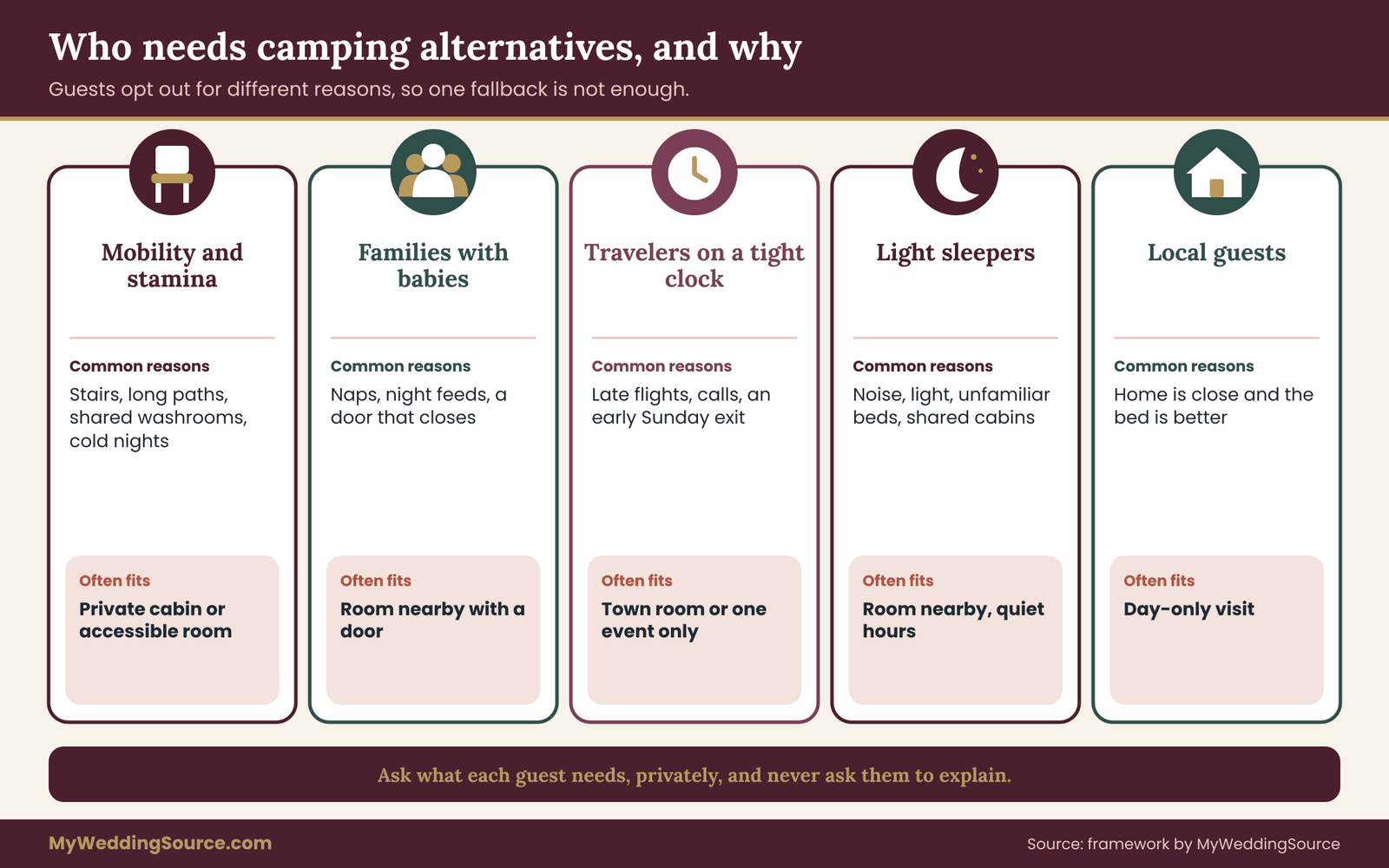
Before you design anything, it helps to see the guests you are designing for. They are not one group. Treating them as a single “non-camper” category produces a single, mediocre solution.
Health, mobility and age
Some guests cannot manage the practical demands of a camp: uneven paths, stairs to a loft, a walk to a washroom at night, cold floors, no air conditioning in summer heat, or shared sleeping rooms with no control over noise and light. These are not matters of toughness.
A guest who uses a cane or a walker, who has a heart or lung condition, who needs a regular overnight medication schedule or who sleeps badly in unfamiliar settings may simply be safer elsewhere. For these guests, camping alternatives are a matter of safety and comfort, not taste.
Ask about these needs gently and privately, and never require anyone to explain. The guide on accessible venue red flags lists the site features worth checking so you know what the grounds can honestly offer before you decide who needs a different lane.
Family stage
Parents of babies and toddlers often prefer a private room with a door, because a baby’s sleep schedule does not match a cabin of other adults. Families with older children may want one room for the whole group. A pregnant guest may want a bathroom close by. Some guests will bring a child who needs a quiet, dark room to sleep. All of this is ordinary, and all of it argues for a room off the grounds. A private room is one of the most requested camping alternatives for this group.
Work, travel and schedule
A guest flying in on Friday after a long day may want an airport hotel and a rental car. A guest who is on call, or who has to take a work call on Saturday morning, may need a reliable signal and a desk. A guest who must leave early on Sunday for another obligation does not want to wake a cabin at five. Here camping alternatives mostly mean a flexible schedule and a room near a main road.
Preference and comfort
Then there are guests who simply do not like camping. They may not like insects, shared bathrooms, sleeping bags or being away from their own bed. This is a legitimate preference and it is the easiest reason to accommodate, because it needs no special equipment, just a room. This is the easiest group to serve, because the camping alternatives they need are ordinary rooms.
The mistake of asking “camp or not”
A common error is a single RSVP line that asks whether a guest will camp. It forces each person to pick a side, and some will choose camping to avoid seeming difficult, then regret it by midnight. A better question offers the camping alternatives and lets guests choose the one that fits. The wording section later in this guide gives examples.
The goal is a short list of real options, each described in plain terms, so that a guest can choose in one reading without writing back to ask what you meant.
The ladder of camping alternatives
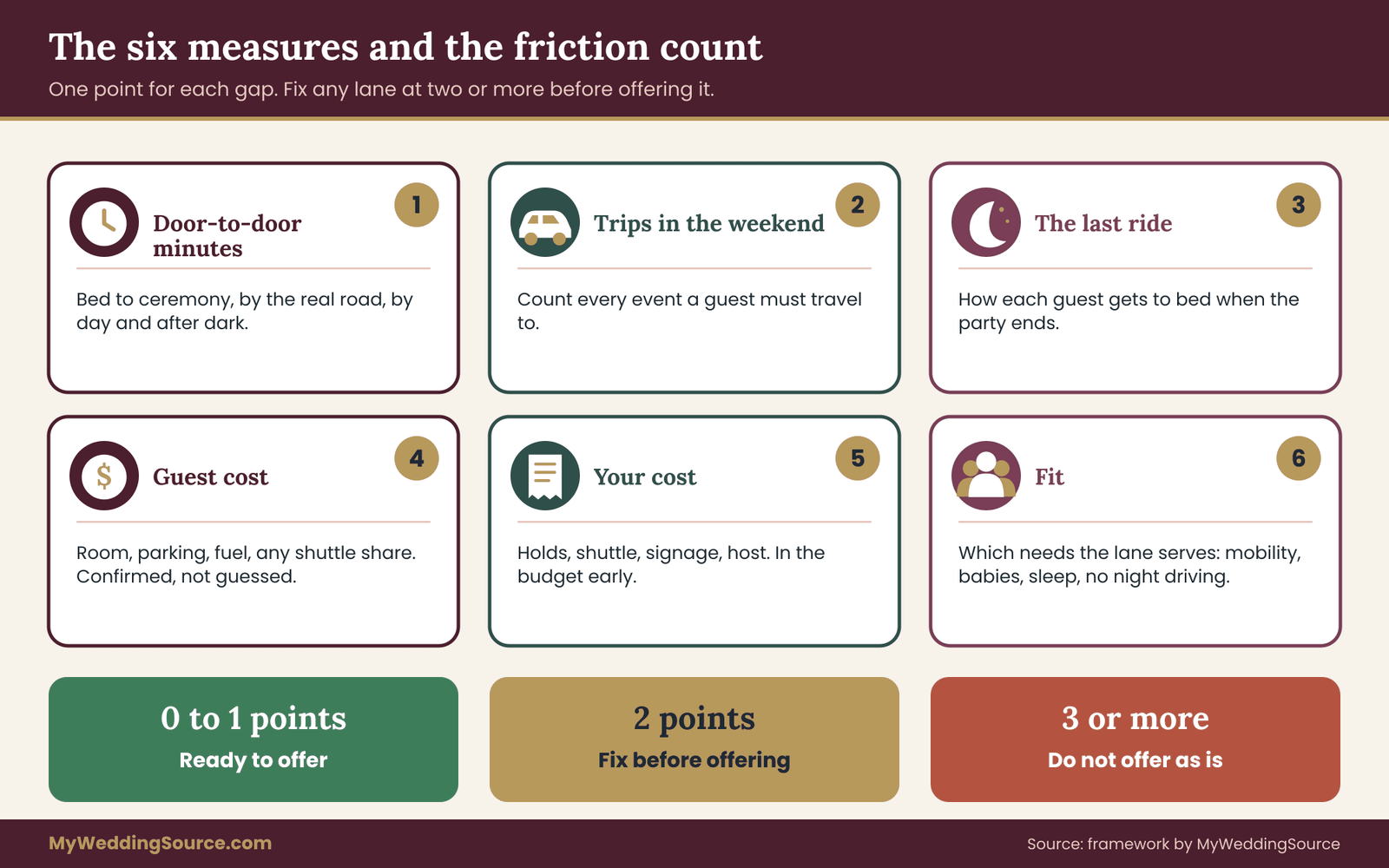
The framework in this guide is a ladder with five camping alternatives. A camping alternative is a way for a guest to be at the wedding, described by where they sleep and how they travel. Each lane is judged by the same six measures, which become the columns of your comparison sheet.
Lane one: the upgraded bed on site
This lane keeps the guest on the grounds but removes the parts of camping they dislike. It might be a private cabin with a bathroom, a room in a main lodge, a bed in a heated building rather than a tent, or a glamping-style unit with real bedding if the camp offers it. It is the camping alternative with the shortest travel and the strongest sense of being part of the weekend. Of all the camping alternatives, this one costs guests the least travel.
The limit is supply. Camps with private rooms usually have few of them, and they tend to be priced and assigned differently from bunks. Ask the operator exactly how many private or semi-private units exist, what they cost per night and whether you can reserve them or only the whole property.
Lane two: a room nearby
A hotel, inn, motel, bed and breakfast or short-term rental close enough that the drive is short and simple. This is the most popular camping alternative and the one most worth planning well. The main questions are how many rooms exist, how far they are by the actual road at night, whether the property allows a block or a hold and what the cancellation terms are.
Lane three: a room farther away
When the nearby supply runs out, guests end up in a town further off. The rooms may be cheaper and more plentiful, but the drive is long enough to change behavior. People leave earlier, drink less or more carefully, and miss the late part of the evening. This lane almost always needs a shuttle or a ride plan, and the plan has to be written down.
Lane four: day-only attendance
Local guests, or guests staying with relatives within an easy drive, can attend without any lodging from you. They arrive for the ceremony and leave after dinner or after the party. This is the simplest lane to support and the cheapest, though it still needs parking details and a clear end time. Among camping alternatives, this is the cheapest for you to support.
Lane five: one event only
Some guests can give you an afternoon but not a weekend. They may attend the ceremony and a short reception, then leave. Offering this camping alternative openly, rather than letting it look like a snub, takes pressure off guests and gives you an honest headcount for each event. A guest who is invited to one event only should be told that clearly and kindly. That conversation is covered in the scripts section. It is the lightest of the camping alternatives, and often the most appreciated.

The nearby room and opt-out comparison sheet
The camping alternatives are only useful if you can compare them. The sheet below is a simple way to do it. It has one row per lane and six measures per row. You fill it in with real numbers from the venue, the properties and the transport operator, and you re-check it when anything changes.
The six measures
Door-to-door minutes. This is the time from the guest’s bed, or front door, to the ceremony site, not the distance on a map. It includes parking, walking from the lot and any gate or gravel road. Measure it twice: once in daylight and once after dark, on the same route a guest would use. Rural and forest roads can be slow at night, and phone maps often leave out the last unpaved stretch.
Trips across the weekend. Count how many times a guest must make the journey. A guest in a nearby hotel who comes for a Friday dinner, Saturday morning activity, the ceremony, the reception and a Sunday brunch makes up to five round trips. Each trip is a chance to be tired, late or lost. A camping alternative with many trips needs shorter minutes to stay comfortable.
The last ride. This is the single most important measure and the one couples most often leave blank. When the party winds down, how does each guest get to their bed? On site the answer is a walk. In a nearby room it may be a car, a shuttle or a taxi. In a farther room it is almost always a shuttle or a designated driver. If the answer is “we will figure it out,” write that down as a gap, not an answer.
Guest cost. What the guest pays: room, parking, fuel, a share of the shuttle if you charge one, and any meals not included. Write the number as a range you have confirmed with the property, or note that you are waiting on a quote. Do not guess.
Your cost. What you pay: any deposits to hold rooms, the shuttle, a welcome item delivered to the front desk, a staffed meeting point, extra signage. This is the column that surprises couples at the end, so fill it in early.
Fit. Which guests the camping alternative suits and which it does not. Name them by need, not by name: wheelchair users, parents of infants, light sleepers, guests who do not drive at night. A camping alternative that fits nobody on your list can be dropped from the sheet.
Turning the measures into a friction count
Numbers on a sheet do not decide anything until you set a standard. Rather than inventing an industry rule, set your own limits once, in writing, before you look at the data. The limits are yours; the point is to apply them evenly. Applied to each of the camping alternatives in turn, the same count keeps the comparison even-handed.
A friction count works like this. For each camping alternative, add one point for each of these conditions.
The minutes exceed the limit you set for a pleasant drive. The lane needs more round trips than you set as a limit. There is no confirmed last ride. The cost to the guest is above what you told guests to expect. The cost to you is not yet in the budget. The lane’s fit for the guests you intend to put there is unknown or only partly known.
A camping alternative with zero or one point is ready. A camping alternative with two points needs a specific fix before you offer it. A camping alternative with three or more points should not be offered as it stands. That might mean adding a shuttle, finding closer rooms, shortening the weekend or dropping the camping alternative and telling guests plainly that it does not exist.
The count is deliberately crude. Its value is that it forces each gap into the open, and it turns a vague worry such as “the hotel is kind of far” into a countable problem such as “twenty-eight minutes at night, four trips and no confirmed last ride.”
How to fill in the sheet in an evening
You can complete a first version in one sitting if you work in a fixed order. A single evening is enough to see which camping alternatives are realistic and which need work.
- List the camping alternatives you expect to offer, starting with the five above and removing any the venue rules out.
- Call or message the camp and ask which private or semi-private units exist and what they cost.
- Search the area for rooms and note each property name, number of rooms, distance and cancellation terms.
- Drive or map the route from each property to the venue gate, and add a night estimate.
- Ask one transport operator about a shuttle for the longest route, and note the quote and conditions.
- Count friction points and write the one fix each camping alternative needs.
At the end you have a one-page picture, and you have asked the questions that decide whether the weekend works.
What the sheet does not do
The sheet does not rank lodging for quality, and it should not be read as a recommendation of any property. It does not predict how many guests will pick each camping alternative. It does not replace a conversation with the venue about rules, hours and insurance. It is a planning tool, and its answers are only as good as the figures you put in. It tells you which camping alternatives are ready, not which property is best.
It is also not a place to hide a problem. If the honest friction count on a camping alternative is high and you offer it anyway, guests will experience that friction, and it will be remembered as the weekend’s weak point.
Measuring door-to-door effort for camping alternatives
The measure that tends to surprise couples is travel time. A drive that looks like ten minutes on a map is not ten minutes for a guest who has had a long day and a glass of wine, in a dark place they do not know, on a road with no lights. This section explains how to measure and describe that effort fairly.
Daylight and night runs
Run the route at least twice. The daytime run tells you the real distance, the turns and any construction. The evening run tells you what guests will face when they leave. If you cannot drive it yourself, ask someone who lives nearby or ask the property how guests usually describe the last stretch. Skipping this step is the most common way couples overrate their camping alternatives.
On the night run, note these things: whether the road is paved, whether there is any lighting, where phone signal drops, whether wildlife is likely to cross, whether a gate is locked after a certain hour, and whether a vehicle can turn around at the end. A narrow road with a locked gate at eleven is a different lane from a paved road with a staffed entrance.
Building a minute range, not a single number
Give guests a range. A single number such as “fifteen minutes” will be wrong on the first foggy night or the first time a tractor is on the road. A range such as “fifteen to twenty-five minutes depending on the final road and the weather” is honest and still useful.
For weather, the National Weather Service forecast for the nearest town gives the picture for the weekend. Check it a few days before and again the day of, and pass on changes through the same channel you use for other updates. If heavy rain, fog or ice is possible, tell guests who drive that the minutes may grow and that the shuttle schedule may change.
Counting trips
List the events on your schedule and mark which ones each camping alternative’s guests are expected at. A Friday welcome gathering, a Saturday morning activity, the ceremony, the reception, a Sunday brunch: each is a trip for anyone not sleeping on site. Seeing the number helps you decide whether to cluster events. Two nearby events on the same afternoon can turn two trips into one. Each trip adds friction to the camping alternatives that depend on a drive.
You can also reduce trips by making some events optional and saying so. Guests in the farther camping alternatives may be glad to skip the Friday gathering if they know it is truly optional, and you will have a more honest headcount.
The time that matters most: the end of the night
Most travel trouble happens after the party, not before it. People are tired, some have been drinking, the lights are low and the venue may be asking everyone to leave by a set time. The last ride has to be planned for that moment.
On site the end of the night is a walk with flashlights. For everyone else you need three things: a clear time when the last shuttle or ride leaves, a place guests wait, and a person responsible for counting heads. The shuttle section covers each of these.
Putting numbers into words
Once the sheet is filled in, convert the numbers into one plain sentence per lane for guests. For example: “The inn is about fifteen to twenty minutes from the gate by a paved road, and a shuttle will run between nine and eleven.” The sentence should state the time range, the way of getting back, and what the guest pays if anything. If you cannot write that sentence, the camping alternative is not ready. Guests compare camping alternatives by reading, so give each one the same short format.
The venue guide explains how to ask a site the questions that produce these facts, such as gate hours, parking and noise limits, and it is worth reading before you call.
Nearby rooms: how to find, hold and verify them
Nearby rooms are the workhorse among camping alternatives. Most guests who do not camp will end up here, and a few ordinary mistakes cause most of the trouble: assuming there are more rooms than there are, assuming a hold is a booking, and assuming the property understands what the weekend is.
Finding the real supply
Start with a map and a list. Search for hotels, inns, motels, bed and breakfasts and rentals within the drive limit you set. Write down each property’s name, the number of rooms it actually has, the distance by road and the phone number. Small rural properties often have only a handful of rooms, and a listing on a booking site may show availability that the front desk cannot confirm. The supply of rooms sets the ceiling for your camping alternatives, so count it before you promise anything.
Call each one. Say that you are hosting a wedding weekend at a camp nearby, give the dates, and ask how many rooms they could offer guests and how bookings work. A small inn may be glad to hear about a block of reservations weeks in advance. A property that is largely rented to fishing or hunting parties on that weekend may already be full. Either answer is useful.
If the area has very few properties, expand the radius gradually and flag the added minutes on your sheet. Short-term rentals can fill gaps, but check the rules in the next section before relying on them.
Block, hold or no arrangement at all
Properties handle group requests in different ways, and it is worth knowing the options. Whichever route you choose, write it into your notes beside the camping alternatives it supports.
A formal room block reserves a number of rooms at a stated rate for a set period, with a date after which unbooked rooms return to general sale. Larger hotels do this routinely. Smaller places may not have a process, or may ask for a deposit or a signed agreement.
A softer arrangement is a courtesy hold, where the property sets rooms aside for a short time without a contract. This is helpful, but it is not a guarantee. If another guest wants the room and your hold expires, the room goes.
With no arrangement at all, guests book on their own. This can work when the supply is large, and it gives guests full control, but it gives you no visibility. You will not know how many rooms are taken, and a few early bookers can take the best ones.
For couples whose area has many properties, the room-block and budget guidance discusses blocks and budget bands more fully. For a camp wedding in a thin market, the practical goal is simpler: know how many rooms exist, hold a small number if you can, and tell guests which properties to try first.
Questions worth asking each property about camping alternatives
Keep the call short and specific. These questions cover what matters.
- How many rooms can be reserved for the weekend, and in what bed types?
- Is there any group arrangement, a deposit, or a cut-off date?
- What is the cancellation policy for an individual guest and for a group?
- Are there accessible rooms, and what makes them accessible?
- What are the check-in and check-out times, and can a guest arrive late?
- Are there quiet hours, and is the property used for other events that weekend?
- Is parking free and on site?
- Will the property confirm any arrangement in writing?
Write the answers in your notes with the date and the name of the person. A verbal “we will take care of you” is not an arrangement. The vendor contract guide explains why details such as cancellation terms and who is liable for what belong in writing, even for a small property.
Short-term rentals and house hosts as camping alternatives
A rental house or cabin can sleep several guests at once and may cost less per person than separate rooms, which makes it attractive for friends who want to share. Three cautions apply.
First, a rental is a private host’s property, and local rules about rentals vary. Ask the host to confirm that they allow the number of guests, and do not assume that a visit to the wedding is a permitted use.
Second, a rental has no front desk. If a guest arrives late or locks themselves out, no one is on site to help. Make sure there is a phone number the guest can call.
Third, a rental is a booking with its own cancellation terms, usually stricter than a hotel’s. A guest who cancels may lose a deposit. Suggest that guests read the terms before booking.
Verifying before you recommend
Never recommend a property you have not checked. At a minimum, confirm by phone that it exists, has rooms for your dates, and is the distance you think it is. Look at a recent map view and recent public reviews for obvious problems such as closure or major construction, but treat reviews as one clue and not a verdict. Guests will trust your camping alternatives only if the ones you name turn out to be real.
Avoid language that implies endorsement. A list titled “places that may have rooms” is more honest than “recommended hotels,” and it keeps the guest in charge of the decision.
Accessible rooms and mobility
Some guests need a room that works for a wheelchair, a walker or limited stamina. The language on a property’s website can be loose, so ask direct questions: is there a step to the entrance, how wide is the bathroom door, is there a roll-in shower or a tub, how far is the room from parking. The ADA.gov site explains the federal accessibility rules for lodging and other public places, and the U.S.
Access Board publishes the technical standards. Neither tells you what a particular older inn actually has, so ask the inn. Accessibility is the test that separates workable camping alternatives from merely nice ones.
When a guest with mobility needs is staying off site, check the route to the venue too. A room that works well and a ceremony path that does not will still leave the guest outside the day. The accessibility red flags guide lists what to look at on the grounds.
The on-site upgraded bed, handled honestly
Lane one deserves the same checking. Ask the camp to describe each private or semi-private unit: bed type, heating or cooling, whether there is an attached bathroom, how far it is from the main building and what the access path looks like. Ask how the units are assigned and whether you can reserve them in advance for named guests. Treat these units as scarce camping alternatives and allocate them by a rule you can explain.
If there are only a few such units, decide who needs them most before the question becomes awkward. Guests with mobility needs, parents of infants and older relatives are common priorities. Decide the rule, write it down and use it consistently. That is kinder than letting the best units go to whoever replied first, and it is easier to explain.
Keeping a simple ledger of rooms
As bookings come in, keep a plain list: guest or party name, property, number of rooms, how they heard about it and whether it is confirmed. It does not need to be elaborate. The ledger lets you see at a glance whether your nearby supply is filling, how many guests are in each camping alternative and whether the shuttle you plan will have enough riders to make sense. The ledger shows at a glance how your camping alternatives are filling.
If you allow guests to book their own rooms, ask them to tell you where they are staying so you can include them in your ride planning. Many couples forget this step and discover on the day that six guests are staying at a property the shuttle does not serve.
Shuttles, rides and the last-ride problem
When nearby rooms are not very near, the shuttle becomes the hinge of the whole plan. A good one makes the farther lane feel easy. A vague one leaves a dozen tired guests at a gate at midnight.
Decide whether you need a shuttle at all
A shuttle is worth planning when several guests are staying in the same direction, when the route is long or poorly lit, or when many guests will be drinking. It is less useful when guests are scattered across many properties or when the route is only a few minutes. In those cases a list of ride options and a staffed waiting point may do. Whether you hire a vehicle or not, camping alternatives off the grounds all depend on a ride home.
A rough test: count the guests in each camping alternative who will not have a car or do not want to drive at night. If the number is small, a few arranged rides may be cheaper and simpler than a vehicle on a schedule. If it is large, a vehicle with a driver is worth pricing.
Hiring a transport operator
Hire a licensed operator, not a friend with a large van, for any route where you are responsible for guests’ safety. The U.S. Federal Motor Carrier Safety Administration is the federal agency that oversees commercial motor carriers, and it publishes ways to check a carrier’s registration and safety record. State and local rules also apply, and they differ, so ask the operator which licenses and insurance cover your trip and ask for proof in writing.
Ask these questions before you commit.
- What vehicle sizes are available, and how many seated passengers does each carry?
- Can the vehicle reach the venue’s roads, gates and turnaround, or is there a size limit?
- How is the trip billed: hourly, by the trip, with a minimum? What counts as billed time, including waiting?
- What is the overtime policy if the party runs late?
- Is there a vehicle with accessible boarding, such as a lift or ramp, and how far ahead must it be requested?
- What insurance does the operator carry, and will they give you a certificate?
- Who is the contact on the night, and how do they communicate with the driver?
Ask the venue, too, whether larger vehicles are allowed on the grounds, where they can stop and whether the access road can handle them in wet conditions. A coach that cannot reach the gate defeats the purpose.
Designing the schedule
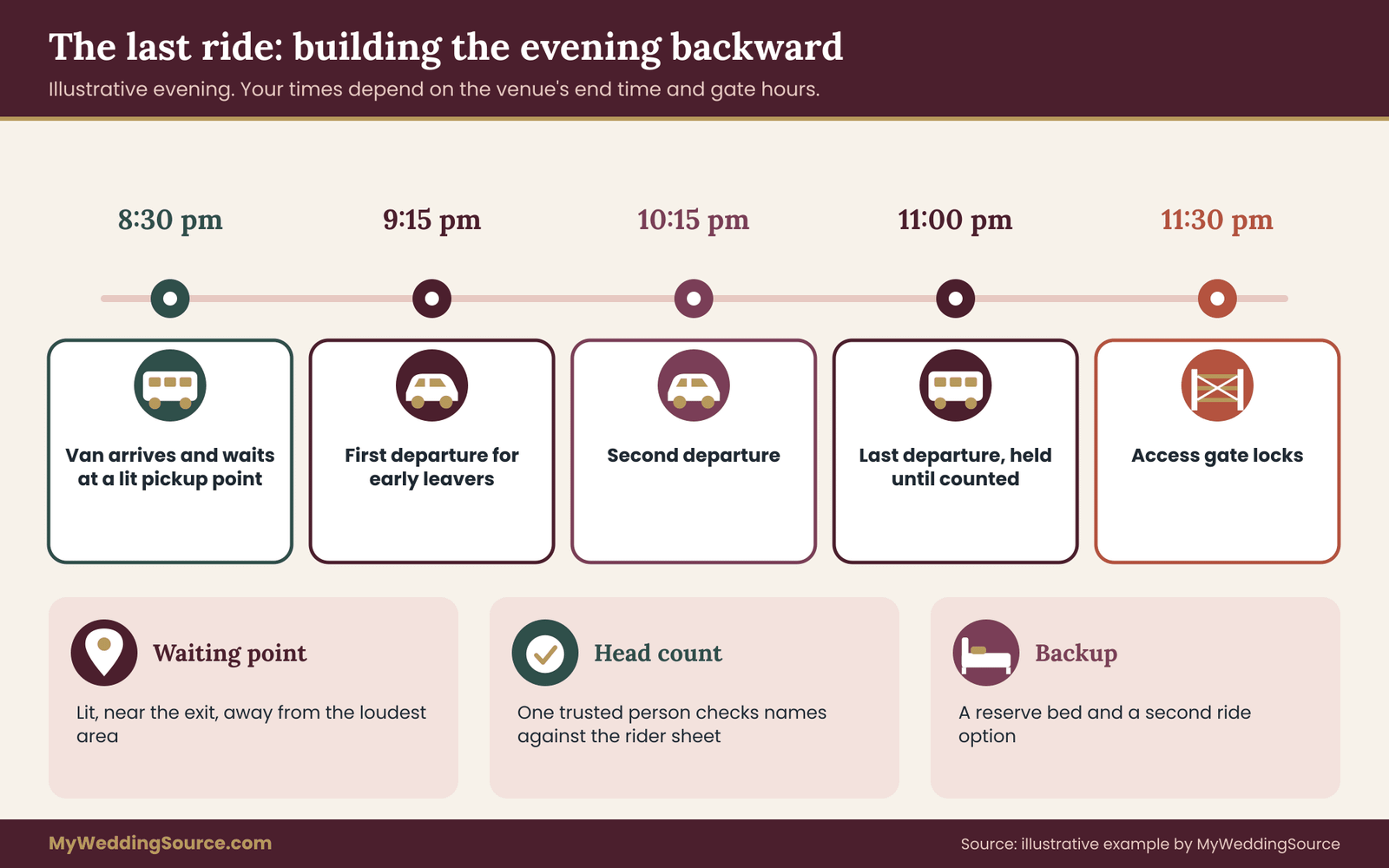
Build the shuttle schedule from the last ride backward. Decide the time when the venue wants the party to end, then set the final departure after that with a margin. Add earlier departures for guests who want to leave sooner, such as older guests or parents with young children. A published schedule is what turns the farther camping alternatives into something guests can trust.
A common pattern is a morning run to the venue, a small number of departures in the evening, and one final departure that you promise to hold. Publish the times. Guests who know exactly when the last ride leaves can plan their evening, and fewer will wander off to find their own way.
Keep a short buffer between the end of the event and the final departure so that no one is rushed, but not so long that the driver is billed for an hour of idling. The cost logic in the cost section explains how billed hours add up.
The waiting point and the head count
Choose a place where guests wait for the shuttle. It should be well lit, near the exit and away from the party’s loudest area. Assign one trusted person, not a vendor and not one of the couple, to count guests as they board and to confirm that everyone on the sheet has been accounted for.
A simple sign-on sheet or a checklist of named riders helps. At the end of the night, the person responsible checks that no one who was expected to ride has been left behind, and that anyone who has chosen to stay on site has told them so. This takes five minutes and prevents most of the panicked searching that follows a missed ride.
Impaired driving and camping alternatives off the grounds
Alcohol is part of most weddings, and the road home is the risk. The National Highway Traffic Safety Administration publishes information about impaired driving and prevention. For your plan the point is simple: do not leave guests to decide at the last minute whether they are fit to drive.
Offer a ride that is easy, free or low-cost, and obvious. Tell guests in advance that the shuttle exists, when it leaves and that guests who are not sure about driving should use it. Camping alternatives that require night driving are only safe if the ride is easy to choose.
If the venue serves alcohol or you hire a bartender, ask whether the server’s policies address guests leaving on their own. That is a conversation to have in the contract stage, not at the bar.
When the shuttle fails
Plan for a late driver, a breakdown or a cancelled ride. Ask the operator what backup they offer. Keep the number of a second option, such as a local taxi or ride company, though in remote areas these may not be available at night, so check rather than assume.
Give the shuttle contact’s number to a few trusted people, and put a written schedule where guests can find it. If your plan relies on the shuttle for the farther lane, a failure should not strand anyone. A good backup is a few guests staying on site for the night in the upgraded lane, with a spare bed or two held for emergencies, if the camp can allow it.
Drivers who volunteer
Some guests will offer to drive others. This is kind and often useful, but treat it as an informal arrangement between guests and not as part of your official plan, unless you want to take on the questions that come with it.
If a friend of the couple is assigned to drive, ask them to arrange their own plans so they do not feel obliged to stay sober at someone else’s party, and let guests know the arrangement is voluntary. Volunteer rides can supplement your camping alternatives, but they should not replace the plan.
Opt-out camping alternatives: day visits, one-event attendance and split weekends
The opposite end of the ladder from the upgraded bed is opting out of some or all of the weekend. These opt-out lanes count as camping alternatives too, even though they involve no lodging from you. They are also where couples are most likely to cause hurt feelings, because opting out can look like not caring. A clear structure prevents that.
Day-only guests
Day-only guests live nearby or are staying with relatives. They do not need rooms or shuttles, but they do need information. Tell them the arrival window, the parking arrangement, what the ground is like for shoes, where the restrooms are and when the party ends. Include a note about what to do if the weather turns, since an outdoor camp setting may change plans on the day. Day visits are camping alternatives that need information more than lodging.
For these guests, the main question is the end of the evening. If your event runs late, they may need a ride home as much as anyone else. If you have a shuttle, tell them whether they can use it.
Single-event attendance
Some invitees cannot come for the whole weekend and may only attend the ceremony or the reception. This works well when you are clear about it from the start. Invite them to the event or events you want them at, state the times, and say how the rest of the weekend works for those who join in. Offering this among your camping alternatives gives busy guests a graceful way to say yes.
The wording matters. A guest who understands that the weekend is a series of optional events can pick the ones that suit them. A guest who thinks the whole weekend is expected may feel guilty about skipping and turn down the invitation altogether. For wording ideas, see the RSVP guidance in the RSVP etiquette guide, which covers how to ask for a response so it is easy to answer.
Split weekends
A split weekend is a guest who stays one night rather than two, or who camps on Friday and moves to a room on Saturday after discovering the cabin is not for them. Allowing this is a kindness, and it can reduce stress for you too, because guests have a way out that does not feel like failure. Letting guests switch between camping alternatives mid-weekend removes the sense of being locked in.
If you are willing to allow it, say so. Decide how a guest changes camping alternatives: whom they tell, by what date and what happens to any reservation or payment. If a camp bed is freed up, can another guest use it? Keep the rules simple and consistent.
Quiet, private time
Some guests opt out of parts of the weekend because they need quiet. A guest who does not want to share a cabin may also not want a late bonfire. Make sure your plan includes some low-key time and a quiet place on the grounds where anyone can step away. This is useful for every camping alternative, not only for those who are sleeping elsewhere. Quiet space is useful for every guest, whichever of the camping alternatives they chose.
Keeping the opt-outs warm
The risk with opt-out camping alternatives is that the guests in them feel like second-class attendees. A few small choices change this. Include them in group photos and activities that happen during their window. Seat them with people they know. Send them the same schedule and the same welcome note as everyone else. Do not make the camping guests the only visible “insiders.”
Remember too that the guests who go home may have given up more than they let on to be there. A short thank you at the end of the evening is worth more than it costs.
A worked case: the Alder Fork weekend
The following example is invented to show the method. The names, numbers and places are made up, and nothing here describes a real venue, a real price or a real couple. Use it to see how the sheet is filled in, not as a benchmark.
The setup
Two partners are planning a Saturday wedding at a summer camp called Alder Fork. They invited 72 adults in 41 parties. The camp has bunkhouses, five heated private cabins and a lodge with a dining hall. The gate to the access road is locked at 11:30 p.m. Friday is a casual dinner, Saturday has the ceremony and reception, and Sunday is a short brunch.
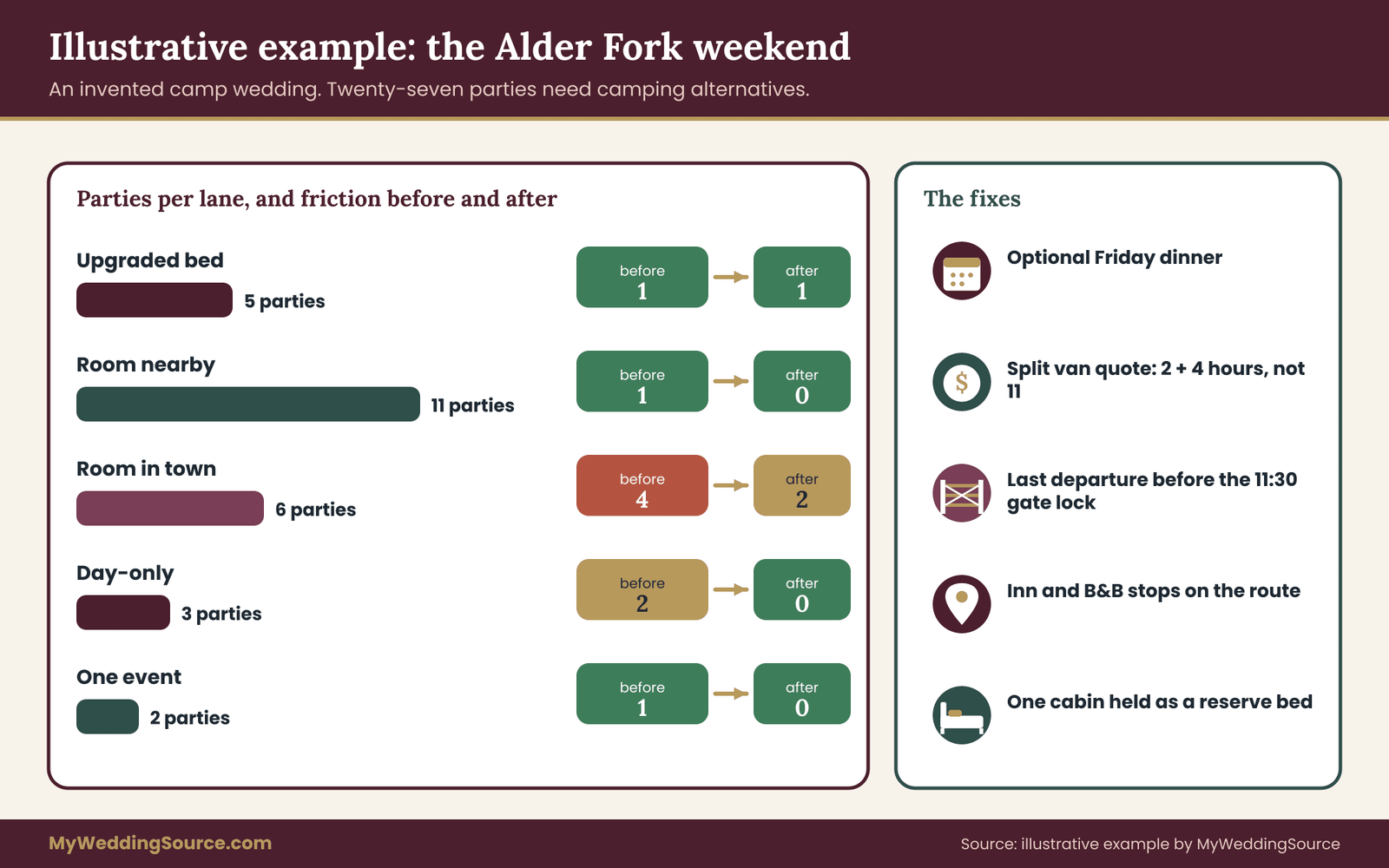
When the couple sent a first, informal survey, 14 parties said they were happy to sleep in the bunkhouses. That left 27 parties looking for camping alternatives. The couple sorted them by what they had asked for.
- Five parties wanted a private cabin: two older relatives, two parents with infants and a guest with limited mobility.
- Eleven parties wanted a room nearby, mostly light sleepers and families.
- Six parties said they would stay wherever there was space, which turned out to be a town hotel.
- Three parties lived within driving distance and planned to attend for the day.
- Two parties could only come for the ceremony and dinner.
That is 5 plus 11 plus 6 plus 3 plus 2, which equals 27.
The measurements
The couple researched the area and found three sources of rooms. A small inn had nine rooms and sat 14 minutes from the gate on a paved road in daylight. A bed and breakfast had two rooms, 17 minutes away. A chain hotel in the nearest town had plenty of rooms, but it was 38 minutes from the gate.
They set their own limits before looking at the results. A comfortable drive would be no more than 20 minutes each way. A camping alternative should need no more than four trips over the weekend. Every lane needed a confirmed last ride. The cost to guests should match what the couple had told them to expect, which was roughly the price of a basic room. And the couple’s own costs had to be in the budget.
The night run of the route added two minutes to the inn and to the bed and breakfast and showed that the last 1.5 miles to the gate were gravel without lights. It also revealed that the gate locked at 11:30, a fact that changed the shuttle plan.
The friction counts
Here is how each camping alternative came out the first time through.
Lane one, the upgraded bed. Minutes: a short walk, no point. Trips: none, no point. Last ride: a walk, no point. Guest cost: the camp charged more for a private cabin than for a bunk, and the couple had told guests a bunk-level price, so one point. Your cost: none. Fit: the guests were known, no point. Total: one point. The fix was easy: tell those five parties the real price before they agree.
Lane two, nearby rooms. Minutes: 14 to 19 at night, no point. Trips: four if guests joined Friday dinner, no point. Last ride: not confirmed, one point. Guest cost and your cost: no points. Fit: known, no point. Total: one point. The fix: put the inn and the bed and breakfast on the shuttle route so the last ride exists.
Lane three, the town hotel. Minutes: about 38 to 45 at night, one point. Trips: five if the Friday dinner counted, one point. Last ride: not confirmed, one point. Guest cost: fine. Your cost: a shuttle that was not yet in the budget, one point. Fit: known, no point. Total: four points. This lane should not be offered as it stood.
Lane four, day-only. Minutes: 25 to 35, one point. Trips: two, no point. Last ride: guests would drive themselves home late, and no plan covered the drive, one point. Total: two points, needing a fix.
Lane five, one event only. Minutes: similar to lane four, one point. Trips: one. Last ride: they planned to leave after dinner, before dark, so it was covered. Total: one point, with nothing further to do.
The fixes
The town hotel was the problem lane, so the couple worked on it first. They moved the Friday dinner to optional and said so, which dropped the trips to four. They asked one operator for a quote on a 14-seat van and found that the operator billed from first pickup to final drop-off, with a minimum.
A single continuous booking from mid-afternoon to midnight would have been about eleven billed hours. Two separate segments, one in the early afternoon and one from 8:30 p.m. to 12:30 a.m., came to about six billed hours. The arithmetic was simply 2 plus 4 against 11, so they asked the operator whether split segments were allowed and priced them.
The evening segment was set up as three departures, at 9:15, 10:15 and 11:00 p.m., so that the last one cleared the gate before it locked at 11:30. The van stopped at the inn and the bed and breakfast on the way to town, which solved the last-ride gap in lane two as well. The couple added the cost to the budget, and the friction count for lane three fell to two: minutes remained high, and the fit for one older guest was still uncertain.
For that guest, the couple held one of the five private cabins as a reserve. If the van or the road failed, anyone who could not leave would have a bed. They told no one, which kept the arrangement quiet, but they wrote it on the host sheet so a trusted friend would know.
The day-only guests were told the party would end at 11:00 and the last van left at 11:00, and they were told they were welcome to take a seat on it to the inn and arrange their own onward ride. Two of the three parties did. The one-event guests simply received a clear invitation to the ceremony and dinner.
What the example shows
The example shows four things. The comparison sheet exposed the gate time, which no one had thought of before the night run. A single high-friction lane could be fixed with a schedule and a split quote, not by abandoning it. A reserve bed turned a single point of failure into a manageable risk. And the whole exercise took a few evenings of calls, not a consultant. In short, camping alternatives can be measured, compared and repaired like any other part of the plan.
It also shows what the sheet does not settle. The couple still had to decide how to price the private cabins fairly, whether to subsidize the shuttle, and how to word the invitation. Those are the next sections.
How the same method adapts
If your camp has no private cabins, lane one disappears and the pressure moves to lanes two and three. If the nearby inn has only two rooms, lane two shrinks and lane three grows. If everyone lives within thirty minutes, camping alternatives four and five may carry most of the load and you may not need a shuttle at all. The sheet is flexible because it measures the same six things whatever the geography.
The method also tells you when a particular weekend format needs rethinking. If the only lane that fits a key guest has a friction count of four and cannot be fixed, you have learned something important early. The failure conditions section lists what to do.
Costs and who pays for camping alternatives
Money is where camping alternatives can create quiet resentment, so it helps to decide the principles before the first quote arrives. The questions are not complicated, but they are easy to postpone until a guest asks.
What guests normally pay and what hosts normally pay
Etiquette varies by community and by couple, and no single rule applies. In many weddings guests pay for their own lodging and travel, and hosts pay for the events. At a camp, the camp fee for a bunk may be bundled into your venue contract, which makes it feel like part of the wedding, while a room at an inn is an outside purchase. That difference can feel unfair to guests who chose a room, and it is worth deciding on purpose.
You have a few honest ways to handle it. You can treat all lodging as the guest’s own cost, camp bunks included, by passing the camp fee through at cost. You can cover camp bunks as part of the venue and ask guests in rooms to cover their own, and say so plainly.
Or you can subsidize some of the room costs for guests who would otherwise be unable to attend. Any of these can be right. What goes wrong is leaving the rule unstated, so that guests discover the gap by comparing notes.
The budget guide is a good place to decide where the money for transport and lodging support sits in your overall numbers.
The cost lines to put in your own budget
List the costs that fall to you for camping alternatives, even if you expect to pass some on. Pricing camping alternatives honestly starts with knowing every line you will carry.
- Deposits or holds on rooms, if a property asks for one, and when they are refundable.
- The shuttle, including billed hours, any overtime, a gratuity if you plan one and any fuel or fee the operator lists.
- A welcome item or note for guests in off-site rooms, if you choose to provide one.
- A volunteer or paid host at the pickup point, if you want someone present.
- Printing or messaging for the lodging and ride information.
- A small reserve for the unexpected, such as a late van or an extra night for a guest.
Ask each vendor to put the cost in writing and to say what is included. If a figure is missing from a quote, do not fill it in with a guess. Ask.
Charging for the shuttle
Some couples include the shuttle in their costs as part of the event. Others ask riders to share the fee. Either is acceptable, but be consistent. Charging some riders and not others invites questions. Charging a small fee can make sense if the ride is optional, such as a Sunday run, while the Saturday night ride home should probably be free, because it is a safety measure.
If you do collect money, think about how you will handle refunds if a guest cancels or the shuttle does not run. It is simpler to absorb the cost than to manage a chain of small payments, unless the amounts are large.
Cancellation and change costs
Rooms, shuttles and camp bookings all have their own terms. Know them before guests commit. A room that a guest booked at an inn may cancel for free up to a certain date. A shuttle booked with a deposit may not be refundable if you reduce the number of departures. A camp may charge for bunks you reserved and do not use. Each of the camping alternatives has its own cancellation terms, so record them separately.
Write the key dates on a single calendar: the last day to cancel rooms without penalty, the last day to change the shuttle, the date the camp needs a final count. The cash-flow guide covers how to time deposits and final balances so that these dates do not surprise you.
Fair pricing among camping alternatives
A common worry is that guests in camping alternatives one through three pay more than guests in bunks. That can be true, and it is not necessarily unfair, because the guests are receiving different things. It becomes unfair when guests could not choose.
If a guest needs a room for health reasons and the room costs much more than a bunk, consider whether you want to bridge some of the difference. You do not owe it, but you may wish to offer it quietly to the guests you most want to have. The goal is not equal prices but fair choices.
If you do subsidize, do it privately and without making a list. A short, warm message such as “We would like to help with your room, so please book it and send us the receipt” avoids a public discussion of who is helped.
Checking the numbers once more
Before you send information to guests, review the cost lines against the sheet. Every lane should have a guest cost and a host cost, and each should be backed by a quote, a rate on a website or a written note from a phone call. If a camping alternative has a blank, either find the number or tell guests that it is pending and when you will update them. Do this review before any camping alternatives are announced to guests.
Telling guests: invitations, RSVP wording and scripts
The sheet is for you. Guests need a short, clear version. The aim is that every invitee can read it once and know what their options are, what each costs and what to do next.
What the guest note should contain
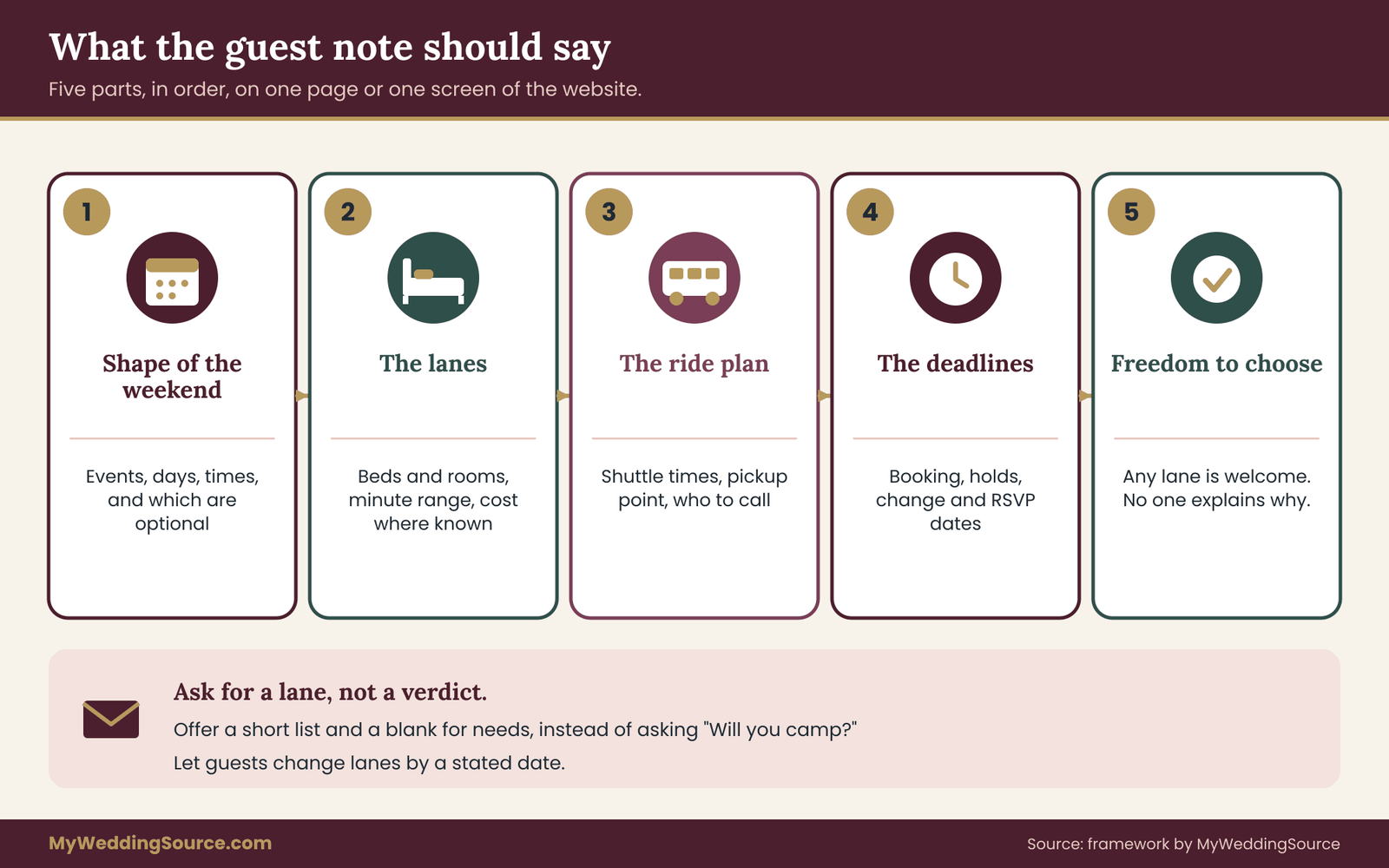
A good lodging and travel note has five parts, in this order. Presenting camping alternatives on one page tells guests they are part of the plan.
First, the shape of the weekend: which events there are, on which days and at what times, and which are optional. Second, the lodging camping alternatives: on-site beds, nearby rooms, farther rooms, with the minute range and the cost where known.
Third, the ride plan: whether a shuttle runs, the departure times and where to board. Fourth, the deadlines: when to book, when to tell you and when your holds expire. Fifth, a plain statement that guests are free to choose the camping alternative that suits them and that no one needs to explain why.
Keep the note on a page or a single screen on your website. Do not hide the alternatives in a second link. If the alternatives look like an afterthought, guests will treat them as one.
RSVP wording that lets people choose
Instead of asking “Will you camp?” ask which lane each party prefers and give the descriptions in a few words. For instance, a party can mark one of these: a bunk or cabin at the camp, a room nearby, a room in town with the shuttle, a day visit, or one event only. Add a line for needs that affect the plan, such as mobility, infants or an early departure, and make the line optional. Naming the camping alternatives on the card itself makes the choice easy to answer.
The point of the question is planning, not control. A guest who is not sure should be allowed to say “undecided” and to change later by a date you state.
Scripts for common conversations
Below are short scripts in plain language. Change them to sound like you. These cover the questions guests raise most often about camping alternatives.
For a guest who says they cannot camp:
“We would love to have you there. There are rooms about fifteen minutes away and a shuttle in the evening. Here is the list, and tell us if anything about getting there is hard.”
For a guest who is nervous about asking:
“There is no wrong choice here. Some people are in the cabins, some are in town. Pick whatever lets you enjoy the weekend.”
For a guest who wants a free upgrade:
“The private cabins are limited and we gave them first to guests with mobility needs and babies. We would be glad to help you find a nearby room, and here is the list.”
For a guest you invite to one event only:
“We would be so happy to have you at the ceremony and dinner on Saturday. We know the full weekend is a lot, and you are welcome to come for just the part that fits.”
For a guest in a farther lane:
“The town hotel is a longer drive, so we have arranged a van that leaves the venue at set times that evening. We will send the exact times, and you can ride either way.”
For a guest who wants to switch camping alternatives after booking:
“Of course. Tell us by the date on the note and we will update the list. If a room needs changing, let us know what they say about the cancellation terms.”
Tone and respect
Avoid framing that sorts guests into those who are “easy” and “difficult,” and avoid jokes about people who do not like camping. The guests who ask for alternatives may already feel self-conscious. Describe the options neutrally, as parts of a plan, and treat each choice as ordinary.
If your own family or friends tease the non-campers, it may be worth a quiet word. The aim is that someone who chooses a room does not feel they are being judged when they walk into dinner.
Updating guests as things change
Send changes through one channel and date every update. If a property closes, a gate time changes or the shuttle schedule moves, tell all affected guests directly and also update the website note. If you use text messages, keep them short and include the one fact that changed. The guest care guide discusses how to look after guests across a weekend, which includes timely, calm updates. Changes to camping alternatives should reach every affected guest by the same route.
Putting it in writing for the venue
Share the lodging and ride plan with the camp. Ask whether any of it conflicts with the venue’s rules about vehicles, quiet hours or gate times, and ask them to confirm in writing. If the camp has not been told that a shuttle will arrive at night, the gate may be locked and the staff asleep. A short email can prevent a long night. The camp should know about every one of your camping alternatives that touches its grounds.
Safety, weather and access limits that shape camping alternatives
Camps and campgrounds sit in places where weather, fire rules, wildlife and poor signal matter more than they do at a hotel ballroom. These factors affect every camping alternative, but they affect the off-site camping alternatives in a particular way: guests who leave the grounds are travelling through that environment, often at night.
Fire restrictions and what they change
Many public and private lands set fire restrictions during dry periods, and the rules can change quickly. The National Park Service and the U.S. Forest Service publish guidance and local restriction notices for lands they manage, and private camps follow county or state rules. Ask the camp what its current restrictions are and who decides, and check again close to the date. Fire rules shape the evening more than the camping alternatives themselves, but they move the shuttle times.
A restriction rarely cancels a wedding, but it can cancel a bonfire. If the fire was central to your plan, think about what replaces it, such as lanterns or a gas-fueled fire feature if the camp permits one. For camping alternatives the effect is indirect: if guests expected a late campfire and it is gone, the evening may end earlier, which changes the shuttle schedule.
Weather and the road
Heavy rain can turn a gravel access road into a hazard. Fog, ice or high wind can make a rural road risky even if the weather at the venue looks fine.
The National Weather Service gives forecasts and alerts for the area, and Ready.gov explains how to prepare for severe weather in general. For your plan, decide in advance what you will do if conditions are bad: who decides to delay or cancel a shuttle run, how you tell guests and where guests can stay if travel is unsafe. Bad weather tests off-site camping alternatives harder than any other part of the weekend.
Giving the on-site reserve bed or two a defined role matters here. If the road becomes unsafe, guests who planned to travel back to town may need a place to stay for the night. Ask the camp whether any bunks or lodge space could be held for that purpose, and what it would cost.
Insects, ticks and outdoor comfort
Guests who do not camp are often those who dislike insects or worry about ticks. The Centers for Disease Control and Prevention publishes information on tick and insect protection. A short, calm note to all guests about footwear, long pants in grassy areas and checking for ticks after being outdoors is helpful and treats campers and non-campers alike. Avoid alarmist language; the aim is to prepare people, not scare them.
Signal and communication
Many camps have patchy cell coverage. This affects off-site guests, who may rely on a phone to reach the shuttle, a driver or you. Find out where signal exists and where it does not. If the pickup point has no signal, a printed schedule and a person on site matter more. Give guests a phone number that works and post the schedule in more than one place. Camping alternatives that depend on a phone call fail where there is no signal.
Emergencies and medical needs
Know the location of the nearest urgent care and hospital, and give a trusted person the information. Ask the camp about its emergency plan, including how an ambulance would reach the site at night and whether the gate can be opened. A guest with a medical condition who is sleeping off site should have a way to reach help and should tell a trusted friend or relative where they are.
Accessibility on the route
A guest with a mobility need relies on the entire chain: the room, the vehicle, the drop-off point, the path to the ceremony and the restroom. Any weak link can make the others useless. The ADA.gov site describes the rules that apply to public lodging and transportation, and the U.S.
Access Board explains the technical standards. Neither replaces a direct question to the property and the shuttle operator about what they actually provide. If an accessible vehicle is needed, ask early, since fleets are often small. Camping alternatives for guests with mobility needs must work from the room to the ceremony.
Pets and children
If guests bring children or pets, the camping alternatives change. A pet may not be welcome at a hotel or in a camp cabin, and young children may need a room with a door. Ask both the property and the camp, and put the answer in the guest note. This is a place where a clear sentence prevents an awkward discovery at check-in. Camping alternatives that suit adults may not suit a family with a dog or a toddler.
Failure conditions: when camping alternatives stop working
Every plan has a point where it stops being a good plan. Knowing yours in advance lets you change course calmly. The conditions below are the common ones. If you meet one and cannot fix it, treat it as a signal to change the format, not as a reason to push on.
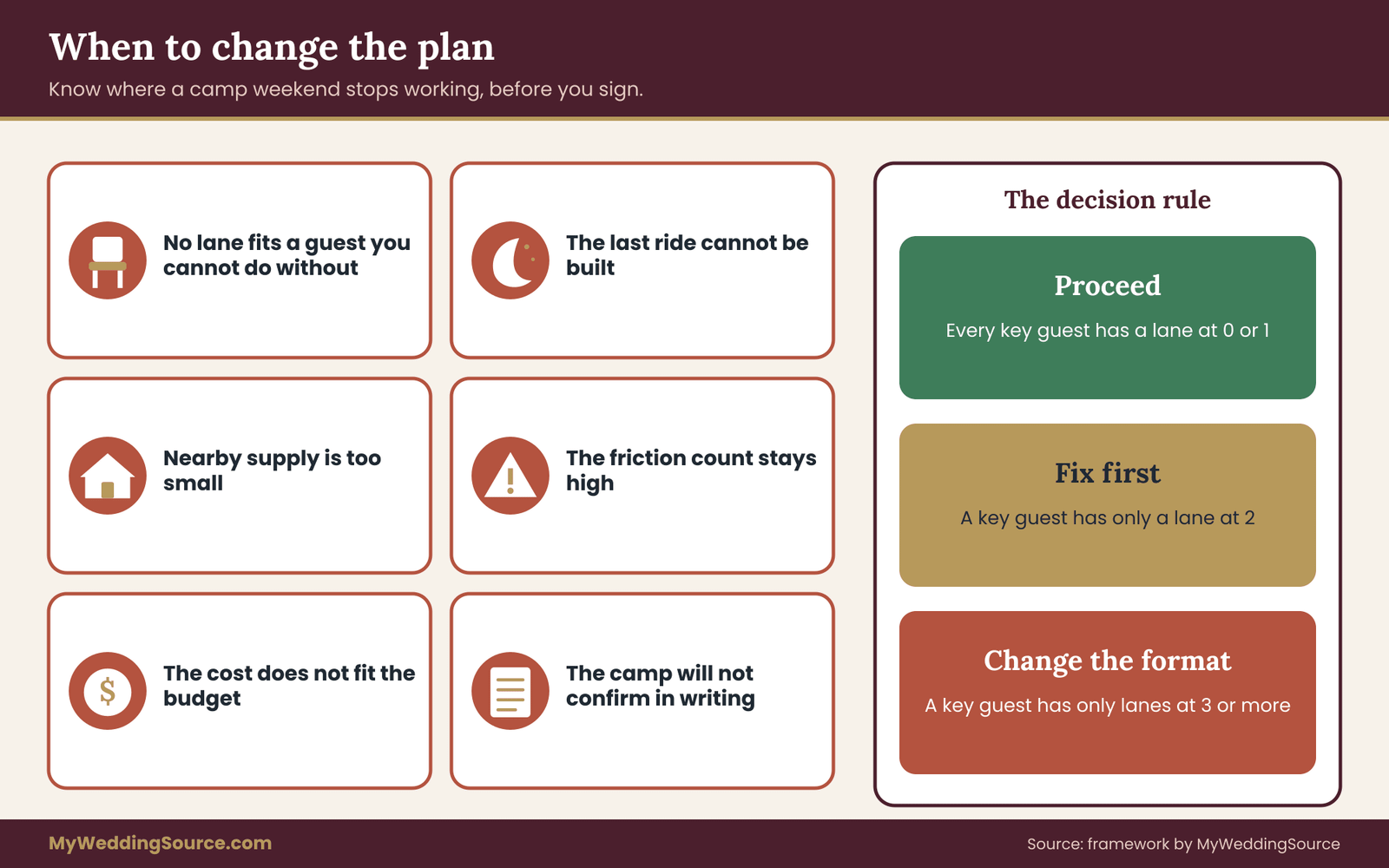
No lane fits a guest you cannot do without
If a person who must attend, perhaps a parent or grandparent, cannot use any camping alternative because of mobility, health or distance, no clever shuttle will fix it. Options are to move part of the weekend to a more accessible place, to choose a different venue for the main event or to host a smaller gathering at the camp and a separate celebration elsewhere. The venue guide can help you think about what to ask of a replacement.
The last ride cannot be built
If you cannot arrange a safe way home for guests in the off-site camping alternatives, because the operator is unavailable, the road is unsuitable or the gate hours do not work, then you should not run a late party that depends on it. End the event earlier, move the party earlier in the day or bring more guests onto the grounds by securing more upgraded beds. This is the failure condition that matters most for camping alternatives away from the grounds.
The nearby supply is too small
When the number of nearby rooms is smaller than the number of guests who need them, and the farther town cannot be served by a shuttle, guests will be left without options. Responses include inviting fewer guests to the overnight part, offering a day-only schedule to more people, or finding a second venue closer to lodging.
The friction count stays high
A camping alternative with three or more points that you cannot lower is a camping alternative you should not offer. Tell guests honestly that it is not available rather than offering a poor one. A smaller set of good options is better than a long list of weak ones.
The cost does not fit
If the shuttle, holds and extra costs push your budget past a limit you set, review the weekend schedule. Cut an event that creates trips, shorten the shuttle’s billed time, or pass through costs openly. Do not hide a shortfall by cutting the safety measures such as the last ride.
The camp will not cooperate
If the camp refuses to confirm vehicle access, gate times or the use of private units, you lack key facts. Ask again in writing. If the answers stay vague, consider whether this is the right place. The contract is the point at which you can still change your mind. A camp that will not confirm its rules cannot support camping alternatives that cross its gate.
Conditions turn on the day
Severe weather, a closed road or a failed vehicle can break the plan on the day itself. A written fallback, a reserve bed and a person with authority to make the call keep a bad moment from becoming a crisis. Tell guests the fallback before the weekend so it is not a surprise. Bad conditions hit the farther camping alternatives first.
A short decision rule
If every guest you cannot do without has at least one lane with a friction count of one or none, proceed. If one has only a camping alternative at two, fix it first. If any has only camping alternatives at three or more, change the format. That is the whole rule, and it is deliberately blunt.
Your next steps
- Write your own limits: minutes you consider a comfortable drive, the number of trips you will accept and your cost ceiling.
- Sort your guest list into the five camping alternatives with a quick, private survey or your own knowledge, and count the parties in each.
- Call the camp about private units, gate hours, vehicle access and rules, and ask for answers in writing.
- Phone every property within your drive limit, record rooms and terms, and place any holds you can.
- Drive the route at night, or ask someone who can, and record the real minutes and surprises.
- Get one quote from a licensed transport operator for the longest route, and ask about split segments.
- Fill in the comparison sheet and count friction points, then fix any camping alternative at two or more.
- Write the guest note and RSVP wording, with the camping alternatives, costs, ride times and deadlines.
- Share the plan with the camp and confirm that nothing conflicts with its rules.
- Set calendar reminders for cancellation dates, the shuttle’s final count and a check on the weather.
FAQ
What are good camping alternatives for wedding guests?
The usual ones are a private cabin or lodge room on site, a hotel, inn or rental nearby, a room in a farther town with a shuttle, a day visit for local guests and attendance at a single event. Which ones fit depends on how far the rooms are, how many exist and who needs them. Compare them on minutes, trips, the last ride, cost and fit before you promise any.
How far should a hotel be from a camp wedding?
There is no standard distance. Set your own limit for a comfortable drive, then measure the real route in daylight and after dark, since gravel roads and gates slow people down. A range is more honest than one number. If the only rooms are farther than your limit, plan a shuttle and a published last ride rather than hoping guests manage.
Do I have to pay for guests who do not want to camp?
Usually not, though customs differ. Many couples ask guests to pay for their own rooms and cover the events themselves. What matters is that the rule is stated and applied to everyone, including how camp bunks are charged. If you want to help a particular guest, do it privately and kindly rather than publishing a list.
Is a shuttle really necessary?
Not always. It helps when several guests are staying in the same direction, the road is long or dark, or many people will be drinking. For a short, easy route a few arranged rides may be enough. In either case, write down how each off-site guest will get back at the end of the night, because that gap causes most problems.
How do I ask guests about lodging without pressure?
Offer a short list of options with plain descriptions and let each party choose one, with an optional line for needs. Avoid asking whether someone will camp. Say that every choice is welcome and that guests may change by a stated date. Guests answer honestly when they do not feel judged for choosing a room.
What if a guest cannot attend the whole weekend?
Invite them to the events that suit them and say that clearly. Many guests can give you an afternoon but not two nights. State the time of each event, whether it is optional and how they can get home. A warm, specific invitation to one event reads as a welcome, not a snub, and it gives you an honest headcount.
Can I rely on short-term rentals for guests?
They can fill a gap, and they suit groups of friends, but check the host’s rules on guest numbers and events, the cancellation terms, and who answers the phone if a guest arrives late. A rental has no front desk. Guests should read the terms before booking, and you should avoid presenting any rental as an official recommendation.
When should I give up on a camp venue because of lodging?
When no lane works for a guest you cannot do without, when you cannot build a safe last ride, or when the friction count stays high after you have tried to fix it. At that point consider a different venue, a shorter schedule or a smaller overnight group. Deciding before you sign is far cheaper than deciding at midnight on the day.
Sources
- National Park Service, visitor guidance and fire safety information
- U.S. Forest Service, recreation, camping and fire restriction information
- ADA.gov, U.S. Department of Justice Americans with Disabilities Act information
- U.S. Access Board, accessibility guidelines and standards
- Centers for Disease Control and Prevention, tick and insect protection
- National Weather Service, forecasts, alerts and sunrise and sunset information
- Ready.gov, emergency and severe weather planning
- National Highway Traffic Safety Administration, impaired driving prevention
- Federal Motor Carrier Safety Administration, commercial carrier registration and safety
- American Camp Association, camp standards and accreditation