

A cash wedding registry works when you name what the money is for, make giving easy on a platform whose fees you have read, and keep a small list of physical gifts beside it for guests who would rather wrap something.
Somewhere between the shower plans and the seating chart, most couples hit the same quiet decision: do we ask for money? You may already share a kitchen full of mismatched pans, you may be saving for a down payment, or you may simply know that your friends would rather send a Venmo than ship a blender. Then the second-guessing starts. Will a fund look greedy to Grandma? What do we write? Which site takes the smallest bite? And does the IRS care?
Those questions are reasonable, and they have more concrete answers than the internet’s mood suggests. The Knot Worldwide’s 2026 Annual Registry Study, which surveyed 1,759 engaged and married members, found that 75% of couples include a cash fund and 56% combine traditional gifts with cash, so asking for money is now a mainstream choice rather than a risky one. What still varies is the execution: the wording, the platform, the way you handle envelopes at the reception, the thank-you notes, and the tax and mortgage paperwork if a large gift shows up.
This guide stays on those execution questions. It covers etiquette and wording for each place you might make the ask, a fee and payout comparison for the platforms couples actually use, ways to blend cash with traditional gifts, what guests tend to give, general gift-tax and payment-app basics from IRS sources, and how to thank people well.
It deliberately does not repeat what to put on a home registry (see our wedding registry ideas piece) or how to trip-plan a honeymoon fund (see the honeymoon fund registry guide), and the fine print on withdrawal charges lives in wedding registry hidden fees. Nothing here assumes that parents are paying, that your wedding is formal, or that a bigger total means a better registry. Where a number comes from a survey, a platform’s own page or our arithmetic, the text says so.

Should You Ask for Cash, or Is a Hybrid Registry Better?
Before wording or platforms, the useful question is whether a cash wedding registry fits your guests and your life. For many couples the honest answer is “mostly yes, with a few physical items,” and that answer rests on data, not on mood. This section lays out what couples and guests actually do, which situations make cash the practical choice, and where the approach can fall short.
Does a cash registry fit your guest list?
What do couples and guests actually do?
The Knot Worldwide’s 2026 registry study (survey of 1,759 members, data collected May 2026) reports that 75% of couples include a cash fund and 41% say cash is the gift they want most. On the guest side, The Knot’s guest figures, which do not state their year on the page we read, report that 40% of guests give cash, 50% give a physical gift and 10% give a gift card.
Read those two numbers together, with the caveat that they come from different surveys and different years, and a pattern emerges: couples ask for cash more often than guests give it, which is one reason a pure cash registry can leave an awkward gap. AARP’s January 2025 etiquette column, written by Lizzie Post, cites The Knot’s 2023 registry study as showing 74% of couples registering for cash, so the practice has been steady for several years. All of these come from a company that sells registries, so they describe common practice, not a verdict on what suits your family.
Which situations make cash the practical choice?
Cash is the natural fit when the things a registry would normally supply are already in your cabinets. Couples who live together, couples marrying for a second time, couples with a small guest list, and couples saving toward one large goal such as a down payment all tend to find a home-goods list thin. The Knot’s registry etiquette page says couples who already share a home can ask for cash toward goals like buying a house or covering pet adoption fees.
A second sign is guest geography: when many invitees travel, a fund spares them from shipping boxes and spares you from hauling gifts home. In our editorial view, a third sign is the people themselves, since friends who are in their twenties and thirties and use payment apps daily often find a fund easier than a store login.
What are the honest downsides?
Where can cash feel awkward for guests?
The friction is rarely the money and almost always the framing. A guest who sees “send us money” with no reason attached may feel like a vendor receiving an invoice, while the same guest told “we’re saving toward a down payment” often feels like an investor in a good plan. Guests also worry about amounts, since cash has no price tag to hide behind.
Lizzie Post’s AARP advice captures the guest’s side: there is no fixed amount, the idea that you must “pay for your plate” is outdated, and a bill handed over bare feels perfunctory while the same cash with a handwritten note can be meaningful. Your job is to lower that anxiety through wording and options, which the next section covers.
What do you give up by skipping physical gifts?
You lose some things you may not notice until later. Retailers’ completion discounts, which reward buying leftover registry items at a reduced price after the wedding, only apply to physical registries, so a cash-only approach forgoes them. You also lose the keepsake effect: a set of glasses from a college friend gets used for a decade, while $75 tends to dissolve into the monthly budget. And you lose a graceful path for guests who simply cannot or will not send money, including older relatives who prefer a wrapped box.
Emily Post’s registry guidance says guests do not have to buy from a registry and the giver always decides, so some physical gifts will arrive whatever you do. Expect that and plan to welcome them.
| Approach | Strength | Weakness | Fits best when |
|---|---|---|---|
| Cash only | Simplest to run; flexible use of money | Some guests feel stuck; no completion discount | Couple owns a full home and has a clear goal |
| Gifts only | Familiar to every guest; discounts apply | Can fill the home with items you will not use | Couple is setting up a first household |
| Hybrid (small list plus named funds) | Gives every guest a choice and a price point | Two things to maintain and track | Mixed guest list across ages and habits |
How Do You Word the Ask Without Sounding Like a Bill?
The wording of a cash request does most of the emotional work. The same fund can read as a warm invitation or a payment demand depending on three or four sentences. This section breaks the message into parts, then walks through where each version belongs, because sources disagree on the invitation and the default should be the safest place.
What should the message actually say?
Which three parts make a request gracious?
A gracious request has a goal, an out and a thank-you. The goal tells guests what the money does (“a down payment on our first home,” “new flooring for the house we just bought”). The out tells them the gift is optional, and The Knot’s honeymoon-fund wording guide says to make clear that contributions are voluntary and that your presence is the main gift. The thank-you comes first in tone, not last: opening with gratitude that people are coming sets the temperature before any request appears. Keep the whole message to two or three sentences on your website, because a long explanation reads as defensive.
What does that sound like in practice?
Here are three versions in our own words, written as editorial examples rather than quotes. A website line: “Your presence is the gift we are looking forward to most. If you would like to give something, we are saving for a down payment, and you will find that fund and a short list of household items below.” A line for a shower host to pass along: “They have a full kitchen already, so they are collecting toward a first house; a small registry is available too.”
A spoken answer when an aunt asks what you need: “Honestly, we have most of the stuff. We are putting money toward a house, but a card is plenty.” Notice that each version names a reason, offers a choice and avoids an amount. The Knot’s examples, such as “No gifts are required, but if you insist, we’d very much appreciate a contribution,” are similar in spirit and can be adapted.
Where should the ask go, and where should it stay out?
Where do the sources disagree about invitations?
They disagree, and it is worth knowing before you order paper. Emily Post’s registry etiquette says not to include any registry or gift information on the wedding invitation or any enclosure, and to share details by word of mouth and on your wedding website. The Knot’s registry etiquette page also says details should stay off formal invitations because they can suggest that gifts matter more than guests, and it recommends an information insert carrying only your website link. The Knot’s honeymoon-fund wording guide, though, offers invitation-based examples, including a sentence at the bottom of the invitation or a separate card.
In our editorial view, the safest default is the website plus a website insert, with the shower invitation as the one paper place where gift details are normal, since Emily Post says showers exist for the giving of gifts.
How do word of mouth and the wedding party fit in?
Word of mouth carries more weight than any paragraph on a website. Emily Post advises telling close family and the wedding party where you are registered because guests will ask them, and the same logic applies to a cash fund: give those people a one-sentence answer they can repeat. A short script (“They’re saving for a house, and there’s a fund on their site if you’d like”) prevents a dozen different paraphrases, some of which will sound like demands.
Emily Post also advises against sharing registry links on social media, even when a platform encourages it, so keep the fund off public posts and on the website. If someone asks you directly, answer directly and warmly; there is no etiquette rule against answering a question you were asked.
| Channel | Safe default | Where sources differ |
|---|---|---|
| Wedding website | Clear fund description and a link | None; every source here endorses it |
| Wedding invitation | Nothing about gifts | The Knot’s wording guide shows examples; Emily Post says no |
| Website insert in the envelope | Link only, no request | Allowed by The Knot; Emily Post says no enclosures |
| Shower invitation | Registry or fund details are normal | Few disagreements; keep the tone optional |
| Word of mouth | Tell family and the wedding party | Few; use one repeatable sentence |
| Social media | Skip | Platforms encourage sharing; Emily Post advises against |
Which Platform Should Hold the Money, and What Will It Cost?
Platforms differ less in headline price than in the small print: who pays the card fee, how long the first transfer takes, and whether a Venmo gift travels through the platform or around it. This section compares the sites couples most often use for cash on the same questions, then looks at the do-it-yourself option of sharing a Venmo handle, where one mislabeled payment can change the fee.
How do the main registry platforms compare?
What do The Knot, Zola and Joy publish about fees and payouts?
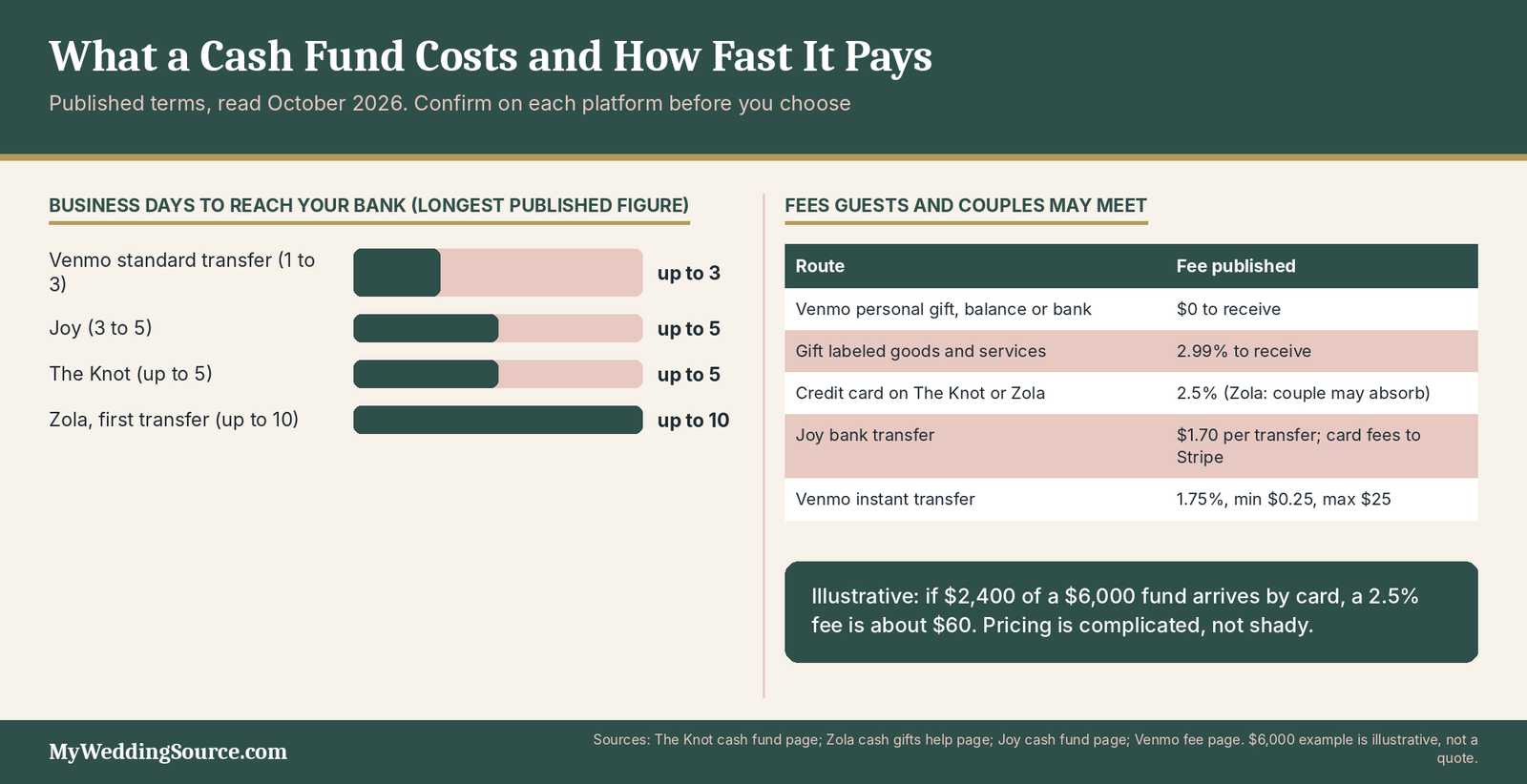
Each of these three says it takes no cut of your cash gifts, but the fine print differs. The Knot’s cash fund page says Venmo contributions carry no fee, credit cards carry a standard 2.5% processing fee that The Knot does not keep, and deposits to your bank take up to five business days.
Zola’s cash-gift help page, which describes honeymoon funds, lists a 2.5% card fee that you can absorb or pass to guests, says your first transfer usually takes up to 10 business days with later ones taking two to four, and offers a store-credit option with a 5% bonus. Joy’s cash fund page says Joy charges nothing on cash gifts, that card payments run through Stripe (the page does not state Stripe’s rate), that bank transfers carry a flat $1.70 per transfer, and that transfers typically arrive in three to five business days.
These are platform statements read in October 2026, so confirm each on its own page before you pick one.
| Platform | Guest options | Fee stated | Time to your bank |
|---|---|---|---|
| The Knot cash funds | Venmo or card | 2.5% on cards; Venmo $0 | Up to 5 business days |
| Zola | Card, PayPal, Venmo | 2.5% on cards, couple may absorb | First transfer up to 10 business days; later 2 to 4 |
| Joy | Card, Venmo, PayPal, Cash App, mailed cash or check | Stripe fees on cards; $1.70 per bank transfer | Typically 3 to 5 business days |
| Honeyfund | No guest fees listed by The Knot’s roundup | 2.2% for PayPal or Venmo redemption; Stripe fees on bank deposit | Not stated on page read |
How should you read “zero fees” claims?
Treat “zero fees” as a claim about the platform, not about the payment pipe. A card payment always passes through a processor, and someone pays that cost: Joy says processing fees on cards go entirely to Stripe, The Knot says its 2.5% goes to the processor, and Zola lets you decide who covers its 2.5%. The Knot also says its fee is typically lower than the taxes and shipping on a physical gift, which is a plausible comparison but is the publisher’s own claim.
The practical test is arithmetic: ask what a $200 card gift and a $200 Venmo gift each leave in your account after the guest’s checkout, and whether the answer changes if you choose “guest covers the fee.” The honeymoon-focused platforms, including Honeymoon Wishes with its larger guest-side charges, are compared in more depth in our honeymoon fund registry guide.
Should you just share a Venmo handle?
What does Venmo charge, and where is the goods-and-services trap?
Venmo’s fee page says sending a personal payment from a balance, debit card or bank account costs $0 and receiving a personal payment is free, unless the sender identifies it as goods and services, in which case a 2.99% seller fee applies. Sending with a credit card costs the sender 3.00%. Moving the money out has its own choices: a standard transfer to your bank is free and typically takes one to three business days, while an instant transfer costs 1.75% with a $0.25 minimum and a $25 maximum.
For example, an instant transfer of $1,000 would cost about $17.50, while a standard transfer of the same amount costs nothing and arrives in a day or three. Because guests choose how to label the payment, put one sentence on your website asking them to send it as a personal gift, never as goods and services.
What are the practical risks of a handle or QR code?
A bare handle is simple, but it lacks the structure that a registry platform provides. Nothing records a goal, nothing hides a total, and nothing builds a gift list for your thank-you notes, so a guest’s payment can arrive as “Sam M. $50” with no note and no way to tell which Sam. A handle shared widely can also be mistyped, and a payment sent to the wrong similar-looking name may be difficult to recover, so ask guests to confirm your display name and a profile photo before sending.
We could not read the consumer-protection guidance on this point during research, so check your payment app’s own help pages for how wrong-recipient payments are handled. In our editorial view, a handle works best as a secondary option listed beneath a registry fund, not as the only door.
How Do You Blend Cash With Traditional Gifts?
The Knot’s 2026 study calls the mix of traditional gifts and cash “hybrid registries” and reports that 56% of couples use one. A hybrid is not a compromise made out of timidity; it is the layout that matches how guests actually give. This section shows three workable structures, how to price funds so guests can choose an amount without anxiety, and how to treat gifts and traditions that arrive outside your plan.
What does a hybrid registry look like?
Which structure matches your situation?
Three structures cover most couples, and the choice depends on how much you truly need. A “mostly cash” layout pairs one or two named funds with a short physical list, a “balanced” layout splits the page roughly evenly, and a “mostly gifts” layout keeps a full list with one fund as an option. The right split is whichever leaves every guest a comfortable path. Our wedding registry ideas article covers how many physical entries to list for a given guest count, so here the focus is on the fund side and on how the pieces fit together.
| Layout | Physical list | Funds | Fits when |
|---|---|---|---|
| Mostly cash | 10 to 20 items under $75 | 2 to 3 named funds | Couples with a full home and one big goal |
| Balanced | Around 40 items across price tiers | 1 to 2 funds | Mixed guest list across ages |
| Mostly gifts | A full list from one to three stores | 1 general fund | First-household couples who still want flexibility |
How do you price funds so guests can choose an amount?
The Knot’s cash fund walkthrough lets you set contribution increments and says some guests are unsure how much to give, citing a $50 increment that guests can give in one or more amounts. Increments solve the problem of the blank box: a guest can choose one unit or three without calculating anything. A named fund with its own picture also helps, because “Sofa fund” invites a different amount than “Cash.”
You can hide the goal total on The Knot, and Zola says that if you hide the total, a guest who tries to exceed it is asked to contribute less, so check how your platform behaves before you publish a goal. We suggest avoiding any wording that implies an expected amount per guest, since the point is to lower pressure.
How do you handle gifts that arrive outside the plan?
What do you do with physical gifts from guests who ignore the fund?
You thank them, and you do not apologize. Emily Post’s registry guidance says guests do not have to purchase from the registry, offering the example that great-aunt Edna might still buy a blender, and the AARP column from Lizzie Post says a guest who prefers a physical gift for a cash-requesting couple may give it with a gift receipt. That receipt is your exchange path. Keep a log of the gift, the giver and the store, because the return policy sits with the store and a note about the receipt saves a follow-up question. Never suggest to the giver that the gift was less welcome than money would have been.
How do envelope traditions fit with an online fund?
Many families give cash in a card regardless of what a registry says, and in several traditions the envelope is the point. The Knot’s red envelope article, quoting planners from Chinese, Vietnamese and Taiwanese backgrounds, says guests often bring red envelopes, that even numbers are preferred and amounts ending in eight are popular, that the number four is avoided because it sounds like the word for death, and that most guests give up to $500. These are cultural practices described by those experts, not rules for everyone, so ask your own family what is customary.
If envelopes will arrive in person, plan a safe place to hold them and a simple way to log them, which the next section covers, and consider noting on your website that cards are welcome in addition to the fund. An online fund and a card box can coexist without either one competing with the other.
What Do Guests Typically Give, and How Do You Handle Cash on the Day?
Guests wonder about amounts and couples worry about envelopes, and both questions have practical answers. This section summarizes the published guest figures with their caveats, explains why suggested amounts tend to backfire, and sets out who should hold the card box, the checks and the log on the wedding day.
What do guests usually give?
What do The Knot’s guest figures say?
The Knot’s guest-spending article, updated in August 2026, reports that guests spent an average of $150 on a wedding gift, with $140 for casual friends, and that 40% gave cash, 50% a physical gift and 10% a gift card. It does not state the year of the underlying guest study, so treat these as rough guides. The same article gives a suggested cash amount by relationship, running from $75 for a distant relative or friend of a friend to $250 for a best friend or immediate family.
Note that the article is not fully consistent with itself (its table gives $100 to $150 for acquaintances while its text mentions $50 to $100), which is a reminder that every such range is a convention and not a rule.
| Relationship | Suggested cash gift |
|---|---|
| Best friend or immediate family | $250 |
| Close friend | $200 |
| Good friend | $175 |
| Extended family member | $150 |
| Acquaintance or coworker | $100 |
| Distant relative or friend of a friend | $75 |
Why should you avoid publishing a suggested amount?
Because the guest, not the couple, sets the number. Lizzie Post’s AARP column says there is no fixed amount, that budgets should guide the gift, and that the notion of covering your plate is outdated, especially for guests who travel. A published figure turns a gift into a price, and any guest below it feels under-delivered. Increments and named funds are the gentle alternative, since they offer a menu without stating a bill. If a guest asks what is typical, point them to the fund’s smallest unit and say any amount is welcome.
Who handles the envelopes, checks and records on the day?
How should the card box be staffed and protected?
Assign a person, not a box. The Knot’s cash gift guidance says guests can hand cards to the gift table, a wedding party member or the planner, and that cards should make clear who the money is from. Pick one trusted adult who is not in the middle of the receiving line, tell the planner or venue coordinator who it is, and move the box to a secure place when the reception winds down. We could not find published data on how often card boxes go missing, so this advice is editorial judgment rather than a statistic.
A closed box with a slot and a person watching it costs almost nothing and removes most of the worry.
What do you do with checks, cash and the log afterward?
Open envelopes in one sitting with a second person, record each giver and amount in a log, and deposit checks promptly. Include the card itself in your records, because a card often says whether a gift is from one person or a family and sometimes where a guest has asked you to use it. For checks made out to a name you do not use on your bank account, ask your bank how it handles them before the wedding rather than after.
For a Venmo or fund gift, the platform usually records the donor’s name (The Knot says each donor is recorded), but a payment-app note may not, so add those lines to your log as they arrive. That single list becomes the backbone of your thank-you notes, covered below.
| Task | Suggested owner | When |
|---|---|---|
| Hold the card box during the reception | One trusted adult | Arrival to last dance |
| Move the box to a secure place | Same adult plus planner or venue contact | End of reception |
| Open envelopes and log gifts | Couple plus one helper | Within a few days |
| Deposit checks | One partner | As soon as logged |
| Add payment-app and fund gifts to the log | Other partner | Weekly until the fund closes |
What Do Cash Gifts Mean for Taxes and Mortgages?
Money questions get anxious fast, so it helps to know where the lines are. This section is general education drawn from IRS and Fannie Mae pages, not tax, legal or lending advice, and your own state and circumstances can change the answer. It covers who the gift-tax rules apply to, what payment-app reporting means, and what to do if a relative offers something large or you hope to use the money for a home.
Do you owe tax on wedding cash?
What does the IRS say about who pays gift tax?
The IRS gift-tax FAQ says the donor is generally responsible for paying any gift tax, not the person who receives the gift. It lists an annual exclusion of $19,000 per recipient for 2026, which in general terms is the amount a donor can give one person in a year before the gift starts to count against a lifetime exemption, and it shows a combined $38,000 per recipient when two spouses give. The same page says the basic exclusion amount for gifts is $15,000,000 for calendar year 2026.
A guest who gives $50, $200 or even $1,000 is nowhere near those thresholds, and the filing question, where one exists, belongs to the giver. For a 100-guest wedding, the question is mostly academic; it matters only when one person gives something large.
What about payment apps and Form 1099-K?
This is the part that surprises couples, so it is worth a few sentences. IRS guidance on Form 1099-K says money from friends and family, such as birthday or holiday gifts, is not reported on the form and “aren’t taxable income,” and it advises marking such payments as non-business in the app when possible. The IRS page says reporting for payment apps and marketplaces is triggered when payments for goods or services exceed $20,000 in more than 200 transactions, though you may receive a form with lower amounts, and that card payments have no threshold.
The page we read did not state the tax year, so confirm current thresholds on IRS.gov. We did not find a platform page explaining how registry cash funds are reported, so if you receive a Form 1099-K for wedding gifts, ask the platform to explain it in writing and talk to a tax professional rather than guessing.
| Situation | General position from IRS pages | What to do |
|---|---|---|
| Guest gives $50 to $1,000 | Giver’s matter; far below the $19,000 exclusion | Log it, write a thank-you |
| Several guests send payment-app gifts | Friends-and-family gifts are not taxable income per IRS | Ask guests to mark gifts as personal |
| Relative gives $20,000 or more | Donor may have a filing question | Suggest they ask their own tax professional |
| You receive a Form 1099-K for gifts | Form does not change what is taxable | Ask the platform; consult a preparer |
| Gift of stock or property | Recipient generally keeps the donor’s cost basis | Ask about tax on a later sale |
When does a large gift need more attention?
What if a parent or relative offers a very large gift?
Suggest they check with their own tax professional, and do not try to structure the gift yourself. The IRS FAQ says the donor is generally responsible and that spouses can each use the exclusion, but it does not state a filing threshold on the page we read, so we will not guess at one. Large gifts sometimes come with a request to keep records, such as a note stating the purpose, and that is a reasonable thing to accept.
Thank the giver in the same warm way you would thank someone who gave $50, and avoid asking what the amount “means” for them tax-wise, since that is their business. If the money is a loan in the giver’s mind and a gift in yours, clear that up in writing before you spend it.
Can wedding cash go toward a down payment?
Possibly, but lenders treat large deposits and gift funds with documentation requirements that a stack of guest envelopes does not fit neatly. Fannie Mae’s selling guide says a gift must come from an acceptable donor (relatives, and also a domestic partner, a person engaged to marry the borrower, or an individual with a long-standing familial-like or mentorship relationship), that the donor signs a letter stating the amount, that no repayment is expected and the donor’s name, address, phone and relationship, and that the transfer must be documented.
It does not mention wedding gifts or cash from many guests, so we cannot tell you how a lender will treat accumulated envelopes. A 2017 article from a mortgage lender, Atlantic Bay, notes that collecting signatures and bank statements from many guests is burdensome and that lender requirements vary, though the piece is promotional and dated. The practical step is to ask your lender early how they treat wedding gifts, deposit gifts into a clearly labeled account, and keep your log.
How Do You Thank Every Giver and Keep a Clean Record?
A cash gift can feel awkward to thank, because you cannot praise its color or its fit. That is why many couples under-write these notes, and why the guidance is worth reading. This section covers what to say, whether to mention the amount, when the deadlines fall, and how a simple log makes the whole task manageable.
What should a thank-you for cash say?
Should you mention the amount?
Sources disagree, and the safe answer is to skip it. Emily Post’s thank-you advice says to refer to the way you will use a gift of money and that mentioning the amount is optional. Zola says it is best not to mention the exact amount, and Inside Weddings writer Emily Lasnier advises never naming the amount and simply thanking the loved one for their generosity. In our editorial view, leaving the figure out costs nothing and removes any chance of sounding like a receipt. Keep the specific detail for the use, which is where the warmth is.
What does a good note sound like?
A good note names the giver, names the use, and says something about the person. An editorial example: “Dear Maria and Jon, thank you for coming all the way from Denver and for your generous gift. It is going straight into our house fund, and we already picture a Saturday morning when we can say you helped us paint the kitchen. We loved seeing you on the dance floor.”
Emily Post’s advice is to personalize the note with reference to the person as well as the gift and not to scale effort to the gift’s price, and to avoid form letters, a generic website post or email in place of a note. Zola’s advice is to keep it short with a pleasant sign-off. Three or four sentences are enough.
When are the notes due, and how do you track them?
What are the deadlines?
The Knot’s registry etiquette page says to send thank-yous within two weeks of arrival for gifts received before the wedding and within three months for gifts received on or after the wedding day. Zola’s thank-you guidance gives a similar standard, two to three weeks for pre-wedding gifts and within three months of the wedding, and adds that later is always better than never. Emily Post says not to use being late as an excuse, and that even if you are still writing after your first anniversary, you should keep going.
Gifts that arrive by mail deserve a quick acknowledgment first, such as a phone call, with the written note to follow within a few days.
| When the gift arrives | Suggested timing | Source of the guidance |
|---|---|---|
| Before the wedding (shower, mailed card, fund) | Within 2 to 3 weeks | The Knot; Zola |
| At or after the wedding | Within 3 months | The Knot; Zola |
| Late for any reason | Send anyway | Zola; Emily Post |
| Shipped or mailed cash or check | Quick call, then a written note within days | Emily Post |
What belongs in the gift log?
Keep five columns: giver, date received, form (card, check, Venmo, fund), amount, and thank-you sent. The amount column is for you, not the note. The Knot says it records each donor’s name with their contribution on its cash funds, but a payment-app payment may show only a handle, so add a “who is this?” column and ask a family member to help identify names. Record when each check was deposited and when each fund payout arrived. One spreadsheet, one owner, and a weekly ten-minute update beat a heroic Saturday after the honeymoon.
Which Cash Registry Mistakes Cost the Most, and How Do You Fix Them?
Most cash registry problems are small and preventable. They come from vague wording, untested checkout flows, and delays no one planned for. This section groups the mistakes by when they happen and pairs each with a fix, so you can check your plan against it before the link goes out.
Which mistakes happen before the link goes out?
What goes wrong with wording and goals?
The most common mistake is a fund with no reason. “Cash gifts” tells guests nothing, while a fund named for a goal gives them a story to join, as The Knot’s cash fund guidance implies when it cites a honeymoon dinner as an example of a fund that helps guests feel they are giving something meaningful. A second is mismatched messages: an invitation that says “no gifts please” on one page and a registry link on another confuses everyone.
A third is choosing a goal number you will not hit and displaying it, which can feel like a countdown of shame; you can hide the number on The Knot and Zola. Write one sentence, name the goal, and reuse that sentence everywhere.
What goes wrong with the checkout?
Many couples never see the fund the way a guest does. The Knot’s cash fund walkthrough lets you preview a fund as a guest, and that step catches confusing amounts, a missing photo or a card-fee message guests do not understand. Make a test contribution if the platform allows it, or ask a friend to try the Venmo or card path and tell you what felt unclear. Check the shipping or mailing address that Joy shows to guests who send a check or cash, since that address becomes public to every guest who uses it. A ten-minute test is cheaper than a confused aunt.
Which mistakes happen after the link is live?
What goes wrong with money and timing?
The classic problem is a payout that arrives after a deposit is due. Platform timing runs from three to five business days (Joy) to five (The Knot) to ten for a first Zola transfer, so if you plan to use fund money for a vendor payment, request the transfer weeks ahead and do not count on the money on the day. A second problem is unclear fee ownership: decide whether you or the guests cover the card fee before the first gift lands.
A third is mixing fund money with everyday accounts; deposit into a labeled account so you can show where the money went, which matters for a lender and for your own sanity.
What goes wrong with records and thank-yous?
Records fail quietly. Payment-app gifts arrive with a handle but no card, checks get deposited without being logged, and the thank-you list ends up in three places. Pick one log in week one, and add every gift the day it arrives. Cash is also the easiest gift to forget to thank, because no object reminds you, which is why we suggest sending notes in batches every week or two during the engagement. Sending a note a little late is far better than sending none.
| Mistake | Cost | Fix |
|---|---|---|
| Fund with no stated goal | Guests hesitate or give less | Name the goal in one sentence |
| Different messages in different places | Confusion; awkward questions | Reuse one sentence everywhere |
| Never testing guest checkout | Failed or confusing gifts | Preview and test before sharing |
| Payout arrives after a deadline | Late fees or a scramble | Request transfers weeks early |
| No gift log | Missed thank-yous | One log, updated on arrival |
FAQ: Cash Wedding Registry
These are the questions couples ask after the first draft of a cash fund exists. The answers lean on the sources named above and flag where those sources disagree.
Asking and wording
Can I put a Venmo QR code on the invitation or save-the-date?
We recommend not doing it. Emily Post’s registry etiquette says not to include registry or gift information on the invitation or its enclosures, and The Knot’s etiquette page says details should stay off formal invitations and go on your wedding website instead. The Knot’s honeymoon-fund wording guide does show invitation-based examples, so you will find advice both ways. A QR code on a save-the-date also lands before guests have decided to attend, which makes the ask arrive early. Putting the code on your website and shower materials gives guests the same access without the paper risk.
What should I say when a guest asks if cash is okay?
Say yes, briefly and warmly, and mention the goal. For example: “That would be lovely, we are saving for a house, and there is a fund on our website.” Emily Post advises telling close family and the wedding party where you are registered because guests ask them, so give those people the same sentence. Do not name an amount, and do not apologize for asking. If the guest prefers to give something physical, tell them that is welcome too and mention the small registry.
Should I hide the fund goal or total?
You can, and it is often a good idea if the goal is large. The Knot says you can hide the goal number from guests, and Zola says you can hide the total you hope to receive, with guests who try to exceed a hidden total being asked to contribute less. Hiding the number prevents a visible gap from looking like a shortfall. It also means guests give what suits them without anchoring on a total. If your goal is concrete and modest, such as a $1,200 sofa, showing it can help.
Money, taxes and thank-yous
Do we have to report wedding cash as income?
For ordinary guest gifts, the IRS says gifts from friends and family are not taxable income and that the donor is generally responsible for any gift tax. The 2026 annual exclusion is $19,000 per recipient. This is general education rather than tax advice, so if you receive a very large gift or a Form 1099-K for wedding money, ask a tax professional. Keep your log either way.
Can I use wedding cash for a down payment?
Possibly, but lenders have their own documentation rules. Fannie Mae’s selling guide describes gift letters and transfer documentation for gift funds, and it does not address cash from wedding guests, so ask your lender how they treat it before you apply. Large deposits generally need an explanation, and a clean log and a labeled account make that conversation easier. Do not assume that an article written by one lender in 2017 reflects what yours will require now.
Should I mention the amount in a thank-you note?
Leave it out. Emily Post calls mentioning the amount optional, while Zola and Inside Weddings advise against it, and omitting it carries no downside. Instead name what the money will do, such as the house fund or the first trip, and say something about the giver. Send the note within about three months of the wedding, or within two to three weeks for gifts that arrive before it.
Your Next Steps
A cash fund is easiest when the decisions are made before the first guest sees the link. These steps are ordered so that the choices that cost money or create awkwardness come first, and they pair well with the dated tasks in our wedding registry checklist.
This week
What should you decide first?
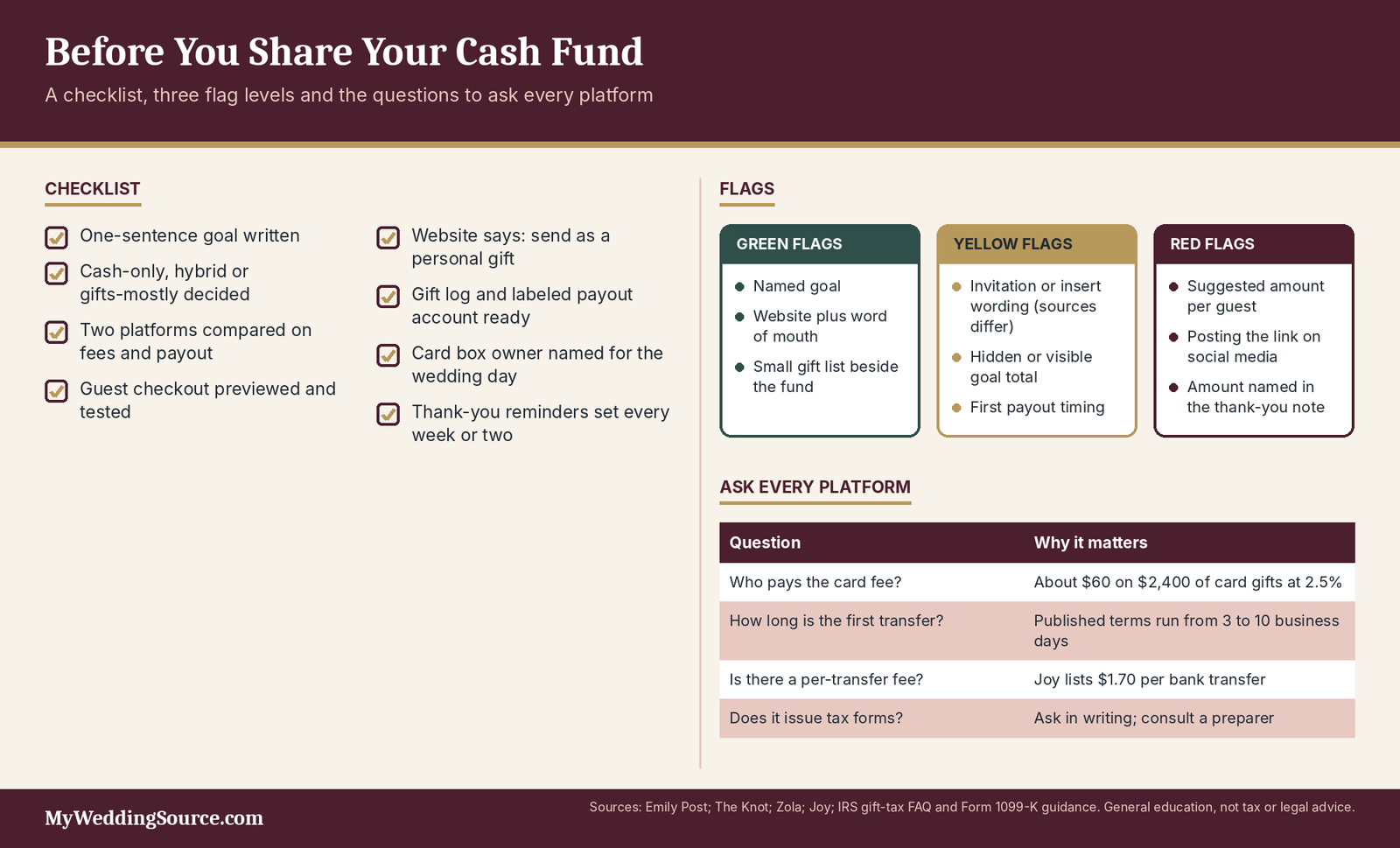
Write one sentence naming what the money is for, then decide whether you want cash only, a hybrid or mostly gifts, using the layouts in the hybrid section. Ask your partner and, if relevant, your families what envelope traditions to expect. Decide who will answer when guests ask “can I send cash?” and give that person the sentence. Those four choices take under an hour and prevent most of the rewriting later.
How do you compare two platforms in thirty minutes?
Open two platforms’ fee and payout pages and write four numbers on one page: the card fee and who pays it, any per-transfer fee, time to your bank for the first transfer and later ones, and which payment methods guests can use. Use the comparison table above as a template and confirm each figure on the platform’s own page. Ask support in writing about anything unclear, and save the reply. If you need help with the surrounding plan, the wedding planning hub and our blog gather related guides.
Before you share the link
What should you test before guests see it?
Preview each fund as a guest and make one small test contribution if the platform allows it. Confirm that the platform’s payout goes to the bank account you want, and check how long the first transfer takes. Make sure your website, shower invitation and verbal script all use the same sentence, and that no invitation or enclosure carries gift details unless you have decided to follow the more flexible advice. For the fee details beyond this guide, see our wedding registry hidden fees article.
What should be in place by the first gift?
Set up a gift log, a labeled account for payouts and a calendar reminder to write thank-yous every week or two. Decide who will hold the card box on the wedding day and who will open envelopes afterward. Note in your calendar that fund payouts can take days to arrive, and request transfers well ahead of any vendor deposit. If a lender or tax question might come up, keep every record in one folder.
Sources & methodology
- The Knot Worldwide: 2026 Annual Registry Study — cash fund adoption (75%), hybrid registries (56%), cash as most-wanted gift (41%), ease-of-use finding, sample of 1,759 members.
- The Knot: Cash registry and funds — setup, increments, hiding goals, 2.5% card fee, Venmo, up to five business days to the bank.
- The Knot: How to give cash for wedding gifts — card advice, delivery options, fee and payout terms, study sample.
- The Knot: How much to spend on wedding gifts — guest averages, cash versus physical split, suggested amounts by relationship.
- The Knot: Wedding registry etiquette — invitation inserts, wedding website, couples who live together, thank-you timing.
- The Knot: Honeymoon fund wording — sample wording, placement advice, optional framing.
- The Knot: Best honeymoon registries — Honeyfund and other platform fee terms (published by a platform that ranks itself).
- The Knot: Red envelope wedding tradition — Chinese, Vietnamese and Taiwanese envelope customs, amounts and numbers.
- Emily Post: Wedding registry etiquette — keeping gift details off invitations, website and word of mouth, no social sharing, giver decides.
- Emily Post: All about registries — guests need not buy from the registry, registries as suggestions.
- Emily Post: Ten wedding thank-you note dos and don’ts — mentioning use of money, optional amount, timing, personalization.
- AARP: Money manners for wedding gifts — Lizzie Post on cash gift etiquette, cash with a note, no fixed amount (January 2025).
- Zola: How cash gifts work — 2.5% card fee, transfer timing, store credit bonus, hidden totals.
- Zola: How does Zola registry work? — cash fund fee and who may cover it.
- Zola: How to write wedding thank-you cards — monetary gift notes, amount, timing.
- Joy: Cash fund registry — Stripe card processing, $1.70 transfer fee, three-to-five-day transfers, payment options.
- Venmo: Fees — personal payment, goods and services, credit card and transfer fees.
- Inside Weddings: What do you write in a thank-you note when you get cash? — not naming the amount, naming the use.
- IRS: Frequently asked questions on gift taxes — donor responsibility, 2026 annual exclusion, spousal gifts, 2026 basic exclusion amount.
- IRS: Understanding your Form 1099-K — friends-and-family payments, thresholds, marking payments non-business.
- Fannie Mae Selling Guide: Personal gifts (B3-4.3-04) — acceptable donors, gift letter contents, documenting transfers.
- Atlantic Bay Mortgage: Weddings and home loans, using gift funds — lender perspective on documenting wedding cash for a down payment (2017, promotional).
Methodology. Verified facts are platform terms and policies read on the platforms’ own pages in October 2026, the IRS statements and the Fannie Mae requirements. Survey findings come from The Knot Worldwide’s 2026 Annual Registry Study and The Knot’s guest figures, both published by a company that sells registries, so they describe common practice rather than best practice. The year of The Knot’s guest study and the tax year for the IRS 1099-K threshold were not stated on the pages we read.
The $6,000 fee example, the hybrid layouts, the sample wording and the thank-you note are our own illustrative arithmetic or editorial judgment and are labeled that way, as are recommendations marked “in our editorial view.” Where sources disagree (invitation wording, mentioning the amount in a thank-you note), the article shows both views.
Freshness note. Recheck card fees, payout times and transfer fees on each platform’s own page before you publish your fund and again before the wedding, because platforms change terms often. Confirm the IRS annual exclusion each January and the Form 1099-K threshold on IRS.gov before tax season. We could not read the IRS publication on income from gifts or the Federal Trade Commission’s payment-app guidance during research, so confirm those points with the IRS or a tax professional. Refresh this article when The Knot publishes its next annual registry study.