

An accessible yacht wedding succeeds or fails at the gangway, not at the altar. This guide gives you a boarding route and transfer assistance inquiry sheet: six legs of the route, four grades of answer quality, a worked case, alternatives, and clear conditions for walking away before you sign a charter.
Before you reserve a vessel for an accessible yacht wedding, break the guest journey into six legs: arrive, approach, cross, enter, move aboard, and leave. Put a written question to the operator for each leg, and grade every answer as measured, written, spoken or assumed. A leg that carries a guest who needs it should be measured or written. Any leg you cannot get past a spoken answer is a reason to pick a different vessel, change the format, or move the ceremony to the dock.
A yacht is a beautiful setting, but an accessible yacht wedding cannot rest on the setting alone, because a boat is a poor default for anyone who cannot step over a gap, climb a steep ramp, or hold a rail while the deck moves. The vessel itself may be fine once everyone is aboard. The trouble is the thirty feet between the car and the deck, and the question nobody asked: who exactly is going to help a guest cross it, and how?
That question is easy to skip. Charter listings show sunsets and champagne flutes, not the gangway at low tide. Sales calls cover capacity and catering. When a couple planning an accessible yacht wedding asks whether the boat is “accessible,” the honest answer is often a cheerful yes that means “we have had a guest with a cane before.” It does not tell you whether a power wheelchair fits through the door, or whether the ramp is rated for its weight.
This article is about the narrow decision of whether and how to ask when you want an accessible yacht wedding that works in practice. It does not repeat the full planning of a boat wedding, the weather rules, or the capacity math, because the site covers those elsewhere. If you want the wider view of venue selection first, start with the wedding venues guide, then come back here for the boarding questions. For the warning signs that show up on land, the checklist of accessible venue red flags is a useful companion.
A note on scope. This is general planning information, not legal, medical or maritime safety advice. Passenger vessel rules, accessibility duties and insurance terms vary by vessel, operator and jurisdiction, so confirm current requirements with the operator and with the agencies listed under Sources.
Why boarding decides an accessible yacht wedding
Most venues are one level of difficulty, which is why an accessible yacht wedding is a different kind of problem. A ballroom has an entrance, a path to the seats and a restroom, and you can walk it with a tape measure in an afternoon. A yacht is a chain of connected transitions, and each one can fail on its own. A guest can be fine with the parking lot, fine with the pier, and stopped cold by a six-inch sill at the deck door.
This is why a general promise of accessibility is not enough information for an accessible yacht wedding. Accessibility on a boat is not a property of the vessel. It is a property of a route, on a given day, with a given tide, with a given crew, for a given guest. Change any one of those and the answer can change.
Think about what a guest with a manual wheelchair actually needs at an accessible yacht wedding. A drop-off point near the pier. A surface that rolls. A path wide enough for the chair and a companion. A way across the gap that is not a lift by hand.
A door the chair clears. A place to sit that is not a fixed bench. A restroom reachable without leaving the group. And, quietly, a way off the boat if something goes wrong. That is seven things, and the operator may have thought carefully about three.
The same chain matters at an accessible yacht wedding for guests who are not wheelchair users. A guest with a walker has a hard time with a narrow, flexing gangway. A guest with low vision needs edges and thresholds marked. A guest who tires easily needs places to stop on a long pier.
A guest who is pregnant, recovering from surgery or carrying a toddler is in a similar position to someone with a cane, for the afternoon. The route serves all of them, which is the reason to design the questions around the route rather than around a list of diagnoses.
There is also a social reason to ask early about an accessible yacht wedding. If the route fails, you want to find out while you still have choices: another vessel, another dock, a different format. Learning it at the pier, with forty guests in good clothes and one grandmother who has been told “the boat is fully accessible,” turns a logistics problem into a family wound. Asking in writing before a deposit costs you a few emails. Asking after costs you a decision under pressure.
Finally, a plain point about expectations. Some vessels cannot be made fully accessible, and that is not a moral failing of the operator. A classic wooden sailing yacht with a high freeboard and narrow companionways is what it is. The honest outcome of good questions is sometimes “this vessel suits eight of our guests and not three,” and then you decide what to do about the three. That is a better place to stand than hope.
How the accessible yacht wedding inquiry sheet works
The inquiry sheet for an accessible yacht wedding is a simple working document. It has six legs of the route, a set of written questions for each leg, and one grade for every answer you get back. You fill it in as the operator responds, and you share the finished version with the people who will rely on it.
The six legs are these. Leg one, arrive: getting from the street or the hotel to the marina, including drop-off, parking and any shuttle. Leg two, approach: the walk or roll from the drop-off to the point where the vessel is tied up, which may be a long pier, a floating dock, or a gate with a keypad. Leg three, cross: the gangway, ramp, steps or direct step-across from the dock to the deck.
Leg four, enter: the first threshold on the vessel itself, such as a door sill, a coaming or a change of level. Leg five, move: getting around once aboard, which includes seating, the ceremony spot, the bar, the dance area and the restroom. Leg six, leave: disembarking at the end, plus getting off in an emergency or if a guest needs to leave early.
For each leg you ask four kinds of question. What is it, physically? What is the limit, in numbers where numbers exist? Who is responsible, by name or role? And what is the fallback if the leg fails on the day? A leg without a fallback is the one most likely to wreck the event, so the fourth question is the one that most often gets a vague answer.
Every answer then gets a grade, and the grading is the part that most couples skip. A measured answer has numbers and a date: “the ramp is 36 inches wide, and slope at low tide was checked in October.” A written answer is a clear statement in an email or contract without numbers: “wheelchair users can board with crew assistance.”
A spoken answer is something said on a call or at a site visit. An assumed answer is what you inferred because nobody said otherwise. We come back to the grades in detail later. For now, remember that the grade matters as much as the content. A confident spoken yes is weaker than a hesitant written maybe.
The sheet has a second job in an accessible yacht wedding plan: it forces the operator to give you the same quality of attention for each leg. Vessels with a good captain often have a good answer for leg five and no answer for leg one, because the marina is not theirs. The sheet makes that visible, and it tells you who else to contact: the marina office, the city that runs the dock, or a shuttle company.
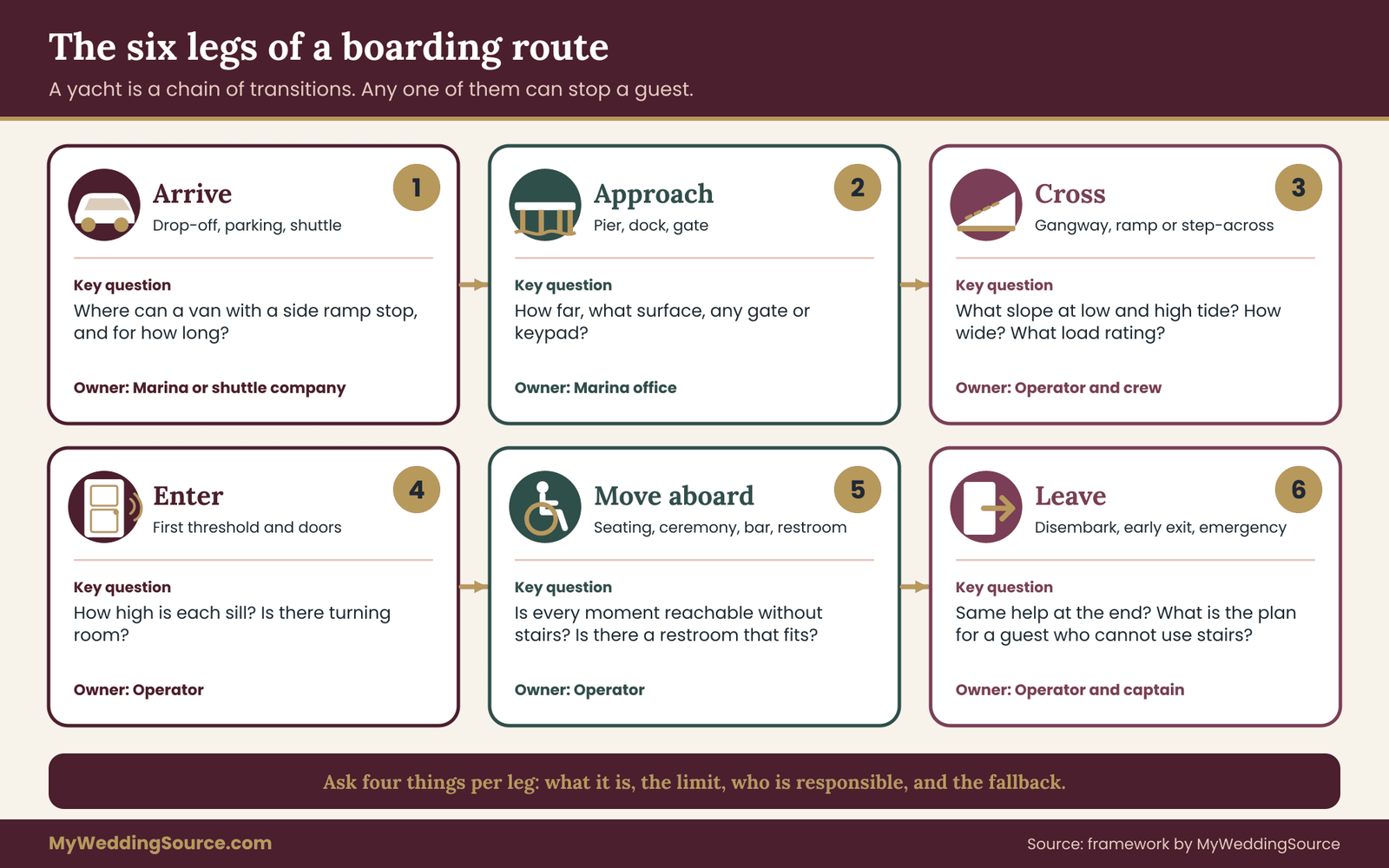
How long does this take in practice for an accessible yacht wedding? The first pass is about an hour of writing and two or three rounds of email. Plan a site visit as a confirmation step, not as the first step. By the time you stand on the dock you should know what you are checking and which answers you doubt.
One more point on purpose. The accessible yacht wedding sheet is not a test the operator passes or fails. Operators who work with events regularly have often seen these questions and can answer them in minutes. Operators who have not will learn something, and some will tell you plainly that their boat is not the right fit. Both outcomes help you. The only unhelpful reply is the one that sounds reassuring and carries no information.
Keep the accessible yacht wedding sheet short enough that people use it. Twelve to fifteen questions on one page, with a space for the grade beside each, beats a forty-item checklist that nobody finishes. The later sections give you the full set of questions and mark the ones that matter most.
Legs one and two: getting to the vessel on wheels or on foot
The first two legs of an accessible yacht wedding look boring, and they cause a surprising share of the trouble. They are also the legs the yacht operator least controls, so the answers often come from someone else.
Drop-off. For an accessible yacht wedding, ask where a car or van can stop as close to the pier as possible, and how long it can stay. Many marinas restrict vehicle access to the docks to protect the pier surface, and gate codes, loading windows and staff approval can all apply.
A guest who needs a van with a side ramp has a different drop-off need than a guest in a sedan. Ask whether there is a marked accessible parking space, how far it is from the pier gate, and whether the surface between them is paved, gravel or boards.
Distance and rest points. Piers in working marinas are long, and an accessible yacht wedding can fail on length alone. A walk of three hundred feet is nothing for most guests and a real obstacle for someone who tires quickly or uses a walker.
Ask for the distance from the nearest drop-off to the vessel, and whether there are places to sit along the way. If the answer is “a short walk,” ask for a number. If the answer is “about two minutes,” ask whether that is at a walking pace or a wheelchair pace with a pause.
Surface. Wooden dock planks with gaps, rubber matting, loose gravel and uneven concrete all roll differently. Narrow wheels and small front casters catch in plank gaps. Cane tips and walker feet slip on wet boards. Ask what the surface is and whether it is ever covered with algae, frost or standing water. Photographs taken by the operator on a wet morning are more useful than a description.
Gates and keypads. Marina gates are a common blind spot for an accessible yacht wedding. Heavy gates with spring closures, narrow gates built for foot traffic, and keypads at a height that a seated guest cannot reach can each stop a guest before the pier. Ask who holds the code and whether a staff member will be at the gate during boarding.
Lighting and wayfinding. An evening charter means arrival in fading light and departure in the dark. Ask about pier lighting and whether the route has edge markings. A guest with low vision may be fine at four in the afternoon and in difficulty at nine. Also ask whether the route has signage, because a first-time guest following a text message that says “walk to the end of the pier” can easily take the wrong dock.
Shuttles and rideshare. If your plan involves a shuttle from a hotel, the shuttle has its own accessibility profile. A standard coach may have a lift or may not, and a lift may need advance notice. If you are coordinating hotel stays and transport for guests with different budgets and mobility needs, the guide to wedding guest hotels, budgets and mobility shows how to handle the hotel side so the marina side is not a surprise.
Here is a hypothetical that shows why this leg deserves its own question. Suppose a couple ask only about the vessel and discover, at a site visit, that the marina’s accessible parking is in a lot across a service road with no crossing. Nothing about the yacht is wrong. The vessel has a solid answer for every question about itself. The failure is one the operator never owned. That is the pattern to expect: the leg nobody owns is the leg that fails.
Legs one and two of an accessible yacht wedding usually end up with one of three kinds of result. Either the marina is a good fit and the operator can confirm the numbers. Or the marina has a weak spot you can fix with a small arrangement, such as a staff escort, a reserved space or a golf cart for the pier.
Or the weak spot is structural, such as a steep or long pier, and that moves the plan toward an alternative dock. All three are useful findings, and all three are cheaper to learn from an email than from the pier.
Ask this leg’s fallback question directly: “If a guest cannot walk the pier, what does the marina offer?” Some marinas have a cart or a staff member with a vehicle. Many do not. If the answer is no, the fallback is a different embarkation point, and you want to know that before the contract.
Leg three: the gangway, the ramp and the step across
This is the leg most likely to decide an accessible yacht wedding. The gangway is where a firm surface meets a moving one, and where the gap between dock and deck is measured in inches that change with the tide, the load and the wind.
What the crossing actually is. There are four common types. A fixed ramp built into a marina dock. A portable gangway that the crew sets from the dock to the deck. A boarding step or short ladder-style set of stairs. And a direct step-across from a dock at the same level as the deck, which is often the easiest if the heights match.
Ask which one applies, and ask whether it is the same at every state of the tide. Ramps that work at high water can be steep at low water, and the reverse can happen on a floating dock tied to a tall vessel.
Slope. For ramps on land, the standard for an accessible route is a maximum slope of one unit of rise for every twelve units of run, with landings at set intervals. Tidal gangways and floating pier connections follow different rules, because their slope changes by the hour.
Do not assume the land rule applies to the boat. Ask for the slope at the lowest and highest expected tide on your date, and ask who measured it and when. A figure with a name and a date is a measured answer. “It’s gentle” is not.
Width. For an accessible yacht wedding, a route that is wide enough for one person is not wide enough for a wheelchair user and a companion walking beside them. For a manual chair, a clear width of about thirty-six inches on a route is a widely used benchmark on land. A power wheelchair or scooter, plus the turning room at the top of the ramp, needs more space. Ask for the clear width between the handrails, not the width of the ramp deck.
Handrails. Ask whether there are handrails on both sides, at what height, and whether a guest can hold one while using a walker or cane. Rope lifelines, common on small boats, are not equal to a rigid rail. A rail that flexes when pulled is a poor support for someone who needs steadying.
Rating and weight. For an accessible yacht wedding, ask for the load rating of the gangway or ramp. Power wheelchairs and scooters can be heavy, and a ramp rated for one person at a time may not carry a chair and a helper at once. Ask for the rating in writing, and ask the guest or the guest’s family for the weight of the device. Do not guess in either direction.
Surface of the crossing. Wet aluminum or wood can be slick. Ask whether the gangway has a non-slip surface, side edges to keep a wheel on the path, and a lip at each end that a wheel can clear. A small lip at the transition from dock to gangway is a classic stopping point for a small front caster.
The gap and movement. Even a good gangway moves. The vessel shifts as people step on and off, and a wake from a passing boat can make a stable-looking crossing jump. Ask what the crew does about wakes at the boarding time, whether guests board one at a time, and whether the crew will hold the vessel against the dock. If a vessel is moored with lines that give, you want to know how much it moves.
The people at the crossing. A trained, calm crew member at the gangway often matters more than the hardware at an accessible yacht wedding. Ask who will be there, how many crew will be assigned during boarding, and whether those people have done assisted boarding for guests with limited mobility before. We cover this in the transfer assistance section.

Timing the crossing. Boarding an accessible yacht wedding rarely happens in a quiet minute. A group of fifty arrives in a clump, and the crossing becomes a queue. Ask how long the operator expects boarding to take.
A guest who needs ten extra minutes at the gangway needs to know the plan will not push on them. Many couples build in a window for early boarding of guests who need extra time, with the rest following. If the operator cannot accommodate a staggered board, that is something to learn now.
The test question. One question tends to tell you more than all the others: “Walk me through boarding a guest in a manual wheelchair at the lowest tide on our date, step by step.” A prepared operator answers with who does what, in what order, with what equipment. An unprepared operator pauses, then says they will figure it out. Both answers are valuable.
If this leg grades as measured or written for every guest who needs it, you are in a strong position for an accessible yacht wedding. If it grades as spoken or assumed for any of them, treat that as an open item, not a settled one. The later sections show how to resolve open items without drama.
Legs four, five and six: entering, moving aboard and leaving
Once a guest is across the gap, the vessel’s own design takes over at an accessible yacht wedding. This part of the route is easier to check on a site visit, but it still needs written answers, because layouts change with the event setup and the number of guests.
The first threshold. At an accessible yacht wedding, look for the first change of level after the crossing. Boats use raised door sills and coamings to keep water out, and these can be four to eight inches or more. A manual wheelchair can sometimes tip over a small sill with help, and a power chair usually cannot.
Ask for the height of every threshold on the route from the gangway to the main gathering area, and whether any can be bridged with a portable ramp. Then ask whether the operator owns that ramp or would need to borrow one.
Door and passage widths. Narrow companionways, stairs between decks and tight turns are normal on yachts. Ask for the clear width of every door on the route and the width of the narrowest passage. Also ask about the turning room at the end of a passage. A chair that clears a door may have nowhere to turn on the other side.
Which deck is the party on? Many yachts hold a main salon on one level and a sun deck on another. If the ceremony is on the upper deck and the only way up is a staircase, the accessible yacht wedding route has failed for anyone who cannot climb. Ask for a floor plan and mark where the ceremony, reception, bar and restroom sit. Then trace the route between each, with a pen, as if you were rolling a chair.
Seating. At an accessible yacht wedding, ask about seating that is not fixed. A wheelchair user may want to stay in the chair or may prefer a standard seat after a transfer, and either choice should be available at the ceremony. A fixed bench around a table requires climbing in. Ask whether the operator can leave a clear space for a chair at the ceremony and at the dining table, and whether those spaces keep the person near the rest of the group rather than at the edge.
The restroom. Restrooms on yachts are often called heads, and many are small. An accessible restroom has room for a wheelchair to turn and for a helper to stand beside the person. Few yachts have one. Ask directly whether any restroom on board fits a wheelchair, and if not, whether there is one at the marina close to the vessel. If the cruise is long, the lack of a restroom can decide the guest’s attendance on its own.
Movement while underway. A moving deck changes everything. A route that is easy at the dock can be difficult at cruising speed, and so can standing for a ceremony. Ask whether the ceremony will take place at the dock, at anchor or underway, and whether guests who need to sit can do so for the whole event.
Ask also about the plan if the sea state changes. We stay out of the weather decisions here, since those belong to the charter terms, but the boarding questions depend on them.
Leg six: leaving. Most couples planning an accessible yacht wedding forget to ask about the exit, and it is half of the journey. Guests may leave early, tired or unwell. The end of the evening brings a crowd at the gangway in the dark, with some people carrying drinks. Ask whether the crew will offer the same assisted exit as the entry, whether a guest can leave mid-event, and how that is managed on a vessel that is at sea.
Emergencies. For an accessible yacht wedding, ask the operator for the evacuation plan for guests who cannot use stairs or a ladder. Ask where life jackets are kept, whether they come in sizes for adults and children, and whether crew are trained to assist a guest who has limited mobility in an emergency.
You are not looking for a technical lecture. You want evidence that the question has been considered. The U.S. Coast Guard sets safety requirements for passenger vessels, and the operator should be able to tell you in plain language which category their vessel falls into and how emergency procedures apply to guests who need help.
Noise, light and sensory needs. Not every boarding question is about movement. A guest who is sensitive to noise, motion or crowding may need a quieter place aboard, a way to step away, or a shorter time on the water. A guest with a cognitive disability may need a clear sequence and a person who stays nearby. Ask whether the vessel has a calmer spot on the boat, and whether crew will respect a guest’s choice to move there. These questions are short and often get warm answers.
Service animals. If a guest uses a service dog, ask about the operator’s policy for animals aboard, the deck surface for paws, and a relief area at the marina. The operator’s policy should be clear and written, and you can compare it with the service animal guidance published by the U.S. Department of Justice under the Americans with Disabilities Act.
Put all of this on the accessible yacht wedding sheet as short questions, one per line. After legs four to six, you will have a full picture of the route. The next step is to look at the people who will help along it.
Transfer assistance: who helps, how, and what to ask
“Transfer assistance” is the phrase that covers the human side of boarding, and it is the least precise term in most charter conversations. It can mean a crew member who offers an arm. It can mean a person who holds a wheelchair steady. It can mean a mechanical lift. And in some conversations it quietly means that friends and family will carry the guest. Those are four different things, with different risks, and you need to know which one the operator means.
Level one: guiding. A crew member walks alongside, points out the thresholds and steadies a hand on request. No physical lifting. This level suits guests who walk with a cane or an occasional rail and want a calm person nearby.
Level two: steadying and device help. A crew member holds a gangway rope, steadies a walker over a gap, or holds a wheelchair’s handles on a slope while the guest controls the movement. This is common and often informal. Ask whether crew are trained for it, because untrained help on a slope can do harm.
Level three: equipment. A portable ramp, a boarding chair, a lift or a slide board. Ask who owns it, who operates it, what its weight rating is, and whether the operator has used it at a real boarding. Equipment on paper and equipment in use are different things.
Level four: lifting or carrying. A person is physically lifted or carried across the gap. Many operators and insurers prohibit this by policy, and for good reasons: injury to the guest, injury to the helper and falls into the water between boat and dock. Ask plainly whether the operator allows it, forbids it, or leaves it to the guest’s party. If the answer is “your family can handle it,” treat that as a red flag, not a solution.
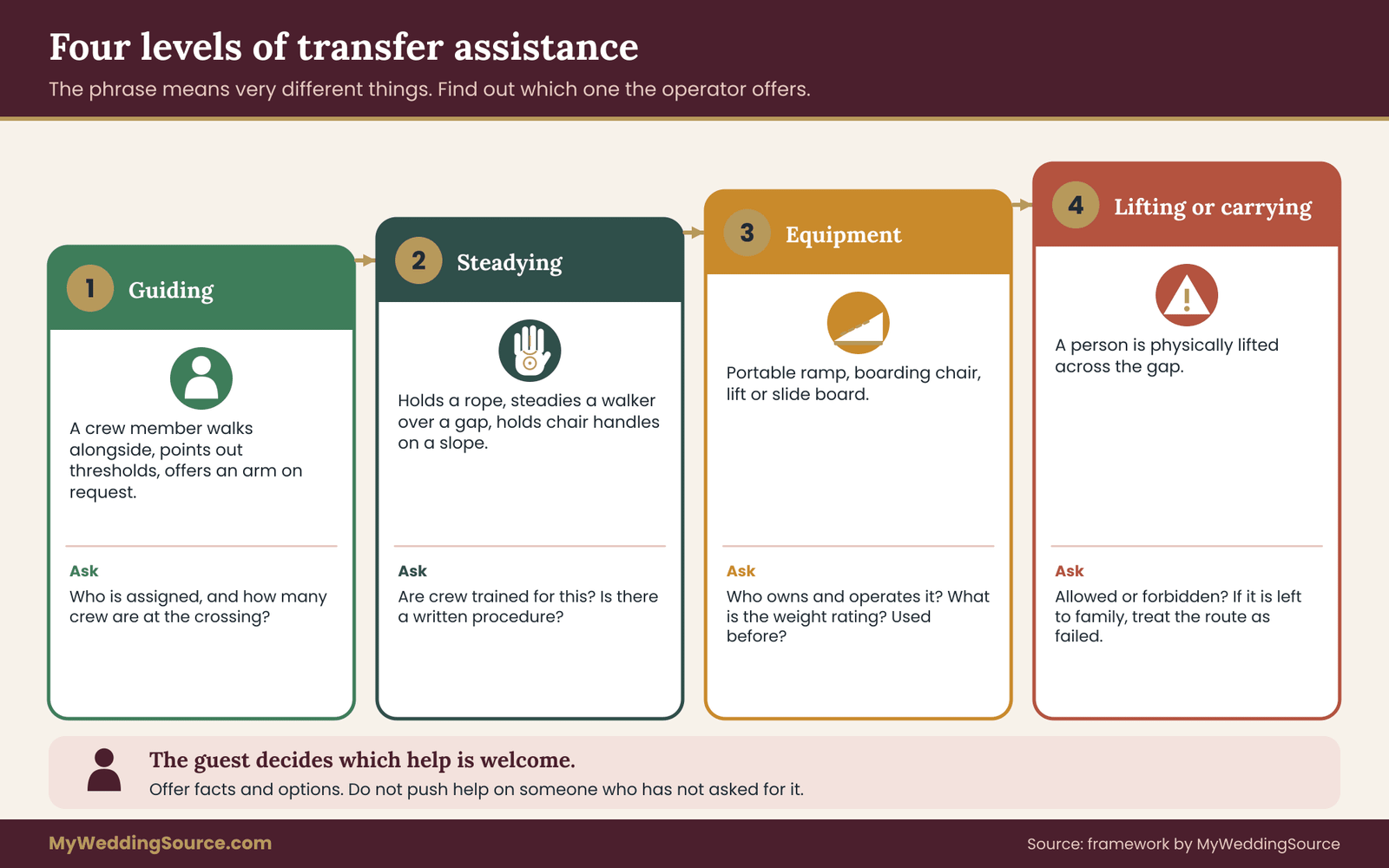
Who decides? At an accessible yacht wedding, the guest does. This is the most important rule in the section. A person who uses a wheelchair or a walker knows what they can and cannot do safely, and knows which kind of help is welcome.
Before you promise anything to the operator or the guest, talk to the guest about the route and let them tell you what they would want. Offer the information, not the decision. A short message might say: “Here is how boarding works, and here is where it is steep or tight. What would make this comfortable for you?” Then listen.
Training and numbers. Ask how many crew will be assigned to boarding, whether they have assisted guests with mobility devices before, and whether the operator has written procedures. Ask whether the person at the gangway is a deckhand, the captain, or an outside event coordinator, and whether anyone has first aid training. You are not asking for credentials to impress you. You are checking that a plan exists.
Liability and insurance. Ask the operator what their policy says about assisted boarding, and ask whether any waiver would be required of guests. A waiver does not excuse an operator from basic duties in every case, and its effect depends on jurisdiction and facts, so do not treat it as a legal conclusion either way.
A policy that requires a guest to sign away their rights as a condition of boarding is something to read carefully and to raise with a lawyer if it matters. Our guide to the wedding vendor contract shows how to read insurance and liability language more broadly.
Mobility devices. Ask whether the vessel can carry a wheelchair, scooter or walker, and where the device will be stored during the event if the guest transfers to a seat. A folding walker is easy to stow. A power chair is not, and its battery type may raise safety questions with the operator. Do not assume. Ask for the policy on battery-powered mobility devices in writing.
What if the guest does not want help? Offer the same route and let the guest decide. Do not push assistance on a guest who has not asked for it, and do not describe a person as a problem to the operator. Describe the route and the need. “One guest uses a power chair that weighs about this much” is information. “We have a difficult guest” is not.
Capture it in writing. For an accessible yacht wedding, the goal is a short paragraph from the operator for each guest need, saying what will be provided, who will provide it, and what happens if it cannot be. That paragraph is the transfer assistance answer, and it should be graded like any other.
Matching guests to the route before you ask the operator
The best questions for an accessible yacht wedding are specific. A specific question needs a specific person in mind, so before you write to the operator, work out which of your guests the route has to serve. This takes about twenty minutes and saves several rounds of vague replies.
Start with a quiet list for your accessible yacht wedding. For each guest you know may need support on a boat, write the guest’s name, the device or need they have told you about, and one line about what they have said they would like. Do not guess about guests who have not mentioned anything, and do not ask people to explain their health.
You can ask a general question on your wedding website or RSVP, such as whether any guest would like to talk about access needs for the boat, and let people reply on their own terms. The guest care planning guide covers how to collect that information respectfully.
Then sort the needs into profiles for your accessible yacht wedding. A profile is a pattern of needs on the route, not a label on a person. The most common ones are these.
Walks with a cane or a single support. Usually manageable on a ramp or a step-across with a rail. The concerns are surface grip, rail height and the rate of boat movement at the gap. Ask for the gangway surface and for a steady hand at the crossing.
Walks with a walker or rollator. Needs a wider crossing, a firm surface and no threshold higher than a small lip. Wheeled walkers catch in plank gaps and flex-gangway ridges. Folding walkers may be carried by a crew member while the guest uses a rail, if the guest agrees.
Uses a manual wheelchair. Needs a roll-in route on legs one and two, a crossing without a step, thresholds that a chair can clear, and clear space for the chair at the ceremony. Many manual chair users can transfer to a seat for a short stretch, and some prefer not to. Respect that choice.
Uses a power chair or scooter. The accessible yacht wedding route is the hardest for this profile. The weight of the device, the load rating of the gangway, the turning radius on the deck and the battery policy all apply. If the operator cannot give measured answers for each, treat the route as unproven for this guest and look at alternatives.
Has low vision or is blind. Needs edge contrast, a verbal orientation to the vessel, a clear description of thresholds and rails, and a person who stays close during boarding. A guest who uses a cane may want to hold a crew member’s arm. Ask whether crew will do an orientation walk before the event.
Is deaf or hard of hearing. Boarding instructions delivered at the gangway over engine noise are easy to miss. Ask how crew will communicate safety announcements, whether a written summary is available, and whether the ceremony can be seen clearly from every seat. If you have booked a sign language interpreter, ask for a good sight line.
Is sensory-sensitive or needs a calm option. Needs a place to step away, a clear idea of how long the trip is, and predictable boarding and exit. Ask whether a guest can use the dock end of the event only, and whether a quiet space exists on board.
Tires easily or has a medical need for rest. Needs shade, seating, a short pier or cart, and a way off early. Ask about drinking water, shade and a place to lie down briefly. If a guest relies on medication at set times, they will tell you what they need. Do not ask them to share it with the operator.
Is traveling with a young child or a stroller. Often overlooked. A stroller has the same problems as a small wheelchair at a plank gap. Ask whether strollers can be brought aboard, and where they are stored.
Is older and slow but has not asked for anything. The most common group, and the least likely to speak up. A route that works for a walker user will almost always work for them, which is one more reason to plan around the route.
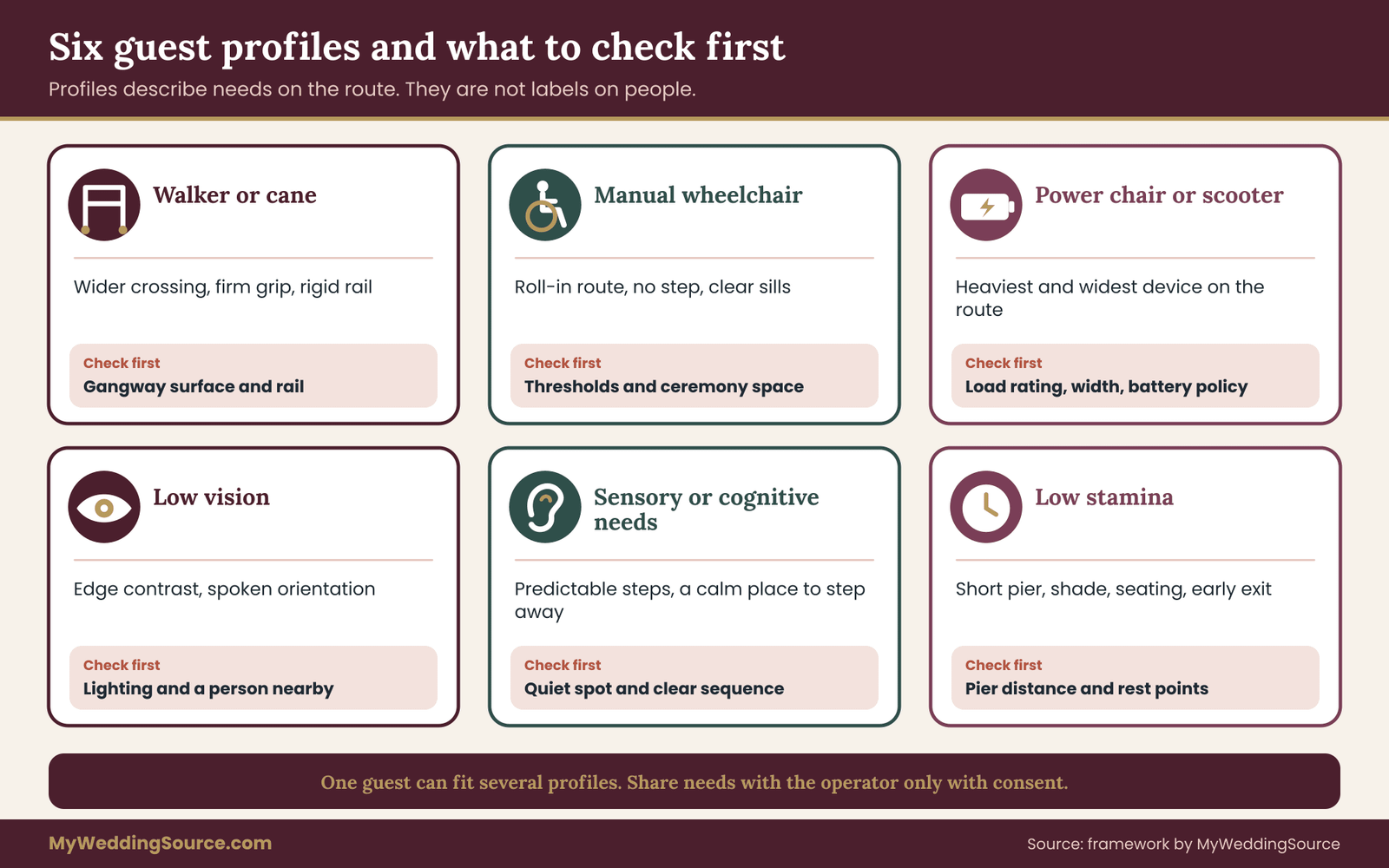
A few points on using the profiles in an accessible yacht wedding plan. First, one guest can sit in more than one profile. A guest with a power chair and low vision has the needs of both. Second, count the number of guests in each profile.
If two guests need the roll-in route and one needs low-vision orientation, that changes how many crew you ask for at boarding. Third, ask the guest’s consent before sharing details with the operator. A line such as “one guest uses a power chair of this approximate weight and width” is enough, with no name or reason.
The profiles also give you an early test of the whole accessible yacht wedding plan. If you map each profile against the six legs and find that one profile fails at leg three, you know where the work lies. If every profile fails at leg one, the marina is the problem, not the boat. If the failures scatter, the vessel may simply be the wrong one.
Some couples find it helpful to see the venue’s red flags from a different angle at this stage. The guide on accessible wedding venue red flags lists the warning signs on land that mean the plan is not ready, and many of them have a boat equivalent: a steep entry, a tight door, or a missing restroom.
The inquiry sheet, question by question
Now write to the operator about your accessible yacht wedding. The questions below are the working core of the sheet. They run in route order, and the ones marked with a star are the ones to resolve first, because they decide whether the rest is worth asking. Copy them into an email or a shared document, and leave a line under each for the answer and a line for the grade.
Leg one: arrive
- (Star) Where can a car or van with a side ramp stop closest to the vessel, and for how long?
- Is there marked accessible parking, and what is the surface between it and the pier gate?
- Who holds the gate code, and will a staff member be present during boarding?
Leg two: approach
- (Star) What is the distance from the nearest drop-off to the vessel, and what is the surface along the way?
- Are there places to sit along the pier, and does the marina offer a cart or escort?
- How is the route lit and marked after sunset?
Leg three: cross
- (Star) What type of crossing is used at our date and time: fixed ramp, portable gangway, steps or step-across?
- (Star) What is the slope at the lowest and highest expected tide, who measured it, and when?
- What is the clear width between handrails, and are there rigid rails on both sides?
- What is the load rating, and does it cover a power chair plus one helper?
- How will boarding be staged, and how many crew will be at the crossing?
Leg four: enter
- (Star) What is the height of each threshold between the gangway and the main gathering area, and can any be bridged by a portable ramp?
- What is the narrowest door or passage on that route, and is there turning room?
Leg five: move aboard
- (Star) Where will the ceremony, reception, bar and restroom be, and is each reachable without stairs?
- Can a wheelchair user sit at the ceremony and dinner in the chair or in a standard seat, as they choose?
- Does any restroom on board fit a wheelchair, and if not, where is the nearest one on shore?
Leg six: leave
- Will the same assisted exit be offered at the end, and can a guest leave early?
- What is the evacuation plan for a guest who cannot use stairs or a ladder?
Transfer assistance
- (Star) What type of assistance does the crew provide, from guiding to equipment to lifting, and which is not allowed?
- Who will be responsible at the crossing, and have they done assisted boarding before?
- What is the policy on service animals and on battery-powered mobility devices?
That is twenty-one questions for an accessible yacht wedding, which looks like a lot until you notice that most are one-line answers. Group the starred questions at the top of your first email. If the operator cannot answer those, the rest can wait.
Add a closing question to every email: “Is there anything about boarding that we should have asked and did not?” A thoughtful operator will often use it to tell you something useful, such as a seasonal change to the dock or a guest-handling policy.
Format and tone. Write the accessible yacht wedding questions in plain language, number them, and keep your own opinions out of them. A line like “We need this to be fully accessible” invites a reassuring yes. A line like “What is the width between handrails on the gangway?” invites a number. Ask for the reply in writing, and say you will confirm the details in the contract.
A short script for the first email. Keep it plain. “We are planning an accessible yacht wedding on your vessel on a specific date, and several guests have mobility needs. Before we go further, could you help us understand the boarding route? I have attached a short list of questions, with the five most important first.
Where you have numbers, such as widths and slopes, they would help a great deal. If any question does not apply to your vessel, please say so. We would also like to visit at the tide we expect on the day. Thank you.”
A short script for a guest. “We are holding part of the wedding on a boat. I would like to be sure the boarding works well for you. Here is what I have learned so far about the pier and the gangway, and here is what is still unknown. Would you like to look at photos, join a site visit, or tell me anything that would help? There is no pressure either way, and we can always find another way to include you.”
A short script for a follow-up that went quiet. “Thank you again for your reply on the gangway. I am still waiting on the slope at low tide and the load rating, which will decide whether we can reserve. Could you send them by Friday, or tell me if they are not available? If they are not available, I will plan on the assumption that this crossing is unverified.”
Who else to ask. For an accessible yacht wedding, marina management can answer legs one and two. The operator or captain answers legs three to six. A shuttle company answers the hotel run. A local disability organization or the guest themselves may know the marina better than anyone. If you are working with a planner or coordinator, the sheet gives them a concrete assignment instead of “check that the boat is accessible.”
Reading the answers for an accessible yacht wedding
The replies about your accessible yacht wedding come in. Some are detailed, some are friendly and thin, and some do not answer the question you asked. This is the point where the grades earn their place, because they turn a pile of replies into a decision.
The four grades. A measured answer states a number, names who measured it and says when. “The portable gangway is 32 inches between rails, 14 feet long, rated for 500 pounds; we checked it at last month’s low water.” A written answer is a clear commitment in an email or the contract, with no number: “We will bring a portable ramp for the deck sill.”
A spoken answer was given on a call or walk-through and was not confirmed in writing. An assumed answer is a gap: nobody said anything, and you filled it in. The first two can be relied on. The second two cannot, until you convert them.
Converting a spoken answer. This is easy and underused. After the call, send a two-line email: “Thank you for the call. To confirm, the gangway at low tide on our date is about thirty-two inches between rails, and the crew will bring a ramp for the sill. Please reply if anything here is wrong.” If the operator replies “correct,” you have a written answer. If they correct you, you have learned something. If they do not reply, you have learned that too.
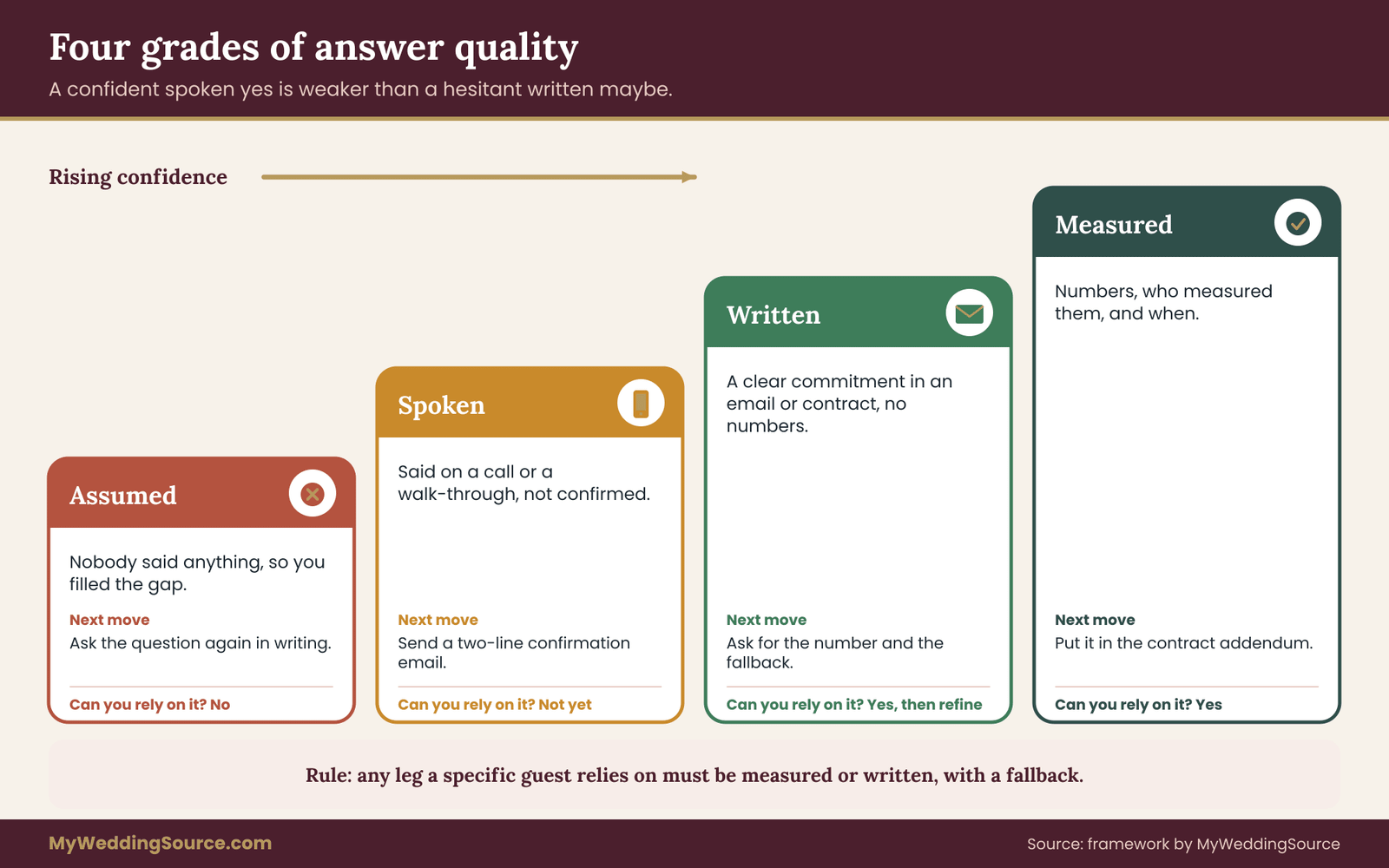
Converting an assumed answer. Assumptions are the ones that hurt, because nobody knows they exist. Walk through the sheet and mark every question with no answer. Each of those is an assumed answer. Send those questions again, in a short second email, and say you cannot confirm the plan for those guests until you hear back.
The rule for each leg. In an accessible yacht wedding, a leg that carries a guest who needs it must be graded measured or written, and the answer must include a fallback. A leg that carries no guest who needs it can be spoken. Do not let a spoken answer stand on any leg that a specific person relies on. This single rule resolves most of the debates.
Colors. Some couples find it easier to mark each leg green, amber or red. Green means measured or written, with a workable answer and a fallback. Amber means a spoken or partial answer, or a workable answer without a fallback. Red means a stated limit that fails for a guest who needs the leg, or no answer after two requests. The colors are a memory aid, not a score. A single red on a leg that a guest needs is more important than six greens elsewhere.
What a good reply looks like. A good reply to an accessible yacht wedding inquiry includes numbers where numbers exist. It names a person. It states what the vessel cannot do. It offers a fallback or says there is none. It does not claim the vessel is “fully accessible” without defining the term. A short reply with those four features beats a long reply that is glowing and empty.
What a worrying reply looks like. “We have never had a problem.” “Guests usually manage.” “Your family can help.” “It’s just a few steps.” “The crew will figure it out.” Each of these is a sign that the question has not been taken seriously, not necessarily that the operator is careless. A polite second request often brings a better answer. If it does not, you have your result.
Delay is information. A reply that takes two weeks and arrives in a single line tells you something about how much attention the operator will pay to your accessible yacht wedding on the day. A prompt, careful reply tells you the opposite. Neither is conclusive, and both feed the decision.
When to ask for a site visit. If the written answers look workable and at least one leg is amber, a site visit is the next step for an accessible yacht wedding. Go at the tide level you will have on your date if you can, and bring the people who will use the route, if they wish.
A short visit at the right tide shows you what email cannot. The venue technical walkthrough guide lists the habits that make a site visit useful, such as measuring with a tape and photographing every threshold.
Writing it into the contract. Once the answers are clear for your accessible yacht wedding, ask the operator to put the key commitments in the contract or an addendum: the crossing type, the boarding assistance, the equipment provided and the fallback. Language that says the vessel “will accommodate guests with disabilities” is weaker than language that names the ramp and the crew. We return to this in the contract section.
A worked case: an invented couple and an invented route
What follows is an illustration of an accessible yacht wedding, not a real event. The names, numbers and answers are made up to show how the sheet works. Treat the structure as the lesson and the details as placeholders.
Maya and Tom plan an accessible yacht wedding with a sunset ceremony and a short cruise for fifty-two guests on a chartered motor yacht. Three guests have said they would like to talk about boarding. Tom’s grandfather uses a folding walker. Maya’s aunt uses a power wheelchair.
A college friend of Maya’s has low vision and uses a white cane. Maya sends each of them a short, friendly message describing the route and asking what would make boarding comfortable. Everyone replies, and the aunt asks for a firm answer on the gangway before she commits.
Maya sends the operator the twenty-one questions, starred ones first. Within three days she has a reply, and she grades it.
Leg one, arrive. The operator says a van can stop at the pier gate for up to thirty minutes. The marina has one marked accessible space close to the gate. Graded written, because the operator put it in an email, and amber, because there is no fallback for a second van.
Leg two, approach. The pier is about two hundred and forty feet, with rubber matting and no benches. The operator says the marina has no cart. Graded written. Amber for the aunt and the grandfather because the walk is long and has no rest point. Maya asks the marina whether a staff member with a utility cart can help for a fee. The marina says yes, and sends the answer in writing. The leg becomes green.
Leg three, cross. The operator says the vessel uses a portable aluminum gangway from a floating dock. At the lowest expected tide on the date, the gangway slope is “pretty steep,” and the width is “about three feet.” Graded spoken. This is the problem leg. Maya replies with the two-line conversion email and asks for the slope at low and high water, the clear width between rails and the load rating.
The operator replies the next day: the gangway is about thirty inches between rails, the slope at the lowest tide is steeper than a standard ramp, and the load rating is for one person at a time. The aunt’s power chair, with a helper, does not fit those numbers. Graded measured, and red for the aunt.
Leg four and five. A six-inch sill at the salon door. The operator owns a portable ramp. The restroom is too small for a wheelchair. Graded written. Amber for the aunt and green for the others.
Leg six, leave. Same assisted exit as the entry. Graded written, green.
Transfer assistance. The operator offers guiding and steadying, owns a boarding ramp, and does not lift or carry guests. Graded written, green. The operator is honest that lifting is not allowed.
Now the decision. The sheet shows two guests on workable routes: the grandfather with his walker, who can cross with a steady hand and a rail, and the friend with low vision, who needs an orientation walk and a calm crossing. For the aunt, one leg fails on measured numbers, and no fallback exists on this vessel. Maya does not argue with the numbers or look for a way to carry the aunt over the gap.
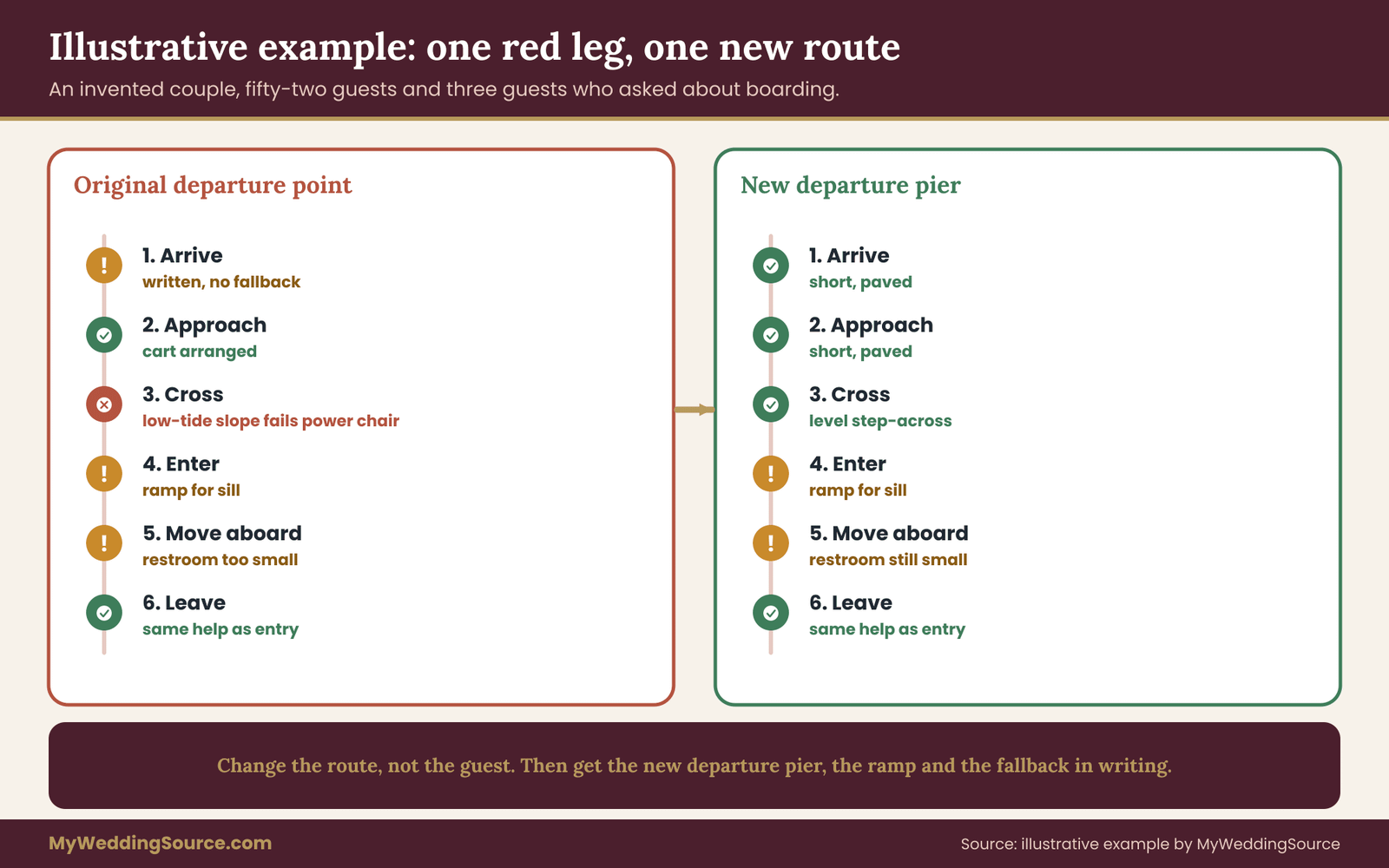
Instead, she looks at alternatives that keep the accessible yacht wedding intact. She asks the operator whether the vessel can board at a fixed pier a mile away that has a level step-across. The operator says yes, for an added fee and a change of departure point, and confirms the deck is level with that pier.
She asks the marina for the distance from the pier’s accessible parking. It is short and paved. She calls the aunt, who looks at photographs and says she would like to come. The new route is graded measured on all legs, with the restroom still amber, and the aunt agrees to a shorter cruise.
Maya then asks for a contract addendum naming the departure pier, the ramp for the sill, the crew assignment and a fallback if the pier is closed for any reason: a dockside ceremony with the guests seated on the pier. The operator agrees.
What this case shows about an accessible yacht wedding is not a happy ending. It shows a sequence: ask, grade, convert, find the red leg, change the route rather than the guest, and get the change in writing. A different outcome could have been a different vessel or a dock ceremony, and both would have been fine. The method was the same.
Alternatives when an accessible yacht wedding route fails
A red leg is not the end of an accessible yacht wedding. It is a prompt to change one variable. The usual options sit on a ladder, from the smallest change to the largest, and it helps to try them in order.
Change the boarding point. The cheapest fix for an accessible yacht wedding is often a different dock. A fixed pier with a level step-across, a ramp built to a standard and a short, paved approach may sit a few minutes away from the marina the operator normally uses. Ask whether the vessel can depart from there, what it costs, and whether the change affects the timeline. Confirm the new route with the same sheet. A new dock is a new route and needs its own grades.
Change the time. Tide drives the slope on floating gangways. A boarding time near high water or slack tide may give a gentler crossing than the original time. Ask the operator for the tide table for your date and for what the slope would be at the times you can use.
Tide information is published by the National Oceanic and Atmospheric Administration, and the operator can read it more easily than most of us. This is a tool for a gangway that is borderline, not for one that is clearly steep at all hours.
Add equipment. A portable ramp over a sill, a wider gangway, a boarding chair or a transfer bench can close some gaps. Ask who supplies and operates it, whether it has been used at a real boarding, and whether a rental is available. Equipment that arrives on the day with nobody trained to use it is a risk to an accessible yacht wedding, not a fix.
Change the vessel. For an accessible yacht wedding, a different yacht, with a lower freeboard, a level deck entry, a wider door or an accessible restroom, may suit the guest list far better. It may cost more or less. Charter several vessels through the same sheet, and compare the grades. A vessel with a lower price and three red legs is not cheaper in any way that matters.
Move the ceremony to the dock. Hold the ceremony and the family photographs on a level pier or at a waterfront venue, then let guests who can board join a shorter cruise. Guests who prefer not to board stay for dockside food and rejoin the group on return.
This keeps everyone in the same event for its most important minutes. The trade-off is that the cruise becomes optional, and you need to avoid making non-boarders feel like they have been left on the shore. A host, a comfortable seat and real food help with that.
Split the event by format. Some couples hold the ceremony and reception on land and add a short sunset cruise as a bonus for those who wish to join. A boat is then a feature of the day, not the only way to attend. This is a good choice for an accessible yacht wedding when a significant share of guests would face the gangway with difficulty.
Offer a ride-along or a smaller group. A few guests may join a small group on a shorter trip at a lower-tide time, on a different vessel or with a different route. This works when the issue is the number of people at the gangway, not the structure.
Stream or share the moment. If a guest cannot board and would like to see the ceremony, a livestream or a recording is a reasonable addition. It is not a replacement for presence, and it should be offered as a choice, not as the consolation prize. Ask the guest first.
Change the venue. Sometimes the honest answer is that a yacht is not the right setting for your guest list. If a marina is hard to reach, the vessel is hard to board and the restroom is not usable, the setting may be a poor fit for the whole group. The venue comparison guide walks through the comparison between venue types and may point you to a waterfront restaurant, a garden, or a lakeside pavilion that keeps the water in view without the gangway.
How to decide among them for your accessible yacht wedding. Ask three questions. Which option keeps the most guests together at the moments that matter most? Which has the fewest unverified answers? And which can be confirmed in writing before you pay a non-refundable deposit? Pick the one that does best across the three, not the one that is most appealing in a photograph.
Edge cases that change the sheet. Some vessel types shift the whole accessible yacht wedding route, so check which one you are dealing with before you grade anything.
An anchored yacht reached by a small tender adds a second crossing, from the dock into the tender and from the tender to the yacht, and both are usually far harder than a gangway. Unless the operator can describe a tested method for each step, plan on tendering being closed to guests with limited mobility. A mooring ball or anchorage is a design choice, so ask whether the vessel can come alongside a dock instead.
Historic, wooden and sailing vessels often have high sides, steep companionways and little flat deck. They can be wonderful and are rarely forgiving. Ask early, and be ready to hear that the vessel suits a smaller part of the guest list. Catamarans and modern motor yachts often have a flatter, wider deck and a lower entry point, which helps, though a swim platform at the stern is not a boarding route unless the operator says it is.
Large, scheduled or ticketed dinner cruise vessels may have their own accessibility procedures, since they carry the public every day. Ask for the written policy. A private charter on a small vessel may have none at all. Neither is automatically better, and each needs its own grades.
Finally, a vessel can change between the contract and the event. Operators sometimes substitute a similar boat for maintenance or schedule reasons. Ask for a clause that requires the same boarding features on any substitute vessel, or lets you cancel if it cannot be met.
One caution about alternatives. Do not use them to pressure a guest. “We could just leave you at the dock” is not an alternative; it is a poor way to put it. Present options, let the guest weigh them, and keep their dignity at the center. A guest who says “I’d rather not board” has made a clear choice and deserves a good dockside experience, not an apology.
Contract language, the day-of plan and the conditions that mean stop
Once the route works on paper, three tasks remain for the accessible yacht wedding: put the commitments in the contract, rehearse the day, and agree in advance on what would make you stop.
What to put in writing. For an accessible yacht wedding, ask the operator to include, in the charter agreement or an addendum, the departure point and boarding time, the crossing type, the slope and width figures that were given, the equipment the vessel will supply, the number of crew assigned to boarding and the fallback if the route fails.
Add the names of those who answered, and the dates. If the operator will not put it in writing, that is information. Use the same approach you would use for any key vendor promise. The vendor purchase order checklist shows how to turn conversations into written deliverables.
Cancellation and change terms. Ask what happens if the boarding route becomes unavailable, for example if the dock is closed for repair or the gangway is out of service. Ask whether you can change the departure point without losing the deposit, and under what conditions you can cancel if the accessibility commitments are not met.
This is about the vendor’s duty to provide what was promised, and the exact rights depend on the contract and local law. If the stakes are high, ask a lawyer to read the addendum.
A boarding run sheet. One page for the accessible yacht wedding day: arrival times by group, who meets the guests at the gate, who is at the gangway, who has the ramp, who has the phone numbers of guests who may need help, and who calls the shuttle. Name the person who makes the call to stop boarding. Share it with the captain and the planner, and give each guest who needs help a short note with the same facts in plain words.
A pre-boarding check. An hour before guests arrive at the accessible yacht wedding, someone should walk the whole route at the current tide, with a tape measure. They check the slope, the surface, the lighting, the sill, the ramp placement and the restroom. They compare it with the written answers. If it differs, the difference gets resolved before anyone arrives. This is a short job and a strong safeguard.
Boarding order and pacing. Offer early boarding to guests who need more time. Hold the vessel against the dock. Board one person at a time on a narrow gangway. Keep the rest of the group at the gate, with water and shade, until the crew calls them. A calm start sets the tone.
The stop conditions. Agree in advance on these for the accessible yacht wedding. Stop or change the plan if any of the following holds. The measured slope or width at the actual tide fails a guest who relies on the leg. The ramp or gangway is rated below the load that must cross. Crew assigned to boarding are fewer than agreed, or untrained for what was promised.
The only offered help is lifting or carrying by friends and family. A leg that a guest needs is still spoken or assumed after two requests. The operator will not put the commitments in writing. A wake, wind or surge makes the crossing unsteady beyond what the captain considers safe, and in that case the captain’s decision governs. And the guest who needs the leg, having seen the facts, says it is not comfortable.
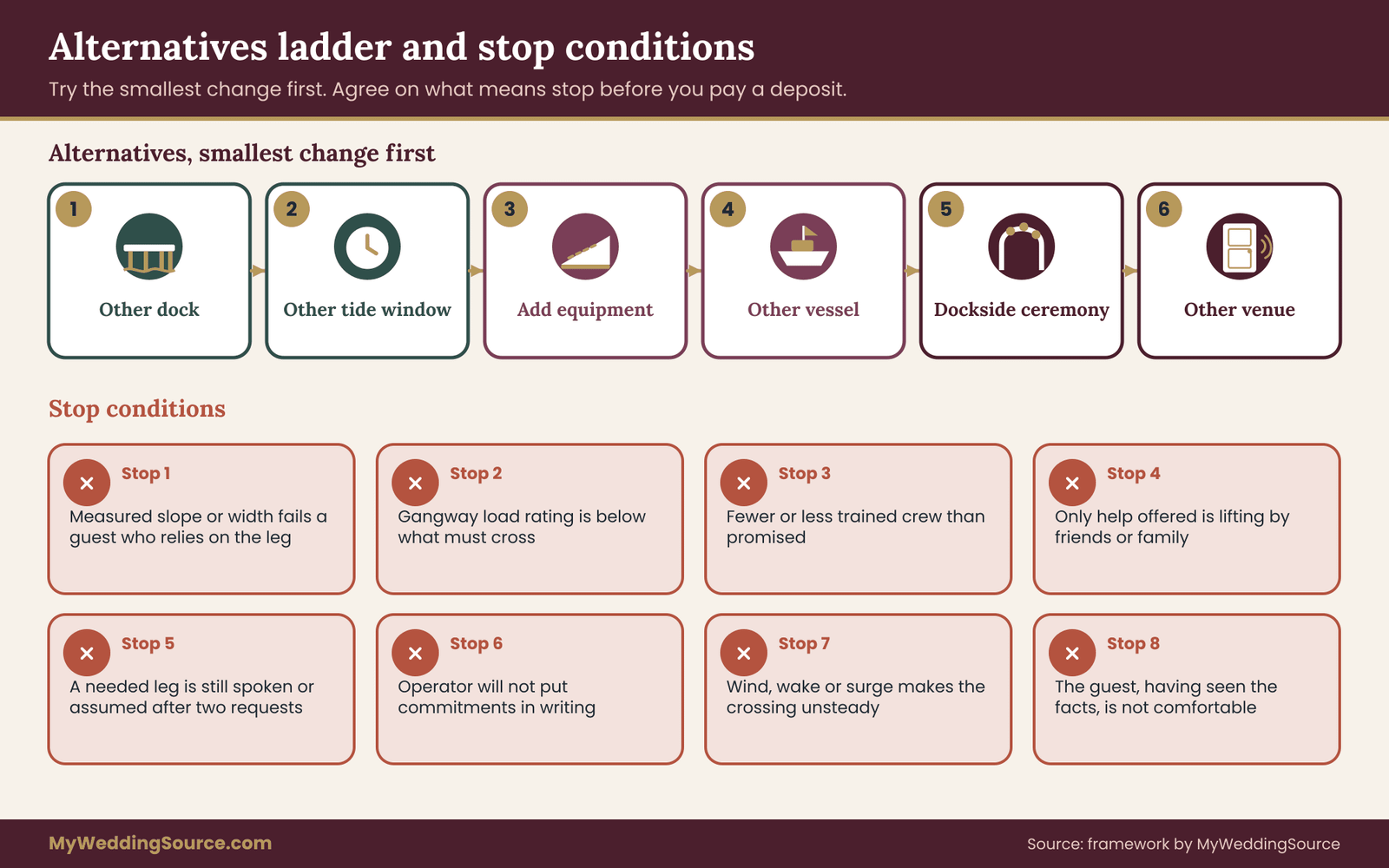
The last condition matters most. A technically workable route is not the same as a route that a guest wants to use. If the person at the center of the plan says no, the plan has failed for that person, whatever the numbers say.
Who makes the call on the day. Name one person from your side and one from the vessel. If they disagree, the safer option wins, and the captain’s authority over vessel safety is not up for debate. Agree on that beforehand so that nobody argues at the gangway.
For a longer list of the warning signs that appear on land, the guide to accessible wedding venue red flags is a useful second check, because a marina is a venue, too.
Your next steps
Work through these in order for your accessible yacht wedding. Each takes less time than you expect, and the order keeps you from paying for something you cannot confirm.
- List the guests who may need support on a boat, with their consent, and sort their needs into profiles. Use no names in anything you send the operator.
- Copy the twenty-one accessible yacht wedding questions into a document, put the starred ones first, and leave a line for the answer and a line for the grade.
- Send the first email to two or three operators, not one. Comparing grades across vessels is the quickest way to see which are ready.
- Grade every accessible yacht wedding reply as measured, written, spoken or assumed. Convert spoken answers with a two-line confirmation email, and re-ask anything that was left blank.
- Mark each leg green, amber or red for each profile. Identify the red legs and decide which alternative on the ladder fits: another dock, another time, equipment, another vessel, a dockside ceremony, or a different setting.
- Visit at the tide you expect, with a tape measure and a camera, and compare the route with the written answers.
- Ask for the commitments in the contract or an addendum before you pay a non-refundable deposit, including a fallback and the same features on any substitute vessel.
- Write the accessible yacht wedding boarding run sheet, name the person who can stop boarding, and share the sheet with the captain, the planner and the guests who rely on it.
If you take only one habit from this article, make it the grade. A written, measured answer to a specific question is what separates a boat that is accessible in the brochure from an accessible yacht wedding that works at the pier. The rest of the sheet is just a way to get those answers.
FAQ
What does accessible boarding mean for an accessible yacht wedding?
For an accessible yacht wedding, it means that a specific guest can get from the street to a seat on the vessel and back, safely and with dignity, using a route that has been checked. That includes parking, the pier, the gangway or step-across, door thresholds, seating and a restroom. The word has no single legal or technical meaning for every vessel, so ask for numbers, equipment and a named person rather than accepting the label.
Does the Americans with Disabilities Act apply to a private yacht charter?
For an accessible yacht wedding on a private charter, it depends on the operator, the type of business and the vessel, and the answer is not the same for every charter. Public accommodations and certain passenger vessels can have duties under federal law, and state laws may add more. Ask the operator how they approach it, and check with the U.S. Department of Justice or the Access Board for current guidance. This is not legal advice.
Can crew lift a guest in a wheelchair onto the boat?
Many operators and insurers do not allow it, because lifting risks injury to the guest and the helper and can cause falls between dock and deck. Ask what the policy is, in writing. If the only offer is that family or friends carry the guest, treat it as a failed route. Equipment such as a ramp or a boarding chair is usually the safer path.
How wide should a gangway be for a wheelchair?
There is no single answer for every vessel and device. On land, a clear width of about thirty-six inches is a common benchmark for an accessible route, and a power chair or a guest with a helper needs more. Ask for the clear width between handrails, not the width of the deck, and compare it with the dimensions of the guest’s own device.
Does the tide really change the boarding route?
Yes. For an accessible yacht wedding on floating docks and tidal waters it can change the slope of a gangway by a large amount between low and high water. A crossing that is gentle at one time of day may be steep at another. Ask for the slope at the lowest and highest expected tide on your date, and check the tide predictions from the National Oceanic and Atmospheric Administration.
What if the operator says the boat is fully accessible but gives no details?
Treat it as an assumed answer. Thank them, then ask for the specifics: crossing type, slope, width, load rating, thresholds, restroom and who provides assistance. Convert anything spoken into a written confirmation. If you still receive no details after two requests, plan as if the route were unverified, and consider another vessel or another format.
How do I ask a guest about their needs without being intrusive?
Offer information first, and let them decide how much to share. Describe the route and the unknowns, ask what would make boarding comfortable, and say there is no pressure. Do not ask about diagnoses, and do not pass personal details to the operator without consent. A line such as “one guest uses a power chair of this weight and width” is enough.
What should we do if the route fails for one guest?
At an accessible yacht wedding, change the route, not the guest. Try another dock, another tide window, added equipment or another vessel, and consider a dockside ceremony so that everyone shares the central moment. Talk with the guest about the options and let them choose. Put any new arrangement in writing before paying a non-refundable deposit, and keep a dockside option ready.
Sources
- U.S. Coast Guard, passenger vessel safety, inspection and operator requirements
- U.S. Coast Guard National Maritime Center, mariner credentials and vessel operator information
- U.S. Coast Guard Office of Auxiliary and Boating Safety, recreational boating safety guidance and life jacket information
- ADA.gov, U.S. Department of Justice, Americans with Disabilities Act guidance, including service animals and public accommodations
- U.S. Department of Justice Civil Rights Division, disability rights enforcement and technical assistance
- U.S. Access Board, accessibility guidelines and standards, including ramps, routes and passenger vessels
- NOAA Tides and Currents, tide predictions for planning boarding times
- National Weather Service, marine forecasts and wake and wind conditions
- U.S. Department of Transportation, transportation accessibility information
- National Transportation Safety Board, marine accident investigations and safety lessons