
To reuse wedding signs well, treat every sign as an object with an owner, a material and a message, and decide its next life from those three facts. This guide gives you a four-question exit ladder, a material-by-material decision grid, a worked case with fourteen signs, and the failure conditions that turn a good intention into a trunk full of clutter.
Before you decide anything, find out who owns each sign, because rented and vendor-owned pieces go back, not home. Then run each remaining sign through four questions: is it still yours, is its message dated or personal, is the material in good shape, and does a second use actually exist. If a second use exists, reuse wedding signs at home or hand them to someone who wants them. If not, recycle by material, and only after checking what your local program accepts. Store only what you will really use.
The reception ends, the lights come up, and a stack of signs leans against a wall: a welcome sign on an easel, a seating chart on a mirror, a bar menu in a frame, a dozen table numbers, a few arrows that pointed guests to the restrooms.
Someone on the cleanup crew asks what to do with them, and nobody has an answer. Most couples who mean to reuse wedding signs say “we’ll figure it out later” and the signs ride home in a trunk, then sit in a closet for three years.
That outcome is not a character flaw. It happens because signs sit in an awkward category. They are too personal for a charity shop to want, too bulky to keep, and too varied in material to throw in one bin. A chalkboard, a laminated card, a foam-core print and an acrylic panel each have a different best ending. The goal here is narrow and practical: help you reuse wedding signs where reuse is real, recycle the rest correctly, and store only what earns its shelf space.
A note on scope. The aim is to help you reuse wedding signs sensibly, not to give a rule for every town. This is general information, not legal, tax or financial advice, and recycling, donation and rental rules differ by place and by organization. Where a rule matters, the guide points you to the agency or the vendor who sets it, so you can confirm the current version yourself.
Why reuse wedding signs deserves its own plan
There is already good general advice on what to do with decor after an event, but few people ask how to reuse wedding signs specifically, and this site has a broader guide to wedding waste reduction that covers the whole wedding, from catering to cleanup. Signs deserve a separate plan because they behave differently from flowers, candles or linens, and the choice to reuse wedding signs depends on facts that other decor does not raise.
Flowers die, so the decision is urgent and the options are few. Linens and tableware are usually rented, so the decision is made for you. Signs are none of those things.
They last for years, they carry text that was written for one day, and they are made from an unusually wide range of materials: paper, cardstock, foam board, corrugated plastic, acrylic, glass, wood, metal, canvas and vinyl, often combined in one object. A single wedding can produce signs from six different material families, so the way you reuse wedding signs has to be material-specific.
Material matters because it controls three things. It controls whether the sign can be reused at all, since a warped foam-board print will not stand up for a second event. It controls whether it can be recycled, since many local programs accept paper and cardboard but not laminated cardstock, glued composites or acrylic. And it controls the storage risk, since paper yellows, wood warps in damp basements and glass breaks.
Message matters just as much. A sign that says “Welcome to the wedding of Ana and Luis, June 14” has no second life as a welcome sign for anyone else, but the frame around it might, and so might the easel under it. Separating the container from the content is the single most useful habit when you reuse wedding signs, and the rest of this guide builds on it.
Ownership comes before both. Plenty of the signs at a reception are not yours at all, and you cannot reuse wedding signs that belong to someone else. The venue may own the easels and the standing directional signs. A rental company may have supplied the frames or the chalkboards. A stationer may retain rights to the artwork on a printed piece. If you start to reuse wedding signs without knowing this, you can end up donating something you do not own.
What this guide does and does not cover
The focus is the period after the reception: the loading dock, the first weekend, and the following months. The planning of signs themselves, including readability, placement, proofing and venue permissions, belongs in the wedding signage system guide, and this article assumes your signs already exist and have already done their job.
This guide also stays with the physical sign. It does not cover digital screens, social media posts or the photographs of signs. Those matter for your archive, and the wedding records guide covers how to keep proof of purchase and photos together, but they raise different questions.
Finally, this is a decision guide on how to reuse wedding signs, not a collection of craft projects. You will find examples of second uses, but the aim is to help you choose between paths. A pinboard of fifty ideas does not help if the sign in front of you is a laminated seating chart with every guest’s full name on it. A set of rules that tells you what to do with that specific object does.
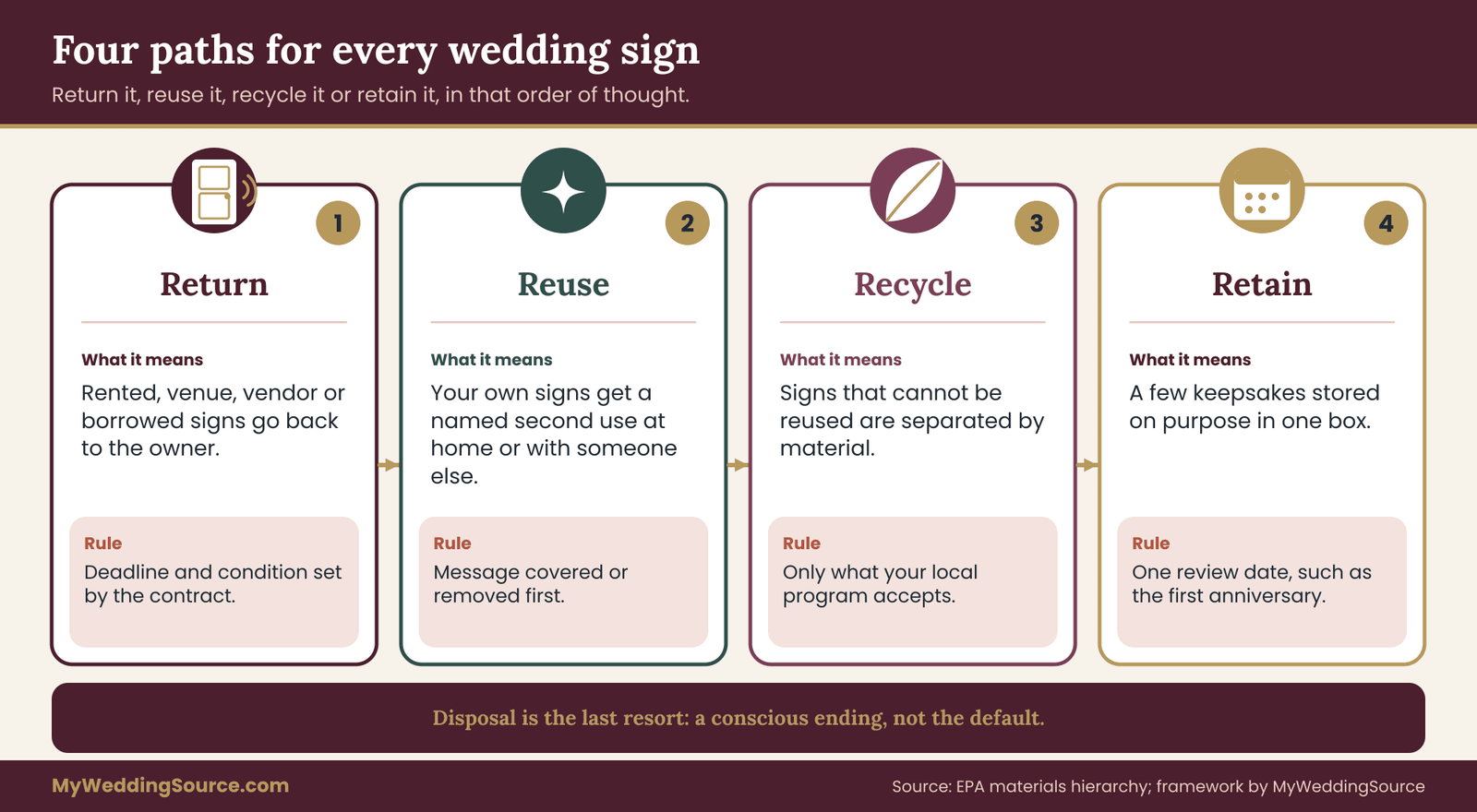
Throughout the guide, you will see the same four paths named again and again.
Return. The sign goes back to its owner: a rental company, a venue, a vendor or a friend who lent it.
Reuse. The sign gets a second use, either with you or with someone else, usually after the personal content is removed or covered.
Recycle. The sign is broken down by material and sent to the right stream, which is a local decision and not a universal one.
Retain. The sign is stored on purpose, with a reason, a place and a review date.
Disposal sits at the bottom of that list on purpose. It is the right ending for some signs, such as a mildewed chalkboard or a glued composite with no recycling stream, but it should be a conscious ending and not the default.
The four paths and the questions that choose between them
The four paths are not equal. They follow an order, and the order is the same one the US Environmental Protection Agency uses for materials in general: prevent and reduce first, then reuse, then recycle, then dispose. Its guidance on sustainable materials management describes this hierarchy, and it is a useful frame even for something as small as a table number. Keeping an object in use is generally better than breaking it down for material, and breaking it down is better than burying it.
The practical meaning for a couple who want to reuse wedding signs is simple. Before you recycle a sign, ask whether anyone could use it as it is. Before you throw one away, ask whether any part of it, such as the frame, the stand or the board, could go to a different stream. This is not about moral effort. It is about not missing an easy save.
Here is a plain example. A cardstock sign in a wooden frame looks like one object. In reality it is three: a printed card, a pane of glass or acrylic, and a wooden frame. The card is personal and will probably be recycled or kept as a memento.
The glass can be wiped and reused. The frame is the part with real second-life value, because frames are among the most commonly reused items in secondhand shops and in homes. Anyone trying to reuse wedding signs without splitting them into parts would have thrown away the best part.
A similar split applies to most signs. A foam-board print on an easel is a print, a board and an easel. A mirror seating chart is a mirror, a vinyl or painted lettering layer, and a stand. A chalkboard is a board, a message and a frame. Breaking each sign into parts before deciding is a thirty-second job, and it changes the outcome more often than any other single step.
The questions that make this work are in the exit ladder later in this guide. First, though, it helps to deal with the question that can end the discussion early: who actually owns the sign.
Who owns each sign: settle this before anything else
Ownership is the first filter in any plan to reuse wedding signs because it removes whole categories from the reuse conversation. A sign you do not own is not yours to donate, sell, cut up or throw away, and mistakes here can cost money. Rental companies charge for missing or damaged items. Venues may withhold part of a deposit if their property goes missing. Friends who lent you a family chalkboard may care a great deal.
Start with the paperwork. The wedding vendor contract for each supplier should say who owns what at the end of the event, and it often says more than couples remember. A stationer’s contract may say the artwork is licensed for your event only. A rental agreement may list every frame and easel by count, with a replacement fee for each. A venue agreement may state that standing signs, directional boards or the entrance easel stay with the venue.
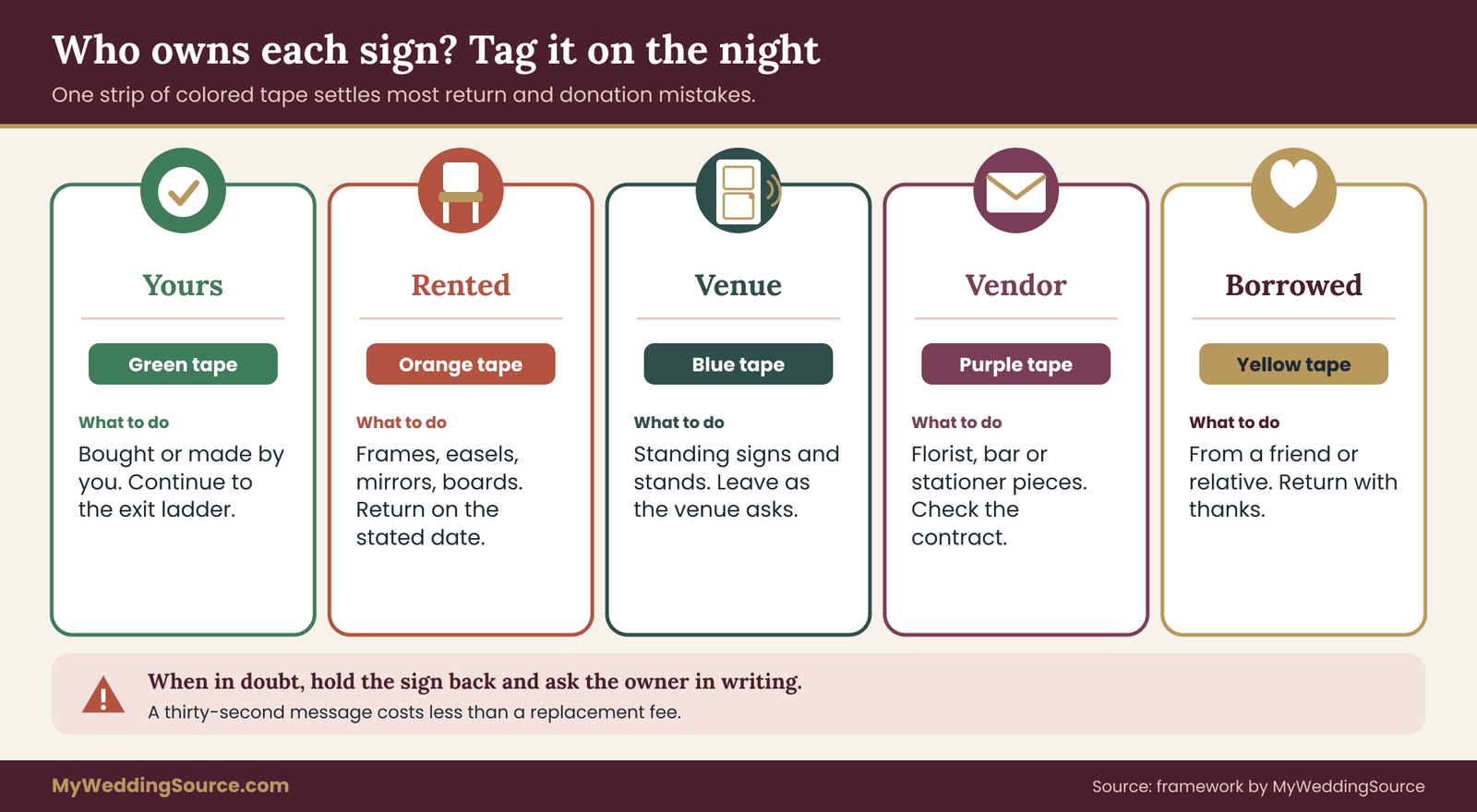
Next, walk through the signs and sort them into five ownership groups.
Yours outright. You bought or made them, and nobody else has a claim. These move on to the exit ladder.
Rented. The frames, easels, chalkboards, mirrors, or arch signs came from a rental company and have a return date, a condition standard and often a cleaning rule. The rental planning checklist explains how those returns are normally handled, and the signs follow the same rules as chairs or linens.
Venue property. Directional signs, easels, stands and sometimes the large framed notices belong to the venue. Leave them where the venue expects them, and confirm that during your final conversation.
Vendor property. A florist’s arch sign, a bar company’s menu board or a photographer’s display may belong to the vendor, even when your names are printed on it.
Borrowed. A cousin’s wooden sign, a friend’s vintage frame, or a family chalkboard. Return these with a thank-you and an offer to cover any damage.
Mark each sign with a small piece of removable tape in a color for its group. It sounds trivial, but on the night of the event the person doing cleanup may not know which easels are rented, and a color code removes the guesswork. When in doubt, hold the item back and ask. A thirty-second text to a vendor costs far less than a replacement fee.
The ownership question also covers the artwork. If a designer created a custom sign or a custom monogram, the designer usually keeps the copyright unless the contract assigns it to you. The U.S. Copyright Office explains in general terms that copyright belongs to the creator and that a transfer requires a written agreement. That has little effect on hanging a sign in your hallway. It can matter if you plan to sell reproductions or hand the file to someone else, so read the license before you do either.
The exit ladder for deciding to reuse wedding signs
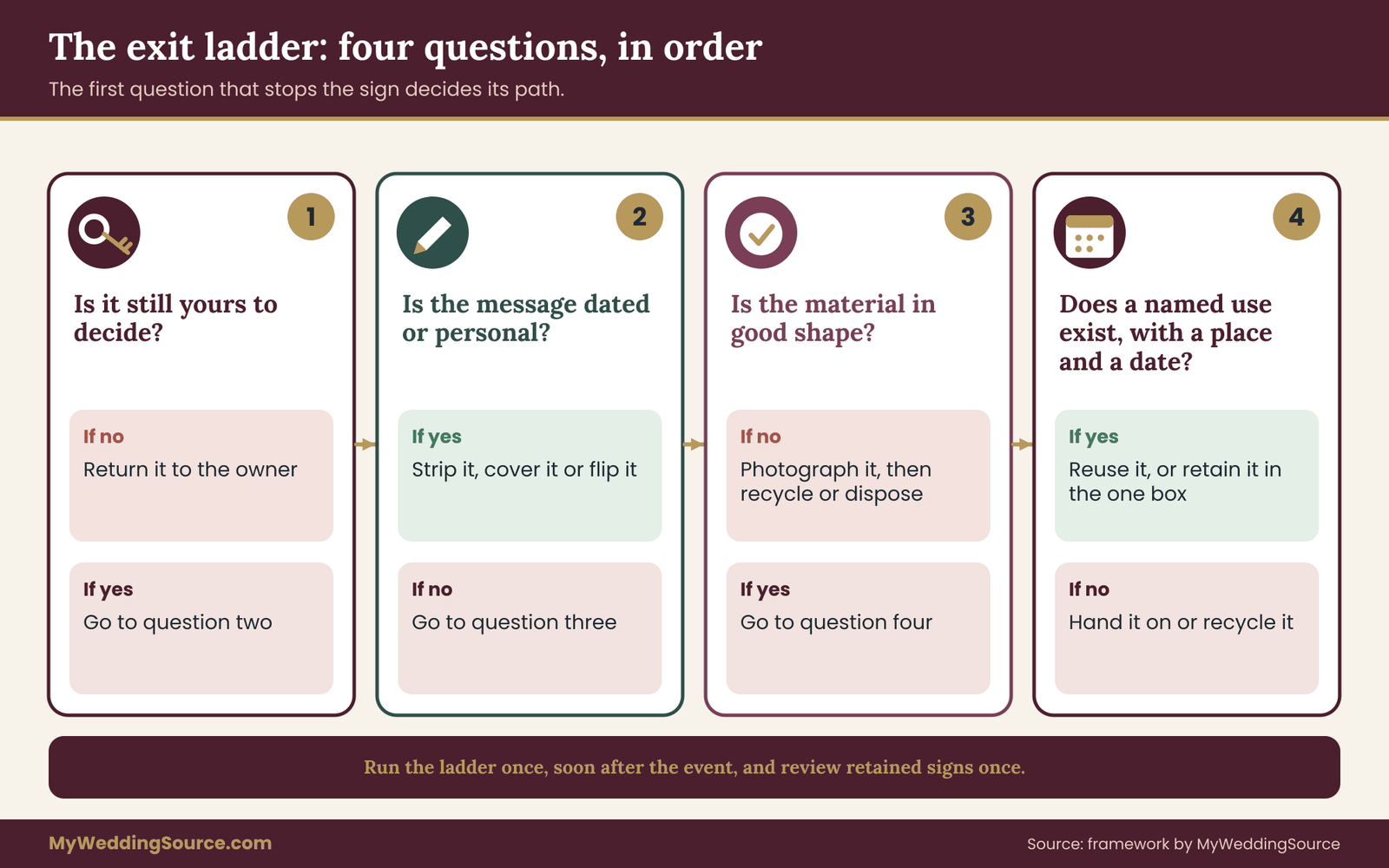
The exit ladder is a short sequence of four questions for anyone who wants to reuse wedding signs without guessing. You ask them in order, for each sign, and the first question that stops the sign decides its path. It takes about two minutes per sign at first and about thirty seconds once you have the rhythm. If you want to reuse wedding signs from a typical reception with fifteen to twenty signs, that is a single evening, and it replaces months of vague guilt about the closet.
The ladder works because it puts the cheap, certain questions first. Ownership is a fact you can check, and it comes first whenever you reuse wedding signs. Message is a fact you can read. Material condition is a fact you can see and touch. Only the last question, whether a second use really exists, asks you to predict the future, and by then you have already removed most of the signs.
Question one: is it still yours to decide? If the sign is rented, borrowed, or belongs to the venue or a vendor, the path is return, and the ladder ends there. If you are unsure, hold the sign aside with a tag that says “ask,” and confirm the answer in writing before you do anything irreversible. A short message works well: “Quick check on the easels used at the reception. Do those go back to you, or were they ours to keep?” Nobody minds that question.
Question two: is the message dated or personal? Read the sign as a stranger would. Does it carry names, a date, a hashtag, a monogram, a street address, a payment handle, a QR code, or guest names? If yes, the message cannot travel, but the container still might. Mark the sign “strip or cover” and keep going. If the message is generic, such as “Cheers,” “Love is sweet,” or a plain arrow, the sign passes and you can reuse wedding signs like this one exactly as they are.
Question three: is the material in good enough shape? Check for warping, cracks, peeling, mildew, curled edges, scratched acrylic, wobbly legs and damp. A sign that cannot stand up, hang flat or be wiped clean should not move to the reuse path, however sentimental. If the condition fails, the path becomes recycle or dispose, with a photograph kept as the memento.
Question four: does a real second use exist? This is the question most couples skip when they say they will reuse wedding signs, and it is the reason signs end up in closets. A second use is real only if you can name the place, the purpose and a rough date.
“The frame becomes a photo display in the hallway this month” is real. “Maybe we will use it for something” is not. If you cannot name a use, the sign goes to a person or program that can, or it goes to recycling.
Two edge cases come up constantly. The first is the sign that is half yours and half someone else’s, such as a printed insert in a rented frame. Split them. The frame returns, the insert follows the ladder on its own. The second is the sentimental sign you cannot let go of. Give it a retention slot with a rule: one box, one shelf, or one wall. If it does not fit, something else leaves.
Why the order matters when you reuse wedding signs
Couples who plan to reuse wedding signs often start with the most appealing question, which is the creative one: what could we make with this? That order produces projects. The ladder order produces decisions. Creative ideas are cheap and abundant, and a stack of fifteen signs can generate thirty ideas in ten minutes. Ownership, message and condition are the constraints, and they cut those thirty ideas down to the handful that are actually possible.
There is a cost logic here too, without inventing any figures. Every sign you keep when you reuse wedding signs at home has a carrying cost, which is the shelf space, the time to move it, and the chance it gets damaged anyway.
Every sign you return has a small time cost and often saves a replacement fee. Every sign you hand on has a small coordination cost and no storage cost. When you compare those three, “keep because it might be useful” usually loses to “name the use or hand it on.”
A final rule of thumb for anyone choosing to reuse wedding signs: the ladder is meant to be run once, soon after the event, and then reviewed once. Do not run it again every few months, because that turns a closed decision into an ongoing chore. If a sign was retained, it gets one review date, perhaps on your first anniversary, and then it either has a use or it leaves.
Paper, cardstock and foam board signs
Paper-based signs are the most common sign type, and the hardest group in which to reuse wedding signs well. They are also the most misunderstood in the recycling bin. Paper itself is one of the most widely recycled materials, and the EPA’s recycling guidance lists paper and cardboard among common recyclables. But a printed wedding sign is rarely just paper. It may be laminated, mounted on foam board with adhesive, coated with glitter or foil, or backed with plastic, and each of those additions can make it unsuitable for ordinary curbside collection.
Plain paper and uncoated cardstock. Table numbers, menu cards, programs, place cards and small directional cards printed on plain stock are the simplest case. If the message is personal, there is no second use, and the paper is clean, it generally belongs in paper recycling. If you want a keepsake, keep one of each type. Photograph the rest on the table where they were displayed, which also helps your archive, and recycle them.
Laminated cardstock. Lamination is a thin plastic film fused to the paper. Many local programs say plainly that laminated paper does not belong in the paper stream, because the plastic and paper cannot be separated easily. Check your own program’s list before you guess. If the lamination can be peeled off the edges, you may be able to remove it. If it cannot, the sign is usually a landfill item unless you reuse it whole.
Foam board prints. A large welcome sign or seating chart printed on foam board is a sandwich of paper facing, a foam core and often a second paper layer, glued together. This is the sign most likely to disappoint. Foam board is not accepted by most curbside programs, and it is not easy to separate into streams. The best outcome is reuse: the board is often in good shape, and you can cover the print and use the board again.
Mounted prints on corrugated plastic. Often called coroplast, this twin-wall plastic is common for directional and yard-style signs. It is durable and light, and it usually suits reuse better than recycling. Some local programs accept clean corrugated plastic as a rigid plastic, though many do not. Ask before you assume.
How to reuse wedding signs made of paper and foam
The easiest way to reuse wedding signs made of paper-based materials is to treat the substrate as the asset. A foam-board sign with a dated message can be covered with a sheet of plain paper, fabric or a new print, and used as a display board for photographs, a calendar for the kitchen, a pinboard for a home office, or a backdrop for a birthday table.
A coroplast sign can be flipped, because the back is usually blank, and reused for a garage sale, a yard notice, a school project or a neighborhood event.
The cover method matters. Spray adhesive and heavy paint can make a sign harder to recycle later, so choose removable covers where you can: a fabric wrap held by tape on the back, a sheet of paper with a few dots of removable adhesive, or a new print held in place with clips. The point of reuse is that the second life is also easy to end.
Here is a short decision rule for paper-based signs.
- If the sign is clean, flat and generic, reuse wedding signs like it as they are, or give them away.
- If it is personal but flat and sturdy, you can still reuse wedding signs of this kind by covering or flipping them, and giving each a named second use.
- If it is personal and warped, torn, damp or curled, recycle the paper portions you can separate, and send the rest to waste.
- If you cannot separate the layers, do not wishcycle. Wishcycling means putting something in the recycling bin hoping it will be accepted. It can contaminate a load of otherwise good material.
A word about glitter, foil and adhesive
Decorative finishes complicate paper signs. Glitter, metallic foil, flocking and heavy glue are common on wedding stationery. They do not usually make a sign dangerous, but they can make it unwelcome in a paper recycling stream, and they make it a poor candidate for a school or community donation because the glitter spreads.
If a sign carries heavy glitter, the honest options are to keep it as a memento, to reuse it for a purpose where glitter is fine, or to treat it as trash. Do not hand it on to a children’s program without saying so.
One last point on paper: the cheapest way to avoid this whole problem next time is at the printing stage, by choosing uncoated stock and skipping lamination where possible. If you are still earlier in your planning, the signage planning guide covers readability and printing choices, and it is the right place to think about this before the order is placed. For a finished wedding, though, the above rules are enough.
A practical tip for the sorting evening: set up three bins before you begin. One is labeled keep, one hand on, and one recycle or waste. Put each paper sign into a bin as soon as it clears the ladder. The physical act of placing it makes the decision feel final, and it stops you from picking the same sign up three times.
Acrylic, glass and mirror signs
Acrylic and mirror signs are the premium end of wedding signage, and you can reuse wedding signs of this kind only when the surface is clean. They look elegant, they cost more to produce, and they are the hardest to place when the day is over. The good news is that they hold their value as objects. The bad news is that their messages are often permanent, applied as vinyl lettering, printed directly on the surface, or engraved.
Acrylic panels. Acrylic, sometimes sold under the name Plexiglas, is a rigid plastic. It is durable, so a clean panel in good condition is a sound candidate if you want to reuse wedding signs. It is also easy to scratch, and visible scratches are the most common reason an acrylic sign fails the condition question.
Acrylic is generally not part of ordinary curbside plastic collection, which is organized around bottles, tubs and jugs. Some scrap and specialty programs take it, and some sign shops will reclaim it. Ask locally before you drop it in a bin.
Messages on acrylic. Check how the message was applied. Adhesive vinyl lettering can often be removed with gentle warmth and patience, and then the panel is blank again. Printed or engraved messages cannot be removed without damage. A blank panel gives you genuine ways to reuse wedding signs: a clip frame for photos, a dry-erase surface for a family calendar, a table protector, a display shelf. An engraved panel has a memento use or none.
Glass. Framed glass is common in seating charts and framed menus. Pane glass, such as window or picture glass, is a different material from container glass like bottles and jars, and many curbside programs do not accept it for that reason. The practical advice is to remove the glass from its frame, wrap it, and either reuse it in another frame or ask your local program how to dispose of it safely. Never put broken glass loose in a recycling bin.
Mirrors. A mirror seating chart is a mirror with lettering on its surface. The lettering is usually a paint pen, a vinyl overlay or a printed decal. If it was applied with a washable marker, it wipes off with a cloth, and you can reuse wedding signs like this as a plain mirror, which is useful in a hallway, a bedroom or a dressing area.
If it was applied with permanent paint, test a small corner with a gentle solvent before scrubbing the whole surface. Like glass, mirrors are not ordinary container-glass recycling in most places, so a mirror you do not want should go to a donation outlet or a bulk waste option, not the household bin.
Safety and handling
Glass and mirror signs need extra care in the post-event phase because the person moving them is usually tired. Wrap each piece in a blanket or in the paper from the packaging, stand it on its long edge in the trunk, and do not stack.
If a piece cracks, treat it as a hazard, not as a keepsake. Wear gloves, collect the pieces into a sturdy box, label it, and ask your local waste authority how broken glass should be set out. For larger mirrors, a rental company or the vendor may have specific return packaging, so ask before the event ends.
Another handling point concerns hanging hardware. Large framed signs often use wire, picture hooks or stands that were set up by a florist or venue team. When you take the sign down, count the screws and hooks and keep them with the piece. A sign without its hardware is a harder sign to reuse, and loose hardware in a trunk is a small safety risk.
Where acrylic and mirror signs usually end up
For clean, blank, undamaged panels, the best way to reuse wedding signs is a direct handoff. A friend planning her own wedding may want a blank mirror for her seating chart, a school may want it for a display, and a community theater may want it as a prop. For panels with permanent messages, the best outcome is a keepsake photograph and a transfer to a shop or program that accepts the material. For cracked or heavily scratched panels, it is usually disposal, done safely.
A simple test settles most cases when you reuse wedding signs: can you describe the second use in one sentence with a place and a date? If so, reuse. If not, hand on or recycle, and do not hold a fragile object in storage for years.
Wood, chalkboard and metal signs
Wood and metal signs are the sturdy part of the signage family, and the easiest place to reuse wedding signs. They are the signs most likely to have a long second life. They are also the signs most likely to be rented, borrowed or inherited, so the ownership question matters here more than anywhere else.
Painted wood signs. A rustic welcome sign, a carved arrow or a wooden table number is usually the easiest sign to repurpose. Wood is forgiving, which is why it is so easy to reuse wedding signs made of it. It can be sanded, repainted, flipped or cut down.
A large welcome board can become a hallway shelf, a garden marker, a headboard accent or a hanging planter backing. Most of that is not a craft project in the elaborate sense. It is simply recognizing that a flat, solid piece of wood is a useful object once the message is gone.
Reclaimed or pallet wood. Pay attention to the condition of the wood before reusing it indoors. Wood that was stored outside or in a damp barn may carry mildew, insects or splinters. Wipe it down, let it dry, and keep it away from food service surfaces until you are confident it is clean. For anything that will be touched or used with children, sand and seal it.
Treated and painted surfaces. Older paint, stain and finish can contain substances that are not safe to sand into dust. If a sign is old or inherited and you plan to sand it, check the guidance from the U.S. Consumer Product Safety Commission on lead paint in older items, and confirm with the lender or the family where the piece came from. For a sign purchased new for the wedding, this is rarely a concern.
Chalkboards. A chalkboard sign is a gift to the person who wants to reuse wedding signs, because the message wipes away. Clean it with a damp cloth, let it dry, and it is a blank board again. Real slate or painted wood chalkboards in good shape are popular and keep their value as secondhand items. Cracked slate and flaking paint are not worth moving.
Chalk paint and sealed surfaces. If the message was written with a liquid chalk marker rather than chalk, it can be stubborn. Water and a little patience usually works, and a sealed board may require a different cleaner. Test a corner first.
Metal signs. Metal easels, steel stands, iron signs and aluminum panels are among the most valuable post-event objects. They resist damage, they stack, and they have obvious second uses at home, in a garden, or at another event. Scrap metal is also one of the better-established recycling streams, and many communities accept clean steel and aluminum. A metal sign with paint or lettering may still be accepted. Check with your local program or a scrap dealer.
Repurposing logic for wood and metal
Wood and metal reward a simple approach when you reuse wedding signs: reduce the object to its useful shape and then ask what shape the home needs. A rectangular wooden board needs a surface, a shelf or a divider. A metal stand needs a plant, a coat or a lamp. A hoop or round sign needs a wreath, a mirror or a wall display. This shape-first thinking is faster than idea-first thinking, and it avoids the trap of buying new supplies for a craft project that was supposed to reduce waste.
What to do with items you cannot reuse
Some signs cannot be used again. A rotted wooden sign, a rusted metal stand with broken welds, or a warped board that will never lie flat should leave the house quickly. Untreated wood can often go to a yard-waste or wood-recycling stream if your community offers one, though painted or glued wood usually cannot. Metal in poor condition is still scrap. Check your local program’s guidance, and when it is unclear, ask a scrap yard or a local waste office.
Edge cases in the wood and metal group
A few edge cases are worth knowing. A sign with a vendor logo burned into the wood belongs to the vendor if the contract says so, and you should ask before cutting it. A sign built into an arch or a larger installation may be part of a florist or rental package. A neon or lighted sign needs separate treatment, because electronics and bulbs often have their own disposal rules.
The U.S. EPA’s household hazardous waste guidance is the right place to start for lamps, batteries and anything with a power source. And a sign borrowed from a family member should go back with the message intact unless they say otherwise, because it may carry meaning for them that is invisible to you.
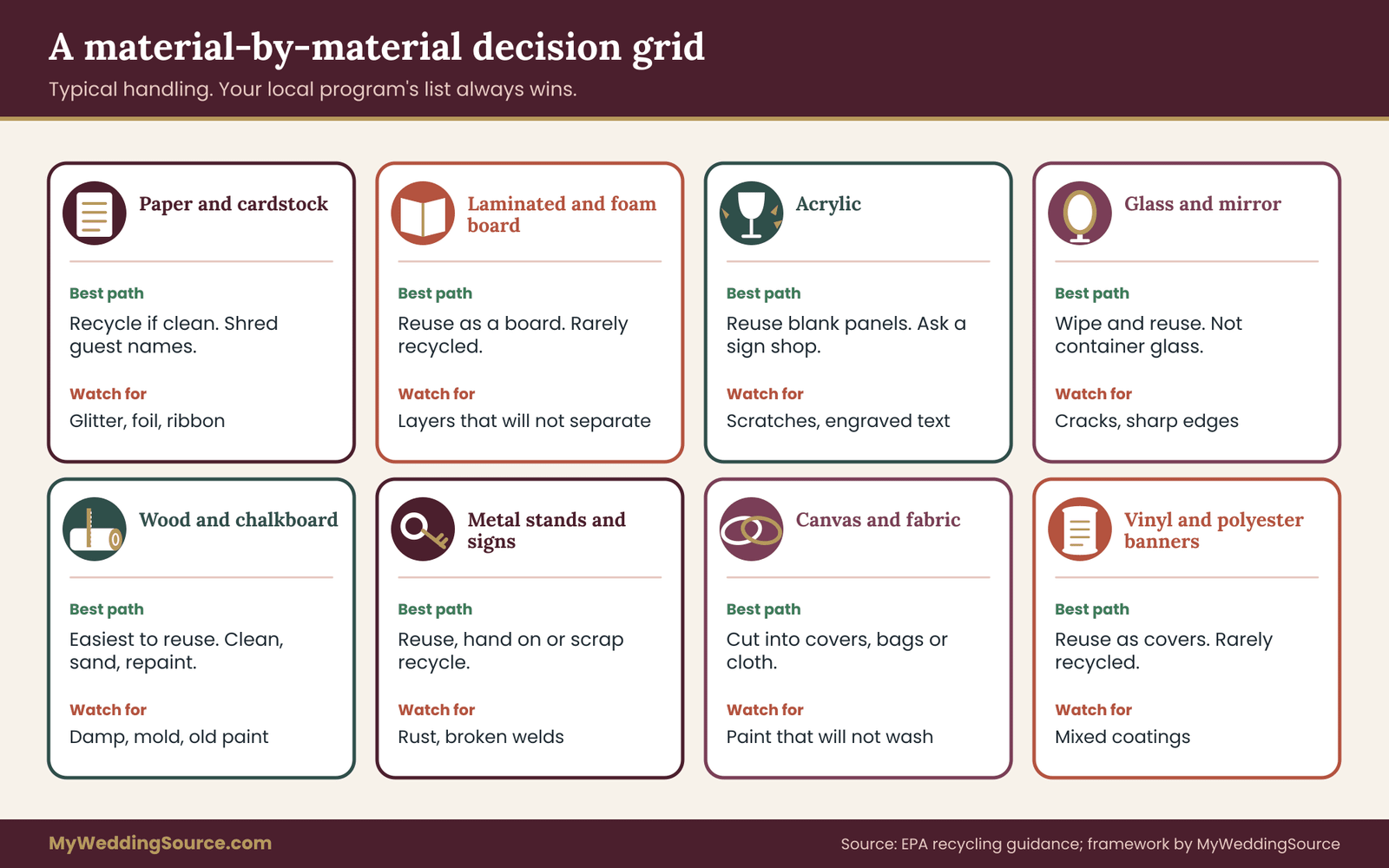
Soft signs are less common than hard ones, but they appear at more weddings than people expect: a canvas welcome banner, a fabric seating chart on a hoop, a vinyl backdrop banner, a flag or pennant garland, or a printed bedsheet strung between two poles. They have a different problem from rigid signs. They are light and easy to store, but their message is usually fixed into the fabric, and their materials are among the least recyclable.
Cotton and canvas. Plain cotton canvas, muslin and linen are the friendliest soft signs. Many keep their value as fabric. If the message was painted, it will not come out, but the fabric can be cut into pieces and used as cloth: tote bags, cushion covers, dust sheets, painting drop cloths, or lining for a drawer.
If the fabric is clean and you want to reuse wedding signs made from it, a textile donation program may accept it, though many programs prefer finished goods and clothing over scraps, so ask before you drop off a bag of cut cloth.
Printed polyester banners. Dye-sublimation printing on polyester is common for large welcome banners and backdrop panels. It makes vivid images, and it makes a poor recycling candidate, because mixed textile and coating streams are limited.
The honest options are to reuse the banner (as a drop cloth, a picnic ground cover, a cover for outdoor furniture, or a tarp for a workshop), to pass it on to someone who will, or to dispose of it. Cutting it into pieces to reuse wedding signs as craft material is fine if you have a plan, but it is not fine if the cut pieces go into a drawer for years.
Vinyl banners. Vinyl banners, the sort printed by a sign shop for an outdoor sign, are durable and waterproof. They are also made from PVC, which is not in ordinary plastic recycling. Vinyl banners are generally better reused than recycled, so the practical way to reuse wedding signs made of vinyl is as covers.
They can cover a woodpile, line a planter, protect a floor during a painting job, or serve as a tarp. Some sign shops take back large-format vinyl, and some communities have special programs. Ask the shop that printed it, because they may know a local option.
Pennants and garlands. Paper pennant garlands and fabric bunting are often recycled or reused with the message cut off. Cutting them down to blank pieces gives you cloth or paper that can be used for gift wrap, bookmarks or labels.
The second life of soft signs
The most useful question when you reuse wedding signs made of cloth is not “what could this become?” It is “where do I already use a cloth, cover or liner?” A canvas banner that becomes the cover for a garden bench cushion has replaced something you would have bought. A vinyl banner that becomes a protective sheet in the garage has replaced a tarp. The second life that avoids a purchase is usually the one that sticks.
For couples who want to reuse wedding signs without a project, there are low-effort options. If you cannot reuse wedding signs this large yourself, offer a large banner to a school, scout group, church group or community sports team for use as a backdrop or as the reverse side of a new banner.
Ask a local theater whether they use fabric panels. Give a canvas piece to a friend who paints. The more specific the offer, the more likely it is to be accepted, and the less likely it is to sit in your own garage.
Stands, easels and frames: the overlooked hardware
The things that hold signs up are often easier to reuse than the signs themselves, so look at stands before you decide how to reuse wedding signs themselves. A wooden easel, a metal stand, a plate stand, a clip frame and a picture frame all have a long, practical second life, and they are in higher demand than a printed sign.
If you own them, they are probably your best candidates for reuse: keep one or two that you will use, pass the rest to someone planning an event, or donate them to a thrift or reuse store that accepts home goods. If they are rented, they go back.
Test every stand before keeping it. Tighten the hinges, check for cracks at the joints, and make sure it stands level on a flat floor. A stand that wobbles is a safety problem for the next person. Remove sticky residue with a mild cleaner so it looks presentable to a charity or a buyer.
A practical way to handle all of this is to pack in two piles from the start: hardware and messages. Hardware goes into a labeled box. Messages go into a separate stack for the ladder. This also makes the return trip to a rental company much faster.
Personal details: what to remove before you reuse wedding signs
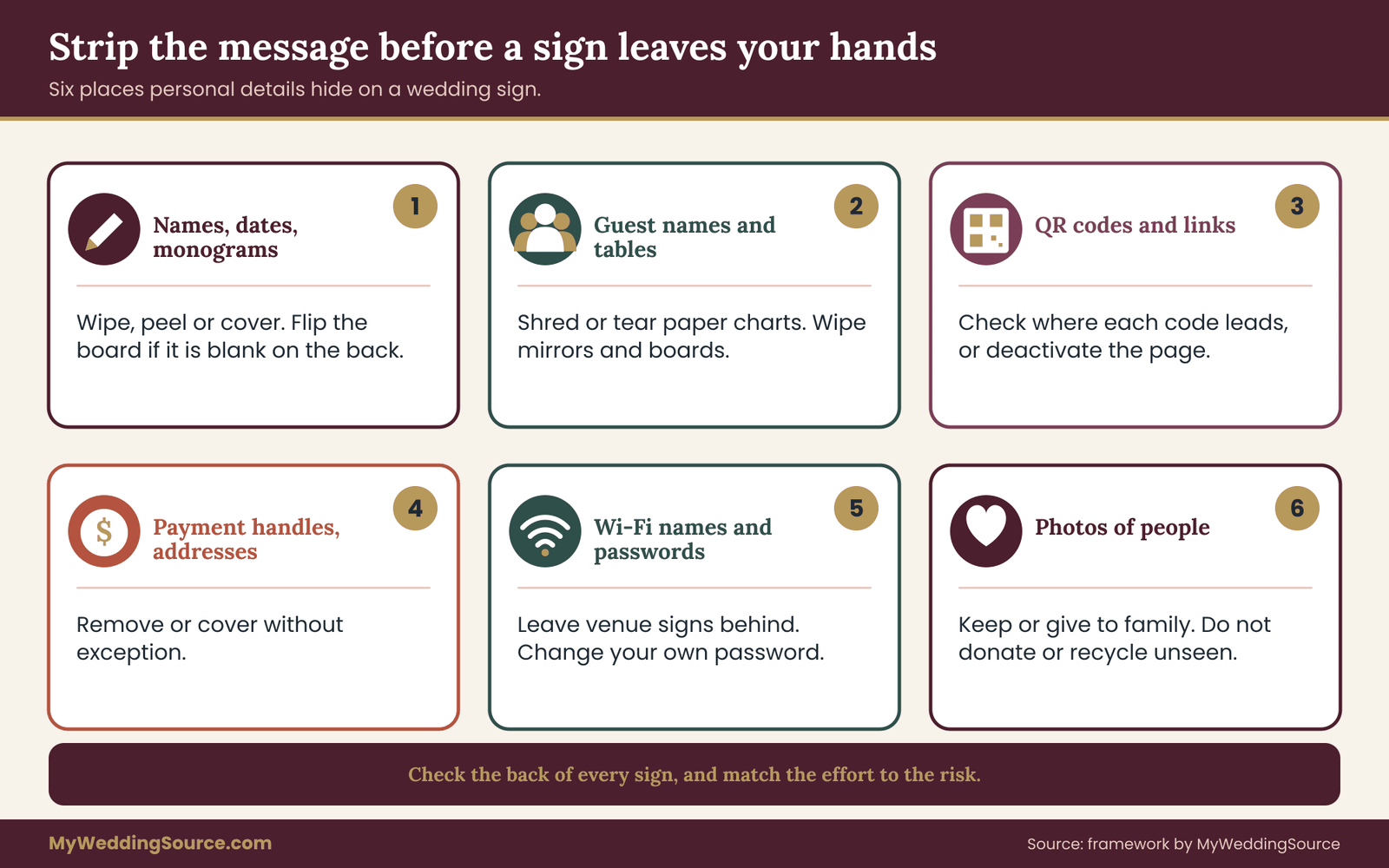
The most overlooked part of any plan to reuse wedding signs is privacy. A wedding sign is a public object for one day, and it carries more personal information than most couples realize. Before you hand any sign to a charity, a buyer, a friend of a friend or a recycling stream, check it for personal details, and remove or cover them. This step takes minutes and avoids real annoyances.
Names and dates. Your names, the wedding date and any initials or monograms are the obvious ones. They are harmless in most cases, but they make a sign hard to reuse, and many people prefer not to receive a sign with someone else’s name on it. They are the reason many signs fail question two on the ladder, and the reason it takes care to reuse wedding signs that carry them.
Guest names. A seating chart carries a list of names and table assignments. That is a list of your friends and family, sometimes with the notes about dietary needs or relationships, and it should not be dropped into a public bin or donated. If the chart is paper, tear it or shred it before recycling. If it is on a mirror or a board, wipe or cover it. The wedding seating chart guide covers how the chart is built, and the same attention to guest details applies afterward.
QR codes and links. A QR code on a sign may link to a registry, a photo gallery, a payment page or a guest portal. Even after the wedding, those links may stay active. Check that each code goes where you want it to go, or deactivate the destination, before the sign leaves your hands. A sign that sends a stranger to your photo album is a surprise nobody wants.
Payment handles and addresses. Some couples display a payment app handle for gifts or a mailing address for cards. Remove or cover these without exception. They are the one category where a mistake has a real cost.
Wi-Fi and access details. A venue or vendor sometimes posts a Wi-Fi name and password. If the password belongs to the venue, leave the sign with them. If it was yours, change the password, because the sign is about to go into the world.
Photographs. Signs with photographs of people, such as a family tree display, a memory board or a photo of a late relative, carry meaning that is not obvious to others. Keep them, or give them to a family member, but do not donate or recycle them without a decision. Photographs of children deserve extra care.
Methods for removal that preserve the sign
Choose the least destructive method that works, since the point is to reuse wedding signs, not to wreck them. Wipe off washable markers, chalk and dry-erase with a damp cloth. Peel off vinyl lettering with gentle warmth from a hair dryer, and work slowly from a corner.
Cover printed messages with removable adhesive paper, a fabric panel, or a flip of the board. Use a permanent marker or opaque paint only where you know the sign will stay in your home, since a painted-over message may still be visible under bright light to the next owner.
For paper and card, the choice is between tearing and shredding. A seating chart with fifty names is worth shredding or tearing into small pieces. A table number with just a number does not need that treatment. Match the effort to the risk.
A short script for handing on a sign
When you offer to a friend a sign you will not reuse, or post it in a local group, say what it is and what has been done to it. For example: “Free to a good home. Blank mirror, 24 by 36, painted lettering wiped off. Wood frame has one chip on the corner. Pickup only, this weekend.” That wording tells the receiver the condition, the size and the deadline. It also saves you from the long back-and-forth that makes people give up and keep the sign.
Ways to reuse wedding signs at home
Reuse at home is the path with the lowest friction, and for many couples it is what they mean when they say they will reuse wedding signs. It is also the path with the highest risk of becoming clutter. It is low friction because nothing has to be listed, delivered or negotiated. It is risky for the same reason: nothing forces you to finish. The rules below are meant to give home reuse a deadline and a place.
The first rule when you reuse wedding signs at home is the named-use rule from the exit ladder. Every sign that goes home gets one sentence: what it becomes, where it goes, and by when. Write that sentence on a small piece of tape on the back. If the sentence has not come true by the date, the sign goes to the hand-on or recycle pile without further debate.
The second rule for anyone who plans to reuse wedding signs is to use the sign’s natural strength. Do not force a sign to become something it is not. A few matches between material and use work reliably.
Frames become frames. A framed menu, seating chart or welcome sign becomes a photo display, a piece of art, a calendar or a school-work board. Replace the printed insert with a photo from the wedding, a map, a print or a child’s drawing. This is the most common way couples reuse wedding signs successfully, and it works because the frame needed no change.
Boards become surfaces. A foam board or wooden panel becomes a pinboard, a kitchen planner, a painting surface, a tray or a headboard accent. Cover the message and add what you need.
Chalkboards stay chalkboards. A cleaned chalkboard becomes a pantry list, a weekly menu, a message board by the door, or a kids’ drawing board. It needs no adaptation, and that is why it tends to survive in a home.
Mirrors stay mirrors. A clean mirror goes in the entry, a bedroom or a dressing area. The only work is wiping off the lettering.
Easels and stands stay stands. An easel displays art, a recipe, a plant or a calendar. It is probably the most useful object in the whole pile.
Table numbers become labels. Small numbered cards or wooden numbers can label shelves, drawers, storage bins, seed rows in a garden, or numbered gifts in a holiday exchange. They have almost no wedding content, which is why they travel well.
Banners and cloth become covers. Canvas and vinyl become drop cloths, covers and liners, which is a quiet way to reuse wedding signs that carry fixed prints.
Anniversary and keepsake uses
Some signs deserve a role connected to the wedding itself. A welcome sign can come out each anniversary, and be placed at a small dinner, with a photograph clipped to it. A framed vow or quote can hang in a bedroom. A small number of signs, perhaps one or two, can become part of a new family tradition, such as a sign that is brought out for each major household celebration. This is a legitimate way to reuse wedding signs, but it should be limited and intentional.
The test is the box rule: every retained sign has to fit in one box or on one shelf. If the box is full, a new keeper requires an old one to leave. This rule protects you from slow accumulation, and it is easy to apply because the limit is physical.
Storage that does not ruin the signs
If you are keeping signs for any length of time, store them properly, because good storage is part of how you reuse wedding signs later. Poor storage turns a good sign into a waste item within a year or two, and it defeats the point of keeping it.
To reuse wedding signs later, keep paper and cardstock flat, in a dry place, between sheets of acid-free paper or clean cardboard. Avoid attics and garages where heat and humidity swing. Keep foam board and wood off concrete floors and out of damp basements, because moisture warps both. Wrap glass, mirror and acrylic in blankets or bubble wrap, and stand them on their long edge, never flat under other items. Hang or roll fabric and canvas loosely, not folded tightly in a plastic bag, which traps moisture. Keep chalkboards dry and upright.
Label each box with a list of contents and a review date. Take one photograph of the contents and store it with your wedding records, so a future you does not have to open the box to remember what is in it. The wedding records guide explains how to keep a simple archive of papers and photographs, and the same system can hold your retention list.
When home reuse is the wrong choice
Be honest about the cases where a plan to reuse wedding signs at home fails. If you do not have the space, if the sign has no use in your home, or if the project requires tools and time you will not find, choose another path. A sign that goes to someone who will use it next week has had a better life than one that sits in your closet. It is not a failure to let it go.
Handing signs on: donate, sell, gift or return
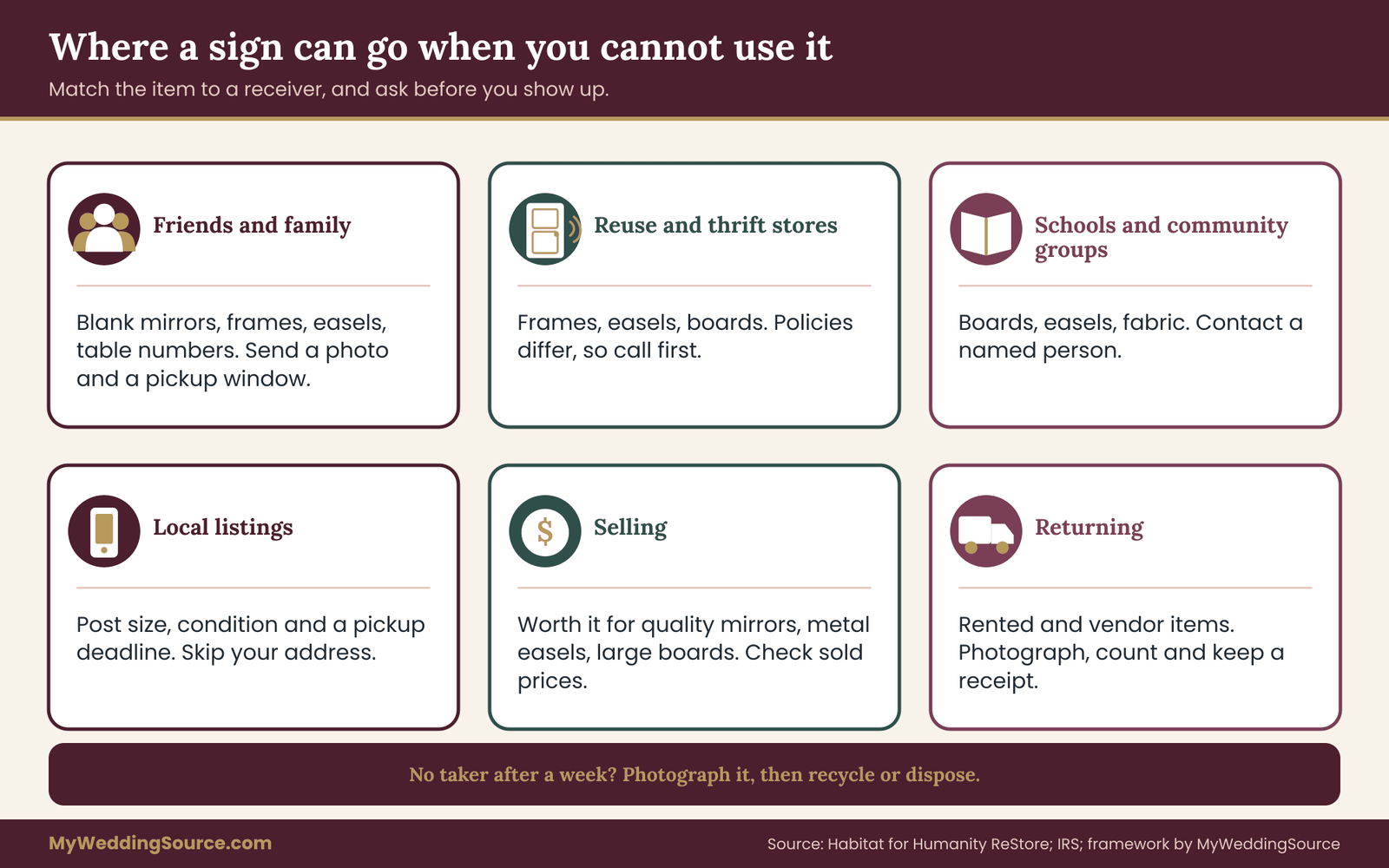
When a sign passes the ladder but you cannot reuse wedding signs of that kind at home, the best next step is a person or program that wants it. This is where many couples assume that “donate” is the answer and then discover that very few outlets want wedding signs. A better approach is to match the item to the receiver and to ask before you show up.
Friends and family. The simplest and most reliable route to reuse wedding signs outside your home. Ask in a short message, with a photo, size and condition. Couples planning their own weddings are the obvious audience for anyone wanting others to reuse wedding signs: for blank mirrors, frames, easels, chalkboards and table numbers. Offer a pickup window so the item is gone quickly.
Local reuse stores and thrift shops. Some accept frames, easels, mirrors, wood boards and home decor, and some do not accept anything that looks like event decor. Habitat for Humanity runs ReStore outlets that accept certain home goods, and policies differ by location. Call first, describe the item, and ask what they accept. Never leave items outside a closed shop, because that creates a disposal problem for the staff.
Schools, churches, community theaters and scout groups. These groups often use boards, easels, fabric and frames for events, sets and displays. Contact a person, not a general inbox, and say exactly what you have. Many groups are glad to receive a clean easel or a large blank board, and less glad to receive a glittered foam print.
Local wedding groups and online listings. Posting items in a neighborhood group or a wedding-focused group is effective, particularly for blank pieces and hardware. Mention the pickup terms and the condition, and use cash or a simple handoff for low-value items. Avoid posting your address publicly, and meet at a neutral spot or on your porch.
Selling. Selling is a valid path to reuse wedding signs that have real value, such as a quality mirror, a large chalkboard, metal easels or a set of wooden numbers. Price by checking what similar items have actually sold for, not what they are listed for. Be honest about condition and remove personal content first. If you sell reproductions of a designer’s artwork, check the license first. For couples tracking their overall spending, the wedding budget guide explains how to record any recovered money so that your records match.
Donation receipts and tax questions
If you donate to a qualified charity and want a receipt, ask for one at drop-off. Whether you can claim a deduction, and how the value is calculated, depends on your tax situation and the rules at the time. The IRS publishes guidance on charitable contributions, including how used household goods are treated. Read the current publication or talk to a tax professional. Do not assume a deduction, and do not invent a value for a sign because that is a common source of trouble.
Returns and the last mile
Return rented and vendor-owned items on the stated date, and in the condition the contract expects, because nobody can reuse wedding signs that were never theirs. Photograph each item before handing it over, and keep a returned-items note with the date, the count and the name of the person who accepted it. If the return is delivered by a courier or collected by a driver, ask for a confirmation by message. This is part of your vendor file, and it keeps small disputes small.
For items you handed to a friend or a group, a brief message that confirms the pickup and thanks them is enough. It closes the loop and makes it easier to ask again next time.
What to do when nobody wants it
Some signs will not find a taker, and that is normal even when you reuse wedding signs with care. If a sign has been offered for a week with no interest, stop spending effort on it. Choose between a final photograph and recycling, or disposal if the material has no stream. A decision made within two weeks is better than an open question that lasts two years.
Recycling by material, and where it fails
Recycling is the right ending for a sign when you cannot reuse wedding signs of that kind, but it is the path with the most room for self-deception. The EPA’s recycling guidance is clear that what is accepted depends on the local program, and that putting the wrong items in a recycling bin can contaminate good material and raise costs for the program. The agency’s term for the habit of hoping something is recyclable is wishcycling, and wedding signs invite it, because so many are made from mixed materials.
The rule is simple and strict, and it applies even if you were hoping to reuse wedding signs instead. Check your own program’s accepted-materials list before you place a sign in a bin. Most municipal and county programs publish a list on their websites, and many have a phone line or a form. If the list does not name the material, or the sign is a composite, treat it as not accepted until someone tells you otherwise.
A material-by-material reading
The list below is a decision aid, not a promise about your town. It describes how each material is usually handled, and your local program’s rules always win.
Plain paper and uncoated cardstock. Usually accepted in curbside paper recycling when clean and dry. Remove ribbon, glitter and plastic. Shred or tear anything with guest names.
Corrugated cardboard. Usually accepted when clean and flattened. A cardboard sign with a glued print on one side may need the print removed.
Laminated paper and cardstock. Often not accepted. If the lamination peels off, the paper may be. If not, it is usually trash, unless you reuse it whole.
Foam board. Usually not accepted at curbside. Reuse is the better route, and disposal is the fallback.
Corrugated plastic (coroplast). Sometimes accepted as rigid plastic, often not. Ask. Reuse is the better route.
Acrylic. Usually not accepted in curbside plastic. Sign shops and specialty programs sometimes take it. Reuse or hand on if clean.
Glass and mirror. Pane glass and mirrors are usually not accepted with container glass. Ask your local program or use a donation or bulk-waste option. Handle with care.
Untreated wood. Sometimes accepted by wood-waste or yard-waste programs. Painted or glued wood often is not. Reuse is the better route.
Metal. Clean steel and aluminum are widely recycled through curbside programs, scrap dealers and drop-off centers. Remove non-metal parts where you can.
Cotton and canvas. Sometimes accepted by textile programs when clean and dry. Reuse as cloth is more reliable.
Polyester and vinyl banners. Usually not accepted. Reuse as a cover or return to the printer if they offer it.
Batteries, bulbs and lighted signs. Never in the household bin. Use the EPA’s guidance on household hazardous waste and your local collection point.
Keep this list as a starting point for questions, not as a replacement for them. The most useful single call you can make is to your local waste or recycling office, with one question: “Which of these do you accept, and how should I prepare them?”
The failure conditions when you reuse wedding signs
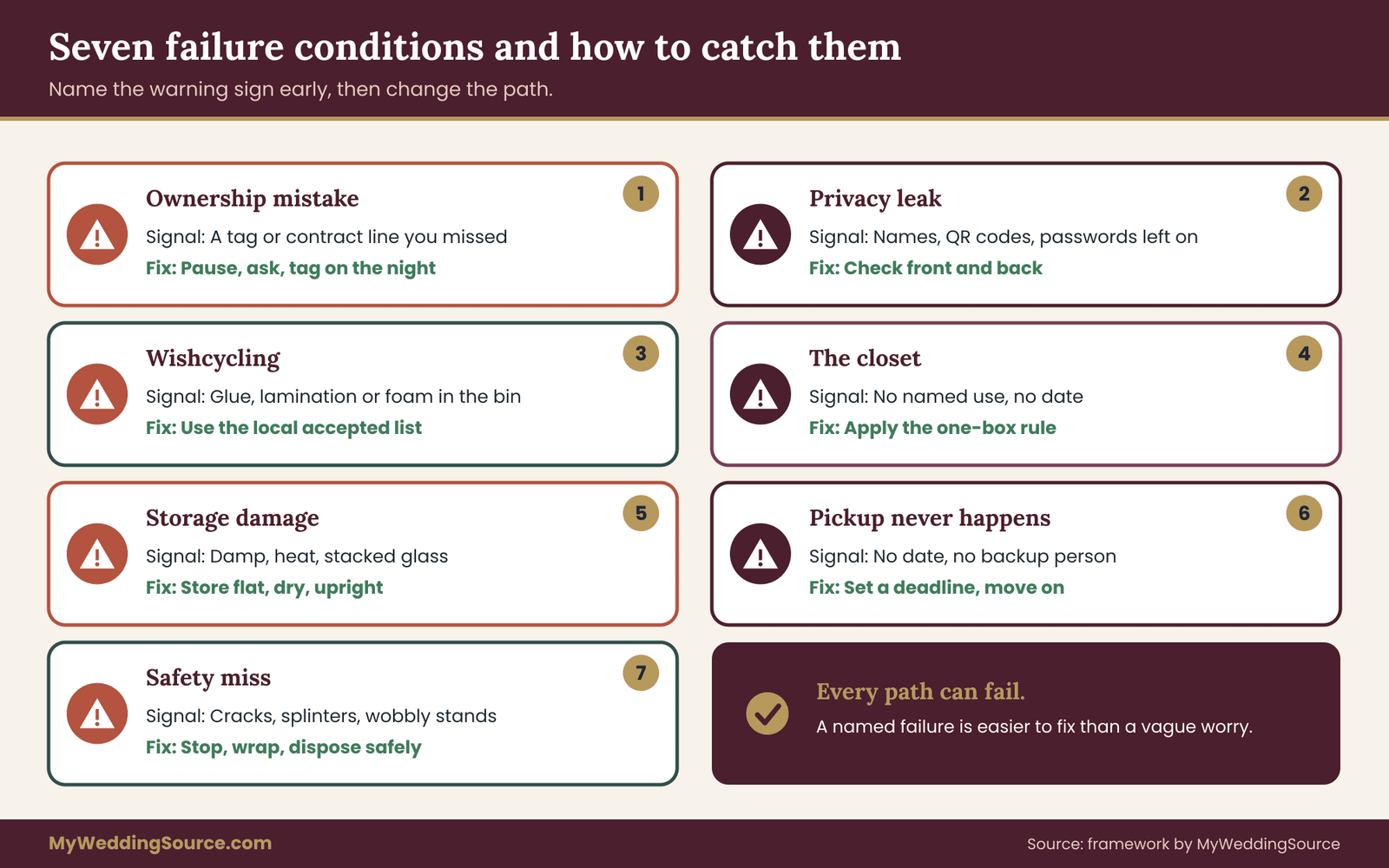
Every path in this guide can fail, including the plan to reuse wedding signs. Naming the failure conditions in advance is more useful than a list of good intentions, because it lets you recognize a problem early and change the path.
Failure one: the ownership mistake. You donate, sell or discard a sign that belonged to a rental company, a venue, a vendor or a friend. Signals: a tag, a contract line, a color you do not recognize, a stand that looks too good to be yours. Fix: pause and ask. Prevention: tag ownership on the night.
Failure two: the privacy leak. A sign with guest names, a payment handle, a QR code or a Wi-Fi password leaves your control. Signals: you did not read the whole sign, or you only checked the front. Fix: retrieve it if possible, deactivate the link, change the password. Prevention: run the message check before any handoff.
Failure three: wishcycling. A composite sign goes into the recycling bin without being checked. Signals: the sign has glue, lamination, foam or mixed layers. Fix: remove it before pickup if you can. Prevention: use the material list above and your local program’s list.
Failure four: the closet. A sign comes home with no named use, and the plan to reuse wedding signs quietly becomes storage. Signals: no tape note, no date, no place. Fix: apply the box rule now. Prevention: write the named use on the back before the sign leaves the venue.
Failure five: storage damage. A sign you kept is warped, moldy, yellowed or broken when you finally take it out. Signals: damp basements, hot attics, stacked glass. Fix: assess honestly, recycle or dispose. Prevention: store flat, dry and upright as appropriate.
Failure six: the pickup that never happens. You offer a sign, someone says yes, and it stays in your hallway for weeks. Signals: vague pickup terms, no date. Fix: set a deadline and move on. Prevention: offer a pickup window and a backup recipient.
Failure seven: the safety miss. A cracked mirror, a splintered board, a wobbly stand or an old painted piece causes an injury or a mess. Signals: you notice damage and keep going anyway. Fix: stop, wrap, label, dispose safely. Prevention: inspect every hard sign during the ladder.
Edge cases that do not fit the ladder neatly
A few situations come up often enough to name. The first is the sign you are not ready to decide about. Grief, family tension or simple tiredness can make a sign feel impossible to judge in the first week. Give it a holding spot with a written date, no more than a few months out, and decide then. A dated hold is different from drifting, because it ends.
The second is the sign made by a friend or relative. A hand-painted board from a parent or a lettered banner from a friend carries a relationship, and that changes the arithmetic. Keep it, or ask the maker what they would like. Most makers are touched to be asked, and some will say that they would rather see it used than stored.
The third is the sign that was meant for a second event from the start: a vow renewal, an anniversary party, a rehearsal dinner for a sibling. Plan that use before the wedding if you can, and keep the sign out of the sorting entirely. Tag it as a planned reuse, store it correctly, and give it a date like any other.
The fourth is the outdoor sign that has been rained on. Wood, foam board and paper take on water quickly, and mold can begin within days if they are left wrapped and damp. Dry them in open air before you store, hand on or recycle them. A damp sign handed to a friend is a problem handed to a friend.
The fifth is the sign made as a group effort, such as a guest-signed board, a wooden heart signed by everyone, or a banner covered in notes. These are not signs in the sense of this guide. They are keepsakes with signatures, and they belong in the retention box with a photograph. Do not cover, flip, donate or recycle them without a deliberate decision from both partners.
The sixth is the couple who disagree. One partner wants to keep every sign and the other wants a clear closet. A rule that both can accept is the one-box limit. Each partner picks what goes in the box, and anything beyond it must pass the named-use test. That turns a dispute about feelings into a short conversation about space.
Costs and trade-offs, without invented numbers
This guide avoids quoting prices when it compares ways to reuse wedding signs, because they vary by region, season and seller, and because anything it printed would be out of date quickly. The logic of cost is still worth stating. Returning a rented item on time often avoids a replacement or late fee. Reusing at home saves the cost of buying a substitute.
Handing on saves storage space and time. Selling may recover some money, but the time cost of listing, messaging and meeting a buyer is real, and a low-value item may not be worth it. Recycling is usually low-cost and sometimes free, but it can cost a trip if the accepted drop-off is not on your usual route.
When two paths look equal, choose the one that finishes soonest, whether you reuse wedding signs or recycle them. A decision that closes within two weeks has a low carrying cost. A decision that stays open for a year has paid rent in closet space the whole time.
When the broader picture matters
Signs are one slice of the waste a wedding produces, and the effort to reuse wedding signs is only one lever. If you want to look at the whole event, including food, flowers, packaging and décor, the realistic waste audit guide gives a realistic audit from catering to cleanup. The aim here is narrower, and it works best when you treat signs as one task among several in your first weeks after the wedding, not as a project of its own.
One last caution about claims. If a vendor describes a sign as “eco-friendly” or “recyclable,” ask what that means in practice. The Federal Trade Commission’s Green Guides explain how environmental marketing claims should be qualified, and a claim that a sign is recyclable usually depends on whether recycling facilities actually accept it where you live. A claim on a label is a reason to ask a question, not a substitute for checking.
A worked case: fourteen signs and one weekend
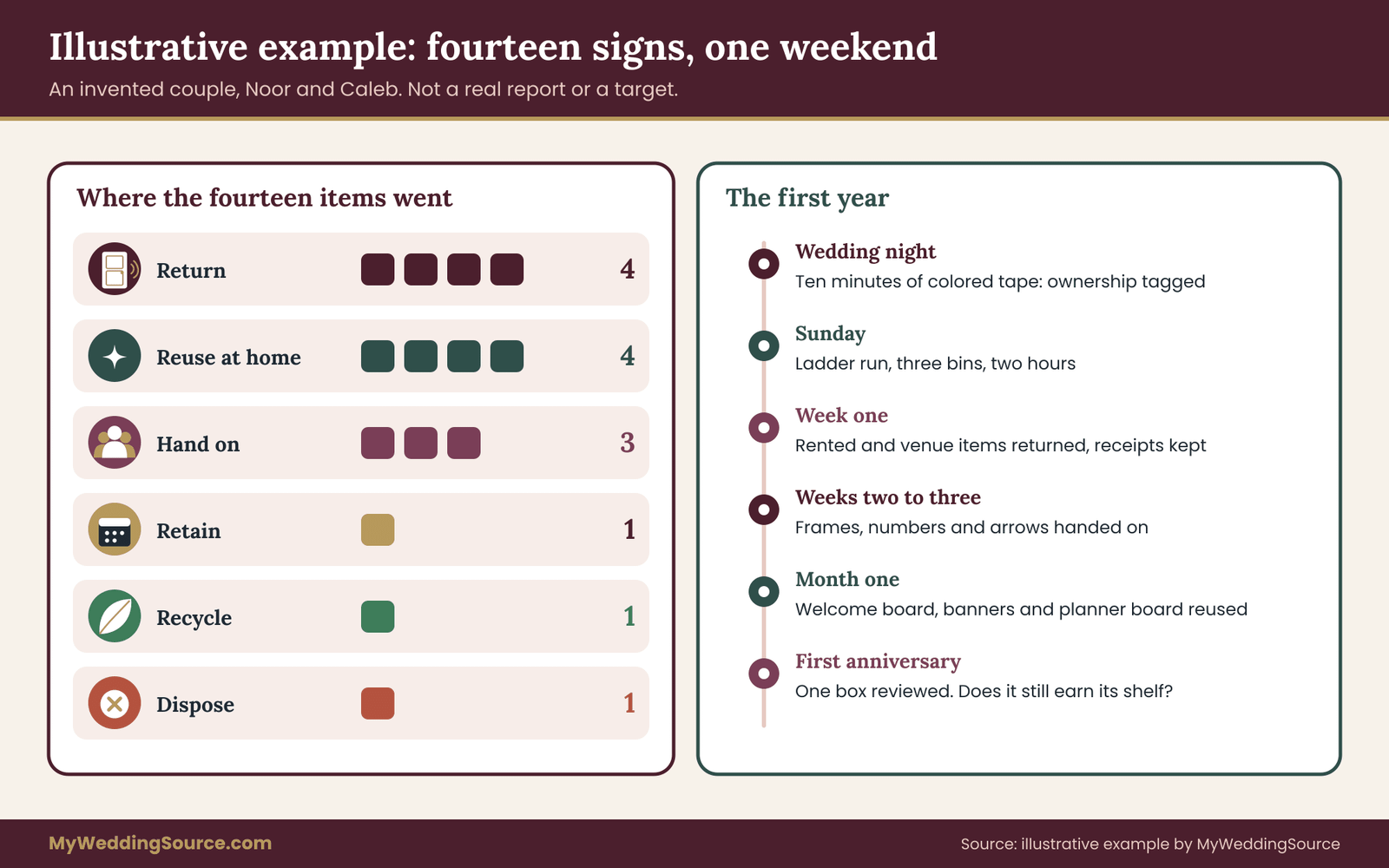
The best way to see how to reuse wedding signs is to run the ladder on a full set. The example below is invented for illustration. It is not a report about a real couple, and no outcome here should be read as typical or promised. It shows the reasoning, which you can copy with your own signs.
Imagine a couple, Noor and Caleb, with a mid-sized reception that used fourteen sign items. On the night, a friend tagged each item with colored tape: green for theirs, orange for rented, blue for venue property, and yellow for borrowed. That took ten minutes and removed the biggest source of mistakes.
On Sunday afternoon, with a plan to reuse wedding signs where possible, they set up three bins and ran the ladder. Here is how each item went.
The wooden welcome sign. Theirs, with names and a date painted on. Question two flagged the message. Question three passed, since the board was solid. Question four produced a named use: sand it and use it as a hallway shelf board by the end of the month. Path: reuse at home.
The easel under it. Orange tape. Rented. Path: return, on the date in the rental agreement.
The mirror seating chart. Orange tape. Rented, with guest names written in paint pen. Before returning it they photographed it for their archive and wiped the names off with a damp cloth, which the rental company’s terms allowed. Path: return.
The framed bar menu. The frame was theirs, and the card inside listed drink names and their wedding hashtag. They tore the card into small pieces for paper recycling, kept the glass in the frame, and offered the frame to a friend planning a spring wedding. Path: hand on.
Twelve wooden table numbers. Theirs, with no names on them. They kept four to label storage bins in the hall closet and offered eight to a cousin. Path: hand on, with a small retained portion.
The laminated “cards and gifts” sign. Theirs, laminated cardstock with a ribbon glued on. Their county program said laminated paper was not accepted, and the lamination would not peel. They photographed it and placed it in the trash. Path: dispose, consciously.
The foam-board signature-drinks print. Theirs, with the cocktail names. They covered it with a sheet of plain paper and a few dots of removable adhesive and used it as a kitchen planning board. Path: reuse at home.
Three corrugated-plastic arrows. Theirs. Their county program did not list corrugated plastic, so they did not guess. A friend running a school fundraiser wanted them for parking signs. Path: hand on.
The canvas welcome banner. Theirs. The paint would not come out, so they cut it into two pieces and used one to cover a garden bench cushion. Path: reuse at home.
The vinyl photo-backdrop banner. Theirs. Vinyl was not accepted locally, so they folded it into the garage as a drop cloth for a painting project. Path: reuse at home.
The aunt’s chalkboard. Yellow tape. Borrowed. They wiped the message off, checked for damage, and returned it with a thank-you note. Path: return.
The venue’s metal stand. Blue tape. They left it where the venue manager had asked, and confirmed with a message. Path: return.
The engraved acrylic sign. Theirs, with names permanently engraved. No second use existed, and it was in good shape. They photographed it and kept it in the memento box as the single retained sign. Path: retain.
The cardboard thank-you sign. Theirs, clean and flat, with a single message. After a photograph, it went into paper recycling. Path: recycle.
What the tally shows
In this invented example, four items went back to their owners, four were reused at home, three were handed on, one was retained, one was recycled and one was thrown away. That spread is a feature of the example, not a target. The useful pattern is that the ladder never asked “what could we make?” first. It asked who owned the item, what the message was, whether the material was sound, and whether a named use existed. Most of the work was done by the first two questions.
The time needed to reuse wedding signs this way was modest. The tagging took minutes on the night. The sorting took an afternoon. The returns happened in the first week, the handoffs within three weeks, and the home projects across the first month. One review at the first anniversary checked whether the memento box was still one box.
How to adapt the example
Your signs will differ. You may have more paper and fewer frames, or a large banner and no mirror. Keep the structure and change the contents: tag ownership on the night, separate hardware from messages, run the ladder once, give every reuse a sentence and a date, and set a two-week limit on any handoff. The structure is what makes it easy to reuse wedding signs without turning the weekend into a project.
Your next steps
Here is a short sequence to reuse wedding signs responsibly, starting on the day of the wedding.
- Tag ownership. Ask a friend to put colored tape on every sign on the night: yours, rented, venue and borrowed. Hardware and messages go in separate boxes.
- Check your contracts. Read the rental, venue and stationer terms for return dates, conditions and artwork licenses. Put the dates on your calendar.
- Run the exit ladder to reuse wedding signs. Within a week or two, sort every sign through the four questions, and put each into a keep, hand on, or recycle bin.
- Strip personal details. Remove names, QR codes, payment handles and passwords before any sign leaves your hands.
- Make the calls. Contact your local recycling office and any reuse store before you drop anything off, and offer signs to people by name.
- Close the file. Photograph the finished set, record returns and receipts in your wedding records, and set one review date.
FAQ
Which wedding signs are easiest to reuse?
Chalkboards, wooden signs, metal stands, easels, frames and blank mirrors are the easiest places to start when you reuse wedding signs, because the message wipes off or the object is useful without it. Foam board and coroplast can also work when they are flat and sturdy. Paper signs with personal content are the least likely to have a second life. Check ownership first, since many easels and frames are rented.
Can I donate wedding signs to a charity or thrift store?
Sometimes. Many shops accept frames, easels, mirrors and wooden boards, but few want event decor with names printed on it. Call first, describe the item, and ask what the location accepts. Remove personal details before you go. If you want a receipt for a donation, ask at drop-off and check current IRS guidance on charitable contributions.
Are wedding signs recyclable?
It depends on the material and your local program. Plain paper, cardboard and clean metal are widely accepted. Laminated paper, foam board, acrylic, vinyl and mixed-material signs often are not. The EPA advises following your local program’s list, because items that are not accepted can contaminate a load. When in doubt, call your local recycling office before using the bin.
What should I remove before I reuse wedding signs or pass them on?
Remove or cover names, dates, monograms, guest names, QR codes, payment handles, mailing addresses and Wi-Fi passwords. Check the back of each sign as well as the front. Seating charts deserve the most care, because they list your guests. Wipe, peel or cover the message, and shred paper that carries names before recycling.
What if the signs were rented?
Rented signs, frames and easels go back to the rental company, on the date and in the condition the contract states. Do not donate, sell or alter them. Photograph each item before returning it, count the pieces, and keep a record of who accepted them. If you are unsure whether an item was rented, ask the vendor before you do anything.
How long should I keep wedding signs?
Keep only what you can name a use for, and what fits in one box or on one shelf. Retain a small number of keepsakes, such as an engraved sign or a favorite welcome board, and set a review date, perhaps your first anniversary. Photograph everything else. Signs stored in damp or hot spaces often deteriorate within a year or two.
Is it worth selling used wedding signs?
Sometimes, for higher-value items such as quality mirrors, large chalkboards, metal easels and sets of wooden numbers. Check sold listings to set a realistic price, be honest about condition, and remove personal content. Consider the time cost of listing and meeting buyers. For low-value items, giving them to someone who will use them is often easier and faster.
What is the best way to reuse wedding signs at home?
Match the sign to its natural strength. Frames stay frames, boards become pinboards or shelves, chalkboards stay chalkboards, mirrors stay mirrors, and fabric becomes covers. Give each sign a named use and a date, and write it on the back. If the use has not happened by the date, hand the sign on or recycle it.
Sources
- U.S. EPA: Recycling basics and what to recycle
- U.S. EPA: Reducing and reusing basics
- U.S. EPA: How do I recycle common recyclables?
- U.S. EPA: Sustainable materials management
- U.S. EPA: Household hazardous waste
- Federal Trade Commission: Green Guides for environmental marketing claims
- IRS Publication 526: Charitable contributions
- Habitat for Humanity: ReStore donations and locations
- U.S. Copyright Office: Copyright basics
- U.S. Consumer Product Safety Commission