
Wedding mirror decor looks calm in a Pinterest photo and unpredictable in a real room. Mirrors throw light at guests, flash back at cameras and, when they stand tall on a thin base, can fall. This guide gives you a one-page glare and tip-risk inspection sheet so you can check every mirror before you book it, place it or let it near a crowd.
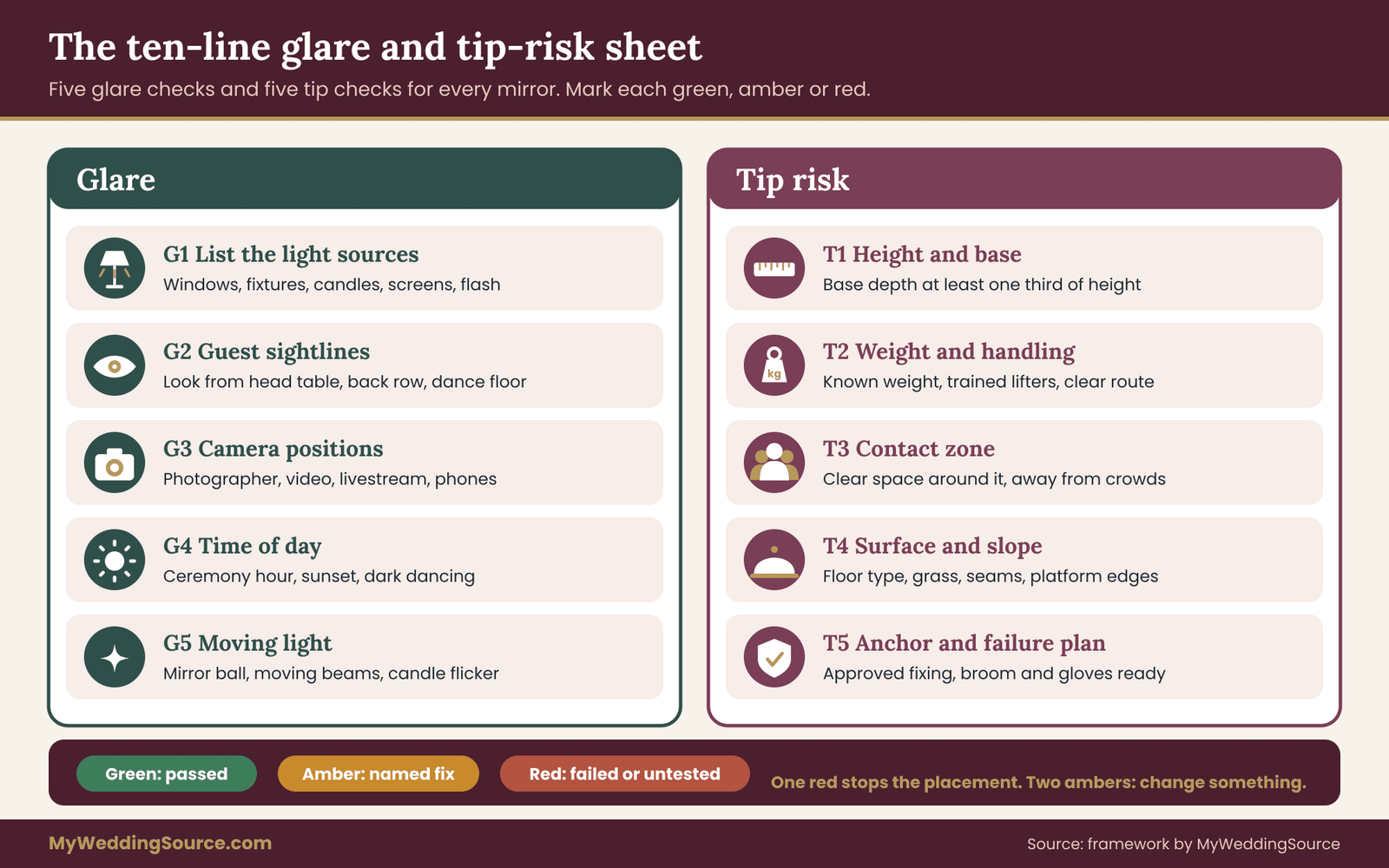
Score each mirror on ten lines, five for glare and five for tip risk, and mark every line green, amber or red. Check glare from the guest seats and camera positions at the lighting level you will actually use, not from the middle of an empty room. Check tip risk with three numbers: height, base depth and weight. Any red line stops the placement until it is fixed. Two ambers on one mirror mean move it, shorten it, secure it or replace it with a matte alternative.
Wedding mirror decor is the only kind of decor that changes what every other item in the room looks like. A candle appears twice. A window appears behind the guest of honor. A projector beam, a phone flash or a low evening sun lands somewhere you did not plan for. Most wedding mirror decor ideas online are written as styling advice, and styling is a fair place to start. The trouble is that the problems show up after setup, when the rental truck has left and the mirror is already standing at the end of the aisle.
Two things can go wrong, and they are different in kind. Glare is a comfort and photography problem. It makes guests squint, hides faces behind bright patches and puts the photographer in every frame. Tip risk is a safety problem. A tall, heavy, flat sheet of glass on a narrow base, placed where people carry drinks and move quickly in heels, is a falling hazard even if it never falls. Good wedding mirror decor handles both before the first guest arrives.
This guide is written for couples and planners who are deciding whether to use wedding mirror decor at all, which kinds and where. It does not replace the judgment of a venue manager, a fire marshal or a qualified rigging professional. Where something has to be hung, anchored, plugged in or lit with flame, the venue and the qualified person in charge decide. This article is general information, not legal, tax or financial advice, and it gives you the questions and checks to bring to those people.
If you are still choosing the room itself, the wedding venues guide covers how to compare spaces, and the venue technical walkthrough guide explains how to test lighting, power and load-in before the day. Wedding mirror decor is one of the items that benefit most from that kind of visit, and the wedding rental planning checklist helps you keep delivery windows and return rules for rented glass in one place.
What wedding mirror decor covers
The phrase covers more objects than people expect. Before you can inspect anything, list what you are actually considering. Most wedding mirror decor falls into seven families, and each family has its own typical glare pattern and its own typical way of tipping or breaking.
Large floor mirrors. Tall mirrors on easels or leaning against a wall, most often used for a seating chart, a welcome sign or a styled photo corner. These carry the highest tip risk because they are tall, heavy and close to foot traffic.
Wall and backdrop mirrors. Mirror panels hung or mounted behind a sweetheart table, a bar or a photo area. These are a rigging question first and a glare question second.
Tabletop mirrors. Mirror tiles, plateaus and trays under centerpieces, candles and cake displays. The risk here is small objects: edges, chips and candle heat on glass.
Mirror runners and aisle mirrors. Mirrored strips or panels laid along a table or an aisle. These raise slip, trip and reflection-upward questions, covered later in this guide.
Mirrored accessories. Mirrored charger plates, mirrored cubes and vases, mirror-finish table numbers and signs. Individually low risk, but together they can fill a room with scattered points of light.
Disco and mirror balls. Small mirror facets turn one light into hundreds of moving bright spots. Their glare is dynamic, which makes it harder to test.
Mirrored surfaces that are not sold as mirrors. Mirror-finish acrylic, polished metal panels, glossy lacquered boards and metallic foil backdrops. They behave like mirrors for glare purposes even if nobody calls them mirrors.
Seeing the families of wedding mirror decor together matters because a vendor quote may list only a few of them. A quote that says “mirror seating chart” does not mention the easel, the base weight or the lights aimed at it, and those are the parts that decide whether the item is safe and photographs well. Readable text on a mirror surface is its own topic, and this guide stays with placement, reflections and guest safety.
Why wedding mirror decor needs its own inspection
You might wonder why mirrors need a dedicated sheet when you already have a general checklist for decor. There are four reasons.
First, wedding mirror decor fails at the interaction between objects, not inside the object itself. A mirror that is fine in a showroom becomes a glare problem when a west-facing window and a pinspot appear in the reflection. No amount of staring at the product photo will tell you that.
Second, mirrors are rented far in advance and set up fast. The person who delivers the item may be a warehouse driver who leaves in fifteen minutes. If the placement turns out to be wrong, you are the one who has to move a heavy sheet of glass on the wedding morning.
Third, risk is concentrated in a small number of items. A room might hold sixty tables and one large mirror, and that one mirror carries most of the safety exposure. An inspection that is short and specific is more useful than a general walk-through that treats every object alike.
Fourth, the usual advice treats wedding mirror decor as pure style. A rule such as “mirrors make a room feel bigger” is true as far as it goes. It says nothing about whether the guest at table nine will spend dinner looking at the reflection of a bright stage light.
How the inspection sheet is built
The sheet has ten lines for each mirror. Five are glare lines, numbered G1 to G5, and five are tip lines, numbered T1 to T5. Each line gets one of three marks.
Green means the check passed at the real lighting level and in the real position. Amber means the check passed with a condition, such as “only if the lamp is moved” or “only with a second weight at the base.” Red means the check failed, or you could not run it.
That last point is deliberate. A line you could not test is a red line, not a green one. If the venue will not let you see the room at the evening lighting level, then G4 is red until someone can show you otherwise. This rule keeps the sheet honest, because the easiest way to pass an inspection is to skip the hard checks.
The sheet for wedding mirror decor is original to this article. It is a framework for organizing your own checks, not a code, a standard or a certification, and nothing on it replaces a requirement from your venue, your insurer or your local fire authority.
The glare and tip-risk inspection sheet
Here is the full sheet for wedding mirror decor, line by line. The sections after this one explain how to run each check. For now, read it through so you know what you are collecting.
G1: Light sources listed. Write down every source of light that could appear in this mirror: windows, ceiling fixtures, uplights, pinspots, candles, screens, projectors, exit signs, the photographer’s flash and guests’ phone lights. You cannot test what you have not listed.
G2: Guest sightlines. From at least three guest positions, such as the head table, a back-row seat and the edge of the dance floor, look at the mirror at the planned lighting level. Does a source appear in the reflection?
G3: Camera positions. Repeat the check from where the photographer, the videographer and any livestream camera will stand. Photographs make glare worse than eyes do, because a camera sensor clips bright patches to flat white.
G4: Time of day. Check at the hour the mirror will be used, and at the hours on either side. A ceremony mirror may be fine at noon and unusable at sunset. A reception mirror may be fine at dinner and a problem once the lights drop for dancing.
G5: Moving light. Check for anything that moves or flickers: mirror balls, intelligent lights, candle flames, ceiling fans, passing guests with phone lights. Moving glare is more tiring than steady glare.
T1: Height and base. Measure the height of the mirror and the depth of its base or the angle at which it leans. This is the first of the three tip numbers.
T2: Weight and handling. Find the weight, and decide who will lift it, how many people are needed and how it travels from the truck to its spot.
T3: Contact zone. Measure how far the mirror stands from walkways, bars, the dance floor, the buffet line and the entrance. This is the check that most often reveals a problem.
T4: Surface and slope. Note the floor under the mirror: carpet, tile, wood, a temporary dance floor, grass or gravel. Note any slope, threshold or seam.
T5: Anchor and failure plan. Decide how the mirror is secured, who approved it, and what happens if it breaks. A failure plan is a short answer to: who clears the area, with what, and where do guests go.
How to use the marks
Run the sheet on your wedding mirror decor once during planning, once at the venue visit and once at setup on the day. The first pass catches bad ideas cheaply. The second pass catches room-specific problems, such as a window you did not know was there. The third pass confirms that what was delivered matches what you inspected.
Keep one sheet per mirror, not one per room, because wedding mirror decor in a single room often carries very different risks. A room with a mirror seating chart, a mirrored bar backdrop and a mirror ball has three different risk profiles, and merging them into one grade hides the worst one.
Sightlines and light sources: mapping glare for wedding mirror decor
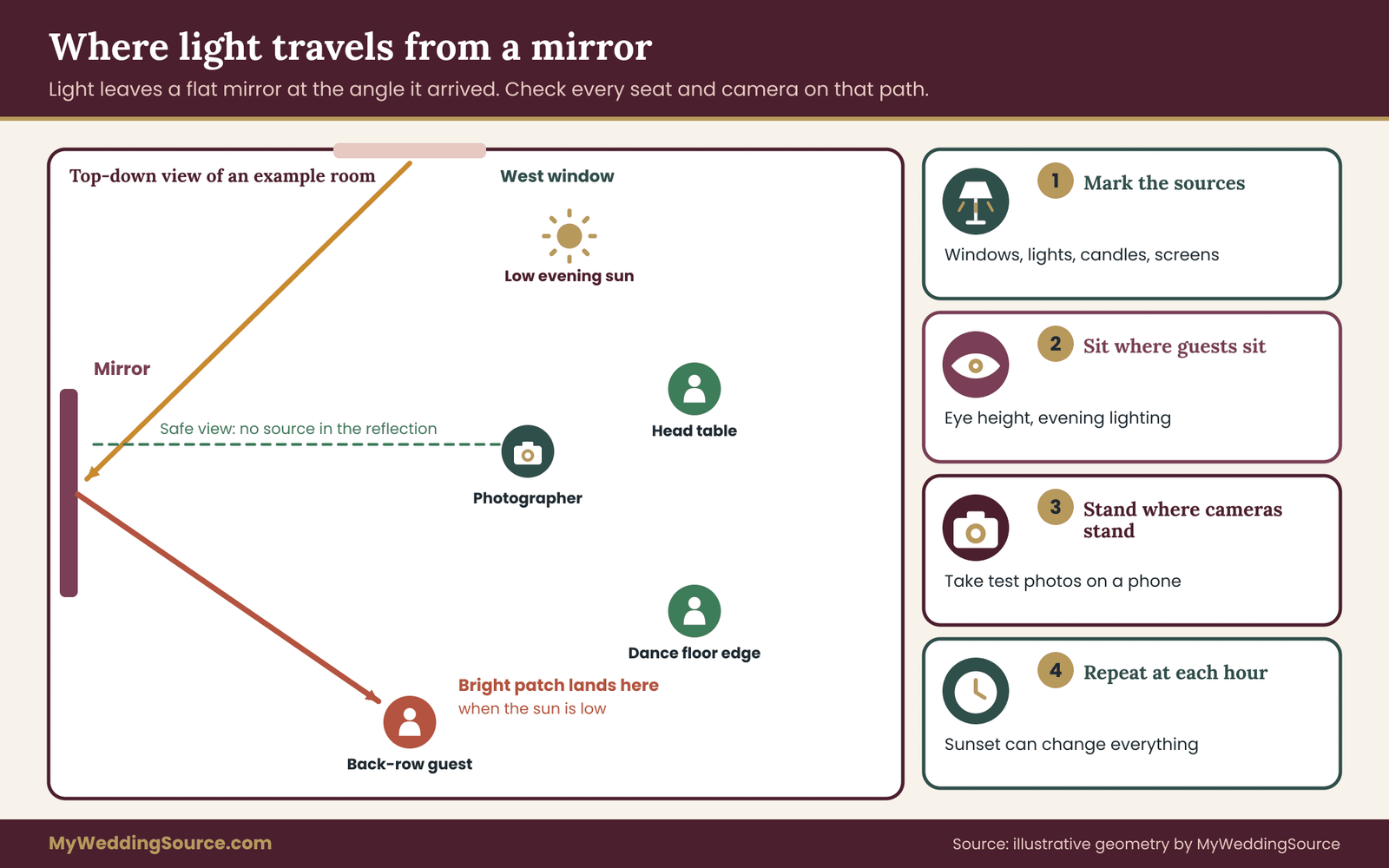
Glare from wedding mirror decor is geometry. A flat mirror sends light back at the same angle it arrived, on the opposite side of an imaginary line standing straight out from the surface. If a window sits at a shallow angle to the left of a mirror, its light leaves toward a shallow angle on the right. Any guest standing or sitting along that outgoing path sees a bright patch, whether or not they are looking at the mirror directly.
You do not need to calculate anything to check wedding mirror decor. You need to look from the right places. The method below turns the geometry into a short routine that two people can finish in about twenty minutes per mirror.
Step one: list the sources (G1)
Walk the room with a notepad and write down every light source that could reach your wedding mirror decor, whether it exists now or will exist on the day. Start with the obvious: windows, doors with glass, ceiling fixtures and any lighting the venue provides. Then add what your vendors will bring: uplights, pinspots, a screen or projector, the DJ’s lights, string lights and candles. Finally add what guests bring, which is phone flashlights and cameras with flash.
Mark each source on a rough sketch of the room, and note whether it is steady, dimmable or moving. A sketch drawn on the back of a floor plan is enough. The point is to have positions, not artwork.
Step two: stand where guests will sit (G2)
Pick at least three positions that represent different guest experiences. Good candidates are the head table or sweetheart table, a seat in the back third of the room and a spot on the edge of the dance floor. Add the end of the aisle if the mirror is near the ceremony.
At each position, put your eyes at seated height, about forty-five inches above the floor for most adults, or standing height where guests will stand. Look at the mirror and write down what you see in it. If a bright source appears in the reflection, that position fails the line. If you see only dim room, other guests and decor, it passes.
The test only means something at the real lighting level. A room lit at full work lights looks different from the same room with the uplights on and the chandeliers dimmed. Ask the venue to set the lights to the evening scene, or have your lighting vendor demonstrate it.
“Could we see the room at the evening lighting level for about twenty minutes during the walkthrough? We want to check a few reflections.”
Step three: stand where cameras will stand (G3)
Cameras see differently from eyes, and that matters for wedding mirror decor. A camera sensor has far less range than the human eye. It records a bright patch as flat white and a dark area as black, so a reflection that looks mildly bright to you can ruin a frame.
Ask your photographer where they usually stand for the ceremony, the entrance, the toasts and the first dance. Stand in each of those spots and look at the mirror. Then take a few phone photos from the same places and look at the results on a screen. The screen will exaggerate the problem in the same way the final photos would.
Pay special attention to two cases. First, a mirror behind the couple will show the photographer, assistants and any lights on stands. Second, a mirror to the side of a first-dance floor may bounce stage lights into the camera repeatedly during the dance. Your photographer can tell you if these are workable, and your lighting vendor can often aim a fixture away from the mirror if asked.
Step four: check the hours (G4)
Light changes through the day. A window that is dull at ten in the morning can send a direct beam across a room at six in the evening. If your ceremony or reception overlaps sunset, treat the sun as a moving spotlight.
Official sun-position tables and calculators are free. The NOAA solar calculator, listed in the sources at the end of this guide, gives sunrise, sunset and the sun’s height and direction for any location and date. Use it to find the sun’s position at the hours you care about, then compare it with the windows you noted. If a window faces the setting sun, a mirror opposite it is likely to catch the light.
Then confirm in person if you can. Visit at the same time of day, ideally within a few weeks of the date, because the angle of the sun shifts with the season. Photographs from the venue’s own gallery can help, but they show a single day.
Step five: look for movement (G5)
Static glare is annoying. Moving glare is tiring, and it is the hardest kind to catch in wedding mirror decor. A mirror ball that turns across a dark room puts hundreds of small bright spots on every wall, and a mirror near the ball adds another set. Candle flames flicker in a mirror and create the illusion of a larger, unsteady light. Fans and passing guests add motion too.
Ask the DJ or lighting vendor whether any fixtures move or strobe and where they point. Ask the venue whether fans, moving window shades or drop-down screens operate during the event. If a mirror is near moving light, the usual fix is to shift one or the other by a few feet, or to angle the mirror down slightly so that it catches the floor instead of the room.
How to mark the glare lines
For wedding mirror decor, mark each position and each hour separately, then give the line the worst result.
Green: No light source, flash or bright patch appears in the mirror from any guest or camera position at the real lighting level.
Amber: One source appears, but off to the side of where faces will be, or only briefly at one hour, and you have a fix that you can name: move a fixture, tilt the mirror, add a shade.
Red: A source or the sun appears in the reflection from a guest seat or a camera position, or you could not test the line.
A red mark is not a verdict against wedding mirror decor. It is a prompt to change one thing, such as the angle, the position, the hour or the fixture, and test again.

Heat, focused light and open flame near mirrors
Glare is uncomfortable. Focused light can be dangerous, and wedding mirror decor can produce both. This is a rare problem, but it is worth a few minutes because the fix costs nothing and the consequences can be serious.
A flat mirror reflects light without changing its intensity much. A curved mirror can gather light and concentrate it. A concave mirror, one that curves inward like the inside of a bowl, can focus sunlight onto a small spot. A shaving mirror, a decorative magnifying mirror and some bowl-shaped dish mirrors do this. In strong direct sun, a focused spot can heat paper, fabric and dry plant material enough to scorch or ignite it.
The sun, curved mirrors and wedding mirror decor
If any piece of your wedding mirror decor is curved, check whether direct sun can reach it. Outdoor ceremonies, tent sides that are rolled up and rooms with large west-facing windows are the usual cases. Look at what sits in the reflected path: programs, a floral arch, a linen runner, guest books and dried grasses are all easy targets.
The simple rules are these. Keep curved or magnifying mirrors out of direct sun. Keep flat mirrors out of direct sun when the reflected beam falls on something flammable or on a guest. If you cannot keep the sun off, cover the mirror until the guests arrive or choose a matte alternative.
Also think about the setup window. A mirror delivered and left propped outdoors at midday may spend two hours in direct sun before anyone returns. Ask the delivery crew to place mirrors face down, face to the wall or covered until the final positioning.
Candles, mirrors and glass tops
Candles and wedding mirror decor are a classic pairing, and a mirror plateau under a candle cluster does create beautiful light. It also introduces three practical questions.
First, heat. Mirror glass sits on a backing and sometimes on a frame or adhesive. A flame in contact with, or very close to, a mirror tile can heat the surface unevenly. Ask the rental company whether the item is rated for use under open flame and what distance they require.
Second, tipping. A candle on a mirror tile slides more easily than on a cloth-covered table. A bump can send a lit candle across the tile and off the edge. Use stable, wide-based holders, or choose flameless candles where the venue requires them.
Third, rules. Many venues restrict open flame, require a certain type of container or ban candles outright. Fire codes and the local fire authority decide, and the venue manager usually knows the current policy. The National Fire Protection Association publishes the widely used fire and life safety codes, and the U.S. Fire Administration offers public guidance on candle safety; both are listed in the sources. Ask the venue which rules apply to your event, and get the answer in writing.
If you want the look of candlelight on a mirror with less risk, battery-operated flameless candles are one practical option. They still reflect, so they still need a glare check, but they remove the heat and tipping questions.
Wedding mirror decor near heat and electronics
A few smaller points are worth a line each. Do not place a mirror directly against a heater, a space heater or a hot lamp, because the glass can heat unevenly. Keep mirrors away from steam tables and chafing dishes. Keep power cords away from the base of a standing mirror, because a cord is one more thing to trip on and a pull on the cord can tilt the mirror.
If a mirror holds lights, such as a string of bulbs around the frame, the electrical question belongs to the venue and a qualified electrician or lighting vendor. Lights plugged into outlets, extension cords and power strips all have limits that depend on the building. Do not guess; ask who is responsible for the power and get that person to approve the plan.
Mark the heat line for wedding mirror decor
Heat and focused light do not need a separate line on the sheet. They sit inside two existing ones. Flame and focus questions go into G1, because a candle or the sun is a light source you must list. The question of who approved the flame and how it is held goes into T5, because it belongs to the anchor and failure plan.
For each mirror near flame, write the name of the person at the venue who approved it. If nobody has approved it, T5 is red.
“We would like to use candles near a mirrored surface at the reception. Which candle types and distances are allowed, and could you confirm that in writing?”
A short answer to that question prevents a long argument at setup.
Tip risk for wedding mirror decor: height, base, weight and crowd
Wedding mirror decor falls for the same reason any tall object falls. Its center of mass moves past the edge of its base. A tall mirror has a high center of mass, so a small push at the top can tip it. A narrow base makes that point close. A heavy mirror makes the consequences worse and makes it harder for one person to catch.
Wedding guests are not careful in the way warehouse staff are. They are dressed up, carrying drinks, moving in groups, taking photos and sometimes leaning on whatever is nearby to steady themselves. Children run. Someone reaches over a mirror to hang a coat. A DJ moves a cable. Wedding mirror decor that sits through a quiet afternoon rehearsal may be knocked on the first dance.
T1: Height and base
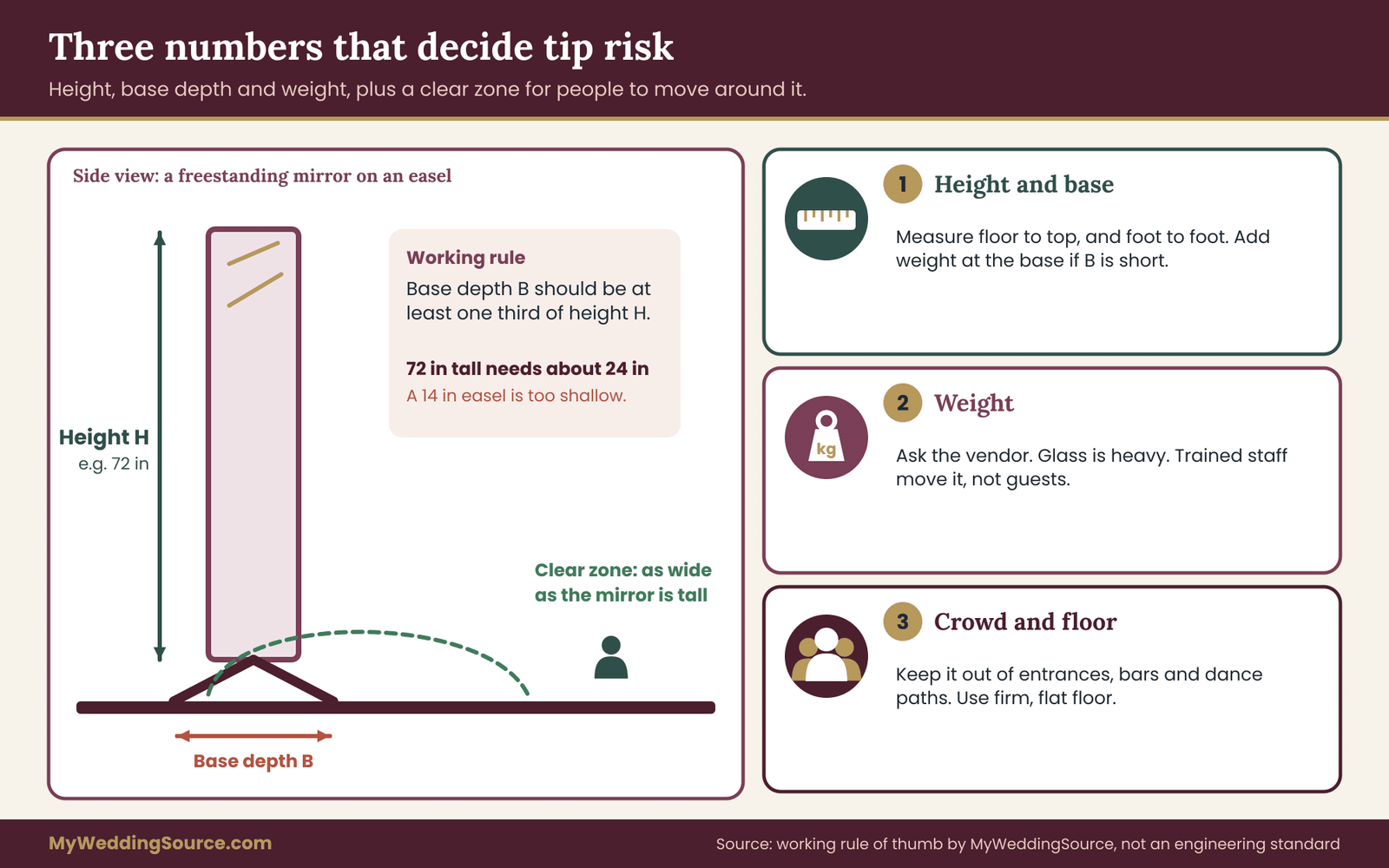
For each piece of wedding mirror decor, measure two things: the height of the mirror from floor to top edge, and the depth of the footprint on the floor. For a freestanding mirror on an easel, the footprint is the distance from the front foot to the back foot. For a mirror that leans against a wall, the footprint is the distance from the wall to the bottom edge of the mirror.
As a working rule for this sheet, a freestanding mirror should have a base depth of at least one third of its height. This is a rule of thumb for organizing your inspection, not an engineering standard. A seventy-two-inch mirror, six feet tall, would need a base of about twenty-four inches. If the easel measures fourteen inches front to back, T1 is amber at best, and you need a fix: a wider base, weights or a different mount.
Why one third? It is a simple threshold that most people can measure with a tape and apply at a glance. Your rental company may use a different method or have tested the item, and that is fine. The value of the number is that it makes you ask the question.
For a leaning mirror, check two more things. The bottom edge needs a stop, such as a lip, a rubber foot or a weighted base, so the bottom cannot slide forward on a smooth floor. And the top needs a clear contact surface on the wall, with no soft decor, cables or curtains that could give way.
T2: Weight and handling
Ask the vendor for the weight of each piece of wedding mirror decor, including the frame and the stand. Do not guess from the size. Glass is dense, and a large mirror can be far heavier than it looks. A mirror that two people can carry across a showroom may need three or four to move safely through a doorway and over a threshold.
Plan the route from the truck to the spot. Walk it if you can. Note steps, ramps, narrow doors, elevators and tight turns. The venue’s load-in rules, including freight elevator and loading dock windows, often decide when and how large items can move, and the venue walkthrough is the moment to confirm those details before the day.
Decide who moves the mirror if it must be moved on the day. If the answer is “the couple’s friends,” T2 is red. Moving heavy glass is a job for trained rental or venue staff who carry the right insurance and know how to lift it.
T3: Contact zone
The contact zone is the area around any wedding mirror decor where people will pass, queue, dance or reach. It is the line that most often reveals a real problem, because a mirror that is stable on a quiet floor can be unsafe in a crowd.
Measure the distance from the mirror to the nearest walkway, bar, buffet line, coat check, dance floor edge, photo booth queue and door. Then think about how people will actually move. Guests cluster near seating charts to find their tables, so a mirror seating chart is a crowd magnet during the thirty minutes after cocktail hour. The same mirror in a quiet corner might be safe on a Tuesday and risky on a Saturday.
As a working rule for the sheet, keep a clear space around a freestanding mirror that is at least as wide as the mirror is tall, in every direction guests can approach. That gives a guest room to stand back and look, and it keeps a stumble from becoming a collision. If the room cannot give you that space, the mirror should be shorter, anchored or somewhere else.
Think also about the tall-object rules for walking routes. The Americans with Disabilities Act sets standards for objects that stick out into circulation paths, because a person who is blind or has low vision may not detect an object that hangs or leans into the route. A mirror leaning into a corridor is that kind of object. Check the ADA site, listed in the sources, and ask the venue about its accessible routes.
T4: Surface and slope
Wedding mirror decor that is stable on a flat concrete floor can slide on polished wood, sink on grass and tilt on a temporary dance floor with a raised edge. Look at what is underneath each foot of the stand.
Carpet adds a small amount of grip but can compress under heavy weight and shift the angle. Polished stone and tile are slippery, especially when guests spill drinks or wax is fresh. Grass and gravel are uneven, and a base that is level in the morning can settle by evening. Outdoor decks have gaps between boards where a narrow foot can catch.
If the floor is uneven or soft, ask for a wider base and for flat load-spreading boards under the feet. Do not place a tall mirror on the edge of a platform, a riser or a stage. If the mirror stands near a floor seam or a threshold, move it.
T5: Anchor and failure plan
Anchoring wedding mirror decor means fixing it so that it cannot tip even if it is pushed. The simplest anchor is weight at the base, such as sandbags, concealed weights or a heavy stand. A stronger anchor is a fixing to a wall or other structure, which is a modification to the venue, and it needs the venue’s approval before anyone drills, screws or hangs anything.
Wind is part of this line for outdoor wedding mirror decor. A large mirror acts like a sail. Check the forecast from the National Weather Service for the event day, ask your tent or rental vendor what wind level they use as a cut-off for large items, and decide in advance who will lay the mirror down or take it inside.
Also write down the failure plan. It is short: if the mirror breaks, who clears the area, what tool do they use, where do guests go and who calls the venue manager. A broom, a dustpan, sturdy gloves and a few cones or chairs to rope off the area take up a corner of a closet. Having them on hand turns a crisis into a ten-minute interruption.
How to mark the tip lines
Green: The base is at least one third of the height, or the mirror is anchored by an approved method. The weight is known and handled by trained staff. The contact zone is clear. The floor is flat and firm. The failure plan is written down.
Amber: One condition is not met, but you have a specific fix and the person who will carry it out.
Red: The mirror is tall and narrow, in a crowd path, on a poor surface, or nobody has agreed how it is secured. Or you could not measure one of the numbers.
Stands, anchors and alternatives for wedding mirror decor
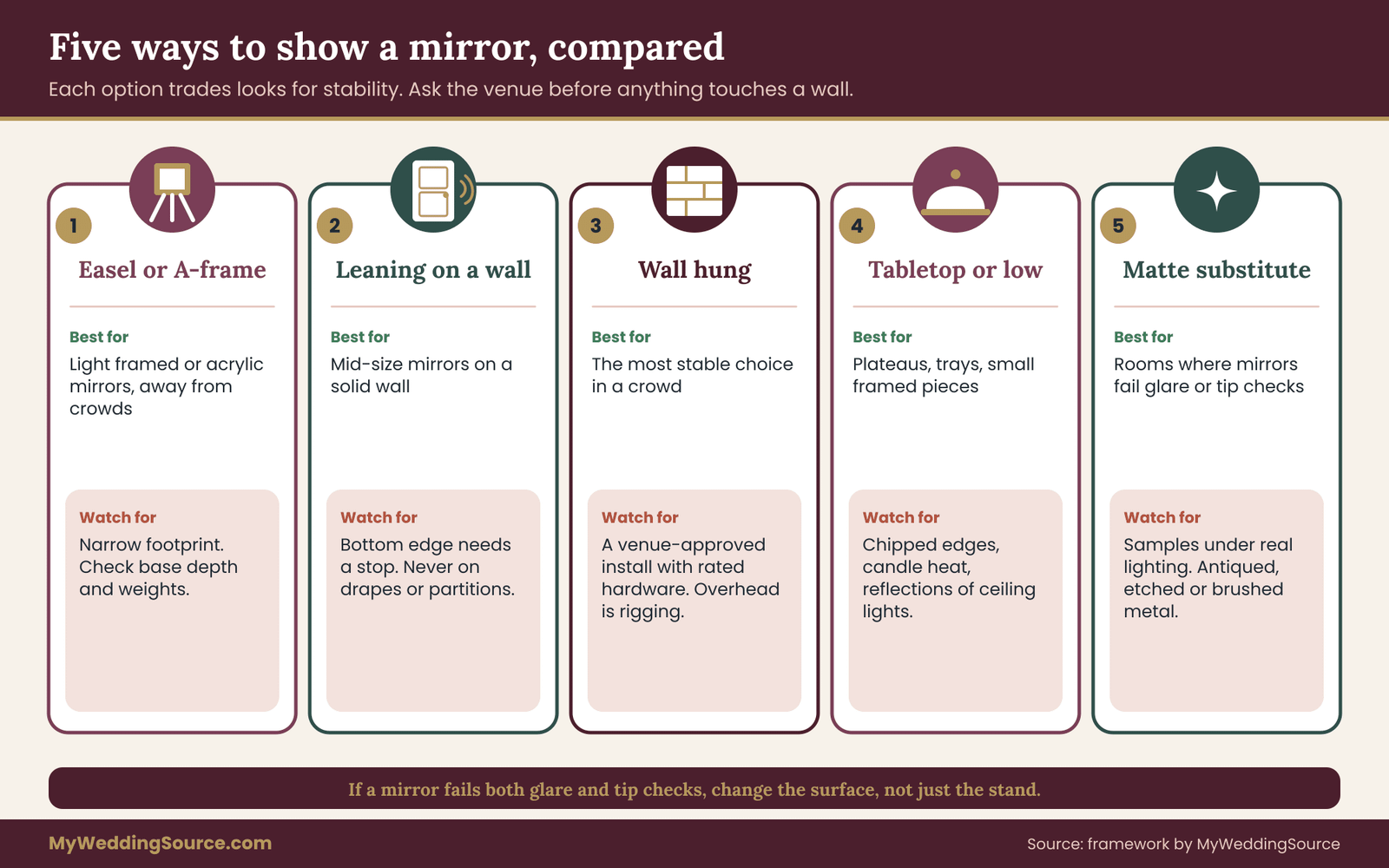
Once wedding mirror decor scores amber or red on tip risk, you have options. They are not equally good, and the right choice depends on the size of the mirror and the room. Here is how the common mounting choices compare, in prose.
Easels and A-frames
An easel is the standard way to show a large mirror, because it looks light and fits many sizes. It is also the most common tip risk. A typical easel has a narrow footprint, and a heavy mirror on it can be top-heavy. Check the footprint against the one-third rule, ask whether the easel is rated for the weight and look for a lower bar or a back brace.
Easels work best for lighter mirrors, such as framed acrylic, and for spots away from foot traffic. If you need a large glass mirror on an easel, add weights low on the legs and keep a clear zone around it.
Leaning against a wall
A mirror leaning against a wall is stable if the angle is right, the bottom is stopped and the wall can take the contact. A steeper lean, closer to vertical, puts more load on the bottom edge and less on the wall, so a small kick can push the bottom out. A shallower lean spreads the load but takes more floor.
The leaning option is fine for mid-size mirrors on a solid wall. It is a poor choice on a curtain, a partition, a temporary wall or a wall with a fragile finish. Ask the venue if leaning items are allowed and whether wall protection is needed.
Wall mounting and hanging
A mirror hung on a wall is the most stable option in the crowd, because it cannot be bumped over. It is also a modification to the venue and a rigging question. Hanging heavy glass needs the right hardware for the wall type, a load rating and a person who is qualified to install it. The venue decides whether it is allowed and who does the work.
If the venue offers existing mirrors or picture rails, use those. If you must hang something new, ask the venue manager who is approved to do it, and make the approval part of the written agreement. Anything hung overhead is a different category again and falls under the venue’s rigging rules; it is not a do-it-yourself task.
Tabletop and low placement
Putting a mirror flat on a table or low on a ledge nearly removes the tip risk. The risks that remain are chipped edges, heat from candles and glare from a flat, horizontal surface that reflects the ceiling. A horizontal mirror reflects whatever is above it, so check the ceiling fixtures, uplights and any rigging in the reflection.
Matte and textured alternatives
If a mirror scores red on both glare and tip risk, consider a substitute that keeps the look and loses the problem. Antiqued or foxed mirror has a mottled surface that diffuses reflections. Frosted or etched glass keeps the elegant look but spreads the light. Brushed brass or satin metal panels give a warm shine without a sharp reflection. Glossy black acrylic gives a reflective look with a softer image. Each has its own cost and handling quirks, so ask your vendor to show samples under similar lighting.
Glass, acrylic and mirrored film: how wedding mirror decor breaks
What your wedding mirror decor is made of changes what happens when it fails. Ask the rental company which of these you are getting, and do not accept “it’s a mirror” as an answer.
Ordinary annealed glass breaks into large, sharp shards. It is the type used in many older and decorative mirrors.
Tempered glass is heat-treated and breaks into small, blunt pieces. It is used where safety rules require it, but it is less common for decorative mirrors.
Laminated or safety-backed mirror holds fragments together, either with an interlayer or an adhesive film. If the mirror breaks, the pieces tend to stay attached to the backing.
Acrylic mirror is plastic with a mirror coating. It is lighter and does not shatter like glass, but it scratches easily, can warp in heat and may show a slightly distorted reflection.
Mirrored film on a board is a thin reflective film over a backing. It is light, but the reflection is often wavy.
The American National Standards Institute lists the safety glazing standard commonly cited for architectural glass, and the Consumer Product Safety Commission publishes requirements for architectural glazing materials. These rules apply to windows, doors and similar installations, and a rental mirror may or may not be covered. Do not assume. Ask the vendor, in plain words, whether the mirror has a safety backing or film and what it would do if it broke.
For a freestanding mirror in a crowd, a safety-backed or acrylic option reduces the injury risk if it falls, though it does not remove the tip risk. For a large glass mirror, ask about a damage waiver, and ask who is responsible for cleanup and any resulting injuries.
Aisle, dance floor and tables: where wedding mirror decor goes wrong
Every part of a wedding room has its own pattern of movement, light and risk, and wedding mirror decor behaves differently in each one. Looking at the room zone by zone is a good way to decide where mirrors belong and where they do not. The sections below walk through the zones guests pass through, in the order they pass through them.

The entrance and welcome area
The entrance is where wedding mirror decor, usually a mirror seating chart or welcome sign, most often stands. It is also the busiest place in the room for about half an hour. Guests arrive in groups, stop in the doorway, bunch up near the chart and carry coats, gifts and sometimes small children. The reception guest flow guide explains how to read those movement patterns before you place anything.
Keep tall freestanding wedding mirror decor out of the doorway bottleneck. If the seating chart must be mirrored, make it lower and wider, with a wall mount or a secured base, and place it on a side wall with room for guests to stand back. Also check the entrance for daylight. Doors with glass and windows near the entrance often send hard light across the mirror at arrival time.
Remember that a seating chart needs to be readable. A mirror reflects lights behind the viewer, so a guest looking at it may see their own face and a bright window instead of their table number. If you are using a mirror for that, the signage guidance in the wedding signage system guide covers legibility choices.
The aisle and ceremony space
A mirrored aisle is the most dramatic wedding mirror decor in a photograph. It also sits at foot level, where guests, the wedding party and the couple will walk, often in formal shoes, a gown with a train or heels. The risks are slipping, tripping and reflection.
Slipping: Mirror glass or acrylic is smooth, and a smooth surface with a thin sole or a dry petal can be slick. A mirror aisle needs a non-slip backing, tight edges and no overhang. Ask the vendor how the panels are held down and what happens at the seams. Raised edges catch a heel; gaps catch a cane or a mobility aid.
Tripping: Panel edges, tape, cables and uneven joins create small ridges. Anyone with a cane, a walker or a wheelchair needs a firm, stable, continuous surface. If you have guests with mobility needs, route them on a separate, solid path or skip the mirrored aisle entirely.
Reflection: A mirror at floor level reflects upward. It shows skirts, hems and the underside of whatever is above it. People who wear skirts or kilts may not want to walk over a mirror, and a guest may be uncomfortable even if nobody says so. Ask the wedding party before you commit, and consider placing the mirror beside the aisle instead of in it.
For ceremony mirrors that stand at the front, such as a mirror arch or a mirrored backdrop, the main glare question is the sun and the photographer. Run G3 and G4 carefully, because the ceremony is the moment you cannot repeat.
Tables and centerpieces with wedding mirror decor
A mirror plateau under a centerpiece lifts it visually and doubles the candlelight. It also reflects whatever sits above it. A table lit by a pinspot or a chandelier will send a bright circle into every guest’s eyes when the mirror catches it.
Check each table from a seated eye position. If a bright patch of reflected light lands at face height, lower the lamp, tilt the light or swap the mirror for a matte tray. Keep the mirror edges clear of glassware, because a glass set down on an edge can tip. Choose a plateau with a bevelled or polished edge and ask whether chips are repaired or replaced.
Also think about the sightline over the table. A tall centerpiece in a mirror creates a second, inverted copy that can feel crowded at a small table. If you want to keep guests able to talk across the table, keep arrangements low, or choose slim stems and open vases.
The dance floor and the evening
By the time dancing starts, the lights are lower, the energy is higher and guests are moving quickly. This is the highest-risk period for tipping, and also a time when glare patterns change as the lighting vendor switches to a party scene.
Keep wedding mirror decor well back from the dance floor edge. A contact zone of at least the mirror’s height is a good starting point, and more is better when guests are dancing in groups. Do not place a freestanding mirror between the dance floor and the bar, because that is a path people take at speed.
Check the dance scene for glare. The party mode often includes moving beams, strobes and mirror balls. Ask the lighting vendor to run the party scene with the mirrors in place and look from the dance floor, the DJ booth and the photographer’s usual spot. If a beam sweeps across a mirror and into the crowd, adjust the fixture or cover the mirror for that part of the night.
Photo areas and selfie mirrors
Mirror photo booths and selfie mirrors are wedding mirror decor that draws a queue. People crowd, lean in, tap the glass and take photos with a flash. A mirror that is touched gets fingerprints, so you will need a cleaning cloth and a staff member to wipe it. A mirror that is leaned on needs to be anchored.
Place a photo mirror in an area with space for a queue, away from the main flow, and with a clear zone around it. Check for flash glare in every direction a guest might stand. Tell the photographer where the mirror is so that they do not walk into the reflection of their own flash.
If the mirror is interactive, with a screen or a camera, power and heat become additional questions for the vendor and the venue.
Restrooms, changing rooms and private spaces
A last point on privacy. Decorative mirrors in changing rooms, restrooms and bridal suites should be placed with the person using the room in mind. A mirror angled toward a door or window can reflect what is inside. Check the sightline from the doorway before you leave the room, and ask the venue about any mirrors that are already there.
A worked example: scoring wedding mirror decor in one room
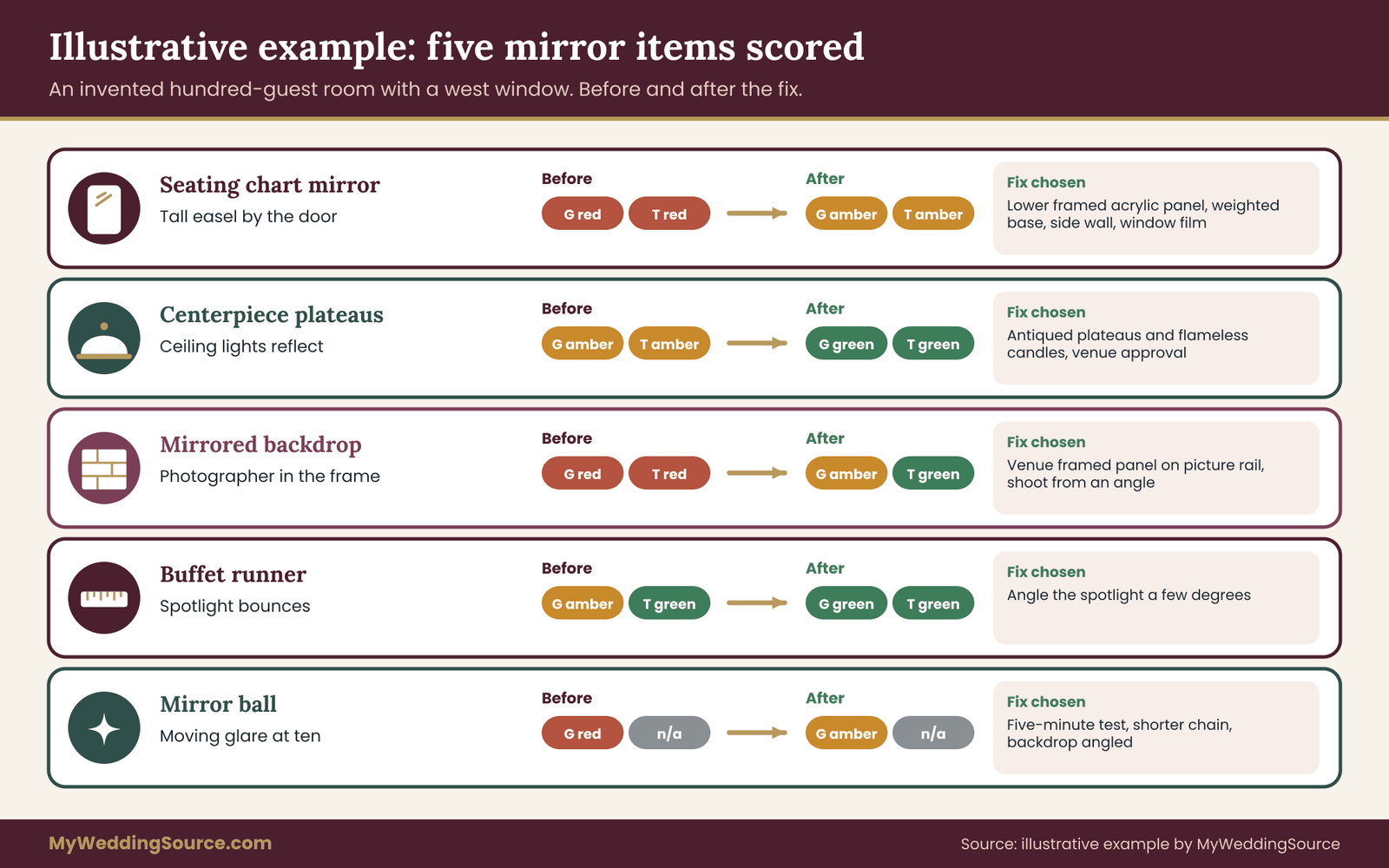
The wedding mirror decor example below is invented, to show how the sheet works in practice. It is not a case study, and the numbers are chosen for clarity. Imagine a couple planning a hundred-guest reception in a garden room with large west-facing windows and a low ceiling with recessed lights.
They are considering five pieces of wedding mirror decor: a six-foot mirror seating chart on an easel near the door, mirror plateaus under twelve centerpieces, a mirrored backdrop behind the sweetheart table, a short mirror runner along the buffet and a mirror ball that the DJ will turn on at ten.
The seating chart mirror
The couple measures the mirror at seventy-two inches high. The easel’s base is sixteen inches deep. One third of seventy-two is twenty-four, so T1 is amber at best. The mirror weighs more than they expected, and the venue’s load-in is by a narrow door, so T2 is amber. The easel stands in the arrival path with about three feet of clear space, so T3 is red. The floor is polished concrete, so T4 is amber. Nobody has discussed anchoring, so T5 is red.
On glare, the mirror stands opposite the door, which has a glass panel. At arrival time, a late afternoon sun streams through the glass. G2 is red from the arrival path and G4 is red at five o’clock.
The sheet gives two reds on tip and two reds on glare. The couple decides not to keep this item as designed.
They keep the idea but change the object: a lower, wider framed acrylic panel with a weighted base, placed on a side wall with six feet of clear space. They also ask the venue about window film or a sheer curtain for the door. They run the sheet again on the new item and it scores green on T1, T2 and T3, amber on T4 and T5 and green on all glare lines except G4, which becomes amber pending the film.
The plateaus under the centerpieces
The plateaus are flat on tables, so tip risk is low. T1 is green because the height is minimal. T3 is green because guests do not walk into table centers. T5 is amber because candles will sit on the glass and the venue must approve them. On glare, the recessed ceiling lights reflect upward from the plateau. From a seated eye position, each plateau throws a small bright dot toward guests across the table. G2 is amber.
The fix is cheap: replace the plateaus with antiqued mirror, or use a mirror tile with a smaller footprint, or move the candles. The couple chooses antiqued plateaus and flameless candles, subject to the venue’s approval. All lines turn green.
The mirrored backdrop
The backdrop is a hung panel behind the sweetheart table. T1, T3 and T4 are green because it does not stand on the floor. T5 is red until the venue confirms who may hang it, with what hardware and with what load rating. G3 is red because the photographer will stand directly in front and in the reflection, along with a light stand. G4 is amber at sunset because of the west windows.
The couple asks the photographer for a view from the usual spots, and the photographer recommends a position from a slight angle. The couple also asks the venue about its own hanging system. The result: the venue offers a framed antiqued panel on a picture rail, which they approve for use. That moves T5 to green and G3 to amber.
The runner and the mirror ball
The buffet runner is low and flat. T1 and T3 are green and the surface is stable. G2 is amber because a spotlight above the buffet is reflected, so the couple asks for the light to be angled slightly.
The mirror ball scores red on G5, because it is a source of moving glare and nobody has tested it with the mirrored backdrop in the room. The DJ agrees to run it for five minutes at the party scene, with the backdrop covered, and check where the spots land. The result is acceptable with a shorter hanging chain and a slightly different position. The ball goes ahead, with the backdrop angled and the DJ’s position noted on the sheet.
What the example shows about wedding mirror decor
Three points are worth noting. First, the sheet did not ban mirrors. It changed one item, softened two and approved two with conditions. Second, the biggest problems came from interactions: a door, a window, a light, a camera. Third, the whole process took a few hours of the couple’s time, spread across a planning call, a venue visit and a setup check, and it replaced a morning of surprises.
Photographers, flash and reflections around wedding mirror decor
Wedding mirror decor and cameras have a complicated relationship. A mirror can give a photographer beautiful depth, with a reflected candle, a second view of a bouquet or a glimpse of a guest laughing across the room. It can also put the photographer, the flash and the light stands into the frame, and it can turn a clean portrait into a mess of bright patches.
Treat the photographer as a partner in checking your wedding mirror decor, not a vendor you tell afterward. They know where they will stand, which lenses they will use and how their flash behaves. A fifteen-minute conversation at the planning stage can prevent a series of ruined frames.
What a photographer looks for in wedding mirror decor
A photographer checks three things. First, the reflection of the camera. A mirror directly behind the subject shows whoever stands in front of it. If you want a clean frame, the photographer needs to shoot at an angle, and the mirror needs to be placed to allow it.
Second, the reflection of lights. Any bright source in the reflection can create a flare, a bright streak or a bright spot that the sensor clips to white. The photographer may reposition, change the angle or ask for a fixture to be moved.
Third, the reflection of the flash. A flash aimed straight at a flat mirror bounces back at the lens. Photographers avoid this by shooting off-axis, using bounce flash from a ceiling or wall, or turning the flash off in that area. They cannot easily avoid it if a mirror covers a whole wall behind the couple.
Questions to ask your photographer
Bring a short list, and bring a floor plan with the mirrors marked on it.
“Here are the places we would like to use mirrors. Could you tell us if any of them will be a problem for the ceremony, the portraits or the first dance, and where you would stand?”
Then follow up on specifics. Ask whether polarizing filters would help in the room. A polarizing filter on a camera can reduce reflections from glass and water in some situations, though it does not remove a bright source in a mirror. Ask how the photographer handles a mirror behind the head table, and whether a lower or angled mirror would be easier to work around. Ask whether any location needs a test frame before the day.
If you are using a videographer or a livestream, repeat the same conversation with them. A fixed livestream camera cannot change its angle during the ceremony, so a mirror in its view can create a problem for the whole broadcast. Ask for a test shot of the mirror from the camera’s fixed position.
Guests and their phones
Guests will photograph your wedding mirror decor too. A mirror seating chart or a photo mirror invites selfies, and a guest’s phone flash is a bright, uncontrolled light. If you want to limit flash near mirrors, say so politely in the program or on a small sign at the mirror. A short, friendly request, such as “Please turn off flash near the mirrors,” is usually enough.
Also think about who appears in those photos. Mirrors capture the people in front of them, including guests who did not agree to appear in someone’s social media. A mirror photo booth queue means many people in many pictures. The wedding photography consent guide covers how to set expectations for guests and vendors so that the photos people take match the preferences you have set.
Handling reflections from wedding mirror decor in the final images
If the mirror is a feature you want in the photos, such as a hallway of mirrors or a mirrored arch, ask the photographer to stage a few shots with it on purpose. Reflections look intentional when they are composed and accidental when they are not. Consider assigning one assistant to watch the mirrors during key moments and to alert the photographer to any problem reflections.
If a mirror is a hazard for photography, such as a mirror directly behind the couple, you can cover it for the ceremony and portraits and reveal it for the party. Fabric covers, a simple drape or a paper sheet attached to the back of the frame all work. Check that any cover is secure and flame-resistant where candles are present, and that the person who will uncover the mirror knows when to do it.
Vendor questions and contract terms for wedding mirror decor
The inspection sheet tells you what you need to know about your wedding mirror decor. The vendor conversation tells you whether you can get it. Wedding mirror decor tends to come from rental companies, decorators and florists, and each has different standards, so ask the same questions of each and compare the answers.
Questions for the rental company or decorator
Start with the item itself. Ask for exact dimensions, including the height, width, thickness and base footprint, and the weight of the mirror and its stand. Ask what the mirror is made of and whether it has a safety backing or film. Ask about the edge finish and whether any chips or scratches are known.
Then ask about handling. Who delivers it, how many people carry it, how long they stay and whether they set it up in the final position? Who picks it up and when? Is there a minimum notice for changes? Can you visit the warehouse or see a sample in person?
Then ask about risk. What is the damage policy and what is the deductible, if any? Is there a cleanup fee for breakage? Is the item covered by the vendor’s liability insurance, and can they provide a certificate of insurance if the venue asks? Ask the venue what insurance documentation it requires from vendors, because many venues ask for it before load-in.
Finally, ask how they would change the item if the sheet turned up a problem. Can the easel be swapped for a wider one? Can they supply weights? Do they have a matte option?
Questions for the venue
The venue holds the authority on most of what matters. Ask what decor can be placed against walls, whether anything may be hung or fixed, what the floor and wall protection rules are, and who is approved to install heavy items. Ask about open flame, candle types and distances. Ask about load-in times, elevator size and any restrictions on glass items.
Ask also about lighting. Can the venue’s lights be dimmed, tilted or turned off? Are there window coverings, and when are they drawn? Who controls them on the day? If the answer to the last question is “nobody,” then glare at sunset is your problem.
For a room with its own mirrors, ask how they are fixed and whether they can be covered. Venues with built-in mirrored walls or ceilings are common in hotels and older ballrooms. You can often cover them for the ceremony.
“We are considering large mirrors as part of our decor. Could you tell us what is allowed for hanging, anchoring, open flame and glass items, and who must approve each?”
Write down the answers, with the date and the name of the person who gave them. A single email thread works as a record.
What to put in the contract
A rental contract for wedding mirror decor should name the specific items by size and quantity, not just by description. It should record delivery and pickup windows and the setup position, and say who is responsible for placing the item. It should state who is liable for damage, breakage and injury, and what the rental company’s insurance covers.
If a mirror will be anchored, hung or placed near flame, the contract or an attached note should record the venue’s approval and the person who gave it. If the mirror is replaced, the contract should say what replaces it and at what price.
The wedding vendor contract guide explains the main terms to look for in any vendor agreement, and the vendor purchase order checklist shows how to turn what you agreed into a single written order. Keep the inspection sheet with your contract file, as it shows what you checked and when.
A scripted conversation
Here is a short script for a call with a rental company. It is plain, polite and specific.
“We are looking at a six-foot mirror for our seating chart. Could you send the exact height, the base depth, the weight and the material? We also want to know whether it has a safety backing, what the damage policy is and whether you can supply a wider base or weights.”
Most companies answer these questions routinely. If a vendor cannot or will not, treat that as information. A vendor who does not know the weight of their own mirror may not have thought about moving it.
Comparing quotes for wedding mirror decor
If you are comparing quotes, ask each vendor for the same set of facts so the comparison is fair. A cheaper mirror that arrives without weights and without a safety backing is not cheaper if you need to rent weights separately or accept more risk. List the extras, such as a wider base, delivery and setup, a damage waiver and cleanup, and compare the full price. The wedding rental planning checklist can help you keep rentals organized, including delivery windows and return rules.
Ask also about their policy on changes. If your venue visit turns up a problem, can you swap items without a penalty? A flexible rental policy is worth more than a slightly lower price.
Edge cases, costs and when to skip wedding mirror decor
The sheet handles the common cases. A few situations need extra thought because they change the rules or stack the risks. After those, this section covers the cost logic and the decision of when to skip mirrors altogether.
Outdoor weddings and tents
For outdoor wedding mirror decor, the sun and the wind are both in charge. Mirrors in direct sun can send beams across a lawn into guests’ eyes and onto flammable decor. Mirrors in the wind can tip, slide or catch a gust like a sail.
Place wedding mirror decor in shade where possible, and check the sun’s path at the ceremony hour with the NOAA calculator. In a tent, check the sidewalls and any clear panels, because translucent fabric glows in low sun and a clear panel acts like a window. Anchor everything with real weight, not a decorative stone, and agree a wind cut-off with the rental company in advance. If the forecast crosses the cut-off, the fallback should be decided before the morning: lay the mirror flat, move it inside or replace it with a lighter item.
Grass makes T4 harder. A base that is level at noon can settle by dinner, especially after rain or after guests have walked around it. Flat boards under the feet help, and so does a lower, wider mirror.
Historic and heritage venues
Older buildings often have strict rules about anything touching walls, floors or ceilings. A mirror that leans against a plastered or painted wall may mark it. A hanging mirror may need a conservator’s approval. Open flame near old wood or fabric may be banned.
Ask early, ideally while you are still choosing a venue, and expect the answer to be no for hanging and leaning. A freestanding mirror on a protected base may be allowed, but the venue may limit its size, weight or position. A venue that holds events regularly usually has a short written list of what is allowed. Ask for it.
Small rooms and low ceilings
In a small room, wedding mirror decor makes the space look larger, which is its main appeal. It also means reflections are close and the contact zone is tight. A mirror in a narrow corridor sends every guest past a possible tip point.
In low rooms, check the ceiling in the reflection. A mirror on a table reflects the ceiling fixtures directly, so a low ceiling with bright recessed lights will give hot spots on every horizontal mirror. Matte or antiqued surfaces help.
Children, pets and accessibility
Children are curious about mirrors. They look at themselves, lean in and touch the glass. A freestanding mirror low enough for a child to push over is a risk, and a mirror with sharp edges at child height is another. If children will attend, favor lower mirrors with soft or covered edges and clear zones, and tell the adults responsible for the children where the mirrors are.
If an assistance animal or a pet attends, remember that some animals react to their own reflection. A guide dog in a harness is trained to ignore many things, but a pet that sees a stranger in a mirror may bark or paw. Keep floor-level mirrors out of the animal’s route.
For guests who use wheelchairs, walkers or canes, check that the mirrors do not narrow the route and that floor-level mirrors are not part of it. The U.S. Access Board and the ADA site, both listed in the sources, publish standards for accessible routes and protruding objects. Ask the venue how its accessible routes are marked.
For guests with low vision, a mirror at the end of a corridor can create the illusion of an open path where there is a wall. A small, visible marker near the base can help, such as a flower arrangement or a floor sign.
Mirrored ceilings, walls and built-in features
Some venues have mirrored walls, pillars or ceilings built in. These cannot be moved, so the choice is whether to cover them. Fabric drapes, panels or a decor feature in front of a mirrored wall can remove glare and the awkward effect of seeing the room doubled.
If you choose to uncover them, run the sheet on them as if they were mirrors you had brought. A mirrored ceiling over a dance floor puts a second dance floor above the first, with all the lights doubled.
Last-minute changes
The day brings changes: a delayed delivery, a different table layout, a rain plan that moves the ceremony indoors. Each one can change the sheet. If the plan changes, rerun the sheet for any mirror that moves, even if only by a few feet.
Name one person, ideally the venue coordinator or your planner, who has the authority to say that a mirror will not be used. A rule that “the sheet can veto any mirror” is easy to apply when the person responsible has the authority and the sheet in hand.
Cost logic: when wedding mirror decor is worth it and when to choose something else
You can find wedding mirror decor for nearly any budget. The question is whether the full cost of the mirror, including safe handling, is worth the effect it creates.
What drives the cost
The price on the quote is rarely the whole price. The usual cost drivers are the rental fee itself, delivery and pickup, setup and strike labor, weights or a wider stand, a damage waiver, cleanup fees if something breaks and the cost of any venue approval, such as a rigger or an electrician. Lighting changes, such as moving a fixture or adding a shade, may be extra. Window film or curtains for glare may be extra.
Add the time cost as well. A mirror that needs a venue visit, a vendor call and a setup check costs hours of planning. That is a real cost when the weeks before a wedding are crowded.
Do not rely on averages from the internet. Prices vary by city, season, vendor and item, and a number from another market can mislead. Ask each vendor for a written quote with every extra itemized, and compare the totals.
A simple decision rule
Use the sheet’s result to decide what to do with each piece of wedding mirror decor.
All lines green or one amber with a clear fix: Use the mirror.
Two or more ambers on the same mirror: Change something, such as the position, the size, the base or the lighting, then rerun the sheet. If it still scores two ambers, choose an alternative.
Any red that you cannot fix in time: Do not use that item. Choose a substitute.
This rule is conservative on purpose. A rejected mirror costs a design choice. An accepted mirror that fails costs injury, damage and a ruined evening.
Choosing an alternative
If a mirror does not pass, you do not have to give up the idea. You are choosing a different way to get the effect you wanted.
If you wanted light and sparkle, consider string lights, candles in secure glass holders or small lanterns, which add warmth without large reflective surfaces. If you wanted depth, consider layered fabric, plants or framed art. If you wanted a sense of elegance, consider a mirror in a smaller format, such as small framed mirrors on a wall in a group, hung by the venue on its own system.
If you wanted a seating chart with a mirror look, consider a framed acrylic panel or a printed sign with a metallic accent. If you wanted the glamour of a mirrored table, consider a gold or silver charger plate under a plate, which gives shine without a sheet of glass.
If you wanted a photo backdrop, a shimmer curtain, a flower wall or a matte mirror-effect panel gives a similar look with fewer reflections of the camera.
What to do when the venue says no
Sometimes the venue says no to hanging, leaning or flame, and you cannot change it. Do not look for ways around the rule. A venue’s rules usually exist because of their insurance, their building or a past incident.
Ask what they allow, and design from there. Many venues have mirrors, frames and decor of their own that fit their rules. Many also have a preferred vendor list with items that have already been approved for the room. Using those saves you from approval delays and often from extra insurance questions.
A final test before the day
The week before the wedding, take your sheets and ask three questions of each piece of wedding mirror decor that is still in the plan. Has anything changed since the last pass: the venue lighting, the layout, the vendor, the weather forecast? Has anyone approved the parts that need approval? Is the person who will set it up the same person who read the sheet?
If the answers are no, yes and yes, the mirror is ready. If any of them is a surprise, there is still time to fix it.
Your next steps
Start with a list, not a purchase. Write down every mirror or mirror-like item you are considering, by family: floor mirrors, wall mirrors, tabletop pieces, runners, accessories, mirror balls and mirror-finish signs. Delete the ones you only like in photographs and keep the ones that serve a purpose in your room.
Next, ask for facts. Request height, base depth, weight and material for each large item from your vendor, and ask your venue what it allows for hanging, leaning, flame and glass. Put the answers beside each item on a copy of the sheet.
Then test. Visit the room at the lighting level you will use, check each mirror from guest seats and camera positions, and mark the glare lines. Measure the tip numbers and the contact zone, and mark the tip lines. Fix or replace anything with a red mark, and keep the sheets in your contract folder. Run them again at setup, and the wedding mirror decor you keep will be there because it passed, not because it was in the plan.
FAQ
Is wedding mirror decor safe for guests?
Wedding mirror decor can be safe when each mirror is checked for glare and tip risk and placed with a clear zone around it. The risks are falling glass, sharp edges, slippery floor mirrors and bright reflections. Ask the vendor what the mirror is made of, how it is secured and what the damage policy is, then confirm the placement with the venue before the day.
How do I stop wedding mirror decor from causing glare in photos?
Check the mirror from the places where the photographer, videographer and guests will be, at the real lighting level and the real hour. If a bright source appears, move the mirror, tilt it, move the light or cover the mirror for key moments. Antiqued or matte surfaces spread reflections. Ask your photographer where they will stand before you decide.
What size is safe for wedding mirror decor at a seating chart?
There is no single safe size, because stability depends on the base, the weight, the floor and the crowd. As a working rule, a freestanding mirror should have a base at least one third of its height, with a clear area around it as wide as it is tall. Lower, wider or wall-mounted options are safer in busy entrances.
Can I use candles with wedding mirror decor at my reception?
Sometimes, but it is a venue and fire-safety decision. Ask the venue which candle types and distances are allowed, and ask the rental company whether the mirror is suitable under flame. Candles slide easily on glass, so use wide, stable holders. Flameless candles are a practical alternative and still need a glare check, because they reflect too.
Do I need venue approval for wedding mirror decor?
Often yes, if the mirror will be hung, fixed to a wall, leaned against a wall, placed near flame or carried through restricted areas. Many venues also have rules about glass items and load-in. Ask early, and get the approval and the name of the person who gave it in writing. Anything overhead belongs to a qualified rigging professional.
Is a mirror aisle good wedding mirror decor?
A mirror aisle looks dramatic, but it adds slip, trip and reflection concerns. Panels must be fixed firmly with no raised edges, and the surface must be non-slip. Guests who use mobility aids need a solid, continuous path. Many people also dislike walking over a surface that reflects upward, so ask the wedding party before you commit.
What if my venue has mirrored walls?
Treat them as mirrors you cannot move and run the same sheet. You can often cover them with drapes or panels for the ceremony and portraits, then reveal them for the party. Ask the venue whether covering is allowed, how it is fixed and who handles it. Check how stage lights and the mirror ball reflect off the walls in the party scene.
Who is responsible if a rented mirror breaks?
It depends on the contract. The rental company usually sets a damage policy, and the venue may have its own rules for cleanup and injuries. Ask who is liable for breakage, injury and cleanup before you sign, and ask about a damage waiver and the company’s insurance. Keep the written answers with your vendor contracts.
Sources
- National Fire Protection Association: codes, standards and fire safety resources
- U.S. Fire Administration, Federal Emergency Management Agency: fire safety and candle safety information
- U.S. Consumer Product Safety Commission: product safety and tip-over information
- Occupational Safety and Health Administration: workplace safety, lifting and rigging resources
- ADA.gov, U.S. Department of Justice: Americans with Disabilities Act information
- U.S. Access Board: accessibility standards and guidance
- American National Standards Institute: standards information, including safety glazing
- National Glass Association: glass types and safety resources
- NOAA Global Monitoring Laboratory: solar calculator for sun position and times
- National Weather Service: forecasts and wind information