
A memory table is a small display at a wedding that honors people who cannot be there, and the hardest part is rarely the memory table itself. It is deciding which photos belong on it when relatives disagree. This guide gives you a screening worksheet, a way to ask for permission, and calm alternatives for any photo that should stay home.
Treat every photo for the memory table as a separate decision. Ask five questions about each one: who has a say, who else is pictured, what the picture reveals, how far it will travel, and who owns the file or print. Sort each photo into display, display with changes, stand-in, or hold back. Ask the closest family first, in writing, with an easy way to say no. If anyone objects, honor the objection and switch to a candle, a name card, an object or a spoken tribute instead.
Most couples start a memory table with a warm idea and a shoebox. A grandmother who died last spring, a father who would have loved the dancing, an uncle everyone still talks about. Someone says “let’s put out a few pictures,” and everybody nods. Then the shoebox opens, and it turns out that the best photo of grandma also shows a cousin who no longer speaks to the family, or that one aunt believes her late sister should never be shown in a hospital gown, or that a widow would rather not see her husband’s face at a party at all.
None of this means you should skip a memory table. It means a memory table is a small public exhibit about private people, and a little structure keeps it kind. The structure in this guide is not complicated. It is a one-page worksheet, a few sentences you can adapt when you ask, and a short list of fallback options that honor someone without putting a face on display.
A note on scope. This is general information, not legal advice, and it cannot account for your family’s customs or your local rules. Where a question touches copyright, ask the issuing agency or a qualified professional for the current answer.
Two kinds of wishes meet at a memory table. There are the wishes of the person you are honoring, if you know them, and there are the wishes of the people who loved them. Add a third group, the living people who appear in the pictures, and the picture of the “simple tribute” becomes more crowded. The worksheet is how you keep all three groups in view without turning your wedding planning into a negotiation.
What a memory table is, and where wedding memory table photos go wrong
A memory table, sometimes called a remembrance table or tribute table, is a small display set up near the entrance, the ceremony space or the reception. It usually holds framed photos, perhaps a candle or flowers, and sometimes a small card with names or a short line. It is not a required part of any wedding. Nothing about marriage law, venue contracts or etiquette says you must have one, and no one is owed a place on it.
That freedom is useful. Because the memory table is optional, you are free to shape it around what your families can comfortably accept. You can make it large or tiny, public or tucked beside the guest book, photo-based or entirely without faces.
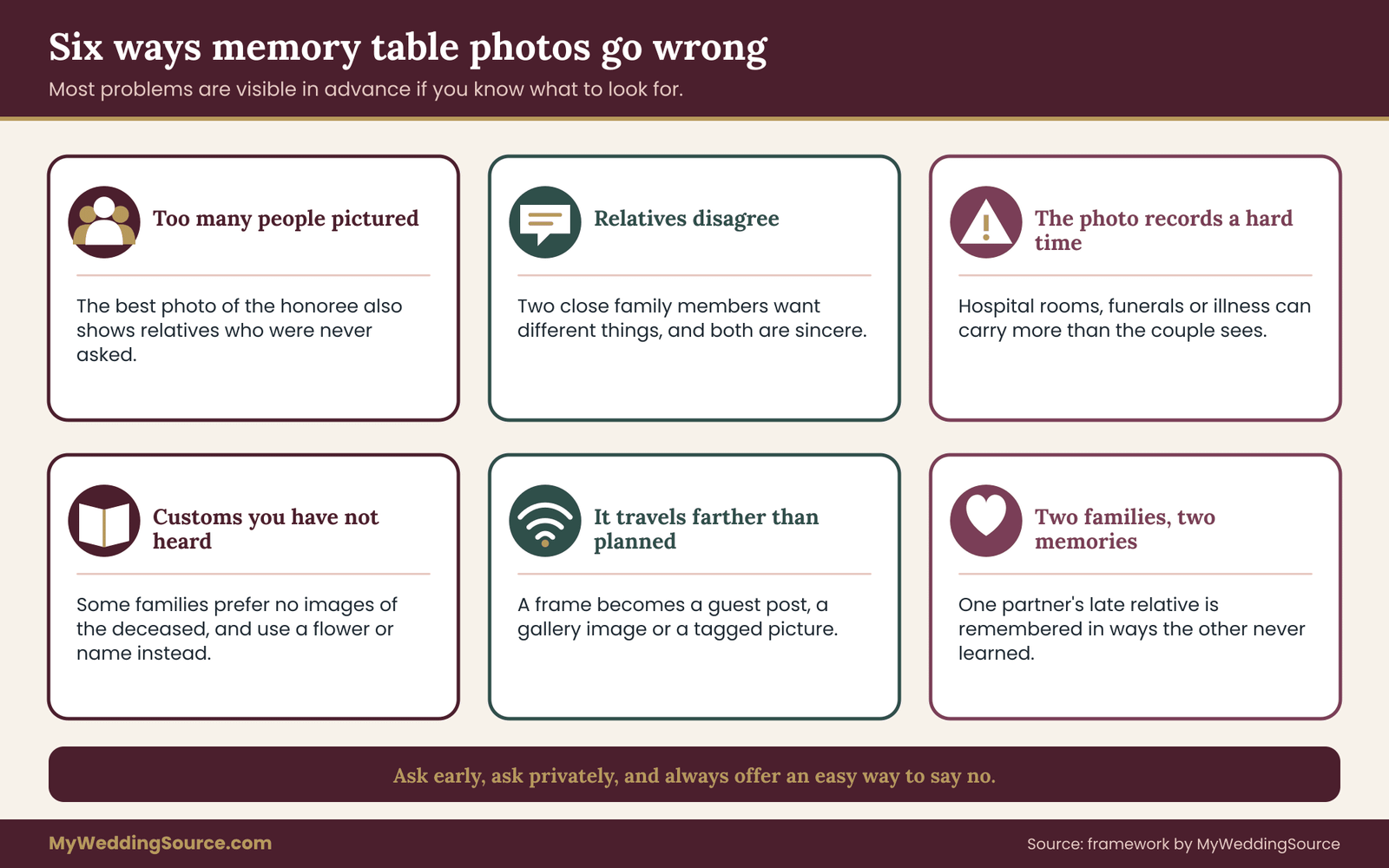
Photo trouble on a wedding memory table tends to come from a handful of patterns. Knowing them in advance makes them easier to spot.
The photo has more people in it than the honoree. A group shot from a holiday is the only decent picture of someone, but the others in the frame were never asked.
The relatives do not agree about what the person would want. One sibling wants a large framed portrait; another thinks it is morbid. Both loved the same person.
The photo records a hard time. An image taken during an illness, a funeral, or a difficult period may carry meaning that the couple does not see.
The family has a custom you have not been told about. Some families, for religious or cultural reasons, prefer not to display images of the deceased, or prefer particular forms. You may not know until you ask.
The photo will travel farther than anyone expected. A frame on a table is one thing. The same frame photographed by guests, shown in a gallery and posted online is another.
The couple’s relatives are not the honoree’s relatives. A partner’s late parent may be remembered by the partner’s family in ways the other partner has never heard.
Each of these patterns has a simple fix, and most of the fixes involve asking early and offering a graceful way to decline. The sections below turn that idea into a routine you can follow in about the time it takes to look through the shoebox.
Why privacy belongs in the conversation
The word “privacy” can sound heavy for a table of framed pictures, but it fits. A photo of a deceased person is also a record of the people who stood beside them, of the place where it was taken, and of a moment that a family may regard as theirs alone. The couple controls the memory table. They do not control how everyone else feels about what is on it.
Privacy in this sense is about control over a family’s image and story. It is not only a legal idea. A relative who objects to a photo is rarely quoting a statute. They are saying that a picture feels exposed, or that the wrong people will see it, or that it is not how they want a loved one remembered. Those are reasons worth honoring whether or not any rule requires it.
Why this belongs next to your wider photo decisions
If you have already thought about how guests and family are photographed on the day, a memory table fits inside the same thinking. The guide to wedding photography consent covers guest boundaries and image use across the whole event, including minors and posting. If you are also building a list of formal family portraits, the wedding family photo list covers that separate job. This guide narrows to one small corner of the topic: the displayed photos of people who have died or who cannot attend, and the permissions around them.
Why the families’ wishes come first, and what that does not mean
It is tempting to treat the memory table as the couple’s decision, since it is their wedding. In most respects it is. You choose the location, the size and whether to have one at all. But the contents involve people who are not the couple, and a memory table does a particular job. It tells a room of guests how a family remembers someone. A display that the family finds painful or wrong defeats that purpose.
Putting family wishes first does not mean handing the memory table to whoever speaks loudest. It means two things. First, you ask before you display. Second, when someone with a real stake says no to a particular photo, you accept it without asking them to justify the decision.
What “against family wishes” actually looks like
The phrase in the title of this guide describes a small set of situations, and it helps to name them so you can recognize your own.
Open objection. A relative says plainly that they do not want a photo displayed. This is the simplest case to understand and often the hardest to manage emotionally.
Silent discomfort. No one objects, but you notice someone steering around the memory table, or a parent goes quiet when the idea comes up. Silence is not consent. It is a cue to ask privately.
Conflicting wishes. One close relative wants a photo shown and another close relative does not. You cannot satisfy both, and neither is wrong.
Wishes unknown. The person died long ago, or you simply cannot tell what the family would want. The right move is to ask the people most likely to know, not to guess.
Wishes of the person themselves. Sometimes the honoree left a clear preference. A person who disliked being photographed, or who asked that no pictures be shown after a certain time, may have told someone. If you know of such a wish, give it weight.
What this does not mean
Honoring family wishes does not mean the couple must give up the idea of remembering someone. It also does not mean you owe every extended relative a vote. A cousin by marriage who barely knew the honoree is not in the same position as a spouse, a parent or a child of that person. The next part of this guide helps you decide whose voice carries the most weight, using a simple set of circles.
It also does not mean you should avoid the subject out of fear of upsetting someone. Families are usually relieved to be asked. Being asked tells a person that their feelings about their own loved one were considered, and most people would much prefer that to being surprised by a frame on a table in front of a hundred guests.
Who has a say: the circles of voice for a memory table
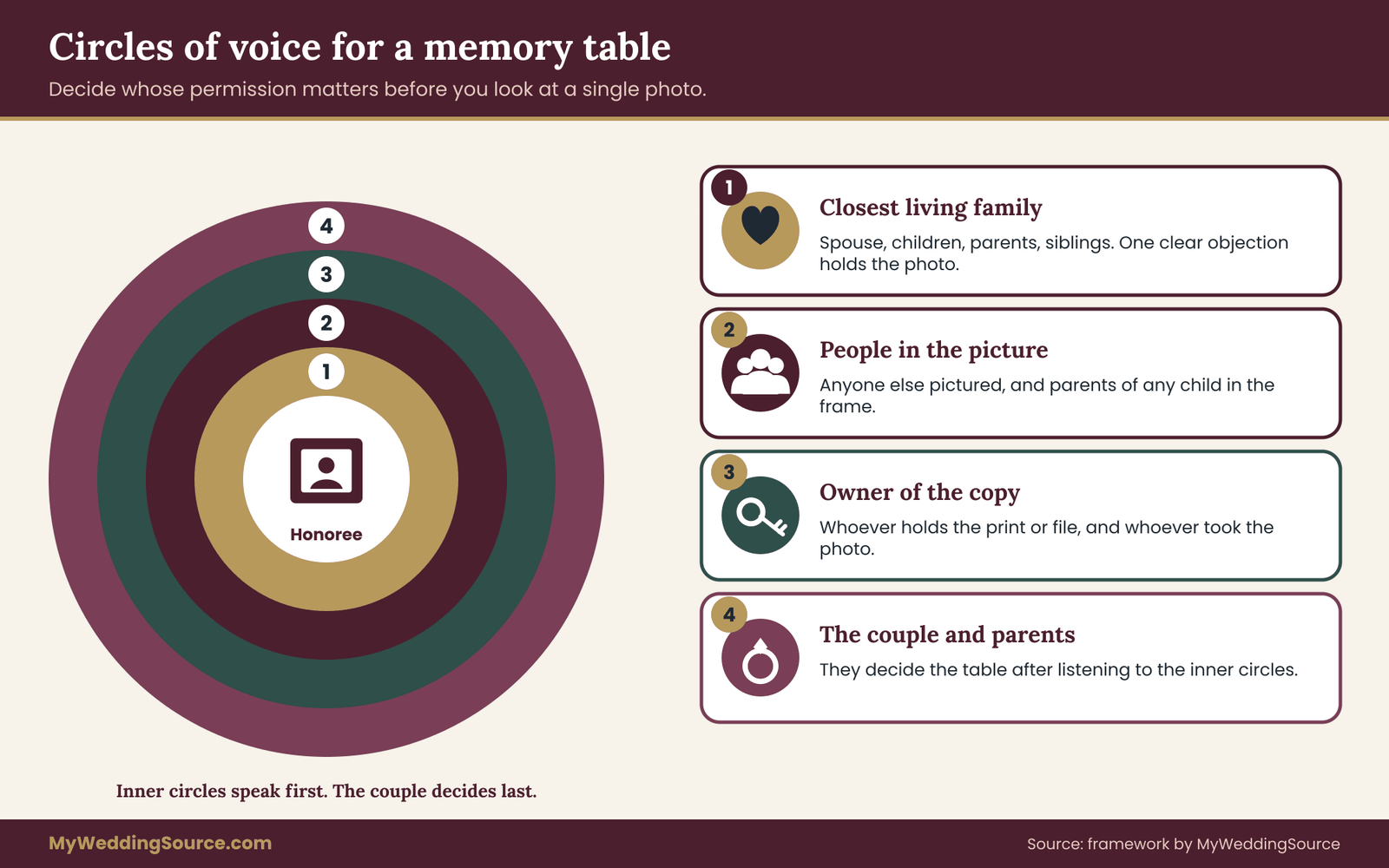
Before you look at any photo, decide whose permission matters for it. A short way to do this is to picture four circles around the honoree. You do not need to be formal about it. The point is to stop treating every opinion as equal and to stop ignoring the ones that matter most.
Circle one: the closest living family. Usually a spouse or partner, children, parents and siblings. When these people agree, a photo is very likely safe to show. When any one of them objects, treat the photo as held until you have talked it through.
Circle two: the people pictured. Anyone else visible in the photo. A picture of a late grandfather holding a toddler involves the toddler, who is now a child with parents who can speak for them. A picture at a barbecue involves everyone at the barbecue.
Circle three: the owner of the copy. The person who holds the print or the file, and sometimes the person who took the picture. They control access to the original and often to the right to copy it.
Circle four: the couple and their parents. The people running the wedding. Their job is to decide, after hearing from the other circles, what the memory table will contain.
The couple sits in the outer circle on purpose. They have the final say on their own event, but on a question about someone else’s loved one, they listen first.
In practice most photos involve only two or three circles. A portrait of a widowed grandmother, held by her daughter, with no one else in frame, needs the daughter’s agreement and little more. A group photo from a reunion needs more thought.
When the circles overlap
Overlap is normal. The couple’s own parent may be the honoree, in which case the couple sits in circle one as well. A partner’s late sibling may be remembered by a family the other partner has met only a few times. In such cases, defer to the family that is closest by blood or marriage, and keep the other partner informed. The couple should still be comfortable with every photo on their own table, even when permission is clear.
Minors and the people pictured
Photos that include children deserve one extra step. A child in a family photo cannot meaningfully agree to being displayed at a wedding, and the people who speak for them are their parents or guardians. If the child is now an adult, ask them directly. If the child is still a minor, ask the parent, and consider whether a tighter crop or a different photo does the job as well.
This is the contextual approach that the broader guide on wedding photography consent describes: the question is not only whether someone could be shown, but whether they would reasonably expect to be shown in this place, to these people, for this purpose.
The screening worksheet: five questions for every memory table photo
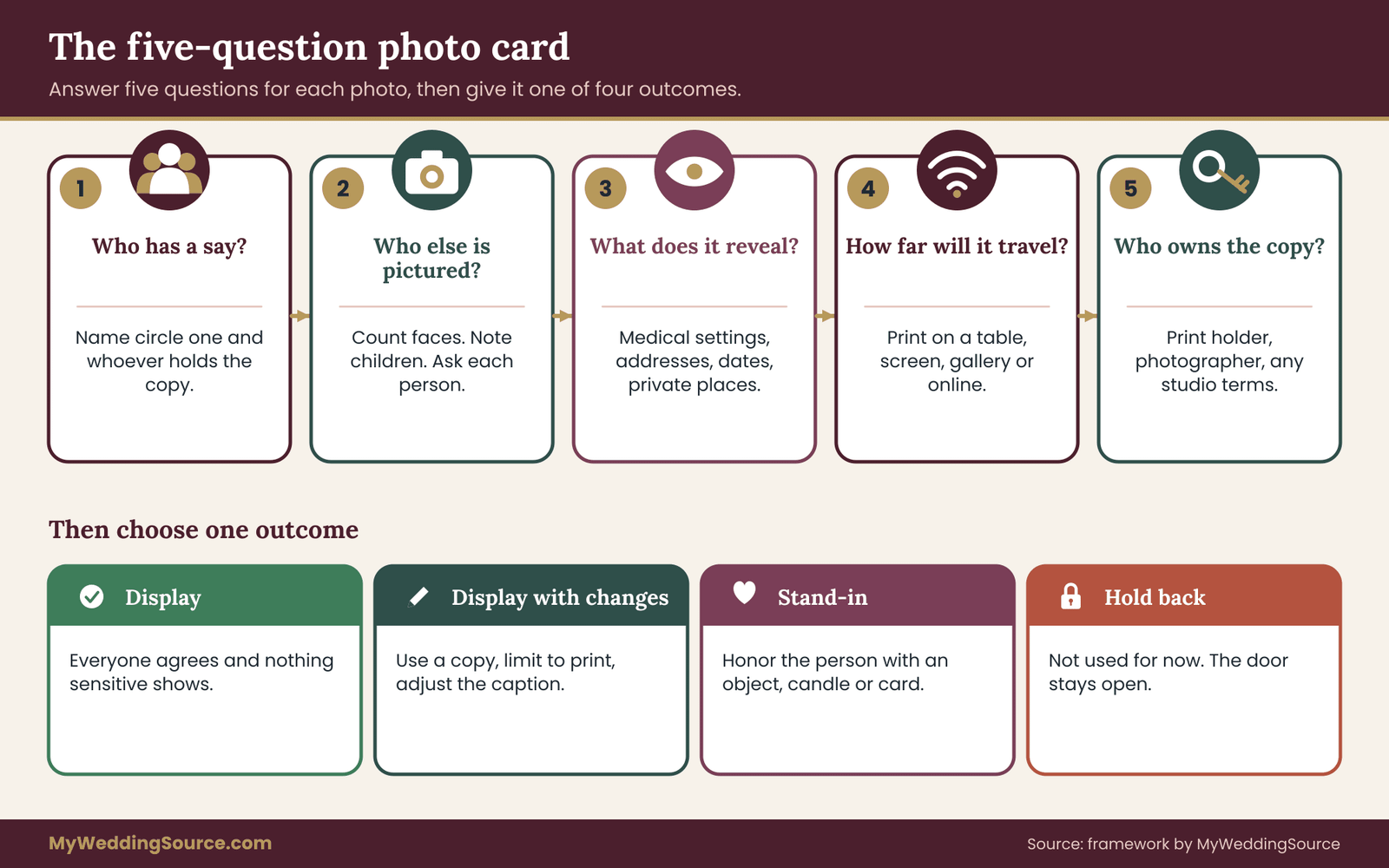
This is the core of the guide. You will go through your pile of candidate photos one at a time, and for each one you will fill in a short card. The card has five questions. Write the answers on paper, in a notes app or in a shared document. It does not need to be elegant. It needs to exist, because a written answer is easy to show to a relative and easy to revisit when you change your mind.
Question one: who has a say?
Name the people from the circles above. Write down the honoree’s closest living relatives, anyone else pictured, and whoever holds the original. If you cannot name a person who could speak for the photo, that is itself a finding. It means you need to find someone to ask before the photo goes any further.
A useful shortcut: if the closest living relative is a parent or spouse, that person is your first call. If there is no living close relative, look to adult children of siblings, long-time friends, or the officiant or clergy who knew the family.
Question two: who else is in the picture?
Count the faces. A solo portrait has none to worry about. A group photo has several. For every other person, write whether you know how to reach them and whether they are a child. Then ask yourself the plain question: would these people be comfortable seeing themselves here?
Often the answer is yes, and a quick message settles it. Sometimes the answer is a firm no, as with a relative who left the family on bad terms or a former partner. In those cases, a crop is not always an honest fix, because the cropped photo may still show a hand on a shoulder or a half-visible shoulder. If cropping changes the picture’s meaning, choose another photo.
Question three: what does the photo reveal?
Look at the photo as a stranger would, and then as a close relative would. A stranger sees an older man smiling at a lake. A relative may see the last good summer before an illness, or the house that was later sold, or a sign that gives an address.
Check for these quiet details: medical settings, hospital clothing or equipment, a visible street address or house number, a date stamp, children’s school uniforms, and anything that points to a private location. If the photo reveals something the family would not choose to share, it needs a different treatment or a different photo.
Question four: how far will this photo travel?
A framed print on a table is seen by whoever walks past. A photo that is also scanned for a slideshow, or photographed by guests, or included in a photographer’s gallery, travels much farther. Decide before you ask permission how far the photo may go.
Be specific when you ask the family. “We would like to display a printed copy on a small table during the ceremony and reception” is a different request from “we would like to show it on a screen and share it in our wedding gallery.” Many people who accept the first are not comfortable with the second.
Question five: who owns the copy and the rights?
Write down who holds the print or file, who took the picture if you know, and whether the photo was taken by a professional. This question matters for two reasons. The first is practical: you need the owner’s permission to borrow an original, and you need to know whether copying it is allowed. The second is legal: ownership of a print and ownership of the copyright are not the same thing. The next section covers the basics.
Turning five answers into one outcome
Once you have answered the five questions, assign each photo one of four outcomes. This is the part that saves arguments, because the outcome is a decision rather than a feeling.
Display. Everyone with a say agrees, the photo reveals nothing sensitive, and the copy is safe to use. Put it on the memory table.
Display with changes. The photo works if you adjust something: use a copy instead of the original, crop out a person with their agreement, remove a caption, or limit it to the printed table and not the slideshow.
Stand-in. The photo cannot be shown, but the person can still be honored through a name card, an object, a flower, a candle or a line in the program. The next parts of this guide cover these in detail.
Hold back. The photo is not used for now. This is not a rejection of the person. It leaves the door open if circumstances or feelings change, and it takes the pressure off a hard decision.
Write the outcome and one line of reasoning on the card. When a relative later asks why a photo is absent, you can answer in a sentence, without defending yourself.
A short example of the worksheet in use
Suppose a bride, whom we will call Priya in this invented example, wants to display a photo of her late grandfather at a family gathering. Question one: her mother is the closest living relative and agrees. Question two: three cousins are in the frame, two of them children. Question three: nothing sensitive, but a street sign is visible behind them. Question four: she wants it on the memory table and in the slideshow. Question five: her uncle holds the original print.
The outcome is display with changes. She asks her uncle for a scan, asks the cousins’ parents whether the printed table is fine, and agrees with her mother that the slideshow will use a different picture of the grandfather alone. The card takes five minutes to fill in. The conversation it prompts saves a good deal more time than that.
Sensitivity flags that change the answer
The five questions catch most problems, but some situations are sensitive enough to deserve their own list. Think of these as flags. When one is raised on a photo, slow down and talk to the person it affects before you decide anything.

Circumstances of death
How a person died can shape whether and how a family wants them shown. A sudden death, an illness the family kept private, a death by accident or any case surrounded by grief that is still raw may call for extra care. You do not need to know the details. You need to ask whether a photo would be welcome, and accept that the answer may be a gentle no.
Never add a caption that mentions how someone died. A name and perhaps the years of birth and death are enough for most tables. Anything more belongs to the family to share or not.
Strained or broken relationships
Families are not always at peace, and a wedding often brings old divisions to the surface. A photo may include a person who is estranged from part of the family, or the honoree may have had a complicated relationship with someone attending. Displaying a photo can feel like taking a side.
When you suspect friction, ask the people on each side separately, and do not tell one what the other said. Offer the same options to both. If they cannot agree, a neutral alternative such as a candle and a name card avoids having to choose.
Cultural and religious customs
Customs about images of the dead vary across and within traditions. Some families display portraits freely, some do so only at certain times, and some prefer not to display images at all, using instead a flower, a prayer, an empty chair or a name. You will not learn which applies to your family from a general guide. You will learn it by asking an older relative or a leader of the family’s faith community.
Ask in an open way: “We would like to honor your sister at the wedding. What would feel right to your family?” That wording invites a real answer, where “can we put her photo out?” invites a yes or no.
Minors in the frame
As above, children in a photo are protected by the adults around them. Beyond the permission question, consider how the photo may age. A picture of a toddler on a memory table is harmless today and may be awkward for a teenager who later finds it in an online gallery. Keep minors off any digital version unless the parents say otherwise.
Online reach
Ask whether the photo could end up online, even by accident. A guest may photograph the memory table and post it. A vendor may include it in a gallery. A tagged image can be found by anyone. If the family wants no online presence for a photo, say so plainly to your photographer and consider a small sign or note asking guests not to post pictures of the memory table.
Personal or intimate settings
Photos taken in bedrooms, hospitals, bathrooms, or moments of undress, however innocent, are not suitable for a public display. If the only decent photo of someone was taken in such a setting, a different approach is needed, and that conversation is gentle and private.
Reading the flags together
Several flags can apply to one photo. A group picture from a hospital visit shows other people, a medical setting and a minor. Each flag raises the question again. When two or more flags appear, move the photo to “hold back” by default and let the family bring it forward if they want to. That sets the burden of proof in the right place.
Copyright and ownership, kept simple
Many couples assume that if they own a print, they may copy and display it however they like. For a private framed print on a family table, that is rarely a problem in practice. But the questions grow once you scan, enlarge, publish or hand a photo to a vendor, and it helps to understand the basic idea.
Owning a print is not owning the copyright
In the United States, copyright in a photograph generally begins with the person who took it, unless a different arrangement applies. The U.S. Copyright Office explains the basics and offers answers to common questions on its website, at copyright.gov. Owning a physical print is separate from owning the rights to reproduce the image. A family may hold the only print of a studio portrait and still not hold the right to make and distribute copies of it.
For a personal family display, this is seldom a barrier, because the photographer is often a relative who is happy to share, or a studio that sold the family the print for exactly that kind of use. The question becomes real when a professional studio’s name appears on the print, when the photo comes from a news or event photographer, or when you want to publish the image widely.
How to handle it without becoming a lawyer
Keep the approach practical. If a family member took the picture, ask them directly and note their yes. If a studio took it, check the paperwork that came with the print or contact the studio and ask what copies are permitted. If you do not know who took it and the photo is an old family snapshot, the family’s agreement is the central question, and you should keep the use private and modest.
Old photographs raise their own questions about when protection ends, and the answer depends on the date, the place and whether the work was published. Do not assume an old photo is free to use. The Copyright Office is the place to check, and a qualified professional can advise on a specific case.
What this means for the memory table
For a printed copy on a table, rights are seldom the main issue, and family permission is. For a scanned copy in a slideshow, a gallery or an online post, take a little more care. Ask the person who holds the file, tell them where the image will appear, and if a professional is involved, ask what the permissions allow. Write down what each person agrees to, even in a short message, so you have a record of the scope.
This is general background, not legal advice. If your situation is unusual, a lawyer who works with image rights can tell you more than a general guide can.
How to ask about a memory table without starting a conflict
The way you ask shapes the answer. A request that sounds like an announcement leaves little room to say no, and people who feel cornered often say yes on the surface and resent it later. A request that is specific, private and easy to decline gets honest answers.
Ask the right person first, and ask privately
Start with the person at the center of circle one. If the honoree’s spouse is living, begin there. If not, begin with a parent or the oldest child. Ask in a phone call, a visit or a private message, not in a group chat where several relatives will answer at once and shape each other’s replies.
Give them time. A reply that comes after a day or two is usually better than one pushed out on the spot. Say clearly that there is no deadline for the conversation, only a date for the final decision, and tell them what that date is.
Be specific about what you are asking
Vague requests produce vague permission. Say which photo, where it will be, how large, for how long, and whether it will be copied or shared. A good request names the following:
- the exact photo, or a few candidates, and where you found them
- where the memory table will stand and who will see it
- whether the print is a copy or an original, and who will handle it
- whether the photo may appear on a screen, in a gallery or online
- what happens to the photo after the wedding
Offer to show the person the planned table layout, or even a mock-up on paper. People can react to something concrete more readily than to an idea.
Make “no” an easy answer
The most useful sentence in this whole process is a short one that gives permission to refuse. Something like this works:
“We would love to remember your brother at the wedding. A photo is one option, and so is a candle or a name card. Whatever feels right to you is what we will do, including nothing.”
That gives the person three real options and does not punish the refusal. It also means that if they say yes, they have chosen it.
Scripts for common situations
These are starting points. Adapt them to your own voice, and keep them short.
Asking a parent about a photo of their late spouse. “We are planning a small table to remember people we miss. We found a photo of Dad at the lake and would like to show a printed copy near the guest book. Would you be comfortable with that? If you would rather not, we will find another way to honor him.”
Asking a person who appears in a group photo. “We would like to put a printed copy of the reunion photo from that summer on our memory table. You are in it, standing next to Grandpa. Is that all right with you? If you would rather we crop or choose another, just say so.”
Asking a parent about a photo of a child. “We would like to display a photo from the christening, where your daughter is in the frame. It would be a printed copy on a small table at the reception only, and it would not be shared online. Would that be fine?”
Asking about the family’s customs. “We want to honor your mother at the wedding, and we do not want to do anything that goes against how your family remembers people. Is there a way you would like us to do this, or something we should avoid?”
Asking the other partner’s family. “We are not sure how your family would like your uncle remembered. Could you tell us what would feel right, or suggest who in the family we should ask?”
Keep a record of what people agreed to
Write down each answer, with the date and the scope. A line in a shared document is enough: “Aunt Rosa: yes to printed copy on the memory table at the ceremony and reception, no to slideshow, no to gallery.” This record protects everyone. It stops the story from drifting between conversations, and it helps your photographer, your planner and the family member who handles the memory table on the day.
If you decide to formalize it, a short email or message thread confirming the plan works well. Do not paste private conversations into public places, and do not forward one relative’s reply to another.
When family members disagree: decision rules for the memory table
Even careful asking will sometimes produce disagreement. One relative says yes, another says no, and both are sincere. You do not have to settle the family’s feelings. You have to decide what goes on a table, and a few plain rules make that possible.
Rule one: a clear objection from circle one holds the photo
If a spouse, parent, child or sibling of the honoree objects to a particular photo, it does not go on the memory table in that form. You may ask what would change their mind, such as a different photo, a smaller size or a printed copy only. If nothing does, move the photo to “hold back” or “stand-in.”
Rule two: split the memory table, not the family
When two close relatives want different things, look for a way to give each part of what they want. One can choose the photo and the other can choose the flowers. One can approve a portrait and the other can approve the wording on the card. If they cannot agree on a single photo, a second option is to leave the photo out and let each relative bring something private, such as a small flower or a handwritten note placed beside the candle.
Rule three: when in doubt, choose the less exposed option
If you cannot get a clear answer, pick the form that reveals the least. A name card with a candle exposes nothing that the family has not already chosen to share. A large photo with a caption exposes a great deal more. Move toward the former when uncertain, and move toward the latter only when the family brings it forward.
Rule four: do not recruit allies
A common trap is to turn the decision into a campaign, telling one relative that another has agreed so that the first will feel pressure to go along. This usually works for a day and costs a great deal later. Keep each conversation separate and truthful, and let people say no without consequence.
Rule five: the couple decides the memory table, within limits
After hearing from everyone, the couple decides what the memory table contains. They may decide to have a smaller table than they hoped, or no photos at all, or a table with one photo that everyone accepted. They may not display a photo over a clear objection from circle one and expect the family to take it gracefully. If the couple feels strongly about one photo, a private conversation about why it matters to them often changes things, but it should be a conversation and not a surprise.
The broader guide on how families and couples can share wedding decisions covers the same balance across the whole event: who advises, who decides, and how to say no without a fight.
What to do when someone objects on the day
Sometimes an objection comes late. A relative arrives, sees the memory table and is upset. Have a plan before it happens. Name one person, a sibling or close friend, who has the authority to quietly remove a photo without discussion. Agree in advance that removal will not be treated as an insult. A frame can be set face down in a bag within a minute, and the memory table remains complete with the candle and the name card.
Afterward, call or write to the person, thank them for telling you and ask what you can do. A day-of correction handled with warmth is usually remembered as a courtesy.
When the objection comes from a living relative about a deceased person’s photo you already own
You may hold a photo yourself, perhaps a picture of your own parent, and a more distant relative objects. This is the point at which circle one matters most. If you are in circle one, you may decide to display it, and you should still tell the objecting relative what you plan and why, before the day. If you are not in circle one, the closest relatives’ wishes should lead. Having a photo in your possession does not by itself decide the question.
When the honoree is not a person who has died
Not every memory table honors someone who died. Some honor a relative who could not travel, a friend serving overseas, or a family member who is unwell. The same worksheet applies, with one addition: ask the person themselves. A living person has the strongest voice of all in how they are shown, and some will prefer a short note or a call over a framed photo on a table.
Memory table alternatives that need no photo
Sometimes the answer is that a photo will not be displayed. The loss is smaller than it seems, because a memory table works through attention more than through faces. A well-chosen object or a few words can carry real feeling, and many families find that a table without photographs is calmer and more focused.

An object that stands for the person
A pair of reading glasses, a favorite coffee mug, a fishing lure, a recipe card in handwriting, a hat, a watch or a garden tool. Objects tell guests something about the person without showing them. Ask the family which item they would be happy to see on display, and which they would rather keep at home. Small and durable things work best, since they will sit on a table for a few hours and will be handled by guests.
A candle or a light
A candle is one of the oldest gestures of remembrance and requires no image at all. Many venues restrict open flames, so check the rules and consider flameless candles that produce a similar glow. A single light, with a name card beside it, is often enough.
Flowers
A small arrangement or a single stem in a vase can stand in for a person. If you have a florist, ask whether a flower the person loved can be included in the bouquet or in a small bud vase on the memory table. A flower from the person’s own garden, if the family has one, is more personal still.
A name card or a short line
A simple card with a name, and perhaps the years or a phrase chosen by the family, is a complete tribute. Use a font that is easy to read and keep the text short, in keeping with the principles in the guide on wedding signage as a system, which covers readability and placement.
A reserved seat
An empty chair at the ceremony or the family table, perhaps with a flower or a small card on it, is a quiet and widely understood gesture. It works well when a family prefers no images, since it asks no one to look at a face.
A line in the program or a spoken tribute
A sentence in the printed program, or a brief mention from the officiant or a family member, honors the person for the whole room at once. If your ceremony is already carefully timed, the wedding ceremony step-by-step guide shows where a short moment of remembrance can fit without disturbing the flow.
A shared moment of remembrance
Some couples choose a short toast, a moment of silence, a song or a brief reading. These are ceremonial and fleeting, they leave no object behind, and they involve everyone. They also avoid the question of what the family is willing to put on display.
A written memory book
A small book or a set of cards where guests can write a memory or a line of thanks lets people take part. It is also a gentle way to include relatives who would not want a photo but would like to say something. Decide in advance who keeps the book afterward, and tell guests where it will go.
Mixing and matching
None of these options excludes the others. A common arrangement is one approved photo, a candle, a flower and a name card for each honoree, with a basket of memory cards beside them. If a family declines the photo, the rest of the arrangement stays the same and looks complete. That is why it helps to design the memory table so it works with or without frames.
Setting up the memory table: handling photos, venue rules and online sharing
Once you know what will go on the memory table, the remaining questions are physical and practical. Where does it stand, who looks after it, how do the photos get there and back, and what happens to the pictures once guests and cameras are in the room? A little planning here prevents most day-of surprises.
Choose the spot with the guest flow in mind
A memory table needs to be seen but not crowded. Near the entrance of the reception, close to the guest book, or beside the ceremony seating are common choices. Avoid the busiest path, such as the line to the bar or the door to the kitchen, where guests will be hurried and where bumps are likely. The guide to reception guest flow explains how to think about movement through a room, and the same logic applies to a small table.
Pick a spot out of direct sunlight and away from heaters, open doors and sprinklers. Photographs fade in strong light, and frames can slip in wind. If the memory table is outdoors, plan for a weighted base and a shaded corner.
Leave room for people to stand and look. Guests will want to pause, and some will want a quiet moment. A table pushed against a crowded wall does not allow that. If you have guests who use wheelchairs or walkers, check that the approach is clear and the display is readable from a seated height. The ADA.gov site has general accessibility guidance on clear space and reach if you want a reference.
Use copies, not originals
The simplest protective step is to display copies. Originals can be scratched, spilled on, lost in a move between rooms, or damaged by light and handling. Library of Congress and National Archives conservation guidance generally advises keeping old photographs away from light, heat, humidity and handling, and a wedding reception offers all four.
Make a good print or a scan at a reasonable size and place that in the frame. If the family would like to display the original, treat it as a loan: agree who carries it, who watches it during the event, and who takes it home the same night. Put the original’s return in writing, even as a short message, so no one wonders where it went.
If you scan an old photo, do it gently. A flatbed scanner works better than a phone for fragile prints, and a print shop can do it for a small fee. Return the original to its owner as soon as the scan is done, and give the owner a digital copy as well. That turns a worry about loss into a small gift.
Frames, stands and what to write on them
Choose frames that hold up on a table: sturdy stands, glass or acrylic that will not shatter easily, and a size that suits the room. A photo that is 5 by 7 inches will read from a few steps away. Smaller frames look tidy but cannot be seen from the back of a line.
Keep any caption brief. A first name or full name, and perhaps the years, is enough for most tables. Do not write how someone died, where they lived or any detail that you were not given permission to share. Do not write on the back of the frame anything you would not want a guest to read if the frame is turned over.
Check the venue’s rules
Venues often have rules that affect a memory table. Many restrict open flames, so a real candle may need to be a flameless one. Some forbid tape or nails on walls and tables. Some require that all items be removed at a certain time. Ask the venue or the coordinator about table space, flame rules, setup times and cleanup, and confirm in writing.
If you hire a florist or a rental company, tell them about the memory table so it is included in the setup and not an afterthought. If the family brings items on the day, name a person who will receive them and place them, so that a grieving relative does not have to arrange a display.
Name a steward for the memory table
Choose one person, not the couple, to look after the memory table. The steward sets it out, adjusts it if something shifts, answers questions, and quietly removes any photo if a family member asks. It should be someone calm and trusted, perhaps a cousin or a close friend, who is not also running three other parts of the day.
Tell the steward the plan in a single page: what is on the memory table, what the family agreed to, who may ask for a change, and what to do if a photo must come down. Give them a small bag with a cloth, a few spare pins or adhesive dots, a flameless candle and a spare frame backing. They should not need to find these on the day.
What to tell your photographer about the memory table
Your photographer is the person most likely to carry the memory table’s images into the wider world, so tell them early. Photographers often like to capture details such as a memory table, and a close, well-lit shot of a framed face can end up in an album or a gallery by default.
Ask three plain questions. First, does the photographer plan to photograph the memory table, and in what way? Second, can they leave out close shots of the framed photos if the family prefers no images? Third, how will the gallery be shared, and who can see it? The broader guide to guest boundaries and image use lays out how to set expectations with a photographer, including what a contract can say about publication.
If the family is comfortable with the memory table being photographed but not with the faces being visible, a wider shot that shows the arrangement without detail often works. If the family wants no photographs at all of the display, the photographer can simply skip it, and that should be written into the shot list.
Guests, phones and posting
Guests will photograph the memory table. That is natural, and for most families it is welcome. Some families, however, would prefer that images of their loved one not appear online. If that is the case, a small, polite sign beside the memory table can ask guests to enjoy the display in person and not post photos of it.
A sign works best when it is kind and brief. Something like “This table remembers people we love. Please take a moment to enjoy it, and please do not share photos of it online.” That wording asks without scolding. Do not expect it to catch every phone, but it sets a norm and gives the steward something to point to.
For wider questions about guests posting wedding photos, the page on wedding etiquette offers context on what guests commonly expect, and the family may find it easier to speak up if the couple has already set the tone.
After the event: who takes what home
Plan the end of the evening in advance. Decide who packs the memory table, who carries the frames, and who returns each item to its owner. Do it before the last dance, when people are tired and the room is loud, and label items with the owner’s name on a small piece of removable tape on the back of the frame. A grieving relative should not have to hunt for a photograph at midnight.
Return originals within a day or two, with a short note of thanks. If you made scans or prints, tell the family what you did with them. If they asked that the digital file be deleted after the event, delete it, and confirm that you did.
Digital copies and your own files
Any scan you make is now a private file. Store it in a folder that is not shared by default, and do not add it to a public album or a vendor’s shared drive unless the family has agreed. If you used a slideshow, remove the memory table photos from any version you give to guests or post online.
The Library of Congress personal archiving pages and the Cybersecurity and Infrastructure Security Agency both offer plain guidance on keeping personal files organized and backed up, which helps if the family later asks you for a copy and you need to find it.
Worked example: the Alvarez-Brooks memory table
An invented couple shows how the worksheet works from start to finish. Daniel Alvarez and Maya Brooks are planning a wedding of about eighty guests. They want a small memory table honoring three people: Daniel’s father, who died four years ago; Maya’s grandmother, who died last year; and Maya’s uncle, who died young and whom the family seldom discusses.
The starting pile
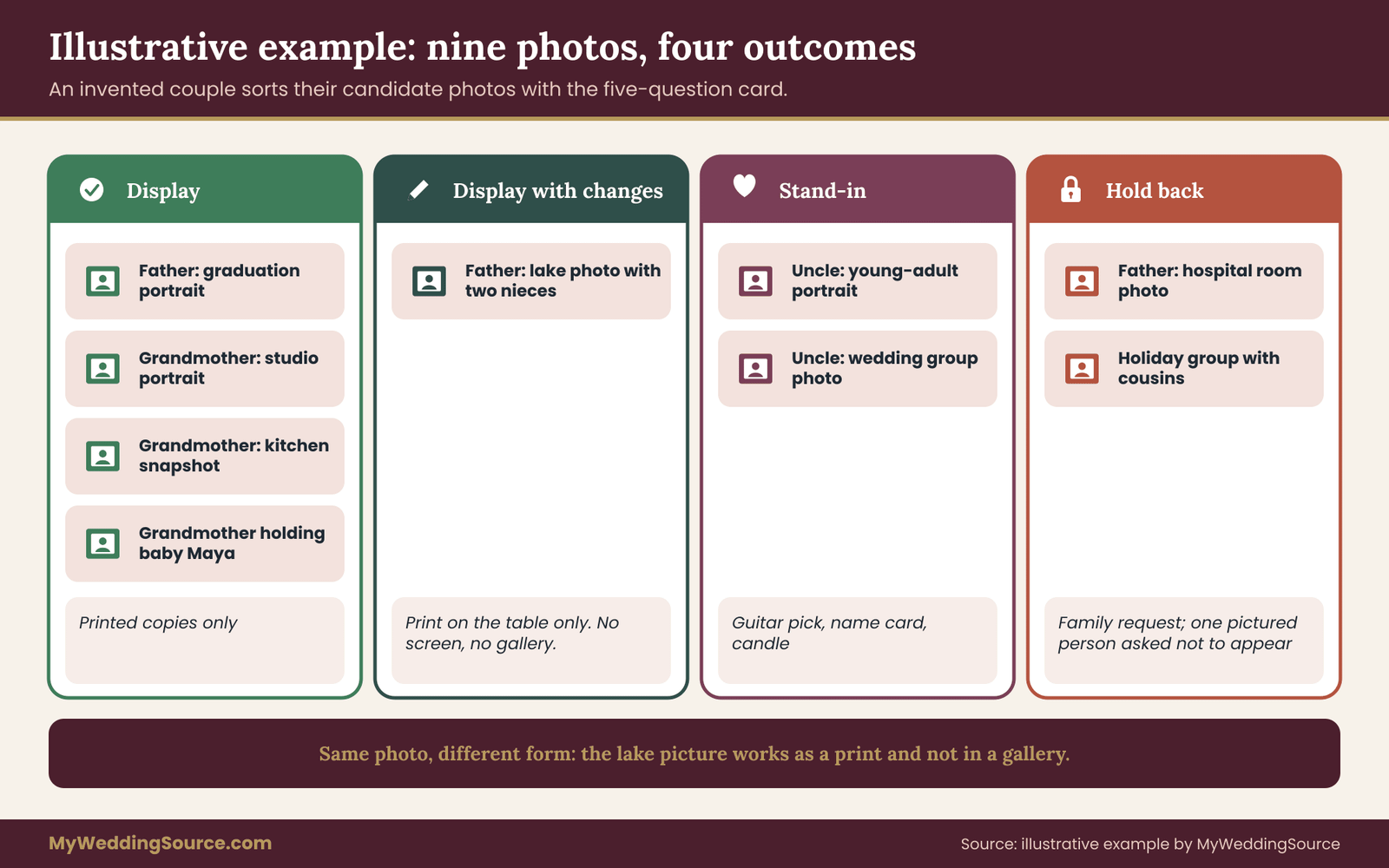
They gather nine candidate photos. Three show Daniel’s father: a solo portrait at a graduation, a group photo at a lake, and a photo taken in a hospital room. Four show Maya’s grandmother: a studio portrait, a kitchen snapshot, a group photo at a holiday with several cousins, and a photo of her holding Maya as a baby. Two show Maya’s uncle: a young-adult portrait and a group photo at a wedding where an estranged cousin appears.
Going through the questions
For Daniel’s father, circle one is Daniel’s mother, who is delighted by the idea. The graduation portrait has no one else in it, reveals nothing sensitive and is a print she owns. Outcome: display, using a copy. The lake photo shows Daniel’s two young nieces. Their parents are asked and agree to a printed copy on the memory table but not to any online use. Outcome: display with changes, restricted to the print. The hospital photo shows medical equipment and a nurse. Daniel’s mother says she would rather it stay in the family. Outcome: hold back.
For Maya’s grandmother, the closest relative is Maya’s mother, who agrees to the studio portrait and the kitchen snapshot. The studio print carries a photographer’s name, so Maya checks the papers that came with it and finds a note allowing family copies. Outcome: display. The holiday group photo includes several cousins; one cousin, now an adult, asks not to be shown. Maya considers cropping, but the cousin’s arm is still visible and the photo loses its meaning. Outcome: hold back. The photo with baby Maya is hers to share. Outcome: display.
For Maya’s uncle, the family is more cautious. Maya’s mother says that her sister, the uncle’s mother, finds photos of him hard to see and has never agreed to display one. Maya asks her aunt directly and gently, using the script about customs. The aunt says she would like him remembered but not by a portrait; she would be glad to see his old guitar pick. Outcome for the portrait and group photo: stand-in. The pick is placed in a small dish with a name card and a candle.
The finished table
The memory table holds three printed copies of approved photos, a flower beside each name card, one flameless candle, a small dish with the pick, and a basket of memory cards. Their photographer is told not to take close shots of the framed portraits and to include only a wide view of the memory table. A cousin is the steward and has a one-page note with the permissions and a bag of small supplies.
The couple’s table is smaller than the one they first imagined. It is also one that every relative can stand next to without worry. Three photos were set aside, one person was honored through an object, and nobody had to argue about any of it. The worksheet did not remove the sadness, which was never the aim, but it removed the avoidable conflict.
What the example shows
Three points are worth taking from this. First, the same photo can be fine in one form and wrong in another: the lake picture works as a print and would not work in a gallery. Second, the family member’s preference for an object over a photo was only discovered because Maya asked in an open way. Third, a stand-in is a full tribute. The guitar pick tells guests more about Maya’s uncle than many portraits could.
A memory table timeline, from first idea to the day after
Most of the work in this guide is conversation, and conversations need time. Starting early costs nothing and gives families room to think. The schedule below assumes about three months, and it compresses well if you have less. If your wedding is only a few weeks away, skip nothing but shorten each step, and lean on stand-ins for any photo that has not been confirmed.

Twelve to ten weeks out: decide whether to have a table at all
Talk as a couple about what you want a memory table to do. Is it a place for a handful of faces, a quiet corner or a way to include the family? Decide how many people you wish to honor and how large the memory table should be. At this stage you are setting the scope, not choosing photos.
Make a short list of the honorees and the closest relative for each. If you do not know whom to ask, ask your parents. Write down the venue’s rules on flames, table space and setup times.
Ten to eight weeks out: gather candidates and ask the first questions
Collect candidate photos, with a few more than you need, since some will be set aside. Note where each came from and who holds it. Then go through the five-question worksheet for each one and sort them into display, display with changes, stand-in and hold back.
Make your first conversations with circle one. Start with the person closest to each honoree, using the scripts above. Share the plan in a sentence, offer alternatives, and say when you will decide. Keep a log of who you asked, what they said and any limits they set.
Eight to six weeks out: ask the people in the frame and the owners
Reach out to the people pictured, or to the parents of children pictured, and to whoever holds each original. Be specific about the use: a printed copy on a table, a screen, a gallery or an online post. Request scans or prints, and agree on the return of any original.
By the end of this stage you should have an answer, or a clear stand-in, for every honoree. If any family is still undecided, fall back on the less exposed option and tell them they can still change their mind.
Six to four weeks out: settle the details
Order prints and frames, and confirm that the sizes suit the memory table. Finalize the cards, the candle, the flowers and any objects. Tell your photographer what the family prefers. Confirm the venue rules and the spot. Name the steward and write the one-page note.
If a sign about online posting is wanted, write it now and have it printed with the rest of your signage. A guide to keeping small signs consistent with the rest of your materials is useful here, and a single sign for this table can be sized and styled to match.
Two weeks to one week out: confirm and rehearse
Send a short confirmation to each family member whose photo or object is on the memory table, restating what you will do and what you will not. This is the last easy moment for anyone to change their mind, so say so kindly. Check that every item has an owner’s label and that the return plan is clear.
Walk the steward through the memory table, either on site or on paper. Give them the contact for the person who can approve changes. If your day-of timeline is detailed, add the setup time and the pack-up time, and tell the coordinator where the memory table will stand.
The day of the wedding
Set out the memory table early, before guests arrive, and have the steward do a last check. Keep the candle flameless if the venue requires it. Be ready for emotion: some guests will linger, some will cry, and some will avoid the memory table. All of these are normal. A tissue box and a chair nearby are small kindnesses that cost almost nothing.
If a relative asks for a change, say yes calmly and make it. You can talk about it later. The purpose of the memory table is to honor people, and a single frame removed in the middle of the evening does not change that.
The day after and the weeks that follow
Return the originals, with a short note of thanks. Send any promised copies to the family, and delete anything they asked you to delete. If your photographer’s gallery includes images of the memory table, check them against what the family agreed to, and ask for changes if needed. Do this early, while the gallery is new and easy to edit.
Decide what happens to the memory cards or the memory book. Some couples give it to a family member, some keep it with their wedding records, and some bring it out on anniversaries. Whatever you choose, tell guests where it is going before they write in it. The guide to organizing your wedding records after the event can help with where to keep these items.
Mistakes that come up again and again
A few errors recur often enough to be worth naming.
- Choosing photos first and asking afterward. The photo then feels like a done deal, and a “no” feels like a rejection. Ask first.
- Treating the memory table as one decision. Each photo is a separate decision, and a yes to one is not a yes to all.
- Forgetting the screen. A relative who agrees to a printed frame may be surprised to see the same face in a slideshow.
- Letting the couple run the memory table on the day. The couple should be greeting guests, not guarding frames.
- Using originals. A spilled drink or a lost frame cannot be undone.
- Writing too much on the card. Names and years are enough. More invites mistakes and exposes details the family did not choose to share.
- Ignoring a quiet “no.” Hesitation counts. Ask again, gently, in private.
What this approach cannot do
No worksheet can predict how a person will feel on a particular day. Grief changes from week to week, and a family that agreed in spring may feel differently in autumn. The method is meant to give people a fair chance to say what they want and a clear way to adjust, and it will not remove every difficult moment.
It also does not settle legal questions. Whether a particular photograph may be copied, published or shown in a particular way depends on the facts, the place and any agreements involved, and a general guide is not a substitute for advice from a qualified professional. If a dispute becomes serious, with a family member threatening action, stop and take advice before displaying the photo.
Finally, it cannot tell you whose feelings should carry more weight when a family is deeply divided. It offers circles of voice and decision rules as a starting point, but your family’s own customs and relationships will shape what is reasonable. When in doubt, choose the option that shows less and asks less of the people who are grieving.
A note on elders and guests who may be affected
A memory table may stir strong feelings in older relatives, in guests who lost someone recently, and in children who do not yet understand. The guide to wedding guest care covers how to support older relatives and young children during a long event, and a quiet spot away from the memory table is a helpful thing to have. If a guest is visibly upset, the steward or a close friend can offer a seat, a glass of water or a walk outside, and the memory table remains as it was.
Your next steps
Start with a single evening and three jobs. First, list the people you want to honor and write the name of the closest living relative beside each. Second, lay out your candidate photos and fill in the five-question card for each one, giving every photo an outcome of display, display with changes, stand-in or hold back. Third, send one private, specific message to the first relative, using a script above, with an easy way to say no.
Over the following weeks, work through the timeline one step at a time. Ask the people in the frame, settle the details with your venue and photographer, name a steward and send a short confirmation before the day. When the wedding is over, return the originals, keep your promises about copies and check the gallery. A memory table built this way is small, calm and fully agreed, and it does what it was meant to do: it lets a room of people remember someone together.
FAQ
Do we need permission to put a photo of a deceased relative on a memory table?
There is usually no rule that requires it for a private framed print, but asking is the considerate step. The closest living relatives often feel strongly about how their loved one is shown, and the people pictured may have their own views. Ask before you display, accept a clear no, and keep a short record of what each person agreed to.
What if two close relatives disagree about a photo?
You do not have to resolve their disagreement, only decide what goes on the memory table. Look for a split, such as one relative choosing the photo and the other choosing the flowers. If they still cannot agree, choose the less exposed option, such as a candle and a name card, and tell both that you will revisit it if they find common ground.
Can we crop someone out of a family photo?
Sometimes, with the cropped person’s knowledge and ideally their agreement. A crop is not always honest, because a hand, a shoulder or a shadow may remain, and the photo’s meaning can change. If the cropped version no longer feels like the original moment, choose another photo or use a stand-in. Do not crop out someone who has objected and then display it quietly.
Is it all right to display a photo of a child on a memory table?
Ask the child’s parent or guardian first, and be specific about the use. A printed copy on a table is a smaller step than a slideshow or an online gallery. If the child is now an adult, ask them directly. Many parents agree to a print and decline online use, which is a reasonable line to draw.
Who owns the copyright in an old family photograph?
It depends on who took it, when and under what arrangement. In the United States, copyright generally begins with the person who took the picture, and owning a print is separate from owning those rights. For a private framed copy this rarely matters, but for publishing, ask the holder and check the U.S. Copyright Office. A lawyer can advise on a specific case.
How do we stop guests from posting photos of the memory table?
You cannot fully control phones, but you can set a norm. A small, polite sign asking guests to enjoy the display in person usually works for most people, and a steward can answer questions. Tell your photographer too, so the memory table does not appear in the gallery unless the family has agreed. Ask the family what level of sharing they accept.
What can we use instead of a photo?
Many things honor a person without showing a face: a candle, flowers, a name card, an empty chair, a favorite object, a line in the program, a spoken tribute or a memory book. These options are complete tributes in themselves. Ask the family which feels right to them, since some prefer objects or words to images for religious, cultural or personal reasons.
What should we do if a relative asks us to remove a photo on the wedding day?
Say yes, calmly, and make the change right away. Have your steward set the frame aside, and leave the rest of the memory table as it is. Talk to the relative afterward, thank them for saying so and ask what would help. A quiet removal is easy to repair, while an argument in front of guests is not.
Sources
- U.S. Copyright Office
- Copyright Basics, Circular 1, U.S. Copyright Office
- Care, handling and storage of photographs, Library of Congress
- Personal archiving: preserving your digital memories, Library of Congress
- Preservation, National Archives and Records Administration
- Americans with Disabilities Act, U.S. Department of Justice
- National Fire Protection Association
- Cybersecurity and Infrastructure Security Agency
- Federal Trade Commission