
Band break music is the recorded sound that fills the room while live musicians rest, eat, tune and reset. A wedding with a good plan for band break music keeps the dance floor warm and the guests relaxed, and a wedding without one gets a silence that every guest notices. This guide gives you a cue plan for each handoff between live and recorded sound, plus a contract schedule that puts the details in writing.
Plan band break music as a chain of five handoffs: an exit cue from the live set, a bridge track, a band break music playlist sized to the break, a re-entry cue and a return to live sound. Give every break a written length, a named person who presses play, a named source of the band break music, and a fallback track. Then copy those details into a performance schedule attached to the band’s contract, so the break is a promise and not an assumption.
Most couples picture the live band and forget the minutes in between. A three-piece or six-piece group cannot play for four hours without stopping. Singers need water and rest, drummers need to loosen their hands, horn players need to rest their lips, and everyone needs to eat at some point. That is not laziness. It is how live performance works, and a good musician will tell you so before you ask.
The break itself is rarely the problem. The gap is. A gap is any stretch where the room expects sound and gets none, or gets something wrong for the moment: a loud pop track while grandparents are mid-conversation, a playlist that stops after twelve minutes when the band needs twenty, a speaker that clicks and hums because someone unplugged a cable. Each of those has a boring cause, and each has a boring fix, which is the good news. This guide is a set of those fixes, arranged in the order you would use them.
A note on scope. This article is general information, not legal, tax or financial advice. Music rights, venue rules and contract terms vary by place and by vendor, so confirm the current version of anything that matters with your venue, your performers and the issuing organization.
Why band break music exists at a live wedding
A live band is a working team. Even a cheerful, well-practiced group has physical limits, and the contract usually reflects them. Many bands describe their time in terms of sets and breaks, for example three sets with a rest between each, though the exact pattern varies by group, by genre and by the number of players. Your band may play shorter sets with shorter breaks, or longer sets with one meal break. The only pattern that matters is the one written in your agreement.
During a break three things have to happen at once. The players rest. The room keeps its mood. And somebody, somewhere, keeps the sound system working. Band break music is the answer to the second item. It is the recorded or otherwise-supplied audio that carries the room through the pause so that guests do not feel the evening stall.
There is a second purpose, which people overlook. Band break music is a chance to include sound that a live act cannot easily provide. A band that plays covers and standards may not have a song in a language your grandparents love, or an instrumental recording of the processional piece, or a favorite quiet track that suits dessert. A planned break lets you place those moments on purpose.
Gaps that guests notice and gaps that nobody notices
Not every pause is a problem. A thirty-second silence while a toast ends and the room applauds is natural. A ten-second dip while the lead singer swaps a guitar is nothing. The gaps that cause trouble have a few things in common. They happen when guests expect momentum, such as right after a big dance. They are long enough to make people check their phones or drift toward the exits. Or they come with an audible fault, such as a loud click, a hum, feedback or a sudden jump in volume when the recorded audio starts.
It helps to sort the common gaps into four kinds, because each has a different cure:
- The cold gap. The band stops and nothing starts. The fix is an exit cue and a prepared first track.
- The mismatch gap. Sound starts, but it is the wrong sound for the moment. The fix is a bridge track and a band break music playlist chosen for the room.
- The tech gap. Sound starts with a pop, a hum or a volume jump. The fix is a signal path that was tested and a person assigned to the volume.
- The return gap. The band break music is still playing when the band is ready, or the band is late and the playlist runs out. The fix is a re-entry cue and a spare buffer.
You will see these four again as the article goes on, because the whole cue plan is built to prevent them.

Where this article fits with the rest of your music planning
Choosing the songs for the whole night is a different job, and the guide on wedding reception music planning covers energy timelines, mixing generations and dance styles. This article is narrower. It picks up where that planning ends, at the moment the live set stops, and it concerns only the stretch of time and sound between two live sets. If you have not yet decided how the evening should rise and fall, start with that guide and come back here once you know roughly where the breaks will land.
Reading the evening: where band break music matters most
The first step in planning band break music is to look at your timeline and mark the places where live music is paused. Do this before you talk to a band about breaks. Many couples discover that the schedule has already decided where the breaks go, because a dinner service, a toast or a cake cutting takes the room’s attention away from the stage anyway.
A reception can be sorted into four kinds of time, from the point of view of the band.
Background time. Guests are eating or mingling. Music is present but nobody is dancing. The sound is a blanket. This is the cheapest and most forgiving stretch to give to recorded sound.
Spotlight time. Something is happening that the whole room watches: an entrance, a first dance, a toast, a cake cutting. Music here is either live, deliberately recorded, or absent. Gaps are very noticeable.
Dance time. The floor is the point. Momentum matters most, and a break here is the costliest kind.
Wind-down time. The room is getting tired, and the last songs matter more than the middle ones. A break right before the final set can drain the floor.
If you read your own timeline through these four lenses, a pattern appears. Breaks fit comfortably in background time, awkwardly in spotlight time and expensively in dance time. The most useful rule in this guide is a single sentence: put the band’s rest where the room is already resting.
Marking the timeline
Take the working version of your reception timeline, the one your coordinator or planner may already have started, and print or copy it. Use a pencil and mark each block as background, spotlight, dance or wind-down. Then circle every block that is at least fifteen minutes long and is background time. Those are your candidate break windows.
For a plated dinner, the main course is the obvious candidate, since guests are eating, talking and not dancing. A cocktail hour often works the same way; the guide on the wedding cocktail hour explains how that stretch is usually paced. A long toast block is a weaker candidate, because the room’s attention is already on a microphone, and band break music under a toast is easy to get wrong.
If your timeline has fewer candidate windows than the band needs breaks, you have found a conflict early. There are three ways out. You can shorten the sets, you can ask the band to take staggered breaks so only part of the group rests at once, or you can add a short planned pause on the floor that the room reads as an intermission. Each option is covered later, and each has costs.
A short test for each break window
Before you accept a window, run three questions against it.
First: what is the room doing right now? If the answer is “waiting for something,” the window is weak, because silence will feel like delay. If the answer is “eating” or “talking,” the window is strong.
Second: what does the next block need? If the next block is the first dance after dinner, the break needs to end with a ready band and an introduced song. If the next block is another toast, the break can run a little loose.
Third: who is in charge of the sound for this window? If the answer is “I’m not sure,” keep reading, because the next sections are about exactly that.
Writing the break into the day’s schedule
A break that exists only in the band’s memory is a break that surprises everyone else. Once you choose the windows, give each one a line in the vendor schedule, with a start time, an end time and a one-line description such as “band break one, recorded dinner music, DJ or sound lead presses play.” Your caterer, photographer and venue manager read the same timeline, and each of them uses the break to plan their own work. The caterer may time the main course to the moment the band steps off, and the photographer may use the break to move the couple for portraits.
The guide to the wedding vendor timeline explains how to share one schedule with every vendor so the break times do not live in separate versions. For this article, the point is simpler: a break is a scheduled event, so it gets a line like any other.
There is one more reason to be exact. Break lengths drift. A twenty-minute break that was supposed to end at 7:40 becomes a twenty-five-minute break because someone was still eating, and the next block pushes back accordingly. When the schedule shows an agreed end time and the band knows it, the drift is easier to catch and the person running the room can adjust the band break music playlist before the gap opens.
What a break window is not
A break window is not a performance, and guests should not be asked to treat it as one. If the band break music is loud enough that dining guests lean across the table to talk, the break has turned into a bad dance block with no dancers. Treat the sound level as part of the plan. A quiet, steady, familiar sound is the right default for most breaks, and the section on holding playlists covers how to build one.
Equally, a break window is not a punishment for the band. Experienced musicians appreciate a client who has thought about this, because a clear plan lets them rest without worrying that the room is falling apart. Say so when you talk to them. The tone of the conversation, “we want you to be able to rest properly and we want the room to stay comfortable,” usually gets a much more helpful answer than a request that sounds like a demand to cut breaks short.
The break budget: how long band break music really has to run
Ask a band how long a break is and you will hear a round number, usually fifteen or twenty minutes. Ask the person running the band break music how long the break was and you may hear something different. The difference is where gaps come from. The planned length of a break and the length of band break music you actually need to supply are two separate numbers, and a good plan keeps them apart.
Think of the break as a budget with four parts.
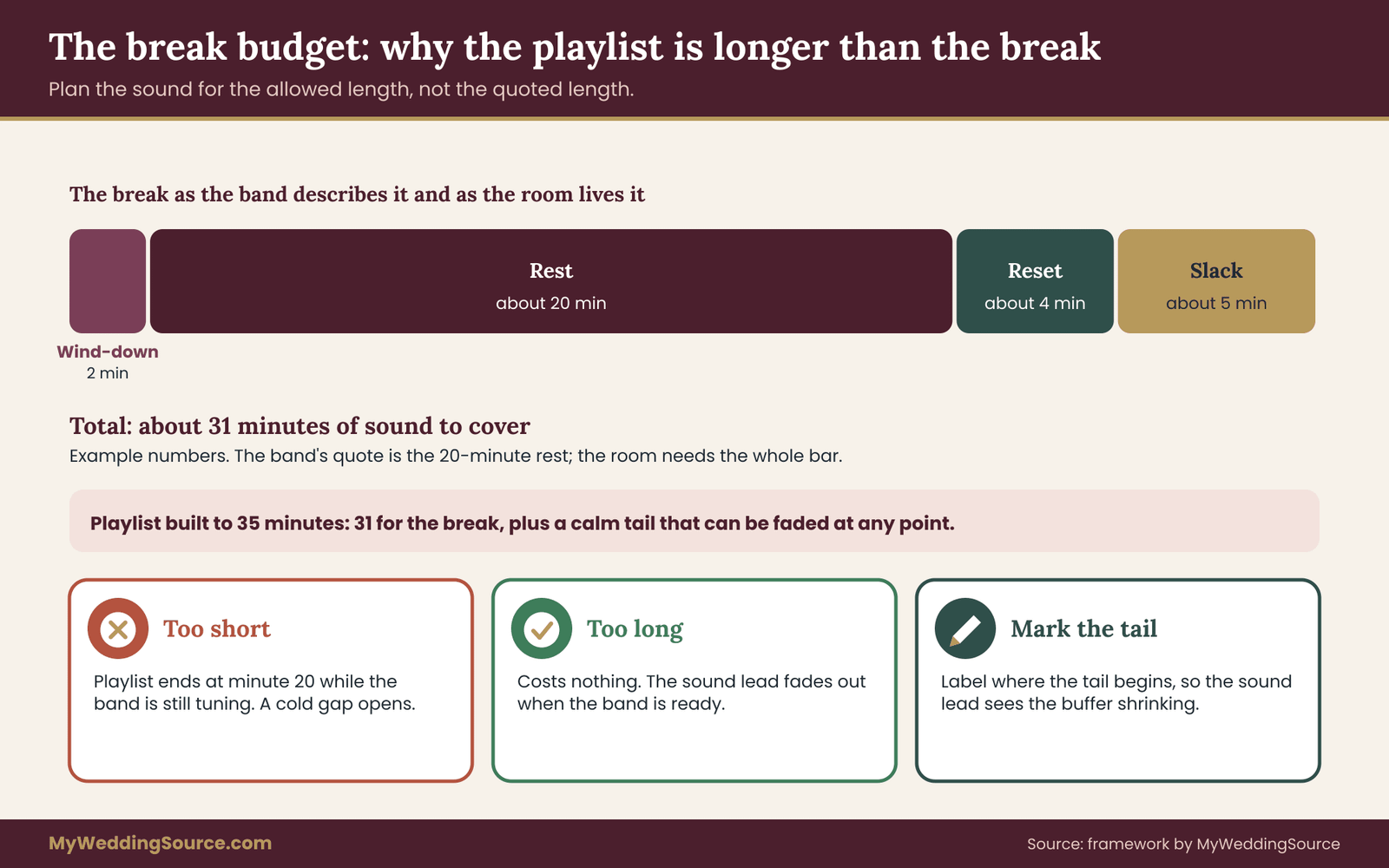
Wind-down. The time between the last live note and the moment the band is physically off the stage or away from their instruments. Singers walk off, a drummer stands, a guitarist sets an instrument on a stand. This can take a minute or two, and the room needs sound for it.
Rest. The actual break. This is the number the band quotes. It is the time they are away from their instruments, eating, drinking, resting their voices.
Reset. The time to return, retune, check levels and get ready for the first song. This often takes three to five minutes, and a band that cares about quality will not skip it. A horn player may warm up, a vocalist may sip water, a bassist may retune.
Slack. A cushion for the break to run long, because breaks nearly always do. A buffer of five minutes covers most overruns.
Add those up and the band break music you need to supply is longer than the quoted break. If the band says “twenty minutes,” plan for something like thirty minutes of sound that you can end gracefully at any point. That does not mean the break will last thirty minutes. It means your hold playlist will not run dry before the band returns.
A worked sum
Suppose the contract says the band plays three sets of forty-five minutes with two twenty-minute breaks. The schedule shows the first break landing in the main course. Here is how a careful coordinator would size the band break music.
The wind-down adds two minutes. The rest is twenty. The reset adds four. The slack adds five. That comes to about thirty-one minutes. Rounded sensibly, the break needs a band break music playlist of thirty-five minutes, with the tail end built from tracks that can be cut short without sounding abrupt.
That is not an official formula. It is arithmetic you can do on the back of a napkin, and it exists to prevent one specific failure: a playlist that is exactly twenty minutes long and ends at minute twenty, while the band is still tuning in the corner.
Which direction the error should go
When you are unsure, make the playlist too long rather than too short. A playlist that runs a little long costs nothing, because whoever is running the sound can fade it out when the band is ready. A playlist that runs short creates a cold gap, which is the most noticeable kind. This asymmetry is the single most useful fact about band break music. Extra length is free, and missing length is expensive.
The same logic applies to the first and last tracks of each break. They should be tracks that can be faded without damage, or that end cleanly. Avoid building a break that ends on a dramatic, high-energy track that must finish before the band returns, because you lose control of the timing.
Overtime and the break
A break that runs long is not always the band’s fault. A late dinner service, a toast that overran, or a delay moving guests from one room to another can all push the break window. When the schedule slips, the break window slips with it, and the performance schedule should say what happens next. Does the band shorten the next set? Does the evening end later? Does the venue allow overtime?
Those are contract questions, and the later section on the contract schedule covers them. For the budget, the lesson is that a break has a planned length and an allowed length, and the band break music needs to cover the allowed length.
The handoff ladder: five steps from live to recorded and back
This is the core framework of the article, and it is built to be used on paper. Each break is a short ladder with five rungs. Every rung has one owner and one cue. If you can fill in those ten items for each break, you have a plan.
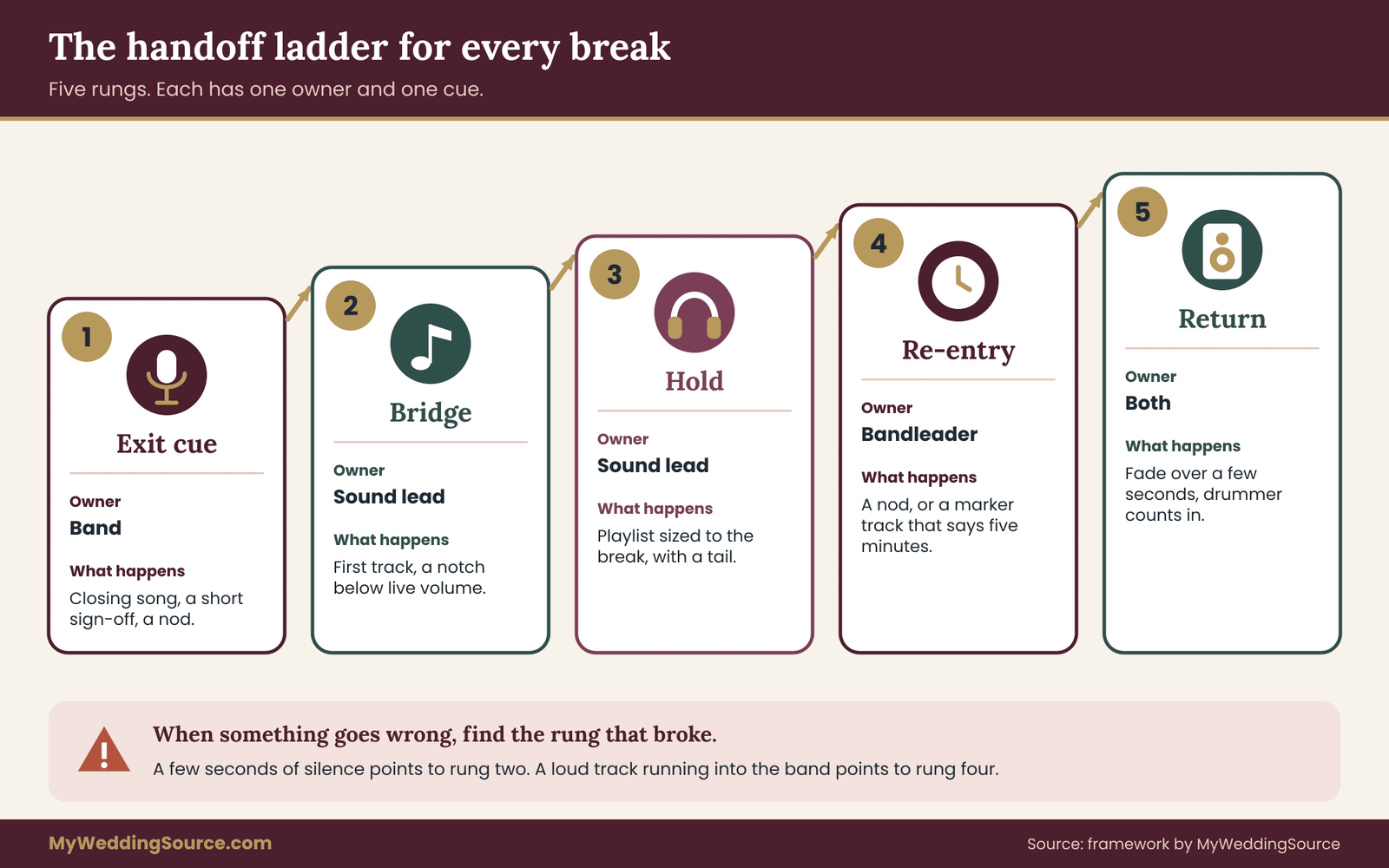
Rung one: the exit cue. This is the signal that the live set is ending. It might be a final song, an announcement from the bandleader, or a nod from the drummer to the person running the sound. The owner is the bandleader. The cue is whatever the band and the sound lead agree on in advance.
Rung two: the bridge. This is the first recorded track, which must follow the last live song without a lurch. The owner is the person at the sound controls. The cue is the exit cue. A bridge track matches the mood and the loudness of what just ended, and it comes in on time.
Rung three: the hold. This is the main body of the band break music, the playlist or recorded sequence that carries the room through the rest. The owner is the same person. The cue is a start time and a target end time.
Rung four: the re-entry. This is the signal that the band is ready to return. It might be a thumbs up, a message to a phone, or a simple rule such as “when the band is on stage and the lead nods, fade out.” The owner is the bandleader. The sound lead acts on the cue.
Rung five: the return. This is the first live song and the moment the band break music ends. The owner is the bandleader for the music and the sound lead for the fade. The cue is the first downbeat.
Write those five rungs for each break, with names beside them, and the plan is done. The rest of the article is a guide to filling each rung well.
Why a ladder and not a playlist
The common instinct is to solve this with a playlist. Make a long list of songs, press play when the band stops, stop it when the band returns. That works on a good night. It fails because it treats the break as one object when it is really five moments.
A playlist alone does not tell anyone when to start, who decides when to stop, what happens when the band returns early or late, or what to do when the first track is wrong. The ladder separates those moments so that each has a single owner, and when something goes wrong, you can see which rung broke. If the room went silent for a few seconds, rung two failed. If a loud track ran into the band’s first song, rung four failed. This makes problems easy to fix on the night and easy to fix for the next event.
Who the ladder is for
A ladder works for every kind of break, from a fifteen-minute meal break with a DJ on the other side of the room to a four-minute pause while a solo guitarist changes a string and a phone plays a quiet track through a small speaker. The rungs are the same. Only the weight changes. A casual backyard gathering may carry the ladder in one sentence, “Priya’s cousin presses play when the guitarist waves and stops when he nods.” A large formal evening may need it written on a cue sheet and rehearsed at the sound check.
If you are working with a planner or a day-of coordinator, hand them the ladders for every break. They can fold them into the main timeline, much as they would fold in the cues from a ceremony. The guide to ceremony cue sheets shows how cue-based planning works for the ceremony, and the same way of thinking transfers to the reception.
Naming the sound lead
The ladder assumes there is a person in charge of the band break music. Many problems come from this single assumption. The band thinks the venue’s technician is handling it. The venue thinks the DJ is. The DJ was not hired for this wedding. A friend was asked to “just press play” and never told when.
Choose the sound lead deliberately, by name, in writing, before the day. There are four common choices, and the next part of the guide compares them. For now, the rule is simple: if you cannot say who presses play on the first track of the first break, you do not yet have a plan.
What each rung looks like when it goes well
On a well-run break, almost nobody notices. The last song of the set ends with an applause or a laugh. The bandleader thanks the room in one sentence and says the band will be back in a little while. A quiet instrumental track starts about two seconds later, at a volume a little lower than the live music, and the room settles. Over the next twenty-some minutes the playlist drifts through familiar, low-key tracks. When the band is ready, the bandleader gives the sound lead a nod. The track fades over five or six seconds. The drummer counts in, and the first live song begins.
Nothing in that description is difficult. It is just a series of small decisions that somebody made ahead of time. The remaining sections go through them one rung at a time, then cover contracts, rights, a worked example and the things that go wrong.
A one-page version
Some couples prefer a single page. A usable one-page ladder has three columns written in plain sentences: what happens, who does it, and the signal. For example, “The set ends; Dana (bandleader) says thanks and that the band will be back at 7:40; signal is the last chord.” “A quiet track starts within five seconds; Marcus presses play; signal is Dana’s thanks.” That is enough. If your plan fits on an index card, it is more likely to be used.
Exit cues: how a band break music handoff begins
Every handoff begins with the band, so the first thing to settle is how the band will signal that a set is ending. This sounds trivial and is not. A set can end because the clock says so, because a song just finished, because the schedule pushed the end earlier, or because a spotlight moment such as a toast is about to begin. Each of those calls for a slightly different exit.
There are four kinds of exit cue, and a good plan picks one per break.
The closing song. The band ends the set with a song chosen for that purpose, often a slower or warmer one, so that the recorded track that follows does not feel like a drop. A set that ends on a loud peak makes any recorded music sound small. A set that ends on a gentler number lets the band break music pick up where the live sound left off.
The spoken sign-off. The bandleader says a short line. “We’ll take a quick break and be back in a bit” is enough. It tells guests that the pause is intentional, which removes much of the awkwardness. Guests who know the band is coming back treat the break as a normal part of the evening.
The visual cue. For sets that end without a clear last song, such as a long instrumental medley, a visual signal tells the sound lead to start. It can be a raised hand or a nod. Practice it once. A cue that has never been seen at the venue is easy to miss.
The timed cue. The set ends at a clock time written in the schedule. This suits a venue with a strict run of events, but it is the weakest cue on its own, because clocks do not read the room. Pair it with one of the other three.
Writing the sign-off line
A sign-off is a short sentence, and the best ones answer the question guests are quietly asking: is the music over? A good line says that the band is taking a break, that band break music will play, and roughly when the band returns. It does not apologize, and it does not explain. Something like this is plenty:
“Thank you, everyone. We’re going to rest for a bit. Music will keep playing, and we’ll be back after dinner.”
Bands have their own phrases, and the couple does not need to script them. What the couple can do is ask the band to include one thing: the time or the milestone when they return. “Back after the toasts” tells a table of guests what to expect, and it reduces the number of people who wander toward the exit because they think the evening is ending.
Special case: the break that follows a big moment
Some breaks follow a high point, such as a dance that filled the floor. The floor is full, the room is excited, and the band walks away. This is the hardest break to manage, because the recorded track has to catch an energy that the live band just built.
There are two reasonable approaches. The first is to place the break after a dip rather than a peak. Ask the band to end the set with a slower song, let the room breathe, and then start the break. The second is to accept that the floor will empty and make that emptying comfortable: choose a band break music playlist with a gentle tempo, lower the volume a little, and let guests move to tables and the bar.
Trying to run a second dance party off a playlist while the band eats usually disappoints, because the band break music has no performer to keep the energy up, and the room can feel the difference.
The guide to programming reception music for different generations describes energy curves in detail, including how planned dips help the evening. The lesson for band break music is the same: plan the dip deliberately, and place the break inside it.
Choosing the bridge and building the band break music playlist
Once the exit cue is set, the next rungs are the bridge and the hold. These are the parts of band break music that guests actually hear for twenty or thirty minutes, so they deserve real care.
The bridge track
The bridge is the first recorded track. Its job is to make the change from live to recorded feel natural. Three qualities matter.
Matching loudness. A bridge that starts louder than the band had been playing jolts the room. A bridge that starts far quieter makes the band sound like it vanished. Set the level a little below the live level and let the sound lead raise it by a notch if needed. Ask the sound lead to listen to the final live song and match it.
Matching mood. If the band ended on a ballad, a thumping dance track is a jolt. If the band ended on a lively number, a sleepy instrumental may flatten the room too abruptly. A track one step down from the last live song is usually right.
Clean starts. A bridge track should begin cleanly, with no long silent intro and no sudden high note. Listen to the first ten seconds before the wedding, not on the night.
The hold playlist
The hold is the rest of the band break music, and it is easier to build if you split the job into three decisions.
Decide the purpose. Is the break during dinner, when talk matters most? Then the playlist should be gentle and familiar. Is it before the final dance set, when the room needs to be ready? Then the playlist can rise in energy near the end, preparing the floor. Is it during a long cocktail hour? Then something light and varied works.
Decide the shape. A simple shape for a thirty-minute hold is a plateau, then a slight lift. The first two-thirds is steady and low-key. The final third gains energy in small steps, so that when the band returns, guests are already leaning toward the floor. Avoid dramatic swings, since the sound lead cannot keep fixing them.
Decide the source. The list can come from the band, from a DJ, from the venue’s music system, or from the couple. The next section covers who is responsible. The point here is that the source affects what you may play. A playlist from a personal streaming account is a different thing from a playlist supplied by a licensed professional, and the section on rights comes back to this.
Qualities of a good hold track
A track for a break needs different qualities than a track for a dance. These are rules of thumb, not requirements.
- Steady dynamics. Avoid tracks with a quiet verse and a thunderous chorus. The volume will bounce, and someone will keep reaching for the fader.
- Familiar without being a request. Instrumental versions of well-known songs, relaxed acoustic arrangements, and mellow classics tend to work, because they fill the air without demanding attention.
- Language and content that suit the room. If lyrics are involved, check them. Use your own judgment, and ask the sound lead for a lyric check if grandparents and children share the room.
- No hard endings. Prefer tracks that fade or end softly. A track that finishes with a bang makes the next cue harder.
- Cut points. Know where each track can be faded without sounding wrong, and mark the playlist so the sound lead can find them.
The fallback track
Every break needs a fallback. This is a single long track, or a separate short playlist, that the sound lead can start the moment anything goes wrong: the main playlist stalls, a device loses connection, a file will not play, or the band is delayed. It should be steady, quiet and long, ideally twenty minutes or more, and it should live somewhere other than the main playback device. A second phone or a different app is enough, provided it has been tested through the same input.
The fallback is cheap insurance, and it is the item people leave out most often. A single long, neutral track turns a technical failure into a non-event.
Sizing the hold to the budget
Go back to the break budget. If the band break music needs about thirty-five minutes, the hold should be built from the break plus a spare track or two. A convenient method is to build the playlist to thirty-five minutes, then add a ten-minute tail of the quietest tracks at the end. The sound lead can then see how much remains. When the band is ready early, the sound lead fades out. When the band is late, the tail absorbs the delay.
Mark the tail with a visible note in the playlist, such as “tail begins.” A sound lead who sees that note knows the safe buffer is shrinking, and can warn the bandleader. That small warning, “we’re into the tail,” is a better cue than any watch.
A short example of shape
Imagine a forty-minute dinner break. Minutes zero to five: a soft bridge, the last live song’s mood a step lower. Minutes five to twenty-five: a steady plateau of gentle, familiar instrumentals and acoustic tracks. Minutes twenty-five to thirty-five: a slight lift, with warmer and slightly livelier tracks. Minutes thirty-five to forty-five: the tail, back to calm and quiet. The sound lead can end at any point from minute thirty onward without hurting the shape.
That is a pattern to adapt, and not a recipe. Your guests, your venue and your band determine the right sounds. What carries over is the structure: a clean bridge, a steady plateau, an optional lift and a calm tail.
Putting someone in charge of band break music
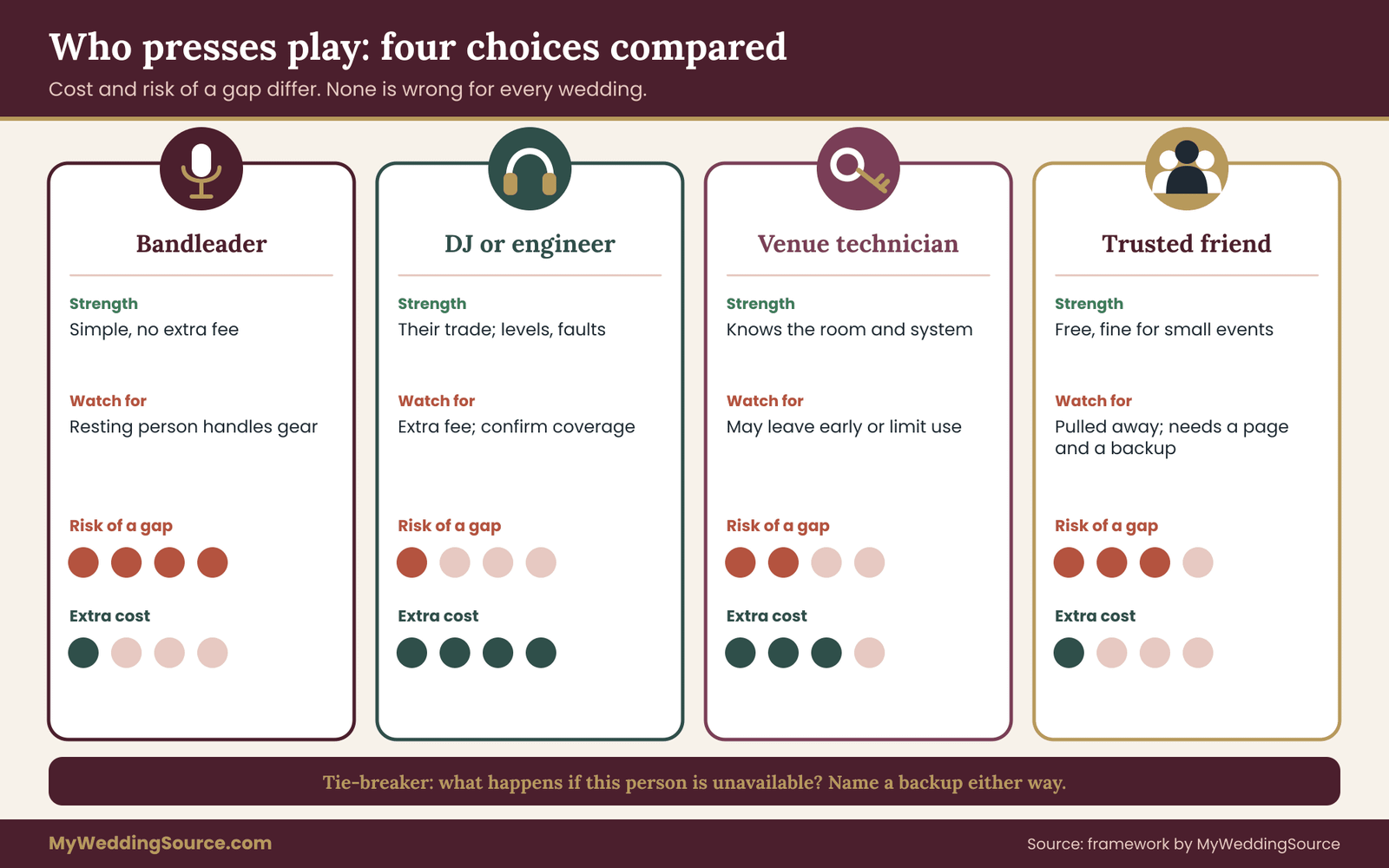
The ladder only works if a person owns each rung. For the recorded portion, there are four realistic choices, and each carries trade-offs. None is wrong. The right one depends on the size of the event, the venue and the band.
Option one: the bandleader
In some small groups the bandleader or a designated member starts a playlist from a device at the stage. This is simple and costs nothing extra. It also means a performer is handling equipment during the one time they are meant to rest, and it depends on the person remembering to start and stop it. It suits solo performers and duos who run their own sound. It suits larger bands less, because the person with the most to do is the one who needs the break.
Option two: a DJ or sound engineer
A professional who runs the sound for the whole evening is the strongest choice. They know the equipment, they can match levels, they can listen to the room and they can keep a band break music playlist ready. If you already hire a DJ for other parts of the night, ask whether they will cover the band’s breaks, and put the answer in writing. Some do this as part of their package, some charge a fee, and some prefer to take the later part of the evening only. The point to confirm is who is physically at the controls during each break.
Option three: the venue’s technician or event staff
Some venues supply a sound technician, or have a house system with a staff member who operates it. They may know the room well. They may also leave at a set hour, or have rules about what can be plugged into the system. Ask what they will and will not do. In particular, ask whether they will start and stop a playlist on cue, because some venues provide equipment only and expect the vendors to run it.
Option four: a trusted friend or relative
A friend or relative can press play, and for a small gathering this is often fine. The risks are practical. Guests are celebrating and may not want to hover by a laptop. They may be pulled into photos or a conversation. They may not know when to start or stop. If you choose this route, give the person a one-page ladder, show them the equipment during the sound check, and ask a second person to act as backup. A job that is delegated casually tends to be forgotten at the exact minute it matters.
Comparing the four in plain terms
The bandleader option costs the least and carries the highest risk of a gap, because the person is also resting. The DJ or engineer option costs the most and carries the lowest risk, because it is their trade. The venue technician option sits in the middle, and its reliability depends on the venue’s rules and hours. The friend option is free and works for small events with a clear page of instructions and a backup.
A useful tie-breaker is to ask what happens if the person is unavailable. A professional has a replacement or a protocol. A friend does not. For a wedding with a hundred guests or more, or a venue with strict timing, the professional option usually pays for itself in lowered stress.
Settling it in writing
Whichever option you choose, put the name in the performance schedule, along with the phone number the band can reach on the day. If the sound lead is not the band’s own person, the band should also see their name, so that the first meeting is not at the moment the set ends. A short message the day before, “Marcus will handle the band break music from the sound desk and will be at your sound check,” avoids many misunderstandings.
The guide to the wedding vendor contract covers general contract basics, such as reading deposits, cancellation terms and who signs what. The performance schedule in this article is one addition to that kind of agreement, built for breaks.
Equipment, signal path and power for band break music
Most technical gaps come from one cause: nobody asked how the band break music gets into the speakers. Live bands often bring their own sound system, or their own mixer, and expect to plug a laptop or phone into it. Venues sometimes provide a house system and expect the band to use it. A DJ may supply separate speakers altogether. Each setup has different answers, and the answers decide whether band break music starts cleanly or with a crackle.
Three possible signal paths
Through the band’s mixer. The band break music plugs into a spare channel on the band’s own mixer. The advantage is a single set of speakers and a single volume control. The disadvantage is that the band’s engineer, or whoever sits at the mixer, has to be present, and the mixer may be partly packed up during the break.
Through the DJ’s or venue’s system. A separate sound system plays the band break music, and the band’s speakers are muted. The advantage is independence: the band can power down. The disadvantage is a possible mismatch in volume and in the location of the sound. Speakers placed near the dance floor and speakers placed for dining may serve different areas.
Through a separate small speaker. A portable speaker handles band break music in a corner, a lobby or an outdoor space. This suits a small gathering and an unusually informal break, and it is not enough for a large room.
Ask your band which of these they expect. Ask your venue which of these it permits. If the answers differ, settle it at the technical walkthrough, not the day of the wedding. The guide to a venue technical walkthrough describes how to check outlets, access routes and equipment needs with the venue ahead of time, and the signal path belongs on that checklist.
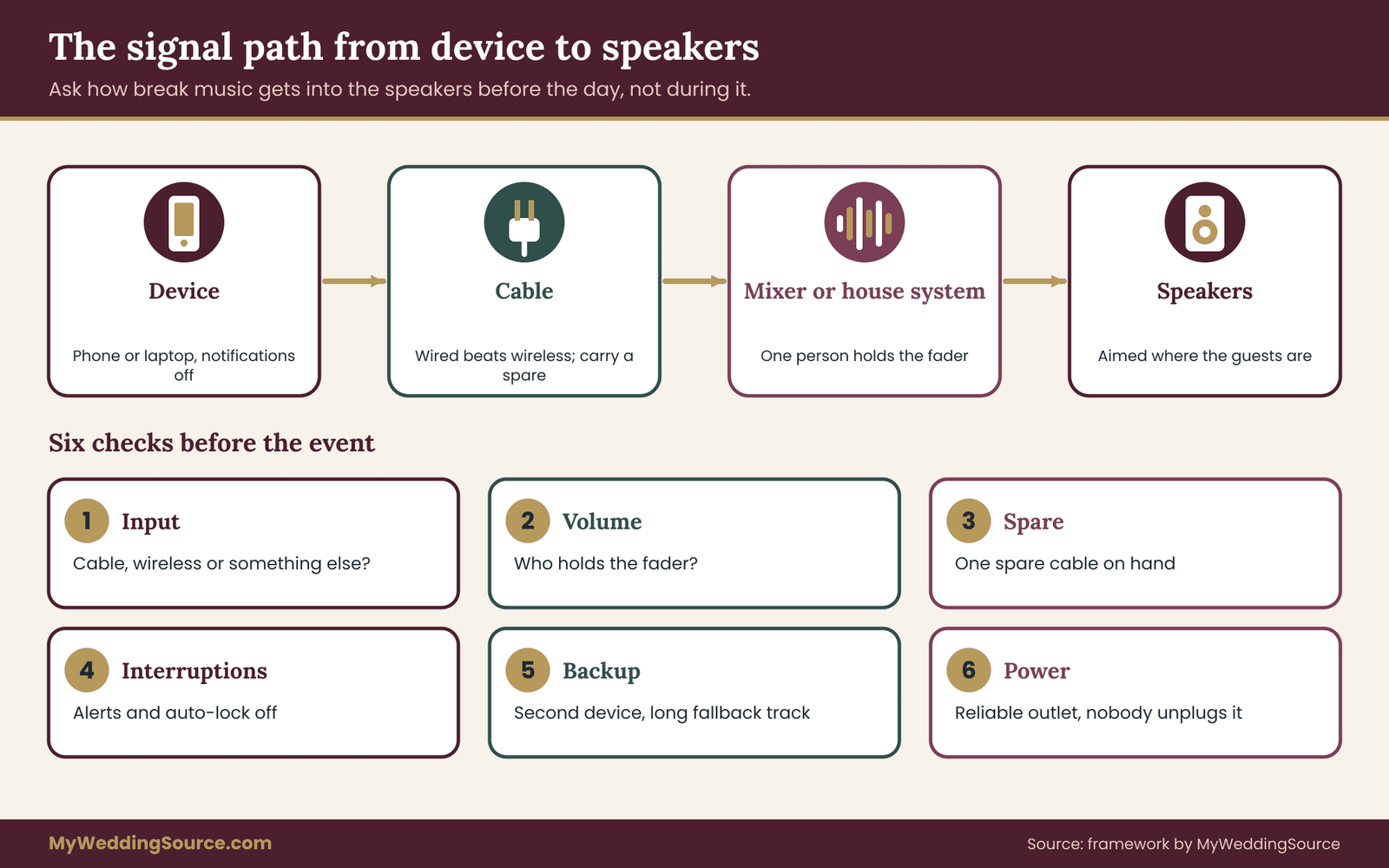
The handful of technical questions that prevent most gaps
You do not have to understand audio gear to ask good questions. A short list is enough.
- What is the input? Does the system accept a cable from a phone or laptop, a wireless connection, or something else? A wireless connection can drop, and a cable cannot. Prefer a cable for the main device.
- Who controls the volume? One person should hold the fader. If the band’s mixer and the venue’s system both have volume knobs, someone will turn the wrong one.
- Is there a spare cable? A single worn cable is a classic cause of a sudden hum or silence. Carry one spare of whatever the plan uses.
- Is the device set up to avoid interruptions? A phone used for playback should have notifications silenced, auto-lock disabled during the event, and enough charge to last. A single call or alert coming through a speaker is a memorable failure.
- Is there a backup device? The fallback track from the previous section should live on a second device.
- Is power secure? Check that equipment is plugged into a reliable outlet and that no one will unplug it to vacuum or charge something else. Tape down or label a cable that guests might trip over.
Avoiding the pop, the hum and the jump
Three small sounds are responsible for a lot of embarrassment.
The pop happens when a device is connected or disconnected while the system is live. The fix is to lower the volume on the input before plugging in and to raise it after. A sound lead who knows this takes five seconds to do it.
The hum is usually a grounding or cable issue. It often appears when two pieces of equipment are connected through different outlets, or when a cheap cable is used. If a hum appears at the sound check, fix it then, with the help of the band’s engineer or the venue’s technician. Do not hope that it disappears during the event.
The jump is a sudden change in volume when the source changes. Recorded tracks are often mastered louder than live instruments sound at the same fader position. The fix is to test the level during the sound check, by playing the bridge track and listening from the middle of the room, and to mark the fader position that matches the live level.
The sound check as a rehearsal of the handoff
A sound check normally tests the band’s own sound. Add one more item. Ask the band, the sound lead and the venue technician to run a mock break: the band plays the last twenty seconds of a song, stops, the recorded bridge starts, and the sound lead raises and lowers it. Then run the return: the sound lead fades the track while the drummer counts in.
This takes three minutes and surfaces nearly every problem. It tells the sound lead what the signal path feels like. It tells the band where the cue comes from. And it often catches a missing cable or a muted channel that would otherwise appear in front of two hundred guests.
If the sound check happens well before the guests arrive, ask for a quick repeat of the handoff shortly before the event starts, since equipment is sometimes moved in between.
Sound level during a break
Volume deserves a sentence of its own. Band break music should usually be quieter than the live set, since the room is eating and talking. The aim is that a guest can speak to the person beside them without raising their voice. If a break plays during a dance block, the level can be higher.
For reference on hearing safety, the National Institute for Occupational Safety and Health and the Centers for Disease Control and Prevention publish general noise guidance, and your sound lead can use a simple level meter app as a rough guide at the table closest to the speakers. Ask the venue if it has a decibel limit, because some do.
Re-entry: bringing the band back without a jolt
The fourth and fifth rungs are the ones most plans forget. The break ends, the band returns, and the band break music has to stop at the right moment. Done badly, two sounds collide or a long silence opens. Done well, the room barely notices the change.
The re-entry cue
The band signals that it is ready. There are a few straightforward methods.
- A visual nod. The bandleader looks at the sound lead and nods. It is simple, and it requires line of sight. Make sure the sound lead can see the stage from the sound position.
- A quiet message. A text to the sound lead’s phone, such as “two minutes.” It works well when the sound lead stands far away, but a phone is a poor tool in a crowded room, so keep it as a backup.
- A fixed track. Agree that when a particular track begins, the band will be ready. For example, “when the last-lifting track starts, we’re on stage in five minutes.” This puts the cue inside the music itself, which is neat and reliable.
- A timed fade. The break ends at a set time, and the sound lead fades at that moment regardless. Use this as a rule of last resort, since it ignores the real situation.
A combination works best. The fixed track gives a rough warning, the nod gives the exact moment, and the timer sets an outer limit.
The fade
A fade is a gradual reduction in volume. It should take between three and eight seconds, long enough to avoid a sudden cut and short enough that it does not drag. A hard stop is rarely right, since it leaves the room with a feeling of something missing. A fade that is too long muddies the first live notes.
The best moment to fade is on a musical phrase boundary, such as the end of a chorus. The sound lead cannot always find one, so a steady fade over a few seconds is fine. What matters is that the band break music is nearly gone by the time the first live note arrives, and not still audible beneath it.
Starting the first live song
The first live song after a break should be one that the band can start cleanly and the room is ready for. A count-in from the drummer, a vocal introduction or a clear first chord all work. Ask the band to avoid starting with a song that needs a long ramp-up, since the floor is not yet warm. A familiar mid-tempo song that invites people to stand is often a better opener than a showpiece.
A small point that matters: the bandleader should say something short as the band returns. “Thanks for waiting, everyone, let’s get back to it.” It restores a sense of occasion, and it tells people at the far tables that the music has changed hands.
When the band is early or late
Bands sometimes return early, because they ate fast or the room looked ready. Bands are sometimes late, because a player was pulled into a conversation or a conversation with a guest ran long. The plan should account for both.
If the band is early, the sound lead fades the recorded track at the next safe point. There is no need to finish the playlist. If the band is late, the tail of the band break music playlist covers the delay, and the sound lead keeps an eye on the stage. A bandleader who is running late should send a quick signal, even a raised hand across the room, so that the sound lead knows to extend.
If the delay is serious, for example a missing player or a gear problem, the sound lead and the coordinator decide together whether to stretch the break, move a toast forward or rearrange the next block. That is a contingency for the section on when things go wrong, but the seed of it belongs here: someone must be able to say, “the band needs ten more minutes,” and someone else must be able to act on it.
Linking the return to the room
A return works best when the room is ready for it. If guests are in the middle of a toast, the band should wait. If the floor is empty, the first song should invite people back. If a family photo is happening, ask the photographer how long it will take. The coordinator, or whoever runs the timeline, is the right person to say “now” or “wait,” since they can see the whole room.
This is another reason to include the coordinator in the ladder. The bandleader controls the band, the sound lead controls the band break music and the coordinator controls the room. Break handoffs run smoothly when all three share a cue.
Short breaks, staggered breaks and the small-ensemble alternatives
Not every wedding has a full band and a long timeline. Many have a duo, a trio or a single performer, and the rules are different. A solo guitarist needs less rest than a five-piece band, and a pianist may play for an hour without pause. But even small acts need breaks, and the shortest ones can produce the most awkward silences.
The micro-break
A micro-break lasts a few minutes. A performer retunes, drinks water, or changes a capo. The right band break music for this is brief and almost invisible. A single track on a small speaker is enough, and the cue ladder collapses to two rungs: the performer says a short line, and someone starts a track. The key is that the track is already queued, so that nobody fumbles with a device while guests watch.
The staggered break
In a group of four or more, the players need not all stop at the same time. A staggered break lets part of the group rest while the others keep playing. A vocalist rests while the instrumentalists play an instrumental number. A rhythm section steps off while a guitarist and a pianist play something quiet. The room hears live music throughout, and no band break music is needed at all.
Staggered breaks have costs. The sound is thinner during the break, which may suit dinner and does not suit dancing. The remaining players work harder, since they carry the whole sound. And some bands do not offer this, or charge for it, because it requires more planning and more material. If you want it, ask the band whether they have a repertoire for it, and whether it changes the pricing.
A good use of staggering is at the very start of the evening, when guests arrive and the room is warming up, and again late in the night when the band wants to avoid a long gap before the final set. Between those, a full break on a quiet stretch usually fits.
The relay with a second act
A relay uses two performers or two groups. One plays while the other rests. A pianist and a guitarist, for example, or a band and a DJ. The cost is hiring a second act, and the benefit is continuous live sound. It is a larger commitment than a recorded break, and most weddings choose a recorded break instead. When a relay is used, the handoff ladder still applies, but the recorded segment is replaced with the other act’s set. The exit cue and re-entry cue need agreeing between two groups of people who may not have met, which is another reason to introduce them at the sound check.
Choosing among break types
A quick set of decision rules:
- If the break falls in the main course or cocktail hour: a full recorded break is usually fine.
- If the break falls during dancing: try a staggered break, or move the break to a natural pause on the floor.
- If the group is a duo or trio: short breaks with brief recorded music, and a fallback track.
- If the budget allows and continuous live sound matters: consider a relay or a DJ who plays live-friendly sets between band blocks.
- If the venue has sound limits: ask which break type fits within them.
None of these is the one right answer. The point of the list is to let you match the break to the room, instead of defaulting to a single approach.
Band break music during dinner, toasts and special dances
Certain blocks of the reception carry their own rules. A break that is perfect at one point of the evening can be a mistake at another. Here are the ones that come up most often, with a decision rule for each.
During dinner
Dinner is the natural home for band break music. Guests are seated, the room is lower in volume, and a break fits without any drama. The question is not whether to break but how to keep service and sound in step.
Ask the caterer when the main course is expected to be served, and when most guests will finish. Servers often move between tables with trays, and loud band break music makes it hard to hear orders and questions. Keep the sound steady and low. If the band plays quiet background music in the first part of dinner, as many do, the break can start after the main course is served, so the live sound covers the busy minutes and the band break music covers the quiet ones.
The guide to reception guest flow describes how guests move between entry, seating, food and exit, and it is worth reading before you fix the break times, because the break should follow the flow of people and not fight it.
Around toasts
Toasts are spotlight time. They need attention, a working microphone and a silent room. Plan band break music so that it never competes with a toast. There are two sound-safe patterns.
Break before the toasts. The band ends a set, the band break music runs, and the toasts begin when the host or the MC fades the music. The risk is a long handoff where the music plays on and the first speaker has to wait. Agree beforehand who fades the music, and make it a single motion: the MC walks to the microphone, the sound lead fades the track.
Break after the toasts. The toasts finish, the room applauds, and the band steps off while recorded music takes over. This is gentler, since the toasts end on a natural pause. The risk is that guests are tired after speeches and the room is quieter than usual, so a loud first track lands badly.
Avoid starting a break during a toast. If a toast runs long, the break can wait, and the band should be told so. A flexible exit cue is more useful here than a fixed clock time.
Around the first dance and special dances
A first dance, a parent dance or a cultural dance often has its own song, which may be live or recorded. Those moments should be settled separately, in the cue plan for the evening. For the purposes of breaks, two points matter.
If a special dance is recorded, it needs a source, a person to press play and a plan for where the sound comes from. If it is live, it needs the band present and ready, and the break should end before it. A break that runs into a special dance is a clear failure, and the schedule should show the band’s return at least five minutes ahead of any live special moment.
If a special dance follows a break, treat the first dance as the first track after the return. The band returns, the MC says a short line, and the dance begins. This sequence works well because the room is ready, and it saves the break from ending on an anticlimax.
Cake cutting, bouquet toss and other moments
Smaller moments, such as a cake cutting, can sit inside a break. The band break music continues, the MC makes a short announcement over it and the photographer gets a clear moment. Because the room is already attending to something other than the band, a break here is comfortable. Your coordinator’s timeline is the place to see how these moments are normally arranged in a day.
Where a moment needs silence, such as a blessing, a moment of remembrance or a reading, the sound lead stops the band break music completely and restarts it afterward. Treat it like a toast: someone owns the fade, someone owns the restart.
The late-night break
A late break before the final set is the most delicate. The room is tired, the floor is thin, and a break risks ending the evening early. If the band needs one, keep it short, make the band break music playlist energetic enough to keep people in the room, and ask the band to open the final set with a song everyone knows. Some bands skip the last break altogether and play one long final set, trading a little rest for momentum. If that is possible, ask.
Cultural and religious moments
Weddings that include ceremonies or dances from particular traditions often have moments where the music matters deeply, and where the wrong sound is more than a gap. If a break falls near such a moment, ask the relevant family or officiant what music is appropriate before and after. Do not assume a generic playlist fits. It is far easier to ask a grandparent a question in advance than to explain a mistake afterward.
The contract schedule: putting band break music in writing
A plan on a napkin helps. A plan inside the band’s agreement helps more, because it binds both sides, survives a change of staff and answers disputes. The performance schedule below is a short addition to a band’s agreement. It does not replace the contract, and it does not change its legal meaning on its own. It lists the details that make breaks predictable. Ask the band whether they prefer to include it as a rider, an addendum or a section of the agreement itself.
Here are the items worth writing down.
Set structure. The number of sets, the length of each and the total performance time. State the start time of the first set and the end time of the last one.
Break structure. The number of breaks, the maximum length of each, and the planned start times. If the band has the right to adjust, state the limit, for example “within fifteen minutes either side of the scheduled time, with notice to the coordinator.”
Break music source. Who supplies the recorded audio: the band, the DJ, the venue or the couple. If the band supplies it, say how the playlist is chosen and whether the couple may approve it. If someone else supplies it, name them.
Break music operator. The named person who starts and stops it at each break, and a named backup.
Equipment. Which sound system carries the band break music, what inputs it needs, who brings cables and devices, and who is responsible if equipment fails.
Exit and re-entry cues. A short description of how the band will signal the end and the return of each set. A sentence is enough.
Fallback. What the operator does if the main playlist fails, and who has the fallback device.
Overruns and overtime. What happens if a break runs long or the schedule slips. Who may authorize a change, and what it costs. Whether the band shortens a set to make up the time or the evening extends.
Meals and rest space. Whether the band is fed, at what time, and where they rest. A band without a place to sit is a band that takes longer breaks and returns less rested. Ask the venue about a green room, a quiet corner or an outdoor space.
Power and access. Where the band loads in, which outlets they use and whether the venue has restrictions on when they can set up.
Sound limits. Any volume or timing limit imposed by the venue or the local rules, and who is responsible for monitoring it.
Recorded music rights. Who holds any permission needed for playing recorded music at the event, and where that is confirmed in writing. The next section expands on this.
Changes and cancellations. What happens if a band member is ill, if the band must change a break time, or if the couple must change the schedule. Who must be notified and by when.

How to ask for it
Present the schedule as a convenience. A message like “We’d like to attach a short schedule that lists the sets, the breaks and who handles the band break music, so everyone is working from the same page. Can you review it and tell us what to change?” gets a cooperative reply. A band that has dealt with many weddings often has its own version and will gladly fill yours in, or hand over theirs.
Do not be surprised if the band says some items are included in their standard contract. Good. Ask them to point to the clause, and mark the schedule “see clause” instead of duplicating it. What you want is for each item to be written somewhere, once.
What the schedule should avoid
Keep it practical. A schedule filled with penalties and legal language makes performers defensive. A schedule that records facts and names, and leaves the remedies to the contract itself, is easier to agree on. If a point turns into a negotiation, move it to the main contract and let the schedule remain a plan.
If you are unsure how to read the broader agreement, the guide to the wedding vendor contract explains the standard parts, and it is worth reading before you sign. For any term that affects money, liability or rights, a lawyer can review it, and this article is not a substitute for that.
Recorded music rights and band break music
Band break music raises a question that live music mostly avoids: whose permission covers the recorded songs? When the band plays a song live, the arrangement for that performance usually falls under the venue’s or the performer’s arrangements with the performing rights organizations. When a playlist plays through a speaker at a business or a public event, the question changes, and many people assume that a personal streaming account covers any use. Often it does not.
This section is general information only. It is not legal advice, and rights differ by country, venue and use. Treat the points below as prompts for questions, and send the real answers to the organizations that issue the rules.
Why a personal account may not be the right source
Streaming services publish terms of service that usually limit their plans to personal, non-commercial listening. Playing a personal account’s playlist through a sound system for a room full of guests is something many providers’ terms address, and the plain reading is often that it falls outside personal use. Whether a given wedding is treated differently by a given service, or by a given venue’s license, is a question for the service and the venue. If someone tells you it is fine, ask them to put it in writing.
For a private wedding, in practice, many venues and professionals hold licenses that cover band break music played at events. The U.S. Copyright Office explains the basics of public performance and the role of licensing organizations, and the major performing rights organizations publish plain-language pages for businesses and event hosts. A professional DJ or a venue with an established music license is usually the simplest source of band break music, because the question of rights is already handled in their business.
Who might hold the permission
There are four common answers.
The venue. Some venues hold blanket licenses that cover music played on their premises. Ask which licenses the venue holds and what they cover, in particular whether recorded music played by outside vendors is included.
The DJ or sound company. Professionals who play band break music at events often hold their own licenses or work from legally obtained libraries. Ask what they cover.
The band. A band that plays covers may or may not provide band break music. If they supply a band break music playlist, ask where it comes from.
The couple. If the couple supplies a playlist from a personal account, the couple carries the question. This may be fine for a small private gathering, and it may not be for a larger or ticketed event.
Keep these four questions in the performance schedule and ask them directly of each party.
Putting it in the schedule
The practical step is to add one line to the performance schedule: “Break music is supplied by [name]. The person supplying it confirms that it is licensed for use at the event, and the venue confirms it allows it.” That single line turns a vague assumption into a statement someone has agreed to. Ask for the confirmation by email, so you have a record.
Do not assume that because a band or DJ is professional, the question is closed. Ask it anyway, politely, as part of the standard briefing.
Recording, livestreaming and video
If the wedding is being filmed or streamed, recorded and live music may need extra permissions, because a recording of music is a different use from playing it in a room. Platforms also apply their own automated rules and may mute or remove videos that contain certain music. If a video matters to you, ask the videographer how they handle music, and consider whether a break should be quieter or silent on camera. A short chat with the videographer in advance can save an unwelcome surprise afterward.
What this means for the plan
Choose a source of band break music that has a clear answer on rights, even if it costs a little more or means giving up a favorite playlist. Keep a short list of the tracks used, so that if anyone asks later you can say what played. And confirm local rules and venue terms with the people who issue them, not with a general article. The Copyright Office website is a reasonable starting point for the general framework, and the venue and performers can speak to their own arrangements.
A worked example: one invented evening, three breaks
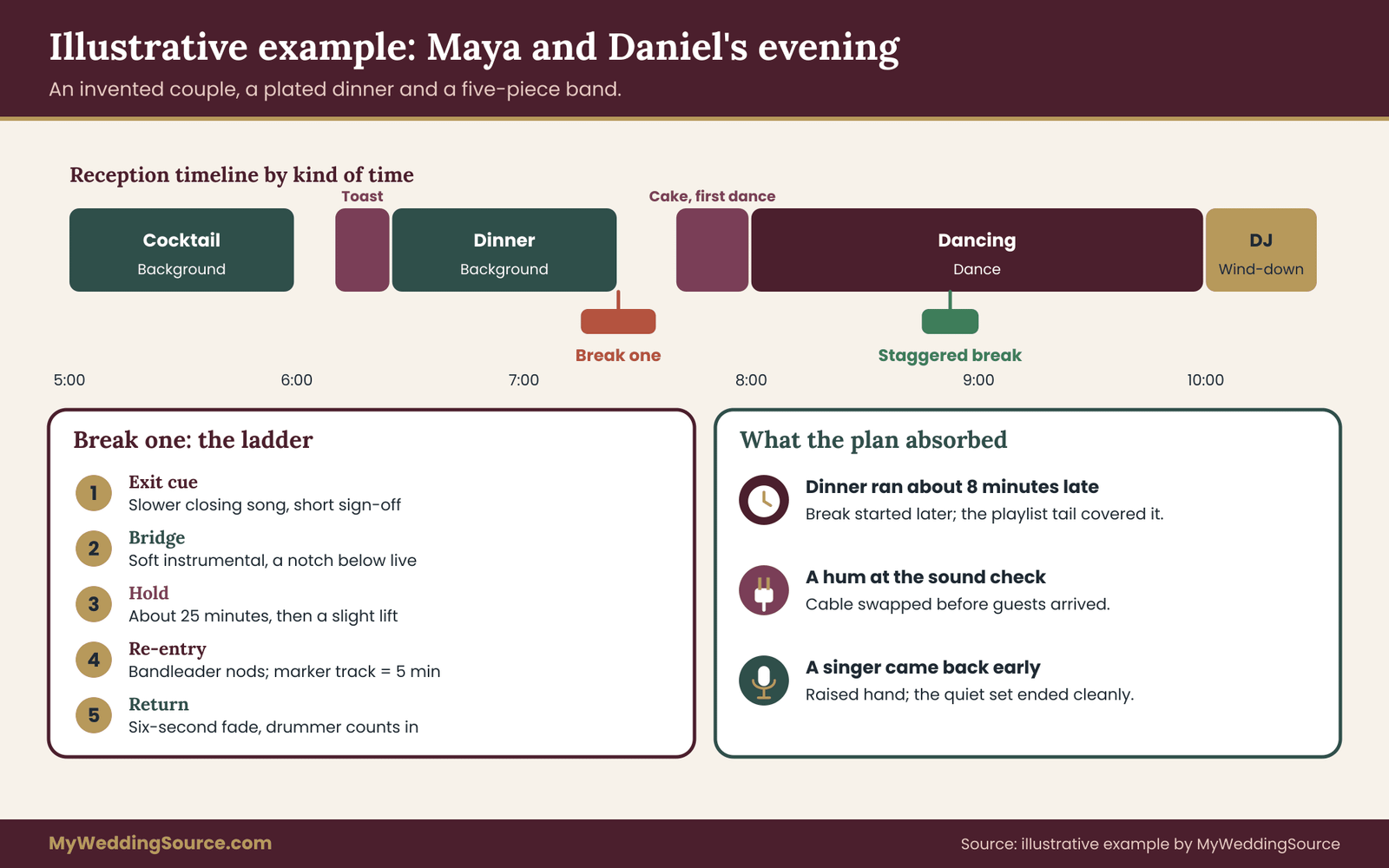
An example makes the ladder concrete. The couple, Maya and Daniel, are invented for this article. They are marrying at a restored hall with about one hundred forty guests, a plated dinner and a five-piece band that plays three sets. They have hired a DJ for the cocktail hour and the last hour of the night.
The timeline they started with
Cocktail hour runs from 5:00 to 6:00. Guests are seated at 6:00. Welcome and a short toast follow at 6:10. Dinner service runs from 6:25 to 7:25. Cake cutting is at 7:40, with the first dance directly afterward. Dancing runs until 10:30. The band’s contract is for three forty-five-minute sets with two twenty-minute breaks, starting at 6:30 and ending at 10:00, with the DJ taking over from 10:00 to 10:30.
Step one: marking the evening
Maya reads the timeline through the four lenses. Cocktail hour and dinner are background time. The welcome toast and the cake cutting are spotlight time. The dance blocks are dance time. The final half hour is wind-down time.
She circles dinner as the first break window. The second break window is harder, because dancing runs from 7:45 to 10:00 with no background stretch. Maya asks the band whether they could take a staggered break, and they say yes: the vocalists rest while the instrumentalists play a quiet instrumental set for fifteen minutes, around 8:45.
Step two: the break budget
For the first break, the band’s rest is twenty minutes. Wind-down adds two, reset adds four, slack adds five. The total is thirty-one minutes. Maya asks the DJ for a thirty-five-minute hold playlist, with a ten-minute tail.
For the staggered break, no recorded music is needed, but a fifteen-minute fallback track is queued on the DJ’s second device in case a player is delayed.
Step three: the ladder for the first break
- Exit cue: The band ends set one with a slower song, and the bandleader says they will be back in a little while. The cue to the DJ is the last chord.
- Bridge: The DJ starts a soft instrumental arrangement a little below the live level.
- Hold: A steady dinner playlist for about twenty-five minutes, with a slight lift in the final ten.
- Re-entry cue: The bandleader nods from the stage. The DJ is told that a particular track means five minutes remain.
- Return: The DJ fades over six seconds, and the drummer counts in a mid-tempo opener.
Step four: the contract schedule
Maya sends the band a one-page performance schedule listing the sets, the breaks, the staggered break, who supplies and operates the band break music, the cable and device arrangement, the fallback, overrun rules and a line on band break music rights. The band replies with two edits: they prefer a green room with food at 7:30 and they want the right to extend break one by up to five minutes if dinner service runs late. Maya agrees. The venue confirms the DJ may use the house sound system for the break.
What happened on the night
Dinner service ran about eight minutes behind. Because the plan allowed it, the band started its break eight minutes later than scheduled, the DJ’s band break music playlist covered the extended time, and the cake cutting slid to match. At the sound check, a hum had appeared on the DJ’s cable, and a replacement fixed it. During the staggered break, one singer returned early, and the bandleader raised a hand, so the instrumentalists ended their quiet set cleanly. No guest noticed any gap.
This is an invented example, built to show how the pieces fit, not a record of a real event. The numbers are simple on purpose. Your own timeline will differ, and the same method works with whatever numbers you have.
When band break music goes wrong: fast fixes for the night
Plans fail in small ways. What separates a calm evening from a stressful one is whether someone knows the next move. These are the problems that come up most often and the fix for each.
The playlist stops. The device locked, an app crashed or a connection dropped. The sound lead starts the fallback track on the second device within a few seconds. Afterward, they restart the main playlist at a calm moment, and not in the middle of the room’s attention.
The first track is wrong. It is too loud, too fast or has a lyric that does not suit the room. The sound lead lowers the volume at once and skips ahead to the next track. A skipped track is invisible to guests. A track left to play is not.
There is a hum or a pop. Lower the input, check the cable, swap in the spare. If the fault persists, switch to the second signal path, such as a small speaker, until the break ends. Fix it properly after the event starts to wind down.
The band is late. The tail of the band break music playlist covers the delay, the sound lead warns the coordinator, and the coordinator decides whether to move the next moment. A late band needs a person who can say “ten more minutes” and mean it.
The band returns early. Fade at the next safe point. There is no virtue in finishing a playlist.
A toast or announcement runs into the break. The sound lead lowers the music under the speaker if the microphone works well, or stops it if it does not. Either way, the sound lead and the MC need a shared signal, such as a raised hand, so that nobody speaks over music.
A guest requests a song during the break. Pass the request to the sound lead or the DJ and not the band. Requests during breaks are common, and a short, kind answer such as “we’ll see if it fits” is enough.
The equipment fails during the return. The band can play acoustically for a song, if their instruments allow it, while the technician fixes the issue. A band that has done this before will have a plan, and it helps to ask whether they do.
The one-minute rule
When a gap opens, aim to have some sound within a minute. It does not need to be perfect. A steady track at a modest volume resets the room’s expectations, and the fix can be refined later. A couple who is told “we have sound again” feels better than one who is told “we are still investigating.”
Who makes the call
A written plan names who decides when something goes wrong. For small matters, the sound lead decides. For anything that changes the schedule, the coordinator, or a friend acting as one, decides. The couple should not need to be involved, and the ladder should be written so that they are not. If you are the couple, ask your coordinator to carry a copy of the performance schedule and the ladders, and ask them to deal with surprises without sending guests to you. A written list of who owns each role, kept with the rest of the day’s paperwork, is enough.
Common mistakes with band break music, and what to do instead
These mistakes show up again and again. Each has a plain fix.
Treating the quoted break as the break length. The break needs a budget with wind-down, reset and slack. Build the band break music playlist from the budget, not from the quote.
Leaving the person at the controls unnamed. “The venue will handle it” and “the band will handle it” are the classic pair. Name the person in the schedule.
Using one long playlist with no cut points. Mark where tracks can be faded, and build a tail.
Skipping the sound check for the handoff. Run the mock break. It takes minutes.
Starting loud. Band break music that starts louder than the live set jolts the room. Start a notch below.
Ending on a peak. A set that ends on a big number leaves band break music at a disadvantage. Ask for a gentler closing song, or plan the break after a dip.
Forgetting the fallback. Queue a long, quiet track on a second device.
Ignoring rights. Choose a source with a clear answer, and ask for it in writing.
Putting a break in the middle of the best dancing. Use staggered breaks or a natural pause on the floor.
Not feeding the band. A hungry band takes longer and plays worse. Put the meal in the schedule and tell the caterer.
Keeping the plan in one head. If only one person knows the ladder, a single absence ruins it. Share it with the coordinator, the sound lead and the bandleader.
Over-scripting. The opposite error. A plan with fifty steps will not be followed. Keep the ladder to five rungs and a page.
What to confirm with the band, the venue and the issuing organizations
A last check before the date. The items below come from the sections above, grouped by who can answer them.
From the band: – How many sets, how long and how many breaks, with planned times – Whether they offer staggered breaks and what that does to the sound – How they signal the end and the return of a set – Whether they supply band break music, and from what source – What they need for a meal, a rest space and power – What happens if a player is ill or late
From the venue: – Which sound system is available, and who may use it – Any sound or time limits, and how they are monitored – Whether outside vendors may play recorded music, and under which licenses – Where the band loads in, rests and eats – Whether a technician is on site and until when
From the sound lead (DJ, engineer, friend): – The input and cable they use, and the spare – The device, the backup device and the fallback track – Where they will stand, and whether they can see the stage – Whether they can attend the sound check
From the organizations that issue the rules: – Current guidance on public performance of band break music, which the U.S. Copyright Office and the performing rights organizations publish – Current noise and hearing guidance, from the CDC and NIOSH – Any local ordinance on amplified sound, from the city or county
Write the answers on the performance schedule. If an answer is “it depends,” write what it depends on and who will decide.
Your next steps
Start with your timeline. Mark the background stretches, circle the ones longer than fifteen minutes, and decide where each break goes. Then work down this short list.
- Ask the band for their set and break structure, and whether they offer staggered breaks.
- Choose the sound lead by name, and a backup.
- Fill in the five-rung ladder for each break, in plain sentences.
- Build or request a hold playlist for each break, sized to the budget with a tail, and a long fallback track on a second device.
- Send the band a one-page performance schedule, and ask them to correct it.
- Add a mock break to the sound check.
- Ask the venue and the sound lead about band break music rights, and get the answer in writing.
- Give your coordinator the ladders and the schedule.
If you are still shaping the evening itself, the wedding planning checklist covers the larger sequence of decisions, and your band break music plan will slot into it. Once the ladder exists on paper, most of the worry disappears. The break stops being a hole in the evening and becomes one more planned moment, handled by people who know what to do.
FAQ
How long should a wedding band’s breaks be?
Many bands plan breaks of fifteen to twenty minutes between sets, but the exact pattern varies by group, genre and the number of players, so use whatever your contract says. Plan your band break music for longer than the quoted break, adding time for wind-down, reset and a small buffer. A thirty-minute band break music playlist for a twenty-minute break is a sensible cushion.
Who should play the music while the band is on break?
A DJ or sound engineer is the most reliable choice, because it is their trade and they can match levels and handle faults. A venue technician, the bandleader or a trusted friend can also work if the person is named in writing, shown the equipment at the sound check and given a backup. Avoid leaving it to whoever happens to be nearby.
Can we use our own streaming playlist for band break music?
It depends on the service’s terms and the venue’s rules. Many streaming plans are limited to personal listening, and playing them through a sound system for guests may fall outside that. Ask the service, the venue and your performers, and get the answer in writing. A DJ or venue with an established music license is often the simplest source.
What if the band runs late returning from a break?
The tail of the band break music playlist covers the delay, and the sound lead should warn the coordinator so the next moment can move if needed. A bandleader who is running late should send a short signal. Keep a fifteen-minute fallback track ready on a second device, so the room never goes quiet while the band sorts itself out.
How do we avoid awkward silence between sets?
End each set with a gentler song, have the bandleader say a short sign-off, and start a quiet bridge track within a few seconds. Keep the first recorded track slightly below the live volume and test the handoff at the sound check. The aim is a small, planned change in sound and not a pause in which guests wonder what happened.
Should the band break during dancing?
Try to avoid it. Breaks fit best in background time such as dinner or cocktail hour. If the band needs a rest during dancing, ask about a staggered break, where some players rest while others play quietly, or place the break at a natural dip on the floor. A recorded playlist rarely keeps a dance floor as full as live music does.
What belongs in a performance schedule for breaks?
Set and break lengths and times, who supplies and operates the band break music, the equipment and cables, the exit and re-entry cues, a fallback plan, overrun and overtime rules, meals and rest space, any sound limits, and who confirms music rights. Keep it short and factual, attach it to the contract, and ask the band to review it.
Do we still need a plan if we hire a DJ as well as a band?
Yes, but the work is easier. Confirm that the DJ will cover each break, who is at the controls, how the DJ will see the band’s cues, and how the volumes will match. Add the DJ to the sound check and name them in the schedule. A DJ and a band that have never met are more likely to miss a cue.
Sources
- Copyright basics and public performance, U.S. Copyright Office
- Music licensing and public performance, U.S. Copyright Office
- Licensing for businesses and venues, ASCAP
- Licensing for businesses and venues, BMI
- Licensing for businesses and venues, SESAC
- Noise and hearing loss prevention, National Institute for Occupational Safety and Health
- Hearing loss prevention, Centers for Disease Control and Prevention
- Terms of service for personal use, Spotify