
A shared venue is a wedding site that hosts two weddings on the same day, and the privacy questions that follow are practical rather than dramatic: who sees your guests, who hears your vows, who uses the same restroom, and what the contract actually promises about all of it. This guide gives you a boundary checklist, an overlap diagram and a scoring rule you can apply before you sign.
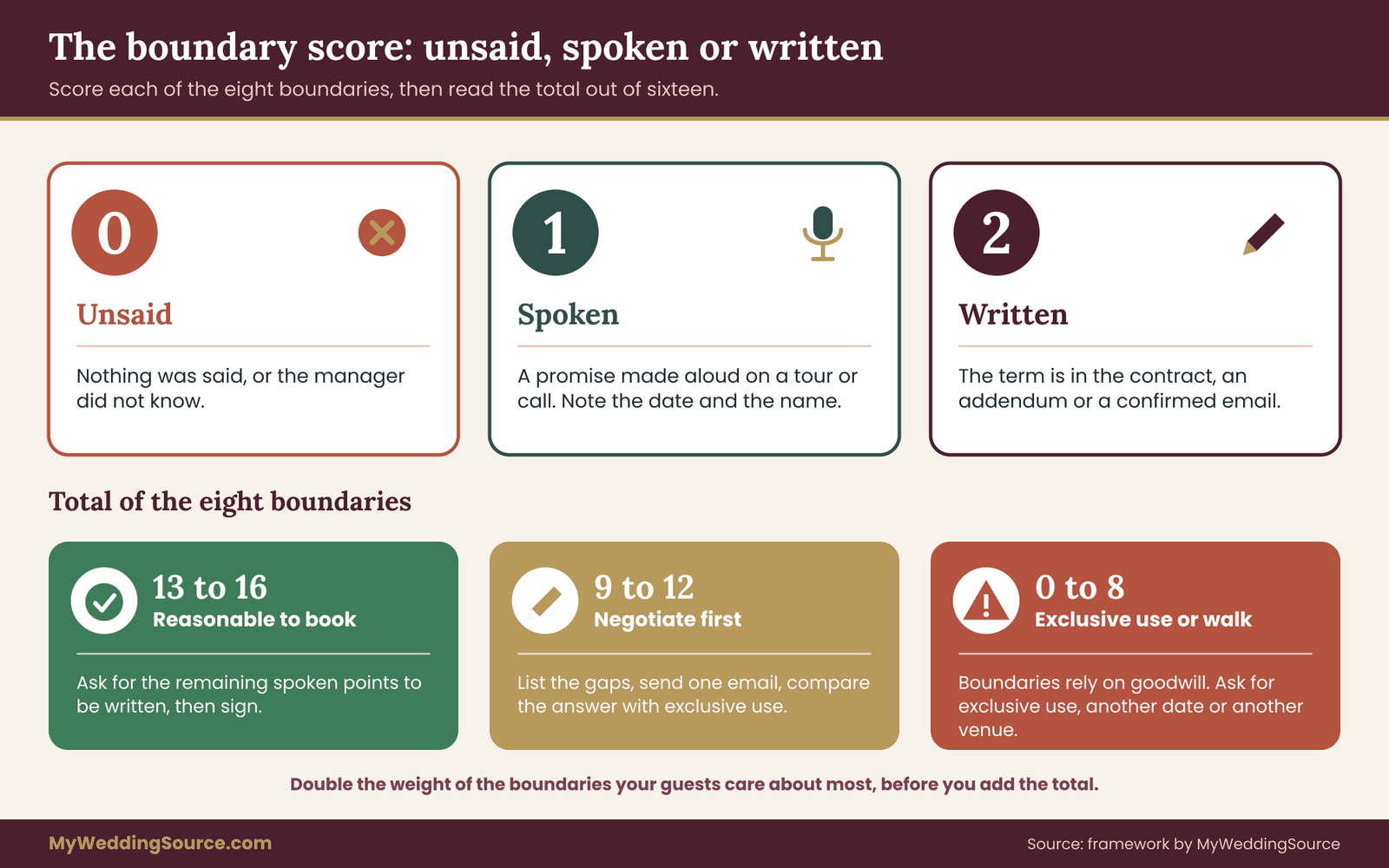
Ask the venue to name the overlap pattern for your date: back-to-back in one room, staggered in different rooms, or side by side on the same grounds. Then check eight boundaries: arrival, waiting areas, ceremony, photo locations, sound, service routes, restrooms and exit. Score each boundary 0 if nothing is said, 1 if it is promised aloud, and 2 if it is written in the contract. A total of 13 or more out of 16 is a reasonable shared venue booking; 9 to 12 means negotiate; 8 or fewer means ask for exclusive use or look elsewhere.
Plenty of couples find out late that their venue sells more than one wedding per day. It might appear on a calendar page, in a casual remark during a tour (“we have a morning ceremony in the garden, but you will not see them”), or only when a florist mentions loading in beside another team. None of this is unusual.
A venue with several rooms, a garden and a ballroom has fixed costs, and filling the day more than once is a normal way to cover them. The question is not whether a shared venue is acceptable. The question is whether the boundaries between the two events are real, written down and workable for your guests.
This article is about those boundaries. It does not repeat the full site inspection covered in the venue technical walkthrough guide, and it does not compare venue types. It stays on one narrow problem: what to ask, check and put in writing when another wedding will be on the property the same day you are.
A note on scope. This is general information, not legal advice, and local fire, access and municipal requirements must be confirmed with the venue and the authorities that set them. Where a rule matters, the article points to the agency or operator that issues it.
When someone says “the venue has two weddings that day,” they can mean at least four different things. They have very different privacy consequences, so the first job is to find out which one you are dealing with.
In the first version, the venue hosts one wedding in the morning or early afternoon and one in the evening, using the same ceremony space and the same reception room. The first party leaves before the second arrives, and the venue turns the spaces in between. The privacy risk here is mostly about timing: your vendors arriving while the previous event is still packing out, your guests waiting in a car park next to the previous guests, your signage and florals being installed with strangers still nearby.
In the second version, the two weddings use different spaces. One group has the garden and the barn, the other has the ballroom and the terrace. The overlap is physical and simultaneous. Both groups arrive within the same hour, share a driveway and perhaps a restroom block, and hear each other’s music if the walls or distances are not what the brochure suggests.
In the third version, the venue divides one large room with a movable wall, a curtain or a screen. Two receptions happen in two halves of the same building. This is the pattern where sound and sightlines matter most, and where a promise of “separate spaces” can mean very little.
In the fourth version, the venue runs a ceremony-only event and a full wedding on the same day, or a rehearsal dinner for one couple while another couple is married. It is easy to overlook, because it feels smaller, but the same arrival and parking questions apply.
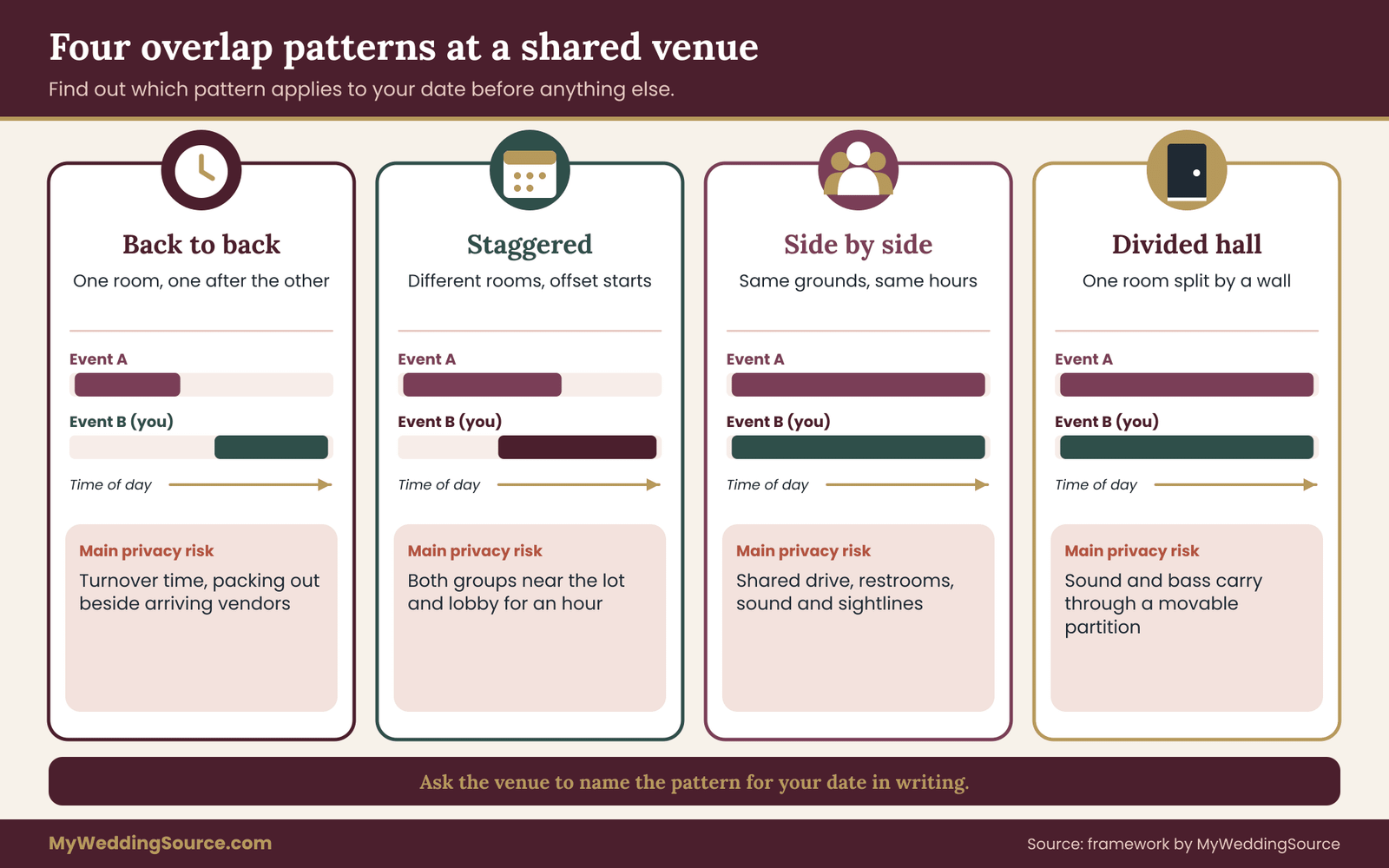
Notice that the first question to ask a shared venue is not “will we see the other wedding?” It is “what is the overlap pattern on our date?” The answer to that question decides how much of the rest of this guide you need. If the venue says plainly that the other event ends two hours before your guests arrive, and the spaces are turned and cleaned in between, you are in the lightest pattern. If it says both events run at once on the same grounds, you are in the heaviest one and need the full boundary checklist.
Why venues book this way
It helps to understand the venue’s side, because it makes your questions more precise and less adversarial. A property carries rent or a mortgage, staff, insurance and maintenance whether or not it is booked. Peak dates, usually Saturdays in the warmer months, are the dates when demand is highest, and a venue that can host two events on those days earns noticeably more from them.
Some venues build their whole model around it: a ceremony garden, a small reception room, and a large hall that can host a second party. Others do it only occasionally, on a Friday or a Sunday, to fill a gap.
None of that means your wedding will be treated as an afterthought. Experienced shared-use venues often have excellent systems for turning rooms, separating guests and keeping two coordinators out of each other’s way. Others have the system on paper and nothing on the ground. The point of the checklist is to tell the difference before you sign instead of at two o’clock on the day.
The privacy questions people actually have
Privacy at a wedding is rarely about secrecy. It is about a handful of ordinary worries, and it helps to name them so you can see which ones matter to you.
Some couples care most about their guests’ experience: an older relative should not have to walk through the other party’s cocktail hour to reach the restroom. Some care about the ceremony: vows are personal, and a loud band in the next room spoils them. Some care about photographs: a photographer can only avoid strangers in the background if the grounds allow it, and other guests may be photographing your arrival.
Some care about information: names, schedules and room assignments on a venue board or a shared coordinator’s clipboard are visible to people who are not your guests. Some care about safety: knowing who belongs on the property, where children can wander, and how a stranger is turned away.
The checklist later in this guide covers all of these under eight boundaries. First, though, the other half of the picture: what the contract and the booking terms probably say.
Reading the booking terms of a shared venue
Most shared venue contracts are written for the venue’s benefit, which is reasonable, but they often leave the boundary questions to unwritten “usual practice.” Before you tour, ask for the standard contract and any rules document, and read them with a specific set of questions.
Start with the definition of what you are renting. A contract that says “the Garden Room and surrounding grounds” is not the same as one that says “the Garden Room, the lawn between the Garden Room and the pond, and the east parking lot.” The first leaves the venue free to use the grounds for anything else. The second names your area. Look for words such as “non-exclusive,” “common areas,” “shared facilities” and “subject to other events.” They are not sinister, but they tell you that the venue has reserved the right to use the same space for others.
Next, look at the time windows. A contract usually lists an access time, an event start, an event end and a vendor-out time. In a shared venue those windows are the boundary between your event and the next one, and they are enforced strictly because the next couple is waiting. If your access time is only two hours before the ceremony, decorating a large room is tight. If your out time is hard and you have a rental company with a strict pickup window, there is no room to recover from a late finish.
Then look at the rules on vendors. Does the venue require its preferred caterer, its own AV team or its in-house coordinator? A shared venue often does, because it has to manage two kitchens and two sound systems in the same place. Do outside vendors need to give the venue a certificate of insurance, and by what date? Do they have to use a specific loading door? These details affect your budget and your vendors’ arrival, and they are covered further in the vendor contract guide.
Finally, read what the contract says about the other event. Often, it says nothing. That silence is itself information: it means any promise about screening, separate arrival or sound control is currently verbal.
Verbal promises and the score of one
During a tour, the venue manager may say reassuring things. “The two groups are never in the same place.” “We keep the ballroom doors closed.” “You will not hear them.” These statements may all be true, and they may be made in good faith. They are also not part of the agreement. The scoring rule in the quick answer gives a verbal promise one point and a written one two.
That is deliberate. A verbal promise is better than nothing because it tells you what the manager intends. It is weaker than a written term because the manager may leave, the policy may change, and no one will remember the exact words in a year.
Whenever you hear a boundary promise, write it down with the date and the name of the person who said it. Then ask whether it can go into the contract or an addendum. The answer tells you a great deal. A venue that says “of course, we will add that” is confident in its own system. A venue that hesitates may be unsure it can deliver what it just described.
A short script for the first call
If you have not toured yet, a short call can save an afternoon. The following wording works for most venues, and you can adapt it to your own voice.
“We are interested in a Saturday in June. Before we book a tour, can you tell us whether the venue ever hosts a second wedding or event on the same day, and if so, which spaces each group would use?”
If the answer is yes, follow up with:
“Would the other event overlap with our guest arrival, ceremony or reception? And is there a written policy about how the two groups are kept apart?”
If the answer is no, ask whether the venue will put “one event per day” in the contract. A venue that says no today may still say yes tomorrow, and “no” is a useful answer to the second question too, because it tells you the venue does not treat the point as fixed.
A boundary, in this guide, is any point where your event and the other event could meet, see each other or affect each other. There are eight. Each one is a place or a moment, each has a few concrete questions, and each can be scored 0, 1 or 2 depending on whether the answer is unsaid, spoken or written.
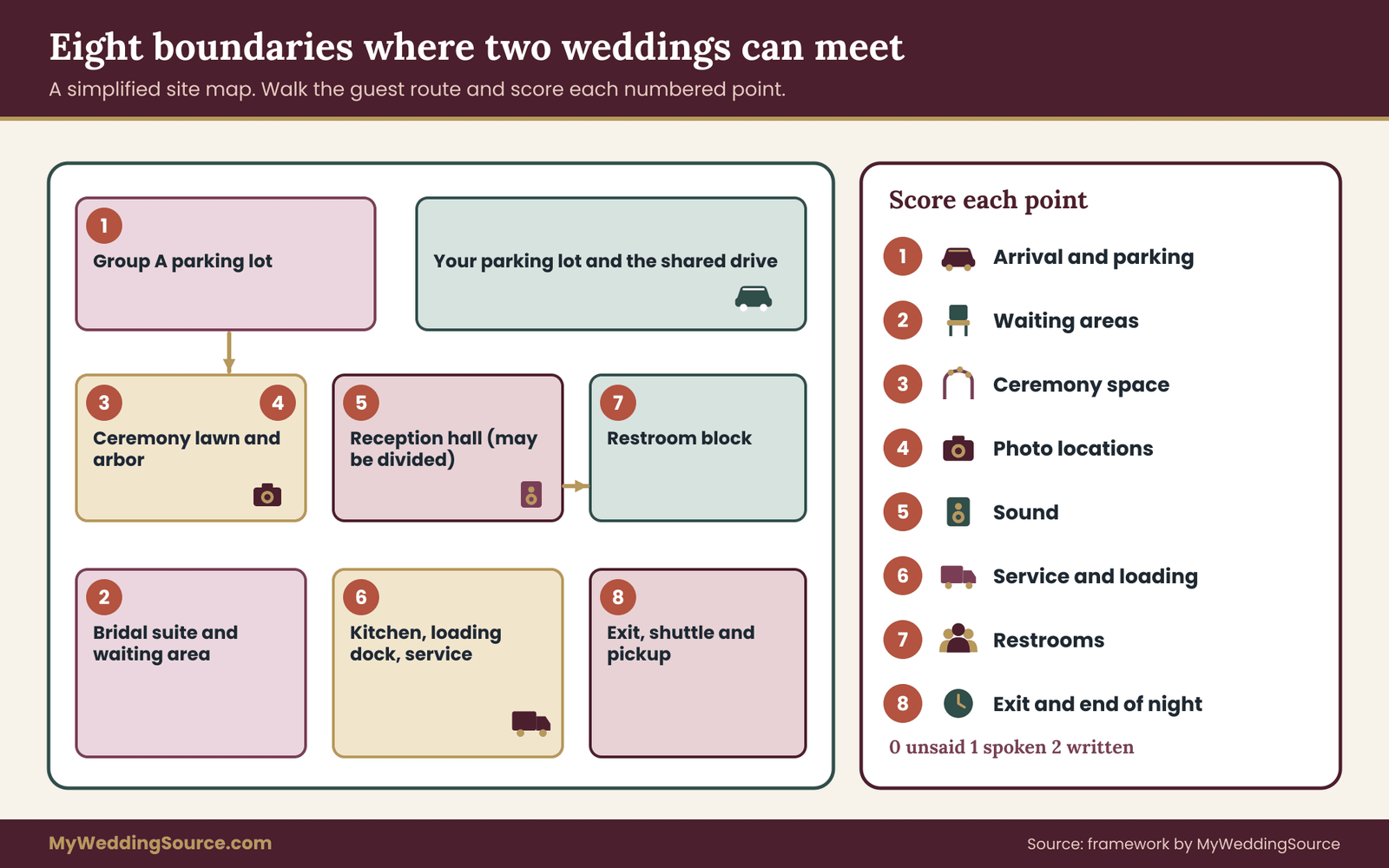
The sections below go through them in the order a guest would experience them. When you tour, carry the list and walk the route with the manager, not just the rooms.
Boundary one: arrival and parking
Arrival is where two weddings most often collide. Guests drive in within the same thirty minutes, look for the entrance and follow whatever signs they see. If the shared venue has one drive and one lot, they will end up parked beside each other.
Ask where your guests park, whether the other group parks in the same place, and who directs traffic. Ask whether there is a valet or a shuttle and whether it is shared. Ask what the signs at the entrance say and who controls them. A sign that reads “Welcome, Garcia and Smith wedding” shows names to anyone who drives past, and a sign that is too generic sends guests to the wrong event.
Also ask about timing. If the other ceremony starts at two and yours at four, when does the previous group leave the lot? Many venues schedule the turn so that cars from the first event are gone before the second guest list arrives. In a parallel pattern, the answer is different: both groups are there at once, and the venue needs a plan for separation. A written statement that your guests arrive by a named entrance and park in a named zone scores two points. A comment that “it usually works out” scores one at best.
Boundary two: waiting and gathering areas
Before the ceremony starts there is almost always a gap in which guests wait: in the lobby, on the patio, by the bar. Ask what space your guests use during that time and whether another group can walk through it.
The same question applies to the wedding party. A bridal suite is a private room. A “getting ready area” with a shared hallway is not. Ask whether your suite has a lockable door, who holds the key, and whether staff or the other party can enter. Ask whether the groom’s or groomsmen’s room is similarly private.
If the venue has one suite and gives it to the earlier wedding, find out what you get instead and how long you have it. Private preparation time matters for hair, makeup and photographs, and an unpredictable room is also a security concern for dresses, rings and gifts.
Boundary three: the ceremony space
The ceremony is the part of the day where privacy is most valued. Ask whether the ceremony site is used by the other wedding that day, when it is reset and who resets it. If the other couple uses the same garden at noon, find out how long the venue needs to clear chairs, replace florals and sweep. A tight turn leaves little room for your photographer’s pre-ceremony shots of the space.
If the two ceremonies happen at the same time in different locations, the question changes to sightlines and sound. Can your guests see the other ceremony from where they sit? Can they hear it? Walk to the farthest seat of the ceremony area and listen. Many venues are quieter than you expect. Some are not, and an amplified officiant at one end of a lawn can be audible at the other.
Finally, ask about the aisle and the entrance. Does your processional pass a door where other guests might open it? Does your officiant stand with their back to a view of another party’s cocktail hour? A good shared venue will have a solution for each of these, such as a screen, a closed door, a planted hedge or a staggered start time. The solution needs to be in writing to earn two points.
Boundary four: photo locations
Photographers need places to work, and venues that host two weddings tend to have a short list of beautiful spots that both couples want. Ask which locations on the property are reserved for your event and at what times. Ask whether a time slot for the staircase, the pond or the rose arch is booked in your favor, or whether it is first come, first served.
This is also a privacy question for your guests and for the other party. A photographer who is photographing family portraits is photographing whoever stands in the background, and those could be strangers. Ask the shared venue whether it has a rule about photographers on the property, whether outside photographers must be insured, and whether they have a policy about drones.
Many venues restrict drone flights, partly for the sake of the other wedding. The wedding photography consent guide deals with how couples set rules for their own guests; here the question is simply what the venue controls on the grounds.
Another practical point: sunset and golden hour. If both weddings want golden hour photographs at the same spot, a sequence is required, and you do not want to learn at 6:30 pm that the other group has booked the lawn first.
Boundary five: sound
Sound has two parts: amplified sound, such as bands, DJs and microphones, and incidental sound, such as cheering, toasts and the clatter of a kitchen.
Ask what the venue’s sound policy is. Is there a decibel limit or a cutoff time? Who monitors it? Is there a sound-limiting device on the in-house system? Ask where the speakers point and whether doors between rooms are solid. Ask whether the other wedding has a band or a DJ and when the music starts. You do not need the other couple’s playlist, only the sound plan.
If the venue divides one hall with a movable partition, ask specifically about the partition. Temporary walls often reduce sound much less than people assume, and the transmission of bass is especially noticeable. A venue that has actually hosted two receptions in that hall will have a practical answer, such as one event being a plated dinner with a string trio while the other runs a DJ, or a schedule that keeps the loudest segments from overlapping.
Quiet moments matter too. Vows, toasts and a first dance can be spoiled by a thump from next door. If your ceremony is at a known time, ask whether amplified music in other areas will be paused or reduced. A written clause that “no amplified sound will be played within a stated distance during ceremony hours” is worth two points.
Boundary six: service routes, kitchens and loading
Behind the scenes, two weddings share the same service infrastructure: kitchens, loading docks, elevators, storage rooms and corridors. This is where a shared venue is most likely to have friction between two vendor teams, and where your food, cake and flowers can be affected.
Ask where your caterer sets up and whether the kitchen is shared. If it is, ask about refrigerator space, oven time and who is responsible for cleaning. Ask where your rentals are delivered and picked up, and whether that spot is in use by the other event. If the shared venue uses a single loading door, there may be a schedule with a time slot for each vendor.
Check that your florist and cake baker have slots that match your timeline, and that the venue has told them. The vendor timeline guide can help you build the vendor side of that schedule.
Also ask about staff. Is the same venue manager running both events? Does each event have its own coordinator? A venue manager who is responsible for two weddings can attend to only one at a time, and an unexpected problem during your ceremony may find them in another building. Ask who is the named person on site for your event, and what their sole responsibility is.
Boundary seven: restrooms and circulation
Restrooms are the most underrated boundary. At two simultaneous events, a restroom block can end up serving both guest lists, and the line, the mix of formal attire and the quiet awkwardness of crossing parties are all avoided with a bit of planning.
Ask which restrooms your guests use, whether they are separate from the other event’s, and whether any are accessible. Check the route from the ceremony area and the reception room to the restrooms and whether it crosses the other group’s space. If the answer is “everyone shares them,” ask whether the venue provides an attendant, extra portable units or a schedule.
For older guests or guests with mobility needs, the distance matters as much as the access. The accessible venue red flags guide covers how to look for barriers on a route; at a shared venue, the extra question is whether the accessible route is also shared.
Boundary eight: exit and the end of the night
The last boundary is the exit. A wedding that ends at midnight while another ends at eleven means two sets of guests leaving at nearly the same time, usually after drinks, and usually looking for rides.
Ask how departure is organized: who calls the shuttles, where the pickup point is, and whether the two events use the same one. Ask where your vendors load out and whether the other event’s loading overlaps. Ask when the shared venue needs the room cleared, and whether your end time is firm if the other event runs late or vice versa. Overtime fees are a particular detail here. A venue that charges for each additional hour needs to say whether an overrun by the other event affects your cleanup window.
At the end of the night, a short walkthrough with the manager should confirm that nothing of yours has been left behind or taken by someone else’s team. Cakes, gifts, cards, signage and rented items can be misidentified when two weddings use similar tables and similar colors. Label everything, and photograph your table setup before guests arrive so that anything missing can be identified later.
Totaling the score
Add the eight scores. The total is out of 16. A venue that scores 13 or more has written down, or is willing to write down, most of what matters. A score of 9 to 12 means there are gaps, but each gap has a fix that you can request. A score of 8 or less means most of the protections are unsaid, and you are relying on goodwill on the day. That is where the next sections come in: the questions to put in writing, the contract language to request and the points at which to consider walking away.
The eight boundaries cover space and sound. Privacy also has an informational side: what the venue and the other party can learn about your event simply because both are on the same property.
Most of it is ordinary and harmless. Another wedding’s guests will see that a wedding is happening beside them, and some will see the bride’s dress or hear a toast. That is the nature of a shared venue and nobody should treat it as a breach. What deserves attention is information that is specific, avoidable and tied to named people.
What gets exposed
Think about where your guests’ names and details appear on the day. A welcome board by the entrance shows the couple’s names. A seating chart on an easel shows every guest’s name and table. A schedule posted on a vendor corridor wall lists times. A coordinator’s clipboard on a shared desk lists guests with dietary needs or accessibility requirements. A guest list sent to the venue for security, or to a shuttle company, sits in someone’s email.
In a single-event venue, those documents are seen only by your own people. At a shared venue, anyone passing through can see them. The risk is small for most couples, but it is not zero. A guest who has a protective order against someone, a family with a recent estrangement, or a public figure may have good reasons for wanting the information limited.

Ask the shared venue the following in plain terms.
“Who on your staff has our guest list and schedule, and where is it kept during the event? Are any printed documents left in shared areas?”
“Do you post or announce the names of events on signage visible to other groups? Can we use first names only, or a code word on the entrance sign?”
“If another party’s guest or vendor wanders into our area, what is the process for turning them away?”
The answers tell you how thoughtful the staff are about the issue. Many venues have never been asked and simply have not thought about it. A reasonable manager will adjust, for example by using a small, generic sign that says “Private event” with a directional arrow, instead of a full-name welcome board at the road.
Seating charts, name cards and signs
Because the couple controls these materials, they are the easiest part of the information problem to fix. A seating chart can be placed inside the reception room instead of at the front door. A welcome sign can be set up only after the ceremony ends, at the entrance to the reception space and not the lobby. Escort cards can be handed out by a host inside the room. Guests can be told by text or the wedding website where to go, instead of being handed a sign at a shared entrance.
If you are using printed signs, the wedding signage system guide explains how to plan readability and placement. At a shared venue, there is an extra layer: ask what the venue permits in terms of freestanding signs, and whether it allows them in the shared drive or lobby. Some venues have a rule that no signs may stand outside before the preceding event has left.
The coordinator and the guest list
A venue coordinator who manages two weddings has two guest lists. Ask how they keep them apart. In a small operation, it may be a single binder, two folders in one cabinet or one shared spreadsheet. None of that is automatically a problem, but if you are sharing a list that contains sensitive details, such as accessibility needs, allergies or contact numbers, ask that those details be limited to the staff who need them.
You can reduce exposure by giving the venue only what it needs. Most venues need a headcount, a list of vendors with arrival times and the name of a day-of contact. They rarely need every guest’s name. If the venue asks for a full list for security reasons, ask what it is used for, who sees it and when it is destroyed. If the answer is vague, give a headcount and a short list of the people who need special access.
Guests of the other wedding, and how to handle them
Sooner or later, a guest from one event will wander into the other. They may be looking for the restroom, following the wrong sign, or hoping for a photograph. Most are harmless. A few are not, particularly late in the evening.
The venue should have a policy. Ask whether staff are stationed at the doors that divide the two events, and whether there is security or a staff member who circulates. At smaller properties, a host with a clipboard at each entrance is enough. At larger ones, a uniformed person or an off-duty officer is more common, and the cost is sometimes passed to the couple. Ask whether that cost applies to your booking and whether it is shared with the other party.
If you want a visible boundary, ask for it in the contract: for example, staff at the garden gate during the ceremony, a closed door between the two reception rooms, and no access from the other event to the terrace. Visible boundaries need to be agreed before the day because staff cannot invent them in the moment.
Photography, video and social media at a shared venue
Photographers and videographers are the people most likely to affect another wedding’s privacy, and the people most likely to be affected by it. The venue’s rules for them are a central part of the booking.
What a venue can and cannot control
A venue controls its grounds and its rules. It can say where photographers may stand, when they may use particular locations, whether tripods or lights are allowed, and whether drones can fly. It can require certificates of insurance and a briefing on the rules. It cannot generally control a guest’s phone, a passerby on a public road or a photographer’s lens at the property boundary, and it cannot decide how another couple shares their own images.
This matters because you may worry that another wedding’s guests will post photos with your wedding in the background. At a shared venue, that can happen, and no clause will reliably stop it. What you can do is limit the likelihood: choose ceremony and portrait locations away from the other event, schedule family portraits at times when the other group is not outside, and ask your own photographer to frame shots with the venue’s architecture or greenery as a backdrop.
Questions about vendors and photo spots
Ask the venue the following.
- Which photo locations are reserved for us, and during what times?
- Are there spots both couples are likely to want, and how does the venue sequence them?
- Do outside photographers need to be on an approved list, carry insurance or attend a briefing?
- Are drones allowed, and under what conditions?
- If the other party’s photographer enters our area, who intervenes?
Share the answers with your photographer, ideally in a short written note, and ask them to confirm. Your photographer may have worked at the shared venue before and know which spots are crowded. If they have not, ask whether they can visit before the day. Also ask the photographer directly about backgrounds and timing.
Guests as photographers
At a wedding with two events on the grounds, the photographer is not the only person with a camera. Guests will photograph the ceremony, the venue and each other. If you want your own guests to refrain from posting images during the day, you can ask them to do so through the ceremony program, a sign or an officiant’s announcement. The consent guide mentioned earlier describes how couples set expectations for their guests. In a shared venue, add one more line to your own message: guests should be considerate about the other wedding’s guests and not photograph them.
Remember that the other couple will have their own rules, or none. You are not responsible for their guests, and you cannot control them. You can only ask the venue to keep the groups apart, and to respond if one group’s behavior creates a problem for another.
Social media and venue marketing
Some venues photograph weddings for their own marketing. A venue’s contract may include a clause that gives it permission to take and use photographs of the event, sometimes including guests. At a shared venue, where staff are moving between events, that clause deserves a close look.
Ask whether the venue photographs your event, who owns and uses the images, and whether you can opt out of use for marketing. If you are comfortable with some use but not all, ask the venue to limit it: no faces of children, no guest names, or no use until after a stated date. The venue may be willing to agree. If it refuses and you care about the point, it belongs in the score, not as a small detail.
Safety questions at a shared venue are mostly about capacity and access. Two weddings on one property means more people, more vehicles and more equipment than the property was designed for if the events overlap. The safety rules that apply are set by local authorities and qualified operators, not by the couple, and your role is to ask good questions and respect the answers.
Capacity and occupancy
Every public assembly space has a maximum occupancy set by local code and enforced by the local fire authority. A venue that books two events at once should know the number for each room and for the property as a whole. Ask what the posted occupancy is for your reception room and whether it includes the staff, the band and the vendors, or only guests. Ask how the venue ensures that two events do not exceed the capacity of shared spaces such as the lobby, the patio or the parking lot.
This is not a challenge to the venue. It is a way to find out whether the manager has thought about the issue. A good manager will say something like “the ballroom is rated for such-and-such, and we cap each event below that to leave room for staff.” A manager who does not know the number should look it up, and may need to check with the local fire marshal or building department. The National Fire Protection Association publishes the codes many jurisdictions use, though the rules that apply to a given property come from the local authority.
Exits, aisles and emergency planning
Ask where the exits are and whether the layout of both events keeps them clear. At a shared venue with two receptions in a divided hall, each half needs its own exits, and tables or décor must not block them. Ask what the emergency plan is for the property as a whole: who calls for help, who gives instructions to both groups, and how a weather event or a power failure is handled.
Weather is a significant issue for outdoor shared venues. If one wedding has a ceremony on the lawn and the other has the barn as a backup, a sudden storm may send both to the same covered space. Ask which event has priority for the rain location, and how the decision is made. The National Weather Service provides forecasts, and the venue should have a rule for when it activates a backup plan. The answer needs to be in the contract, since “we will figure it out” is not a plan when there are two groups and one covered room.
Access for guests with disabilities
Venues that are open to the public for events must comply with the Americans with Disabilities Act as it applies to places of public accommodation. The Department of Justice explains the rules at its ADA Title III page. Compliance is the venue’s responsibility, and the details depend on the facility. As a customer, you can ask practical questions: is there an accessible route from the parking area to the ceremony, the reception, and the restrooms; are accessible parking spaces reserved and clearly marked; and is the route the same for all guests or a separate one?
At a shared venue, add questions about whether accessible spaces are shared and whether they will be crowded or blocked by the other event. For example, a drop-off area near the entrance may be used by both wedding parties, and accessible parking might fill early. Ask whether any spaces can be reserved for your guests, and whether staff can help with directions.
The red flags guide mentioned earlier goes deeper on barriers. The point to keep here is that sharing a venue should not reduce access for anyone, and a manager who has hosted two events should have an answer ready.
Who approves what
For fire, electrical, structural and municipal matters, the people who approve your plan are the venue’s operators and the local authority, not you or your vendors. If you plan to use candles, a heated tent, string lights, a generator, a fog machine or any equipment that draws significant power, ask the venue what is permitted and who signs off. At a shared venue, the answer may be stricter than elsewhere, because one event’s equipment can affect the other’s power supply, noise or safety. The relevant operators should confirm everything in writing before the day.
Your vendors experience a shared venue differently from you. You see the ballroom; they see the loading door, the elevator queue and the clock. If their day goes badly, so does yours, so it is worth asking the venue how it handles vendor traffic when two events are in progress.
The vendor day in a shared venue
Start with arrival windows. At a single-event venue, a florist may arrive at nine and take as long as needed. At a shared venue, the florist might be told to arrive at a specific time, use a specific door and be out by a specific time because the other event’s caterer needs the same corridor at noon. Ask the venue for a vendor schedule for your date, listing each vendor category, its arrival window and the route it uses. If the venue does not have one, ask the manager to draft it with you, then send it to your vendors.
A good rule is to treat each vendor’s time window as a contract term, not a courtesy. If your cake arrives after the permitted slot, the loading door may be occupied and the cake may sit in a hot van. If your band arrives early, it may block the other party’s rental truck. The venue’s coordinator may be perfectly helpful, but the coordinator cannot be everywhere. A written schedule lets each vendor know where to be, and gives the shared venue something to point to if there is a conflict.
Preferred vendors, outside vendors and sharing
Many shared-use venues have a preferred or required vendor list, especially for catering, bar service, rentals and sound. The logic is straightforward: a venue that runs two events on the same day cannot afford two outside caterers learning the kitchen from scratch. Required vendors know the property, carry the right insurance and understand the shared-venue rules.
If the venue lets you use outside vendors, expect conditions. These often include a certificate of insurance naming the venue as an additional insured, a signed vendor agreement, a briefing on rules and sometimes a fee. Ask for the list of requirements before you hire, because a vendor who cannot meet them is a wasted booking. The vendor due diligence checklist is useful for confirming that an outside vendor is insured and legitimate before they appear at the venue.
Another question is whether the two weddings share vendors. In a busy market, the same DJ, florist or rental company may serve both. That is usually fine, but it creates a scheduling risk: a vendor with two events must be in two places. Ask your vendor directly whether they have another event at the same venue that day and, if so, how they will manage the timing. A vendor who tells you the truth and has a plan is better than one who is evasive.
Deliveries and the loading route
At a venue with one loading dock, ask how deliveries are scheduled. If two rental companies are bringing tables and chairs, there may be a queue. If your equipment is large, such as a dance floor or a tent, it may need its own time and route. Access routes, freight elevators and loading docks are part of the technical walkthrough and belong in your conversation with the venue manager. For a shared venue, add: who controls the dock on the day, and who decides when two deliveries conflict?
If the venue uses a sign-in sheet for vendors, ask whether your vendor information is visible to others. The vendor list is usually harmless, but it shows who you hired and when they are on site, and a handful of couples prefer not to share it.
Rentals, decor and the risk of mix-ups
Two weddings on one property sometimes means two sets of rented chairs, tables, linens and decorations on the same property. A guest or a vendor can mistake one for the other. Ask the rental company to label your items, for example with colored tape or tags, and ask the venue to keep your items in a separate area during the turn.
If you own your decor, such as signs, centerpieces or frames, label them with your name and a phone number on the underside, and take photographs of them before the event. At the end of the night, ask that your items be collected by your own team before the next event’s crew begins a reset.
Timelines: how overlap shapes the day
A timeline at a shared venue has to include the boundaries. Rather than a simple schedule of “ceremony at four, cocktail hour at four-thirty,” your timeline should show when each space is available to you, when it is reset and when the other event is active in nearby areas. Draw a simple diagram, with one line for each of your spaces and one for each of the other event’s, and mark the overlaps. Anywhere two lines touch, you need a rule: a closed door, a staff member, a quiet period or a staggered start.
The overlap diagram in this guide shows the standard patterns, and you can draw your own in a few minutes from the venue’s information. Do this before you finalize your schedule. If the diagram shows that your cocktail hour and the other party’s ceremony share a patio at the same time, you have found a problem on paper instead of on the day.
Many couples assume a shared venue is cheaper, and many venues do price accordingly. Others charge the same as an exclusive venue, on the logic that the date is the date. Neither is automatically right. What matters is whether the price matches what you are getting.
Cost logic without guesswork
There are three ways to think about price at a shared venue.
The first is the rental fee. If a shared venue sells two events on one day, the revenue per day is higher, and a good venue may pass some of that benefit to couples through a lower rental fee. Ask the venue whether the fee for your date reflects shared use, and whether an exclusive-use fee is available for the same date.
The difference between the two is the market price of privacy at that property. If the difference is small, exclusive use may be a good value. If it is large, you can decide how much the boundaries are worth to you.
The second is the cost of the extras the venue requires because of shared use: a staffed gate, a required security person, a mandatory coordinator, shuttle service, a deposit for damage, or a higher fee for overtime. These can add up, and they are sometimes listed in the fine print and not in the headline price. Ask for a total, including every fee tied to the shared-venue arrangement.
The third is the cost of the time you lose. If your access window is shorter than at an exclusive venue, you may need more labor to set up quickly, or you may have to pare back the decorations. If your end time is fixed by the next party, you may lose an hour of dancing. These are real costs, and they belong in your comparison even if they are not on the invoice.
Comparing a shared venue to an exclusive one
When you compare, make a short list of what each option gives you for the same date. For the shared venue, note the overlap pattern, the written boundaries and the score out of sixteen. For the exclusive option, note the full price, the access window and the end time. You are not looking for a winner on price alone. You are looking for the option whose boundaries meet your needs at a cost you can accept.
A shared venue with a high score and a lower price can be an excellent choice. A shared venue with a low score and a price near the exclusive rate is a weak value, and you should ask the venue to explain. An exclusive venue that is only slightly more expensive may be worth it for the reduction in uncertainty alone.
Do not forget the broader venue decision. The wedding venues guide covers how to compare venue types and sizes; the shared-use question is one filter among many.
Deposits, cancellation and the other wedding
Because a shared venue can sell the same date twice, the contract should say what happens if the other event is cancelled or moved. Usually, nothing changes for you, but some venues rearrange spaces when one event is lost, and the space you were promised may change. Ask whether your room and your access windows are fixed regardless of what happens to the other event. If the venue reserves the right to reassign rooms, ask for a clause that guarantees comparable space and time, and a right to cancel with a refund if it cannot.
Ask the same question in reverse: if you decide to cancel or reduce your event, what does the contract say about the deposit? The usual rules apply, but at a shared venue the venue may be able to rebook the other half of your day, which can affect how hard it will bargain. Do not assume. Ask and put the terms in writing.
Most of what this guide recommends comes down to a handful of lines in the contract or an addendum. You do not need legal language. You need clear statements about what you are renting, when, and what the venue will do to keep the events apart.

Consider asking for terms along the following lines, adapted to your venue:
“The Client’s event will use the Garden Terrace, the Ballroom and the east parking lot during the hours listed. Other events at the venue on the same date will not use these areas during those hours.”
“The venue will provide a staff member at the garden gate and the ballroom doors during the ceremony and reception to direct guests and prevent access from other events.”
“Amplified music from other events at the venue will not be audible at the ceremony site during the ceremony. The venue will adjust the schedule or sound levels if necessary.”
“The venue will not display the Client’s names or guest information on any sign or document visible to other groups, other than a generic directional sign.”
“The Client’s vendors will have the loading access windows listed in the vendor schedule, and the venue will manage dock use to avoid conflicts.”
Whatever you request, expect a conversation. The venue may accept some, modify others and decline a few. Each answer is informative. A venue that agrees to most of these has a working system. A shared venue that agrees to none is telling you that the boundaries are not under its control.
What to do when the venue says no
If the venue declines a request, ask why. Sometimes the reason is practical: it cannot promise a quiet ceremony because the other event’s band will be loud, or it cannot promise a separate restroom because there is only one block. Sometimes the reason is standard policy: the venue does not customize contracts. In either case, you have three options. You can accept the risk, offset it by other means, such as moving your ceremony time or choosing a different space, or look elsewhere.
The decision framework in this guide helps here. For each item the venue declined, check which boundary it affects and how much that boundary matters to your guests. A declined request about a name on a sign is a minor issue; a declined request about the ceremony being quiet is not.
The following example is invented to show how the scoring and the questions fit together. It describes no real couple or property.
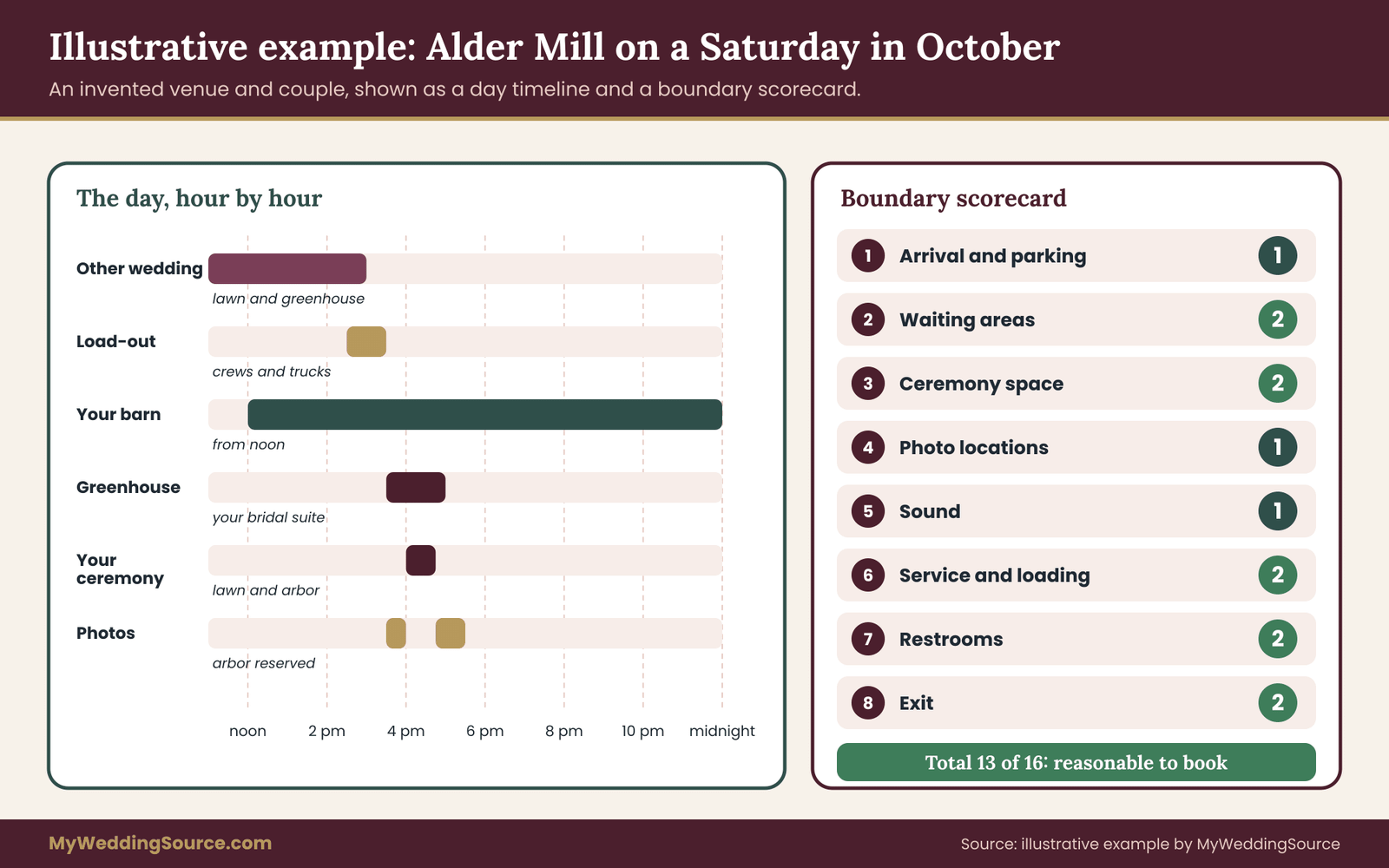
Imagine a couple, Dana and Marcus, who tour a converted farm called Alder Mill. The mill has a stone barn for receptions, a lawn with an arbor for ceremonies and a small greenhouse used as a bridal suite. They want a Saturday in early October with about ninety guests. The manager mentions that the venue often hosts a second wedding on Saturdays, with a late-morning ceremony and a lunch reception in the greenhouse and lawn.
Dana asks what the overlap pattern is for their date. The manager checks the calendar and says another couple has the greenhouse and lawn until three in the afternoon. Dana and Marcus would have the barn from noon, the lawn from four, and the greenhouse from three-thirty. The first wedding would load out between two-thirty and three-thirty. This is a staggered pattern: the second event’s setup overlaps with the first event’s ending.
Scoring the boundaries
Dana and Marcus walk the property with the manager and score each boundary.
On arrival and parking, the manager says guests will use the north lot and the first wedding’s guests use the south lot. Nothing is written, so this scores one. On waiting areas, the couple’s guests would gather in the barn, which is separate from the lawn; the manager agrees to add the barn as the guest waiting area in the contract. That scores two. For the ceremony space, the lawn is reset after the first wedding, and the manager promises ninety minutes between events. It is written in the timing schedule, so two.
On photo locations, the arbor and a stone wall are the two best spots, and both are on the lawn. The first wedding will be there until three. Dana and Marcus ask for the arbor between three-thirty and four-thirty on the day, the manager says “that should be fine,” and it scores one. On sound, the first wedding is a lunch with a small acoustic trio; the manager says it will be done before the ceremony, and the barn is two hundred feet from the lawn. This is verbal, so one.
On service routes, the caterer shares a prep kitchen with the first wedding’s caterer from one-thirty to two-thirty. This is flagged as a possible conflict, and the manager agrees to give each caterer a separate station and time. That scores two once written. On restrooms, the barn has its own restrooms, separate from the greenhouse, and the contract names them. Two. On exit, the venue’s closing time is midnight, the first wedding leaves hours earlier, and the contract lists both. Two.
The total is thirteen out of sixteen. The couple notes the three scores of one and asks for them to be written. The manager agrees to add the arbor time and the parking arrangement but declines to put a sound statement in writing because the other couple’s music plan has not been decided. Dana and Marcus accept that, since the other event is well before their ceremony.
Why the result is reasonable
Notice what the example shows. A shared venue that hosts two weddings the same day is not necessarily a problem. This one has a staggered pattern with a clear handoff, separate spaces and a written plan for the places where the events might meet. The couple spent about an hour asking questions and one email exchange on the contract. They also made a small, reasonable adjustment: they moved the family portraits to the greenhouse and barn, away from the lawn, in case the lawn turn ran late.
Now imagine the same venue with a different scenario. The second wedding is not at noon but in the evening, with a band, and the couple’s ceremony is at five. The overlap is no longer staggered but parallel: both events would be active in the same hours, and the sound question becomes central. Dana and Marcus would have to ask about decibel limits, the doors of the barn and the positions of the speakers. If the manager says “we will see on the day,” they would score sound at zero, and the total would drop into the negotiating range.
How the score becomes a decision
The scoring rule converts a number of vague impressions into a decision. A total of thirteen or more means the venue has either written the key boundaries or is willing to. You can sign after the changes are added. A total from nine to twelve means there are gaps, and you should list the gaps and request changes before you commit. A total of eight or lower means the venue is not demonstrating that it can protect your event, and you should either ask for exclusive use or look elsewhere.
Treat the thresholds as guides, not laws. A couple who cares little about ceremony privacy but a great deal about accessibility might weight the boundaries differently. If your grandmother uses a wheelchair, a two on the restroom and route boundaries matters more than a two on the photo spots. If your ceremony is a quiet one with spoken vows, sound matters most. You can double the weight of the boundaries that matter most to you, and recalculate, as long as you do it before you see the total and not after.
The standard patterns cover most bookings, but a few edge cases come up often enough to be worth thinking about.
The other couple is someone you know
Sometimes the other wedding is a friend, a coworker or a relative. It can be a pleasant coincidence, and it can create awkwardness: shared guests, two events competing for the same photographer or an uncomfortable choice of who gets the better time slot. If you know the other couple, a short, friendly conversation can help. You can compare schedules, agree on vendor times and share only what you both want to share. Do not use the other couple as a channel to negotiate with the venue; keep that between you and the venue.
If your guest lists overlap, ask each venue how it handles guests who might attend both. The venue cannot decide for your guests, but it can help with timing: a late-morning wedding followed by an evening one is easy to attend if the spaces are clearly separated.
The venue is a house of worship or a public building
Not every shared venue is a banquet hall. A church, a community hall, a museum or a city garden may host more than one wedding on a day under a booking system that differs from a commercial venue. Rules about decorations, music and photography may be set by the institution, and the staff may be volunteers. Ask for the written policy and for the name of the person who enforces it.
Public venues also often have fixed hours, public access to some areas and different rules about alcohol. In these cases, the boundary checklist still applies, but you may find that the shared venue cannot offer the same level of control, and the question is whether you can work within it.
The ceremony and reception are at different places
If your ceremony is at a house of worship and your reception is at a shared venue, the overlap pattern applies only to the reception. But your travel time between the two places affects the venue’s schedule, so ask whether the access time works if guests arrive early or late, and where they wait if the previous event is still using the room.
A very small or very large event
A micro-wedding of twenty guests can fit easily in a corner of a venue that is also hosting a larger party, and the privacy risks are different: your event may feel more exposed. A large event of two hundred may use most of the property, leaving little for the other party. Ask the venue how it handles different sizes, whether it limits the second event when yours is large, and whether the contract says so.
The weather turns
Outdoor shared venues often have a rain plan that moves a ceremony indoors. If both events share a rain location, the first to ask may not be the first served. Ask for the priority rule and for a deadline by which the venue makes the call. If the decision belongs to the venue, ask what information it uses, such as a forecast from the National Weather Service, and how soon you will hear. A written weather plan prevents a hard conversation on the morning of the event.
The other event runs late
Even the best schedule can slip. A ceremony that starts forty minutes late, a caterer that is delayed, or a vendor that runs over the load-out window can push the second event back. Ask what the shared venue does when this happens. Does it shorten your access window? Does it compensate for lost time? Does it have a right to move your event to a different space? A clause that protects your minimum time, or gives you a refund of part of the fee if the venue cannot deliver it, is a reasonable request.
By now you have a way to learn the overlap pattern, a checklist of boundaries and a scoring rule. The last step is to turn them into a decision. The path below is meant to be followed in order, and each step can end in a clear yes, a request or a no.
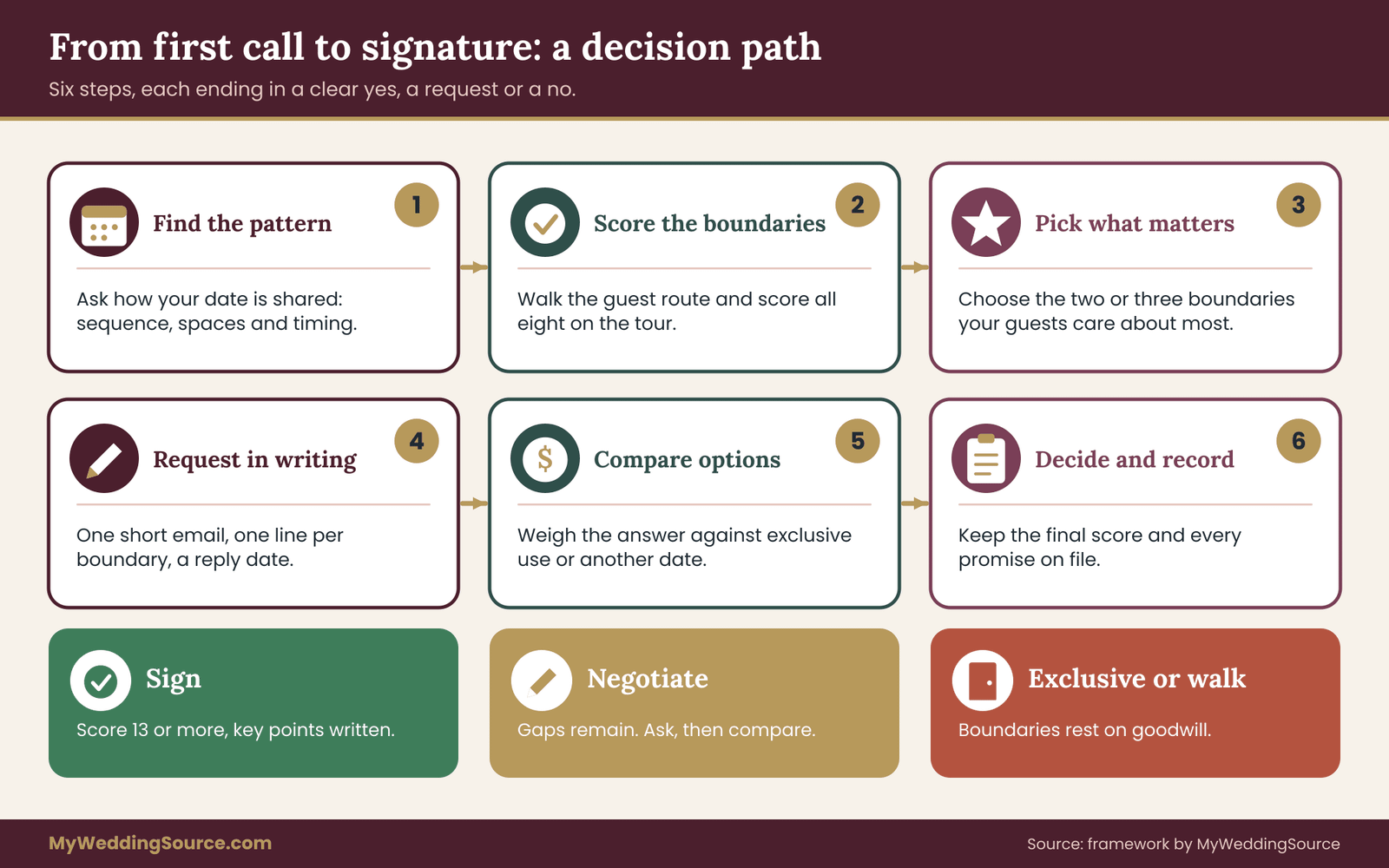
Step one: find the overlap pattern. Ask the venue to describe what happens on your date in terms of sequence, spaces and timing. If the venue cannot answer because the other event is not booked yet, ask what the policy is. Some venues will agree to hold a date as exclusive until a certain deadline, which gives you time to decide.
Step two: score the eight boundaries. Do this on the tour, not afterward, because details fade. Write a number next to each boundary and a one-line note on what was said or shown.
Step three: list what matters most. Choose the two or three boundaries that your guests care about most. For a guest list with many older relatives, it may be restrooms and routes. For a couple with a quiet ceremony, it may be sound. For a couple with a public profile, it may be the guest information and photo boundaries. These are the ones you will insist on in writing.
Step four: request the written terms. Send the venue an email listing your requested changes. Keep it short and specific, with one line per boundary, and ask for a reply by a date. A reply in writing is itself a record.
Step five: compare the outcome with your alternatives. If the venue agrees to what matters most and your score rises to 13 or above, the booking is reasonable. If it agrees to some, weigh the remaining gaps against the price and the date. If it declines the items you care about, compare the exclusive option, a different date or a different venue.
Step six: decide and record it. Whatever you choose, record the final score and the promises. If you sign, you will know what you have. If you walk away, you will know why.
When to walk away
A shared venue is not a mistake. There are, however, a few signals that suggest the boundaries will not hold. They are worth noting calmly, and they are not a reason to be alarmed.
The first signal is a manager who cannot say what happens on your date. If the shared venue cannot tell you who else is booked, what spaces they use or what times they run, it is not tracking the overlap. The second signal is a refusal to put any boundary in writing, especially the ones that cost the venue nothing, such as using a first name on a sign. The third is a venue that responds to questions about sound, restrooms or access with irritation or vagueness.
A fourth is a fee structure that charges extra for the boundaries, without clear reasons. And the fifth is a venue whose reviews or former clients describe the same complaint: noise, crowding or confusion between events. Take reviews with a grain of salt, but a repeated complaint about the same issue is worth asking about.
None of these means the shared venue is dishonest. It may simply lack a system. If you love the place, you can ask for an exclusive date, a different time or a smaller guest count in the shared pattern. If you do not feel any of those will work, the venue is not the right fit for your event, and that is a perfectly good reason to choose another.
How firm to be, and how to say it
Couples often worry about sounding difficult. In practice, venue managers deal with these questions regularly, and a calm, specific request is received better than a general complaint. Compare the following two messages.
“We are worried about privacy. Can you guarantee we will not be disturbed?”
“Could you add to the contract that the east lawn and the barn are reserved for our event between two and eleven, and that amplified music from other events will not be audible at the ceremony site during our ceremony?”
The second is easier to answer yes or no, and each part can be accepted or declined independently. A venue that answers it with a written reply is doing exactly what you need.
Telling your guests what to expect
The boundaries you have negotiated work best when guests know about them. A few lines on your wedding website or in a text message before the day can prevent most of the confusion.
What to tell guests in advance
Tell guests which entrance to use, where to park and what time to arrive. Mention that the venue hosts another event that day, and that your event has a specific area. A simple line such as “the shared venue hosts another event nearby, so please follow the signs for our ceremony” is enough. If guests with mobility needs require a specific route or drop-off point, tell them directly and let them reply with questions.
Avoid sharing your schedule with more detail than necessary on any public page. Because other guests may see a wedding website, consider a password or limit the website to guests if privacy is a concern. A short text message on the morning of the event can also help everyone find the right place.
What to ask your wedding party and family
Ask your wedding party to be aware of the other event and to redirect any stray guests politely. Give them a phone number for the venue’s day-of contact so they can use it without involving you. Ask family members who may be sensitive to noise or crowds to arrive early, when the area is quieter, and to use the closest restroom you have identified.
For anyone who is likely to be upset by strangers or photographers, such as a person who has asked not to be photographed, tell them where the private areas are and how to find a staff member. Do not rely on the venue to know this without being told, and do not assume the other event’s guests will respect it.
On the day: a short routine
On the day, a simple routine helps. Arrive early enough to walk the route with the venue contact. Check that the signs, doors and boundaries match what you agreed. Confirm the vendor schedule with the venue and with each vendor, and give the shared venue contact the same number your wedding party has. If something is not as agreed, raise it right away with the named contact, politely and specifically, and note the time.
After the event, send the venue a brief note on anything that worked or did not. It is useful for you if a dispute arises, and for the venue as it improves its process.
When something goes wrong
Even with a good contract and a clear plan, problems happen. The following are the most common, with a practical response to each.
If the other event is louder than promised, ask the named contact to speak to the other event’s coordinator, and ask for a specific change, such as turning down a speaker or closing a door. Do not confront the other party. Make a note of the time and what you observed, and photograph or record only what is necessary, mindful of the privacy of the people nearby.
If a guest from the other event enters your area, a polite and neutral approach works best: “Are you looking for the other wedding? I think it is that way.” If they seem unsettled or refuse to leave, ask a staff member to handle it.
If a vendor is blocked by the other event’s vendor, contact the venue’s coordinator, who controls the dock and the schedule. If something is missing, check the label and the photographs from before the event, then ask the venue to check the other party’s area.
If the shared venue changes the agreed space or schedule on the day, refer to the written agreement and ask for a remedy: a comparable space, additional time or a partial refund. If the problem cannot be resolved on the day, document it with times and photographs, and raise it afterward in writing. Payments made by credit card may have dispute rights, which the Consumer Financial Protection Bureau describes on its site; contact the card issuer promptly if you believe you have been charged for something you did not receive.
Your next steps
If you have a shared venue on your shortlist, or you have just learned that your venue sells two weddings a day, the following order of work keeps the effort small.
- Ask the venue for the overlap pattern on your date and for any written policy about hosting two events.
- Walk the guest route with the manager, from the entrance to the restrooms, and score the eight boundaries as you go.
- Pick the two or three boundaries that matter most to your guests, and send a short email asking for those in writing.
- Ask for a vendor schedule for your date and share it with each vendor.
- Compare the total cost, including required staff and fees, with an exclusive option or another date.
- Draw your own overlap diagram once the venue confirms its schedule, and note every point where the two events touch.
- Tell your guests the entrance, parking and arrival time, and give your wedding party the venue contact.
If the venue meets the standard in the quick answer, you can sign with a clear idea of what you are getting. If it does not, you have the notes you need to decide calmly.
FAQ
Is it normal for a venue to host two weddings on the same day?
Yes. Many venues with several rooms or a garden and a hall schedule more than one event on busy dates, usually with staggered times or separate spaces. It is a business model, not a warning sign. The question for a shared venue is whether the boundaries between events are specific, written down and workable for your guests.
How do I know if a shared venue will keep the other wedding out of sight?
Ask for the overlap pattern on your date and walk the guest route with the manager. Check arrival, waiting areas, the ceremony site, photo spots and restrooms for sightlines. Request that the spaces you rent be named in the contract. A written description of your areas is far more reliable than a spoken assurance that you will not see anyone.
Can I ask the venue to guarantee my ceremony will be quiet?
You can ask, and a venue may agree to a clause limiting amplified sound near your ceremony site during ceremony hours. Some will not promise absolute silence, because they cannot control every guest or vendor. Even so, a written commitment to adjust the schedule or sound levels is a meaningful protection and worth requesting before you sign.
Is a shared venue cheaper than an exclusive one?
Sometimes. Some venues lower the rental fee when they plan two events, and others charge the same either way. Compare the total, including required staff, security, shuttles and overtime, along with the access time you lose. Ask for the exclusive-use price for the same date so you can see what privacy costs at that property.
What guest information should I share with a shared venue?
Share only what the venue needs: a headcount, the vendor list with arrival times and a day-of contact. Avoid giving a full guest list with dietary or accessibility details unless there is a clear reason. Ask who sees it, where it is kept during the event and when it is destroyed or deleted afterward.
Do I need to worry about the other couple’s photographer?
Usually not a great deal, but it helps to know the venue’s rules. Ask which photo spots are reserved for you, whether photographers must be insured or briefed, and whether drones are allowed. Plan portraits at times and places away from the other event, and ask the venue who intervenes if a photographer enters your area.
What if both weddings need the same rain location?
Ask for the priority rule in writing before you sign. A fair contract says who gets the covered space, who decides and by what time. If the venue cannot answer, ask whether it can offer a second covered space, a different schedule or a refund if it cannot deliver your agreed area. Local forecasts from the National Weather Service can inform the decision.
When should I walk away from a shared venue?
Consider leaving if the manager cannot explain what happens on your date, refuses to put any boundary in writing, or dismisses questions about sound, access or restrooms. A low total on the boundary score, with no willingness to improve it, is a good signal. If you still love the place, ask about exclusive use or a different date.
Sources
- ADA.gov, Title III: public accommodations and commercial facilities
- National Fire Protection Association, codes and standards
- U.S. Fire Administration, fire safety resources
- Ready.gov, emergency planning for gatherings
- National Weather Service, forecasts and alerts
- Federal Trade Commission, consumer protection
- Consumer Financial Protection Bureau, credit card disputes
- Cybersecurity and Infrastructure Security Agency, privacy and data safety
- USA.gov, find local government offices