

A wedding hotel welcome desk is a small, staffed table in or near the hotel lobby where arriving guests get a greeting, a key answer and a printed plan. Done well, it takes pressure off the front desk and off the couple. This guide shows how to staff a wedding welcome desk in the hours that matter, stock it, and set up an escalation rota, without hiring a crowd.
Do not staff a wedding welcome desk for every hour. Staff it for the arrival waves, which are usually two or three short windows, not a whole day. Assign four roles (desk lead, runner, floater, and an off-site escalation contact), supply a one-box kit, and write an escalation rota with four rungs so that each problem goes to the lowest person who can fix it. Get the hotel’s written permission first, because the lobby is the hotel’s space, not yours.
Picture a Friday afternoon. Forty guests are due between two and six o’clock, the front desk has one agent on shift, and a line forms at the counter while a tired traveler asks where the welcome event is. Another guest wants to know whether the shuttle runs tonight. A third has a room that is not ready. None of those questions belong to the front desk agent, and none of them should reach the couple. A well-run wedding welcome desk is simply a place to send those questions.
The idea is easy to get wrong in two directions. Some couples build a staffed booth with banners and a rota of ten friends, burn their closest people out before the rehearsal dinner, and annoy the hotel. Others skip any structure, hand a few paper bags to the front desk and hope. The sensible version sits between them, and it depends mostly on timing and clear roles, not on headcount.
This guide covers the hospitality desk at a hotel where your guests are staying. It does not cover how to pick hotels or negotiate room blocks; for that, see the broader guide to coordinating wedding guest hotels across budgets and mobility needs. Here the question is narrower: once guests are in the building, how do you receive them well with the fewest people possible?
A note on scope. This is general planning information, not legal, tax or financial advice, and hotel policies, fees and local rules vary, so confirm each one with the property in writing.
What a wedding welcome desk is, and what it is not
A wedding welcome desk is a temporary, hosted point of contact. It has a table or counter, a person or two, a stack of printed materials, and a purpose: to answer the questions a wedding weekend creates that the hotel itself does not answer. It exists for guests who came because of your event, and it exists only for the days of that event.
It is not a second front desk. It cannot check anyone in, issue keys, change room assignments or resolve billing, because the hotel controls all of that. It is not a concierge either, although a good desk lead will know the hotel’s concierge by first name. And it is not a registration table for the ceremony, which has different needs: that table usually holds programs and escort cards at the venue.
What it does well falls into five jobs.
Greeting. A person who says “You must be here for the wedding, welcome” removes a surprising amount of arrival stress. Many guests have been traveling for a day and do not know whether they are in the right place.
Directing. Which elevator, which room for the welcome gathering, where to meet for the shuttle, where the ice machine is. These are small questions that multiply.
Handing over. Welcome bags, printed schedules, shuttle cards, a map with the hotel and venue marked.
Collecting. Last-minute information: a dietary need that never made it onto a response card, a guest who will arrive a day late, a mobility need the hotel does not know about.
Escalating. Passing the problems that need a decision to the right person, quickly, with the details attached. This job is where most welcome desks fail, so it gets its own section later.

Where the desk physically sits
The best location is the one the hotel allows, which is often not the one you imagined. Common options include a small table beside the front desk, a console in a mezzanine or lounge area, a table outside a function room, or, for very small groups, no table at all, just a host with a clipboard standing near the entrance. Each has a trade-off. A table by the front desk is easy to find but crowds the check-in line. A lounge table is calm but easy to miss. A function room table is private but only works when the room is yours.
Ask the hotel which spot they prefer. Property staff know where foot traffic bunches up, which areas are covered by cameras, and which spots are fire-code sensitive. We will come back to the permission conversation in the next section.
When you actually need a wedding welcome desk
Not every wedding needs one. A decision rule helps, because the cost of a welcome desk is people’s time, and people’s time is the most limited resource in a wedding weekend.
Use three tests. If you answer yes to two or more, a desk is worth setting up.
Test one: arrivals are spread across many hours. If most guests will arrive within a single hour, say a ceremony at a hotel ballroom that starts at four, a welcome desk is not useful. If arrivals trickle in over six hours or across two days, guests will keep asking the same questions to whoever is closest.
Test two: guests are not familiar with the area. A destination wedding, a wedding in a large city, or a venue far from the hotel creates questions about transport, food and timing that a printed plan only partly answers.
Test three: some guests need extra help. Older relatives, guests with limited mobility, families with infants, and international travelers are more likely to need a person than a piece of paper. The same applies if your hotel is spread across a large property with several buildings.
If you answer no to all three, skip the welcome desk. Put a one-page plan in each room instead, ask the hotel to forward questions to a named contact, and save your friends’ energy for the wedding itself. A welcome desk that nobody visits is simply a chair in a lobby.
The cost of overbuilding
Overstaffing carries real costs that are easy to miss. Every person who sits at the wedding welcome desk is a person who is not getting ready, not seeing their own family, and not enjoying the weekend. The couple’s closest friends and siblings usually have other duties, from readings to wedding party photos. A welcome desk that is staffed for twelve hours across two days can consume a dozen volunteer-hours per person for little benefit.
There is a second cost, which is friction with the hotel. Hotels are used to managing their own lobby traffic. A branded desk with several people can look like an obstacle, and in some properties a group that sets up in the public space without arrangement will be asked to move. The staffing model in this guide is built around asking for less: fewer hours, fewer people, one clearly bounded space.
Three versions, sized by wedding
It helps to name the sizes before going into detail, so you can place your own event.
The light version suits roughly fifteen to forty room-nights of guests: one host, one printed plan, one box, and a handful of hours on the main arrival day. The host is also the escalation contact for that stretch.
The standard version suits somewhere between forty and ninety guests staying at the hotel, spread across a Friday and a Saturday morning: two people during each arrival wave, one named floater, and a phone number for questions.
The extended version suits large groups, multiple hotels or multi-day events, and it adds a second shift lead, a written log and a short handoff meeting each evening. Even then, the welcome desk is open for windows, not for whole days.
These sizes are illustrative, not rules. What matters is that you pick one on purpose, write down the hours and roles, and tell the hotel.
Getting hotel permission before you plan the wedding welcome desk
The lobby belongs to the hotel. Before you buy a banner or recruit a single volunteer, ask the property whether a hosted desk is allowed, where, when and on what terms. Most hotels that regularly host weddings say yes, and many will help, because a well-organized group reduces the questions their own staff field. But the answer is not automatic, and the terms vary by property, brand and even by the shift manager on duty.
Start with the person who owns your group booking. That is usually a group sales manager or an event services manager, not the front desk. If you contracted a room block, the group sales contact is named in your agreement. If guests are booking individually at a hotel with no block, you may have no formal contact at all, and the first step is to call the hotel and ask for the manager on duty or the sales office. In that case, introduce yourself to the property first and ask who handles groups.
Questions to ask the hotel
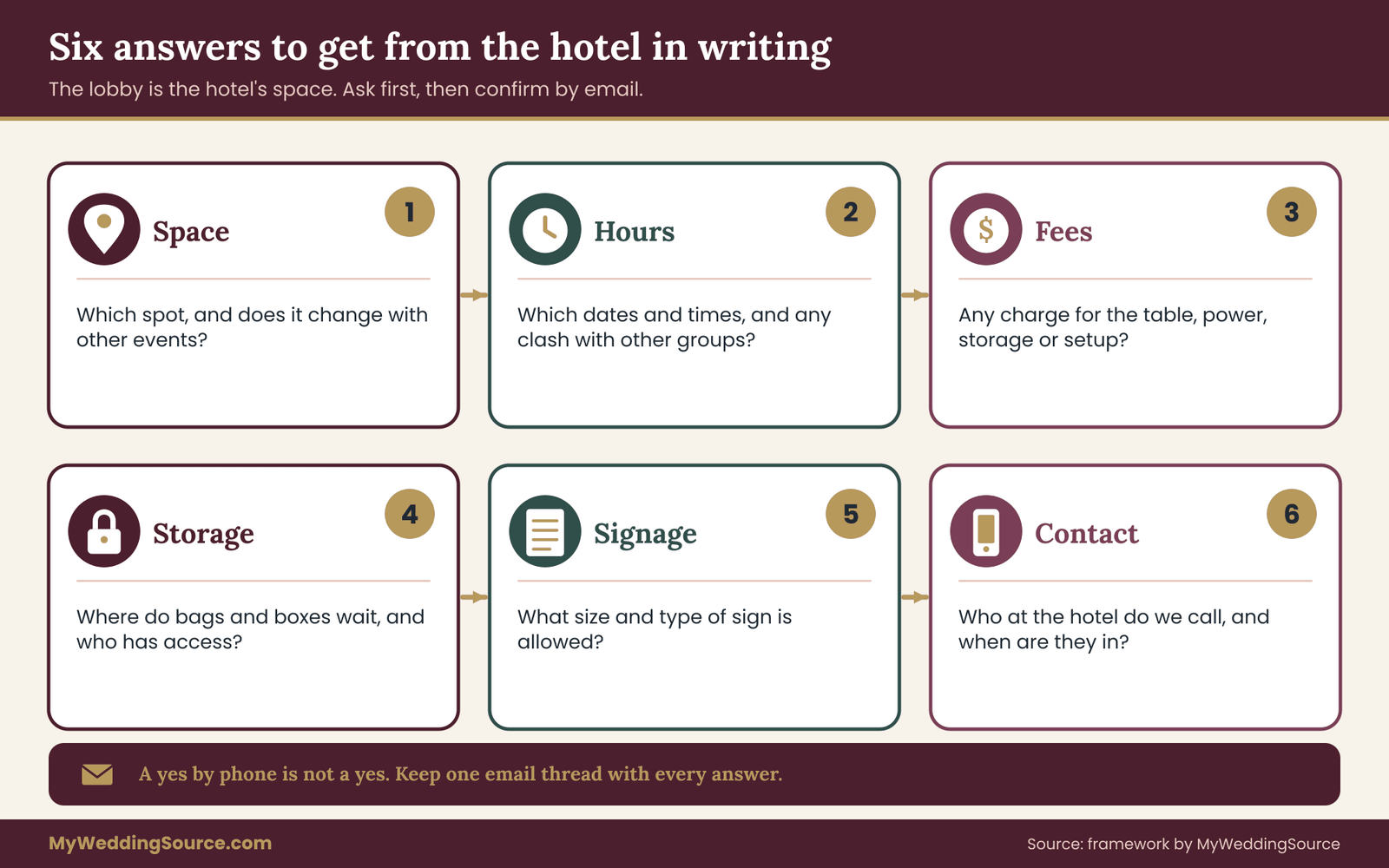
Ask in writing, or confirm any phone answer by email afterward. A reply that says “yes, that is fine” from the group contact is worth far more than a memory of a call. These are the questions that matter, in rough order of importance.
Is a hosted table allowed in the lobby or another public area, and where? Ask for a specific spot, and ask whether it changes with other events. A hotel might have a conference in the same lobby the same weekend.
On which dates and during which hours? Give a draft window and ask if it conflicts with anything, such as a school group arrival or a hotel cleaning schedule.
Is there a fee for the space, the table, power or Wi-Fi? Some properties charge nothing for a small table. Others charge a setup or service fee, especially if they provide furniture. Do not assume.
Can the hotel provide a table, tablecloth or skirting? If not, you bring your own, and you need to know how it enters the building.
Where can we store welcome bags and supplies? A locked room behind the front desk, a bell stand or a function room are the usual answers. Ask who has access and whether the hotel will accept a delivery with your name on it.
Can the hotel pass messages, packages or deliveries to the welcome desk? Guests sometimes ship items ahead, and vendors sometimes drop off signage.
Is signage allowed, and what size? Some properties allow a small standing sign and nothing else, for fire-code or brand reasons.
What are the rules for food and drink? If you plan to put out water, snacks or coffee, the hotel may require that all food come from its own kitchen, or may charge a fee for outside food. Ask before you buy anything perishable.
Who is the contact when we have a problem, and what is the escalation path inside the hotel? Get a name, a direct number or a front desk extension, and the hours that person works.
What a reasonable answer looks like
A good reply usually grants a bounded space and a bounded time, names one hotel contact, and confirms the storage arrangement. A cautious reply might offer a table in a less visible spot, or ask you to hand off bags to the front desk instead. Both are workable. A reply that says no outright is also useful information: you can pivot to a host with a clipboard in the lobby, a printed plan in each room and a phone number, which is a smaller desk with the same purpose.
Be willing to scale down to match the hotel. A property that is gracious about a small table and one volunteer will be gracious again next time, and the couple’s relationship with the group sales manager matters if anything goes wrong during the weekend. Treat the hotel’s staff as partners, not as obstacles. They know more about this building than you ever will.
Liability, insurance and the quiet details
Two details are easy to forget. The first is insurance. A hotel may ask whether you have event liability coverage for any activity that happens in its public areas, or may extend its own coverage for small hosted tables at no charge. Ask directly, and if your venue or planner already holds a certificate of insurance for the wedding weekend, ask whether it can be shared. Do not guess about coverage, and do not assume that a friend’s homeowner policy extends to a lobby table.
The second is the hotel’s own labor. A desk that asks hotel staff to do additional work, such as carrying bags or storing items, may be charged. Ask whether a bellman will move boxes, and whether there is a cost.
Written confirmation worth keeping
Keep a single email thread, or a short document, that records the hotel’s answers. Put these items in it: the table location, the dates and hours, any fee, the storage arrangement, the name and number of the hotel contact, and the signage limits. Share it with the person who will run the welcome desk. When a staff member on the day says “we did not agree to that,” a calm, polite reference to the thread resolves most disagreements in thirty seconds. The same record supports your general vendor documentation; keep it with the rest of your vendor agreements so it is easy to find.
How to pick hours for the wedding welcome desk
Hours are where the money, or rather the people, go. The most common mistake is to set the welcome desk for a long continuous block, such as nine in the morning to six at night. That structure looks reassuring on paper and wastes most of the time, because guest arrivals are not even.
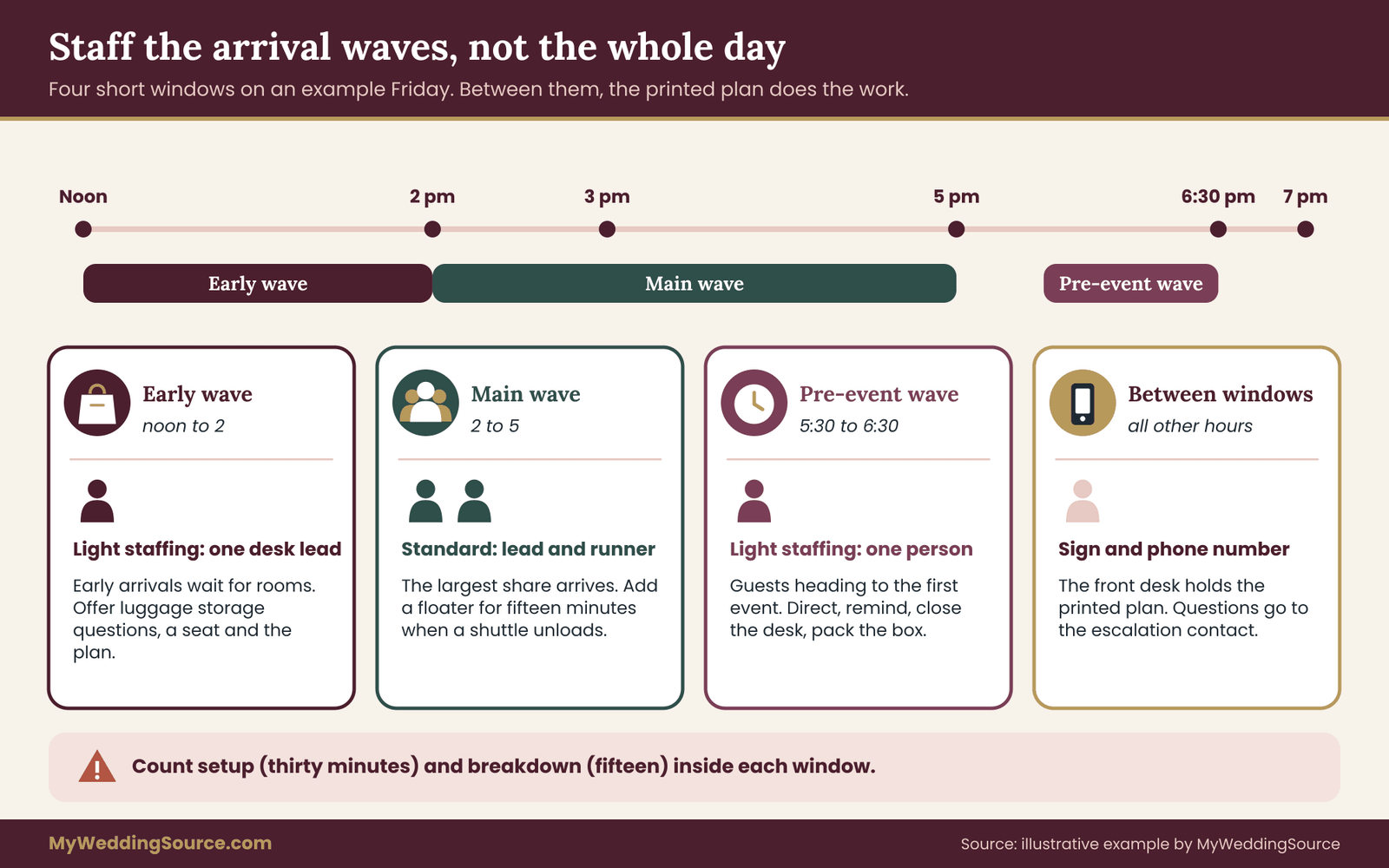
Arrivals come in waves. A wave is a stretch of time in which a large share of guests reach the hotel, usually because of something that moves people together: a flight schedule, a train, a check-in time, a start time for the first event. If you can identify the waves, you can staff them and leave the rest of the day to the front desk and a posted phone number.
Finding the waves with the information you already have
You probably already hold most of what you need. Look at four sources.
Response cards and the guest list. Any note about travel plans, even partial, shows where to look. If you asked guests when they planned to arrive, tally the answers into morning, midday, afternoon and evening.
The hotel’s check-in time. Standard check-in is commonly mid-afternoon, and most guests who arrive earlier will wait. That creates a bulge in the early afternoon at the lobby, with people asking about luggage storage and early check-in. Ask the hotel for its early check-in and luggage storage policy in writing, because it shapes this wave.
Flight and rail schedules. If most guests fly into one airport, check the major arrival times and add the usual time to reach the hotel. Many guests land in a cluster, and the ground transport from the airport spreads that cluster into a wave of about an hour or two at the hotel. For rules about delays and cancellations that affect travelers, point guests to the U.S. Department of Transportation’s aviation consumer protection pages, and do not promise outcomes yourself.
The first event. If a welcome reception starts at seven on Friday, guests will try to be checked in and changed before it. That puts a second wave between five and six-thirty.
A simple three-window model
For most weddings with a Friday arrival day, three windows cover the welcome desk. They are labeled by purpose, not by clock time, because you will set the clock times from your own data.
Window one, the early wave. Guests who arrive well before check-in and who need luggage storage, directions and reassurance. This window is often small but disproportionately demanding, because these guests are tired and the room is not ready.
Window two, the main wave. The largest group, typically in the hours after check-in opens. Everyone wants keys, the plan for the weekend and the shuttle details at once.
Window three, the pre-event wave. Guests heading to the first event, who need a final reminder of timing, attire and transport. This window is shorter and more about directing than receiving.
A fourth, optional window sits on the morning of the wedding day, when guests who arrived late or slept in need a quick plan. Many weddings do not need it, and a printed plan with a phone number is enough.
Setting the window lengths
Make each window only as long as the data supports. A rough method is to find the hour in which the largest share of guests arrive, then extend one hour on each side. Staff the central hour fully and the shoulders lightly. If you do not have arrival data, use the hotel’s check-in time as your anchor and plan for the three or four hours after it.
When guests keep trickling in outside the windows, the front desk handles them with your printed plan in hand and the phone number to call. That is why the printed plan and the escalation contact matter more than any extra hour of staffing. Between windows, a small sign on the table with a phone number and the hour the welcome desk reopens is enough. A table left in place but not staffed is fine if the hotel agrees and if nothing valuable is on it.
A last point on hours. Count the welcome desk’s opening and closing as part of the window. Setup takes thirty minutes if the kit is packed well, and breakdown takes fifteen. A window that is “two to five” really means a person arrives at one-thirty and leaves at five-fifteen, and that fact belongs in the schedule you hand your volunteers.
Staffing a wedding welcome desk with four roles instead of ten people
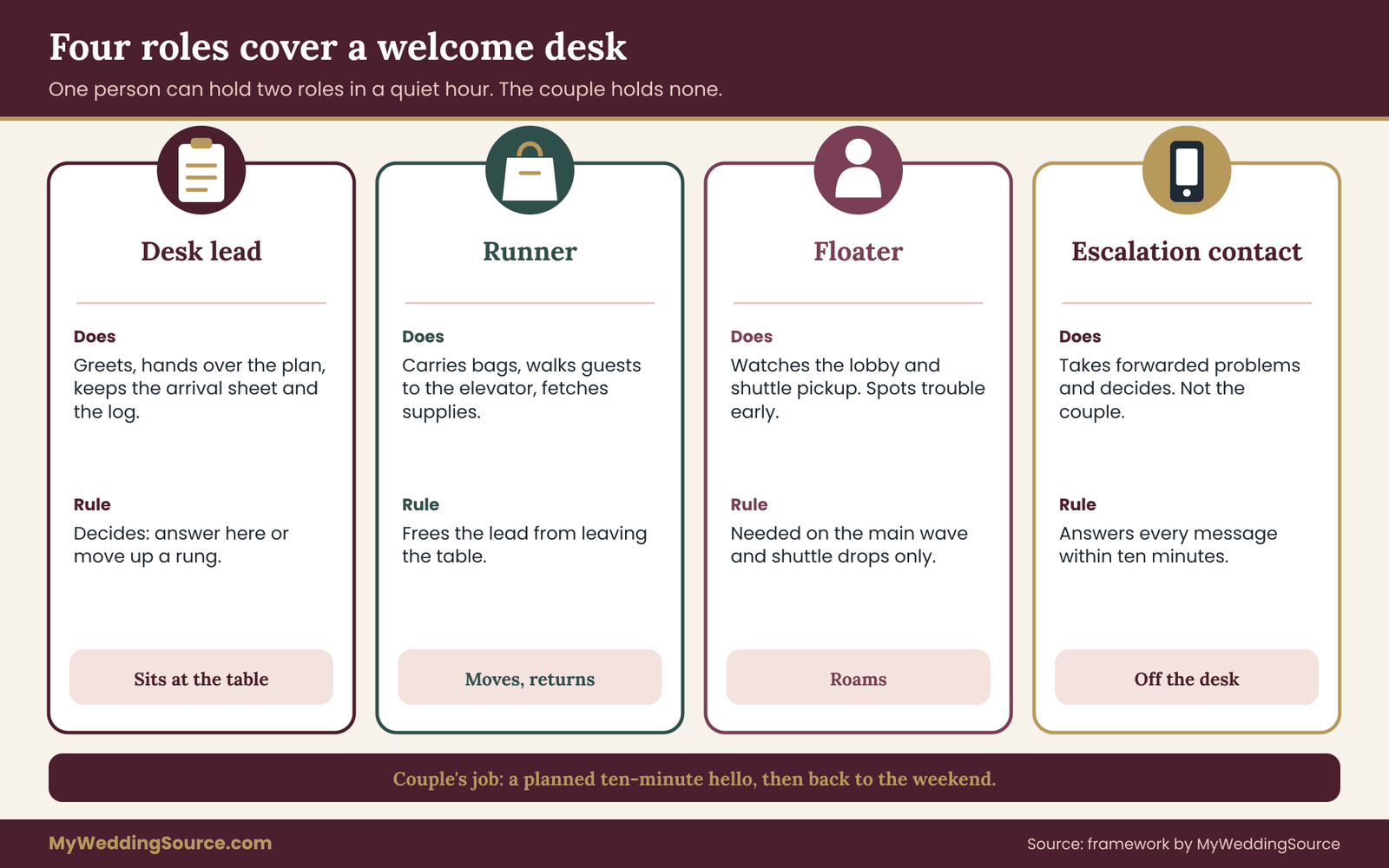
Headcount is the wrong starting point. Start with roles, because a role is a job that has to be done in a given window, and one person can hold more than one role in a quiet hour. Four roles cover almost every wedding welcome desk.
The desk lead. This person owns the table during a window. They greet, hand out materials, keep the guest list sheet, and decide whether a question is theirs to answer or needs a rung higher on the escalation rota. The desk lead needs a calm manner and a working memory of the printed plan. They do not need to be a close family member, and in fact it is better if they are not.
The runner. A runner is someone who can leave the table: to carry a bag to a room, fetch an item from storage, walk an older guest to the elevator, or find a front desk manager. In a standard window the runner is the second person at the table. Without a runner, the desk lead is stuck at the table every time a guest needs physical help.
The floater. A floater is not tied to the table at all. They move through the lobby, the shuttle pickup area and the breakfast room, and they notice problems before guests reach the welcome desk. The floater is useful on the main wave only, and often one of the people already in the wedding party can do this casually while they are there anyway.
The escalation contact. This is a named person, off the welcome desk, who receives forwarded problems by phone or message and who has the authority to decide. It is usually the planner, the day-of coordinator, or a sibling or friend who is organized and reachable. It should not be the couple. Their role is to keep the couple out of the queue.
Why the couple stays off the roster
It is tempting to have the couple greet guests at the welcome desk, and a short visit is lovely. But if they are on the roster, they become the default answer to every question. Guests who see the couple will bring the couple their problems: a room with a view that was not what they hoped, a question about parking, a billing misunderstanding. The couple then becomes a customer service line during the weekend they are paying for.
A better pattern is a planned drop-in. The couple visits for ten minutes in the middle of the main wave, greets people warmly, and leaves. The desk lead knows the visit is coming and sets it in the schedule. Outside that time, the couple is not on the welcome desk and does not carry the escalation phone.
Who actually fills the roles
You have four sources of people, and most weddings use a mix.
Close friends and relatives. The warmest and cheapest option. The risk is fatigue and divided attention: the best man who is also staffing a table at four o’clock may be late to hair and makeup. Keep family out of the windows that sit close to getting-ready time, and do not assign anyone who has a reading, a toast or a major role in the following twelve hours.
Wedding party members who are not in the central family. Friends who are happy to help and who know many guests. They often make the best floaters.
A day-of coordinator or planner. If you already have one, adding the welcome desk to their scope is reasonable, but confirm the price and the hours in writing, since a welcome desk at a hotel may fall outside the standard package. A coordinator is a strong choice for the escalation contact and, in a pinch, a strong desk lead for the main wave.
Paid help. A local hospitality or event staffing agency, or a student worker, can cover a window for a set rate. This is a practical way to protect friends, and it makes particular sense on a Friday afternoon when family is busy. If you pay people, ask the agency or a qualified adviser about the correct way to engage them; the U.S. Department of Labor publishes information on who counts as an employee and how volunteers differ, and the rules vary by situation and by state. Do not treat friends who receive gifts or free meals as paid staff without checking.
Shifts, breaks and fairness
A two-person desk in a three-hour window is not demanding, but it is not nothing. The tasks are small, the standing is long and the attention is constant. A few rules keep volunteers from regretting they said yes.
Keep shifts to about three hours, and never more than four. Give each person a break in the middle of a longer window, and have a second person ready to take over. Schedule meals: a volunteer who works through dinner time will be hungry and curt by the end. Tell people early what the shift involves, including setup and breakdown, so they do not discover the extra thirty minutes at the door.
Fairness matters more than most couples expect. If one cousin works two shifts and another works none, resentment builds quietly. Publish the roster to everyone, rotate the least pleasant window, and thank people in person. A small gift is kind but not required; what people remember is whether the couple noticed.
The staffing ladder: matching people to waves
With roles and windows defined, the question becomes how many people each window needs. Use a ladder, with three rungs of intensity, and place each window on one.
Light staffing: one person. A single desk lead, who also acts as the runner when needed and who has a name card for the front desk to call. This fits an early wave or a pre-event wave with a small number of guests arriving. The lead keeps a phone nearby and has a pre-agreed way to summon the escalation contact.
Standard staffing: two people. A desk lead and a runner. This fits the main wave in a typical weekend with forty to ninety guests at the hotel.
Full staffing: three or four people. Desk lead, runner and one or two floaters. This fits the main wave in a larger group, or a wave where many guests need assistance at once, such as a late-arriving shuttle full of older travelers. Full staffing should be rare, and it should be short.
A way to estimate your own numbers
You can estimate staffing with arithmetic, but treat the result as a planning assumption to test, not a measured fact. Take the number of guests expected in the busiest hour. Estimate how long each interaction might take, including greeting and handing over materials; two to four minutes is a reasonable range to try, and your own test run will give you a better number. Multiply, then divide by sixty to get the number of staff-hours of work in that hour.
For example, if thirty guests might arrive in the busiest hour and each interaction takes three minutes, that is ninety minutes of work in a sixty-minute window. One person cannot do that, so two people are the minimum. If the same hour has twelve arrivals, the work is thirty-six minutes, and one person is enough with a runner on call.
The point is not precision. It is to catch the common error, which is to put one person at a table for the busiest hour and assume it will be fine. Interactions also bunch. A shuttle that unloads twenty people at once creates a queue that a steady-state average hides. If your main wave has a shuttle drop, count that as a spike and add a floater for the first fifteen minutes.
Cross-training and handoffs
Everyone who works the wedding welcome desk should know the same five facts without looking: the schedule for the weekend, where the shuttle picks up, the escalation phone number, where bags are stored, and the hotel contact’s name. A one-page card, which we describe in the supplies section, holds those facts. A fifteen-minute huddle before the first shift covers the rest.
Handoffs between shifts need a minute of overlap. The outgoing lead tells the incoming lead three things: what has been handed out, what is still open, and anything unusual. A short written log, even a notes app page, helps, and it is the spine of the escalation process described later.
When to close the desk
Close the welcome desk when its window ends, even if one guest is still on the way. Leave a sign with the escalation number and the next opening time, and brief the hotel’s front desk. A welcome desk that stays open an extra hour out of politeness tends to turn into an unplanned shift, and volunteers who stay late will be less willing next time.
There is one exception. If an accessibility or safety issue is open, such as a guest who needs help getting to a room, the desk lead stays until the issue is handed to someone who can own it. The lead should never leave a person stranded.
How the desk relates to other roles on the weekend
The wedding welcome desk is part of a larger set of roles, and it helps to be clear about the boundaries. The day-of coordinator owns the timeline of the wedding itself. The venue owns its own staff. The shuttle company owns its own vehicles and drivers. The welcome desk owns the hotel arrival experience and the flow of information between guests and the people who can answer them. When a question falls into another role’s territory, the desk lead passes it along, with the guest’s name, room and contact details.
If you are still setting the rest of the vendor timeline, the wedding vendor timeline guide shows how to place these windows next to the vendor arrivals so that the same volunteers are not asked to be in two places.
What goes in the wedding welcome desk kit
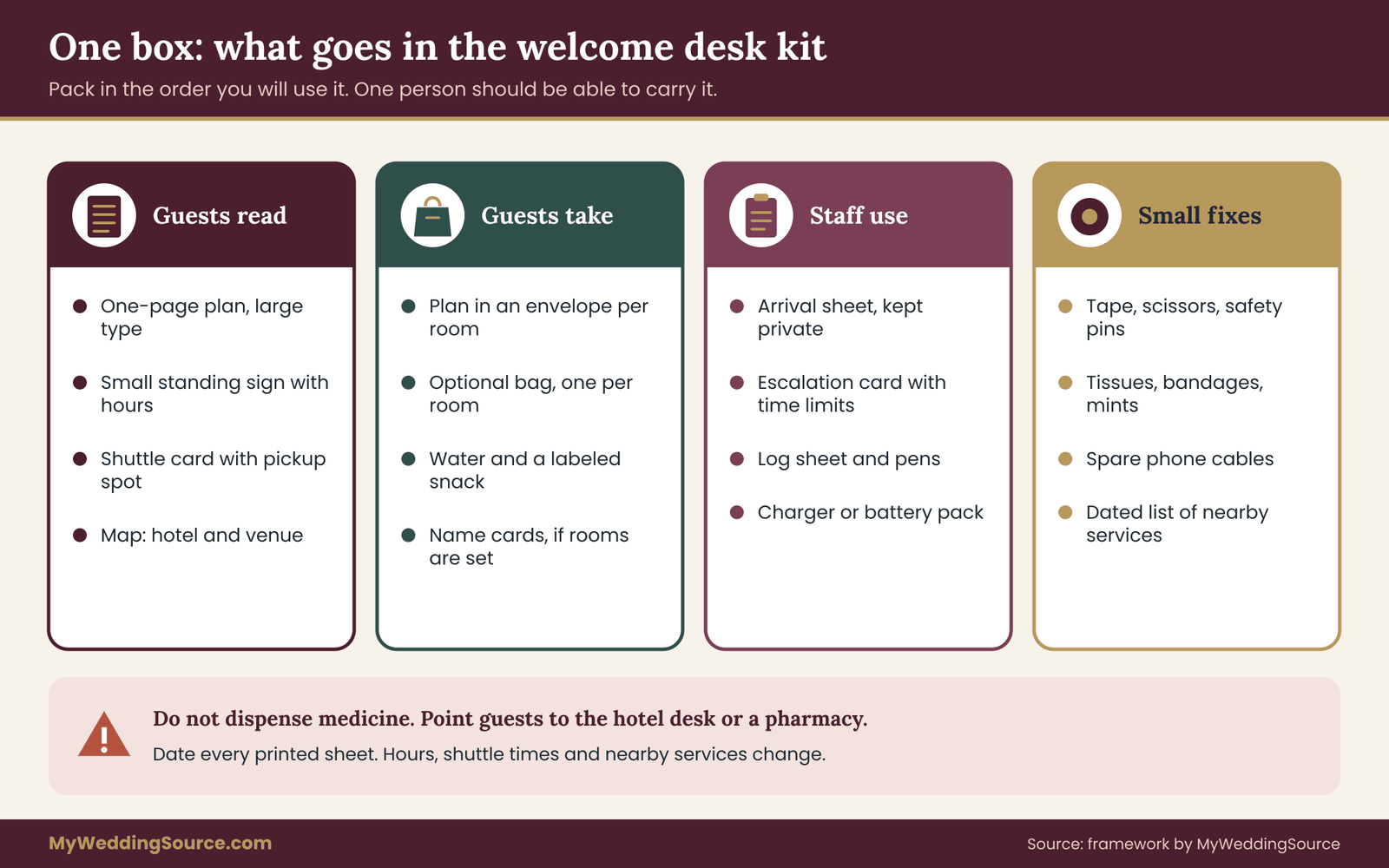
Everything a desk needs should fit in one box or one rolling bag, and one person should be able to carry it. If the kit needs a car trip and two people, it has grown too large. The goal is to arrive, open the box, and be ready in thirty minutes. Think in layers: the things people read, the things people take, the things staff use, and the things that fix small problems.
Things guests read
The one-page plan. This is the single most useful item. It lists, in plain language, the schedule for the weekend with times, locations and attire notes; the transport times and pickup spots; the hotel’s contact number and the escalation number; and a simple map or a description of how to walk from the hotel to the nearest event. Print it large enough to read in a dim lobby, and keep it to one side of one sheet. Guests who are tired do not read a booklet.
The signage. One small standing sign at the table, and perhaps a second at the shuttle pickup. The sign says what the table is for, in a few words, and lists its hours. If the hotel has allowed it, add a line for the phone number outside those hours. Accessibility matters here: use large type, high contrast and a plain typeface so that guests with low vision can read it. The guide to accessible wedding venue red flags covers many of the same signage and route issues from the venue side.
The shuttle card. If you run a shuttle, a card that shows the pickup spot, the times and a phone number for the driver or dispatcher saves a dozen questions. Check that the transport company’s own schedule is the source, and print the date of the version.
Things guests take
Welcome bags. A bag is optional. Many weddings do not need one, and some hotels discourage large deliveries to the front desk. If you do assemble them, keep them modest and useful: the one-page plan, water, a small snack, and perhaps a local item. Avoid anything that needs a power outlet, anything that could spill, and anything that creates a question about allergies. A bag that contains food should state the main allergens plainly, or leave food out. The federal foodsafety.gov pages are a reasonable source for keeping perishable items safe if you plan to put out anything that needs cooling.
Keep the count honest. One bag per room, not one bag per guest, is usually enough, and it cuts cost and carrying. Make three or four extra for late additions, and do not make forty extras because you are afraid of running short.
Name cards or envelopes. If you pre-assign rooms or tables, a name envelope with the plan inside is quick to hand over. It also helps the desk lead recognize who has been greeted.
Things staff use
The arrival sheet. A printed list of expected guests, grouped by household, with room or reservation notes where you have them, and a column to mark arrivals. This is the welcome desk’s working tool. Treat it as private: it has personal information on it, and it should not be left on the table unattended. We return to privacy below.
The escalation card. A single laminated or printed card on the table with the escalation rota: who to call for what, in order. This is the key instrument in the whole setup, and it gets a full section later.
A notebook or log sheet. For writing down every issue, who raised it, the time, who it went to and whether it is closed. A log can be as simple as lines on a sheet of paper. Its value is that volunteers on different shifts see the same history.
A phone charger and a small power strip. If the table has no outlet nearby, a charged battery pack is enough.
Things that fix small problems
A small bag of repairs and comforts covers many minor issues: pens, tape, scissors, safety pins, adhesive bandages, tissues, a few over-the-counter items that the hotel allows you to hand out, mints, a stain pen, and a few extra phone cables. Keep it small. If you carry medication of any kind, be cautious: handing out medicine to guests carries risks, and it is wiser to direct people to the hotel front desk or a nearby pharmacy than to dispense anything yourself.
Include a printed list of nearby services, such as the closest pharmacy, an urgent care center, a grocery store and a place to eat late. Verify hours before you print them, and write the date.
The one-box packing rule
Pack the box in the order it will be used. On top: the sign, the escalation card, the arrival sheet and the log. In the middle: the one-page plans and the welcome bags if any. At the bottom: the repair kit and chargers. Label the box with a name and a phone number. Photograph the packed contents so that the person who repacks at the end can restore it.
Guest information and privacy at the wedding welcome desk
A desk handles personal information whether you intend it or not: names, room numbers, travel plans, health or mobility notes, and sometimes messages about family situations. Treat that information with the same care you would give to a guest list, and a little more.
What the wedding welcome desk should know, and what it should not
The desk lead needs enough to be useful: who is expected, roughly when, and which guests have asked for help. The desk lead does not need a guest’s room number printed beside their name on a sheet that sits on a public table. Hotels themselves are careful about room numbers, and the front desk will not read one out loud. Follow the same custom: the welcome desk can confirm that a guest is expected and can call the front desk to connect them, but it should not announce room numbers.
A good practice is to split the information. The arrival sheet has names, households and notes such as “needs step-free access” or “traveling with infant.” A separate, private sheet, held by the escalation contact, has details like reservation numbers and phone numbers. The desk lead asks for what they need and does not keep it on the table.
Handling health and mobility notes
Guests may have told you about a mobility need, a dietary restriction or a medical concern when they responded. This information is sensitive and was given for a specific purpose. Use it only for that purpose. The desk lead should know that Mr. Alvarez needs a step-free route to the elevator, for example, but should not discuss why, and should not repeat it to other guests. If your guests have shared notes about accessible rooms, remember that the room itself is a hotel matter. When a question arises, rely on the hotel’s own accessibility staff and on the Americans with Disabilities Act information at ada.gov.
Do not promise a specific room type, view or feature at the welcome desk. The hotel assigns rooms, and the wedding welcome desk cannot guarantee them. If a guest asks for a change, the desk lead records the request, thanks them, and passes it to the hotel or the escalation contact.
Collecting last-minute information
The welcome desk is a good place to hear news that did not reach you earlier. A guest might mention a dietary need, a late arrival of a family member, or a change in plans. Use a simple note format in the log: guest name, what they said, the time, and the person who needs to know. Then send it to that person at the end of the window, not in the middle of a greeting.
Resist the urge to collect more data than you need. A welcome desk is not a survey point. Ask only what helps you serve the person in front of you.
What to do with the sheet afterward
The arrival sheet and the log hold personal information, and they do not need to live forever. When the weekend ends, the escalation contact collects them, records anything that must be followed up, and then shreds the paper or deletes the file. If you keep a summary, keep it without health or room details. A short retention habit is part of treating guests kindly, and it ties into the way you handle all your wedding paperwork afterward; the guide on wedding records after the event explains how to decide what to keep.
Sponsored items and gifts
If a hotel, a local business or a family member provides items for the welcome bags, such as free local products, mention the source on the plan or on a small card. Guests deserve to know whether an item was chosen for quality or supplied by someone with a stake. The Federal Trade Commission publishes guidance on disclosing material connections in endorsements, and although a wedding bag is not an advertisement in the usual sense, a plain line such as “snacks provided by the hotel” avoids any confusion. Do not put brand claims on materials, and do not suggest a product works in any particular way.
A short script for greeting and handing over
Scripts help volunteers who are not used to hosting. They should be short enough to say in a lobby and natural enough that they do not sound read.
“Welcome, you are here for the wedding. I’m Dana, and I’ll be here until five. Here’s your plan for the weekend; the shuttle leaves from that door at six-fifteen. Anything I can help with before you go up?”
That greeting does four jobs in three sentences. It confirms the guest is in the right place, introduces a person, hands over the plan with one key detail, and opens the door to a question. Volunteers can vary the words, as long as they cover the same four jobs.
Writing the escalation rota for your wedding welcome desk
An escalation rota is a short, ordered answer to the question “who handles this?” It is what lets a volunteer who has known the couple for three weeks deal with a stranger’s problem without calling the bride. Without it, every unusual question climbs straight to the couple or to the loudest relative. With it, each problem lands on the lowest person who can actually fix it.
The rota has four rungs. Write them on one card, put the card on the table, and give a copy to the hotel contact and the escalation contact.
Rung zero: the welcome desk answers. Anything that can be settled from the printed plan or the lead’s own knowledge stays at the welcome desk. Where is the shuttle? What time is the welcome gathering? Is there a nearby pharmacy? The desk lead should be able to resolve most questions here, and the one-page plan is the reason they can.
Rung one: the hotel. Anything that is the hotel’s to fix goes to the front desk or the duty manager. That includes room assignments, keys, a room that is not ready, billing disputes, housekeeping, noise, temperature, broken equipment and the hotel’s own amenities. The desk lead does not argue with the front desk on a guest’s behalf and does not promise outcomes. The lead walks the guest to the counter, or calls, introduces the issue in one sentence and lets the hotel respond.
Rung two: the escalation contact. Anything that belongs to the wedding itself goes here: the shuttle did not arrive, a vendor is missing, the schedule changed, a guest has a question about the ceremony, a guest has an unusual request, or the hotel has declined something the group had agreed. This person decides, or knows who does, and replies to the desk lead within a set time.
Rung three: the couple or the named decision-makers. Only a short list of issues reaches this rung: a major change to the weekend, a safety issue that affects many guests, a conflict between family members that needs a family decision, or news that the couple would want to hear in person. The list is agreed in advance, and everything else stays below.
Outside the ladder sit emergencies. A medical emergency, a fire alarm, a threat to safety or a crime goes to emergency services and hotel security immediately. The wedding welcome desk does not triage emergencies, and the rota card says so in plain words.

The ownership test
When a volunteer is unsure which rung applies, three questions settle most cases. Whose building is it? Whose vehicle or vendor is it? Whose decision is it?
If the building is the hotel’s, the issue goes to rung one. If the vehicle or vendor belongs to the wedding, it goes to rung two. If the decision changes the plan for the weekend or involves money the couple controls, it goes to rung two with a possible path to rung three. This test is easy to teach in a minute, and it prevents the common error of sending a hotel problem to the couple because the couple booked the block.
Time limits make the rota real
A rota without time limits is a list of names. Attach a clock to each rung.
For rung one, if the hotel has not resolved the issue within fifteen minutes, or if the guest is still waiting in the lobby, move it up to rung two. The escalation contact can phone the hotel’s group sales contact, who has more standing than the desk lead.
For rung two, the escalation contact acknowledges every message within ten minutes during the welcome desk’s windows, even if only to say “on it.” A silent contact is the main reason volunteers panic. If the contact cannot reply, a named backup does, and that backup is on the card.
For rung three, only after a rung two decision. The couple is told in a short message, with a recommended action, so they can say yes or no and go back to their day.
What a good escalation message contains
When a desk lead passes a problem up, the message should hold five facts, in this order: who is affected, where they are, what the problem is, what has been tried, and what the guest is asking for. For example:
“Aunt Ruth Mendel, in the lobby now. Her room has no step-free route to the elevator from the east wing. The front desk offered another room; she wants to know if it is on the same floor as her sister. Hotel is checking. She would like an answer within the hour.”
That message can be read in ten seconds and acted on without a follow-up question. A short template saved in the volunteer’s phone keeps the format consistent. The escalation contact replies with a decision, a name or a question, and the desk lead records the outcome in the log.
Scripts for the awkward moments
Volunteers worry more about what to say than about what to do. A few lines, kept on the card, ease that.
For a guest who wants a change the welcome desk cannot grant: “I can’t change rooms from here, but I’ll take your details and pass this to the hotel and to our coordinator right now. May I have a number to reach you?” The words avoid promising an outcome while showing that someone will act.
For a guest who is upset about something that is not the welcome desk’s fault: “I’m sorry that happened. Let me find the right person for this.” No debate, no defense, no explanation of why the hotel did it.
For a guest asking about money or an extra night: “That’s a question for the hotel directly. I’ll walk you to the front desk.” The wedding welcome desk does not discuss rates or charges.
For a question the lead cannot answer: “I don’t know, and I would rather find out than guess. Give me a few minutes.” A confident admission of ignorance is better than a wrong answer.
Keeping the rota alive during the weekend
The rota works only if people use it. Brief the hotel contact on the rungs and the names, so that when a front desk agent has a wedding-related problem, they know who to phone. Test the numbers before the first window: call each one and confirm that it rings and is answered. Check that the escalation contact’s phone is charged, silent mode is off, and a backup can cover meal breaks.
End each window with a two-minute review. The desk lead reads the log aloud to the escalation contact, and they agree on anything open. Items that are still open go on the next window’s opening list.
Special cases the wedding welcome desk should plan for
The first guests through the door will mostly have ordinary questions. A few situations deserve a plan before the weekend, because a calm response depends on having thought about them in advance.
Guests with mobility or access needs
Plan for guests who need step-free routes, more time or a quieter space. The desk lead should know which entrances and elevators are step-free, where the accessible restroom is and how far it is from the lobby, and where a guest can sit. Ask the hotel for this information before the weekend, and write it on the plan. If a guest has told you about a need, the hotel’s own team should already hold the details of the room request; the welcome desk’s role is to check on arrival, not to arrange a room on the spot.
Never promise a particular accessible feature. If a room does not match what the guest expected, the desk lead records the details and passes them to the hotel and to the escalation contact immediately. The hotel can often adjust a room assignment, and the sooner it knows the better.
Delayed or canceled travel
Flights and trains change. A guest who arrives eight hours late, or who is stranded in another city, will call or message the welcome desk. Have a simple answer ready: record the new arrival time, tell the hotel about the late check-in if the property needs notice, and update the escalation contact. The U.S. Department of Transportation’s aviation consumer protection pages explain what airlines owe passengers after delays and cancellations, and the welcome desk can point guests there instead of interpreting rules. Do not promise refunds or rebooking help beyond what you can actually provide.
For late arrivals, ask the hotel about its late check-in procedure and how a guest can get a key after the front desk’s busiest hours. That fact belongs on the plan.
Guests who do not appear on the list
Sometimes a guest arrives who is not on the arrival sheet. They may have booked under a different name, they may be a plus-one nobody recorded, or they may have the wrong hotel. Do not turn anyone away or question them in front of others. Take their name, check the list quietly, and if there is no match, call the escalation contact. The guide to RSVP etiquette covers the larger question of who was invited, but at the welcome desk the rule is simple: be kind first, sort it out second.
Children and families
Families with young children need a different set of facts: where to find a quiet space, whether the hotel offers cribs, and when the shuttle’s last return is. The guide to wedding guest care planning treats babies, children and quiet spaces in depth, and the welcome desk simply needs to hold the address of those answers on the plan.
Conflicts among guests
Weddings gather people who have history. A desk lead should never mediate a family quarrel. If two guests are in a dispute in the lobby, the lead stays neutral, gives each person space, and phones the escalation contact. If anyone feels unsafe, the lead calls hotel security without waiting.
When the weather changes the plan
If a storm, heat or road closure changes the schedule, the wedding welcome desk becomes an information hub. The desk lead should have a single source of truth, the escalation contact’s update, and should not repeat rumors. Post a short printed notice with the new time and place, with the date and hour written on it so guests can tell it is current. The hotel’s own emergency procedures come first, and the Ready.gov pages are a reasonable public reference for general preparedness.
A worked example of a wedding welcome desk for one weekend
An example makes the method concrete. The couple below is invented, and so are the numbers. They show how the pieces fit, not what your own event will need.
Priya and Marcus are marrying on a Saturday in a mid-sized city. Eighty-four guests are staying at one hotel, in forty-six rooms, under a room block. The hotel is a ten-minute drive from the venue. A shuttle runs between them on Friday evening and Saturday. The couple’s families live in three regions, so arrivals are spread over most of Friday. The welcome gathering starts at seven on Friday evening in a function room at the hotel.
Step one: three tests
Arrivals are spread across six or more hours, so test one passes. The city is unfamiliar to most guests, so test two passes. Several older relatives and one guest who uses a wheelchair are coming, so test three passes. A welcome desk is worth setting up. They choose the standard version.
Step two: the hotel conversation
Marcus’s sister Elena, who is organizing the weekend, writes to the group sales manager. She asks for a table near the lobby seating area on Friday from noon to seven, plus a short window on Saturday morning. The manager offers a table at the end of the front desk counter for Friday only, with no fee, and agrees to hold welcome bags in a back office. The hotel asks that signage stay on the table itself. Elena confirms everything in an email and forwards it to the volunteers.
Step three: the waves
Elena reviews the response cards and flight schedule. She finds that a handful of guests will land in the morning, the largest group will arrive between two and five, and almost everyone will be in the building by six-thirty. She sets four windows.
The early wave runs noon to two, with light staffing. The main wave runs two to five, with standard staffing, and a floater joins for the first fifteen minutes of a shuttle drop at half past three, when a group from the airport is expected. The pre-event wave runs five-thirty to six-thirty, with light staffing. A Saturday morning window runs eight to ten, also light.
Step four: the roster
A paid student helper, Jun, takes the early wave and the pre-event wave. Two friends of the couple, Dana and Theo, share the main wave, with Dana as lead and Theo as runner. A cousin, Sol, floats for the shuttle drop and then goes to get ready. Lena, the day-of coordinator, is the escalation contact. A second coordinator assistant is the backup for her meal break. The couple visit for ten minutes at three o’clock.
The arithmetic is simple. The early wave is one person for two and a half hours, including setup. The main wave is two people for three hours. The pre-event wave is one person for one and a half hours, including breakdown. That totals ten person-hours on Friday, plus two on Saturday morning. A continuous two-person desk from nine to six would have used eighteen person-hours on Friday alone.

Step five: the kit
Elena packs one rolling bag. It holds a standing sign, one escalation card, the arrival sheet, a log, forty-six one-page plans in envelopes with room names written on the outside, a small bag of snacks from the hotel kitchen, tape, pens, a charger and a printed list of nearby services with the date written on it. She photographs the packed bag.
Step six: what happens
At one o’clock, an early arrival finds her room is not ready. Jun explains that the hotel controls check-in, walks her to the front desk, and asks the agent about luggage storage. The matter is closed in ten minutes at rung one, and Jun records it.
At three thirty-five, the airport shuttle is twenty minutes late. A guest calls the welcome desk, worried. Dana records the message, sends the five-fact message to Lena, and Lena confirms with the transport company within eight minutes. Dana tells the guest that the vehicle is on its way and gives the new time. This is rung two.
At four, a guest arrives whose name is not on the arrival sheet. Theo takes the name quietly and phones Lena. She finds that the guest is a cousin’s plus-one added late, and the hotel has a booking under the cousin’s name. Ten minutes, rung two, no embarrassment.
At four-thirty, a guest who uses a wheelchair finds that the room’s bathroom is not what she had expected. Dana walks her to the front desk, introduces the issue, and forwards the details to Lena. The hotel offers to inspect and, if possible, change the room. The couple is not contacted. The desk lead stays with the guest until the hotel manager has taken over.
By six-thirty the log has eleven entries, nine closed and two open. Jun reads them to Lena, who carries the open items into the evening.
What the example shows
The wedding welcome desk never took a decision that belonged to the hotel or the couple, and the couple’s only job was a ten-minute greeting. The volunteers worked short shifts, and nobody sat through a quiet afternoon for the sake of looking busy. The result is not perfect; guests still had irritations, because hotels and airlines produce them. But each irritation had a clear path, and nobody had to guess.
The cost logic of a wedding welcome desk
A desk is cheap in cash and expensive in attention. Count both.
Cash costs are usually small: printing, a sign, any snacks or bags, a box, and perhaps a fee from the hotel for the table or storage. If you hire a helper, multiply the agreed hourly rate by the hours. In the example above, Jun works four hours on Friday, so the cost is four times her rate, plus any minimum the agency applies. Ask for the minimum before you agree, because a short shift can carry a longer minimum.
Attention costs are the hours your people spend and the tasks they do not do instead. A useful question is: what would this person otherwise be doing at this hour? If the answer is “getting their hair done for the wedding” or “greeting their grandparents,” the shift is too expensive. If the answer is “waiting for the next event,” it is cheap.
A practical way to decide where to spend money is to pay for the windows that clash with people’s own preparation, and to use volunteers for the windows when they would be at the hotel anyway. Many couples find that paying for two or three hours of help is a better use of the budget than a printed booklet or an elaborate bag. The wedding budget guide shows how to place a small line like this in the wider plan without letting it spread.
Where the desk can save money elsewhere
A good desk can reduce other costs, indirectly. It cuts the number of calls to the couple, which means fewer phone minutes and less stress. It reduces front desk friction, which may help your relationship with the hotel. It can shorten the time guests spend wondering about the shuttle, which may cut no-shows at the first event. These are possible benefits, not promises, and you should not build a budget on them.
What not to buy
A few purchases rarely pay back. Branded banners are one, since many hotels do not allow them. Large welcome bags are another, because the hotel may charge for storage and delivery, and guests often do not want one more thing to pack for the flight home. Elaborate printed booklets that duplicate the one-page plan are a third. If an item does not answer a question or reduce a delay, leave it out.
Verifying rules and fees for your wedding welcome desk
Because hotel policies, local rules and travel conditions change, treat every figure and every rule in this guide as a prompt to check, not as a fact. A few verification habits help.
Confirm hotel terms in writing. Fees, space, hours and storage can all change between your first call and the weekend. Reconfirm one week before and again two days before.
Check the details that affect safety. Ask the hotel about its fire and occupancy rules for the lobby, its emergency procedures and the location of its first aid supplies. The hotel’s staff will know these, and the American Hotel and Lodging Association is a useful public reference for how hotels describe their operations in general.
Check transport and travel rules with the issuing body. If guests ask about flight delays, point them to the Department of Transportation. For security screening questions, the Transportation Security Administration publishes passenger support information. Do not interpret these for guests.
Check accessibility rules with the right authority. The Americans with Disabilities Act website explains the federal framework, and the hotel’s own accessibility contact can say what a given room or route offers. Local rules may differ.
Date your printed information. Hours, shuttle times and nearby services change. Write the date on every printed sheet, and bring a fresh print for each window if anything has changed.
The limits of a wedding welcome desk
A desk cannot fix a poor hotel match, an unreliable shuttle company or a guest list that has no arrival information. It cannot guarantee a room type, a view, an early check-in, a flight connection or a refund, and it should never appear to. It also cannot replace the venue’s day-of team. If the weekend has deeper problems, such as too few rooms or inaccessible routes, the better fix is earlier in the process; the broader guide to coordinating guest hotels covers that stage.
Admit the limits to your volunteers. A desk lead who says “I can’t promise that, but I’ll pass it on right now” is acting correctly. A lead who promises something the hotel has not agreed to creates a worse problem than the original one.
A timeline for setting up your wedding welcome desk
The wedding welcome desk is a small project, and a short timeline keeps it from becoming a last-week scramble. Work backward from the arrival day. Fit these steps into the larger plan in your wedding planning checklist rather than treating them as a separate project.
Two to three months before. Decide whether the welcome desk is worth doing, using the three tests. If it is, send the hotel the permission questions and keep the reply. Pick the escalation contact early, because that person has to agree and has to be reachable.
One to two months before. Collect arrival information from guests in whatever way you already communicate with them. Draft the windows. Recruit the desk leads and runners, and decide where you will use paid help. Ask the hotel for the accessible routes, restroom locations and quiet spaces, and draft the one-page plan.
Three to four weeks before. Finalize the roster, share it with everyone on it, and tell volunteers the hours including setup and breakdown. Confirm the hotel’s storage and delivery arrangements. Send welcome bag items to the hotel if the hotel agreed, with a clear label and your name.
One week before. Reconfirm the hotel’s terms in writing. Print the plans, the sign, the shuttle cards, the arrival sheet and the escalation card. Check that every number on the card rings and is answered. Pack the box.
Two days before. Update the arrival sheet with the latest changes. Brief the hotel contact on the windows and the escalation path. Walk the lobby, if possible, and decide exactly where the table stands.
Arrival day. Set up thirty minutes before the first window. Test the phones. Read the escalation card aloud with the lead and the runner. Introduce yourselves to the front desk agent on shift, which is a small courtesy that pays back quickly.
Departure day. Decide whether a short window is useful on the last morning, to help guests with luggage and shuttle times. In many weddings, a sign and a phone number are enough.
The huddle before the first window
A fifteen-minute huddle is worth more than a long document. Cover the weekend’s schedule in one minute. Show the one-page plan. Read the escalation card, including the time limits. Practice the greeting once. Name the hotel contact. Explain the privacy rule about room numbers and health notes. Finish with the question “what are you unsure about?” and answer each doubt. Volunteers who have a chance to ask in advance will not interrupt the guests later.
Checking in with the hotel mid-weekend
A short visit to the group sales manager or the duty manager at the end of the first day builds goodwill and catches problems. Ask what the front desk heard, what the group is doing well and what to change for the next day. A hotel that feels respected will often adjust small things on request, such as holding the table spot for Saturday morning or posting a notice at the front desk.
Taking down the wedding welcome desk and closing the loop
Closing is part of the work. A desk that disappears without a word leaves the front desk with leftover bags, stray sheets and unanswered messages.
At the end of the last window, count what is left. Return unused bags and supplies to storage or to the hotel, as agreed, and note anything the hotel keeps. Remove the sign and the table items. Thank the front desk agent on duty by name.
Then close the log. The escalation contact reads through every open item and decides what remains. Some items go to the hotel, such as a billing question, and some go to the couple after the wedding, such as a thank-you for a guest who helped. The rest are marked closed. Delete or shred the arrival sheet and any copies of notes that include health or room details, as discussed earlier.
Thank the volunteers while the weekend is still happening. A short message from the couple after the wedding is good; a few words in person on the day is better. If you have promised paid help a rate, pay promptly and keep the receipt with your other vendor records.
Learning for the next event
If you are hosting more than one event, or if you are helping family members plan weddings, write three lines afterward: what worked, what did not, and what you would change. Include the actual times you saw guests arrive, since those numbers are the most useful part for next time. This is the kind of small record that belongs with the rest of your files after the wedding.
Common mistakes with a wedding welcome desk
Most problems with a hotel desk are not dramatic. They are small decisions that compound. The following patterns appear again and again, and each has a simple correction.
Staffing the day instead of the waves. The fix is to place the welcome desk only where guest arrivals cluster, and to rely on the printed plan and the phone number in between.
Putting the couple on the roster. The fix is a ten-minute greeting at a planned time and a named escalation contact who is not the couple.
Skipping the hotel conversation. A desk set up without permission may be moved or removed. The fix is a written reply from the group contact before anything is bought.
Promising what the hotel controls. Room types, views, early check-in and billing belong to the hotel. The fix is a script that records the request and passes it on.
Leaving personal information on the table. Arrival sheets with room numbers and health notes should not sit in public view. The fix is a split between the desk sheet and a private sheet.
Printing too much. Large booklets and many bags create clutter. The fix is a one-page plan and a bag per room, if a bag is used at all.
Forgetting people who arrive outside the windows. The fix is a sign with a phone number, a briefed front desk and a plan in each room.
No time limits on the rota. An escalation card with names and no clocks leads to long waits. The fix is the fifteen-minute and ten-minute rules.
Overworking the best helper. The same person ends up on every shift because they are reliable. The fix is a published roster and a hard limit on hours.
When a simpler approach is better
If your group is small, or the hotel is already excellent with wedding groups, a welcome desk may be unnecessary. A short plan in each room, a message to guests with the escalation phone number, and a standing request to the hotel to pass questions to a named contact can do most of the work. Choosing the simpler approach is not a failure of hospitality. It is a recognition that the best use of your people’s time may be at the wedding itself.
Your next steps
Start with the decision, not with supplies. Take an hour this week and do these things in order.
- Run the three tests: spread of arrivals, familiarity with the area, and guests who need extra help. Write the result in a sentence.
- Draft the permission email to the hotel’s group contact using the questions in this guide, and send it.
- List the arrival waves from your response data and the hotel’s check-in time. Name each window and set its length.
- Choose the escalation contact, and ask them directly whether they can take the role.
- Draft the one-page plan and the escalation card. Test every phone number.
- Recruit the roster, share the hours including setup and breakdown, and decide where paid help makes sense.
- Pack one box, photograph it and schedule the huddle.
If you have not yet settled the hotels themselves, go back to the broader guide on guest lodging first, and return here when rooms and dates are confirmed. If your guest list is still moving, the wedding guest list guide helps you settle who is coming before you size the welcome desk.
FAQ
Do we need a wedding welcome desk if the hotel already has a front desk?
Not always. A front desk handles check-in, keys and billing, but it will not answer questions about your shuttle, your schedule or your plans, and it cannot spend time on each guest during a busy hour. A hosted desk is worth it when arrivals are spread out, guests are unfamiliar with the area or several people need extra help. For small, simple groups, a printed plan in each room usually does the job.
How many people should staff the desk?
Staff the busiest window with two people, a lead and a runner, and use one person for quieter windows. Add a floater only for a short spike, such as a shuttle unloading at once. Estimate the work by multiplying expected arrivals in the busiest hour by the minutes each interaction takes, then test the result. Most weddings need far fewer people than couples first assume.
Does the hotel have to allow a hosted table in the lobby?
No. The lobby belongs to the hotel, and policies differ by property and by event that weekend. Ask the group sales or event contact for a specific spot, dates, hours, fees, storage and signage limits, and get the answer in writing. Many hotels agree to a small table. If they decline, a host with a clipboard and a printed plan can serve the same purpose.
Who should be the escalation contact?
Choose someone organized and reachable, who is not the couple and is not already holding a major role on the wedding day. A day-of coordinator or planner is an excellent choice, and a trusted sibling or friend can work. The person should respond within ten minutes during desk windows, have a named backup for breaks and know which decisions they may make alone.
Should we give out welcome bags?
Welcome bags are optional. If you make them, keep them small and useful: the one-page plan, water and a modest snack, labeled for allergens or left without food. Check the hotel’s rules on storage, outside food and delivery first. One bag per room is usually enough, with a few extras. Skip anything that spills, needs power or invites questions about health.
What should the desk do about guests with mobility needs?
Know the step-free routes, elevators, restrooms and seating before the weekend, and put them on the plan. The room itself is the hotel’s matter, so the welcome desk records any problem and walks the guest to the front desk instead of promising a fix. Never guarantee a particular accessible feature. For federal accessibility information, point to the Americans with Disabilities Act website, and keep health details private.
How do we handle guests whose flights are delayed or canceled?
Record the new arrival time, tell the hotel about a late check-in if it needs notice, and pass the information to the escalation contact. Do not promise rebooking or refunds. The U.S. Department of Transportation publishes aviation consumer protection information on what airlines owe passengers, and the wedding welcome desk can point guests there. Make sure the plan explains how to get a key after the front desk’s busiest hours.
What do we do with guest information after the weekend?
Collect the arrival sheet and the log, record any follow-ups, and then shred the paper or delete the file. Keep only a short summary without room numbers or health details if you need one. Guests shared that information for a specific purpose, and it should not linger. Keep payment records and any contract with a paid helper with your other vendor files.
Sources
- U.S. Department of Transportation, Aviation Consumer Protection: https://www.transportation.gov/individuals/aviation-consumer-protection
- ADA.gov, U.S. Department of Justice Americans with Disabilities Act information: https://www.ada.gov/
- Transportation Security Administration: https://www.tsa.gov/
- U.S. Department of Labor, employment and volunteer guidance: https://www.dol.gov/
- Federal Trade Commission, endorsement and disclosure guidance: https://www.ftc.gov/
- FoodSafety.gov, federal food safety information: https://www.foodsafety.gov/
- Ready.gov, preparedness information: https://www.ready.gov/
- American Hotel and Lodging Association: https://www.ahla.com/