A Chinese tea ceremony looks simple from the back of the room: the couple serves tea to their elders, the elders offer blessings, and everyone smiles. Behind that scene sits a set of decisions about who is invited to receive tea, in what order, in which seats, with what cups, and who stands where. This guide walks through those decisions and gives you a three-sheet method for making them with your families instead of for them.
Treat your Chinese tea ceremony as a small production with three written sheets: a participant roster (who receives tea, and who the family says they are), a sequence sheet (the order of service, with the rule behind every position), and a layout sheet (chairs, cushions, tea table, helpers and photographer). Each family reviews its own part, a freeze date locks the sheets, and a rehearsal with real timing replaces guesswork. When your family’s practice differs from anything written here, your family’s practice wins.
Couples tend to start the Chinese tea ceremony conversation with feelings, which is reasonable. It is a moment many people look forward to for years. The trouble is that feelings do not produce a seating plan. Somewhere between the first family dinner where the topic comes up and the morning of the wedding, somebody has to decide whether the paternal grandmother goes before or after the maternal grandparents, whether a divorced parent sits beside a new spouse, and whether the couple kneels, bows or stands. If those decisions are made late, they are made under pressure, in front of relatives who each remember the tradition a little differently.
This article is about that planning work. It is not a guide to what the tradition “should” be. Families, regions and generations carry different versions of it, and a planning article that pretends otherwise does more harm than good. What follows is a way to collect your families’ versions, resolve conflicts between them calmly, and turn the result into a service you can stage in a hotel suite, a family living room, a banquet hall corner or a garden.
A note on scope. This is general planning information, not legal, tax or financial advice, and it is not religious or cultural authority. Where a rule matters, such as the marriage license or a venue’s policy, the article points you to the office or the organization that sets it.
What Chinese tea ceremony logistics actually cover
When people say “the Chinese tea ceremony,” they usually mean the moment of serving tea. The logistics are everything that has to be true for that moment to go smoothly. It helps to split them into six jobs, because each job has a different owner.
The roster. Who is invited to receive tea? This is a family question, and it is almost never answered by the couple alone.
The sequence. In what order are people served, and in what groupings: pairs, singles, whole households? This is also a family question, with a tradition-based logic that varies.
The layout. Where do the elders sit, where does the couple kneel or stand, where does the tea table go, and where do helpers and the photographer stand? This one belongs to you and the venue.
The tea service. Which tea, what goes in it, how many cups, how hot, on what trays? This belongs to you, with your families’ preferences and any allergies in mind.
The gifts. Red envelopes, jewelry and other gifts often change hands during a Chinese tea ceremony. Someone needs to hold them, record them and keep them safe. This belongs to a named helper.
The timing and the place. When in the day does the Chinese tea ceremony happen, how long does it run, and where? This belongs to you and your wedding timeline, and it has to fit with the venue and the photographer.
Notice what is not on the list: the meaning of the ritual, the correct way to do it, or the historical origin of any custom. Those matter, but they are not logistics, and they are not something this article can settle for your family. For anything specific to your families, ask your families.
A Chinese tea ceremony is a family event first and a ceremony second
Most wedding rituals are staged for guests. The Chinese tea ceremony, in many families, is staged for the relatives who are in it. It is often held in a smaller setting than the main ceremony, sometimes at home or in a hotel suite, sometimes with only close family present. That changes the planning in two ways.
First, the audience is also the cast. The people receiving tea are the same people who will judge whether it was done properly, and they care about it more than any vendor or guest will. Their comfort and their sense of being honored matter more than the photographs.
Second, the stakes are relational. A wrong order or a forgotten relative can sting for years. A calm, written, family-reviewed plan is the best protection against that.
What this guide does not decide for you
Several questions that look like logistics are really questions of family authority, and no article should answer them. For a Chinese tea ceremony, whether a particular relative is served, whether a late relative is honored with a photograph or a cup, whether siblings serve the couple or the couple serves siblings, whether the couple kneels, whether the ceremony is held before or after the main wedding: these are yours to decide with your families. Later sections give you ways to ask and ways to record the answers. They do not give you the answers.
One tradition, many family versions: the validation rule
The phrase “Chinese tea ceremony” covers a wide range of practice. Families whose roots are in different regions, dialect groups and generations often describe different orders, different words, different gifts and different postures. Families in the diaspora may have blended their parents’ practice with local habits, or dropped parts and kept others. A couple where one partner is Chinese and the other is not may be building a version that has never existed before, and that is perfectly legitimate.
Because of that range, this guide uses one rule above all others, and it is worth stating plainly.
The validation rule: no element of your Chinese tea ceremony goes onto the final sheets until someone from the family that owns that element has confirmed it.
An “element” is any choice that could be done differently: who is served, in what order, in what posture, with what tea, with what gift. The “family that owns it” is the family whose relatives are involved. The person who confirms it is a family elder or that elder’s chosen delegate, not the couple’s best guess and not an article.
Why you cannot validate by internet search
Searching for “how to do a Chinese tea ceremony” will give you plenty of descriptions. Some descriptions of the Chinese tea ceremony are written by people who grew up with the ritual, some by wedding businesses and some by people who have never attended one. Even good descriptions describe one family’s practice, which may not be yours. They are useful for forming questions. They are not useful for answering them.
It also helps to remember that the person writing a description may be summarizing a region’s most visible customs, not the quiet variations of a particular household. When your grandmother says “that is not how we do it,” she is not wrong because a website disagrees with her.
Who counts as a validator
Each family needs one validator. This is the person whose word on the ritual the rest of the family respects. In many families that is the eldest relative present, but not always. Sometimes it is a parent who has organized family ceremonies before, an aunt who is the keeper of family customs, or a relative who is the family’s usual master of ceremonies at weddings and funerals.
Find the validator by asking a neutral question: “If we wanted to make sure we did the tea ceremony the way our family would expect, who should we ask?” The answer is often a surprise to the couple and a relief to the family.
If one family is not Chinese, or does not follow the custom, they still need a validator, even if the role is small. Their questions about the Chinese tea ceremony are different: are they comfortable being served tea, is there any custom of their own they would like to include, and what would they like to be called during the ceremony? A non-Chinese family that is asked in advance usually responds with warmth. A family that is surprised on the day may feel put on the spot.
When two families disagree
Disagreement between families is common and rarely means anyone is being difficult. One family may serve the groom’s side first, the other the bride’s. One may expect kneeling, the other standing. One may expect the couple to serve each elder pair together, the other expects each partner to serve their own relatives. These are all real family customs.
The sequence section later in this guide offers a tie-break ladder for exactly this situation. Its core idea is that you put the disagreement in front of both validators, in the same conversation, with the options written down, and you ask them to choose or to combine. Do not carry messages between families one at a time. A message passed through the couple loses nuance, and the couple ends up looking like the author of a decision they were only reporting.
A short script for asking a family elder
Many couples find the first conversation the hardest, because they do not want to sound like they are examining their own elders. A plain, warm request works better than a clever one.
“We would like to do the tea ceremony in a way that feels right to our family. Could you tell us who should be served, in what order, and anything we should know before we plan the room?”
Write down what you hear, in the elder’s words, not your summary. If the answer is “ask your aunt,” ask the aunt. If the answer is “do whatever you like,” that is also an answer, and you can say so in the roster: “family leaves this to the couple.”

The three-sheet method for a Chinese tea ceremony
The core of this guide is a method that turns conversations into documents. It uses three sheets, a pair of sign-off rounds and a freeze date. It is deliberately plain. The only tools you need are a shared document or spreadsheet and a way to print.
Sheet one is the roster. One line per person who might receive tea, with columns that capture who the person is to each of you, how they are addressed, what the validator says about their position, any practical needs such as mobility or hearing, and whether a gift is expected to be given.
Sheet two is the sequence. A numbered list of servings, with each serving described as a person or a pair, the reason for its position, who calls the names, and a time estimate.
Sheet three is the layout. A simple top-down drawing of the service area, with chairs, cushions, the tea table, the gift keeper’s position, the photographer’s lane and the path elders take to their seats.
Each sheet in the Chinese tea ceremony plan has an owner on your side, a validator on each family’s side, and a status: draft, reviewed, or frozen. The sections that follow explain each sheet in detail. For now, the point is that every decision lives on a sheet, and every sheet has a date by which it stops changing.
Why a freeze date matters
Without a freeze date, the plan for your Chinese tea ceremony changes until the first cup is poured. A relative adds a cousin, an aunt remembers a custom, the venue moves the room. Every late change reaches the helpers, the photographer and the elders as a surprise.
A freeze date, typically two to three weeks before the wedding, gives everyone a clear message: after this date, changes go through one named person, and only for good reasons. That protects the elders from confusion and protects you from last-minute reworking. Chosen well, it also leaves time for a printed run-of-show and a rehearsal.
Who runs the sheets
Choose one person on your side to be the sheet owner. It may be you, your partner, a sibling, a friend or a planner. This person does not decide the content; they keep the sheets, send the drafts to validators and track who has confirmed what. If you are working with a coordinator, the sheets slot into the run-of-show described in the guide to ceremony cue sheets. If you are not, a single shared document is enough.
Building the Chinese tea ceremony participant roster
The roster is the first sheet of a Chinese tea ceremony plan and the one that causes the most feeling, so it deserves the most care. Its job is to answer one question for every person: will this person receive tea, give tea, witness, or none of these, and what does the family say about that?
Start with a long list and let the validators trim it
Begin by listing every relative you might conceivably include, across both families, without filtering. Parents, step-parents, grandparents, great-grandparents, aunts and uncles on each side, older siblings and cousins, godparents, family friends who are treated as relatives, and any relative who has died but whom the family wants to remember. A long list at this stage costs nothing. A short list that omits someone costs a conversation later.
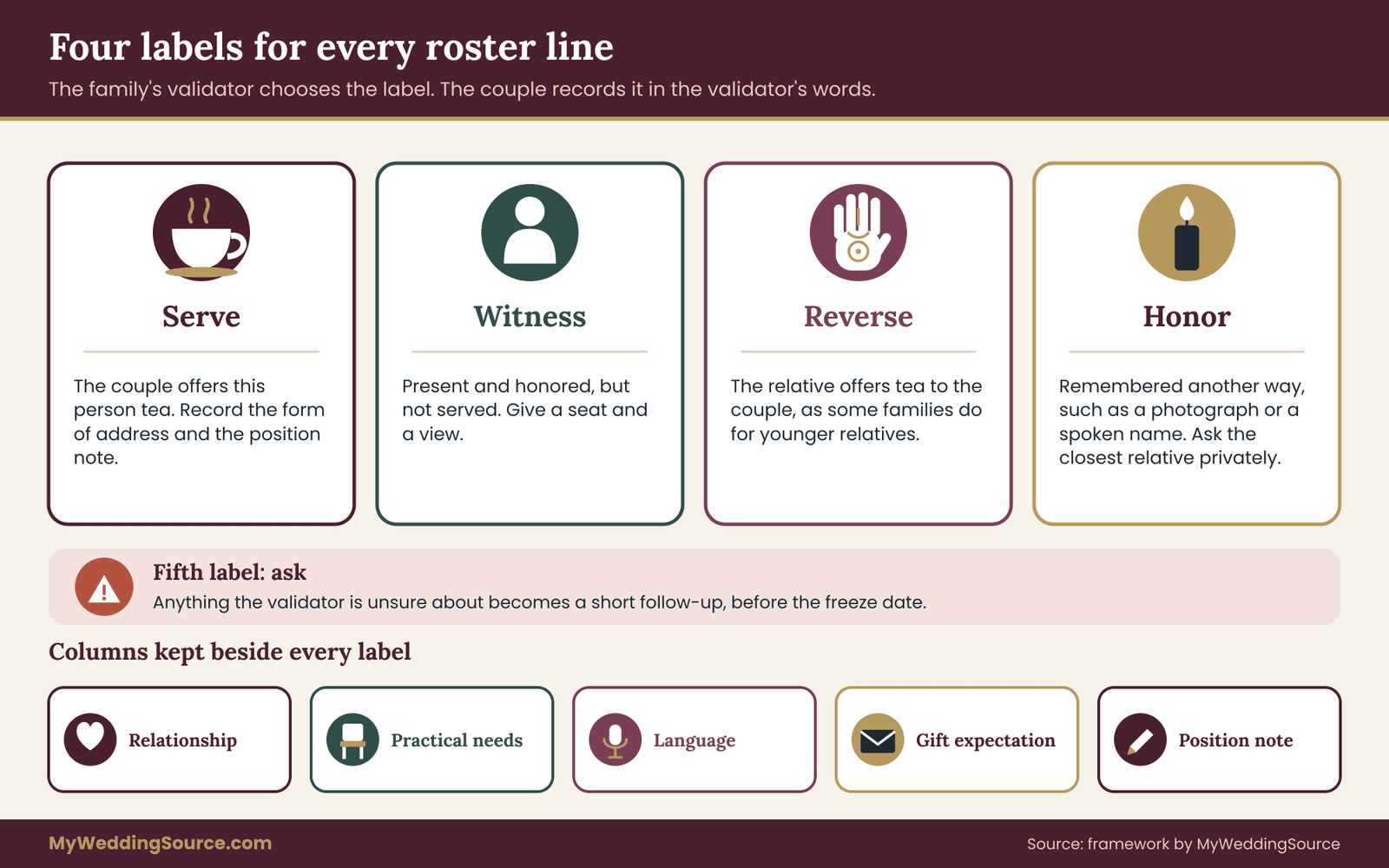
Then give the list to each family’s validator and ask them to mark each name with one of four labels: serve, meaning the couple offers this person tea; witness, meaning present but not served; reverse, meaning the relative offers tea to the couple, as some families do for younger relatives; or honor, meaning the person is remembered in some other way. Leave a fifth label, ask, for names the validator is unsure about. The ask names become a short follow-up conversation.
The columns that matter
Keep the roster narrow enough that people will actually read it. These columns cover nearly every case.
Name and how the couple addresses the person. For a Chinese tea ceremony, many families have specific forms of address for relatives, depending on side, generation and relationship. Record the form the family uses, spelled the way the family spells it. Do not substitute a translation of your own. If you do not know the form, ask. People are usually pleased to be asked.
Relationship to each partner. Write it plainly: father’s elder brother, mother’s mother, and so on. This is the information the validator uses to place the person.
Validator’s label. Serve, witness, reverse, honor or ask.
Position note. Anything the validator says about order, in their words: “after the grandparents,” “together with her husband,” “last, because he is the youngest of that generation.”
Practical needs. Mobility, hearing, vision, language, medications, dietary limits, how long the person can sit or stand. These are not an afterthought. They shape the layout, the pace and the seating.
Gift expectation. Whether the person is expected to give a gift, receive one, or neither, and who will hold it. The gifts section covers this in detail.
Language for the moment. Which language the person is most comfortable hearing during the Chinese tea ceremony. If the elder is most comfortable in a particular dialect, a helper who speaks it makes an enormous difference.
Edge cases the roster has to handle
Every real family planning a Chinese tea ceremony has at least one of these. Naming them early prevents a scramble.
Divorced or separated parents. Do both parents receive tea? Together or separately? Each with a new partner? There is no universal answer, and the couple should not guess. Ask each parent privately what they would be comfortable with, then ask the validators what the family’s practice would suggest. Where the answers conflict, a common compromise is to serve the parents at separate points in the sequence, so nobody has to sit side by side. The couple makes the final call, with the parents informed in advance.
Step-parents. Whether a step-parent is served as an elder, as a guest of honor or not at all depends on the relationship and the family. For many couples, a step-parent who raised them is treated exactly like a parent. Ask the step-parent too. Some prefer not to be put forward.
A deceased parent or grandparent. Families handle this differently. Some leave a place for the person, some place a photograph, some mention the person in the opening words, and some choose silence. This is a family decision and a sensitive one. Ask the surviving family member who is most closely connected, in private, and offer options rather than a single plan.
A relative who cannot attend. A relative may be abroad, ill or unable to travel. Some couples arrange a video call at a planned point in the sequence, some serve a representative, some hold a small separate moment later. Let the validator and the relative choose. Test the technology beforehand if a call is planned.
A relative who disapproves of the marriage. This is hard, and no logistics sheet fixes it. If the relative will attend and be served, the plan should not rely on their goodwill: place them where the sequence still works if they decline, and keep the moment short and gracious. If the relative will not attend, record it without commentary and move on.
A partner whose family does not know the custom. Explain the custom briefly and early, offer to serve them tea, and ask whether they would like any part of their own family’s customs included. The pillar guide on planning an interfaith wedding ceremony covers how to hold two sets of traditions in one program, and its ritual-ownership approach applies neatly here.
A very large family. Some families cannot reasonably serve every relative one by one. Validators may suggest serving only the senior members of each branch, or serving households together. A large roster also changes the time estimate, which the sequence section will address.
Where the roster is stored and who sees it
The roster contains family details and sometimes health details. Keep it in a shared document with limited access: the couple, the sheet owner and the validators. Do not send the whole roster to every relative. Each validator needs to see their own family’s section and the sequence, not the other family’s practical needs. If a coordinator or photographer needs names, give them a trimmed copy with names, relationships and seat positions only.
Roster review round
Once the Chinese tea ceremony roster has a validator label on every line, you hold the first sign-off round. Send each validator their own family’s section. Ask for three things in writing: a confirmation that the names and relationships are right, a confirmation of the labels, and a list of anyone who is missing. The reply can be a message, a phone call you write up yourself, or a note on a printout. The point is that the person who owns the practice has seen the line and agreed to it.
When a validator is not comfortable writing, a phone call works. Summarize what you heard in two sentences afterward, and send it back: “Here is what I understood. Is that right?” A summary that is confirmed counts as a confirmation.
A note on numbers and names
Names deserve care. If a relative’s name is written in Chinese characters, ask the family how it should appear on any printed material and who will check it. A printed program with a misspelled or wrongly rendered name reads as carelessness, even though it is only a typo. Ask a family member fluent in the script to proofread it, and ask the printer how they handle non-Latin characters. The guide to invitation print production covers proofing in general.
Sequence: the order in which a Chinese tea ceremony is served
The second sheet is the sequence. It converts a roster into an order and a time budget. The order should be driven by the family’s rules, not by what looks tidy.
The common logic, held loosely
In many versions of the Chinese tea ceremony, the order follows seniority. Older generations are served before younger ones, and within a generation, relatives are often arranged by age or by the closeness of their relationship. Families also differ on which side comes first, on whether a pair is served together, and on whether the couple serves each side in turn or alternates between them.
Treat all of that as a pattern you can ask about, not a rule you can assume. A good planning habit is to start from the pattern, write it as a proposal, and ask the validator: “Here is the order we think your family would expect. What would you change?” Corrections come easily when there is something concrete to correct.
The tie-break ladder
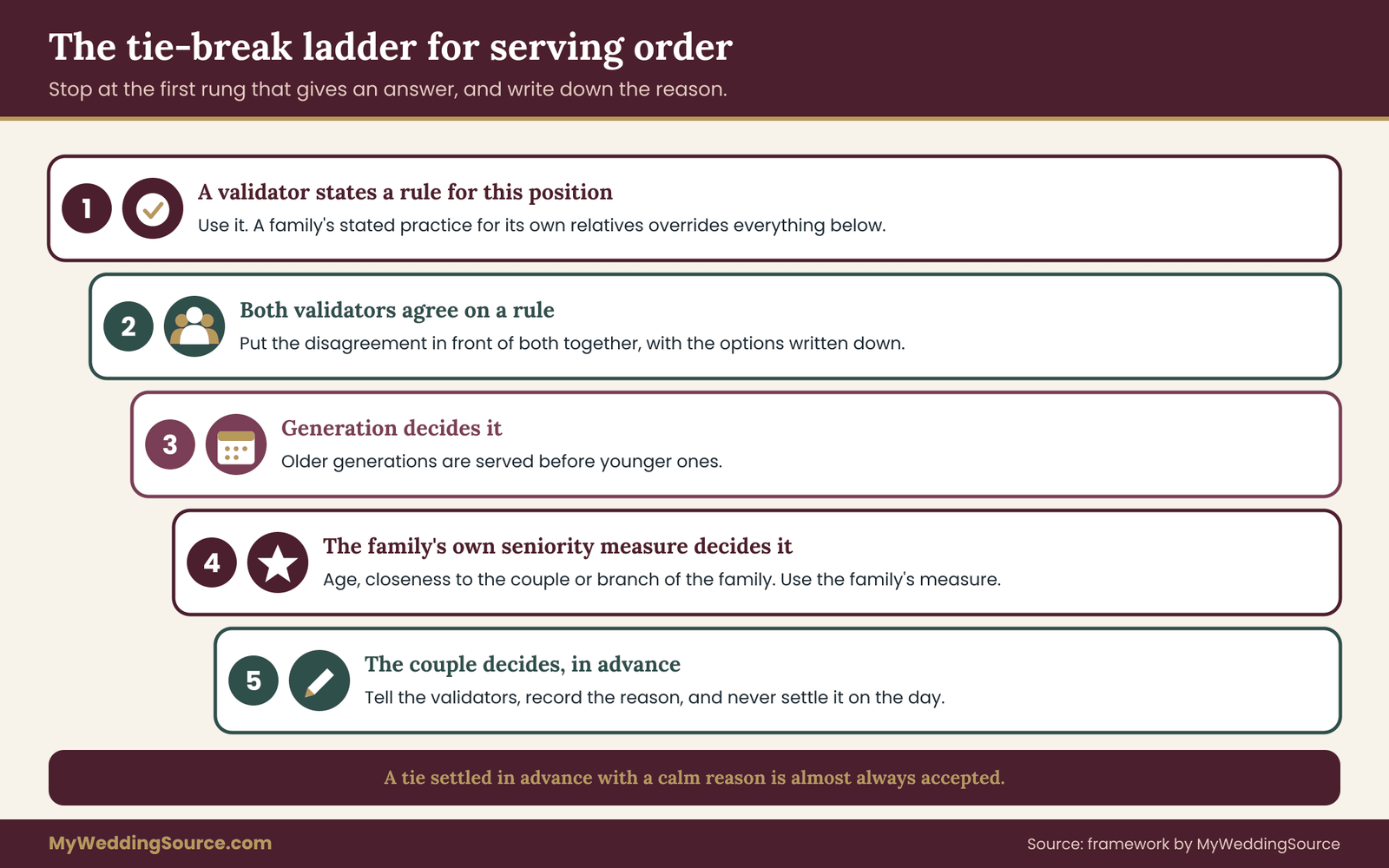
When rules conflict or run out, you need a way to decide that is fair, written down, and not dependent on the loudest voice. The tie-break ladder is a short list of questions asked in a fixed order. You stop at the first rung that gives an answer.
Rung one: does a validator state a rule for this position? If yes, use it. A family’s stated practice for its own relatives overrides everything below.
Rung two: do both validators agree on a rule? If two families have different practices for a shared moment, such as which side goes first, ask them together. If they agree on a combination, use it.
Rung three: does generation decide it? Older generations before younger ones.
Rung four: within a generation, does the family’s own measure of seniority decide it? Some families rank by age, some by the relationship’s closeness to the couple, some by the branch of the family. Use the family’s measure, and write it in the sequence note.
Rung five: still tied? The couple decides, tells the validators in advance, and records the reason. Do not leave this rung to be decided on the day. A tie that is settled in advance with a calm explanation is almost always accepted. A tie that is settled on the spot looks like favoritism.
Pairs, singles and households
A pair of elders is often served together, with two cups on the tray and the couple addressing both. That works well when the pair is a married couple. It becomes awkward when the pair is a divorced couple, when one of the two has died, or when a person comes with a new partner the family has not met.
Decide per case, and write it on the sequence sheet. A few cases to settle in advance: whether a widowed grandparent is served alone, whether a remarried parent is served with a new spouse, and whether a household with several adults is served together or one by one. When a relative is served alone, the couple still brings the same warmth and time to the moment as they would for a pair.
Estimating the time
Time is what turns a lovely Chinese tea ceremony plan into a wedding-day problem. Estimate it honestly.
A planning assumption, which you should replace with measurements from your rehearsal: each serving, including seating the elder, pouring, the offering, the blessing or exchange of words, the gift and the photograph, takes somewhere between two and four minutes. Multiply by the number of servings. Add a few minutes at the start for introductions and a few at the end for family photographs. If your roster has ten servings, the Chinese tea ceremony is likely to run closer to forty minutes than to fifteen.
That estimate has a lot of consequences. It tells you how long elders will sit, how long the couple will be on their feet or knees, whether the schedule can absorb it between the main ceremony and the reception, and how much tea you will need. It is also the basis for deciding whether some servings should be grouped. A planner’s trick, when time is tight, is to serve a whole household together and give the pair-by-pair attention to the senior elders.
Who calls the names
Someone should call each serving, so the couple is not trying to remember the order while holding a tray. Choose a trusted relative or friend who is comfortable speaking in front of the family, knows the names and forms of address, and can pronounce them. This role is sometimes filled by an aunt or uncle, sometimes by a bridesmaid or groomsman, sometimes by a hired master of ceremonies who has been briefed.
Give the caller a printed sequence with names spelled phonetically where needed, the form of address the family uses, and a short cue for each serving. The caller is also the person who keeps time and, discreetly, tells the couple to speed up if the room is running behind.
Chinese tea ceremony seating and tea-service layout
The third sheet of the Chinese tea ceremony plan is a drawing. It does not need to be beautiful. It needs to show where every person and object goes, so that a helper who has never seen the room can set it up, and so that the venue can confirm it is allowed.
What the layout has to answer
Before you draw anything, answer these questions in words.
Where do the elders sit, and how do they get there? Elders are usually seated, often in a row or in pairs, facing the couple. The path from the entrance to the chairs should be clear, step-free if possible, and short. A grandparent who has to cross a room on a cane in front of forty people is not enjoying the honor.
What does the couple do? Kneel on cushions, stand, bow, sit on low stools, or stand in front of the chairs. This is a family and personal decision. Kneeling is physically demanding in formal clothing and can be impossible for some people, so the layout should have a plan for whatever is chosen, including a fallback.
Where does the tea come from? A tea table or a tray station, close to the couple but out of the sight line of the photographer, with a helper to refill and hand over cups.
Where do the gifts go? A named helper stands close enough to receive envelopes or boxes quickly and a discreet bag or box holds them.
Where do relatives who are not being served stand or sit? Witnesses need a place that lets them see without crowding the elders or blocking the photographer.
Where does the photographer stand? The photographer needs a lane to capture the couple, the elder and the exchange, without walking through the service area. The guide to photography consent is useful if some elders do not want to be photographed, which is a real and respectable request.
Three common shapes for the service area
Most Chinese tea ceremony layouts fall into one of three shapes. Each has strengths, and the room often decides.
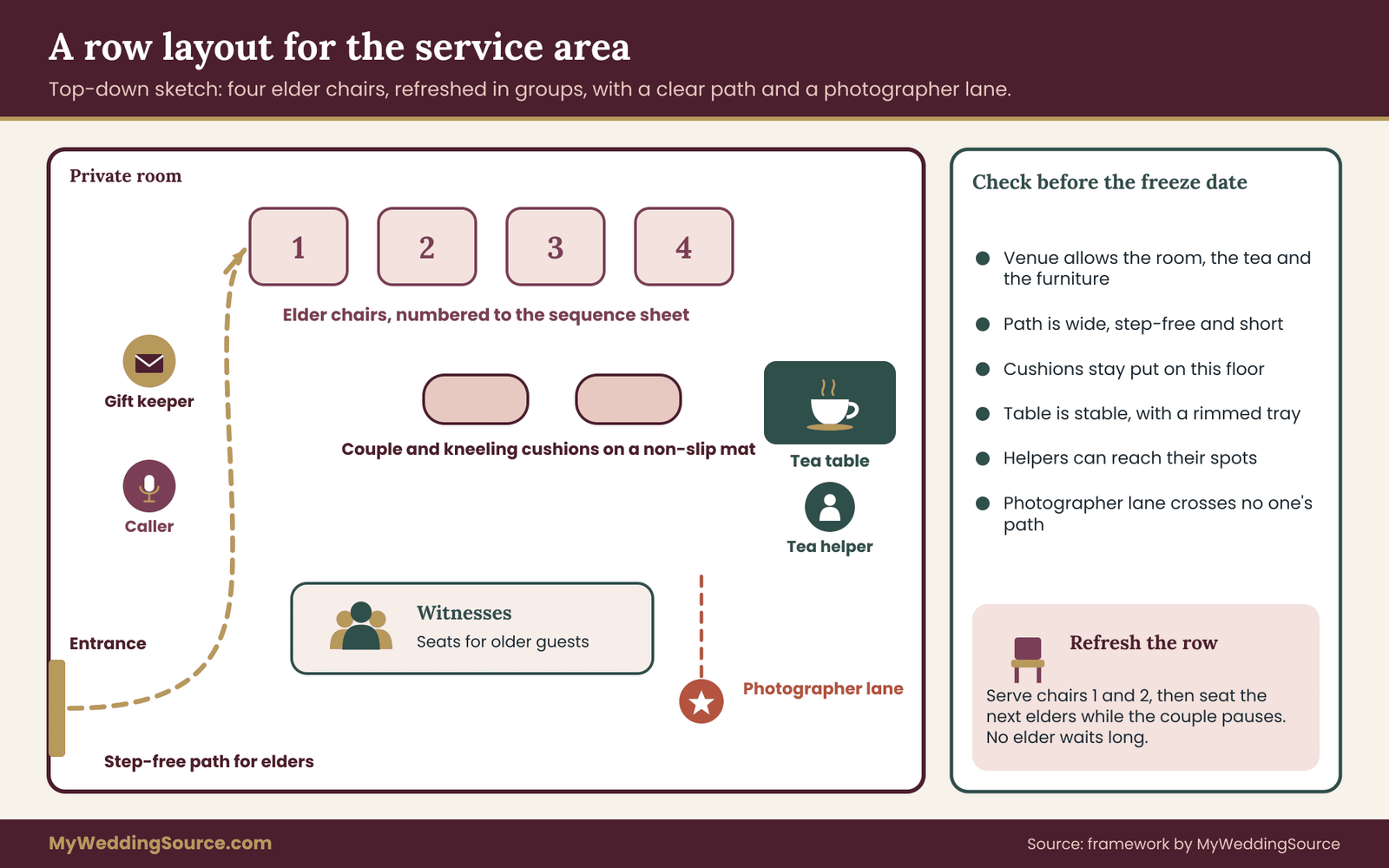
The row. Chairs for the elders sit in a line, with the couple moving along the line one pair at a time. This shape is easy to build, easy to photograph, and keeps every elder visible. Its weakness is that elders at the end of the line may wait a long time, and the couple does a lot of walking in formal clothing. A short row of four to six chairs, refreshed with the next elders after each group, works better than one long row.
The stage. Elders are brought forward one pair at a time to a pair of chairs, and the couple stays in one spot. This shape reduces the couple’s movement and puts all the attention on the current pair. Its weakness is that elders move instead of the couple, and anyone with limited mobility has to be helped to the chairs. If your elders are comfortable moving, this is a graceful shape. If they are not, avoid it.
The circle. Elders and witnesses sit around a small open area, and the couple moves around the inside. This is intimate and works well in a living room or a hotel suite, but it shrinks quickly as the roster grows, and photographers have fewer angles.
Pick the shape that suits the number of servings and the mobility of your elders. If the roster is long and elders are frail, the row, refreshed in small groups, is a safe default.
Chairs, cushions and floor
Chairs for elders at a Chinese tea ceremony should be stable, with arms if possible, and set at a height that lets an older person sit and stand without a struggle. A pair of chairs, side by side with a small table between them, is common. If the venue’s chairs are folding chairs or banquet chairs, check that they are steady and that the floor is not slippery.
If the couple will kneel, they need cushions or kneeling pads that stay put on the floor. Thin cushions slide on polished floors and compress on hard ones. Test them. If the couple’s clothing has a long skirt or a train, the layout needs space for it, and a helper to arrange it. A dress with a heavy skirt, and a groom in formal shoes, can find kneeling harder than expected.
A simple fallback, and a kind one, is to offer elders and the couple the choice at the time: kneel or stand. Ask the family in advance whether this is acceptable. Some elders will insist on the traditional posture, and the couple should be ready.
A table for tea, not a crowd
The tea table is where the working part of the Chinese tea ceremony lives. It holds the teapot or kettle, the cups, a tray, napkins, a small towel, a spare tray and a waste container for used tea. It should be near the couple, stable, and protected, because tea spills. A table covering that does not slip, a tray with a rim, and a small mat for the kettle help.
Keep the table small and tidy. Elders will see it, and a crowded table with open water bottles and cables looks careless. If the venue has outlets, a hidden electric kettle or insulated flask keeps the tea warm. Do not use open flame. Many venues prohibit it, and it adds risk around fabric.
Drawing the layout
A layout drawing can be a pencil sketch. What matters is the content. Draw the room’s walls and doors, then mark:
- The path elders take from the entrance to their seats.
- The chairs, numbered to match the sequence sheet.
- The couple’s position and the cushion spots.
- The tea table, the helper for tea, and the gift keeper.
- The caller’s position, with a view of the whole area.
- The photographer’s lane and any videographer’s position.
- The witnesses’ seating or standing area.
- Any hazards: steps, cables, a threshold, a heater.
Then take the drawing to the venue and ask three questions: is the arrangement allowed, who sets up and clears the furniture, and what time can you have access to the room? The venue’s coordinator may spot problems you did not, such as fire exit clearances or a door that does not stay open. The guide to venue technical walkthroughs explains how to take measurements and confirm access, and the same habits work here.
Seating the witnesses and the rest of the family
The people who are not being served still have a role. They witness, they photograph, they translate, they help. Give them places, so they are not drifting through the service area. A few chairs for older witnesses and a standing area for younger ones near the back or sides work well.
If children are present, give them a place and a role, such as carrying the tea tray to the table or handing out napkins, with an adult close by. Children who are engaged are quieter than children who are told to sit still. Be realistic: tea is hot, and children and hot tea should not be mixed unsupervised.
The tea, the cups and the trays for a Chinese tea ceremony
The tea itself is the smallest part of Chinese tea ceremony planning and the easiest to get wrong, because small details multiply across many servings.
Choosing the tea
Many families have a preference for what is served at a Chinese tea ceremony. Some serve a sweet tea with added ingredients such as dried red dates, lotus seeds or longan, which are often chosen for the associations families give them. Others serve a plain tea, such as a well-known black or green tea. Some use a particular tea that has meaning for the family. Ask the validators, and record the answer, including any ingredients.
If the tea contains seeds, nuts or other ingredients, check for allergies before you commit. Lotus seeds and similar ingredients are plant foods, and allergies to seeds and nuts do exist. Ask each person on the roster about food allergies as part of the practical-needs column, and ask the person preparing the tea to list every ingredient. The Food Allergy Research and Education organization is a reliable reference for what to ask, and the sources list at the end of this guide points to it.
Think about temperature. Tea for an elder should be warm enough to taste but cool enough to sip at once. A cup that is too hot is a burn risk and makes the moment awkward, because the elder either wastes the moment waiting or risks a scald. Many couples pour tea a little cooler than they would for themselves and keep a reserve in a flask.
How much tea and how many cups
Count the cups from the roster, not from a hunch. For each serving, there is one cup per person receiving tea, and sometimes a second cup in case of a spill or a request for a refill. For a roster of ten servings with several pairs, that is likely to be fifteen to twenty cups in use, plus spares.
Decide whether cups are single-use or washed and reused. Reusing cups between servings means someone has to rinse and refill them, and that person needs a place and a few minutes. Using a cup per person avoids the washing but uses many cups. Neither is wrong. What matters is that the plan accounts for it.
Whichever route you choose, label spare cups and keep them out of sight, so a spill at serving six does not stall the whole Chinese tea ceremony.
Trays, pots and the handoff
A tray carries the cups to the elders. A tray with a non-slip surface and a raised edge is safer than a flat one, and a small tray holds fewer cups, which suits pairs. Practice carrying a loaded tray in the clothing the couple will wear, over the floor of the room, with the real cups. Long sleeves, a narrow skirt or a wedding dress with a full skirt all change how a tray moves.
Decide who pours. In some families the couple pours each cup in front of the elder. In others, a helper fills the cups in advance and the couple presents them. A helper who stands at the tea table, refills a pot and hands over the next tray means the couple never walks away from the elders to fetch anything. Name the helper, give them the sequence, and have them rehearse the handoff.
Keep a small supply bag out of view with napkins, a towel, a roll of paper towels, tissues, a spare pot, a stain remover and a small first-aid item for burns. It will not be used most of the time, and it is the first thing everyone wants when it is.
What the couple wears and carries
The clothing question is partly cultural and partly practical. Some couples change into traditional clothing for the tea ceremony. Others wear their wedding clothes. Either way, think about how the clothing behaves during a Chinese tea ceremony: can the bride kneel, does the groom’s jacket restrict reaching, are the shoes steady, and can both hold a tray without catching a sleeve?
If an outfit change is planned, it affects the timeline, the dressing room, the hair and makeup schedule and the photographer’s plan. Put it on the timeline in the next section.
Gifts, red envelopes and a keeper for them
Gifts are common in many versions of the Chinese tea ceremony. Elders may give the couple red envelopes, jewelry or other presents, and the couple may give gifts to younger relatives. The details differ by family and region, and the logistics are the same regardless: someone has to hold, record and protect what changes hands.
Why you need a named gift keeper
A tray of tea in one hand and a handful of envelopes in the other is a poor combination. During the Chinese tea ceremony the couple should not be stuffing envelopes into pockets. A gift keeper, standing close, receives each gift, notes who gave it, and puts it into a bag or box that stays with them.
Choose someone trustworthy, calm and not in the middle of another job. This is not the best role for a bridesmaid who is also the caller. A parent or an organized friend works well. Give them a small notebook or a note on a phone, and ask them to record the giver and, if the family agrees, a short description. Jewelry in particular should be recorded and stored somewhere secure the same day.
Recording without making it awkward
Some families would find it odd to see a record of gifts. The recording is for the couple, for thank-you notes and for safety, not for display. A discreet approach: the gift keeper takes the gift, nods to the giver, and writes the name later at the table. If a family prefers not to be recorded in any way, the couple can reconstruct the list afterward from memory and photographs.
Where cash is involved, the sums are the family’s business. Do not publish or compare them, and do not discuss amounts with other families. A gift is a gesture, not a bid.
Giving gifts to younger relatives
In many families the couple also gives small gifts, often red envelopes, to relatives younger than themselves, or to those who serve them tea. If your family follows this, prepare envelopes ahead of time with a name on each one, or a clear count, and give them to the keeper. Decide in advance who receives and in what amount, and agree it with your partner. Running short of envelopes in front of the family is easy to avoid.
Safe storage for valuables
Jewelry, cash and small boxes should not be left on a chair or a table. Arrange for the gift keeper to hand them to a named person with a locked car, a hotel safe or a secure room at the end of the ceremony. Write down who has them. Keep the gift list with your other post-wedding papers, so thank-you notes and any insurance questions are easy to handle later.
Where the Chinese tea ceremony fits in the wedding day
Few decisions shape the logistics of a Chinese tea ceremony more than its place in the day. The same Chinese tea ceremony is easy at one time and hard at another.
The common placements
Families place the tea ceremony in different spots, and couples often choose based on family custom, venue and energy.
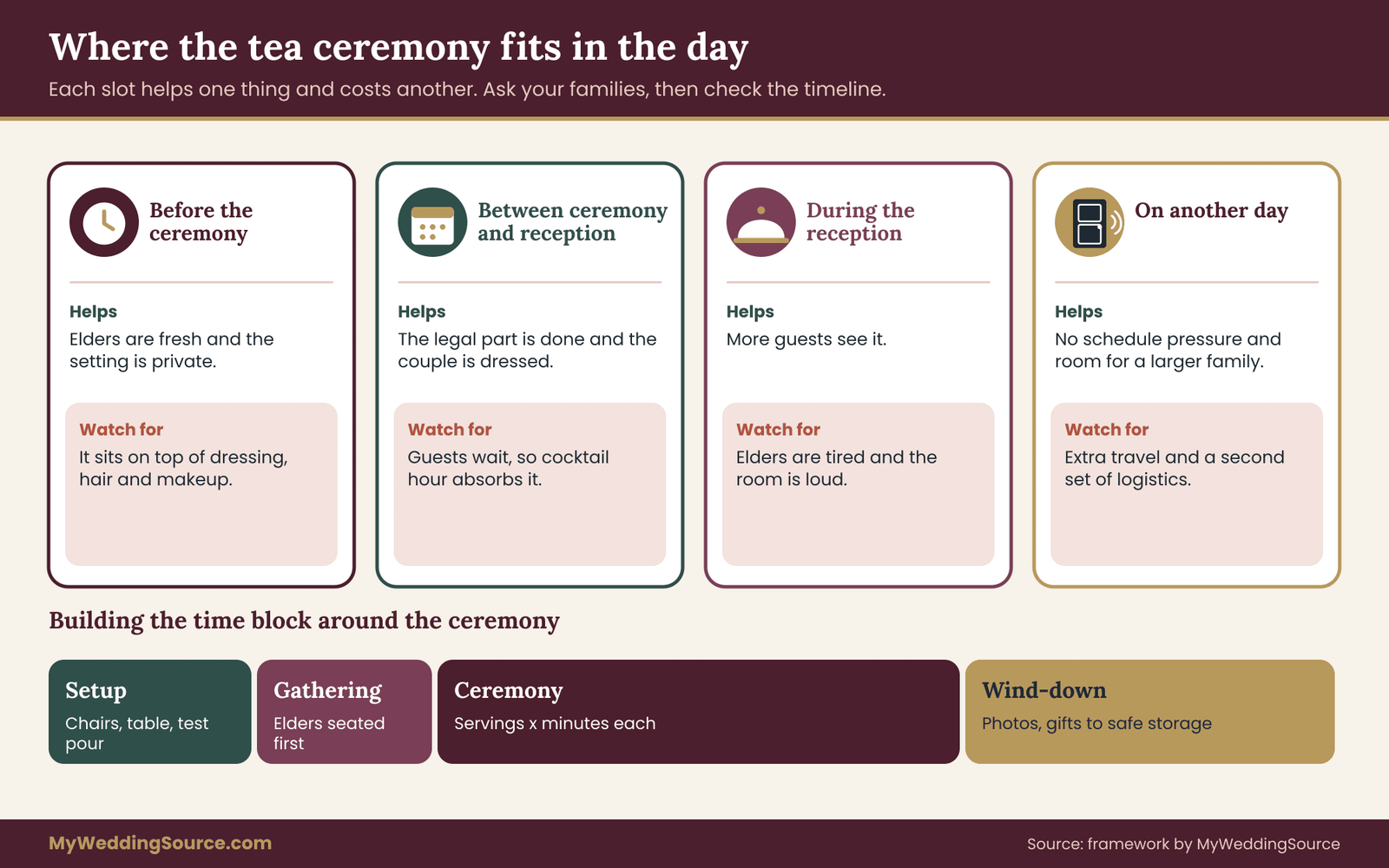
Before the main ceremony. The couple serves tea in the morning, at a family home, a hotel suite or a room at the venue, then moves on to the main ceremony. Advantages: elders are fresh, the setting is private, and the couple has not yet been photographed all day. Disadvantages: it sits on top of hair, makeup and dressing, and a delay there delays everything else.
Between the ceremony and the reception. The family withdraws to a quiet room after the main ceremony. Advantages: the couple is already dressed and photographed, the legal part is done, and the tea ceremony can be unhurried. Disadvantages: guests are waiting, so the time budget is tight and the cocktail hour has to absorb it.
Before or after the banquet, at the venue. Some families hold it during the reception, with guests watching. Advantages: more people see it. Disadvantages: elders are tired, the room is noisy, and the service area has to compete with a dining room. It works best with a short roster.
On a different day. Some families hold the tea ceremony the day before or the day after the wedding, at a family home or a restaurant. Advantages: no pressure from the wedding schedule, and room for a larger family. Disadvantages: travel, a second set of logistics and a second outfit.
Ask the validators what their family expects for the Chinese tea ceremony. If neither has a strong preference, choose the placement that keeps your elders comfortable and your timeline honest.
Building the time block
For the Chinese tea ceremony, take your time estimate from the sequence sheet and add four things around it.
Setup. Chairs, cushions, the tea table, the gift station, and a test pour. Plan thirty to forty-five minutes for a service area built from nothing, shorter if the venue sets it up. Add a buffer if the room is shared.
Gathering. Elders arrive at different times and some need help finding the room. Plan to have them seated before the couple enters, with a helper at the door. An elder who arrives as the couple begins disrupts the whole opening.
The ceremony. Use your estimate, plus a margin of one or two extra minutes per serving for the unexpected: an elder who wants to speak, a photo that takes longer, a cup that needs refilling.
Wind-down and handoff. A few minutes for group photographs and for moving gifts to safe storage, then clearing the room.
Write the block on your wedding-day timeline with a start, an end and a named person who watches the clock. The guide to wedding vendor timelines shows how to place blocks like this so each vendor knows when they are needed.
Choosing the place
The place matters as much as the time. A living room, a hotel suite, a quiet corner of the venue and a private dining room each have strengths.
A family home is warm and familiar, and elders are comfortable there, but it may lack space, parking and step-free access. A hotel suite offers privacy and a place to change, but suites are small, and a roster of ten servings plus witnesses may not fit. A corner of the main venue keeps everyone in one place, but check the venue’s rules and its noise level. A private room at a restaurant or banquet hall is often the best compromise: space, chairs, plumbing, and staff who can help.
Whatever you choose, visit it, measure the space against your layout sheet, and check the practical items: step-free access, restrooms close by, enough power outlets, a water source for tea, and a place to leave coats. If the venue is a rental, ask about the permitted noise and whether it allows food and drink in that room.
Does the tea ceremony have anything to do with the legal marriage?
In general, no. Whatever else it means to your families, a Chinese tea ceremony is a family and cultural ritual, and it is separate from the legal marriage. The legal marriage in the United States depends on a license issued by a local authority and a solemnization by an authorized person, and the rules differ by state. If you are unsure what your state requires, the official guidance from the government’s marriage license page and your local clerk is the place to check, and the guide on officiant requirements explains the usual pieces.
Do not assume the tea ceremony can substitute for any part of the legal process, and do not let the legal ceremony’s schedule be squeezed by the tea ceremony.
Comfort, access and safety for elders and the couple
The people at the center of a Chinese tea ceremony are often the oldest people at the wedding. Planning for their comfort is not an extra. It is the job.
Mobility and seating
Ask each elder, or the validator, about mobility before you lay out the room. Some will walk easily, some will use a cane or walker, and some will use a wheelchair. Each case changes the layout.
For anyone using a mobility device, leave a clear path wide enough for the device, avoid thresholds and thick rugs, and consider placing them in the first position so they can sit comfortably through the rest. If an elder cannot rise easily, the couple can go to them rather than the other way round. That is graceful and kind, and many elders prefer it to the effort of coming forward. The Americans with Disabilities Act guidance, linked in the sources, is a good starting point for accessible routes in public venues.
Heat, hydration and time
An elder who has been seated for thirty minutes in a warm room needs water, a way to stand up without help, and a restroom within reach. A helper should be assigned to elders’ comfort: bringing water, adjusting a chair, escorting someone out. It is a different job from the caller and the gift keeper, and it deserves a name on the sheet.
If the Chinese tea ceremony runs long, consider a short pause. A natural break, such as a toast or a photograph with the whole group, gives elders a chance to rest without the couple feeling they have interrupted.
Kneeling and the couple’s bodies
Kneeling on a cushion for several minutes is hard on knees and backs, especially in formal clothing and shoes. If the family expects kneeling, practice it in the real clothes. If either partner has a knee, hip or back problem, talk to the validator about an alternative, such as bowing or a low stool. Many families will accept a modified posture once they understand why. If they do not, it is the couple’s choice how much comfort to trade for tradition, and both partners should agree in advance.
Shoes matter. Smooth soles on a polished floor, a long skirt on a cushion, and a tray in the hands are a recipe for a slip. Check the floor, test the footwear, and have a helper close.
Hot tea and burns
Hot tea is the most likely source of injury during a Chinese tea ceremony. Cups should be warm, not scalding. A tray that tips can burn the couple or an elder. Keep the kettle or flask on the table, not in anyone’s hands, and keep children away from the tea station. If a burn happens, cool running water is the standard first response, and the Centers for Disease Control and Prevention provide general safety guidance in their burn prevention material, linked in the sources. A small first-aid kit with a cold pack and non-stick dressings should be in the supply bag.
Allergies, medications and dietary limits
Record any allergies and dietary limits on the roster, and cross-check them against the tea and any snacks served alongside it. Some families serve small sweets or dried fruit with the tea. Those add allergens and choking risks for older guests. Label everything, and keep a version without nuts and seeds for anyone who needs it.
If an elder takes medication that affects hydration or timing, ask the family whether the Chinese tea ceremony needs to fit around it. This is a quiet conversation with a family member, not a question for the elder in front of the room.
Language and hearing
Elders who hear poorly or who are more comfortable in a particular dialect need support. Seat them close to the couple, speak slowly, and have a helper repeat key words in the language the elder prefers. If the couple is exchanging blessings or phrases, write them in a form the couple can read, and ask a fluent relative to coach pronunciation. A sincere attempt at an elder’s language is received warmly, and a mispronounced word usually earns affection rather than offense, provided the couple has asked.
The couple’s own comfort
The couple will be on their feet or knees, carrying trays, receiving gifts and speaking, all with a room watching. Plan water, a snack, a quiet moment before and a few minutes afterward. Many couples say, in general terms, that the tea ceremony is emotional. If you expect to be moved, keep tissues close and give yourselves room for it.
Vendors, venue rules and helpers for a Chinese tea ceremony
A Chinese tea ceremony touches more vendors than it appears to. Each one needs the sheets, or the part of the sheets that concerns them, and each one has limits you should hear before the freeze date.
The venue
Ask the venue five plain questions about the Chinese tea ceremony in writing and keep the answers.
- Is the room we want available for the whole time block, including setup and clearing, and is it ours alone for that time?
- Can we bring hot water, a kettle or a flask, and do you allow tea service in that room?
- Are there rules on furniture: can we move chairs, and who puts them back?
- Are there rules about flooring, such as no kneeling cushions on certain surfaces, or restrictions on what can sit on a wooden floor?
- Is there step-free access from the entrance to the room, and a restroom close by?
If the venue’s answers change your layout, redraw the sheet, and send it to the sheet owner. A venue that says “we normally do this for you” should still tell you in writing who is setting up and when. Details that live in conversations disappear.
The photographer and the videographer
The Chinese tea ceremony is one of the most photographed moments of the day, and one of the easiest to miss. Send the photographer the sequence, the roster in trimmed form, and the layout. Ask them to look at the lane you drew and tell you honestly whether it works.
Three points to settle in advance. First, which elders are comfortable being photographed, and whether any prefer not to be. Respecting a refusal is part of the job, and the family will remember it. Second, what shots the families want: each serving, each pair, the gift exchange, a group photograph afterward. Third, how long the photographer needs for the group photograph and where it will happen. The guide on the family photo list helps you decide which groupings to ask for, and the sequence sheet can double as the shot list.
If the photographer is not familiar with the Chinese tea ceremony, give them a short briefing. Many are, and some will have strong opinions about positioning. Listen to them and ask what has worked in other families, then check it against your validators.
The caller or master of ceremonies
If you hire a master of ceremonies, hold a call before the freeze date. Give them the sequence, the forms of address and the phonetic spellings, and ask them to read the opening aloud to you. If the MC does not speak the language an elder prefers, assign a second helper who does. An MC who says each name correctly earns trust, and one who stumbles over names does not.
If a relative is the caller, give them a printed sequence in large type. Walk through it with them once. Make sure they know they are allowed to slow things down and to say “one moment” to the room.
The tea service helpers
You need at least three helpers beyond the caller, and they can be friends or relatives rather than hired staff.
The tea helper stands at the table, pours, refills and hands over trays.
The gift keeper receives and records gifts, as described earlier.
The comfort helper looks after elders: water, chairs, restroom, a hand on an arm.
For larger rosters, add a door helper who greets elders and shows them to seats. Each helper gets a one-page copy of the sheet that concerns them and a short walkthrough. Put their names and phone numbers on the sequence sheet, and tell each of them who is in charge if something goes wrong. That person is usually the sheet owner or the coordinator.

A coordinator, if you have one
If you work with a wedding coordinator, hand them the three sheets as soon as the first versions exist. Ask them to place the time block on the timeline, check the venue’s rules, and attend the rehearsal. A coordinator who has not worked on a Chinese tea ceremony before can still run the sheets well, because the sheets are written for people who were not in the room when the decisions were made. If you do not have a coordinator, the guide to ceremony step-by-step planning shows how a ceremony’s parts fit together, and you can use the same logic for the Chinese tea ceremony block.
Budget logic without invented numbers
The cost of a Chinese tea ceremony is usually modest in cash, but it is not zero, and some items get missed. Build a short line-item list and price it locally, using real quotes.
Items to consider: tea and ingredients; cups, trays, a teapot or flasks; a table covering and kneeling cushions, whether bought or rented; red envelopes and printed programs; outfits or an outfit change, including alterations; a room, if the venue charges for a separate space; a master of ceremonies or extra photography time; flowers or a small decorative setup; transportation for elders; and a contingency for the unexpected.
Do not rely on a figure from a website. Ask the venue, the rental company and the vendors for quotes in writing, and check whether the price depends on time, number of guests or the room. Also ask whether any fee changes if the Chinese tea ceremony runs over. A sensible habit is to hold a small reserve for the day itself, in case an extra hour of room time or a replacement tray is needed.
Printed material
Many families like a printed program, a card with names and forms of address, or a small sign. If you print anything, treat it like any other print job: proof it, ask a family member to check the language, and leave enough time for a reprint. Do not print the roster with practical needs or anything private. A one-page program with the sequence and the names is enough.
Rehearsing the Chinese tea ceremony
A rehearsal turns the Chinese tea ceremony sheets into muscle memory. It need not be elaborate. A single walkthrough, in the real room or one of the same size, with the real helpers and a stand-in for each elder, catches most problems.
What to rehearse
Run the entire sequence once, at real speed, with the real cups and trays, using water. Check these points.
- Does the path to the chairs work for everyone, and does it avoid thresholds?
- Can the couple carry a loaded tray, kneel and rise in their real outfits?
- Does the tea helper keep up, and is the table in the right place?
- Does the gift keeper reach each elder in time, and is there a good way to record names?
- Does the caller have a clear view and a clear voice?
- Does the photographer’s lane work, or do they stand in someone’s way?
- How long did the run take, per serving, and in total?
Write the real time on the sequence sheet and adjust the time block. A rehearsal that takes twelve minutes for four servings tells you something that no estimate does.
Who attends
The couple, the caller, the tea helper, the gift keeper, the comfort helper, and the coordinator if you have one. If an elder is willing, invite them to sit in at their chair for a minute, as long as it does not feel like a test. Many elders are happy to help. Others would prefer to see the real thing for the first time, and that is fine.
What to do about what the rehearsal reveals
A rehearsal will turn up small problems. A chair is wobbly, a cushion slips, the table is too far from the couple, or the caller cannot be heard. Fix what is simple, and put anything that changes the sequence or the roster through the same sign-off process. A change to the layout after the freeze date should go to the sheet owner, and anything that affects an elder should go to that elder’s validator.
The final sign-off
After the rehearsal, hold the second sign-off round. Send each validator the final sequence and the layout, with the real time. Ask them to confirm: the order for their family’s relatives, the pairings, the posture and any gift expectations. When all validators have confirmed, mark the sheets frozen, print them and give each helper their copy.
Keep a record of who confirmed and when. If a question comes up on the day, you can say “your aunt reviewed this on the second of the month,” and that sentence settles more disputes than any rule.
A worked example: Grace and Marcus build their Chinese tea ceremony
The following couple is invented, to show how the sheets work together for a Chinese tea ceremony. Their families are not typical of anyone, and their choices are not a model to copy. The point is the process.
Grace Chen and Marcus Reed are planning a Saturday wedding. Grace’s family is Cantonese-speaking and has held tea ceremonies at family weddings. Marcus’s family has no such custom. His parents are divorced and his mother has remarried. Both families want a Chinese tea ceremony, and nobody has agreed on how.
Step one: find the validators
Grace asks her mother who in the family would know how it should go. Her mother names Grace’s father’s older sister, Aunt Linda, who has organized several family weddings. Linda becomes the Chen validator. Marcus asks his mother, who says she has never seen one and would be glad to be told what to do. She is the Reed validator for her own side, and Marcus asks his father separately, because a combined conversation would be awkward.
Step two: the long list and the labels
Grace writes a long list of relatives: her parents, her maternal grandparents, her paternal grandmother, Aunt Linda and her husband, a maternal aunt and her husband, three cousins, and her older brother. Marcus adds his mother and stepfather, his father, and his grandmother.
Linda marks the Chen side. Grace’s parents and grandparents are serve. Linda and her husband are serve. The maternal aunt is serve. Grace’s older brother and cousins are ask, which Linda says she will check with Grace’s father. Grace’s paternal grandfather died some years ago, and Linda says the family would like his photograph on the table and his name mentioned. She suggests Grace ask her grandmother privately whether that feels right. Grace does, and her grandmother agrees.
Marcus’s mother marks everyone on the Reed side serve, and asks if she can be served after Grace’s parents so she can watch first. Marcus’s father says he would be glad to be served alone, and not with his former wife.
Step three: the sequence and the tie-break ladder
Linda gives the Chen order, from the oldest generation to the youngest. The Reed family has no rule. The question is where the Reed relatives go.
- Rung one: Linda states a rule for Chen relatives only.
- Rung two: the validators speak together. Linda suggests that Marcus’s relatives be served after Grace’s parents, the order Marcus’s mother has already suggested. Marcus’s mother agrees.
- Rung three: generation settles Marcus’s grandmother before his parents.
- Rung four: no family measure applies to the divorced parents.
- Rung five: the couple decides. Marcus’s father and Marcus’s mother with her husband are served separately, with the grandmother between them. They tell both parents the reason in advance, and both are content.
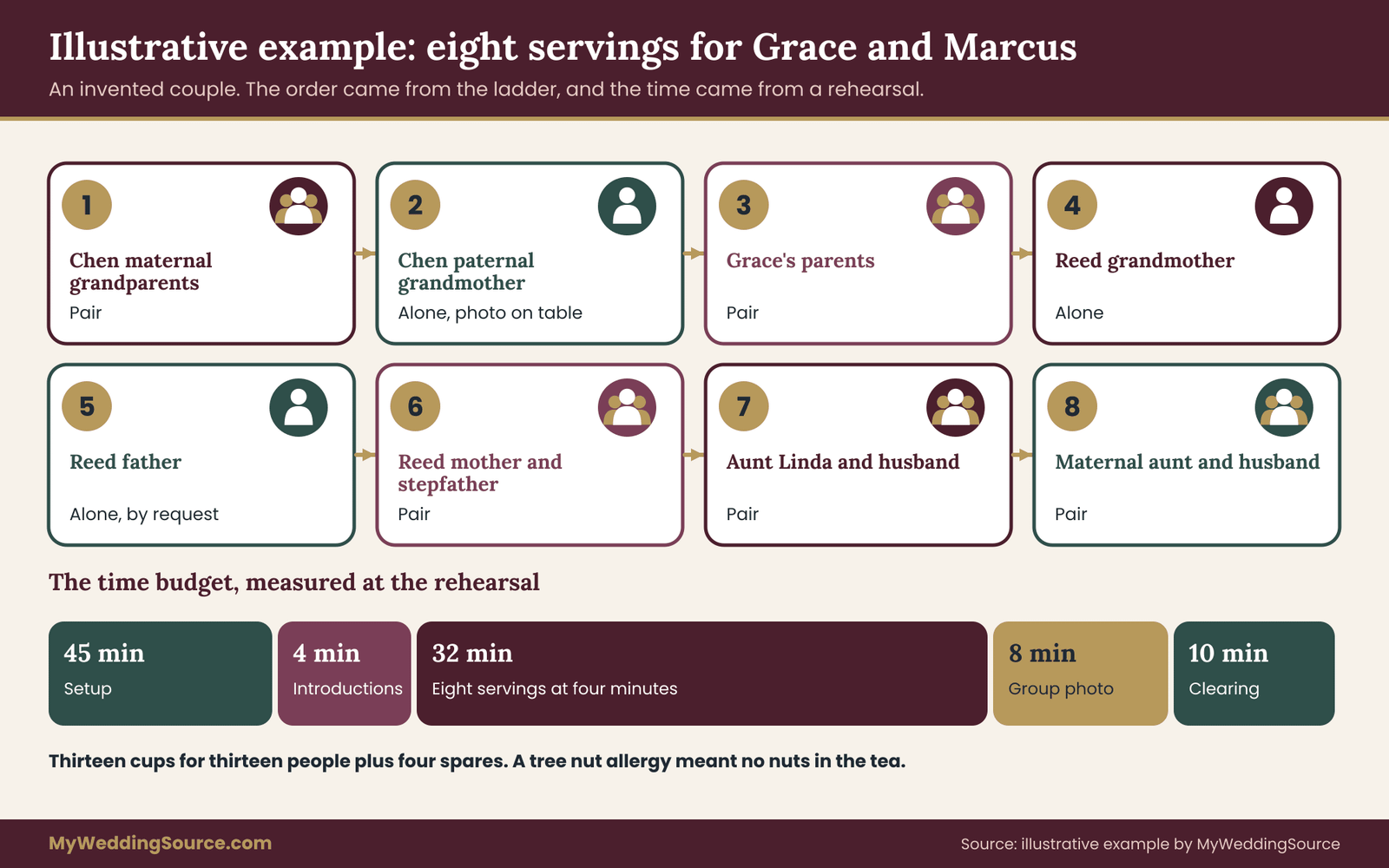
The final sequence has eight servings.
- Grace’s maternal grandparents, as a pair.
- Grace’s paternal grandmother, alone, with her husband’s photograph on the table.
- Grace’s parents, as a pair.
- Marcus’s grandmother, alone.
- Marcus’s father, alone.
- Marcus’s mother and stepfather, as a pair.
- Aunt Linda and her husband, as a pair.
- Grace’s maternal aunt and her husband, as a pair.
Linda says the older brother and cousins will receive a red envelope each at the end, and does not call for tea service to them. That is her family’s practice, and it goes on the sheet as a note.
Step four: time and room
Grace and Marcus use an assumption of three minutes per serving, eight servings, so twenty-four minutes. They add four minutes of introductions and eight for the family photograph, for a total of thirty-six minutes. They plan a forty-five-minute time block, with a further forty-five minutes before it for setup and ten after it for clearing.
They use a private room at the venue, next to the main ceremony space. They choose the row shape with four chairs, refreshed halfway. They draw the room, take it to the venue, and learn that the tea may be heated in the venue’s kitchen but not in the room. They add a flask and a kitchen run to the tea helper’s job.
Step five: cups, tea and safety
Thirteen people are served in eight servings, so Grace plans thirteen cups and four spares. The Chen family uses a sweet tea with red dates and longan. Marcus’s grandmother has a tree nut allergy, so the tea helper checks every ingredient, and the Chinese tea ceremony uses no nuts. Linda is asked to confirm that no component is a seed or nut. She does.
The comfort helper is Grace’s cousin Ben, who is assigned to the two grandmothers and the three oldest elders. The gift keeper is Grace’s friend Priya, who carries a small bag and a notebook. The caller is Grace’s cousin Nina, who is comfortable in both English and Cantonese, and who has the names and forms of address on a card.
Step six: sign-off, freeze and rehearsal
The first sign-off round took two weeks, because Linda asked her brother for confirmation on the cousins. The freeze date was set for three weeks before the wedding. At the rehearsal, Grace and Marcus run four servings in the real room with water and the real cups. The run takes sixteen minutes, which is more than their assumption, so they revise the estimate to four minutes per serving, which makes thirty-two minutes for eight, and they shorten the group photograph. They also learn that the kneeling cushions slide on the polished floor, so they add a non-slip mat.
After the rehearsal, Linda reviews the final sequence and confirms it. Marcus’s mother and father each confirm their parts. The sheets are frozen and printed.
What the example shows
The example Chinese tea ceremony is notable for what did not happen. Nobody argued on the day. The two sides of the family did not have to negotiate in public. The divorced parents were never placed side by side without being asked. The couple never decided something alone that an elder expected to decide. And the schedule held, because the real time was measured.
None of this required special knowledge of the tradition. It required asking, writing it down, getting it confirmed and rehearsing.
Mistakes, special situations and limits of a Chinese tea ceremony plan
Mistakes that derail a Chinese tea ceremony
Most problems with a Chinese tea ceremony come from a small set of repeated mistakes.
Assuming one version. The most common error is to treat a description from a website, a friend or one family member as the standard. Use it to form questions, then ask your own validators.
Starting with the layout. A pretty room does not fix an unresolved roster. Do the roster and sequence first, then draw the room.
Leaving the order to the day. An order that is decided on the day is a decision made in front of the elders. Settle it before.
Forgetting the practical needs. An elder who cannot kneel, rise or hear will not enjoy the moment, and the family will notice. Put needs on the roster early.
No gift keeper. Envelopes and jewelry that end up in a pocket or on a chair are lost more often than you might think. Name the keeper.
Hot tea and tight clothing. Test the tray, the clothing and the floor together.
Underestimating time. An eight-serving ceremony runs for thirty or forty minutes, not fifteen. Rehearse, then adjust.
Skipping the non-Chinese family. A family that is not part of the tradition still deserves an explanation and a role. They are guests of honor in the Chinese tea ceremony, and they will follow the couple’s lead if they are told what to expect.
Letting the sheets drift. A sheet that has not been updated since the first draft is worse than none. Use a freeze date and a single owner.
Overloading the helpers. One person cannot be caller, gift keeper and comfort helper. Name separate people.
Special situations for a Chinese tea ceremony
A few arrangements need a short note of their own.
A small or elopement-style wedding. With only a few relatives, the roster and sequence shrink, but the logic holds. Even a two-person Chinese tea ceremony benefits from a written order and a plan for the gifts.
A destination or far-away family. If elders cannot travel, a video call at a planned point in the sequence, or a separate small tea ceremony at home before the trip, are both common choices. Test the connection, and keep the call short and warm.
A blended or interfaith program. When the tea ceremony shares a day with another tradition’s ritual, such as a church service or a mandap ceremony, the question becomes one of ritual ownership and timing. The guide on interfaith ceremony planning offers a matrix for deciding who owns each element, and the same questions apply to the tea service.
A Chinese tea ceremony for a couple who are both not Chinese. Some couples adopt the custom out of respect or family connection. If that is you, ask families who practice it for guidance and permission, credit them where it is natural, and avoid presenting an invented version as the tradition.
A very hot or very cold climate. Outdoor settings change the tea, the cups and the comfort plan. Provide shade or heat, keep tea warm, and check the layout against wind.
An unexpected change on the day. An elder is unwell, a relative is late, a cup breaks. The caller and sheet owner should know that the plan can bend. Skip a serving and return to it, serve a family member early, or move on and take photographs later. A calm response matters more than perfect order, and the validators will understand if told afterward what changed and why.
What this guide cannot tell you about a Chinese tea ceremony
A planning guide for a Chinese tea ceremony has limits, and it is better to name them than to cover them over.
It cannot tell you what your family’s practice is. Only your family can. Where this guide describes a common pattern, such as seniority order, sweet tea or red envelopes, it describes a pattern that many families recognize, not a rule your family must follow.
It cannot tell you what a particular gesture, ingredient or gift means in your family. Families attach different meanings to the same object, and an article should not overrule them.
It cannot confirm your venue’s rules, your vendors’ policies or your state’s marriage requirements. For those, ask the venue, the vendor and the local office that issues marriage licenses, in writing, and verify any fee or rule directly, because rules and prices change. The government’s marriage license page at USA.gov is a reliable starting point for the legal side, and the sources list at the end of this guide has other references.
It cannot replace a relationship with the people involved. The most valuable result of a good Chinese tea ceremony plan is not a flawless order. It is a set of conversations in which elders were asked, listened to and honored before the day began.
Your next steps
This week, find each family’s validator. Ask the neutral question: who would know how our family does this? Write down the name and a way to reach them.
Over the next two weeks, build the long Chinese tea ceremony roster and send each validator their own family’s section. Ask for labels and for anyone missing. Meanwhile, ask each person on the roster about mobility, allergies and language, through a family member if that is more comfortable.
Then draft the sequence using the tie-break ladder, and put every unresolved question in front of both validators together. Choose the time and the place, and fit the block into your timeline using the real estimate from the sequence sheet.
Next, draw the layout, take it to the venue, and ask your five questions in writing. Name the caller, the tea helper, the gift keeper and the comfort helper, and give each a one-page copy.
Set a freeze date for the Chinese tea ceremony three weeks before the wedding. Hold a rehearsal with real timing before it, and a final sign-off round after it. After that, print the sheets, assemble the supply bag and let the Chinese tea ceremony be what it is meant to be, a quiet moment between your family and you.
FAQ
How long does a Chinese tea ceremony usually take?
How long a Chinese tea ceremony takes depends on how many people are served. A planning estimate is two to four minutes per serving, plus a few minutes for introductions and a group photograph, so ten servings can run close to forty minutes. Treat that as a starting point and time a rehearsal with the real cups, trays and clothing before you fix the schedule.
Who should be invited to receive tea?
Your families decide. Many couples start with parents, grandparents and senior aunts and uncles, then ask each family’s validator about step-parents, siblings, cousins and relatives who have died. Write the answers on the roster with the validator’s own words. If a relative is unsure, label the line “ask” and follow up before the freeze date.
In what order should the elders be served?
There is no single order. Many families go from older generations to younger, but they differ on which side goes first and whether pairs are served together. Ask each family’s validator, then use the tie-break ladder: stated family rule first, shared agreement second, generation third, family seniority measure fourth, and the couple’s recorded decision last.
Do we have to kneel?
Not necessarily. At a Chinese tea ceremony some families expect kneeling, others accept bowing or standing. Ask the validator what the family expects, then check what your bodies and clothing can do. If kneeling is difficult, explain why and propose an alternative in advance. Practice in the real outfits and shoes, and provide non-slip cushions if kneeling is part of the plan.
What if our parents are divorced?
Ask each parent privately what would feel comfortable, then ask the validators about family practice. A common solution is to serve the parents at separate points in the sequence so nobody sits beside a former spouse. The couple makes the final call, tells both parents the reason in advance, and records it on the sequence sheet.
What if one partner’s family does not have this custom?
Explain the Chinese tea ceremony custom early and ask whether they would like to be served tea and what they would like to be called. Give them a validator, even if the role is small. Ask whether they would like to add a custom of their own, and place their servings where the sequence still makes sense.
Who should hold the red envelopes and gifts?
Name a gift keeper who is calm and not carrying another job. They receive each gift, note the giver, and store envelopes and jewelry in a bag that goes to a secure place at once. Never leave valuables on a chair. If a family prefers no record, reconstruct the list afterward for thank-you notes.
Where does the tea ceremony fit in the wedding day?
Families choose to hold a Chinese tea ceremony before the main ceremony, between the ceremony and the reception, during the reception, or on another day. Choose the slot that keeps elders comfortable and the timeline honest. Add setup, gathering and wind-down time around the Chinese tea ceremony itself, and confirm the room, the tea service and the access with the venue in writing.
Sources
- Marriage license, USA.gov
- Americans with Disabilities Act information, ADA.gov
- Food allergy resources, Food Allergy Research and Education
- Burn prevention and safety, Centers for Disease Control and Prevention
- Food allergies, U.S. Food and Drug Administration
- Museum of Chinese in America
- Chinese Historical Society of America
- Smithsonian Institution
- Library of Congress