
Wedding dress steaming at the venue is a short job with a long list of ways to go wrong: scorched trim, water spots on silk, melted tulle, a steamer tripping the breaker in the bridal suite. This guide gives you a fabric care risk card to decide what can be steamed and by whom, and a one-page handoff sheet that lets a professional work on your dress without guessing.
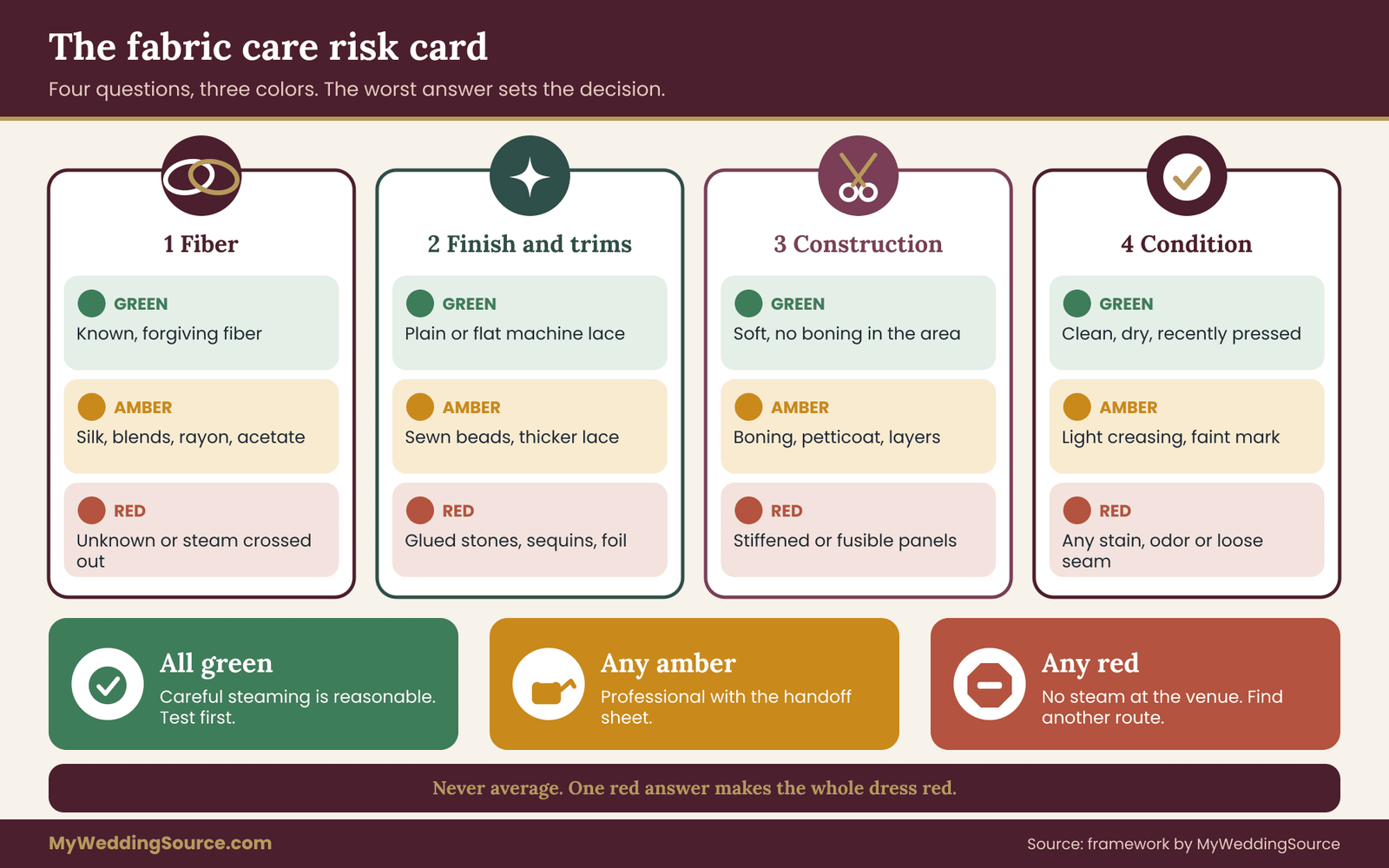
Before the wedding, photograph the dress’s care label and fiber content, then score the dress on a four-question risk card: fiber, finish and trims, construction, and condition. A green score means careful wedding dress steaming is reasonable. An amber score means a professional with the dress’s details in hand. A red score means no steam at the venue at all; ask the boutique or tailor for another route. Whoever steams, give them a written handoff sheet, confirm power and water at the venue in advance, and test on a hidden spot first.
A wedding dress usually arrives at the venue creased from the car, the garment bag, or the hanger it has been on for a few weeks. Someone then says, cheerfully, “We’ll just steam it.” That sentence hides a handful of decisions that nobody has made yet. Which steamer? Whose hands? What does the fabric tolerate? Where is the outlet, and what else is plugged into that circuit?
Wedding dress steaming at the venue is not hard when those questions have answers. It becomes expensive when they get answered in the bridal suite, forty minutes before photos. Done well, wedding dress steaming is invisible: nobody remembers it, and the photographs simply show a dress that looks the way it did in the boutique.
A note on scope. This is general information, not legal or professional garment-care advice, and every dress is different. Where a rule or a care instruction matters, the article points to the organization that issues it so you can confirm the current version, and your dress’s own label and your boutique’s advice come first.
The article is organized around two tools. The first is the fabric care risk card, which turns a vague worry into a green, amber or red decision. The second is the steamer handoff sheet, a single page that travels with the dress and tells whoever is holding the steamer what the fabric is, what to avoid, and who to call.
Around those tools you will find fabric-by-fabric notes, venue setup, a worked example with an invented couple, a morning-of timeline, and the edge cases that most advice skips. For the broader picture of what else needs to travel with the dress on the day, the guide to wedding day accessories planning covers compatibility, movement and backups.
What wedding dress steaming at the venue actually involves
Steaming relaxes wrinkles by delivering hot, moist vapor to the fibers so they soften and fall flat under their own weight. It is not ironing. Nothing presses the fabric, and the steamer head ideally never touches it. That is why steaming is gentler than an iron for most dresses, and also why it is easy to underestimate: the heat is real, the moisture is real, and both act on glues, linings, dyes and finishes as well as on fibers.
Doing it at the venue, rather than at home or at a boutique, adds four constraints that change the job.
You do not control the space. A hotel room, a bridal suite, a church side room or a barn tack room may have one usable outlet, a low ceiling, carpet, no hook and a bathroom door that is the only thing to hang from. Wedding dress steaming at the venue is shaped by what the room offers, not by what a wedding dress steaming guide assumes.
You do not control the clock. Hair and makeup, photographers, family arrivals and the ceremony start all want the same morning. A dress that needs forty-five minutes of careful work cannot be given ten. If the time is tight, the safe decision is often to steam less, not to steam faster.
You do not control the water and power. Tap water in some places leaves mineral spots. Circuits are shared with hair tools, kettles and phone chargers. The steamer you borrowed may not match the one the professional would bring.
You cannot undo most mistakes. A scorched satin panel, a puckered glued appliqué or a melted tulle edge does not get better with time. The gap between a small crease and permanent damage is small, and the dress is the single item on the day that cannot be replaced by tomorrow.
For those reasons the useful question is not “how do we steam a wedding dress?” It is “what are the conditions under which steaming this particular dress, in this particular room, is clearly the right call, and who should be the one doing it?” The rest of this guide is a way of answering that question in advance.
Where wedding dress steaming fits in the dress timeline
Steaming belongs near the end of a longer sequence. The dress is bought, altered and fitted, then cleaned or pressed by the boutique or tailor if the contract includes that, then transported, then touched up on the day. The guide to wedding dress fit and alterations covers the earlier steps. Most of the wedding dress steaming decisions in this article should be made weeks before the wedding, at the final fitting, when the person who altered the dress is still holding it and can tell you what they did to it.
That last detail matters. Alterations change fabric. A shortened hem may have new tape or glue. A taken-in bodice may have new interfacing or boning. A bustle may have loops and buttons sewn into a layer that is delicate. If you ask the tailor one question at the final fitting, “Is there anything about this dress I should not steam?”, you often learn more than the label can tell you.
Why wedding dress steaming goes wrong at venues
Most wedding dress steaming accidents are predictable. Reading through them is worth a few minutes because each one maps to a specific line on the risk card and the handoff sheet later in the article.
Water spotting. Some fabrics, especially silk satin, taffeta and certain acetates, can show rings or marks where moisture lands unevenly and dries. A steamer that spits droplets, or one held too close, makes this more likely. The mark may fade or may not.
Melting and shine. Synthetic fibers such as polyester, nylon and acetate respond to heat. Tulle and net are often nylon or polyester. Sequins and some beads are plastic. A steamer head that touches them, or lingers, can flatten, glaze or distort them.
Glue failure. Many beads, crystals and appliqués are attached with adhesive as well as thread. Heat and moisture can soften that adhesive. Pieces shift, lift or fall, and sometimes the first sign is a bead on the floor an hour later.
Distortion of structure. Dresses with boning, horsehair braid, crinoline, stiffened organza or fusible interfacing hold their shape through components that react to moisture. Steam can soften a stiffened hem, slacken a bodice, or leave a skirt limp.
Color transfer and dye movement. Dyed or printed fabrics, colored sashes and some embroidered threads can bleed under moisture, onto the white parts next to them.
Burns to people. Steam burns are quick and painful. Escaping steam, hot condensation and a steamer tipped over in a cramped room are all realistic hazards, particularly when someone is holding a garment above their head. The U.S. Centers for Disease Control and Prevention publishes general guidance on preventing burns at home, and the same common sense applies in a bridal suite.
Electrical overload. Steamers draw a lot of power for their size. In a hotel room or a historic venue, plugging a steamer, two hair dryers and a curling iron into one circuit is how breakers trip and the room goes dark during the hair timeline. The Electrical Safety Foundation International publishes plain guidance on overloaded outlets and power strips.
The shower-steam shortcut. Hanging the dress in a bathroom and running a hot shower is the most common improvised method. It is uncontrolled. Moisture lands everywhere, including places that should stay dry, and the dress may hang damp for an hour in a room that is not clean. If it is the only option, it needs the same risk-card score as any other steaming.
The mistake underneath the mistakes
All of those problems share a root: someone decided to steam before anyone checked what the dress was made of. The label was not read. The fiber content was a guess. Nobody knew about the glued lace. The cure is not better wedding dress steaming technique. It is information, gathered early, written down, and put in the hands of the person with the steamer. Good wedding dress steaming starts with paperwork, not with hot water.
Reading the fabric label before wedding dress steaming
Every dress has at least one label sewn into a seam, usually near the waist, side seam or inside the back neckline. Some dresses have two or three: a designer label, a size label, and a separate care and content label. Finding them is the first action of the whole process, and it should happen as soon as the dress is delivered, not at the venue.
What a care label can and cannot tell you
In the United States, the Federal Trade Commission’s Care Labeling Rule requires most garments to carry permanent care instructions, and the rule says the label must warn about any ordinary-seeming care step that would damage the garment. That is useful but narrower than people expect. A label has to give one safe method of regular care.
It is not required to list every method that would work, and it may say nothing at all about steaming. “Dry clean only” tells you that dry cleaning is the manufacturer’s recommended process. It does not say that steam is safe, and it does not say that steam is forbidden.
Some labels do address pressing. The common care symbols standardized in the United States under ASTM International’s care symbol standard include an iron symbol with dots indicating the temperature range, and a version showing that steam should not be used. If your label has an iron symbol with a crossed-out steam burst under it, take that at face value for the home or venue. Where the label is silent, treat silence as “unknown,” not “allowed.”
What to photograph
Spend five minutes with your phone and the dress, ideally at the final fitting or when you pick it up.
- The full care label, flat and readable, front and back if there is printing on both sides.
- The fiber content label, which may be a separate tag. If a part of the dress lists “shell,” “lining,” “lace” and “trim” separately, capture all of them.
- Any hang tag or garment tag the designer left on, which sometimes carries the fabric name.
- The inside of the bodice and the hem, where tape, boning, bust cups, netting and bustle hardware show up.
- Close-ups of any beaded, sequined or crystal areas, with a coin or finger for scale.
Put those photos in a single album and share it with whoever will handle the dress. The handoff sheet later in the article asks for them.
When the label is missing or vague
Designer samples, vintage dresses, custom gowns and dresses ordered from overseas often have no usable label, or one that says only “see care instructions” with nothing following. In that case, ask the boutique or the designer’s customer service directly and ask in writing. Ask what the shell, lining, overlay and trims are made of, and whether they recommend steam. Save the reply. If they cannot say, that unknown becomes a line on the risk card, and it pushes the dress toward amber or red, because a professional will want to test before they treat.
A few contract points about who is responsible for the dress’s care also deserve a quick look in your boutique agreement. The guide to wedding vendor contracts explains how to read cleaning, pressing and liability clauses so that you know in advance whether the boutique’s wedding dress steaming service, if there is one, is included, optional or excluded.
The fabric care risk card for wedding dress steaming
The risk card is a four-question screen. It takes about ten minutes with the dress in front of you and the photos from the label. It does not replace a professional’s judgment. It tells you whether you need one, and what to tell them.
Each question has three possible answers: green (low concern), amber (needs care or expertise), and red (do not steam without specific advice from the maker or a specialist). The dress’s overall score is its worst single answer, not an average. A dress that is green on three questions and red on one is a red dress, because a single melted panel is enough.
Question one: what is the fiber?
Look at the content label for each layer: shell, overlay, lining and trim.
- Green: a single, well-known fiber that tolerates steam in general, such as polyester satin or crepe, or silk that your boutique has explicitly said can be steamed. The content is known for every visible layer.
- Amber: silk satin, taffeta, charmeuse or other silk that shows water spots easily; blends; rayon, viscose or acetate; any layer where the content is unknown but the boutique or tailor can confirm.
- Red: unknown content on the shell or overlay with no one able to confirm it; any label that crosses out steam; fibers that the maker has told you must not touch moisture; velvet or other pile fabrics where nobody present has handled them before.
Question two: what is the finish or trim?
Surface decoration is where steam does most of its harm.
- Green: plain, unembellished fabric, or light machine-stitched lace that sits flat.
- Amber: hand-sewn beading with thread attachment, thicker lace, embroidered motifs, covered buttons, ribbon trims, and layered tulle.
- Red: glued crystals, heat-set stones, sequins or beads of unknown material, appliqués held on with adhesive, foil or metallic print, flocking, and any trim that has already shifted or shed.
If you cannot tell whether beads are sewn or glued, turn the dress inside out and look at the back of the embellishment. Thread through every bead means it is sewn. A smear of dried glue under a stone means glue. If the back is hidden by a lining, ask the boutique.
Question three: how is it constructed?
Construction decides whether moisture will change the shape of the dress.
- Green: a soft, unstructured silhouette with no boning or stiffener in the area to be steamed, and a plain hem.
- Amber: a boned bodice, a built-in petticoat, several layers of tulle or organza, or a skirt with a bustle already sewn in. A hem with horsehair braid or a stiffened edge.
- Red: structured fabrics that hold their form through finishing treatments, such as mikado, heavily stiffened organza or taffeta ball gowns with crinoline sewn in, where the tailor has told you the structure is sensitive; any fusible interfacing in a visible panel that has begun to bubble or pucker.
Question four: what condition is it in?
A dress in good condition is a very different proposition from one that has lived through a move, a hot car or a long storage.
- Green: clean, dry, recently pressed or steamed by a professional, no stains, no loose threads or lifting trim.
- Amber: light creasing from transport, a faint mark you are not sure about, or a hem that touched the ground at the last fitting.
- Red: any stain or discoloration. Heat and moisture can set stains permanently, and steam can turn a faint mark into a visible ring. Any odor, mildew spots or old yellowing. Any area where stitching has loosened or fabric has frayed.
Reading the score
Add nothing together. Look for the worst answer.
All green: careful wedding dress steaming is reasonable. Even then, test first, use a clean steamer with the right water, keep the head off the fabric, and have a second person to hold the dress. Do not let that green result talk you into skipping the handoff sheet; it takes five minutes and prevents most of the confusion.
Any amber, no red: use a professional, or a person your boutique names. Amber does not mean “do not steam.” It means the wedding dress steaming should be done by someone who has handled this kind of fabric, with the dress’s details in hand and a spot test on a hidden area. This is where most wedding dresses land.
Any red: do not steam at the venue. The decision is not “steam carefully.” It is “find another way to deal with the wrinkles,” which might be a professional pressing before the wedding, a different way of hanging and transporting, a garment-specific technique recommended by the designer, or accepting a few creases that will fall out as the skirt moves and the dress is worn. Red does not mean the dress is a problem. It means steam is the wrong tool.
A worked pass through the card
Take an invented dress to see how the card works in practice. It is made of silk satin with a sewn-on lace bodice, a layered tulle underskirt and covered buttons down the back. The tailor shortened the hem and replaced the zipper.
Fiber: the satin shell is silk, which tends to show water spots, so amber. The tulle is nylon, which is sensitive to heat, also amber. Finish: the lace is hand-sewn onto the bodice, with some seed pearls attached with thread. Amber. Construction: a lightly boned bodice and a net petticoat sewn into the skirt. Amber. Condition: some creasing along the skirt from the garment bag, no stains. Amber.
The dress scores amber overall, and the right action is to book a professional who has steamed silk satin with tulle layers before, and to give them the details. If the pearls had been glued, the score would be red for finish, and the advice would change.
Why a card, and not a rule of thumb
Rules of thumb such as “steam from the inside” or “never let the head touch” are sound as far as they go, and later sections cover technique. The reason to use a risk card first is that the decision about who steams, and whether to steam, is made once, calmly, in advance, with the label in hand. Rules of thumb get applied under pressure by whoever is closest to the steamer.
The card creates a recorded decision. It can also be shared with a planner or a bridesmaid so nobody has to reconstruct the logic when the morning gets busy. That shared record is what keeps wedding dress steaming calm on a day full of other demands.
Where the card gets its limits
Be honest about what the card cannot do. It cannot detect a defect hidden in a seam, a glue you did not know was there, or a dye that will bleed. It cannot judge a custom-dyed or hand-painted piece. It also cannot replace the maker’s own instructions: if the designer says never steam this dress, that overrides a green card. The card is a way of organizing what you know and noticing what you do not know.
Treat it as the first step of wedding dress steaming, not as an extra chore beside it. When it points at an unknown, the correct response is to find the answer from the boutique or designer, or to treat the unknown as a red flag.
What to ask the boutique and tailor before wedding dress steaming
The risk card tells you what questions to ask. The boutique and tailor, who have seen the dress closely, can answer most of them in a single short exchange. Ask at the final fitting, or send a message the week before, and keep the replies.
A script that works well in a message:
“We are planning to have the dress steamed on the wedding morning at the venue. Could you tell us the fiber content of the shell, lining and lace, whether any beads or appliqués are glued rather than sewn, and whether there is anything you would not steam? Do you recommend a wedding dress steaming method, or someone you trust to do it?”
The answers feed straight into the handoff sheet. Here are the questions in more detail, and why each one matters.
“What are the fibers in every layer?” The label may list only the shell. Lace, lining and tulle can each be different.
“Is anything glued?” Glue is the most common hidden problem. Boutiques and tailors usually know which dresses have glued trims.
“Did the alterations add anything?” Hem tape, new boning, bust cups, a replaced zipper and bustle loops all change what the dress can take.
“Have you steamed or pressed this dress, and what did you use?” If the boutique has already steamed it, they know how it behaved.
“Do you offer wedding dress steaming, or do you recommend someone?” Many boutiques provide a steam-and-press service before pickup, and some will send a stylist to the venue. If it is included in your contract, use it.
“What should we do if something goes wrong?” Ask who to call, whether they can advise by phone, and whether the boutique carries any responsibility for work they do. This is the question people most often forget.
The bridal tailor and the wardrobe stylist
Two kinds of professional come up repeatedly in this process, and they do slightly different things.
A bridal tailor knows the construction. They can tell you what is sewn, what is glued, which parts are fragile, and how the dress was altered. They are the right person to ask what not to steam. Many tailors will also steam and press a dress as part of the final fitting.
A wardrobe stylist, or a day-of dress specialist, is more familiar with working on the day itself: lacing, bustling, wedding dress steaming in strange rooms, carrying the right pins and tape. They are the right person to hold the steamer in a hotel suite, because they have done it in hotel suites before. A good one will ask for exactly the information on the handoff sheet. If they do not ask, that is information about them.
For some weddings the same person fills both roles. For others, the tailor advises and the stylist executes. Whichever arrangement you have, the handoff sheet is what connects them.
When the boutique says “don’t bother”
Some boutiques simply say the dress will fall out on its own, and for some dresses that is correct. Soft, lightweight fabrics often relax after being hung overnight or worn for an hour. If the boutique says no steaming is needed, ask what they recommend for transport and hanging instead. It is a legitimate answer, and sometimes the best one. Treat it as a red or amber outcome on the risk card, record it on the handoff sheet, and make sure nobody at the venue decides to steam anyway because a crease looks bad in the mirror.
Wedding dress steaming by fabric: how each material behaves
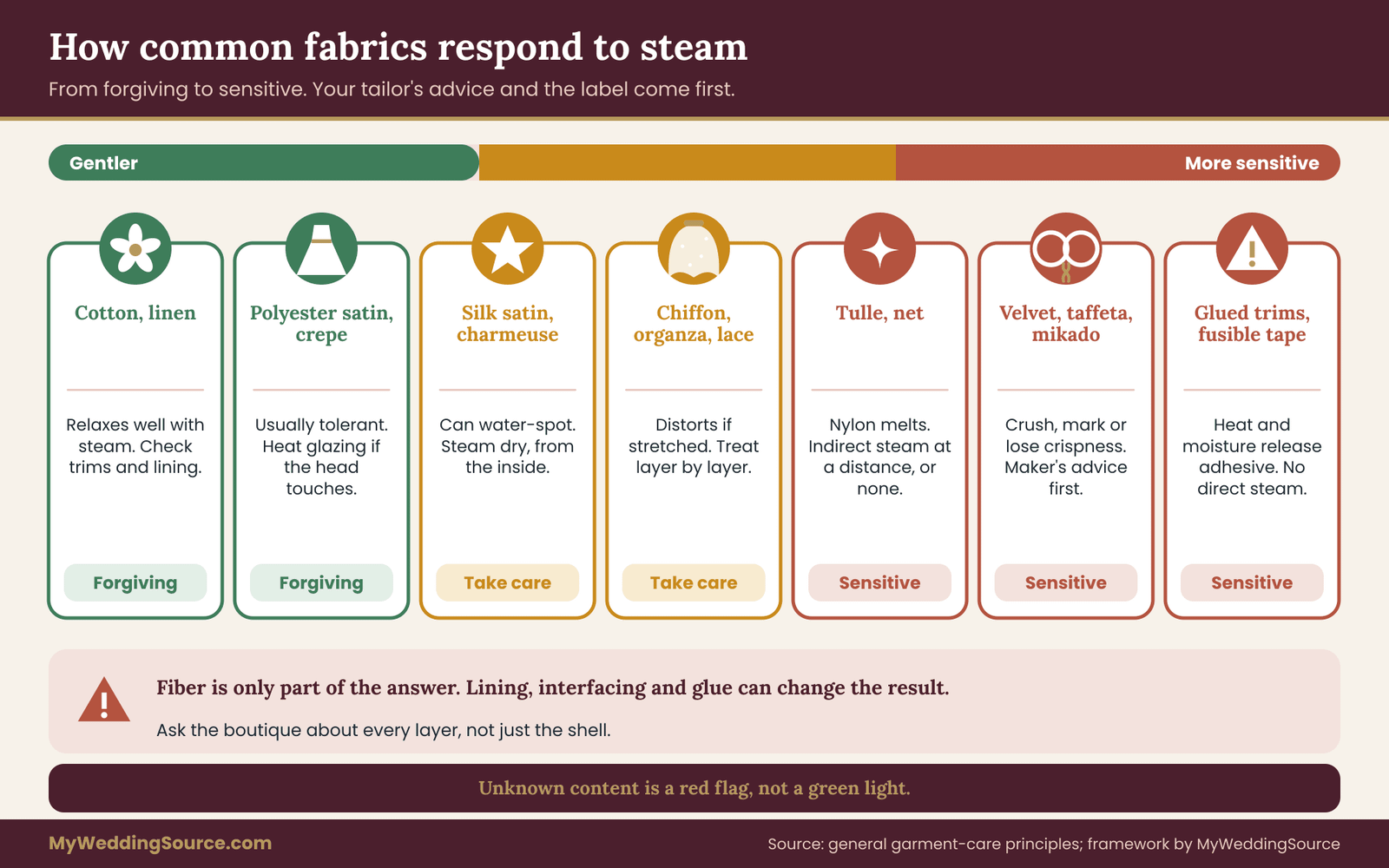
Fiber and fabric are not the same thing. Silk is a fiber; satin is a weave that can be made from silk, polyester or acetate. Two dresses that look alike across a room can behave differently under steam because one is silk charmeuse and the other is polyester satin. The notes below describe general behavior. They are starting points for the conversation with your tailor, not instructions that override the label or the maker. Every fabric below changes what wedding dress steaming should look like in your suite.
Silk satin, charmeuse and dupioni
Silk responds well to steam in some cases and badly in others. Silk satin and charmeuse are smooth and light-reflective, which means any mark shows. Water spotting is the main risk, and it comes from droplets, not vapor. A steamer that sputters, a steamer with a full tank on its first use of the day, or a head held too close can all deposit droplets. Dupioni has a textured, slubby surface that tends to hide spots better, but it can also crease heavily and take a firmer hand.
If the dress is silk and the risk card is amber, the best practice is to let the steamer run for a minute away from the dress until it is producing a steady, dry-looking vapor, to hold the head a few inches from the surface, to keep it moving, and to work from the inside of the skirt where the fabric allows. A hidden test area, such as inside the hem allowance, shows how the fabric reacts before the visible panels are touched.
Polyester satin, crepe and similar synthetics
Polyester is the most common fiber in wedding dresses, and in many cases the most forgiving of steam, because it is less prone to water spotting than silk. It is also heat-sensitive: contact with a hot head or an iron can glaze or melt it. Many dresses described as “satin” are polyester.
Steam is often a good tool for them, as long as the head stays off the fabric and the dress is not sewn to something more delicate. This is where the risk card most often scores green on fiber and still lands amber on trims, so keep reading past the first question.
Chiffon, georgette and organza
These sheer, lightweight fabrics are often silk or polyester. They wrinkle easily and recover quickly, but they are also easy to distort. Chiffon can pucker if steamed while it is stretched, and organza, especially stiffened organza, can lose its crispness. Most professionals steam sheer layers while they hang freely, using very little pressure, and sometimes with a clean cotton cloth held lightly behind the area to catch moisture. Layered sheers need steam applied layer by layer, not all at once, so each can dry.
Tulle and net
Tulle is almost always nylon or polyester, and it is the fabric most likely to be damaged by direct heat. Soft tulle falls flat with gravity and a little time in a clean hanging position, and in many cases does not need steam at all. Where tulle is creased from packing, a professional may use a low, indirect steam from a distance.
Do not touch tulle with a steamer head, and do not steam it while it is compressed against another layer. If your tulle skirt is part of a built-in petticoat, the structure may use stiff tulle or horsehair, and steam can reduce its body.
Lace
Lace behaves according to its fiber and how it is attached. Cotton lace tolerates steam better than most. Nylon and polyester lace respond like their fibers. Silk or rayon lace needs more care. The attachment is as important as the lace: machine-stitched lace on a bodice is more stable than appliqués glued to tulle. Steam can also distort lace’s pattern if the lace is pulled while damp, so it should hang to dry without being tugged. Heavily corded or beaded lace is generally amber or red.
Beading, sequins and crystals
Beaded and sequined dresses are where the glue question matters most. Sewn beads attached with thread through each bead are usually stable, though heat can still affect the thread and the base fabric. Glued crystals, flat-back stones and heat-set rhinestones can loosen, and plastic sequins can warp. Steaming from the reverse side of the fabric, so that the vapor reaches the base without hitting the embellishment directly, is the usual approach for professionals.
Even then, many choose not to steam heavily embellished areas at all and focus on the plain areas around them. If a beaded dress needs wrinkle relief in the beaded zone itself, that is a conversation with the designer.
Velvet and pile fabrics
Velvet is fussy: pressing or touching it crushes the pile, and steam applied the wrong way can leave marks. Specialists steam velvet from the reverse side or with the fabric hanging, never with contact. If a wedding dress is velvet, or has velvet trim, treat it as red unless a specialist is doing the work.
Taffeta, mikado and structured fabrics
Taffeta, mikado and similar crisp or structured fabrics hold their shape through weave, finishing and sometimes added stiffening. Steam can leave water marks on taffeta and can soften the crisp finish. Creases in these fabrics can be stubborn, and the usual professional approach is targeted steam with a hand protecting the area, or a different technique entirely. Because the structure is part of the design, the maker’s advice carries a lot of weight here.
Cotton, linen and casual fabrics
For informal or beach weddings, dresses in cotton, linen or blends are common. These fabrics wrinkle readily and respond well to steam, and they are generally the easiest to treat. Linen in particular relaxes with moisture. The risk is usually in trims, linings and dyes, not in the base fabric. A cotton-linen dress with a polyester lining and a lace overlay is a mixed-fiber garment, and it needs to be assessed layer by layer.
Lining, interfacing and bust cups
A dress’s hidden layers matter. Linings in polyester, acetate or silk can each respond differently, and acetate is particularly sensitive to heat and water. Fusible interfacing, which is glued to the fabric with heat, can release, bubble or pucker if it is hit with steam, and the damage shows on the outside. Foam bust cups can hold moisture and deform. If the label lists only the shell, ask about the lining.
A short comparison in prose
If you want a sense of the spectrum, think of it this way. Cotton and linen sit at the forgiving end, and nearly always take steam. Polyester crepe and polyester satin are next, with the main risk being contact heat. Silk sits in the middle, because it can steam beautifully or spot, depending on the type and the handling. Sheers and laces depend on fiber and attachment. Tulle, velvet, taffeta, mikado, glued embellishments and fusible interfacing sit at the sensitive end, and they are where a professional, a test and a written handoff are worth the most.
Edge cases that change wedding dress steaming decisions
Some situations do not fit the general advice neatly. They come up often enough that they deserve their own section.
A rental or sample dress. If the dress belongs to a rental company or is a boutique sample you bought at a discount, the owner may restrict what can be done to it. Some rental terms forbid any treatment other than the company’s own. Check the agreement before anyone touches the garment. Steam damage on a rental is a billing event.
A family heirloom. An older dress carries unknowns: fibers that have aged, repairs from decades ago, adhesives that did not exist when the dress was made. Silk that has been stored for years can be brittle. For heirlooms, a textile conservator or a specialist in vintage garments is the right first call, and the default is not to steam at the venue.
A custom or hand-painted dress. If the dress has been dyed, painted or printed by the designer or an artist, the colorfastness is unknown unless they tell you. Ask them directly. A mistake can move the color permanently.
A second outfit. Many couples change for the reception or wear a separate ceremony garment. Each piece needs its own label photos and risk card. The reception dress is often the one that gets forgotten, then steamed in a hurry by someone who has never seen it.
Cultural or religious garments. Saris, lehengas, kimono, hanbok, qipao, barong and many other wedding garments use fabrics, metallic threads, embroidery and construction methods that standard wedding dress steaming advice does not cover. Silk with zari work, for instance, can tarnish or distort under moisture. If a family member or a specialist in that garment tradition has handled these garments before, rely on them rather than on general guidance. A pass through the risk card still helps to frame what to ask. A garment specialist’s advice always outranks general guidance here.
Outdoor and humid weddings. Humidity can undo wedding dress steaming quickly. A dress steamed to perfection inside an air-conditioned room can relax or crease again in a humid garden within an hour, and some fabrics take on moisture from the air. In humid conditions, plan for a lighter steam, a longer hang, and a dress touch-up kit rather than a perfect-from-the-steamer finish.
A destination wedding. Luggage creases are close to certain. The question is whether a steamer, a trained person and a power outlet that matches your steamer’s plug will be available in the destination. Ask the venue or hotel for details well in advance. If you are traveling internationally, a steamer from home may need a plug adapter or a voltage converter, and some travel steamers are not built for it. Check the manufacturer’s information rather than guessing.
Dresses that should not be steamed at all
There are dresses where the right answer is no steam, and it is worth saying so plainly. If the dress has a red on the risk card that nobody can resolve, if the label forbids steam, if the maker advises against it, or if the only available option is an unknown steamer in a room with no hanging space and a time limit, then stop. A few creases are an acceptable cost. A damaged dress is not. Wedding dress steaming is optional; the dress is not.
The practical alternatives are worth knowing: hanging the dress in a clean space for several hours so gravity does the work, asking the boutique or tailor to press it professionally before pickup, transporting it in a way that avoids creasing, and having a stylist adjust folds and fall at the venue by hand. None of these is as dramatic as a steamer, and all of them are safer for a dress that is at risk. They are a legitimate answer to the question of wedding dress steaming, not a failure to answer it.
Who should handle wedding dress steaming on the day
Once the risk card has a score, the next decision is who actually holds the steamer. There are five realistic options, and each fits a different score.
Option one: no one, and the dress hangs
For a green or amber dress in a soft fabric, with a day that has no time to spare, hanging the dress in a clean, dry space from the evening before is a real choice. Gravity relaxes a surprising amount of creasing, particularly in lightweight skirts. This option costs nothing, carries no risk of damage, and works best when the dress was pressed professionally before pickup and transported carefully.
Option two: the boutique or tailor, before pickup
The safest wedding dress steaming happens in the shop, by people who know the dress and have the right equipment, before it travels. Ask whether a final pressing or steaming is included in the price or available as an add-on, and ask them to do it as close to your pickup date as they reasonably can. Transport is the next step in the chain, and a pressed dress that is then folded into a car trunk loses much of the benefit. The section on transport later in the article covers that.
Option three: a professional day-of stylist or steamer
A person who works with wedding gowns on the day brings their own equipment, knowledge of fabrics and experience in awkward rooms. They are the right choice for most amber dresses. The things worth confirming before you book are covered in the vetting questions below.
Option four: a trusted friend or relative with the handoff sheet
A bridesmaid, a mother or a friend who has steamed garments before can do a careful job on a green dress, particularly if they are given the handoff sheet, a clear no-go list and a spot-test rule. This option works when the fabric is forgiving, the trims are simple and everybody agrees that the rule is “stop if in doubt.” It does not work when the dress is amber or red and the helper is eager but inexperienced.
Option five: the venue or hotel
Some venues and hotels have a steamer, an iron and a garment room, or housekeeping that will lend a steamer. Treat that as a source of equipment, not as a source of expertise. A borrowed steamer may be dirty, low on descaling, or not designed for delicate fabrics, and housekeeping staff are not trained in handling wedding gowns. If you plan to use the venue’s equipment, ask in advance what it is, whether it is clean, and whether you can inspect it.
Matching the option to the score
A simple rule works for most cases:
- Green dress: option one, four or two. A friend with the handoff sheet is reasonable.
- Amber dress: option two or three. A professional with the dress’s details, and a spot test.
- Red dress: option two, or option one with a plan for no steam. A specialist, with the maker’s advice, if steam is considered at all.

The point of the rule is not rigidity but a default for wedding dress steaming. If you want to go outside it, write down why, so that someone else reading the handoff sheet understands the decision.
Vetting a professional for wedding dress steaming
Hiring someone for wedding dress steaming on a dress that cost a great deal and cannot be replaced deserves the same care as hiring any other wedding vendor. The guide to wedding vendor due diligence lays out the general process of checking a vendor. For a steamer or day-of stylist, the questions below are the ones that matter most.
“Which fabrics have you steamed, and which have you declined to steam?” A good professional can give you examples in both categories. Someone who says they can steam anything is a warning sign. Experienced people know their limits and will say so.
“What equipment do you bring, and what water do you use?” Many professionals bring their own steamer and use distilled or filtered water to avoid mineral spotting. Ask what they do, and why. Their answer tells you whether they have thought about it.
“What will you need from the venue?” Usually an outlet, a hanging point or rack, a clean floor area and a certain amount of time. A professional who asks for these before the wedding is a professional who has done it before.
“How long will the dress take?” You are not looking for a number that sounds impressive. You are looking for one that reflects the dress. A plain gown and a multilayer skirt with beading do not take the same time, and a good professional will say “I need to see it first,” or will ask for the photos.
“Do you carry insurance, and what happens if the dress is damaged?” This is the awkward one, and it is worth asking. Some professionals carry general liability or garment-care insurance, and some do not. Some contracts limit liability to the fee. Ask for the answer in writing, and make sure you understand it before you hand over the dress. You can also check whether your own wedding insurance or homeowner’s or renter’s policy has any coverage for the dress, and ask the issuer rather than assuming.
“Can you do a test on a hidden area first?” A good answer is yes, and that they would insist on it for anything delicate.
“What would make you decline on the day?” Professionals who have never declined a job are professionals who have never been careful. A good one will name the conditions, such as an unlabeled dress, an unknown stain or no room to work, and will tell you what they would do instead.
Agreeing the terms in writing
For a paid professional, the booking should cover the following in a short written agreement or confirmation, whether in a contract or an email thread.
- The date, arrival time, and the window in which the dress will be worked on.
- The fee, any travel or parking charge, and the cancellation terms.
- Who will attend, and whether a second person may be sent in their place.
- What happens if the professional decides not to steam, and whether the fee is still due.
- How they handle damage: whether they are responsible, up to what amount, and how a claim is made.
- What they need at the venue.
You do not need a lawyer for this. You need an email thread that both sides have acknowledged. The guide to wedding vendor timelines is helpful for slotting the steamer’s arrival into the rest of the day’s schedule, since the steamer must finish before hair is complete and the dress goes on.
Cost logic without invented numbers
Prices vary a great deal by region, by the person’s experience and by the length of the job, and you should confirm them directly. The logic is what matters. A professional’s fee is small compared with the cost of the dress and tiny compared with the cost of an irreplaceable one-day garment going wrong.
At the same time, paying a professional is not automatically the right answer. If the dress is a green on the risk card and the boutique already pressed it, the money may be better spent elsewhere. The risk card is how you decide that, instead of relying on anxiety.
When you weigh the cost of wedding dress steaming by a professional, a decent test is to ask: “If this goes wrong, what is the cost of the damage, and who pays?” If the answer is “us, and it is large,” then reducing the chance of damage by even a small margin is worth the fee. If the answer is “a minor crease that falls out in the first hour,” then the fee may not be.
The steamer handoff sheet for wedding dress steaming
The second tool is the handoff sheet. It is one page, printed or on a phone, that goes with the dress and is read by anyone who handles the steamer. It has two purposes. It gives the person the facts they need. It also records, in your words, what you have decided, so that the decision does not depend on who is in the room.
The sheet has ten fields. Fill them in with the boutique’s answers and your label photos.
1. Dress identification. The designer, style name or description, and color. Something like “ivory silk satin A-line with lace bodice.” This avoids mix-ups when there are several garments in the room.
2. Fiber content by layer. Shell, lining, overlay, trim, as best known. Mark anything unknown as unknown. Attach or reference the photos of the labels.
3. Care label wording. Copy the exact words and symbols, and note whether steam is mentioned.
4. Risk card result. The score for each of the four questions and the overall color. This tells the handler at a glance how careful to be.
5. No-go zones. The specific places not to touch, for example “beaded bodice front: no steam,” “glued appliqué on the left hip,” or “tulle underskirt: no direct contact.”
6. Alterations. What the tailor changed: hem, bodice, bustle, zipper. Include the tailor’s name and number.
7. Method rules. For example: “Spot-test inside hem allowance first. Distilled water. Hold the head at least a few inches away. Steam from the reverse side. Stop and call if any mark appears.”
8. Space and equipment. Which outlet, which circuit if known, where the dress will hang, and who is bringing the steamer.
9. Time window. When wedding dress steaming should start and the time by which it must end, with a buffer before the dress goes on.
10. Who to call. The boutique, the tailor and the couple’s point person, with phone numbers. Also what the handler should do if they are unsure: stop, hang the dress, and call.

A sample of the handoff language
Here is how the fields can read, in plain, unfussy language that a professional will appreciate.
“Ivory silk satin dress, lace overlay on the bodice (nylon), tulle underskirt, polyester lining. Pearls on the bodice are sewn; the small crystals on the waistband are glued. No steam on the waistband or bodice. Steam the skirt only, from the inside, with the head held away from the fabric. Spot-test inside the hem first. If anything looks different afterward, stop and call the tailor.”
The test of a good handoff sheet for wedding dress steaming is whether a competent stranger could follow it without asking you anything. If it takes a phone call to interpret, rewrite it.
Who gets a copy
Give the sheet to the person doing the wedding dress steaming, the planner or day-of coordinator if there is one, and the person managing the bridal suite. Keep a copy in the dress’s garment bag, so the dress carries its own instructions. This small step matters most when someone unexpected ends up handling the dress, such as when the booked professional is delayed and a bridesmaid takes over.
Venue setup for wedding dress steaming: power, water, space and time
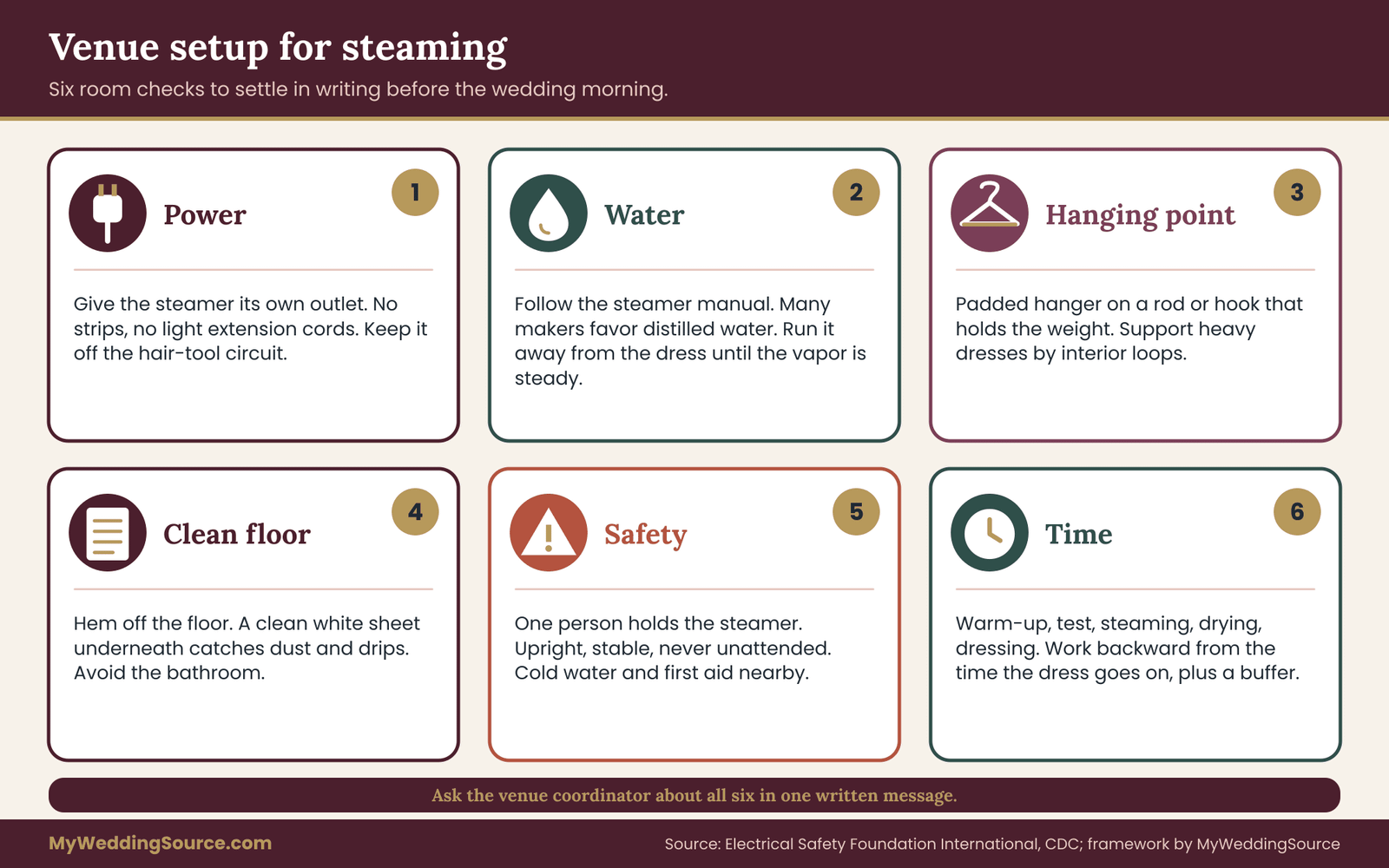
The risk card and handoff sheet cover the dress. This section covers the room. Many problems that look like dress problems are really room problems, and nearly all of them can be solved by one phone call to the venue a few weeks before. Wedding dress steaming depends on the room at least as much as on the steamer.
Questions for the venue coordinator
Send these in writing, ideally as part of the same conversation that covers the getting-ready rooms. The guide to a venue technical walkthrough explains how to collect this sort of detail on a site visit, and the questions here fit naturally into it.
- Which room will the dress be in, and when can we access it? Many venues hand over the suite only a few hours before the ceremony, and some share it with other events.
- How many outlets are there, and are any on a dedicated circuit? Ask whether the room has had trouble with tripped breakers during hair and makeup. Venues that host weddings regularly usually know.
- Is there a rack, hook or hanging point at a safe height? A door frame, a closet rod, a curtain rod or a purpose-built garment rack are different things, and not all can carry the weight of a heavy dress.
- Does the venue have rules about outside electrical equipment? Some historic buildings, churches and rented spaces restrict equipment, and some require that appliances be tested or approved. Ask before bringing a steamer.
- Can we use the venue’s water, and is it hard? If the venue says its tap water leaves deposits on kettles and glassware, that is a reason to bring distilled water.
- Is there a smoke or fire alarm sensitivity in that room? Steam can trigger some detectors, particularly in small rooms with poor ventilation. Ask whether it has happened and where the nearest ventilation is.
- Who is the contact on the day if something goes wrong in the suite? A name and a number.
Power: the circuit problem
A steamer is a heating appliance, and hair tools are heating appliances too. Put a steamer, two hair dryers, a flat iron and a kettle on one circuit and something will give. The Electrical Safety Foundation International advises against overloading outlets and against chaining power strips, and the same guidance applies in a hotel room or a venue suite.
Practical habits that help:
- Give the steamer its own outlet if the room has more than one, and tell the hair team which outlets they may use.
- Do not run the steamer through a multi-outlet strip or a light extension cord. If an extension is unavoidable, use a heavy-duty cord rated for the load, as short as possible, and check the steamer’s manual for any warning about extensions.
- Stagger heavy use. The steamer needs a warm-up and a steady run, so schedule it when hair tools are not all running at once.
- Keep cords out of walking paths. A cord across a doorway, near someone in heels and a long dress, is a hazard to the dress and to people.
Water: what goes in the tank
Many steamer manufacturers recommend distilled or demineralized water to reduce mineral buildup and spitting, and some say tap water is fine. Follow the manual for your model. The reason it matters for wedding dresses is spotting: mineral deposits and a spitting steamer both make marks on delicate fabrics. If your professional brings their own steamer, they will already have a view. If you are using a borrowed or purchased steamer, run it first against a clean towel, away from the dress, until the vapor is steady and no droplets appear.
Space: where the dress hangs
The ideal space for wedding dress steaming is a clear area at least as tall as the dress with room to walk around it, away from the traffic of hair and makeup, with a hard, clean floor. In practice, you may get a corner of a hotel room.
- Hang from the right place. A padded hanger or a skirt hanger with clips and straps for the weight, hung from a rod or hook that can hold it. Heavy beaded dresses should be supported by the internal hanging loops where they exist, not by thin shoulder straps that may stretch.
- Keep the hem off the floor. If the skirt is long, raise the hanger or use the clean sheet technique below. A hem that drags picks up dirt, and the dirt then meets the steam.
- Protect the floor and the dress. A clean white sheet or a clean garment bag spread on the floor beneath the hem keeps dust and hair from the dress and catches drips.
- Avoid the bathroom if there is a choice. A bathroom is damp, often has hair products in the air, and the floor is rarely clean. If it is the only space with a hanging point, wipe the area, keep the door open, and keep the dress away from any running water.
Safety around the steamer
Steam burns are fast. A few rules make the room safer.
- Only one person holds the steamer; nobody else reaches over it.
- Keep the steamer upright and stable on a hard surface, never on a bed or soft chair, and never left running unattended.
- Keep hands away from the vapor path. Do not hold fabric with one hand while steaming behind it, since steam can pass through lightweight layers.
- Keep children and pets out of the space.
- Treat the head and the hose as hot even after the unit is off. Let it cool before it is packed.
- Know where cold water and a first-aid kit are. The CDC and other public-health organizations publish basic burn first-aid guidance, and it is worth a minute of reading before the day.
The Occupational Safety and Health Administration publishes workplace guidance on hot surfaces and electrical hazards, which is aimed at employers but contains the same common-sense principles a professional steamer follows.
Time: the part everyone underestimates
Wedding dress steaming at the venue has to fit between other things. A dress that needs to be on by a given time, with photographers waiting for the first-look or getting-ready photos, needs a hard stop for steaming, with a buffer before it.
Work backward from the time the dress must be on, and subtract the following:
- the time to get the bride dressed, including buttons, laces, bustle checks and any pins;
- a drying and settling interval after wedding dress steaming, because a freshly steamed dress is slightly damp and may hold new creases if worn immediately;
- the wedding dress steaming itself, as estimated by the professional for this dress;
- setup time, including the warm-up of the steamer and a spot test;
- a contingency buffer.
If the numbers do not fit, shorten the wedding dress steaming by prioritizing: steam the areas that show, such as the front skirt, the bodice front and the train, and skip the areas that will be hidden or will fall out in movement. The guide to bridal hair and makeup planning covers the order of getting-ready tasks and where a wedding dress steaming window can slot in without colliding with hair and makeup.
How careful wedding dress steaming proceeds, step by step
Technique is the least interesting part of this subject, because a professional already knows it and a novice should not attempt it on an amber or red dress. It is still worth knowing what good practice looks like, so you can recognize it and ask for it.
Step 1: Read the handoff sheet and agree the plan. The person doing the wedding dress steaming reads it and asks questions. They agree with the couple’s contact which areas will be treated, which will not, and what the stop-and-call rule is.
Step 2: Inspect the dress. Before any steam, look for stains, loose beads, lifted trim, or damage from transport. Photograph anything unusual so that a before-state exists. These photos protect everyone, including the person steaming.
Step 3: Prepare the steamer. Fill with the right water, let it heat fully, and run it away from the dress to clear any droplets. A steady stream with no spitting means it is ready.
Step 4: Test on a hidden area. Choose a spot that will not show, such as inside the hem allowance, and apply steam as planned. Let it dry and check for spots, color change, shine or shrinkage. If anything is off, stop and reconsider.
Step 5: Work top to bottom. Steaming from the top down lets gravity and moisture work in the same direction, so that you do not drip over areas already done. Many professionals begin with the bodice and work down the skirt.
Step 6: Keep the head moving and away. The head should not touch the fabric, particularly not on synthetics and embellishments. Keep it moving, with short passes, and do not linger in one place. A second person gently pulling the fabric taut, with a clean hand and without tension on delicate areas, can help creases release.
Step 7: Steam from the reverse side where possible. Reverse-side steaming protects the surface, and is the usual approach near beads, lace and appliqués.
Step 8: Treat layers separately. For a multi-layer skirt, steam each layer while it hangs freely, and let it settle before treating the next.
Step 9: Let it dry. The dress should hang for a while after steaming, ideally with air moving around it, before it is worn or bagged. A damp dress put on too early picks up new creases and can feel clammy.
Step 10: Final check. Look at the dress under good light, and photograph it. If there are any marks, note them and tell the couple’s contact.
Steps one, two and four are the ones most often skipped in wedding dress steaming, and they are the ones that prevent trouble.
A worked example of wedding dress steaming at the venue
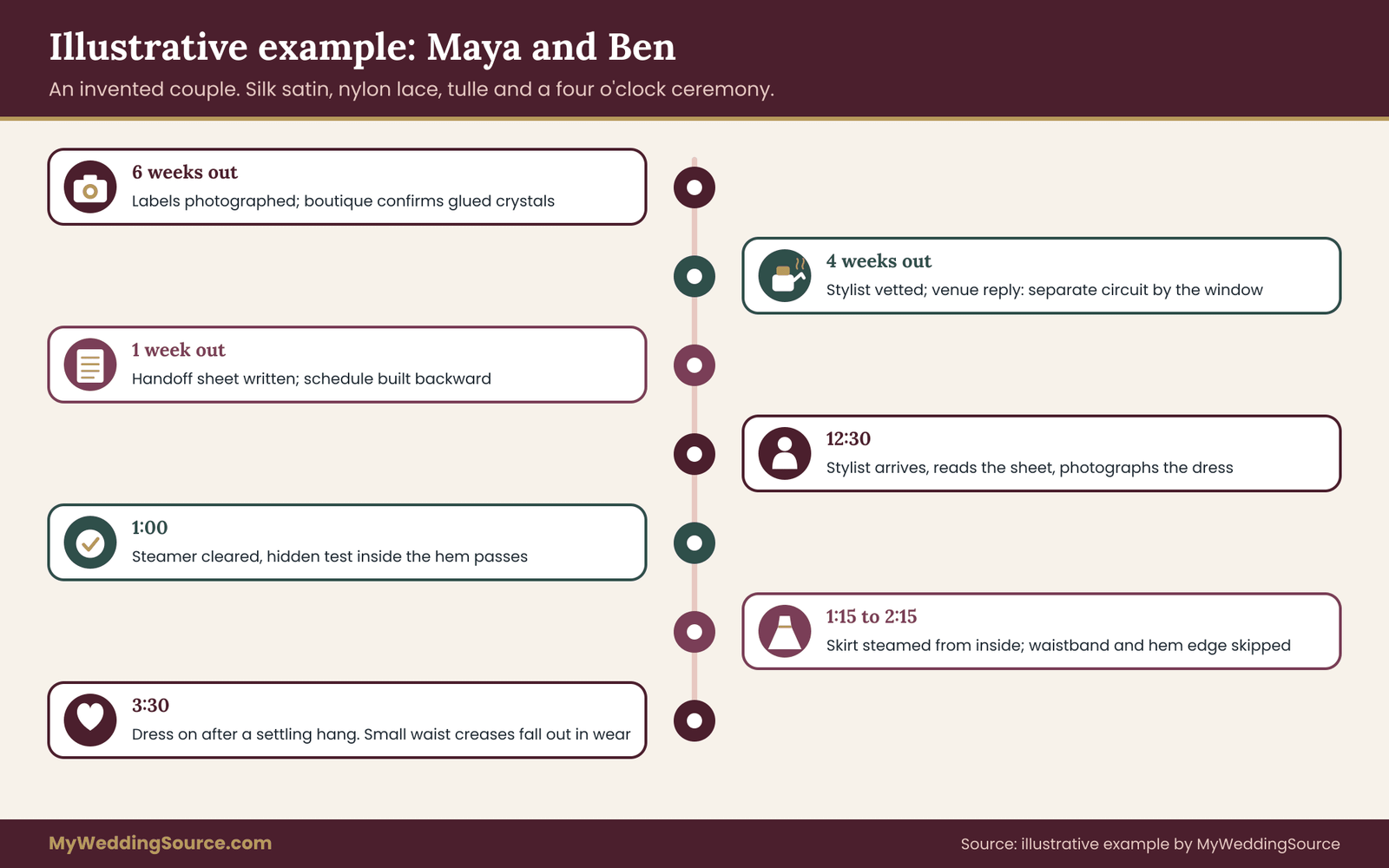
The following example is invented to show how the tools fit together. It is not a case study and the people do not exist. Call the couple Maya and Ben. Maya’s dress is ivory silk satin with a nylon lace bodice, a tulle underskirt and a polyester lining. The tailor shortened the hem and added a French bustle. The wedding is at a restored mill with a second-floor bridal suite, a four o’clock ceremony and photographs of getting ready from noon.
Six weeks out: label photos and the first questions
When Maya picks the dress up after the last alteration, she photographs both labels. The care label says dry clean only and carries no steam symbol. The content label lists “shell: silk” and nothing else. She sends the boutique a short message, the script from earlier in the article, and a few days later gets the reply: the lace is nylon, the lining is polyester, the pearls on the bodice are sewn, and the small crystals on the waistband are glued. The tailor adds that the new hem tape is a fusible type and should not be steamed directly.
Scoring the card
Maya fills in the risk card with Ben.
- Fiber: silk satin plus nylon lace and tulle. Amber.
- Finish and trim: sewn pearls, glued crystals at the waist. Red for the waistband specifically, amber for the rest.
- Construction: lightly boned bodice, sewn-in net petticoat, fusible hem tape. Amber.
- Condition: clean, no stains. Green.
Overall, the card says red because of the glued crystals, but only for one area. They note that the red applies to the waistband and the hem edge, not the whole garment. The decision they reach is a hybrid: no steam on the waistband or the hem tape, and a professional for the rest.
Four weeks out: finding a steamer and confirming the venue
Maya asks the tailor for a recommendation and gets the name of a day-of stylist. She asks the stylist the vetting questions. The stylist says she steams silk satin from the inside with distilled water, brings her own steamer, will want to do a hidden test, and would decline to steam the waistband. She carries liability insurance and sends a one-page confirmation. She asks for the handoff sheet and the label photos, which Maya had already prepared.
Meanwhile Ben emails the mill’s coordinator. The reply: the suite has four outlets, two of which are on the same circuit as the hair stations, the room has a closet rod that holds up to a stated weight, and the venue asks that outside equipment be listed in advance. Ben lists the stylist’s steamer. The coordinator suggests using the outlet near the window, which is on a separate circuit. The tap water is described as hard, so the stylist plans to bring distilled water.
One week out: the handoff sheet and the schedule
Maya writes the handoff sheet. Fields five and seven carry most of the weight: “No steam on the waistband crystals or the hem edge. Steam from inside. Spot test first. Stop and call the tailor if anything changes.” She prints two copies and puts one in the garment bag.
Working backward from a three-thirty dressing time, she and the stylist set a schedule: stylist arrival at noon thirty, setup and test by one, steaming from one until about two fifteen, then hang and settle until three, dressing at three thirty. Hair and makeup are in the room across the hall until two forty-five, and nobody is to use the outlet by the window.
The morning of
The stylist arrives, reads the sheet, and photographs the dress. The skirt has creases from the garment bag. She runs the steamer away from the dress until it is steady, tests inside the hem allowance, waits, and checks the spot: no mark, no shine. She works from the bodice down, from the inside of the skirt, and treats each tulle layer separately at a distance. She skips the waistband and the hem edge, as agreed.
At a quarter past two, the dress hangs. A few small creases at the waist, where the stylist did not steam, are still visible. The stylist smooths them gently by hand and explains that they will fall out once the dress is worn. Maya agrees. The dress goes on at three thirty. The photos at four are fine, and most people never see the creases.
What the example shows
Several decisions in this example are worth noticing, because they generalize.
The card’s red result did not mean “do not steam anything.” It identified exactly which areas to avoid and which were safe in professional hands. The handoff sheet carried that knowledge to the person who needed it. The venue conversation about wedding dress steaming turned up a circuit issue that would otherwise have been discovered at one o’clock. The schedule had a buffer. And the couple accepted a few small creases rather than risking the waistband. That trade, a small visible imperfection for a large avoided risk, is the most useful habit in wedding dress steaming at the venue.
When wedding dress steaming goes wrong: a calm response plan
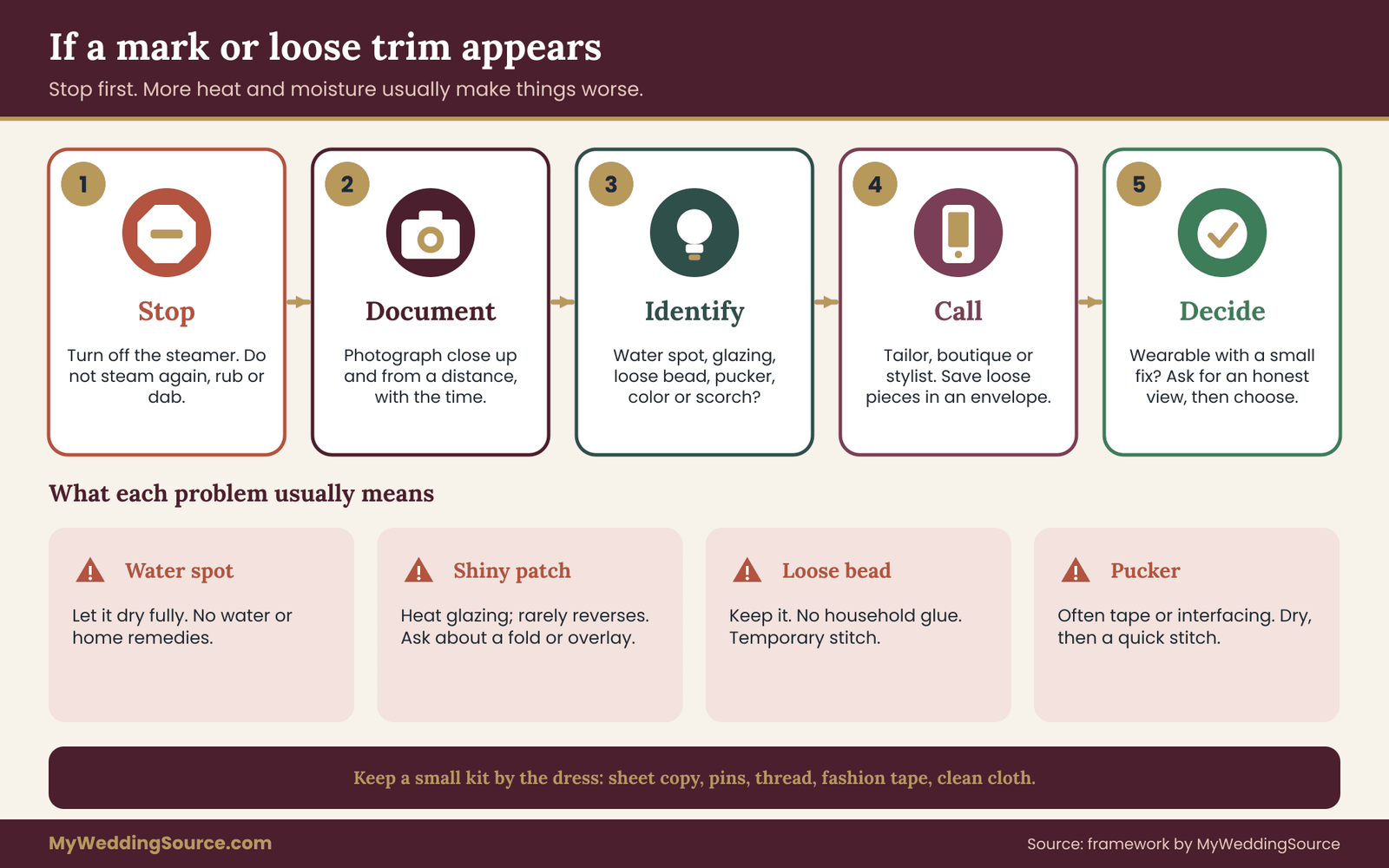
Even careful wedding dress steaming can go wrong, and it is better to decide in advance how you will respond than to improvise while the clock runs.
Stop first
The first rule: if a mark, shine, color change or loose trim appears, stop. Do not steam again to “fix” it, and do not rub, dab or press. More heat and moisture usually make a problem worse. Move the steamer away, hang the dress, and look at the affected area calmly in good light.
Document it
Photograph the area close up and from a distance, with the time. If the person steaming is a professional, tell them what you see and ask them to note it. A record matters for any later conversation with the boutique, the stylist or an insurer.
Identify what it is
Different problems have different first responses.
A water spot on silk or satin. Leave it alone and let the dress dry fully. Some marks fade as the fabric dries. If it remains, a professional cleaner or the boutique may be able to treat it. Do not apply water or home remedies, because they spread rings.
A shiny or flattened patch on synthetic fabric. This is heat glazing, and it usually does not reverse. Contact the tailor about whether an overlay, a fold or a hidden placement can disguise it. A professional may be able to suggest options.
A loose or fallen bead, crystal or appliqué. Collect any loose pieces and keep them in an envelope. Do not try to glue them back on with household glue, which can stain the fabric. A stylist or tailor carries tools for a temporary stitch or a fabric-safe adhesive, and a seamstress can fix it properly afterward.
A sagging hem or a puckered area. This often relates to fusible tape or interfacing reacting to moisture. Let it dry, then see whether it relaxes. If it does not, ask the tailor about a quick stitch.
Color transfer. Blot nothing. Call the boutique or a specialist cleaner right away, since time and handling matter.
A burn or scorch. Scorched fabric cannot be repaired. A tailor may be able to cover or modify the area, and may suggest a placement for a flower, a sash or a draped layer.
Decide whether the dress is still wearable
Often the answer is yes, with a small adjustment. A glazed patch on the back of the skirt, a loose bead at the hem, a water ring on a hidden panel, these are all things most guests will never notice. Ask the tailor or the stylist for an honest view, and then decide as a couple. Keep in mind that photographs and ceremonies move quickly, and that small imperfections rarely mean what they feel like they mean in the moment.
The emergency kit
Keep a small kit in or near the dress’s garment bag, as part of the compatibility and emergency backups described in the accessories guide. Useful items include:
- a handoff sheet copy and the tailor’s phone number;
- a few safety pins in assorted sizes, and a small sewing kit with thread that matches the dress;
- fashion tape for emergency hems and neckline shifts;
- a clean, white, lint-free cloth;
- a lint roller that is safe for the fabric;
- a small amount of distilled water in a labeled bottle, if the steaming person has asked for it;
- a spare hanger and a clean sheet.
Do not pack stain removers in the kit unless the boutique recommends a specific product for the dress. Guessing makes things worse.
Who pays
If a professional damaged the dress, the booking confirmation should say what happens next. Refer to it, contact them promptly, and keep calm and factual. If the damage came from a friend or a venue appliance, the situation is more personal, and the best response is to document it and decide what matters. If you have wedding insurance, check whether the policy covers the dress and whether there is a reporting window. Your insurer or the policy documents, not an article, give the answer.
Getting the dress to the venue, and what comes after wedding dress steaming
The best wedding dress steaming session is the one you barely need. Much of the work happens before the dress reaches the suite, and some of it happens after the wedding is over.
Transport that prevents creases
Wrinkles are mostly made in transit. A few habits cut them sharply.
- Hang, do not fold. Hang the dress in the car if there is a clean place to do it, with the bag lifted so the hem does not touch the floor. A hook above a rear door works in many cars. If the dress must lie flat, lay it on a clean sheet with the skirt in loose, wide folds and tissue paper between layers.
- Use a breathable garment bag. A cloth or breathable bag lets air move and avoids trapping moisture. Plastic dry cleaner bags are fine for a few hours but not for storage.
- Keep it cool and dry. A hot car, direct sun and damp trunks all create problems. Dresses should not sit in a closed car for long.
- Keep a hand free. The person carrying the dress should not also be carrying other things. Stairs and doorways are where hems get stepped on.
- Check what is in the bag. A hanger with a sharp edge, a loose pin or a spare shoe pressed against fabric all leave marks.
If the dress travels by air, ask the boutique about packing it in a box with tissue or carrying it on board, and ask the airline about garment bag policy. The airline’s own rules govern, and they change.
Hanging overnight
If you are staying at the venue or a nearby hotel the night before, hang the dress as soon as it arrives, in a clean space, away from the bathroom’s moisture and from any strong smell such as perfume, smoke or cooking. A dress hung overnight with a bit of space around it will often drop a surprising number of creases on its own, and that may leave very little for the steamer to do. This is also the moment to check the dress against your handoff sheet and note any new marks.
What wedding dress steaming cannot fix
It is worth being clear about the limits, so nobody expects a miracle from a steamer.
- It does not remove stains. It can set them.
- It does not repair damaged seams, loose beads or lifted trim.
- It does not restore the crispness of fabric that has been softened by moisture.
- It does not replace professional cleaning. A dress that is dirty needs cleaning by someone who specializes in wedding gowns, and that happens before or after the wedding, not at the venue.
- It does not reliably last. In humid conditions or after hours of wear, creases return.
Knowing these limits of wedding dress steaming shapes expectations. The goal at the venue is a dress that looks good in photographs and in motion, not a surface that has never seen a crease.
After the wedding: cleaning and storage, not wedding dress steaming
After the wedding, wedding dress steaming is not the right tool. The dress will have picked up skin oils, perfume, food, dust and invisible stains from the day, and those need to be cleaned out by a specialist in wedding gowns before long-term storage. Stains that are invisible when fresh can yellow over time, and steam and heat can set them. Ask the boutique, the tailor or a reputable specialist cleaner about timing, and tell them about anything that happened to the dress on the day, including any spills or steaming marks.
For storage, specialists commonly recommend acid-free tissue and a breathable box or bag, in a cool, dry, dark place, rather than a plastic bag in an attic or basement. Preservation boxes that seal the dress carry their own pros and cons, and your cleaner can explain which fits your dress. If you want to resell the dress, it may have a different care path again.
The point is simple: wedding dress steaming is a day-of touch-up. Care after the wedding is a different job, with different people.
Keeping the paperwork
Keep the handoff sheet, the label photos, the boutique’s replies and the stylist’s confirmation. If you later sell, donate or pass on the dress, those details are useful to the next person. They also help if a question comes up with the cleaner or an insurer. The main wedding planning checklist is a sensible place to add a “dress care” line to your task list.
Your next steps
Work through these in order. Most take a few minutes, and together they make wedding dress steaming a planned task instead of a morning scramble.
- Photograph every label on the dress, plus the inside of the bodice, the hem and any embellished area.
- Send the boutique or tailor the script from this guide and save their replies.
- Fill in the four questions of the risk card and write down the overall score and any no-go zones.
- Decide who will handle the wedding dress steaming, using the matching rule, and book them if they are a professional.
- Ask the venue about outlets, circuits, hanging points, outside equipment and water, and ask for the answers in writing.
- Write the handoff sheet, print two copies, and put one in the garment bag.
- Build a backward schedule from the time the dress goes on, with a settling interval and a buffer.
- Pack the small emergency kit, and decide in advance who calls whom if a problem appears.
- After the wedding, book specialist cleaning and storage rather than steaming.
FAQ
Can I steam my wedding dress myself?
You can, if the dress scores green on the risk card: a forgiving fiber, plain trims, simple construction and clean condition. Test on a hidden area first, keep the head off the fabric and use clean water. If the dress scores amber or red, or you are unsure what it is made of, ask your boutique or a professional rather than learning on the dress itself.
Does a dry clean only label mean I cannot steam the dress?
Not necessarily. The label tells you the manufacturer’s recommended cleaning method, and the FTC’s Care Labeling Rule does not require it to address every process, including steaming. Silence on steam means unknown. Ask the boutique or designer in writing, and check for a crossed-out steam symbol on the label before deciding.
Which wedding dress fabrics are riskiest to steam?
Tulle, velvet, taffeta, mikado, acetate, glued embellishments and fusible interfacing carry the most risk, because heat or moisture can melt, mark, soften or loosen them. Silk satin can show water spots. Polyester and cotton are generally more forgiving, though trims and linings still matter. Your tailor can tell you which parts of your dress are sensitive.
Should the venue steam my dress for me?
Venue staff and hotel housekeeping are rarely trained in wedding gowns, and their equipment may be dirty or unsuitable for delicate fabrics. Treat a venue steamer as an equipment option only after asking what it is and checking its condition. For an amber or red dress, a professional with the dress’s details is a safer choice.
How long does wedding dress steaming take at the venue?
It depends on the dress, so ask the person doing it for an estimate after they have seen the label photos. Plain gowns are quicker than multi-layer skirts with embellishment. Add warm-up and testing time, a settling interval while the dress dries, and a buffer before the dress goes on.
Can I use a shower or bathroom steam instead?
It is possible, but it is uncontrolled. Moisture lands everywhere, including areas that should stay dry, and bathroom floors and air are rarely clean. If it is your only option, apply the same risk card and keep the dress away from running water. Hanging the dress overnight in a clean, dry room often does more with less risk.
What should I do if the steamer leaves a mark?
Stop the wedding dress steaming at once. Do not rub, blot or apply water. Photograph the area, let it dry, and call the tailor, boutique or stylist for advice. Some water marks fade, but heat glazing and scorching usually do not. A tailor may be able to disguise or repair the area, and a record helps with any insurance or vendor conversation.
What do I need to tell the person steaming my dress?
Give them the fiber content of every layer, a photo of the care label, which beads or trims are glued, what the tailor altered, the no-go zones, the time window and who to call. The handoff sheet in this guide puts all of it on one page, so they do not have to guess or interrupt the schedule.
Sources
- Federal Trade Commission: Care Labeling Rule and clothing guidance
- Electronic Code of Federal Regulations: 16 CFR Part 423, Care Labeling of Textile Wearing Apparel
- ASTM International: care symbols for textile products
- Electrical Safety Foundation International: outlet, power strip and extension cord safety
- U.S. Consumer Product Safety Commission: household appliance and electrical safety
- Centers for Disease Control and Prevention: burn prevention and first aid
- Occupational Safety and Health Administration: electrical and hot-surface hazards
- National Fire Protection Association: electrical and home fire safety
- Library of Congress: caring for family textiles and heirlooms