
A vegan wedding menu works when every guest leaves the table full, when the plate looks like a decision rather than a leftover, and when anyone who needs to know exactly what is in a dish can find out. This guide gives you a two-part tasting scorecard, one half for fullness and one half for allergen clarity, plus a worked example and plain scripts for your caterer.
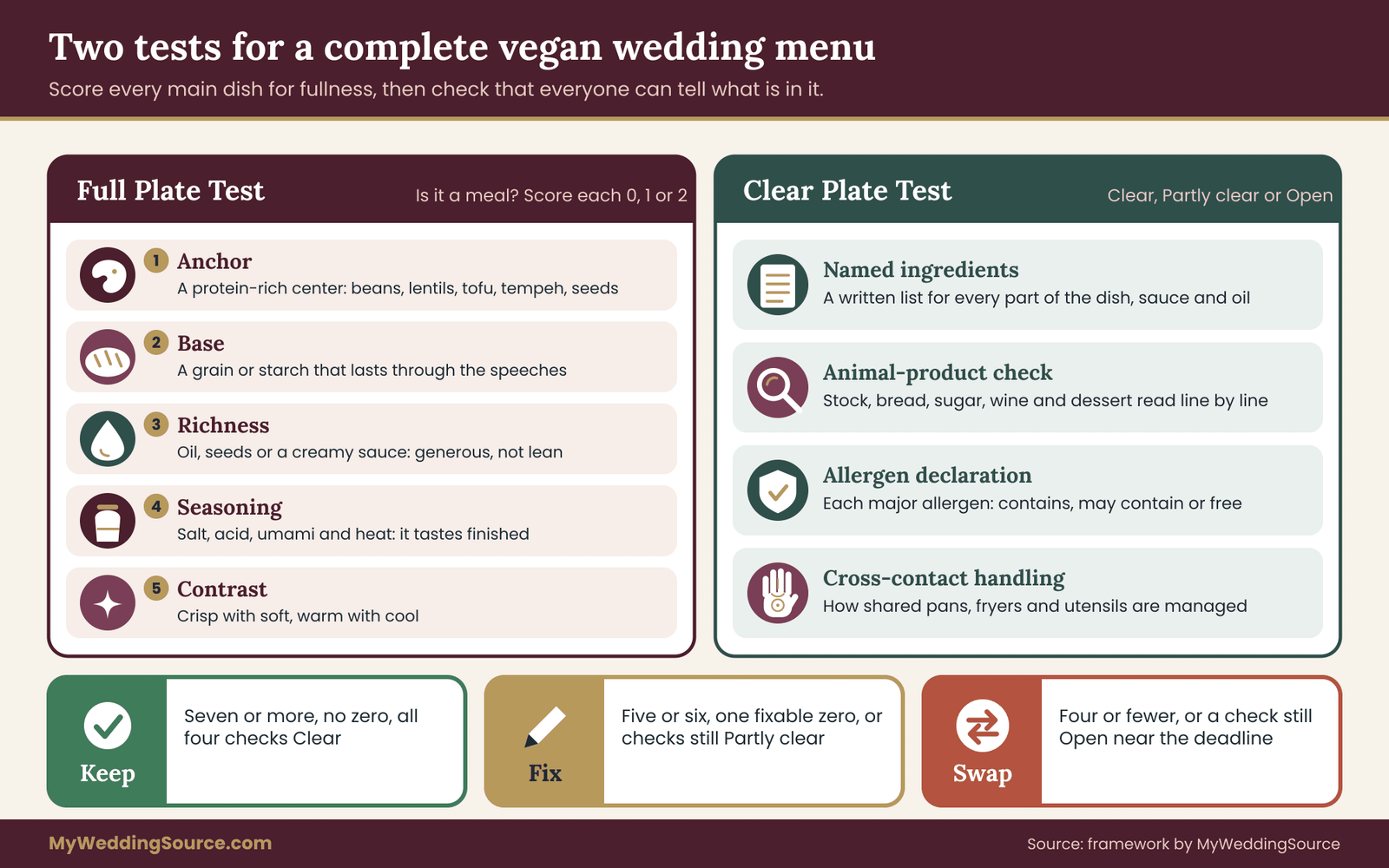
Score every main dish twice before you lock your vegan wedding menu. The Full Plate Test checks five things: a protein anchor, a slow starch or grain base, richness, seasoning depth, and contrast in texture and temperature. The Clear Plate Test checks four things: a written ingredient list, a check for hidden animal products, a dish-by-dish allergen declaration, and a description of how the kitchen prevents cross-contact. Keep a dish that passes both, fix one that nearly passes, and swap one that cannot be made clear in time. Never promise a guest that a plant-based dish is safe for an allergy.
Most couples who ask for a vegan wedding menu have the same quiet worry. They have eaten at weddings where the plant-based option was a plate of roasted vegetables and a scoop of rice, delivered late, to the one table that asked for it. They do not want a guest to spend the evening hungry, and they do not want to be the people who made a relative feel like an afterthought.
The opposite worry is just as common. A couple who loves the idea of a fully vegan wedding menu for all guests may fear that the omnivores in the room, perhaps most of them, will feel shortchanged. A grandparent asks where the “real” main course is. A friend asks whether the dressing has nuts in it, because the last vegan dish they ate was built on cashews, and cashews are exactly what they cannot have.
Both worries are about the same thing: whether the meal is complete. This article treats the completeness of a vegan wedding menu as something you can test rather than something you hope for. It breaks the question into two parts that rarely get discussed together. The first is satiety, which is whether the dinner feels like a full meal.
The second is allergen clarity, which is whether the people serving and eating the food know what is in it. A vegan wedding menu that passes the first test and fails the second can still put someone in the hospital, and one that passes the second but not the first sends guests to the late-night pizza.
A note on scope. This is general information, not legal, tax or financial advice. Your caterer’s permits, your venue’s rules and a guest’s own doctor decide what is safe and allowed in a particular case, and the guide points you to the agencies that publish the current rules so you can read them yourself.
The most common way to produce a weak plant-based dinner is also the most natural. The kitchen takes the menu it already has, removes the meat, and keeps what is left. A chicken breast with potato gratin, green beans and a pan sauce becomes potato gratin and green beans. The gratin may contain cream and cheese, so it is quietly swapped for a plain baked potato. The pan sauce disappears. What lands on the plate is the side dishes of a meal that no longer has a main.
That approach fails on both counts of completeness. The plate is light, because the part of a dinner that carries most of the protein and richness has been taken out and nothing has replaced it. And the plate is unclear, because the substitutions were made in a hurry by a line cook, so nobody wrote down which oil the vegetables were roasted in or whether the substitute sauce contains soy, wheat or nuts.
Building a vegan wedding menu by addition works the other way around. You start with the plant-based plate and ask what it needs to be a dinner. Then you add exactly that, in the form of beans, grains, nuts or seeds, sauces, a cooked-in layer of savory flavor, and a contrast of textures.
This is how many cuisines already work. Lentil stews, bean-and-grain dishes, vegetable curries with rice and flatbread, and noodle bowls were never missing a meat course, because they were designed as complete plates from the start. A good caterer will know this, and a good tasting will show whether yours does.
The three groups of guests you are actually feeding
It helps to be specific about who will eat the plant-based plate, because the best design depends on the mix.
The first group is guests who are vegan or strictly plant-based by choice. They care about hidden animal ingredients and tend to notice them. For them, clarity about what is in each dish is as important as flavor.
The second group is guests who will happily eat a plant-based dish if it is good. These are your omnivores at a fully vegan dinner, or the curious ones at a mixed menu. They judge the meal on whether it felt substantial and tasted finished. They rarely read ingredient lists.
The third group is guests with food allergies or medical diets, for whom a plant-based plate is neither safer nor riskier by default. Many popular vegan substitutes lean on tree nuts, soy, wheat and sesame, so a plate built for the first group can be a problem for the third. A guest with a tree nut allergy who sees “vegan cheese” has no idea whether it is made from cashews or from starch.
A vegan wedding menu that serves all three groups needs both tests. That is the reason this guide builds one scorecard with two halves, rather than treating allergens as a footnote to a conversation about flavor.
What this guide leaves to other pages
This guide covers one narrow job: designing and verifying a vegan wedding menu for the dinner itself. It does not walk through every dietary need you may meet at a wedding, and it does not cover how to pick a caterer or set a budget from scratch. For the wider picture of feeding guests of different ages and diets, including kosher, halal, gluten-free and child portions, the guide on building a wedding menu that works across ages and diets is the right starting point.
For what happens before dinner, the page on planning a wedding cocktail hour covers timing, volume and passed food. Here, the focus stays on the plate in front of the guest at dinner.
The scorecard for a vegan wedding menu is simple on purpose. You will use it at a tasting, on a call with the caterer, and again when the final menu is written, so it needs to fit in your head. It has two halves.
The Full Plate Test asks whether the dish is a meal. It has five checks, and each is scored zero, one or two. Zero means the check is missing. One means it is present but weak or accidental. Two means it is deliberate and noticeable. A dish can therefore score between zero and ten.
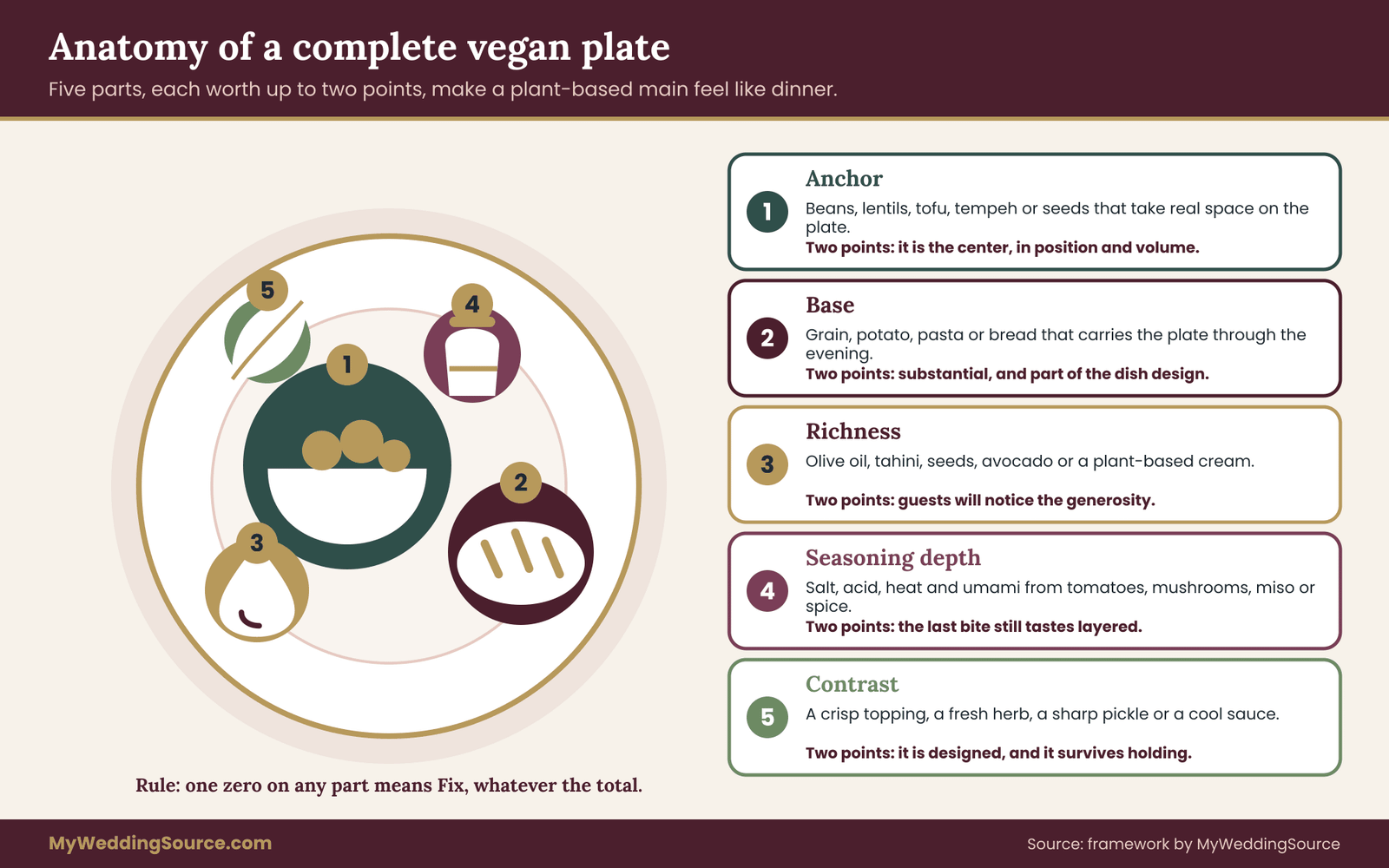
The five checks are the anchor, the base, the richness, the seasoning depth and the contrast. The next section explains each in detail. For now, think of them as the answers to five questions a hungry person asks without knowing it. Is there something with real substance here? Is there something that will keep me going through the speeches? Does it feel generous and not lean? Does it taste finished? Is it interesting to eat?
The Clear Plate Test asks whether anyone can say what is in the dish and how it was handled. It has four checks, and each is marked Clear, Partly clear or Open. Clear means the information exists in writing from the kitchen. Partly clear means someone has said it out loud but it is not written down, or part of the dish is confirmed and part is not. Open means nobody knows yet.
The four checks are named ingredients, the animal-product check, the allergen declaration and cross-contact handling. The section on allergen clarity later in the guide covers them in turn.
How the two halves combine
The verdict for each dish comes from putting the halves together.
A dish earns Keep when it scores seven or more on the Full Plate Test, has no zero on any single check, and has all four Clear Plate checks marked Clear. A Fix applies when the dish is close: it scores five or six, or it has a single zero that a small addition could cure, or one or two Clear Plate checks are Partly clear with enough time left to close them.
A dish earns Swap when it scores four or lower, or when a Clear Plate check is still Open close to the date the menu must be final.
Two points about those rules matter. First, a single zero is a hard stop on the Full Plate side because an average can hide a missing piece. A beautiful dish with no anchor and a lot of everything else will score reasonably well and still leave guests hungry. Second, an Open check is not a small flaw. The caterer will usually be able to close it, but if the answer is not available by the time the printed menu and the final guest count are due, the safe choice is to change the dish rather than to hope.
Why score a vegan wedding menu at all
Numbers can seem like overkill for dinner. They earn their place in three ways.
They stop a tasting from becoming a vote on whichever dish the most enthusiastic person liked. Scoring each dish against the same questions makes quieter observations visible, such as the fact that the dish everyone loved has no protein anchor.
They give you something concrete to say to the caterer. “We found it a bit light” is easy to nod at and hard to act on. “It scored zero on anchor, so we would like to add a legume or a seed component and taste it again” is a request a chef can fulfill.
And they leave a record. If a guest or a family member asks later why the menu looks the way it does, you can say what you tested, which dishes changed and why. That record matters more for the Clear Plate half, because it shows what you asked and what the kitchen answered.
Fullness is partly physical and partly psychological. People feel satisfied when a plate has enough substance to digest slowly, enough richness to feel generous, enough seasoning to taste complete and enough variety to stay interesting for the length of a wedding dinner. A vegan wedding menu can deliver all of that, but it has to be designed on purpose, because the shortcuts that work in a meat-based kitchen do not carry over.
This guide does not count grams or calories, and it makes no claims about nutrition beyond what the official dietary guidance says. For general information, the Dietary Guidelines for Americans and MyPlate both describe beans, peas, lentils, soy products, nuts and seeds as part of the protein group. A single celebration dinner is not a diet, and nobody needs a spreadsheet to feed a guest well. The five checks for a vegan wedding menu are about the experience of a plate.
Check one: the anchor
The anchor is the part of the dish that gives it weight and that guests would name if you asked them what they ate. In a meat-based meal it is usually the protein. In a plant-based dish it can be a legume, a soy product such as tofu or tempeh, a wheat-based protein such as seitan, a nut or seed element, or a combination such as a grain-and-bean filling.
The anchor is the most common gap on a vegan wedding menu, and the easiest one to spot. A weak anchor looks like decoration. A few chickpeas scattered over a salad, a thin slice of grilled tofu on top of vegetables, or a spoonful of lentils beside a large pile of greens all fail the test, because the plate is still mostly vegetables with a garnish of substance.
A strong anchor is the visual center of the plate and takes up real room. Think of a full wedge of braised white beans under a roasted vegetable, a thick slab of marinated and seared tempeh, a stuffed squash whose filling is mostly lentils and grains, or a mushroom and bean stew in a generous portion.
The practical way to score it is to ask what a guest would say they had. If the answer is “the cauliflower,” the anchor is probably missing, because cauliflower is a vegetable that has been given a center-of-plate position but not center-of-plate substance. If the answer is “the lentil and squash thing,” the anchor is working.
Score zero when there is no identifiable anchor, one when there is an anchor but it is small or secondary, and two when the anchor is the center of the plate in both position and volume.
Check two: the base
The base is what carries the meal through the evening. It is usually a starch or a whole grain, such as potatoes, polenta, rice, farro, barley, pasta, noodles, bread or a root vegetable mash. Starch alone does not make a dinner, but a dinner without any tends to feel as though it ran out before the music started.
The base matters more at a wedding than at a restaurant. Guests may eat at five or six in the evening, dance for several hours and not eat again until a late snack. A plate of lightly dressed vegetables and a small protein can leave people hungry well before the cake. A good base also helps with a practical problem: it holds heat well in a banquet setting, and it absorbs sauces so the dish does not go watery during a long service.
Score zero when there is no base, one when the base is a small or incidental side, and two when the base is a deliberate part of the dish and substantial enough to matter. A dish built as a combined bowl, where grains and legumes share the same space, can earn a two on the base and a two on the anchor at the same time, as long as both are visible in the portion.
Check three: the richness
Richness is the feeling of generosity that fat and creaminess give a dish. In a traditional menu it often comes from butter, cream, cheese and the fat in meat. In a vegan wedding menu it comes from other places, including olive oil, nut and seed butters, tahini, avocado, coconut milk, well-made dairy-free cream sauces, fried or crisped elements and the fat that browns into roasted vegetables.
A dish with no richness tastes lean and sharp, even when everything else is right. People often say it feels like “diet food,” which is a fair description of a plate where the fat was left out. On a vegan wedding menu, this is the check that most often separates a dish guests remember fondly from one that is merely polite.
The richness check is also where allergen clarity enters the picture, because many of the richest vegan ingredients are common allergens. Cashew cream, almond-based cheeses, tahini, peanut sauces and soy-based creams are popular for good reason. The scorecard does not ban them. It just means a high richness score gets a matching question on the Clear Plate side. If the creamy sauce is a cashew sauce, someone has to know, and the menu has to say so.
Score zero when the dish is dry or lean, one when richness is present but modest, and two when the dish has a clear source of creaminess or fat that guests will notice.
Check four: the seasoning depth
Seasoning depth is how finished the dish tastes. It is built from salt, acid, heat, herbs, and the savory depth that cooks call umami. Meat and cheese supply a lot of that depth without any help. When they are removed, the cook has to build it back with other tools: browned onions and garlic, roasted tomatoes, mushrooms, miso, soy sauce or tamari, nutritional yeast, smoked paprika, preserved lemon, olives, capers, vinegar, fermented vegetables and well-toasted spices.
A common failure on a vegan wedding menu is a dish that is correctly cooked and carefully plated but under-seasoned, because the kitchen is used to relying on a pan sauce or a finishing cheese. The guest takes a bite and feels that something is missing but cannot say what.
The tasting is the best place to check this. Taste the dish at serving temperature, not lukewarm from a sample tray, and ask what the final bite tastes like. A dish with depth has a layered finish: salt and acid up front, a savory middle and a lingering note of toasted spice or herb. A dish without it tastes the same from start to finish.
Score zero when the dish tastes flat or needs obvious additions, one when it tastes fine but not memorable, and two when it tastes complete.
Check five: the contrast
Contrast is the variety of texture and temperature across the plate. A bowl of soft roasted vegetables over soft beans over soft grains is nutritious and monotonous. The same bowl with crisp seeds, a fresh herb salad, a sharp pickle and a cool yogurt-style dressing is a different experience entirely.
The most useful contrasts are crisp against soft, warm against cool, and bright against rich. They also serve a practical purpose at a wedding. Many dishes sit in warming equipment for a time, and crisp elements can soften. A kitchen that adds the crunch at the last minute, from a topping that holds well, produces a better plate than one that cooks it into the dish and hopes.
Score zero when the plate is a single texture and temperature, one when there is some variation, and two when the contrast is clearly designed.
Reading the total
Add the five scores. On a vegan wedding menu, a dish that scores nine or ten is a plate people will talk about. Seven or eight is a solid dinner that would not embarrass anyone. Five or six is probably a good side dish with a weak role as a main. Four or fewer is a vegetable course.
Look at the pattern as well as the total. A dish that scores two, two, two, two, zero has a missing contrast, which is an easy fix. A dish that scores zero, two, two, two, two has a missing anchor, which is a more structural problem and usually calls for a different component rather than a garnish. The pattern tells you what to ask for.
Scripts for tasting a vegan wedding menu
It is easier to give feedback if you have words ready. A few examples follow, and you can adapt them.
For a missing anchor: “This tastes lovely, and it feels light for a main. Could we add a bean or lentil component, or increase the tempeh portion, and taste it again?”
For missing richness: “The flavors are right, but it feels a little lean. What would you use for creaminess that does not rely on dairy, and what allergens would that bring in?”
For a flat finish: “It needs something at the end. Would acid, a salty element or a toasted spice change it?”
For missing contrast: “Everything is soft. Is there a crisp element that holds up under the warming trays?”
Notice that each script ends with a specific question rather than a verdict. The kitchen is your partner in solving the problem, and a chef who is asked what would fix a dish usually has a better answer than the couple would.
When the whole menu is plant-based
If every dish at the dinner is plant-based, as a fully vegan wedding menu would be, the Full Plate Test matters even more, because there is no meat-based option for anyone to fall back on. In that case, a good habit is to run the test on the whole dinner as well as on individual dishes. Check that at least one dish on the menu has a strong anchor, that at least one provides a substantial base, that richness is not concentrated in one course and that dessert is not the only place with real indulgence.
A fully plant-based dinner also has a social job. The omnivore at table nine decides within the first few bites whether the evening’s food was a clever compromise or a proper meal. A plate that scores eight or higher usually settles the question before anyone raises it.
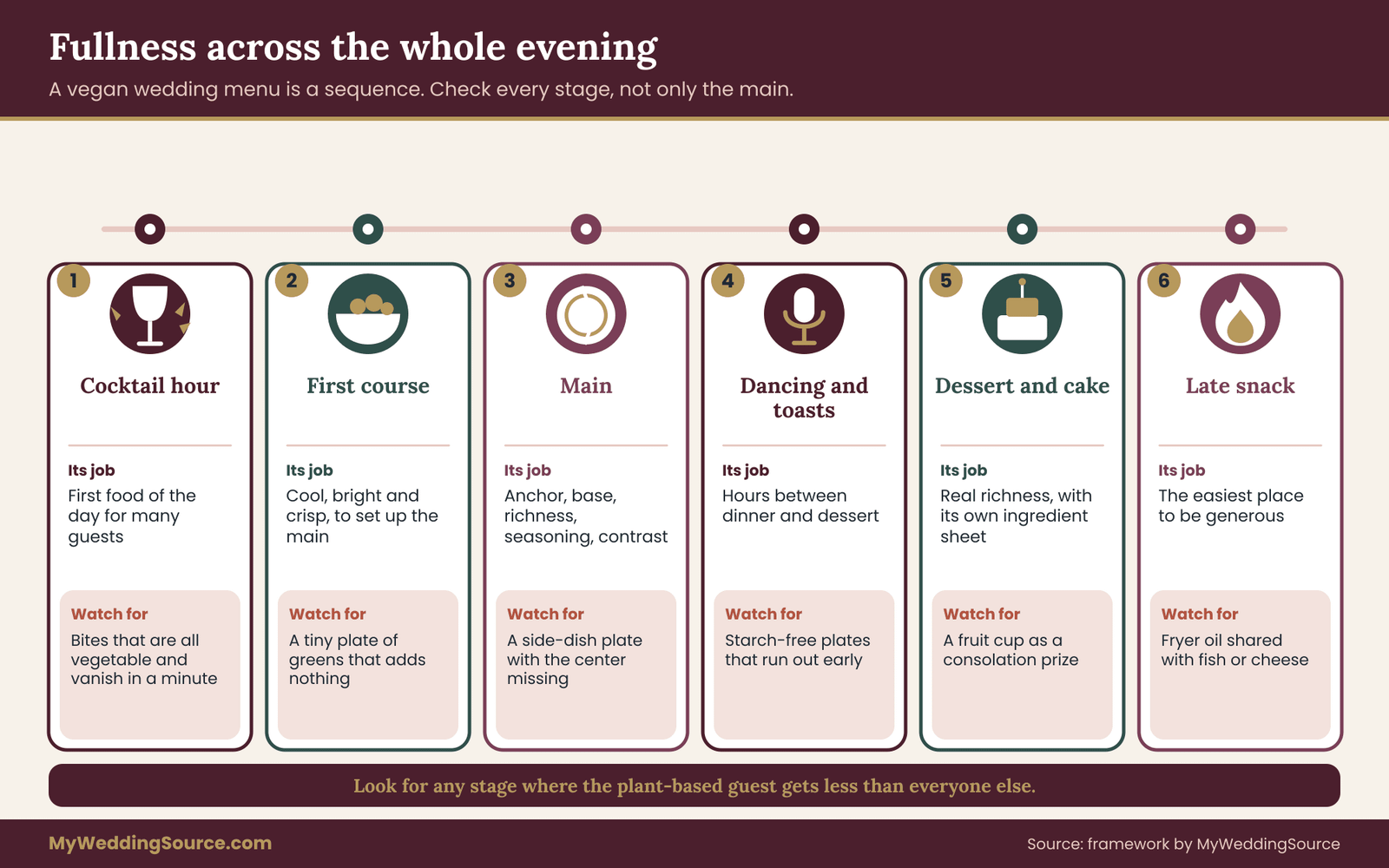
A vegan wedding menu is not one plate. It is a sequence that begins when guests arrive and ends with the last snack, and fullness has to hold across all of it. Looking at the whole arc helps you spot gaps that no single dish would reveal. It also stops you from spending your whole budget and attention on the main course while the hours around it quietly fail.
Arrival and the cocktail hour
Guests who arrive at the ceremony in the late afternoon may not have eaten since lunch, and the cocktail hour is the first real food they see. Passed appetizers and stations at this stage have to do two jobs. They have to be good enough to hold attention, and they have to be filling enough that nobody starts the evening hungry and slightly irritable.
Appetizers on a vegan wedding menu tend to be small, light and bite-sized, so volume needs attention. A tray of cucumber rounds with a dab of spread disappears in a minute and leaves little behind. Items that include a grain, a legume or a starch, such as stuffed mushrooms with a rice filling, small fritters, skewers served with a dipping sauce, flatbreads, or small cups of soup, have more staying power.
If the cocktail hour is long, a station with hummus, grain salads, roasted vegetables and breads gives guests something they can graze. The guide to the cocktail hour covers timing and quantities, and it is worth reading beside this section.
The Clear Plate Test applies here too, and it is where couples most often forget it. Passed items move fast and are described by a server in a few seconds. A server who has been told that every appetizer is vegan but cannot say which contain nuts, sesame or wheat will either guess or say “I’m not sure,” and neither answer helps the guest with an allergy. Ask for small cards at stations and a one-page appetizer sheet for the servers.
The first course
The first course sets the tone for the vegan wedding menu. A salad, a soup or a small plate placed in front of every guest is also the easiest course to make vegan for everyone, because it is cold or lightly warm, relatively simple and rarely central to anyone’s idea of dinner.
Because it is the first thing at the table, it works best when it is distinct from the main. A bright salad with fruit and seeds followed by a hearty main works better than a soup followed by a stew. Think of the first course as the contrast to the main. If the main is warm, rich and soft, the first course should be cool, sharp and crunchy.
Count the fullness the first course adds. A large bean-and-grain salad is nearly a meal. A small plate of greens is not. Do not assume you can lighten the main because the first course was generous, since guests eat at different speeds and some skip the first course altogether in conversation.
The main
The main is where the Full Plate Test gets its hardest workout. Everything above applies, and the main should usually score eight or more. If your caterer offers a choice of two plant-based mains, test both.
One useful habit is to portion the plant-based main at the same weight and plate coverage as any other main on the menu. A smaller plate sends a message, even an unintended one. The kitchen can reach the same plate size with sides as long as the sides are part of the plate design, and not extra items added because the main fell short.
Sides and bread
Sides carry a lot of the fullness at a vegan wedding menu, and they also carry a lot of the hidden animal products. Bread is a classic example, because many commercial breads and rolls contain milk, butter or eggs, and the butter on the table is rarely a plant-based butter unless someone asked. Mashed potatoes are traditionally made with butter and milk. Roasted vegetables may be finished with butter. Rice and grains are often cooked in chicken stock.
Each side deserves the Clear Plate questions. The Full Plate Test applies to the plate as a whole, so the side dishes feed into the base and richness scores of the main.
Dessert and the cake
Dessert is often an afterthought for the plant-based plate. A fruit cup or a sorbet is a polite thing to serve, and guests understand it as a consolation prize. A vegan dessert that has real richness, such as a chocolate dessert made with a plant-based cream, a fruit tart with a nut or oat crust, or a baked fruit dish with a crumble, closes the dinner with the same level of care as the rest.
The cake is its own planning topic, with its own timeline and its own cross-contact questions, and the guide to wedding cake timelines covers how production works from the final guest count to the cutting. For this guide, the main point is that the dessert course is part of the allergen picture for the whole vegan wedding menu. A vegan cake from a bakery that also handles eggs, milk and nuts is vegan in ingredients and not necessarily free of cross-contact, and the bakery should say so in writing.
The late-night snack
If the wedding runs long, a late snack is a good place for the vegan wedding menu to be generous. Guests who have danced for three hours are usually hungry, and the late snack is the one meal where nobody needs to be impressed. Plant-based options, such as fries, pretzels, sliders with a bean or mushroom patty, tacos with beans and vegetables, or a bowl of noodles, are easy to make filling.
Fryer oil is a particular cross-contact question: if the same oil cooks fish, chicken or cheese-filled items, the plant-based items are not allergen-free, and in some cases are not strictly plant-based.
Before the tasting, decide how the food on your vegan wedding menu will reach guests. Four models cover most weddings, and each changes both the Full Plate Test and the Clear Plate Test.
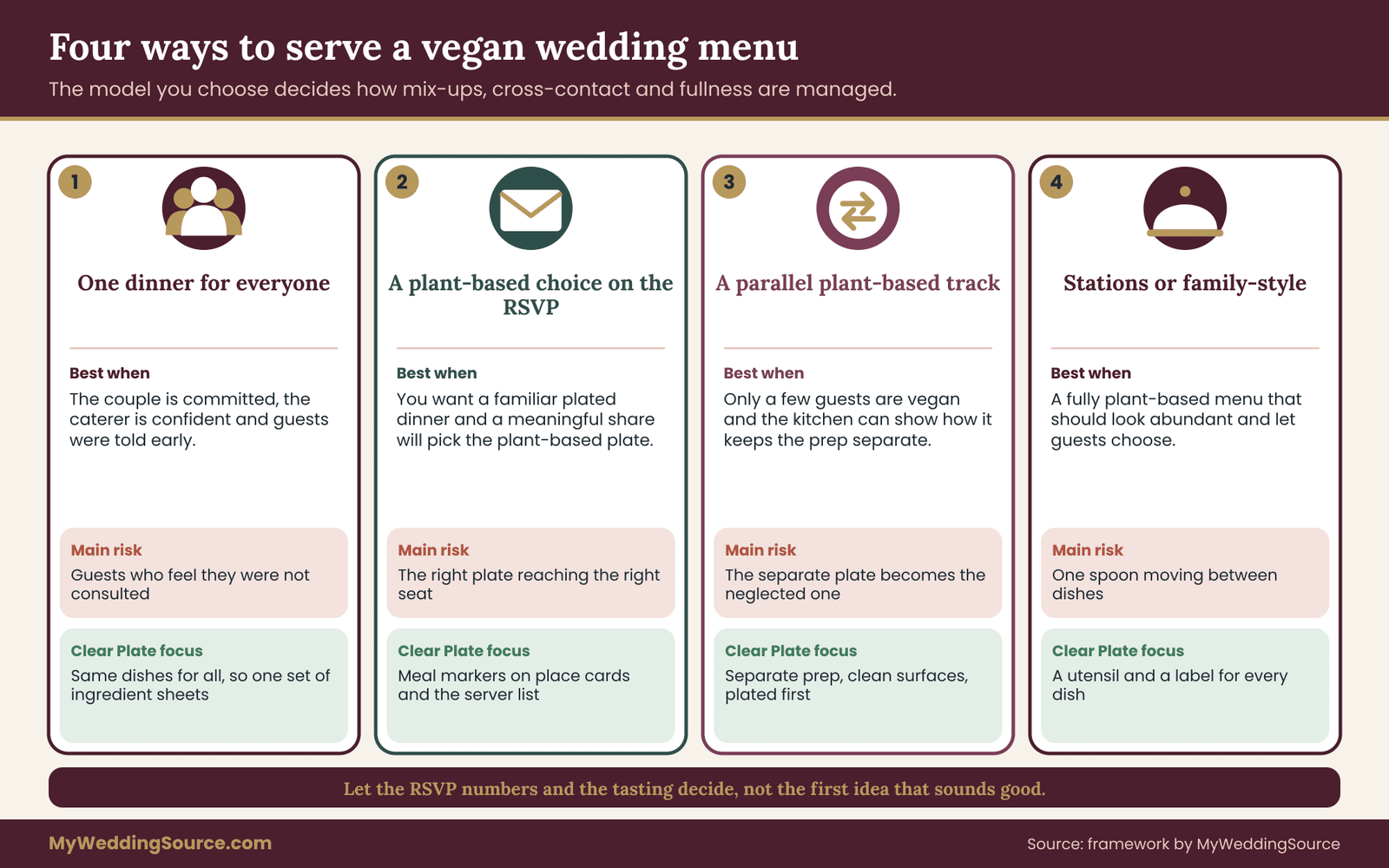
Model one: everyone eats the same plant-based dinner
In this model the entire reception menu is plant-based. There is one dinner, and every guest receives it. This is the simplest to run, because the kitchen avoids parallel prep, there is no risk of a vegan plate being swapped with a non-vegan one and the vegan wedding menu becomes the whole menu, not an exception.
It works best when the couple is committed, when the caterer is comfortable with plant-based cooking, and when most guests have been told ahead of time. Its main risk is the reaction of guests who feel they were not consulted. Say so on the invitation or website, describe the menu warmly and make sure the Full Plate Test is applied to every dish, not just one.
Model two: a plant-based choice at every table
Guests choose between two or three mains on the RSVP, and one of them is plant-based. This is the most common arrangement for a vegan wedding menu at a mixed reception, and the most familiar to guests. Every guest has a plated meal, and the plant-based one is built as a main, not as a side-dish plate.
The risk is the same one as in any plated choice: the right plate has to reach the right person. Seating charts, place cards with meal markers, or a color or symbol system help servers. If you use one, put the marker on the place card and on the seating list the servers carry. The caterer needs the final counts by a deadline, usually well before the date, so ask for it in writing.
Model three: a parallel plant-based track
A few guests receive a separate plant-based meal prepared in its own area of the kitchen, served at the same time as everyone else’s. This is the model most often used when only a handful of guests are vegan, and it is the one where cross-contact and timing need the most attention. The plant-based plates are prepared separately, plated first or at the same time and carried out by a server who knows which table they go to.
The danger is that the separate meal becomes the neglected one. The Full Plate Test is the best protection. If the plant-based plate scores as high as the main on the menu, the kitchen will treat it as a real dish.
Model four: stations or family-style service
Food is placed on tables or at stations, and guests serve themselves. This gives plant-based guests a choice of dishes and gives everyone a larger share of vegetables, grains and beans. It is a good fit for a fully vegan wedding menu, because the abundance reads as generosity.
The cross-contact concern here is physical. A shared serving spoon that moves between a dish with cheese and a dish without it, or a guest who reaches across, defeats any label. Each dish needs its own utensil, and the staff should be told to replace a utensil that has migrated. The guide to reception guest flow covers how lines and stations are arranged, and it is worth reading if you choose a station model.
A short decision rule for your vegan wedding menu
Choose model one if the couple’s own preference is fully plant-based and the caterer is confident. Choose model two if you want a familiar plated dinner and at least a fifth of the guests are likely to choose the plant-based main, because the kitchen is then preparing it at volume and has a reason to get it right.
Choose model three if only a handful of guests need plant-based plates and the kitchen can show you how it separates preparation. Choose model four if you are serving family-style or from stations and want the vegetables and grains to look abundant.
If you are unsure, the tasting and the RSVP data will help. Ask guests about dietary preferences early, and let the response numbers inform the model.
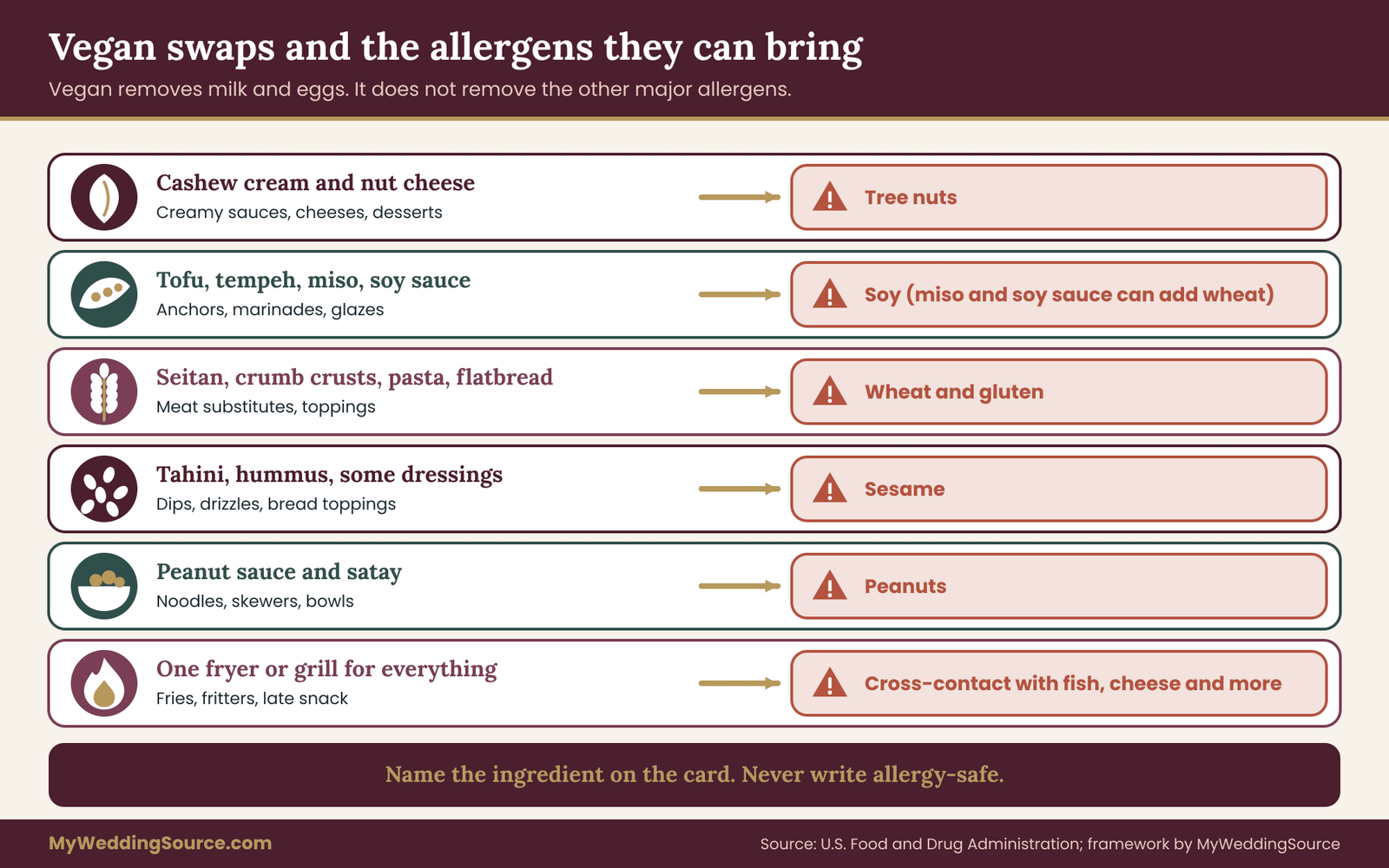
The word vegan describes what a dish leaves out: meat, fish, dairy, eggs, honey and other animal products. It says nothing about what a dish contains. Under United States food labeling law, the major food allergens are milk, eggs, fish, crustacean shellfish, tree nuts, peanuts, wheat, soybeans and sesame, as described by the Food and Drug Administration. A vegan wedding menu removes the first four of those, and sometimes it replaces them with the rest.
That is not a reason to avoid a vegan wedding menu. It is a reason to treat allergen clarity as its own half of the scorecard, with its own questions, because a guest with an allergy cannot tell from a menu card whether a dish is safe, and the answer changes from one kitchen to the next.
Where vegan substitutes bring allergens back
The substitutions that make a vegan wedding menu rich and filling are the ones that most often carry the major allergens. It helps to know the common pairings, so you can ask informed questions at the tasting.
Cashew cream and almond-based cheeses and sauces carry tree nuts. Many vegan creams, cheeses, and desserts are built on cashews because they blend smoothly and taste neutral. A guest with a tree nut allergy cannot tell from a creamy white sauce whether it is cashew or oat.
Tofu, tempeh, edamame, soy milk, miso and soy sauce carry soy. Soy sauce and many miso products also carry wheat. Tamari is often marketed as the wheat-free alternative, but labels vary, and the product has to be checked.
Seitan, the wheat-protein “meat,” is nearly pure gluten and is not an option for guests with wheat allergy or celiac disease. Many veggie burgers, meat substitutes, breadcrumb crusts, pastas, and flatbreads also carry wheat.
Tahini, hummus, many dressings and some falafel carry sesame. Sesame became the ninth major allergen to be required on labels in the United States under a law that took effect in January 2023, and it is easy to miss because it hides in sauces, seasoning blends and bread toppings.
Peanut sauces, satay, and some noodle dishes carry peanuts. Coconut is another ingredient that guests ask about, and its classification for allergy purposes has changed over time, so a guest who avoids it should be told when it is used, and their own doctor is the right source on whether it matters for them.
None of these are reasons to leave the ingredient out. They are reasons to name it. A dish that is rich because of tahini is a good dish, and a guest with a sesame allergy will pass on it gladly if the menu card says “contains sesame.” The problem arises only when nobody says it.
The four checks of the Clear Plate Test
Each dish on the final vegan wedding menu gets four checks. Mark each one Clear, Partly clear or Open.
Check one: named ingredients. The kitchen provides a written list of every component in the dish, including the sauce, the oil used for cooking, the seasoning blend, the garnish, the bread or crumb, and any store-bought element such as a stock or a spread. “Roasted vegetables” is not a list. “Carrots, parsnips, olive oil, salt, thyme” is.
This is also the check where you learn how much the kitchen makes from scratch. Items made in-house can be described exactly. Items bought from a supplier come with their own ingredient labels, and the kitchen should be able to produce them.
Check two: the animal-product check. For guests who are vegan, the list of ingredients has to be read against the list of things that are not obvious. The next section covers this. Mark Clear only when the kitchen has gone through the list and confirmed that nothing animal-derived is in the dish, including in any commercial product used as an ingredient.
Check three: the allergen declaration. The kitchen states, for each of the major allergens, whether the dish contains it, may contain it because of how it is made, or is free of it. This is a different statement from “vegan,” and it should be written. Ask for it dish by dish. A one-line answer such as “no nuts” is not the same thing as a declaration for each allergen.
Check four: cross-contact handling. Cross-contact happens when an allergen is transferred from one food to another, through a shared surface, utensil, fryer, grill, pot or hand. The FDA explains that even trace amounts can cause a reaction in a person with a food allergy, which is why a menu description is only part of the picture. Ask the kitchen how the plant-based dishes are prepared, whether they are made at a separate time or on separate equipment, how utensils are handled and who delivers the plate.
What a kitchen can and cannot promise
Some kitchens will tell you a dish is “allergy-safe.” Be cautious with that phrase, and do not repeat it. A professional kitchen can describe its procedures, tell you what is in each dish and what is made on shared equipment, and take reasonable steps to reduce cross-contact. It generally cannot promise that no trace of an allergen could ever be present, particularly in a large banquet operation with many suppliers and substitutions. The honest statement is a description of what the kitchen does, and the guest with an allergy can decide what to do with it.
Phrase the cards for your vegan wedding menu in the same spirit. “Contains sesame and wheat” is a statement of fact. “Prepared in a kitchen that also handles tree nuts and milk” is a statement of fact. “Allergy friendly” is a promise nobody can keep.
A script for the caterer: “For each dish on our vegan wedding menu, could you send a written ingredient list and tell us which of the major allergens it contains, which it may contain through shared equipment, and how you prepare it to limit cross-contact? We will share this with guests who ask.”
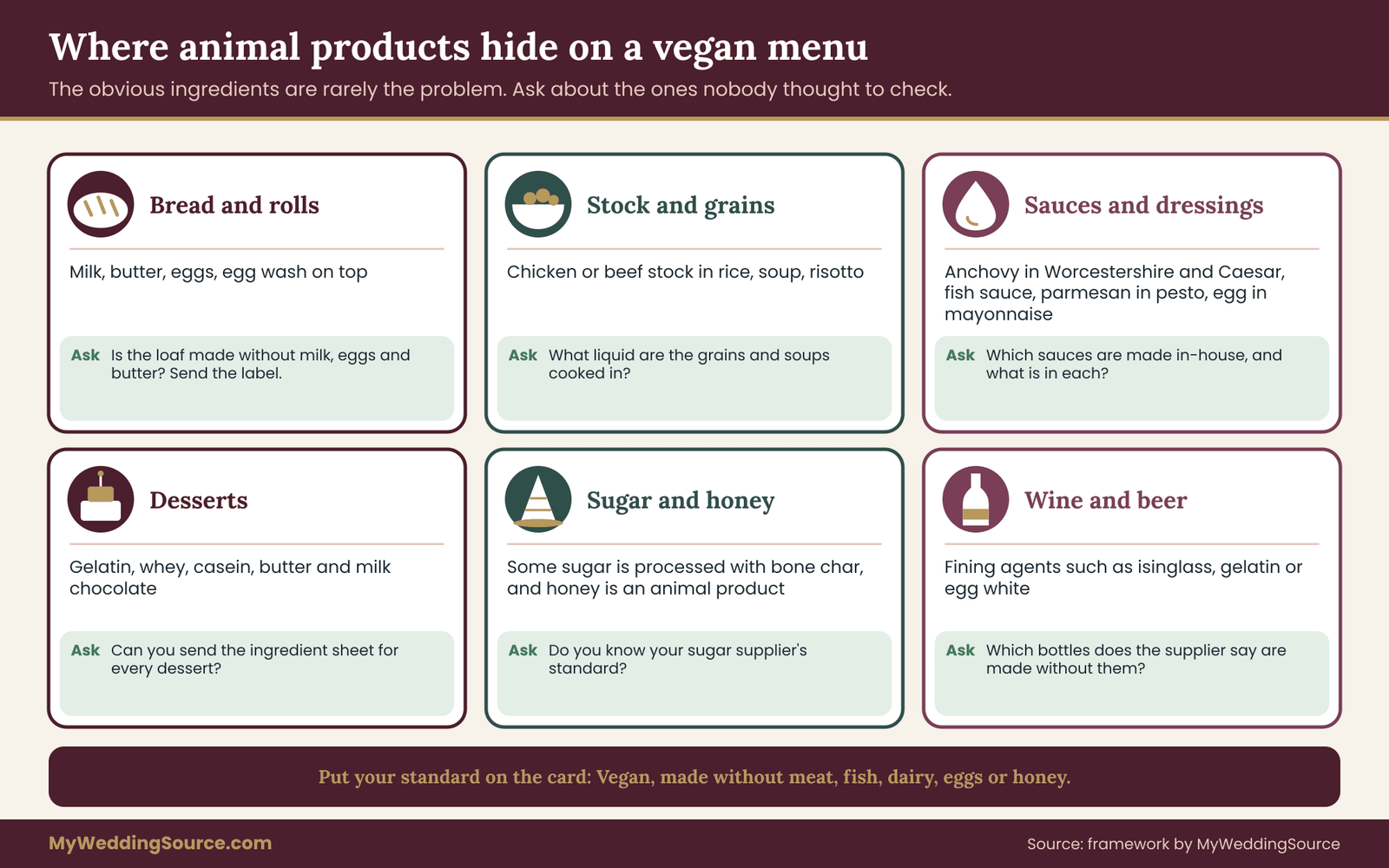
For guests who are vegan for ethical reasons, a plate that looks plant-based but contains an animal product is a real breach of trust, even when it is unintentional. The issue is rarely the obvious ingredient. It is the one that nobody thought to check.
The usual suspects
Bread and rolls are the first place to look. Many commercial breads contain milk, eggs or butter, and bakeries often brush the tops with egg wash or butter before baking. The butter dish on the table and the oil in a bread basket deserve the same attention.
Stock is the second. Soups, risottos, grains, gravies and sauces are routinely made with chicken or beef stock, or with a base that contains meat extracts. A restaurant kitchen will often use a vegetable stock for a vegetarian dish, but may use the same base for all dishes unless asked.
Sauces and dressings are the third. Worcestershire sauce contains anchovies. Caesar dressing usually does too. Fish sauce appears in a surprising number of Asian-inspired dressings and marinades. Pesto often has parmesan. Mayonnaise contains eggs. Some barbecue sauces contain honey, which is a point of disagreement among vegans, so ask how guests feel.
Dessert is the fourth. Gelatin is used in mousses, panna cotta and some marshmallow products. Milk chocolate, whey, casein and butter appear in many baked goods and fillings. Some sugars are processed with bone char, a detail that most vegans know about and many kitchens do not. A kitchen can often tell you the brand and ask the supplier.
Drinks are the fifth, and a place where the cocktail hour and the bar overlap with the dinner. Some wines and beers are clarified with animal-derived fining agents such as isinglass, gelatin or egg whites, and the label often does not say so. The guide to wedding bar service covers how to plan the bar, and the question of fining is one a good wine supplier can answer for the specific bottles you choose.
Vegan versus vegetarian versus plant-based
The words are used loosely at weddings, and a vegan wedding menu is no exception. Vegetarian usually means no meat or fish and may include dairy and eggs. Vegan means no animal products at all. Plant-based is a looser term that may mean vegan or may mean “mostly plants.”
As far as the agency’s published guidance shows, the FDA has not set a formal definition for vegan on food labels, so the word on a package or a menu depends on the maker’s own standard. A caterer who says “vegan” means whatever the caterer means. Ask what the kitchen counts, in writing, and compare it to what your guests expect. For a menu card, a short line such as “Vegan: made without meat, fish, dairy, eggs or honey” tells guests what you mean.
The honey, sugar and wine conversation
For a few guests these details matter a lot, and for many they do not matter at all. You do not have to resolve every philosophical question. You do have to decide what you will say. Many couples find the simplest rule is to treat the stated standard of the menu as the rule, and to answer questions about borderline ingredients directly when asked.
A good approach is to prepare a one-line answer for each borderline item. “The sugar in the desserts is certified vegan.” “The wine is from a producer that states it uses no animal fining agents.” “The bread is made with no milk, eggs or butter, and we have the supplier’s label.” If you cannot say one of those lines with confidence, it is a sign the check is still Open.
Marking a dish on the vegan wedding menu Clear
By the time the vegan wedding menu is final, every dish should be marked Clear on the animal-product check, or the menu card should say exactly what is in it. A common compromise is to relabel a dish as vegetarian, and keep it off the vegan list, rather than pretend. That is a good outcome, since it is true.
It is easy to assume that a vegan wedding menu is lower risk than meat, fish or eggs. In one respect it is, and in another it is not. The dishes that anchor a vegan dinner, such as cooked beans, lentils, rice, grains, tofu, tempeh and pasta, are moist, starchy, protein-rich foods, and the guidance from food safety agencies treats cooked foods of that kind with the same care as other perishable foods.
The United States Department of Agriculture’s Food Safety and Inspection Service describes the range between 40 and 140 degrees Fahrenheit as the temperature zone where bacteria multiply quickly, and advises that perishable food should not sit in that range for more than two hours, or one hour when the surrounding temperature is above 90 degrees. Cooked rice is a well-known example that food safety agencies call out specifically, because it can carry bacteria that survive cooking and multiply when the rice is left at room temperature.
You do not need to supervise the kitchen’s thermometer. You do need to ask a few questions, because a wedding is a long service in a place the caterer does not control, and a plant-based dish that has been held, transported and reheated has more points where it can go wrong than the same dish at a restaurant.
Questions that cover safety without turning into an audit
Ask where the dishes are cooked and how they travel. If the caterer prepares food off-site and brings it to the venue, ask how it is kept hot or cold in transit and whether it is reheated and to what temperature. If it is prepared on site, ask what equipment holds it between cooking and service.
Ask how long the dish will hold. A creamy bean stew or a grain pilaf in a warming cabinet will keep for a while. A crisp topping will not, so find out whether the crunch is added at the last moment.
Ask whether the caterer is licensed and whether the venue requires a permit. Food service rules in the United States are set by state and local health authorities, many of which build on the FDA Food Code. Your county or city health department can tell you which permits apply to caterers in your area, and your venue’s contract often specifies what the caterer must show.
Many venues require proof of a food service license and liability insurance. If you are using a friend or a relative as a cook, the rules differ, and the same agencies are the place to check.
Ask how leftovers are handled. A caterer may be allowed to send food home with you in some places and not in others, and the safety rules for cooling and storing leftover rice, beans and tofu are the same as for any cooked food. If you want to keep the food, ask what the caterer’s policy is, and ask about the timing.
The cold dishes
Cold dishes also need care. A bean salad, a grain salad, a tofu dish or a cut-fruit course should be kept at 40 degrees Fahrenheit or lower until service and should not sit out for hours on a warm patio. If the reception is outdoors in summer, plan for shade, ice, and short service windows. The guidance from the USDA and FoodSafety.gov is a good reference to share with the venue, and the caterer will likely already know it.
None of this is a reason to hesitate over a vegan wedding menu. It is a reason to treat it like any other menu, with the same attention to temperature, holding time and handling.
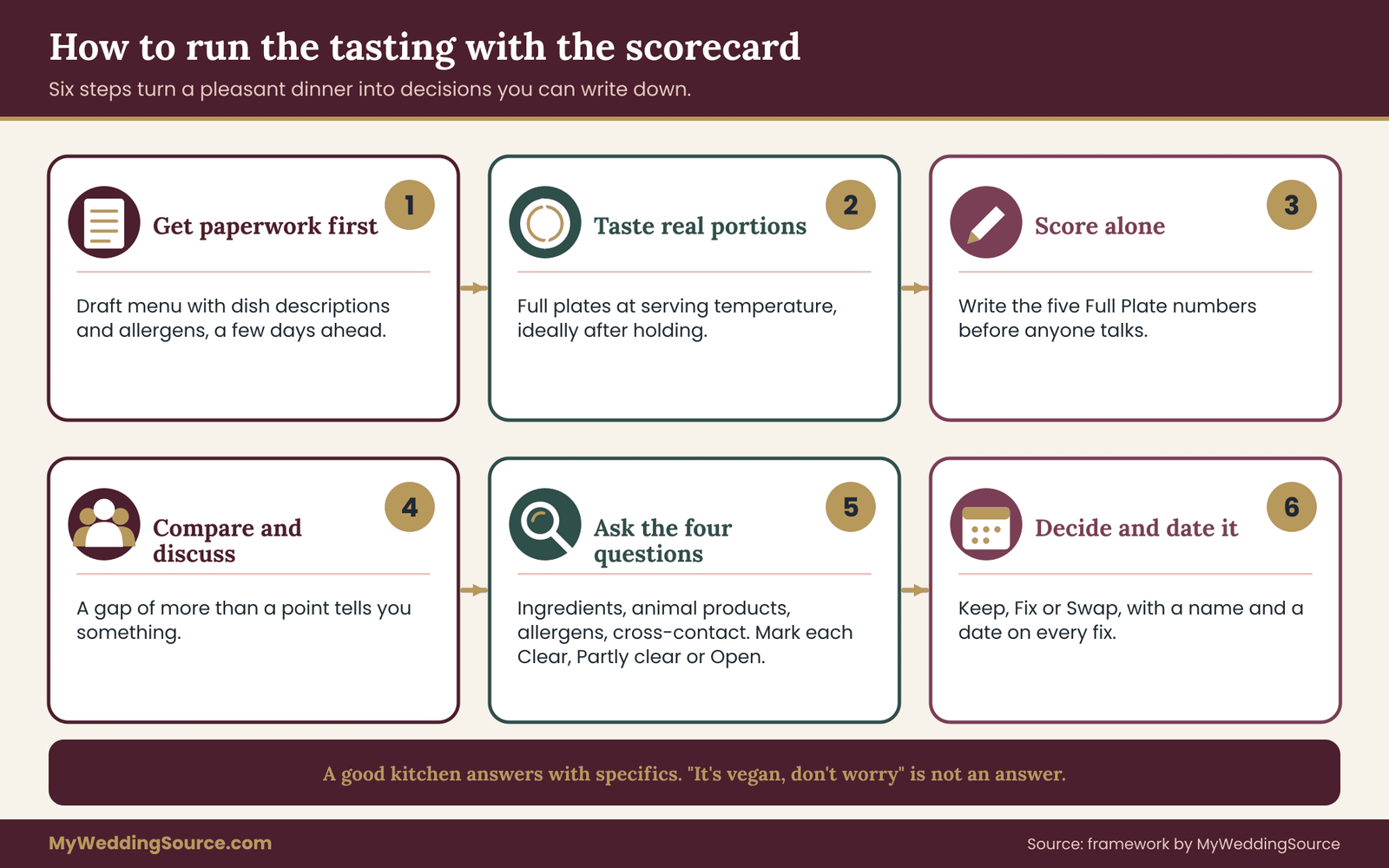
The tasting is where the scorecard earns its keep. Most couples treat a tasting as an enjoyable meal with a few notes, and this is fine. A few changes in how you run it make it far more useful for a vegan wedding menu.
Before the tasting: ask for the paperwork
Ask the caterer to send, at least a few days ahead, a draft vegan wedding menu with a short description of each dish and a list of the major allergens that each contains. This lets you spot issues before you taste and gives the kitchen time to think. It also tells you something about how the kitchen works. A caterer who answers with a clear, detailed document is usually a caterer who will answer well on the day.
Make a one-page scoring sheet for the vegan wedding menu, either on paper or on a phone, with a row for each dish and ten small boxes: five for the Full Plate Test and four for the Clear Plate Test, plus a notes line. You do not need elaborate software. You need to write the scores before you start discussing them.
Taste at real size and real temperature
Ask for a full portion of each main, not a sampler. A sample cup hides the answer to the most important question, which is how it feels to eat a whole plate. A small spoonful of a bean stew may taste excellent, and the full bowl may feel heavy or one-note by the fifth bite.
Ask to taste the dish after it has been held. If the kitchen plans to hold food in a warming cabinet or to transport it, ask for a portion that has been through the same process, or at least held for a while. Plant-based dishes with delicate vegetables or crisp toppings change a lot after holding, and this is where problems surface.
Score alone, then compare
Each person scores quietly and writes the numbers down. Then compare. If you disagree by more than a point on any check, discuss it. The difference often tells you something. If one person scores the seasoning a two and the other a zero, the dish may be unevenly seasoned, or may simply suit one palate, and the answer matters for a room of two hundred.
If you can, include a guest who is vegan, or someone who cooks plant-based food regularly. They notice what a meat eater or a cautious couple may not. If you include an omnivore skeptic, treat their reaction as data. If a skeptic scores the anchor a two, that is the best sign you can have.
Ask the Clear Plate questions at the table
While the dishes are in front of you, run through the four questions with the person who made them. Do it politely and directly. A script: “Can you walk us through what is in this, including the sauce and the oil? Anything that comes from a package, like the stock or the bread? Which of the major allergens does it contain? And how is it made, in the same space as other dishes or separately?”
Write down the answers, or ask for them in an email afterward. Mark each check Clear, Partly clear or Open. A good chef will answer without defensiveness. If you get “it’s vegan, don’t worry,” follow up gently: “Thank you, and for our records we are writing down the ingredients and allergens for each dish. Could you send that?”
Red flags and green flags
A few answers suggest a kitchen is not ready. “We make everything to order, so it can be anything.” “Allergies are no problem, we’ve never had an issue.” “I’m not sure, I’d have to ask.” The last one is fine if it is followed by an answer. The first two are not answers.
Green flags look like specifics. “The cream is made from sunflower seeds, and we make it in-house. The bread comes from a bakery that supplies a vegan loaf, and we have the label.” “We prepare plant-based plates first, on clean surfaces, with separate utensils, and a manager delivers them to the table.” “Here is our allergen sheet, and here is the cross-contact statement we give to every client.”
Turning scores into decisions
After the tasting, sit down with the sheets for your vegan wedding menu within a day, while the memory is fresh. For each dish, apply the rule: Keep if the Full Plate Test is seven or higher, with no zero and every Clear Plate check Clear. Fix if it is close. Swap if it is not.
Write a short list of fixes, each with a name and a date. “Add white beans under the cauliflower: caterer, by Friday.” “Confirm bread ingredients and send the label: caterer, by Monday.” “Check with guest allergies from the RSVP list: couple, by the weekend.” Then schedule a second, shorter tasting for the changed dishes if the changes are large. Many caterers are willing to do a smaller follow-up tasting, and some will include it in the original fee. Ask early, since a second tasting may carry a cost.
What to do when the caterer pushes back
Not every caterer is thrilled about a detailed review of a vegan wedding menu. Some are protective of recipes, and others are simply busy. Stay specific and calm. You are asking for ingredient and allergen information, not recipes or quantities. Most professional kitchens have this information because they must be able to answer when a guest asks.
If a kitchen cannot or will not provide it, treat that as a result and not an insult. An Open check on a dish is information about the kitchen, and you may decide to change the dish, change the kitchen or accept a labeled limitation.
The following example is invented to show how the scorecard works in practice. The couple, the caterer and the numbers are made up, and your own dishes and results will differ. What matters is the sequence of decisions.
Noor and Ellis are planning a dinner for 140 guests at a rented hall with an outside caterer. They are both vegan. They want a fully plant-based dinner for everyone, because they do not want to run two kitchens. A fully vegan wedding menu avoids that, though they know most guests are not vegan. They have a long-time friend with a tree nut allergy, an uncle who avoids gluten and a cousin who is allergic to sesame. They gave the caterer a budget range and asked for three candidate mains.
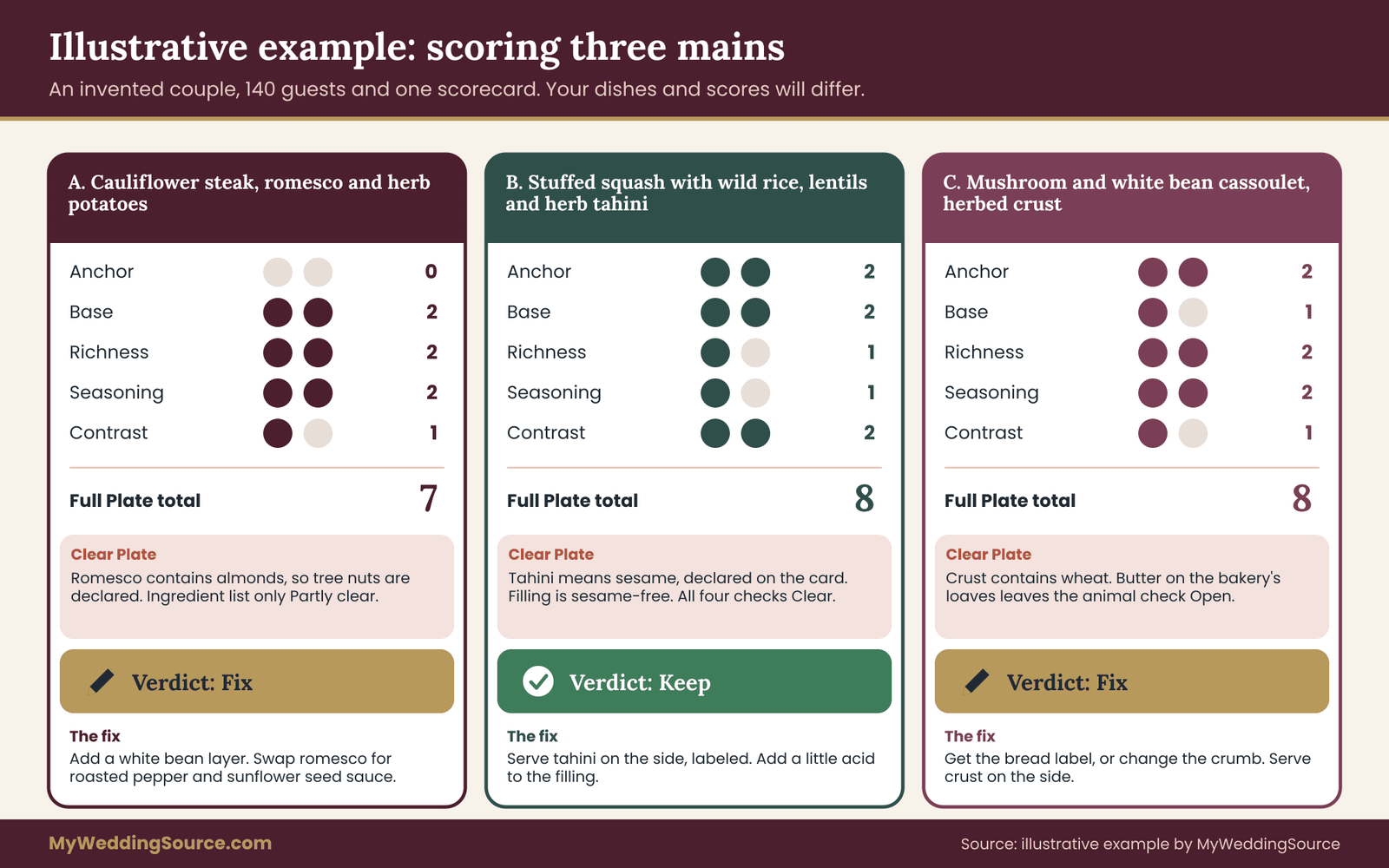
Three candidates for the vegan wedding menu main
Candidate A is a roasted cauliflower steak with romesco sauce and herb potatoes. At the tasting it looks beautiful and tastes good. Scored on the Full Plate Test, the anchor gets a zero, because the cauliflower is a vegetable and nothing else on the plate carries protein. The base gets a two, thanks to the potatoes, richness gets a two from the romesco and the olive oil, seasoning gets a two, and contrast gets a one. The total is seven, but with a zero on the anchor, the rule says Fix, not Keep.
On the Clear Plate side, the romesco is the problem. Traditional romesco contains almonds or hazelnuts, and sometimes bread. The caterer says it is made with almonds. That is a tree nut, which puts the dish in conflict with their friend’s allergy. The ingredient list is Partly clear, and the allergen declaration is Clear in that it contains tree nuts.
Candidate B is a stuffed delicata squash with wild rice, green lentils, pepitas and an herb tahini drizzle. The anchor is a two, because the lentils fill the squash. The base is a two, the richness is a one, because the tahini is a modest drizzle, the seasoning is a one, because it needs more acid, and contrast is a two, with crisp pumpkin seeds on a soft filling. The total is eight with no zero.
The Clear Plate Test shows tahini, which is sesame, and the cousin is allergic to it. The caterer confirms the full ingredient list and says the filling contains no sesame, but the drizzle does. That leaves a simple solution: the drizzle can be served on the side, or replaced with a lemon and herb sauce for the cousin’s plate. The kitchen prepares the drizzle in its own container and confirms its handling in writing, so all four checks are Clear.
Candidate C is a mushroom and white bean cassoulet with a herbed breadcrumb crust. The anchor is a two, the base is a one, because the crust is the only starch, the richness is a two, the seasoning is a two from the mushrooms and roasted garlic, and contrast is a one. Total eight, no zero.
The Clear Plate Test shows the crust contains wheat, which is a problem for the uncle, and the caterer’s bread comes from a bakery that brushes loaves with butter. The animal-product check is Open until the caterer confirms the bread. The wheat allergen is Clear, because it is declared.
The decisions
Looking at the three, the couple draws up their changes.
For A, they decide the fix is to add a braised white bean component under the cauliflower steak, which also adds a second base, and to replace the romesco with a roasted red pepper and sunflower seed sauce. The caterer agrees. This removes the tree nut and gives the dish an anchor. A second tasting will confirm the score.
For B, they keep the dish and ask the caterer to serve the tahini drizzle in a small cup beside the squash, labeled as containing sesame, with a lemon and herb option available. They also ask the caterer to add a splash of acid in the filling to lift the seasoning.
For C, they ask the caterer to supply a bread label. If the loaf is vegan, the crust stays. If not, the caterer will use a different crumb. The uncle can have the cassoulet without the crust, and the caterer says it can be served in a ramekin with the crust on a separate portion.
At this point, a vegan wedding menu with two solid mains and one that needs work is a good result. Noor and Ellis decide to serve B and C as the two mains, offered as a choice on the RSVP, and to keep A as a backup if either of the others fails to close. Every guest has a plant-based main with a real anchor, and the three special diets are covered by labels and small modifications.
The rest of the vegan wedding menu: first course, sides and dessert
The first course is a citrus and fennel salad with marinated white beans, which scores well on contrast and gets a seven overall. The caterer says it uses a vinaigrette made with olive oil, lemon and a little mustard, and sends the label for the mustard. The sides are roasted carrots and a plain grain pilaf. The caterer confirms in writing that the pilaf is cooked in vegetable stock and the carrots in olive oil, not butter. Those answers close the animal-product check for both.
For dessert, they choose a dark chocolate pot de crème made with coconut cream, served with fresh berries. The caterer mentions that the chocolate is produced in a facility that handles milk, so the “may contain” statement goes on the card. The couple’s own cake comes from a separate bakery, with its own ingredient sheet, and is handled through the cake process on a different timeline.
The cost logic
Before choosing, the couple asks for a per-plate price for each candidate on their vegan wedding menu, and they are surprised. The squash is the cheapest to produce. The cassoulet has more labor, since the mushrooms are cooked down in batches. The cauliflower costs more than expected because the kitchen has to prepare the steaks, the bean layer and the new sauce separately.
The point is not the particular numbers, which are invented here. The point is that a vegan wedding menu does not automatically cost less. Ingredients such as dried beans and grains are often inexpensive per portion, but labor, specialty products, nut-based creams and the cost of plant-based cheese or dessert components can narrow or reverse the difference.
The fair way to compare is to ask for per-plate pricing and see what is in it. The guide to the wedding budget explains how to set up categories so that a change to one dish shows up in the right line.
Writing the vegan wedding menu into the agreement
When the vegan wedding menu is final, Noor and Ellis ask the caterer to confirm in the written agreement the dish list, the ingredient and allergen documents that were provided, the rule for substitutions and the deadline for the final count. They add a plain request: if an ingredient has to be replaced because a supplier cannot deliver, the caterer will tell them before the event, not on the day, and will not substitute any ingredient that changes the allergen declaration without written approval.
Contracts differ, and the guide to wedding vendor contracts explains how to read the clauses that cover substitutions, minimums and cancellation. The couple also keeps the allergen sheets in a shared folder, and the caterer’s day-of manager receives a copy.
What the example shows
Three things stand out about this vegan wedding menu. First, the scorecard found the weak spot in a dish that everyone liked. Candidate A looked and tasted wonderful, and the zero on the anchor was the thing nobody would have raised on their own. Second, the Clear Plate Test turned vague comfort into specific decisions. The romesco, the tahini and the breadcrumb crust were each a single question away from becoming a problem on the day.
Third, the fixes were small. Adding a bean layer, moving a sauce to the side and changing a bread supplier cost little compared with the cost of a guest in distress or a guest who left hungry.
The result is a vegan wedding menu where the plant-based dinner has real substance, every dish has a written ingredient list, and the three guests with specific needs know exactly what to eat without having to ask a server in front of the table.
A good vegan wedding menu can still go wrong in the last ten feet, between the kitchen and the guest. Part of that is communication before the day, and part is the briefing the staff receive. Both are easy to overlook and cheap to fix.
What to say on the invitation and website
If the whole vegan wedding menu is plant-based, say so in a calm, matter-of-fact way. A sentence on the website works better than a note of apology: “Our dinner is fully plant-based, and we have worked with our caterer to make it a full, hearty meal.” Guests who are curious can read more, and guests who have concerns can contact you. Avoid language that sounds defensive or preachy, and leave out lectures on why you chose it.
If the menu offers a plant-based choice, list it alongside the others on the RSVP, with the same level of description. “Squash stuffed with wild rice and lentils” is more appealing than “vegan option.” The guide to wedding RSVP etiquette covers how to word response cards and how to collect dietary information without making it awkward.
Ask about allergies and dietary needs in a separate, specific line: “Please tell us about any food allergies or dietary needs, including the foods you avoid.” Then follow up with those guests personally, by phone or message, rather than relying on a checkbox. A guest with a serious allergy will often be glad that someone asked directly, and may tell you things the form did not capture.
Menu cards and labels
Printed cards for the vegan wedding menu are a good place to put information. For each dish, a short line of allergens set in plain type works better than a symbol that guests must decode. A card that says “Contains: soy, sesame” is easy to read. If you use symbols, add a key on the same card.
At stations and buffets, each dish needs its own label, with the dish name and the allergens. Labels should be on the dish, not in a binder. Tent cards are a simple solution, and the caterer will usually supply them, but proofread them yourself, since the label is the thing a guest will trust.
Keep your language factual. Avoid “safe for,” “free of” or “allergy-friendly” unless the caterer has confirmed it in writing and you are repeating exactly what they said. Better to say “made without nuts” with the caveat “prepared in a kitchen that also handles nuts,” and let the guest decide.
Guests who are uneasy
You may have a relative who looks at a plant-based menu with suspicion, or a friend who says they will “just eat before.” You do not need to convince them. A short, warm answer works: “We think you’ll like it. The chef has made a real dinner, and there will be plenty of food.” If a guest has a genuine dietary need that the menu cannot meet, such as a serious allergy to something in the main, offer a direct alternative and arrange it with the caterer early.
For the omnivore who worries about being hungry, the late snack and the generous cocktail hour are reassurance. The Full Plate Test is the real answer to the question, and it is already done.
The server briefing
Servers on a vegan wedding menu are the people who will answer the questions guests ask at the table, and they can only answer what they have been told. A short briefing, ideally in writing and at the start of the shift, should cover five things.
First, the menu: what each dish is, in a sentence. Second, the allergens in each dish, from the list the kitchen provided. Third, which tables or guests have specific needs and what they have ordered. Fourth, what to do if a guest asks a question the server cannot answer, which should always be “I’ll check with the chef,” and never a guess. Fifth, how plant-based plates are marked and delivered, so they do not get mixed up.
Ask the caterer when this briefing happens and who delivers it. You can offer to send the one-page summary, which is also a useful record. The best-run events usually have a manager or lead who knows the details and walks the floor.
Plating order and delivery
If some plates are different from others, think about the sequence. Guests with allergies are often better served first, so their plates do not sit while the rest of the room is plated, and so the staff can give them full attention. Ask the kitchen to plate special-diet meals separately and to carry them to the table by name, rather than by a table number alone.
For a fully vegan wedding menu, this is simpler, because every plate is the same, and the focus shifts to allergen modifications. Those guests still need their own plates, labeled and delivered individually.
On the day
Keep a printed copy of the final menu, the ingredient and allergen sheets and the list of guests with special needs with a person you trust, such as a planner, a coordinator or a family member who is not the couple. If a question comes up during the evening, that person can answer it without pulling you away from your own wedding. Share the same folder with the caterer’s manager, and ask them to confirm they have the final version.
Think, too, about what to do if something goes wrong. If a guest has a reaction, the venue and the caterer should know where the nearest emergency services are and who will call. Ask the venue about its emergency procedures during the walkthrough. This is a small part of planning, and having an answer in advance is worth the minute it takes to ask.
Your next steps
Start with the people. This week, ask your caterer for a draft vegan wedding menu with descriptions and allergen information, and tell them you want to run a scored tasting. Check your RSVP data or guest list for dietary needs, and contact guests with allergies directly. If you also need to cover other diets, the menu planning guide shows how the pieces fit together.
Next, choose a service model from the four described above. Then book the tasting, bring a scoring sheet with ten boxes for each dish, and invite one person who cooks plant-based food regularly. Taste at full portion, score alone, and compare afterward.
Then turn the scores into decisions. Keep what passes both tests, fix what almost passes with a name and date on each fix, and swap what cannot be made clear in time. Write the final menu, ingredient lists and allergen declarations into your agreement, brief the servers and share the folder with someone you trust. A vegan wedding menu built this way gives every guest a dinner worth finishing, and gives you written answers when somebody asks what is on the plate.
FAQ
How do we make a vegan wedding menu filling enough for guests who are not vegan?
Check that each main has a protein-rich anchor such as beans, lentils, tofu or tempeh, a substantial starch or grain base, some richness from oil, seeds or a creamy sauce, and real seasoning depth. Add crisp or fresh contrast. Serve a full-size portion, plan a generous cocktail hour and consider a late-night snack. Taste the dish at full portion and at serving temperature before you decide.
Is a vegan wedding menu automatically free of common allergens?
No. A vegan dish leaves out milk and eggs, but plant-based substitutes often rely on tree nuts, soy, wheat or sesame, which are all among the major allergens listed by the FDA. Ask the kitchen for a written ingredient list and an allergen declaration for each dish, and print the allergens on menu cards so guests can decide for themselves.
Should the whole dinner be vegan or should we offer a choice?
It depends on your preference, your caterer and your guests. A fully plant-based dinner is simpler for the kitchen and avoids mix-ups. A choice of mains is familiar, and works well if a meaningful share of guests will pick the plant-based plate. A separate track suits a handful of guests. Use your RSVP responses and a tasting to decide.
How can we tell whether a dish on a vegan wedding menu contains hidden animal products?
Ask the kitchen to go through each component, including stock, bread, sauces, sugar, wine and desserts, and to confirm in writing that nothing is animal-derived. Common hidden items include butter in bread, chicken stock in grains, anchovies in dressings, eggs in mayonnaise, gelatin in desserts and fining agents in some wine and beer.
What should we ask a caterer about cross-contact on a vegan wedding menu?
Ask how the dishes are prepared, whether surfaces, pans, fryers and utensils are shared with dishes containing the major allergens, how plates are carried and served, and what the staff do when a guest reports an allergy. A good kitchen describes its procedures. Be wary of anyone who says there is no risk, since no kitchen can promise that.
Is a vegan wedding menu cheaper than a traditional one?
Not automatically. Beans, grains and vegetables can be inexpensive per portion, but labor, specialty ingredients, nut-based creams and plant-based desserts can raise the price. Ask the caterer for per-plate pricing for each option and compare line by line. Then record the result in your budget so that a menu change shows up clearly.
Do we need to label a vegan wedding menu with allergens?
No wedding rule requires it, though your caterer or venue may have its own policy, and labeling is a kindness. A short line of allergens under each dish helps guests with allergies and saves servers from guessing. Use factual wording such as “contains sesame,” and avoid promises like “allergy-safe.” Check local requirements with the caterer and the venue.
How far ahead should we lock the vegan wedding menu?
Early enough for the kitchen to close every open check and to order ingredients, usually well before the final guest count is due. Ask your caterer for its deadlines in writing. Plan the tasting two or three months ahead if you can, leave room for a second tasting of changed dishes and settle substitutions in the agreement.
Sources
- Food Allergies, U.S. Food and Drug Administration
- Food Labeling and Nutrition, U.S. Food and Drug Administration
- FDA Food Code, U.S. Food and Drug Administration
- Danger Zone (40 F to 140 F), USDA Food Safety and Inspection Service
- Safe food handling, FoodSafety.gov
- Dietary Guidelines for Americans, U.S. Department of Agriculture and U.S. Department of Health and Human Services
- MyPlate protein foods, U.S. Department of Agriculture
- Food allergies, Centers for Disease Control and Prevention
- Food allergy, National Institute of Allergy and Infectious Diseases
- FoodData Central, U.S. Department of Agriculture