
Choosing buttercream vs ganache for an outdoor wedding cake comes down to two things you can plan for: how long the cake will stand in warm air, and what you want it to feel like on the fork. This guide compares how each finish behaves in heat, wind and humidity, then gives you a heat budget sheet to fill in with your baker.
Neither finish wins on its own. Butter-based frosting softens as it warms, and chocolate-based ganache slumps and turns glossy once its cocoa butter loosens, so the better choice depends on your baker’s own recipe and on your cake’s exposure: minutes outdoors, shade, air temperature and humidity. Ask the baker for written limits for each finish, compare them with the time the cake will actually stand outside, and pick the finish with the larger margin. Then choose the texture you like from the options that pass.
A cake can look perfect in the bakery and wrong an hour into a garden reception, and the buttercream vs ganache choice is often where that starts. The frosting that seemed sturdy at the tasting is now shiny, the sharp edges have rounded, and a drip has started down one side. Nothing went wrong with the baking. The cake simply met more warmth than anyone planned for.
That is why the buttercream vs ganache question deserves more thought for an outdoor wedding than for a ballroom one. Indoors, the air conditioning absorbs most mistakes. Outdoors, the forecast, the tent, the afternoon sun and the schedule all become part of the recipe. The finish you choose decides how forgiving the cake will be when the day does not go exactly to plan.
This article is written for couples who are comparing the two finishes and want to talk with their baker in specifics. It does not tell you which one to buy. It explains how each behaves, where each one fails, what each one feels like to eat and how to turn all of that into a decision you can defend. A scope note: this is general information, not legal, tax or financial advice, and any temperature, time or ingredient limit for your particular cake has to come from your baker and your local food authority.
What buttercream vs ganache really decides outdoors
On the surface, buttercream vs ganache looks like a taste question. One is a whipped, creamy, butter-and-sugar frosting. The other is a chocolate-and-cream mixture that can be poured, whipped or spread. Many couples settle buttercream vs ganache the way they choose between flavors, by what they enjoyed at the tasting.
Outdoors, the choice quietly carries five other decisions. Naming them separately makes the conversation with a baker much easier, because each one has a different owner and a different kind of answer.
Heat tolerance. How long the finished cake can stand in warm air before the surface softens, sweats or slumps. This is the question most people think of first, and it depends on the recipe, not on the label.
Texture. How the frosting feels when it is cut and eaten: light or dense, creamy or fudgy, soft or firm at the temperature the guest will eat it. Texture also changes with temperature, so it cannot be judged separately from heat.
Look. Whether you want a soft, swirled, textured surface or a clean, sharp-edged one, and how that look holds up in photographs taken over several hours.
Weight and structure. Ganache is dense. A cake coated in it weighs more than a cake coated in buttercream, and the structure inside has to be sized to match. That is the baker’s decision, and the wedding cake timeline guide explains how tiers are held up and why the support plan belongs in the contract.
Safety and allergens. Some frostings contain dairy, eggs or other ingredients that the baker treats as perishable. Both finishes usually contain milk, and many contain soy or tree nuts, depending on the chocolate and the flavoring.

Seeing the five questions apart prevents a common mistake, which is treating buttercream vs ganache as a single yes-or-no on heat. A finish can be stable and still taste wrong to you. It can taste wonderful and need a shorter display time than your schedule allows. In buttercream vs ganache, the goal is to find the option that passes on all five, or to find which compromise you are comfortable with.
Where this question usually shows up
Couples tend to raise buttercream vs ganache in three situations. The first is a summer or early-fall wedding with an outdoor reception, where the baker mentions that a particular finish is risky. The second is a venue that has a covered space but no air conditioning, such as a barn, a pavilion or a tent. The third is a design that depends on clean lines, where the baker suggests ganache under fondant or on its own for sharp edges and the couple wonders whether that is wise in the heat.
If your venue is a barn, the barn wedding venues guide explains what to expect from the building itself, including airflow, shade and temperature swings that affect a cake table.
What this buttercream vs ganache guide does not decide for you
This guide does not name a safe temperature for your cake. It does not say that one frosting is always better outdoors. Bakers use many recipes under the same names, and a Swiss meringue buttercream from one bakery can behave differently from the same-named recipe in another. Ganache varies as much, since the ratio of chocolate to cream and the type of chocolate change how it sets and how it melts.
What the guide does give you is a method. You will learn what to ask, how to translate the answers into minutes of exposure, and how to compare two finishes using the baker’s own numbers instead of internet rules of thumb.
What goes into buttercream vs ganache, and why that matters in the sun
Before comparing how buttercream vs ganache behave, it helps to know what each finish is made of, because the heat story follows directly from the ingredients. Think of each frosting as a mixture of a fat, some sugar, some water and sometimes a protein, and ask what happens to each part as the temperature climbs.
Buttercream in plain terms
Buttercream is a family of frostings built on butter. The basic idea is to whip butter with sugar until it is light and spreadable. The differences between the types come from how the sugar and the structure are built.
In the simplest version, often called American buttercream, powdered sugar is beaten into soft butter, sometimes with a little milk or cream and flavoring. Meringue-based versions start with egg whites. In Swiss meringue buttercream the whites and sugar are warmed together, whipped to a meringue and then beaten with soft butter. Italian meringue buttercream uses hot sugar syrup poured into whipping whites before the butter goes in. French-style buttercream is built on egg yolks. Other bakers use a cooked flour-and-milk base, often called ermine or boiled-milk frosting. Some bakeries blend in part shortening to improve stability, and some add cream cheese for flavor.
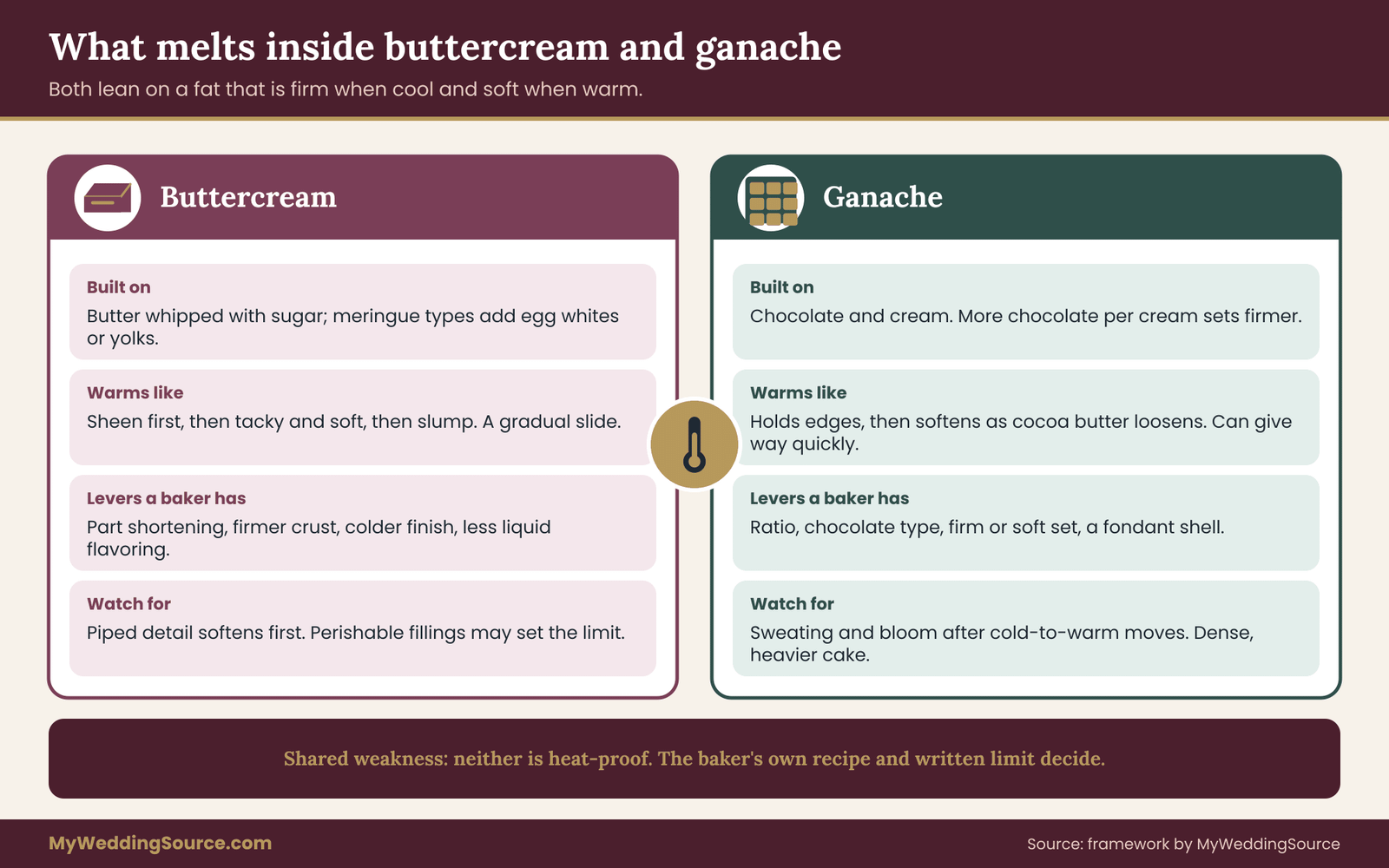
The thread that runs through all of them is butter fat. Butter is solid when cool and softens at moderately warm temperatures, long before it melts into a liquid. A butter-based frosting follows the same path. It holds sharp lines when cool, loses them as it warms, becomes glossy and soft, and eventually slumps or separates.
Ganache in plain terms
Ganache is chocolate and cream, melted together and allowed to cool. At its simplest it has only those two ingredients, sometimes with a little butter or flavoring. The ratio decides everything. More chocolate relative to cream makes a firmer ganache that sets hard. More cream makes a softer one that can be poured as a glaze or whipped into a lighter frosting.
Chocolate melts because of cocoa butter, which is solid at room temperature and melts close to body temperature. That property is why chocolate feels smooth in the mouth, and it is also why ganache gets soft in a warm tent. A firm ganache is stiff when cool and loses its stiffness gradually as it warms. Milk and white chocolate contain more milk solids and generally need a higher proportion of chocolate to set as firmly as dark chocolate does, according to common professional practice, so the type of chocolate matters too.
The shared weakness in buttercream vs ganache, and the real difference
Both sides of buttercream vs ganache rely on a fat that is solid when cool and soft when warm. That is the shared weakness, and it is why neither is simply better in heat.
The real differences in buttercream vs ganache are more subtle. Ganache is denser and carries more mass, so it tends to hold its shape for a while as it warms and then slump in a more visible way. Butter-based frostings often soften at the surface first, becoming shiny and tacky while the inside stays firm. Ganache sweats differently too, and it reacts to a cold-to-warm jump in a way that can dull its shine. Later sections cover each of these in detail.
There is a second difference that matters for planning. A baker can adjust a buttercream recipe toward stability by changing the fat, the sugar or the structure. A baker can adjust a ganache by changing the ratio and the chocolate. Each baker has a house version, and that house version is the only one you can evaluate. That is why the questions you ask are always about the baker’s recipe, not the category.
Terms you will hear in a buttercream vs ganache conversation
Bakers sometimes use a few terms that sound technical but are simple. “Crusting” describes a buttercream that forms a thin dry skin when exposed to air, which helps it resist touch but does not make it resistant to heat. “Slump” is when a frosting or a tier starts to lose shape under its own weight.
“Sweating” is moisture beading on the surface, usually when a cold cake meets warm, humid air. “Bloom” is a pale, streaky or dusty look on chocolate that appears when its fat separates or crystallizes after temperature swings. It is a cosmetic issue rather than spoilage, and it is the reason bakers worry about moving ganache between cold and warm rooms.
Knowing these four words lets you follow a baker’s answer about buttercream vs ganache, and it lets you ask a sharper question: “Which of these four are we most likely to see on our day, and what do you do about it?”
The buttercream side: families and how each handles warmth
When a couple says they want buttercream, a baker hears at least four different questions. Which family of buttercream? How much butter, and is anything else in the fat? Is the cake finished smooth or piped and textured? And is the frosting the outside coat or a layer hidden under fondant? In the buttercream vs ganache decision, each answer moves the heat limit up or down.
This section walks through the buttercream side of buttercream vs ganache so that you can recognize the answers when your baker gives them.
Why the family matters less than the recipe in buttercream vs ganache
It is tempting to rank the buttercream types, and you will see rankings online. The honest version is that each family has tendencies, and the baker’s actual recipe overrides the tendencies.
American-style buttercream is mostly butter and powdered sugar. It is sweet, dense and often forms a light crust. That crust helps it resist fingerprints and gives a matte finish, but the butter underneath still softens with warmth. Meringue-based buttercreams, Swiss and Italian, are lighter, silkier and less sweet. They contain the same butter, so they soften at similar temperatures, though many bakers find them smoother when they are cool and quicker to turn greasy when they are warm and overworked. French-style buttercream, made with yolks, is richer and softer. Cooked-flour or boiled-milk frostings are lighter again and taste less sweet.
Those descriptions are general, and good bakers disagree about the details. What matters for planning is that every family on that list gets its structure from butter. If the recipe is mostly butter, assume it will soften when the air around it is warm, and let the baker tell you how long and how warm.
What changes the heat limit within the buttercream side of buttercream vs ganache
Bakers have levers. A few of the common ones are worth knowing, because they explain why one bakery says its buttercream is fine in a tent and another says it is not.
Adding shortening. Vegetable shortening stays solid at higher temperatures than butter. A buttercream made with part shortening, often called a high-ratio or stabilized recipe, usually tolerates warmth better, with a trade-off in flavor and in how the frosting feels in the mouth. Some people notice a coating on the palate from shortening, and some bakers avoid it for that reason. Others use it only on outdoor cakes.
Changing the sugar structure. A heavily sugared American-style frosting forms a firmer crust than a lightly sweetened meringue buttercream. The crust is a surface effect, so it does not stop the interior from warming, but it can make the cake look intact longer.
Using colder or firmer butter and finishing cold. Bakers who finish the cake right out of the cooler give it a head start. The cake begins its time outdoors at a lower temperature and takes longer to reach the point where the surface softens.
Reducing liquid. Flavoring with a lot of liquid, such as fruit purée or liqueur, loosens the frosting. A baker may suggest using concentrated flavors or moving a fruit element into a filling that sits inside the cake.
Altering the finish. A smooth, thin coat of frosting over a firm crumb coat holds up differently from a thick, piped, heavily textured surface. Piped ruffles and rosettes have more surface area and thinner edges, so they soften first.
None of these changes the basic rule of buttercream vs ganache. They shift the numbers. When you ask your baker for a limit, you are asking about the baker’s recipe plus the baker’s choices.
What softening looks like, stage by stage
Heat does not break a buttercream cake all at once, and buttercream vs ganache fail in different sequences. It moves through stages, and knowing them helps you decide where the line is for your own cake.
Stage one: sheen. The matte surface turns glossy and a little tacky. Piped edges look less crisp. At this stage the cake is still structurally fine, and most guests will not notice, although photographs taken in direct light may show the difference.
Stage two: softening. The frosting loses its crispness and takes a fingerprint. Sharp corners round off. Textured finishes start to lose definition. If the cake is touched, it marks.
Stage three: slump. Frosting begins to move under its own weight. Layers may bulge, borders can sag, and decorations may lean. This is the stage where the structure of the cake matters, and the baker will want the cake moved or cut.
Stage four: separation or sliding. Butter and liquid separate, oil pools on the board, or the coat slides down the side. This is not recoverable at the table.
Every cake has its own timetable for these stages. A baker who has seen your frosting recipe in a warm room knows roughly where the line between stage one and stage two sits, and that is the number to ask for. A good plan stays comfortably inside stage one for the entire time the cake will be on display, then allows a margin.
Why piped detail is the first to go
If your cake has piped borders, ruffles, florals made of frosting or a heavily textured surface, treat that decoration as a separate heat question. Small piped shapes are thin, they have a lot of exposed surface and they have little mass to hold the cold. A smooth cake with a thick coat has more thermal inertia and softens more slowly than the same cake with delicate piping.
This matters for the buttercream vs ganache decision in one practical way, because the design may already have chosen for you. If the design depends on fine buttercream piping, an outdoor reception in warm weather puts that design at its most vulnerable. A baker may suggest simpler piping, a fondant or ganache base with a few piped accents, or a display plan that shortens the time outdoors.
Cream cheese, whipped cream and other nearby frostings
Not every soft white frosting is buttercream. Cream cheese frosting and whipped cream frosting contain dairy that the baker is likely to treat as perishable. Whipped cream softens quickly and cannot stand in warm air for long, and cream cheese frosting is soft to begin with. If you are weighing buttercream vs ganache but your heart is set on cream cheese or whipped cream, tell the baker at the start. The comparison may need three options, not two, and the food-safety conversation becomes the main one.
The U.S. government’s foodsafety.gov site advises that perishable food should not stay out more than two hours, and no more than one hour when the temperature is above 90°F. Whether a given cake counts as perishable depends on its ingredients, and that call belongs to the baker and the local health authority. The practical point is that frostings and fillings with fresh dairy sit on the cautious side of that line, and a butter-and-sugar frosting often sits closer to the middle.
Fillings and layers inside a buttercream cake
The outside of the cake is what the sun hits, but the filling can fail as well. Fresh fruit fillings, custards, mousses and cream-based fillings are less forgiving than the buttercream around them. A cake finished in a stable frosting can still be limited by a perishable filling inside.
Ask the baker which part of the cake has the shortest limit, the outside, the filling or the structure. The answer might surprise you. A cake with a very stable exterior and a custard layer is governed by the custard.
Sample questions for the buttercream side of buttercream vs ganache
Use plain, specific questions and ask for the answers in writing, because a verbal answer on buttercream vs ganache is easy to forget:
“Which buttercream do you plan to use for our cake, and what is it made of?”
“At what air temperature and for how long does your frosting stay firm in shade? When do you start to see it soften?”
“Does the design have piping or textured detail that will soften before the rest of the cake?”
“Are any fillings perishable, and do they set a shorter limit than the frosting?”
If a baker cannot give a number, ask what they have seen in the past. A baker who has delivered to outdoor weddings often has a feel for it, even if they do not publish a limit. You can then turn that into a cautious written commitment: “We will keep the cake in shade and move it indoors after the cut.”
Where buttercream is the stronger choice outdoors
Fairness matters in buttercream vs ganache, because ganache is not the only answer to heat. Buttercream has real strengths in an outdoor setting.
First, it softens gradually. A baker can watch it and act: a quick move to shade, a fan pointed at the table, a decision to cut early. Second, it shrugs off a bit of wind and dust better than a glossy surface does, since a matte crust does not show every mark. Third, it is lighter in weight, which reduces the load on the structure. Fourth, many couples prefer its taste and texture, and the best way to enjoy a cake is to eat what you like.
The weakness of buttercream in a buttercream vs ganache comparison is heat, plainly. If the cake will stand outdoors for a long afternoon in strong sun, an all-butter buttercream is the finish most likely to need a plan B. That is not a reason to give it up. It is a reason to match the display time to the frosting.
The ganache side: ratios, cocoa butter and the slump point
Ganache has a reputation as the sturdy choice, and in some settings it earns it. It also has a reputation as the choice that “melts like chocolate,” and in a warm tent that is also fair. Both reputations are true because both come from the same property: cocoa butter that is solid in a cool room and soft in a warm one. The buttercream vs ganache comparison only becomes useful once you know which of those two reputations applies to the ganache your baker will actually use.
The ratio sets the firmness in buttercream vs ganache
Ganache is defined by the proportion of chocolate to cream. A higher share of chocolate makes it firmer when set. A higher share of cream makes it softer and glossier. Bakers commonly work with a firmer ratio when they want a spreadable, sculptable coating under a smooth finish, and a softer ratio when they want a pourable glaze or a base for whipping into a lighter frosting.
The type of chocolate shifts the numbers too. Dark chocolate has less milk solids and more cocoa mass, and it generally sets firmer at a given ratio. Milk and white chocolate contain more milk solids and more fat relative to cocoa solids, so a baker typically uses more chocolate per unit of cream to get the same firmness. White chocolate ganache is, in most recipes, the softest and the most sensitive to warmth. That is a general tendency, not a rule, and it is the reason for the first question you should ask: what kind of chocolate, and at what ratio?
You do not need to learn the arithmetic of ganache to handle buttercream vs ganache. You need to hear your baker say something like “dark chocolate, firm ratio, set overnight” or “white chocolate, softer, kept chilled.” Those words tell you where on the heat spectrum your ganache sits.
What heat does to ganache
In buttercream vs ganache, ganache does not pass through the same stages as buttercream, because its structure is different. A firm ganache is a continuous mass of set cocoa butter and cream. As the room warms, the cocoa butter softens and the mass loses stiffness.
Stage one: shine. The surface takes on a gloss and shows fingerprints more easily. A matte, velvety ganache starts to look wet. Sharp edges are still sharp.
Stage two: soft edges. The surface gives slightly under a finger. Edges and corners begin to round. A cut would still be clean.
Stage three: slump. The coat moves downward, sags at the bottom border or pulls away from the cake in places. Because ganache is dense, the movement can be sudden once it begins, and a heavy coating puts more load on what is beneath it.
Stage four: flow. The ganache runs, pools on the board and loses its structure. Recovery is not possible at the table.
The difference people notice between buttercream vs ganache is the middle of this sequence. Many bakers find that a well-set ganache holds its edges for a long time and then gives way fairly quickly, while a butter-based frosting softens more gradually. That is a general observation and varies by recipe, but it explains why some bakers describe ganache as either “fine” or “gone,” and why the display limit for ganache needs to be taken seriously and not stretched.

Dark surfaces, sun and buttercream vs ganache
There is an extra factor for dark ganache. Dark surfaces absorb more radiant heat than light ones, so a dark chocolate cake standing in direct sun can warm faster than a pale buttercream cake in the same place. In shade, this effect mostly disappears. In bright sun, it can matter. That is another reason to settle the question of shade first, before comparing finishes.
Cold-to-warm swings, sweating and bloom
Ganache cakes are often chilled before delivery, because cold ganache is firm and easy to handle. That is sensible, and it creates its own risk. When a cold cake is brought into warm, humid air, moisture from the air condenses on its surface. The surface looks dewy, colors can dull, and a fondant covering over ganache can turn tacky. Bakers call this sweating.
Chocolate can also develop bloom. Bloom is a pale, streaky or dusty film that appears when fat in the chocolate separates and recrystallizes after temperature swings, or when moisture dissolves surface sugar and leaves it behind as crystals. It is a cosmetic change that does not mean the cake has spoiled, but it can make a deep brown ganache look gray and uneven, which no one wants in photographs.
What to do about it is a baker decision. Some bakers deliver the cake in its box and let it come up to room temperature before opening it. Some use a short, controlled warm-up in a cool room. Some avoid the problem by keeping the cake at a cool room temperature from the beginning. The point for you is to ask how they handle the transition from cold storage to the venue, because the answer affects both the look and the timeline.
Ganache under fondant and ganache as the finish
Ganache is used in two very different ways, and the heat story differs for each.
Ganache as an under-coat. Many bakers coat a cake in firm ganache to get crisp edges and a very smooth surface, and then cover it in fondant. In that design the ganache is hidden, and the fondant sits on top as a shell. The shell offers some protection from air and humidity, though fondant can sweat and can soften in heat as well. The structure here is heavier than a buttercream-under-fondant cake, because ganache is dense.
Ganache as the visible finish. The cake is covered in smooth, glossy ganache, sometimes with a drip, sometimes with a mirror-like surface, sometimes with a velvet texture. Here the ganache takes the sun, the wind and the guests’ attention. It shows fingerprints, heat sheen and bloom, and a baker who offers it for an outdoor wedding will normally ask about shade and timing.
Ask which of the two your baker has in mind. A cake that uses ganache only as a hidden under-coat is a different heat decision from a cake with exposed ganache.
Ganache drips and glazes in buttercream vs ganache
Drips deserve their own note. A ganache drip is a pour of softer ganache over the edge of a firm coating. It is designed to run and then set. In warm air, it can start running again, and it can run further than designed. If your design includes drips and you are comparing buttercream vs ganache for a hot setting, ask the baker whether drips are made with a firmer ratio for outdoor use, and how they behave when the cake is warm.
Glazes work in the same way. A glossy glaze looks stunning when set and cool, and it is the first thing to lose its sheen or move when the temperature rises. If the glaze is the star, plan the setup so that it comes out late and stays in shade.
Weight, density and structure
Because ganache is dense, the buttercream vs ganache choice changes the load: a ganache-coated cake weighs more than a buttercream-coated one of the same size. That extra weight sits on the same boards and supports. A baker who offers ganache is already accounting for it, but it belongs in the written plan: what supports the weight, what the table must carry and who moves the cake. The venue technical walkthrough guide shows how to measure access routes and surfaces, which matters for a heavier cake carried over grass or gravel.
Serving and slicing in buttercream vs ganache
Ganache is firm when cool and soft when warm, and the serving temperature changes the experience. A very cold ganache cake can be hard to cut and can feel waxy on the tongue. A ganache cake at room temperature cuts easily and tastes fuller. In an outdoor reception, where the cake will not be cold by the time it is cut, that is a point in ganache’s favor for texture, and a point against it for stability, since the same warmth that improves the eating softens the finish.
The perishability question
In buttercream vs ganache, ganache is made with cream, and a reasonable person might ask whether that makes it perishable. Bakers answer this differently. Some treat a well-made, high-sugar, high-fat ganache as stable at cool room temperature for a limited time. Others keep ganache-finished cakes chilled until display. Rules for how a baker classifies and handles such products come from the local health authority, which usually follows the FDA Food Code or a state version of it.
You do not have to resolve this. Ask your baker how long a ganache-finished cake can stand at the venue, and ask whether the answer depends on the filling inside. If the baker uses a fresh cream filling inside a ganache-coated cake, the filling may set the limit.
Where ganache is the stronger choice outdoors
As with buttercream, ganache has real advantages in an outdoor setting, and a fair view of buttercream vs ganache recognizes them.
When the cake is displayed in shade and the temperature stays moderate, a firm ganache coat can hold crisp edges and a clean look through a long evening. It handles light wind and a bit of dust without showing much. It gives a rich, smooth eating experience that many couples love. And for cooler outdoor weddings, such as an autumn afternoon, ganache can be the most comfortable choice because the weather helps it set and stay set.
Its weakness in buttercream vs ganache is the reverse of buttercream’s. It handles moderate warmth well and then fails more suddenly, it weighs more, and it needs careful handling around cold and warm transitions. For a hot, sunny reception with a long display time, ganache is not the automatic answer, and a baker who says so is being honest.
Texture tradeoffs in buttercream vs ganache
Heat gets most of the attention, but texture is what your guests will remember. A cake that survives the afternoon and tastes like nothing you wanted has not succeeded. This section compares buttercream vs ganache on the fork, in the mouth and on the plate, so that texture can break the tie when heat does not.
One caution first. Texture depends on temperature. A frosting that feels silky at seventy degrees can feel stiff at fifty and greasy at ninety. So every texture comparison below carries an unwritten label: at the temperature the guest will actually eat it.
What buttercream vs ganache feel like
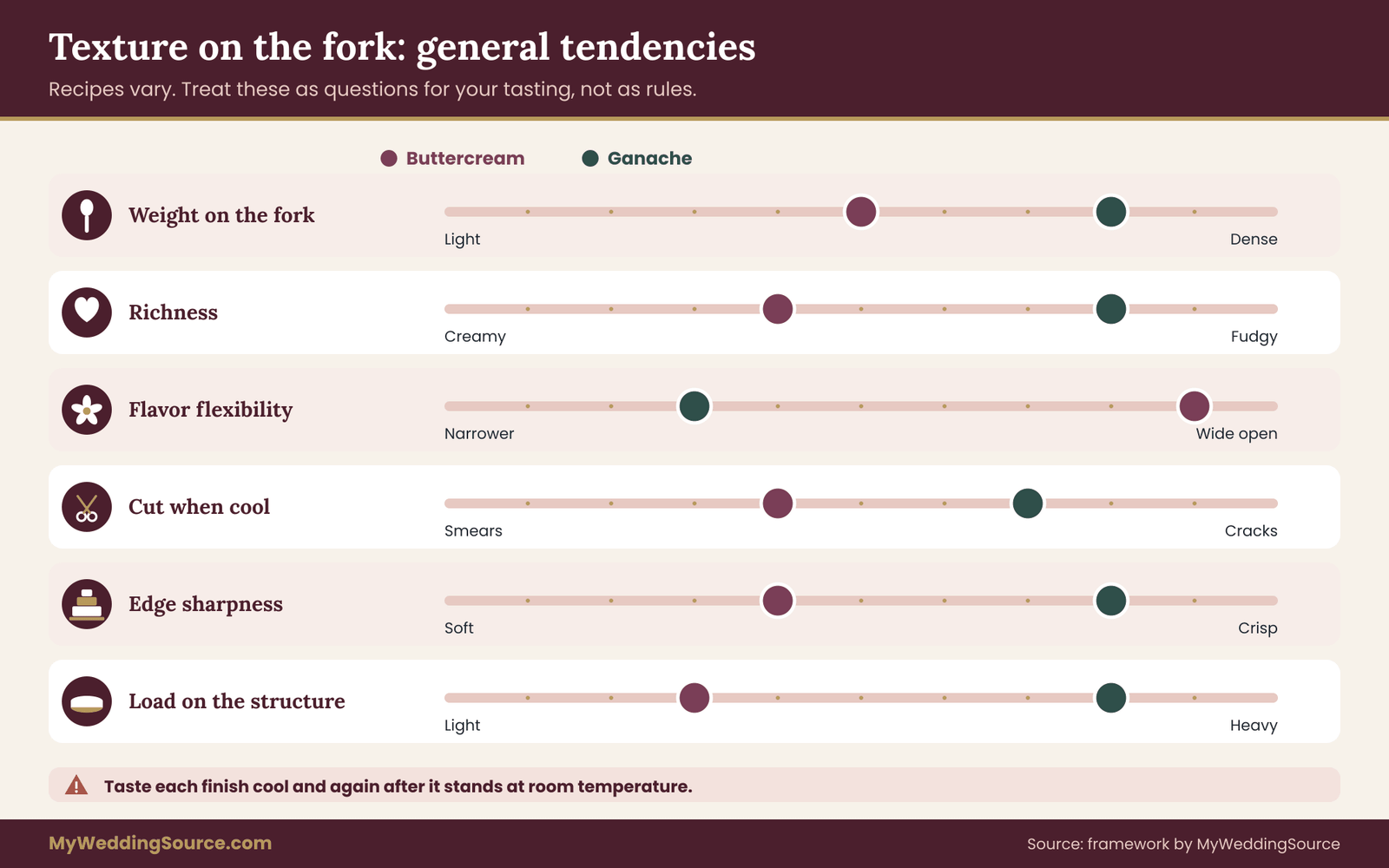
Buttercream. Light to medium in density, depending on how much air was whipped in. The butter melts at about the temperature of the mouth, so a good buttercream dissolves smoothly and leaves a creamy, buttery note. American-style versions taste sweeter and can have a slight grain from the sugar. Meringue-based versions taste less sweet and feel silkier. Flavor is flexible, because vanilla, citrus, berry, coffee, caramel and many other flavors blend in easily.
Ganache. Denser and richer. A firm ganache has a fudge-like bite that softens in the mouth, and the flavor is chocolate-forward whether you use dark, milk or white. It tends to taste less sweet than American buttercream when made with dark chocolate, and sweeter and creamier when made with white. Flavor is more limited: you can infuse the cream with tea, coffee, citrus or spices, but the base is chocolate.
In both cases the cake underneath matters, and so does the filling. A buttercream-finished cake with a light sponge feels very different from a ganache-finished cake with a dense chocolate layer. Think of the finish as part of a combination, and taste the combination.
The temperature effect on buttercream vs ganache at the plate
When the cake is cut, the frosting is at whatever temperature the room has made it. That has opposite effects on the two finishes.
A chilled butter-based frosting is firm and slightly waxy, and it opens up into its full flavor as it warms. At comfortable room temperature it is soft and creamy. If it gets too warm it turns greasy and heavy. There is a sweet spot, and it is usually a cool room.
A chilled ganache is hard to cut and cold in flavor. At comfortable room temperature it is soft, glossy and full of chocolate taste. If it gets too warm it becomes loose and messy. The sweet spot is a little warmer than buttercream’s, which is one reason some bakers love ganache for an outdoor cake in mild weather.
For an outdoor reception this means the cake’s best eating temperature and its best display temperature are not the same. The cake is at its safest and sharpest cold, and at its tastiest a little warmer. A plan that lets the cake warm slightly between the display and the cutting, without crossing into slump, gives you both.
Cutting behavior
A clean slice is part of the experience in buttercream vs ganache, and it affects the person doing the cutting. Buttercream cuts easily when cool and tends to smear when it is warm and soft, which means the knife needs to be warmed and wiped between cuts, a practice many servers know. Ganache cuts cleanly at a moderate temperature and can crack or chip if it is too cold. A very firm ganache layer can resist a plastic cake server.
If a venue’s kitchen staff or catering team is cutting, ask your baker whether they recommend a particular method, tool or temperature for your finish, and pass that on in writing. The cutting plan itself, including who cuts and when, belongs in the baker’s written plan.
Look and photographs
In buttercream vs ganache, the finish also decides the look, and an outdoor wedding is photographed in natural light, which is unforgiving to a glossy surface.
Buttercream offers a soft, matte or lightly textured surface, swirled or ruffled or smoothed. Under bright sun, a matte buttercream surface reads as soft and creamy. If it begins to warm, it turns glossy and reflects more light, and the change shows in photos.
Ganache offers a very smooth, sharp-edged finish, either glossy or velvety. In soft shade it looks rich and refined. In harsh light it can show fingerprints, sheen and any bloom.
If your photographer will take the cake photos early, shortly after delivery and before cocktail hour, the finish only has to look its best for a short time. If the cake will also be photographed at the cutting, hours later, the finish has to survive the whole evening. Share the photography timeline with the baker so the plan reflects when the cake will be seen most closely.
Buttercream vs ganache at the tasting
Most couples taste cake at a bakery counter, at a cool indoor temperature, from a small portion. That is a fine way to choose a flavor, and a poor way to compare finishes for an outdoor reception. Ask for two adjustments.
First, ask to taste each finish at two temperatures: cool from the refrigerator and then after it has stood at room temperature for a while. You are looking for the point at which each one tastes its best, and the point at which it turns heavy or greasy.
Second, ask the baker to describe or show how each finish looks after it has stood out for a while. Some bakers keep a sample slice for this purpose, or have photos from earlier outdoor events. A sample sitting on the counter for an hour is not a perfect proxy for a tent in July, but it gives you real information about what the surface does.
Taste with the intended cake and filling, not the frosting alone. A thin layer of rich ganache on a light cake tastes different from the same ganache on a dense one.
Sweetness, richness and slice size in buttercream vs ganache
Rich frostings feel more filling. A slice of ganache-coated chocolate cake is often more satisfying in a smaller portion than a slice of lightly frosted vanilla cake. Some couples find that guests take smaller slices of the richer cake, and some find the opposite when the cake is the only dessert. Serving counts and slice sizes are baker decisions, since they depend on tier dimensions and the cutting method, and the timeline guide covers the planning. For this comparison the useful point is that richness and portion size are linked, so check the serving count with the baker for the finish you choose, not just for the cake.
Allergens and dietary needs
Both sides of buttercream vs ganache usually contain milk. Chocolate commonly contains soy lecithin, and may contain tree nuts or traces of them, depending on the product and the facility. Buttercream often includes vanilla or other flavorings, and meringue-based versions contain egg. These are the kinds of facts a baker should list in writing for the exact recipe.
The FDA identifies nine major food allergens under U.S. law: milk, eggs, fish, crustacean shellfish, tree nuts, peanuts, wheat, soybeans and sesame. A made-to-order cake is not a packaged grocery product with a label, so you need to ask for ingredient information and cross-contact practices directly. If a guest has a serious allergy, speak to that guest and follow their medical guidance, and let the baker’s written statement guide the cake.
Dairy-free or vegan versions of buttercream vs ganache both exist, and they behave differently in heat. A dairy-free buttercream made with plant-based fat and a coconut-cream ganache can have a different melting point from the butter and dairy versions. If anyone needs a dairy-free tier, ask the baker for the heat limit of that tier separately.
Three decision rules for texture
Once buttercream vs ganache both pass the heat check, here is a simple way to decide.
- If you want a light, creamy, flexible-flavor frosting and a soft look, lean toward buttercream, and plan the display time around it.
- If you want a rich, chocolate-forward bite and a clean, sharp or glossy look, lean toward ganache, and plan for shade and a careful cold-to-warm transition.
- If you love one and the other passes the heat check more comfortably, consider a hybrid: the finish you love on the parts guests see up close, and the sturdier one hidden beneath it. The later section on hybrids and fallbacks covers how that works.
None of these rules should override your baker’s written limits. They only help you pick among options that have already passed.
Reading the day: sun, wind, humidity and dew at the cake table
Both sides of buttercream vs ganache respond to the air around them, so before comparing frostings you need an honest description of that air. The forecast high is only one number. What the cake experiences depends on where the table is, what is above it, what is next to it and how long it stays there.
Sun and shade matter differently in buttercream vs ganache
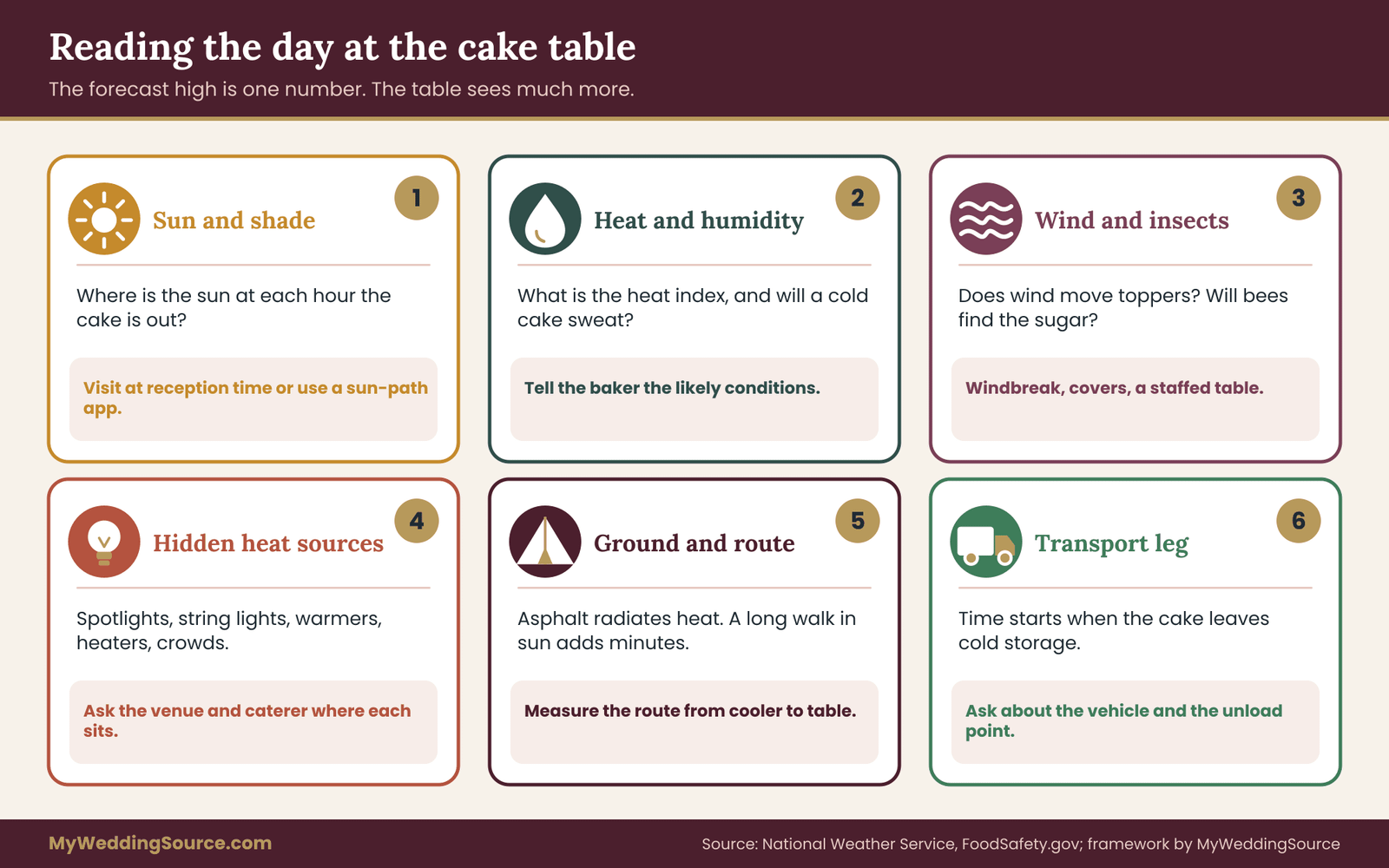
Shade is the cheapest form of cooling and the easiest to get wrong. A table that sits under a tree at two o’clock may be in full sun by five. A tent gives shade, but a tent in direct sun can trap warm air, especially with the sidewalls down and a crowd inside. A pergola or an arbor filters light without blocking it.
Ask the venue to tell you where the sun will be at each hour the cake is out. If the venue cannot say, visit at the same time of day as the reception, or use a free sun-path app on your phone. Then check the answer against the cake table position you actually plan to use. A shaded table at the wrong time of day is not shade.
Heat index, humidity and dew point
Air temperature tells part of the story. The National Weather Service publishes a heat index that combines temperature and humidity to describe how hot conditions feel to people. The cake is not a person, but the idea carries over in one useful way: humid air changes what heat does.
High humidity affects frosting in two ways. Surfaces that crust, such as American-style buttercream, dry more slowly and stay tacky. And any cold surface can pick up condensation, which is the same dew you see on a cold glass. The dew point, the temperature at which air becomes saturated, tells you when condensation will form on a cold cake. If a chilled cake is brought into air whose dew point is higher than the cake’s surface temperature, moisture will appear.
You do not need to calculate this. You need to ask the baker how they handle a cold cake in humid air, and you need to give them the venue’s likely conditions. In buttercream vs ganache, both finishes are affected, and ganache with a fondant shell is affected most visibly.
Wind, dust and insects
Wind does three things to buttercream vs ganache at a cake table. It moves tablecloths and toppers, it dries the surface of frosting, and it carries grit. A crusted buttercream tolerates a bit of wind and a glossy ganache shows every mark. A tall display in an open field is a different problem from a cake in the middle of a tent.
Insects arrive for sugar. Bees and wasps at an outdoor dessert table are a real concern, particularly near orchards, gardens and water. Covers, domes or a staffed table help. Ask whether the venue has insect control in place, and treat a cake dome as a plan item, not an afterthought, since it also traps heat and needs a vent.
Heat sources people forget
When couples picture heat, they picture the sun. At a reception, other things add warmth.
Lighting. Spotlights, uplights, string lights with heat-giving bulbs and photographers’ lamps all warm the surface they point at.
Food warmers and catering equipment. A chafing dish, a grill or a generator close to the cake table adds heat and exhaust.
Patio heaters and fire features. In cooler weather, a heater near the table can warm a cake more than the air temperature suggests.
Crowds. A packed cutting ceremony puts dozens of warm bodies around the table for several minutes.
Hot ground. A cake table on asphalt or stone radiates heat upward in the afternoon, and a thin tablecloth does little to block it.
Ask the venue and the caterer where each of these will be, and put the answers on the sheet in the next section.
The transport leg
The cake’s time outdoors starts earlier than the table. It begins when the cake leaves the baker’s climate control. A baker in a refrigerated vehicle is in a different position from one who uses a regular car with air conditioning, and a short walk from a parking area across a sunlit lawn adds minutes. This is the baker’s department. You only need to know what the plan is and how many minutes it adds.
If the cake will be stored in a cooler or cool room at the venue before display, ask where that room is and how the cake gets from there to the table. Measure that route, because a long walk in the sun is part of the exposure.
How to check the forecast for buttercream vs ganache without driving yourself crazy
Forecasts get more reliable as the date approaches, and cake decisions need to be made earlier than the forecast can be trusted. A practical approach:
- At booking, use the typical conditions for that date and place, and plan the cake for the likely conditions with room to spare.
- A week out, look at the extended forecast and tell the baker if it points to unusually hot or humid weather.
- Three days out, look at the hourly forecast for the afternoon and evening of the wedding, and decide whether to trigger the fallback plan.
- The day before, confirm the final decisions with the baker and the coordinator.
The point of a trigger is that it removes the argument on the day. If the forecast crosses a line you agreed on, you do the fallback. You do not deliberate.
The heat budget sheet: comparing buttercream vs ganache with your baker
Now to the method this guide is built around. A heat budget sheet turns the vague worry “will it hold up?” into a comparison of two numbers: how long the cake will be exposed, and how long the baker says each finish can stand it. It is a way of comparing buttercream vs ganache with the baker’s own limits, not with a rule from the internet.
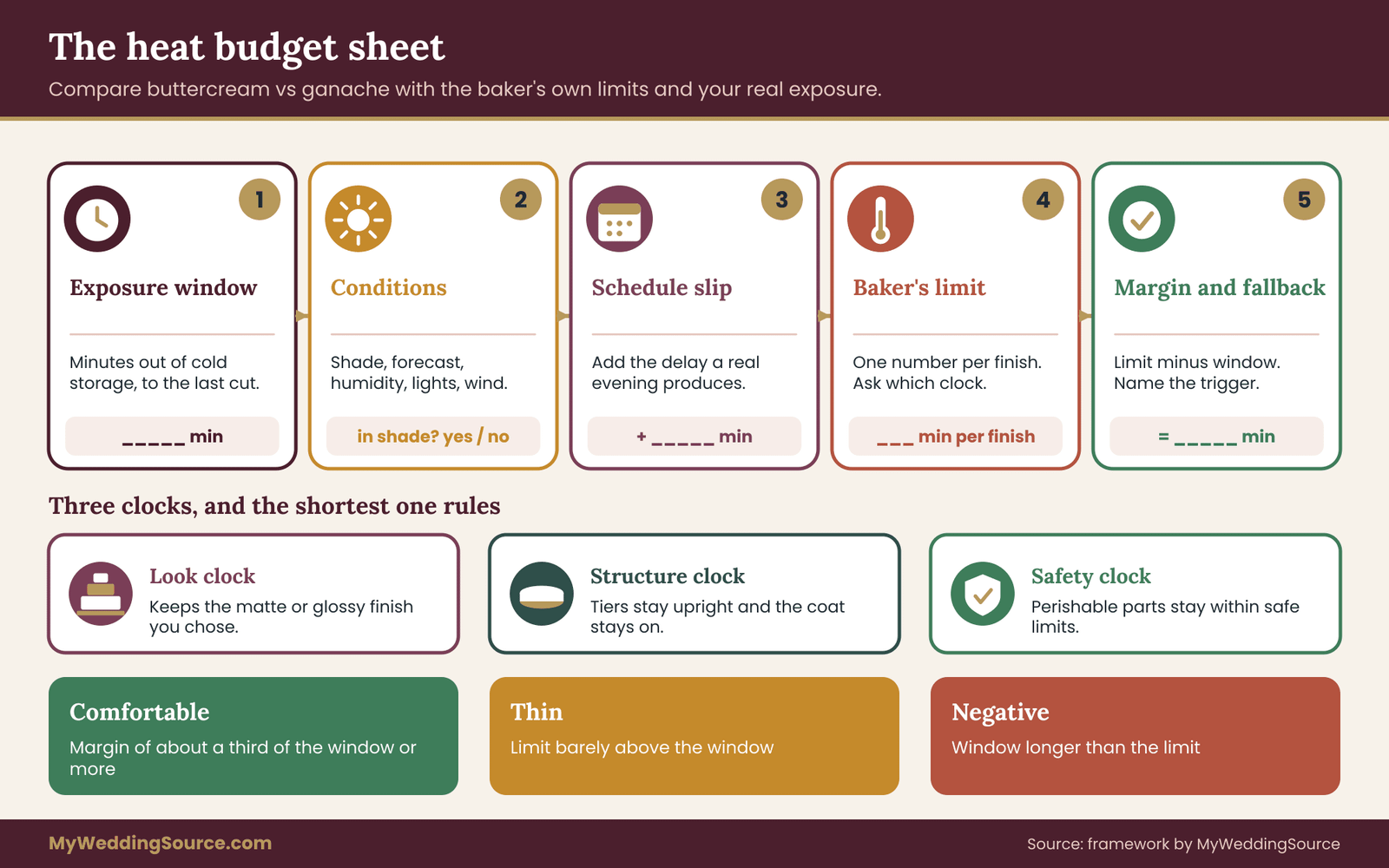
The three clocks
A cake does not have one limit, and buttercream vs ganache can differ on each. It has three, and the baker may give you a different number for each.
The look clock. How long the finish keeps the appearance you chose: matte or glossy, sharp or soft. This is usually the first clock to run out.
The structure clock. How long the tiers stay upright and the coating stays on, with the weight the structure carries. It is the baker’s call, and it depends on the finish, the filling and the supports.
The safety clock. How long perishable parts of the cake can safely stand at the venue. Public guidance such as the two-hour rule on foodsafety.gov, tightened to one hour above 90°F, sets a general frame, and the baker applies it to the specific recipe.
When you ask for a limit, ask which clock it is. A baker who says “three hours” might mean the look clock for a firm finish. Another might mean the safety clock. The plan has to respect the shortest of the three.
The five lines of the buttercream vs ganache sheet
The sheet has five lines. You fill in the first three with the venue and the schedule, and the baker fills in the fourth. You do the fifth together.
Line one: the exposure window. Count the minutes the cake spends out of climate control, from the moment it leaves the baker’s cold storage or vehicle to the last cut. Include unloading, setup, any delay for photos, speeches and the schedule slip that always happens. Use the cut time that the schedule really produces, not the one on the printed timeline.
Line two: the conditions. Describe the table: full shade, partial shade or sun, the forecast temperature and humidity at the display hours, wind, lights and other heat sources. Keep it short and factual.
Line three: the schedule slip. Ask how late the evening is likely to run. Add a realistic delay, such as extra time for photos or a late dinner service. Many couples forget that the cake is the last event of a long run.
Line four: the baker’s limit for each finish. For each finish you are comparing, ask the baker for the number of minutes the cake can stand under the conditions on line two, and which clock that number represents. Ask for it in writing.
Line five: the margin and the fallback. Subtract the exposure window, with the slip, from the baker’s limit. The difference is your margin. Then agree on what happens if the margin shrinks: who watches, what triggers a move and where the cake goes.
Reading the margin
The margin is where the buttercream vs ganache comparison pays off. As a starting guide for your own planning, not a food-safety rule, look at it this way:
- Comfortable. The limit exceeds the exposure window by a wide margin, say by about a third of the window or more. The finish passes, and you can choose by texture.
- Thin. The limit exceeds the window by only a little. The finish can work, but only if the plan has no slack, and that rarely survives a real evening. Add shade, shorten the window or choose a different finish.
- Negative. The window exceeds the limit. The finish does not pass for this setting unless the plan changes.
Your baker may set a different margin, and a baker’s margin should win. The sheet only helps you ask the question.
Comparing buttercream vs ganache on the sheet
For buttercream vs ganache, fill in the sheet once for each finish, using the same exposure window and conditions. Only line four changes. You now have two margins side by side.
If both are comfortable, choose by texture and look. If one is comfortable and the other thin, the decision is usually made for you, unless the thin one is the finish you love and you are willing to change the plan. If both are thin, change the plan before you change the finish: add shade, shorten the window or use a display cake. If both are negative, the setting may call for a different approach to the whole cake, which the hybrids section describes.
Notice what the sheet does not require. It does not require you to know the melting point of anything. It requires your baker to state limits, and your coordinator to describe the setting. That division of labor keeps the technical judgments with the person who is accountable for them.
What if the baker will not give a buttercream vs ganache number?
Some bakers resist putting a number in writing, and some honestly do not have one. Do not take that as a refusal. Ask for what they will commit to instead: a delivery time, a shade requirement, a cutting time, a cooler plan or an agreement to move the cake if it softens. A baker who will say “we deliver within an hour of the ceremony and the cake stays in the tent” has given you a usable condition even without a number.
If a baker will not describe any limits or any plan, treat that as information about the baker. The vendor due diligence checklist covers how to evaluate vendors who are vague about their process.
A worked example: choosing buttercream vs ganache for a July garden wedding
Numbers make the method concrete, so here is an invented couple and an invented baker. Every figure below is made up for illustration. Your baker’s numbers will differ, and the point is the process, not the values.
Priya and Marcus are planning a mid-July wedding at a garden venue. The ceremony is on the lawn at 4:30 pm, cocktails follow, and dinner is served in a tent with open sides and fans but no air conditioning. The venue has a kitchen with a walk-in cooler that the caterer shares. The forecast for the date is a high of 91°F in the afternoon, easing to about 84°F in the evening, with moderate humidity. They want a three-tier cake and cannot decide between buttercream vs ganache.

Step one: line one of the sheet
The baker’s van arrives at 5:15 pm. In the first plan, the cake goes straight onto the tent table, where it will stand through cocktails and dinner. The cake is cut at 8:15 pm, and the last slice is served around 8:40. The coordinator adds twenty minutes for the schedule slip, so the cake will not be done with its exposure until about 9:00 pm.
Window for plan one: 5:15 to 9:00 pm, which is 225 minutes.
Step two: the conditions
The table would stand in the tent, near the open west side, which gets low sun in the early evening. A string of warm-white bulbs hangs directly over the planned spot, and the caterer’s warming trays will be about ten feet away. The couple writes these down exactly as they are.
Step three: the baker’s limits
The baker, after looking at the conditions, gives these invented limits for the evening, with the look clock as the one that matters most:
- Swiss-style meringue buttercream, standard recipe: about 90 minutes before the finish starts to lose crispness under those conditions.
- Firm dark chocolate ganache under fondant: about 150 minutes before the surface begins to soften.
The baker adds that none of the fillings is perishable, so the safety clock is not the limiting one. The structure clock exceeds both numbers.
Step four: the margin for buttercream vs ganache
Against the 225-minute window of plan one, both finishes come out negative. Buttercream falls short by 135 minutes and ganache by 75. If the couple had stopped at the tasting and picked by flavor, they would have chosen a cake that fails in the tent regardless of finish.
This is the useful lesson. In this example the finish was not the main problem. The exposure window was. Changing the plan matters more than changing the frosting.
Step five: change the plan before the finish
The couple and baker work through the options in order of least disruption:
- Keep the cake in the venue’s cooler until dinner begins. The baker agrees that the cake can wait in the walk-in cooler, and the caterer confirms there is room for a tall box. The cake comes out at 7:45 pm.
- Recalculate. The new window runs from 7:45 pm to the 9:00 pm end, which is 75 minutes.
- Check the margins. Ganache has 150 minutes against 75, a margin of 75, comfortably more than a third of the window. Buttercream has 90 minutes against 75, a margin of only 15, which is thin.
- Improve the conditions. The couple moves the table to the center of the tent, away from the open side, asks the lighting vendor to point the string lights away from it, and has the caterer move the warming trays. The baker revises the buttercream limit to about 105 minutes under the improved conditions.
- Recheck. Buttercream now has a margin of 30 minutes, which is 40 percent of the window. That is comfortable by the planning guide in this article.
Step six: choose buttercream vs ganache on texture
With both finishes passing, Priya and Marcus can pick by taste. At the tasting they tried both at cool and room temperature. Marcus preferred the lightness of the buttercream on vanilla cake, and Priya wanted a chocolate tier with a rich, fudgy finish. They decide on two vanilla tiers in the buttercream and a chocolate tier in ganache, all finished the same way outside.
The baker notes that the cake’s look clock is set by its weakest tier, so the buttercream tiers still govern the 105-minute figure.
Step seven: write the fallback
The coordinator writes a short fallback into the day-of plan. If the three-day forecast shows an evening above the baker’s stated range, the baker will convert the vanilla tiers to the stabilized buttercream recipe or to ganache, at a price the baker names in advance. If the tent feels hot on the day, the coordinator moves the cake to the indoor reception hall that the venue has agreed to keep available. The couple’s wedding planner is the one person authorized to make that call.
What the example shows
Three things stand out about buttercream vs ganache. First, the exposure window decided the outcome more than the frosting did. Second, a numeric margin made the discussion calm, because everyone was comparing the same two numbers. Third, the final cake used both finishes. That is a common result of this method, not a failure to choose.
It also shows the cost of skipping the step. Had the couple chosen on the basis of “ganache is sturdier,” they would have picked the finish that failed less badly in plan one, and still been displaying a cake that was out of its limit for over an hour.
Hybrids, covers and fallback plans for buttercream vs ganache
Few weddings settle buttercream vs ganache with a pure buttercream or pure ganache cake all the way through. Bakers mix finishes and change the plan around the cake to fit the setting. This section lists the options in order from least to most disruptive, so you can choose the lightest change that solves the problem.

Option one: move the exposure, not the buttercream vs ganache choice
The cheapest changes come before the frosting is touched. Shade, late display, cool storage until dinner and an earlier cut all reduce the exposure window without changing the cake’s look. If you are comparing buttercream vs ganache purely because the baker is worried about heat, try these first and recompute the margin.
Option two: hide the delicate finish
A firm coat of ganache or a stabilized buttercream under fondant gives a hard shell around a softer interior, and many bakers use that approach for outdoor cakes. The trade-offs are weight, a different eating experience and fondant’s own habits, since it can sweat with cold-to-warm changes. Ask the baker whether the interior limit or the shell limit controls.
Option three: mix buttercream vs ganache across tiers
Different tiers can have different finishes, as in the example. This helps when a couple loves two textures. It does not raise the limit of the weakest tier, so the plan has to respect it. Use it for taste, not as a heat solution.
Option four: a stabilized recipe
Some bakers keep a heat-tolerant buttercream, typically with part shortening or a modified structure, for summer outdoor cakes. It will taste and feel a little different. If you want to try it, ask for a sample of exactly that recipe at the tasting, and ask how it differs from the house buttercream.
Option five: display cake plus kitchen cake
A decorated display cake, real or partly dummy, stands on the table for the cutting moment, while servings come from a plain kitchen cake or sheet cake kept in the cooler. This arrangement removes most of the exposure problem, because the cake that guests eat never stands outside. The cost is the extra cake and a less dramatic cutting. Our guide to planning a wedding cake from final count to cutting explains how to plan servings for a display cake and a kitchen cake together.
Option six: indoor display or a cooled space
If the venue has an air-conditioned room, a cool hall or a shaded porch that is a few degrees cooler, ask whether the cake can stand there, and plan how guests will see the cutting. Photographers can still take the photos there. For a rental cooler or display case, the wedding rental planning checklist shows what to confirm about power, delivery and returns.
Option seven: simplify the design
Delicate piping, tall ruffles, glossy glazes and thin drips are the first things to fail. A simpler finish for the same flavors can solve the problem and often costs less. The baker is the right person to suggest which elements to simplify.
Day-of watch and triggers
Whatever you choose, give the plan a person and a few triggers. Name one watcher, such as a coordinator or planner, who checks the cake at intervals. Write the triggers in plain terms:
- Surface turns glossy or tacky. Tell the coordinator, who moves guests away, checks the fan and shade and calls the baker.
- Edges round off or a fingerprint stays. Move the cutting earlier or move the cake to the cool space, as planned.
- Visible slump, lean or oil on the board. Nobody touches the cake. Call the baker and follow their instruction.
- Droplets or a damp look after moving from the cooler. Wait. Do not wipe, and let the baker advise.
Mistakes to avoid
A few well-meant fixes backfire, whichever side of buttercream vs ganache you choose. An ice pack or bag of ice set against a cake table can cause condensation. A cake dome without ventilation traps heat. A fan pointed straight at the frosting can dry and crack a crust. And well-meaning relatives lifting the cake into the shade can do more damage than the heat did. Decide ahead of time who may move the cake, and make the answer “the baker, or someone the baker named.”
Questions to settle in writing before you commit to buttercream vs ganache
A good conversation with a baker can disappear into memory by the wedding week. Writing the answers down protects both sides. This section lists what to settle, how to word it and what it tends to cost, so that the buttercream vs ganache choice is recorded in the same place as the rest of the order.
The short written list for buttercream vs ganache
Ask the baker to confirm these in the contract, an addendum or a plain email that you save:
- The exact finish for each tier, with the recipe type named, for example “Swiss-style meringue buttercream” or “firm dark chocolate ganache under fondant.”
- The baker’s stated limit for each finish under the conditions you described, which clock it refers to and the date the baker last confirmed it.
- The delivery time, the setup time and the plan for where the cake waits before display.
- Who decides to move, cut early or swap the display plan if conditions change, and the phone number to call.
- What happens if the forecast crosses your trigger line, including any recipe change, its price and the deadline for deciding.
- Which fillings are perishable, and whether the baker’s practices change the allergen picture.
- Who owns any stand, dome or cooler, and when it is picked up.
The wedding vendor contract guide explains how to read the clauses around deposits, changes and cancellations, which matters here because a recipe swap three days before the wedding is a change order.
A sample message about buttercream vs ganache
A short, polite note works better than a long one. Something like this:
“We are choosing between buttercream and ganache for our outdoor reception. The tent has no air conditioning, the forecast for the date is usually in the high 80s, and the cake would be on display from about 7:45 until 9:00. Could you tell us how long each finish would hold under those conditions, which kind of limit that is, and what you would change if the forecast is hotter than expected?”
The message supplies the details the baker needs and asks for the answer in a form you can use. Save the reply with your contract. If the baker answers by phone, send a short email afterward summarizing the call and asking them to correct anything you got wrong.
Where the cost comes from
Cost differences in buttercream vs ganache are real but vary a great deal between bakeries, so this guide gives no prices. It can show you where the cost comes from, which helps you ask better questions and read a quote.
Ingredients. Ganache requires quality chocolate and cream in meaningful quantity, and its cost follows the chocolate market and the size of the cake. Buttercream needs butter, sugar and, in meringue versions, eggs. Which is cheaper depends on the recipe and the season.
Labor. Smooth, sharp-edged finishes take skill and time whether the material is ganache or buttercream. A ganache-and-fondant cake involves several steps, such as coating, setting and covering. A heavily piped buttercream cake takes hours of detail work. The quote usually reflects labor more than ingredients.
Logistics. A late delivery slot, a second trip, a refrigerated vehicle, on-site setup and a staff member to stay with the cake all add cost. So might a display cake plus a kitchen cake, since you are paying for two cakes.
Contingency. A recipe change on short notice can carry a rush fee. Ask what it would be before you need it, and decide whether you would rather pay for a conversion or move the cake indoors for free.
The best approach to cost is to compare complete plans, not finishes. A cheaper frosting that needs a rented cooler and a second delivery may cost more than a pricier one that needs neither. When you compare quotes, the wedding vendor due diligence checklist can help you line them up on the same terms.
Where this decision sits in the larger plan
Buttercream vs ganache is one decision among many. If you are still building the overall schedule, the wedding planning checklist shows where cake decisions fall relative to venue, catering and rentals. And if dietary needs affect the dessert course, the wedding menu planning guide explains how to cover them across the whole meal.
Food safety, official sources and the limits of this buttercream vs ganache guide
Food safety guidance for a wedding cake comes from official sources and from the baker’s own license and practices. This guide describes the general frame and points to the agencies that publish it. It does not substitute for them.
What the official sources say, in general terms
The U.S. Department of Agriculture’s Food Safety and Inspection Service describes a danger zone between 40°F and 140°F, the range in which bacteria multiply fastest. Its general advice for perishable food is to keep it out of that range for no more than two hours, and for no more than one hour when the surrounding temperature is above 90°F. The foodsafety.gov site, run by the U.S. Department of Health and Human Services, carries the same two-hour guidance.
The FDA Food Code is the model that many state and local health departments use to write their own rules. It describes foods that need temperature control for safety, and how licensed food businesses must handle them. Whether a particular frosting or filling falls into that category depends on its recipe, and the Food Code leaves the details to the regulator and the food business.
For a couple, the practical meaning is modest. Ask the baker whether any part of the cake is considered perishable under local rules, and how long it can stand. If any answer is unclear, the local health department is the authority to ask.
Checking the baker
A licensed commercial bakery has been inspected by a local authority, and a cottage-food or home baker may operate under different rules that vary by state. You can ask how the baker is licensed and whether they carry insurance, and many couples do. Rules for what a home baker may sell, and which products are covered, differ widely, and some states limit perishable products. Your local health department can tell you what applies where you live.
The limits of this guide
This buttercream vs ganache article is general information. It describes tendencies, not guarantees. It cannot say how a specific recipe will behave, what temperature is safe for your cake, whether a filling is perishable, how a given structure will hold up or how many servings a cake will cut into. Those decisions belong to your baker, who knows the recipe, and to the local authority that regulates the baker. The numbers in the worked example are invented. Check the current rules, fees and limits with the people who issue them.
If a guest’s health depends on the cake, rely on the baker’s written statement and the guest’s own medical guidance over anything written here.
Your next steps
Start with three actions this week. First, write down the exposure window for your cake: when it will leave cold storage, when it will be set up, when it will be cut and how much slip to allow. Second, describe the table’s conditions in a few lines, including shade, forecast, lights and other heat sources, and send both to your baker. Third, ask for the baker’s written limits for each finish you are considering, and which clock each one measures.
When the answers arrive, fill in the margin for each finish. Choose by texture among the options that pass, agree on a fallback and a forecast trigger, and put the decision in your contract. Then give the buttercream vs ganache plan to the coordinator and the venue so that everyone is working from the same sheet. The decision on buttercream vs ganache will feel far smaller once the numbers are in front of you.
FAQ
Is ganache better than buttercream for an outdoor wedding cake?
Not automatically. Ganache holds sharp edges well in shade and moderate warmth, and then loses its firmness fairly quickly once its cocoa butter softens. Butter-based frosting softens earlier and more gradually. Which one works better depends on your baker’s recipe, the shade, the temperature and how long the cake stands outside. Ask for written limits for both finishes and compare them with your own exposure window.
Which holds up better in heat, buttercream or ganache?
It depends on the recipe. A firm, dark chocolate ganache often tolerates moderate warmth longer than an all-butter buttercream, while a buttercream stabilized with part shortening may outlast a soft white chocolate ganache. Because bakers use different recipes under the same names, the baker’s own stated limit for the finish is the only reliable comparison. Do not rely on a general ranking.
How long can a buttercream or ganache wedding cake sit outside?
There is no single number, and this guide does not give one. The answer depends on the recipe, the fillings, the temperature, the shade and what limit the baker applies, whether for appearance, structure or food safety. General food-safety guidance says perishable food should not stand out for more than two hours, or one hour above 90°F. Ask your baker for a written figure.
Does ganache melt as easily as chocolate?
Ganache contains chocolate, and cocoa butter softens close to body temperature, so it can soften and slump in a warm setting. A firmer ratio and dark chocolate usually hold longer than a softer ratio or white chocolate. The surface may turn glossy first, then the edges round, and finally the coating can move. Ask the baker how your ganache behaves at the venue’s expected temperature.
What is the most heat-stable frosting for a summer wedding?
No single frosting is best for every recipe and setting. Bakers often name stabilized buttercreams made with part shortening, firm ganache under fondant and fondant itself as sturdier choices, each with trade-offs in taste, weight or humidity behavior. Ask your baker which option they trust for your date, and ask to taste that exact recipe at the tasting before you decide.
Can I mix buttercream and ganache on one cake?
Yes. Many bakers use different finishes on different tiers, or a ganache under-coat beneath another finish. It works well for taste and look, but the most heat-sensitive tier still sets the cake’s limit. Tell the baker where the cake will stand, ask for the limit of the weakest tier and confirm who decides whether the plan changes on the day.
Should the cake wait in a cooler before display?
Often that is the simplest way to shorten the time a cake spends in warm air. It requires space, a clear route and a person to carry it, and a cold cake can sweat when it meets warm, humid air. Ask the venue and caterer whether a cooler is available and how big, and ask the baker how to handle the move.
What if the forecast turns hotter than we planned?
Agree on a trigger and a fallback before the day. A common approach is to set a forecast line three days out, such as the evening heat the baker named as the edge of the plan. If the forecast crosses it, the baker converts the recipe, shifts the display time or the couple moves the cake to a cooler space, with the price and deadline agreed in advance.
Sources
- FoodSafety.gov, U.S. Department of Health and Human Services
- Food Safety and Inspection Service, U.S. Department of Agriculture
- FDA Food Code, U.S. Food and Drug Administration
- Food allergies, U.S. Food and Drug Administration
- Buy, store and serve safe food, U.S. Food and Drug Administration
- Food safety, Centers for Disease Control and Prevention
- Heat safety and the heat index, National Weather Service
- Extreme heat, Ready.gov, Federal Emergency Management Agency
- Retail food protection, U.S. Food and Drug Administration