

A courtesy hold is a venue’s short, informal promise to keep your wedding date open while you decide, and the rules behind it decide whether that promise is worth anything. This guide explains how a courtesy hold works before a contract is signed, how to read its expiry, priority and deposit status, and how to track several venues with one comparison log.
A courtesy hold is a temporary calendar entry with a time limit and, often, a place in line. It is not a contract, and it usually carries no deposit and no guarantee. Before you accept one, get four things in writing: the exact expiry (date, time and time zone), your priority position, what ends the hold early, and whether any money is involved. Record each one in a comparison log so you can see every venue’s clock at a glance. Then decide before the earliest clock runs out, and release the others politely.
Somewhere between “we love this place” and “here is the contract” there is a stretch of days when a venue date lives in an odd in-between state. The venue has said it will keep the date for you. You have not signed anything or paid anything. And another couple may be asking about the same Saturday right now. That state is a courtesy hold, and most couples walk into it without asking a single question about how it works.
The rules matter because a courtesy hold is built entirely out of the venue’s own policy. There is no industry standard you can point to. One venue might give you seventy-two hours, another ten days, and another may tell you it does not offer holds at all. One ranks interested couples in a queue, and another drops you the moment a paying inquiry arrives. Those numbers are examples, not norms. If you misread your venue’s version, you can lose a date while believing you held it, or sit on a date you no longer want while someone else is turned away.
This guide covers the stretch before the contract only. It does not rewrite the whole process of picking a date or choosing a venue; those have their own guides on this site. Here you will learn what a courtesy hold is, which rules usually govern it, which questions to ask before you accept one, how to read an expiry time without being surprised by it, where a courtesy hold ends and a paid hold begins, and how to keep several of them straight with a simple log. A worked example with an invented couple shows the log in use over ten days.
A note on scope. This is general information, not legal, tax or financial advice, and venue policies and state rules differ, so confirm anything that affects your money with the venue’s written terms and the relevant state agency.
What a courtesy hold is, and what it is not
A courtesy hold is a temporary reservation of a date on a venue’s calendar, offered as a favor while you make up your mind. The venue marks your date as tentatively taken. It will not, for a limited time, confirm that date to other couples without first checking with you. In exchange you are expected to decide, or to ask for more time, before the limit runs out.
Venues use many names for this. You may hear courtesy hold, soft hold, tentative hold, pencil, option, or placeholder. Some venues use “first hold” and “second hold” to describe a queue. Some use “hold” for a date that has a deposit attached, which is a different thing and is covered later in this guide. Because the vocabulary is inconsistent, treat the label as unreliable and ask what the arrangement actually does: how long it lasts, what happens when someone else asks, and whether any money is involved.
What a courtesy hold usually is
In most versions you will find three ingredients.
The first is a calendar entry. Somebody at the venue, whether a sales manager, an events coordinator or the owner, enters your name against the date in a calendar or booking system. That entry is what stops an ordinary inquiry from being told the date is open.
The second is a time limit. A courtesy hold is meant to be short. The limit may be measured in hours, days or a fixed calendar date, and the venue may count it from the moment it was granted or from the moment it sent you the contract.
The third is a position. If only one couple has asked for the date, you are the only hold. If others have asked, the venue has to decide whose request counts first, and a courtesy hold is where that ranking shows up.
What a courtesy hold is not
It is not a contract. Nothing about the date, the price, the hours or the services is binding on either side until a contract says so. If a venue changes its mind, raises its price or double-books the date during a courtesy hold, you generally have fewer remedies than you would under a signed agreement, because you have no signed agreement.
It is not a guarantee that the date will be there on the last day. Many holds can be ended early. A common rule is that if another couple is ready to sign, the venue gives you a short window, often a day or two, to sign first or release the date. That rule is one reason you should never treat the stated expiry as the only deadline.
It is not free of obligation. Even without a fee, a courtesy hold asks something of you: a prompt answer, and a clear release if you decide not to go ahead. A date held by a couple who has already decided against the venue is a date no one else can book, and venues remember who handles that well.
It is not a deposit. A deposit is money paid under a contract, with terms for what happens to it. A refundable fee paid to keep a date is something in between, and it needs its own read, which the deposit section below covers.
Why venues offer courtesy holds at all
A venue only has so many Saturdays. Each one that goes unbooked is revenue that cannot be recovered. A courtesy hold lets a venue say “yes, keep talking” without asking a couple to commit before they are ready, and it lets the venue keep a record of who is interested, in what order. For many venues that is a sales tool as much as a courtesy.
It also protects the venue from a particular kind of awkwardness. If a couple tours on Saturday, says they love the room, and then returns a week later to find the date gone, the venue has a frustrated couple. If a second couple was turned away because the first one was “thinking about it,” the venue has two frustrated couples. A time-limited hold is the compromise that limits both problems.
For you, the value is a short, calm window to check the things that cannot be checked at the tour: whether your key guests can travel that weekend, whether the contract is acceptable, and whether the numbers work. A courtesy hold is worth the most when you are days away from a decision and need a little time to finish it, not when you are months away and want to park a date.
Where a courtesy hold sits in the booking path
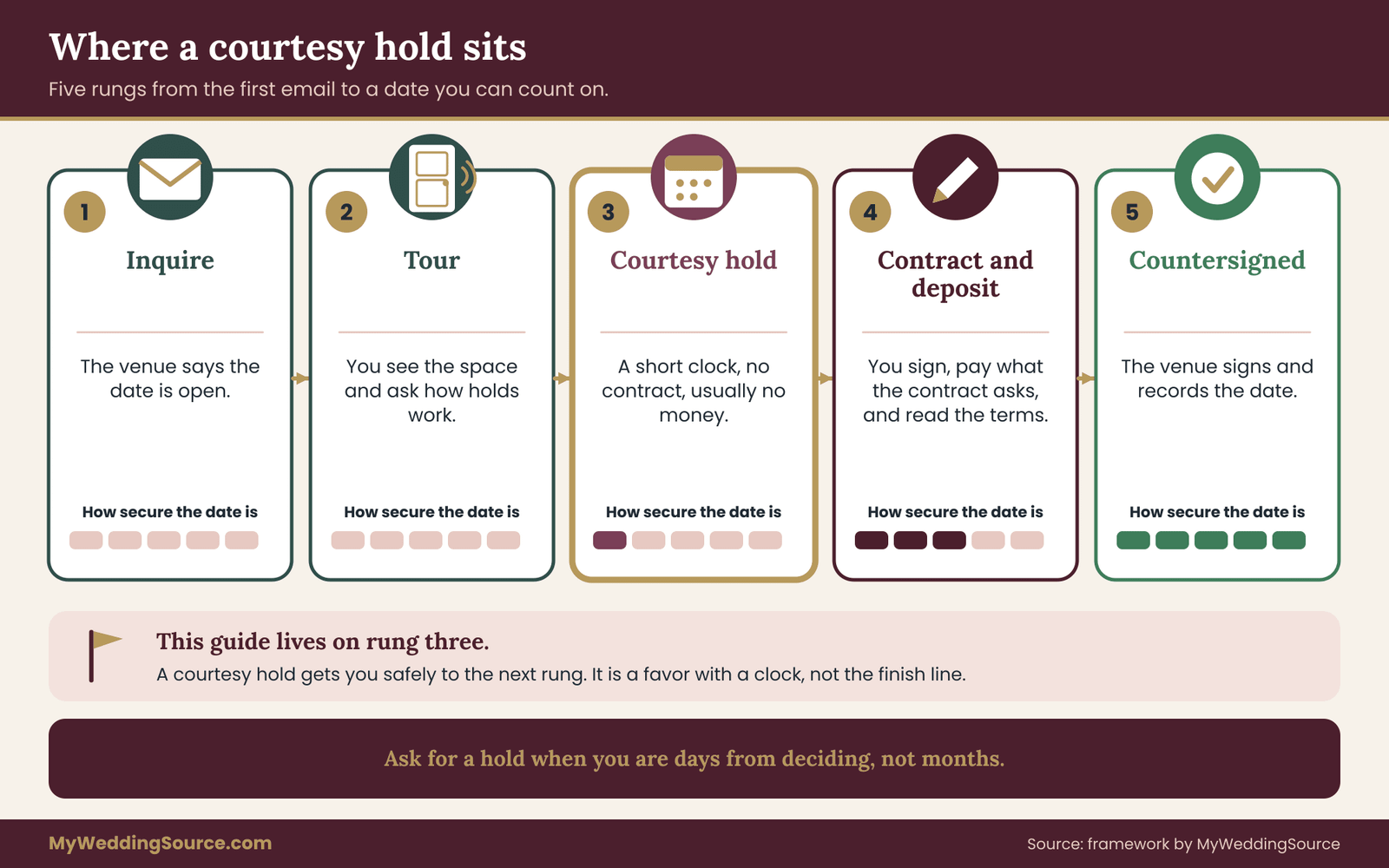
Picture the path as a ladder with a few rungs. First you inquire and learn the date is open. Next, usually after a tour, you ask the venue to hold it. After that the venue sends a contract, you review it, and you sign and pay the deposit it requires. Finally the venue countersigns, and the date is yours in the way that counts.
A courtesy hold lives on the second rung only. It is the least secure place to stand, and its whole purpose is to get you safely to the next one. The most common mistakes happen when couples forget that, treat the hold as if it were the contract, and let a clock run out because they felt safe.
Before you ask for any hold, it helps to know that the date itself is worth holding. If you are still weighing which weekend suits your guests, the vendors you want, and local travel conditions, work through choosing a wedding date first and come to the venue with two or three real candidates. A courtesy hold is a poor tool for answering “which date do we even want?” because the clock on it is short. It is a good tool for answering “can we get this particular date long enough to confirm that we do?”
Used that way, a courtesy hold is simple. It is a small, time-boxed favor with rules that you can learn in one email. The next section shows what those rules tend to look like.
How courtesy hold rules usually work
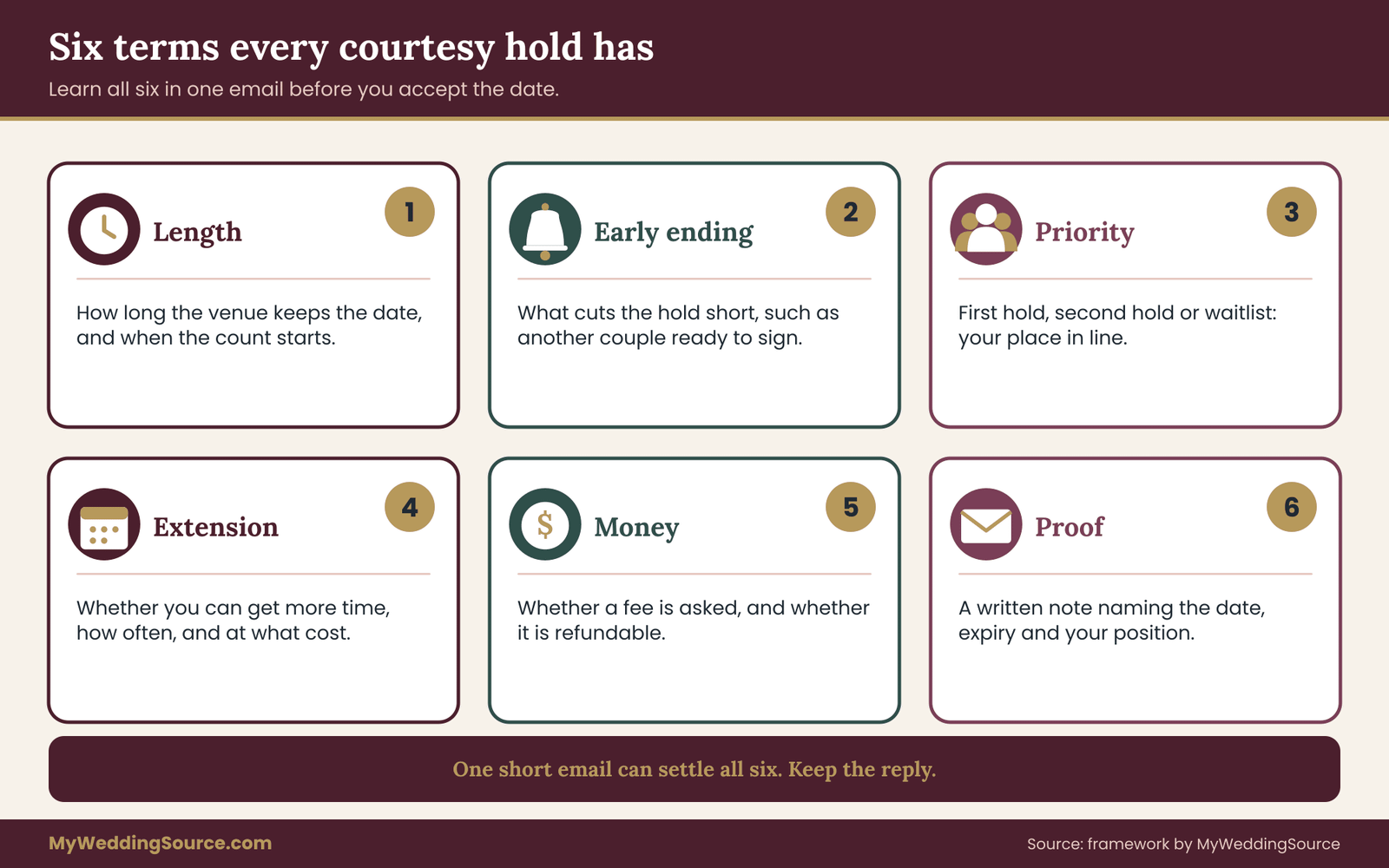
Because every venue writes its own policy, no single description fits them all. You can still predict the shape of a courtesy hold, because the same six terms show up again and again, whether the venue is a converted barn run by a family, a hotel with a sales department, or a historic house managed by a nonprofit. Each term has a plain meaning and a place where couples tend to be caught off guard.
Term one: the length of the hold
The length is how long the venue promises not to confirm your date to someone else without checking with you first. It may be stated in hours, days, or as a calendar date such as “until the end of next week.” Shorter holds tend to appear on in-demand dates, and longer ones on dates that are quiet anyway, which is a reasonable thing for a venue to do even if nobody says it out loud.
The part that deserves care is when the clock starts. Some venues count from the moment they entered your name on the calendar. Others count from the day they emailed you a contract, on the logic that you cannot be expected to decide before you have seen the terms. A hold that starts at the contract can be much longer in practice than one that starts at the phone call, so ask which one you have.
Also ask what the unit is. “Three days” might mean seventy-two hours, three business days, or three calendar days that happen to include a weekend when no one at the venue is working. The reading section later in this guide shows how much room for confusion hides in that one phrase.
Term two: what ends the hold early
A courtesy hold has a stated end, but it often has an unstated one too. The most common early ending is a competing inquiry that turns into a request to book. If the venue has promised to give you the first chance, it will typically tell you that someone else wants the date and ask whether you want to sign now. This is sometimes called a bump or a right of first refusal, though venues rarely use the legal phrase.
What you want to learn is how much notice you get when that happens. A venue that gives you twenty-four hours and a phone call is giving you a real chance to act. A venue that says “we may release the date if someone else is ready” without any notice period is describing a hold that can vanish between one email and the next.
Other early endings are less dramatic. A hold may end if you miss a tour, if you fail to return a short questionnaire, or if the venue’s system closes out unreturned holds on a regular schedule. None of these is unreasonable, but you cannot plan around them if no one tells you.
Term three: priority
When several couples want the same date, a courtesy hold is usually ranked. The first couple to ask holds the first position. The next holds the second, and so on. Venues commonly call these a first hold and a second hold.
Rank decides who gets the chance to sign. If you are second, you are not safe on the date. You are waiting to learn whether the first couple signs or lets the hold lapse. Some venues will tell you automatically when the first couple releases, and your hold is then promoted. Others will not promote anyone unless you ask, so a second hold can sit unchanged after the first has ended, and the date remains available to others who have not yet inquired.
Rank can also be a function of money. At some venues a couple who pays a small refundable fee outranks a couple who has none, which is the first sign that a courtesy hold is turning into something else.
Term four: extensions
Many couples need more time than they were first given. Whether the venue will allow it depends on its policy and on how much interest the date has. An extension is easier to get when nobody else is waiting and when you ask before the clock expires, not after.
Ask three things. Can the hold be extended at all? Is there a limit, such as one extension or one extra week? And does an extension cost anything? If it costs a fee, that fee is money you are paying for time, so move to the deposit section before agreeing.
An extension should be recorded in writing with a new expiry date and time. A conversation that ends with “sure, take your time” tells you almost nothing about when the hold actually stops.
Term five: money
The default is that a courtesy hold costs nothing. A venue offering one is spending its own calendar and asking nothing in return. That default is why the arrangement is called a courtesy in the first place.
Money enters in two ways. A venue might ask for a small payment to convert a courtesy hold into a paid hold, which is a longer, firmer reservation. Or it might send a contract with a deposit due within a fixed number of days. Each deserves a close look, and both are covered below. For now, the practical rule is simple: if any payment is requested, you are no longer dealing with a plain courtesy hold, and you should ask what the payment buys, whether it is refundable, and what the refund conditions are before you pay.
Term six: proof
Every term above is worthless if it exists only in a phone call. The last term is the venue’s record that the hold exists and what it says. A confirmation email is enough for most purposes. It should name the date, the venue space, the expiry, and your position. If the venue prefers to give holds only by phone, send a short summary yourself the same day and ask them to correct it if anything is wrong. That summary is not a legal document, but it is a dated record of what you understood, and silence from the venue after you sent it counts for something.
Limits on how many holds you can ask for
Some venues limit the number of dates a couple may hold at once, commonly one, sometimes two. Others limit how many holds they will place on a single date, or refuse holds on peak dates altogether and offer a short window to sign instead. Hotels often work differently still, using a tentative booking status in their sales system with a cut-off date, and those can feel more formal than a family-run venue’s calendar pencil mark.
Venues run by a city, a park system or a religious organization often do not use courtesy holds at all. Their dates may be reserved through a permit or an application, with a fixed process and fixed fees, or through a conversation with a clergy member or a facilities committee. If your venue is one of these, ask how a date is reserved and what is refundable, and do not assume a courtesy hold exists just because private venues commonly offer one.
Who has the authority to grant one
A courtesy hold is only as good as the person who entered it. A sales manager who owns the calendar can promise a date. A friendly staff member who answers the phone on a weekend may not have access to the calendar, and a hold given in conversation may never reach the system. If you did not receive a written confirmation from the person who controls the calendar, treat the hold as unconfirmed.
For venues that are managed by a third party, such as a property management company, or that use an online booking platform, ask who actually owns the calendar. A hold recorded on a platform may follow different rules from one recorded by the venue’s own staff, and you want to know which rules govern.
How to be honest about holds elsewhere
Venues sometimes ask whether you are holding other dates or touring other places. You can answer truthfully without giving away much: “We are visiting two other venues this week and expect to decide by Friday.” That is not a negotiating trick. It tells the venue your real timeline, which helps it decide how long to give you, and it avoids the awkward moment when the venue learns later that you held its date while planning to sign elsewhere. Honesty here is also self-interest, because venues talk to couples, planners and photographers, and a reputation for releasing dates promptly is worth having.
Reading the whole picture
When you put the six terms together, one conclusion stands out. A courtesy hold gives you time, not security. The length tells you how much time. The early-ending rule tells you how much of that time is reliable. Priority tells you where you stand. Extensions tell you how flexible the time is. Money tells you whether you have started paying for the time. Proof tells you whether you can show any of this later.
The next section turns those six terms into questions you can ask in a single message before you accept the hold.
Questions to ask before you accept a courtesy hold
Couples tend to accept a courtesy hold the way they accept a free sample: gladly, and without reading anything. The better habit is to spend three minutes on a single message that turns the venue’s informal favor into a set of facts you can write down. The message does not need to sound legal or suspicious. Venue staff answer these questions every week, and a couple who asks them clearly usually gets treated as a couple who will be easy to work with.
The eight questions
Here is the full set. You will rarely need to ask all eight in a row, but together they cover everything that can go wrong with a courtesy hold.
- Which date and which space are you holding for us? A venue with a ceremony lawn, a ballroom and a garden may track each space separately, and a date held for one is not held for the others.
- When exactly does the hold end? You want a calendar date, a time of day and a time zone. “End of the week” is not an answer.
- Does that time count from today or from when you send the contract?
- Are we first in line, or is another couple ahead of us or behind us?
- If someone else wants the date, how much notice do we get, and how will you reach us?
- Can the hold be extended, how many times, and does an extension cost anything?
- Is any payment involved now or later to keep the date, and if so, is it refundable and under what conditions?
- Will you confirm all of this by email today?
Questions two, four, five and seven carry most of the weight. They are the ones that decide whether your courtesy hold lasts, whether you can lose it without warning, and whether you have put any money at risk.
One message, not eight
Sending eight questions as a list can feel like an interrogation. A short message works better, and it makes the venue’s reply easy to compare with your log later. Something like this is enough:
“Thank you for holding October 16 for us. To keep our own records clear, could you confirm by email the time the hold ends, whether we are first in line, how much notice we would get if another couple is ready to book, and whether any payment is needed to extend or keep it? We expect to decide by Friday.”
That message is polite, it is specific, and it states your real timeline. Notice what it does not do. It does not accuse the venue of anything, and it does not threaten to go elsewhere. It simply asks the venue to write down what it has just promised.
If you prefer to ask in person at a tour, do that, and send the same message afterward as a recap: “Just to confirm what we discussed today…” A recap email has the same record-keeping value as a request, and it gives the venue the chance to correct any detail you misheard.
What good answers look like
A clear answer to question two names a date, a time and a zone: “Until 5 p.m. Eastern on Tuesday the 16th.” A clear answer to question four says where you stand: “You are the first hold. We have one other inquiry, who would be second.” A clear answer to question five states the process: “If anyone is ready to book, we call you and email you, and you have twenty-four hours to sign or release.” A clear answer to question seven is a plain yes or no, and if it is yes, it comes with the amount and the refund terms.
Answers that carry real detail are a good sign about the venue as a whole. A coordinator who explains the notice process in two sentences has probably used it many times. One who says “we’ll let you know” has probably not thought about it, and that is information too.
Answers that should slow you down
A few replies deserve a pause.
“We’ll hold it until you tell us.” This sounds generous and gives you nothing. An open-ended hold has no clock you can track, and the venue can end it whenever another couple asks. Ask for a specific expiry anyway.
“Don’t worry, nobody else is interested.” Possibly true today. It says nothing about tomorrow, and it is not a position or a notice rule. Ask what happens if that changes.
“Let’s just do a small deposit to be safe.” A small payment can be a perfectly ordinary way to keep a date, but it is no longer a courtesy hold. Do not pay until you have read what the payment is called, what it covers, whether it is refundable and who decides.
“We don’t give anything in writing for holds.” Some venues really do operate this way for informal holds. If so, your recap email becomes the only written record, so send it the same day, and treat the courtesy hold as thinner than a confirmed one.
“The date is ours until you sign.” If that sentence is not in an email, treat it as a courtesy, not a term.
Questions for a venue that does not offer holds
Not every venue gives courtesy holds. If you hear “we do not hold dates,” you still have useful questions to ask. How quickly can you send a contract? How long do couples usually have to review it? Does the date stay open while you review, or can it be booked by someone else in the meantime? Is there a short period after signing during which you can cancel? The answers tell you how much time you really have, and whether to hold off on touring other venues until you have read this one’s contract.
A venue with no holds and a quick contract is offering a different bargain: less time, more certainty once you sign. That bargain suits couples who have already decided and may not suit couples who are still comparing. Neither is wrong, but you should know which one you are accepting.
Using the time well
A courtesy hold is a short window, and it is easy to waste it. The most useful way to spend the clock is to divide it into three jobs and start them on the first day.
The first job is checking the date. Confirm that the guests you cannot do without can attend that weekend: the grandparents, the parents, the person who is traveling from abroad. If your date has competing events in the area, such as a large local festival, a college graduation weekend or a holiday, find out now, because those events affect hotel availability and traffic. Checking a date against guest availability and local events is covered in the date-choosing guide linked earlier, so here it is enough to say that you should not spend a courtesy hold clock discovering a problem you could have found on day one.
The second job is reading the contract. If the venue has not yet sent one, ask for it today, even if you are not sure you will use it. A contract in hand lets you read the cancellation terms, payment schedule and responsibilities for damage or overtime before your clock is almost out. If the contract arrives on the last day, you will be reading it in a hurry, and that is how people sign things they would have questioned.
The third job is checking the numbers. Look at your rough budget and the total the venue’s price implies, including fees that were not in the first quote. The wedding budget guide shows how to set up the numbers, and the point here is only that you want an honest answer to “can we afford this at these terms?” before you sign.
When to say no to a hold
Sometimes the best answer to a courtesy hold is “no thank you.” If you are weeks from deciding, a courtesy hold on a popular date can block another couple for no reason, and it will not last long enough to help you anyway. If you do not actually like the venue enough to sign, a courtesy hold is a polite way of being less than candid. And if the venue has attached unclear conditions to the hold that you cannot get clarified, it may be safer to wait until you can sign something firm.
A short honest message does the job: “We are not ready to commit on this date yet, so please do not hold it for us. We will let you know if we decide to move forward.” It frees the date for someone else, and it keeps your relationship with the venue clean.
A habit worth building
Whatever the venue’s reply, copy the answers into your comparison log the same day. The log is introduced in full a little later. The habit to build now is simple: the minute a venue tells you how a courtesy hold works, write it down in one place, with the date you were told and the person who told you. That small step is what keeps three or four venues from blurring together a week later.
Reading a courtesy hold’s clock: expiry, priority and what counts as signed
A courtesy hold is a countdown, and countdowns go wrong in ordinary ways. The venue means one thing, you hear another, and a weekend or a time zone falls in the gap. This section takes the three pieces that decide when your courtesy hold ends in practice: the expiry, your priority, and the event the venue treats as “signed.”
The expiry has three parts
A complete expiry has a date, a time and a time zone. Most disputes about holds come from one of the three being missing.
The date is the easy part, though “Friday” can still be ambiguous when the conversation happens on a Thursday night and the email reaches you on Saturday. Ask for the calendar date and write it down in full.
The time matters more than most people expect. A hold that ends “Friday” might end at the start of the business day, at close of business, or at midnight. A coordinator who leaves at five does not usually watch the clock at nine in the evening, so even a midnight deadline can function as a five o’clock deadline in practice. When you cannot tell, assume the earlier reading and ask for the real one.
The time zone matters whenever the venue and you are not in the same one. A couple living in Chicago who tour a venue in Denver may be given an expiry in Mountain time, and an email that says “5 p.m.” can be read in either zone. Put the zone in your own reply: “We understand the hold ends Tuesday, February 16, at 5 p.m. Mountain.”
Three ways to read “three days”
Consider a hold granted on a Tuesday at 3 p.m. with the words “three days.” There are at least three reasonable readings, and they end at different times.
Seventy-two hours ends Friday at 3 p.m. Three business days, counted from the next business day, ends Friday at close of business or, if the venue counts from the day after, Monday. Three calendar days with the venue’s weekend closure ends Friday, Saturday or Sunday depending on how the venue treats days when no one is in the office, and the staff may not answer questions over the weekend even if the courtesy hold is technically still running.
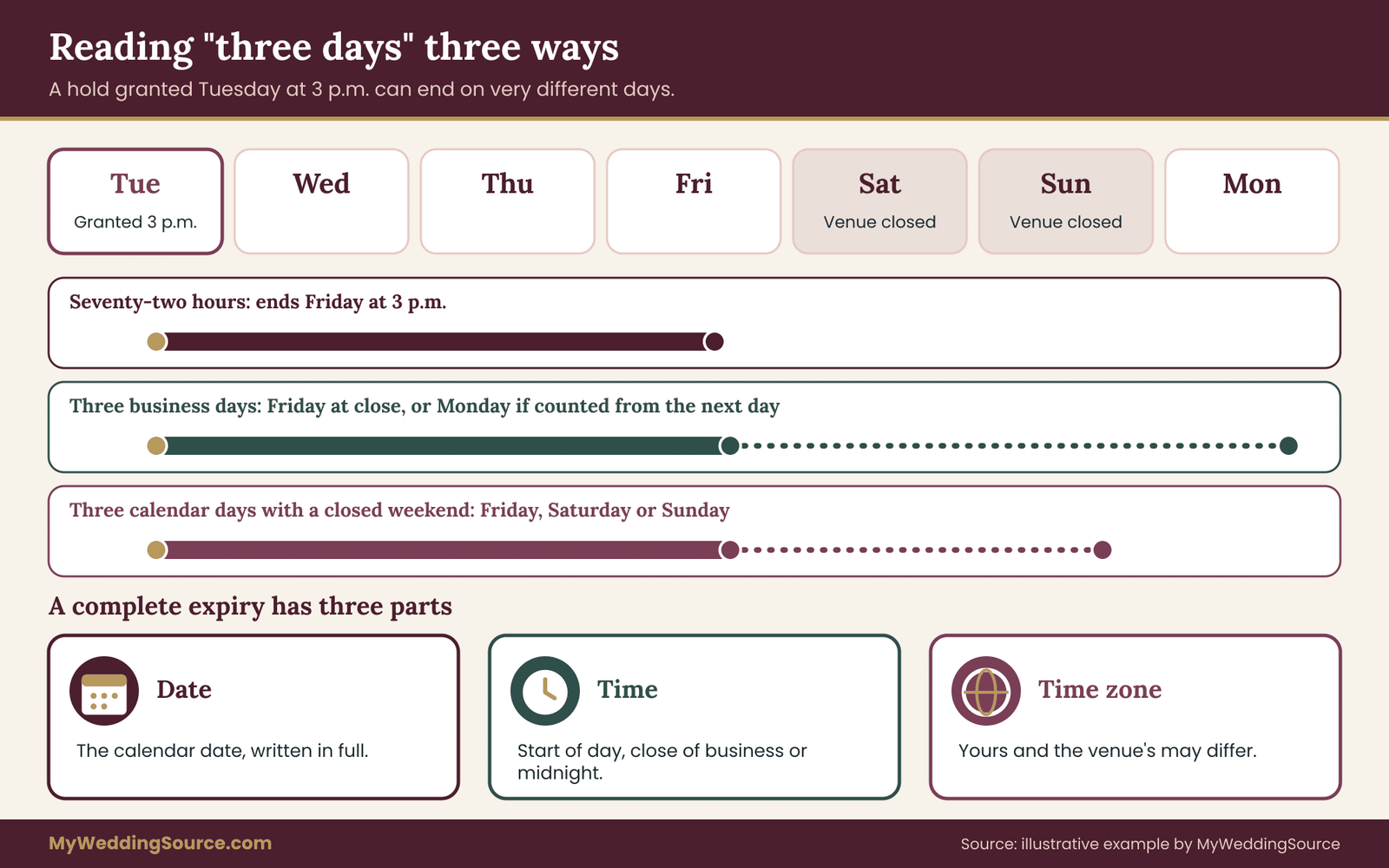
The cure is the same every time. Ask the venue to restate the expiry as a date and time and to say whether weekends and holidays count. If the venue is open for tours on Saturdays but closed for sales on Sundays, a courtesy hold that ends on a Sunday is a hold you cannot use on its last day. For the same reason, check federal holidays and local ones near your date. The U.S. Office of Personnel Management publishes the federal holiday schedule, and a three-day hold that spans a Monday holiday can be a day longer or a day shorter than it looks, depending on the venue’s reading.
When the clock starts
Two venues can both say “seven days” and mean different things. One starts the count when the hold was entered in the calendar. The other starts it when the contract was emailed. If your contract is slow to arrive, the first reading leaves you with a short window, and the second may give you a much longer one.
When the hold depends on a contract that has not been sent yet, ask when it will be sent and whether the expiry will move if it is late. A venue that takes four days to send the contract it promised in one has used up most of your window, and you are entitled to say so politely and ask for a matching extension. Ask early, because an extension request on the last day looks like a request for favors. A request made on day two, supported by the fact that the contract has not arrived, is simply a request to keep the original promise.
What counts as signed
You may sign the contract on Monday and discover on Wednesday that the venue does not consider the date secured. In many venues the date is confirmed by a combination of three events: you sign, you pay the deposit the contract requires, and the venue countersigns. A hold may end only when the last one is complete, or it may end when the first one happens. You need to know which.
Ask, in these words if you like: “What step ends the courtesy hold and secures the date: our signature, our payment or your countersignature?” The answer shapes how you use your time.
If payment is the step, a payment that has been initiated but not received does not count. Bank transfers, checks and card payments can take different amounts of time to arrive, and some card issuers cap a single transaction or require you to approve a large one. Weekends slow most of them. The sensible approach is to finish every step you control at least one business day before the expiry and to ask the venue to confirm receipt in writing.
Electronic signatures are generally accepted for contracts in the United States, and most venues use a signing service that stamps the time automatically. The stamp may use the venue’s zone or UTC, so check the receipt email rather than relying on your memory of what time it felt like.
Priority in plain terms
Priority answers a single question: if two couples want the date, who gets to sign first? A courtesy hold may carry one of four positions.
If you are the only hold, no one is ahead or behind. Your risk is the unannounced competing inquiry, and your protection is the notice rule you asked about earlier.
If you are the first hold, you are ahead of any other couple. Your risk is that a competing couple is ready to sign, which shortens your window to whatever the notice period is.
If you are the second hold, you are not holding the date. You are holding a place in line. The first couple’s hold has to end before yours matters. Your protection is knowing when it ends, and the venue may or may not be willing to tell you.
If you are on a waitlist, you are not on the calendar at all. A waitlist entry only says that the venue will contact you if the date opens up.
A rule for second holds
A second hold is worth having, but only if you treat it as an option and not as a date. Do not buy nonrefundable travel, print save-the-dates, or pay another vendor’s deposit on the strength of it. Until the venue confirms in writing that you have been promoted to first and the contract is signed, the date belongs to someone else.
Ask these things when you accept a second hold. When does the first hold end? Will you tell me in writing when the first couple releases or lets it lapse? Do I get an automatic promotion, or do I need to ask? And how long would I have to sign after being promoted? Venues vary in how much they will say about another couple, and they should not share names, but they can usually share a date and time that the first hold expires.
The silent lapse
A quiet failure deserves its own mention. Sometimes a courtesy hold ends and nobody tells you. The venue’s system closes it out at the expiry, the date reopens, and you assume you are still on it because no one said otherwise. The defense is a simple routine.
Put the expiry on your own calendar as two entries: one at forty-eight hours before and one at twenty-four hours before. At the first one, send a two-line note: “Our hold on the 16th ends Tuesday at 5 p.m. Mountain, correct? We are on track to decide by Monday.” That note either confirms the clock or draws a correction while there is still time to use it.
Set your own deadline earlier
The venue’s expiry is the last moment the date is protected, not a good moment to decide. Set a personal decision deadline one business day earlier. That buffer pays for the unexpected: a contract question that takes a day to answer, a payment that needs a call to the bank, or a parent who is unreachable until the evening.
When you hold dates at several venues at once, the buffer matters more. The earliest expiry sets the pace for everything else, because you cannot make a good comparison after one of the options has disappeared. A later section shows how to rank holds in the order their clocks will run out, and how to use that order to decide when to ask for extensions and when to release a date.
Counting a bump notice as a new clock
Remember that a bump notice starts a second, shorter clock inside your courtesy hold. If the venue calls to say another couple is ready to book, the original expiry stops mattering and the new notice period takes over. The new clock should have its own date, time and zone, and it should be confirmed in writing as soon as you receive the call. A bump notice you answered by phone and never wrote down is the easiest kind to dispute later, and the hardest kind to defend.
The practical rule is short. Whenever a venue changes the terms of a courtesy hold by phone, send back a confirming email within the hour. The email can be two sentences long. Its only job is to give both sides the same version of what was said.
Deposit status: where a courtesy hold ends and a paid hold begins
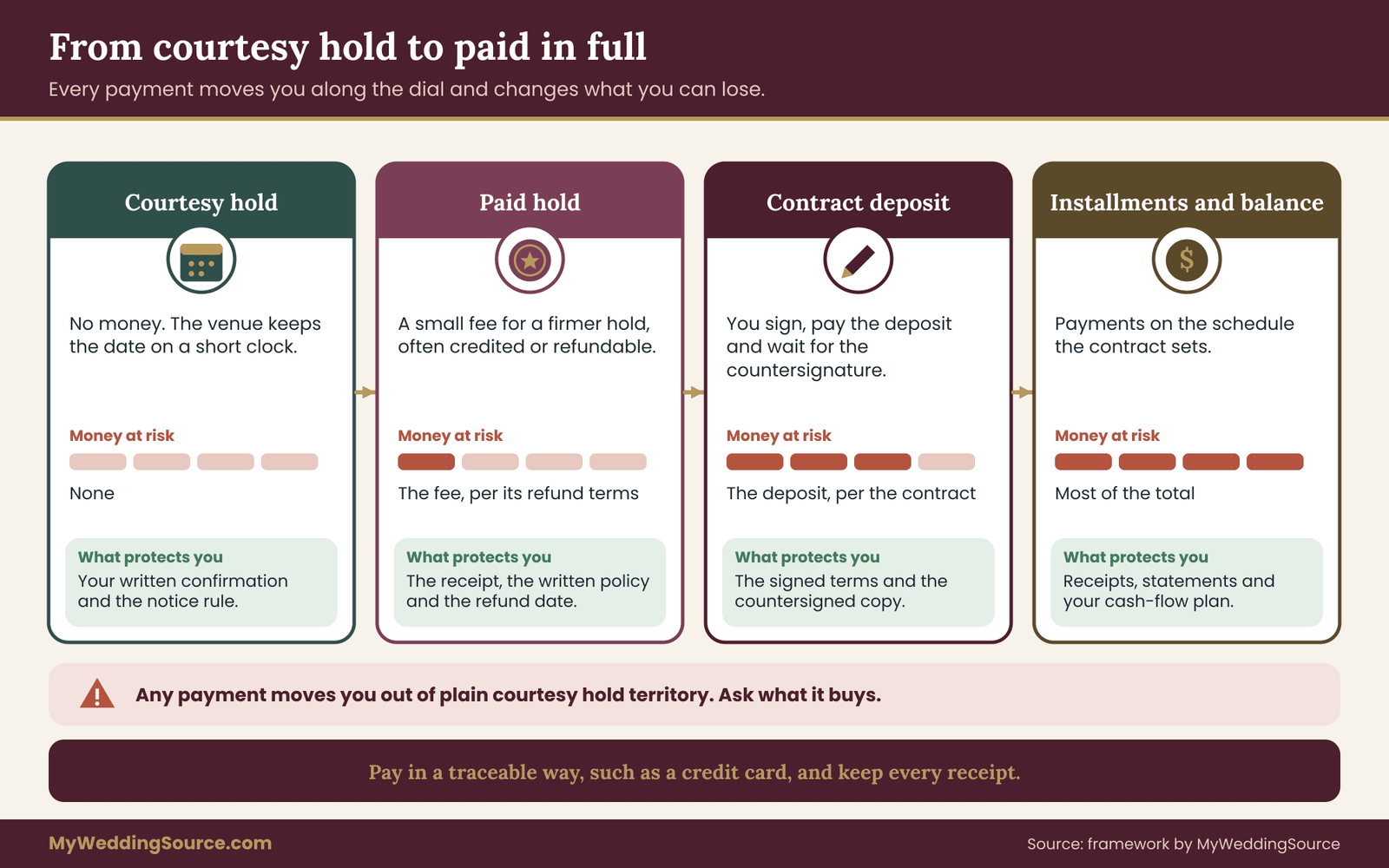
The simplest courtesy hold costs nothing, and that is the version this guide has described so far. Many venues also offer something firmer, where you pay a small amount to keep the date a little longer or to move ahead in line. The change from “no money” to “some money” is the most important line in the whole process, because everything about your risk changes when it is crossed. It helps to think of the whole booking path as a spectrum of commitment, with money as the dial.
Four stages on the dial
At the first stage there is no money at all. This is the plain courtesy hold. If you walk away, you lose nothing and owe nothing, and the venue can release the date at will.
At the second stage you pay a small fee that is described as refundable, creditable or both, in exchange for a firmer hold. Venues may call it a date-hold fee, a holding deposit, a reservation fee or a retainer, and the name tells you very little. The terms on the receipt or the venue’s written policy are what count.
At the third stage you sign the contract and pay the deposit it requires. Now the date is secured and the contract governs what happens if either side cancels. The amount and the refund terms are whatever the contract says.
At the fourth stage you pay installments and the final balance on the schedule in the contract. Your exposure rises with each payment, and so does the importance of the cash-flow plan described in the wedding cash-flow planning guide.
What “refundable” can mean
The word refundable covers a wide range, and the range is where couples lose money without noticing. A fee might be fully refundable until a certain date and nonrefundable after. It might be refundable except for a processing charge. It might be refundable only if the venue is able to rebook the date. It might be convertible into credit for a later date but not returned as cash. Or it might be “refundable” only in the sentence on the venue’s website, while the receipt says something else.
Ask four questions before you pay.
Is the fee credited toward the contract deposit if you sign? A fee that is credited is a down payment on something you plan to do anyway, and it costs you nothing if you proceed.
If you release the date, by when do you have to say so to get the money back, and in what form? A release made by phone may not count. A release made in writing before a stated date usually does.
How long does the refund take, and how is it returned? A refund to the original card is easier to track than a check mailed to an old address.
What happens if the venue cancels, double-books the date or closes? The answer should be a full refund, and you should ask for it in writing.
Cost logic with an invented example
A fee is a price for time, and the logic is easier to see with numbers. Suppose a venue charges a $500 date-hold fee that is credited toward your deposit if you sign and fully refundable if you release the date within ten days. If you sign, the fee costs you nothing, because it was a down payment. If you decide on day six not to go ahead and you release in writing, you get the $500 back, and the fee cost you nothing again. If you let the clock run to day eleven without deciding, you may lose the whole $500 for no benefit.
In that structure, the only way to lose money is to be indecisive, and that is exactly what the fee is designed to discourage.
Now change one fact: the same $500 is credited if you sign but nonrefundable if you do not. The fee is now the price of a ten-day option. You may decide that is worth paying for a date you badly want, and that is a fair choice. The point is to make it knowingly, comparing the cost of the option against the cost of losing the date.
These numbers are invented for illustration. Your venue’s fee, credit and refund window will be different, and you should work the same arithmetic with the real ones.
Pay in a way you can trace
How you pay matters as much as what you pay. Use a method that leaves a record, such as a credit card, and keep the receipt. The Consumer Financial Protection Bureau explains how billing disputes on credit cards work, including the requirement to notify the card issuer of an error in writing within a limited time after the statement that shows it. That is another reason to calendar your own deadlines instead of relying on memory.
Be cautious if a venue or a person claiming to represent one asks you to pay through a personal account, with gift cards, by wire to an unfamiliar account or through an app transfer to an individual. The Federal Trade Commission publishes consumer warnings about payment methods that are hard to reverse. A real venue runs a business account and gives a receipt, and a request that departs from that deserves a phone call to the venue’s published number before any money moves.
Money changes the category
The practical rule is that any payment moves the arrangement out of the courtesy hold category and into a different one that needs its own read. The usual courtesy hold advice, ask about expiry and priority and notice, still applies, but you add a fresh layer: what exactly did I pay for, and what do I get back? Write the answer in the log under deposit status, using a short vocabulary so that entries can be compared: none, requested, paid and refundable, paid and credited, paid and nonrefundable.
A comparison log for every courtesy hold
Once you are tracking more than one venue, memory stops working. The details that matter are small and different: a Tuesday at five o’clock, a second position, a fee that is refundable until the 18th. A comparison log puts all of it in one place so that you can see which clock runs out first, which venue is actually holding your date, and where any money is at stake.
The log can live in a spreadsheet, a shared note or a notebook. What matters is the fields. Each venue-and-date hold gets one entry, and each entry has six groups of information.
Identity. The venue, the specific space, the date, the contact person, and how the courtesy hold was granted (call, email, tour). This keeps two similar venues from blurring together.
Clock. The expiry as a date, time and zone, how the venue counts it (from the grant or from the contract), what ends it early, and your own earlier decision deadline.
Priority. Your position (only, first, second, waitlist), what notice you get if someone else wants the date, and whether the venue will tell you if you are promoted.
Deposit status. None, requested, paid and refundable, paid and credited, or paid and nonrefundable, with the amount, the refund conditions and the date they change.
Evidence. Where the written confirmation is, and the date you received it. If you only have a phone call, write “phone only” and the date you sent your recap.
Next move. The next thing you must do, by when, and who does it.
How to read the log
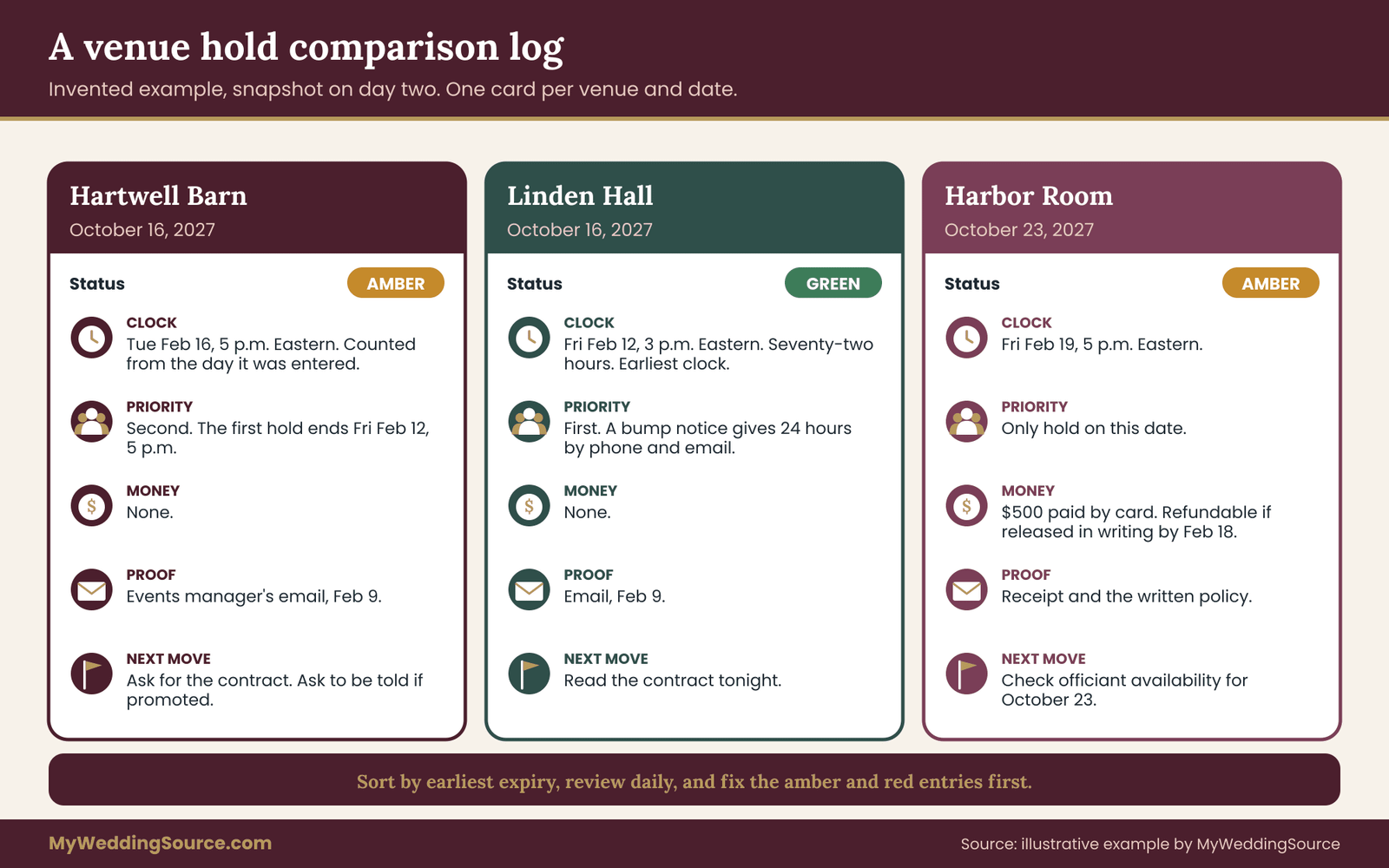
The log earns its keep in a daily five-minute review. Sort the entries by expiry, earliest first. The top entry is the decision that is forcing the pace. Ask of each entry: is the evidence in writing, is the priority what I think it is, and is any money at risk? An entry with a clear expiry, first or only position, a written confirmation and no money is solid. An entry with a vague expiry, second position, no written confirmation or an unclear refund is fragile, and your effort should go first to making it less so.
A helpful habit is to give each entry a color after reviewing it. Green means the clock, position and evidence are all clear and no money is at risk. Amber means one of those is unclear, and you have a question out to the venue. Red means the courtesy hold may end before you can decide, or money is at risk under unclear terms. The colors do not need to be fancy. They exist to keep you from reading a long log and missing the one line that needs attention today.
Keeping the log honest
Two rules keep the log useful. First, record what you were told, not what you hoped. If the venue said “probably until Friday,” the log says “probably until Friday,” and the next move is to get a firm time. Second, update the log the day something changes, including a conversation that seemed minor. A log that is a week stale is worse than none, because it gives you false confidence.
If you plan with a partner, share the log. Having only one person know where the holds stand creates a single point of failure, and the person who is traveling or at work when a bump notice arrives is the one who most needs to see it.
The log also pairs naturally with your wider planning list. The wedding planning checklist shows where venue booking fits among everything else on your list, and the log is simply the detailed record of that one line item while it is still unresolved.
A worked example: three courtesy hold clocks over ten days
The following example is invented. The couple, the venues and the figures are made up to show how the log works, and your own venues will have their own rules. The couple, Maya and Theo, want a Saturday in October 2027 and have a rough guest count in mind. Their first choice is October 16, and October 23 is a weaker backup. They have toured three venues and, on Monday, February 8, they send each one the same short email asking what is open.
The first snapshot
By the evening of Wednesday, February 10, each venue has answered, and Maya has built the log. Here is what it says, in plain words.
Hartwell Barn has given them a courtesy hold on October 16. They are second in line. The couple ahead of them holds the first position until 5 p.m. Eastern on Friday, February 12. Maya’s own hold ends at 5 p.m. Eastern on Tuesday, February 16, counted from the day it was entered. No money is involved. The confirmation is an email from the events manager.
Linden Hall has given them a courtesy hold on October 16 and they are first in line. It ends at 3 p.m. Eastern on Friday, February 12, which is seventy-two hours from the moment it was granted. If another couple is ready to book, the venue calls and emails, and Maya and Theo have twenty-four hours to sign or release. One extension is possible, in writing, if no one else is waiting. No money is involved, and the confirmation is an email.
Harbor Room has no availability on October 16 but offers October 23. Its policy is a paid hold: a $500 fee, credited toward the deposit if they sign, and refundable in full if they release the date in writing by Thursday, February 18. The hold ends at 5 p.m. Eastern on Friday, February 19. Maya paid by credit card and kept the receipt, and she copied the written policy into the log.
Day by day
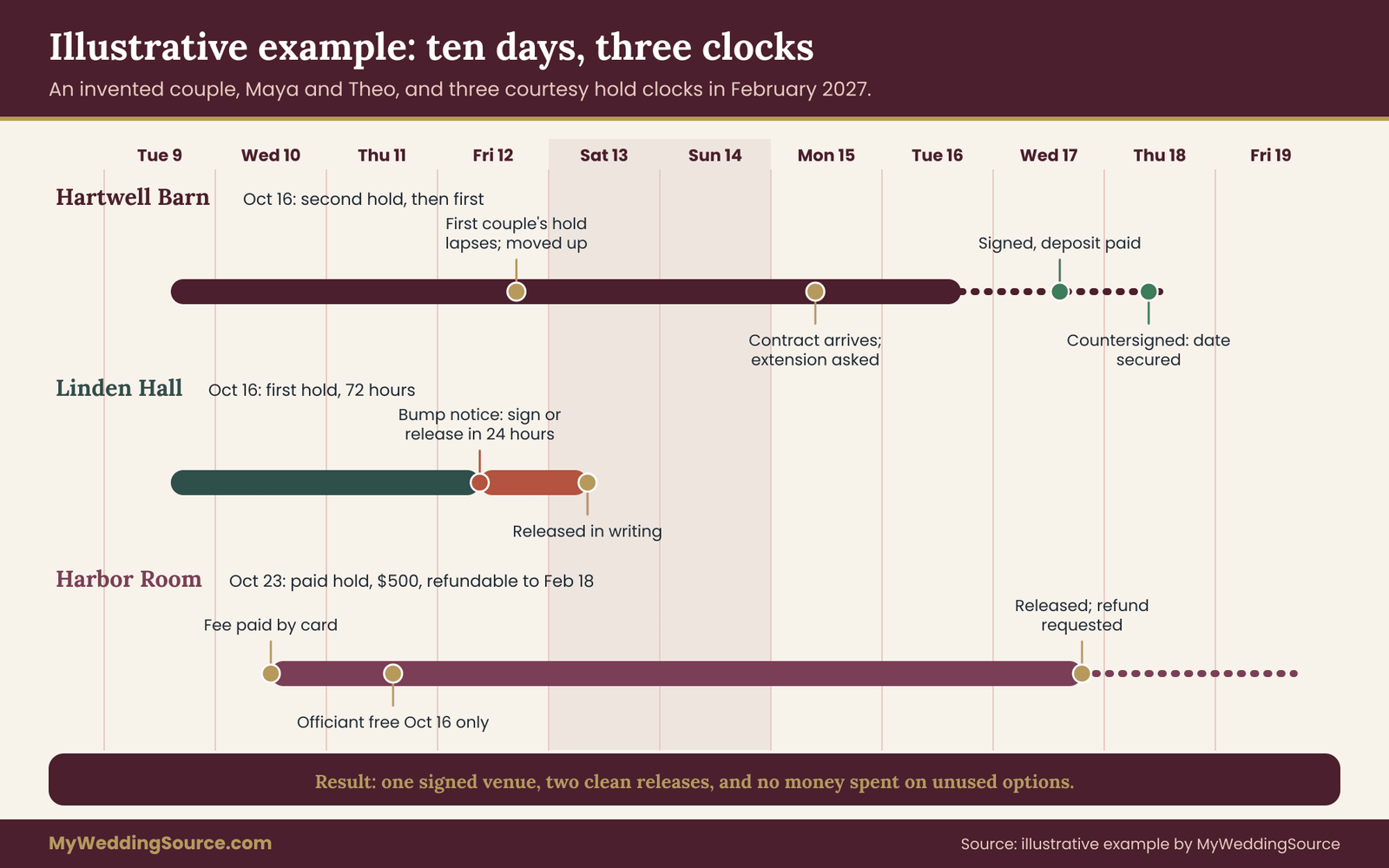
Sorted by expiry, the log shows Maya where to look first. Linden Hall’s clock is earliest, so it sets the pace, and Hartwell Barn is the venue she prefers but holds only second. Harbor Room is the safest in a sense, because it is a paid hold with a refund, but it is October 23, and on Thursday, February 11, Maya learns that her brother, who will officiate, is not available that weekend. That turns Harbor Room into a fallback and pushes it toward amber in the log.
Before anything else happens, Maya and Theo do something useful. They agree on a decision tree in advance. If Hartwell Barn becomes theirs, they will release Linden Hall. If Hartwell Barn does not, they will sign Linden Hall, provided its contract is acceptable. They ask both venues for contracts on Thursday. Linden Hall sends its contract that evening. Hartwell Barn says its contract will arrive Monday.
On Friday, February 12, at 9 a.m., Linden Hall calls. Another couple is ready to sign for October 16, and Maya and Theo have until 9 a.m. Saturday to sign or release. Maya sends a recap email within the hour confirming the new deadline, as the earlier section advised. She also asks for an extension, which the venue declines because someone is waiting.
This is the hard moment, and it shows why the pre-agreed tree matters. Hartwell Barn’s first couple has until 5 p.m. that day. If that couple signs, Maya and Theo lose Hartwell Barn, and if they release Linden Hall too early, they might lose both. Maya calls Hartwell Barn at 4:45 p.m. and asks whether the coordinator can confirm the first hold’s status as soon as it ends. The coordinator agrees to check at five o’clock and send an email.
The email arrives at 5:20 p.m.: the first couple did not sign, their hold has ended, and Maya and Theo are now first in line at Hartwell Barn, with their own expiry unchanged. Linden Hall’s contract was acceptable but less appealing, with a higher guest minimum, so by the tree they release it. On Saturday morning, well before the 9 a.m. deadline, Maya sends a two-line release to Linden Hall, thanks them, and asks them to confirm that the courtesy hold is closed. A confirmation arrives later that morning.
Had the first couple signed at Hartwell Barn, the tree said to sign Linden Hall that same Friday evening. Because they had read its contract the night before, that was possible. The earlier work is what made the decision safe.
The contract arrives late
On Monday, February 15, Hartwell Barn sends its contract. The hold ends the next afternoon, which leaves Maya and Theo about a day to read it. They ask for an extension that morning, explaining that the contract arrived on Monday as promised but the hold was counted from last Tuesday. Because no other couple is waiting, the venue extends the hold to noon Eastern on Thursday, February 18, and confirms in writing.
Maya uses the extra time on three tasks. She reads the cancellation and payment terms and writes down questions, following the approach in the wedding vendor contract guide. She checks the venue’s references and insurance details using the steps in the wedding vendor due diligence checklist. And she compares the real cost of the contract against the couple’s budget, including the fees that were not in the first quote.
The decision
On Wednesday, February 17, at about 2 p.m., they sign the contract through the venue’s e-signature service and pay the deposit by credit card. Following the buffer rule, Maya had set their own deadline for Wednesday, a day before the extended expiry, so nothing is rushed. The signing receipt shows the time. On Thursday morning, Hartwell Barn countersigns and sends the fully signed copy. The date is secured.
That Wednesday evening they release Harbor Room in writing, well inside the refund window, and ask for the $500 fee to be returned to the card. The log shows the refund as pending, with a follow-up date a week out so that Maya can check her statement.
The log at the end reads simply. Hartwell Barn: signed and countersigned, date secured. Linden Hall: released, confirmation on file. Harbor Room: released, refund pending, check on February 24. Every clock was handled before it ran out, and the couple never paid for an option they did not use.
What the example shows
Three things carried the result. The couple asked about priority, so they knew a second hold was only an option. They agreed on a decision tree before the pressure arrived, so they were not improvising at nine in the morning. And they used written confirmations at each step, which meant that none of the changes depended on anyone’s memory.
Nothing in the example depended on luck, except one thing: the first couple at Hartwell Barn did not sign. The next section covers what to do when events go the other way.
When a courtesy hold expires, gets bumped or needs more time
At every clock event, you have three options: sign, extend or release. Most trouble comes from drifting into a fourth, which is doing nothing and hoping. Each of the three real options has its own best practice.
Signing
You sign when the venue is the right one, the contract is acceptable, and the numbers work. If any of those is missing, the clock is not a reason to sign. A venue that has asked you to sign within hours of a bump notice, with terms you have not read, is asking you to accept risk you cannot measure. It is reasonable to ask for a short extension to finish reading. If the answer is no, the question is whether you would sign this contract on any other day. If you would, sign. If you would not, release the date and accept the loss.
This is a place for cost logic. Losing a date costs the effort of finding another one, and that is usually a modest price compared with signing a contract that includes a nonrefundable deposit you did not understand. Dates come around again, and a bad contract does not.
Extending
An extension request works best when it is early, specific and tied to a reason. Compare two messages. “Can we have more time?” gives the venue nothing to work with. “Your contract arrived today, and our courtesy hold ends tomorrow at 5. Could you extend to Thursday at noon so we can read it properly?” gives a clear reason and a clear ask. Make the request in writing, and ask for the new expiry in writing.
If the venue declines because another couple is waiting, you have lost nothing but the extension. Move to the decision between signing and releasing, using the contract you have already read.
Releasing
Release promptly and in writing, as soon as you know. A short message does the work: “Thank you for holding October 16 for us. We have decided to go in a different direction, so please release the date. We appreciated your time.” You do not owe a long explanation. If you paid a fee under a refund condition, add one more sentence: “Per the policy you sent on February 10, please refund the date-hold fee to the card ending in…, and confirm the date it will be returned.” Give only the last four digits, never the full number.
Release the day you decide, not the day before the expiry. A venue that learns early can offer the date to the next couple, and that goodwill is worth more than another day of false insurance.
When the date is gone
Sometimes you return to find the date has been taken. If the courtesy hold had lapsed, the venue has done nothing wrong. If the venue confirmed the date to someone else while your courtesy hold was still running, you have a legitimate complaint, though your remedies are limited because there is no contract.
Start with a calm email that cites your written confirmation and asks the venue to explain and to offer alternatives, such as another date, a different space or a refund of any fee. If you paid money and the venue will not return it as promised, the state consumer protection office or attorney general in the venue’s state accepts complaints, and USA.gov lists them. Keep the complaint factual, with dates and copies of the written terms.
When the terms change
A courtesy hold does not fix the price. Venues update fees, and the number you heard at the tour may not be the number in the contract. Ask for the full price in writing early in the courtesy hold, including service charges, taxes, fees for extra hours and any required vendors. If the contract’s figure is higher than what you were told, say so, and ask why before you accept it.
The pressure of a bump notice
You cannot verify whether another couple really exists. You can decide how much that matters. Venues do receive competing requests, and a notice may be entirely honest. It can still be used as pressure. Either way, the right reply is the same: ask for a short extension, ask what the contract allows, and decide on the merits. A contract that is good on its terms is good under a bump notice. One that is not is not made better by a deadline.
Verifying courtesy hold terms, and knowing their limits
A courtesy hold leads to a contract, and the contract is where the real protection lives. The last job in this stretch is to confirm that what you were told during the hold shows up on paper, and that you understand what a hold could never have covered in the first place.
Check the contract against the hold
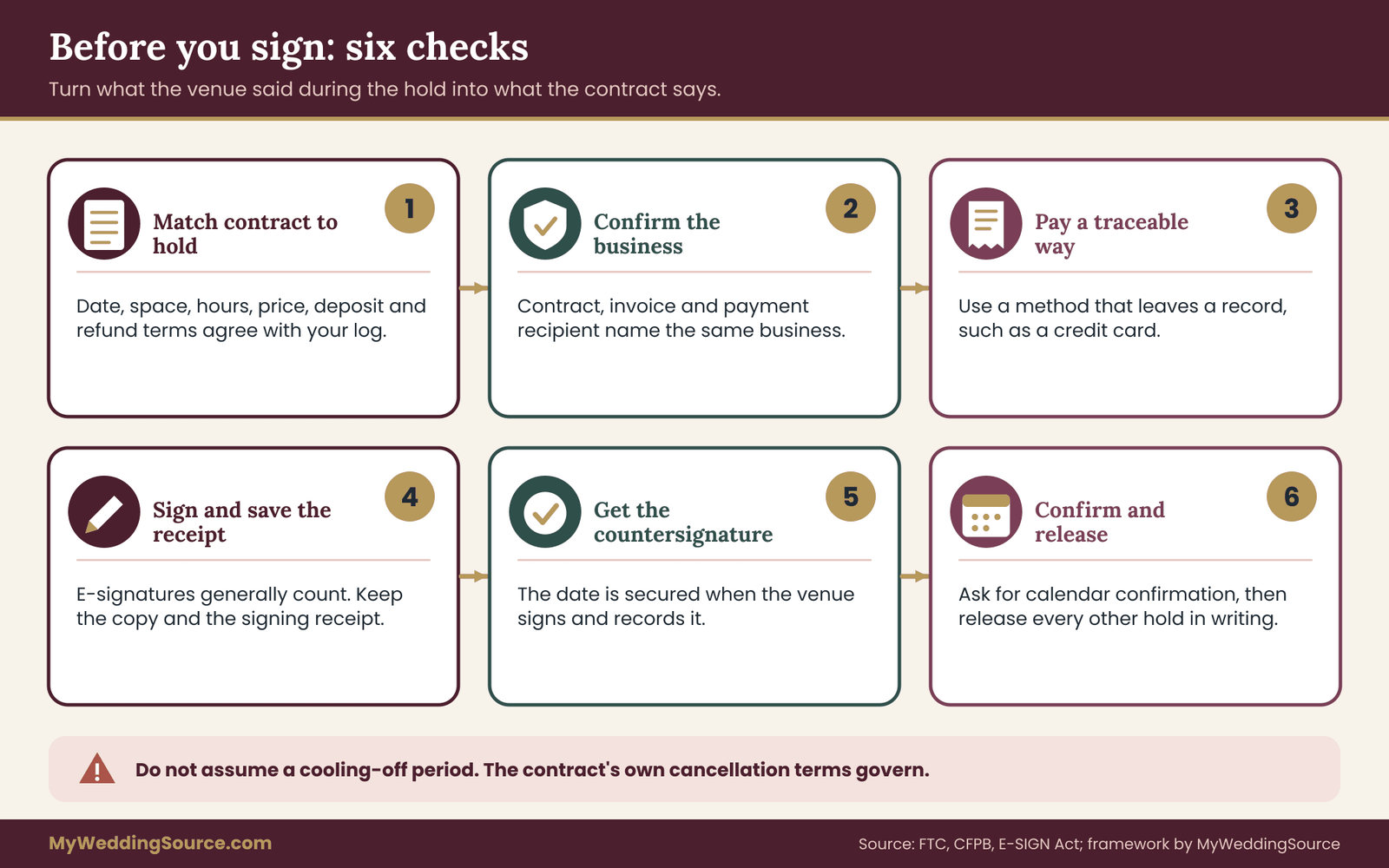
Open the contract beside your log and compare the two line by line. The date and the specific space should match what the venue confirmed. The hours should include setup and cleanup, not only the event itself, because a courtesy hold on a date says nothing about when your vendors can enter. The price should match the written quote, with any new fees explained. The deposit amount and due date should match what you were told. And the cancellation and refund terms should be spelled out in a way you could explain to a friend.
If a promise made during the hold, such as a second ceremony space, an extended hour or a waived fee, does not appear in the contract, ask for it to be added before you sign. A promise made by email during a courtesy hold is better than one made by phone, but a promise inside the signed contract is the only one that reliably binds the venue. The wedding venues guide covers what else to look for in the wider agreement.
Confirm who you are contracting with
Check that the name on the contract, the name on the invoice and the name that receives your payment all point to the same business. A mismatch can be innocent, such as a management company that bills on behalf of an owner, but it is worth a one-line question: “Could you confirm the legal name of the business we are contracting with?” Your state’s business registration office can usually confirm that a business exists and is in good standing, and most publish a free search on their websites.
Do not assume a cooling-off period
Couples sometimes assume they can cancel a signed venue contract within a few days with no penalty. That is not a safe assumption. The Federal Trade Commission’s Cooling-Off Rule covers certain sales made away from the seller’s regular place of business, such as at your home, and it generally does not cover a contract signed online or at the venue’s own office. Read the contract’s own cancellation terms, and treat them as the whole story unless a state agency tells you otherwise. The FTC and your state’s consumer protection office are the places to confirm what applies in your situation.
Electronic signatures and payment records
Contracts signed electronically are generally valid under the federal E-SIGN Act and under state versions of the Uniform Electronic Transactions Act, so a typed or drawn signature on the venue’s signing page counts. That also means you should treat a click on “sign” with the same seriousness as ink. Keep the signed copy and the signing receipt, and keep proof of each payment in the same folder.
Confirm the countersignature and the calendar
Your date is not secured when you sign. It is secured when the venue countersigns and records it. After you sign and pay, ask for the fully signed copy and a one-line confirmation that the date is booked in the venue’s calendar. Then update the log with the date of that confirmation. A short email will do: “Thank you for the countersigned copy. Please confirm that October 16, 2027 is now recorded as booked for the Barn.”
Once the date is secured, release every other courtesy hold on the same day. The longer you keep a second venue’s date open, the more you may be blocking a couple who needs it.
Limits of a courtesy hold
Knowing what a courtesy hold cannot do prevents the most common surprises.
It does not reserve more than the date and the space it names. A hold on a ceremony site says nothing about the reception venue, and the reverse is also true. If your plan involves two locations, a rehearsal dinner or a morning-after brunch, each needs its own confirmation, and you may want to hold the one with the scarcer calendar first.
It does not confirm the hours, the vendors the venue allows, or the rules about noise, alcohol and décor. Those live in the contract. If you have a particular need, such as step-free access or a specific caterer, ask about it during the hold and check it again in the contract. The accessible wedding venue red flags guide lists the questions to ask about access, and the venue technical walkthrough guide shows what to measure and test when you visit.
It does not protect you from the venue’s own errors. A calendar system can double-book, and a staff change can lose a note. That is why the written confirmation matters, and why your own calendar reminders matter more than the venue’s.
It does not apply uniformly. Public parks, municipal buildings, religious venues and some historic properties reserve dates through permits, applications or committee approval, and a courtesy hold may not exist there. Ask how the date is reserved and what happens if the application is not approved.
It does not stay accurate on its own. Local events, road work and holidays change between the day you hold a date and the wedding itself. Before you lean on a date, check what else is happening in the area and, if possible, walk the route your guests will take. The date-selection guide offers a longer set of checks for that stage.
Limits of this guide
Everything above describes common patterns, not any one venue’s rules. Policies, fees and lead times change, and state law affects deposits and cancellations in ways that a general guide cannot track. Use the guide to ask better questions, then rely on the venue’s written answers and the agencies listed in the sources for current rules.
Your next steps
- List the two or three dates and venues you are seriously considering, and confirm your date with your essential guests before you ask for any hold.
- Send each venue the same short message asking for the expiry, your position, the notice rule and any payment in writing.
- Start the comparison log the same day, one entry per venue and date, and mark each entry green, amber or red.
- Put two reminders on your calendar for each expiry, at forty-eight and twenty-four hours before, and set your own deadline one business day earlier.
- Ask for each contract as soon as a hold begins, and read it while the clock is still comfortable.
- Decide using sign, extend or release. Put every release, extension and confirmation in writing.
- After you sign, get the countersigned copy and a calendar confirmation, then release every other hold on the same day.
FAQ
What is a wedding venue courtesy hold?
A courtesy hold is a temporary, informal reservation of a date on a venue’s calendar, usually with no payment and a short time limit. The venue agrees not to confirm the date to another couple, at least without notice, while you decide. It is a favor, not a contract, and the terms come from the venue’s own policy, so ask for them in writing.
How long does a courtesy hold usually last?
It varies by venue. Some give a day or two, others a week or more, and some do not offer them. The time may be counted from when the hold was entered or from when the contract is sent. Ask for the expiry as a date, a time and a time zone, and ask whether weekends and holidays count.
Is a courtesy hold legally binding?
Generally no. A courtesy hold is an informal arrangement without a signed agreement, so neither side has the protections a contract provides. A written confirmation still helps, because it records what the venue promised. The contract, once signed and countersigned, is what secures the date. For questions about your rights, contact your state consumer protection office or an attorney.
Can a venue give my date to someone else during a courtesy hold?
Often yes, if another couple is ready to book and the venue gives you a short notice period to sign or release first. Some venues give no notice at all. Ask how much notice you would receive, how you will be contacted, and whether the notice period is confirmed in writing, because that rule decides how reliable your hold really is.
Should I pay to extend a courtesy hold?
Only after you know what the payment is. Ask whether it is credited toward your deposit, whether it is refundable, until when, and how the refund is returned. A fee that is credited and refundable by a stated date may cost nothing if you decide in time. A nonrefundable fee is the price of an option, so weigh it against the date’s value.
How many venues can I hold at once?
There is no universal limit. Some venues allow one hold per couple, and others do not mind. Holding two or three dates while you compare is common, but be honest if a venue asks, and release the ones you will not use as soon as you decide, in writing. A comparison log keeps the clocks straight.
What if the courtesy hold expires and the date is gone?
If the hold lapsed, the venue has not done anything wrong, though you can ask about alternatives such as another date or space. If the venue gave the date away while your hold was still running, send a factual email citing your written confirmation and ask for options or a refund of any fee. A state consumer protection office can help if a promised refund is withheld.
What is the difference between a first hold and a second hold?
A first hold is the top position on a date, so the venue contacts you first if anyone else wants it. A second hold is a place in line behind another couple. You are not holding the date until the first hold ends and you are promoted. Treat a second hold as an option, and avoid nonrefundable commitments until you are first and the contract is signed.
Sources
- Federal Trade Commission: consumer protection guidance, including the Cooling-Off Rule and warnings about payment methods that are hard to reverse.
- FTC Consumer Advice: plain-language articles on contracts, deposits and payment scams.
- Consumer Financial Protection Bureau: how credit card billing errors and disputes work, including written notice timing.
- USA.gov: State Consumer Protection Offices: directory for filing a complaint with a state consumer office or attorney general.
- National Association of Attorneys General: contact information for state attorneys general.
- U.S. Office of Personnel Management: Federal Holidays: the federal holiday schedule, useful when counting business days.
- Congress.gov: official text of the federal Electronic Signatures in Global and National Commerce Act (E-SIGN).
- Uniform Law Commission: the Uniform Electronic Transactions Act and state adoption information.
- National Conference of State Legislatures: links to state legislatures and summaries of state consumer and contract laws.