

Traveling with an engagement ring is mostly a paperwork-and-habits problem, not a security problem: the ring is safest when it is on your hand or in your carry-on, when you can prove what it is and what it is worth, and when you know before you leave what your airline, your hotel, and your insurer will and will not pay for.
Quick answer
Keep the ring on your body or in your carry-on, never in checked luggage. Before you go, photograph it, gather the appraisal and receipt, and read your policy for the exact limit, deductible, and any rule about loss versus theft. At the hotel, use the room safe only after checking the posted notice, and take the ring off for water, lotions, and hard use. Carry a short claim file with you so a loss can be reported in hours, not weeks.
Most advice on this topic is a list of “tips” that stops at “use the hotel safe.” This guide goes one step further. It follows the ring through each hand-off, from your jewelry box to the airport checkpoint, the cabin, the hotel, and home again, and it asks the same two questions at every stop: who is responsible here, and what would I need in my hand to prove a claim? It ends with a travel storage and claim-document checklist you can print, plus the questions to put to your insurer, airline, and hotel before you pay or pack.
We are a wedding-planning publication, not a lawyer, an insurer, or a jeweler. Nothing here is legal, financial, or insurance advice, and policy terms, airline rules, and state hotel laws differ. Where a claim comes from a government page, an insurer, or a trade body, we say so, and where a figure is our own arithmetic, we label it an estimate.
Why traveling with an engagement ring needs its own plan
A ring is small, valuable, easy to forget on a bathroom counter, and easy to remove without noticing. Those four traits make it unlike almost anything else in your luggage. A lost phone can be locked and tracked. A lost ring cannot be pinged, and a stone that slips out of its setting rarely announces itself. Each of those traits shows up in the habits you will need for traveling with an engagement ring.
What actually goes wrong
When people describe a ring loss on a trip, the stories fall into a handful of patterns. None of them involves a dramatic thief. Knowing the patterns helps when you are traveling with an engagement ring for the first time.
Quiet losses at the sink, the pool, and the gym
The most common pattern is a ring that was taken off for a good reason and left behind or lost in a drain, a towel, a locker, or a pool deck. This is a “mysterious disappearance” or plain misplacement, and it matters because many insurance policies treat it differently from a documented theft. One national home-insurance comparison guide notes that lost or misplaced jewelry is generally not covered under a standard renters policy, while theft tied to a covered event may be. Whether your own policy treats an unexplained loss as covered depends on its wording, so read it before you leave, not after. These are the moments to watch when you are traveling with an engagement ring.
Hand-offs between people and places
Every hand-off is a chance for the ring to be separated from you: a tray at the security checkpoint, a seat-back pocket, a hotel room that housekeeping enters, a car left at a trailhead. The ring is rarely stolen in transit by a stranger. It is more often set down somewhere and not picked up, which is why the habits in this guide focus on a single, repeatable place for the ring at each stop. Traveling with an engagement ring is mostly about shrinking the number of hand-offs.
Damage that looks like loss
Prongs loosen, and stones can fall out without any single dramatic moment. A trip with luggage handling, bag zippers, climbing, and swimming gives a ring more knocks than a week at home. If you have noticed a stone that moves when you tap the ring near your ear, get it checked before the trip. Our guide to engagement ring prong settings explains how prongs work and what a jeweler looks at during a check. A pre-trip check is part of traveling with an engagement ring, not an optional extra.
How to use this guide
You do not need to follow every step. A weekend road trip with a modest ring needs less than a week abroad with a family heirloom. The point is to decide deliberately instead of by default. Traveling with an engagement ring on a short drive is not the same job as an international flight.
Match the effort to the value
Start with the replacement value on your appraisal, not the price you paid. A ring that would be painful but affordable to replace calls for a light routine: photos, a receipt, and carry-on handling. A ring that would be hard to replace, either because of the cost or because it has family history, calls for the full routine, including a written coverage check and a claim file you can reach from your phone. The same value test sets the effort for traveling with an engagement ring.
Read it in the order you will live it
The sections that follow run in the order a trip unfolds: preparation, the airport, the hotel, border crossings, what to do if something goes wrong, and a set of edge cases such as a proposal on the road. If you are leaving soon, jump to the checklist section and return to the rest later. Whether you are traveling with an engagement ring for a honeymoon or a family visit, the order is the same.
Before you leave: the claim file, the coverage check, and the wear-or-leave decision
The best protection for traveling with an engagement ring is made at home, at a kitchen table, a week before the trip. If something goes wrong, you will be on the phone with an airline desk, a hotel manager, a police officer, or an insurer, and each will ask for specific things. Having them ready turns a bad day into a manageable one.
Build a claim file before you pack
A claim file is simply a folder, on paper and in the cloud, that proves the ring exists, what it looks like, and what it is worth. Insurers and airlines are not obliged to take your word for any of that. For traveling with an engagement ring, it is the single most useful thing to prepare.
What belongs in the file
Gather the original receipt or invoice, the current appraisal, any gem grading report, the insurance policy or schedule with the policy number, and the claims phone number. The U.S. Department of Transportation notes that airlines may ask for receipts or other proof for valuables in a lost bag, which is one reason to have these on hand. If the ring is a family piece without a receipt, an appraisal and a set of dated photographs carry more weight than nothing. Our guide to engagement ring insurance and appraisals covers how to get a usable appraisal and how often to refresh it. Keep this folder current whenever you are traveling with an engagement ring.
Photographs that help a claim
Take clear photos of the ring from the top, the side, and the underside, and a close shot of any inscription or maker’s mark inside the band. Add one photo of the ring on your hand, so the scale is obvious, and one of the stone’s grading report if there is one. Keep the originals with their dates intact, and store a copy somewhere that does not depend on your phone, since a stolen bag may take the phone too. An insurer’s travel guide advises photographing jewelry and keeping records of its value before you leave, because documentation speeds a claim. Fresh photos are cheap insurance when you are traveling with an engagement ring.
Make two copies, one of them offline
Save the file to a cloud folder and also print a one-page summary that lives in a different bag from the ring. The one-page version should list the ring’s description, the appraised value, the policy number, and the claims number. If your phone is lost, you can still make the call. Two copies are a small price for traveling with an engagement ring.
Check what your insurance actually covers
Most people assume a ring is insured because the jeweler said so, or because they have a renters or homeowners policy. Both assumptions deserve a ten-minute check. That is worth ten minutes before traveling with an engagement ring.
Standard home and renters policies have low jewelry caps
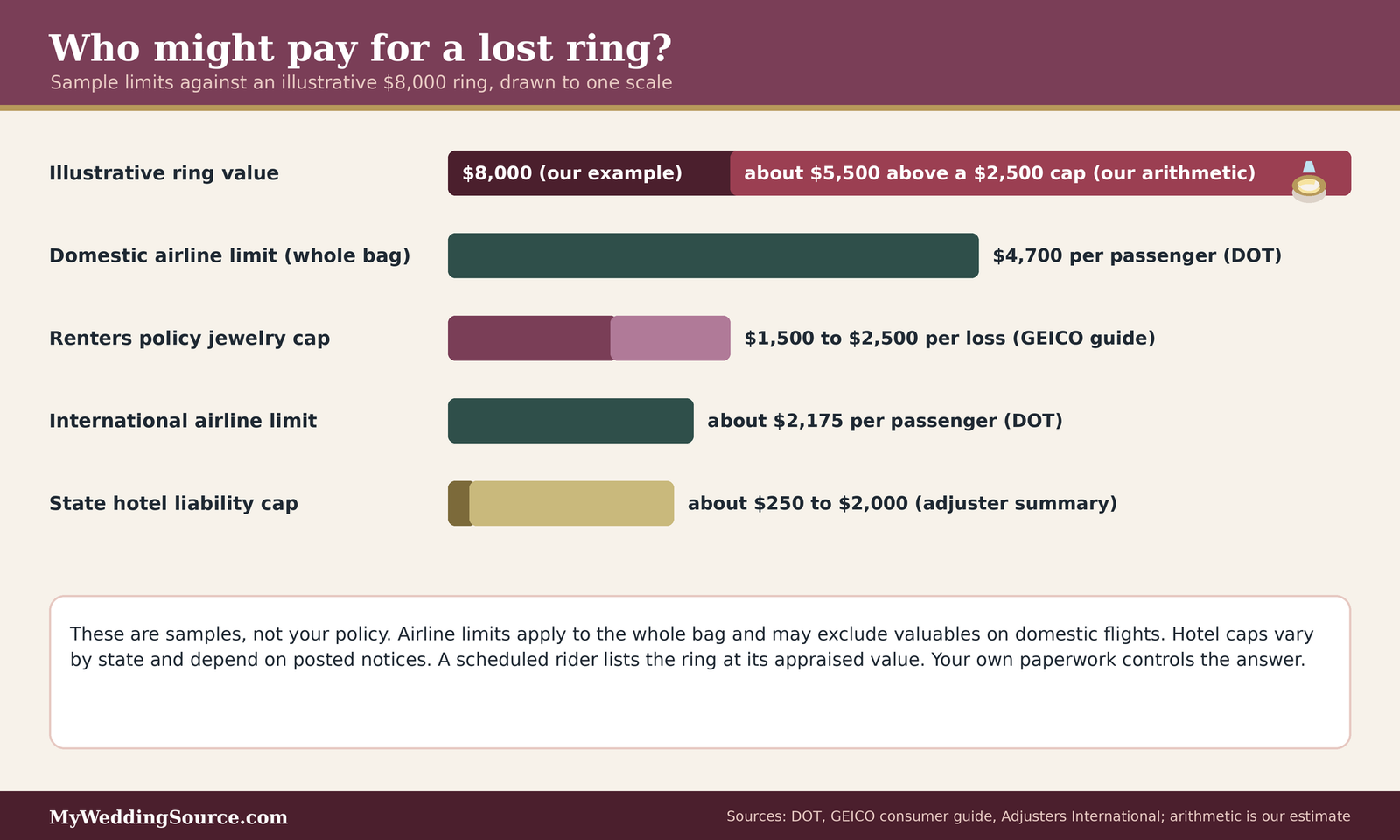
GEICO’s consumer guide says many renters policies cap jewelry at a sublimit in the range of $1,500 to $2,500 per loss, even when the overall personal-property coverage is much higher, and that engagement rings and wedding bands fall under that sublimit unless they are scheduled separately. The same guide adds that theft coverage can apply away from home, for example at an airport, but that lost or misplaced jewelry is not covered and a police report and proof of ownership are needed. Treat these figures as an example of what a policy may say, not as a statement about yours. The limit in your own policy is the only number that counts. Those limits are the first thing to look up before traveling with an engagement ring.
Scheduled jewelry coverage and travel insurance work differently
A scheduled personal property endorsement, sometimes called a rider or floater, lists a piece at its appraised value, and the guide above says many of these have no deductible and can cover accidental loss, but insurers typically require an appraisal or receipt. Travel insurance is a different product. A jewelry insurer notes that travel policies may not cover jewelry at all, and that where they do, per-item caps may leave you with a fraction of the value. That insurer sells jewelry insurance, so weigh its framing accordingly, but the instruction to read your travel policy for jewelry limits is sound whoever gives it. For the broader trip-protection picture, see our guide to honeymoon travel insurance, and for the costs that surprise people, our piece on hidden costs in engagement ring insurance. Compare it with your standard policy before traveling with an engagement ring.
Ask whether the coverage is worldwide
Policies differ on where they apply, so do not assume. A jewelry insurer states that its own coverage extends to international travel, which is a feature of that product, not a given across the market. Ask your insurer in writing whether coverage follows the ring abroad, whether it includes unexplained disappearance, and whether it requires the ring to be in a safe or in your carry-on to pay.
What this actually costs
The gap is the number to watch, not the premium. As a rough illustration only, if a ring is appraised at $8,000 and a renters policy caps jewelry at $2,000 per loss, an uncovered theft leaves about $6,000 to absorb, before any deductible. That is our own arithmetic on a hypothetical ring and a sample cap, not a quote. Compare that gap with the cost of scheduling the ring, which varies by insurer, ring value, and state, and ask for a written quote.
Decide: wear it, carry it, or leave it home
There are three honest options, and each has a cost. The right one depends on the trip, not on a rule. Each applies differently when traveling with an engagement ring.
Wearing the ring
For most trips, the ring on your hand is the lowest-risk place for it. It is attached to you, and you notice immediately if it is gone. The trade-off is exposure: water, sunscreen, sand, sports, and hard knocks. If you choose to wear it, set limits for yourself before you leave, such as taking it off for swimming and the gym. Some jewelry experts also recommend discretion, for example turning a stone toward the palm or wearing the ring on a chain under clothing in unfamiliar places, as one gem society suggests. Wearing it is the default most people choose when traveling with an engagement ring.
Carrying a spare or a travel ring
Many travelers wear a simple substitute on the trip and leave the real ring at home. A jewelry insurer’s 2025 survey, reported in its own newsroom, found that nearly 80 percent of travelers who wear jewelry choose travel pieces or duplicates, though that is the insurer’s survey and not an independent figure. A plain band, a lab-grown stone, or a simulant in a similar setting can keep the look of your hand without the risk. If you do this, make sure the real ring is genuinely secure at home: in a safe, a safe-deposit box, or with a trusted person, and covered by your policy while it is there. This is a common answer to the question of traveling with an engagement ring on a rough-and-tumble trip.
Leaving the ring in a safe place at home
Leaving the ring at home is a real choice, and for trips heavy on water, hiking, or crowded transit it can be the sensible one. Document where it is stored and who has access. If a house-sitter or relative will be in the home, think about whether they need to know it exists. For ideas on storing other keepsakes, see our notes on wedding keepsake storage. Not traveling with an engagement ring at all is sometimes the right call.
At the airport: screening, the cabin, and what airlines will pay
Airports concentrate the hand-offs. You will take things out of pockets, put them in trays, walk through a scanner, and be rushed by the people behind you. Plan the ring’s route through the checkpoint in advance, so you are not improvising while someone is waiting for your tray. Traveling with an engagement ring through a checkpoint is easier with a plan.
Getting the ring through security
The Transportation Security Administration publishes a short page on jewelry. Its core message is that carry-on and checked bags are both allowed for jewelry, but valuables such as jewelry should stay with you and should not go in checked baggage. It also says you can ask a TSA officer to screen you and your valuables in private, and that the final decision on whether an item goes through the checkpoint rests with the officer.
Decide before the line, not in it
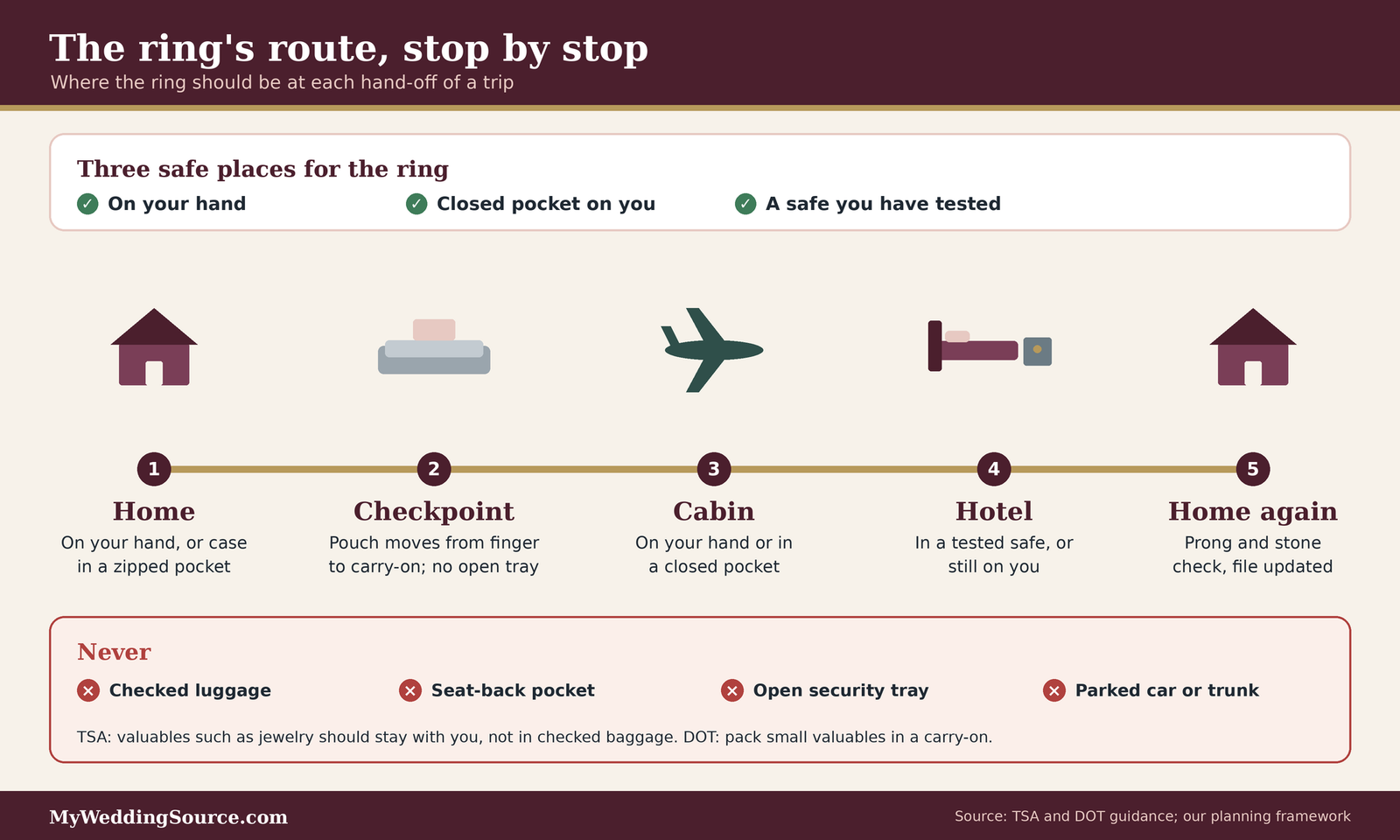
If you wear the ring through the scanner, you can usually keep it on, and many travelers do, since a ring on a finger cannot be left in a bin. If you are asked to remove it, put it in a zippered pocket of a bag that stays in your hands, or in a small pouch that you move straight from your finger to your carry-on. Avoid placing it loose in an open tray. A little planning here costs nothing and removes the most common way rings are left behind at checkpoints. This is the simplest way of traveling with an engagement ring through security.
Using private screening
If you would rather not display a ring or other valuables to the line behind you, the TSA page says you may request private screening. It is a legitimate option for anyone, not only for people with medical devices. Ask the officer politely and early, before you place items on the belt.
Pick a single place for the ring on the other side
After you pass screening, put the ring back on, or into the same zipped pocket, before you collect anything else. Make this a fixed habit. People lose valuables on the far side of checkpoints because they are juggling a laptop, a coat, and a child while the ring sits on the edge of a bin. Small rituals like this make traveling with an engagement ring routine.
In the cabin
On the plane, the ring has the same two safe places it had at home: your hand or a closed pocket. The seat-back pocket, the tray table, and the floor are all places where things disappear. The rule for traveling with an engagement ring in the cabin is short.
Keep it with you, not above you
Overhead bins are fine for a bag but not for a bag that holds the only copy of your documents and a ring. If the ring is in a case, keep the case in a personal item under the seat, within sight. If the flight is full and gate staff ask you to check your carry-on at the last minute, move the ring and your claim file into a pocket or small pouch before you hand the bag over.
Choosing a case
A small hard case or a padded pouch keeps the ring from scratching other pieces and from being crushed. Jewelry insurers and gem-society advice both stress storing pieces separately, in compartments or individual pouches, to avoid scratches and tangled chains. A case also gives the ring a recognizable home, which makes it less likely to be left behind.
What the airline will and will not pay
Airline liability is the part of traveling with an engagement ring that surprises people most, because the figures are lower than the value of many rings, and because an airline’s own contract can exclude valuables.
The federal limits and what they mean for a ring
The U.S. Department of Transportation’s baggage page states that, for domestic flights, airlines can limit their liability for lost, damaged, or delayed bags to $4,700 per passenger, and that for most international flights under the Montreal Convention the limit is 1,519 Special Drawing Rights, about $2,175. Those limits apply to the whole bag, not to each item, and airlines may pay more but need not. Because the DOT updates these figures, confirm the current amounts on its page before you rely on them. The DOT also says that, on domestic flights, airlines need not compensate for items their contracts of carriage exclude, which commonly include valuables, fragile items, and electronics, and it advises putting small valuables such as jewelry in a carry-on. On international flights, the DOT says airlines are responsible for such items if they accepted the bag for transport, even if you did not disclose them at check-in.
Why the checked-bag answer is almost always “no”
Put those facts together and the logic is plain. A ring in checked luggage may be excluded under a domestic contract, would be limited by the per-passenger cap even if it were not excluded, and is out of your sight for hours. That is why the TSA and the DOT both direct valuables to the carry-on, and why the question is rarely worth debating. If a ring has to be shipped, do not use airline baggage to do it. Use an insured, tracked carrier chosen specifically for jewelry, and read its declared-value limits first. In practice, traveling with an engagement ring means traveling with it in your hands.
What to do if a bag with other valuables goes missing
For ordinary lost bags, the DOT advises filing a claim as soon as possible, says most airlines declare a bag lost between five and 14 days after the flight, and says that for damaged bags you should check the contents before leaving the airport and insist on a written report. Keep the name and number of whoever took your report. These steps apply to the rest of your luggage, and they illustrate how a claim file is used: the airline will want proof, and the better your documentation, the less time you spend arguing.
In the hotel or rental: safes, notices, and the daily routine
Once you arrive, the ring’s biggest risks are mundane: a bathroom counter, a pool towel, a room that other people enter. The hotel safe is the obvious answer, and it is a good one, but the legal and practical reality is more specific than “lock it up.”
The room safe, honestly assessed
A room safe is better than a bedside table and worse than the ring on your hand. Its value depends on how you use it. Its value for traveling with an engagement ring depends on how you use it.
Use it consistently, and check it works
Test the safe before you rely on it: set your code, close it, open it, and close it again. Write the code somewhere you will remember but a thief will not find. A public-adjuster firm’s guide to innkeeper liability notes that guests are generally responsible for accessing the safe and keeping the combination private, and that safes with digital keypads are the usual recommendation. If the safe will not latch, ask for another room or for the front desk to hold the ring, rather than trusting it. Do this on the first evening of any trip involving traveling with an engagement ring.
Put everything away at once
Ring, documents, and spare cash go in together, and you retrieve them together. A common failure is putting the ring in the safe and leaving the claim paperwork in an open bag, so that a theft takes the proof with it. Keep the one-page summary and a printed receipt in a different place from the ring.
Make it a ritual, not a decision
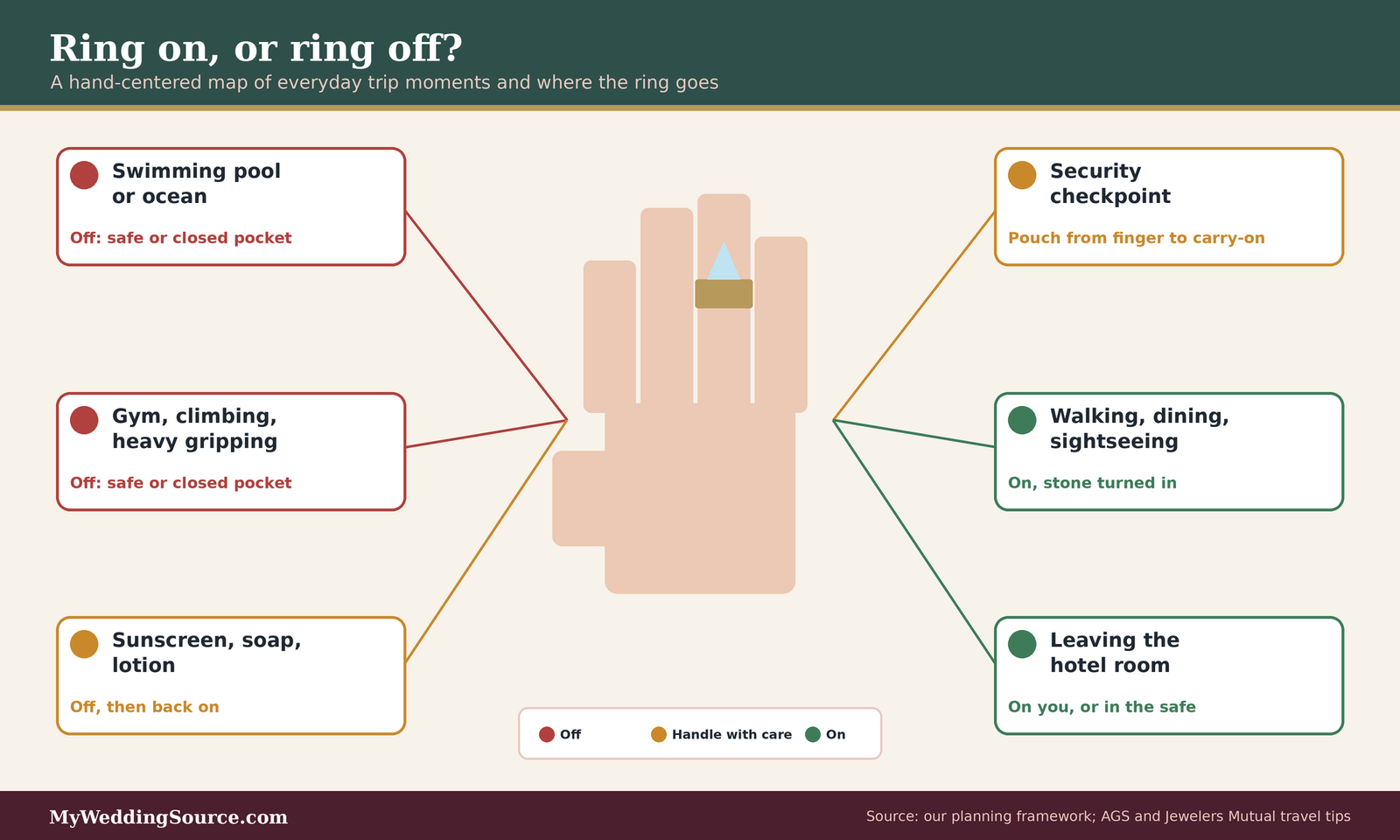
When you leave the room, the ring is on you or in the safe. There is no third option. Tell your partner the rule, so that two people are not each assuming the other has it.
What hotel liability law generally says
Hotel liability for a guest’s belongings is set by state law, so there is no single national rule. What you can say with confidence is that most states limit a hotel’s liability, that the limits are often modest compared with a ring’s value, and that a hotel usually must meet certain conditions to claim a limit.
Statutory limits are typically low
The same firm’s summary says most states now cap innkeeper liability, usually somewhere between about $250 and $2,000, and that hotels often post notices saying that valuables above a stated amount should be deposited in the hotel safe. Its examples include Massachusetts, where the limit for money or jewelry deposited for safekeeping is $1,000, and New Mexico, where hotels are liable up to $1,000 for theft or negligence by the hotel or staff. These are secondary summaries and statutes change, so do not rely on them for a particular stay.
Conditions the hotel must meet
Colorado’s statute, as published online, is a useful illustration. A hotel is not liable for lost or stolen valuables if it provides a safe or vault for guests’ valuables and posts an English-language notice in specified places, and, under the statute’s wording, the guest must hand the valuables to the proprietor or the person in charge for deposit. The statute sets no fixed dollar cap, but liability is limited to the value the guest declares on deposit. That summary describes a Washington, D.C., case in which a guest lost jewelry from an in-room safe, and the appeals court found the hotel could not rely on the cap because the required notice had not been posted everywhere the statute required. The lesson for a traveler is limited but real: a hotel’s protection depends on its following the rules, and the rules differ by state.
What this means for you
For most travelers, the practical consequence is that you should not assume the hotel will pay for a lost ring, and you should not assume it will not. Read the notice posted in your room, ask the front desk what the property’s policy is for valuables, and, if the ring is valuable, ask whether the hotel will hold it at the front desk and issue a receipt. We are not lawyers either, so if a loss happens, ask your insurer and, if needed, an attorney about the specific statute that applies. This is the sensible stance for anyone traveling with an engagement ring.
Routines for the days between
The ring is most at risk in the ordinary moments of a trip, not in the dramatic ones. A routine that you can run on autopilot helps more than a long list of cautions.
Water, lotion, and hard use
Take the ring off before you swim, shower in an unfamiliar bathroom, apply sunscreen, or use a gym. Cold water, soap, and lotion can make a ring looser than usual, and a ring that slips off in a pool or the ocean is hard to find again. Put it in the pocket of a bag you are carrying, or in the safe, not on the edge of the sink. If you wear a ring with raised prongs, notice what it catches on, such as towels, sweaters, and bag straps. Our guide to manicure shapes for different ring styles is a lighter read on the same everyday-wear theme. These are the habits that matter most for traveling with an engagement ring.
Housekeeping, laundry, and room changes
Do not leave the ring on the nightstand or the bathroom counter when housekeeping might enter, and do not put it in a pocket of clothing that you send to the laundry. If you change rooms, do a deliberate sweep of the safe, the bathroom, and the bed before you leave, and ask a travel companion to check too.
Rentals, cabins, and shared spaces
Vacation rentals usually have no safe and no notice posted. Think about the ring’s place before you arrive: on you, in a locked bag within sight, or left at home. A rental host’s insurance may not cover your belongings, so confirm what your own policy says about theft from a short-term rental. Our honeymoon planning guide has more on how to structure a trip so the things that matter get decided early.
International trips and border crossings
Crossing a border adds paperwork and a different liability regime, but it does not need to be complicated. Most of what matters is documentation and timing. Traveling with an engagement ring abroad adds a few steps, but they are manageable.
Proving the ring left with you
U.S. Customs and Border Protection runs a registration process for personal articles that you take out of the country and bring back, so that there is a record that the items were yours before you left. This is mainly relevant to expensive items that could be mistaken for new foreign purchases.
How the registration process works
CBP’s certificate-of-registration page says that, before you leave, you take the items to a local CBP office, where an officer gives you a blank Form 4457, you fill in the owner’s name, address, and a description of the articles, and the officer checks the items against your entries, completes the form, signs it, and returns it to you. The form is presented to CBP each time the registered articles are returned, it stays valid for re-importation as long as it remains legible, and it cannot be transferred to someone else. CBP’s page does not say jewelry specifically, but the process applies to any articles you register. Whether it is worth the visit for a ring depends on the ring’s value and how likely it is to be questioned. Ask CBP or a customs broker if you are unsure. Whether it suits traveling with an engagement ring depends on the ring and the trip.
Why an appraisal and a receipt still matter
Even without registration, a ring with a receipt or appraisal and a worn, obviously used appearance is much easier to explain than one with no paperwork. Carry the one-page summary and the appraisal, and keep them where you can reach them at the border without digging through bags. This is why paperwork matters when traveling with an engagement ring across a border.
Work done abroad
A trip is a tempting moment to get a ring resized, repaired, or cleaned, especially where jewelers are known for craftsmanship. It brings a customs consideration, and a practical one.
Foreign repairs and duty
CBP’s registration page notes that foreign repairs or alterations are dutiable and must be declared when the items re-enter the United States, even if the work was free. If you plan to have the ring altered abroad, ask CBP or a customs professional how to declare it, and keep the repair invoice.
Whether to repair abroad at all
Beyond customs, there is a quality and warranty question. A resize or a prong repair done by a stranger on a short stay leaves you without the usual recourse if something is wrong. If the ring needs work, it is generally better to schedule it at home with a jeweler you can return to. Our guide to resizing a ring before the wedding covers timing, and the ring sizing guide can help you check the fit before you go.
Liability differs abroad
On international flights, the airline’s liability regime and the insurer’s territory both matter, and a hotel abroad is governed by that country’s rules, not by a U.S. state’s.
Airline and hotel rules abroad
The DOT’s page describes a different structure for international flights, under the Montreal Convention, as described earlier. Hotel rules abroad vary by country, and we do not summarize them here. If the ring is valuable, treat the hotel’s liability as unknown and rely on your own insurance and habits.
Local reporting and documentation
If a loss occurs abroad, a police report is the kind of document insurers commonly ask for after a theft, as the consumer guide cited earlier notes, so get one quickly, with a translation if you can. Ask the hotel and your consulate or embassy what they can provide. Our overview of destination wedding legal requirements and the destination wedding checklist may help you structure the wider paperwork.
A travel storage and claim-document checklist for traveling with an engagement ring
This is the working part of the guide. It turns everything above into two lists: where the ring and its paperwork should be at each stage, and which documents to have in hand if you ever need to make a claim. Print it, or paste it into a note you can read offline. It is the practical core of traveling with an engagement ring.
Where the ring should be at each stage
The rule underneath every row is the same: the ring is on you, in a closed pocket on you, or in a locked place you have checked. It is never in checked luggage, a seat pocket, or an open tray. That is the whole discipline of traveling with an engagement ring.
| Stage | Where the ring is | What to do | Who sets the rule |
|---|---|---|---|
| Packing at home | On your hand, or in a labeled case | Photograph it, update the claim file, confirm coverage | You and your insurer |
| Getting to the airport | In a zipped pocket or on your hand | Do not put it in a bag that goes in the trunk | You |
| Security checkpoint | On your hand, or pouch moved from finger to carry-on | Ask for private screening if you prefer | TSA officer has final say |
| In the cabin | On your hand or in a closed pocket | Never the seat pocket or tray | You |
| Checked bag | Never | Valuables stay out; airline contracts can exclude them | Airline contract and DOT rules |
| Hotel room | On your hand, or in a tested safe | Read the posted notice; keep paperwork separate | State statute and hotel policy |
| Water, gym, spa | In the safe or a closed pocket | Decide before you leave the room | You |
| Border crossing | On your hand, with appraisal on hand | Consider registering before you leave | CBP |
| Back home | In its usual secure place | Re-check the stones and prongs | You and your jeweler |
Reading the table
The “who sets the rule” column is the useful one. It tells you where you control the outcome (most of the stages) and where somebody else’s policy controls it (screening, airline contracts, hotel statutes). For the second group, your protection is your documentation and your coverage, not your good intentions. Knowing who decides is half the work of traveling with an engagement ring.
Adapting it to your trip
Trim the table to match the trip. On a road trip, “airport” rows drop out and “car” rows come in: the ring never stays in a parked car, including the trunk or glove box. On a cruise, the ship’s safe, the cabin safe, and the shore excursions each need their own answer. Write them down before you board. Every version of traveling with an engagement ring needs its own edits.
The claim-document checklist
If you ever have to report a loss, you will be asked for a similar set of documents by the airline, the hotel, the police, and the insurer. Collect them once and carry them in two forms. The stakes of traveling with an engagement ring are mostly about what you can show.
| Document | What it proves | Who may ask for it |
|---|---|---|
| Receipt or invoice | Purchase date and price | Insurer, airline |
| Current appraisal | Replacement value and description | Insurer |
| Gem grading report, if any | The stone’s identity and characteristics | Insurer, jeweler |
| Dated photographs, several angles | What the ring looks like | Insurer, police |
| Policy or schedule and claims number | That the ring is covered | You, in the first call |
| Police or incident report | That the loss was reported | Insurer |
| Airline or hotel incident report | Where and when the loss happened | Insurer |
| Names, times, and contact details | A record of who you spoke to | Everyone |
Keeping it findable
Store the file under a boring name in a cloud folder and in your email drafts, and print the one-page summary. If you travel with a partner, make sure both of you can open it. A claim file that only one phone can open is a single point of failure.
Refreshing it on a schedule
An appraisal can go out of date as metal and stone prices move, and insurers may ask for a recent one. The jewelry insurer’s guidance suggests documenting and appraising pieces regularly. How often is up to you and your insurer, and we cover the options in our guide to engagement ring insurance and appraisals.
A short timeline for the week before
A checklist works better with a calendar attached. The timeline below is a suggestion, not a standard. A timeline makes traveling with an engagement ring less of a last-minute scramble.
Seven to ten days before
Read your policy for the jewelry limit, deductible, and territory, and call or email your insurer with questions. Have the ring checked by a jeweler if a stone feels loose. Update the photographs.
Two to three days before
Assemble the claim file, print the one-page summary, and decide where the ring will be on each leg. Confirm with your travel partner who is responsible for what. If you plan to register the ring with CBP, do it before you leave, since the process happens at a local CBP office.
The day of travel
Put the ring on, or in the zipped pocket, before you leave the house. Move through the airport with the plan you made. At the hotel, test the safe before you rely on it.
If something goes wrong: the first hours
Most of the outcome of a loss is decided in the first few hours, because that is when the location is fresh and the people who might have seen something are still there. Stay calm and work in order. A calm, ordered response is the best defense when traveling with an engagement ring goes wrong.
At an airport or on a plane
If you realize the ring is missing at or after the checkpoint, tell a TSA officer, an airline gate agent, or the airport’s lost-property office immediately. Do not leave the area before you have given your contact details and a description.
Report and write it down
Ask for a written report or a reference number and note the date, the time, and the name of the person you spoke with. The DOT’s advice for damaged bags, to insist on a written report and record those details, is a good template for any report you make. Photograph any paperwork you are given.
Search systematically
Retrace the route in the order you traveled it, starting with the most recent place. Check the tray area at the checkpoint, the seat and floor on the plane, pockets, and bags. Ask the cleaning crew or gate staff to check the aircraft if you have just left it.
At a hotel or rental
If the ring is missing from a room or safe, do not clean or move anything. Ask the front desk to document that you have reported it and who was told, and ask what the property’s process is.
Ask for a manager and an incident report
Be factual and specific about where and when you last saw the ring. Ask for a copy of the incident report. If the hotel posted a notice about valuables, photograph it, because its wording and location can matter to a later claim.
File a police report
A police report supports a theft claim, and one consumer guide says a report and proof of ownership are required for jewelry theft claims under a renters policy. File one where the loss happened and keep a copy.
With your insurer
Call as soon as you can, and ask the claims representative what the policy requires and by when. Do not guess about deadlines.
What to say and what to hold back
Describe what happened plainly and keep to what you know. Do not speculate about who took it, and do not offer opinions about fault. Ask the representative to confirm which documents are needed and how to submit them.
What happens next
The process after that varies by insurer, so we will not describe it in detail. Ask whether the policy pays to replace the ring, to repay its value, or to use a preferred jeweler, and what the options are if you want a different ring. Keep every email and the claim number in your claim file.
Edge cases that change the plan
The standard routine handles the typical trip, but several common situations need a different approach. Traveling with an engagement ring is rarely identical from one trip to the next.
The ring is not yet on a finger
A ring that is on its way to a proposal is in the most vulnerable state of all: it is new, it may not yet be on a policy, and its owner may be too excited to follow the routine. Traveling with an engagement ring before a proposal is a special case.
Traveling to propose
If you are traveling with an engagement ring to propose, treat the ring as the first priority of the trip. Carry it in your carry-on or on your person in a small case, keep the receipt and appraisal with you, and confirm that it is insured before you leave. A gem society’s travel tips page notes that members with existing Jewelers Mutual policies get up to 30 days of automatic coverage on newly acquired jewelry, up to $10,000, which is a feature of that insurer and not a general rule. Ask yours what happens in the days between purchase and the first policy. For the proposal itself, our guides to proposal ideas and proposal location permissions cover planning, and our comparison of private and public proposals can help you decide how much exposure the moment needs.
Airport security and a surprise
If you are carrying a ring to surprise a partner who is traveling with you, a small box in a bag can raise questions at a checkpoint, and a visible case may reveal the surprise. Think through whether the ring should be in a pocket, in a different bag, or with a friend who is traveling separately. The TSA’s private screening option exists if you would rather not open a case in public.
Rings that are in transit or in the middle of work
Sometimes the ring itself is the thing being moved: shipped from a jeweler, picked up after a resize, or carried to a family member. Traveling with an engagement ring that is not yet yours to wear needs extra care.
Pickup and delivery
If a ring is being delivered, ask the jeweler about declared value, signature requirements, and who bears the risk while it is in transit. Ask in writing. Do not accept an unsigned drop at a door.
Resized or repaired rings
A ring that has just been resized or repaired should be checked before you travel, since a new solder joint or reset stone is the thing you least want to discover is loose in a hotel. Our guide to wedding ring metals explains why metals differ in how repairable they are, and our piece on engagement ring settings covers how a setting affects what can go wrong.
Unusual trips and unusual rings
Some trips and some rings do not fit the standard plan. It is better to see this in advance than to discover it at the airport.
Honeymoons, mini-moons, and destination weddings
A honeymoon or destination wedding is the case where the ring, the new wedding band, and a stack of documents all travel together. If you are planning one, our honeymoon booking checklist and our comparison of a mini-moon and a honeymoon put the trip in context. Add the wedding band to your claim file and to your insurance schedule. Names on airline tickets and travel documents are a separate matter, and our guide to name mismatches on honeymoon airline tickets covers what to check.
Heirlooms, antique settings, and lab-grown stones
An heirloom without a receipt needs a current appraisal and photographs more than any other ring does. An antique setting can be fragile, and it deserves a jeweler’s check before a trip. A lab-grown or moissanite stone has a different replacement value than a mined diamond, and the appraisal should say which it is. If you are unsure what you own, a jeweler or an independent appraiser can tell you, and the FTC’s Jewelry Guides, which are not binding but shape how sellers describe diamonds and lab-created stones, are a useful reference point for the words an appraisal should use.
Medical and mobility factors
If your hands swell, if you use a mobility aid, or if you have a condition that changes how a ring fits, talk to a jeweler about a more secure option for travel, such as a sizing insert or a spare ring. We are not giving medical advice here, only noting that a ring that slides on and off easily is a ring that can be lost easily.
Questions to ask your insurer, airline, hotel, and jeweler
The questions below are short enough to ask by phone or email. Ask for answers in writing, since you may need to produce them later. They apply to any trip involving traveling with an engagement ring.
Questions to ask before you travel
- What is the exact limit for jewelry in my policy, and is my ring scheduled separately?
- Does my coverage apply abroad, and does it include unexplained disappearance?
- Does the policy require a police report, a safe, or a carry-on for a claim to be paid?
- What does the airline’s contract of carriage say about valuables, and what is the claim deadline?
- Does the hotel post a valuables notice, and will it hold a ring at the front desk against a receipt?
- Can my jeweler check the prongs and stones before the trip, and provide a current appraisal?
Questions for your insurer
These decide whether a loss is covered at all, and they are best asked before you buy a ticket.
Limits, deductibles, and conditions
Ask for the per-item limit, the deductible, and any condition that affects payment, such as a safe or carry-on requirement. A jewelry insurer’s guidance advises reviewing your policy or asking your provider what is covered and to what extent. Ask what documents the insurer will want and how long a claim usually takes.
Territory and loss types
Ask whether the ring is covered abroad, whether loss, theft, accidental damage, and unexplained disappearance are each included, and how the insurer defines them. The answers can be very different from one policy to the next.
Questions for the airline and the hotel
These tell you what protection comes from the business itself, which is often less than people expect.
Airline questions
Ask what the contract of carriage says about valuables in checked baggage, how to file a claim, and what the deadline is. For the baseline federal rules, see the DOT’s baggage page, which we cite in the sources section below.
Hotel questions
Ask whether there is a safe, whether it is in the room or at the front desk, whether the hotel posts a notice limiting its liability, and what happens if something goes missing. A friendly request often gets a straight answer.
Questions for your jeweler
Your jeweler is the person who knows the ring best and who can help with both the prep and the paperwork.
Condition and documentation
Ask for a prong and stone check, a current appraisal in writing, and photographs. A jeweler’s inspection before a trip can catch a loose stone, which is much easier to fix at home.
Travel-specific advice
Ask whether a spare or travel band makes sense for your lifestyle and whether the jeweler offers any temporary substitutes. These are services some jewelers offer and others do not, so ask rather than assume.
FAQ: traveling with an engagement ring
Airport and flight questions
Can I wear my engagement ring through airport security?
Yes, most travelers keep a ring on their finger, and the TSA says valuables like jewelry should stay with you. An officer makes the final decision at the checkpoint, so be ready to remove it if asked. Put it in a zipped pocket or pouch you control, not an open tray. Ask for private screening if you prefer.
Should I put my engagement ring in checked luggage?
No. The TSA says valuables such as jewelry should stay with you rather than in checked baggage, and the DOT advises packing small valuables like jewelry in a carry-on. Airlines can limit their liability and, on domestic flights, may exclude valuables under their contract of carriage. A checked bag is also out of your sight for hours.
Hotel and daily-use questions
Is a hotel room safe enough for an engagement ring?
It is better than leaving the ring out, but it is not a guarantee. Test the safe, use a code only you know, and read the posted notice about the hotel’s liability. State laws differ, and many cap a hotel’s liability at modest amounts. If the ring is valuable, keep it on you or ask whether the front desk can hold it.
Should I take my ring off when I swim or work out?
We suggest it, since water, lotion, and activity make rings easy to lose and to damage. Decide before you leave the room where it will go, either in the safe or in a closed pocket. Leave it on the sink or a towel, and it is easier to forget than you expect.
Insurance and paperwork questions
Does homeowners or renters insurance cover an engagement ring while I travel?
It may, but check. One consumer guide says many policies cap jewelry at roughly $1,500 to $2,500 per loss, may cover theft away from home, and generally do not cover lost or misplaced items. A scheduled rider can list the ring at its appraised value. Your own policy controls, so ask your insurer.
Does travel insurance cover a lost engagement ring?
Not necessarily. A jewelry insurer notes that travel policies may not cover jewelry at all, and that per-item caps can leave you with a fraction of the value. Read the policy’s definitions and exclusions before relying on it, and ask whether the ring should be insured separately. Our guide to honeymoon travel insurance covers the wider trip.
Do I need to register my ring with customs before an international trip?
It is not required for most travelers, but CBP offers a registration process through Form 4457 for personal articles that you take abroad and bring back, to show they were yours before you left. It happens at a local CBP office before departure. If you are unsure whether it suits your ring, ask CBP or a customs professional.
What should I do first if my ring goes missing on a trip?
Report it at once to whoever is responsible for the place it vanished, such as the airline, TSA, or hotel, and get a written report or reference number. Then file a police report if theft is possible, and call your insurer promptly. Keep notes on every name, time, and conversation, and photograph any paperwork.
Your next steps
Before you book anything
Check your coverage in writing
Find the jewelry limit and the territory in your policy and ask your insurer the questions in this guide. If the gap between the limit and the ring’s value worries you, get a written quote for scheduling the ring. Our engagement ring insurance and appraisals guide is the next read.
Build the claim file
Collect the receipt, appraisal, photos, and policy details now, and store them in two places. If your wedding insurance or planning documents are in progress, our wedding insurance guide and wedding planning checklist show where this fits.
Before you fly
Choose the ring’s route
Decide whether the ring will be worn, carried, or left home, and write down the place it will be at each stage. Review the table in this guide and share it with your travel partner. See our honeymoon planning guide for the larger trip.
Do the day-before check
Test the safe at your hotel when you arrive, confirm you have the printed summary, and put the ring on or in its pocket before you leave for the airport. If you are also thinking about the wedding band, our wedding rings overview and engagement rings hub help you plan the rest.
Sources & methodology
How we built this guide
What we relied on
This guide to traveling with an engagement ring draws on U.S. government pages from the Transportation Security Administration, the Department of Transportation, U.S. Customs and Border Protection, and the Federal Trade Commission, on a state hotel-liability statute, and on published guidance from jewelry insurers, a gem society, a consumer insurance guide, and a public-adjuster firm. Where a claim comes from an insurer or a trade body that sells or promotes a product, we say so and treat it as practical guidance, not independent evidence. The dollar illustration in the cost box is our own arithmetic on a hypothetical ring and is an estimate, not a quote. We checked these pages on November 12, 2026.
What we did not do
We did not review any particular insurance policy, airline contract of carriage, or hotel’s terms, and we did not test any hotel safe. We did not summarize every state’s hotel statute, and the state examples are illustrations drawn from a secondary summary and one published statute, both of which can change. A DOT rulemaking page we also opened lists an older domestic baggage limit of $3,800, so we used the DOT’s current baggage page for the $4,700 figure; confirm the current limit before you rely on it. Nothing here is legal, financial, or insurance advice.
Source list
Government and regulatory sources
- Transportation Security Administration, What Can I Bring: Jewelry: https://www.tsa.gov/travel/security-screening/whatcanibring/items/jewelry
- U.S. Department of Transportation, Lost, Delayed, or Damaged Baggage: https://www.transportation.gov/individuals/aviation-consumer-protection/lost-delayed-or-damaged-baggage
- U.S. Department of Transportation, Oversales and Domestic Baggage Final Rule (older page, used only to flag the changed limit): https://www.transportation.gov/individuals/aviation-consumer-protection/oversales-and-domestic-baggage-final-rule
- U.S. Customs and Border Protection, Certificate of Registration (Form 4457): https://cbp.gov/travel/clearing-cbp/certificate-registration
- Federal Trade Commission, Guides for the Jewelry, Precious Metals, and Pewter Industries, Federal Register notice of August 16, 2018: https://www.govinfo.gov/content/pkg/FR-2018-08-16/html/2018-17454.htm
- Colorado Revised Statutes section 6-25-106 (hotel liability for guest valuables): https://colorado.public.law/statutes/crs_6-25-106
Insurance, trade, and consumer sources
- Jewelers Mutual, Does travel insurance cover lost jewelry? (insurer guidance): https://www.jewelersmutual.com/the-jewelry-box/does-travel-insurance-cover-lost-jewelry
- Jewelers Mutual, USA Today travel safety tips (insurer newsroom): https://ode2.jewelersmutual.com/newsroom/jewelers-mutual-usa-today-travel-safety-tips
- American Gem Society, 6 Tips for Traveling with Jewelry: https://www.americangemsociety.org/6-tips-for-traveling-with-jewelry/
- GEICO, Does renters insurance cover jewelry? (insurer consumer guide): https://www.geico.com/living/does-renters-insurance-cover-jewelry/
- Adjusters International, Innkeeper’s Liability for Loss to Guest’s Property (public-adjuster firm guide): https://www.adjustersinternational.com/pubs/insights-for-your-industry/innkeepers/
- Gemological Institute of America (nonprofit gemological institute; general reference on grading reports): https://www.gia.edu/