
Choosing wedding ring metals is mostly a question of how your hands live, not which metal sounds strongest, and the right answer can change the weight, cost, resizing options, and skin comfort of a ring you will wear every day for decades.
Quick answer
For most couples, 14K gold or platinum is the low-regret choice because a jeweler can resize, repair, and match them later. Pick titanium or cobalt chrome if you work with your hands and accept limited resizing. Treat tungsten carbide and ceramic as scratch-proof but breakable, and as rings you replace rather than repair. If you react to costume jewelry, settle the alloy in writing before anything else.
How wedding ring metals actually fail, and why “strongest” is the wrong question
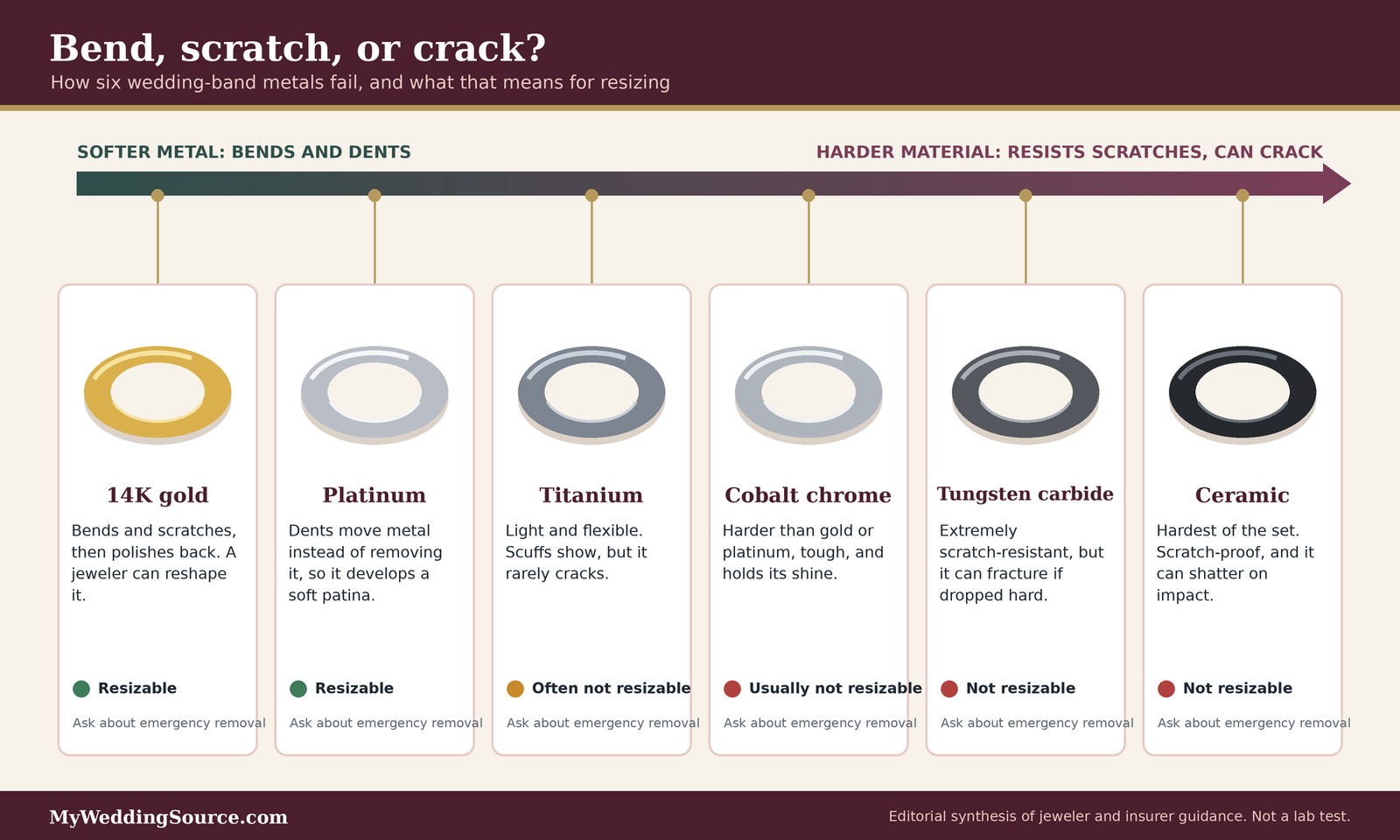
Most shopping advice ranks metals on a single scale from soft to hard and stops there. Real rings fail in three different ways, and each metal fails in its own preferred way. Once you see that, the comparison of wedding ring metals gets much easier, because you can ask which failure you can live with instead of which metal wins.
Hardness, toughness, and density are three different things
Jewelers and insurers use the word “strong” loosely, and a major jewelry insurer makes the point plainly in its own guide to band metals: strong can mean durable, which is resistance to chipping and breaking, or hard, which is resistance to scratches. Those are not the same property, and a metal can be excellent at one and poor at the other. A third property, density, decides how heavy the ring feels on your finger.
Scratch resistance is hardness
Hardness describes how easily a surface is marked. A very hard material keeps its polished finish for years because everyday contact, such as keys, countertops, and gym equipment, cannot cut into it. That is the appeal of tungsten carbide, ceramic, and cobalt chrome. The catch is that hardness says nothing about what happens when the ring takes a sharp, sudden hit. When you read a hardness number in a store, treat it as one input for wedding ring metals, not a verdict.
Breakage resistance is toughness
Toughness describes how much force a material absorbs before it fails. Gold and platinum are soft enough to deform under a hard knock, which means they dent or bend instead of snapping. A very hard material has less room to deform, so the same knock can chip or fracture it. That is why a tungsten band that shrugs off a year of scratches can still crack if it is dropped onto tile. Neither behavior is a defect. It is simply what each family of wedding ring metals does when it reaches its limit.
What daily wear does to a band
A ring lives on the busiest part of your body. It meets door handles, steering wheels, weights, dishes, hand sanitizer, sunscreen, and chlorine, usually without you noticing. Over ten years the sum of those small events is what separates a ring you love from a ring you stop wearing.
The dent-versus-scratch trade
Soft metals show wear as fine scratches and small dents that spread across the whole surface, which many people read as character. They are also easy to fix, because a jeweler can polish the surface and, in the case of platinum, push displaced metal back into place. Hard metals stay clean-looking for much longer, but when they are marked, the damage is harder to remove. If you care about a mirror finish forever, a hard material is attractive. If you accept a worn-in look that a jeweler can refresh, softer wedding ring metals suit you better.
Why lifestyle beats the spec sheet
A software engineer and a nurse can buy the same ring and subject it to wildly different treatment. Think about the three moments that actually destroy rings: heavy gripping, such as lifting and climbing; chemical exposure, such as pool and cleaning chemicals; and impact on a hard floor. Match your daily moments to the metal’s failure mode. If your risk is gripping and abrasion, a hard metal makes sense among wedding ring metals. If your risk is impact, a ring that bends beats one that shatters. This is the filter we use for every comparison of wedding ring metals in the rest of this guide.
Gold: the default for good reason
Among all wedding ring metals, gold remains the most common choice because it can be resized, repaired, engraved, and soldered by nearly any jeweler, and because it comes in several colors from one family of alloys. The trade-off is that you must read the stamp, understand the karat, and know what the color is made from.
Karat math and the stamp inside the band
Pure gold is too soft for a daily ring, so jewelers mix it with other metals. The karat number tells you how much of the mix is gold, and it is the first number to check among wedding ring metals.
What 10K, 14K, and 18K actually contain
Karat is measured out of 24 parts. That makes 10K about 41.7% gold, 14K about 58.3%, and 18K 75%. Higher karat means richer color in gold wedding ring metals and more gold content, but also a softer ring, because there is less of the strengthening alloy. Most U.S. wedding bands made from gold wedding ring metals are 14K or 18K, and 14K is usually the practical middle for rings that will be worn daily. If you are comparing two bands with different karats and different weights, compare the grams of fine gold, not the karat alone.
What federal marking rules require
In the United States, the Federal Trade Commission’s Jewelry Guides, codified at 16 CFR Part 23, work alongside the National Stamping Act to govern how gold, silver, and platinum are marked and described. A trade association guide for jewelers notes that karat gold may fall short of its stated karat by no more than three parts per thousand, with a larger allowance of seven parts per thousand where solder is involved. The Guides also changed in 2018 so that gold terms can describe lower-karat alloys when the description is qualified clearly. For you, the practical rule is simple: the karat should be stamped, and the stamp should match the paperwork.
White, yellow, and rose gold in practice
Color comes from the alloy, and the alloy decides how the ring wears and how it affects skin. Two rings with the same karat can behave very differently.
White gold and rhodium plating
White gold is yellow gold mixed with white metals, and many white gold rings are plated with rhodium for a bright, silvery finish. The plating wears down with time, revealing a slightly warmer tone, and a jeweler can re-plate it. Ask who will re-plate it and what it will cost, because that becomes a recurring expense. Some white gold alloys contain nickel, and others use palladium instead. If skin reaction is a concern, the alloy matters more than the color, which we cover in the allergy section below.
Yellow and rose gold: color from the alloy
Yellow gold gets its warm color mostly from gold itself, and rose gold gets its pink tone from added copper. Higher copper content generally means a stronger rose color. Yellow gold usually needs no plating, so it ages quietly without maintenance beyond occasional polishing. If you want the least upkeep among gold wedding ring metals, a plain yellow or rose band is the simplest route.
Platinum and palladium: dense, white, and quietly different
Platinum and palladium, two white wedding ring metals from the same family, are both are naturally white, which means there is no plating to wear off. They differ in weight, price, and how they behave over time.
Platinum: dense, dent-prone, and unplated
Platinum is the heaviest common choice among wedding ring metals, and many people find the weight reassuring. It is also relatively soft in terms of scratching, so it picks up a frosted, lived-in surface rather than staying mirror-bright.
The patina trade
Platinum rarely loses metal when it is scratched. The metal is displaced and pushed around instead, which is why jewelers describe a soft patina rather than damage. Some couples love that look, and others ask for periodic polishing to restore shine. If you want a ring that looks the same on year ten as on day one, platinum will disappoint you. If you want a white metal that never needs replating and can always be repaired, it is hard to beat.
How purity is marked
FTC guidance allows a product with at least 950 parts per thousand pure platinum to be marked “Platinum” without qualification, while lower fineness, down to 850, must carry the number in front, as in 900Plat. Because the platinum section of the Guides is specific, check the current text before relying on this summary. The practical step is to look inside the band for the stamp and confirm it matches the receipt.
Palladium and the lighter alternative
Palladium is a white metal from the platinum group that does not tarnish in air and stays white without plating. It is lighter than platinum, which can suit people who dislike heavy rings.
Weight and price trade-offs
A palladium band feels noticeably lighter than the same design in platinum, and the metal itself has often cost less per gram. Prices move with the market, so compare quotes on the day you buy rather than trusting a rule of thumb. The right question is what you are paying for: grams of metal, labor, and finish. Our cost section later in this guide shows how to separate them.
When palladium makes sense
Palladium suits a buyer who wants a naturally white, unplated ring without platinum’s weight. It is a less common choice, so confirm that the jeweler can resize and repair it in house. If the answer is “we send it out,” get the turnaround time and cost in writing before you buy.
Titanium, cobalt chrome, tungsten carbide, and ceramic
These materials, often called alternative wedding ring metals, have grown popular because they are hard, affordable, and look modern. They share one trait that matters for planning: they usually cannot be resized the way gold and platinum can.
Titanium and cobalt chrome
Both are light-to-moderate in weight and widely used for men’s and women’s bands. They are the middle ground of this group: tougher than ceramic and less brittle than tungsten.
Titanium: light, grey, and scuff-prone
Titanium is very light, roughly a third of the weight of gold for the same ring, as the weight chart in this guide shows. It scuffs and shows wear over time, though many scuffs can be polished out. Jewelers disagree on resizing, and a major insurer states that titanium is difficult to resize for most standard jewelry shops. That means you should choose your size carefully and ask whether the seller offers size exchanges.
Cobalt chrome: bright white and tough
Cobalt chrome is an alloy of cobalt and chromium that looks close to white gold or platinum. One gemology educator places cobalt rings at about 7 to 8 on the Mohs scale, harder than gold or platinum, so they resist scratching well. Like other hard alloys, cobalt is generally not resizable. If you want a white look without plating and with good scratch resistance, cobalt chrome is worth a serious look among alternative wedding ring metals.
Tungsten carbide and ceramic
These are the hardest materials in common use for rings, and they are also the most likely to break rather than bend.
Tungsten carbide is not pure tungsten
Jewelry labeled tungsten is usually tungsten carbide, a compound of tungsten and carbon, held together with a binder. It has a satisfying weight, similar in feel to gold or platinum, at a much lower price. Black and white tungsten finishes may be coatings, and one retailer guide notes that coated tungsten may not be as scratch-resistant as the natural grey. Ask whether the color is the material or a coating, and what the warranty says about coating wear.
Ceramic: hardest of the set, most brittle
Ceramic bands, often made from titanium carbide or similar compounds, are extremely scratch-resistant and very light. They resist scratches but, like tungsten, they can crack or shatter if struck hard, and they generally cannot be resized. If you choose ceramic, treat it as a ring you may replace. A replacement program or a low replacement cost is part of what you are buying.

Allergies, skin reactions, and what “hypoallergenic” really means
Skin reactions are the one factor that can make even well-chosen wedding ring metals unwearable, and the word “hypoallergenic” is not a regulated promise. It is worth understanding before you buy, not after.
Nickel: the common culprit
Nickel is a hardening agent used in many metal products, and it is the most common cause of contact allergy worldwide, according to a dermatology review. It is the main reason some people cannot wear certain rings.
How common nickel allergy is
In the North American Contact Dermatitis Group’s 2015 to 2016 patch-test cycle, with 5,597 patients tested, 17.5% reacted to nickel. That group is patients referred for patch testing, not the general public, so it overstates how common allergy is in everyone. The review also notes that regulation of nickel in jewelry is stronger in the European Union, where nickel release from items in prolonged skin contact is limited to 0.5 micrograms per square centimeter per week, than in the United States, where the review describes regulation as lacking.
Why white gold deserves a closer look
The same review advises people with nickel allergy to avoid white gold because it often contains nickel for its color. It also warns that lower-karat yellow gold can contain nickel, and that gold plating can wear away and expose a base metal. This does not mean all white gold is a problem. Palladium white gold alloys are made without nickel. It means you should ask for the alloy composition in writing instead of assuming.
How to test and what to ask
If you already know you react to costume jewelry or earrings, treat the ring as a medical-adjacent purchase and gather facts first.
Spot tests and patch testing
A dimethylglyoxime spot test, sold as an inexpensive nickel test kit, turns pink when nickel is released from a metal item and does not harm jewelry, according to the dermatology review. A spot test is a screening tool and does not diagnose an allergy. A dermatologist can run a patch test, which is the standard way to confirm a nickel allergy. Allergies to other metals, such as cobalt and chromium, are also possible, so a ring that passes a nickel test may still cause a reaction in a sensitized person.
Ask for the alloy in writing
For any ring, ask the seller to state the exact alloy and any coating on the receipt: the karat and alloy type for gold, the platinum or palladium purity, and any plating or color treatment. A seller who will not put the alloy in writing has told you something useful. If you have a diagnosed allergy, ask your clinician which metals to avoid before you shop.
Resizing, repairs, and emergencies
Hands change, and wedding ring metals do not change with them. Pregnancy, weight changes, arthritis, heat, and age can all change ring size, and the more rigid your chosen material, the less room you have to adapt.
What you can change later
Resizing is one of the clearest dividing lines among wedding ring metals, and it should influence your choice more than most couples expect.
Gold and platinum: adjustable
A jeweler can resize gold and platinum bands by cutting, adding or removing metal, and rejoining. Plain bands are simplest, and rings with continuous stones or detailed engraving can be more limited. That flexibility is also what makes these metals good for stacking and for rings you might inherit or hand down.
Hard metals: plan for replacement
Insurer and retailer guides agree that tungsten, ceramic, and cobalt generally cannot be resized, and that titanium is difficult. Some sellers offer a size exchange or a discounted replacement, but policies vary by seller. Ask three questions: how long is the exchange window, is the exchange free or discounted, and does it cover a size change due to weight or swelling.
Emergency removal
A swollen finger, an injury, or a medical procedure can make a ring urgent to remove. Metal choice affects how that goes.
Know the method before you need it
Gold and platinum bands can usually be cut off with a ring cutter. Some very hard materials need different tools, and sources disagree on specifics, so do not rely on a general statement. Ask the seller how an emergency removal of this exact ring is handled, and save the answer.
Plan for swelling and medical situations
If you expect a surgery, pregnancy, or a long flight with hot weather, consider wearing a looser ring or a temporary band. Many people keep a low-cost silicone band for the gym and for medical situations. That is not a downgrade. It protects the ring you care about and removes the emergency question entirely.
Care, cleaning, and upkeep by metal
A ring that is never maintained ages faster than one that gets a little attention, and the upkeep demands differ more than most shoppers expect. This is where the real long-term cost of wedding ring metals shows up.
Everyday habits that protect any ring
Most ring damage comes from a handful of repeated situations rather than from one dramatic accident, so a few habits go a long way.
Chemicals, pools, and cleaning products
Jewelers commonly warn that chlorine and strong household cleaners can attack the alloys in gold jewelry and can damage plated finishes, and the warning is cheap to follow. Take your ring off before you clean the bathroom, mix pool chemicals, or work with bleach. Hand sanitizer, lotion, and sunscreen leave a film under the band that dulls the metal and can irritate skin, so rinse and dry the ring and your finger when you notice buildup. A soft brush, mild dish soap, and warm water clean most plain bands safely.
Five moments to take the ring off
Remove it for heavy lifting and gym work, for gardening and yard work, for painting and sanding, for cleaning with chemicals, and for sleep if you move a lot in your sleep or have swollen hands in the morning. Keep a small dish by the sink and a second one in the gym bag so removal becomes automatic. People lose rings in the moment they are taking them off in a hurry, so a fixed place matters more than good intentions.
Upkeep schedules by metal family
Different materials ask for different attention, and knowing the schedule before you buy prevents surprise bills.
Gold and platinum: inspect, polish, re-plate
Gold and platinum bands benefit from a yearly check, where a jeweler looks for thinning, deformation, and loose stones if the band has any, then cleans and polishes. White gold with a rhodium finish eventually shows a warmer tone as the plating thins, and the interval before re-plating varies with how hard you are on your hands, so ask your jeweler what to expect rather than trusting a fixed number. Platinum needs no plating, but you can ask for a refresh polish if you prefer a brighter surface.
Hard metals: little upkeep, but inspect
Titanium, cobalt chrome, tungsten carbide, and ceramic ask for almost no polishing. They still deserve an inspection, because chips, edge damage, and worn coatings are easier to catch early. If your tungsten or ceramic band has a colored coating, look at the inner edge and the shoulders for wear, because that is where coatings usually go first. Save the warranty paperwork somewhere you will find it in five years.
Finish choice changes how wear shows
A high-polish finish shows every scratch, while a brushed or satin finish hides small marks and a hammered texture hides even more. This matters across all wedding ring metals, because two couples can buy the same metal and one will feel their ring is worn out in two years while the other thinks it looks the same. If you are choosing a softer metal such as gold or platinum, a brushed finish is a practical way to make the wear less visible, and a jeweler can refresh it later.
Weight, cost, and the math behind the price
Two bands with the same width and thickness can differ several times in weight depending on which of the wedding ring metals you choose, and the price of precious metal rings follows the grams of metal in them. A little arithmetic shows why.
Weight: the same ring in five metals
To compare like with like, we calculated the weight of one design in five materials. This is editorial arithmetic with stated assumptions, not a measurement of any specific ring.
The calculation and its assumptions
We assumed a plain 4 mm wide band, 1.5 mm thick, in U.S. size 7, which has an inner diameter of about 17.3 mm. That works out to a volume of roughly 0.354 cubic centimeters. We then multiplied by approximate densities: titanium 4.5, 14K gold 13.1, 18K gold 15.5, tungsten carbide 15.6, and platinum 950 21.4 grams per cubic centimeter. Across these wedding ring metals the result is about 1.6 g for titanium, 4.6 g for 14K gold, 5.5 g for 18K gold, 5.5 g for tungsten carbide, and 7.6 g for platinum. Real alloys and profiles vary, and a domed or comfort-fit profile shifts the numbers.
What the grams mean for comfort
A seven-gram band feels different from a two-gram band, and neither is objectively better. People who dislike feeling a ring tend to prefer lighter wedding ring metals. People who like a sense of presence often prefer heavier ones. Try a weight similar to your candidate wedding ring metals in person, and wear it for a full day before you commit.
Cost: build the price from grams, purity, and labor
Because metal prices change daily, we do not quote a price per ring. You can build the metal cost yourself and then see what the seller adds.
A worksheet with variables, not stale prices
Multiply the ring weight by the fraction of precious metal in it, then by the day’s price per gram. For the example band above, 14K gold contains about 2.7 g of fine gold (4.6 g times 0.583), 18K contains about 4.1 g (5.5 g times 0.75), and platinum 950 contains about 7.2 g of platinum (7.6 g times 0.95). Titanium, cobalt, tungsten carbide, and ceramic contain no precious metal, which is why those bands cost far less. Add a bullion dealer’s current price for the metal to your own arithmetic, and you will know whether a quote is plausible.
What the seller adds on top
Labor, finish, brand, warranty, and retail margin make up the difference between metal value and the price tag. A hand-finished band costs more to make than a cast one, and a warranty that includes re-plating or resizing has a real cost. Compare quotes by asking for weight in grams, metal and purity, finish, and what service is included. For a wider budget view, our wedding budget calculator helps you place rings within the full plan.
A worked example: judging three quotes for the same band
Suppose you collect three illustrative quotes, which are invented round numbers for the exercise and not market prices. Quote A is a 4 mm 14K band at 4.6 g for $780. Quote B is a 14K band at 3.2 g for $620. Quote C is a 950 platinum band at 7.6 g for $1,350. Divide each price by the weight of the finished ring and you get about $170 per gram for A, $194 per gram for B, and $178 per gram for C.
Now divide by the fine metal inside: A holds about 2.7 g of gold, so it costs about $291 per gram of gold, while B holds about 1.9 g and costs about $332 per gram of gold.
Quote B looks cheaper in dollars, but you are paying more per gram of gold because the band is thinner, and a thinner band is also less durable.
That does not make B a bad deal, but it shows what you are actually comparing. Compare like with like within the same metal, and ask for the weight on every quote.
What this actually costs
The price of a gold or platinum band is mostly grams times purity times the day’s metal price, plus labor and margin. Alternative metals cost less because the material is cheaper, not because they are lower quality. Judge a quote by weight, purity, finish, and included service.
| Metal | Scratch behavior | Breakage behavior | Resizing | Plating needed | Skin note |
|---|---|---|---|---|---|
| 14K / 18K gold | Scratches, can be polished | Bends before it breaks | Yes, most jewelers | Only white gold | Ask the alloy; some white gold has nickel |
| Platinum | Dents and frosts, can be repaired | Bends, rarely breaks | Yes, with a skilled jeweler | No | Generally well tolerated, confirm purity |
| Palladium | Scuffs, can be polished | Bends before it breaks | Often yes, confirm in house | No | Confirm alloy composition |
| Titanium | Scuffs, polishes partly | Tough, rarely cracks | Often difficult | No | Ask about alloy |
| Cobalt chrome | Very scratch-resistant | Tough | Usually not | No | Cobalt and chromium can affect some people |
| Tungsten carbide | Extremely scratch-resistant | Can fracture if struck | No | Some finishes are coatings | Ask about the binder |
| Ceramic | Extremely scratch-resistant | Can shatter on impact | No | No | Generally inert, confirm |
Matching a pair: when two rings meet different metals
Many couples want different wedding ring metals for each person, or want a wedding band to sit beside an engagement ring. That is fine, but the pairing changes how each ring wears.
Mixing metals on purpose
Pairing rings in different wedding ring metals is common, and it can look intentional when width and finish echo each other.
Hard against soft
When a ring sits flush against another, the harder one can wear into the softer one over years. A tungsten band next to a gold engagement ring is not a typical stack, but a platinum band against a thin gold prong setting is a real consideration. For a stacked pair on one hand, choose metals of similar hardness, or leave a very small gap. If you are matching to an engagement ring, our engagement ring guide covers the setting side of that decision.
Contour bands and stacking
Contour bands curve around an engagement ring and require precise fit. That is a gold or platinum job, because a contour band needs to be made or adjusted to the ring. Hard metals that cannot be reshaped are a poor fit for this style, so if you want a contour or stackable look, choose a metal a jeweler can work.
Pairs with different lifestyles
You do not have to choose one metal for both people. One person may work with hands all day while the other works at a desk.
Let each ring match its wearer
A matched look can survive different materials. Keep width, finish, and edge profile consistent, and let the metal follow the wearer. A couple might choose a cobalt chrome band for the person who works with tools and a 14K gold band for the person who does not.
Insure the pair, not just the diamond
Rings are lost and damaged more often than people expect, and replacement costs differ sharply by metal. Check whether your policy covers a plain band at replacement value. Our guide to engagement ring insurance explains what to read in the fine print.
Where to buy, and the red flags that cost couples money
The channel you buy from affects the service you will need later more than it affects the metal. A plain band is a simple product, and the seller’s policies are the real difference between offers.
Local jeweler, online retailer, or custom maker
Each channel offers a different mix of fit, price, and service, and the right one depends on how much support you want after the sale.
What a local jeweler gives you
A local jeweler lets you try sizes, feel the weight, and watch the stamp being read. The same shop usually handles resizing, cleaning, and repairs, which turns the purchase into a relationship. That convenience has value if you picked gold or platinum, because those are the metals you will want serviced. Ask whether resizing is done in house, how long it takes, and whether the first resize is included.
What to check with online sellers
Online sellers can offer wide choice and competitive pricing, but you should verify what you cannot touch. Ask for the return window and who pays return shipping, whether size exchanges are free, and whether the listing shows the stamp and the weight in grams. Read the metal description closely, because listings that say only “gold tone” or “gold plated” are not solid gold. For tungsten, cobalt, and ceramic, confirm the exchange program before you choose a size.
Red flags in listings and quotes
Most problems are visible before payment if you know what to look for.
Vague metal language
The FTC Jewelry Guides exist because marketers blurred the difference between solid gold and plated or filled products, and descriptions that hide the difference are the first warning. Terms such as gold plated, gold filled, and vermeil describe coatings or layers over another metal, not solid karat gold. If a listing does not state the karat, the weight, and whether the ring is solid, ask before you buy, and walk away if the answer is evasive.
Pressure and bundling
Be cautious when a seller pushes a same-day decision, bundles expensive add-ons you did not ask for, or will not put policies in writing. A plain wedding band rarely needs urgency, and a quote that is good today will usually be good tomorrow. If you feel rushed, that is information about the seller, not about the ring.
Choose your metal: profiles, scenarios, and thresholds
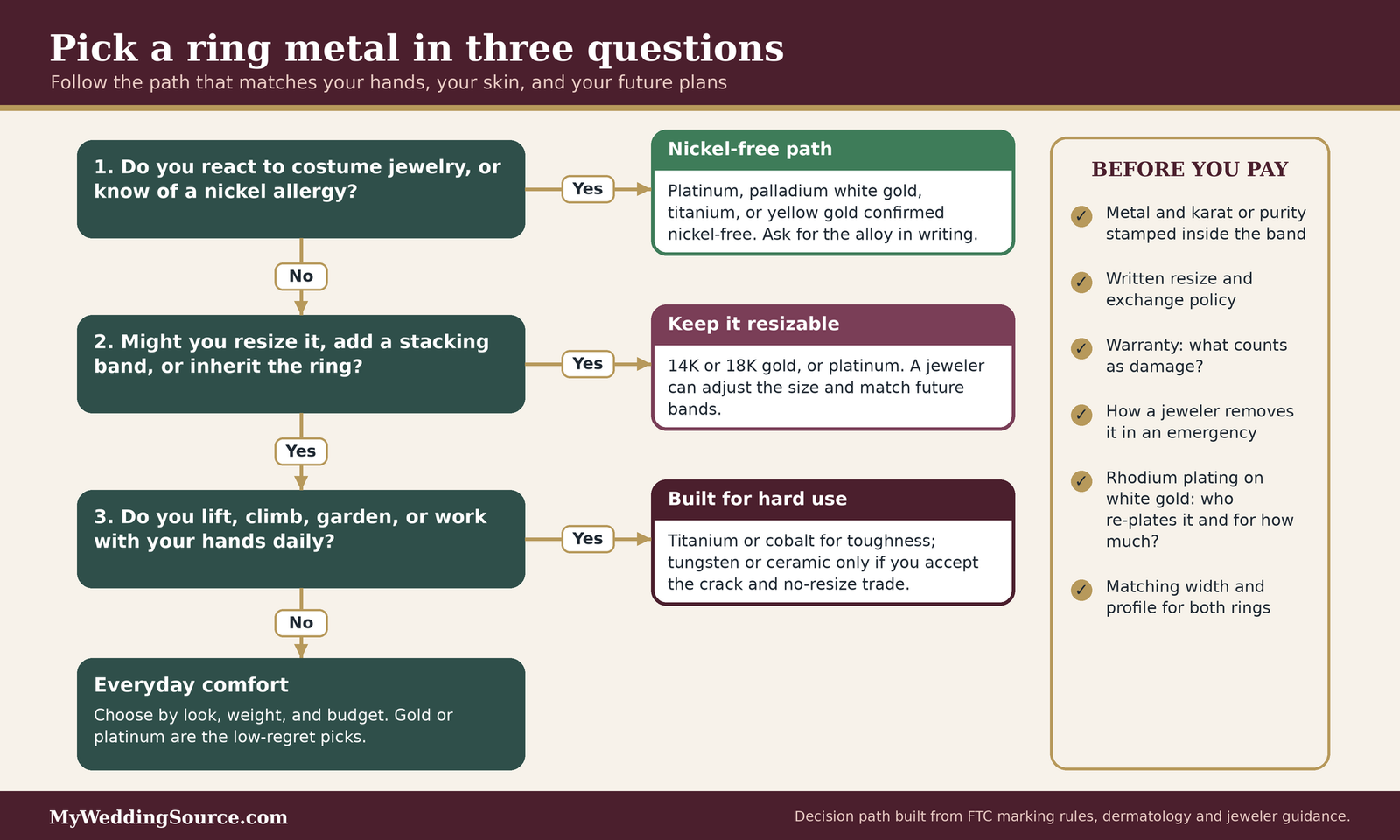
Use the decision path above as a first pass for your wedding ring metals shortlist, then test it against the profiles below.
Four buyer profiles
These are not stereotypes. They are common combinations of constraints that point to a metal.
The hands-on worker
If you lift, climb, garden, or use tools daily, prioritize toughness and a finish that tolerates abrasion. Titanium and cobalt chrome fit well. Consider keeping a silicone band for the hardest tasks. If you choose tungsten, accept that it is a ring you may replace.
The nickel-sensitive buyer
For wedding ring metals, start from the alloy. Platinum, palladium, and gold with a documented nickel-free alloy are the strongest candidates, and a dermatologist can confirm what to avoid. Skip plated finishes unless you know the base metal, because wear can expose it.
The planner who expects change
If you may resize, add bands, inherit a ring, or restyle later, choose gold or platinum. Flexibility is the product. Rings in these wedding ring metals can follow your life for decades.
Scenario table and thresholds
The table below shows when each option wins and the threshold that flips the recommendation. Use it to test your own situation.
| Situation | Best fit | Flip point |
|---|---|---|
| You want one ring forever with repair options | 14K gold or platinum | Flips to a hard metal if you accept replacement over repair |
| You work with hands and tools daily | Titanium or cobalt chrome | Flips to gold if scratches will not bother you and resizing matters |
| You react to costume jewelry | Platinum, palladium, or confirmed nickel-free gold | Flips only after a clinician confirms what to avoid |
| You want the lowest cost | Titanium, tungsten carbide, or ceramic | Flips to gold if you value resizing or resale |
| You want a contour or stackable look | 14K or 18K gold, or platinum | Never flips to a metal a jeweler cannot reshape |
When to pick gold
Choose gold when flexibility and repairability matter most. It is the metal that forgives change in your hands, your taste, and your plans. A plain 14K band from a reputable jeweler with a written service policy is a safe default.
When to walk away from a hard metal
Walk away when a seller cannot explain resizing, replacement, or emergency removal for that exact ring, when coating durability is vague, or when you know you will want a stackable or contour look. A good seller answers these questions without hesitation.
Questions to ask before you pay
Good questions protect you from vague claims about wedding ring metals. Keep them short and ask for answers in writing.
Questions worth asking before you buy
- What exact metal and purity is this ring, and where is it stamped?
- Is any part plated or coated, and what happens when it wears?
- Can it be resized, and what is the exchange or replacement policy?
- How is it removed in an emergency?
- What does the warranty cover, and what counts as damage?
About the metal
These questions confirm what you are actually buying.
Purity and markings
Ask the seller to show you the stamp and match it to the receipt. For gold, the karat should appear on the ring. For platinum, the purity should be marked. A missing stamp on a precious metal ring deserves a direct question.
Coatings and finishes
Ask which finishes are coatings and which are the base material. Black, white, and rose-colored finishes on hard metals can be surface treatments, and a rhodium plated white gold ring will need re-plating. Get the replating cost and the warranty terms.
About service
These questions decide what happens in year five.
Resizing and exchange
Ask for the policy in writing, including the time window, the fee, and any size limits. For hard metals, ask whether the seller offers an exchange program and whether it covers size changes caused by weight gain or loss.
Warranty and repair
Ask what counts as damage and who pays for polishing, re-plating, or stone tightening. A good warranty for wedding ring metals is specific about what it covers and for how long.
FAQ: wedding ring metals questions
Skin and comfort questions
Which wedding ring metals are safest for sensitive skin?
Platinum, palladium, and gold made without nickel are the usual starting points, and many people tolerate titanium well. No metal is guaranteed safe for everyone, so ask for the alloy in writing and talk to a dermatologist if you have a confirmed allergy.
Can a ring cause a rash even if it is real gold?
Yes. Lower-karat gold and some white gold alloys can contain nickel, and a plated ring can expose the base metal as the coating wears. Skin reactions can also come from soap or moisture trapped under a ring, which is not a metal allergy at all.
Durability and cost questions
Is tungsten better than gold for a wedding band?
It depends on the failure you want to avoid. Tungsten carbide resists scratches far better than gold, but it can fracture if struck hard and generally cannot be resized. Gold scratches more easily, but a jeweler can polish, resize, and repair it.
Why are some wedding bands so much cheaper?
Gold and platinum bands contain precious metal, which is why wedding ring metals differ so much in price. Their price follows the weight and purity of that metal. Titanium, tungsten carbide, cobalt chrome, and ceramic bands do not, which is why they cost less. The lower price is not a sign of poor quality, but the trade-offs in resizing and repair are real.
Your next steps
Narrow the field
Pick your top two metals
Use the decision path and the scenario table to choose two candidates, one primary and one backup. Write down why each fits your hands, skin, and plans, so the choice survives a persuasive sales conversation.
Try the weight in person
Handle bands in your candidate wedding ring metals for a full day if possible. A weight you like in the store can feel different by evening. Our wedding planning checklist can help you schedule ring shopping inside the larger timeline.
Lock in the details
Get the paperwork
Before you pay, get the metal, purity, finish, and policies in writing. Keep the receipt and appraisal with your insurance records. If rings are part of your photography plan, our wedding photographer shot list shows where ring close-ups fit.
Schedule the first checkup
Put a reminder in your calendar to have gold and platinum rings checked and cleaned about once a year, and to review your insurance when you change rings. For the broader timeline, see our wedding planning guide and our month-by-month wedding timeline.
Once you have chosen a metal, the next decision is how wide the band should be. Width changes weight, comfort and how the ring sits beside an engagement ring, so see our guide to wedding band width.
Metal also decides what can be engraved and whether a ring can be resized afterward, which our ring engraving guide covers.
Sources & methodology
How we built this guide
What we relied on
This guide to wedding ring metals combines U.S. federal marking rules, a dermatology review of nickel allergy, a jewelry-industry compliance guide, and published guidance from jewelry insurers and retailers. Where a claim comes from a retailer or insurer, it is labeled as such and treated as practical guidance, not laboratory evidence. The weight figures are our own arithmetic with stated assumptions.
What we did not do
We did not test rings, quote current metal prices, or give medical advice. Prices change daily, regulations are updated, and individual allergies vary. Verify current rules and consult a clinician about skin reactions.
Source list
Government and regulatory sources
- Federal Trade Commission, Guides for the Jewelry, Precious Metals, and Pewter Industries, 16 CFR Part 23: https://www.federalregister.gov/documents/2018/08/16/2018-17454/guides-for-the-jewelry-precious-metals-and-pewter-industries
- Federal Register, FTC amendment to the Platinum Group Metals section of the Jewelry Guides (December 28, 2010): https://www.govinfo.gov/content/pkg/FR-2010-12-28/html/2010-32273.htm
- Federal Register, FTC revised Jewelry Guides statement (August 16, 2018): https://www.govinfo.gov/content/pkg/FR-2018-08-16/html/2018-17454.htm
Trade, clinical, and retailer sources
- MJSA, U.S. Marking and Stamping Regulations compliance guide: https://cms.mjsa.org/publications/compliance-guides/marking-stamping-regulations
- Jewelers Mutual, Strongest metals for a wedding band: https://www.jewelersmutual.com/the-jewelry-box/strongest-metals-wedding-band
- The Hospitalist, Contact Allergy to Nickel: Still #1 After All These Years: https://blogs.the-hospitalist.org/content/contact-allergy-nickel-still-1-after-all-these-years
- Contact Dermatitis, nickel release and prolonged contact study (PMC6749565): https://pmc.ncbi.nlm.nih.gov/articles/PMC6749565
- MyGemologist, Alternative Metals for Men’s Jewelry (educator guide, vendor-affiliated): https://www.mygemologist.com/?p=5637
- With Clarity, Guide to Alternative Metals for Men’s Wedding Bands (retailer guide): https://withclarity.com/blogs/wedding-bands/guide-to-alternative-metals-for-mens-wedding-bands
- Larson Jewelers, Metal Comparison (retailer guide): https://mcprod.larsonjewelers.com/metal-comparison