

Handling a wedding party member who cannot travel comes down to three calm decisions: what role this person can still play, how the rest of the party and your vendors will adjust, and how a gift and a thank-you will reach someone who is not in the room.
Quick answer
For handling a wedding party member who cannot travel, start with a conversation, not a replacement. Ask why they cannot travel, ask what they would still like to do, and write the agreed role in one sentence. Then choose one of four paths: keep them in the party with remote jobs, give them an honorary or “present in spirit” role, move them to a guest or well-wisher seat, or, only if there is plenty of time, invite someone else. The Knot and Inside Weddings both advise against filling the spot only to keep numbers even or the photos tidy. Plan their attire, their gift, and any video or livestream link as separate, dated tasks, and tell your planner, photographer, and the rest of the party as soon as the decision is made.
What “cannot travel” really means
Before you decide anything about handling a wedding party member who cannot travel, it helps to know what kind of “cannot” you are dealing with. A person who cannot afford a flight, a person with a medical limit, and a person whose employer will not release them are three different conversations, even though the practical result looks the same on your guest list. The way you respond in the first few minutes tends to set the tone for the next several months.
Common reasons a wedding party member cannot travel
Reasons come in a handful of families, and each one affects what you can offer. Treat the list below as a way to listen, not as a questionnaire to run through. Many people will not give you the full reason, and you do not need it to make a good plan.
Money and cumulative cost
Wedding party costs add up in layers: a dress or suit, accessories, hair and makeup, gifts, pre-wedding events, and travel. Bridal Guide notes that attendants often pay for a shower contribution, shower and wedding gifts, a dress and accessories, and sometimes a bachelorette party. The Knot’s advice for people who need to decline says bachelorette trips can run from about three hundred dollars for a single night to two thousand dollars, depending on length and destination. A person who says they “can’t travel” may really be telling you that the combined total is more than they can carry. Our guide to wedding party costs lays out those layers so you can see where a conversation might ease them.
Health, pregnancy, and caregiving
Some people cannot travel because of a medical condition, a pregnancy, recovery from surgery, or responsibility for a child, parent, or partner who needs them at home. Inside Weddings suggests being respectful and not pressing for details when the cause is a family emergency, and The Knot says a person can disclose a health concern discreetly. You are not owed a diagnosis, and you are not in a position to judge whether the limit is “serious enough.”
Work, military, and paperwork
A work trip, a shift schedule, a deployment, a court date, or a travel document that has not arrived can all stop a flight. These reasons are often outside the person’s control and sometimes outside the date they know when you ask. If the obstacle might clear, a flexible plan with a decision date is kinder than an all-or-nothing answer.
Distance, weather, and other practical limits
The wedding may be in a place that is hard to reach, a season with unreliable flights, or a venue that requires several connections. Other people simply carry a quiet anxiety about flying or long drives. None of these needs a defense, and your plan should not require one.
Why handling a wedding party member who cannot travel starts with listening
The Knot’s guidance on a bridesmaid who drops out begins with a reminder that the reason is probably not about you: finances, priorities, family, and moves shift over a long engagement. The same logic applies here. A person who tells you they cannot travel is giving you information, and it usually costs them something to say it.
Ask before you assume
The Knot suggests asking the person about their reasoning and looking for compromises, such as a dinner closer to home when a trip is too costly, or a wedding-day job when pre-wedding events are too much. Open with a question like “What would feel doable for you?” rather than “Are you sure you can’t make it?” The first invites a plan, and the second invites a defense.
Avoid pressure disguised as a question
Phrases like “It won’t be the same without you” are affectionate, but they can land as pressure when someone is already disappointed. You can say you will miss them and mean it while making clear that their answer does not damage the friendship. The aim is that they feel free to tell you the truth, including that something has changed.
Decide what you need from this person
The Knot quotes planner Lara Mahler on considering who a person is to you and what role they can realistically play, instead of expecting every attendant to do the same things. That is a useful way to split a wedding party role into pieces before you decide what is lost.
Separate the core duty from the extras
Inside Weddings makes the point that a bridesmaid does not have to do anything beyond the wedding weekend and that help with favors and showers is nice but optional. Most of the time, the core duty is to stand beside you and be someone you trust. If that is physically impossible, the extras may or may not be what you want from them, so name them separately: pre-wedding planning help, a speech or toast, a physical role on the day, and emotional support.
Write the role in one sentence
Try completing this sentence: “I would still love for you to ___ .” If the blank is “stand next to me on the day,” the answer is probably a replacement or an honorary role. If it is “help me with the playlist and speak to me the night before,” the person may be able to keep most of what matters. A single sentence also keeps later group-chat conversations short.
The first conversation
How you open the conversation matters more than any template you find online, and it is the first real step in handling a wedding party member who cannot travel. People who cannot travel are often braced for disappointment, and a clear, warm first call can make the rest of the planning go faster.
Call first, then follow up in writing
Whether you are the couple reaching out or the attendant announcing a limit, a voice usually carries warmth that text does not. The Knot’s advice for people who need to decline a role is to call rather than text and to follow up with a handwritten card. That advice reads just as well in the other direction.
Opening lines that leave room
Plain wording works best. You might say: “I heard it may be hard for you to get there, and I want to understand what is going on, no matter what. I would rather have you in my life in whatever way works than have you feel stuck.” If they reached out first, thank them for telling you early; Inside Weddings advises people who cannot attend to tell the couple promptly and to be honest instead of inventing an excuse.
What to avoid saying
Skip comparisons (“Everyone else managed”), skip bargaining (“Could you at least come for the ceremony?”) unless they have said that is possible, and skip speculation about what they could cut from their budget. If a financial problem is the issue, ask what would help and offer options; do not audit their spending.
Offer options without pressure
Once you understand the situation, offer two or three paths and let the person choose, which keeps handling a wedding party member who cannot travel a shared decision. The paths are covered in the next sections, but the way you offer them matters as much as their content.
Offering financial help
Inside Weddings suggests that when money is the obstacle, offering to help with dress and travel costs may make it possible for a person to stay in the party. Bridal Guide is clear that you are not required to pay attendants’ travel or lodging, but it says that if costs would be a real burden you may choose to contribute as a gift. Both ideas can be true at once: no obligation, and a kindness if you can afford it. If you do offer, offer privately, with a specific amount or item, and without a request for anything in return. Our guide on how to ask wedding party members about financial boundaries gives wording for those conversations.
Offering a smaller job
If travel is out but time and energy are not, a remote or reduced role can keep the person involved. Offer it as one option among several, never as a consolation prize, and let them say no.
Offering time to decide
If the obstacle may clear, such as a medical test, a work schedule, or a delayed document, agree on a decision date. Inside Weddings advises people who decline to decide before the RSVP deadline because the couple needs final counts, and a similar date helps here, because your vendors and the rest of the party need a plan as well. Choose a date early enough that every outcome is still workable.
Write down what you agreed
A short note after the call prevents misunderstandings later, particularly in a long engagement with many moving parts.
What the note should include
Send a short message that repeats the agreed role, any costs you offered to cover, the date by which you will check in again, and what happens to attire, gifts, and communications. This is not a contract; it is a courtesy that lets both of you correct a misunderstanding early.
Where to keep it
Keep the note somewhere you will find it, such as your planning document, and share the relevant parts with a planner or maid of honor or best man so that nobody asks the person to repeat a hard conversation. Our wedding party coordination checklist is a good home for the larger plan.
Four paths for handling a wedding party member who cannot travel
Most situations land on one of four paths. None is the “right” one in general; each fits a different combination of relationship, timing, and what the person can realistically give. The picture below shows how they relate to each other, and the sections that follow walk through each path with its trade-offs.

Path one: keep them in the party with remote jobs
This path for handling a wedding party member who cannot travel suits people who still want the title and can contribute from where they are. It works best when the wedding is far enough away that the group has time to settle into new routines, and when the rest of the party is relaxed about uneven roles.
What it looks like
The person stays on the group chat, helps with planning that happens on screens, and sends something meaningful for the wedding day. The Knot’s advice is to focus on the core duty of supporting the couple, which can look different for each person. In practice, that can mean a person who cannot travel still has a clear and visible job, and the day-of duties move to someone else.
What to settle in advance
Agree on what is lost (standing in the processional, for example) and who covers it. Agree on how they will be mentioned on the day: in the program, in a toast, or in a short video moment. Check in with the rest of the party. The Knot suggests confirming that remaining attendants still agree on costs and expectations and feel good about their roles, and a remote member changes who does what.
Path two: honorary or “present in spirit” role
An honorary role is a gentle way of handling a wedding party member who cannot travel: it gives the person a named place without asking them to do what they cannot. It can feel warm, but it can also feel hollow if it is announced without thought, so it helps to make it specific.
Ways to make it real
Some couples print the person’s name and a short note in the program, set a framed photo at a reserved seat, or invite them to send a message to be read aloud. WeddingWire’s roles for loved ones outside the wedding party, such as a ceremony reader or a gift-table host, all need someone in the room, so a remote honor usually looks different: a recorded reading, a letter, or a short video. These are our suggestions, not a standard.
What to avoid
Avoid presenting an honorary role as a replacement for a role the person wanted. Avoid inventing a title that makes the rest of the party feel demoted. And avoid putting the person on display: if they said they are stepping back for health reasons, a public mention may not be welcome. Ask first.
Path three: move to guest or well-wisher
Sometimes the cleanest way of handling a wedding party member who cannot travel is to take the person out of the party and keep them in your life. This is easier to say than to hear, so it is worth handling with care and only when the person agrees.
When this fits
It fits when the person cannot take part in any way that feels like a real role, or when they would feel more comfortable as a guest who might attend if circumstances change. Inside Weddings suggests being understanding about a schedule conflict, such as a due date, a family wedding, or a work trip, and including the person in the pre-wedding events they can attend.
How to say it kindly
Use plain language: “I want you in my life whether or not you can be on the day. Would you rather stay in the party in a remote way, or would you feel better stepping back and just celebrating with us?” Let the person lead. If they step back, send the invitation as you would for any guest, so the door remains open if their situation changes.
Path four: ask someone else to fill the role
Replacing a person is the part of handling a wedding party member who cannot travel that most often causes hurt feelings, so use it only when there is a clear reason and clear time.
The timing rule
The Knot says invitations to join the wedding party ideally go out eight months to a year before the wedding. For a replacement, Inside Weddings says that more than six months out, if you have not bought dresses or posted your party publicly, you can ask someone else without making them feel like a second choice. A few months out, the same article generally advises against replacing the person to avoid hurt feelings, noting that uneven bridal parties are common enough that the look will not matter much.
The motive rule
The Knot, quoting Lara Mahler, says to ask someone only if they are genuinely special to you and your partner, and not to fill a spot or to improve photographs. It also notes that wedding photos will look good regardless of party size. If you cannot name a reason beyond symmetry, leave the spot empty. Our guide to bridal party size has more on why a smaller or uneven line works.
Remote roles that work
When handling a wedding party member who cannot travel means keeping the role but not the physical presence, the work is to divide tasks by where they can be done. Weddingsonline.ie, a commercial wedding blog, calls this delegating by location: local members take tasks that need a body, and distant members take tasks that happen on a screen. That advice comes without data behind it, but it is simple enough to try and adjust.
Planning tasks that do not need travel
Most pre-wedding work is communication, decisions, and lists, which suit a person who is far away but still wants to help. This is where handling a wedding party member who cannot travel can feel most normal.
Calls, documents, and decisions
Weddingsonline.ie suggests video calls for input on dresses or speeches, recorded calls or photos for people in other time zones, and shared documents for collaboration. A person who cannot travel can keep a shared playlist, review the toast schedule, or keep a list of who is bringing what. Our group chat rules for wedding parties cover how to keep these channels from turning into noise, including time zones.
Tasks to give to someone else
Anything that needs a physical presence, such as picking up suits, collecting favors, or running errands at the venue, goes to a local attendant. Be specific about who takes each task and write it on the shared list so the remote person does not feel they have dropped something.
Wedding-day tasks that travel on a phone
Some parts of the day can include a person who is not there, but they require advance work.
A recorded message or reading
A short video of a toast, a reading, or a few warm words can be played at the rehearsal dinner or reception. Zola notes that the wedding party is a customary part of the rehearsal dinner guest list, which makes that event a natural place for a clip. Ask the person to record it a few weeks ahead so you can check the sound and the file format.
A live call during a key moment
A live call can be wonderful and can be fragile. It needs a person to hold the phone, a venue connection or cellular signal, and a backup plan if it fails. Ask the person whether they want a live call at all. Some people would rather send something recorded than appear on a screen at a moment they cannot control.
Roles that need a body and who can take them
Some jobs cannot be done remotely, and it is better to say so than to leave them quietly unfilled.
Ushering, greeting, and carrying
WeddingWire’s list of roles for loved ones outside the wedding party, including usher, greeter, gift receiver, and decor helper, are all in-person tasks. If your remote attendant was meant to do one of these, give it to a local friend or relative and thank them clearly.
Standing in the lineup
If a member was meant to walk in the processional, the plan for the lineup changes. The Knot says the processional order and reception entrance may need small adjustments and that vendors can help make them smoothly. Our guides to processional order and the upcoming guide to wedding party entrance logistics show how to rebuild a lineup.
Attire when someone is not fitting in person
Clothing is where handling a wedding party member who cannot travel turns practical and sometimes expensive. Someone who stays in the party remotely may still wear the matching dress or suit for a video moment or a photo, while someone who steps back should not be left holding an item they never wanted. The key is to decide early whether the person will wear the outfit at all.
Buying attire remotely
If the person will wear the outfit, the order has to work without a fitting room. The Knot’s guide to bridesmaid dresses online, updated in May 2026, is the main source for the points below. It describes retailer features as the retailers describe them, and policies change, so verify each one before you rely on it.
Measurements and size guides
The Knot says bridesmaid sizing can differ from everyday sizing, and that you should read each site’s size guide carefully and have measurements ready. One editor’s example: the dress ran large and long in their usual size, so they ordered one size down and the shortest length for a person of 5 feet 4 inches. That is a single person’s experience, not a rule, but it shows why a remote member should measure before ordering and confirm the retailer’s own method.
Home try-on, swatches, and virtual appointments
For someone far from a store, the Knot lists several features that can substitute: home try-on programs at Revelry, AW Bridal, and Kennedy Blue; free dress samples and swatches from Kennedy Blue; five swatches from Dessy with shipping paid by the buyer; and virtual appointments through LulaKate. It also notes that many brands send swatches free or for a small fee. A person who cannot travel can often see the fabric and color at home before anyone commits.
Lead times and alterations
The Knot advises buying at least six months before the wedding, with the couple choosing dresses or colors about eight months out, and it says to leave time for tailoring. It reports that Birdy Grey says many dresses are made to order and can take up to eight weeks to ship. If the person has a local seamstress, ask them early about availability; if not, a shorter hem length can sometimes avoid hemming, as the editor’s example showed.
When they will not wear the outfit
If the person steps back or the plan changes after an order, the question is what you can undo and at what cost.
Returns and cancellations
The Knot’s roundup shows how much return policies vary. Many retailers allow returns within thirty days, but it reports that Azazie excludes custom dresses, LulaKate does not accept returns on custom dresses, and Kennedy Blue refunds seventy-five percent on made-to-order dresses returned within thirty days with in-stock dresses final sale. These are the retailers’ terms as reported by The Knot on a given date and may have changed, so ask the retailer in writing before you assume a refund.
Your rights when a shipment is late
If a dress or gift ordered online is delayed, the Federal Trade Commission’s rule for mail, internet, and telephone orders gives buyers specific rights. According to the FTC’s business guide, if a seller states no shipping time, the default is thirty days from receiving a properly completed order; if a seller cannot ship on time, it must offer the buyer the choice to accept the delay or cancel for a refund. This is a plain summary of regulator guidance, not legal advice, and the details have exceptions. It matters here because a delayed dress for someone who may drop out is a reason to ask about canceling before production starts.
Resale and reuse
A dress that was ordered and not worn may be sold, kept, or given to someone else in the party. Do not ask the person to carry the cost of an item they will not wear, and do not assume you can pass it to a replacement without checking the size.
Suits, tuxedos, and rentals
For a groomsperson or best person, formalwear often works differently. Rentals depend on fitting dates, measurements taken at a store, and return rules.
Measurements for a rental
If the person cannot visit a shop, ask whether the rental company accepts measurements taken by a tailor near them or at a local retailer, and how fit exchanges work if the suit arrives late. Our guides to groomsmen suits versus tuxedos and groomsmen rental returns cover the logistics.
Coordinating different bodies and different cities
When members are in different cities, matching fabric and color can drift. Our guides on wedding party attire and coordinating attire across different body types explain how to keep a group cohesive even when pieces come from different sources. A sibling guide on coordinating attire for a mixed-gender wedding party is also planned.
What this actually costs
The Knot reports that the starting price for several online bridesmaid brands is around one hundred dollars (Birdy Grey and Azazie from $99, most Lulus dresses under $100, Dessy under $200), and that couples in its research spend an average of about $80 per wedding party member on gifts, with $50 described as acceptable. Beyond those two figures, we found no reliable source for the extra cost of an absent member, so treat the next line as our own arithmetic. As an illustration, if a $150 made-to-order dress is returned within thirty days at a seventy-five percent refund, the loss is about $37.50, and shipping both ways is extra. Your numbers will differ. Decide in advance who covers that gap, and tell the person that it will not be charged to them.
The gift distribution list and timing
This is the practical heart of handling a wedding party member who cannot travel. When a person is in the room, a gift passes from one hand to another at a moment you can see. When they are not, every step needs an owner, a route, and a date. Below is a distribution list you can copy, followed by a timing plan and the details that usually go wrong.
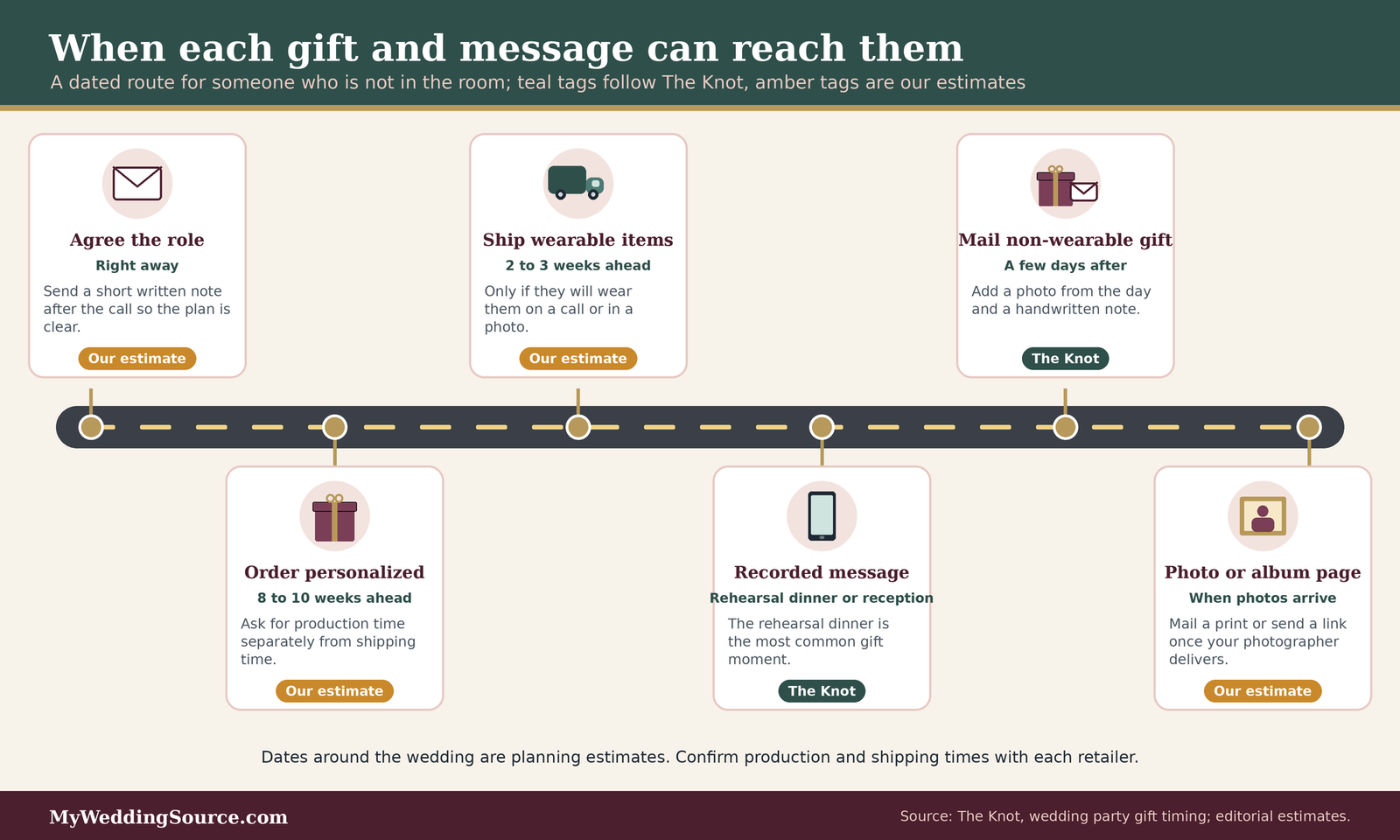
Build the gift distribution list
A gift distribution list for handling a wedding party member who cannot travel does one job: it matches each thing you intend to give with the moment and route that fits it. The Knot gives the in-person baseline, and we adapt it for someone who will receive their items by mail or through a helper.
The baseline from the in-person rules
The Knot says there are no strict rules for gift timing. Its guide to wedding party gifts calls the rehearsal dinner the most common moment and the morning of the wedding a good alternative, with items to be worn during the wedding suited to the getting-ready window and non-wearable gifts suited to the rehearsal dinner. Its guide to bridesmaid gift spending adds that proposal gifts are best given early, and that non-wearable gifts can wait until a few days after the wedding. That later window is the one that works best for someone who is not there.
The distribution list
Copy this table into your planning document and fill in the last column with a real name.
| Gift or gesture | In-person moment (The Knot) | Route for a person who cannot travel | Suggested timing (our estimate) | Owner |
|---|---|---|---|---|
| Handwritten thank-you note | With the gift, or privately | Mail or hand to a helper to deliver | Mail so it arrives in the week before the wedding | Couple |
| Proposal-style gift, if you still owe one | Earlier is better; most couples ask within two months of engagement | Ship to their address with a note | As soon as you know the plan | Couple |
| Wearable item (jewelry, robe, cufflinks) | Getting ready or rehearsal dinner | Ship only if they will wear it on a call or in a photo; otherwise choose something else | Two to three weeks before the wedding | Couple or maid of honor or best person |
| Non-wearable gift (gift card, self-care set, frame) | Rehearsal dinner, or a few days after | Ship after the wedding, with a photo from the day | Within two weeks after the wedding | Couple |
| Personalized item | Same as above, once made | Order early and confirm production time | Order eight to ten weeks ahead | Couple |
| Video or recorded message | Rehearsal dinner or reception | Send a file they can keep | Day of, plus a copy afterward | Videographer or friend |
| Photo or album page | After the wedding | Mail or send a link | When photos are delivered | Couple |
Customizing the list
Add rows for anything else you plan to give: a flower from the bouquet, a program, a favor, or a small keepsake. Keep the spending roughly even across attendants, as The Knot recommends. If a person is not receiving a wearable item, do not quietly give a smaller gift; replace it with something of similar value, or explain what you are doing.
Set the timing
A short timeline prevents a gift from arriving three weeks late or a note from arriving after the party. The timing below is our planning estimate, built around the two windows the Knot describes.
Before the wedding
Send the note as soon as the role is agreed, so the person knows you are thinking of them. If you plan a wearable item for a video moment, ship it two to three weeks before the wedding to leave time for a delay or a wrong size. For personalized items, ask the maker for the production time separately from shipping time and add a buffer.
Around the wedding
Aim for the rehearsal dinner or wedding morning for anything that should feel part of the day, such as a recorded message. If the person is joining a call, tell them the time and check any time zone difference. Our guide to wedding party gift delivery has a full cue sheet for people who are present.
After the wedding
Many people prefer to open gifts when they are not in a crowded room, and The Knot suggests non-wearable gifts a few days after the wedding. This window suits an absent member well. Mail the gift with a photo and a few lines about the day, and avoid making them feel they missed everything.
Spending, fairness, and what goes in the box
The gift is a thank-you for time, effort, and money, and The Knot says a gift can convey appreciation for the time, effort, and money each person gave.
Keep it even
The Knot’s guide says to keep gifts roughly even across attendants and notes that the maid of honor may warrant a bit more. A person who cannot travel still gave time, advice, and in many cases money for an outfit, a shower, or a gift. Do not lower the value of their gift because they will not be present. If you offered financial help, keep it separate from the gift so neither feels like a payment for the other.
The note matters most
Write the note by hand, name something specific the person did, and say what you wish they had been there to see. If you have a photograph from the day, add it. Our wedding thank-you cards guide has wording ideas, and our guides to bridesmaid gifts and groomsmen gifts can help you choose the gift itself.
Shipping safely and privately
Shipping a gift is simple until it fails, and it fails more often when the whole gift depends on the mail. A few checks reduce the chance.
Ask about the address and the recipient
Ask where the person wants a package sent and whether someone needs to sign for it. A person who is traveling, in a hospital, or caring for a family member may prefer a different address. Avoid posting the shipment details in a large group chat.
Check the retailer’s terms
Ask for the production and shipping times in writing, ask who pays for a wrong name or size, and ask for a gift receipt that omits prices. The FTC rule described earlier gives buyers a right to cancel if an order is not shipped on time, and a seller that makes a delivery promise should have a reasonable basis for it.
The wedding weekend without them
A missing attendant changes a few concrete things on the wedding weekend: who stands where, who is told what, and how the person is included in a way they actually want. Handling a wedding party member who cannot travel on the day itself is mostly a matter of telling the right people early and keeping the changes small.
Rehearsal, processional, and entrances
A calm rehearsal is easier when everyone knows who is not there and why that is fine, which is a large part of handling a wedding party member who cannot travel well.
Tell your planner and officiant early
The Knot advises telling a planner or day-of coordinator as soon as possible, particularly if the change happens weeks or days before the wedding, because the processional order and reception entrance may need small changes. If you do not have a planner, tell the officiant, the venue coordinator, and the person who will run the rehearsal. Our guides to the wedding rehearsal and who needs to attend a ceremony rehearsal can help you decide who is essential.
Rebalance the lineup
You can close the gap so the line looks evenly spaced, leave an uneven line, or reserve a symbolic spot. Inside Weddings says uneven wedding parties are common enough that the look is rarely an issue. If the party was paired in a certain way, rewrite the pairs so nobody is left to walk alone unless they would like to. Avoid assuming that pairs should be matched by gender; ask people how they would like to walk.

Photographs and the lineup
The Knot says wedding photos will look good regardless of party size, so you do not need to worry about the picture itself. What you may want is a way to keep the person present in the record of the day.
Update the photo list
Add the remote member to your list of shots where it makes sense, such as the group portrait “with” a framed photo or a phone held up for a short video moment, and remove them from the shots that depend on position. Share the list with your photographer in advance; our wedding photographer shot list guide covers how to build one.
Ask before you stage anything
A framed picture or a phone propped on a chair can feel touching to some people and uncomfortable to others. Ask the person before you create a visible stand-in, and let them say no. If they prefer privacy, a private photo of the group sent afterward may be better.
Livestream or recorded message
A live link can be part of handling a wedding party member who cannot travel, but the logistics are specific and the etiquette is careful.
What Zola says about livestreaming
Zola’s guide, last updated in February 2024, suggests assigning one person to shoot and stream, ideally a professional videographer but possibly a close friend, and asking the venue about wifi, recording policies, and any extra fee before you plan. It also suggests testing the stream by sharing it with someone away from the venue’s network, sending the link well ahead, and using the wedding website to share it. Zola says DIY is the most cost-effective option but carries a higher risk of failure.
Etiquette for the link
Zola advises not mentioning the livestream on invitations, because guests are expected to attend in person, and using the stream as a last resort for people who cannot attend because of extenuating circumstances. For a wedding party member, the same logic suggests offering the link privately, and asking whether they want to watch live, watch a recording, or neither. It is also kind to ask the other members whether they are comfortable being filmed.
Day-of communication
A person who is far away still has feelings on the day itself, and a little attention goes a long way.
Choose one person to be their contact
Name one person, perhaps the maid of honor, best person, or a sibling, who will send them a message at a few key moments. Weddingsonline.ie suggests small gestures such as updates, sneak peeks of décor, or a handwritten note to keep distant members emotionally included. That person should not need to carry the couple’s phone.
Plan the after-message
Send a photo and a short note the next morning, even if it is only a few words. The first photo from the day is often the moment a missed person feels connected again.
Edge cases that need their own plan
Not every case of handling a wedding party member who cannot travel fits the four paths. The cases below come up often enough to deserve their own thought. None of this is medical, legal, or financial advice; where a professional would be needed, we say so.
Health, pregnancy, and travel limits
When health is the reason for handling a wedding party member who cannot travel, the person’s own clinician is the right authority, not the couple.
Pregnancy and air travel
The Mayo Clinic says air travel before thirty-six weeks is generally considered safe for pregnant people without complications, but it advises talking with a health care provider first, and notes that some airlines restrict travel later in pregnancy or on international flights and may ask for a provider’s letter. It also says the second trimester is often the best time to fly. Do not use this to question someone’s decision: they may have conditions that make the usual rule not apply, and it is their choice to make.
Illness, recovery, and long-term conditions
If a person cannot travel because of an illness or recovery, build flexibility into the plan rather than asking for a prediction. A decision date, a remote role, and a backup for the day can all work together. If the condition is ongoing, ask what the person would like you to say to others and what they would prefer stay private.
Insurance and refundable plans
If the person can travel but may not be able to, a refundable plan or insurance may change the picture. The decision is theirs.
What travel insurance can and cannot do
The National Association of Insurance Commissioners says travel insurance often costs about four to ten percent of a trip’s price. Trip cancellation coverage generally reimburses prepaid costs when a covered reason such as illness or injury prevents travel. It also says pre-existing medical conditions may be excluded, that epidemics and pandemics are generally excluded, and that buying at the last minute may not cover a sudden event that has already started. It describes “cancel for any reason” coverage as an optional add-on that is more expensive and reimburses only part of the cost. Read the policy language, and keep any insurance conversation with the person’s own agent or insurer.
Whose cost is it
Bridal Guide says you are not required to pay attendants’ travel or lodging, and The Knot says wedding party members should expect to pay their own travel and accommodations at a destination wedding. If you want to help with a refundable fare or an insurance premium, say so plainly. Our wedding insurance guide covers coverage for the couple’s own plans.
When the person is a key role-holder
If the person was your maid of honor, best man, or other lead, handling a wedding party member who cannot travel is bigger than moving one name.
Redistribute the duties
List what the lead was to do, from planning showers and managing the group to holding rings or keeping the schedule, and assign each task to someone by name. Our guides to maid of honor duties and best man duties list the usual jobs.
Keep the toast possible
If the person was to give a speech, ask whether they would like to record it. The rehearsal dinner is a natural place to play it. Our wedding speeches guide has structure and timing ideas.
Last-minute changes
Handling a wedding party member who cannot travel can become urgent if you hear in the final weeks, or on the day.
Days or weeks before
The Knot says that when the wedding is only days, weeks, or a few months away, the better approach is generally to keep the group as it is. Tell the planner, adjust the lineup, and let the remaining members know. Avoid a scramble to find a replacement.
The morning of
If a person cannot make it because of an emergency, such as a flight cancellation or illness, treat it as a logistics problem for the coordinator. Tell the officiant and photographer, ask the party to line up in the usual way, and save conversations about disappointment for later.
Inclusive and non-gendered planning
Wedding parties include people of many genders, backgrounds, and abilities, and a plan for handling a wedding party member who cannot travel should not assume any of them.
Language and roles
Use “attendant” or “wedding party member” in group messages unless a person has asked for another term. Do not match attire or lineup positions by assumption; ask each person what they would like to wear and where they would like to stand. Our sibling guide on coordinating attire for a mixed-gender wedding party is in the same cluster.
Access and comfort
Sometimes handling a wedding party member who cannot travel turns out to be about access: venues, transportation, or lodging are not accessible to them. In that case, the right fix may be an accessible plan and not a remote role. Ask what would make attendance possible before you assume it is not.
Fairness, tone, and the rest of the party
The remaining attendants have their own feelings about a change, and a calm approach keeps the group intact. Good handling a wedding party member who cannot travel includes the people who remain.
Talking to the other attendants
The Knot recommends checking in with the rest of the party to confirm they still agree on costs and expectations and feel good about their roles.
Share only what is yours to share
Tell the group what role the person will keep, but let the person tell their own reasons. If the reason is private, say “they cannot travel and we have made a plan.” People are usually satisfied with that.
Redistribute work fairly
If tasks pass to others, list them and ask. Do not assume the local attendants have time or money to spare. Our wedding party coordination checklist and group chat rules can help you keep the work visible.
Announcements, social media, and tone
How the change is presented to the wider circle matters.
Keep the announcement brief
If guests ask, a short answer works: “They will be with us in spirit and they are helping from afar.” Do not share health, money, or family details on someone else’s behalf. If you have an online wedding party page or program, update it after the person has seen the update.
Keep the friendship ahead of the plan
The Knot says to remember that the reason is probably not about you, and Inside Weddings reminds couples that they are first a friend. Whatever path you choose, plan a time after the wedding to meet or call, so the person knows the relationship continues.
Questions to ask before you finalize
A few questions can prevent most of the mistakes in handling a wedding party member who cannot travel. They are grouped by who can answer them.
Who to ask and what to ask
Different people hold different pieces of the plan.
The person who cannot travel
The person knows what is realistic, what they would like, and what they would prefer to keep private. Ask what role feels good, what costs they are worried about, whether they want a video link, and where to send mail.
Your vendors and venue
Photographers, planners, officiants, and venues can adjust the day if they know early. The Knot says vendors can help make processional and entrance changes smoothly. Ask about wifi and recording policies if you plan a stream, as Zola recommends, and check our guide on vendor communication deadlines for timing.
Retailers and carriers
Retailers can tell you about returns, cancellations, and production time; carriers can tell you about delivery windows and signature rules. Get answers in writing and keep them with your notes.
Using the answers
A list of answers is only helpful if you turn it into dates.
Turn answers into a dated list
Add each decision to your planning document with a date and a name. If the answer is “we will know in six weeks,” put that date on the calendar and plan for both outcomes.
Revisit at a set point
Check in again at the date you chose and again about a month before the wedding. Many problems shrink when they are caught early. Our wedding planning checklist can anchor those check-ins.
Questions to ask
- The person: What part of the wedding would feel good to you, and what would feel like too much?
- The person: Is there a cost, a date, or a worry you would like me to know about?
- The person: Would you like a video link, a recorded message, a letter, or none of these?
- The person: Where should I send a package, and who can sign for it?
- The person: Is there anything you would prefer I not say to the rest of the group?
- Planner or officiant: How should the processional, pairs, and entrances change?
- Photographer: Which group photos need to change, and can you include a short video moment if the person wants one?
- Venue: What is the wifi situation, and are there recording or streaming rules or fees?
- Retailer: Can an order be canceled before production, what is the production time, and what are the return terms for custom items?
- Carrier or retailer: What is the delivery window, and is a signature required?
FAQ: handling a wedding party member who cannot travel
Deciding what to do
Should I replace a wedding party member who cannot travel?
Usually not unless there is a lot of time and you have a real reason. The Knot says to ask someone else only if they are truly special to you, and Inside Weddings says replacement more than six months out can work but is generally not advised closer in. A calm conversation and a remote role are often kinder.
Can someone stay in the wedding party if they cannot attend?
Yes, if both of you agree on what that means. They can keep the title, help with remote tasks, send a recorded message, and receive a gift and note. Be specific about what is lost and who covers it, and ask what the person wants before you announce anything to the group.
Do I have to pay for their travel?
No. Bridal Guide says you are not required to pay attendants’ travel or lodging, and The Knot says wedding party members typically pay their own at a destination wedding. If cost is the real obstacle and you can afford to help, offering privately and specifically, as a gift with no strings, can keep a friend in the party.
Gifts and attire
When should I give a gift to someone who cannot attend?
The Knot calls the rehearsal dinner the most common moment and suggests non-wearable gifts can wait until a few days after the wedding. For an absent member, mailing after the wedding with a photo and a note works well. Send the note earlier so they know you are thinking of them.
Should their gift be smaller or different?
No. The Knot says to keep gifts roughly even across attendants. Choose something that does not depend on being present, such as a non-wearable item, and keep any financial help separate. If you cannot give a wearable item as planned, replace it with something of similar value and a personal note.
What if they already ordered a dress or suit?
Ask the retailer about cancellation before production starts and check the return terms in writing. The Knot’s roundup shows custom dresses are often excluded from returns and one retailer refunds seventy-five percent on made-to-order returns within thirty days. Decide in advance who absorbs any loss, and do not charge the attendant.
Day-of logistics
How do I handle the processional with a missing member?
Tell your planner or officiant early and rebuild the pairs. The Knot says the processional order and reception entrance may need small changes and that photos look good regardless of party size. You can close the gap or leave an uneven line, and you can ask people how they would like to walk.
Can I livestream or record their part?
Yes, with planning. Zola suggests asking the venue about wifi and recording rules, assigning one person to stream, testing ahead, and not mentioning the livestream on invitations. For a wedding party member, ask whether they want to appear live, send a recording, or neither, and check that the others are comfortable.
Your next steps
Make the decision
Have the conversation
Handling a wedding party member who cannot travel is easier once the first call is made. Call the person, ask what is going on and what they would like, and offer two or three paths. Write the agreed role in one sentence and send it with a short note. Set a decision date if the situation might change.
Tell the people who need to know
Tell your planner, officiant, photographer, and the other attendants as soon as the plan is clear. Keep reasons private unless the person says otherwise. Our sibling guide on wedding party entrance logistics is coming soon in this cluster.
Build the plan
Fill in the distribution list
Copy the gift table into your planning document, fill in a real name for each owner, and add dates. Order anything personalized with extra time, and send the note early.
Check attire and messages
Confirm whether the person will wear the outfit, check retailer terms in writing, and plan who will message them on the day. Keep a short list of what you will say if something goes wrong, so a surprise does not become a crisis.
Sources & methodology
How we built this guide
What we relied on
This guide combines etiquette and planning advice from The Knot, Zola, Inside Weddings, Bridal Guide, WeddingWire, and a commercial wedding blog, with a federal rule on mail, internet, and telephone orders, a hospital’s guidance on air travel in pregnancy, and an insurance regulators’ consumer guide to travel insurance. We read each source in full on November 12, 2026. Retailer features, prices, and return terms come from The Knot’s May 2026 roundup and are the retailers’ own terms as reported there; they change, so confirm them yourself. The Knot’s destination-wedding cost guide is dated 2018. The gift timing and ordering windows in our distribution list, and the dress-return example in the cost box, are our own planning estimates and arithmetic, not survey results.
What we did not do
We did not interview wedding planners or test any retailer’s return process. The Knot’s public Real Weddings Study page, our primary reference, describes its 2025 survey of couples but does not show wedding party figures, so we did not use any statistics from it. We give no medical, legal, insurance, or financial advice. A person’s clinician, insurer, or attorney is the right source for those questions. Brand names appear only because the cited sources name them; nothing here is a product endorsement.
Source list
Etiquette and planning sources
- The Knot, Exactly What to Do When a Bridesmaid Drops Out of Your Wedding (updated July 7, 2022): https://www.theknot.com/content/what-to-do-when-a-bridesmaid-backs-out
- The Knot, How to Say No to Being a Bridesmaid: https://www.theknot.com/content/say-no-to-being-a-bridesmaid
- The Knot, When Do You Give Your Wedding Party Their Gifts? (updated June 9, 2023): https://www.theknot.com/content/when-to-give-thank-you-gifts
- The Knot, The Etiquette to Know on How Much to Spend on Bridesmaids Gifts (updated July 13, 2023): https://theknot.com/content/bridesmaid-gift-shopping-tips
- The Knot, Should You Pay for Your Guests to Travel to Your Destination Wedding? (updated November 30, 2018): https://www.theknot.com/content/destination-weddings-who-pays
- The Knot, Real Weddings Study (updated February 17, 2026): https://www.theknot.com/content/real-weddings-study
- Inside Weddings, What to Do When a Bridesmaid Drops Out of Your Wedding: https://www.insideweddings.com/news/planning-design/what-to-do-if-a-bridesmaid-drops-out-of-your-wedding/43161
- Inside Weddings, How to Tell Someone You Can’t Go to Their Wedding: https://www.insideweddings.com/news/planning-design/what-to-do-if-you-cant-make-your-friends-wedding/43802/
- Bridal Guide, Etiquette Q&A: Who Covers Travel Costs for an Out-of-Town Bridesmaid?: https://bridalguide.com/node/145324
- WeddingWire, 6 Roles You Can Give Loved Ones Not in the Wedding Party (September 17, 2019): https://www.weddingwire.com/wedding-ideas/wedding-roles-for-friends
- Weddingsonline.ie, Handling Long-Distance Bridesmaids or Groomsmen (commercial blog, no cited data): https://www.weddingsonline.ie/blog/handling-long-distance-bridesmaids-or-groomsmen-without-the-stress/
Attire, livestreaming, and rehearsal dinner sources
- The Knot, The Best Places to Buy Bridesmaid Dresses Online (updated May 29, 2026): https://www.theknot.com/content/bridesmaid-dresses-online
- Zola, What to Know About Live Streaming Your Wedding (updated February 5, 2024): https://www.zola.com/expert-advice/what-to-know-about-live-streaming-your-wedding
- Zola, Who to Invite to a Rehearsal Dinner (updated July 1, 2025): https://www.zola.com/expert-advice/wedding-planning-101/wedding-planning-questions/who-to-invite-to-a-rehearsal-dinner
Government, regulator, and health sources
- Federal Trade Commission, Business Guide to the FTC’s Mail, Internet, or Telephone Order Merchandise Rule: https://ftc.gov/business-guidance/resources/business-guide-ftcs-mail-internet-or-telephone-order-merchandise-rule
- National Association of Insurance Commissioners, Taking a Trip? Information About Travel Insurance You Should Know Before You Hit the Road (March 10, 2020): https://content.naic.org/article/consumer-insight-taking-trip-information-about-travel-insurance-you-should-know-you-hit-road
- Mayo Clinic, Air travel during pregnancy: Is it safe?: https://www.mayoclinic.org/healthy-lifestyle/pregnancy-week-by-week/expert-answers/pregnancy/faq-20058087
Disclosure
If that changes, we will say so here.