

Choosing between a private proposal vs public proposal is less a question about venues and more a question about your partner: how they feel about being watched, filmed, congratulated by strangers, and caught off guard, and what they would want to be able to tell people afterward.
Quick answer
There is no better option in the abstract. In The Knot’s 2024 survey of couples, 53% of proposals were private and 39% were in a public place, so both are common, and the survey cannot tell you which one your partner would choose. For a private proposal vs public proposal decision, read your partner’s real preferences first (we give you a ten-cue worksheet below), settle four privacy boundaries (who knows, who watches, who records, who posts), and then pick the format on a five-step spectrum. If you are unsure, choose the more private format, because a quiet moment can be shared later while a public one cannot be taken back. Public places still need homework: park permits, ballpark policies, and drone rules vary, and the pages we read cover weddings and events, not proposals, so call the managing office before you commit.
Why a private proposal vs public proposal is about your partner
Most advice about a private proposal vs public proposal starts with the setting: a beach, a restaurant, a stadium, a mountain. The setting is the last thing to choose. The first thing is a clear picture of the person who will say yes, and that picture is usually more detailed than people expect once they write it down.
The private proposal vs public proposal question hides three smaller questions
When someone weighs a private proposal vs public proposal, they often bundle together things that can be separated. Pulling them apart is the quickest way to find a format that fits.
Who is physically present
This is the plainest meaning of the private proposal vs public proposal split: whether anyone besides the two of you can see the moment. A proposal on a quiet trail with no one else around is private in this sense. A proposal on a crowded boardwalk is not, even if nobody stops walking.
Who is recording or photographing
A moment can be private in the sense that only two people are there and still be photographed by a hired professional standing a hundred feet away. A moment can also be public in the sense that strangers are nearby and not be recorded at all. Photography and presence are separate dials, and many couples are comfortable with one and not the other.
Who finds out, and when
Some people love a proposal that stays between the two of you for a day or two before anyone is told. Others want family on a video call within the hour. The timing of the news is a third dial, and it does not depend on where you stand when you ask.
Surprise and audience are different dials
In a private proposal vs public proposal debate, people often merge “surprise” with “public.” A proposal can be a complete surprise and entirely private, and a proposal can be public with the partner fully expecting it. In the same Knot survey, 83% of people who were proposed to considered it a surprise, and more than half of those knew a proposal was coming soon without knowing exactly when. In other words, surprise in practice is often about timing, not about whether a proposal is coming.
Timing surprise without an audience
If your partner would enjoy not knowing the day, you can keep that part and still choose a private setting. A weekend away or a regular Sunday walk can carry the surprise of timing with no spectators.
Audience without surprise
If your partner would love an audience but dislikes surprises, the reverse works: you can talk openly about the idea of a proposal in the coming months, and still let the details of the day be a surprise to everyone but you.
The preference conversation you may already have had
Couples who are close to engagement have usually dropped hints about how they want to be celebrated, even if they never meant them as hints. You can mine that history instead of asking directly.
Reread how your partner reacts to other people’s moments
Think about the last few times a friend or relative was celebrated: a surprise party, a toast, a birthday song in a restaurant, an engagement announcement posted online. Did your partner light up, laugh and join in, or quietly look for the door? Reactions to other people’s attention are a more honest guide than a hypothetical answer to “would you want a public proposal?”
Use hypothetical questions that sound like gossip
Asking “how would you feel about a proposal on a stadium screen” can feel like a trap. Asking, in passing, what you thought of a viral proposal video a friend shared, or how you felt at a cousin’s surprise engagement, gets honest reactions without announcing your plan. If you have already talked about getting engaged and want to talk openly about it, our proposal ideas guide walks through ways to match a moment to personality and logistics.
What the numbers tell you, and what they cannot
Survey figures on a private proposal vs public proposal are useful for one thing: they show that neither format is unusual. They are not a vote on which one your partner would pick. It helps to look at what the surveys we found actually measured.

What The Knot reported
The Knot’s article on proposal myths, dated December 10, 2024, draws on its 2024 Jewelry and Engagement Study, which it describes as covering more than 7,800 U.S. couples. It reports that 53% of proposals were private with only the couple present and 39% took place in a public place. It also reports that about 83% of proposers prepared ahead of time while 13% described the moment as spontaneous. It says about one in five proposers (20%) hired a photographer without telling their partner.
The location split
The two location figures add up to 92%, which leaves about 8% that the article does not categorize (this is our arithmetic, and the missing share may reflect a “somewhere in between” answer or simply rounding). Treat the split as roughly even odds that a proposal is private versus public, with private ahead.
A caution about conflicting figures
The same article gives two different figures for proposals in front of friends and family, 28% in one place and 5% in another. We did not use either figure for that reason. If you read this study elsewhere, check which number a writer is quoting before repeating it.
What older and broader data add
The Knot’s 2019 Jewelry and Engagement Study release reported that 51% of proposals were private, with 21% at the proposer’s home and 18% at a place significant to the couple, and that proposers spent an average of three months planning. These are different surveys from different years, so we are not claiming a trend. They do suggest that the private majority is not new.
What the 2019 release adds
It also reported that one in ten couples had a professional photographer capture the proposal, which, next to the 2024 figure of one in five, hints that hired photography has grown. We cannot say that definitively because the two figures come from different studies with different wording, so treat the comparison as a prompt for your own questions rather than a conclusion.
Who answers these surveys
The Knot’s 2026 Real Weddings Study release describes its sample as self-reported U.S. couples who married in 2025 and who were invited by email through Knot and WeddingWire membership. Members of a wedding-planning site are not a random sample of everyone who gets engaged, and the 2024 article we read does not describe how respondents were recruited. These are indications, not measurements of the whole country.
Why the averages should not settle a private proposal vs public proposal choice
Even a perfect survey of every private proposal vs public proposal would tell you only what other couples did. It would not tell you what your partner would prefer. A person’s comfort with public attention is one of the most individual traits there is.
Majorities are made of individuals
If more than half of proposals are private, nearly four in ten are not, and in any group of friends you will hear both stories told warmly. Neither group made a mistake. They fit the format to the person.
Regret is lopsided
If you choose a private setting and your partner would have loved an audience, you can recreate the audience after the fact with a dinner or a party, as our engagement party planning guide describes. If you choose a public setting and your partner would have hated it, the moment has already happened with strangers watching. This asymmetry is the main reason we suggest leaning private when you are unsure.
Five formats on one spectrum
It helps to stop thinking of a private proposal vs public proposal as two boxes and to see a spectrum with five steps. Each step adds people who can see or record the moment, and each step makes it a little harder to stop gracefully if your partner is uncomfortable. The five steps below are our own framework for planning, not an industry standard.
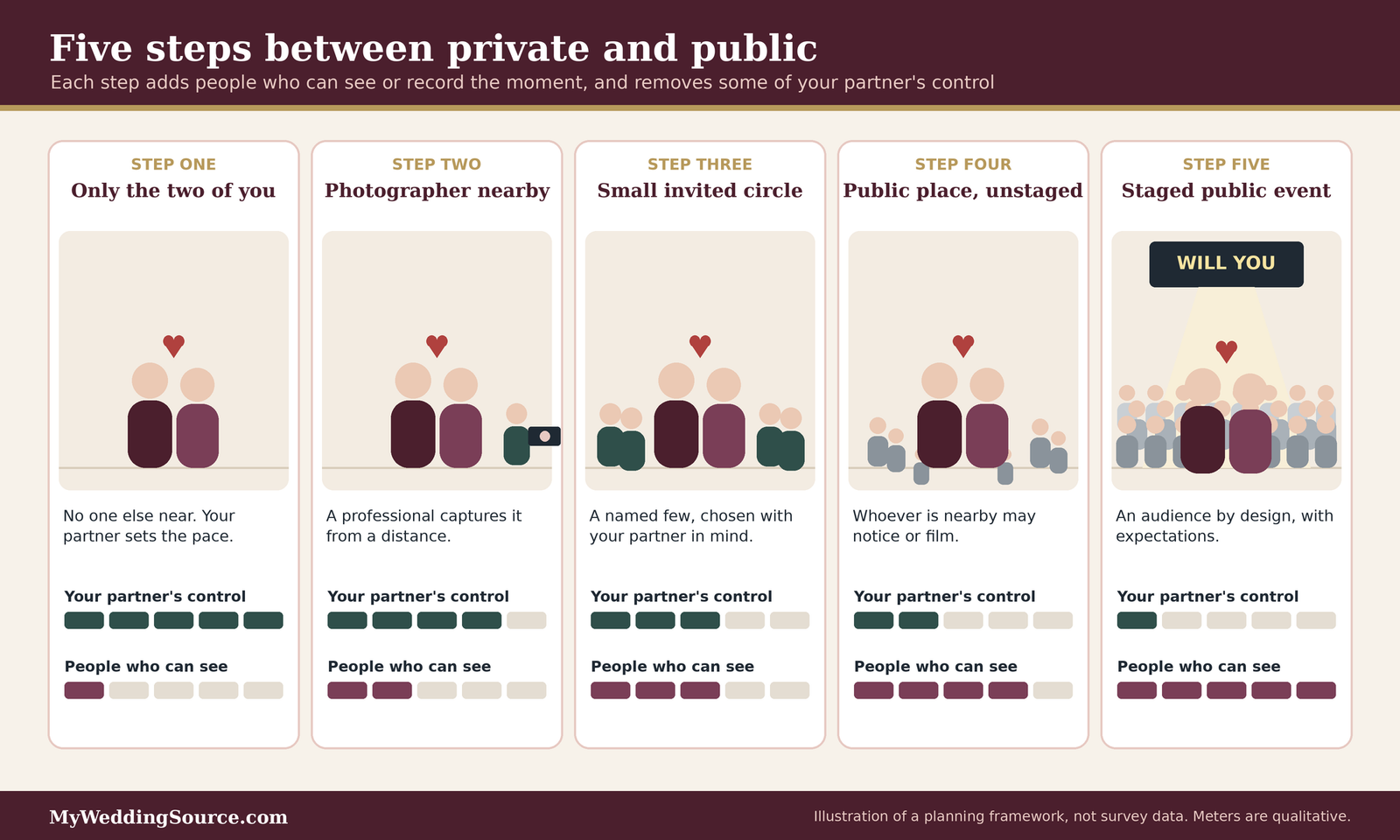
Step one: only the two of you
This is the classic private proposal format: a quiet room, a trail, a porch, a car parked at a view. No one is nearby, and nothing about the moment depends on a third party showing up on time.
What it does well
It gives your partner full control over their reaction. They can laugh, cry, say no, say “not yet,” or ask for a minute without a single person watching. It is the easiest format to adapt if the weather changes, because you only have to move yourselves. If you want to keep a record, a timer on a phone propped against a rock works, though you should decide with your partner afterward whether the video stays.
What it asks of you
Because no one else is there, you carry every detail: the ring, the words, the backup plan. It also leaves no outside photography unless you arrange it. If photos matter, plan how you will capture them, perhaps with a session scheduled shortly afterward rather than during.
Step two: private moment with a photographer nearby
Here the two of you are alone in the sense that matters, but a professional is close enough to capture the moment. The photographer may be hidden, posing as a tourist, or introduced beforehand.
How hidden photography works
Flytographer, a vacation photography service, describes three approaches on its New York proposal page: a photographer who pretends to be a tourist offering to take your photo, a version where you tell your partner you booked an ordinary couple’s shoot, and one where the photographer stays hidden entirely. The company itself calls the hidden version the riskiest, because passersby can interrupt the shot. That is the company’s characterization of its own service, and it is worth remembering that the more hidden the photographer, the less control you have over a stranger wandering through the frame.
Where this step can slip into step four
In a popular public location, even a private moment can attract onlookers. If you choose a famous overlook or a busy plaza, you are choosing step four whether you meant to or not. Ask your photographer how they handle crowds and whether they will step in if onlookers gather.
Step three: a small circle of invited witnesses
This is the proposal where family or close friends are present, either openly or hidden nearby to celebrate right after the yes.
Who belongs in the circle
Keep it to people your partner would be glad to see in that moment: usually people they would invite to a small dinner. Avoid adding people because you feel obliged, such as a relative whose presence would create tension. A short list is easier to keep calm and easier to coordinate.
How to protect the moment
Agree on a rule: nobody emerges, speaks, or films until the question is answered and you give a sign. Decide in advance who stays out of sight and what happens if the answer is not an immediate yes. A small circle can be generous, or it can feel like pressure, and the difference is how well you have read your partner.
Step four: a public place, no staging
You propose somewhere open to everyone, such as a park bench, a restaurant table, or a viewpoint, without arranging for any audience. Strangers may notice or not.
The honest middle
Many people who say “public proposal” mean this step. It feels spontaneous and can be low-key: a few nearby people may smile and move on. It is more exposed than steps one through three, and you cannot control who is nearby or whether someone starts filming.
What to settle first
Check whether the location has rules about gatherings, equipment, or amplified sound, and pick a time of day when the place is quiet. Our wedding permits guide explains how permit logic works for weddings, and the same questions apply, though the specifics for proposals may differ.
Step five: a staged public proposal event
This is the high-visibility end: a message on a scoreboard, a coordinated surprise at a restaurant or event, an audience arranged on purpose.
Why it needs the most caution
Everything in step four applies, plus the pressure of an audience that expects a certain answer. The person who is proposed to may feel they must say yes in front of everyone, which can make a private “I need to think” difficult. If you are choosing this step, you should have unusually strong evidence, from the worksheet below and from conversations, that your partner would welcome it.
What policies can change
Venues change their rules. SeatGeek’s July 2026 survey of Major League Baseball proposal options found wide differences in what teams offer, with some clubs not offering proposal options at all. You should confirm any arrangement directly with the organization and in writing.
A preference-based choice matrix for your partner
This section is the working tool for any private proposal vs public proposal decision. It turns a vague sense of “my partner is private” or “my partner loves a crowd” into ten observable cues, a rough score, and a match to the five steps above. It is our own planning framework, built from common sense about attention and consent, and it has not been tested as a research instrument. Use it to organize your thinking, not to replace paying attention to the person you know.
Ten cues to read before you choose
For each cue, give your partner a score from 0 to 2 based on what you have actually seen, not what you hope. A 0 means the behavior leans private, a 1 means it could go either way, and a 2 means it leans toward welcoming an audience.
Cues about attention
- At a restaurant, when the staff brings out a birthday dessert and sings, does your partner dread it (0), tolerate it (1), or enjoy it (2)?
- When a camera is pointed at them in a group, do they step aside (0), pose briefly (1), or lean in (2)?
- If a stranger congratulates them on something personal, do they deflect (0), say thanks and move on (1), or start a conversation (2)?
- Have they ever asked you not to post something about them, or to wait before you do (0), have no strong feelings (1), or often ask you to share (2)?
Cues about people and news
- When there is big news, do they want to tell one or two people first (0), a handful (1), or everyone at once (2)?
- Do they prefer to process emotions alone first (0), with you (1), or with others around (2)?
- How would they feel if their parents or a sibling were present for the question: uncomfortable (0), fine (1), delighted (2)?
Cues about surprise and control
- Do they like surprises in general: they dislike them (0), mixed (1), or love them (2)?
- When plans change, do they need time to adjust (0), adjust reasonably (1), or enjoy the improvisation (2)?
- Have they said, even jokingly, what a proposal should or should not look like? Count a stated preference for privacy as 0, no stated preference as 1, and a stated preference for something big as 2.
Score the cues and match a step
Add the ten scores for a total from 0 to 20. The ranges below are a rough guide. They are not cut-offs, and a single strong signal can outweigh the total.
What the total suggests
A total of 0 to 5 points to step one or step two. A total of 6 to 9 fits step two or step three, with a very short guest list. A total of 10 to 13 fits step three or a quiet version of step four. A total of 14 to 17 can support step four, and a total of 18 to 20 is the range in which step five may be worth considering, but only with a conversation or two behind it.
Three vetoes that override the total
Whatever the total, treat these as vetoes for any step above step two. First, your partner has said clearly that they do not want to be filmed or watched during personal moments. Second, your partner is dealing with anxiety around being observed or has avoided attention-heavy situations. The National Institute of Mental Health describes social anxiety disorder as an intense fear of being scrutinized or judged, and it is a medical question that only a health care provider can assess, so we are not suggesting you diagnose anything. We are saying that if you already know your partner finds attention painful, the audience should be zero. Third, the people you would invite are in conflict with each other in a way that could take over the moment.
The private proposal vs public proposal matrix itself
The table lays out the five steps against the questions that tend to matter. “Control” means how easily your partner can slow down, ask for a minute, or move the moment somewhere else.
| Step | Who can see it | Control for your partner | Recording | Planning load | Best fit when |
|---|---|---|---|---|---|
| One: only the two of you | No one | Highest | Only what you arrange | Low to moderate | Your partner is private or you are unsure |
| Two: photographer nearby | A professional, perhaps strangers | High | Professional, agreed in advance | Moderate | Your partner wants photos but not witnesses |
| Three: small invited circle | Chosen family or friends | Moderate | Likely by guests | Moderate to high | Your partner wants loved ones, not strangers |
| Four: public place, unstaged | Whoever is nearby | Moderate to low | Strangers may film | Moderate | Your partner is relaxed in public and likes being out |
| Five: staged public event | An audience, by design | Lowest | Often by organizers and crowd | High | Your partner has clearly said they would love it |
How to read the matrix
When a private proposal vs public proposal choice is close, move left if you are uncertain, since each step to the right removes some of your partner’s ability to shape the moment. Move right only when your evidence is specific, such as your partner explicitly telling you about a public proposal they loved.
When the answer is “between steps”
Many good plans sit between steps. A proposal in step one followed by dinner with close family is a step-one proposal with a step-three celebration. A hidden photographer who works a quiet shoreline is a step two. The matrix is for noticing which dial you are turning, not for forcing a label.
When you and your partner would score differently
Sometimes the score from your cues and your own wishes for a private proposal vs public proposal point in opposite directions. You may want a big, joyful moment, and your partner’s cues are low.
Put your partner’s comfort first
The proposal is a question for them. A moment designed around the proposer’s wish for spectacle can make the answer feel less free. If you want a bigger celebration, build it into the engagement party afterward. Our engagement party guide covers how to do that.
Honor your own preference in small ways
Private does not have to mean plain. Choose a place that matters to you both, write your own words, and ask a trusted friend to be ready with a toast that evening. The quiet format keeps your partner comfortable and still carries meaning.
Four privacy boundaries for a private proposal vs public proposal
Once you have picked a side of the private proposal vs public proposal question, the next job is to decide on four boundaries. Each one answers a question that someone else will ask you, often in the minutes after the yes, when you are least able to think clearly.
Who knows beforehand
The more people who know, the more likely your partner hears early, and the more ways the plan can leak.
Choose a short list and say what you asked of them
Tell as few people as the plan requires: whoever is coordinating the photographer, anyone who needs to be in place, and perhaps one trusted person who can handle an emergency. Ask each person plainly to keep it off group chats and social media, and tell them what to say if your partner asks questions.
Plan for a leak
Decide in advance what you will do if your partner learns something. A calm “I am planning something and I would like it to stay a surprise” can protect the day better than elaborate cover stories.
Who watches
This is the question of how many people are within sight at the moment, and it is the heart of a private proposal vs public proposal choice.
Match the list to the step
At step one, the answer is no one. At step three, it is a named list. At step four, you cannot control it, so choose the place and time with that in mind. Our wedding etiquette guide covers the broader question of who should be part of couple moments.
Decide on a signal
Agree on how you will end the moment if it is not going well, whether you pause, move to another spot, or tell guests to hold back. A code word or gesture shared with a friend can help the moment end gracefully.
Who records
Recording is a separate decision from watching, and it carries legal and personal considerations.
Two kinds of record
There is the footage you plan, such as a photographer’s images or a video you place, and there is the footage you do not control, such as a bystander’s phone. You can plan for the first. For the second, you can only choose a location and time that make it less likely.
Recording audio is different from taking photos
Laws on recording conversations vary by state. Justia’s national survey describes federal law as one-party consent and lists about fifteen states as clearly or potentially requiring consent from all parties under some or all circumstances, including California, Florida, Illinois, Maryland, Massachusetts, Pennsylvania, and Washington. It adds that rules often depend on whether people have a reasonable expectation of privacy, and that the page is a general survey rather than current legal advice. We are not lawyers. The practical takeaway is simple: if you plan to hide a microphone, or you are proposing in a different state from the one you live in, check with a professional and consider asking everyone present for consent.
Who posts
This is the boundary people forget until they are holding their phones.
Decide when the news goes out
Agree with your partner, ideally before you propose or right afterward, when you will tell family, when you will post, and whether you will post at all. Some people want to call their parents first; some want a week to themselves. Our engagement announcement guide covers wording, timing, and photos.
Ask guests and vendors before the day
If a circle of friends or family is present, ask them to hold posts until you say so. If a photographer is hired, ask who owns the images and what you may share. Flytographer’s New York proposal page, for example, says you can download and share your photos, while its footer states that photos are subject to copyright and may not be used without written consent from the company. Those two statements are not reconciled on the page, so it is a reminder to read the terms before you post.
Public places: permits, policies, and lead times
If your private proposal vs public proposal choice lands on step four or five, the place itself has rules. A useful discipline is to separate what you have confirmed from what you are assuming. The official pages we read describe permits for weddings, ceremonies, and events; none of the ones we read addressed proposals directly, so the honest answer for any given spot is to ask the people who manage it.
National parks
Park rules vary by site, and each park publishes its own page. Two examples show the range.
What two parks say about ceremonies
Glacier National Park’s page says a Special Use Permit is required for wedding ceremonies and vow exchanges, that ceremonies are limited to two hours including setup and wrap-up, and that they are not private, so other visitors can stay in the area. It lists a $125 non-refundable application fee, recommends applying at least four weeks ahead, and says processing may take several months. Yellowstone’s page says a Special Use Permit must be requested at least 10 business days in advance for weddings and similar ceremonies, with group-size limits by location that range from 5 people in Lamar Valley to 250 at Mammoth Chapel.
What the pages did not say
Neither page mentions proposals, and Yellowstone’s page itself says it is unclear whether they need a permit and directs people to contact the park. A one-to-one moment may sit outside a permit, but a group, equipment, a hired photographer, or decorations may not. Call or email the park, describe your plan in plain words, and keep their answer. If you are building a longer trip around the moment, our guide on planning a proposal while traveling and our guide to proposal location permissions go deeper on the logistics.
City parks
City parks offices often have a group-size threshold and an equipment rule.
New York City Parks as an example
New York City Parks’ special events page says a permit is required for events of 20 or more people, that a permit may still be worth getting for a smaller group if you want to reserve a particular spot or bring canopies or tables, and that a permit does not guarantee exclusive use of an area. It says amplified sound requires both Parks approval and an NYPD sound permit, that the sound permit costs $45, and that Parks processing takes about 21 to 30 days with a $25 non-refundable fee. It does not address proposals, and it tells people to contact their borough permit office.
What to take from it
The pattern, rather than the specific numbers, is what travels: small groups are often fine, equipment and amplified sound are where permits start, and processing takes weeks. A different city will have different rules, so look for the parks department’s events or permits page and call the number listed.

Ballparks and venues
A scoreboard message is the best-known staged public format, and its policies are rarely uniform.
What one team says
The Arizona Diamondbacks’ scoreboard messages page lists a $100 donation, shows the message at the end of the fourth inning, asks for submission at least 24 hours before the game, caps messages at 100 characters, and says the team does not offer marriage proposals through scoreboard messages. It also says the team may edit or decline any message and that visibility varies by seat. This is one team’s policy as we read it in November 2026, and policies can change.
What the league-wide picture looks like
SeatGeek’s July 2026 survey of Major League Baseball proposal options reported a price range from $25 for a scoreboard message at one ballpark to $2,500 for an in-game proposal at another, found that cheaper options are usually just a message on a board without photography or flowers, and noted that some teams do not offer proposal options at all. It advised confirming the time window, requirements, and inclusions directly with the club. If you want a ballpark proposal, call the team’s guest services and ask what is offered for the dates you want, in writing.
Drones and other equipment
Aerial photography and amplified sound are the two items most likely to turn a casual moment into something regulated.
Drones
The Federal Aviation Administration’s recreational flyer page says drones weighing 250 grams or more must be registered, that recreational flyers must pass the free TRUST test, and that flying in controlled airspace near airports needs prior FAA authorization. Glacier’s wedding page says drones are prohibited there. Many parks, venues, and cities add their own limits, so assume you cannot fly a drone at a public place until the managing office says you can. A hired professional should know the rules, but you can ask them about registration and permission.
Other equipment
Tables, arches, balloons, confetti, amplified sound, and catered food are all items that Glacier’s page lists as prohibited for ceremonies, and the NYC page flags tables, canopies, and amplified sound. A blanket, a bouquet, and a small speaker may be fine in one place and not in another. If your plan includes props, ask about each one by name.
Photographers, video, and consent in a private proposal vs public proposal
In a private proposal vs public proposal plan, photos are often the thing couples are happiest about afterward and the thing that most complicates the choice. A little planning keeps a private proposal vs public proposal moment about the two of you.
Hiring a photographer for a proposal
A photographer is a vendor, and a good one will ask you about your partner as much as about the shot.
What to ask in the first conversation
Ask how they handle crowds, how close they plan to stay, whether they have worked at your location, and how they will recognize the moment. Ask whether you can see a sample from a proposal, not just a wedding. For a general view of how photographers work and what to look for in a contract, see our wedding photography guide.
What the work costs
Prices vary by city and photographer. As one data point, Flytographer’s New York proposal page lists packages from $425 for 30 minutes and 20 photos to $815 for two hours and 65 photos. That is one company’s published pricing at the time we looked and not a market average. Local independent photographers may price differently, and some include a follow-up engagement session.
Hidden or introduced
A hidden photographer protects surprise but introduces a person your partner has not met.
The case for a hidden photographer
If your partner likes surprise and is relaxed about photos, a hidden photographer captures an unguarded moment. Plan how they will be introduced afterward, so the first thing your partner sees is not a stranger with a camera.
The case for an introduced photographer
If your partner is private or uneasy about being photographed, introduce the photographer in advance as part of an engagement or couple’s session, then schedule the proposal during it. This removes the awkward reveal and lets your partner opt out of the shoot without learning why. It is a gentler version of the vacation-cover approach Flytographer describes, and it works best when your partner is truly comfortable being photographed. If your partner would be upset to discover that a shoot was a cover, choose a different approach.
Strangers’ phones and recording laws
You can hire a photographer, but you cannot hire the people nearby out of the frame.
What you can and cannot control
You can pick a quiet place and time and let your photographer know how to respond if people gather. You cannot stop a stranger from posting a photo taken in a public place, and the rules around recording conversations are separate from rules about photographs. If your partner would be upset to see the moment online, that is a reason to prefer step one or two.
Do not record people who have not agreed
If you plan to have friends or family present and filming, tell them. Do not place hidden cameras or microphones around a location where other people may be recorded without their knowledge. As the Justia survey notes, rules on recording conversations vary by state and can carry penalties, and consent rules are strictest for audio. When in doubt, ask for consent, and consult a lawyer for questions specific to your situation. We are not giving legal advice.
Who owns the pictures and what you may post
Photographs have owners, and the owner may not be you.
Read the delivery terms
Ask whether you receive a download license, whether you may print and post, and how long the gallery stays online. Flytographer’s page, for example, says its gallery arrives within five days and that you can download and share the photos, while its footer says photos may not be used without written consent. Get the answer in writing so that there are no surprises.
Decide what stays private
You do not have to post the proposal. Some couples keep it off social media entirely and share one photo with family. Agree with your partner on what is shared, and let the photographer know if any images should be kept off their portfolio.
What each format tends to cost
Money matters in a private proposal vs public proposal choice mostly because public formats add fees and deposits while private formats shift the cost to travel or a nice dinner. Costs below are examples drawn from the pages we read, not averages.
What this actually costs
A private proposal vs public proposal comparison starts with this: a private proposal can cost nothing beyond the ring and a good evening. Public formats add fees that are set by someone else. From the pages we read: a Glacier ceremony permit has a $125 application fee plus park entrance fees; a New York City Parks permit has a $25 processing fee; one ballpark’s scoreboard message is a $100 donation; ballpark proposal options in SeatGeek’s July 2026 survey ran from $25 to $2,500; and one photography company’s New York proposal packages run from $425 to $815. These are prices at the time we checked and may change.
Where the money usually goes
Costs fall into a few buckets, and it helps to name them before you start.
Fees set by others
Permits, application fees, ballpark packages, and venue minimums are fixed by the organization. Ask for the total, including taxes, tickets, and any deposit, and ask what happens if weather or a schedule change forces you to move.
Costs you control
Photography, flowers, a meal, travel, and a place to stay are the costs you can flex. A simple, meaningful private moment can be as personal as an elaborate public one. If you are comparing the cost of a proposal with other early expenses, our wedding budget guide can help you place it in context, and our engagement ring guide covers the largest early purchase.
Protecting what you spend
Before you pay a deposit, check what you can recover.
Ask about cancellations and weather
The Diamondbacks’ page, for example, says confirmed paid messages are refunded if the game is not played or does not reach the end of the fourth inning. Other organizations differ, so ask about refunds, rescheduling, and rain dates in writing.
Keep it proportionate
A proposal is a moment, and the cost is not the measure of its meaning. If a plan requires deposits you cannot afford to lose, simplify it. A well-chosen private step one often feels more personal than a more expensive public one.
Edge cases that change the answer
The choice between a private proposal vs public proposal gets harder in situations the simple versions of this question skip. These are the ones we think deserve a pause.
When your partner finds a public proposal hard
In a private proposal vs public proposal decision, some people are not shy so much as strongly uncomfortable under observation.
Make the audience zero
If you know your partner avoids attention-heavy situations, choose step one and make the entire experience low-pressure: familiar place, no timeline, no surprise audience. The NIMH page on social anxiety describes the core of the condition as an intense fear of being scrutinized or judged, and notes that people may worry for weeks before an event, so a quiet format also spares your partner anticipation. If you are unsure whether this describes your partner, a calm conversation about how they feel in the spotlight is a kinder test than a hypothetical proposal.
Offer a way to celebrate that is theirs
If the day is private, offer to let your partner decide how and when to tell people. A phone call from the car, a small dinner next weekend, or a handwritten note to a parent can feel safer than a surprise party.
When your partner is publicly visible
If your partner has a public role and you are weighing a private proposal vs public proposal, such as a local business owner, a teacher in a small town, or someone with a large online following, a public place has different stakes.
Consider who might recognize you
Recognition changes a public moment from a few strangers to a possible crowd, and a filmed moment can be shared with an audience your partner did not choose. Choose a quiet time, a quieter location, or step one.
Agree on what happens to the footage
If you want a photographer, discuss whether any images can appear on their portfolio or social accounts. If your partner has a professional reputation to manage, they may want to approve anything before it goes out.
When surprise itself is the problem
Some people dislike surprises for good reasons: a past hurt, a need for control, or simply how they handle big news.
Replace the surprise with a shared date
If your partner would be uncomfortable with a surprise, talk about proposing in terms of timing without scripting the details. You might tell them that you intend to propose within a certain season, and plan the moment together or let them know the setting without the day.
Keep the romance, lose the ambush
A proposal does not have to be a trap. A walk at a place that matters, a quiet question, and a plan to celebrate afterward can be warm without being a shock.
When families expect a say in a private proposal vs public proposal
In some families, an engagement is a family event, and asking privately may feel like skipping a step.
Talk with your partner, not around them
If you suspect your partner’s family expects involvement, ask your partner what feels right rather than guessing. Many people want a private question followed quickly by a family gathering, which is a step-one proposal with a step-three celebration.
Plan the first calls
Decide which relatives hear first and how. If both families have expectations that differ, a joint celebration may be the answer. Our guide to the engagement party discusses ways to bring people together.
When travel or access changes the plan
Trips and public places add access considerations that private homes do not.
Check access for everyone
If your partner or a guest uses a wheelchair, has limited stamina, or needs seating, choose a place that works for them. The National Park Service says each park’s website describes its accessible features, so check the specific park rather than assuming. A proposal at a viewpoint that requires a long walk may exclude the very people you want present.
Weather and time of day
Heat, cold, storms, and crowds change a public moment more than a private one. Have an indoor or covered backup within a short walk, and decide in advance what triggers the switch.
What if the moment does not go to plan
Even a careful private proposal vs public proposal plan can be interrupted. Thinking through the possibilities in advance means you will not improvise under pressure.
If the answer is not an immediate yes
An answer of “I need a moment” or “not yet” is a legitimate response, and the format determines how easy it is to honor.
Step one makes room
In a private setting you can sit down, talk, and revisit the conversation later. No one is waiting for a reaction, and your partner can say what they feel in their own words.
Public formats leave less room
If you have an audience, you may need to end the moment gently, for example by saying “let’s take a walk.” Tell friends and vendors in advance that you may pause and what you will say. Be prepared that your partner might not welcome a large celebration afterward. A public format makes this conversation harder, which is another reason to match the format to evidence.
If onlookers or recording appear
In public, you do not control who is nearby.
Move without drama
If onlookers gather and your partner is uncomfortable, you can move to a quieter spot. Agree on a gesture or a phrase so that you can leave the moment without explaining.
Ask politely, then let it go
If someone is filming, you can ask them not to post it, and some will agree. You cannot require it in a public place. This is why partners who would be upset by public sharing usually do better with step one or two.
After the yes
The first hours matter for how the whole thing is remembered.
Take some time for the two of you
Even with a hired photographer or a waiting circle of friends, set aside a few minutes before the phones come out. People often say afterward that they wish they had kept the first hour to themselves.
Then decide how to celebrate
Use your boundaries: who hears first, who is told in person, and whether to post. For ideas about the weeks after, see our proposal and engagement party planning guide, and for engagement photos with a calmer pace, our engagement photos guide. When you begin planning the wedding itself, our wedding planning checklist is the place to start, and our wedding planning stress guide can help if the new to-do list feels heavy.
Questions to ask before you commit
Whichever side of the private proposal vs public proposal question you choose, you will be dealing with a place, a vendor, or both. These questions work for most situations and give you something concrete to bring to a phone call.
Questions for the place
The managing office of a park, venue, or ballpark has the final word on what is allowed.
Rules and permissions
Ask what is allowed, in plain words, rather than asking only whether a permit is needed. Describe the number of people, whether a photographer will be present, and what you plan to bring. Write down who answered and when.
Timing and backup
Ask about quiet times, closures, weather policies, and how far ahead any approval must be requested. Ask whether the answer applies to the date you want.
Questions for vendors and helpers
A photographer, planner, or helper shares your plan and should be a calm presence.
Questions to ask before you book or confide
- How will you stay out of the way, and what will you do if strangers gather?
- Who owns the images, what may I post and print, and for how long is the gallery online?
- Can images from this session appear in your portfolio or social accounts, and can I decline?
- What happens if weather, illness, or a permit decision forces a change of date or location?
- What is the total cost, including taxes, deposits, and cancellation terms?
- Who else knows about the plan, and what will they say if my partner asks?
- If my partner asks for a pause, how will we end the moment gracefully?
- Are there rules about drones, amplified sound, props, or group size at this location?
Questions for helpers and guests
Ask friends and family to hold posts until you say so, to stay out of sight until you give the sign, and to follow your lead if your partner needs a pause. A clear brief is a gift to them as well.
Questions for yourself
Before settling a private proposal vs public proposal choice, ask: would I still be glad I chose this if my partner’s reaction were quiet? Is anyone being included to please someone else? What is the smallest version of this plan that would still mean something? If an answer makes you uneasy, move one step toward private.
Choosing a format
Does the private proposal vs public proposal choice really matter?
It matters because the moment is hard to redo and you cannot control strangers once it begins. Most people are happy with either format when it fits them. The aim is not to find the right answer in general, but to avoid choosing one that makes your partner uncomfortable at the moment of the question.
What if I am not sure whether my partner would like a public proposal?
Choose the more private format. A private moment can be followed by a celebration with friends and family that your partner designs, while a public one cannot be undone. Use the ten-cue worksheet to look for specific evidence, and move toward an audience only when you find it.
Can a proposal be a surprise and still be private?
Yes. Surprise and audience are separate. Many people are surprised by the timing but not the question, and a private setting lets you keep the surprise of the day without spectators. In The Knot’s 2024 survey, 83% of those proposed to said it was a surprise, yet over half knew one was coming.
Public places and rules
Do I need a permit to propose in a park?
It depends on the park, the group size, and what you bring. The park and city pages we read cover weddings and events and do not mention proposals, and Yellowstone’s page says it is unclear and asks you to contact the park. Describe your plan to the managing office and keep their reply.
Can I propose on a stadium scoreboard?
Sometimes. SeatGeek’s July 2026 survey found that offerings vary by team, that some teams do not offer proposal options, and that prices range from $25 to $2,500. The Diamondbacks, for instance, state on their page that they do not offer marriage proposals through scoreboard messages. Confirm directly with the club.
Photos, video, and sharing
Should I hire a photographer for the proposal?
Only if your partner is comfortable being photographed. A professional can capture the moment without anyone holding a phone, but a hidden photographer introduces a stranger. Ask how they handle crowds and who owns the images. If your partner would dislike being photographed, plan a session afterward instead.
Is it legal to record a proposal with friends and family present?
Photos and video of people in public are treated differently from recording conversations, and state laws on audio vary. Justia’s survey lists some states as requiring consent from all parties. We are not lawyers, so if you plan to record audio, ask everyone present for consent or consult a lawyer.
When should we tell people and post online?
Agree on this together, ideally before you propose or immediately afterward. Many couples take a short time alone, call close family, and post later or not at all. Ask any guests and vendors to hold posts until you say so, and settle photo ownership terms first.
Your next steps
Understand your partner
Score the ten cues
Set aside half an hour and score each cue honestly, since the private proposal vs public proposal answer depends on it. Where you cannot answer, note it and watch for the answer over the next few weeks, using the gossip-style questions earlier in this guide. Check for any of the three vetoes.
Choose a step and a fallback
For your private proposal vs public proposal plan, pick the step the score supports and the step one notch more private as a backup. Decide in advance what would make you switch, such as weather or a crowd.
Settle the logistics
Make the four boundary decisions
Write down who will know beforehand, who will be present, who may record, and who may post and when. Share the list with every helper. For the wider plan, our proposal ideas guide and wedding planning guide are good companions, and our guide to a proposal picnic setup is useful if you choose a quiet outdoor moment.
Call the managing office
If you chose step four or five, contact the park, venue, or club, describe your plan in plain words, and get the answer in writing. If you chose a photographer, ask the questions in the box above and keep the contract.
Sources & methodology
How we built this guide
What we relied on
This guide combines survey figures published by The Knot, official pages from the National Park Service and New York City Parks, the Federal Aviation Administration’s drone page, a national survey of recording laws, a National Institute of Mental Health page on social anxiety, and published policies and pricing from a baseball club, a ticket marketplace, and a photography company. Where a statement comes from a company, we attribute it, because a company describes its own service. The ten-cue worksheet, the five-step spectrum, and the choice matrix are our own planning frameworks and have not been tested as research instruments. The 8% unaccounted for in the location split, and the estimate that ten business days is about two calendar weeks, are our own arithmetic. We checked the sources listed below on November 12, 2026, and permit rules, prices, and team policies change, so confirm everything with the organization before you act.
What we did not do
We did not interview park officials, venue managers, or photographers, and none of the permit pages we read addressed marriage proposals, so we cannot say whether a given proposal needs a permit. We did not give legal, medical, or financial advice. Recording laws, accessibility needs, and mental health vary by person and place, so speak with a lawyer, the managing office, or a health care provider where those questions apply. We did not use any figure we found conflicting within a source.
Source list
Government, regulatory, and clinical sources
- National Park Service, Glacier National Park, Wedding permits: https://www.nps.gov/glac/planyourvisit/weddings.htm
- National Park Service, Yellowstone National Park, Wedding information: https://www.nps.gov/yell/planyourvisit/weddinginfo.htm
- National Park Service, Accessibility: https://www.nps.gov/subjects/accessibility/index.htm
- New York City Department of Parks and Recreation, Special events permits FAQ: https://www.nycgovparks.org/permits/special-events/faq
- Federal Aviation Administration, Recreational flyers: https://www.faa.gov/uas/recreational_flyers
- National Institute of Mental Health, Social anxiety disorder: more than just shyness: https://www.nimh.nih.gov/health/publications/social-anxiety-disorder-more-than-just-shyness
Surveys, legal summaries, and company sources
- The Knot, Wedding proposal myths (2024 Jewelry and Engagement Study, December 10, 2024): https://www.theknot.com/content/wedding-proposal-myths
- The Knot Worldwide, 2019 Jewelry and Engagement Study release: https://www.theknotww.com/press-releases/theknot-jewelry-engagement-study-2019
- The Knot Worldwide, 2026 Real Weddings Study release: https://www.theknotww.com/press-releases/the-knot-worldwide-unveils-2026-real-weddings-study
- Justia, Recording phone calls and conversations, 50-state survey: https://www.justia.com/50-state-surveys/recording-phone-calls-and-conversations/
- SeatGeek, How much does it cost to propose at an MLB ballpark (July 20, 2026): https://seatgeek.com/blog/how-much-does-it-cost-to-propose-at-an-mlb-ballpark-prices-for-all-30-teams
- Arizona Diamondbacks, Scoreboard messages: https://www.mlb.com/dbacks/fans/scoreboard-messages
- Flytographer, New York City proposal photography: https://www.flytographer.com/destinations/new-york-city/proposal