
Decor bundles are the lots of leftover wedding items that couples sell together after the event: candle holders with table numbers, a cluster of signs, a box of faux greenery, a string of lights and a few linens. Decor bundles sell well when the buyer can see exactly what is in it, what condition each piece is in and what is missing, so this guide gives you an itemized condition and photo checklist that keeps the listing honest.
Before you list decor bundles, write one line per item: how many, what it is, a condition grade, the flaw in plain words and the photo that proves it. Photograph every item in daylight, plus the whole lot of decor bundles laid out. Describe only what you can show. Price the bundle below the sum of its parts and say why. Leave out anything rented, borrowed, recalled or unsafe. If a buyer finds something the listing did not say, offer to fix it the same day.
Wedding leftovers have a short window, and decor bundles feel it most. Two weeks after the event the venue is a memory, the boxes are in a hallway, and the person who set up the tables has a dim sense of which candle holders are chipped. That is exactly when most decor bundles get listed. The listing is written from memory, the photos are taken in a rush, and a phrase like “gently used, like new” goes in because it sounds friendly.
The trouble is that a buyer reads that phrase as a promise. If one of these decor bundles arrives with a cracked lantern, a faded runner and a string of lights with two dead bulbs, the buyer does not feel that you were careless. They feel misled. Sometimes they are right to. Almost every one of these disputes starts with a gap between what the seller remembers and what the listing says.
This article is about closing that gap for mixed decor bundles. It is narrower than the site’s broader thinking on a realistic wedding waste reduction audit, which helps you decide what to keep, sell, donate or return. Here the decision to sell is already made. The question is how to describe, photograph, price and hand over decor bundles so that nobody is surprised.
A note on scope. This is general information, not legal, tax or financial advice. Consumer rules, platform policies and tax treatment differ by place and change over time, so where a rule matters, this guide points you to the agency or platform that publishes the current version.
What decor bundles are and where buyers get misled
Decor bundles are any groups of wedding items sold for one price. They come in a few common shapes. There is the themed lot, where everything shares a color or style. There is the table-set lot, built around what one table needed. There is the clear-out lot, which is whatever remained in the boxes. And there is the ceremony lot: an arch, an aisle marker, a few signs and an arrangement stand.
Each shape invites a different kind of error. A themed lot invites color errors, because “dusty rose” on a screen is not “dusty rose” on a table. A table-set lot invites count errors, because people think in tables while buyers think in pieces. A clear-out lot invites completeness errors, because the seller no longer knows what is in the box. A ceremony lot invites safety and fit errors, because structures need hardware and stability that photos rarely show.
The six gaps that mislead without anyone lying
Most misleading listings for decor bundles are not fraud. They are gaps. After reading a lot of ordinary listing language, six gaps account for nearly every complaint a buyer can reasonably make.
The count gap. The listing says “set of twelve” and the buyer finds eleven, because one broke during teardown. Or it says “lots of greenery” and the buyer cannot tell whether that is a bag or a carload.
The condition gap. The words “excellent” or “like new” are doing the work that a specific flaw description should do.
The color gap. Photos taken under a venue’s warm uplighting, or indoors at night, make fabric and flowers look different from daylight.
The completeness gap. The lights have no power adapter, the arch has no base plate, or the signs have no easel. The buyer assumed the missing piece came along.
The ownership gap. The seller lists something that was rented, borrowed from a relative or still tied to a vendor agreement.
The safety gap. Candles, string lights, glass and electrical items carry risks that a seller may not mention because the seller does not think of them as risks.
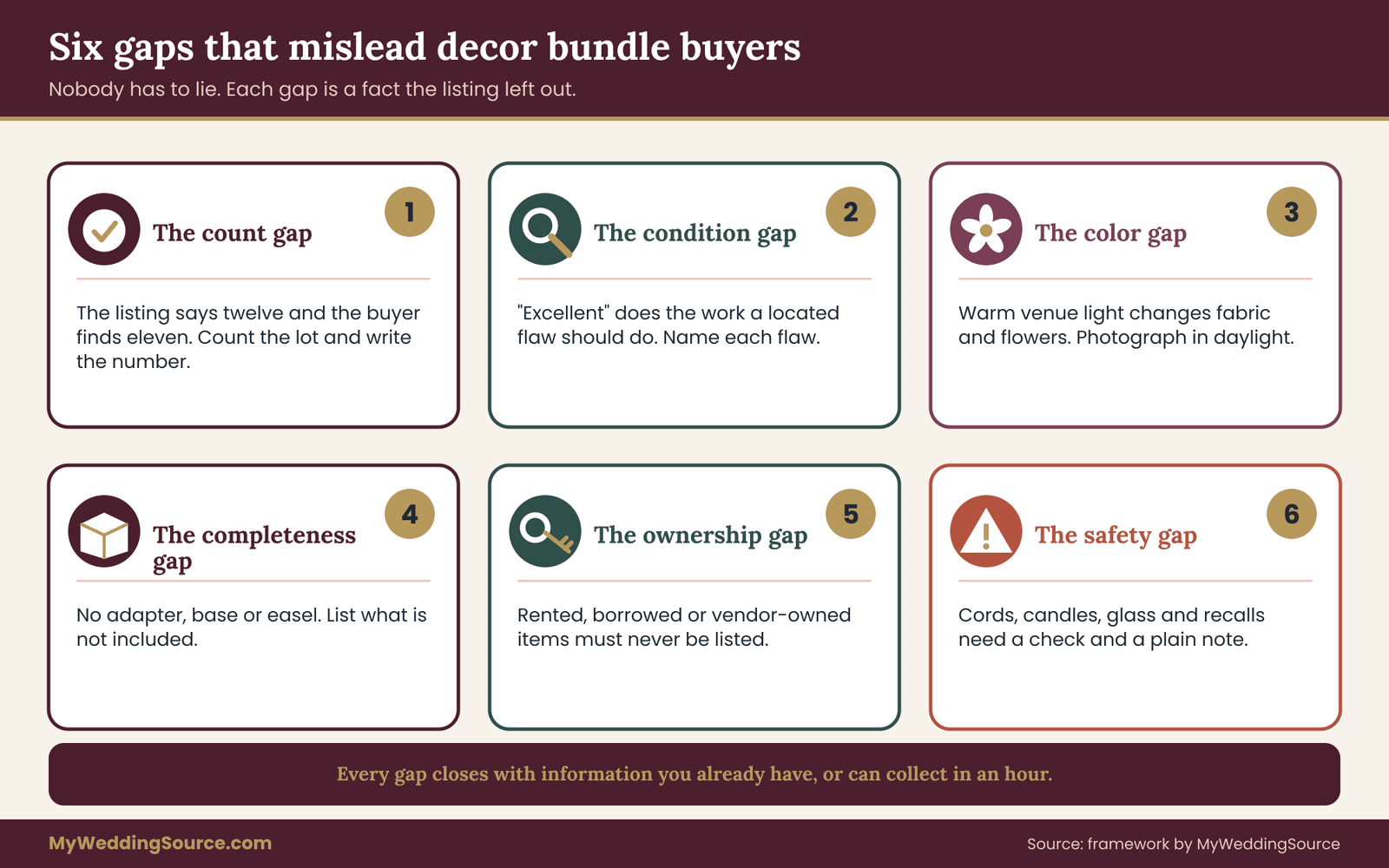
Notice that none of these gaps requires bad intent. All of them can be closed with information you already have or can collect in an hour. The rest of this guide builds that process, one piece at a time: the split-or-bundle decision for decor bundles, the ownership and safety checks, the ledger, the photo list, the listing wording, the price, the handoff and the dispute plan.
Why honest decor bundles sell better
It sounds backwards, but detailed flaws help a sale. A buyer scanning a marketplace sees dozens of decor bundles described in vague, cheerful language. A lot that says “two of the eight lanterns have a chipped base, photo 6” stands out because it is checkable. The buyer who messages you has already accepted the flaw, so there is nothing to argue about at pickup.
There is also a plainer reason. In the United States, advertising that is likely to mislead a reasonable consumer can be treated as deceptive under federal consumer protection law, and many states have their own rules. The Federal Trade Commission publishes guidance for businesses and for consumers on what counts as a deceptive claim. A private seller clearing out wedding leftovers is not the typical target of that guidance, but the underlying idea is a good test for any listing: would a fair-minded buyer feel tricked by what you left out?
What this guide does not cover
Three nearby topics have their own handling. If you are still deciding whether to sell at all, the site’s guide to a realistic waste audit is the place to start. If you are selling one category of decor bundles in depth, such as table centerpieces or linens, that category will have specifics this guide does not repeat. And if the items are rentals or belong to a vendor, they are not yours to sell; the ownership section below explains how to tell.
What this guide adds to decor bundles is the layer that sits across categories: how to make a mixed lot legible. The same ledger works for a box of mixed greenery and a lot of ceremony signs, because it asks the same questions of each item.
Decide what belongs in decor bundles: the bundle-or-split rule
The first honest decision for decor bundles is not what to write but what to include. Many listings mislead because the seller threw everything into one lot to get rid of it fast. A buyer who wanted three of the items ends up paying for twelve, or a buyer who wanted the whole set cannot tell whether the lot is complete.
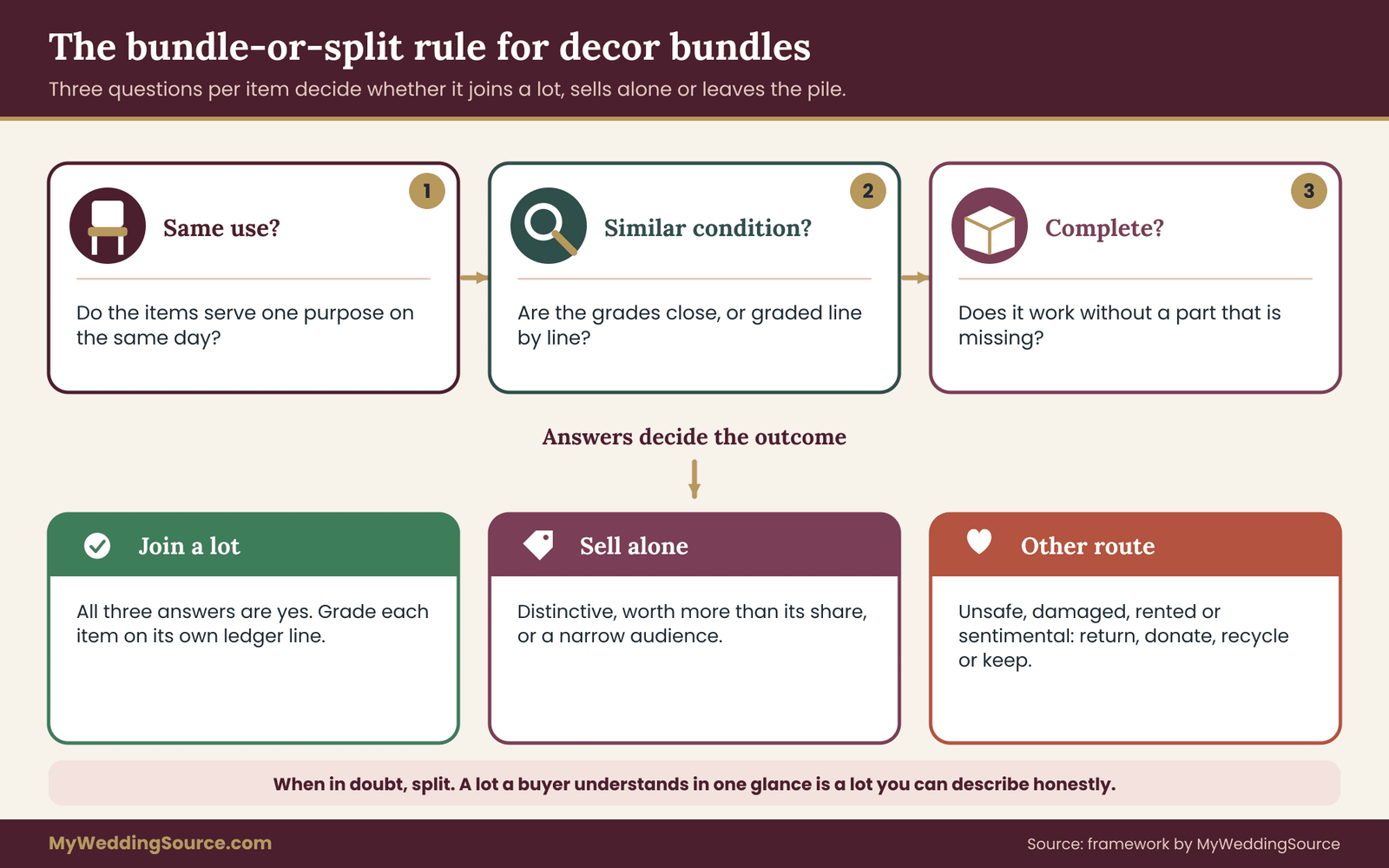
Use a simple rule for each candidate item. Ask three questions and let the answers decide whether it joins the bundle, sells alone or leaves the pile.
Does it share a use with the other items? Items that serve the same purpose on the same day, such as everything for a welcome table, belong together. A single oversized prop that only fits one scenario does not.
Is it similar in condition to the others? One pristine item and six worn ones teach the buyer to distrust the lot. Mixing grades is allowed, but only if each item is graded separately in the ledger. If the gap is wide, split.
Does it need something else to work? If an item is useless without a part, either the part goes in the same lot or the listing says in the first line that the part is missing.
Three outcomes for every item
The answers produce three outcomes for decor bundles. The item joins a bundle, sells alone, or goes to a different route entirely: donation, return, recycling or keeping.
Selling alone is worth it when an item is distinctive, clearly worth more than a share of a lot, or likely to attract a specific buyer. A hand-lettered sign with a short run of names has a narrow audience, but that audience is exactly the people searching for it. Putting it in a general lot buries it.
Leaving the pile is the right call more often than sellers expect. Burned candle stubs, wilted or dried flowers, anything food-contact that has not been washed, and damaged electrical items rarely belong in a sale. The ownership and safety section explains where the line sits.
A quick example of the rule at work
Imagine a pile after a garden reception: eight glass hurricanes, forty tea-light holders, two kraft-paper table-number sets, a roll of burlap, three framed signs and a string of outdoor lights. Applying the rule gives three lots. The hurricanes and tea-light holders share a purpose and a material, so they become one lot of table lighting holders.
The signs and the table numbers share a paper-and-frame purpose, so they become a signage lot. The burlap is plain cut fabric with no obvious partner, so it goes with a small linens-and-textiles lot or into a free pile. The outdoor lights are an electrical item with a separate safety check and sell alone.
None of those choices needed art or marketing. They needed a clear idea of what a buyer would be doing with the items. When decor bundles make sense to a buyer in one glance, half of the work of avoiding misleading them is already done.
Ownership, rentals and safety checks before listing decor bundles
Nothing misleads a buyer more completely than a listing for something the seller does not own. It happens by accident all the time. Rented linens get mixed with bought ones. A cousin’s lanterns end up in the same box as the couple’s own. A vendor’s arch frame is still on site because the pickup was never scheduled. Before any item enters decor bundles it has to pass an ownership check.
The ownership check
Go through the paperwork before you go through the boxes. Gather the vendor contracts, purchase receipts and any rental agreements. The site’s guide to wedding vendor contracts explains which clauses decide who owns what after the event, and the purchase order checklist shows how to keep a clean record of what you actually bought. For each item you plan to sell, mark one of four statuses.
Bought and mine. You have a receipt, an order confirmation or a clear memory that you can check against a statement. These items are free to go into decor bundles.
Gifted or handed down. The item came from family or friends. Ask before selling. A candlestick that was a grandmother’s loan is not a clearance item, even if nobody wrote the loan down.
Rented or borrowed. These go back to the owner. They never go into a listing, even if the rental company has been slow to collect them. If a rental company has not picked up an item, send a written reminder and keep the reply; the wedding rental planning checklist covers return windows and what to photograph at pickup.
Vendor-owned or contract-tied. Some florists, planners and rental companies retain ownership of stands, frames, arches and lighting, even when the decor on them was custom. The contract may say what happens to custom pieces. If it does not, ask in writing before anything is sold.
What to do when ownership is unclear
If you cannot tell, treat the item as not yours until you can. That sounds cautious, but the cost of being wrong is lopsided. Holding an item for another week costs a delay. Selling an item that belongs to someone else can cost a refund, a replacement and an awkward message to a vendor or relative.
The same careful habit applies to custom artwork and fonts. A set of printed signs may be yours, but the file behind them may carry a license that limits reuse. If you are selling the physical signs only, say so, and do not include or promise the design file unless your agreement with the designer allows it. The site’s guide to wedding signage as a system explains how sign files and permissions are usually handled.
Safety checks that belong in the ledger
Some categories need a safety check before they go into any of your decor bundles. These are not about perfection. They are about not passing a hazard to a stranger.
Electrical items. Inspect cords, plugs and sockets. Frayed insulation, bent prongs, scorch marks or a damp-damaged adapter mean the item stays out. Test every strand on a bench and write the result in the ledger. “Works, all bulbs lit on test day” is a statement you can stand behind. “Should work” is not.
Candles and flame items. Used candles with blackened wicks, glass holders that have cracked from heat, and anything that has dripped wax into a hollow base need honest labels or removal. Unused candles can be listed with the quantity and size. Some lots should simply omit open-flame items and say so.
Glass and ceramics. Chips on a rim or base can cut a hand. Note every chip. Wrap glass for pickup in ways described later, and decline to ship anything that cannot be packed safely.
Recalled products. In the United States, selling a recalled consumer product is generally against the law, even when it is used and even when you did not know about the recall. The Consumer Product Safety Commission keeps a searchable list of recalls. Search by brand and product name for lighting, candles, furniture-like items and anything with a battery.
Food and beverage contact items. Cake stands, drink dispensers and serving pieces should be washed, and the listing should say how. Anything that held food and cannot be cleaned fully should not be listed.
Why a short safety note protects both sides
The safety note in a listing does not need to be dramatic. A single line works: “Lights tested on [date]; all bulbs lit; cord intact; for indoor and covered outdoor use only.” That line tells the buyer what you checked and sets a boundary on what you are claiming. It also gives you a reasonable answer if a buyer asks later whether the lights were safe outdoors in the rain.
If you are unsure about a category, the U.S. Consumer Product Safety Commission and your state or local consumer protection office are the places to ask, and the Environmental Protection Agency’s guidance on reducing waste can help you decide what to do with items too worn or risky to sell. Sending a damaged item to the right waste stream is part of selling decor bundles responsibly.
The Truth Ledger: an itemized condition checklist for decor bundles
This is the core of the guide. The Truth Ledger is a one-page working list, one line per item or per identical group of items. It is the document you write before you write the listing. Everything the listing says should come from the ledger, and everything in the ledger should be provable by a photo.
The ledger behind decor bundles exists because memory fails in predictable ways. You remember the best pieces, you forget the chipped one, and you round counts up. Writing a line per item forces you to look at each one once, with a pen, and to decide what to say about it.
What goes on each line
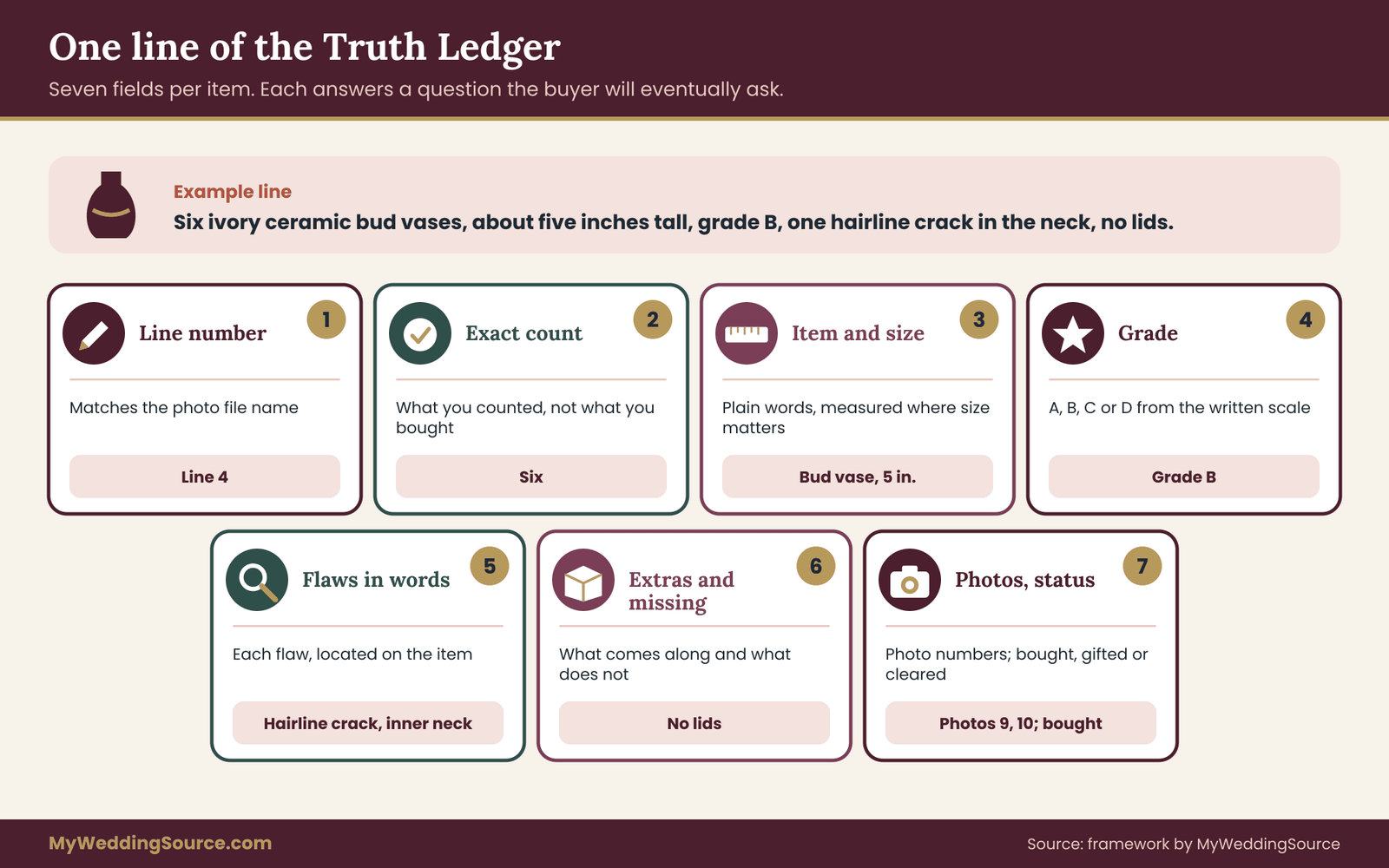
A ledger line has seven fields. Each one answers a question a buyer will eventually ask.
Line number. A simple number that you will also write on the photo or its filename. Photos and lines have to match.
Count. The exact number you counted, not the number you bought. If you bought twelve and eleven survived, write eleven.
Item and size. What it is, in plain words, with a measurement where size matters. “Glass hurricane, about 9 inches tall” beats “large hurricane.”
Grade. A letter from the four-grade scale described in the next section.
Flaws in words. Each visible flaw, located. “Small chip on the rim, near the base” is better than “minor wear.”
Included extras and missing parts. What comes with it and what does not. This field closes the completeness gap.
Photo number and status. Which photo shows it, and whether it is bought, gifted, or cleared as yours to sell.
How to fill in the ledger without making it a chore
Set aside one table and one hour for each of your decor bundles. Spread the items out in daylight. Count first, then grade, then look for flaws, then photograph. Do not mix the steps, because counting while you grade is how counts drift.
Handle the items in the same order each time: left to right, big to small. Say each flaw out loud as you write it. It sounds silly, but spoken descriptions come out more precise than written ones. “There is a dark mark on the inside rim of the third lantern” is a better note than “some marks.”
Work with a second person if you can. One person holds and describes; the other writes and photographs. A second pair of eyes catches the chip you stopped noticing because it was in your own house for a month.
A sample ledger line, in prose
Here is how a single line might read: line four, six, ivory ceramic bud vases, about five inches tall, grade B, one has a hairline crack inside the neck that does not leak, one has a small glaze flaw on the base, no lids, photos 9 and 10, bought and mine. That is one sentence of information, and every part of it can be checked by the buyer.
Compare it with “6 pretty ivory vases, great shape.” The second version is shorter and nicer to read, but it leaves every decision to the buyer’s imagination, and the buyer’s imagination is generous. The ledger line gives the imagination nothing to invent.
Keeping the ledger useful after the sale
Keep the ledger for your decor bundles. After the sale, it doubles as your record of what was sold, to whom and for how much. If a buyer writes three days later to say something was not as described, you have a dated list of exactly what you said and showed. Many disputes end the moment both sides look at the same document. The site’s guide to wedding records after the event explains where to file it with your other post-wedding paperwork.
Grading decor bundles: a four-grade condition scale that means something
Words like “excellent,” “good” and “fair” mean different things to different people. A seller who thinks of a slightly scuffed lantern as excellent and a buyer who expects mint condition will both feel wronged. The fix is a scale with written definitions that you print or paste into the listing, so the grade is a statement against a standard rather than an opinion.
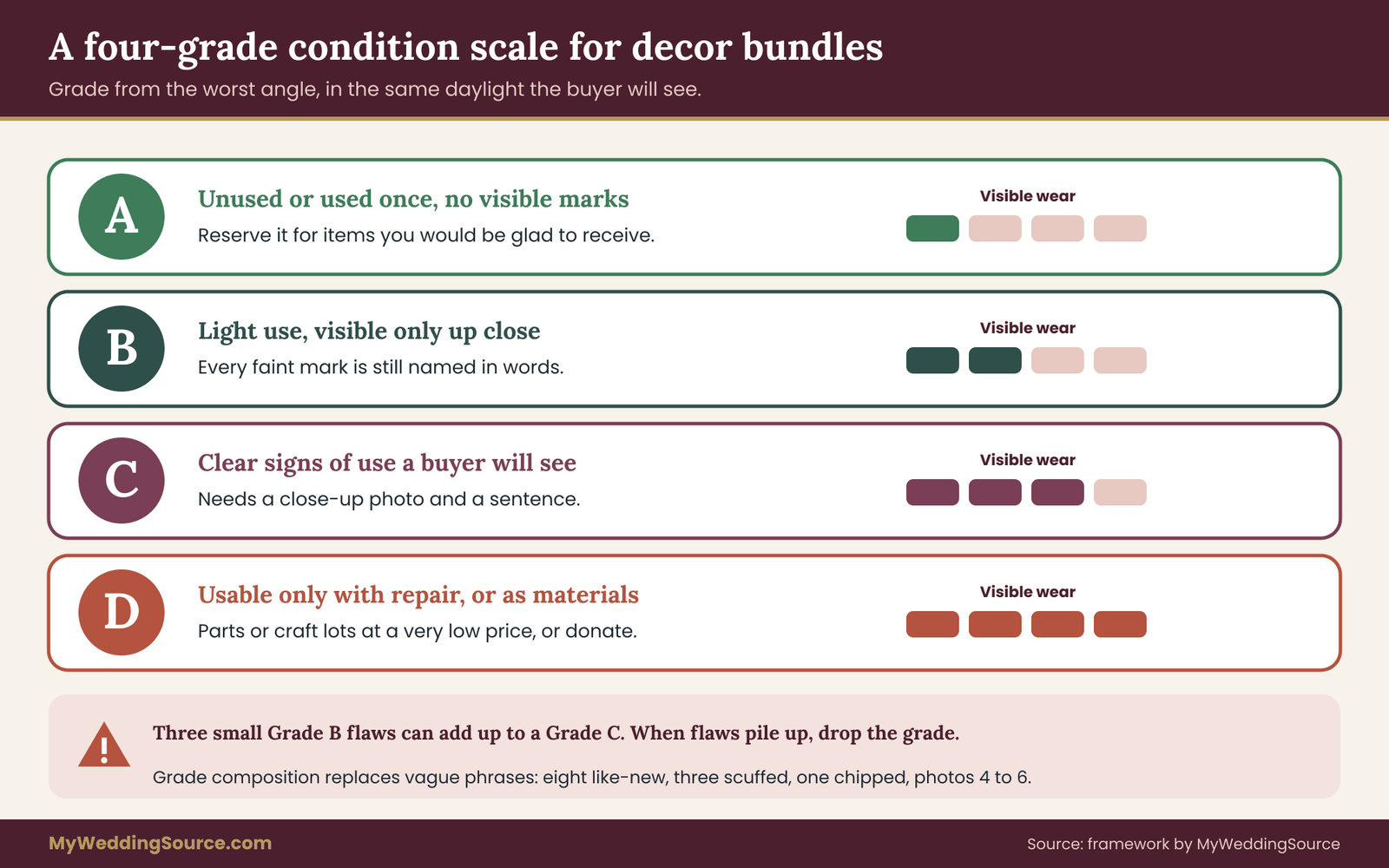
Use four grades. Four is enough to be useful and few enough that you will apply them consistently. Define them by what a buyer will notice, not by how you feel about the item.
The four grades
Grade A: unused or used once without visible marks. You can look at it from a normal distance and from close up and find no flaw. If it was used on the wedding day, it was handled gently and cleaned. Reserve this grade for items you would be comfortable receiving yourself.
Grade B: light signs of use that show only up close. A faint scuff, a slightly bent wire that straightens, a small crease in fabric that steams out. Nothing a buyer would notice at arm’s length. Every visible mark is still listed in words.
Grade C: clear signs of use that a buyer will see. A chip, a stain that did not fully wash out, a faded side, a missing bulb in a string. The item is fully usable, but the flaw is obvious. It needs a photo and a sentence.
Grade D: usable only with repair, or only as materials. A cracked piece that still holds, a frame with a loose joint, a runner with a hole. Sell these only with that framing, usually as part of a craft or parts lot, and often at a very low price. Many Grade D items are better donated, recycled or discarded.
Applying grades without self-deception
The easiest mistake is grade inflation. People tend to grade items from the best angle. To resist it, grade from the worst angle. Turn the item over, look at the underside, hold it up to a window, and check it in the same daylight the buyer will see in your photos.
Another trap is the cumulative flaw. An item with three Grade B marks may deserve a Grade C. When flaws pile up, the buyer’s overall impression shifts even if each mark is small. If you find yourself writing a fourth minor flaw, drop the grade.
A third trap is grading by cost. Expensive items do not deserve a higher grade for being expensive. A pricey silk runner with a stain is a Grade C item, and describing it as such protects your credibility on the rest of the lot.
Mixed-grade decor bundles and how to describe them
Decor bundles can contain several grades. A lot of twelve lanterns might include eight at Grade A, three at Grade B and one at Grade C. The ledger lists each grade group on its own line, and the listing summarizes: “eight like-new, three with light scuffs, one with a chipped base, photos 4 to 6.” The buyer then knows the composition and can ask for a discount on the one that bothers them.
Avoid averaging. A lot “in good condition overall” is a phrase that can excuse any single defect. Grade composition replaces it with something a buyer can check.
Condition words to use and words to retire
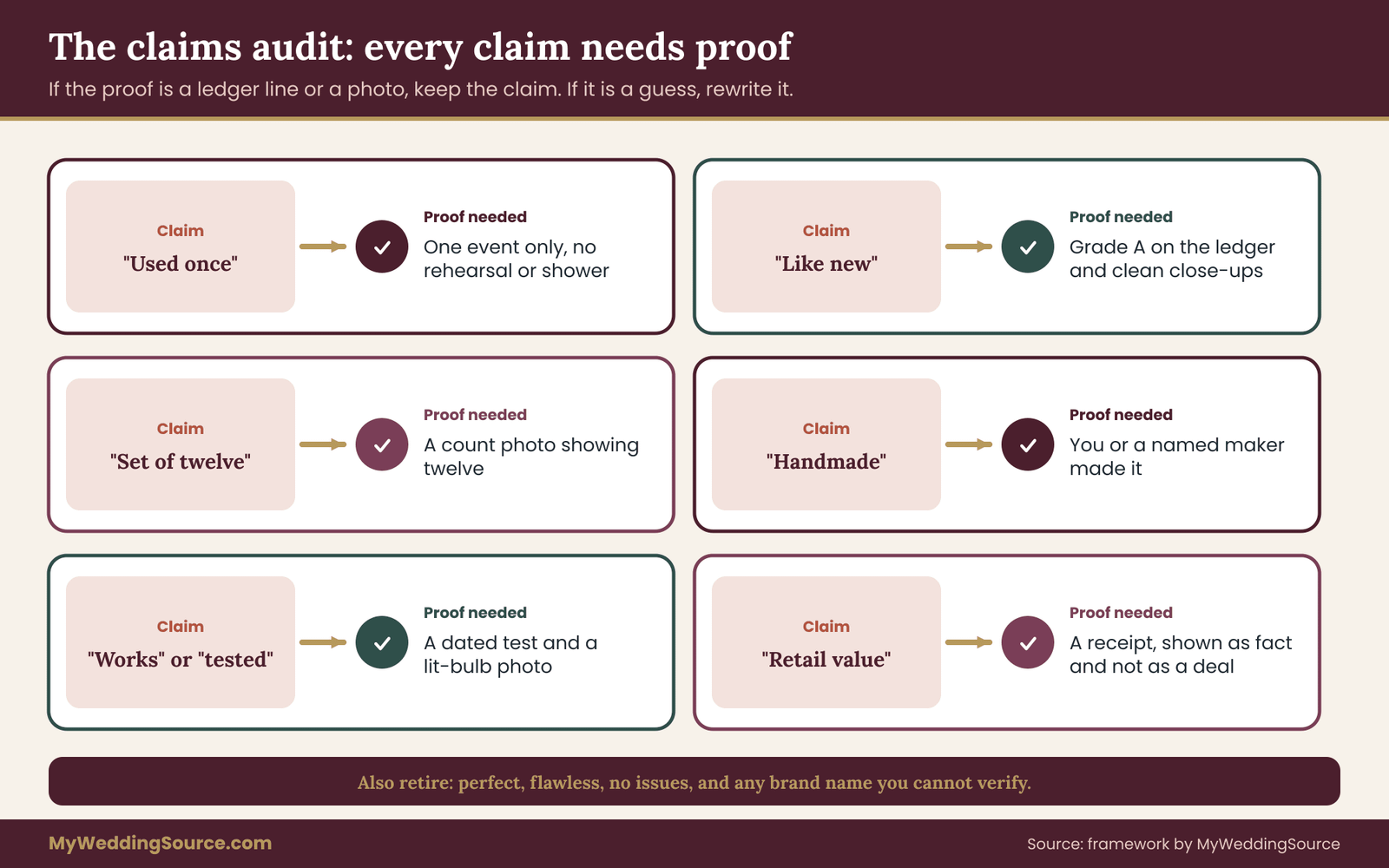
Some words are useful because they are specific: “chipped,” “faded,” “scuffed,” “creased,” “stained,” “bent,” “discolored,” “loose,” “tested,” “unused,” “cleaned.” Some are useful only with detail attached: “worn,” “marked,” “aged.” And some should be retired from honest decor bundles listings because they promise more than any seller can know: “perfect,” “flawless,” “brand new” for anything used, “mint” for anything handled, and “no issues” for anything you have not tested.
“Like new” deserves a note of its own. It is one of the most common phrases in resale listings and one of the most disputed. If you use it, tie it to a grade. “Grade A, used for one evening, wiped clean” is a version of “like new” that carries information. The bare phrase does not.
The photo checklist: nine frames every bundle needs
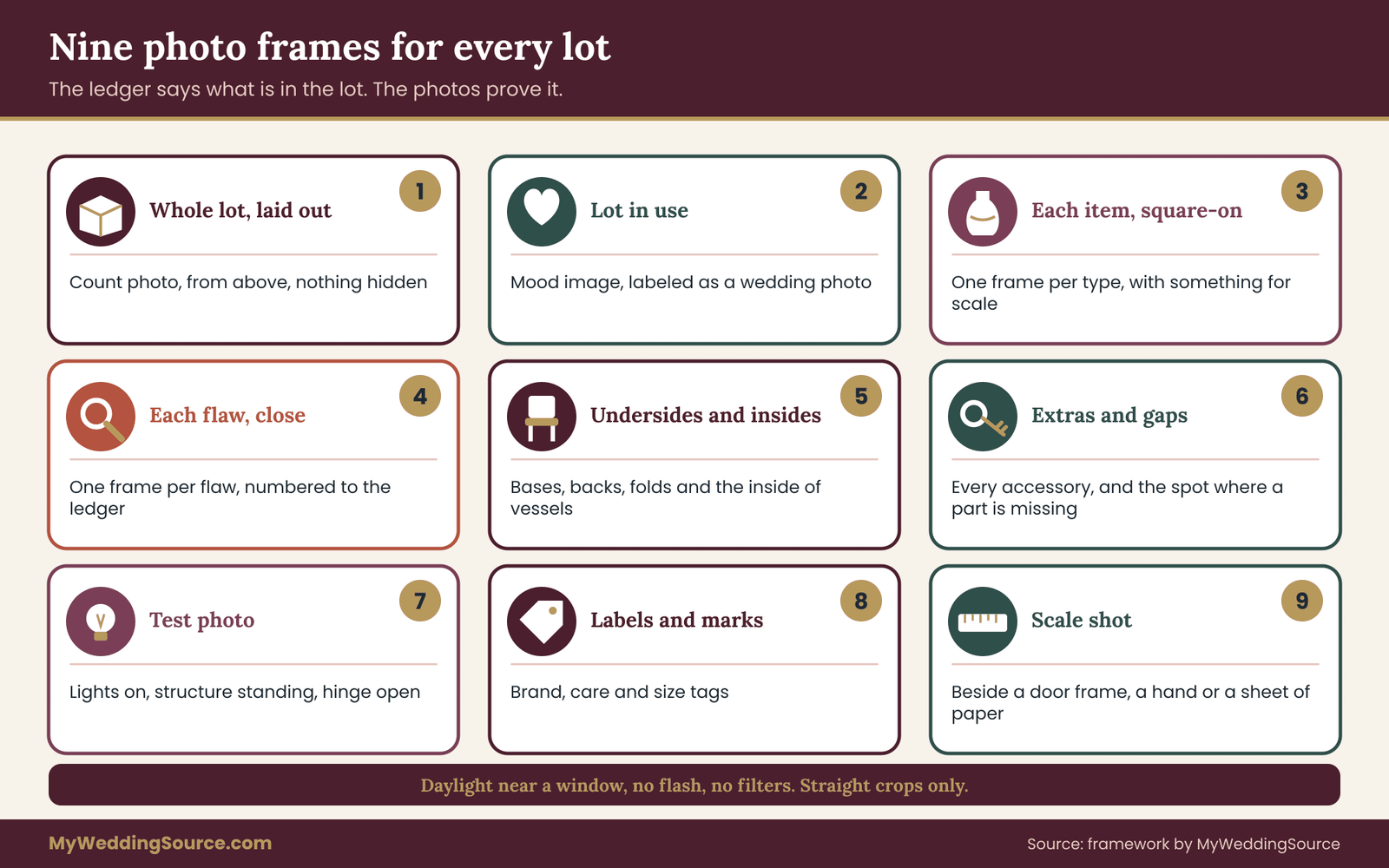
Photos are the second half of the ledger for decor bundles. The ledger says what is in the bundle; the photos prove it. A buyer who cannot see a flaw in a photo will assume it is not there, and a buyer who finds the flaw in person will assume you hid it. Both outcomes are avoidable with a short, repeatable shot list.
The list below is built for decor bundles. It works for most mixed decor bundles, and it assumes a phone camera and a window, nothing more.
The nine frames
Frame one: the whole lot, laid out. Everything in the decor bundles on one neutral surface, nothing stacked or hidden, shot from above. This is the count photo. A buyer should be able to count the pieces in it.
Frame two: the lot in use. If you have a photo of the items set up at the wedding, it can show scale and style. Label it as a wedding photo, not a condition photo. It sells the idea; it does not prove the condition.
Frame three: each distinct item, close and square-on. One photo per type of item, taken straight on, filling the frame, with a ruler or an everyday object beside it for scale.
Frame four: each flaw, close up. One photo per flaw. Hold a finger or a pen near it so the scale is clear. Write the photo number on the matching ledger line.
Frame five: undersides, backs and insides. Chips hide on bases. Stains hide inside vessels. Fabric wear hides along folds. Take the photo a suspicious buyer would ask for.
Frame six: the extras and the missing parts. Show every included accessory, such as stakes, hooks, clips, cords or adapters. If a part is missing, show the place where it would go, and say it is missing.
Frame seven: the test photo. For anything electrical, a photo with the item switched on, in a dim room, showing every bulb. For anything that opens, folds or stands, a photo of it open, folded or standing.
Frame eight: labels and markings. Brand tags, care labels, size tags and any maker marks. These help the buyer verify what the item is and how to clean it.
Frame nine: the scale shot. A photo that gives true size, such as the item beside a standard door frame, a hand or a sheet of paper.
Lighting and color: the honest way to photograph decor
Natural daylight near a window, with no direct sun and no flash, is the most reliable light for color. Shoot in the morning or late afternoon on an overcast day when you can. Avoid warm indoor bulbs and the evening glow of the wedding itself.
Include a neutral reference in at least one frame, such as a white sheet of paper, so the buyer can judge color shifts. Then write the color word in the listing in plain terms and add “photographed in daylight; screens vary.” That last phrase is not a disclaimer that excuses errors; it is a reminder that color is the hardest thing to convey, and it gives the buyer permission to ask for a closer comparison.
Editing and filters
Do not apply filters to photos of decor bundles. Do not brighten flaws away or sharpen them into invisibility. The honest edit is a straight crop and nothing else. If a buyer later compares the item to the photo, the photo should look like the item.
Also be careful with staged photos of decor bundles. A flattering photo from the wedding is fine as a mood image. A listing that uses only professional wedding photographs, with soft light and flattering angles, and no condition photos at all, is the single most common way decor bundles end up misrepresented without a word of false text.
Naming and keeping the photos
Name each file with the ledger line number and a short description, such as “04-bud-vases-flaw-neck.” That way the ledger, the listing and the folder agree. Keep the originals for your decor bundles after the sale. Along with the ledger, they are your proof of what you showed.
Writing the listing: a claims audit for decor bundles
With the ledger and photos done, listings for decor bundles are mostly assembly. The danger at this stage is not lack of information; it is the urge to add warmth. Cheerful phrases fill the gaps between facts, and each one is a small claim the buyer may hold you to.
Run every sentence of the draft through a claims audit. For each claim, ask what proof you could show if the buyer asked. If the proof is a ledger line or a photo, keep the claim. If the proof is “I think so,” rewrite or delete it.
The claim-and-proof test
Here are the claims that appear most often in decor bundles listings, with the proof each one needs.
“Used once.” Proof: you used it at one event and have not used it since. This is a fair claim if true, and it is worth stating, because it tells the buyer exactly how much wear to expect. Be careful if the item was also used at a rehearsal dinner or a shower. That is two uses.
“Like new” or “excellent condition.” Proof: a Grade A on the ledger and no flaws in the close-up photos. Without that, replace with the grade and the flaws.
“Set of twelve.” Proof: a count photo showing twelve items. If you are selling eleven, the listing says eleven.
“Handmade.” Proof: you or someone you can name made it. If you ordered it from a maker or a marketplace, say “custom-made for our wedding” or describe what you know. Many platforms have specific rules about the word, and misusing it can be treated as a false claim.
“Real” or “preserved” flowers, “silk” or “linen” fabric. Proof: a label, a receipt or the original product listing. Fiber content matters to buyers who plan to wash an item. If you do not know, write “fabric content unknown, no care label.”
“Works” or “tested.” Proof: a dated test and a test photo. Include the date.
“Smoke-free home” or “pet-free home.” Proof: you actually know. If it is not true, say so, because buyers with allergies take the claim seriously.
“Retail value” or “originally cost.” Proof: a receipt. Even with a receipt, comparing your price to the original price implies a discount that may not reflect the market. The pricing section covers this.
“Authentic,” “designer,” “brand name.” Proof: the brand is visible on a label or in a receipt. Avoid brand terms you cannot verify.
The structure of an honest listing
A good listing for decor bundles follows the same order every time, so buyers can scan it.
The title states the quantity, the item type and the headline condition: “Eight glass hurricanes and forty tea-light holders, mixed grades, pickup only.” The first line of the description repeats the most important limit, such as “Pickup only; hurricanes include two with chipped bases.” The next block lists the contents in the same order as the ledger. After that comes the grading scale, then the testing and cleaning notes, then the missing items, and last the logistics: where, when and how payment works.
Plain wording for the first lines
The first two lines of a listing do the most work. Write them as if the buyer will read nothing else. For example: “Wedding decor bundle: six ceramic bud vases, grades A and B, two with small flaws shown in photos 9 and 10. No lids. Local pickup only.” That sentence gives the count, the item, the grade, the flaw count, a missing part and the logistics.
If you notice the draft sounds a little dry, that is fine. Buyers of used items are looking for clarity. A short sentence about what the items looked like at the wedding can add warmth, as long as it comes after the facts.
The “not included” paragraph
Add a short paragraph titled “Not included.” It lists the things a buyer might assume come with the bundle but do not: stands, hardware, power adapters, containers, signs’ easels, floral foam, flowers, candles or the design files. Sellers of decor bundles resist this paragraph because it feels like negativity. In practice it removes the most common source of disputes and costs nothing.
Words that quietly promise too much
Watch for sentences that promise outcomes rather than describe items. “Perfect for any wedding” promises fit. “Will look amazing on your tables” promises results. “Everything you need to decorate a ceremony” promises completeness. Replace them with description: “These items were used on eight round tables seating ten each.” The buyer can judge fit from facts.
Category notes for mixed decor bundles
Mixed decor bundles contain categories that each carry their own wording traps. These short notes cover the ones that come up most.
Lighting in decor bundles. Say the type (string lights, fairy lights, lanterns, battery candles), the length, the number of working bulbs and the power source. State whether the strand is rated for indoor or outdoor use only if the packaging or label says so. If you have no label, say “rating unknown, use indoors or under cover.” Include any adapter, controller or battery pack, and say what is not included.
Fabric and linens. Give the fiber if a label shows it, the dimensions measured flat, the color in daylight and the state of every stain, snag or burn mark. Say how you cleaned it and whether it has been pressed. A runner described as “washed” should have been washed, not shaken out.
Faux and preserved greenery. Say whether it is plastic, silk, paper or preserved, and how it is wired. Note shedding, bent stems and sun fading. Count in stems or garlands, not in “bunches,” because a bunch has no standard size.
Signs and frames. Give the size, the material, the wording and whether names or dates are on it. A sign with personal names has a tiny market; say so in the listing and be ready to sand or cover the text if the buyer wants that. Note whether the stand, easel or hardware is included.
Candle holders, vases and glass. Count them, measure the height and opening, and list each chip, scratch or cloudy patch. Mention water stains or wax residue. Photograph rims and bases in raking light.
Arches, stands and structures. These carry the highest risk of a misleading listing because stability depends on parts the photo does not show. List every piece, every bolt or clip, the assembled dimensions and the weight the structure was built to carry, if you know it. If you do not know, say so, and tell the buyer you cannot vouch for its use outdoors in wind or for holding hanging decor.
Paper goods. Count sleeves or sets, not “a bunch.” Say how many are unused and how many have been written on or handled. Mention curling, fading and any smell, such as smoke or storage damp.
Each note comes down to the same habit: describe what you can see, measure what you can measure, and say plainly what you do not know. A short sentence of honest uncertainty protects the sale better than a confident guess, and it costs nothing to add. Buyers of decor bundles tend to trust sellers who mark the edges of their own knowledge.
Pricing decor bundles without implying value you cannot show
Price is part of the claim in decor bundles. A price tag implies a value, and a listing that sets the price against an inflated reference can mislead as surely as a false description. Pricing decor bundles honestly means choosing reference points the buyer can check and explaining discounts in a way that matches reality.
Start from what buyers actually pay
The most reliable reference is what comparable used items have actually sold for in your area, not what they are listed for. Many marketplaces let you search completed or sold listings. Local groups often show what neighbors paid. Listed prices tell you what sellers hope for; sold prices tell you what buyers did.
Then think about what decor bundles are worth to a buyer compared with their parts. Decor bundles save the buyer time and shipping, so a modest discount from the sum of individual prices is reasonable. Decor bundles also hand the buyer items they may not need, so a steep discount may be needed to move a lot of mixed pieces.
Whatever you choose, make the logic visible to yourself in the ledger: next to each line, write what you would ask for that item alone, then total the column, then set the bundle price below the total.
The three-number approach for decor bundles
Use three numbers, and write them on the ledger sheet where only you can see them.
The sum of parts. The total of what each line would sell for alone. This is a private number. You never put it in the listing as the “value.”
The asking price. Typically below the sum of parts, because the buyer takes the whole lot, including pieces they may not want.
The floor. The lowest price at which you would rather sell than keep, donate or hold for another week. Decide it before the first message arrives, because negotiation pressure is when sellers make decisions they regret.
If an item in the lot is clearly worth more than the others, pull it out and list it alone. That keeps the price of decor bundles from carrying a hidden valuable item that a buyer snaps up at a bargain, and it spares you the annoyance of discovering the price mismatch after the sale.
Honest ways to talk about original cost
Original cost is the most tempting number to cite and the most misleading. A seller who writes “paid 400 dollars, asking 150” is implying a 63 percent saving. But most decor loses a large share of its market value the moment it leaves the store, and many buyers know it. Sellers who anchor to retail often find they have to defend the price rather than explain it.
A fairer approach is to give the original cost only as a fact, only when you have the receipt, and only in a sentence that does not frame the price as a deal. “Purchased new in the spring; receipt available” is information. “Retail value 400, yours for 150” is a sales argument that the buyer may rightly distrust.
For a broader look at how to budget post-wedding recovery, the site’s wedding budget guide explains how to track what you spent, and that record is useful when you decide how much of it a lot can realistically return.
Discounts on decor bundles that are real
If you offer a discount for buying more, state it plainly: “Each hurricane is 8 dollars; all eight for 56.” Do not advertise the price of decor bundles as a “savings” unless the individual prices were genuinely offered. A price that was never really available is a pretend discount, and consumer agencies take dim views of reference prices that were never offered.
Do not create urgency that is not real. “Must go today” is fine if you are moving or the venue storage ends. It is misleading if you are happy to wait. Be honest about why a date matters, or leave the date out.
Taxes and records on resale
For most people, selling used personal items for less than they paid does not produce a taxable gain, but rules differ, and platforms may report some sales to tax authorities. The Internal Revenue Service publishes guidance on the sale of personal property and on reporting income. Check it for the current thresholds and rules rather than relying on a general statement. Keep the ledger, the photos and the payment record together so that your own paper trail is complete.
Where and how to sell decor bundles: platforms, pickup and shipping
The best route for decor bundles depends on weight, fragility and how local the audience is. Heavy or breakable lots do well locally. Light, durable lots can ship. Niche lots, such as a themed ceremony set, sometimes find a better audience on a wedding-focused resale community. Platform rules change, so check each platform’s current seller policies before you list.
Local marketplaces and neighborhood groups
Local groups suit bulky and fragile decor bundles. There are no shipping risks, the buyer can inspect the items before paying, and the ledger and photos make the inspection quick. The drawbacks are no-shows and haggling. Both are manageable with a firm pickup window and a floor price you decided in advance.
Meet in a visible, well-lit place or at your door with another person present. State the pickup window in the listing, and say what happens if the buyer misses it. Many marketplaces publish safety tips for in-person exchanges, and the Federal Trade Commission’s consumer advice pages explain common payment scams, so read both before you list.
Shipping marketplaces
Shipping suits lighter decor bundles such as paper goods, fabric, faux greenery and small hardware. It adds problems local sales do not have. The buyer cannot inspect the lot first, so the photos carry all the weight. Damage in transit becomes a dispute, and platform buyer-protection rules may favor the buyer.
If you ship, weigh and measure the packed box before you list, get an actual shipping quote from the carrier, and put the cost in the listing. The United States Postal Service and other carriers publish packaging guidance, including how to pack fragile items. Insure higher-value lots and keep the tracking record with the ledger.
Wedding-focused resale communities
Some online communities and marketplaces are built around wedding resale. Buyers of decor bundles there expect detailed descriptions and often ask for the same things the ledger already provides: counts, colors, grades and photos in daylight. Rules vary, including fees and policies on item descriptions, so read them first. If your lot is themed or has recognizable pieces, this is often where the right buyer is.
Handoff for local pickup
The handoff is where the ledger for decor bundles earns its keep. Do the following in order.
First, set out the lot on a clean surface before the buyer arrives, with the ledger printed or open on your phone. Second, walk through the lot line by line with the buyer, saying the count and the grade out loud, and letting them look at each flaw. Third, count again together, because counting together is more trusted than counting alone. Fourth, take payment only after the buyer has accepted the lot, and give a short written receipt, even if it is a text message that says what was sold and for how much.
This sounds formal for a bag of table numbers. It takes about five minutes, and it is the reason the dispute rate is low. Buyers who have just walked through a ledger rarely come back to say that the chip they were shown is a surprise.
Packing fragile items
Wrap glass and ceramics in decor bundles one by one, with padding between them and around them. Pack heavy items at the bottom, and fill every empty space so nothing shifts. Label the box with the contents and mark it fragile, although the label is no substitute for good packing.
For pickup, bring the boxes to the door or the car. For the buyer’s trip home, include newspaper or a few spare towels when you can. A buyer who drives away with an unprotected hurricane on a car seat has a bad afternoon ahead, and it might turn into a message to you.
Payment methods and scams
Prefer payment methods that confirm the money before you hand over the lot. Be skeptical of any buyer who offers more than you asked, asks you to refund the difference, wants to pay by check from a third party, or insists on moving the conversation off the platform. The FTC’s consumer advice pages describe overpayment and fake-payment schemes in plain language.
If a buyer asks to send a courier, a “shipping agent” or a third-party payment link, step away. A legitimate buyer will accept a standard payment on the platform or cash at pickup.
A worked case: one invented bundle, line by line
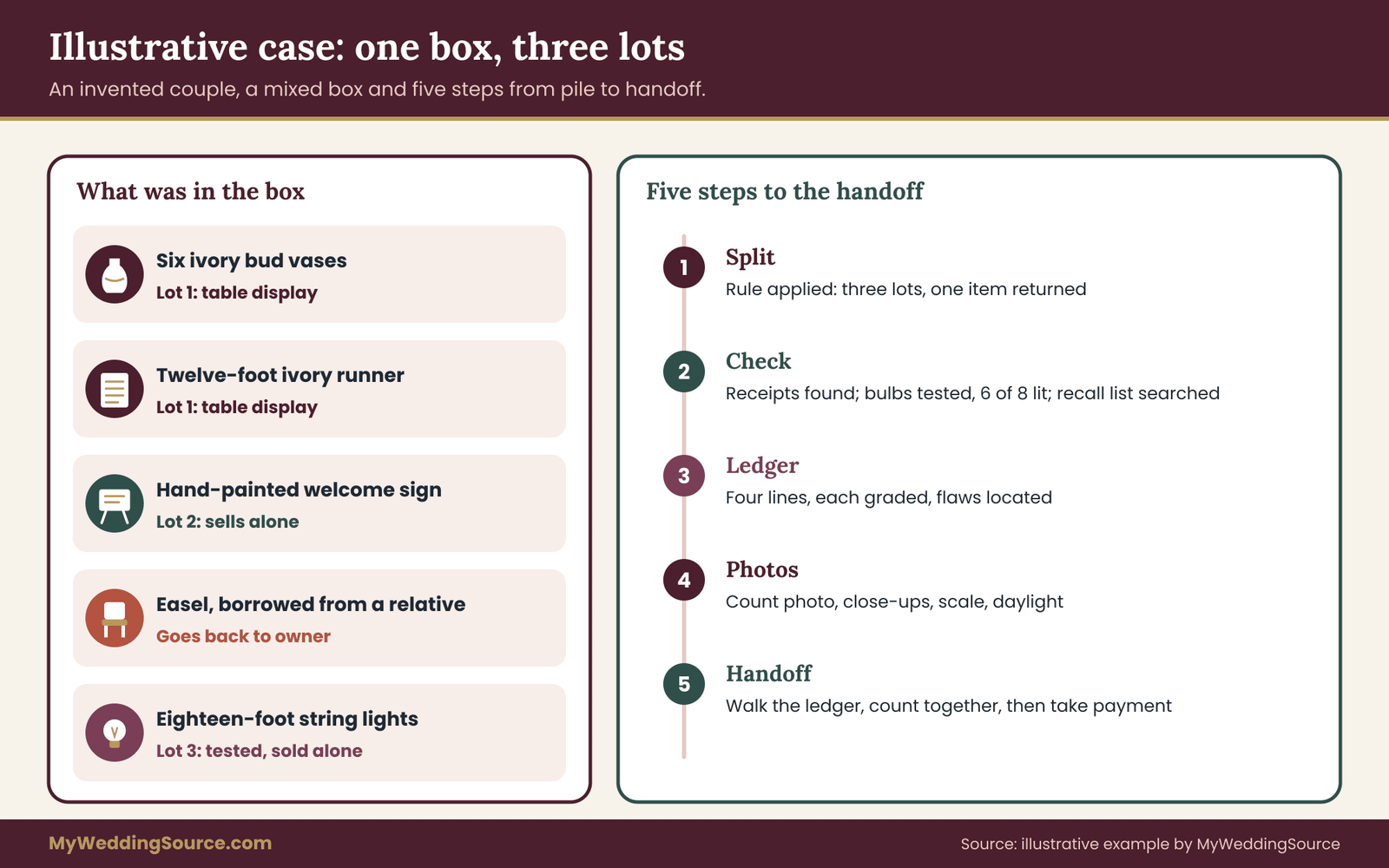
The example below of decor bundles is invented for illustration. It shows how the ledger, the photo list and the listing work together for one lot. The couple, items and prices are made up.
The pile
After a garden wedding, a couple has a box of mixed ceremony and welcome-table items. The box holds: six ivory ceramic bud vases, one of which has a hairline crack in the neck; a hand-painted wooden welcome sign on an easel; a roll of ivory table runner fabric, about twelve feet, with a small stain; a strand of warm-white string lights, with two bulbs that do not light; and a bag of fifty paper table numbers sets in a clear sleeve, half unused.
Step one: the bundle-or-split rule
The couple applies the rule. The vases and the welcome sign share a display use but not a buyer, so they split. The string lights are electrical and follow a separate safety check. The runner and the paper goods have no obvious partner. The result is three lots: a table-display lot of vases and runner, a signage lot with the welcome sign and its easel, and the lights alone, which they decide to test before deciding anything else.
Step two: ownership and safety
The vases were bought on a receipt the couple still has. The easel, they realize, was borrowed from a relative, so it goes back and the sign sells without it. The string lights are tested on a bench: eight bulbs in a strand, six light up, two are dead and the cord is intact. The couple decides they are Grade C and says so. They search the recall list for the lights’ brand and find nothing.
Step three: the ledger
Line one: six ivory bud vases, about five inches tall, grade B, one with a hairline crack inside the neck that does not leak, photos 3 and 4, bought and mine. Line two: ivory runner, about twelve feet long, grade C, one stain about the size of a coin near one end, did not wash out, photo 5, bought and mine. The vase lot and the runner are the table-display lot.
Line three: hand-painted wooden welcome sign, about twenty-four inches tall, grade A, used once, no easel, photo 6, bought and mine. The sign is its own lot.
Line four: strand of warm-white string lights, about eighteen feet, grade C, six of eight bulbs light, two dead, cord intact, tested on the day of listing, photo 7, bought and mine. These are listed alone.
Step four: photos and listing
The couple takes a count photo of the six vases and the runner, then close-ups of the crack and the stain, and a scale shot next to a sheet of paper. They shoot by a north-facing window on an overcast morning. The listing’s first line reads: “Six ivory ceramic bud vases and a twelve-foot ivory runner, grades B and C; one vase has a hairline neck crack, the runner has a small stain, both shown in photos 4 and 5. Local pickup only.”
Step five: price and pickup
They check recent sold listings in their area, then price the display lot below the sum of what each item would fetch alone, with a floor in mind. At pickup, they walk the buyer through the ledger, count together, and accept payment after the buyer says yes. The buyer notices that the stain is about where the photo showed it, asks for a small discount and gets it, and leaves. No messages follow.
What the example shows
Nothing in this example of decor bundles required special skill. The couple graded from the worst angle, split what did not belong together, returned what was not theirs, and described flaws in plain words. The result is a lot that is easier to sell because the buyer is not guessing, and a seller who is not worried about the follow-up message.
Most real decor bundles are messier than this one. Items arrive without a clear owner, a flaw turns up on the second day, or the count is off by one. The point of the ledger is that you find those issues before the buyer does.
When a buyer says the bundle was not as described, and the close-out after
Even a careful listing of decor bundles sometimes meets a disappointed buyer. A color looked different on their screen, a flaw they accepted in a photo looks worse in person, or a piece broke on the drive home. How you respond decides whether the sale ends quietly or turns into a platform dispute. The ledger makes the response easier, because it turns a feeling into a comparison.
Compare before you reply
When a complaint arrives, do not answer from memory and do not answer from irritation. Open the ledger and the photos. Find the line the buyer is talking about. Then sort the complaint into one of four kinds.
The listing was wrong. The count was off, a flaw was missed, a part was missing and the listing did not say so. This is your error. Own it quickly.
The listing was right but the buyer misread it. The flaw is in photo six, line three. This is where the ledger shows its value. Reply politely, point to the line and the photo, and offer a reasonable accommodation if you like.
The item changed after the sale. It was damaged in transit or after pickup. For shipped lots, this goes through the carrier and the platform. For local pickups, it is outside your control once the buyer accepted the lot.
The buyer is unhappy for reasons unrelated to the listing. The color is not quite what they imagined, the style is not what they pictured. The listing was accurate; the buyer’s taste differs. You may offer a return, but you are not obliged to.
Scripts that keep the exchange calm
Use short, factual messages. A reply to a listing error might read: “Thank you for telling me. You are right, the listing said eight and there are seven. I can refund the price of one, or take the lot back for a full refund. Which would you prefer?”
A reply to a misreading might read: “I am sorry it is not what you hoped for. The chip on the base is shown in photo six and noted on the second line of the list. If you would like to return it in the same condition, I am happy to refund it.”
Notice what these messages avoid: blame, long explanations and defensive language. They state the fact, give the remedy and ask a single question. Most buyers respond to that tone with equal calm.
Refunds, partial refunds and returns
Decide your return stance before you list and say it in the listing. Many sellers of decor bundles say “all sales final, inspect at pickup,” which is fair for local sales if the handoff includes a ledger walk-through. For shipped lots, platform rules often decide returns, so read them first.
When the listing was wrong, a partial refund is often the fastest fix. Calculate it from the ledger: the missing item’s share of the sum of parts, or the value you would have placed on a flaw you did not disclose. A fair number offered quickly settles more disputes than a perfect number offered after a week of messages.
If the dispute goes through a platform
Keep every message on the platform. Save the ledger, the photos, the listing text and the payment record in one folder. Platforms that handle disputes usually look at what the listing said, what the photos showed and what the buyer says arrived. A listing that matches a ledger and photos tends to fare well, and one that does not is hard to defend.
For serious problems, such as a buyer reporting an injury from a product, stop and look up the agencies that handle product safety and consumer complaints. The Consumer Product Safety Commission takes reports of unsafe products, and state consumer protection offices accept complaints about sales. Contacting the right office is better than improvising.
After the sale: the seven-day close-out for decor bundles
A sale is not finished at the handoff. A short close-out keeps your records clean and catches the small problems that surface in the first week.
The first day
Mark the lot as sold on the listing so that no second buyer shows up. Save the final listing text and the photo set in the same folder as the ledger. Write the sale price, the date and the payment method on the ledger sheet. If any items remain unsold, move them to a “second round” list and regroup them using the bundle-or-split rule.
The first week
Check in once, with a short message, only if the sale was shipped. For local pickup, there is no need to follow up unless the buyer has raised a concern. Watch for messages, and respond within a day. If you promised a refund or a replacement, complete it promptly and record it.
Keeping the paper trail
Keep the ledger, photos, listing and payment record for decor bundles with the rest of your wedding records for as long as the retention rules you follow call for. The IRS publishes guidance on how long to keep records related to income and sales, and your payment platform may issue year-end forms. The site’s guide to wedding records after the event shows where a sales folder fits among certificates, contracts and receipts.
Closing the loop on what did not sell
At the end of a few weeks, set a date for what did not sell. Lower the price once, with a reason. If the lot still does not move, donate it, recycle it or offer it free. The goal is a clean end to the project, not the maximum return. The waste reduction audit explains how to route unsold items so they do not return to the closet.
When not to bundle: failure conditions and better alternatives
A guide that always says “sell it” is not much use, and some decor bundles fail in ways no checklist can fix. Some decor bundles fail in ways no checklist can fix, and the honest answer is to stop. Each failure condition below has a better route.
Condition failure. If most of the lot is Grade C or D, decor bundles only transfer a problem to a stranger. Better routes: donate the items that can still be used, offer the rest free to craft groups or schools that accept used materials, and recycle or discard what is damaged. The EPA’s guidance on reducing and reusing materials helps you choose among those routes.
Ownership failure. If you cannot establish that most of the lot is yours, wait. Returning something late is a minor embarrassment. Selling someone else’s property is a larger problem.
Safety failure. If a lot includes electrical items with damaged cords, recalled goods, or open-flame items with damaged holders, take them out. A cheaper lot with fewer items is better than a bigger lot with a hazard in it.
Count failure. If you cannot count the lot with confidence, because items are mixed with other boxes or partly with a vendor, do not list it. Recount after sorting.
Time failure. If you are leaving for a honeymoon or a move, a rushed listing is a poor one. A short delay costs less than a dispute. If storage or a venue deadline forces the timing, be honest in the listing about why the date matters, and consider a local donation instead.
Fit failure. If the lot is unusual, a buyer may not exist. Giving it away to someone who will use it is a good outcome, not a failure.
Comparing the alternatives in plain terms
When a lot fails the bundle test, the choice among the other routes comes down to effort, return and fit.
Donation takes the least effort when a receiving organization will take the items, but acceptance varies. Many charities decline open-flame items, damaged goods and highly personalized pieces, and many take only clean, complete items. Call ahead, describe the lot honestly using the same ledger, and ask what they can accept. The site’s guide to a waste audit explains how to match items to receivers.
Giving items away locally takes a little more effort and returns no money, but it works for craft supplies, vases and fabric. A free listing needs the same honesty as a paid one. A free lot that is missing parts still wastes a stranger’s trip.
Keeping takes no effort and costs storage space. It suits sentimental pieces and the few items you will realistically use again, such as vases for a home or a runner for a holiday table.
Recycling or disposal is the right answer for damaged glass, frayed electrical items and broken structures. Check local rules for glass, batteries and electronics, and use the EPA’s guidance on materials management as a starting point. Choosing it is not a failure of the sale; it keeps a hazard out of someone else’s house.
Selling singly is often the best alternative to a failed lot. One distinctive piece, listed alone with a good ledger line and photos, can find a buyer who would never have scrolled past a mixed lot. If decor bundles are not working after two weeks, pull out the two best items and list them alone. The remainder often goes more easily once the best pieces are gone and the price is lower.
Decor you should keep
Some items carry more value as keepsakes than as cash. A hand-lettered sign with your names, a framed print, the cake topper, or a bundle of programs from the day. If you are on the fence, put it in a “hold” box and look at it again in three months. Selling is reversible only in one direction.
A quick decision before listing decor bundles
Before the listing goes live, ask yourself four questions. Do I own everything in this lot? Have I counted and graded each piece? Do the photos show every flaw? Would I be comfortable if the buyer read the ledger line by line while holding the item? If the answer to any is no, fix that before you post.
Your next steps
Work through these in order to sell decor bundles. Each step takes one sitting, and none depends on a tool you do not already have.
- Gather every receipt, vendor contract and rental agreement. Mark each item as bought and mine, gifted, rented or vendor-owned. Set aside anything that is not clearly yours.
- Apply the bundle-or-split rule to what remains. Aim for two or three lots with a shared purpose, and let a distinctive item sell alone.
- Test every electrical item, search the Consumer Product Safety Commission’s recall list by brand, and remove anything damaged or recalled.
- Write the ledger: one line per item, with count, size, grade, located flaws, extras, missing parts, photo number and status.
- Photograph each lot in daylight with the nine frames, and name the files by ledger line.
- Draft the listing from the ledger, run the claims audit on every sentence and add a “Not included” paragraph.
- Set a sum of parts, an asking price and a floor, and write down your return stance before you post.
- Choose a route, set a pickup window, and prepare a printed ledger for the handoff.
- Keep the ledger, photos, listing and payment record together, and set a date for what does not sell.
If you are working through the wider job of clearing the venue and the storage boxes, the rental planning checklist is a useful companion for anything that has to be returned before you start selling.
FAQ
How many photos should listings for decor bundles have?
Use as many as the ledger needs for decor bundles. A lot with twelve distinct items and four flaws may need fifteen or more photos, while a small lot of identical pieces may need six. At minimum, include a count photo of the whole lot, one close-up per flaw, one photo of the extras and missing parts, and a scale shot. Photos that match ledger numbers are more useful than a larger number of general shots.
Can I call used decor “like new”?
You can, but tie the phrase to something checkable. If the item was used once, cleaned and has no visible marks, say “Grade A, used for one evening, cleaned” and show the close-ups. The bare phrase “like new” is a promise that buyers read generously, and it is one of the most common triggers for disputes. Where there is any flaw at all, describe it instead.
Should I sell decor bundles whole or split them?
Split when the items serve different buyers, differ widely in condition, or include a distinctive piece worth more alone. Bundle when everything shares a purpose and a similar condition, such as all the items for one table or one ceremony. If you bundle mixed grades, list each grade on its own line so the buyer can see the composition before paying.
What if some of the decor was rented?
Rented items go back to the rental company and never go into a listing. Check your contract for return deadlines and fees, and keep a written record of the return. If a rental company has not collected items, send a written reminder. If the contract says custom or modified pieces belong to you, keep that clause with your records before listing them.
Is it legal to sell used decor with a recall?
In the United States, selling a recalled consumer product is generally prohibited, even when it is used and even when you did not know about the recall. Search the Consumer Product Safety Commission’s recall list by brand and product before listing lights, candles, furniture-like items and anything with a battery. If you find a match, follow the recall instructions rather than selling.
How should I handle buyers who ask for a discount at pickup?
Decide your floor price before listing and treat it as the lowest figure you will accept. If the buyer finds a flaw that was shown in the photos and ledger, the discount is a negotiation, and you can decline. If the buyer finds something the listing did not say, a fair partial refund based on the item’s share of the lot settles it quickly and keeps the exchange calm.
Do I need to pay taxes on selling wedding decor?
It depends on your situation. Selling used personal items for less than you paid generally does not produce a taxable gain, but rules vary, and platforms may report some sales. The Internal Revenue Service publishes current guidance on selling personal property and reporting income. Check it, or ask a qualified tax professional, and keep the ledger and payment records.
What if a buyer says the bundle was not as described?
Open the ledger and the photos, find the line in question and sort the complaint: your error, the buyer’s misreading, damage after the sale, or a difference in taste. Reply briefly with the facts and offer a remedy where the listing was wrong. Keep every message on the platform, and save the ledger, listing and payment record together in case a dispute is opened.
Sources
- U.S. Environmental Protection Agency: reducing and reusing materials
- Federal Trade Commission
- FTC Consumer Advice: how to recognize and avoid scams
- Internal Revenue Service: sales of personal property and recordkeeping
- U.S. Consumer Product Safety Commission: recalls and product safety
- USAGov: consumer protection and state consumer offices
- United States Postal Service: packing and shipping guidance
- Facebook Commerce Policies
- eBay seller policies
- Etsy Seller Policy