
An energy budget for your wedding is a written plan that treats the energy and mobility of the partner with limits as a finite resource, then spends it on purpose across the months of planning and the wedding weekend itself. This guide shows a couple how to price every task, set a daily limit and a rest floor, choose what to protect, delegate, shorten or drop, and decide in advance what happens when the energy budget fails.
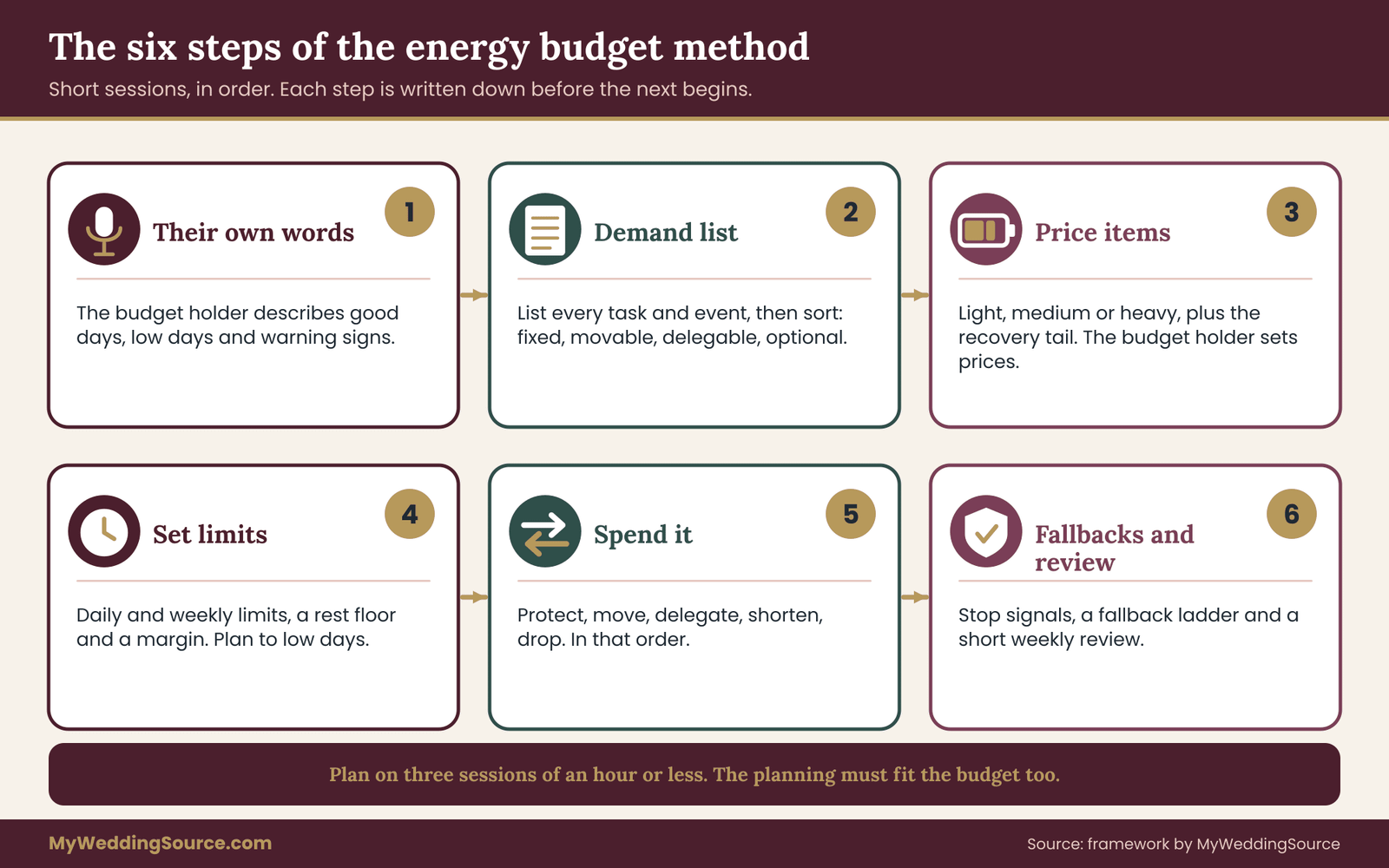
Build the energy budget together, in six steps. Let the partner with limits describe their own good days and low days. List every task and event, from vendor calls to the ceremony. Price each one as light, medium or heavy, and add its recovery tail. Set a daily and weekly limit with a protected rest floor. Spend the energy budget by protecting, moving, delegating, shortening or dropping items. Write stop signals and a fallback ladder before the wedding day so nobody has to improvise while tired.
Most wedding advice assumes that the couple has roughly equal and roughly limitless stamina. It assumes that you can attend a venue tour on Saturday, a tasting on Sunday, three evening calls during the week, and still wake up ready to dance a year later. When one of you cannot do that, the usual advice quietly turns into a list of ways to fail. The planning calendar looks fine on paper, and the person it was built around pays for it in missed days, cancelled plans and a wedding they approach with dread.
An energy budget is a simple correction. Instead of asking “what does a wedding require?”, you ask “what can this particular couple afford, and in what order?” The answer is almost always a smaller, calmer and better-sequenced wedding than the default, not a lesser one. Many couples find that the parts they drop were parts neither of them cared about.
A note on scope. This is general planning information, not medical, legal or financial advice. It does not assume any diagnosis, and it cannot tell you how much activity is safe for you. Your own treating clinicians can do that, and where a law or rule matters, this article points you to the agency that issues it so you can confirm the current version.
What an energy budget for a wedding actually is
Think of your energy the way you think of money. Money has a monthly income, fixed costs you cannot skip, flexible spending, and a reserve for surprises. A couple that ignores any of those four usually ends up in trouble. The same four ideas map cleanly onto energy, and that is the entire framework in one sentence: an energy budget lists what you can spend, what you must spend, what you choose to spend, and what you keep in reserve.
In this guide the budget holder is the partner whose energy or mobility is limited. The other partner is the one who plans alongside them, and who also has a budget, because supporting someone, covering for them and managing family reactions all cost energy too. The energy budget method works whichever of you is the bride, the groom or neither term fits. It also works if both partners have limits. Either way, the same energy budget logic applies to each person.
The energy budget has three ledgers. The activity ledger records everything that draws on energy: calls, travel, standing, decisions, social contact, even choosing between two shades of napkin. The rest ledger records the recovery that must happen for the energy budget to be real: sleep, quiet time, treatment, movement breaks, a day with no obligations. The margin ledger is the buffer you keep unspent so that one bad day does not collapse the whole schedule.
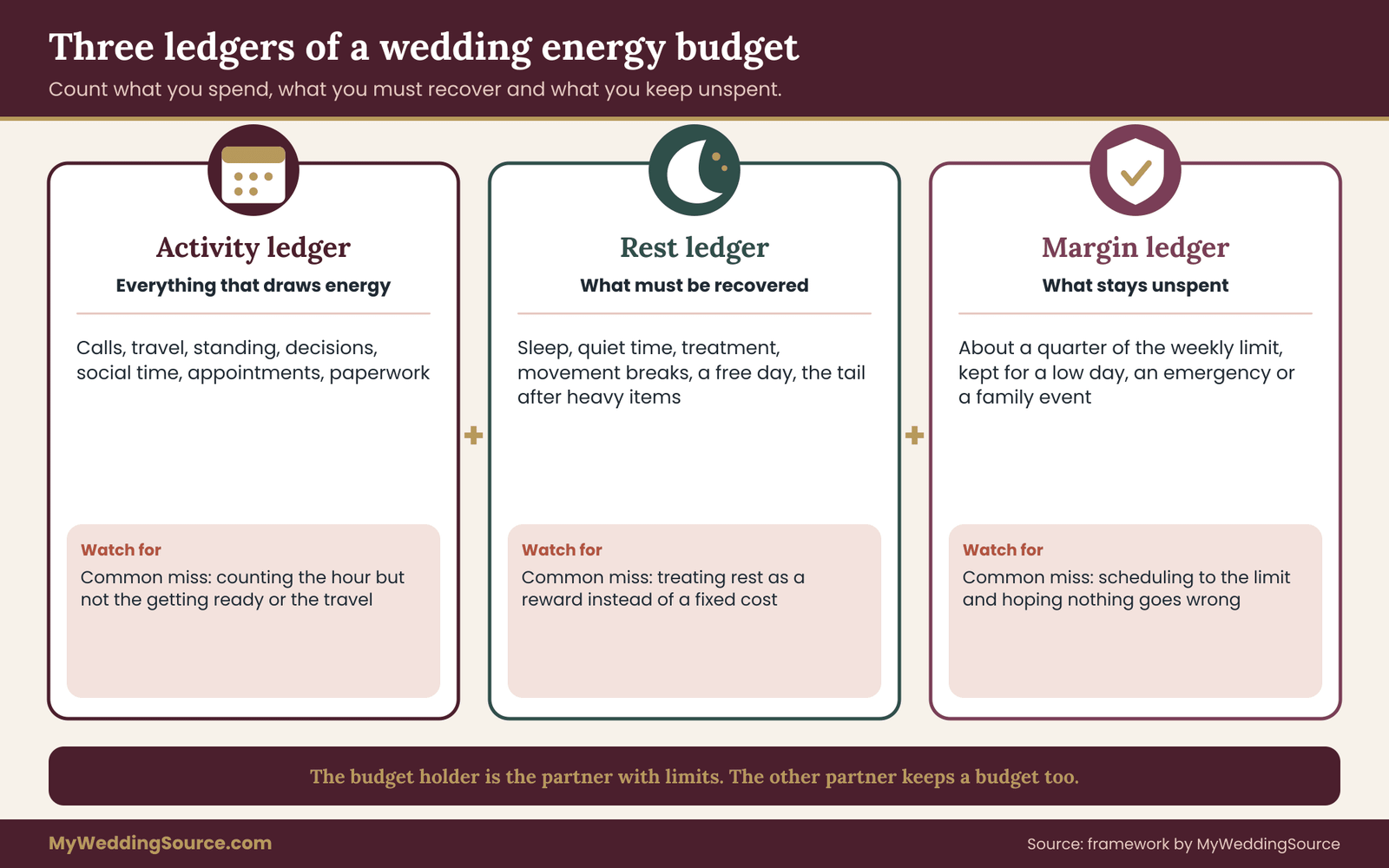
Why three ledgers and not one number? Because the common mistake is to count only the activities. A couple lists eight tasks for the week, notes that each is “only an hour,” and concludes the week is easy. The hour is never the whole cost. Getting ready, traveling, being social, and recovering afterward all belong to the task, and the rest ledger is where that hidden cost becomes visible. An honest energy budget always shows the tail of an activity as well as its start.
The energy budget is also personal in a way no template can be. One person’s heavy task is another person’s light one. A long drive might be easy while a fifteen-minute conversation with a relative is draining. The only valid prices are the ones the budget holder assigns. The other partner’s role is to ask, to believe the answer, and to write it down.
One practical point on vocabulary. You do not need to name a condition, share a diagnosis with vendors, or justify yourself to relatives for any of this to work. The energy budget is written in terms of what the person can do, how long, and what it costs afterward. That framing protects privacy and keeps the conversation about the plan rather than the explanation.
Why this is a couple’s plan, not a guest accessibility plan
Accessibility guides for weddings are mostly about guests: ramps, seating, restrooms, sensory spaces, transport. Those matter, and the site has detailed guidance on them, including a venue audit in accessible wedding venue red flags. But a guest can leave when they are tired. A guest can skip the rehearsal dinner. The couple cannot leave their own wedding, and they carry the planning workload for a year beforehand.
That difference changes three things. First, the couple’s energy is spent in places guests never see: contracts, revisions, family negotiations, payment schedules, and the long tail of small decisions. A venue can be perfectly step-free and still be the wrong choice if the planning process around it exhausts the budget holder before the date arrives.
Second, the couple’s presence is load-bearing. If a guest cannot attend a portion of the day, the wedding continues. If the budget holder cannot continue, the wedding changes shape. That is why the failure conditions in the later sections of this guide matter so much, and why they have to be agreed before the day.
Third, the couple is the only party who can decide which parts of a wedding are optional. A vendor will tell you a first look, a receiving line and a grand exit are “standard.” A relative will tell you that a missing tradition will upset someone. Neither of them is carrying the cost. The energy budget gives the couple a neutral, numbers-light way to say “that item does not fit” without arguing about whether it is important.
There is a useful boundary here. If you are mainly worried about how guests with mobility needs will get around, start with the guide to coordinating guest hotels across budgets and mobility needs. If the question is how the couple will get through the planning and the day, you are in the right place, and the rest of this article is about exactly that.
Who this energy budget method is for, and who needs more than this
The energy budget method fits several situations. Some couples live with a chronic condition where energy fluctuates, and the budget holder’s capacity on a given day is hard to predict. Others have a recovery period from surgery, treatment or illness that overlaps the wedding date. Some have a permanent mobility limit and use a wheelchair, walker, cane or scooter, with different costs for different surfaces and distances. Still others are pregnant, or caring for a parent, or both partners are simply running low from work and family load.
It does not fit if the real problem is a medical question. If you do not know whether the budget holder can safely stand for the ceremony, take a long flight, or stay up for the reception, the answer belongs with the person’s clinicians. This guide can help you organize the question to ask them, but it cannot answer it. The honest version of the plan includes a line that reads “confirm with treating team” next to any item where safety, not just comfort, is at stake.
It also does not replace formal accommodation processes. If the wedding takes place in a public venue, a restaurant, a hotel or a government building, the venue has its own obligations under accessibility law, and the ADA website explains the general framework. That is a separate track from your internal budget, and the sections on venues and vendors cover how the two fit together.
Finally, the energy budget method is not a replacement for general planning. You still need a timeline, a budget in dollars, and a guest list. The energy budget sits on top of those. If you are still at the stage of setting up the basics, start with the wedding planning checklist and then come back here to decide how each item will be paid for in energy rather than only in money.
How the rest of this guide works
The next sections follow the six steps in order. You will start by having a specific conversation, then build a demand list, then price items, then set limits, then spend the energy budget. After that comes a worked example with an invented couple so you can see the arithmetic, followed by the wedding day itself, the money and vendor side, failure conditions and fallback plans, and the other partner’s budget.
Two warnings before you begin. Do not try to do all six steps in one sitting. The first session is a conversation, not a spreadsheet, and rushing it is how couples end up with a plan that one of them privately does not believe. Second, do not treat the numbers as science. They are a shared language. A “3” is a 3 because the two of you agree it is, and you will adjust it as you learn.
Plan on about three short sessions of an hour or less, spread over a week or two, to produce a first version. That alone is an application of the energy budget method: the planning of the energy budget should itself fit within the budget holder’s good-day capacity. If a session leaves the budget holder flattened, it was too long, and the next one should be shorter.
Step one: start with the budget holder’s own words
The first step is a conversation, and it has one rule: the budget holder talks, and the other partner writes things down without correcting them. This is harder than it sounds. The other partner will want to reassure (“you can do more than you think”) or to protect (“let’s not even try that”). Both reactions replace the real data with a guess. The energy budget is only as accurate as what goes into it.
Set up the conversation at a good time of day, with no deadline. Ten or fifteen minutes is plenty to start. Nothing needs to be priced yet, because the energy budget begins with description. Use plain questions about what has actually happened, not predictions about what might. The point is to build a description of reality, and the best evidence is the last few months.
Here are questions that tend to produce useful answers. What does a good day look like in terms of hours you are comfortable being up and active? What does a low day look like, and how often do those happen? What activities reliably cost more than they seem to, such as long drives, crowded rooms, standing, heat, noise or phone calls? What do you need before, during and after a big day? What helps you recover fastest? What warning signs tell you that you are about to hit a wall?
Write down the answers in the budget holder’s words, not in clinical shorthand. “Two hours of standing max, then I need to sit for twenty minutes” is more useful than “limited mobility.” “Afternoons are my best time, and I lose the next morning after a late night” is a scheduling rule. These sentences become the raw material for pricing activities in step three. Each one is a line in the future energy budget.
The good-day, low-day, recovery-day pattern
Most people with limited energy do not have a flat capacity. They have a pattern. For planning, three kinds of days are enough. A good day is one where the budget holder can do close to what they want. A low day is one where activity must be cut sharply. A recovery day follows a heavy effort and is spent mostly resting, whether or not the person feels low that morning.
Ask the budget holder to estimate roughly how many of each they have in a typical month. Do not chase accuracy. “About half good, a third low, the rest recovery” is a perfectly usable answer. If the pattern is unpredictable, say so, and the energy budget will treat every date as possibly low. If the pattern is tied to something predictable, such as treatment cycles, hormone cycles, the weekly work schedule or the weather, note that. Predictable patterns let you aim heavy tasks at likely good days.
The reason to name three kinds of day is that a schedule built only for good days fails on its first low day. A schedule built only for low days feels pointless and gets abandoned. The working approach is a plan with a base layer designed to survive low days, and optional items that happen only on good days. You will see this structure again when we set limits.
One more distinction helps. Some limits are about quantity (how much total activity), some about duration (how long at a stretch), some about conditions (heat, stairs, surfaces, noise), and some about timing (mornings are poor, evenings are poor). A wedding plan that respects quantity but ignores timing will still fail. Mark which type each limit is, because they are solved by different moves. A timing limit and a quantity limit need different entries in the energy budget.
Agree on what the budget holder wants the wedding to be
Before any numbers, ask a values question. If the energy budget could pay for only three things, which three would the budget holder choose? The answer is not always what you expect. Some people care most about the ceremony, some about the dance, some about a quiet hour with close family, some about being rested enough to enjoy the next morning.
Ask the other partner the same question separately, then compare. Where the lists overlap, you have your protected core. Where they differ, you have a negotiation, and it is much better to have that negotiation now, at a kitchen table, than at the venue with a caterer waiting for an answer.
Be honest about the difference between “important” and “expected.” Many items in a wedding exist because the couple assumes someone else wants them. A late-night send-off, a formal receiving line, a full-day photo schedule and a seven-course dinner are all expected in some circles and meaningless in others. The budget holder’s values list is the fastest way to tell the difference.
A related point is disclosure. Decide who needs to know what. Disclosure is a choice, and the energy budget works without it. The couple, the immediate families, the planner if you have one, and a handful of key vendors will probably need some version of the plan. Everyone else needs only the logistics. Settle on one or two sentences you are comfortable using, for example “we are keeping the day shorter and building in rest breaks,” and use them consistently. You do not owe anyone a medical explanation.
Step two: build the demand list
With the conversation done, the next step is to list everything that will ask for energy. This is a brainstorm, not a ranking. Include things you assume are fixed, because assumptions are where hidden costs live. Every item belongs in the energy budget until you decide otherwise. Aim to cover three periods: the planning months, the final two weeks, and the wedding weekend.
For the planning months, list venue visits, vendor meetings and calls, tastings, dress or suit fittings, invitation tasks, registry decisions, guest list conversations, family visits, shower or party events, legal paperwork, travel for the wedding itself, and any health appointments that will happen anyway. Do not leave out the invisible work: reading contracts, answering email, comparing quotes, and having the same conversation with four relatives.
For the final two weeks, list the crunch: final headcount, seating, payments, vendor confirmations, packing, rehearsal, arrival logistics, and any pre-wedding gatherings. This period is where couples with limited energy most often get hurt, because everything lands at once. Seeing it listed in one place is often a shock, and a useful one.
For the wedding weekend, list every scheduled moment from arrival to departure: hair and makeup, photos, the ceremony, cocktail hour, dinner, toasts, dances, cake, farewells, and the morning after. Include transitions, because moving between spaces is where mobility costs show up. Include the rehearsal dinner and any welcome event if you have them.
Separating the fixed items from the flexible ones
Once the list exists, sort each item into one of four groups. Fixed items cannot move or disappear: the legal ceremony itself, a venue date already contracted, a medical appointment. Movable items can happen at another time or in another place. Delegable items can be done by someone else, wholly or partly. Optional items can be shortened, replaced or dropped.
This sort is the most valuable hour in the whole process. Most couples find that fewer items are fixed than they thought. A tasting can be replaced by a delivered sample box. A venue tour can be done by the other partner with a video call and a measurements checklist. A fitting can happen at home if the tailor will travel, and some do. A guest list negotiation can be handled by the other partner with a written summary for approval.
Be specific about who can take each delegable item. Name a person, not a category. “Someone will handle it” is a plan that lands back on the budget holder in two weeks. A named person with a clear scope, a deadline and an approval step is a plan that works. The approval step matters: delegating a decision without keeping a veto can cost more energy than doing it, because of the cleanup.
Watch for items that look optional but carry a hidden obligation. Skipping the rehearsal dinner might save a heavy evening, but it may also leave the families without a chance to meet before the day, which creates its own tension at the ceremony. Mark any such item with a note about what it protects, so that when you drop it you can replace its function in a cheaper way.
A note on decisions as energy cost
Many people count physical tasks and forget that decisions are expensive. A wedding is a long sequence of choices with real money attached and no obvious right answer. For someone with low energy, decision fatigue is a genuine cost, and it tends to peak in the middle of planning when the choices are finer and the stakes feel higher.
Put decisions on the demand list explicitly. “Choose florist” is a task with a research phase, a comparison phase and a commitment phase, each with a cost. Where possible, shrink the decision itself: ask a trusted friend to shortlist three options, set a rule such as “first vendor that meets these four criteria,” or decide by a fixed date and stop revisiting.
The guide to wedding decision rights covers how couples and families can share input without losing control, and it is directly relevant here. A clear rule about who decides what saves an enormous amount of energy that would otherwise go to repeated negotiations.
Finally, give decisions a time of day. If the budget holder thinks clearly in the morning, hold decision sessions then and keep afternoons for low-stakes tasks or rest. This single scheduling change is often the cheapest way to get more out of the same energy budget.
Step three: price each activity as light, medium or heavy
Now give every item on the demand list a price. The energy budget uses three tiers, and the budget holder assigns them, not the other partner and not a template. A light item costs one block. A medium item costs two. A heavy item costs three. A block is not a unit of time or a clinical measure. It is the couple’s own shorthand for “a small slice of a day’s capacity.”
Why only three tiers? Because finer scales invite false precision. If you try to rate a task from one to ten, you will argue about whether a vendor call is a four or a five, and the argument costs more than the difference. Three tiers are fast, easy to explain to a helper, and good enough to show where the load sits. A coarse energy budget that gets used beats a precise one that does not.
Price each item by asking one question: after doing this, how much of a normal good day would I have left? A light item leaves most of it. A medium item leaves about half. A heavy item leaves little. Then ask the question again for a low day, because the same item can jump a tier. A twenty-minute call may be light on a good day and medium on a low one. Record both prices when they differ. The energy budget should hold both numbers.
Do not price by how long something takes. A two-hour quiet lunch with a close friend may be light. A twenty-minute argument with a relative about seating may be heavy. A short walk across a gravel parking lot may be heavy for someone who uses a wheelchair or cane, and trivial for someone who does not. Each item gets priced in the budget holder’s terms.
The recovery tail
Every medium and heavy item has a tail. The tail is the rest that must follow for the energy budget to stay solvent. A heavy item might need a full recovery day after it. A medium item might need an easy evening. A light item usually has no tail. Record the tail in the rest ledger as a separate entry, because it is the part most often forgotten.
Here is the arithmetic that surprises couples. Suppose a venue visit is priced as heavy (three blocks) and carries a one-day tail. If the budget holder’s good days are about half of all days, then the real cost of the visit is not three blocks. It is three blocks plus the day you lose, and that lost day may have been a good day you would have used for something else. The tail is where hidden cost lives.
Tails also compound. Two heavy items in a row do not simply cost twice as much. They can leave the budget holder at a level where even light tasks become medium. For this reason, the energy budget should space heavy items so each tail finishes before the next begins. A rule of thumb that many couples settle on is “no heavy item within its own tail.” That means no tasting the day after the venue tour unless the tour was priced light.
Ask the budget holder to estimate each tail in their own words: “a quiet evening,” “a whole day,” “two days if it rains.” You are not predicting precisely. You are building a map of how items interact, so that your calendar does not stack them blindly.

Pricing mobility separately from energy
When the limit is mobility rather than, or as well as, general energy, add a second dimension. Mobility costs depend on the environment: distance, surface, stairs, door widths, seating availability, restroom access, lighting and weather. A place that is cheap in energy for most people may be expensive for the budget holder, and vice versa.
For each location on the list, ask four environmental questions. How far is it from drop-off to the place where you will actually be? What is the surface: smooth, carpeted, gravel, grass, cobblestone? Where can you sit, and how close is the seat to where you will be standing or moving? How far is an accessible restroom? Answers to these four questions change the price of an item more than its duration does.
Plan on verifying rather than assuming. A venue that says it is “accessible” may mean one thing for a wheelchair and another for a person who can walk short distances but not long ones. Environmental facts change the energy budget more than any price tag. Ask for specifics: the path of travel from parking to ceremony space, the number and height of any steps, the distance to restrooms, and whether seating is available along the route. The ADA website explains the general legal framework for public places and is a reasonable starting point for what to ask.
Be careful with outdoor sites. Grass, sand, gravel and uneven ground change costs dramatically for wheels, canes and walkers, and weather can change the surface overnight. If the venue is outdoors, price the item twice: once on a dry day, once on a wet one. Then decide whether you have a rain plan that keeps the cost the same or lower, rather than one that moves everyone to a longer path.
Example items and their usual tiers
Because the budget holder sets the prices, no list can be authoritative. Still, examples help you see how the tiers behave. The tiers below are illustrations of reasoning, not recommendations, and your own prices may differ from every one of them.
A short vendor phone call about a delivery time is often light, because it is brief, low stakes and can be done sitting down. A video meeting with a photographer to review a shot list may be medium, because it requires sustained attention and some decision-making. A negotiation with a venue about changes to a contract may be heavy, because it combines money, conflict and pressure.
A seated tasting at a restaurant may be medium, with a moderate tail. A venue walkthrough that involves long distances, stairs, standing and many people may be heavy, with a full-day tail. A fitting is often medium, but can be light if the tailor comes to you and the budget holder can sit during most of it. A family dinner with relatives who have strong opinions can be heavy no matter how pleasant the food is.
The wedding day items are priced later, but note the pattern. Standing is expensive. Waiting is expensive, especially standing and waiting. Being “on” socially for hours is expensive. Transitions between spaces are expensive. Sitting while being the center of attention is cheaper than standing while doing so. This pattern is why wedding-day plans for limited-energy couples revolve around seating, sequencing and short, well-timed appearances.
Pricing the other partner’s items
The other partner also has a budget, and a fair plan prices their items as well. They will carry extra load: calls the budget holder cannot take, errands, tours, paperwork, relationship management, and the emotional work of watching someone they love push through hard days. It is easy for that load to become invisible The couple’s energy budget has to count both people., and it is how the other partner ends up burned out before the wedding.
Run the same pricing exercise for the other partner. Their energy may be less limited in the physical sense, but they have a day job, a family and a limited tolerance for chronic worry. When the two budgets are laid side by side, you will often see that the combined workload exceeds what either partner can sustain, and that is the correct moment to bring in help or to cut scope.
A useful rule: the other partner’s budget should never be spent to hide the budget holder’s limits from the budget holder. Overfunctioning, meaning doing everything quietly so the budget holder never feels the cost, tends to backfire. The budget holder loses the ability to judge what is happening, and the other partner eventually runs out. Shared visibility of both budgets is a form of respect for both people.
Rules for revising prices
Prices will be wrong at first. That is normal. After each priced item actually happens, take two minutes to compare what you expected with what happened. Did the item cost the tier you assigned? Was the tail longer or shorter? Update the list. After five or six items, your prices will be noticeably more accurate, and your calendar will start to match reality.
Keep one column of notes for surprises. Surprises are how an energy budget gets more accurate. A pattern will emerge: perhaps calls after four in the afternoon cost more, or being driven costs less than driving, or the third vendor in a day is the one that tips things over. These patterns turn into scheduling rules, such as “no vendor contact after four” or “never more than two outside appointments in a day.” Rules like these are the real output of the energy budget, and they will continue to help long after the wedding.
Do not treat a bad estimate as a failure. The purpose of pricing is to make the invisible visible and to give you a shared vocabulary for saying “that is too much.” If the budget holder can say “that is a heavy and I have two heavies this week” instead of “I just can’t,” the conversation changes from a complaint to a scheduling problem, and scheduling problems can be solved.
Step four: set the daily and weekly energy budget and the rest floor
With prices in hand, you can set limits. This step turns the loose sense of “we should not do too much” into numbers the two of you can check against a calendar. The energy budget has four parts: a daily limit, a weekly limit, a rest floor and a margin.
Start with the daily limit. Ask the budget holder how many blocks they can spend on a good day and on a low day. Use the same three-tier scale: light is one, medium two, heavy three. A typical answer might be six blocks on a good day and three on a low one, but yours will be your own. Remember that daily life already uses some of the energy budget, so this number should cover only the wedding-related load, after normal routines, work and treatment.
Next, the weekly limit. Add up an average week: the good days, the low days and the recovery days. Weekly capacity is not seven times a daily number, because recovery days contribute little or nothing. Estimate honestly, then subtract. The weekly limit is the number you will check each Sunday against the week ahead. That check is the working core of the energy budget.
The rest floor is the part of the energy budget that cannot be spent. It might be one fully unscheduled day per week, a quiet hour every afternoon, and a minimum number of full nights of sleep before any heavy item. The rest floor is not a reward for finishing tasks. It is a fixed cost, like rent, and it comes out first.
Finally, the margin. Keep at least a quarter of the weekly energy budget limit unspent. The margin pays for a low day that arrives uninvited, a vendor emergency, or a family event you could not decline. A schedule with no margin is not a schedule. It is a prediction that nothing will go wrong, and weddings reliably punish that prediction.
Planning to low days, enjoying good days
Here is the design rule that makes the energy budget survive reality: commit to the low-day number, and treat the good-day number as a bonus. Fixed items, such as contracted appointments and deadlines, should fit within what the budget holder can do on a low day. Anything that needs good-day capacity goes on a flexible list, to be done if the day allows and rescheduled without guilt if it does not.
This is the opposite of how most people schedule. The default is to plan for a typical day and treat low days as interruptions. For a couple with limited energy, low days are not interruptions; they are part of the pattern, and a plan that cannot absorb them will break repeatedly. This is the point where an energy budget earns its keep. Each break costs energy twice: once for the missed task, and once for the reshuffling and the worry.
In practice you keep two lists each week. The committed list holds the items that must happen and fit within the low-day limit. The bonus list holds the optional or movable items you will do when the budget holder feels well. At the end of the week, anything left on the bonus list slides into next week or gets dropped. Nothing on the bonus list is allowed to become urgent, which is why you build those lists early, with enough lead time.
If this sounds conservative, consider the alternative. A couple that plans for good days and hits three low days in a row ends up with a pile of overdue items, a stressed budget holder, and a family wondering what is wrong. The conservative plan, by contrast, produces steady progress, and the good days become a pleasant surprise rather than a requirement.
Worked case: an invented couple’s final twelve weeks
The following example is invented for illustration. It does not describe a real couple, and the numbers are examples of how to reason, not targets. Priya and Daniel are planning a wedding for about sixty guests, twelve weeks from now. Priya’s energy fluctuates, and on low days she uses a cane. Daniel works full time and has been handling most tasks quietly. Both are tired.
They run the first three steps. Priya says a good day gives her about six blocks of wedding-related activity and a low day about three. She guesses roughly half her days are good. Her weekly capacity, counting a recovery day after any heavy item, comes to about twenty-four blocks. They keep a margin of six, so the weekly planning limit is eighteen blocks. The rest floor is one fully free day and a quiet hour each afternoon.
Their demand list, sorted into fixed, movable, delegable and optional, shows forty-one items across twelve weeks. When they price them, nine items are heavy, fifteen medium and seventeen light. The heavy items include the final venue walkthrough, a family dinner with both sets of parents, the rehearsal, and the contract negotiation with the caterer. Counting each item’s recovery tail as extra blocks, total demand comes to about one hundred fifty blocks across twelve weeks, comfortably under the combined limit on average but badly lumpy.
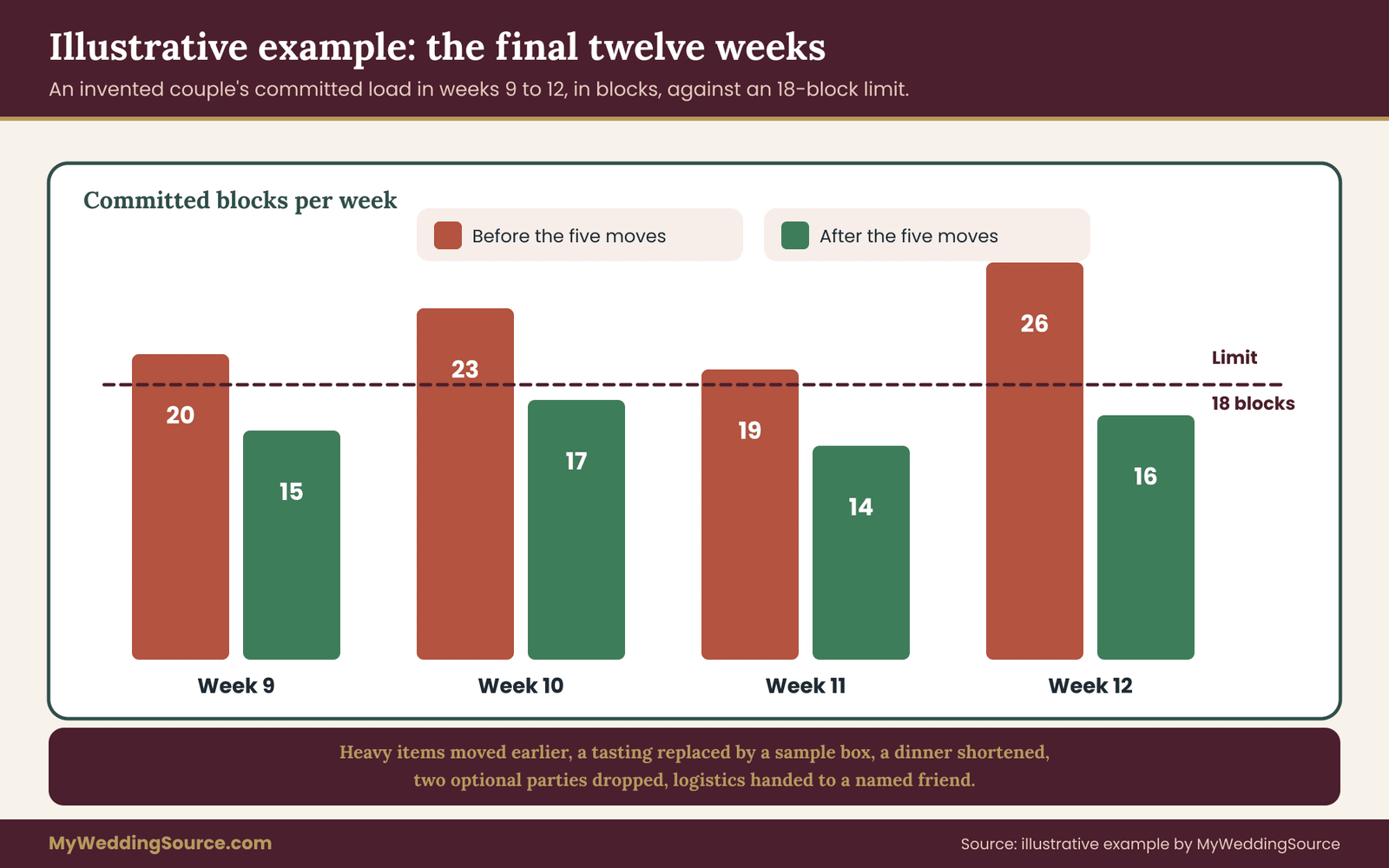
The lumps are the problem. Weeks nine through twelve hold twenty, twenty-three, nineteen and twenty-six blocks of committed items, every one of them above the eighteen-block limit. The couple’s schedule looks fine on average and impossible at the end. This is the typical finding, and it is why the energy budget is worth building: it shows exactly where the plan will break, while there is still time to change it.
What Priya and Daniel changed
They look at the overloaded final weeks and apply the five moves described in the next section. They move the caterer negotiation into week four, when the energy budget is light, and give Daniel the first pass with Priya approving a written summary. The final walkthrough becomes two shorter visits, one now with measurements and photos, one in week eleven for a seated check of the route from parking to ceremony space.
They replace the full tasting with a delivered sample box eaten at home on a good day. The parents’ dinner is shortened to a seated two-hour lunch at a restaurant near Priya’s home, which brings it down from heavy to medium. They drop two optional gatherings, a bridal luncheon and a casual cocktail evening, and tell family they will do a relaxed brunch after the wedding instead.
The rehearsal is the item they cannot drop, because it protects the ceremony. They keep it, but price it honestly as heavy with a full-day tail, so the next day is blocked. Final payments, signage, seating and day-of logistics are given to a friend who has offered to help, with a one-page handoff sheet and a clear rule that she may decide anything under a set dollar amount without asking.
After the changes, weeks nine to twelve carry fifteen, seventeen, fourteen and sixteen blocks, under the limit, with the margin intact. Nothing important disappeared. What changed is the shape: heavy items moved earlier, long items were shortened, and some work moved to people who had already offered. The result is the same wedding with a different load profile, and the couple can say with confidence that the plan fits.
What the example does not show
Examples like this look tidy, and real life is not. Two things are worth saying. First, the first pass is always off. Priya’s prices will change as she finds that some “medium” items are heavy and some “heavy” ones are manageable. The couple should expect to revise after the first three weeks. Second, a plan that fits on paper still needs a plan for failure, which is why a later section is entirely about stop signals and fallbacks.
Third, the numbers carry no medical meaning. If Priya’s clinicians tell her to cap total activity at a lower level, that advice overrides anything the couple calculated. The energy budget is a scheduling tool that sits underneath professional guidance, not above it. Couples working with a treatment team can bring the demand list to an appointment and ask directly which items worry the team.
Step five: spend the energy budget with five moves
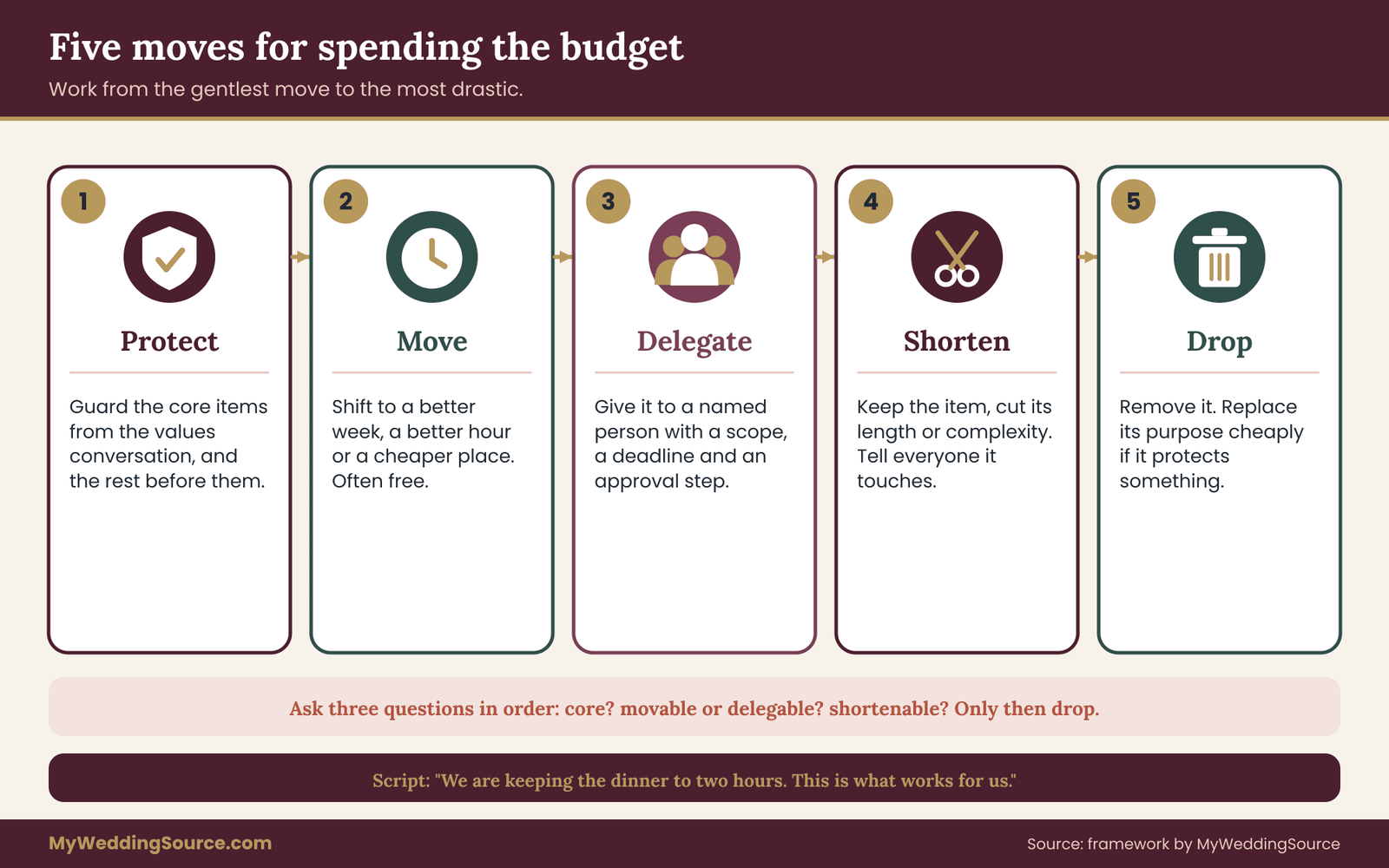
When the demand list is priced and the limits are set, you will almost always find that demand exceeds the energy budget in some weeks. Spending decisions are how you close the gap. Think of it as editing the energy budget until it balances. There are five moves, and they work best in a fixed order, from the gentlest to the most drastic: protect, move, delegate, shorten, drop.
Protect means deciding which items are the core of the wedding and guarding the energy they need. These are the items from the values conversation in step one. If the ceremony and a quiet hour with close family are the core, then the energy budget for those, including the rest before them, is spent first. Everything else competes for what remains. The energy budget funds the core first and the extras second.
Move means shifting an item to a better time or place. Move heavy items to weeks with spare budget. Move decisions to the budget holder’s best time of day. Move a meeting to a location that costs less, such as a vendor who comes to your home or a video call instead of a drive. Moving is often free, and it is where the quickest savings hide. Most couples recover more of their energy budget here than anywhere else.
Delegate means giving the item to someone else, with a clear scope and an approval step. Shorten means keeping the item but reducing its length, size or complexity: a one-hour tasting instead of two, a fifteen-minute toast sequence instead of forty minutes, a receiving line replaced by a table visit during dinner. Drop means removing the item and, if needed, replacing its purpose cheaply.
How to choose the right move for each item
Ask three questions in order. Does this item protect something from the core list? If yes, protect it and look for ways to lower its cost without cutting it. If no, can it be moved or delegated without losing quality? If yes, do that. If neither works, can it be shortened? And only then, if the item is neither core nor cheaply changed, drop it.
The order matters because couples tend to jump to the end. Dropping feels decisive and relieving, and it is sometimes right. But a dropped item often returns as a complaint, a gap or a guilty memory, and it can cost more energy in explanations than it saved. Delegating and shortening keep most of the value at a fraction of the price.
Be careful about delegating to the wrong person. A helper who needs constant instructions costs more than doing the task yourself. The best candidates are people who have offered, who have done something similar, and who are comfortable making small decisions without asking. If a friend or relative has said “let me know what I can do,” take them up on it with a specific job, not a general thanks.
Also be careful about shortening in ways that create friction elsewhere. A shortened ceremony that leaves the officiant, musicians and photographer with timing conflicts has not saved energy; it has moved the cost to people who will bring it back to you. When you change an item’s length, tell everyone who touches it, and check the cue sheet. The guide to ceremony cue sheets is a good reference for how a change in one cue ripples into others.
Moves that tend to pay off for limited-energy couples
Some changes consistently lower cost without lowering meaning. Hold the ceremony and reception in the same place, or in places connected by a short, step-free route, so that no transport is needed between them. Put the quiet, seated parts of the day at the beginning, when energy is highest, and the loud, social parts later with a rest break in between.
Reduce the number of separate events. A rehearsal dinner, welcome party, wedding, brunch and farewell lunch are five events, each with a prep cost, a social cost and a tail. Many couples hold two or three and fold the others into them. A single relaxed welcome gathering the evening before can replace both a rehearsal dinner and a welcome party if the group is small.
Choose a weekday, a daytime or an earlier start if the budget holder’s energy is better then. A wedding that starts at noon and ends at six can be as joyful as one that starts at five and ends at midnight. Some of the highest-cost parts of a traditional wedding are simply late: late dinners, late dances, late exits.
Simplify the sensory load. Noise, crowds, bright light and heat all draw on energy for some people. A quieter room for part of the day, shade, fans, a seated area with a view of the action, and a designated person who can steer the budget holder away from long conversations are all low-cost changes. None of them requires explaining anything to anyone.
Wording that makes delegation and dropping easier
People often avoid these moves because they dread the conversation. A few plain scripts help. When delegating: “I would like you to handle the rental pickup. Here is the list, the address and the time window. You can decide anything under this amount; call me for anything above it.” That is short, specific and leaves no room for the task to boomerang.
When shortening an event with family: “We are keeping the dinner to two hours so that we can enjoy it. We would love to see everyone at the brunch afterward.” When dropping an item: “We decided not to do a receiving line. We will spend time at each table during dinner instead.” Notice that these scripts state a decision rather than ask permission, and they offer a replacement where possible.
When a relative pushes back, resist the pull to explain medical details. “This is what works for us” is a complete answer. You can repeat it as many times as needed. If the pressure continues, the other partner can take over those conversations so the budget holder does not spend energy defending the energy budget. Taking the conflict is a legitimate use of the other partner’s budget.
The wedding day and weekend energy budget
The wedding itself needs its own budget, and it is different from the planning budget in two important ways. It is compressed into hours, and it cannot be rescheduled. For both reasons, the wedding-day plan should be the most conservative part of your whole scheme.
Start by pricing every scheduled moment from the morning of the wedding to the departure the next day, using the same light, medium and heavy tiers. Include getting ready, travel, photos, ceremony, cocktail hour, dinner, toasts, dances, cake, and farewells. Include transitions as separate items, because walking from one space to another is where mobility costs sit. Include the night before and the morning after, because rest on either side shapes how the day feels.
Then set a wedding-day limit that is deliberately below the budget holder’s good-day number. Adrenaline can make people feel capable on the day, and the crash afterward is real. Many couples find it wise to plan for the number they would use on a low day and treat anything beyond that as a bonus. The margin on the wedding day should be larger than during planning, not smaller. The wedding-day energy budget is a separate document from the planning one.
Next, protect the rest floor. Build a scheduled rest period into the timeline, in a private room if possible, with water, food, a place to lie down or put feet up, and a trusted person at the door. Fifteen to thirty minutes between the ceremony and the reception, or between photos and dinner, can change how the evening goes. Write it into the run-of-show as an event, not as a favor. Rest is a line item in the day’s energy budget.
Sequencing the day around the budget holder
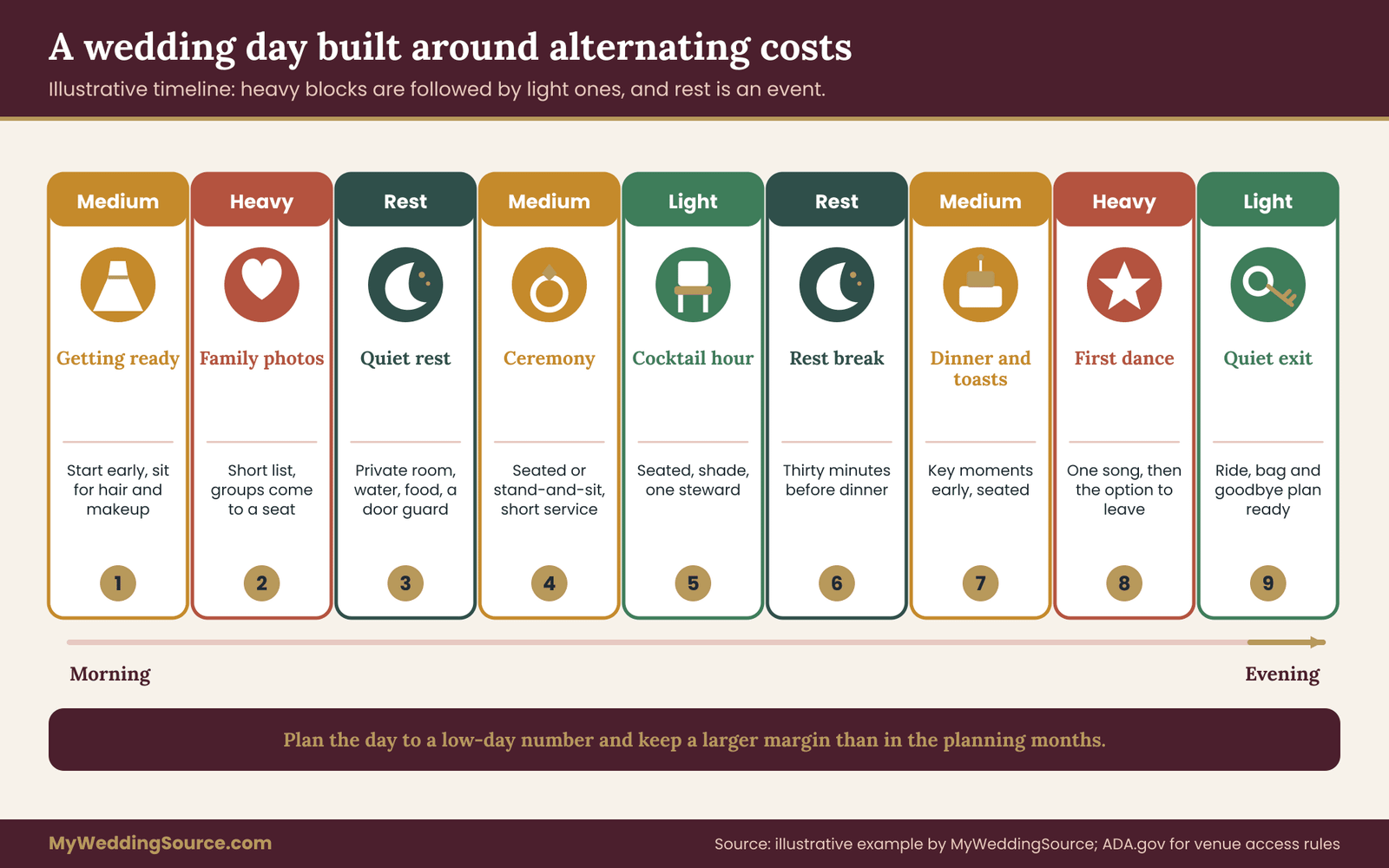
The standard wedding timeline is built around photographers and caterers. Yours should be built around the energy budget, with the vendors fitting into it. Draw the day as a sequence of high-cost and low-cost blocks and make sure they alternate. A heavy block, such as an hour of formal photographs, should be followed by a light one, such as a seated quiet period. Two heavy blocks back to back is the usual point where the day starts to slip.
Consider doing portraits and family photographs before the ceremony, when the budget holder is freshest, or splitting them into a short session before and a short session after. A long photo marathon between the ceremony and the dinner is one of the most expensive parts of a traditional day, and a seated option, such as bringing family groups to a bench or chair, can cut its cost sharply. A written list of required groups, with names, keeps it short.
Put seating everywhere the budget holder will wait. During the processional, at the altar or ceremony space, at the cocktail hour, in the photo area, at the head table or sweetheart table, and in a spot near the dance floor. Seating is not a concession; it is infrastructure. If the venue’s design makes this hard, ask for extra chairs and a rental company can supply them cheaply.
Plan the route as carefully as the schedule. Walk it in advance, or have the other partner walk it, and time it at the budget holder’s pace, not yours. Note the surface, the slope, the doors, the lighting and the distance to a seat. If someone uses a wheelchair, scooter or walker, check turning space in the restroom and at the head table. The guide to reception guest flow explains how entry, seating, food and exit interact, which helps when you change any one of them.
Ceremony, reception and the morning after
For the ceremony, decide whether the budget holder will stand, sit or alternate. A seated ceremony is entirely legitimate, and many couples find it also reads as intimate. If standing matters to them, plan a bench or stool nearby and a cue for when to sit. Shorten the ceremony if needed: a ten- to fifteen-minute service with meaningful readings is easier on everyone than a long one with filler.
For the entrance, choose a path and pace that suits the budget holder. An entrance on a partner’s arm, on a scooter, with a cane, or with both partners walking in together is a decision, not a problem. If the aisle is long, consider shortening it by repositioning the chairs or starting the walk part way along. Rehearse the movement at the real pace, and decide how you will handle a low-energy moment mid-aisle, for instance by pausing with a quiet signal.
At the reception, put the most important elements early: the first dance, toasts, the meal and the cake. After that, the budget holder can leave while the party continues. A plan for a quiet exit is as much a part of the day as the entrance. Decide who tells the DJ, who gathers belongings, how the transport is arranged, and how guests are told so that no one feels abandoned.
The morning after matters too. A farewell brunch can be lovely, but it is another event with another cost. Decide in advance whether the budget holder attends, joins for thirty minutes, or sleeps in while the other partner represents the couple. A short note or video message to guests who do not see you again is a kind and cheap alternative.
Money, vendors and venue checks that protect the energy budget
Money and energy are linked in ways couples often miss. A cheaper venue that is hard to reach, or a vendor that needs constant coordination, can cost far more in energy than its price tag shows. Conversely, paying for a service that removes a heavy task, such as a day-of coordinator, a delivery with setup, or a shuttle, may be the best use of a limited budget. Treat energy as a line item next to the dollar budget. A venue quote without an energy budget beside it is only half a quote.
For a dollar view of the whole wedding, the wedding budget guide is the reference. Here the point is narrower: when you compare options, add a column for energy. Ask what each option demands of the budget holder in planning and on the day. A venue with an on-site coordinator may cost more than one without, and still save the couple several heavy items.
Spend where the energy cost is highest. This is the dollar side of the energy budget: money buys back energy. Common candidates are a coordinator for the day, a vendor who handles delivery and setup, hair and makeup that comes to the getting-ready location, transport that drops guests at the door, and rental seating and shade. If money is tight, ask whether a friend, a relative or a hired helper can fill one of those roles for a smaller fee.
Vendor questions that reveal energy costs
Most vendors will happily answer a short list of practical questions, and the answers show you the energy price of working with them. How many meetings do you require, and can they be remote? Will you come to us, or do we need to travel? What is your process for changes, and how many of them are included? Do you need decisions by a certain date, and what happens if we are late? Who will be on site, and who is our contact if we are unavailable?
Ask also about flexibility. Can the schedule change if the budget holder has a low day? Is there a fee for rescheduling? Can you work from a written summary instead of live calls? Vendors that say yes are cheaper in energy than ones that say no, even if the dollar price is similar. The vendor timeline guide helps you see how many touchpoints each vendor adds and when they fall.
Put your agreements in writing. A written change is cheap; an unwritten one drains the energy budget later. Anything that affects the energy plan, such as a flexible reschedule clause, a shortened service window, a delivery to a seated location, or extra chairs, belongs in the contract or in an email confirmed by the vendor. If you must change something at the last minute, a written record saves a heavy phone call.
Checking the venue with the energy budget in mind
Venue checks serve two purposes. One is accessibility in the general sense: can people get in, move around and use facilities. The other is the couple’s own cost: how far will the budget holder travel, stand and wait. The first is covered in detail in the guide to venue accessibility audit, which is the place to start when you are choosing a site.
For the second purpose, visit the venue, or send a trusted person with a checklist, at the same time of day the wedding will take place if possible. Time the walk between parking, ceremony space, restrooms, a resting space and the reception area. Check for seating along the route. Check temperature and shade. Check the light, which affects some people’s energy and comfort. Ask where a vendor can park so that deliveries do not block the budget holder’s path.
If the venue is a public accommodation, such as a hotel, restaurant or event hall, it has obligations under the Americans with Disabilities Act. If it is a government facility, a different part of the law applies. The ADA website explains the general rules and links to technical guidance, and the U.S. Access Board publishes the design standards. These are the places to check current requirements, and a venue manager should be able to answer specific questions about the property. A private home or a backyard works differently, so rely on your own measurements there.
Insurance, cancellation and flexibility clauses
A plan that depends on perfect health is fragile. Ask about cancellation and rescheduling terms before you sign, and read them with the budget holder’s pattern in mind. What happens if you need to postpone because of illness or a medical procedure? Is a deposit refundable, transferable or lost? Is there a date after which you cannot change anything? Some vendors will move a date for a fee; others will not move it at all.
Event cancellation or wedding insurance may cover some situations, and policies differ widely in what they exclude, including pre-existing conditions. Read the exclusions before you rely on any coverage, and ask the insurer directly about how your situation would be treated. This article cannot tell you what a policy covers Insurance sits outside the energy budget, but it affects how much risk you can carry., and a licensed insurance agent or the policy documents are the right sources.
Keep a short list of “decision dates”: the last day to cancel, the last day to reduce the guest count, the last day to change a menu. Put them on the shared calendar. Knowing these dates in advance lets the couple decide with a clear head rather than in the middle of a bad week.
Failure conditions and the fallback ladder
Every plan needs a description of how it can fail, and this one is no exception. A written failure plan is not pessimism. It is a way to make decisions while rested, so that nobody has to make them while exhausted, in pain or in front of guests. An energy budget with no failure plan is a wish. The energy budget is only believable if the couple has agreed in advance what happens when the energy budget runs out.
Start with stop signals: the specific signs that the budget holder is near the limit. Ask them to describe the early signs in their own words. It might be going quiet, losing the thread of a conversation, needing to sit down suddenly, a change in color or breathing, or a particular phrase. Choose one word or gesture that means “I need a break now” and agree that it is never questioned in public.
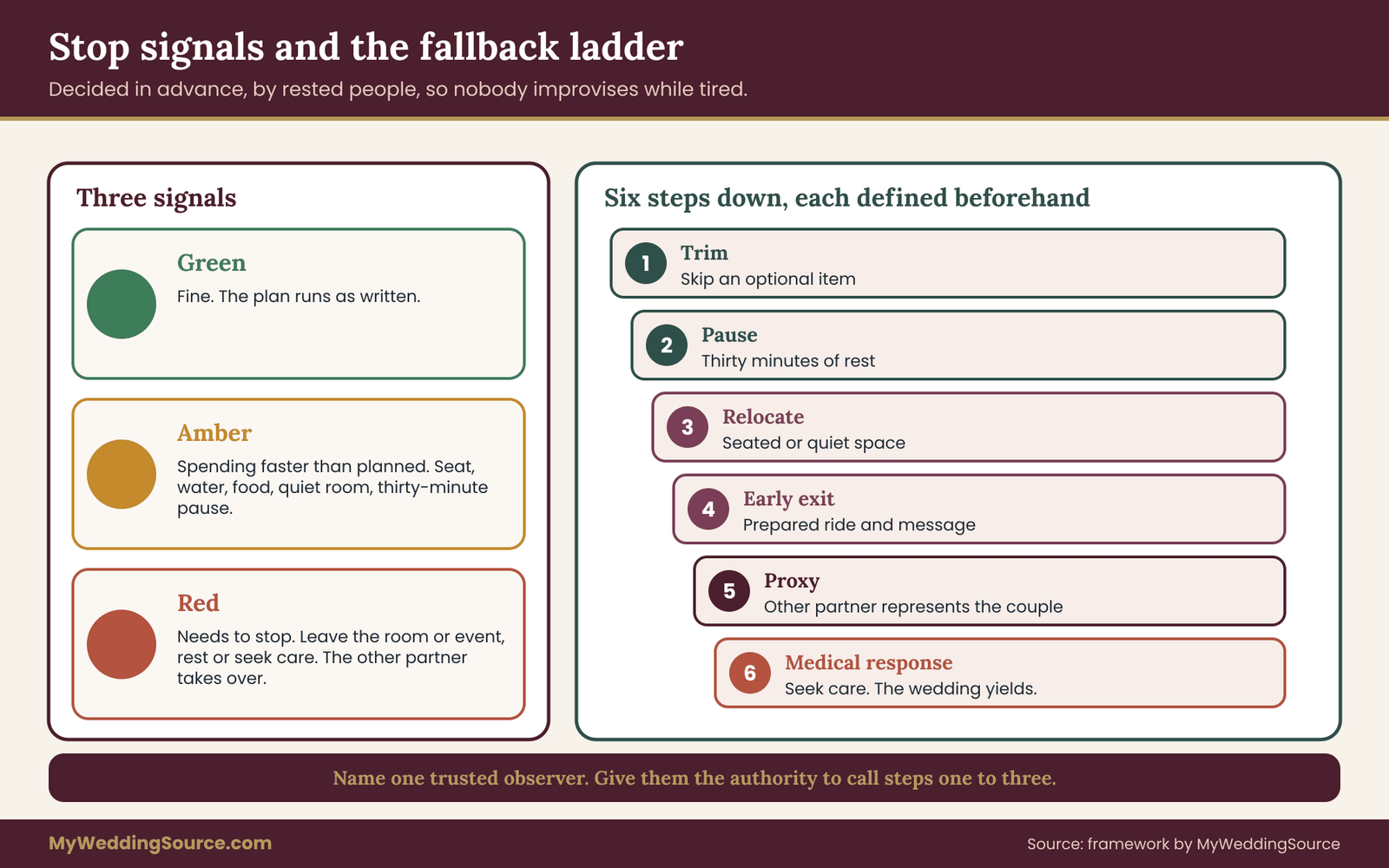
Give the signals three levels. At green, the budget holder is fine and the energy budget runs as written. At amber, they are spending faster than planned: the response is a seated break, water, food, a quiet room, and a thirty-minute pause in the schedule. At red, they need to stop. The response is to leave the event or the room, rest or seek care, and the other partner takes over whatever remains.
Agree on who watches for the signals. It cannot be only the other partner, because the other partner will be pulled in many directions. Name one trusted person, a sibling, a close friend or a coordinator, whose only job on the day is to notice the budget holder and to act on the signal without needing to ask. Brief them in advance and give them written authority to adjust the schedule.
The fallback ladder
A ladder is a list of steps from “slightly smaller” to “much smaller,” each defined before the day. Because it is defined, the couple can step down without losing face, and vendors and family can follow along. A sample ladder works like this, and yours should be built from your own demand list.
Step one is the trim: skip an optional item, such as the grand exit, a second round of photographs or a long set of toasts, and tell the DJ or coordinator quietly. Step two is the pause: insert a thirty-minute rest into the schedule, and shift later items by that amount or compress them. Step three is the relocation: move the budget holder to a seated or quiet space and let the event continue around them.
Step four is the early exit: the budget holder leaves after the main moments, with a prepared plan for transport, belongings and guest communication. Step five is the proxy: the other partner continues, represents the couple, and the budget holder joins by short video or returns for a final goodbye if able. Step six is the medical response: if the situation is a health concern rather than tiredness, the plan is to seek care without delay, and the wedding yields.
Write the ladder on one page, and share it with the coordinator, the trusted observer and the closest family. The ladder should also say who has the authority to call each step. If only the budget holder can invoke it, they may hesitate. If the observer can invoke steps one to three on a signal, the pressure lifts.
Failure conditions for the whole plan
Besides the day itself, the plan has its own failure conditions. Name them early. The planning schedule fails if the budget holder spends more than two consecutive weeks over the weekly energy budget limit, if recovery days begin to run into each other, if the other partner’s budget is overspent for a month, or if any item on the committed list is repeatedly missed.
Decide in advance what you will do when a failure condition is met. Options include cutting scope, hiring help, moving a deadline, changing the date or reducing the guest list. The couple should also decide the latest date by which they will reassess the whole plan, for example eight weeks before the wedding, and what they will do if the answer is “this is not working.” Having that conversation early removes the shame from it.
Some conditions are not about energy at all. If the budget holder’s health changes in a way that affects safety, the energy budget pauses and the treatment team’s advice leads. If a vendor will not meet reasonable adjustments, the couple should be ready to replace them, and the contract questions from the earlier section help you know the cost of doing so. A written stop rule such as “if X happens, we do Y” is worth more than good intentions.
Keeping the other partner’s energy budget honest
The other partner carries a load that is easy to overlook, and a plan that spends them down will fail even if the budget holder’s numbers are perfect. They are managing tasks, family reactions, logistics and worry. They may also be doing a job, caring for children or parents, and absorbing the emotional weight of watching someone struggle. Their energy budget deserves the same attention. Overspend here and the whole energy budget fails.
Run the five-step method for them too, at least in simplified form. List their demands, price them, set a limit and a rest floor, and use the same five moves. Put their rest on the calendar. The most common mistake is for the other partner to treat their own rest as the thing that gives way when the schedule tightens, which means the schedule’s weakest point is also its most important support.
Check in on a rhythm, not only in a crisis. The weekly review keeps the energy budget alive. A short weekly review works well: what did the week cost each of us, where did we exceed the limit, what do we change next week? Ten minutes on a Sunday is enough. Keep it practical. The review is not the place to settle old grievances, and it is not the place for the budget holder to apologize for having limits.
Sharing the load with family and friends
Many people want to help and do not know how. Give them specific, bounded tasks, and match tasks to people’s strengths. One relative may be good at tracking RSVPs; another at driving elderly guests; another at handling the vendor load-out. Offer a short written description of what the job is, how long it takes and when it ends.
Keep one point person for communication. When twelve relatives text the budget holder, the cost is enormous. A single message channel, a shared document with the latest plan, or a weekly update from the other partner reduces the volume. The same logic applies to guests: a clear wedding website and a single contact for questions avoids a long tail of small queries.
Be selective about who sees the plan. Not everyone needs the ladder or the full budget. The coordinator, the trusted observer and one or two family members will need the details. Others need only the schedule and the things that affect them, such as where to park, where the quiet room is and when the day ends. This is a privacy choice and an energy-saving choice at once.
What to say when someone offers an opinion
Offers of unrequested advice will come. A few short replies keep them from draining the energy budget. “Thank you, we have a plan for that” ends most conversations. “We are keeping the day shorter on purpose” explains without apologizing. “We would love your help with the parking, if you are free” redirects the offer into something useful. Practice them aloud, and let the other partner use them freely.
If a relative is upset about a change, a brief, warm acknowledgment is usually enough: “We know that tradition matters to you. We are not doing it this time, and we are glad you are part of the day.” If the person keeps pressing, the other partner takes the next conversation, or it waits until after the wedding. Nobody is owed a debate on the couple’s limits.
Your next steps
You do not need to finish the whole method at once. In the next week, hold the first conversation and write down the budget holder’s own words about good days, low days and warning signs. In the second week, list every demand across the planning months and the wedding weekend, and sort each into fixed, movable, delegable or optional. In the third week, price the items, set the daily and weekly limits, and mark the rest floor and the margin.
After that, work through the five moves for any week that exceeds its limit, price the wedding day on its own, and write the stop signals and the fallback ladder. Keep a printed copy of the energy budget with it. Share the ladder with your coordinator and your trusted observer. Review the plan after the first month, adjust your prices, and keep going. If you have not yet built your master list of tasks and dates, the master planning checklist is a good place to attach the energy prices.
Bring the energy budget to the people who advise you. Treating clinicians can tell you which items worry them. A coordinator or planner can tell you how to make the schedule fit. Vendors can tell you what they can change. Each of those conversations is easier when you arrive with a priced list rather than a general worry. And remember that the energy budget is a living document: expect to change it as you learn what the budget holder actually can do.
FAQ
How do we start if the budget holder has not told anyone how they feel?
Begin with a short, private conversation about specific events, not about a condition. Ask what a good day and a low day look like, and which activities cost more than they appear to. The budget holder decides what to share and with whom. The plan can be written entirely in terms of limits and timing, so nobody has to disclose a diagnosis to use it.
What if the budget holder’s energy is unpredictable from day to day?
Plan to the low-day number and treat good days as a bonus. Keep a committed list that fits a low day and a bonus list for good days. Make appointments movable where you can, and give vendors a written note that you may need to reschedule. Unpredictability makes the margin and the fallback ladder more important, not less.
Is it acceptable to have a short or seated wedding?
Yes. A shorter day, a seated ceremony and fewer events are legitimate choices, and many guests will barely notice what you left out. Decide what the budget holder wants the day to feel like, protect those parts, and shorten the rest. Tell vendors and family the plan as a decision, with a clear replacement such as a post-wedding brunch.
How do we price tasks when we are not sure how they will feel?
Make your best estimate and record both a good-day and a low-day price. After each task, compare the result with the price and adjust. After five or six items your estimates will be better. Do not wait for certainty. The pricing is a shared language for scheduling, and it improves with use.
Should the other partner take over everything?
No. Overfunctioning hides the real cost and tends to exhaust the other partner. Delegate specific tasks with an approval step, keep the budget holder in the decisions they care about, and put the other partner’s rest on the calendar. Both partners should see both budgets, so that the load is shared in the open rather than hidden.
What should we ask a venue about accessibility and rest space?
Ask about the path from parking to each space, steps and their heights, surfaces, seating along the route, restroom access and distance, a private room for rest, and temperature control. Ask for details rather than a general yes. For public venues, the ADA website explains the general rules, and the venue manager should answer specifics about the property.
What if the budget holder cannot attend the whole wedding?
Decide in advance which moments they will attend and which the other partner covers. Protect the ceremony and one or two key moments, such as a first dance or a toast. A planned early exit, with transport and guest communication arranged, is a graceful ending. A short video message or a morning-after visit can complete the goodbyes.
When should we involve doctors or other professionals?
Involve treating clinicians whenever a question is about safety, such as standing for a ceremony, long travel, medication timing or activity limits. Bring your demand list and ask which items worry them. Involve a planner or coordinator for logistics, and a venue manager for access questions. The energy budget supports those conversations but does not replace any of them.
Sources
- ADA.gov, U.S. Department of Justice: Americans with Disabilities Act information and technical assistance
- U.S. Access Board: accessibility standards and guidance
- U.S. Department of Health and Human Services
- Centers for Disease Control and Prevention: disability and health information
- National Institutes of Health
- Administration for Community Living
- Job Accommodation Network: accommodation guidance
- U.S. Department of Transportation: accessible travel information
- Transportation Security Administration: travel assistance for travelers with disabilities